Loading article…
デジデリウス・エラスムス | |
|---|---|
 | |
| 生まれる | 1466年10月28日頃 |
| 死亡 | 1536年7月12日(69歳) バーゼル、旧スイス連邦 |
| その他の名前 | デジデリウス・エラスムス・ロテロダムス |
| 知られている | 新約聖書の翻訳と解釈、風刺、平和主義、手紙、著者、編集者 |
| 受賞歴 | チャールズ5世の顧問官(名誉) |
| 学歴 | |
| 教育 |
|
| 影響 |
|
| 学術研究 | |
| 時代 | 北方ルネサンス |
| 学校か伝統か | |
| 機関 | |
| 主な関心事 | |
| 主な作品 | |
| 注目すべきアイデア |
|
| 影響を受けた | |
| 聖職者としての経歴 | |
| 宗教 | キリスト教 |
| 教会 | カトリック教会 |
| 叙階された | 1492年4月25日 |
デジデリウス エラスムス ロテロダムス( / ˌ d ɛ z ɪ ˈ d ɪər i ə s ɪ ˈ r æ z m ə s / DEZ -i- DEER -ee-əs irr- AZ -məs、オランダ語: [ˌdeːziˈdeːrijʏs eːˈrɑsmʏs] ; 10月c 1466年 - 1536年7月12日)、一般的に英語でロッテルダムのエラスムスまたはエラスムスとして知られる、オランダのキリスト教の人文主義者、カトリックの司祭および神学者、教育学者、風刺家、哲学者。膨大な数の翻訳、著書、随筆、祈祷書、手紙などを通じて、彼は北方ルネサンスで最も影響力のある思想家の一人であり、オランダと西洋文化の重要人物の一人であると考えられています。[1] [2]
エラスムスは、自発的で豊富な自然なラテン語の文体で著作を残した、古典学の重要人物である。カトリックの司祭として人文主義的な手法でテキストを研究し、ラテン語とギリシャ語による新約聖書と教父の先駆的な新版を準備した。その注釈と解説は、プロテスタント宗教改革とカトリック宗教改革の両方に即座に重大な影響を与えた。また、『自由意志について』、『愚行の賛美』、『平和の嘆き』、『キリスト教騎士の手引き』、『子供の礼儀正しさについて』、『豊かな文体の基礎』など、多くの一般向けおよび教育用の著作も執筆した。
エラスムスは、ヨーロッパで宗教改革が進む中で生きた。彼は聖書に基づく人文主義神学を展開し、宗教と社会の両方において平和的調和と無関心な事柄に対する司牧的寛容の両方が必要であると主張した。生涯を通じてカトリック教会の信者であり続け、教会を内部から改革することに尽力し続けた。彼は伝統的な共力主義の教義を推進したが、マルティン・ルターやジャン・カルヴァンなどの著名な改革者たちは共力主義の教義を否定し、単独力主義の教義を支持した。彼の影響力のある中道的アプローチは、両陣営の支持者を失望させ、さらには怒らせた。
人生とキャリア
エラスムスのほぼ70年間は、4つの四半期に分けることができます。[注 1]
- 最初は中世オランダで過ごした幼少期で、孤児となり貧困に陥って終わりました。
- 第二に、聖職者(一種の半修道士)、事務員、司祭、成績不振で病弱な大学生、詩人志望者、家庭教師として奮闘した年月。
- 第三に、1499年に改革派のイギリス人サークル、その後急進派のフランス人フランシスコ会士ジャン・ヴィトリエ(またはヴォワリエ)と接触し、その後はヴェネツィアのギリシャ語圏のアルディン新アカデミーと接触した後、集中力と文学的生産性が高まった、繁栄したが放浪的な年月。
- 第四に、シュヴァルツヴァルト近郊で過ごした、より安全で落ち着いた晩年。バーゼルでは新約聖書を通じてヨーロッパ思想に多大な影響を与え、ルター派のさまざまな側面に対する世論の反対が高まり、フライブルクでは宗教難民となった。
若いころ
デジデリウス・エラスムスは、1460年代後半の10月27日または28日(「シモンとユダの徹夜」)[4]にロッテルダムで生まれたと伝えられている。彼は、エラスムスの父ジェラルド(ジェラルドゥス・ヘリエ)[5]が個人的に寵愛していたフォルミアのエラスムスにちなんで名付けられた[注 2]。[6] [7]ロッテルダムと密接な関係があったにもかかわらず、彼はロッテルダムに4年間しか住まず、その後は二度と戻ってこなかった。
エラスムスの生年ははっきりしない。後年、彼は自分の年齢を1466年生まれとして計算したが、重要な出来事の際の彼の記憶年齢は実際には1469年を示唆することが多い。[8] [9] : 8 (この記事では現在、生年を1466年としている。[10] [11]この不一致に対処するため、年齢は最初に1469年に基づいて示され、次に括弧内に1466年に基づいて示されている。例:「20(または23)」)。さらに、彼の初期の人生に関する多くの詳細は、1516年に彼が書いた架空の三人称の記述(1529年に出版)から収集されなければならない。その記述は、架空の教皇秘書官ランベルトゥス・グルニウス(「グルント氏」)宛ての手紙である。[12]
両親は法的に結婚していなかった。父ジェラルドはカトリックの司祭で[13]、 1450年代か60年代にイタリアで書記や学者として6年間ほど過ごした可能性がある[14] 。母はマルガレータ・ ロジェリウス(オランダの姓ラトガースのラテン語化形)で[15] 、ゼーフェンベルゲン出身の医師の娘であった。彼女はジェラルドの家政婦だった可能性がある。[13] [16] エラスムスは私生児であったが、両親は1483年に腺ペストで早世するまで、愛情あふれる家庭と最高の教育でエラスムスを育てた。唯一の兄弟であるピーターは1463年に生まれた可能性があり、マーガレットは未亡人でピーターはエラスムスの異母兄弟であると示唆する著者もいる。一方、エラスムスはピーターを兄弟と呼んでいた。[9]未婚の両親の子供たちに開かれている職業や機会には法的および社会的制限がありました。
1524年にエラスムスが書いた、おそらくは偽造された『エラスムス伝記全集』に記されたエラスムス自身の物語は、両親が婚約していたが、正式な結婚は親族によって阻止された(おそらく若い未亡人や未婚の母親と子供がいるのは有利な結婚ではなかった)、父親はラテン語とギリシャ語を学ぶためにイタリアに行き、親族はジェラルドにマルガレータが亡くなったと誤解させ、その知らせに悲しんだジェラルドは恋に落ちて聖職に就いたが、帰国後にマルガレータが生きていることを知った、というものである。多くの学者がこの記述に異議を唱えている。[17] : 89
1471年に彼の父はウールデンという小さな町の副教区牧師となり(若きエラスムスはそこで地元の方言の学校に通い、読み書きを学んだとされる)、1476年にゴーダの副教区牧師に昇進した。[5]
エラスムスは、当時の若者が受けられる最高の教育を、一連の修道院や半修道院の学校で受けた。1476年、6歳(または9歳)のとき、家族はゴーダに移り、彼はピーテル・ヴィンケルの学校に通い始めた。[5]ヴィンケルは後に彼の保護者となった(そしておそらく、エラスムスとピーターの遺産を浪費した)。彼の生年月日を1466年とする歴史家たちは、この時期エラスムスはユトレヒトの聖歌隊学校に通っていたとしている。[18]
1478年、9歳(あるいは12歳)のとき、彼と兄のピーターは、ネーデルラントで最も優れたラテン語学校の一つに入学した。その学校はデーフェンターにあり、聖レブイン教会の聖職者会議が所有していた。[10]彼がそこで過ごす期間の終わりごろ、学校の新校長で、先駆的な修辞学者ルドルフ・アグリコラの文通相手であったアレクサンダー・ヘギウスによってカリキュラムが刷新された。アルプス以北のヨーロッパで初めて、大学よりも低いレベルでギリシャ語が教えられるようになり[19] 、彼はここでギリシャ語を学び始めた。[20]彼のそこでの教育は、1483年頃にペストが街を襲ったことで終了し[21]、息子たちに家を与えるために引っ越してきた母親が感染症で亡くなり、続いて父親も亡くなった。両親と学校の同級生20人が亡くなった後[9] 、彼は故郷(ロッテルダム?)[5]に戻り、そこで慈悲深い未亡人ベルト・ド・ヘイデン[22]に支えられました[9] 。

1484年、14歳(または17歳)の頃、エラスムスと弟はスヘルトーヘンボスにある共同生活兄弟会が運営するより安価な[23]文法学校または神学校に通った。[24] [注 3]エラスムスのグルニウスへの手紙では、彼らを「共同生活兄弟会」[12]として風刺している。彼らは少年たちを修道士になるために選別し分類する。彼はそこでデボティオ・モデルナ運動や兄弟会の有名な著書『キリストに倣う』に触れたが、修道士や教育者の厳しい規則や厳格な方法に憤慨した。[10]二人の兄弟は聖職者に抵抗するが大学に通うという協定を結んだ。[22]エラスムスはラテン語発祥の地であるイタリアで学び、イタリアの大学で学位を取得することを切望していた。[8] : 804 その代わりに、ピーターはシュタインのアウグスティノ会聖職者会に赴き、エラスムスは裏切られたと感じた。[22]この頃、彼は友人のエリザベート・デ・ヘイデンに「私は難破し、水の中で凍りつき、道に迷った」と寂しそうに書いた。[9]彼は1年以上クアルタン熱に苦しんだ。結局、エラスムスは1487年かそれ以前に、 16歳(または19歳)の頃に、同じ修道院に志願者として移った。[注 4]
誓願、叙階、聖職者経験
.jpg/500px-Erasmus(buste).jpg)
貧困[25]によりエラスムスは聖職に就くことを余儀なくされ、1487 年[26]に南ホラント州ゴーダ近郊のシュタインの田舎の修道会で修練生活に入った。シオン修道会は、ヴィンデスハイムのより大規模な修道会からその規則を借用していた。[注 5] 1488 年から 1490 年にかけて、周辺地域はフランシス継承戦争で軍隊にひどく略奪され、その後飢饉に見舞われた。[8] : 759 1488 年後半、エラスムスは 19 歳 (または 22 歳) で、聖アウグスティヌス[注 6]の修道会会員としての誓願を立てた。 [26]歴史家エイデン・ガスケ神父は後にこう書いている。「しかし、一つだけはっきりしていることがある。彼は修道生活にいかなる召命も抱いていなかっただろう。その後の彼の全経歴が、このことを紛れもなく示している。」[30] あるカトリックの伝記作家によると、エラスムスは修道院で精神的な目覚めを経験したという。[31]
修道会
における特定の不正行為は、彼が後に西方教会を内部から改革するよう呼びかけた主な目的の一つであった。特に、未熟な少年の強制的または欺瞞的な入会(グルニウスへの手紙の架空の記述では、少年たちは「ドミニコ、フランシス、ベネディクトの犠牲者」と呼ばれている)。エラスムスは、自分がこの階級に属し、「自発的だが自由意志ではない」と感じていたため、誓願に道徳的に縛られていないとしても、法的、社会的、名誉的に誓願を守る義務があると考えたが、それでも自分の真の使命を探さなければならなかった。[27] : 439
シュタインにいる間、18歳(または21歳)のエラスムスは、同僚の聖職者セルヴァティウス・ロジェラス[注 7]と、彼が「情熱的な愛着」(ラテン語:フェルビドス・アモーレス)と呼ぶ報われない恋に落ち、一連のラブレター[注 8] [33]を書き、その中で彼はロジェラスを「私の魂の半分」と呼び、[注 9]「私があなたたちを不幸に執拗に求愛したのは、報酬のためでも、何らかの好意を欲したためでもない。では、それは何なのか?なぜ、あなたはあなたを愛する彼を愛しているのだ」と書いている。[34] [注 10]この書簡は、彼が後年通常示した、一般的には超然とした、はるかに抑制された態度とは対照的であるが、彼はモア、コレット、アモニオなどとの深い男性との友情を築き、それを維持する能力を持っていた。 [注 11] [注 12]エラスムスの生涯において、性的言及や性的告発は一切行われなかった。彼の著作は、男女間の結婚における適度な性的欲求を称賛していることが特筆される。[35]
ラテン秘書サークル
フアン・デ・ベルガラ • ピエトロ・カルメリアーノ[36] •ギョーム・ブデ •ピエトロ・ベンボ •ヤコポ・サドレート •リチャード・ペース •アンドレア・アンモニオ •ヒエロニムス・エムセル •コルネリウス・グラフェウス •ヨハネス・セクンドゥス •フアン・デ・バルデス、アルフォンソ・デ・バルデス •ピーター・ヴァンネス •ピーター・ギリス •リンドウ・ヘルヴェトゥス •ヤン・ワスキ • ピエール・バルビエ • ランベール・グルニウス (架空) [12] : 337 人の
ラテン語秘書は、後のエラスムスの特派員や友人のネットワークの重要な部分となった。[注13]
ラテン語秘書は、後のエラスムスの特派員や友人のネットワークの重要な部分となった。[注13]
1493年、彼の修道院長は、ラテン語の優れた能力と文学者としての評判を理由に、彼がシュタイン家を離れ[38] 、野心的なカンブレー司教ヘンリー・フォン・ベルゲンのラテン語秘書の職に就くよう手配した[39] 。 [注 14]
彼は1492年4月25日[25]か1495年4月25日、25歳(あるいは28歳)のときにカトリックの司祭に叙階された。 [注 15]いずれにせよ、彼は聖歌隊の司祭としてあまり長くは活動しなかったが[41]、告解と懺悔に関する多くの著作から、告解と懺悔を執行した経験があることがうかがえる。
1500年以降、彼はシュタインの聖職者会に戻ることを避け、食事や礼拝時間は命取りになると主張したが[注 16]、旅の途中で他のアウグスティノ会の共同体や他の修道会の修道院に滞在した。1504年にシュタインの修道院長となったロジェラスとエラスムスは長年文通し、ロジェラスはエラスムスが勉強を終えたら戻ってくるよう要求した。それでも、聖職者会の図書館[注 17] にはゴーダ地方で最大のエラスムスの出版物のコレクションが収蔵された。[42]
1505年、教皇ユリウス2世は、エラスムスに清貧の誓願の免除を与え、一定の聖職に就くことを許したが、彼は生涯司祭であり、形式的にはアウグスティノ会の常任参事会員[注 18]であり続けた。 [27] 1517年、教皇レオ10世はエラスムスの出生障害に対する法的免除を与え[注 19] 、以前の免除を確認し、48歳(または51歳)のエラスムスに独立[43]を認めた が、参事会員として依然として修道院長または修道院長の職に就くことは可能であった。[27] 1525年、教皇クレメンス7世は健康上の理由から、四旬節と断食日に肉と乳製品を食べることを許した。[44] : 410
↓誕生?
↓孤児
↓誓い
↓叙階?
↓分配
↓
↓
↓死
↓
↓
│
1465
│
1475
│
1485
│
1495
│
1505
│
1515
│
1525
│
1535
人生のタイムライン
旅行
エラスムスは、貧困、シュタイン修道会からの「逃避」(カンブレー)、教育(パリ、トリノ)、発汗病の流行からの逃避(オルレアン)、就職(イングランド)、図書館での原稿探し、執筆(ブラバント)、王室顧問(ケルン)、後援、家庭教師、付き添い(北イタリア)、人脈作り(ローマ)、印刷された本を直接見る(パリ、ヴェネツィア、ルーヴァン、バーゼル)、宗教狂信者の迫害を避ける(フライブルク)などの理由で、広く定期的に旅行した。乗馬を楽しんだ。[45]
パリ
1495年、エラスムスはヘンリー司教の同意と奨学金を得て、改革の熱意の中心地であったパリ大学のモンテギュ校に進学した。 [注20 ]指導は禁欲主義者の ヤン・スタンドンクが担当したが、彼はスタンドンクの厳しさに不満を抱いていた。[46]当時、大学はスコラ学の中心地であったが、すでにルネサンス人文主義の影響下に入りつつあった。[47]例えば、エラスムスはパリの詩人で「人文科学教授」でもあったイタリア人人文主義者プブリオ・ファウスト・アンドレリーニと親しい友人になった。[48]
この間、エラスムスは排他的あるいは過度なアリストテレス主義やスコラ哲学に深い嫌悪感を抱くようになり[49]、イギリスやスコットランドの貴族を訪問する家庭教師や付き添いとして働き始めた。彼が卒業した記録はない。
イギリスへの最初の訪問(1499-1500年)
イギリスのサークル。[50]
トーマス・モア •ジョン・コレット •トーマス・リネカー • ウィリアム・グロシン •ウィリアム・リリー • アンドレア・アモニオ •フアン・ルイス・ビベス• カスバート ・タンストール • ヘンリー・ブロック • トーマス ・ルプセット• リチャード ・フォックス• クリストファー・アースウィック •ロバート・アルドリッチ •リチャード・ウィットフォード •ロレンツォ・カンペッジョ •リチャード・レイノルズ •ポリドール・ヴァージル
パトロン:ウィリアム・ブラント 、ウィリアム・ウォーラム 、ジョン・フィッシャー 、 ジョン・ロングランド 、マーガレット・ボーフォート 、キャサリン・オブ・アラゴン
エラスムスは少なくとも3回イギリスに滞在した。[注 21]その間にパリ、オルレアン、ルーヴェンなどの都市で勉強した時期もあった。
1499年、彼は第4代マウントジョイ男爵ウィリアム・ブラントからイングランドへの招待を受け、イングランド旅行に同行することを申し出られた。[51]イングランドでの彼の時間は、ヘンリー8世時代のイギリス思想の指導者たちとの生涯にわたる友情を築くという実り多いものとなった。
1499年に初めてイギリスを訪れた際、エラスムスはオックスフォード大学で学び、あるいは教えた。学位を取得したという記録はない。エラスムスは特にジョン・コレットの聖書の教えに感銘を受けた。コレットはスコラ学派よりも教父に近いスタイルを追求していた。人文主義者ジョン・コレットの影響により、彼の関心は神学へと向かった。[51]エラスムスに影響を与えたと思われるコレットの思想の他の特徴としては、平和主義、[52]改革志向、[53]反スコラ学派、告解の秘跡に対する司牧的尊重などがある。[54] : 94
これにより、彼はイギリスからパリに戻った後、ギリシャ語を集中的に勉強するようになり、より深いレベルで神学を学ぶことができるようになった。[55] : 518
エラスムスは、修道士になることを考えていた若い法学生のトマス・モアとも親しくなりました。モアの思想(良心や公平さなど)は14世紀フランスの神学者ジャン・ジェルソンの影響を受けており、[56] [57]その知性は、彼の強力な後援者であり、有名なイギリスの修道院改革を試みた枢機卿ジョン・モートン(1500年没)によって培われていました。 [58]
エラスムスは、寛大な友人たちから学業を終えられるよう十分な資金をもらい、ロンドンを出発した。しかし、友人たちから誤った法的助言を受けていた。イギリスの税関職員が金銀をすべて没収し、数か月続いた夜熱以外何も残らなかったのだ。
フランスとブラバント
フランスサークル
イングランドへの最初の旅の後、エラスムスはまずパリで貧困生活を送り、そこで学生たちのために『アダージョ』を編纂し始めた。その後、ペストから逃れるためにオルレアンへ、そしてフランスで半修道院生活、学問の研究、執筆活動を始めた。特にサン・トメールのサン・ベルタン修道院(1501,1502) で修道生活を送り、そこで『エンキリディオン』 (キリスト教騎士の手引き)の初版を執筆した。特に大きな影響を与えたのは、1501年に急進的なフランシスコ会士ジャン・ヴィトリエと出会ったことだった。ヴィトリエは、エラスムスの修道制の過度な重視に反対する考えを、ある種 の回心体験[14] : 213, 219 で統合し、オリゲネス を紹介した。[60]
1502年、エラスムスはブラバントに行き、最終的にはルーヴァン大学に入学した。1504年、彼はブラバントの「属州」の指導者たちに雇われ、数少ない公の演説の一つ、ブルゴーニュ公で後にカスティーリャ王となるフィリップ「美男」への非常に長い公式の賛美歌を行なった。前半は慣例通りの派手な賛美であったが、後半は戦争の悲惨さ、中立と和解(隣国フランスとイギリスとの)の必要性、[61] および平和的な統治者の素晴らしさ(指導者の真の勇気とは戦争を起こすことではなく貪欲さを抑えることである、など)を力強く論じていた。[62] : 71 これは後に『 Panegyricus』として出版された。エラスムスはその後1504年にパリに戻った。
2度目のイギリス訪問(1505年~1506年)

エラスムスの2度目の訪問では、当時結婚したばかりのトーマス・モア(現在は弁護士兼国会議員)の家に1年以上滞在し、翻訳のスキルを磨いた。 [50]
エラスムスは独立した学者として生きることを好み、個人の自由を阻害する可能性のある行動や正式なつながりを意識的に避けた。[63]イギリスではエラスムスは重要な役職に就くよう打診されたが、国王自らが支援を申し出るまで、彼は全てを断った。 [63]彼はその気はあったが、結局は受け入れず、イタリアに留まることを切望した。[63]
イタリア
イタリアサークル
アルドゥス・マヌティウス •ジュリオ ・カミッロ •アレアンダー •アレクサンダー ・スチュワート •ピエトロ・ベンボ• ボンバシウス •マルクス・ムスルス •ヤヌス・ラスカリス •ヴィテルボのジャイルズ •エニャツィオ •ジェルマン・ド・ブリー •フェリー・カロンデレ • ウルバーノ・ヴァレリアーニ • トンマーゾ・イングラミ • スキピオ・カルテロマコス •ドメニコ・グリマーニ
守護者: 教皇レオ10世、ハドリアヌス6世、クレメンス7世、パウロ3世、ジェームズ4世
守護者: 教皇レオ10世、ハドリアヌス6世、クレメンス7世、パウロ3世、ジェームズ4世
1506年に彼はイギリス王の専属医師の息子たちをイタリアからボローニャまで同行させ、家庭教師を務めた。 [63]
ロレンツォ・ヴァッラの新約聖書注釈を途中で発見したことは、エラスムスのキャリアにおいて大きな出来事となり、エラスムスが文献学を用いて新約聖書を研究するきっかけとなった。[64]
1506年に彼らはトリノを通過し、エラスムスは37歳(または40歳)でトリノ大学から神学博士号(Sacra Theologia)[65] : 638を 授与される手配をした。 [63]エラスムスは1年間ボローニャに滞在して教師を務め、冬には教皇ユリウス2世が以前に包囲していたボローニャを征服し、勝利を収めて入城したときにエラスムスは同席した。[63]

エラスムスはヴェネツィアへ旅し、有名な印刷業者アルドゥス・マヌティウスのアルドゥス・プレスでアダージアの増補版に取り組み、どの原稿を出版すべきか助言し、[66]ギリシャ語圏のアルドゥス「新アカデミー」(ギリシア語:ネアカデミア(Νεακαδημία)) の名誉会員となった。 [67]アルドゥスからは、フロベンでの生産性を高めた対面でのワークフローを学んだ。それは、土壇場での変更や、インクが乾いたらすぐに印刷したページの校正をチェックして修正することだった。アルドゥスは、エラスムスは与えられた時間内に、自分が会ったどの人よりも2倍の仕事ができると書いている。[30]
手紙によると、1507年に彼はパドヴァでヴェネツィアの自然哲学者ジュリオ・カミッロに上級ギリシャ語を学んだ。[68]彼はスコットランドの貴族で24歳のセント・アンドリュース大司教アレクサンダー・スチュワートの家庭教師と護衛としてパドヴァ、フィレンツェ、シエナを回る仕事に就いた[注 24]。エラスムスは1509年にローマに到着し、いくつかの有名な図書館や枢機卿を訪問したが、イタリアの学者との交流は予想されていたほど活発ではなかった。
1510年、カンタベリー大主教ウィリアム・ウォーラムとマウントジョイ卿は、10ポンドの旅費を支払ってエラスムスをイングランド(人文主義者の新国王統治下)に誘い戻した。[70]アルプスを越えライン川を下りイングランドへ戻る旅の途中で、エラスムスは『愚行礼賛』を心の中で作曲した。
3度目のイングランド訪問(1510年~1515年)
1510年、エラスムスはモアの賑やかな家を訪れ、再発性の病気から回復するために寝たきりになり、ベストセラーとなる『愚行礼賛』を執筆した。当時、モアはロンドン市の次官であった。

イタリアでの華々しい歓迎の後、エラスムスは一文無しで職もなく帰国し、[注 25]大陸のかつての友人や支援者との関係は悪化し、教皇の戦争に恐怖を覚えながらもイタリアを去ったことを後悔していた。彼の通常膨大な書簡には空白がある。それは、危険または不満の意見を自ら検閲したためかもしれない、いわゆる「失われた 2 年間」である。[注 12]彼はロンドンのオースティン修道会の敷地内で友人のアンドレア・アモニオ(マウントジョイの秘書官、翌年にはヘンリー 8 世の秘書官) と下宿していたが、修道士たちと家賃をめぐって意見が食い違って仲たがいしたため、逃げ出した。[注 26]
彼は友人のジョン・コレットに協力してギリシャ語の教科書を執筆し、新設されたセント・ポール学校の教職員を確保した[73]。また、コレットが1512年に教会改革を訴えた悪名高い集会説教を行った際にも連絡を取り合っていた[74] 。コレットの唆しで 、エラスムスは『コピアについて』の執筆を開始した。
1511年、ケンブリッジ大学の学長ジョン・フィッシャーはエラスムスがレディ・マーガレットの神学教授になる(またはその準備のために勉強する)よう手配したが、彼が実際にその職に就いたかどうかは議論の余地がある。彼はギリシャ語を学び、教え、ヒエロニムスについて研究し、講義した。[50] [注 27]
エラスムスは1511年から1515年の間、主にクイーンズ・カレッジに滞在しながら大学で講義をしていた[76] 。 [注 28]エラスムスの部屋はオールド・コートの「 I 」階段にあった。 [77]慢性的な資金不足にもかかわらず、トーマス・リネカーの指導の下、3年間昼夜を問わず集中的に勉強し、友人たちに本や教師のためのお金を送ってくれるよう手紙で懇願し続け、ギリシャ語を習得することに成功した。[ 78]
エラスムスは健康状態が悪く、特に暖房、きれいな空気、換気、隙間風、新鮮な食べ物、腐っていないワインに気を配っていた。彼はイギリスの建物の隙間風の多さに不満を漏らしていた。[79]彼はクイーンズ・カレッジが十分な良質のワインを供給してくれないと不満を漏らしていた[注 29] (ワインはエラスムスが患っていた胆石のルネサンス時代の薬だった)。[80]クイーンズ・カレッジは16世紀の異例なほど人文主義的な大学であったため、クイーンズ・カレッジの旧図書館にはエラスムスの出版物の初版が数多く所蔵されている。その多くは遺贈や購入によってその時期に入手されたもので、友人でポーランドの宗教改革者ヤン・ラスキの署名があるエラスムスの新約聖書訳も含まれる。[81]
この時までにモアは貧民衡平法裁判所の判事(請願主任)であり、枢密顧問官でもあった。
フランドルとブラバント
ブルゴーニュ/ルーヴァンサークル
ユトレヒトのエイドリアン •ピーテル・ギリス •マルティン・ドープ •ヒエロニムス・ファン・ブスレーデン •アルブレヒト・デューラー •ダーク・マルテンス •ニコラス・クレイナーツ • コルネリアス・グラフェウス • ヤン・ファン・ボルセル • ジャン・ド・ネーヴ •リチャード ・サンプソン
対戦相手:ラトムス 、エドワード・リー 、ウルリッヒ・フォン・ヒュッテン 、ニコラス・ベヘム(エグモンダヌス)
ルーヴェンに住み、大学で講義をしていたエラスムスは、彼が人生を捧げていた文学と宗教の改革の理念に敵対する禁欲主義者、学者、聖職者から多くの批判にさらされた。 [82] 1514年、バーゼルへ向かう途中、ヘルマンヌス・ブスキウス、ウルリッヒ・フォン・フッテン、ヨハン・ロイヒリンと知り合い、マインツでヘブライ語を紹介された。[83] 1514年、エラスムスは落馬して背中を負傷した。

エラスムスはブラバントに住んでいた間に、イングランドまたはイングランド領土を何度か短期間訪問していた可能性がある。[50]エラスムスにとって幸運なことに、モアとタンストールは1516年頃に政府の任務でブリュッセルかアントワープに派遣され、モアは6か月、タンストールはもっと長く駐在した。彼らの仲間にはアントワープのピーテル・ギリスがおり、彼の家でエラスムスの奨励を受けてトマス・モアの『ユートピア』(1516年出版)が執筆され、 [注 30]エラスムスは編集し、おそらくは断片を寄稿した。[86]彼のケンブリッジ時代の古い友人リチャード・サンプソンは近くのトゥルネー教区を管理する総司教代理だった。しかし、1517年に彼の親友アモニオが発汗病でイングランドで亡くなった。
1516年、エラスムスは注釈付きの学術的なラテン語-ギリシャ語新約聖書の初版、ヒエロニムスの全作品、および『キリスト教君主の教育』 ( Institutio principis Christiani )を出版した。最後の『キリスト教君主の教育』に関しては、エラスムスは200ギルダー(10万ドル以上)という稀にしか支払われない年金でカール5世の顧問官の名誉職を受け入れ[87] 、10代の弟で後に神聖ローマ帝国皇帝となるフェルディナント・フォン・ハプスブルク家の家庭教師を務めた。
1517年、彼は大学にヘブライ語、ラテン語、ギリシャ語の研究のためのコレギウム・トリリンゲを設立した[88] : s1.14.14 —アルカラ大学のシスネロスの三言語大学をモデルに— 友人ヒエロニムス・ファン・ブスレイデンの遺言により資金提供を受けた。[89]
1518年までに彼はパウルス・ボンバシウスに、後援費を除いて年間300ドゥカット[注 31] (15万米ドル以上)の収入があったと報告した。 [91] : 350 1522年までに彼は年間収入が400金フローリン[92] : 50 (20万米ドル以上) であったと報告した。

1520年、彼はギヨーム・ビュデとともに金布の戦場にいたが、これがトーマス・モア[93]やウィリアム・ウォーラムとの最後の会合だったと思われる。彼の友人やかつての教え子、昔の文通相手は、台頭してきた政治エリートたちであり、彼も彼らとともに台頭していた。[注 32]
彼は1521年の夏、アンデルレヒト(ブリュッセル近郊)を含む様々な場所に滞在しました。[94]
バーゼル(1521–1529)
スイスサークル[95] : 56, 63
ヨハネス・フローベン •ヒエロニムス ・フローベン •ベアトゥス・レーナヌス •ボニファシウス・アメルバッハ •ブルーノ・アメルバッハ • ハンス・ホルバイン一世 •ヨハン・ファーバー •シモン・グリネウス •セバスティアン・ブラント •ヴォルフガング・カピト •ダミアン・デ・ゴイス • ジルベール・カズン • ヤコブ・ナフ • アウグスティヌス・マリウス
対戦相手:オコランパディウス

1514年以降、エラスムスは定期的にバーゼルを訪れ、フローベンと本の印刷を調整した。彼はバーゼルの偉大な出版者ヨハン・フローベン、後にその息子ヒエロニムス・フローベン(エラスムスの名付け子)と永続的な関係を築き、二人はエラスムスと共に200冊以上の作品を出版した[96] 。[95]
彼がフロベンの事業に興味を抱いたのは、印刷所のアダギア版『アダギア』(1513年)を発見した時だった。[97]フロベンの作品は、新しいローマン体(ブラックレターではなく)とアルディン風のイタリック体とギリシャ語のフォント、そして縁取りと装飾的な大文字を使ったエレガントなレイアウトで有名だった。 [95] : 59 ハンス・ホルバイン(小)はエラスムスの版のためにいくつかの木版大文字を切り出した。エラスムスの多くの本の印刷は、アルザスの友人でギリシャ学者のベアトゥス・レナヌスが監督した。[注 33]
1521年、彼はバーゼルに定住した。[98]彼はルーヴァンでの論争と敵意に疲れ果て、ルター派の論争にさらに巻き込まれることを恐れていた。[99]彼は、年金と利益の分配と引き換えに、献辞や序文を書くフロベン印刷所の文芸監督になることを承諾した。[ 30 ] [75]フロベンの制作チームとは別に、彼は自分の家庭[注 34]を持ち、優秀な家政婦、馬小屋、そして最大8人の下宿人または有給の使用人を抱えていた。彼らは助手、校正者、筆写者、食事の相手、国際配達人、世話人として働いていた。[101]彼は、散歩する人文主義者が会話をするために見やすく、また見られやすいように、1階の窓際に座るのが習慣だった。[102]
フロベンとそのチームとの協力により、エラスムスの『注釈』の範囲と野心は、ヴァッラの『注釈』に沿った新約聖書の文献学的注釈というエラスムスの長年の研究プロジェクトにも及ぶようになり、軽く改訂されたラテン語のウルガタ訳、次にギリシャ語のテキスト、方法論に関するいくつかの啓発的なエッセイ、次に大幅に改訂されたウルガタ訳(これらすべてが彼の『全新約聖書』としてまとめられ、ヨーロッパ中で個別に海賊版が出回った)、そして最後に彼の増補された 『パラフレーズ』も含まれるようになった。
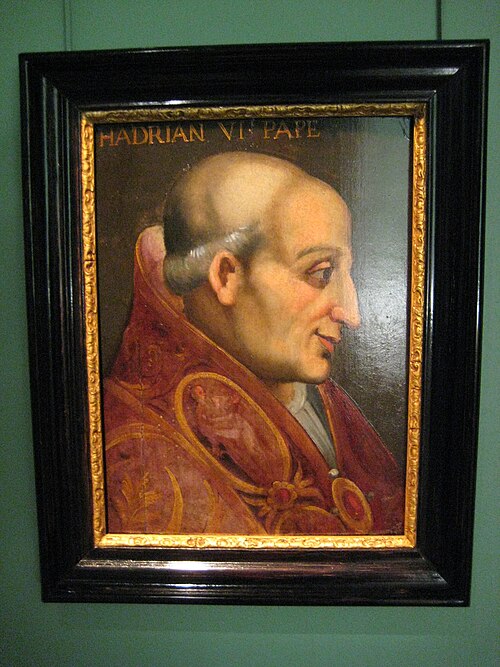
1522年、エラスムスの同胞で、かつての教師(1502年頃)であり、ルーヴァン大学時代の友人であったハドリアヌス6世が、スペインの摂政(および/または大異端審問官)を6年間務めた後、予期せず教皇となった[注 35]。エラスムスやルター同様、ハドリアヌスも共同生活兄弟会の影響を受けていた。彼はエラスムスをローマに誘おうとした。彼がローマ教皇庁の改革に期待したのは、多くのルター派の反対に遭うことだったが、トレント公会議でやり直されたものの、頓挫した(教皇庁が破産していたため)後、彼は1523年に亡くなった[105]。
ルターに対する民衆と国民の反応が勢いを増すにつれ、ドイツ農民戦争(1524-1525)、ドイツと低地諸国におけるアナバプテストの反乱、偶像破壊、ヨーロッパ全土における農民の過激化など、エラスムスが恐れ、ルターが関係を断った社会的混乱が現れ始めた。これらが改革の結果であるならば、エラスムスはそれに関与しなかったことに感謝した。しかし、彼は「悲劇」 (エラスムスがそう呼んだ) を引き起こしたとして、ますます激しく非難された。[注 36]
1523年、彼は、新たに導入された異端審問から釈放された、貧困で不名誉なアントワープ元ラテン語秘書コルネリウス・グラフェウスに経済的援助を行った。 [106] : 558 1525年、エラスムスの父がかつて経営していたウールデンの教会で奉仕していたエラスムスの元生徒ヤン・デ・バッカー(ピストリウス)は、ネーデルラントで異端者として処刑された最初の司祭となった。1529年、彼のフランス語の通訳で友人のルイ・ド・ベルカンは、ソルボンヌ大学の神学者から反ローマの異端者として非難され、パリで火刑に処された。
フライブルク(1529–1535)
1529年初頭、元補佐官のオコランパディウスが率いた突然の暴力的な偶像破壊暴動[注 37]で選出されたカトリックの評議員が解任された後、バーゼル市は宗教改革を正式に採用し、最終的に1529年4月1日にカトリックのミサを禁止しました。[108]
エラスムスは、アウグスティヌス・マリウス司教を含む他のバーゼルのカトリック司祭たちとともに、1529年4月13日にバーゼルを出発し[注 38]、かつての教え子であるオーストリア大公フェルディナンドの保護下に入るため、カトリックの大学都市フライブルク・イム・ブライスガウへ船で向かった。[14] : 210 エラスムスは、当時の虚弱な状態について、トーマス・モアにやや劇的に手紙を書いている。「彼らのような計画に賛成しているように見られるよりは、命を危険にさらす方がましだ。中庸に戻る望みはいくらかあった。」[109]

1530年初春、エラスムスは、おそらく炭疽病と思われる激痛を伴う感染症で3か月間寝たきりとなり、彼にしては珍しく、働けないほどの重症を負った。[110] : 411 彼は、アウクスブルク司教と教皇特使カンペッジョの両者から招待されたアウクスブルク議会への出席を辞退し、カンペッジョとメランヒトンに、神学以外の理由から、和解が当時可能かどうか疑問を呈した。カンペッジョに宛てた手紙には、「神が突然デウス・エクス・マキナのように現れ、人々の心を変えない限り、この大きな悲劇から抜け出す道は見出せない」とあり、 [110] : 331 後には「私を動揺させるのは、彼らの教え、特にルターの教えではなく、福音書という口実のもとに、あらゆる観点から私が嫌悪感を抱く一群の人々が出現するのを見ているという事実である」とある。[110] : 367
彼はホエールハウスの最上階に2年間住み、[111]その後、別の家賃紛争[注 39]の後、自分の家を購入して改装し、コルネリウス・グラフェウスの友人であるダミアン・デ・ゴイスなどの学者/助手を下宿人として受け入れました[112]。その中には迫害から逃れてきた者もいました。
衰弱が進むにもかかわらず[注 40]、 エラスムスは生産的な仕事を続けた。特に、新しい最高傑作、伝道の書の説教に関する手引書、死に備えるための小冊子の執筆に取り組んだ。5か月間彼の下宿人だったポルトガルの学者で外交官のダミアン・デ・ゴイス[106]は、スウェーデンのサーミ人とエチオピアの教会の窮状に関するロビー活動に取り組み、 [114] : 82 エラスムスの海外宣教への意識を高めるきっかけとなった。[注 41]
モアが首相を務めていた時期から辞任するまで(1529-1533年)、ほぼその日まで、モアとエラスムスの間で交わされた書簡は残っていない。エラスムスはトーマス・ボーリンの意外な後援のもと、政治に関係のない重要な著作をいくつか書いた。『詩篇22篇の三重解説』(1529年)、ルターに対抗するカテキズム『象徴的説明』(1533年)はフランクフルト・ブックフェアで3時間で完売した。『死への準備』(1534年)はエラスムスの作品の中で最も人気があり、最も利用された作品の1つである。[116] [注 42]
友人たちの運命

,_Bishop_of_Durham_(Auckland_Castle).jpg/500px-Cuthbert_Tunstall_(1474%E2%80%931559),_Bishop_of_Durham_(Auckland_Castle).jpg)
1530年代、エラスムスの保護者であった異端審問総長アロンソ・マンリケ・デ・ララが王室の寵愛を失い、自身の組織内でも神学者修道士たちに権力を奪われると、スペインのエラスムス信徒たちの生活はより危険なものとなった。1532年、エラスムスの友人で改宗者のフアン ・デ・ベルガラ(シスネロスのラテン語秘書で、コンプルトゥム多国語訳聖書の作成に携わり、エラスムスに対するストゥーニカの批判を出版した)がスペイン異端審問所に逮捕され、同じくエラスムスの通信員で、以前にイグナチオ・デ・ロヨラを異端審問所から救出していた人文主義者のトレド大司教アロンソ3世・フォンセカによって身代金を払って救出された。[117] : 80
カトリック教会の聖職者には世代交代があった。1530年、改革派のフランス人司教ギヨーム・ブリソネットが死去。1532年、長年の師であるイギリス人首座主教ウォーラムが老衰で死去。[注 43]改革派のヴィテルボのジル枢機卿とスイス人司教フーゴ・フォン・ホーエンランデンベルクも死去。1534年、信頼されていなかった守護者クレメンス7世(「気難しいクレメンス」[118] : 72 )が死去、イタリア人の同盟者カエターノ枢機卿(次期教皇と広く予想されていた)が死去、古くからの同盟者カンペッジョ枢機卿が引退した。
友人たちが次々と亡くなり(1533年に友人のピーテル・ギリス、1534年にウィリアム・ブラント、1536年初頭にキャサリン・オブ・アラゴン)、ルターや一部のルター派、有力なカトリック神学者らがエラスムスに対する個人攻撃を再開するにつれ、エラスムスの手紙は友人関係の状態や、健康にもかかわらず味気ないフライブルクからの移住を検討していた際の安全に関する懸念にますます焦点が当てられるようになった。[注 44]
1535年、エラスムスの友人であるトーマス・モア、ジョン・フィッシャー司教、ブリジット・リチャード・レイノルズ[注 45]は、ヘンリー8世によってローマ支持の裏切り者として処刑された。ヘンリー8世とは、エラスムスとモアが少年時代に初めて会った人物である。病気にもかかわらず、エラスムスはモア(とフィッシャー)の最初の伝記である短い匿名の『信仰の暴露』を書き、ゴイスの唆しでフロベンが出版した。[106]
エラスムスの時代以降、マーガレット・ポール、ウィリアム・ティンダル、ミカエル・セルベトゥスなど、エラスムスの翻訳者の多くが、英国国教会、カトリック教会、改革派の宗派主義者や独裁者の手で同様の運命をたどった。カール5世のラテン語秘書フアン・デ・バルデスなど、逃亡して自ら亡命した者もいる。
エラスムスの友人で協力者だったカスバート・タンストール司教は、エリザベス1世の治世中に至上権の誓いを拒否したために獄死した。エラスムスの文通相手で、パリとケンブリッジで10代の学生として知り合ったスティーブン・ガーディナー司教は[120] 、後にエドワード6世の治世中にプロテスタントを妨害したとしてロンドン塔に5年間投獄された。[注 46] ダミアン・デ・ゴイスは72歳でポルトガル異端審問にかけられ[106] 、ほぼ隔離された状態で拘留され、最終的に修道院に追放され、釈放後におそらく殺害された。 [ 122]彼の筆記者ギルバート・カズンは、教皇ピウス5世の個人的な命令で逮捕された直後、66歳で獄死した。[101]
バーゼルでの死

体力が衰え始めると、彼はついにネーデルラントの摂政であるハンガリーのマリー女王(彼のかつての教え子であるフェルディナント1世大公とカール5世皇帝の妹)の招きに応じ、フライブルクからブラバントへ移ることを決意した。1535年、彼は準備のためバーゼルのフロベン邸に戻り(オコランパディウスが亡くなり、宗教の私的な実践が可能になった)、衰弱が進む中、 『伝道の書』など最後の主要著作を出版した。
1536年7月12日、彼は赤痢の発作で亡くなった。[123]「当時最も有名な学者は、平和で繁栄し、高名で責任ある友人たちに囲まれて亡くなった。」[124]友人で伝記作家のベアトゥス・レナヌスが記録した彼の最後の言葉は、「主よ、それを終わらせてください」(ラテン語:domine fac finem、メランヒトンの最後の言葉と同じ)[125]、そして「親愛なる神よ」(オランダ語:Lieve God)だったようだ。[126]
彼はローマカトリックに忠実であり続けたが[127]、伝記作家たちは彼を内部者として扱うべきか外部者として扱うべきかで意見が分かれている。[注 47]彼はカトリック教会の葬儀の儀式を受けなかったか、受ける機会がなかった可能性がある。 [注 48]彼の死に関する当時の報告書には、彼がカトリックの司祭を頼んだかどうか、 [注 49]ひそかにまたは個人的にバーゼルに司祭がいたかどうかについては触れられていない。
彼は盛大な儀式のもとバーゼル大聖堂に埋葬された。驚くべきことにプロテスタントの市当局は彼の葬儀をエキュメニカルなカトリックのレクイエムミサとして行うことを許可した。[129]
彼は相続人または遺言執行者として、学生や困窮者に元金[注 50]を与えるようボニファティウス・アメルバッハに任命した。 [注 51]彼は遺言書を作成するよう(オーストリア大公フェルディナントから、また1530年に皇帝カール5世から)許可を受けており、財産を自分の修道会(シオン修道会)や国家に返還するのではなく、遺言書を作成するよう命じられていた。また、500冊近い蔵書のほとんどをポーランドの人文主義者ヤン・ラスキにずっと前に売却していた。[130] [131]最終的な受取人の一人は、ジュネーブからバーゼルに逃れ、後に聖書をラテン語とフランス語に翻訳し、カトリック、アナバプテスト、プロテスタントの各派に分かれた西方キリスト教の亀裂と分裂の修復に尽力した、貧困にあえぐプロテスタントの人文主義者セバスティアン・カステリオであった。[132]
考えと見解
ヨハン・ホイジンガなどの伝記作家は、エラスムスの信念の多くと彼の初期の伝記との関連を頻繁に指摘している。結婚生活と適切な結婚の尊重、聖職者結婚の支持、女性の結婚の見通しの改善への関心、配慮に欠ける規則、特に制度的な食事規則への反対、教育を参加者にとって魅力的なものにしたいという願望、古典言語への関心、貧困と精神的な絶望への恐怖、勉強や仕事ができるときに物乞いをする修道士への嫌悪、当局の直接的な管理下に入ることを望まないこと、世俗主義、権力者は被支配者の最善の利益のために行動する必要性、慈悲と平和の尊重、特に貪欲な君主間の不必要な戦争に対する怒り、死の意識などである。
考え方
カトリックの歴史家は、エラスムスは独特の思考様式を持っていたと示唆している。それは、広い認識力、機敏な判断力、そして「人間の繁栄に対する深く不変の献身」を伴う皮肉で不安をかき立てる思考様式である。[133] 「あらゆる分野において、彼の見方は本質的に牧歌的であった。」[14] :225
エラスムスは、一貫性や体系的な思想家というよりは、独創的な思想家と呼ばれてきた。[134]特に、特定の事柄から一般的な事柄にまで過度に踏み込むことを嫌った。しかし、牧会的[注 52]かつ修辞的な神学者として、聖書の解釈に形而上学的アプローチではなく文献学的、歴史的アプローチを採用し[136] [注 53] 、文字どおりの意味と比喩的な意味に興味を持っていたことから、非常に真剣に受け止められるべきである。[14] : 145 フランスの神学者ルイ・ブイエは、「エラスムスは、誤解があると疑われる箇所では、聖書解釈から何の教訓も得られない人物の一人である」とコメントした。[137]
ある神学者は「エラスムスは自分以外の誰も満足させようとはしなかった」と書いている。[138]彼は批判的であったり、極端なことを嘲笑しているときでも、穏健で思慮深く、建設的であると言われている。[139] [注 54]
表現方法
エラスムスは、特に手紙の中では、非常に皮肉な表現を多用することが多く[133] 、 [注 55]、 皮肉的に受け取るよりも文字通りに受け取る方が解釈が分かれやすい傾向がある。
- エラスムス自身も、ウルリヒ・フォン・フッテンが自分はルター派であると主張したことを非難し、フォン・フッテンがエラスムスの公開書簡の皮肉に十分気づいていないと述べた。[102] : 27
- 反対派の学者JWウィリアムズは、エラスムスがアモニウスに宛てた手紙「すべてのことにおいてあなた自身の利益を基準にしなさい」は、エラスムスに同情的な人々が主張するように、明らかに冗談だったという主張を否定している。[140]
- ロイヒリンの迫害に関するエラスムスの格言「ユダヤ人を憎むことがキリスト教徒であるならば、我々はここにいる皆、十分にキリスト教徒である」は、テオドール・ドゥンケルグリュン[141] :320 とハリー・S・メイ[142]によって文字通りそのような憎悪を容認するものと解釈されているが、別の見方では、それは皮肉で挑戦的なものであったということになる。
テレンス・J・マーティンは、「エラスムスのパターン」を特定し、読者が想定する「他者性」(トルコ人、ラップランド人、インド人、アメリカ人、[注 56]ユダヤ人、さらには女性や異端者)が「キリスト教文化の失敗を暴露し批判するための引き立て役となる」としている。 [144]
- 1518年にジョン・フィッシャーに宛てた手紙の中で、エラスムスはこう書いている。「君主たちの狡猾さとローマ教皇庁の厚かましさはこれ以上は続かない。一般民衆の状態は、大トルコ人の圧政に耐えられるほどにまで悪化するだろう。」[91] : 70
- エラスムスは『トルコ戦争』の中で、換喩的に「トルコ人を殺すべきであって、人間を殺すべきではない。[...]本当にトルコ人を首から引きずり下ろしたいのであれば、まずはもっと忌まわしいトルコ人という種族を心から追い出さなければならない。貪欲、野心、権力への渇望、自己満足、不信心、浪費、快楽への愛、欺瞞、怒り、憎しみ、嫉妬である。」と述べている。[注 57]
エラスムスの「豊かさ」の文学理論は、比喩や象徴的な人物の膨大な蓄積を、その現実性に対する現代的な否定や累積的な影響に対する懸念なしに活用することを美徳としている。
- エラスムスが「ユダヤ教」について書いたとき、彼はほとんどの場合(常にではないが)、ユダヤ人を指してはいなかった。[注 58]代わりに彼は、特に修道院生活を送っていた当時のカトリック教徒を指していた。彼らは、第二神殿時代のユダヤ教 との類推によって、内面の信心深さよりも外面の儀式主義を誤って推進していたのである。
平和主義
家庭から宗教、政治まで、あらゆる領域における平和、平和性、平和構築は、キリスト教生活と彼の神秘神学に関するエラスムスの著作の中心的な特徴であった。[146] 「私たちの宗教の要点は平和と一致である」 [注 60]イエスの降誕 の際、「天使たちは戦争の栄光や勝利の歌ではなく、平和の賛美歌を歌った。」[147]
彼(キリスト)は優しさで勝利した。彼は親切で勝利した。彼は真実そのもので勝利した。
— 真の神学の方法、4 [注 61] : 570
エラスムスは絶対的な平和主義者ではなかったが、政治的には平和主義、宗教的には平和主義を推進した。[148]平和主義に関する著名な著作には、 『コンコルディアについて』 、『トルコとの戦争について』 、 『キリスト教君主の教育』、『教会の調和の回復について』、『平和の嘆き』などがある。エラスムスの平和構築に関する教会論では、教会当局には宗教紛争を解決する神聖な使命があり、[注 62]教義の展開は最小限にすることが望ましいなど、可能な限り排他的でない方法で解決すべきであると主張した。
後者では、平和の女神は、キリスト教生活の核心であり、キリストを理解するための核心であるとして、平和を主張しています。
「わたしはあなたがたにわたしの平和を与える。わたしはあなたがたにわたしの平和を残す」(ヨハネ14:27)。イエスが人々に何を残したか、お分かりですか?馬、護衛、帝国、富、どれも残しません。それではどうなるのでしょう?イエスは平和を与え、平和を残します。友人との平和、敵との平和です。
— 平和の嘆き[149]
ある歴史家は彼を「16世紀の平和教育と平和文化の先駆者」と呼んだ。[注 63]
エラスムスの平和構築への重点は、中世の一般の精神性の典型的な関心を反映しており、歴史家ジョン・ボッシーは次のように述べている(イーモン・ダフィーの要約)。「中世キリスト教は、暴力的な世界における平和の創造と維持に根本的に関心を寄せていた。中世ヨーロッパにおける「キリスト教」は、イデオロギーでも制度でもなく、平和と相互愛という宗教的理想を常に目指していた信者のコミュニティを意味していた。」[150]
戦争
歴史家は「エラスムスの著作には、紛争への言及が赤い糸のように流れている」と書いている。[3] : 34 エラスムスは子供の頃に戦争を経験しており、特にキリスト教の王同士の戦争を懸念していた。兄弟同士であるべきであり、戦争を始めてはならない。これは彼の著書『キリスト教王子の教育』のテーマである。 彼の格言には「戦争はそれを味わったことのない者には甘い」(ピンダロスのギリシャ語から取ったDulce bellum inexpertis)などがある。[注 64]
彼は金布の戦場を推進し、そこに出席した。 [152]彼の広範囲にわたる書簡は、しばしば和平問題に関連していた。[注 65]彼は、仲裁[154]と調停[3]による和平において教会が重要な役割を果たすと考えていた。 また、暴君的な君主や司教を抑制するために教皇の職が必要であると考えていた。[30] : 195
彼は正戦理論の実際的有用性と濫用性[注 66]に疑問を呈し、さらにそれを国民の支持を得て実行可能な防衛行動に限定し、「最後の手段として避けられない場合を除いて、戦争は実行されるべきではない」と主張した。 [155]最後まで戦うよりも、敗北に耐えるべきである。彼の格言では、「不利な平和は正義の戦争よりもよい」と論じている(一般的な翻訳)。これは、キケロとジョン・コレットの「最も正当な戦争よりも、不当な平和のほうがよい」という言葉に由来している。拡張主義は正当化できない。[注 67]戦争に充てる税金は、貧困者への負担を最小限にすべきである。[92] : 20 彼は、しばしば抑圧の原因となる扇動行為を嫌悪した。
エラスムスは、教会の諸侯を含む、当時のヨーロッパの有力な諸侯の好戦的なやり方を非常に批判した。[注 68]彼はこれらの諸侯を腐敗し貪欲であると表現した。エラスムスはこれらの諸侯が「共謀してゲームを行い、その結果として国家を疲弊させ抑圧する」と信じていた。[88] : s1.7.4 彼はトマス・モア、ベアトゥス・レナヌス、アドリアヌス・バルランドゥスなどの友人に送った手紙の中で、この問題についてもっと自由に語っている。特に彼の批判の対象となったのは皇帝マクシミリアン1世で、エラスムスは彼がネーデルラントがゲルデン人との和平条約に署名するのを妨害したとされ[156]、また国民から金銭を引き出すために戦争を引き起こすその他の陰謀を企てたと非難した。[注 69]
彼のアプローチの一つは、強力な立場にありながら隣国と和平交渉を行った諸侯に、祝福と称賛の手紙を送り、出版することだった。例えば、1527年にポーランド王ジグムント1世に送った手紙などである。 [114] : 75
エラスムスは「常に一貫して」、オスマン帝国の勢力を打ち負かすことができるとされる、過度に拡大した帝国を持つキリスト教の「世界君主」という議論された考えに反対した。そのような世界君主主義は「既存の政治的多様性よりも紛争を少なくする見込みはない」。むしろ、世俗的および精神的両方の君主間の調和を主張した。[3] : 44, 45 精神的君主は、その仲裁と調停によって「政治的多様性を脅かすのではなく、その擁護者として行動する」。[3] : 50
キリスト教内部の宗教的寛容
彼は『自由意志について』の序文で、自分の非寛容な性質を、不寛容な主張よりも懐疑派の見解を好むような隠れた性質であると述べているが、彼はアディアフォラを、新約聖書で明白に議論の余地なく述べられているものや、教会の教えによって絶対的に義務付けられているものとは明確に区別している。 [ 157 ]協和派は団結と同意を要求した。エラスムスは非宗派的であると同時に反宗派的であった[注 70] 。 [158]愛の法則に従うためには、いかなる主張をするときも私たちの知性は謙虚で友好的でなければならない。彼は論争を「地上的、獣的、悪魔的」[159] : 739 と呼び、教師やその追随者を拒否する十分な理由である。メランヒトンの見解では、エラスムスは信仰ではなく慈愛を教えた。[125] : 10

エラスムスの著作の中には、宗教が私的意見を容認し、エキュメニズムを広める基盤となったものがある。例えば、マルティン・ルターの特定の見解に反対する『自由意志論』の中で、エラスムスは宗教論争者は言葉遣いを慎むべきだと指摘し、「そうすれば、論争が多すぎると失われがちな真実をより確実に認識できる」と述べている。ゲイリー・レマーは「キケロのように、エラスムスは対話者間のより調和のとれた関係によって真実が促進されると結論づけている」と書いている。[160]
ロレンツォ・カンペッジョ枢機卿に宛てた手紙の中で、エラスムスは寛容を外交的に訴えた。「もし宗派が(ボヘミア人が主張するように)一定の条件の下で容認されるならば、それは確かに悲惨な不幸ではあるが、戦争よりは耐えられるものであることは認める。」[要出典] しかし、(反ポピュリストの)宗派に加わりたくなる人々も、紛争や流血を避ける同じ献身を示すべきである。
「おそらく、邪悪な支配者も時には容認されるべきだろう。我々は、彼らがその地位を占めていると考える人々の記憶に敬意を払う義務がある。彼らの称号は我々に何らかの権利を与える。治療が病気よりも悪くなる可能性が本当にあるなら、我々は事態を正そうとすべきではない。」
— エラスムス、『アルキビアデスのシレーニ』(1517)
異端と扇動
エラスムスは、ルターとその支持者を異端の罪から守る初期の試みに関わっていた。エラスムスは『信仰の異端審問』を著し、ルター派(1523年)は正式には異端者ではないと述べた。彼は、大学や異端審問所で自らの見解を強制するために、一部の神学者が断食で異端を訴えようとする姿勢に反対した。
エラスムスにとって、処罰に値する異端とは、キリストに関連する重要な教義(すなわち冒涜)に対して、悪意、堕落、頑固さをもって、不和で、危険で、公然と扇動すること(つまり冒涜)を意味した。[注 71 ]ステュディテスの聖テオドロスと同様に、[162] エラスムスは、単に私的または平和的な異端、あるいは重要でない事項に関する異議を唱えたという理由での死刑に反対した。「病人を治すのは、殺すよりもよい」。[163]教会には信者を保護し、異端者を改宗または治癒する義務があり、彼はイエスの麦と毒麦のたとえ話を引用した。[14] : 200
エラスムスの平和主義には、戦争を引き起こす扇動行為に対する特別な嫌悪が含まれていた。
この(改革)運動の指導者たちの義務は、もし彼らの目標がキリストであるならば、悪徳だけでなく、あらゆる悪の兆候さえも避けること、そして、たとえ許されていても、まだ有益ではない慣習さえも注意深く避け、福音にとってほんのわずかな障害も与えないことであった。何よりも、彼らはあらゆる反乱に対して警戒すべきであった。
— マルティン・ブツァーへの手紙[164]
エラスムスは、流血と戦争を防ぐために、暴力的な扇動者に対する死刑を認めた。彼は、異端者であれ正統派であれ、公共の秩序に必要な危険をもたらす者を国家が処刑する権利があることを認めたが、アウグスティヌスは暴力的なドナティストの処刑にさえ反対していたと指摘した(例えば、ノエル・ベーダ神父に対して)。ヨハネス・トラップマンは、エラスムスがアナバプテストの弾圧を支持したのは、彼らが行政官の言うことを聞かなかったことと、ミュンスターの反乱の犯罪的暴力から生じたのであって、洗礼に対する彼らの異端的見解から生じたのではないと述べている。[161]国家権力に対するこれらの譲歩にもかかわらず、エラスムスは、宗教的迫害は依然として不適切(非効果的)であると異議を唱えられる可能性があることを示唆した。[165]
アウトサイダー
彼の政治的著作の大半はキリスト教世界内の平和についてであり、ほとんどヨーロッパに焦点が当てられていた。1516年にエラスムスは「キリスト教の君主は、非信者でない限り、誰も部外者とみなさないこと、そして彼らにさえ危害を加えてはならない」と書いた。これは部外者を攻撃しないこと、彼らの富を奪わないこと、彼らを政治的支配に服従させないこと、強制的な改宗をしないこと、そして彼らとの約束を守ることを意味している。[3] : 50, 51
トルコ人
最後の10年間、彼は当時西ヨーロッパを侵略していたオスマン帝国との戦争に関する政策論争に関わり、特に著書『トルコに対する戦争について』(1530年)では、ローマ教皇レオ10世がそれ以前の数十年間に新しい十字軍による攻勢を推奨していた「無謀で無謀な」[166]として論じた。 [注 72]エラスムスは、侵略するトルコは堕落したキリスト教世界に対する神の審判であるとするルターのレトリックを、ルターの宿命論を抜きにして再解釈した。エラスムスは、西側の指導者を王国を脅かす偽善者と非難しただけでなく、解決策を提案した。それは、オスマン帝国の脅威に対する侵略戦争の前に、ヨーロッパの分裂した指導者による反拡張主義の道徳改革を、必要な統一的な政治的ステップとして提案するもので、改革自体が誠実であれば、内戦と外国との戦争の両方を防ぐことができるかもしれない。[114]
エラスムスは当時と同様に[167]、ユダヤ教とイスラム教を別々の宗教ではなくキリスト教の異端(したがって正統派キリスト教の競争相手)とみなし、後者を包括的に「半キリスト教」と呼んでいた。 [注 73]
しかし、彼の著作における反ユダヤ主義や反イスラム主義の偏見の程度と性質については、学術的な意見が幅広く分かれている。歴史家のネイサン・ロンは、彼の著作はイスラム教に対する軽蔑と敵意を伴い、厳しく人種差別的な含意があると考えている。[169]
ユダヤ人

エラスムスは個人的には外国人嫌いではないと主張した。「私は、たとえユダヤ人であっても、それが楽しい仲間であり、キリストに対する冒涜的な言葉を吐かなければ、愛することができるような性格である」[注 74]。しかし、エラスムス研究家のシモン・マーキッシュ は、エラスムスが実際には(信仰深い)ユダヤ人に出会ったことはなかった可能性が高いと示唆している。[170] [注 75]
マルキッシュは、エラスムスの著作では反ユダヤ主義の非難は成り立たないと書いている。[171]エラスムスは(神学的には)反ユダヤ的であったが、後のカトリック信者となったマルティン・ルターのような激しい人種的反ユダヤ主義ではなかった。それはいかなる本の主題でもテーマでもなかった。
これに対してエラスムス研究者のネイサン・ロンは、エラスムスがヨハネス・クリュソストムスの全集を翻訳・出版したことでユダヤ人を軽蔑したと書いている。その全集には、ヨハネスの悪名高い説教『ユダヤ反対』(地元のシナゴーグでキリスト教徒を再改宗させようとする試みに反対して書かれたもの)が含まれており、この説教はキリスト教内の再ユダヤ化傾向を非難するだけでなく、ユダヤ人を集団的にキリストの殺害者として描写することで後のキリスト教反ユダヤ主義のパターンを設定した。またエラスムスのさまざまなコメントも軽蔑したと書いている。[172]
伝記作家のジェームズ・トレイシーは、ロイヒリン事件の際にエラスムスがヨハネス・プフェッファーコルンに対していつもとは違って辛辣なコメントをしたことに反ユダヤ主義的な側面があると指摘している。エラスムスはプフェッファーコルンが自分を個人的に攻撃したと感じていた。[注 76]
彼は、当時のキリスト教神学者としては珍しく、イエス、パウロ、そして初期の教会の知的環境にヘブライの影響だけではなくヘレニズムの影響が強く見られ、それを擁護した。「キリスト教会が旧約聖書をそれほど重視しなければよかったのに!」 [注 77] エラスムスの広範にわたる反儀式主義は、割礼、食物、特別な日に関する初期の教会の議論を、アンティオキアの初期のユダヤ教徒による文化的排外主義の表れとみなした。[注 78]
エラスムスはローマ人への手紙のパラフレーズの中で、パウロとして、終わりの時に「イスラエル人全員が救済され」、キリストを彼らの救世主として受け入れるが、「彼らの一部は今はそれから離れてしまっている」という「秘密」を表明した。[174]
ピコ・デラ・ミランドラからヨハネス・ロイヒリンまで、多くの人文主義者がユダヤ神秘主義に興味をそそられたが、エラスムスはそれを嫌うようになった。「私は彼らを、タルムード、カバラ、テトラグラマトン、光の門、言葉、言葉、言葉、すべてに一種の霧を撒き散らす、退屈な捏造に満ちた国民とみなしている。私はキリストをスコトゥスと混ぜ合わせた方が、彼らのくだらないものに混ぜ合わせるよりましだ。」[91] : 347
奴隷
奴隷制については、エラスムスは典型的に専制政治というテーマでそれを扱いました。キリスト教徒は、奴隷を所有する上で必要な専制君主になることは許されませんでしたが、特に他のキリスト教徒の主人になることは許されませんでした。[175]エラスムスは、奴隷制に対して、他にもさまざまな断片的な議論をしました。たとえば、不当な戦争で奴隷を捕らえることは正当ではないという議論ですが、それは彼の関心の対象ではありませんでした。しかし、彼の「自然はすべての人間を自由に創造した」(そして奴隷制が課された)という信念は、アリストテレスの自然奴隷のカテゴリーを否定するものでした。[143]
宗教改革
個人的な改革
エラスムスは改革計画の多くを、秘跡とその影響に対する適切な態度という観点から表現した。[176]特に、洗礼と結婚という過小評価されている秘跡(『キリスト教的結婚の制度について』を参照)は行事というよりも召命とみなされていた。[注 79]そして神秘的な聖体拝領、実用的な告解、危険な臨終の儀式( 『死の準備について』を執筆)[注 80]そして司牧的な聖職(『伝道の書』を参照)[178] 歴史家たちは、エラスムスが秘跡の観点から、聖書に没頭して素直に読むことの利点を賞賛していたと指摘している。[注 81]
聖礼典

宗教改革の試金石は秘跡の教義であり、この問題の核心は聖体の遵守であった。エラスムスは、バーゼルのオコランパディウス率いる秘跡主義者たちが、エラスムスが自分たちと似た見解を持っていると主張し、彼らの分裂的で「誤った」運動の指導者として彼を利用しようとしていることを懸念していた。1529年にバーゼルでミサが最終的に禁止されると、エラスムスは追放された他のカトリック聖職者と同様に、直ちにバーゼルを去った。
1530年、エラスムスは11世紀の異端者トゥールのベレンジャーに対抗するアルジェロスの正統論文の新版を出版した。エラスムスは献辞を加え、聖体拝領後のキリストの体の実在性(一般に聖体変化と呼ばれる)に対する自身の信念を肯定したが、エラスムスは聖体変化のスコラ哲学的定式化が言語の限界を超えていると感じた。[180]
概して、著者エラスムスがパンの変化よりも興味を持った奇跡的な本当の変化は、謙虚な参加者の変化でした。[181] : 211 エラスムスは、結婚と賢明な結婚、告解の準備と司牧的励ましの必要性、死の準備と恐怖を和らげる必要性、司教の下で司祭が説教する義務の訓練と支援、洗礼と信者が洗礼の誓いを受け入れる必要性について、儀式や形式よりも常に全体的に見て、秘跡に関するいくつかの注目すべき牧会書やパンフレットを執筆しました。
カトリック改革
制度改革

プロテスタントの宗教改革は、彼が画期的なラテン語とギリシャ語による新約聖書の版を出版した翌年(1516年)に始まった。後にプロテスタントが生まれた教会の改革的傾向と反動的な傾向の間の論争があまりにも明確になり、多くの知識人や聖職者が議論への参加を求められずにはいられなかった。
歴史家C・スコット・ディクソンによれば、エラスムスは教会の失敗を批判しただけでなく、教会の基本的な教えの多くに疑問を投げかけた。[注 82]しかし、伝記作家エリカ・ルメルによれば、「エラスムスは教義の革新や制度の変更よりも、濫用の是正を目指していた。」[注 83]
神学者ルイ・ブイエの解釈によれば、[137]エラスムスの課題は「新約聖書の文献学的研究に基づき、教父学の知識に支えられ、同じ方法で刷新された聖書神学の刷新によって教会を内部から改革することであった。その最終的な目的は[...]主に道徳的、精神的な改革を育むことであった[...]」[注 84]
文学的名声の絶頂期にあったエラスムスは、どちらかの側につくよう求められたが、公の場での党派心は彼の信念、性質、習慣とは無縁だった。西方教会内の聖職者の腐敗や権力濫用を批判していたにもかかわらず[注 85]、特に当初は、公にはルター派にも反ルター派にも明確に味方しなかった(ただし、個人的には両党派の過激主義に反対するロビー活動を熱心に行っていた)。しかし、最終的には、離脱したプロテスタント宗教改革運動とその最も過激な分派を避けた。[127]
「私は数え切れないほどの手紙、小冊子、個人的な声明の中で、どちらの党とも関わりたくないと常に宣言してきました。」
— エラスムス、スポンジア(1523)
世間は彼の風刺小説『愚行礼賛』を笑ったが、彼の活動に干渉するものはほとんどいなかった。彼は、これまでの自分の作品が最高の知性と宗教界の支配的な権力に認められていると信じていた。エラスムスは学者の言語であるラテン語(およびギリシャ語)で執筆することを選んだ。彼は無学な人々の間に大きな支持者を築くことはなかったが、彼の批評は少数だがエリート層に届いた。[184]
反友愛主義
エラスムスは自身の経験から、修道院生活や修道院制度はもはやかつてのような積極的な精神的、社会的目的を果たしていないと信じるようになった。[185] : 669 エンキリディオンで彼は「修道士であることは敬虔さではない」と物議を醸した。[注 86]当時は、修道院で暮らすよりも「世俗の修道士」として暮らす方がよかった。[注 87]
彼の著作の多くには、いわゆる修道院の腐敗や出世主義、特に托鉢修道士(フランシスコ会とドミニコ会)に対する激しい非難が含まれている。これらの修道会は大学のスコラ神学プログラムを運営することが多く、彼の最も危険な敵はそこから生まれた。一部の人々が彼を攻撃すればするほど、彼は彼らの政治的影響力と物質主義的日和見主義と見なすものに対して攻撃的になっていった。
悪霊アラストール:「彼らは、黒と白の祭服、灰色のコート、その他さまざまな服を着たある種の動物であり、常に王子たちの宮廷の周りを飛び回っており、[それぞれの側で]彼らの耳に戦争への愛を絶えず植え付け、貴族や一般の人々に戦争を勧め、説教で戦争は正義の、神聖な、宗教的な戦争であると熱心に説いている。[...]」
カロン: 「[...] 彼らはそれで何を得るのですか?」
アラストール: 「なぜなら、彼らは生きている者よりも死んだ者からより多くのものを得るからです。遺言状、葬儀の告別式、勅書、その他、何の利益もない多くの物品があります。そして最後に、彼らは独房で暮らすよりもむしろ野営地で暮らすことを好みます。戦争は平和な時代に何の役にも立たないと考えられていた多くの司教を生み出します。」
— エラスムス、「カロン」、対話集
彼は、フランシスコ会の修道服を着て埋葬されると天国に直行できるといった迷信に憤慨した。[注 88]犯罪[186]と子供の修練生。彼は、30歳になるまで聖職に就くことを禁止すること、腐敗した小規模な修道院を閉鎖すること、司教を尊重すること、物乞いではなく労働を要求すること (彼自身のアウグスティノ会修道士団の慣行を反映)、修道時間、断食、儀式の軽視、騙されやすい巡礼者や借家人への嘘つきの減少など、さまざまな改革を主張した。
しかし、彼は修道院の急速な閉鎖や、重要な図書館を備えた大規模な改革された修道院には賛成しなかった。ウォルシンガムへの巡礼の記録の中で、彼は巡礼者から集めた資金が典型的には貧困者や高齢者のための住宅の支援に使われたと記している。[187]
これらの考えは、カトリックとプロテスタント両方の同世代の人文主義者に広く影響を与えた。 [188] : 152 彼の半ば風刺的な『愚行の礼賛』におけるぞっとするような誇張表現は、後にプロテスタントによって、ほぼ普遍的な腐敗の客観的な報告として扱われた。さらに、「ワインを飲みながら語られることは、信仰の真剣な表明として記憶され、書き留められるべきではない」。たとえば、修道士全員を修道女全員と結婚させる、あるいは修道士全員をトルコと戦って新しい島々を植民地化するために送り出す、といった提案などである。[30]
彼は、キリスト教徒に必要な唯一の誓願は洗礼の誓願であるべきであり、福音伝道の誓願などの他の誓願は、意図と内容は称賛に値するものの、現在では主に逆効果であると信じていました。
しかし、エラスムスはすべての信者に対する福音の勧告を口先だけの賛辞ではなく頻繁に称賛した。例えば、彼の名声を確立したアダギアの最初の格言は「友人の間ではすべては共有である」であり、そこで彼は共同所有(彼の修道会の清貧スタイルによって実践されたような)を古典哲学者とキリストの教えと結び付けた。[189]
カトリック教徒の間でのエラスムスへの主な反対者は、托鉢修道会の学者たちだった。彼は「聖フランシスが最近夢の中で私のところに現れ、彼らを叱責したことに感謝した」と主張した。[190]彼の死後、托鉢修道会の学者たちはエラスムスを誇張し無知であると論じた。20世紀のベネディクト派の学者は彼を「帆ばかりで舵がない」と書いた。[104] : 357
エラスムスはまた、ジャン・ヴィトリエやシスネロス枢機卿などのフランシスコ会修道士や、説教修道会の元総長であるカジェターノ枢機卿などのドミニコ会修道士を含む、改革志向の修道士たちから多大な支援と接触を得ていました。
プロテスタント改革
初期の改革者たちは、エラスムスによる新約聖書の特定の節に関する文献学的分析に基づいて神学を構築した。懺悔よりも悔い改め(ルターの95ヶ条の論題の第一の根拠)、帰属による義認、恩寵よりも慈悲、信仰よりも信頼を希望すること、[191]改革よりも人間の変容、教会よりも会衆、秘跡よりも神秘、などである。エラスムスの見解では、彼らは行き過ぎ、教父の解釈などの聖伝を軽視し、無責任に流血を煽動した。
エラスムスは、教皇レオ10世の事業資金を調達するための免罪符の販売に憤慨した多くの人々の一人だった。1518年にジョン・コレットに宛てた手紙の中で彼が述べた見解は、神学というよりは政治的なものだった。「ローマ教皇庁は恥の意識を放棄した。こうした絶え間ない免罪符発行以上に恥知らずなことがあるだろうか?そして今、彼らはトルコとの戦争を口実にしているが、彼らの本当の目的はスペイン人をナポリから追い出すことである。」[91]
ルターとの意見の相違が増大

エラスムスとルターは互いに大きな影響を与えました。二人は最初からお互いに疑念を抱いていましたが (エラスムスはルターの無謀で敵対的な性格を、ルターはエラスムスの慈悲よりも道徳を重視する性格を)、人前では相手に対して否定的な発言をしないことを戦略的に合意しました。
教会の腐敗に対するルターの批判に注目して、エラスムスは教皇レオ10世にルターを「福音の真理を強く伝えるラッパ」と評し、「ルターが訴える改革の多くは(免罪符の販売など)緊急に必要であることは明らかだ」と同意した。[192]しかし、舞台裏ではエラスムスは出版者のフロベンにルターの著作を扱わせないように禁じ[95] : 64 、改革運動を神学の問題ではなく制度の問題に集中させようとしたが、ルターの迫害を防ぐために当局に個人的に手紙を書いた。ある歴史家の言葉を借りれば、「この初期の頃、エラスムスはルターの神学よりもルターの運命を心配していた」[193]
1520年、エラスムスは「ルターは答えられるべきであり、打ち負かされるべきではない」と書いた。[194]しかし、ルターの『教会のバビロン捕囚について』 (1520年10月)[195]の出版とその後の好戦的な行動により、エラスムスや多くのヒューマニストの同情心は失われ、キリスト教徒がパルチザンとなり、パルチザンが暴力に訴えるようになったことで、さらに衰退した。
ルターは、エラスムス自身の自然な成果にしか思えない仕事に協力してくれることを期待し[注 89]、エラスムスの優れた学識を称賛した。初期の手紙の中で、ルターはエラスムスが健全で合理的なキリスト教のために行ったすべてのことに限りない称賛を表明し、彼にルター派に加わるよう勧めた。エラスムスは、いつもの「小さな標的」の言い訳をし、そうすることで彼が人生の目的の 1 つとみなしていたbonae litterae [注 90] [197]の大義が危険にさらされるとして、参加を断っ た。独立した学者としてのみ、宗教改革に影響を与えることができると期待できた。エラスムスが彼の支援を断ったとき、「率直な」ルターは、エラスムスが臆病か目的の欠如のどちらかで責任を回避していることに腹を立てた。
しかし、エラスムスが躊躇したのは、勇気や信念の欠如からではなく、改革運動の混乱と暴力が増大することへの懸念からだったのかもしれない。 1524年に彼はフィリップ・メランヒトンに次のように書いている。
私はあなたの教会について何も知りません。少なくとも、教会には、全体のシステムをひっくり返し、権力者たちに善人も悪人も同じように抑制するために力を使うよう駆り立てる人々がいるのではないかと私は恐れています。福音、神の言葉、信仰、キリスト、聖霊、これらの言葉は常に彼らの口にあります。彼らの生活を見れば、彼らはまったく別の言語を話しています。[198]
カトリック神学者ジョージ・シャントレーンは、ルターがルカ11:21「私に味方しない者は、私に敵対する者である」を引用しているのに対し、エラスムスはマルコ9:40「我々に敵対しない者は、我々の味方である」を引用していると指摘している[199] :86
彼は教義上の論争では融通を利かせようとしたが、どちらの側も彼が他方の側に立っていると非難した。おそらくそれは彼の影響力と、彼らが彼の偽りの中立とみなしたもの[注 91]のためだったのだろう。 彼はそれを和平交渉の妥協とみなしていた。
私は、キリストの教えと自然の隠れた傾向の両方に反する不和を嫌悪します。この論争のどちらの側も、重大な損失なしに鎮圧できるとは思えません。
— 「自由意志について」[192]
自由意志に関する論争
1523年までに、ヘンリー8世からの手紙で初めて示唆されたエラスムスは、ルターの必然性と自由意志に関する考えは、公に発表するに値する根本的な意見の相違であると確信し、友人や通信員[200]と、特に人文主義改革の議題にとって、全員にとって状況を悪化させることなく、適切な節度をもって対応する方法について戦略を立てました[201] 。彼は最終的に、非宗教的な「対話」である「信仰の異端審問」、肯定的で福音主義的なモデル説教「神の限りない慈悲について」、そして穏やかに批判的な「非難」である「自由意志について」を含むキャンペーンを選択しました。
彼の短い著書『自由意志について』の出版は、今日でも影響を与えている「その時代最大の論争」[202]と呼ばれる論争を引き起こした。 [203]彼らは、一般的には両者が同意していた改革についての議論を避け、代わりに、救済に関する 共同主義と単独主義の権威と聖書的正当性を扱った。
ルターは『意志の束縛について』(1525年) でこれに応えた。
エラスムスは、ルターが無視した、長大な 2 巻の『ヒュペルスピステス』とその他の著作の中でこれに答えました。改革者たちの信奉者たちの道徳的欠陥はエラスムスにとって重要な兆候でしたが、彼はまた、教会が革新に対する防壁として長年築いてきた歴史を挙げ、教義のいかなる変化も恐れていました。彼はルターに率直にこう言いました。
私たちが取り組んでいるのは、次のような問題です。堅固な精神を持つ人は、聖性と奇跡で有名な多くの人々によって伝えられた意見から離れ、教会の決定から離れ、あなたのような少数の追随者とともに今現れたような人の信仰に私たちの魂を委ねるでしょうか。あなたの群れの指導者たちはあなたにも、彼らの間でも同意していません。実際、あなた自身も自分自身に同意していません。なぜなら、この同じ主張[204]の中で、あなたは最初は一つのことを言っていて、後で別のことを言って、以前に言ったことを撤回しているからです。
— ヒュペルスピステス1世[205]
ルターへの叱責を続けながら、そして間違いなく「ヴィッテンベルク以外には聖書の純粋な解釈はない」[206]という考えにうんざりしながら、エラスムスは論争のもう一つの重要な点に触れている。
あなたは、私たちが聖書以外のものを求めたり受け入れたりしてはならないと規定していますが、他のすべてを放棄して、あなたが聖書の唯一の解釈者となることを私たちが認めることを要求するようなやり方でそれを行っています。したがって、私たちがあなたを聖書の管理者ではなく主人として認めれば、勝利はあなたのものとなるでしょう。
— ヒュペルスピステス、第1巻[207]
「偽福音主義者」
1529年、エラスムスは、ゲラルドゥス・ゲルデンハウワー(元ユトレヒト司教、デーフェンターでも学んだ) に宛てて「福音主義者であると偽って自慢する人々に対する手紙」を書いた。
あなた方は、司祭の贅沢、司教の野心、ローマ教皇の暴政、詭弁家のたわ言、そして私たちの祈り、断食、ミサを激しく非難し、これらのものの中にあるかもしれない悪弊を撤廃するだけでは満足せず、それらを完全に廃止しなければならないのです。... [208]
ここでエラスムスは、スコラ哲学の公開討論に対して行ったのと同じ批判を適用して、改革者たちの教義と道徳について不満を述べています。
この「福音主義」世代を見回し、[209]彼らの中に、あなたがたが忌み嫌う人々よりも贅沢や欲望や貪欲に耽溺する人が少ないかどうか観察してください。その福音によって、酩酊から節制に、激怒と激情から柔和に、貪欲から気前の良さに、ののしりから美談に、放縦から慎み深さに改心した人を一人でも見せてください。それに従うことでより悪くなった人が大勢いることをお見せしましょう。[...] 教会の厳粛な祈りは廃止されましたが、今ではまったく祈らない人が非常に多くいます。[...]
私は彼らの集会所に入ったことはありませんが、説教から戻ってくる彼らの顔には、まるで悪霊に動かされているかのように、怒りと驚くべき凶暴さが表れていました。 [...]
彼らの集会で涙を流したり、胸を打ったり、罪を嘆いたりするのを見た者がいただろうか。[...] 司祭への告解は廃止されたが、今では神に告解する者はほとんどいない。[...] 彼らはエピクロス主義者になるためにユダヤ教から逃げてきた。— Epistola contra quosdam qui se false Iactant evangelicos。[210]
他の
歴史家クリストファー・オッカーによれば、初期の改革者たちは「神学上の区別をテキスト神学の常識として提示するツールを必要としていた。[...]エラスムスはそのツールを提供した」が、この偏った区別は、エラスムスの目にはスコラ哲学の最近の行き過ぎを彷彿とさせ、「エラスムスがルターやプロテスタントの論争家に対して嫌悪感を抱いていたのはまさにそれだった」という。[211]
エラスムスは他の改革者たちの教えや影響、脅威の側面に反対する本を書いた。[212]
- ウルリッヒ・フォン・ハッテン Spongia adversus aspergines Hutteni (1523) 下記参照
- マルティン・ ブーサー 自己複製に関する書面による謝罪に対する不正な応答(1530)
- ハインリヒ・エッペンドルフアドモニティオ・アドバーサス・メンダシウムとオブストラクテーション(1530)
しかし、エラスムスは他のプロテスタント、特に平和主義者のメランヒトンやアルブレヒト・デューラーと友好的な関係を維持した。
敵対的な修道神学者によって始められたとされる一般的な非難[注 92]は、マルティン・ルターと宗教改革の責任をエラスムスに負わせた。「エラスムスは卵を産み、ルターはそれを孵化させた」。エラスムスは機知に富んだ非難を退け、ルターは「全く別の鳥を孵化させた」と主張した。[213]エラスムスの読者であるピーター・カニシウスは「確かにルターが孵化させる卵が不足することはなかった」とコメントした。[214] [注 93]
哲学とエラスムス

エラスムスは哲学史上、問題のある人物として位置づけられている。そもそも彼を哲学者と呼ぶべきかどうかという問題である。 [注 94] (実際、彼を神学者と呼ぶべきかどうか疑問視する人もいる。 [14] : 205 ) エラスムスは、哲学者というよりは修辞学者や文法学者であると自ら考えていた。 [215] : 66 彼は特に風刺作家で修辞学者のルシアンの影響を受けた。[注 95] エラスムスの著作は、「知的文化を物事についての論理的議論から、テキスト、文脈、および単語についての論争へと」移行させた。[216]
クラシック
エラスムスは、キリスト教のテーマについての議論を提供するために、多くの古典哲学者の言い回しや考え、モチーフを融合させた。[注 96]学者たちは、彼の思想のさまざまな側面を、プラトン主義(二元性)、[注 97] シニカル(禁欲主義)、[218] [219] ストア派(アディアフォラ)、[220] エピクロス主義(アタラクシア、[注 98] 快楽を美徳とする)、[221]現実主義/非意志主義、[222] アイソクラテス主義(修辞学、政治教育、融合主義)[223]と特定している。19 しかし、彼のキリスト教化されたエピクロス主義は、彼自身のものと見なされている。[224]
エラスムスは、ある種の認識論(デカルト的ではなくキケロ的[225])[226]に共感していた:50 懐疑主義:[注99]
懐疑主義者とは、何が真実で何が偽であるかを気にしない人ではありません。むしろ、最終的な決断を簡単に下したり、自分の意見のために死ぬまで戦ったりせず、むしろ誰かが確実だと受け入れているものを、可能性として受け入れる人です。私は、聖書に記されていることや、教会の権威によって私たちに伝えられてきたことはすべて、懐疑主義から明確に除外します。
— エラスムス[228]
歴史家カーク・エッサリーは、エラスムスは初期から後期の著作まで「ストア派の強硬な立場と無感動主義の擁護を特に非キリスト教的であると定期的に非難していた」と指摘している。「温かい愛情と適度に燃える心は人間の誠実さの不可欠な部分である」。[229] : 17 しかし、歴史家ロス・ディーリーは、エラスムスが他の穏やかでない「倒錯した愛情」を非難したことはストア派に由来すると見ている。[220]
エラスムスは、人間の本質は三つに分かれており、魂が自由意志の座であるとして次のように書いています。
肉体は純粋に物質的であり、精神は純粋に神性であり、魂は…肉体の誘惑に抵抗するか、それとも屈するかによって、両者の間を行ったり来たりします。精神は私たちを神にし、肉体は私たちを獣にし、魂は私たちを人間にします。
— エラスムス[230]
神学者ジョージ・ファン・クーテンによれば、エラスムスは「プラトンの『饗宴』とヨハネの福音書の類似点に気づいた最初の近代学者」であり、最初は『エンキリディオン』で、次に『アダーギア』で、他の学問的関心よりも400年も先行していた。[231] [232]
反スコラ主義
,_RP-P-OB-7416.jpg/500px-thumbnail.jpg)
エラスムスは、その虚弱な身体に形而上学的な骨を持たず、スコラ神学の哲学的関心に対して本当の感情を抱いていなかった。
— ルイス・W・スピッツ[233] : 70
彼は通常、アリストテレスに見られるような形而上学的、認識論的、論理的哲学を避けていた。[注 100]特に、アクィナス以降のスコラ学者(スコラ学派)のカリキュラムと体系的な方法[注 101] と、彼が冷淡で非生産的だとみなしたアリストテレス主義[注 102]を避けていた。「アリストテレスとキリストとに何の関係があるのか?」[236] [注 103]
「彼らは、聖書のどんなテキストも、蝋の鼻のように扱い、自分たちの興味に最も合った形に練り上げることができる。」
— 愚行の賛美[237] : 75
エラスムスは、学者は「全世界をキリスト教化する」ために、キリスト教の調和に対する違反として哲学的派閥主義を避けなければならないと主張した。[238] : 851 実際、エラスムスは、スコラ哲学は、適度に使用されない限り、参加者を実際の道徳に集中することから実際にそらすと考えていた。[注 104] [注 105] [注 106]そして、「プラトン主義者を注釈から排除することで、彼らは啓示の美しさを窒息させている。」[注 107]「彼らはアリストテレスで膨らませたおしゃべり屋であり、大量の理論的定義、結論、命題を詰め込んだソーセージである。」[240]
フィロソフィア・クリスティ
(同時代のイタリア人クリソストム・ヤヴェッリの『クリスティアナ哲学』と混同しないように。)
エラスムスは、古典哲学者に神学的、修辞学的にアプローチした。彼らの価値は、キリストのユニークな教え(特に山上の垂訓[14] : 117 )をいかに予見し、説明し、 あるいは拡大したかにあった。つまり、キリスト哲学である。[注 108] [注 109] 「キリストの教えの大部分は、ソクラテス、ディオゲネス、エピクテトスなどの哲学者の教えの中に見出すことができる。しかし、キリストはそれをはるかに完全に教え、それをよりよく例示した…」(パラクレシス)実際、キリストは「哲学の父」であった(アンチ・バルビエリ)[注 110]
エラスムスは『エンキリディオン』『キリスト教君主の教育』『対話』などの著作の中で、精神的・倫理的・社会的・政治的・法的哲学として捉えられたイエスの教えに従って生きる人生という哲学( philosophia Christi)の考えを展開した。 [241 ]
天の教師であるキリストは、地上に新しい民を創られました。…この民は偽りのない目を持ち、悪意や嫉妬を知りません。自由に去勢し、肉体にいながら天使のような生活を目指しているので、不道徳な欲望を知りません。耐えられない悪はなく、善に向かわない悪もないので、離婚を知りません。誰も疑ったり騙したりしないので、誓いを立てません。彼らの宝は天にあるので、金銭欲を知りません。また、すべてのものをキリストの栄光に帰するので、空虚な栄光を渇望しません。…これらは、どの哲学の流派もこれまでに生み出したことのない、私たちの創始者の新しい教えです。
— エラスムス『真の神学の方法』
哲学者エティエンヌ・ジルソンは次のように要約している。「彼が追求する極めて明確な目標は、キリスト教の外部にあるギリシャ哲学を拒否することである。中世はキリスト教の知恵を腐敗させる危険を冒してギリシャ哲学をキリスト教に持ち込んだ。」[243]
有用な「哲学」は、実践的かつ道徳的なものに限定される(または、そのように再定義される)必要がありました。
「『哲学者』とは、弁証法や科学に精通している人ではなく、幻想的な外見を拒否し、恐れることなく真実と善を探し求め、それに従う人を意味することを理解しなければなりません。哲学者であることは、実際にはキリスト教徒であることと同じです。用語が異なるだけです。」
— エラスムス『アンチ・バルビエリ』
エラスムスの神学
エラスムスが提唱した霊性の3つの重要な特徴は、順応性、沈黙、そしてキリストのスコープである。[注 112]
文学史家チェスター・チャピンの見解では、エラスムスの思想傾向は「伝統的な[カトリック]見解を慎重に甘やかす方向」にあった。 [注 113]
宿泊施設
歴史家マンフレート・ホフマンは、適応を「エラスムスの解釈学における最も重要な概念」と表現した。[注 114]
エラスムスにとって、適応は普遍的な概念です。つまり、人間は互いに適応しなければならず、教会に適応しなければならず、またその逆もまた然りであり、キリストが弟子たちとの交流においてどのように適応し、受肉においてどのように人間に適応したかをモデルにしなければなりません。これは、三位一体における永遠の相互適応を反映しているに過ぎません。そして、適応の主なメカニズムは言語であり、[注 115] : 6 言語は現実と抽象を仲介し、あらゆる種類の論争を解決し、福音を伝えることを可能にする: [246]エラスムスは新約聖書の中で、ヨハネ 1:1のギリシャ語の「初めに言葉があった」を「初めに言葉があった」と訳したことで有名である: [247]ラテン語のsermo (談話、会話、言語)をverbum (言葉) ではなく使用して、静的な原理ではなく動的で対人的なコミュニケーションを強調している: 「神の雄弁な演説として受肉したキリスト」: [168]「彼は言葉 [sermo] と呼ばれています。なぜなら、その本質においていかなる推論によっても理解できない神が、彼を通して私たちに知られることを望んだからです。」[226] : 45
順応の模範[注116]はパウロ[注117]であり、 「カメレオン」[249] : 385 (または「滑りやすいイカ」[250] )であり、キリストは「プロテウス自身よりも変化しやすい」 [249] : 386 であった。
エラスムスは、パウロ、クィンティリアヌス(アプテ・ディエチェレ)、グレゴリウス1世の『牧会』に倣い、弁論家、説教者、教師は「聴衆の特徴に合わせて話を適応させる」必要があると書き、牧会を「芸術の中の芸術」とした。[248] : 64 エラスムスは、風刺からパラフレーズまで、彼のオリジナル作品のほとんどは、本質的に同じテーマを異なる聴衆向けにパッケージ化したものだと書いた。
この観点からすると、エラスムスがトーマス・モアやトーマス・ボーリン[116]、フィリップ・メランヒトンや教皇ハドリアヌス6世の両者と友好的な文通を交わすことができたのは、彼の神学の成果であり、あいまいな不誠実さ[注55]や潜在的なパトロンへのおべっかではなく、また、彼の平和主義の神学的根拠と、彼自身のような司祭から教会会議に至るまでの教会の権威を、平和を仲介する必要な存在と見なしていたことを示している。
休眠
エラスムスにとって、キリストは受肉において人間に適応するだけでなく、ある種の隠蔽によって人間に適応しました。[注 118]私たちは今や復活を知っていますが、キリストは福音書によって明らかにされており、実際にキリストの話を聞いた人々よりも、読むことによってキリストをよりよく知ることができます。[注 119] [注 120]これにより、私たちは変わるかもしれません。[注 121]
福音書は事実上、聖礼典のようなものであり、[252] [注 122]、エラスムスにとって福音書を読むことは祈りの一種となり[注 81]、一文を孤立させて三段論法として使うことでその祈りが台無しになる。[注 123]その代わりに、新約聖書の文脈、ジャンル、文学的表現を理解することを学ぶことは、学問的訓練というよりも精神的な訓練となる。[246]エラスムスのそれは修辞神学 ( theologia rhetorica )と呼ばれてきた。 [182] : 32 [注 124]
スコプス・クリスティ
スコーパスは、トピックの統一的な参照点、ナビゲーションの目標、または組織化の原則です。[注 125]助手から敵になったオコランパディウスによると、エラスムスのルールは「nihil in sacris literis praeter Christum quaerendum」(「聖書にはキリスト以外に何も求めてはならない」)でした。[256] : 269
ホフマンの言葉によれば、エラスムスにとって「キリストは万物のスコープである」。「人間と神という現実の両次元が交差する焦点である」。したがってキリスト自身が聖書の解釈原理である。「中間は媒介であり、媒介は仲介者であり、仲介者は調停者である」。[246] : 9 エラスムスの初期のエンキリディオン[注 126] : 82 では、彼はこのスコープを、存在が神に上昇するという中世の典型的な用語で表現していたが(垂直)、1510 年代半ばからは、中心であるキリストの周りを回るコペルニクスの惑星のアナロジー(水平)や目的地に向かうコロンブスの航海へと移行した。[14] : 135
エラスムスがキリストの神性に関する議論に貢献したのは、形而上学的思索を控えるよう助言し、永遠の神の言葉の啓示的な広さを強調し、受肉したキリストを神の雄弁な演説として考えるよう勧めたことです。しかし、エラスムスのキリスト論の中心的動機は、人間の存在におけるキリストの完全な受肉を肯定することであり、人間の経験の闘争から神を隔離する教義的な行為を可能な限り避け、人間の生活を変えるキリストの救済能力を強調することです。それとともに、エラスムスのキリストに関する考察の倫理的頂点は、キリストの他者への愛を模倣し、個人的および社会的生活における平和の大義を推進する責任に集中しています。
— テレンス・J・マーティン『エラスムスのキリスト論』[168](出版社の説明[6])
その影響の一つは、聖書の解釈は福音書にあるイエスの教えと対話から始めなければならないということである。[257] : 78 山上の垂訓を出発点として[注 127] [159]、そしておそらく八福と主の祈りを先頭に据えて行われなければならない。[要出典]これにより、平和の実現、慈悲、柔和さ、[注 128]心の純粋さ、正義への渇望、精神の清貧などが、キリスト教と敬虔さと真の神学の揺るぎない核心として重視される。[注 129]
山上の垂訓は、あらゆる正当な神学が構築されるべき公理、神学的な言説を統制する倫理、そして神学的な成果を検証するための規則を提供している。エラスムスの『キリストの哲学』は、最初の福音書におけるイエスの第一かつ最初の教えを神学的な方法論として扱っている。[注 130]
たとえば、「平和構築」は、キリスト教神学のあらゆる分野で取り上げられる可能性のあるテーマであるが、エラスムスにとって、至福の教えから、教会の権威、三位一体など、他のすべての神学的概念を議論する際の出発点、参照点、終着点となるはずである。さらに、キリスト教神学は、平和構築の目的のためにのみ、平和構築の形で行われなければならない。したがって、分裂や戦争を促進する神学は、反キリスト教的である。[注 131]
神秘神学
エラスムスにとってもう一つの重要な概念は「十字架の愚行」[14] : 119 で あった(これは『愚行の礼賛』で探求された)。[注 132]真理は、スコラ哲学の複雑な弁証法的、三段論法的な哲学的議論があまりにも頻繁に生み出す冷淡な世界ではなく、愚かで、奇妙で、予想外で、表面的にさえ私たちにとって不快な、熱狂的で、 おそらくは恍惚とした世界に属するという見解。 [注 133]これにより、エラスムスは超合理性にまったく無関心になり、[注 134]言葉、修辞、神秘、牧歌、個人的/政治的な道徳的関心を重視するようになった。
神学書
何人かの学者は、エラスムスは学問的な神学者ではなく伝道者として書いたと示唆している。[注 135]「神学は人をキリストに改宗させる変容的な言葉であるべきだった」[226] : 49 エラスムスはキリスト教を根本的に知的なシステムとは考えていなかった。
しかし、これらの古代の教父たちは、ユダヤ人と異教徒の両方を論破した人々でした [...]。彼らは(私が言うには)彼らを論破しましたが、言葉や三段論法ではなく、彼らの生活と奇跡によって論破しました。そして、彼らがこのようにして布教した人々は、まったく正直で善意のある人々であり、どんな人工的な推論の虚飾よりも平易な感覚を理解する人々でした [...]
— エラスムス『愚行の礼賛』[263]
歴史家ウィリアム・マクカイグは「私は、根本的に福音主義文学ではない主題に関する彼の著作を読んだことがない」とコメントした。[262]
We may distinguish four different lines of work, parallel with each other, and complementary. First, the establishing and critical elucidation of the biblical texts; alongside it, the editions of the great patristic commentators; then, the exegetical works properly so called, in which these two fundamental researches yield their fruit; and finally, the methodological works, which in their first state constitute a sort of preface to the various other studies, but which—in return—were nourished and enlarged by them as they went along.
— Louis Bouyer[137]: 498
Apart from these programmatic works, Erasmus also produce a number of prayers, sermons, essays, masses and poems for specific benefactors and occasions, often on topics where Erasmus and his benefactor agreed. His thought was particularly influenced by Origen.[note 136]
He often set himself the challenge of formulating positive, moderate, non-superstitious versions of contemporary Catholic practices that might be more acceptable both to scandalized Catholics and Protestants of good will: the better attitudes to the sacraments, saints, Mary, indulgences, statues, scriptural ignorance and fanciful Biblical interpretation, prayer, dietary fasts, external ceremonialism, authority, vows, docility, submission to Rome, etc. For example, in his Paean in Honour of the Virgin Mary (1503) Erasmus elaborated his theme that the Incarnation had been hinted far and wide, which could impact the theology of the fate of the remote unbaptized and grace, and the place of classical philosophy:[265]
"You are assuredly the Woman of renown: both heaven and earth and the succession of all the ages uniquely join to celebrate your praise in a musical concord. [...]
During the centuries of the previous age the oracles of the gentiles spoke of you in obscure riddles. Egyptian prophecies, Apollo’s tripod, the Sibylline books, gave hints of you. The mouths of learned poets predicted your coming in oracles they did not understand. [...]
Both the Old and the New Testament, like two cherubim with wings joined and unanimous voices, repeatedly sing your praise. [...]
Thus indeed have writers religiously vied to proclaim you, on the one hand inspired prophets, on the other eloquent Doctors of the church, both filled with the same spirit, as the former foretold your coming in joyful oracles before your birth and the latter heaped prayerful praise on you when you appeared."
— Erasmus, Paean in Honour of the Virgin Mary (1503)[265]
Works
Erasmus was the most popular, most printed and arguably most influential author of the early sixteenth century, read in all nations in the West and frequently translated. By the 1530s, his writings accounted for 10-20% of book sales in Europe.[266] "Undoubtedly he was the most read author of his age."[267]: 608 His vast number of Latin and Greek publications included translations, paraphrases, letters, textbooks, plays for schoolboys, commentary, poems, liturgies, satires, sermons, and prayers. A large number of his later works were defences of his earlier work from attacks by Catholic and Protestant theological and literary opponents.
The Catalogue of the Works of Erasmus (2023)[268] runs to 444 entries (120 pages), almost all from the latter half of his life. He usually wrote books in particular classical literary genres with their different rhetorical conventions: complaint, diatribe, dialogue, encomium, epistle, commentary, liturgy, sermon, etc. His letter to Ulrich von Hutten on Thomas More's household has been called "the first real biography in the real modern sense."[269]
From his youth, Erasmus had been a voracious writer. Erasmus wrote or answered up to 40 letters per day,[30] usually waking early in the morning and writing them in his own hand. He did not work after dinner. His writing method (recommended in De copia and De ratione studii)[270] was to make notes on whatever he was reading, categorized by theme: he carted these commonplaces in boxes that accompanied him. When assembling a new book, he would go through the topics and cross out commonplace notes as he used them. This catalog of research notes allowed him to rapidly create books, though woven from the same topics. Towards the end of his life, as he lost dexterity, he employed secretaries or amanuenses who performed the assembly or transcription, re-wrote his writing, and in his last decade, recorded his dictation; letters were usually in his own hand, unless formal. For much of his career he wrote standing at a desk, as shown in Dürer's portrait.
Notable writings
Erasmus wrote for educated audiences both
- on subjects of humanist interest:[271] "Three areas preoccupied Erasmus as a writer: language arts, education, and biblical studies. [...]All of his works served as models of style. [...]He pioneered the principles of textual criticism."[272] and
- on pastoral subjects: "to Christians in the various stages of lives:[...]for the young, for married couples, for widows," the dying, clergy, theologians, religious, princes, partakers of sacraments, etc.[248]: 58
He is noted for his extensive scholarly editions of the New Testament in Latin and Greek, and the complete works of numerous Church Fathers. These formed the basis of the so-called Textus Receptus Protestant bibles.
The only works with enduring popularity in modern time are his satires and semi-satires: The Praise of Folly, Julius Excluded from Heaven and The Complaint of Peace. However, his other works, such as his several thousand letters, continue to be a vital source of information to historians of numerous disciplines.
Legacy and evaluations

Since the origin of Christianity there have been perhaps only two other men—St Augustine and Voltaire—whose influence can be paralleled with Erasmus.
— W.S. Lily, Renaissance Types[273]
Erasmus was given the sobriquet "Prince of the Humanists", and has been called "the crowning glory of the Christian humanists".[274] He has also been called "the most illustrious rhetorician and educationalist of the Renaissance".[230]
By the 1570s, "Everyone had assimilated Erasmus to one extent or another."
— Christophe Ocker[211]
However, at times he has been viciously criticized, his works suppressed, his expertise corralled, his writings misinterpreted, his thought demonized, and his legacy marginalized. He was never judged and declared a heretic by the Catholic Church, during his lifetime or after: a semi-secret trial in Vallodolid Spain, in 1527 found him not to be a heretic, and he was sponsored and protected by Popes and Bishops.
Personal
Health
Erasmus was a quite sickly man and frequently worked from his sickbed. As a teenager he contracted Quartan fever, a non-lethal type of Malaria which recurred numerous times for the rest of his life: he attributed his survival to the intercession of St Genevieve.[275] His digestion gave him trouble: he was intolerant of fish, beer and some wines, which were the standard diet for members of religious orders; he eventually died following an attack of dysentery.
In Cambridge he was ill, possibly with the English sweating sickness. He suffered kidney stones from his time in Venice and, in late life, with gout[276] In 1514, he suffered a fall from his horse and injured his back.
In 1528 he suffered recurrent episodes of the stone, "from which he almost died."[277] In 1529 his self-removal from Basel was delayed because of headcold and fever.[278] In 1530 while traveling he suffered some near-fatal illness which several doctors diagnosed as the plague (which had killed his parents) but several others diagnosed as not the plague.[279]
Various illnesses have been diagnosed of the skeletons claimed to be his, including pustulotic arthro-osteitis,[280] syphilis or yaws. Other doctors have diagnosed from his written descriptions ailments such as rheumatoid arthritis, enteric rheumatism[281] and spondylarthritis.[282]
Clothing

Until Erasmus received his 1505 and 1517 Papal dispensations to wear clerical garb, Erasmus wore versions of the local habit of his order, the Canons regular of St Augustine, Chapter of Sion, which varied by region and house, unless travelling: in general, a white or perhaps black cassock with linen and lace choir rochet for liturgical contexts, or otherwise with white sarotium (scarf) (over left shoulder), or almuce (cape), perhaps with an asymmetrical black cope of cloth or sheepskin (Latin: cacullae) or long black cloak.[284]
From 1505, and certainly after 1517, he dressed as a scholar-priest.[285] He preferred warm and soft garments: according to one source, he arranged for his clothing to be stuffed with fur to protect him against the cold, and his habit counted with a collar of fur which usually covered his nape.[285]
All Erasmus' portraits show him wearing a knitted scholar's bonnet.[286]
Signet ring and personal motto

Erasmus chose the Roman god of borders and boundaries Terminus as a personal symbol[287] and had a signet ring with a herm he thought depicted Terminus carved into a carnelian.[287] The herm was presented to him in Rome by his student Alexander Stewart and in reality depicted the Greek god Dionysus.[288] The ring was also depicted in a portrait of his by the Flemish painter Quentin Matsys.[287]
.jpg/500px-Hans_Holbein_the_Younger._Terminus,_the_Device_of_Erasmus_(1532).jpg)
The herm became part of the Erasmus branding at Froben, and is on his tombstone.[290]: 215 In the early 1530s, Erasmus was portrayed as Terminus by Hans Holbein the Younger.[289]
,_bronze_medal_of_105_mm,_commissioned_in_1519_by_Desiderius_Erasmus.jpg/500px-Quinten_Metsys_(Massijs),_bronze_medal_of_105_mm,_commissioned_in_1519_by_Desiderius_Erasmus.jpg)
He chose Concedo Nulli (Lat. I concede to no-one) as his personal motto.[291] The obverse of the medal by Quintin Matsys featured the Terminus herm. Mottoes on medals, along the circumference, included "A better picture of Erasmus is shown in his writing",[292] and "Contemplate the end of a long life" and Horace's "Death is the ultimate boundary of things,"[290]: 215 which re-casts the motto as a memento mori.
Representations


Erasmus frequently gifted portraits and medals with his image to friends and patrons.
- Hans Holbein painted him at least three times and perhaps as many as seven, some of the Holbein portraits of Erasmus surviving only in copies by other artists. Holbein's three profile portraits – two (nearly identical) profile portraits and one three-quarters-view portrait – were all painted in the same year, 1523. Erasmus used the Holbein portraits as gifts for his friends in England, such as William Warham, the Archbishop of Canterbury. (Writing in a letter to Warham regarding the gift portrait, Erasmus quipped that "he might have something of Erasmus should God call him from this place.") Erasmus spoke favourably of Holbein as an artist and person but was later critical, accusing him of sponging off various patrons whom Erasmus had recommended, for purposes more of monetary gain than artistic endeavor. There were scores of copies of these portraits made in Erasmus' time. Holbein's 1532 profile woodcut was particularly lauded by those who knew Erasmus.[84]: 129
- Albrecht Dürer also produced portraits of Erasmus, whom he met three times, in the form of an engraving of 1526 and a preliminary charcoal sketch. Concerning the former Erasmus was unimpressed, declaring it an unfavorable likeness of him, perhaps because around 1525 he was suffering severely from kidney stones.[84]: 129 Nevertheless, Erasmus and Dürer maintained a close friendship, with Dürer going so far as to solicit Erasmus's support for the Lutheran cause, which Erasmus politely declined. Erasmus wrote a glowing encomium about the artist, likening him to famous Greek painter of antiquity Apelles. Erasmus was deeply affected by his death in 1528.
- Quentin Matsys produced the earliest known portraits of Erasmus, including an oil painting from life in 1517[293] (which had to be delayed as Erasmus' pain distorted his face)[84]: 131 and a medal in 1519.[294]
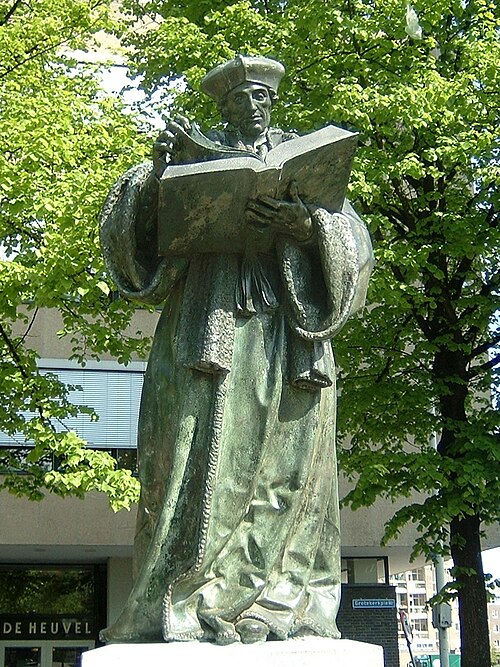
- In 1622, Hendrick de Keyser cast a statue of Erasmus in (gilt) bronze replacing an earlier stone version from 1557, itself replacing a wooden one of 1549, possibly a gift from the City of Basel. This was set up in the public square in Rotterdam, and today may be found outside the St. Lawrence Church. It is the oldest bronze statue in the Netherlands.[295]
- In 1790, Georg Wilhelm Göbel struck commemorative medals.'
- Canterbury Cathedral, England has a statue of Erasmus on the North Face, placed in 1870.
- Actor Ken Bones portrays Erasmus in David Starkey's 2009 documentary series Henry VIII: The Mind of a Tyrant
Name used
- The European Erasmus Programme of exchange students within the European Union is named after him.
- The original Erasmus Programme scholarships enable European students to spend up to a year of their university courses in a university in another European country, commemorating Erasmus' impulse to travel.
- The European Union cites the successor Erasmus+ programme as a "key achievement": "Almost 640,000 people studied, trained or volunteered abroad in 2020."[296]
- The parallel Erasmus Mundus project is aimed at attracting non-European students to study in Europe.
- The Erasmus Prize is one of Europe's foremost recognitions for culture, society or social science. It was won by Wikipedia in 2015.
- The Erasmus Lectures are an annual lecture on religious subjects, given by prominent Christian (mainly Catholic) and Jewish intellectuals,[297] most notably by Joseph Ratzinger in 1988.[298]
- A peer-reviewed annual scholarly journal Erasmus Studies has been produced since 1981.[299]
- Rotterdam has the Erasmus University Rotterdam:
- It has the Erasmus Institute for Philosophy and Economics (EIPE),[300] which produces the Erasmus Journal of Philosophy and Economics[301]
- Erasmus University College is an "international, interdisciplinary Bachelor of Science programme in Liberal Arts and Sciences."[302]
- From 1997 to 2008, the American University of Notre Dame had an Erasmus Institute.[303]
- The Erasmus Building in Luxembourg was completed in 1988 as the first addition to the headquarters of the Court of Justice of the European Union (CJEU).[304] The building houses the chambers of the judges of the CJEU's General Court and three courtrooms.[304] It is next to the Thomas More Building.
- Rotterdam has an Erasmus Bridge.
- Queens' College, Cambridge, has an Erasmus Tower,[305] Erasmus Building[306] and an Erasmus Room.[307] Until the early 20th century, Queens' College used to have a corkscrew that was purported to be "Erasmus' corkscrew", which was a third of a metre long; as of 1987, the college still had what it calls "Erasmus' chair".[308]
- Several schools, faculties and universities in the Netherlands and Belgium are named after him, as is Erasmus Hall in Brooklyn, New York, US.
Exhumation
In 1928, the site of Erasmus' grave was dug up, and a body identified in the bones and examined.[285] In 1974, a body was dug up in a slightly different location, accompanied by an Erasmus medal. Both bodies have been claimed to be Erasmus'. However, it is possible neither is.[309]
Notes
- ^ Vollerthun and Richardson suggest three phases, grouping the first two quarters for their purposes.[3]: 31
- ^ Erasmus was his baptismal name, given after Erasmus of Formiae. Desiderius was an adopted additional name, which he used from 1496. The Roterodamus was a scholarly name meaning "from Rotterdam", though the Latin toponymic adjective would be Roterdamensis.
- ^ Painter Hieronymous Bosch lived nearby, on the marketplace, at this time.
- ^ "Poverty stricken, suffering from quartan fever, and pressurized by his guardians"Juhász, Gergely (1 January 2019). "The Making of Erasmus's New Testament and Its English Connections". Sparks and Lustrous Words: Literary Walks, Cultural Pilgrimages. Archived from the original on 9 September 2023. Retrieved 23 May 2024.
- ^ Canons regular of St Augustine, Chapter of Sion (or Syon), Emmaus house, Stein (or Steyn).
- ^ This is a non-mendicant order of clerics which followed the looser Rule of St Augustine, who do not withdraw from the world, and who take a vow of Stability binding them to a House in addition to the usual Poverty (common life, simplicity), Chastity and Obedience. Erasmus described the Canons Regular as "an order midway between monks and (secular priests) [...] amphibians, like the beaver [...] and the crocodile". Also "for the so-called Canons formerly were not monks, and now they are an intermediate class: monks where it is an advantage to be so; not monks where it is not".[27] The kind of world-involved, devout, scholarly, loyal, humanistic, non-monkish, non-mendicant, non-ceremonial, voluntaristic religious order without notions of spiritual perfection that may have suited Erasmus better arose soon after his death, perhaps in response to the ethos Erasmus shared: notably the Jesuits, Oratorians[28]: 52 and subsequent congregations such as the Redemptorists. For the Ursalines, Barnabites, etc. "these associations were not conceived by their founders as 'religious orders', but as spiritual companies mostly composed of both lay and religious folk ... Similarly to the teachings of humanists like Erasmus and of the devotio moderna, these ... associations did not emphasise the institutional aspect of religious life."[29]
- ^ Diarmaid MacCulloch (2003). Reformation: A History. p. 95. MacCulloch has a footnote "There has been much modern embarrassment and obfuscation on Erasmus and Rogerus, but see the sensible comment in J. Huizinga, Erasmus of Rotterdam (London, 1952), pp. 11–12, and from Geoffrey Nutuall, Journal of Ecclesiastical History 26 (1975), 403"
In Huizinga's view: "Out of the letters to Servatius there rises the picture of an Erasmus whom we shall never find again—a young man of more than feminine sensitiveness; of a languishing need for sentimental friendship. [...]This exuberant friendship accords quite well with the times and the person. [...] Sentimental friendships were as much in vogue in secular circles during the fifteenth century as towards the end of the eighteenth century. Each court had its pairs of friends, who dressed alike, and shared room, bed, and heart. Nor was this cult of fervent friendship restricted to the sphere of aristocratic life. It was among the specific characteristics of the devotio moderna." - ^
However, note that such crushes or bromances may not have been scandalous at the time: the Cistercian Aelred of Rievaulx's influential book On Spiritual Friendship put intense adolescent and early-adult friendships between monks as natural and useful steps towards "spiritual friendships", following Augustine.
The correct direction of passionate love was also a feature of the spirituality of the Victorine canons regular, notably in Richard of St Victor's On the Four Degrees of Violent Love[32]
Huizinga (p.12) notes "To observe one another with sympathy, to watch and note each other's inner life, was a customary and approved occupation among the Brethren of the Common Life and the Windesheim monks." - ^ Erasmus used similar expressions in letters to other friends at the time.[9]: 17
D. F. S. Thomson found two other similar contemporary examples of humanist monks using similar florid idiom in their letters. Thomson, D.F.S. (1969). "Erasmus as a poet in the context of northern humanism". De Gulden Passer (in Dutch). 47: 187–210.
Historian Julian Haseldine has noted that medieval monks used charged expressions of friendship with the same emotional content regardless of how well-known the person was to them: so this language was sometimes "instrumental" rather than "affective." However, in this case we have Erasmus' own attestation of the genuine rather than formal fondness. Haseldine, Julian (2006). "Medieval Male Friendship Networks". The Monastic Review Bulletin (12). p.19. - ^ Erasmus editor Harry Vredeveld argues that the letters are "surely expressions of true friendship", citing what Erasmus wrote in his Letter to Grunnius about an earlier teenage infatuation with a "Cantellius": "It is not uncommon at [that] age to conceive passionate attachments [fervidos amores] for some of your companions". However, he allows "That these same letters, which run the gamut of love's emotions, are undoubtedly also literary exercises—rhetorical progymnasmata—is by no means a contradiction of this."Harry Vredeveld, ed. (1993), Collected Works of Erasmus: Poems, Translated by Clarence H. Miller, University of Toronto Press, p. xv, ISBN 9780802028679
- ^ But also a capacity to feel betrayal sharply, as with his brother Peter, "Cantellius", Aleander, and Dorp.
- ^ a b The biographer J.J. Mangan commented of his time living with Andrea Ammonio in England "to some extent Erasmus thereby realized the dream of his youth, which was to live together with some choice literary spirit with whom he might share his thoughts and aspiration". Quoted in J. K. Sowards, The Two Lost Years of Erasmus: Summary, Review, and Speculation, Studies in the Renaissance, Vol. 9 (1962), p. 174.
- ^ The position of Latin Secretary to some great churchman or prince had a long and distinguished history: Jerome had been the Latin Secretary for Pope Damasus I.[37] The position was important but not lucrative, unless a stepping-stone to other offices.
- ^ This was his entry to the European network of Latin secretaries, who were usually humanists, and so to their career path: a promising secretary could be appointed tutor to some aristocratic boy, when that boy reached power they were frequent kept on as a trusted counselor, and finally moved over to some dignified administrative role.[40]
- ^ 25 was the minimum age under canon law to be ordained a priest. However, Gouda church records do not support the 1492 year given by his first biographer, and 1495 has been suggested as more plausible.[5]
- ^ Erasmus suffered severe food intolerances, including to fish, beer and many wines, which formed much of the diet of Northern European monks, and caused his antipathy to fasts. "My heart is Catholic, but my stomach is Lutheran." (Epistles)
- ^ The canonry burnt down in 1549 and the canons moved to Gouda. Klein, Jan Willem; Simoni, Anna E.C. (1994). "Once more the manuscripts of Stein monastery and the copyists of the Erasmiana manuscripts". Quaerendo. 24 (1): 39–46. doi:10.1163/157006994X00117.
- ^ Dispensed of his vows of stability and obedience Archived 6 June 2019 at the Wayback Machine from his obligations "by the constitutions and ordinances, also by statutes and customs of the monastery of Stein in Holland", quoted in J. K. Sowards, The Two Lost Years of Erasmus: Summary, Review, and Speculation, Studies in the Renaissance, Vol. 9 (1962), p. 174. Erasmus continued to report occasionally to the prior, who disputed the validity of the 1505 dispensation.
- ^ Undispensed illegitimacy had various effects under canon law: it was not possible to be ordained a secular priest or to hold benefices, for example. Clarke, Peter (2005). "New sources for the history of the religious life: the registers of the Apostolic Penitentiary". Monastic Research Bulletin. 11.
- ^ Subsequent students included Ignatius of Loyola, Noël Béda, Jean Calvin, and John Knox.
- ^ Some of these visits were interrupted by trips back to Europe.[citation needed]
- ^ According to theologian Thomas Scheck "In the fuller context of the Ratio the “ceremonies” Erasmus criticizes are not the liturgical rites of the Church, but the special devotions and prescriptions added to them, particularly those related to food and clothing, which became binding in particular religious orders and more generally, under threat of excommunication and even eternal punishment."[59]
- ^ "We find in the New Testament that fasting was observed by Christians and praised by the apostles, but I do not remember reading that it was prescribed with certain rites. These things are not mentioned so that any ceremonies that the church has instituted concerning clothing, fasting or similar matters should be despised, but to show that Christ and his apostles were more concerned with things pertaining to salvation."[59]
- ^ Movingly remembering later, how Alexander would play the monochord, recorder or lute in the afternoon after studies.[69]
- ^ Even in good times, Erasmus had a "frequent inability to understand the details of his own finances" which caused him disappointment and suspicion.[71] His finances as late as 1530 have been described as "bewilderingly complicated" with multiple small income sources being managed with varying degrees of promptness by different associates in different countries.[72]: 2404
- ^ Erasmus claimed the blind poet laureate friar Bernard André, the former tutor of Prince Arthur, had promised to cover the rent. Roth, F. (1965). "A History of the English Austin Friars (continuation)". Augustiniana. 15: 567–628. ISSN 0004-8003. JSTOR 44992025. p.624. It may also show the practical difficulty of being dispensed from wearing the habit of his order without being entirely dispensed from his vow of poverty: indeed, Erasmus had said his order of Augustinian Canons regular were priests when that suited and monks when that suited.[9]
- ^ He wrote to Servatius Rogerus, the prior at Stein, to justify his jobs: "I do not aim at becoming rich, so long as I possess just enough means to provide for my health and free time for my studies and to ensure that I am a burden to none."[75]
- ^ It is reported that the commission of theologians Henry VIII assembled to identify the errors of Luther was made up of three of Erasmus' former students: Henry Bullock, Humphrey Walkden and John Watson.Schofield, John (2003). The lost Reformation: Why Lutheranism failed in England during the reigns of Henry VIII and Edward VI (Thesis). Newcastle University. hdl:10443/596. p28
- ^ "Beer does not suit me either, and the wine is horrible."Froud, J.A. (1896). Life and Letters of Erasmus. Scribner and Sons. p. 112.
- ^ Historians have speculated that Erasmus passed on to More an early version of Bartholome de las Casas' Memoria which More used for Utopia, due to 33 specific similarities of ideas, and that the fictional character Raphael Hythloday is de las Casas.[85]: 45 Coincidentally, de las Casas' nemesis Sepúlveda, arguing for the natural slavery of American Indians, had previously been Erasmus' opponent as well, initially supporting the anti-decadence of Erasmus' Ciceronians but then finding heresy in his translations and works.
- ^ Italian gold florins and Venetian gold ducats, Dutch silver guilders had similar values. However, there is no single modern equivalent exchange rate.[90]
- ^ By 1524, his disciples included, in his words, "the (Holy Roman) Emperor, the Kings of England, France, and Denmark, Prince Ferdinand of Germany, the Cardinal of England, the Archbishop of Canterbury, and more princes, more bishops, more learned and honourable men than I can name, not only in England, Flanders, France, and Germany, but even in Poland and Hungary..." quoted in Trevor-Roper, Hugh (30 July 2020). "Erasmus". Pro Europa. Archived from the original on 29 December 2023. Retrieved 29 December 2023.
- ^ Rhenanus shared many humanist contacts from Paris and Strassburg: a former student of Andrelini, friend of the Amerbach family, colleague of Sebastian Brant etc. He had learned printing in Paris with Robert Estienne.
- ^ In his own house "Zur alten Treu" which Froben had bought in 1521 and fitted with Erasmus' required fireplace.[100]
- ^ Engineered by reformer Cardinal Thomas Cajetan,[103] the leading Thomist of his age, who had become a friendly correspondent of Erasmus and had moved to bibliocentrism, progressively producing his own commentaries on the New Testament and most of the Old. Erasmus was initially sceptical of Cajetan, blaming him for taking a too-hard line against Luther, however he was won over in 1521 after reading Cajetan's works on the Eucharist, Confession and invocation of the saints.[104]: 357 In 1530, Cajetan proposed that concessions be made to Germany to allow communion under both kinds and married clergy, in full sympathy with Erasmus' spirit of mediation.
- ^ "When the Lutheran tragedy (Latin: Lutheranae tragoediae) opened, and all the world applauded, I advised my friends to stand aloof. I thought it would end in bloodshed...", Letter to Alberto Pío, 1525, in e.g., "Froude, Life and Letters of Erasmus, p 322" (PDF).
- ^ In a few hours, they cleansed churches of idolatry by smashing statues, rood-screens, lights, altar paintings – everything they could lay their hands on, including Hans Holbein the Younger’s work.[...] the hang-man lit nine fires in front of the Minster [...] It was, [a witness] lamented, as though these objects ‘had been public heretics’.[...] Nowhere else was the destruction by Christian activists so unexpected, violent, swift and complete.[107]: 96
- ^ Prominent reformers like Oecolampadius urged him to stay. However, Campion, Erasmus and Switzerland, op. cit., p26, says that Œcolampadius wanted to drive Erasmus from the city.
- ^ He spent the first two years in Freiburg as a guest of the city in the unfinished mansion Haus zum Walfisch and was indignant when an attempt was made to charge back-rent: he paid this rent, and that of another refugee from Basel in his house, his fellow Augustinian Canon Bishop Augustinus Marius, the humanist preacher who had led the efforts in Basel to resist Œcolampadius. Emerton (1889), p.449.
- ^ His arthritic gout[113] kept him housebound and unable to write: "Even on Easter Day I said mass in my bedroom." Letter to Nicolaus Olahus (1534)
- ^ De Góis then proceeded to Padua, meeting with the humanist cardinals Bembo and Sadeleto, and with Ignatius of Loyola. He had previously dined with Luther and Melanchthon, and met Bucer.[115]
- ^ The last was released at the time of Henry VIII and Anne Bolyn's wedding; Erasmus appended a statement that indicated he opposed the marriage. Erasmus outlived Anne and her brother by two months.
- ^ Erasmus writing a moving letter to William Blount's teenaged son Charles about Warham: "I wrote this in sorrow and grief, my mind totally devastated… We had made a vow to die together; he had promised a common grave…I am held back here half-alive, still owing the debt from the vow I had made, which …I will soon pay. …Instead, even time, which is supposed to cure even the most grievous sorrows, merely makes this wound more and more painful. What more can I say? I feel that I am being called. I will be glad to die here together with that incomparable and irrevocable patron of mine, provided I am allowed, by the mercy of Christ, to live there together with him."[59]: 86
- ^ "I am so weary of this region[...]I feel that there is a conspiracy to kill me[...]Many hope for war." Letter to Erasmus Schets (1534)
- ^ In the Expositio Fidelis, Erasmus recounts "Included with the Carthusians was the Brigittine monk Reynolds, a man of angelic features and angelic character and possessed of sound judgment, as I discovered through the conversations I had with him when I was in England in the company of Cardinal Campeggi."[119]: 611
- ^ During which he occupied himself copying out quotations from Erasmus' Adages etc and formally complaining about the protestantized English translation of Erasmus' Paraphrases of the New Testament.[121]
- ^ Contrast the "outsider" interpretation of Huizinga "He tried to remain in the fold of the old [Roman] Church, after having damaged it seriously, and renounced the [Protestant] Reformation, and to a certain extent even Humanism, after having furthered both with all his strength." Johan Huizinga, Erasmus and the Age of Reformation (tr. F. Hopman and Barbara Flower; New York: Harper and Row, 1924), p. 190. with the "insider" interpretation of Francis Aidan Gasquet "He was a reformer in the best sense, as so many far-seeing and spiritual-minded churchmen of those days were. He desired to better and beautify and perfect the system he found in vogue, and he had the courage of his convictions to point out what he thought stood in need of change and improvement, but he was no iconoclast; he had no desire to pull down or root up or destroy under the plea of improvement. That he remained to the last the friend of Popes and bishops and other orthodox churchmen, is the best evidence, over and above his own words, that his real sentiments were not misunderstood by men who had the interests of the Church at heart, and who looked upon him as true and loyal, if perhaps a somewhat eccentric and caustic son of Holy Church. Even in his last sickness he received from the Pope proof of his esteem, for he was given a benefice of considerable value."[30]: 200
- ^ This assertion is contradicted by Gonzalo Ponce de Leon speaking in 1595 at the Roman Congregation of the Index on the (mostly successful) de-prohibition of Erasmus' works said that he died "as a Catholic having received the sacraments." Menchi, Silvana Seidel (2000). "Sixteenth-Annual Bainton Lecture". Erasmus of Rotterdam Society Yearbook. 20 (1): 30. doi:10.1163/187492700X00048.
- ^ According to historian Jan van Herwaarden, it is consistent with Erasmus' view that outward signs were not important; what mattered is the believer's direct relationship with God. However, van Herwaarden states that "he did not dismiss the rites and sacraments out of hand but asserted a dying person could achieve a state of salvation without the priestly rites, provided their faith and spirit were attuned to God" (i.e., maintaining being in a State of Grace) noting Erasmus' stipulation that this was "as the (Catholic) Church believes."[128]
- ^ "He left a small fortune, in trusts for the benefit of the aged and infirm, the education of young men of promise, and as marriage portions for deserving young women - nothing, however, for Masses for the repose of his soul." Kerr, Fergus (2005). "Comment: Erasmus". New Blackfriars. 86 (1003): 257–258. doi:10.1111/j.0028-4289.2005.00081.x. ISSN 0028-4289. JSTOR 43250928.
- ^ '. After the payment of all outstanding claims, the sum in the hands of Bonifacius and the two Basel executors amounted to 5,000 florins. This sum was invested in a loan to the duchy of Württemberg that yielded an annual income of 250 florins. The greater part of this sum became a fund to provide scholarships for students at the University of Basel (in theology, law, and medicine); the rest went into a fund devoted to the assistance of the poor."[119] In modern terms, 5000 florins could be between US$500,000 and US$5,000,000; 250 florins could be between $25,000 and $250,000
- ^ Historian Kirk Essary comments "Reading the work (Exomologesis), one is reminded that Erasmus remains underrated for his psychological insights in general and that he is perhaps overlooked as a pastoral theologian."[135]
- ^ For Erasmus, "dogmatics do not exist for themselves; they take on meaning only when they issue, on the one hand, in the exegesis of scripture and, on the other, in moral action" according to Manfred Hoffmann's Erkenntnis und Verwirklichung der wahren Theologie nach Erasmus von Rotterdam (1972) [14]: 137
- ^ However, "his wit can be gentle; it can break out into bitterness. In controversy, resentments and anxieties can get loose, countermanding the Christian imperative of love to which he was devoted and which runs as a leitmotiv through all his writings." Mansfield [14]: 230
- ^ a b His mode of expression made him "slippery like a snake" according to Luther - Visser, Arnoud (2017). "Irreverent Reading: Martin Luther as Annotator of Erasmus". The Sixteenth Century Journal. 48 (1): 87–109. doi:10.1086/SCJ4801005. hdl:1874/348917. S2CID 31540853.)
- ^ "Erasmus discussed Amerindians and their way of life only as a tool, an analogy or parable, for those issues that consistently preoccupied his mind, namely the mores of the Christian Church."[143]
- ^ Erasmus, de bello Turcico, apud Ron, Nathan The Non-Cosmopolitan Erasmus: An Examination of his Turkophobic/Islamophobic Rhetoric, op. cit. p 99: Ron takes this as an affirmation by Erasmus of the low nature of Turks; the alternative view would take it as a negative foil (applying the model of the Mote and the Beam) where the prejudice is appropriated in order to subvert it.
- ^ For Markish, Erasmus' "theological opposition to a form of religious thought which he identified with Judaism was not translated into crude prejudice against actual Jews", to the extent that Erasmus could be described as 'a-semitic' rather 'anti-semitic'."Erasmus of Rotterdam". Jewish Virtual Library. AICE. Archived from the original on 15 July 2023. Retrieved 15 July 2023.
- ^ Historian Kevin Ingram suggests "The conversos also clearly reveled in Erasmus’s comparison, in the Enchiridion, of Old-Christians mired in ceremonial practice to Pharisees who had forgotten the true message of Judaism, a statement they used as a counter-punch against Old-Christian accusations of converso Judaizing. The conversos conveniently ignored the anti-semitic aspect of Erasmus’ statement."[117]: 71
- ^ Summa nostrae religionis pax est et unanimated. Erasmus continued: "This can hardly remain the case unless we define as few matters as possible and leave each individual's judgement free on many questions." Erasmus (1523). Letter to Carondelet: The Preface to His Edition of St. Hilary.
Note that the use of summa is perhaps also a backhanded reference to the scholastic summa, which he upbraided for their moral and spiritual uselessness.Surtz, Edward L. (1950). ""Oxford Reformers" and Scholasticism". Studies in Philology. 47 (4): 547–556. JSTOR 4172947. Archived from the original on 19 June 2023. Retrieved 19 June 2023. - ^ "Latin: Vicit mansuetudine, vicit beneficentia" R. Sider translates vicit as "he prevailed" Sider, Robert D. (31 December 2019). "A System or Method of Arriving by a Short Cut at True Theology by Desiderius Erasmus of Rotterdam". The New Testament Scholarship of Erasmus: 479–713. doi:10.3138/9781487510206-020. ISBN 9781487510206. S2CID 198585078.
- ^ Bruce Mansfield summarizes historian Georg Gebhart's view: "While recognizing the teaching authority, but not the primacy, of Councils, Erasmus adopted a moderate papalism, papal authority itself being essentially pastoral."[14]: 132
- ^ If any single individual in the modern world can be credited with "the invention of peace", the honour belongs to Erasmus rather than Kant whose essay on perpetual peace was published nearly three centuries later.[86]
- ^ "The argument of Bellum is governed by three favorite themes that recur in other works of Erasmus. First, war is naturally wrong[...]Second, Christianity forbids war[...]Third, “just cause” in war will be claimed by both sides and will be next to impossible to determine fairly: hence, the traditional criteria of the just war are nonfunctional."[151]
- ^ "Desiderius Erasmus, Thomas More and John Colet[...]between them in the first three decades of the sixteenth century, ushered in not only humanism – an ethically sanctioned guide for practical, humanitarian ways of living in society – but also the formation of a group that might be called a ‘peace movement’."[153]
- ^ "I do not deny that I wrote some harsh things in order to deter the Christians from the madness of war, because I saw that these wars,which we witnessed for too many years, are the source of the biggest part of evils which damage Christendom. Therefore, it was necessary to come forward not only against these deeds, which are clearly criminal, but also against other actions, which are almost impossible to do without committing many crimes." Apology against Albert Pío [148]: 11
- ^ "Erasmus and Vives ruled out conquests and annexation of territories."[143]
- ^ Erasmus was not out-of-step with opinion within the church: Archbishop Bernard II Zinni of Split speaking at the Fifth Council of the Lateran (1512) denounced princes as the most guilty of ambition, luxury and a desire for domination. Bernard proposed that reformation must primarily involve ending war and schism. Minnich, Nelson H. (1969). "Concepts of Reform Proposed at the Fifth Lateran Council". Archivum Historiae Pontificiae. 7: 163–251. ISSN 0066-6785. JSTOR 23563707. Archived from the original on 1 November 2023. Retrieved 1 November 2023. p. 173,174
- ^ James D.Tracy notes that mistrust of the Habsburg government in the general population (partially due to the fact Maximilian and his grandson Charles V were absentee rulers, the secret nature of diplomacy and other circumstances) was widespread, but it is notable that intellectuals like Erasmus and Barlandus also accepted the allegations.[88]: 94, 95
- ^ "I have made my support of the church sufficiently clear[...]The only thing in which I take pride is that I have never committed myself to any sect." Erasmus, Letter to Georgius Agricola (1534)
- ^ Historian Johannes Trapman notes "But who are in fact heretics? According to Erasmus not somebody who doubts a minor doctrinal point or even errs in some article. [...]For the protection of the commonwealth[...] heretics who are not only blasphemous but also seditious deserve the death penalty."[161]: 23 Erasmus commended that the punishment of the early church for heresy was excommunication.
- ^ "...the goal of De bello Turcico was to warn Christians and the Church of moral deterioration and to exhort them to change their ways.... Erasmus’ objection to crusades was by no means an overall opposition to fighting the Turks. Rather, Erasmus harshly condemned embezzlement and corrupt fundraising, and the Church's involvement in such nefarious activities, and regarded them as inseparable from waging a crusade." Ron, Nathan (1 January 2020). "The Non-Cosmopolitan Erasmus: An Examination of his Turkophobic/Islamophobic Rhetoric". Akademik Tarih ve Düşünce Dergisi (Academic Journal of History and Idea). pp. 97,98
- ^ "...in large part half-Christian and perhaps nearer to true Christianity than most of our own folk." Letter to Paul Volz[168]: 32
- ^ "I have never broken off a friendship with anyone because he was either more inclined towards Luther or more against Luther than I was. My disposition is naturally such that I could love even a Jew, provided he were in other respects an agreeable person to live with and friendly, and provided he did not vomit blasphemies against Christ in my hearing. And this courteous approach can, I believe, do more towards ending strife[...]the ties of friendship I do not readily abandon to please anyone." Letter to John Botzheim, quoted in Remer, Gary (1989). "Rhetoric and the Erasmian Defense of Religious Toleration". History of Political Thought. 10 (3): 377.
- ^ However, Erasmus related that he had consulted a Jewish doctor, in October 1518. Erasmus also knew several converted Jews: his doctor Matthais Adrianus, who Erasmus recommended for the Trilingual College, and his doctor Paolo Riccio, a professor of philosophy and imperial physician.Krivatsy, Peter (1973). "Erasmus' Medical Milieu". Bulletin of the History of Medicine. 47 (2): 113–154. ISSN 0007-5140. JSTOR 44447526. PMID 4584234. Archived from the original on 28 July 2023. Retrieved 28 July 2023. Erasmus's Spanish friend Juan Luis Vives came from a conversos family: indeed, his father had been executed as a Judaizer heretic. Erasmus' friendly correspondents Juan de Vergara and Francisco de Vergara similarly came from a conversos family, on their mother's side.
- ^ Erasmus wrote of Pferfferkorn that "a wicked (Latin: scelerato) Jew had become a most wicked (Latin: sceleratissimum) Christian."
In the case of the Reuchlin affair, Erasmus sided with Reuchlin, a gentile who advocated Hebrew studies (which Erasmus never undertook seriously himself but promoted) and interaction with Jewish scholars (which Erasmus never felt the professional occasion for) to learn of things such as the kaballa (which Erasmus scorned), against the attacks of Johannes Pfefferkorn, a converted Jew (which Erasmus approved of when sincere) who saw dangers in any re-Judaizing or re-mosaing Christianity (like Erasmus) but who went into fanaticism (which Erasmus abhored), e.g., advocating that Jews be compelled to hear Christian sermons, and that all copies of the Talmud be destroyed; both Reuchlin and Pfefferkorn called out the blood libel.[14]: 223 - ^ "If only the Christian church did not attach so much importance to the Old Testament! It is a thing of shadows, given us for a time." Ep 798 p. 305,[173]
For Erasmus, "...the relative importance we should ascribe to the different books of the Bible," accorded to how much "they bring us more or less directly to knowledge of (Christ)": which gave priority to the New Testament and the Gospels in particular.[137]
"To Erasmus, Judaism was obsolete. To Reuchlin, something of Judaism remained of continuing value to Christianity."[141] - ^ "The Jews" (i.e. the earliest Jewish Christians in Antioch) "because of a certain human tendency, desire(d) to force their own rites upon everyone, clearly in order under this pretext to enhance their own importance. For each one wishes that the things which he himself has taught should appear as outstanding." Erasmus, Paraphrase of Romans and Galatians[138]: 321
- ^ In marriage, Erasmus' two significant innovations, according to historian Nathan Ron, were that "matrimony can and should be a joyous bond, and that this goal can be achieved by a relationship between spouses based on mutuality, conversation, and persuasion."[177]: 4:43
- ^ According to historian Thomas Tentler, few Christians from his century gave as much emphasis as Erasmus to a pious attitude to death: the terrors of death are "closely connected to guilt from sin and fear of punishment" the antidote to which is first "trust in Christ and His ability to forgive sins", avoiding (Lutheran) boastful pride, then a loving, undespairing life lived with appropriate penitence. The focus of the Last Rites by priests should be comfort and hope. Tentler, Thomas N. (1965). "Forgiveness and Consolation in the Religious Thought of Erasmus". Studies in the Renaissance. 12: 110–133. doi:10.2307/2857071. ISSN 0081-8658. JSTOR 2857071. Archived from the original on 25 December 2023. Retrieved 25 December 2023.
- ^ a b "It is because Christ is in the pages of the bible that we meet him as a living person. As we read these pages we absorb his presence, we become one with him." Robert Sider[179]
- ^ "Erasmus had been criticizing the Catholic church for years before the reformers emerged, and not just pointing up its failings but questioning many of its basic teachings. He was the author of a series of publications, including a Greek edition of the New Testament (1516), which laid the foundations for a model of Christianity that called for a pared-down, internalized style of religiosity focused on Scripture rather than the elaborate, and incessant, outward rituals of the medieval church. Erasmus was not a forerunner in the sense that he conceived or defended ideas that later made up the substance of the Reformation thought. [...] It is enough that some of his ideas merged with the later Reformation message." Dixon, C. Scott (2012). Contesting the Reformation. Wiley-Blackwell. p. 60. ISBN 978-1-4051-1323-6.
- ^ "Unlike Luther, he accepted papal primacy and the teaching authority of the church and did not discount human tradition. The reforms proposed by Erasmus were in the social rather than the doctrinal realm. His principal aim was to foster piety and to deepen spirituality." [182]: 37
- ^ "Rigorously scientific biblical study must sustain an effort to renew the interior life, and the interior life must itself be at once the agent and the beneficiary of a renewal of the whole of Christian society." This went beyond the devotio moderna, which "was a spirituality of teachers."
- ^ Writer Gregory Wolfe notes however "For Erasmus, the narrative of decline is a form of despair, a failure to believe that the tradition can and will generate new life."[183]
- ^ monachatus non est pietas: Being a monk is not piety but he adds ‘but a way of life that may be useful or not useful according to each man’s physical make-up and disposition’.[182]: 36
- ^ DeMolen claims: "It is important to recall that Erasmus remained a member of the Austin Canons all his life. His lifestyle harmonized with the spirit of the Austin Canons even though he lived outside their monastic walls."[27] Erasmus represents the anti-Observantist wing of the canons regular who believed that the charism of their orders required them to be more externally focussed (on pastoral, missionary, scholarly, charitable and sacramental works) and correspondingly de-focussed on monastic severity and ceremonialism.
- ^ See the collequy Exequiae Seriphicae[118]
- ^ "In the first years of the Reformation many thought that Luther was only carrying out the program of Erasmus, and this was the opinion of those strict Catholics who from the outset of the great conflict included Erasmus in their attacks on Luther." Catholic Encyclopedia
- ^ An expression Erasmus coined. Bonae connotes more than just good, but also moral, honest and brave literature. Such sound learning encompassed both sacred literature (Latin: sacrae litterae), namely patristic writings and sacred scriptures (Latin: sacrae scripturae), and profane literature (Latin: prophanae litterae) by classical pagan authors.[196]
- ^ Future cardinal Aleander, his former friend and roommate at the Aldine Press, wrote "The poison of Erasmus has a much more dangerous effect than that of Luther" Catholic Encyclopedia
- ^ Namely Egmondanus, the Louvain Carmelite Nicolaas Baechem.[211]
- ^ Another commentator: "Erasmus laid the egg that Luther broke" Midmore, Brian (7 February 2007). "The differences between Erasmus and Luther in their approach to reform". Archived from the original on 7 February 2007. Retrieved 3 December 2023.
- ^ For Craig R. Thompson, Erasmus cannot be called philosopher in the technical sense, since he disdained formal logic and metaphysics and cared only for moral philosophy.
Similarly, John Monfasani reminds us that Erasmus never claimed to be a philosopher, was not trained as a philosopher, and wrote no explicit works of philosophy, although he repeatedly engaged in controversies that crossed the boundary from philosophy to theology. His relation to philosophy bears further scrutiny.
MacPhail, Eric. "Desiderius Erasmus (1468?—1536)". Internet Encyclopedia of Philosophy. Archived from the original on 17 August 2010. Retrieved 28 July 2023. - ^ "According to Erasmus, Lucian's laughter is the most appropriate instrument to guide pupils towards moral seriousness because it is the denial of every peremptory and dogmatic point of view and, therefore, the image of a joyful pietas (“true religion ought to be the most cheerful thing in the world”; De recta pronuntiatione, CWE 26, 385). By teaching the relativity of communicative situations and the variability of temperaments, the laughter resulting from the art of rhetoric comes to resemble the most sincere content of Christian morality, based on tolerance and loving persuasion." Bacchi, Elisa (2019). "Hercules, Silenus and the Fly: Lucian's Rhetorical Paradoxes in Erasmus' Ethics". Philosophical Readings Online Journal of Philosophy. CI (2). Archived from the original on 1 November 2023. Retrieved 20 October 2023.
- ^ According to historian Jamie Gianoutsos, Erasmus was not cherry-picking, in the way of St Augustine's 'spoiling the Egyptians,' i.e., acquiring what is valuable from the pagan heritage for the benefit of Christianity. "Erasmus, in contrast, had expressed reserve and even cautious criticism for Augustine's views while betraying great enthusiasm for St Jerome and his metaphor of the freeman who marries the captive slave to obtain her freedom. Christianity[...]had wed itself to the classical heritage to enhance and liberate it (i.e., that heritage) from its pagan ethos[...]"[217]
- ^ Baker-Smith, Dominic (1994). "Uses of Plato by Erasmus and More". Platonism and the English Imagination. pp. 86–99. doi:10.1017/CBO9780511553806.010. ISBN 9780521403085. p. 92:
Erasmus does not engage with Plato as a philosopher, at least not in any rigorous sense, but rather as a rhetorician of spiritual experience, the instigator of a metaphorical system which coheres effectively with Pauline Christianity.
- ^ "Despite a lack of formal philosophical training and an antipathy to medieval scholasticism, Erasmus possessed not only a certain familiarity with Thomas Aquinas, but also close knowledge of Plato and Aristotle. Erasmus’ interest in some Platonic motifs is well known. But the most consistent philosophical theme in Erasmus’ writings from his earliest to his latest was that of the Epicurean goal of peace of mind, ataraxia. Erasmus, in fact, combined Christianity with a nuanced Epicurean morality. This Epicureanism, when combined in turn with a commitment to the consensus Ecclesiae as well as with an allergy to dogmatic formulations and an appreciation of the Greek Fathers, ultimately rendered Erasmus alien to Luther and Protestantism though they agreed on much." Abstract of Monfasani, John (2012). "Twenty-fifth Annual Margaret Mann Phillips Lecture: Erasmus and the Philosophers". Erasmus of Rotterdam Society Yearbook. 32 (1): 47–68. doi:10.1163/18749275-00000005.
- ^ Historian Fritz Caspari quipped that Machiavelli "appears as a sceptic whose premise is the badness of man", while Erasmus is a sceptic whose general premise is "man is or can be made good."[227]
- ^ In the Adagia, Erasmus quotes Aristotle 304 times, "making extensive use of the moral, philosophical, political, and rhetorical writings as well as those on natural philosophy, while completely shunning the logical works that formed the basis for scholastic philosophy" Mann Phillips, Margaret (1964). The 'Adages' of Erasmus. A Study with Translations. Cambridge University Press. apud Traninger, Anita (25 January 2023). "Erasmus and the Philosophers". A Companion to Erasmus. pp. 45–67. doi:10.1163/9789004539686_005. ISBN 9789004539686.
- ^ "However learned the works of those men may be, however ‘subtle’ and, if it please them, however ‘seraphic,’ it must still be admitted that the Gospels and Epistles are the supreme authority." Erasmus, Paraclesis, apud Sider [234]
- ^ Erasmus followed the tradition of proto-humanist Petrarch, summarized as: "Aristotle was spiritually deficient, because although he could define virtue, his words lacked the power to motivate men to lead virtuous lives. It was not possible to know God adequately in this life, but it was possible to love him, which made virtue far more important than knowledge."[235]: 39
- ^ A narrowing of Tertullian's "What has Athens to do with Jerusalem?"
- ^ Rice puts it "Philosophy is felt to be a veil of pretense over an unethical reality...pious disquisitions cannot excuse immorality." Rice, Eugene F. (1950). "Erasmus and the Religious Tradition, 1495-1499". Journal of the History of Ideas. 11 (4): 387–411. doi:10.2307/2707589. ISSN 0022-5037. JSTOR 2707589. Archived from the original on 30 October 2023. Retrieved 25 October 2023. pp. 402-404
- ^ "For I am ready to swear that Epimenides came to life again in Scotus." Erasmus to Thomas Grey Nichols, ep. 59; Allen, ep 64
- ^ "Like Jean Gerson before him, he recommended that (scholastic method) be practiced with greater moderation and that it be complemented by the new philological and patristic knowledge that was becoming available."[239]: 26
- ^ "I find that in comparison with the Fathers of the Church our present-day theologians are a pathetic group. Most of them lack the elegance, the charm of language, and the style of the Fathers. Content with Aristotle, they treat the mysteries of revelation in the tangled fashion of the logician. Excluding the Platonists from their commentaries, they strangle the beauty of revelation." Enchiridion, Erasmus, apud Markos, Louis A. (April 2007). "The Enchiridion of Erasmus". Theology Today. 64 (1): 80–88. doi:10.1177/004057360706400109. S2CID 171469828. p. 86
- ^ "Why don't we all reflect: this must be a marvelous and new philosophy since, in order to reveal it to mortals, he who was god became man..."Erasmus (1516). Paraclesis (PDF). Archived (PDF) from the original on 11 August 2023. Retrieved 11 August 2023.
- ^ A Lutheran view: "Philosophia christiana as taught by Erasmus has never been factual reality; wherever it was philosophia, it was not christiana; wherever it was christiana, it was not philosophia." Karl Barth[241]: 1559
- ^ Similar to John Wycliffe's statement "the greatest philosopher is none other than Christ."Lahey, Stephen Edmund (1 May 2009). John Wyclif. doi:10.1093/acprof:oso/9780195183313.003.0005.
- ^ Philosopher Étienne Gilson has noted "Confronted with the same failure of philosophy to rise above the order of formal logic, John of Salisbury between 1150 and 1180, Nicolas of Autrecourt and Petrach in 1360, Erasmus of Rotterdam around 1490, spontaneously conceived a similar method to save Christian faith," i.e. a sceptical-about-scholasticism ad-fontes religious moralism promoting peace and charity.[242]: 102–107
- ^ Accommodation and scopus christi were ideas significant later, in Calvin's theology.[244]: 231, 131
- ^ For example, "It is likely that Erasmus rejected the traditional view of Hell as a place of real, material fire. But although he probably conceived of it as a place of mental rather than physical torment,... Erasmus does not appear to reject the eternality of Hell."[245]
- ^ Furthermore, "the role allegory plays in Erasmus' exegesis is analogous to the crucial place accommodation obtains in his theology".[246]: 7 )
- ^ "We see Erasmus' hermeneutic as governed by the idea of language as mediation [...] The dynamics of mediation, central as it is in Erasmus' hermeneutic, informed all aspects of his world view."Hoffmann, Manfred (1994). Rhetoric and Theology (PDF). University of Toronto. ISBN 978-0-8020-0579-3. Archived (PDF) from the original on 23 February 2024. Retrieved 23 February 2024.
- ^ "The saintly versatility with which Christ and Paul accommodate their message to their imperfect hearers is one of the highest expressions of their charity, which desires the salvation of all men."[199]
- ^ Erasmus quoted "I have become all things to all men, that I might by all means save some." ( Cor. 9:22, RSV).[248]: 55
- ^ "The gospel text for Erasmus, and many others, possessed “the capacity to transform our inner self by the presence of God as incarnated in the text (or 'inverbation') Leushuis, Reinier (3 July 2017). "Emotion and Imitation: The Jesus Figure in Erasmus's Gospel Paraphrases". Reformation. 22 (2): 82–101. doi:10.1080/13574175.2017.1387967. S2CID 171463846.: 93
- ^ Not a novel idea: see Duns Scotus' "For as there is no place in which it is more proper to seek Thee than in Thy words, so is there no place where Thou art more clearly discovered than in Thy words. For therein Thou abidest, and thither Thou leadest all who seek and love Thee."[251] : ch2
- ^ Mansfield[14]: 166 summarizes Robert Kleinhan that "In contrast to contemporary theologies which centred on grace (Luther) or church and sacraments (the Council of Trent), Erasmus' theology 'stressed the acquisition of peace through the virtue obtainable by union with Christ through meditation upon the documents of the early church's witness to him.'"
- ^ For Erica Rummel "In content, Erasmian theology is characterized by a twin emphasis on inner piety and on the word as mediator between God and the believer."[182]
- ^ Margaret O'Rourke Boyle sees it as "The text was real presence."[226]: 49
However, this may go too far: "The Christian Faith does not recognize either inlibration or inverbation"[253] - ^ "Erasmus insists in the Ratio that in the process of interpreting a passage from Scripture it is essential to consider not only what was said but also by whom and to whom it was said, with which words, at what time, on what occasion, and what preceded and followed it."[248]: 65
- ^ This was a fine-grained extension of the medieval theory of modus procedendi, associated with Alexander of Hales and Bonaventure, that each biblical book requires a different mode of proceeding as history, law, lyric, etc.[254]
- ^ Scopus comes from Origen and was also picked up by Melanchthon. Saarinen, Risto. Luther and the Reading of Scripture in [255]
- ^ "Erasmus is so thoroughly, radically Christ-centered in his understanding of both Christian faith and practice that if we overlook or downplay this key aspect of his character and vision, we not only do him a grave disservice but we almost completely misunderstand him."Markos, Louis A. (April 2007). "The Enchiridion of Erasmus". Theology Today. 64 (1): 80–88. doi:10.1177/004057360706400109. S2CID 171469828.
- ^ According to philosopher John Smith "The core of his theological thought he traced back to Christ’s Sermon on the Mount, rather than Paul."[258]
- ^ Historical theologian Carl Meyer writes "Because the Scriptures are the genuine oracles of God, welling forth from the deepest recesses of the divine mind, Erasmus said they should be approached with reverence. Humility and veneration are needed to find the secret chambers of eternal wisdom. "Stoop to enter," Erasmus warned, "else you might bump your head and bounce back!"[159]: 738
- ^ According to historian Emily Alianello, "Throughout Ecclesiastes, Erasmus seeks to orient his theories of preaching around "the simplicity of Christ's teaching and example." Consequently, preaching is not for engaging in controversy, but for bringing salvation, moving the congregation to a moral life and building community through concord."[259]: 71
- ^ I.e., Erasmus' method is that Jesus' primary teachings are not things you (whether lay person or theologian) interpret in the light of everything else (particularly some novel, post-patristic theological schema, even if ostensibly biblically coherent), but what you base your interpretation of everything else on.
- ^ This is quite contrary to Luther's privileging of his scheme of justification, its associated verses of Romans and Galatians, and his prizing of vehement assertions and insults. Erica Rummel notes "The similarities between his and Luther’s thought were of course superficial."[182]: 36
- ^ As with many of his individual works, reading The Praise of Folly in isolation from his other works may give an idea of Erasmus' priorities different to that given by broader reading, even though he sometimes claimed to be re-presenting essentially the same thoughts in different genres.
- ^ This was a long-recognized tendency: indeed Aquinas wrote in the Preface to his Summa Theologiae that "students in this science have not seldom been hampered by what they have found written by other authors, partly on account of the multiplication of useless questions, articles, and arguments"[261]
- ^ "Erasmus saw the scholastic exercise, in its high intellectualism, as fundamentally wrong-headed."[14]: 148
- ^ Historian William McCuaig wrote " I will however defend the view that for the historian evangelism is the category to which Erasmus should rightly be assigned."[262]
Historian Hilmar Pabel wrote "an essential aspect of Erasmus' life's work (was)...his participation in the responsibility of the bishops and all pastors to win souls for Christ."[248]: 54 - ^ "Without denying the presence of theological mistakes in Origen’s corpus, Erasmus felt that an irenic attitude toward Origen was more helpful to the Church than one of censorious criticism. Erasmus believed that Origen had seen further into the mind of St Paul than Augustine had done."[264]
References
- ^ Tracy, James D. "Desiderius Erasmus Biography & Facts". Encyclopædia Britannica. Archived from the original on 29 May 2018. Retrieved 29 May 2018.
- ^ Sauer, J. (1909). Desiderius Erasmus Archived 13 June 2010 at the Wayback Machine. In The Catholic Encyclopedia. New York: Robert Appleton Company. Retrieved 10 August 2019 from New Advent: http://www.newadvent.org/cathen/05510b.htm Archived 13 June 2010 at the Wayback Machine
- ^ a b c d e f Vollerthun, Ursula; Richardson, James L. (31 August 2017). The Idea of International Society: Erasmus, Vitoria, Gentili and Grotius. doi:10.1017/9781108264945.005.
- ^ Olin, John (23 October 2020). "Introduction: Erasmus, a Biographical Sketch". Christian Humanism and the Reformation: 1–38. doi:10.1515/9780823295289-004. ISBN 978-0-8232-9528-9.
- ^ a b c d e f Goudriaan, Koen (6 September 2019). "New Evidence on Erasmus' Youth". Erasmus Studies. 39 (2): 184–216. doi:10.1163/18749275-03902002. hdl:1871.1/2eb41bd4-6929-41be-a984-94747300015a. S2CID 203519815.
- ^ Avarucci, Giuseppe (1983). "Due codici scritti da 'Gerardus Helye' padre di Erasmo". Italia Medioevale e Umanistica (in Italian). 26: 215–55, esp. 238–39.
- ^ Huizinga, Erasmus, pp. 4 and 6 (Dutch-language version)
- ^ a b c Vredeveld, Harry (Winter 1993). "The Ages of Erasmus and the Year of his Birth". Renaissance Quarterly. Vol. 46, no. 4. pp. 754–809. JSTOR 3039022.
- ^ a b c d e f g DeMolen, Richard L. (1976). "Erasmus as Adolescent: "Shipwrecked am I, and lost, 'mid waters chill'": Erasmus to Sister Elisabeth". Bibliothèque d'Humanisme et Renaissance. 38 (1): 7–25. ISSN 0006-1999. JSTOR 20675524. Archived from the original on 22 July 2023. Retrieved 22 July 2023.
- ^ a b c Nauert, Charles. "Desiderius Erasmus". Winter 2009 Edition. Stanford Encyclopedia of Philosophy. Archived from the original on 19 July 2023. Retrieved 10 February 2012.
- ^ Gleason, John B. (Spring 1979). "The Birth Dates of John Colet and Erasmus of Rotterdam: Fresh Documentary Evidence". Renaissance Quarterly. Vol. 32, no. 1. The University of Chicago Press on behalf of the Renaissance Society of America. pp. 73–76. JSTOR 2859872.
- ^ a b c Erasmus, Desiderius; Nichols, Francis Norgan (1901–1918). The Epistles of Erasmus: from his earliest letters to his fifty-first year arranged in order of time. London: Longmans, Green.
- ^ a b Cornelius Augustijn, Erasmus: His life, work and influence, University of Toronto, 1991
- ^ a b c d e f g h i j k l m n o p q Mansfield, Bruce (6 May 2003). "Erasmus in the Twentieth Century: Interpretations 1920-2000". Erasmus in the Twentieth Century. University of Toronto Press. doi:10.3138/9781442674554. ISBN 978-1-4426-7455-4.
- ^ "Catholic Encyclopedia". Archived from the original on 1 May 2023. Retrieved 1 May 2023.
- ^ The 19th-century novel The Cloister and the Hearth, by Charles Reade, is an account of the lives of Erasmus's parents.
- ^ Grendler, Paul F. (1983). "In Praise of Erasmus". The Wilson Quarterly. 7 (2): 88–101. ISSN 0363-3276. JSTOR 40256471.
- ^ Miller, Clement A. (1966). "Erasmus on Music". The Musical Quarterly. 52 (3): 332–349. doi:10.1093/mq/LII.3.332. ISSN 0027-4631. JSTOR 3085961. Archived from the original on 9 September 2023. Retrieved 13 December 2023.
- ^ "Alexander Hegius". Encyclopedia Britannica. Archived from the original on 1 May 2023. Retrieved 1 May 2023.
- ^ Peter Nissen: Geloven in de Lage landen; scharniermomenten in de geschiedenis van het Christendom. Davidsfonds/Leuven, 2004.
- ^ Roosen, Joris (2020). The Black Death and recurring plague during the late Middle Ages in the County of Hainaut: Differential impact and diverging recovery (PDF). p. 174. ISBN 978-94-6416-146-5. Archived (PDF) from the original on 20 July 2023. Retrieved 20 July 2023.
- ^ a b c DeMolen, Richard L. (1976),p.13
- ^ Cartwright, Mark. "Desiderius Erasmus". World History Encyclopedia. Archived from the original on 14 January 2024. Retrieved 13 December 2023.
- ^ DeMolen, Richard L. (1976).pp.10–11
- ^ a b Galli, Mark, and Olsen, Ted. 131 Christians Everyone Should Know. Nashville: Holman Reference, 2000, p. 343.
- ^ a b Harry Vredeveld, ed. (1993), Collected Works of Erasmus: Poems, Translated by Clarence H. Miller, University of Toronto Press, pp. xiv–xv, ISBN 9780802028679
- ^ a b c d e Demolen, Richard L. (1973). "Erasmus' Commitment to the Canons Regular of St. Augustine". Renaissance Quarterly. 26 (4): 437–443. doi:10.2307/2859495. JSTOR 2859495. S2CID 163219853.
- ^ Danyluk, Katharine (10 September 2018). Imitations of Christ: Ignatius of Loyola, Philip Neri and the influence of the Devotio Moderna (masters). University of Wales Trinity Saint David. Archived from the original on 5 January 2024. Retrieved 5 January 2024.
- ^ Mazzonis, Querciolo (2018). "Reforming Christianity in early sixteenth-century Italy: the Barnabites, the Somaschans, the Ursulines, and the hospitals for the incurables". Archivium Hibernicum. 71: 244–272. ISSN 0044-8745. JSTOR 48564991.
- ^ a b c d e f g h Gasquet, Francis Aidan (1900). The Eve of the Reformation. Studies in the Religious Life and Thought of the English people in the Period Preceding the Rejection of the Roman jurisdiction by Henry VIII.
- ^ Molen, Richard L. de (1987). The spirituality of Erasmus of Rotterdam. Nieuwkoop: De Graaf. ISBN 978-90-6004-392-9.
- ^ Kraebel, Andrew (2011). "Richard of St. Victor, On the Four Degrees of Violent Love". Victorine Texts in Translation. 2.
- ^ Forrest Tyler Stevens, "Erasmus's 'Tigress': The Language of Friendship, Pleasure, and the Renaissance Letter". Queering the Renaissance, Duke University Press, 1994
- ^ Collected Works of Erasmus, vol. 1, p. 12 (Toronto: University of Toronto Press, 1974)
- ^ Erasmus, Desiderius (23 May 2009). Collected Works of Erasmus: Paraphrases on the Epistles to the Corinthians, Ephesians, Philippans, Colossians, and Thessalonians, Volume 43. University of Toronto Press. ISBN 9781442691773. Archived from the original on 11 August 2023. Retrieved 7 August 2023.
- ^ Sutton, Anne F.; Visser-Fuchs, Livia (1997). Richard III's books: ideals and reality in the life and library of a medieval prince. Stroud: Sutton publ. ISBN 0750914068.: 376
- ^ Kuhner, John Byron (2017). "The Vatican's Latinist". The New Criterion. 25 (7). Archived from the original on 6 June 2017. Retrieved 3 March 2024.
- ^ "Desiderius Erasmus, Dutch Renaissance humanist, Catholic priest and theologian (1466-1536)". www.1902encyclopedia.com. Archived from the original on 13 December 2023. Retrieved 13 December 2023.
- ^ Hunt Janin (2014). The University in Medieval Life, 1179–1499 (illustrated ed.). McFarland. p. 159. ISBN 978-0-7864-5201-9. Extract of page 159
- ^ Allen, Grace (24 October 2019). "Mirrors for secretaries: the tradition of advice literature and the presence of classical political theory in Italian secretarial treatises". Laboratoire Italien (23). doi:10.4000/laboratoireitalien.3742.
- ^ Erasmus, Desiderius (1989). Collected Works of Erasmus: Spiritualia. University of Toronto Press. ISBN 978-0-8020-2656-9.
- ^ Klein, Jan Willem (21 June 2018). "Copyist B of the Erasmiana Manuscripts in Gouda Identified". Quaerendo. 48 (2): 95–105. doi:10.1163/15700690-12341402. S2CID 165911603.
- ^ Allen, P. S.; Colotius, A. (1910). "A Dispensation of Julius II for Erasmus". The English Historical Review. 97 (25): 123–125. doi:10.1093/ehr/XXV.XCVII.123. JSTOR 549799. Archived from the original on 11 July 2023. Retrieved 11 July 2023.
- ^ Erasmus, Desiderius (1974). The Correspondence of Erasmus: Letters 2204-2356 (August 1529-July 1530). University of Toronto Press. ISBN 978-1-4426-6833-1.
- ^ "Philip Schaff: History of the Christian Church, Volume VII. Modern Christianity. The German Reformation - Christian Classics Ethereal Library". ccel.org. Archived from the original on 21 June 2023. Retrieved 2 December 2023.
- ^ Andrews, Edward D.; Lightfoot, J.B.; Kenyon, Frederic G. (2022). THE REVISIONS OF THE ENGLISH HOLY BIBLE: Misunderstandings and Misconceptions about the English Bible Translations. Christian Publishing House. ISBN 9798352124185.
- ^ Lundberg, Christa (16 February 2022). Apostolic theology and humanism at the University of Paris, 1490–1540 (Thesis). Apollo - University of Cambridge Repository. doi:10.17863/CAM.81488. Retrieved 23 July 2023.
- ^ Coroleu, Alejandro (2014). Printing and Reading Italian Latin Humanism in Renaissance Europe (ca. 1470-ca. 1540) (PDF). Cambridge Scholars Publishing. p. 15. ISBN 978-1-4438-5894-6. Archived (PDF) from the original on 11 July 2023. Retrieved 11 July 2023.
- ^ Ptaszyński, Maciej (8 October 2021). "Theologians and Their Bellies: The Erasmian Epithet Theologaster during the Reformation". Erasmus Studies. 41 (2): 200–229. doi:10.1163/18749275-04102001. ISSN 1874-9275. S2CID 240246657. Archived from the original on 10 August 2023. Retrieved 9 August 2023.
- ^ a b c d Baker House, Simon. "Erasmus circle in England". Oxford Dictionary of National Biography (online ed.). Oxford University Press. doi:10.1093/ref:odnb/96813. Retrieved 20 July 2023. (Subscription or UK public library membership required.)
- ^ a b Treu, Erwin (1959). Die Bildnisse des Erasmus von Rotterdam (in German). Gute Schriften Basel. pp. 6–7.
- ^ Adams, Robert Pardee (1937). Pacifism in the English Renaissance, 1497-1530: John Colet, Erasmus, Thomas More and J.L. Vives. University of Chicago.
- ^ Harper-Bill, Christopher (1988). "Dean Colet's Convocation Sermon and the Pre-Reformation Church in England". History. 73 (238): 191–210. doi:10.1111/j.1468-229X.1988.tb02151.x. ISSN 0018-2648. JSTOR 24413851. Archived from the original on 30 October 2023. Retrieved 30 October 2023.
- ^ a b Tracy, James D. (1972). Erasmus, the Growth of a Mind. Librairie Droz. ISBN 978-2-600-03041-0. Archived from the original on 28 November 2023. Retrieved 26 November 2023.
- ^ Giese, Rachel (1934). "Erasmus' Greek Studies". The Classical Journal. 29 (7): 517–526. ISSN 0009-8353. JSTOR 3290377.
- ^ Suzanne, Hélène (December 2014). "Conscience in the Early Renaissance: the case of Erasmus, Luther and Thomas More". Moreana. 51 (3–4 (197–198)): 231–244. doi:10.3366/more.2014.51.3-4.13. ISSN 0047-8105.
- ^ Masur-Matusevich, Yelena (2023). Le père du siècle: the early modern reception of Jean Gerson (1363-1429) theological authority between Middle Ages and early modern era. Turnhout: Brepols. ISBN 978-2-503-60225-7.
- ^ Gairdner, James (1909). "Archbishop Morton and St. Albans". The English Historical Review. 24 (93): 91–96. doi:10.1093/ehr/XXIV.XCIII.91. ISSN 0013-8266. JSTOR 550277. Archived from the original on 9 April 2024. Retrieved 9 April 2024.
- ^ a b c Scheck, Thomas P. (June 2022). "Mark Vessey (ed.), Erasmus on Literature: His Ratio or 'System' of 1518/1519 (Review)". Moreana. 59 (1): 141–148. doi:10.3366/more.2022.0119. S2CID 248601520.
- ^ "Erasmus". www.britannica.com. 23 October 2023. Archived from the original on 26 April 2019. Retrieved 22 April 2023.
- ^ Tinelli, Elisa (January 2018). "Erasmus' Panegyricus ad Philippum Austriae ducem (1504)". Lectio. 7: 445–464. doi:10.1484/M.LECTIO-EB.5.116073. ISBN 978-2-503-58077-7.
- ^ Emerton, Ephraim (25 July 2020). Desiderius Erasmus of Rotterdam. BoD – Books on Demand. ISBN 978-3-7523-4313-7.
- ^ a b c d e f Treu, Erwin (1959),p.8
- ^ Anderson, Marvin (1969), "Erasmus the Exegete", Concordia Theeological Monthly, 40 (11): 722–46
- ^ van Herwaarden, Jan (1 January 2003). Between Saint James and Erasmus: Studies in Late-Medieval Religious Life – Devotion and Pilgrimage in the Netherlands. doi:10.1163/9789004473676_024. S2CID 239956783.
- ^ Murray, Stuart. 2009. The library: an illustrated history. Chicago, ALA Editions
- ^ Treu, Erwin (1959),pp.8–9
- ^ Opus Epistolarum Des. Erasmi Roterdami, Ed. H.M. Allen, (Oxford University Press, 1937), Ep. 3032: 219–22; 2682: 8–13.
- ^ Shire, Helena M., Stewart Style 1513-1542, Tuckwell, (1996), 126-7, quoting Phillips, M. M., The Adages of Erasmus Cambridge (1964), 305-307.
- ^ Pattison, Mark; Allen, Percy Stafford (1911). . Encyclopædia Britannica. Vol. 9 (11th ed.). pp. 727–732.
- ^ "(Publisher's summary) The Correspondence of Erasmus". University of Toronto Press. Archived from the original on 17 January 2024. Retrieved 23 May 2024.
- ^ Erasmus, Desiderius (2016). The correspondence of Erasmus. Letters 2357 to 2471 August 1530-March 1531 / translated by Charles Fantazzi ; annotated by James M. Estes. Toronto Buffalo London: University of Toronto Press. ISBN 978-1442648784.
- ^ "History and Archives". St.Pauls. Archived from the original on 16 January 2019. Retrieved 16 January 2019.
- ^ Seebohm, Frederic (1869). The Oxford Reformers. John Colet, Erasmus and Thomas More (3rd ed.). Longmans, Green and Co. Archived from the original on 17 December 2023. Retrieved 17 December 2023.
- ^ a b Cheng-Davies, Tania (1 May 2023). "Erasmian Perspectives on Copyright: Justifying a Right to Research". Joint PIJIP/TLS Research Paper Series. Archived from the original on 7 January 2024. Retrieved 7 January 2024.
- ^ Askin, Lindsey (12 July 2013). "Erasmus and Queens' College, Cambridge". Queens' Old Library Books Blog. Queenslib.wordpress.com. Archived from the original on 19 July 2023. Retrieved 8 March 2014.
- ^ "Erasmus, Desiderius (ERSS465D)". A Cambridge Alumni Database. University of Cambridge.
- ^ Huizinga, Dutch edition, pp. 52–53.
- ^ "Erasmus, Life in 16th Century England". World Civilizations. Archived from the original on 4 April 2023. Retrieved 3 December 2023.
- ^
- Seltman, Charles (1957). Wine In The Ancient World.
- Taylor, Fred M. (February 2021). "Thomas Linacre: Humanist, Physician, Priest". The Linacre Quarterly. 88 (1): 9–13. doi:10.1177/0024363920968427. PMC 7804502. PMID 33487740.
- Herbert, Amanda (23 January 2018). "Bibulous Erasmus". The Recipes Project. doi:10.58079/td2u. Archived from the original on 22 June 2023. Retrieved 22 June 2023.
- ^ "Old Library Collections". Queens' College Cambridge. Queens' Rare Book and Special Collections. Queens.cam.ac.uk. Archived from the original on 13 December 2013. Retrieved 8 March 2014.
- ^ Rummel, Erika (1990). "Erasmus and the Louvain Theologians — a Strategy of Defense". Nederlands Archief voor Kerkgeschiedenis / Dutch Review of Church History. 70 (1): 2–12. doi:10.1163/002820390X00024. ISSN 0028-2030. JSTOR 24009249. Archived from the original on 23 July 2023. Retrieved 23 July 2023.
- ^ Seidel Menchi, S. (ed.). "Opera Omnia Desiderii Erasmi – Erasmus, Opera Omnia". Brill. pp. 50–51. Retrieved 21 December 2022.
- ^ a b c d Kaminska, Barbara A. "But for the Voice, the Likeness is Alive": Portraits of Erasmus of Rotterdam and Their Reception among Renaissance Humanists. in Borusowski, Piotr (2020). Ingenium et labor. Studia ofiarowane Profesorowi Antoniemu Ziembie z okazji 60. urodzin. UNIWERSYTET WARSZAWSKI.
- ^ Varacalli, Thomas (1 January 2016). "The Thomism of Bartolomé de Las Casas and the Indians of the New World". LSU Doctoral Dissertations. doi:10.31390/gradschool_dissertations.1664. Archived from the original on 12 January 2024. Retrieved 12 January 2024.
- ^ a b Dungen, Peter van den (30 November 2009). "Erasmus: The 16th Century's Pioneer of Peace Education and a Culture of Peace". Journal of East Asia and International Law. 2 (2): 5. doi:10.14330/jeail.2009.2.2.05. hdl:10454/5003. Retrieved 28 July 2023.
- ^ De Landtsheer, Jeanine (1 January 2013). "On Good Government: Erasmus's Institutio Principis Christiani versus Lipsius's Politica". The Reception of Erasmus in the Early Modern Period: 179–208. doi:10.1163/9789004255630_009. ISBN 978-90-04-25563-0.
- ^ a b c Tracy, James D. (1 January 1996). Erasmus of the Low Countries. University of California Press. ISBN 978-0-520-08745-3. Retrieved 4 August 2023.
- ^ "500 years Collegium Trilingue". expo.bib.kuleuven.be.
- ^ "Measuring Worth - Purchasing Power of the Pound".
- ^ a b c d Erasmus, Desiderius (31 December 1979). The Correspondence of Erasmus: Letters 594-841 (1517-1518). doi:10.3138/9781442681019. ISBN 978-1-4426-8101-9.
- ^ a b Ron, Nathan (2021). Erasmus: intellectual of the 16th century. Palgrave Macmillan. ISBN 978-3-030-79859-8.
- ^ Sowards, J. K. (1982). "Erasmus and the Education of Women". The Sixteenth Century Journal. 13 (4): 77–89. doi:10.2307/2540011. ISSN 0361-0160. JSTOR 2540011. S2CID 166057335. Archived from the original on 11 February 2023. Retrieved 31 August 2023.
- ^ "Erasmus House, Anderlecht". 14 February 2016. Archived from the original on 30 April 2023. Retrieved 30 April 2023.
- ^ a b c d Serikoff, Nicolaj (2004). "The Concept of Scholar-Publisher in Renaissance: Johannes Froben". Journal of the Washington Academy of Sciences. 90 (1): 53–69. ISSN 0043-0439. JSTOR 24530877.
- ^ Müller, Christian (2006). Hans Holbein the Younger: The Basel Years, 1515-1532. Prestel. p. 296. ISBN 978-3-7913-3580-3.
- ^ Bloch Eileen M. (1965). "Erasmus and the Froben Press." Library Quarterly 35 (April): 109–20.
- ^ "Portrait of Erasmus of Rotterdam (Hans Holbein the Younger)". print. British Museum. Archived from the original on 17 July 2023. Retrieved 17 July 2023. quoting G. Bartrum, German Renaissance Prints 1490-1550, BM exh. cat. 1995, no. 238.
- ^ Erasmus, Desiderius (31 December 1989). The Correspondence of Erasmus: Letters 1252-1355 (1522-1523). doi:10.3138/9781442680944. ISBN 978-1-4426-8094-4.
- ^ "Altbasel - Erasmus in Basel". altbasel.ch. Archived from the original on 8 January 2024. Retrieved 8 January 2024.
- ^ a b Blair, Ann (13 March 2019). "Erasmus and His Amanuenses". Erasmus Studies. 39 (1): 22–49. doi:10.1163/18749275-03901011. S2CID 171933331.
- ^ a b Introductpry Note in Tracey, James (31 December 2010). "The Sponge of Erasmus against the Aspersions of Hutten/ Spongia adversus aspergines Hutteni". Controversies. University of Toronto Press: 1–146. doi:10.3138/9781442660076-002. ISBN 978-1-4426-6007-6.
- ^ Pastor, Ludwig (1923). The History of the Popes, from the Close of the Middle Ages.
- ^ a b Seaver, William (1959). "Cardinal Cajetan Renaissance Man" (PDF). Dominicana. 44 (4). Archived (PDF) from the original on 13 May 2024. Retrieved 4 May 2024.
- ^ Geurts, Twan (17 October 2022). "Pope Adrian VI, the 'Barbarian From the North' Who Wanted to Reform the Vatican". The Low Countries. Archived from the original on 12 January 2024. Retrieved 23 May 2024.
- ^ a b c d Hirsch, Elisabeth Feist (1951). "The Friendship of Erasmus and Damiâo De Goes". Proceedings of the American Philosophical Society. 95 (5): 556–568. ISSN 0003-049X. JSTOR 3143242.
- ^ Rublack, Ulinka (2017). "People and Networks in the Age of the Reformations". Reformation Europe (2 ed.). Cambridge University Press. pp. 92–123. doi:10.1017/9781139087728.005. ISBN 978-1-107-60354-7.
- ^
- "Erasmus - Dutch Humanist, Protestant Challenge". www.britannica.com. Archived from the original on 21 June 2023. Retrieved 21 June 2023.
- Schaff, Philip. The Reformation in Basel. Oecolampadius. History of the Christian Church, Volume VIII: Modern Christianity. The Swiss Reformation. Archived from the original on 21 June 2023. Retrieved 21 June 2023.
- ^ 2211 / To Thomas More, Freiburg, 5 September 1529, "Letters 2803 to 2939. Part 2". The Correspondence of Erasmus: 151–302. 31 December 2020. doi:10.3138/9781487532833-005. ISBN 978-1-4875-3283-3. S2CID 240975375.
- ^ a b c "Letters 2803 to 2939. Part 2". The Correspondence of Erasmus: 151–302. 31 December 2020. doi:10.3138/9781487532833-005. ISBN 978-1-4875-3283-3. S2CID 240975375.
- ^ Wilson, Derek (1996). Hans Holbein: Portrait of an Unknown Man. Phoenix Giant. pp. 161–162. ISBN 978-0297 815617.
- ^ Emerton (1889), op cit p442
- ^ "Erasmus' Illnesses in His Final Years (1533–6)". The Correspondence of Erasmus: 335–339. 31 December 2020. doi:10.3138/9781487532833-007. ISBN 978-1-4875-3283-3. S2CID 240920541.
- ^ a b c van Herwaarden, Jan (2012). "Erasmus and the Non-Christian World". Erasmus of Rotterdam Society Yearbook. 32 (1): 69–83. doi:10.1163/18749275-00000006.
- ^ Bell, Aubrey F. G. (1941). "Damião de Goes, a Portuguese Humanist". Hispanic Review. 9 (2): 243–251. doi:10.2307/470220. ISSN 0018-2176. JSTOR 470220. Archived from the original on 12 April 2024. Retrieved 23 May 2024.
- ^ a b Mackay, Lauren (2019). The life and career of Thomas Boleyn (1477–1539): courtier, ambassador, and statesman (Thesis). University of Newcastle. hdl:1959.13/1397919.
- ^ a b Ingram, Kevin (2006). Secret lives, public lies: the conversos and socio-religious non-conformism in the Spanish Golden Age (Thesis). UC San Diego. Archived from the original on 4 January 2024. Retrieved 4 January 2024.
- ^ a b Bietenholz, Peter G. (1966). History and Biography in the Work of Erasmus of Rotterdam. Geneva: Librairie Droz.
- ^ a b Erasmus, Desiderius (31 December 2021). Estes, James M.; Dalzell, Alexander (eds.). The Correspondence of Erasmus: Letters 2940 to 3141, Volume 21. doi:10.3138/9781487536695. ISBN 978-1-4875-3669-5.
- ^ Allen, Amanda (1 January 2014). Flesh, Blood, and Puffed-Up Livers: The Theological, Political, and Social Contexts behind the 1550-1551 Written Eucharistic Debate between Thomas Cranmer and Stephen Gardiner. doi:10.31390/gradschool_dissertations.401. Archived from the original on 29 March 2024. Retrieved 23 May 2024.
- ^ "(Prison) Note(book)s Toward a History of Boredom". JHI Blog. Archived from the original on 18 January 2024. Retrieved 23 May 2024.
- ^ Ruth, Jeffrey S. "Lisbon in the Renaissance: Author Damiao de Gois". www.italicapress.com.
- ^ Herbermann, Charles, ed. (1913). . Catholic Encyclopedia. New York: Robert Appleton Company.
- ^ "Erasmus and His Books (Publisher's material)". University of Toronto Press. Archived from the original on 30 April 2024. Retrieved 30 April 2024.
- ^ a b Kusukawa, Sachiko (2003). "Nineteenth-Annual Bainton Lecture". Erasmus of Rotterdam Society Yearbook. 23 (1): 1–24. doi:10.1163/187492703X00036.
- ^ Huizinga, Dutch edition, p. 202.
- ^ a b Hoffmann, Manfred (Summer 1989). "Faith and Piety in Erasmus's Thought". Sixteenth Century Journal. 20 (2). Truman State University Press: 241–258. doi:10.2307/2540661. JSTOR 2540661. S2CID 166213471.
- ^ Jan Van Herwaarden (2003), Between Saint James and Erasmus: Studies in Late Medieval Religious Life, Leiden: Brill, pp. 529–530, ISBN 9789004129849
- ^ Campion, Edmund (2003). "Erasmus and Switzerland". Swiss American Historical Society. 39 (3). Archived from the original on 21 June 2023. Retrieved 21 June 2023.
- ^ Żantuan, Konstanty (1965). "Erasmus and the Cracow Humanists: The Purchase of His Library by Łaski". The Polish Review. 10 (2): 3–36. ISSN 0032-2970. JSTOR 25776600. Archived from the original on 19 December 2023. Retrieved 19 December 2023.
- ^ Vale, Malcolm (6 November 2020). "Erasmus and his Books, by Egbertus van Gulik, tr. J.C. Grayson, ed. James K. McConica and Johannes Trapman". The English Historical Review. 135 (575): 1016–1018. doi:10.1093/ehr/ceaa149.
- ^ Guggisbert, Hans (2003). Sebastian Castellio, 1515-1563; Humanist and Defender of Religious Toleration in a Confessional Age; Translated and Edited by Bruce Gordon. Hants England; Burlington, Vermont, USA: Ashgate Publishing Limited. ISBN 0754630196.
- ^ a b Terrence J. Martin, Truth and Irony[1] quoted in Moore, Michael (2019). "Truth and Irony: Philosophical Meditations on Erasmus (Review)". Erasmus Studies. 39 (1). doi:10.1163/18749275-03901009. S2CID 171963677. Archived from the original on 30 December 2023. Retrieved 22 June 2023.
- ^ Tracy, James (1987). "Two Erasmuses and Two Luthers: Erasmus' strategy in defense of De libero arbitrio". Archiv für Reformationsgeschichte. 78 (jg): 57. doi:10.14315/arg-1987-jg03. S2CID 171005154. Retrieved 22 June 2023.
- ^ Essary, Kirk (2016). "Collected Works of Erasmus, written by Frederick J. McGinness (ed.), Michael J. Heath and James L.P. Butrica (transl.), Frederick J. McGinness and Michael J. Heath (annotat.), and Alexander Dalzell (contrib. ed.)". Erasmus Studies. 36 (1): 64–66. doi:10.1163/18749275-03601005.
- ^ Trinkaus, Charles (1976). "Erasmus, Augustine and the Nominalists". Archiv für Reformationsgeschichte - Archive for Reformation History. 67 (jg): 5–32. doi:10.14315/arg-1976-jg01. S2CID 163790714. Retrieved 22 June 2023.
- ^ a b c d Bouyer, Louis (1969). "Erasmus in Relation to the Medieval Biblical Tradition". The Cambridge History of the Bible: Volume 2: The West from the Fathers to the Reformation. 2: 492–506. doi:10.1017/CHOL9780521042550.011. ISBN 978-1-139-05550-5.
- ^ a b Chester, Stephen (April 2008). "When the Old Was New: Reformation Perspectives on Galatians 2:16". The Expository Times. 119 (7): 320–329. doi:10.1177/0014524608091090. S2CID 144925414.
- ^ Ocker, Christopher (22 September 2022). The Hybrid Reformation: A Social, Cultural, and Intellectual History of Contending Forces. doi:10.1017/9781108775434.011.
- ^ Williams, W. J. (1927). "Erasmus the Man". Studies: An Irish Quarterly Review. 16 (64): 595–604. ISSN 0039-3495. JSTOR 30094064. Archived from the original on 7 April 2024. Retrieved 7 April 2024.
- ^ a b Dunkelgrün, Theodor (16 November 2017). "The Christian Study of Judaism in Early Modern Europe". The Cambridge History of Judaism: 316–348. doi:10.1017/9781139017169.014. ISBN 9781139017169.
- ^ May, Harry S.; ה', מאי (1973). "ארסמוס והיהודים – מחקר פסיכו-היסטורי / Erasmus and the Jews — a Psychohistoric Reëvaluation". Proceedings of the World Congress of Jewish Studies / דברי הקונגרס העולמי למדעי היהדות. ו: 85–93. ISSN 0333-9068. JSTOR 23529114.
- ^ a b c Ron, Nathan (2019). "Erasmus' and Las Casas' Conception of Barbarian Peoples". Erasmus and the “Other”: 77–96. doi:10.1007/978-3-030-24929-8_6.
- ^ Martin, Terence J. (25 January 2023). "Erasmus and the Other". A Companion to Erasmus: 181–200. doi:10.1163/9789004539686_012. ISBN 9789004539686.
- ^ Erasmus, Declarationes ad censuras Lutetiae, 1532.
- ^ Dart, Ron. "Erasmus: Then and Now". Clarion: Journal for Religion, Peace and Justice. Archived from the original on 30 November 2023. Retrieved 28 November 2023.
- ^ Erasmus (1813). "The Complaint of Peace, p57". Google Books. Archived from the original on 15 July 2023. Retrieved 19 June 2023.
- ^ a b Ron, Nathan (2014). "The Christian Peace of Erasmus". The European Legacy. 19 (1): 27–42. doi:10.1080/10848770.2013.859793. S2CID 143485311. Archived from the original on 19 June 2023. Retrieved 19 June 2023.
- ^ Erasmus. "The Complaint of Peace". Wikisources. Archived from the original on 7 May 2023. Retrieved 19 June 2023.
- ^ Duffy, Eamon (1 November 2016). "The End of Christendom". First Things. Retrieved 27 November 2023.
- ^ Cahill, Lisa Sowle (2019). Blessed Are the Peacemakers: Pacifism, Just War, and Peacebuilding. 1517 Media. ISBN 978-1-5064-3165-9. JSTOR j.ctv9b2ww5.11.
- ^ "The Field of Cloth of Gold | Hampton Court Palace | Historic Royal Palaces". Retrieved 2 December 2023.
- ^ White, R. S. (2008). Pacifism and English Literature. doi:10.1057/9780230583641. ISBN 978-1-349-36295-0.
- ^ Xheraj, Blerina (4 December 2020). "Erasmus, Jus Canonicum and Arbitration". The Social and Psychological Underpinnings of Commercial Arbitration in Europe. University of Leicester. Archived from the original on 19 June 2023. Retrieved 19 June 2023.
- ^ Dallmayr, Fred R. (2006). "A War Against the Turks? Erasmus on War and Peace". Asian Journal of Social Science. 34 (1): 67–85. doi:10.1163/156853106776150225. JSTOR 23654400. Archived from the original on 19 June 2023. Retrieved 19 June 2023.
- ^ Tracy, James D. (23 October 2018). Holland Under Habsburg Rule, 1506-1566: The Formation of a Body Politic. Univ of California Press. pp. 68–70. ISBN 978-0-520-30403-1. Retrieved 4 August 2023.
- ^ Yoder, Klaus C. (17 May 2016). Adiaphora and the Apocalypse: Protestant Moral Rhetoric of Ritual at the End of History (1990 –2003). p. 2.
- ^ Kieffer, Amanda (2006). "Ad Fontes: Desiderius Erasmus' Call for a Return to the Sources of a Unified and Simple Christian Faith". The Kabod. 3 (1). Retrieved 16 December 2023.
- ^ a b c Meyer, Carl (1 December 1969). "Erasmus on the Study of Scriptures". Concordia Theological Monthly. 40 (1). Archived from the original on 25 December 2023. Retrieved 25 December 2023.
- ^ Remer, Gary, Humanism and the Rhetoric of Toleration (University Park: University of Pennsylvania Press 1996), p. 95 ISBN 0-271-02811-4
- ^ a b Trapman, Johannes (2013). "Erasmus and Heresy". Bibliothèque d'Humanisme et Renaissance. 75 (1): 12. JSTOR 24329313. Archived from the original on 26 March 2023. Retrieved 15 July 2023.
- ^ "Αποστολική Διακονία της Εκκλησίας της Ελλάδος". apostoliki-diakonia.gr.
- ^ Froude, James Anthony Life and letters of Erasmus: lectures delivered at Oxford 1893–4 (London: Longmans, Green & Co. 1894), p. 359
- ^ Huizinga, Johan; Flower, Barbara (1952). Erasmus and the Age of Reformation. Harper Collins. Retrieved 15 July 2023.
- ^ Remer, Gary (1989). "Rhetoric and the Erasmian Defense of Religious Toleration". History of Political Thought. 10 (3): 385.
- ^ Withnell, Stephen (25 April 2019). "A terrible pope but a patron of genius". Catholic Herald. Archived from the original on 27 April 2024. Retrieved 27 April 2024.
- ^ Howell, Rob (2003). "Islam as a Heresy: Christendom's Ideological View of Islam". Fairmount Folio: Journal of History. 5.
- ^ a b c Martin, Terence J. (12 January 2024). The Christology of Erasmus: Christ, Humanity, and Peace. CUA Press. ISBN 978-0-8132-3802-9. Archived from the original on 19 April 2024. Retrieved 23 May 2024.
- ^ Ron, Nathan (2019). "Erasmus' attitude to towards Islam in the light of Nicholas of Cusa's De pace fidei and Cribiatio alkorani" (PDF). Revista Española de Filosofía Medieval. 26 (1): 113–136. doi:10.21071/refime.v26i1.11846. S2CID 200062225. Archived (PDF) from the original on 15 July 2023. Retrieved 15 July 2023. Reviewed: Renaissance Quarterly Archived 29 July 2023 at the Wayback Machine
- ^ "Erasmus of Rotterdam". Jewish Virtual Library. AICE. Retrieved 15 July 2023.
- ^ Erasmus and the Jews. University of Chicago Press. Archived from the original on 15 July 2023. Retrieved 15 July 2023.
- ^ Ron, Nathan (2019). Erasmus and the "Other": On Turks, Jews, and Indigenous Peoples. doi:10.1007/978-3-030-24929-8. ISBN 978-3-030-24928-1.
- ^ Rummel, Erika (1989). "Review of Opera Omnia. vo. V-2. Opera Omnia vol. V-3. Opera Omnia. II-4". Renaissance Quarterly. 42 (2): 304–308. doi:10.2307/2861633. ISSN 0034-4338. JSTOR 2861633. S2CID 164160751. Archived from the original on 29 October 2023. Retrieved 24 October 2023.
- ^ Cohen, Jeremy (15 August 2022). "3. The Latin West: From Augustine to Luther and Calvin". The Salvation of Israel: 50–70. doi:10.1515/9781501764769-005.
- ^ Kute, David (26 December 2019). "Erasmus and the Ideal Ruler".
- ^ Payne, John B. (1970). Erasmus: His Theology of the Sacraments. Knox.
- ^ Ron, Nathan (2021). "Erasmus on the Education and Nature of Women". Erasmus: intellectual of the 16th century. Cham: Palgrave Macmillan. pp. 37–47. doi:10.1007/978-3-030-79860-4_4 (inactive 10 September 2024). ISBN 978-3-030-79859-8. Archived from the original on 1 January 2024. Retrieved 1 January 2024.
{{cite book}}: CS1 maint: DOI inactive as of September 2024 (link) - ^ Tylenda, Joseph N. (December 1971). "Book Review: Erasmus: His Theology of the Sacraments". Theological Studies. 32 (4): 694–696. doi:10.1177/004056397103200415. S2CID 170334683.
- ^ Sider, Robert (31 December 2020). Sider, Robert D. (ed.). "Erasmus on the New Testament". Erasmus Studies. doi:10.3138/9781487533250. ISBN 978-1-4875-3325-0. S2CID 241298542.
- ^ "Praise of Folly | work by Erasmus | Britannica".
- ^ Williams, David (15 November 2022). "Sacramental Reading: Foxe's Book of Actes and Milton's Fifth Gospel". The Communion of the Book: 157–228. doi:10.1515/9780228015857-009. ISBN 978-0-2280-1585-7.
- ^ a b c d e Rummel, Erika (2004). "The theology of Erasmus". The Cambridge Companion to Reformation Theology. Cambridge Companions to Religion. Cambridge University Press: 28–38. doi:10.1017/CCOL0521772249.005. ISBN 9780521772242. Archived from the original on 10 November 2023. Retrieved 10 November 2023.
- ^ Wolfe, Gregory. "The Erasmus Option". Image Journal (94). Archived from the original on 19 January 2024. Retrieved 19 January 2024.
- ^ Wallace, Peter G. (2004). European History in Perspective: The Long European Reformation. New York: Palgrave Macmillan. p. 70. ISBN 978-0-333-64451-5.
- ^ Post, Regnerus Richardus (1968). The Modern Devotion: Confrontation with Reformation and Humanism. Brill Archive.
- ^ Lusset, Elizabeth (2012). "'Non monachus, sed demoniacus': Crime in Medieval Religious Communities in Western Europe, 12th – 15th Centuries" (PDF). The Monasric Research Bulletin (18). Archived (PDF) from the original on 13 December 2023. Retrieved 13 December 2023.
- ^ A Religious Pilgrimage, Seery, Stephenia. "The Colloquies of Erasmus". it.cgu.edu.
- ^ Knowles, Dom David (27 September 1979). "Ch XI - Erasmus". The Religious Orders in England. doi:10.1017/CBO9780511560668.012.
- ^ Willinsky, John. "Make Haste Slowly: Aldus and Erasmus, Printers and Scholars". aldine.lib.sfu.ca.
- ^ Letter to Charles Utenhove (1523)
- ^ Green, Lowell C. (1974). "The Influence of Erasmus upon Melanchthon, Luther and the Formula of Concord in the Doctrine of Justification". Church History. 43 (2): 183–200. doi:10.2307/3163951. ISSN 0009-6407. JSTOR 3163951. S2CID 170458328.
- ^ a b Galli, Mark, and Olsen, Ted. 131 Christians Everyone Should Know. Nashville: Holman Reference, 2000, p. 344.
- ^ Kleinhans, Robert G. (1970). "Luther and Erasmus, Another Perspective". Church History. 39 (4): 459–469. doi:10.2307/3162926. ISSN 0009-6407. JSTOR 3162926. S2CID 162208956. Archived from the original on 11 July 2023. Retrieved 23 May 2024.
- ^ Letter to Louis Marlianus, 25 March 1520
- ^ "Erasmus - Dutch Humanist, Protestant Challenge". www.britannica.com. Archived from the original on 21 June 2023. Retrieved 21 June 2023.
- ^ van Kooten, George; Payne, Matthew; Rex, Richard; Bloemendal, Jan (6 March 2024). "Erasmus' Cambridge Years (1511–1514): The Execution of Erasmus' Christian Humanist Programme, His Epitaph for Lady Margaret's Tomb in Westminster Abbey (1512), and His Failed Attempt to Obtain the Lady Margaret's Professorship in the Face of Scholastic Opposition". Erasmus Studies. 44 (1): 33–102. doi:10.1163/18749275-04401002.
- ^ Cummings, Brian (1 January 2013). "Erasmus and the Invention of Literature". Erasmus of Rotterdam Society Yearbook. 33 (1): 22–54. doi:10.1163/18749275-13330103.
- ^ "Letter of 6 September 1524". Collected Works of Erasmus. Vol. 10. University of Toronto Press. 1992. p. 380. ISBN 0-8020-5976-7.
- ^ a b Kinney, Daniel (February 1983). "Georges Chantraine, S.J ., Erasme et Luther: Libre et serf arbitre, etude Historique et Theologique. Paris : Éditions Lethielleux / Presses Universitaires de Namur, 1981. XLV + 503 pp. in-8°. 270 Fr". Moreana. 20 (Number 77) (1): 85–88. doi:10.3366/more.1983.20.1.22.
- ^ Emerton, Ephraim. "Desiderius Erasmus of Rotterdam". Project Guttenberg. Archived from the original on 30 April 2023. Retrieved 30 April 2023.
- ^ Alfsvåg, Knut (October 1995). The Identity of Theology (Dissertation) (PDF). pp. 6, 7.
- ^ Costello, Gabriel J. (2018). "Erasmus, Luther and the Free Will Debate: Influencing the Philosophy of Management 500 Years on-whether we realise it or not!". Conference: Philosophy of Management Conference University of Greenwich. Retrieved 24 October 2023.
- ^ Massing, 2022 (publisher's abstract)
- ^ A reference to Luther's Assertio omnium articulorum per bullam Leonis X. novissimam damnatorum (Assertion of all the Articles condemned by the Bull of Leo X, 1520), WA VII.
- ^ Collected Works of Erasmus, Controversies: De Libero Arbitrio / Hyperaspistes I, Peter Macardle, Clarence H. Miller, trans., Charles Trinkhaus, ed., University of Toronto Press, 1999, ISBN 978-0-8020-4317-7 Vol. 76, p. 203
- ^ István Pieter Bejczy (2001). Erasmus and the Middle Ages: The Historical Consciousness of a Christian Humanist. Brill. p. 172. ISBN 90-04-12218-4.
- ^ Hyperaspistes, Book I, Collected Works of Erasmus, Vol. 76, pp. 204–05.
- ^ The Reformers on the Reformation (foreign), London, Burns & Oates, 1881, pp. 13–14. [2] See also Erasmus, Preserved Smith, 1923, Harper & Brothers, pp. 391–92. [3]
- ^ "Circumspice populum istum Euangelicum…" Latin text in Erasmus, Opera Omnia, (1706), vol. 10, 1578BC. [4]
- ^ Manfred Hoffmann, ed. (2010). Controversies. University of Toronto Press. doi:10.3138/9781442660076. ISBN 978-1-4426-6007-6.
- ^ a b c Ocker, Christopher (2022). "Erasmus and Biblical Scholasticism". The Hybrid Reformation: A Social, Cultural, and Intellectual History of Contending Forces. Cambridge University Press. pp. 157–184. ISBN 978-1-108-47797-0.
- ^ Regier, Willis (1 January 2011). "Review of Erasmus, Controversies: Collected Works of Erasmus, vol. 78, trans. Peter Matheson, Peter McCardle, Garth Tissol, and James Tracy". Bryn Mawr Review of Comparative Literature. 9 (2). ISSN 1523-5734. Archived from the original on 6 August 2023. Retrieved 6 August 2023.
- ^ Concordia Theological Journal Archived 26 March 2023 at the Wayback Machine Was Erasmus Responsible for Luther? A Study of the Relationship of the Two Reformers and Their Clash Over the Question of the Will, Reynolds, Terrence M. p. 2, 1977. Reynolds references Arthur Robert Pennington The Life and Character of Erasmus, p. 219, 1875.
- ^ Pabel, Himer M. (2013). "Praise and Blame: Peter Canisius's ambivalent assessment of Erasmus". In Enenkel, Karl Alfred Engelbert (ed.). The reception of Erasmus in the early modern period. p. 139. doi:10.1163/9789004255630_007. ISBN 9789004255630.
- ^ Traninger, Anita (25 January 2023). "Erasmus and the Philosophers". A Companion to Erasmus: 45–67. doi:10.1163/9789004539686_005. ISBN 9789004539686.
- ^ Ocker, Christopher (2017). "Review: Collected Works of Erasmus, vol. 73: Controversies: Apologia de 'In Principio Erat Sermo', Apologia de Loco 'Omnes quidem', De Esu Carnium, De Delectu Ciborum Scholia, Responsio ad Collationes, edited by Drysdall, Denis L.". Erasmus Studies. 37 (2): 229–231. doi:10.1163/18749275-03702007.
- ^ Gianoutsos, Jamie A. (4 May 2019). "Sapientia and Stultitia in John Colet's Commentary on First Corinthians". Reformation & Renaissance Review. 21 (2): 109–125. doi:10.1080/14622459.2019.1612979. S2CID 182939353.
- ^ Laursen, J. C. (2016). "Erasmus and Christian Cynicism as Cultural Context for Toleration" (PDF). Theological Foundations of Modern Constitutional Theory. Nantes Institute for Advanced Study. Retrieved 8 August 2023.
- ^ Roberts, Hugh (1 January 2006). "Dogs' Tales: Representations of Ancient Cynicism in French Renaissance Texts". Faux Titre Online. 279. doi:10.1163/9789401202985_006. S2CID 243905013.
- ^ a b Dealy, Ross (2017). The Stoic Origins of Erasmus' Philosophy of Christ. University of Toronto Press. ISBN 9781487500610. JSTOR 10.3138/j.ctt1kgqwzz. Archived from the original on 11 August 2023. Retrieved 11 August 2023.
- ^ Leushuis, Reinier (2015). "The Paradox of Christian Epicureanism in Dialogue: Erasmus' Colloquy The Epicurean". Erasmus Studies. 35 (2): 113–136. doi:10.1163/18749275-03502003.
- ^ Olson, Roger E. (26 December 2010). "A Much Neglected Basic Choice in Theology". Archived from the original on 19 January 2024. Retrieved 2 December 2023.
- ^ Innerd, W. L. (1969). The contribution of isocrates to western educational thought (Masters). Durham University. Archived from the original on 13 April 2021. Retrieved 21 December 2023.
- ^ Linkels, Nicole (2013). "Philosophy and Religion in service of the Philosophia Christi" (PDF). Erasmus Student Journal of Philosophy (5): 48. Retrieved 19 July 2023.
- ^ Thorsrud, Harald. "Cicero: Academic Skepticism". Internet Encyclopedia of Philosophy. Archived from the original on 13 March 2024. Retrieved 21 April 2024.
- ^ a b c d Boyle, Marjorie O'rourke (25 November 1999). "Evangelism and Erasmus". The Cambridge History of Literary Criticism: 44–52. doi:10.1017/CHOL9780521300087.005. ISBN 978-1-139-05363-1.
- ^ Caspari, Fritz (1947). "Erasmus on the Social Functions of Christian Humanism". Journal of the History of Ideas. 8 (1): 78–106. doi:10.2307/2707442. ISSN 0022-5037. JSTOR 2707442. Archived from the original on 6 December 2023. Retrieved 17 January 2024.
- ^ Rummel, Erika; MacPhail, Eric (2021). "Desiderius Erasmus". The Stanford Encyclopedia of Philosophy. Metaphysics Research Lab, Stanford University. Archived from the original on 11 December 2017. Retrieved 25 August 2023.
- ^ Essary, Kirk (2016). "Fiery Heart and Fiery Tongue: Emotion in Erasmus' Ecclesiastes". Erasmus Studies. 36 (1): 5–34. doi:10.1163/18749275-03601014.
- ^ a b Laytam, Miles J.J. (2007). The Medium was the Message: Classical Rhetoric and the Materiality of Language from Empedocles to Shakespeare (PDF). English Dept, University of York. p. 81. Retrieved 26 July 2023.
- ^ van Kooten, George. "Three Symposia" (PDF). Faculty of Divinity. University of Cambridge. Archived (PDF) from the original on 11 August 2023. Retrieved 5 August 2023.
- ^ Harold W. Attridge, “Plato, Plutarch, and John: Three Symposia about Love”, in: Townsend, Philippa; Denzey Lewis, Nicola; Jenott, Lance; Iricinschi, Eduard (2013). Beyond the Gnostic Gospels: Studies Building on the Work of Elaine Pagels (Studies and Texts in Antiquity and Christianity 82. Tübingen: Mohr Siebec.
- ^ Spitz, Lewis W. (1967). "Desiderius Erasmus". Reformers in Profile: [essays].
- ^ Sider, Robert (2 April 2020). Sider, Robert D. (ed.). "Erasmus on the New Testament". Erasmus Studies. University of Toronto Press. doi:10.3138/9781487533250. ISBN 978-1-4875-3325-0. S2CID 241298542.
- ^ Hitchcock, James. "The Age of Reformations by James Hitchcock". Touchstone: A Journal of Mere Christianity.
- ^ Letter to Dorp "Letter to Dorp". The Erasmus Reader. University of Toronto Press. 1990. pp. 169–194. ISBN 9780802068064. JSTOR 10.3138/j.ctt1287x95.12.
- ^ Foote, George (1894). Flowers of Freethought (PDF).
- ^ Collected works of Erasmus: an introduction with Erasmus' prefaces and ancillary writings. Toronto Buffalo (N.J.) London: University of Toronto press. 2019. ISBN 9780802092229.
- ^ Scheck, Thomas P. (2016). "ERASMus's PROGRAM for THEOLOGICAL RENEWAL". Erasmus's Life of Origen. Catholic University of America Press. pp. 1–42. doi:10.2307/j.ctt19rmcgd.7. ISBN 9780813228013. JSTOR j.ctt19rmcgd.7.
- ^ Erasmus, The Sileni of Alcibiades (1517)
- ^ a b Wolf, Erik (1 January 1978). "Religion and Right in the Philosophia Christriana of Erasmus from Rotterdam". UC Law Journal. 29 (6): 1535. ISSN 0017-8322.
- ^ Gilson, Etienne (1937). The Unity of Philosophical Experience. Charles Scribner's Sons. ISBN 978-0-89870-748-9.
- ^ Gilson, Étienne (1990). Medieval Essays.
- ^ Coetsee, Albert J.; Walt, Sarel van der; Muller, D. Francois; Huijgen, Arnold; Brink, Gijsbert van den; Alten, HH van; Broeke, Leon van den; Kotzé, Manitza; Kruger, P. Paul; Potgieter, Raymond M.; Fick, Rikus; Dreyer, Wim (17 November 2023). The Belgic Confession. doi:10.4102/aosis.2023.BK448. ISBN 978-1-77995-289-9.
- ^ Chapin, Chester (1973). "Alexander Pope: Erasmian Catholic". Eighteenth-Century Studies. 6 (4): 411–430. doi:10.2307/3031577. ISSN 0013-2586. JSTOR 3031577.
- ^ a b c d Hoffmann, Manfred (July 1991). "Erasmus on Language and Interpretation". Moreana. 28 (Number 106- (2–3): 1–20. doi:10.3366/more.1991.28.2-3.4.
- ^ Jarrott, C. A. L. (1964). "Erasmus' "In Principio Erat Sermo": A Controversial Translation". Studies in Philology. 61 (1): 35–40. JSTOR 4173446.
- ^ a b c d e Pabel, Hilmar M. (1995). "Promoting the Business of the Gospel: Erasmus' Contribution to Pastoral Ministry". Erasmus of Rotterdam Society Yearbook. 15 (1): 53–70. doi:10.1163/187492795X00053.
- ^ a b Remer, Gary (1989). "Rhetoric and the Erasmian Defence of Religious Toleration". History of Political Thought. 10 (3): 377–403. ISSN 0143-781X. JSTOR 44797141. Archived from the original on 3 March 2024. Retrieved 3 March 2024.
- ^ Moore, Michael Edward (13 March 2019). "Truth and Irony: Philosophical Meditations on Erasmus, by Terence J. Martin (Review)". Erasmus Studies. 39 (1): 107–113. doi:10.1163/18749275-03901009. S2CID 171963677.
- ^ Ward, Timothy. Word and Supplement. Oxford Academic.
- ^ Williams, David (20 January 2024). The Communion of the Book. McGill-Queens University Press. ISBN 9780228014690.
- ^ Koch, Kurt. "Bible Engagement in the Catholic Church Tradition. Conference on the occasion of the annual retreat of the Board of Management of the American Bible Society in Rome". www.christianunity.va. Archived from the original on 3 March 2024. Retrieved 3 March 2024.
- ^ Kraebel, Andrew (2020). "Interpretive Theories and Traditions". Biblical Commentary and Translation in Later Medieval England: Experiments in Interpretation: 21–53. doi:10.1017/9781108761437.002. ISBN 978-1-108-76143-7.
- ^ Remembering the Reformation: Martin Luther and Catholic Theology. 1517 Media. 2017. ISBN 978-1-5064-2337-1. JSTOR j.ctt1ggjhg1.15.
- ^ Fudge, Thomas (1 January 1997). "Icarus of Basel? Oecolampadius and the Early Swiss Reformation". Journal of Religious History. 21 (3): 268–284. doi:10.1111/1467-9809.00039.
- ^ Martin Luther's Erasmus, and How he got that Way, Marius, Richard (1998). "Eleventh-Annual Margaret Mann Phillips Lecture". Erasmus of Rotterdam Society Yearbook. 18 (1): 70–88. doi:10.1163/187492798X00069.
- ^ Smith, John H. (15 October 2011). Dialogues between Faith and Reason: The Death and Return of God in Modern German Thought. doi:10.7591/9780801463273-003.
- ^ Alianello, Emily (2019). Understanding and Presence: The Literary Achievement of the Early Modern Sermon (Thesis). Catholic University of America. hdl:1961/cuislandora:213631. Retrieved 2 March 2024.
- ^ Chaudhury, Sarbani (2014). "Radical Carnivalisation of Religion in Erasmus's The Praise Of Folly" (PDF). English Literature. doi:10.14277/2420-823X/3p. Archived (PDF) from the original on 30 December 2023. Retrieved 20 December 2023.
- ^ Aquinas, Thomas. "Summa Theologiae, Prologue & Ia Q. 2". Aquinas 101. Thomistic Institute. Archived from the original on 23 April 2024. Retrieved 23 April 2024.
- ^ a b Mccuaig, William (1994). "(Review) The Collected Works of Erasmus, vol 44". The Medieval Review. 44 (9). Archived from the original on 25 April 2024. Retrieved 25 April 2024.
- ^ "IN PRAISE OF FOLLY, by Erasmus". www.gutenberg.org.
- ^ Scheck, Thomas P. (17 February 2022). "The Influence of Origen on Erasmus". The Oxford Handbook of Origen: 483–504. doi:10.1093/oxfordhb/9780199684038.013.28.
- ^ a b Franceschini, Chiara (1 January 2014). ""Erasmus and Faustus of Riez's De gratia"". Rivista di Storia del Cristianesimo. XI (2): 367–390. Retrieved 23 March 2024.
- ^ Galli, Mark, and Olsen, Ted. 131 Christians Everyone Should Know. Nashville: Holman Reference, 2000, 343.
- ^ Nellen, Henk; Bloemendal, Jan (2016). "Erasmus's Biblical Project: Some Thoughts and Observations on Its Scope, Its Impact in the Sixteenth Century and Reception in the Seventeenth and Eighteenth Centuries". Church History and Religious Culture. 96 (4): 595–635. doi:10.1163/18712428-09604006. ISSN 1871-241X. JSTOR 26382868. Archived from the original on 22 December 2023. Retrieved 22 December 2023.
- ^ Tello, Joan (25 January 2023). "Catalogue of the Works of Erasmus of Rotterdam". A Companion to Erasmus: 225–344. doi:10.1163/9789004539686_014. ISBN 9789004539686.
- ^ Smith, David R (September 2005). "Portrait and Counter-Portrait in Holbein's The Family of Sir Thomas More". The Art Bulletin. 87 (3): 484–506. doi:10.1080/00043079.2005.10786256. S2CID 191473158.
- ^ Moss, Ann (14 March 1996). Printed Commonplace-Books and the Structuring of Renaissance Thought. doi:10.1093/acprof:oso/9780198159087.003.0006.
- ^ Tello, Joan. Catalogue of the Works of Erasmus of Rotterdam. In Eric MacPhail (ed.), A Companion to Erasmus. Leiden and Boston: Brill, 2023, 225-344.
- ^ Rummel, Erika (2 November 2022). "Christian History 145 Erasmus: Christ's humanist by Christian History Institute - Issuu". issuu.com (145): 7, 8. Archived from the original on 17 July 2023. Retrieved 17 July 2023.
- ^ Kloss, Waldemar (1907). "Erasmus's Place in the History of Philosophy". The Monist. 17 (1): 84–101. doi:10.5840/monist190717138. ISSN 0026-9662. JSTOR 27900019.
- ^ Latourette, Kenneth Scott. A History of Christianity. New York: Harper & Brothers, 1953, p. 661.
- ^ Krivatsy, Peter (1973). "Erasmus' Medical Milieu". Bulletin of the History of Medicine. 47 (2): 113–154. ISSN 0007-5140. JSTOR 44447526.
- ^ Benedek, Thomas G. (1983). "The Gout of Desiderius Erasmus and Willibald Pirckheimer: Medical Autobiography and Its Literary Reflections". Bulletin of the History of Medicine. 57 (4): 526–544. ISSN 0007-5140. JSTOR 44443063. PMID 6365217.
- ^ Boyle, Marjorie O'Rourke (1978). "Erasmus' Prescription for Henry VIII: Logotherapy". Renaissance Quarterly. 31 (2): 161–172. doi:10.2307/2860126. ISSN 0034-4338. JSTOR 2860126. PMID 11620600.
- ^ Carrington, Laurel (2013). "Desiderius Erasmus. The Correspondence of Erasmus: Letters 2082 to 2203, 1529. Ed. James Estes. Trans. Alexander Dalzell. Collected Works of Erasmus 15. Toronto: University of Toronto Press, 2012. xxii + 404 pp. $175. ISBN: 978–1–4426–4203–4". Renaissance Quarterly. 66 (1): 180–181. doi:10.1086/670414.
- ^ "Erasmus' Illness in 1530". The Correspondence of Erasmus. 17 March 2015. pp. 409–412. doi:10.3138/9781442668331-008. ISBN 978-1-4426-6833-1.
- ^ Dequeker, J. (1 July 1991). "Art, history, and rheumatism: the case of Erasmus of Rotterdam 1466-1536 suffering from pustulotic arthro-osteitis". Annals of the Rheumatic Diseases. 50 (7): 517–521. doi:10.1136/ard.50.7.517. PMC 1004472. PMID 1877862.
- ^ Appelboom, T.; Rouffin, C.; Vanherweghem, J. L.; Vanden Branden, J. P.; Ehrlich, G. (December 1986). "Can a diagnosis be made in retrospect? The case of Desiderius Erasmus". The Journal of Rheumatology. 13 (6): 1181–1184. ISSN 0315-162X. PMID 3550075.
- ^ Appelboom, T. (1 June 2004). "Art and history: a large research avenue for rheumatologists". Rheumatology. 43 (6): 803–805. doi:10.1093/rheumatology/keg474. PMID 12923286.
- ^ "Four canons with Sts Augustine and Jerome by an open grave, with the Visitation". Rijksmuseum.
- ^ Shoes, Boots, Leggings, and Cloaks: The Augustinian Canons and Dress in Later Medieval England [5]
- ^ a b c Treu, Erwin (1959). pp.20–21
- ^
- Kruseman, Geeske M. (25 August 2018). "Some Uses of Experiment for Understanding Early Knitting and Erasmus' Bonnet". EXARC Journal (EXARC Journal Issue 2018/3). ISSN 2212-8956.
- Malcolm-Davies, Jane; Kruseman, Geeske (1 January 2016). "Erasmus' bonnet". Kostuum.
- ^ a b c Stein, Wilhelm (1929). Holbein der Jüngere (in German). Berlin: Julius Bard Verlag. pp. 78–79.
- ^ Stein, Wilhelm (1929). Holbein der Jüngere. Berlin: Julius Bard Verlag. pp. 78–79.
- ^ a b "Terminus, the Device of Erasmus". Cleveland Museum of Art. 31 October 2018. Retrieved 9 January 2022.
- ^ a b Panofsky, Erwin (1969). "Erasmus and the Visual Arts". Journal of the Warburg and Courtauld Institutes. 32: 200–227. doi:10.2307/750613. ISSN 0075-4390. JSTOR 750613. S2CID 192267401.
- ^ "Terminus, the Device of Erasmus". Cleveland Museum of Art. 31 October 2018. Retrieved 9 January 2022.
- ^ Papy, Jan. Erasmus, Europe and Cosmopolitanism: the Humanist Image and Message in his Letters.
- ^ "Quinten Massys (1465/6-1530) - Desiderius Erasmus (1466-1536)". www.rct.uk. Retrieved 15 January 2022.
- ^ Stein, Wilhelm (1929), p.78
- ^ Giltaij, Jeroen (12 May 2015). "Erasmus". Sculpture International Rotterdam. Retrieved 7 March 2024.
- ^ "Achievements and benefits, European Union". european-union.europa.eu. European Union. Retrieved 25 April 2024.
- ^ "Erasmus Lectures". First Things. Retrieved 1 October 2023.
- ^ Ratzinger, Joseph (26 April 2008). "Biblical Interpretation in Crisis". First Things.
- ^ "Erasmus Studies". Brill.
- ^ "Erasmus School of Philosophy". www.eur.nl.
- ^ "Erasmus Journal for Philosophy and Economics". ejpe.org.
- ^ "Erasmus University College". www.eur.nl. Erasmus University Rotterdam.
- ^ "No more Erasmus, but NDIAS and NDCEC continue". Irish Rover. 19 September 2010.
- ^ a b "Erasmus Building". Europa (web portal). Retrieved 1 October 2023.
- ^ "Erasmus' Tower, Queen's College, Cambridge". Victoria and Albert Museum. 5 January 1854.
- ^ "Erasmus Building history". www.queens.cam.ac.uk. Queens' College.
- ^ "The Erasmus Room". queensconferences.com. Queens' College.
- ^ John Twigg, A History of Queens' College, Cambridge 1448–1986 (Woodbridge, Suff.: Boydell Press, 1987).
- ^ Gleason, John B. (1 January 1990). "The Allegation of Erasmus' Syphilis and the Question of His Burial Site". Erasmus Studies. 10 (1): 122–139. doi:10.1163/187492790X00085. ISSN 1874-9275. Retrieved 19 July 2023.
Further reading
Biographies
- Augustijn, Cornelis (1995). Erasmus: his life, works, and influence (Reprinted in paperback ed.). Toronto: Univ. of Toronto Press. ISBN 0802071775.
- Barker, William (2022). Erasmus of Rotterdam: The Spirit of a Scholar. Reaktion Books
- Bentley-Taylor, David (2002). My dear Erasmus: the forgotton reformer. Fearn: Focus. ISBN 9781857926958.
- Christ-von Wedel, Christine (2013). Erasmus of Rotterdam: Advocate of a New Christianity. Toronto: University of Toronto Press
- Dickens, A. G.; Jones, Whitney R. D. (2000). Erasmus: the reformer. London: Methuen. ISBN 0413753301.
- Emerton, Ephraim (1899). Desiderius Erasmus of Rotterdam. New York: G.P. Putnam's Sons. OCLC 312661.
- Froude, James Anthony (1894). Life and Letters of Erasmus: lectures delivered at Oxford 1893-4. Scribner's Sons.
- Halkin, Leon E. (1994). Erasmus: A Critical Biography. Wiley. ISBN 978-0-631-19388-3.
- Huizinga, Johan; Flower, Barbara (1952). Erasmus and the Age of Reformation,with a Selection from the Letters of Erasmus. Harper Collins. in series, Harper Torchbacks, and also in The Cloister Library. New York: Harper & Row, 1957. xiv, 266 pp
- Dutch original by Huizinga (1924)
- Jebb, Richard Claverhouse (1897). Erasmus. Cambridge University Press.
- Pennington, Arthur Robert (1875). The Life and Character of Erasmus, pp. 219.
- Rummel, Erika (2004). Erasmus. London: Continuum. ISBN 9780826491558.
- Tracy, James D. (1997). Erasmus of the Low Countries. Berkeley – Los Angeles – London: University of California Press
- Zweig, Stefan (1937). Erasmus of Rotterdam. Translated by Eden and Cedar Paul. Garden City Publishing Co., Inc
Topics
- Contemporaries of Erasmus: a biographical register of the Renaissance and Reformation; volumes 1 - 3, A - Z (Paperback, [Nachdr. der 3-bändigen Ausg. 1985 - 1987] ed.). Toronto: Univ. of Toronto Press. 2003. ISBN 9780802085771.
- Bietenholz, Peter G. (2009). Encounters with a Radical Erasmus. Erasmus' Work as a Source of Radical Thought in Early Modern Europe. Toronto: University of Toronto Press
- Dart, Ron (2017). Erasmus: Wild Bird.
- Dodds, Gregory D. (2010). Exploiting Erasmus: The Erasmian Legacy and Religious Change in Early Modern England. Toronto: University of Toronto Press
- Furey, Constance M. (2009). Erasmus, Contarini, and the Religious Republic of Letters. Cambridge and New York: Cambridge University Press
- Gulik, Egbertus van (2018). Erasmus and His Books. Toronto: University of Toronto Press
- Payne, John B. (1970). Erasmus, His Theology of the Sacraments, Research in Theology
- Martin, Terence J. (2016). Truth and Irony - Philosophical Meditations on Erasmus. Catholic University of America Press
- MacPhail, Eric (ed) (2023). A Companion to Erasmus. Leiden and Boston: Brill
- Massing, Michael (2022). Fatal Discord - Erasmus, Luther, and the Fight for the Western Mind. HarperCollins
- McDonald, Grantley (2016). Biblical Criticism in Early Modern Europe: Erasmus, the Johannine Comma, and Trinitarian Debate. Cambridge and New York: Cambridge University Press
- Ron, Nathan (2019). Erasmus and the “Other”: On Turks, Jews, and Indigenous Peoples. Palgrave Macmillan Cham
- Ron, Nathan (2021). Erasmus: Intellectual of the 16th Century. Palgrave Macmillan Cham
- Quinones, Ricardo J. (2010). Erasmus and Voltaire: Why They Still Matter. University of Toronto Press, 240 pp. Draws parallels between the two thinkers as voices of moderation with relevance today.
- Winters, Adam. (2005). Erasmus' Doctrine of Free Will. Jackson, TN: Union University Press.
Non-English
- Bataillon, Marcel (1937) Erasme et l'Espagne , Librairie Droz (1998) ISBN 2-600-00510-2
- Erasmo y España: Estudios Sobre la Historia Espiritual del Siglo XVI (1950), Fondo de Cultura Económica (1997) ISBN 968-16-1069-5
- Garcia-Villoslada, Ricardo (1965) 'Loyola y Erasmo, Taurus Ediciones, Madrid, Spain.
- Lorenzo Cortesi (2012) Esortazione alla filosofia. La Paraclesis di Erasmo da Rotterdam, Ravenna, SBC Edizioni, ISBN 978-88-6347-271-4
- Pep Mayolas (2014) Erasme i la construcció catalana d'Espanya, Barcelona, Llibres de l'Índex
Primary sources
- Collected Works of Erasmus (U of Toronto Press, 1974–2023). 84/86 volumes published as of mid 2023; see U. Toronto Press, in English translation
- The Correspondence of Erasmus (U of Toronto Press, 1975–2023), 21/21 volumes down to 1536 are published
- Rabil, Albert (2001). "Erasmus: Recent Critical Editions and Translations". Renaissance Quarterly. 54 (1): 246–251. doi:10.2307/1262226. ISSN 0034-4338. JSTOR 1262226. S2CID 163450283. Discusses both the Toronto translation and the entirely separate Latin edition published in Amsterdam since 1969
External links

Wikiquote has quotations related to Erasmus.

Wikimedia Commons has media related to Desiderius Erasmus.

Wikisource has original works by or about:
Erasmus
Erasmus
- "Desiderius Erasmus" entry in the Stanford Encyclopedia of Philosophy
- "Desiderius Erasmus". Internet Encyclopedia of Philosophy.
- "Desiderius Erasmus" entry in Catholic Encyclopedia, 1909 by Joseph Sauer
- Works by Erasmus at Project Gutenberg
- Works by or about Erasmus at the Internet Archive
Non-English
- Index of Erasmus's Opera Omnia (Latin)
- Opera (Latin Library)
- Literature by and about Erasmus in the German National Library catalogue
- Works by and about Erasmus in the Deutsche Digitale Bibliothek (German Digital Library)
- Publications by and about Erasmus in the catalogue Helveticat of the Swiss National Library
Media
- Works by Erasmus at LibriVox (public domain audiobooks)

- In Our Time podcast from BBC Radio 4 with Melvyn Bragg, and guests Diarmaid MacCulloch, Eamon Duffy, and Jill Kraye.
- Desiderius Erasmus: "War is sweet to those who have no experience of it ..." - Protest against Violence and War ( Publication series: Exhibitions on the History of Nonviolent Resistance, No. 1, Editors: Christian Bartolf, Dominique Miething). Berlin: Freie Universität Berlin, 2022. PDF
- Sporen van Erasmus (Traces of Erasmus), documentary TV series, 5 episodes ("Sporen van Erasmus". www.ngnprodukties.nl. NGN produkties Amsterdam.)