
Loading article…
.jpg/500px-Skeet_masculin_aux_Jeux_olympiques_de_2024_-_%C3%89ric_Delaunay_(2).jpg) 2024年夏季オリンピックの男子スキート競技の決勝シュートオフより。 | |
| 最高統治機関 | いくつかの組織、リストを参照 |
|---|---|
| ニックネーム | 射撃 |
| 初プレイ | 15世紀後半のスイス[要出典] |
| 特徴 | |
| 接触 | いいえ |
| チームメンバー | 競争状況に応じて、はいまたはいいえ |
| 男女混合 | はい、いいえ、分野によって異なります |
| タイプ | 屋内または屋外 |
| 会場 | 射撃場 |
| 面前 | |
| オリンピック | 1896 - 1900、1908 - 1924、1932年以降 |
| パラリンピック | 1976年以来 |
射撃スポーツは、射撃の精度、精密さ、スピードを競う競技およびレクリエーションスポーツのグループです 。射撃とは、主に小火器(拳銃[1]、ライフル[2]、散弾銃[3]などの銃器と空気銃)と弓/クロスボウを使用した遠距離武器を使用する技術です。[4] [5]
射撃スポーツは、装備、射撃距離、標的、制限時間、運動能力の程度によって分類できます。射撃スポーツにはチーム競技と個人競技の両方があり、チームのパフォーマンスは通常、個々のチームメンバーのスコアを合計することで評価されます。射撃の騒音[6]と発射物の衝撃エネルギーが高い(そしてしばしば致命的)ため、射撃スポーツは通常、指定された常設射撃場[7]または集落から離れた地域の臨時射撃場で行われます。
歴史
イギリス
全米ライフル協会(NRA)は、1859年に「英国全土における志願ライフル部隊の奨励とライフル射撃の促進」を目的とした毎年恒例の全国ライフル大会の資金集めのために設立されました。[8]
アメリカ合衆国
植民地時代のアメリカでは、標的射撃は人気のスポーツで、ニューイングランドの清教徒たちはレクリエーションとして、また民兵訓練日に、定期的に射撃の腕を試していた。開拓地に移住したスコットランド系アイルランド人入植者たちは、酒場の主人が主催する射撃試合を好んだ。収穫期の後には、七面鳥射撃が人気だった。参加者は参加費を支払い、繋がれた七面鳥をマスケット銃で110ヤード、ライフルで165ヤードの距離から仕留めた者は、その鳥を持ち帰ることができた。ペンシルバニア州のドイツ人銃砲職人たちは、1720年代にフリントロック式ライフルの製造を開始し、これは長距離射撃の精度の高さから、特にハンターの間で人気となった。200ヤードの精度を出すことができた。1820年頃には、雷管とそれを点火するロックが利用できるようになり、ほぼすべての新型銃器がこの点火システムを使用して製造されるようになった。その後、多くのフリントロック式銃器もパーカッション システムに改造されましたが、これは比較的簡単な手順で、地元の銃器職人が実行できました。パーカッション点火では銃器の精度は向上しませんでしたが、銃器の発射機構 (または「ロック」) が銃身内の推進剤の点火につながるシーケンスを開始してからの時間が大幅に短縮されました。これにより、射手が引き金を引いた後に銃器が照準点から外れる可能性が減り、ターゲットに小さな弾丸を撃ち込むことが容易になりました。「ロック時間」と呼ばれるこの短縮された点火時間は、ターゲット シューティングで非常に重要な要素でした (現在でもそうです)。パーカッション システムの密閉設計により、特に雨天や湿気の多い状況での銃器の信頼性が大幅に向上しました。[関連? ]「ロック時間」の短縮により、滑腔銃器から発射された小さな鉛の弾丸 (「ショット」) の雲で高速で移動する空中ターゲットを撃つことも現実的になりました。バネ式の発射装置(「トラップ」)から発射された人工の空中標的を射撃する狩猟の練習が非常に人気となり、現代のトラップ射撃、スキート射撃、スポーツクレー射撃などのスポーツの発展につながりました。
1831年、オハイオ州シンシナティのスポーツマンクラブが、地面に仕掛けた罠から放たれたハトやウズラを狙う競技会を開催した。ドイツ系民族のコミュニティは、1850年から1917年にかけて、特に中西部諸州で運動クラブや射撃クラブを設立した。[9] 1860年代に導入された後装式散弾銃と、南北戦争の兵士によるライフル銃の知識により、罠射撃が人気を博した。しかし、生きた鳥を殺すことに対する人道的反対があり、リョコウバトは絶滅しつつあったため、代わりにガラスや粘土の標的が使用された。[10] [11]
南北戦争中の射撃技術の低さを懸念した北軍のベテラン将校ウィリアム・C・チャーチ大佐とジョージ・ウィンゲート将軍は、科学的根拠に基づいてライフル射撃を奨励・促進することを目的として、1871年に全米ライフル協会を設立した。 [12] 1872年、ニューヨーク州の財政援助を受けて、ロングアイランドのクリード農場がライフル射撃場建設の目的で購入された。クリードモアと名付けられたこの射撃場は1872年にオープンし、最初の全国マッチの会場となったが、ニューヨーク州の政治的理由により、全米ライフル協会は試合をニュージャージー州シーガートに移転せざるを得なくなった。全国マッチの人気により、すぐにイベントは現在のはるかに広い場所、キャンプペリーに移転せざるを得なくなった。1903年、米国議会は、全米ライフル射撃振興委員会 (NBPRP) を設立した。これは陸軍長官の諮問委員会であり、全米ライフル協会とほぼ同じ憲章を持っていた。 NBPRP(現在は民間射撃プログラムとして知られている)もキャンプペリーで開催される全国試合に参加している。[13] [14] [15]

1903 年、全米ライフル協会は主要な大学や陸軍士官学校にライフル クラブを設立し始めました。1906 年までに、青少年プログラムは本格的に始まり、200 人以上の少年が全国大会に出場しました。今日では、4-H、ボーイスカウトアメリカ連盟、アメリカ在郷軍人会、米国ジェイシーズ、NCAA、全米高校クレー射撃連盟、スコラスティック クレー射撃プログラム、州兵局、ROTC、JROTCなどの団体を通じて、100 万人以上の青少年が射撃スポーツ イベントや関連プログラムに参加しています。
オリンピック
フランスのピストルチャンピオンで近代オリンピックの創始者でもあるピエール・ド・クーベルタンは、こうした初期の競技会に数多く参加していた。この事実は、1896年のオリンピックに5つの射撃競技が組み込まれたことに間違いなく貢献した。長年にわたり、競技は技術と社会基準に追いつくために何度も変更されてきた。以前は形や大きさが人間や動物に似ていた標的は、このスポーツがいかなる形の暴力とも関連しないように、現在は円形になっている。同時に、いくつかの競技が廃止され、新しい競技が追加されている。2004年のオリンピックでは、3つの射撃競技(ライフル、ピストル、ショットガン)が行われ、選手たちは男子10種目、女子7種目で51個のメダルを競った。これは以前のオリンピックスケジュールよりわずかに少ない。[16]
オリンピックでは、射撃競技は常にオリンピックの最初のメダルを授与するという栄誉を享受してきました。国際的には、国際射撃スポーツ連盟(ISSF) が世界中のオリンピック射撃競技すべてを監督し、各国では国内射撃統括団体 (NGB) が競技を管理しています。
競技種目
夏季オリンピックの射撃競技には、7つの競技種目を含む15のメダル競技がある。メダル競技はライフル、ピストル、ショットガンに均等に配分され、それぞれ5種目ずつである。男女の競技間の平等を確保するため、男女混合ペア競技が3種導入された。これらは、すべて男子のみの競技であった50m伏射ライフル、50m自由形ピストル、ダブルトラップに代わるものである。[17]
- ライフル
- 50メートルライフル3姿勢(個人 - 男子および女子)
- 10メートルエアライフル(個人 - 男女)
- 10メートルエアライフル(混合ペア)
- ピストル
- 25メートル速射ピストル(個人 - 男子)
- 25メートルスポーツピストル(個人 - 女子)
- 10メートルエアピストル(個人 - 男女)
- 10メートルエアピストル(混合ペア)
- ショットガン
- トラップ(男女)
- スキート(個人 - 男子および女子)
- スキート(混合ペア)
銃射撃スポーツ

射撃競技は、拳銃、ライフル、ショットガンなどの銃器または空気銃を使用して行われます。
ハンドガンは、ショルダーストックを必要とせずに、手で撃つことができるように設計された手持ちの小火器です。ハンドガンには、ピストルとリボルバーという 2 つの主なサブタイプがあります。一般的に、ハンドガンは持ち運びに便利ですが、ライフルなどの長銃に比べて有効射程が短く、精度も劣ります。射撃スポーツでは、リボルバーと半自動拳銃が最も一般的に使用されています。
ライフルはライフル銃身を備えた長い銃で、安定して射撃するためには両手で銃床を介して銃を肩に当てて保持する必要があります。ライフルは一般にハンドガンよりも射程距離が長く、命中精度も高いため、狩猟に人気があります。射撃競技では、ボルトアクション式または半自動式ライフルが最も一般的に使用されています。
散弾銃はライフル銃に似ているが、滑腔銃が多く口径が大きく、典型的には散弾と呼ばれる多数の小さな散弾を含んだ薬莢か、スラッグと呼ばれる単一の大きな弾を発射する。射撃競技では、散弾銃はオーバーアンダータイプのブレイクアクション式か半自動式の散弾銃であることが多く、散弾銃競技の大半はクレー射撃に含まれます。
ブルズアイ射撃

ブルズアイ射撃は、ピストルとライフルの射撃競技の一種で、ゆっくりとした精密射撃で、できるだけ中心に近い丸い標的を撃ち、できるだけ多くのポイントを獲得することを目的とする。これらの競技では、照準、呼吸、引き金のコントロールによる精度と正確さが非常に重視される。 [要出典]制限時間が比較的長く固定されているため、競技者は完璧な射撃に集中する時間がある。ブルズアイ射撃の一例として、 ISSFのピストルとライフルの競技があるが、ブルズアイ射撃に分類できる国内および国際競技は他にも数多くある。射撃距離は通常、銃器の種類や競技に応じて、10、25、50、100、200、または300メートルなどの概数で示される。競技は通常、常設の射撃場で行われ、標的の配置と距離は試合ごとに同じである。通常、競技者はそれぞれ自分の射撃標的を持ち、同時に隣で射撃する。試合形式が比較的単純なため、初心者には射撃の基礎を学ぶためにブルズアイ射撃が勧められることが多い。 [要出典]ブルズアイ射撃は夏季オリンピックの競技種目であり、熟練するにはかなりの訓練が必要である。
拳銃によるブルズアイ射撃
- ISSFにはピストルを使った射撃競技が6つある。このうち3つはオリンピック競技で、残り3つはオリンピック競技には含まれていないが世界選手権で争われる。ピストル射撃の起源は1896年の第1回近代オリンピックに遡り、10、25、50メートルの距離からスローファイアとラピッドファイアの両方の精密射撃を行う。特殊なピストルは解剖学に基づいたグリップを備え、競技者は片手で射撃する。英国(北アイルランドを除く)では、ダンブレーン虐殺後に制定された1997年銃器(改正)(第2号)法に従い、オリンピック競技の一部では練習ができなくなった。
- CISMラピッド ファイア マッチは、ISSF 25 メートル ラピッド ファイア ピストル イベントに似ています。
- NRA プレシジョン ピストルは、最大 3 丁の異なる口径の拳銃を使用するブルズアイ シューティング イベントです。その歴史は ISSF イベントとほぼ同じくらい古いものです。射手は、それぞれ 25 ヤードと 50 ヤード先に配置された 6 インチと 8 インチのブルズアイ ターゲットに片手でピストルを撃たなければなりません。
- 精密ピストル競技(PPC)は、もともと全米ライフル協会が1960年に始めた警察射撃プログラムでした。[18]
-

-

-
 2012年夏季オリンピック女子10メートルエアピストル
.jpg/500px-KOCIS_London_Korea_Jinjongoh_Shooting_13_(7683323904).jpg)
ライフルで的を射る
- 6つのISSFライフル射撃競技(オリンピック競技2つ:10メートルエアライフルと50メートルライフル3姿勢を含む)は、10メートル、50メートル、または300メートル(33フィート、164フィート、または984フィート)の距離からのスローファイアターゲット射撃で構成されています。[19]
- フルボア ターゲット ライフルは、 300 ヤードから 1200 ヤードの距離で単発ライフルを使用して伏せ射撃を行うスポーツです。このスポーツは、特にイギリスおよびイギリス連邦諸国(主にイギリス帝国の旧構成国) で人気があります。
- 英国では、ピストル口径のカービン銃を使用するギャラリーライフル射撃が人気です。ギャラリーライフルは、1997 年の拳銃禁止法に続いて、多くのピストル射撃競技の代替として導入されました。
- 米国のハイパワー ライフル(「アクロス ザ コース」または「従来の」ハイパワーとも呼ばれる) は、200、300、600 ヤードの距離で 3 姿勢 (立位、膝立ち、または座位、伏せ) で射撃する形式です。「アクロス ザ コース」という用語が使用されるのは、この試合形式では競技者が射撃コースを完了するために異なる距離で射撃する必要があるためです。
- 軍用ライフル射撃は、軍隊や法執行機関が過去および現在使用しているライフルを使用する射撃競技です。軍用ライフル射撃競技では、元軍用ライフル、スナイパーライフル(過去と現在の両方)、および現在使用されている軍用ライフルの民間バージョンが一般的に使用されます。これは米国で人気があり、毎年オハイオ州キャンプ ペリーで開催される全国試合で最高潮に達します。一部の国では、人間のシルエットの標的への民間人の射撃を禁止しています。全国試合射撃コースでは、シルエットの標的は使用されません。ブルズアイの標的が使用されます。ハイパワー ライフル競技は、キャンプ ペリーで毎年開催される米国全国選手権など、軍用ライフルと同じイベントで開催されることがよくあります。ハイパワー競技者は一般に民間人で、ルールの範囲内で好きなライフルを使用しますが、軍用ライフルの参加者は現在または以前に米軍が使用していた武器に限定されます。全米射撃協会の規則では、光学照準器の使用が認められるのは特定の試合のみで、通常は 600 ヤード以上の距離で行われる試合に限られます。
- プロジェクト アップルシードは、アメリカ独立戦争退役軍人協会によるライフル射撃プログラムで、アメリカ独立戦争に関するライフル射撃と口述歴史の両方を指導します。縮小されたターゲットを 25 メートルの距離から 3 姿勢 (立位、座位、伏位) で射撃し、100、200、300、400 ヤードでの射撃をシミュレートします。指導されるテクニックは、ハイ パワー ライフルへの移行にも簡単に応用できます。
- 英国でのフルボアおよび小口径ライフル射撃。
- アメリカで人気の3ポジションエアガン競技。
- 4 ポジションスモール ボアは、国際的に使用されている3 つのポジションにシッティングを加えた、米国で人気のスポーツです。
-

-
 ウェールズで行われたISSF50メートル伏射競技で選手たちが射撃する。パラアスリートが椅子から射撃する。
 -
 ISSF 300 メートルライフル射撃中の 2 人の射手が3 つの姿勢(伏せ、膝立ち、立ち) で射撃します。
フィールドシューティング
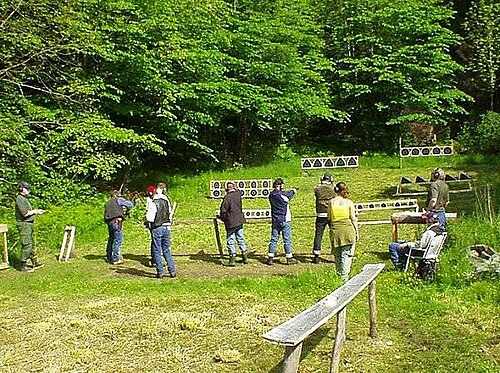
フィールドシューティングまたはテレインシューティング[20] [21]とは、固定距離の常設射撃場ではなく、屋外の地形にあるさまざまな距離(時には不明な距離)の臨時射撃場から射撃するピストルとライフルの射撃競技を指します。
拳銃を使った野外射撃
- ノルディックハンドガンフィールドシューティング競技は、ピストルとリボルバーを使用して、装備に応じてさまざまなクラスで射撃が行われ、[22]小口径の.22 LRから大口径の.500 S&Wマグナムまでのクラスがあります。[23]試合は、さまざまな射撃ターゲットと距離で年間を通じて屋外で開催され、ノルウェー射撃協会(NSF)、デンマーク体操スポーツ協会(DGI射撃)、スウェーデンピストル射撃協会(SPSF)によって手配されます。
- スイスのハンドガンを使ったフィールド射撃は、スイスの共通ルールに基づいて編成されたスイス射撃スポーツ連盟の管轄下にある競技であり、1899年以来編成されているライフルを使ったフィールド射撃と並んで、1919年以来毎年開催されるフィールド射撃選手権の一部となっています。
ライフルを使った野外射撃
- ノルディックライフル射撃競技[24]は、小口径の.22 LR弾を使用して100メートル、または中口径( .223レミントン弾や6mm BR弾など)またはバトルライフル弾(6.5×55mm弾、.308ウィンチェスター弾、.30-06スプリングフィールド弾など)を使用して100~650メートルの距離で射撃する競技である。ノルディックブルズアイライフル射撃競技では200~300メートルが通常の射撃距離であるのに対し、ライフル射撃競技では標的が300メートルをはるかに超える距離に配置されるため、この競技形式も長距離射撃競技に分類できる。試合は通常冬季にさまざまな標的で開催され、ノルウェー国立ライフル協会(DFS)、デンマーク体操スポーツ協会(DGI射撃)、スウェーデン射撃スポーツ協会(SvSF)が主催する。
- スイスのライフル射撃競技は、スイスの共通ルールに基づいて編成されたスイス射撃スポーツ連盟の競技です。毎年開催されるスイスフィールド射撃選手権は 1899 年から開催されています。1919 年からは、スイスフィールド射撃選手権にハンドガン射撃競技も加わりました。
- 精密ライフル シリーズ(PRS)のような精密ライフル競技は、中距離または戦闘用ライフル カートリッジを装着したライフルで約 10 メートルから 1000 メートルのさまざまな距離を射撃するフィールド射撃と長距離射撃の両方の競技です。
- フィールド ターゲットは、英国発祥の屋外エアガン競技ですが、世界中で人気が高まっています。ハンター フィールド ターゲットは、フィールド ターゲットのバリエーションです。
-
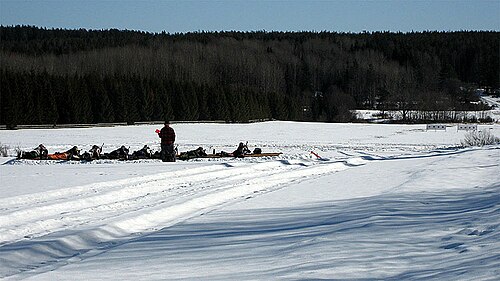 2012 年冬にスウェーデンで行われたノルディックライフル射撃大会。
 -
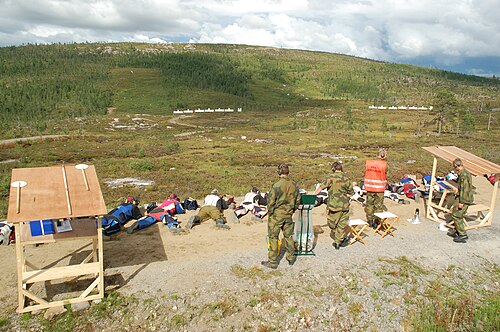 2007年Landsskytterstevnetでのノルウェーライフル射撃選手権。
 -
 National Match M1 を使用した、アメリカでのフィールドのような射撃競技。
 -
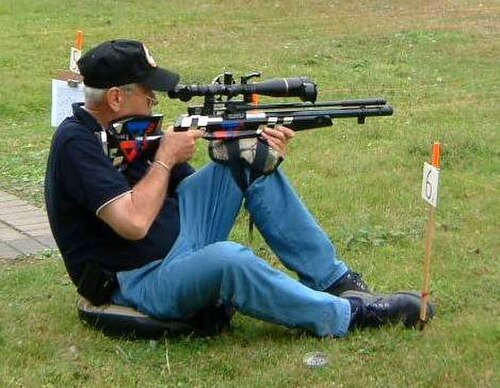 ドイツでの野外射撃
速射
拳銃による連射
- オリンピックでは、ISSF 25 メートル ピストルと ISSF 25 メートル ラピッド ファイア ピストルの競技が行われます。
- ビアンキ カップは、IPSC(「ラン アンド ガン」要素なし)とブルズアイ シューティング(ルールで許可されている場合は両手で撃ち、伏せ撃ちする)を融合したもので、4 つのシミュレートされたシナリオ(「イベント」と呼ばれる)で厳しい時間制限内での正確さが、この競技の基本となります。射手は、射撃のたびにホルスターに銃を収めた状態で開始する必要があり、距離は 10 ヤードから 50 ヤードの範囲です。
- ファスト ドローは、クイック ドローとも呼ばれ、北米発祥のピストル アクション シューティングの一種で、アメリカ西部のガンマンたちのロマンチックな技を基にしており、伝統的なシングル アクション リボルバーを使用します。ただし、カウボーイ アクション シューティングとは異なり、ファスト ドローは特殊な空砲またはワックス弾を使用します。一部の競技は厳密に時間制限があり、最速のタイムが勝利となりますが、多くは直接対決のシングル エリミネーションまたはダブル エリミネーション マッチとして設定されています。
-
 女性アスリートが25メートルピストル競技に出場
 -
 2016年リオデジャネイロオリンピックのISSF25メートルラピッドファイアピストル競技に出場する米国のキース・サンダーソン選手。
 -
 2008年ビアンキカップでのジョン・プライド。
.jpg/500px-Sanderson9209_(28322239393).jpg)
ライフルの連射
- CISMラピッド ファイア マッチは、 ISSF 300 m スタンダード ライフル競技のスピードアップ版です。
- フェルトゥルティグスキーティング(文字通り、野戦速射)とスタングスキーティングは、スカンジナビアで人気のある可変速射撃ライフル競技の一種です。


クレーターゲット
クレー射撃は、飛んでいるクレーの標的を狙って射撃する散弾銃競技です。
- 3 つの ISSF/オリンピック ショットガン射撃競技はすべて、「トラップ」と呼ばれるマシンによって投げられたクレー射撃ターゲットに対する素早い反応に基づいています。
- スキート:標的は、40メートル離れた場所に設置された「トラップ」と呼ばれる2人の投手から、単発または2回投げられます。[25]
- トラップとダブルトラップ:射手の前方15メートルから1つのターゲット(トラップ)または2つのターゲット(ダブルトラップ)が投げられます。[25]
- 国際ティル・オ・アルム・スポーツ連盟(FITASC)のコンパック・スポルティングは、クレー射撃、トラップ射撃、スキート射撃に似たショットガンスポーツ射撃の一種です。
- 国際的に(少なくとも部分的に)認知されている他のショットガン スポーツとしては、スポーティング クレー、ダウン ザ ライン/ATA、ファイブ スタンドなどがあります。
-
 アメリカでのトラップ射撃。
 -
 アメリカでのスキート射撃。
 -
 クレー射撃の標的が自動投擲機にセットされているところ。
 -
 米国で開催された2015年世界警察消防競技大会でのトラップ射撃。
 -
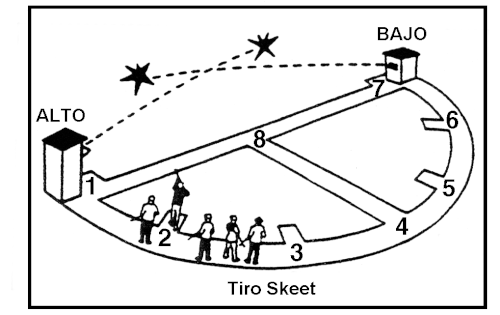 スキート射撃場のスケッチ。
.jpg/500px-Trap_shooting_at_WPFG_(19279134951).jpg)
ランニングターゲット
ランニング ターゲット シューティングとは、イノシシ、ヘラジカ、シカなどとも呼ばれるターゲットを、走る動物のように動かす射撃競技の総称です。このタイプの競技には、次のものがあります。
- ISSF 10メートルランニングターゲット
- ISSF 10メートルランニングターゲット混合
- ISSF 50メートルランニングターゲット
- ISSF 50メートルランニングターゲット混合
- 100メートル走のヘラジカは、スカンジナビアではスポーツとしても狩猟の練習としても人気があります。スウェーデンでは80メートルで競技が行われます。[26]
- 100メートル走る鹿、スカンジナビアやイギリスでもやや人気がある[要出典]
動く標的
1908年夏季オリンピックの射撃 - 男子移動標的小口径ライフル
消えゆく標的
1908年夏季オリンピックの射撃 - 男子用消失標的小口径ライフル
実践的な射撃
実技射撃はアクション射撃またはダイナミック射撃とも呼ばれ、スピードが精度と同じくらい重要視される射撃競技に適用される一般的な用語です。競技の多くは動きを伴い、拳銃を使用する場合はホルスターから拳銃を引き抜くことが多いです。
- 国際実用射撃連盟(IPSC) は、実用射撃における最古かつ最大の認可団体です。IPSC は射撃スポーツの「フォーミュラ 1」と見なされることもあり、ハンドガン、ライフル、ショットガンで射撃を行います。米国実用射撃協会(USPSA) は IPSC の米国地域支部ですが、USPSA のルールの多くは国際的に使用されているものと若干異なります。IPSC は元警察官や民間の射手によって開発され、後に現代の軍隊や警察の演習の基礎として使用されました。これは射撃中に射手が頻繁に移動するバリエーションであり、命中数と射撃時間が同等に重要です。ステージの手順は一般に指示されず (フリースタイル)、射手はターゲットに挑む順序と方法を決めることができます。
- 国際防衛ピストル協会(IDPA) は、半自動拳銃とリボルバーを使用するアクション シューティング スポーツで、特に隠し射撃を重視しています。ステージでの戦闘の多くの側面が競技者に指示され、競技上の優位性を得ようとした、または故意に正しく行わなかった「後ろめたさ」で禁止行為を行ったと安全担当者が判断した競技者にはペナルティが与えられます。
- マルチガンは実践的な射撃競技で、各ステージでは通常、競技者はライフル、ハンドガン、ショットガン[27]、またはその他の種類の銃器を組み合わせて使用し、切り替える必要があります。3ガンは、通常のIPSC / USPSAの試合と多くの共通点があり、射手がさまざまなステージを移動し、さまざまな位置にあるターゲットに攻撃する必要がある射撃コースがあります。
- スチール チャレンジは、スチール ターゲットをできるだけ速く撃つことだけを競うスピード シューティング チャンピオンシップで、スチール チャレンジ シューティング アソシエーション (SCSA) が主催しています。標準化された射撃コースが 8 つあり、最後に特別な「ストップ プレート」を撃ってタイマーを停止する必要があります。
- 国際リボルバー愛好家連盟(ICORE)は、リボルバーを使ったアクションシューティング競技を推進する国際コミュニティです。1991年に設立されたこのスポーツは、ビアンキカップ、IPSC、スティールチャレンジの要素を取り入れています。[28]
- IPSC アクションエアは、実銃の代わりにエアソフトガンを使用するという点で、IPSCと同じ原則に従っています。射撃場、紙のターゲット、ポッパーなどはエアソフトガンに合わせて縮小されており、このスポーツは、民間人が実銃を所有することが違法であるか、入手が極めて困難な台湾、香港、日本などの国で人気を博しています。
- ボウリングピン射撃(主に拳銃で射撃)では、競技者は最短時間で標準的なボウリングピンをテーブルから落とすために互いに競い合います。
-
 ステージ中のオープン部門実技ピストル射撃選手。
 -
 ロシアで開催された2017年IPSCライフル世界射撃大会に出場したノルウェーの実戦ライフル射撃選手。
 -
 エクアドル出身のリカルド・ロペス・トゥーゲントハットは、実用リボルバーの世界チャンピオンに3度輝いた人物です。
長距離
長距離射撃は、気象条件の判断に基づく照準調整が重要になる距離で行われる射撃です。
- フルボア ターゲット シューティングは、300 ~ 1200 ヤードの距離にあるターゲットを射撃するスポーツです。このスポーツは国際的にICFRAによって統括されており、英国、米国、ドイツ、連邦諸国で人気があります。ブルズアイ シューティングやフィールド シューティングと呼ばれる同様の競技はスカンジナビアで人気がありますが、射撃距離はより短くなります。
- 「ターゲット ライフル」(パルマ ライフルとも呼ばれる)は、1876 年に始まった ICFRA のフルボア競技形式で、1,000 ヤードまで射撃する長距離ライフルが特徴です。最初のパルマ マッチは、米国、オーストラリア、カナダ、スコットランド、アイルランドのチームによって競われました(当時は前装式ライフルを使用)。この試合は 1920 年代後半まで続き、パルマ トロフィーは第二次世界大戦の勃発頃にワシントン DC で失われました。この試合は、現代では 1966 年にカナダで復活し、世界中のチーム間で継続されています。規則では、ボルトアクションライフルの弾薬は7.62mm NATO口径(ウィンチェスター .308)で、マイクロメーター口径(アイアン)サイトを使用して155グレインの弾丸を使用するマッチグレード弾、または最大弾丸重量90グレインの5.56mm NATO(.223レミントン)とアイアンサイトを使用することが規定されています。現代の弾丸技術の発達により、適切な装填であれば、.223から発射された85.5グレインの弾丸は.308より射撃能力が優れています。[29]直近の2回の国際長距離ターゲットライフル競技は、2011年にオーストラリアで、2015年に米国で開催され、イギリスが優勝しました。[30]
- F クラスは、フルボア ターゲット ライフルを使用して最大 1000 ヤードの距離から射撃する、ICFRA フルボア競技形式の 1 つです。ライフルには望遠照準器が取り付けられており、フォア エンドとバット レストの使用が許可されています。これは、急速に普及しているフルボア ターゲット ライフルの派生型です。「F」は、F クラスのカナダ人発明者、ジョージ ファークハーソンに敬意を表しています。
- 精密ライフル競技は、スピードと精度のバランスを求める比較的新しい長距離競技形式で、既知および未知の距離の両方で、制限時間内に通常とは異なる位置から移動して射撃することが多い。
- 全米ライフルリーグ(NRL)は、米国における精密ライフル射撃の発展と教育を目的とする501(c)(3) 非営利団体である。試合形式は、口径.224から.308まで、速度3,200フィート/秒(980 m/s)を超えないもので、少なくとも50人の射手が少なくとも2日間にわたり、少なくとも12の個別ステージで各人が最低140発の弾丸を発射する。2017年のデビュー以来、現在8つの州から11のクラブがリーグに参加している。[31]
- ナショナルライフルリーグ22(NRL22)は、ナショナルライフルリーグの傘下にある、.22ロングライフルの リムファイアライフルに特化したサブリーグです。ほとんどの地域に1000ヤードの射撃場がない一方で、ほぼすべての地域に100ヤードの射撃場があり、ほとんどの射手が.22ライフルを所有しているという事実に対処するために設立されました。彼らのチャンピオンシップマッチは、少なくとも15の個別のステージで少なくとも170発の弾丸を発射するものです。現在、米国31州から68のクラブがNRL22の試合に参加しており、英国とオーストラリアの2つの海外クラブも参加しています。[32]
- T クラス射撃スポーツ競技。精密ライフル システムを使用した実践的な狙撃は、短期間で世界中で絶大な人気を博した射撃スポーツです。人工的に作り出された現実的なストレス状況下で、さまざまな位置からさまざまな距離 (既知および未知) の静的または動的ターゲットを射撃することに重点を置いています。難易度が高いため、実行と観察の両方で非常に興味深いものとなっています。国際 T クラス連盟 (ITCC) は、T クラス射撃スポーツの国際的普及を目的として 2014 年に設立された非営利団体で、本部はブルガリアにあります。T クラス競技の設計と管理に関する一連のルールを提供しています。
-
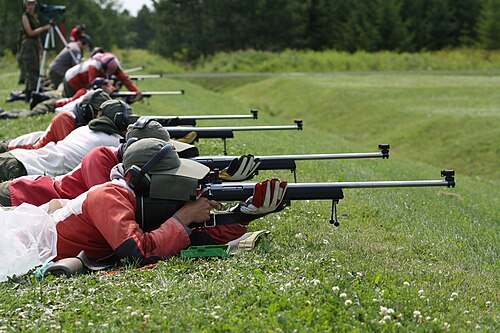 2011 年にカナダで行われたフルボア ターゲット ライフル(「パルマ」) 射撃。
 -
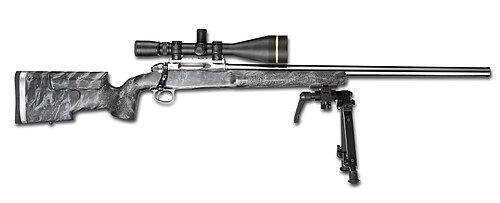 スコープとバイポッドを装備したICFRA F クラスライフル。
ベンチレスト
ベンチレスト射撃は、射手が椅子(ベンチ)に座り、テーブルにライフルを支えて小グループを射撃する競技です。すべての射撃競技の中で、最も装備が要求される競技です。装備のクラスに応じて、国際ベンチレスト競技は世界ベンチレスト射撃連盟または世界リムファイアーおよびエアライフルベンチレスト連盟によって統括されます。
-
 50 メートルのベンチレスト射撃に使用される、口径 .22 LR の Anschütz 1903 ライフル。
 -
 BCM ヨーロッパアームズ シングルショット ベンチレスト ライフル。
メタリックなシルエット
金属製のシルエット競技者は、動物の形をした鋼鉄のシルエット(鶏、豚、七面鳥、羊)を撃ち、得点を得るためには、シルエットを倒さなければなりません。5 つのターゲットが最大 500 メートルの位置に配置され、ターゲットの距離とサイズは銃器のクラスによって決まります。クラスには、ハンドガン、小口径ライフル(ハンター、シルエット)、高出力ライフル(ハンター、シルエット)、空気銃、黒色火薬ライフルがあります。無制限のカテゴリで使用されるハンドガンは、ライフルのような外観をしています。トンプソン コンテンダー、レミントン XP-100、およびその他のピストルは、200 メートルでの正確な射撃に必要なパワー、空気力学的効率、および外部弾道を備えたライフル口径の薬室を備えています。ターゲットに損傷を与える高速徹甲弾を除き、ほぼすべての種類の調整可能な照準器付きピストルとライフルに適したシルエット カテゴリがあります。オープンサイト銃の標的は 25 〜 200 メートルの間に配置され、約 1.5ミリラジアン(または 5分角)のヒット ゾーンの使用可能なサイズを提供するように設計されています。

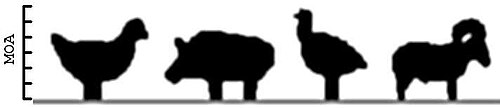
西洋
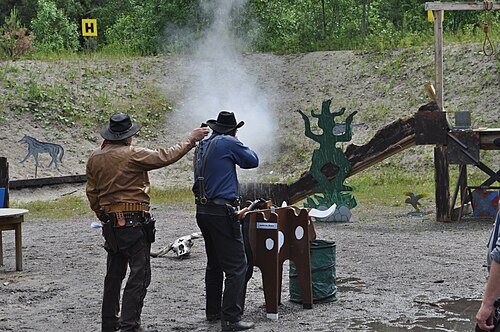
- カウボーイ アクション シューティング(CAS) は、西部のカウボーイをテーマにした小道具を使用することを除けば、USPSA および IDPA のステージ デザインとほぼ同じです。競技者は歴史的な長銃とリボルバーを使用して射撃し、テーマに沿った偽名と本格的な服装を使用する必要があります。
- カウボーイ騎乗射撃は、ウエスタン騎乗射撃または単に騎乗射撃とも呼ばれ、馬に乗って射撃パターンを競う競技である。射撃競技団体によってルールは異なるが、 19世紀後半のワイルドウェストショーで行われた歴史的な射撃競技の歴史的再現に基づいている場合もある。現代の競技では、実弾ではなく空砲を使用し、20フィート以内の標的風船を破ることが認定されている。[33]
-
-
 西部劇の風景。
 -
 射手はステージ中にさまざまな銃器を使用します。このステージでは、近距離の青いターゲットにはリボルバーを使用し、最も遠い赤いターゲットにはレバーアクションを使用しました。
 -
 2012 AQHA 騎馬射撃世界選手権でのカウボーイ騎馬射撃。
マスケット銃
前装式はレプリカ(またはアンティーク)銃の射撃に関係します。
-
 仰向けになって1000ヤード(914.4メートル)の距離から射撃する競技者
 -
 ノルウェーチームの選手が1000ヤード(914.4メートル)を射撃する
 -
 2015 MLAIC マスケット銃長距離選手権で使用されたレプリカ リグビー ライフル
 -
 米国チームのメンバーが黒色火薬ライフルに弾を装填している
パラシュート
パラリンピック射撃は「パラスポーツ射撃」とも呼ばれ、障害を持つ競技者向けに射撃スポーツを改良したものである。パラリンピック射撃は、1976年のトロント大会の夏季パラリンピックで初めて登場した。パラ射撃は国際パラリンピック委員会によって国際的に統括されている。公平な競技を確立するために、パラリンピック大会ではパラ射撃分類と呼ばれる射撃分類が設けられています。[34]
これらの競技は、オリンピックの射撃競技とある程度似ています。エアピストルは通常、ピストルを支えずに座った状態で射撃します。許可される背もたれの量は、選手の障害レベルによって決まります。エアライフル競技には、エアピストルのように座った状態で射撃するライフル「スタンディング」が含まれますが、背もたれのレベルはさまざまです。「伏せ」ライフルは、支える腕にスリングを使用する基本的な伏せ射撃姿勢を使用しますが、選手は椅子または車椅子に座り、テーブルの上に置いた状態で射撃します。
-
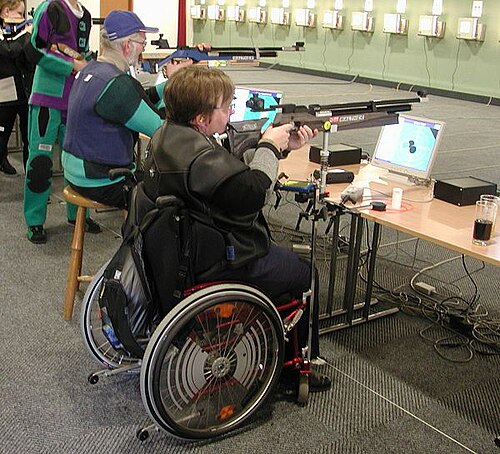 車椅子に座りながらライフルでパラシュート射撃をする。
 -

-

-
 パラ「伏せ撃ち」は、伏せ撃ちの基本姿勢をテーブルから射撃できるように修正します。
工場および軍の銃器を使用した競技
Shooting competitions for factory and service firearms, usually called Service Rifle, Service Pistol, Production, Factory or Stock, describe a set of disciplines or equipment classes where the types of permitted firearms are subject to type approval and few aftermarket modifications are permitted. Thus the terms refer to permitted equipment and modifications rather than the type of shooting format itself. The names Service Rifle and Service Pistol stem from that the equipment permitted for these types of competitions traditionally were based on standard issue firearms used by one or several armed forces and civilian versions of these, while the terms Production, Factory and Stock often are applied to more modern disciplines with similar restrictions on equipment classes. Factory and service classes are often restrictive in nature, and the types of firearms permitted are usually rugged, versatile and affordable. In comparison, more expensive custom competition equipment are popular in more permissive equipment classes. Both types of equipment classes can be found within many disciplines, such as bullseye, field, practical and long range shooting.
-
 Service rifle shooting in Slovenia with the Zastava M48 rifle.
 -


Plinking
Plinking refers to informal target shooting done for pleasure or practice typically at non-standard targets such as tin cans, logs, cartons, fruits, or any other homemade or naturally occurring objects like rocks (however, it is unsafe to shoot at rocks) or tree branches. The primary appeals of plinking as a sport are the broad variety of easily available locations, minimal costs, freedom in practice styles, and more relaxing and less restrictive shooting experience.
The flexibility of target choice is also why plinking is popular. A small, three-dimensional target in an outdoors setting is much more akin to a real-world hunting and varminting scenario, presenting a better simulated opportunity to practice shooting skills. A plinking target will also often react much more positively to a hit than a paper target used in formal competitions, either audibly with a sharp impact sound (hence the name "plink") or visually by bouncing, splattering or falling over. Steel targets used for formal action and long range shooting competitions are also popular for plinking due to the ease of setting up and confirming good hits.
-
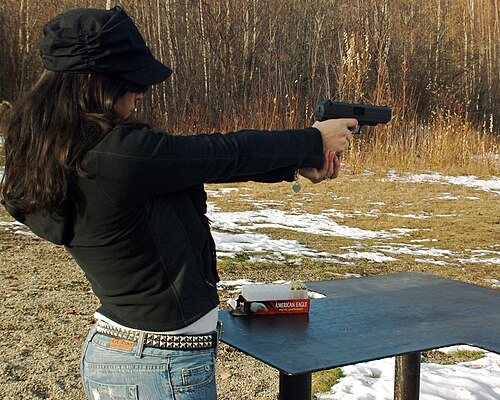 A woman plinking with a Hi-Point pistol in .40 S&W in Alaska.
 -
 Plinking with a Ruger 10/22 rifle in Burro Canyon, Arizona, US.
 -
 Plinking on a Saturday in Burro Canyon, Arizona, US. On this range firearms must be kept unloaded in the rack, except when on the firing line.
Athletic shooting sports
Athletic shooting sports are hybrid events of normally stationary shooting sport competitions and the sport of athletics or other physically demanding non-shooting sports. Many were borne from military exercises and emphasize physical endurance.
- IBU Biathlon is a Winter Olympic sport combining cross-country skiing (normally freestyle skate skiing) and shooting with .22 LR rifles.[13] In Scandinavia the discipline is simply known as "Ski Shooting" (Swedish: skidskytte, Danish: skiskydning, Norwegian: skiskyting).
- Bike biathlon or velo biathlon (Russian Велобиатлон) combines cycling (road or mountain bike) and shooting (handgun[35] or rifle[36]).
- ISSF Target Sprint combines medium-range run (3 × 400 m) and airgun shooting.
- Modern pentathlon is a Summer Olympic sport includes a combined event called Laser-run that consists of 4 laps of 800 metres combined with 4 rounds of timed shooting with a laser air pistol as one of its original five parts.[37]
- Nordic Ski Field Shooting (Norwegian: skifeltskyting, Swedish: skidfältskytte) is a Nordic discipline organised by the National Rifle Association of Norway and the Swedish Shooting Sport Association which is based on the origins of modern biathlon. It is normally held using classic (in-track) skiing, but competitions can also be held in a freestyle skate skiing format. Furthermore, shooting is done with fullbore calibers and usually in the field from temporary shooting ranges. The discipline is considered as a near precursor to modern biathlon.
- Nordic shooting with cross-country running (Norwegian: skogsløp, Swedish: springfältskytte) is a Nordic discipline arranged by the National Rifle Association of Norway and the Swedish Shooting Sport Association which combines running with shooting. It is considered the summer edition of Ski Field Shooting. Running distances are usually between 2 and 3 kilometers with 2 to 3 shooting series.
- Military patrol was a team winter sport in which athletes competed in cross-country skiing, ski mountaineering and rifle shooting. It was usually contested between countries or military units.
- Moose biathon (Finnish Hirvenhiihto) is a variation of biathlon comprising cross-country skiing, range estimation and rifle shooting at paper targets of moose. Moose shooting with cross-country running (Finnish Hirvenjuoksu) is a summer variant where the skiing part is replaced with running.
- Orienteering shooting (Finnish ampumasuunnistus) combines shooting with orienteering, and competitions are organised in Denmark by DMSA, in Sweden by the civilian Swedish Multisport Association[38] and in Finland by the FRSF.
- Pistol shooting with cross-country running (maastokilpailu), organized in Finland by the FRSF.
- Pistol skiing (Norwegian pistollangren, Swedish pistolskidskytte, Finnish pistooliammuntahiihto) is biathlon with pistols and revolvers, and is organised in Norway by NROF, in Sweden by SPSA and in Finland by the FRSF.
- Summer biathlon, with skiing replaced by either running or rollerskis, is popular in Germany.
- Ski Archery is a variation of biathlon combining archery marksmanship with cross country skiing.
- Underwater target shooting is a combined underwater and shooting sport that tests a competitors' ability to accurately use a speargun via a set of individual and team events conducted in a swimming pool using free diving or Apnoea technique.
-
 German military patrol in Giant Mountains in 1932.
 -
 Standing phase at the 2018 Biathlon World Cup in Oberhof.
 -

-
 Bike biathlon competition using handguns.

Bow shooting sports
Archery
Modern competitive archery involves shooting arrows at a target for accuracy from a set distance or distances. A person who participates in archery is typically called an archer or a bowman, and a person who is fond of or an expert at archery is sometimes called a toxophilite. The most popular competitions worldwide are called target archery. Another form, particularly popular in Europe and America, is field archery, which generally is shot at targets set at various distances in a wooded setting. 3D archery, which differs from field archery in that the targets are animal models, is also quite popular in the same regions. There are also several other lesser-known and historical forms, as well as archery novelty games. The tournament rules vary from organization to organization. World Archery Federation rules are often considered normative, but large non-WA-affiliated archery organizations do exist with different rules. Competitive archery in the United States is governed by USA Archery and National Field Archery Association (NFAA), which also certifies instructors. Run archery is a shooting discipline connecting archery with running.
-
 Target shooting with a recurve bow.
 -
 Archery competition in Mönchengladbach, West Germany, June 1983.
.jpg/500px-WA_target_shot_with_a_compound_bow_(Devizes_Bowmen).jpg)
Crossbow
The International Crossbow Shooting Union (Internationale Armbrustschützen Union or IAU) was founded in Landshut, Germany on June 24, 1956, as the world governing body for crossbow target shooting. The IAU supervises World, Continental and International crossbow shooting championships in 3 disciplines; 30 m Match-crossbow, 10 m Match-crossbow and Field-crossbow shooting. IAU World Championships take place every two years with Continental Championships on intervening years. Other International and IAU-Cup events take place annually.[13] World Crossbow Shooting Association (WCSA) organises competitions in 7 disciplines: Target, Target match play, Forest, Forest match play, 3D, Bench & prone target and Indoor target.[39]
-
 Anna Sushko of Russia, 2006 Junior World Champion, holding an ICU 10 m Match Crossbow
 -
 A competitor at the 30 meter event at the 2008 ICU Match-Crossbow World Championships in Sulgen, Switzerland.
Dart shooting sports
Sport blowgun
There are several competition styles of sport blowgun practised around the world. A standardization of competition style is based upon fukiya, and governed by the International Fukiyado Association. It is a 10-metre target shooting, using a standardized barrel caliber and length, and a standardized dart length and weight as outlined by IFA. There are two more styles, both based upon the Cherokee Annual Gathering Blowgun Competition. The Field Style competition is similar to the winter Biathlon, where the shooter runs from a starting line to a target lane, shoots and retrieves the darts, and continues to the next station. The course length varies from 400 to 800 m with from 9 to 16 targets at various heights and shooting distances. The final style is the Long Distance target shoot. The target is a circle of 24 cm diameter, and the firing line is 20 m away. Three darts are fired by each shooter, at least one of which must stick in the target. All successful shooters move to the next round, moving back 2 m each time.
Confrontational shooting sports
Confrontational shooting sports is a set of relatively new team sports using non-lethal ranged weapons that are safe enough to shoot at other people. Previously such games were not possible due to safety concerns since bows and guns are generally too lethal and dangerous for human targets, but the development of newer airgun and infrared technologies allowed for the development of safe confrontational disciplines. While initially only for sport and recreations, professional sport competitions are now held. These type of games are also used for tactical gunfight training by military and law enforcement agencies to some extent.[40]
Olympic dueling
Olympic dueling is an archaic individual sport that sought to safely emulate the deadly practice of pistol duelling, akin to fencing emulating sword fighting. It involved the use of specially built primer-fired pistols to propel wax bullets.[41] Two versions of the sport were demonstration events at the 1906 Olympics and 1908 Olympics. It was also a popular sport in France.[42]
-
 A duel at the 1908 Olympics.
 -
 Portrait shots of Olympic duelists, showing their safety equipment and modified guns.
Paintball
Paintball is a competitive sport in which players from opposing teams eliminate opponents out of play by hitting them with round, breakable, dye-filled oil and gelatin pellets ("paintballs"), shot from HPA/CO2-powered air guns called paintball markers. It can be played on indoor or outdoor fields scattered with natural or artificial terrain, which players use for tactical cover. Paintball game types vary, but can include capture the flag, elimination, ammunition limits, defending or attacking a particular point or area, or capturing objects of interest hidden in the playing area. Depending on the variant played, games can last from seconds to hours, or even days in scenario play. The game was developed in the 1980s and is now regularly played at a formal sporting level with organized competition involving major tournaments, professional teams and players.
- National Xball League is the United States' professional paintball circuit. The league consists of a Professional Division, consisting of the best players the sport has to offer, that extends down to the beginner ranks of "Division 5" for those newer to the tournament atmosphere. The league hosts five national events across the country in places such as Las Vegas, Dallas, Nashville, Cleveland, Chicago, Atlantic City and Orlando throughout the year, starting in March and ending their season in early November. The league's largest event each year is the season finale known as the World Cup, with the 2016 World Cup hosted 3,554 players from 35 countries.
- National Collegiate Paintball Association is an all-volunteer, non-profit organization created by United States college players. The goal of the NCPA is to promote the positive aspects of the sport in an intercollegiate manner. The NCPA consists of two distinct classes which competes separately — Class AA is an open-class division where any college may enter and compete in regional and national tournaments. Class A is a closed-class division where only certain colleges may compete after securing a bid in the previous season, and represents the best talent of college paintball and includes universities such as Drexel University, University of Maryland, Illinois State University, Purdue University, University of Connecticut, Penn State University and 10 other teams across three conferences all fighting for a national title. The association's 2007 playoff tournament was aired on Fox Sports Net's digital cable college sports network, Fox College Sports.
-
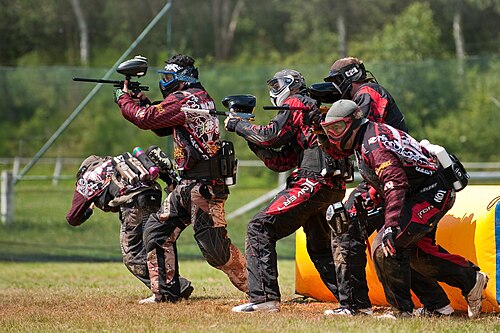 Players next to an inflatable Sup'Air bunker.
 -
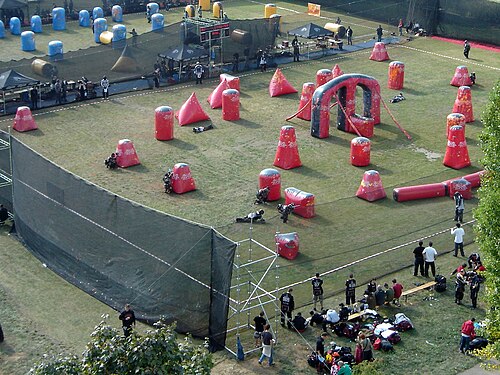 View of a course during a speedball game in progress.
Airsoft
Airsoft is a competitive sport similar in concept to paintball, in which participants from opposing teams eliminate opponents by hitting each other with solid round plastic pellets launched from low-powered smoothbore air guns called airsoft guns. It is different from paintball in that airsoft pellets do not visibly mark the targets like paintballs, and thus the sport relies heavily on an honor system where a hit player has the ethical duty to call himself out of play, regardless of whether anyone else sees it happen. Most airsoft guns are also magazine-fed (unlike the commonly top-mounting pellet loader of paintball markers) with mounting platforms compatible with real firearm accessories, and tend to more closely resemble real guns in appearance, making them more popular for military simulation and historical reenactments. The greater toughness of airsoft pellets also allows the use of better powerplants and apparatus such as hop-up device for improved external ballistics, making the gameplay more accurately resemble real gunfights. They are also much cheaper for casual players to participate than paintball.
Airsoft gameplay varies in style and composition just like paintball and is played in both indoor and outdoor courses. Situations on the field frequently involve the use of real-life military tactics to achieve objectives, and it is not uncommon for participants to emulate the uniforms and equipment of real military and police organizations for a sense of realism. Games are normally supervised (and sometimes umpired) by trained on-site administrators, and players' airsoft guns are usually checked through a chronograph to enforce power output restrictions.
There are currently no formal national or international governing bodies for the airsoft sport. Competitive tournaments are usually organized by private clubs or among enthusiasts and professional/semi-professional teams (often referred to as "clans"), with rules and restrictions varying from event to event.
-
 Three airsoft team members defending an area during an indoor CQB game.
 -
 From an outdoor airsoft game.
 -
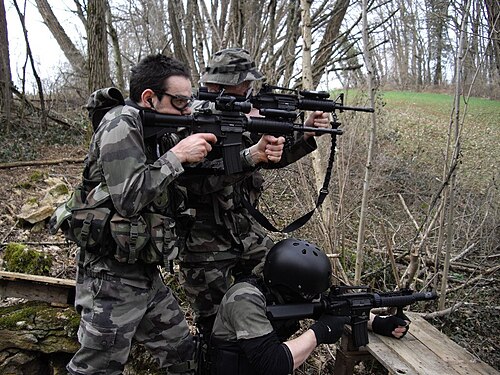 Three airsoft team members during a field game.
Laser tag
Laser tag (despite the name, laser is actually not used due to safety concerns) is a tag game played with infrared light guns and sensors worn on the body of the players. Since its birth in 1979, laser tag has evolved in both indoor and outdoor games, each with gameplay styles such as annihilation, capture the flag, domination, VIP protection, (usually sci-fi) role playing, etc. When compared to paintball and airsoft, laser tag is painless and very safe because it involves no projectile impacts, and indoor games may be considered less physically demanding because most indoor venues prohibit running or roughhousing.
- Zone Laser Tag World Championships were international tournaments among professional/semi-professional teams from North American, Europe and Australia, hosted every few years since 2003.
- Bi-lateral international championships have included USA vs. Australia and Australia vs. South Africa.
- National tournaments in various countries including Australia, US, Sweden, Finland, UK, etc.
- Private club-level events such as TagCon (annual in UK and US), Tagfest (annual in US), Dropzone (annual in UK), LaserStorm (annual in Australia), etc.
More sophisticated forms of laser tag, such as MILES, are used (in conjunction with blanks) by militaries to allow for non-lethal combat training.
-
 An indoor laser tag competition at Long Beach, California in 2011.
 -
 Soldiers equipped with laser tag training equipment
.jpg/500px-Long_Beach_Comic_&_Horror_Con_2011_-_Party_Xtreme_Laser_Tag_(6301174661).jpg)
Archery Tag
Archery Tag is a form of combat archery sport where participants shoot one another using a bow with arrows with large foam tips. The game's rules closely resemble dodgeball. The game begins with a number of arrows in the center of the arena. At the whistle, players race to collect them, before firing them at one another across the playing field. A player is eliminated if struck by an arrow, and a player can bring an eliminated teammate back into play by catching an arrow. To avoid injury, participants wear protective facemasks and use bows with less than 30 pounds (14 kg) draw weight. It was invented in 2011 by John Jackson of Ashley, Indiana, and experienced a boost in popularity from the Hunger Games books and film series, which feature a bow-wielding protagonist Katniss Everdeen. Jackson staged Archery Tag games at local premieres of the films. By 2014, Jackson had licensed the game to 170 locations, mostly in the United States, but also in Russia, Peru and Saudi Arabia.
Battle gaming variants of Archery Tag also exist, such as Dagorhir, Amtgard, Belegarth and Darkon, where archers are pitted among melee players welding foam weapons to simulate medieval battles.
-
 A game of archery tag in Toronto
Esports
Esports is the competitive playing of video games, often referring to play at the professional level. While the term esports includes many types of video games unrelated to shooting sports, a major subset of esports are the shooters, namely first-person shooters and third-person shooters. Matches of these games can take a variety of forms but traditionally take formats similar to paintball, involving teams of players whose objective is to eliminate the opposing team in simulated combat, often while also focusing other key objectives. Major games of these styles currently in professional play include (among others) Counter-Strike: Global Offensive, Overwatch, Team Fortress 2, Valorant, and PlayerUnknown's Battlegrounds. Organized play is done both online or in-person. While there has been serious interest to include esports in the Olympics and similar events, the inclusion of shooters has been less welcomed due to their often violent visual content.
-

-
 A live professional CS:GO match in 2016.
.jpg/500px-Go%C5%9Bcie_Intel_Extreme_Masters_(8465481816).jpg)
See also
- List of shooting sports organizations
- Shooting sports in Canada
- Shooting ranges in the United States
- Shooting ranges in Switzerland
- Shooting targets
- Air travel with firearms and ammunition
- Plinking
- Shot grouping
- Schützenverein
References
- ^ "Handgun Sports • NSSF | National Shooting Sports Foundation". Archived from the original on April 4, 2019. Retrieved November 3, 2017.
- ^ "Rifle Sports • NSSF | National Shooting Sports Foundation". Archived from the original on April 4, 2019. Retrieved November 3, 2017.
- ^ "Shotgun Sports • NSSF | National Shooting Sports Foundation". Archived from the original on October 14, 2018. Retrieved November 3, 2017.
- ^ "Archery 101 by Archery 360". February 22, 2023. Archived from the original on November 3, 2017. Retrieved November 3, 2017.
- ^ "Archery | World Archery". August 16, 2023. Archived from the original on September 2, 2017. Retrieved November 3, 2017.
- ^ Kardous, C. A.; Willson, R. D.; Hayden, C. S.; Szlapa, P.; Murphy, W. J.; Reeves, E. R. (2003). "Noise exposure assessment and abatement strategies at an indoor firing range". Applied Occupational and Environmental Hygiene. 18 (8): 629–36. doi:10.1080/10473220301409. PMID 12851012.
- ^ "Noise levels at shooting range - timesofmalta.com". June 19, 2015. Archived from the original on July 28, 2024. Retrieved November 3, 2017.
- ^ Minshall, David (2005). "Wimbledon & the Volunteers". ResearchPress.co.uk. Archived from the original on April 23, 2012.
- ^ Richard L. Hummel, and Gary S. Foster, "Germanic/American shooting societies: continuity and change of schuetzenvereins." International Journal of the History of Sport 15.2 (1998): 186-193.
- ^ "Pottery Pigeons" Timeline (March/April 1994) 11#2 pp. 22-27 identifies George Ligowsky of Cincinnati as an inventor of clay pigeons.
- ^ Steven A. Riess, ed. Sports in America from Colonial Times to the Twenty-First Century: An Encyclopedia (Sharpe, 2011), 3:828.
- ^ Russell Gilmore, "'The New Courage': Rifles And Soldier Individualism, 1876-1918." Journal of Military History 40.3 (1976): 97+
- ^ a b c "Shooting Equipment and history - Olympic Sport History". www.olympic.org. May 15, 2018. Archived from the original on August 18, 2016. Retrieved August 12, 2016.
- ^ Marlin, Marlin, Jeffrey A. "The National Guard, the National Board for the Promotion of Rifle Practice, and the National Rifle Association: Public Institutions and the Rise of a Lobby for Private Gun Ownership." (Dissertation, Georgia State University, 2013). online Archived November 1, 2019, at the Wayback Machine
- ^ James B. Trefethen, Americans and their guns: The National Rifle Association story through nearly a century (1967)
- ^ Australia, Sporting Shooter's Association of. "| Sporting Shooters' Association of Australia (SSAA)". ssaa.org.au. Archived from the original on August 8, 2016. Retrieved August 12, 2016.
- ^ "Double trap, rifle prone and 50m pistol dropped from Olympics". The Times of India. timesofindia.indiatimes.com. February 24, 2017. Archived from the original on April 12, 2023. Retrieved June 1, 2020.
- ^ "NRA Law Enforcement Division: Police Pistol Combat Competition". ppc.nra.org. National Rifle Association of America. 2015. Archived from the original on July 28, 2024. Retrieved April 17, 2015.
- ^ Scott McDonald (April 15, 2016). "Your Comprehensive Guide To The 15 Olympic Shooting Events". Team USA. Archived from the original on April 19, 2016. Retrieved November 16, 2022.
- ^ "Danish: Aalborg Skyttekreds af 1862 - Terrænskydning". Archived from the original on September 23, 2017. Retrieved October 6, 2017.
- ^ "Norwegian: feltskyting – Store norske leksikon". November 17, 2016. Archived from the original on September 23, 2017. Retrieved October 6, 2017.
- ^ "Swedish: Svenska Pskytteförbundet-Om pistolskytte-Fältskjutning". June 2017. Archived from the original on October 13, 2017. Retrieved October 6, 2017.
- ^ "Norwegian: Litt om feltskyting – Haugesund Pistolklubb (English: A little about field shooting - Haugesund Pistol Club)". Archived from the original on July 28, 2024. Retrieved October 6, 2017.
- ^ "Swedish: Fältskytte gevär förklarat | Sandvikens Skyttegille". Archived from the original on April 17, 2017. Retrieved October 6, 2017.
- ^ a b "Topend Sports | About Shooting Sports". Archived from the original on July 28, 2024. Retrieved October 6, 2017.
- ^ ""jagareforbundet.se"". Archived from the original on July 28, 2024. Retrieved June 8, 2018.
- ^ DeJesus, Ivey (January 8, 2015). "A pistol, rifle and shotgun sport part of the lineup at NRA's Great American Outdoor Show". PA Media Group. Archived from the original on April 17, 2015. Retrieved April 16, 2015.
- ^ "ICORE History and Information". Archived from the original on June 27, 2015. Retrieved July 30, 2015.
- ^ "Palma USA". Archived from the original on April 1, 2017. Retrieved March 31, 2017.
- ^ "PALMA TEAM TROPHY" (PDF). Archived (PDF) from the original on March 26, 2014.
- ^ "Participating Clubs/Matches". National Rifle League. Archived from the original on June 24, 2018. Retrieved June 24, 2018.
- ^ "Clubs". NRL 22. Archived from the original on June 24, 2018. Retrieved June 24, 2018.
- ^ Taffin, John (September 28, 2005). Single Action Sixguns. Iola, Wisconsin: Krause Publications. pp. 299–300. ISBN 978-1-4402-2694-6.[permanent dead link]
- ^ "Shooting Para Sport Classification Rules and Regulations". International Paralympic Committee. Archived from the original on February 7, 2022. Retrieved November 21, 2022.
- ^ "Biathlon goes for spin in Bike-n-Shoot event – The Denver Post". April 23, 2007. Archived from the original on September 20, 2019. Retrieved September 16, 2019.
- ^ "Velo Biathlon Combines Cycling and Rifles | Complex". Complex Networks. Archived from the original on September 20, 2019. Retrieved September 16, 2019.
- ^ "UIPM Laser Run". Union Internationale de Pentathlon Moderne (UIPM). July 15, 2016. Archived from the original on July 28, 2024. Retrieved August 4, 2021.
- ^ "Orienteringsskyting – enda en orienteringsgren? – Knut Edvard Helland". Archived from the original on July 22, 2023. Retrieved December 12, 2018.
- ^ stephen sommers (January 3, 2014). "World Crossbow Shooting Association Inc". Worldcrossbow.com. Archived from the original on March 20, 2022. Retrieved March 4, 2022.
- ^ "Police and US Military Using Airsoft Guns for Training Missions". Police1. December 12, 2012. Archived from the original on September 27, 2022. Retrieved June 27, 2022.
- ^ "Forgotten Weapons - "Lepage Wax-Bullet Dueling Pistols" (YouTube)". YouTube. January 3, 2018. Archived from the original on August 21, 2019. Retrieved July 8, 2019.
- ^ "Duel With Wax Bullets" (PDF). The New York Times. February 26, 1909. Archived (PDF) from the original on June 28, 2021. Retrieved December 24, 2014.
Further reading
- Axford, Ray. Archery Anatomy: An introduction to techniques for improved performance (Souvenir Press, 2017).
- Björklund, Glenn. "Shooting efficiency for winners of World Cup and World Championship races in men's and women's biathlon: where is the cut-off?" International Journal of Performance Analysis in Sport 18.4 (2018): 545-553.
- Chen, Yin-Ting, and Derick Mordus. "Shooting sports (archery, air rifle, trapshooting)." in Adaptive Sports Medicine (Springer, Cham, 2018) pp. 313–322.
- George, Judith Jenkins. "Women's Riflery Teams: A Collegiate Anomaly of the Post World War I Period." Sport History Review 23.1 (1992): 32-45.
- Goldschmied, Nadav, and Jason Kowalczyk. "Gender performance in the NCAA rifle championships: where is the gap?" Sex Roles 74.7 (2016): 310-322. online
- Ihalainen, Simo, et al. "Relation of elite rifle shooters' technique-test measures to competition performance." International journal of sports physiology and performance 11.5 (2016): 671-677.
- Ihalainen, Simo, et al. "Which technical factors explain competition performance in air rifle shooting?" International Journal of Sports Science & Coaching 13.1 (2018): 78-85.
- Reeves, W. P. "The Adoption of Military Rifle Shooting as an Intercollegiate Sport." American Physical Education Review 23.3 (1918): 157-159.
- Spancken, Sina, Hannah Steingrebe, and Thorsten Stein. "Factors that influence performance in Olympic air-rifle and small-bore shooting: A systematic review" PLOS ONE 16.3 (2021): e0247353 online.
- Wadge, Richard. Archery in Medieval England: Who Were the Bowmen of Crecy? (The History Press, 2012).
- Wallace, Lacey N. "College Student Involvement in Hunting and Shooting Sports: What Drives Participation?" Recreational Sports Journal 44.2 (2020): 126-138.
External links
- Get Inspired: How to get into Shooting - BBC Sport
- How to get into shooting - Shooting UK

Wikimedia Commons has media related to Shooting sports.

Wikivoyage has a travel guide for Recreational shooting.