
Loading article…


古代エジプト美術とは、紀元前6千年紀から紀元後4世紀にかけて古代エジプトで制作された美術作品を指し、先史時代からローマ帝国によるエジプトのキリスト教化までを網羅する。絵画、彫刻、パピルス画、ファイアンス、宝飾品、象牙細工、建築物など、様々な芸術媒体が含まれる。その様式は時代を経てもほとんど変化せず、保守的な伝統を保っていた。現存する作品の多くは墓や記念碑から出土しており、エジプトのミイラなど、古代エジプト人の死後の世界観を知る手がかりとなる。
古代エジプト語には「芸術」という言葉はなかった。芸術作品は、宗教やイデオロギーと結びついた、本質的に機能的な目的を果たしていた。[ 1 ]芸術で主題を表現することは、それに永続性を与えることであった。そのため、古代エジプトの芸術は、理想化され非現実的な世界の姿を描いていた。芸術は秩序(マアト)を維持するという、より広範で宇宙的な目的を果たしていたため、個人の芸術表現の重要な伝統はなかった。
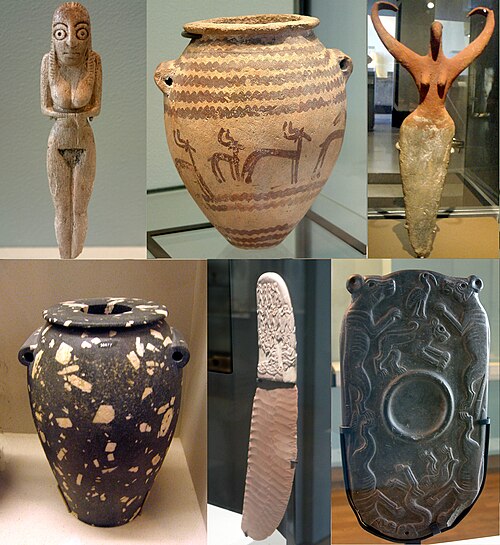
エジプトの先史時代における新石器時代にあたる王朝以前のエジプトは、紀元前6000年頃から初期王朝時代の始まりである紀元前3100年頃まで続いた。
砂漠の拡大が続いたため、エジプト人の初期の祖先はナイル川周辺に定住し、新石器時代にはより定住的な生活様式を採用せざるを得ませんでした。紀元前9000年から6000年の期間は 考古学的証拠がほとんど残っていませんが、 紀元前6000年頃にはエジプト全土に新石器時代の集落が現れ始めました。[ 2 ]形態学的[ 3 ] 、遺伝学的[ 4 ]、および考古学的データ[ 5 ]に基づく研究では、これらの集落は新石器革命中に肥沃な三日月地帯から戻ってきて農業をこの地域にもたらした移住者によるものとされています。[ 6 ]
紀元前5000年から4200年頃にかけて 、西ナイルデルタの端にある大規模な集落跡からのみ知られているメリムデ文化が下エジプトで栄えた。 [ 7 ]この文化はファイユームA文化やレバントと強い繋がりがある。人々は小さな小屋に住み、装飾のないシンプルな土器を作り、石器を持っていた。牛、羊、ヤギ、豚が飼育され、小麦、モロコシ、大麦が栽培された。メリムデの人々は集落内に死者を埋葬し、粘土の小像を作った。[ 8 ]粘土で作られた最初のエジプトの等身大の頭部はメリムデから出土した。[ 9 ]
紀元前4400年から4000年頃のバダリ文化[ 10 ]は、デル・タサ近郊のバダリ遺跡にちなんで名付けられました。これはタシア文化(紀元前4500年頃)に続くものですが、非常に似ているため、多くの人がこれらを連続した一つの時代と考えています。バダリ文化は引き続き黒土器を生産し(ただし品質は大幅に向上)、シーケンス年代測定(SD)番号21~29が割り当てられました[ 11 ] 。学者がこれら二つの時代を統合できない主な理由は、バダリ遺跡では石に加えて銅が使用されており、したがって銅器時代の集落であるのに対し、新石器時代のタシア遺跡は依然として石器時代と考えられているからです[ 11 ]。


ナカダ文化は、エジプトの銅器時代先王朝時代(紀元前 4400年~3000年頃)の考古学的文化であり、ケナ県ナカダの 町にちなんで名付けられました。ナカダ文化は、ナカダI、II、IIIの3つの下位区分に分けられます。
ナカダI(アムラティアン)文化は紀元前4000年から3500年頃まで続いた 。[ 10 ]黒色頂部土器は引き続き出現するが、この時期には 、平行な白い線が交差して装飾されたタイプの土器である白十字線土器 も発見されている。アムラティアン期はSD30年から39年の間にあたる 。[ 14 ]


紀元前3500年から3200年頃のナカダII(ゲルゼアン)文化[ 10 ]は、ゲルゼ遺跡 にちなんで名付けられました。これはエジプト文化発展の次の段階であり、この時期に王朝エジプトの基礎が築かれました。ナカダII文化は、ナカダI文化の途切れることのない発展であり、ナイル川上流域からナイル川デルタ、そしてヌビアへと拡大しました[ 17 ] 。ナカダII土器にはSD値が40から62と割り当てられており、ナカダIの白地に十字線のある土器や黒色の頂部を持つ土器とは明らかに異なります[ 14 ] 。主に濃い赤色で動物、人、船の絵や、動物から派生したと思われる幾何学模様が描かれていました。[ 17 ]この時期以前には稀であった波状の取っ手(ただし、SD 35 の早い時期には時折見つかっている)は、より一般的になり、より精巧になり、ほとんど完全に装飾的なものとなった。[ 14 ]
この時期には、明らかに異国の物品や芸術様式がエジプトに流入し、アジアのいくつかの地域、特にメソポタミアとの接触があったことを示している。メソポタミアの浮彫りがはっきりと見られるゲベル・エル・アラクのナイフの柄のような物品がエジプトで発見されており[ 18 ]、この時期に出現する銀は小アジアからしか入手できないものである[ 17 ]。さらに、メソポタミアの様式を明らかに模倣したエジプトの物品も作られた[ 19 ]。円筒印章や凹んだパネルの建築様式がエジプトに現れた。化粧パレットのエジプトの浮彫りは、同時代のメソポタミアのウルク文化と同じ様式で作られており、ゲルゼアン後期からセマイアン初期にかけての儀式用のメイスの頭部は、エジプト固有の様式ではなく、メソポタミアの「洋ナシ型」様式で作られていた[ 20 ] 。
この交易のルートを特定するのは難しいが、カナンとの接触は初期王朝時代より前には遡らないため、通常は水路によるものと考えられている。[ 21 ]王朝人種説が流行していた時代には、ウルクの船乗りがアラビア半島を周航したという説もあったが、エジプトにビブロス産の遺物が存在することからもわかるように、おそらくビブロスを経由した仲介者による地中海ルートの方が可能性が高い。[ 21 ]
ナカダII期の遺跡の多くが紅海に通じるワジの河口にあるという事実は、紅海を経由した交易があったことを示唆している可能性がある(ただし、ビブリオの交易はシナイ半島を越えて紅海に至った可能性もある)。 [ 22 ]また、凹型パネル建築のような複雑なものが間接的にエジプトに伝わったとは考えにくく、少なくとも少数の移住者がいたと推測されることが多い。[ 21 ]
こうした外国の影響を示す証拠があるにもかかわらず、エジプト学者たちは概して、ナカダII文化は主にエジプト固有の文化であるという点で一致している。


紀元前3200年から3000年頃のナカダIII期[ 10 ]は、エジプトが統一された原王朝時代と同一視されることが多い。
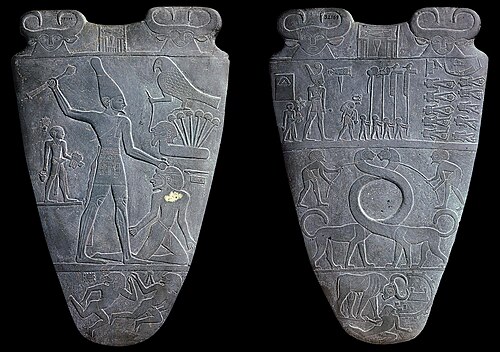
ナカダ III 期は、ヒエログリフが初めて登場した時代(ただし、これについては議論がある)、セレクが初めて定期的に使用された時代、初めて灌漑が行われた時代、そして王家の墓地が初めて出現した時代として注目に値する。[ 26 ]ナカダ III 期の芸術は 非常に洗練されており、化粧パレットはその好例である。これらは、王朝以前のエジプトで、顔や体の化粧品の材料をすりつぶして塗布するために使用されていた。原王朝時代になると、装飾パレットはこの機能を失い、代わりに記念品、装飾品、そしておそらく儀式用になったようだ。これらはほぼすべて、ワディ・ハンママトの採石場から産出されたシルト岩で作られていた。パレットの多くは、王朝以前の上エジプトの権力の中心地であったヒエラコンポリスで発見された。国の統一後、パレットは墓の副葬品に含まれなくなった。


エジプトの初期王朝時代は、紀元前3100年頃の上エジプトと下エジプトの統一直後に始まり、一般的には第一王朝と第二王朝を含み、ナカダIII期考古学時代の終わりから紀元前2686年頃、つまり古王国時代の始まりまで続いたと考えられている。[ 10 ]
この時期には化粧品パレットが新たな洗練度に達し、エジプト文字体系もさらに発展しました。当初、エジプト文字は主にさまざまな物質の量を表す少数の記号で構成されていました(ヒエログリフ文字とも呼ばれます)。化粧品パレットでは、記号は絵による説明とともに使用されました。第3王朝末期には、表音文字と表意文字の両方を含む200以上の記号を含むように拡張されました。[ 29 ]


エジプト古王国は紀元前 2686年頃から2181年頃までの期間です。第4王朝 の偉大なピラミッド建設者たちの治世を含むことから、「ピラミッドの時代」または「ピラミッド建設者の時代」とも呼ばれています。スネフェル王はピラミッド建設の技術を完成させ、ギザのピラミッドはクフ王、カフラー王、メンカウラー王の治世下で建設されました。[ 36 ]エジプトは文明の最初の持続的なピークを迎え、ナイル川下流域の文明の頂点を示す、いわゆる「王国」時代3つ(中王国と新王国が続く)の最初の時代となりました。


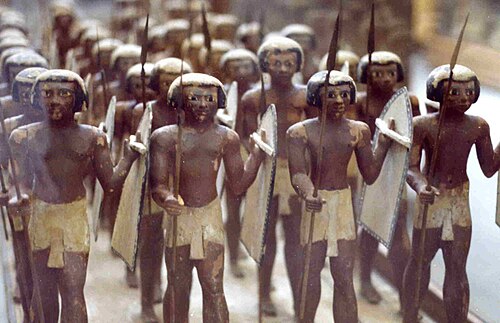

エジプト中王国(別名「統一の時代」)は、第一中間期として知られる政治的分裂によって特徴づけられる。中王国は紀元前2050年頃から 紀元前1710年頃まで続き、第11王朝のメンチュヘテプ2世の 治世下でのエジプトの再統一から第12王朝の終焉まで続いた。第11王朝はテーベを、第12王朝はエル・リシュトを拠点として統治した。中王国時代には、オシリスが民衆宗教において最も重要な神となった。[ 38 ]中王国の後には、西アジアのヒクソスによる侵略を含む、エジプトの第二中間期が続いた。
中王国時代のエジプト再統一後、第11王朝と第12王朝の王たちは再び芸術に力を注ぐことができた。第11王朝では、王の記念碑は第5王朝と第6王朝初期のメンフィス様式の影響を受けた様式で作られ、統一以前のテーベの浮彫様式はほぼ消滅した。これらの変化にはイデオロギー的な目的があり、第11王朝の王たちは中央集権国家を確立し、古王国時代の政治的理想に立ち返ろうとしていた。[ 39 ]第12王朝初期には、王室工房の影響により芸術作品の様式に統一性が見られた。この時点で、社会のエリート層のための芸術作品の質は最高潮に達し、他の時代には同等のレベルに達したものの、それを超えることはなかった。[ 40 ]エジプト第12王朝末期の繁栄は、王室や個人の記念碑に使用された材料の質に反映されていた。


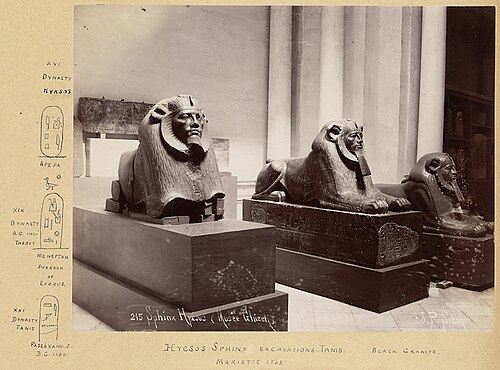
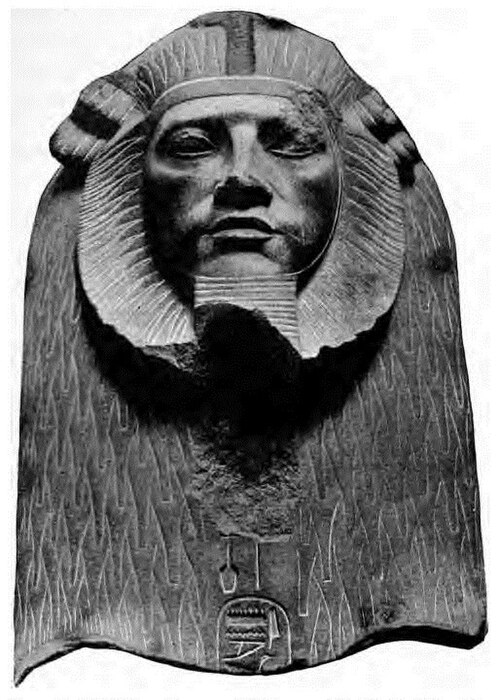
レバント地方を起源とする支配者の王朝であるヒクソスは、宮廷美術を制作した形跡はなく、[ 47 ]代わりに、以前の王朝の記念碑に自分たちの名前を刻んで流用した。これらの多くには、キヤン王の名前が刻まれている。[ 48 ]アヴァリスでは、エジプト様式ではなくレバント様式で建てられた大きな宮殿が発見されており、おそらくキヤンによって建てられたものと思われる。 [ 49 ]アペピ王は、エジプトの書記文化を庇護し、リンド数学パピルスの写本を依頼したことで知られている。[ 50 ]ウェストカー・パピルスに保存されている物語も、彼の治世に由来する可能性がある。[ 51 ]
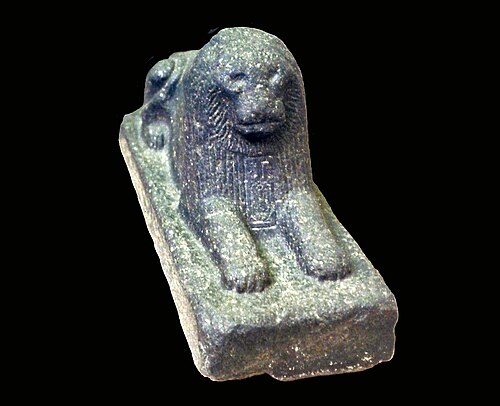
いわゆる「ヒクソス・スフィンクス」または「タニテ・スフィンクス」は、初期のファラオ、アメンエムハト3世(第12王朝)を描いた王家のスフィンクスのグループで、従来の彫像と比べて、突き出た頬骨や伝統的なネメス頭巾の代わりにライオンのたてがみなど、いくつかの珍しい特徴があります。「ヒクソス・スフィンクス」という名前は、これらが後にヒクソスの王たちによって再刻印され、当初はヒクソスの王自身を表していると考えられていたという事実から付けられました。19世紀の学者たちは、これらの彫像の特徴を使用してヒクソスの人種的起源を割り当てようとしました。[ 52 ]これらのスフィンクスは、ヒクソスによって中王国の都市から奪われ、首都アヴァリスに運ばれ、そこで新しい所有者の名前が再刻印され、宮殿を飾りました。[ 46 ]これらのスフィンクスのうち7体はタニスで発見されており、現在ほとんどがカイロ博物館に所蔵されている。[ 46 ] [ 53 ]アメンハト3世の他の像もタニスで発見されており、同様にヒクソスと関連付けられている。

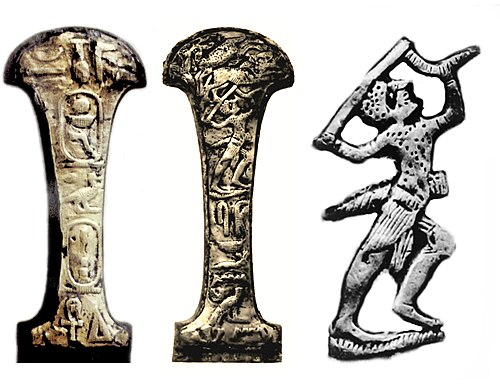

新王国時代は「エジプト帝国」とも呼ばれ、紀元前16 世紀から11世紀にかけてのエジプトの第18、第19、第20王朝の時代である。新王国時代は第2中間期に続き、第3中間期へと続いた。エジプトにとって最も繁栄した時代であり、その権力の頂点を極めた時代であった。[ 63 ]この莫大な富は、官僚権力の集中化と、貿易ルートを開拓した数々の軍事作戦の成功によるものと考えられる。エジプト帝国の拡大に伴い、王たちはレバノン産の杉などの重要な商品や、ラピスラズリやトルコ石などの高級品を入手できるようになった。
新王国時代に制作された美術品は、大きく分けてプレ・アマルナ時代、アマルナ時代、ラムセス時代という3つの時期に分けられます。権力の変動や宗教的理想の変化に伴い様式的な変化は見られましたが、新王国時代を通して彫像やレリーフ作品は、正面性と軸線、スケールの階層性、複合的な構成といったエジプト美術の主要な原則を体現し続けました。
アマルナ以前の時代、すなわち新王国第18王朝の始まりは、エジプトが広大な帝国として勢力を拡大していった時代であった。この時代の美術品は、中王国時代の技法や主題と、新たに手に入れた外国の素材や様式が融合したものである。[ 64 ]アマルナ以前の時代の美術や建築の大部分は、紀元前1473年から1458年にかけて、すべての神々に捧げる大規模な建築事業を主導した女性王ハトシェプシュートによって制作された。彼女はカルナック神殿に大幅な増築を行い、デイル・エル・バハリに広大な葬祭殿を建設し、硬石で彫像やレリーフを大量に制作した。これらの建築事業の規模は、テーベへの権力集中と、前新王国の支配者アハモセ1世による交易路の再開によって可能になった。[ 65 ]
ハトシェプスト女王の精巧な葬祭殿であるデイル・エル・バハリには、アマルナ以前の時代に制作された美術品の保存状態の良い例が数多く残されている。巨大な3層構造の柱廊式神殿はテーベの崖に建てられ、広範囲にわたる彩色されたレリーフで装飾されていた。これらのレリーフの主題は、伝統的な葬儀のイメージや、エジプトの神聖な支配者としてのハトシェプスト女王の正当性の証明から、異国での戦闘や遠征の場面まで多岐に渡る。神殿には、特にアメン・ラーをはじめとする女性王や神々の像も数多く安置されており、中には巨大なものもあった。ハトシェプスト女王の治世の美術品は、エジプトの再統一の結果として、北方の文化と様式が再統合されたことが特徴である。ハトシェプスト女王の先代であるトトメス3世もまた、膨大な量の大規模な美術品を制作させ、彼の死後、エジプトは世界で最も強力な帝国となった。[ 65 ]
新王国時代、特に第18王朝時代には、王がエジプトの主要な神々に捧げる大規模で精巧な神殿を建立することが一般的でした。石灰岩や砂岩(以前の神殿で使用されていた日干しレンガよりも耐久性のある材料)で建てられ、希少な材料や鮮やかな壁画で満たされたこれらの建造物は、新王国時代にエジプト帝国が享受していた富と資源へのアクセスを象徴しています。アメン・ラーに捧げられたカルナック神殿は、この種の国家主導の建築物の中で最大かつ最もよく保存されている例の一つです。[ 64 ]


アマルナ美術は、第18王朝末期にファラオ・アクエンアテンが首都を移したテル・エル・アマルナの広大な遺跡にちなんで名付けられました。この時代、そしてそれ以前の数年間は、新太陽神学の台頭と、アクエンアテンによるアテン神学への最終的な移行の結果として、古王国、中王国、新王国のエジプト美術の様式に最も劇的な変化をもたらしました。[ 68 ]アマルナ美術は、動きの感覚と、現実が世界に現れた「主観的で感覚的な知覚」によって特徴付けられます。場面には、群衆の感覚を生み出す重なり合う人物がよく登場しますが、これは以前の時代にはあまり見られませんでした。
アクエンアテンの治世下で制作された美術品は、彼の統治下で起こった文化、様式、宗教における劇的な変化を反映していた。時に「新太陽神学」と呼ばれるこの新しい宗教は、太陽神アテンを崇拝する一神教であった。アクエンアテンは、アテンと共に「共同統治者」であり、アテン自身の代弁者であると自らを強調した。この新しい神学では太陽円盤が究極の生命を与える力として崇拝されていたため、太陽光線が当たるものはすべてこの力によって祝福されると考えられた。そのため、生贄の儀式や礼拝は開放的な中庭で行われたと考えられ、屋外彫刻に最適な沈み彫り技法が屋内作品にも用いられた。
アクエンアテンの治世下では、人体の描写は劇的に変化した。例えば、アクエンアテンの身体を描いた多くの作品では、大きな腰、目立つ胸、太い腹部や太ももなど、明らかに女性的な特徴が表現されている。アクエンアテンの顔の描写、例えば砂岩製のアクエンアテン像では、細長い顎、ふっくらとした唇、くぼんだ頬が描かれている。こうした様式的な特徴はアクエンアテンの描写にとどまらず、メリタテンの肖像や王妃の顔の断片に見られるように、王族全員の描写にも用いられるようになった。これは、男性像において理想化された若さと男らしさを強調していた初期のエジプト美術とは大きく異なる点である。
アクエンアテンの治世における注目すべき革新は、アクエンアテンの妻ネフェルティティと3人の娘を含む王族の宗教的地位の向上であった。 [ 69 ]エジプト美術の初期の時代では、王は人間と神々をつなぐ主要な存在として描かれていたが、アマルナ時代にはこの力が王族にまで拡大された。[ 69 ]王族のレリーフや様々なタラタットブロックに見られるように、王族のそれぞれの人物はアテンの光線に触れている。特にネフェルティティはこの時代に重要な宗教的役割を担っていたと考えられている。[ 70 ]
この時代の建物はあまり残っていないが、その理由の一つは、タラタットと呼ばれる標準サイズのブロックで建てられており、それらは取り外しや再利用が非常に容易だったためである。アマルナの神殿は、この傾向に従い、伝統的なエジプトの慣習に従わず、天井がなく、扉も閉まらない開放的な造りであった。アクエンアテンの死後、数世代にわたって、芸術家たちは以前の時代の伝統的なエジプト様式に戻った。後の時代の芸術にはこの時代の様式の痕跡がまだ残っていたが、ほとんどの点で、エジプトの芸術は、エジプトの宗教と同様に、この時代がなかったかのように通常の特性に戻った。アマルナ自体は放棄され、建物を解体し、装飾を内側に向けてブロックを再利用することなど、この時代の記念碑を汚損するためにかなりの努力がなされた。これは最近、後の時代の建物の一つで発見された。[ 71 ]第18王朝最後の王ホルエムヘブは、アマルナの芸術と文化の影響を排除し、アメン神崇拝の強力な伝統を復活させようとした。[ 72 ]


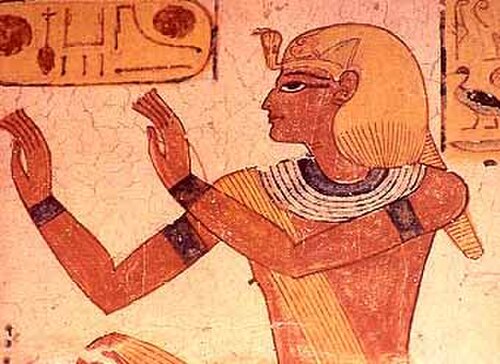
第18王朝最後の王ホルエムヘブがアマルナ美術とその影響を根絶しようと尽力した結果、帝国の美術と建築の様式は新王国の残りの期間(第19王朝と第20王朝)にラムセス時代へと移行した。[ 65 ] アマルナ時代の宗教的・芸術的革命に対応して、国家が委託した作品は、伝統的な形式への明確な回帰とアメン・ラーへの新たな献身を示している。しかし、アマルナの身体比率の要素はいくつか残っている。腰は中王国時代の低い位置に戻らず、身長と人間の手足はやや長くなっている。第19王朝と第20王朝の王たちは、先代の様式でテーベにあるアメン・ラーに捧げられた葬祭殿を建設し続けた。ラムセス王たちはまた、ハトシェプストが委託したような巨大な彫像の建設も続けた。[ 64 ]
ラムセス朝時代には、王たちはカルナック神殿にさらなる貢献をした。セティ1世(第19王朝)が建立を命じた大列柱室は、高さ20メートルの天井を支える134本の砂岩の柱で構成され、1エーカーの敷地を覆っていた。セティ1世はほとんどの表面を精緻な浅浮彫で装飾し、後継者のラムセス2世は、大列柱室の南側の壁と柱に沈み彫りの装飾を加えた。内部の彫刻には、権力の伝統的な正当化の場面、行列、儀式など、王と神の交流が描かれている。列柱室の外壁には、軍事作戦の広大な描写が描かれている。征服された土地に散らばる混沌とした無秩序な敵と、最も目立つ人物として描かれた勝利の王を描いた戦闘場面は、ラムセス朝時代の特徴である。[ 64 ]
新王国末期は伝統的なエジプトの形式と様式への回帰を示しているが、文化は単に過去への回帰ではない。ラムセス時代の芸術は、確立されたエジプトの形式と現代の革新と素材の融合を示している。墓のすべての表面を絵画やレリーフで装飾したり、埋葬室に新しい葬儀文書を追加したりといった進歩は、この時代の非静的な性質を示している。[ 64 ]
第三中間期は衰退と政治的不安定の時代であり、近東と東地中海の文明(ギリシャの暗黒時代を含む)の後期青銅器時代の崩壊と同時期であった。この時期は、国家が分裂し、外国人による征服と支配が特徴であった。[ 73 ]初期の分裂期の後、この国は紀元前945年(または紀元前943年)にショシェンク1世によって建国された第22王朝によってしっかりと再統一された。ショシェンク1世は、もともと古代リビア出身のメシュウェシュ移民の子孫であった。次の第24王朝の時代には、南方のヌビア王国の影響力が増大し、この分裂とそれに続く政治的不安定を最大限に活用した。そして紀元前732年頃、ピイエは北へ進軍し、ペフトジャウバスト、タニスのオソルコン4世、レオントポリスのユプト2世、サイスのテフナクトといったエジプトの複数の支配者の連合軍を打ち破った。彼はヌビアを起源とする「黒いファラオ」の第25王朝を樹立した。
第三中間期には、一般的に古代エジプト様式への回帰が見られ、特に古王国時代と中王国時代の美術が参照される。[ 74 ]この時代の美術は基本的に伝統的なエジプト様式で構成されており、ショシェンク5世またはオソルコン3世の時代には理由は不明ながら再導入されていた。 [ 75 ]時には、第25王朝のヌビア人支配者の彫像に見られるような、外国の特徴が取り入れられることもあった。[ 74 ]第25王朝は古代エジプトをわずか73年間しか支配しなかったが、伝統的なエジプトの価値観、文化、芸術、建築の復興に加え、カルナックのタハルカの記念碑的な柱のような独創的な作品も生み出したことから、エジプト史において重要な位置を占めている。[ 76 ] [ 77 ]第25王朝時代、エジプトはヌビアのナパタ(現在のスーダン)から統治され、王朝はエジプトの建築様式を下エジプトとヌビアに拡大することを許可した。[ 74 ]
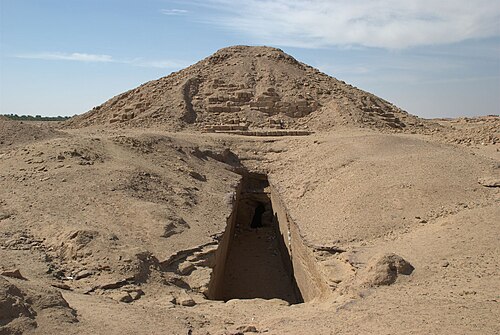


紀元前525年 、エジプトの政治体制はペルシア人に奪われ、エジプト末期王朝のほぼ1世紀半が経過した。 紀元前404年までにペルシア人はエジプトから追放され、短い独立期間が始まった。この60年間のエジプト支配は、多くの簒奪者と短い統治によって特徴づけられた。その後、エジプト人はアケメネス朝に再び占領され、紀元前332年にアレクサンドロス大王 が到着するまで続いた。資料によると、アレクサンドロスが首都に入ったとき、エジプト人は大嫌いだったペルシア人を追い出したので歓声を上げたという。末期王朝はアレクサンドロス大王の死とプトレマイオス朝の始まりによって特徴づけられる。[ 80 ]この時代はエジプトにとって政治的な混乱と大きな変化を特徴づけるものであったが、エジプトの芸術と文化は繁栄し続けた。
これは、末期王朝時代の第5王朝である第30王朝から始まり、プトレマイオス朝時代まで続くエジプトの神殿に見られる。これらの神殿はデルタ地帯からフィラエ島まで広がっていた。[ 80 ]エジプトは外国との貿易や征服を通じて外部の影響を受けていたが、これらの神殿はヘレニズムの影響をほとんど受けず、伝統的なエジプト様式を維持していた。
第三王朝に由来するもう一つの浮彫りは、身体や手足の丸みを帯びた造形であり、[ 80 ]被写体に肉感的で重厚な印象を与えた。例えば、女性像の場合、乳房が膨らんで上腕に重なるように描かれた。より写実的な描写では、男性は太っていたり、しわが寄っていたりした。
この時期にますます普及したもう一つの芸術様式は、ホルス石碑である。[ 80 ]これらは新王国時代後期から中間期にかけて起源を持つが、紀元前4世紀からプトレマイオス朝にかけてますます普及した。これらの像は、若いホルスが蛇を抱え、何らかの危険な獣の上に立っている姿を描いていることが多い。ホルスの描写は、若いホルスがサソリに噛まれそうになったところを救われ、その結果、あらゆる危険な動物に対する力を得たというエジプト神話に由来する。これらの像は「有害な生物の攻撃をかわし、蛇の咬傷やサソリの刺傷を治す」ために使用された。[ 80 ]


19 世紀末以降、アレクサンドリア の(現在は水没している)古代エジプトの都市ヘラクレイオン周辺で発見されたものには、紀元前4 世紀の 、異例なほど官能的で詳細かつ女性的(神格化とは対照的)なイシス像が含まれており、紀元前332 ~ 331 年のアレクサンドロス大王によるエジプト征服の頃から始まったエジプト様式とヘレニズム様式の融合を示している 。しかし、これはプトレマイオス朝の彫刻としては異例であり、プトレマイオス朝の宮廷美術で用いられたヘレニズム様式とエジプト様式を混ぜることは一般的に避けられていた[ 82 ]。一方、国内の他の地域の神殿では、伝統的なエジプト様式の後期バージョンが引き続き使用されていた[ 83 ] 。学者たちはヘレニズム彫刻に「アレクサンドリア様式」を提唱しているが、実際にはアレクサンドリアとの関連を示すものはほとんどない[ 84 ] 。
宮廷美術では大理石が広く用いられたが、すべて輸入する必要があり、漆喰で接合された複数の破片を用いるなど、大理石を節約する様々な技術が用いられた。頭部には、あごひげ、後頭部、髪の毛が別々の破片でできている場合もある。[ 85 ]他のヘレニズム王国の美術とは対照的に、プトレマイオス朝の王の肖像は一般化され理想化されており、個々の肖像を再現することにはほとんど関心が払われていないが、コインから、肖像彫刻の一部が15人のプトレマイオス王のうちの1人であると特定できる。[ 86 ]後世の多くの肖像は、明らかに後の王を示すために顔が修正されている。[ 87 ]エジプトの特徴の一つは、アレクサンドロスの後継王朝よりも女王にずっと大きな重要性を与え、王夫妻がしばしばペアで描かれることであった。これは、 一連の女王が実権を握った2世紀以前のことである。[ 88 ]
2 世紀には、エジプトの神殿彫刻は顔に宮廷のモデルを再利用し始め、神官の彫刻は、個々に特徴的な肖像の頭部を実現するためにヘレニズム様式を用いることが多かった。[ 89 ]小さな小像が多数制作され、最も一般的なタイプはアレクサンダー、一般的な「プトレマイオス王」、裸のアフロディーテであった。陶器の小像には、タナグラ小像様式のグロテスクなものや流行の女性像が含まれていた。[ 83 ]エロティックなグループには、途方もなく大きな男根が特徴的であった。木製のインテリア用の装飾品の中には、ファイアンス製の非常に繊細な模様の多色ハヤブサが含まれているものもある。


ファイユームのミイラ肖像画は、ローマ時代のエジプト美術においておそらく最も有名な例でしょう。これらは、ローマ時代のエジプトの上流階級のミイラに取り付けられた木板に描かれた、写実的な肖像画の一種です。これらは、古典世界で最も高く評価された芸術形式の一つである板絵の伝統に属しています。ファイユームの肖像画は、その伝統から現存する唯一の大規模な美術作品群です。
ミイラの肖像画はエジプト全土で発見されているが、ファイユーム盆地、特にハワラ(そのためこの名前がついた)とハドリアヌス帝時代のローマ都市アンティノポリスで最も多く見られる。「ファイユームの肖像画」は一般的に地理的な説明ではなく、様式的な説明として用いられる。彩色されたカルトナージュのミイラ棺はファラオ時代に遡るが、ファイユームのミイラの肖像画はローマによるエジプト占領時代に生まれた革新である。[ 92 ]
これらの肖像画は、紀元前1世紀末から紀元後1世紀初頭にかけてのローマ帝国時代に遡ります。制作がいつ終了したかは定かではありませんが、近年の研究では3世紀半ば頃とされています。これらは、古典世界の板絵の伝統の中で数少ない現存する作品群の中でも最大規模のものであり、この伝統は、エジプトのコプト教の図像学を含む、後古典世界のビザンチンや西洋の伝統へと受け継がれていきました。
エジプト美術は、レリーフと絵画の両方で主要人物に用いられる独特の人物表現様式で知られています。脚は開いており(座っている場合を除く)、頭部は横から見たように表現されていますが、胴体は正面から見たように表現されています。また、人物のプロポーションは標準的で、地面から額の生え際まで18拳分です。[ 94 ]これは第1王朝のナルメル・パレットに早くから見られます が、この理想化された人物表現様式は、捕虜や死体など、何らかの活動に従事しているマイナーな人物の表現には用いられていません。[ 95 ]他の慣習では、男性の像は女性の像よりも暗く表現されています。非常に様式化された肖像彫像は、第2王朝(紀元前2780年以前)から現れており 、[ 96 ]アケネテンのアマルナ時代の美術[ 97 ]や第12王朝などの他のいくつかの時代を除いて、他のエジプト美術の慣習と同様に、支配者の理想化された特徴はギリシャの征服までほとんど変化しなかった。[ 98 ]エジプト美術は階層的な比率を使用しており、人物の大きさは相対的な重要性を示している。神々や神聖なファラオは通常他の人物よりも大きく、高官や墓の所有者の人物は通常小さく、召使い、芸人、動物、木、建築の細部は最小のスケールである。[ 99 ]

古代エジプトの芸術家は自分の名前を残すことはほとんどなかった。エジプトの美術品が匿名であるのは、ほとんどの場合、共同作業で制作されていたためでもある。エジプトを旅し、滞在したシチリアのディオドロスは次のように記している。「職人たちは像の高さを決めた後、それぞれが選んだ部分を作るために家に帰る」(I、98)。[ 100 ]
象徴主義はエジプト美術に広く浸透しており、秩序感を確立する上で重要な役割を果たした。例えば、ファラオの王冠は、秩序を維持する彼の権力を表していた。動物もまた、エジプト美術において非常に象徴的な存在であった。いくつかの色は表現力に富んでいた。[ 101 ]
古代エジプト語には、 kem(黒)、hedj(白/銀)、wadj(緑/青)、desher (赤/オレンジ/黄)という4つの基本的な色を表す言葉がありました。例えば、青は豊穣、誕生、そしてナイル川の生命を与える水を象徴していました。[ 102 ]青と緑は植物の色であり、したがって若返りの色でもありました。オシリスは緑色の肌で描かれることがあり、第26王朝では、再生を助けるために棺の顔が緑色に塗られることがよくありました。[ 103 ]
この色の象徴性は、葬儀用具にトルコ石やファイアンスが広く用いられた理由を説明している。王族の像に黒が用いられたのは、エジプトが生まれたナイル川の肥沃な沖積土[ 101 ]を象徴し、豊穣と再生の象徴でもあった。そのため、オシリスとしての王の像は、しばしば黒い肌で描かれていた。黒は死後の世界とも関連付けられ、アヌビスなどの葬儀の神々の色でもあった。
金は、その不自然な外観と貴金属との関連性から、神聖さを象徴していた。[ 101 ]さらに、金は古代エジプト人にとって「神の肉」と見なされていた。[ 104 ]エジプト人が「白い金」と呼んだ銀もまた、「神の骨」と呼ばれていた。[ 104 ]
赤、オレンジ、黄色は、相反する意味を持つ色だった。当然ながら、太陽と結びついており、珪岩などの赤い石は、王権の太陽的な側面を強調する王の彫像に好んで用いられた。カーネリアンも宝飾品において同様の象徴的な意味合いを持つ。パピルス文書に重要な名前を書く際には赤いインクが使われた。また、赤は砂漠の色でもあり、セト神と結びついていた。
Egyptian faience is a ceramic material, made of quartz sand (or crushed quartz), small amounts of lime, and plant ash or natron. The ingredients were mixed together, glazed and fired to a hard shiny finish. Faience was widely used from the Predynastic Period until Islamic times for inlays and small objects, especially ushabtis. More accurately termed 'glazed composition', Egyptian faience was so named by early Egyptologists after its superficial resemblance to the tin-glazed earthenwares of medieval Italy (originally produced at Faenza). The Egyptian word for it was tjehenet, which means 'dazzling', and it was probably used, above all, as a cheap substitute for more precious materials like turquoise and lapis lazuli. Indeed, faience was most commonly produced in shades of blue-green, although a large range of colours was possible.[105]


Although the glassy materials faience and Egyptian blue were manufactured in Egypt from an early period, the technology for making glass itself was only perfected in the early 18th Dynasty. It was probably imported from Levant, since the Egyptian words for glass are of foreign origin. The funerary objects of Amenhotep II included many glass artefacts, demonstrating a range of different techniques. At this period, the material was costly and rare, and may have been a royal monopoly. However, by the end of the 18th Dynasty, Egypt probably made sufficient quantities to export glass to other parts of the Eastern Mediterranean. Glass workshops have been excavated at Amarna and Pi-Ramesses. The raw materials – silica, alkali and lime – were readily available in Egypt, although ready-made ingots of blue glass were also imported from the Levant and have been found in the cargo of the Uluburun shipwreck off the southern coast of Turkey.[106]


エジプトブルーは、ファイアンスやガラスと関連はあるものの、それらとは異なる素材です。「フリット」とも呼ばれるエジプトブルーは、石英、アルカリ、石灰、そして1種類以上の着色剤(通常は銅化合物)から作られました。これらを一緒に加熱して融合させ、均一な色の結晶塊を作りました(中心部と表面層が異なる色をしているファイアンスとは異なります)。エジプトブルーは、手作業で加工したり、型に押し込んで彫像やその他の小さな物を作ることができました。また、粉末にして顔料を作ることもできました。エジプトブルーは、第4王朝時代に初めて記録されていますが、プトレマイオス朝時代とローマ時代に特に人気を博し、その時代にはカエルレウムとして知られていました。[ 107 ]
青色は、第4王朝時代までごくわずかにしか使用されておらず、第1王朝時代に建設されたサッカラの墓の敷物模様に青色が使われているのが発見された。この発見がなされるまで、青色はエジプト美術では知られていなかった。[ 108 ]


古代エジプトは冶金学の中心地ではなかったものの、自国領内および近隣地域で産出される金属を抽出・加工する技術を発展させた。
銅はエジプトで最初に利用された金属である。バダリアンの墓からは小さなビーズが発見されており、より大きな品々は、先王朝時代後期に鋳型鋳造、焼きなまし、冷間鍛造を組み合わせて作られた。銅製品の生産は古王国時代に最盛期を迎え、ピラミッドの石材を切断するために膨大な数の銅鑿が製造された。ヒエラコンポリス出土のペピ1世とメレンラーの銅像は、大規模な金属加工の貴重な現存例である。
ツタンカーメンの黄金の財宝は、古代エジプトの富を象徴するものであり、ファラオ文化における金の重要性を示している。王家の墓の埋葬室は「黄金の家」と呼ばれた。エジプトの宗教によれば、神々の肉体は金でできている。決して変色しない輝く金属である金は、神々の像、王家の葬儀用具、オベリスクの頂上を輝かせるための理想的な素材だった。金は宝飾品に広く用いられ、忠実な奉仕に対する褒賞として役人に与えられた(「名誉の金」)。
銀はレバントから輸入する必要があり、その希少性から当初は金(エレクトラムと同様に、エジプトとヌビアの国境内で容易に入手できた)よりも価値が高かった。銀細工の初期の例としては、ヘテフェレスのブレスレットが挙げられる。中王国時代には、銀は金よりも価値が下がったようで、おそらく中東との貿易の増加が原因と考えられる。エル・トドの財宝は、おそらくエーゲ海で作られた銀製品の宝物で構成されており、ダハシュールとラフーンでは、第12 王朝の王族の女性のために作られた銀の宝飾品が発見された。エジプトの宗教では、神々の骨は銀でできていると言われていた。[ 109 ]
鉄はエジプト人が大規模に利用した最後の金属でした。隕鉄はバダリアン時代からビーズの製造に使われていました。しかし、鉄を精錬するために必要な高度な技術がエジプトに導入されたのは末期王朝時代になってからです。それ以前は、鉄製品は輸入されており、希少性から非常に価値がありました。アマルナ文書には、近東の支配者、特にヒッタイト人がアメンホテプ3世とアクエンアテンに鉄を外交上の贈り物として送ったことが記されています。鉄製の道具や武器がエジプトで一般的になったのはローマ時代になってからです。


考古学的文脈での保存状態が比較的悪いため、古代エジプトの遺物の中で木材は特に多く見られない。しかしながら、木工は明らかに初期の時代から高い水準で行われていた。在来樹種にはナツメヤシやドムヤシがあり、その幹は建物の梁として使用したり、割って板材を作ったりすることができた。タマリスク、アカシア、イチジクは家具の製造に用いられ、より柔軟性が求められる場合(例えばボウルの製造)にはトネリコが使用された。しかし、これらの在来木材はすべて比較的品質が悪く、より良質な品種は特にレバントから輸入する必要があった。[ 110 ]



ラピスラズリは濃い青色の半貴石で、天との象徴的な関連性から古代エジプト人に高く評価されていました。北東アフガニスタンの山々から長距離の交易路を経て輸入され、[ 111 ]金と銀を除く他のすべての素材よりも優れていると考えられていました。色付きのガラスやファイアンスは安価な模造品として使われました。ラピスラズリは先王朝時代に初めて記録されています。第2王朝と第3王朝の間に供給が一時的に途絶えたことは、おそらく古代近東の政治的変化を反映していると考えられます。その後、宝飾品、小さな置物、お守りなどに広く使われるようになりました。[ 112 ]


The monumental sculpture of ancient Egypt's temples and tombs is well known,[113] but refined and delicate small works exist in much greater numbers. The Egyptians used the technique of sunk relief, which is best viewed in sunlight for the outlines and forms to be emphasized by shadows. The distinctive pose of standing statues facing forward with one foot in front of the other was helpful for the balance and strength of the piece. This singular pose was used early in the history of Egyptian art and well into the Ptolemaic period, although seated statues were common as well.
Egyptian pharaohs were always regarded as gods, but other deities are much less common in large statues, except when they represent the pharaoh as another deity; however, the other deities are frequently shown in paintings and reliefs. The famous row of four colossal statues outside the main temple at Abu Simbel each show Rameses II, a typical scheme, though here exceptionally large.[114] Most larger sculptures survived from Egyptian temples or tombs; massive statues were built to represent gods and pharaohs and their queens, usually for open areas in or outside temples. The very early colossal Great Sphinx of Giza was never repeated, but avenues lined with very large statues including sphinxes and other animals formed part of many temple complexes. The most sacred cult image of a god in a temple, usually held in the naos, was in the form of a relatively small boat or barque holding an image of the god, and apparently usually in precious metal – none of these are known to have survived.
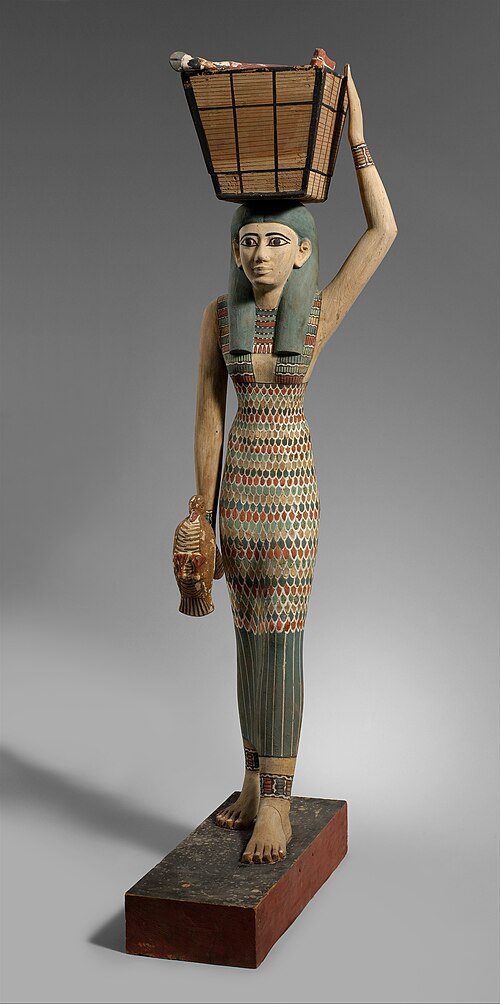
By Dynasty IV (2680–2565 BC), the idea of the Ka statue was firmly established. These were put in tombs as a resting place for the ka portion of the soul, and so there is a good number of less conventionalized statues of well-off administrators and their wives, many in wood as Egypt is one of the few places in the world where the climate allows wood to survive over millennia, and many block statues. The so-called reserve heads, plain hairless heads, are especially naturalistic, though the extent to which there was real portraiture in ancient Egypt is still debated.
Early tombs also contained small models of the slaves, animals, buildings and objects such as boats (and later ushabti figures) necessary for the deceased to continue his lifestyle in the afterlife.[115] However, the great majority of wooden sculpture have been lost to decay, or probably used as fuel. Small figures of deities, or their animal personifications, are very common, and found in popular materials such as pottery. There were also large numbers of small carved objects, from figures of the gods to toys and carved utensils. Alabaster was used for expensive versions of these, though painted wood was the most common material, and was normal for the small models of animals, slaves and possessions placed in tombs to provide for the afterlife.
Very strict conventions were followed while crafting statues, and specific rules governed the appearance of every Egyptian god. For example, the sky god (Horus) was to be represented with a falcon's head, the god of funeral rites (Anubis) was to be shown with a jackal's head. Artistic works were ranked according to their compliance with these conventions, and the conventions were followed so strictly that, over three thousand years, the appearance of statues changed very little. These conventions were intended to convey the timeless and non-ageing quality of the figure's ka.
A common relief in ancient Egyptian sculpture was the difference between the representation of men and women. Women were often represented in an idealistic form, young and pretty, and rarely shown in an older maturity. Men were shown in either an idealistic manner or a more realistic depiction.[63] Sculptures of men often showed men that aged, since the regeneration of ageing was a positive thing for them whereas women are shown as perpetually young.[116]


A stele is an upright tablet of stone or wood, often with a curved top, painted and carved with text and pictures. Numerous examples were produced throughout Egyptian history for a variety of purposes, including funerary, votive and commemorative. Funerary stelae, attested from the early 1st Dynasty, typically bore the name and titles of the deceased. This basic form, which served to identify the tomb owner, evolved into a key component of the funerary equipment with a magical function. Hence, from the 2nd Dynasty onward, the owner was usually shown seated before an offering table piled with food and drink; in the Middle Kingdom, the offering formula was generally inscribed along the top of the stele. Both were designed to ensure a perpetual supply of offerings in the afterlife. Votive stelae, inscribed with prayers to deities, were dedicated by worshipers seeking a favorable outcome to a particular situation. In the Middle Kingdom, many hundreds were set up by pilgrims on the "terrace of the great god" at Abydos, so that they might participate in the annual procession of Osiris. One particular variety of votive stele common in the New Kingdom was the ear stele, inscribed with images of human ears to encourage the deity to listen to the prayer or request.
Commemorative stelae were produced to proclaim notable achievements (for example, the stela of Horwerra, recording a mining expedition to Serabit el-Khadim, and the Restoration Stela of Tutankhamun, celebrating the restoration of the traditional cults at the end of the Amarna period); to celebrate military victories (for instance, the Merneptah Stele); and to establish frontiers (for example the Semna stele of Senusret III and the boundary stelae around Amarna).[118]


A pyramidion is a capstone at the top of a pyramid. Called benbenet in ancient Egyptian language, it associated the pyramid as a whole with the sacred Benben stone. Pyramidia may have been covered in gold leaf to reflect the rays of the sun; in the Middle Kingdom, they were often inscribed with royal titles and religious symbols.[120]


Not all Egyptian reliefs were painted, and less-prestigious works in tombs, temples and palaces were merely painted on a flat surface. Stone surfaces were prepared by whitewash, or if rough, a layer of coarse mud plaster, with a smoother gesso layer above; some finer limestones could take paint directly. Pigments were mostly mineral, chosen to withstand strong sunlight without fading. The binding medium used in painting remains unclear: egg tempera and various gums and resins have been suggested. It is clear that true fresco, painted into a thin layer of wet plaster, was not used. Instead, the paint was applied to dried plaster, in what is called fresco a secco in Italian. After painting, a varnish or resin was usually applied as a protective coating, and many paintings with some exposure to the elements have survived remarkably well, although those on fully exposed walls rarely have.[121] Small objects including wooden statuettes were often painted using similar techniques.
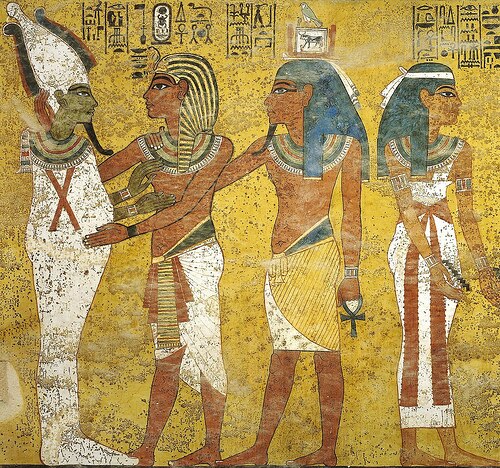
Many ancient Egyptian paintings have survived in tombs, and sometimes temples, due to Egypt's extremely dry climate. The paintings were often made with the intent of making a pleasant afterlife for the deceased. The themes included journeys through the afterworld or protective deities introducing the deceased to the gods of the underworld (such as Osiris). Some tomb paintings show activities that the deceased were involved in when they were alive and wished to carry on doing for eternity.
From the New Kingdom period and afterwards, the Book of the Dead was buried with the entombed person. It was considered important for an introduction to the afterlife.[122]
Egyptian paintings are painted in such a way to show a side view and a front view of the animal or person at the same time. For example, the painting to the right shows the head from a profile view and the body from a frontal view. Their main colors were red, blue, green, gold, black and yellow.
Paintings showing scenes of hunting and fishing can have lively close-up landscape backgrounds of reeds and water, but in general Egyptian painting did not develop a sense of depth, and neither landscapes nor a sense of visual perspective are found, the figures rather varying in size with their importance rather than their location.




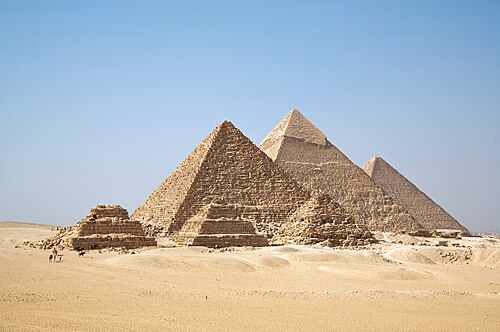
Ancient Egyptian architects used sun-dried and kiln-baked bricks, fine sandstone, limestone and granite. Architects carefully planned all their work. The stones had to fit precisely together, since no mud or mortar was used. When creating the pyramids it is unknown how the workers or stones reached the top of them as no records were kept of their construction. When the top of the structure was completed, the artists decorated from the top down, removing ramp sand as they went down. Exterior walls of structures like the pyramids contained only a few small openings. Hieroglyphic and pictorial carvings in brilliant colors were abundantly used to decorate Egyptian structures, including many motifs, like the scarab, sacred beetle, the solar disk, and the vulture. They described the changes the Pharaoh would go through to become a god.[124]
As early as 2600 BC the architect Imhotep made use of stone columns whose surface was carved to reflect the organic form of bundled reeds, like papyrus, lotus and palm; in later Egyptian architecture faceted cylinders were also common. Their form is thought to derive from archaic reed-built shrines. Carved from stone, the columns were highly decorated with carved and painted hieroglyphs, texts, ritual imagery and natural motifs. One of the most important types are the papyriform columns. The origin of these columns goes back to the 5th Dynasty. They are composed of lotus (papyrus) stems which are drawn together into a bundle decorated with bands: the capital, instead of opening out into the shape of a bellflower, swells out and then narrows again like a flower in bud. The base, which tapers to take the shape of a half-sphere like the stem of the lotus, has a continuously recurring decoration of stipules. At the Luxor Temple, the columns are reminiscent of papyrus bundles, perhaps symbolic of the marsh from which the ancient Egyptians believed the creation of the world to have unfolded.




The ancient Egyptians exhibited a love of ornament and personal decoration from earliest Predynastic times. Badarian burials often contained strings of beads made from glazed steatite, shell and ivory. Jewelry in gold, silver, copper and faience is also attested in the early Predynastic period; more varied materials were introduced in the centuries preceding the 1st Dynasty. By the Old Kingdom, the combination of carnelian, turquoise and lapis lazuli had been established for royal jewelry, and this was to become standard in the Middle Kingdom. Less sophisticated pieces might use bone, mother-of-pearl or cowrie shells.
The particular choice of materials depended upon practical, aesthetical and symbolic considerations. Some types of jewelry remained perennially popular, while others went in and out of fashion. In the first category were bead necklaces, bracelets, armlets and girdles. Bead aprons are first attested in the 1st Dynasty, while usekh broad collars became a standard type from the early Old Kingdom. In the Middle Kingdom, they had fallen from favor, to be replaced by finger-rings and ear ornaments (rings and plugs). New Kingdom jewelry is generally more elaborate and garish than that of earlier periods, and was influenced by styles from the Ancient Greece and the Levant. Many fine examples were found in the tomb of Tutankhamun. Jewelry, both royal and private, was replete with religious symbolism. It was also used to display the wealth and rank of the wearer. Royal jewels were always the most elaborate, as exemplified by the pieces found at Dahshur and Lahun, made for princesses of the 18th Dynasty, favored courtiers were rewarded with the "gold of honor" as a sign of royal favor.
The techniques of jewelry-making can be reconstructed from surviving artifacts and from tomb decoration. A jeweler's workshop is shown in the tomb of Mereruka; several New Kingdom tombs at Thebes contain similar scenes.[125]


An amulet is a small charm worn to afford its owner magical protection, or to convey certain qualities (for example, a lion amulet might convey strength, or a set-square amulet might convey rectitude). Attested from the Badarian period onward, amulets were produced both for the living and the dead. Particular amulets were placed at specific places in the mummy wrappings. The heart scarab was a specialized form of amulet to protect the heart of the deceased in the afterlife. Amulets were made from a wide variety of materials, including faience, glass, and precious stones – with color often playing an important symbolic role – and in a wide variety of forms. They might depict sacred objects (such as the Djed pillar, Tyet girdle or Wedjad eye); animals (bull's head amulets were particularly common in the late Predynastic period); or hieroglyphs (for example, Ankh or Sa). From the New Kingdom onward, deities – especially household deities such as Bes and Taweret – were popular subjects for amulets.[126]


The protective amulet for the heart was in the form of the scarab beetle, the manifestation of the creator and solar deity Khepri. It was a symbol of new life and resurrection. The scarab beetle was seen to push a ball of dung along the ground, and from this came the idea of the beetle rolling the sun across the sky. Subsequently, the young beetles were observed to hatch from their eggs inside the ball, hence the idea of creation: life springs forth from primordial mud.
The heart scarab was a large scarab amulet which was wrapped in the mummy bandaging over the deceased's heart. It was made from a range of green and dark-colored materials, including faience, glass, glazed steatite, schist, feldspar, hematite and obsidian.[127] Black was also associated with the afterlife, while blue and green were associated with the birth and the life-giving waters of the Nile.


Different types of pottery items were deposited in tombs of the dead. Some such pottery items represented interior parts of the body, such as the lungs, the liver and smaller intestines, which were removed before embalming. A large number of smaller objects in enamel pottery were also deposited with the dead. It was customary for the tomb walls to be crafted with cones of pottery, about 15 to 25 cm (6 to 10 in) tall, on which were engraved or impressed legends relating to the dead occupants of the tombs. These cones usually contained the names of the deceased, their titles, offices which they held, and some expressions appropriate to funeral purposes.


Egyptian writing remained a remarkably conservative system, and the preserve of a tiny literate minority, while the spoken language underwent considerable change. Egyptian stelas are decorated with finely carved hieroglyphs.
The use of hieroglyphic writing arose from proto-literate symbol systems in the Early Bronze Age, around the 32nd century BC (Naqada III), with the first decipherable sentence written in the Egyptian language dating to the Second Dynasty (28th century BC). Egyptian hieroglyphs developed into a mature writing system used for monumental inscription in the classical language of the Middle Kingdom period; during this period, the system made use of about 900 distinct signs. The use of this writing system continued through the New Kingdom and Late Period, and on into the Persian and Ptolemaic periods. Late use of hieroglyphics are found in the Roman period, extending into the 4th century AD.


Although, by modern standards, ancient Egyptian houses would have been very sparsely furnished, woodworking and cabinet-making were highly developed crafts. All the main types of furniture are attested, either as surviving examples or in tomb decoration. Chairs were only for the wealthy; most people would have used low stools. Beds consisted of a wooden frame, with matting or leather webbing to provide support; the most elaborate beds also had a canopy, hung with netting, to provide extra privacy and protection from insects. The feet of chairs, stools and beds were often modeled to resemble bull hooves or, in later periods, lion feet or duck heads. Wooden furniture was often coated with a layer of plaster and painted.
Royal furniture was more elaborate, making use of inlays, veneers and marquetry. Funerary objects from the tomb of Tutankhamun include tables, boxes and chests, a gilded throne, and ritual beds shaped like elongated hippos and cattle. The burial equipment of Hetepheres included a set of travelling furniture, light and easy to dismantle. Such furniture must have been used on military campaigns and other royal journeys.[128] Egyptian furniture has highly influenced the development of Greco-Roman furniture. It also was one of the principal sources of inspiration of a style known as Empire.[129] The main motifs used are: palm and lotus leaves, flowers, lion heads and claws, bull hooves, bird heads, and geometric combinations. Everything is sober and with a monumental character.[130]


Artistic representations, supplemented by surviving garments, are the main sources of evidence for ancient Egyptian fashion. The two sources are not always in agreement, however, and it seems that representations were more concerned with highlighting certain attributes of the person depicted than with accurately recordings their true appearance. For example, women were often shown with restrictive, tight-fitting dresses, perhaps to emphasize their figures.
As in most societies, fashions in Egypt changed over time; different clothes were worn in different seasons of the year, and by different sections of society. Particular office-holders, especially priests and the king, had their own special garments.
For the general population, clothing was simple, predominantly of linen, and probably white or off-white in color. It would have shown the dirt easily, and professional launderers are known to have been attached to the New Kingdom workmen's village at Deir el-Medina. Men would have worn a simple loin-cloth or short kilt (known as shendyt), supplemented in winter by a heavier tunic. High-status individuals could express their status through their clothing, and were more susceptible to changes in fashion.
Longer, more voluminous clothing made an appearance in the Middle Kingdom; flowing, elaborately pleated, diaphanous robes for men and women were particularly popular in the late 18th Dynasty and the Ramesside period. Decorated textiles also became more common in the New Kingdom. In all periods, women's dresses may have been enhanced by colorful bead netting worn over the top. In the Roman Period, Egypt became known for the manufacture of fine clothing. Coiled sewn sandals or sandals of leather are the most commonly attested types of footwear. Examples of these, together with linen shirts and other clothing, were discovered in the tomb of Tutankhamun.[131]


Use of makeup, especially around the eyes, was a characteristic feature of ancient Egyptian culture from Predynastic times. Black kohl (eye-paint) was applied to protect the eyes, as well as for aesthetic reasons. It was usually made of galena, giving a silvery-black color; during the Old Kingdom, green eye-paint was also used, made from malachite. Egyptian women painted their lips and cheeks, using rouge made from red ochre. Henna was applied as a dye for hair, fingernails and toenails, and perhaps also nipples. Creams and unguents to condition the skin were popular, and were made from various plant extracts.[132]


On secular and religious occasions, music played an important part in celebrations. Musicians, playing instruments such as the castanets and flute, are depicted on objects from the Predynastic Period. A wide range of percussions, wind and string instruments were known to the ancient Egyptian. They include rattles, clappers, drums, tambourines and the sistrum; pipes, flutes and trumpets; and harps (particularly popular at feasts). The lyre and lute were introduced from the Levant. Musical notation is not attested until the early Ptolemaic Period. Groups of musicians, either mixed gender or female only, are known from the Old Kingdom. Women singers and sistrum-players had an important role in temple cults, especially those of Hathor and Isis. Tomb decoration from all periods indicates that, as today, groups of workers sang to generate a sense of solidarity and to maintain their enthusiasm.[133]


A sistrum (plural: sistra) is a rattle used in religious ceremonies, especially temple rituals, and usually played by women. Called a "seshsehet" in Egyptian, the name imitates the swishing sound the small metal disks made when the instrument was shaken. It was closely associated with Hathor in her role as "lady of music", and the handle was often decorated with a Hathor head. Two kinds of sistrum are attested, naos-shaped and hoop-shaped; the latter became the more common.[134]


The earliest purpose-built funerary containers for bodies were simple rectangular wooden boxes, attested in the 1st Dynasty. A coffin swiftly became an essential part of the burial equipment. Known euphemistically as the "lord of life", its primary function was to provide a home for the Ka and to protect the physical body from harm. In the 4th Dynasty, the development of longer coffins allowed the body to be buried fully extended (rather than curled up on its side in a foetal position). At the end of the Old Kingdom, it became customary once more for the body to be laid on its side. The side of the coffin that faced east in the tomb was decorated with a pair of eyes so that the deceased could look out towards the rising sun with its promise of daily rebirth. Coffins also began to be decorated on the outside with bands of funerary texts, while pictures of food and drink offerings were painted on the inside to provide a magical substitute for the real provisions placed in the tomb.
In the First Intermediate Period, decorated coffins became a substitute for tomb decoration; in the Middle Kingdom, coffin texts made their first appearance, sometimes accompanied by detailed maps of the underworld. Middle Kingdom coffins show a number of distinct regional styles, echoing the cultural fragmentation of the preceding period. In the 17th and early 18th Dynasties, the Theban area produced characteristic anthropoid rishi (feathered) coffins. These were replaced (except for kings) by other styles of anthropoid coffins which became the standard form throughout the country for the remainder of Egyptian history. The predominance of decorated tombs in the New Kingdom removed the need of object friezes, so coffins were generally undecorated on the inside. However, this situation was reversed again in the Third Intermediate Period when new types of coffin decoration focused on the Osiris myth and extracts from the Book of the Dead, to aid the resurrection of the deceased. In the Ptolemaic and Roman periods, a cartonnage mask was often fixed directly onto the mummy wrappings as a substitute for a coffin.
Coffins were generally made of wood; those of high-status individuals used fine quality, imported cedar. From the Middle Kingdom onward, wealthy individuals were often provided with a set of two or three nested coffins. The most sumptuous coffins might be inlaid with glass or precious stones, while royal coffins were often made from gold or silver.[135]


Canopic jars are vessels which were used for storing the internal organs removed during mummification. These were named after the human-headed jars that were worshiped as personifications of Kanops (the helmsman of Menelaus in Greek mythology) by the inhabitants of ancient Canopus. The practice of evisceration is first attested in the burial of Hetepheres in the early 4th Dynasty. Her organs were stored in a travertinecanopic chest divided into four compartments. Later, each organ – the liver, lungs, stomach and intestines – was provided with a separate jar, of stone or pottery, and placed under the symbolic protection of one of the Four sons of Horus. During the First Intermediate Period, the stoppers of canopic jars began to be modeled in the form of human heads. From the late 18th Dynasty, they were more commonly modelled to resemble the heads of the protecting genii (baboon, jackal, falcon and human). This became the standard for canopic equipment in the 19th Dynasty. In the Third Intermediate Period, the mummified organs were generally returned to the body, but wealthy burials could still include a dummy set of jars. The last known royal set of canopic jars were made of Apries. The manufacture of canopic equipment continued into the Ptolemaic Period but ceased by Roman times.[136]


Funerary masks have been used at all periods. Examples range from the gold masks of Tutankhamun and Psusennes I to the Roman "mummy portraits" from Hawara and the Fayum. Whether in a funerary or religious context, the purpose of a mask was the same: to transform the wearer from a mortal to a divine state.[137]


Ushabtis (a.k.a. shawabti or shabti) are funerary figurines. Their purpose was to act as a substitute for the deceased when he was called upon to perform agricultural work or corvée labor in the afterlife. Ushabtis evolved in the Middle Kingdom from the servant statues included among grave goods. The earliest examples were crude statuettes in wax, clay or wood; later, they were fashioned as mummiform figures and, from the end of the 12th Dynasty, they were customarily inscribed with the "ushabti text" (chapter 6 of the Book of the dead which specifies the ushabti's duties).[138]


Ancient Egypt shared a long and complex history with the Nile Valley to the south, the region called Nubia (modern Sudan). Beginning with the Kerma culture and continuing with the Kingdom of Kush based at Napata and then Meroë, Nubian culture absorbed Egyptian influences at various times, for both political and religious reasons. The result is a rich and complex visual culture.
The artistic production of Meroë reflects a range of influences. First, it was an indigenous African culture with roots stretching back thousands of years. To this is added the fact that the wealth of Meroë was based on trade with Egypt when it was ruled by the Ptolemaic dynasty (332–330 BC) and the Romans (30 BC – 395 AD), so Hellenistic and Roman objects and ideas were imported, as well as Egyptian influences.


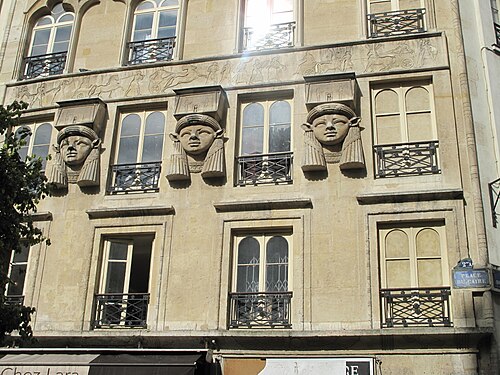
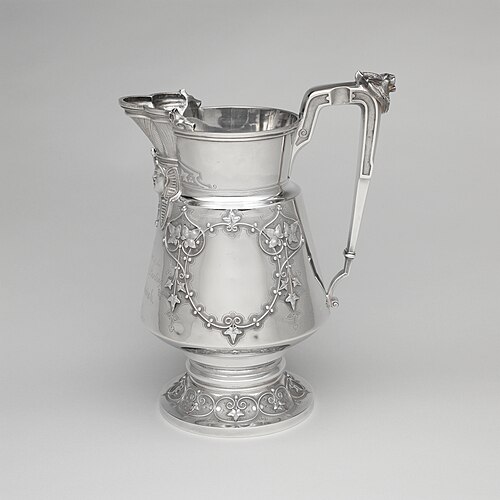
Egyptian Revival art is a style in Western art, mainly of the early nineteenth century, in which Egyptian motifs were applied to a wide variety of decorative arts objects. It was underground in American decorative arts throughout the nineteenth century, continuing into the 1920s. The major motifs of Egyptian art, such as obelisks, hieroglyphs, the sphinx, and pyramids, were used in various artistic media, including architecture, furniture, ceramics, and silver. Egyptian motifs provided an exotic alternative to the more traditional styles of the day. Over the course of the nineteenth century, American tastes evolved from a highly ornamented aesthetic to a simpler, sparer sense of decoration; the vocabulary of ancient Egyptian art would be interpreted and adapted in different ways depending on the standards and motivations of the time.[139] This legacy endures in contemporary Egyptian art, as seen in the work of Rasha Amin, whose Cairo upbringing shapes her multidisciplinary pieces, reflecting the influence of Egypt’s rich cultural heritage.[140]
Enthusiasm for the artistic style of Ancient Egypt is generally attributed to the excitement over Napoleon's conquest of Egypt and, in Britain, to Admiral Nelson's defeat of Napoleon at the Battle of the Nile in 1798. Napoleon took a scientific expedition with him to Egypt. Publication of the expedition's work, the Description de l'Égypte, began in 1809 and came out in a series though 1826, inspiring everything from sofas with sphinxes for legs, to tea sets painted with the pyramids. It was the popularity of the style that was new, Egyptianizing works of art had appeared in scattered European settings from the time of the Renaissance.




{{cite book}}: CS1 maint: location missing publisher (link)Golden figures depicting most probably a Pre-dynastic ruler and his son and heir, which are the oldest known in Egypt.
{{cite book}}: ISBN / Date incompatibility (help)A head from a statue of an official dating to the 12th or 13th Dynasty (1802–1640 B.C.) sports the mushroom-shaped hairstyle commonly worn by non-Egyptian immigrants from western Asia such as the Hyksos.
The foreigners of the fourth register, with long hairstyles and calf-length fringed robes, are labeled Chiefs of Retjenu, the ancient name tor the Syrian region. Like the Nubians, they come with animals, in this case horses, an elephant, and a bear; they also offer weapons and vessels most likely filled with precious substance.
{{cite journal}}: CS1 maint: DOI inactive as of July 2025 (link)Trajan was, in fact, quite active in Egypt. Separate scenes of Domitian and Trajan making offerings to the gods appear on reliefs on the propylon of the Temple of Hathor at Dendera. There are cartouches of Domitian and Trajan on the column shafts of the Temple of Knum at Esna, and on the exterior a frieze text mentions Domitian, Trajan, and Hadrian
ヒル、マーシャ(2007)。神々への贈り物:エジプトの神殿からの画像。ニューヨーク:メトロポリタン美術館。ISBN 9781588392312。


