Loading article…
数学において、ノルムベクトル空間における単位ベクトルとは、長さが 1 のベクトル(多くの場合、空間ベクトル) のことである。単位ベクトルは、小文字の文字にサーカムフレックス、または「ハット」を付けて表されることが多い。(「v-hat」と発音します)。正規化ベクトルという用語は、単位ベクトルの同義語として使用されることがあります。
非ゼロベクトルuの正規化ベクトル ûは、 uの方向の単位ベクトル、すなわち、
ここで、‖ u ‖ はuのノルム(または長さ)であり、[ 1 ] [ 2 ]
その証明は以下のとおりです。
単位ベクトルは、法線方向などの方向を表すためによく用いられます。単位ベクトルはベクトル空間の基底を形成するためによく選ばれ、その空間内のすべてのベクトルは単位ベクトルの線形結合の形で表すことができます。
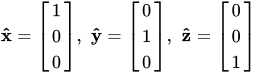
単位ベクトルは、デカルト座標系の軸を表すために使用できます。たとえば、3次元デカルト座標系のx、y、z軸の方向の標準単位ベクトルは次のとおりです。
これらは互いに直交する単位ベクトルの集合を形成し、線形代数では一般的に標準基底と呼ばれます。
これらは、一般的なベクトル表記法(例:xまたは) 標準単位ベクトル表記 (例: x̂ )ではなく。ほとんどの場合、x、y、z、(またはそして) は 3 次元直交座標系の versors です。表記 ( î , ĵ , k̂ )、( x̂ 1 , x̂ 2 , x̂ 3 )、( ê x , ê y , ê z )、または ( ê 1 , ê 2 , ê 3 ) は、ハットの有無にかかわらず使用されます。[ 1 ]特に、 i、j、k が他の量 (たとえば、変数のセット、配列、またはシーケンスの要素を識別するために使用されるi、j、kなどのインデックス記号)と混同される可能性があるコンテキストで使用されます。
空間内の単位ベクトルをデカルト座標でx、y、zの線形結合として表すと、その 3 つのスカラー成分は方向余弦と呼ばれます。各成分の値は、単位ベクトルとそれぞれの基底ベクトルがなす角度の余弦に等しくなります。これは、直線、直線の線分、方向付けられた軸、または方向付けられた軸の線分 (ベクトル) の向き(角度位置) を記述するために使用される方法の 1 つです。
円筒対称性に適した3つの直交単位ベクトルは次のとおりです。
これらはデカルト座標系に関連している、、による:
ベクトルそして関数また、方向は一定ではありません。円筒座標で微分または積分する場合、これらの単位ベクトル自体にも演算を行う必要があります。は:
球対称に適した単位ベクトルは以下のとおりです。、原点からの半径方向距離が増加する方向。、 x - y平面において正のx軸から反時計回りに角度が増加する方向。正のz軸からの角度が増加する方向。表現の冗長性を最小限に抑えるため、極角 is usually taken to lie between zero and 180 degrees. It is especially important to note the context of any ordered triplet written in spherical coordinates, as the roles of and are often reversed. Here, the American "physics" convention[3] is used. This leaves the azimuthal angle defined the same as in cylindrical coordinates. The Cartesian relations are:
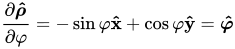
The spherical unit vectors depend on both and , and hence there are 5 possible non-zero derivatives. For a more complete description, see Jacobian matrix and determinant. The non-zero derivatives are:
Common themes of unit vectors occur throughout physics and geometry:[4]
In general, a coordinate system may be uniquely specified using a number of linearly independent unit vectors [1] (the actual number being equal to the degrees of freedom of the space). For ordinary 3-space, these vectors may be denoted . It is nearly always convenient to define the system to be orthonormal and right-handed:
where is the Kronecker delta (which is 1 for i = j, and 0 otherwise) and is the Levi-Civita symbol (which is 1 for permutations ordered as ijk, and −1 for permutations ordered as kji).
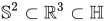
A unit vector in was called a right versor by W. R. Hamilton, as he developed his quaternions. In fact, he was the originator of the term vector, as every quaternion has a scalar part s and a vector part v. If v is a unit vector in , then the square of v in quaternions is −1. Thus by Euler's formula, is a versor in the 3-sphere. When θ is a right angle, the versor is a right versor: its scalar part is zero and its vector part v is a unit vector in .
Thus the right versors extend the notion of imaginary units found in the complex plane, where the right versors now range over the 2-sphere rather than the pair {i, −i} in the complex plane.
By extension, a right quaternion is a real multiple of a right versor.