Loading article…
ウィリアム・リヨン・マッケンジー・キング | |||||||||||||||||||||||||||||||||||||||||||||
|---|---|---|---|---|---|---|---|---|---|---|---|---|---|---|---|---|---|---|---|---|---|---|---|---|---|---|---|---|---|---|---|---|---|---|---|---|---|---|---|---|---|---|---|---|---|
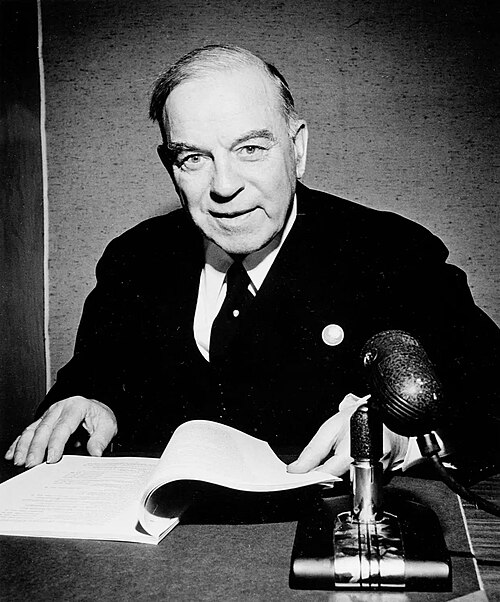
.jpg/500px-William_Lyon_Mackenzie_King_1942_(cropped).jpg) 1942年のキング | |||||||||||||||||||||||||||||||||||||||||||||
| カナダ第10代首相 | |||||||||||||||||||||||||||||||||||||||||||||
| 在任期間 :1935年10月23日~1948年11月15日 | |||||||||||||||||||||||||||||||||||||||||||||
| 君主 | |||||||||||||||||||||||||||||||||||||||||||||
| 総督 | |||||||||||||||||||||||||||||||||||||||||||||
| 先行 | R.B.ベネット | ||||||||||||||||||||||||||||||||||||||||||||
| 後継者 | ルイ・サンローラン | ||||||||||||||||||||||||||||||||||||||||||||
| 在任期間 :1926年9月25日~1930年8月7日 | |||||||||||||||||||||||||||||||||||||||||||||
| 君主 | ジョージ5世 | ||||||||||||||||||||||||||||||||||||||||||||
| 総督 | |||||||||||||||||||||||||||||||||||||||||||||
| 先行 | アーサー・メイゲン | ||||||||||||||||||||||||||||||||||||||||||||
| 後継者 | R.B.ベネット | ||||||||||||||||||||||||||||||||||||||||||||
| 在任期間 :1921年12月29日~1926年6月28日 | |||||||||||||||||||||||||||||||||||||||||||||
| 君主 | ジョージ5世 | ||||||||||||||||||||||||||||||||||||||||||||
| 総督 | ヴィミーのビング卿 | ||||||||||||||||||||||||||||||||||||||||||||
| 先行 | アーサー・メイゲン | ||||||||||||||||||||||||||||||||||||||||||||
| 後継者 | アーサー・メイゲン | ||||||||||||||||||||||||||||||||||||||||||||
| |||||||||||||||||||||||||||||||||||||||||||||
| |||||||||||||||||||||||||||||||||||||||||||||
| |||||||||||||||||||||||||||||||||||||||||||||
| 個人情報 | |||||||||||||||||||||||||||||||||||||||||||||
| 生まれる | 1874年12月17日カナダ 、オンタリオ州、ベルリン | ||||||||||||||||||||||||||||||||||||||||||||
| 死亡 | 1950年7月22日(享年75歳)カナダ 、ケベック州チェルシー | ||||||||||||||||||||||||||||||||||||||||||||
| 休憩所 | マウント プレザント墓地、トロント、オンタリオ州 | ||||||||||||||||||||||||||||||||||||||||||||
| 政党 | リベラル | ||||||||||||||||||||||||||||||||||||||||||||
| 母校 | |||||||||||||||||||||||||||||||||||||||||||||
| サイン |  | ||||||||||||||||||||||||||||||||||||||||||||
ウィリアム・ライアン・マッケンジー ・キング ( 1874年12月17日 - 1950年7月22日)は、カナダの政治家であり、1921年から1926年、1926年から1930年、1935年から1948年の3期にわたり、第10代カナダ首相を務めた。自由党員であったキングは、1920年代初頭から1940年代後半にかけて、カナダの有力政治家であった。[a]キングは、大恐慌と第二次世界大戦を通じてカナダを指導したことで最もよく知られている。彼は、カナダの福祉国家の基礎を築く上で重要な役割を果たし、世界秩序に全面的に関与する中規模国としてのカナダの国際的な評判を確立した。[1]合計21年と154日間の在任期間で、彼はカナダ史上最長の首相の地位を維持している。
キングは1890年代に法律と政治経済学を学び、社会福祉の問題に関心を持つようになった。後に博士号を取得したが、カナダの首相で博士号を取得した唯一の人物となった。1900年、カナダ政府の新設労働省の副大臣となった。1908年に庶民院議員となり、1909年にウィルフリッド・ローリエ首相の下で連邦労働大臣となった。 1911年の連邦選挙で議席を失った後、キングはロックフェラー財団で働き、その後短期間産業コンサルタントとして働いた。1919年にローリエが死去した後、キングは自由党の指導部に就任した。 1917年の徴兵危機で分裂した党の舵取りを引き受け、党内の徴兵賛成派と反対派の両派を統一し、 1921年の連邦選挙で勝利に導いた。
キング牧師は戦後政策として、戦時税の引き下げ、関税の適度な削減、首都オタワの発展を掲げた。また、チャナック危機において議会の同意なしに英国を支援することを拒否し、また米国とハリバット条約を英国の干渉なしに交渉することで、カナダの自治権を強化した。 1925年の選挙では保守党が過半数の議席を獲得したが、自由党は進歩党からの支援を交渉し、少数派政権のまま政権にとどまった。1926年、下院での投票で政権の辞任を余儀なくされる恐れがあったキング牧師は、総督 ビング卿に議会の解散と選挙の実施を要請した。ビング卿はこれを拒否し、代わりに保守党に組閣を要請した。保守党は短期間政権を維持したものの、不信任決議で敗訴した。この一連の出来事が、キング牧師とビング牧師の事件と呼ばれる大きな憲法上の危機を引き起こした。その結果生じた選挙では、キング牧師と自由党が圧勝した。その後、キングは外務省を拡大し、カナダの外交官を増員することで、カナダの外交政策の独立性を高めようとした。また、キングの政府は、必要に応じた老齢年金制度を導入し、電信、電報、鉄道、蒸気船の切符に対する税金を撤廃した。キングは大恐慌への対応が遅れたため、1930年の選挙で敗北した。
保守党政権の大恐慌への対応は不評で、キング牧師は1935年の選挙で圧勝して政権に復帰した。その後まもなく、経済は上向き始めた。キング牧師は1935年に米国と互恵貿易協定を交渉し、住宅購入のしやすさを改善するために1938年に国家住宅法を可決し、1940年に失業保険を導入し、1944年にはカナダ初の国民皆福祉制度である家族手当を導入した。政府はまた、トランスカナダ航空(エア・カナダの前身)とカナダ国立映画庁を設立した。第二次世界大戦勃発の数日後、カナダ軍が派遣された。 1940年の選挙で自由党が圧倒的勝利を収めたため、キング牧師は戦争中もカナダを率いることができた。キング牧師は、経済を活性化させ、国内の士気を維持しつつ、英国を支援するためにカナダの資金、物資、ボランティアを動員した。キングはフランス系カナダ人を満足させるため、海外徴兵の導入を1944年後半まで延期した。1945年の連合国の勝利により、キングは戦後総選挙を呼びかけることができたが、自由党は過半数政府を失った。在任最後の数年間、キングと彼の政府はカナダを他の西側諸国と連携させて深刻化する冷戦に参加させ、カナダ市民権を導入し、ニューファンドランドの連邦加盟交渉を成功させた。近代化を推進するテクノクラートであったキングは、自由党が社会の調和を生み出す自由主義コーポラティズムを代表することを望んだ。 [2] [3] [4]
29年間党を率い、21年間国を率いた後、+1948年後半、キングは政界を引退した。 1950年半ば、肺炎で死去した。キングの性格は複雑で、伝記作家たちは彼を際立たせた個人的な特徴について意見が一致している。彼にはフランクリン・D・ルーズベルト、ウィンストン・チャーチル、シャルル・ド・ゴールといった同時代の人物のようなカリスマ性はなかった。人間関係においては冷たく無神経で、雄弁さに欠け、その性格は有権者の共感を呼ばなかった。 [5]彼には政治的な同盟者は多かったが、親しい友人はほとんどいなかった。彼は心霊術への信仰と、亡くなった仲間、特に母親と連絡を取るために霊媒師を使うことを1930年代後半を通じてその強烈な霊性によってアドルフ・ヒトラーに対する理解が歪んでいた。 [6]歴史家ジャック・グラナットシュタインは、「学者たちはキングという人間にはほとんど感心しなかったが、彼の政治的手腕とカナダ統一への配慮には限りない感心を示した」と述べている。 [7]キングはカナダの首相の中でトップ3に ランクされています。
幼少期(1874年~1891年)
キングは、オンタリオ州ベルリン(現在の キッチナー)のベントン通り43番地に両親が借りていた木造住宅で、ジョン・キングとイザベル・グレース・マッケンジーの子として生まれた。 [8]母方の祖父は、トロントの初代市長で1837年のアッパー・カナダ反乱の指導者であるウィリアム・ライオン・マッケンジーである。父親は弁護士で、後にオズグッド・ホール法科大学院の講師となった。キングには3人の兄弟がいた。姉のイザベル・「ベラ」・クリスティーナ・グレース(1873年 - 1915年)、妹のジャネット・「ジェニー」・リンジー(1876年 - 1962年)、弟のダガル・マクダガル・「マックス」(1878年 - 1922年)。[9] 家族内ではウィリーと呼ばれていたが、大学時代にはWLマッケンジー・キングを署名として採用し、家族外の人に対してはマッケンジーを好んで使うようになった。
キングの父は小さな町で弁護士として苦労しており、経済的に安定したことは一度もなかった。両親は貧しい生活を送り、ほとんど払えないほどの使用人や家庭教師を雇っていたが、1890年頃にトロントに移住してからは経済状況がいくらか改善した。キングはトロント大学で学びながら、数年間ビバリー通りの2階建て住宅で両親と暮らした。[10]
キングは生涯にわたって長老派教会の信者となり、キリスト教の義務に基づいて社会改革に献身した。[11]彼は決して社会主義を支持しなかった。[12]
大学(1891–1900)
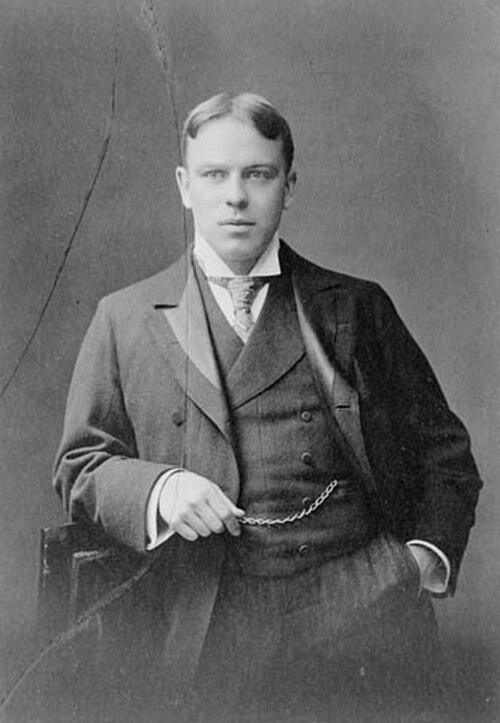
キングは1891年にトロント大学に入学した。 [2]彼は1895年にBA 、1896年にLLB、 1897年にMAを同大学で取得した。[13]トロントで学んでいる間に彼は幅広い友人と知り合い、その多くが著名人となった。[14]彼はカッパアルファ協会の初期の会員であり役員で、この協会にはこれらの人々(将来のオンタリオ州最高裁判所判事2人と将来の大学会長)が多数含まれていた。この協会は政治思想に関する討論を奨励した。彼はまた、将来の政敵となるアーサー・メイゲンとともに文学協会に同時に所属していた。 [15]
キングは社会福祉の問題に特に関心があり、イギリスのロンドンのトインビー・ホールが先駆けとなったセツルメントハウス運動に影響を受けた。1895年の大学での学生ストライキの扇動で中心的な役割を果たした。キングは舞台裏で副総長ウィリアム・ミューロックと密接な関係にあり、このストライキはライバルである総長エドワード・ブレイクと総長ジェームズ・ラウドンを困惑させる機会となった。キングは当面の目標であった大学での教職は得られなかったが、ミューロックから政治的な評価を得て、ミューロックはキングをオタワに招き、わずか5年後には副大臣に任命した。 [16]トロント大学在学中、キングはキャンパス新聞「ザ・ヴァーシティ」にも寄稿し、 1896年には年鑑委員会の委員長を務めた。 [17] [18] [19]キングはその後「ザ・グローブ」、 「ザ・メール・アンド・エンパイア」、「トロント・ニュース」に寄稿した。[20]同僚ジャーナリストのW・A・ヒューイットは、ある日の午後、トロントニュースの編集長がキングが現れたら解雇するようにと指示して彼を任せたと回想している。ヒューイットが編集長のデスクに座ると、キングは数分後に現れ、ヒューイットが解雇を伝える前に辞職した。[20]
シカゴ大学で学び、ジェーン・アダムスの入植地ハル・ハウスで働いた後、キングはハーバード大学に進学した。シカゴ大学在学中、キングは大学の陸上競技チームに半マイル走者として参加した。[21]キングは1898年にハーバード大学で政治経済学の修士号を取得した。1909年、ハーバード大学はキングに「カナダの産業問題の解決要因としての宣伝と世論」と題する論文で博士号を授与した。 [22]キングは博士号を取得した唯一のカナダ首相である。[23]
初期のキャリア、公務員(1900-1908)
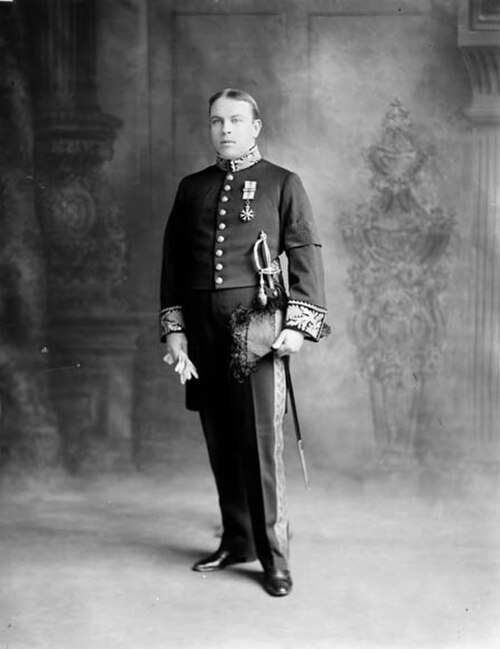
1900年、キングは連邦政府所有の労働問題を扱う出版物「Labour Gazette」の編集者となった。 [24]同年後半、キングはカナダ政府の新設労働省の副大臣に任命され、日本人移民から鉄道まで政策分野で活躍し、特に労働争議を事前調停で回避することを目的とした労働争議調査法(1907年)に尽力した。[25]

Wikisource にはこの記事に関連する原文があります:
英雄の秘密
1901年、キングのルームメイトで親友のヘンリー・アルバート・ハーパーは、スケートパーティーの最中に、半分凍ったオタワ川の氷に若い女性が落ちて英雄的に亡くなった。ハーパーは彼女を救おうと水中に飛び込んだが、その途中で亡くなった。キングはハーパーの記念碑を建てる運動を主導し、その結果、 1905年に国会議事堂にサー・ガラハッド像が建てられた。1906年、キングはハーパーの回想録『英雄の秘密』を出版した。[26]
労働副大臣だったキングは、1907年にバンクーバーのチャイナタウンとジャパンタウンで起きた反東洋人暴動の原因と、その結果生じた賠償請求の調査を任された。損害賠償請求の1つは中国人のアヘン売人からのものであり、キングはこれをきっかけにブリティッシュコロンビア州バンクーバーでの麻薬使用を調査することになった。調査後、キングは中国人男性だけでなく白人女性もアヘン使用者だったと報告し、連邦政府はこの報告書をカナダで初めて麻薬を違法とする法律の制定の根拠とした。[27]
初期の政治経歴、労働大臣(1908年 - 1911年)
キングは1908年の連邦選挙で自由党議員として初めてウォータールー北部選挙区から国会議員に選出された。1909年、ウィルフリッド・ローリエ首相によって初の労働大臣に任命された。[2]
キングの労働大臣としての任期は、2つの大きな成果を収めた。彼は、文民および議会議員時代に策定した労働争議調査法と企業調査法の成立を主導した。この法律は、何百万人ものカナダ人労働者の経済状況を大幅に改善した。 [28] 1910年、マッケンジー・キングは公共事業における8時間労働の確立を目的とした法案を提出したが、上院で否決された。[29] 1911年の総選挙で彼は議席を失い、保守党が自由党を破って政権を樹立した。[2]
政治から遠ざかる(1911年~1919年)
産業コンサルタント
敗北後、キングは自由党を代表して講演旅行に出かけた。1914年6月、ジョン・D・ロックフェラー・ジュニアは彼をニューヨーク市のロックフェラー財団に雇い、新設された産業研究部門の責任者とした。自由党が支払っていた年間わずか2,500ドルに対して、年間12,000ドルの給与だった。[30]彼は1918年まで財団に勤務し、ロックフェラーと緊密な協力関係と友情を築き、コロラド州の家族経営の石炭会社で1913年から1914年のストライキとラドロー虐殺(コロラド炭田戦争として知られる)の混乱期を通じてロックフェラーに助言を与え、これが後にアメリカの労使管理の新時代の幕開けとなった。[31]キングは、当時台頭しつつあった労使関係の専門家の一人となった。

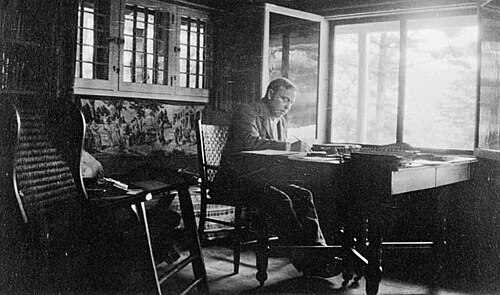
キングは平和主義者ではなかったが、第一次世界大戦にはあまり熱意を示さなかった。カナダ軍に従軍せず、ロックフェラーのために働いていたことで批判を受けた。しかし、戦争が始まったとき、彼は40歳近くで、体調も良くなかった。彼はオタワの自宅を手放すことはなく、必要に応じて米国に渡り、戦争関連産業の円滑な運営を支援することで戦争遂行に貢献した。[32]
1918年、キングは友人のFAマクレガーの助けを借りて、ラドロー虐殺への反応として書いた、密度の濃い抽象的な本『産業と人間性:産業復興の原理の研究』を出版した。ほとんどの読者には理解できなかったが、キングの政治思想の背後にある実践的な理想主義を明らかにした。資本と労働者は敵ではなく自然な同盟者であり、(政府によって代表される)社会全体が労働争議における第3の決定的な当事者であるべきだと論じた。[33] [34]彼はシンジケートや労働組合を軽蔑し、彼らが「既存の組織を強制的に破壊し、現在の所有者から産業資本を自分たちに移すこと」を目指していると非難した。[35]
1918年2月にロックフェラー財団を辞めたキングは、その後2年間労働問題に関する独立コンサルタントとなり、アメリカの大手企業から週1,000ドルを稼いだ。それでもキングは召集令状が来るのを待ち望み、オタワに公邸を構え続けた。[36]
戦時政治
1917年、カナダは危機に陥っていた。キングは、ケベック州で激しく反対されていた徴兵制に反対する自由党の指導者ウィルフリッド・ローリエを支持した。自由党は深刻な分裂に陥り、数人の英語圏の議員が、ロバート・ボーデン首相率いる保守党が支配する連合軍である徴兵制賛成派の連合政府に加わった。キングはカナダに戻り、徴兵制問題にほぼ全面的に焦点が当てられた1917年の選挙に出馬した。ローリエに対する圧倒的な勝利を収めることができなかったキングは、祖父がかつて代表を務めたヨーク北部選挙区で敗北した。 [2]
野党指導者(1919年~1921年)
1919年党首選挙
自由党は、ケベック州の徴兵反対とオンタリオ州およびプレーリー地方での農民反乱によって深く分裂した。レヴィンは、キングが1919年に政界に復帰したとき、言語、地域主義、階級によって激しく分裂した国を前に、基盤の弱い、錆びついた部外者であったと論じている。キングは、ローリエの遺産を受け入れ、労働者の利益を擁護し、福祉改革を呼びかけ、保守党のライバルにしっかりと対抗することで、より上級の競争相手を出し抜いた。[37]ローリエが1919年に死去すると、キングは第1回自由党指導者大会で党首に選出され、4回目の投票で3人のライバルを破った。彼が勝利したのは、後にケベックでキングの長年の補佐官となるアーネスト・ラポワント(1876年 - 1941年)が組織したケベック派の支援のおかげだった。キングはフランス語を話せなかったが、その後20年間(1930年を除く)の選挙でラポワントは重要な議席を獲得し、自由党が下院を掌握できるようにした。ケベックでの選挙活動中、キングはラポワントを共同首相に据えた。[38]

大草原を理想化する
1919年にキングが自由党の党首になると、急速に発展するプレーリー地域にもっと注意を払うようになった。1920年にアルバータ州で日の出を眺めながら、彼は日記に「私は新しい日、新しい社会秩序について考えた。それは新しい時代の幕開けを告げる天の予言が私に明らかにされたように思える」と記している。[39]実用主義も役割を果たした。彼の党は存続のために進歩党議員の票に依存していたが、その多くはオンタリオ州とプレーリー地域の農民を代表するものだった。彼は多くの進歩党員を説得して自由党に復帰させた。[40]
1921年連邦選挙
1921年の選挙では、キングの自由党がアーサー・メイゲン首相率いる保守党を破り、235議席中118議席という僅差で勝利した。保守党は50議席、新たに結成された進歩党は58議席を獲得したが(ただし正式な野党結成は辞退)、残りの10議席は労働党議員と無所属議員が獲得した。この10議席のほとんどは進歩党を支持した。キングが首相となった。[2]
首相(1921年 - 1926年、1926年 - 1930年)
キングはカナダの首相として、1922年6月20日にイギリス枢密院議員に任命され[41] 、1923年10月11日、 1923年御前会議中にバッキンガム宮殿で宣誓した[42]。
バランスを取る
1921年から1926年までの最初の任期中、キング牧師は戦時中の税金、特に戦時中の民族間および労働間の緊張を緩和しようと努めた。「戦争は終わった」と彼は主張した。「そして今後長い間、溝を埋め、戦争が我々の社会生活に与えた傷を癒すために、人類が全力を尽くす必要があるだろう。」[43]
長期にわたる交渉にもかかわらず、キングは進歩党を政府に引き入れることができなかったが、議会が開会すると、保守党の不信任決議を阻止するために彼らの支持を頼りにした。キングの政策のいくつかは、国家政策の高関税に反対する進歩党から反対された。キングは、プレーリーを拠点とする進歩党を満足させる程度に関税を引き下げる一方で、関税はアメリカからの輸入品と競争するために必要だと考えていた工業地帯のオンタリオ州とケベック州の重要な支持者を遠ざけるほどには引き下げないという微妙なバランスをとる必要があった。[44] [45]
時が経つにつれ、進歩党は徐々に弱体化していった。彼らの有能で情熱的な指導者であるトーマス・クレラーは穀物ビジネスに戻るために辞任し、より穏やかなロバート・フォークが後任となった。フォークは自由進歩党員となり、1926年にキング内閣の移民・植民地大臣に就任した。社会主義改革者のJ・S・ウッドワースは徐々に影響力と権力を増し、キングは政策問題でウッドワースと妥協することができた。[46]いずれにせよ、進歩党の議員団には自由党と保守党が伝統的に守ってきた党の規律が欠けていた。進歩党は、彼らの国会議員はまず彼らの選挙区の住民を代表するという約束で選挙運動を行っていた。キングはこれを有利に利用した。重要な投票の際には、常に少なくとも数人の進歩党議員が彼のほぼ多数派の立場を支えてくれると期待できたからである。
移民
1923年、キング政権はカナダへのほとんどの形態の中国人移民を禁止する中国人移民法を可決した。ほとんどの国からの移民は何らかの形で管理または制限されていたが、中国人だけは完全に移民を禁止されていた。これは連邦政府のさまざまなメンバーといくつかの州政府(特にブリティッシュコロンビア州)が連邦政府に中国人移民を阻止するよう圧力をかけた後のことだった。[47]
また1923年、政府は移民法を改正し、オーストリア=ハンガリー帝国の旧臣民が再びカナダに入国できるようにした。第一次世界大戦中に制限が課された後、ウクライナからの移民が再開された。[48]
都市計画
キングは長年、都市計画と首都開発に関心を抱いていた。なぜならキングはセツルメントハウス運動の訓練を受けており、都市計画とガーデンシティを自身のより広範な社会改革プログラムの構成要素として構想していたからである。キングは、社会計画、公園運動、科学的な都市、美しい都市という、北米初期の都市計画における4つの幅広い伝統を参考にした。キングの最大の影響力は、カナダの首都オタワの計画と開発の政治的推進者としてであった。キングの計画の多くは彼の死後20年の間に完成し、美しい都市様式でオタワを国家的な空間として再配置した1世紀にわたる連邦計画の一部であった。例えば、コンフェデレーション広場[49] [50]は当初、近くにある連邦議会議事堂とのバランスを取るための市民広場として計画されたが、戦争記念碑に転用された。第一次世界大戦記念碑は1939年の王室訪問まで設置されず、キングは首都の再計画を第一次世界大戦の記念碑にするつもりであった。しかし、第一次世界大戦記念碑の象徴的な意味は徐々に拡大し、カナダのすべての戦争犠牲者を追悼する場所となり、戦争記念碑も含まれるようになった。[51]
汚職スキャンダル
キング牧師は1925年に総選挙を呼びかけ、保守党は最多の議席を獲得したものの、下院で過半数には届かなかった。キング牧師は進歩党の支持を得て権力を握り続けた。キング牧師の最初の任期の終わりに発覚した汚職スキャンダルは、ケベック州のボーアルノワ運河拡張工事をめぐる不正行為に関するものであった。このことがきっかけで広範囲にわたる調査が行われ、最終的には王立委員会が設置され、ボーアルノワ・スキャンダルが暴露された。その結果生じたマスコミの報道によって、選挙でキング牧師の政党は打撃を受けた。キング牧師の2期目の初めには、今度は関税局における別の汚職スキャンダルが発覚し、保守党と進歩党への支持が高まり、下院で十分な支持を失えばキング牧師が辞任を余儀なくされる可能性が高まった。キング牧師自身が任命した議員の一人がスキャンダルの中心人物であったものの、キング牧師はこのスキャンダルに個人的には関わっていなかった。野党党首メイゲンはキング牧師に対して激しい非難を浴びせ、キング牧師は「口が塞がったロブスターのように」権力にしがみついていると述べた。[52 ]
キング・ビング事件
1926年6月、キング牧師は、関税スキャンダルに関連する庶民院での投票により政府総辞職を余儀なくされる可能性に直面し、総督ビング卿に議会を解散して再選挙を行うよう進言した。しかし、ビング卿は首相の要請を断った。カナダ史上初めて、解散要請が拒否されたことであり、現在までカナダ総督がそうした唯一のケースである。ビング卿は代わりに野党党首のアーサー・メイゲンに組閣を要請した。保守党は下院で他党より多くの議席を有していたものの、過半数には達しなかった。保守党自身も7月2日の不信任動議ですぐに敗北した。メイゲン卿自身が議会の解散を要請し、ビング卿はこれを認めた。

キング牧師は1926年の自由党選挙運動で、カナダ国民が自らを統治する権利と国王の干渉反対という問題を主な争点とした。自由党は少数派政府で政権に復帰し、この問題に関するキング牧師の立場と首相全般の立場を強化した。キング牧師は後に1926年の帝国会議でカナダの自治権拡大を主張し、その会議で採択されたバルフォア宣言では、自治領の地位が付与されれば、カナダ、オーストラリア、ニュージーランド、ニューファンドランド、南アフリカ、アイルランド自由国は、依然として大英帝国内の自治州ではあるものの、英国への従属関係は終了すると述べられている。したがって、総督は英国政府を代表することをやめ、国王の個人的な代表者でありながら国王の代表者となった。これは最終的に1931年のウェストミンスター憲章で正式化された。[53] [54] 9月14日、キング牧師と彼の政党は下院で最多議席を獲得して選挙に勝利した。下院議員数245名のうち、保守党は91議席、キング牧師は116議席を獲得した。[55]
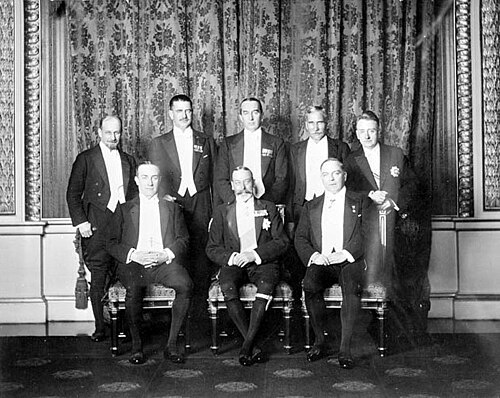
カナダの自治権の拡大
.jpg/500px-KingMasseyErsme_(cropped).jpg)
1922年のチャナック危機の際、キング牧師は議会に相談せずに英国を支持することを拒否したが、保守党党首のアーサー・メイゲンは英国を支持した。キング牧師は外交問題においてロンドンから独立したカナダの発言力を求めた。1922年9月、英国首相デイヴィッド・ロイド・ジョージは、危機に際してカナダの支援をキング牧師に繰り返し要請した。キング牧師は、カナダ議会がどのような政策を取るかを決めると冷たく答え、ロンドンの提案に縛られないことを明らかにした。[56]キング牧師は日記に英国の要請についてこう書いている。「正直に言って、私はそれに苛立った。これは帝国主義のゲームをするために、ヨーロッパの戦争に関して中央集権と自治を試すために意図的に起草されたものだ...どの[カナダ]代表団も、まず議会が召集されないまま行くことはないだろう」。[57]英国はキング牧師の対応に失望したが、キング牧師が予想した通り、危機はすぐに解決した。[45]チャナックの後、キングはカナダがイギリスとの関係のために戦争に突入する可能性を懸念し、バイオレット・マーカムに次のように書いている。
ロンドンの中央集権化のようなことは、ダウニング街の役人が自治領の人々に何をすべきか、何をすべきでないかを直接的または間接的に指示し、外交政策の問題で義務を指示しようとすることは言うまでもなく、純粋に国内問題への干渉の試みと同じくらい、いわゆる「帝国の結束」に有害であることが確実に証明される。もしイギリス連邦の加盟が、事前の協議、会議、またはいかなる種類の合意もなしに、イギリスが関与するあらゆる戦争に自治領が参加することを意味するのであれば、永続的な関係の望みは私には見えない。[58]
何年もの間、北太平洋のカナダとアメリカの漁場ではオヒョウの資源が枯渇しつつあった。1923年、キングの政府はアメリカとオヒョウ条約を交渉した。この条約は毎年11月16日から2月15日まで商業漁業を禁止し、違反すると押収されるというものだった。この協定は、イギリス代表の参加なしに、またイギリス議会の批准なしにカナダが交渉したという点で注目に値する。公式ではないが、慣例上、イギリスは交渉の席に着くか、カナダが参加する協定に署名するとされていた。キングは、状況はカナダとアメリカだけの問題だと主張した。その後、イギリスは、キングがワシントンDCにイギリスではなくカナダの外交官を派遣するという意向を受け入れた(カナダの利益を代表するため)。1923年の帝国会議で、イギリスはオヒョウ条約を受諾し、それがイギリス領の役割の新たな先例となると主張した。[59] [60]
キングは1909年に設立された外務省を拡大し、英国からのカナダの自立をさらに推進した。新しい省庁の発展には多少の時間を要したが、時が経つにつれてカナダ外交の範囲と展望を大幅に拡大した。[61]これに先立ち、カナダはロンドンに第一の忠誠を誓う英国の外交官に依存していた。キング=ビング事件の後、キングは新しい事業のために多くの優秀な人材を採用した。その中には将来の首相レスター・ピアソンや、影響力のあるキャリア行政官ノーマン・ロバートソンとヒューム・ロングが含まれていた。このプロジェクトは彼の全体戦略の重要な要素であり、カナダを英国、旧植民地フランス、そして隣国の強国米国から独立した道に導いた。[45] [62]
キングは在任中、カナダを責任ある政府を持つ自治領からイギリス連邦内の自治国家へと導いた。キングはイギリス政府が連邦を同盟国にしようとする試みに対してカナダの自治権を主張した。伝記作家は「この闘争においてマッケンジー・キングは常に攻撃的だった」と断言している。[63]カナダの駐英高等弁務官ヴィンセント・マッシーは「反英的偏見」が「彼の性格の中で最も強い要素の一つ」だと主張した。[64]
その他の改革
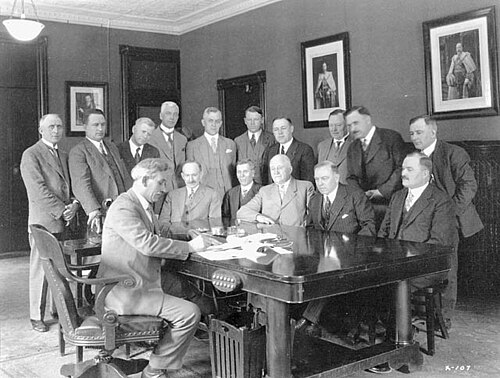
内政面では、キングはマニトバ、アルバータ、サスカチュワンの各州政府に王領の所有権と地下資源の権利を移譲することで州政府の権限を拡大するという自由党の政策を強化した。石油やその他の天然資源が非常に豊富であることが判明したため、これらの権利は特に重要になっていった。キングは州政府と協力して、必要に応じた老齢年金制度を導入した。 [65] 1930年2月、キングはカナダ史上 初の女性上院議員としてケリン・ウィルソンを任命した。
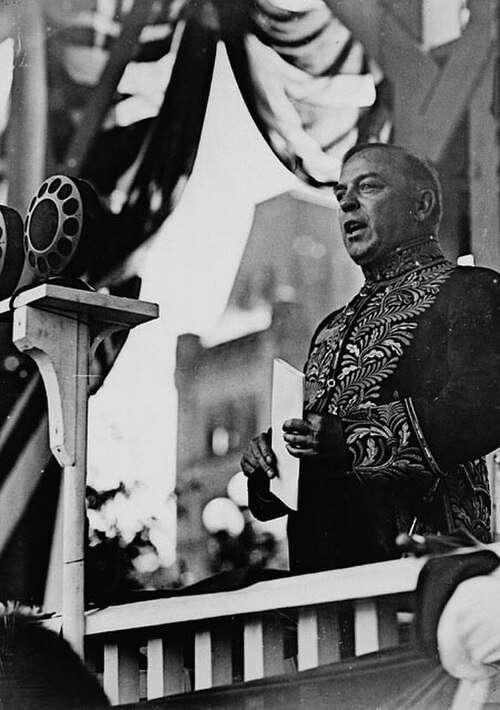
物品税の免税や所得税の免税の拡大などの減税が実施され、1929年には電信、電報、鉄道・蒸気船の切符に対する税金が撤廃された。[66]
農民を支援するための措置も実施された。例えば、1922年には「大草原地帯から東へ輸送される穀物と小麦粉に対するクロウズ・ネスト・パス鉄道の料金を復活させる」という措置が提案され、可決された。農村融資委員会が設立され、農民に「通常の資金源からは得られない金利と条件で」資金を貸し付けた。また、口蹄疫の予防措置や「国内外での農産物のマーケティングを支援する」ための格付け基準の確立などの措置も実施された。さらに、1923年のコンバイン調査法は、消費者と生産者を搾取から守ることを目的としていた。[67]公正賃金および1日8時間労働法は1930年に導入された。[68]
1930年の敗北
King's government was in power at the beginning of the Great Depression, but was slow to respond to the mounting crisis. He felt that the crisis was a temporary swing of the business cycle and that the economy would soon recover without government intervention.[69] Critics said he was out of touch. Just prior to the election, King carelessly remarked that he "would not give a five-cent piece" to Tory provincial governments for unemployment relief.[38] The opposition made this remark a catch-phrase; the main issue was the deterioration in the economy and whether the prime minister was out of touch with the hardships of ordinary people.[70] The Liberals lost the election of 1930 to the Conservative Party, led by Richard Bedford Bennett. The popular vote was very close between the two parties, with the Liberals actually earning more votes than in 1926, but the Conservatives had a geographical advantage that turned into enough seats to give a majority.[71]
Opposition leader (1930–1935)
After his loss, King stayed on as leader of the Liberals, becoming the leader of the Opposition for the second time. King began his years as Opposition leader convinced that his government did not deserve defeat and that his government's financial caution helped the economy prosper. He blamed the financial crisis on the speculative excesses of businessmen and on the weather cycle. King argued that the worst mistake Canada could react to the Depression was to raise tariffs and restrict international trade. He believed that over time, voters would learn that they had been deceived by Bennett and would come to appreciate the King government's policy of frugality and free trade.[2]

King's policy was to refrain from offering advice or alternative policies. Indeed, his policy preferences were not much different from Bennett's, and he let the Conservative government have its way. Though he gave the impression of sympathy with progressive and liberal causes, he had no enthusiasm for the New Deal of American President Franklin D. Roosevelt (which Bennett eventually tried to emulate, after floundering without solutions for several years), and he never advocated massive government action to alleviate the Depression in Canada.[72]
As Opposition leader, King denounced the Bennett government's budget deficits as irresponsible, though didn't suggest his own idea of how budgets could be balanced. King also denounced the "blank cheques" parliament was asked to approve for relief and delayed the passage of these bills despite the objections of some Liberals who feared the public might conclude that the Liberals had no sympathy for those struggling. Each year, after the throne speech and the budget, King introduced amendments that blamed the depression on Bennett's policy of high tariffs.[2]
By the time the 1935 election arrived, the Bennett government was heavily unpopular due to their handling of the depression. Using the slogan "King or Chaos",[73] the Liberals won a landslide victory, winning 173 out of the Commons' 245 seats and reducing the Conservatives to a rump of 40; this was the largest majority government at the time.[2]
Prime Minister (1935–1948)
For the first time in his political career, King led an undisputed Liberal majority government. Upon his return to office in October 1935, he seemed to demonstrate a commitment (like Franklin Roosevelt) to the underprivileged, speaking of a new era where "poverty and adversity, want and misery are the enemies which liberalism will seek to banish from the land".[74] Once again, King appointed himself as secretary of state for external affairs; he held that post until 1946.[2]
Economic reforms
Free trade
Promising a much-desired trade treaty with the U.S., the King government passed the 1935 Reciprocal Trade Agreement. It marked the turning point in Canadian-American economic relations, reversing the disastrous trade war of 1930–31, lowering tariffs, and yielding a dramatic increase in trade. More subtly, it revealed to the prime minister and President Roosevelt that they could work together well.[75][76]
Social programs
King's government introduced the National Employment Commission in 1936. As for the unemployed, King was hostile to federal relief.[77] However, the first compulsory national unemployment insurance program was instituted in August 1940 under the King government after a constitutional amendment was agreed to by all of the Canadian provinces, to concede to the federal government legislative power over unemployment insurance. New Brunswick, Alberta and Quebec had held out against the federal government's desire to amend the constitution but ultimately acceded to its request, Alberta being the last to do so. The British North America Act Section 91 was amended by adding in a heading designated Number 2A simply in the words "Unemployment Insurance".[78]
Over the next thirteen years, a wide range of reforms similar to those association with the New Deal were realized during Mackenzie King's last period in office as prime minister. In 1937, the age for blind persons to qualify for old-age pensions was reduced to 40 in 1937, and later to 21 in 1947.[79] In 1939, compulsory contributions for pensions for low-income widows and orphans were introduced (although these only covered the regularly employed) while depressed farmers were subsidized from that same year onwards. In 1944, family allowances were introduced. King had various arguments in favour of family allowances, one of which, as noted by one study, was that family allowances "would mean better food, clothing and medical and dental care for children in low-income families."[80] From 1948 the federal government subsidized medical services in the provinces.[81]
Spending management
The provincial governments faced declining revenues and higher welfare costs. They needed federal grants and loans to reduce their deficits. In a December 1935 conference with the premiers, King announced that the federal grants would be increased until the spring of 1936. At this stage, King's main goal was to have a federal system in which each level of government would pay for its programs out of its own tax sources.[2]
King only reluctantly accepted a Keynesian solution that involved federal deficit spending, tax cuts, and subsidies to the housing market.[77] King and his finance minister, Charles Avery Dunning, had planned to balance the budget for 1938. However, some colleagues, to King's surprise, opposed that idea and instead favoured job creation to stimulate the economy, citing British economist John Maynard Keynes's theory that governments could increase employment by spending during times of low private investment. In a politically motivated move, King accepted their arguments and hence ran deficits in both 1938 and 1939.[2]
Workers
The various provinces were assisted by the Federal Unemployment and Agricultural Assistance Act of 1938 and the Youth Training Act of 1939 to create training programs for young persons,[82] while an amendment to the Criminal Code in May 1939 provided against refusal to hire, or dismissal, "solely because of a person's membership in a lawful trade-union or association".[83]
The Vocational Training Co-ordination Act of 1942 provided an impetus to the provinces to set up facilities for postsecondary vocational training,[84] and in 1948 the Industrial Relations and Disputes Investigation Act was passed, which safeguarded the rights of workers to join unions while requiring employers to recognize unions chosen by their employees.[85]
Housing
The Federal Home Improvement Plan of 1937 provided subsidized rates of interest on rehabilitation loans to 66,900 homes, while the National Housing Act of 1938 made provision for the building of low-rent housing.[86] Another Housing Act was later passed in 1944 with the intention of providing federally guaranteed loans or mortgages to individuals who wished to repair or construct dwellings through their own initiative.[87]
Agriculture
While King opposed Bennett's Canadian Wheat Board in 1935, he accepted its operation. However, by 1938, the board had sold its holdings and King proposed returning to the open market. This angered Western Canadian farmers, who favoured a board that would give them a guaranteed minimum price, with the federal government covering any losses. Facing a public campaign to keep the board, King and his minister of agriculture, James Garfield Gardiner, reluctantly extended the board's life and offered a minimum price that would protect the farmers from further declines.[2]
Crown corporations
In 1937, King's government established the Trans-Canada Air Lines (the precursor to Air Canada), as a subsidiary of the crown corporation, Canadian National Railways. It was created to provide air service to all regions of Canada.[88]
In 1938, King's government nationalized the Bank of Canada into a crown corporation.[89]
Media reforms
In 1936, the Canadian Radio Broadcasting Commission (CRBC) became the Canadian Broadcasting Corporation (CBC), which was a crown corporation. The CBC had a better organizational structure, more secure funding through the use of a licence fee on receiving sets (initially set at $2.50), and less vulnerability to political pressure.[90] When Bennett's Conservatives were governing and the Liberals were in Opposition, the Liberals accused the network of being biased towards the Conservatives. During the 1935 election campaign, the CRBC broadcast a series of 15 minutes soap operas called Mr. Sage which were critical of King and the Liberal Party. Decried as political propaganda, the incident was one factor in King's decision to replace the CRBC.[91]
In 1938, King's government invited British documentary maker John Grierson to study the situation of the government's film production (which at that time was the responsibility of the Canadian Government Motion Picture Bureau). King believed that Canadian cinema deserved an increased presence in Canadian theatres.[92] This report prompted the National Film Act, which created the National Film Board of Canada in 1939. It was created to produce and distribute films serving the national interest and was intended specifically to make Canada better known both domestically and internationally.[93] Gierson was appointed the first film commissioner in October 1939.[94]
Relationship with provinces
After 1936, the prime minister lost patience when Western Canadians preferred radical alternatives such as the CCF (Co-operative Commonwealth Federation) and Social Credit to his middle-of-the-road liberalism. Indeed, he came close to writing off the region with his comment that the prairie dust bowl was "part of the U.S. desert area. I doubt if it will be of any real use again."[40] Instead he paid more attention to the industrial regions and the needs of Ontario and Quebec, particularly with respect to the proposed St. Lawrence Seaway project with the United States.[95]
In 1937, Maurice Duplessis, the conservative Union Nationale premier of Quebec, passed the Padlock Law (the Act to Protect the Province Against Communistic Propaganda),[96] which intimidated labour leaders by threatening to lock up their offices for any alleged communist activities. King's government, which had already repealed the section of the Criminal Code banning unlawful associations, considered disallowing this bill. However, King's cabinet minister, Ernest Lapointe, believed this would harm the Liberal Party's electoral chances in Quebec. King and his English-Canadian ministers accepted Lapointe's view; as King wrote in his diary in July 1938, "we were prepared to accept what really should not, in the name of liberalism, be tolerated for one moment."[2]
Germany and Hitler
In March 1936, in response to the German remilitarization of the Rhineland, King had the High Commission of Canada in the United Kingdom inform the British government that if Britain went to war with Germany over the Rhineland issue, Canada would remain neutral.[97] In June 1937, during an Imperial Conference in London of the prime ministers of every dominion, King informed Britain's Prime Minister Neville Chamberlain that Canada would only go to war if Britain were directly attacked, and that if the British were to become involved in a continental war then Chamberlain was not to expect Canadian support.[98]

In 1937, King visited Nazi Germany and met with Adolf Hitler.[99] Possessing a religious yearning for direct insight into the hidden mysteries of life and the universe, and strongly influenced by the operas of Richard Wagner (who was also Hitler's favourite composer), King decided Hitler was akin to mythical Wagnerian heroes within whom good and evil were struggling. He thought that good would eventually triumph and Hitler would redeem his people and lead them to a harmonious, uplifting future. These spiritual attitudes not only guided Canada's relations with Hitler but gave the prime minister the comforting sense of a higher mission, that of helping to lead Hitler to peace. King commented in his journal that "he is really one who truly loves his fellow-men, and his country, and would make any sacrifice for their good".[100][101] King forecast that:
The world will yet come to see a very great man–mystic in Hitler ... I cannot abide in Nazism – the regimentation – cruelty – oppression of Jews – attitude towards religion, etc., but Hitler ... will rank some day with Joan of Arc among the deliverers of his people.[102]
In late 1938, during the great crisis in Europe over Czechoslovakia that culminated in the Munich Agreement, Canadians were divided. Francophones insisted on neutrality, as did some top advisers like Oscar D. Skelton. Anglophones stood behind Britain and were willing to fight Germany. King, who served as his own secretary of state for external affairs (foreign minister), said privately that if he had to choose he would not be neutral, but he made no public statement. All of Canada was relieved that the Munich Agreement, while sacrificing the sovereignty of Czechoslovakia, seemed to bring peace.[103][104]
Under King's administration, the Canadian government, responding to strong public opinion, especially in Quebec, refused to expand immigration opportunities for Jewish refugees from Europe.[105] In June 1939 Canada, along with Cuba and the United States, refused to allow entry for the 900 Jewish refugees aboard the passenger ship MS St. Louis.[106] King's government was widely criticized for its antisemitic policies and refusal to admit Jewish refugees. Most famously, when Frederick Blair, an immigration official in King's party, was asked how many Jewish refugees Canada would admit after World War II, he replied "None is too many". This policy was wholly supported by King and his political allies.[107]
Second World War
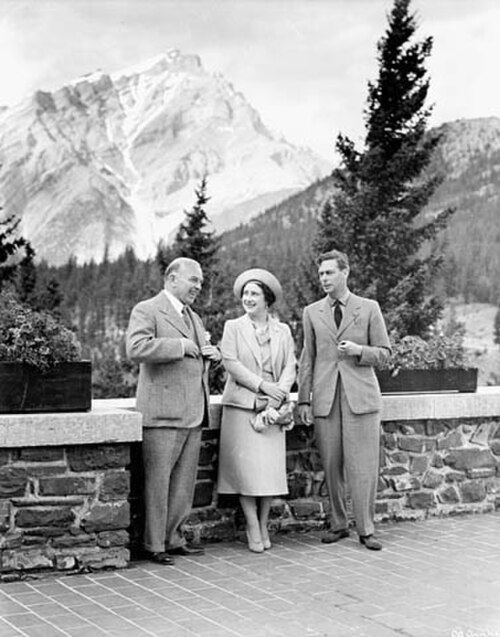
King accompanied the Royal Couple—King George VI and Queen Elizabeth—throughout their 1939 cross-Canada tour, as well as on their American visit, a few months before the start of World War II.[108]

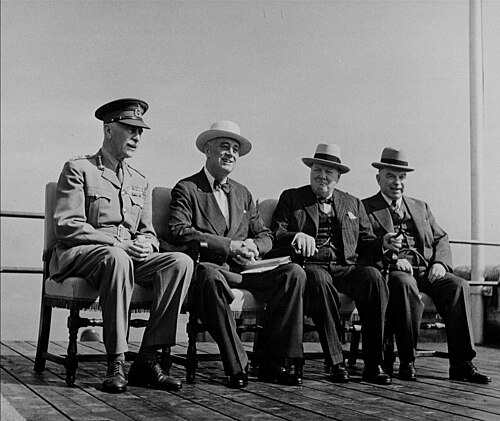
.jpg/500px-thumbnail.jpg)
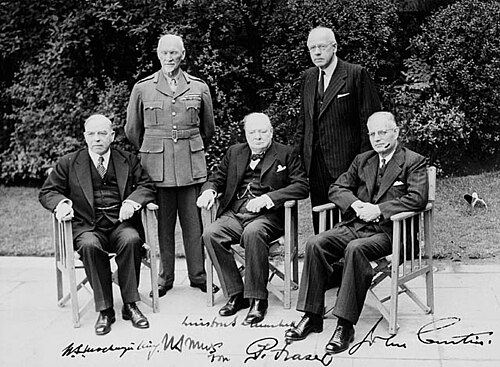
Declaration of war
According to historian Norman Hillmer, as British Prime Minister Neville Chamberlain "negotiated in Munich with Adolf Hitler in September 1938, Mackenzie King, Canada's Prime Minister, grew agitated."[109] King realized the likelihood of World War II and began mobilizing on August 25, 1939, with full mobilization on September 1, 1939, the day Germany invaded Poland. In 1914, Canada was at war by virtue of King George V's declaration. In 1939, King asserted Canada's autonomy and convened the House of Commons on September 7, nearly a month ahead of schedule, to discuss the government's intention to enter the war. King affirmed Canadian autonomy by saying that the Canadian Parliament would make the final decision on the issue of going to war. He reassured the pro-British Canadians that Parliament would surely decide that Canada would be at Britain's side if Great Britain was drawn into a major war. At the same time, he reassured those who were suspicious of British influence in Canada by promising that Canada would not participate in British colonial wars. His Quebec lieutenant, Ernest Lapointe, promised French Canadians that the government would not introduce conscription for overseas service; individual participation would be voluntary. These promises made it possible for Parliament to agree almost unanimously to declare war on September 9. On September 10, King, through his high commissioner in London, issued a request to King George VI, asking him, in his capacity as King of Canada, to declare Canada at war against Germany.[110][111][112]
Foreign policy
To re-arm Canada, King built the Royal Canadian Air Force as a viable military power, while at the same time keeping it separate from Britain's Royal Air Force. He was instrumental in obtaining the British Commonwealth Air Training Plan Agreement, which was signed in Ottawa in December 1939, binding Canada, Britain, New Zealand and Australia to a program that eventually trained half the airmen from those four nations in the Second World War.[113]
King linked Canada more and more closely to the United States, signing an agreement with Roosevelt at Ogdensburg, New York, in August 1940 that provided for the close cooperation of Canadian and American forces, despite the fact that the U.S. remained officially neutral until the bombing of Pearl Harbor on December 7, 1941. During the war the Americans took virtual control of the Yukon in building the Alaska Highway, and major airbases in Newfoundland, at that time under British governance.[114]
King—and Canada—were largely ignored by British Prime Minister Winston Churchill, despite Canada's major role in supplying food,[115] raw materials, munitions,[116] and money[117] to the hard-pressed British economy, training airmen for the Commonwealth, guarding the western half of the North Atlantic Ocean against German U-boats,[118] and providing combat troops for the invasions of Italy, France and Germany in 1943–45. King proved highly successful in mobilizing the economy for war, with impressive results in industrial and agricultural output. The depression ended, prosperity returned, and Canada's economy expanded significantly.[119]
During the war, Canada rapidly expanded its diplomatic missions abroad. While Canada hosted two major Allied conferences in Quebec in 1943 and 1944, neither King nor his senior generals and admirals were invited to take part in any of the discussions.[120]
Political affairs
King's government made an unprecedented intervention in the 1939 Quebec general election to defeat anti-war Premier Maurice Duplessis's Union Nationale and ensure victory for the pro-war Quebec Liberals under Adélard Godbout. Three of King's Cabinet ministers from Quebec (Ernest Lapointe, Arthur Cardin, and Charles Gavan Power) threatened to resign if Duplessis won re-election, claiming that no one would be left to stand up for Quebec in the Cabinet if conscription become an issue again.[121][122] In his diary, King called Duplessis "diabolic" and a "little Hitler", believing Duplessis's aim was to provoke such a crisis between French Canada and English Canada that Quebec would leave Confederation.[123] King used the powers of censorship under the War Measures Act to keep Duplessis from speaking on the radio. The Quebec Liberals won a landslide victory.[124]
King rejected any notion of a government of national unity like the Unionist Government during World War I.[113] When the Legislative Assembly of Ontario passed a resolution criticizing King's government for not fighting the war "in the vigorous manner the people of Canada desire to see", King dissolved the federal parliament, triggering a federal election for March 26, 1940. He held it despite the ongoing war, unlike Britain, which formed a government of national unity and did not hold a wartime election. King won a second consecutive landslide victory, winning 179 seats – 6 more than in 1935. This was the Liberals' most successful result as of 2023[update] (in terms of proportion of seats). The Official Opposition party, the Conservatives, won the same number of seats as R. B. Bennett did in the 1935 election. King's relationship with Liberal Ontario Premier Mitchell Hepburn was damaged due to Hepburn spearheading the resolution criticizing the war effort.[125]
King promoted engineer and businessman C. D. Howe to senior cabinet positions during the war. King also suffered two cabinet setbacks; his defence minister, Norman McLeod Rogers, died in 1940 and his Quebec lieutenant and minister of justice and attorney general, Ernest Lapointe, died in 1941. King successfully sought out the reluctant Louis St. Laurent, a leading Quebec lawyer, to enter the House of Commons and to take over Lapointe's role. St. Laurent became King's right-hand man.[45][126]
Wartime expenditure
On June 24, 1940, King's government presented the first $1 billion budget in Canadian history. It included $700 million in war expenses compared to $126 million in the 1939–1940 fiscal year; however, due to the war, the overall economy was the strongest in Canadian history.[127]
Internment of Japanese-Canadians
Following the attack on Pearl Harbor in December 1941, Japanese Canadians were categorized by Canada as enemy aliens under the War Measures Act, which began to remove their personal rights.[128] Starting on December 8, 1941, 1,200 Japanese-Canadian-owned fishing vessels were impounded as a "defence measure."[129] On January 14, 1942, the federal government passed an order calling for the removal of male Japanese nationals between 18 and 45 years of age from a designated protected area of 100 miles inland from the British Columbia coast, enacted a ban against Japanese-Canadian fishing during the war, banned shortwave radios and controlled the sale of gasoline and dynamite to Japanese Canadians.[130] Japanese nationals removed from the coast after the January 14 order were sent to road camps around Jasper, Alberta. Three weeks later, on February 19, 1942, US President Franklin D. Roosevelt signed Executive Order 9066, which called for the removal of 110,000 people of Japanese ancestry from the American coastline. A historian of internment, Ann Sunahara, argues that "the American action sealed the fate of Japanese Canadians."[131]
On February 24, the federal government passed order-in-council PC 1468 which allowed for the removal of "all persons of Japanese origin"[132] This order-in-council allowed the Minister of Justice the broad powers of removing people from any protected area in Canada, but was meant for Japanese Canadians on the Pacific coast in particular. On February 25, the federal government announced that Japanese Canadians were being moved for reasons of national security.[133] In all, some 27,000 people were detained without charge or trial, and their property confiscated. Others were deported to Japan.[134] King and his Cabinet received conflicting intelligence reports about the potential threat from the Japanese. Major General Ken Stuart told Ottawa, "I cannot see that the Japanese Canadians constitute the slightest menace to national security."[135] In contrast, BC's attorney general, Gordon Sylvester Wismer reported that, while he had "the greatest respect for" and "hesitated to disagree with" the RCMP, "every law enforcement agency in this province, including ... the military officials charged with local internal security, are unanimous that a grave menace exists."[136]
Expansion of scientific research
King's government greatly expanded the role of the National Research Council of Canada during the war, moving into full-scale research in nuclear physics and commercial use of nuclear power in the following years. King, with C. D. Howe acting as point man, moved the nuclear group from Montreal to Chalk River, Ontario in 1944, with the establishment of Chalk River Nuclear Laboratories and the residential town of Deep River, Ontario. Canada became a world leader in this field, with the NRX reactor becoming operational in 1947; at the time, NRX was the only operational nuclear reactor outside the United States.[137]
Conscription
King's promise not to impose conscription contributed to the defeat of Maurice Duplessis's Union Nationale Quebec provincial government in 1939 and the Liberals' re-election in the 1940 election. But after the fall of France in 1940, Canada introduced conscription for home service (conscription meant for the defence of Canada only). Only volunteers were to be sent overseas. King wanted to avoid a repeat of the Conscription Crisis of 1917. By 1942, the military was pressing King hard to send conscripts to Europe. In 1942, King held a national plebiscite on the issue, asking the nation to relieve him of the commitment he had made during the election campaign. In the House of Commons on June 10, 1942, he said that his policy was "not necessarily conscription but conscription if necessary".[138]
French Canadians voted against conscription, with over 70 percent opposed, but an overwhelming majority – over 80 percent – of English Canadians supported it. French and English conscripts were sent to fight in the Aleutian Islands in 1943 – technically North American soil and therefore not "overseas" – but the mix of Canadian volunteers and draftees found that the Japanese troops had fled before their arrival. Otherwise, King continued with a campaign to recruit volunteers, hoping to address the problem with the shortage of troops caused by heavy losses in the Dieppe Raid in 1942, in Italy in 1943, and after the Battle of Normandy in 1944. In November 1944, the government decided it was necessary to send conscripts for the war. This led to a brief political crisis (see Conscription Crisis of 1944) and a mutiny by conscripts posted in British Columbia, but the war ended a few months later. In all, 12,908 conscripts were sent to fight abroad, though only 2,463 saw combat.[139]
Post-war Canada
1945 election
With the war winding down, King called a federal election for June 11, 1945. The Liberals' election campaign was centered on a broad program of social security. Although King was hesitant for his government to expand its role in the economy and run deficits, he accepted it as these measures aligned with his concern for people struggling financially. There were political motives too; the Liberals needed to compete with the rising socialist Co-operative Commonwealth Federation (CCF) for votes.[2] In addition, King promised to commit one division of volunteers to Operation Downfall, the planned invasion of Japan scheduled for late 1945-early 1946, whereas Progressive Conservative leader John Bracken promised conscription. Bracken's promise was unpopular and it thus benefited the Liberals.[140]
The Liberals were knocked down from a massive majority government to a minority government. However, they were able to govern with a working majority with the support of eight "Independent Liberal" MPs (most of whom did not run as official Liberals because of their opposition to conscription). The Liberals' decline in support was partly attributed to the introduction of conscription, which was unpopular in many parts of Canada. As King was defeated in his own riding of Prince Albert, fellow Liberal William MacDiarmid, who was re-elected in the safe seat of Glengarry, resigned so that an August 6 by-election could be held, which was subsequently won by King.[2]
Foreign affairs, Cold War
King helped found the United Nations (UN) in 1945 and attended the opening meetings in San Francisco.[141] Though he conceded that major powers such as the United States and the United Kingdom would dominate the organization, King argued that middle powers such as Canada should be given an influence on the UN based on their contributions to the settlement of disputes.[2]
King moved Canada into the deepening Cold War in alliance with the U.S. and Britain. He dealt with the espionage revelations of Soviet cipher clerk Igor Gouzenko, who defected in Ottawa in September 1945, by quickly appointing a Royal Commission to investigate Gouzenko's allegations of a Canadian Communist spy-ring transmitting top-secret documents to Moscow. Justice Minister Louis St. Laurent dealt decisively with this crisis, the first of its type in Canada's history.[142] St. Laurent succeeded King as external affairs minister in September 1946.[2]
Domestic achievements
After the war, King quickly dismantled wartime controls. Unlike World War I, press censorship ended with the hostilities.[143]

King's government introduced the Canadian Citizenship Act in 1946, which officially created the notion of "Canadian citizens". Prior to this, Canadians were considered British subjects living in Canada. On January 3, 1947, King received Canadian citizenship certificate number 0001.[144]
King also laid the groundwork for the Dominion of Newfoundland's later entry into Canadian Confederation, stating, "Newfoundlanders are no strangers to Canada, nor are Canadians strangers to Newfoundland." Pro-Confederation Newfoundlanders Frederick Gordon Bradley and Joey Smallwood argued that joining Canada would raise the standard of living for Newfoundlanders; Britain also favoured Confederation. A runoff vote was held on July 22, 1948, and 52.3 percent of voters decided that Newfoundland should enter Canada. After, Smallwood negotiated the terms of entry with King. Newfoundland entered Confederation on March 31, 1949, becoming Canada's tenth province.[145][146]
Retirement
With his health declining, King declared in May 1948 that he would not be Liberal leader going in the next election.[2] The August 7, 1948, convention (held exactly 29 years after King became Liberal leader) picked St. Laurent, King's personal choice, as the new leader of the Liberal Party.[147] Three months later, on November 15, King retired after 21+1⁄2 years as prime minister. King was the longest-serving prime minister in Canadian history; he also served in the most parliaments (six, in three non-consecutive periods) as prime minister.[2]
Retirement and death (1948–1950)

King had plans to write his memoirs. However, he did not enjoy a lengthy retirement and died on July 22, 1950, at his country estate in Kingsmere[2] from pneumonia.[148] He is buried in Mount Pleasant Cemetery, Toronto.[149]
Personal style and character
King lacked a commanding presence or oratorical skills; he did not shine on the radio or in newsreels. There was scant charisma.[150] Cold and tactless in human relations, he had allies but very few close personal friends. His allies were annoyed by his constant intrigues.[151]
Scholars attribute King's long tenure as party leader to his wide range of skills that were appropriate to Canada's needs.[152] King kept a very candid diary from 1893, when he was still an undergraduate, until a few days before his death in 1950; the volumes, stacked in a row, span a length of over seven metres and comprise over 50,000 manuscript pages of typed transcribed text.[153] One biographer called these diaries "the most important single political document in twentieth-century Canadian history,"[154] for they explain motivations of the Canadian war efforts and describe other events in detail.

.jpg/500px-William_Lyon_Mackenzie_King_with_two_dogs_-_William_Mackenzie_King_avec_deux_chiens_(39107229965).jpg)
King's occult interests were kept secret during his years in office,[155] and only became publicized after his death when his diaries were opened. Readers were amazed and for some, King was saddled with the moniker "Weird Willie."[156] King communed with spirits, using seances with paid mediums. Thereby, he claimed to have communicated with Leonardo da Vinci, Wilfrid Laurier, his dead mother, his grandfather, and several of his dead dogs, as well as the spirit of the late President Roosevelt. Some historians argue that he sought personal reassurance from the spirit world, more than political advice. After his death, one of his mediums said that she had not realized that he was a politician. King did inquire whether his party would win the 1935 election, one of the few times politics came up during his seances. However Allan Levine argues that sometimes he did pay attention to the political implications of his seances: "All of his spiritualist experiences, his other superstitions and his multi-paranoid reactions imprinted on his consciousness, shaping his thoughts and feelings in a thousand different ways."[157]
Historians have seen in his spiritualism and occult activities a penchant for forging unities from antitheses, thus having latent political import. Historian C.P. Stacey, in his 1976 book A Very Double Life examined King's secret life in detail, argued that King did not allow his beliefs to influence his decisions on political matters. Stacey wrote that King entirely gave up his interests in the occult and spiritualism during World War II.[158]
King never married,[155] but had several close female friends, including Joan Patteson, a married woman with whom he spent some of his leisure time; sometimes she served as hostess at his dinner parties.[159] He did not have a wife who could be the hostess all the time and handle the many social obligations that he tried to downplay. Editor Charles Bowman reports that, "He felt the lack of a wife, particularly when social duties called for a hostess."[160]
Some historians have interpreted passages in his diaries as suggesting that King regularly had sexual relations with prostitutes.[161] Others, also basing their claims on passages of his diaries, have suggested that King was in love with Lord Tweedsmuir, whom he had chosen for appointment as Governor General in 1935.[162]
Legacy
Historian George Stanley argues that King's wartime policies, "may not have been exciting or satisfying, but they were effective and successful. That is why, practically alone among wartime governments, his continued to enjoy public support after as well as during the Second World War."[163] Historian Jack Granatstein evaluates the King government's economic performance. He reports, "Canada's economic management was generally judged the most successful of all the countries engaged in the war."[164]
Historian Christopher Moore says, "King had made 'Parliament will decide' his maxim, and he trotted it out whenever he wished to avoid a decision."[165] King was keenly sensitive to the nuances of public policy; he was a workaholic with a shrewd and penetrating intelligence and a profound understanding of the complexities of Canadian society.[166] His strength was apparent when he synthesized, built support for, and passed measures that had reached a level of broad national support. Advances in the welfare state were an example. His successors, especially Diefenbaker, Pearson, and Trudeau built the welfare state which he had advanced during the Second World War into the modern cradle-to-grave system.[167]
Historian H. Blair Neatby wrote, "Mackenzie King has continued to intrigue Canadians. Critics argue that his political longevity was achieved by evasions and indecision, and that he failed to provide creative leadership. His defenders argue that he gradually changed Canada, a difficult country to govern, while keeping the nation united."[25]
King was ranked as the greatest Canadian Prime Minister by a survey of Canadian historians.[168] King was named a Person of National Historic Significance in 1968.[169]
Memorials
King's likeness is used on the Canadian fifty-dollar note since 1975.
King left no published political memoirs, although his private diaries were extensively detailed. His main published work remains his 1918 book Industry and Humanity.[35]
Following the publication of King's diaries in the 1970s, several fictional works about him were published by Canadian writers. These included Elizabeth Gourlay's novel Isabel, Allan Stratton's play Rexy and Heather Robertson's trilogy Willie: A Romance (1983), Lily: A Rhapsody in Red (1986), and Igor: A Novel of Intrigue (1989).[170]
In 1998, there was controversy over King's exclusion from a memorial to the Quebec Conference, which was attended by King, Roosevelt, and Churchill. The monument was commissioned by the sovereigntist Parti Québécois government of Quebec, which justified the decision on their interpretation that King was acting merely as a host for the meeting between Roosevelt and Churchill. Canadian federalists, however, accused the government of Quebec of trying to advance their own political agenda.
OC Transpo has a Transitway station named Mackenzie King due to its location on the Mackenzie King Bridge. It is adjacent to the Rideau Centre in downtown Ottawa, Ontario.
The bridge across the Rideau Canal in downtown Ottawa, built following World War II, is named in his honour to recognize his contributions to the land planning of the city of Ottawa.[158]
King bequeathed his private country retreat in Kingsmere, Quebec, near Ottawa, to the Government of Canada and most of the estate was incorporated into the federally managed Gatineau Park. King's summer home at Kingsmere, called "The Farm", now serves as the official residence of the Speaker of the House of Commons of Canada. The Farm and its grounds are located within Gatineau Park but are not open to the public.

The Woodside National Historic Site in Kitchener, Ontario was King's boyhood home. The estate has over 4.65 hectares of garden and parkland for exploring and relaxing, and the house has been restored to reflect life during King's era. There is a MacKenzie King Public School in the Heritage Park neighbourhood in Kitchener. Kitchener was known as Berlin until 1916.
King was mentioned in the book Alligator Pie by Dennis Lee, appearing as the subject of a nonsensical children's poem,[170] which reads "William Lyon Mackenzie King / He sat in the middle and played with string / He loved his mother like anything / William Lyon Mackenzie King."
King is a prominent character in Donald Jack's novel Me Too, set in Ottawa in the 1920s.
A character who appeared twice in the popular 1990s Canadian television series Due South was named "Mackenzie King" in obvious reference.
King is portrayed by Sean McCann in Donald Brittain's 1988 television miniseries The King Chronicle,[171] and by Dan Beirne in Matthew Rankin's 2019 film The Twentieth Century.[172]
Honours
.svg/500px-Gal%C3%B3_de_l'Orde_del_M%C3%A8rit_(UK).svg.png)





Honorary degrees
Supreme Court appointments
King chose the following jurists to be appointed as justices of the Supreme Court of Canada:
- Arthur Cyrille Albert Malouin (January 30, 1924 – October 1, 1924)
- Francis Alexander Anglin (as Chief Justice, September 16, 1924 – February 28, 1933; appointed a Puisne Justice under Prime Minister Laurier, February 23, 1909)
- Edmund Leslie Newcombe (September 16, 1924 – December 9, 1931)
- Thibaudeau Rinfret (October 1, 1924 – June 22, 1954; appointed as Chief Justice January 8, 1944)
- John Henderson Lamont (April 2, 1927 – March 10, 1936)
- Robert Smith (May 18, 1927 – December 7, 1933)
- Lawrence Arthur Dumoulin Cannon (January 14, 1930 – December 25, 1939)
- Albert Blellock Hudson (March 24, 1936 – January 6, 1947)
- Robert Taschereau (February 9, 1940 – September 1, 1967)
- Ivan Rand (April 22, 1943 – April 27, 1959)
- Roy Lindsay Kellock (October 3, 1944 – January 15, 1958)
- James Wilfred Estey (October 6, 1944 – January 22, 1956)
- Charles Holland Locke (June 3, 1947 – September 16, 1962)
Electoral record
Notes
References
Notes
- ^ King and the Liberals were briefly out of power from 1930 to 1935.
Citations
- ^ Moscovitch, Allan (February 7, 2006). "Welfare State". The Canadian Encyclopedia (online ed.). Historica Canada. Archived from the original on September 25, 2017. Retrieved June 9, 2011.
- ^ a b c d e f g h i j k l m n o p q r s t u Neatby, H. Blair (2016). "King, William Lyon Mackenzie". In Cook, Ramsay; Bélanger, Réal (eds.). Dictionary of Canadian Biography. Vol. XVII (1941–1950) (online ed.). University of Toronto Press. Retrieved July 20, 2015.
- ^ Bliss, Michael (1994). Right Honourable Men: The Descent of Canadian Politics from MacDonald to Mulroney. Harper Collins. pp. 123–184.
- ^ Courtney, John C. (1976). "Prime Ministerial Character: An Examination of Mackenzie King's Political Leadership". Canadian Journal of Political Science. 9 (1): 77–100. doi:10.1017/S0008423900043195. S2CID 154305556.
- ^ English, John; Stubbs, J.O., eds. (1977). Mackenzie King: Widening the Debate. Macmillan of Canada.
- ^ Granatstein, J. L. (1977). Mackenzie King: His life and world. McGraw-Hill Ryerson. ISBN 978-0-07-082304-4.
- ^ Granatstein, J.L. (2011). "King, (William Lyon) Mackenzie (1874–1950)". Oxford Dictionary of National Biography.
- ^ "Downtown Heritage Walking Tour" (PDF). City of Kitchener. Retrieved February 18, 2023.
- ^ The King Family, courtesy of Parks Canada
- ^ Stacey, C. P. (1976). A Very Double Life: The Private World of Mackenzie King. Vol. 46 (1 ed.). Macmillan. ISBN 0-7705-1509-6., photo between pages 96–97
- ^ Gordon, David L. A. (2002). "William Lyon Mackenzie King, planning advocate". Planning Perspectives. 17 (2): 97–122. Bibcode:2002PlPer..17...97G. doi:10.1080/02665430110111838. S2CID 145272228 – via Taylor & Francis Online.
- ^ Dawson, Robert Macgregor (1958). William Lyon Mackenzie King: A Political Biography 1874–1923. University of Toronto Press. ISBN 978-0-8020-1083-4., Ch. 1
- ^ "William Lyon Mackenzie King: Prime Minister and Graduate". Great Past. University of Toronto. Archived from the original on December 2, 2011. Retrieved December 7, 2011.
- ^ Dawson 1958, pp. 37–38.
- ^ University of Toronto (1893). The Varsity, October 11, 1893 - March 21, 1894. University of Toronto Archives & Records Management Services. Toronto : The University.
- ^ Blackburn, Robert H. (1988). "Mackenzie King, William Mulock, James Mavor, and the University of Toronto Students' Revolt of 1895". Canadian Historical Review. 69 (4): 490–503. doi:10.3138/CHR-069-reviews.
- ^ University of Toronto (1938). The Varsity, September 29, 1938 - March 17, 1939. University of Toronto Archives & Records Management Services. Toronto : The University.
- ^ University of Toronto (1892). The Varsity, October 12, 1892 - March 29, 1893. University of Toronto Archives & Records Management Services. Toronto : The University.
- ^ University of Toronto (1894). The Varsity, October 11, 1894 - March 3, 1895. University of Toronto Archives & Records Management Services. Toronto : The University.
- ^ a b Hardy, Reginald (July 8, 1948). "Mister Canada, Chapter V: Pen Is Mightier Than The Sword". Lethbridge Herald. Lethbridge, Alberta. p. 4.

- ^ University of Toronto (1896). The Varsity, October 14, 1896 - March 18, 1897. University of Toronto Archives & Records Management Services. Toronto : The University.
- ^ Dawson 1958, pp. 198–199.
- ^ "PRIME MINISTERS OF CANADA Biographical Information". Parliament of Canada. Archived from the original on April 15, 2014. Retrieved June 8, 2011.
- ^ "Mackenzie King's legacy". CBC. Retrieved January 22, 2022.
- ^ a b Neatby, H. Blair (October 15, 2008). "William Lyon Mackenzie King". The Canadian Encyclopedia (online ed.). Historica Canada. Archived from the original on June 7, 2018. Retrieved July 21, 2015.
- ^ Dawson 1958, pp. 129–131.
- ^ Green, Melvyn (Winter 1979). "A History of Narcotics Control: The Formative Years". University of Toronto Law Review. 37 (1).
- ^ *Hutchison, Bruce (1952). The Incredible Canadian. Longmans, Green and Company. ASIN B0007ISXVI., pp. 28–33
- ^ "MACKENZIE KING As I Knew Him SEPTEMBER 1950 BLAIR FRASER". Archived from the original on December 4, 2022. Retrieved December 4, 2022.
- ^ Dawson 1958, pp. 227–231.
- ^ Chernow, Ron (1998). Titan: The Life of John D. Rockefeller Sr. Random House. pp. –571–586. ISBN 0-679-43808-4.
- ^ Dawson 1958, ch. 10.
- ^ Dawson 1958, pp. 248–251.
- ^ Cooper, Barry (1978–1979). "On Reading Industry and Humanity: a Study in the Rhetoric Underlying Liberal Management". Journal of Canadian Studies. 13 (4): 28–39. doi:10.3138/jcs.13.4.28. ISSN 0021-9495. S2CID 151462556.
- ^ a b King, William Lyon Mackenzie (1918). Industry and Humanity: A Study in The Principles Underlying Industrial Reconstruction. Boston: Houghton Mifflin. pp. 494–495.
- ^ Dawson 1958, pp. 255–265.
- ^ Levine, Allan (2011). "Ch. 4". King: William Lyon Mackenzie King, A Life Guided by the Hand of Destiny. Vancouver: Douglas & MacIntyre. ISBN 978-1-77100-068-0.
- ^ a b Betcherman, Lita-Rose (2002). Ernest Lapointe: Mackenzie King's Great Quebec Lieutenant. University of Toronto Press. p. 175. ISBN 978-0-8020-3575-2.
- ^ "Diaries of William Lyon Mackenzie King; Item #7452". Library and Archives Canada. October 12, 1920. Retrieved November 27, 2014.
- ^ a b Wardhaugh, Robert A. (2000). Mackenzie King and the Prairie West. University of Toronto Press. ISBN 0-8020-4733-5.
- ^ "No. 32721". The London Gazette. June 20, 1922. p. 4621.
- ^ "No. 32870". The London Gazette. October 12, 1923. p. 6817.
- ^ Dawson 1958, p. 294; Letter of May 5, 1919.
- ^ Dawson 1958, 14, 15.
- ^ a b c d Hutchison (1952)
- ^ Hutchison (1952), pp. 76–78.
- ^ "Chinese Immigration Act, 1923". Pier 21. Retrieved January 22, 2022.
- ^ Swyripa, "Canada", p. 344.
- ^ Gordon, David L.A (December 2015). Town and Crown p. 180-185. U of Ottawa Press.
- ^ Gordon, David L.A.; Osborne, Brian S. (October 2004). "Constructing national identity in Canada's capital, 1900–2000: Confederation Square and the National War Memorial". Journal of Historical Geography. 30 (4): 618–642. doi:10.1016/S0305-7488(03)00041-0.
- ^ Gordon, David L.A. (2002). "William Lyon Mackenzie King, planning advocate". Planning Perspectives. 17 (2): 97–122. Bibcode:2002PlPer..17...97G. doi:10.1080/02665430110111838. S2CID 145272228.
- ^ Hutchison (1952), p. 152
- ^ Marshall, Peter (September 2001). "The Balfour Formula and the Evolution of the Commonwealth". The Round Table. 90 (361): 541–53. doi:10.1080/00358530120082823. S2CID 143421201.
- ^ Thompson, John Herd; Seager, Allan (1985). Canada 1922–1939. The Canadian Centenary Series. Vol. 15. McClelland & Stewart. ISBN 0-7710-8564-8.
- ^ "Electoral Results by Party". Parliament of Canada. Archived from the original on September 24, 2015. Retrieved July 20, 2015.
- ^ Dawson 1958, pp. 401–422.
- ^ Dawson 1958, p. 409.
- ^ Dawson 1958, p. 419.
- ^ Hillmer, Norman; Scott, Jeff (February 7, 2006). "Halibut Treaty". Canadian Encyclopedia. Retrieved May 3, 2022.
- ^ Granatstein & Hillmer 1999, pp. 87, 95.
- ^ Hilliker, John (1990). Canada's Department of External Affairs. The Early Years: 1909–1946. McGill-Queen's Press. ISBN 0-7735-0751-5.
- ^ English, John (1989). Shadow of Heaven: The Life of Lester Pearson. Vol. 1. Lester & Orpen Dennys. ISBN 0-88619-169-6.
- ^ Neatby (1963), Vol. 2, p. 32.
- ^ Vincent Massey, What's Past is Prologue (London: Macmillan, 1963), p. 242.
- ^ Neatby, H. Blair (1963). William Lyon Mackenzie King, 1924–1932: The Lonely Heights. Vol. 2. Methuen & Co. ASIN B000LRH2N0.
- ^ Murray, W.W. (July 1, 1929). "The Session in Review". Maclean's. Archived from the original on January 22, 2022. Retrieved January 22, 2022.
- ^ Mackenzie King, by Norman McLeod Rogers; a revised and extended edition of a biographical sketch by John Lewis, 1925
- ^ Labour Legislation in Canada A Historical Outline of the Principal Dominion and Provincial Labour Laws, August, 1945 By Canada. Department of Labour. Legislation Branch, 1945
- ^ Neatby (1963), Vol. 2, p. 312
- ^ Berton, Pierre (1990). The Great Depression, 1929–1939. McClelland & Stewart. pp. 54, 70. ISBN 0-7710-1270-5.
- ^ Neatby (1963), Vol. 2, Ch. 15, quote p. 318
- ^ Neatby, H. Blair (1976). William Lyon Mackenzie King, 1932–1939: The Prism of Unity. Vol. 3. University of Toronto Press. ASIN B000GPCV06., Ch. 2
- ^ ""It's King or chaos"". Parli.ca. July 7, 2015. Retrieved January 16, 2022.
- ^ Raymond B. Blake (2009). From Rights to Needs: A History of Family Allowances in Canada, 1929–92. UBC Press. p. 33. ISBN 978-0-7748-5868-7.
- ^ Boucher, Marc T. (1985–1986). "The Politics of Economic Depression: Canadian-American Relations in the Mid-1930s". International Journal. 41 (1): 3–36. doi:10.2307/40202349. JSTOR 40202349.
- ^ Neatby (1976), pp. 143–48.
- ^ a b Neatby, H. Blair (1972). The Politics of Chaos: Canada in the Thirties. Gage. pp. 84–86. ISBN 0-7715-5661-6.
- ^ CA, 1867: Constitution Act, 1867, 30 & 31 Victoria, c. 3. Consolidated with amendments
- ^ Bryden, K. (May 1974). Old Age Pensions and Policy-Making in Canada. McGill-Queen's Press - MQUP. ISBN 978-0-7735-6066-6.
- ^ Hearings Volume 3 By United States. Congress Senate, 1966, P.2704
- ^ Foundations of the Welfare State, 2nd Edition by Pat Thane, published 1996
- ^ Kinetics, Human (2013). Introduction to Recreation and Leisure. Human Kinetics. ISBN 978-1-4504-2417-2.
- ^ "MONTHLY LABOR REVIEW VOLUME 49: JULY TO DECEMBER 1939". 1939.
- ^ Wishart, David J. (January 2004). Encyclopedia of the Great Plains. U of Nebraska Press. ISBN 0-8032-4787-7.
- ^ "MOB! CAPE's mobilization bulletin". Archived from the original on March 4, 2016. Retrieved October 12, 2015.
- ^ Ann McAfee. "Housing and Housing Policy". The Canadian Encyclopedia.
- ^ Redekop, Calvin Wall; Krahn, Victor A.; Steiner, Samuel J. (1994). Anabaptist/Mennonite Faith and Economics. University Press of America. ISBN 978-0-8191-9350-6.
- ^ Marsh, James (February 7, 2006). "Trans-Canada Airlines". Canadian Encyclopedia. Retrieved April 10, 2022.
- ^ "The Bank's History". Bank of Canada. Retrieved June 9, 2011.
- ^ Eaman, Ross (April 9, 2012). "CBC/Radio-Canada". Canadian Encyclopedia. Retrieved April 10, 2022.
- ^ "The Birth and Death of The Canadian Radio Broadcasting Commission (1932–1936) Archived 2006-10-10 at the Wayback Machine," Canadian Communications Foundation, accessed April 11, 2022
- ^ Matlin, Julie (August 12, 2009). "The Founding of the NFB". NFB Blog. Archived from the original on July 15, 2014. Retrieved April 11, 2022.
- ^ Ménard, Denise; Thomas, Suzanne; Moore, Christopher (February 7, 2006). "Music at the National Film Board of Canada". Canadian Encyclopedia. Retrieved April 10, 2022.
- ^ Morris, Peter; Wise, Wyndham (November 3, 2011). "National Film Board of Canada". Canadian Encyclopedia. Retrieved April 10, 2022.
- ^ Pennanen, Gary (March 1997). "Battle of the Titans: Mitchell Hepburn, Mackenzie King, Franklin Roosevelt, and the St. Lawrence Seaway". Ontario History. 89 (1): 1–21. ISSN 0030-2953.
- ^ Black, Conrad (1977). Duplessis. Toronto: McClelland & Stewart. pp. 162. ISBN 978-0-7710-1530-4.
- ^ Emmerson, James Thomas (1977). The Rhineland Crisis, March 7, 1936: A Study in Multilateral Diplomacy. Iowa State University Press. p. 144. ISBN 0-8138-1865-6.
- ^ Middlemas, Keith (1972). Diplomacy of Illusion: The British Government and Germany, 1937–1939. London: Weidenfeld and Nicolson. pp. 21–23. ISBN 0-297-99390-9.
- ^ "Mackenzie King in Berlin". A Real Companion and Friend: The diary of William Lyon Mackenzie King. Library and Archives Canada. Archived from the original on October 31, 2009. Retrieved November 24, 2008.
- ^ Keyserlingk, Robert H. (1985–1986). "Mackenzie King's Spiritualism and His View of Hitler in 1939". Journal of Canadian Studies. 20 (4): 26–44. doi:10.3138/jcs.20.4.26. ISSN 0021-9495. S2CID 152129614.
- ^ Stacey, C. P. (1980). "The Divine Mission: Mackenzie King and Hitler". Canadian Historical Review. 61 (4): 502–512. doi:10.3138/chr-061-04-03.
- ^ Alan Davies; Marilyn F. Nefsky (2010). How Silent Were the Churches?: Canadian Protestantism and the Jewish Plight during the Nazi Era. Wilfrid Laurier UP. pp. 76–77. ISBN 978-1-55458-666-0.
- ^ Neatby (1976), pp. 287–293
- ^ Fry, Michael Graham (1999). "The British Dominions and the Munich Crisis". In Goldstein, Erik; Lukes, Igor (eds.). The Munich Crisis, 1938. Psychology Press. pp. 320–325. ISBN 0-7146-4995-3.
- ^ Tulchinsky, Gerald J. J. (1998). Branching Out: The Transformation of the Canadian Jewish Community. Stoddart. pp. 200–201. ISBN 0-7737-3084-2.
- ^ Knowles, Valerie (2007). Strangers at Our Gates: Canadian Immigration and Immigration Policy, 1540–1997. Toronto: Dundurn. p. 144. ISBN 978-1-4597-1237-9.
- ^ Abella, Irving; Troper (1983). None Is Too Many: Canada and the Jews of Europe 1933–1948. Canada: Lester & Orpen Dennys. ISBN 978-0-919630-31-4.
- ^ Queen Elizabeth The Queen Mother: The Official Biography, by William Shawcross, 2009
- ^ Hillmer, Norman (2019). "Mackenzie King and the Munich Agreement, 1938: An Insider's View". The Champlain Society. Retrieved April 5, 2020.
- ^ Buckner, Phillip Alfred (2008). Canada and the British Empire. Oxford University Press. pp. 105–106. ISBN 978-0-19-927164-1.
- ^ "J. S. Woodsworth, no to war with Germany, Sept., 1939". Great Canadian Speeches. September 2, 2019. Retrieved January 20, 2022.
...only Woodsworth and two MPs from Quebec opposed participation in the war.
- ^ Neatby, H. Blair (February 13, 2008). "Ernest Lapointe". Canadian Encyclopedia. Retrieved January 20, 2022.
- ^ a b Stacey, C. P. (1970). Arms, Men and Governments: The War Policies of Canada, 1939–1945. Queen's Printer.
- ^ Perras, Galen Roger (1998). Franklin Roosevelt and the Origins of the Canadian-American Security Alliance, 1933–1945: Necessary, but Not Necessary Enough. Praeger. ISBN 0-275-95500-1.
- ^ "Food on the Home Front during the Second World War". Wartime Canada. Retrieved January 21, 2022.
Particularly after the fall of France in June 1940, Canadian food exports provided an essential lifeline to Britain.
- ^ "Canada Goes to War". CBC. Retrieved January 21, 2022.
- ^ "Canada and the Cost of World War II". McGill-Queens University Press. Retrieved January 22, 2022.
- ^ Dubreuil, Brian; Douglas, W.A.B. (April 25, 2010). "Battle of the Atlantic". Canadian Encyclopedia. Retrieved January 22, 2022.
- ^ von Moos, Kristy (November 8, 2018). "The Canadian economy and the Second World War". Ingenium. Retrieved January 22, 2022.
- ^ J. L. Granatstein, "Happily on the Margins: Mackenzie King and Canada at the Quebec Conferences," in David B. Woolner, ed., The Second Quebec Conference Revisited: Waging War, Formulating Peace: Canada, Great Britain, and the United States in 1944–1945 (1998) pp 49-64.
- ^ Granatstein, Jack; Morton, Desmond (2003). Canada and the Two World Wars. Toronto: KeyPorter. p. 179.
- ^ Sarra-Bournet, Michel. "DUPLESSIS, MAURICE LE NOBLET". Dictionary of Canadian Biography. Retrieved August 4, 2022.
- ^ Granatstein, Jack; Morton, Desmond (2003). Canada and the Two World Wars. Toronto: KeyPorter. p. 178.
- ^ Paulin, Marguerite (2005). Maurice Duplessis. Toronto: Dundurn Press. p. 116.
- ^ Glassford, Larry. "Hepburn, Mitchell Frederick". Dictionary of Canadian Biography. Retrieved August 2, 2022.
- ^ "Louis S. St-Laurent National Historic Site". Government of Canada. Retrieved January 23, 2022.
During this period, the Minister of Justice was the right hand man of the Prime Minister
- ^ Dean, Edgard Packard (October 1940). "Canada's New Defense Program". Foreign Affairs. 19 (1): 222–236. doi:10.2307/20029058. JSTOR 20029058.
- ^ Fujiwara, Aya. "Japanese-Canadian Internally Displaced Persons:Labour Relations and Ethno-Religious Identity in Southern Alberta, 1942–1953. Page 65
- ^ Sunahara (1981), 28.
- ^ Sunahara (1981), 37.
- ^ Sunahara (1981), 46.
- ^ Sugiman, Pamela. "Life is Sweet: Vulnerability and Composure in the Wartime Narratives of Japanese Canadians". Journals of Canadian Studies. Winter 2009: 186-218, 262.
- ^ Sunahara, Ann. "The Politics of Racism: The Uprooting of Japanese Canadians During the Second World War." Toronto: J, Larimer, 1981. Pg 47-48.
- ^ Kobayashi, Audrey. "The Japanese-Canadian redress settlement and its implications for ‘race relations’" Canadian Ethnic Studies. Vol. 24, Issue 1.
- ^ Sunahara, Ann Gomer (1981). The Politics of Racism: The Uprooting of Japanese Canadians During the Second World War (PDF). Ottawa: James Lorimer. p. 23. ISBN 0-88862-413-1. Archived from the original (PDF) on November 1, 2014. Retrieved December 6, 2014.
- ^ Mutual Hostages: Canadians and Japanese during the Second World War. Toronto: University of Toronto Press. 1990. p. 51. ISBN 0-8020-5774-8.
- ^ Bothwell, Robert (1988). Nucleus: The History of Atomic Energy of Canada Limited. University of Toronto Press. ISBN 0-8020-2670-2.
- ^ Hansard, House of Commons, June 10, 1942
- ^ McIntosh, Andrew; Granatstein, J.I.; Jones, Richard (February 6, 2006). "Conscription in Canada". Canadian Encyclopedia. Retrieved January 22, 2022.
- ^ Morton, Desmond A Military History of Canada, Toronto: McClelland & Stewart, 1999 page 223-224.
- ^ "Visits By Foreign Leaders in 1945". Office of the Historian. Retrieved January 22, 2022.
- ^ Hutchison, Bruce (1964). Mr. Prime Minister 1867–1964. Toronto: Longmans Canada.
- ^ Purcell, Gillis (1947). "Wartime Press Censorship in Canada". International Journal. 2 (3): 250–261. doi:10.2307/40194144. JSTOR 40194144. Retrieved January 22, 2022.
- ^ "The first officially Canadian citizens". CBC Archives. Canadian Broadcasting Corporation. March 22, 2010. Retrieved June 10, 2015.
- ^ "PM Mackenzie King considers Confederation for Newfoundland". CBC. Archived from the original on January 22, 2022. Retrieved January 22, 2022.
- ^ Tattrie, Jon; McIntosh, Andrew (January 5, 2015). "Newfoundland and Labrador and Confederation". Retrieved April 19, 2022.
- ^ "Louis St. Laurent biography". Dictionary of Canadian Biography. Retrieved April 19, 2022.
- ^ "The Right Hon. William Lyon Mackenzie King, P.C., O.M., C.M.G., M.P." Parliament. Retrieved April 18, 2022.
- ^ "The Right Honourable William Lyon Mackenzie King". Historic Sites and Monuments Board of Canada – Former Prime Ministers and Their Grave Sites. Parks Canada. February 24, 2011. Archived from the original on November 2, 2014. Retrieved June 10, 2015.
- ^ Terry Reardon (2012). Winston Churchill and Mackenzie King: So Similar, So Different. Dundurn. p. 381. ISBN 978-1-4597-0590-6.
- ^ English, John; Stubbs, J.O., eds. (1977). Mackenzie King: Widening the Debate. Macmillan of Canada. ISBN 0-7705-1529-0.
- ^ Neatby, H. Blair (1977). "King and the Historians". In English, John; Stubbs, J.O. (eds.). Mackenzie King: Widening the Debate. Macmillan of Canada.
- ^ "Diaries of William Lyon Mackenzie King". Library and Archives Canada. February 28, 2013. Retrieved April 17, 2018.
- ^ Stacey, C.P. (1985). A Very Double Life: The Private World of Mackenzie King (reprint ed.). Formac Publishing. ISBN 0-88780-136-6., p. 9
- ^ a b Mallinos, Chris (2018). "For King – and Laurier – and country". Canada's History. 97 (6): 70–71. ISSN 1920-9894.
- ^ "Weird Willie". The Dictionary of Canadian Politics. Parli. 2021. Retrieved April 2, 2021.
- ^ Levine, Allan (2011). King: William Lyon Mackenzie King: a Life Guided by the Hand of Destiny. Vancouver, British Columbia: Douglas & McIntyre. pp. 2–14. ISBN 978-1-55365-560-2.
- ^ a b Stacey (1976)
- ^ Levine, Allan (1996). Scrum Wars: The Prime Ministers and the Media. Toronto, Ontario: Dundurn. p. 134. ISBN 978-1-55488-289-2. Retrieved July 20, 2015.
- ^ Bowman, Charles A. (1966). Ottawa Editor: The Memoirs of Charles A. Bowman. Gray's Pub.
- ^ Stacey (1985)
- ^ Jarvis, Ian; Collins, David (1992). Willie: Canada's Bachelor Prime Minister. Toronto, Ontario: Butterfly Productions.
- ^ George F. G. Stanley, "Canada's War," American Historical Review (1976) 81#3: 699.
- ^ J.L. Granatstein, "Thirty Years of War," Canada's History (Oct/Nov 2014) 94#5:20-29.
- ^ Christopher Moore (2011). 1867: How the Fathers Made a Deal. McClelland & Stewart. p. 222. ISBN 978-1-55199-483-3.
- ^ Allan Levine (2011). King: William Lyon Mackenzie King : a Life Guided by the Hand of Destiny. Douglas & McIntyre. ISBN 978-1-55365-560-2.
- ^ Peter Neary; J. L. Granatstein (1999). The Veterans Charter and Post-World War II Canada. MQUP. p. 294. ISBN 978-0-7735-1697-7.
- ^ Granatstein & Hillmer 1999.
- ^ King, William Lyon MacKenzie National Historic Person. Directory of Federal Heritage Designations. Parks Canada.
- ^ a b "Behind the Diary: The Private Becomes Public: The Impact of the Diary". A Real Companion and Friend: The Diary of William Lyon Mackenzie King. Library and Archives Canada. Archived from the original on July 4, 2009. Retrieved April 17, 2018.
- ^ Ted Shaw, "Actor brings sympathy to King role". Windsor Star, March 25, 1988.
- ^ "Oscilloscope heads to The Twentieth Century". Playback, August 2, 2019.
- ^ a b c d McCreery, Christopher (November 28, 2015). The Canadian Honours System. Dundurn. ISBN 978-1-4597-2417-4.
- ^ Martin, Stanley: THE ORDER OF MERIT: One Hundred Years of Matchless Honour
- ^ a b "Dominionofcanada.com". Dominionofcanada.com. Archived from the original on February 7, 2015. Retrieved July 8, 2022.
- ^ "The History of Queen's Graduation | Registrar & Financial Aid Services". Queensu.ca. Retrieved July 8, 2022.
- ^ "University of Toronto Honorary Degree Recipients : 1850–2016 : Sorted by Date of Degree Conferral" (PDF). Governingcouncil.utoronto.ca. Retrieved July 8, 2022.
- ^ "Honorary Degrees Since 1702 | Office of the Secretary and Vice President for University Life". Secretary.yale.edu. Retrieved July 8, 2022.
- ^ "Honorary degree recipients – Special Collections Research Center Wiki". Scdbwiki.swem.wm.edu.
- ^ "HONORARY DEGREES AWARDED 1881 – PRESENT" (PDF). Uwo.ca. Retrieved July 8, 2022.
Further reading
Biographical
- Bliss, Michael (1994). Right Honourable Men: The Descent of Canadian Politics from MacDonald to Mulroney. Harper Collins. pp. 123–184. ISBN 978-1-4434-0342-9.
- Courtney, John C. (March 1976). "Prime Ministerial Character: An Examination of Mackenzie King's Political Leadership". Canadian Journal of Political Science. 9 (1): 77–100. doi:10.1017/s0008423900043195. JSTOR 3230872. S2CID 154305556.
- Dawson, Robert, and H. Blair Neatby (1958). William Lyon Mackenzie King: vol. 1, 1874–1923. Online free to borrow
- English, John; Stubbs, J.O., eds. (1977). Mackenzie King: Widening the Debate. Macmillan of Canada. ISBN 0-7705-1529-0. 11 essays by scholars.
- Esberey, Joy E. (1980). Knight of the Holy Spirit: A Study of William Lyon Mackenzie King. University of Toronto Press. ISBN 0-8020-5502-8.; a psychobiography stressing his spirituality.
- Ferns, Henry; Ostry, Bernard (1976). The Age of Mackenzie King. Toronto, Ontario: James Lorimer & Company. ISBN 0-88862-115-9.; a scholarly biography to 1919.
- Henderson, George F. (2015). W.L. Mackenzie King: A Bibliography and Research Guide. University of Toronto Press. ISBN 978-1-4426-5560-7.
- Hutchison, Bruce (1953). The Incredible Canadian: A Candid Portrait of Mackenzie King: His Works, His Times, and His Nation. 480pp Online free to borrow
- McGregor, Fred A. (1962). The Fall & Rise of Mackenzie King, 1911–1919. Toronto: Macmillan of Canada. Archived from the original on June 5, 2011. Retrieved September 18, 2017.
- Wardhaugh, Robert A. (1996). "A Marriage of Convenience? Mackenzie King and Prince Albert Constituency". Prairie Forum. 21 (2): 177–199.; He represented the safe Saskatchewan district 1926–45; his goal was to disarm the Progressives.
- Whitaker, Reginald (1978–1979). "Political Thought and Political Action in Mackenzie King". Journal of Canadian Studies. 13 (4): 40–60. doi:10.3138/jcs.13.4.40. S2CID 152214059.
Scholarly studies
- Allen, Ralph (1961). Ordeal by Fire: Canada, 1910–1945. Canadian History Series. Vol. 5. Toronto, Ontario: Doubleday Canada.
- Cook, Tim. Warlords: Borden, Mackenzie King and Canada's World Wars (2012) 472pp excerpt and text search
- Cuff, R.D. and Granatstein, J.L. Canadian-American Relations in Wartime: From the Great War to the Cold War. (1975). 205 pp.
- Donaghy, Greg, ed. Canada and the Early Cold War, 1943–1957 (1998) online edition Archived May 31, 2008, at the Wayback Machine.
- Dziuban, Stanley W. Military Relations between the United States and Canada, 1939–1945 (1959)
- Eayrs, James. In Defence of Canada. 5 vols. 1964–1983. the standard history of defense policy.
- Esberey, J.B. "Personality and Politics: A New Look at the King-Byng Dispute," Canadian Journal of Political Science vol 6 no. 1 (March 1973), 37–55.
- Granatstein, J. L. Canada's War: The politics of the Mackenzie King government, 1939–1945 (1975)
- Granatstein, J.L. Conscription in the Second World War, 1939–1945;: A study in political management (1969).
- Granatstein, J. L.; Hillmer, Norman (1999). Prime ministers : ranking Canada's leaders. HarperCollins. pp. 83–101. ISBN 0-00-200027-X. OCLC 41432030.
- Macfarlane, John. "Double Vision: Ernest Lapointe, Mackenzie King and the Quebec Voice in Canadian Foreign Policy, 1935–1939," Journal of Canadian Studies 1999 34(1): 93–111; argues Lapointe guided the more imperialist Mackenzie King through three explosive situations: the Ethiopian crisis of 1935, the Munich crisis of 1938, and the formulation of Ottawa's 'no-neutrality-no-conscription' pact in 1939.
- Neatby, Blair. "Mackenzie King and the National Identity," Manitoba Historical Society Transactions, Series 3, Number 24, 1967–68 online
- Stacey, C. P. Canada and the Age of Conflict: Volume 2: 1921–1948; the Mackenzie King Era (U of Toronto Press 1981), ISBN 0-80-202397-5.
- Whitaker, Reginald. The Government Party: Organizing and Financing the Liberal Party of Canada, 1930–1958 (1977).
Primary sources
- The Canadian Annual Review of Public Affairs (annual, 1901–1938), full text for 1920 online and downloadable.
- Mackenzie King, W. L. Industry and Humanity: A Study in the Principles Under-Lying Industrial Reconstruction (1918) online edition Archived June 5, 2011, at the Wayback Machine; also full text online and downloadable.
- The diaries of William Lyon Mackenzie King, 50,000 pages, typescript; fully searchable.
- Pickersgill, J.W., and Donald F. Forster, The Mackenzie King Record. 4 vols. Vol. 1: 1939–1944 and Vol. 2: 1944–1945 (University of Toronto Press, 1960); and Vol. 3: 1945–1946 online and Vol. 4: 1946–1947 online (University of Toronto Press, 1970). Edited from King's private diary.
- Canadian Department of External Affairs, Documents on Canadian External Relations (Ottawa: Queen's Printer, 1967–). These cover the period 1909–1960. (Often referred to as DCER.)
- Henderson, George F. ed W.L. Mackenzie King: a bibliography and research guide (2nd ed. University of Toronto Press, 2015); 392pp excerpt and text search
- Hou, Charles, and Cynthia Hou, eds. Great Canadian Political Cartoons, 1915 to 1945. (2002). 244pp.
- William Lyon Mackenzie King fonds at Library and Archives Canada.
Television series
- Brittain, Donald. The King Chronicle, National Film Board, 1988.
External links
 William Lyon Mackenzie King visual chronology at Wikimedia Commons
- William Lyon Mackenzie King – Parliament of Canada biography
- H. Blair Neatby, "William Lyon Mackenzie King", The Canadian Encyclopedia.
- H. Blair Neatby, "William Lyon Mackenzie King", Dictionary of Canadian Biography, University of Toronto/Université Laval, 2005.
- Woodside National Historic Site page from Parks Canada website
- William Lyon Mackenzie King Estate Visitor's Information Archived July 10, 2008, at the Wayback Machine
- William Lyon Mackenzie King, The secret of heroism : a memoir of Henry Albert Harper. Available on Internet Archive.
- Works by William Lyon Mackenzie King at Faded Page (Canada)
- Canadian Newspapers and the Second World War
- Mackenzie King declares war against Nazi Germany (.rm file) 1939 speech
- CBC Digital Archives – Mackenzie King: Public Life, Private Man
- Newspaper clippings about William Lyon Mackenzie King in the 20th Century Press Archives of the ZBW

.svg/500px-Maple_Leaf_(from_roundel).svg.png)