
Loading article…
ロシア帝国[ e ] [ f ]は、ロシア君主制の最後の時代でした。1721年の建国から1917年のロシア共和国の宣言まで、北ユーラシアの大部分を支配していました。19世紀後半の最盛期には、約22,800,000 km 2 (8,800,000 sq mi)を支配し、世界の陸地の約6分の1を占め、イギリス帝国とモンゴル帝国に次いで歴史上3番目に大きな帝国でした。 1799年から1867年の間にアラスカを植民地化しました。 1897年のロシアの国勢調査では、人口1億2600万人で、民族、言語、宗教、社会経済においてかなりの多様性が見られました。
From the 10th to 17th century, the Russian lands were dominated by a noble class known as the boyars , above whom stood the grand prince and later the tsar , an absolute monarch . The groundwork of the empire was laid by Ivan III ( r. 1462–1505 ), who greatly expanded his domain, established a centralized Russian national state , and secured independence from the Tatars . His grandson, Ivan IV ( r. 1533–1584 ), was the first Russian monarch to be crowned as tsar in 1547. Between 1550 and 1700, the Russian state grew by an average of 35,000 km 2 (14,000 sq mi) per year. Peter the Great transformed the tsardom into an empire, and fought wars that turned Russia into a major European power. He moved the capital from Moscow to the new model city of Saint Petersburg , and led a cultural revolution that introduced a modern, scientific, rationalist, and Western-oriented system. Catherine the Great ( r. 1762–1796 ) presided over further Russian expansion by conquest, colonization, and diplomacy, while continuing Peter's policy of modernization. Alexander I ( r. 1801–1825 ) helped defeat the militaristic ambitions of Napoleon and constituted the Holy Alliance , which aimed to restrain the rise of secularism and liberalism across Europe. Russia further expanded to the west, south, and east, strengthening it as a European power. Its victories in the Russo-Turkish wars were checked by defeat in the Crimean War (1853–1856), leading to a period of reform and conquests in Central Asia instead. [ 7 ]アレクサンドル2世(在位1855年~1881年)は、1861年に2300万人の農奴全員を解放するなど、大規模な改革に着手した。
19世紀初頭までに、ロシアの領土は北は北極海から南は黒海まで、西はバルト海から東はアラスカ、ハワイ、カリフォルニアまで広がっていた。19世紀末までに、ロシアはコーカサス、中央アジアの大部分、北東アジアの一部に支配を拡大した。領土の拡大と大国としての地位にもかかわらず、帝国は危険な状態で20世紀を迎えた。 1891年から1892年にかけての壊滅的なロシア飢饉は数十万人の命を奪い、不満を引き起こした。ヨーロッパで最後に残った絶対君主制国家として、ロシアでは政治的な急進化と共産主義などの革命思想の人気上昇が見られた。[ 8 ] 1905年の革命後、最後の皇帝ニコライ2世(在位1894年~1917年)は、国家議会である国家ドゥーマの創設を承認したが、最終的な政治権力は彼のもとに留まった。
When Russia entered the First World War on the side of the Allies, it suffered a series of defeats that further galvanized the population against the emperor. In 1917, mass unrest among the population and mutinies in the army culminated in the February Revolution, which led to the abdication of Nicholas II, the formation of the Russian Provisional Government, and the proclamation of the first Russian Republic. Political dysfunction, continued involvement in the widely unpopular war, and widespread food shortages resulted in mass demonstrations against the government in July.[9] The republic was overthrown in the October Revolution by the Bolsheviks, who proclaimed the Russian Soviet Federative Socialist Republic and signed a treaty that ended Russia's involvement in the war, but who nevertheless were opposed by various factions known collectively as the Whites.[10][11] After emerging victorious in the Russian Civil War, the Bolsheviks established the Soviet Union across most of the Russian territory; Russia was one of four continental European empires to collapse as a result of World War I, along with Germany, Austria–Hungary, and the Ottoman Empire.[12]
From the 10th to 17th century, the Russian lands were dominated by a noble class known as the boyars , above whom stood the grand prince and later the tsar , an absolute monarch . The foundations of a unified Russian state and eventually the Russian Empire were laid in the 15th century under Ivan III . [ 13 ] [ 14 ] Moscow became the leading Russian principality and came to dominate the region known as Great Russia ; by the early 16th century, the remaining Russian states were united with Moscow. [ 14 ] [ 15 ] The subjects of the Muscovite ruler were overwhelmingly Great Russian in ethnicity and Orthodox in religion. [ 14 ] 1453年のビザンツ帝国の崩壊後、モスクワは唯一の独立した正教勢力であったため、その支配者たちはビザンツ帝国の王朝と婚姻関係を結び、双頭の鷲をシンボルとして採用し、ツァーリ(皇帝)の称号を用いることで、すでに帝国となるための象徴的な一歩を踏み出していた。[ 14 ]
イヴァン 4世の治世中、16世紀半ばにカザン・ハン国とアストラハン・ハン国がロシアに征服され、ほぼ単一民族の王国から多民族帝国への変貌の始まりとなった。 [ 16 ] [ 17 ]ロシア人は、当初はシベリアの利益の大きい毛皮を求めて、シベリアへの拡大を開始した。[ 16 ] 17世紀初頭の動乱の時代以降、専制君主制、教会、貴族の伝統的な同盟が、社会秩序とロシア国家を維持する唯一の基盤と見なされ、ロマノフ王朝の統治を正当化した。[ 16 ]


ロシア帝国の基礎は、ロシアの政治と社会構造を変えたピョートル 1世の改革[ 18 ]と、ロシアの世界的地位を強化した大北方戦争の結果として築かれた[ 19 ] [ 20 ] 。 ピョートル 1世(在位1682年~1725年)は、ヨーロッパの国家システムをロシアに導入する上で重要な役割を果たした。ロシアの広大な土地には1400万人の人口があったが 、穀物の収穫量は西欧諸国に比べて少なかった[ 21 ] 。人口のほぼ全員が農業に従事し、都市に住んでいるのはごくわずかだった。奴隷に近い身分であったホロプス階級は、1723年にピョートルが家内ホロプスを家内農奴に転換し、人頭税の対象とするまで、ロシアで主要な制度として存続した。農業従事者であったホロプは1679年に農奴に転用された。彼らは19世紀後半まで、封建的な意味で土地に縛り付けられていた。
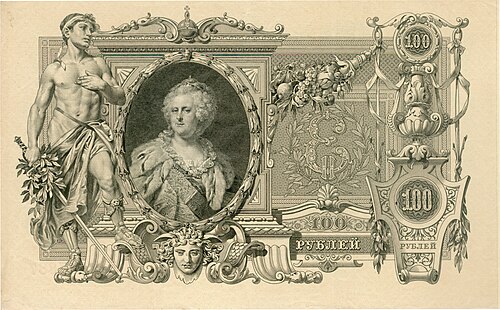
Peter's first military efforts were directed against the Ottoman Empire. His attention then turned north; Russia lacked a secure northern seaport, except at Arkhangelsk on the White Sea, where the harbor was frozen for nine months a year. Access to the Baltic Sea was blocked by Sweden, whose territory enclosed it on three sides. Peter's ambitions for a "window to the sea" led him, in 1699, to make a secret alliance with Saxony, the Polish–Lithuanian Commonwealth, and Denmark-Norway against Sweden; they conducted the Great Northern War, which ended in 1721 when an exhausted Sweden asked for peace with Russia. On 2 November [O.S. 22 October] 1721, the day of the announcement of the Treaty of Nystad, the Governing Senate and Synod invested the tsar with the titles of Peter the Great,[22]Pater Patriae (father of the fatherland),[g] and Imperator of all Russia.[h][23][24] The adoption of the title of imperator by Peter I is seen as the beginning of "imperial" Russia.[i][27]
As a result of the war with Sweden, Peter acquired four provinces situated south and east of the Gulf of Finland, securing access to the sea. There he built Russia's new capital, Saint Petersburg, on the Neva river in 1703, to replace Moscow, which had long been Russia's cultural center. This relocation expressed his intent to adopt European elements for his empire. Many of the government and other major buildings were designed under Italianate influence.
ピョートルは最新の政治モデルに基づいて政府を再編成し、ロシアを絶対主義国家へと変貌させた。軍事規則は政権の専制的な性質を認めた。 [ 28 ]ピョートルは旧来のボヤール・ドゥーマ(貴族会議)を、事実上の国家最高評議会である9人からなる元老院に置き換えた。ボヤールの独立の痕跡は失われた。農村は新しい州と地区に分割された。ピョートルは元老院に税金の徴収が任務であると告げ、彼の治世中に税収は3倍になった。ピョートルは前任者たちがすべての貴族に課した国家奉仕の要求を継続し強化し、階級表でヴォチナを身分と同等とした。ロシアの近代的な艦隊はピョートルによって建造され、ヨーロッパ式に改革された軍隊と教育機関(サンクトペテルブルク科学アカデミー)も建設された。ピョートル1世の治世中に文語が採用され、最初のロシアの新聞であるヴェドモスチが発行された。ピョートル1世は、科学、特に地理学と地質学、貿易、産業[ 29 ](造船を含む)を奨励し、教育制度の発展にも尽力した。彼の治世中、ロシア人の10人に1人が教育を受け、当時のロシア人の人口は1500万人であった[ 30 ] 。
ピョートル大帝の再編の一環として、彼は教会改革を実施した。ロシア正教会は国の行政機構に部分的に組み込まれ、事実上、国家の道具となった。ピョートル大帝は総主教制を廃止し、政府高官が率いる集団組織である至聖シノドスに置き換えた。[ 31 ]
The concept of the triune of the Russian people, composed of the Great Russians, the Little Russians, and the White Russians, was introduced under Peter I, and it was associated with the name of Archimandrite Zacharias Kopystensky (1621), the Archimandrite of the Kiev Pechersk Lavra and expanded upon in the writings of an associate of Peter I, Archbishop Professor Theophan Prokopovich. Several of Peter I's associates include Alexander Menshikov, Jacob Bruce, Mikhail Golitsyn and Anikita Repnin. During Peter's reign serf labor played a significant role in the growth of industry, reinforcing traditional socioeconomic structures. International trade increased as a result of Peter I's industrial reforms. However, imports of goods overtook exports, strengthening the role of foreigners in Russian trade, particularly the British.[32]
In 1722, Peter turned his aspirations toward increasing Russian influence in the Caucasus and the Caspian Sea at the expense of the weakened Safavid Persians. He made Astrakhan the base of military efforts against Persia, and waged the first full-scale war against them in 1722–23.[33] Peter the Great temporarily annexed areas of Iran to Russia, which after his death were returned in the 1732 Treaty of Resht and 1735 Treaty of Ganja as a deal to oppose the Ottomans.[34]
Peter died in 1725, leaving an unsettled succession. After a short reign by his widow, Catherine I, the crown passed to Empress Anna. She slowed reforms and led a successful war against the Ottoman Empire. This resulted in a significant weakening of the Crimean Khanate, an Ottoman vassal and long-term Russian adversary. The next emperor, the infant Ivan VI was deposed and killed. The discontent over the dominant positions of Baltic Germans in Russian politics resulted in Peter I's daughter Elizabeth being put on the Russian throne. Elizabeth supported the arts, architecture, and the sciences (for example, the founding of Moscow University). But she did not carry out significant structural reforms. Her reign, which lasted nearly 20 years, is also known for Russia's involvement in the Seven Years' War, where it was successful militarily, but gained little politically.[35]


Catherine the Great was a German princess who married Peter III, the German heir to the Russian crown. After the death of Empress Elizabeth, Catherine came to power after she effected a coup d'état against her very unpopular husband. She contributed to the resurgence of the Russian nobility that began after the death of Peter the Great, abolishing State service and granting them control of most state functions in the provinces. She also removed the Beard tax instituted by Peter the Great.[36]
Catherine extended Russian political control over the lands of the Polish–Lithuanian Commonwealth, supporting the Targowica Confederation. However, the cost of these campaigns further burdened the already oppressive social system, under which serfs were required to spend almost all of their time laboring on their owners' land. A major peasant uprising took place in 1773, after Catherine legalized the selling of serfs separate from land. Inspired by a Cossack named Yemelyan Pugachev and proclaiming "Hang all the landlords!", the rebels threatened to take Moscow before they were ruthlessly suppressed. Instead of imposing the traditional punishment of drawing and quartering, Catherine issued secret instructions that the executioners should execute death sentences quickly and with minimal suffering, as part of her effort to introduce compassion into the law.[37]
She furthered these efforts by ordering the public trial of Darya Nikolayevna Saltykova, a high-ranking noblewoman, on charges of torturing and murdering serfs. Whilst these gestures garnered Catherine much positive attention from Europe during the Enlightenment, the specter of revolution and disorder continued to haunt her and her successors. Indeed, her son Paulintroduced a number of increasingly erratic decrees in his short reign aimed directly against the spread of French culture in response to their revolution.
In order to ensure the continued support of the nobility, which was essential to her reign, Catherine was obliged to strengthen their authority and power at the expense of the serfs and other lower classes. Nevertheless, Catherine realized that serfdom must eventually be ended, going so far in her Nakaz ("Instruction") to say that serfs were "just as good as we are" – a comment received with disgust by the nobility. Catherine advanced Russia's southern and western frontiers, successfully waging war against the Ottoman Empire for territory near the Black Sea, and incorporating territories of the Polish–Lithuanian Commonwealth during the Partitions of Poland, alongside Austria and Prussia. As part of the Treaty of Georgievsk, signed with the Georgian Kingdom of Kartli-Kakheti, and her own political aspirations, Catherine waged a new war against Persia in 1796 after they had invaded eastern Georgia. Upon achieving victory, she established Russian rule over it and expelled the newly established Persian garrisons in the Caucasus.
エカチェリーナの拡張主義政策により、ロシアはヨーロッパの大国へと発展した[ 38 ] 。啓蒙時代やロシアの黄金時代も同様である。しかし、1796年にエカチェリーナが亡くなると、息子のパーヴェルが後を継いだ。彼は1798年に、新しく革命を起こしたフランス共和国に対する大規模な連合戦争にロシアを導いた。ロシア軍司令官のスヴォーロフ元帥はイタリアとスイスの遠征軍を率い、フランス軍に一連の敗北を与えた。特に1799年のトレッビアの戦いは有名である。

ロシアは継続的な財政危機に陥っていた。歳入は 1724年の900万ルーブルから 1794年には4000万ルーブルに増加したが、歳出はそれ以上に急速に増加し、1794年には4900万ルーブルに達した。予算は軍事費に 46 %、政府の経済活動に20%、行政に12%、サンクトペテルブルクの宮廷に9%が割り当てられた。赤字を補うために、主にアムステルダムの銀行家から借入が必要となり、予算の5%が債務返済に充てられた。高額な戦争費用を賄うために紙幣が発行され、インフレを引き起こした。支出の結果、ロシアは大規模で装備の整った軍隊、非常に大規模で複雑な官僚機構、そしてヴェルサイユやロンドンの宮廷に匹敵する宮廷を発展させた。しかし、政府は身の丈に合わない生活を送っており、18世紀のロシアは世紀半ば以降「貧しく後進的」になり[ 40 ]、「圧倒的に農業中心で識字率の低い国」のままであった[ 41 ] 。
ロシアの拡大の大部分は17世紀に起こり、太平洋への最初のロシア植民地化、左岸ウクライナの併合につながった露ポーランド戦争(1654~1667年)、そしてロシアによるシベリア征服で頂点に達した。ポーランドは1772~1815年にライバルによって分割され、その土地と人口の大部分がロシアの支配下に置かれた。19世紀の帝国の成長の大部分は、シベリアの南の中央アジアと東アジアの領土の獲得によるものであった。[ 42 ] 1795年までに、ポーランド分割後、ロシアはフランスを上回り、ヨーロッパで最も人口の多い国となった。

1801年、パーヴェルがロシア皇帝になってから4年以上経った後、彼は聖ミハイル城でクーデターにより殺害された。パーヴェルの後を継いだのは、23歳の息子アレクサンドルであった。ロシアは、コルシカ島生まれの第一執政ナポレオン・ボナパルト率いるフランス共和国と戦争状態にあった。ナポレオンは皇帝に即位後、 1805年のアウステルリッツ、1807年のアイラウとフリートラントでロシアを破った。アレクサンドルはフリートラントで敗北した後、交渉に同意し、フランスとの和平を求めた。ティルジット条約は、対仏大同盟に対する仏露同盟につながり、大陸封鎖体制に加わった。[ 44 ] 1812年までに、ロシアは東ヨーロッパの多くの領土を占領し、オーストリアから東ガリツィアの一部、オスマン帝国からベッサラビアを保持していた。[ 45 ]北ヨーロッパから、弱体化したスウェーデンとの戦争でフィンランドを獲得し、コーカサス地方でも領土を獲得した。
1812年、アレクサンドル1世皇帝との対立の後、ナポレオンはロシア侵攻を開始した。ロシアの冬にフランス軍が壊滅的な打撃を受けたため、フランスにとってこれは大惨事となった。ナポレオンのグランダルメはモスクワに到達したが、ロシアの焦土作戦により侵略軍は現地で食料を得ることができなかった。厳しい冬の間、数千人のフランス軍兵士が農民ゲリラ兵に待ち伏せされ殺害された。[ 46 ]その後、ロシア軍はナポレオン軍をパリの門まで追撃し、ウィーン会議(1815年)でヨーロッパの地図の再編成を主導し、最終的にアレクサンドルはポーランド立憲君主となった。[ 47 ]オーストリア、プロイセン、ロシアの君主制大国を結びつける「神聖同盟」が宣言された。

ロシア帝国は、ナポレオン時代のフランスを打ち破った功績により、次の世紀に政治的に主導的な役割を果たしたが、農奴制の維持により、経済発展は著しく阻害された。西ヨーロッパの経済成長が産業革命期に加速するにつれ、ロシアはますます後れを取り、大国としての役割を果たそうとする帝国にとって新たな弱点が生じた。ロシアの大国としての地位は、政府の非効率性、国民の孤立、経済的・社会的後進性を覆い隠していた。ナポレオンの敗北後、アレクサンドル1世は憲法改革について議論する用意があったが、いくつかの改革案は提出されたものの、大きな変更は試みられなかった。[ 48 ]
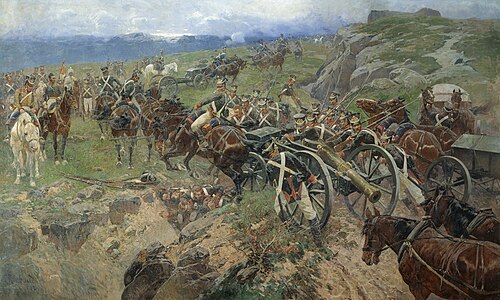
The liberal Alexander I was replaced by his younger brother Nicholas I (1825–1855), who at the beginning of his reign was confronted with an uprising. The background of this revolt lay in the Napoleonic Wars, when a number of well-educated Russian officers travelled in Europe in the course of military campaigns, where their exposure to the liberalism of Western Europe encouraged them to seek change on their return to autocratic Russia. The result was the Decembrist revolt (December 1825), which was the work of a small circle of liberal nobles and army officers who wanted to install Nicholas' brother Constantine as a constitutional monarch. The revolt was easily crushed, but it caused Nicholas to turn away from the modernization program begun by Peter the Great and champion the doctrine of Orthodoxy, Autocracy, and Nationality.[49]
In order to repress further revolts, censorship was intensified, including the constant surveillance of schools and universities. Textbooks were strictly regulated by the government. Police spies were planted everywhere. Under Nicholas I, would-be revolutionaries were sent off to Siberia, with hundreds of thousands sent to katorga camps.[50] The retaliation for the revolt made "December Fourteenth" a day long remembered by later revolutionary movements.
The question of Russia's direction had been gaining attention ever since Peter the Great's program of modernization. Some favored imitating Western Europe while others were against this and called for a return to the traditions of the past. The latter path was advocated by Slavophiles, who held the "decadent" West in contempt. The Slavophiles were opponents of bureaucracy, who preferred the collectivism of the medieval Russian obshchina or mir over the individualism of the West.[51] More extreme social doctrines were elaborated by such Russian radicals on the left, such as Alexander Herzen, Mikhail Bakunin, and Peter Kropotkin.


ロシア軍は、1802年にガージャール朝が占領していた東グルジア王国(1783年のゲオルギエフスク条約以来同盟関係にあった)を解放した後、ロシア・ペルシア戦争(1804年~1813年)でグルジアの支配と統合をめぐってペルシアと衝突し、またカフカス・イマーム国とのカフカス戦争にも関与した。戦争の終結後、ペルシアはグリスタン条約に基づき、現在のダゲスタン、東グルジア、アゼルバイジャンの大部分をロシアに不可逆的に割譲した。[ 52 ]ロシアはオスマン帝国を犠牲にして南西に拡大しようと試み、最近獲得したグルジアをカフカスとアナトリア戦線の拠点として利用した。1820年代後半は軍事的に成功した年であった。1826年から1828年の露土戦争の最初の年に、ロシアは最近統合した領土のほぼすべてを失ったにもかかわらず、トルクメンチャイ条約によって戦争を有利に終結させ、現在のアルメニア、アゼルバイジャン、およびイグディル県を正式に獲得した。[ 53 ] 1828年から1829年の露土戦争では、ロシアはアナトリア北東部に侵攻し、戦略的に重要なオスマン帝国の都市カリンとギュムシュハネ(アルギロウポリ)を占領し、ギリシャ正教徒の保護者を装って、この地域のポントス系ギリシャ人から広範な支援を受けた。短期間の占領の後、ロシア帝国軍はグルジアに撤退した。[ 54 ]
ロシア皇帝は、新たに獲得したポーランド領土で起きた2つの反乱、1830年の11月蜂起と1863年の1月蜂起を鎮圧した。1863年、ロシア専制政治は、ポーランドの職人や貴族に、言語、宗教、文化といった国家の中核的価値観を攻撃することで反乱を起こす理由を与えた。[ 55 ]フランス、イギリス、オーストリアは危機に介入しようとしたが、できなかった。ロシアの報道機関と国家プロパガンダは、ポーランド蜂起を利用して帝国の統一の必要性を正当化した。[ 56 ]その後、半自治的なポーランド立憲議会は独自の政治的権利と司法権を失い、学校や裁判所にはロシア化が強制された。[ 57 ]しかし、ポーランド、フィンランド、バルト三国のドイツ人の間で行われたロシア化政策は概ね失敗に終わり、政治的反対勢力を強める結果となった。[ 56 ]


1854年から1855年にかけて、ロシアはクリミア戦争でイギリス、フランス、オスマン帝国と戦い、敗北した。この戦争は主にクリミア半島で戦われ、関連するオーランド戦争ではバルト海でも小規模ながら戦われた。ナポレオンの敗北に大きく貢献して以来、ロシアは軍事的に無敵と見なされていたが、ヨーロッパ列強の連合軍を相手に陸海両面で敗北を喫し、ニコライ1世の政権の弱点が露呈した。
1855年にアレクサンドル2世が皇帝に即位した時、改革への願望は広く広がっていた。高まりつつあった人道主義運動は、農奴制を非効率的だと批判した。1859年には、2300万人以上の 農奴が概して劣悪な生活環境に置かれていた。アレクサンドル2世は、革命によって下から農奴制が廃止されるのを待つのではなく、地主のために十分な措置を講じた上で、上から農奴制を廃止することを決定した。[ 58 ]
1861年の農奴解放改革は、農奴を解放したものであり、19世紀ロシア史において最も重要な出来事であり、土地貴族による権力独占の終焉の始まりでもあった。1860年代には、財産権に関するロシア政府の立場を明確にするための社会経済改革がさらに行われた。[ 59 ]農奴解放は都市に無償労働力をもたらし、産業を刺激する一方、中産階級は数と影響力を増した。しかし、解放された農民は土地を無償で受け取る代わりに、政府に生涯にわたる特別税を支払わなければならず、政府は代わりに、失った土地に対して地主に多額の代金を支払った。多くの場合、農民は生産性の低い土地を比較的少量しか得られなかった。農民に引き渡されたすべての財産は、村の共同体であるミールによって共同所有され、ミールは農民に土地を分配し、さまざまな所有地を監督した。農奴制は廃止されたものの、農民にとって不利な条件で廃止されたため、革命的な緊張は残った。革命家たちは、新たに解放された農奴は産業革命の始まりに賃金奴隷として売られ、都市のブルジョワジーが事実上地主を置き換えたのだと信じていた。[ 60 ]
Seeking more territories, Russia obtained Priamurye ( Outer Manchuria ) from the weakened Manchu-led Qing China , which had been occupied fighting against the Taiping Rebellion . In 1858, the Treaty of Aigun ceded much of the Manchu homeland to the Russian Empire, and in 1860, the Treaty of Peking also ceded the modern Primorsky Krai , which provided the land for the establishment of the outpost of the future Vladivostok . [ 61 ] Meanwhile, Russia under Alexander II decided to sell what it saw as the indefensible Russian America to the United States for 11 million rubles (7.2 million dollars) in 1867 to Andrew Johnson 's government in the Alaska Purchase . [ 62 ] [ 63 ]当初、多くのアメリカ人はこの新たに獲得した領土を不毛で役に立たない土地と考え、政府が金を無駄にしていると見ていたため、この取引は、この取引を仲介した同名の国務長官ウィリアム・H・スワードにちなんで「スワードの愚行」と呼ばれることもあったが、[ 64 ] [ 65 ]後に、多くの金と石油が発見された。[ 66 ]
In the late 1870s, Russia and the Ottoman Empire again clashed in the Balkans. From 1875 to 1877, the Balkan crisis intensified, with rebellions against Ottoman rule by various Slavic nationalities,[67] which the Ottoman Turks had dominated since the 15th century. This was seen as a political risk in Russia, which similarly suppressed its Muslims in Central Asia and Caucasia. Russian nationalist opinion became a major domestic factor with its support for liberating Balkan Christians from Ottoman rule and making Bulgaria and Serbia independent. In early 1877, Russia intervened on behalf of Serbian and Russian volunteer forces,[68] leading to the Russo-Turkish War (1877–78).[69] Within one year, Russian troops were nearing Constantinople and the Ottomans surrendered. Russia's nationalist diplomats and generals persuaded Alexander II to force the Ottomans to sign the Treaty of San Stefano in March 1878, creating an enlarged, independent Bulgaria that stretched into the southwestern Balkans.[68] When Britain threatened to declare war over the terms of the treaty, an exhausted Russia backed down. At the Congress of Berlin in July 1878, Russia agreed to the creation of a smaller Bulgaria and Eastern Rumelia, as a vassal state and an autonomous principality inside the Ottoman Empire, respectively.[70][71] As a result, Pan-Slavists were left with a legacy of bitterness against Austria-Hungary and Germany for failing to back Russia. Disappointment at the results of the war stimulated revolutionary tensions, and helped Serbia, Romania, and Montenegro gain independence from, and strengthen themselves against, the Ottomans.[72]

戦争のもう一つの重要な結果は、オスマン帝国からトランスコーカサス地方のバトゥミ、アルダハン、カルスの各州を獲得し、軍事統治下のバトゥミ州とカルス州に改編したことである。新たな国境を越えてオスマン帝国領に逃れたイスラム教徒の難民の代わりに、ロシア当局はカルス州に民族的に多様な多数のキリスト教徒、特にグルジア人、コーカサス系ギリシャ人、アルメニア人を定住させた。彼らはそれぞれ、保護を得て自らの地域的な野望を推し進めることを期待していた。
1881年、アレクサンドル2世は虚無主義テロ組織であるナロードナヤ・ヴォーリャによって暗殺された。王位はアレクサンドル3世(1881年~1894年)に引き継がれた。彼は反動主義者であり、ニコライ1世の「正教、専制政治、民族主義」という格言を復活させた。熱心なスラヴ主義者であったアレクサンドル3世は、ロシアが混乱から救われるためには、西ヨーロッパの破壊的な影響から自らを遮断するしかないと信じていた。彼の治世中、ロシアは増大するドイツの勢力を抑えるために仏露同盟を結成し、中央アジアの征服を完了させ、中国から重要な領土的・商業的譲歩を要求した。皇帝の最も影響力のある顧問は、アレクサンドル3世とその息子ニコライの家庭教師であり、1880年から1895年まで聖シノドの検事総長を務めたコンスタンチン・ポベドノスツェフであった。ポベドノスツェフは、皇帝の弟子たちに言論と報道の自由を恐れるように教え、民主主義、憲法、議会制度を嫌うように教えた。ポベドノスツェフの下で、革命家たちは帝国の秘密警察によって迫害され、数千人がシベリアに追放され、ロシア化政策が帝国全土で実施された。[ 73 ]
ロシアはトルキスタンの征服を含め、南方への拡大にほとんど困難を感じなかったが、[ 74 ]ロシアがアフガニスタンを脅かし、暗黙のうちにインドを脅かしたことでイギリスが警戒し、グレート・ゲームと呼ばれる数十年にわたる外交的駆け引きが始まった。[ 75 ]この2つの帝国間の対立は、外モンゴルやチベットなどの遠隔地にも及んだと考えられている。この駆け引きは、 1907年の英露条約でほぼ終結した。[ 76 ]
広大なシベリアへの拡大は遅く費用もかかったが、1890年から1904年にかけてのシベリア鉄道の建設によってようやく可能になった。これにより東アジアが開かれ、ロシアの関心はモンゴル、満州、朝鮮に集中した。中国は抵抗するには弱すぎ、ますますロシアの勢力圏に引き込まれていった。ロシアは大連/旅順港などの条約港を獲得した。1900年、ロシア帝国は義和団の乱に対する八カ国連合の介入の一環として満州に侵攻した。日本はロシアの拡大に強く反対し、1904年から1905年の日露戦争でロシアを破った。日本は朝鮮を占領し、満州は係争地として残った。[ 77 ]
一方、 1871年以降ドイツに対抗する同盟国を探していたフランスは、1894年にロシアへの大規模な融資、武器や軍艦の売却、外交支援などを含む軍事同盟を結成した。1907年に英露条約によってアフガニスタンが非公式に分割されると、イギリス、フランス、ロシアはドイツとオーストリア=ハンガリーに対抗するため、ますます緊密な関係を築いた。この3カ国は後に第一次世界大戦で三国協商を形成することになる。[ 78 ]
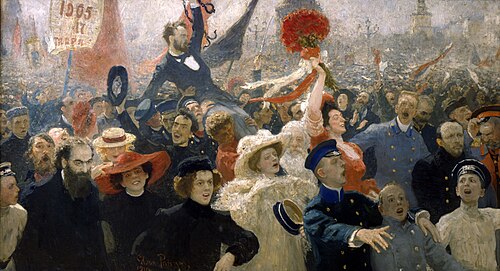
1894年、アレクサンドル3世の後を継いだのは息子のニコライ2世で、彼は父が残した専制政治を維持することに尽力した。ニコライ2世は無能な統治者であることが証明され、最終的に彼の王朝はロシア革命によって打倒された。[ 80 ]産業革命はロシアで大きな影響力を示し始めたが、国は依然として農村的で貧しかった。
1890年以降、砂糖大根などの新しい作物や鉄道輸送の新たなアクセスのおかげで、経済状況は着実に改善した。人口増加による国内需要の高まりにもかかわらず、穀物の総生産量と輸出量は増加した。その結果、1914年までの帝国最後の20年間、ロシアの農民の生活水準は緩やかに改善した。陸軍新兵の体格に関する最近の研究によると、彼らはより大きく、より強靭であったことが示されている。地域差があり、人口密度の高い中央黒土地域では貧困が大きかった。また、1891~93年と1905~1908年には一時的な不況があった。[ 81 ]
政治的右派では、貴族の反動勢力が大地主を強く支持していたが、大地主は農民土地銀行を通じて徐々に農民に土地を売却していた。十月党は地主や実業家を基盤とする保守勢力であった。彼らは土地改革を受け入れたが、土地所有者には全額が支払われるべきだと主張した。彼らは広範な改革を支持し、地主階級が消滅することを望みつつ、土地の対価が支払われるべきであることには同意した。産業資本家や貴族の中の自由主義勢力は、平和的な社会改革と立憲君主制を信じ、立憲民主党(カデット)を結成した。[ 82 ]
左派では、社会革命党(SR)とマルクス主義社会民主党(RSDLP)は土地の収用を望んでいたが、個人所有か集団所有かという問題については決めかねていた。[ 83 ]また、社会革命党は、革命は都市労働者ではなく農民に頼らなければならないと考えていた点で、社会民主党とは異なっていた。[ 84 ]
ロシア社会民主労働党(RSDLP)の創設期は、イデオロギー的、戦略的な論争が特徴的であり、1903年の第2回大会で党は2つの主要な派閥に分裂した。1つはウラジーミル・レーニンが率いるボリシェヴィキで、職業革命家の緊密に組織された前衛を主張した。もう1つはユリウス・マルトフらが率いるメンシェヴィキで、より穏健で幅広い支持基盤を持つモデルを支持した。再統一の試みが繰り返されたにもかかわらず、ボリシェヴィキとメンシェヴィキの間の亀裂は深まり、1912年に正式な分裂に至った。 1917年の2月革命では、一部のメンシェヴィキが臨時政府との協力を支持したが、ボリシェヴィキは「すべての権力をソビエトへ」と主張してこれに反対した。同年後半の10月革命でボリシェヴィキが権力を掌握すると、RSDLPは事実上解散した。[ 85 ]

日露戦争(1904~1905年)での敗北は、ツァーリ体制にとって大きな打撃となり、社会不安の可能性をさらに高めた。1905年1月、ゲオルギー・ガポン神父が皇帝に嘆願書を提出するため、サンクトペテルブルクの冬宮殿へ大勢の群衆を率いて向かった際に、「血の日曜日」として知られる事件が発生した。行列が宮殿に到着すると、兵士が群衆に発砲し、数百人が死亡した。ロシアの民衆はこの虐殺に激怒し、民主共和制を要求するゼネストが宣言された。これが1905年革命の始まりとなった。革命活動を指導するために、ほとんどの都市にソビエト(労働者評議会)が出現した。ロシアは麻痺状態に陥り、政府は窮地に立たされた。[ 86 ]
1905年10月、ニコライ2世はしぶしぶ十月宣言を発布し、国民議会(ドゥーマ)の即時招集を認めた。選挙権は拡大され、ドゥーマの承認なしにはいかなる法律も最終決定されないことになった。穏健派は満足したが、社会主義者たちは譲歩が不十分だと拒否し、新たなストライキを組織しようとした。1905年末までに改革派の間には分裂が生じ、皇帝の立場は強化され、1906年の新ロシア憲法によって譲歩の一部を撤回することが可能になった。
Russia, along with France and Britain, was a member of the Entente in antecedent to World War I; these three powers were formed up in response to Germany's rival[87]Triple Alliance, comprising itself, Austria-Hungary and Italy. The relations with Britain were in disquietude from the Great Game in Central Asia until the 1907 Anglo-Russian Convention, when both agreed to settle their differences and joined to oppose the new rising power of Germany.[88] Russia and France's relations remained isolated before the 1890s when both sides agreed to ally when peace was threatened.[89]
The relations between Russia and the Triple Alliance, especially Germany and Austria, were like those of the League of the Three Emperors. Russia's relations with Germany were deteriorating,[90] and tensions over the Eastern question had reached a breaking point with Austria-Hungary.[91] The 1908 Bosnian Crisis had nearly led to war and in 1912–13 relations between Saint Petersburg and Vienna were tense during the Balkan Wars.[92]
The assassination of the Austro-Hungarian heir, Archduke Franz Ferdinand, raised Europe's tensions, which led to the confrontation between Austria and Russia.[93]Serbia rejected an Austrian ultimatum that demanded an obligation for the heir's death, and Austria-Hungary cut all diplomatic ties and declared war on 28 July 1914. Russia supported Serbia because it was a fellow Slavic state, and two days later, Emperor Nicholas II ordered a mobilization to attempt to force Austria-Hungary to back down.[94]

オーストリア=ハンガリー帝国がセルビアに宣戦布告した結果、ニコライ2世は490万人の兵士の動員を命じた。オーストリア=ハンガリー帝国の同盟国であるドイツは、この召集を脅威とみなし[ 95 ]、1914年8月1日に宣戦布告した。オーストリア=ハンガリー帝国もこれに続き、8月6日にロシアに宣戦布告した[ 96 ] 。ロシア人は愛国心とドイツ嫌悪の感情に駆り立てられ、首都サンクトペテルブルクという名前はドイツ的すぎるとしてペトログラードに改名された[ 97 ] 。
ロシアが第一次世界大戦に参戦した後、フランスも参戦した。[ 98 ]ドイツ参謀本部はシュリーフェン・プランを考案し、まず非同盟国ベルギーを経由してフランスを排除し、その後東へ進軍してロシアを攻撃した。ロシアの巨大な軍隊は動員がはるかに遅かった。[ 99 ]

By August 1914, Russia had invaded with unexpected speed the German province of East Prussia, ending with a humiliating defeat at Tannenberg, owing to a message sent without wiring and coding,[100] causing the destruction of the entire second army. Russia suffered a massive defeat at the Masurian Lakes twice, the first ending with a hundred thousand casualties;[101] and the second suffering 200,000.[102] By October, the German Ninth Army was near Warsaw, and the newly-formed Tenth Army had retreated from the frontier in East Prussia. Grand Duke Nicholas, the Russian commander-in-chief, now had the order to invade Silesia with his Fifth, Fourth, and Ninth armies.[103] The Ninth Army, led by Mackensen, retreated from the frontline in Galicia and concentrated between the cities of Posen and Thorn. The advance took place on 11 November against the main army's right flank and rear; the First and Second armies were severely mauled, and the Second army was nearly surrounded in Łódź on 17 November.
Exhausted Russian troops began to withdraw from Russian-held Poland, allowing the Germans to capture many cities, including the kingdom's capital Warsaw on 5 August 1915.[104] In the same month, the emperor dismissed Grand Duke Nicholas and took personal command;[105] this was a turning point for the Russian army and the beginning of the worst disaster.[106] Russia lost the entire territory of Poland and Lithuania,[107] part of the Baltic states and Grodno, and partly of Volhynia and Podolia in Ukraine; thereafter the front with Germany was stable until 1917.
Austria-Hungary went to war with Russia on 6 August. The Russians started to invade Galicia, held by Austrian Cisleithania on 20 August, and annihilated the Austro-Hungarian Army at Lemberg, leading to the occupation of Galicia.[108] While the fortress of Premissel was besieged, the first attempt to capture the fortress failed, but the second attempt seized the redoubt in March 1915.[109] On 2 May, the Russian army was broken through by joint Austro-German forces, retreating from the Gorlice to Tarnów line and losing Premissel.
On 4 June 1916, General Aleksei Brusilov carried out an offensive by targeting Kovel. His offensive was a great success, taking 76,000 prisoners from the main attack and 1,500 from the Austrian bridgehead. But the offensive was halted by inadequate ammunition and a lack of supplies.[110] The eponymous offensive was the most successful allied strike of World War I,[111] practically destroying the Austro-Hungarian army as an independent force, but the slaughter of many casualties (approximately one million men) forced the Russian forces not to rebuild or launch any further attacks.
On 29 October 1914, a prelude to the Russo-Turkish front, the Turkish fleet, with German support, began to raid Russian coastal cities in Odessa, Sevastopol, Novorossiysk, Feodosia, Kerch, and Yalta[112] This led Russia to declare war on the Ottoman Empire on 2 November.[113] In December 1914, Russia obtained success at Sarikamish, where the Russian General Nikolai Yudenich routed Enver Pasha.[114] Yudenich captured Köprüköy in January 1916 and captured Erzurum about one month later in February.[115]
1914年、ロシア海軍の黒海艦隊は防御に徹していたが、1915年春、最高司令部がガリポリにおける西側連合軍の上陸を支援するためトルコ沿岸を攻撃するよう艦隊に命じたことで状況は一変した。[ 116 ]ロシア海軍の襲撃はガリポリ作戦には何ら影響を与えなかったが、アナトリアの他の地域からコンスタンティノープルへの石炭輸送を妨害することには大いに成功した。ロシアの潜水艦と駆逐艦の攻撃によって引き起こされた石炭不足は、オスマン帝国の戦争継続を脅かした。[ 117 ]

1915年半ばまでに、戦争の影響は士気を低下させていた。食料と燃料は不足し、死傷者は増加し、インフレは上昇していた。低賃金の工場労働者の間でストライキが起こり、土地所有の改革を求める農民が騒然としているという報告もあった。皇帝は最終的に軍の指揮を自ら執ることを決意し、妻である皇后アレクサンドラを首都に残して前線に向かった。皇后は僧侶グリゴリー・ラスプーチン(1869年 - 1916年)の魅力に囚われていた。1916年末に貴族の一団によってラスプーチンが暗殺されたが、皇帝の失われた威信を取り戻すことはできなかった。[ 118 ]
1917年3月8日、国際女性デーに、首都の工場でストライキが組織され、その後、ペトログラードでは数千人が食糧不足に抗議して街頭に繰り出した。翌日、抗議者は20万人に膨れ上がり、ロシアの戦争からの撤退と皇帝の退位を要求した。秩序回復のために派遣された軍隊の半数にあたる8万人のロシア軍兵士がストライキを起こし、上級将校の命令を拒否した。[ 119 ]あらゆる帝国の象徴が破壊され、焼かれた。首都は統制を失い、抗議と争いに巻き込まれた。[ 120 ]
首都から南西に262 km (163マイル)離れたプスコフ市では、多くの将軍や政治家が皇帝に皇太子に譲位するよう助言した。ニコライはこれを受け入れたが、正当な後継者として大公ミハイルに帝位を譲った。 [ 121 ]ミハイルは、憲法制定議会によって帝位が提供される場合にのみ受け入れると述べた。[ 122 ]出現した政治組織の形態は、ロシア臨時政府とソビエトが共存する「二重権力」と表現されている。[ 122 ]ロシアの憲法上の枠組みは、アレクサンドル・ケレンスキーが9 月 1 日にロシアの共和国としての地位を最終的に確認するまで宙ぶらりんの状態であった。[ 122 ] 1918年7月、十月革命の後、ロマノフ一家はエカテリンブルクでボリシェヴィキによって殺害され、王朝の終焉と1000年以上続いたロシア君主制の終焉を告げた。[ 123 ]
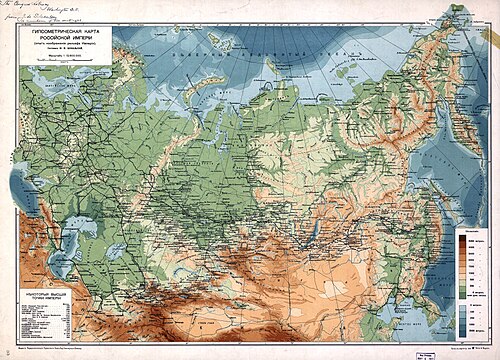

19世紀末までに、帝国の面積は約22,400,000平方キロメートル(8,600,000平方マイル)に達し、地球の陸地のほぼ6分の1を占めていました。当時、その規模で帝国に匹敵するのは大英帝国だけでした。人口の大部分はヨーロッパ・ロシアに居住していました。ロシア帝国には100以上の異なる民族グループが居住しており、民族ロシア人は人口の約45%を占めていました。[ 124 ]
フィンランドとポーランドの一部を除くヨーロッパ・ロシアの行政境界は、東ヨーロッパ平原の自然境界とほぼ一致していた。北には北極海があった。ノヴァヤゼムリャ、コルグエフ諸島、ヴァイガチ諸島はヨーロッパ・ロシアの一部とみなされていたが、カラ海はシベリアの一部であった。東には帝国のアジア領土、すなわちシベリアとキルギス草原があり、これらはウラル山脈、ウラル川、カスピ海によってヨーロッパ・ロシアから隔てられていた。ただし、行政境界はウラル山脈のシベリア斜面で部分的にアジアにまで及んでいた。南には黒海とコーカサスがあり、マニチ川の窪地によってヨーロッパ・ロシアの残りの部分から隔てられていた。マニチ川の窪地は、鮮新世以降、アゾフ海とカスピ海を結んでいた。西側の境界線は全く恣意的なもので、ヴァランゲルフィヨルドからボスニア湾までコラ半島を横断し、そこからバルト海南部のクルシュー潟を経てドナウ川河口へと続き、西へ大きく弧を描いてポーランド中東部を囲み、ロシアとプロイセン、オーストリア領ガリツィア、ルーマニアを隔てていた。
ロシアの重要な特徴は、北極海の氷に閉ざされた海岸線以外に、外洋への自由な出口がほとんどないことである。ボスニア湾とフィンランド湾の深い入り江は、民族的にはフィンランド人の領土に囲まれており、ロシア人が確固たる足場を築いたのは、後者の湾の最奥部、ネヴァ川の河口に首都を建設した時だけであった。リガ湾とバルト海もまた、スラブ人ではなく、バルト人、フィン人、そしてゲルマン人が居住していた地域に属していた。黒海の東海岸は、ロシアからそれを隔てる大きな山脈であるトランスコーカサスに属していた。しかし、この海域でさえ内海であり、唯一の出口であるボスポラス海峡は外国の支配下にあった。一方、広大な浅い湖であるカスピ海は、大部分が砂漠に囲まれており、他国との交流路というよりも、ロシアとアジアの居住地を結ぶ水路としての重要性が高かった。

1860年から1905年まで、ロシア帝国は現在のロシア連邦の領土すべてを占領していたが、現在のカリーニングラード州、千島列島、トゥヴァ共和国は例外であった。1905年にロシアはサハリン南部を日本に奪われたが、1914年にトゥヴァ共和国を保護国として獲得した。1917年以前、ロシア帝国はドニエプル川流域ウクライナの大部分、ベラルーシ(旧リトアニア大公国の一部)、ベッサラビア、フィンランド大公国、アルメニア、アゼルバイジャン、グルジア、ロシア領トルキスタンの中央アジア諸国、バルト海沿岸の県の大部分、ポーランドのかなりの部分、旧オスマン帝国のアルダハン、アルトヴィン、イグディル、カルス、エルズルム県の北東部を含んでいた。
ヘンリー・キッシンジャーは、ロシア帝国が領土拡大を開始した方法論的手順は、アメリカ合衆国が同様のことを行った方法と類似していると指摘した。ロシアの政治家アレクサンドル・ゴルチャコフは、アメリカ合衆国の明白な使命に合致するものとしてロシアの拡大を正当化した。その後、ロシアの領土拡大は遊牧社会または封建社会にしか遭遇しなかったが、これはアメリカ合衆国の西部への拡大と驚くほど似ている。[ 125 ]
1742年から1867年の間、ロシア・アメリカ会社はアラスカを植民地として統治した。同社はハワイにも入植地を築き、その中にはフォート・エリザベス(1817年)も含まれる。また、北米最南端では、サンフランシスコのすぐ北、カリフォルニア州ソノマ郡にフォート・ロス植民地(1812年設立)を建設した。フォート・ロスとカリフォルニアのロシアン川は、いずれもロシア人入植者にちなんで名付けられた。彼らは、1821年までスペインがヌエバ・エスパーニャの一部として領有権を主張していた地域に権利を主張していた。
Following the Swedish defeat in the Finnish War of 1808–1809 and the signing of the Treaty of Fredrikshamn on 17 September 1809, the eastern half of Sweden, the area that then became Finland, was incorporated into the Russian Empire as an autonomousgrand duchy. The emperor eventually ended up ruling Finland as a semi-constitutional monarch through the Governor-General of Finland and a native Senate appointed by him. The emperor never explicitly recognized Finland as a constitutional state in its own right, although his Finnish subjects came to consider the grand duchy as such.

In the aftermath of the Russo-Turkish War (1806–1812), and the ensuing Treaty of Bucharest (1812), the eastern parts of the Principality of Moldavia, an Ottoman vassal state, along with some areas formerly under direct Ottoman rule, came under the rule of the empire. This area (Bessarabia) was among the Russian Empire's last territorial acquisitions in Europe. At the Congress of Vienna (1815), Russia gained sovereignty over so-called Congress Poland, which on paper was an autonomous kingdom in personal union with Russia. However, this autonomy was eroded after the November Uprising in 1831, and was finally abolished in 1867.
Saint Petersburg gradually extended and consolidated its control over the Caucasus in the course of the 19th century, at the expense of Persia through the Russo-Persian War (1804–13) and Russo-Persian War (1826–28) and the respectively ensuing treaties of Gulistan and Turkmenchay,[126] as well as through the Caucasian War (1817–1864).
The Russian Empire expanded its influence and possessions in Central Asia, especially in the later 19th century, conquering much of Russian Turkestan in 1865 and continuing to add territory as late as 1885.
Newly discovered Arctic islands became part of the Russian Empire: the New Siberian Islands from the early 18th century; Severnaya Zemlya ("Emperor Nicholas II Land") first mapped and claimed as late as 1913.
第一次世界大戦中、ロシアは当時ドイツ領だった東プロイセンのごく一部、オーストリア領ガリツィアの大部分、オスマン帝国領アルメニアの大部分を一時的に占領した。現在のロシア連邦は、東プロイセンの北部を構成していたカリーニングラード州を支配しているが、これは1914年に帝国が占領した地域とは異なる。ただし、一部重複する地域もあり、グセフ(ドイツ語ではグンビンネン)はロシア軍が最初に勝利を収めた場所である。

組織法の第1条によれば、ロシア帝国は不可分な一つの国家であった。さらに、第26条では「ポーランド王国とフィンランド大公国は、ロシア帝国の帝位と不可分である」と規定されていた。フィンランド大公国との関係は、第2条「フィンランド大公国は、ロシア国家の不可分な一部であり、その内政は特別法に基づく特別規定によって統治される」および1910年6月10日の法律によっても規定されていた。
1744年から1867年の間、ロシア帝国はロシア領アメリカも支配していた。この地域(現在のアラスカ)を除けば、ロシア帝国はヨーロッパとアジアにまたがる広大な領土であった。この点で、同時代の植民地主義的な帝国とは異なっていた。その結果、20世紀に大英帝国とフランス帝国が衰退する一方で、ロシア帝国の領土の大部分は、まずソビエト連邦、そして1991年以降はより小規模なロシア連邦として、一体のまま存続したのである。
さらに、帝国は時折、租借地を支配していた。特に、清朝中国から租借した関東州と中国東部鉄道、そしてロシアが租借していた天津などが挙げられる。
1815年、ロシアの実業家ゲオルク・アントン・シェーファーはカウアイ島を訪れ、ハワイ王カメハメハ1世の家臣である島の総督カウムアリイと保護条約の交渉を行ったが、ロシア皇帝は条約の批准を拒否した。ハワイ正教会およびロシアのフォート・エリザベスも参照のこと。
1889年、ロシアの冒険家ニコライ・イヴァノヴィチ・アチノフは、現在のジブチのタジュラ湾にサガロというロシア植民地を建設しようと試みた。しかし、この試みはフランスの怒りを買い、フランスは植民地に対して2隻の砲艦を派遣した。植民地は短期間の抵抗の後、降伏し、ロシア人入植者はオデッサへ追放された。
1721年の建国宣言から1905年のロシア革命まで、ロシア帝国は皇帝(ツァーリとも呼ばれる)によって統治され、皇帝は絶対君主として君臨した。[ 127 ] 1906年のロシア憲法の採択は、ロシアにおける立憲主義への重要な一歩となった。皇帝はもはや形式的には専制君主ではなくなり、初めて選挙で選ばれた機関に権限を委譲した。[ 128 ] [ 129 ]それにもかかわらず、その政体は半立憲君主制と表現するのが最も適切である。[ 127 ] [ 128 ] [ 130 ]皇帝は、立法に対する絶対的な拒否権、例外的な法令を公布する権利、外交の統制、国防立法における特別な特権など、最終的な権限を保持していた。[ 128 ]以前はロシアを「世襲君主制」と表現していた『アルマナック・デ・ゴータ』は、その後「専制君主制下の立憲君主制」と表現するようになった。[ 128 ]
Most Russian leaders adhered to a kind of conservatism or traditionalism, albeit accommodating occasional reform. This conservatism was premised on the anti-rationalism of intellectuals, religiosity of the Russian Orthodox Church, traditionalism rooted in the landed estates worked by serfs, and militarism of the army officer corps.[131] Regarding irrationality, Russia avoided the plenitude of the European Enlightenment that prioritized rationalism, preferring the romanticism of an idealized nation state that reflected the beliefs, values, and behavior of their distinctive people.[132] A conservative notion of modernization based on the incorporation of modern technology to serve the established system replaced the liberal notion of "progress". The promise of modernization in the service of autocracy frightened socialist intellectual Alexander Herzen, who warned of a Russia governed by "Genghis Khan with a telegraph".[133]

Peter the Great changed his title from tsar to emperor in order to secure Russia's position in the European states system.[134] While later rulers did not discard the new title, the Russian monarch was commonly known as the tsar or tsaritsa until the imperial system was abolished following the February Revolution of 1917. Prior to the issuance of the October Manifesto, the emperor ruled as an absolute monarch, subject to only two limitations on his authority, both of which were intended to protect the existing system: the emperor and his consort must both belong to the Russian Orthodox Church, and he must obey the Pauline Laws of succession established by Paul I. Beyond this, the power of the Russian autocrat was virtually limitless.
1905年10月17日、状況は一変した。皇帝は、 1906年4月28日に公布された組織法によって設立された自由選挙で選出された国民議会である帝国議会(ドゥーマ)の同意なしにはいかなる法案も成立させてはならないと布告し、自らの立法権を自発的に制限した。しかし、皇帝は新設されたドゥーマを解散する権利を保持し、この権利を複数回行使した。また、すべての立法に対する絶対的な拒否権を保持し、組織法自体の改正も皇帝のみが行うことができた。大臣は皇帝にのみ責任を負い、ドゥーマやその他のいかなる機関にも責任を負わず、これらの機関は大臣に質問することはできても解任することはできなかった。このように、1906年4月28日以降、皇帝の個人的権力は範囲が制限されたものの、依然として強大な権力を保っていた。


1906年2月20日のロシアの改正基本法の下では、国家評議会は立法上院としてドゥーマと結び付けられ、この時から立法権は通常、両院と連携してのみ皇帝によって行使されるようになった。[ 135 ]この目的のために再編成された帝国評議会、または帝国評議会は196人のメンバーで構成され、そのうち98人は皇帝によって指名され、98人は選挙で選ばれた。大臣も指名され、職権上のメンバーであった。 Of the elected members, 3 were returned by the "black" clergy (the monks), 3 by the "white" clergy (secular), 18 by the corporations of nobles, 6 by the academy of sciences and the universities, 6 by the chambers of commerce, 6 by the industrial councils, 34 by local governmental zemstvos , 16 by local governments having no zemstvos, and 6 by Poland. As a legislative body the powers of the council were coordinate with those of the Duma; in practice, however, it has seldom if ever initiated legislation.
The Imperial Duma or State Duma (Gosudarstvennaya Duma), which formed the lower house of the Russian parliament, consisted (since the ukaz of 2 June 1907) of 442 members, elected by an exceedingly complicated process. The membership was manipulated as to secure an overwhelming majority of the wealthy (especially the landed classes) and also for the representatives of the Russian peoples at the expense of the subject nations. Each province of the empire, except Central Asia, returned a certain number of members; added to which were those returned by several large cities. The members of the Duma were chosen by electoral colleges and these, in their turn, were elected by assemblies of the three classes: landed proprietors, citizens, and peasants. In these assemblies the wealthiest proprietors sat in person while the lesser proprietors were represented by delegates. The urban population was divided into two categories according to taxable wealth and elected delegates directly to the college of the governorates. The peasants were represented by delegates selected by the regional subdivisions called volosts. Workmen were treated in a special manner, with every industrial concern employing fifty hands electing one or more delegates to the electoral college.
In the college itself, the voting for the Duma was by secret ballot and a simple majority carried the day. Since the majority consisted of conservative elements (the landowners and urban delegates), the progressives had little chance of representation at all, save for the curious provision that one member at least in each government was to be chosen from each of the five classes represented in the college. That the Duma had any radical elements was mainly due to the peculiar franchise enjoyed by the seven largest towns — Saint Petersburg, Moscow, Kiev, Odessa, Riga, and the Polish cities of Warsaw and Łódź. These elected their delegates to the Duma directly, and though their votes were divided (on the basis of taxable property) in such a way as to give the advantage to wealth, each returned the same number of delegates.
In 1905, the Council of Ministers (Sovet Ministrov) was created, under a minister president, the first appearance of a prime minister in Russia. This council consisted of all the ministers and of the heads of other principal departments. The ministries were as follows:

The Most Holy Synod, established in 1721, was the supreme organ of government of the Russian Orthodox Church. It was presided over by a lay procurator, representing the emperor, and consisted of the three metropolitans of Moscow, Saint Petersburg, and Kiev, the Archbishop of Georgia, and a number of bishops sitting in rotation.
The Governing Senate (Pravitelstvuyushchi Senat), originally established during the government reform of Peter the Great, consisted of members nominated by the emperor. Its wide variety of functions were carried out by the different departments into which it was divided. It was the supreme court of cassation; an audit office; a high court of justice for all political offences; and one of its departments fulfilled the functions of a heralds' college. It also had supreme jurisdiction in all disputes arising out of the administration of the empire, notably in differences between representatives of the central power and the elected organs of local self-government. Lastly, it promulgated new laws, a function which theoretically gave it a power akin to that of the Supreme Court of the United States, of rejecting measures not in accordance with fundamental laws.


ロシアは単一国家であった。[ 136 ] [ 137 ] 1914年時点で、ロシアは81の県(gubernii)、20の州、1つの管区に分かれていた。ロシア帝国の属国および保護国には、ブハラ首長国、ヒヴァ・ハン国、そして1914年以降はトゥヴァ(ウリアンハイ)が含まれていた。これらのうち、11の県、17の州、1つの管区(サハリン)はアジア・ロシアに属していた。残りのうち、8つの県はフィンランドに、10の県はポーランド立憲王国にあった。したがって、ヨーロッパ・ロシアは59の県と1つの管区(ドン管区)を包含していた。ドン管区は戦争省の直接管轄下にあり、残りはそれぞれ知事と副知事がおり、副知事が行政評議会の議長を務めていた。さらに、総督も存在し、通常は複数の県を管轄し、より広範な権限を有していた。その権限には、通常、管轄区域内の軍隊の指揮権も含まれていた。1906年当時、フィンランド、ワルシャワ、ヴィルナ、キエフ、モスクワ、リガに総督が置かれていた。サンクトペテルブルク、モスクワ、オデッサ、セヴァストポリ、ケルチ、ニコラエフ、ロストフといった大都市は、県とは独立した独自の行政システムを有しており、これらの都市では警察署長が知事の役割を果たしていた。
ロシア帝国の司法制度は、アレクサンドル2世の1864年11月20日の法令によって確立された。この制度は、部分的にイギリス法とフランス法に基づいており、司法機能と行政機能の分離、裁判官と裁判所の独立、公開裁判と口頭審理、そして法の下の平等を前提としていた。さらに、陪審制度の採用と裁判官の選挙によって民主的な要素が導入された。この制度は、司法行政を行政領域から切り離すため、官僚機構からは嫌われた。アレクサンドル2世の晩年とアレクサンドル3世の治世中に、与えられた権力は徐々に取り戻され、その取り戻しは1905年の革命後の第三ドゥーマによって完全に覆された。[ k ]
The system established by the law of 1864 had two wholly separate tribunals, each having their own courts of appeal and coming in contact with each other only in the Senate, which acted as the supreme court of cassation. The first tribunal, based on the English model, were the courts of the elected justices of the peace, with jurisdiction over petty causes, whether civil or criminal; the second, based on the French model, were the ordinary tribunals of nominated judges, sitting with or without a jury to hear important cases.
Alongside the local organs of the central government in Russia, there were three classes of local elected bodies charged with administrative functions:

Since 1870, the municipalities in European Russia had institutions like those of the zemstvos. All owners of houses, tax-paying merchants, artisans, and workmen were enrolled on lists, in descending order according to their assessed wealth. The total valuation was then divided into three equal parts, representing three groups of electors very unequal in number, each of which would elect an equal number of delegates to the municipal duma. The executive was in the hands of an elected mayor and an uprava, which consisted of several members elected by the municipal duma. Under Alexander III, however, bylaws promulgated in 1892 and 1894, the municipal dumas were subordinated to the governors in the same way as the zemstvos. In 1894, municipal institutions, with still more restricted powers, were granted to several towns in Siberia, and in 1895 to some in the Caucasus.
The formerly Swedish-controlled Baltic provinces of Livonia and Estonia and later Duchy of Courland, a vassal of Polish–Lithuanian Commonwealth, were incorporated into the Russian Empire after the defeat of Sweden in the Great Northern War. Under the Treaty of Nystad of 1721, the Baltic German nobility retained considerable powers of self-government and numerous privileges in matters affecting education, police, and the local administration of justice. After 167 years of German language administration and education, in 1888 and 1889 laws were passed transferring administration of the police and manorial justice from Baltic German control to officials of the central government. About the same time, a process of Russification was being carried out in the same provinces, in all departments of administration, in the higher schools, and in the Imperial University of Dorpat, the name of which was altered to Yuriev. In 1893, district committees for the management of the peasants' affairs, similar to those in purely Russian governments, were introduced into this part of the empire.

Before the abolition of serfdom in 1861, Russia's economy mainly depended on agriculture.[138] By the census of 1897, 95% of the Russian population lived in the countryside.[139]Nicholas I attempted to modernize his country, and have it not been so dependent on a single economic sector.[140] During the reign of Alexander III, many reforms occurred. The Peasants' Land Bank was founded in 1883 to provide loans for Russian peasants, both as individuals and in communes. The Nobles' Land Bank, in 1885, made loans at nominal interest rates to the landed nobility. The poll tax was abolished in 1886.[141]
When Ivan Vyshnegradsky was appointed as the new minister of finance in 1886, he increased the pressure on peasants by increasing taxes on land and prescribing how they harvested grain. These policies led to the severe Russian famine of 1891–1892, with four hundred thousand perishing from starvation. Vyshnegradsky was succeeded by Count Sergei Witte in 1892. Witte began by raising revenues through a monopoly on alcohol, which brought in 300 million rubles in 1894. These reforms returned the peasants to essentially being serfs again.[142] In 1900, a wealthy peasant class (kulaks) had emerged, representing less than 20% of the population.[143] An income tax was introduced in 1916.
Russia had a longstanding economic bargain on fundamental agriculture on large estates worked by Russian peasants (also known as serfs), who did not get any rights from slave masters under the system of "barshchina".[l] Another system was called obrok,[m] in which serfs worked in exchange for cash or goods from the master, allowing them to work outside the estate.[144] These systems were based on a legal code called the Sobornoye Ulozheniye, which was introduced by Alexis I in 1649.
From 1891 to 1892, peasants were faced with new policies carried out by Ivan Vyshnegradsky, causing a famine and disease that took the lives of four hundred thousand people,[145][146] especially in the Volga region, eliciting the greatest decline in grain production.[147]


1860年以降、ロシアの鉄道網の拡大は、ロシアの経済、文化、そして日常生活に広範囲にわたる影響を与えた。中央政府と帝国のエリート層が主要な決定の大部分を下したが、地方のエリート層は鉄道網の整備を要求した。地方の貴族、商人、起業家たちは、「地方」から「帝国」へと、自分たちの地域的利益を促進する未来を思い描いた。彼らはしばしば他の都市と競争しなければならなかった。鉄道網における自分たちの役割を思い描くことで、帝国の経済にとって自分たちがどれほど重要であるかを理解するようになった。[ 148 ]
1880年代、ロシア軍は中央アジアに2つの主要な鉄道路線を建設した。トランスコーカサス鉄道は黒海沿岸のバトゥミ市とカスピ海沿岸の石油中心地バクーを結んだ。トランスカスピアン鉄道はカスピ海沿岸のクラスノヴォツクを起点とし、ブハラ、サマルカンド、タシュケントに到達した。両路線とも帝国の商業的および戦略的ニーズを満たし、移住を促進した。[ 149 ]
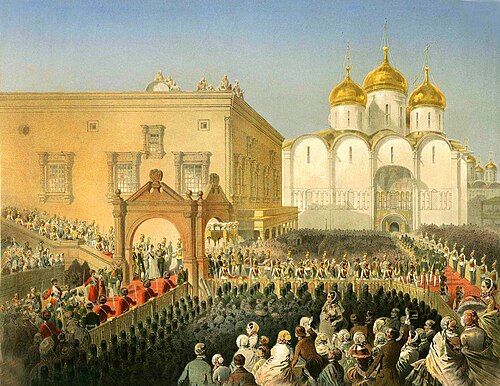

ロシア帝国の国教は正教であった。[ 150 ] [ 151 ]皇帝は「正教以外のいかなる信仰も公言してはならない」(1906年基本法第62条)とされ、「支配的な信仰の教義の最高擁護者および守護者であり、聖教会内の信仰の純粋さとすべての秩序の維持者である」(前述の第64条)とみなされた。皇帝はすべての高位聖職者の任命を行い、また取り消したが、教義や教会の教えに関する問題は解決しなかった。ロシア教会の主要な教会機関は、かつてのカルトリ・カヘティ王国を含む帝国の全域に管轄権を広げた至聖シノドであり、聖シノドの文民総監は、教会問題において広範な事実上の権限を持つ大臣評議会の一員であった。
The ecclesiastical heads of the national Russian Orthodox Church consisted of three metropolitans (Saint Petersburg, Moscow, Kiev), fourteen archbishops and fifty bishops, all drawn from the ranks of the monastic (celibate) clergy.
All non-Orthodox religions were formally forbidden from proselytizing within the empire.[152] In a policy influenced by Catherine II but solidified in the 19th century, Tsarist Russia exhibited increasing "confessionalization", pursuing top-down reorganization of the empire's faiths,[152] also referred to as the "confessional state".[153] The tsarist administration sought to arrange "orthodoxies" within Islam, Buddhism, and the Protestant faiths, which was performed by creating spiritual assemblies (in the case of Islam, Judaism, and Lutheranism), banning and declaring bishoprics (in the case of Roman Catholicism), and arbitrating doctrinal disputes.[152] When the state lacked resources to provide a secular bureaucracy across its entire territory, guided 'reformation' of faiths provided elements of social control.[152][153]
エカチェリーナ2世がポーランド分割で東ポーランドを併合した後、[ 154 ]居住制限区域として知られるユダヤ人に対する制限が課せられた。居住制限区域は、ユダヤ人が居住を許可されたツァーリ・ロシアの地域で、その外では移動や商業の自由などのさまざまな権利が剥奪された。[ 155 ]特に抑圧的だったのはニコライ1世で、ユダヤ人の強制同化を求め、[ 156 ] 1827年からユダヤ人の子供たちを東部の軍事施設に徴兵し、キリスト教への改宗を強制しようとし、[ 157 ]富に基づいてユダヤ人を「有用」と「有用でない」に階層化しようとし、[ 156 ]さらに居住制限区域内での宗教的および商業的権利を制限した。[ 155 ] [ 158 ]アレクサンドル 2 世はこのような厳しい扱いをやめ、より官僚的な同化政策を追求した。[ 156 ]例えば、カントニストに以前の軍務に対する補償を行ったが、その中にはユダヤ人のままの者も含まれていた。 [ 155 ]ただし、特定の軍の階級は依然としてキリスト教徒に限定されていた。[ 156 ]対照的に、アレクサンドル 3世は抑圧的な雰囲気を再開し、5 月法によってユダヤ人の居住地や財産権がさらに制限され、就ける職業の種類も制限された。[ 155 ] [ 159 ]また、1886 年にキエフから、1891 年にモスクワからユダヤ人が追放された。ロシア帝国の全体的な反ユダヤ政策は、大規模で継続的な移住につながった。[ 155 ]
ロシア帝国において、イスラム教は「保護されているが不安定な」地位にあった。[ 160 ]当初、ロシア帝国初期には、イスラム教徒に対する散発的な強制改宗が要求された。18世紀、エカチェリーナ2世は寛容令を発布し、イスラム教に法的地位を与え、イスラム教徒が宗教的義務を果たすことを許可した。 [ 161 ]エカチェリーナはまた、オレンブルク・ムスリム精神評議会を設立し、これは国内のイスラム教の慣習の組織化に関してある程度の帝国管轄権を持っていた。[ 162 ]ロシア帝国が拡大するにつれて、ツァーリの行政官は、既に存在していた既存のイスラム教の宗教機関を利用することが都合が良いと考えた。[ 163 ] [ 162 ]

19世紀には、ロシア・トルコ戦争中に制限的な政策がさらに抑圧的になり、ロシア帝国は1860年代のチェルケス人虐殺などの迫害を行った。 [ 161 ] [ 165 ]チェルケス征服後、約100万から150万人のチェルケス人(総人口のほぼ半分)が殺害されるか強制的に追放された。[ 166 ]迫害から逃れた人々の多くは、他の国へ向かう途中で亡くなった。今日、チェルケス人の大多数はディアスポラ・コミュニティに住んでいる。[ 167 ] 19世紀後半には、家を失ったチェルケス難民が蔓延していたため、「チェルケス人」という言葉はバルカン半島とアナトリア地方全体で「山賊」の一般的な言い回しとなった。[ 168 ]
クリミア戦争でのロシアの敗北後、クリミア・タタール人などの多くのイスラム教徒の集団はオスマン帝国への移住を余儀なくされた。[ 169 ] 19世紀後半、ロシア帝国におけるイスラム教の地位は、ロシア正教を要求する公式民族主義というツァーリ体制のイデオロギー的原則と結びついた。[ 163 ]それにもかかわらず、オレンブルク議会などの特定の地域ではイスラム教の機関の運営が許可されていたが、低い地位に指定されていた。[ 162 ]

正教が優勢であったにもかかわらず、いくつかのキリスト教宗派が信仰されていた。[ 170 ]ヴォルガ・ドイツ人の招聘とバルト・ドイツ貴族の存在により、ルター派は特に寛容であった。[ 171 ]エカチェリーナ2世の治世中、イエズス会弾圧は布告されなかったため、イエズス会はロシア帝国で存続し、この「ロシア協会」は西方におけるイエズス会の再建に役割を果たした。[ 172 ]総じて、ローマ・カトリックはエカチェリーナ2世の治世中に厳しく統制され、カトリックに対する比較的寛容な時代と考えられていた。[ 152 ] [ 173 ]カトリック教徒は、ポーランド民族主義の要素としてロシア帝国から不信感を抱かれており、この認識は1月蜂起後に特に高まった。[ 174 ]その後、ロシア化政策が強化され、ワルシャワのアレクサンドル・ネフスキー大聖堂のような正教会がポーランド立憲王国の各地に建設されたが、強制改宗は試みられなかった。
ツァーリの宗教政策は、ユニエイトやセクト派などの正統派の異端者を罰することに重点を置いていた。[ 152 ]古儀式派は危険な分子と見なされ、激しく迫害された。[ 175 ] [ 19 ]スピリチュアル・クリスチャンやモロカンなどのさまざまな小規模宗派は、トランスコーカサスや中央アジアに国内追放され、一部はさらにアメリカ大陸に移住した。[ 176 ]ドゥホボル派は主にカナダに定住した。[ 177 ]
1905年、ニコライ2世皇帝は非正教の宗教に法的地位を与える宗教寛容令を発布した。 [ 178 ]これにより、ソビエト連邦の出現まで、それまで迫害されていた古儀式派にとって「古信仰の黄金時代」が生まれた。[ 19 ] 20世紀初頭には、居住制限区域の一部が撤廃されたが、正式に廃止されたのは2月革命まで待たなければならなかった。[ 155 ]しかし、一部の歴史家は、ニコライ2世が反動的な暴動から生じた反ユダヤ主義ポグロムを暗黙のうちに承認していたと評価している。 [ 158 ] [ 179 ]エドワード・ラジンスキーは、ポグロムの多くは当局によって扇動され、帝政ロシアの秘密警察であるオフラナによって支援されていたが、一部は自発的に発生したと示唆した。[ 180 ]ラジンスキーによれば、セルゲイ・ヴィッテ(1905年に首相に任命)は回顧録の中で、ポグロムを扇動する布告が帝国警察によって印刷・配布されていたことを発見したと述べている。[ 180 ]: 69
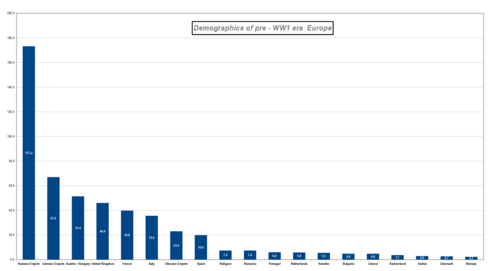


1897年のロシア帝国国勢調査に基づき1905年に公表された報告書によると、帝国における様々な宗教共同体の信者数は概ね以下の通りであった。
Russian Central Asia was also called Turkestan. As of the 1897 census, Russian Central Asia's five oblasts contained 5,260,300 inhabitants, 13.9 percent of them urban. The largest towns were Tashkent (156,400), Kokand (82,100), Namangan (61,900), and Samarkand (54,900). By 1911, 17 percent of Semireche's population and half of its urban residents were Russians, four-fifths of them agricultural colonists. In the other four oblasts in the same year, Russians constituted only 4 percent of the population, and the overwhelming majority lived in European-style settlements alongside the native quarters in the major towns.[182]
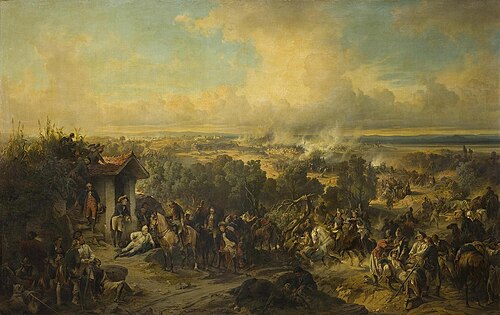

The armed forces of the Russian Empire consisted of the Imperial Russian Army and the Imperial Russian Navy. The Emperor of Russia was the commander-in-chief of the armed forces and implemented out his military policies through the Ministry of War and the Ministry of the Navy, which were tasked with administering their respective branches. There was no joint staff, but joint commissions were formed to work on specific tasks that involved both services.[183][184] The Main Staff of the War Ministry administered the Army's organization, training, and mobilization, as well as coordinating the different branches of the Army, while the General Staff was tasked with operational planning. This structure developed in the 1860s after the Crimean War.[185] The Navy Ministry had a similar structure, including a Main Staff tasked with administration and a Naval Technological Committee, and after the Russo-Japanese War a Naval General Staff was added for operational planning and war preparation.[186][187]
ピョートル大帝は、ロシアの非正規軍、封建軍、近代化された軍が混在する状態を、スウェーデンとの大北方戦争やオスマン帝国との紛争によって生じた要求に応えるため、常備軍と海軍へと変革した。彼の治世は、それ以前から始まっていた改革を加速させた。ピョートルは1699年に軍隊の徴兵の基礎となる勅令を発布し[ 188 ]、1701年に砲兵学校、1709年に工兵学校を設立し、1716年に軍の組織に関する軍事規則をまとめ[ 189 ] 、 1718年には陸軍と海軍を監督する行政機関(陸軍大学と海軍本部)を創設し[188]、新海軍の建設をゼロから監督した[ 188 ] 。これらの改革は外国人専門家の助けを借りて行われたが、ピョートルの治世が終わる前に、これらの専門家は次第にロシア人将校に取って代わられていった[ 188 ] 。
徴募された兵士や水兵のほとんどは農民徴募兵であったが、19 世紀後半には帝国海軍はより技術的な役割を担うために都市労働者階級の人々を徴募することを好むようになった。陸軍と海軍の両方で下士官が不足しており、下士官は兵士から昇進し、義務的な勤務期間の終わりに軍を去る傾向があった。[ 190 ] [ 191 ]いくつかの特殊部隊を除いて、[ 192 ]士官になるつもりなく自発的に軍隊に入隊する者はほとんどいなかった。[ 193 ]クリミア戦争後の改革後、陸軍士官の主な任官源は、ページ部隊、士官候補生部隊、およびユンカーまたは軍事学校の 3 つであった。[ 194 ] The cadet corps, among which the Page Corps was considered the most elite, [ 195 ] provided a military boarding school education to the sons of the high nobility as teenagers. [ 196 ] The junker schools provided the largest number of officers, and had a two-year education program for older enlisted soldiers that served for at least one year, and these were most often either lesser nobility or commoners. [ 197 ] The majority of army officers were nobles, though this changed by the end of the 19th century, with non-nobles being almost half of the officer corps in the 1890s. [ 198 ] The source of naval officers was the Naval Cadet Corps . [ 199 ] The majority of naval officers were also from the nobility, and many of them were descended from Baltic German or Swedish families with a history of naval service. [ 200 ]
The Russian military budget declined in the late 19th century as the government prioritized spending for civilian purposes, paying interest on foreign loans, and building railways.[200] Russia maintained a large peacetime standing army of over one million troops in the decades after the Napoleonic Wars,[201] and at the outbreak of World War I it was the largest in Europe.[202] During the war the Russian Army was unable to match the German Army in tactical and operational proficiency, but its performance against the Austro-Hungarian Army and the Ottoman Army was credible.[203] The Russo-Japanese War took Russia from having the third largest navy in the world to the sixth largest.[204] A reconstruction program approved by the State Duma in 1912, but it was not completed before World War I.[205] Russia's Baltic Fleet stayed on the defensive against the German High Seas Fleet,[206] but its Black Sea Fleet had success in raiding Ottoman merchant shipping and threatened the ability of the Ottoman Empire to continue the war.[117]
The Russian Empire was predominantly a rural society spread over vast spaces. In 1913, 80% of the people were peasants. Soviet historiography proclaimed that the Russian Empire of the 19th century was characterized by systemic crisis, which impoverished the workers and peasants and culminated in the revolutions of the early 20th century. Recent research by Russian scholars disputes this interpretation. Boris Mironov assesses the effects of the reforms of latter 19th-century, especially in terms of the 1861 emancipation of the serfs, agricultural output trends, various standard of living indicators, and taxation of peasants. He argues that those reforms brought about measurable improvements in social welfare. More generally, he finds that the well-being of the Russian people declined during most of the 18th century but increased slowly from the end of the 18th century to 1914.[207]
ロシア帝国の臣民は、貴族(ドヴォリャンストヴォ)、聖職者、商人、コサック、農民といった社会階級(身分)に分けられていた。コーカサス地方の先住民、タタルスタン、バシコルトスタン、シベリア、中央アジアといった非ロシア系地域の人々は、公式には「非スラブ人」、つまり「別の起源の人々」というカテゴリーとして登録されていた。
人口の過半数、81.6%は農民階級に属していた。その他の階級は、貴族が0.6%、聖職者が0.1%、市民と商人が9.3%、軍人が6.1%であった。8800 万人以上のロシア人が農民であり、その中には元農奴(1858年時点で男性10,447,149人)も 含まれていた。残りは「国家農民」(1858年時点で男性9,194,891人、アルハンゲリスク県を除く)と「領地農民」(同年男性842,740人)であった。


16世紀にロシアで発展し、1649年に法律で明文化された農奴制は、1861年に廃止された。[ 208 ] [ 209 ]
Household servants or dependents attached to personal service were merely set free, while the landed peasants received their houses and orchards, and allotments of arable land. These allotments were given over to the rural commune, the mir , which was responsible for the payment of taxes for the allotments. For these allotments the peasants had to pay a fixed rent, which could be fulfilled by personal labor. The allotments could be redeemed by peasants with the help of the Crown, and then they were freed from all obligations to the landlord. The Crown paid the landlord and the peasants had to repay the Crown, for forty-nine years at 6% interest. The financial redemption to the landlord was not calculated on the value of the allotments but was considered as compensation for the loss of the compulsory serf labor. 多くの地主は農民が農奴制の下で占有していた土地を縮小させ、しばしば農民が最も必要としていた土地、つまり家の周りの牧草地を奪った。その結果、農民はかつての主人から土地を借りざるを得なくなった。[ 210 ] [ 211 ]
農奴は悲惨な状況で暮らし、週にほぼ7日間畑で働き、シベリアの厳しい土地に追放されたり、兵役に送られたりした。所有者は、土地を狙っているか、告発されたか(つまり、労働から逃げたか)に応じて、奴隷を売る権利があった。農奴の子供たちは教育を受ける機会が少なかった。これらの農奴は重税を課せられ、ロシア人の中で最も貧しかった。[ 144 ] 1861年、アレクサンドル2世皇帝は農奴をロシアの発展を阻害する問題と見なし、2300万人の農奴を解放して自由にしたが、 [ 212 ]権利を得たにもかかわらず、元奴隷人口全体にわたって貧困状態が続いた。 1865年にゼムストヴォ制度が導入され、地方議会として、元農奴が受けられなかった教育や福祉を含む、地方住民に対する行政権限が与えられた。


かつての農奴たちは農民となり、すでに農民の身分を持っていた何百万もの農民に加わった。[ 211 ] [ 209 ]ほとんどの農民は、非常に家父長的な制度の下、何万もの小さな村に住んでいた。何十万人もの人々が工場で働くために都市に移住したが、彼らは通常、村とのつながりを維持していた。[ 213 ]
解放改革後、農民の4分の1は男性一人当たりわずか1.2ヘクタール(2.9エーカー)の土地しか割り当てられず、半数は3.4~4.6ヘクタール(8.5~11.4エーカー)未満しか割り当てられませんでした。三圃制の下で家族の生活を維持するために必要な通常の割り当て面積は11~17ヘクタール(28~42エーカー)と推定されています。この土地は必然的に地主から借りるものでした。土地の償還と土地税の合計額は、割り当て地の通常の賃貸料の185~275%に達することがよくありました。徴兵目的、教会、道路、地方行政などのための税金は言うまでもなく、これらは主に農民に課せられました。この負担は年々増加し、結果として住民の5分の1が家を離れ、家畜も姿を消しました。毎年、成人男性の半数以上(地域によっては男性の4分の3、女性の3分の1)が家を出て、仕事を求めてロシア中をさまよった。黒土地方の政府でも状況はほとんど変わらなかった。多くの農民が「無償の割り当て」を受け取ったが、その量は通常の割り当ての約8分の1だった。[ 214 ]
ヘルソンの平均割当地はわずか0.36ヘクタール(0.90エーカー)で、1.2~2.3ヘクタール(2.9~5.8エーカー)の割当地に対して、農民は5~10ルーブルの償還税を支払っていた。国有農民はそれよりはましだったが、彼らもまた大量に移住していた。状況がより希望的だったのはステップ地帯だけだった。割当地が個人所有(ミールは国有農民のみに存在)だったウクライナでは、高額な償還税のために状況は改善されなかった。ポーランド蜂起後、土地の評価額が安く割当地がいくらか増加した西部諸州では状況は改善した。最後に、バルト諸州では、土地のほぼすべてがドイツ人地主の所有であり、彼らは自ら耕作するか、雇い労働者を雇って耕作するか、小規模農場として貸し出していた。農民のうち農民はわずか4分の1で、残りは単なる労働者だった。[ 215 ]
強制労働に慣れていた旧農奴地主たちは、新たな状況に適応できなかった。王室から受け取った数百万ルーブルの償還金は、実質的かつ永続的な農業改善をもたらすことなく浪費された。森林は売却され、裕福な地主は農民に割り当てられた土地から法外な地代を徴収する者だけであった。少数の富裕層の間では富が増大したが、それに伴い大多数の人々は貧困に陥った。さらに、土地の共同所有と占有を原則とするミールという特殊な制度も相まって、全体として個人の努力を促す効果はなかった。
1861年から1892年にかけて、貴族が所有する土地は30%減少し、85万平方キロメートルから61万平方キロメートル( 2億1000万エーカーから1億5000万エーカー)にまで減少しました。続く4年間でさらに8577平方キロメートル(211万9500エーカー)が売却され、その後売却は加速し、1903年だけで約8000平方キロメートル(200万エーカー)が彼らの手から離れました。一方、1861年以降、特に1882年に農民土地銀行が設立され、土地の購入を希望する農民(ヤイファル・マヤ)への融資が行われるようになってからは、かつての農奴、あるいはむしろその子孫が、1883年から1904年の間に、かつての主人から約78,900平方キロメートル(19,500,000エーカー)の土地を購入した。
しかし、1906年11月、ニコライ2世皇帝は、農民が解放時に割り当てられた土地の自由保有者になることを許可する暫定命令を公布し、すべての償還金は免除された。この措置は、1908年12月21日に可決された法律で第3回ドゥーマによって承認され、ロシアの農村経済に広範囲かつ深刻な影響を与えることが予想された。13年前、政府は、ミールに属する土地をその共有権を持つ者の間で2回再分配するごとに少なくとも12年が経過しなければならないと規定することで、土地保有のより固定性と永続性を確保しようと努めていた。1906年11月の命令では、各農民が所有するさまざまな土地を1つの保有地に統合することが規定されていたが、ドゥーマは政府の助言により、それを徐々にしか実現できない理想とみなし、その実施を将来に委ねた。[ 215 ]
検閲はアレクサンドル2世の治世まで厳しく行われていたが、完全には廃止されなかった。[ 216 ]新聞は掲載できる内容が厳しく制限されており、知識人は出版の場として文芸誌を好んだ。例えば、フョードル・ドストエフスキーは、サンクトペテルブルクの新聞、例えば『ゴロス』や『ペテルブルグスキー・リストク』などを嘲笑し、それらが些細な記事を掲載し、見世物やヨーロッパの大衆文化への執着によって、当時のロシアの差し迫った社会問題から読者の注意をそらしていると非難した。[ 217 ]

ロシア帝国の教育水準は非常に低かったが、最後の世紀には徐々に向上した。1800年までに、農民男性の識字率は1~12%、都市部の男性は20~25%であった。女性の識字率は非常に低かった。識字率は貴族が最も高く(84~87%)、次いで商人(75%以上)、そして労働者と農民の順であった。農奴は識字率が最も低かった。どの階層においても、女性の識字率は男性よりはるかに低かった。対照的に、西ヨーロッパでは都市部の男性の識字率は約50%であった。正教会の聖職者たちは教育に懐疑的で、識字能力に宗教的な必要性は全くないと考えていた。農民は識字能力を持つ必要はなく、職人、商人、専門家など識字能力を持つ者は少数であった。1851年になっても、ロシア人のわずか8%しか都市に住んでいなかった。[ 218 ]
1801年のアレクサンドル1世(1801~1825年)の即位は、ヨーロッパ啓蒙主義からの新たな自由主義思想の到来を告げるものとして広く歓迎された。多くの改革が約束されたが、皇帝が外交問題や個人的な宗教問題に重点を移し、改革の問題を軽視するようになった1820年以前に実施されたものはほとんどなかった。西ヨーロッパとは対照的に、帝国全体の官僚機構は非常に小規模で、約1万7000人の公務員しかおらず、そのほとんどがモスクワとサンクトペテルブルクという2つの大都市に住んでいた。政府の近代化にははるかに多くの人員が必要であったが、そのためには適切な訓練を提供できる教育制度が必要であった。ロシアにはそれが欠けており、大学教育を受けるために若者は西ヨーロッパへ行った。軍隊と教会はそれぞれ独自の訓練プログラムを持っており、それぞれの特定のニーズに狭く焦点を絞っていた。アレクサンドル1世の下で最も重要な成功した改革は、国民教育制度の創設であった。[ 219 ]

教育省は1802年に設立され、国は6つの教育地域に分割された。長期計画では、各地域に大学、主要都市に中等学校、小学校の改良、そして最も多くの生徒を抱える教区ごとに2つの教区学校を設置することになっていた。1825年までに、中央政府は6つの大学、48の中等公立学校、337の改良小学校を運営していた。優秀な教師は、革命から逃れてきたフランスからやって来た。亡命したイエズス会士は、1815年に修道会が追放されるまで、エリート寄宿学校を設立した。最高レベルの大学は、カザン、ハリコフ、サンクトペテルブルク、ヴィルナ(1803年に帝国大学として再設立)、ドルパットにドイツのモデルに基づいて設立され、比較的新しいモスクワ帝国大学は拡張された。高等教育はごく少数のエリート層に限られており、1825年時点で大学には数百人、中等学校には5500人しか生徒がいなかった。女子のための学校は存在しなかった。裕福な家庭のほとんどは依然として家庭教師に頼っていた。[ 220 ]
Emperor Nicholas I was a reactionary who wanted to neutralize foreign ideas, especially those he ridiculed as "pseudo-knowledge". Nevertheless, his Minister of Education, Sergey Uvarov, promoted greater academic freedom at the university level for faculty members, who were under suspicion by reactionary church officials. Uvarov raised academic standards, improved facilities, and opened the admission doors a bit wider. Nicholas tolerated Uvarov's achievements until 1848, after which he reversed these innovations. [ 221 ] For the rest of the century, the national government continued to focus on universities, and generally ignored elementary and secondary educational needs. By 1900 there were 17,000 university students, and over 30,000 were enrolled in specialized technical institutes. The students were conspicuous in Moscow and Saint Petersburg as a political force typically at the forefront of demonstrations and disturbances. [ 222 ]帝国の高等教育機関の大部分はロシア語を使用していたが、一部は他の言語を使用していたものの、後にロシア化が行われた。[ 223 ]帝国の他の教育機関には、ティフリスのネルシシアン学校などがあった。
The first government to be formed after the February Revolution of 1917 had, with one exception, been composed of liberals.
Ivan III in his own time already had the reputation of the builder of the Russian state... The consolidation of Russia as a state was not just a territorial issue, for Ivan also began the development of a state apparatus...; Millar, James R. (2004). Encyclopedia of Russian History. New York: Macmillan Reference USA. p. 687. ISBN 978-0-0286-5693-9. 2023年10月26日にオリジナルからアーカイブされました。2023年12月30日に取得されました。
イヴァン3世の治世下で、ロシアの諸公国を中央集権国家に統合する作業は、大きく急速に進展しました。
モスクワが目指した大ロシア支配の目標を完遂した。2人の統治者のうち、イヴァン3世(大王)が最も多くの功績を残し、ロシアの歴史家たちは彼を「ロシアの領土を結集した者」と呼んでいる。
これは、ピョートル1世が皇帝の
称号を採用した際に直面した多くの困難を説明するものである。
ツァーリという
言葉の語源は
曖昧にされ、その称号の価値は低下していたのだ。
グレート・ゲームの時代、モンゴルはチベットがイギリスにとってそうであったように、ロシアによる帝国主義的侵略の対象であった。
The structure of LeDonne's analysis facilitates systematic comparison of the three theaters and highlights the impediments to unitary governance in a multiethnic and religiously diverse state. Russia...
Covering two centuries of Russian history, Forging a Unitary State is a comprehensive account of the creation of what is commonly known as the "Russian Empire," from Poland to Siberia. In this book, John P. LeDonne demonstrates that the so-called empire was, for the most part, a unitary state, defined by an obsessive emphasis on centralization and uniformity.
1860年代のチェルケス人の大惨事で亡くなった人の数は、100万人を下回ることはまずなく、150万人に近い可能性も十分にある。;アハメド、アクバル (2013). 『アザミとドローン』 ワシントンD.C.: ブルッキングス研究所出版局. p. 357. ISBN 978-0-8157-2378-3。リッチモンド、ウォルター(2013)。「4:1864」。『チェルケス人虐殺』。米国ニュージャージー州ニューブランズウィック:ラトガース大学出版局。88 ~ 93頁。ISBN 978-0-8135-6068-7。;カタリオッティ、ジョセフ (2023 年 10月22 日)。「チェルケス人虐殺:概要と歴史」。Study.com。2023年 3 月 20 日のオリジナルからアーカイブ済み。2023年8 月 22 日取得。「チェルケス人虐殺159周年 ― 虐殺は人道に対する罪である!」人権協会2023年5月21日。 2023年8月22日にオリジナルからアーカイブ済み。
To the tsar, the pogroms organized by the police seemed like a holy outburst of popular indignation against the revolutionaries
 Media related to Russian Empire at Wikimedia Commons
 Russian Empire travel guide from Wikivoyage