
Loading article…

洗礼(コイネー・ギリシア語:βάπτισμα、ローマ字: váptisma、直訳すると 「浸礼、水に浸すこと」)[1]は、ほぼ常に水を用いるキリスト教の 入信の秘跡である。 [2] [3]頭に水を振りかけたり注いだり、あるいは部分的または完全に水に浸すことによって執り行われる。伝統的には三位一体の各位格につき1回ずつ、計3回行われる。[4] [5] [6]共観福音書には、洗礼者ヨハネがイエスに洗礼を施したことが記されている。[7] [8] [9] [10]洗礼はほとんどの教会で秘跡とみなされ、他の教会では儀式とみなされている。ほとんどの主流キリスト教宗派で行われる三位一体の方式による洗礼は、キリスト教のエキュメニズム、つまりキリスト教徒間の統一の概念の基礎とみなされている。 [11] [12] [13]洗礼は洗礼式とも呼ばれますが、[14] [15]「洗礼」という言葉を幼児洗礼に限って使う人もいます。[16]カトリック教会、東方正教会、東方正教会、アッシリア東方教会、ルーテル教会などの特定のキリスト教宗派では、洗礼は教会の会員になるための入り口であり、志願者は洗礼の誓いを立てます。[17] [18]バプテスト教会や宗派にもその名前が付けられています。
キリスト教思想の特定の学派(カトリックやルーテル神学など)では、洗礼は救済に必要であると考えているが、フルドリヒ・ツヴィングリ(1484–1531)など一部の著述家はその必要性を否定している。[19]水による洗礼はキリスト教の宗派の間では非常に一般的であるが、クエーカー教徒や救世軍など、水による洗礼をまったく行わない宗派もある。[20]洗礼を実施する宗派間でも、洗礼の方法や様式、儀式の重要性の理解に違いがある。ほとんどのキリスト教徒は「父と子と聖霊の名において」という三位一体の式を用いて洗礼を施すが[21] (大宣教命令に従う)一神教のペンテコステ派はイエスの名のみを用いて洗礼を施す。[22]キリスト教徒の大多数は幼児に洗礼を施す。[a]バプテスト教会など他の多くの教会では、信者の洗礼のみを真の洗礼とみなしています。[23]東方正教会や東方正教会などの特定の宗派では、コンスタンティノープルの第六回公会議(シノドス)に触発されて、洗礼を受けた個人は生涯身に着ける十字架のネックレスを受け取ります。[24] [25]
キリスト教以外では、マンダ教徒は入信の代わりに浄化のために繰り返し洗礼を受ける。 [26]彼らは洗礼者ヨハネを最も偉大な預言者とみなし、ヨルダン川にちなんですべての川をヤルデナと名付けている。[26] [27] [28] :45
洗礼という用語は、人が入会、清められ、または名前を与えられる儀式、試練、または経験を指す比喩としても使われてきました。[29] キリスト教会の歴史の初期には、殉教は「血による洗礼」とみなされ、水による洗礼を受けていない殉教者の救済を可能にしました。後にカトリック教会は、洗礼の準備をしているが実際に聖餐を受ける前に亡くなった人が救われたとみなされる、願望による洗礼とみなしました。 [30]メソジスト派の伝統では、聖霊による洗礼は、恵みの第二の働き、完全な聖化を指し、ペンテコステ派では、聖霊による洗礼という用語は異言を話すことと同一視されています。[31]
語源
英語の「バプティズム」という単語は、ラテン語を介して間接的に中性ギリシャ語の概念名詞báptisma(ギリシャ語βάπτισμα、「洗う、浸す」)から派生しており、[b] [32]これは新約聖書の新語であり、男性ギリシャ語名詞baptismós(βαπτισμός )から派生しており、第二神殿時代のヘレニズム時代のユダヤ教のギリシャ語テキスト、例えば七十人訳聖書で儀式的な洗浄を意味する用語である。[33] [34]これらの名詞は両方とも動詞baptízō(βαπτίζω、「私は洗う」他動詞)から派生しており、これはユダヤ教のテキストでは儀式的な洗浄を意味するほか、新約聖書では儀式的な洗浄と、明らかに新しい儀式であるbáptismaを意味する。
動詞baptízōの由来となったギリシア語の動詞báptō ( βάπτω ) 「浸す」は、仮説的には再構成されたインド・ヨーロッパ語の語根* gʷabh- 「浸す」に由来する。[35] [36] [37]
ギリシャ語の単語は、多種多様な意味で使われています。[38]ヘレニズム時代の βάπτωとβαπτίζωは、一般的に「浸水」、「沈む」(液体染料の材料として)、「滅びる」(船が沈む、人が溺れるなど)という意味で使われ、英語の「沈む」や「圧倒される」と同じ二重の意味を持ちます。入浴や洗浄は、時折使用され、通常は神聖な文脈で使用されます。[39]
歴史
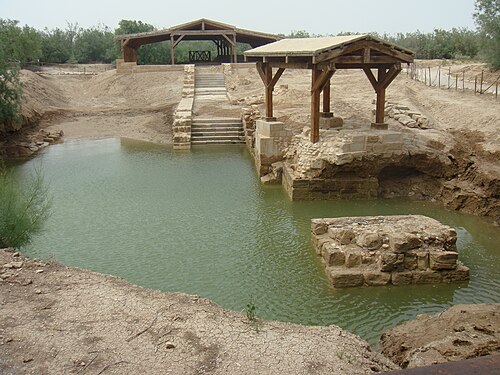
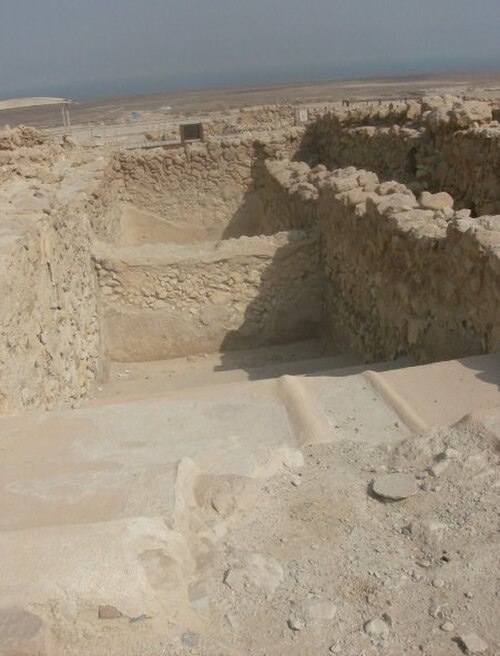
洗礼の習慣は、第二神殿時代のユダヤ教の儀式的慣習から生まれたもので、洗礼者ヨハネのような人物が生まれた。例えば、クムランの死海文書(DSS)集成のさまざまな文書には、洗浄、入浴、散水、浸水を含む儀式的慣習が記述されている。そのような文書の1つは、共同体の規則として知られるDSSで、「そして、彼の魂が神のすべての法律に従うことによって、彼の肉体は清めの水で散水され、悔い改めの水で聖化されて清められる」と書かれている。[40]
洗礼者ヨハネの信奉者であるマンダ教徒は、浄化の儀式として全身浸礼(マスブタ)を頻繁に行っています。 [41]マンダ教徒の資料によると、彼らは1世紀にヨルダン渓谷を去りました。 [42]
キリスト教の先駆者とされる洗礼者ヨハネは、洗礼を彼の救世主運動の中心的な秘跡として用いた。 [43]使徒パウロはヨハネの洗礼(「悔い改めの洗礼」)とイエスの名による洗礼を区別しており、[44]キリスト教の洗礼がヨハネの洗礼と何らかの形で関連していたかどうかは疑問である。[45]しかし、マルコ1:8によると、ヨハネは自分の水の洗礼を、聖霊によるイエスの真の究極の洗礼の型として結び付けているようだ。キリスト教徒は、イエスが洗礼の秘跡を制定したと考えている。[19]
初期の教会では、何らかの形の浸礼が最も一般的な洗礼方法だったと思われるが、古代教会の多くの文献では、この洗礼方法は重要でないとみなされていたようだ。ディダケー 7.1–3 (西暦 60–150 年) では、浸礼が現実的でない状況では、水に浸す洗礼が認められていた。同様に、テルトゥリアヌス(西暦 196–212 年) は、たとえ聖書や伝統的な命令に従わなくても、洗礼に対するさまざまなアプローチを認めていた (cf. コロナ ミリティス 3、洗礼について 17)。最後に、キプリアヌス (西暦 256 年頃) は、水の量は重要でないと明言し、浸礼、水に浸す洗礼、水に浸す洗礼の慣習を擁護した (書簡 75.12)。その結果、4 世紀以前の古代教会では、統一された一貫した洗礼方法は存在しなかった。[46]
3世紀と4世紀までに、洗礼には教理教育のほか、聖別、悪魔祓い、按手、信条の朗読が含まれるようになりました。[47]
中世初期には、幼児洗礼が一般的になり、儀式は大幅に簡素化され、ますます重視されるようになった。[48] [49]西ヨーロッパでは、12世紀から14世紀にかけて浸礼が通常の洗礼方法となったが、浸礼は16世紀まで行われていた。 [50]中世には、一部の急進的なキリスト教徒が洗礼を秘跡として拒否した。トンドラキアン、カタリ派、アルノルド派、ペトロブルス派、ヘンリカ派、自由精神兄弟団、ロラード派などの宗派は、カトリック教会から異端とみなされた。16世紀には、マルティン・ルターが洗礼を秘跡として保持したが、[51]スイスの宗教改革者フルドリッヒ・ツヴィングリは、洗礼と聖餐は象徴的なものとみなした。[19] 再洗礼派は幼児洗礼の有効性を否定し、改宗者に再洗礼を施した。[52]
モードとマナー


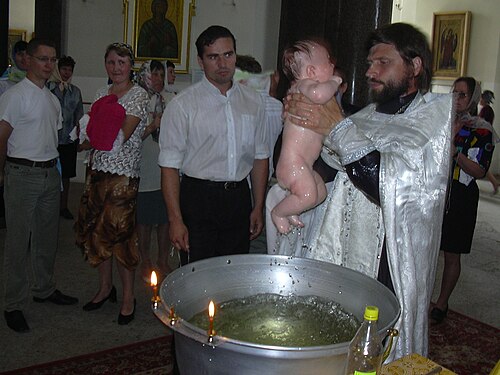
洗礼はいくつかの異なる方法で行われます。散水は頭に水を振りかけることであり、灌水は頭に水を注ぐことです。[4]伝統的に、人は聖三位一体の各位格に対して3回水を振りかけられ、注がれ、または浸されます。この古代キリスト教の慣習は三位一体洗礼または三位一体洗礼と呼ばれています。[4] [6] ディダケーは次のように規定しています。
洗礼の仕方はこうです。これらすべてのことばを唱えた後、(教えの前半、「命の道と死の道」)父と子と聖霊の名において、流水で洗礼を授けなさい。流水がない場合は、静水で洗礼を授けてください。水は冷水でなければなりませんが、冷水がない場合は温かい水を使用してください。どちらもない場合は、父と子と聖霊の名において、頭に3回水を注ぎます。洗礼を受ける者と洗礼を施す者は、他の可能な者とともに事前に断食する必要があります。洗礼を受ける者は、1日か2日断食するように言われます。[53]
— JB ライトフット、スティーブン トンプキンス、ダン グレイブス、『ディダケ』、クリスチャン歴史研究所
「浸礼」という言葉は、後期ラテン語の immersioから派生したもので、これは動詞immergere(「中に」のin + 「浸す」のmergere)から派生した名詞です。洗礼に関して、この言葉を、体を完全に水中に入れるか、部分的に水に浸すかを問わず、あらゆる浸し方を指すために使う人もいます。つまり、浸礼は完全浸礼か部分浸礼かのどちらかであると言います。アナバプテストの信仰を持つ他の人々は、「浸礼」を、完全に水面下に沈めることを意味するためにも使います。[54] [55]「浸礼」という用語は、人が水中に沈むことなく、水の中に立っている人に水を注ぐ洗礼にも使われます。[56] [57]「浸礼」という言葉のこの3つの意味については、浸礼洗礼を参照してください。
「浸水」が「沈没」の対義語として使われる場合、[58]それは、洗礼を受ける者が水の中に立つかひざまずき、上半身に水を注ぐ洗礼の形式を指します。この意味での浸水は、少なくとも2世紀以来、西洋でも東洋でも採用されており、初期キリスト教美術では一般的に洗礼が描かれている形式です。西洋では、この洗礼方法は8世紀頃から浸水洗礼に取って代わられ始めましたが、東方キリスト教では引き続き使用されています。[56] [57] [59]
浸水という語は後期ラテン語(sub-「下、下」+ mergere「浸す、浸す」)[60]に由来し、「完全浸水」とも呼ばれる。これは、水が受洗者の体を完全に覆う洗礼の形式である。浸水は、正教会および他のいくつかの東方教会で行われている。[61]カトリック教会のラテン教会では、浸水による洗礼はアンブロジオ典礼で使用されており、幼児洗礼のローマ典礼で規定されている方法の1つである。 [62]これは、バプテストなど、プロテスタント改革以降に発生したいくつかのグループでは義務と見なされている。[63]
ギリシャ語の動詞の意味洗礼を受ける

リデルとスコットの『ギリシア語-英語辞典』は、英語の動詞「baptize」の由来となった動詞baptízeinの主な意味を「浸す、突っ込む」としており、剣を喉や胎児に突き刺す、杯をボウルに浸してワインを汲むなどの例を挙げている。新約聖書では、この語は2つの意味を示している。1つは「洗礼する」で、これは七十人訳聖書でナアマンがヨルダン川に身を浸したという記述と関連している。もう1つは、ルカ11:38にある「身を清める」である。[64]
ギリシャ語の動詞baptízeinは、浸す、沈める、没頭するなどの意味だけを意味するわけではないが(「沈める」、「無力にする」、「圧倒する」、「沈める」、「圧倒される」、「ボウルから汲む」などの文字通りの意味と比喩的な意味で使用されている)、語彙資料では、七十人訳聖書[66] [67] [68]と新約聖書[69]の両方で、この単語の意味として引用されているのが一般的である。
「バプテスマと洗礼のギリシャ語の基本的な語源は「浸す」であるのは事実だが、マルコ10:38-39、ルカ12:50、マタイ3:11、ルカ3:16、コリント10:2からわかるように、その言葉を単純にこの意味に還元できるというのは真実ではない。」[70]
福音書の 2 つの箇所から、動詞baptízein が必ずしも水に浸すことを意味していたわけではないことがわかります。1 つ目はルカによる福音書 11:38 で、イエスが食事をした家のパリサイ人が「イエスが食事の前にまず身を清めない ( ἐβαπτίσθη、βαπτίζωのアオリスト受動態、文字通り「洗礼を受けた」) のを見て驚いた」ことが書かれています。これは、リデルとスコットがβαπτίζωを「沐浴」の意味で使用した例として挙げている箇所です。イエスがこの行為を省略したことは、弟子たちの省略と似ています。「そのとき、エルサレムの律法学者やパリサイ人がイエスのもとに来て言った。『なぜ、あなたの弟子たちは昔の人の言い伝えを破るのですか。彼らはパンを食べるとき、手を洗わない ( νίπτω ) のです』」。[71]指摘されているもう一つの福音書の一節は、「パリサイ人は…長老たちの言い伝えに従って、手をよく洗わないと(νίπτω、洗うことの通常の言葉)食事をしない。また、市場から帰ってきたら、身を洗わないと(文字通り「洗礼を受ける」—βαπτίσωνται 、βαπτίζωの受動態または中動態)食事をしない」というものである。[72]
さまざまな宗派の学者[73] [74] [75]は、この 2 つの節は、招待された客や市場から帰ってきた人々が、水に完全に浸かる (「洗礼を受ける」) ことは求められておらず、現在のユダヤの慣習で認められている唯一の形式である、手を水に浸すか、手に水をかけるという部分的な浸水を行うだけであることを示していると主張しています。[76] 2 つの節のうちの 2 番目では、実際には手が「洗われる」と具体的に特定されており[77]、人全体が洗われるわけではありません。人全体を表す動詞はbaptízomaiで、文字通り「洗礼を受ける」、「浸される」です。[78]この事実は、両方の動詞の翻訳として「洗う」を使用している英語版では不明瞭です。ゾディアテスは、手を洗うのは手を水に浸すことによって行われたと結論付けています。[79]リデル・スコット・ジョーンズギリシャ語-英語辞典(1996年)は、他の聖句(ルカ11:38)を、動詞baptízeinが「水に浸す」という意味ではなく「洗浄する」という意味で使用されている例として挙げています。[80]容器の洗浄にβαπτίζωが使われている場合も、浸水を意味します。[81]
すでに述べたように、ゾディアテスの辞書編集著作によれば、これら2つの場合のうち2番目の場合、[82]では、動詞baptízeinは、市場から帰った後、パリサイ人が集めた水に手を浸して洗ったことを示している。[79]バルツとシュナイダーは、ῥαντίσωνται (sprinkle)の代わりに使用されるβαπτίζωの意味を、βάπτω(浸す、浸す)と同じであると理解している。[83] [84] [85]これは、手に持った一口をワインに部分的に浸したり、指をこぼした血に浸したりするために使用される動詞である。[86]
ピーター・レイトハート(2007)は、動詞baptízeinが儀式的な洗浄に関連して使用される可能性を示唆しており、パウロの「そうでなければ、死者のために洗礼を受ける人々はどうするだろうか?」[87]というフレーズは、ユダヤ人の儀式的な洗浄に関連していると示唆している。[88]ユダヤ系ギリシャ語では、動詞baptízein「洗礼を受ける」は単に「洗礼」よりも広い意味を持ち、ユダヤ教の文脈では主に男性名詞baptismós「儀式的な洗浄」に適用される[89]。
動詞baptízeinは七十人訳聖書の中で、儀式的な洗礼baptismósの文脈で4回登場します。例えば、月経による汚れから身を清めるユディト、らい病から身を清めるために7回身を洗うナアマンなどです。[90]
さらに、新約聖書においてのみ、動詞baptízeinは中性名詞báptisma「洗礼」にも関連しているが、これは七十人訳聖書や他のキリスト教以前のユダヤ教の文書では知られていない新語である。[91]
baptízeinの意味の広さは、英語の聖書がユダヤ教の儀式的な洗浄を意味する「wash」を「wash」と訳していることにも反映されています。例えば、マルコ7:4では、パリサイ人は「洗わないと(ギリシャ語で「baptize」)、食事をしない」と述べており、[92]また、キリスト教の新しい儀式であるbáptismaを意味する「baptize」も訳されています。[93]
派生名詞

新約聖書には動詞baptízō (βαπτίζω) から派生した 2 つの名詞、男性名詞baptismós (βαπτισμός) と中性名詞baptisma (βάπτισμα) が登場します。
- バプティズモス(βαπτισμός)は、マルコ7:4では、食器の浄化、洗浄、清めを目的とした水の儀式を指しています。[94] [95]同じ節とヘブル9:10では、レビ人の器物または身体の清めを指しています。[96]また、ヘブル6:2では、おそらくバプテスマにも言及されていますが、そこでは無生物の洗浄を指している可能性があります。[95]スピロス・ゾディアテスによると、単に器具の洗浄を指す場合、バプティズモス(βαπτισμός)は、ヘブル12:24とペトロ1:2にのみ見られる名詞、ランティズモス(ῥαντισμός、「振りかける」 )と同一視されています。これは、旧約聖書の祭司による象徴的な清めを示すために使用されています。[79]
- báptisma (βάπτισμα)は新約聖書に由来すると思われる造語であり、おそらくそれ以前のユダヤ教の概念であるbaptismós (βαπτισμός)と混同すべきではない。[97]その後、これはキリスト教徒の著作にのみ見られる。[94]新約聖書では、少なくとも21回登場する。
- 洗礼者ヨハネが行った儀式に関して13回[98 ]
- キリスト教の特定の儀式に関連して3回[99](コロサイ2:12の写本での使用を考慮すると4回。ただし、その場合は元のバプテスマから変更された可能性が高く、その逆ではない)[100]
- 比喩的な意味で5回。[101]
- 写本による差異:コロサイ書では、写本によっては中性名詞báptisma(βάπτισμα)が用いられているが、男性名詞baptismós(βαπτισμός)が用いられているものもあり、これは新約聖書の現代の批評版で与えられている読み方である。[102]この読み方が正しければ、これは新約聖書の中でbaptismós (βαπτισμός)が一般的な洗礼ではなく、明らかにキリスト教の洗礼を指して用いられている唯一の例である。ただし、ヘブル人への手紙6章2節もキリスト教の洗礼を指しているかもしれないという一部の意見が正しい場合は別である。[95]
- 女性名詞baptisis [ 103]と男性名詞baptismós [104]はともに、ヘロデによる洗礼者ヨハネの殺害に関連して、ヨセフスの『ユダヤ古代誌』(J. AJ 18.5.2)に登場します。[105] [106]この女性形は、ヨセフスの他の著作や新約聖書では使用されていません。[107]
衣服

中世まで、洗礼のほとんどは候補者が裸で行われていました。これは、洗礼の初期の描写のほとんど(この記事でいくつか示されています)や、初期の教父や他のキリスト教の著述家によって証明されています。女性の候補者には、慎み深さの理由から助祭が手伝いました。[108]
その典型が、4 世紀 (西暦 350 年頃) に「洗礼の秘義について」を著した エルサレムのキュリロスです。
あなたたちは知らないのですか。私たちのうち、イエス・キリストにつくバプテスマを受けた者は皆、彼の死につくバプテスマを受けたのです。などなど。あなたたちは律法の下ではなく、恵みの下にあるからです。
1. したがって、私は昨日の講義の続きを皆さんに提示する必要があります。それは、皆さんが内室で行ったことが何を象徴していたかを知るためです。
2. それで、あなたがたは中に入るとすぐに上着を脱ぎ捨てた。これは、古い人間をその行いとともに脱ぎ捨てることの象徴であった。[109]あなた方は身を脱ぎ捨てて裸になったのである。この点でも、十字架上で裸にされ、その裸によって支配と権力を脱ぎ捨て、十字架の上で公然とそれらに打ち勝ったキリストに倣ったのである。敵対的な力があなた方の肢体に巣を作ったので、あなた方はもうその古い衣服を着てはならない。私が言っているのは、目に見える古い衣ではなく、欺瞞の欲望の中で腐敗していく古い人間のことである。[110]一度それを脱いだ魂は、二度とそれを着ることなく、雅歌にあるキリストの花嫁とともに、「私は衣を脱いだ。どうやって着ようか」と言うように。[111]ああ、不思議なことよ。あなた方は皆の前で裸であったが、恥ずかしがらなかった。実に、あなた方は、園で裸であったが恥ずかしく思わなかった最初の造られたアダムの姿をとっていた。
3. それから、あなたたちは裸にされ、頭の毛から足の先まで、悪魔祓いの油を塗られ、良いオリーブの木、イエス・キリストの分け前にあずかる者とされたのです。
4. これらのことの後、あなた方は、キリストが十字架から私たちの目の前にある墓に運ばれたように、神の洗礼の聖なる池に導かれました。そして、あなた方一人一人は、父と子と聖霊の名を信じるかどうか尋ねられ、その救いの告白をし、水の中に三度降り、再び昇りました。ここでも、象徴によってキリストの三日間の埋葬を暗示しています。...そして、まさにその瞬間に、あなた方は死に、そして生まれていました。[112]
— エルサレムのキュリロス、教理講話第20章(洗礼の神秘について、II)、ローマ6:3–14
象徴性は3つあります。
1. 洗礼は再生の一形態であると考えられています。「水と聖霊による」[113]洗礼の裸の状態(第二の誕生)は、最初の誕生の状態と並行しています。たとえば、ヨハネス・クリュソストムスは洗礼を「λοχείαν」、つまり出産と呼び、「水と聖霊による新しい創造の方法」と呼んでいます(「ヨハネへの」スピーチ 25,2)。そして後に詳しく説明します。
イエスは私たちに知覚できるものを何も渡さなかった。知覚できるものと共に、しかし、それらはすべて想像できるものである。これは洗礼の場合も同じである。水の賜物は知覚できるものと共に行われるが、行われていること、すなわち再生と更新は想像できるものである。なぜなら、もしあなたが肉体を持っていなければ、イエスはこれらの肉体のない賜物を裸の賜物としてあなたに渡したであろう。しかし、魂は肉体と密接に結びついているので、イエスは知覚できるものを想像できるものと共にあなたに渡したであろう。(マタイへの金口書、スピーチ82、4、紀元後390年頃)
2. 衣服を脱ぐことは「古い人間をその行いとともに脱ぎ捨てるイメージ」を表しており(上記のキリルによる)、洗礼の前に体を剥ぐことは、罪深い自己の装飾を脱ぎ捨て、イエスが与えてくださった「新しい人間」を身に着けることを表している。

3. キリルが上でも主張しているように、聖書のアダムとイブはエデンの園で裸で、無垢で、恥じていなかったので、洗礼中の裸は、その無垢と元々の罪のない状態の更新と見なされました。また、十字架刑のキリストの裸の状態と、洗礼の準備として悔い改めた罪人の「古い人間」が十字架刑にかけられたことなど、他の類似点も挙げられます。
慣習の変化や慎み深さに関する懸念が、洗礼志願者が下着をつけたままにしておくこと(ダ・ヴィンチ、ティントレット、ヴァン・スコル、マサッチオ、ド・ウィットらによるルネッサンス期の洗礼画に多く見られるように)や、今日ほぼ普遍的に行われている洗礼衣の着用を許可または義務付ける慣習につながったものと思われる。洗礼衣はほとんどの場合白で、純潔を象徴している。今日では、ズボンとTシャツなど、適切な衣服であればどのようなものでも着用できるグループもある。実用的な考慮事項としては、衣服がどれだけ乾きやすいか(デニムは推奨されない)、濡れたときに透けてしまうかどうかなどがある。[要出典]
キリスト教の特定の宗派では、洗礼を受けた個人は、生涯「キリストの死に対する勝利とキリストへの帰属のしるし」として身に着ける十字架のネックレスを受け取ります(ただし、紛失したり壊れたりした場合は、新しい十字架のペンダントに交換されます)。 [24] [25]洗礼を受けたキリスト教徒が常に十字架のネックレスを身に着けるこの慣習は、コンスタンティノープルの第六回公会議(シノドス)のカノン73とカノン82に由来しており、次のように宣言されています。
...教会(日曜)学校の子供たちは全員、十字架を身につけることがいかに霊的に有益であるかを知りながら身につけなければなりません。十字架を身につけることで、子供は邪悪な力から守られ、キリストの聖十字架の恵みを招き、神の祝福を子供に与え、自分はキリストに属し、キリスト教徒としての特別なアイデンティティを持っているという感覚を子供に与え、キリストが常に彼/彼女と共にあることを思い出させ、イエスが彼/彼女を救うために十字架で死んだこと、イエス・キリストが私たちの唯一の救世主であり真の神であることを子供に思い出させます。十字架を身につけることで、子供は神の愛を感じ、人生におけるどんな障害も克服する希望と強さを子供に与えます。[25]
— コンスタントプロス、2017年
意味と効果

キリスト教徒にとっての洗礼の効果については見解が分かれている。カトリック、正教会、そして主流プロテスタントのほとんどのグループは、洗礼は救済の条件であり、秘跡であると主張し、「洗礼による再生」について語る。[114]その重要性は、新約聖書にある「キリストの神秘体」の意味の解釈に関係している。[115]この見解は、カトリックと東方正教会の宗派、そしてルター派や英国国教会などのプロテスタント改革の初期に形成された教会によって共有されている。[要出典]たとえば、マルティン・ルターは次のように述べている。
簡単に言えば、洗礼の力、効果、利益、成果、目的は、救うことです。誰も王子になるために洗礼を受けるのではなく、言葉にあるように、「救われる」ために洗礼を受けるのです。救われるということは、罪、死、悪魔から解放され、キリストの王国に入り、永遠にキリストと共に生きることに他ならないことを私たちは知っています。
— ルターの大教理問答、1529年
キリスト教会」[ 116] :66 [117] :112 エホバの証人、キリスト教徒、末日聖徒イエス・キリスト教会は、バプテスマが救いに必要であると信じています。[要出典]
ローマカトリック教徒にとって、水による洗礼は神の子としての生活への入信の秘跡である(カトリック教会のカテキズム、1212-13)。それは人をキリストに似せるものであり(カトリック教会のカテキズム 1272)、教会の使徒的活動および宣教活動に参加することをキリスト教徒に義務付ける(カトリック教会のカテキズム 1270)。カトリック教徒は、人が救われるための洗礼には 3 つの種類があると考えている。それは、秘跡的洗礼(水による)、願望による洗礼(イエス・キリストによって設立された教会の一員になりたいという明示的または暗黙の願望)、血による洗礼(殉教)である。1943 年 6 月 29 日の回勅「Mystici corporis Christi」で、教皇ピウス 12 世は、洗礼と真の信仰の告白は、唯一の真の教会、すなわちイエス・キリスト自身の体の一員となるものであると語り、聖霊なる神が使徒パウロを通して教えたとおりである。
- 18 ...罪の中で死んでこの世に生まれた人々は、洗礼の水を通して、新しく生まれ変わって教会の一員となるだけでなく、霊的な印を押されて、他の秘跡を受ける能力と資格を得るのです。...
- 22実際には、洗礼を受け、真の信仰を告白し、不幸にも教会の一致から離脱したり、重大な過ちを犯して正当な権威によって排除されたりしていない人だけが、教会のメンバーとして含められるべきです。使徒は「ユダヤ人であろうと異邦人であろうと、奴隷であろうと自由人であろうと、私たちは皆、一つの霊によって一つの体となるように洗礼を受けたのです」と言っています。したがって、真のキリスト教共同体には、一つの体、一つの霊、一つの主、一つの洗礼しかないように、信仰も一つしかありません。したがって、もし人が教会の言うことを聞こうとしないなら、その人は異教徒や徴税人としてみなされるべきです。主が命じているように。信仰や政治において分裂している人は、そのような体の一致の中で生きることも、その唯一の神聖な霊の生活を生きることもできないということになります。
— ミスティ・コーポリス・クリスティ[118]
対照的に、アナバプテスト派と福音派プロテスタントは、洗礼を、個々の信者が赦しの恩寵を体験した後に起こる、内なる現実の外的なしるしと認識している。改革派とメソジスト派のプロテスタントは、洗礼と再生のつながりを維持しているが、それは自動的でも機械的でもないと主張し、再生は洗礼とは別の時期に起こるかもしれないと主張している。 [119] キリスト教会は、洗礼において信者は信仰と服従において自分の人生を神に捧げ、神は「キリストの血の功績によって人を罪から清め、その人の状態を異邦人から神の国の市民へと真に変えます。洗礼は人間の行いではなく、神だけが行える行いを神が行う場です」と一貫して教えている。 [116] : p.66 したがって、彼らは洗礼を功績ある行いではなく、受動的な信仰行為と見なしている。それは「人が神に捧げるものが何もないという告白」である。[117] : p.112
キリスト教の伝統

カトリック、東方正教会、ルーテル教会、英国国教会、メソジスト教会の洗礼の典礼では、洗礼は象徴的な埋葬と復活であるだけでなく、実際の超自然的な変化であると明確に言及されており、ノアの経験や、モーセによって分けられた紅海をイスラエル人が渡ったことと類似している。したがって、洗礼は文字通りにも象徴的にも清めであるだけでなく、キリストとともに死んで復活することでもある。カトリック教徒は、洗礼は原罪の汚れを清めるために必要であると信じており、そのため幼児に洗礼を施すのが一般的である。[120]
東方教会(東方正教会および東方正教会)も、マタイ伝19章14節などの聖書の箇所に基づいて幼児洗礼を施しており、これは子どもの完全な教会員資格を支持するものと解釈されている。これらの宗派では、年齢に関係なく、洗礼の直後に次の聖体礼儀で堅信礼と聖体拝領が行われる。正教会も同様に、洗礼はアダムの先祖の罪と呼ばれるものを取り除くと信じている。 [121]英国国教会は、洗礼は教会への入会でもあると信じている。メソジスト派と英国国教会の大半は、洗礼は西洋では原罪、東洋では先祖の罪と呼ばれるものの汚れを清めることにも同意している。[要出典]

東方正教会のキリスト教徒は、死とキリストへの再生の象徴として、また罪の洗い流しとして、完全な三重の浸礼を主張することが多い。ラテン教会のカトリック教徒は一般的に浸礼(注ぎ)で洗礼を行うが、東方カトリック教徒は通常浸礼、または少なくとも部分的な浸礼で洗礼を行う。しかし、浸礼はラテンカトリック教会内で人気が高まっている。新しい教会の聖域では、洗礼盤が浸礼による洗礼を明示的に許可するように設計されていることがある。[122]英国国教会は浸礼または浸礼で洗礼を行う。[123] [124]
西暦200年頃まで遡る証拠によれば、[125]後見人または代父母が洗礼に立ち会い、洗礼を受けた者のキリスト教教育と生活を守ることを誓います。[126]
バプテスト派は、ギリシャ語のβαπτίζω はもともと「浸す」という意味だと主張している。彼らは、洗礼に関する聖書のいくつかの節は、体を水に浸すことを要求していると解釈している。[127]また、水に浸すことだけが、キリストとともに「埋葬され」、「復活」するという象徴的な意味を反映しているとも述べている。[128] [非一次資料が必要]バプテスト派の教会は、父、子、聖霊の三位一体の名において洗礼を行う。しかし、彼らは洗礼が救済に必要だとは信じておらず、むしろそれはキリスト教の服従行為であると考えている。[129]
ワンネス・ペンテコステ派のような一部の「完全福音」カリスマ派教会は、ペテロがイエスの名において洗礼を説いたことを権威として引用し、イエスの名においてのみ洗礼を授けている。[130] [一次資料以外が必要]
エキュメニカル声明
1982年、世界教会協議会はエキュメニカル文書『洗礼、聖体拝領、聖職』を出版した。その文書の序文には次のように記されている。
洗礼、聖餐、聖職に関する教義と実践において、教会がいかに大きく異なっているかを知っている人なら、ここに記録された大きな合意の重要性を理解するだろう。委員会のメンバーには、事実上すべての宗派の伝統が含まれている。このように大きく異なる宗派の神学者が、洗礼、聖餐、聖職についてこのように調和して語ることができるというのは、現代のエキュメニカル運動において前例のないことである。特に注目すべきは、委員会の正式メンバーの中に、世界教会協議会自体に所属していないカトリック教会やその他の教会の神学者も含まれているという事実である。[131]
— 世界教会協議会、洗礼、聖体拝領、聖職—信仰と秩序に関する文書第111号、1982年
1997年の文書「キリスト教徒になる:私たちの共通の洗礼のエキュメニカルな意味」は、世界教会協議会の支援のもとに集められた専門家委員会の見解を示したものである。そこには次のように記されている。[126]
...使徒行伝2章38節によると、洗礼はペテロがイエスの名において説いた洗礼に続き、洗礼を受けた人々をキリストの霊、聖霊の受け取りと共同生活へと導きます。「彼らは使徒たちの教えと交わり、パンを裂くことと祈りに励んだ」[132]。また、困っている人々に物資を配給した。[133] [非一次資料が必要]
これを聞いて洗礼を受け、共同体の生活に入った人々は、すでに終わりの日の神の約束の証人となり、それにあずかっている。それは、イエスの名による洗礼による罪の赦しと、すべての肉なる者への聖霊の注ぎである。[130]同様に、洗礼のパターンとも言えるかもしれないが、ペテロの第一の手紙は、イエス・キリストの復活の告知と新しい命についての教えが[134]清めと新たな誕生につながることを証言している。[135]これに続いて、神の食物を食べたり飲んだりすること、[136]共同体の生活への参加、つまり王なる祭司職、新しい神殿、神の民[137]への参加、そしてさらなる道徳的形成が続く。[138]ペテロの第一の手紙の冒頭で、筆者はこの洗礼を、キリストへの服従と聖霊による聖化という文脈に置いている。[139]したがって、キリストへの洗礼は聖霊への洗礼と見なされる。[140]第四福音書では、イエスとニコデモの対話の中で、水と聖霊による誕生が神が支配する場所への恵み深い入場手段となることが示されています。[113] [141]
一部の教会による有効性の検討

キリスト教宗派の大多数は、洗礼は実際に霊的、神聖、救済効果を持つ秘跡であるという神学的考えを認めている。洗礼が有効であるためには、つまり実際にそれらの効果を持つためには、いくつかの重要な基準を満たす必要がある。これらの重要な基準が満たされている場合、洗礼に関するいくつかの規則、例えば儀式の認可された儀式を変更するなどの違反は、洗礼を違法(教会の法律に反する)とするものだが、それでも有効である。[142]
有効性の基準の1つは、正しい言葉の使用である。ローマカトリック教会は、「洗礼する」という動詞の使用が不可欠であると教えている。[50]ラテン教会、英国国教会、メソジスト教会のカトリック教徒は、「私は…の名においてあなたに洗礼を授けます」という形式を使用する。受動態は東方正教会とビザンチン カトリック教徒によって使用され、「神のしもべは…の名において洗礼を受ける」という形式である。[143]
三位一体の儀式(「父と子と聖霊の名において」)の使用も不可欠であると考えられており、そのためこれらの教会は、ワンネス・ペンテコステ派などの非三位一体教会の洗礼を有効なものとして受け入れていません。[144]
もう一つの必須条件は水の使用です。ワイン、牛乳、スープ、フルーツジュースなど、通常は水とは呼ばれない液体が使用された洗礼は有効とはみなされません。[145]
もう一つの要件は、司式者が洗礼を執行する意図を持っていることです。この要件は単に「教会が行うことを行う」という意図を伴います。 [146]洗礼の効果を生み出すのは洗礼者ではなく、聖餐を通して働く聖霊であるため、キリスト教の信仰を持っている必要はありません。したがって、洗礼者の信仰に対する疑いは、洗礼の有効性に対する疑いの根拠にはなりません。[147]
いくつかの条件は、有効性に明確に影響しません。たとえば、水に浸す、浸礼、注ぎ(注ぐ)、散布(振りかける)のどれが使用されるかなどです。[148]しかし、水を振りかけると、水が洗礼を受けていない人の皮膚に触れない危険性があります。すでに述べたように、「水が単に候補者に触れるだけでは不十分です。水は流れなければなりません。そうでなければ、本当の清めが行われていないように見えます。そのような洗礼は、せいぜい疑わしいものと見なされるでしょう。水が髪の毛だけに触れた場合、聖餐はおそらく有効に授与されたことになりますが、実際にはより安全な方法に従う必要があります。人の衣服だけが散布を受けた場合、洗礼は間違いなく無効です。」[145]多くの聖体拝領では、3回ではなく1回の水に浸すか注ぐことが行われても有効性に影響はありませんが、正統派ではこれは議論の的となっています。[要出典]
カトリック教会によれば、洗礼は洗礼を受けた者の魂に消えない「印」を与えるものであり、したがって、すでに洗礼を受けた者は、再度洗礼を受けることはできない。この教えは、再洗礼を実践したドナティストに対して肯定された。洗礼で受けた恩寵は、 ex opere operatoに作用すると信じられており、したがって、異端または分裂グループで施行された場合でも有効であると見なされる。[149]
他の宗派による承認
カトリック、ルーテル、英国国教会、長老派、メソジストの各教会は、三位一体の式の使用を含む一定の条件の下で、このグループ内の他の宗派による洗礼を有効なものとして受け入れている。[150]洗礼は一度しか受けられないため、他の宗派で有効な洗礼を受けた人は、改宗または転向の際に再度洗礼を受けることはできない。ローマカトリック教会の場合、これは教会法第864条で確認されており、[151]そこには「まだ洗礼を受けていないすべての人、そしてそのような人だけが洗礼を受けることができる」と書かれている。 [152]そのような人は信仰告白をすることで受け入れられ、堅信礼または洗礼の秘跡/儀式をまだ有効に受けていない場合は堅信礼を受けることで受け入れられる。具体的には、「メソジスト神学者は、神が適切な意図を持って結ばれ、封印された契約を破棄することは決してないので、最初の洗礼が三位一体の名においてなされなかったという欠陥がない限り、再洗礼は決して選択肢ではないと主張した。」[153]場合によっては、最初の洗礼が実際に有効であったかどうかを判断するのが難しい場合があります。疑わしい場合は、 「まだ洗礼を受けていないなら、私が洗礼します...」という決まり文句で条件付き洗礼が行われます。[154] [155]
カトリック教会は通常、東方正教会、キリスト教会、会衆派、英国国教会、ルーテル派、古カトリック、ポーランド国カトリック、改革派、バプテスト派、ブレザレン派、メソジスト派、長老派、ワルドー派、合同プロテスタントの各宗派のキリスト教徒の洗礼を有効と認めており、これらの伝統のキリスト教徒は堅信礼を通じてカトリック教会に受け入れられる。 [ 156]メノナイト派、ペンテコステ派、アドベンチスト派の伝統に属する人でカトリック教会に受け入れられることを望む人は、これらの伝統における秘跡の有効性に関する懸念から、条件付き洗礼を受けることを求められる場合がある。 [156]カトリック教会は、末日聖徒イエス・キリスト教会で授けられる洗礼の有効性を明確に否定している。[157]
改革派教会は、カトリック教会をはじめ、三位一体の原理を用いる教会で行われる洗礼を有効と認めている。[158] [159]
東方正教会における他の宗派からの改宗者に対する洗礼の慣習は統一されていない。しかし、一般的に、聖三位一体の名において行われる洗礼は正教会に受け入れられている。東方正教会、ローマカトリック教会、ルーテル教会、古カトリック教会、モラヴィア教会、英国国教会、メソジスト教会、改革派教会、長老派教会、兄弟教会、アッセンブリーズ・オブ・ゴッド教会、バプテスト派の伝統に属するキリスト教徒は、聖別(堅信礼)の秘跡を通じて東方正教会に受け入れられる。 [ 160]改宗者が洗礼の秘跡(ミステリオン)を受けていない場合は、正教会との交わりに入る前に、聖三位一体の名において洗礼を受けなければならない。もし彼/彼女が他のキリスト教宗派(正教会以外)で洗礼を受けた場合、彼/彼女の以前の洗礼は、聖別によって遡及的に恩寵に満たされたとみなされます。あるいは、まれな状況では、洗礼が聖三位一体(父、子、聖霊)の名において行われた限り、信仰告白のみで満たされたとみなされます。正確な手順は地域の教会法に依存しており、議論の対象となっています。[要出典]
東方正教会は、東方正教会内で行われた洗礼の有効性を認めている。カトリック教会で行われた洗礼も認めている教会もある。三位一体の儀式に従わずに行われた洗礼は無効とみなされる。[161]
カトリック教会、すべての正教会、英国国教会、ルーテル教会の見解では、末日聖徒イエス・キリスト教会が授ける洗礼は無効である。[162]その旨の公式宣言とともに発表された記事は、その判断の理由を次のように要約している。「カトリック教会の洗礼と末日聖徒イエス・キリスト教会の洗礼は、洗礼が授けられる父、子、聖霊への信仰に関する点と、洗礼を制定したキリストとの関係に関する点の両方で本質的に異なる。」[163]
末日聖徒イエス・キリスト教会は、バプテスマは適切な権限を持つ者によって執行されなければならないことを強調しており、したがって、教会は他の教会のバプテスマを有効なものとして認めていません。[164]
エホバの証人は、1914年以降に行われた他のいかなる洗礼も有効とは認めていません。 [165] [166]なぜなら、彼らは現在、自分たちが唯一の真のキリスト教会であり、[167]残りの「キリスト教世界」は偽りの宗教であると信じているからです。[168]
司式者

キリスト教会の間では、誰が洗礼を執行できるかについて議論がある。新約聖書に挙げられている例では、使徒と執事だけが洗礼を執行していると主張する人もいる。[要出典] 古代キリスト教会は、これは、洗礼を受ける人が差し迫った死の危険にさらされているなどの極限状態を除いて、洗礼は聖職者によって行われるべきであることを示していると解釈している。[要出典]その場合、東方正教会の見解では、洗礼を行う人がその教会の会員であるか、カトリック教会の見解では、その人は洗礼を受けていなくても、教会が儀式を執行する際に行うことを行うつもりである限り、誰でも洗礼を施すことができる。[要出典]多くのプロテスタント教会は、聖書の例に特に禁止事項はないと考えており、信者であれば誰でも他の人に洗礼を施すことを許可している。[要出典]
ローマカトリック教会では、ラテン教会の教会法では、洗礼の通常の司祭は司教、司祭、または助祭であると定められているが[169]、その執行は「特に教区司祭に委ねられた」職務の 1 つである。[170]洗礼を受ける人が 14 歳以上の場合、その人の洗礼は司教に委ねられ、司教が自分で洗礼を授けるかどうかを決めることができる。[171]通常の司祭がいない場合は、教理教師または地方司教がこの目的のために任命した他の人物が合法的に洗礼を授けることができる。実際、必要な場合には、必要な意思を持つ人(その人の宗教に関係なく) が洗礼を授けることができる。[172]「必要な場合」とは、病気または外的脅威のいずれかによる差し迫った死の危険を意味する。 「必要な意図」とは、最低限、洗礼の儀式を通して「教会が行うことを行う」という意図です。[要出典]
東方カトリック教会では、助祭は普通の聖職者とはみなされない。聖餐の執行は教区司祭または教区司祭もしくは地域の高位聖職者が許可した他の司祭に委ねられており、教会法に準じていれば許可されているとみなされる。しかし、「必要な場合には、洗礼は助祭によって執行されるが、助祭が不在または妨害されている場合は、他の聖職者、奉献生活修道会の会員、または他のキリスト教信者によって執行される。洗礼の仕方を知っている別の人がいない場合は、母親または父親によっても執行される。」[173]
東方正教会、東方正教会、東方アッシリア教会の規律は、東方カトリック教会の規律と似ている。これらの教会では、洗礼者は、必要に迫られた場合でも、教会の信徒でなければならない。その理由は、教会の信徒資格など、自分が持っていないものを授けることはできないからである。[174]ラテンカトリック教会は、教会の信徒資格などの秘跡の効果は、洗礼者ではなく聖霊によってもたらされると考え、この条件を主張していない。正教会では、死に瀕した洗礼は助祭または信徒が執り行うことができるが、洗礼を受けた人が生き延びた場合は、司祭が洗礼式のその他の祈りを執り行い、堅信礼の秘跡を執り行わなければならない。[要出典]
英国国教会とルーテル教会の規律は、ラテンカトリック教会の規律と似ています。メソジスト派や他の多くのプロテスタント宗派では、洗礼の通常の司祭は、聖職者または任命された司祭です。[引用が必要]
プロテスタント福音派教会の新しい運動、特に非宗派の教会では、一般信徒による洗礼が認められている。[要出典]
末日聖徒イエス・キリスト教会では、アロン神権に聖任され、祭司の神権職またはメルキゼデク神権のより高い職を持つ男性だけがバプテスマを執行することができます。[175]
エホバの証人の洗礼は「献身的な男性」信者によって行われます。[176] [177]特別な状況でのみ、「献身的な」洗礼者が洗礼を受けないことがあります(エホバの証人のセクションを参照)。[178]
実践者
プロテスタント
アナバプテスト
初期のアナバプテスト派は、幼児洗礼を認めず、適切に洗礼を受けていないと感じた人々に再洗礼を施したことからその名が付けられた。[179]
アナバプテストの伝統的な洗礼は、16世紀初頭に西洋キリスト教が出現した際に一般的に使用されていた注ぎ式洗礼であった。注ぎ式は、アナバプテストのキリスト教のメノナイト派、アーミッシュ派、フッター派の伝統において、今でも標準となっている。 [180] [181]アナバプテストのキリスト教のメノナイト・ブレザレン教会、シュヴァルツェナウ・ブレザレン派、リバー・ブレザレン派の各宗派は、浸礼を行っている。シュヴァルツェナウ教会は、聖三位一体の各位のために、また「聖書には、イエスが頭を下げて(前に垂らして)死んだと書かれているため、前向きの姿勢で3回浸礼を行う。洗礼は、罪深い古い自己の死を表す」からである。[182] [183] 今日、アナバプテストの間では、あらゆる洗礼様式(注ぎ式や浸礼など)が見受けられる。[184]
保守的なメノナイト派のアナバプテストは、洗礼を7つの儀式のうちの1つとみなしている。[185]アナバプテストの神学では、洗礼は救済の過程の一部である。[186]アナバプテストにとって、「信者の洗礼は、聖霊、水、血の3つの部分から成り、これら3つの地上での証人である。」[187]アナバプテストの神学によると、(1) 信者の洗礼では、聖霊が候補者が神との契約に入ることを証する。[187] (2) 信者の洗礼では、神は「洗礼を受けた信者に、神と仲間の信者に対して非の打ちどころのない生活で真に従順に生きたいと願っていることを示し、公に告白する契約のしるしとして、洗礼の水を与える。」[187] (3)信者の洗礼に不可欠なのは、殉教に至るまで世界に証言するという候補者の使命であり、イエスの「彼らは彼の洗礼を受け、彼らの血が流されたとき、世界に証言するであろう」という言葉を反映しています。[187]
バプテスト
バプテスト派の大多数にとって、キリスト教の洗礼とは、父と子と聖霊の名において信者を水に浸すことである。[188] [189]洗礼はそれ自体では何も達成しないが、その人の罪がキリストの十字架の血によってすでに洗い流されていることを示す外的な個人的なしるしである。[190]
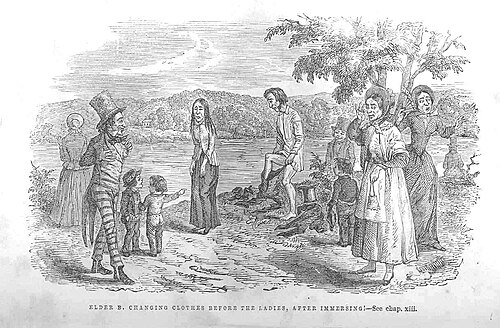
新しく改宗した人にとって、洗礼を受けると地元のバプテスト教会の会員として登録されるのが一般的です (ただし、一部の教会では、教会員になるための追加の必須ステップとして「新会員クラス」を採用しています)。[引用が必要]
再洗礼に関する一般的な規則は次のとおりです: [引用が必要]
- 浸礼以外の洗礼は有効とは認められず、浸礼による再洗礼が必要である。
- 他の宗派における浸礼による洗礼は、その人がイエス・キリストへの信仰を告白した後に行われた場合、有効とみなされることがある(ただし、独立バプテスト派などのより保守的なグループでは、非バプテスト派の教会で行われた場合、地元の会衆によって再洗礼が要求されることがある。また、極端な場合には、独立バプテスト派の会衆ではないバプテスト派の教会で行われた場合でも再洗礼が要求されることがある)。
新生児には、子授けと呼ばれる儀式があります。[191]
南北戦争前の テネシー州メソジスト 巡回牧師で新聞発行者のウィリアム・G・ブラウンローは、 1856年に出版した著書『鉄の車輪の調査、あるいは偽のスポークの抽出、そして墓場の長老とその建築者の展示』の中で、米国で見られるバプテスト教会で行われていた浸礼は「洗礼者ヨハネからの正規の継承ではなく、老ジーク・ホリマンと彼の真の仲間である[ロジャー]ウィリアムズ氏から」広がったと述べている。1639年にホリマンとウィリアムズは最初に互いに浸礼を施し、その後ロードアイランド州プロビデンスにあるイギリス領アメリカ初のバプテスト教会の他の10人の信者に浸礼を施した。[192]
キリスト教会
キリスト教会における洗礼は、全身浸漬によってのみ行われ、[193] : 107 [194] : 124 これは、浸す、浸す、沈める、または飛び込むことを意味するコイネーギリシャ語の動詞baptizoに基づいています。 [195] [196] : 139 [197] : 313–14 [198] : 22 [199] : 45–46 水没は、他の洗礼方法よりも、イエスの死、埋葬、復活に近いものと考えられています。[195] [196] : 140 [197] : 314–16 キリスト教会は、歴史的に浸漬は1世紀に使用された方法であり、後に浸漬が不可能な場合に二次的な方法として注ぐことと振りかけることが出現したと主張しています。[196] : 140 時が経つにつれ、これらの二次的な洗礼法が浸礼に取って代わるようになった。[196] : 140 精神的に信仰と悔い改めができる者だけが洗礼を受ける(つまり、幼児洗礼は新約聖書に前例がないため行われていない)。[194] : 124 [195] [197] : 318–19 [200] : 195
キリスト教会は歴史的に、復興運動のさまざまな分派の中で洗礼に関して最も保守的な立場をとっていて、浸礼による洗礼は改宗の必要な一部であると理解していた。[116] : 61 最も重要な意見の相違は、洗礼の有効性のために洗礼の役割を正しく理解することがどの程度必要であるかということに関係していた。[116] : p.61 デイビッド・リップスコムは、信者が神に従いたいという願いから洗礼を受けたのであれば、たとえその人が救いにおいて洗礼が果たす役割を完全に理解していなくても、その洗礼は有効であると主張した。[116] : 61 オースティン・マクギャリーは、有効であるためには、改宗者も洗礼は罪の赦しのためであることを理解しなければならないと主張した。[116] : 62 マクギャリーの見解は20世紀初頭に主流となったが、リップスコムが主張したアプローチが完全に消えることはなかった。[116] : 62 そのため、キリスト教会では、改宗者、たとえ他の教会で浸礼による洗礼を受けた者であっても、浸礼による再洗礼を要求するのが一般的である。[要出典]
最近では、国際キリスト教会の台頭により、この問題を再検討する人も現れている。[116] : 66
キリスト教会は一貫して、洗礼において信者は信仰と服従において神に人生を捧げ、神は「キリストの血の功績によって人を罪から清め、その人の状態を異邦人から神の国の市民へと真に変えてくださる」と教えています。洗礼は人間の行いではなく、神だけが行える行いを神が行う場です。[116] : 66 洗礼は功績ある行いというよりはむしろ受動的な信仰の行為です。それは「人が神に捧げるものが何もないという告白です。」[117] : 112 キリスト教会は洗礼を「聖礼典」とは表現していませんが、洗礼に対する彼らの見解は正当に「聖礼典的」と表現することができます。[116] : 66 [198] : 186 彼らは、洗礼の力は水や洗礼行為そのものから来るのではなく、洗礼を手段として使うことを選んだ神から来るものだと考え、[198] : 186 洗礼は単なる改宗の象徴ではなく、改宗の過程の不可欠な部分であると理解しています。[198] : 184
最近の傾向は、洗礼の変容的側面を強調することです。洗礼を単に法的な要件や過去に起こったことのしるしとして説明する代わりに、「信者を『キリストの中』に置く出来事であり、そこで神は継続的な変容の働きをなさる」とみなされています。[116] : 66 宗派主義を避けるために洗礼の重要性を軽視する少数派もありますが、より広い傾向は、「洗礼に関する聖書の教えの豊かさを再検討し、キリスト教における洗礼の中心的かつ不可欠な位置を強化する」ことです。[116] : 66
バプテストの中には、洗礼は救済に不可欠な要素であるという信念から、キリスト教会が洗礼による再生の教義を支持していると考える者もいる。[201]しかし、キリスト教会の信者はこれを拒否し、信仰と悔い改めは必要であり、罪の清めは神の恵みによるキリストの血によるものであるため、洗礼は本質的に救済の儀式ではないと主張している。[196] : 133 [201] [202] : 630–31 むしろ、彼らは聖書の一節を指摘する傾向がある。その一節では、ペテロは洗礼をノアの洪水にたとえて、「同じように、洗礼は今や私たちも救うのです」と断言しているが、その際、洗礼は「肉の汚れを除くことではなく、神に対する正しい良心の応答である」と補足的に明確にしている(ペテロ第一 3:21)。[203]キリスト教会の著者の一人は、信仰と洗礼の関係を次のように説明しています。「信仰は人が神の子である理由であり、洗礼は人がキリストに組み入れられ、神の子となる時である」(強調は出典)。 [200] : 170 洗礼は、救いを得るための「行為」ではなく、信仰と悔い改めの告白的な表現として理解されています。[ 200] : 179–82
ルター派
ルーテル派キリスト教では、洗礼は魂を再生させる秘跡である。[204]洗礼を受けると、人は聖霊を受け、教会の一員となる。[204]マルティン・ルターの小教理問答によれば、洗礼に力を与えるのは「水の中に、そして水とともに」の神の言葉と命令であり、「神の言葉と約束が宣言しているように、罪の赦しをもたらし、死と悪魔から解放し、これを信じるすべての人に永遠の救いを与える」。[205]ルーテル神学では、洗礼は、洗礼者が律法に従って行う行為ではなく、むしろ「水にしがみつく」信仰によって受ける神の行為であると考えられている。[206]
メソジズム
.jpg/500px-Baptistry_(United_Methodist_Church_of_the_Saviour).jpg)
メソジストの宗教条項は、洗礼に関して次のように教えている。[207]
洗礼は信仰告白のしるしであり、洗礼を受けていない人々とキリスト教徒を区別する印であるだけでなく、再生や新生のしるしでもあります。幼児の洗礼は教会で保持されるべきです。[207]
洗礼は恩寵を与えるものであるが、メソジストはイエス・キリストを個人的に受け入れること(最初の恩寵の働き)が救済に不可欠であると教える。[208] [209]二番目の恩寵の働きである完全な聖化において、信者は原罪から清められ、聖化される。[210] [211]このように、メソジストの伝統では、聖霊による洗礼は二番目の恩寵の働きである完全な聖化(キリスト教の完全性)を指している。[31]
メソジスト教会では、洗礼は目に見える教会への入信の秘跡です。[212]ウェスレー派の契約神学では、さらに洗礼は恵みの契約のしるしであり印であると教えています。[213]
したがって、この偉大な新しい契約の祝福において、洗礼は際立ったしるしであり、洗礼の執行方法、すなわち洗礼を受けた対象に上から水を注ぐことによって、聖霊の「注ぎ出し」、「聖霊の降臨」、「聖霊の人々の「上への」降臨を象徴しました。また、印として、または確認のしるしとして、洗礼は割礼に相当します。[213]
メソジストは、聖三位一体の名において「浸礼、散布、注ぎ」の3つの洗礼方法を有効であると認めている。[214]
モラヴィア派
モラヴィア教会は、洗礼はしるしであり印であると教えており、浸礼、散布洗礼、浸出洗礼の3つの洗礼形式を有効と認めている。[215]
改革派プロテスタント
改革派の洗礼神学では、洗礼は主に、神が洗礼を受けた者にキリストとの結合とそのすべての恩恵を提供するとみなされている。この提供は、洗礼を受けた人が信仰をもって受け入れなくても、そのままであると信じられている。 [216]改革派の神学者は、聖霊が洗礼で意味される約束を実現すると信じている。[217]改革派の伝統のほぼすべてにおいて、洗礼は、後に実を結ぶことになる信仰を実現させることによって、信仰を持たない幼児にさえも再生をもたらすと考えられている。 [218]また、洗礼は、目に見える教会と恵みの契約に人を入会させる。[219]洗礼は、旧約聖書で恵みの契約への入会の儀式とみなされている割礼の代わりと見なされている。 [220]
改革派キリスト教徒は、洗礼を適切に行うために水に浸す必要はなく、水を注いだり振りかけたりすることは許容されると信じている。[221]改革派教会では、任命された聖職者だけが洗礼を執行することが許されており、緊急洗礼は認められていないが、聖職者以外が行う洗礼は一般的に有効とみなされている。[222]改革派教会は、ローマカトリック教会の洗礼式を拒否する一方で、同教会で行われた洗礼の有効性を認めており、再洗礼は行わない。[223]
ユナイテッドプロテスタント
カナダ合同教会、北インド教会、パキスタン教会、南インド教会、オランダプロテスタント教会、オーストラリア合同教会、日本基督教団などの合同プロテスタント教会では、洗礼は聖礼典である。[224]
カトリック
.jpeg/500px-Bautizo_(68227747).jpeg)
カトリックの教えでは、洗礼は「実際に受けるか、少なくとも望むことによって救済されるために必要」であるとされている。[225]カトリックの規律では、洗礼の儀式は助祭、司祭、または司教によって執り行われる必要があるが、死の危険などの緊急時には、誰でも合法的に洗礼を施すことができる。この教えは、イエスが「まことに、まことに、あなたに告げます。人は、水と霊とによって生まれなければ、神の国に入ることはできません。」と宣言したヨハネによる福音書に基づいている。 [226]これは1世紀のキリスト教徒の教えと実践にまで遡り、救済と洗礼の関係は、フルドリッヒ・ツヴィングリが洗礼の必要性を否定し、洗礼をキリスト教共同体への入会を認めるしるしに過ぎないとみなすまで、全体として大きな論争の対象にはならなかった。[19]カトリック教会のカテキズムでは、「福音が宣べ伝えられ、この秘跡を求める機会があった人々にとって、洗礼は救いのために必要である」と述べられています。[227]トレント公会議も、第 6 会期の「義認に関する教令」で、洗礼は救いのために必要であると述べられています。 [228]故意に、故意に、悔い改めずに洗礼を拒否する人には、救いの希望はありません。しかし、知識がなければ、「自分のせいではないのにキリストの福音や教会を知らない人でも、神を心から求め、恵みに動かされて、良心の命令によって知っている神の意志を自分の行いによって実行しようと努める人は、救いを得ることができます。」[229]
カトリック教会のカテキズムには、「洗礼は罪とその扇動者である悪魔からの解放を意味するので、洗礼志願者に対して1回以上の悪魔祓いが宣告される」とも記されている。[230]ローマの幼児洗礼典礼では、悪魔祓いの祈りの文言は次の通りである。「全能にして永遠に生きる神よ、あなたはあなたの唯一の息子をこの世に遣わし、悪魔の霊であるサタンの力を追い出し、人間を闇の王国から救い出し、あなたの光の王国の輝きに導くために遣わされました。私たちはこの子のために祈ります。彼(彼女)を原罪から解放し、あなたの栄光の神殿とし、あなたの聖霊を彼(彼女)と共に住まわせてください。私たちの主キリストによって。」[231]
カトリック教会では、洗礼によって原罪もすべての個人的な罪もすべて赦されます。[232]洗礼はすべての罪を清めるだけでなく、新信者を「新しい被造物」、神の養子、「神の性質の共有者」、キリストの一員であり共同相続人、聖霊の神殿にします。一度だけ与えられた洗礼は繰り返すことはできません。人が一度しか生まれないように、洗礼も一度しか受けられません。このため、聖なる教父たちはニカイア信条に「私たちは唯一の洗礼を認めます」という言葉を加えました。[233]洗礼によって神から与えられた聖化の恵み、義認の恵みは、原罪と個人的な実際の罪を消し去ります。[234]
洗礼の力は、罪と罰の両方に関して、人をすべての罪から清めることです。そのため、洗礼を受けた人には、たとえ罪がどんなに大きくても、苦行は課されません。また、洗礼後すぐに死んだとしても、彼らはすぐに永遠の命によみがえるでしょう。[233]

カトリック教会のラテン教会では、 1917年の教会法典の第758条によれば、有効な洗礼には、洗礼者が洗礼を受ける者を水に浸しながら「父と子と聖霊の名において洗礼を授ける」という式文を唱えることが必要である。この接触は、浸漬、「注水」(注ぐ)、「散布」(振りかける)のいずれかである。[148]この式文では「名」が単数形であることが求められ、三位一体の一神教を強調している。[235]ステファノ1世、アンブロシウス、ニコラウス1世は、「父と子と聖霊」の名による洗礼だけでなく、「イエス」の名による洗礼も有効であると宣言したとされている。彼らの言葉の正しい解釈は議論の余地がある。 [50]現在の教会法では、有効性には三位一体の式文と水が必要である。[225] 2020年6月24日の回答で明確にされているように、この式文では「私たちが洗礼を施す」ではなく「私が洗礼を施す」とする必要がある。 [236] 2022年、フェニックス教区は「私たちが洗礼を施す」という表現の使用により「20年以上にわたる何千もの洗礼」が無効になった教区司祭の辞任を受け入れた。 [237]ビザンチン典礼では、この式文は受動態で「神の僕Nは父と子と聖霊の名において洗礼を受ける」とあることに注意されたい。[238]
カトリック信者の両親の子供は、通常、幼児洗礼を受ける。洗礼は、非キリスト教背景からの改宗者や幼児洗礼を受けていない人のために用意された、成人キリスト教入信儀式の一部である。 [239]非カトリック教徒による洗礼は、儀式と水があれば有効であるため、他のキリスト教宗派からの改宗者にはカトリックの洗礼は施されない。
教会は、水による洗礼に相当する2つの洗礼、「血による洗礼」と「願望による洗礼」を認めています。血による洗礼は、洗礼を受けていない人が信仰のために殉教する洗礼であり、願望による洗礼は、洗礼を受ける前に亡くなった洗礼志願者に一般的に適用されます。カトリック教会のカテキズムでは、この2つの形式について説明しています。[240]
教会は、洗礼を受けずに信仰のために死を経験した人々は、キリストのために、そしてキリストと共に死ぬことによって洗礼を受けるという確固たる信念を常に抱いてきました。この血による洗礼は、洗礼への願望と同様に、秘跡ではなく、洗礼の成果をもたらします。
- — 1258
洗礼を受ける前に亡くなった洗礼志願者にとって、洗礼を受けたいという明確な希望と、罪に対する悔い改め、そして愛は、秘跡を通しては受けられなかった救いを保証するものである。
- — 1259
カトリック教会は、キリストの福音と教会について無知だが、真理を求め、理解したとおりに神の意志を行う人々は、洗礼を暗黙のうちに望んでいるとみなされ、救われる可能性があるとしている。「『キリストはすべての人のために死なれ、すべての人は実際、神の同じ運命に召されているので、聖霊はすべての人に、神が知る方法で過越の神秘にあずかる者となる可能性を与えていると考えなければならない。』キリストの福音と教会について無知だが、真理を求め、理解したとおりに神の意志を行うすべての人は救われる可能性がある。そのような人々は、洗礼の必要性を知っていたなら、洗礼をはっきりと望んでいただろうとみなされる。」[241]洗礼を受けていない幼児については、教会は彼らの運命がわからない。「教会は彼らを神の慈悲に委ねることしかできない。」[242]
東方正教

東方正教では、洗礼は、古くて罪深い人を新しくて純粋な人に変え、古い生活、罪、犯した過ちが消えて白紙の状態に戻す秘跡と神秘であると考えられています。ギリシャ正教とロシア正教の伝統では、洗礼を通して人は正教会の正式なメンバーになることでキリストの体と一体になると教えられています。礼拝中、正教会の司祭は使用する水を祝福します。洗礼を受けた人は、三位一体の名において、水に3回完全に浸されます。これは、キリストの磔刑と埋葬に参加することで「古い人」が死に、キリストの復活に参加することでキリストの新しい人生に生まれ変わると考えられています。[243] : 277–278 適切には、新しい名前が与えられ、それがその人の名前になります。[引用が必要]
Babies of Orthodox families are normally baptized shortly after birth. Older converts to Orthodoxy are usually formally baptized into the Orthodox Church, though exceptions are sometimes made. Those who choose to convert from a different religion to Eastern Orthodoxy typically undergo Chrismation, known as confirmation in the Roman Catholic Church.[244]
Properly and generally, the Mystery of Baptism is administered by bishops and other priests; however, in emergencies any Orthodox Christian can baptize.[243]: 278 In such cases, should the person survive the emergency, it is likely that the person will be properly baptized by a priest at some later date. This is not considered to be a second baptism, nor is it imagined that the person is not already Orthodox, but rather it is a fulfillment of the proper form.[citation needed]
The service of baptism in Greek Orthodox (and other Eastern Orthodox) churches has remained largely unchanged for over 1500 years. This fact is witnessed to by Cyril of Jerusalem (d. 386), who, in his Discourse on the Sacrament of Baptism, describes the service in much the same way as is currently in use.[245]
Other groups
Jehovah's Witnesses
Jehovah's Witnesses believe that baptism should be performed by complete immersion (submersion) in water and only when an individual is old enough to understand its significance. They believe that water baptism is an outward symbol that a person has made an unconditional dedication through Jesus Christ to do the will of God. Only after baptism, is a person considered a full-fledged Witness, and an official member of the Christian Congregation. They consider baptism to constitute ordination as a minister.[246]
Prospective candidates for baptism must express their desire to be baptized well in advance of a planned baptismal event, to allow for congregation elders to assess their suitability (regarding true repentance and conversion).[247] Elders approve candidates for baptism if the candidates are considered to understand what is expected of members of the religion and to demonstrate sincere dedication to the faith.[248]
Most baptisms among Jehovah's Witnesses are performed at scheduled assemblies and conventions by elders and ministerial servants, in special pools, or sometimes oceans, rivers, or lakes, depending on circumstances,[249][250][251] and rarely occur at local Kingdom Halls.[252] Prior to baptism, at the conclusion of a pre-baptism talk, candidates must affirm two questions:[253]
- On the basis of the sacrifice of Jesus Christ, have you repented of your sins and dedicated yourself to Jehovah to do his will?
- Do you understand that your dedication and baptism identify you as one of Jehovah's Witnesses in association with God's spirit-directed organization?
Only baptized males (elders or ministerial servants) may baptize new members. Baptizers and candidates wear swimsuits or other informal clothing for baptism, but are directed to avoid clothing that is considered undignified or too revealing.[254][255][256] Generally, candidates are individually immersed by a single baptizer,[254] unless a candidate has special circumstances such as a physical disability.[257] In circumstances of extended isolation, a qualified candidate's dedication and stated intention to become baptized may serve to identify him as a member of Jehovah's Witnesses, even if immersion itself must be delayed.[258] In rare instances, unbaptized males who had stated such an intention have reciprocally baptized each other, with both baptisms accepted as valid.[178] Individuals who had been baptized in the 1930s and 1940s by female Witnesses due to extenuating circumstances, such as in concentration camps, were later re-baptized but still recognized their original baptism dates.[176]
The Church of Jesus Christ of Latter-day Saints

In The Church of Jesus Christ of Latter-day Saints (LDS Church), baptism is recognized as the first of several ordinances (rituals) of the gospel.[259] In Mormonism, baptism has the main purpose of remitting the sins of the participant. It is followed by confirmation, which inducts the person into membership in the church and constitutes a baptism with the Holy Spirit. Latter-day Saints believe that baptism must be by full immersion, and by a precise ritualized ordinance: if some part of the participant is not fully immersed, or the ordinance was not recited verbatim, the ritual must be repeated.[260] It typically occurs in a baptismal font.[citation needed]
In addition, members of the LDS Church do not believe a baptism is valid unless it is performed by a Latter-day Saint one who has proper authority (a priest or elder).[261] Authority is passed down through a form of apostolic succession. All new converts to the faith must be baptized or re-baptized. Baptism is seen as symbolic both of Jesus' death, burial and resurrection[262] and is also symbolic of the baptized individual discarding their "natural" self and donning a new identity as a disciple of Jesus.[263]
According to Latter-day Saint theology, faith and repentance are prerequisites to baptism. The ritual does not cleanse the participant of original sin, as Latter-day Saints do not believe the doctrine of original sin. Mormonism rejects infant baptism[264][265] and baptism must occur after the age of accountability, defined in Latter-day Saint scripture as eight years old.[266][267]
Latter-day Saint theology also teaches baptism for the dead in which deceased ancestors are baptized vicariously by the living, and believe that their practice is what Paul wrote of in Corinthians 15:29. This occurs in Latter-day Saint temples.[268][269]
Freemasonry
Due to tensions between the Roman Catholic Church and Freemasons in France in the aftermath of the French Revolution, French Freemasons developed rituals to replace those of the Church, including baptism. Chrétien-Guillaume Riebesthal's Rituel Maçonnique pour tous les Rites (Masonic Ritual for All Rites),[270] published in Strasbourg in 1826, includes one such baptismal rite.[2] Lodges in Louisiana and Wisconsin performed baptism ceremonies in 1859, though they were widely condemned by their Grand Lodges.
In 1865, Albert Pike, publicly performed a ceremony of Masonic baptism in New York City. The ceremony was greeted with skepticism by many American Masons including Albert Mackey. A ceremony for Masonic baptism was published by Charles T. McClenechan in 1884.[271]
Non-practitioners
Quakers
Quakers (members of the Religious Society of Friends) do not believe in the baptism of either children or adults with water, rejecting all forms of outward sacraments in their religious life. Robert Barclay's Apology for the True Christian Divinity (a historic explanation of Quaker theology from the 17th century), explains Quakers' opposition to baptism with water thus:
I indeed baptize you with water unto repentance; but he that cometh after me is mightier than I, whose shoes I am not worthy to bear; he shall baptize you with the Holy Ghost and with fire.[272] Here John mentions two manners of baptizings and two different baptisms, the one with water, and the other with the Spirit, the one whereof he was the minister of, the other whereof Christ was the minister of: and such as were baptized with the first were not therefore baptized with the second: "I indeed baptize you, but he shall baptize you." Though in the present time they were baptized with the baptism of water, yet they were not as yet, but were to be, baptized with the baptism of Christ.
— Robert Barclay, 1678[273]
Barclay argued that water baptism was only something that happened until the time of Christ, but that now, people are baptised inwardly by the spirit of Christ, and hence there is no need for the external sacrament of water baptism, which Quakers argue is meaningless.[citation needed]
Salvation Army
The Salvation Army does not practice water baptism, or indeed other outward sacraments. William Booth and Catherine Booth, the founders of the Salvation Army, believed that many Christians had come to rely on the outward signs of spiritual grace rather than on grace itself. They believed what was important was spiritual grace itself. However, although the Salvation Army does not practice baptism, they are not opposed to baptism within other Christian denominations.[274]
Hyperdispensationalism
There are some Christians termed "Hyperdispensationalists" (Mid-Acts dispensationalism) who accept only Paul's Epistles as directly applicable for the church today. They do not accept water baptism as a practice for the church since Paul who was God's apostle to the nations was not sent to baptize. Ultradispensationalists (Acts 28 dispensationalism) who do not accept the practice of the Lord's supper, do not practice baptism because these are not found in the Prison Epistles.[275] Both sects believe water baptism was a valid practice for covenant Israel. Hyperdispensationalists also teach that Peter's gospel message was not the same as Paul's.[276] Hyperdispensationalists assert:[citation needed]
- The great commission[277] and its baptism is directed to early Jewish believers, not the Gentile believers of mid-Acts or later.
- The baptism of Acts 2:36–38 is Peter's call for Israel to repent of complicity in the death of their Messiah; not as a Gospel announcement of atonement for sin, a later doctrine revealed by Paul.
Water baptism found early in the Book of Acts is, according to this view,[citation needed] now supplanted by the one baptism[140][non-primary source needed] foretold by John the Baptist.[278][non-primary source needed] Others[who?] make a distinction between John's prophesied baptism by Christ with the Holy Spirit and the Holy Spirit's baptism of the believer into the body of Christ; the latter being the one baptism for today.[citation needed] The one baptism for today, it is asserted,[by whom?] is the "baptism of the Holy Spirit" of the believer into the Body of Christ church.[279][non-primary source needed]
Many in this group[who?] also argue that John's promised baptism by fire is pending,[citation needed] referring to the destruction of the world by fire.[280][non-primary source needed]
Other Hyperdispensationalists[which?] believe that baptism was necessary until mid-Acts.[citation needed]
Debaptism
Most Christian churches see baptism as a once-in-a-lifetime event that can be neither repeated nor undone. They hold that those who have been baptized remain baptized, even if they renounce the Christian faith by adopting a non-Christian religion or by rejecting religion entirely. But some other organizations and individuals are practicing debaptism.[281]
Comparative summary
A comparative summary of the practice of baptism throughout various Christian denominations is given below.[282][verification needed][283][284] (This section does not give a complete listing of denominations, and therefore, it only mentions a fraction of the churches practicing "believer's baptism".)
Baptism of objects

The word "baptism" or "christening" is sometimes used to describe the naming or inauguration of certain objects for use.[335]
Boats and ships
Baptism of Ships: since at least the time of the Crusades, rituals have contained a blessing for ships. The priest asks God to bless the vessel and protect those who sail on it. The ship is usually sprinkled with holy water.[50]
Church bells
The name Baptism of Bells has been given to the blessing of (musical, especially church) bells, at least in France, since the 11th century. It is derived from the washing of the bell with holy water by the bishop, before he anoints it with the oil of the infirm without and with chrism within; a fuming censer is placed under it and the bishop prays that these sacramentals of the church may, at the sound of the bell, put the demons to flight, protect from storms, and call the faithful to prayer.[336]
Dolls
"Baptism of Dolls": the custom of 'dolly dunking' was once a common practice in parts of the United Kingdom, particularly in Cornwall where it has been revived in recent years.[337]
Other initiation ceremonies
Many cultures practice or have practiced initiation rites, with or without the use of water, including the ancient Egyptian, the Hebraic/Jewish, the Babylonian, the Mayan, and the Norse cultures. The modern Japanese practice of Miyamairi is such a ceremony that does not use water. In some, such evidence may be archaeological and descriptive in nature, rather than a modern practice.[citation needed]
Mystery religion initiation rites
Many scholars have drawn parallels between rites from mystery religions and baptism in Christianity. Apuleius, a 2nd-century Roman writer, described an initiation into the mysteries of Isis. The initiation was preceded by a normal bathing in the public baths and a ceremonial sprinkling by the priest of Isis, after which the candidate was given secret instructions in the temple of the goddess. The candidate then fasted for ten days from meat and wine, after which he was dressed in linen and led at night into the innermost part of the sanctuary, where the actual initiation took place, the details of which were secret. On the next two days, dressed in the robes of his consecration, he participated in feasting.[338] Apuleius describes also an initiation into the cult of Osiris and yet a third initiation, of the same pattern as the initiation into the cult of Isis, without mention of a preliminary bathing.[339] The water-less initiations of Lucius, the character in Apuleius's story who had been turned into an ass and changed back by Isis into human form, into the successive degrees of the rites of the goddess was accomplished only after a significant period of study to demonstrate his loyalty and trustworthiness, akin to catechumenal practices preceding baptism in Christianity.[340]
Jan Bremmer has written on the putative connection between rites from mystery religions and baptism:
There are thus some verbal parallels between early Christianity and the Mysteries, but the situation is rather different as regards early Christian ritual practice. Much ink was spilled around 1900 arguing that the rituals of baptism and of the Last Supper derived from the ancient Mysteries, but Nock and others after him have easily shown that these attempts grossly misinterpreted the sources. Baptism is clearly rooted in Jewish purificatory rituals, and cult meals are so widespread in antiquity that any specific derivation is arbitrary. It is truly surprising to see how long the attempts to find some pagan background to these two Christian sacraments have persevered. Secularising ideologies clearly played an important part in these interpretations but, nevertheless, they have helped to clarify the relations between nascent Christianity and its surroundings.[341]
Thus the practice is derivative, whether from Judaism, the Mysteries or a combination (see the reference to Hellenistic Judaism in the Etymology section.)
Gnostic Catholicism and Thelema
The Ecclesia Gnostica Catholica, or Gnostic Catholic Church (the ecclesiastical arm of Ordo Templi Orientis), offers its Rite of Baptism to any person at least 11 years old.[342]
Mandaean baptism

Mandaeans revere John the Baptist and practice frequent baptism (masbuta) as a ritual of purification, not of initiation. They are possibly the earliest people to practice baptism.[26] Mandaeans undergo baptism on Sundays (Habshaba), wearing a white sacral robe (rasta). Baptism for Mandaeans consists of a triple full immersion in water, a triple signing of the forehead with water and a triple drinking of water. The priest (Rabbi) then removes a ring made of myrtle worn by the baptized and places it on their forehead. This is then followed by a handshake (kushta, "hand of truth") with the priest. The final blessing involves the priest laying his right hand on the baptized person's head.[41]: 102 Living water (fresh, natural, flowing water)[41] is a requirement for baptism, therefore can only take place in rivers. All rivers are named Jordan (yardena) and are believed to be nourished by the World of Light. By the river bank, a Mandaean's forehead is anointed with sesame oil (misha) and partakes in a communion of bread (pihta) and water. Baptism for Mandaeans allows for salvation by connecting with the World of Light and for forgiveness of sins.[343][344][345]
Sethian baptism
The Sethian baptismal rite is known as the Five Seals, in which the initiate is immersed five times in running water.[346]
Yazidi baptism

Yazidi baptism is called mor kirin (literally: "to seal"). Traditionally, Yazidi children are baptised at birth with water from the Kaniya Sipî ("White Spring") at Lalish. It essentially consists of pouring holy water from the spring on the child's head three times.[347][348]
Islamic practice of wudu
Many Islamic scholars such as Shaikh Bawa Muhaiyaddeen have compared the Islamic practice of wudu to a baptism.[349] Wudu is a practice that Muslims practice to go from ritual impurity to ritual purity. Ritual purity is required for Salah (praying) and also to hold a physical copy of the Qur’an,[350] and so wudu is often done before salah. However, it is permissible to pray more than one salah without repeating wudu, as long as ritual purity is not broken, for example by using the bathroom.[351]
Another similar purification ritual is ghusl, which takes someone from major ritual impurity (janabah) to lesser ritual impurity, which is then purified by wudu. If one is in a state of janabah, both ghusl and wudu are required if one wants to pray.
Although original sin does not exist in Islam, wudu is widely regarded to remove sins. In a Sahih hadith, Muhammad says "Whenever a man performs his ablution intending to pray and he washes his hands, the sins of his hands fall down with the first drop. When he rinses his mouth and nose, the sins of his tongue and lips fall down with the first drop. When he washes his face, the sins of his hearing and sight fall down with the first drop. When he washes his arms to his elbows and his feet to his ankles, he is purified from every sin and fault like the day he was born from his mother. If he stands for prayer, Allah will raise his status by a degree. If he sits, he will sit in peace."[352]
Baptism in the Yadav community

People of the Yadav community of Hindu religion follow baptism, where it is called Karah Pujan. In this, the person who is being baptized is bathed in boiling Milk. The newborn baby is also included in this process, in which he is bathed with boiling milk and then he is garlanded with flowers.[353][354][355]
See also
- Baptismal font
- Baptism by fire
- Baptistery
- Chrism
- Christifideles
- Consolamentum
- Disciple (Christianity)
- Divine filiation
- Ghusl
- Holy water in Eastern Christianity
- Mikvah
- Misogi
- Prevenient Grace
- Ritual purification
- Theophany
- Water and religion
- Amrit Sanchar, in Sikhism
Notes
- ^ As of 2010[update], out of a total of about 2,100,000,000 Christians, infant baptism is in use in the Catholic Church (1,100,000,000), the Eastern Orthodox Church (225,000,000), most of the 77,000,000 members of the Anglicanism, Lutherans, and others.
- ^ βάπτισμα, βαπτισμός, βαπτίζω, βάπτω. Liddell, Henry George; Scott, Robert; A Greek–English Lexicon at the Perseus Project. "The several Greek words from which the English word baptism has been formed are used by Greek writers (in classical antiquity, in the Septuagint, and in the New Testament) with a great latitude of meaning, including "to make Christian" and "baptisma pyros (baptism of fire)"" — The University of Texas at Austin, College of Liberal Arts, Linguistics Research Center, Indo-European Lexicon, PIE (Proto-Indo-European) Etymon and IE (Indo-European) Reflexes: "baptism" and "baptize", Greek baptein, baptizein, baptos — New Advent, Catholic Encyclopedia: "Baptism": Etymology — Spirit Restoration, Theological Terms: A to B Dictionary: "baptize" Archived September 11, 2010, at the Wayback Machine (scroll down to "baptism") — Online Etymological Dictionary: "baptize" — International Standard Bible Encyclopedia: "baptism" — two parallel online sources, Search God's Word and Eliyah, for "Strong's numbers": Strong's Exhaustive Concordance of the Bible: Greek Lexicon 907 βαπτίζω "baptize"/907 baptizo "baptize", 908 βάπτισμα "baptism"/908 baptisma "baptism", 909 βαπτισμός "baptisms"/909 baptismos "baptisms", and 910 βαπτστἠς "baptist"/910 baptistes "baptist". Archived June 29, 2015, at the Wayback Machine
- ^ Assemblies of God, Church of God of Prophecy, and Church of God in Christ
References
- ^ "baptize (v.)". Online Etymology Dictionary. Douglas Harper of the LNP Media Group. Retrieved March 24, 2023.
- ^ "Baptism". Encyclopædia Britannica.
- ^ "Lumen gentium". www.vatican.va. p. 28. Retrieved May 2, 2023.
- ^ a b c McKim, Donald K. (April 14, 2014). The Westminster Dictionary of Theological Terms, Second Edition: Revised and Expanded. Presbyterian Publishing Corp. p. 27. ISBN 978-1-61164-386-2.
baptism, modes of The manner in which baptism is administered. Main modes of baptism are immersion (dipping or plunging), pouring (affusion), and sprinkling (aspersion).
baptism, triune The practice of sprinkling, pouring, or immersing three times in the act of baptism. This ancient practice emphasized the distinctions of the three members of the Trinity, even as the act of baptism itself was one action that emphasizes the oneness of the Godhead. - ^ Hale, Tom; Thorson, Steve (December 10, 2012). Applied New Testament Bible Commentary. David C. Cook. ISBN 978-1-4347-6642-7.
There are three main methods of baptism: immersion, sprinkling, and pouring. In most churches sprinkling or pouring of water on the head of the recipient is practiced. If infants are baptized, sprinkling or pouring is usually used, although infant immersion has been practiced in the past. For adults, all three methods have been used. Very ill adults or those in unfavorable habitats of the world, such as deserts and ice-locked lands, usually do not receive baptism by immersion. However, in one place or another, all three methods have been practiced since the days of the early church.
- ^ a b "On Triple Immersion Baptism". Classical Christianity. February 22, 2012. Retrieved September 7, 2021.
- ^ Matthew 3:16, Mark 1:9–10, Luke 3:21
- ^ Powell, Mark Allen (2005). Jesus as a figure in history: how modern historians view the man from Galilee (7th pr. ed.). Louisville: Knox. p. 47. ISBN 0-664-25703-8.
- ^ Harrington, Daniel J. (1991). The Gospel of Matthew. Collegeville, MI: Liturgical Press. p. 63. ISBN 0-8146-5803-2.
- ^ Lopez, Kathryn Muller Lopez; et al. (2010). Christianity: a biblical, historical, and theological guide for students (1st ed.). Macon, GA: Mercer University Press. pp. 95–96. ISBN 978-0-88146-204-3.
- ^ Pizzey, Antonia (2019). Receptive Ecumenism and the Renewal of the Ecumenical Movement: The Path of Ecclesial Conversion. Brill Academic Publishers. p. 131. ISBN 978-90-04-39780-4.
Baptism into Christ unites all Christians, despite ther divisions. It is relationship with Christ through baptism, which enables relationship with other Christians. According to Congar, "on the basis of the baptism which incorporates us into Christ and the Word which is our Christian norm, [ecumenism's] aim is to carry out the will and the prayer of Christ, which is that his disciples should be united." The Christological foundation of Spiritual Ecumenism affirms that ecumenism is not our idea or goal, but rather Christ's will and prayer for us. Moreover, Christian unity already exists to some extent among all baptised Christians because of their relationship with Christ. Only through Christ is ecumenism possible. Kasper explains that Spiritual Ecumenism's fundamental Christological basis means that any ecumenical spirituality "will also be a sacramental spirituality." Baptism is "therefore a basic element of ecumenical spirituality."
- ^ "Becoming a Christian: The Ecumenical Implications of Our Common Baptism". World Council of Churches. January 24, 1997. Retrieved September 13, 2020.
- ^ Karttunen, Tomi (June 27, 2023). "Towards Unity in Baptism: Exploring the Current State and Future Possibilities of Ecumenical Recognition". Khazanah Theologia. 5 (2): 109–118. doi:10.15575/kt.v5i2.20036. ISSN 2715-9701.
- ^ Faelli, Rita (2006). Christianity: History, Beliefs, Worship and Celebrations. Blake Education. p. 23. ISBN 9781741641011.
- ^ "Church of England: Weddings, Baptisms & Funerals". Anglican.
- ^ Wootten, Pat (2002). Christianity. Heinemann. p. xiv. ISBN 978-0435336349.
- ^ Hammett, John S. (2019). Biblical Foundations for Baptist Churches: A Contemporary Ecclesiology. Kregel Academic. p. 64. ISBN 978-0-8254-4511-8.
- ^ Haithcox, H. C. (1881). "The Church, Visible and Invisible". The Lutheran Quarterly. Vol. XI. H. C. Neinstedt. p. 503.
- ^ a b c d Cross, Frank Leslie; Elizabeth A. Livingstone (2005). "Baptism". The Oxford Dictionary of the Christian Church. Oxford: Oxford University Press. pp. 151–154. ISBN 0-19-280290-9. OCLC 58998735.
- ^ Cross, Anthony R. (2012). Recovering the Evangelical Sacrament: Baptisma Semper Reformandum. Wipf and Stock Publishers. ISBN 978-1-62032-809-5.
- ^ "Rite for the Baptism of One Child". Catholic liturghy. Archived from the original on July 27, 2018. Retrieved May 21, 2013.
- ^ Paul F. Bradshaw (April 24, 2013). New SCM Dictionary of Liturgy and Worship. Hymns Ancient and Modern. p. 51. ISBN 978-0-334-04932-6.
- ^ Vandiver, Dallas W. (September 10, 2021). Who Can Take the Lord's Supper?: A Biblical-Theological Argument for Close Communion. Wipf and Stock Publishers. p. 289. ISBN 978-1-6667-0313-9.
- ^ a b Samaan, Moses (August 25, 2010). "Who wears the Cross and when?". Coptic Orthodox Diocese of Los Angeles, Southern California, and Hawaii. Retrieved August 18, 2020.
- ^ a b c Konstantopoulos, George D. (September 18, 2017). "All Orthodox Christians are Given a Cross Following Their Baptism to Wear for Life". St. Andrew Greek Orthodox Church. Archived from the original on July 22, 2018. Retrieved August 18, 2020.
- ^ a b c McGrath, James F. (January 23, 2015). The First Baptists, The Last Gnostics: The Mandaeans. Retrieved November 3, 2021 – via YouTube.
- ^ Rudolph, Kurt (1977). "Mandaeism". In Moore, Albert C. (ed.). Iconography of Religions: An Introduction. Vol. 21. Chris Robertson. ISBN 9780800604882.
- ^ Brikhah S. Nasoraia (2012). "Sacred Text and Esoteric Praxis in Sabian Mandaean Religion" (PDF). Archived (PDF) from the original on October 9, 2022.
- ^ Pickett, Joseph P, ed. (2000). "baptism". The American Heritage Dictionary of the English Language (4th ed.). Boston: Houghton Mifflin. ISBN 0-395-82517-2. Archived from the original on August 24, 2007. Retrieved February 24, 2009.
- ^ Scarnecchia, D. Brian (June 2, 2010). Bioethics, Law, and Human Life Issues: A Catholic Perspective on Marriage, Family, Contraception, Abortion, Reproductive Technology, and Death and Dying. Scarecrow Press. ISBN 978-0-8108-7422-0.
- ^ a b "Guidelines: The UMC and the Charismatic Movement". The United Methodist Church. 2012. Archived from the original on July 31, 2019. Retrieved July 31, 2019.
The Methodists were also first to coin the phrase baptism of the Holy Spirit as applied to a second and sanctifying grace (experience) of God. (Cf. John Fletcher of Madeley, Methodism's earliest formal theologian.) The Methodists meant by their "baptism" something different from the Pentecostals, but the view that this is an experience of grace separate from and after salvation was the same.
- ^ Scobie, Charles Hugh Hope (1964). "it+is+used+of+ritual+washing" John the Baptist. SCM Press. p. 92.
- ^ Unger, Merrill F (2004). The Baptism & Gifts of the Holy Spirit. Moody Press. p. 34. ISBN 978-0-8024-0467-1.
- ^ Chafer, Lewis Sperry (1993). Systematic Theology. Kregel. p. 149. ISBN 978-0-8254-2340-6.
- ^ Mallory, JP; Adams, Douglas Q. (2006). The Oxford Introduction to Proto-Indo-European and the Proto-Indo-European World. Oxford University Press. pp. 403, 532.
- ^ "Baptize". Online Etymology Dictionary.
- ^ Watkins, Calvert (2000). The American Heritage Dictionary of Indo-European Roots. Houghton Mifflin Harcourt. ISBN 978-0-618-08250-6.
- ^ "Baptism". International Standard Bible Encyclopedia.
- ^ Kittel, Gerhard, ed. (1964). Theological Dictionary of the New Testament. Vol. 1. Translated by Bromiley, Geoffrey. Grand Rapids, MI, USA: Wm. B. Eerdmans Publishing Company. pp. 529–530.
- ^ Everett Ferguson, Baptism in the Early Church: History, Theology, and Liturgy in the First Five Centuries, Eerdmans 2009, pp68-71
- ^ a b c Drower, Ethel Stefana. The Mandaeans of Iraq and Iran. Oxford at the Clarendon Press, 1937.
- ^ Buckley, Jorunn Jacobsen. The Mandaeans: Ancient Texts and Modern People. Oxford University Press, 2002.p4
- ^ "Sacrament | religion | Britannica". www.britannica.com. Retrieved May 2, 2023.
- ^ "David Guzik's Commentary". StudyLight.org. Acts 19:1–7. Retrieved May 2, 2023.
- ^ Schmithals, Walter (1997). The Theology of the First Christians. Westminster John Knox Press. p. 215. ISBN 978-0-66425615-9. Retrieved April 13, 2014.
- ^ Slade, Darren M. (August 15, 2014). "The Early Church's Inconsequential View of the Mode of Baptism". American Theological Inquiry. 7 (2): 21–34.
- ^ Old, Hughes Oliphant (1992). The Shaping of the Reformed Baptismal Rite in the Sixteenth Century. Grand Rapids, MI: William B. Eerdmans Publishing Company. pp. 3, 7. ISBN 978-0802824899.
- ^ Old, Hughes Oliphant (1992). The Shaping of the Reformed Baptismal Rite in the Sixteenth Century. Eerdmans. pp. 7–8. ISBN 978-0802836991.
- ^ Crow, Madison; Zori, Colleen; Zori, Davide (2020). "Doctrinal and Physical Marginality in Christian Death: The Burial of Unbaptized Infants in Medieval Italy". Religions. 11 (12): 678. doi:10.3390/rel11120678.
- ^ a b c d Fanning, William (1907). "Baptism". Catholic Encyclopedia. New York City: Robert Appleton Company. Archived from the original on February 28, 2009. Retrieved February 24, 2009.
- ^ "Baptism and Its Purpose". Lutheran Church–Missouri Synod. Archived from the original on February 6, 2009. Retrieved February 24, 2009.
- ^ Wernham, R. B. (November 1968). The New Cambridge Modern History: Volume 3, Counter-Reformation and Price Revolution, 1559-1610. CUP Archive. ISBN 978-0-521-04543-8.
- ^ Lightfoot, J.B.; Tomkins, Stephen; Graves, Dan. "#101: The Didache". Christian History Institute. Retrieved September 7, 2021.
- ^ "immersion". Online Etymology Dictionary. Retrieved August 14, 2010.
- ^ Piper, John (January 1986). "1689 Baptist Catechism". Retrieved February 3, 2010.
- ^ a b Cross, Frank Leslie; Elizabeth A. Livingstone (2005). "Immersion". The Oxford Dictionary of the Christian Church. Oxford and New York: Oxford University Press. p. 827. ISBN 0-19-280290-9. OCLC 58998735.
- ^ a b "Study published on the website of Pinehurst United Methodist Church" (PDF). Archived from the original (PDF) on October 21, 2013. Retrieved April 13, 2014.
- ^ In scientific contexts the two words are often understood as mutually exclusive. Examples are found in mathematics (see Ralph Abraham, Jerrold E. Marsden, Tudor S. Ra iu, Manifolds, Tensor Analysis, and Applications, p. 196 and Klaus Fritzsche, Hans Grauert, From Holomorphic Functions to Complex Manifolds, p.168), in medicine (Effect of immersion, submersion, and scuba diving on heart rate variability), and language learning (Immersion in a Second Language in School). Archived December 6, 2014, at the Wayback Machine
- ^ "Catholic Encyclopedia, article Baptismal Font". Newadvent.org. Retrieved April 13, 2014.
- ^ "Definition of SUBMERGE". www.merriam-webster.com. Retrieved May 2, 2023.
- ^ Ferguson, Everett (March 23, 2009). Baptism in the Early Church: History, Theology, and Liturgy in the First Five Centuries. Wm. B. Eerdmans Publishing. p. 860. ISBN 978-0-8028-2748-7.
- ^ George, Maya (2009). Faith and Philosophy of Christianity. Gyan Publishing House. ISBN 978-81-7835-720-1.
- ^ Williams, Peter W. (2008). America's Religions: From Their Origins to the Twenty-first Century. University of Illinois Press. ISBN 978-0-252-07551-3.
- ^ a b Liddell & Scott: entry βαπτίζω: "βαπτ-ίζω, A. dip, plunge, 'ξίφος εἰς σφαγήν' J.BJ2.18.4; 'σπάθιον εἰς τὸ ἔμβρυον' Sor.2.63:—Pass., of a trephine, Gal.10.447; ... 2. draw wine by dipping the cup in the bowl, Aristopho 14.5; 'φιάλαις β. ἐκ . . κρατήρων' ..." The usage examples quoted here mean "a sword into his throat"; "a sword into the foetus"; "draw with cups from bowls"
- ^ Theological dictionary of the New Testament. 1964–c1976. Vols. 5–9 edited by Gerhard Friedrich. Vol. 10 compiled by Ronald Pitkin. (G. Kittel, G. W. Bromiley & G. Friedrich, Ed.) (electronic ed.) (1:529–530). Grand Rapids, MI: Eerdmans.
- ^ 'In the Sept.: 2 Kgs. 5:13, 14 we have loúō (3068), to bathe and baptízomai. See also Leviticus 11:25, 28, 40, where plúnō (4150), to wash clothes by dipping, and loúō (3068), to bathe are used. In Numbers 19:18, 19, báphō, to dip, and plúnō, to wash by dipping are used', Zodhiates, S. (2000, c1992, c1993). The Complete Word Study Dictionary : New Testament (electronic ed.) (G908). Chattanooga, TN: AMG Publishers.
- ^ 'In the LXX βάπτειν (βαπτίζειν occurs only at 4 Βασ. 5:14) as a rendering of טָבַל, "to dip," is used for the dipping of the morsel in wine at Ru. 2:14, of feet in the river at Jos. 3:15, of the finger in blood in the Torah of sacrifices at Lv. 4:6, 17 etc., of the dipping of unsanctified vessels in water in the laws of purification at Lv. 11:32 (בא hiph). In the latter case, however, πλύνω (כבס) and λούομαι (רחץ) are more common, as in Lv. 15:11, 13 etc. The sevenfold dipping of Naaman (2 K. 5:14) perhaps suggests sacramental ideas and illustrates the importance of the Jordan. In the later Jewish period טבל (b. Ber., 2b of the bathing of priests; Joma, 3, 2ff. etc.) and βαπτίζειν become tech. terms for washings to cleanse from Levitical impurity, as already in Jdt. 12:7; Gk. Sir. 31(34):30. The טְבִילָה of proselytes belongs to this context.', Theological dictionary of the New Testament. 1964–c1976. Vols. 5–9 edited by Gerhard Friedrich. Vol. 10 compiled by Ronald Pitkin. (G. Kittel, G. W. Bromiley & G. Friedrich, Ed.) (electronic ed.) (1:535). Grand Rapids, MI: Eerdmans.
- ^ 'βαπτίζω+ V 0-1-1-0-2=4 2 Kgs 5,14; Is 21,4; Jdt 12,7; Sir 34,25 M to dip oneself 2 Kgs 5,14; to wash Jdt 12,7 ἡ ἀνομία με βαπτίζει I am imbued with transgression Is 21,4 Cf. DELLING 1970, 243–245; →NIDNTT; TWNT', Lust, J., Eynikel, E., & Hauspie, K. (2003). A Greek–English Lexicon of the Septuagint : Revised Edition. Deutsche Bibelgesellschaft: Stuttgart.
- ^ 'In Mark 7:3, the phrase "wash their hands" is the translation of níptō (3538), to wash part of the body such as the hands. In Mark 7:4 the verb wash in "except they wash" is baptízomai, to immerse. This indicates that the washing of the hands was done by immersing them in collected water. See Luke 11:38 which refers to washing one's hands before the meal, with the use of baptízomai, to have the hands baptized.', Zodhiates, S. (2000, c1992, c1993). The Complete Word Study Dictionary : New Testament (electronic ed.) (G907). Chattanooga, TN: AMG Publishers.
- ^ Dyrness, William A., ed. (2008). Global Dictionary of Theology. Intervarsity Press. p. 101. ISBN 978-0-8308-2454-0. Retrieved April 13, 2014.
- ^ Matthew 15:1–2
- ^ Mark 7:3–4
- ^ A. A. Hodge, Outlines of Theology 1992 ISBN 0-85151-160-0 ISBN 978-0-85151-160-3 quoted in Bremmer, Michael (September 7, 2001). "The Mode of Baptism". Archived from the original on January 26, 2002. Retrieved February 25, 2009.
- ^ Naumann, Paul; Naumann, Bertram (2006). "The Sacrament of Baptism" (PDF). Learn From Me. Church of the Lutheran Confession. Archived (PDF) from the original on February 25, 2009. Retrieved February 24, 2009.
- ^ Brom, Robert H. (August 10, 2004). "Baptism: Immersion Only?". Catholic Answers. Archived from the original on March 14, 2009. Retrieved February 24, 2009.
- ^ Drachman, Bernard; Kaufmann Kohler. "Ablution". In Cyrus Adler (ed.). Jewish Encyclopedia.
- ^ Mark 7:3
- ^ Mark 7:4
- ^ a b c 'Washing or ablution was frequently by immersion, indicated by either baptízō or níptō (3538), to wash. In Mark 7:3, the phrase 'wash their hands' is the translation of níptō (3538), to wash part of the body such as the hands. In Mark 7:4 the verb wash in 'except they wash' is baptízomai, to immerse. This indicates that the washing of the hands was done by immersing them in collected water. See Luke 11:38 which refers to washing one's hands before the meal, with the use of baptízomai, to have the hands baptized.", Zodhiates, S. (2000, c1992, c1993). The Complete Word Study Dictionary : New Testament (electronic ed.) (G907). Chattanooga, TN: AMG Publishers.
- ^ "LSJ: βαπτίζω". Perseus.tufts.edu. Retrieved April 13, 2014.
- ^ 'Despite assertions to the contrary, it seems that baptizō, both in Jewish and Christian contexts, normally meant "immerse", and that even when it became a technical term for baptism, the thought of immersion remains. The use of the term for cleansing vessels (as in Lev. 6:28 Aquila [cf. 6:21]; cf. baptismos in Mk. 7:4) does not prove the contrary, since vessels were normally cleansed by immersing them in water. The metaphorical uses of the term in the NT appear to take this for granted, e.g. the prophecy that the Messiah will baptise in Spirit and fire as a liquid (Matt. 3:11), the "baptism" of the Israelites in the cloud and the sea (1 Cor. 10:2), and in the idea of Jesus' death as a baptism (Mk. 10:38f. baptisma; Lk. 12:50; cf. Ysebaert, op. cit., 41 ff.).', Brown, C. (1986). Vol. 1: New international dictionary of New Testament theology (144)
- ^ Mark 7:4
- ^ 'Mark 7:4 [v.l. in v. 8]; here βαπτίσωνται appears in place of ῥαντίσωνται in Koine D Θ pl, giving βαπτίζω the meaning of βάπτω', Balz, H. R., & Schneider, G. (1990–c1993). Exegetical dictionary of the New Testament. Translation of: Exegetisches Worterbuch zum Neuen Testament. (1:195). Grand Rapids, Mich.: Eerdmans.
- ^ 'Βάπτω dip, immerse', Balz, H. R., & Schneider, G. (1990–c1993). Exegetical dictionary of the New Testament. Translation of: Exegetisches Worterbuch zum Neuen Testament. (1:195). Grand Rapids, Mich.: Eerdmans.
- ^ 'βάπτω; ἐμβάπτω: to dip an object in a liquid—to dip in., Louw, J. P., & Nida, E. A. (1996, c1989). Greek-English lexicon of the New Testament: Based on semantic domains (electronic ed. of the 2nd edition.) (1:522). New York: United Bible societies.
- ^ "In the LXX βάπτειν...is used for the dipping of the morsel in wine at Ju. 2:14, ...of the finger in blood in the Torah of sacrifices at Lv. 4:6, 17 etc.", Theological dictionary of the New Testament. 1964–c1976. Vols. 5–9 edited by Gerhard Friedrich. Vol. 10 compiled by Ronald Pitkin. (G. Kittel, G. W. Bromiley & G. Friedrich, Ed.) (electronic ed.) (1:535). Grand Rapids, MI: Eerdmans.
- ^ οἱ βαπτιζόμενοι ὑπὲρ τῶν νεκρῶν
- ^ Peter J. Leithart The Baptized Body 2007 p136 "Paul uses a distancing third person—"they" baptize for the dead. Why not "we"? Paul might well be referring to Jewish practices. Under the ceremonial laws of Torah, every washing was a washing "for the dead" (cf. Num. 19). Uncleanness was a ceremonial form of death, and through washings of various sorts the unclean dead were restored to life in fellowship with.."
- ^ "masculine noun baptismos 4x NT uses". Blueletterbible.org. Retrieved April 13, 2014.
- ^ Philippe Wolff Baptism: The Covenant and the Family 2009 p45 "This word occurs but four times in the Septuagint, and in no case with the Baptist meaning. 1st. "Judith baptized herself in a fountain of water, by the camp." (Judith xii. 7.) She was then purifying herself from her uncleanness."
- ^ Jonathan David Lawrence Washing in Water: Trajectories of Ritual Bathing in the Hebrew Bible and Second Temple Literature (Atlanta: Society of Biblical Literature, 2006), p294
- ^ ἐὰν μὴ βαπτίσωνται οὐκ ἐσθίουσιν
- ^ Bromiley, Geoffrey William (1979). The International Standard Bible Encyclopedia. Wm. B. Eerdmans Publishing. ISBN 978-0-8028-3781-3.
- ^ a b Arndt, W., Danker, F. W., & Bauer, W. (2000). A Greek-English Lexicon of the New Testament and Other Early Christian Literature, (3rd ed.) (165). Chicago: University of Chicago Press
- ^ a b c Friberg, T., Friberg, B., & Miller, N. F. (2000). Vol. 4: Analytical Lexicon of the Greek New Testament. Baker's Greek New Testament Library (87). Grand Rapids, Mich.: Baker Books.
- ^ Theological Dictionary of the New Testament. 1964–c1976. Vols. 5–9 edited by Gerhard Friedrich. Vol. 10 compiled by Ronald Pitkin. (G. Kittel, G. W. Bromiley & G. Friedrich, Ed.) (electronic ed.) (1:545). Grand Rapids, MI: Eerdmans.
- ^ Zodhiates, S. (2000, c1992, c1993). The Complete Word Study Dictionary : New Testament (electronic ed.) (G908). Chattanooga, TN: AMG Publishers.
- ^ Matthew 3:7, Matthew 21:25; Mark 1:4, Mark 11:30; Luke 3:3, Luke 7:29, Luke 20:4; Acts 1:22, Acts 10:37, Acts 13:24, Acts 18:25, Acts 19:3–4)
- ^ Romans 6:4, Ephesians 4:5, 1 Peter 3:21
- ^ Leppä, Outi (2005). The Making of Colossians. Vandenhoeck & Ruprecht. p. 137. ISBN 978-3-525-53629-2. Retrieved April 13, 2014.
- ^ Matthew 20:22–23, Mark 10:38–39, Luke 12:50
- ^ "Seite nicht gefunden :: bibelwissenschaft.de". www.bibelwissenschaft.de (27th ed.). Retrieved May 2, 2023.
- ^ LSJ "baptisis".
- ^ LSJ "baptismos".
- ^ "Flavius Josephus, Antiquitates Judaicae, *ta/de e)/nestin e)n th=| ih tw=n *)iwsh/pou i(storiw=n th=s *)ioudai+kh=s a)rxaiologi/as., Whiston chapter 5, Whiston section 2". www.perseus.tufts.edu. Retrieved May 2, 2023.
- ^ "Flavius Josephus, Antiquities of the Jews, Book 18, Whiston chapter 5, Whiston section 2". www.perseus.tufts.edu. Retrieved May 2, 2023.
- ^ James D. G. Dunn Jesus remembered 2003 p256
- ^ "The Woman Deacon's role at Baptism". Wijngaards Institute for Catholic Research. August 27, 2015. Retrieved June 23, 2022.
- ^ Colossians 3:9
- ^ Ephesians 4:22
- ^ Song of Songs 5:3
- ^ Cyril of Jerusalem, Catechetical Lecture 20 (On the Mysteries. II. of Baptism) Romans 6:3–14 http://www.newadvent.org/fathers/310120.htm
- ^ a b John 3:5
- ^ "Baptismal Regeneration and Bible Salvation - Doctrine - Wholesome Words". www.wholesomewords.org. Retrieved July 19, 2022.
- ^ Traill, Dr Ian. Ten Christian Foundational Studies for new converts - Teachers book: Teacher's book for Discipleship program one. Traillblazer Bookshop. ISBN 978-1-921978-34-0.
- ^ a b c d e f g h i j k l m Foster, Douglas Allen; Dunnavant, Anthony L. (2004). "entry on Baptism". The Encyclopedia of the Stone–Campbell Movement: Christian Church (Disciples of Christ), Christian Churches/Churches of Christ, Churches of Christ. Wm. B. Eerdmans. ISBN 978-0-8028-3898-8.
- ^ a b c Harold Hazelip, Gary Holloway, Randall J. Harris, Mark C. Black, Theology Matters: In Honor of Harold Hazelip: Answers for the Church Today, College Press, 1998, ISBN 978-0-89900-813-4, 368 pages
- ^ "Mystici corporis Christi (full text in an English translation)". Archived from the original on July 1, 2010. Retrieved September 9, 2010.
- ^ Inbody, Tyron (2005). The Faith of the Christian Church. Grand Rapids, MI: William B. Eerdmans. p. 299.[ISBN missing]
- ^ Erickson, Millard J. (August 11, 2015). Introducing Christian Doctrine. Baker Academic. ISBN 978-1-4412-2254-1.
- ^ Nicodemos the Hagiorite. "Concerning Thoughts". Exomologetarion.
- ^ Overbeck, T. Jerome (1998). Ancient Fonts, Modern Lessons. Liturgy Training Publications. p. 18. ISBN 978-1-56854-091-7.
New baptismal fonts, therefore, should be constructed to allow for the immersion of infants, at least, ...
- ^ a b "Holy Baptism". The Church of England.
- ^ a b "Baptism". Episcopal Church.
- ^ Tertullian. "Of the Persons to Whom, and the Time When, Baptism is to Be Administered". In Philip Schaff (ed.). Ante-Nicene Fathers.
- ^ a b Beal, John P.; Coriden, James A.; Green, Thomas Joseph (2000). New Commentary on the Code of Canon Law. Paulist Press. ISBN 978-0-8091-0502-1.
- ^ Judd, Willard (1845). The Memoirs and Remains of Rev. Willard Judd: Embracing a Review of Professor Stuart, a Compilation of Miscellanies, and a Biographical Sketch, by Orrin B. Judd, with an Introductory Essay, by Spencer H. Cone. Lewis Colby.
- ^ Romans 6:3–4
- ^ Kennedy, Rodney Wallace; Hatch, Derek C. (August 27, 2013). Gathering Together: Baptists at Work in Worship. Wipf and Stock Publishers. ISBN 978-1-61097-758-6.
- ^ a b Acts 2:38
- ^ "Baptism, Eucharist and Ministry—Faith and Order Paper No. 111". World Council of Churches. 1982. Archived from the original on July 9, 2008. Retrieved March 1, 2009.
- ^ Acts 2:42
- ^ Acts 2:45
- ^ 1 Peter 1:3–21
- ^ 1 Peter 1:22–23
- ^ 1 Peter 2:2–3
- ^ 1 Peter 2:4–10
- ^ 1 Peter 2:11ff
- ^ 1 Peter 1:2
- ^ a b 1 Corinthians 12:13
- ^ "Becoming a Christian: The Ecumenical Implications of Our Common Baptism". World Council of Churches. 1997. Archived from the original on May 9, 2007. Retrieved May 13, 2007.
- ^ Bruno, Luciano (2015). An Ecumenical Proposal About The Sacraments. pp. 16–17.
- ^ The Great Book of Needs: Expanded and Supplemented (Volume 1): The Holy Mysteries. Translated by Saint Tikhon's Monastery. South Canaan, Pennsylvania: Saint Tikhon's Seminary Press (published 2000). 1998. p. 37. ISBN 9781878997562.
- ^ Wilks, John (April 30, 2013). "The New Evangelical Subordinationism? Perspectives on the Equality of God the Father and God the Son Dennis Jowers and H. Wayne House (eds.) Eugene: Pickwick, 2012. 464pp. pb. $51, ISBN 978-1-60899-852-4". Evangelical Quarterly. 85 (2): 164–165. doi:10.1163/27725472-08502010. ISSN 0014-3367.
- ^ a b "William Fanning, "Baptism" in Catholic Encyclopedia (New York 1907)". Newadvent.org. Retrieved April 13, 2014.
- ^ "Catechism of the Catholic Church, 1256". Vatican.va. Retrieved April 13, 2014.
- ^ "On the Intention Required in the Minister of the Sacraments". Archived from the original on January 30, 2014. Retrieved April 13, 2014.
- ^ a b Peters, Edward N. (2001). The 1917 Or Pio-Benedictine Code of Canon Law: In English Translation with Extensive Scholarly Apparatus. Ignatius Press. p. 280. ISBN 978-0-89870-831-8.
- ^ Bowker, John (1999). The Oxford Dictionary of World Religions. Oxford: Oxford University Press. ISBN 0-19-866242-4. OCLC 60181672.[page needed]
- ^ "Baptisms mutually recognized in European and American churches". World Council of Churches. April 17, 2014. Retrieved March 29, 2021.
- ^ "Code of Canon Law - IntraText". November 12, 2020. Archived from the original on November 12, 2020.
- ^ "Code of Canon Law – IntraText". www.vatican.va. Retrieved April 19, 2018.
- ^ Cracknell, Kenneth; White, Susan J. (2005). An Introduction to World Methodism. Cambridge University Press. p. 193. ISBN 978-0521818490.
- ^ Yrigoyen, Charles Jr. (2014). T&T Clark Companion to Methodism. A&C Black. p. 263. ISBN 978-0567290779.
Methodists historically do not rebaptize unless the ecumenical formula was not used or another major impediment calls into question the adequacy of an earlier rite. When questions arise of a very grievous nature, there is the possibility of conditional baptism using the words 'If you are not already baptized, I baptize you in the name, etc.'
- ^ Code of Canon Law, canon 869; cf. New Commentary on the Code of Canon Law By John P. Beal, James A. Coriden, Thomas J., pp. 1057–1059.
- ^ a b "Churches with Valid, Doubtful and Invalid" (PDF). Roman Catholic Diocese of Davenport. Archived (PDF) from the original on October 9, 2022. Retrieved March 25, 2021.
- ^ "Response of the Congregation for the Doctrine of the Faith". Vatican.va. June 5, 2001. Archived from the original on February 23, 2009. Retrieved February 25, 2009.
- ^ "Catholics, Reformed Christians Publicly Sign Historic Agreement To Recognize Each Other's Baptisms". USCCB. February 1, 2013. Retrieved March 29, 2021.
- ^ "Baptism: FAQ, Liturgies, and Certificates". Reformed Church in America. Retrieved March 29, 2021.
- ^ Metropolitan Isaiah (May 9, 2000). "Protocols 2000". Orthodox Research Institute. Archived from the original on November 27, 2010.
- ^ Saunders, William. "Invalid Baptisms". Archived from the original on September 12, 2018. Retrieved September 12, 2018.
- ^ "Response on the validity of baptism conferred by Â"mormonsÂ"". www.vatican.va. Retrieved May 2, 2023.
- ^ "The Question Of The Validity Of Baptism Conferred In The Church Of Jesus Christ Of Latter-Day Saints". Ewtn.com. August 1, 2001. Archived from the original on January 16, 2009. Retrieved October 27, 2014.
- ^ a b "Gospel Topics: Baptism". churchofjesuschrist.org. The Church of Jesus Christ of Latter-day Saints.
- ^ "Questions From Readers", The Watchtower, May 1, 1959, p. 288, "Thus, when Christ was enthroned as King A.D. 1914 it was not necessary for all true Christians to be rebaptized in recognition of his ruling position."
- ^ "Jehovah's Witnesses Endure for His Sovereign Godship", The Watchtower, September 15, 1966, p. 560, "In the decades of restoration since 1919, right-hearted clergymen of various religious sects in different parts of the earth have repentantly accepted the priesthood services of the anointed remnant of Job-like ones by becoming rebaptized and ordained as true ministers of Jehovah."
- ^ "True Christianity Is Flourishing", The Watchtower, March 1, 2004, p. 7 As retrieved November 3, 2014
- ^ Jehovah's Witnesses— Proclaimers of God's Kingdom, publ Jehovah's Witnesses, "Chapter 31: How Chosen and Led by God", p. 706, "Clearly, when the time of the end began in 1914, none of the churches of Christendom were measuring up to these Bible standards for the one true Christian congregation. What, though, about the Bible Students, as Jehovah's Witnesses were then known?"
- ^ "canon 861 §1". Intratext.com. May 4, 2007. Retrieved April 13, 2014.
- ^ "canon 530". Intratext.com. May 4, 2007. Retrieved April 13, 2014.
- ^ "canon 863". Intratext.com. May 4, 2007. Retrieved April 13, 2014.
- ^ "canon 861 §2". Intratext.com. May 4, 2007. Retrieved April 13, 2014.
- ^ "Canon 677". Code of Canons of the Eastern Churches. 1990. Retrieved February 26, 2009.
- ^ Ware, Kallistos (1964). The Orthodox Church. New York City: Penguin Books. p. 285.
- ^ "Priesthood § Aaronic Priesthood". Priesthood and Auxiliary Leaders' Guidebook. The Church of Jesus Christ of Latter-day Saints. 2001. pp. 4–10.
Brethren who hold the Aaronic Priesthood have authority to perform certain priesthood ordinances. Priests may perform baptisms…
- ^ a b "Questions From Readers", The Watchtower, August 1, 1973, page 480, "In connection with baptism, it may also be noted that a baptism may be performed by a dedicated male even though no other human witnesses are present."
- ^ "The General Priesthood Today", The Watchtower, March 1, 1963, page 147, "Because he is a minister, any competent male member is called on to perform funerals, baptisms and weddings, and to conduct the service in annual commemoration of the Lord's death."
- ^ a b "Puerto Rico and the Virgin Islands", 1987 Yearbook of Jehovah's Witnesses, page 71
- ^ Harper, Douglas (2010) [2001]. "Anabaptist". Online Etymological Dictionary. Retrieved August 6, 2013.
- ^ Kurian, George Thomas; Day, Sarah Claudine (March 14, 2017). The Essential Handbook of Denominations and Ministries. Baker Books. ISBN 978-1-4934-0640-1.
The Conservative Mennonite Conference practices believer's baptism, seen as an external symbol of internal spiritual purity and performed by immersion or pouring of water on the head; Communion; washing the feet of the saints, following Jesus's example and reminding believers of the need to be washed of pride, rivalry, and selfish motives; anointing the sick with oil--a symbol of the Holy Spirit and of the healing power of God--offered with the prayer of faith; and laying on of hands for ordination, symbolizing the imparting of responsibility and of God's power to fulfill that responsibility.
- ^ Kraybill, Donald B. (November 1, 2010). Concise Encyclopedia of Amish, Brethren, Hutterites, and Mennonites. JHU Press. p. 23. ISBN 978-0-8018-9911-9.
All Amish, Hutterites, and most Mennonites baptized by pouring or sprinkling.
- ^ Durnbaugh, Donald F. (1983). The Brethren Encyclopedia. Brethren Encyclopedia, Incorporated. p. 82. ISBN 978-0-318-00487-7.
- ^ Mitchell, Larry (November 4, 2007). "Old Brethren follow distinctive practices". Chico Enterprise-Record. Retrieved May 11, 2022.
- ^ "Baptism - GAMEO". gameo.org. Retrieved May 2, 2023.
- ^ Hartzler, Rachel Nafziger (April 30, 2013). No Strings Attached: Boundary Lines in Pleasant Places: A History of Warren Street / Pleasant Oaks Mennonite Church. Wipf and Stock Publishers. ISBN 978-1-62189-635-7.
- ^ Fretz, Clarence Y. "How To Make SURE You Are Saved". Anabaptists. Retrieved May 22, 2021.
- ^ a b c d Eby, Edwin R. "Early Anabaptist Positions on Believer's Baptism and a Challenge for Today". Pilgrim Mennonite Conference. Archived from the original on May 11, 2022. Retrieved May 11, 2022.
- ^ Matthew 28:19
- ^ "VII. Baptism and the Lord's Supper". The Baptist Faith and Message. Southern Baptist Convention. Archived from the original on March 3, 2009. Retrieved July 29, 2009.
- ^ "London Baptist Confession of 1644". The Spurgeon Archive. XVII. Archived from the original on June 17, 2010.
- ^ David Blankenhorn, The Faith Factor in Fatherhood: Renewing the Sacred Vocation of Fathering, Lexington Books, USA, 1999, p. 103
- ^ Brownlow, William Gannaway (1856). The great iron wheel examined; or, its false spokes extracted, and an exhibition of Elder Graves, its builder. unknown library. Nashville, Tenn., For the author.
- ^ a b Matlins, Stuart M.; Magida, Arthur J.; Magida, J. (1999). "Churches of Christ". How to Be a Perfect Stranger: A Guide to Etiquette in Other People's Religious Ceremonies. Wood Lake Publishing. ISBN 978-1-896836-28-7.
- ^ a b c d Rhodes, Ron (2005). The Complete Guide to Christian Denominations. Harvest House. ISBN 0-7369-1289-4.
- ^ a b c d e Baxter, Batsell Barrett. Who are the churches of Christ and what do they believe in?. Archived from the original on January 31, 2008. Retrieved September 10, 2009., and [1] Archived February 9, 2014, at the Wayback Machine, "Church of Christ". Archived from the original on May 9, 2008. Retrieved September 10, 2009. and "Who are the Churches of Christ?". Archived from the original on November 30, 2010. Retrieved September 10, 2009.
- ^ a b c d e f Nettles, Tom J.; Pratt, Richard L. Jr.; Armstrong, John H.; Kolb, Robert (2007). Understanding Four Views on Baptism. Zondervan. ISBN 978-0-310-26267-1.
- ^ a b c d Howard, V. E. (1971). What Is the Church of Christ? (4th ed.). West Monroe, LO: Central Printers & Publishers.
- ^ a b c d Bryant, Rees (1999). Baptism, Why Wait?: Faith's Response in Conversion. College Press. ISBN 978-0-89900-858-5.
- ^ Wharton, Edward C. (1997). The Church of Christ: The Distinctive Nature of the New Testament Church. Gospel Advocate. ISBN 0-89225-464-5.
- ^ a b c d e f g Ferguson, Everett (1996). The Church of Christ: A Biblical Ecclesiology for Today. Wm. B. Eerdmans. ISBN 978-0-8028-4189-6.
- ^ a b c d Douglas A. Foster, "Churches of Christ and Baptism: An Historical and Theological Overview," Archived May 20, 2010, at the Wayback Machine Restoration Quarterly, Volume 43/Number 2 (2001).
- ^ a b Foster, Douglas Allen; Dunnavant, Anthony L. (2004). "entry on Regeneration". The Encyclopedia of the Stone–Campbell Movement: Christian Church (Disciples of Christ), Christian Churches/Churches of Christ, Churches of Christ. Wm. B. Eerdmans Publishing. ISBN 978-0-8028-3898-8.
- ^ KJV, italics inserted.
- ^ a b Schmid, Heinrich (1876). The Doctrinal Theology of the Evangelical Lutheran Church. Lutheran Publication Society. p. 595.
By Baptism we are regenerated and renewed; by the Lord's Supper we are fed and nourished unto eternal life. In Baptism, especially that of infants, faith is kindled by the Holy Spirit; in the use of the Supper it is increased, confirmed, and sealed. By Baptism we are grafted into Christ; by the salutary use of the Lord's Supper we receive a spiritual increase in this relation. By Baptism we are received into the divine covenant; by the use of the Eucharist we are preserved in it, or, when we fall from it by sins against conscience, we are restored to it by true penitence.
- ^ Luther, Martin. "The Small Catechism: The Sacrament of Holy Baptism". Book of Concord.org. Retrieved April 9, 2024.
- ^ Luther, Martin. "The Large Catechism: Holy Baptism". Book of Concord.org. Retrieved April 9, 2024.
- ^ a b Understanding Four Views on Baptism. Zondervan. 2009. p. 92. ISBN 978-0310866985.
Thomas J. Nettles, Richard L. Pratt Jr., Robert Kolb, John D. Castelein
- ^ a b "Baptism and Dedication". Free Methodist Church. December 3, 2008.
When they baptize babies, pastors should make sure that their prayers include clear requests that God will bring the children to a personal faith that "owns" what the parents are promising at a time when the children (who "belong" from day one) cannot act for themselves. And when they dedicate children, pastors should make sure that their prayers include clear gratitude to God for the fact that he is already at work in the life of that child, who already "belongs" in the Christian community. Here's what must be stressed: whether at the time of baptism (in the adult baptism tradition) or at the time of confirmation when the vows made earlier by the parents are personally "owned" (in the infant baptism tradition), it is faith in Jesus (dependent trust, not mere cognitive affirmation) that is crucial. Paul goes so far as to say that without faith and obedience, the old rite of circumcision has no value (Romans 2:25). The same is true of baptism. With either rite, clear evangelistic follow-through is crucial.
- ^ a b "By Water and the Spirit: A United Methodist Understanding of Baptism". The United Methodist Church. Retrieved August 2, 2007.
John Wesley retained the sacramental theology which he received from his Anglican heritage. He taught that in baptism a child was cleansed of the guilt of original sin, initiated into the covenant with God, admitted into the church, made an heir of the divine kingdom, and spiritually born anew. He said that while baptism was neither essential to nor sufficient for salvation, it was the "ordinary means" that God designated for applying the benefits of the work of Christ in human lives. On the other hand, although he affirmed the regenerating grace of infant baptism, he also insisted upon the necessity of adult conversion for those who have fallen from grace. A person who matures into moral accountability must respond to God's grace in repentance and faith. Without personal decision and commitment to Christ, the baptismal gift is rendered ineffective.
Baptism as Forgiveness of Sin. In baptism God offers and we accept the forgiveness of our sin (Acts 2:38). With the pardoning of sin which has separated us from God, we are justified—freed from the guilt and penalty of sin and restored to right relationship with God. This reconciliation is made possible through the atonement of Christ and made real in our lives by the work of the Holy Spirit. We respond by confessing and repenting of our sin, and affirming our faith that Jesus Christ has accomplished all that is necessary for our salvation. Faith is the necessary condition for justification; in baptism, that faith is professed. God's forgiveness makes possible the renewal of our spiritual lives and our becoming new beings in Christ.
Baptism as New Life. Baptism is the sacramental sign of new life through and in Christ by the power of the Holy Spirit. Variously identified as regeneration, new birth, and being born again, this work of grace makes us into new spiritual creatures (2 Corinthians 5:17). We die to our old nature which was dominated by sin and enter into the very life of Christ who transforms us. Baptism is the means of entry into new life in Christ (John 3:5; Titus 3:5), but new birth may not always coincide with the moment of the administration of water or the laying on of hands. Our awareness and acceptance of our redemption by Christ and new life in him may vary throughout our lives. But, in whatever way the reality of the new birth is experienced, it carries out the promises God made to us in our baptism. - ^ Stokes, Mack B. (1998). Major United Methodist Beliefs. Abingdon Press. p. 95. ISBN 978-0687082124.
- ^ Stuart, George Rutledge; Chappell, Edwin Barfield (1922). What Every Methodist Should Know. Lamar & Barton. p. 83.
- ^ a b Summers, Thomas Osmond (1857). Methodist Pamphlets for the People. E. Stevenson & F. A. Owen for the M. E. Church, South. p. 18.
- ^ The Discipline of the Allegheny Wesleyan Methodist Connection (Original Allegheny Conference). Salem: Allegheny Wesleyan Methodist Connection. 2014. p. 140.
- ^ "The Sacrament of Baptism". Moravian Church. June 19, 2018. Retrieved September 13, 2020.
- ^ Riggs, John W. (2002). Baptism in the Reformed Tradition: A Historical and Practical Theology. Louisville, KY: Westminster John Knox Press. p. 119. ISBN 0-664-21966-7.
- ^ Allen, R. Michael (2010). Reformed Theology. New York: T&T Clark. pp. 123–124. ISBN 978-0-567-03430-4.
- ^ Riggs, John W. (2002). Baptism in the Reformed Tradition: A Historical and Practical Theology. Louisville, KY: Westminster John Knox Press. p. 121. ISBN 0-664-21966-7.
- ^ Riggs, John W. (2002). Baptism in the Reformed Tradition: A Historical and Practical Theology. Louisville, KY: Westminster John Knox Press. p. 120. ISBN 0-664-21966-7.
- ^ Fesko, J. V. (2013) [2010]. Word, Water, and Spirit: A Reformed Perspective on Baptism. Grand Rapids, MI: Reformation Heritage Books. p. 159. ISBN 978-1-60178-282-3.
- ^ Rohls, Jan (1998) [1987]. Theologie reformierter Bekenntnisschriften [Reformed Confessions: Theology from Zurich to Barmen] (in German). Translated by John Hoffmeyer. Louisville, Kentucky: Westminster John Knox Press. p. 207. ISBN 0-664-22078-9.
- ^ Rohls, Jan (1998) [1987]. Theologie reformierter Bekenntnisschriften [Reformed Confessions: Theology from Zurich to Barmen] (in German). Translated by John Hoffmeyer. Louisville, Kentucky: Westminster John Knox Press. pp. 207–208. ISBN 0-664-22078-9.
- ^ Rohls, Jan (1998) [1987]. Theologie reformierter Bekenntnisschriften [Reformed Confessions: Theology from Zurich to Barmen] (in German). Translated by John Hoffmeyer. Louisville, Kentucky: Westminster John Knox Press. p. 209. ISBN 0-664-22078-9.
- ^ "Baptism and Communion". United Church of Canada. Retrieved March 28, 2021.
- ^ a b "Code of Canon Law, canon 849". Intratext.com. May 4, 2007. Archived from the original on January 15, 2009. Retrieved February 25, 2009.
- ^ John 3:5
- ^ a b "The Necessity of Baptism". Catechism of the Catholic Church. Vatican Publishing House. 1993. Archived from the original on February 21, 2009. Retrieved February 24, 2009.
- ^ "Council of Trent Session 6". Session 6. Archived from the original on June 26, 2012. Retrieved November 3, 2012.
- ^ "LUMEN GENTIUM". Vatican II. Archived from the original on September 6, 2014.
- ^ "Catechism of the Catholic Church, 1237". Vatican.va. Retrieved April 13, 2014.
- ^ Rite of Baptism of Children, 86
- ^ Higgins, Jethro (March 27, 2018). "What is Baptism?". Oregon Catholic Press. Retrieved April 25, 2018.
- ^ a b The Aquinas Cathechism, Sophia Institute Press, foreword of Ralph Mclnerry, 2000 p. 84. ISBN 978-1-928832-10-2
- ^ Catechism of the Catholic Church: THE SACRAMENT OF BAPTISM
- ^ Ordo initiationis christanae adultorum, editio typica, Vatican City, Typis polyglottis vaticanis, 1972, pg 92, cf Lateran IV De Fide Catholica, DS 802, cf Florence, Decretum pro Armeniis, DS, 1317.
- ^ "Responses to Questions Proposed: On the validity of Baptism conferred with the formula "We baptize you in the name of the Father and of the Son and of the Holy Spirit"". press.vatican.va. August 6, 2020. Retrieved February 16, 2022.
- ^ Medina, Eduardo (February 14, 2022). "Pastor Resigns After Incorrectly Performing Thousands of Baptisms". The New York Times. Retrieved February 16, 2022.
- ^ "The Mystery of Baptism". The Holy Mysteries. Metropolitan Cantor Institute. Retrieved March 13, 2022.
- ^ "RCIA-Rite of Christian Initiation for Adults". Catholic Parishes of Arlington. Retrieved March 19, 2021.
- ^ "CCC, 1258". Vatican.va.
- ^ "Catechism of the Catholic Church, 1260". Vatican.va. Retrieved April 13, 2014.
- ^ "Catechism of the Catholic Church, 1261". Vatican.va. Retrieved April 13, 2014.
- ^ a b Ware, Kallistos (1993). The Orthodox Church. New York: Penguin Books. pp. 277–278. ISBN 0-14-014656-3. OCLC 263544700.
- ^ "Christmations". St. John the Baptist Greek Orthodox Church. Retrieved October 27, 2022.
- ^ Saint Cyril Bishop of Jerusalem (c. 1986). St. Cyril of Jerusalem's lectures on the Christian sacraments: the Procatechesis and the five mystagogical Catecheses. F. L. Cross. Crestwood, NY: St. Vladimir's Seminary Press. ISBN 0-913836-39-7. OCLC 13498176.
- ^ "Interracial baptism". Jet. Vol. 3, no. 13. Johnson Publishing Company. 4 August 1955. p. 26.
- ^ Organized to Do Jehovah's Will, published by Jehovah's Witnesses, page 182.
- ^ Organized to Do Jehovah's Will, published by Jehovah's Witnesses, page 217–218.
- ^ The Watchtower, May 15, 1970, p. 309.
- ^ "The General Priesthood Today", The Watchtower, March 1, 1963, page 147
- ^ Organized to Do Jehovah's Will, published by Jehovah's Witnesses, page 215, "Baptisms are usually performed at assemblies and conventions of Jehovah's Witnesses."
- ^ "Questions From Readers", The Watchtower, August 1, 1973, p. 480
- ^ Watchtower June 1, 1985
- ^ a b ""God's Prophetic Word" District Conventions", Our Kingdom Ministry, May 1999, page 4
- ^ "Questions From Readers", The Watchtower, April 15, 1973, page 254–255
- ^ "Question Box", Our Kingdom Ministry, June 1993, page 3
- ^ "Questions From Readers", The Watchtower, November 15, 1986, page 31
- ^ "Questions From Readers", The Watchtower, August 1, 1973, pages 479–480
- ^ Porter, Bruce D. (October 2000). "The First Principles and Ordinances of the Gospel". Ensign. Retrieved March 24, 2009.
- ^ "Performing Priesthood Ordinances § Baptism". Duties and Blessings of the Priesthood: Basic Manual for Priesthood Holders, Part B. LDS Church. 2000. pp. 41–48.
- ^ "Guide to the Scriptures: Baptism, Baptize § Proper authority". churchofjesuschrist.org. LDS Church.
- ^ "Baptism". KJV (LDS): Bible Dictionary. LDS Church. 1979.
- ^ The Church of Jesus Christ of Latter-Day Saints. "Baptism". The Church of Jesus Christ of Latter-Day Saints.
- ^ Book of Mormon, Moroni 8:4–23
- ^ Parsons, Robert E. (1992). "Infant Baptism: LDS Perspective". In Ludlow, Daniel H (ed.). Encyclopedia of Mormonism. New York: Macmillan Publishing. p. 682. ISBN 0-02-879602-0. OCLC 24502140.
- ^ Doctrine and Covenants 68:25–27
- ^ Warner, C. Terry (1992). "Accountability". In Ludlow, Daniel H (ed.). Encyclopedia of Mormonism. New York: Macmillan Publishing. p. 13. ISBN 0-02-879602-0. OCLC 24502140.
- ^ "Gospel Topics: Baptisms for the Dead". churchofjesuschrist.org. LDS Church.
- ^ Burton, H. David (1992). "Baptism for the dead: LDS Practice". In Ludlow, Daniel H (ed.). Encyclopedia of Mormonism. New York: Macmillan Publishing. pp. 95–97. ISBN 0-02-879602-0. OCLC 24502140.
- ^ Rituel maçonnique pour tous les rites (in French). 1827.
- ^ "AASR - 1884 - Ceremony of Baptism in the Ancient and Accepted Scottish Rite". www.phoenixmasonry.org. Retrieved September 18, 2023.
- ^ Matthew 3:11
- ^ "Apology, Proposition 12". Qhpress.org. Archived from the original on June 17, 2009. Retrieved July 28, 2009.
- ^ "Why does The Salvation Army not baptise or hold communion?". The Salvation Army. February 28, 1987. Archived from the original on November 20, 2008. Retrieved July 28, 2009.
- ^ The "prison epistles" include Ephesians, Colossians, Philippians, and Philemon
- ^ Havard, David M. "Are We Hyper-Dispensationalists?". Berean Bible Society. Archived from the original on February 4, 2009. Retrieved January 19, 2009.
- ^ Matthew 28:18–20
- ^ Luke 3:16, John 1:33, Matt 3:11Acts 1:5
- ^ Acts 11:15–16
- ^ Matthew 3:12, Luke 3:17, 2 Peter 3:10
- ^ Beardsley, Elenanor. "Off The Record: A Quest For De-Baptism In France". NPR. Retrieved June 22, 2022.
- ^ Good News. Issue 3. St Louis, MO. 2003. pp 18–19
- ^ a b "The Thirty-Nine Articles". Anglicans Online. April 15, 2007. Archived from the original on February 24, 2009. Retrieved February 25, 2009.
- ^ "The Baptist Faith & Message". Southern Baptist Convention. June 14, 2000. Archived from the original on March 3, 2009. Retrieved February 25, 2009.
- ^ By Alter in "Why Baptist?" pp. 52–58.
- ^ "The Brethren – Beliefs and Practices Of The Church of The Brethren". Christianity.about.com. April 7, 2014. Archived from the original on April 12, 2014. Retrieved April 13, 2014.
- ^ "Calvary Chapel Beliefs – What Do Calvary Chapels Believe and Teach". Christianity.about.com. March 4, 2014. Archived from the original on April 12, 2014. Retrieved April 13, 2014.
- ^ "Baptism". Archived from the original on October 12, 2007. Retrieved August 22, 2007.
- ^ "Baptism". Bible Q & A. 2001. Archived from the original on September 27, 2007. Retrieved August 22, 2007.
- ^ Levin, David. "Forgiveness". Retrieved August 22, 2007.
- ^ Norris, Alfred (November 12, 2006). "His Cross and Yours". Retrieved August 22, 2007.
- ^ a b Morgan, Tecwyn (2006). "What Exactly is Christian Baptism?" (PDF). Understand the Bible for Yourself. Christadelphian Bible Mission. Archived (PDF) from the original on October 9, 2022. Retrieved February 26, 2009.
- ^ Todd (March 11, 2012). "What the Church of Christ Believes About Baptism — Seeking The Lost –International Radio". Seekingthelostradio.net. Retrieved April 13, 2014.
- ^ For a more thorough Latter-day Saint explanation of the Godhead with scripture references, see: "Guide to the Scriptures: God, Godhead". churchofjesuschrist.org. LDS Church.
- ^ "Baptism". cmalliance.org. Archived from the original on March 3, 2016. Retrieved March 9, 2016.
- ^ "Baptism & Communion – Willow Creek Community Church". Willowcreek.org. Archived from the original on September 27, 2011. Retrieved April 13, 2014.
- ^ "Disciples of Christ – Distinctive Beliefs and Practices of the Disciples of Christ". Christianity.about.com. March 4, 2014. Archived from the original on April 12, 2014. Retrieved April 13, 2014.
- ^ "Eastern Orthodox Church – Beliefs and Practices of the Eastern Orthodox Denomination". Christianity.about.com. March 4, 2014. Archived from the original on April 12, 2014. Retrieved April 13, 2014.
- ^ "Evangelical Free Church – Site Map". Newsite3299.web07.intellisite.com. Archived from the original on March 25, 2014. Retrieved April 13, 2014.
- ^ "Foursquare Gospel Church – Learn the Beliefs of the Foursquare Gospel Church". Christianity.about.com. April 7, 2014. Archived from the original on April 12, 2014. Retrieved April 13, 2014.
- ^ "The GCI Statement of Beliefs | Grace Communion International". Gci.org. Retrieved April 13, 2014.
- ^ Worship the Only True God, published by Jehovah's Witnesses (2002, 2006), "Chapter 12: The Meaning of Your Baptism", p. 118, "It would be a mistake to conclude that baptism is in itself a guarantee of salvation. It has value only if a person has truly dedicated himself to Jehovah through Jesus Christ and thereafter carries out God's will, being faithful to the end."
- ^ "Questions From Readers", The Watchtower, May 1, 1979, p. 31, "The Bible shows that baptism by complete immersion is very important. So even when unusual steps are necessary because of a person's condition, he should be baptized if at all possible. ...In modern times Jehovah's Witnesses have arranged for baptisms at conventions. [However], fully valid baptisms have even been performed locally in large home bathtubs. ...Of course, it might be that in some extreme case baptism would seem absolutely impossible for the time being. Then we trust that our merciful heavenly Father will understand".
- ^ "Is the Trinity Doctrine in the Bible? | Bible Questions".
- ^ "Is Jesus Almighty God? | Bible Questions".
- ^ "Who is Jehovah? | Bible Questions".
- ^ "Who is Jesus Christ? | Learn from God's Word".
- ^ "What is the Kingdom of God? | Bible Questions".
- ^ "The Return of Christ: What Happens? What Will Jesus Do? | Bible Questions Answered".
- ^ "What is the Holy Spirit? | Bible Questions".
- ^ Luther, Martin (1529). "The Sacrament of Holy Baptism" (PDF). Luther's Small Catechism (1986 ed.). Concordia Publishing House. Archived (PDF) from the original on October 9, 2022.
- ^ "Glossary of Terms: Baptism". Evangelical Lutheran Church in America. Archived from the original on November 1, 2012. Retrieved December 2, 2012.
- ^ a b c "What About Holy Baptism?". Lutheran Church––Missouri Synod. Archived from the original on March 1, 2013. Retrieved December 2, 2012.
- ^ "What is a baptismal remembrance – sprinkling with water?". Evangelical Lutheran Church in America. Archived from the original on October 27, 2012. Retrieved December 2, 2012.
- ^ Crowther, Jonathan (1815). A Portraiture of Methodism: Or, The History of the Wesleyan Methodists. T. Blanshard. pp. 224, 228.
They believe baptism to be an ordinance appointed by Christ; not only for the solemn admission of the party baptized into the visible church, also to be to him a sign or emblem of regeneration, and of his presenting himself to God, through Jesus Christ, to walk in newness of life. It is also a covenant of grace, and by Christ's own appointment, is to continue in the church to the end of the world.
- ^ "AMEC – Beliefs and Practices of the AMEC (African Methodist Episcopal Church)". Christianity.about.com. March 4, 2014. Archived from the original on April 12, 2014. Retrieved April 13, 2014.
- ^ "By Water and the Spirit: A United Methodist Understanding of Baptism". The United Methodist Church. Retrieved August 2, 2007.
In United Methodist churches, the water of baptism may be administered by sprinkling, pouring, or immersion.
- ^ History and Exposition of the Twenty-five Articles of Religion of the Methodist Episcopal Church. Eaton & Mains. 1908. pp. 295–312. Retrieved August 2, 2007.
infant.
- ^ "By Water and the Spirit: A United Methodist Understanding of Baptism". The United Methodist Church. Retrieved August 2, 2007.
The United Methodist Church does not accept either the idea that only believer's baptism is valid or the notion that the baptism of infants magically imparts salvation apart from active personal faith.
- ^ "Moravian Church Beliefs Are Solidly Based On The Bible". Christianity.about.com. March 4, 2014. Archived from the original on April 12, 2014. Retrieved April 13, 2014.
- ^ "Nazarene – Distinctive Beliefs and Practices of the Church of the Nazarene". Christianity.about.com. March 4, 2014. Archived from the original on April 12, 2014. Retrieved April 13, 2014.
- ^ a b Bernard, David (1984). The New Birth. Hazelwood, MO: Word Aflame Press. ISBN 9780912315775.
- ^ a b "Baptism". UPCI. United Pentecostal Church International. Archived from the original on July 12, 2015. Retrieved August 14, 2010.
- ^ Fundamental Truths (Full Statement) Archived October 25, 2010, at the Wayback Machine. Ag.org (March 1, 2010). Retrieved on August 14, 2010.
- ^ a b Assembly, Westminster. Westminster Confession of Faith.
- ^ Rohls, Jan (1998). Theologie reformierter Bekenntnisschriften [Reformed Confessions: Theology from Zurich to Barmen] (in German). Translated by John Hoffmeyer. Louisville, Kentucky: Westminster John Knox Press. p. 211. ISBN 0-664-22078-9.
- ^ a b John Wilhelm Rowntree, 1902, Quaker Faith and Practice, Fourth Edition ch 27.37
- ^ Hahn, Scott; Suprenant, Leon J. (1998). Catholic for a Reason: Scripture and the Mystery of the Family of God. Emmaus Road Publishing. p. 135. ISBN 978-0-9663223-0-9.
- ^ Haffner, Paul (1999). The Sacramental Mystery. Gracewing Publishing. p. 36. ISBN 978-0-85244-476-4.
- ^ a b Seventh-day Adventist Minister's Handbook, ed. Ministerial Association, The General Conference of Seventh-day Adventists (Silver Spring, Maryland, 1997), 199.
- ^ Seventh-day Adventist Church Manual: Revised 2015 and Updated 2016 19th Edition, ed. The Secretariat of General Conference of Seventh-day Adventists (Hagerstown, Maryland: Review and Herald Publishing Association, 2016), p.44
- ^ "About Baptism". United Church of Christ. Retrieved May 2, 2023.
- ^ "Fundamental Beliefs | United Church of God". Ucg.org. Retrieved April 13, 2014.
- ^ "Welcome to The Vineyard Church". Thevineyardchurch.us. Archived from the original on May 26, 2013. Retrieved April 13, 2014.
- ^ "Definition of CHRISTEN". www.merriam-webster.com. Retrieved May 2, 2023.
- ^ "Why church bells are "baptized"". Aleteia — Catholic Spirituality, Lifestyle, World News, and Culture. January 8, 2020. Retrieved May 2, 2023.
- ^ "IN PICTURES: Good Friday dolly dunking at Fenton Bebibell well | the Cornishman". Archived from the original on December 16, 2015. Retrieved June 17, 2016.
- ^ Apuleius (1998). "11.23". The golden ass or Metamorphoses. trans. E. J. Kenney. New York City: Penguin Books. pp. 208–210. ISBN 0-14-043590-5. OCLC 41174027.
- ^ Apuleius, The Golden Ass (Penguin Books), pp. 211–214
- ^ Hartman, Lars (1997). Into the Name of the Lord Jesus: Baptism in the Early Church. Edinburgh: T&T Clark. p. 4. ISBN 0-567-08589-9. OCLC 38189287.
- ^ Bremmer, Jan. Initiation into the Mysteries of the Ancient World. De Gruyter, 2014, 152.
- ^ "US Grand Lodge, OTO: Ecclesia Gnostica Catholica". Oto-usa.org. March 19, 1933. Archived from the original on March 5, 2009. Retrieved February 25, 2009.
- ^ "Mandeans". US News. Archived from the original on October 21, 2013.
- ^ Yamauchi, Edwin M (2004). Gnostic Ethics and Mandaean Origins. Gorgias Press. p. 20. ISBN 978-1-931956-85-7.
- ^ "History". Mandean union. Archived from the original on March 17, 2013.
- ^ Pearson, Birger A. (July 14, 2011). "Baptism in Sethian Gnostic Texts". Ablution, Initiation, and Baptism. De Gruyter. pp. 119–144. doi:10.1515/9783110247534.119. ISBN 978-3-11-024751-0.
- ^ "YAZIDIS ii. INITIATION IN YAZIDISM". Archived from the original on April 29, 2011. Retrieved July 16, 2021.
- ^ Kreyenbroek, Philip G. (2009). Yezidism in Europe: Different Generations Speak about Their Religion. Otto Harrassowitz Verlag. ISBN 978-3-447-06060-8.
- ^ "Four Steps to Pure Iman". January 1, 1979.
- ^ "Muwatta Malik 15:2". Sunnah.com. July 4, 2023. Retrieved July 4, 2023.
- ^ "iium.edu book 2". July 4, 2023.
- ^ Elias, Abu Amina (July 30, 2019). "Hadith on Ablution: Sins washed away by first drop of water".
- ^ Singh, Ratnesh (July 30, 2019). "Karah Poojan of Yadavs".
- ^ FAIZ, SAIYED (July 30, 2023). "Ballia News : आस्था या अन्धविश्वास, खौलते दूध से बच्ची को नहलाया, कहा- सुख शांति के लिए जरूरी है ये पूजा".
- ^ Yadav, Anil (July 30, 2019). "कराह पूजा या कृष्ण पूजा केवल यूपी के यादव समाज में ही होती है।". Facebook.
Further reading
- Bellarmine, Robert (1847). . The Art of Dying Well. Translated by John Dalton. Richardson and Son.
- Canadian Council of Churches, Commission on Faith and Witness (1992). Initiation into Christ: Ecumenical Reflections and Common Teaching on Preparation for Baptism] (PDF). Winfield, B.C.: Wood Lake Books. ISBN 2-89088-527-5. Archived (PDF) from the original on October 9, 2022.
- Chaney, James M. (2009). William the Baptist. Oakland, TN: Doulos Resources. p. 160. ISBN 978-1-4421-8560-9. OCLC 642906193. Archived from the original on July 8, 2009.
- Dallmann, Robert (2014). Baptisms - One? Many? Or Both?. ChristLife, Inc. ISBN 978-0991489107.
- Deharbe, Joseph (1912). . A Complete Catechism of the Catholic Religion. Translated by Rev. John Fander. Schwartz, Kirwin & Fauss.
- Fanning, William Henry Windsor (1907). . In Herbermann, Charles (ed.). Catholic Encyclopedia. Vol. 2. New York: Robert Appleton Company.
- Gerfen, Ernst (1897). "Baptizein": the Voice of the Scriptures and Church History Concerning Baptism. Columbus, Ohio: Press of F.J. Heer.
- Guelzo, Allen C (1985). Who Should Be Baptized?: a Case for the Baptism of Infants. Reformed Episcopal Pamphlets. Philadelphia, PA: Reformed Episcopal Publication Society.. 26 pp. N.B.: States the Evangelical Anglican position of the Reformed Episcopal Church.
- Guelzo, Allen C (1985). What Does Baptism Mean?: a Brief Lesson in the Spiritual Use of Our Baptisms. Reformed Episcopal Pamphlets. Philadelphia, PA: Reformed Episcopal Publication Society.
- Jungkuntz, Richard (1968). The Gospel of Baptism. St. Louis: Concordia Publishing House. OCLC 444126.
- Kolb, Robert W. (1997). Make Disciples, baptizing: God's gift of new life and Christian witness. St. Louis: Concordia Seminary. ISBN 0-911770-66-6. OCLC 41473438.
- Linderman, Jim (2009). Take Me to the Water: Immersion Baptism in Vintage Music and Photography 1890–1950. Atlanta: Dust to Digital. ISBN 978-0-9817342-1-7.
- Matzat, Don (Spring 1997). "In Defense of Infant Baptism". Issues, Etc. Journal. 2 (3). Retrieved February 26, 2009.
- Root, Michael; Saarinen, Risto, eds. (1998). Baptism and the Unity of the Church. Grand Rapids, MI: W.B. Eerdmans; Geneva: W.C.C. [i.e. World Council of Churches] Publications. Also mentioned on t.p.: "Institute for Ecumenical Research, Strasbourg, France". ISBN 2-8254-1250-3.
- Scaer, David P. (1999). Baptism. St. Louis: The Luther Academy. OCLC 41004868.
- Schlink, Edmund (1972). The Doctrine of Baptism. St. Louis, Mo: Concordia Publishing House. ISBN 0-570-03726-3. OCLC 228096375.
- Slade, Darren M. (August 15, 2014). "The Early Church's Inconsequential View of the Mode of Baptism" (PDF). American Theological Inquiry. 7 (2): 21–34. Archived from the original on September 3, 2014.
- Stookey, Laurence Hull (1982). Baptism, Christ's act in the church. Nashville, TN: Abingdon. ISBN 0-687-02364-5. OCLC 7924841.
- Torrell, Jean-Pierre (2011). A Priestly People: Baptismal Priesthood and Priestly Ministry. New York/ Mahwah, NJ: Paulist Press. ISBN 978-0-8091-4815-8.
- Weigel, George (2016). "The Most Important Day of Your Life". First Things.
- Willimon, William H. (1980). Remember who you are: baptism, a model for Christian life. Nashville: Upper Room. ISBN 0-8358-0399-6. OCLC 6485882.
- World Council of Churches (1982). Baptism, Eucharist, and ministry. Geneva: World Council of Churches. ISBN 2-8254-0709-7. OCLC 9918640.
External links

Look up βαπτίζω in Wiktionary, the free dictionary.

Wikiquote has quotations related to Baptism.

Wikisource has original text related to this article:
Thomas Aquinas on Baptism
- "Writings of the Early Church Fathers on Baptism"
- The Sacrament of Baptism in the Catechism of the Catholic Church/Holy See website
- "Baptism." Encyclopædia Britannica Online.
- . Encyclopædia Britannica (11th ed.). 1911.
- . Encyclopedia Americana. 1920.