↑"World Economic Outlook Database, October 2023 Edition. (China)". IMF.org. International Monetary Fund. 22 October 2024. Archived from the original on 20 October 2023. Retrieved 11 November 2024.
↑"World Bank Country and Lending Groups – World Bank Data Help Desk". datahelpdesk.worldbank.org. Archived from the original on 28 October 2019. Retrieved 4 January 2024.
↑"World Bank Country and Lending Groups". datahelpdesk.worldbank.org. World Bank. Archived from the original on 21 August 2016. Retrieved 29 September 2019.
↑"World Economic Outlook database: October 2024". imf.org. International Monetary Fund. Archived from the original on 25 June 2024. Retrieved 11 November 2024.
↑"Poverty headcount ratio at $8.30 a day (2021 PPP) (% of population) - China". data.worldbank.org. World Bank. Retrieved 23 June 2025.
↑"Gini index – China". World Bank. Archived from the original on 19 March 2024. Retrieved 24 May 2022.
↑"Labor force, total – China". data.worldbank.org. World Bank & ILO. Archived from the original on 11 November 2019. Retrieved 22 September 2020.
↑"Employment to population ratio, 15+, total (%) (national estimate) – China". data.worldbank.org. World Bank & ILO. Archived from the original on 6 March 2023. Retrieved 22 September 2020.
1234"World Economic Outlook Database, October 2023 Edition. (China)". IMF.org. International Monetary Fund. 10 October 2023. Archived from the original on 20 October 2023. Retrieved 10 October 2023.
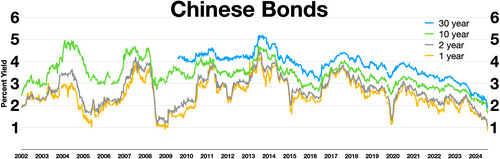
↑"CGB Yield Curve and Others". yield.chinabond.com.cn.
↑"China PMI". ycharts.com. Archived from the original on 18 April 2023. Retrieved 5 June 2026.
↑"China Non-Manufacturing PMI". ycharts.com. Archived from the original on 18 April 2023. Retrieved 5 June 2026.
123456"2025年12月进出口商品主要国别(地区)总值表(美元值)". customs.gov.cn. Retrieved 14 January 2026.
12"China – WTO Statistics Database". World Trade Organization. Archived from the original on 1 September 2017. Retrieved 1 March 2017.
12"UNCTAD 2022"(PDF). UNCTAD. Archived(PDF) from the original on 12 December 2022. Retrieved 6 January 2022.
12"Current account balance". IMF.org. 14 April 2026. Retrieved 7 May 2026.
↑"Money and Banking Statistics". Archived from the original on 4 November 2020. Retrieved 28 July 2019.
↑"Official reserve assets". pbc.gov.cn. Archived from the original on 30 January 2023. Retrieved 9 November 2019.
↑"China sets GDP target of 'around 5%' for 2023". CNBC. 4 March 2023. Archived from the original on 6 March 2023. Retrieved 6 March 2023.
↑"Sovereigns rating list". Standard & Poor's. 26 January 2017. Archived from the original on 26 September 2017. Retrieved 26 September 2017. On Jan. 26, 2017, S&P Global Ratings affirmed the 'AA-' long-term and 'A-1+' short-term sovereign credit ratings on China. The outlook on the long-term rating remains negative
↑"Moody's affirms China's A1 rating, changes outlook to negative from stable". moodys.com. 5 December 2023. Archived from the original on 5 December 2023. Retrieved 5 December 2023.
↑"Fitch Downgrades China to 'A'; Outlook Stable". fitchratings.com. 3 April 2025. Retrieved 4 April 2025.
↑ —Xu, Chenggang. "The Fundamental Institutions of China's Reforms and Development." Journal of Economic Literature, vol. 49, no. 4, American Economic Association, 2011, pp. 1076–151, JSTOR23071664. —Nee, Victor, and Sonja Opper. "Political Capital in a Market Economy." Social Forces, vol. 88, no. 5, Oxford University Press, 2010, pp. 2105–32, JSTOR40927540. —Shue Tuck Wong & Sun Sheng Han (1998) Whither China's Market Economy? The Case of Lijin Zhen, Geographical Review, 88:1, 29–46, doi:10.1111/j.1931-0846.1998.tb00094.x —Gregory C. Chow (2005) The Role of Planning in China's Market Economy, Journal of Chinese Economic and Business Studies, 3:3, 193–203, doi:10.1080/14765280500317866 —HUA, HUANG. "The Market Economy in China." Security Dialogue, vol. 24, no. 2, SAGE Publications, Ltd., 1993, pp. 175–79, JSTOR44471339. —Chow, Gregory C. "Development of a More Market-Oriented Economy in China." Science, vol. 235, no. 4786, American Association for the Advancement of Science, 1987, pp. 295–99, JSTOR1698592.
↑"GDP, current prices". www.imf.org. Retrieved 23 August 2024.
12"Global Economy Watch - Projections > Real GDP / Inflation > Share of 2016 world GDP". PWC. Archived from the original on 19 October 2015. Retrieved 23 June 2017.
↑Tang, Frank; Wang, Orange (18 January 2022). "China GDP growth slows as population crisis, Covid-19 cloud economic outlook". South China Morning Post. Archived from the original on 5 December 2022. Retrieved 14 August 2022.
Bijun Wang & Xiang Li (2017) From world factory to world investor: the new way of China integrating into the world, China Economic Journal, 10:2, 175–193, doi:10.1080/17538963.2017.1320047
Chen Li, Mee Kam Ng, Yuanzhou Tang & Tung Fung (2022) From a 'World Factory' to China's Bay Area: A Review of the Outline of the Development Plan for the Guangdong-Hong Kong-Macao Greater Bay Area, Planning Theory & Practice, 23:2, 310–314, doi:10.1080/14649357.2021.1958539
Mees, H. (2016). China as the World's Factory. In: The Chinese Birdcage. Palgrave Macmillan, New York. doi:10.1057/978-1-137-58886-9_3
Yuwan Duan; Erik Dietzenbacher; Bart Los; Cuihong Yang (2021). "How much did China's emergence as "the world's factory" contribute to its national income?"(PDF). China Economic Review. 69 101658. doi:10.1016/j.chieco.2021.101658. ISSN1043-951X. S2CID237676638. Archived(PDF) from the original on 5 April 2023. Retrieved 29 March 2023.
↑"China Widens Lead as World's Largest Manufacturer". thomasnet.com. Archived from the original on 27 July 2013. Retrieved 25 August 2013.
↑"China is the world's sole manufacturing superpower: A line sketch of the rise". 17 January 2024.
↑"China Is the World's Manufacturing Superpower". December 2024.
↑"China's Economy Is Catching Up to the U.S."Archived from the original on 17 March 2018. Retrieved 8 March 2018.
↑"Trade recovery expected in 2017 and 2018, amid policy uncertainty". Geneva, Switzerland: World Trade Organization. 12 April 2017. Archived from the original on 3 July 2017. Retrieved 22 June 2017.
↑"High-technology exports". World Bank Open Data. Archived from the original on 15 April 2023. Retrieved 15 April 2023.
↑Our World in Data. "Research & development spending as a share of GDP". ourworldindata.org. Archived from the original on 18 May 2024. Retrieved 10 January 2024.
↑Baffes, John; Kabundi, Alain Ntumba; Nagle, Peter Stephen Oliver; Ohnsorge, Franziska Lieselotte (26 June 2018). "The role of major emerging markets in global commodity demand". Policy Research Working Paper Series. Archived from the original on 6 March 2023. Retrieved 16 May 2022.
↑"intracen.org"(PDF). Archived from the original(PDF) on 30 October 2014.
↑"China's Free Trade Agreements Framework - China Guide | Doing Business in China". www.china-briefing.com. Retrieved 17 November 2025.
↑"Global 500". Fortune Global 500. Archived from the original on 16 January 2023. Retrieved 3 August 2023.
↑"GFCI 36 Rank - Long Finance". www.longfinance.net. Retrieved 24 September 2024.
12"Top 10 Largest Stock Exchanges in the World By Market Capitalization". ValueWalk. 19 February 2019. Retrieved 28 November 2019.
↑"Allianz Global Wealth Report 2021"(PDF). Archived(PDF) from the original on 7 October 2021. Retrieved 5 March 2022.
↑"Foreign direct investment in China slides 9.5% in 2025". Reuters. 23 January 2026. Retrieved 24 January 2026.
↑Briefing, China (16 September 2025). "Mapping China's ODI Shifts: Sources, Destinations, and Sectors". China Briefing News. Retrieved 17 November 2025.
↑Evie Steele (2 February 2024). "IMF Predicts China Economy Slowing Over Next Four Years". Voice of America. Archived from the original on 3 March 2024. Retrieved 20 February 2024.
12"Labor force Comparison - The World Factbook". www.cia.gov. Archived from the original on 9 January 2021. Retrieved 17 November 2025.
↑Peterson-Withorn, Chase; Chung, Grace; Durot, Matt (27 March 2025). "World's Billionaires List". Forbes. Retrieved 15 May 2023.
↑Ren, Daniel (28 October 2025). "China minted a new billionaire a day last year, Hurun's Rich List says". South China Morning Post. Retrieved 31 October 2025.
↑"Global Wealth Report 2025". UBS. 2025. Retrieved 18 December 2025.
↑"Home". Archived from the original on 24 April 2024. Retrieved 24 April 2024.
↑Maddison, Angus (20 September 2007). Contours of the World Economy 1-2030 AD: Essays in Macro-Economic History. Oxford University Press. ISBN978-0-19-164758-1. Retrieved 3 November 2024.
↑Maddison, Angus (2008). Chinese Economic Performance in the Long Run: 960-2030 AD. Organization for Economic Cooperation and Development. pp.43. ISBN978-92-64-03762-5.
↑Maddison, Angus (2007). Chinese Economic Performance in the Long Run(PDF). Development Centre Studies (2nded.). OECD. p.29. ISBN978-92-64-03762-5. Archived from the original(PDF) on 15 October 2014. See the "Table 1.3. Levels of Chinese and European GDP Per Capita, 1–1700 AD" in page 29, Chinese GDP Per Capita was 450 and European GDP Per Capita was 422 in 960AD. Chinese GDP Per Capita was 600 while European was 576. During this time, Chinese per capita income rose by about a third.
↑Thompson, Derek (19 June 2012). "The Economic History of the Last 2,000 Years in 1 Little Graph". The Atlantic. Archived from the original on 24 September 2020. Retrieved 9 December 2017.
↑Holcombe, Charles (2010). A History of East Asia: From the Origins of Civilization to the Twenty-First Century. Cambridge University Press. p.1. ISBN978-0-521-73164-5.
↑Hu, Angang (2006). Economic and Social Transformation in China: Challenges and Opportunities. Routledge. pp.12–13. ISBN978-0-415-38067-6.
↑Arnander, Christopher; Wood, Frances (2016). Betrayed Ally: China in the Great War. Pen and Sword (published 28 September 2016). p.20. ISBN978-1-4738-7501-2.
↑"12 Facts on China's Economic History". The Globalist. 10 November 2014. Archived from the original on 24 September 2020. Retrieved 26 February 2018.
123Karl, Rebecca E. (2010). Mao Zedong and China in the twentieth-century world: a concise history. Durham [NC]: Duke University Press. p.75. ISBN978-0-8223-4780-4. OCLC503828045.
↑Liu, Zongyuan Zoe (2023). Sovereign Funds: How the Communist Party of China Finances its Global Ambitions. The Belknap Press of Harvard University Press. doi:10.2307/jj.2915805. ISBN978-0-674-27191-3. JSTORjj.2915805. S2CID259402050.
↑Selden, Mark (1988). "Mao Zedong and the Political Economy of Chinese Development". China Report. 24 (2): 125–139. doi:10.1177/000944558802400202.
12Frost, Adam K.; Li, Zeren (31 July 2023). "Markets under Mao: Measuring Underground Activity in the Early PRC". The China Quarterly. 258: 309–328. doi:10.1017/S0305741023001133. hdl:10398/8f85638d-d939-4887-b6fd-d2c551ad620c. ISSN0305-7410.
↑Nelson D. Schwartz; Rachel Abrams (24 August 2015). "Advisers Work to Calm Fearful Investors". The New York Times. Archived from the original on 26 August 2015. Retrieved 25 August 2015. Even the most pessimistic observers think China will still grow by4 or5 percent
↑"Report for Selected Countries and Subjects". International Monetary Fund. 16 April 2013. Archived from the original on 2 November 2013. Retrieved 16 April 2013.
↑McGregor, James (6 November 2012). No Ancient Wisdom, No Followers: The Challenges of Chinese Authoritarian Capitalism. Easton Studio Press, LLC. ISBN978-1-935212-81-2. Archived from the original on 8 April 2023. Retrieved 26 February 2023.
↑Gruin, Julian; Knaack, Peter (15 April 2020). "Not Just Another Shadow Bank: Chinese Authoritarian Capitalism and the 'Developmental' Promise of Digital Financial Innovation". New Political Economy. 25 (3): 370–387. doi:10.1080/13563467.2018.1562437. hdl:11245.1/336bf4c0-6cf3-402d-a0ed-da06b78edc9c. ISSN1356-3467. S2CID159282907.
↑Andrew Szamosszegi and Cole Kyle. "An Analysis of State-owned Enterprises and State Capitalism in China"(PDF). U.S.-China Economic and Security Review Commission. Archived(PDF) from the original on 2 April 2023. Retrieved 26 February 2023.
↑Pearson, Margaret; Rithmire, Meg; Tsai, Kellee S. (1 September 2021). "Party-State Capitalism in China". Current History. 120 (827): 207–213. doi:10.1525/curh.2021.120.827.207. ISSN0011-3530.
↑Pearson, Margaret M.; Rithmire, Meg; Tsai, Kellee S. (1 October 2022). "China's Party-State Capitalism and International Backlash: From Interdependence to Insecurity". International Security. 47 (2): 135–176. doi:10.1162/isec_a_00447. ISSN0162-2889.
↑Li, Dr Haizheng; Li, Xiangyuan; Li, Dr Haizheng Li and Xiangyuan (27 March 2023). "The COVID-19 Pandemic's Impact on the Chinese Economy". China Research Center. Retrieved 14 June 2026.
↑Ang, Yuen Yuen (4 September 2024). "China's Economic Paradox". Project Syndicate. Retrieved 14 June 2026.
↑"China lifting 800 million people out of poverty is historic: World Bank". Business Standard India. Press Trust of India. 13 October 2017. Archived from the original on 22 February 2019. Retrieved 22 February 2019.
↑Four Decades of Poverty Reduction in China: Drivers, Insights for the World, and the Way Ahead. World Bank Publications. 2022. p.ix. ISBN978-1-4648-1878-3. By any measure, the speed and scale of China's poverty reduction is historically unprecedented.
↑"China's Approach to Reduce Poverty: Taking Targeted Measures to Lift People out of Poverty"(PDF). United Nations. Archived(PDF) from the original on 20 March 2019. Retrieved 21 February 2019.
↑"Regional aggregation using 2017 PPP and $2.15/day poverty line". iresearch.worldbank.org. World Bank. Retrieved 13 May 2022.
↑"Current account balance (BoP, current US$) – China". worldbank.org. World Bank. Archived from the original on 3 December 2020. Retrieved 18 March 2021.
↑"China's Next Leap in Manufacturing". bcg.com. Boston Consulting Group. 19 August 2020. Archived from the original on 31 March 2021. Retrieved 18 March 2021.
↑Dutta, Soumitra; Lanvin, Bruno; Wunsch-Vincent, Sacha; León, Lorena Rivera; World Intellectual Property Organization (2022). Global Innovation Index 2022 – Which are the most innovative countries. World Intellectual Property Organization. doi:10.34667/tind.46596. ISBN978-92-805-3432-0. Archived from the original on 3 December 2022. Retrieved 29 September 2022.
↑Dutta, Soumitra; Lanvin, Bruno; Wunsch-Vincent, Sacha; León, Lorena Rivera; World Intellectual Property Organization (2022). Global Innovation Index 2022: Switzerland, the U.S., and Sweden lead the Global Innovation Ranking; China Approaches Top 10. World Intellectual Property Organization. doi:10.34667/tind.46596. ISBN978-92-805-3432-0. Archived from the original on 29 September 2022. Retrieved 29 September 2022.
↑"The World Factbook". CIA.gov. Central Intelligence Agency. Archived from the original on 20 December 2021. Retrieved 5 April 2019.
12Marquis, Christopher; Qiao, Kunyuan (15 November 2022). Mao and Markets: The Communist Roots of Chinese Enterprise. Yale University Press. doi:10.2307/j.ctv3006z6k. ISBN978-0-300-26883-6. JSTORj.ctv3006z6k. S2CID253067190.
↑He, Laura (17 January 2023). "China posts one of its worst economic performances in decades because of Covid". CNN. Archived from the original on 15 August 2024. Retrieved 21 April 2023.
↑"A Rocky Recovery". World Economic Outlook. International Monetary Fund. April 2023. Archived from the original on 13 April 2023. Retrieved 11 April 2023. The outlook is uncertain again amid financial sector turmoil, high inflation, ongoing effects of Russia's invasion of Ukraine, and three years of COVID
123World Bank. "China Country Climate and Development Report"(PDF). Archived(PDF) from the original on 14 October 2022. Retrieved 10 October 2022.
↑Fan, Shenggen; Kanbur, Ravi; Zhang, Xiaobo (2011). "China's regional disparities: Experience and policy☆". Review of Development Finance. 1: 47–56. doi:10.1016/j.rdf.2010.10.001. hdl:1813/58114. ISSN1879-9337.
↑"Shenzhen is a hothouse of innovation". The Economist. Archived from the original on 14 January 2018. Retrieved 13 January 2018.
↑"These will be the most important cities by 2035". World Economic Forum. 31 October 2019. Archived from the original on 3 November 2020. Retrieved 2 November 2020.
↑Pomfret, James (27 June 2022). "Explainer: Hong Kong's rocky political road since the 1997 handover". Reuters. Archived from the original on 29 July 2023. Retrieved 29 July 2023.
↑Campbell, Matthew (29 July 2023). "What Happens to Hong Kong When 'One Country, Two Systems' Expires in 2047". Bloomberg News. Archived from the original on 9 March 2022. Retrieved 29 July 2023.
↑"World Bank World Development Indicators". World Bank. Archived from the original on 20 August 2016. Retrieved 8 December 2014.
↑Liu, Lizhi (2024). From Click to Boom: The Political Economy of E-Commerce in China. Princeton University Press. ISBN978-0-691-25410-4.
↑"Five-year plan: China moves to technology self-sufficiency". South China Morning Post. 30 October 2020. Archived from the original on 18 March 2021. Retrieved 18 March 2021.
↑Pei, Changhong; Yang, Chunxue; Yang, Xinming (4 July 2019). The Basic Economic System of China. Springer. ISBN978-981-13-6894-3. Archived from the original on 13 June 2020. Retrieved 13 June 2020.
↑Oi, Jean (1999). Rural China takes off: institutional foundations of economic reform. University of California Press. p.3. ISBN978-0-520-21727-0.
12Ang, Yuen Yuen (2016). How China Escaped the Poverty Trap, Chapter 1 "Mapping Coevolution". ISBN978-1-5017-0640-0.
↑Ang, Yuen Yuen (12 June 2024). "INET Lecture Series, "The Economics of China," Episode 3: Let Many China Models Bloom".
↑Ang, Yuen Yuen (29 June 2018). "The Real China Model: It's Not What You Think It Is". Foreign Affairs.
↑Nathan, Andrew (25 June 2021). "An Anxious 100th Birthday for China's Communist Party". The Wall Street Journal. Archived from the original on 26 May 2023. Retrieved 23 May 2023.
12345678Garlick, Jeremy (2024). Advantage China: Agent of Change in an Era of Global Disruption. Bloomsbury Academic. ISBN978-1-350-25231-8.
1234567891011121314Lan, Xiaohuan (2024). How China Works: An Introduction to China's State-led Economic Development. Translated by Topp, Gary. Palgrave MacMillan. doi:10.1007/978-981-97-0080-6. ISBN978-981-97-0079-0.
123Frank N. Pieke; Bert Hofman, eds. (2022). CPC Futures The New Era of Socialism with Chinese Characteristics. Singapore: National University of Singapore Press. p.138. doi:10.56159/eai.52060. ISBN978-981-18-5206-0. OCLC1354535847.
↑"Xi Jinping really is unshakeably committed to the private sector". The Economist. 11 July 2024. ISSN0013-0613. Archived from the original on 15 August 2024. Retrieved 13 July 2024.
↑Hissey, Ian (17 December 2019). "Investing in Chinese State-Owned Enterprises". insight.factset.com. Archived from the original on 18 April 2021. Retrieved 15 March 2021.
↑Tjan, Sie Tek (21 May 2020). "How reform has made China's state-owned enterprises stronger". www.weforum.org. Archived from the original on 11 October 2020. Retrieved 19 October 2020.
↑CBNEditor (18 January 2021). "China's GDP Breaches 100 Trillion Yuan Threshold after Posting 2.3% Growth in 2020, Disposable Income up 4.7%". China Banking News. Archived from the original on 7 May 2021. Retrieved 13 April 2021.
↑Tjan, Sie Tek (17 October 2020). "China State Firms' Assets grow even as the Government presses for lighter debt". www.caixinglobal.com. Archived from the original on 7 January 2022. Retrieved 19 October 2020.
↑Tjan, Sie tek (18 August 2020). "The Biggest but not the Strongest: China's place in the Fortune Global 500". www.csis.org. Archived from the original on 24 May 2023. Retrieved 19 October 2020.
↑Huang, Tianlei; Véron, Nicolas (20 January 2026). "China's private-sector rebound continued in 2025, fueled by "new economy"". Peterson Institute for International Economics. Retrieved 27 January 2026.
12Tang, Frank (20 January 2017). "Can you still trust China's economic data after province admits cooking books?". South China Morning Post. Archived from the original on 13 August 2019. Retrieved 19 November 2019.
↑"China meets its official growth target. Not everyone is convinced". The Economist. 17 January 2025. ISSN0013-0613. Retrieved 18 January 2025.
↑Fernald, John G.; Hsu, Eric; Spiegel, Mark M. (1 June 2021). "Reprint: Is China fudging its GDP figures? Evidence from trading partner data". Journal of International Money and Finance. Special Issue "Monetary Policy under Global Uncertainty". 114 102406. doi:10.1016/j.jimonfin.2021.102406. ISSN0261-5606.
123Fernald, John G.; Malkin, Israel; Spiegel, Mark M. (2013). "On the reliability of Chinese output figures". FRBSF Economic Letter. Archived from the original on 27 October 2020. Retrieved 25 October 2020.
↑"Recent challenges in reading China's GDP". Economist Intelligence Unit. 4 March 2021. Archived from the original on 18 August 2022. Retrieved 18 August 2022.
↑Rosen, Daniel H.; Wright, Logan; Vest, Charlie; Quinn, Rogan (29 December 2023). "Through the Looking Glass: China's 2023 GDP and the Year Ahead". Rhodium Group. Archived from the original on 21 July 2024. Retrieved 21 July 2024.
↑"Is China Cooking the Books on Economic Expansion? | Civic". US News. Archived from the original on 20 April 2018. Retrieved 19 April 2018.
↑"Some Alternative Methods for Tracking Chinese GDP". Federal Reserve Bank of St. Louis. 12 September 2017. Archived from the original on 31 July 2020. Retrieved 6 May 2020.
↑"Look Whos Back, Alibabas Jack Ma Shakes Presidents Xi's Hand". Asia News.
↑"Never mind Trump's tariffs. The Chinese Communist Party remains defiant". The Washington Post. 4 March 2025. Archived from the original on 6 April 2025. Retrieved 16 May 2026.
↑Woo, Yawen Chen (17 January 2018). "Another Chinese city admits 'fake' economic data". Reuters. Archived from the original on 13 August 2019. Retrieved 19 November 2019– via www.reuters.com.
↑"Why Chinese officials are coming clean over cooking the books". South China Morning Post. 16 January 2018. Archived from the original on 2 October 2019. Retrieved 19 November 2019.
↑"Estimating Chinese GDP Using Night-Lights Data". Federal Reserve Bank of St. Louis. 14 September 2017. Archived from the original on 30 July 2020. Retrieved 6 May 2020.
↑"Challenges in Measuring China's Economic Growth". Federal Reserve Bank of St. Louis. 11 September 2017. Archived from the original on 29 October 2020. Retrieved 29 October 2020.
12Clark, Hunter; Pinkovskiy, Maxim; Sala-i-Martin, Xavier (1 August 2020). "China's GDP growth may be understated"(PDF). China Economic Review. 62 101243. doi:10.1016/j.chieco.2018.10.010. ISSN1043-951X. S2CID157898394. Archived(PDF) from the original on 2 May 2019. Retrieved 19 November 2019.
↑Chandran, Nyshka (16 October 2015). "These guys think China's economy is much larger". CNBC. Archived from the original on 28 October 2020. Retrieved 25 October 2020.
12Arvind, Subramanian (13 January 2011). "Is China Already Number One? New GDP Estimates". Peterson Institute for International Economics (PIIE). Archived from the original on 26 October 2020. Retrieved 25 October 2020.
12Rosen, Daniel; Bao, Beibei (2015). Broken Abacus? A More Accurate Gauge of China's Economy. Center for Strategic and International Studies. pp.X–XV. ISBN978-1-4422-4084-1.
↑Allison, Graham (15 October 2020). "China Is Now the World's Largest Economy. We Shouldn't Be Shocked". The National Interest. Archived from the original on 16 December 2020. Retrieved 25 October 2020.
↑Williamson, Peter J.; Hoenderop, Simon; Hoenderop, Jochem (3 April 2018). "An alternative benchmark for the validity of China's GDP growth statistics". Journal of Chinese Economic and Business Studies. 16 (2): 171–191. doi:10.1080/14765284.2018.1438867. ISSN1476-5284. S2CID158464860.
↑"China'S GDP Growth May Be Understated"(PDF). National Bureau of Economic Research. April 2017. Archived(PDF) from the original on 9 October 2022. Retrieved 26 January 2021.
↑Wei Chen; Xilu Chen; Chang-Tai Hsieh; Zheng (Michael) Song (7 March 2019). "A forensic examination of China's national accounts". Brookings. Archived from the original on 20 July 2019. Retrieved 20 July 2019.
12Wildau, Gabriel (7 March 2019). "China's economy is 12% smaller than official data say, study finds". Financial Times. Archived from the original on 20 July 2019. Retrieved 20 July 2019.
↑"China's economy might be nearly a seventh smaller than reported". The Economist. 7 March 2019. ISSN0013-0613. Archived from the original on 20 July 2019. Retrieved 20 July 2019.
↑"Through the Looking Glass: China's 2023 GDP and the Year Ahead – Rhodium Group". rhg.com. 29 December 2023. Retrieved 13 January 2025.
↑William L., Barcelona; Cascaldi-Garcia, Danilo; J. Hoek, Jasper; Van Leemput, Eva (6 June 2025). "Is China Really Growing at 5 Percent?". FEDS Notes (2025–06–06). Washington: Board of Governors of the Federal Reserve System: None. doi:10.17016/2380-7172.3784.
↑"Xi to chair symposium attended by Jack Ma and other Chinese business leaders, sources say". Reuters. Archived from the original on 14 February 2026.
↑Liu, John (17 February 2025). "In from the cold? Alibaba co-founder Jack Ma spotted among top tech bosses who met China's Xi | CNN Business". CNN. Archived from the original on 18 August 2025. Retrieved 17 June 2026.
↑AFP. "China's Xi hosts summit with business leaders, including Alibaba's Jack Ma". Al Jazeera. Archived from the original on 7 February 2026. Retrieved 17 June 2026.
↑Lee, Lizzi C.; Qian, Jing (20 February 2026). "China's Private Sector Pivot". Foreign Affairs. ISSN0015-7120. Retrieved 20 February 2026.
↑"Report for Selected Countries and Subjects". IMF. Archived from the original on 2 January 2024. Retrieved 11 October 2023.
↑"People's Republic of China 2015 Article IV Consultation–Press Release; Staff Report; and Statement by the Executive Director for the PRC"Archived 16 March 2016 at the Wayback Machine IMF Country Report No. 15/234
↑World Economic Outlook Database, October 2015Archived 12 March 2016 at the Wayback Machine, IMF
↑IMF Country Report No. 15/234, People's Republic of China: Staff Report for the 2015 Article IV ConsultationArchived 16 March 2016 at the Wayback Machine (7 July 2015).
↑Xiaoyi Shao and Lisa Twaronite (7 March 2016), "China's fiscal income to slow but room for more government debt–Finance Minister"Archived 12 March 2016 at the Wayback Machine, Reuters
↑Joyce Ho (19 January 2016), "Bernanke downplays China impact on world economy"Archived 12 March 2016 at the Wayback MachineNikkei Asian Review
↑OECD Economic Surveys: China 2019. 16 May 2019. p.10. doi:10.1787/eco_surveys-chn-2019-en. ISBN978-92-64-31225-8. S2CID241605811. Archived from the original on 26 October 2019. Retrieved 28 June 2019.
↑Noah Smith, Be Scared of China's Debt, Not Its StocksArchived 29 April 2016 at the Wayback Machine, Bloomberg View (7 January 2016).
↑Chinese Banks Look to Shadow Banking for Growth: Risks increase as third-quarter earnings show banks pushing deeper into gray marketsArchived 10 July 2017 at the Wayback Machine, The Wall Street Journal (30 October 2015), p. 76.
↑"China's LGFV Insiders Say $9 Trillion Debt Problem Is Worsening". Bloomberg.com. 24 August 2023. Archived from the original on 7 February 2024. Retrieved 10 July 2024.
↑JIA, Yuxuan. "China's local govt debt in 2020 was 50% higher than WB, IMF estimates: David Daokui Li". www.eastisread.com. Archived from the original on 25 December 2023. Retrieved 10 July 2024.
↑An, Alex and An, David, "Media control and the Erosion of an Accountable Party-State in China". China Brief, 7 October 2008.
↑Allen, Gregory (26 November 2014). "The True Impact of Allied Export Controls on the U.S. and Chinese Semiconductor Manufacturing Equipment Industries". Center for Strategic and International Studies.
↑Lung, Tiffany. "How China's Antitrust And Monopoly Probe Will Disrupt Tech Titans In Retail". Forbes. Archived from the original on 2 January 2021. Retrieved 3 January 2021.
↑Zhong, Raymond (24 December 2020). "With Alibaba Investigation, China Gets Tougher on Tech". The New York Times. ISSN0362-4331. Archived from the original on 24 December 2020. Retrieved 3 January 2021.
↑澎湃新闻 (18 December 2020). "中央经济工作会议:强化反垄断和防止资本无序扩张". tech.sina.com.cn. Retrieved 3 January 2021.
↑"Alibaba's antitrust review comes to close after 3 years of government scrutiny". South China Morning Post. 30 August 2024. Archived from the original on 12 February 2026. Retrieved 10 March 2026.
↑Khoo, Kenneth; Lai, Sinchit; Tian, Chuyue (September 2025). "The impact of antitrust enforcement on China's digital platforms: Evidence from SAMR v. Alibaba". International Review of Law and Economics. 83 106268. doi:10.1016/j.irle.2025.106268.
123456789101112Zhang, Angela Huyue (2024). High Wire: How China Regulates Big Tech and Governs Its Economy. Oxford University Press. doi:10.1093/oso/9780197682258.001.0001. ISBN978-0-19-768225-8.
↑Wang, P. (2013). The rise of the Red Mafia in China: a case study of organised crime and corruption in Chongqing. Trends in Organized crime, 16(1), 49-73.
↑Huang, Carol. "Healthcare Is So Corrupt In China That Patients Have To Bribe Doctors For Proper Care". Business Insider. Archived from the original on 4 January 2020. Retrieved 24 October 2019.
↑Wan, William (7 October 2013). "Bribes, not just brains, needed to enter top Chinese schools". The Washington Post. ISSN0190-8286. Archived from the original on 24 October 2019. Retrieved 24 October 2019.
↑Teresa Welsh (11 June 2015). "China's Corruption Crackdown: Progress or Politics?". U.S. News & World Report. Archived from the original on 2 October 2017. Retrieved 30 June 2015.
↑"Report for Selected Countries and Subjects". IMF. Retrieved 24 January 2025.
12Mesa-Lago, Carmelo (2025). Comparing Socialist Approaches: Economics and Social Security in Cuba, China, and Vietnam. Pitt Latin American Series. Pittsburgh, PA: University of Pittsburgh Press. ISBN978-0-8229-4847-6.
↑"China continues see increase in prices amid ongoing war in Middle East". 11 May 2026.
↑Eckstein, Alexander (1976). China's Economic Development: The Interplay of Scarcity and Ideology. University of Michigan Press. ISBN978-0-472-08310-7.
↑DeWeaver, Mark (2012). Animal Spirits with Chinese Characteristics: Investment Booms and Busts in the World's Emerging Economic Giant. Palgrave Macmillan. ISBN978-0-230-11569-9.
↑Zhou, Li'an (2004), "Jinsheng Boyi Zhong Zhengfu Guanyuan de Jili yu Hezuo" [Cooperation and Government Officials' Incentives in Promotion Competitions], Jingji Yanjiu [Economic Research], 6: 33–40.
↑Zhou, Li'an (2007), "Zhongguo Difang Guanyuan de Jinsheng Jinbiaosai Moshi Yanjiu" [A Tournament Model of Local Government Official Promotions], Jingji Yanjiu [Economic Research], 7: 36–50.
↑Jin, Sanlin (2004), "Chengben Ruanyueshu Shi Touzi Guore de Zhongyau Yuanyin" [Soft Budget Constraints Are an Important Cause of Investment Overheating], Zhongguo Touzi [China Investment], June: 37–39.
↑Fan Gang; Zhang Xiaojing (2004). Zenme You Guo Re Le? Xin Yilun Jingji Bodong yu Hongguan Tiaokong Fenxi [Why Is There Overheating Yet Again? The New Round of Economic Fluctuation and an Analysis of Macroeconomic Adjustment]. Jiangxi People's Publishing House. ISBN978-7-210-03077-5.
↑Mott, Filip De. "China's real youth unemployment rate could actually be close to 50% - more than double the official rate". Business Insider. Retrieved 6 January 2025.
↑"China's record high 21% youth unemployment could actually be as high as 46.5%. Blame fake jobs and 16 million workers 'lying flat'". Yahoo Finance. Archived from the original on 10 August 2023. Retrieved 6 January 2025.
↑Tjan, Sie Tek (15 September 2020). "Assets and Liabilities Statistics of Financial Institutions as of 2nd quarter 2020". pbc.gov.cn. Archived from the original on 18 October 2020. Retrieved 16 October 2020.
↑Chiu, Becky; Lewis, Mervyn K. (2006). Reforming China's State-Owned Enterprises and Banks. p.205.
↑"Silk Road Fund". www.silkroadfund.com.cn. Archived from the original on 30 October 2020. Retrieved 26 October 2020.
↑Chiu, Becky; Lewis, Mervyn K. (2006). Reforming China's State-Owned Enterprises and Banks. p.11.
↑Tatlow, Didi Kirsten (21 September 2011). "More Stimulus May Not Be an Option for China". The New York Times. Archived from the original on 22 September 2011. Retrieved 22 September 2011.
↑"The bees get busy". The Economist. 3 March 2012. Archived from the original on 3 March 2012. Retrieved 3 March 2012.
↑Lingling Wei (29 February 2012). "Yuan Move Chips at Capital Controls". The Wall Street Journal. Archived from the original on 23 September 2017. Retrieved 4 August 2017.
↑"The Global Financial Centres Index 28"(PDF). Long Finance. September 2020. Archived(PDF) from the original on 9 October 2022. Retrieved 26 September 2020.
↑"Monthly Reports – World Federation of Exchanges". WFE. Archived from the original on 12 September 2019. Retrieved 6 September 2019.
↑Tjan, Sie Tek (13 October 2020). "China's stock market tops $10 trillion". Bloomberg. Archived from the original on 31 October 2020. Retrieved 22 October 2020.
↑Tjan, Sie Tek (7 July 2020). "Overseas investor snap up Chinese stocks so fast, they are hitting foreign ownership caps such as home appliance maker Midea". The South China Morning Post. Archived from the original on 20 October 2020. Retrieved 22 October 2020.
↑Tjan, Sie Tek (3 September 2020). "China moves to ease Access to $15.4 Trillion Bond Market". Caixin Global.
↑Tjan, Sie Tek (19 October 2020). "China greenlights Shenzhen to issue Offshore Local Government Bonds". Archived from the original on 19 October 2020. Retrieved 20 October 2020.
123Curtis, Simon; Klaus, Ian (2024). The Belt and Road City: Geopolitics, Urbanization, and China's Search for a New International Order. New Haven and London: Yale University Press. doi:10.2307/jj.11589102. ISBN978-0-300-26690-0. JSTORjj.11589102.
1234567Jin, Keyu (2023). The New China Playbook: Beyond Socialism and Capitalism. New York: Viking. ISBN978-1-9848-7828-1.
↑Lipman, Joshua Klein (April 2011). "Law of Yuan Price: Estimating Equilibrium of the Renminbi"(PDF). Michigan Journal of Business. 4 (2). Archived from the original(PDF) on 27 July 2011. Retrieved 23 May 2011.
12"Why the IMF's newest report finds that the yuan is undervalued". The Economist. 19 February 2026. ISSN0013-0613. Retrieved 20 February 2026.
↑Keith Bradsher )29 December 2007), "China Lets Currency Appreciate a Bit Faster"Archived 8 February 2017 at the Wayback MachineThe New York Times
↑Jalil, Abdul, Feridun, Mete and Ma, Ying (2010) Finance-growth nexus in China revisited: New evidence from principal components and ARDL bounds tests. International Review of Economics & Finance, 19 (2). pp. 189–195. ISSN 1059-0560 (doi:10.1016/j.iref.2009.10.005)
↑"Progress for Reform as Yuan Inches toward SDR". Caixin. 19 August 2015. Archived from the original on 21 August 2015. Retrieved 19 August 2015.
↑"Currency Reform"(PDF). brookings.edu. Archived(PDF) from the original on 2 April 2015. Retrieved 28 March 2015.
↑"Non financial corporate debt" from Diversification
↑"Why so many Chinese are drowning in debt" from The Economist
↑"Global 500". Fortune. Archived from the original on 16 January 2023. Retrieved 11 July 2024.
↑"The Global 2000 2022". Forbes. Archived from the original on 13 May 2021. Retrieved 14 June 2022.
↑"Chinese report counts 206 unicorns. That's more than America". CNN. 23 October 2019. Archived from the original on 9 July 2021. Retrieved 18 March 2021.
↑"China | World Food Programme". www.wfp.org. 31 March 2023. Archived from the original on 9 July 2023. Retrieved 9 July 2023.
↑Urbina, Ian. "How China's Massive Fishing Fleet Is Transforming the World's OceanArchived 24 September 2020 at the Wayback Machine." www.slate.com. Slate. Retrieved 2 September 2020
↑Plantation Study in China: Research OutlineArchived 16 February 2008 at the Wayback Machine Forest Conservation Project, Institute for Global Environmental Strategies, Japan; February 2006.
↑Stanway, David (14 November 2012). "Analysis: China turns to machines as farmers seek fresh fields". Reuters. Archived from the original on 1 December 2017. Retrieved 26 November 2017.
↑Cheng, Fang. "Development of Agricultural Mechanization in China"(PDF). Eurasian Food Economy Forum 2017. UN Food and Agriculture Organization. Archived(PDF) from the original on 1 December 2017. Retrieved 26 November 2017.
↑Schaer, Lilian (24 March 2017). "China powers up: The world's most populous country gets serious about farming machinery". Country Guide. Archived from the original on 1 December 2017. Retrieved 26 November 2017.
↑"China's Real Estate Meltdown Is Battering Middle Class Wealth". Bloomberg News. 18 December 2023. Archived from the original on 17 December 2023. Retrieved 18 December 2023.
↑"Can China's long property boom hold?". The Economist. 25 January 2021. ISSN0013-0613. Archived from the original on 28 March 2021. Retrieved 28 March 2021.
↑Stella Yifan Xie; Mike Bird (17 July 2020). "The $52 Trillion Bubble: China Grapples With Epic Property Boom". The Wall Street Journal. ISSN0099-9660. Archived from the original on 28 March 2021. Retrieved 28 March 2021.
↑"Downloads | Energy economics | Home". BP global. Archived from the original on 15 June 2018. Retrieved 15 June 2018.
↑"Global Electricity Review 2024: Analysis of key power sector emitters in 2023". Ember. 8 May 2024. Archived from the original on 14 May 2024. Retrieved 21 May 2024.
↑Chen, Aizhu (13 January 2023). "China 2022 crude oil imports fall for second year despite Q4 pickup". Reuters. Archived from the original on 26 May 2023. Retrieved 23 May 2023.
↑Hiroshi Satō. Unemployment, Inequality and Poverty in Urban China. (2006) Routledge. ISBN0-415-33872-7
↑Keith Bradsher (5 July 2010), "China Fears Consumer Class Impact on Global Warming"Archived 23 July 2016 at the Wayback Machine, The New York Times
↑"China's Greenhouse Gas Emissions Exceeded the Developed World for the First Time in 2019". Rhodium Group. 6 May 2021. Archived from the original on 17 June 2021. Retrieved 24 March 2023.
↑"Welcome to World Bank Intranet"(PDF). message.worldbank.org. Archived from the original on 21 July 2015.
↑Xu, Beina. "China's Environmental Crisis". Archived from the original on 20 August 2015.
↑"Worst air pollution in China and the U.S."Archived from the original on 17 November 2015. Retrieved 16 August 2015– via www.washingtonpost.com.
↑Fergus Green; Nicholas Stern. "An innovative and sustainable growth path for China: a critical decade"(PDF). Archived(PDF) from the original on 17 November 2015. '...China is... planning to grow its high technology and high value-added industries. It is championing seven "strategic emerging industries": energy efficient and environmental technologies; new energy; new-energy vehicles; next generation information technology; biotechnology; advanced equipment manufacture; and new materials.'
↑Davidson, Helen (29 August 2023). "China continues coal spree despite climate goals". The Guardian. ISSN0261-3077. Archived from the original on 15 August 2024. Retrieved 10 July 2024.
↑"China is building six times more new coal plants than other countries, report finds". npr.org. 2 March 2023. Archived from the original on 18 December 2023.
↑Case Study of Electrification: ChinaArchived 16 February 2008 at the Wayback Machine Worldwide Electrification from the 1950s to the 1970s. (Chapter 2; page 33).
↑MSN Encarta. Asia: Mineral Resources. Archived 31 October 2009.
12TED Case Studies. China and CoalArchived 12 February 2017 at the Wayback Machine
↑Heping, Xie; Golosinski, Tad S. (1999). Mining Science and Technology '99. Taylor & Francis. pp.252–256. ISBN978-90-5809-067-6.
↑Creedy, David; Lijie, Wang; Xinquan, Zhou; Haibin, Liu; Campbell, Gary (February 2006). "Transforming China's coal mines: A case history of the Shuangliu Mine". Natural Resources Forum. 30 (1). Blackwell Publishing: 15–26. Bibcode:2006NRF....30...15C. doi:10.1111/j.1477-8947.2006.00154.x.
↑"China overtakes US as the biggest importer of oil". BBC News. 10 October 2013. Archived from the original on 10 October 2013. Retrieved 11 October 2013.
↑Xinhua. China to calculate oil and gas reservesArchived 20 January 2008 at the Wayback Machine 25 November 2004.
↑"Puguang Named 2nd Largest Gas Field". Chinapage.com. Archived from the original on 8 May 2013. Retrieved 28 February 2012.
↑Kaoru YAMAGUCHI, Keii CHO. Natural Gas in ChinaArchived 31 October 2007 at the Wayback Machine IEEJ: August 2003.
↑Jalil, Abdul and Feridun, Mete (2011) "The impact of growth, energy and financial development on the environment in China: a cointegration analysis". Energy Economics, 33 (2). pp. 284–291. ISSN 0140-9883 (doi:10.1016/j.eneco.2010.10.003)
↑"Phosphate Rock Statistics and Information"(PDF). Archived(PDF) from the original on 13 May 2017. Retrieved 15 June 2017.
12Lewis, Joanna I. (2023). Cooperating for the Climate: Learning from International Partnerships in China's Clean Energy Sector. Cambridge, Massachusetts: The MIT Press. ISBN978-0-262-54482-5.
↑Bertrand, Arnaud (1 December 2025). "China's great green leap forward". Le Monde diplomatique. Retrieved 26 December 2025.
12345Šebeňa, Martin (2023). "Technological Power". In Kironska, Kristina; Turscanyi, Richard Q. (eds.). Contemporary China: a New Superpower?. Routledge. ISBN978-1-03-239508-1.
↑Keith Bradsher (6 November 2012). "Facing Protests, China's Business Investment Slows". The New York Times. Archived from the original on 7 November 2012. Retrieved 7 November 2012.
↑"Florida Forestry China Trade Mission Report"(PDF). Archived(PDF) from the original on 6 March 2012. Retrieved 28 February 2012.
↑"Industrial output growth 1978–2006". Chinability.com. Archived from the original on 28 February 2012. Retrieved 28 February 2012.
↑"14–19: Output of Major Industrial Products". Allcountries.org. 26 April 2006. Archived from the original on 11 February 2012. Retrieved 28 February 2012.
↑Shanghai's GDP Keeps GrowingArchived 30 August 2005 at the Wayback Machine Xinhua News Agency 1February 2003.
↑"Global crude steel output decreases by 0.9% in 2020". worldsteel.org. 26 January 2021. Archived from the original on 10 January 2022. Retrieved 10 February 2022.
↑Steel exports fall in 2008–People's Daily OnlineArchived 2 November 2009 at the Wayback Machine. English.people.com.cn (12 February 2009). Retrieved on 6 August 2010.
↑"In China's Floundering Steel Sector, the Burden of Politics". The New York Times. Reuters. 3 May 2012. Archived from the original on 5 May 2012. Retrieved 4 May 2012.
↑Dong, Yi Chen (14 January 2025). "China produced and sold 31.282 million and 31.436 million vehicles in 2024". CarNewsChina.com. Retrieved 31 January 2025.
↑Gelles, David; Sengupta, Somini; Bradsher, Keith; Plumer, Brad; Stevens, Harry (30 June 2025). "There's a Race to Power the Future. China Is Pulling Away". The New York Times. ISSN0362-4331. Retrieved 30 June 2025.
↑"China 2010 Auto Sales Reach 18 Million, Extend Lead". Bloomberg. 10 January 2011. Archived from the original on 22 June 2011. Retrieved 27 December 2011.
↑Peter, Hoskins (19 May 2023). "China overtakes Japan as world's top car exporter". BBC News. Archived from the original on 14 November 2023. Retrieved 24 June 2024.
↑"Sustained global cement demand growth expected". International Cement Review. 21 July 2015.
↑Grimes, Seamus (21 May 2023). "China's Evolving Role in the Chemical Global Value Chain". Retrieved 12 May 2025.
↑"International Council of Chemical Association – China". Archived from the original on 5 June 2019. Retrieved 5 June 2019.
↑"Mexican Cartels - the Asian Connection". 8 December 2020. Retrieved 30 August 2021.
↑"Asia's multi-billion dollar methamphetamine cartels are using creative chemistry to outfox police, experts say". 4 May 2021. Retrieved 30 August 2021.
↑"LETHAL EXCHANGE: SYNTHETIC DRUG NETWORKS IN THE DIGITAL ERA"(PDF). Retrieved 1 March 2023.
↑Oxford, Dwayne (20 April 2024). "Are Chinese electric vehicles taking over the world?". Al Jazeera. Archived from the original on 24 June 2024. Retrieved 24 June 2024.
12"Sales of New Energy Vehicles in December 2023". China Association of Automobile Manufacturers. 12 January 2024. Archived from the original on 24 June 2024. Retrieved 24 June 2024.
↑IEA (18 June 2020). Global EV Outlook 2020: Entering the decade of electric drive? (Report). Global EV Outlook. OECD Publishing. doi:10.1787/d394399e-en. ISBN978-92-64-61622-6. Archived from the original on 26 November 2023. Retrieved 26 November 2023. See Statistical annex, pp. 247–252 (See Tables A.1 and A.12). The global stock of plug-in electric passenger vehicles totaled 7.2 million cars at the end of 2019, of which, 47% were on the road in China. The stock of plug-in cars consist of 4.8 million battery electric cars (66.6%) and 2.4 million plug-in hybrids (33.3%). In addition, the stock of light commercial plug-in electric vehicles in use totaled 378 thousand units in 2019, and about half a million electric buses were in circulation, most of which are in China.
↑Kane, Mark (5 February 2024). "China Plug-In Car Sales Hit A New 8 Million Record In 2023". Inside EVs. Archived from the original on 24 June 2024. Retrieved 24 June 2024.
↑"China Sets Massive Record: 500,000 Plug-In Cars Sold in December 2021". Archived from the original on 26 April 2022. Retrieved 6 April 2022.
↑"Batteries and secure energy transitions". Paris: IEA. 2024.
↑"Japan battery material producers lose spark as China races ahead". Archived from the original on 4 April 2023. Retrieved 6 April 2022.
↑"Global lithium-ion battery capacity to rise five-fold by 2030". 22 March 2022. Archived from the original on 2 April 2023. Retrieved 6 April 2022.
↑"CATL outgrows the battery competition". 8 February 2022. Archived from the original on 6 April 2022. Retrieved 6 April 2022.
12"China Accelerates Foundry, Power Semi Efforts". 22 November 2021. Archived from the original on 5 November 2022. Retrieved 14 March 2024.
↑"The Impending Chinese NAND Apocalypse – YMTC 128 Layer NAND is the First Semiconductor Where China is Technologically Competitive". 28 September 2021. Archived from the original on 7 May 2022. Retrieved 29 March 2022.
↑Allen, Gregory C. (3 May 2023). "China's New Strategy for Waging the Microchip Tech War". Center for Strategic and International Studies. Archived from the original on 3 July 2023. Retrieved 3 July 2023.
↑"Innovation in China's Electronic Information Industry"(PDF). Archived from the original(PDF) on 3 March 2016. Retrieved 7 October 2007.
↑"Chinese Labour Market – Electronics Industry". Daxue Consulting - Market Research China. 1 January 2015. Archived from the original on 8 June 2023. Retrieved 26 June 2022.
↑"The Current Status of China's Electronic Information Industry". Archived from the original on 26 March 2014. Retrieved 7 October 2007.
↑"China Passes U.S. as World's Biggest PC Market - WSJ". Archived from the original on 23 September 2017. Retrieved 9 August 2024.
↑"Consumer Electronics Industry Report". Intrepid Sourcing. Archived from the original on 6 March 2023. Retrieved 9 August 2024.
↑"Top 10 Pharmaceutical Companies in China (2018)". 21 July 2017.
↑于小明. "Fast growth in China's pharmaceutical market to benefit foreign firms: report – Chinadaily.com.cn". chinadaily.com.cn. Retrieved 14 January 2020.
↑"China's Pharmaceutical Industry Lacks Innovation, Lags Behind", China Watch, Washington, D.C., United States: Worldwatch Institute, worldwatch.org, archived from the original on 26 December 2018, retrieved 3 January 2012
↑Dyer, Geoff (5 November 2006), "Novartis to open Shanghai research arm", Financial Times, retrieved 3 January 2012 ← No-charge registration required to reach this content.
↑Bradsher, Keith (4 October 2012). "Glut of Solar Panels Poses a New Threat to China". The New York Times. Archived from the original on 5 October 2012. Retrieved 5 October 2012.
12"Nation becomes world's biggest sex-toy producer". China Daily. 10 July 2010. Archived from the original on 15 September 2010. Retrieved 11 July 2010.
↑Fletcher, Owen (24 August 2011). "China Passes U.S. as World's Biggest PC Market". The Wall Street Journal. Archived from the original on 23 September 2017. Retrieved 3 August 2017.
↑Alon, Ilan, ed. (2003). Chinese Economic Transition and International Marketing Strategy. Westport, CN: Praeger. ISBN978-1-56720-587-9. Archived from the original on 24 June 2016. Retrieved 11 November 2015.
↑Parzyan, Anahit (2023). "China's Digital Silk Road: Empowering Capabilities for Digital Leadership in Eurasia". In Sahakyan, Mher (ed.). China and Eurasian Powers in a Multipolar World Order 2.0: Security, Diplomacy, Economy and Cyberspace. New York: Routledge. ISBN978-1-003-35258-7. OCLC1353290533.
↑"The 53rd Statistical Report on China's Internet Development"(PDF). CNNIC. March 2024. Archived(PDF) from the original on 11 July 2024. Retrieved 11 July 2024.
↑Yuan, Li (29 April 2021). "'Dog Biting Dog': China's Online Fight Could Further Empower Beijing". The New York Times. ISSN0362-4331. Archived from the original on 8 December 2024. Retrieved 16 April 2026.
↑"China AI Winners: Comparing Tencent and Alibaba". Archived from the original on 16 February 2026.
↑"A brief introduction to the Chinese education system". OpenLearn. Archived from the original on 24 November 2021. Retrieved 30 June 2020.
↑"Major educational achievements in China in 2020 - Ministry of Education of the People's Republic of China". en.moe.gov.cn. Archived from the original on 28 September 2022. Retrieved 28 September 2022.
↑"China's Book in Higher Education"Archived 29 July 2017 at the Wayback Machine graphic in The New York Times based on information from China's Ministry of Education, 28 April 2005.
↑Su, Xiaohuan (28 March 2011), China 'to overtake US on science' in two years, BBC World News, ISBN978-7-80113-993-1, archived from the original on 13 August 2018, retrieved 21 June 2018
↑Tollefson, Jeff. "China Declared World's Largest Producer of Scientific Articles". Scientific American. Archived from the original on 22 October 2021. Retrieved 9 May 2020.
↑Tollefson, Jeff (18 January 2018). "China declared world's largest producer of scientific articles". Nature. 553 (7689): 390. Bibcode:2018Natur.553..390T. doi:10.1038/d41586-018-00927-4.
↑"全国高等学校名单 - 中华人民共和国教育部政府门户网站". www.moe.gov.cn. Archived from the original on 10 January 2022. Retrieved 12 January 2022.
↑"China to further promote the Double First-Class Initiative - Ministry of Education of the People's Republic of China". Ministry of Education of the People's Republic of China. Archived from the original on 7 November 2022. Retrieved 28 September 2022.
↑Sheehy, Kelsey (8 October 2013). "Explore the World's Top Universities". U.S. News & World Report. Archived from the original on 24 October 2014. Retrieved 26 August 2017. Asia is among the fastest growing destinations for international students, and foreign enrollment at universities in Indonesia and South Korea have more than doubled since 2005, the agency reports. China continues to be the most popular destination in the region, though, ranking third among countries that host the most international students, IIE reports.
↑"China tops US and UK as destination for anglophone African students". Victoria Breeze, The Conversation. 27 June 2017. Archived from the original on 9 November 2021. Retrieved 18 February 2018.
↑"China's 2020 target: reshaping global mobility flows". EAIE. 27 January 2020. Archived from the original on 10 October 2021. Retrieved 6 May 2020.
↑"Results | ARTU". UNSW Sites. Retrieved 22 January 2026.
↑He, Lingnan; Yang, Dali L. (2024). "Political Participation in China: Social Surveys as Windows to Chinese Political Attitude and Behavior". In Zhong, Yang; Inglehart, Ronald (eds.). China as Number One? The Emerging Values of a Rising Power(EPUB). China Understandings Today series. Ann Arbor, Michigan: University of Michigan Press. ISBN978-0-472-07635-2.
↑"PISA 2018: Insights and interpretations"(PDF). Archived(PDF) from the original on 23 December 2021. Retrieved 9 May 2020.
↑Mance, Henry (7 December 2010), "Why are Chinese schoolkids so good?", Financial Times, archived from the original on 15 July 2016, retrieved 28 June 2012
↑Cook, Chris (7 December 2010), "Shanghai tops global state school rankings", Financial Times, archived from the original on 10 December 2022, retrieved 28 June 2012
1234"国家医疗保障局 政策解读 "十四五"全民医疗保障规划一问一答". www.nhsa.gov.cn. Archived from the original on 26 January 2022. Retrieved 26 January 2022.
↑"Xinhua Insight: China's rural residents enjoy better healthcare – Xinhua | English.news.cn". news.xinhuanet.com. Archived from the original on 26 February 2016. Retrieved 9 August 2022.
↑"China's Health Care Reform: Far from Sufficient". The New York Times. Archived from the original on 13 April 2017. Retrieved 16 May 2019.
↑Frank Le Deu; etal. "Health care in China: Entering 'uncharted waters'". McKinsey & Company. Retrieved 13 April 2016.
↑"Opportunities in Chinese healthcare - Top1000funds.com". 21 January 2020. Archived from the original on 5 November 2020. Retrieved 23 January 2020.
↑Yang, jinghui; Li, xiangqin (September 2017). 港澳基本法比较研究[A Comparative Study of the Basic Law of Hong Kong and Macao]. BEIJING BOOK CO. INC. ISBN978-7-301-28741-5.
↑Gambrell, Dorothy; Fevrier, Tom (23 September 2025). "A New Script". Bloomberg News. Retrieved 26 October 2025.
↑"USA & China Battle for#1 Top Games Market". Games Sector Report 2015. Casual Games Association. 4 February 2015.
↑"The Global Games Market Reaches $99.6 Billion in 2016, Mobile Generating 37%". newzoo.com. 21 April 2016. Archived from the original on 7 April 2022. Retrieved 3 June 2016.
↑Laxton, Nate (1 June 2017). "China Just Became the Games Industry Capital of the World". Bloomberg Newsweek. Retrieved 23 September 2019.
↑China Travel & Tourism Economic Impact Report(PDF) (Report). World Travel and Tourism Council. 2013. Archived from the original(PDF) on 29 October 2013.
↑UNWTO Tourism Highlights(PDF) (Report). World Tourism Organization. 2013. Archived from the original(PDF) on 18 July 2013.
↑Flannery, Russell. "China's Domestic Tourism Shrinks Amid Covid Lockdowns". Forbes. Archived from the original on 18 December 2023. Retrieved 10 July 2024.
↑Douglas, Jason; Liang, Rachel; Solomon, Feliz (19 May 2023). "World's Biggest Tourism Spenders Aren't Traveling—and May Not for Years". The Wall Street Journal. Archived from the original on 18 December 2023.
↑"U.S.-China flights still down 94% as post-COVID recovery delayed". Nikkei Asia. Archived from the original on 18 December 2023. Retrieved 10 July 2024.
↑"U.S. and China agree to double air connectivity". www.travelweekly.com. Archived from the original on 18 August 2023. Retrieved 10 July 2024.
↑Gaines, Cork. "Tourists are still not returning to China and that's not good for anybody". Business Insider. Retrieved 10 July 2024.
↑Marsh, Jenni (10 March 2021). "As risk of being jailed in China grows, some Westerners cut ties with the country". CNN. Archived from the original on 18 December 2023. Retrieved 10 July 2024.
↑"China 'barring thousands of citizens and foreigners from leaving country'". The Guardian. 2 May 2023. ISSN0261-3077. Archived from the original on 15 August 2024. Retrieved 10 July 2024.
123Simpson, Tim (2023). Betting on Macau: Casino Capitalism and China's Consumer Revolution. Globalization and Community series. Minneapolis: University of Minnesota Press. ISBN978-1-5179-0031-1.
↑Qu Yunxu (26 February 2013). "China's Frills and Posh Market Springs a Leak: Wealthy Chinese consumers continue to drive global demand for luxury goods, but the engine is losing steam". Caixin. Archived from the original on 2 March 2013. Retrieved 26 February 2013.
12Johannes Jutting and Theodora Xenogiani, "Informal Employment and Internal Migration:The Case of China," Organisation de Cooperation et de Developpement Economiques, (Beijing, Nov 2007).
↑National Public Radio, The 'Informal Economy' Driving World Business, 26 October 2011.
↑Robert Neuwirth, Stealth of Nations: The Global Rise of the Informal Economy (Random House 2011.
↑Kristina Flodman Becker, The Informal EconomyArchived 2011-10-27 at the Wayback Machine, Sida, March 2004.
↑Kharas, Homi; Dooley, Meagan (2020). China's Influence on the Global Middle Class(PDF). Brookings Institution. p.1. Archived(PDF) from the original on 9 October 2022. Retrieved 8 November 2020.
↑Kochhar, Rakesh (18 December 2021). "In the pandemic, India's middle class shrinks and poverty spreads while China sees smaller changes". Pew Research Center. Archived from the original on 5 December 2023. Retrieved 19 December 2023.
↑"Households' Income and Consumption Expenditure in 2022". NBS. 18 January 2023. Archived from the original on 8 December 2023. Retrieved 19 December 2023.
↑"Households' Income and Consumption Expenditure in 2025". 国家统计局. 2026. Retrieved 23 April 2026.
↑"Forbes World's Billionaires List: The Richest People in the World 2023". Forbes. Archived from the original on 4 January 2019. Retrieved 15 May 2023.
↑Shorrocks, Anthony; Davies, James; Lluberas, Rodrigo (2022). Global Wealth Databook 2022(PDF). Credit Suisse Research Institute. Archived(PDF) from the original on 19 October 2022. Retrieved 18 December 2023.
↑"China Has More Billionaires Than U.S. And India Combined: Hurun Report – Caixin Global". www.caixinglobal.com. Archived from the original on 2 November 2020. Retrieved 8 November 2020.
12"Hurun Report – Info – Hurun Global Rich List 2021". www.hurun.net. Retrieved 19 March 2021.
↑Tjan, Sie Tek (24 December 2020). "China surpasses the US in Wealth of Top 10%". The US News & World Report. Retrieved 20 October 2020.
↑Dawkins, David (21 October 2019). "China Overtakes U.S. In Global Household Wealth Rankings 'Despite' Trade Tensions – Report". Forbes. Retrieved 12 November 2019.
↑"China is now home to two-thirds of the world's top women billionaires". South China Morning Post. 27 March 2021. Retrieved 26 November 2021.
↑Yu, Sun (10 June 2020). "China faces outcry after premier admits 40% of population struggles". Financial Times. Retrieved 10 July 2024.
↑"China Claims It Has Eliminated Poverty But Is That True?". Voice of America. 3 March 2021. Retrieved 10 July 2024.
↑Liu, Zongyuan Zoe (10 July 2024). "China's Pensions System Is Buckling Under an Aging Population". Foreign Policy. Retrieved 10 July 2024.
↑"China's social security system | China Labour Bulletin". clb.org.hk. Retrieved 10 July 2024.
↑Lan, Xiaohuan (2024). How China Works: An Introduction to China's State-led Economic Development. Translated by Topp, Gary. Palgrave Macmillan. doi:10.1007/978-981-97-0080-6. ISBN978-981-97-0079-0.
↑Mesa-Lago, Carmelo (2025). Comparing Socialist Approaches: Economics and Social Security in Cuba, China, and Vietnam. Pitt Latin American Series. Pittsburgh, PA: University of Pittsburgh Press. p.61. ISBN978-0-8229-4847-6. The poverty incidence in China was 0.6 percent of the population in 2019 (declining from 97.5 percent in 1978)
↑Sullivan, Dylan; Hickel, Jason; Moatsos, Michail (7 January 2024). "China's capitalist reforms are said to have moved 800 million out of extreme poverty – new data suggests the opposite". The Conversation.
↑Sullivan, Dylan; Hickel, Jason; Moatsos, Michail (2024). "Capitalist reforms and extreme poverty in China: unprecedented progress or income deflation?". New Political Economy. 29: 1–21. doi:10.1080/13563467.2023.2217087. Retrieved 1 August 2025. China's basic needs poverty rate was markedly lower, and its performance on other social indicators was markedly better, than in capitalist developing economies of comparable size and income.
↑Schuman, Michael (22 July 2016). "Is China Stealing Jobs? It May Be Losing Them, Instead". The New York Times. Archived from the original on 24 July 2016. Retrieved 23 July 2016.
1234Free, C., O'Connor, N. G., & Wieland, A. Global supply chains on the move: panarchical reorganisation out of China. International Journal of Operations & Production Management. https://doi.org/10.1108/IJOPM-03-2025-0209
↑Brown, Kerry (2023). China Incorporated: The Politics of a World Where China is Number One. London: Bloomsbury Academic. ISBN978-1-350-26724-4.
↑"China, Switzerland sign free trade agreement". eubusiness.com. Archived from the original on 24 October 2013. Retrieved 14 November 2013.
↑"China FTA Network". fta.mofcom.gov.cn. Retrieved 3 June 2022.
↑"China – Member information". WTO. Archived from the original on 1 September 2014. Retrieved 28 August 2014.
↑"China to further reduce tariffs and remove non-tariff barriers for foreign investors: Xinhua". Reuters. 19 October 2019. Archived from the original on 19 October 2019. Retrieved 19 October 2019.
↑China emerges India's top trade partnerArchived 7 September 2008 at the Wayback Machine. News.tootoo.com (25 March 2008). Retrieved on 6 August 2010.
↑"China's foreign trade hits new high in 2021-Xinhua". Xinhuanet.com. 14 January 2022. Retrieved 10 February 2022.
↑"Chinese foreign trade in figures". Santandertrade.com. 15 November 2020. Retrieved 10 February 2022.
↑"RCEP: Asia-Pacific countries form world's largest trading bloc". BBC. 16 September 2020. Retrieved 30 September 2020.
↑"China applies to join Pacific trade pact to boost economic clout". Reuters. 17 September 2021. Retrieved 23 May 2023.
↑"China Foreign Investment Posts Record Slump as Covid Zero Ended". Bloomberg News. 19 January 2023. Retrieved 15 May 2023.
↑Tjan, Sie Tek (25 September 2020). "SAFE releases China's net International Investment Position (NIIP) as of the end of June 2020". www.safe.gov.cn. Retrieved 19 October 2020.
↑China Statistical Yearbook 2007, Table 18-14: http://www.stats.gov.cn/tjsj/ndsj/2007/indexeh.htmArchived 20 December 2008 at the Wayback Machine
↑China Statistical Yearbook 2007, Table 18-13: http://www.stats.gov.cn/tjsj/ndsj/2007/indexeh.htmArchived 20 December 2008 at the Wayback Machine
↑"Öffnung des Finanzmarktes: Ausländer dürfen Mehrheit an chinesischen Banken übernehmen". Faz.net– via www.faz.net.
↑Broz, J. Lawrence; Zhang, Zhiwen; Wang, Gaoyang (2020). "Explaining Foreign Support for China's Global Economic Leadership". International Organization. 74 (3): 417–452. doi:10.1017/S0020818320000120. S2CID226865956.
↑"Foreign investment in China rebounds". International Herald Tribune. 15 January 2007. Archived from the original on 13 October 2007. Retrieved 28 February 2012.
↑"Foreign direct investment, net inflows (BoP, current US$) | Data | Table". World Bank. Archived from the original on 17 February 2016. Retrieved 29 January 2016.
↑Enda Curran; Jonathan Browning. "Foreign Investment into China Falls as Weaker Yuan Dents Inflows". Bloomberg. Archived from the original on 2 February 2016. Retrieved 29 January 2016.
↑Hannon, Paul. "U.S. Overtakes China as Top Destination for Foreign Investment". The Wall Street Journal. Archived from the original on 26 January 2016. Retrieved 29 January 2016.
↑2016 China Business Climate Survey. Beijing, China: American Chamber of Commerce in China. 2016. p.4. Archived from the original on 10 February 2016. Retrieved 29 January 2016.
↑"The World Factbook – Central Intelligence Agency". cia.gov. Archived from the original on 13 June 2007. Retrieved 28 June 2019.
↑Warner Bros to withdraw from Chinese mainlandArchived 13 October 2007 at the Wayback Machine (Xinhuanet.com, with source from China Radio International)
↑"Shanghai's New Free Trade Zone–General Plan and Regulations"Archived 25 February 2014 at the Wayback Machine, China Briefing, Shanghai, 28 September 2013
↑"China opens free trade zone in Shanghai". Deutsche Welle. Archived from the original on 8 July 2014. Retrieved 8 May 2014.
↑中国(上海)自由贸易试验区门户网站[China (Shanghai) Pilot Free Trade Zone Portal] (in Chinese (China)). waigaoqiao.gov.cn. Archived from the original on 2 March 2001.
↑"Shanghai Releases 'Negative List' for Foreign Investment in Shanghai Free Trade Zone"Archived 18 July 2014 at the Wayback Machine, China Briefing, Shanghai, 9 September 2013.
↑"Foreign Investment Law of the People's Republic of China". mofcom.gov.cn. Archived from the original on 16 October 2019. Retrieved 25 November 2019.
↑Kaplan, Seth D. (26 January 2022). "How to Navigate the Ethical Risks of Doing Business in China". Harvard Business Review. HBR. Retrieved 5 March 2022.
↑Alon, Ilan and John McIntyre, eds. (2008), The Globalization of Chinese Enterprises, New York: Palgrave Macmillan.
↑James Flanigan (6 July 2011). "A Wave of Chinese Money Gives a Lift to Companies Struggling in Tough Times". The New York Times. Archived from the original on 9 July 2011. Retrieved 7 July 2011.
↑"Ministry of Commerce of China". Archived from the original on 14 July 2014. Retrieved 3 July 2014.
↑2007年度中国全行业对外直接投资统计数据[China's total foreign direct investment statistics for the whole year 2007] (in Chinese (China)). China Daily. 30 October 2008. Archived from the original on 14 July 2014. Retrieved 3 July 2014.
↑"Chinese investment, and influence, in Europe is growing". The Economist. Archived from the original on 8 October 2018. Retrieved 8 October 2018.
↑"M&A in China – IMAA-Institute". IMAA-Institute. Archived from the original on 22 February 2018. Retrieved 22 February 2018.
↑American Consumer's Attitude towards China and Chinese Brands (2007, 2009, 2011, 2012), The Monogram Group.
↑"Statistics on Mergers & Acquisitions (M&A) – M&A Courses | Company Valuation Courses | Mergers & Acquisitions Courses". Imaa-institute.org. Archived from the original on 6 January 2012. Retrieved 27 December 2011.
↑Wee, Sui-Lee (31 May 2021). "China Says It Will Allow Couples to Have 3 Children, Up From 2". The New York Times. ISSN0362-4331. Archived from the original on 4 November 2021. Retrieved 11 August 2022.
↑Cheng, Evelyn (21 July 2021). "China scraps fines, will let families have as many children as they'd like". CNBC. Archived from the original on 28 January 2023. Retrieved 29 April 2022.
↑Walder, Andrew G.; Gong, Xiaoxia (January 1993). "Workers in the Tiananmen Protests: The Politics of the Beijing Workers' Autonomous Federation". The Australian Journal of Chinese Affairs. 29 (29): 1–29. doi:10.2307/2949950. JSTOR2949950. S2CID155448546.
↑Zhang, Yueran. "The Forgotten Socialists of Tiananmen Square". Jacobin Magazine. Archived from the original on 12 July 2019. Retrieved 12 July 2019.
↑Bachulska, Alicja; Leonard, Mark; Oertel, Janka (2 July 2024). The Idea of China: Chinese Thinkers on Power, Progress, and People(EPUB). Berlin, Germany: European Council on Foreign Relations. ISBN978-1-916682-42-9. Archived from the original on 17 July 2024. Retrieved 22 July 2024.
↑Codings. "HIGH SPEED RAILWAYS IN CHINA". orcasia.org. Retrieved 26 November 2024.
↑"China produces first home-grown bullet train: report". 22 December 2007. Archived from the original on 26 December 2007. Retrieved 28 February 2012.
↑"China: Logistics is key to inland shift". Financial Times. 10 December 2007. Archived from the original on 7 March 2008. Retrieved 28 February 2012.
↑Bazi, Vincent; Firzli, M. Nicolas J. (2011). "Infrastructure Investments in an Age of Austerity: The Pension and Sovereign Funds Perspective". Revue Analyse Financière. Vol.41, no.Q4. pp.19–22. Archived from the original on 17 September 2011.
↑BBC News. China to clean up polluted lake. 27 October 2007.
123Hook, Leslie (14 May 2013). "China: High and dry: Water shortages put a brake on economic growth". Financial Times. Retrieved 15 May 2013.
↑"Progress on sanitation and drinking water – 2015 update and MDG assessment"(PDF). JMP (WHO and UNICEF). Retrieved 14 February 2016.
↑benjohnson (25 August 2025). "JMP - Progress on household drinking water, sanitation and hygiene 2000-2024". UNICEF DATA. Retrieved 5 July 2026.
↑"World Intellectual Property Indicators Report: Global Patent Filings Reach Record High in 2023". www.wipo.int. Retrieved 26 November 2024.
↑Allen, Gregory. "Understanding China's AI Strategy". Understanding China's AI Strategy. Center for a New American Security. Archived from the original on 17 March 2019. Retrieved 11 March 2019.
↑Fedasiuk, Ryan (17 September 2020). "If You Want to Keep Talent Out of China, Invest at Home". Foreign Policy. Retrieved 11 September 2022.
Further reading
Video Lecture
Yuen Yuen Ang. "The Economics of China." 7-episode video series produced by INET (Institute of New Economic Thinking) in 2024
Articles
Sit Tsui, Erebus Wong, Lau Kin Chi and Wen Tiejun. One Belt, One Road: China's Strategy for a New Global Financial Order (January 2017), Monthly Review, Volume 68, Issue 08
Cheng Enfu and Ding Xiaoqin. A Theory of China's 'Miracle': Eight Principles of Contemporary Chinese Political Economy (January 2017), Monthly Review, Volume 68, Issue 08
China: Country Studies–Federal Research Division, Library of Congress. Lcweb2.loc.gov (27 July 2010)
Heilmann, Sebastian (2017). China's Political System. Lanham; Boulder; New York; London: Rowman & Littlefield. Archived from the original on 6 May 2017.
Sullivan, Dylan; Hickel, Jason; Moatsos, Michail (7 January 2024). "China's capitalist reforms are said to have moved 800 million out of extreme poverty – new data suggests the opposite". The Conversation.
Yin-Wong Cheung; Jakob de Haan (2013). The Evolving Role of China in the Global Economy. MIT Press. ISBN978-0-262-01823-4.
Yi-Ling Liu, "Shenzhen Express" (review of Dan Wang, Breakneck: China's Quest to Engineer the Future, Norton, 2025, 260 pp.; and Eva Dou, House of Huawei: The Secret History of China's Most Powerful Company, Portfolio, 406 pp.), The New York Review of Books, vol. LXXIII, no. 6 (9 April 2026), pp.11–13.
Journals
China Economic JournalTaylor & Francis Journals: Welcome. Tandf.co.uk. Retrieved on 6 August 2010.
China Economic Quarterly
China & World EconomyChina & World Economy–Journal Information. Blackwellpublishing.com (2010-05-07). Retrieved on 6 August 2010.
Journal of Chinese Economic and Business Studies (JCEBS) Taylor & Francis Journals: Welcome. Tandf.co.uk. Retrieved on 6 August 2010. is the official journal of the Chinese Economic Association (UK). CEA Publications–Journal of Chinese Economic and Business Studies. Ceauk.org.uk. Retrieved on 6 August 2010.
Journal of Chinese Economic and Foreign Trade StudiesEmerald, Journal of Chinese Economic and Foreign Trade Studies information. Emeraldinsight.com. Retrieved on 6 August 2010.
The China QuarterlyJournals.cambridge.orgArchived 19 June 2016 at the Wayback Machine
The Chinese EconomyM. E. Sharpe, Inc.–Journal Information. Mesharpe.com. Retrieved on 6 August 2010.
Journal of Chinese Economic Studies (ISSN 1348-2521)
Journal of the Chinese Statistical Association (ISSN 0529-6528)
China: An International Journal (ISSN 0219-7472)
China Economic Review (ISSN 1043-951X)
China Review (ISSN 1680-2012)
Frontiers of Economics in China (ISSN 1673-3444)
China 2030: Building a Modern, Harmonious, and Creative High-Income Society (pre-publication version)
Citation: "World Bank; Development Research Center of the State Council, P.R.C. 2012. China 2030: Building a Modern, Harmonious, and Creative High-Income Society [pre-publication version]. Washington, DC: World Bank. China 2030: Building a Modern, Harmonious, and Creative High-Income Society (pre-publication version) License: Creative Commons licenseCC BY 3.0 Unported."
URI: China 2030: Building a Modern, Harmonious, and Creative High-Income Society (pre-publication version)
Date: 2012-02-27
Author(s): World Bank; Development Research Center of the State Council, P.R.C.
China 2030
Categories:
Economy of China
World Trade Organization member economies
Hidden categories:
Articles with short description
Short description is different from Wikidata
Use American English from August 2019
All Wikipedia articles written in American English
Use dmy dates from February 2024
Articles containing potentially dated statements from 2023
All articles containing potentially dated statements
All articles with unsourced statements
Articles with unsourced statements from December 2025
Articles containing potentially dated statements from 2025
Webarchive template wayback links
All articles with dead external links
Articles with dead external links from April 2018
Articles with permanently dead external links
Articles with excerpts
Articles with unsourced statements from February 2021
Articles needing additional references from January 2021