
Loading article…
| ロンドン地下鉄 | |
|---|---|
 | |
 「チューブ」というニックネームは、小型の列車が通る円形のチューブのようなトンネルに由来しています。(ロンドン地下鉄ノーザン線の深層部にある1995 年のストックトレイン) | |
 | |
| 概要 | |
| ロケール | グレーター・ロンドン、バッキンガムシャー、エセックス、ハートフォードシャー |
| トランジットタイプ | 高速輸送 |
| 行数 | 11 [1] |
| 駅数 | 272 サーブ[1] (262 所有) |
| 1日の乗車人数 | 323万人(2023/24年平均)[2] |
| 年間乗客数 | 11億8100万人(2023年/2024年)[2] |
| Webサイト | tfl.gov.uk/modes/tube/ |
| 手術 | |
| 運用開始 | 1863年1月10日 |
| オペレーター | ロンドン地下鉄株式会社 |
| 報告マーク | LT(ナショナルレール)[3] |
| テクニカル | |
| システムの長さ | 402 km (250 マイル) [1] |
| 軌道ゲージ | |
| 電化 | 第4レール、630または750V DC |
| 平均速度 | 33 km/h (21 mph) [4] |
ロンドン地下鉄(単に地下鉄、または愛称チューブとも呼ばれる)は、イングランドのグレーター・ロンドンと隣接するバッキンガムシャー、エセックス、ハートフォードシャーの一部の地域をカバーする高速交通システムである。 [5]
地下鉄はメトロポリタン鉄道に起源を持ち、1863年1月10日に世界初の地下鉄旅客鉄道として開業した。[6]メトロポリタンは現在、サークル線、ディストリクト線、ハマースミス&シティ線、メトロポリタン線の一部となっている。1890年に初めて地下電気牽引列車を運行したシティ&サウスロンドン鉄道は、現在ノーザン線の一部となっている。[7]
ネットワークは11路線、線路長250マイル(400 km)にまで拡大しました。[8]しかし、地下鉄はグレーターロンドン の南部のほとんどをカバーしておらず、テムズ川の南には地下鉄駅が33駅しかありません。[9]システムの272の駅は、合計で1日最大500万人の乗客の移動に対応しています。[10] 2023/24年には、11億8100万人の乗客の移動に使用されました 。
このシステムの最初のトンネルは、開削工法を用いて地面の真下に建設された。後に、より小さな円形のトンネル(このことからチューブというニックネームが付けられた)がより深いところに掘られるようになった。[11]その名前にもかかわらず、システムの45%だけが地下にあり、ロンドン郊外のネットワークの大部分は地上にある。[8]
初期の地下鉄路線は、もともと複数の民間企業が所有していたが、20世紀初頭にアンダーグラウンドのブランドで統合され、最終的には1933年に地下路線とバスサービスと統合され、ロンドン旅客運輸局(LPTB)の管理下にあるロンドン交通局となった。現在の運営会社であるロンドン地下鉄株式会社(LUL)は、ロンドンの交通網を管轄する法定法人であるロンドン交通局(TfL)の完全子会社である。 [11] 2015年現在、運営費の92%は旅客運賃で賄われている。[12]トラベルカードチケットは1983年に導入され、非接触型発券システムのオイスターカードは2003年に導入された。 [13]非接触型銀行カードによる支払いは2014年に導入され、[14]公共交通機関でこのような使用が初めて行われた。[15][update]
ロンドン地下鉄は、モダニズム様式で多くの新しい駅舎、ポスター、公共アート作品を発注した。[16] [17] [18] 1931年にハリー・ベックがデザインした概略的な地下鉄路線図は、2006年に国民的デザインアイコンに選ばれ、現在では地下鉄のほか、ドックランズ・ライト・レールウェイ、ロンドン・オーバーグラウンド、テムズリンク、エリザベス線、トラムリンクなどの他の交通システムも含まれる。ロンドン地下鉄のその他の有名なブランドには、1916年に エドワード・ジョンストンが作成した円形ロゴとジョンストン書体がある。
歴史
幼少期

地下線
ロンドン市と都心部を結ぶ地下鉄道のアイデアは1830年代に提案され、 [20]メトロポリタン鉄道は1854年にそのような路線の建設許可を得た。[21]建設の準備として、ロンドンに似た地質学的特性を持つ小さな町、キブルスワースに1855年に短い試験トンネルが建設された。 この試験トンネルは最初の地下鉄道の開発に2年間使用され、後に1861年に埋め立てられた。[22]世界初の地下鉄道は、1863年1月にパディントンとファリンドンの間で開業し、ガス灯付きの木製客車を蒸気機関車が牽引した。[23]これは成功と称賛され、開業日に38,000人の乗客を運び、サービスを補完するために他の鉄道から列車を借りた。[24]メトロポリタン・ディストリクト鉄道(一般にディストリクト鉄道として知られる)は、ロンドンの主要駅を結ぶ地下の「インナー・サークル」計画の一環として、1868年12月にサウス・ケンジントンからウェストミンスターまで開通した。 [25] メトロポリタン鉄道とディストリクト鉄道は、1884年にサークル線を完成させた。 [26]これは開削工法を用いて建設された。[27]両鉄道とも拡張し、ディストリクト鉄道は西に5つの支線を建設してイーリング、ハウンズロー、[28] アクスブリッジ、[29 ] リッチモンド、ウィンブルドン[28]に到達し、メトロポリタン鉄道は最終的にバッキンガムシャーのヴァーニー・ジャンクションまで延伸した。これはベーカー・ストリートやロンドン中心部から50マイル(80km)以上も離れた場所であった。 [30]
深層線
最初の深層地下鉄路線であるシティ・アンド・サウス・ロンドン鉄道では、地上の土地所有者との合意を必要とせずに済むよう、キング・ウィリアム・ストリート(現在のモニュメント駅の近く)とストックウェルの間に、直径10フィート2インチ(3.10メートル)の円形トンネル2本が道路の下に掘られた。これは1890年に、パッド付きセルと呼ばれる小さな不透明な窓が付いた客車を牽引する電気機関車で開通した。[31]ウォータールー・アンド・シティ鉄道は1898年に開通し、[32]セントラル・ロンドン鉄道は1900年に「2ペニー・チューブ」として知られて続いた。 [33]これら2つの鉄道は、直径11フィート8インチ(3.56メートル)から12フィート2.5インチ(3.72メートル)の円形トンネルで電車を走らせました。[34]一方、1904年に開通したグレートノーザン・アンド・シティ鉄道は、フィンズベリーパークからシティのムーアゲートターミナルまで本線の列車を運ぶために建設され、直径16フィート(4.9メートル)のトンネルがありました。[35]
地下鉄で蒸気機関車が使われていた頃、健康に関する報告は対照的だった。熱と汚染のため、乗客が移動中に倒れる例が多く、庭に植物を植えて空気をきれいにするよう求める声が上がった。[36]メトロポリタンでは、空気清浄機の役割を果たすために、職員にひげを生やすことを奨励したほどだった。[37]地下鉄を利用することで有益な結果が得られたとする報告は他にもあり、グレート・ポートランド・ストリートが「喘息や気管支疾患の患者のための療養所」に指定されたこと、酸性ガスで扁桃炎が治ったこと、2ペニー・チューブで食欲不振が治ったことなどが挙げられる。[36]
電化
地下鉄の電化サービス(ウォータールー・アンド・シティ鉄道とグレート・ノーザン・アンド・シティ鉄道)やブライトンのフォルクス・エレクトリック鉄道の登場、そして電気路面電車との競争により、先駆的な地下鉄会社は近代化を必要としていた。[38] 20世紀初頭、ディストリクト鉄道とメトロポリタン鉄道は電化を必要とし、合同委員会は交流システムを推奨した。インナー・サークルを共有していたため、両社は協力した。ディストリクト鉄道は必要な資金を調達する必要があり、シティ&サウス・ロンドン鉄道やセントラル・ロンドン鉄道で使用されているものと同様の直流システムを支持するアメリカ人チャールズ・ヤーキスに投資家として出会った。メトロポリタン鉄道は計画変更に抗議したが、商務省の仲裁の後、直流システムが採用された。[39]
地下鉄電気鉄道会社時代
.jpg/500px-Baker_Street_Waterloo_Railway_platform_March_1906_(cropped).jpg)
ヤーキスはすぐにディストリクト鉄道の経営権を握り、 1902年にロンドン地下鉄電気鉄道会社(UERL)を設立して、ベーカー・ストリート・アンド・ウォータールー鉄道(ベーカールー)、チャリング・クロス・ユーストン・アンド・ハムステッド鉄道(ハムステッド)、グレート・ノーザン・ピカデリー・アンド・ブロンプトン鉄道(ピカデリー)の3つの地下鉄路線の資金調達と運営を行い、1906年から1907年にかけて開業した。[40] [41] 1906年7月に「ベーカールー」という名前が付けられたとき、『鉄道雑誌』はそれを不名誉な「下品な名称」と呼んだ。[41] 1907年までにディストリクト鉄道とメトロポリタン鉄道は路線の地下部分を電化した。[42]
1913年1月、ロンドン地下鉄道はセントラル・ロンドン鉄道とシティ・アンド・サウス・ロンドン鉄道、さらにロンドンのバスや路面電車の運行会社の多くを買収した。[43]メトロポリタン鉄道とその子会社のグレート・ノーザン・アンド・シティ鉄道、イースト・ロンドン鉄道、そして当時は幹線鉄道のロンドン・アンド・サウス・ウェスタン鉄道が所有していたウォータールー・アンド・シティ鉄道だけが地下鉄グループの管理下になかった。[44]
20世紀初頭のほとんどの会社間の共同マーケティング協定には、地図、共同宣伝、直通乗車券、そしてロンドン中心部の駅の外に最初のブルズアイシンボルを組み込んだ「アンダーグラウンド」の標識[36]が含まれていた。 [45]当時、他の3つの提案された名前の中から「アンダーグラウンド」という言葉が選ばれた。「チューブ」と「エレクトリック」は両方とも正式に却下された。[36]皮肉なことに、チューブという言葉は後に地下鉄と並んで採用された。ベーカールー線はユーストンからワトフォードまでの新しい電化線に接続するため北のクイーンズパークまで延長されたが、第一次世界大戦により建設が遅れ、列車がワトフォードジャンクションに到達したのは1917年だった。1915年の空襲の間、人々は地下鉄の駅を避難所として使った。[46]セントラル線の西イーリングへの延伸も戦争により遅れ、1920年に完成した。[47]戦後、政府支援の財政保証がネットワークの拡張に使用され、シティ鉄道とサウスロンドン・ハムステッド鉄道のトンネルがユーストンとケニントンで接続された。[48]この複合サービスは後になってノーザン線と名付けられた。[49]メトロポリタンは「メトロランド」ブランドで鉄道近くの住宅団地を推進し、9つの住宅団地が路線の駅の近くに建設された。電化はハローからリックマンズワースまで北に延長され、1925年にリックマンズワースからワトフォードへの支線が、1932年にはウェンブリーパークからスタンモアへの支線が開通した。 [50] [51]ピカデリー線はコックフォスターズまで北に延長され、ハロー(後のアクスブリッジ)とハウンズローへのディストリクト線の支線を引き継いだ。[52]
ロンドン旅客運輸局時代

1933年、ロンドンの地下鉄、路面電車、バスのほとんどが統合され、ロンドン旅客運輸局が設立され、ロンドン交通局のブランドが使用された。[53]当時、主要路線のサザン鉄道の所有であったウォータールー・アンド・シティ鉄道は、既存の所有者に残った。[54]ロンドン旅客運輸局が設立されたのと同じ年に、ハリー・ベックの図式的な地下鉄路線図が初めて登場した。[55]
その後数年間で、旧メトロポリタン鉄道の郊外線が廃止され、ブリル・トラムウェイは1935年に、クエイントン・ロードからバーニー・ジャンクションまでの線は1936年に廃止された。[56] 1935年から1940年にかけての新事業計画には、セントラル線とノーザン線の延伸と、メトロポリタン鉄道のスタンモア支線を引き継ぐベーカールー線が含まれていた。 [57]第二次世界大戦により、ベーカールー線がスタンモアまで、ノーザン線がハイ・バーネットとミル・ヒル・イーストまで到達した1941年以降、これらの計画は中断された。 [58] 1940年の爆撃後、西ロンドン線の旅客サービスは停止され、戦後アールズ・コートからディストリクト線のシャトルが開始されるまで、オリンピア展示センターは鉄道サービスのない状態となった。 [59]東ロンドンと西ロンドンのセントラル線延伸工事が再開され、1949年に完成した。[60]
戦時中、多くの地下鉄駅が防空壕として使われた。[61]しかし、それらは常に安全を保証していたわけではなかった。1941年1月11日のロンドン大空襲の際、爆弾がバンク駅の切符売り場を貫通し、その爆発で111人が死亡したが、その多くは通路やプラットフォームで寝ていた人々だった。 [62] 1943年3月3日、空襲警報サイレンの試験と新型対空ロケット弾の発射により、ベスナルグリーン地下鉄駅に避難しようとした人々が押し寄せた。62人の子供を含む合計173人が死亡し、これは第二次世界大戦中の英国で最悪の民間人災害であり、ロンドン地下鉄ネットワークにおける単一の事件での死者数としては最大となった。[63]
ロンドン交通局の役員および理事会時代

1948年1月1日、 1947年運輸法の規定に基づき、ロンドン旅客運輸局は国有化され、ロンドン運輸局に改名され、同日に設立された英国運輸委員会の補助運輸機関となった。 [64] [65] [66]同法により、国の主要鉄道も国有化され、その再建は地下鉄の保守よりも優先され、戦前の新事業計画の未完成の計画のほとんどは棚上げまたは延期された。[67]
ディストリクト線では新しい車両が必要となり、1953年に無塗装のアルミニウム製車両が運行を開始し、これが新しい車両の標準となった。[68] 1960年代初頭、メトロポリタン線はアマシャムまで電化され、イギリス国鉄がアマシャムとアリスバーリー間の旧メトロポリタン線の駅にサービスを提供した。[69] 1962年、イギリス運輸委員会は廃止され、ロンドン運輸局はロンドン運輸局に改名され、運輸大臣に直接報告するようになった。[65] [70]また1960年代には、ヴィクトリア線がロンドン中心部の地下に掘られ、以前のトンネルとは異なり、上の道路に沿っていなかった。この路線は1968年から1971年に開通し、列車は自動運転で、自動ゲートで収集された磁気コード化された切符でプラットホームに入ることができた。[71]
グレーター・ロンドン・カウンシル時代
1970年1月1日、グレーター・ロンドン内の公共交通機関の責任は中央政府からグレーター・ロンドン評議会(GLC)の形で地方政府に移り、ロンドン交通局は廃止された。ロンドン交通局のブランドはGLCによって引き続き使用された。[72]
1975年2月28日、ノーザン・シティ線の南行き列車がムーアゲート終点で停止できず、トンネルの出口の壁に衝突するムーアゲート地下鉄事故が発生した。この事故で43人が死亡、74人が負傷し、平時のロンドン地下鉄で最大の人的被害となった。[73] 1976年、ノーザン・シティ線はイギリス国鉄に引き継がれ、フィンズベリー・パークで本線鉄道と接続されたが、この移転は事故前から計画されていた。[74]
1979年、エリザベス2世即位25周年を記念して名付けられた別の新しい地下鉄、ジュビリー線がベーカールー線のスタンモア支線を引き継ぎ、ベーカーストリート駅とチャリングクロス駅の間に新設された路線と接続した。[75] GLCの管理下で、ロンドン交通局はバスと地下鉄の運賃ゾーンのシステムを導入し、1981年に平均運賃を引き下げた。運賃は訴訟後に値上げされたが、運賃ゾーンは維持され、1980年代半ばにはトラベルカードとキャピタルカードが導入された。[76]
ロンドン地域交通時代

1984年、ロンドンバスとロンドン地下鉄の管理は中央政府に戻り、ロンドン地域交通局(LRT)が設立された。LRTは運輸大臣に直接報告し、ロンドン交通局のブランドは維持された。[77] 1968年には 1人での運行が計画されていたが、労働組合との対立により導入は1980年代まで遅れた。[78]
1987年11月18日、キングス・クロス・セント・パンクラス駅のエスカレーターで火災が発生した。この火災で31人が死亡、100人が負傷した。火災後、ロンドン地下鉄は地下鉄火災への対応を厳しく批判され、火災に関する報告書の公表をきっかけにロンドン地下鉄とロンドン地域交通の上級管理職が辞任した。[79]火災後、地下鉄の安全性を大幅に向上させる措置が講じられた。これには喫煙の禁止、木製エスカレーターの撤去、CCTVと火災感知器の設置、緊急サービスのための包括的な無線カバレッジなどが含まれる。[80]
1994年4月、当時イギリス国鉄が所有し、ウォータールー&シティ線として知られていたウォータールー&シティ鉄道は、ロンドン地下鉄に移管された。 [54] 1999年、ジュビリー線延伸プロジェクトにより、ジュビリー線はグリーンパーク駅から成長著しいドックランズを通ってストラトフォード駅まで延長された。これにより、グリーンパーク駅とチャリングクロス駅間の短いトンネル区間が閉鎖された。11の新しい駅は「将来を見据えた」設計となっており、広い通路、多数のエスカレーターとエレベーター、非常口が備えられていた。これらの駅は、地下鉄で初めてプラットホーム端ドアを備え、全駅が段差のないアクセスができるように建設された。[81]これらの駅はその後、20世紀建築の模範として称賛されている。[82]
ロンドン交通局時代
2000年、ロンドン交通局(TfL)がロンドンの交通システムを統括する機関として設立された。グレーター・ロンドン・オーソリティーの一部であるTfL理事会はロンドン市長によって任命され、ロンドンの公共交通機関の運賃体系と水準も定める。同公社の日常的な運営はロンドン交通局長官に委ねられている。[83]
TfLは最終的にロンドン地域交通局に取って代わり、ロンドン交通局のブランドの使用を中止して独自のブランドを採用した。責任の移管は段階的に行われ、ロンドン地下鉄の経営権の移管は2003年7月まで延期され、ロンドン地下鉄株式会社はTfLの間接子会社となった。[84] [85]
2000年代初頭、ロンドン地下鉄はシステムの更新と近代化プロジェクトの一環として官民パートナーシップ(PPP)で再編された。民間インフラ企業(インフラコ)が鉄道の更新と保守を行い、ロンドン地下鉄が列車サービスを運営する。インフラコの1つであるメトロネットは2007年に経営破綻し、もう1つの地下鉄路線は2010年にTfLが引き継いだ。[86]それにもかかわらず、地下鉄の更新と近代化のために多額の投資が行われ、新しい車両(ロンドン地下鉄S7およびS8ストックなど)、新しい信号、駅のアップグレード(キングスクロスセントパンクラスなど)、アクセシビリティの改善(グリーンパークなど)が行われた。 2000年代には地下鉄網に小さな変化が起こり、ヒースロー空港ターミナル5への延伸、ウッドレーンの新駅、そして2009年にロンドン中心部を周回する閉ループからハマースミスにもつながる螺旋状の路線に変更された。[87]
2005年7月、4件の同時テロ事件が発生し、そのうち3件は地下鉄網で発生した。これは1988年以来、英国で最も多くの死者を出したテロ事件となった。[88]
非接触型オイスターカードによる電子発券は2003年に初めて導入され、[89]非接触型銀行カードによる支払いは2014年9月に導入されました。[90] 2019年には[update]、1,200万枚以上のオイスターカードと3,500万枚の非接触型カードが使用され、約50 億ポンドの発券収入を生み出しました。[91]
2012年のロンドンオリンピック・パラリンピックの期間中、地下鉄の利用者数は記録的な数となり、 ある日には430万人を超える人々が利用した。[92]この記録はその後も更新され、 2015年12月には482万人の利用者を記録した。 [93] 2013年、地下鉄は150周年を迎え、蒸気機関車の運行や各駅でのユニークなラビリンスアートの設置などの祝賀イベントが行われた。 [94]
TfLの傘下でロンドンの公共交通機関のネットワークはより統一され、ロンドン全域の既存の郊外鉄道路線は2007年からロンドン・オーバーグラウンドとして改良され、旧イースト・ロンドン線は2010年にオーバーグラウンドのネットワークの一部となった。[95] [96]多くのオーバーグラウンドの駅は地下鉄の駅と相互乗り入れしており、オーバーグラウンドの路線は地下鉄の路線図に追加された。
2010年代には、188億ポンドのクロスレールプロジェクトにより、ロンドン中心部の地下に東西に走る新しい鉄道トンネルが建設された。[97] [98]このプロジェクトには、トッテナム・コート・ロードやホワイトチャペルなど、いくつかの地下鉄中心部の駅の改築と拡張が含まれていた。[97] [99]鉄道の輸送力を増やすことで、この路線は地下鉄の混雑を緩和し、ロンドンを横断する移動時間を短縮することを目指している。[99]この鉄道は2022年5月にエリザベス線として開業した。[97]地下鉄の一部ではないが、この路線はいくつかの地下鉄駅と接続している。
2020年、COVID-19パンデミックにより乗客数は大幅に減少し、40駅が一時閉鎖された。[100]ノーザン線延伸は2021年9月に開通し、ノーザン線はケニントンからナインエルムズを経由してバタシー発電所まで延伸された。延伸は民間資金で行われ、バタシー発電所、ヴォクソール、ナインエルムズ地域の開発からの寄付があった。 [101] [102]
インフラストラクチャー
鉄道
2021年現在、地下鉄には272の駅がある。[103] [104] 16の駅(メトロポリタン線とセントラル線にそれぞれ8つずつ)はロンドン地域外にあり、そのうち5つの駅はM25ロンドン環状高速道路の外側にある(メトロポリタン線のアマシャム、チャルフォント・アンド・ラティマー、チェシャム、チョーリーウッド、セントラル線の エッピング)。
32のロンドン特別区のうち、6つ(ベクスリー、ブロムリー、クロイドン、キングストン、ルイシャム、サットン)には地下鉄が通っていないが、ハックニーにはオールドストリート(ノーザン線バンク支線)とマナーハウス(ピカデリー線)が区内に位置している。ルイシャムにはイーストロンドン線(ニュークロス駅とニュークロスゲート駅)が通っていたが、2010年に路線と駅がロンドン・オーバーグラウンドのネットワークに移管された。[105]

ロンドン地下鉄の11路線は総延長402キロメートル(250マイル)で、[1]世界で11番目に長い地下鉄システムとなっている。これらは地下ネットワークと深層地下鉄の路線から構成されている。[1]
サークル線、ディストリクト線、ハマースミス&シティー線、メトロポリタン線は、英国の本線と同程度の規模の開削式鉄道トンネルを備えた地下ネットワークを形成しています。これらの路線はロンドン中心部で双方向のループに収束し、それぞれの路線沿いのさまざまな場所で線路や駅を共有しています。
ベーカールー線、セントラル線、ジュビリー線、ノーザン線、ピカデリー線、ヴィクトリア線、ウォータールー&シティー線は深層地下鉄であり、直径約11フィート8インチ (3.56 m) の円形トンネル (チューブ) を小型の列車が走る。各方向に1本のチューブがある。7本の深層地下鉄は、路線沿いの線路と駅を独占的に使用する。ただし、ピカデリー線は、アクトン・タウンとハンガー・レーン・ジャンクションの間でディストリクト線と、レイナーズ・レーンとアクスブリッジの間でメトロポリタン線と線路を共有している。また、ベーカールー線は、クイーンズ・パークの北の地上区間でロンドン・オーバーグラウンドのワトフォードDC線と線路を共有している。 [106]
システムの55パーセントは地上を走っている。地下トンネルは20マイル(32 km)、地下鉄トンネルは93マイル(150 km)ある。[1]深層地下鉄路線にあるロンドン中心部の駅の多くは、到着時の減速と出発時の加速を補助するため、走行線よりも高くなっている。[107]列車は一般的に左側の線路を走る。場所によっては、トンネルが互いの上にある(例えば、セントポール駅の東側のセントラル線)か、列車が右側を走る(例えば、ウォーレンストリートとキングスクロスセントパンクラス間のヴィクトリア線では、ユーストンでノーザン線とのプラットホーム間の乗り換えが可能)。[106] [108]
線路は4線式直流システムで電化されており、レール間の導体レールは−210 Vと走行レールの外側のレール+420 V、電位差は630 V。イースト・パトニーからウィンブルドン、ガナーズベリーからリッチモンドまでのディストリクト線や、クイーンズ・パークの北にあるベーカールー線など、本線と共用する線路区間では、センターレールが走行レールと接着されている。[109]
地下鉄の平均速度は時速20.5マイル(33.0 km/h)です。[8]ロンドン中心部のトンネルの外では、多くの路線の列車は郊外や田園地帯で時速40マイル(64 km/h)以上で走行する傾向があります。メトロポリタン線は時速62マイル(100 km/h)の速度に達することがあります。[110]
ライン
ロンドン地下鉄は 2023年から2024年にかけて11億8100万回利用される予定である。[2]
- ^ 1937年以前はセントラルロンドンとして知られていた。[49]
- ^ メトロポリタン鉄道とディストリクト鉄道の共同インナーサークルサービスは馬蹄形で始まり、1884年に完全なループが形成され[114]、現在の螺旋状になったのは2009年である。この路線は少なくとも1936年以来サークル線と呼ばれており、1948年に初めて地下鉄の路線図に単独で登場した。[115]
- ^ もともとグレート・ウェスタン鉄道とメトロポリタン鉄道の共同サービスであったこの路線は、1990年に初めて地下鉄路線図に個別に登場しました。[95]
- ^ この名前は1937年に遡る。[49]
- ^ 1994年まで、ウォータールー&シティ線はイギリス鉄道とその前身によって運営されていました。
2020~21年のロンドン地下鉄路線別利用者数
旧本線および現本線を利用したサービス

地下鉄は、幹線鉄道会社によって建設されたいくつかの線路と路線を利用しています。
- ベーカールー線
- クイーンズパークとハロー&ウィールドストーンの間では、 1837年に開通したロンドン&ノースウェスタン鉄道(LNWR)本線と並んで、ロンドン・オーバーグラウンドも使用するワトフォードDC線を走ります。この路線は1912年から1915年にかけてLNWRによって敷設され、ネットワーク・レール・システムの一部となっています。
- 中央線
- レイトンのすぐ南からラフトンのすぐ南までの鉄道は、現在使用されているのと同じ線路上に、1856年にイースタン・カウンティーズ鉄道によって建設されました。 [119]地下鉄はまた、1865年にグレート・イースタン鉄道(GER) によって建設された、ラフトンからエッピング経由でオンガーまでの線路を使用しています。レイトン南部の本線への接続は1970年に閉鎖され、1972年に撤去されました。エッピングからオンガーまでの線路は1994年に閉鎖されましたが、線路の大部分は現在、歴史的建造物のエッピング・オンガー鉄道によって使用されています。[119]ニューベリー・パークとウッドフォード・ジャンクション (ロディング・バレーの西)間のハイノールト経由の線路は、1903年に GER によって建設され、ニューベリー・パーク南部の本線への接続は 1947 年 (イルフォード方面) と 1956 年 (セブン・キングス方面) に閉鎖されました。[119]
- 中央線
- ホワイト・シティのすぐ北からイーリング・ブロードウェイまでの路線は、1917年にグレート・ウェスタン鉄道(GWR)によって建設され、1920年に地下鉄によって旅客サービスが導入されました。ノース・アクトンからウェスト・ルイスリップまでの路線は、1904年に遡るオールド・オーク・コモン・ジャンクションからハイ・ウィコムおよびその先に向かう既存の線路に沿って、1947年から1948年にかけて地下鉄に代わってGWRによって建設されました。 [119] 2013年5月現在、オリジナルのオールド・オーク・コモン・ジャンクションからサウス・ルイスリップ[update]までの路線には、パディントン行きとパディントンからの幹線列車が1日1本運行されています。[120]
- 地区線
- ディストリクト鉄道が1872年にアールズコートから延伸した際、ケンジントン(オリンピア)の南では、1862年開通のウェスト・ロンドン鉄道(WLR)とその1863年開通のウェスト・ロンドン延長鉄道(WLER)の短い区間が使用された。ディストリクト鉄道は1958年にオリンピアに独自のベイ・プラットフォームを建設し、1862-63年開通のWLR/WLER北行きの線路を敷設した。当時、南行きのWLR/WLERが新しい北行き本線となり、かつての貨物ヤードの跡地を通って新しい南行き本線が建設された。1872年のジャンクションは1958年に閉鎖され、オリンピアのすぐ南にあるWLRへのさらなる接続も1992年に閉鎖された。この支線は現在分離されている。[119]
- ブロムリー・バイ・ボウ近くのキャンベル・ロード交差点(現在は閉鎖)とバーキングの間の路線は、1858年にロンドン・ティルベリー・アンド・サウスエンド鉄道(LTSR)によって建設されました。緩行線は、ディストリクト鉄道の列車がボウ・ロードから延長された1903年から1905年にかけて建設されました(ただし、 1905年から1932年まではイースト・ハムの東ではディストリクト鉄道の列車は運行されていませんでした)。緩行線は、1962年に本線列車が中間駅への停車を停止するまで、LTSRの停車駅と貨物列車と共有されていました。[119]
- バーキングからアップミンスターまでの鉄道は1885年にLTSRによって建設され、ディストリクト鉄道は1902年にこの路線を延伸した。ディストリクト鉄道は1905年から1932年の間に撤退し、この間に路線は4路線となった。本線の列車は1962年に中間駅への乗り入れを中止し、現在ディストリクト線は1932年に敷設された緩行線のみを使用している。[119]
- レイヴンズコート・パークの東とターナム・グリーンの間、およびターナム・グリーンからリッチモンドまでの西行きの線路(ロンドン・オーバーグラウンドも使用)は、1869年にロンドン・アンド・サウス・ウェスタン鉄道(LSWR)によって建設された鉄道の線形に従っています。ターナム・グリーンとレイヴンズコート・パークの東の間の東行きの線路は、1911年に建設された線形に従っています。これは1916年に廃止されましたが、1932年にピカデリー線が延長されたときに再利用されました。[119]ターナム・グリーンとリッチモンドの間のセクションは現在もネットワーク・レールに属しています。[121]
- イースト・パトニーとウィンブルドン間の路線は1889年にLSWRによって建設された。最後の定期本線サービスは1941年に運行されたが[119]、今でも毎日の時刻表の始めと終わりにウォータールー経由の旅客サービスがいくつかある。[122]この路線はウィンブルドン・パーク車両基地への/からのECS定期移動や、他の場所での混乱や線路閉鎖中に迂回するウォータールーサービスにも使用されている。この区間は現在ロンドン地下鉄が所有しているが、信号システムは依然としてネットワーク・レールが管理している。[121]
- ハマースミス&シティ
- パディントンとウェストボーン・パーク地下鉄駅の間では、この路線は本線と並行して走っている。グレート・ウェスタン本線は1838年に開通し、ビショップ・ロードの反対側に臨時ターミナルがあった。現在のパディントン駅が1854年に開業すると、この路線は旧駅の南側を通るようになった。[119] 1864年の開通時に、ハマースミス・アンド・シティー鉄道(当時はメトロポリタン鉄道の一部)が本線を経由してウェストボーン・パークのジャンクションまで走っていたが、1867年に本線の南側に2本の線路が開通し、パディントンのウェストボーン橋近くに踏切が設置された。現在の本線の北側とウェストボーン・パークの東側の地下鉄2本線は1878年に開通した。[123]ハマースミス・アンド・シティー路線は現在、本線から完全に分離されている。
- ジュビリーライン
- カニングタウンとストラトフォード間の鉄道路線は1846年にGERによって建設され、1847年に旅客サービスが開始されました。元の線路は貨物サービスのために「1860年から1892年の間に段階的に」4倍に拡張されましたが、20世紀に交通量が減少したため追加の(西側の)線路が撤去され、1999年に開始されたジュビリー線のサービスのために再敷設されました。現在のドックランズ・ライト・レールウェイ(旧ノース・ロンドン線)は元の東側の線路を使用し、ジュビリー線は西側の線路を使用しています。[119]
- ノーザンライン
- イースト・フィンチリーからミル・ヒル・イーストまでの路線は1867年に開通し、フィンチリー・セントラルからハイ・バーネットまでの路線は1872年に開通した。どちらもグレート・ノーザン鉄道によって開通した。[119]
- ピカデリー線
- レイヴンズコートパークの東とターナムグリーンの間の西行き線路は、LSWRによって1869年に建設され、当初は東行きの本線とディストリクト鉄道のサービスに使用されていました。東行きの線路は1911年に建設され、1916年に閉鎖されましたが、1932年にピカデリー線が延長されたときに再利用されました。[119]
LU線路を使用した幹線サービス
チルターン鉄道はハロー・オン・ザ・ヒルとアマシャムの間でメトロポリタン線と線路を共有している。サウス・ウェスタン鉄道の旅客列車は1日3本、ウィンブルドンとイースト・パトニーの間でディストリクト線の線路を使用している。[124]
列車

ロンドン地下鉄の列車には、大型の地下列車と小型の深管列車の2つのサイズがある。[125] 1960年代初頭以来、すべての旅客列車はスライドドア付きの電動マルチユニットであり[126]、最後に車掌付き列車が運行されたのは2000年である。 [127] 4両編成のウォータールー&シティ線を除き、すべての路線で6~8両編成の固定長列車が使用されている。[128]新しい列車は、立っている乗客の最大数と車両へのアクセス速度を考慮して設計されており、回生ブレーキと拡声システムを備えている。[129] 1999年以来、すべての新しい車両は、車椅子のアクセスとスペース、ドアコントロールのサイズと位置などを要求するアクセシビリティ規制に準拠している必要がある。すべての地下鉄列車は、2020年までに鉄道車両アクセシビリティ(非相互運用性鉄道システム)規制2010(RVAR 2010)に準拠する必要がある。 [130]
地下線の車両は文字で識別されます(メトロポリタン線で使用されるS車両など)。一方、地下鉄の車両は導入予定年によって識別されます[131](たとえば、ジュビリー線で使用される1996車両)。
デポ
地下鉄は以下の車両基地で運行されています:
- ベーカールー:ストーンブリッジパーク、クイーンズパーク、ロンドンロード
- 中心部:エノールト、ルイスリップ、ホワイトシティ
- サークル:ハマースミス
- 地区:イーリング・コモン、リリー・ブリッジ、アップミンスター
- ハマースミス&シティ:ハマースミス
- ジュビリー:ニーズデン、ストラトフォードマーケット
- 都市:ニーズデン
- 北部:エッジウェア、ゴールダーズグリーン、ハイゲート、モーデン
- ピカデリー:コックフォスターズ、ノースフィールズ
- ビクトリア州:ノーサンバーランド パーク
- ウォータールーと都市:ウォータールー
- ロンドン地下鉄:アクトン・ワークス
使われなくなった駅や放棄された駅
ロンドン地下鉄の最初の部分が開通してから数年の間に、多くの駅や路線が閉鎖された。乗客数が少なく採算が取れなくなったために閉鎖された駅もあれば、路線のルート変更や代替駅の建設により不要になった駅、地下鉄はもう通っていないがナショナル・レールの幹線サービスが利用できる駅もある。アルドウィッチやオンガーなど一部の駅では、建物がそのまま残され、他の目的で使用されている。大英博物館など他の駅では、取り壊しにより駅の痕跡がすべて失われている。
ロンドン交通博物館は、 「隠れたロンドン」プログラムを通じて、ダウンストリート駅やオールドウィッチ駅を含むいくつかの廃止された駅を巡るガイド付きツアーを実施している。ツアーでは、交通網の歴史を振り返り、博物館のアーカイブやコレクションから集められた歴史的詳細を紹介している。[132]
提案された路線延長

ベーカールー線をルイスハムまで延長
エレファント&キャッスルからベーカールー線の南への延伸は、同線が開通して以来何度も提案されてきた。2010年代には、延伸に関する協議イベントと予備設計作業が行われた。エレファント&キャッスルからオールド・ケント・ロードとニュー・クロス・ゲートを経由してルイシャムに至るルートが、2019年にロンドン交通局によって選ばれた。 [133]この路線は、将来、ヘイズ・ナショナル・レール線でさらに延伸される可能性がある。費用は47億~79億ポンド(2017年の価格で)と見積もられており、延伸には約7年かかる見込みである。[134] COVID-19パンデミックによる経済的影響のため、延伸を実施する作業は現在保留となっている。[135]
その他の提案された延長線と路線
近年では、ノーザン線をクラッパムジャンクションまでさらに延伸するなど、いくつかの延伸が提案されている。[136]長らく提案されていたクロックスリー鉄道リンク(メトロポリタン線の延伸)は、予想よりもコストが高騰し資金不足のため、2018年に中止された。[137] [138]
2019年、カナリーワーフグループは、将来の高速鉄道2号線との接続を改善するために、ユーストンとカナリーワーフの間に新しい鉄道線路を建設することを提案した。[139]
2021年、ハーロー地区議会はセントラル線をエッピングの東端からハーローまで延伸することを提案した。彼らは、これによりエッピングとロンドンへの移動時間が短縮され、町に19,000戸の新しい住宅を追加し、人口を130,000人に増やす取り組みに役立つと主張した。しかし、この提案された延伸には資金が割り当てられていない。[140]
ラインの改善
ベーカールー線
ベーカールー線の1972年製車両36両は、すでに当初の設計寿命である40年を超えている。ロンドン地下鉄は信頼性を維持するために、多くの車両に大規模な改修を行い、運行寿命を延ばしている。ベーカールー線は、ロンドン新地下鉄プロジェクトの一環として新しい車両を導入する。これにより、既存の車両が新しい空冷連節車両に置き換えられ、自動列車運転を可能にする新しい信号システムが導入される。この路線は、ピーク時には1時間あたり最大27本の列車を運行すると予想されており、現在の1時間あたり21本の列車から25%の増加となる。[141] [142]
中央線

セントラル線は 1990 年代に近代化された最初の路線で、1992 年型車両 85 両が導入され、自動列車運転を可能にする新しい自動信号システムが導入されました。この路線は朝のピーク時には 30 分間、1 時間あたり 34 本の列車を運行していますが、追加の列車がないため、より頻繁に運行することができません。既存の 1992 年型車両 85 両は、第 1 世代のソリッド ステート直流サイリスタ制御牽引装置を搭載しているため、ロンドン地下鉄で最も信頼性が低い車両です。列車は頻繁に故障し、急遽運行を中止しなければならず、必要なときに運行できないこともあり、ピーク時には運行に空白が生じます。比較的近代的で設計寿命内であるが、2028年から2032年の間に予定されている更新まで、牽引制御装置の信頼性を継続的に確保し、車両の稼動性を維持するために、中期的には列車の作業が必要である。車両の信頼性を継続的に確保するために、ブレーキ、牽引制御装置、ドア、自動制御システムなどの部品の修理または交換など、車両に大規模な作業が行われる予定である。セントラル線は、ロンドン新地下鉄プロジェクトの一部となる。このプロジェクトでは、既存の車両を新しい空冷ウォークスルー列車と新しい自動信号システムに置き換える。この路線は、朝と夕方のピーク時の最も混雑する30分間に1時間あたり34本の列車、その他のピーク時には1時間あたり27~30本の列車を運行している現在のサービスと比較して、25%の増加となる1時間あたり36本の列車を運行すると予想されている。[141] [143] [144]
ジュビリーライン
ジュビリー線の信号システムは、同線全体の容量を20%増加させるために交換された。この路線は、ピーク時には1時間あたり24本の列車を運行していたが、現在は30本の列車を運行している。ヴィクトリア線と同様に、運行頻度は1時間あたり36本に増加する予定である。これを可能にするために、換気、電源、制御、信号システムは、頻度の増加を可能にするように調整および変更される。ロンドン地下鉄はまた、1996年製の現在の63本の列車に最大18本の列車を追加する計画である。[145] [146]
ノーザンライン
ノーザン線の信号システムは、ピーク時の1時間当たりの列車本数が以前の20本から24本に増え、20%の容量増加を図るために交換された。チャリングクロス支線とバンク支線の運行を分離すれば、さらに容量を増やすことができる。これを可能にするため、現在の1995年製106本に加えて、最大50本の追加列車が製造される。ノーザン線の延長には5本の列車が必要で、残りの路線の運行頻度を上げるには45本必要となる。これとカムデンタウンジャンクションでの列車の分離を組み合わせると、現在の1時間当たり24本の列車に比べて、1時間当たり30~36本の列車が運行できるようになる。[146] [147]
ピカデリー線
ピカデリー線で運行されている 1973 年型ストック列車 86 両は、ロンドン地下鉄で最も信頼性の高い列車の一部です。列車は設計寿命の約 40 年を超えており、交換が必要です。ピカデリー線は、ロンドン地下鉄新プロジェクトの一部となります。このプロジェクトでは、既存の車両を新しい空冷ウォークスルー列車と、自動列車運転を可能にする新しい信号システムに置き換えます。この路線は、現在提供されている 1 時間あたり 24 ~ 25 本の列車と比較して最大 50% の増加となる、1 時間あたり 30 ~ 36 本の列車を運行すると予測されています。この路線は、近年乗客数が増加しており、さらに増加すると予想されるため、ロンドン地下鉄新プロジェクトの一環として最初にアップグレードされる路線となります。この路線は現在、他の路線よりも運行頻度が低いため、このプロジェクトでは重要です。[141]
ヴィクトリア線
ヴィクトリア線の信号システムが交換され、同線は以前の1時間当たり27~28本から、現在は36本まで列車が運行されている。列車は47本の新型のより大容量の2009年製列車に交換された。2016年には、北行きの列車を南行きの線路に切り替えて復路を運行するウォルサムストウ・セントラル交差点の分岐器のレイアウトの線路工事が完了した後、ピーク時の列車運行頻度は1時間当たり36本に増加した。これにより、セブン・シスターズとウォルサムストウ・セントラル間の容量が40%増加した。[148] [149]
ウォータールー&シティ線
この路線は、1990年代初頭にセントラル線がアップグレードされたのと同時期に、1992年型の新型車両5両を導入してアップグレードされた。この路線は従来の信号システムで運行されており、自動列車運転は使用されていない。この路線は、ロンドン新地下鉄プロジェクトの一部となる。このプロジェクトでは、既存の車両を新型空冷ウォークスルー車両と新型信号システムに置き換え、自動列車運転を可能にする。この路線は、1時間あたり30本の列車を運行すると予想されており、現在の1時間あたり21本の列車から最大50%の増加となる。この路線は、ピカデリー線と並んで、セントラル線とベーカールー線のアップグレード前にシステムをテストするための新型車両、システム、プラットホーム端ドアを導入してアップグレードされる最初の路線の1つになる可能性もある。[141]
地下線(ディストリクト線、メトロポリタン線、ハマースミス&シティ線、サークル線)
新型S形電車が地下鉄(ディストリクト線、メトロポリタン線、ハマースミス&シティ線、サークル線)に導入されました。これらはすべて2017年までに納入されました。導入された電車は191両で、メトロポリタン線に58両、サークル線、ディストリクト線、ハマースミス&シティ線に133両です。ピーク時の輸送力を高めるプログラムの一環として、線路、電源、信号システムもアップグレードされています。信号システムの交換と自動列車運転制御の導入は2019~22年に予定されています。地下鉄ネットワーク用の制御室がハマースミスに建設され、自動列車制御(ATC)システムが、エッジウェアロードの信号室、アールズコートの制御室、ベーカーストリートの信号センターなど、1920年代半ばから1980年代後半に作られた老朽化した信号設備に取って代わることになっています。ボンバルディアは2011年6月に契約を獲得したが、2013年12月に合意により解除され、ロンドン地下鉄は現在タレスと別の信号契約を結んでいる。[150] [151] [152]
深層線用の新型列車
2014年半ば、ロンドン交通局はジュビリー線に最大18両、ノーザン線に最大50両の列車の入札を行った。これらは運行頻度の増加とノーザン線のバタシー延長をカバーするために使用される予定であった。[153]
2014 年初頭、ベーカールー、セントラル、ピカデリー、ウォータールー & シティ線の車両交換プロジェクトはNew Tube for London (NTfL) と改名され、実現可能性の段階から設計および仕様の段階に移行しました。調査では、新世代の車両と信号の再導入により、次のことが示されました。
- ピカデリー線の輸送能力は、2025年までにピーク時に1時間あたり33本の列車を運行し、60%増加する可能性がある。
- 中央線の容量は2030年までに25%増加し、ピーク時には33tphになります。
- ウォータールー駅の線路が改修された後、ウォータールー&シティ線の輸送力は 2032 年までに 50% 増加します。
- ベーカールー線の容量は、2033年までにピーク時で27tphとなり、25%増加する可能性があります。
このプロジェクトの費用は164億2000万ポンド(2013年の価格で98億6000万ポンド)と見積もられている。2014年2月28日、欧州連合官報に列車製造への関心表明を求める通知が掲載された。[154] [155] 2014年10月9日、TFLは10億〜25億ポンドで250編成の列車を供給することに関心を示した企業(アルストム、シーメンス、日立、CAF、ボンバルディア)の最終候補リストを公表し、同日、プリーストマングッドのデザインによる展示会を開いた。[156] [157]完全自動運転の列車は運転手なしでも走行できるかもしれないが、[158]運転手を代表するASLEFとRMTの労働組合は安全性に影響するとしてこれに強く反対している。[159]列車の入札募集は2016年1月に行われた。[160]ピカデリー線のインフラの仕様は2016年に発表される予定であり、[154] [155]ピカデリー線で最初の列車が運行されるのは2023年の予定である。[161] シーメンス・モビリティのインスパイロ設計は、2018年6月に15億ポンドの契約で選定された。[162]
換気と冷却
ベーカールー線が1906年に開通した際、最高気温が60 °F (16 °C)と宣伝されていたが、時が経つにつれて地下鉄のトンネルは暖かくなった。[163] 1938年に換気改善計画が承認され、トッテナム・コート・ロードのエレベーターシャフトに冷蔵ユニットが設置された。[163] 2006年のヨーロッパの熱波では117 °F (47 °C)の気温が報告された。[164] 2002年には、動物が輸送されている場合、地下鉄の気温は欧州委員会の動物福祉法に違反すると主張した。[165] 2000年の研究では、空気の質は地上の73倍悪く、ノーザン線での20分間の乗車中に乗客が吸い込む粒子の量は、タバコを吸うときと同量であると報告された。[166] [167]ロンドン地下鉄の換気扇の主な目的はトンネルから熱気を排出することであり、[163]ネットワーク全体の換気扇は改修中であるが、地域住民からの騒音苦情により夜間にフルパワーで使用することはできない。[168]
2006年6月、ヴィクトリア駅に地下水冷却システムが設置された。[169] 2012年には、グリーンパーク駅のプラットフォームに冷たい深層地下水を使用した冷房装置が設置され、オックスフォードサーカス駅では隣接する建物の屋上にチラーユニットが設置された。[170]地下線には新しいエアコン付き車両が導入されたが、地下鉄の車両ではエアコンを設置するスペースが限られていることと、空調装置を設置するとトンネルがさらに熱くなることから、当初は地下鉄での導入は検討されなかった。ベーカールー線、セントラル線、ウォータールー線、シティ線、ピカデリー線の車両に代わるロンドンの新地下鉄では、新しい車両にエアコンを装備するとともに、省エネと回生ブレーキの改良も計画されている。[129] [171] [172]
元々のチューブの設計では、ぴったりと収まったトンネルを通過する列車がピストンの役割を果たして、駅間に気圧勾配を作り出します。この圧力差によってプラットフォーム間の換気が促進され、表面は乗客の足元ネットワークを通って排出されます。このシステムは、足元トンネルとエスカレーター内の乗客の頭上空間の断面積が適切であることに依存しており、層流は半径の 4 乗に比例し、ハーゲン・ポアズイユの式で表されます。また、トンネルの頭上空間に乱流がないことも必要です。多くの駅では、改造によりトンネルの直径が縮小し、乱流が増大したため、換気システムが現在は効果を発揮していません。一例として、グリーン パーク駅があります。この駅では、金属フレームに取り付けられた吊り天井パネルが設置され、多くの場所で頭上空間の直径が半分以下に縮小されています。これにより、層流が 94% 減少します。
当初は、すべての標識をトンネルの壁に対して平らに保つことで、空気の乱流を最小限に抑えていました。現在、頭上高の換気スペースには、ダクト、導管、カメラ、スピーカー、バッフルプレートの役割を果たす機器が密集しており、予想どおりの流れが減少しています。[173]多くの場合、電子標識の平らな表面は主な空気の流れに対して直角になっており、流れが妨げられます。エスカレーターの上部に立つ一時的な標識も、乱流を最大化します。換気システムの変更は、熱交換だけでなく、重要です。
エレベーターとエスカレーター

もともと、深層地下鉄のプラットホームへはエレベーターでアクセスしていた。[174]各エレベーターにはスタッフが配置され、1920年代には、利用の少ない駅ではチケットオフィスがエレベーター内に移されたり、チケットオフィスからエレベーターを操作できるようになったりした。[175]ロンドン地下鉄で最初のエスカレーターは、1911年にアールズコートのディストリクト・プラットホームとピカデリー・プラットホームの間に設置され、翌年からは新しい深層駅にはエレベーターではなくエスカレーターが設置された。[176]エスカレーターには最上階の踊り場に斜めのシャントがあった。[176] [177] 1921年には、録音された音声で乗客に右側に立つよう指示し、第二次世界大戦中には標識がそれに続いた。[178]旅行者は、追い越したい人がエスカレーターの左側を通行できるように、右側に立つように求められた。[179]最初の「くし型」エスカレーターは1924年にクラパム・コモンに設置されました。[176] 1920年代から1930年代にかけて、多くのエレベーターがエスカレーターに置き換えられました。[180] 1987年のキングス・クロス駅での致命的な火災の後、すべての木製エスカレーターは金属製のものに置き換えられ、機構は火災の可能性を下げるために定期的に脱脂されています。[181]交換されなかった唯一の木製エスカレーターはグリーンフォード駅のもので、2014年3月まで残っていましたが、 2015年10月にTfLが英国の交通網で最初の傾斜エレベーターに交換しました。[182]
ロンドン地下鉄には426基のエスカレーターがあり、最も長いのはエンジェル駅のエスカレーターで、高さは60メートル(200フィート)である。最も短いのはストラトフォード駅のエスカレーターで、垂直上昇は4.1メートル(13フィート)である。エレベーターは184基あり[183] 、近年は地下鉄駅のバリアフリー化への投資によりその数が増加している。今後10年間で28以上の駅にエレベーターが設置され、段差のない駅は合計で100を超える。[184]エレベーターとエスカレーターには広告ポスターが豊富に貼られており、その配置の性質上、芸術的な目的で使用できる。[185]
Wi-Fiと携帯電話の受信
2012年半ば、ロンドン地下鉄はヴァージン・メディアと提携し、トンネル内を除く多くの駅で乗客が無料でインターネットにアクセスできるWi-Fiホットスポットの試験運用を開始した。この無料トライアルは成功し、2012年末まで延長されたが、 [186]その後、ヴァージン・メディアなどの加入者が無料で利用できるサービス、または有料サービスに切り替わった。[187]以前は、地下鉄のほとんどの部分(電話機と通信事業者によっては地上または時折地下を走るサービスを除く)でネイティブの2G、3G 、または4Gネットワークを使用して携帯電話を使用することは不可能であり、 2012年のオリンピックまでにカバレッジを拡大するプロジェクトは商業的および技術的な問題により断念された。[188]
2020年3月、初期試験の一環として、ウェストミンスターとカニングタウン間のジュビリー線の一部の駅とトンネルで2G、3G、4G信号が利用可能になりました。 [189]
2021年6月、ボーダフォンはロンドン地下鉄のWi-Fi接続をネットワーク全体で廃止した。[190] [191]これは、ロンドン交通局との20年間の譲渡契約の一環として、Wi-Fi接続の制御がヴァージンメディアからボールディンネットワークスに移った後、2023年4月に復元され、ネットワーク全体でデータ接続が提供された。[192]
2022年12月、セントラル線の駅とトンネルの一部で5G接続を含む追加のモバイルカバレッジが開始され、 2024年末までにロンドン地下鉄の地下駅とトンネル全体、さらにエリザベス線にも拡大する予定です。 [193] [194]ノーザン線のさらなる駅は2023年1月から開始され、2023年6月にはノーザン線の駅も追加されました。すべての駅で同一のカバレッジソリューションが提供されるわけではなく、5G接続がない駅もあります。[195] 2023年6月現在、ベーカールー線、ピカデリー線、ヴィクトリア線の一部でテストが開始されています。[196] [197]
2023年11月と12月には、ノーザン線とセントラル線のさらに多くの駅でモバイルデータ通信サービスが開始されました。ノーザン線:トッテナム・コート・ロードからユーストンまでの全駅。セントラル線:オックスフォード・サーカスからチャンセリー・レーンまで。[198]
旅行
発券業務

地下鉄は2016/17年度に26億6,900万ポンドの運賃収入を得ており、運賃計算にはロンドン交通局のゾーン運賃システムを使用している。 [200]ゾーンは9つあり、ゾーン1は中央ゾーンで、サークル線のループとテムズ川の南側のいくつかの駅を含む。ゾーン7から9にあるロンドン地下鉄の駅は、ロンドン地域外のムーアパークを越えたメトロポリタン線のみである。いくつかの駅は2つのゾーンにまたがっており、最も安い運賃が適用される。[201]紙のチケット、非接触型オイスターカード、非接触型デビットカードまたはクレジットカード[202]、Apple Pay [203]、Android Pay [204]のスマートフォンや時計が旅行に使用できる。[205]片道チケットと往復チケットはどちらの形式でも入手可能だが、 1日以上のトラベルカード(定期券)はオイスターカードでのみ購入できる。[206] [207] [208]
TfLは2003年にオイスターカードを導入した。これは非接触型RFIDチップが埋め込まれたプリペイドスマートカードである。 [209]トラベルカードをチャージして、ロンドン市内の地下鉄、オーバーグラウンド、バス、路面電車、ドックランズ・ライト・レールウェイ、ナショナル・レールで利用できる。[210]片道の運賃は紙の切符よりも安く、1日の上限額により1日の総費用はデイ・トラベルカードの料金に制限される。[211]オイスターカードは、旅の始まりと終わりに「タッチイン」する必要があり、そうでない場合は「未完了」とみなされ、最高運賃が請求される。[212] 2012年3月、前年の旅行者のコストは6,650万ポンドであった。[213]
2014年、TfLは非接触型銀行カードによる支払いを受け付ける世界初の公共交通機関となった。[15]地下鉄は2014年9月に初めて非接触型 デビットカードとクレジットカードの受け入れを開始した。[14]その後、2015年にApple Pay [203]、2016年にAndroid Pay [204]が採用され、非接触型対応の携帯電話やスマートウォッチでの支払いが可能になった。非接触型支払いを利用した移動は5億回を超え、TfLはヨーロッパ最大の非接触型加盟店の1つとなり、英国では非接触型取引の約10分の1がTfLネットワークで行われている。[15]この技術はTfLが独自に開発したもので、[214]ニューヨーク市[215]やボストン[216]などの他の大都市にもライセンス供与されている。
ロンドン市議会は、身体に障がいのある住民や一定の年齢基準を満たす住民を対象に、割引運賃制度を運営している。[217] 1951年以前に生まれた住民は60歳の誕生日以降に資格を得たが、1955年生まれの住民は66歳になるまで待たなければならない。[218]「フリーダムパス」と呼ばれるこのパスは、ロンドン交通局が運営する路線を常時無料で利用できるほか、ロンドン市内の一部のナショナルレールサービスでは週末および月曜から金曜の午前9時30分以降に有効である。[219] 2010年以降、フリーダムパスには所有者の写真が埋め込まれており、更新まで5年間有効である。[220]
駅の自動改札機と有人改札機に加え、地下鉄では支払い証明システムも採用されている。このシステムは、制服と私服の運賃検査官がオイスターカードリーダーを持って巡回している。有効な切符を持たずに乗車する乗客は、 80ポンド(21日以内に支払えば40ポンド)の罰金を支払わなければならず、 1889年鉄道規制法およびロンドン交通局の条例に基づき、運賃逃れの罪で起訴される可能性がある。[221] [222]
営業時間
地下鉄は平日は夜間運休となるが、2016年以降、セントラル線、ジュビリー線、ノーザン線、ピカデリー線、ヴィクトリア線、およびロンドン・オーバーグラウンドの一部区間は金曜と土曜の夜に終夜運行している。始発は午前5時ごろから、終電は午前1時過ぎまでで、日曜の朝はもっと遅い時刻に運行される。[223] [224]夜間の運休はメンテナンスのためであるが[223]、一部の路線は大晦日も営業しており[225] 、 2012年のロンドンオリンピックなどの主要な公共イベントの期間中は運行時間が延長される。[226]一部の路線は週末に予定されている工事のため運休となることがある。[227]
地下鉄はクリスマスイブに限定運行し、一部の路線は早めに運行を終了し、クリスマス当日は運行しません。[225] 2010年以降、休日手当をめぐるロンドン地下鉄と労働組合の紛争により、ボクシングデーには限定運行となっています。[228]
ナイトチューブ

2016年8月19日、ロンドン地下鉄はヴィクトリア線とセントラル線で24時間サービスを開始し、これをピカデリー線、ノーザン線、ジュビリー線にも金曜日の朝から日曜日の夕方まで延長する計画である。[229]ナイトチューブの提案は、当初は改修完了後の2015年9月12日に開始する予定であったが、2015年8月に労働組合とロンドン地下鉄の間で契約条件に関する協議が継続しているため、ナイトチューブの開始日が延期されたことが発表された。[230] [231] 2016年5月23日、セントラル線とヴィクトリア線で2016年8月19日に夜間サービスを開始することが発表された。このサービスは、以下の路線で運行している。
- 中央線
- イーリング ブロードウェイとハイノート間はニューベリー パークまたはロートン経由で運行されます。ウェスト ルイスリップ支線、ウッドフォードとハイノート間はグランジ ヒル経由で運行され、ロートンとエッピング間では運行されません。
- ノーザンライン
- モーデンとエッジウェア/ハイ・バーネット間はチャリング・クロス経由。ミル・ヒル・イースト、バタシー、バンク支店では運行していません。
- ピカデリー線
- コックフォスターズとヒースロー空港ターミナル 1、2、3、5 間。ターミナル 4 およびアクトン タウンとアクスブリッジ間へのサービスはありません。
- ジュビリーライン
- 全線 – ストラットフォードからスタンモアまで。
- ヴィクトリア線
- 全線 – ウォルサムストウ セントラルからブリクストンまで。
The Jubilee, Piccadilly and Victoria lines, and the Central line between White City and Leytonstone, operate at 10-minute intervals. The Central line operates at 20-minute intervals between Leytonstone and Hainault, between Leytonstone and Loughton, and between White City and Ealing Broadway. The Northern line operates at roughly 8-minute intervals between Morden and Camden Town via Charing Cross, and at 15-minute intervals between Camden Town and Edgware and between Camden Town and High Barnet.[232]
Night Tube services were suspended in March 2020 during the COVID-19 pandemic.[233] They were reinstated partially in November 2021 and fully in July 2022.[234]
Accessibility
Accessibility for people with limited mobility was not considered when most of the system was built, and before 1993 fire regulations prohibited wheelchairs on the Underground.[235] The stations on the Jubilee Line Extension, opened in 1999, were the first stations on the system designed with accessibility in mind, but retrofitting accessibility features to the older stations is a major investment that is planned to take over twenty years.[236] A 2010 London Assembly report concluded that over 10% of people in London had reduced mobility[237] and, with an ageing population, numbers will increase in the future.[238]
The standard issue tube map indicates stations that are step-free from street to platforms. There can also be a step from platform to train as large as 12 inches (300 mm) and a gap between the train and curved platforms, and these distances are marked on the map. Access from platform to train at some stations can be assisted using a boarding ramp operated by staff, and a section has been raised on some platforms to reduce the step.[239][240]
As of January 2022[update], there are 90 stations with step-free access from platform to train,[184][241][242] and there are plans to provide step-free access at another 11 stations by 2024.[242] By 2016 a third of stations had platform humps that reduce the step from platform to train.[243] New trains, such as those being introduced on the sub-surface network, have access and room for wheelchairs, improved audio and visual information systems and accessible door controls.[243][130]
Delays and overcrowding

During peak hours, stations can get so crowded that they need to be closed. Passengers may not get on the first train[244] and the majority of passengers do not find a seat on their trains,[245] some trains having more than four passengers every square metre.[246] When asked, passengers report overcrowding as the aspect of the network that they are least satisfied with, and overcrowding has been linked to poor productivity and potential poor heart health.[247] Capacity increases have been overtaken by increased demand, and peak overcrowding has increased by 16 percent since 2004–05.[248]
Compared with 2003–04, the reliability of the network had increased in 2010–11, with lost customer hours reduced from 54 million to 40 million.[249] Passengers are entitled to a refund if their journey is delayed by 15 minutes or more due to circumstances within the control of TfL,[250] and in 2010, 330,000 passengers out of a potential 11 million Tube passengers claimed compensation for delays.[251] Mobile phone apps and services have been developed to help passengers claim their refund more efficiently.[252]
Safety
London Underground is authorised to operate trains by the Office of Rail Regulation. As at 19 March 2013[update] there had been 310 days since the last major incident,[253] when a passenger had died after falling on the track.[254] As of 2015[update] there have been nine consecutive years in which no employee fatalities have occurred.[255] A special staff training facility was opened at West Ashfield tube station in TFL's Ashfield House, West Kensington in 2010 at a cost of £800,000. Meanwhile, Mayor of London Boris Johnson decided it should be demolished along with the Earls Court Exhibition Centre as part of Europe's biggest regeneration scheme.[256]
In November 2011 it was reported that 80 people had died by suicide in the previous year on the London Underground, up from 46 in 2000.[257] Most platforms at deep tube stations have pits, often referred to as 'suicide pits', beneath the track. These were constructed in 1926 to aid drainage of water from the platforms, but also halve the likelihood of a fatality when a passenger falls or jumps in front of a train.[258][259][260]
Tube Challenge
The Tube Challenge is the competition for the fastest time to travel to all London Underground stations, tracked by Guinness World Records since 1960. The goal is to visit all the stations on the system, but not necessarily using all the lines; participants may connect between stations on foot, or by using other forms of public transport.
As of 2021, the record for fastest completion was held by Steve Wilson (UK) and Andi James (Finland), who completed the challenge in 15 hours, 45 minutes and 38 seconds on 21 May 2015.[261]
Design and the arts
Map

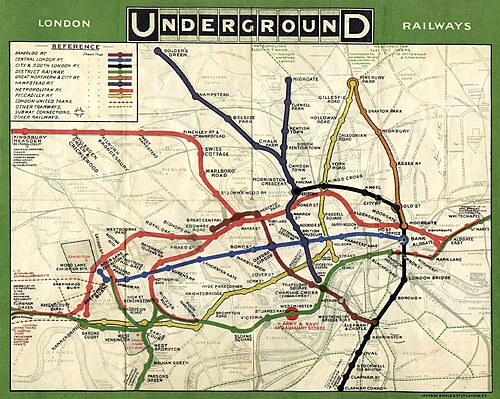
Early maps of the Metropolitan and District railways were city maps with the lines superimposed,[262] and the District published a pocket map in 1897.[263] A Central London Railway route diagram appears on a 1904 postcard and 1905 poster,[264] similar maps appearing in District Railway cars in 1908.[265] In the same year, following a marketing agreement between the operators, a joint central area map that included all the lines was published.[266] A new map was published in 1921 without any background details, but the central area was squashed, requiring smaller letters and arrows.[267] Although Fred H. Stingemore enlarged the central area of the map, it was Harry Beck who took this further by distorting geography and simplifying the map so that the railways appeared as straight lines with equally spaced stations.[268] He presented his original draft in 1931, and after initial rejection it was first printed in 1933. Today's tube map is an evolution of that original design, and the ideas are used by many metro systems around the world.[269][270]
The current standard Tube map shows the Docklands Light Railway, London Overground, IFS Cloud Cable Car, London Tramlink and the London Underground;[271] a more detailed map covering a larger area, published by National Rail and Transport for London, includes suburban railway services.[201] The tube map came second in a BBC and London Transport Museum poll asking for a favourite UK design icon of the 20th century[272] and the underground's 150th anniversary was celebrated by a Google Doodle on the search engine.[273][274]
Commissioned by Art on the Underground, the cover of the pocket map is designed by various British and international artists, one of the largest public art commissions in the UK.[275]
Roundel

While the first use of a roundel in a London transport context was the trademark of the London General Omnibus Company registered in 1905, it was first used on the Underground in 1908 when the UERL placed a solid red circle behind station nameboards on platforms to highlight the name.[276][277] The word "UNDERGROUND" was placed in a roundel instead of a station name on posters in 1912 by Charles Sharland and Alfred France, as well as on undated and possibly earlier posters from the same period.[278]
Transport administrator Frank Pick, wanting to establish a strong corporate identity and visual brand for the Underground, thought the solid red disc cumbersome and took a version where the disc became a ring from a 1915 Sharland poster and gave it to Edward Johnston to develop, and registered the symbol as a trademark in 1917.[38][279] The roundel was first printed on a map cover using the Johnston typeface in June 1919, and printed in colour the following October.[280]
After the UERL was absorbed into the London Passenger Transport Board in 1933, it used forms of the roundel for buses, trams and coaches, as well as the Underground. The words "London Transport" were added inside the ring, above and below the bar. The Carr-Edwards report, published in 1938 as possibly the first attempt at a graphics standards manual, introduced stricter guidelines.[281] Between 1948 and 1957 the word "Underground" in the bar was replaced by "London Transport".[282] As of 2013[update], forms of the roundel, with differing colours for the ring and bar, are used for other TfL services, such as London Buses, Tramlink, London Overground, London River Services and Docklands Light Railway.[283] Crossrail will also be identified with a roundel.[284] The 100th anniversary of the roundel was celebrated in 2008 by TfL commissioning 100 artists to produce works that celebrate the design.[285][286] Roundels are featured outside many underground stations; they are commonly mounted on a white pole known as a "Venetian mast".[287]
In 2016, Tate Modern commissioned conceptual artist Michael Craig-Martin to "reimagine" the roundel, changing its colours for the first time since the sign was introduced. His design was displayed at Southwark Station in collaboration with Art on the Underground to mark the opening weekend of the new Tate Modern gallery situated near the station.[288]
-
 An early form of the roundel as used on the platform at Ealing Broadway
 -
 Mosaic roundel used at Maida Vale station
 -
 The form used today outside Westminster tube station
 -
 Roundel and "way out" arrow on a platform at Bethnal Green station
 -
 Michael Craig-Martin's 2016 roundel design
 -
 NO SMOKING signs using the roundel which are now present only on the 1972 stock trains of the Bakerloo line


Architecture
Seventy of the 272 London Underground stations use buildings that are on the Statutory List of Buildings of Special Architectural or Historic Interest, and five have entrances in listed buildings.[289] The Metropolitan Railway's original seven stations were inspired by Italianate designs, with the platforms lit by daylight from above and by gas lights in large glass globes.[290] Early District Railway stations were similar and on both railways the further from central London the station the simpler the construction.[291] The City & South London Railway opened with red-brick buildings, designed by Thomas Phillips Figgis, topped with a lead-covered dome that contained the lift mechanism and weather vane (still visible at many stations, such as Clapham Common).[36][292] The Central London Railway appointed Harry Bell Measures as architect, who designed its pinkish-brown steel-framed buildings with larger entrances.[293]
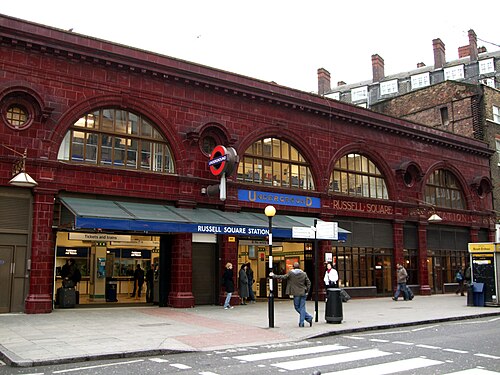
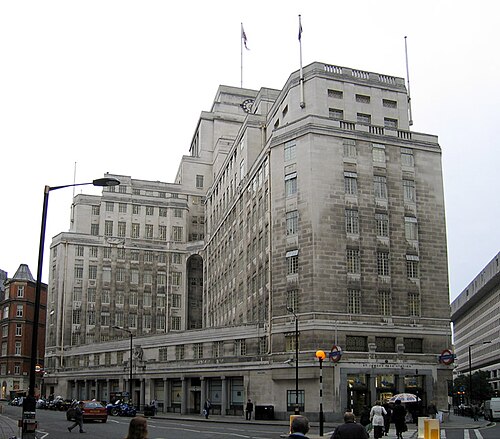
In the first decade of the 20th century Leslie Green established a house style for the tube stations built by the UERL, which were clad in ox-blood faience blocks.[294] Green pioneered using building design to guide passengers with direction signs on tiled walls, with the stations given a unique identity with patterns on the platform walls.[295][296] Many of these tile patterns survive, though a significant number of these are now replicas.[297] Harry W. Ford was responsible for the design of at least 17 UERL and District Railway stations, including Barons Court and Embankment, and claimed to have first thought of enlarging the U and D in the UNDERGROUND wordmark.[298] The Met's architect Charles Walter Clark had used a neo-classical design for rebuilding Baker Street and Paddington Praed Street stations before the First World War and, although the fashion had changed, continued with Farringdon in 1923. The buildings had metal lettering attached to pale walls.[293] Clark would later design "Chiltern Court", the large, luxurious block of apartments at Baker Street, that opened in 1929.[299] In the 1920s and 1930s, Charles Holden designed a series of modernist and art-deco stations some of which he described as his 'brick boxes with concrete lids'.[300] Holden's design for the Underground's headquarters building at 55 Broadway included avant-garde sculptures by Jacob Epstein, Eric Gill and Henry Moore.[301][302]
When the Central line was extended east, the stations were simplified Holden proto-Brutalist designs,[303] and a cavernous concourse built at Gants Hill in honour of early Moscow Metro stations.[304] Few new stations were built in the 50 years after 1948, but Misha Black was appointed design consultant for the 1960s Victoria line, contributing to the line's uniform look,[305] with each station having an individual tile motif.[306] Notable stations from this period include Moor Park, the stations of the Piccadilly line extension to Heathrow and Hillingdon.
In recent years, the stations of the 1990s Jubilee Line Extension were designed in a high-tech style by architects such as Norman Foster and Michael Hopkins.[307] The project was critically acclaimed, with the Royal Fine Arts Commission describing the project as "an example of patronage at its best and most enlightened", and two stations shortlisted for the Stirling Prize.[308] Stations were built to the latest standards, future proofed for growth, with innovations such as Platform screen doors.[309] West Ham station was built as a homage to the red brick tube stations of the 1930s, using brick, concrete and glass.
Many platforms have unique interior designs to help passenger identification. The tiling at Baker Street incorporates repetitions of Sherlock Holmes's silhouette;[310] at Tottenham Court Road semi-abstract mosaics by Eduardo Paolozzi feature musical instruments, tape machines and butterflies;[311] and at Charing Cross, David Gentleman designed the mural depicting the construction of the Eleanor Cross.[36] Robyn Denny designed the murals on the Northern line platforms at Embankment.[310]
Johnston typeface
The first posters used various typefaces, as was contemporary practice,[312] and station signs used sans serif block capitals.[313] The Johnston typeface was developed in upper and lower case in 1916, and a complete set of blocks, marked Johnston Sans, was made by the printers the following year.[314] A bold version of the capitals was developed by Johnston in 1929.[315] The Metropolitan Railway changed to a serif letterform for its signs in the 1920s, used on the stations rebuilt by Clark.[316] Johnston was adopted systemwide after the formation of the LPTB in 1933 and the LT wordmark was applied to locomotives and carriages.[317] Johnston was redesigned, becoming New Johnston, for photo-typesetting in the early 1980s when Elichi Kono designed a range that included Light, Medium and Bold, each with its italic version. The typesetters P22 developed today's electronic version, sometimes called TfL Johnston, in 1997.[318]
Posters and patronage of the arts

Early advertising posters used various typefaces.[319] Graphic posters first appeared in the 1890s,[320] and it became possible to print colour images economically in the early 20th century.[321] The Central London Railway used colour illustrations in their 1905 poster,[322] and from 1908 the Underground Group, under Pick's direction, used images of country scenes, shopping and major events on posters to encourage use of the tube.[323] Pick found he was limited by the commercial artists the printers used, and so commissioned work from artists and designers such as Dora Batty,[324] Edward McKnight Kauffer, the cartoonist George Morrow,[320] Herry (Heather) Perry,[324] Graham Sutherland,[320] Charles Sharland[325] and the sisters Anna and Doris Zinkeisen. According to Ruth Artmonsky, over 150 women artists were commissioned by Pick and latterly Christian Barman to design posters for London Underground, London Transport and London County Council Tramways.[326]
The Johnston Sans letter font began appearing on posters from 1917.[325] The Met, strongly independent, used images on timetables and on the cover of its Metro-land guide that promoted the country it served for the walker, visitor and later the house-hunter.[327][328] By the time London Transport was formed in 1933 the UERL was considered a patron of the arts[320] and over 1000 works were commissioned in the 1930s, such as the cartoon images of Charles Burton and Kauffer's later abstract cubist and surrealist images.[329] Harold Hutchison became London Transport publicity officer in 1947, after the Second World War and nationalisation, and introduced the "pair poster", where an image on a poster was paired with text on another. Numbers of commissions dropped, to eight a year in the 1950s and just four a year in the 1970s,[320] with images from artists such Harry Stevens and Tom Eckersley.[330]

Art on the Underground was launched in 2000 to revive London Underground as a patron of the arts.[331] Today, commissions range from the pocket Tube map cover, to temporary artworks, to large-scale permanent installations in stations.[332][331] Major commissions by Art on the Underground in recent years have included Labyrinth by the Turner Prize–winning artist Mark Wallinger, to mark the 150th anniversary of the Underground;[333] Diamonds and Circles, permanent works in situ by the French artist Daniel Buren at Tottenham Court Road;[334] and Beauty < Immortality, a memorial to Frank Pick by Langlands & Bell at Piccadilly Circus.[335]
Similarly, since 1986 Poems on the Underground has commissioned poetry that is displayed in trains.[336]
In popular culture
The Underground (including several fictitious stations[337]) has appeared in many movies and television shows, including Skyfall, Death Line, Die Another Day, Sliding Doors, An American Werewolf in London, Creep, Tube Tales, Sherlock and Neverwhere. The London Underground Film Office received over 200 requests to film in 2000.[338] The Underground has also featured in music such as the Jam's "Down in the Tube Station at Midnight" and in literature such as the graphic novel V for Vendetta. Popular legends about the Underground being haunted persist to this day.[339][user-generated source] In 2016, British composer Daniel Liam Glyn released his concept album Changing Stations based on the 11 main tube lines of the London Underground network.[340]
Call of Duty: Modern Warfare 3 has a single-player level named Mind The Gap where most of the level takes place between the dockyards and Westminster while the player and a team of SAS attempt to take down terrorists attempting to escape using the London Underground via a hijacked train. The game also features the multiplayer map "Underground", in which players are combating in a fictitious Underground station. The London Underground map serves as a playing field for the conceptual game of Mornington Crescent[341] (which is named after a station on the Northern line) and the board game The London Game.
In 1999, Carlton Television premiered a regional game show (Greater London area only) also called Mind the Gap.[342]
Busking
The London Underground provides busking permits for up to 39 pitches across 25 central London stations, with over 100,000 hours of live music performed each year.[343] Performers are chosen by audition, with previous buskers including Ed Sheeran, George Michael and Rod Stewart.[344]
Research
The London Underground is frequently studied by academics because it is one of the largest, oldest, and most widely used systems of public transit in the world. Therefore, the transportation and complex network literatures include extensive information about the Tube system.
For London Underground passengers, research suggests that transfers are highly costly in terms of walk and wait times. Because these costs are unevenly distributed across stations and platforms, path choice analyses may be helpful in guiding upgrades and choice of new stations.[345] Routes on the Underground can also be optimized using a global network optimization approach, akin to routing algorithms for Internet applications.[346] Analysis of the Underground as a network may also be helpful for setting safety priorities, since the stations targeted in the 2005 London bombings were amongst the most effective for disrupting the transportation system.[347]
A study in March 2023 showed that over £1.3 million worth of mobile phones were stolen on the London Underground in 2022, more than the entire UK rail network combined.[348]
Notable people
- Harry Beck (1902–1974) designed the tube map, named in 2006 as a British design icon.[349]
- Hannah Dadds (1941–2011), the first female train driver on the London Underground.[350]
- John Fowler (1817–1898) was the railway engineer that designed the Metropolitan Railway.[351]
- MacDonald Gill (1884–1947), cartographer credited with drawing, in 1914, "the map that saved the London Underground".
- James Henry Greathead (1844–1896) was the engineer that dug the Tower Subway using a method using a wrought iron shield patented by Peter W. Barlow, and later used the same tunnelling shield to build the deep-tube City & South London and Central London railways.[352][353]
- Edward Johnston (1872–1944) developed the Johnston Sans typeface, still in use today on the London Underground.[354]
- Charles Pearson (1793–1862) suggested an underground railway in London in 1845 and from 1854 promoted a scheme that eventually became the Metropolitan Railway.[355]
- Frank Pick (1878–1941) was UERL publicity officer from 1908, commercial manager from 1912 and joint managing director from 1928. He was chief executive and vice chairman of the LPTB from 1933 to 1940. It was Pick that commissioned Edward Johnston to create the typeface and redesign the roundel, and established the Underground's reputation as patrons of the arts as users of the best in contemporary poster art and architecture.[356]
- Robert Selbie (1868–1930) was manager of the Metropolitan Railway from 1908 until his death, marketing it using the Metro-land brand.[354][357]
- Edgar Speyer (1862–1932) Financial backer of Yerkes who served as UERL chairman from 1906 to 1915 during its formative years.[358]
- Albert Stanley (1874–1948) was manager of the UERL from 1907, and became the first chairman of the London Passenger Transport Board (LPTB) in 1933.[359]
- Edward Watkin (1819–1901) was chairman of the Metropolitan Railway from 1872 to 1894.[360]
- Charles Yerkes (1837–1905) was an American who founded the Underground Electric Railways Company of London (UERL) in 1902, which opened three tube lines and electrified the District Railway.[361][362]
See also
- Automation of the London Underground
- List of London Underground stations
- List of busiest London Underground stations
- London Underground mosquito
- London Underground strikes
- London UnderRound
- Timeline of the London Underground
References
- ^ a b c d e f "About TfL – What we do – London Underground – Facts & figures". Transport for London. Archived from the original on 27 September 2014. Retrieved 17 June 2014.
- ^ a b c Transport for London (4 February 2023). "Public Transport Journeys by Type of Transport". London Datastore. Archived from the original on 22 March 2023. Retrieved 22 March 2023.
- ^ "National Rail Enquiries – London Underground". www.nationalrail.co.uk. Archived from the original on 10 May 2021. Retrieved 21 April 2021.
- ^ Transport for London (29 July 2019). "Facts & figures". Archived from the original on 27 September 2014. Retrieved 18 June 2014.
- ^ "An overview of the British rail industry" (PDF). Office of Rail and Road. 19 December 2014. Archived (PDF) from the original on 3 April 2016. Retrieved 5 January 2017.
- ^ Lee, Charles E (1973). The Metropolitan Line. London: London Transport. p. 7. ISBN 0-85329 033 4.
- ^ Wolmar (2004), p. 135.
- ^ a b c Attwooll, Jolyon (5 August 2015). "London Underground: 150 fascinating Tube facts". The Daily Telegraph. London. Archived from the original on 11 January 2022.
- ^ May, Jack (31 March 2017). "Why are there so few tube lines in South London?". City Monitor. Archived from the original on 10 May 2021. Retrieved 10 October 2019.
- ^ "Daily Ridership". Transport for London. Archived from the original on 24 January 2017. Retrieved 22 July 2016.
- ^ a b Croome & Jackson (1993), Preface.
- ^ "Annual Report and Statement of Accounts 2011/12" (PDF). Transport for London. pp. 98, 100. Archived (PDF) from the original on 20 December 2015. Retrieved 25 October 2015.
Fares revenue on LU was £2,410m... Operating expenditure on the Underground increased to £2,630m
- ^ "Annual Report and Statement of Accounts 2011/12" (PDF). TfL. p. 11. Archived (PDF) from the original on 20 December 2015. Retrieved 25 October 2015.
- ^ a b "Contactless payment on London Underground" (Press release). Transport for London. 9 September 2014. Archived from the original on 10 May 2021. Retrieved 20 November 2017.
- ^ a b c "Licencing London's contactless ticketing system" (Press release). Transport for London. 13 July 2016. Archived from the original on 1 December 2017. Retrieved 20 November 2017.
- ^ "Design in Relation to the Problem: The London Underground". Commercial Art & Industry: 38–59. 1932. Archived from the original on 15 May 2021. Retrieved 21 November 2017.
- ^ Sagittarius (1928). "Celebrities of Advertising II: Frank Pick". Commercial Art & Industry: 168–9. Archived from the original on 1 December 2017. Retrieved 21 November 2017.
- ^ Barman, Christian (1948). "Frank Pick and his Influence on Design in England". Graphis: 70–73. Archived from the original on 15 May 2021. Retrieved 21 November 2017.
- ^ Peacock (1970), pp. 37–38.
- ^ Day & Reed (2010), p. 8.
- ^ Jackson (1986), p. 19.
- ^ Bextor, Robin (2013). A History of the London Underground. Demand Media Limited. p. 34. ISBN 978-1909217379.
- ^ Day & Reed (2010), pp. 8, 14.
- ^ Simpson (2003), p. 16.
- ^ Day & Reed (2010), pp. 18–24.
- ^ Day & Reed (2010), pp. 27–28.
- ^ Day & Reed (2010), pp. 10–11.
- ^ a b Day & Reed (2010), p. 26.
- ^ Day & Reed (2010), p. 33.
- ^ Day & Reed (2010), p. 32.
- ^ Day & Reed (2010), pp. 40–45.
- ^ Day & Reed (2010), pp. 50–51.
- ^ Day & Reed (2010), pp. 52–56.
- ^ Day & Reed (2010), pp. 50, 53.
- ^ Day & Reed (2010), pp. 60–61.
- ^ a b c d e f Ackroyd, P. (2012). London Under. London: Vintage Books. ISBN 978-0-099-28737-7
- ^ Mason, M. (2013). Walk the Lines: The London Underground, Overground. London: Arrow Books. p.126. ISBN 978-0-099-55793-7
- ^ a b Emmerson, Andrew (2010). The London Underground. London: Shire Publications Ltd. ISBN 978-0-74780-790-2.
- ^ Day & Reed (2010), pp. 62–63.
- ^ Day & Reed (2010), pp. 69–72, 78.
- ^ a b Green (1987), p. 30.
- ^ Green (1987), pp. 24–28.
- ^ Wolmar 2004, p. 204.
- ^ Wolmar 2004, p. 205.
- ^ Horne (2003), p. 51.
- ^ Green (1987), p. 35.
- ^ Green (1987), p. 33.
- ^ Day & Reed (2010), p. 94.
- ^ a b c Day & Reed (2010), p. 122.
- ^ Day & Reed (2010), pp. 84–88.
- ^ Jackson (1986), pp. 134, 137.
- ^ Day & Reed (2010), p. 98–103, 111.
- ^ Day & Reed (2010), p. 110.
- ^ a b "Waterloo & City Line". Clive's Underground Line Guides. Clive Feather. 14 December 2007. Archived from the original on 12 April 2015. Retrieved 11 June 2015.
- ^ Green (1987), p. 46.
- ^ Day & Reed (2010), p. 118.
- ^ Day & Reed (2010), p. 116.
- ^ Day & Reed (2010), pp. 131, 133–134.
- ^ Horne (2006), p. 73.
- ^ Day & Reed (2010), pp. 144–145.
- ^ Day & Reed (2010), pp. 135–136.
- ^ "Tribute to Bank Tube station bomb victims of 1941". BBC London News. 11 January 2011. Archived from the original on 15 August 2021. Retrieved 15 August 2021.
- ^ "Bethnal Green Tube disaster marked 70 years on". BBC News. 3 March 2013. Archived from the original on 6 March 2013. Retrieved 11 June 2015.
- ^ Day & Reed 2008, p. 150.
- ^ a b Cooke 1964, p. 739.
- ^ Green (1987), p. 54.
- ^ Green (1987), pp. 56–57.
- ^ Green (1987), p. 56.
- ^ Day & Reed 2008, p. 163.
- ^ Day & Reed (2010), pp. 160–162, 166–168, 171.
- ^ Day & Reed 2008, p. 172.
- ^ "In Living Memory, Series 11: The 1975 Moorgate tube disaster". BBC Radio 4. 2 December 2009. Archived from the original on 4 February 2023. Retrieved 26 January 2012.
- ^ Green (1987), pp. 55–56.
- ^ Day & Reed (2010), pp. 178–181.
- ^ Green (1987), pp. 65–66.
- ^ Day & Reed (2010), pp. 186–187.
- ^ Croome & Jackson (1993), p. 468.
- ^ Fennell 1988, pp. 17–18.
- ^ "Kings Cross Tragedy Means Safety First For London Underground". London Transport. 21 October 1997. Archived from the original on 12 February 1998. Retrieved 14 August 2021.
- ^ Day & Reed (2010), pp. 206–211.
- ^ "Elizabeth Line "more mannered" than Jubilee predecessor says head of architecture". Dezeen. 10 May 2022. Archived from the original on 8 August 2022. Retrieved 8 August 2022.
- ^ "Chief Officers". Transport for London. Archived from the original on 22 January 2014.
- ^ "About TfL – How we work – How we are governed – Subsidiary companies". Transport for London. Archived from the original on 11 March 2015. Retrieved 17 June 2014.
- ^ "A brief history of the Underground – London Underground milestones". Transport for London. Archived from the original on 19 August 2014. Retrieved 6 June 2014.
- ^ Day & Reed (2010), pp. 215, 221.
- ^ "Circle Line extended to the west". BBC News. 5 March 2009. Archived from the original on 10 March 2009. Retrieved 24 November 2011.
- ^ "More than 50 killed in blasts". The Guardian. London. 8 July 2005. Archived from the original on 8 August 2022. Retrieved 8 August 2022.
- ^ Day & Reed (2010), p. 216.
- ^ Topham, Gwyn (16 September 2014). "London tube introduces contactless payments". The Guardian. London. Archived from the original on 10 May 2021. Retrieved 8 August 2022.
- ^ "Services - 541858-2020 - TED Tenders Electronic Daily". ted.europa.eu. Archived from the original on 8 August 2022. Retrieved 8 August 2022.
The Transport for London (TfL) Revenue Collection System collects in excess of GBP 5 billion of revenue per annum (pre Covid-19). Supporting transactions generated from over 16 million journeys per day, 0.5 million retail sales per day and in the last year 12 million Oyster and 35 million contactless payment card used to make journeys.
- ^ "London 2012: Games bring record London Underground users". BBC News. 4 August 2012. Archived from the original on 8 August 2022. Retrieved 8 August 2022.
- ^ "London Underground breaks the record again for busiest day ever on the Tube" (Press release). Transport for London. 9 December 2015. Archived from the original on 8 August 2022. Retrieved 8 August 2022.
- ^ "London Underground: 150 years". ITV News. 10 January 2013. Archived from the original on 8 August 2022. Retrieved 8 August 2022.
- ^ a b Rose (2007).
- ^ "East London line officially opens". BBC News. 27 April 2010. Archived from the original on 18 April 2015. Retrieved 2 April 2010.
- ^ a b c "Elizabeth line: What is Crossrail and when does it open?". BBC News. 24 May 2022. Archived from the original on 26 August 2022. Retrieved 8 August 2022.
- ^ "Elizabeth line: almost 50 years in the planning for Crossrail – timeline". The Guardian. 20 May 2022. Archived from the original on 10 January 2023. Retrieved 10 January 2023.
Proposals for east-west train route across London, first mooted in 1974, inspired by Paris RER
- ^ a b "Elizabeth line: Crossrail complete after decades of struggle". The Guardian. 23 May 2022. Archived from the original on 10 January 2023. Retrieved 10 January 2023.
- ^ "Coronavirus: 40 London Underground stations to be closed". BBC News. 19 March 2020. Archived from the original on 29 June 2021. Retrieved 11 February 2021.
- ^ "London Underground: Nine Elms and Battersea Power Station set to open". BBC News. 3 September 2021. Archived from the original on 5 September 2021. Retrieved 5 September 2021.
- ^ "Northern line extension". Transport for London. 2019. Archived from the original on 29 July 2019. Retrieved 26 January 2016.
- ^ "Northern Line extension: Two new Tube stations open". BBC News. 20 September 2021. Archived from the original on 20 September 2021. Retrieved 20 September 2021.
- ^ Attwooll, Jolyon (25 January 2018). "150 London Underground facts (including the birth of Jerry Springer in East Finchley station)". The Telegraph. London. Archived from the original on 11 January 2022. Retrieved 28 April 2020.
- ^ "East London Line opens to public". BBC. 27 April 2010. Archived from the original on 18 April 2015. Retrieved 8 June 2016.
- ^ a b "Detailed London Transport Map". cartometro.com. Archived from the original on 28 July 2020. Retrieved 1 December 2012.
- ^ Croome & Jackson (1993), pp. 26, 33, 38, 81.
- ^ Croome & Jackson (1993), pp. 327–328.
- ^ Martin, Andrew (26 April 2012). Underground, Overground: A Passenger's History of the Tube. London: Profile Books. pp. 137–138. ISBN 978-1-84765-807-4. Archived from the original on 19 January 2023. Retrieved 7 December 2012.
- ^ "Which London Underground line is the fastest?". 18 September 2017. Archived from the original on 15 May 2021. Retrieved 21 April 2021.
- ^ London Underground. "Standard Tube Map" (PDF). Transport for London. Archived (PDF) from the original on 25 June 2017. Retrieved 1 December 2017.
- ^ "Rolling Origin & Destination Survey (RODS)". Archived from the original on 4 November 2019. Retrieved 11 April 2019.
- ^ "Up to date per line London Underground usage statistics". TheyWorkForYou. 29 April 2018. Archived from the original on 2 July 2020. Retrieved 29 April 2018.
- ^ Horne (2006), pp. 13, 24.
- ^ Ovenden (2013), p. 220.
- ^ a b c "Commissioner's Report" (PDF). Transport for London. 26 March 2014. pp. 3–4. Archived (PDF) from the original on 10 October 2022. Retrieved 2 April 2014.
- ^ "Piccadilly Underground line – Transport for London". Transport for London. Archived from the original on 26 May 2021. Retrieved 17 March 2021.
- ^ Neil, Graham (4 August 2015). "London Underground Rolling Stock Information Sheet" (PDF). WhatDoTheyKnow. Archived (PDF) from the original on 5 May 2016. Retrieved 17 April 2016.
- ^ a b c d e f g h i j k l m Brown (2012).
- ^ Table 115 National Rail timetable, May 13
- ^ a b Section 10 - Network Rail, London Underground - Individual Working Alone, [1] Archived 4 February 2023 at the Wayback Machine
- ^ Maund, Richard (2013). Passenger Train Services over Unusual Lines Archived 1 July 2013 at the Wayback Machine.
- ^ Peacock (1970), p. 67.
- ^ Maund, Richard. "Passenger Train Services over Unusual Lines". Archived from the original on 22 October 2021. Retrieved 22 October 2021.
Point Pleasant Junction – East Putney
- ^ "Rolling Stock". Transport for London. Archived from the original on 19 May 2014. Retrieved 18 June 2014.
- ^ Day & Reed (2010), p. 159.
- ^ Day & Reed (2010), p. 205.
- ^ "Rolling Stock Data Sheet" (PDF). Transport for London. March 2007. Archived (PDF) from the original on 4 October 2013.
- ^ a b Connor, Piers (January 2013). "Deep tube transformation". Modern Railways. pp. 44–47.
- ^ a b "Making transport more accessible to all". Department for Transport. 3 October 2012. Archived from the original on 17 September 2013. Retrieved 17 March 2013.
- ^ Hardy (2002), p. 6.
- ^ "New Tickets Released for Hidden London tours". London Transport Museum. 25 January 2023. Archived from the original on 5 November 2023. Retrieved 15 February 2023.
- ^ "New consultation on Bakerloo line extension opens today". Transport for London. 14 October 2019. Archived from the original on 26 October 2022. Retrieved 2 April 2021.
- ^ "Bakerloo line extension Background to Consultation Summary Report October 2019" (PDF). Transport for London. October 2019. Archived (PDF) from the original on 24 March 2020. Retrieved 15 March 2021.
- ^ "Planning for the Future – Bakerloo line extension". Transport for London. Archived from the original on 29 September 2015. Retrieved 15 March 2021.
- ^ Henderson, Jamie (23 June 2013). "Clapham Junction next for Northern Line says London Assembly member". Wandsworth Guardian. Archived from the original on 24 December 2013. Retrieved 12 January 2014.
- ^ "Metropolitan line extension". Transport for London. Archived from the original on 17 July 2017. Retrieved 17 July 2017.
- ^ Smith, Rebecca (8 February 2018). "Metropolitan Line extension stalemate between mayor Sadiq Khan and government leaves TFL mulling bus scheme alternative". City AM. Archived from the original on 18 February 2019. Retrieved 26 October 2022.
- ^ Smale, Katherine (11 April 2019). "Canary Wharf Group in talks about rail link to Euston". New Civil Engineer. Archived from the original on 13 April 2019. Retrieved 25 April 2019.
- ^ "Harlow's addition to London Underground proposed by council". BBC News. 11 August 2021. Archived from the original on 25 March 2023. Retrieved 26 March 2023.
- ^ a b c d "New Tube for London Feasibility Report" (PDF). TfL. October 2014. Archived from the original (PDF) on 26 June 2015. Retrieved 25 June 2015.
- ^ "Bakerloo Line Fleet Life Extension" (PDF). TfL. 11 March 2015. Archived (PDF) from the original on 26 June 2015. Retrieved 25 June 2015.
- ^ "Central line train overhaul project" (PDF). TfL. Archived (PDF) from the original on 26 June 2015. Retrieved 25 June 2015.
- ^ "Central line timetable" (PDF). TfL. Archived from the original (PDF) on 15 April 2014. Retrieved 25 June 2015.
- ^ "Jubilee line 36tph upgrade" (PDF). TfL. Archived (PDF) from the original on 20 April 2015. Retrieved 25 June 2015.
- ^ a b "LU to source additional Tube trains" (Press release). TfL. 18 August 2014. Archived from the original on 26 June 2015. Retrieved 25 June 2015.
- ^ "Information on the Northern Line upgrade" (PDF). railway-technical. Archived from the original (PDF) on 30 August 2015. Retrieved 25 June 2015.
- ^ "Major works to improve Victoria line services this summer" (Press release). TfL. 17 February 2015. Archived from the original on 24 May 2015. Retrieved 25 June 2015.
- ^ Barnes, Tom (13 May 2016). "All Victoria Line trains to run 'end to end' for first time". East London and West Essex Guardian Series. Watford. Archived from the original on 10 May 2021. Retrieved 21 April 2021.
- ^ "Tube Improvements". TfL. n.d. Archived from the original on 11 July 2015. Retrieved 25 June 2015.
- ^ "Third Time Lucky: A Look At The New Sub-Surface Signalling Plan". London Reconnections. 15 June 2015. Archived from the original on 26 June 2015. Retrieved 25 June 2015.
- ^ "SSR Signalling contract" (PDF). TfL. Archived (PDF) from the original on 26 June 2015. Retrieved 25 June 2015.
- ^ "LU begins search for new Jubilee and Northern line train supplier". www.railtechnologymagazine.com. Archived from the original on 3 August 2020. Retrieved 5 October 2019.
- ^ a b "New Tube for London Programme" (PDF). Board Minutes. Transport for London. 5 February 2014. Archived (PDF) from the original on 7 April 2014. Retrieved 3 April 2014.
- ^ a b "New Tube for London Programme". Railway Gazette. 28 February 2014. Archived from the original on 10 March 2014. Retrieved 3 April 2014.
- ^ "Design for the 'New Tube for London' revealed" (Press release). TfL. 9 October 2014. Archived from the original on 15 May 2021. Retrieved 9 October 2014.
- ^ "New Tube for London Programme". BBC News. 9 October 2014. Archived from the original on 20 June 2021. Retrieved 9 October 2014.
- ^ "TfL prepares for driverless tube". Railnews. 28 February 2014. Archived from the original on 6 April 2014. Retrieved 3 April 2014.
- ^ "Driverless Tube trains: Unions vow 'war' over plan". BBC News. 28 February 2014. Archived from the original on 30 April 2014. Retrieved 3 April 2014.
- ^ "New Tube for London invitations to tender issued". Railway Gazette. 18 January 2016. Archived from the original on 4 July 2018. Retrieved 14 November 2016.
- ^ "Khan: New Piccadilly rolling stock will be delivered by 2023". Rail Technology Magazine. 20 December 2016. Archived from the original on 15 May 2021. Retrieved 18 January 2018.
- ^ "East Yorkshire factory wins £1.5bn Tube train deal". BBC News. 15 June 2018. Archived from the original on 10 May 2021. Retrieved 15 June 2018.
- ^ a b c Croome & Jackson (1993), pp. 253–254.
- ^ Griffiths, Emma (18 July 2006). "Baking hot at Baker Street". BBC News. Archived from the original on 1 January 2016. Retrieved 31 March 2013.
- ^ "London's Tube 'unfit for animals'". The Daily Telegraph. London. 28 August 2002. Archived from the original on 11 January 2022. Retrieved 31 March 2013.
- ^ Croxford, Ben (4 December 2003). "Environmental Quality in Underground Railways". University College London. Archived from the original on 16 October 2013. Retrieved 5 November 2013.
- ^ Murray, Dick (23 August 2002). "Passengers choke on the Tube". London Evening Standard. Archived from the original on 8 November 2020. Retrieved 31 March 2013.
- ^ Westgate, Stuart; Gilby, Mark (8 May 2007). "Meeting Report: Cooling the tube" (PDF). LURS. Archived (PDF) from the original on 5 October 2013. Retrieved 31 March 2013.
- ^ "Water pump plan to cool the Tube". BBC News. 8 June 2006. Archived from the original on 6 July 2006. Retrieved 31 March 2013.
- ^ "Work begins to cool the platforms at two major central London stations" (Press release). Transport for London. 17 February 2012. Archived from the original on 27 March 2014. Retrieved 27 March 2014.
- ^ Abbott, James (January 2013). "Sub-surface renewal". Modern Railways. pp. 38–41.
- ^ "Improving the Tube – What we're doing – Improving the trains". Transport for London. Archived from the original on 15 August 2021. Retrieved 21 August 2021.
- ^ Demartini, L. C.; Vielmo, H. A.; Möller, S. V. (2004). "Numeric and experimental analysis of the turbulent flow through a channel with baffle plates". Journal of the Brazilian Society of Mechanical Sciences and Engineering. 26 (2): 153–159. doi:10.1590/S1678-58782004000200006. hdl:10183/75781. ISSN 1678-5878.
- ^ Croome & Jackson (1993), pp. 26, 35, 39, 87–89.
- ^ Croome & Jackson (1993), p. 540.
- ^ a b c Croome & Jackson (1993), pp. 114, 542.
- ^ Day & Reed (2010), p. 59.
- ^ Croome & Jackson (1993), pp. 154, 546.
- ^ Malvern, Jack (21 October 2009). "Mystery over Tube escalator etiquette cleared up by restored film". The Times. London. Archived from the original on 15 June 2011. Retrieved 9 December 2009.(subscription required)
- ^ Day & Reed (2010), p. 93.
- ^ "Pioneers of Survival: Fire". PBS. Archived from the original on 9 June 2021. Retrieved 4 September 2017.
- ^ "Incline lift at Greenford Tube station is UK first". Transport for London. 20 October 2015. Archived from the original on 29 June 2016. Retrieved 21 October 2015.
- ^ "Facts & figures". Transport for London. Archived from the original on 17 February 2017. Retrieved 20 November 2017.
- ^ a b "Improvements and Projects – Step-free access". Transport for London. Archived from the original on 10 May 2021. Retrieved 19 November 2017.
- ^ "London Underground Advertising | All Products & Formats". 31 December 2022. Retrieved 8 January 2023.
- ^ "Virgin Media extends free wi-fi on London Underground until 2013". Metro. London. 17 October 2012. Archived from the original on 20 November 2012. Retrieved 10 November 2012.
- ^ "Station Wifi". Transport for London. Archived from the original on 25 February 2013. Retrieved 12 March 2013.
- ^ Mulholland, Hélène (1 April 2011). "Plans for mobile network on London underground shelved". The Guardian. London. Archived from the original on 23 May 2021. Retrieved 1 April 2013.
- ^ "4G on Jubilee line tunnel section from March 2020". Transport for London (Press release). Archived from the original on 10 May 2021. Retrieved 3 August 2020.
- ^ Jackson, Mark (17 June 2021). "Vodafone UK Quietly Scrap London Underground WiFi Support". ISPreview UK. Archived from the original on 19 August 2023. Retrieved 19 August 2023.
- ^ Mansfield, Ian (17 June 2021). "Vodafone drops WiFi coverage from the London Underground". ianVisits. Archived from the original on 19 August 2023. Retrieved 19 August 2023.
- ^ Jackson, Mark (3 April 2023). "Vodafone UK Reintroduced Public WiFi to London Underground". ISPreview UK. Archived from the original on 19 August 2023. Retrieved 19 August 2023.
- ^ Transport for London (21 December 2022). "Three more London Underground stations begin offering high-speed mobile coverage to customers". Transport for London. Archived from the original on 19 August 2023. Retrieved 19 August 2023.
- ^ Jackson, Mark (21 December 2022). "EE and Vodafone UK Extend 4G Mobile to 6 New London Underground Stations". ISPreview UK. Archived from the original on 19 August 2023. Retrieved 19 August 2023.
- ^ a b "London Underground mobile connectivity map". mastdatabase.co.uk. Archived from the original on 19 August 2023. Retrieved 19 August 2023.
- ^ Mansfield, Ian (20 June 2023). "London Underground expands mobile phone coverage to Mornington Crescent station". ianVisits. Archived from the original on 19 August 2023. Retrieved 19 August 2023.
- ^ a b c Mansfield, Ian (8 September 2023). "London Underground expands mobile phone coverage and confirms Elizabeth line coming soon". ianVisits. Archived from the original on 15 December 2023. Retrieved 15 December 2023.
- ^ "Mobile phones and Wi-Fi underground". Transport for London. Archived from the original on 9 January 2024. Retrieved 9 January 2024.
- ^ a b c "Tube Map 4g - 5g Feb 2024" (PDF). Transport for london. February 2024. Archived from the original (PDF) on 12 March 2024. Retrieved 12 March 2024.
- ^ "TfL Statement of Accounts" (PDF).
- ^ a b "London Rail & Tube Services Map" (PDF). Transport for London. May 2014. Archived (PDF) from the original on 3 July 2014. Retrieved 18 June 2014.
- ^ "Fares & payments – Contactless". Transport for London. Archived from the original on 12 March 2016. Retrieved 11 March 2016.
- ^ a b "TfL to accept Apple Pay on public transport" (Press release). Transport for London. Archived from the original on 10 May 2021. Retrieved 20 November 2017.
- ^ a b "Android Pay accepted for pay as you go travel in London" (Press release). Transport for London. Archived from the original on 10 May 2021. Retrieved 20 November 2017.
- ^ "Fares & payments – Contactless – Apple Pay". Transport for London. Archived from the original on 13 April 2016. Retrieved 11 March 2016.
- ^ "Where can I buy my ticket?" (PDF). Transport for London. January 2012. Archived from the original (PDF) on 1 April 2014. Retrieved 18 June 2014.
- ^ "Fares & payments – Fares – Tube, DLR and London Overground". Transport for London. Archived from the original on 21 June 2014. Retrieved 18 June 2014.
- ^ "Fares & payments – Ticket types". Transport for London. Archived from the original on 27 March 2014. Retrieved 18 June 2014.
- ^ "Travelcards make way for 'oyster'". BBC News. 30 June 2003. Archived from the original on 15 February 2009. Retrieved 7 March 2012.
- ^ "Getting around with Oyster" (PDF). Transport for London. January 2010. Archived (PDF) from the original on 26 September 2012.
- ^ "Fares & payments – Oyster – Using your Oyster card – Capping". Transport for London. Archived from the original on 12 June 2014. Retrieved 18 June 2014.
- ^ "Fares & payments – Oyster – Using your Oyster card – Incomplete journeys". Transport for London. Archived from the original on 5 June 2014. Retrieved 18 June 2014.
- ^ Murray, Dick (7 March 2012). "The £66.5 million cost of not touching out your Oyster card". London Evening Standard. Archived from the original on 27 March 2014. Retrieved 30 March 2013.
- ^ "London's contactless fares system to power New York's subway, bus and rail journeys". MayorWatch. 25 October 2017. Archived from the original on 18 September 2020. Retrieved 20 November 2017.
- ^ Barron, James (23 October 2017). "New York to Replace MetroCard With Modern Way to Pay Transit Fares". The New York Times. ISSN 0362-4331. Archived from the original on 23 October 2017. Retrieved 20 November 2017.
- ^ "The MBTA has a $723 million plan to change the way you pay for rides". The Boston Globe. Archived from the original on 10 May 2021. Retrieved 20 November 2017.
- ^ "Freedom Pass". London Councils. Archived from the original on 19 March 2013. Retrieved 30 March 2013.
- ^ "Freedom Pass age change" (PDF). London Councils. November 2011. Archived from the original (PDF) on 1 September 2012. Retrieved 30 March 2013.
- ^ "Freedom Pass Map" (PDF). London Councils. December 2012. Archived from the original (PDF) on 25 May 2013. Retrieved 30 March 2013.
- ^ "Freedom passes". London Borough of Hammersmith & Fulham. 17 November 2010. Archived from the original on 13 May 2006. Retrieved 4 February 2011.
- ^ "Revenue Enforcement and Prosecutions Policy" (PDF). Transport for London. 18 August 2014. Archived from the original (PDF) on 17 November 2015. Retrieved 16 November 2015.
- ^ "Penalties & enforcement". Transport for London. Archived from the original on 1 January 2016. Retrieved 16 November 2015.
- ^ a b "Later London Underground service being considered". BBC News. 30 January 2013. Archived from the original on 10 May 2021. Retrieved 1 April 2013.
- ^ Beard, Matthew (30 January 2013). "Party on, London... Tube will run an hour later on Fridays and Saturdays". London Evening Standard. Archived from the original on 10 May 2021. Retrieved 1 April 2013.
- ^ a b "Transport in London over Christmas and New Year's Eve". Time Out London. Archived from the original on 10 February 2013. Retrieved 1 April 2013.
- ^ "London 2012 Olympics: Tube to shut hour later, TfL says". BBC News. 30 March 2011. Archived from the original on 10 May 2021. Retrieved 1 April 2013.
- ^ "Planned Works Calendar". Transport for London. 2013. Archived from the original on 31 March 2013. Retrieved 1 April 2013.
- ^ "London Tube strike on Boxing Day". BBC News. 17 December 2012. Archived from the original on 7 June 2021. Retrieved 1 April 2013.
- ^ "Night Tube services to start in August". BBC News. 23 May 2016. Archived from the original on 11 June 2021. Retrieved 23 May 2016.
- ^ "Night Tube start date postponed as talks continue". Sky News. 27 August 2015. Archived from the original on 29 August 2015. Retrieved 27 August 2015.
- ^ Topham, Gwyn (21 November 2013). "London tube to run all night at weekends but 750 jobs to go". The Guardian. London. Archived from the original on 10 May 2021. Retrieved 21 November 2013.
- ^ "The Night Tube". Transport for London. Archived from the original on 15 May 2021. Retrieved 21 April 2021.
- ^ "Coronavirus: London cuts Tube trains and warns 'don't travel unless you really have to'". Sky News. 19 March 2020. Archived from the original on 21 March 2020. Retrieved 17 April 2020.
- ^ "Full Night Tube service restored for the first time since the start of the pandemic" (Press release). Transport for London. 28 July 2022. Retrieved 31 August 2024.
- ^ Cathcart-Keays, Athlyn (29 October 2014). "Disabled man takes on Tube challenge". The Guardian. Archived from the original on 10 May 2021. Retrieved 20 November 2018.
- ^ "The London Underground – An accessible future?". disability horizons. 24 July 2011. Archived from the original on 1 May 2013. Retrieved 20 April 2013.
- ^ LA Transport Committee (2010), p. 11.
- ^ LA Transport Committee (2010), p. 9.
- ^ "Step-free Tube Guide" (PDF). Transport for London. December 2023. Archived (PDF) from the original on 10 October 2015. Retrieved 8 February 2024.
- ^ "Transport accessibility – Wheelchair access & avoiding stairs". Transport for London. Archived from the original on 21 June 2014. Retrieved 18 June 2014.
- ^ "Debden Underground station becomes step-free". Transport for London. 9 April 2021. Archived from the original on 9 April 2021. Retrieved 13 April 2021.
- ^ a b "Step-free access". Transport for London. Archived from the original on 5 February 2015. Retrieved 26 February 2020.
- ^ a b TfL (2012), p. 18.
- ^ LA Transport Committee (2009), p. 55.
- ^ "Overcrowding on Public Transport" (PDF). House of Commons Transport Committee. 17 September 2003. p. 17. Archived from the original (PDF) on 24 February 2021. Retrieved 2 April 2013.
- ^ LA Transport Committee (2009), p. 12.
- ^ LA Transport Committee (2009), p. 13.
- ^ LA Transport Committee (2011), pp. 22–23.
- ^ LA Transport Committee (2011), pp. 12–13.
- ^ "Fares & payments – Replacements & refunds – Charter refunds". Transport for London. Archived from the original on 27 March 2014. Retrieved 18 June 2014.
- ^ "London Underground: Millions not claiming Tube refund". BBC News. 9 March 2011. Archived from the original on 14 May 2021. Retrieved 21 June 2018.
- ^ Booth, Nick (11 August 2011). "Apps that help you get money back on Delays". City AM. London. Archived from the original on 3 July 2013. Retrieved 2 April 2013.
- ^ "Quarterly Health, Safety and Environment Performance Reports – Quarter 3, 2012/13" (PDF). Transport for London: Safety and Sustainability Panel. 19 March 2013. Archived from the original (PDF) on 11 April 2013. Retrieved 19 April 2013.
- ^ "Quarterly Health, Safety and Environment Performance Reports – Quarter 4, 2011/12" (PDF). Transport for London: Safety and Sustainability Panel. 10 July 2012. Archived from the original (PDF) on 17 August 2012. Retrieved 19 April 2013.
- ^ "TfL HSE Report 14/15" (PDF). Transport for London. Archived (PDF) from the original on 8 December 2015. Retrieved 1 December 2015.
- ^ Stevens, Michelle (18 January 2010). "Mock tube station gives London Underground staff real-life training". Chartered Institute of Personnel and Development. Retrieved 15 August 2024.
- ^ "Tube suicides rise 74% over last 10 years". Metro. London. 10 November 2011. Archived from the original on 6 May 2013. Retrieved 19 April 2013.
- ^ Coats, T. J.; Walter, D. P. (9 October 1999). "Effect of station design on death in the London Underground: observational study". British Medical Journal. 319 (7215). British Medical Association: 957. doi:10.1136/bmj.319.7215.957. PMC 28249. PMID 10514158. Archived from the original on 22 May 2006. Retrieved 11 July 2008.
- ^ Croome & Jackson (1993), p. 158.
- ^ "Pit falls halve tube deaths". BBC News. 8 October 1999. Archived from the original on 14 February 2009. Retrieved 20 April 2013.
- ^ "Fastest time to travel to all London Underground stations". Guinness World Records. Archived from the original on 4 March 2016. Retrieved 2 October 2021.
- ^ Ovenden (2013), pp. 21, 28–30.
- ^ Ovenden (2013), p. 51.
- ^ Ovenden (2013), pp. 52–53, 56.
- ^ Ovenden (2013), p. 93.
- ^ Ovenden (2013), p. 91.
- ^ Ovenden (2013), p. 142.
- ^ Kent, Alexander J. (1 February 2021). "When Topology Trumped Topography: Celebrating 90 Years of Beck's Underground Map". The Cartographic Journal. 58 (1): 1–12. Bibcode:2021CartJ..58....1K. doi:10.1080/00087041.2021.1953765. S2CID 236970579.
- ^ "Design Classics: Harry Beck". Transport for London. Archived from the original on 16 March 2011. Retrieved 27 March 2014.
- ^ Ovenden (2013), pp. 152–153, 168–169.
- ^ "Standard Tube Map" (PDF). Transport for London. December 2013. Archived (PDF) from the original on 26 September 2015. Retrieved 26 March 2014.
- ^ "Tube map voted a UK design icon" (Press release). Transport for London. 3 March 2006. Archived from the original on 27 June 2012.
- ^ Brown, Matt (9 January 2013). "London underground's 150th birthday celebrated in Google doodle". The Guardian. London. Archived from the original on 10 May 2021. Retrieved 9 January 2013.
- ^ "Google Doodle Marks 150 Years Of The London Underground". Londonist. 9 January 2013. Archived from the original on 14 January 2013. Retrieved 9 January 2013.
- ^ "Ten years of artists' tube map covers – in pictures". The Guardian. 2 May 2014. ISSN 0261-3077. Archived from the original on 10 May 2021. Retrieved 23 March 2021.
- ^ "History of the roundel". London Transport Museum. Archived from the original on 24 August 2012. Retrieved 12 April 2013.
- ^ Ovenden (2013), pp. 86–88.
- ^ Ovenden (2013), p. 67.
- ^ Ovenden (2013), pp. 112–113.
- ^ Ovenden (2013), pp. 126–127.
- ^ Ovenden (2013), pp. 155, 186.
- ^ Ovenden (2013), pp. 206, 218, 226.
- ^ "Interchange signs standard" (PDF). Transport for London. January 2009. Sections 3–7. Archived from the original (PDF) on 21 August 2012.
- ^ Bull, John (January 2009). "Crossrail Gets Its Roundel". London Reconnections. Archived from the original on 15 March 2013. Retrieved 12 April 2013.
- ^ "100 artists celebrate 100 years of Tube logo" (Press release). Transport for London. 4 September 2008. Archived from the original on 12 April 2013.
- ^ "100 Years, 100 Artists, 100 Works of Art". Art on the Underground. Archived from the original on 10 May 2021. Retrieved 18 August 2020.
- ^ "The evolution of the roundel". London Transport Museum. Archived from the original on 31 October 2020. Retrieved 7 June 2023.
- ^ Edmonds, Lizzie (17 June 2016). "Tate gives Tube roundels at Southwark station a modern makeover". Evening Standard. London. Archived from the original on 10 May 2021. Retrieved 30 December 2020.
- ^ "Heritage Library: Underground: Line". Urban Design. Transport for London. Archived from the original on 23 May 2013. Retrieved 15 May 2013.
- ^ Ovenden (2013), pp. 11, 18–19.
- ^ Ovenden (2013), pp. 26, 28.
- ^ Ovenden (2013), p. 35.
- ^ a b Ovenden (2013), p. 38.
- ^ Ovenden (2013), pp. 60–61, 70.
- ^ Ovenden (2013), pp. 71–72.
- ^ Fulcher, Kate (2012). "Conserving Heritage Tiles on the London Underground: Challenges and Approaches". Papers from the Institute of Archaeology. 22: 48–60. doi:10.5334/pia.402.
- ^ "London Underground's Edwardian Tile Patterns". Doug Rose. Archived from the original on 20 April 2012. Retrieved 12 July 2007.
- ^ Ovenden (2013), pp. 41, 63.
- ^ Green (1987), p. 44.
- ^ Ovenden (2013), pp. 150–152.
- ^ Ovenden (2013), p. 146.
- ^ "Underground Journeys: Charles Holden's designs for London Transport" (PDF). V&A RIBA architecture partnership. Archived from the original (PDF) on 14 March 2012. Retrieved 15 April 2013.
- ^ Ovenden (2013), p. 213.
- ^ Ovenden (2013), p. 214.
- ^ Ovenden (2013), p. 234.
- ^ Ovenden (2013), p. 243.
- ^ Day & Reed (2010), pp. 209–211.
- ^ Marrs, Colin (1 August 2017). "Big names call for rethink on Jubilee Line listing refusals". The Architects' Journal. Archived from the original on 15 May 2021. Retrieved 22 March 2021.
- ^ Ovenden (2013), pp. 268–269.
- ^ a b "Station architecture". Transport for London. Archived from the original on 20 October 2013. Retrieved 20 October 2013.
- ^ Day & Reed 2010, pp. 188–189.
- ^ Ovenden (2013), p. 21.
- ^ Ovenden (2013), p. 23.
- ^ Ovenden (2013), p. 112.
- ^ Ovenden (2013), p. 122.
- ^ Ovenden (2013), p. 139.
- ^ Ovenden (2013), p. 156.
- ^ Ovenden (2013), p. 250.
- ^ Ovenden (2013), p. 52.
- ^ a b c d e "London Transport Posters: Frank Pick's vision". Exploring 20th century London. Museum of London. Archived from the original on 4 August 2012. Retrieved 21 April 2013.
- ^ Jackson (1986), pp. 238–239.
- ^ Ovenden (2013), p. 53.
- ^ Ovenden (2013), pp. 88–89.
- ^ a b Artmonsky (2012), p. 117.
- ^ a b Ovenden (2013), pp. 124–125.
- ^ Artmonsky (2012), pp. 106–111.
- ^ Jackson (1986), p. 240.
- ^ Ovenden (2013), p. 109.
- ^ Ovenden (2013), pp. 160–161.
- ^ Ovenden (2013), pp. 246–247.
- ^ a b Coles, Alex (2007). Platform for Art: Art on the Underground. Black Dog. ISBN 978-1906155063.
- ^ "Overview". Art on the Underground. Transport for London. 5 March 2015. Archived from the original on 11 September 2018. Retrieved 15 July 2017.
- ^ "Labyrinth". Art on the Underground. Transport for London. Archived from the original on 12 January 2020. Retrieved 15 July 2017.
- ^ Morby, Alice (12 July 2017). "Daniel Buren completes installation at Tottenham Court Road tube station". Dezeen. Archived from the original on 24 June 2019. Retrieved 15 July 2017.
- ^ Craig, Zoe (10 January 2017). "The Frank Pick Roundel At Piccadilly Circus". Londonist. Archived from the original on 3 January 2019. Retrieved 15 July 2017.
- ^ "Poems on the Underground". Transport for London. Archived from the original on 28 March 2014. Retrieved 19 June 2014.
- ^ Nicholas, Dean (7 September 2011). "Mapped: Fictional Stations On The London Underground". Londonist. Archived from the original on 24 September 2011. Retrieved 7 September 2011.
- ^ "Tube's movie stardom". BBC News. 28 December 2000. Archived from the original on 19 March 2008. Retrieved 4 February 2011.
- ^ "London Underground Ghosts". h2g2. Archived from the original on 8 December 2010. Retrieved 14 October 2007.
- ^ "This synaesthetic composer turned the tube map into music". Time Out London. 24 February 2017. Archived from the original on 5 March 2019. Retrieved 24 February 2017.
- ^ Knowles, Elizabeth, ed. (2006). "Mornington Crescent". A Dictionary of Phrase and Fable. Oxford University Press.
- ^ Quiz Mind the Gap Part 1 1999 – via YouTube.
- ^ "Busking". Transport for London. Archived from the original on 4 November 2022. Retrieved 4 November 2022.
- ^ Langfitt, Frank (31 August 2017). "London Underground Calling: Buskers Audition To Play On The Tube". NPR. Retrieved 4 November 2022.
- ^ Guo, Zhan; Wilson, Nigel H.M. (1 February 2011). "Assessing the cost of transfer inconvenience in public transport systems: A case study of the London Underground". Transportation Research Part A: Policy and Practice. 45 (2): 91–104. Bibcode:2011TRPA...45...91G. doi:10.1016/j.tra.2010.11.002. ISSN 0965-8564.
- ^ Yeung, Chi Ho; Saad, David; Wong, K. Y. Michael (20 August 2013). "From the physics of interacting polymers to optimizing routes on the London Underground". Proceedings of the National Academy of Sciences. 110 (34): 13717–13722. arXiv:1309.0745. Bibcode:2013PNAS..11013717Y. doi:10.1073/pnas.1301111110. ISSN 0027-8424. PMC 3752220. PMID 23898198.
- ^ Jordan, Ferenc (2008). "Predicting target selection by terrorists: a network analysis of the 2005 London underground attacks". International Journal of Critical Infrastructures. 4 (1/2): 206. doi:10.1504/ijcis.2008.016101. ISSN 1475-3219.
- ^ "Phone Theft on the Rise in London - Get Phone Repairs". Get Phone Repairs. 7 March 2023. Archived from the original on 20 March 2023. Retrieved 20 March 2023.
- ^ Ovenden (2013), p. 153.
- ^ "Dadds, Hannah". Explore 20th Century London. 13 November 2016. Archived from the original on 13 November 2016. Retrieved 20 September 2022.
{{cite web}}: CS1 maint: bot: original URL status unknown (link) - ^ Ovenden (2013), p. 11.
- ^ Ovenden (2013), p. 34.
- ^ Day & Reed (2010), pp. 40, 52.
- ^ a b Ovenden (2013), p. 69.
- ^ Ovenden (2013), p. 10.
- ^ Croome & Jackson (1993), pp. 512–513.
- ^ Jackson (1986), pp. 194, 346.
- ^ Lentin (2013), pp. 5, 6, 63.
- ^ Ovenden (2013), p. 63.
- ^ Jackson (1986), p. 334.
- ^ Ovenden (2013), p. 40.
- ^ Croome & Jackson (1993), pp. 49–51, 79–81.
Bibliography
- Artmonsky, Ruth (2012). Designing Women: Women Working in Advertising and Publicity from the 1920s to the 1960s (1st ed.). Artmonsky Arts. ISBN 978-0-9551994-9-3.
- Bonavia, Michael R. (1981). British Rail: The First 25 Years. Newton Abbot: David & Charles. ISBN 978-0-7153-8002-4.
- Brown, Joe (1 October 2012). London Railway Atlas (3rd ed.). Ian Allan Publishing. ISBN 978-0-7110-3728-1.
- Cooke, B.W.C., ed. (September 1964). "The Why and the Wherefore: London Transport Board". Railway Magazine. Vol. 110, no. 761. Westminster: Tothill Press.
- Croome, D.; Jackson, A (1993). Rails Through The Clay — A History Of London's Tube Railways (2nd ed.). Capital Transport. ISBN 978-1-85414-151-4.
- Day, John R; Reed, John (2010) [1963]. The Story of London's Underground (11th ed.). Capital Transport. ISBN 978-1-85414-341-9.
- Day, John R.; Reed, John (2008) [1963]. The Story of London's Underground (10th ed.). Harrow: Capital Transport. ISBN 978-1-85414-316-7.
- Fennell, Desmond (1988). Investigation into the King's Cross Underground Fire. Department of Transport. ISBN 978-0-10-104992-4. Scan Archived 14 May 2021 at the Wayback Machine available online at railwaysarchive.co.uk. Retrieved 27 October 2012.
- Green, Oliver (1987). The London Underground — An illustrated history. Ian Allan. ISBN 978-0-7110-1720-7.
- Hardy, Brian (2002) [1976]. London Underground Rolling Stock (15th ed.). Harrow Weald: Capital Transport. ISBN 978-1-85414-263-4.
- Horne, Mike (2003). The Metropolitan Line. Capital Transport. ISBN 978-1-85414-275-7.
- Horne, Mike (2006). The District Line. Capital Transport. ISBN 978-1-85414-292-4.
- Jackson, Alan (1986). London's Metropolitan Railway. David & Charles. ISBN 978-0-7153-8839-6. Snippet view Archived 19 January 2023 at the Wayback Machine at google.com, retrieved 20 August 2012
- Lentin, Antony (2013). Banker, Traitor, Scapegoat, Spy? The Troublesome Case of Sir Edgar Speyer. Haus. ISBN 978-1-908323-11-8.
- Ovenden, Mark (2013). London Underground by Design. Penguin Books. ISBN 978-1-84614-417-2.
- Peacock, Thomas B. (1970). Great Western London Suburban Services. Oakwood Press. ASIN B0006C7PD2.
- Rose, Douglas (December 2007) [1980]. The London Underground: A Diagrammatic History (8th ed.). Capital Transport. ISBN 978-1-85414-315-0.
- Simpson, Bill (2003). A History of the Metropolitan Railway. Vol 1. Lamplight Publications. ISBN 978-1-899246-07-6.
- Wolmar, Christian (2004). The Subterranean Railway: how the London Underground was built and how it changed the city forever. Atlantic. ISBN 978-1-84354-023-6.
- Transport Committee (December 2009). "Too Close For Comfort: Passengers' experiences of the London Underground" (PDF). London Assembly. Archived from the original (PDF) on 15 August 2012. Retrieved 1 April 2013.
- Transport Committee (November 2010). "Accessibility of the transport network" (PDF). London Assembly. Archived from the original (PDF) on 21 August 2012. Retrieved 20 April 2013.
- Transport Committee (September 2011). "The State of the Underground" (PDF). London Assembly. Archived from the original (PDF) on 5 May 2015. Retrieved 1 April 2012.
- "Your accessible transport network" (PDF). Transport for London. December 2012. Archived (PDF) from the original on 25 September 2013. Retrieved 20 April 2013.
External links

Wikimedia Commons has media related to:
London Underground (category)
London Underground (category)
Template:Attached KML/London Underground
KML is from Wikidata

Look up Underground, aboveground, underground, or overground in Wiktionary, the free dictionary.
- Official website
- London Underground Morphing Map
- London Underground API
- London Underground map and history
- London Underground history in a dynamic timeline map Archived 26 October 2016 at the Wayback Machine
- Documents and clippings about London Underground in the 20th Century Press Archives of the ZBW
London Underground track maps
- TfL Track Map Archived 6 March 2021 at the Wayback Machine (shows only London Underground-operated trackage)
- Carto.metro Track Map Archived 9 June 2021 at the Wayback Machine (more detailed; shows Underground, Overground, Crossrail, DLR, and mainline railway tracks as well)