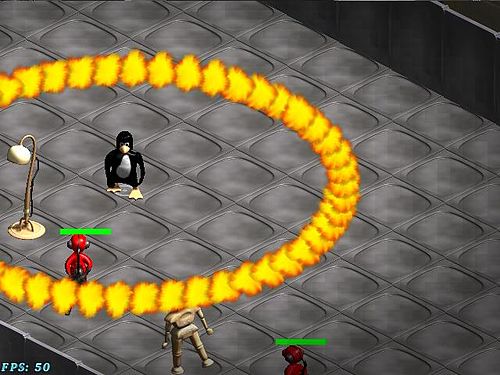
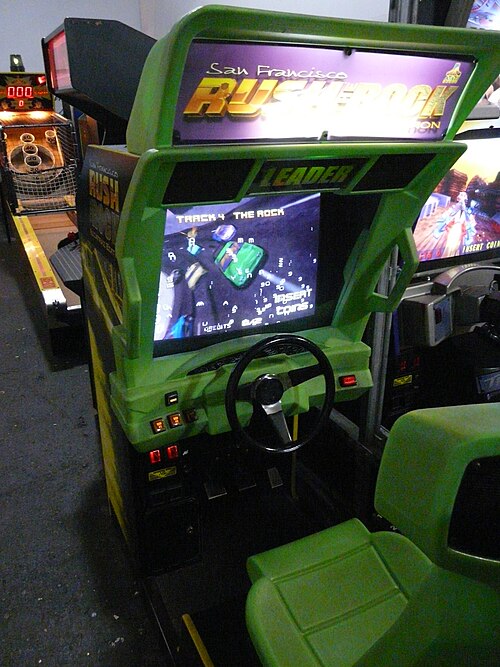
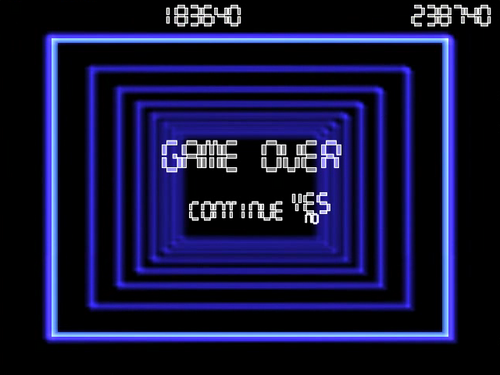
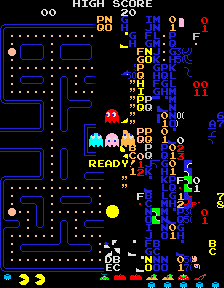
An object that gives the player an extra life (or attempt) in games where the player has a limited number of chances to complete a game or level.[2]
100%
To collect all collectibles or to also obtain all achievements (see below) within a game, either indicated within games as a percentage counter or determined by consensus of the community of players.[3]
1v1
An abbreviation of 1 versus 1, denoting two players battling against each other. Can be extended to any player versus player grouping, such as '2v2' to mean two teams of two battling each other, or "1v4" to refer to a team of four players against one (as seen in asymmetrical gameplay).
2D graphics refers to the rendering of visual elements using two-dimensional graphics primitives and bitmaps, commonly used in applications such as video games.[4]
Graphic rendering technique of three-dimensional objects set in a two-dimensional plane of movement. Often includes games where some objects are still rendered as sprites.
360 no-scope
A 360 no-scope usually refers to a trick shot in a first or third-person shooter video game in which one player kills another with a sniper rifle by first spinning a full circle and then quickly shooting without looking through the scope.
An aspect ratio of digital display devices such as televisions and monitors, supporting up to 3840 × 2160 pixel (roughly 4 kilopixels wide) resolutions.
A genre of strategic video games, short for "eXplore, eXpand, eXploit, and eXterminate". Such games are usually complicated, involving extensive diplomacy, technology trees, and win conditions.
An aspect ratio of digital display devices such as televisions and monitors, supporting up to 7680 × 4320 pixel (roughly 8 kilopixels wide) resolutions.
「オートチェス」とも呼ばれるこのゲームは、チェスに似た要素を持つ戦略ゲームのサブジャンルで、プレイヤーは準備段階でグリッド状の戦場にキャラクターを配置し、その後はプレイヤーからの直接的な操作なしに相手チームのキャラクターと戦います。 2019年初頭にDota Auto Chessによって開発され、普及しました。
The ability in games to define the player-characters abilities by selecting appropriate gear, equipment, and accessories to optimize and maximize the character's performance in the game. The end results, known as builds, then are frequently shared to other players through various means.
Build order
An optimal sequence of player actions in a building-based strategy game, dictating what option should be constructed in what order.
A type of shoot 'em up where the player must dodge a large or overwhelming bombardment of projectiles.
Bullet sponge
Any enemy that appears to require more firepower than would be considered realistic or reasonable to defeat. This is an allusion to how the enemy can absorb bullets much like a sponge absorbs liquids. For example, an enemy soldier in a first-person shooter that requires several full magazines of ammunition to defeat, in comparison to other soldier types that are defeated in a handful of shots, would be a bullet sponge.
Bullshot
A portmanteau of bullshit and screenshot, referring to the misrepresentation of a final product's technical or artistic quality by artificially enhancing promotional images or video footage.[31]
Button mashing
1.The pressing of different button combinations in rapid succession to perform or attempt to perform special moves, typically with little rhyme or reason. This technique is most often encountered in fighting games, especially among weaker players.[32]
2.The rapid pressing of a single button to accomplish a task, especially in minigames. Sometimes, this requires the rapid pressing of two buttons simultaneously, or rapidly pressing any button.
Breach
Common name for the value that dictates how much stun a weapon deals.
C
Campaign mode
A series of game levels intended to tell a linear story; some campaigns feature multiple 'paths', with the player's actions deciding which path the story will follow and affecting which choices are available to the player at a later point.
1.Where a player stays in one place – typically a fortified high-traffic location – for an extended period of time and waits to ambush other players. Many players consider camping a form of cheating or, at best, griefing.[33] It is most common in first-person shooter games,[34] but is also frequent in fighting games with projectile-heavy characters.
2.The act of waiting around a rare mob or player's spawn point, usually in MMOs. This may be known as spawn-camping or spawn-trapping.
Camping a player's spawn point for an easy kill is deeply frowned upon and in many games is considered a bannable offense.
A common game mode in multiplayer video games, where the goal is to capture and retrieve a flag from the opposing side's territory while defending the flag in one's own territory.
Career mode
A mode of gameplay that involves taking control of a single character and guiding the character through a structured career.[35] The mode is commonly used in sports games, where it is referred to by various names such as "Be a Pro", "superstar mode",[36] "My Player",[37] and "Road to the Show",[38] in which a player controls the career of a single athlete.[39]
In team-based video games, when a player disproportionately contributes to the success of their team. For example, Team A's sole remaining player defeating the rest of Team B, thus saving Team A from a close defeat, would be considered carrying, as would one player on Team A having the most kills among the rest of their team. The term is usually but not always interpreted as indirect slander towards the rest of the team, though the term may also be used generally. Carrying may also be a method experienced players use to win rounds when the rest of their team are less experienced or less efficient at completing tasks; this may entail taking on enemy combatants alone, or using teammates as a distraction while completing objectives for the round.
Cartridge tilting
Deliberately inducing glitches and other strange behaviour in cartridge-based games by tilting the cartridge slightly in its slot in the console, enough for the connection to be altered but not completely severed. Cartridge tilting creates similar effects to using a corruptor, and may include such glitches as character models becoming distorted, extremely loud noises and in particularly severe cases, both the game and the console itself may crash.
Playing video games on an infrequent and spontaneous basis without a long-term commitment. Casual video games are distinguished by a low learning curve and ease of access, often web-based for mobile phones or personal computers. Most casual games have simplified controls, with one or two buttons dominating play. Casual games can normally be played in small periods of time, and may not have a save feature.[40]
2.A character archetype in team or party-based games, specifically a character or class that is designed purely to deal as much damage as possible to enemies, as opposed to a tank or healer, who have other primary duties. Specific characters or classes may be considered "sub-types" of DPS, such as a "magic-DPS" as opposed to a "melee-DPS".
Day one
The day of release for a video game; often accompanied by a "day-one patch" to repair issues that could not be addressed in time for the game's distribution, or "day-one DLC", where the developer offers content for a price. "Day-one DLC" is often associated with on-disc DLC, where the content is already a part of the game's data, but the player must pay to access it.
Day zero
Before the day of release for a video game; often accompanied by a "day-zero DLC" to allow early play time that users paid for before launch or extra cosmetics. The purchaser may receive the "day-one DLC" on launch day, or some in game currency, where the developer offers content bundled in for buying the game "pre-launch". The "day-one DLC" is often associated with on-disc DLC, where the content is already a part of the game's data, but the player must pay to access it.
Dead zone
1.A region of the screen in video games in which the camera is controlled via free look where the mouse cursor can be positioned to lock the camera in place. Can be adjusted in some games.
2.A deadzone setting for the analog stick that lets players configure how sensitive they want their analog sticks to be, popular in console FPS games, and in racing games where it appears as Steering Deadzone.
A game mode in many shooter and real-time strategy games in which the objective is to kill as many other characters as possible until a time limit or kill limit is reached.
ゲームランチャーは、ゲームを直接起動するのではなく、1つまたは複数のゲームを起動するためにパーソナルコンピュータで使用されるアプリケーションプログラムです。ランチャーには通常、ソフトウェア開発者から提供される追加サービスが含まれており、フレンドやマッチメイキングサービス、コンテンツの更新、デジタル著作権管理、クラウドセーブなどのミドルウェア機能を提供します。また、ゲームランチャーは、ゲームの購入やダウンロードを行うためのデジタルストアフロント機能を提供する場合もあります。ランチャーには、Battle.netやUbisoft Connectのようにパブリッシャーが自社ゲーム専用に設計したものもあれば、 SteamやEpic Games Storeのようにファーストパーティおよびサードパーティのゲームをサポートする汎用プラットフォームもあります。
Abbreviation meaning "good game". Typically exchanged as parting words at the end of a competitive game or match as a gesture of good sportsmanship. The variantions "GGWP" ("good game, well played") and "GF" ("good fight") are also occasionally used. Due to the near exclusive use of "GG" at the end of a game or match, it is sometimes said by spectators to denote a situation, action, or move which suggests that a particular player's or team's victory appears inevitable (e.g. "This attack just wiped all the blue player's forces, that's a GG"). It can also be used to taunt players while a game is still in progress as an implication that their win is assured. Insulting variations, such as "GGEZ" ("good game, easy") can similarly be used to imply the opposing player is unskilled.
Ghost
A feature included in time attack or time trial modes in video games allowing the player to review their previous rounds. In racing games, for example, a "ghost car" may follow the last or fastest path a player took around the track. In fighting games, the ghost is an opponent that the computer AI player can train against outside of normal player versus player or story mode. Ghost cars in racing games generally appear as translucent or flashing versions of the player's vehicle. Based on previously recorded lap times, they serve only to represent the fastest lap time and do not interact dynamically with other competitors. A skilled player will use the ghost to improve their time, matching the ghost's racing line as it travels the course. Many racing games, including Gran Turismo, F-Zero, and Mario Kart offer a ghost function. Some also have ghosts set by staff members and developers, often showing perfect routes and lap times. The concept has also been adapted for television broadcasts of auto racing; in 2019, NASCAR broadcasters began to use a ghost graphic during qualifying sessions with a single-car format, intended to visualize the pace of the leader in comparison to the current driver.[94] A variation of the feature, dubbed by Firemonkeys Studios as "Time-Shifted Multiplayer", was implemented in the mobile racing game Real Racing 3.[95] It works by recording the lap times of players in each race, and uses statistics from other players to recreate their lap times for the player to beat. These ghost cars can collide with the player and other vehicles, and are fully visible to the player. In some rhythm games, such as the Elite Beat Agents and Moero! Nekketsu Rhythm Damashii Osu! Tatakae! Ouendan 2, saved replay data can be used in one of the player slots in a multiplayer game.
1.A character, character class, or character ability that is so underpowered as to make using the gimp a severe handicap in the context of the game.
2.A design choice that has this effect.
3.In multiplayer games, killing a character much earlier than would be expected, such as by relentlessly pursuing them until they die in the early game.
プレイヤーがレベルアップするゲームにおけるゲームメカニズムの一つで、プレイヤーキャラクターや敵の属性が変化し、戦闘における難易度が同程度になるように調整される。プレイヤーキャラクターのレベルが数段階高い場合、敵の能力が強化されるか、プレイヤーの能力が弱体化され、難易度が同程度になるように調整される。プレイヤーはレベルが上がるにつれて、追加の能力、独自の特性を持つ優れた装備、高レベルのクエストやエリアへのアクセスなど、追加のメリットも得られる。レベルスケーリングを採用しているゲームの例としては、『World of Warcraft』や『Destiny』などがある。[ 113 ]
The option to temporarily suspend play of a video game, allowing the player to take a break or attend to an urgent matter outside of the game, or to perform other actions through a menu, such as adjusting options, saving the current game or ending the current game session. In multiplayer online or networked games, pausing may not be available as a feature, as such games require continuous activity from all participating players in order to properly function.
A monetization method that requires players to spend money to access gameplay features.
Pay to win (P2W)
Elements of a game that can only be unlocked by making premium digital purchases and provide the player with an advantage. The purchase packages can include game currency, resources, special characters, unique items, summoning tickets, character skins that give buffs to their stats, or VIP points if the game has a built-in VIP system. This monetization scheme can result in an unbalanced experience between players.
Peak
Commonly used when the player or someone in the current lobby they are in does something that is above their current skill level.
Pentakill (penta)
Occurs when a single player gets the killing blow on five opposing players in rapid succession, resulting in a team elimination. Comparable to ace.
How well a game runs in terms of frame rate. Generally, a game that is considered performant has a frame rate that is both high and consistent in all areas of the game.
Peripheral
An optional hardware component for a video game system.[136]
Generally refers to when a player must restart the game from the beginning when their character dies, instead of from a saved game or save point. This may also refer to the case of a player having to restart the game due to failing to meet a certain objective. The term may also apply to squad-based games such as tactical role-playing games, if the death of the character eliminates that character from the game completely but the game may continue on with other characters.
In PvP games, the act of killing other players in their spawn, often immediately after they have spawned. Usually looked down upon as unfair for not giving opposing players a chance, though some gamers defend it as a legitimate strategy. Many games have features to prevent spawn killing, such as temporary invincibility or barriers preventing enemies from entering or attacking in spawns. A component of, but not entirely the same as, spawn camping.
Spectator mode
1.A game mode that allows a player to view the world without restrictions, but without being able to interact with the game world in any way.
2.A game mode that allows a player to view the world from another player's perspective.
Specialization
A means of selecting certain options—such as a character, weapon, vehicle, or other in-game item—during the course of a game for a specific function, as opposed to selecting a specific character class at the start of the game. Such specialization allows that entity to have access to unique skills or options for that type while denying them access to other options. Some games allow players to re-specialize past choices for some in-game cost and pursue a different specialization.
Specs
Short for specifications, used to describe the details of a player's stats, gear, or build.
An attempt to complete a game as fast as possible. Depending on the rules for the speedrun, players may exploit glitches or bugs in the game to speed their progress.[176]
Splash damage
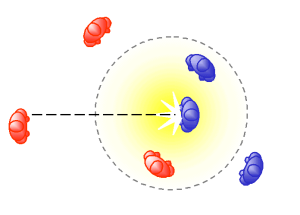
Although only the blue player in the center takes a direct hit, everyone within the circle takes splash damage. The damage may decrease further from the point of impact; this is known as damage falloff.
Attacks with an explosive or other area-of-effect component deal splash damage, affecting the area around the attack's impact. Splash damage is particularly useful against game targets that dodge well. However, splash damage weapons are also dangerous since they can damage the shooter and are not preferred in close-quarters combat. Such weapons are typically aimed at an opponent's feet; this ensures that the impact point is near enough for splash damage to cover the opponent in the event that the shot misses.[177] Usually splash damage is separate from the damage of a direct hit with an attack, and the two may or may not both affect the target. Often there is damage falloff, meaning the further away from the center of the attack a target is, the lower the splash damage.
A 2D image used as a part of a larger graphical scene. Typically, sprites define all objects and entities within games that use 2D graphics, but they are sometimes also used in earlier 2.5D and 3D games.
Squeaker
A usually derogatory term that refers to young tween and preteen gamers that use voice chat, the word referring to their high-pitched voice as a result of them not having hit puberty yet.
Stage
Stamina
1.A resource that allows the player to use certain types of physically exerting actions, such as running and attacking, that typically replenishes over time.
2.A type of stat that governs a character's ability to take damage, either raising their health or increasing their defense.
Stat point
A discrete number of points for the player to distribute among their character's attributes, e.g., to choose their player's trade-offs between strength, charisma, and stamina.[179]
Stat squish
A practice of scaling down numbers, commonly score or health points, damage or healing values, or item levels, in the aftermath of a stat inflation as numbers get exponentially large and more difficult for the player to conceptualize. The practice is most common in MMORPGs, and World of Warcraft is notable for having several stat squishes.[180]
An overarching term that covers both buffs and debuffs. Essentially, any effect to a character that is outside of the normal baseline is a status effect. Common negative status effects are poisoning (damage over time), petrification/paralysis (inability to move), or armor/damage reduction (lowering of defensive/offensive abilities). Common positive status effects include a heal-over-time (a small, pulsing heal that triggers multiple times over a set period), armor/damage increases, or speed increases.
Printed or online manuals that are written to guide players through a game, typically offering maps, lists of equipment, moves, abilities, enemies, and secrets, and providing tips and hints for effective play strategies.
A game genre which emphasizes consideration and planning to achieve victory. Subgenres include real-time strategy, turn-based strategy and wargames.
Stream-sniping
When a player watches another (usually professional) player livestream a game to locate their position or plans and gain the upper hand on them. This practice most commonly occurs in online multiplayer games and is generally frowned upon.
Video and audio that is continuously fed from a server to a client and presented to the end user. In gaming, this may be used to watch a live or recorded Let's Play demonstration of a game, or to play a game through cloud gaming.
Stun lock
A situation whereby the player character cannot act for a long period of time due to being periodically stunned. Often caused by being staggered by repeated attacks from multiple enemies.
Subgame
Superboss
An optional super powerful boss, typically more powerful and harder to beat than the game's main final boss.
A type of game mode in co-operative multiplayer games. Players work together to defend one or more objectives or simply to have at least one man standing as they fight through discrete waves of enemies, with each subsequent wave featuring more numerous and powerful enemies. Such modes often include elements of tower defense games where players can deploy defensive tools such as turrets or traps to injure or slow enemies. The game may offer short periods between waves where players can spend in-game currency or similar points to improve their defenses, their equipment, or similar boosts. Horde modes can be based on a fixed number of waves or in an endless mode where players attempt to last as long as possible.
Survival multiplayer
A multiplayer game mode where players start out with no items, a health bar, and are able to die (as opposed to creative mode, where players are immortal). Commonly used to refer to Minecraft servers, but can otherwise be used to refer to any similar game mode in any game. A well-known example is the Dream SMP.
Sweat
A derogatory term used to refer to players with a highly competitive attitude, typically in situations where such an attitude is uncalled for or unnecessary. Synonymous with tryhard.[181]
A positioning of a character model in a video game with the character standing upright and arms up to the side. Typically used as a default position for 3D character models, this is often seen in games as a glitch or result of software bugs.[182]
A character with high health and abilities or equipment that mitigate damage, draw aggro from opponents, and/or receive enemy attacks so that teammates can concentrate on their attacks or objectives. Common in MMORPGs.
A character movement control system in which up and down directional inputs move the player character forward or backward, while sideways directional inputs rotates the character, similar to how a tank's movement is controlled.
Targeting
A strategy used in online games where the player continuously kills or attacks the same opponent, ignoring the others surrounding them. It is often seen as unsportsmanlike behaviour in gaming.
Taunt
A tactic and an effect used during turn-based fights in which a character (usually with high defense or hit points (HP) – see Tank) tricks opponents into attacking him/herself instead of the rest of the team.
2.A move in a fighting game where one player presses a specific input or inputs to make their character play an animation which usually deals no damage and serves merely to mock their opponent.
Teabagging
A type of action used in multiplayer games where a victorious player-character repeatedly crouches down and stands back up (functions that are a common part of standard gameplay) over the head of knocked down or dead opponent, simulating the sexual act of the same name. The act is usually considered disrespectful and provocative, intended to irritate their opponents and make them act irrationally. While the act of teabagging is generally associated with first or third-person shooters, similar actions in other game genres have become synomous with teabagging.[183]
Team deathmatch
Teamkill
The killing of teammates through destruction or damage done to allies, such as through deliberate shooting of teammates. Teamkilling is often identified as unsportsmanlike behavior.[184]
A branching series of technologies that can be researched in strategy games, to customize the player's faction. .
Telefrag
A frag or kill which occurs when a player uses a teleporter to get to a location occupied by another character. This character is killed and the player-character landing on them is granted credit for the kill.
1.Animations or similar visual and audible indicators that indicate to a player what actions an opponent will take. Often used as part of computer-controlled artificial intelligence to help the player avoid or block attacks or make counter-attacks.
2.In multiplayer games, the actions a player does, revealing to their opponent or opponents what attack they may do next. Usually considered a sign of predictability, but for some characters it may be necessary.
Test room
A secret level that is used by developers to test the movements, actions and control of a game's player character(s). They are usually removed or hidden from regular access before the game is released.
The analysis of a video game to mathematically determine the most-optimal approach to winning the game, typically in games that feature a number of player-character attributes that are enumerated. One common type of theorycraft is determining how to best maximize damage per second through selection of equipment and skills. .
Third party
When two teams or players are in a fight and a third team or player attempts to kill one or both of the teams. The term was likely popularized in battle royale games such as Fortnite but is also used in first-person shooters.
A hierarchical organization of various gameplay elements, such as characters, classes, weapons, or abilities, organized into "tiers" based on their perceived usefulness. An element placing in the top or bottom tiers of this list can be called top-tier or bottom-tier, respectively, with similar terminology describing elements as high-tier, mid-tier, or low-tier.
A type of puzzle video game where the player manipulates tiles in order to make them disappear according to a matching criterion. If this number is three, the game is called a match-3 game.
Tilt
When a player gets angry at someone or something, often resulting in reduced quality of play.[28]
A game mode that challenges player(s) to complete a level or the game within a fixed amount of game time or in the fastest time possible. Often, the best times are recorded for other players to see.
Timed exclusive
When a game releases exclusively for one platform but may release for other platforms when the exclusivity period expires.[185][186]
Time to kill (TTK)
The average amount of time it takes to kill an opponent. Commonly used in first-person shooters, especially tactical shooters, where it is typically representative of how much damage or shots a character can take before dying, and thus also the game's realism.[187]
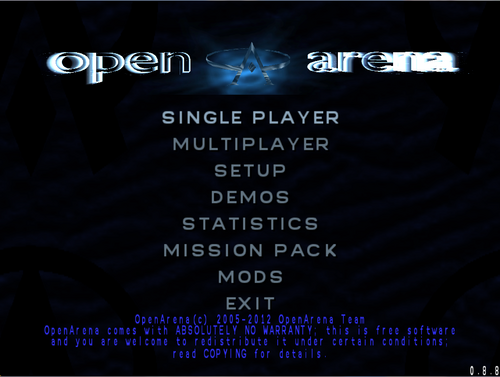
The initial screen of a computer, video, or arcade game after the credits and logos of the game developer and publisher are displayed. Early title screens often included all the game options available (single player, multiplayer, configuration of controls, etc.) while modern games have opted for the title screen to serve as a splash screen. This can be attributed to the use of the title screen as a loading screen, in which to cache all the graphical elements of the main menu. Older computer and video games had relatively simple menu screens that often featured pre-rendered artwork.
In arcade games, the title screen is shown as part of the attract mode loop, usually after a game demonstration is played. The title screen and high score list urge potential players to insert coins. In console games, especially if the screen is not merged with the main menu, it urges the player to press start. Similarly, in computer games, the message "Hit any key" is often displayed. Controls that lack an actual "Start" button use a different prompt; the Wii, for example, usually prompts the player to press both letter buttons on the Wii Remote simultaneously, as in Super Mario Galaxy 2 or Mario Party 9. Fan-made games often parody the style of the title that inspired them.
A form of user input that relies on physical touch, rather than a mouse, keyboard or other control method.
Toxicity
Actions of a rude and unwelcoming gamer or gaming community that detriments the experience for other players or developers. Almost universally viewed negatively across gaming, some game developers take measures to stymie toxicity in their games.[188]
Tower dive
Commonly used in MOBAs to define the act of going into range of the opponent's tower, a defensive structure that damages its opponents, to kill low-health targets.[189]
A form of a video game controller, most often found on arcade game cabinets, in which the player uses a freely-rotating ball to interact with the game.
Changing the appearance of gear, such as weapons and armor, typically to that of functionally equivalent gear.[190][191]
Trash
1.A term meaning bad or poor, often used to insult a player(s) in online PvP games, but also used for items, spells, etc.
2.Commonly used in MMORPGs to refer to groups of non-boss enemies. Particularly in dungeons/ areas leading up to boss fights.
Trick-shot
A shot that requires significant skill to make. Usually associated with first-person shooters.[159][192][193]
Trickjump
Any type of unusual jump that demonstrates skill and expertise, often considered an exploit that was unforeseen by the game's creators.[194]
Triple A
Triple jump
Being able to jump twice in mid-air after leaving the ground, and must then typically touch the ground before being able to mid-air jump again.
Tryhard
An insult that means a gamer is ruining the fun of the game due to an inordinate obsession with winning.[195] Also known as playing sweaty.
True Last Boss (TLB)
Can be similar to a . Primarily in s, A boss in a game that is exceptionally difficult, and has specific requirements outside of a normal game clear that must be met in order to reach the boss.
A gameplay strategy that emphasizes heavy defense, with little or no offense. A player who turtles minimizes risk to themselves while baiting opponents to take risks in trying to overcome the defenses.
A practice in MMORPGs of equipping a low-level character with items or resources not normally available to new characters, by transfer from high-level characters.[128]
A character, item, tactic, or ability considered to be too weak to be a balanced element of gameplay.
Underworld
A collection of isolated dungeon-, cave-, or hell-like levels which are connected by an open overworld.
Unfinished
Used to describe games that release in a very buggy state, or with missing/poor-quality content, such that it gives the impression of having been fully released before development was properly completed (whether or not this is the case). Compare beta release.
Unlockable
A piece of content that is obtained in-game by fulfilling certain conditions. These are sometimes represented in-game or represented through a platform-wide system of achievements. Such content can be purely cosmetic, a game mechanic, tool, character, a separate video game, and more. They are sometimes hidden Easter eggs.[196]
Ultimate
Ultimate attacks or abilities (or ults) that a character may possess, often those that are the strongest or that deal the most damage. Ults often require an energy bar, charge meter, or other similar resource which must be filled before the ult can be used.[197]
Upgrade
A game mechanic to make a given item, character, etc. more powerful. Equipment is commonly upgraded through crafting while a character upgrade may be an alternative to advancing a character level.
V
VAC
An abbreviation of Valve Anti-Cheat, Valve Corporation's cheat detection software. Players who are caught using cheats on a VAC-secured server will be issued a VAC ban, banning them from VAC-secured servers for that particular game in the future and putting a mark on their Steam profile that can't be hidden from public view. VAC bans are permanent, non-negotiable, and cannot be removed by Steam Support.[198] Players who have gotten a VAC ban are sometimes referred to as going on a "permanent VACation".[199][200]
A term used to describe the economy in a video game, for example, gold and the auction house in Old School RuneScape money can be used to buy in game gear, all the way to in-game cosmetics.
An interactive computer-generated experience taking place within a simulated environment. Used in video gaming primarily to describe a VR-based video game or a VR option for an otherwise non-VR video game.
A genre of video games with interactive stories. These games typically use static imagery, anime-styled character art (thanks in part to the popularity of the genre in Japan), and detailed backgrounds, with character dialogue presented in text boxes. Players may alter the path of the story by choosing from dialog trees or a small list of actions.
W
Waggle
A pejorative term when one must shake a controller to do an action, regardless of how the controller is shaken. Usually implies that the controller needs to be shaken wildly. Sometimes extended to motion controls in general, ignoring any precision required.
A term sometimes used to classify exploration games, which generally involve exploring an environment for story and narrative but with few, if any, puzzles or gameplay elements. May be considered derogatory but is often used as a neutral term.
Walkthrough
A description of the gameplay experience for a level or playthrough, intended to guide players who are unsure how to complete it.[19]
Wall bang
In first or third person shooters, the act of shooting someone through a wall or object with bullets or other projectiles that have the ability to penetrate an obstacle. Made a popular term by games such as Counter-Strike and Call of Duty.
Wall climb
The ability for a video game character to rapidly scale a vertical wall or similar surface, typically as part of the character's passive abilities, but may be aided with a tool such as a grappling hook. This often appears in platform games alongside abilities like wall jumping and double jumping.
Wall jump
A jump performed off of a vertical surface to propel the player higher in the opposite direction. Wall jumps can be done between two tight walls in quick succession to climb vertically in some games, though some games such as Mega Man X and Transformice allow the player to repeatedly jump on a single wall. As a special jump, it is sometimes an acquired skill instead of available from the game's start.[99]:102
A cheat that makes walls translucent.[17]:119 Some wallhacks let players shoot weapons or physically pass through walls.[17]:120
Wall run
The ability for a video game character to appear to run along a vertical wall for a short distance without falling off. Common in games featuring parkour-type movement.
A game mechanic popularized by the Grand Theft Auto series and used in many Grand Theft Auto clone games. A player's actions in an open-world game may cause non-player characters, often representing law enforcement, to chase the player, with the response becoming more significant at higher wanted levels. The wanted level persists unless the player can elude these opponents, or if the character dies, eliminating the wanted level.
A common control-mechanism using a typical QWERTY keyboard, with the W, A, S, and D keys bound to movement controls. This allows arrow key-like control with the left hand.
Wave
In game genres or modes where player(s) are to defend a or stay alive as long as possible, enemies are commonly grouped into "waves" (sometimes referred to as levels). When one wave of enemies is defeated, player(s) are typically given a short period to prepare for the next wave.
Weekly
An in-game objective in live service games that offers optional rewards and can be completed every week.
Whale
In free-to-play games, a user who spends a considerable amount of real-world money for in-game items, rather than acquiring said items through grinding or playing the game normally. These players are typically seen as the largest segment for revenue production for free-to-play titles. Exceptionally high spenders may be called white whales[201][202] or leviathans. Borrowed from gambling jargon; a 'whale', in that context, is a person who makes extravagant wagers or places reckless bets.
2.An event intentionally resetting all game progress or deleting the save file - i.e., after major updates in early access games.
World
A series of levels that share a similar environment or theme. A boss fight will typically happen once all or most of these levels are completed rather than after each individual level.
World compression
The representation of a world on a much smaller scale than is realistic. For example, in many role-playing games, it is possible for the player character to walk across a continent in sometimes under a minute, and the player character may appear to be several kilometers tall given the relative scale. This is not the same as the player being much larger than the icon for a town or other settlement, but rather that a distance which is given as hundreds of kilometers appears to be much smaller. In some cases, such as in Final Fantasy VIII, trains will run between towns despite the visibly short distance. For voxel games such as Minecraft, the in-game narrative may refer to a distance as being tens of kilometers away, while the actual distance may be accurately measured by counting only a few hundred blocks understood to each be one meter across.
A principle for structuring a game world or portraying its map that allows a player to move in a straight line and get back to the point where they started moving, reaching it from the opposite direction, similar to walking along the circumference of a sphere in a straight line. This was often used in older games to make it seem that the player is moving up or down an extremely high hill; memory can be saved by using wrapping instead of creating a larger area filled with impassable walls. Wrapping is also used to make a 2D game world round; for example, in Pac-Man, exiting the game screen to the right wraps the player to the same position on the left side of the screen. Similarly, in Final Fantasy VII, exiting the game map to the right wraps the player to the same position on the left side of the map, and exiting the map to the top wraps the player to the bottom of the map.
X
Ximmer
A term used to refer to console players who use an Xbox Input Machine (XIM) to use mouse-and-keyboard controls or other control units for games that do not officially support them. "Ximmer" is generally considered derogatory as this method is typically associated with cheating in multiplayer games, with such players having finer control over a game compared to a typical controller; however, this method also has valid uses to aid video game accessibility.[203][204]
Tactic in strategy games in which the player uses overwhelming numbers of inexpensive, disposable units rather than skill or strategy.[19] The term comes from the Zerg, a race in StarCraft that uses numerical advantage to overwhelm opponents.
Zero-day patch
A software security patch that fixes a Zero-day vulnerability. See: Zero-day and 0-day warez.
1.A section of a MUD or MMO's shared environment within which communications may be limited or game mechanics altered to encourage certain types of gameplay.
A fighting game strategy that involves continuously using long range attacks and projectiles. Characters who specialize in this type of play are called zoners.
↑"Croixleur Sigma PC Review: Hack, Slash, Dash". U.S. Gamer. 12 May 2014. Archived from the original on 21 November 2022. Retrieved 11 June 2020.
↑Schwartz, Steven A.; Schwartz, Janet (1994). The Parent's Guide to Video Games. Prima Pub. ISBN978-1-55958-474-6.
↑Good, Owen S. (January 5, 2019). "Awesome Games Done Quick 2019: everything you need to know about the first day". Polygon. Retrieved January 5, 2019.
↑"Working with 2D graphics in your DirectX game". Microsoft Learn. Retrieved 23 July 2026.
↑Schultz, Warren. "AAA Game". About.com. IAC/InterActiveCorp. Archived from the original on March 27, 2014.
12Janssen, Cory (March 8, 2012). "In-App Purchasing". Technopedia. Archived from the original on May 29, 2014. Retrieved May 28, 2014.
↑"abandonware". dictionary.cambridge.org. November 18, 2025. Archived from the original on 2023-12-08. Retrieved 2025-11-25.
↑"Video Game Vocabulary, Jargon, and Slang". Lee Laughead. Retrieved May 2, 2015.
↑Manodeep Mukherjee (23 July 2022). "Team Ace in Valorant: What does it mean?". Sportskeeda. Retrieved 1 August 2022.
↑Gibson, Jeremy (2014). Introduction to Game Design, Protoyping, and Development From Concept to Playable Game – With Unity and C#. Addison-Wesley Professional. p.194. ISBN978-0-321-93316-4.
↑Slavicsek, Bill; Baker, Richard; Mearls, Mike (2008). Dungeons & Dragons For Dummies (4thed.). Hoboken, New Jersey: Wiley. p.86. ISBN978-0-470-40639-7. Retrieved May 24, 2016.
↑Clark, Andrew (18 April 2007). "Defining Adaptive Music". Gamasutra. Retrieved 2 June 2020.
↑Ramesh, Omkar; Shaikh, Mohammad Ali Aejaz (2025). "AAAG: Advanced AI Adaptive Game Framework"(PDF). International Journal of Research and Technical Innovation (IJRTI). 10 (4).
↑Jennings, Scott (2006). Massively Multiplayer Games for Dummies. Wiley. p.304. ISBN9780471793113.
↑Stang, Sarah (March 2019). "'This Action Will Have Consequences": Interactivity and Player Agency". Game Studies. 19 (1). Retrieved August 23, 2025.
12Bennerstedt, Ulrika; Ivarsson, Jonas; Linderoth, Jonas (2012). "How gamers manage aggression: Situating skills in collaborative computer games"(PDF). International Journal of Computer-Supported Collaborative Learning. 7: 50–51. doi:10.1007/s11412-011-9136-6. ISSN1556-1607. S2CID1595007. Archived(PDF) from the original on 2022-02-19. Retrieved 2022-02-19.
1234567Davidson, Drew; Kelley, Heather; Kücklich, Julian; Walz, Steffen P.; Böttger, Matthias (2007). Space Time Play: Synergies Between Computer Games, Architecture and Urbanism: the Next Level. Basel: Birkhäuser. ISBN978-3-7643-8414-2. Retrieved March 3, 2017.
12Kohler, Chris (September 13, 2005). "Controller History Dynamite". 1UP.com. Archived from the original on May 25, 2015.
123456789101112131415161718Dille, Flint; Platten, John Zuur (2007). The Ultimate Guide to Video Game Writing and Design. New York: Lone Eagle Publishing. ISBN978-1-58065-066-3.
↑Klepek, Patrick (August 5, 2015). "The History Behind Dark Souls' Most Controversial Move, The Backstab". Kotaku. Retrieved February 26, 2018.
↑"Anti-RPGs For Fans of Undertale". TheGamer. 2021-03-27. Retrieved 2021-12-29.
↑"Remix RPG Adventure moon revived for Nintendo Switch after 22 years, for the first time in English!". Gamasutra. September 5, 2019. Archived from the original on September 15, 2020. Retrieved September 2, 2020.
↑Parish, Jeremy (August 28, 2012). "What the Hell is Asymmetric Gameplay?". 1UP.com. Archived from the original on November 28, 2016. Retrieved February 29, 2016.
12Ruggill, Judd Ethan; McAllister, Ken S. (2011). Gaming Matters: Art, Science, Magic, and the Computer Game Medium. Tuscaloosa: University of Alabama Press. pp.70–71. ISBN978-0-8173-1737-9. Retrieved November 29, 2012.
↑""What is attract mode?"". Archived from the original on 28 August 2019.
↑"Banner Meaning". DotNetGame Dictionary. June 2021.
123Steinberg, Scott (March 24, 2012). "Parlez Vous Gamer? A Gaming Dictionary for Parents". abcnews.go.com. ABC News. Retrieved February 2, 2018.
1234Irwin, Sidney V.; Naweed, Anjum (October 8, 2018). "BM'ing, Throwing, Bug Exploiting, and Other Forms of (Un)Sportsmanlike Behavior in CS:GO Esports". Games and Culture. 15 (4): 411–433. doi:10.1177/1555412018804952. ISSN1555-4120. S2CID150073080.
↑Batchelor, James (December 10, 2018). "Boosting now a criminal offence in South Korea". GamesIndustry.biz. Retrieved December 10, 2018.
↑McAloon, Alissa (June 26, 2019). "Law against account boosting goes into effect in South Korea". Gamasutra. Retrieved June 26, 2019.
↑Davenport, James (September 30, 2016). "The worst bullshots in PC gaming". PC Gamer. Retrieved December 7, 2017.
↑"Button Masher". Techopedia.com. 21 September 2011. Retrieved February 27, 2018.
↑Hernandez, Patricia (January 17, 2013). "In Defense of the Camper". Kotaku. Retrieved October 19, 2014.
↑"Important Glossary". Rock Paper Shotgun. Archived from the original on October 22, 2014. Retrieved October 19, 2014.
↑"UFC Undisputed 2010 career mode preview". PS3 GameZone. Archived from the original on 2011-08-10. Retrieved 2011-04-18.
↑"Madden 08 Countdown: Superstar Mode". IGN. Archived from the original on October 17, 2007. Retrieved 2011-04-18.
↑"NBA 2K10: My Player Hands On". IGN. 21 September 2009. Retrieved 2012-04-02.
↑"MLB 10: The Show Career Mode Hands-on". IGN. 24 February 2010. Retrieved 2011-04-18.
↑"NBA Live 09's Be A Pro Mode". IGN. Archived from the original on 2011-07-09. Retrieved 2011-04-18.
↑"A Guide to Choosing Your Class in Pillars of Eternity". Gamerevolution.com. April 1, 2015. Retrieved May 24, 2016.
↑Laycock, Joseph (2009). Vampires Today: The Truth about Modern Vampirism. Westport, Connecticut: Praeger. pp.115–. ISBN978-0-313-36473-0. Retrieved March 3, 2017.
↑Barton, Matt (2008). Dungeons and Desktops: The History of Computer Role-Playing Games. Wellesley, Massachusetts: A.K. Peters. pp.229–. ISBN978-1-4398-6524-8. Retrieved March 3, 2017.
↑Paez, Danny (August 16, 2020). "How Street Fighter Invented Gaming's Most Despised Strategy". Inverse. Retrieved October 4, 2020.
↑Driscoll, Kevin (2009). "Endless loop: A brief history of chiptunes". Transformative Works and Cultures. 2 (1). doi:10.3983/twc.2009.0096. Retrieved March 3, 2017.
↑Jalen Lopez (12 June 2021). "What does 'clutch' mean in gaming?". Dot Esports. Retrieved July 30, 2022.
↑Jess Ragan (June 15, 2006). "Playing With Power". 1UP.com. p.3. Archived from the original on February 4, 2012. Retrieved February 25, 2011.
↑Prell, Sam (December 28, 2016). "Who needs a console generation? PS4 Pro and Scorpio are the birth of a new upgrade cycle | GamesRadar". Gamesradar.com. Retrieved March 3, 2017.
↑Chris Kolher (November 30, 2013). "A Fond Farewell to the Craziest, Longest, Most Eventful Console Generation Ever". WIRED. Retrieved March 3, 2017.
↑Minor, Jordan (November 11, 2013). "Console Wars: A History of Violence". PCMag.com. Retrieved March 3, 2017.
1234Compton, Shanna (2004). Gamers: Writers, Artists and Programmers on the Pleasures of Pixels. Brooklyn, New York: Soft Skull Press. pp.117–118. ISBN978-1-932360-57-8. Retrieved May 24, 2016.
↑Kunkel, Bill; Katz, Arnie (May 1983). "Arcade Alley: Zapping for Truth and Justice". Video. Vol.7, no.2. Reese Communications. pp.26–28. ISSN0147-8907.
↑Salen, Katie; Zimmerman, Eric (2004). Rules of Play: Game Design Fundamentals. Cambridge, Massachusetts: MIT Press. p.264. ISBN978-0-262-24045-1. Retrieved May 24, 2016.
↑Bycer, Josh (July 31, 2017). "The 3 Key Factors of Balance in Game Design". Game Developer. Retrieved May 26, 2023.
↑Brian Ashcraft (January 20, 2010). "How Cover Shaped Gaming's Last Decade". Kotaku. Retrieved March 26, 2011.
↑Good, Owen (September 2, 2017). "Video game developers confess their hidden tricks at last". Polygon. Retrieved June 26, 2020.
↑Hernandez, Patricia (March 13, 2020). "Dev reveals the many ways their tough game secretly helps the player". Polygon. Retrieved June 26, 2020.
↑Kaelin, Mark (3 May 2006). "Playing a MMORPG is not all fun and games, you better have the right vocabulary". Tech Republic. CBS Interactive, Inc. Archived from the original on 2009-07-05. Retrieved 15 December 2009.
↑Serin, Kaan (2023-11-03). "Baldur's Gate 3 developer says the game isn't really a CRPG - in any sense of the word". GamesRadar. Retrieved 2024-02-13.
↑Frauenheim, Ed (11 November 2004). "No fun for game developers?". CNet News.
↑Randall, Harvey (2025-08-07). "The dialogue wheel was the worst thing to happen to RPGs, it's robbed us all for years, and I'm glad it's dying out". PC Gamer. Retrieved 2025-11-04.
↑"Rainbow Six Siege Y6S4 introduces Finka self-revive, Echo and Mozzie drone changes, and several camera tweaks". Dot Esports. 8 November 2021. Retrieved 31 December 2024.
↑"What does DBNO mean?". support.pubg.com. 26 December 2017. Retrieved 16 November 2018.
↑"Master of the Sigmaringen Collection", Benezit Dictionary of Artists, Oxford University Press, 2011-10-31, doi:10.1093/benz/9780199773787.article.b00114514, retrieved 2021-05-19
↑Polansky, Lana (1 July 2013). "The Leaderboard: The Loneliness of the Endless Runner". Paste Magazine. Retrieved 24 December 2022.
↑Lawardorn, Damien (2020-01-27). "The Rise, Fall, and Place of Environmental Storytelling in Games". The Escapist. Retrieved 2022-11-12.
↑Vicente, Vann (20 February 2022). "Press F to Pay Respects: What Does "F" Mean Online?". How-To Geek. Retrieved 2022-07-11.
↑Yake, Doug (February 9, 2015). "Does Fast Travel Help or Hurt Games?". GameCrate. Archived from the original on February 14, 2015.
↑Close, James; Lloyd, Joanne (2021). Lifting the Lid on Loot-Boxes(PDF) (Report). GambleAware. Archived(PDF) from the original on 2 April 2021. Retrieved 2 April 2021.
↑"Spindizzy review". Zzap!64. June 1986. Retrieved February 25, 2011.
↑"Amaurote review". Crash. May 1987. Retrieved February 25, 2011.
↑"The Making Of: Bandersnatch". Edge. 4 September 2009. Archived from the original on 2013-10-19.
↑"How to play Street Fighter: a fighting game primer for everyone". Polygon. 7 July 2014. Retrieved 17 March 2026.
↑Scorpia (20 May 2009). "Looking Evil". Scorpia's Gaming Lair. Archived from the original on 7 April 2016. Retrieved 11 November 2018.
↑Kaiser, Rowan (13 July 2010). "Stop Killing the Foozle!". The Escapist. Archived from the original on 22 December 2017. Retrieved 2017-12-20.
↑Gealogo, David (27 August 2021). "League of Legends: What Is FOTM?". Gfinity.
↑Max Miceli (April 9, 2021). "What does 'frag' mean in gaming?". Dot Esports. Retrieved July 30, 2022.
123Chen, Amy (2025-04-26). "Gaming roles explained: From tanks to duelists and more". Esports. Retrieved 2026-06-30.
↑Parrish, Ash (August 7, 2025). "Friendslop is coming for the Switch 2". The Verge. Retrieved September 7, 2025.
↑Castello, Jay (2025-07-17). "'Friendslop' Isn't Real, But People Love Posting About It Anyway". Aftermath. Retrieved 2025-07-18.
↑Coleman, Jack (2025-06-29). "Forget REPO And Crab Game, Peak Is By Far The Best Friendslop Game I've Played". TheGamer. Retrieved 2025-08-29.
↑Yin-Poole, Wesley (2018-01-23). "Guitar Hero expert completes Through the Fire and Flames without making a single mistake - blindfolded". Eurogamer. Retrieved 2022-01-18.
↑Lum, Patrick (August 16, 2018). "Video game loot boxes addictive and a form of 'simulated gambling', Senate inquiry told". The Guardian. Retrieved August 16, 2018.
↑"Gambling and gaming: Children as young as 11 betting online". BBC. November 21, 2018. Retrieved November 21, 2018.
↑"How to VALORANT: Advanced tips for climbing players". Yahoo Esports & Gaming SEA. July 23, 2021. Retrieved May 22, 2023.
↑Chung, Peichi; Lee, Micky, eds. (May 28, 2021). Media Technologies for Work and Play in East Asia: Critical Perspectives on Japan and the Two Koreas. Bristol University Press. p.219. ISBN9781529213379. Retrieved May 22, 2023.
↑Çakır, Gökhan (February 21, 2021). "What does it mean to get 'ganked' in gaming?". Dot Esports. Retrieved January 22, 2022.
↑Josh Bycer (June 28, 2016). "Examining Gating in Game Design". Gamedeveloper.com. Retrieved July 30, 2022.
↑Horti, Samuel (March 4, 2026). "Extraction Shooters Explained – What Kind of Game is Marathon?". IGN . Retrieved March 8, 2026.
↑Dachman, Jason (May 8, 2019). "SMT's GhostCar Technology Enables NASCAR To Transition to Single-Car Qualifying". Sports Video Group. Retrieved 2019-05-14.
↑"From Arcade To The iPhone 5- The History Of The Gaming Ghost Car". Red Bull. Retrieved June 28, 2013.
↑Winslow, Levi (April 22, 2022). "Elden Ring YouTuber Crushes Malenia And 'Git Gud' Reddit Losers". Kotaku. Retrieved July 12, 2023.
↑Mueller, Saura. "Gaming Glossary: What Do GG, GLHF, LAN, MMR, OOM, OP, Ping And Other Gaming Terms Mean?". International Business Times. Retrieved April 29, 2021.
12Rogers, Scott (2013). Level Up!: The Guide to Great Video Game Design. Hoboken, New Jersey: Wiley. p.102. ISBN978-0-470-97092-8. Retrieved March 3, 2017.
↑Ryan, Jeff (2011). Super Mario: How Nintendo Conquered America. Penguin Group US. p.58. ISBN978-1-101-51763-5. Retrieved March 3, 2017.
↑El-Shagi, Makram; von Schweinitz, Gregor (February 2016). "The Diablo 3 Economy: An Agent Based Approach". Computational Economics. 47 (2): 193–217. doi:10.1007/s10614-014-9480-5. ISSN1572-9974. S2CID2922342. "gold sinks", i.e. opportunities in the game to spend gold at in-game vendors, thereby removing it permanently from the economy and thus reduce money supply.
↑"5 Most Violent Video Games". Consumer Reports. December 10, 2014. Retrieved May 24, 2016.
12Braddock, Daniel (July 8, 2016). "The language of gaming". OxfordWords blog. Oxford University Press. Archived from the original on February 4, 2018. Retrieved February 2, 2018.
↑Team, esports gg Editorial (2021-05-02). "The Importance of CS:GO Roles". Esports. Retrieved 2026-06-30.
↑John Hansen (June 1, 2022). "Juggernaut game mode in Splitgate explained". Gamepur. Retrieved July 30, 2022.
↑Fraser Brown (July 3, 2020). "Become the last Juggernaut standing in Warzone's new mode". PC Gamer. Retrieved July 30, 2022.
↑Wolf, Mark J.P. (2012). Encyclopedia of Video Games: The Culture, Technology, and Art of Gaming. Santa Barbara, California: Greenwood. p.70. ISBN978-0-313-37936-9. Retrieved March 3, 2017.
↑Jensen, Christopher Matthew (March 16, 2011). "Albert Elmore scoffs at the blue screen of death". City Pages. Archived from the original on October 18, 2013. Retrieved October 17, 2013.
↑"TF2/King of the Hill". Valve Developer Community.
↑Schwab, Brian (2009). AI game engine programming (2nded.). Boston, Massachusetts: Course Technology. p.224. ISBN978-1-58450-628-7. Retrieved March 3, 2017.
↑Finniss, David (November 18, 2009). "What is a "Let's Play?"". Yahoo Voices. Yahoo News Network. Archived from the original on July 29, 2014. Retrieved December 23, 2013.
↑Fahey, Mike (January 16, 2018). "World of Warcraft Gets Level Scaling Today". Kotaku. Retrieved October 20, 2018.
↑Adams, Ernest (2010). Fundamentals of Game Design. New Riders. pp.161, 268. ISBN978-0-13-210475-3. Retrieved December 19, 2012.
↑Fullerton, Tracy; Swain, Christopher; Hoffman, Steven S. (2008). Game Design Workshop: A Playcentric Approach to Creating Innovative Games (2nded.). Amsterdam: Elsevier Morgan Kaufmann. pp.72–73. ISBN978-0-240-80974-8. Retrieved December 19, 2014.
↑Thomas, David; Orland, Kyle; Steinberg, Scott; Jones, Scott; Hertz, Shana (2007). The Videogame Style Guide and Reference Manual. Power Play. p.41. ISBN978-1-4303-1305-2. Retrieved December 10, 2013.
↑D'Anastasio, Cecilia (March 20, 2017). "Why Opening Loot Boxes Feels Like Christmas, According To Game Devs". Kotaku. Retrieved March 20, 2017.
↑Carter, Max (28 July 2018). "A Quick History of Speedrunning: From Then to Now".
↑Carter, Chris (January 16, 2017). "Nioh's director: 'This is meant to be a masocore game, we consciously avoided making it easy'". Destructoid. Retrieved July 5, 2017.
↑Alexander, Julia (September 5, 2014). "Unbeatable 2D Platformers Are All the Rage Among Hardcore Gamers". Motherboard. Retrieved July 5, 2017.
↑Stuart, Keith (October 11, 2021). "Dungeon crawler or looter shooter? Nine video game genres explained". The Guardian. Retrieved October 12, 2021.
↑Gray, Kate (20 May 2022). "Feature: What The Heck Is A 'MetroidBrainia'? Introducing The Newest Genre On The Block". nintendolife.com. Retrieved 23 January 2025.
↑Grayson, Nathan (April 24, 2018). "Overwatch's Symmetra Mains Agree: The Problem Is Other Players". Kotaku. Retrieved June 30, 2018.
↑Vega, Sin (August 5, 2021). "The Rally Point: we need to talk about overwatch". Rock Paper Shotgun. Retrieved December 14, 2022.
↑Thomas, David; Orland, Kyle; Steinberg, Scott (2007). The Videogame Style Guide and Reference Manual(PDF). Power Play Publishing. p.21. ISBN9781430313052. Archived from the original on September 28, 2007. Retrieved September 13, 2021.
↑Benford, Steve; Magerkurth, Carsten; Ljungstrand, Peter (2005). "Bridging the physical and digital in pervasive gaming"(PDF). Communications of the ACM. Vol.48, no.3. ACM. pp.54–57. Archived from the original(PDF) on November 11, 2014.
↑Nieuwdorp, Eva (April 1, 2007). "The discourse". Computers in Entertainment. 5 (2): 13. doi:10.1145/1279540.1279553. S2CID17759896.
↑Montola, Markus; Stenros, Jaakko; Waern, Annika (2009). Pervasive Games. Theory and Design. Experiences on the Boundary Between Life and Play. Morgan Kaufmann Publishers.
↑Duggan, E. (2017) "Squaring the (Magic) Circle: A Brief Definition and History of Pervasive Games". In Nijholt, A. ed. Playable Cities: The City as a Digital Playground. Springer. Singapore. pp. 111–135.
↑Lahti, Evan (February 8, 2019). "Apex Legends' ping system is a tiny miracle for FPS teamwork and communication". PCGamer. Retrieved July 8, 2019.
↑Dobra, Andrei (April 18, 2013). "League of Legends Nerfs Are Made to Control Power Creep Level". Softpedia. Retrieved May 15, 2013.
↑"What is 'Proc' and 'Proccing'?". Lifewire. March 15, 2017. Retrieved July 28, 2017.
↑"Pro Gamer Move – Meaning & origin of the meme". SlangLang. 4 August 2020. Archived from the original on 17 January 2021. Retrieved December 1, 2020.
↑Maduro, Daniela Côrtes, ed. (2017-12-31). Digital Media and Textuality: From Creation to Archiving. transcript Verlag. p.57. doi:10.1515/9783839440919. ISBN978-3-8394-4091-9.
↑"QQ - Meaning & Origin". Dictionary.com. Retrieved August 1, 2022.
↑"How a video game shortcut became a brutal online insult". Inverse.com. 21 June 2020. Retrieved August 8, 2023.
↑Bramwell, Tom (2022-02-01). "Quality of life: small things making games better in 2022". NME. Retrieved 2023-08-25.
↑Diaz, Ana (2023-05-17). "The best quality-of-life features in Zelda: Tears of the Kingdom". Polygon. Retrieved 2023-08-25.
↑Bailey, Dustin (2023-07-21). "Pikmin 4 has a quality-of-life feature that's so good every game should steal it". gamesradar. Retrieved 2023-08-25.
↑Waters, Tim (February 8, 2011). "Full Reactive Eyes Entertainment: Incorporating Quick Time Events into Gameplay". Gamasutra. Retrieved February 8, 2011.
↑"5 simple steps to never rage quit again: dealing with game anger". Plarium. 19 June 2018. Retrieved 31 December 2018.
↑Patricia Hernandez, 6/03/13, Why People Rage Quit Games, Kotaku
↑Lager, Craig (November 21, 2011). "Game Logic vs Choice & Consequence". Rock, Paper, Shotgun. Retrieved November 9, 2017.
123Kayla Dube (December 7, 2020). "Differences Between a Video Game Reboot vs Remake vs Remaster". Online Tech Tips. Retrieved August 2, 2022.
12Phil Hayton (January 24, 2020). "Game remakes vs remasters: what's the difference?". TechRadar. Retrieved August 2, 2022.
↑"'Battlefield 2042' trailer pays tribute to one player's legendary maneuver". Engadget. June 9, 2021.
12"Warzone trick-shotter goes viral with sniping twist on Battlefield's "Rendezook"". Dexerto. 2021-06-13. Archived from the original on 2022-02-08. Retrieved 2026-07-13.
↑Snyder, David (2017). Speedrunning: Interviews with the Quickest Gamers. Studies in Gaming. McFarland & Company. pp.36–37. ISBN978-1-4766-3076-2. Retrieved 2022-02-19.
↑Montfort, Nick (2003). "The Pleasure of the Text Adventure". Twisty Little Passages: An Approach to Interactive Fiction. Cambridge, Massachusetts: MIT Press. p.18. ISBN0-262-13436-5.
↑McGath, Gary (1984). "Doing Your Own". Compute!'s Guide to Adventure Games. Greensboro, North Carolina: Compute! Books. p.145. ISBN0-942386-67-1.
↑Bradbury, A.J. (1985). "Once Upon a Time...". Adventure Games for the Amstrad CPC 464. London: William Collins, Sons. p.6. ISBN0-00-383078-0.
↑Darby, Jason (2013). "Point-and-Click Adventures". Creating Adventure Games for Teens. Boston, MA: Course Technology. p.278. ISBN978-1-133-72802-3.
↑Smith, Graham (March 1, 2015). "Confessions Of A Save Scummer". Rock Paper Shotgun. Retrieved February 11, 2016.
↑Moss, Richard (June 20, 2011). "From SimCity to Real Girlfriend: 20 years of sim games". Ars Technica. Retrieved April 20, 2016.
↑Grolleman, Jaap (July 2, 2016). "1.2: Arcade vs. simcade vs. simulators". Virtual Racing School (VRS).
↑Smith, Rebecca (11 November 2022). "What Does 'Skill Issue' Mean on TikTok and in Gaming?". GameRevolution. Retrieved April 10, 2026.
123"Let's Spec Into Talent Trees: A Primer for Game Designers". Game Development at Tutsplus. 16 April 2013. Retrieved October 29, 2014.
↑Rossignol, Jim (February 24, 2012). "Idle Musing: The Joy Of Unwinnable Skirmishes". Rock Paper Shotgun. Retrieved December 23, 2015.
↑Daniel Friedman (March 17, 2016). "League of Legends' biggest change in years is for the better". Polygon. Retrieved May 24, 2016.
↑Saed, Sharif (April 12, 2017). "Overwatch: Jeff Kaplan does not much care for your hate of smurfing". VG247. Retrieved April 12, 2017.
↑Jamieson, Darran (9 August 2014). "The Snowball Effect (And How to Avoid It) in Game Design". Code Envato Tuts+. Retrieved 20 July 2024.
↑Gies, Arthur (24 October 2016). "Titanfall 2 review". Polygon. Retrieved 20 July 2024. This has the effect of making lopsided matches even more so – if one team has just a couple more titans than the other, it frequently leads to snowballing matches that spiral out of control.
↑"10 Times Games Accidentally Lost All Of Your Progress". WhatCulture. 12 October 2024. Retrieved 23 January 2025.
↑Prescott, Shaun (April 23, 2015). "In praise of the speedrun: 14 impeccable playthroughs". PC Gamer. Retrieved December 24, 2015.
↑Schrum, Jacob; Karpov, Igor V.; Miikkulainen, Risto (2013). "Human-Like Combat Behaviour via Multiobjective Neuroevolution"(PDF). Believable bots. Springer Berlin Heidelberg. p.123.
↑Gunn, Heather (2015). Aspect Core Rulebook FC 2015 SC. Lulu.com. pp.9–. ISBN978-1-312-28952-9. Retrieved March 3, 2017.
↑Law, Eric (14 November 2023). "World of Warcraft Reveals When Another Stat Squish Could Be Coming". Game Rant. Retrieved 4 January 2024.
↑Bhernardo Viana (April 11, 2019). "What being a "sweat" means in Fortnite: Battle Royale". Dot Esports. Retrieved July 30, 2022.
↑Isaac, Mike; Browning, Kellen (December 19, 2020). "Cyberpunk 2077 Was Supposed to Be the Biggest Video Game of the Year. What Happened?". The New York Times. Retrieved December 20, 2020.
↑Francis, Bryant (August 6, 2021). "Opinion: Devs, please don't encourage 'teabagging'". Gamasutra. Archived from the original on August 6, 2021. Retrieved August 6, 2021.
↑"Rise of the Tomb Raider, and the dubious benefit of a console exclusive". Gamasutra. January 19, 2016. Archived from the original on January 21, 2016. Retrieved December 23, 2016.
↑"E3 2017: Xbox Boss Clarifies What "Console Launch Exclusive" Means". GameSpot. June 13, 2017. Retrieved July 23, 2020.
↑"Battlefield V gets a controversy around time to kill". www.altchar.com.
↑Moore, Bo (22 March 2018). "Major game companies are teaming up to combat toxicity in gaming". PC Gamer. Retrieved 27 June 2018.
↑Geere, Duncan (2 December 2012). "Dota 2 Diary: Dancing with towers". PC Gamer. Future plc. Archived from the original on 12 November 2020. Retrieved 22 May 2021.
↑Brown, F. (November 27, 2025). "Poll: Should RPGs always provide a transmog system, or should we be forced to live with our fashion crimes?". PC Gamer. Retrieved March 8, 2026.
↑Blaker, M. (February 28, 2017). "Video Game Tuesday: Transmog Systems". Game Industry News. Retrieved March 8, 2026.
↑"CS:GO player destroys entire opposing team with single 'one in f**king billions' miracle shot". 2023-04-12. Retrieved 2026-07-13.
↑"Overwatch players go viral with incredible D.Va-Symmetra "trickshots"". Retrieved 2026-07-13.
↑Obrien, Nicholas (2014-09-18). "How a group of players cracked open Quake 3 and found a new way to play". Kill Screen - Previously. Retrieved 2023-04-10.
↑Orland, Kyle (2014-11-12). "Breaking the lock: Why all game content should be unlocked from the outset". Ars Technica. Retrieved 2021-07-20.
↑"What Does 'Ult' Mean?". Gaming Glossary. DMT Agency. 4 March 2017.
↑Scott Duwe (April 16, 2021). "What is a VAC ban?". Dot Esports. Retrieved July 30, 2022.
↑Chris Higgins (July 28, 2016). "How to spot a hacker in Counter-Strike". Red Bull. Retrieved July 30, 2022.
↑Nathan Grayson (December 24, 2014). "A Lot Of Cheaters Just Got Banned From Counter-Strike". Kotaku. Retrieved July 30, 2022.{{cite web}}: CS1 maint: deprecated archival service (link)
↑Lawrence, Nathan (April 23, 2017). "The Troubling Psychology of Pay-to-Loot Systems". IGN. Retrieved April 24, 2017.
↑Carmichael, Stephanie (March 14, 2013). "What it means to be a 'whale' — and why social gamers are just gamers". Venture Beat. Retrieved December 20, 2016.
↑Irwin, Kate (April 19, 2024). "Blizzard Is Banning Overwatch Console Players Who Use a Mouse and Keyboard". PC Magazine. Retrieved August 29, 2025.
↑Maiberg, Emanual (May 7, 2019). "Is Using a Mouse and Keyboard on Consoles Cheating?". Vice. Retrieved August 29, 2025.
↑Carlisle, Rodney P (2009). Encyclopedia of Play in Today's Society. Los Angeles: SAGE. p.464. ISBN978-1-4129-6670-2. Retrieved March 3, 2017.
Categories:
Glossaries of computers
Glossaries of gaming
Video game terminology
Video game lists
Hidden categories:
Articles with short description
Short description is different from Wikidata
Articles that may contain original research from September 2019
All articles that may contain original research
Articles needing additional references from November 2023
All articles needing additional references
Articles with multiple maintenance issues
All articles with dead external links
Articles with dead external links from July 2022
Articles with permanently dead external links
Articles with dead external links from September 2023