
Loading article…
 | |
| 人口の多い地域 | |
|---|---|
 ブルガリア ブルガリア | 508,375人(2021年国勢調査)[1] |
 七面鳥 七面鳥 | 326,000(2005年)[2] |
 オランダ オランダ | 10,000~30,000 [3] [4] |
 スウェーデン スウェーデン | 500 [5] |
 北キプロス 北キプロス | 2,000~10,000 [6] [7] |
.svg/500px-Flag_of_Belgium_(civil).svg.png) ベルギー ベルギー | 4,807 [8] |
 オーストリア オーストリア | 1,000 [9] |
| 言語 | |
| トルコ語 · ブルガリア語 | |
| 宗教 | |
| |


ブルガリア・トルコ人(ブルガリア語:български турци、トルコ語:Bulgaristan Türkleri)は、ブルガリア出身のトルコ人である。2021年の国勢調査によると、トルコ系ブルガリア人は508,375人で、人口の約8.4%を占め、[1]国内最大の少数民族となっている。ブルガリア・トルコ人はバルカン半島で最大のトルコ人人口も占めている。彼らは主に南部のクルジャリ州と北東部のシュメン州、シリストラ州、ラズグラト州、タルゴヴィシュテ州に住んでいる。ブルガリア国外にもトルコ、オーストリア、オランダ、スウェーデン、ノルウェー、ルーマニアなどの国に移住しており、その中で最も重要なのはトルコのブルガリア・トルコ人である。
ブルガリア・トルコ人は、14世紀後半から15世紀初頭のオスマン帝国によるバルカン半島征服後にこの地域に移住したトルコ人入植者の子孫であるとともに、オスマン帝国支配の何世紀にもわたってイスラム教に改宗しトルコ化したブルガリア人の子孫である。 [14] [15]しかし、現在ブルガリアに住んでいるトルコ人の中には、中世以前のペチェネグ族、オグズ族、クマン・トルコ系部族の直接の民族的子孫である可能性も示唆されている。 [16] [17] [18] [19]地元の伝承によると、移住政策に従って、カラマン朝トルコ人(主にカラマン州のコンヤ郡、ネヴシェヒル郡、ニーデ郡出身)は、メフメト征服王、セリム、マフムド2世のスルタンによって主にクルジャリ地域に定住した。[20] 1877年から1878年の露土戦争後にブルガリア公国が成立すると、トルコ人コミュニティは少数民族となった。このコミュニティはトルコ民族意識を持ち、独自の言語、宗教、文化、習慣、伝統によって、多数派のブルガリア民族や他のブルガリア国民とは異なっている。
遺伝的起源
ブルガリアの3大人口グループであるブルガリア人、トルコ人、ロマ人を調査しているDNA研究では、STRのY染色体分析により、3つの民族グループ間に大きな違いがあることが確認されている。この研究では、人口固有のハプロタイプが多数存在し、ブルガリアDNAバンクの検査を受けた63人のトルコ人男性とブルガリアのさまざまな地域で生まれた通常の父子鑑定の父親の間で54のハプロタイプが見つかった。[21]ブルガリアのトルコ人のハプロタイプをハプログループに変換すると、次の頻度となる:J2(18%)、I2(13%)、E ( 13%)、H(11%)、R1a(10 %)、R1b (8%)、 I1(6 %)、 J1 (6%) 、G(6%)、N(5%)、Q(3%)。[22]
スラブ民族とその近隣民族の一部を対象としたY-DNA遺伝研究では、研究された詳細の量のために、距離の2つの統計的分布が発表されました。ペアワイズF ST値に基づくと、ブルガリアのトルコ人はアナトリア・トルコ人と最も関連があり、次にイタリア人、ブルガリア人、その他と関連があります。一方、R ST値によると、ブルガリアのトルコ人はブルガリア人と最も関連があり、次にマケドニア人、アナトリア・トルコ人、セルビア人、その他と関連があり、バルト人と北スラブ人は両者によると最も無関係のままです。この研究では、F ST遺伝距離は比較対象集団間の集団間関係を段階的に基づく類似体よりもはるかによく反映しているが、同時に遺伝的変異はR STによってより深く計算されたと主張しています。[23] F STとR STは、集団間の対立遺伝子(ハプロタイプまたはマイクロサテライト)頻度と対立遺伝子間の進化的距離の分布を計算します。 R ST は、各マイクロサテライト遺伝子座における対立遺伝子間の反復差異の数に基づいており、ほとんどの典型的なサンプルサイズに適していると提案されていますが、データがマイクロサテライト遺伝子座の変異またはヌクレオチド配列(ハプロタイプ) 情報で構成されている場合、多数の遺伝子座を使用しない限り、この方法は信頼できない可能性があります。有意でないテストは、 F STが優先されるべきであることを示唆しています。または、集団内で遺伝子流動が高い場合、 F ST の計算は対立遺伝子の同一性に基づいており、対立遺伝子のサイズ情報に基づくものよりもパフォーマンスが優れている可能性があります。この方法は突然変異率に依存し、時には偏った推定値を提供する可能性がありますが、 R ST が必ずしも優れているわけではありません。ブルガリアおよびその他の集団研究で観察された結論では、差別化があまりない場合、両方の統計的平均は同様の結果を示し、それ以外の場合は R STが F STよりも優れていることがよくあります。ただし、単一遺伝子座のR STと F ST の推定値が有意に異なるかどうかをテストする手順は、現在までに開発されていません。[24] [25]
まとめ
14世紀後半から15世紀初頭にかけてオスマン帝国がバルカン半島を征服した際、トルコ人が現在のブルガリアの領土に定住した。その後5世紀にわたりオスマン帝国の支配的グループであったトルコ人は、この地の経済と文化生活において重要な役割を果たした。貧困に陥ったトルコ人が次々と肥沃な土地に定住し、ブルガリア人の家族は戦略的な居住地を離れ、より辺鄙な場所に移住した。歴史家ハリル・イナルチクによると、オスマン帝国はニコポリ、キュステンディル、シリストラ、トリカラ、スコピエ、ヴィディンなどの前線都市基地とその周辺にトルコ人の存在を確約した。オスマン帝国のイスラム教徒は、主にトラキアからマケドニアとアドリア海へ、そしてマリツァとトゥンジャ渓谷からドナウ川地域へ続く南バルカン半島の戦略的なルート内および周辺で多数を占めていた。[26]
1831年のオスマン帝国の国勢調査によると、現在のブルガリア共和国の国境内にあるオスマン帝国のカザの男性人口は496,744人で、そのうちキリスト教徒が296,769人(59.7%)、イスラム教徒が181,455人(36.5%)、ロマ人が17,474人(3.5%)、ユダヤ人が702人(0.1%)、アルメニア人が344人(0.1%)であった。[27] [28]国勢調査は15歳以上の健康な男性のみを対象としており、多くの矛盾があった。最も注目すべきは、セルヴィ(セヴリエヴォ)、イズラディ(ズラティツァ)、エトリポル(エトロポレ)、ロフチャ(ロヴェチ)、プレヴネ(プレヴェン)、ラホヴァ(オリャホヴォ)の各カザのキリスト教徒人口が、別の小冊子に書かれていたために欠落していることである。この小冊子はその後紛失した。国勢調査はオスマン帝国のミレット制度に従っていたため、トルコ人人口の正確な数は特定できない。したがって、「イスラムのミレット」または「イスラム教徒」にはトルコ人だけでなく、別途数えられたイスラム教徒ロマ人を除く他のすべてのイスラム教徒が含まれていた。
露土戦争(1877年 - 1878年)とブルガリア公国および東ルメリア自治州の設立後、ブルガリア領内のトルコ人はオスマン帝国へ、そして現代のトルコへ移住し始めた。移住は1989年にピークを迎え、ブルガリア共産主義政権によるトルコ人同化運動の結果、36万人のトルコ人がブルガリアを離れ、1989年から1990年の間に約15万人が帰国した。
現在、ブルガリアのトルコ人は、北東部(ルドゴリエ/デリオルマン)と南東部(東ロドピ山脈)の2つの農村地域に集中しています。[29]彼らは、クルジャリ州(トルコ人59.0%、ブルガリア人26.5%)で多数派を形成し、ラズグラード州(トルコ人47.8%、ブルガリア人37.7%)でも多数派を形成しています。[ 30]彼らはどの州都でも人口の多数派を構成しているわけではありませんが、国勢調査によると、ブルガリアのトルコ人の38.4%が都市部に住み、61.6%が村に住んでいます。国勢調査によると、トルコ人の13.8%は0~14歳(ブルガリア系は12.0%)、66.3%は15~64歳(ブルガリア系は63.1%)、19.8%は65歳以上(ブルガリア系は25.0%)となっている。[30] トルコ人の数を正確に把握することは難しく、ポマク人、クリミア・タタール人、チェルケス人、ロマ人の中にはトルコ人と自認する者もいるため、国勢調査の数字は過大評価されている可能性が高いことに留意する必要がある。[31] [32]ブルガリアには、ガジャル人など、特にデリオルマン地方に多く見られるトルコ語を話すコミュニティも存在する。[33]
2002年のデータによると、ブルガリア系トルコ人の貧困率は20.9%であるのに対し、ブルガリア系民族では5.6%、ロマでは61.8%である。[34] 2021年、トルコ人の大学卒業率は8.1%(2011年は4.1%)に達し、中等教育を受けた人は35.9%(2011年は26%)であった。比較すると、ブルガリア人の大学卒業者と中等学校の卒業者はそれぞれ29.2%と50.5%であり、ロマ人の場合、それぞれ0.8%と14.4%である。[30] [35]ブルガリア人の大多数はロマ人に対して否定的な感情を抱いているが、トルコ人に対して否定的な感情を抱いているブルガリア人はわずか15%と推定されているが、これがブルガリア系トルコ人に対してどの程度であるかは不明である。[36]
人口統計

2021年ブルガリア国勢調査によるブルガリア系トルコ人の州別分布。[37] [30]
宗教
2021年の国勢調査では、508,378人がトルコ人であると回答し、ブルガリア系トルコ人の447,893人(89.1%)がイスラム教であると回答し、 4,435人(0.9%)が東方正教会を信仰していると回答し、13,195人(2.6%)が無宗教であると回答し、残りの7.4%は回答または返答を拒否したと2021年の国勢調査では報告されている。[38] [39] [30]
比較すると、2001年の国勢調査ではトルコ系民族の95%以上がイスラム教徒であると自認し、その数は746,664人であった。これがブルガリアのトルコ人とブルガリアの残りの人口、特に支配的なブルガリア系民族との主な違いであると考えられており、2021年の国勢調査ではその79.9%が正教会のキリスト教徒であると宣言した。 2021年、トルコ人はブルガリアのイスラム教徒コミュニティの70.1%を占め、ブルガリア人(107,777人のイスラム教徒、16.9%)とロマ人(45,817人のイスラム教徒、7.2%)が残りの大部分を占めた。[30] 2001年には約10,052人(1.3%)のキリスト教徒トルコ人がいたが、ブルガリア人とは異なり、彼らは正教会、カトリック、プロテスタントにほぼ均等に分かれている。[40] [41]

2001 年のブルガリア国勢調査における宗教的自己認識に関する 結果を示す表:
言語
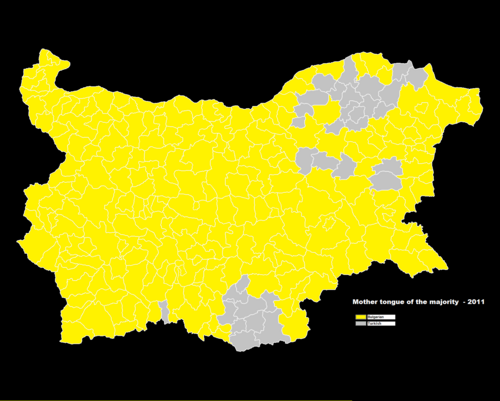
2001 年のブルガリア国勢調査における言語的自己認識に関する 結果を示す表:
年齢構成
トルコ人の人口は、ブルガリア人の人口と比較すると、20歳未満の若者の割合がわずかに多い。[44]トルコ系民族は全人口のわずか8%を占めるに過ぎないが、20歳未満の全人口の9.7%、60歳以上の全人口のわずか5%を占める。
歴史的人口統計
オスマン帝国統治時代のブルガリアにおけるトルコ人の正確な数は、オスマン帝国当局が採用していたミレット制度のため、確定するのが難しい。したがって、イスラムのミレット、すなわちイスラム教徒には、トルコ人だけでなく、イスラム教徒ブルガリア人またはポマク人、イスラム教徒アルバニア人などを含むがこれらに限定されない他のすべてのイスラム教徒が含まれ、1850年代以降には、特にチェルケス人虐殺の結果として1850年代と1860年代にロシア帝国によって追放されたクリミア・タタール人、チェルケス人、ノガイ人などを含む多数のイスラム教徒ムハシルも含まれていた。イスラム教徒ロマは、散発的にのみイスラムのミレットに数えられ、通常は独自のカテゴリを形成していた。
1831年オスマン帝国の国勢調査
1831年のオスマン帝国の国勢調査によると、現在のブルガリア共和国の国境内にあるオスマン帝国領カザの男性人口は496,744人で、そのうちキリスト教徒が296,769人、イスラム教徒が181,455人、ロマ人が17,474人、ユダヤ人が702人、アルメニア人が344人であった。[27] [28]国勢調査は、障害のない15歳から60歳までの健康な課税対象の男性のみを対象としていた。
ブルガリアの統計学者ディミタル・アルカディエフはドナウ川流域の一次人口記録を用いて、15~60歳の男性が平均して全男性の49.5%を占め、男性人口全体を計算できる係数は2.02であることを発見した。[28]総人口を計算するには、男性の数字を2倍にするのが通例である。[45]この計算方法、(N=2 x (Y x 2.02))を使用すると、1831年の現在のブルガリアの人口は2,006,845人で、[28]うち正教徒が1,198,946人(欠落データのため過少に数えられている)、イスラム教徒が733,078人、ロマ人が70,595人、ユダヤ人が2,836人、アルメニア人が1,390人であった。しかし、オスマン帝国のニコライ・トドロフが示唆したように、15~60歳の男性の20~40%が虚弱であるか、別の理由で課税対象外であったと仮定すると、数字は実際よりもかなり少なく計算されている可能性があり、データとして完全に信頼できるとは決して考えられない。[46]
将来のブルガリア公国のオスマン帝国の人口記録(1860-1875)

ブルガリア公国は、1877年から1878年の露土戦争以前にオスマン帝国領ドナウ川流域の一部であった5つのサンジャク(ヴィディン、ティルノヴァ、ルシュク、ソフィア、ヴァルナ)から1878年7月13日に設立され、個別の国境変更が行われた(下記参照)。[47] [48]ドナウ川流域の他の2つのサンジャク、ニシュとトゥルチャは、それぞれセルビアとルーマニアに割譲された。
1859年から1860年のオスマン帝国暦によると、将来のブルガリア公国を形成する5つのドナウ川サンジャクの男性イスラム教徒人口(イスラム教徒ロマ人を含む)は255,372人で、男性非イスラム教徒人口(キリスト教徒ロマ人を含む)は418,682人だった。[49]これにより、イスラム教徒と非イスラム教徒の比率は37.9%対62.1%となった。
1859年から1860年の数字は、1855年から1865年にかけてドナウ州に30万人以上のクリミア・タタール人とチェルケス人が定住したことを考慮していない最後のオスマン帝国の記録であったため、ベンチマークとして重要です。 [50] [51] [52]この定住は2つの波に分かれて起こりました。1つ目は1855年から1862年の間にドナウ州に定住した142,852人のタタール人とノガイ人、そして少数のチェルケス人であり、2つ目は1864年に定住した約35,000のチェルケス人家族です。[53] [54] [55]
トルコの学者ケマル・カルパットによれば、タタール人とチェルケス人によるこの州の植民地化は、今世紀初頭のイスラム教徒の人口の大幅な減少を相殺しただけでなく、その後も続いた人口減少を相殺し、イスラム教徒の人口増加につながったという。[56]これに関連して、カルパットはイスラム教徒と非イスラム教徒の出生率の大きな違いにも言及しており、非イスラム教徒の出生率は年間2%増加しているのに対し、イスラム教徒の平均出生率は0%であることが多い。[57]
1875年のオスマン帝国暦によれば、ドナウ川流域の5つのブルガリア領土(ルシュク、ヴィディン、ソフィア、ティルノヴァ、ヴァルナ)の男性イスラム教徒人口は405,450人、男性非イスラム教徒人口は628,049人であった。[58]これにより、イスラム教徒と非イスラム教徒の比率は39.2%対60.8%と、やや有利となった。
コーカサスとクリミアのムハジルがドナウ川流域の人口に与えた影響をよりよく示すには、トゥルチャのサンジャクのデータも取り入れるとよいだろう。ここは1850年代と1860年代にオスマン帝国から逃れてきたクリミア・タタール人の主な移住先であり、1878年にはサンジャクの人口の過半数(31.5%)を占めるまでになり、この地域は親しみを込めて「キュチュク・タタールスタン(小さなタタール人)」と呼ばれた。[60]
1875年のデータは、さまざまな民族宗派グループ別の内訳としても入手可能である。ここでは非ムスリムがいくつかの異なるカテゴリーに分けられているが、イスラム教ミレットまたは「ムスリム」はより広い民族をカバーしている(ロマや最近のチェルケス人難民を除く)。支配的なトルコ民族グループに加えて、1870年代には、ロヴェチ地方に主に居住する約1万人のポマクまたはムスリムブルガリア人も含まれていると推定されている。[61]
ベルリン会議は、ソフィアのサンジャク(男性ムスリム人口2,755人)のクマイ・バーラのカザ[47]をオスマン帝国に、ヴァルナのサンジャク(男性ムスリム人口6,675人)のマンカリャのカザ[47] [63]をルーマニアに割譲し、ニシュのサンジャクのイズネボルのカザ(男性ムスリム人口149人)をブルガリア公国に割り振った。[64] [65] [48]
したがって、1877年から1878年の露土戦争以前の将来のブルガリア公国のイスラム教徒男性人口は、トルコ人333,705人、イスラム教徒のブルガリア人またはポマク人10,000人、イスラム教徒のロマ人24,696人、およびチェルケス人ムハシル人27,589人で構成されていました。
したがって、男性と女性を合計すると、将来のブルガリア公国のイスラム教徒の人口は、トルコ人 668,410 人、ポマク人 20,000 人、イスラム教徒ロマ人 49,392 人、チェルケス人ムハシル人 55,178 人、つまり合計792,980 人のイスラム教徒で構成されていた。
クリミアとコーカサスのムハシルの数
1875年のオスマン帝国のサルナーメのデータは、1874年9月に完了した全州人口調査から得たものである。1874年10月18日にドナウ官報に掲載された結果の速報(累積データのみ、サンジャクごとの内訳なし)では、 1875年に発表された最終結果と比べて、男性 チェルケス人 ムハシルの数が2倍の64,398人(30,573人)となり、「定着したイスラム教徒」の数はわずかに減少した。 [66] [67]コユンツによれば、13,825人の男性チェルケス人が「定着したイスラム教徒」の列に繰り越され、さらに20,000人が単に除外されたか、繰り越しで失われた。[62]
1875年のオスマン帝国の記録はチェルケス人を別個に数えた最初の記録であるが、オスマン帝国の人口記録にはクリミア・タタール人について言及さえなく、彼らが数えられたかどうか、またどのように数えられたかについて憶測が飛び交っている。例えば、フランスの外交官オーバレは、チェルケス人もタタール人もオスマン帝国の記録には含まれていなかったと仮定し、推定値の残りの数字に31万人のムハシル人を加えただけである。[68] [69]一方、ドイツ系イギリス人のラフェンスタイン、フランス人のビアンコニ、ドイツ人のキーペルトなど、同時代のヨーロッパの地理学者は、イスラム教ではタタール人はトルコ人と一緒に数えられていると示唆している。[70] [71] [72]
ケマル・カルパットは、クリミア・タタール人とチェルケス人はオスマン帝国のサルナメに数えられておらず、したがってイスラム教徒の総数は過小評価されていると主張している。しかし、同じ本の後半で、彼は1878年の北ドブルジャのイスラム教徒126,924人を、トルコ人48,783人、クリミア・タタール人71,146人、チェルケス人6,994人に分類している。[73] [74] [75] 1875年にはトゥルチャ・サンジャクに53,059人の「確立したイスラム教徒」と2,954人のチェルケス人がおり[62]、1873年にはマンカルヤのカザにさらに6,675人のイスラム教徒がいたことを考えると[64] 、これらの数字は男性のみを指し、女性を含めて再計算すると、約2倍以上になる。 125,000人という数字は、クリミア・タタール人が単に数えられただけでなく、確立されたイスラム教徒として数えられていたことは疑いの余地がない。
コユンチュによれば、国勢調査と1875年のオスマン帝国のサルナーメにおけるイスラム教徒の「定住者」と「ムハジル」への区分は、出自に基づくものではなく、完全に課税に基づくものであった。したがって、国勢調査の時点で10年間の免税期間が終了し課税対象となっていたイスラム教徒入植者(クリミア・タタール人、ノガイ人など、少数のチェルケス人)は「定住者」として数えられ、免税の恩恵をまだ受けていた入植者(チェルケス人)は「ムハジル」として数えられた。[66]
これに関連して、コユンチュは、1860年から1875年にかけて、ブルガリアの5つのサンジャクとトゥルチャのイスラム教徒の人口が84.23%(男性220,276人)と驚異的な増加率を示したのに対し、非イスラム教徒の人口は53.29%(男性229,188人)と、非イスラム教徒の自然増加率の方が高かったことを指摘し、この原因をクリミア・タタール人とチェルケス人がこの州に定住したことに帰している。[76] [77]
1864年以降のチェルケス人による植民地化とは異なり、1855年から1862年にかけてのクリミア・タタール人、ノガイ人などの移住については詳細に記録されている。ドナウ川沿いに移住した34,344世帯、142,852人(平均世帯あたり4.16人)のうち、22,360世帯、約93,000人にカザの土地が与えられ、ブルガリア公国の一部となった。[55]
1874年に「定着したイスラム教徒」に引き継がれた、あるいはサルナーメから除外されたチェルケス人(男性と女性を合わせた数字はそれぞれ27,650人と40,000人[62])と、1861年まで定住していたクリミア・タタール人、ノガイ人、チェルケス人難民(93,000人[55])を考慮すると、 1875年の将来のブルガリア公国のイスラム教徒の男女合計人口は、トルコ人547,760人(65.8%)、クリミアおよびコーカサスのムハシル人215,828人(25.9%)、ロマ人イスラム教徒49,392人(5.9%)、ブルガリア人イスラム教徒20,000人(2.4%)で構成され、合計で832,980人のイスラム教徒となった。
1878年のベルリン会議でブルガリア公国とルーマニア公国に割譲された領土 (215,828人と71,146+6,994人[73] )に移住したクリミア・タタール人、チェルケス人などの男女を合わせた入植者の数は293,968人で、この数字はケマル・カルパットによる200,000~300,000ムハシル[78] [51]、トルコの歴史家ネディム・イペクによる300,000ムハシル[51] 、ブルガリアのオスマン帝国主義者ムチノフによる350,000~400,000ムハシル[79]、オスマン帝国の政治家でドナウ川知事のミドハト・パシャの1866年の推定では35万人のムハシル[51]、ブルガリア版ドナウ官報の1867年の推定では30万人のムハシル[79]がドナウ川流域に定住した。
ドナウ川流域の戦前の人口に関する外国の推定値

1876年のブルガリア四月蜂起の鎮圧に伴う極度の残虐行為と、特にオスマン帝国の非正規民兵組織(主にチェルケス人の バシバズーク)によって犯された数々の残虐行為は、ヨーロッパ全土、特にそれまでオスマン帝国の最も近い同盟国であったイギリスで大きな怒りを呼んだ。[80] [81] [82] [83] [84] [85] [86] [87] [88]反乱軍だけでなく非戦闘員に対しても不釣り合いなほどの暴力が使用されたため、ヨーロッパの報道機関はこれを「ブルガリアの恐怖」[83] [80] [84]や「世紀の犯罪」[89]と呼び、列強は1876年12月にコンスタンティノープル会議を招集し、ブルガリア問題の解決策を模索した。
会議と連携して、列強のほとんどがドナウ川流域の人口に関する多数の推計を作成した。その作成者には、ルシュク駐在フランス総領事ガブリエル・オーバレ[68]、[69]、[90]、オスマン帝国軍将校スタニスラス・サンクレール[67]、フランスの学者で東洋学者のウビチーニとクルテイユ[90]、コンスタンティノープル駐在英国大使館書記官イギリス人WNジョスリン[90]、コンスタンティノープル駐在英国大使館通訳ギリシャ人役人スタヴリデス[90] 、ロシア外交官ウラジーミル・チェルカスキー[90] 、ロシア外交官ウラジーミル・テプロフ[90]などがいる。推計は以下の表のとおりである。

聖クララの推定値はオスマン帝国のテスケレに基づいていたが、それ以外の推定値はオスマン帝国のサルナメ(オスマン帝国の年鑑)に基づいている。この数字は1876年から1877年にかけて行われたコンスタンティノープル会議の基礎データとして使用され、最終的にはオスマン帝国の支配下にありながらも列強諸国による広範な監視を受ける2つのブルガリア自治州を設立するという提案が出された。数字とその正確さに関する議論についてはコユンチュを参照のこと。[90]
将来の東ルメリアのオスマン帝国の人口記録(1876年)
オスマン帝国から切り離されたブルガリアのもう一つの領土は、東ルメリア自治州であった。これには、フィリベのサンジャク(オスマン帝国に返還されたアヒ・チェレビ/スモリャンとスルタンエリ/モムチルグラードのカザを除く)、イシリミエのサンジャク、エディルネのサンジャクからのクズラグアチ/エルホヴォのカザとマナスティル/トポロヴグラードのナヒヤ、そしてエディルネのサンジャクからのウスクダルとチョーケのナヒヤの小さな部分が組み込まれた。[47] [91]
1876年のオスマン帝国の記録による人口データは以下の通り(男性のみ): [92] [93]
イギリスの外交官ドラモンド・ウォルフによると、イスラムのミレットには25,000人のブルガリア人、10,000人のタタール人とノガイ人、10,000人のチェルケス人が含まれていた。[94] [95]コユンツは11,000人から20,000人のタタール人とチェルケス人を挙げており、メフメット・チェティンカヤは6,000ほどのチェルケス人家族がエディルネのサンジャク族とイシュリミエのサンジャク族に分かれていたと主張している。[96] [97]
したがって、露土戦争前の東ルメリアの男女を合わせた人口は、正教徒のブルガリア人とギリシャ人が595,528人(62.6%)、カトリックのブルガリア人が7,284人(0.8%)、正教徒のロマ人が6,616人(0.7%)、アルメニア人が1,370人(0.1%)、ユダヤ人が5,806人(0.6%)、トルコ人が256,740人(27.0%)、イスラム教徒のブルガリア人が25,000人(2.6%)、ムハシル人が20,000人(2.1%)、イスラム教徒のロマ人が31,634人(3.3%)、合計でイスラム教徒が333,374人(35.0%)で構成されていた。
東ルメリア/アドリアノープル地方の戦前の人口に関する外国の推定値
トルコのオスマン主義者ケマル・カルパトによれば、1877年のアドリアノープル郡の総人口は1,304,352人で、そのうち526,691人がブルガール人(40.38%)、503,058人がイスラム教徒(38.57%)であった。[95] 1877年から1878年、この郡はフィリベ、イスリミエ、エディルネ、ゲリボル(ガリポリ)、テクフルタグ(ロドスト)のサンジャクから構成され、歴史的および地理的にはトラキアの地域と大部分が重なっていた。[48]
フランスの東洋学者ウビチニによると、1875年のオスマン帝国によるアドリアノープル郡の公式国勢調査に基づき、郡の総人口は1,594,185人で、そのうち557,692人(34.98%)がイスラム教徒、45,418人(2.84%)がイスラム教徒のロマ人、937,054人(58.78%)がブルガリア人とギリシャ人、16,432人(1.03%)がユダヤ人、16,194人(1.02%)がアルメニア人、12,144人(0.76%)がローマカトリック教徒、9,252人(0.58%)がキリスト教徒のロマ人であった。[98]カルパットが報告したように、郡の範囲とそれを構成するサンジャクは同じであった。
英国の歴史家RJムーアによれば、1876年のフィリベ・サンジャク(アヒ・チェレビとスルタンエリのカザを含む)の男性人口は、トルコ人127,260人(37%)とイスラム教徒ロマ人12,471人(4%)で構成されていたが、1875年のイスリミエ・サンジャクの男性イスラム教徒人口は44,747人で、総人口の42%を占めていた。[94] [99] [28]
イギリスの外交官ドラモンド・ウォルフ(ソールズベリー宛ドラモンド・ウォルフ、1878年9月26日)は1878年に、1875年の東ルメリアの総人口76万人のうち、トルコ人22万人(29%)、ポマク人2万5千人(3%)、クリミア・タタール人ムハシル人1万人(1%)、チェルケス人ムハシル人1万人(1%)、イスラム教徒ロマ人2万5千人(3%)で構成されていたと推定した。[95] [94]
1878年以降
アナトリアへのトルコ人の流入は、1925年以降移民が規制されるまで、統治政権の政策に応じて一定のパターンで続いた。20世紀にはブルガリアも強制的な国外追放や追放を実施し、これもイスラム教徒のポマク住民を対象としていた。[100]
トルコ人移住の最大の波は1989年に起きた。共産主義政権の トドル・ジフコフによる同化政策の結果、36万人がブルガリアを離れたが、1989年から1990年の間に約15万人が帰国した。1984年に始まった同化政策では、ブルガリアに住むすべてのトルコ人とその他のイスラム教徒にキリスト教徒の名前を採用し、すべてのイスラム教の慣習を放棄するよう強制した。1984年の同化政策の動機は不明だが、多くの専門家はトルコ人とブルガリア人の出生率の不均衡が大きな要因だったと考えている。[101]政府の公式見解は、ブルガリアに住むトルコ人は実際にはトルコ化したブルガリア人であり、トルコ人/イスラム教徒の名前をブルガリア人/スラブ人の名前に自発的に変更することを選んだというものだった。[102]この期間中、ブルガリア当局は民族弾圧の報告や国内にトルコ系民族が存在するという報告を全て否定した。このキャンペーンの名称変更の段階では、トルコの町や村は軍隊に包囲された。市民にはブルガリア名が記された新しい身分証明書が発行された。新しいカードを提示しないと、給与、年金の支払い、銀行引き出しが没収された。出生証明書や結婚証明書はブルガリア名でのみ発行された。伝統的なトルコの衣装は禁止され、家は捜索され、トルコ人であることを示すものはすべて取り除かれた。モスクは閉鎖または破壊された。墓石のトルコ名がブルガリア名に置き換えられた。米国議会図書館の連邦調査部が報告した推計によると、同化政策に抵抗した500人から1,500人が殺害され、数千人が労働キャンプに送られたり強制移住させられたりした。[103]
ブルガリアにおける共産主義の崩壊は、トルコ系国民に対する国家の政策の転換をもたらした。 1989年にジフコフが失脚した後、ブルガリア国会はトルコ系住民の文化的権利を回復するための法律を可決した。1991年、新しい法律により、改名運動の影響を受けたすべての人に、元の名前と改名後に生まれた子供の名前を正式に回復するために3年間の猶予が与えられた。1991年1月、トルコ語の授業が、希望者であれば週4時間の非必須科目として再導入された。2011年のブルガリア国勢調査によると、トルコ系民族は588,318人で、全民族の8.8%を占め、[104]そのうち564,858人がトルコ語を母国語としている。[105] 2014年からトルコに居住する外国生まれの人口に関する住所ベースの人口登録システムの統計結果によると、外国生まれの居住者合計992,597人のうち37.6%がブルガリアで生まれており、同国で最大の外国生まれのグループを形成しています。[106]トルコに居住するトルコ系ブルガリア国民の数は326,000人とされており、2005年のブルガリア議会選挙では120,000人がブルガリアまたはトルコに設置された投票所で投票しました。[2]
-
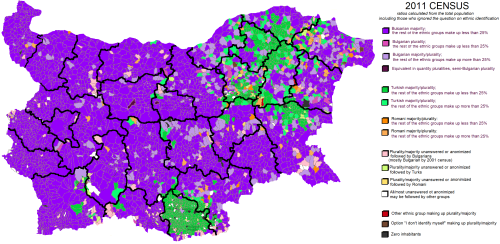 2011年国勢調査による地籍区分別の主要民族グループ
 -
 2011年の国勢調査による自治体別の主要民族グループ
 -
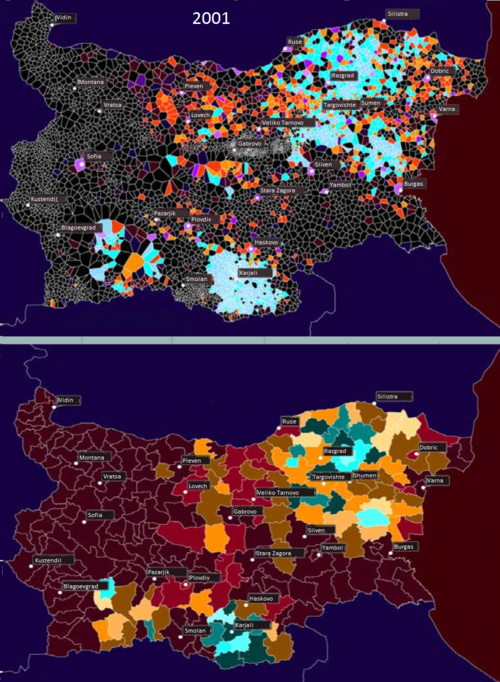 2001年の国勢調査によるトルコ人の分布
 -
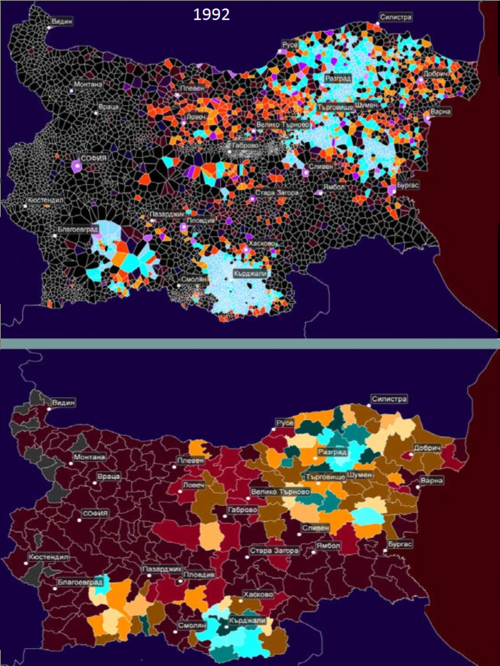 1992年の国勢調査によるトルコ人の分布
 -
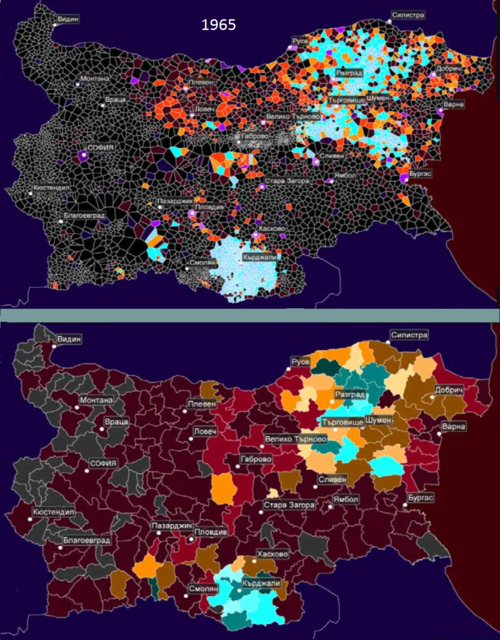 1965年の国勢調査によるトルコ人の分布
 -
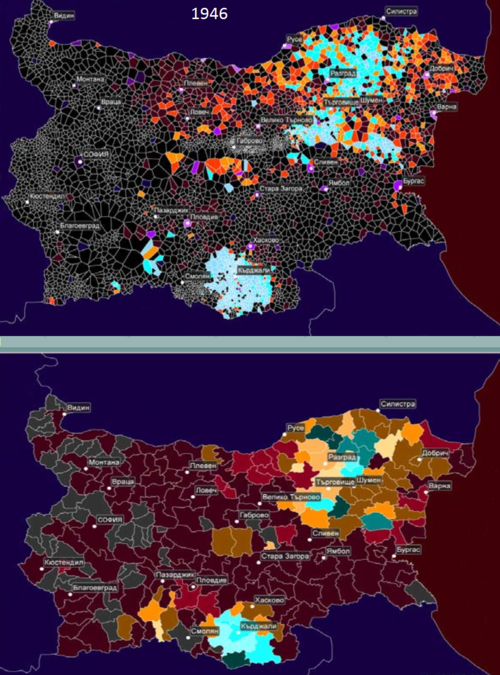 1946年の国勢調査によるトルコ人の分布
 -
 1934年の国勢調査によるトルコ人の分布
 -
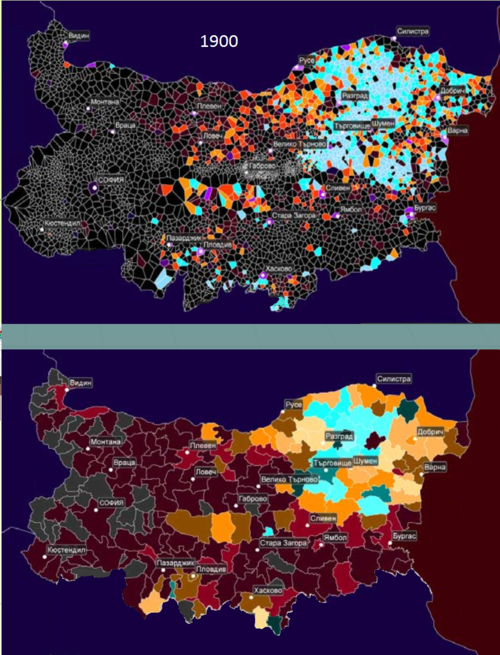 1900年の国勢調査によるトルコ人の分布
 -
 1892年の国勢調査によるネイティブスピーカーの分布
 -
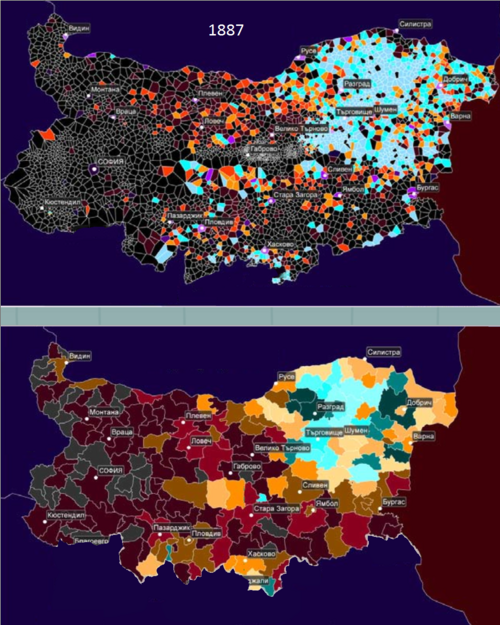
歴史
トルコ人は、今日では約100万人(バルカン半島全体の人口の約2%)と数的には少ないものの、その数をはるかに超えてバルカン半島の歴史を形成する役割を果たしてきました。 [113]
オスマン帝国以前の居住地の可能性
オスマン帝国による征服中および征服後にトルコ人がブルガリアに定住したが、この時期以前にもトルコ人が定住していた可能性を示す兆候がある。[114]初期の歴史編纂物およびイブン・ビビの『ルーム・セルジューク朝の歴史』の翻訳によると、アナトリアからドブルジャへのトルコ人の移住について根拠のある説明がなされている。イブン・ビビの歴史回想録は、オスマン帝国がバルカン半島を支配するよりかなり前の1192年から1281年までの期間を扱っている。イブン・ビビの著作は1281年に完成し、ルーム・セルジューク朝最後のスルタンの一人、カイフスラフ3世のためにペルシャ語で書かれた。ヤズィツィオール・アリは、そのトルコ語訳『セルチュク朝』の中で、セルジューク朝の軍隊がスルタン・イッズッディーン・カイカウス2世(カイカウス2世)に加わり、ビザンツ帝国の皇帝ミカエル8世パレオロゴスの軍事作戦を支援した様子を描いている。[115]この軍事作戦中にセルジューク朝はドブルジャに定着したと考えられている。[116] 1261年のババイーの反乱の結果、トルクメンの修道士の一人であるサリ・サルトゥクは、40のトルクメン氏族とともにビザンツ帝国に避難することを余儀なくされた。彼はドブルジャに定着し、そこから強力なイスラム教徒のモンゴル人エミール、ノガイ・ハーンに仕えた。サリ・サルトゥクは、イスラム教をヨーロッパに広めた修道士およびガズィーとして、叙事詩の英雄となった。[117]イブン・バットゥータとエヴリヤ・チェレビの著作に記されているように、セルジューク・トルコ人は、現在のブルガリアと彼らの最遠の拠点である北ドブルジャにあるババダグとの国境にある黒海沿岸のドブルジャ地域に定住した。[118] [119] [120] [121] [122]彼らの一部はアナトリアに戻り、残りはキリスト教化してガガウズという名前を採用した。[123]これらの出来事については疑問もあり、一部の学者によると民間伝説の特徴があるという。[18]
オスマン帝国時代の集落


オスマン帝国によるバルカン半島の征服は、重要な人口移動を引き起こし、征服された地域の民族的、宗教的構成を変えた。この人口構成の再編は、アナトリアから連れてこられた、あるいは追放されたトルコ人によるバルカン半島の戦略的な地域の植民地化を通じて達成され、ヨーロッパでのさらなる征服のための強固なトルコ系イスラム教徒の基盤が確立された。オスマン帝国は、バルカン半島での地位と権力を強化するために、植民地化を非常に効果的な手段として利用した。バルカン半島に連れてこられた入植者は、国家にとって不安な集団、兵士、遊牧民、農民、職人、商人、修道僧、説教師、その他の宗教関係者、行政職員など、多様な要素で構成されていた。最も初期の到着者の中には、ユリュク人、トルコ人(オグズ・トルコ人)、アナトリアのタタール人、首長アクタブに率いられたクリミア・タタール人(カラエイまたはカラ・タタール人)などの多数の遊牧民がいた。 [124]オスマン帝国がバルカン半島での征服を拡大すると、アナトリアから遊牧民を連れてきて、主要幹線道路沿いや周囲の山岳地帯に定住させた。トラキア、マリツァ、トゥンジャ渓谷の国境地域には、人口密度の高いトルコ植民地が築かれた。オルハンのもとですでに始まっていた植民地化政策は、その後継者であるムラト1世(1360年 - 1384年)とバヤジト1世(1389年 - 1402年)によって引き継がれた。トラキア、マケドニア、テッサリアの主要交通・通信路沿いには、再びほとんどが遊牧民である追加の入植者が定住した。オスマン帝国の当局は 16 世紀を通じてこれらの遊牧民を部族組織として維持し、17 世紀になってようやく彼らに定住し始めました。
自発的な移住に加えて、オスマン帝国の当局はバルカン半島とアナトリアの潜在的な反乱分子を制御する方法として大量追放( sürgün )を使用しました。反乱を起こしたカラマニ・ピル・アフメドの追随者の場合のように、本拠地から遠く離れた場所では、そのような分子の潜在的な脅威は大幅に減少しました。部族の抵抗に続いて、カラマニド族とトルクメン族の遊牧民がデリオルマンとルメリアに大規模に移送されました。双方向の追放は14世紀、15世紀、16世紀を通じて行われました。[124]
1402年、バヤズィト1世がティムール軍にアンカラの戦いで敗れた後、オスマン帝国はしばらくアナトリアの領土を放棄し、バルカン半島を本拠地とみなして、アドリアノープル(エディルネ)を新たな首都とした。ティムール朝の侵略やアナトリアでのその他の動乱により、バルカン半島にはさらに多くのトルコ人入植者が流入した。多数のトルコ人入植者が新しい村に農民として定住した。15世紀のワクフの証書や記録によると、西アナトリアの農民がトラキアや東バルカン半島に定住し、何百もの新しい村を建設するなど、広範囲にわたる植民地化の動きがあったことが分かる。他の入植者の中には、軍事や行政の役目を求めてやってきた者や、イスラム教の宗教施設を設立するためにやってきた者もいた。イスラム教徒は、半島の2つの主要な歴史的ルートに沿って密集して定住していた。1つはトラキアとマケドニアを通ってアドリア海に通じ、もう1つはマリツァとトゥンジャ渓谷を通ってドナウ川に通じるルートである。ユリュク人は主にこの地域の山岳地帯に定住した。1520年から1530年の間に行われた国勢調査では、バルカン半島の人口の19%がイスラム教徒であったことが示された。[125]
しかし、バルカン半島におけるオスマン帝国の植民地化の影響が最も大きかったのは、都市部であった。多くの町がトルコの支配と行政の中心地となり、ほとんどのキリスト教徒は徐々に山岳地帯に撤退していった。歴史的証拠によれば、オスマン帝国は、オスマン帝国の征服に先立つ2世紀にわたる絶え間ない戦争、およびオスマン帝国の征服自体の荒廃により、人口が大幅に減少し経済的に混乱していた古い町に新しい町を建設し、再び住民を住まわせるという体系的な政策に着手した。古い町の再植民地化と新しい町の設立には、帝国の他の地域からの移住者や、他の土地からのイスラム教徒の難民が伴うことが多かった。[126]記録によると、14世紀末までに、プロヴディフ(フィリベ)やパザルジク(タタール・パザルチク) などのトラキア北部の大都市では、イスラム教徒のトルコ人が絶対多数を占めていた。[127]
ブルガリアのオスマン建築

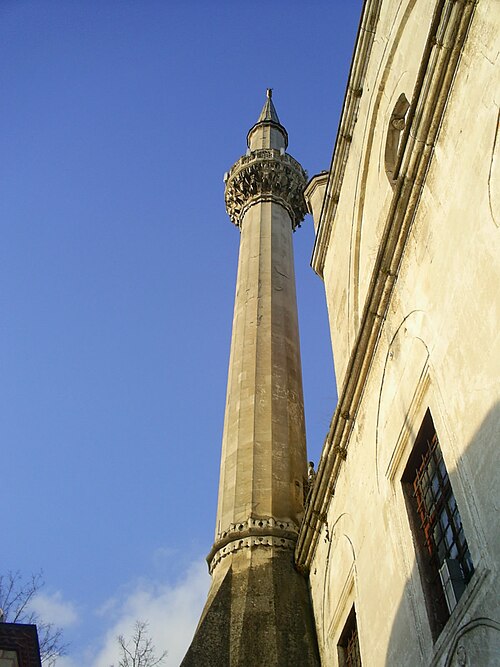


オスマン建築はバルカン半島の都市景観を形成し、目に見える痕跡を残してきました。オスマン帝国の都市文化には、建築家と棟梁(マケドニアとエピルスではマイストア、アナトリアと時にはブルガリアではカルファ)という2つの異なる技術が顕著に存在し、彼らはあらゆる種類の建築プロジェクトの設計と建設の責任とタスクを共有していました。ミマール・スィナンが帝国の主任建築家を務めていた時代から16世紀後半まで、40〜70人の建築家が非常に大きな労働力のために設計図を作成し、ブダペストからカイロまでの軍事施設、民間施設、水道、道路インフラの建設を管理していました。中央集権的なハスまたはハッサ(スルタンの財産と奉仕)システムにより、少数の建築家が帝国の広大な領土にあるすべての重要な帝国建築現場とほとんどのワキフ建築現場を管理することができました。18世紀に帝国は西洋の影響に開かれました。 18世紀後半までに、オスマン帝国のキリスト教徒の採用数が増加した。オスマン帝国の最後の最後まで、バルカン半島とアナトリアの両方で、建築の巨匠たちはオスマン精神と建築の革新との間の文化的均衡を維持した。トルコ、スラブ、ギリシャの巨匠たちは、西洋のスタイルとオスマンの視点を融合させ、建築の景観を広げた。その最も良い例の1つが、フィリベ・プロヴディフの対称的な家である。革新は、アナトリア、マケドニア、ブルガリアのオスマンの家と市場(チャルシュ)の建物から派生した。[128]
共産主義政権への解放(1878年~1946年)

1878年の露土戦争以前の現在のブルガリア領土におけるトルコ人の推定数は様々である。主要都市部はイスラム教徒が大多数を占め、19世紀まで圧倒的にイスラム教徒が占めていた。[129] 1876年にルセのフランス領事だったオーバレによると、部分的に現代ブルガリアの外側にあったドナウ州には112万人のイスラム教徒(うちトルコ人は77万4千人、非イスラム教徒は123万3500人、うちブルガリア人は115万人)がいた(比較のために、1881年のブルガリア国勢調査ではブルガリア公国のより狭い地域で134万5千人が登録されている)。[130]彼によれば、ルスチュク・サンジャクには388,000人のトルコ人と229,500人のブルガリア人がおり、ヴァルナ・サンジャクではトルコ人が92,800人とブルガリア人の32,200人を上回っており、その差は歴然としていた。国勢調査とサルナーメによれば、1世紀前は北東部ではイスラム教徒が優勢だった。[131] [検証に失敗した] 1876年にニシュとソフィア・サンジャクがドナウ・ヴィライェトから分離され、コソボ・ヴィライェトとアドリアノープル・ヴィライェトに加わり、1877年から1878年の露土戦争前には110万人のイスラム教徒と170万人の非イスラム教徒がこの地域に住んでいた。[132]ロシア軍とブルガリア義勇軍は1878年1月に南下し、地元のイスラム教徒住民に残虐な行為を次々に加えた。[133] NYT 1877年11月23日。[信頼できない情報源? ]オスマン帝国軍はイスラム教徒の非戦闘員を攻撃し、難民を利用して退却の盾としたとも非難されている。[134]逃亡中に苦難で亡くなった人も多かったのは確かだ。死傷者の数は不明だが、数万人と推定されている。[135]難民の数も不明で、リチャード・クランプトン教授は13万人から15万人の脱出と推定し、そのうち約半数が1878年のベルリン会議で奨励された暫定期間に帰国した。[136]一方、ハプチック博士は難民は50万人だったと主張している。[137]ロシア軍とブルガリア軍がトルコ人とポマク人に対して行った残虐行為は、フランス、イタリア、イギリス、トルコの代表が署名した1878年のロドピ委員会にも記載されている。委員会は、休戦協定に署名した後に80のイスラム教徒の村が焼き払われたことや、イスラム教徒の民間人に対する他の多くの戦争犯罪を指摘している。委員会は、ロドピ山脈とその周辺に15万人の難民がいるという数字を提示している。[138]
ジャスティン・マッカーシーによると、[139] [140]ロシアの目的は大量のイスラム教徒の民間人の犠牲者を負わせることだった。犠牲者は4つのカテゴリーに分けられる。1) 戦闘による犠牲者 2) ブルガリア軍とロシア軍による殺人 3) 生活必需品の供給拒否による飢餓と病死 4) 難民状態による死亡。ブルガリアでの戦争を取材したヨーロッパの報道関係者は、イスラム教徒に対するロシアの残虐行為について報道した。シュメンとラズグラードの目撃証言では、サーベルや槍で負傷した子供、女性、老人について語られている。多くの村のイスラム教徒全員が虐殺されたと彼らは述べた。[141]
オスマン帝国軍は撤退中にキリスト教徒に対して数々の残虐行為を犯したが、最も顕著なのはスタラ・ザゴラとその周辺地域の完全な破壊であり、これがトルコ系民族に対する攻撃の一部を引き起こした可能性がある。[142] [143]また、オスマン帝国の支配から逃れたワラキア、モルダビア、ロシアからのブルガリア難民も祖国に戻ってきた。
戦争中、大地主や小地主を含む多くのトルコ人が土地を放棄した。[144]ベルリン条約の調印後、多くの人が戻ってきたが、すぐに彼らが去った土地の雰囲気に馴染めないことに気づき、多くの人がオスマン帝国のより馴染みのある文化的、政治的雰囲気へと再び移住した。[144]
1881年の国勢調査によると、ブルガリア公国北東部には40万人以上のトルコ語話者が住んでおり、ブルガリア人は22万8千人であった。 [145] 2011年にはトルコ人の約50%が北東部に住んでおり、同地域の人口の20%を占めている。
ブルガリアの人口は、1881年の国勢調査では200万人だったが、1892年には250万人に増加し、1910年には350万人、1920年には400万人に達した。この増加は、ブルガリアのトルコ語を話す住民の多くが国外へ移住していた時期に起きた。1881年の国勢調査では、ブルガリアと東ルメリアのトルコ語を話す人々は約70万人で、人口の24.9%を占めていたが、1892年の国勢調査ではその割合は17.21%、1910年の国勢調査では11.63%にまで減少した。同時期にブルガリア語を話す人々は、総人口の67.84%、75.67%、81.63%であった。[146]
1913年8月のバルカン戦争中、西トラキア(南ロドピ山脈の地域とキルジャリ/クルジャリ地域を含む)のイスラム教徒の多数派は西トラキア臨時政府を設立した。この短命な共和国の人口は23万人を超え、そのうち約80%がトルコ人とポマク人であった。[147]西トラキアは、1913年9月29日に調印されたイスタンブール協定によりブルガリアに引き渡され、この地域に住むトルコ人の権利が保証された。この地域は1919年までブルガリアの支配下に置かれた。ブルガリア人は西トラキアの人口のほんの一部を占めるに過ぎなかったため、当時、西トラキアとトルコの双方の住民にとって、ブルガリアへの領土譲渡は受け入れられない選択肢とみなされた。1913年に領土を失ったオスマン帝国は、いつの日か西トラキアを取り戻すという希望を抱き、主にトルコ人が住む地域を維持するつもりだった。[148] 1925年にブルガリアとトルコの間で締結された条約により、1940年までに約70万人のトルコ人がブルガリアからトルコに移住することが認められた。[149]
ブルガリアにおけるトルコの報道 1879-1945
出典: [150]
ブルガリアにおけるトルコの報道機関は、1878 年のブルガリア公国建国とほぼ同時に設立されました。新しい(「外国の」)ブルガリア政権下で、トルコの知識人は、まずブルガリアの官報を翻訳してトルコ国民に新しい法律や規則を伝える必要性を感じました。この数年間で、ブルガリア公国で発行されるトルコの新聞や出版物の数は 90 にまで増加しました。
ブルガリアのトルコの報道機関は多くの困難に直面し、多数の新聞が発行禁止の危機に瀕し、記者は国外追放の危機に瀕していました。トルコのジャーナリストと教師は組織化して、ブルガリアのイスラム教師コミュニティ(Bulgaristan Muallimi Islâmiye Cemiyeti)と、青年組織であるブルガリアのトゥランコミュニティ連合(Turan Cemiyetleri Birliği)を設立しました。これらの組織のリーダーは、ブルガリアのさまざまな場所で毎年開催される全国大会で会合しました。最大の全国大会は1929年にソフィアで開催され、1000人以上が参加しました。
1895 年から 1945 年にかけて、ブルガリアにはいくつかの有名なトルコの新聞がありました。
ガイレット:この新聞は1895年にプロヴディフで創刊され、フィリベリ・リザ・パシャによって印刷されました。1896年に有名なトルコの思想家で知識人のウベイドゥッラー・エフェンディがガイレットにコラムを執筆し、後に同紙の主任コラムニストになりました。
ムヴァゼネ:週刊新聞は1897年8月20日にプロヴディフでメクテビ・ムルキエ・ウルム・シヤシエの卒業生によって創刊され、フィリベリ・ルザ・パシャによって印刷されました。新聞の運営は一時的にヴァルナに移りましたが、その後プロヴディフに戻りました。ムヴァゼネで最もよく知られた記者の一人は、ブルガリアのトルコ人教師の組合化を推進し、シュメンで最初のトルコ人教師会議の扇動者であったアリ・フェフミ・ベイです。会議中に、ブルガリアのイスラム教師コミュニティ(ブルガリスタン・ムアリミ・イスラミエ・セミエティ)が設立されました。
ルメリ - バルカン: 1904 年にエテム・ルヒ・バルカンによって創刊。最初の 3 版の発行後、新聞の名前はバルカンに変更されました。1912 年にバルカン戦争が勃発するまで、日刊紙が発行されていました。この新聞は、マウリミ・メフメット・マフリとハリル・ゼキ・ベイによっても印刷されていました。エテム・ルヒは頻繁に投獄されていたため、1912 年に新聞の経営はフスヌ・マフムトに移り、1917 年にハリル・イブラヒムが編集長になりました。この新聞は 1920 年に発行を終了しました。
UHUVVET : 1904 年 5 月 24 日に無名のジャーナリストのグループによって創刊された週刊新聞で、ルセで印刷され、政治と日々の出来事に焦点を当てていました。1905 年にメフメット・テフティシュが新聞の編集長になりました。
トゥナ:1905年9月1日にメフメト・テフティシュによって創刊されたトゥナは、ルーセで印刷された日刊新聞でした。415号発行後、この新聞は廃刊となりましたが、1908年10月13日、トルコの知識人グループがこの地方のトルコの日刊紙のニーズに応えるために別の会社を設立し、トゥナの発行が再開されました。新しいトゥナ新聞の主な寄稿者は、タヒル・リュトフィ・ベイ、ハフィズ・アブドゥラ・メチク、キザンリクリ・アリ・ハイダルでした。
Terbiye Ocağı : 1921 年にブルガリアのイスラム教師コミュニティ(Bulgaristan Muallimi Islâmiye Cemiyeti ) によって設立され、1923 年から 1925 年にかけてヴァルナで印刷されました。Terbiye Ocağı の既知の寄稿者は、Osman Nuri Peremeci、Hafız Abdullah Meçik、Hasip Aytuna です。 、ムスタファ・シェリフ・アリャナク、メフメト・マフスム、オスマンパザルリ・イブラヒム・ハッキ・オウズ、アリ・アヴニ、エブシナシ・ハサン・サブリ、フセイン・エディップ、タイヤルザデ・ジェミル・ベイ。
ヨルダシュ:1921年にハフィズ・アブドゥラ・メチクによって創刊され、シュメンで隔週発行されています。ヨルダシュはブルガリアにおける最初のトルコの児童向け出版物の1つです。
デリオルマン: マフムト・ネジメッティン・デリオルマンが所有するこの新聞は、1922年10月21日にラズグラードで創刊され、アフメト・イフサンが編集長を務めました。1923年から1925年にかけては、ムスタファ・シェリフ・アリャナクが編集長を務め、週刊版を発行しました。デリオルマンは、ブルガリアのトルコスポーツクラブ連合の主要出版物としても機能しました。ハシップ・サフェティ、アフメト・アイトゥナ、ハフィズ・イスマイル・ハッキ、ヤヒヤ・ハヤティ、フスメン・ジェラル、チェティン・エブシナシ、ハサン・サブリなどのトルコ人コラムニストは、デリオルマンでよく知られた人物でした。
トゥラン:1928年5月6日にヴィディンで創刊されたトゥランは、ブルガリアのトルコ青年コミュニティ連合の媒体でした。この新聞は、1934年に廃刊になるまで、 カルジャリとヴァルナでも印刷されていました。
Tebligat : 1929 年に設立され、ソフィアの大ムフティとイスラム財団の事務所によって発行されています。
ロドップ:1929年4月にリュトフィ・タカノールがカルジャリで創刊。ロドップはブルガリアのトルコ系住民の権利、自由、国内問題に焦点を当てた。ロドップで最も有名な記者はムスタファ・シェリフ・アリャナクとオメル・カシフ・ナルバンドオールである。ブルガリアの他の多くのトルコ系新聞と同様に、ロドップは1934年に業務を停止せざるを得なくなり、記者は追放されるかトルコに避難することを余儀なくされた。
ウェイン州立大学のアリ・エミノフ教授は、広範なリストをまとめています。[151] [152]
1934年の右翼クーデターにより、トルコ語の新聞は弾圧された。最初の1年だけで、10の新聞(デリオルマン、トゥランを含む)が廃刊となり、1939年までにはハヴァディス(「ニュース」)という新聞1紙だけが生き残ったが、1941年に廃刊となった。その理由は、新聞がケマル主義(つまりトルコ民族主義)のプロパガンダを広めていたためである。[153]
土地の譲渡
トルコ人移住の最も重要な影響であるトルコ人からブルガリア人への土地の所有権の移転は、複雑なプロセスでした。このような移転は 1878 年以前にも行われていました。たとえば、 1840 年にはブルガリア人の地主が不明であったタタール人のパザルジク地区の一部では、1872 年から 1875 年の間に約 2,000 区画がブルガリア人によって購入されました[要出典] 。1877 年とその後数年間、移転のプロセスは、この地域でも他の場所でも、はるかに大規模なものになりました[154] 。1875 年には、ルメリアの土地の約 50% がトルコ人の所有でした[155]。1878 年から 10 年後には、ブルガリアの耕作地の 4 分の 1 がトルコ人からブルガリア人の所有に移りました[156] 。
戦争の勃発とともに、トルコ人の中には財産を売却した者もいたが、そのほとんどは裕福な地元ブルガリア人だった。他のトルコ人は、所有者が戻れば土地を返すという条件で、通常は信頼できる地元ブルガリア人に土地を貸した。しかし、去るトルコ人のほとんどは土地を放棄して逃げた。プレヴェン陥落でロシアが戦争に勝つことが明らかになっていたからだ。トルコ人が逃げると、多くのブルガリア人が空き地となった土地の一部を占拠した。[157]占拠の状況は地域によって異なった。北東部ではトルコ人の数が多く、数の多さに安心感を覚えたトルコ人はほとんどおらず、残ったトルコ人はブルガリア人による占拠を思いとどまらせるほど強かった。一方、北部と南西部ではトルコ人はほとんど全員逃げており、彼らの土地は直ちに地元ブルガリア人に接収され、多くの場合、これらの地域にある広大な土地を分割した。ブルガリア北部の残りの地域では、約 3 分の 1 のコミュニティで、しばしば賃貸の名目で土地の移転が行われた。たとえば、トゥルノヴォ州には、トルコ人とブルガリア人の混住村が 77 あったが、そのうち 24 (31.0%) はブルガリア人によって占拠され、22 (28.5%) は後にトルコから帰国した難民によって再占拠され、さらに 22 村は影響を受けなかった。残りの 9 村の運命は不明である。南西部では、はるかに緊張と暴力が高まった。ここでは賃貸に関する規定はなく、ブルガリア人農民が土地を占拠しただけでなく、建物を破壊した例もあった。[158]
ほとんどの場合、空き地を占拠したのは地元のブルガリア人だったが、トルコからの移民がほとんどいなかったブルガリアの他の地域のブルガリア人や、マケドニアと西トラキアでのオスマン帝国の弾圧から逃れたブルガリア難民も占拠に参加した。その後数か月でベルリン条約の条項が公表され、当然ながらこれらの地域からの難民の流入が激化し、ブルガス州の知事によれば、難民は「非常に恣意的なやり方で」移住者の土地を手に入れたという[要出典]。
ブルガスと東ルメリアの残りの地域では、ベルリン条約により、オスマン帝国の主権が回復される前に十分な土地を奪取するブルガリア人の決意が強まり、土地争いが激化した。また、旧トルコ領主の帰還も促された。ロシア臨時政権はこれらの問題に対処しなければならなかった。
臨時政権には、たとえ意志があったとしても、トルコの空き地の接収のような大衆運動を阻止する力はなかったが、この運動を完全に野放しにすることもできなかった。なぜなら、それはトルコとイギリスに、解放された領土の内政に干渉する口実を与えることになるからである。これらの危険を考慮して、ロシア人は農業問題をかなりの手腕で処理した。1877 年の夏には、マケドニア、トラキア、オスマン帝国領ルメリアからのブルガリア難民がトルコ人亡命者が残した作物の収穫を許可され、9 月にはすべてのブルガリア人、つまり入植難民と先住民がトルコの空き地に種をまくことを許可されたが、これは決して所有権の移転を意味するものではないと強調された。サン・ステファノ条約後のトルコ人の大量脱出により、臨時政権は、収穫額の半分に設定された地代を合法的な所有者に支払って、ブルガリア人に空き地の耕作を許可する以外に選択肢がほとんどなかった。多くの場合、ブルガリア人は地代の支払いを単に拒否し、ロシア人は地代を徴収することに熱心ではなかった。
ベルリン条約でトルコの財産権が保証され、南ブルガリアがスルタンの主権に戻されると、1878年9月までに15万人のトルコ人亡命者のうち少なくとも8万人が帰国した。このため、ブルガリア人に財産を奪われたり破壊されたりした帰国トルコ人の住居など、大きな問題が生じた。9月に地元当局は、ブルガリア人に奪われた家屋は元の所有者の要求に応じて返還するよう命じ、その他の帰国トルコ人にはタタール人またはチェルケス人の土地が与えられた。
これらの問題は、帰還したトルコ人が失った土地の返還を要求したときに生じた問題に比べれば取るに足らないものだった。
1878 年 7 月、ロシア臨時行政はオスマン帝国と協定を結び、トルコ難民は必要に応じて軍の護衛の下で帰還し、武器をすべて引き渡すという条件で土地を返還されることとなった。1878 年 8 月、帰還者は訴追を免れないこと、また、告発が立証された者は土地を奪われることが布告された。この布告は何よりもトルコ人の帰還を阻み、この布告が施行された日から帰還難民の数は徐々に減少し始めた。しかし、まだ処理すべき要求は多く残っており、1878 年 11 月には、これらの要求を調査するためにトルコとブルガリアの混合委員会がすべての州に設置された。決定は、コンスタンティノープルのロシア大使館がオスマン帝国と協議して作成した規則に従って行われることになっており、その規則の下では、ブルガリア人は、本物の土地証書であるタピイを提示し、それによって紛争の対象となる土地がもともと強制的にまたは詐欺的に奪われたことを証明できれば、土地に対する法的権利を確保できるとされていた。
1879 年春にロシア人が撤退した後、プロヴディフの行政は、土地をトルコに返還する裁判所の判決を執行するよう命じた。裁判所の半分だけがそのような判決を記録していた。他の措置はさらに感情的ではなく、1880 年には東ルメリアにおけるブルガリア人の立場は改善されていた。プロヴディフ政府は、所有権を証明する新しい方法を導入し、既存の文書が所有権を証明していると確信した場合、または地元の自治体議会が所有権を証明する証明書を発行した場合、地方裁判所が新しい所有権証書を発行できるようにした。ほとんどの地方議会は完全にブルガリア人で構成されていたか、ブルガリア人が主導権を握っており、以前は補助権を握っていた混合委員会よりもはるかに頻繁に、同胞に有利な判決を下した。また、多くの場合、ブルガリア人は押収した土地を手放すことを拒否し、1884 年になっても、トルコの地主が財産を返還する裁判所命令の執行を要求していた。
1880 年以降、ルメリアのブルガリア人も援助を受けた。トルコ人が再び亡命し始めたためである。これはバルカン半島南部におけるトルコの勢力の完全回復への期待が失望に終わった結果であった。
トルコ人は、もともとこの地域にトルコ人によってもたらされた米の栽培に影響を与える規制によっても、ブルガリアからの移住を奨励されました。これはマラリアを根絶するためのプロジェクトの一部であり、トゥンジャ、アルダ、マリツァ盆地の沼地の排水も含まれていました。このプロジェクトはマラリアの根絶に成功しましたが、それらの地域の干ばつを悪化させました。米はトルコ人の主要作物であり、米の禁止はブルガリアの支配が容認できないことを示すもう 1 つの兆候であるとトルコ人は多くいました。トルコ人の移住をさらに促したさらに重要な要因は、1882 年のブルガリアの土地税でした。1830 年代に封建制が廃止された後、その土地を使用することで、使用者に一時的な後見権が与えられ、したがって 1882 年まで土地に対する主な課税であった十分の一税は、伝統的なイスラムの思想と実践の規範に準拠していました。土地税はそうではありませんでした。さらに、地税は、十分の一税のように耕作された部分だけではなく、人が所有するすべての土地に適用されました。これはトルコ人に大打撃を与えました。なぜなら、彼らは慣習的に土地の大部分、多くの場合半分を休耕地として残していたからです。今度は休耕地にも課税されましたが、生産と収益を同じ割合で増やすことはできず、その結果、大地主として残っていたトルコ人の多くはルメリアを去りました。注目すべきことに、1882年はルメリアのトルコ人の大土地の売却のピークの年でしたが、そのような土地の売却は1880年代前半を通じて着実に続きました。戦争の終結から1880年の夏までに東ルメリアで売却されたトルコ人の大土地はわずか6つでしたが、1885年にブルガリア公国と合併する前の5年間で約100の土地が売却されました。トルコの大領主のほとんどと多くの小領主がルメリアを去ったことは、1880 年代初頭に ブルガリアがルメリアで容易に覇権を獲得する上で間違いなく重要な要因であった。
ブルガリア公国でもルメリアと同様、戦争の混乱により多くの土地押収が記録に残されず、新たな占領者たちは土地を問題なく所有することになった。制憲議会はそのような不法な譲渡を立法化する提案を検討したが、カラヴェロフが議会に対し、これほど広範囲に及ぶ現象について立法化するのは無意味であると容易に説得したため、何の措置も取られなかった。公国のブルガリア人は、土地問題に関してオスマン帝国が直接介入する危険がほとんどなかったため、そのような大胆な姿勢を取ることができた。ブルガリアからはトルコ人の移住が絶えず、1890年代初頭までに非常に多くのトルコ人がかつてのトルコの拠点であったブルガリア北東部を去ったため、ソフィアの政府はその地域が深刻な過疎化に陥ることを恐れ始めた。 1891 年、財務大臣は Subranie に対し、国内に 26,315 の空き地があり、その多くが北東部にあり、そのほとんどが 20 デカレラ以下の広さであると報告しました。
ブルガリアでも、政府は3年間空き地となっていたトルコの土地を接収した。帰還したトルコ人難民の多くが土地の返還や補償を求めたが、強制されることなく3年間土地を耕作しなかったという理由で、その要求は却下された。[159]イスラム教徒の土地所有者の土地権利は、権力者によって保証されていたにもかかわらず、ほとんど無視された。歴史家マイケル・パライレットは、ブルガリアと東ルメリアの脱オスマン化が同地域の経済衰退を招いたと主張しているが、[160]これは、1878年以降ブルガリアで経済が急成長し、産業が急成長し、輸出が伸びたとする他の多くの歴史家と矛盾している。[161] [162] [163]
言語と教育
1878 年の露土戦争後、ブルガリア系トルコ人はブルガリアにおける社会的、政治的支配力を失いました。公用語のトルコ語は少数民族の言語となりました。1875 年にはドナウ州に2,700 校のトルコ系小学校、40 校の中等学校、150 校の神学校がありました。1913 年までにトルコ系学校の数は 1,234 校にまで減少し、そのすべてをトルコ系コミュニティが資金援助しなければならなくなりました。
第一次世界大戦後、ブルガリア政府はトルコの学校に財政援助を行い、学校の数は 1,712 校、生徒数は 60,481 人にまで増加しました。1934 年にファシスト政権が権力を握ると、トルコの改革に従ってラテン アルファベットを採用していたトルコの学校は、アラビア文字での授業を強いられました。これは、トルコからの国家主義的影響を減らすためでした。
1944 年に共産党がブルガリアを掌握すると、彼らは少数民族にさらなる自由を与えるという約束を果たした。トルコの学校が再開され、ラテン文字の使用が認められた。しかし、新政権は学校を国有化し、国家の管理下に置いた。1944 年、就学年齢のトルコの児童は 84,603 人いたが、そのうち 40,388 人は学校に通っていなかった。法律によれば、トルコの学校の卒業生は文盲とみなされた。
1956年、トルコ語学校は1,149校、生徒数は100,843人、教師数は4,527人であった。1958年以降、これらの学校ではトルコ語が公用語からブルガリア語に置き換えられ、トルコ語は選択科目となった。1970年以降、学校でのトルコ語教育は廃止され、1984年までにトルコ語の使用自体が違法とみなされた。唯一残ったバイリンガル雑誌であるYeni IşıkとYeni Hayatはブルガリア語のみで発行された。[164]
共産党政権時代(1945年~1989年)
初期の改良(1944年~1956年)
1944年に共産党が政権を握ると、新政権はすべての少数民族と民族間の平等と友愛を支持すると宣言し(プロレタリア国際主義の古典的な教義に従って)、前政権のすべての「ファシスト的」反イスラム決定を無効にした。 [165]これには「ロディナ」組織の禁止、[165]閉鎖されたトルコ少数民族学校の再建と新しい学校の設立が含まれていた。新憲法には少数民族保護に関する多くの規定があり、特にすべての国内少数民族の母国語教育と文化の自由な発展の権利を保証した。[165]さらに、新しいトルコ少数民族教科書の発行とトルコ語ラジオ放送の放送時間の割り当てが法律で義務付けられた。[166]前政権による禁止以来初めて、1945年からトルコ語の新聞や雑誌、ブルガリアの出版物のトルコ語版が創刊された。これにはVatan(祖国)、Işık(光)、Halk Gençliği、Yeni Işık、Yeni Hayat(新しい生活)などが含まれる。[167] 1947年には、トルコ系少数民族が入学試験なしで高等教育機関に受け入れられるという「積極的差別是正措置」のような政策も実施された。このような慣行は後年も続き、イスラム教徒が共産党や国の政治に積極的に関与するよう特別な努力が払われた。しかし、この特別待遇は、このような統合によって彼らの文化的同化も促進されるかもしれないという期待からのものであった可能性もある。[168] [169]しかし、トルコ人とポマク人のトルコへの移住は1949年以降定期的に禁止された。トルコはまた、ブルガリアからの移民を厳しい条件で妨害した。[ 170]しかし、1950年から1951年にかけて、約15万5000人のトルコ人がブルガリアからトルコへ移住した。[171]ポマク人の移住は禁止された。なぜなら、彼らはトルコ人とは違い、民族的にはブルガリア人であると見なされたからである。[172]また、トルコ人やその他の少数民族はしばらくの間兵役に就くことができず、1952年に正式に兵役を認める決定が下された後も、彼らの入隊には一定の不明確な政治的基準を満たす必要があった。[173]
同化政策(1956年~1989年)

1956年以降、政権は徐々にトルコ人に対する長期同化政策に乗り出し、共産党支配の終わりまで、多かれ少なかれ強度を保って日常的に進められ、それぞれ数年続いた2回の集中的なキャンペーンで最高潮に達した。[177]最も広範囲で公的なトルコ人に対するキャンペーンは1984年から1985年に行われ[178] 、公式には「復興プロセス」と呼ばれた(この用語は、 1971年から1974年にポマクのアイデンティティに対して組織されたもう1つの大規模なキャンペーンにも、まれに使用された[179])。これらのキャンペーンの主な側面の1つは、国のイスラム教徒の人口に強制的に名前を変えさせることであり、さらに、伝統的な衣服を消し去り、イスラムの習慣を禁止し、トルコ語の使用を拒否する取り組みも行われた。[180]これらの暴力的な出来事以外にも、長期的な政策はさまざまな事実に表れていた。例えば、トルコ語の出版物は次々と廃刊となり、1981年までにたった1つの新聞(Yeni Işık)だけが生き残り、1985年に廃刊となった。注目すべきは、1971年の新しい「ジフコフ憲法」で「民族的少数派」という用語が「非ブルガリア系国民」に置き換えられたことだ。
ポマクに対するキャンペーン
同化政策は、共産主義政権以前の慣行を引き継ぎ、まずブルガリア語を話すイスラム教徒のポマク族を標的とした。「ロディナ」が使用した方法のいくつかは共産主義政権によって採用され、ポマク族は主に1964年と1970年から1974年にかけて組織的に標的とされた。これらの強制同化作戦中に行われた残虐行為の例は数多くある。例えば、1972年3月にバルティン村で起きた事件では、警察と国家治安部隊が、政権の同化政策に反対する多数派イスラム教徒のデモを暴力的に鎮圧し、民間人2名を殺害、その他多数の人を銃撃した。[180] 1973年3月、ブルガリア南西部の山岳地帯にあるコルニツァ村で、地元のイスラム教徒が強制的な名前の変更に抵抗し、政府の抑圧的な行動に抗議するデモを行おうとした。ブルガリアの治安部隊は報復として村人5人を殺害し、多数の民間人を負傷させた。[181] 1974年までに、悪名高いベレネ労働収容所の1,300人の囚人のうち500人は、名前を変えるよう圧力に抵抗したポマク人であった。[182]
「再生のプロセス」
再生の過程(「復興の過程」とも呼ばれる – ブルガリア語: Възродителен процес)は、同化政策の頂点であった。1984年から1989年にかけて施行されたこの明確な政策により、ブルガリア政府はブルガリアのトルコ人コミュニティ(90万人、国の人口の10パーセント)に名前の変更を強制した。影響を受けた人々はすべてトルコ人であった。1984年までに、他のイスラム教徒、主にイスラム教徒のロマ人とポマク人は、すでにトルコ人またはイスラム教徒の名前を放棄してキリスト教徒の名前を採用することを強制されていた。政府は、教育を受けたトルコ人にブルガリア人の名前を自発的に採用するよう奨励していた。
ジフコフの大規模な同化政策の正確な理由は不明だが、主な要因の一つは、1990年までにブルガリアの人口がゼロまたはマイナスの人口増加を経験し、イスラム教徒の人口が増加し、ブルガリアの人口が減少するという予測であったと考えられている。[183]
1984年6月、政治局は「トルコ人を社会主義の大義とブルガリア共産党の政策にさらに統合し、組み込む」という政策を採択した。計画は、すべてのイスラム少数派をスラブ系の名前に改名し、トルコ特有の衣服の着用を禁止し、トルコ語の使用を禁じ、モスクを閉鎖することだった。同化キャンペーンは、民族的ブルガリア人の多数派に国家「復興」の試みとして売り込まれ、当局は「復興プロセス」と呼んだ。[184]この用語の背後にあるイデオロギーは、もともと1970年代初頭のポマクの同化のあまり知られていない試みに使われたもので、標的となった少数派はオスマン帝国統治時代に改宗または同化される前はもともとブルガリア人であったという主張であった。したがって、同化は、住民の本来の「本当の」アイデンティティの回復であるとして正当化されたとされている。
後に判明したことだけれど、政権はトルコ系少数民族のエージェントに惑わされ、トルコ系少数民族が同化運動に従わなかったことに驚いた。政権は暴力を使わざるを得ない状況に陥った。[184]
1984年12月24日、ブルガリア警察と治安部隊はムレチノ村(現在のスート・ケシギ村)のトルコ人コミュニティに対して最初の発砲を行った。[185]ムレチノがブルガリア治安部隊に包囲されている間、近隣の小さな町から来た約200人のトルコ人村民が包囲を破り、パスポートの返還とトルコ人の名前の復活を求めて抗議しようとした。このパターンは、トルコ人が住むブルガリアの多くの地域で繰り返された。小さな町や村の人々は、トルコ人がなぜ標的にされているのか、いつトルコ人の名前を復活させて元の身分証明書を受け取ることができるのかを説明できる、より権限のある政府職員を見つけるために、行進して大きな町や村に入ろうとした。中央行政のこれらの大きな町は、ブルガリア治安部隊に包囲されているため、到達できないことが多かった。[186]
On 25 December 1984, close to the town of Benkovski, some 3,000 Turkish protesters from the nearby smaller villages confronted Bulgarian security forces and demanded to have their original identification papers back. The Bulgarian security forces managed to disperse the crowd claiming that they have no idea where their identification papers were and urged them to go back to their villages and inquire from the local mayors. The large police presence was explained with undergoing security forces "exercise manoeuvres". After returning to their towns and discovering that the local municipality didn't have their passports and ID documentation the crowd headed back, this time more decisively, towards the town of Benkovski on the next day (26 December 1984). The Bulgarian police and security forces were prepared and awaiting with some 500 armed men in position. When the crowd of 2,000 Turkish villagers approached the Bulgarian security forces opened fire with automatic weapons wounding 8 people and killing 4. One of the killed was a 17-month-old Turkish baby.[187] The killed were from the villages of Kayaloba, Kitna and Mogiljane. Judging from the wounds of the dead and wounded the police and security force had been aiming at the midsection of the bodies. The captured demonstrators were faced down on the snow for 2 hours and blasted with cold water coming from the fire fighting trucks. In a report by Atanas Kadirev the head of the Ministry of Interior Forces in Kardzhali it is stated "It was interesting how they endured the entire water from the fire fighters' cisterns". The temperature that day was minus 15 degrees Celsius.[186][188]
On the same day, 26 December 1984, the Turkish community in the village of Gruevo, situated in Momchilgrad county, resisted the entry of security forces vehicles into the village by burning truck tires on the main road. The villagers were temporarily successful, but the security forces returned later that night with reinforcements. The electricity to the village was cut. The villagers organised at the village entrance but were blasted with water mixed with sand coming from the hoses of the fire fighting trucks. Some of the security forces opened fire directly at the villagers and several civilians were wounded and killed. The wounded from bullets attempted to seek help from hospitals but were refused medical treatment. There are reports of incarcerated Turks committing "suicide" while held for police questioning.[citation needed] In demonstrations in Momchilgrad at least one 16-year-old youngster was shot and killed and there are reports of casualties also in Dzhebel. According to the Bulgarian "Ministry of Interior" during these few Christmas days there have been some 11 demonstrations in which approximately 11,000 Turks participated. A large number of the arrested protesters were later sent to the "Belene labour camp" at the gates of which it is written "All Bulgarian citizens are equal under the laws of the People's Republic of Bulgaria"[186]
One of the most notable confrontations between the ethnic Turk population and the Bulgarian State Security apparatus and army was in the village of Yablanovo during January 1985 where the Turkish population resisted the tanks of the 3rd Bulgarian Army for 3 days. When the village was overrun by the Bulgarian Army the town hall was made a temporary Command Centre and became the scene of terrifying acts of brutality in the name of "Bulgarisation". The torture and violation of the captured resisting Turks was later continued in the underground cellars of the Ministry of Interior in the city of Sliven. The interrogation methods applied on the captured villagers were depicted with the torture of "Jesus Christ before his crucifixion".[189] Over 30 people are reported killed during the events in Yablanovo.[190]
The regime's violence did achieve its immediate aims. All Turks had been registered with Slavic names, Turkish was forbidden in public and the mosques abandoned. This however was not the end of the matter but the beginning of the revival of the Turkish identity where the oppressed minority strongly re-defined itself as Muslim and distinct. Bulgarians came to be seen as occupiers and oppressors and protest demonstrations took place in some of the bigger villages in the southern and northern Turk enclaves. Moreover, the Turkish community received the solidarity of Bulgarian intellectuals and opponents of the regime.[184]
Militant attacks
Several militant attacks were committed in the period between 1984 and 1985. The first attack was on 30 August 1984, when one bomb exploded on Plovdiv's railway station and another one in the Varna airport on a date when Todor Zhivkov was scheduled to visit the two towns.[191] One woman was killed and 41 were wounded.[192] On 9 March 1985, attacks going even further as an explosive device was planted on the Sofia-Burgas train[193] and exploded on Bunovo station in a car that was specifically designated for mothers with children, killing seven people (two children) and wounding nine.[193] The accused perpetrators, three Turkish men from the Burgas region who belonged to the illegal Turkish National Liberation Front (TNLF), were arrested, sentenced to death and executed in 1988.[191][193][194] On 7 July 1987, militants detonates three military fragmentation grenades outside hotel "International" in Golden Sands resort at the time occupied with East German holiday-makers, trying to get attention and publicity for the renaming process.
Apart from these acts, the ethnic Turks in Bulgaria used nonviolent ways to resist the regime's oppression, though as noted above there were some violent clashes during the actual renaming process. Notably, intellectuals founded a movement, which was claimed to be the predecessor of the Movement for Rights and Freedoms (MRF). It used civil disobedience and focused on providing information to the outside world of the physical persecution and suppression suffered by the Turks. The activities of the movement consisted of peaceful demonstrations and hunger strikes with the goal of restoring civil liberties and basic human rights.[citation needed]
The "Big Excursion"
In May 1989, there were disturbances in regions inhabited by members of the Turkish minority. In the so-called "May events" of 1989, tensions reached boiling point as tens of thousands of Turkish demonstrators took to the streets in the north-eastern and south-eastern provinces. The demonstrations were violently suppressed by police and the military forces.[195] On 6 May, members of the Turkish community initiated mass hunger strikes and demanded the restitution of their Muslim names and civil liberties in accordance with the country's constitution and international treaties signed by Bulgaria. The participants were members of the "Democratic League" and the "Independent Association". The regime responded with mass detentions and the deportation of activists to foreign countries such as Austria and Turkey. Individuals were driven to the Yugoslav, Romanian or Turkish borders, presented with a tourist passport and extradited without even having a chance of contacting their families first. The mass demonstration in major cities and the regions like Razgrad, Shumen, Kardzhali and Silistra continued systematically all through May 1989.[196] According to the Turkish government, 50 people were killed during the clashes with Bulgarian security forces. The Bulgarian government has put the death toll at only 7.[197]
On 10 May 1989, travel restrictions to foreign countries were partly lifted (only for the members of the Turkish minority). Todor Zhivkov gave a speech on 29 May 1989, in which he stated that those who did not want to live in Bulgaria could emigrate to Turkey and demanded that Turkey open its borders in order to receive all "Bulgarian Muslims". There followed an exodus[198] of 360,000 Turks to Turkey, which became known as "The Big Excursion".[199]
The first wave of refugees was forcefully extradited from Bulgaria. These first deportees consisted of the prisoners of the Belene labour camp, their families and other Turkish activists. People were given 24 hours to gather their luggage before being driven to the border with Turkey in special convoys. Under psychological pressures and fear these were followed by hundreds of thousands. There were also cases where activists of Turkish movements pressured Turks to leave. During the protests in May, the Turkish population effectively abandoned their workplaces in the industrial and agricultural sector. The loss of hundreds of thousands of workers had severe consequences on the production cycle and the whole Bulgarian economy.[200]
In 1998, the Bulgarian president condemned the Revival process and the Big Excursion,[201] nine years after it took place.
Migration and expulsion of Turks from Bulgaria to Turkey
-
 Turkish refugees from the Tirnova district coming into Shumla. The Illustrated London News 1 September 1877.
 -
 War Distribution Clothing Turkish Refugees Shumla. The Illustrated London News 17 November 1877.
 -
 Turkish refugees from Eastern Rumelia in 1885. The Illustrated London News, author: Richard Caton Woodville, Jr.
Official recognition of ethnic cleansing
The Bulgarian Parliamentary Committee on Human Rights and Religious Freedom approved in February 2010 a declaration, condemning the Communist regime's attempt to forcefully assimilate the country's ethnic Turkish population. The Committee declared the forceful expulsion of 360 000 Turks in 1989 as a form of ethnic cleansing. The committee requested the Bulgarian judiciary and the Chief Prosecutor to renew the case against the architects of the Revival Process.[207][208]
Turks in post-Communist Bulgaria
Collapse of Zhivkov regime and civil liberties given to Turks
On 10 November 1989, Bulgaria's Communist regime was overthrown. On 29 December, the government allowed the Turks of Bulgaria to resume use of their Turkish names. This decision was recognized by law in March 1990. By 1991, some 600 thousand applications were received for the reinstatement of Turkish birth given names. Also in 1991, the Institutition of the Spiritual leader of the Muslims in Bulgaria, the Grand Mufti's Office was founded. In 1991 a new Constitution was adopted granting citizens of non-Bulgarian origin a wide range of rights and lifting the legislative ban on teaching in Turkish. In January of the same year another law was adopted allowing the Turks to change their names or "strike out" their Slavonic endings like "ov", "ova", "ev", "eva" within three years.[209]
As in other parts of Eastern Europe, the repeal of single-party rule in Bulgaria exposed the long-standing grievances of an ethnic minority. The urban intelligentsia that participated in the 1990 reform movement pushed the post-Zhivkov governments toward restoring constitutionally guaranteed human rights to the Turks. But abrogation of Zhivkov's assimilation program soon after his fall brought massive protests by ethnic Bulgarians.
In January 1990, the Social Council of Citizens, a national body representing all political and ethnic groups, reached a compromise that guaranteed the Turks freedom of religion, choice of names, and unimpeded practice of cultural traditions and use of Turkish within the community. In turn the Bulgarians were promised that Bulgarian would remain the official language and that no movement for autonomy or separatism would be tolerated. Especially in areas where Turks outnumbered Bulgarians, the latter feared progressive "Islamification" or even invasion and annexation by Turkey—a fear that was based on the traditional enmity after the Ottoman rule and had been stirred up after the 1974 invasion of Cyprus. This had been part of the propaganda during by the Zhivkov assimilation campaign and was revived by politicians in post-Communist Bulgaria. Because radical elements of the Turkish population did advocate separatism, however, the non-annexation provision of the compromise was vital.
The Bulgarian governments that followed Zhivkov tried to realize the conditions of the compromise as quickly as possible. In the multiparty election of 1990, the Turks won representation in the National Assembly by twenty-three candidates of the predominantly Turkish Movement for Rights and Freedoms (MRF). At that point, ethnic Bulgarians, many remaining from the Zhivkov regime, still held nearly all top jobs in government and industry, even in the predominantly Turkish Kurdzhali Province. [citation needed] Parts of Bulgarian society felt threatened by the rise of the MRF. The Bulgarian National Radical Party (BNRP) threatened to surround the Bulgarian Parliament building on the day of the newly elected legislature was scheduled to convene. The BNRP protested the participation of ethnic Turks in the National Assembly and the teaching of Turkish language as a standard curriculum in secondary school with large numbers of Turkish students.[210]
The Patriotic Party of Labour (OPT) was established as the political wing of the National Committee for Defense of National Interests (CDNI). According to its own historiography the OPT emerged due to pressure from ordinary Bulgarian citizens who were outraged by the fact that the MRF was allowed to participate in the 1990 elections. CDNI members were mainly small-shop owners, artisans, farmers and elements of the local communist nomenklatura. The CDNI did not limit itself to rhetoric but also arranged protests against ethnic Turks returning to Bulgaria to claim back their names and property. In October 1991 violent outbreaks occurred between Bulgarian nationalists and Turkish activists in Razgrad.[211]
Bulgarian nationalist forces tried to take advantage of the country's hard economic and uncertain political conditions. In November 1990 massive protests were staged by Bulgarian nationalists in Razgrad area inhabited by a large number of Turks. The nationalists declared an "independent Bulgarian republic" and refused to recognize Sofia's authority over the region. In late November the "Razgrad Republic"[212][213][214] was renamed the Association of Free Bulgarian Cities, linking several towns with large Turkish population. The CDNI and other groups opposed restoration of Turkish names, Turkish language lessons in Bulgarian schools and the recognition of ethnic Turks as a national minority in Bulgaria.[211]
These conditions forced the government to find a balance between Turkish demands and demonstrations for full recognition of their culture and language, and some Bulgarians' concerns about preferential treatment for the ethnic minority. In 1991 the most important issue of the controversy was restoring Turkish language teaching in the schools of Turkish ethnic districts. In 1991 the Popov government took initial steps in this direction, but long delays brought massive Turkish protests, especially in Kurdzhali. In mid-1991 continuing strikes and protests on both sides of the issue had brought no new discussions of compromise. Frustration with unmet promises encouraged Turkish separatists in both Bulgaria and Turkey, which in turn fueled the ethnocentric fears of the Bulgarian majority[citation needed] —and the entire issue diverted valuable energy from the national reform effort. The problem was mostly solved in 1991. In the same year a new constitution was adopted which guaranteed citizen with a native language other than Bulgarian the right to study and use their language.[215]
Some developments noted by the US Department of State 2000 report include the fact that Turkish-language classes funded by the government continued, and that on 2 October 2000 Bulgarian national television launched Turkish-language newscasts.[216]
Since 1992, the Turkish language teachers of Bulgaria have been trained in Turkey. At the initial stage only textbooks published in Turkey were used for teaching Turkish, later on, in 1996, Bulgaria's Ministry of Education and Science began publishing the manuals of the Turkish language. A number of newspapers and magazines are published: the "Müslümanlar" ("Muslims"), "Hak ve Özgürlük" ("Right and freedom"), "Güven" ("Trust"), "Jır-Jır" ("Cricket", a magazine for children), "Islam kültürü" ("Islamic culture"), "Balon", "Filiz". In Turkey summer holidays for the Turkish children living in Bulgaria are organized. During the holidays the children are taught the Koran, Turkish literature, Turkish history and language.[209][217]
Movement for Rights and Freedoms
At the end of 1984 an underground terrorist[218] organization called the National Liberation Movement of the Turks in Bulgaria was formed in Bulgaria which headed the Turkish community's opposition movement and is responsible for several terrorist acts such as one at the train station at Bunovo which was targeted at a train killing 6 civilians and wounding 9. Three of the members were sentenced to death for the bombing and executed. On 4 January 1990 the activists of the movement, registered an organization with the legal name Movement for Rights and Freedom (MRF) (in Bulgarian: Движение за права и свободи: in Turkish: Hak ve Özgürlükler Hareketi) in Varna, headed by Ahmed Dogan, though a former Bulgarian communist agent himself, his main philosophy was against the communist regime. At the moment of registration it had 33 members, at present, according to the organization's website, 68000 members plus 24000 in the organization's youth wing.[219] With 120,000 members, the Movement for Rights and Freedoms (MRF) was the fourth largest political organization in Bulgaria in 1991, but it occupied a special place in the political process. The leader of the movement, Ahmed Dogan, was imprisoned in 1986. Founded in 1990 to represent the interests of the Turkish ethnic minority, the MRF gained twenty three seats in the first parliamentary election that year, giving it the fourth-largest parliamentary voting bloc. Its agenda precluded mass media coverage or building coalitions with other parties, because of the strong anti-Turkish element in Bulgaria's political culture. By mid-1991, the UDF had held only one joint demonstration with the MRF; their failure to reconcile differences was considered a major weakness in the opposition to the majority BSP. In early 1990, the MRF protested vigorously but unsuccessfully its exclusion from national round table discussions among the major Bulgarian parties.
In 1991 the MRF broadened its platform to embrace all issues of civil rights in Bulgaria, aiming "to contribute to the unity of the Bulgarian people and to the full and unequivocal compliance with the rights and freedoms of mankind and of all ethnic, religious, and cultural communities in Bulgaria." The MRF took this step partly to avoid the constitutional prohibition of political parties based on ethnic or religious groups. The group's specific goals were ensuring that the new constitution protect ethnic minorities adequately; introducing Turkish as an optional school subject; and bringing to trial the leaders of the assimilation campaign in the 1980s. To calm Bulgarian concerns, the MRF categorically renounced Islamic fundamentalism, terrorism, and ambitions for autonomy within Bulgaria.[220]


In the first general elections in 1990 after the communist regime which the Muslims boycotted, the party won 6.0% of the popular vote and 24 out of 400 seats and became the fourth largest party in the parliament. In the parliamentary elections in 1991 it won 7.6% of the vote and remained with 24 seats in а 240-seat parliament. In the elections in 1994 it won 5.4% of the vote and its seats decreased to 15. In the elections in 1997 it won 7.6% of the vote and 19 out of 240 seats. It won in the elections in 2001 7.5% of the vote and 21 out of 240 seats. Subsequently, for the first time the party joined a coalition government, which was led by the winner of the elections (NDSV). Under the control of the party were 2 out of 17 Bulgarian ministries – the Ministry of Agriculture and Forests and the Minister without portfolio, the rest 15 remained under the control of NDSV.
At the 2005 elections it increased to 12.8% of vote and 34 out of 240 seats and kept in power as a part of the coalition led by the BSP and NDSV party. The ministries under the control of the Movement of Rights and Freedoms increased to 3 out of 18. In the budget of 2008, MRF directed a large parts of the subsidies for agriculture to tobacco growers (which are predominantly Turks, Pomaks, and Romani) leaving staple crops, like wheat, without subsidies for buying the seed for sowing. This evoked protests by farmers in the regions of Vratsa, Knezha, and Dobrudzha.
At the 2009 elections it increased to 14.0% of vote and 37 out of 240 seats. Following the election, the government was totally occupied by the decisive winner, the Citizens for European Development of Bulgaria party and the Movement for Rights and Freedoms returned to opposition after being part of coalition governments two consecutive terms between 2001 and 2009. At the 2009 European Parliament elections the party won 14.1% of the vote and 3 MEPs out of 18. Two of the MEPs are ethnic Turks (Filiz Husmenova and Metin Kazak) and one (Vladko Panayotov) is ethnic Bulgarian.
According to exit polls of the Bulgarian parliamentary election in 2013, the Movement for Rights and Freedoms gained 11.3% of the vote, it keeps 36 seats and remains the third largest voting bloc. The party won the elections in five regions where the Muslim population resides – Kardzhali, Razgrad, Silistra, Targovishte and Shumen provinces; the party also wins abroad with 49% of the vote, in general the most polling stations and voters in a foreign country wherever were in Turkey, from where the party included 50,000 votes more to its result of 350,000 votes. Another Turkish party, founded in 2011 and headed by Korman Ismailov – People's Party Freedom and Dignity (PPFD) in a coalition with NDSV won 1.531% of the vote and therefore did not cross the 4% threshold to enter the parliament.[221] Another political party founded in 1998 and representing a smaller fraction of the Turkish minority in Bulgaria is the National Movement for Rights and Freedoms (NMRF), which do not participate in the parliamentary elections. The party is headed by Güner Tahir and has on several occasions formed an alliance with the MRF during nationwide local elections.[222] During the 1999 local elections the NMRF gained some 80 000 votes.[223]
Turkish names of cities, towns, villages and geographical locations
Over 3200 locations in Bulgaria are also known by some Turks in their Turkish names.[224]
Bulgarian Turkish literature
Bulgarian Turks have produced perhaps the most substantial amount of literature in the Turkish language outside Turkey.
The list of noted writers includes:[225]
- Aşık Hıfzi
- Hüseyin Raci Efendi
- Ali Osman Ayrantok
- Mehmet Müzekka Con
- İzzet Dinç
- Mustafa Serit Alyanak
- Muharrem Yumuk Mehmet
- Behçet Perim
- Ali Kemal Balkanlı
- Lütfi Erçin
- Osman Kesikoğlu
- Mehmet Fikri
- Oğuz Peltek
- Mehmet Muradov
- Selim Bilalov
- Osman Kılıç
- Riza Mollov
- Mustafa Kahveciev
- Nuri Turgut Adalı
- Yusuf Kerimov
- Kemal Bunarciev
- Salih Baklacıev
- Süleyman Gavazov
- Hasan Karahüseyinov
- Sabri Tatov
- Ahmet Timisev
- Hüseyin Oğuz
- Ahmet Şerifov
- Mülazim Çavuşev
- Mefkure Mollova
- Niyazi Hüseyinov
- Lütfi Demirov
- Muharrem Tahsinov
- Mehmet Bekirov
- İshak Raşidov
- Nadiye Ahmedova
- Sabahattin Bayramov
- Halit Aliosmanov
- Mehmet Sansarov
- İslam Beytullov
- Ismail Çavusev
- Turhan Rasiev
- Ismail Yakubov
- Naci Ferhadov
- Mukaddes Akmonova – Saidova
- Yasar Gafur
- Ali Boncuk
- Ahmet Mehmedov
- Isa Cebeciev
- Mustafa Aladag
- Ahmet Eminov
- Ibrahim Kamberoglu
- İsmail Bekirov
- Mehmet Davudov
- Hüsmen İsmailov
- Kazım Memişev
- İsmail İbişev
- Mehmet Çavuşev
- Muhammet Yusufov
- Yusuf Ahmedov
- Recep Küpçü
- Nevzat Mehmedov
- Ömer Osmanov
- Ali Bayramov
- Latif Aliev
- Mustafa Mutkov
- Ali Kadirov
- Halim Halilibrahimov
- Faik İsmailov
- Ali Pirov
- Mustafa Çetev
- Süleyman Yusufov
- Durhan Hasanov
- Mehmet Memov
- Nazmi Nuriev
- Osman Azizov
- Sabri İbrahimov
- Ali Durmuşev
- Alis Saidov
- Fehim Şentürk
- Fevzi Kadirov
- Saban Mahmudov
- Sahin Mustafaov
- Latif Karagöz
- Kadir Osmanov
- Mustafa Ömer Asi
- Ahmet Aptiev
- Necmiye Mehmedova
- Lamia Varnalı
- Ahmet Aliev
- Nevzat Yakubov
- İsmet Bayramov
- Nebiye İbrahimova
- Ahmet Kadirov
- Avni Veliev
- Arzu Tahirova
- Durhan Aliev
- Saffet Eren
- Emine Hocova
- Aysel İsmailova Süleymanova
- Kadriye Cesur
- Nafize Habip
- Naim Bakoğlu
- Beyhan Nalbantov
- Ali Tiryaki
- Fatma Hüseyin
Distribution of Turkish dialects in Bulgaria
There are two main dialects; the first one is spoken in every area in south-east Bulgaria and is also used in the neighbouring countries (Greece and Turkey). It can be identified from the second one by looking at the "present continuous time"; it has the suffix forms -yirin, -yisin, -yiri. In formal Turkish they are -yorum, -yorsun, -yor. In the second dialect, used near Kurdzhali, the forms are; -værin, -væsin, -væri.[226][227]
Notable Bulgarian Turks
See also
- Bulgaria–Turkey relations
- Bulgarian Turks in Turkey
- Crimean Tatars in Bulgaria
- Islam in Bulgaria
- List of Bulgarian Turks
- Turkish minorities in the former Ottoman Empire
- Turks in the Balkans
- Turks in Europe
- Razgrad Incident
Notes
- ^ The term "Vlachs" may refer to either the Aromanians, the Megleno-Romanians, the Romanians, two of the three or all of them at the same time. It is a term originally used by foreign peoples for the Eastern Romance peoples (which also include the Istro-Romanians, who never lived under the Ottoman Empire), although some of them have internalized it as a self-designation.
References
- ^ a b "Census 2021: 84.6% of population define themselves as Bulgarians, 8.4% Turks, 4.4% Roma". 24 November 2022. Archived from the original on 27 November 2022. Retrieved 27 November 2022.
- ^ a b "DÖNEM: 22" (in Turkish). Tbmm.gov.tr. Archived from the original on 16 May 2019. Retrieved 29 September 2015.
- ^ "Turkish Bulgarians fastest-growing group of immigrants in The Netherlands – Bulgaria abroad". The Sofia Echo. Archived from the original on 10 August 2016. Retrieved 29 September 2015.
- ^ "Nieuwe Turk is Bulgaar|Binnenland". Telegraaf.nl. 21 July 2009. Archived from the original on 5 November 2012. Retrieved 29 September 2015.
- ^ "Bli medlem", eBas - Kontaktnätet, archived from the original on 2 November 2022, retrieved 17 July 2023
- ^ "Хиляди български турци не успяха да дадат своя вот в Кипър : : Novinar.bg". Novinar.net. Archived from the original on 29 December 2013. Retrieved 29 September 2015.
- ^ "Най-известната тв водеща в Северен Кипър се изправя пред камерата на "Другата България" – Фактор Нюз". Bgfactor.org. Archived from the original on 13 December 2010. Retrieved 29 September 2015.
- ^ "sln.be is for sale | www.belgischedomeinnamen.be" (PDF). Retrieved 30 January 2010.[dead link]
- ^ "Avusturya'daki Bulgaristan Türkleri hala Bulgar isimlerini neden taşıyor?". Balkan Türkleri Kültür ve Dayanışma Derneği. Archived from the original on 15 May 2019. Retrieved 14 May 2012.
- ^ H. T. Norris (1993). Islam in the Balkans: Religion and Society Between Europe and the Arab World. p. 98.
- ^ İlyas Üzüm (1988–2016). "KIZILBAŞ". TDV Encyclopedia of Islam (44+2 vols.) (in Turkish). Istanbul: Turkiye Diyanet Foundation, Centre for Islamic Studies.
- ^ a b "Structure of the population by confession". NSI. Archived from the original on 25 December 2009. Retrieved 14 May 2012.
- ^ a b "Ethnic minority communities". NSI. Archived from the original on 24 August 2017.
- ^ Stein, Jonathan. The Politics of National Minority Participation in Post-communist Europe, p. 238. M.E. Sharpe, 2000. ISBN 0-7656-0528-7
- ^ R.J.Crampton. "A concise history of Bulgaria", p. 36. Cambridge University Press, 1997.
- ^ Hupchick 2002, pp.11
- ^ Nicole 1990, pp.45
- ^ a b Norris, Islam in the Balkans, pp. 146–47.
- ^ "Еркечки Великден | PDF to Flipbook". Archived from the original on 15 January 2018. Retrieved 15 October 2021.
- ^ "Професор Илбер Ортайлъ: Султаните Фатих и Махмуд са заселили Родопите с турци". Archived from the original on 2 February 2017. Retrieved 30 January 2017.
- ^ Boriana Zaharova (1 January 2002). "Y-chromosomal STR haplotypes in three major population groups in Bulgaria". ResearchGate. Archived from the original on 15 October 2021. Retrieved 3 December 2017.
- ^ "Bulgarian_Y_Table.XLSX - Google Drive". Archived from the original on 31 May 2020. Retrieved 13 May 2016.
- ^ Krzysztof Re˛bała Alexei I. Mikulich Iosif S. Tsybovsky Daniela Siva'kova' Zuzana Dzˇupinkova' Aneta Szczerkowska-Dobosz Zofia Szczerkowskа Y-STR variation among Slavs: evidence for the Slavic homeland in the middle Dnieper basin Archived 31 August 2017 at the Wayback Machine
- ^ Kent E. Holsinger, Bruce S. Weir [1] Archived 3 March 2016 at the Wayback Machine Genetics in geographically structured populations:defining, estimating and interpreting FST
- ^ Olivier J. Hardy,*,1 Nathalie Charbonnel, Helene Freville, Myriam Heuertz Microsatellite Allele Sizes: A Simple Test to Assess Their Significance on Genetic Differentiation Archived 11 October 2016 at the Wayback Machine
- ^ Inalcik, Halil., "Osmanlilar", Istanbul 2010, p.85
- ^ a b c d e Karpat, K.H. (1985). Ottoman population, 1830-1914: demographic and social characteristics. Madison, Wis: University of Wisconsin Pres. pp. 109–115. Archived from the original on 23 November 2022. Retrieved 1 February 2023.
- ^ a b c d e f g h Аркадиев, Димитър. "ИЗМЕНЕНИЯ В БРОЯ НА НАСЕЛЕНИЕТО ПО БЪЛГАРСКИТЕ ЗЕМИ В СЪСТАВА НА ОСМАНСКАТА ИМПЕРИЯ]" [CHANGES IN THE NUMBER OF THE POPULATION OF THE BULGARIAN LANDS IN THE OTTOMAN EMPIRE] (in Bulgarian). National Statistical Institute. pp. 19–21. Archived from the original on 2 February 2017.
- ^ Troebst, 1994; Bachvarov, 1997
- ^ a b c d e f National Statistical Institute (24 November 2022). "Ethno-Cultural Characteristics of the Bulgarian Population as at 7 September 2021" (PDF) (in Bulgarian). Archived (PDF) from the original on 24 November 2022. Retrieved 12 February 2023.
- ^ "York Consortium on International and Security Studies" (PDF). Archived (PDF) from the original on 29 February 2008. Retrieved 10 October 2015.
- ^ "The Roma of Bulgaria : A Pariah Minority" (PDF). Ethnopolitics.org. Archived from the original (PDF) on 24 September 2015. Retrieved 29 September 2015.
- ^ Encyclopedia of the Stateless Nations. Greenwood Press. 2002. ISBN 9780313323843. Archived from the original on 14 February 2016. Retrieved 19 October 2015.
- ^ Nations, United (9 February 2004). World Economic and Social Survey. ISBN 9789211091434.[permanent dead link]
- ^ Nolan, Brian; Checchi, Daniele; McKnight, Abigail (2014). Changing Inequalities and Societal Impacts in Rich Countries. OUP Oxford. ISBN 9780199687428. Archived from the original on 3 August 2021. Retrieved 25 August 2017.
- ^ Giordano, Christian; Kostova, Dobrinka; Lohmann-Minka, Evelyne (January 2000). Bulgaria. University Press. ISBN 9783727813269. Archived from the original on 3 August 2021. Retrieved 25 August 2017.
- ^ National Statistical Institute (2022). "Population by Ethnic Group, Statistical Regions, Districts and Municipalities as of 07/09/2021". Archived from the original on 12 February 2023. Retrieved 12 February 2023.
- ^ "From the 2021 Census: How many are the Bulgarians, Turks and Roma in the Country - Novinite.com - Sofia News Agency". www.novinite.com. Retrieved 27 November 2023.
- ^ "71.5% are the Christians in Bulgaria - Novinite.com - Sofia News Agency". www.novinite.com. Retrieved 27 November 2023.
- ^ "2001 Census: Population by districts and religious groups". Archived from the original on 23 February 2017.
- ^ "Структура на населението по вероизповедание (Structure of the population by confession)". NSI. Archived from the original on 25 December 2009. Retrieved 14 May 2012.
- ^ "Population by mother tongue". NSI. Archived from the original on 27 June 2013. Retrieved 15 May 2012.
- ^ "Country Profile: Bulgaria" (PDF). Compendium of Cultural Policies and Trends in Europe, 13th edition. Council of Europe. 2012. Archived from the original (PDF) on 24 December 2012. Retrieved 14 January 2013.
- ^ [2] Archived 2 June 2012 at the Wayback Machine [3] Archived 17 March 2018 at the Wayback Machine
- ^ a b c d e Palairet, Michael (1997), The Balkan Economies c. 1800-1914: Evolution without Development, New York: Cambridge University Press, p. 25
- ^ Todorov, Nikolai (1972), Балканският град ХV–ХIХ век. Социално-икономическо и демографско изследване [Society, the City and Industry in the Balkans, 15th-19th Centuries], Sofia, pp. 296–297
{{citation}}: CS1 maint: location missing publisher (link) - ^ a b c d e KOYUNCU, Aşkın (January 2014). "Tuna Vilâyeti'nde Nüfus Ve Demografi (1864-1877)" [Population and Demography of the Danube Vilayet (1864-1877)]. Turkish Studies - International Periodical for the Languages, Literature and History of Turkish or Turkic (in Turkish). 9 (4): 727–728. doi:10.7827/TurkishStudies.7023.
- ^ a b c "Balkan ethnic maps - New Map 13". Archived from the original on 9 February 2023. Retrieved 9 February 2023.
- ^ a b c KOYUNCU, Aşkın (January 2014). "Tuna Vilâyeti'nde Nüfus Ve Demografi (1864-1877)" [Population and Demography of the Danube Vilayet (1864-1877)]. Turkish Studies - International Periodical for the Languages, Literature and History of Turkish or Turkic (in Turkish). 9 (4): 682. doi:10.7827/TurkishStudies.7023.
- ^ "Danube Official Gazette, Year III". Дунав, Г. III (in Bulgarian). 7 May 1867.
- ^ a b c d KOYUNCU, Aşkın (January 2014). "Tuna Vilâyeti'nde Nüfus Ve Demografi (1864-1877)" [Population and Demography of the Danube Vilayet (1864-1877)]. Turkish Studies - International Periodical for the Languages, Literature and History of Turkish or Turkic (in Turkish). 3 (4): 686–687. doi:10.7827/TurkishStudies.7023.
- ^ Muchinov, Ventsislav (September 2016). "Ottoman Policies on Circassian Refugees in the Danube Vilayet in the 1860s and 1870s". Journal of Caucasian Studies (JOCAS). 2 (3): 85–86. doi:10.21488/jocas.50245. Archived from the original on 10 April 2023. Retrieved 10 April 2023.
- ^ Pinson, Mark (1973). "Ottoman Colonization of Crimean Tatars in Bulgaria". Turk Tarihi Kongresi. 2: 1047.
- ^ Kanitz, Felix (1875), 1875–1879: Donau-Bulgarien und der Balkan [Danube Bulgaria and the Balkans] (in German), vol. 1, Leipzig, H. Fries, p. 313
- ^ a b c d e ÇETİNKAYA, Mehmet (August 2022). "Migrations From the Crimea and Caucasus to the Balkans 1860 1865". Migrations from the Crimea and Caucasus to the Balkans (1860-1865): 70, 91, 146. Archived from the original on 8 April 2023. Retrieved 4 February 2023.
- ^ Karpat, K.H. (1985). Ottoman population, 1830-1914: demographic and social characteristics. Madison, Wis: University of Wisconsin Press. p. 70. Archived from the original on 23 November 2022. Retrieved 1 February 2023.
The assessment of fertility rates is an absolute necessity for the understanding of the growth rate of the Ottoman population. It is generally assumed that during the first thirtv years of the nineteenth century the Ottoman population decreased, beginning to increase again after 1850. This assumption is one-sided and only partly true, for it ignores the differences in growth rates between Muslim and non-Muslim groups. The non-Muslim population actually grew at a fairly fast rate after the 1830s—probably 2 percent annually; the Muslim population declined or remained the same in number. There are indications, however, that fertility rates among the Muslims began to increase after 1850. The causes of the disproportionate fertility rates among the two groups are to be found in the special economic and social conditions which favored non-Muslims and penalized the Muslims, especially Turks. Male Turks spent their peak reproductive years in military service and were unable to marry and settle down to take advantage of economic opportunities. Then, when in the nineteenth century the Ottoman state was exposed to the influence of the European capitalist economy and to intensified internal and international trade, several non-Muslim groups became the early recipients of the economic benefits—and the promoters as well—of the new economic system.
- ^ Karpat, K.H. (1985). Ottoman population, 1830-1914: demographic and social characteristics. Madison, Wis: University of Wisconsin Press. p. 70. Archived from the original on 23 November 2022. Retrieved 1 February 2023.
The percentage of the Muslim population in the Rumili increased substantially after 1860. There is no question that this increase resulted from the immigration of the Tatars and Circassians. The immigration not only made up for the heavy losses suffered in the various wars fought since 1812 but also increased the proportion of Muslims in the area.
- ^ a b c KOYUNCU, Aşkın (January 2014). "Population and Demography of the Danube Vilayet (1864-1877)" [Tuna Vilâyeti'nde Nüfus Ve Demografi (1864-1877)]. Turkish Studies - International Periodical for the Languages, Literature and History of Turkish or Turkic (in Turkish). 9 (4): 718. doi:10.7827/TurkishStudies.7023.
- ^ a b c d KOYUNCU, Aşkın (January 2014). "Tuna Vilâyeti'nde Nüfus Ve Demografi (1864-1877)" [Population and Demography of the Danube Vilayet (1864-1877)]. Turkish Studies - International Periodical for the Languages, Literature and History of Turkish or Turkic (in Turkish). 9 (4): 681, 717. doi:10.7827/TurkishStudies.7023.
- ^ Williams, Brian (2001). he Crimean Tatars: The Diaspora Experience and the Forging of a Nation. Boston: Brill. p. 205.
- ^ a b Мошин, А. (1877) Придунайская Болгария (Дунайский вилает). Статистико-экономический очерк. В: Славянский сборник, т. ІІ. Санкт Петербург.
- ^ a b c d e f KOYUNCU, Aşkın (January 2014). "Population and Demography of the Danube Vilayet (1864-1877) / Tuna Vilâyeti'nde Nüfus Ve Demografi (1864-1877)". Turkish Studies - International Periodical for the Languages, Literature and History of Turkish or Turkic (in Turkish). 9 (4): 717. doi:10.7827/TurkishStudies.7023.
- ^ "Up until the Treaty of Berlin, the Dobruca region, which the Muslim population at the center of this study inhabited, consisted of the entire sancak (district) of Tulça (with the kazas of Babadağı, Hırşova, Sünne, Köstence, Maçin, and Mecidiye) and one of the four kazas of the sancak of Varna (Mankalya)." For more see: Catalina Hunt (2015) Changing Identities at the Fringes of the Late Ottoman Empire: Dobruja Muslims, p. 33, url: https://etd.ohiolink.edu/apexprod/rws_etd/send_file/send?accession=osu1429644189&disposition=inline Archived 3 May 2023 at the Wayback Machine.
- ^ a b KOYUNCU (January 2014). "Tuna Vilâyeti'nde Nüfus Ve Demografi (1864-1877)" [Population and Demography of the Danube Vilayet (1864-1877)]. Turkish Studies - International Periodical for the Languages, Literature and History of Turkish or Turkic (in Turkish). 9 (4): 711–712. doi:10.7827/TurkishStudies.7023.
- ^ OSMANİ, Mead (28 May 2018). "Arşiv belgelerine göre Niş Sancaği (1839-1878)" [Sanjak of Niš Archives (1839-1878)] (PDF) (in Turkish). p. 55. Archived (PDF) from the original on 4 February 2023. Retrieved 4 February 2023.
- ^ a b c d e KOYUNCU (January 2014). "Tuna Vilâyeti'nde Nüfus Ve Demografi (1864-1877)" [Population and Demography of the Danube Vilayet (1864-1877)]. Turkish Studies - International Periodical for the Languages, Literature and History of Turkish or Turkic (in Turkish). 9 (4): 714–716. doi:10.7827/TurkishStudies.7023.
- ^ a b c d Аркадиев, Димитър. "ИЗМЕНЕНИЯ В БРОЯ НА НАСЕЛЕНИЕТО ПО БЪЛГАРСКИТЕ ЗЕМИ В СЪСТАВА НА ОСМАНСКАТА ИМПЕРИЯ]" [CHANGES IN THE NUMBER OF THE POPULATION OF THE BULGARIAN LANDS IN THE OTTOMAN EMPIRE] (in Bulgarian). National Statistical Institute. pp. 25–26. Archived from the original on 2 February 2017.
- ^ a b Suleiman, Yasir (16 December 2013). Language and Identity in the Middle East and North Africa. Routledge. p. 102. ISBN 9781136787843. Archived from the original on 15 February 2017. Retrieved 6 February 2017.
- ^ a b ENGİN, DENİZ TANIR. THE MID-NINETEENTH CENTURY OTTOMAN BULGARIA FROM THE VIEWPOINTS OF THE FRENCH TRAVELERS (Thesis). A THESIS SUBMITTED TO THE GRADUATE SCHOOL OF SOCIAL SCIENCES OF MIDDLE EAST TECHNICAL UNIVERSITY BY. p. 52. Archived from the original on 2 February 2017. Retrieved 6 February 2017.
- ^ Ravenstein, Ernst (October 1876). "Distribution of the Population in the Part of Europe Overrun by Turks". The Geographical Magazine. 3: 259–261.
- ^ Bianconi, F (1877), Ethnographie et statistique de la Turquie d'Europe et de la Grèce [Ethnography and Statistics of Turkey in Europe as well as Greece], pp. 50–51
- ^ Kiepert, Heinrich (20 May 1878). "X". Das Ausland. 20: 393–416.
- ^ a b Karpat, K.H. (1985). Ottoman Population, 1830-1914: Demographic and Social Characteristics. Madison, Wis: University of Wisconsin Pres. pp. 50, 199. Archived from the original on 23 November 2022. Retrieved 1 February 2023.
- ^ K. Karpat, : Correspondance Politique des Consuls. Turguie (Tulqa). 1 (1878) 280-82
- ^ Omer, Metin (March 2019). "Why did They Leave? Perceptions on the Turkish Emigration from Dobrogea to Turkey (1918-1940)". International Journal of Political Science & Urban Studies. 7: 43. doi:10.14782/ipsus.539390. S2CID 159145032.
- ^ KOYUNCU, Aşkın (January 2014). "Tuna Vilâyeti'nde Nüfus Ve Demografi (1864-1877)" [Population and Demography of the Danube Vilayet (1864-1877)]. Turkish Studies - International Periodical for the Languages, Literature and History of Turkish or Turkic (in Turkish). 9 (4): 720. doi:10.7827/TurkishStudies.7023.
Ancak, en dikkat çekici nokta, Kuyûd-ı Atîk'de yazılmamış olan muhacirlerin ilave edilmiş olmasına rağmen Tahrir-i Cedid'deki Müslim-Gayrimüslim nüfus yüzdesi (%42,22-%57,78) ile Kuyûd-ı Atîk'deki nüfus yüzdelerinin (%40,51-%59,49) birbirine yakın oluşudur. Bu durum, Bulgarlarda ve Gayrimüslim nüfus genelinde doğurganlık oranının ve nüfus artış hızının Türk ve diğer Müslüman unsurlardan daha yüksek olduğunu; buna rağmen vilâyette iskân edilen Kırım ve Kafkas muhacirleri sayesinde nüfus yüzdelerinin korunduğu gibi, Müslüman nüfus oranının bir miktar arttığını göstermektedir. 1859-1860 verilerine bakıldığında bu husus daha net olarak anlaşılmaktadır.
[However, what is most striking is that the ratio between Muslim and Non-Muslims in the 1875 Salname (42.22% vs. 57.78%) and the 1865 Kuyûd-i Atik population registry (including Tulça) (40.51% vs. 59.49%) is close to each other, even though a number of immigrants had not been included in the 1865 registry. This indicates that the fertility rate and population growth rate among Bulgarians and other non-Muslim population is higher than among Turks and other Muslims. Despite this, the relative ratio of the population is preserved thanks to the Crimean and Caucasian immigrants settled in the province, and the ratio of Muslims has even increased slightly. Looking at the data of 1859-1860, this issue is understood more clearly.] - ^ KOYUNCU, Aşkın (January 2014). "Tuna Vilâyeti'nde Nüfus Ve Demografi (1864-1877)" [Population and Demography of the Danube Vilayet (1864-1877)]. Turkish Studies - International Periodical for the Languages, Literature and History of Turkish or Turkic (in Turkish). 9 (4): 720. doi:10.7827/TurkishStudies.7023.
Demografik hareketliliğin tespiti ve Kırım ve Kafkas muhacirlerinin etkisinin anlaşılabilmesi için 1859–1860 icmal nüfus verileri esas alınmalıdır... Buna göre, Kırım muhacirlerinin yoğun olarak iskân edildikleri Mecidiye ile Sünne sancakları yazılmadığı halde, 1859–1860'ta bölgede 284.934 Müslüman ve 536.748 Gayrimüslim nüfus kaydedilmiş olduğunu hatırlatmalıyız. 1859–1860'tan 1874'e kadar Niş Sancağı hariç bölgedeki Müslüman nüfus, %84,23 (220.276 kişi) artışla 261.522'den 481.798'e; Gayrimüslim nüfus %53,29 (229.188 kişi) artışla 430.065'den 659.253'e ve toplam nüfus ise %65,02 artışla 691.587'den 1.141.051'e yükselmiştir. Bu süreçte Müslüman nüfus oranı %37,81'den %42,22'ye çıkarken, Gayrimüslim nüfus oranı %62,19'dan %57,88'e gerilemiştir. Dolayısıyla 1859–1860 ile 1874 yılları arasında kadınlarla birlikte bölgedeki nüfus 440.552'si Müslüman ve 458.376'sı Gayrimüslim olmak üzere 898.928 kişi artmıştır. Bu verilere göre, Niş Sancağı dışında Tuna bölgesinde iskân edilen Kırım ve Kafkas muhacirleri, Müslüman nüfustaki doğal nüfus artışı da göz önünde bulundurularak söz konusu 440.552 Müslüman nüfus içinde aranmalıdır.
[In order to determine demographic mobility and understand the effect of Crimean and Caucasian immigration, we should use the summary population data from 1859-1860 as a basis... And we must keep in mind that even though the Silistra and Mecidiye kazas were heavily settled, they had not been included in the results. In the period from 1859-1860 to 1874, the Muslim population of the region, apart from the Nis Sanjak, went up from 261,522 to 481,798 males, an increase of 84.23% (220,276 males); while the non-Muslim population went up from 430,065 to 659,253 males, or an increase of 53.29% (229,188 males), which led to an increase in the total population from 691,587 to 1,141,051, or 65.02%. In the process, the percentage of Muslims increased from 37.81% to 42.22%, while non-Muslims decreased from 62.19% to 57.88%. Therefore, between 1859-1860 and 1874, the male/female-aggregated population of the region increased by 898,928 people, of whom 440,552 were Muslims and 458,376 were non-Muslims. According to this data, the Crimean and Caucasian immigrants who were settled in the Danube vilayet, apart from the Nis Sanjak, should be sought among these 440,552 Muslims, while taking into account the natural population growth in the Muslim population] - ^ Karpat, K.H. (1985). Ottoman Population, 1830-1914: Demographic and Social Characteristics. Madison, Wis: University of Wisconsin Pres. p. 50. Archived from the original on 23 November 2022. Retrieved 1 February 2023.
- ^ a b Muchinov, Ventislav (January 2013). "Политика на Османската власт за справяне с бежанската криза в българските земи от края на 50-те и 60-те години на XIX век" [Ottoman Policy for Dealing with the Refugee Crisis in the Bulgarian Lands at the End of 1850s and 1860s] (PDF). Анамнеза [Anamnesis, Year VIII] (in Bulgarian). 4: 74, 77. Archived (PDF) from the original on 26 March 2023. Retrieved 26 March 2023.
- ^ a b "The Batak Massacre (1876) | Bulgarian Horrors | J. A. MacGahan | Turkish Atrocities | The W.T. Stead Resource Site". attackingthedevil.co.uk. Archived from the original on 6 October 2022. Retrieved 8 April 2023.
- ^ MacGahan, Januarius A. (1876). Turkish Atrocities in Bulgaria, Letters of the Special Commissioner of the "Daily News," J.A. MacGahan, Esq. London: Bradbury Agnew and Co. Retrieved 29 September 2013.
- ^ "No. 24365". The London Gazette. 19 September 1876. pp. 5140–5144.
- ^ a b "[W]illiam [E]wart Gladstone, "Bulgarian Horrors and the Question of the East" (1876) | W.T. Stead Resource Site". attackingthedevil.co.uk. Archived from the original on 4 July 2019. Retrieved 8 April 2023.
- ^ a b "Gladstone, Disraeli and the Bulgarian Horrors". Archived from the original on 16 November 2019. Retrieved 8 April 2023.
- ^ Schuyler, Eugene (1901), Selected Essays, with a Memoir by Evelyn Schuyler, Scribner, pp. 66–74, retrieved 30 July 2016
- ^ MacGahan, Januarius A. (1876). "Mr. Schuyler's Preliminary Report". Turkish Atrocities in Bulgaria, Letters of the Special Commissioner of the "Daily News," J.A. MacGahan, Esq. London: Bradbury Agnew and Co. p. 89. Retrieved 30 September 2013.
- ^ William Cary (1965) Bulgaria Today: the Land and the People, a Voyage of Discovery p.45
- ^ Gladstone, William Ewart (1876). Bulgarian Horrors and the Question of the East (1 ed.). London : J. Murray. pp. 8–12. Retrieved 10 June 2016 – via Internet Archive.
- ^ Clarke, J.F.; O. Dwight, Henry (1977). "Reporting the Bulgarian Massacres: "The Suffering in Bulgaria, " by Henry O. Dwight and the Rev. J. F. Clarke (1876)". Southeastern Europe/L'Europe du Sud-Est. 4 (1): 278–279. doi:10.1163/187633377X00177.
- ^ a b c d e f g KOYUNCU, Aşkın (January 2014). "Population and Demography of the Danube Vilayet (1864-1877)" [Tuna Vilâyeti'nde Nüfus Ve Demografi (1864-1877)]. Turkish Studies - International Periodical for the Languages, Literature and History of Turkish or Turkic (in Turkish). 9 (4): 723–726. doi:10.7827/TurkishStudies.7023.
- ^ a b "Visualizations | Koç Üniversitesi". Archived from the original on 9 February 2023. Retrieved 9 February 2023.
- ^ a b c KOYUNCU, Aşkın (1 December 2013). "1877-1878 Osmanlı-Rus Harbi Öncesinde Şarkî Rumeli Nüfusu" [The Population of Eastern Rumelia Before the 1877-1878 Russo-Turkish War] (in Turkish). p. 191. Archived from the original on 4 February 2023. Retrieved 4 February 2023.
- ^ a b c Köse, Muhammed. "İngiltere Konsolosluk Raporlarında 1878 Yılında Türkiye Avrupa'sının Demografi k Yapısı" [Demographic Structure of Turkey in Europe in 1878 in British Consular Reports*] (PDF) (in Turkish). p. 158. Archived (PDF) from the original on 8 December 2022. Retrieved 4 February 2023.
- ^ a b c Demeter, Gabor. "Ethnic maps as political advertisements and instruments of symbolic nation-building and their role in influencing decision-making from Berlin (1877-1881), to Bucharest (1913)". p. 28. Archived from the original on 25 November 2022. Retrieved 4 February 2023.
- ^ a b c Karpat, K.H. (1985). Ottoman population, 1830-1914: demographic and social characteristics. Madison, Wis: University of Wisconsin Press. Archived from the original on 23 November 2022. Retrieved 1 February 2023.
- ^ ÇETİNKAYA, Mehmet (August 2022). "Migrations From the Crimea and Caucasus to the Balkans 1860 1865". Migrations from the Crimea and Caucasus to the Balkans (1860-1865): 90. Archived from the original on 8 April 2023. Retrieved 4 February 2023.
- ^ KOYUNCU, Aşkın (1 December 2013). "The Population of Eastern Rumelia Before the 1877-1878 Russo-Turkish War / 1877-1878 Osmanlı-Rus Harbi Öncesinde Şarkî Rumeli Nüfusu" (in Turkish). p. 187. Archived from the original on 4 February 2023. Retrieved 4 February 2023.
- ^ Ubicini, Abdolonyme; de Courteille, Abel (1876), État Présent De L'empire Ottoman: Statistique, Gouvernement, Administration, Finances, Armée, Communautés Non Musulmanes, Etc., Etc. d'Apres Le Salnameh (Annuaire Imperial) Pour l'Annee 1293 de l'Hegire (1875-76) [Present State Of The Ottoman Empire: Statistics, Government, Administration, Finances, Army, Non-Muslim Communities, Etc., Etc. according to the Salnameh (Annual Imperial Register) for the Year 1293 of the Hegira (1875-76)], Dumaine, p. 91
- ^ More, R.J., Under the Balkans. Notes of a visit to the district of Philippopolis in 1876. London, 1877.
- ^ Suleiman, Yasir, . "Language and identity in the Middle East and North Africa ", Cornwall, Great Britain 1996, pp.102–103
- ^ Glenn E. Curtis, ed. Bulgaria: A Country Study. Washington: GPO for the Library of Congress, 1992
- ^ Laber, Jery "Destroying ethnic identity: the Turks of Bulgaria", Helsinki Watch 1987 pp.45–47
- ^ Curtis, Glenn E., ed. (1993). "Bulgaria: A country study" (PDF). Federal Research Division, Library of Congress. p. 82. Archived (PDF) from the original on 25 February 2017. Retrieved 12 April 2018.
- ^ "2011 Census Final data" (PDF). Archived (PDF) from the original on 27 July 2013. Retrieved 27 July 2011.
- ^ "Население по етническа група и майчин език". Censusresults.nsi.bg. Archived from the original on 19 December 2015. Retrieved 30 September 2015.
- ^ "Place of Birth Statistics, 2014". TUIK. Archived from the original on 13 May 2019. Retrieved 18 August 2015.
- ^ Maeva, Mila. Маева, М. Българските турци-преселници в Р Турция (култура и идентичност). 2005. Bulgarian Turks – Emigrants in Turkey (Culture and Identity). София: IMIR. Archived from the original on 3 August 2021. Retrieved 7 February 2017.
- ^ "General results of the population census on 1 January 1881, p.10". NSI. 1881.[permanent dead link]
- ^ Ivan Balev (2013). ""Непризнатите" преброявания в историята на българската статистика / "Unrecognised" Censuses in the History of Bulgarian Statistics". National Statistical Institute.
- ^ "Council of Europe, Ministers' Deputies, 6.1 European population committee (CDPO), Section 3". Wcd.coe.int. p. 10. Retrieved 8 April 2022.
- ^ Bulgaria, R. J. Crampton, 2007, Oxford University Press, p.424
- ^ "Население по местоживеене, пол и етническа група (Population by place of residence, sex and ethnic group)". NSI. 1900–2011. Archived from the original on 30 May 2017. Retrieved 2 May 2012.
- ^ Hupchick 2002, pp.10
- ^ Runciman, S. A History of the First Bulgarian Empire, p. 27
- ^ Ив. К. Димитровъ, Прѣселение на селджукски турци въ Добруджа около срѣдата на XIII вѣкъ, стр. 32—33
- ^ P. Wittek, Yazijioghlu 'Ali on the Christian Turks of the Dobruja, pp. 640, 648
- ^ Halil Inalcik (1973). The Ottoman Empire: The Classical Age, 1300–1600 (The Ottoman Empire). p. 187.
- ^ Mehmet Fuat Köprülü, Gary Leiser, Robert Dankoff; "Early mystics in Turkish literature", New York 2006, pp.53–54
- ^ H. T. Norris: "Islam in the Balkans: religion and society between Europe and the Arab world", 1993 pp.147
- ^ Paul R. Brass: "Ethnic groups and the state" 1985 pp.100
- ^ John Renard: "Tales of God's friends: Islamic hagiography in translation" 2009 pp.136
- ^ Charles King:The Moldovans: Romania, Russia, and the politics of culture" 1999 pp.210
- ^ P. Wittek, Yazijioghlu 'Ali on the Christian Turks of the Dobruja, pp. 666–667
- ^ a b Hooper, Paul Lovell (May 2003). Forced Population Transfers in Early Ottoman Imperial Strategy (PDF) (Thesis). Princeton University. Archived from the original (PDF) on 29 October 2008.
- ^ Ira Marvin Lapidus: "A history of Islamic societies" 2002 pp.252
- ^ Eminov 1997
- ^ Grigor Boykov (September 2004), Demographic features of Ottoman Upper Thrace: A case study on Filibe, Tatar Pazarcık and İstanimaka (1472–1614) (PDF), Department of History, Bilkent University, Ankara, archived (PDF) from the original on 8 August 2017, retrieved 19 May 2008
- ^ Cerasi, Maurice: Late Ottoman Architects and Master Builders.
- ^ Eminov, Ali. "Turkish and other Muslim minorities in Bulgaria", 1997, ROUTLEDGE, New York, pp.30–31
- ^ "General result of the Bulgarian census on 1 January 1881, p.10". Archived from the original on 24 September 2017. Retrieved 23 September 2017.
- ^ Engi̇n Deni̇z Tanir. The Mid-Nineteenth Century Ottoman Bulgaria from the Viewpoints of the French Travelers
- ^ Koyuncu, Aşkın (2014). "Tuna Vilâyeti'nde Nüfus Ve Demografi (1864-1877)". Journal of Turkish Studies. 9: 675. doi:10.7827/TurkishStudies.7023.
- ^ The Turkish Campaign.; Notes from the Ottoman Capital. Refugees at Constantinople—doing Justice to the Turks—A Good Word for the Mussulmans—Attempted Apostasy of a Woman—News from the Front—the Two Ghazis. 14 December 1877, Wednesday [4] Archived 15 October 2021 at the Wayback Machine
- ^ James J. Reid (2000). Crisis of the Ottoman Empire: Prelude to Collapse 1839–1878. Franz Steiner Verlag. p. 42. ISBN 978-3-515-07687-6. Archived from the original on 3 August 2021. Retrieved 19 October 2015.
- ^ Mark Levene (2005). Genocide in the Age of the Nation State: The Rise of the West and the Coming of Genocide. Bloomsbury Academic. p. 225. ISBN 978-1-84511-057-4. Archived from the original on 3 August 2021. Retrieved 19 October 2015.
- ^ a b R.J.Crampton 1997, p.426
- ^ a b Hupchick 2002, pp.265
- ^ "Papers Past — Star — 6 Whiringa-ā-rangi 1878 — THE REPORT OF THE RHODOPE COMMISSION". Paperspast.natlib.govt.nz. Archived from the original on 6 October 2015. Retrieved 27 September 2015.
- ^ Imber, Colin (1999), "Reviewed work: The Ottoman Turks: An Introductory History, Justin McCarthy", British Journal of Middle Eastern Studies, 26 (2): 307–310, JSTOR 195930?
- ^ Michael Mann, The dark side of democracy: explaining ethnic cleansing, pp. 112–4, Cambridge, 2005 "... figures are derive[d] from McCarthy (1995: I 91, 162–4, 339), who is often viewed as a scholar on the Turkish side of the debate."
- ^ McCarthy, Justin., "Death and Exile: The Ethnic Cleansing of Ottoman Muslims, 1821–1922 "The Darwin Press Inc., Princeton, Sixth Printing 2008, pp.66–67
- ^ "НАЧАЛО – Стара Загора Туристически информационен център". Tour.starazagora.net. Archived from the original on 30 September 2011. Retrieved 27 September 2015.
- ^ ""Karlovo" related terms, short phrases and links". Keywen.com. Archived from the original on 28 September 2015. Retrieved 27 September 2015.
- ^ a b Crampton 1983, pp.175
- ^ ЕТНО-ДЕМОГРАФСКИ ПРОЦЕСИ В СЕВЕРОИЗТОЧНА БЪЛГАРИЯ ОТ ОСВОБОЖДЕНИЕТО ДО НАЧАЛОТО НА ХХІ ВЕК Надежда Борисова Илиева Национален институт по геофизика, геодезия и география – БАН, pp. 114
- ^ Crampton 1987, p. 71
- ^ Kemal Şevket Batıbey, Batı Trakya Türk Devleti, 2000, ISBN 9754511926
- ^ Öksüz, Hikmet. "The Reasons for Immigration from Western Thrace to Turkey (1923–1950)" (PDF). Archived from the original (PDF) on 17 June 2008. Retrieved 21 October 2008.
- ^ "European population committee (CDPO) The demographic characteristics of national minorities in certain European States The demographic characteristics of the main ethnic/national minorities in Bulgaria". Archived from the original on 8 February 2017. Retrieved 7 February 2017.
- ^ Bulgaristan Türk basını:1879–1945/Adem Ruhi Karagöz, İstanbul : Üniversite Matbaası, 1945
- ^ Ali Eminov. "Select Works by Native Turks in Bulgaria". Academic.wsc.edu. Archived from the original on 8 July 2012. Retrieved 27 September 2015.
- ^ "Select Works by Native Turks in Bulgaria". wsc.edu. Archived from the original on 8 July 2012. Retrieved 28 September 2015.
- ^ [5] Archived 8 May 2007 at the Wayback Machine
- ^ Crampton 1983, pp.178
- ^ Crampton, R. J, "Bulgaria" Oxford University Press, 2007, pp.288
- ^ Crampton, R. J., "A Short History of Modern Bulgaria" Cambridge University Press, 1987, pp.71
- ^ Stephen K. Wegren: "Land reform in the former Soviet Union and Eastern Europe" 1998 pp.209
- ^ Crampton 1983, pp.179
- ^ Crampton 1983, pp.183
- ^ Michael R. Palairet (2003). The Balkan Economies C.1800–1914: Evolution Without Development. Cambridge University Press. pp. 174–202. ISBN 978-0-521-52256-4. Archived from the original on 3 August 2021. Retrieved 14 January 2020.
- ^ An Economic and Social History of the Ottoman Empire, Volume 2; Halil İnalcık, Donald Quataert; 1997; p. 381
- ^ Leften Stavros Stavrianos, The Balkans Since 1453, 2000, p.425
- ^ Mikulas Teich, Roy Porter, The Industrial Revolution in National Context: Europe and the USA, 1996, p.300
- ^ Suleiman, Yasir, . "Language and identity in the Middle East and North Africa ", Cornwall, Great Britain 1996, pp.104–105
- ^ a b c The Bulgarian Helsinki Committee: The Human Rights of Muslims in Bulgaria in Law and Politics since 1878 Archived 7 October 2006 at the Wayback Machine (p.35)
- ^ The Bulgarian Helsinki Committee: The Human Rights of Muslims in Bulgaria in Law and Politics since 1878 Archived 7 October 2006 at the Wayback Machine (p.46)
- ^ The Bulgarian Helsinki Committee: The Human Rights of Muslims in Bulgaria in Law and Politics since 1878 Archived 7 October 2006 at the Wayback Machine(p.69)
- ^ The Bulgarian Helsinki Committee: The Human Rights of Muslims in Bulgaria in Law and Politics since 1878 Archived 7 October 2006 at the Wayback Machine (p.48)
- ^ The Bulgarian Helsinki Committee: The Human Rights of Muslims in Bulgaria in Law and Politics since 1878 Archived 7 October 2006 at the Wayback Machine (p.57)
- ^ The Bulgarian Helsinki Committee: The Human Rights of Muslims in Bulgaria in Law and Politics since 1878 Archived 7 October 2006 at the Wayback Machine (p.50)
- ^ Özgür, Ulvi (2007). BULGARİSTAN TÜRKLERİ' NİN 1950 – 1951 YILLARINDA TÜRKİYE' YE GÖÇLERİ (PDF) (in Turkish).
- ^ Аврамов, Румен (2016). Икономика на Възродителния процес (in Bulgarian). Sofia: Center for Advanced Study.
- ^ The Bulgarian Helsinki Committee: The Human Rights of Muslims in Bulgaria in Law and Politics since 1878 Archived 7 October 2006 at the Wayback Machine (p.53)
- ^ "Siemens". Dariknews.bg. Archived from the original (PDF) on 26 February 2012. Retrieved 27 September 2015.
- ^ "抜け毛・薄毛・白髪の改善方法集 | 髪の悩みを全て解決するために!髪と頭皮のアンチエイジング!". Sofiahotels-link.com. Archived from the original on 30 September 2015. Retrieved 27 September 2015.
- ^ "Abvg.net". Abvg.net. Archived from the original on 27 September 2015. Retrieved 27 September 2015.
- ^ The Bulgarian Helsinki Committee: The Human Rights of Muslims in Bulgaria in Law and Politics since 1878 Archived 7 October 2006 at the Wayback Machine (p.53-54)
- ^ Улрих Бюксеншютц (2000) Малцинствената политика в България. Политиката на БКП към евреи, роми, помаци и турци (1944–1989) Archived 26 September 2007 at the Wayback Machine, p.107
- ^ [6] Archived 26 September 2007 at the Wayback Machine
- ^ a b Михаил Груев, Алексей Кальонски, Възродителният процес: Мюсюлманските общности и комунистическият режим, Сиела – София: Институт за изследване на близкото минало, 2008
- ^ Любен Обретенов (1 April 2002). "В Корница не искат извинения за възродителния процес : : Novinar.bg". Novinar.net. Archived from the original on 15 October 2021. Retrieved 27 September 2015.
- ^ Crampton 1997, pp.203
- ^ Eminov, Ali: Turkish and Other Muslim Minorities of Bulgaria, 1997, pp.92
- ^ a b c Dr. Dainov, Evgenii: "Transition, Violence and the Role of NGOs: the Case of Bulgaria" [7] Archived 5 March 2009 at the Wayback Machine
- ^ "redirect to /world/BU/44/Mlechino.html". fallingrain.com. Archived from the original on 24 September 2015. Retrieved 28 September 2015.
- ^ a b c "СЕГА – Технология на злото". Segabg.com. 4 August 2011. Archived from the original on 15 April 2009. Retrieved 27 September 2015.
- ^ "България | ДПС и НДСВ почетоха жертвите на преименуването". Dnevnik.bg. 26 December 2001. Archived from the original on 13 January 2016. Retrieved 27 September 2015.
- ^ Драгостинова, Жанина, "Кръвта от 1984 г. или защо в Момчилград има шведски граждани" e-vestnik.bg [8] Archived 18 October 2008 at the Wayback Machine
- ^ ХАЛИФ, Омар, ЦАНКОВА, Диана: "Апокрифната Ябланска епопея: Българи и турци заедно се възправиха срещу диктатурата на Тодор Живков II" www.sedembg.com "Страница 16". Archived from the original on 16 April 2009. Retrieved 17 October 2008.
- ^ Бюксеншютц, Улрих: "Малцинствената политика в България. Политиката на БКП към евреи, роми, помаци и турци (1944–1989)" "Archived copy" (PDF). Archived from the original (PDF) on 26 September 2007. Retrieved 19 October 2008.
{{cite web}}: CS1 maint: archived copy as title (link) - ^ a b Улрих Бюксеншютц (2000) Малцинствената политика в България. Политиката на БКП към евреи, роми, помаци и турци (1944–1989), p.105 Archived 26 September 2007 at the Wayback Machine
- ^ Навършват се 24 години от терористичния атентат на Централна гара в Пловдив. 30 August 2008 | 02:46 | Агенция "Фокус"
- ^ a b c Terrorism Yesterday – netinfo.bg, 27.02.2007 (in Bulgarian) Archived 10 October 2007 at the Wayback Machine, source verified in the Discussion section.
- ^ "България | Доган и Костов в битка за малцинствата – Капитал". Capital.bg. 11 September 1998. Retrieved 27 September 2015.
- ^ "Bulgaria". Hrw.org. Archived from the original on 24 September 2015. Retrieved 27 September 2015.
- ^ Узунова Р.:"Част Трета: "ГОРЕЩОТО" ЛЯТО на '89а" Глава І. Системата срещу мюсюлманите
"Archived copy". Archived from the original on 5 March 2009. Retrieved 25 October 2008.
{{cite web}}: CS1 maint: archived copy as title (link) - ^ "Flow of Turks Leaving Bulgaria Swells to Hundreds of Thousands". The New York Times. 15 August 1989. Archived from the original on 28 July 2018.
- ^ Flamini, Roland (14 August 1989). "Refugees A Modern Balkan Exodus". Time. Archived from the original on 15 April 2009.
- ^ Kamusella, Tomasz (2018). Ethnic Cleansing During the Cold War: The Forgotten 1989 Expulsion of Bulgaria's Turks. Routledge Studies in Modern European History. London: Routledge. ISBN 9781138480520.
- ^ Маева, Мила Милева: "Българските Турци-Преселници В Република Турция (Култура и идентичност)" "Archived copy" (PDF). Archived from the original (PDF) on 5 March 2009. Retrieved 25 October 2008.
{{cite web}}: CS1 maint: archived copy as title (link) - ^ Геновева Червенакова. ""Ал Джазира": БГ, турците и политиката на извинения – Мнения, акценти и коментари | ФАКТИ.БГ". Fakti.bg. Archived from the original on 28 September 2015. Retrieved 27 September 2015.
- ^ a b c d e f „Турската етническа група в България (1878–2001)” н.с.д-р Надежда Илиева от НИГГГ – БАН
- ^ a b The International Migration Review Vol. 26, No. 2, Special Issue: The New Europe and International Migration (Summer, 1992), pp. 342–352
- ^ a b c d e f g Yakar, Mustafa (1 March 2013). "The population growth and distribution of the foreign-borns in Turkey [Türkiye'de yurtdışı doğumlu nüfusun gelişimi ve dağılışı]". International Journal of Human Sciences. Archived from the original on 7 February 2017. Retrieved 7 February 2017.
- ^ U.S. Committee for Refugees, Immigration and Refugee Services of America – Social Science p.176
- ^ Mila Maeva. "Българските турци-преселници в Р Турция (култура и идентичност). Bulgarian Turks – Emigrants in Turkey (Culture and Identity)". Academia.edu. Archived from the original on 3 August 2021. Retrieved 28 September 2015.
- ^ "Bulgaria MPs Move to Declare Revival Process as Ethnic Cleansing – Novinite.com – Sofia News Agency". Novinite.com. 11 February 2010. Archived from the original on 28 September 2015. Retrieved 27 September 2015.
- ^ "Actualno.com Новини от България и света, последни новини". Lead.actualno.com. Archived from the original on 3 October 2011. Retrieved 27 September 2015.
- ^ a b [9] Archived 29 February 2008 at the Wayback Machine
- ^ Janusz Bugajski: "Political parties of Eastern Europe: a guide to politics in the post" 2002 pp.804
- ^ a b Janusz Bugajski: "Political parties of Eastern Europe: a guide to politics in the post" 2002 pp.805–807
- ^ "СЕГА – Стари националисти възраждат ОКЗНИ". Segabg.com. 18 January 2006. Archived from the original on 28 September 2011. Retrieved 27 September 2015.
- ^ Митев, Петър-Емил: "БЪЛГАРСКИЯТ ЕТНИЧЕСКИ МОДЕЛ –ПРОБЛЕМАТИЗИРАНО ПОСТИЖЕНИЕ В ОБЕДИНЯВАЩА СЕ ЕВРОПА" "Българска Социалистическа Партия". Archived from the original on 5 March 2009. Retrieved 9 October 2008.
- ^ Turks of Bulgaria, Center for Documentation and Information on Minorities in Europe – Southeast Europe (CEDIME-SE), MINORITIES IN SOUTHEAST EUROPE
"Archived copy". Archived from the original on 5 March 2009. Retrieved 9 October 2008.
{{cite web}}: CS1 maint: archived copy as title (link) - ^ Constitution of the Republic of Bulgaria, Article 36, p.2: "Citizens whose mother tongue is not Bulgarian shall have the right to study and use their own language alongside the compulsory study of the Bulgarian language." [10] Archived 10 November 2010 at the Wayback Machine
- ^ "The Ethnic Turks in Bulgaria: Social Integration and Impact on Bulgarian–Turkish Relations, 1947–2000" (PDF). ethnopolitics.org. Archived from the original (PDF) on 20 February 2012. Retrieved 10 October 2015.
- ^ "Bulgarsitan'dan 70 Turk Ogrenci, Tatilini Tekirdag'da degerlendiriyor", "BTHA" Bulgar-Turk Haber Ajansi – 24, 07 2004
- ^ Pirro, Andrea L. P. (5 June 2015). The Radical Right in Europe. Routledge. ISBN 9781317557128. Archived from the original on 3 August 2021. Retrieved 25 August 2017.
- ^ [11] Archived 30 October 2007 at the Wayback Machine
- ^ "Bulgaria – The Public And Political Decision Making". Countrystudies.us. Archived from the original on 5 April 2016. Retrieved 27 September 2015.
- ^ "Резултати :: Избори за народни представители 2013". Results.cik.bg. Archived from the original on 7 June 2013. Retrieved 27 September 2015.
- ^ "Гюнер Тахир – лидер на НДПС". Events. Bg. Archived from the original on 28 September 2015. Retrieved 27 September 2015.
- ^ Kosta Kostadinov (6 January 1990). "Standard – Single News / Стандарт – Единична новина". Paper.standartnews.com. Archived from the original on 28 September 2015. Retrieved 27 September 2015.
- ^ "iLib – Пълнотекстово разглеждане" (PDF). Statlib.nsi.bg:8181. Archived from the original (PDF) on 4 March 2016. Retrieved 27 September 2015.
- ^ "Bilgi". Kultur.gov.tr. Archived from the original on 9 January 2015. Retrieved 27 September 2015.
- ^ Eminov, Ali. "Bibliographies-Turkish/Dialects in Bulgaria". Academic.wsc.edu. Archived from the original on 24 July 2011. Retrieved 27 September 2015.
- ^ Salimehmed, Naylen (2006). Bulgaristan Kırcaali ili ve çevresi Türk ağzı [Turkish dialect of Kırcaali province and its around] (in Turkish). Edirne.
Bibliography
- Ahmet Erdi Öztürk and Semiha Sözeri, "Diyanet as a Turkish Foreign Policy Tool: Evidence from the Netherlands and Bulgaria", Politics and Religion, Volume 11, Issue, September 2018, pp. 624–648
- Bulgarian Helsinki Committee, The Human Rights of Muslims in Bulgaria in Law and Politics since 1878, 2003
- Bulgarian Olympic Committee
- Can, T. & Todorov, . M.S., Turks of Bulgaria: Assimilation Policy and Linguistic Oppression Archived 3 August 2021 at the Wayback Machine, 2004, Syracuse University
- Crampton, R.J., Bulgaria: 1878–1918, A History, 1983, East European Monographs ISBN 0-88033-029-5
- Crampton, R.J., A History of Modern Bulgaria, 1987, Cambridge University Press ISBN 0-521-25340-3
- Crampton, R.J., A Concise History of Bulgaria, 1997, Cambridge University Press ISBN 0-521-56719-X
- Eminov, A., Turkish and Other Muslim Minorities of Bulgaria, 1997, Routledge ISBN 0-415-91976-2
- Hupchick, D.P., The Balkans: From Constantinople to Communism, 2002, Palgrave ISBN 1-4039-6417-3
- Kaplan, R.D., Balkan Ghosts: A Journey Through History, 1994, Vintage Departures
- Kamusella, Tomasz. 2018.Ethnic Cleansing During the Cold War: The Forgotten 1989 Expulsion of Bulgaria's Turks (Ser: Routledge Studies in Modern European History). London: Routledge, 328pp. ISBN 9781138480520
- Maeva, M. New Migration Waves of Bulgarian Turks. In: Marushiakova, E. (ed.): Dynamics of National Identity and Transnational Identities in the Process of European Integration. Cambridge Publ. 2007. pp. 224–247 ISBN 1-84718-471-5 [12]
- Maeva, M. Arabic Language and Bulgarian Turks, Еmigrants in Turkey. – In: Theophanov, Tz. and al. (eds.). 30 Years of Arabic and Islamic Studies in Bulgaria. Sofia, University Press St. Kl. Ohridski, 2008, pp. 161–170 ISBN 978-954-07-2867-4, ISBN 954-07-2867-3
- McCarthy, J., Death and Exile: The Ethnic Cleansing of Ottoman Muslims, 1821–1922, 1996, Darwin Press ISBN 0-87850-094-4
- Nicole, D., Attila and the Huns, 1990, Osprey Publishing
- Petkova, L., "The Ethnic Turks in Bulgaria: Social Integration and Impact on Bulgarian–Turkish Relations, 1947–2000", The Global Review of Ethnopolitics Vol. 1, no. 4, June 2002, 42–59
- Peykovska, P. The Current Demographic Statistics of the Population in Bulgaria on the Exodus of Bulgarian Turks in the 1930s to 1943. – In: Archives and History: Interrelations and Perspectives. Ed. A. Kochankova. Sofia, 2020, 151–159. (In Bulg. lang.)
- Runciman, Steven (1930). A History of the First Bulgarian Empire. G. Bell & Sons, London. Archived from the original on 13 December 2007. Retrieved 25 August 2017.
- A Country Study: Bulgaria – Ethnographic Characteristics (Turks) (Data as of 1992)
- Yalamov, I., The History of the Turkish Community in Bulgaria (in Bulgarian), 2002, ISBN 954-711-024-1
Further reading
- Gökatalay, Gözde Emen (2021). "A crisis of legitimacy or a source of political consolidation? The deportation of Bulgarian Turks in 1950–1951 and the Democratic Party". Middle Eastern Studies. 57 (6): 920–934. doi:10.1080/00263206.2021.1917394. S2CID 235558261.
- Kamusella, Tomasz. 2018. Ethnic Cleansing During the Cold War: The Forgotten 1989 Expulsion of Bulgaria's Turks (Ser: Routledge Studies in Modern European History). London: Routledge. ISBN 9781138480520.
- Mahon, Milena (November 1999). "The Turkish minority under communist Bulgaria – politics of ethnicity and power". Journal of Southern Europe and the Balkans. 1 (2): 149–162. doi:10.1080/14613199908413996.
- Warhola, James W.; Orlina Boteva (September 2003). "The Turkish Minority in Contemporary Bulgaria". Nationalities Papers. 31 (3): 255–279. doi:10.1080/0090599032000115484. S2CID 153358568.
- Ghodsee, Kristen (2009). Muslim Lives in Eastern Europe: Gender, Ethnicity and the Transformation of Islam in Postsocialist Bulgaria. Princeton: Princeton University Press. ISBN 978-0-691-13955-5.
- Library of Congress – Federal Research Division, Country Profile: Bulgaria, October 2006