
Loading article…
| International Phonetic Alphabet | |
|---|---|
 "IPA" in IPA ([aɪ̯ pʰiː eɪ̯]) | |
| Script type | Alphabet
– partially featural |
Time period | 1888 to present |
| Languages | Used for phonetic and phonemic transcription of any oral language |
| Related scripts | |
Parent systems | |
| Unicode | |
| See Phonetic symbols in Unicode § Unicode blocks | |
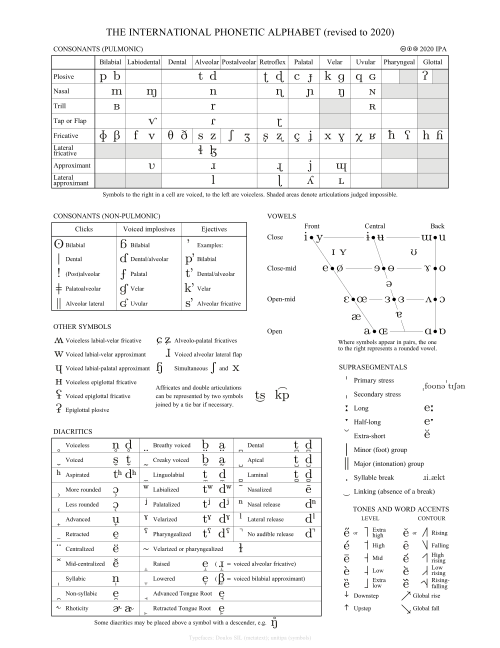
The International Phonetic Alphabet (IPA) is an alphabetic system of phonetic notation based primarily on the Latin script. It was devised by the International Phonetic Association in the late 19th century as a standard written representation for the sounds of speech.[1] The IPA is used by lexicographers, foreign language students and teachers, linguists, speech–language pathologists, singers, actors, constructed language creators, and translators.[2][3]
The IPA is designed to represent those qualities of speech that are part of lexical (and, to a limited extent, prosodic) sounds in oral language: phones, intonation and the separation of syllables.[1] To represent additional qualities of speech—such as tooth gnashing, lisping, and sounds made with a cleft palate—an extended set of symbols may be used.[2]
Segments are transcribed by one or more IPA symbols of two basic types: letters and diacritics. For example, the sound of the English digraph ⟨ch⟩ may be transcribed in IPA with a single letter: [c], or with multiple letters plus diacritics: [t̠̺͡ʃʰ], depending on how precise one wishes to be. Slashes are used to signal phonemic transcription; therefore, /tʃ/ is more abstract than either [t̠̺͡ʃʰ] or [c] and might refer to either, depending on the context and language.[note 1]
Occasionally, letters or diacritics are added, removed, or modified by the International Phonetic Association. As of the most recent change in 2005,[4] there are 107 segmental letters, an indefinitely large number of suprasegmental letters, 44 diacritics (not counting composites), and four extra-lexical prosodic marks in the IPA. These are illustrated in the current IPA chart, posted below in this article and on the International Phonetic Association's website.[5]
History
In 1886, a group of French and English language teachers, led by the French linguist Paul Passy, formed what would be known from 1897 onwards as the International Phonetic Association (in French, l'Association phonétique internationale).[6] Their original alphabet was based on a spelling reform for English known as the Romic alphabet, but to make it usable for other languages the values of the symbols were allowed to vary from language to language.[note 2] For example, the sound [ʃ] (the sh in shoe) was originally represented with the letter ⟨c⟩ in English, but with the digraph ⟨ch⟩ in French.[6] In 1888, the alphabet was revised to be uniform across languages, thus providing the base for all future revisions.[6][8] The idea of making the IPA was first suggested by Otto Jespersen in a letter to Passy. It was developed by Alexander John Ellis, Henry Sweet, Daniel Jones, and Passy.[9]
Since its creation, the IPA has undergone a number of revisions. After revisions and expansions from the 1890s to the 1940s, the IPA remained primarily unchanged until the Kiel Convention in 1989. A minor revision took place in 1993 with the addition of four letters for mid central vowels[2] and the removal of letters for voiceless implosives.[10] The alphabet was last revised in May 2005 with the addition of a letter for a labiodental flap.[11] Apart from the addition and removal of symbols, changes to the IPA have consisted largely of renaming symbols and categories and in modifying typefaces.[2]
Extensions to the International Phonetic Alphabet for speech pathology (extIPA) were created in 1990 and were officially adopted by the International Clinical Phonetics and Linguistics Association in 1994.[12]
Description
The general principle of the IPA is to provide one letter for each distinctive sound (speech segment).[note 3] This means that:
- It does not normally use combinations of letters to represent single sounds, the way English does with ⟨sh⟩, ⟨th⟩ and ⟨ng⟩, nor single letters to represent multiple sounds, the way ⟨x⟩ represents /ks/ or /ɡz/ in English.
- There are no letters that have context-dependent sound values, the way ⟨c⟩ and ⟨g⟩ in several European languages have a "hard" or "soft" pronunciation.
- The IPA does not usually have separate letters for two sounds if no known language makes a distinction between them, a property known as "selectiveness".[2][note 4] However, if a large number of phonemically distinct letters can be derived with a diacritic, that may be used instead.[note 5]
The alphabet is designed for transcribing sounds (phones), not phonemes, though it is used for phonemic transcription as well. A few letters that did not indicate specific sounds have been retired (⟨ˇ⟩, once used for the "compound" tone of Swedish and Norwegian, and ⟨ƞ⟩, once used for the moraic nasal of Japanese), though one remains: ⟨ɧ⟩, used for the sj-sound of Swedish. When the IPA is used for broad phonetic or for phonemic transcription, the letter–sound correspondence can be rather loose. The IPA has recommended that more 'familiar' letters be used when that would not cause ambiguity.[14] For example, ⟨e⟩ and ⟨o⟩ for [ɛ] and [ɔ], ⟨t⟩ for [t̪] or [ʈ], ⟨f⟩ for [ɸ], etc. Indeed, in the illustration of Hindi in the IPA Handbook, the letters ⟨c⟩ and ⟨ɟ⟩ are used for /t͡ʃ/ and /d͡ʒ/.
Among the symbols of the IPA, 107 letters represent consonants and vowels, 31 diacritics are used to modify these, and 17 additional signs indicate suprasegmental qualities such as length, tone, stress, and intonation.[note 6] These are organized into a chart; the chart displayed here is the official chart as posted at the website of the IPA.
Letter forms
The letters chosen for the IPA are meant to harmonize with the Latin alphabet.[note 7] For this reason, most letters are either Latin or Greek, or modifications thereof. Some letters are neither: for example, the letter denoting the glottal stop, ⟨ʔ⟩, originally had the form of a question mark with the dot removed. A few letters, such as that of the voiced pharyngeal fricative, ⟨ʕ⟩, were inspired by other writing systems (in this case, the Arabic letter ⟨ﻉ⟩, ʿayn, via the reversed apostrophe).[10]
Some letter forms derive from existing letters:
- The right-swinging tail, as in ⟨ʈ ɖ ɳ ɽ ʂ ʐ ɻ ɭ ⟩, indicates retroflex articulation. It originates from the hook of an r.
- The top hook, as in ⟨ɠ ɗ ɓ⟩, indicates implosion.
- Several nasal consonants are based on the form ⟨n⟩: ⟨n ɲ ɳ ŋ⟩. ⟨ɲ⟩ and ⟨ŋ⟩ derive from ligatures of gn and ng, and ⟨ɱ⟩ is an ad hoc imitation of ⟨ŋ⟩.
- Letters turned 180 degrees for suggestive shapes, such as ⟨ɐ ɔ ə ɟ ɥ ɯ ɹ ʌ ʍ ʎ⟩ from ⟨a c e f h m r v w y⟩.[note 8] Either the original letter may be reminiscent of the target sound (e.g., ⟨ɐ ə ɹ ʍ⟩) or the turned one (e.g., ⟨ɔ ɟ ɥ ɯ ʌ ʎ⟩). Rotation was popular in the era of mechanical typesetting, as it had the advantage of not requiring the casting of special type for IPA symbols, much as the sorts had traditionally often pulled double duty for ⟨b⟩ and ⟨q⟩, ⟨d⟩ and ⟨p⟩, ⟨n⟩ and ⟨u⟩, ⟨6⟩ and ⟨9⟩ to reduce cost.

An example of a font that uses turned small-capital omega ⟨ꭥ⟩ for the vowel letter ʊ. The symbol had originally been a small-capital ⟨ᴜ⟩.
- Among consonant letters, the small capital letters ⟨ɢ ʜ ʟ ɴ ʀ ʁ⟩, and also ⟨ꞯ⟩ in extIPA, indicate more guttural sounds than their base letters. (⟨ʙ⟩ is a late exception.) Among vowel letters, small capitals indicate "lax" vowels. Most of the original small-cap vowel letters have been modified into more distinctive shapes (e.g. ⟨ʊ ɤ ɛ ʌ⟩ from U Ɐ E A),[citation needed] with only ⟨ɪ ʏ⟩ remaining as small capitals.
Typography and iconicity
The International Phonetic Alphabet is based on the Latin script, and uses as few non-Latin letters as possible.[6] The Association created the IPA so that the sound values of most letters would correspond to "international usage" (approximately Classical Latin).[6] Hence, the consonant letters ⟨b⟩, ⟨d⟩, ⟨f⟩, ⟨ɡ⟩, ⟨h⟩, ⟨k⟩, ⟨l⟩, ⟨m⟩, ⟨n⟩, ⟨p⟩, ⟨s⟩, ⟨t⟩, ⟨v⟩, ⟨w⟩, and ⟨z⟩ have more or less their word-initial values in English (g as in gill, h as in hill, though p t k are unaspirated as in spill, still, skill); and the vowel letters ⟨a⟩, ⟨e⟩, ⟨i⟩, ⟨o⟩, ⟨u⟩ correspond to the (long) sound values of Latin: [i] is like the vowel in machine, [u] is as in rule, etc. Other Latin letters, particularly ⟨j⟩, ⟨r⟩ and ⟨y⟩, differ from English, but have their IPA values in Latin or other European languages.
This basic Latin inventory was extended by adding small-capital and cursive forms, diacritics and rotation. The sound values of these letters are related to those of the original letters, and their derivation may be iconic.[note 9] For example, letters with a rightward-facing hook at the bottom represent retroflex equivalents of the source letters, and small capital letters usually represent uvular equivalents of their source letters.
There are also several letters from the Greek alphabet, though their sound values may differ from Greek. For most Greek letters, subtly different glyph shapes have been devised for the IPA, specifically ⟨ɑ⟩, ⟨ꞵ⟩, ⟨ɣ⟩, ⟨ɛ⟩, ⟨ɸ⟩, ⟨ꭓ⟩ and ⟨ʋ⟩, which are encoded in Unicode separately from their parent Greek letters. One, however – ⟨θ⟩ – has only its Greek form, while for ⟨