Loading article…
ジョージ・オーウェル | |
|---|---|
 プレスカードのポートレート、1943年 | |
| 生まれる | エリック・アーサー・ブレア 1903年6月25日 |
| 死亡 | 1950年1月21日(46歳) ロンドン、イギリス |
| 休憩所 | オールセインツ教会、サットン・コートニー、オックスフォードシャー、イングランド |
| 教育 | イートン・カレッジ |
| 職業 |
|
| 政党 | 独立労働党(1938年以降) |
| 配偶者たち | |
| 子供たち | リチャード・ブレア |
| 作家としてのキャリア | |
| ペンネーム | ジョージ・オーウェル |
| 言語 | 英語 |
| ジャンル | |
| 科目 | |
| 活動年数 | 1928–1949 [1] |
| 主な作品 |
|
| サイン | |
 | |
エリック・アーサー・ブレア(1903年6月25日 - 1950年1月21日)は、イギリスの小説家、詩人、随筆家、ジャーナリスト、評論家であり、ジョージ・オーウェルのペンネームで執筆活動を行っていた。このペンネームは、彼が最も好んだ場所であるオーウェル川にちなんで付けられた。[2]彼の作品は、明快な散文、社会批判、あらゆる全体主義(すなわち、左翼の権威主義的共産主義と右翼のファシズムの両方)への反対、そして民主的社会主義の支持を特徴としている。[3] [4]
オーウェルは寓話的な中編小説『動物農場』(1945年)とディストピア小説『1984年』(1949年)で最もよく知られているが、彼の作品には文芸批評、詩、フィクション、論争的なジャーナリズムも含まれる。産業化が進むイングランド北部での労働者階級の生活を記した『ウィガン埠頭への道』 (1937年)や、スペイン内戦(1936年~1939年)で共和党派として従軍した経験を記した『カタロニア讃歌』 (1938年)などのノンフィクション作品は、政治、文学、言語、文化に関する彼のエッセイと同じくらい批評家から高く評価されている。
オーウェルの作品は大衆文化と政治文化に影響力を持ち続けており、全体主義的かつ権威主義的な社会慣行を表す形容詞「オーウェル的」は、彼の多くの新語である「ビッグ・ブラザー」 「思想警察」「101号室」「ニュースピーク」「記憶の穴」「二重思考」「思想犯罪」などと同様に英語の一部となっている。[5] [6] 2008年、タイムズ紙はオーウェルを1945年以降で2番目に偉大なイギリスの作家に挙げた。[7]
人生
幼少期

エリック・アーサー・ブレアは1903年6月25日、イギリス領インドのベンガル管区(現在のビハール州)モティハリで、彼が言うところの「上流中流階級の下層」の家庭に生まれた。[8] [9]彼の高祖父チャールズ・ブレアは裕福な奴隷所有者の田舎紳士で、ジャマイカの2つのプランテーションの不在所有者だった。[10]ドーセット出身で、第8代ウェストモーランド伯爵の娘メアリー・フェイン夫人と結婚した。[11]彼の祖父トーマス・リチャード・アーサー・ブレアは英国国教会の牧師だった。オーウェルの父リチャード・ウォルムズリー・ブレアは、インド行政庁のアヘン局でアヘン捜査官補佐として働き、中国に販売するアヘンの生産と貯蔵を監督していた。 [12]母のアイダ・メイベル・ブレア(旧姓リムーザン)はビルマのモールメインで育ち、フランス人の父は投機事業に携わっていた。 [11]エリックには2人の姉妹がいた。5歳年上のマージョリーと5歳年下のアヴリルである。エリックが1歳のとき、母親は彼とマージョリーを連れてイギリスへ渡った。[13] [n 1] 2014年、モティハリにあるオーウェルの生家と先祖代々の家の修復工事が始まった。[14]
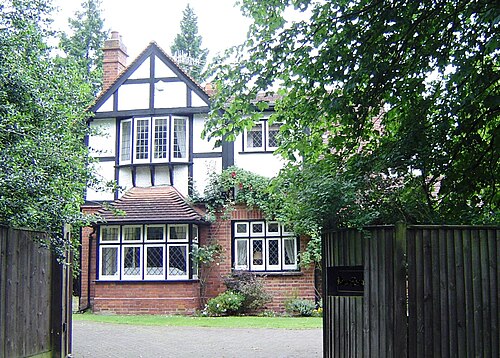
1904年、アイダは子供たちとともにオックスフォードシャーのヘンリー・オン・テムズに定住した。エリックは母親と姉妹たちと一緒に育ち、1907年半ばの短い訪問を除いて[15] 、 1912年まで父親に会うことはなかった。[12] 5歳のとき、エリックはヘンリー・オン・テムズの修道院の学校に通う生徒として送られた。そこはフランス人ウルスラ修道女が運営するカトリックの修道院だった。[16]母親は彼に公立学校での教育を受けさせたかったが、家族にはそれができなかった。アイダの兄弟チャールズ・リムーザンの社交的なつながりを通じて、ブレアはイーストサセックス州イーストボーンのセント・シプリアンズ・スクールの奨学金を得た。[12] 1911年9月に到着した彼は、その後5年間寄宿生活を送り、休暇のときだけ家に帰った。学費が減額されたことは知らなかったが、「すぐに自分が貧しい家庭の出身だと気づいた」。[17]ブレアは学校を嫌っており[18]、何年も後にそこでの経験をもとにしたエッセイ「喜びというものは、このようなものだった」を書き、死後に出版された。セント・キプリアンズでブレアは初めてシリル・コノリーと出会った。コノリーは後に作家となり、ホライゾン誌の編集者としてオーウェルのエッセイを数冊出版した。[19]
第一次世界大戦前に、家族は2マイル(3キロ)南のオックスフォードシャー州シップレイクに引っ越し、そこでエリックはバディコム家、特に娘のジャシンサと親しくなった。彼らが初めて会ったとき、エリックは野原で逆立ちをしていた。理由を尋ねると、彼は「逆立ちした方が、まっすぐ立っているより注目されるから」と答えた。[21]一緒に成長したバディコムとブレアは、理想主義的な思春期の恋人となり、一緒に詩を読んだり書いたりして、有名な作家になることを夢見ていた。[22]ブレアは、ジャシンサの兄妹と一緒に射撃、釣り、バードウォッチングも楽しんだ。[21]
セント・キプリアンズ在学中、ブレアはヘンリー・アンド・サウス・オックスフォードシャー・スタンダード紙に掲載された2編の詩を書いた。[23] [24]彼はハロー歴史賞でコノリーに次いで2位となり、彼の作品は学校の外部審査官から賞賛され、ウェリントンとイートンへの奨学金を獲得した。しかし、イートンの奨学金名簿に載っても入学が保証されるわけではなく、すぐに空きが出たわけではなかった。彼はイートンの空きが出た場合に備えて、1916年12月までセント・キプリアンズに留まることを選んだ。[12]

1月、ブレアはウェリントン校に着任し、春学期をそこで過ごした。1917年5月、イートン校のキングス・スカラーの席が空いた。このとき、家族はノッティング・ヒル・ゲートのモール・チェンバーズに住んでいた。ブレアは1921年12月までイートン校にいたが、18歳と19歳の誕生日の中間で退学した。ブレアはジャシンサに、ウェリントンは「凶暴だった」と語ったが、イートン校では「興味があり、幸せだった」と語った。[25]ブレアの主任家庭教師は、ケンブリッジ大学トリニティ・カレッジのフェローであるASFガウで、後にブレアのキャリアに助言を与えた。[12]ブレアはオルダス・ハクスリーからフランス語を教わった。ブレアとイートン校にいたスティーブン・ランシマンは、ブレアと彼の同世代の人たちがハクスリーの言語的才能を高く評価していたと述べている。[26]
ブレアの成績報告書は彼が学業を怠っていたことを示唆しているが、[26]彼はロジャー・マイナーズと協力し大学雑誌「エレクション・タイムズ」を刊行し、他の出版物「カレッジ・デイズ」や「バブル・アンド・スクイーク」の刊行にも参加し、イートン・ウォール・ゲームにも参加した。彼の両親は別の奨学金なしに彼を大学に送る余裕はなく、また成績の悪さから奨学金を獲得することはできないと結論付けた。ランシマンは彼が東部に対してロマンチックな考えを持っていたと指摘し、 [ 26]家族はブレアがインド警察の前身である帝国警察に入ることを決定した。そのためには彼は入学試験に合格しなければならなかった。1921年12月、彼はイートンを離れ、その月にサフォーク州サウスウォルドのストラドブローク・ロード40番地に引っ越した引退した父、母、妹のアヴリルのもとへ旅立った。アヴリルは町で最初の家であった。[27]ブレアはクレイグハーストという予備校に通い、古典、英語、歴史を勉強した。彼は試験に合格し、合格者26人中7位となった。[12] [28]
ビルマの警察活動

ブレアの母方の祖母はモールメインに住んでいたため、彼は当時まだイギリス領インドの一州であったビルマに赴任することを選んだ。1922年10月、彼はビルマのインド帝国警察に入隊するためSSヘレフォードシャー号に乗り込んだ。1ヵ月後、彼はラングーンに到着し、マンダレーの警察訓練学校に向かった。彼は1922年11月29日に地区警視補(試用期間)に任命され、[29]月給525ルピーであった。 [30]ビルマの主要な高地リゾート地であるメイミョーに短期間駐在した後、彼は1924年初めにイラワジ・デルタのミャウンミャーの辺境前哨地に配属された。[31]
帝国警察官として働くことは、同世代のほとんどがまだイギリスの大学に通っていた時期に、彼にかなりの責任を与えた。デルタ地帯のさらに東にあるトワンテに分署長として配属されたとき、彼は約20万人の人々の安全を担っていた。1924年末、彼はラングーンに近いシリアムに配属された。シリアムにはビルマ石油会社の製油所があり、「周囲の土地は不毛の地で、製油所の煙突から昼夜を問わず噴出する二酸化硫黄の煙ですべての植物が枯れていた」。しかし、町は国際的な港町ラングーンの近くにあり、ブレアは「本屋をぶらぶらしたり、よく調理された料理を食べたり、警察生活の退屈な日常から逃れたりするために」できるだけ頻繁に街に出かけた。[32] 1925年9月、彼はインセイン刑務所があるインセインに向かった。[33]この時までにブレアは研修を終えており、手当を含めて月額740ルピーの給料を受け取っていた。[34]
ブレアはビルマ人からの敵意に直面したことを回想し、「結局、どこでも私に会う若者たちの冷笑的な黄色い顔、安全な距離にいるときに私に向かって罵声を浴びせられる侮辱がひどく私の神経を逆なでした」と語った。彼は「私が仕えた帝国への憎しみと、私の仕事を不可能にしようとした邪悪な小悪魔たちへの怒りの間で私は板挟みになった」と回想している。[35] [36]
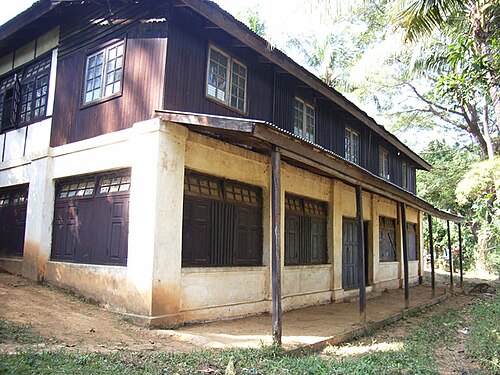
ビルマでは、ブレアはよそ者という評判を得た。彼は一人で多くの時間を過ごし、読書をしたり、カレン族の教会に通うなど、非伝統的な活動に従事した。同僚のロジャー・ビードンは、ブレアは言語を素早く習得し、ビルマを離れる前は「『非常に流暢なビルマ語』でビルマの僧侶と流暢に話すことができた」と回想している。[37]ブレアはビルマで外見を変え、それは生涯にわたって維持された。鉛筆のような口ひげを生やすようになったのもその一つである。エマ・ラーキンは『ビルマの日々』の序文で次のように書いている。
ビルマ滞在中、彼はそこに駐留していた英国連隊の将校がしていたのと同じような口ひげを生やした。また、いくつかの入れ墨も入れた。それぞれの指の関節に小さなだらしない青い円を入れた。田舎に住むビルマ人の多くは、今でもこのような入れ墨を入れている。銃弾や蛇に噛まれないように守ってくれると信じられている。[38]
1926年4月、彼は母方の祖母が住むモールメインに移住した。その年の終わりに、彼はビルマ北部のカターに配属され、1927年にデング熱に罹った。その年、彼はイギリスで休暇を取る権利があったが、病気のため7月に帰国を許された。1927年9月に家族とコーンウォールで休暇を過ごしている間、彼は自分の人生を見つめ直した。ビルマに戻ることをやめて、1928年3月12日付けでインド帝国警察を辞職し、作家になった。[39]彼はビルマ警察での経験をもとに、小説『ビルマの日々 』 (1934年)や随筆『絞首刑』(1931年)、『象を撃つ』(1936年)を書いた。[40]
ロンドンとパリ

イングランドでは、サウスウォルドの実家に戻り、地元の友人と再会し、オールド・イートン校のディナーに出席した。作家になるためのアドバイスを求めて、ケンブリッジの昔の家庭教師であるガウを訪ねた。[41] 1927年にロンドンに移住した。[42]家族の知り合いである ルース・ピッターが下宿先を探すのを手伝い、1927年末までにポートベロー・ロードの部屋に引っ越した。[43]彼がそこに住んでいたことを記念する青い銘板がある。 [44]ピッターがこの引っ越しに関わっていたことで、「ブレア夫人の目に安心感を与えただろう」。ピッターはブレアの文章に好意的な関心を抱き、彼の詩の弱点を指摘し、彼が知っていることについて書くように助言した。実際、彼は「自分が知ろうとした現在の特定の側面」について書くことを決意し、ロンドンのイーストエンドに足を踏み入れた。これは、貧困の世界とそこに住む落ちぶれた人々を発見するために5年間にわたって断続的に行うことになる時折の遠征の最初のものであった。[45]
ブレアは、ジャック・ロンドンの著作(特に『深淵の民』)を賞賛し、ロンドンの貧しい地域を探検し始めた。最初の遠出でライムハウス・コーズウェイに向かい、おそらくジョージ・レヴィの「宿舎」と思われる共同下宿屋で最初の夜を過ごした。しばらくの間、彼は自分の国で「土着」し、浮浪者のような格好をしてP.S.バートンという名前を名乗った。彼は、下層生活での経験を「ザ・スパイク」という英語で出版された最初のエッセイと、最初の著書『パリとロンドンのどん底生活』(1933年)の後半に記録した。 [46]
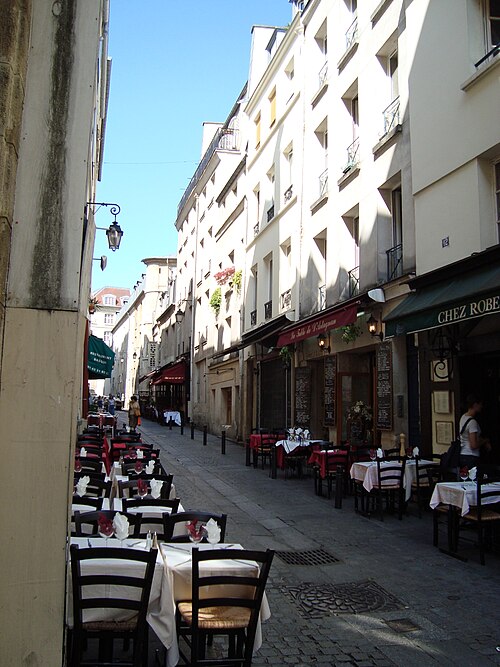
1928年初頭、彼はパリに移住した。彼は5区の労働者階級の地区、ポ・ド・フェール通りに住んだ。[12]叔母のエレン(ネリー)・ケイト・リムザンもパリに住み(エスペランティストの ウジェーヌ・ランティと同居)、彼に社交的な援助をし、必要に応じて経済的な援助もした。彼は小説を書き始め、その中には『ビルマの日々』の初期版も含まれているが、この時期の著作は他に何も残っていない。[12]彼はジャーナリストとしてより成功し、アンリ・バルビュスが編集する政治・文学雑誌『モンド』に記事を発表(職業作家としての最初の記事「アングルテールの非難」は1928年10月6日、同誌に掲載された)し、GK's Weeklyには1928年12月29日、イギリスでの最初の記事「ファージング新聞」が掲載された。[47]とル・プログレ・シヴィーク(左派連合のル・カルテル・デ・ゴーシュが設立)の2つの雑誌に掲載された。ル・プログレ・シヴィークには、失業、浮浪者の一日、ロンドンの物乞いについてそれぞれ論じた3つの作品が、週に一度掲載された。「貧困は、その破壊的な形態のいずれにおいても、彼の執着の対象となり、カタロニア讃歌まで彼が書いたほぼすべての作品の中心となった。」[48]
彼は1929年2月に重病に陥り、医学生が研修を受ける無料病院であるコーチン病院に運ばれた。そこでの経験は、1946年に出版されたエッセイ「貧乏人はいかにして死ぬか」のベースとなった(ただし、病院名は明かさなかった)。その後まもなく、下宿から全財産を盗まれた。必要に迫られてか、あるいは資料集めのためか、彼はリヴォリ通りの流行りのホテルで皿洗いなどの雑用を引き受け、後に「パリとロンドンの浮浪者」でそのことを描写した。1929年8月、彼は「スパイク」のコピーをロンドンのジョン・ミドルトン・マリーのニュー・アデルフィ誌に送った。同誌はマックス・プラウマンとリチャード・リース卿が編集し、プラウマンは作品の出版を引き受けた。[49]
サウスウォルド
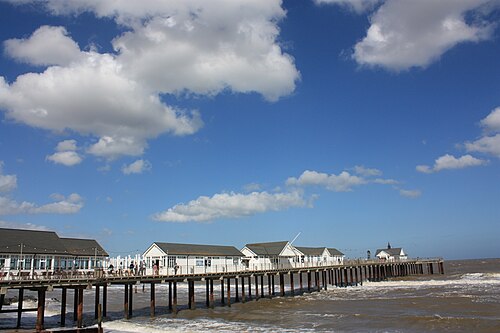
1929年12月、パリで2年近く過ごした後、ブレアはイギリスに戻り、サフォークの海岸沿いの町サウスウォルドにある両親の家へ直行した。ここはその後5年間、ブレアの拠点となった。家族は町で定住し、姉のアヴリルは喫茶店を経営していた。ブレアは地元の多くの人々と知り合いになり、その中には聖フェリックス女学校の体育教師として働いていた牧師の娘ブレンダ・サルケルドもいた。サルケルドはブレアの結婚の申し出を断ったが、その後も友人であり、長年文通を続けていた。また、デニス・コリングスのような年上の友人とも親交を深めた。コリングスの恋人エレノア・ジャックスもブレアの人生に重要な役割を果たすことになる。[12]
1930年初頭、ブレアは妹のマージョリーとその夫ハンフリー・デイキンとともにリーズのブラムリーに短期間滞在した。ブレアはアデルフィに書評を執筆し、サウスウォルドの障害児の家庭教師を務めていた。その後、3人の若い兄弟の家庭教師となり、そのうちの1人リチャード・ピーターズは後に著名な学者となった。[50]
この時期の彼の経歴は二重性と対照性に富んでいる。サウスウォルドの両親の家で執筆活動をしながら、表面的には平凡で立派な生活を送っているブレアと、対照的に、バートン(落ちぶれたエピソードで彼が使った名前)として、キップスやスパイク、イーストエンド、路上、ケントのホップ畑で経験を求めているブレアがいる。[51]
彼は海岸で絵を描いたり海水浴をしたりしていたが、そこで後に彼のキャリアに影響を与えることになるメイベルとフランシス・フィアーズ夫妻と出会った。翌年、彼はロンドンで彼らを訪ね、彼らの友人マックス・プラウマンとよく会った。また、彼はルース・ピターとリチャード・リースの家に泊まることが多く、そこで散発的なトレッキング旅行の「足しに」なった。彼の仕事の1つは、 1日半クラウン(2シリング6ペンス、つまり1ポンドの8分の1)で下宿屋で家事手伝いをすることだった。[52]
ブレアはその後も定期的にアデルフィ誌に寄稿し、1931年8月には「絞首刑」を発表した。1931年8月から9月にかけて、彼は貧困の探求を続け、牧師の娘の主人公のように、イーストエンドの伝統に従い、ケントのホップ畑で働いた。そこでの体験を日記に書いた。その後、トゥーリー・ストリートのキップに下宿したが、長くは続かず、両親の経済的援助でウィンザー・ストリートに移り、クリスマスまでそこに住んでいた。エリック・ブレアの「ホップ摘み」は、1931年10月号のニュー・ステイツマンに掲載された。同誌の編集スタッフには、彼の旧友シリル・コノリーもいた。メイベル・フィアーズは、彼をレナード・ムーアと引き合わせ、ムーアは1932年4月に彼の著作権代理人となった。[53]
当時、ジョナサン・ケープは『どん底の日々』の初版である『スカリオンの日記』を拒否していた。リチャード・リースの助言で、ケープはそれをフェイバー&フェイバー社に持ち込んだが、編集長のT・S・エリオットもそれを拒否した。ブレアは、刑務所でクリスマスを過ごすために、わざと逮捕されてその年を終えたが、 [54]イーストエンドのロンドンにあるベスナルグリーン警察署に連行された後、当局は彼の「酔って騒がしい」行動を投獄に値するものとはみなさず、2日間の監房生活の後、サウスウォルドの自宅に戻った。[54]
教師としてのキャリア
1932年4月、ブレアはロンドン西部ヘイズの男子校、ホーソンズ高等学校の教師になった。この学校は小さな私立学校で、10歳から16歳の男子が14、6人しかおらず、他に教師が1人いた。[55]学校にいる間、ブレアは地元の教区教会の牧師と親しくなり、そこでの活動に関わるようになった。メイベル・ファイアーズがムーアと交渉し、1932年6月末、ムーアはブレアに、ビクター・ゴランツが40ポンドの前金で『スカリオンの日記』を出版する用意があると伝えた。出版元は、急進派や社会主義的な作品の出版元であるビクター・ゴランツ社だった。[56]
1932年の夏学期の終わりに、ブレアはサウスウォルドに戻った。両親が遺産を使って家を購入した場所だった。ブレアと妹のアヴリルは休暇を利用して家を居住可能な状態にし、その間に彼はビルマの日々の仕事をしていた。[57]彼はエレノア・ジャックとも時間を過ごしていたが、彼女のデニス・コリングスへの執着は、より真剣な関係を望む彼の望みの障害となっていた。
刑務所行きを阻止しようとして失敗したことを綴ったエッセイ「クリンク」は、1932年8月のアデルフィ誌に掲載された。彼はヘイズ大学で教鞭をとり、現在「パリとロンドンの放浪者」として知られる本の出版準備に取りかかった。彼は「放浪者」として過ごした期間について家族に恥をかかせないために、別の名前で出版したいと望んだ。[59]ムーア宛の手紙(1932年11月15日付)で、彼はペンネームの選択をムーアとゴランツに任せた。4日後、彼はムーア宛に手紙を書き、P.S.バートン(放浪中に使っていた名前)、ケネス・マイルズ、ジョージ・オーウェル、H.ルイス・オールウェイズというペンネームを提案した。[60]彼は最終的に「英語で丸みのある良い名前だから」という理由でジョージ・オーウェルというペンネームを採用した。 [61]ジョージという名前はイングランドの守護聖人に由来し、オーウェルはオーウェルのお気に入りの場所の一つであったサフォークのオーウェル川にちなんで名付けられました。 [62]
『浮浪者とパリとロンドン』は1933年1月9日にロンドンのヴィクター・ゴランツ社から出版され、好評を博した。セシル・デイ・ルイスはオーウェルの「明快さと良識」を称賛し、『タイムズ・リテラリー・サプリメント』はオーウェルの風変わりな登場人物をディケンズの登場人物に例えた。[62] 『 浮浪者とパリとロンドン』はそこそこの成功を収め、次にニューヨークのハーパー・アンド・ブラザーズ社から出版された。 [62]
1933年半ば、ブレアはホーソンズを離れ、ロンドン西部のアクスブリッジにあるフレイズ・カレッジの教師になった。この学校は生徒200名と教職員を揃える、はるかに大きな学校だった。彼はバイクを購入し、周辺の田園地帯を旅行した。ある遠征中にずぶ濡れになり、風邪をひいて肺炎になった。アクスブリッジの小さな病院に運ばれたが、一時は命が危ないと思われた。1934年1月に退院すると、療養のためサウスウォルドに戻り、両親の支えもあり、二度と教職に就くことはなかった。[63]
ゴランツが『ビルマの日々』を、主に名誉毀損訴訟の可能性を理由に断ったとき、ブレアは失望したが、ハーパー社は米国で出版する用意があった。一方、ブレアは教師としての人生とサウスウォルドでの生活を基にした小説『牧師の娘』に取り掛かった。10月、ついに『牧師の娘』をムーアに送った後、彼は叔母のネリー・リムーザンが見つけてくれた仕事に就くためにロンドンへ出発した。[62]
ハムステッド
この仕事は、ハムステッドにある古本屋「ブックラバーズ・コーナー」のパートタイムの店員としての仕事だった。店を経営していたのはフランシスとミファンウィ・ウェストロープ夫妻で、夫妻はエスペラント運動でネリー・リムーザンの友人だった。ウェストロープ夫妻は親切で、ブレアにポンド・ストリートのワーウィック・マンションの快適な住居を提供してくれた。ブレアは、やはりウェストロープ夫妻と同居していたジョン・キムチェと仕事を分担していた。ブレアは午後に店で働き、午前中は執筆に、夕方は社交に充てることができた。これらの経験が小説「アスピディストラを飛ばせ」 (1936年)の背景となっている。ウェストロープ夫妻のさまざまな客だけでなく、ブレアはリチャード・リースやアデルフィの作家たち、メイベル・フィアースとの付き合いを楽しむことができた。ウェストロープ夫妻とキムチェは独立労働党の党員だったが、この頃のブレアは政治活動に真剣に取り組んではいなかった。彼はアデルフィに寄稿し、『牧師の娘』と『ビルマの日々』の出版を準備していた。[64]

1935年の初め、ブレアはウォーリック・マンションから引っ越さなければならなくなり、メイベル・フィアーズがパーラメント・ヒルにアパートを見つけてくれた。『牧師の娘』は1935年3月11日に出版された。1935年初め、ブレアは将来の妻となるアイリーン・オショーネシーと出会った。ロンドン大学ユニバーシティ・カレッジで心理学の修士号を目指していた大家のロザリンド・オーバーマイヤーが、同級生を何人かパーティに招待した時だった。その中の一人、エリザベータ・フェンは、ブレアと友人のリチャード・リースが暖炉のそばで「身を寄せ合って」いたのを、「虫食いになって、若くして老けた」ように見えたと回想している。[65]この頃、ブレアはニュー・イングリッシュ・ウィークリーに書評を書き始めていた。[66]
6月に『ビルマの日々』が出版され、ニュー・ステイツマン紙のシリル・コノリーの好意的な書評がきっかけで、ブレアは旧友と再び連絡を取るようになった。8月、彼はケンティッシュ・タウンのローフォード・ロード50番地にあるアパートに引っ越し、マイケル・セイヤーズ、レイナー・ヘッペンストールと同居した。2人の関係は時々ぎこちなくなり、ブレアとヘッペンストールは殴り合いになることもあったが、2人は友人のままで、後にBBCの放送で一緒に働くことになった。[67]ブレアは『アスピディストラを飛ばせ』の執筆に取り掛かり、ニューズ・クロニクル紙に連載を書こうとしたがうまくいかなかった。1935年10月までにルームメイトは引っ越してしまい、ブレアは家賃の支払いに苦労した。彼は1936年1月末までそこに留まり、その後ブックラバーズ・コーナーでの仕事をやめた。1980年、イングリッシュ・ヘリテージはオーウェルを称えて、ケンティッシュ・タウンの彼の住居に青い銘板を設置した。[68]
ウィガン・ピアへの道
この頃、ヴィクター・ゴランツはオーウェルに、経済的に不況に陥ったイングランド北部の社会状況を少し調べるよう提案した。[n 2]大恐慌により、イングランド北部の労働者階級の作家が数多く読者層に紹介された。オーウェルが助言を求めたのも、こうした労働者階級の作家の一人、ジャック・ヒルトンだった。オーウェルはヒルトンに手紙を書き、宿泊先と旅程のアドバイスを求めた。ヒルトンは宿泊先を提供できなかったが、ロッチデールではなくウィガンに行くよう提案した。「そこには炭鉱労働者がいて、彼らはいい人たちだから」[70]。
1936年1月31日、オーウェルは公共交通機関と徒歩で出発した。マンチェスターに到着したのは銀行が閉まった後だったので、彼は共同下宿屋に泊まらなければならなかった。翌日、彼はリチャード・リースから送られてきた連絡先リストを受け取った。その中の一人、労働組合役員のフランク・ミードがウィガンを提案し、オーウェルは2月をそこで、胃袋の詰まった店の上の汚い下宿屋で過ごした。ウィガンでは、人々がどのように暮らしているかを見るために多くの家を訪問し、ブリン・ホール炭鉱に降り立ち、地元の公立図書館を利用して公衆衛生記録や炭鉱の労働条件に関する報告書を調べた。[71]
この間、彼は『アスピディストラを飛ばせ』のスタイルと名誉毀損の可能性についての懸念に気をとられていた。リバプールに短期間滞在し、3月は南ヨークシャーに滞在し、シェフィールドとバーンズリーに滞在した。グリムソープなどの鉱山を訪れ、社会情勢を観察したほか、共産党とオズワルド・モズレーの会合に出席し(「彼の演説はいつもの戯言で、すべての責任は謎の国際ユダヤ人ギャングに押し付けられた」)、黒シャツ隊の戦術を目の当たりにした。[72]また、ヘディングリーにいる妹を訪ね、その際にハワースのブロンテ牧師館を訪れた。[73]


オーウェルは執筆に集中できる場所を必要としており、今回も叔母のネリーが協力した。ネリーはハートフォードシャーのウォリントンにある「ストアーズ」と呼ばれる非常に小さな16世紀のコテージに住んでいた。オーウェルはその借家を引き継ぎ、1936年4月2日に入居した。[74] 4月末までに『ウィガン桟橋への道』の執筆を開始したが、同時に庭の手入れにも何時間も費やし、今も残っているバラ園を作った。そして4年後に「仕事以外で一番気にかけているのはガーデニング、特に野菜の栽培だ」と明かした。[75]また、ストアーズを村の店として再開する可能性も検討した。『アスピディストラを飛ばせ』はゴランツ社から1936年4月20日に出版された。8月4日、オーウェルはランガムで開催されたアデルフィ・サマースクールで「部外者が見る苦境の地」と題した講演を行った。学校で講演した他の人物には、ジョン・ストレイチー、マックス・プラウマン、カール・ポラニー、ラインホールド・ニーバーなどがいた。[76]
オーウェルの北部への旅の成果は、 1937年にゴランツによってレフト・ブック・クラブのために出版された『ウィガン桟橋への道』である。 [77]本の前半は、ランカシャーとヨークシャーの社会調査を記録したもので、炭鉱での労働生活の印象的な描写が含まれている。後半は、彼の生い立ちと政治的良心の発達に関する長いエッセイで、社会主義の主張も含まれている。ゴランツは後半が読者の反感を買うことを恐れ、オーウェルがスペインにいる間にこの本に説教じみた序文を加えた。[78]オーウェルの『ウィガン桟橋への道』の調査の結果、彼は1936年から特別捜査局の監視下に置かれることになった。[79]
オーウェルは1936年6月9日にオショーネシーと結婚した。その後まもなくスペインで政治危機が始まり、オーウェルはそこでの展開を注意深く見守った。その年の終わり、フランシスコ・フランコの軍事蜂起を懸念したオーウェルは、スペイン内戦に共和派側として参加するためスペインに行くことを決意した。国境を越えるには左翼組織の書類が必要だという誤った印象から、ジョン・ストレイチーの勧めでイギリス共産党のリーダー、ハリー・ポリットに申し込んだが、不合格となった。ポリットはオーウェルの政治的信頼性に疑いを持ち、国際旅団に参加するつもりがあるかどうか尋ね、パリのスペイン大使館から通行許可証を取得するよう助言した。[80]現地の状況を見るまでは決断したくないオーウェルは、代わりに独立労働党のコネを使ってバルセロナのジョン・マクネアに紹介状をもらった。[81]
スペイン内戦

オーウェルは1936年12月23日頃スペインに向けて出発し、途中パリでヘンリー・ミラーと会食した。ミラーはオーウェルに、義務感や罪悪感から内戦に赴くのは「まったくの愚かさ」であり、イギリス人の「ファシズムとの戦い、民主主義の擁護などなど」という考えは「すべてナンセンス」だと語った。 [82]数日後、バルセロナでオーウェルは独立労働党(ILP)事務所のジョン・マクネアと会った。[83] [84]共和党政府は、マルクス主義統一労働者党(POUM)、アナルコ・サンディカリストの全国労働者連盟(CNT)、カタルーニャ統一社会党(スペイン共産党の一派)など、相反する目的を持ついくつかの派閥の支援を受けていた。オーウェルは当初、この政党や労働組合の「万華鏡」に憤慨していた。[84] ILPはPOUMと連携していたため、オーウェルはPOUMに加わった。[85]
バルセロナのレーニン兵舎にしばらくいた後、彼はジョルジュ・コップ指揮下の比較的平穏なアラゴン戦線に送られた。1937年1月、彼は真冬の海抜1,500フィート (460 メートル) のアルクビエレにいた。軍事行動はほとんどなく、オーウェルは弾薬、食料、薪の不足、その他の極度の欠乏に衝撃を受けた。 [86]士官候補生部隊と警察訓練を受けたオーウェルは、すぐに伍長に任命された。約3週間後、イギリス軍ILP派遣団が到着すると、オーウェルともう1人のイギリス民兵ウィリアムズは彼らとともにモンテ・オスクロ、そしてウエスカへと送られた。
一方、イギリスでは、アイリーンはスペインへ出発する前に『ウィガン埠頭への道』の出版に関する諸問題を処理しており、ネリー・リムーザンにストアーズの世話を任せていた。アイリーンはジョン・マクネアのオフィスに志願し、ジョルジュ・コップの助けを借りて夫を訪ね、イギリスの紅茶、チョコレート、葉巻を届けた。[87]オーウェルは手に毒を盛られて数日間入院しなければならず[88]、スタッフに所持品のほとんどを盗まれた。彼は前線に戻り、ナショナリストの塹壕への夜襲に参加し、銃剣で敵兵を追い、敵のライフル陣地を爆撃した。
4月、オーウェルはバルセロナに戻った。[88]マドリード戦線に派遣されることを希望し、それは「国際部隊に入隊しなければならない」ことを意味した。彼はスペイン医療援助隊に所属する共産主義者の友人に近づき、自分の事情を説明した。「共産主義者をあまり評価していなかったが、オーウェルは彼らを友人や同盟者として扱う用意があった。それはすぐに変わることになる。」[89]バルセロナの5月事件の間、オーウェルは派閥争いに巻き込まれた。彼は小説を積んだ屋根の上で多くの時間を過ごしたが、滞在中にハムステッド時代のジョン・キムチェと出会った。その後、共産主義の報道機関が展開した嘘と歪曲のキャンペーン[90]では、POUMがファシストと協力していると非難され、オーウェルに劇的な影響を与えた。彼は当初考えていた国際旅団に入隊する代わりに、アラゴン戦線に戻ることを決意した。5月の戦いが終わると、共産主義者の友人が彼に近づき、国際旅団に転属するつもりがまだあるかと尋ねた。オーウェルは、共産党の報道によれば彼はファシストであるにもかかわらず、彼らがまだ彼を欲しがっていることに驚きを表明した。[91]

前線に戻った後、彼は狙撃兵の銃弾で喉を負傷した。身長6フィート2インチ(1.88メートル)のオーウェルはスペイン兵よりもかなり背が高く[92]、塹壕の胸壁に立つことを警告されていた。話すこともできず、口から血を流していたオーウェルは担架でシエタモに運ばれ、救急車に乗せられてリェイダの病院に送られた。彼は起き上がることができるまで回復し、1937年5月27日にタラゴナに送られ、2日後にバルセロナ郊外のPOUMサナトリウムに送られた。銃弾は彼の主動脈をわずかに外れ、声はほとんど聞こえなかった。非常に正確な射撃だったため、傷はすぐに焼灼術を受けた。彼は電気療法を受け、医学的に兵役に就くことができないと診断された[93]。
6月中旬までにバルセロナの政情は悪化し、親ソ共産主義者によってトロツキスト組織とみなされたPOUMは非合法化され、攻撃を受けた。[94]コップを含むメンバーは逮捕され、他のメンバーは潜伏した。オーウェルと妻は脅迫を受け、身を潜めなければならなかったが[n 3] 、コップを助けようと身を隠した。彼らは最終的に列車でスペインから脱出した。1937年7月第1週にオーウェルはウォリントンに戻った。1937年7月13日、バレンシアのスパイおよび反逆罪裁判所に証言録取書が提出され、オーウェル夫妻は「過激なトロツキズム」とPOUMのエージェントであると告発された。[95] POUMの指導者とオーウェル(本人は不在)の裁判は1938年10月と11月にバルセロナで行われた。フランス領モロッコでの出来事を観察したオーウェルは、それらは「ロシアのトロツキスト裁判の副産物に過ぎず、最初からあらゆる種類の嘘、甚だしい不条理も含め、共産主義の新聞で流布されていた」と書いた。[96]スペイン内戦でのオーウェルの体験は、 『カタロニア讃歌』 (1938年)のきっかけとなった。
ジャイルズ・トレムレットは著書『国際旅団:ファシズム、自由、そしてスペイン内戦』の中で、 ソ連のファイルによると、オーウェルと妻のアイリーンは1937年5月にバルセロナでスパイ活動を行っていたと書いている。[97]
休息と回復

オーウェルは1937年6月にイギリスに戻り、グリニッジのオショーネシー家に滞在。スペイン内戦に関する自身の見解が不評だった。キングズリー・マーティンは彼の作品2冊を拒否し、ゴランツも同様に慎重だった。同時に、共産党のデイリー・ワーカー紙は『ウィガン・ピアへの道』を攻撃し、文脈を無視して「労働者階級は臭い」と書いたオーウェルの文章を取り上げていたが、ゴランツ宛てのオーウェルからの名誉毀損訴訟の脅迫の手紙により、この攻撃は中止された。オーウェルはまた、セッカー・アンド・ウォーバーグ社のフレドリック・ウォーバーグという、自分の見解にもっと共感的な出版社を見つけることができた。オーウェルはウォリントンに戻ったが、不在後に混乱状態にあった。彼はヤギ、ヘンリー・フォードと名付けた雄鶏、マルクスと名付けたプードルの子犬を飼い、[99] [100] [101]、畜産と『カタロニア讃歌』の執筆に落ち着いた。
インドに行き、ラクナウの新聞『ザ・パイオニア』で働こうという考えもあったが、1938年3月までにオーウェルの健康状態は悪化した。彼は、義理の兄弟ローレンス・オショーネシーが勤務していた、ケント州アイルズフォードのプレストン・ホール・サナトリウムに入院した。彼は当初結核を患っていると思われ、9月までサナトリウムに入院していた。『カタロニア讃歌』はロンドンのセッカー・アンド・ウォーバーグ社から出版されたが、商業的には失敗に終わった。オーウェルの後期の作品の成功を受けて、1950年代に再登場した。[102]
小説家LHマイヤーズは、オーウェルがイギリスの冬を避けて健康を回復できるよう、半年間フランス領モロッコへの旅行を密かに資金援助した。オーウェル一家は1938年9月にスペイン領モロッコを避けるためジブラルタルとタンジールを経由して出発し、マラケシュに到着した。彼らはカサブランカへの道中に別荘を借り、その間にオーウェルは『空気を求めて』を執筆した。彼らは1939年3月30日にイギリスに戻り、『空気を求めて』は6月に出版された。オーウェルはウォリントンとサウスウォルドでディケンズのエッセイを執筆していた。1939年6月、オーウェルの父親が亡くなった。[103]
第二次世界大戦と動物農場
.jpg/500px-George_Orwell_and_Sir_Stephen_Spender_(Marchmont_Association).jpg)
第二次世界大戦が勃発すると、オーウェルの妻アイリーンはロンドン中心部の情報省検閲局で働き始め、平日はグリニッジの家族と過ごした。オーウェルは戦争関連の仕事をするために中央登録簿に名前を出したが、何も起こらなかった。彼はウォリントンに戻り、1939年後半に初の随筆集『Inside the Whale』の原稿を書いた。翌年は『The Listener』、『Time and Tide 』 、『New Adelphi』で演劇、映画、書籍の評論を執筆した。1940年3月29日、モスクワからのナポレオンの撤退に関する軍曹の報告を評論したことで、トリビューンとの長い関係が始まった[104] 。1940年の初めに、コノリーの『 Horizon』の初版が出版され、これがオーウェルの作品の新たな発表の場と新たな文学的つながりをもたらした。 5月にオーウェル夫妻はロンドンのメリルボーン、チャグフォード・ストリートのドーセット・チェンバーズにアパートを借りた。当時はダンケルク撤退の時期で、フランダースでアイリーンの兄ローレンス・オショーネシーが亡くなったことで、彼女は深い悲しみと長期にわたる鬱状態に陥った。[105]
オーウェルは6月に医療委員会から「いかなる種類の軍務にも不適格」と宣告されたが、すぐにホームガードに入隊した。[106]彼はトム・ウィントリンガムのホームガードを革命的な人民民兵とする社会主義的ビジョンに共感した。小隊員を指導するための彼の講義ノートには、市街戦、野戦要塞化、迫撃砲の使用に関する助言が含まれている。オーウェル軍曹はフレドリック・ウォーバーグを部隊に採用した。イギリス空襲の間、彼はウォーバーグと彼の新しいシオニストの友人トスコ・ファイベルとともに、バークシャー州トワイフォードのウォーバーグの家で週末を過ごした。ウォリントンでは「イングランド、あなたのイングランド」の制作に携わり、ロンドンでは定期刊行物にレビューを書いた。グリニッジのアイリーンの家族を訪ねた際に、彼はロンドン大空襲の影響を直に経験した。1940年に彼はBBCのインド部門のプロデューサーとして初めて働き、その間アナウンサーで作家のヴェヌ・チタレが彼の秘書を務めた。[107] 1940年半ば、ウォーバーグ、ファイベル、オーウェルはサーチライト・ブックスを企画した。最終的に11巻が出版され、そのうち1941年2月に出版されたオーウェルの『ライオンとユニコーン:社会主義とイギリスの天才』が最初の巻となった。[108]
1941年初頭、彼はアメリカン・パルチザン・レビュー誌に記事を書き始め、同誌はオーウェルと同じく反スターリン主義のニューヨーク知識人を結びつけた。 [109]また、モロトフ・リッベントロップ協定を背景に書かれたゴランツのアンソロジー『裏切りの左翼』にも寄稿した。彼は航空省に職を求めたものの、不合格となった。その間も、彼は書籍や劇の評論を書き続け、小説家のアンソニー・パウエルと知り合った。彼はBBC東部放送のラジオ放送に参加した。3月にオーウェル一家はセント・ジョンズ・ウッドのラングフォード・コートの7階のアパートに引っ越し、一方オーウェルはウォリントンでジャガイモを植えて「勝利のために掘っていた」。
「我々全員が多かれ少なかれスターリンを支持しているという事実以上に、我々の時代の道徳的、感情的な浅薄さを示す良い例はないでしょう。この忌まわしい殺人者は一時的に我々の側にいるため、粛清などは突然忘れ去られてしまうのです。」
— ジョージ・オーウェル、戦時中の日記、1941年7月3日[110]
1941年8月、オーウェルはBBC東部放送局にフルタイムで採用され、ついに「戦争の仕事」を得た。[111]彼は帝国とのつながりを弱めるためにナチスドイツが仕掛けたプロパガンダに対抗するため、インドへの文化放送を監督した。[112]
8月末、オーウェルはHGウェルズと会食したが、ウェルズがホライゾン紙の記事でオーウェルについて述べたことに腹を立てたため口論に発展した。10月、オーウェルは気管支炎にかかり、頻繁に再発した。デイヴィッド・アスターはオブザーバー紙に刺激的な寄稿者を探しており、オーウェルに記事を書いてくれるよう依頼した。最初の記事は1942年3月に掲載された。1942年初め、アイリーンは食糧省に転職し、1942年半ば、オーウェル一家はメイダ・ヴェール/キルバーンのモーティマー・クレセント10aにあるもっと広いアパートに引っ越した。[113]
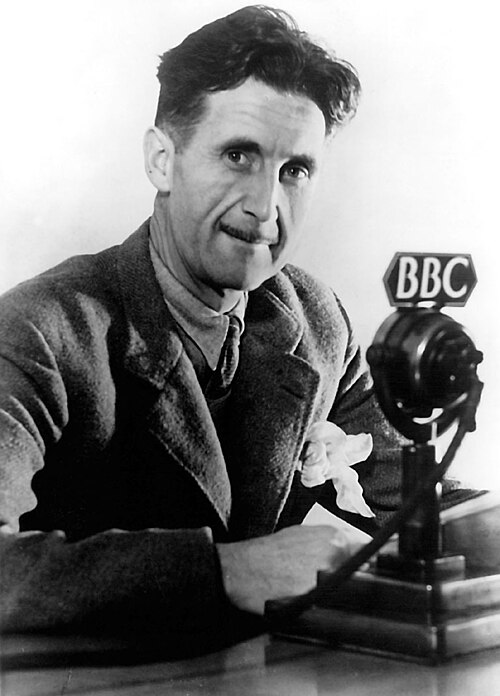
BBCで、オーウェルはインド向け放送の文学番組『ボイス』を立ち上げ、この頃には特に政治的に左派の文学仲間と活発な社交生活を送っていた。1942年後半、彼は労働党議員のアナイリン・ベヴァンとジョージ・ストラウスが編集する左派週刊紙『トリビューン』 [117] : 306 [118] : 441 に定期的に寄稿し始めた。1943年3月、オーウェルの母親が亡くなり、その頃、彼はムーアに本の執筆を始めたことを告げたが、それが後に『動物農場』となった。
1943年9月、オーウェルはBBCを辞職した。[119] : 352 彼の辞職は、インド人のほとんどが放送を聴いていないという彼の懸念を裏付ける報告を受けてのものだったが、[120]彼はまた、 『動物農場』の執筆に集中することに熱心だった。1943年11月24日、彼の最後の勤務日の6日前に、童話ハンス・クリスチャン・アンデルセンの『裸の王様』を翻案した作品が放送された。それは彼が非常に興味を持っていたジャンルであり、『動物農場』の表紙にも登場した。[121]彼は健康上の理由でホームガードを辞職した。[122]
1943年11月、オーウェルはトリビューン紙の文芸編集者に任命され、友人のジョン・キムチェがアシスタントを務めた。オーウェルは1945年初めまでスタッフとして勤務し、80以上の書評を執筆し[123]、1943年12月3日には定期的な個人コラム「As I Please」を開始した[124] 。彼は、パルチザン・レビュー、ホライゾン、ニューヨーク・ネーションなど、他の雑誌にも書評を執筆し続けた。1944年4月までに『動物農場』は出版の準備が整った。ゴランツは、戦争で重要な同盟国であったソビエト政権への攻撃であるとして出版を拒否した。ジョナサン・ケープが引き受けることに同意するまで、フェイバー&フェイバーのT・S・エリオットを含む他の出版社でも同様の結果となった。
5月、オーウェル夫妻は、当時ニューカッスル・アポン・タインの医師だったアイリーンの義理の妹グウェン・オショーネシー[125]のつてで、子供を養子に迎える機会を得た。6月、V-1飛行爆弾がモーティマー・クレセントを襲い、オーウェル夫妻は住む場所を探さなければならなかった。オーウェルは瓦礫の中をかき回して、ようやくウォリントンから手押し車で運び出した本を探さなければならなかった。もうひとつの打撃は、ケープが『動物農場』の出版計画を撤回したことだった。この決定は、情報省の役人ピーター・スモレットを訪問した後に下された。スモレットは後にソ連のエージェントであることが判明した。[126] [127]
オーウェル夫妻は、北東部のカウンティ・ダラム州カールトン近郊で過ごし、リチャード・ホレイショ・ブレアと名付けた男の子を養子に迎えた。[128] 1944年9月までに、彼らはイズリントンのキャノンベリー・スクエア27bに家を構えた。[129]赤ん坊のリチャードもそこに加わり、アイリーンは家族の世話をするために食糧省の仕事を辞めた。セッカー・ウォーバーグ社は『動物農場』を翌年3月に出版することに同意したが、印刷されたのは1945年8月になってからだった。1945年2月までに、デイヴィッド・アスターはオーウェルをオブザーバー紙の従軍記者にするよう誘った。彼は解放されたパリに行き、その後ドイツとオーストリアのケルンやシュトゥットガルトなどの都市を訪れた。彼は前線で砲火を浴びたことはなかったが、軍隊に密着して従い、「時には陥落後1日以内に、死体が通りに転がっている占領された町に入ることもあった」。[130]彼のレポートのいくつかはマンチェスターイブニングニュースに掲載されました。[131]
オーウェルがそこにいる間、アイリーンは子宮摘出手術のために入院し、1945年3月29日に麻酔下で亡くなった。彼女は費用を心配し、またすぐに回復するだろうと予想していたため、手術についてオーウェルにあまり知らせていなかった。オーウェルは帰国し、その後ヨーロッパに戻った。彼は7月初めに1945年の総選挙を取材するためにロンドンに戻った。 『動物農場:おとぎ話』は1945年8月17日にイギリスで出版され、1年後の1946年8月26日に米国で出版された。[132]
ジュラと1984年
『動物農場』は戦後の雰囲気の中で特に反響を呼び、その世界的な成功によりオーウェルは引っ張りだこの人物となった。その後の4年間、オーウェルは主にトリビューン、オブザーバー、マンチェスター・イブニング・ニュースでジャーナリストとして働き、また多くの小規模な政治・文芸雑誌にも寄稿しながら、1949年に出版された彼の最も有名な作品である『 1984年』の執筆も行った。彼はEHカー、セバスチャン・ハフナー、アイザック・ドイチャー、バーバラ・ワード、ジョン・キムチェらを含む左派や亡命ジャーナリストのいわゆる上海クラブ(ソーホーのレストランにちなんで名付けられた)の中心人物であった。[133]
_-_geograph.org.uk_-_451643.jpg/500px-Barnhill_(Cnoc_an_t-Sabhail)_-_geograph.org.uk_-_451643.jpg)
アイリーンの死後、オーウェルは130本ほどの記事と批評エッセイ集を出版し、さまざまな政治ロビー活動にも積極的に参加した。イズリントンのアパートで養子の世話をするため、家政婦のスーザン・ワトソンを雇ったが、そのアパートは訪問者から「荒涼としている」と評された。9月、オーウェルはインナー・ヘブリディーズ諸島のジュラ島で2週間過ごし、ロンドンの文学生活の煩わしさから逃れられる場所だと思った。デイヴィッド・アスターは、ジュラ島にオーウェルの家を用意するのに尽力した。[134]アスターの家族は、その地域にスコットランドの地所を所有しており、オールド・イートン校の同窓生ロビン・フレッチャーも島に土地を持っていた。1945年後半から1946年初めにかけて、オーウェルは、同じアパートに住んでいたセリア・カーワン、アン・ポップハムなど、若い女性に望みのない歓迎されないプロポーズを何度か行った。オーウェルは1946年2月に結核性出血症を患ったが、病気を隠していた。1945年か1946年初頭、まだキャノンベリー・スクエアに住んでいたオーウェルは、ブリティッシュ・カウンシルの依頼で「イギリス料理」に関する記事を執筆し、レシピも掲載した。戦後の物資不足のため、両者はそれを出版しないことで合意した。[135]妹のマージョリーは5月に亡くなった。[136]
1946年5月22日、オーウェルはジュラ島のバーンヒルに移住した。そこは離れ家もない廃墟となった農家だった。 [137]農家の環境は原始的だったが、自然史と場所を改善するという挑戦がオーウェルの心を引いた。1946年後半にロンドンに戻ったオーウェルは、文芸ジャーナリズムを再開した。今や著名な作家となった彼は、仕事に忙殺された。新年にジュラ島を訪れた以外は、記録上最も寒いイギリスの冬の一つをロンドンで過ごし、全国的に燃料が不足したため、家具や子供のおもちゃを燃やしてしまった。1956年の大気浄化法が施行される前の数日間の濃いスモッグは彼の健康にほとんど役立たず、彼は健康について口うるさく、医療処置を避けていた。一方、彼は出版権をめぐってゴランツとウォーバーグの競合する出版社の主張に対処しなければならなかった。この頃、彼はレジナルド・レイノルズと共同で『英国パンフレット』というコレクションを編集した。『動物農場』の成功の結果、オーウェルは国税庁から多額の請求書が届くことを予想し、会計事務所に連絡を取った。会計事務所はオーウェルに、著作権を所有し、印税を受け取り、給料を受け取るための「サービス契約」を結ぶ会社を設立するようアドバイスした。そのような会社、「ジョージ・オーウェル・プロダクションズ株式会社」(GOP株式会社)は1947年9月12日に設立された。[138]
オーウェルは1947年4月10日にロンドンを発ち、ジュラ島に向かった。 [12] 7月にウォリントンの別荘の賃貸契約を終了した。[139]ジュラ島に戻って『1984年』の執筆に取り組んだ。その頃、姉の家族が訪ねてきて、オーウェルは8月19日に悲惨なボート遠征を率いた。[140]その遠征では、悪名高いコリヴレッカン湾を渡ろうとして危うく命を落としそうになり、びしょ濡れになって健康を害した。12月にグラスゴーから胸部専門医が呼び出され、オーウェルは重病であると宣告され、1947年のクリスマスの1週間前にはヘアマイレス病院に入院していた。結核と診断され、オーウェルの治療のためにストレプトマイシンの輸入許可を求める要請が、当時の保健大臣アナイリン・ベヴァンにまで及んだ。デイヴィッド・アスターが供給と支払いを手伝い、オーウェルは1948年2月19日か20日にストレプトマイシンの投与を開始した。 [141] 1948年7月末までにオーウェルはジュラに戻ることができ、12月までに『1984年』の原稿を完成させた。1949年1月、非常に衰弱した状態で、彼はグロスターシャーのクランハムにある療養所に向かった。オーウェルにとって不運なことに、まれな副作用である中毒性表皮壊死症を発症したため、ストレプトマイシンの投与を継続することはできなかった。[142]

クランハムの療養所は、ストラウド近郊のコッツウォルズの人里離れた場所に建てられた、小さな木造のシャレーや小屋の集まりだった。訪問者はオーウェルの容姿に衝撃を受け、治療の欠陥や効果のなさを心配した。友人たちは彼の財政状況を心配したが、この頃には彼は比較的裕福になっていた。彼は、彼を「再発見」したジャシンタ・バディコムを含む多くの友人に手紙を書いており、1949年3月にはセリア・カーワンが訪ねてきた。カーワンは、労働党政権が反共産主義のプロパガンダを出版するために設置した外務省の情報調査部( IRD) で働き始めたばかりで、オーウェルは彼女に、親共産主義的傾向があるためIRDの著者には不適格とみなした人々のリストを渡した。 2003年まで公表されなかったオーウェルのリストには、主に作家が含まれていたが、俳優や労働党議員も含まれていた。[126] [143]動物農場のさらなる宣伝のため、IRDはノーマン・ペットに漫画を依頼し、世界中の新聞に掲載させた。[144]オーウェルはストレプトマイシンによる治療を受け、わずかに回復した。このストレプトマイシンの繰り返し投与は、副作用が認められた後では特に、「無謀」と言われた。[142]その後、医師は結核に効果がないことをわかっていたにもかかわらず、ペニシリンを投与された。気管支拡張症の治療に投与されたと推定される。[142] 1949年6月、1984年が出版され、批評家から絶賛された。[145]
最後の数ヶ月と死
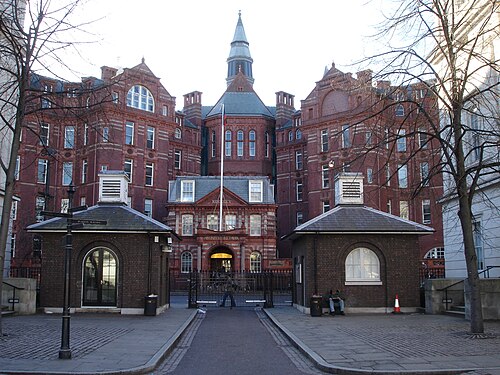
オーウェルの健康は衰え続けた。1949年半ば、彼はソニア・ブラウネルに求愛し、ロンドンのユニバーシティ・カレッジ病院に移送される直前の9月に婚約を発表した。彼女は『1984年』のヒロイン、ジュリアのモデルだと考えられている。[146] [147]ソニアはオーウェルの身辺を預かり、病院で熱心に付き添った。オーウェルの友人たちは、ブラウネルはオーウェルの人生の最後の数ヶ月の苦痛を乗り越える手助けをしてくれたと語り、アンソニー・パウエルによると、オーウェルを大いに元気づけたという。[148]しかし、彼女がオーウェルに惹かれたのは主に彼の名声のためだったのではないかと主張する者もいる。[142]
1949年9月、オーウェルは会計士のジャック・ハリソンを病院に招き、ハリソンはオーウェルがGOP社の取締役に就任して会社を経営するよう依頼したと主張したが、独立した証人はいなかった。[138]オーウェルの結婚式は1949年10月13日に病室で行われ、デイヴィッド・アスターが花婿介添人を務めた。[149]会計士とのさらなる会議が開かれ、ハリソンとブレア夫妻が会社の取締役に就任することが承認された。[138]オーウェルの健康はクリスマスまでに再び悪化した。ジャック・ハリソンが後に病院を訪れ、オーウェルが会社の25%を自分に譲ったと主張した。[138] 1月21日の早朝、オーウェルの肺の動脈が破裂し、46歳で死亡した。[150]
,_All_Saints,_Sutton_Courtenay_-_geograph.org.uk_-_362277.jpg/500px-Grave_of_Eric_Arthur_Blair_(George_Orwell),_All_Saints,_Sutton_Courtenay_-_geograph.org.uk_-_362277.jpg)
オーウェルは、自分が亡くなった場所に最も近い教会の墓地に、英国国教会の儀式に従って埋葬されることを希望していた。ロンドン中心部の墓地には空きがなく、オーウェルの遺志を確実にかなえるため、未亡人はオーウェルの友人たちに、墓地に空きのある教会を知っている人がいないかと尋ねた。デイヴィッド・アスターは、オーウェルがサットン・コートニーのオールセインツ教会の墓地に埋葬されるよう手配した。[151]葬儀はアンソニー・パウエルとマルコム・マガーリッジが主催した。パウエルは「地上に住むすべての人々」、「偉大なる救い主よ、私を導いてください」、「万の万倍」という賛美歌を選んだ。[152]
オーウェルの養子リチャード・ホレイショ・ブレアは、オーウェルの妹で法定後見人のアヴリルとその夫ビル・ダンによって育てられた。[153]
1979年、ソニア・ブラウネルは、ハリソンが会社の25パーセントの株式を3人の子供に分割する意向を表明したため、高等裁判所に訴訟を起こした。ソニアにとって、この策略の結果、会社の全権を握ることが3倍困難になっただろう。彼女は強い立場にあると考えられていたが、病状が悪化し、最終的には1980年11月2日に法廷外で和解するよう説得された。彼女は1980年12月11日に62歳で亡くなった。[138]
文学のキャリアと遺産
オーウェルは、そのキャリアの大半において、新聞や雑誌のエッセイ、評論、コラム、ルポルタージュ本『パリとロンドンのどん底生活』(これらの都市の貧困時代を描写)、『ウィガン埠頭への道』 (北イングランドの貧困層の生活状況と一般的な階級分断を描写)、 『カタロニア讃歌』などのジャーナリズムで最もよく知られていた。アーヴィング・ハウによれば、オーウェルは「ヘズリット以来、おそらくジョンソン博士以来最高のイギリス人エッセイスト」であった。[154]
現代の読者は、オーウェルを小説家として、特に大ヒットした『動物農場』や『1984年』を通して知ることが多い。前者はロシア革命後のソ連の退廃とスターリン主義の台頭を反映しているとよく考えられており、後者は全体主義支配下の生活を反映したものである。1984年、『1984年』とレイ・ブラッドベリの『華氏451度』は、ディストピア文学への貢献が認められプロメテウス賞を受賞した。2011年には『動物農場』で再び同賞を受賞した。2003年、BBCのビッグリード投票で『1984年』は8位、『動物農場』は46位にランクされた。[155] 2021年、ニューヨークタイムズブックレビューの読者は『1984年』を「過去125年間のベストブック」リストで3位にランク付けした。 [156]
文学的影響
オーウェルは1940年に『20世紀作家』 の編集者に送った自伝的な文章の中で、次のように書いている。
私が最も関心を持ち、飽きることのない作家は、シェイクスピア、スウィフト、フィールディング、ディケンズ、チャールズ・リード、フローベール、そして現代作家ではジェイムズ・ジョイス、T・S・エリオット、D・H・ロレンスです。しかし、私が最も影響を受けた現代作家はW・サマセット・モームだと信じています。私は、飾り気なく率直に物語を語る彼の力に非常に感銘を受けています。[157]
オーウェルは、ジャック・ロンドンの作品、特に『ザ・ロード』を強く賞賛した。『ウィガン埠頭への道』における貧困の調査は、ジャック・ロンドンの『奈落の底の人々』と非常によく似ている。『奈落の底の人々』では、アメリカ人ジャーナリストが失業中の船乗りに変装してロンドンの貧困者の生活を調査する。『政治対文学:ガリヴァー旅行記の考察』(1946年)というエッセイで、オーウェルは「他の本がすべて破棄されたときに保存すべき6冊の本のリストを作らなければならないとしたら、間違いなく『ガリヴァー旅行記』をその中に入れたい」と書いている。HGウェルズについては、「ウェルズが存在しなかったら、私たち全員の心、そして物質世界は明らかに違っていただろう」と書いている。[158]
オーウェルはアーサー・ケストラーの崇拝者であり、ケストラーとその妻ママインがフェスティニオグ渓谷のブールチ・オシンの別荘で過ごした3年間に親しい友人になった。オーウェルは1941年にニュー・ステイツマン誌でケストラーの『真昼の暗黒』を評し、次のように述べている。
この本は小説としても、また文学作品としても素晴らしいが、おそらく最も価値があるのは、全体主義の手法を熟知した人物によるモスクワの「自白」の解釈である。これらの裁判で恐ろしかったのは、裁判が実際に行われたという事実ではなく、全体主義社会では明らかにこのようなことが必要であるが、西洋の知識人が裁判を正当化しようと熱心に取り組んだことであった。[159]
オーウェルが尊敬していた他の作家には、ラルフ・ワルド・エマーソン、ジョージ・ギッシング、グレアム・グリーン、ハーマン・メルヴィル、ヘンリー・ミラー、トバイアス・スモレット、マーク・トウェイン、ジョセフ・コンラッド、エフゲニー・ザミャーチンなどがいた。[160]彼はラドヤード・キップリングの崇拝者であり批評家でもあった。[161] [162]キップリングは才能ある作家であり「良い悪い詩人」であり、その作品は「偽物」であり「道徳的に無神経で美的に不快」だが、紛れもなく魅惑的で、より啓蒙された作家よりも効果的に現実の特定の側面について語ることができると賞賛した。[163]彼は、 G・K・チェスタトンに対しても同様に相反する態度を示していた。チェスタトンは、ローマカトリックのプロパガンダに専念することを選んだ、かなりの才能を持った作家だと考えていた。 [164]また、イヴリン・ウォーに対しても、彼は「(つまり、現代の小説家としては)支持できない意見を持ちながらも、最高の小説家」だと書いている。[165]
文芸評論家
オーウェルは生涯を通じて書評家として生計を立てた。彼の書評はよく知られており、文学批評に影響を与えてきた。彼は1940年にチャールズ・ディケンズについて書いたエッセイの結論で次のように書いている。[166]
「どんな著作でも、非常に個性的な文章を読むと、ページの裏に顔が見えるという印象を受ける。それは必ずしも作家の実際の顔ではない。私はスウィフト、デフォー、フィールディング、スタンダール、サッカレー、フローベールについて、この印象を強く受ける。ただし、いくつかのケースでは、これらの人物がどのような顔をしていたかは知らないし、知りたいとも思わない。目に入るのは、作家が持つべき顔だ。さて、ディケンズの場合、私はディケンズの写真の顔とは少し違う顔を見る。それは、少しあごひげを生やし、濃い色の顔をした、40歳くらいの男の顔だ。彼は笑っている。その笑いには怒りの影が少しあるが、勝利や悪意はない。それは、常に何かと戦っているが、公然と戦って恐れていない男の顔であり、寛大に怒っている男の顔である。言い換えれば、19世紀のリベラルな、自由な知性、今や我々の魂を奪い合っているあらゆる悪臭を放つ小さな正統派から等しく憎まれているタイプである。」
ジョージ・ウッドコックは、最後の2つの文はオーウェルについても述べていると示唆した。[167]
オーウェルは、ジョージ・バーナード・ショーの戯曲『武器と人間』の批評を書いた。彼は、この戯曲がショーの最高傑作であり、社会的に最も関連性が残る作品だと考えた。1945年のエッセイ『PG・ウッドハウス擁護』では、戦時中のドイツからの放送はウッドハウスを裏切り者にするものではないと主張している。彼は、情報省がプロパガンダ目的でウッドハウスの行動を誇張していると非難した。
フードライティング
1946年、ブリティッシュ・カウンシルは、対外的な英国関係を促進する活動の一環として、オーウェルに英国料理に関するエッセイを書くよう依頼した。[168]「英国料理」と題されたエッセイで、オーウェルは英国の食生活を「シンプルで、かなり重く、おそらく少し野蛮な食事」であり、「一日のほとんどの時間、温かい飲み物は許容される」と表現した。[168]彼は、英国のハイティーはさまざまな塩味と甘味の料理で構成されていたが、「少なくとも1種類のケーキが含まれていなければ、良いお茶とはみなされない」と書き、さらに「ケーキだけでなく、ビスケットもティータイムによく食べられる」と付け加えた。[168] [169]オーウェルは、トーストに塗る人気の英国製スプレッドであるマーマレードのレシピをエッセイに含めた。 [168]しかし、ブリティッシュ・カウンシルは、戦後の厳しい配給制の時代に食べ物について書くのはあまりにも問題があるという理由で、エッセイの出版を断った。 2019年、このエッセイはブリティッシュ・カウンシルのアーカイブで却下通知とともに発見された。ブリティッシュ・カウンシルは依頼されたエッセイの却下についてオーウェルに公式謝罪し、却下通知とともにオリジナルのエッセイを公開した。[168]
オーウェルの作品の受容と評価

アーサー・ケストラーは、オーウェルの「妥協を許さない知的誠実さは、彼を時折ほとんど非人間的に見せた」と述べた。 [171] ベン・ワッテンバーグは、「オーウェルの著作は、彼が見つけた知的偽善をどこにでも突き通した」と述べた。 [4]歴史家ピアーズ・ブレンドンによると、「オーウェルは、昔なら『聖人になるか、火あぶりにされるかのどちらかだった』と、BBCのボスであるラッシュブルック・ウィリアムズは語った」。[172]レイモンド・ウィリアムズは『政治と文学:ニュー・レフト・レビューとのインタビュー』の中で、オーウェルを「経験に率直にぶつかり、それについて真実を語る平凡な男の見事に模倣した人物」と表現している。[173]クリストファー・ノリスは、オーウェルの「素朴な経験主義的見解、つまり真実は率直な常識的な方法で語られるべきであるという彼の仮定は、今や単にナイーブなだけでなく、罪深いほど自己欺瞞的であるように思われる」と断言した。[174]アメリカの学者スコット・ルーカスは、オーウェルを左翼の敵と表現した。[175]ジョン・ニューシンガーは、ルーカスが左翼の敵と表現したのは、「オーウェルがそうではないと言い続けていたにもかかわらず、オーウェルのスターリン主義に対するすべての攻撃をあたかも社会主義に対する攻撃であるかのように」描写することしかできなかったと主張した。[176]
オーウェルの作品はイギリスの学校文学カリキュラムで重要な位置を占めており、[177] 『動物農場』は中等教育終了時の定期試験(GCSE )のテーマであり、『1984年』は大学以下のレベル( Aレベル)の試験のテーマとなっている。2016年の英国の世論調査では、『動物農場』が国民の学校で最も人気のある本の1位にランクされた。[178]
歴史家のジョン・ロッデンは次のように述べている。「ジョン・ポドレッツは、もしオーウェルが生きていたなら、彼はネオコンの側に立って左翼に反対していただろうと主張した。そこで疑問が生じる。その時までに30年以上も死んでいる人物の政治的立場を、どの程度まで予測できるだろうか?」[4]
ジョン・ロッデンは「オーウェルの容貌に見られる否定できない保守的特徴」を指摘し、「オーウェルは、彼の名前が右派によって利用され、悪用されるような類のものをある程度助長した。他の点では、選択的引用の政治があった」と述べている。[4]ロッデンは「なぜ私は書くのか」というエッセイ[179]に言及し、その中でオーウェルはスペイン内戦を「政治的な転機」と呼び、「スペイン戦争と1936年から37年にかけての他の出来事が、状況を一変させた。それ以来、私は自分の立場を知った。1936年以来私が書いた真剣な作品はすべて、直接的または間接的に全体主義に反対し、私が理解する民主的社会主義を支持するものであった」と述べている。(強調は原文のまま)[4]ロッデンはさらに、マッカーシー時代の動物農場のシグネット版の序文で選択的引用がどのように利用されているかを説明している。
「[序文]:動物農場という本自体が、この問題について疑問を残していたとしても、オーウェルはエッセイ「なぜ私は書くのか」でそれを払拭した。「1936年以来私が書いた真剣な作品はすべて、直接的または間接的に全体主義に反対して書かれたものです...」
[ロッデン]:ドット、ドット、ドット、ドット、省略の政治。「民主社会主義のために」は、ウィンストン・スミスが真実省でやったように蒸発し、それはまさにマッカーシー時代の初めに起こったことであり、オーウェルが選択的に引用されながら続いている。」[4]
ファイベルはオーウェルについてこう書いている。
彼の決定的な経験は、作家になるための苦闘であり、それは長い貧困、失敗、屈辱の期間を経てのものであり、彼はそれについて直接ほとんど何も書いていない。スラム街での生活での汗と苦悩よりも、その経験を文学にするための努力の方が多かった。[180] [181]
対照的に、歴史家アイザック・ドイチャーはマルクス主義の観点からオーウェルに対してはるかに批判的で、彼を「単純な無政府主義者」と特徴づけた。ドイチャーは、オーウェルはマルクス主義の弁証法的哲学を理解するのに苦労し、社会主義の他の流れに対して個人的な相反する感情を示し、 1984年などの彼の作品は反共産主義の 冷戦プロパガンダの目的で流用されたと主張した。[182] [183]
言語と文章への影響
オーウェルは、エッセイ「政治と英語」(1946 年)で、正確で明確な言語の重要性について述べ、曖昧な文章は政治的操作の強力な手段として使用される可能性があると主張しました。そのエッセイで、オーウェルは作家のための 6 つのルールを示しています。
- 印刷物でよく見かける隠喩、直喩、その他の比喩表現は絶対に使用しないでください。
- 短い単語で済むところでは決して長い単語を使わないでください。
- 単語を削除できる場合は、必ず削除してください。
- 能動態が使えるところでは受動態を決して使わないでください。
- 日常的な英語で同等の表現が思いつく場合は、外国語のフレーズ、科学用語、または専門用語を決して使用しないでください。
- 野蛮なことを言う前に、これらのルールを破ってください。[184]
オーウェルはオブザーバー紙の記者として7年間勤務し、編集者のデイビッド・アスターは新入社員全員にこの有名なエッセイのコピーを配った。[185] 2003年、同紙の文芸編集者 ロバート・マクラムは「今でも、このエッセイは私たちのスタイルブックに引用されている」と書いた。[185]ジャーナリストのジョナサン・ヒーウッドは「オーウェルのだらしない言葉遣いに対する批判は、今でも非常に真剣に受け止められている」と指摘した。[185]
アンドリュー・N・ルービンは、「オーウェルは、支配的な思考様式が私たちが使用する言語そのものをどのように変えてきたかに等しく関心を持つべきであるのと同様に、言語の使用が批判的思考能力をどのように制限してきたかに注意を払うべきだと主張した」と主張している。[186]
「オーウェル的」という形容詞は、プロパガンダ、監視、誤報、真実の否定、過去の操作による統制の姿勢や方針を暗示する。『1984年』でオーウェルは、言語を統制することで思考を統制し、特定の考えを文字通り考えられないものにする全体主義政府を描写した。『1984年』に出てくるいくつかの単語やフレーズは、一般の言葉にもなっている。「ニュースピーク」は、独立した思考を不可能にするために考案された、単純化され難読化された言語である。「二重思考」は、2つの矛盾する信念を同時に持つことを意味する。「思想警察」は、すべての反対意見を抑圧する人々である。「プロレフィード」は、従順さを通じて大衆を統制し、教化するために使われる、均質化され、作られた表面的な文学、映画、音楽である。「ビッグ・ブラザー」は、すべての人を監視する最高の独裁者である。この小説に出てくる他の新語としては、「2分間の憎悪」、「101号室」、「記憶の穴」、「無人」、「思考犯罪」などがあり、[5] [6]また、新語「集団思考」の直接的なインスピレーションも与えている。
オーウェルは、1945 年 10 月 19 日にトリビューン紙に掲載されたエッセイ「あなたと原子爆弾」の中で、 「冷戦」という言葉を初めて使用した人物である可能性がある。彼は次のように書いている。
「我々は、全般的な崩壊ではなく、古代の奴隷帝国と同じくらい恐ろしく安定した時代に向かっているのかもしれない。ジェームズ・バーナムの理論は盛んに議論されてきたが、そのイデオロギー的意味合い、つまり、征服不可能で、隣国と永続的な「冷戦」状態にある国家でおそらく優勢となるであろう世界観、信念、社会構造について検討した人はまだほとんどいない。」[187]
現代文化

オーウェル協会は、オーウェルの生涯と作品への理解を促進するために2011年に設立されました。英国の登録慈善団体であり、オックスフォードシャー州ヘンリー・オン・テムズにあるフィリス・コート会員クラブでディオン・ヴェナブルズによって設立され、発足しました。このクラブは、オーウェルが若い頃によく訪れたクラブでした。[188]
彼の著書の舞台化以外にも、オーウェルを主人公の一人として描いた作品がいくつか書かれた。
- In 2012, a musical play, One Georgie Orwell, by Peter Cordwell and Carl Picton was performed at the Greenwich Theatre, London. It explored Orwell's life, his concerns for the world that he lived in, and for the Britain that he loved.[189]
- In 2014, a play written by playwright Joe Sutton titled Orwell in America was first performed by the Northern Stage theatre company in White River Junction, Vermont. It is a fictitious account of Orwell doing a book tour in the United States (something he never did in his lifetime). It moved to off-Broadway in 2016.[190]
- In 2017, Mrs Orwell by British playwright Tony Cox opened at the Old Red Lion Theatre in London before transferring to the Southwark Playhouse.[191] The play centres on Orwell's second wife Sonia Brownell (played by Cressida Bonas), her reasons for marrying Orwell and her relationship with Lucian Freud.
- In 2019, Tasmanian theatre company Blue Cow presented the play 101 by Cameron Hindrum,[192] in which Orwell is seen working on his novel 1984 "while keeping his severe illness at bay and balancing the demands of fatherhood, art, family and success."[193]
- Orwell is the main character in a 2017 novel, The Last Man in Europe, by Australian author Dennis Glover.[194]
- The young Eric Blair is the main character in Paul Theroux's 2024 novel Burma Sahib, a fictional narrative of Blair's five years in the country.[195]
Orwell's birthplace, a bungalow in Motihari, Bihar, India, was opened as a museum in May 2015.[196]
Archive
In 1960 Orwell's widow Sonia deposited his papers on permanent loan to University College London.[197] The collection contains Orwell's literary notebooks, manuscripts and typescripts of his work, personal and political diaries, correspondence and family material.[197] Since the initial donation the papers - now known as the George Orwell Archive - have been supplemented by further donations from family, friends and business associates.[197] Orwell's son Richard Blair has purchased additional material for the collection since its inception; in 2023 Blair was awarded an Honorary Fellowship from University College London for his contributions.[198][199]
University College London also holds an extensive collection of Orwell's books, including rare and early editions of his works, translations into other languages and titles from his own library.[200]
Statue
.jpg/500px-George_Orwell_statue_-_BBC_London_(38562767202).jpg)
A statue of George Orwell, sculpted by the British sculptor Martin Jennings, was unveiled on 7 November 2017 outside Broadcasting House, the headquarters of the BBC.[n 4] The wall behind the statue is inscribed with the following phrase: "If liberty means anything at all, it means the right to tell people what they do not want to hear". These are words from his proposed preface to Animal Farm and a rallying cry for the idea of free speech in an open society.[201][202]
Personal life
Childhood
Jacintha Buddicom's account, Eric & Us, provides an insight into Blair's childhood.[203] She quoted his sister Avril that "he was essentially an aloof, undemonstrative person" and said herself of his friendship with the Buddicoms: "I do not think he needed any other friends beyond the schoolfriend he occasionally and appreciatively referred to as 'CC'". She could not recall him having schoolfriends to stay and exchange visits as her brother Prosper often did in holidays.[204] Cyril Connolly provides an account of Blair as a child in Enemies of Promise.[205] Years later, Blair mordantly recalled his prep school in the essay "Such, Such Were the Joys", claiming among other things that he "was made to study like a dog" to earn a scholarship. Jacintha Buddicom repudiated Orwell's schoolboy misery described in the essay, stating that "he was a specially happy child". She noted that he did not like his name because it reminded him of a book he greatly disliked—Eric, or, Little by Little, a Victorian boys' school story.[206]
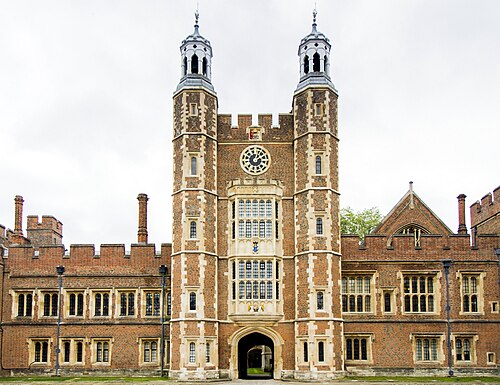
Connolly remarked of him as a schoolboy, "The remarkable thing about Orwell was that alone among the boys he was an intellectual and not a parrot for he thought for himself".[205] At Eton, John Vaughan Wilkes, his former headmaster's son at St Cyprians, recalled that "he was extremely argumentative—about anything—and criticising the masters and criticising the other boys [...] We enjoyed arguing with him. He would generally win the arguments—or think he had anyhow."[207]
Blair liked to carry out practical jokes. Buddicom recalls him swinging from the luggage rack in a railway carriage like an orangutan to frighten a woman passenger out of the compartment.[21] At Eton, he played tricks on John Crace, his housemaster, among which was to enter a spoof advertisement in a college magazine implying pederasty.[208] Gow, his tutor, said he "made himself as big a nuisance as he could" and "was a very unattractive boy".[209] Later Blair was expelled from the crammer at Southwold for sending a dead rat as a birthday present to the town surveyor.[210]
Blair had an interest in natural history which stemmed from his childhood. In letters from school he wrote about caterpillars and butterflies,[211] and Buddicom recalls his keen interest in ornithology. He also enjoyed fishing and shooting rabbits, and conducting experiments as in cooking a hedgehog[21] or shooting down a jackdaw from the Eton roof to dissect it.[212] His zeal for scientific experiments extended to explosives—again Buddicom recalls a cook giving notice because of the noise. Later in Southwold, his sister Avril recalled him blowing up the garden. When teaching he enthused his students with his nature-rambles both at Southwold[213] and at Hayes.[214] His adult diaries are permeated with his observations on nature.
Relationships and marriage
Blair’s adolescent idyll with Buddicom was shattered in the summer of 1921, when he attempted to take their relationship further than Buddicom was ready for, in what was characterised as a botched seduction.[215] When Blair left for Burma the following year, he wrote to Buddicom but she soon stopped replying to his letters.[216] Returning from Burma in 1927, Blair went in search of Buddicom at her family home to ask her to marry him but she was nowhere to be seen.[217] What had been a very serious business indeed for Blair had apparently been dismissed by Buddicom, leaving Blair potentially emotionally vulnerable.[218] Buddicom and Blair revisited those memories briefly in 1949 in three letters and three telephone calls but without closure.[219]
Mabel Fierz, who later became Blair's confidante, said: "He used to say the one thing he wished in this world was that he'd been attractive to women. He liked women and had many girlfriends I think in Burma. He had a girl in Southwold and another girl in London. He was rather a womaniser, yet he was afraid he wasn't attractive."[220]
Brenda Salkield (Southwold) preferred friendship to any deeper relationship and maintained a correspondence with Blair for many years, particularly as a sounding board for his ideas. She wrote: "He was a great letter writer. Endless letters, and I mean when he wrote you a letter he wrote pages."[26] His correspondence with Eleanor Jacques (London) was more prosaic, dwelling on a closer relationship and referring to past rendezvous or planning future ones in London and Burnham Beeches.[221]
When Orwell was in the sanatorium in Kent, his wife Eileen's friend Lydia Jackson visited. He invited her for a walk and out of sight "an awkward situation arose."[222] Jackson was to be the most critical of Orwell's marriage to Eileen, but their later correspondence hints at a complicity. At the time Eileen was more concerned about Orwell's closeness to Brenda Salkield. Orwell had an affair with his secretary at Tribune which caused Eileen much distress, and others have been mooted. In a letter to Ann Popham he wrote: "I was sometimes unfaithful to Eileen, and I also treated her badly, and I think she treated me badly, too, at times, but it was a real marriage, in the sense that we had been through awful struggles together and she understood all about my work, etc."[223] Similarly he suggested to Celia Kirwan that they had both been unfaithful.[224] There are several testaments that it was a well-matched and happy marriage.[225][226][227]
In June 1944, Orwell and Eileen adopted a three-week-old boy they named Richard Horatio.[228] According to Richard, Orwell was a wonderful father who gave him devoted, if rather rugged, attention and a great degree of freedom.[229]
Orwell was very lonely after Eileen's death in 1945 and was desperate for a wife, both as companion for himself and as mother for Richard. He proposed marriage to four women, including Celia Kirwan, and eventually Sonia Brownell accepted.[230] Orwell had met her when she was assistant to Cyril Connolly, at Horizon literary magazine.[231] They were married on 13 October 1949, only three months before Orwell's death. Some maintain that Sonia was the model for Julia in Nineteen Eighty-Four.
Social interactions
Orwell was noted for very close and enduring friendships with a few friends, but these were generally people with a similar background or with a similar level of literary ability. Ungregarious, he was out of place in a crowd and his discomfort was exacerbated when he was outside his own class. Though representing himself as a spokesman for the common man, he often appeared out of place with real working people. His brother-in-law Humphrey Dakin, a "Hail fellow, well met" type, who took him to a local pub in Leeds, said that he was told by the landlord: "Don't bring that bugger in here again."[232] Adrian Fierz commented "He wasn't interested in racing or greyhounds or pub crawling or shove ha'penny. He just did not have much in common with people who did not share his intellectual interests."[233] Awkwardness attended many of his encounters with working-class representatives, as with Pollitt and McNair,[234] but his courtesy and good manners were often commented on. Jack Common observed on meeting him for the first time, "Right away manners, and more than manners—breeding—showed through."[235]
In his tramping days, he did domestic work for a time. His extreme politeness was recalled by a member of the family he worked for; she declared that the family referred to him as "Laurel" after the film comedian.[52] With his gangling figure and awkwardness, Orwell's friends often saw him as a figure of fun. Geoffrey Gorer commented "He was awfully likely to knock things off tables, trip over things. I mean, he was a gangling, physically badly co-ordinated young man. I think his feeling [was] that even the inanimate world was against him."[236] At the BBC in the 1940s, "everybody would pull his leg"[237] and Spender described him as having real entertainment value "like, as I say, watching a Charlie Chaplin movie".[238] A friend of Eileen's reminisced about her tolerance and humour, often at Orwell's expense.[226]
One biography of Orwell accused him of having had an authoritarian streak.[239] One of his former pupils recalled being beaten so hard he could not sit down for a week.[240] When sharing a flat with Orwell, Heppenstall came home late one night in an advanced stage of loud inebriation. The upshot was that Heppenstall ended up with a bloody nose and was locked in a room. When he complained, Orwell hit him across the legs with a shooting stick and Heppenstall then had to defend himself with a chair. Years later, after Orwell's death, Heppenstall wrote a dramatic account of the incident called "The Shooting Stick".[241]
Orwell got on well with young people. The pupil he beat considered him the best of teachers and the young recruits in Barcelona tried to drink him under the table without success.[225]
In the wake of his most famous works, he attracted many uncritical hangers-on, but many others who sought him found him aloof and even dull. With his soft voice, he was sometimes shouted down or excluded from discussions.[242] At this time, he was severely ill; it was wartime or the austerity period after it; during the war his wife suffered from depression; and after her death he was lonely and unhappy. In addition to that, he always lived frugally and seemed unable to care for himself properly. As a result of all this, people found his circumstances bleak.[243] Some, like Michael Ayrton, called him "Gloomy George", but others developed the idea that he was an "English secular saint".[244]
Lifestyle
Orwell was a heavy smoker, who rolled his own cigarettes from strong shag tobacco, despite his bronchial condition. His penchant for the rugged life often took him to cold and damp situations. Described by The Economist as "perhaps the 20th century's best chronicler of English culture",[245] Orwell considered fish and chips, football, the pub, strong tea, cut-price chocolate, the movies, and radio among the chief comforts for the working class.[246] He advocated a patriotic defence of a British way of life that could not be trusted to intellectuals or, by implication, the state:
"We are a nation of flower-lovers, but also a nation of stamp-collectors, pigeon-fanciers, amateur carpenters, coupon-snippers, darts-players, crossword-puzzle fans. All the culture that is most truly native centres round things which even when they are communal are not official—the pub, the football match, the back garden, the fireside and the "nice cup of tea". The liberty of the individual is still believed in, almost as in the nineteenth century. But this has nothing to do with economic liberty, the right to exploit others for profit. It is the liberty to have a home of your own, to do what you like in your spare time, to choose your own amusements instead of having them chosen for you from above."[247]
"By putting the tea in first and stirring as one pours, one can exactly regulate the amount of milk, whereas one is likely to put in too much milk if one does it the other way round"
— One of Orwell's eleven rules for making tea from his essay "A Nice Cup of Tea" which appeared in the London Evening Standard, 12 January 1946[248]
Orwell enjoyed strong tea—he had Fortnum & Mason's tea brought to him in Catalonia.[12] His 1946 essay, "A Nice Cup of Tea", appeared in the London Evening Standard article on how to make tea.[249] He appreciated English beer, taken regularly and moderately, despised drinkers of lager,[250] and wrote about an imagined, ideal British pub in his 1946 Evening Standard article, "The Moon Under Water".[251] Not as particular about food, he enjoyed the wartime "Victory Pie"[252] and extolled canteen food at the BBC.[237] He preferred traditional English dishes, such as roast beef, and kippers.[253]
His dress sense was unpredictable and usually casual.[254] In Southwold, he had the best cloth from the local tailor,[255] but was equally happy in his tramping outfit. His attire in the Spanish Civil War, along with his size-12 boots, was a source of amusement.[256][257] David Astor described him as looking like a prep school master,[258] while according to the Special Branch dossier, Orwell's tendency to dress "in Bohemian fashion" revealed that the author was "a Communist".[259]
Orwell's confusing approach to matters of social decorum—on the one hand expecting a working-class guest to dress for dinner[260] and, on the other, slurping tea out of a saucer at the BBC canteen[261]—helped stoke his reputation as an English eccentric.[262]
Views
Religion

Orwell was an atheist who identified himself with the humanist outlook on life.[263] Despite this, and despite his criticisms of both religious doctrine and religious organisations, he nevertheless regularly participated in the social and civic life of the church, including by attending Church of England Holy Communion.[264] Acknowledging this contradiction, he once said: "It seems rather mean to go to HC [Holy Communion] when one doesn't believe, but I have passed myself off for pious & there is nothing for it but to keep up with the deception."[265] He had two Anglican marriages and left instructions for an Anglican funeral.[266] Orwell was also well-read in Biblical literature and could quote lengthy passages from the Book of Common Prayer from memory.[267]
His extensive knowledge of the Bible came coupled with unsparing criticism of its philosophy, and as an adult he could not bring himself to believe in its tenets. He said in part V of his essay, "Such, Such Were the Joys", that "Till about the age of fourteen I believed in God, and believed that the accounts given of him were true. But I was well aware that I did not love him."[268] Orwell directly contrasted Christianity with secular humanism in his essay "Lear, Tolstoy and the Fool", finding the latter philosophy more palatable and less "self-interested". Literary critic James Wood wrote that in the struggle, as he saw it, between Christianity and humanism, "Orwell was on the humanist side, of course".[269]
Orwell's writing was often explicitly critical of religion, and Christianity in particular. He found the church to be a "selfish [...] church of the landed gentry" with its establishment "out of touch" with the majority of its communicants and altogether a pernicious influence on public life.[270] His contradictory and sometimes ambiguous views about the social benefits of religious affiliation mirrored the dichotomies between his public and private lives: Stephen Ingle wrote that it was as if the writer George Orwell "vaunted" his unbelief while Eric Blair the individual retained "a deeply ingrained religiosity".[271]
Politics
Orwell liked to provoke arguments by challenging the status quo, but he was also a traditionalist with a love of old English values. He criticised and satirised, from the inside, the various social milieux in which he found himself. In his Adelphi days, he described himself as a "Tory-anarchist".[272][273] Of colonialism in Burmese Days, he portrays the English colonists as a "dull, decent people, cherishing and fortifying their dullness behind a quarter of a million bayonets."[274] Writing for Le Progrès Civique, Orwell described the British colonial government in Burma and India:
"The government of all the Indian provinces under the control of the British Empire is of necessity despotic, because only the threat of force can subdue a population of several million subjects. But this despotism is latent. It hides behind a mask of democracy... Care is taken to avoid technical and industrial training. This rule, observed throughout India, aims to stop India from becoming an industrial country capable of competing with England ... Foreign competition is prevented by an insuperable barrier of prohibitive customs tariffs. And so the English factory-owners, with nothing to fear, control the markets absolutely and reap exorbitant profits."[275]

The Spanish Civil War played the most important part in defining Orwell's socialism. He wrote to Cyril Connolly from Barcelona on 8 June 1937: "I have seen wonderful things and at last really believe in Socialism, which I never did before."[276][277] Having witnessed anarcho-syndicalist communities and the subsequent brutal suppression of the anarcho-syndicalists, anti-Stalin communist parties and revolutionaries by the Soviet Union-backed Communists, Orwell returned from Catalonia a staunch anti-Stalinist and joined the British Independent Labour Party.[278]
In Part 2 of The Road to Wigan Pier, published by the Left Book Club, Orwell stated that "a real Socialist is one who wishes—not merely conceives it as desirable, but actively wishes—to see tyranny overthrown". Orwell stated in "Why I Write" (1946): "Every line of serious work that I have written since 1936 has been written, directly or indirectly, against totalitarianism and for democratic socialism, as I understand it."[179] Orwell's conception of socialism was of a planned economy alongside democracy.[279] Orwell was a proponent of a federal socialist Europe, a position outlined in his 1947 essay "Toward European Unity", which first appeared in Partisan Review. According to biographer John Newsinger:
"The other crucial dimension to Orwell's socialism was his recognition that the Soviet Union was not socialist. Unlike many on the left, instead of abandoning socialism once he discovered the full horror of Stalinist rule in the Soviet Union, Orwell abandoned the Soviet Union and instead remained a socialist—indeed he became more committed to the socialist cause than ever."[91]
Orwell was opposed to rearmament against Nazi Germany and at the time of the Munich Agreement he signed a manifesto entitled "If War Comes We Shall Resist"[280]—but he changed his view after the Molotov–Ribbentrop Pact and the outbreak of the war. He left the ILP because of its opposition to the war and adopted a political position of "revolutionary patriotism". On 21 March 1940 he wrote a review of Adolf Hitler's Mein Kampf for The New English Weekly, in which he analysed the dictator's psychology. Asking "how was it that he was able to put [his] monstrous vision across?", Orwell tried to understand why Hitler was worshipped by the German people:
The situation in Germany, with its seven million unemployed, was obviously favourable for demagogues. But Hitler could not have succeeded against his many rivals if it had not been for the attraction of his own personality, which one can feel even in the clumsy writing of Mein Kampf, and which is no doubt overwhelming when one hears his speeches...The fact is that there is something deeply appealing about him. The initial, personal cause of his grievance against the universe can only be guessed at; but at any rate the grievance is here. He is the martyr, the victim, Prometheus chained to the rock, the self-sacrificing hero who fights single-handed against impossible odds. If he were killing a mouse he would know how to make it seem like a dragon.[281]
In December 1940 he wrote in Tribune (the Labour left's weekly): "We are in a strange period of history in which a revolutionary has to be a patriot and a patriot has to be a revolutionary." During the war, Orwell was highly critical of the popular idea that an Anglo-Soviet alliance would be the basis of a post-war world of peace and prosperity.[282] In his reply (dated 15 November 1943) to an invitation from the Duchess of Atholl to speak for the British League for European Freedom, he stated that he could not "associate himself with an essentially Conservative body" that claimed to "defend democracy in Europe" but had "nothing to say about British imperialism". His closing paragraph stated: "I belong to the Left and must work inside it, much as I hate Russian totalitarianism and its poisonous influence in this country."[283]
Orwell joined the staff of Tribune magazine as literary editor, and from then until his death, was a left-wing (though hardly orthodox) Labour-supporting democratic socialist.[284] On 1 September 1944, writing about the Warsaw uprising, Orwell expressed in Tribune his hostility against the influence of the alliance with the USSR over the allies: "Do remember that dishonesty and cowardice always have to be paid for. Do not imagine that for years on end you can make yourself the boot-licking propagandist of the sovietic regime, or any other regime, and then suddenly return to honesty and reason. Once a whore, always a whore."[285] According to Newsinger, although Orwell "was always critical of the 1945–51 Labour government's moderation, his support for it began to pull him to the right politically. This did not lead him to embrace conservatism, imperialism or reaction, but to defend, albeit critically, Labour reformism."[286] Special Branch, the intelligence division of the Metropolitan Police, maintained a file on Orwell for more than 20 years of his life. The dossier, published by The National Archives, states that, according to one investigator, Orwell had "advanced Communist views and several of his Indian friends say that they have often seen him at Communist meetings".[287] MI5, the intelligence department of the Home Office, noted: "It is evident from his recent writings—'The Lion and the Unicorn'—and his contribution to Gollancz's symposium The Betrayal of the Left that he does not hold with the Communist Party nor they with him."[288]
Sexuality
Sexual politics plays an important role in Nineteen Eighty-Four. In the novel, people's intimate relationships are strictly governed by the party's Junior Anti-Sex League, by opposing sexual relations and instead encouraging artificial insemination.[289] Personally, Orwell disliked what he thought as misguided middle-class revolutionary emancipatory views, expressing disdain for "every fruit-juice drinker, nudist, sandal-wearer, sex-maniacs".[290]
Orwell was also openly against homosexuality. Daphne Patai said: "Of course he was homophobic. That has nothing to do with his relations with his homosexual friends. Certainly, he had a negative attitude and a certain kind of anxiety, a denigrating attitude towards homosexuality. That is definitely the case. I think his writing reflects that quite fully."[291]
Orwell used the homophobic epithets "nancy" and "pansy", for example, in expressions of contempt for what he called the "pansy Left".[292] The protagonist of Keep the Aspidistra Flying, Gordon Comstock, conducts an internal critique of his customers when working in a bookshop, and there is an extended passage of several pages in which he concentrates on a homosexual male customer, and sneers at him for his "nancy" characteristics, including a lisp.[293] Stephen Spender "thought Orwell's occasional homophobic outbursts were part of his rebellion against the public school".[294]
Biographies
Orwell's will requested that no biography of him be written, and his widow, Sonia Brownell, repelled every attempt by those who tried to persuade her to let them write about him. Various recollections and interpretations were published in the 1950s and 1960s, but Sonia saw the 1968 Collected Works[295][296] as the record of his life. She did appoint Malcolm Muggeridge as official biographer, but later biographers have seen this as deliberate spoiling as Muggeridge eventually gave up the work.[297] In 1972, two American authors, Peter Stansky and William Abrahams, produced The Unknown Orwell, an unauthorised account of his early years that lacked any support or contribution from Sonia Brownell.[298]
Sonia Brownell then commissioned Bernard Crick to complete a biography and asked Orwell's friends to co-operate.[299] Crick collated a considerable amount of material in his work, which was published in 1980,[299] but his questioning of the factual accuracy of Orwell's first-person writings led to conflict with Brownell, and she tried to suppress the book. Crick concentrated on the facts of Orwell's life rather than his character, and presented primarily a political perspective.[300]
After Sonia Brownell's death, other works on Orwell were published in the 1980s, particularly in 1984. These included collections of reminiscences by Audrey Coppard and Crick[210][296] and Stephen Wadhams.[26][301] In 1991, Michael Shelden published a biography.[33][302] More concerned with the literary nature of Orwell's work, he sought explanations for Orwell's character and treated his first-person writings as autobiographical. Shelden introduced new information that sought to build on Crick's work.[299]
Peter Davison's publication of the Complete Works of George Orwell, completed in 2000,[303][304] made most of the Orwell Archive accessible to the public. Jeffrey Meyers, a prolific American biographer, was first to take advantage of this and published a book in 2001 that investigated the darker side of Orwell and questioned his saintly image.[299] Why Orwell Matters (released in the UK as Orwell's Victory) was published by Christopher Hitchens in 2002.[305]
In 2003, the centenary of Orwell's birth resulted in biographies by Gordon Bowker[306] and D. J. Taylor.[307] Taylor notes the stage management which surrounds much of Orwell's behaviour[12] and Bowker highlights the essential sense of decency which he considers to have been Orwell's main motivation.[308] An updated edition of Taylor's biography was released in 2023 as Orwell: The New Life, published by Constable.[309][310]
In 2018, Ronald Binns published the first detailed study of Orwell's years in Suffolk, Orwell in Southwold. In 2020, Richard Bradford wrote a new biography, Orwell: A Man of Our Time,[311] while in 2021 Rebecca Solnit reflected on Orwell's interest in gardening in her book Orwell's Roses.[312]
Two books about Orwell's relationship with his first wife, Eileen O'Shaughnessy, and her role in his life and career, have been published: Eileen: The Making of George Orwell by Sylvia Topp (2020)[313] and Wifedom: Mrs Orwell's Invisible Life by Anna Funder (2023).[314][307] In her book Funder claims that Orwell was misogynistic and sadistic. This sparked a strong controversy among Orwell's biographers, particularly with Topp. Celia Kirwan's family also intervened in the discussion, believing that the attribution to their relative of a relationship with Orwell, as stated by Funder, is false. The publishing house of Wifedom was forced to remove that reference from the book.[315]
Bibliography
Novels
- 1934 – Burmese Days
- 1935 – A Clergyman's Daughter
- 1936 – Keep the Aspidistra Flying
- 1939 – Coming Up for Air
- 1945 – Animal Farm
- 1949 – Nineteen Eighty-Four
Nonfiction
- 1933 – Down and Out in Paris and London
- 1937 – The Road to Wigan Pier
- 1938 – Homage to Catalonia
Notes
- ^ Stansky and Abrahams suggested that Ida Blair moved to England in 1907, based on information given by her daughter Avril, talking about a time before she was born. This is contrasted by Ida Blair's 1905, as well as a photograph of Eric, aged three, in an English suburban garden.[13] The earlier date coincides with a difficult posting for Blair senior, and the need to start their daughter Marjorie (then six years old) in an English education.
- ^ The conventional view, based on Geoffrey Gorer's recollections, is of a specific commission with a £500 advance. Taylor argues that Orwell's subsequent life does not suggest he received such a large advance, Gollancz was not known to pay large sums to relatively unknown authors, and Gollancz took little proprietorial interest in progress.[69]
- ^ The author states that evidence discovered at the National Historical Archives in Madrid in 1989 of a security police report to the Tribunal for Espionage and High Treason described Eric Blair and his wife Eileen Blair, as "known Trotskyists" and as "linking agents of the ILP and the POUM". Newsinger goes on to state that given Orwell's precarious health, "there can be little doubt that if he had been arrested he would have died in prison."
- ^ The statue is owned by The Orwell Society under the patronage of Richard Blair, Orwell's adopted son
References
- ^ Jeffries, Stuart (24 January 2013). "What would George Orwell have made of the world in 2013?". The Guardian. Retrieved 3 March 2024.
- ^ "George Orwell". The British Library. Archived from the original on 16 January 2021. Retrieved 4 October 2019.
- ^ Gale, Steven H. (1996). Encyclopedia of British Humorists: Geoffrey Chaucer to John Cleese, Volume 1. Taylor & Francis. p. 823.
- ^ a b c d e f "PBS: Think Tank: Transcript for 'Orwell's Century'". pbs.org. Retrieved 25 February 2015.
- ^ a b Robert McCrum, The Observer, 10 May 2009
- ^ a b "Quotations: G. Orwell". Oxford English Dictionary. Retrieved 2 September 2017.
- ^ "The 50 greatest British writers since 1945". The Times. 5 January 2008. Retrieved 7 January 2014.
- ^ Crick, Bernard (2004). "Eric Arthur Blair [pseud. George Orwell] (1903–1950)". Oxford Dictionary of National Biography. Oxford: Oxford University Press.
- ^ Orwell, George (1937). "8". The Road to Wigan Pier. Left Book Club. p. 1.
- ^ "Legacies of British Slavery". Legacies of British Slavery. University College London. Retrieved 28 April 2024.
- ^ a b Stansky, Peter; Abrahams, William (1994). "From Bengal to St Cyprian's". The Unknown Orwell and Orwell: The Transformation. Stanford, California: Stanford University Press. pp. 5–12. ISBN 978-0804723428.
- ^ a b c d e f g h i j k l Taylor, D.J. (2003). Orwell: The Life. Henry Holt and Company. ISBN 978-0805074734.; Chowdhury, Amlan (16 December 2018). "George Orwell's Birthplace in Motihari to Turn Museum". www.thecitizen.in. Retrieved 26 February 2022.; Haleem, Suhail (11 August 2014). "The Indian Animal Farm where Orwell was born". BBC News.; "Arena News Week: Frank Maloney, George Orwell Museum and Giant Panda Tian Tian". BBC. 14 August 2014. Retrieved 2 February 2023.; Rahman, Maseeh (30 June 2014). "George Orwell's birthplace in India set to become a museum". TheGuardian.com.
- ^ a b Crick (1982), p. 48
- ^ "Renovation of British Author George Orwell's house in Motihari begins". IANS. news.biharprabha.com. Archived from the original on 29 June 2014. Retrieved 26 June 2014.
- ^ A Kind of Compulsion 1903–36, xviii
- ^ Bowker, Gordon. George Orwell. p. 21.
- ^ Bowker p. 30
- ^ Jacob, Alaric (1984). "Sharing Orwell's Joys, but not his Fears". In Norris, Christopher (ed.). Inside the Myth. Lawrence and Wishart.
- ^ The Oxford Companion to Twentieth-century Literature in English. Oxford University Press. 1996. p. 517.
- ^ "Such, Such Were The Joys". Orwell.ru. Retrieved 9 June 2023.
- ^ a b c d Buddicom, Jacintha (1974). Eric and Us. Frewin. ISBN 978-0856320767.
- ^ Taylor, D.J. (17 April 2010). "George Orwell: lost letter revealed". Times Media Limited. The Times. Retrieved 22 September 2024.
- ^ "Henley and South Oxfordshire Standard". 2 October 1914.
- ^ "Henley and South Oxfordshire Standard". 21 July 1916.
- ^ Jacintha Buddicom, Eric and Us, p. 58
- ^ a b c d e Wadhams, Stephen (1984). Remembering Orwell. Penguin.
- ^ Binns, Ronald (2018). Orwell in Southwold. Zoilus Press. ISBN 978-1999735920.
- ^ A Kind of Compulsion, p. 87, gives Blair as seventh of 29 successful candidates, and 21st of the 23 successful candidates who passed the Indian Imperial Police riding test, in September 1922.
- ^ The India Office and Burma Office List: 1927. Harrison & Sons, Ltd. 1927. p. 514.
- ^ The Combined Civil List for India: January 1923. The Pioneer Press. 1923. p. 399.
- ^ The Unknown Orwell: Orwell, the Transformation. Stanford University Press. 1994. p. 176.
- ^ Stansky & Abrahams, The Unknown Orwell, pp. 170–171
- ^ a b Michael Shelden Orwell: The Authorised Biography, William Heinemann, 1991
- ^ The Combined Civil List for India: July–September 1925. The Pioneer Press. 1925. p. 409.
- ^ The Broadview Anthology of British Literature Volume 6: The Twentieth Century and Beyond. Broadview Press. 2006. p. 546.
- ^ Orwell, George (2009). Facing Unpleasant Facts: Narrative Essays. HMH. pp. 29–30.
- ^ A Kind of Compulsion, 1903–36, p. 87
- ^ Emma Larkin, Introduction, Burmese Days, Penguin Classics edition, 2009
- ^ The India Office and Burma Office List: 1929. Harrison & Sons, Ltd. 1929. p. 894.
- ^ "Exploring Burma Through George Orwell". NPR. Retrieved 14 January 2021.
- ^ Crick (1982), p. 122
- ^ Stansky & Abrahams, The Unknown Orwell, p. 195
- ^ Ruth Pitter BBC Overseas Service broadcast, 3 January 1956
- ^ Plaque #2825 on Open Plaques
- ^ Stansky & Abrahams, The Unknown Orwell, p. 204
- ^ "Orwell's take on destitution, live from Paris and London". The Guardian. Retrieved 16 November 2021.
- ^ A Kind of Compulsion (1903–36), p. 113
- ^ Stansky & Abrahams, The Unknown Orwell, p. 216
- ^ Marks, Peter (2015). George Orwell the Essayist: Literature, Politics and the Periodical Culture. Bloomsbury Publishing. p. 28.
- ^ R.S. Peters (1974). A Boy's View of George Orwell Psychology and Ethical Development. Allen & Unwin
- ^ Stansky & Abrahams, p. 230 The Unknown Orwell
- ^ a b Stella Judt "I once met George Orwell" in I once Met 1996
- ^ Davison, Peter, ed. (2013). George Orwell: A Life in Letters. W. W. Norton & Company. p. 494. ISBN 9780871404626.
- ^ a b "Discovery of 'drunk and incapable' arrest record shows Orwell's 'honesty'". ucl.ac.uk. 4 December 2014. Archived from the original on 6 January 2015. Retrieved 25 February 2015.
- ^ Crick (1982), p. 221
- ^ Wagner, David Paul (2019). "Left Book Club". Publishing History.
- ^ Avril Dunn My Brother George Orwell Twentieth Century 1961
- ^ Voorhees (1986: 11)
- ^ Leys, Simon (6 May 2011). "The Intimate Orwell". The New York Review of Books. Retrieved 6 May 2011.
- ^ Orwell, Sonia and Angus, Ian (eds.)Orwell: An Age Like This, letters 31 and 33 (New York: Harcourt, Brace & World)
- ^ "George Orwell: from Animal Farm to Zog, an A–Z of Orwell". The Telegraph. 20 March 2018. Archived from the original on 10 January 2022.
- ^ a b c d Brunsdale, Mitzi (2000). Student Companion to George Orwell. ABC-CLIO. pp. 48–49, 64.
- ^ Applegate, Edd (2009). Advocacy Journalists: A Biographical Dictionary of Writers and Editors. Scarecrow Press. p. 151.
- ^ The Cambridge Introduction to George Orwell. Cambridge University Press. 2012. p. 16.
- ^ Stansky & Abrahams, Orwell:The Transformation pp. 100–101
- ^ The Cambridge Introduction to George Orwell. Cambridge University Press. 2012. p. 17.
- ^ A Kind of Compulsion, p. 392
- ^ "George Orwell's Blue Plaque in Kentish Town, London NW5". English Heritage. Retrieved 27 February 2021.
- ^ D. J. Taylor Orwell: The Life Chatto & Windus 2003
- ^ Clarke, Ben. "George Orwell, Jack Hilton, and the Working Class." Review of English Studies 67.281 (2016) 764–785.
- ^ Orwells tracks, archived from the original on 3 December 2013, retrieved 16 November 2021
- ^ A Kind of Compulsion, p. 457
- ^ A Kind of Compulsion, p. 450. The Road to Wigan Pier Diary
- ^ A Kind of Compulsion, p. 468
- ^ Gaby Hinsliff (19 October 2021). "Orwell's Roses (by Rebecca Solnit review – deadheading with the writer and thinker)". The Guardian. Retrieved 20 August 2022.
- ^ Davison, Peter (ed.). George Orwell: A Kind of Compulsion 1903–1936 (1998), p. 493.
- ^ Orwell, Facing Unpleasant Facts, Secker & Warburg (new edition 2000), p. 12
- ^ Ruth Dudley Edwards, Victor Gollancz, a Biography, pp. 246–247; quoted in A Kind of Compulsion: 1903–1936 (The Complete Works of George Orwell), p. 532.
- ^ "George Orwell under the watchful eye of Big Brother – The National Archives". www.nationalarchives.gov.uk. Archived from the original on 8 December 2011.
- ^ "Notes on the Spanish Militias" in Orwell in Spain, p. 278
- ^ Ingle, Stephen (1993). George Orwell: A Political Life. Manchester University Press. p. 41.
- ^ Haycock, I Am Spain (2013), 152
- ^ John McNair – Interview with Ian Angus UCL 1964
- ^ a b Orwell, George (2013). Homage to Catalonia. Penguin Books. p. 197. ISBN 978-0-141-39302-5.
- ^ Orwell, George (2013). Homage to Catalonia. Penguin Books. pp. 197–198.
- ^ See article by Iain King on Orwell's war experiences, here.
- ^ Letter to Eileen Blair April 1937 in The Collected Essays, Journalism and Letters of George Orwell Volume 1 – An Age Like This 1945–1950 p. 296 (Penguin)
- ^ a b Hicks, Granville (18 May 1952). "George Orwell's Prelude in Spain". The New York Times.
- ^ Bowker, p. 216
- ^ "The accusation of espionage against the P.O.U.M. rested solely upon articles in the Communist press and the activities of the Communist-controlled secret police." Homage to Catalonia p. 168. Penguin, 1980
- ^ a b "Newsinger, John "Orwell and the Spanish Revolution" International Socialism Journal Issue 62 Spring 1994". Pubs.socialistreviewindex.org.uk. Archived from the original on 17 October 2018. Retrieved 21 October 2010.
- ^ "Harry Milton – The Man Who Saved Orwell". Hoover Digest. Hoover Institution. Archived from the original on 20 June 2015. Retrieved 23 December 2008.
- ^ Taylor (2003: 228–229)
- ^ Gordon Bowker, Orwell, p. 218 ISBN 978-0349115511
- ^ Facing Unpleasant Facts, p. xxix, Secker & Warburg, 2000
- ^ Facing Unpleasant Facts, pp. 31, 224
- ^ "Revealed: Soviet spies targeted George Orwell during Spanish civil war". The Guardian. 11 October 2020. Retrieved 12 October 2020.
- ^ "Gordon Bowker: Orwell's London". theorwellprise.co.uk. 23 September 2010. Retrieved 2 February 2011.
- ^ "Another piece of the puzzle – Charles' George Orwell Links". Netcharles.com. Archived from the original on 19 June 2010. Retrieved 21 October 2010.
- ^ "George Orwell Biography". Paralumun.com. Archived from the original on 27 April 2011. Retrieved 21 October 2010.
{{cite web}}: CS1 maint: unfit URL (link) - ^ "The Orwell Prize". Orwelldiaries.wordpress.com. 16 August 2010. Retrieved 21 October 2010.
- ^ Buchanan, Tom (1 September 2002). "Three Lives of Homage to Catalonia". The Library. 3 (3): 302–314. doi:10.1093/library/3.3.302. ISSN 0024-2160. Retrieved 17 October 2021.
- ^ Connelly, Mark (2018). George Orwell: A Literary Companion. McFarland. p. 17.
- ^ A Patriot After All, 1940–41, p. xvii, 1998 Secker & Warburg
- ^ O'Shaughnessy, Laurence Frederick (1900–1940).Royal College of Surgeons of England. Obituary
- ^ "About George Orwell". theguardian.com. Retrieved 2 September 2017.
- ^ Sutaria, Sejal. "Walking the Line: Venu Chitale". BBC. Archived from the original on 22 July 2022. Retrieved 28 December 2023.
- ^ A Patriot After All, p. xviii
- ^ Frances Stonor Saunders, Who Paid the Piper?, p. 160
- ^ A Patriot After All 1940–1941, p. 522
- ^ Walsh, John (6 April 2016). "BBC proposes 8 ft tall bronze statue in honour of George Orwell". The Independent. Retrieved 19 May 2020.
- ^ Orwell, George (1987). The War Broadcasts. Penguin Books. ISBN 978-0-14-018910-0.
- ^ Crick (1982), pp. 432–433
- ^ Gordon Bowker (2013). George Orwell. Little, Brown Book Group. pp. 309–310. ISBN 978-1405528054.
- ^ "Recordings Capture Writers' Voices Off The Page Listen Queue". NPR.org. NPR. Retrieved 5 November 2016.
- ^ Khan, Urmeen (4 June 2009). "BBC tried to take George Orwell off air because of 'unattractive' voice". Daily Telegraph. Archived from the original on 10 January 2022. Retrieved 5 November 2016.
The BBC tried to take the author George Orwell off air because his voice was "unattractive", according to archive documents released by the corporation...no recording of Orwell's voice survives but contemporaries—such as the artist Lucian Freud—have described it as "monotonous" with "no power".
- ^ Rodden (1989)
- ^ Crick (1982)
- ^ Crick, Bernard R. (1980). George Orwell: A Life. Boston: Little, Brown and Company. ISBN 978-0316161121.
- ^ Muggeridge, Malcolm (1962), Burmese Days (Introduction), Time Inc. Muggeridge recalls that he asked Orwell if such broadcasts were useful, "'Perhaps not', he said, somewhat crestfallen. He added, more cheerfully, that anyway, no one could pick up the broadcasts except on short-wave sets which cost about the equivalent of an Indian labourer's earnings over 10 years"
- ^ Two Wasted Years, 1943, p. xxi, Secker & Warburg, 2001
- ^ I Have Tried to Tell the Truth, p. xv. Secker & Warburg, 2001
- ^ Orwell, G.; Davison, P. (1999). I Have Tried to Tell the Truth. London: Secker & Warburg. ISBN 978-0436203701.[permanent dead link]
- ^ I Have Tried to Tell the Truth, p. xxix
- ^ Taylor, DJ (10 December 2005). "Another piece of the puzzle". The Guardian. Retrieved 27 March 2023.
- ^ a b Garton Ash, Timothy (25 September 2003). "Orwell's List". The New York Review of Books. Archived from the original on 5 March 2016. Retrieved 26 April 2016.
- ^ Caute, David (2009). Politics and the Novel during the Cold War. New Brunswick, NJ: Transaction Publishers. p. 79. ISBN 978-1412811613.
- ^ "He had led a quiet life as Richard Blair, not 'Richard Orwell'": Shelden (1991: 398; 489)
- ^ Orwell: Collected Works, I Have Tried to Tell the Truth, p. 283
- ^ "Reporting from the Ruins". The Orwell Society. 3 October 2021. Retrieved 1 March 2022.
- ^ Orwell, George (2021). Ruins: Orwell's Reports as War Correspondent in France, Germany and Austria from February until June 1945. Comino Verlag. ISBN 978-3945831311. Retrieved 19 September 2021 – via Google Books.
- ^ Bloom, Harold (2009). George Orwell's Animal Farm. Infobase Publishing. p. 128.
- ^ Koutsopanagou, Gioula (2020). The British Press and the Greek Crisis, 1943–1949: Orchestrating the Cold-War 'Consensus' in Britain. London: Palgrave Macmillan. pp. 52–53. ISBN 978-1137551559.
- ^ "Remembering Jura, Richard Blair". Theorwellprize.co.uk. 5 October 2012. Archived from the original on 31 January 2017. Retrieved 14 May 2014.
- ^ "The Orwell Prize | Life and Work – Exclusive Access to the Orwell Archive". Archived from the original on 10 December 2007.
- ^ Ingle, Stephen (1993). George Orwell A Political Life. Manchester University Press. p. 84.
- ^ "Barnhill". is located at 56°06′39″N 5°41′30″W / 56.11083°N 5.69167°W / 56.11083; -5.69167 (British national grid reference system NR705970)
- ^ a b c d e "Tim Carroll 'A writer wronged'". The Sunday Times. Timesonline.co.uk. 15 August 2014. Retrieved 14 May 2014.
- ^ Crick (1982), p. 530
- ^ Orwell: Collected Works, It Is What I Think, p. xx, Daily Telegraph, 2 December 2013, [1]
- ^ It Is what I Think, p. 274
- ^ a b c d Ross JJ (December 2005). "Tuberculosis, bronchiectasis, and infertility: what ailed George Orwell?". Clin Infect Dis. 41 (11): 1599–1603. doi:10.1086/497838. ISSN 1058-4838. PMID 16267732.
- ^ Ezard, John (21 June 2003). "Blair's babe: Did love turn Orwell into a government stooge?". The Guardian. London.
- ^ Defty, Andrew (2005). Britain, America and Anti-Communist Propaganda 1945–1953: The Information Research Department. e-book version: Routledge. p. 161.
- ^ "1950: Acclaimed author George Orwell dies". BBC. Retrieved 20 September 2021.
- ^ "Dedicated follower of passions". The Guardian. 19 May 2002.
- ^ "The Widow Orwell". The New York Times. 15 June 2003.
- ^ Powell, Anthony, 1977. Infants of the Spring, p.106. New York: Holt, Rinehart and Winston.
- ^ Ingle, Stephen (1993). George Orwell: a political life. Manchester: Manchester University Press. p. 90. ISBN 978-0719032332.
- ^ "George Orwell, author, 46, Dead. British Writer, Acclaimed for His '1984' and 'Animal Farm,' is Victim of Tuberculosis. Two Novels Popular Here Distaste for Imperialism". The New York Times. 22 January 1950.
- ^ Andrew Anthony (11 May 2003). "Orwell: the Observer years", The Observer, Observer Review Pages, p. 1.
- ^ Taylor, D.J. Last days of Orwell The Guardian (14 January 2000).
- ^ "Richard Blair on Life With My Aunt Avril". The Orwell Society. 27 October 2011.
- ^ Howe, Irving (January 1969). "George Orwell: 'As the bones know'". Harper's Magazine.(reprinted in Newsweek). Howe considered Orwell "the finest journalist of his day and the foremost architect of the English essay since Hazlitt".
- ^ "BBC – The Big Read". BBC. Retrieved 31 December 2021.
- ^ "What's the Best Book of the Past 125 Years? We Asked Readers to Decide". The New York Times. 29 December 2021. ISSN 0362-4331. Retrieved 31 December 2021.
- ^ Writers: Their Lives and Works. Dorling Kindersley Ltd. 2018. p. 245.
- ^ Sperber, Murray A. (1981). "The Author as Cultural Hero: H. G. Wells and George Orwell". University of Manitoba. JSTOR 24780682.
- ^ "The Untouched Legacy of Arthur Koestler and George Orwell". 24 February 2016. Retrieved 2 September 2017.
- ^ Letter to Gleb Struve, 17 February 1944, Orwell: Essays, Journalism and Letters Vol 3, eds. Sonia Brownell and Ian Angus
- ^ "Malcolm Muggeridge: Introduction". Retrieved 23 December 2008.
- ^ "Does Orwell Matter?". Archived from the original on 5 July 2008. Retrieved 23 December 2008.
- ^ "George Orwell: Rudyard Kipling". Retrieved 23 December 2008.
- ^ Notes on Nationalism
- ^ Orwell: Essays, Journalism and Letters Vol 4, eds. Sonia Brownell and Ian Angus, p. 576
- ^ Orwell, George. "Charles Dickens". george-orwell.org. Retrieved 17 January 2019.
- ^ George Woodcock Introduction to Stephen Wadhams Remembering Orwell Penguin 1984
- ^ a b c d e "Orwell gets apology for rejected food essay". BBC. 7 February 2019. Retrieved 7 February 2019.
- ^ "British Cookery". Orwell Foundation. Retrieved 20 August 2021.
- ^ Rodden, John (2012). The Unexamined Orwell. University of Texas Press. p. 4.
- ^ "5.Orwell's Persona". orwelltoday.com.
- ^ Brendon, Piers (7 June 2003). "The saint of common decency". The Guardian. UK.
- ^ Raymond Williams Politics and Letters 1979
- ^ Christopher Norris Language, Truth and Ideology: Orwell and the Post War Left in Inside the Myth: Orwell views from the Left Lawrence and Whishart 1984
- ^ Lucas, Scott (2003). Orwell. Haus Publishing. ISBN 1904341330
- ^ O. Dag. "John Newsinger: Orwell Centenary: The Biographies" (in Russian). Orwell.ru. Retrieved 14 May 2014.
- ^ Rodden (1989: 394–395)
- ^ "George Orwell's Animal Farm tops list of the nation's favourite books from school". The Independent. Retrieved 10 April 2020.
- ^ a b Orwell, George (Summer 1946). "Why I Write". The Orwell Foundation. Gangrel No. 4.
Every line of serious work that I have written since 1936 has been written, directly or indirectly, against totalitarianism and for democratic socialism, as I understand it.
- ^ Fyvel, T.R., "A Writer's Life", World Review, June 1950
- ^ Fyvel, T.R., "A Case for George Orwell?", Twentieth Century, September 1956, pp. 257–258
- ^ "1984 - The Mysticism of Cruelty, by Isaac Deutscher 1955". www.marxists.org.
- ^ Newsinger, J. (17 January 1999). Orwell's Politics. Springer. p. 123. ISBN 978-0-333-98360-7.
- ^ Orwell, George (April 1946). "Politics and the English Language". mtholyoke.edu. Horizon. Archived from the original on 15 July 2010. Retrieved 15 July 2010.
- ^ a b c "George Orwell and the eternal truths of good journalism". The Guardian. Retrieved 17 July 2021.
- ^ Rubin, Andrew N. "The Rhetoric of Perpetual War". Archived from the original on 23 January 2012. Retrieved 11 October 2011.
- ^ Orwell, George (19 October 1945). "You and the Atom Bomb". Tribune. Retrieved 15 July 2010.
- ^ "History". The Orwell Society. Retrieved 17 October 2023.
- ^ Venables, Dione (6 May 2012). One Georgie Orwell @ Greenwich Theatre The Orwell Society.
- ^ Jaworowski, Ken (16 October 2016). "Review: A Dynamic Actor Redeems 'Orwell in America'". The New York Times. Archived from the original on 2 January 2022.
- ^ "Mrs Orwell review – Cressida Bonas is persuasive as Orwell's muse and mistress". The Guardian. 6 August 2017. Retrieved 6 January 2023.
- ^ "Tale of legendary author brought to life – Eastern Shore Sun". 15 July 2019. Retrieved 6 January 2023.
- ^ "101 – Australian Plays Transform". 9 January 2022. Retrieved 6 January 2023.
- ^ "The Last Man in Europe by Dennis Glover | Review Essay by Ben Brooker". Sydney Review of Books. Retrieved 20 August 2023.
- ^ "Burma Sahib: A Personal (Re)View". The Orwell Society. 13 March 2024. Retrieved 5 July 2024.
- ^ "George Orwell's house in Bihar turned into museum". India Today. 17 May 2015. Retrieved 16 January 2018.
- ^ a b c UCL Special Collections. "George Orwell Papers: Acquisition". UCL Archives Catalogue. Retrieved 5 December 2023.
- ^ UCL (14 September 2023). "UCL awards 2023 Honorary Degrees and Fellowships". UCL Alumni. Retrieved 5 December 2023.
- ^ UCL Special Collections (6 December 2021). "Important letters donated to the George Orwell Archive". Library Services. Retrieved 5 December 2023.
- ^ UCL Special Collections (23 August 2018). "Orwell Book Collection". Library Services. Retrieved 5 December 2023.
- ^ "Orwell statue unveiled". BBC. 7 November 2017. Retrieved 7 November 2017.
- ^ Kennedy, Maev (9 August 2016). "Homage to George Orwell: BBC statue wins planning permission". The Guardian. Retrieved 30 September 2017 – via www.theguardian.com.
- ^ Jacintha Buddicom Eric & Us Frewin 1974.
- ^ remembering Orwell, p. 22
- ^ a b Connolly, Cyril (1973) [1938]. Enemies of Promise. London: Deutsch. ISBN 978-0233964881.
- ^ Orwell Remembered, p. 23
- ^ John Wilkes in Stephen Wadham's Remembering Orwell Penguin Books 1984.
- ^ Hollis, Christopher (1956). A study of George Orwell: The man and his works. London: Hollis & Carter. OCLC 2742921.
- ^ Crick (1982), p. 116
- ^ a b Audrey Coppard and Bernard Crick Orwell Remembered 1984
- ^ Crick, Bernard (1980). George Orwell: A Life. London: Secker & Warburg. ISBN 978-0436114502.
- ^ Roger Mynors in Stephen Wadhams Remembering Orwell Penguin Books 1984.
- ^ R.S. Peters A Boy's View of George Orwell in Psychology and Ethical Development Allen & Unwin 1974
- ^ Geoffrey Stevens in Stephen Wadham's Remembering Orwell Penguin 1984
- ^ Hughes, Kathryn (18 February 2007). "Such were the joys". The Guardian. Retrieved 25 June 2024.
- ^ Buddicom, Jacintha (2006). Eric & Us. Chichester: Finlay Publisher. ISBN 978 0 9553708 0 9.
- ^ Davison, Peter (27 January 2011). ORWELL - A Life in Letters. Penguin Classics. p. 576. ISBN 978-0141192635.
- ^ Taylor, D.J. (17 April 2010). "George Orwell: lost letter revealed". Times Media Limited. The Times. Retrieved 22 September 2024.
- ^ Loftus, Guy (September 2024). "A Pathway to Orwell". The Orwell Society Journal. 24: 32–36.
- ^ Stephen Wadhams Remembering Orwell Penguin Books 1984
- ^ Correspondence in Collected Essays Journalism and Letters, Secker & Warburg, 1968.
- ^ Davison, Peter (ed.). George Orwell: Complete Works XI 336.
- ^ Crick (1982), p. 480
- ^ Celia Goodman interview with Shelden June 1989 in Michael Shelden Orwell: The Authorised Biography
- ^ a b Henry Dakin in Stephen Wadhams Remembering Orwell
- ^ a b Patrica Donahue in Stephen Wadhams Remembering Orwell
- ^ Meyer, Michael. Not Prince Hamlet: Literary and Theatrical Memoirs 1989
- ^ Davison, Peter (2007). The Lost Orwell. Timewell Press. p. 244. ISBN 978-1857252149.
- ^ "Orwell and Son". The New Yorker. 25 March 2009. Retrieved 2 September 2017.
- ^ Spurling, Hilary. 2002. The girl from the Fiction Department: a portrait of Sonia Orwell. New York: Counterpoint, p. 96.
- ^ Crick (1982), p. 449
- ^ Ian Angus Interview 23–25 April 1965 quoted in Stansky and Abrahams The Unknown George Orwell
- ^ Adrian Fierz in Stephen Wadhams Remembering Orwell
- ^ John McNair George Orwell: The Man I knew MA Thesis – Newcastle University Library 1965, quoted Crick (1982), p. 317
- ^ Jack Common Collection Newcastle University Library quoted in Crick (1982), p. 204
- ^ Geoffrey Gorer – recorded for Melvyn Bragg BBC Omnibus production The Road to the Left 1970
- ^ a b Sunday Wilshin in Stephen Wadhams Remembering Orwell Penguin Books 1984
- ^ Stephen Spender in Stephen Wadhams Remembering Orwell Penguin Books 1984
- ^ "Powell's Books – Synopses and Reviews of D J Taylor Orwell: The Life". Powells.com. 12 October 2010. Retrieved 21 October 2010.
- ^ Interview with Geoffrey Stevens, Crick (1982), pp. 222–223
- ^ Heppenstall The Shooting Stick Twentieth Century April 1955
- ^ Michael Meyer Not Prince Hamlet: Literary and Theatrical Memoirs Secker and Warburg 1989
- ^ T. R. Fyval George Orwell: A Personal Memoir 1982
- ^ McCrum, Robert (14 July 2011). "George Orwell was no fan of the News of the World". The Guardian. Retrieved 7 May 2018.
- ^ "Still the Moon Under Water". The Economist. London. 28 July 2009.
- ^ Dewey, Peter (2014). War and Progress: Britain 1914–1945. Routledge. p. 325.
- ^ The Complete Works of George Orwell: A patriot after all, 1940–1941. Secker & Warburg. 1998. p. 294.
- ^ "How to make a perfect cuppa: put milk in first". The Guardian (London). Retrieved 30 December 2014
- ^ Orwell, George; Angus, Ian; Davison, Sheila (1998) [1946]. The Complete Works of George Orwell: Smothered under journalism. Secker & Warburg. p. 34.
- ^ Lettice Cooper in Stephen Wadhams Remembering Orwell, Penguin Books 1984
- ^ Orwell, George (9 February 1946). "The Moon Under Water". Evening Standard. Archived from the original on 7 August 2013. Retrieved 24 June 2013.
- ^ Julian Symonds in Stephen Wadhams Remembering Orwell Penguin Books 1984
- ^ Crick (1982), p. 502
- ^ Crick (1982), p. 504
- ^ Jack Denny in Stephen Wadhams Remembering Orwell, Penguin Books 1984
- ^ Bob Edwards in Audrey Coppard and Bernard Crick Orwell Remembered, 1984
- ^ Jennie Lee in Peter Davison, Complete Works XI 5
- ^ David Astor Interview, in Michael Shelden
- ^ "Watching Orwell – International Herald Tribune". Archived from the original on 14 September 2008. Retrieved 23 December 2008.
- ^ Jack Braithwaite in Wadhams Remembering Orwell, Penguin Books 1984
- ^ John Morris "Some are more equal than others", Penguin New Writing, No. 40 1950
- ^ Pindar, Ian (17 April 2009). "Review: In Search of the English Eccentric by Henry Hemming". The Guardian. Retrieved 19 September 2018.
- ^ Gray, Robert (11 June 2011). "Orwell vs God – A very Christian atheist". The Spectator. UK. Retrieved 2 November 2017.
- ^ Cushman, Thomas and John Rodden (eds.), George Orwell: Into the Twenty-first Century (2004), p. 98.
- ^ "Letter to Eleanor Jaques, 19 October 1932" in The Collected Essays, Journalism, and Letters of George Orwell: An Age Like This, ed. Sonia Orwell and Ian Angus. Harcourt, Brace & World Inc. New York, 1968. p. 102
- ^ Why Orwell Matters (2003), p. 123
- ^ A Patriot After All, 1940–1941, p. xxvi, Secker & Warburg 1998 ISBN 0436205408
- ^ Orwell, George. "Such, Such Were the Joys". Archived from the original on 3 February 2014. Retrieved 23 November 2013.
- ^ Wood, James (13 April 2009). "A Fine Rage". The New Yorker. Retrieved 8 February 2017.
- ^ Voorhees, Richard A. (1986). The paradox of George Orwell. West Lafayette, Ind: Purdue University Press. pp. 18–19. ISBN 978-0911198805.
- ^ Ingle, Stephen (1993). George Orwell: a political life. Manchester, England: Manchester University Press. p. 110. ISBN 978-0719032332.
- ^ Rees, Richard (1961), Orwell: Fugitive from the Camp of Victory, Secker & Warburg
- ^ Heppenstall, Rayner (1960), Four Absentees, Barrie & Rockcliff
- ^ Orwell, George (2021). Burmese Days. Oxford University Press. p. 56.
- ^ Orwell, George (4 May 1929). "Comment on exploite un peuple: L'Empire britannique en Birmanie" [How a Nation Is Exploited – The British Empire in Burma]. Le Progrès Civique (CW 86). Translated by Percival, Janet; Willison, Ian – via Orwell Foundation.
- ^ Connolly, Cyril (1973), "George Orwell 3", The Evening Colonnade, David Bruce & Watson
- ^ Orwell, George, The Collected Essays, Journalism and Letters, vol. 1 – An Age Like This 1945–1950, Penguin, p. 301
- ^ Crick (1982), p. 364
- ^ Steele, David Ramsay (20 July 2017). Orwell Your Orwell: A Worldview on the Slab. St. Augustines Press. ISBN 978-1587316104.
For Orwell, socialism is a planned society by definition, as contrasted with capitalism, which is by definition unplanned. So closely was socialism identified with planning that socialists would sometimes use a phrase like 'a planned society' as a synonym for socialism, and Orwell himself does this too...Democracy too is part of Orwell's picture of socialism, though when he employs the term 'democracy,' he is usually referring to civil liberties rather than to decisions by majority vote—not that he rejects majoritarian rule, but that when he talks about 'democracy,' this is not uppermost in his mind.
- ^ "The reluctant patriot: how George Orwell reconciled himself with England". New Statesman. 6 January 2014. Archived from the original on 8 May 2021. Retrieved 3 February 2019.
- ^ Orwell, George (21 March 1940). "George Orwell's 1940 Review of 'Mein Kampf'". New English Weekly. Retrieved 29 September 2021.
- ^ Collini, Stefan (5 March 2008). "E.H. Carr: Historian of the Future". The Times. UK. Archived from the original on 16 May 2008. Retrieved 9 November 2008.
- ^ Orwell, Sonia and Angus, Ian (eds.). The Collected Essays, Journalism and Letters of George Orwell Volume 4: In Front of Your Nose (1945–1950) (Penguin)
- ^ Woodcock, George (1967). The crystal spirit: a study of George Orwell. London: Jonathan Cape. p. 247. ISBN 978-0947795054.
- ^ Orwell, George (1 September 1944). "As I please". Tribune. p. 15.
- ^ "John Newsinger in Socialist Review Issue 276 July/August 2003". Pubs.socialistreviewindex.org.uk. Archived from the original on 13 October 2018. Retrieved 21 October 2010.
- ^ Bates, Stephen (4 September 2007). "Odd clothes and unorthodox views – why MI5 spied on Orwell for a decade". The Guardian. Retrieved 19 September 2018.
- ^ "MI5 confused by Orwell's politics". BBC News. 4 September 2007. Retrieved 22 November 2008.
- ^ "We are the dead ... you are the dead". An examination of sexuality as a weapon of revolt in Orwell's Nineteen Eighty-Four. Journal of Gender Studies. Retrieved 21 December 2018
- ^ "Nineteen Eighty-Four and the politics of dystopia" Archived 8 March 2021 at the Wayback Machine. British Library. Retrieved 21 December 2018
- ^ Rodden, John (2006). Every Intellectual's Big Brother: George Orwell's Literary Siblings. University of Texas Press, Austin. p. 162. ISBN 978-0292774537.
- ^ Sharp, Tony (2013). W H Auden in Context. Cambridge University Press. p. 95.
- ^ Orwell, George (1987). Keep The Aspidistra Flying. Secker & Warburg. ISBN 9780436350269.
- ^ Bowker, Gordon (2003). George Orwell. Palgrave Macmillan. ISBN 978-0312238414.
- ^ Orwell, George; Angus, Ian; Orwell, Sonia (1969). The collected essays, journalism and letters of George Orwell. London: Secker & Warburg. ISBN 978-0436350153.
- ^ a b Rodden, John (1989). "Personal Behavior, Biographical History, and Literary Reputation: The Case of George Orwell". Biography. 12 (3): 189–207. ISSN 0162-4962. JSTOR 23539417.
- ^ D.J. Taylor Orwell: The Life. Henry Holt and Company. 2003. ISBN 0805074732
- ^ "Homage to Stansky and Abrahams: Orwell's first biographers". 24 January 2020. Retrieved 23 July 2020.
- ^ a b c d Gordon Bowker – Orwell and the biographers in John Rodden The Cambridge Companion to George Orwell Cambridge University Press 2007
- ^ "VQR " Wintry Conscience". Archived from the original on 8 December 2008. Retrieved 23 December 2008.
- ^ "Remembering Orwell Again". The Orwell Society. 7 January 2018. Retrieved 27 March 2024.
- ^ Haley, P. Edward (1993). "Review of Orwell: The Authorized Biography". Utopian Studies. 4 (1): 193–195. ISSN 1045-991X. JSTOR 20719210.
- ^ Davison, Peter. The Complete Works of George Orwell. Random House, ISBN 0151351015
- ^ Meyers, Jeffrey (2001). "Review of The Complete Works of George Orwell. With additional notes on George Orwell: A Bibliography". The Papers of the Bibliographical Society of America. 95 (1): 121–124. doi:10.1086/pbsa.95.1.24304724. ISSN 0006-128X. JSTOR 24304724.
- ^ Also see: Roberts, Russ (17 August 2009). "Hitchens on Orwell". EconTalk. Library of Economics and Liberty. Archived from the original on 2 April 2013. Retrieved 14 July 2013.
- ^ Bowker, Gordon (20 October 2010). "The Biography Orwell Never Wrote". The Orwell Foundation.
- ^ a b Bakewell, Sarah (26 August 2023). "One Biography Questions Orwell's Image, and Another Brings His First Wife Into Focus". The New York Times. Retrieved 27 March 2024.
- ^ Review: Orwell by DJ Taylor and George Orwell by Gordon Bowker Observer on Sunday 1 June 2003
- ^ "'Orwell: New Life'". Balliol.ox.ac.uk. Retrieved 7 June 2023.
- ^ "D J Taylor to write second Orwell biography for Constable". The Bookseller. Retrieved 6 January 2023.
- ^ "Orwell: A Man of Our Time by Richard Bradford review – undone by its own premise". The Guardian. 27 January 2020. Retrieved 6 January 2023.
- ^ "Orwell's Roses by Rebecca Solnit review – deadheading with George Orwell". The Guardian. 19 October 2021. Retrieved 6 January 2023.
- ^ Cooke, Rachel (10 March 2020). "Eileen: The Making of George Orwell by Sylvia Topp – review". The Guardian. ISSN 0261-3077. Retrieved 20 August 2023.
- ^ Funder, Anna (30 July 2023). "Looking for Eileen: how George Orwell wrote his wife out of his story". The Guardian. ISSN 0029-7712. Retrieved 20 August 2023.
- ^ Brooks, Richard (11 November 2023). "Sadistic and misogynistic? Row erupts over sex claims in book about George Orwell's marriage". The Observer. Retrieved 14 November 2023.
Sources
- Anderson, Paul (ed.). Orwell in Tribune: 'As I Please' and Other Writings. Methuen/Politico's 2006. ISBN 1842751557
- Azurmendi, Joxe (1984): George Orwell. 1984: Reality exists in the human mind, Jakin, 32: 87–103.
- Bounds, Philip. Orwell and Marxism: The Political and Cultural Thinking of George Orwell. I.B. Tauris. 2009. ISBN 1845118073
- Bowker, Gordon. George Orwell. Little Brown. 2003. ISBN 0316861154
- Buddicom, Jacintha. Eric & Us. Finlay Publisher. 2006. ISBN 0955370809
- Caute, David. Dr. Orwell and Mr. Blair, Weidenfeld & Nicolson. ISBN 0297814389
- Crick, Bernard. George Orwell: A Life. Penguin. 1982. ISBN 0140058567
- Davison, Peter; Angus, Ian; Davison, Sheila (eds.). 2000 A Kind of Compulsion. London: Random House ISBN 978-0436205422
- Flynn, Nigel. George Orwell. The Rourke Corporation, Inc. 1990. ISBN 086593018X
- Haycock, David Boyd. I Am Spain: The Spanish Civil War and the Men and Women who went to Fight Fascism. Old Street Publishing. 2013. ISBN 978-1908699107
- Hitchens, Christopher. Why Orwell Matters. Basic Books. 2003. ISBN 0465030491
- Hollis, Christopher. A Study of George Orwell: The Man and His Works. Chicago: Henry Regnery Co. 1956.
- Larkin, Emma. Secret Histories: Finding George Orwell in a Burmese Teashop. Penguin. 2005. ISBN 1594200521
- Lee, Robert A. Orwell's Fiction. University of Notre Dame Press, 1969. LCCN 74--75151
- Leif, Ruth Ann. Homage to Oceania. The Prophetic Vision of George Orwell. Ohio State U.P. [1969]
- Meyers, Jeffery. Orwell: Wintry Conscience of a Generation. W.W. Norton. 2000. ISBN 0393322637
- Newsinger, John. Orwell's Politics. Macmillan. 1999. ISBN 0333682874
- Orwell, George, The Collected Essays, Journalism and Letters, vol. 1 – An Age Like This 1945–1950, Penguin.
- Rodden, John (1989). George Orwell: The Politics of Literary Reputation (2002 revised ed.). New York: Oxford University Press. ISBN 978-0765808967.
- Rodden, John (ed.). The Cambridge Companion to George Orwell. Cambridge. 2007. ISBN 978-0521675079
- Shelden, Michael. Orwell: The Authorized Biography. HarperCollins. 1991. ISBN 0060167092
- Smith, D. & Mosher, M. Orwell for Beginners. 1984. London: Writers and Readers Publishing Cooperative.
- Taylor, D. J. Orwell: The Life. Henry Holt and Company. 2003. ISBN 0805074732
- West, W. J. The Larger Evils. Edinburgh: Canongate Press. 1992. ISBN 0862413826 (Nineteen Eighty-Four – The truth behind the satire.)
- West, W. J. (ed.). George Orwell: The Lost Writings. New York: Arbor House. 1984. ISBN 0877957452
- Williams, Raymond. Orwell, Fontana/Collins, 1971
- Wood, James. "A Fine Rage." The New Yorker. 2009. 85(9):54.
- Woodcock, George. The Crystal Spirit. Little Brown. 1966. ISBN 1551642689
Further reading
- Karp, Masha (2023). George Orwell and Russia (1st ed.). United Kingdom: Bloomsbury Publishing. p. 312. ISBN 978-1788317139.
- Morgan, W. John, 'Pacifism or Bourgeois Pacifism? Huxley, Orwell, and Caudwell'. Chapter 5 in Morgan, W. John and Guilherme, Alexandre (Eds.), Peace and War-Historical, Philosophical, and Anthropological Perspectives, Palgrave Macmillan, 2020, pp, 71–96. ISBN 978-3-030-48670-9.
- Orwell, George. Diaries, edited by Peter Davison (W. W. Norton & Company; 2012) 597 pages; annotated edition of 11 diaries kept by Orwell, from August 1931 to September 1949.
- Orwell, George. On Jews and Antisemitism, introduced, edited and annotated by Paul Seeliger (Berlin: Comino; 2022) 304 pages, ISBN 978-3-945831-32-8
- Steele, David Ramsay (2008). "Orwell, George (1903–1950)". In Hamowy, Ronald (ed.). The Encyclopedia of Libertarianism. Thousand Oaks, CA: Sage; Cato Institute. pp. 366–368. doi:10.4135/9781412965811.n224. ISBN 978-1412965804. LCCN 2008009151. OCLC 750831024.
- Ostrom, Hans and Halton, William. Orwell's "Politics and the English Language" in the Age of Pseudocracy (New York: Routledge, 2018) ISBN 978-1138499904
- Powell, Anthony. 1977. Infants of the Spring, pp. 91-104. New York: Holt, Rinehart and Winston.
- Venables, Dione George Orwell - The Complete Poetry, introduction by Peter Davidson (Finlay Publisher; 2015) ISBN 978-0955370823
- Wilson, S. M. and Huxtable, J. "Such, Such Were the Joys: graphic novel" (London: Pluto Press, Sept 2021) ISBN 978-0745345925
External links
George Orwell at Wikipedia's sister projects
 Definitions from Wiktionary
 Media from Commons
 Quotations from Wikiquote
 Texts from Wikisource
 Data from Wikidata
- Blair, Eric Arthur (George Orwell) (1903–1950) at the Oxford Dictionary of National Biography
- George Orwell Archived 16 January 2021 at the Wayback Machine at the British Library
- "George Orwell". Internet Encyclopedia of Philosophy.
- Works by George Orwell at Open Library
- Works by or about George Orwell at the Internet Archive
- Works by George Orwell at Faded Page (Canada)
- "Archival material relating to George Orwell". UK National Archives.
- George Orwell archive at University College London
- Orwell Papers at University College London
- Orwell Collection (rare and early editions of Orwell's works) at University College London