
Loading article…

_-_by_Pudelek..jpg/500px-Manastir_Visoki_De%C4%8Dani_(%D0%9C%D0%B0%D0%BD%D0%B0%D1%81%D1%82%D0%B8%D1%80_%D0%92%D0%B8%D1%81%D0%BE%D0%BA%D0%B8_%D0%94%D0%B5%D1%87%D0%B0%D0%BD%D0%B8)_-_by_Pudelek..jpg)

セルビアの歴史における中世は、6世紀にスラヴ人が南東ヨーロッパに移住したことから始まり、[1] 15世紀後半のオスマン帝国によるセルビア征服まで続いた。 [2]この期間は、ハンガリー亡命中のセルビア最後の名目上の専制君主パヴレ・バキッチがゴルジャニの戦いで倒れた1537年まで続く。[3]
定住当時、セルビア人は既に部族社会から封建社会へと移行しつつあった。確立された政治的アイデンティティを持つ最初のセルビア国家は、9世紀半ばにヴラスティミル公によって建国された。その後、他のセルビア原始国家が続いたが、ブルガリア人、ハンガリー人、ビザンチン帝国との絶え間ない衝突、そして9世紀にビザンチン帝国が優勢となったキリスト教化をめぐるローマとコンスタンティノープルの対立により不安定であった。 [4] [5] [6]
10世紀後半までにセルビア公国は拡大したものの統合されておらず、内部の部族主義と外国の攻撃に弱く、セルビアの領土を略奪者の手に委ねて崩壊した。[4] [5]セルビアの国家はドゥクリャに移り、一時はセルビアのほぼすべての領土を再統一したが、ビザンチン帝国はこれを首尾よく排除した。[5] [6] [7]安定した統一された継続的セルビア公国は、 11世紀後半にヴカンによって樹立された。ステファン・ネマニャとその子孫であるネマニッチ王朝の統治下で、セルビアは黄金時代を迎え、14世紀まで続き、強力な国家(1217年からは王国、1346年からは帝国)としてバルカン半島の大半を支配した。[4]
14世紀までに、セルビアは完全に発達した封建国家であった。[5] [7]中世セルビアで最も重要な統治者であるミルティン王(1282-1321)によって基礎が築かれ、彼は1299年に国家の強化のために国の拡大を停止した。[6] [7]セルビアは、王であり後に皇帝となったドゥシャン(1331-55)の治世中に最盛期を迎えた。彼は、サヴァ川とドナウ川の南の現代のセルビア、マケドニア、モンテネグロ、アルバニア、東ヘルツェゴビナ、イピロス、テッサリアを含むように国を拡大し、ビザンチン帝国に倣ってセルビアを組織し、成文化された法律を導入した。[4]
国家と教会は緊密に結びつき、1219年に聖サヴァのもとで独立教会が、1346年には総主教区が成立し、コンスタンティノープルの全地総主教区に匹敵する地位となった。統治者たちは、ミレシェバ、ペーチ、モラチャ、ソポチャニ、ヴィソキ・デチャニ、グラチャニツァなど、今日ではセルビア人にとって重要な象徴となる記念碑となっている数多くの修道院を寄贈した。この統合により文化の発展が加速し、ビザンチン作品の単なる翻訳の領域を超え、独自のセルビア文明が確立された。政治的、文化的成長に続いて経済成長が起こった。農業が発達し、銀、錫、銅はローマ時代に採掘されていたが、この時期には採鉱が大幅に拡大した。古代ローマの道路を利用して貿易も盛んになった。
絶頂期は長くは続かなかった。ドゥシャンの死後、対立する一族や地方の指導者らによる国家の崩壊が続いた。[4]最後の皇帝ウロシュは1371年に死去した。統一された王位を主張した有力者はヴカシン王であったが、彼は1371年にオスマン帝国と衝突して死去した。次にセルビアを復興できそうに見えたのは、拡大したモラヴィア・セルビアの統治者、ラザル・フレベリャノヴィッチ王子であった。[6]進軍するオスマン帝国との主な衝突は1389年6月28日にコソボ・ポリェで起こった。スルタン・ムラト1世とラザル王子の両君主は、この戦いで殺された。その重要性、規模、結果から、この戦い、その参加者、状況は民謡や文学の中に祀られ、不滅のものとなった。それは歴史的重要性を超え、19世紀には精神的なレベルに達し、コソボを「セルビア人のエルサレム」に変えました。[4]敗北にもかかわらず、[5]セルビアはさらに70年間持ちこたえ、暴君ステファン・ラザレヴィッチ(1389-1427)の下で領土と文化の復興を経験しました。[6] [7]セルビア人の抵抗は1459年のスメデレヴォ陥落まで続きました。 [4]
トルコの支配がセルビア人の国民意識を形成したという主張にもかかわらず、オスマン帝国による陥落はセルビアの歴史家によって「トルコの夜」と呼ばれました。[4]この征服により、経済、社会、政治の発展の連続性が断ち切られ、[7]セルビアは独自の地位を築きつつあったヨーロッパの文化と政治社会から切り離されました。15世紀と19世紀のセルビアとヨーロッパの他の国々の発展を比較すると、大きな衰退と遅れが見られます。[8]
導入
背景

6世紀、中世初期の初めには、後のセルビアの領土は主にビザンチン帝国(南部と中央部)によって支配され、またビザンチンの近隣のライバルであるゲピド王国と東ゴート王国(北部)によっても支配されていました。ビザンチン皇帝ユスティニアヌス1世(527-565)の治世中、この地域の防衛構造は強化されました。 [9] 535年、新しく建設された都市ユスティニアナ・プリマは、ダキア教区のすべての州に対する大司教区の管轄権を持つユスティニアナ・プリマ大司教区の中心地となりました。[10] 7世紀初頭、この地域はアヴァール人とスラヴ人の侵略を受け、ビザンチン帝国の支配は終わりを告げました。[11]
スラブ人の居住地


スラヴ人全般については、紀元1世紀と2世紀にローマの歴史家タキトゥスと大プリニウス、クラウディウス・プトレマイオスによってウェネティの名で言及されている。6世紀には、ビザンチンの著述家プロコピオスとゴートの歴史家ヨルダネスが彼らをスクラヴェニとして言及している。この頃までに、スラヴ人は中央ヨーロッパと東ヨーロッパの広い地域に定住し、ドナウ川の中央部と下流域にまで達し、トラキアからイリュリクム、パンノニア、ダルマチアに至るまでビザンチン領を侵略していた。[12] [13]
ビザンツ帝国のコンスタンティノス7世ポルフュロゲネトスが編纂した『帝国の統治について』( DAI ) [14] [15] [16]には、白系セルビア人がボイカの地(白セルビアとも呼ばれる。歴史学ではそれがどこなのか正確には特定できないが、ボヘミア(ボイハエムム=ボイカ)とザクセン地方のあたりであったというのが一般的な見解である。 [17] [18] [19] [20] [21] [22] [23]
セルビアの王子の死後、彼の二人の息子が統治を引き継ぎ、白系セルビア人を二つのグループに分けた。一方は白系セルビアに残り、もう一方はバルカン半島に移住した。[24] [25]フランク人のフレデガー年代記には、 631年頃のセルビア人の族長デルヴァンについて言及されており、歴史上初めて名前が言及されたセルビア人である可能性がある。デルヴァンは、白系セルビア人をバルカン半島に導いた無名の王子の父、あるいは兄弟であると考えられている。 [26] [27] [28]
スクラヴェニ族は6世紀と7世紀に西バルカン半島を襲撃し、定住した。[29]彼らは別のスラヴ人グループであるアンテス族と共同で、ドナウ川とサヴァ川の南からバルカン半島、そしてローマ帝国をほぼ復活させたユスティニアヌス1世(527-565)が統治するビザンチン帝国の領土に侵入した。567年にアヴァール人がパンノニア平原に到着したことで、適切な侵略襲撃が促進された。スラヴ人はアヴァール人のほとんどが破壊的な事業を追ってビザンチン領土に入り、シルミウム(582年)やシンギドゥヌム(現在のベオグラード、584年)など、帝国の北の国境であるドナウ川リメスを構成する都市や要塞を一つずつ破壊し、征服した。 584年と586年にスラヴ人はエーゲ海沿岸のテッサロニキを包囲し、597年にはダルマチアを襲撃したが、602年までにリメス全土が崩壊した。 [30] [31] [32] [33]
決定的な局面は、主に610年から626年にかけて、スラヴ人がバルカン半島の内陸部を襲撃し、大都市を破壊し、ギリシャの北と南のドナウ川の間の地域を荒廃させたときであり、これには616年と618年のテッサロニキの度重なる包囲、 626年のコンスタンティノープル自体の包囲が含まれる。コンスタンティノープルでの敗北によってのみ襲撃は止み、半島の状況は平穏になったが、その頃にはバルカン半島の大部分にはすでにスラヴ人が住んでいた。[34] [35]
640年頃、アヴァール・スラヴ人一行がダルマチア・アドリア海沿岸のサロナ市を襲撃し、キリスト教徒の住民と、サロナの聖ドムニウスと聖ウェナンティウスの聖遺物を含む多数の宗教遺物を奪った。教皇ヨハネス4世は、捕虜と聖遺物を買い取るために修道院長マルティンを派遣した。この事件に関する彼の記録は今も残っている。同時に、近隣のスパラトゥムの住民は「コンスタンティノープルの皇帝」(ヘラクレイオスとその息子ヘラクロナス)に、スラヴ人による絶え間ない嫌がらせについて苦情を申し立てた。これを受けて皇帝は「ゴート人とスラヴ人」に町から立ち去るよう命令を出し、彼らはそれに従った。8世紀のパウルス・ディーコンによる『ロンゴバルド人の歴史』には、642年(または646年)にイタリアのシポント市を攻撃したスラヴ艦隊について書かれている。スラヴ人は「多くの船」で到着し、シポントに近いガルガーノ岬に上陸し、そこでテントを張った。彼らはロンゴバルド人の公爵アイウルフ1世と対峙し、彼を殺害した。その後、アイウルフの養子であるラドアルドが彼らに近づき、「彼らの言語を話した」ため、スラヴ人は混乱し、敗北してアペニン半島から追い出された。[36]
現代イタリアの土地に対する後のいくつかの攻撃とは異なり、この遠征を指揮した特定のスラヴ部族は不明である。しかし、他のいくつかのデータ(イタリアの修道士はスラヴ人がビザンツ皇帝の絶対的な支配を認めていたと主張している)と、イタリアにおけるビザンツ帝国の主な敵対者であるロンバルド人に対する装備の整った攻撃は、スラヴ人とビザンツ人、およびビザンツの全体的な影響力の密接な関係を示しており、セルビア人がビザンツ皇帝に従ってバルカン半島に定住したというDAIの主張を裏付けている。 [37]
7世紀から9世紀にかけてのスラヴ文化と社会組織の主な遺跡には、現在のボスニア・ヘルツェゴビナのドボイ周辺とドリナ川流域のいくつかの地域、特にバトコヴィッチ村近くの大きな集落が含まれます。この集落には鉱石を溶かしたり鍛冶をするための炉がありました。[38]
セルビア人とクロアチア人以外にも、バルカン半島に定住したスラヴ人の部族には次のようなものがある。[39] [40]
中世初期
初期のスラヴ人
言語学的研究により、初期の南スラヴ人は西と東の支流から成り、ティモク語族、オショゴヴォ語族、シャール語族の系統に大まかに分かれていたと結論付けられている。[41]
セルビア、特にモラヴァ川流域(ブルガリア系スラヴ人のティモチャニ族、東オボトリテス族、モラヴィア人が定住していた地域[42] [43] )の考古学的証拠によると、ローマの砦でフィブラやスラヴ陶器が多数発見されていることから、スラヴ人は6世紀後半から7世紀初頭にかけて、考えられていたよりも早くこの地に到達していた可能性があるが、「スラヴ人と関係のある墓は今のところ確実に見つかっていない」し、「スラヴ人がイリュリクムに定住し始めた時期は依然として疑問である」。[44]セルビアにおけるスラヴ人とパンノニア人のアヴァール人の発見数は一般に非常に少なく、[42] [43]戦士の遠征や文化変容の痕跡である可能性があり、7世紀後半以降になって初めて「スラヴ人の植民地化のモデルとしてかなり確実に解釈できる」ようになった。しかし、この地域はスラヴ人によって十分に再定住されず、8世紀と9世紀の定住パターンは「周辺地域からの継続的な人口流入」を示している(ブルガリアの影響が顕著[45] [46])。[43]発見された硬貨は「7世紀半ばから9世紀半ばにかけて中央バルカン半島での生活が再活性化した」ことを示している。[47]定住地は要塞化されておらず、規模も小さく、[48] [49]古代の城壁の外れにあった。[50]多数の発見物は、土着のローマ人人口の大部分が城壁内やその付近に留まり、住み続けたという結論を裏付ける証拠となっている。[51]キリスト教化後、ビザンチン帝国とブルガリア帝国の影響を受けて、9世紀半ば以降、定住地の数が増加し、要塞化され、古代の丘陵要塞(30%以上)も再定住されたが、面積は縮小した。[52] [53]墓地は発見されておらず、埋葬は主に火葬で、後に土葬になったことを示している。[54]
初期のセルビア人
帝国行政官セルビア人について
中世初期のセルビア公国の歴史は、DAIに記録されている。コンスタンティノス 7 世ポルフィロゲネトゥス帝は、948 年から 952 年にかけて、息子で後継者のロマノス 2 世のためにこれをまとめた。その目的は、若い王子に、彼の治世中に起こりうる問題について警告することだった。セルビア人については、29 章から 36 章まで、合計 8 章で言及されている。最も重要なのは、第 32 章で、「セルビア人と、現在セルビア人が居住している土地について」と題されている。[24] [25]
DAIはセルビア人に関する情報を、セルビアの情報源などから得た。[55]セルビア人の起源について、DAIは「セルビア人は、トルコ(ハンガリー)の反対側、ボイカと呼ばれる土地に住む、洗礼を受けていないセルビア人、つまり白セルビア人に由来し、フランク王国と大クロアチアに近い、洗礼を受けていない、白クロアチアとしても知られる」と述べている。[24] [25]
皇帝はまた、セルビアの部族が2つに分かれ、一方のグループがバルカン半島に移住した様子についても述べている。
二人の兄弟が父の後を継いでセルビア人の統治権を継承したが、そのうちの一人が民の半数を連れてローマ皇帝ヘラクレイオスの元に移住した。ヘラクレイオスは彼を受け入れ、テサロニキのテマに定住地を与えた。テサロニキはその後セルビアと呼ばれるようになった。しかし、しばらくして、同じセルビア人が故郷に帰ることを決意し、皇帝は彼らを派遣した。しかし、ドナウ川を渡った後、彼らは考えを変え、シンギドゥヌムのストラテゴスを通じてヘラクレイオス皇帝に、定住地を与えてほしいという手紙を送った。そして、現在のセルビアとパガニヤ、いわゆるザクルミアとトラヴニアの地、コナヴレの地は、アヴァール人(現在のダルマチアとデュラキウムに住むローマ人を追放した)のせいで荒れ果てたままだったので、皇帝はこれらの地にセルビア人を定住させ、彼らはローマ皇帝に従属し、皇帝はローマから司祭を連れてきて彼らに洗礼を施し、敬虔な義務を秩序正しく遂行することを教え、キリスト教の信仰を示した。[25]
中世初期のセルビアに関するもう一つの資料は、アインハルトによるフランク王国年代記で、822年にセルビア人がダルマチアの大部分を支配していた(「ソラボスよ、ダルマチアの国民は皆、支配するべきだ」)と記録されている。これはセルビア人という名前に言及し、彼らについての詳細を記した最古の歴史記録である。[56] [57]
現代の歴史学と考古学では、 『帝国行政』の物語は時代錯誤や事実誤認を含んでいるとして再評価されている。DAIのセルビア人に関する記述では、セルビア人が現在のベオグラードのビザンチン帝国の司令官に、7世紀のヘラクレイオスの治世の約150年後に形成されたテッサロニキの地域に定住するよう要請したとされている。DAIは物語の目的上、セルビア人の民族名の語源をラテン語のservi(農奴)に由来するものと誤って定式化している。 [58]
DAIは、ポラビア出身のセルビア人がヘラクレイオス皇帝(在位610-641年)の治世中にバルカン半島に定住したと述べているが、一部の学者は、セルビア部族は歴史学で一般的に考えられているような後代の移住の一部ではなく、他の初期スラヴ人とともに移住したと考えている。[59] [60]
沈下範囲

7世紀初頭から入植後の最初の2世紀、セルビア人やその地域全般に関する歴史的記録はほとんど残っておらず、ビザンチン帝国全体においても同時代の年代記や歴史書はほとんど残っていない。しかし、この時期に半島中央部へのセルビア人の再定住は完了した。彼らはリム、タラ、ピヴァ、イバル、西モラヴァ、上ドリナ、上ボスナの流域の狭い谷間に住んでいた。[61] [62]一部の集団はディナル山脈を越えてアドリア海沿岸に到達した可能性があるが、DAIを詳しく読むと、コンスタンティノス7世がパガニア、トラヴニア、ザクルミアの住民のセルビア人としてのアイデンティティについて考えたことは、10世紀のセルビアの政治支配に基づいており、民族的起源を示すものではないことが示唆されている。[63] [64] [ 65] [66] [67] [68] [69] [70]また、「未知のアルコン」に率いられた少数の集団も広大な領土に定住することはできず、彼らはおそらく小規模な軍事エリートとして到着し、すでに定住していたより多数のスラヴ人を組織することに成功した。[63] [71] [72]
9世紀に再び現れた歴史資料では、セルビア人は「ダルマチアの大部分を支配していると言われる」民族として言及されているが、これはローマ時代の意味でのダルマチア、つまり南はアドリア海、北はサヴァ川、東はドリナ川(またはイバル川)の間の地域を指す。しかし、ジョン・ファイン(ジュニア)によれば、ビザンチン時代の資料は南岸に限られているため、この地域にセルビア人が存在したかどうかは議論の余地があるが、他の部族の中にセルビア人の部族または小部族の集団が存在した可能性はあるという。[73]ジヴコヴィッチによれば、フランク王朝年代記でダルマチアという用語がセルビア人が支配した土地とクロアチア公爵の支配下の土地の両方を指して使用されているのは、フランク人がかつてのローマ帝国の属州ダルマチア全域に対する領土的野心を反映したものと思われる。[74]同時代の『フルドヴィチ伝』ではセルビア人に関する記述は省略されている。[70]記述されている国境は広い範囲に及んでいるが、そのほとんどは山岳地帯で、ディナル山脈の高地で険しく、アクセスが困難な地形である。この地域では、セルビア人は孤立した互いに離れた小さな川の谷、カルスト平原、肥沃な盆地にのみ定住した。領土のそれらの区画は肥沃な土地で農業に適しているが、アクセスが困難な山岳地帯の一部は無人のままであった。[35]
7世紀までにセルビア人はペロポネソス半島やギリシャの他の地域まで南に散らばり、ヘラクレイオス皇帝は彼らを当初テッサロニキ周辺に定住させた。ユスティニアヌス2世皇帝はおそらく688年から689年にかけてテッサロニキ周辺から小アジアのビテュニアにセルビア人の一部を再定住させ、彼らはそこでゴルドセルヴォンの町/地区を設立した。692年にコンスタンティノープルで開催されたトルッラン会議の参加者の中にゴルドセルバの司教イシドールスの名前が挙げられており、これはヨーロッパ南部でセルビア人の名前が言及された最初の例である可能性がある。[75] [76]
キリスト教化


南方への移住以前、まだポラービアン地方に住んでいたセルビア人は、キリスト教と接触した最初のスラブ人だったかもしれない。7世紀、セルビア人はメロヴィング朝の一部となり、キリスト教を国教としていただけでなく、キリスト教を広めるという概念も持っていた。記録にはセルビア人に対するキリスト教化の試みについては特に触れられていないが、6世紀にフランク族に征服された近隣のゲルマン民族であるバイエルン人とテューリンゲン人に対する布教の試みが多かれ少なかれ成功したという記録がある。 [77]
DAIは、ヘラクレイオス皇帝の治世中にセルビア人はキリスト教化されており、その儀式はローマからの司祭によって執り行われたと主張しているが、新しい宗教が全人口に広まるまでにはしばらく時間がかかった。[78]他の報告書は、教会の布教活動がすでに7世紀後半から8世紀半ばには南スラヴ人の間で組織されていたことを確認している。 [79] [80] [81]この儀式は9世紀後半のビザンチン皇帝バシレイオス1世の治世までにほぼ完了しており、この時にセルビア人の間で最初のキリスト教名が登場している。[82] 850年頃から891年まで統治したムティミル公は息子にステファン・ムティミロヴィッチ、甥にペータル・ゴイニコヴィッチという名を付けた。小アジアのゴルドセルバに移住したセルビア人は、7世紀末までにすでにキリスト教化されていたとみられ、司教がおり、692年には「選ばれた民」(キリスト教徒)の軍隊の一部であったとみられる。[75] [76]
この時期から、ムティミルの兄弟であるストロジミル公の印章が生まれた。印章には十字架が描かれ、その周りに「主よ、ストロジミルを助けたまえ」(ギリシャ語でICE BOIΘ CTPOHMIP)という碑文が刻まれている。教皇ヨハネス8世は873年にムティミル公に宛てた手紙の中で、「祖先の伝統に従い」、ムティミルは新しいパンノニア司教 メトディオスの管轄下に領土を従うよう求めた。[83]
セルビア人のキリスト教化に主要な役割を果たしたのは、より近いコンスタンティノープルではなく、ローマの司祭と宣教師であったという事実を指摘する議論は数多くある。これはまた、セルビア語における最古のキリスト教用語がラテン語(祭壇を意味するaltareからoltare)に由来していること、最古のキリスト教の地名、そしてローマカトリック教会の暦の日付(聖ヴィート祭(Vidovdan)、ミカエル祭(Miholjdan)、ステウディテス大司教テオドロス(Mratindan))に対応するいくつかの宗教的な祝祭日の存在にも見られる。ローマによる初期の宣教活動は、すでに 7 世紀に、教皇アガトと大助祭トマスの著作によって確認されている。これは珍しいことではなかった。なぜなら、古代の規則に従い、まだ統一教会であったこの地域はローマによって統治されていたからである。この状況は、732年ビザンチン皇帝レオ3世がバルカン半島の一部を含む地域と都市をコンスタンティノープル総主教区の管轄下に移管し始めたことで変わり始めた。それにもかかわらず、分裂は1054年の東西分裂後ほど顕著にはならなかった。[84]
セルビア人と他のスラヴ人のキリスト教化の最も重要な物的証拠は、セルビア領土で知られている最古のキリスト教寺院、ラスの聖ペテロ教会であり、7世紀から9世紀に建てられました。ビェロ・ポリェ(モンテネグロ)の聖使徒ペテロとパウロ(ビェロ・ポリェ) 教会の建設の最も古い段階も、最近の建設工事と石の装飾の再調査により8世紀に移され、12世紀に増築または完成されました。キリスト教化が完了する前の8世紀の教会の遺跡には、ビリミシュチェ(ゼニツァ、以前は5世紀または6世紀の後期ローマ教会であると考えられていた)、ダブラヴィネ(ヴィソコ)、マリモシュニ(ヴィテズ)、レペニツァ(キセリャク)の地域だけでなく、ストラツ、リュブシュキ、リヴノ、グラモチ、フォチャ、ブレザ(すべて現在のボスニア)とイモツキ(クロアチア)の近隣にも含まれています。ただし、この時期に活動していたものの、その多くはスラヴ以前のローマ教会である可能性があります。[85]
ローマやビザンチンの修道士、ローマ化された人々の地元の残党、または都市のビザンチンの住民の布教活動を通じて、セルビア人のキリスト教化はフランク帝国の強制的な慣行とは異なり、平和的で自発的なものであったように思われる。中央統治を強化し、権力を支配者の手に集中させるために新しい宗教を使用するという政治的意味合いとは別に、当時の基本的な文化的価値と原則を受け入れることを含む文化的、精神的な側面もあり、教会は中世社会における識字と教育の礎石であった。宗教的文化的プロセス全体は3世紀にわたって続いた。[86]
最初のセルビア公国
初期の組織
セルビア人は、これらの小さな孤立した地域で、基本的な領土と政治単位を形成しました。各単位は、通常、周囲の丘に囲まれた、川の谷または村落のある盆地である小さな地理的領域で構成されていました。この単位はジュパと呼ばれ、それを統治する地元の首長はジュパンと呼ばれました。ジュパンは、クネズまたは王子 (アルコン、ギリシャ語では ἄρχων、ラテン語ではdux ) に従属していました。クネズは、全人民の最高長老および支配者であり、ジュパンはクネズと人民の間の仲介者でした。中世初期のヨーロッパの他の地域と同様に、セルビアの「国家」は、デフォルトで領土の支配ではなく、人民の支配を意味していました。したがって、セルビアの政治組織には、セルビア人が居住する地域のみが含まれ、その間の広大な無人地域は除外されていました。そのため、「国家」の境界を正確に決定することはできません。[87]
中世初期のセルビア公国

DAIによれば、「洗礼を受けたセルビア」(歴史学ではラシュカとしても知られる[88] )には、デスティニコン(またはセルビアのドスティニカ)(Δεστινίκον)、ツェルナブースケイ(Τζερναβουσκέη)の居住都市(καστρα/カストラ)が含まれていた。Μεγυρέτους)、ドレスニク (Δρεσνεήκ)、レスニク (Λεσνήκ)、サリネス(Σαληνές)、セルビアの一部であるボスニア(Βοσωνα) の「小さな土地」 (χοριον/chorion) には、カテラ (Κατερα) とデスニク (Δ) の都市がありました。 έσνηκ)。[89]サリネスとおそらくデスティニコンを除いて、それらのほとんどはまだ特定されていません。[90] [91]セルビアの町は、東または西の国境に位置していた可能性があり、後者の位置がより可能性が高いです。[92]これらはその後は言及されていないが、おそらくは遠隔地であったため、 10世紀末のブルガリアのサミュエルの征服後には重要性を失ったか荒廃した。 [92]デスティニコンは中世初期のセルビアの教会の中心地であり首都であったと考えられている。[93] [79] [94] [91]スタリ・ラスが国境のセルビア側かブルガリア側にあったかどうかについては学術的に意見が一致していない。[95] [96] [97] [98] [99] [100] ] [101]しかし、最近の研究では、9世紀半ば以降、ラスはブルガリア人によって改修され、居住され、支配されていたため、「ブルガリアの国境地区」であったことが示されています。[102] [103] [104] [105]
支配的な君主家系は、ヘラクレイオス帝の治世中にセルビア人をバルカン半島に導いた最初のアルコンに由来する。しかし、コンスタンティノス7世ポルフィロゲネトゥス帝の時代までには、これらの初期の君主の名前は人々の記憶から消えていった。DAIでは、皇帝は基本的に最初のセルビア支配王朝の系図を次のように示している。ブルガリアがローマの支配下にあった時代にヘラクレイオス帝のもとに逃れたセルビア人の「無名のアルコン」の後、相続(統治)によって彼の息子が統治を引き継ぎ、その後彼の孫、そして彼の家系の他のアルコンが統治を引き継いだ。数年後、ヴィシェスラフが生まれ、彼の父ラドスラフ、彼の父プロシゴイ、そして父ヴラスティミルが生まれた。[24] [25] [106]
この系図には日付はないが、いくつかは推測できる。最初のアルコンは610年から626年の間に到着し、680年に起こったブルガリア人の侵略の前に(かなり前に?)亡くなった。歴史家コンスタンチン・イレチェクは、著書『セルビア人の歴史 I』の69ページで、名前が知られている最初のセルビア人支配者であるヴィシェスラフの統治は780年頃であると推定している。彼の2人の後継者のうちの1人は、フランク王朝年代記に記載されているように、822年に権力を握っていた。この作品は、パンノニアの支配者リュデヴィト・ポサフスキに関するエピソードを扱っている。フランク人の攻撃を受け、彼は首都シサクを離れ、セルビア人のもとへ逃亡した。セルビア人は「(ローマ領)ダルマチアの大部分を支配していたと言われている」。「シシアは残されたまま、ソラボスに逃げ、大国ダルマチアは一部を所有し、逃げ去った。 」 [106] [107] [108]しかし、822年と833年にフランク年代記の著者が「ダルマチア」を古い地理用語として言及しているのは、この地理用語が実際に指すものについての漠然とした認識を伴う、全体主義的な解釈であった。 [109]同時代の『フルドヴィチ伝』では、セルビア人に関するその記述は省略されている。[70]リュデヴィトは後に、彼を受け入れ、一時的に彼の領地の支配権を握った地元のジュパンを殺害した。彼の領地は、ボスニア西部、中部、または東部のどこかであったと推定されている。[70]歴史家の中には、現代のクロアチアのリカ地方にある現代のセルビア村が、中世には町であり、14世紀初頭には「昔のようにセルビア人の首都と宮廷があった」と描写されていることから、その場所の可能性を指摘する者もいるが、[110] [111] [112] [113]反対する者もいる。[114] [115]フランクの年代記では、クロアチア人が支配した集落(カステリ、つまり城)とセルビア人が支配した集落(キヴィタ、つまり都市国家)を区別している。[110]その後、リュデヴィトはクロアチア領に逃亡したが、すぐに殺害された。[116] 822年の蜂起の間、セルビア人は反乱を支持し、フランク帝国に反対し、間接的にビザンチン帝国を支援したが、8世紀と9世紀の2つの帝国間の小競り合いにセルビア人がどの程度参加したかは不明である。[117]
戦争時代
680年、ブルガール人はバルカン半島に定住し、その地域に住む多数のスラヴ人と同盟を組み、681年に独立した組織立った政治体、第一ブルガリア帝国を形成した。ブルガリアの大きな拡張は9世紀前半に始まり、ブルガール人はコンスタンティノープルを攻撃し、バルカン半島の多数のスラヴ部族(グドゥスカニ(疑わしい[39])、ティモチャニ(西のフランク人支配地域に逃げた)、825年頃のプラエデネチェンティ、メレハニ- これらはすべてその後歴史から姿を消した)、およびパンノニア平原のアヴァール人の残党を征服した。モラヴァ渓谷とベオグラードを獲得することで、ブルガール人はセルビア人と接触した。その後のブルガリアとセルビアの関係により、ヴラスティミル公の治世はより確実に特定できる。DAIによると、ブルガリアのハンであるプレシアン 1 世は、その治世中にセルビア人を攻撃し (ブルガリア・セルビア戦争 (839-842) )、「彼らを征服する」ことを目指した。東の部族とは異なり、ヴラスティミルは地盤にとどまり、セルビア人を西に導かないことに決めた。ブルガリア人以外にも、彼は家臣のザクルミアを含むフランク族に北、西、南西の全域を包囲されていた。彼は従属していたトラヴニアとつながり、娘をトラヴニアの支配者一族と結婚させることで、自分の立場を強化しようとした。しかし、3 年間の戦争の後、プレシアンは領土を獲得できず、さらに軍の大部分を失った。[24] [118] [119]
ヴラスティミルは850年頃、プレシヤンは852年に死去した。セルビアの王位はヴラスティミルの息子であるムティミル、ストロジミル、ゴイニクが継承した。当時の慣習的な継承規則によれば、国家は行政上おそらく3つに分割されていたが、ムティミルが長男として「統治権」を保持していた。プレシヤンの息子で後継者のブルガリア王ボリス1世は父の仇討ちを決意し、再びセルビアを攻撃して853年のブルガリア・セルビア戦争を引き起こしたが、歴史家たちはこの戦争を854年、858年、863年~864年、870年、さらには880年代と様々に位置付けている。この戦争は、ドナウ川流域中央部へのブルガリアの拡大、大モラヴィアに対するブルガリア・フランク同盟の弱体化、ブルガリア人のローマへの文化的転向など、この地域で起こったより大きな小競り合いの一部でもあった。ムティミルとその兄弟が率いるセルビア軍は再び勝利し、ブルガリア軍の指揮官でボリスの息子で後継者のウラジーミル・ド・ブルガリアと12人のボヤールを捕らえた。これによりボリスはしぶしぶ和平条約に同意せざるを得なくなった。息子と他の人々が解放されることを保証するため、ボリスはムティミルの息子たちに国境まで捕虜に同行するよう求めた。ムティミルは2人の年下の息子、ブランとステファンを送り、長男で王位継承者のプリビスラフは予防措置として自宅に留め置いた。息子の解放に喜んだボリスは彼らに「豪華な贈り物」を与え、セルビアの王子たちはボリスに「奴隷2人、ハヤブサ2羽、犬2匹、毛皮80枚」を贈った。[24] [120] [121]
ブルガリアとの和平が成立した直後、三頭政治の内紛が勃発した。国王ムティミルは長男で、おそらく国内で最も権力を持っていたが、兄弟のストロジミル(とその息子クロニミル)とゴイニクをブルガリアのハンであるボリスのもとに追放し、ゴイニクの息子で甥のペタル・ゴイニコヴィッチだけを残した。これは863年から873年の間に起こり、教皇ヨハネス8世はムティミルだけに手紙を送った。しかし、ペタルはすぐにクロアチアに逃亡した。ストロジミルは生涯ブルガリアに亡命したままだった。ボリスは彼をブルガリアの貴族の女性と結婚させ、2人の間にはチャスラフ・クロニミロヴィッチという息子が生まれた。[122]
ムティミルの長男プリビスラフは、891年に父が死去した後、王位を継承した。これは、ムティミルの兄弟の子孫がセルビア王位を継承する好機であった。892年にはペタル・ゴイニコヴィッチがクロアチアから戻り、ムティミルの3人の息子、プリビスラフ、ブラン、ステファンをクロアチアに追放し、917年まで続いた統治を開始した。この時期に、彼は2度の廃位の試みを鎮圧した。ペタルは、895年にクロアチアから攻めてきたブランを破って失明させ、897年にはブルガリアからクロノミールが廃位しようとした試みを粉砕した。クロノミールは、おそらくブルガリア人の扇動を受けて、一時的にドスティニカ市を占領したが、最終的にはペタルに敗れて殺害された。[24]
ペタルは治世中、ビザンツ皇帝レオ6世賢帝(在位886年 - 912年)およびブルガリア皇帝シメオン1世(故ボリス皇帝(893年 - 927年)の次男)の両者と良好な関係を保った。彼はシメオンとは和平条約だけでなく、クムストヴォの慣習でもつながっていた。ブルガリア帝国とビザンツ帝国の間の緊張は894年 - 896年のビザンツ・ブルガリア戦争につながり、これは913年 - 927年のビザンツ・ブルガリア戦争として引き継がれた。これはセルビアに大きな影響を及ぼした。この第二次戦争で最も重要な瞬間の1つは、917年8月20日に行われたアンヒアルスの戦いであり、このときシメオンはビザンツ帝国を破った。ペタルは明らかにビザンツ側に傾いていた。戦いの直前、ネレトヴァ川のほとりで、彼はビザンツのデュラキウムの戦略家レオ・ラブドゥホスと会った。シメオンと個人的な関係の良かったザクルミアの統治者ミカエル・ヴィシェヴィッチは、この手紙をブルガリア皇帝に送り、ペタルがビザンツと共謀していると非難した。彼はまた、ビザンツがハンガリーと共同でブルガリアを攻撃するようペタルに賄賂を贈っていると報告した。シメオンはこれを利用し、917年から924年にかけてブルガリア・セルビア戦争を開始した。セルビアを攻撃したブルガリア軍は、盲目のブランの息子パヴレ・ブラノヴィッチが率いていた。シメオンと親しい関係にあったためペタルは安全を認められたものの、捕らえられてブルガリアに送られ、そこで獄死した。パヴレは917年末までに新しい統治者となった。[123]
当初、パヴレはブルガリアの子分として統治していた。これがきっかけで、新しいビザンツ皇帝ロマノス1世レカペノスは、921年にパヴレを倒すために党を組織した。この作戦を率いたのはプリビスラフの息子で、当時ロマノスの宮廷でコンスタンティノープルに住んでいたザハリヤ・プリビスラヴリェヴィッチだった。彼は敗れ、パヴレは彼を捕虜としてブルガリアに送った。923年、パヴレは後援者であるブルガリア人に背いたため、今度はシメオンがザハリヤを再びパヴレに派遣した。今度はシメオンは成功し、パヴレを追放して自ら統治権を握った。しかし、ザハリヤはすぐに元の同盟国であるビザンツに戻った。シメオンは狡猾なアルコンを征服するために軍隊を派遣した。テオドール・シグリツァとマルマイスが率いる彼の軍隊は924年にセルビア人を攻撃したが、敗北した。両指揮官は殺害され、彼らの首と没収された武器は戦利品としてビザンチン皇帝に送られた。その年の後半、シメオンはより大きな軍隊を派遣した。兵士の中にはクロニミールの息子、チャスラフ・クロニミロヴィッチもいた。はるかに大きなブルガリア軍の前に、ザハリヤはクロアチアに逃げた。[124]
晩年
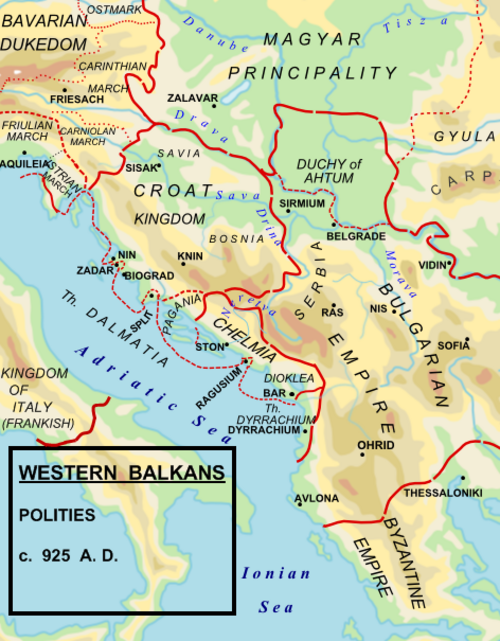
ブルガリア帝国はセルビアのジュパンを集めてチャスラフを新しいアルコンとして受け入れるよう求めたが、彼らは全員捕らえられ、ブルガリアに送られた。その後の数年間、925年と926年に、ブルガリア人はセルビアを完全に荒廃させた。 [125]住民の一部は奴隷にされてブルガリアに連れて行かれ、一部はクロアチアやビザンチン帝国に逃げることができた。[126]コンスタンティノス7世ポルフィロゲネトスによると、「国は荒廃したままになった」。[126] [127]しかし、シメオン1世が927年に死去すると状況は一変した。彼の息子で後継者のブルガリア王ピョートル1世は、国の政治を完全に変え、ビザンチンの影響を強く受けた。これにより、セルビアが荒野と化した際にブルガリアの首都プレスラフに戻ったチャスラフは、セルビアに来て国家を再建することができた。これは「7年後」に起こった[126]が、歴史家たちはそれが924年のセルビア遠征の7年後なのか、927年とシメオンの死後なのか確信が持てず、遅くとも933年から934年までには起こったはずだ。[125] DAIは、彼と4人の随行員が出会ったのは「狩猟で生計を立てていた妻子のない独身男性50人」だけだったと主張している。これは、ブルガリア人によるセルビア国家と社会の破壊がいかに徹底的であったかを示しており、「この時点で要塞は一時的に放棄されていた」と考えられている[125] 。
チャスラフは、彼の指導者であり保護者となったビザンチン皇帝コンスタンティノス7世ポルフュロゲネトスの最高権力を認めた。皇帝は多額の財政援助を含め、チャスラフがセルビアを復興するのを助けた。チャスラフはセルビアを再定住させ、近隣諸国に逃げた人々の一部を帰還させた。セルビアはビザンチンと良好な関係を保ち繁栄し、皇帝はこの時期セルビアとの良好な関係を常に強調していた。チャスラフの国の境界は不明だが、ボスニアまで拡大していた可能性がある。[128]彼の統治は940年代に終わったか、あるいは亡くなったと推定されている。[129] [125]
13世紀後半の半ば架空の『ドゥクリャ司祭の年代記』によると、ハンガリーの地方貴族キサがボスニアのチャスラフ(チャスラフ[130] )の領地を攻撃した。一部の学者はDAIのチャスラフをチャスラフと同一視しているが、これは非常に議論の余地がある。[131] [ 132]支持する学者は、マジャル人とセルビア人の紛争として知られるこの出来事が950年から960年の間に起こったとしている。 [133] [134]
940年代または960年代のチャスラフの死は、当時とこの地域では異例の長きに渡る最古のセルビア王朝であるヴラスティミロヴィッチ王朝の約350年にわたる統治の終焉を意味した。初期の王朝はすべて、610年頃から960年頃までセルビアを統治したヴラスティミロヴィッチ王朝のように、現代の歴史家によってその祖先または最も著名なメンバーにちなんで名付けられている。
その他の公国
セルビアの政治的影響下にあった他の公国としては、パガニヤ、ザフムリェ、トラヴニャ、ドゥクリャなどがある。[135] [68] [69] [70]これらの国家は北でセルビアと接していたが、 [89]初期のセルビア国家の正確な境界は不明である。[88]セルビアの支配者は「セルビア人の公(アルコン)」(αρχων Σερβλίας)と称された。 [136] DAIは、セルビアの王位は息子、つまり長子が継承すると述べている。彼の子孫が彼の後を継いだが、彼らの名前はヴィシェスラフの登場まで知られていない。 [24] [25] [106]
この時代、セルビア人に対して2つの呼び名が使われていた可能性がある。1つは最初の移住者の子孫を表す一般的な呼び名で、もう1つは地域的な呼び名である。11世紀までに、ほとんどの地域名は消え、民族名セルビア人に置き換えられた。11世紀のビザンチン将軍カタカロン・ケカウメノスは著書『戦略論』の中で、ドゥクリャ公ステファン・ヴォイスラフを「ディオクレスの」また「トラヴニアのセルビア人」と呼んでいる。同時代の歴史家ジョン・スキュリッツは、ステファン・ヴォイスラフを「セルビア人のアルコン」と呼び、「セルビア人の土地」を占領したとしている。[137] [138]
ディオクレア
ドゥクリャ(ディオクレア)地方は、アドリア海沿岸のコトル湾からドリン川河口まで広がっており、レジャ、ウルツィニ、バールなどの主要な海辺の町はビザンチン帝国の支配下にあった。ドゥクリャ地方はゼタ・ナド・モラチャの中央部を占め、トラヴニアやザクルミアと同様に、北部の山岳地帯は、コンスタンティノス7世ポルフュロゲネトゥスによって洗礼を受けたセルビアと呼ばれたヴラスティミロヴィッチ朝の中央セルビア国家に接していた。南部は、数世紀にわたって絶えず変化していたスラヴ人/セルビア人とビザンチン人の国境であるデュラキウム方面にビザンチン帝国と接していた。[139] [140]
トラヴニア
トラヴニア地方はドゥブロヴニクの奥地とコトル湾に位置し、コナヴレの肥沃なジュパを囲んでいた。トレビニェ、ヴルム、リゾン、ルカヴェテ、ゼトリヴィの5つの町があった。ヴラスティミルの統治下では、国家はある程度の自治権を与えられた。[141]ヴラスティミル大君には娘もいたが、名前は記録されていないものの、歴史上初めて言及されるセルビア人女性であった。ヴラスティミルは娘をトラヴニアのジュパであるベロイェの息子クライナと結婚させ、後に義理の息子にクネズの称号を与えた。クライナの後継者であるフヴァリミルとチュチミルも同じ称号を使った。コンスタンティヌス帝はDAIで「トラヴニアのアルコンは常にセルビアのアルコンの支配下にあった」と書いている。[24] [142] [143]
867年、マケドニアのバシレイオス1世がビザンチン皇帝になると、南イタリアのアラブ人がドゥブロヴニクを含むダルマチア諸都市を攻撃した。市民がビザンチンに救援を求めたため、皇帝はニケタス・ウーリファス率いる艦隊のドルンガリオスを派遣した。皇帝はアラブ人を撤退させ、封鎖を中止させ、こうして数十年ぶりにアドリア海におけるビザンチンの海上支配を回復した。これによりビザンチンは、870年から871年にかけてのビザンチン・フランクによるアラビア・バーリ包囲戦で、クロアチアとセルビアの土地の現地住民を補助的な海軍派遣隊として利用することが可能になった。ラグサ人が派遣した船には、クロアチア人、セルビア人、ザフムリア人、トラヴニア人、カナリテス人など、さまざまなスラヴ人が参加していたことが記録されている。ビザンチン帝国はアドリア海沿岸を荒廃させ、この地域の行政と政治関係を確立し、スプリット、トロギル、ザダル、ツレス、ラブ、クルクの町と島々にクロアチア国家への貢物を、ラグーザにセルビアのザクルミアとトラヴニアの国家への貢物を命じた。[144]
ザクルミア
ザクルミア地方は、北のネレトヴァ川上流域(洗礼を受けたセルビア)、西のナレンティア人、アドリア海沿岸からドゥブロヴニクまでのネレトヴァ川下流域を占めていた。この政体には5つの都市(ストン、モクリシュキ、ヨシュリウ、ガルマイニク、ドブリシュキ)があったが、ストンの位置のみが知られており、その集落は現在も存在し、クロアチアに位置している。[145] [146]
ブルガリア皇帝シメオンが925年と926年にセルビアを制圧し始めると、それまで同盟者だったザクルミアのミハイル・ヴィシェヴィッチは政治的志向を変えた。925年、彼はクロアチアとセルビアの領土、およびダルマチアの都市における教会組織を扱ったスプリト公会議に出席した。926年、ビザンチン同盟者として、ミハイルはコンスタンティノープルの宮廷とのつながりを強化するため、南イタリアのシポント市に対して大胆な海軍攻撃を実施した。皇帝は彼にアンティパトスとパトリキオスの称号を与えた。[123]
ナレンティーノ人(パガニア)
ナレンツィア人の地域はネレトヴァ川とツェティナ川の間の地域を占め、沿岸部のラストクとモクロ、および内陸部のダレンの3つのジュパから構成されていました。最初の2つには艦隊があり、3つ目は農業用地でした。ナレンツィア人は、ローマ化した住民が去ったムリェト島、コルチュラ島、ブラチ島、フヴァル島も領有していましたが、ナレンツィア人はそこに住み、家畜を飼っていました。彼らはセルビアの他の部族とともにキリスト教に改宗していなかったため、ギリシャ人は彼らを異教徒と呼んでいました。ヴェネツィアの年代記作者である助祭ヨハネスは、830年頃にナレンツィア人がヴェネツィアを訪れたことを述べています。彼らはまだキリスト教に改宗していなかったため、ヴェネツィアで洗礼を受けました。ナレンツィア人とヴェネツィア人の間で合意に達したが、長続きせず、835年にナレンツィア人は再びヴェネツィアの商人や宣教師を攻撃し始めました。ヴェネツィアの護民官ピエトロ・トラドニコは839年にアドリア海のバルカン半島沿岸に艦隊を派遣し、ダルマチア・クロアチアのミスラヴ公と和平を結び、ナレンツィアの族長ドルジャクと同盟(フォエドゥス)を結んだ。しかしこれも長続きせず、翌年護民官は再び艦隊を派遣したが、ナレンツィアに敗れた。[147] [148]
パガニヤは、アルコン ペタルの治世中、セルビアに従属していたとされている。しかし、その後、政体はより独立した道を歩むようになった。DAI は、ツェティナ川がパガニヤの延長線上にあるが、川はクロアチアとセルビアの国境でもあり、パガニヤはチャスラフ クロニミロヴィッチ公、または洗礼を受けたセルビアの支配下にあったと述べている。また、917 年にペタル ゴイニコヴィッチ公とビザンチンのデュラキウムのストラテゴス、レオ ラブドゥーコスが会談したのは、パガニヤで、「セルビアの支配下」にあったと述べている。しかし、パガニヤは洗礼を受けたセルビアの宗主権外にあることがほとんどだったと思われる。国境 (クロアチア、ザクルミア) のさらなる変化と影響力 (ヴェネツィア、ビザンチン) の変化により、パガニヤは中央セルビア国家から物理的に切り離された。[148]
ボスニア
ボスニアは、 DAI (χωριον βοσονα、ボスニアの小さな土地) で、洗礼を受けたセルビアの地域として初めて言及されています。 [149] [150] 12世紀のビザンチン歴史家ジョン・キナモスは、1149年の出来事について、ドリナ川が「ボスニアをセルビアの他の地域から分離している。ボスニア自体はセルビア人の大ジュパンに従属しておらず、別々に生活し、統治されている部族である」と記述し、1155年には「ハンガリーの支配者の同盟者に登録されたセルビアの地域」であるボスニアのボスニア人バン・ボリッチ 総督について言及しています。[151] [152] [153]
ビザンチン帝国の支配の回復
チャスラフ公の跡を継いだのは誰か、またこの時期のセルビアの状況はどのようなものだったかは不明である。940年代から960年代にかけてのチャスラフの死と、959年のコンスタンティノス7世ポルフィロゲネトゥスの死により、旧ヴラスティミロヴィッチ・セルビアの領域に関する情報は薄れてしまった。971年にビザンチン帝国の新皇帝、ヨハネス1世ツィミスケスがブルガリア帝国を事実上打ち倒すと、ビザンチン(「ローマ」)の最高統治は3世紀以上ぶりにドナウ川まで再び広がった。こうしてセルビアの土地はビザンチン帝国の直接統治下に入った。[27]発見された多くの貨幣の埋蔵物は、10世紀末から11世紀初頭にかけてビザンチン、ブルガリア、セルビアの間で継続的な紛争があったことを示している。[154]
当初、中央セルビアは現地の君主ではなくラス・カテパナ国として組織され、ビザンチンの行政官によって統治された。彼はカテパノ(またはドゥクス)という高い地位を持ち、ラスに座していた。[155]しかし、この状況は長くは続かず、976年にヨハネス1世ツィミスケスが死去するとすぐに、中央バルカン半島でコメトプリの反乱が勃発し、しばらくの間ブルガリア国家が復活した。その後の数十年にわたるビザンチンによるブルガリア征服の戦争は、セルビア人を困難な立場に置いた。991-992年に海路でビザンチン皇帝バシレイオス2世ブルガリア人殺しに会いに行ったセルビア代表団の記録がある。この代表団はセルビアの海洋国家のいくつかから来たと考えられている。この時期、 1000年頃に海上ドゥクリャの支配者であったヨヴァン・ウラジミールの支配が「セルビアの地域」にまで及んでいたことが記録されている。 [27]
1018年にブルガリアが敗北し、皇帝イヴァン・ヴラディスラフが死去すると、ビザンツ帝国はセルビア領土の無政府状態と混乱を利用し、再びビザンツ帝国の直接統治を復活させた。中央セルビアはテマ・セルビアという新しい軍事行政地域として組織され、ストラテゴスによって統治された。ドゥクリャはデュラキウムのドゥクスに従属し、トラヴニアの状況は記録が残っていないため不明瞭である。ザクルミアでは地元のセルビア人王子が権力を握っていたが、彼らは確立されたビザンツの行政秩序に統合された。例えば、リュトヴィト公はビザンツの称号プロトスパタリオス・エピ・トゥ・クリソトリクリノウ(文字通り「最初の剣持ち」)を与えられ、ある時点でセルビアとザクルミアのストラテゴスに任命された。 [27]
中世盛期

ドゥクリャと内セルビア(ラシュカ)のヴォジスラブリェヴィッチ王朝
ドゥクリャは中世セルビア人の国家で、西はコトル湾から東はボヤナ川、北はゼタ川とモラチャ川の源流まで、現在のモンテネグロ南東部の領土をほぼ取り囲んでいた。ドゥクリャは10世紀のビザンチン年代記で初めて言及され、11世紀と12世紀のドゥクリャの歴史に関する最も重要な資料であり続けている。ヨハネス・スキュリツェス、スキュリツェス・コンティヌアトゥス、カタカロン・ケカウメノス、アンナ・コムネネの著作『アレクシアス』など。コンスタンティノス7世ポルフィロゲネトゥスはドゥクリャの統治者に関するデータを一切提供していない。9世紀か10世紀の鉛の印章には「ドゥクリャ公ペトル」という人物が記されているが、彼に関する他のデータは存在しない。[156] [27]
ドゥクリャの王子ヨヴァン・ウラジミールは、998年から999年にかけてサムイル皇帝がドゥクリャを征服しようとした際にブルガリア人に捕らえられた。その後ヨヴァン・ウラジミールはサムイルの親戚のコサラ(初期の年代記では彼女はサムイルの娘とされている)と結婚し、ドゥクリャに戻ってブルガリアの家臣として統治することを許された。ヨヴァン・ウラジミールはビザンチンとも良好な関係を維持していたが、それが彼の死につながったのかもしれない。1014年にサムイルが亡くなった後、彼の息子で後継者のガヴリル・ラドミールは、1015年に従兄弟のイヴァン・ウラジミールによって暗殺された。1016年5月22日、ヨヴァン・ウラジミールの義理の従兄弟でもあったイヴァン・ウラジミールは、プレスパの町の教会の前でヨヴァン・ウラジミールを暗殺した。ヨヴァン・ウラジミールは、その敬虔な生涯と殉教の死により、セルビア人として初めて聖人となった。一方、ビザンチンの文献では、彼は「公正で、平和的で、徳に満ちた人物」と評されている。[27]
ヨヴァン・ウラジミールの後を継いだのは、1018年に死去した父方の叔父で地元の王子であったドラギミールである。ドラギミールの後を継いだのは息子のステファン・ヴォイスラフである。彼はビザンチンの資料ではセルビア人、トラヴニア人、ドゥクリャン人と様々に呼ばれている。彼の母はラシュカの支配者リュトミル(あるいはリュトヴィト)の娘であった。ステファン・ヴォイスラフは父の死後間もなく、ドリナ地方のブルスノで生まれた。この統治者の起源は正式な歴史記録では不明瞭であるため、一部の歴史家はトラヴニア公爵家の分家であると考えている。[27]
上昇

1018年にブルガリアが崩壊した後、ドゥクリャはビザンチン帝国の属国となったが、 1034年にロマノス3世アルギュロス皇帝が死去するとすぐに、ステファン・ヴォイスラフがビザンチン帝国に反乱を起こした。しかし、反乱は1036年に鎮圧され、ステファン・ヴォイスラフは捕らえられてコンスタンティノープルに連行された。セルビアにおけるビザンチン帝国の直接統治が復活し、セルビアの新しいストラテゴスは将軍テオフィロス・エロティコスであった。ステファン・ヴォイスラフは1037年か1038年に捕虜から逃亡し、1039年までにセルビアに戻り、テオフィロスを追放して、支配下の領土を拡大し、ドゥクリャと「イリイラン海岸」(バル、ウルツィニ、スクタリの各都市)を占領した。これらはビザンチン帝国のテマ・デュラキウムに属していた。彼はまた、1039年から1040年の冬にアドリア海で帝国の船を攻撃し略奪し始めた。これがきっかけで、次の皇帝ミカエル4世パフラゴニア(在位1034年から1041年)は、1040年春に宦官ゲオルギオス・プロヴァタスの指揮のもと、ステファン・ヴォイスラフへの遠征を行なった。プロヴァタスは大敗した。「国に到着し、峡谷や峡谷、道なき土地の奥深くに入り、全軍を失い、かろうじて命を救った」[157] [27]
これに勇気づけられたステファン・ヴォイスラフは、国土を拡大し続け、ビザンチン同盟国を挑発し続けた。新皇帝コンスタンティノス9世モノマコス(在位1042-1055年)は、1042年秋に新たな遠征軍を派遣した。軍は、1042年10月6日の彗星観測の直後に派遣された。4万から6万人の兵士を擁する帝国軍は、デュラキウム公ミカエルが率いていた。ミカエルは当初成功を収めた。彼はステファン・ヴォイスラフの国土に深く侵入し、多くの「略奪品と捕虜」を集め、帰還を決意した。しかし、ステファン・ヴォイスラフは、ルミヤ山の峡谷で待ち伏せを仕掛けた。攻撃は、セルビア人が山の上からビザンチン軍を投げつけ、あらゆる種類の発射兵器を使って大量の石と矢の嵐でビザンチン軍を埋め尽くしたときに始まった。ミハイルはなんとか生き延びたものの、4万人の兵士と7人のストラテゴを失った。バールの戦いとして知られるこの戦いに勝利することで、ステファン・ヴォイスラフはバルカン半島のこの地域におけるビザンチン帝国の支配を鎮圧し、セルビア人統一国家の統治者としての地位を固めた。この統一セルビア国家は、移住以来初めて、5つの歴史的公国のうち4つ、すなわちセルビア(ラシュカ、ドゥクリャ、トラヴニア、ザクルミア、ネレトヴァ川とボヤナ川の間に広がる)を包含した。しかし、ステファン・ヴォイスラフは、象徴的ではあるものの、ビザンチン帝国との従属関係を公式に維持した。[157] [27]
最初のセルビア王国


1040年半ば、ステファン・ヴォイスラフが亡くなり、息子のミハイロ・ヴォイスラフリェヴィッチが後を継いだ。新公は1053年頃にコンスタンティノス9世モノマコス皇帝と条約を結び、プロトスパタリオスの称号を授かった。この称号は特に高いものではなかったが、帝国の知事に与えられたものであり、象徴的な家臣関係がまだ維持されていたことを示している。ドゥクリャとコンスタンティノープルの良好な関係は1070年代まで続いた。 1071年のマンジケルトの戦いでセルジューク朝に大敗し、新皇帝ミハイロ7世ドゥーカスの統治に対する不満が広がると、ビザンチン帝国は急激に弱体化し、内紛や暴動が勃発した。[157] [27]
1072年9月、スコピエのブルガリア貴族による反乱がゲオルギ・ヴォイテフ率いるブルガリアのビザンツ領内で発生した。反乱の指導者たちはミハイロに救援を要請し、彼はそれに応じ、息子のコンスタンティン・ボディンと指揮官ヴォイヴォダ・ペトリロが率いる300人の兵士からなる部隊を派遣した。ブルガリア・セルビア連合軍はプリズレンに集結し、ここでボディンはブルガリア皇帝を宣言され、シメオン皇帝の息子であるブルガリア皇帝ペタル1世にちなんでペタルの名を与えられた。ビザンツ帝国軍は反乱鎮圧のために派遣されたが、大敗した(「恐ろしい戦いとローマ人のさらに恐ろしい敗北」)。ビザンツ攻撃軍のリーダーであるダミアン・ダラセノスとロンバルディア人傭兵ロンギバルドプロスは捕らえられた。この勝利とスコピエの征服の後、ボディンは軍を二つに分けた。彼は北へ向かう部隊の指揮を執り、ニシュへ向かう一方、ペトリロは南へ向かう部隊を率いてオフリド、デヴォル、カストリアへと向かった。ペトリロはカストリアで敗れ、一方ボディンはニシュを征服した。ヴォイテからの呼びかけに応じて、ボディンはコンスタンティノープルから派遣された新しい帝国軍によって奪還されたスコピエの再征服に戻ったが、1072年12月にタオニオス(後のパウニ平原)でビザンチン軍に阻止され、敗北し、捕らえられた。ミハイロは息子を救うために新しい連隊を派遣したが、失敗した。ミハイロに宮廷に連れて行かれ、ミハイロの娘と結婚したロンギバルドプロスは、セルビア人とロンバルド人の兵士からなる救出隊の1つを率いていたが、義理の兄弟であるボーダンを裏切り、タオニオスでビザンチン側に寝返った。ボーダンはコンスタンティノープルに連行され、聖セルギウス修道院に投獄された後、アンティオキアに移送された。ミハイロはヴェネツィア商人のグループに賄賂を贈り、投獄からボーダンを救い、ドゥクリャに返した。ボーダンがドゥクリャの統治に参加したことは以前には言及されていなかったが、彼の帰還後、資料によるとミハイロは「以前の統治を回復した」ため、1072年以前はボーダンは共同統治者だったようだ。[157] [27]
ビザンツ帝国との関係を断絶していたこの時期に、ミハイロはローマに頼った。当時、教皇グレゴリウス7世は神聖ローマ皇帝ハインリヒ4世との叙任権論争に巻き込まれていたため、両者はヨーロッパ中に同盟国を探していた。この流れで、教皇は1075年にクロアチアのデメトリウス・ズヴォニミールに、1076年か1077年にミハイロに王の称号を与え、1078年1月9日の手紙では、教皇はミハイロをスラヴ人の王( Michaeli Sclavorum regi ) と呼んでいる。これにより、ミハイロは公式に王と宣言された最初のセルビアの支配者となり、ストンにある彼の寄進地である聖ミカエル教会のフレスコ画には王として描かれている。当時の外交上、これはドゥクリャが国際的に独立国家として認められることを意味した。この認識はすぐにビザンチン帝国によって認められ、ビザンチン帝国はミハイロの後継者であるボディンをアルコンではなくエクソシアステス(他の外国の君主と同様に)と呼んだが、ミハイロをそのように呼ぶことはなかった。[27]
ミハイロは1081年半ばまで息子のボディンと共同統治を続けた。この時期以降は、ボディンのみが言及されている。しばらくの間、ビザンチン帝国との関係は再び良好だった。歴史家アンナ・コムネネは、皇帝アレクシオス1世コムネノスが「ダルマチアの総督であるボディンとミハイロを友人にし、手紙や贈り物で彼らの共感を得て、多くの秘密の扉を開いた」と書いている。ボディンにはビザンチンの高位の称号であるプロトセバストスが与えられた。ミハイロの統治の最後の時期には、南イタリアのビザンチン諸州と良好な関係を築いた。その結果、ボディンはバーリの知事アルギュリッツォスの娘であるバーリのジャキンタと結婚した。アルギュリッツォスはノルマン人として、ノルマン人の南イタリア征服を支持した。その後、ノルマン人はバルカン半島のビザンチン領土を攻撃する計画を立てた。ロベルト・グイスカルド率いるノルマン人は、デュラキウムを占領することを決めた。ボーダンは当初ノルマン人と数回の小競り合いを繰り広げ、来たるデュラキウムの戦いでは皇帝アレクシオスに味方した。戦いは1081年10月18日に起こったが、ボーダンは戦闘には一切参加しなかった。彼は軍を脇に置き、ノルマン人が勝利しているのを見てドゥクリャに戻った。彼はこのビザンツの敗北を利用して、ビザンツ帝国がまだ存在すると考えていた正式な従属関係を放棄し、ドゥクリャの奥地を攻撃し、ビザンツからラシュカ(旧ヴラスティミロヴィッチ王朝の領地)とボスニアの土地を奪い、ラシュカには甥のヴカンとマルコ、ボスニアにはステファンを総督に任命した。[157] [27]
これにより、アレクシオスとボダンの関係は修復不可能なほど悪化した。ビザンチン帝国は、ロベルト・グイスカルドの死後弱体化したノルマン人を追い出し、1085年にデュラキウムを奪還した。デュラキウムの新総督、ヨハネス・ドゥーカスは、ボダンおよびヴカンと絶えず戦い、1091年または1092年にボダンを捕らえることに成功した。彼の不在中は女王ヤキンタが統治したが、ボダンは再び脱出し、1093年または1094年に王位を奪還し、再びビザンチン帝国と交戦した。しかし、この時までに彼はすでに権力を失っており、ボスニアとラシュカは従属義務を放棄して別々の国となり、一方ラシュカのヴカンは「ダルマチア(現代のクロアチアの地域ではなく、ローマの意味でのダルマチア)で全権力を握った男」と評された。ボーダンが最後に言及されるのは1096/1097年の冬である。彼は、トゥールーズのレーモンドとル・ピュイの司教アデマールが率いるエルサレムへの最初の十字軍の旅を歓迎した。このとき、ボーダンとレーモンドはポブラティミ、つまり血のつながった兄弟になった。ボーダンは1101年に亡くなった。[157] [27]
衰退
ミハイロとボーディンの統治下で、ドゥクリャは絶頂期を迎えた。セルビアの奥地を併合し、そこに従属君主を据えたこの海洋公国は、支配者たちが用いた称号(「セルビア公」、「セルビア人」)に見られるように、最も強力なセルビア人国家として台頭した。しかし、その隆盛は結局長くは続かなかった。ボーディンの死の時点では、ラシュカとボスニアは事実上ボーディンの国から独立していたが、ドゥクリャ自体はその後数十年間に内戦に見舞われ、王位はボーディンの王家の分家から、ボーディンの父方の叔父であるブラニスラフの血統の者へと受け継がれた。この時期の適切な歴史記録がないため、日付もおおよそのものである。ボディンの兄弟ドブロスラフ2世が直々に王位を継承し(1101年 - 1102年)、続いてブラニスラフの兄弟コチャパルが継承し(1102年 - 1103年)、その後、同じくボディンの兄弟ウラジミールの息子ウラジミールが王位に就いた(1103年 - 1114年)。ボディンの息子ジョルジェは1114年から1118年まで統治し、その後ビザンチンの保護下にあったグルベシャ(1118年 - 1125年)に取って代わられた。ジョルジェは1125年に権力を取り戻したが、ビザンチンは再び彼らのお気に入りの一人であるグラディニャ(1131年 - 1146年)を王に据えた。グルベシャとグラディニャは2人ともブラニスラフの息子であった。グラディニャの跡を継いだのは息子のラドスラフであったが、1162年にその領地はデサのラシュカの伯爵に奪われた。[27]
しかし、ラドスラフの後を継いだのはウラジミール王の息子ミハイロであった。アンティヴァリ・グルグル大司教の手紙には、ラシュカ大主教ステファン・ネマニャとその兄弟ストラチミール・ザヴィドヴィッチ、フムのミロスラフがミハイロの「彼に多大な圧力をかけている母方の叔父」として描かれている。12世紀はドゥクリャにとって混乱の時代であり、王家の交代が何度も起こり、ボーディンの後継者たちはヴカンの台頭から始まり、ますます勢力を強める隣国ラシュカの影に隠れた。1113年から1149年の間、ドゥクリャはセルビアとビザンチンの紛争の中心地となり、ヴォイスラヴリェヴィッチ家のメンバーは権力をめぐって互いに争う子分となった。この時期のドゥクリャの統治者の中には公爵の称号を得た者もいれば、王の称号を保持した者もいた。ボーディン王の息子であるジョルジェの印章にも、「ジョルジェ王」ではなく「ボーディン王の息子であるジョルジェ」と記されていた。1186年1月、ステファン・ネマニャはついにドゥクリャを征服し、ラシュカに併合した。ドゥクリャの最後の統治者ミハイロの信仰は不明だが、1189年には彼の妻デシスラヴァが未亡人であったと記されている。ドゥクリャはその後ラシュカの王領となり、後にゼタとして知られるようになり、14世紀にセルビア帝国が崩壊するまでその名が残っていた。この時期にドゥクリャ・ゼタを統治したネマニッチ王朝の人々は、王の称号を与えられた。最初の王であるヴカン・ネマニッチは、父ステファン・ネマニャによって任命され、「ドゥクリャ、ダルマチア、トラヴニア、トプリカ、フヴォスノ」(ラテン語:ディオクリエ、ダルマチア、トリブニエ、トプリカ、コズネ)の王(rex)の称号を与えられました。[158]
セルビア内陸部のヴカノヴィッチ王朝(ラシュカ)

セルビア大公国は、歴史的なラシュカ(ラテン語:Rascia)地方を中心とし、 [159] 1090年頃に建国され、 [160] [161] [162] 1217年に王国に昇格するまで存続した。この期間の前半、ラシュカはドゥクリャのヴォイスラヴリェヴィッチ王朝の分家であるヴカノヴィッチ王朝によって統治され、後半はヴカノヴィッチ王朝の分家であるネマニッチ王朝によって統治された。[163]
起源と拡大
1081年にビザンチン帝国がデュラキウムでノルマン人に敗れた後、ドゥクリャのボディンがバルカン半島の奥地にあるビザンチン帝国の領土を攻撃し、ラシュカと旧ヴラスティミロヴィチ王国を征服した。ボディンはその廷臣で甥のヴカンとマルコを1082年頃に地方の知事、ジュパンに任命した。マルコは記録に再び登場することはなく、歴史家は後にこの王朝をヴカンにちなんで名付けたが、厳密にはマルコが新王朝の祖先であり、その息子がヴカンの後を継いだ。1085年にビザンチン帝国がデュラキウムを奪還した後、ヨハネス・ドゥーカスとの戦争で、ヴカンは当初、最高統治者であるボディン側で戦っていくつかの要塞都市を失った。しかし、1090年にボディンがビザンチン帝国に捕らえられていた間に、彼はドゥクリャとの家臣関係を断ち切り、大君主の称号を得て、古代ダルマチア(バルカン半島中央西部)で最も強力な支配者として浮上した。[164]
1093年、ヴカンはビザンツ帝国が支配するコソボ平原に侵入し、リプリャンの町を征服して焼き払った。皇帝アレクシオス1世コムネノスは自ら軍を率いてヴカンと交戦した。しかし、ヴカンは要塞化されたズヴェチャンの町に撤退し、交渉を申し出た。皇帝がこれを承諾したことは、ヴカンが明らかに重要視していたことを示している。ヴカンは自分が持つ力を認識していたようで、すぐに再び休戦協定を破り、1093年から1094年にかけて再びコソボを攻撃した。ヴカンは皇帝の甥ヨハネス・コムネノスが率いるビザンツ軍を破り、進撃を続け、最初はズヴェチャンとリプリャンの間のコソボ平原地域を征服したが、さらにビザンツ領の奥深くまで進軍してスコピエ周辺を略奪し、ヴラニェとポログ渓谷を獲得した。皇帝アレクシオス1世コムネノスは1094年の夏に再びリプリャンを訪れ、ヴカンは再び交渉した。ヴカンは将来ビザンツの領土を攻撃しないことを受け入れ、兄弟の甥であるウロシュとステファン・ヴカン、および他の従兄弟とジュパン約20人を担保としてビザンツ帝国に送った。1112年から1115年頃に死去する前の1106年春、ヴカンは再びビザンツを攻撃した。同年11月に戦闘が終結する前に、ヴカンは再びヨハネス・コムネノスを破った。ヴカンは隣国のドゥクリャにも介入した。ボディン王の死後、ヴカンは継承戦争に参加した。彼はドブロスラフ2世に反対するコチャパルを支援した。モラチャの戦いでドブロスラフ2世は敗れ、捕らえられ、鎖につながれてラシュカに送られた。コチャパルとヴカンはその後ドゥクリャを占領し、「ダルマチアの非常に大きな部分」を略奪した。ヴカンは後に、歴史上名前のない娘を、コチャパルのドゥクリャ王位継承者であるウラジミールと結婚させた。彼はその後、ウラジミール王の父方の叔父であったドブロスラフを解放した。[165] [166]
ビザンチン帝国の宗主権
ヴカンの後を継いだのは甥のウロシュ1世で、ウロシュ1世は兄弟のマルコの息子であったが、1094年にビザンツ帝国に引き渡された。1世紀に及ぶコムネノス・ルネサンスとして知られるビザンツ帝国の新たな拡大と成長の時期に、歴史的には不明の状況下でビザンツ帝国はラスを占領し、そこに軍の部隊を駐留させた。ビザンツ帝国はセルビアに対する属国支配を復活させ、セルビア人に対して厳しい統制を確立した。ビザンツ帝国の皇帝ヨハネス2世コムネノスは、大量の住民を小アジアのニコメディアに再定住させた。 1127年~1129年のビザンツ・ハンガリー戦争が勃発した後、セルビア人はビザンツ帝国に対して反乱を起こした。最終的には敗れたものの、セルビア人はラスの町を奪還し、破壊することに成功した。ヨハネス2世コムネノスは、セルビア人に都市を奪われたラスの司令官を罰し、彼に女性の服を着せ、ロバに乗ってコンスタンティノープルの街を歩かせた。その後、ハンガリー軍がドナウ川に現れてビザンチン帝国と様々な小競り合いをするたびに、セルビア人は反乱を起こした。[165] [167]
この状況により、ウロシュ1世はハンガリー人の間に支援を求めるようになり、その結果、セルビア王朝とヨーロッパの支配王朝との最初の婚姻関係が生まれた。ウロシュ1世の娘ヘレナは、ハンガリー王ベーラ2世と結婚した。彼女は、当時王位継承者であったベーラの叔父で前王であるイシュトヴァーン2世から1129年にプロポーズされた。ベーラ2世が1131年に王位を継承した後、彼が幼少時に失明したため、ヘレナが事実上の統治者となった。彼女は、ベーラの失明に加担した有力者たちへの報復と大量処刑を組織した。彼女はまた、息子ゲーザ2世の摂政時代と統治初期の期間にも統治を拡大した。彼女の他の2人の息子、ラスロー2世とイシュトヴァーン4世も後にハンガリー王となった。ヘレナの兄弟ベロシュもハンガリーに居を構え、プファルツ、ハンガリー共同摂政(1141年 - 1146年)、クロアチアのバン(1142年 - 1158年と1163年)となった。ベロシュは娘を後にキエフ大公となるウラジーミル3世ムスティスラヴィチと結婚させた。ウロシュ1世は2番目の娘マリアをボヘミア公コンラト2世ズノイモと結婚させ、マリアはセルビアのマリアとして知られるようになった。ウロシュ1世の残りの2人の子供、息子のウロシュ2世とデサはセルビアに残り、政治に参加した。ハンガリーに支援されたウロシュ1世の政治により、ビザンツ帝国がドゥクリャで行ったようにラシュカを完全に占領して解体することはしばらくの間できなかった。ウロシュ1世の統治下でも、ラシュカ王朝とドゥクリャ王朝は同じ血統であったにもかかわらず、互いの政務に干渉し合う傾向が続いた。[168] [169]

ウロシュ2世は1146年に父の後を継ぎました。家臣として、彼はヨーロッパでのビザンチン戦争やアジアでのトルコとの戦争の際には軍隊を派遣する義務がありました。ヨーロッパの政治情勢は第2回十字軍(1147~1149年)中および後に劇的に変化しました。ドイツのコンラート3世とビザンチン皇帝マヌエル1世コムネノスは同盟を結びました。脅威を感じたフランスのルイ7世は、南イタリアのノルマン人、ドイツにおけるコンラートの敵、ハンガリー王を含む独自の同盟を結成しました。ウロシュはビザンチンの保護を振り払うためにこのグループに加わりました。ビザンチンとハンガリーのより広範な戦闘の範囲内で、セルビア人とビザンチン人の間の戦争は 1149 年から 1153 年まで断続的に続いた。1149 年と 1150 年に激しい戦闘が起こった際、皇帝マヌエルは自ら軍を 2 度率いた。1149 年、ビザンチン人は短期間ラスを占領し、町を破壊し、ウロシュの宮廷を焼き払った。また、ガリチとニカヴァの町も占領した。1150 年の晩夏、セルビア人はハンガリーの大規模な分遣隊の支援を受けて決戦が起こった。現在のヴァリェヴォ近くの小川であるタラの戦いでは、皇帝マヌエル 1 世は軍の 2 度目の指揮官として「英雄的に戦い、軍を大勝利に導いた」。歴史家ヨハネス・キナモスによれば、敗北後、皇帝の知らないうちにウロシュ2世は解任され、1150年11月に弟のデサが新たな大宰相に任命された。しかし、マヌエル1世は1151年までにウロシュ2世を復位させ、ウロシュ2世は再び臣下としての立場を認め、さらに多くの義務を受け入れた。[170] [171] [169]
ウロシュは1153年にセルビアの完全独立を再び試みたが、本格的な戦争に発展する前から、彼は再びビザンチン帝国の最高権力を認めていた。ハンガリーとビザンチン帝国の衝突が1155年に終結すると、ウロシュの独立回復の試みも終わった。1155年に弟のデサが再び彼を廃位したが、皇帝の家臣であったウロシュはマヌエルから一定の支援を受けていた。2人の兄弟がマヌエルの前に立ちはだかり、マヌエルは再びウロシュを選んだ。ウロシュは1162年に再び反乱を起こすまでマヌエルに忠誠を誓った。その後マヌエルはついにウロシュを廃位し、ハンガリーからセルビアに帰国したばかりの弟のベロシュを任命した。わずか数か月後、ベロシュはハンガリーに戻り、マヌエルはデサを新しい大総督に任命した。[165] [172]
ウロシュ1世の末息子であるデサは、最終的に王位に就く前に、12世紀半ばからドゥクリャ、ザクルミア、トラヴニアの古い領土を統治していました。1155年に兄のウロシュ2世を倒そうとする2度目の試みが失敗した後、ニシュ近郊のデンドラ地方を与えられました。1162年にマヌエルが彼をセルビア王位に任命したとき、デサは生きている限り忠誠を誓い、デンドラから完全に撤退してビザンチン帝国に任せると約束しました。しかし、彼はデンドラを離れることを拒否したため、1163年に皇帝がニシュに来たとき、マヌエルに正当化しなければなりませんでした。同じ年に、ハンガリーとビザンチン帝国の間で5年間にわたる戦争が勃発しました。デサは両者のバランスを取ろうとしているように見えたが、ビザンツ帝国からのセルビアの独立を確保するという永続的な努力において、ハンガリー側に傾いていた。彼はドイツ人と接触し、ドイツの王女たちと結婚しようとさえした。マヌエルは戦争中のデサの態度に満足しなかった。何度か警告した後、皇帝はデサを捕らえてコンスタンティノープルに追放したが、デサはどうやら逃げることができたようだ。結局、マヌエルは1165年にデサを追放し、デサはハンガリーに逃亡した。皇帝は新しい大宰相として、ヴォイスラヴリェヴィッチ王朝とヴカノヴィッチ王朝の支族の一員であるティホミールを任命した。この王朝はネマニッチ王朝へと発展した。[173] [163] [169]
ティホミールは4人兄弟の1人で、全員が地方領主だったが、皇帝マヌエルが彼を主君に任命した。他の3人の兄弟はストラチミール、ミロスラフ、ステファン・ネマニャである。彼らは、やはり地方領主で統治者一族の一員であったザヴィダの息子であったが、ヴカノヴィッチ朝との正確なつながりは不明である。ヴカノヴィッチ朝末期の混乱した時代にもかかわらず、兄弟の誰も国家レベルで目立った役割を果たさなかった。兄弟間の緊張が高まり、任命された翌年の1166年に、ティホミールはステファン・ネマニャによって打倒され、単独の統治者となった。[172]
中世後期
中世セルビア王国
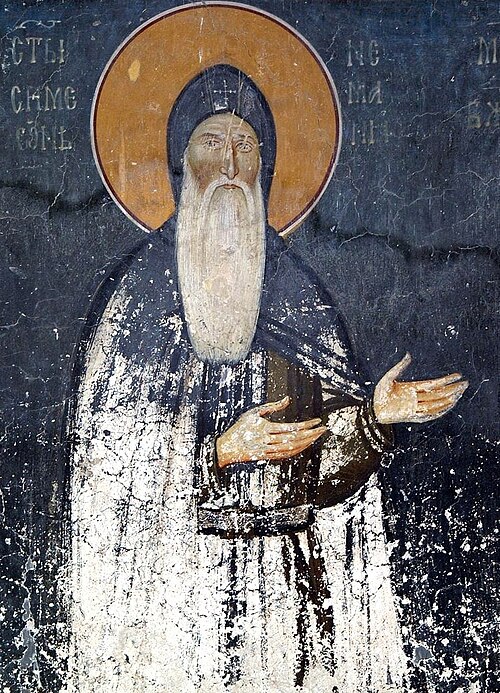

ステファン・ネマニャ大公(1166-1196)はセルビアの領土を統一し、衰退しつつあったビザンチン帝国から独立を果たした。[174] [175] [176]次男のステファンが後を継ぎ、長男のヴカンはゼタ地方(現在のモンテネグロ)の統治を任された。ステファン・ネマニャの末息子ラストコは修道士(サヴァ)となり、国民の間に宗教を広めることに全力を注いだ。カトリック教会は既にバルカン半島にも影響力を及ぼす野心を持っていたため、ステファンはこれを利用し、1217年に教皇から王冠を得た。ビザンチンでは、サヴァがセルビア教会の独立をなんとか確保し、1219年にセルビア人初の大司教となった。同年、サヴァはセルビア初の憲法であるザコノプラヴィロを発布した。こうして中世セルビア国家は政治的独立と宗教的独立の両方を獲得した。[177] [178] [179]
セルビアの統治者の次の世代、ステファン王の息子たち、ステファン・ラドスラフ、ステファン・ヴラディスラフ、ステファン・ウロシュ1世の時代は、国家構造の停滞期を特徴づけた。3人の王はいずれも、多かれ少なかれ近隣諸国、すなわちビザンツ、ブルガリア、ハンガリーのいずれかに依存していた。ハンガリーとの関係が決定的な役割を果たし、ウロシュ1世の後を継いだのは、ハンガリーの王女を妻とする息子のステファン・ドラグティンであった。後に、ドラグティンが弟のミルティンに譲位すると(1282年)、ハンガリー王ラディスラウス4世は彼にボスニア北東部、マチュヴァ地方、ベオグラード市の領土を与え、一方で彼はセルビア北東部の領土を征服し併合した。こうして、これらの領土の一部が初めてセルビア国家の一部となった。彼は兄と同盟を組み、クチェヴォとブラニチェヴォの地域も獲得した。彼の新しい国家はスレム王国と名付けられた。当時、スレムという名前は2つの地域、上スレム(現在のスレム)と下スレム(現在のマチュヴァ)を指していた。ステファン・ドラグティンの統治下のスレム王国は実際には下スレムであったが、歴史資料の中にはステファン・ドラグティンが上スレムとスラヴォニアも統治していたと記されているものがある。ドラグティンが死去(1316年)した後、スレム王国の新しい支配者は彼の息子である王ヴラディスラフ2世となり、1325年までこの国を統治した。[180] [181]
ドラグティンの弟、ステファン・ミルティン王の統治下で、セルビアは時折3つの戦線で戦争を戦わなければならなかったにもかかわらず、強くなっていった。ミルティン王は有能な外交官で、中世の外交や王朝の結婚の慣習を大いに利用した。彼はハンガリー、ブルガリア、ビザンチンの王女と5回結婚した。彼は教会の建設でも有名で、その中には中世セルビア建築の最も素晴らしい例である、コソボのグラチャニツァ修道院、アトス山のヒランダル修道院の大聖堂、エルサレムの聖大天使教会などがある。ミルティン王は波乱に満ちた人生にもかかわらず、その寄付金により聖人とされている。[182] [183]
Milutin was succeeded by his son Stefan Dečanski, who maintained his father's kingdom and had monasteries built, the most notable being Visoki Dečani in Metohija (Kosovo), after which he is known in historiography.[184] Visoki Dečani, Our Lady of Ljeviš and the Gračanica monastery, all founded by Dečanski, are part of the Medieval Monuments in Kosovo, a combined World Heritage Site.[185] After decisively defeated the Bulgarians, Serbia was caught up in an internal war between two groups of the Serbian nobility, one supporting Dečanski, the other supporting his son Stefan Dušan which sought to expand to the south. The struggle ended in 1331, when the old King was forced to abdicate.[186]
Serbian Empire


In the first half of the 14th century Serbia flourished, becoming one of the most powerful countries in Southeastern Europe. It had a substantial political, economic, and cultural achievements, followed by high ambitions of its new ruler. Stefan Dušan became King of Serbia in 1331 and in the following decades fought the Byzantine Empire, taking advantage of the Byzantine civil wars. After conquering Albania, Macedonia and much of Greece, he was crowned Emperor in 1346, after having elevated the Serbian archbishopric into a patriarchate.[187] He had his son crowned King, giving him nominal rule over the "Serbian lands", and although Dušan was governing the whole state, he had special responsibility for the "Roman" (Byzantine) lands.[187] "Dušan's Code" was enacted in 1349 and amended in 1353–1354.[188][189] Dušan sought to conquer Constantinople and become the new Byzantine emperor, however, he suddenly died in 1355 at the age of 47. His son and successor, Serbian Emperor Stefan Uroš V (1355-1371) did not inherit his father's ruling abilities, and by 1365 magnates appointed him a co-ruler, King Vukašin of Serbia, who fell in Battle of Maritsa, fighting against Ottoman Turks.[190]
During the period of the Serbian Empire, there were instances where Albanians persecuted Serbs. These actions included attacks on Serbian communities, leading to violence, displacement, and the destruction of property. Such conflicts were part of the broader regional struggles during the empire's existence.[191]
Decline

The death of Emperor Stefan Uroš V in 1371 marked the end of the Nemanjić dynasty in Serbia. The empire in disintegration was left without an heir and regional magnates (velikaši) finally obtained the absolute rule over their provinces, completing the process of feudal fragmentation. They continued to govern as independent rulers, with titles such as gospodin, and despot, given to them during the Empire.
Serbian lands were thus divided between the regional lords: King Marko, son of King Vukašin of Serbia, claimed the royal title and seized southwestern regions, while the Dejanović brothers, nephews of the late Emperor Stefan Dušan, ruled the southeastern provinces. Other lords were: Đurađ I Balšić, Vuk Branković, Nikola Altomanović, and Lazar Hrebeljanović.[192] Lazar managed to rule most of what is today Central Serbia (known as Moravian Serbia). He was unable to unite the Serbian magnates, as they were too powerful and pursued their own interests, fighting each other.[193] On the other side, Tvrtko I of Bosnia annexed several western regions, and claimed, since he was descended through his paternal grandmother from the Nemanjić dynasty, that he was the rightful hair to Serbian throne. In 1377,[194] he came to his newly acquired provinces in western Serbia and was crowned in Mileševa Monastery as King of the Serbs and Bosnia.[195]
The period after the Battle of Maritsa (1371) saw the rise of a new threat, the Ottoman Turks. They began raiding Moravian Serbia in 1381, though the actual invasion came later. In 1386, Lazar's knights beat the Ottoman army near Pločnik,[196] in what is today southern Serbia. Another invasion by Ottomans came in the summer of 1389, this time aiming towards Kosovo.[197]
On 28 June 1389 the two armies met at Kosovo, in a battle that ended in a draw, decimating both armies (both Lazar and Murad I fell).[198] The battle is particularly important to Serbian history, tradition, and national identity,[199] as symbolized in the Kosovo Myth.[200] By now, the Balkans were unable to halt the advancing Ottomans. Eventually, Serbian nobility became Ottoman vassals.[201]
Serbia managed to recuperate under Despot Stefan Lazarević,[202] surviving for 70 more years, experiencing a cultural and political renaissance, but after Stefan Lazarević's death, his successors from the Branković dynasty did not manage to stop the Ottoman advance. Serbia finally fell under the Ottomans in 1459, and remained under their occupation until 1804, when Serbia finally managed to regain its sovereignty.
Serbian Despotate

Despite the deep-seated impression that the mighty medieval Serbian state perished in one single magnificent battle, as derived from the Kosovo Myth, Serbia survived exactly 70 years after the 1389 Battle of Kosovo and perished under the Ottomans gradually languishing and shrinking. The danger was hinted already during its higher position of power, under the rule of emperor Dušan, when the Ottomans made the first permanent foothold on the European continent. Critical position was enhanced after the crumbling of the unified empire into the separate feudal states and the Battle of Maritsa (1371) and Kosovo. The battles reduced the state's territory and diminished its "living force". The Ottoman defeat by the Timurid Empire at the Battle of Angora in 1402 and the ensuing turmoil in the empire, allowed for several decades of revival in Serbia (Lazarević renaissance).[202]
In this period, during the reigns of despots Stefan Lazarević (1389-1427) and Đurađ Branković (1427-1456), Serbia cooperated with Hungary. In the second half of the 15th century, the Ottoman conquest became a major issue in the European politics. Taking Crusades as a mold, both the rulers of the European states and the church leaders forged a myriad of plans for researching and repelling the Turks. However, when the time for the serious preparations would come, the funding would turn out to be a major problem. As the feudal states engaged more and more in the mutual wars, there was no money for the operations on the east of the continent. Being on the frontline of the Ottoman expansion, Serbia and Hungary formed an alliance. The greatest fruit of this collaboration was the joint 1443 campaign which resulted in the liberation of Serbia and its reestablishment as a state after it was conquered by the Ottomans in 1439.[203][204]
However, in the times to come, Serbia couldn't rely much on its western allies. Hungary was in the internal crisis of its own, while European courts and church provided no help, organizing instead a series of fruitless councils in Wiener Neustadt, Frankfurt and Mantua. The downfall of Serbia was accelerated after the Fall of Constantinople in 1453 which allowed for the Ottoman sultan Mehmed the Conqueror to turn his efforts to capture the remaining parts of the Balkans and Hungary. The Turks conquered the southern parts of Serbia in 1455, rich in both ores and arable land, including the large cities and mines of Trepča end, especially important and wealthy Novo Brdo, "the mother of all cities". Mehmed tried to capture Belgrade in 1456, which was part of Hungary at time, but was defeated. The Ottomans withdrew and halted the campaigns for a while.[205]
Ottoman conquest

The attacks were renewed and by 1458 the Ottomans controlled the northern and central Serbia, reducing Serbia only to the strip of land with the capital Smederevo and its surroundings. Additionally, in such a diminished territory, internal strife broke out after the death of despot Lazar Branković in February 1458. Ruling class divided in two groups, one of which was for inauguration of a pro-Turkish man in order to appease the Ottomans while the other group was against it. Pro-Turkish Michael Angelović opened the gate to the company of Turks, but he was removed and captured while the Turks were killed. In an attempt to prolong the fall of the state, despot Lazar's daughter Maria Branković was married to the Bosnian heir apparent Stephen Tomašević, uniting the two lands as in the time of the migration to the Balkans. This has been done in an agreement and with cooperation from Hungary, but the Ottomans were against it, and even tried to capture young prince before he reached Smederevo in 1459. However, there was no practical gain from enthroning Stephen as Serbian despot in March 1459, as Bosnian kingdom was in only marginally better position than Serbia at the time. Instead of resurrecting the state, despot Stephen was the one who negotiated the surrender of Smederevo to the Ottomans, who in turn allowed the Bosnian entourage to leave the fortified city and entered the vacant Smederevo on 20 June 1459, which marks the end the medieval Serbian state. At the time, prince "drew on his shoulders the wrath and contempt of the entire Europe because of the Smederevo surrender, but he atoned himself four years later, when as the Bosnian king was killed during the Turkish conquest of Bosnia".[206]
The aftermath

The fall of the medieval Serbian despotate marked the discontinuation of the free development of society and economy based on the foundations built by the Serbian people since the period of the migration. Those foundations were, like in the rest of the Europe, feudal. Population was diversified according to the usual divisions of the societies in the period, producing numerous goods and creating huge wealth for the ruling, noble and upper classes. Wealth produced in Serbia was at the time subject of numerous stories which spread both to the east and the west of Europe, though many of them were obviously exaggerated.[2]
With the conquest, Serbia was cut off from the European cultural and political community in which she carved its own place. Being in a region under both Byzantine and Italian cultural influence, medieval Serbia developed a significant culture of its own. Comparison of the cultural development of Serbia and the rest of Europe in the 15th and the 19th century, when Serbia regained independence from the Turks, shows the massive loss and lagging behind as a result of the 1459 events.[8]
Society
Settlements
First settlements were the typical half-dug houses, present throughout all Slavic areas. They were located in the valleys of the major rivers, close to the water itself. By the 8th and the 9th century, population began to settle close to, and within the abandoned Roman cities and fortresses. Though the ramparts offered protection, majority of population remained in the traditional, scattered open settlements. All important centers within the walls had some administrative buildings and churches, either within the ramparts (Dabravine, Martinići) or outside of the walls (Ston, Ras, settlements in the Sarajevo Field).[38]
Burials
One of the first changes among Slavs, which spanned jointly with the acceptance of Christianity during these centuries, were burial customs. In the 9th and 10th century, the predominant type of burial sites became the "cemeteries with burial in row" (groblje na redove). Christian influences included burying of the bodies in the stretched position, with or without a casket, with the head in the west direction, but the graves contained pottery vessels and other burial objects, remnants of the pre-Christian customs. In time, the latter became less and less present. In the mountainous and hilly areas, the cemeteries were usually located on hillocks or elevations (Mihaljevići, near Sarajevo), in lowlands they were built in the valley bottoms (Mahovljani, near Banja Luka; Petoševci, near Laktaši), while some were located in the ruins from the Late Antiquity (Cim, near Mostar; Višići).[38]
In many cemeteries, evidence of cremation were discovered, but they make only a few percent of the graves (Gomjenica near Prijedor, Petoševci, Dvorovi, Batković, Čelarevo, Novi Slankamen). Various objects, like iron knives, were buried next to some of the urns. At the Trnovica locality, near Zvornik, the urn was buried inside the much older, prehistoric mound. Unique way of burials appeared in time, consisting of stone mounds. With the diameter of 4 m (13 ft) or more, and grouped into the collections of several dozens, they are believed to contain cremated remains. Dated from the 8th to the 11th century, only few were examined. Sparse pieces of pottery, jewelry and personal items were discovered but the origin of the practice, and if they indeed were burial sites, remains unanswered.[38]
There is almost complete absence of expensive jewelry and personal items from this period. Those items and artifacts that were discovered, show that economic inequality among the inhabitants of one locality was quite low. Some personal items distinguished the difference, at least when it comes to the ruling family, like in the case of the Seal of Strojimir. Still, though a quality work, it is an unpretentious and typical artwork of the day. The jewelry was not distinguished from the other Byzantine-influenced Slavs. It was made in the Byzantine artisan shops and in the Byzantine manner, which in turn was Roman in origin. Main surviving artifacts include female jewelry: earrings, rings, necklaces, pendants, etc. Older pieces were simple and cast from bronze, but in time more sophisticated techniques, like filigree, granulation and gold plating, were used, while the main material switched to silver.[38]
Social classes


As the basic social unit in Serbia was family, the dominant type of ownership was collective, or familiar, in all the classes. Furthermore, the house, or the family, was a legal entity, when it dealt with the state. It was represented by one of the family elders.[207]
Some of the offices and social classes included:
- Nobility
- Logotet ("logothete") was the royal chancellor, the most senior court clerk and keeper of the royal seal. His duty was drafting of the public documents and he administered the scribes (dijak). Prince Lazar Hrebeljanović was previously logotet of Emperor Dušan. His son, Despot Stefan Lazarević had two chancellors, logotet and the Latin chancellor. Logotets were also sent on various diplomatic missions.[208][209]
- Čelnik or čeonik was a type of elder, a chief or head of some state institute or local administration. The title was recorded for the first time in the 11th century, during Peter Delyan's rebellion of 1040–41. Emperor Dušan appointed čelniks to head cities within the empire. There was a special category of čelniks, which were employed at the royal court. Their duties included the protection of the ruler and implementation of his commands and orders. In time, they became integrated into the central state administration and began to take over other duties, outside of their usual function: protectors of the church land, judges, dvorodržica, kaznac (treasurer), tepčija (majordomo of the royal lands and household), etc.[210][211]
- Dvorodržica ("court handler") was taking care of the royal court's management. The tenure became a norm during the rule of the Lazarević dynasty in the 14th and 15th century. He had a major position among the central management. The appointment was copied from previous similar positions which existed on the courts of despot Jovan Uglješa, Alexander Komnenos Asen, ruler of the Principality of Valona or the Bosnian kings. The permanent court was situated in Kruševac but the royal family often traversed through the country. Among the duties of dvorodržica was to set those temporary courts and organize their normal functioning. He was authorized to issue orders to the citizens all over the state in order to construct and structure the courts and providing and sustaining them. He was always present at the court and, due to its high social status, he could serve as a witness for the various documents issued by the ruler.[212]
- Sebri - Commoner
- Meroph (also meropah or parik, plural merops(i)) was a serf. Apart from the laboring duties to the upper feudal class, he had other tributes he had to pay. One was soća, a type of tax, which had to be paid by every house. The amount of soća was 1 perper per year and it could be paid either in money or grains. The other tribute was priselica. It consisted of meroph's duty to accommodate, feed and escort his master and the official guests and travelers: rulers, their courtiers, clerks, envoys, etc. Meroph was also obliged to sow, plow, harvest and thresh 7.5 mats of the church land. Mat was a measure for cereal grains, but also was a measure of area: it was a patch of land which could be seeded by a mat of cereals. Approximately, one mat was either 40 lb (18 kg) (weight) or 200 square motikas (or 1.44 ha (3.6 acres); surface).[213][214][215]
- Ćеlator was a member of the poor class, who were employed by the monasteries. They worked on the monastery farms, mostly handling the smaller livestock (sheep, goats) and wool processing. They had different duties from other herders, the nomadic vlah or merops (singular meropah or meroph), the serfs. It was not allowed for a meroph to wed a vlah girl and to become vlah himself. If he would do that after all, the couple would be pushed back down the social ladder and would become ćelators or to the position in the society occupied by their parents. Even then, they were not allowed to be vlah soldiers. Though they shared part of the social duties with ćelators, the latter were more numerous and more poor. One joint duty they both fulfilled was bringing cheese down the mountain, to the monasteries. As ćеlators couldn't pay their duties in products, they were shearing the sheep and used wool to make blankets and thick vests (klašnja).[216][217]
Law
In medieval Serbia, laws were promulgated by the ruler and the state assembly, known as "Sabor", that consisted both of secular nobles and ecclesiastical dignitaries.[218]
Law-enforcing powers were delegated by the state to regional and village chieftains, but only as long as it was in accordance with the royal codes. The locals were strongly discouraged from enforcing justice of their own, as taking legal matters in your own hands was also against the law. Though officially judged by the magistrates, the village councils, which were to be elected to start and conduct the criminal proceedings, were the root of the inquisitor-type examinations in Serbia, which were cut with the fall of the state, and failed to develop into the similar Western Europe counterpart. The proceedings were called "general investigations". Stealing was one of the major concern of the code. The council would first have to establish if the person is indeed guilty of stealing and then whether this person is a "well known thief", meaning that he has, in modern terms, "criminal history". If a village would harbor such a thief, the entire village would be resettled, and the villagers were obliged to pay the damage to the victim. The punishment for professional thieves was blinding. Thieves who were on the "lower level" were punished with some sort of body mutilation: cutting of pieces of ears, or entire noses and hands in some harsher or repeated crimes. Modern crime scholars consider this rudimentary criminal records: by seeing what was cut on some criminal, you could see how far he progressed in his crimes.[219][220][221]

As mirrored by modern laws, the crime was divided into individual and organized one. Criminal of the first kind was called tat (thief; tatba, robbery), while the latter would be gusar (pirate, marauder). The gusars were considered bandits, who also loot and plunder public goods, rather than just private ones, and their crime was called najezda or grabež (raid or plunder, respectively). The horses used in the raid (najezdni konji, raid horses) were taken from the gang and divided in two: half for the state (that is, emperor) and half for the victim of the crime. As horse was an expensive commodity in medieval Serbia, it was used as a currency for damage payments. The plunderers themselves were hanged upside down. The state considered organized crime much more threatening to society. As the horses were expensive, regular thieves could rarely organize themselves to conduct horse raids, so the concern came from the acts of the noblemen, who had resources. They would often plunder the population and take lands that were not theirs and not given to them by the emperor. The ruler didn't want to allow them to control more assets than he gave them, or to let them form their own private armies. In accordance with this, the punishments for these crimes became harsher in time, including the death penalty as the later amendments to the code recognized the crime as being premeditated. The code was specifically forbidding the noblemen to plunder their own villagers, which was a common thing at one point.[219][220]
There was one legal institute which was left to the local lawmen to be conducted by their free will, the institute of conciliation. It involved an agreement on resolving the dispute between the plaintiff and the defendant. Though this institute exists today in numerous legal systems, legal historians consider it a forced result of the state's weakness, that is, of the internal affairs apparatus which wasn't able to conduct proper investigations and produce evidence. Especially harsh provision were for the crime of betrayal against the state, called nevera (unfaithfulness). The complete assets of the person sentenced for betrayal would be transferred to the ruler, as the entire family had to pay for the crimes. In the case of the military betrayal, the punishment was death.[219][220]
Among provisions and institutes in the Dušan's Code, some of the today unknown or unusual are:
- Bližike; The concept of private ownership was quite different in the Middle Ages compared to the modern ideas of this institute. The titular holder of the property wasn't one person who had all the rights, but the property was owned jointly by the entire family, sometimes including the distant relatives. The circle of relatives which had the right to limit the management of the assets, including the disposition of the property, was much wider than the circle which was nominally a titular on the possessions. This prerogative of the relatives to limit each other's rights was called bližike. For example, father had no prerogative to have the disposition right on the entire property, but only on "his share", which excluded the share which belonged to his children.[222]
- Gradozidanije; The dependent classes had to fulfill the obligation of gradozidanije. It included the construction and fortification of new towns, reconstruction and repair of the damaged and desolate forts, ramparts and towers. The peasants would transport the stones to the locations, but they also had to help with the construction works. Though present since the early days of the Serbian statehood, it became common in the 14th century, especially during the reign of emperor Dušan. As he vastly expanded the state at the expense of the Byzantine Empire, numerous abandoned, damaged and razed Byzantine forts needed to be repaired. Byzantine emperor John VI Kantakouzenos wrote that during the reconstructions of the town of Ber, 10,000 people were employed.[215]
- Mehoskubina; It was a fine charged for the twitching of someone's beard (skubež) during the physical altercation among the lower classes. Article 98 of the Code states that mehoskubina amounts to 6 Serbian perpers. Since Article 97 protects the dignity of the nobility and good people under the threat of severe mutilation, Article 98 continues in the same vein: the fine wasn't actually being paid to the indemnified party, but to his master cause it was his dignity that was tarnished. This is in line with the general direction of the Code, which concentrates on the fine itself rather than on the indemnifying party.[223]
- Smuđenje; In the medieval Serbian and Dubrovnik law, there was a punishment of smuđenje, or scorching of a beard. It was a specific Serbian measure as the Byzantine law hadn't such a provision, but included the forcible cutting of a beard instead. As a nobleman's beard was a sign of dignity, it couldn't be scorched, unlike the beards of the lower classes. Dušan's Code (article 55) provided that a nobleman who insults the subordinated person should pay 100 perpers, but if a subordinated one insults the nobleman, he will pay the same amount but his beard will be scorched, too. Beard could also be scorched if a person attends the illegal assemblies or if it is a meropah (serf) who has escaped (article 69). Additionally, the leader of such an assembly or a meropah could also be punished with cutting of their noses in addition to scorching.[224]
- Sok; In Serbian medieval and customary law, there was an institute of sok. It was a secret witness, who testified in front of the judicial organs, but his testimony was secret, while his personal identity might remain secret even from the judges. Testimony of the sok was paid, and court documents contained spending for the sok fees, called sočbina, though it wasn't paid by the court but by the plaintiff. The secrecy of the testimony wasn't diminishing its value as the courts were bent on finding the guilty person as quick as possible and for the process to be short.[225]
- Zamanica; The state of zamanica was a medieval equivalent of a modern state of emergency. Declaration of zamanica meant that the ordered feudal obligations had to be fulfilled as fast as possible. When declared, it concerned the entire population. It was mostly declared because of the agricultural works, but sometimes because of the war efforts. Article 68. of Dušan's Code provided that the meropsi were obliged to work on noblemen's land for two days in a week, once a year to pay money to the emperor and to scythe one day per year, as part of zamanica. A chrysobull of the Banjska Monastery explains that zamanica is obligatory even for those dependent classes which are usually not mandatory to do it. On the first day, those who were capable to work with the scythe were mowing and later they would have to collect and stack the hay. Off course, they all had to do it for free.[226]
Chivalry and tournaments

First orders of chivalry appeared in Serbia during the reign of Stefan Nemanja, in the 12th century. As the protector of the dynasty was Saint George, the main order was named after him. Hungarian Order of the Dragon spread over to Serbia in the 15th century. Despot Stefan Lazarević belonged to the highest order, while several other noblemen were members of the order's lower ranks. At first, all members of the orders of the knights were members of nobility. Young men were not only trained for physical and warrior skills, but were also taught philosophy, foreign languages or court etiquette. The most popular role models were heroes from the Antiquity, especially Alexander the Great. After coming of age, young nobles were settling in their patrimonies and pronoias, awaiting calls from their lords. The initiation into the order was usually conducted on the battlefield, either before or after the battle. First Serbian king who hired foreign mercenaries, as he couldn't mobilize enough domestic warriors, was King Milutin. They formed a special estate of the realm. Emperor Dušan also had a personal, foreign-based guard.[227]
In his 1601 work The Realm of the Slavs, which was published in Serbia in 1968 with critical commentaries, Ragusan chronicler Mavro Orbini writes that Emperor Dušan practiced using all available weapons at the time, and that he expected from his lords the same. Orbini says that two types of knights games were organized at that period: đostre, or tournaments, and bagorde, or duels. Despot Stefan Lazarević also organized tournaments, but on a smaller scale. He personally was a participant in the grand scale tournament in 1412 in Buda, organized by Matthias Corvinus, King of Hungary. Historian Stojan Novaković, in his work "A monk and a hajduk" from 1913 describes the palace of the local lord Vitomir Gvozdenović in the 15th century: "On the convenient location, in front of the little town, there was a potecište, a place for racing and other heroic games, where men from the lord's house, and other houses, played and had fun all day long".[228]
Chivalry games were the most popular fun among the nobility. The tracks were built in front of the castles or on the vast, low fields surrounding the settlements. The tournaments would last for several days, and could attract up to 2,000 spectators. The weaponry used in the duels was produced and forged in Serbia during the entire this period, and especially known was the famed Serbian sword or schiavonesca. The prizes were mostly monetary and were handed over to the winners by the highest lords in the state or the queen consorts themselves. Empress Helena often participated in gatherings and conferences, presiding councils made solely of knights. Princess Milica and her daughter Olivera often headed knightly entourages on their diplomatic missions. Milica's other daughter, princess consort and regent of Zeta Jelena Lazarević, fought against the Venetians and the Ragusans after the death of her husband Đurađ II Balšić in 1403 to 1409, when she handed over the throne to her son Balša III. Apart from waging war, she also provoked the opponents by smuggling salt, a commodity sold only by the Venetians and the Ragusans. In her testament, she left her full knightly armor, expensive vestures and a male, dragon shaped signet ring.[227]
Culture

Cultural interaction
Serbs, and other Slavic tribes encountered the Romanized population in towns after the settlement in the 7th century. The native population at first avoided the new settlers, but in time the trading and cultural ties developed, so as the mixing and blending of the population. As a result, numerous words at that time entered the Serbian language, directly from the Latin language, like the names of the plants (bosiljak, "basilicum", basil; kupus "composita", cabbage; lovor, "laurus", laurel; cer, "cerrus", Turkey oak), everyday objects (konopac, "canapus", rope; mramor, "marmor", marble; sapun, "sapo", soap; sumpor, "sulphur" sulfur; ulje, "oleum", oil) and animals (mazga, "muscus", hinny; kresta, "crista", crest). The blending of the population occurred at different pace and the Romanized population prevailed the longest in the maritime towns and locations on the Adriatic, some of which kept the original, Roman, names in Slavic rendering: Scodra = Skadar, Ulcinium = Ulcinj, Butua = Budva, Rhizon = Risan, Stagnum = Ston, Dormire = Durmitor, Visitor (from videre, vidi, visum; to see), Leotar (from leo; lion), Narenta = Neretva, Barbana = Bojana, Drinio or Dirnius = Drim, Cnetona = Cetina.[27]
Some of the later, surviving Byzantine/Greek influences include the names of the region of Ljeviš, near Prizren (from Eleousa, Ἐλεούσα), Đunis ([Saint] Dionysios) or Stalać ([Saint] Theodore Stratelates). Slavic deities were later replaced and identified with the Christian saints, passing on them their original attributes. Among the Serbs, probably the best known example is the supreme god Perun, who, as also god of thunder, lightning, storms, etc., was blended with the Saint Elijah the Thunderer. Saint Vitus replaced Svetovid, god of war and fertility. Among the Serbs, the cult of the ancestors was particularly worshiped, so in accordance they especially venerated Dažbog, the supreme deity of the ancestors, the god of darkness and protector of the cattle and wolves, who was considered as the progenitor of the Serbs.[229]
Discovered artifacts from the 7th to the 9th century show developed smithing of the tools. In the Batković they included knives, stone cutters, blade sharpeners and sickles, but also parts of the weaving frames, female jewelry made of silver, bronze and pâte de verre, combs, ceramic vessels, etc. In the remains of the Mogorjelo, near Čapljina (modern Bosnia and Herzegovina), lots of ceramics was discovered, but also the incomplete, luxurious gold-plated warrior belt from the second half of the 8th century. Though probably imported and Frankish in appearance, it is considered one of the most valuable findings from this period in the entire Slavic realm.[229]
After settling, the Slavs repopulated some of the abandoned settlements from the Late Antiquity. Apart from previously mentioned early settlements, there are also remains in the habitats of Breza and Panik, near Bileća, both in modern Bosnia and Herzegovina, with the latter being in Travunija at the time.Serbian pottery from the 8th-9th century was discovered in old Roman/Byzantine habitats, which Slavs reworked using wood and stone, in the dry stone building method. Apart from the ceramics (Mogorjelo, Gornji Vrbljani, Ston), in some larger settlements, the Slavic necropolises were discovered, like in Makljenovac. This was one of the former forts, repopulated by the Slavs, and they were mostly located at the border of the Pannonian Plain, which became the border zone with the Avars after Slavs split from them. Re-population of the forts in the eastern part of the Serbian settled areas came later, from the mid-9th century (Ras, Vrsenice (near Sjenica), Gradište (Kraljevo), Gradina (Jelica mountain), etc., which was probably a consequence of the approaching threat from the Bulgarian attacks.[229]
In this period, western parts of the Balkan were partially held, and influenced by the Frankish Empire, leaving largest number of artifacts on the territory of early Croatian state, but also in Zachlumia, which may indicate that it accepted Frankish suzerainty. In other Serbian states, Frankish remnants and cultural influence are scarce.[229]
In the 9th century, the Byzantine state was very engaged into the cultural and religious expansion among the newly settled people in the Balkans. In 864 they finally succeeded into Christianizing the Bulgarians, thus including them into their cultural sphere. Especially important for the history of the Serbian culture was the missionary work of Saints Cyril and Methodius which operated in Great Moravia since 863, introducing the original, Slavic alphabet and translating Byzantine religious and political works. This was the foundation of the Slavic literacy and literature, which soon profoundly influenced the Serbs, leaving major mark in their tradition and culture.[124][230]
Literacy



Serbian medieval literacy was marked by the wide use of Cyrillic script, and the Serbian recension of the Old Slavic language.[231][232][233] One of the main literary genres in medieval Serbia were hagiographies, known in Serbian as žitije (vita), that were written as biographies of rulers, archbishops and saints from the 12th up to the 15th century.[234][235][236][237]
Originally, upon settling, South Slavs had no writing system, but according to the 9th century Bulgarian scholar Chernorizets Hrabar, they used "lines and cuts". Modern scholars refer to this marking system as the Slavic runes. With Christianity, Slavs of the Balkans also adopted new alphabets: in the west (Croats), the Latin script was used; in the central parts (Serbs), both Greek and Latin; in the east (Bulgarians), only Greek letters. The first attested Slavic script, Glagolitic script, was compiled by the Saint Cyril and Methodius in the 9th century. It is believed that the script reached Serbs quite early, in its both early redactions, Great Moravian and Pannonian, since Methodius was appointed to head the Archbishopric of Sirmium, which also had jurisdiction over the Serbian lands in the hinterland. Methodius was very active in promoting the script among the Slavs, organizing numerous missionary actions with his disciples in the massive effort to spread Christianity among the Slavs.[231][230][238]
The oldest writing which could be originating from to the Serbian speaking region, though also claimed by other Slavic nations, is the Codex Marianus. The usage of certain letters and marks for certain sounds points to the Serbian language. The codex was written sometime between 1050 and 1075, on 174 pages of parchment. It was discovered in the 19th century at the Mount Athos and sent to Saint Petersburg, Russia, where it is still kept today. Examining the language used, just like the later, and much better known Miroslav Gospel, it obviously contains older texts written in Glagolitic and, later compiled, Cyrillic script. This points to the existence of, today unknown, Slavic literacy tradition.[231][239]
Apart from the initial mix of scripts (Latin, Greek, Glagolitic, Cyrillic), there is one apparent historical oddity. In Breza, in central Bosnia, the inscription in Elder Futhark, variant of the Older Germanic runes, was discovered. Except for the Eastern Slavs, through the Varangian influence, Slavic people didn't use runes, especially not the South Slavs. Despite some theories, there is no universally accepted explanation. However, though discovered in the locality which corresponds to the Slavic settlement (7th-9th century), the inscription itself may predate it.[240]
Religion
After Cyril died in 869 in Rome, Methodius continued their work on his own. He was appointed the Archbishop of Pannonia in 870, and from this period (873) comes the letter from the pope John VIII in which he invited Serbian prince Mutimir to accept the competence of Methodius, in an effort to expand the jurisdiction of Methodius' bishopric. This was in collision with the strivings of the Patriarchate of Constantinople to place the area under its authority.[241][242][243] The appetites especially grew larger when in 870 the entire newly established Christian church in Bulgaria was subdued to Constantinople. This way, the areas of Belgrade and Morava valley came under the Byzantine religious jurisdiction, and the Metropolis of Morava was formed.[244] First data on the church organization date from the 10th century. During the reign of Bulgarian emperor Peter I (927–969), the Bulgarian Patriarch and the Bulgarian Orthodox Church administered not only the bishoprics in the Morava valley, but also founded the Bishopric of Ras.[245] At the church Councils of Split, in 925 and 928, bishoprics in the Dalmatian cities of Dubrovnik and Kotor, bordering Serbian territories, are mentioned, so as the bishopric of Ston, which was part of Zachlumia. Ston was subordinated to the Archbishopric of Split.[246][247][248][230]
By the mid-10th century, an Archbishopric of Dubrovnik seceded from Split and included Kotor, Zachlumia (Bishopric of Ston) and Travunija (Bishopric of Trebinje). In the second half of the 10th century the Bishopric of Duklja was mentioned, along with the bishoprics in the maritime cities of Bar, Scutari, Drivast, Pilot in the župa of the same name, and Gradac. Though their previous religious affiliation is not known, at this time they were all subordinated to the Metropolis of Dyrrhachium of the Patriarchate of Constantinople.[249][250]
After the Byzantine reconquest (1018) and the establishment of the Archbishopric of Ohrid (1019), eparchies in Serbian hinterland were placed under its jurisdiction, thus coming under the heavy influence of the Byzantine Orthodox tradition. Primorje, Travunia and Zachlumia belonged to the Archbishopric of Ragusa, that was under the jurisdiction of the Church of Rome since the mid-10th century, while Duklja was originally under the jurisdiction of the Metropolitanate of Dyrrachium. After the Great Schism (1054) and the decline of Byzantine political influence in Serbian lands, cities of the southeastern Adriatic, such as Bar, Ulcinj, Scutari and Drivast were detached from the Greek Metropolitanate of Dyrrachium, and became subordinated to the Archbishopric of Ragusa. This was accepted and in a letter from 9 January 1078, where Pope Gregory VII mentions bishop of Bar as being subordinated to the archbishop of Ragusa.[251][252]
Since 1219, Serbian Orthodox Church was reorganized as an autocephalous archbishopric, and in 1346 it was elevated to patriarchal rank, as the Serbian Patriarchate of Peć. Deeply influenced by Byzantine traditions, Serbian Orthodoxy played crucial role in religious and cultural life of medieval Serbian society.[253][254] Religious influence was particularly strong on the development of sacral architecture and visual arts in Serbian medieval lands.[255][256]
Population was obliged to support the church. The tax was called bir ("picked", "collected') and originally included only goods, mostly food. The tax was known as popovski bir or duhovni bir (priestly tax, or spiritual tax, respectively). In the 14th century, it was partially, and then fully, replaced with money. In the mid-14th century, during the reign of Emperor Dušan, it was recorded that Serbs pay lukno žita ili 2 dinara (one measure of grain or 2 dinars), while Albanians were paying half of that (poluknica ili dinar). It was a much lesser taxation, and easier to pay, than the vlastelinski bir or vladaočev bir (noblemen's tax and ruler's tax). The tax survived the Middle Ages. During the Ottoman occupation it reverted fully to being paid in food. It survived into the modern Serbian state after the liberation, being replaced with money again in the late 19th century. The verb ubirati, from the old bir, remained in modern Serbian language, still depicting the tax collecting (ubirati porez).[257]
Education
There were three possibilities to get educated: with priests, with monks in the monastery or with the private tutors. The surviving sources can't point to which of this possibilities was the most spread. The modern idea of the school as the central institution in the educational system differs greatly from the education in the Middle Ages. The schools developed on specific locations, where the continual meeting of the students and teachers was possible. Each school was an educational entity for itself and the level was dependent on the qualifications and training of the teacher. Some traditional educational elements, however, were applied in different schools throughout the state.[258]
Music

Byzantine historians left testimonies about musicians, singers and players (trumpet, strings) among the South Slavs. Remains of the medieval tradition can be found in the songs and dances of the customs of dodola. After Saints Cyril and Methodius introduced the church service in the Slavic language, Slavic church music began to develop. Serbian music evolved within the Byzantine musical culture, from the 12th to the 15th century, but also continued to develop on the same basis during the later Ottoman occupation. The chanting was performed in one voice, both choral and solistic. The conductor, called domestik, pointed to the melodic flow with his hands. The main singer, protopsalt, was singing the shortened melodic preparation of the song at the beginning, which was the formula for the entire musical work. After that, he would begin to sing a song, in one voice, accompanied by the choir. In the case of melismatic melodies, the task of the choir was only to keep its drone tone, or ison.[259][260][261][262][260]
Clothing and fashion


In medieval Serbia, clothing and fashion was marked by social distinctions. The most used materials among the lower classes were wool, flax and hemp. Nobility used silk, velvet and taffeta which were imported from Italy, Greece and Flanders via Dubrovnik. In time, the weaving workshops began to open in Serbia itself. The silk was produced in Dečani and Prizren and domestic gold-woven fabrics appear at the court of Emperor Dušan. In time, the colored embroidery developed as the main characteristics of the Serbian medieval attire. The most expensive fabric was aksamit. It was type of a brocade, interwoven with gold, having a contrast basic colors of the warp and weft. Hazdija or bračin, was a type of velour or velvet. The expensive fabrics were especially handy as gifts during the diplomatic meetings. That way, some exotic fabrics reached Serbia, like hamuha or kamha, Middle Eastern, whole-colored fabric made of the sea silk, the threads produced by the pen shells. Olovera was a purple material, sometimes decorated with lion motifs. Pandaur included a batch of gold-woven textiles, while often mentioned faustan was a thin, cotton material for summer dresses. Influence of the Byzantine fashion was the strongest, while Western influence penetrated later, while the Ottoman impact became evident from the 15th century. There are no evidence that the luxury was forbidden, but there were instructions which ornaments and colors could be used at the court.[263][264]
The attire was specific for each class and, in general, three different styles of robes can be differentiated: rural, urban, and noble/royal attire:
Rural attire
There are issues with the rural garment from this period as the written and artistic sources differ visually but also show the garment from different parts of the state and from different times. Earliest Slavic dress, both for men and women, consisted of rubaš, a long shirt made of coarse linen or hemp, which was often the only item of the costume. Married women would add an apron-type skirt (ponjava) over the lower part of rubaš, while over the top they would wear different types of short dresses. In modern Serbian, ponjava (поњава) means "coarse blanket", but in the old times it meant "to understand", akin to modern Russian понимаю. Girls would be allowed to wear ponjava only when they turn 15 after reaching maturity and acknowledging that they have understood they are grown up. A special ceremony was held in presence of the parents, cousins and friends. A girl would get on a bench, and mother would held a skirt saying to her daughter to jump into it if she understands that she is grown up. A girl would pretend to hesitate for a while, and then say ponjala ("I understood") and jump into the skirt. That way, the girl would announce she is ready to get married.[265]
Additionally, men were wearing trousers. They were of different shapes and sizes and had numerous names: gaće, pelengaće, pelengiri, benevreci, bečve. They were made from hemp or flax with some reaching the lengths of the calves, some of the knees and some would cover only the thighs. A lower dress over trousers, the only other additional part of the garment during summer, was actually a rubaš shirt, which also had numerous other names: rubina, klinara, cjelara and rebrača. They were cut in different fashions and the most simple was klinara or cjelara. It had clothespins (klin) over both the front and back sides, straight cut, untailored sleeves and knee length. It was fitted by the belt at the waist and the shirt was partially pulled out, over the belt, as a puffy girdle (bauš). Over the shirt, a textile vest was worn, called klašnja. It could be with or without sleeves, and was covered with the wool or kostret (coarse goat hairs) dress. That top dress was used in the mountains even during the summer. After the cloth which was used (sukno) and the way it was prepared, it was called suknja (if the fabric was woven) or gunj (if it was rolled). It was of different lengths. In modern Serbian language, suknja is named for the women's skirt, while gunj is a thick, leather or fur, wool-padded vest which was often decorated with silver buttons. Sheep fur and leather were the most common so as some sorts of capes, blue or green. The cape with sleeves, made of fur, was called šuba. Hats included shallow caps, proper hats and winter, šubara hat. Footwear consisted of some rudimental type of opanak.[265]
Urban attire
The law on mines from 1412, issued by Despot Stefan Lazarević is the most important written source on the medieval Serbian urban attire. The law lists this types: (a) male and female woolen suknja (vest) with buttons; (b) male and female velvet barhan; (c) kuntuš, male top dress with hanging sleeves; (d) mrčni plašt, female top dress; (e) kavas, a suit embellished with embroidery, with hanging sleeves; and (f) svita, a ceremonial military suit. The transcription of the Law from the second half of the 16the century contains illustration with the portraits of the citizens – čelniks of the Novo Brdo mines. They wear long dresses, tall, bubble-shaped hats (klobuk) while some have insignia sticks. As they were symbol of a nobility, it appears that the top level of the citizen class were equaled with the nobility when it comes to the attire. Basic attire was similar to the rural attire. lower part attire, and of the entire body, was a linen or hemp made dress (basically, a rubaš), while the main top attire was still a sunkja, in urban attire called gonela. Another top clothing was mrčni plašt or mrčina, a type of cape with sleeves. More complex items were kuntuš and kavad, the latter better known as the part of the noble suit. Both were taken from the Byzantine fashion. Women from the cities were dressed equally to the noblewomen.[265]
Noble attire

The most widespread clothing among the nobles was kavadion or kavad, a type of tunic. It was a tightly tailored long dress, with either long or short, narrow sleeves. It was buttoned in front, and usually had gold-woven ribbons on the collar and along the entire length. First graphical evidence of kavadion was the scene from the Sopoćani Monastery which depicts the mourners in the death scene of the queen Anna Dandolo. A nobleman, standing next to the episcop, is depicted in blue attire with the golden waistband and next to him is a young man in the long, red kavadion, of simple tailoring and with long sleeves. On the sides, from the shoulders to the waist, the dress is hemmed with the golden ribbon, so as along the neckline. Next to him is a nobleman in the lower red dress with golden bracelets. He wears an upper blue dress, cut on both sides below the armpits, and is probably some kind of a cape, worn over the kavadion. Influenced by the Byzantines fashion, the attire was largely oriental in appearance, but in time Western influences also shaped it. The dress was long to the ankles or heels. The kavadion was in general richly embellished with the embroidery like the silk or silver threads (srma), while the puffy waistband, which was falling down on the hips, was sometimes adorned with pearls and gemstones. Across the tunic, a cape ornamented with the embroidery was worn. In front, it was held with needles, but often with very expensive fibulas. By the early 15th century, the dress became shorter, wider and hemmed with the fur, made from the luxury Italian and Flemish fabrics while the expensive furs, like ermine, became popular. The hats were tall, mitre-like, bedecked with the costly gemstones. This crown resembling hat was called čoja. The main footwear in this period were boots. Rich noblemen owned expensive full plate armor, made from various metals including silver. Lances were decorated and the elite's swords were embroidered with gemstones.[265]
Jewelry
Production of the precious jewelry in Serbia dates from the early 13th century. It was influenced both by the East and the West. Originally, the western influence was prevalent, but by the end of the 13th century, the Byzantine influence became dominant. Byzantine impact included the filigree technique, which became quite common in Serbian goldsmithing. The best example of the mixed influences is the ring of Stefan the First-Crowned, the first Serbian king. Filigree was part of the national medieval heritage which became the most used technique in working with gold and silver after Serbia was conquered by the Ottomans.[266][267]
Economy

Agriculture
In one of the oldest Slavic settlement in the region, near Pančevo, archaeologists discovered that the main food were grains and millet, but some meat was prepared, too. However, findings in some other parts (village of Mušići, in the Drina river valley), show much higher share of meat in the diet (cows, game, sheep, goats, poultry). Later, the agriculture barely covered the needs of the total population and while the rich ones enjoyed in luxury, poor ones were constantly on the brink of starvation. Once vast forests were still home of the now extinct aurochs and wisent, which today survived only in Białowieża Forest, on the Poland-Belarus border. As population grew, especially from the 13th century onwards, the forests were massively cut down to clear land for the cultivation, so the natural world looked completely different in Serbia in the 13th than in the 15th century. In time, the agricultural tools were getting more sophisticated and the use of iron plow and fertilizers spread, which, on the other hand, further accelerated the clearing of the forests. Word hrana, meaning food, remained in use today, but some other names for food included pišta (which disappeared from language) and krma (which evolved in krmivo, fodder). Name used for dish in general was jedenie (modern jelo; jedenje means "eating"), lunch was obed which today means a meal in general (lunch itself is ručak), while dinner was called the same as today, večera. The vegetables were called zelje, which is today a name for patience dock. Onions and radishes were called "hot zelje". With the gradual arrival of the Ottomans to the Serbian borders, a cultivation of rice was introduced in border areas. Visiting Serbia in 1433, during the reign of despot Đurađ Branković, Burgundian Bertrandon de la Broquière wrote: "there is a town called Niš, in a very beautiful region, where rice grows a lot".[268][269]
Red-hot stones were used for cooking and boiling. This technique was especially used during the warfare or among those who spent lots of time alone (shepherds, later also hajduks etc.). Right away after milking (sheep, goats, cows), the milk would be poured in the hollowed pumpkin or a wooden container. The rocks were then heated above the fire and placed in the milk. Good cooks knew how much the stone should be heated for a given amount of milk. Larger pigs and lambs were prepared the same way. The heated stones were placed inside their bellies. When the belly was roasted, the food would be skewered on the spit. The vegetables were cooked in the same way. Heated stones were also used for the preparation of skorup, precursor of the modern kaymak, and rakija (brandy). Additionally, ashes and charcoal were sometimes used instead of the stones. On the other hand, after being killed the poultry was scalded with hot water. In the process of cooking or baking with heated stones, the food was half-dug into the ground and covered with a lid (sač). Cicvara was also made. It is a grains porridge cooked with skorup, which is today made from corn and kaymak.[270]
Bread made from the mix of wheat, rye and barley, with added yeast was a base of the diet in medieval Serbia. It was also made from oats and buckwheat. Bread dough would be wrapped in the leaves of sorrel or great yellow gentian, placed on the live coal and covered with ashes. Porridges were often prepared, made from barley, oats and millet. Broths were prepared with the addition of vegetables, red wine or bread soaked in red wine. A whole array of vegetables (onions, garlic, beetroot, cabbage), fruits (apples, pears, plums, raspberries, hawthorns, blackberries, blueberries, mulberries, cherries, walnuts, grapes, hazelnuts) and mushrooms supplemented the everyday diet. The fruit was often dried (apples, plums, apricots). The food intake was enriched with milk and dairies, mostly goat's sirene cheese and skorup. With sour cabbage, skorup is today considered as the only autochthonous Serbian dish. Vlach sirene was more expensive than any meat. Meat itself was rarely eaten by the common people and was usually consumed during the festivals and religious holidays. Byzantine records write that the main food of the Serbian peasants were barley bread mixed with chaff, sorrel and sour cabbage. The lowest, poorest classes in general had a vegetable oriented diet as the meat was expensive and game hunting was allowed only for the noblemen.[271]
Unlike rest of the population, all sorts of meat were abundant in the houses of the nobility or the royal court itself. Especially popular were game meat, fish, ram's meat, poultry, dried meat and bacon. Salted meat was also much used. Region of Pomorje provided sea fish, octopuses and salted ikra. Fish from the Zeta provided sea fish for the Studenica Monastery, as ordered by the ruling Nemanjić dynasty. All monasteries had to be supplied with fish and even during the Great Fast, in Hilandar Monastery octopuses, polyps and jellied sea fish were served. Despot Uglješa provided the monastery of Saint Athanasius with bivalves, cuttlefish and fish. Some regions rich in fish had an obligation to send fish to the court of Stefan Nemanja. Town of Bar supplied the court with the olive oil, and Dubrovnik, Kotor and Bojana with sea salt. After the conquest of Emperor Dušan and expansion of the state, Serbia acquired its own saltworks in Greece and Albania. Later, salt was purchased in Hungary and Wallachia. Through Pomorje, the court was supplied with other condiments, like pepper, wild thyme, common yarrow, mint, basil, saffron, cinnamon, clove and dill.[271]
Main alcoholic beverage was honey rakija (medovača), while the honey wine, medovina, was popular until the late 15th century. Domestic ale in eastern Serbia was called alovina. Prince Lazar originally held the title of stavilac, which means he was in charge of the imperial cuisine during the reigns of emperors Dušan and Uroš. The process of obtaining malt from the grains, and the brewing process for producing beer were known. Beer production was apparently important as it was mentioned in various royal documents: king Stefan Vladislav's letter to the Bistrica Monastery (1230), the St. Stephen Chrysobull (1310) and the Gračanica Charter (1321) by king Milutin and king Stefan Dečanski's Dečani chrysobulls (1320s). The beer production completely ceased after the Ottoman conquest.[272][273][274]
Byzantine statesmen Theodore Metochites describes the rich lunch prepared at the court of King Milutin, which consisted of the fish from the Danube, boar meat, venison, and bird meat. He also mentions other food served at the court, like other game (roe deer and rabbit meat), broths made from numerous birds (partridge, snipe, wild pigeon) and a special treat, pogača kneaded with honey. Aromatic wines and spring water were served, too. Dessert consisted of apples, pears, black and white grapes, figs (both fresh and dried) and watermelons, kept in the pit (trap), to stay cool. Other delicacies included: millet balls with porcini; squares of duck and goose meat cooked in the cauldron with black wine, honey and spices; prunes filled with goat cheese, covered with walnuts and baked under the sač; baked apples with walnuts and honey; barley balls with dried fruit.[275]
Wine

When Stefan Nemanja issued the founding charter for the Hilandar monastery at the end of the 12th century, he bequeathed the vineyards in Velika Hoča to it. It is believed that the modern vineyards in Velika Hoča descended from those old ones. Other rulers also donated vineyards to the monasteries later, like kings Stefan Prvovenčani and Stefan Dragutin. The grapes were originally cultivated in Primorje, Macedonia and Metohija. Center of wine making in the Primorje was the town of Kotor, which was the center of the Saint Tryphon festivity, who is even today celebrated as the protector of wine makers. The largest wine-producing region was Metohija, and from the 14th century, the vineyards expanded to Vranje, Paraćin, Prokuplje and monasteries of Žiča, Manasija and Ravanica. Both the white and red wine were produced and the malvasia variety was among the most popular. It originated on Peloponnese but Venetians spread it along the Adriatic coast.[276]
As wine is essential for the church rituals, monasteries had their own vineyards which were frequently mentioned in the charters. In the Law on mines, issued by despot Stefan Lazarević and dealing with the town of Novo Brdo, a tribute called psunja was to be collected for each wine brought to the city square to be sold. Only wine produced in the city metochion was freed from taxes and, apart from money collecting, the tribute served as a protective measure for the domicile wine production. Some of the even older wine provisions by emperor Dušan can be considered as the origins of the geographical indication, while mixing of wine and water was strictly forbidden.[277]
After the expansion in the 14th century, the majority production moved to the central, Moravian Serbia. Vast patches of land were turned into the vineyards. In the 15th century, Constantine of Kostenets wrote: "many vineyards were planted, with such a great effort, in this country more than in any other", while De la Broquière noted that in the valleys of the Serbian state there are many villages and good food, and especially good wine. Turkish defters, after the Ottoman occupation in the mid-15th century, show how much the vineyards were spread and how much taxes were collected on wine and must. Fleeing from the Ottomans to the north, Serbs expanded the wine production in the area of Fruška Gora in Syrmia, which was a wine-producing region since the Roman period.[278]
Beekeeping
Special class of the commoners were ulijars. They were the bee keepers and collectors of the bee products on the feudal lordships. Ulijar had a duty to take care of the apiaries (ulijanik) which belonged to rulers, monasteries, churches or lords, and was relieved of all other feudal duties. It is recorded that during the establishment of the monasteries, the rulers would sometimes, among other gifts, donate ulijaniks with ulijars to take care of them. The bee keepers were much sought in this period as need for the bee products, especially the wax needed for the churches, was great and growing all the time. Also, honey and wax were expensive export goods. As ulijars were giving the 10% tribute in the products, that wasn't nearly enough for the entire state, so the number of ulijars grew. The Hilandar Monastery administered 15 apiaries throughout the state. Ulijars mostly lived within the agricultural settlements or outside of the villages, on the monastic properties suitable for the bee keeping, but a rare, small settlements consisting solely of the bee keepers also existed.[279][280]
Tableware
Tableware was diverse, influenced by the different regions and social status of the population. The food was served at the table or at sinija, also known as sofra, a short round or square table made of wood. In oldest periods, people were eating sitting on the ground. Later, people would sit around on the small logs, tripod stools or on a cloth, but the poorest continued to sit on earth. The tables in the homes of the gentry were covered with tablecloths. Different sources list golden, gold-plated and silver glasses. Despot Đurađ Branković personally sent 50 gold-plated glasses to Dubrovnik. Cutlery consisted of spoons, forks and knives, made of iron, corals, silver or being gold-plated. It was imported but also manufactured in Serbia. First dishes and tableware were made of wood. Later, the clay and stone came into use. Originally, both the rich and the poor were using wooden spoons. It is known that at the court of king Vladislav, in the first half of the 13th century, quite simple cutlery was used, both in the sense of the materials used and the craft of making it. Half a century later, during the reign of king Milutin, the tableware was already made from silver and gold. At first, the wooden spoon was used only by the head of the housem while the rest of the household members were using fingers for eating. Fork came into use much later. The clergy declared the fork a "sinful debauchery" in the 12th century. Even the wooden ones were considered a sin. Only in the 16th century the clergy allowed the usage of fork.[281]
Mining and money

Mining was most important in the economy of the state, though it developed only in the 13th century and fully blossomed in the 15th century, amidst the most turbulent period in the state's history. The mining intensified the trading turnover, enhanced the building and expansion of the cities and empowered the citizens' class in them. At the beginning of the 15th century, Serbian respot Stefan Lazarevć (d. 1427) issued the Mining Code. The new relations and social forces, already turning traditional in the Serbian feudal society were nipped in the bud by the Ottoman destruction of the Serbian state. For the entire economy, and especially the mining, the period of primitiveness and regression began.[282][283][284]
Mining town of Novo Brdo is considered one of the major examples of this. Described by Constantine of Kostenets as a "truly gold town" in the 15th century, gold and silver mine was surrounded by the town which had a population of 40,000 in 1434 (more than London, England). Due to its size and affluence, it was nicknamed majka svih gradova ("mother of all towns"). Novo Brdo had a sewage system and street lights. Miners worked 6 hours a day, had uniforms, their own mining anthem, music and flag, while two times a year they had right to go on a vacation, in which case they were awarded 3 gold coins "for the road". In that same year, there were 125 different consuls from foreign states and cities residing in Novo Brdo. The first legal document which regulated economic relations in mediaeval Serbia (Law on Mining) was adopted in Novo Brdo, by the orders of despot Stefan Lazarević. Though close to the location of the Battle at Kosovo in 1389, it succumbed to the Ottomans only 66 years later, in 1455. Despite greatness and richness, the mine survived only until the late 16th century, when the mining completely stopped.[285]
During the rule of the Nemanjić dynasty, minting coins was one of the ruler privileges and the state had unified monetary system. First known coins were issued by king Stefan Radoslav (1227-1233). However, as the state weakened, the right was granted to local rulers, cities, church, etc. It is recorded that before the Battle of Kosovo, coins were minted by Prince Lazar, members of the Balšić family (Đurađ I, Balša II and Đurađ Stracimirović), brothers Jovan Dragaš and Konstantin Dejanović Dragaš, Marko Kraljević and his brother Andrijaš Mrnjavčević, their mother Jevrosima (or Jelena), but also some lower noblemen. Patriarch of the Serbian Orthodox Church also minted coins, so as some of the cities (Prizren, Skopje). Main ore mines and minting centers were Novo Brdo, Rudnik and Prizren. The Balšić family minted coins in Cyrillic in Prizren and in Latin in Zeta.[286]
Trade and roads
Serbia inherited important Roman roads, like Via Militaris to Constantinople, which developed into Tsarigrad Road (section from the Great Morava's mouth into the Sava to Niš was called Morava Road). Other trade routes in the region developed in time: Dubrovnik Road (Dubrovnik-Hotča-Novo Trgovište-Kruševac-Niš); Scutari-Sofia Road; Zeta Road (Kotor-Belgrade); Kotor Road (Kotor-Zaslon; Gabela-Dmitrovica Road; Bosnian Road (Jajce-Travnik-Priština-Skopje-Maritsa Valley). Trading caravans (called turma), connecting West and East, were crisscrossing the state, importing salt, spices, medicines, arms, expensive fabrics, rare furs and citrus fruit, and exporting leather, honey, cheese and wax. The main trading route was from Dubrovnik, but merchants travelling Serbia included Arabs, Venetians, Greeks, and more traders from towns of Kotor and Bar. Trade agreements with Dubrovnik included the full protection for the merchants, freedom of trade, reimbursement in case of theft but also obligatory taxes and tariffs. Still, the caravans were often looted. In the case of dispute, the joint Dubrovnik-Serbian courts held jurisdiction.[287][288]
Emperor Dušan established priselica, an obligation to host domestic dignitaries and foreign rulers and representatives. It was obligatory only in the rural areas, as towns had inns. Innkeeper was also in charge of keeping the goods and animals. If something would be missing during caravan's stay, he was obliged to pay the damage. Prior to king Milutin, Serbian rulers had no proper palaces but smaller, humble wooden edifices which were parts of scattered royal compounds. So even when such dignitaries, like Byzantine emperors, would visit, they would be hosted in tents in the royal yard.[289][290]
See also
References
- ^ Ćirković 2004, pp. 7–15.
- ^ a b Ćirković 2004, pp. 105–110.
- ^ Jireček 1918, pp. 263–264.
- ^ a b c d e f g h Allcock & Lampe 2023.
- ^ a b c d e Blagojević 1986.
- ^ a b c d e Stamenković et al. 2008.
- ^ a b c d e Šentija 1981.
- ^ a b Ćirković 2004, pp. XXIV, XXVI.
- ^ Bulić 2013, pp. 137–234.
- ^ Turlej 2016, p. 189.
- ^ Ćirković 2004, pp. 7–8.
- ^ Ćirković 2004, pp. 7–10.
- ^ Kardaras 2011, pp. 91–98.
- ^ Curta 2001, pp. 64–66.
- ^ Živković 2010a, pp. 117–131.
- ^ Komatina 2019, pp. 39–68.
- ^ Mykhailo Hrushevsky (1997) [1898]. Andrzej Poppe; Frank E. Sysyn; Uliana M. Pasiczny (eds.). History of Ukraine-Rus'. Volume 1: From Prehistory to the Eleventh Century. Translated by Marta Skorupsky. Canadian Institute of Ukrainian Studies Press. pp. 161–162. ISBN 978-1-895571-19-6.
The second detail in Constantine's account, which supposedly points to the eastern Carpathians, is his reference to a 'place called Boiki (Boiki)' on the border with the White Serbs; for a long time this was considered — and some consider it still – to be a reference to the Ukrainian Boikos. That is very unlikely, however, because the location is too far east for the Serbs, nor is there any indication that the name of the Boikos was ever in such wide usage. So all we are left with to suggest the existence of a Rus' Croatia in the Carpathians is the Primary Chronicle ... Published by H. Jireiek, the Karten zur Geschichte (1897) also show the 'Boiki' on the Dnister (map 4). It is more likely that Boiki is a distorted variant of the name Boiohem, or Bohemia, as most scholars now believe...
- ^ Moravcsik 1949, pp. 130–131. "...should be modern Saxony, where remnants of Serbs (Sorbs) are still living. The name 'Boiki' has been much disputed over by specialists ... has proved that the 'place called Boiki' can only be Bohemia. Grégoire (L'Origine, 98) rejects Skok's proposal to read 'Boioi', and suggests 'Boimi'. C.'s account contains one serious inexactitude: namely, the statement that the Serbs lived 'in a place called by them Boiki'. Although we have documentation of Croats in Bohemia, we have none to suggest that Serbs lived there. Bohemia was in fact another neighbor of White Serbia"
- ^ Andreas Nikolaou Stratos (1968). Byzantium in the seventh century. Adolf M. Hakkert. p. 326. ISBN 9789025607487.
These, he says, descended from the unbaptised Serbs who were also called "white" and lived in a place called by them "Boiki" (Bohemia)...
- ^ Acta archaeologica Carpathica. Państwowe Wydawn. Naukowe. 1999. p. 163.
Wielu spośród nich osiedlili królowie węgierscy u zachodnich granic swego królestwa; morze Ciemne = Bałtyk; Boiki = Bohemia, czyli Czechy...
- ^ Slavia antiqua. Vol. 44. Poznań Society of Friends of Learning. 2003. p. 13.
Serbów balkañskich znajdowala siç w kraju zwanym u nich Boiki (Bohemia=Czechy)...
- ^ Łowmiański 2004, pp. 16, 76–77.
- ^ Rudnyckyj 1972, p. 162.
- ^ a b c d e f g h i Ферјанчић 1959, p. [page needed].
- ^ a b c d e f Moravcsik 1967, p. [page needed].
- ^ Curta 2001, p. [page needed].
- ^ a b c d e f g h i j k l m n o p Živković 2008a, p. [page needed].
- ^ Алексић 2020, p. 21.
- ^ Bogdanović 1986, ch. II, para. 2.
- ^ Ostrogorsky 1956, pp. 75, 83.
- ^ Whitby 1988, pp. 133–134, 142.
- ^ Ćirković 2004, p. 8.
- ^ Mirković 2017, pp. 107–115.
- ^ Ostrogorsky 1956, p. 83.
- ^ a b Ćirković 2004, pp. 7–9.
- ^ Алексић 2020, p. 41.
- ^ Алексић 2020, pp. 41–48.
- ^ a b c d e Алексић 2020, pp. 63–70.
- ^ a b Gračanin 2012, pp. 55–58, 68.
- ^ Алексић 2020, pp. 177, 197.
- ^ Bogdanović 1986, ch. II, para. 4.
- ^ a b Sedov, Valentin Vasilyevich (2013) [1995]. Славяне в раннем Средневековье [Sloveni u ranom srednjem veku (Slavs in Early Middle Ages)]. Novi Sad: Akademska knjiga. p. 460. ISBN 978-86-6263-026-1.
- ^ a b c Bugarski, Ivan; Radišić, Milica (2016). "The Central Balkans in the Early Middle Ages: Archaeological Testimonies to Change". Byzantine heritage and Serbian art I: Processes of Byzantinisation and Serbian archaeology. Belgrade: Službeni Glasnik, Institute for Byzantine Studies of SANU. pp. 93–99. ISBN 9788651920045.
- ^ Kazanski, Michel (2020). "Archaeology of the Slavic Migrations". In Marc L. Greenberg (ed.). Encyclopedia of Slavic Languages and Linguistics Online. BRILL.
- ^ Špehar 2015a, p. 75, 78.
- ^ Špehar 2019, p. 120–122.
- ^ Špehar 2015a, p. 76.
- ^ Špehar 2015a, p. 75.
- ^ Špehar 2019, p. 115–116.
- ^ Špehar 2019, p. 113, 116.
- ^ Špehar 2019, p. 120.
- ^ Špehar 2015a, p. 78.
- ^ Špehar 2019, p. 113, 115, 117, 120–122.
- ^ Špehar 2015a, p. 83.
- ^ Živković 2006, p. 23.
- ^ Pertz 1845, p. 83.
- ^ Scholz 1970, p. 111.
- ^ Curta 2001, p. 66: They were first given land in the province of Thessalonica, but no such theme existed during Heraclius’ reign. Emperor Constantine's explanation of the ethnic name of the Serbs as derived from servi is plainly wrong.
- ^ Bogdanović 1986, ch. II, para. 3.
- ^ Janković 2004, pp. 39–61.
- ^ Fine 1991, p. 53.
- ^ Dinić, Mihailo (1953). "VII poglavlje: Srpske zemlje u ranofeudalno doba (do XII. stoljeća)". In Bogo Grafenauer; Dušan Perović; Jaroslav Šidak (eds.). Historija naroda Jugoslavije (in Serbo-Croatian). Zagreb: Školska knjiga. p. 245.
Srbija je, po njemu, obuhvaćala tada planinske predjele oko Lima, gornje Drine (s porječjem Pive i Tare), Ibra i zapadne Morave (kasniji izvori upotrebljavaju za te krajeve i naziv Raška}, dalje područje Sol (oko Tuzle) i Bosnu, po kojom se podrazumijevala samo oblast oko gornjeg toka rijeke Bosne.
- ^ a b Dvornik 1962, p. 139, 142.
- ^ Curta 2006, p. 210.
- ^ Živković 2006, pp. 60–61.
- ^ Živković 2012, p. 161–162, 181–196.
- ^ Živković 2012b, p. 12–13.
- ^ a b Gračanin 2008.
- ^ a b Budak 1994, pp. 58–61.
- ^ a b c d e Budak 2018, pp. 49, 51, 111, 177, 181–182.
- ^ Fine 1991, p. 57.
- ^ Heather 2010, pp. 404–408, 424–425, 444.
- ^ Fine 2010, p. 35.
- ^ Živković 2011, p. 395.
- ^ a b Komatina 2014, pp. 33–42.
- ^ a b Алексић 2020, pp. 49–56.
- ^ Алексић 2020, pp. 18–30.
- ^ Živković 2013a, pp. 33–53.
- ^ a b Živković 2013a, pp. 47.
- ^ Komatina 2015, pp. 713.
- ^ Komatina 2016, pp. 44–47, 73–74.
- ^ Komatina 2016, pp. 45–46.
- ^ Živković 2007, pp. 23–29.
- ^ Алексић 2020, pp. 112, 134.
- ^ Алексић 2020, pp. 134–138.
- ^ Алексић 2020, p. 71.
- ^ Ćirković 2004, pp. 11–12.
- ^ a b Novaković 2010.
- ^ a b Moravcsik 1967, pp. 153–155.
- ^ Bulić 2013, pp. 156, 219.
- ^ a b Petrović 2013, p. 282.
- ^ a b Bulić 2013, p. 219.
- ^ Popović 1999, p. 401.
- ^ Živković 2013b, pp. 30.
- ^ Popović 1999, p. 37, 297–298, 400.
- ^ Živković 2013b, pp. 28, 31, 34.
- ^ Bulić 2013, pp. 217.
- ^ Ćirković 2004, p. 12–15.
- ^ Curta 2006, p. 146.
- ^ Novaković 1981.
- ^ Ivanišević & Krsmanović 2013, p. 450.
- ^ Popović 1999, p. 139–161, 400–401.
- ^ Curta 2006, p. 146–147.
- ^ Ivanišević 2013, p. 450.
- ^ Špehar 2019, p. 118–120, 122.
- ^ a b c Ćirković 2004, p. 14.
- ^ Fine 2005, p. 35.
- ^ Curta 2006, p. 136.
- ^ Ančić 1998, p. 32.
- ^ a b Алексић 2020, p. 90.
- ^ Klaić 1971, pp. 211–212.
- ^ Goldstein 1984, pp. 243–244.
- ^ Goldstein 1995, pp. 168–169.
- ^ Katičić 1990, p. 67.
- ^ Živković 2008a, p. 254.
- ^ Алексић 2020, p. 89.
- ^ Алексић 2020, p. 97.
- ^ Komatina 2010, pp. 55–82.
- ^ Алексић 2020, pp. 195–196.
- ^ Fine 1991, p. 141.
- ^ Shepard 1995, p. 239.
- ^ Ćirković 2004, p. 15.
- ^ a b Uzelac 2018, pp. 236–245.
- ^ a b Ćirković 2004, p. 18.
- ^ a b c d Bulić 2013, p. 218.
- ^ a b c Moravcsik 1967, p. 159.
- ^ Curta 2006, p. 212.
- ^ Fine 1991, p. 159–160.
- ^ Živković 2008a, p. 255.
- ^ Kowalski, Wawrzyniec (2021). The Kings of the Slavs: The Image of a Ruler in the Latin Text of The Chronicle of the Priest of Duklja. BRILL. pp. 91, 163, 179–189, 191–192, 217, 233–235, 240, 247, 250, 283, 311. ISBN 9789004447639.
- ^ Živković 2008a, p. 220, 255.
- ^ Živković 2009, p. 80–94.
- ^ Кунчер 2009, p. [page needed].
- ^ Живковић 2009, p. [page needed].
- ^ Curta 2006, pp. 210–211.
- ^ Moravcsik 1967, p. 156.
- ^ Thurn 1973, p. [page needed].
- ^ Wortley 2010, p. [page needed].
- ^ Ćirković 2004, pp. 24–29.
- ^ Алексић 2020, p. 294.
- ^ Алексић 2020, p. 198.
- ^ Ćirković 2004, pp. 16–17, 24, 28.
- ^ Алексић 2020, p. 197.
- ^ Алексић 2020, pp. 220–224.
- ^ Ćirković 2004, pp. 17, 24–25, 28.
- ^ Алексић 2020, pp. 244, 278.
- ^ Živković 2008a, pp. 250–258.
- ^ a b Алексић 2020, pp. 177–183.
- ^ Moravcsik 1967, pp. 153, 155.
- ^ Živković 2010b, pp. 161–180.
- ^ Алексић 2020, p. 303.
- ^ Dzino, Danijel (2023). Early Medieval Hum and Bosnia, ca. 450-1200: Beyond Myths. Taylor & Francis. p. 134. ISBN 9781000893434.
- ^ Kinnamos, John (22 December 1976). Deeds of John and Manuel Comnenus. Translated by Charles M. Brand. New York: Columbia University Press. pp. 84, 103–104. ISBN 978-0-231-52155-0.
- ^ Špehar 2019, p. 122.
- ^ Nesbitt & Oikonomides 1991, pp. 100–101.
- ^ Jireček 1911, p. [page needed].
- ^ a b c d e f Острогорски & Баришић 1966, p. [page needed].
- ^ Kukuljević-Sakcinski 1875, p. 239.
- ^ Kalić 1995, pp. 147–155.
- ^ Fine 1991, p. 225: "In the early 1090s Vukan of Raška took the title of grand (veliki) župan. His state was centered in the vicinity of modern Novi Pazar."
- ^ Dimnik 1995, p. 268: "Vukan assumed the title grand župan and established his capital at the fortress of Ras after which Raška was named."
- ^ Živković 2008a, p. 310: "at the time of Vukan′s rule in Serbia, when he raided the Byzantine possessions from Zvečan, prior to 1112, Ras was in his hands."
- ^ a b Ćirković 2004, p. 34.
- ^ Ćirković 2004, pp. 23–29.
- ^ a b c Острогорски & Баришић 1971, p. [page needed].
- ^ Ćirković 2004, pp. 28–29.
- ^ Ćirković 2004, pp. 29–30.
- ^ Ćirković 2004, pp. 30–31.
- ^ a b c Kalić 2016, pp. 75–96.
- ^ Ćirković 2004, pp. 29–31.
- ^ Komatina 2016b, pp. 103–107.
- ^ a b Ćirković 2004, p. 31.
- ^ Krekić 1992, pp. 43–52.
- ^ Dvornik 1962, pp. 91–94.
- ^ Fine 1994, pp. 2–9, 15, 19–20, 38–41.
- ^ Ćirković 2004, pp. 31–36.
- ^ Ćirković 2004, pp. 43, 68.
- ^ Ferjančić & Maksimović 2014, pp. 37–54.
- ^ Kalić 2017, pp. 7–18.
- ^ Kalić 2014, p. 78.
- ^ Krstić 2016, pp. 33–51.
- ^ Fine 1994, pp. 217–224, 255–270.
- ^ Ćirković 2004, pp. 49–52, 61–62.
- ^ Todić & Čanak-Medić 2013, p. [page needed].
- ^ "UNESCO (Serbia): Medieval Monuments in Kosovo".
- ^ Fine 1994, pp. 273–274.
- ^ a b Fine 1994, p. 309.
- ^ Fine 1994, pp. 314–317.
- ^ Ćirković 2004, pp. 67–71.
- ^ Ćirković 2004, pp. 77–79.
- ^ History of Serbia by Temperley, Harold William Vazeille, 1879-1939
- ^ Ćirković 2004, pp. 77–80.
- ^ Mihaljčić 1975, pp. 164–165, 220.
- ^ Ćirković 2004, p. 81.
- ^ Ćirković 2014, pp. 107–143.
- ^ Ćirković 2004, p. 83.
- ^ Šuica 2017, pp. 7–23.
- ^ Fine 1994, pp. 409–411.
- ^ Blagojević 1993, pp. 20–31.
- ^ Šuica 2011, pp. 152–174.
- ^ Šuica & Rudić 2017, pp. 88–102.
- ^ a b Ćirković 2004, pp. 88–89.
- ^ Ćirković 2004, pp. 104–105.
- ^ Spremić 2014, pp. 145–163.
- ^ Ćirković 2004, p. 107.
- ^ Ćirković 2004, pp. 107–107.
- ^ Popović, Marjanović-Dušanić & Popović 2016, pp. 75–89.
- ^ Fine 1994, pp. 313, 624.
- ^ Janićijević 1998, p. 589.
- ^ Jireček 1918, pp. 10–11.
- ^ Ćirković 2004, p. 48.
- ^ Jireček 1918, p. 11.
- ^ Fine 1994, pp. 318, 624.
- ^ Ćirković 2004, p. 54.
- ^ a b Vlahović 2004, pp. 92–94.
- ^ Vlahović 2004, p. 96.
- ^ Isailović 2017, pp. 25–42.
- ^ Kršljanin 2017, pp. 1–16.
- ^ a b c Fine 1994, pp. 313–317.
- ^ a b c Ćirković 2004, pp. 68–71.
- ^ Krstić 1993, pp. 188–195.
- ^ Pavković 1997, pp. 165–180.
- ^ Krstić 1981, pp. 127–128.
- ^ Nešović 2020, pp. 117–130.
- ^ Ćirković 2004, p. 131.
- ^ Ivanović 2019b, p. 396.
- ^ a b Popović, Marjanović-Dušanić & Popović 2016, pp. 90–112.
- ^ Орбин 1968, p. [page needed].
- ^ a b c d Алексић 2020, p. [page needed].
- ^ a b c Komatina 2015, pp. 711–718.
- ^ a b c Bubalo 2014, p. [page needed].
- ^ Isailović & Krstić 2015, pp. 185–195.
- ^ Popović, Marjanović-Dušanić & Popović 2016, pp. 219–230.
- ^ Birnbaum 1972, pp. 243–284.
- ^ Radošević 1986, pp. 445–451.
- ^ Thomson 1993, pp. 103–134.
- ^ Grickat-Radulović 1993, pp. 146–150.
- ^ Алексић 2020, pp. 232–237.
- ^ Алексић 2020, pp. 318–322.
- ^ Алексић 2020, pp. 225–231, 318–322.
- ^ Živković 2013a, pp. 44–46.
- ^ Komatina 2015, pp. 713, 717.
- ^ Komatina 2016, pp. 73–74.
- ^ Komatina 2016, pp. 75, 88–91.
- ^ Ćirković 2004, p. 21, 30.
- ^ Vlasto 1970, pp. 207–209.
- ^ Špehar 2010, pp. 203–220.
- ^ Špehar 2015a, pp. 71–93.
- ^ Dragojlović 1990, pp. 201–209.
- ^ Ćirković 2004, pp. 22, 26–28.
- ^ Dragojlović 1991, pp. 43–55.
- ^ Ćirković 2004, pp. 20, 22, 26–28.
- ^ Dragojlović 1993, pp. 32–40.
- ^ Ćirković 2004, pp. 28, 64.
- ^ Đurić 1993, pp. 72–89.
- ^ Korać 1993, pp. 90–114.
- ^ Vlahović 2004, p. 92.
- ^ Milosavljević 2008, pp. 79–102.
- ^ Đurić-Klajn 1972, pp. 7–20, 28–38.
- ^ a b Jakovljević 1984, pp. 69–82.
- ^ Ivić 1995, pp. 133–134.
- ^ Pejović 2013, p. [page needed].
- ^ Njegovan 1998, pp. 125–126.
- ^ Janićijević 1998, pp. 110, 119, 166.
- ^ a b c d Popović, Marjanović-Dušanić & Popović 2016, pp. 153–163.
- ^ Vlahović 2004, pp. 146–147, 373–374.
- ^ Manojlović-Nikolić 2016, pp. 45–57.
- ^ Njegovan 1998, p. [page needed].
- ^ Ćirković 2004, pp. 52–57.
- ^ Njegovan 1998, pp. 47–48.
- ^ a b Popović, Marjanović-Dušanić & Popović 2016, pp. 135–152.
- ^ Stoianovich 1995, p. 30.
- ^ Vlahović 2004, p. 134.
- ^ Bataković 2005, p. 51.
- ^ Баришић & Ферјанчић 1986, p. [page needed].
- ^ Njegovan 1998, pp. 6, 60–61.
- ^ Njegovan 1998, pp. 60–61, 125.
- ^ Njegovan 1998, pp. 60–61.
- ^ Njegovan 1998, pp. 15–16, 61, 124, 161.
- ^ Vlahović 2004, pp. 120–121.
- ^ Bajalović-Hadži-Pešić 2003, pp. 181–190.
- ^ Ćirković 2004, pp. 95, 104, 114, 123.
- ^ Kovačević-Kojić 2014, pp. 97–106.
- ^ Kovačević-Kojić 2019, pp. 57–71.
- ^ Ćirković 2004, pp. 78, 94, 104, 123, 125.
- ^ Ćirković 2004, pp. 55–57.
- ^ Petrović 2013, pp. 235–287.
- ^ Sophoulis 2020, pp. 39–55.
- ^ Vlahović 2004, pp. 92, 94.
- ^ Sophoulis 2020, p. 103.
Sources
- Primary sources
- Баришић, Фрањо; Ферјанчић, Божидар, eds. (1986). Византијски извори за историју народа Југославије. Vol. 6. Београд: Византолошки институт.
- Даничић, Ђура, ed. (1866). Животи краљева и архиепископа српских [Lives of Serbian Kings and Archbishops] (in Serbian). Загреб.
{{cite book}}: CS1 maint: location missing publisher (link) - Failler, Albert; Laurent, Vitalien, eds. (1984). Georges Pachymérès: Relations historiques. Vol. 1. Paris: Les Belles Lettres. ISBN 9782251322308.
- Ферјанчић, Божидар (1959). "Константин VII Порфирогенит". Византиски извори за историју народа Југославије. Vol. 2. Београд: Византолошки институт. pp. 1–98.
- Flusin, Bernard; Cheynet, Jean-Claude, eds. (2003). John Scylitzès: Empereurs de Constantinople. Paris: Lethielleux. ISBN 9782283604595.
- Kukuljević-Sakcinski, Ivan (1875). Codex Diplomaticus Regni Croatiae, Dalmatiae et Slavoniae. Vol. 2. Zagreb.
{{cite book}}: CS1 maint: location missing publisher (link) - Кунчер, Драгана (2009). Gesta Regum Sclavorum. Vol. 1. Београд-Никшић: Историјски институт, Манастир Острог.
- Moravcsik, Gyula, ed. (1949). De administrando imperio. Pázmány Péter Tudományegyetemi Görög Filoĺ́ogiai Intézet.
- Moravcsik, Gyula, ed. (1967) [1949]. Constantine Porphyrogenitus: De Administrando Imperio (2nd revised ed.). Washington D.C.: Dumbarton Oaks Center for Byzantine Studies. ISBN 9780884020219.
- Nesbitt, John; Oikonomides, Nicolas, eds. (1991). Catalogue of Byzantine Seals at Dumbarton Oaks and in the Fogg Museum of Art, Volume 1: Italy, North of the Balkans, North of the Black Sea. Washington, DC: Dumbarton Oaks Research Library and Collection. ISBN 0-88402-194-7.
- Острогорски, Георгије; Баришић, Фрањо, eds. (1966). Византијски извори за историју народа Југославије. Vol. 3. Београд: Византолошки институт.
- Острогорски, Георгије; Баришић, Фрањо, eds. (1971). Византијски извори за историју народа Југославије. Vol. 4. Београд: Византолошки институт.
- Parthey, Gustav (1866). Hieroclis Synecdemus et notitiae Graecae episcopatuum: Accedunt Nili Doxapatrii notitia patriarchatuum et locorum nomina immutata. Berolini: In aedibus Friderici Nicolai.
- Pertz, Georg Heinrich, ed. (1845). Einhardi Annales. Hanover.
- Rezar, Vlado, ed. (2001). Ludovici Tuberonis Dalmatae Abbatis Commentarii de temporibus suis. Zagreb: Hrvatski institut za povijest. ISBN 9789536324286.
- Scholz, Bernhard Walter, ed. (1970). Carolingian Chronicles: Royal Frankish Annals and Nithard's Histories. University of Michigan Press. ISBN 0472061860.
- Thallóczy, Lajos; Áldásy, Antal, eds. (1907). Magyarország és Szerbia közti összeköttetések oklevéltára 1198-1526. Budapest: Magyar Tudományos Akadémia.
- Thurn, Hans, ed. (1973). Ioannis Scylitzae Synopsis historiarum. Berlin-New York: De Gruyter. ISBN 9783110022858.
- Шишић, Фердо, ed. (1928). Летопис Попа Дукљанина. Београд-Загреб: Српска краљевска академија.
- Wortley, John, ed. (2010). John Skylitzes: A Synopsis of Byzantine History, 811–1057. Cambridge: Cambridge University Press. ISBN 978-0-521-76705-7.
- Живковић, Тибор (2009). Gesta Regum Sclavorum. Vol. 2. Београд-Никшић: Историјски институт, Манастир Острог.
- Secondary sources
- Алексић, Марко (2020). Српске земље пре Немањића од 7. до 10. века [Serbian Lands before the Nemanjić Dynasty, from the 7th to 10th Century]. Београд: Лагуна.
- Ančić, Mladen (1998). "Od karolinškoga dužnosnika do hrvatskoga vladara. Hrvati i Karolinško Carstvo u prvoj polovici IX. stoljeća". Zavod Za Povijesne Znanosti HAZU U Zadru. 40: 27–41.
- Andrić, Stanko (2016). "Saint John Capistran and Despot George Branković: An Impossible Compromise". Byzantinoslavica. 74 (1–2): 202–227.
- Angold, Michael (2011). "The Latin Empire of Constantinople, 1204–1261: Marriage Strategies". Identities and Allegiances in the Eastern Mediterranean after 1204. Farnham: Ashgate Publishing Limited. pp. 47–68. ISBN 9781409410980.
- Babić, Gordana (1989). "Western Medieval and Byzantine Traditions in Serbian Art". Tradition and Modern Society: A Symposium at the Royal Academy of Letters, History, and Antiquities. Stockholm: Almqvist & Wiksell International. pp. 117–132. ISBN 9789174022025.
- Bajalović-Hadži-Pešić, Marija (2003). "Ornamentation of Medieval Serbian Tableware - Byzantine Heritage" (PDF). VIIe Congrès International sur la Céramique médiévale en Méditerranée. Athènes: Caisse des Recettes Archéologiques. pp. 181–190.
- Bataković, Dušan T. (1996). The Serbs of Bosnia & Herzegovina: History and Politics. Paris: Dialogue. ISBN 9782911527104.
- Bataković, Dušan T., ed. (2005). Histoire du peuple serbe [History of the Serbian People] (in French). Lausanne: L’Age d’Homme. ISBN 9782825119587.
- Birnbaum, Henrik (1972). "Byzantine Tradition Transformed: The Old Serbian Vita". Aspects of the Balkans: Continuity and Change. The Hague and Paris: Mouton. pp. 243–284.
- Blagojević, Miloš (1993). "On the National Identity of the Serbs in the Middle Ages". Serbs in European Civilization. Belgrade: Nova, Serbian Academy of Sciences and Arts, Institute for Balkan Studies. pp. 20–31. ISBN 9788675830153.
- Bogdanović, Dimitrije (1986) [25 December 1984]. The Kosovo Question Past and Present. Serbian Academy Of Sciences And Arts Monographs. Vol. DLXVI. Belgrade.
{{cite book}}: CS1 maint: location missing publisher (link) - Bubalo, Đorđe (2014). Pragmatic Literacy in Medieval Serbia. Turnhout: Brepols. ISBN 9782503549613.
- Budak, Neven (1994). Prva stoljeća Hrvatske (PDF). Zagreb: Hrvatska sveučilišna naklada. Archived from the original (PDF) on 2019-05-04. Retrieved 2019-05-04.
- Budak, Neven (2018). Hrvatska povijest od 550. do 1100 [Croatian history from 550 until 1100]. Leykam international. ISBN 978-953-340-061-7. Archived from the original on 2022-10-03. Retrieved 2020-12-27.
- Bulić, Dejan. "The Fortifications of the Late Antiquity and the Early Byzantine Period on the Later Territory of the South-Slavic Principalities, and their re-occupation". In Rudić (2013), pp. 137–234.
- Čanak-Medić, Milka; Todić, Branislav (2017). The Monastery of the Patriarchate of Peć. Novi Sad: Platoneum, Beseda. ISBN 9788685869839.
- Carter, Francis W. (1969). "An Analysis of the Medieval Serbian Oecumene: A Theoretical Approach". Geografiska Annaler. Series B: Human Geography. 51 (1–2): 39–56. doi:10.1080/04353684.1969.11879331.
- Ćirković, Sima; Korać, Vojislav; Babić, Gordana (1986). Studenica Monastery. Belgrade: Jugoslovenska revija.
- Ćirković, Sima (2004). The Serbs. Malden: Blackwell Publishing. ISBN 9781405142915.
- Ćirković, Sima (2014) [1964]. "The Double Wreath: A Contribution to the History of Kingship in Bosnia". Balcanica (45): 107–143. doi:10.2298/BALC1445107C.
- Crnčević, Dejan. "Architecture of Cathedral Churches on the Eastern Adriatic Coast at the Time of the First Principalities of South Slavs (9th-11th Centuries)". In Rudić (2013), pp. 37–136.
- Ćurčić, Slobodan (1979). Gračanica: King Milutin's Church and Its Place in Late Byzantine Architecture. Pennsylvania State University Press. ISBN 9780271002187.
- Curta, Florin (2001). The Making of the Slavs: History and Archaeology of the Lower Danube Region, c. 500–700. Cambridge: Cambridge University Press. ISBN 9781139428880.
- Curta, Florin (2006). Southeastern Europe in the Middle Ages, 500–1250. Cambridge: Cambridge University Press. ISBN 978-0-521-81539-0.
- Curta, Florin (2019). Eastern Europe in the Middle Ages (500-1300). Leiden and Boston: Brill. ISBN 9789004395190.
- Dimnik, Martin (1995). "Kievan Rus', the Bulgars and the southern Slavs, c. 1020-c. 1200". The New Cambridge Medieval History. Vol. 4/2. Cambridge: Cambridge University Press. pp. 254–276. ISBN 9780521414111.
- Dragnich, Alex N., ed. (1994). Serbia's Historical Heritage. New York: Columbia University Press. ISBN 9780880332446.
- Dragnich, Alex N. (2004). Serbia Through the Ages. Boulder: East European Monographs. ISBN 9780880335416.
- Dragojlović, Dragoljub (1990). "Dyrrachium et les Évéchés de Doclea jusqu'a la fondation de l'Archevéche de Bar" (PDF). Balcanica (21): 201–209.
- Dragojlović, Dragoljub (1991). "Archevéché d'Ohrid dans la hiérarchie des grandes églises chrétiennes" (PDF). Balcanica (22): 43–55.
- Dragojlović, Dragoljub (1993). "Serbian Spirituality in the 13th and 14th Centuries and Western Scholasticism". Serbs in European Civilization. Belgrade: Nova, Serbian Academy of Sciences and Arts, Institute for Balkan Studies. pp. 32–40. ISBN 9788675830153.
- Ducellier, Alain (1999). "Albania, Serbia and Bulgaria". The New Cambridge Medieval History. Vol. 5. Cambridge: Cambridge University Press. pp. 779–795. ISBN 9780521362894.
- Ducellier, Alain (2008). "Balkan Powers: Albania, Serbia and Bulgaria (1200-1300)". The Cambridge History of the Byzantine Empire c. 500–1492. Cambridge: Cambridge University Press. pp. 779–802. ISBN 9780521832311.
- Đurić, Vojislav J. (1993). "The European Scope of Painting in Medieval Serbia". Serbs in European Civilization. Belgrade: Nova, Serbian Academy of Sciences and Arts, Institute for Balkan Studies. pp. 72–89. ISBN 9788675830153.
- Đurić-Klajn, Stana (1972). A Survey of Serbian Music Through the Ages. Belgrade: Association of Composers of Serbia.
- Dvornik, Francis (1962). The Slavs in European History and Civilization. New Brunswick: Rutgers University Press. ISBN 9780813507996.
- Engel, Pál (2001). The Realm of St. Stephen: A History of Medieval Hungary, 895-1526. London & New York: I.B.Tauris. ISBN 9781850439776.
- Ferjančić, Božidar; Maksimović, Ljubomir (2014). "Sava Nemanjić and Serbia between Epiros and Nicaea". Balcanica (45): 37–54. doi:10.2298/BALC1445037F. hdl:21.15107/rcub_dais_12894.
- Fine, John V. A. Jr. (1991) [1983]. The Early Medieval Balkans: A Critical Survey from the Sixth to the Late Twelfth Century. Ann Arbor: University of Michigan Press. ISBN 0-472-08149-7.
- Fine, John V. A. Jr. (1994) [1987]. The Late Medieval Balkans: A Critical Survey from the Late Twelfth Century to the Ottoman Conquest. Ann Arbor, Michigan: University of Michigan Press. ISBN 0-472-08260-4.
- Fine, John Van Antwerp Jr. (2005). When Ethnicity Did Not Matter in the Balkans: A Study of Identity in Pre-Nationalist Croatia, Dalmatia, and Slavonia in the Medieval and Early-Modern Periods. Ann Arbor, Michigan: University of Michigan Press. ISBN 0472025600.
- Gál, Judit (2013). "IV. Béla és I. Uroš szerb uralkodó kapcsolata" [The Relationship of Kings Béla IV of Hungary and Uroš I of Serbia]. Századok (in Hungarian). 147 (2): 471–499.
- Goldstein, Ivo (1984). Ponovno o Srbima u Hrvatskoj u 9. stoljeću [Again on Serbs in the 9th century Croatia]. Zagreb: Historijski zbornik, god. XXXVII (1).
- Goldstein, Ivo (1995). Hrvatski srednji vek [Croatian Middle Ages]. Zagreb: Zavod za hrvatsku povijest Filozofskog fakulteta Sveučilišta u Zagrebu.
- Gračanin, Hrvoje (2008). "Od Hrvata pak koji su stigli u Dalmaciju odvojio se jedan dio i zavladao Ilirikom i Panonijom: Razmatranja uz DAI c. 30, 75-78" [Of the Croats who arrived in Dalmatia, however, a part separated and ruled Illyricum and Pannonia: Considerations with DAI c. 30, 75-78]. Povijest U Nastavi (in Croatian). VI (11): 67–76.
- Gračanin, Hrvoje (2012). "Guduskani/Guduščani - Gačani: promišljanja o etnonimu Gačani i horonimu Gacka u svjetlu ranosrednjovjekovnih narativa i suvremenih historiografskih tumačenja" [The Guduskani/Guduščani-Gačani: Considerations about the Ethnonym Gačani and the Choronym Gacka in Light of the Early Medieval Narratives and Modern Historiographic Interpretations]. Gacka i Otočac u srednjem vijeku (in Croatian). Institut društvenih znanosti Ivo Pilar. pp. 49–68. ISBN 978-953-6666-96-6.
- Gavrilović, Zaga (2001). Studies in Byzantine and Serbian Medieval Art. London: The Pindar Press. ISBN 9781899828340.
- Grickat-Radulović, Irena (1993). "Serbian Medieval Literary Language". Serbs in European Civilization. Belgrade: Nova, Serbian Academy of Sciences and Arts, Institute for Balkan Studies. pp. 146–150. ISBN 9788675830153.
- Heather, Peter (2010). Empires and Barbarians: The Fall of Rome and the Birth of Europe. Oxford University Press. ISBN 978-0-19-974163-2.
- Hupchick, Dennis P. (2002). The Balkans: From Constantinople to Communism. New York: Palgrave. ISBN 9780312299132.
- Hupchick, Dennis P. (2017). The Bulgarian-Byzantine Wars for Early Medieval Balkan Hegemony: Silver-Lined Skulls and Blinded Armies. New York: Springer. ISBN 9783319562063.
- Isailović, Neven (2016). "Living by the Border: South Slavic Marcher Lords in the Late Medieval Balkans (13th-15th Centuries)". Banatica. 26 (2): 105–117.
- Isailović, Neven (2017). "Legislation Concerning the Vlachs of the Balkans Before and After Ottoman Conquest: An Overview". State and Society in the Balkans Before and After Establishment of Ottoman Rule. Belgrade: The Institute of History. pp. 25–42. ISBN 9788677431259.
- Isailović, Neven G.; Krstić, Aleksandar R. (2015). "Serbian Language and Cyrillic Script as a Means of Diplomatic Literacy in South Eastern Europe in 15th and 16th Centuries". Literacy Experiences concerning Medieval and Early Modern Transylvania. Cluj-Napoca: George Bariţiu Institute of History. pp. 185–195.
- Ivanišević, Vujadin; Krsmanović, Bojana (2013). "Byzantine Seals from the Ras Fortress" (PDF). Зборник радова Византолошког института. 50 (1): 449–460. doi:10.2298/ZRVI1350449I.
- Ivanović, Miloš (2016). "Foreigners in the Service of Despot Đurađ Branković on Serbian territory". Banatica. 26 (2): 257–268.
- Ivanović, Miloš (2019). "Serbian Hagiographies on the Warfare and Political Struggles of the Nemanjić Dynasty (from the Twelfth to Fourteenth Century)". Reform and Renewal in Medieval East and Central Europe: Politics, Law and Society. Cluj-Napoca: Romanian Academy, Center for Transylvanian Studies. pp. 103–129.
- Ivanović, Miloš (2019b). "Militarization of the Serbian State under Ottoman Pressure". Hungarian Historical Review. 8 (2): 390–410.
- Ivanović, Miloš; Isailović, Neven (2015). "The Danube in Serbian-Hungarian Relations in the 14th and 15th Centuries". Tibiscvm: Istorie–Arheologie. 5: 377–393.
- Ivić, Pavle, ed. (1995). The History of Serbian Culture. Edgware: Porthill Publishers. ISBN 9781870732314.
- Jakovljević, Andrija (1984). "Musical Works of Serbian Composers Stefan and Nikola the Serb from 14th C - Bilingual Anthology of Great Laura (E-108)" (PDF). Balcanica (15): 69–82.
- Janićijević, Jovan, ed. (1998). The Cultural Treasury of Serbia. Belgrade: Idea, Vojnoizdavački zavod, Markt system. ISBN 9788675470397.
- Janković, Đorđe (2004). "The Slavs in the 6th Century North Illyricum". Гласник Српског археолошког друштва. 20: 39–61.
- Jireček, Constantin (1911). Geschichte der Serben. Vol. 1. Gotha: Perthes.
- Jireček, Constantin (1918). Geschichte der Serben. Vol. 2. Gotha: Perthes.
- Kalavrezou, Ioli (1997). "Helping Hands for the Empire: Imperial Ceremonies and the cult of Relics at the Byzantine Court". Byzantine Court Culture from 829 to 1204. Washington: Dumbarton Oaks Research Library and Collection. pp. 53–79. ISBN 9780884023081.
- Kalić, Jovanka (1995). "Rascia – The Nucleus of the Medieval Serbian State". The Serbian Question in the Balkans. Belgrade: Faculty of Geography. pp. 147–155.
- Kalić, Jovanka (2014). "A Millennium of Belgrade (Sixth-Sixteenth Centuries): A Short Overview" (PDF). Balcanica (45): 71–96. doi:10.2298/BALC1445071K.
- Kalić, Jovanka (2016). "Grand Župan Uroš II of Rascia" (PDF). Balcanica (47): 75–96. doi:10.2298/BALC1647075K.
- Kalić, Jovanka (2017). "The First Coronation Churches of Medieval Serbia" (PDF). Balcanica (48): 7–18. doi:10.2298/BALC1748007K.
- Kalić, Jovanka (2019). "Information about Belgrade in Constantine VII Porphyrogenitus" (PDF). Balcanica (50): 33–38. doi:10.2298/BALC1950033K.
- Kardaras, Georgios (2011). "The Settlement of the Croats and Serbs on the Balkans in the Frame of the Byzantine-Avar Conflicts" (PDF). България, българите и Европа - мит, история, съвремие. Vol. 4. Велико Търново: Университетско издателство Св. Кирил и Методий. pp. 91–98.
- Kartalija, Nebojša (2020). "The Perception of the Balkans in Western Travel Literature from the Eleventh to the Fourteenth Century". Voyages and Travel Accounts in Historiography and Literature. Vol. 1. Budapest: Trivent. pp. 141–165.
- Katičić, Radoslav (1990). Pretorijanci kneza Borne [Praetorians of prince Borna]. ShP 20.
- Klaić, Nada (1971). Povijest Hrvata u ranom Srednjem vijeku [History of the Croats in the early Middle Ages]. Zagreb: Školska knjiga.
- Komatina, Ivana (2016). Црква и држава у српским земљама од XI до XIII века [Church and State in the Serbian Lands from the XIth to the XIIIth Century]. Београд: Institute of History. ISBN 9788677431136.
- Komatina, Predrag (2010). "The Slavs of the mid-Danube basin and the Bulgarian expansion in the first half of the 9th century" (PDF). Зборник радова Византолошког института. 47: 55–82.
- Komatina, Predrag (2014). "Settlement of the Slavs in Asia Minor During the Rule of Justinian II and the Bishopric των Γορδοσερβων" (PDF). Београдски историјски гласник: Belgrade Historical Review. 5: 33–42.
- Komatina, Predrag (2015). "The Church in Serbia at the Time of Cyrilo-Methodian Mission in Moravia". Cyril and Methodius: Byzantium and the World of the Slavs. Thessaloniki: Dimos. pp. 711–718.
- Komatina, Predrag (2016b). "Military, Administrative and Religious Strongholds on the Danubian Frontier: The Example of Morava and Braničevo". Processes of Byzantinisation and Serbian Archaeology. Belgrade: Institute for Byzantine Studie. pp. 103–107.
- Komatina, Predrag (2019). "Constantine Porphyrogenitus, De Administrando Imperio and the Byzantine Historiography of the Mid-10th Century" (PDF). Зборник радова Византолошког института. 56: 39–68.
- Korać, Vojislav (1993). "Serbian Architecture Between Byzantium and the West". Serbs in European Civilization. Belgrade: Nova, Serbian Academy of Sciences and Arts, Institute for Balkan Studies. pp. 90–114. ISBN 9788675830153.
- Kovačević-Kojić, Desanka (2014). "On the Composition and Processing of Precious Metals mined in Medieval Serbia" (PDF). Balcanica (45): 97–106. doi:10.2298/BALC1445097K.
- Kovačević-Kojić, Desanka (2019). "Serbian Silver at the Venetian Mint in the First Half of the Fifteenth Century" (PDF). Balcanica (50): 57–71. doi:10.2298/BALC1950057K.
- Krekić, Bariša (1992). "Medieval Serbia: The Nemanyids and Byzantium". Byzantine Studies: Essays on the Slavic World and the Eleventh Century. New York: Aristide D. Caratzas. pp. 43–52. ISBN 9780892415175.
- Kršljanin, Nina (2017). "Interrupted Evolution: The Serbian Medieval Assembly (Sabor)". Parliaments, Estates & Representation. 37 (1): 1–16. doi:10.1080/02606755.2016.1260818. S2CID 151704989.
- Krsmanović, Bojana (2008). The Byzantine Province in Change: On the Threshold Between the 10th and the 11th Century. Belgrade: Institute for Byzantine Studies. ISBN 9789603710608.
- Krstić, Aleksandar R. (2016). "The Rival and the Vassal of Charles Robert of Anjou: King Vladislav II Nemanjić". Banatica. 26 (2): 33–51.
- Krstić, Aleksandar R. (2017). "Which Realm will You Opt for? – The Serbian Nobility Between the Ottomans and the Hungarians in the 15th Century". State and Society in the Balkans Before and After Establishment of Ottoman Rule. Belgrade: Institute of History, Yunus Emre Enstitüsü Turkish Cultural Centre. pp. 129–163. ISBN 9788677431259.
- Krstić, Aleksandar R. (2019). "Familiares of the Serbian despots in and from the territory of Banat (1411-1458)". Politics and Society in the Central and South-Eastern Europe (13th-16th centuries). Cluj-Napoca: Editura Mega. pp. 93–109.
- Krstić, Đurica (1981). "Symbols in Customary Law" (PDF). Balcanica (12): 117–130.
- Krstić, Đurica (1993). "Serbian Medieval Law and the Development of Law in Subsequent Periods". Serbs in European Civilization. Belgrade: Nova, Serbian Academy of Sciences and Arts, Institute for Balkan Studies. pp. 188–195. ISBN 9788675830153.
- Łowmiański, Henryk (2004) [1964]. Nosić, Milan (ed.). Hrvatska pradomovina (Chorwacja Nadwiślańska in Początki Polski) [Croatian ancient homeland] (in Croatian). Translated by Kryżan-Stanojević, Barbara. Maveda. OCLC 831099194.
- Luttwak, Edward N. (2009). The Grand Strategy of the Byzantine Empire. Harvard University Press. ISBN 9780674035195.
- Madgearu, Alexandru (2017). The Asanids: The Political and Military History of the Second Bulgarian Empire (1185–1280). Leiden-Boston: Brill. ISBN 9789004333192.
- Maksimović, Ljubomir (2010). "Serbia's View of the Byzantine World (1204-1261)". Identities and Allegiances in the Eastern Mediterranean After 1204. Farnham: Ashgate. pp. 121–132. ISBN 9781409410980.
- Manojlović-Nikolić, Vesna (2016). "Anthropomorphic Representations on Medieval Rings in Serbia". Истраживања. 27 (27): 45–57. doi:10.19090/i.2016.27.45-57.
- Marjanović-Dušanić, Smilja (2006). "Lʹ idéologie monarchique dans les chartes de la dynastie serbe des Némanides (1168-1371): Étude diplomatique". Archiv für Diplomatik: Schriftgeschichte, Siegel- und Wappenkunde. 52: 149–158. doi:10.7788/afd.2006.52.jg.149. S2CID 96483243.
- Marković, Miodrag; Vojvodić, Dragan, eds. (2017). Serbian Artistic Heritage in Kosovo and Metohija: Identity, Significance, Vulnerability. Belgrade: Serbian Academy of Sciences and Arts.
- Mihaljčić, Rade (1975). Крај Српског царства [End of the Serbian Empire]. Belgrade: Srpska književna zadruga.
- Mileusnić, Slobodan (1998). Medieval Monasteries of Serbia (4th ed.). Novi Sad: Prometej. ISBN 9788676393701.
- Miller, William (1923a). "The Balkan States, I: The Zenith of Bulgaria and Serbia (1186-1355)". The Cambridge Medieval History. Vol. 4. Cambridge: University Press. pp. 517–551.
- Miller, William (1923b). "The Balkan States, II: The Turkish Conquest (1355-1483)". The Cambridge Medieval History. Vol. 4. Cambridge: University Press. pp. 552–593.
- Milosavljević, Boris (2008). "Basic Philosophical Texts in Medieval Serbia" (PDF). Balcanica (39): 79–102. doi:10.2298/BALC0839079M.
- Mirković, Miroslava B. (2017). Sirmium: Its History from the First Century AD to 582 AD. Novi Sad: Center for Historical Research.
- Nešović, Anđelija (2020). "Criminal Sanctions in Dušan's Code". Facta Universitatis, Series: Law and Politics. 18 (2): 117–130. doi:10.22190/FULP2002117N.
- Nikolov, Alexandar (2011). "Stephen Nemanja and the Foundation of the Second Bulgarian Empire: 1183-1190". Стефан Немања и Топлица: Тематски зборник. Ниш: Центар за црквене студије. pp. 59–69.
- Njegovan, Zoran M. (1998). Agriculture of Medieval Serbia. Belgrade: The Economics Institute. ISBN 9788673290430.
- Novaković, Relja (1981). Gde se nalazila Srbija od VII do XII veka. Narodna knjiga i Istorijski institut. Google Books
- Orbini, Mauro (1601). Il Regno de gli Slavi hoggi corrottamente detti Schiavoni. Pesaro: Apresso Girolamo Concordia.
- Орбин, Мавро (1968). Краљевство Словена. Београд: Српска књижевна задруга.
- Ostrogorsky, George (1956). History of the Byzantine State. Oxford: Basil Blackwell.
- Pálosfalvi, Tamás (2018). From Nicopolis to Mohács: A History of Ottoman-Hungarian Warfare, 1389-1526. Leiden: BRILL. ISBN 9789004375659.
- Pavlovich, Paul (1989). The History of the Serbian Orthodox Church. Serbian Heritage Books. ISBN 9780969133124.
- Pavlowitch, Stevan K. (2002). Serbia: The History behind the Name. London: Hurst & Company. ISBN 9781850654773.
- Paizi-Apostolopoulou, Machi (2012). "Appealing to the Authority of a Learned Patriarch: New Evidence on Gennadios Scholarios' Responses to the Questions of George Branković". The Historical Review. 9: 95–116.
- Pavković, Nikola F. (1997). "Protimesis byzantine et le droit de preemption chez les Slaves du Sud" (PDF). Balcanica (28): 165–180.
- Peić, Sava (1994). Medieval Serbian Culture. London: Alpine Fine Arts Collection.
- Pejović, Roksanda (2013). Musical Instruments in Medieval Serbia. Belgrade: University of Arts. ISBN 9788688619257.
- Petković, Vesna; Peić, Sava (2013). Serbian Medieval Cultural Heritage. Belgrade: Dereta.
- Petrović, Vladeta. "Terrestrial Communications in the Late Antiquity and the Early Middle Ages in the Western Part of the Balkan Peninsula". In Rudić (2013), pp. 235–287.
- Polemis, Demetrios I. (1968). The Doukai: A Contribution to Byzantine Prosopography. London: The Athlone Press. ISBN 9780485131222.
- Popović, Marko (1999). Tvrđava Ras [The Fortress of Ras] (in Serbian). Belgrade: Archaeological Institute. ISBN 9788680093147.
- Popović, Marko; Marjanović-Dušanić, Smilja; Popović, Danica (2016). Daily Life in Medieval Serbia. Belgrade: Clio & Institute for Balkan Studies. ISBN 9788671025256.
- Popović, Svetlana (2002). "The Serbian Episcopal Sees in the Thirteenth Century". Старинар (51: 2001): 171–184.
- Porčić, Nebojša (2016). "Information on Travel of Nemanjić Embassies: Content and Context". Balcanica (47): 97–118. doi:10.2298/BALC1647097P.
- Purković, Miodrag A. (1951). "Two Notes on Mediaeval Serbian History". The Slavonic and East European Review. 29 (73): 545–549. JSTOR 4204256.
- Radošević, Ninoslava (1986). "Laudes Serbiae: The Life of Despot Stephan Lazarević by Constantine the Philosopher". Зборник радова Византолошког института (in French). 24–25: 445–451.
- Rudić, Srđan, ed. (2013). The World of the Slavs: Studies of the East, West and South Slavs: Civitas, Oppidas, Villas and Archeological Evidence (7th to 11th Centuries AD). The Institute of History.Monographs. Vol. 64. Belgrade: The Institute for History. ISBN 9788677431044.
- Rudnyckyj, Jaroslav (1972). An Etymological Dictionary of the Ukrainian Language. Vol. 1: Parts 1–11, A–G (in English and Ukrainian). Winnipeg: Ukrainian Free Academy of Sciences (UVAN). LCCN 62-20867. OCLC 630429231.
- Runciman, Steven (1930). A History of the First Bulgarian Empire. London: G. Bell & Sons. ISBN 9780598749222.
- Runciman, Steven (1988) [1929]. The Emperor Romanus Lecapenus and His Reign: A Study of Tenth-Century Byzantium. Cambridge University Press. ISBN 9780521357227.
- Ružičić, Gojko (1967). "The Birth Year of Stephan Nemanya". To Honor Roman Jakobson: Essays on the Occasion of His 70. Birthday. Vol. 3. Mouton: The Hague. pp. 1704–1708. ISBN 9783111349138.
- Sedlar, Jean W. (1994). East Central Europe in the Middle Ages, 1000-1500. Seattle: University of Washington Press. ISBN 9780295800646.
- Setton, Kenneth M. (1976). The Papacy and the Levant (1204–1571), Volume I: The Thirteenth and Fourteenth Centuries. Philadelphia: The American Philosophical Society. ISBN 0-87169-114-0.
- Shepard, Jonathan (1995). "Slavs and Bulgars". The New Cambridge Medieval History. Vol. 2. Cambridge: Cambridge University Press. pp. 228–248. ISBN 9780521362924.
- Shepard, Jonathan (1999). "Bulgaria: The other Balkan Empire". The New Cambridge Medieval History. Vol. 3. Cambridge: Cambridge University Press. pp. 567–583. ISBN 9780521364478.
- Soulis, George Christos (1984). The Serbs and Byzantium during the reign of Tsar Stephen Dušan (1331-1355) and his successors. Washington: Dumbarton Oaks Library and Collection. ISBN 9780884021377.
- Sophoulis, Panos (2020). Banditry in the Medieval Balkans, 800-1500. Cham: Springer Nature. ISBN 9783030559052.
- Špehar, Perica N. (2010). "By Their Fruit you will recognize them - Christianization of Serbia in Middle Ages". Tak więc po owocach poznacie ich. Poznań: Stowarzyszenie naukowe archeologów Polskich. pp. 203–220.
- Špehar, Perica N. (2015a). "Remarks to Christianisation and Realms in the Central Balkans in the Light of Archaeological Finds (7th-11th c.)". Castellum, Civitas, Urbs: Centres and Elites in Early Medieval East-Central Europe. Budapest: Verlag Marie Leidorf. pp. 71–93.
- Špehar, Perica N. (2015b). "(Dis)continuity of the Life in Late Antique Danubian Fortresses in Early Middle Ages: From Belgrade to the Confluence of the Timok River". Archaeology of the First Millennium A.D. Vol. 4. Brăila: Istros. pp. 329–350.
- Špehar, Perica N. (2019). "Reocupation of the Late Antique Fortifications on the central Balkans during the Early Middle Ages". Fortifications, Defence Systems, Structures, and Features in the Past. Zagreb: Institute of Archaeology. pp. 113–124.
- Spremić, Momčilo (2004). "La famille serbe des Branković - considérations généalogiques et héraldiques" (PDF). Зборник радова Византолошког института (in French). 41: 441–452.
- Spremić, Momčilo (2014). "Le Despote Stefan Lazarević et Sieur Djuradj Branković" (PDF). Balcanica (45): 145–163. doi:10.2298/BALC1445145S.
- Stanković, Vlada, ed. (2016). The Balkans and the Byzantine World before and after the Captures of Constantinople, 1204 and 1453. Lanham, Maryland: Lexington Books. ISBN 9781498513265.
- Stanojević, Stanoje (2019) [1927]. Serbian Rulers from the 9th to the 20th Century. Belgrade: Princip Pres.
- Stoianovich, Traian (1995). Between East and West: The Balkan and Mediterranean Worlds. Vol. 3. New Rochelle: A.D. Caratzas. ISBN 9780892415069.
- Šuica, Marko (2011). "The Image of the Battle of Kosovo (1389) Today: a Historic Event, a Moral Pattern, or the Tool of Political Manipulation". The Uses of the Middle Ages in Modern European States: History, Nationhood and the Search for Origins. New York: Palgrave Macmillan. pp. 152–174. ISBN 9780230283107.
- Šuica, Marko (2017). "Effects of Early Ottoman Conquests on the State and Social Structure of the Lazarević Principality". State and Society in the Balkans Before and After Establishment of Ottoman Rule. Belgrade: The Institute of History. pp. 7–23.
- Šuica, Marko; Rudić, Slobodan (2017). "Princess Milica as the Ottoman Vassal – One Case of Multifaceted Serbian-Ottoman Relations at the end of 14th Century". Uluslararasi Balkan Tarihi ve Kültürü Sempozyumu. Çanakkale Onsekiz Mart Üniversitesi. pp. 88–102.
{{cite book}}: CS1 maint: location missing publisher (link) - Temperley, Harold W. V. (1919) [1917]. History of Serbia (PDF) (2nd ed.). London: Bell and Sons.
- Thomson, Francis J. (1993). "Archbishop Daniel II of Serbia: Hierarch, Hagiographer, Saint: With Some Comments on the Vitae regum et archiepiscoporum Serbiae and the Cults of Mediaeval Serbian Saints". Analecta Bollandiana. 111 (1–2): 103–134. doi:10.1484/J.ABOL.4.03279.
- Turlej, Stanisław (2016). Justiniana Prima: An Underestimated Aspect of Justinian's Church Policy. Krakow: Jagiellonian University Press. ISBN 9788323395560.
- Uzelac, Aleksandar B. (2011). "Tatars and Serbs at the end of the Thirteenth Century". Revista de istorie Militara. 5–6: 9–20.
- Uzelac, Aleksandar B. (2015). "Foreign Soldiers in the Nemanjić State - A Critical Overview". Belgrade Historical Review. 6: 69–89.
- Uzelac, Aleksandar B. (2018). "Prince Michael of Zahumlje – a Serbian ally of Tsar Simeon". Emperor Symeon's Bulgaria in the History of Europe's South-East: 1100 years from the Battle of Achelous. Sofia: St Kliment Ohridski University Press. pp. 236–245.
- Vásáry, István (2005). Cumans and Tatars: Oriental Military in the Pre-Ottoman Balkans, 1185–1365. Cambridge: Cambridge University Press. ISBN 9781139444088.
- Vlahović, Petar (2004). Serbia: The Country, People, Life, Customs. Belgrade: Ethnographic Museum. ISBN 9788678910319.
- Vlasto, Alexis P. (1970). The Entry of the Slavs into Christendom: An Introduction to the Medieval History of the Slavs. Cambridge: Cambridge University Press. ISBN 9780521074599.
- Vojvodić, Dragan; Popović, Danica, eds. (2016). Sacral Art of the Serbian Lands in the Middle Ages. Belgrade: Institute for Byzantine Studies.
- Whitby, Michael (1988). The Emperor Maurice and his Historian: Theophylact Simocatta on Persian and Balkan warfare. Oxford: Clarendon Press. ISBN 9780198229452.
- Whittow, Mark (1996). The Making of Orthodox Byzantium, 600–1025. Basingstoke: Macmillan. ISBN 9781349247653.[permanent dead link]
- Zečević, Nada (2014). The Tocco of the Greek Realm: Nobility, Power and Migration in Latin Greece (14th-15th centuries). Belgrade: Makart. ISBN 9788691944100.
- Živković, Tibor; Bojanin, Stanoje; Petrović, Vladeta, eds. (2000). Selected Charters of Serbian Rulers (XII-XV Century): Relating to the Territory of Kosovo and Metohia. Athens: Center for Studies of Byzantine Civilisation.
- Živković, Tibor (2006). Portreti srpskih vladara (IX—XII vek). Belgrade: Zavod za udžbenike. ISBN 86-17-13754-1.
- Živković, Tibor (2007). "The Golden Seal of Stroimir" (PDF). Historical Review. 55. Belgrade: The Institute for History: 23–29.
- Živković, Tibor (2008a). Forging unity: The South Slavs between East and West 550-1150. Belgrade: The Institute of History, Čigoja štampa. ISBN 9788675585732.
- Živković, Tibor (2008b). "Constantine Porphyrogenitus' Kastra oikoumena in the Southern Slavs Principalities" (PDF). Историјски часопис. 57: 9–28.
- Živković, Tibor (2010a). "Constantine Porphyrogenitus' Source on the Earliest History of the Croats and Serbs". Radovi Zavoda Za Hrvatsku Povijest U Zagrebu. 42: 117–131.
- Živković, Tibor (2010b). "On the Beginnings of Bosnia in the Middle Ages". Spomenica akademika Marka Šunjića (1927-1998). Sarajevo: Filozofski fakultet. pp. 161–180.
- Živković, Tibor (2011). "The Origin of the Royal Frankish Annalist's Information about the Serbs in Dalmatia". Homage to Academician Sima Ćirković. Belgrade: The Institute for History. pp. 381–398. ISBN 9788677430917.
- Živković, Tibor (2012). De conversione Croatorum et Serborum: A Lost Source. Belgrade: The Institute of History.
- Živković, Tibor (2012b). "Неретљани – пример разматрања идентитета у раном средњем веку" [Arentani - an Example of Identity Examination in the Early Middle Ages]. Istorijski časopis. 61: 11–25.
- Živković, Tibor (2013a). "On the Baptism of the Serbs and Croats in the Time of Basil I (867–886)" (PDF). Studia Slavica et Balcanica Petropolitana (1): 33–53.
- Živković, Tibor (2013b). "The Urban Landcape [sic] of Early Medieval Slavic Principalities in the Territories of the Former Praefectura Illyricum and in the Province of Dalmatia (ca. 610-950)". In Rudić (2013), pp. 15–36.
- Allcock, John B.; Lampe, John R. (2023). Britannica-History of Serbia (updated version 2023).
External links
 Media related to Middle Ages in Serbia at Wikimedia Commons