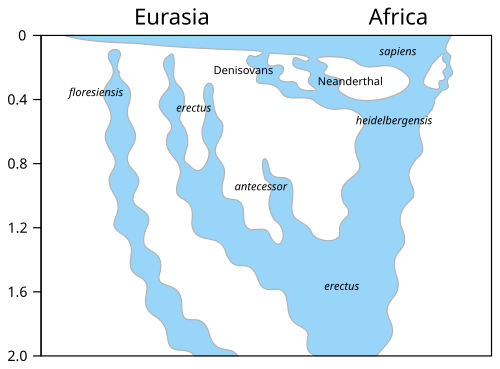
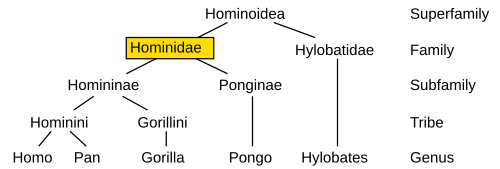
分子証拠によると、テナガザルの系統は1800万~1200万年前に類人猿の系統から分岐し、オランウータン(オランウータン亜科)[ b ]の系統は他の類人猿から約1200万年前に分岐した。テナガザルの祖先を明確に記録した化石はなく、テナガザルはこれまで知られていない東南アジアのヒト上科の集団に起源を持つ可能性があるが、化石の原始オランウータンは、約1000万年前のインドのシヴァピテクスとトルコのグリフォピテクスによって代表される可能性がある。[ 31 ]
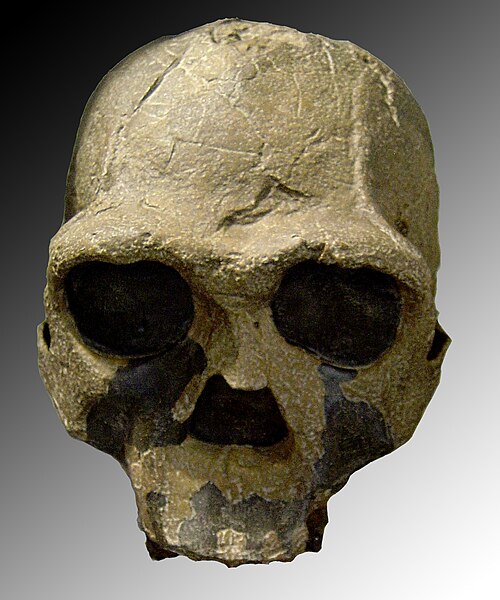
連続する(あるいは資料によってはほぼ連続する)人類の進化上の祖先の頭蓋骨、[ c ] 「現代」のホモ・サピエンスまで* Mya – 百万年前、kya – 千年前
ヒト科動物の脳の大きさと歯の大きさ
人類は最終的に他の霊長類よりもはるかに大きな脳を発達させました。現代人では典型的には1,330 cm 3 (81 cu in)で、チンパンジーやゴリラの脳のほぼ 3 倍の大きさです。[ 154 ]二足歩行の結果として脳が小さかったアウストラロピテクス・アナメンシスとアルディピテクスとの停滞期の後、 [ 155 ]脳の大型化のパターンはホモ・ハビリスから始まりました。ホモ・ハビリスの脳は600 cm 3 (37 cu in)で、チンパンジーの脳よりわずかに大きかったのです。この進化はホモ・エレクトスで800~1,100 cm 3 (49~67 cu in)まで続き、ネアンデルタール人では最大で1,200~1,900 cm 3 (73~116 cu in)に達し、現代のホモ・サピエンスよりも大きくなりました。この脳の増大は出生後の脳の成長期に現れ、他の類人猿をはるかに凌駕した(異時性)。また、 200万年前から始まった幼少期の人間の社会学習や言語習得の期間を延長することも可能にした。脳の大型化は、カロリー密度が高く入手困難な食物への依存によるものかもしれない。[ 156 ]
↑ Zhang, Rui; Wang, Yin-Qiu; Su, Bing (2008年7月) 「霊長類特異的マイクロRNAファミリーの分子進化」 . Molecular Biology and Evolution . 25 (7): 1493– 1502. doi : 10.1093/molbev/msn094 . ISSN 0737-4038 . PMID 18417486 .
↑ Willoughby, Pamela R. (2005). "Palaeoanthropology and the Evolutionary Place of Humans in Nature" . International Journal of Comparative Psychology . 18 (1): 60– 91. doi : 10.46867/IJCP.2005.18.01.02 . ISSN 0889-3667 . 2012年1月17日のオリジナルからアーカイブ済み。 2015年4月27日取得。
↑ Wood, Bernard; Collard, Mark (1999). "The changing face of Genus Homo ". Evolutionary Anthropology: Issues, News, and Reviews . 8 (6): 195– 207. doi : 10.1002/(SICI)1520-6505(1999)8:6 < 195::AID-EVAN1 > 3.0.CO ; 2-2 . ISSN 1060-1538 . S2CID 86768101 .
1 2 Pearce, Eiluned; Stringer, Chris; Dunbar, RIM (2013). 「ネアンデルタール人と解剖学的現代人の脳構造の違いに関する新たな知見」 . Proceedings of the Royal Society of London B: Biological Sciences . 280 (1758) 20130168. doi : 10.1098/rspb.2013.0168 . PMC 3619466 . PMID 23486442 .
1 2 Martin, Robert D. ; Maclarnon, Ann M.; Phillips, James L.; Dobyns, William B. (2006 年 11 月). "Flores hominid: 新種か小頭症の矮小人か?" . The Anatomical Record Part A: Discoveries in Molecular, Cellular, and Evolutionary Biology . 288A (11): 1123– 1145. doi : 10.1002/ar.a.20389 . ISSN 1552-4884 . PMID 17031806 .
↑ Callaway, E. (2016年6月8日) "「ホビット」の親戚が10年の捜索の末に発見される」。Nature。534 (7606 ):164–165。Bibcode:2016Natur.534Q.164C。doi:10.1038 / 534164a。PMID 27279191。
↑ Brumm, A.; van den Bergh, GD; Storey, M.; Kurniawan, I.; et al. (2016年6月8日). "フローレス島で発見された最古のヒト科化石の年代と背景" (PDF) . Nature . 534 (7606): 249– 253. Bibcode : 2016Natur.534..249B . doi : 10.1038/nature17663 . PMID 27279222 . S2CID 28608179 . 2020年3月6日のオリジナルからアーカイブ(PDF) 。 2021年11月11日取得。
↑ Dennell, Robin; Roebroeks, Wil (2005). "An Asian perspective on early human dispersal from Africa" . Nature . 438 ( 7071): 1099–1104 . Bibcode : 2005Natur.438.1099D . doi : 10.1038/nature04259 . PMID 16371999. S2CID 4405913. 2021年10月31日にオリジナルからアーカイブ済み。2021年11月10日に取得。
1 2 Schoenemann, P. Thomas (2006 年 10 月). 「人間の脳のサイズと機能領域の進化」. Annual Review of Anthropology . 35 (1): 379–406 . Bibcode : 2006ARAnt..35..379S . doi : 10.1146/annurev.anthro.35.081705.123210 . ISSN 0084-6570 . S2CID 7611321 .
↑ Brown, Graham; Fairfax, Stephanie; Sarao, Nidhi. "Tree of Life Web Project: Human Evolution" . www.tolweb.org . 2020年6月6日のオリジナルからアーカイブ済み。 2015年8月24日取得。
↑ Barr, W. Andrew; Pobiner, Briana; Rowan, John; Du, Andrew; Faith, J. Tyler (2022年2月1日) 「ホモ・エレクトスの出現後、肉食に関する動物考古学的証拠の持続的な増加は見られない」米国科学アカデミー紀要119 (5) e2115540119. Bibcode : 2022PNAS..11915540B . doi : 10.1073 /pnas.2115540119 . ISSN 0027-8424 . PMC 8812535 . PMID 35074877 .
↑ Organ, Chris; Nunn, Charles L.; Machanda, Zarin; Wrangham, Richard W. (2011年8月30日). "ヒトの進化における摂食時間の系統発生速度の変化" .米国科学アカデミー紀要. 108 (35): 14555– 14559. Bibcode : 2011PNAS..10814555O . doi : 10.1073/pnas.1107806108 . ISSN 0027-8424 . PMC 3167533 . PMID 21873223 .
1 2 David-Barrett, T.; Dunbar, RIM (2013). "処理能力が社会的集団の規模を制限する: 社会性の認知コストに関する計算論的証拠" . Proceedings of the Royal Society of London B: Biological Sciences . 280 (1765) 20131151. doi : 10.1098/rspb.2013.1151 . PMC 3712454 . PMID 23804623 .
↑ Schuster, AM (1997). "Earliest Remains of Genus Homo " . Archaeology . 50 (1). 2015年3月17日のオリジナルからアーカイブ済み。 2015年3月5日取得。ホモ属の初期メンバーへの系統は、アウストラロピテクス属から派生したものであり、この属は中新世後期または鮮新世初期までにチンパンジーとヒトの最後の共通祖先から分岐した。
↑ Zeitoun, V. (2003 年 9 月) 「ホモ・エレクトスにおける頭蓋底の特徴の高頻度出現:関節窩前結節の解剖学的記述」 . The Anatomical Record Part B: The New Anatomist . 274 (1): 148– 56. doi : 10.1002/ar.b.10028 . PMID 12964205 .
↑Dembo, M.; Matzke, N. J.; Mooers, A. Ø.; Collard, M. (August 2015). "Bayesian analysis of a morphological supermatrix sheds light on controversial fossil hominin relationships". Proceedings. Biological Sciences. 282 (1812) 20150943. Bibcode:2015PBioS.28250943D. doi:10.1098/rspb.2015.0943. PMC4528516. PMID26202999.
↑Dembo, M.; Radovčić, D.; etal. (August 2016). "The evolutionary relationships and age of Homo naledi: An assessment using dated Bayesian phylogenetic methods". Journal of Human Evolution. 97: 17–26. Bibcode:2016JHumE..97...17D. doi:10.1016/j.jhevol.2016.04.008. hdl:2164/8796. PMID27457542.
Full list of authors
Mana Dembo
Davorka Radovčić
Heather M. Garvinc
Myra F. Laird
Lauren Schroeder
Jill E. Scott
Juliet Brophy
Rebecca R. Ackermann
Chares M. Musiba
Darryl J. de Ruiter
Arne Ø. Mooers
Mark Collard
↑Mounier, A.; Caparros, M. (2015). "The phylogenetic status of Homo heidelbergensis – a cladistic study of Middle Pleistocene hominins". BMSAP (in French). 27 (3–4): 110–134. doi:10.1007/s13219-015-0127-4. ISSN0037-8984. S2CID17449909.
↑Harrison, N. (May 1, 2019). The Origins of Europeans and Their Pre-Historic Innovations from 6 Million to 10,000 BCE: From 6 Million to 10,000 BCE. Algora Publishing. ISBN978-1-62894-379-5.
↑Rogers, A. R.; Harris, N. S.; Achenbach, A. A. (February 2020). "Neanderthal-Denisovan ancestors interbred with a distantly related hominin". Science Advances. 6 (8) eaay5483. Bibcode:2020SciA....6.5483R. doi:10.1126/sciadv.aay5483. PMC7032934. PMID32128408.
↑Tanner, Nancy Makepeace (1981). On Becoming Human. CUP Archive. p.202. ISBN978-0-521-28028-0.
↑Reno, Philip L.; Lovejoy, C. Owen (April 28, 2015). "From Lucy to Kadanuumuu: Balanced analyses of Australopithecus afarensis assemblages confirm only moderate skeletal dimorphism". PeerJ. 3 e925. doi:10.7717/peerj.925. ISSN2167-8359. PMC4419524. PMID25945314.
↑Lovejoy, C. Owen (October 2, 2009). "Reexamining Human Origins in Light of Ardipithecus ramidus"(PDF). Science. 326 (5949): 74–74e8. Bibcode:2009Sci...326...74L. doi:10.1126/science.1175834. ISSN0036-8075. PMID19810200. S2CID42790876. Archived(PDF) from the original on February 24, 2021. Retrieved December 6, 2019.
↑Young, Richard W. (January 2003). "Evolution of the human hand: The role of throwing and clubbing". Journal of Anatomy. 202 (1): 165–174. doi:10.1046/j.1469-7580.2003.00144.x. ISSN0021-8782. PMC1571064. PMID12587931.
12Ittyerah, Miriam (2013). Hand Preference and Hand Ability: Evidence from studies in Haptic Cognition. John Benjamins Publishing. pp.37–38. ISBN978-90-272-7164-8.
↑Wilson, Frank R. "The Hand How Its Use Shapes the Brain, Language, and Human Culture". The New York Times. Archived from the original on August 28, 2017. Retrieved July 2, 2017.
↑Kuzawa, Christopher W.; Chugani, Harry T.; Grossman, Lawrence I.; Lipovich, Leonard; Muzik, Otto; Hof, Patrick R.; Wildman, Derek E.; Sherwood, Chet C.; Leonard, William R.; Lange, Nicholas (August 25, 2014). "Metabolic costs and evolutionary implications of human brain development". Proceedings of the National Academy of Sciences of the United States of America. 111 (36): 13010–13015. Bibcode:2014PNAS..11113010K. doi:10.1073/pnas.1323099111. PMC4246958. PMID25157149.
↑Pontzer, Herman; Brown, Mary H.; Raichlen, David A.; Dunsworth, Holly; Hare, Brian; Walker, Kara; Luke, Amy; Dugas, Lara R.; Durazo-Arvizu, Ramon; Schoeller, Dale; Plange-Rhule, Jacob; Bovet, Pascal; Forrester, Terrence E.; Lambert, Estelle V.; Thompson, Melissa Emery; Shumaker, Robert W.; Ross, Stephen P. (May 4, 2016). "Metabolic acceleration and the evolution of human brain size and life history". Nature. 533 (7603): 390–392. Bibcode:2016Natur.533..390P. doi:10.1038/nature17654. PMC4942851. PMID27144364.
↑Rantala, Markus J. (August 20, 2007). "Evolution of nakedness in Homo sapiens". Journal of Zoology. 273 (1): 1–7. doi:10.1111/j.1469-7998.2007.00295.x. Archived from the original on November 5, 2022. Retrieved November 5, 2022.
↑Differential modularity of the mammalian Engrailed 1 enhancer network directs sweat gland development
↑Humans Evolved to Be the Water-Saving Ape | Duke Today
↑Why Humans Sleep Less Than Their Primate Relatives
↑Potter, Lisa Marie (September 8, 2015). "Shouldering the Burden of Evolution". UCSF News Center. University of California San Francisco. Archived from the original on May 8, 2023. Retrieved May 8, 2023.
↑Weber, G.W.; Lukeneder, A.; Harzhauser, M. (February 28, 2022). "The microstructure and origin of the Venus of Willendorf". Scientific Reports. 12 (2926). Nature: 2926. doi:10.1038/s41598-022-06799-z. PMC8885675. PMID35228605.
12Ko, Kwang Hyun (2016). "Origins of human intelligence: The chain of tool-making and brain evolution"(PDF). Anthropological Notebooks. 22 (1): 5–22. Archived(PDF) from the original on August 17, 2016. Retrieved August 8, 2016.
↑Jabr, Ferris (July 18, 2012). "Does Thinking Really Hard Burn More Calories?". Scientific American. ISSN0036-8733. Archived from the original on May 3, 2015. Retrieved May 3, 2015.
↑Gibbons, Ann (May 29, 1998). "Solving the Brain's Energy Crisis". Science. 280 (5368): 1345–1347. doi:10.1126/science.280.5368.1345. ISSN0036-8075. PMID9634409. S2CID28464775.
12Harmand, Sonia; Lewis, Jason E.; Feibel, Craig S.; Lepre, Christopher J.; Prat, Sandrine; Lenoble, Arnaud; Boës, Xavier; Quinn, Rhonda L.; Brenet, Michel (May 20, 2015). "3.3-million-year-old stone tools from Lomekwi 3, West Turkana, Kenya". Nature. 521 (7552): 310–315. Bibcode:2015Natur.521..310H. doi:10.1038/nature14464. ISSN0028-0836. PMID25993961. S2CID1207285.
↑Semaw, Sileshi; Rogers, Michael J.; Quade, Jay; Renne, Paul R.; Butler, Robert F.; Dominguez-Rodrigo, Manuel; Stout, Dietrich; Hart, William S.; Pickering, Travis; Simpson, Scott W. (August 1, 2003). "2.6-Million-year-old stone tools and associated bones from OGS-6 and OGS-7, Gona, Afar, Ethiopia". Journal of Human Evolution. 45 (2): 169–177. Bibcode:2003JHumE..45..169S. doi:10.1016/S0047-2484(03)00093-9. ISSN0047-2484. PMID14529651.
↑Bar-Yosef, Ofer (October 2002). "The Upper Paleolithic Revolution". Annual Review of Anthropology. 31: 363–393. doi:10.1146/annurev.anthro.31.040402.085416. ISSN0084-6570.
12Oppenheimer, Stephen (2012). Out of Eden: The Peopling of the World (Newed.). Robinson.
12Henshilwood, C. S.; d'Errico, F.; Yates, R.; etal. (2002). "Emergence of Modern Human Behavior: Middle Stone Age Engravings from South Africa". Science. 295 (5558): 1278–1280. Bibcode:2002Sci...295.1278H. doi:10.1126/science.1067575. PMID11786608. S2CID31169551.
↑Henshilwood, Christopher; Marean, Curtis (2003). "The Origin of Modern Human Behavior: Critique of the Models and Their Test Implications". Current Anthropology. 44 (5): 627–651. doi:10.1086/377665. PMID14971366. S2CID11081605.
↑Backwell, L.; d'Errico, F.; Wadley, L. (2008). "Middle Stone Age bone tools from the Howiesons Poort layers, Sibudu Cave, South Africa". Journal of Archaeological Science. 35 (6): 1566–1580. Bibcode:2008JArSc..35.1566B. doi:10.1016/j.jas.2007.11.006.
↑Nowell, April (October 2010). "Defining Behavioral Modernity in the Context of Neandertal and Anatomically Modern Human Populations". Annual Review of Anthropology. 39 (1): 437–452. Bibcode:2010ARAnt..39..437N. doi:10.1146/annurev.anthro.012809.105113. ISSN0084-6570.
↑d'Errico, Francesco; Stringer, Chris B. (April 12, 2011). "Evolution, revolution or saltation scenario for the emergence of modern cultures?". Philosophical Transactions of the Royal Society B. 366 (1567): 1060–1069. doi:10.1098/rstb.2010.0340. ISSN0962-8436. PMC3049097. PMID21357228.
↑Chatterjee, Rhitu (March 15, 2018). "Scientists Are Amazed By Stone Age Tools They Dug Up In Kenya". NPR. Archived from the original on March 15, 2018. Retrieved March 15, 2018.
↑Yong, Ed (March 15, 2018). "A Cultural Leap at the Dawn of Humanity – New finds from Kenya suggest that humans used long-distance trade networks, sophisticated tools, and symbolic pigments right from the dawn of our species". The Atlantic. Archived from the original on November 17, 2020. Retrieved March 15, 2018.
↑Brooks, A. S.; Yellen, J. E.; Potts, R.; Behrensmeyer, A. K.; Deino, A. L.; Leslie, D. E.; Ambrose, S. H.; Ferguson, J. R.; d'Errico, F.; Zipkin, A. M.; Whittaker, S.; Post, J.; Veatch, E. G.; Foecke, K.; Clark, J. B. (2018). "Long-distance stone transport and pigment use in the earliest Middle Stone Age". Science. 360 (6384): 90–94. Bibcode:2018Sci...360...90B. doi:10.1126/science.aao2646. PMID29545508. S2CID14051717.
↑Rasmussen, Morten; Guo, Xiaosen; Wang, Yong; Lohmueller, Kirk E.; Rasmussen, Simon; Albrechtsen, Anders; etal. (2011). "An Aboriginal Australian Genome Reveals Separate Human Dispersals into Asia". Science. 334 (6052): 94–98. Bibcode:2011Sci...334...94R. doi:10.1126/science.1211177. PMC3991479. PMID21940856.
↑Ambrose, Stanley H. (March 2, 2001). "Paleolithic Technology and Human Evolution". Science. 291 (5509): 1748–1753. Bibcode:2001Sci...291.1748A. doi:10.1126/science.1059487. ISSN0036-8075. PMID11249821. S2CID6170692.
↑Mellars, P. (2010). "Neanderthal symbolism and ornament manufacture: The bursting of a bubble?". Proc Natl Acad Sci USA. 107 (47): 20147–20148. Bibcode:2010PNAS..10720147M. doi:10.1073/pnas.1014588107. PMC2996706. PMID21078972.
↑Bender, Andrea (August 8, 2019). "The Role of Culture and Evolution for Human Cognition". Topics in Cognitive Science. 12 (4): 1403–1420. doi:10.1111/tops.12449. hdl:1956/22031. ISSN1756-8757. PMID31392845.
↑Fu, Q.; Hajdinjak, M.; Moldovan, O. T.; Constantin, S.; Mallick, S.; Skoglund, Pontus; Patterson, N.; Rohland, N.; Lazaridis, I.; Nickel, B.; Viola, B.; Prüfer, Kay; Meyer, M.; Kelso, J.; Reich, D.; Pääbo, S. (2015). "An early modern human from Romania with a recent Neanderthal ancestor". Nature. 524 (7564): 216–219. Bibcode:2015Natur.524..216F. doi:10.1038/nature14558. PMC4537386. PMID26098372.
↑Medical Research Council [UK] (November 21, 2009). "Brain Disease 'Resistance Gene' evolves in Papua New Guinea community; could offer insights into CJD". ScienceDaily. Archived from the original on June 8, 2019. Retrieved November 22, 2009.
↑Mead, S.; Whitfield, J.; Poulter, M.; etal. (2009). "A Novel Protective Prion Protein Variant that Colocalizes with Kuru Exposure"(PDF). The New England Journal of Medicine. 361 (21): 2056–2065. doi:10.1056/NEJMoa0809716. PMID19923577. Archived(PDF) from the original on July 20, 2018. Retrieved August 20, 2019.
Full list of authors
Simon Mead
Jerome Whitfield
Mark Poulter
Paresh Shah
James Uphill
Tracy Campbell
Huda Al-Dujaily
Holger Hummerich
Jon Beck
Charles A. Mein
Claudio Verzilli
John Whittaker
Michael P. Alpers
John Collinge
↑Corbett, Stephen; Morin-Papunen, Laure (July 2013). "The Polycystic Ovary Syndrome and recent human evolution". Molecular and Cellular Endocrinology. 373 (1–2): 39–50. doi:10.1016/j.mce.2013.01.001. PMID23352610. S2CID13078403. Archived from the original on May 25, 2021. Retrieved October 8, 2020.
↑Markov, Alexander V.; Markov, Mikhail A. (June 2020). "Runaway brain-culture coevolution as a reason for larger brains: Exploring the "cultural drive" hypothesis by computer modeling". Ecology and Evolution. 10 (12): 6059–6077. Bibcode:2020EcoEv..10.6059M. doi:10.1002/ece3.6350. ISSN2045-7758. PMC7319167. PMID32607213.
↑Stout, Dietrich (April 12, 2011). "Stone toolmaking and the evolution of human culture and cognition". Philosophical Transactions of the Royal Society B: Biological Sciences. 366 (1567): 1050–1059. doi:10.1098/rstb.2010.0369. ISSN0962-8436. PMC3049103. PMID21357227.
↑Editors of the American Heritage Dictionaries, ed. (2006). More Word Histories and Mysteries: From Aardvark to Zombie. Boston: Houghton Mifflin. ISBN978-0-618-71681-4. LCCN2006020835. OCLC70199867.
↑"Nested Hierarchies, the Order of Nature: Carolus Linnaeus". Understanding Evolution: The History of Evolutionary Thought. The University of California at Berkeley. Archived from the original on August 2, 2019. Retrieved August 2, 2019.
↑Shipman, Pat; Storm, Paul (2002). "Missing links: Eugène Dubois and the origins of paleoanthropology". Evolutionary Anthropology: Issues, News, and Reviews. 11 (3): 108–116. doi:10.1002/evan.10021. ISSN1520-6505. S2CID84889438.
↑Dart, Raymond (February 7, 1925). "Australopithecus africanus: The Man-Ape of South Africa". Nature. 115 (2884): 195–199. Bibcode:1925Natur.115..195D. doi:10.1038/115195a0. ISSN0028-0836. S2CID4142569.
↑Shreeve, Jamie (July 2010). "The Evolutionary Road". National Geographic. ISSN0027-9358. Archived from the original on January 26, 2016. Retrieved May 28, 2015.
↑Berger, L. R.; Hawks, J.; de Ruiter, D. J.; Churchill, S. E.; etal. (September 10, 2015). "Homo naledi, a new species of the genus Homo from the Dinaledi Chamber, South Africa". eLife. 4 e09560. Bibcode:2015eLife...409560B. doi:10.7554/eLife.09560. PMC4559886. PMID26354291.
Full list of authors
Lee R Berger
John Hawks
Darryl J de Ruiter
Steven E Churchill
Peter Schmid
Lucas K Delezene
Tracy L Kivell
Heather M Garvin
Scott A Williams
Jeremy M DeSilva
Matthew M Skinner
Charles M Musiba
Noel Cameron
Trenton W Holliday
William Harcourt-Smith
Rebecca R Ackermann
Markus Bastir
Barry Bogin
Debra Bolter
Juliet Brophy
Zachary D Cofran
Kimberly A Congdon
Andrew S Deane
Mana Dembo
Michelle Drapeau
Marina C Elliott
Elen M Feuerriegel
Daniel Garcia-Martinez
David J Green
Alia Gurtov
Joel D Irish
Ashley Kruger
Myra F Laird
Damiano Marchi
Marc R Meyer
Shahed Nalla
Enquye W Negash
Caley M Orr
Davorka Radovcic
Lauren Schroeder
Jill E Scott
Zachary Throckmorton
Matthew W Tocheri
Caroline VanSickle
Christopher S Walker
Pianpian Wei
Bernhard Zipfel
12Shreeve, Jamie (September 10, 2015). "This Face Changes the Human Story. But How?". National Geographic News. Archived from the original on April 14, 2018. Retrieved September 10, 2015.
↑Dirks et al. (2017): between 335 and 236 ka. The lower limit of 236 ka is due to optically stimulated luminescence dating of sediments with U-Th and palaeomagnetic analyses of flowstones; the upper limit of 335 ka is due to U-series and electron spin resonance (US-ESR) dating of two H. naledi teeth, to 253+82−70ka, for an estimated age of the fossils of 253+82−17ka.
↑Dirks PH, Roberts EM, Hilbert-Wolf H, Kramers JD, etal. (May 9, 2017). "The age of Homo naledi and associated sediments in the Rising Star Cave, South Africa". eLife. 6 e24231. Bibcode:2017eLife...624231D. doi:10.7554/eLife.24231. PMC5423772. PMID28483040.
Full list of authors
Paul H.G.M. Dirks
Eric M. Roberts
Hannah Hilbert-Wolf
Jan D. Kramers
John Hawks
Anthony Dosseto
Mathieu Duval
Marina Elliott
Mary Evans
Rainer Grün
John Hellstrom
Andy I.R. Herries
Renaud Joannes-Boyau
Tebogo V. Makhubela
Christa J. Placzek
Jessie Robbins
Carl Spandler
Jelle Wiersma
Jon Woodhead
Lee R. Berger
12Sarich, V. M.; Wilson, A. C. (1967). "Immunological time scale for hominid evolution". Science. 158 (3805): 1200–1204. Bibcode:1967Sci...158.1200S. doi:10.1126/science.158.3805.1200. PMID4964406. S2CID7349579.
↑Wade, Nicholas (May 18, 2006). "Two Splits Between Human and Chimp Lines Suggested". The New York Times. Archived from the original on May 18, 2022. Retrieved April 20, 2015.
↑Gonder, M. K.; Mortensen, H. M.; Reed, F. A.; de Sousa, A.; Tishkoff, S. A. (March 2007). "Whole-mtDNA Genome Sequence Analysis of Ancient African Lineages". Molecular Biology and Evolution. 24 (3): 757–768. doi:10.1093/molbev/msl209. ISSN0737-4038. PMID17194802.
↑Tishkoff, S. A.; Reed, F. A.; Friedlaender, F. R.; etal. (2009). "The Genetic Structure and History of Africans and African Americans". Science. 324 (5930) (published May 22, 2009): 1035–1044. Bibcode:2009Sci...324.1035T. doi:10.1126/science.1172257. PMC2947357. PMID19407144.
↑deMenocal, Peter B. (2016). "Climate Shocks". Scientific American. Vol.25, no.4.
↑Barras, Colin (February 6, 2016). "Stone tools hint humans reached Asia much earlier". New Scientist.
↑Wolpoff, Milford H.; Hawks, John; Caspari, Rachel (May 2000). "Multiregional, Not Multiple Origins"(PDF). American Journal of Physical Anthropology. 112 (1): 129–136. doi:10.1002/(SICI)1096-8644(200005)112:1<129::AID-AJPA11>3.0.CO;2-K. hdl:2027.42/34270. ISSN0002-9483. PMID10766948. Archived(PDF) from the original on January 25, 2021. Retrieved May 12, 2013.
↑Wolpoff, M. H.; Spuhler, J. N.; Smith, F. H.; Radovcic, J.; Pope, G.; Frayer, D. W.; Eckhardt, R.; Clark, G. (August 12, 1988). "Modern Human Origins". Science. 241 (4867): 772–774. Bibcode:1988Sci...241..772W. doi:10.1126/science.3136545. ISSN0036-8075. PMID3136545. S2CID5223638.
↑Owen, James (July 18, 2007). "Modern Humans Came Out of Africa, 'Definitive' Study Says". National Geographic News. Washington, DC: National Geographic Society. Archived from the original on June 27, 2018. Retrieved May 14, 2011.
↑Stringer, Chris B.; Andrews, Peter (March 11, 1988). "Genetic and fossil evidence for the origin of modern humans". Science. 239 (4845): 1263–1268. Bibcode:1988Sci...239.1263S. doi:10.1126/science.3125610. ISSN0036-8075. PMID3125610. S2CID39200956.
↑Gill, Victoria (May 1, 2009). "Africa's genetic secrets unlocked". BBC News. London: BBC. Archived from the original on May 14, 2020. Retrieved June 8, 2011.
↑Jorde, Lynn B.; Bamshad, Michael; Rogers, Alan R. (February 1998). "Using mitochondrial and nuclear DNA markers to reconstruct human evolution". BioEssays. 20 (2): 126–136. doi:10.1002/(SICI)1521-1878(199802)20:2<126::AID-BIES5>3.0.CO;2-R. ISSN0265-9247. PMID9631658. S2CID17203268.
↑Wall, Jeffrey D.; Lohmueller, Kirk E.; Plagnol, Vincent (August 2009). "Detecting Ancient Admixture and Estimating Demographic Parameters in Multiple Human Populations". Molecular Biology and Evolution. 26 (8): 1823–1827. doi:10.1093/molbev/msp096. ISSN0737-4038. PMC2734152. PMID19420049.
↑Huertha Sanchez, Emilia et al. (2014), "Altitude adaptation in Tibetans caused by introgression of Denisovan-like DNA" (Nature Vol 512, August 14, 2014)
↑"Artificial intelligence applied to the genome identifies an unknown human ancestor". ScienceDaily. Archived from the original on January 16, 2019. Retrieved January 17, 2019.
123Lahr, Marta Mirazón; Petraglia, Mike; Stokes, Stephen; etal. "Searching for traces of the Southern Dispersal". Leverhulme Centre for Human Evolutionary Studies. University of Cambridge. Archived from the original on May 10, 2012. Retrieved April 21, 2015.
↑Simpson, Colin. DNA evidence suggests the whole world is a little bit Arab. The National. 16, June 2020. Archived at The Wayback Machine
↑Fernandes, V.; Alshamali, F.; Alves, M.; etal. (2012). "The Arabian cradle: Mitochondrial relicts of the first steps along the southern route out of Africa". American Journal of Human Genetics. 90 (2): 347–355. Bibcode:2012AmJHG..90..347F. doi:10.1016/j.ajhg.2011.12.010. PMC3276663. PMID22284828.
↑Macaulay, Vincent; Hill, Catherine; Achilli, Alessandro; etal. (May 13, 2005). "Single, Rapid Coastal Settlement of Asia Revealed by Analysis of Complete Mitochondrial Genomes"(PDF). Science. 308 (5724): 1034–1036. Bibcode:2005Sci...308.1034M. doi:10.1126/science.1109792. ISSN0036-8075. PMID15890885. S2CID31243109. Archived(PDF) from the original on August 28, 2022. Retrieved August 20, 2019.
↑Posth, C.; Renaud, G.; Mittnik, M.; Drucker, D. G.; Rougier, H.; Cupillard, C.; etal. (2016). "Pleistocene Mitochondrial Genomes Suggest a Single Major Dispersal of Non-Africans and a Late Glacial Population Turnover in Europe". Current Biology. 26 (6): 827–833. Bibcode:2016CBio...26..827P. doi:10.1016/j.cub.2016.01.037. hdl:2440/114930. PMID26853362. S2CID140098861.
↑Karmin, M.; Saag, L.; Vicente, M.; Wilson Sayres, M. A.; Järve, M.; Talas, U. G.; etal. (April 2015). "A recent bottleneck of Y chromosome diversity coincides with a global change in culture". Genome Research. 25 (4): 459–66. doi:10.1101/gr.186684.114. PMC4381518. PMID25770088.
↑Haber, M.; Jones, A. L.; Connell, B. A.; Arciero, E.; Yang, H.; Thomas, M. G.; etal. (August 2019). "A Rare Deep-Rooting D0 African Y-Chromosomal Haplogroup and Its Implications for the Expansion of Modern Humans Out of Africa". Genetics. 212 (4): 1421–1428. doi:10.1534/genetics.119.302368. PMC6707464. PMID31196864.
12Wood, Bernard A.; Richmond, Brian G. (July 2000). "Human evolution: Taxonomy and paleobiology". Journal of Anatomy. 197 (1): 19–60. doi:10.1046/j.1469-7580.2000.19710019.x. ISSN1469-7580. PMC1468107. PMID10999270.
↑Ajit, Varki; Nelson, David L. (October 2007). "Genomic Comparisons of Humans and Chimpanzees"(PDF). Annual Review of Anthropology. 36: 191–209. doi:10.1146/annurev.anthro.36.081406.094339. ISSN0084-6570. Archived(PDF) from the original on September 23, 2015. Retrieved April 26, 2015. Sequence differences from the human genome were confirmed to be ~1% in areas that can be precisely aligned, representing ~35 million single base-pair differences. Some 45 million nucleotides of insertions and deletions unique to each lineage were also discovered, making the actual difference between the two genomes ~4%.
↑Coghlan, Andy (May 30, 2002). "Just 2.5% of DNA turns mice into men". New Scientist. Retrieved August 18, 2024.
↑"Find Time of Divergence: Hominidae versus Hylobatidae". TimeTree. Archived from the original on April 18, 2015. Retrieved April 18, 2015.
↑Ruvolo, Maryellen (October 1997). "Genetic Diversity in Hominoid Primates". Annual Review of Anthropology. 26: 515–540. doi:10.1146/annurev.anthro.26.1.515. ISSN0084-6570.
↑Ruvolo, Maryellen (March 1997). "Molecular Phylogeny of the Hominoids: Inferences from Multiple Independent DNA Sequence Data Sets". Molecular Biology and Evolution. 14 (3): 248–265. doi:10.1093/oxfordjournals.molbev.a025761. ISSN0737-4038. PMID9066793.
↑Patterson, N.; Richter, D. J.; Gnerre, S.; Lander, E. S.; Reich, D. (2006). "Genetic evidence for complex speciation of humans and chimpanzees". Nature. 441 (7097): 1103–1108. Bibcode:2006Natur.441.1103P. doi:10.1038/nature04789. PMID16710306. S2CID2325560.
↑Woodley, Michael A.; Younuskunju, Shameem; Balan, Bipin; Piffer, Davide (2017). "Holocene Selection for Variants Associated With General Cognitive Ability: Comparing Ancient and Modern Genomes". Twin Research and Human Genetics. 20 (4): 271–280. doi:10.1017/thg.2017.37. ISSN1832-4274. PMID28724479. Retrieved April 17, 2026.
↑Zimmer, Carl (May 17, 2023). "Study Offers New Twist in How the First Humans Evolved - A new genetic analysis of 290 people suggests that humans emerged at various times and places in Africa". The New York Times. Retrieved May 18, 2023.{{cite news}}: CS1 maint: deprecated archival service (link)
↑Ragsdale, Aaron P.; etal. (May 17, 2023). "A weakly structured stem for human origins in Africa". Nature. 167 (7962): 755–763. Bibcode:2023Natur.617..755R. doi:10.1038/s41586-023-06055-y. PMC10208968. PMID37198480.
↑Begun, David R. (October 2010). "Miocene Hominids and the Origins of the African Apes and Humans". Annual Review of Anthropology. 39: 67–84. doi:10.1146/annurev.anthro.012809.105047. ISSN0084-6570.
↑Mitchell, Alanna (January 30, 2012). "DNA Turning Human Story Into a Tell-All". The New York Times. Archived from the original on January 1, 2022. Retrieved February 13, 2012.
↑Wood, Bernard A. (December 1996). "Human evolution". BioEssays. 18 (12): 945–954. doi:10.1002/bies.950181204. ISSN0265-9247. PMID8976151. S2CID221464189.
↑Huxley, T. (1890). "The Aryan Question and Pre-Historic Man". Collected Essays: Volume VII, Man's Place in Nature. Archived from the original on July 26, 2011. Retrieved August 25, 2018.
↑Coghlan, Andy (March 15, 2018). "Our ancestors mated with the mystery 'Denisovan' people – twice". New Scientist. Archived from the original on August 5, 2018. Retrieved August 25, 2018.
12Wei-Haas, Maya (August 22, 2018). "Ancient Girl's Parents Were Two Different Human Species – Born 90,000 years ago, the child is the first direct evidence of interbreeding among Neanderthals and their cousins the Denisovans". National Geographic. Archived from the original on June 14, 2019. Retrieved August 22, 2018.
↑Cell Press (March 28, 2016). "A world map of Neanderthal and Denisovan ancestry in modern humans". ScienceDaily. Archived from the original on August 26, 2018. Retrieved August 25, 2018.
↑Sankararaman, S.; Mallick, S.; Patterson, N.; Reich, D. (March 28, 2016). "The Combined Landscape of Denisovan and Neanderthal Ancestry in Present-Day Humans". Current Biology. 26 (9): 1241–1247. Bibcode:2016CBio...26.1241S. doi:10.1016/j.cub.2016.03.037. PMC4864120. PMID27032491.
↑"Human-Neandertal Comparisons". the Neandertal Genome. American Association for the Advancement of Science. 2010. Archived from the original on May 28, 2020.
↑Dannemann, M.; Andrés, A. M.; Kelso, J. (2016). "Introgression of Neandertal- and Denisovan-like Haplotypes Contributes to Adaptive Variation in Human Toll-like Receptors". American Journal of Human Genetics. 98 (1): 22–33. Bibcode:2016AmJHG..98...22D. doi:10.1016/j.ajhg.2015.11.015. PMC4716682. PMID26748514.
↑Gittelman, Rachel M.; Schraiber, Joshua G.; Vernot, Benjamin; Mikacenic, Carmen; Wurfel, Mark M.; Akey, Joshua M. (2016). "Archaic Hominin Admixture Facilitated Adaptation to Out-of-Africa Environments". Current Biology. 26 (24): 3375–3382. Bibcode:2016CBio...26.3375G. doi:10.1016/j.cub.2016.10.041. PMC6764441. PMID27839976.
12Plummer, Thomas (2004). "Flaked stones and old bones: Biological and cultural evolution at the dawn of technology". American Journal of Physical Anthropology. 125 (Supplement 39: Yearbook of Physical Anthropology): 118–164. Bibcode:2004AJPA..125S.118P. doi:10.1002/ajpa.20157. ISSN0002-9483. PMID15605391.
↑Wong, Kate (April 15, 2015). "Archaeologists Take Wrong Turn, Find World's Oldest Stone Tools". Scientific American (Blog). ISSN0036-8733. Archived from the original on May 8, 2015. Retrieved May 3, 2015.
↑Balter, Michael (April 14, 2015). "World's oldest stone tools discovered in Kenya". Science (News). doi:10.1126/science.aab2487. ISSN0036-8075. Archived from the original on October 20, 2021. Retrieved May 3, 2015.
↑Drake, Nadia (April 16, 2015). "Oldest Stone Tools Discovered in Kenya". National Geographic News. Washington, DC: National Geographic Society. Archived from the original on April 23, 2015. Retrieved May 3, 2015.
↑Yellen, J. E.; Brooks, A. S.; Cornelissen, E.; Mehlman, M. J.; Stewart, K. (April 28, 1995). "A middle stone age worked bone industry from Katanda, Upper Semliki Valley, Zaire". Science. 268 (5210): 553–556. Bibcode:1995Sci...268..553Y. doi:10.1126/science.7725100. PMID7725100.
Bogin, Barry (1997). "The Evolution of Human Nutrition". In Romanucci-Ross, Lola; Moerman, Daniel E.; Tancredi, Laurence R. (eds.). The Anthropology of Medicine: From Culture to Method (3rded.). Westport, Connecticut: Bergin & Garvey. ISBN978-0-89789-516-3. LCCN96053993. OCLC36165190.
Bown, Thomas M.; Rose, Kenneth D. (1987). Patterns of Dental Evolution in Early Eocene Anaptomorphine Primates (Omomyidae) From the Bighorn Basin, Wyoming(PDF). Memoir (Paleontological Society). Vol.23. Tulsa, Oklahoma: Paleontological Society. OCLC16997265. Archived from the original on November 11, 2016. Retrieved April 25, 2015.
Curry, James R. (2008). Children of God: Children of Earth. Bloomington, Indiana: AuthorHouse. ISBN978-1-4389-1846-4. OCLC421466369.
Darwin, Charles (1859). On the Origin of Species by Means of Natural Selection, or the Preservation of Favoured Races in the Struggle for Life(PDF). Archived(PDF) from the original on March 4, 2016. Retrieved May 13, 2017.
DeSalle, Rob; Tattersall, Ian (2008). Human Origins: What Bones and Genomes Tell Us About Ourselves. Texas A&M University Anthropology Series. Vol.13. College Station: Texas A&M University Press. ISBN978-1-58544-567-7. OCLC144520427.
Freeman, Scott; Herron, Jon C. (2007). Evolutionary Analysis (4thed.). Upper Saddle River, New Jersey: Pearson Prentice Hall. ISBN978-0-13-227584-2. LCCN2006034384. OCLC73502978.
Johanson, Donald; Edey, Maitland (1981). Lucy, the Beginnings of Humankind. St Albans: Granada. ISBN978-0-586-08437-3.
Montgomery, William M. (1988) [Originally published 1974]. "Germany". In Glick, Thomas F. (ed.). The Comparative Reception of Darwinisms. University of Chicago Press. ISBN978-0-226-29977-8. LCCN87035814. OCLC17328115. "The Conference on the Comparative Reception of Darwinism was held in Austin, Texas, on April 22 and 23, 1972, under the joint sponsorship of the American Council of Learned Societies and the University of Texas at Austin"
Kondo, Shiro, ed. (1985). "Primate Morphophysiology, Locomotor Analyses, and Human Bipedalism". American Journal of Physical Anthropology. 70 (2). University of Tokyo Press: 278–279. doi:10.1002/ajpa.1330700214. ISBN978-4-13-066093-8. LCCN85173489. OCLC12352830.
M'charek, Amade (2005). The Human Genome Diversity Project: An Ethnography of Scientific Practice. Cambridge Studies in Society and the Life Sciences. Cambridge University Press. ISBN978-0-521-83222-9. LCCN2004052648. OCLC55600894.
Maxwell, Mary (1984). Human Evolution: A Philosophical Anthropology. New York: Columbia University Press. ISBN978-0-231-05946-6. LCCN83024005. OCLC10163036.
Ramachandran, Sohini; Tang, Hua; Gutenkunst, Ryan N.; Bustamante, Carlos D. (2010). "Genetics and Genomics of Human Population Structure". In Speicher, Michael R.; Antonarakis, Stylianos E.; Motulsky, Arno G. (eds.). Vogel and Motulsky's Human Genetics: Problems and Approaches (4thed.). Heidelberg / London / New York: Springer. doi:10.1007/978-3-540-37654-5. ISBN978-3-540-37653-8. LCCN2009931325. OCLC549541244.
Robinson, J. T. (2008) [Originally published 1963; Chicago, Illinois: Aldine Transaction]. "Adaptive Radiation in the Australopithecines and the Origin of Man". In Howell, F. Clark; Bourlière, François (eds.). African Ecology and Human Evolution. New Brunswick, New Jersey: Transaction Publishers. ISBN978-0-202-36136-9. LCCN2007024716. OCLC144770218.
Srivastava, R. P. (2009). Morphology of the Primates and Human Evolution. New Delhi: PHI Learning. ISBN978-81-203-3656-8. OCLC423293609.
Stanford, Craig; Allen, John S.; Antón, Susan C. (2009). Biological Anthropology: The Natural History of Humankind (2nded.). Upper Saddle River, New Jersey: Pearson Prentice Hall. ISBN978-0-13-601160-6. LCCN2007052429. OCLC187548835.
Trent, Ronald J. (2005). Molecular Medicine: An Introductory Text (3rded.). Burlington, Massachusetts: Elsevier Academic Press. ISBN978-0-12-699057-7. LCCN2004028087. OCLC162577235.
Trevathan, Wenda R. (2011) [Originally published 1987; New York: Aldine De Gruyter]. Human Birth: An Evolutionary Perspective. New Brunswick, New Jersey: Transaction Publishers. ISBN978-1-4128-1502-4. LCCN2010038249. OCLC669122326.
Ungar, Peter S.; Teaford, Mark F., eds. (2002). Human Diet: Its Origin and Evolution. Westport, Connecticut: Bergin & Garvey. ISBN978-0-89789-736-5. LCCN2001043790. OCLC537239907.
Walker, Alan (2007). "Early Hominin Diets: Overview and Historical Perspectives". In Ungar, Peter (ed.). Evolution of the Human Diet: The Known, the Unknown, and the Unknowable. Human Evolution Series. Oxford University Press. ISBN978-0-19-518346-7. LCCN2005036120. OCLC132816551.
Wood, Bernard A. (2009). "Where Does the Genus Homo Begin, and How Would We Know?". In Grine, Frederick E.; Fleagle, John G.; Leakey, Richard E. (eds.). The First Humans – Origin and Early Evolution of the Genus Homo. Vertebrate Paleobiology and Paleoanthropology. Dordrecht: Springer Netherlands. pp.17–28. doi:10.1007/978-1-4020-9980-9_3. ISBN978-1-4020-9979-3. ISSN1877-9077. LCCN2009927083. OCLC310400980. "Contributions from the Third Stony Brook Human Evolution Symposium and Workshop October 3–7, 2006."
Further reading
Alexander, Richard D. (1990). How Did Humans Evolve? Reflections on the Uniquely Unique Species(PDF). Special Publication. Ann Arbor: Museum of Zoology, University of Michigan. pp.1–38. LCCN90623893. OCLC22860997. Archived from the original(PDF) on March 4, 2016. Retrieved May 6, 2015.
Bellwood, Peter (2022). The Five-Million-Year Odyssey: The Human Journey from Ape to Agriculture. Princeton: Princeton University Press. ISBN978-0-691-19757-9.
Enard, Wolfgang; Przeworski, Molly; Fisher, Simon E.; etal. (August 22, 2002). "Molecular evolution of FOXP2, a gene involved in speech and language". Nature. 418 (6900): 869–872. Bibcode:2002Natur.418..869E. doi:10.1038/nature01025. hdl:11858/00-001M-0000-0012-CB89-A. ISSN0028-0836. PMID12192408. S2CID4416233.
Flinn, Mark V.; Geary, David C.; Ward, Carol V. (2005). "Ecological dominance, social competition, and coalitionary arms races: Why humans evolved extraordinary intelligence"(PDF). Evolution and Human Behavior. 26 (1): 10–46. Bibcode:2005EHumB..26...10F. doi:10.1016/j.evolhumbehav.2004.08.005. ISSN1090-5138. Archived(PDF) from the original on June 4, 2007. Retrieved May 5, 2015.
Galinon-Melenec, Béatrice (2015). "From "Traces" and "Human Trace" to "Human–Trace Paradigm"". In Parrend, Pierre; Bourgine, Paul; Collet, Pierre (eds.). First Complex systems Digital Campus World E-Conference. Tempe, Arizona: Springer.
Gibbons, Ann (2006). The First Human: The Race to Discover our Earliest Ancestors. New York: Doubleday. ISBN978-0-385-51226-8. LCCN2005053780. OCLC61652817.
Heizmann, Elmar P. J.; Begun, David R. (November 2001). "The oldest Eurasian hominoid"(PDF). Journal of Human Evolution. 41 (5): 463–481. Bibcode:2001JHumE..41..463H. doi:10.1006/jhev.2001.0495. ISSN0047-2484. PMID11681862. S2CID21230992.
Hill, Andrew; Ward, Steven (1988). "Origin of the hominidae: The record of African large hominoid evolution between 14 my and 4 my". American Journal of Physical Anthropology. 31 (59): 49–83. Bibcode:1988AJPA...31S..49H. doi:10.1002/ajpa.1330310505. ISSN0002-9483.
Hoagland, Hudson (1964). "Science and the New Humanism". Science. 143 (3602): 111–114. Bibcode:1964Sci...143..111H. doi:10.1126/science.143.3602.111. PMID17781189.
Ijdo, Jacob W.; Baldini, Antonio; Ward, David C.; etal. (October 15, 1991). "Origin of human chromosome 2: An ancestral telomere-telomere fusion". Proceedings of the National Academy of Sciences of the United States of America. 88 (20): 9051–9055. Bibcode:1991PNAS...88.9051I. doi:10.1073/pnas.88.20.9051. ISSN0027-8424. PMC52649. PMID1924367. – two ancestral ape chromosomes fused to give rise to human chromosome 2
Jones, Steve; Martin, Robert D.; Pilbeam, David, eds. (1994) [1992]. The Cambridge Encyclopedia of Human Evolution. Foreword by Richard Dawkins. Cambridge University Press. ISBN978-0-521-32370-3. LCCN92018037. OCLC444512451. (This book contains very useful, information-dense chapters on primate evolution in general, and human evolution in particular, including fossil history.)
Kawabata, Hiroshi; Kaifu, Yousuke (2020). Lost in Evolution: Exploring Humanity's Path in Asia. Tokyo: Japan Publishing Industry Foundation for Culture. ISBN978-4-86658-133-0. Archived from the original on October 20, 2022. Retrieved October 20, 2022.
Leakey, Richard E.; Lewin, Roger (1992). Origins Reconsidered: In Search of What Makes us Human. New York: Doubleday. ISBN978-0-385-41264-3. LCCN92006661. OCLC25373161.
Lewin, Roger (1997). Bones of Contention: Controversies in the Search for Human Origins (2nded.). University of Chicago Press. ISBN978-0-226-47651-3. LCCN97000972. OCLC36181117.
Morwood, Mike; van Oosterzee, Penny (2007). A New Human: The Startling Discovery and Strange Story of the 'Hobbits' of Flores, Indonesia. New York: Smithsonian Books / HarperCollins. ISBN978-0-06-089908-0. LCCN2006052267. OCLC76481584.
Shreeve, James (1995). The Neandertal Enigma: Solving the Mystery of Modern Human Origins. New York: William Morrow & Co.ISBN978-0-688-09407-2. LCCN95006337. OCLC32088673.
Stringer, Chris B. (2011). The Origin of Our Species. London: Allen Lane. ISBN978-1-84614-140-9. LCCN2011489742. OCLC689522193.
Stringer, Chris B.; Andrews, Peter (2005). The Complete World of Human Evolution. London / New York: Thames & Hudson. ISBN978-0-500-05132-0. LCCN2004110563. OCLC224377190.
Stringer, Christopher; McKie, Robin (1997). African Exodus: The Origins of Modern Humanity. New York: Henry Holt & Co.ISBN978-0-8050-2759-4. LCCN96037718. OCLC36001167.
Sykes, Rebecca Wragg (2020). Kindred: Neanderthal Life, Love, Death and Art. London: Bloomsbury Sigma. ISBN978-1-4729-3749-0.
Tattersall, Ian (2008). The Fossil Trail: How We Know What We Think We Know About Human Evolution (2nded.). Oxford University Press. ISBN978-0-19-536766-9. LCCN2008013654. OCLC218188644.
van Oosterzee, Penny (1999). Dragon Bones: The Story of Peking Man. St Leonards, New South Wales: Allen & Unwin Australia. ISBN978-1-86508-123-6. LCCN00300421. OCLC45853997.
Walker, Alan; Shipman, Pat (1996). The Wisdom of the Bones: In Search of Human Origins. London: Weidenfeld & Nicolson. ISBN978-0-297-81670-6. OCLC35202130.
Weiss, Mark L.; Mann, Alan E. (1985). Human Biology and Behavior: An Anthropological Perspective (4thed.). Boston: Little, Brown & Co.ISBN978-0-316-92894-6. LCCN85000158. OCLC11726796. (This book contains very accessible descriptions of human and non-human primates, their evolution, and fossil history.)
Wells, Spencer (2003) [Originally published 2002; Princeton, NJ: Princeton University Press]. The Journey of Man: A Genetic Odyssey (Random House trade paperbacked.). New York: Random House. ISBN978-0-8129-7146-0. LCCN2003066679. OCLC53287806.
External links
"Race, Evolution and the Science of Human Origins" by Allison Hopper, Scientific American (July 5, 2021).
"The evolution of man". BBC Science & Nature. Retrieved May 6, 2015.
"Bones, Stones and Genes: The Origin of Modern Humans" (Video lecture series). Howard Hughes Medical Institute. Archived from the original on April 24, 2015. Retrieved May 6, 2015.
"Evolution Figures: Chapter 25". Cold Spring Harbor Laboratory Press. Retrieved May 6, 2015. – Illustrations from the book Evolution (2007)
"Human Evolution". Smithsonian Institution's Human Origins Program. Retrieved June 24, 2013.
"Human Evolution Timeline". ArchaeologyInfo.com. Archived from the original on June 18, 2013. Retrieved June 24, 2013.
"Human Trace" video (2015) Normandy University UNIHAVRE, CNRS, IDEES, E.Laboratory on Human Trace Unitwin Complex System Digital Campus UNESCO.
Lambert, Tim (Producer) (June 24, 2015). First Peoples. London: Wall to Wall Television. OCLC910115743. Retrieved July 18, 2015.