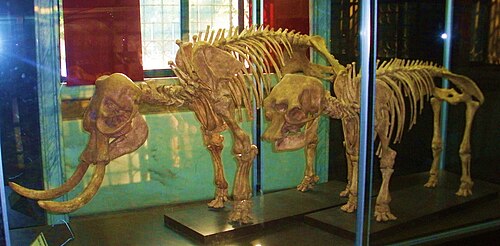
Skeletons of the extinct Palaeoloxodon falconeri, native to Sicily and Malta, it is one of the smallest known species of dwarf elephant. Adult males measured about one meter (3.3 ft) in shoulder height and weighed about 250kg (550lb). Females were smaller.
Insular dwarfism, a form of phyletic dwarfism,[1] is the process and condition of large animals evolving or having a reduced body size[a] when their population's range is limited to a small environment, primarily islands. This natural process is distinct from the intentional creation of dwarf breeds, called dwarfing. This process has occurred many times throughout evolutionary history, with examples including various species of dwarf elephants that evolved during the Pleistocene epoch, as well as more ancient examples, such as the dinosaurs Europasaurus and Magyarosaurus. This process, and other "island genetics" artifacts, can occur not only on islands, but also in other situations where an ecosystem is isolated from external resources and breeding. This can include caves, desert oases, isolated valleys and isolated mountains ("sky islands").
Insular dwarfism is one aspect of the more general "island effect" or "Foster's rule", which posits that when mainland animals colonize islands, small species tend to evolve larger bodies (island gigantism), and large species tend to evolve smaller bodies. This is itself one aspect of island syndrome, which describes the differences in morphology, ecology, physiology and behaviour of insular species compared to their continental counterparts.
Possible causes
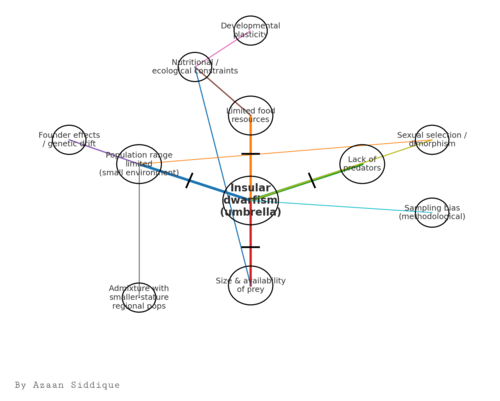
Structure of insular dwarfism web
There are several proposed explanations for the mechanism which produces such dwarfism.[3][4]
↑ de Lang R、Vogel G (2005)。スラウェシ島のヘビ:識別キー付きスラウェシ島陸生ヘビフィールドガイド。フランクフルト自然史シリーズ第25巻、Chimaira社、2005年。ISBN3-930612-85-223~27ページ、198~201ページ。
↑ Barker, DG; Barten, SL; Ehrsam, JP; Daddono, L. (2012). "The Corrected Lengths of Two Well-known Giant Pythons and the Establishment of a New Maximum Length Record for Burmese Pythons, Python bivittatus " (PDF) . Bulletin of the Chicago Herpetological Society . 47 (1): 1– 6. 2022年10月9日にオリジナル(PDF)からアーカイブ済み。2020年3月2日に取得。
↑ Shine, R.; Harlow, PS; Keogh, JS; Boeadi, NI (1998). "The influence of sex and body size on food habits of a giant tropical snake, Python reticulatus " . Functional Ecology . 12 (2): 248– 258. Bibcode : 1998FuEco..12..248S . doi : 10.1046/j.1365-2435.1998.00179.x .
↑ Sheehy, CM; Albert, JS; Lillywhite, HB; Van Damme, R. (2016). "The evolution of tail length in snakes associated with different gravitational environments" . Functional Ecology . 30 (2): 244– 254. Bibcode : 2016FuEco..30..244S . doi : 10.1111/1365-2435.12472 .表S1を参照。
↑シベリア北部のウランゲリ島のマンモスは、もはや矮小種とはみなされていない。参照:Tikhonov, Alexei; Larry Agenbroad; Sergey Vartanyan (2003). Comparative analysis of the mammoth populations on Wrangel Island and the Channel Islands . DEINSEA 9: 415–420. ISSN 0923-9308
1 2 3 4 Sondaar, PY; AAE van der Geer (2005). "鮮新世-更新世の島嶼有蹄類の進化と絶滅" . International Journal of the French Quaternary Association . 2 : 241– 256 . 2017-07-31に取得.
↑ van den Bergh, Gert D.; de Vos, John; Sondaar, Paul Y. (2000年9月25日). "インドネシア諸島における哺乳類進化の後期第四紀古地理" (PDF) . Palaeogeography, Palaeoclimatology, Palaeoecology . 171 ( 3– 4): 385– 408. doi : 10.1016/S0031-0182(01)00255-3 .
↑ van Vuure, Cis (2005). Retracing the Aurochs: History, Morphology and Ecology of an Extinct Wild Ox . Coronet Books Incorporated. ISBN978-954-642-235-4OCLC 472741798
↑ van der Geer, A.; Lyras, G; de Vos, J.; Dermitzakis, M. (2011年2月14日). 「サルデーニャ島とコルシカ島」 . 『島嶼哺乳類の進化:島嶼における胎盤哺乳類の適応と絶滅』 . John Wiley & Sons. ISBN978-1-4443-9128-2. OCLC 894698082 .
↑ Burns, KC (2019年5月). Evolution in Isolation: The Search for an Island Syndrome in Plants . Cambridge University Press . pp. 174–177 . doi : 10.1017/9781108379953 . ISBN978-1-108-37995-3. OCLC 1108160200 . S2CID 186536407 . (pp. 174-175) ... その矮小な体格が遺伝的にどの程度決定されているか、また島嶼矮小症が選択的に有利である理由の説明については、さらなる研究が必要である。