Loading article…
TimeTree は、現在テンプル大学に所属するS. Blair Hedgesと Sudhir Kumarによって開発された、生命の系統樹における分岐の時期を示す無料の公開データベースです。[ 1 ] [ 2 ]基本的なコンセプトは、発表された研究から生命の系統樹のコミュニティの合意を作成して提示し、ウェブやモバイル デバイスでその情報に簡単にアクセスできるようにすることです。[ 3 ] [ 4 ]このデータベースでは、 2つの種またはそれ以上の分類群間の平均ノード時間を検索したり、生命の起源までのすべての分岐を示す分類群の視点からタイムラインを表示したり、選択した分類群またはユーザーが提出した分類群のグループの系統樹を作成したりできます。[ 5 ] TimeTreeは、高校などの公共教育の場で、生命の進化を概念化するために使用されています。[ 6 ] [ 7 ] [ 8 ]デビッド・アッテンボローのエミー賞受賞映画およびテレビ番組「動物の台頭」では、TimeTree データベースから生成されたヘッジスとクマール[ 3 ]の生命の円形タイムツリーを制作の枠組みとして使用しました。タイムツリーは、2 時間の映画の中で 10 分ごとにアニメーション化されたコンピュータ生成画像を使用して生き生きと表現されました。ヘッジスとクマールによる TimeTree の元の開発は 1990 年代後半に始まり、NASA 宇宙生物学研究所からの最初の支援を受けていました。それ以来、NASA、NSF、NIH からの追加助成金によって支援されています。現在のバージョン (v5) は 2022 年にリリースされ、4,075 の研究と 137,306 種のデータが含まれています。[ 5 ]
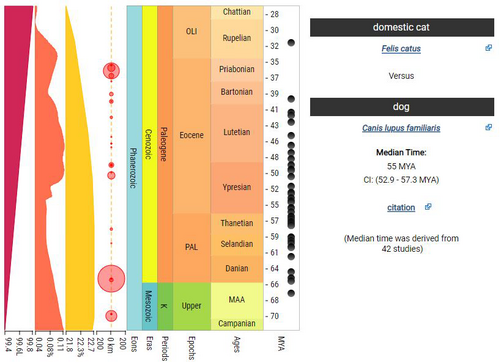
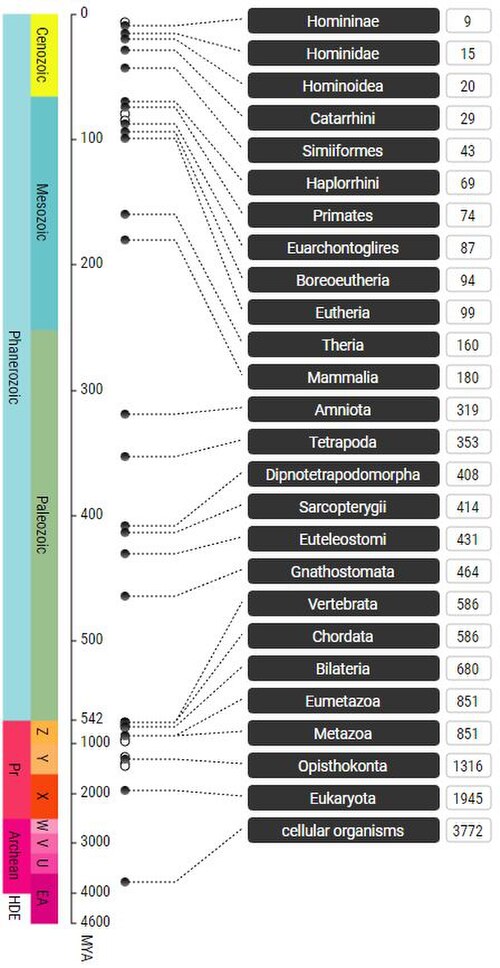
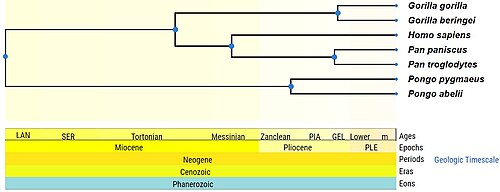
TimeTree users can search for the names of two species, such as cat and dog, to obtain the mean and median time estimates for their divergence, in millions of years. The results also show all individual time estimates, from each study, next to a geologic timescale, indicating geologic periods. Different aspects of the Earth's environment are shown next to the timescale for comparison, including Earth impacts, solar luminosity, carbon dioxide levels, and oxygen levels. Separately, a table lists the time estimates, downloadable as a spreadsheet, from each study along with references and links to the abstracts of the original articles. Users can download the original study data as Newick-formatted timetrees for further research. In the timeline search, users type the name of a taxon, and all divergences back to the origin of life are show with their taxon names, in a vertical ladder-like figure. Timepanels of Earth's environment also are shown next to the geological timescale, as in all three search options. The third search option, timetree search, involves building a timetree by either specifying a taxon (group) name or uploading a list of species or other taxa. After specifying a group name, the user can choose which taxonomic level they prefer to view. For example, with a family group name, either a species-level or genus-level timetree can be selected. Then, the timetree is show and can be output as a Newick file or image for publication. Times on the tree can be explored by clicking on nodes, and obtaining tables of data pertaining to the node. The database also allows search of timetree articles by author name. The entire open-access book Timetree of Life[3] is presented on the site.