Sir Thomas Malory of Newbold Revel in Warwickshire, England, presumed author of the chivalric tales of Le Morte d'Arthur, is imprisoned for most of the following decade on multiple charges including violent robbery and rape.
1452 – Completion of the Malatestiana Library (Biblioteca Malatestiana) in Cesena (in the Emilia-Romagna region of Italy, commissioned by the city's ruler Malatesta Novello), the first European public library, in the sense of belonging to the commune and open to all citizens.[6]
1452–3 – Johannes Gutenberg in Mainz probably prints the Sibyllenbuch, a poem of about 74 pages, of which only a fragment survives, making it the earliest known remnant of any European book printed using movable type.[7]
5 June – French poet François Villon is implicated in a murder.
1457
14 August – The Mainz Psalter, the second major book printed with movable type in the West, the first to be wholly finished mechanically (including colour) and the first to carry a printed date, is printed by Johann Fust and Peter Schoeffer for the Elector of Mainz.
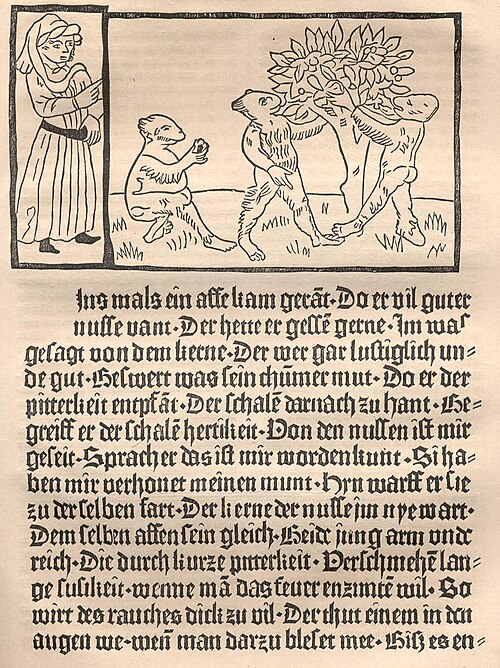
1461 – Albrecht Pfister is pioneering movable type book printing in German and the addition of woodcut illustrations in Bamberg, producing a collection of Ulrich Boner's fables, Der Edelstein, the first book printed with illustrations. Soon after this he prints the first known Biblia pauperum (picture Bible).
First book printed in Spain, Obres e trobes en lahors de la Verge María, the anthology of a religious poetry contest held this year in Valencia.
Approximate date – Georgius Purbachius (Georg von Peuerbach)'s Theoricae nouae planetarum is published in Nuremberg, an early example of the application of color printing to an academic text.
30 January – Constantine Lascaris's Erotemata ("Questions", also known as Grammatica Graeca) is the first book to be printed entirely in Greek (in Milan).
William Caxton sets up the first printing press in England, at Westminster.[15] This year he prints improving pamphlets: Stans Puer ad Mensam (John Lydgate's translation of Robert Grosseteste's treatise on table manners, printed together with Salve Regina); The Churl and the Bird and The Horse, the Goose and the Sheep (both by Lydgate); and a parallel text edition of Cato with translation by Benjamin Burgh.[16]
The first printed edition of Ptolemy's Geography (in Latin translation as Cosmographia) with maps, published in Bologna, is the first printed book with engraved illustrations[17][18] and also the first with maps by a known artist, the plates having been engraved by Taddeo Crivelli of Ferrara[19] (book wrongly dated 1462).
1482: 25 January – Probable first printing of the Torah (in Hebrew with vowels and marks of cantillation printed), with paraphrases in Aramaic and Rashi's commentary, printed in Bologna.[22]
1491 (probable date) – Death of English publisher William Caxton; he is said to have completed his translation of a Vitae Patrum on the last day of his life.[24]
1496: February – Francesco Griffo cuts the first old-style serif (or humanist) typeface (known from the 20th century as Bembo) for the Aldine Press edition of Pietro Bembo's narrative Petri Bembi de Aetna Angelum Chabrielem liber ("De Aetna", a description of a journey to Mount Etna) published in Venice, Aldus Manutius' first printing in the Latin alphabet and a work which includes early adoption of the semicolon (dated 1495 according to the more veneto).
Cardinal Juan de Torquemada – Meditationes, seu Contemplationes devotissimae ("Meditations, or the Contemplations of the Most Devout"), the first book printed in Italy to include woodcut illustrations[26]
The boke intituled Eracles, and also of Godefrey of Boloyne the whiche speketh of the conquest of the holy londe of Iherusalem, a translation by William Caxton from Estoire d'Eracles, the French version of William of Tyre's Historia
Mirrour of the Worlde, a translation of 1480 by William Caxton from Vincent of Beauvais's Speculum Maius, the first book printed in England to include woodcut illustrations
↑"History of Guildhall Library". City of London. Archived from the original on 5 April 2014. Retrieved 7 April 2014.
12Palmer, Alan; Palmer, Veronica (1992). The Chronology of British History. London: Century Ltd. ISBN0-7126-5616-2.
↑Norman, Jeremy M. (20 December 2022). "Foundation of the Library of the Dominican Convent of San Marco, the First "Public" Library in Renaissance Europe". HistoryofInformation.com. Retrieved 18 January 2023.
↑Klooster, John W. (2009). Icons of invention: the makers of the modern world from Gutenberg to Gates. Santa Barbara, CA: ABC-CLIO. p.8. ISBN978-0-313-34745-0.
↑"Biblioteca Malatestiana" (in Italian). Istituzione Biblioteca Malatestiana. Archived from the original on 16 December 2002. Retrieved 17 January 2014.
↑"The Sibyllenbuch", Incunabula Short Title Catalogue (entry), London: British Library.
↑The University of Glasgow, Munimenta, II, 69, dated 10 September 1462, admits a Robert Henryson, licenciate in Arts and bachelor of Decreits (Canon Law), as a member of the University. It is considered strongly likely, from secondary evidence, that this was the poet.
↑This article incorporates text from a publication now in the public domain:Löffler, Klemens (1911). "Arnold Pannartz and Konrad Sweinheim". In Herbermann, Charles (ed.). Catholic Encyclopedia. Vol.11. New York: Robert Appleton Company.
↑Wijnekus, F. J. M.; Wijnekus, E. F. P. H. (22 October 2013). "2827 cicero". Elsevier's Dictionary of the Printing and Allied Industries (2nded.). Elsevier. ISBN978-0-444-42249-1.
↑Robinson, Anton Meredith Lewin (1979). From monolith to microfilm: the story of the recorded word. Cape Town: South African Library. p.2 5. ISBN0-86968-020-X2011年10月2日にオリジナルからアーカイブされました。 2017年6月14日に取得。
↑ Vitæ Pontificum Platinæ historyi liber de vita Christi acomnium pontificum qui hactenus ducenti fuere et XX (1479 年発行)。この出来事は、メロッツォ・ダ・フォルリの図書館のフレスコ画、シクストゥス 4 世がプラティナをバチカン図書館の長官に任命する(1477 年) に描かれています。ケネス・M・セットン (1960)。 「中世から現代の図書館へ」。アメリカ哲学協会の議事録。104 : 371–390 .
↑"Lot 36: Bible, Pentateuch, in Hebrew - Hamishah humshe Torah, with paraphrase in Aramaic (Targum Onkelos) and commentary by Rashi (Solomon ben Isaac). Edited by Joseph Hayim ben Aaron Strasbourg Zarfati. Bologna: Abraham ben Hayim of Pesaro for Joseph ben Abraham Caravita, 5 Adar I [5] 242 = 25 January 1482". Sale 3587: Importants livres anciens, livres d'artistes et manuscrits. Paris: Christie's. Retrieved 28 August 2020.
↑Gillam, Stanley (1988). The Divinity School and Duke Humfrey's Library at Oxford. Oxford: Clarendon Press. p.28. ISBN0-19-951558-1.
↑According to Wynkyn de Worde in the first published edition (1495).
↑"51: Louis de Gruuthuse's copy of the Deeds of Sir Gillion de Trazegnies in the Middle East, in French, illuminated manuscript on vellum [southern Netherlands (Antwerp or perhaps Bruges), dated 1464]". Old Master & British paintings Evening Sale including three Renaissance Masterworks from Chatsworth. London: Sotheby's. Retrieved 7 October 2019.
↑Kleinhenz, Christopher (2004). Medieval Italy: An Encyclopedia. Vol.1. Routledge. p.360. ISBN0-415-93930-5.
↑Biddick, Kathleen (2013). The Typological Imaginary: Circumcision, Technology, History. Philadelphia: University of Pennsylvania Press. p.48. ISBN9780812201277.
↑Ivins, William M. "The Herbal of 'Pseudo-Apuleius'"(PDF). New York: Metropolitan Museum of Art. Retrieved 2 December 2014.
↑Jacobus (de Vorágine) (1973). The Golden Legend. CUP Archive. pp.8–. GGKEY:DE1HSY5K6AF. Retrieved 16 November 2012.
↑Martin, Joanna (2008). Kingship and Love in Scottish poetry, 1424-1540. Aldershot: Ashgate. p.111. ISBN978-0-7546-6273-0.
↑Hooper, David; Kenneth, Whyld (1996) [1992], "King's Gambit", The Oxford Companion to Chess (2nded.), Oxford University Press, p.201, ISBN0-19-866164-9.
12John Flood (8 September 2011). Poets Laureate in the Holy Roman Empire: A Bio-bibliographical Handbook. Walter de Gruyter. p.1531. ISBN978-3-11-091274-6.
↑Nelson, Alan H. (2004). "Medwall, Henry (b. 1462, d. after 1501)". Oxford Dictionary of National Biography (onlineed.). Oxford University Press. doi:10.1093/ref:odnb/18504. Retrieved 27 July 2015.(Subscription, Wikipedia Library access or UK public library membership required.)
↑Milorad Živančević (1971). Živan Milisavac (ed.). Jugoslovenski književni leksikon[Yugoslav Literary Lexicon] (in Serbo-Croatian). Novi Sad (SAP Vojvodina, SR Serbia): Matica srpska. p.70.
Categories:
15th-century literature
15th-century books
Renaissance literature
History of literature
Hidden categories:
Articles with short description
Short description is different from Wikidata
Use dmy dates from April 2020
Articles containing Irish-language text
Articles containing Italian-language text
CS1 Italian-language sources (it)
CS1 maint: location missing publisher
Articles incorporating a citation from the 1913 Catholic Encyclopedia with Wikisource reference
Articles incorporating text from the 1913 Catholic Encyclopedia with Wikisource reference
Articles containing Latin-language text
Articles containing Catalan-language text
CS1: unfit URL
Articles containing Thai-language text
Articles containing Persian-language text
Articles containing Middle French (ca. 1400-1600)-language text
Wikipedia articles incorporating a citation from the ODNB



 This article incorporates text from a publication now in the public domain: Löffler, Klemens (1911). "Arnold Pannartz and Konrad Sweinheim". In Herbermann, Charles (ed.). Catholic Encyclopedia. Vol. 11. New York: Robert Appleton Company.