
Loading article…
 | |
| エリア | 239,681 km 2 (92,541 平方マイル) |
|---|---|
| 人口 | 44,182,048 [1] [2] |
| 人口密度 | 151.5/km 2 (392/平方マイル) |
| 民族グループ | アフロカリブ人、ラテン系またはヒスパニック系、(スペイン人、ポルトガル人、クリオーリョ人、メスティーソ、ムラート、パルド人、ザンボ人)、インド人、ヨーロッパ人、中国人、ユダヤ人、アラブ人、アメリカインディアン、ジャワ人、[3] モン族、多民族 |
| 宗教 | キリスト教、ヒンズー教、イスラム教、アフリカ系アメリカ人の宗教、アフリカの伝統宗教、ラスタファリ、アメリカ先住民の宗教、ユダヤ教、仏教、中国の民間宗教(儒教と道教を含む)、バハイ教、ケバティナン、シーク教、無宗教、その他 |
| 異名 | カリブ海、西インド諸島 |
| 国 | 16 |
| 依存関係 | 12 |
| 言語 | |
| タイムゾーン | UTC−05:00からUTC−04:00 |
| インターネットTLD | 複数 |
| 呼び出しコード | 複数 |
| 最大の都市 | |
| UN M49コード | 029– カリブ海419–ラテンアメリカとカリブ海019–アメリカ大陸001–世界 |
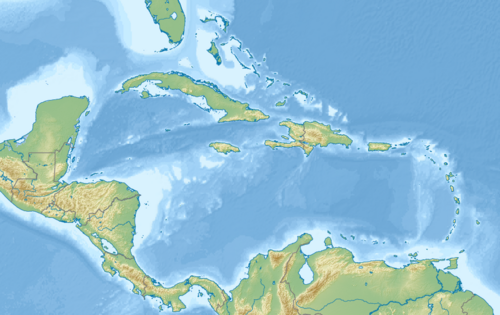
カリブ海(/ ˌ k ær ɪ ˈ b iː ən、k ə ˈ r ɪ b i ən / KARR -ib- EE -ən、 kə- RIB -ee -ən、地元では/ ˈ k ær ɪ b i æ n / KARR -ib-ee-an ; [4]スペイン語: el Caribe、フランス語: les Caraïbes、オランダ語: de Caraïben)は、アメリカ大陸の亜地域であり、カリブ海とその島々を含み、そのいくつかはカリブ海に囲まれており[5]、いくつかはカリブ海と北大西洋の両方に接しています。 [ 6]本土の近くの沿岸地域もこの地域に含まれることがあります。この地域は、メキシコ湾と北アメリカの南東、中央アメリカの東、南アメリカの北に位置しています。

この地域は主にカリブプレート上に位置し、何千もの島、小島、岩礁、岩礁がある。[7] 島弧がカリブ海の北端と東端の境界を定めている:[7]北は大アンティル諸島、東と南はリーワードアンティル諸島を含む小アンティル諸島。バハマ諸島とタークス・カイコス諸島からなる近くのルカヤン諸島と小アンティル諸島のバルバドス島は、カリブ海に面していないにもかかわらず、カリブ海の一部と見なされている。アンティル諸島のすべての島とルカヤン諸島は西インド諸島を形成し、カリブ海という用語と互換性があることが多い。本土では、ベリーズとメキシコのカリブ海沿岸、中央アメリカ、南アメリカも文化的にはカリブ海諸国とみなされており、メキシコのユカタン半島、ホンジュラスのベイ諸島県、ニカラグアの北カリブ海自治地域と南カリブ海自治地域、コスタリカのリモン州、コロンビアのサンアンドレス島、プロビデンシア島、サンタカタリナ島、カルタヘナ、バランキージャ、マラカイボ、クマナ、ベネズエラの連邦属領などがある。[8]フランス領ギアナ、ガイアナ、パナマ、スリナムは、この地域との 政治的、文化的つながりから、カリブ海諸国に含まれることが多い。

地政学的には、カリブ海諸島は北アメリカのサブリージョンと見なされることが多いが、中米に含まれる場合や、独自のサブリージョンとして残される場合もある。 [9] [10]あるいは、「カリブ海」という用語は、ラテンアメリカの一部として意図的に除外されるか、意図せずに含まれる場合もある。一般的に、カリブ海地域は、13の主権国家、12の属国、歴史的に紛争のある領土、および7つのその他の海外領土を含む33の政治実体で構成されている。1954年12月15日から2010年10月10日まで、オランダ領アンティルとして知られる5つの島からなる領土があり、すべてオランダの属国であった。[11] 1958年1月3日から1962年5月31日まで、当時はすべてイギリスの属国であった10の英語圏のカリブ海領土からなるイギリス領西インド諸島連邦と呼ばれる短命の政治連合もあった。
スペイン、イギリス、オランダ、フランスによる植民地化、アフリカからの大西洋奴隷貿易、アジアからの年季奉公、そして近代の移民によってもたらされた移民の波の歴史により、現代のカリブ海地域は、これらすべての民族的背景を持つ人々が住む、地球上で最も民族的に多様な地域の一つとなっています。
語源と発音
この地域の名前は、スペインがアメリカ大陸を征服した当時、小アンティル諸島と隣接する南アメリカの一部に存在していた民族であるカリブ人の名前に由来しています。[12]
カリブ海以外で最も一般的な「Caribbean」の発音は、第3音節に主アクセントがある/ ˌ k ær ɪ ˈ b iː ə n / ( KARR -ə- BEE -ən )と、第2音節にアクセントがある/ k ə ˈ r ɪ b i ə n / ( kə- RIB -ee-ən )の2つである。前世紀のほとんどの権威者は第3音節にアクセントを置くことを好んだ。[13]これは2つの発音のうち古い方だが、第2音節にアクセントがある変種は75年以上前から確立されている。[14]イギリス英語話者は/ ˌ k ær ɪ ˈ b iː ə n / ( KARR -ə- BEE -ən )を好むのに対し、北米英語話者は/ k ə ˈ r ɪ b i ə n / ( kə- RIB -ee-ən ) をより一般的に使用すると示唆されていますが、[15]主要なアメリカの辞書やその他の情報源では、アメリカ英語でも第3音節の強勢がより一般的であると記載されています。[16] [17] [18] [19]オックスフォードオンライン辞書のアメリカ版によると、第2音節の強勢はイギリス英語でより一般的になりつつあり、「一部の人々」によってより現代的でより「正しい」と見なされるようになっています。[20]
オックスフォードオンライン辞書では、カリブ海地域では2番目の音節にアクセントを置くのが最も一般的な発音であると主張しているが、カリブ海英語使用辞典によると、カリブ海英語で最も一般的な発音は、代わりに1番目の音節にアクセントを置く/ ˈ k ær ɪ b i æ n / ( KARR -ih-bee-an )である。[4] [20]
意味
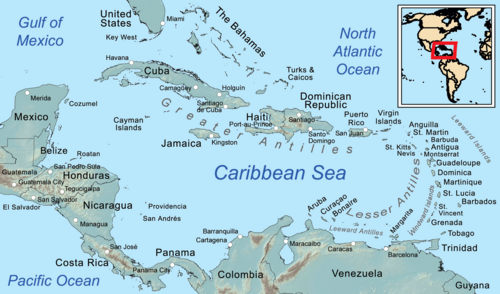
「カリブ海」という言葉にはさまざまな用法があります。その主なものは地理的および政治的なものです。カリブ海の範囲は、アフリカ、奴隷制度、ヨーロッパの植民地化、プランテーション制度との文化的、歴史的つながりが強い地域も含むように拡大することもできます。
- 国連のアメリカ大陸地理体系では、カリブ海地域はアメリカ大陸内の別個の地域として提示されています。
- 自然地理学的には、カリブ海地域は主にカリブ海を取り囲む島々の連なりです。この地域の北はメキシコ湾、フロリダ海峡、東と北東に広がる北大西洋に接しています。南は南アメリカ大陸の海岸線に面しています。
国と地域のリスト
歴史

カリブ海における人類最古の証拠は、トリニダード島南部のバンワリ・トレースにあり、7000年前の遺跡が発見されている。これらの先土器時代の遺跡は、アルカイック(先土器時代)に属し、オルトイロイドと呼ばれている。イスパニョーラ島における人類の定住に関する最古の考古学的証拠は、紀元前3600年頃のものだが、これらの発見の信頼性は疑問視されている。紀元前3100年という一貫した年代は、キューバで発見されている。小アンティル諸島における最古の年代は、紀元前2000年のアンティグアのものである。ウィンドワード諸島に先土器時代の遺跡がないことと、技術の違いから、これらのアルカイック時代の入植者は中米起源である可能性が示唆されている。これらの島々にオルトイロイドによる入植があったかどうかは定かではないが、その証拠はほとんどない。
DNA研究により、コロンブス以前の先住民の歴史に関する従来の考えの一部が変わった。ナショナル ジオグラフィックによると、「研究により、陶器を作る農民の波(陶器時代の人々として知られる)が、約 2,500 年前に南米の北東海岸からカヌーで出発し、カリブ海を渡って島々を移動したことが確認されている。しかし、彼らは最初の入植者ではなかった。多くの島で、彼らは約 6,000 年または 7,000 年前に到着した採集民と遭遇した...今日のアラワク語を話す人々と関係のある陶工たちは、新しい島に定住するにつれて、おそらく病気や暴力によって、以前の採集民に取って代わった。」[29]
紀元前400年から紀元前200年の間に、陶器を使った最初の農耕民であるサラドイド文化が南アメリカからトリニダード島に侵入しました。彼らはオリノコ川を遡ってトリニダード島まで広がり、その後カリブ海の島々に急速に広がりました。西暦250年を過ぎたころ、別のグループであるバランコイドがトリニダード島に入りました。バランコイド社会は西暦650年ごろオリノコ川沿いで崩壊し、別のグループであるアラウキノイドがこれらの地域とカリブ海諸島に広がりました。西暦1300年ごろ、新しいグループであるマヨイドがトリニダード島に入り、スペイン人が入植するまで支配的な文化であり続けました。
カリブ海の島々のほとんどがヨーロッパ人によって発見された当時、島々には3つの主要なアメリカ先住民族が住んでいた。大アンティル諸島、バハマ、リーワード諸島のタイノ族、ウィンドワード諸島のアイランド・カリブ族とガリビ族、そしてキューバ西部のシボネイ族である。タイノ族は、プエルトリコとイスパニョーラ島の一部を占領した古典的タイノ族、バハマ諸島、キューバ、ジャマイカ、イスパニョーラ島の一部を占領した西部タイノ族、および小アンティル諸島北部を占領した東部タイノ族に細分される。グアドループ、ドミニカ、トリニダードを含む小アンティル諸島南部には、カリブ語を話すグループとアラワク語を話すグループの両方が住んでいた。
ヨーロッパの連絡先
クリストファー・コロンブスがカリブ海に到着して間もなく、ポルトガルとスペインの探検家たちは中央アメリカと南アメリカの領有権を主張し始めました。これらの初期の植民地はヨーロッパ、特にイギリス、オランダ、フランスに金をもたらしました。これらの国々はカリブ海に利益のある植民地を築くことを望みました。植民地間の競争により、カリブ海は何世紀にもわたってヨーロッパの戦争の舞台となりました。
コロンブスやイスパニョーラ島の初期の植民者は、先住民を残酷に扱い、子供を奴隷にすることさえありました。[30] 1512年、ドミニコ会の修道士からの圧力を受けて、スペイン国王は新世界の先住民の権利をよりよく保護するためにブルゴス法を導入しました。スペイン人はエンコミエンダと呼ばれる奴隷制度を採用し、奴隷は征服者に与えられ、征服者は奴隷を保護し、改宗させる責任を負っていました。これは住民に壊滅的な影響を与えたため、[31] 1503年からアフリカから植民地に奴隷が輸入されました。
初期の奴隷貿易業者はポルトガル人とスペイン人で、第一大西洋システムとして知られていましたが、17世紀までにはイギリス、フランス、オランダの商人が貿易を独占するようになりました。これは第二大西洋システムとして知られていました。500万人のアフリカ人奴隷がカリブ海に連れて行かれ、約半数がイギリス領カリブ海諸島に売買されました。奴隷制度は1814年にオランダ帝国で最初に廃止されました。スペインは1811年に帝国内で奴隷制度を廃止しましたが、キューバ、プエルトリコ、サントドミンゴは例外でした。キューバでは1886年まで奴隷制度は廃止されませんでした。 [32]イギリスは1807年に奴隷貿易を廃止し、1833年に奴隷制度そのものを廃止しました。フランスは1848年に植民地で奴隷制度を廃止しました。

カリブ海は、特に 1640 年から 1680 年にかけて海賊で知られていました。この地域で活動する海賊を表すのに「海賊」という言葉がよく使われます。カリブ海地域は植民地時代の歴史の大半を通じて戦争に見舞われましたが、戦争はヨーロッパを拠点とするものが多く、カリブ海で戦われた戦闘は小規模なものにとどまりました。しかし、一部の戦争はカリブ海自体の政治的混乱から生まれました。
1791年、フランス植民地サン=ドマングで奴隷反乱が起こり、1804年にカリブ海初の共和国ハイチが建国された。隣国サントドミンゴ(現在のドミニカ共和国)は、1821年、1844年、1865年の3回にわたり独立を果たした。キューバは、米西戦争中の独立戦争へのアメリカの介入を受けて、1898年に独立した。戦争後、アメリカ大陸におけるスペイン最後の植民地プエルトリコは、米国の未編入地域となった。
脱植民地化と近代
1960年代から80年代にかけて、カリブ海におけるイギリス領土のほとんどが政治的独立を達成した。最初は1962年のジャマイカで、その後、トリニダード・トバゴ(1962年) 、英領ギアナ( 1966年)、バルバドス(1966年)、バハマ(1973年)、グレナダ(1974年)、ドミニカ(1978年)、セントルシア(1979年)、セントビンセント(1979年)、アンティグア・バーブーダ(1981年)、セントクリストファー・ネイビス(1983年)が独立を果たした。現在でも、米国、英国、フランス、オランダがカリブ海諸国の一部を領有している。
輸出産業の衰退は、カリブ海地域の経済を多様化する必要があったことを意味した。観光産業は20世紀初頭に発展し始め、国際定期便の就航で休暇が手頃になった1960年代に急速に発展し、現在では500億ドル規模の産業となっている。20世紀初頭に発展したもう1つの産業は、オフショア銀行業務と金融サービスであり、特にバハマ諸島とケイマン諸島で発展した。カリブ海諸島は北米に近いため、規制が簡単で税率が低い外国銀行の支店にとって魅力的な場所だった。
米国の介入
アメリカは少なくとも100年にわたってカリブ海地域で軍事作戦を行ってきた。[33]
モンロー主義以来、米国はほとんどのカリブ海諸国に大きな影響を与えるようになった。20世紀初頭には、バナナ戦争への参加によってこの影響力が拡大した。米西戦争での勝利と1901年のプラット修正条項の調印により、米国はキューバの政治・経済問題に、必要であれば軍事的にも干渉する権利を得た。 1959年のキューバ革命後、関係は急速に悪化し、ピッグス湾侵攻、キューバ危機、そして冷戦下のソ連の脅威に対する恐怖に基づく米国の島不安定化の試みが続いた。米国は19年間(1915年から1934年)イスパニョーラ島を侵略・占領し、その後援助と借款返済を通じてハイチ経済を支配した。米国は1994年に再びハイチに侵攻し、2004年にはカリコムから、ハイチの選出された指導者ジャン=ベルトラン・アリスティドを排除するためのクーデターを画策したとして非難された。1965年、軍政に対する地元の反乱を鎮圧するため、23,000人の米軍がドミニカ共和国に派遣された(ドミニカ内戦を参照)。リンドン・ジョンソン大統領は、「共産主義の脅威」とみなしたものを阻止するために侵攻を命じた。しかし、この任務は曖昧に見え、砲艦外交への回帰として西半球全体で激しく非難された。1983年、米国はポピュリスト左派指導者モーリス・ビショップを排除するためグレナダに侵攻した。米国はキューバのグアンタナモ湾に海軍基地を維持している。司令部の本部はフロリダ州マイアミにある。
-

-
 1965 年、サントドミンゴの国際中立回廊沿いの陣地を監視する海兵隊の重機関銃手。
 -

-
 1994年、ハイチ沖の米海軍航空母艦USSドワイト・D・アイゼンハワー(CVN-69 )の甲板に駐留する米陸軍のシコルスキーUH-60ブラックホーク、ベルAH-1コブラ、ベルOH-58カイオワのヘリコプター。

.jpg/500px-DR1965-5_(8161964889).jpg)
地理と地質学
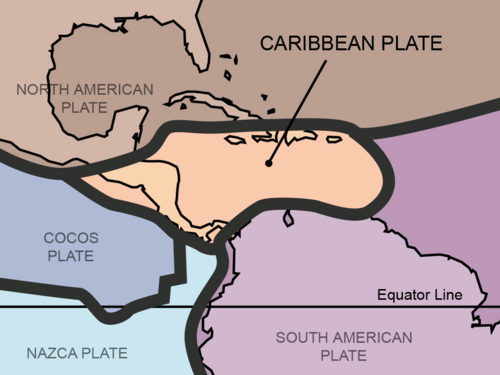
カリブ海プレートは、ここに島が存在する理由です。北部では、オブダクションによって岩石が北アメリカプレートに削り取られています(キューバ西部など)。東部では、小アンティル諸島の沈み込み帯が火山活動と島弧を生み出しています。南アメリカプレートとの複雑な相互作用により、南の境界に沿って島が形成されています。サンゴ島は、中央アメリカの東海岸近くのコロンビア島にあります。
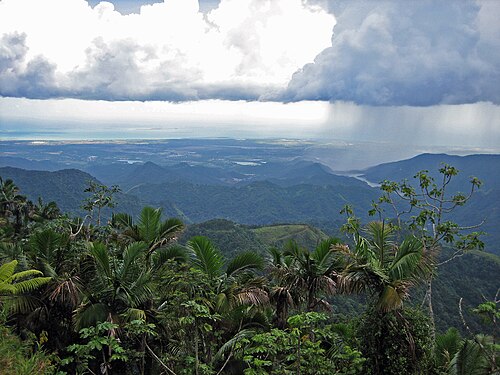
カリブ海地域の地理と気候は多様です。この地域のいくつかの島は、火山起源ではない比較的平坦な地形をしています。これらの島には、アルバ島(小規模な火山性地形のみ)、キュラソー島、バルバドス、ボネール島、ケイマン諸島、セントクロイ島、バハマ諸島、アンティグア島が含まれます。その他の島には、セント・マーチン島、キューバ、イスパニョーラ島、プエルトリコ、ジャマイカ、ドミニカ島、モントセラト島、サバ島、シント・ユースタティウス島、セントクリストファー・ネイビス、セントルシア、セント・トーマス島、セント・ジョン島、トルトラ島、グレナダ、セントビンセント、グアドループ、マルティニーク島、トリニダード・トバゴ島のように、険しくそびえ立つ山脈があります。
大アンティル諸島と小アンティル諸島という用語の定義は、しばしば異なります。プエルトリコの沿岸部にあるヴァージン諸島は、大アンティル諸島に含まれることもあります。小アンティル諸島という用語は、グレナダを含み、トリニダード・トバゴとリーワード・アンティル諸島を除いた島弧を定義するためによく使用されます。
カリブ海の海域には、回遊する魚やカメ、サンゴ礁の大きな群れが生息している。プエルトリコ島のすぐ北、大西洋とカリブ海の境界に位置するプエルトリコ海溝は、大西洋全体で最も深い地点である。[34]
この地域は、西カリブ海と太平洋を結ぶ パナマ運河を含むいくつかの主要な航路の沿線に位置しています。
気候

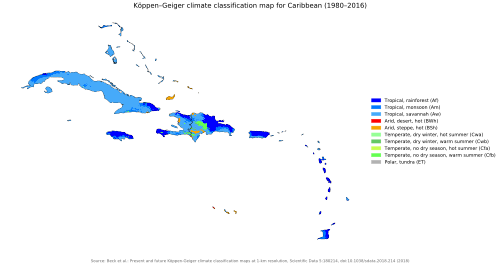
この地域の気候は熱帯性で、ある地域では熱帯雨林、他の地域では熱帯モンスーンや熱帯サバンナと変化します。また、年によってはかなりの干ばつが発生する乾燥気候の場所もあり、山の頂上は涼しい温帯気候になる傾向があります。
降雨量は、標高、大きさ、およびABC諸島を乾燥した状態に保っている冷たい湧昇流などの水流によって異なります。暖かく湿った貿易風が常に東から吹き、この地域全体に熱帯雨林気候と半乾燥気候の両方を作り出しています。熱帯雨林気候には、コスタリカから北のベリーズまでのカリブ海近くの低地、ドミニカ共和国、プエルトリコが含まれ、季節的な乾燥した熱帯サバンナ気候は、キューバ、コロンビア北部 、ベネズエラ、メキシコのユカタン半島南部に見られます。乾燥気候は、ベネズエラの最北端の海岸からアルバ島やキュラソー島などの島々、およびユカタン半島の北西端に見られます。
この地域は、一般的に年間を通じて晴れているが、5月から11月までの雨期には雲が多くなり(断続的または曇り)、12月から4月までの乾期には晴れからほぼ晴れになることが多い。季節的な降雨量は「乾期」と「雨期」に分かれており、1年の後半の6か月は前半よりも雨が多い。気温は年間を通じて高温で、雨期と乾期の間で25~33℃(77~90℉)の範囲で変化する。季節によって、月平均気温は最北部地域で約5℃(7℉)からカリブ海の最南部地域では3℃未満まで変化する。
ハリケーンシーズンは6月から11月ですが、8月と9月に頻繁に発生し、カリブ海北部の島々でよく見られます。この地域を時折襲うハリケーンは、通常、グレナダの北方とバルバドスの西方を襲います。主なハリケーン帯は、東カリブ海にあるバルバドス島の北西に弧を描いています。2017年のハリケーンシーズン中にセントマーチン島を壊滅させたハリケーン・イルマの最近の出来事は、その良い例です。
海面温度は年間を通じてほとんど変化せず、通常は最も暖かい月の 30 °C (87 °F) から最も寒い月の 26 °C (76 °F) までの範囲です。気温は年間を通じて暖かく、70 度、80 度、90 度で、冬と夏では南の島で約 2 ~ 5 度、カリブ海の北の島では約 10 ~ 20 度しか変わりません。バハマ、キューバ、プエルトリコ、ドミニカ共和国などの北の島々は、冬季に寒冷前線などの大陸の塊の影響を受けることがあります。
アルバ: 北緯12度
プエルトリコ: 北緯18度
キューバ: 北緯22度


.jpg/500px-Guadeloupe_(Le_cimeti%C3%A8re_de_Gourbeyre).jpg)

島嶼群
ルカヤン諸島[a]
 バハマ
バハマ タークス・カイコス諸島(イギリス)

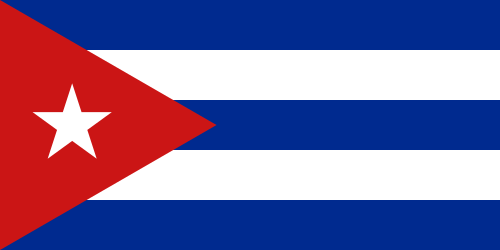


- リーワード諸島
 アメリカ領ヴァージン諸島 (米国)
 イギリス領ヴァージン諸島(イギリス)
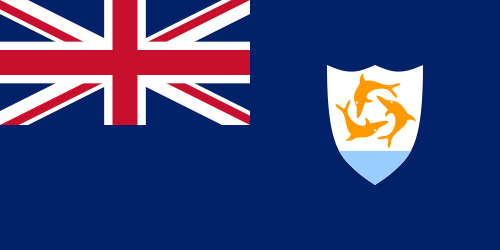 アンギラ(イギリス)
 アンティグア・バーブーダ
- 政治的に分裂している サン・マルタン島
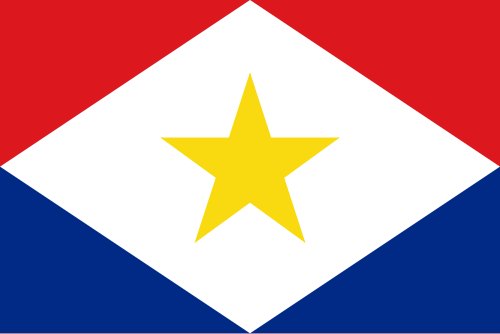 サバ島(カリブ海オランダ領、オランダ)
 シント・ユースタティウス(カリブ海オランダ領、オランダ)
 サン・バルテルミー島(フランス領アンティル諸島、フランス)
 セントクリストファー・ネイビス
 モントセラト(イギリス)
- グアドループ(フランス領アンティル諸島、フランス)を含む
- ウィンドワード諸島
- リーワードアンティル諸島


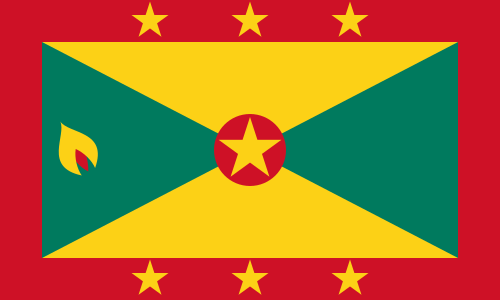


歴史的グループ分け


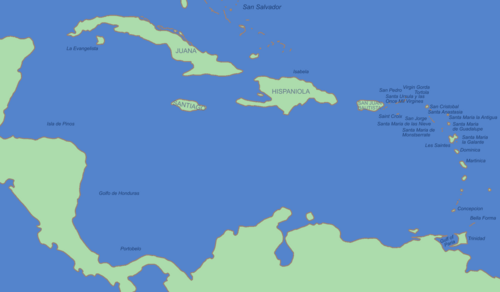
すべての島々はかつてはヨーロッパ諸国の植民地であり、現在もいくつかの島々はそうである。いくつかの島々は海外領土または従属領である。
- イギリス領西インド諸島/英語圏カリブ海–アンギラ、アンティグア・バーブーダ、バハマ、バルバドス、ベイ諸島、ガイアナ、ベリーズ、イギリス領ヴァージン諸島、ケイマン諸島、ドミニカ、グレナダ、ジャマイカ、モントセラト、セントクロア(短期間)、セントクリストファー・ネイビス、セントルシア、セントビンセントおよびグレナディーン諸島、トリニダード・トバゴ(1797年以降)、タークス・カイコス諸島
- デンマーク領西インド諸島– 1814年以前はデンマーク=ノルウェー、その後デンマーク、現在のアメリカ領ヴァージン諸島を領有
- オランダ領西インド諸島–アルバ、ボネール、キュラソー、サバ、シント・ユースタティウス、シント・マールテン、ベイ諸島(一時的)、セント・クロア(一時的)、トバゴ、スリナム、ヴァージン諸島
- フランス領西インド諸島–アンギラ(短期)、アンティグア・バーブーダ(短期)、ドミニカ国、ドミニカ共和国(短期)、グレナダ、ハイチ(旧サン=ドマング)、モントセラト(短期)、セントルシア、セントビンセントおよびグレナディーン諸島、シント・ユースタティウス(短期)、シント・マールテン、(短期)、トバゴ(短期)、サン・クロワ、現在のフランス海外県であるフランス領ギアナ、マルティニーク、グアドループ(マリー=ガラント島、ラ・デジラード、レ・サントを含む)、現在のフランス海外県であるサン・バルテルミー島およびサン・マルタン島
- ポルトガル領西インド諸島- 現在のバルバドス。16 世紀、ポルトガル人がブラジルへ向かう途中でこの島の領有権を主張した際にはオス バルバドスとして知られました。ポルトガル人はイギリス人が到着する何年も前にバルバドスを放棄しました。
- スペイン領西インド諸島-キューバ、イスパニョーラ島(現在のドミニカ共和国)、ハイチ(1659年まで、フランスに譲渡)、プエルトリコ、ジャマイカ(1655年まで、イギリスに譲渡)、ケイマン諸島(1670年まで、イギリスに譲渡) 、トリニダード島(1797年まで、イギリスに譲渡)、ベイ諸島(1643年まで、イギリスに譲渡)、中央アメリカの沿岸島(ベリーズを除く)、パナマ、コロンビア、メキシコ、ベネズエラのカリブ海沿岸島嶼の一部。
- スウェーデン領西インド諸島– 現在のフランス領サン・バルテルミー島、グアドループ島(短期間)、トバゴ島(短期間)。
- クールランダー 西インド諸島–トバゴ(1691 年まで)
イギリス領西インド諸島は、1958年から1962年にかけてイギリスによって西インド諸島連盟に統合されました。かつてBWIに加盟していた独立国は、現在も合同クリケットチームを結成し、テストマッチ、ワンデイインターナショナル、トゥエンティ20インターナショナルに出場しています。西インド諸島のクリケットチームには、大陸本土で唯一の旧イギリス植民地である 南米の国ガイアナも含まれています。
さらに、これらの国々は、地域団体として西インド諸島大学を共有しています。この大学は、ジャマイカ、バルバドス、トリニダード・トバゴの 3 つの主要キャンパス、バハマの小規模キャンパス、およびトリニダードなどの他の参加地域に常駐講師を配置しています。
カリブ海沿岸と島々を持つ大陸諸国




.jpg/500px-Palancar_Beach_aerial_Cozumel_Mexico_(21398553341).jpg)

生物多様性
カリブ諸島は、世界でも最も多様な生態系を持つ地域の一つです。動物、菌類、植物、そして、山岳雲霧林から熱帯雨林、サボテンの低木地帯まで、その非常に多様な陸上・海洋生態系により、コンサベーション・インターナショナルの生物多様性ホットスポットの一つに分類されています。この地域には、世界のサンゴ礁の約8%(表面積で)[40]と広大な海草藻場[41]があり、どちらもこの地域の島と大陸の海岸に隣接する浅い海域でよく見られます。
菌類については、参考コレクションの標本、出版された報告、および現地観察から得られた約90,000件の記録に基づく最新のチェックリストがある。[42]このチェックリストには、この地域で記録された11,250種以上の菌類が含まれている。その著者が指摘しているように、この作業は網羅的とはほど遠く、カリブ海ですでに知られている菌類の種の本当の総数はこれよりも多い可能性がある。世界中の菌類の約7%しか発見されていないという一般に受け入れられている推定を考えると、まだ記録されていない種を含むカリブ海に生息する菌類の種の本当の総数はおそらくはるかに多いだろう。[43]入手可能な情報はまだ少ないが、いくつかのカリブ海諸島に固有の菌類種の数を推定する最初の努力がなされた。キューバについては、2,200種の菌類が島の固有種の可能性があると暫定的に特定されている。[44]プエルトリコについては、その数は789種である。[45]ドミニカ共和国ではその数は699種である。[46]トリニダード・トバゴではその数は407種である。[47]
カリブ諸島の生態系の多くは、森林破壊、汚染、人間の侵入によって壊滅的な被害を受けています。最初の人間の到来は、オオフクロウと小型地上ナマケモノの絶滅と相関しています。 [ 48 ]ホットスポットには、数十種の絶滅が危惧されている動物(鳥類から哺乳類、爬虫類まで)、菌類、植物が生息しています。絶滅が危惧されている動物の例としては、プエルトリコのアマゾン、キューバとイスパニョーラ島の2種のソレノドン(オオトガリネズミ)、キューバワニなどがあります。

この地域のサンゴ礁には約70種の硬質サンゴと500~700種のサンゴ礁関連魚類が生息している[49]が、近年生態系の健全性が急速に低下しており、地球温暖化と海洋酸性化に対して特に脆弱であると考えられている。[50] UNEPの報告書によると、カリブ海のサンゴ礁は、海岸沿いの人口爆発、乱獲、沿岸地域の汚染、地球温暖化により、今後20年以内に絶滅する可能性がある。[51]
カリブ海の島々の中には、ヨーロッパ人が農業に適した地形だと考えたものもある。植民地時代の初期の重要な作物はタバコだったが、やがてこの地域の主食はサトウキビに取って代わられた。サトウキビから砂糖が作られ、ヨーロッパに輸出された。キューバとバルバドスは歴史的に最大の砂糖生産国だった。そのため、熱帯プランテーションシステムがカリブ海の入植地の主流となった。他の島々は農業に適さない地形だと分かった。例えばドミニカは森林が密生している。小アンティル諸島南部の島々、アルバ、ボネール、キュラソーは極度に乾燥しており、農業には適していない。しかし、塩田があり、オランダ人が利用した。海水が浅い池に汲み上げられ、水が蒸発すると粗塩が生成された。[52]
カリブ諸島の自然環境の多様性は、近年エコツーリズムの成長につながっています。このタイプの観光は、砂浜や人口密度の低い島々で成長しています。[53]
動植物
-

-
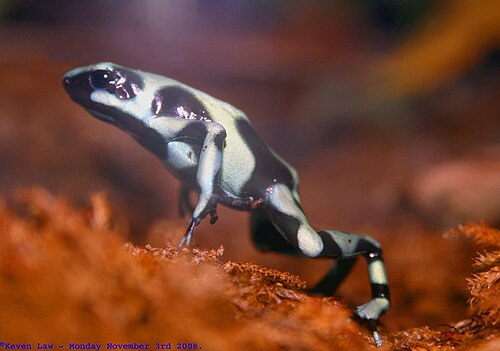 緑と黒の毒ガエル、Dendrobates auratus
 -

-
 Costus speciosus、湿地植物、グアドループ
 -

-
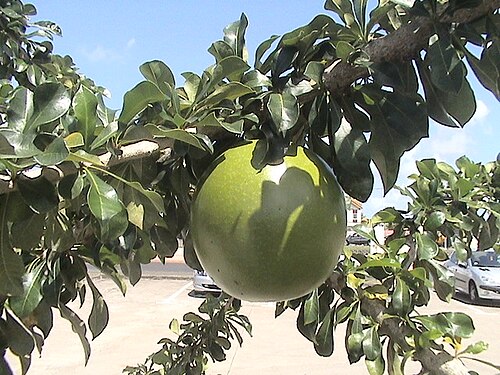 Crescentia cujete、またはひょうたんの果実、マルティニーク
 -
 Thalassoma bifasciatum(ブルーヘッドラス)とBispira brunnea(ソーシャルフェザーダスターワーム)
 -

-

-
 マルティニークアマゾヒョウ(Amazona martinicana )は、オウム科に属する絶滅したオウムの一種である。
 -
 カリブミバエ類、アナストレファ・サスペンサ
 -

.jpg/500px-Epiphytes_(Dominica).jpg)

.jpg/500px-Ocypode_quadrata_(Martinique).jpg)
_juvenile_yellow_stage_over_Bispira_brunnea_(Social_Feather_Duster_Worms).jpg/500px-Thalassoma_bifasciatum_(Bluehead_Wrasse)_juvenile_yellow_stage_over_Bispira_brunnea_(Social_Feather_Duster_Worms).jpg)
.jpg/500px-Stenopus_hispidus_(Banded_cleaner_shrimp).jpg)
_pair.jpg/500px-Cyphoma_signata_(Fingerprint_Cowry)_pair.jpg)
.jpg/500px-Hemidactylus_mabouia_(Dominica).jpg)
人口統計
平均寿命
世界銀行グループの推定によると、2022年のカリブ海諸国の平均寿命は次の通りである。[54] [55] [56]
Change in life expectancy in the Caribbean from 2019 to 2021[54]
Indigenous groups


At the time of European contact, the dominant ethnic groups in the Caribbean included the Taíno of the Greater Antilles and northern Lesser Antilles, the Island Caribs of the southern Lesser Antilles, and smaller distinct groups such as the Guanajatabey of western Cuba and the Ciguayo of eastern Hispaniola. The population of the Caribbean is estimated to have been around 750,000 immediately before European contact, although lower and higher figures are given. After contact, social disruption and epidemic diseases such as smallpox and measles (to which they had no natural immunity)[57] led to a decline in the Amerindian population.[58][59] such as the Kongo, Igbo, Akan, Fon and Yoruba as well as military prisoners from Ireland, who were deported during the Cromwellian reign in England.[citation needed] Immigrants from Britain, Italy, France, Spain, the Netherlands, Portugal and Denmark also arrived, although the mortality rate was high for both groups.[60]
The population is estimated to have reached 2.2 million by 1800.[61] Immigrants from India, China, Indonesia, and other countries arrived in the mid-19th century as indentured servants.[62] After the ending of the Atlantic slave trade, the population increased naturally.[63] The total regional population was estimated at 37.5 million by 2000.[64]
In Haiti and most of the French, Anglophone and Dutch Caribbean, the population is predominantly of African origin; on many islands there are also significant populations of mixed racial origin (including Mulatto-Creole, Dougla, Mestizo, Quadroon, Cholo, Castizo, Criollo, Zambo, Pardo, Asian Latin Americans, Chindian, Cocoa panyols, and Eurasian), as well as populations of European ancestry: Dutch, English, French, Italian, Portuguese and Spanish ancestry. Asians, especially those of Chinese, Indian descent, and Javanese Indonesians, form a significant minority in parts of the region. Indians form a plurality of the population in Trinidad and Tobago, Guyana, and Suriname. Most of their ancestors arrived in the 19th century as indentured laborers.
The Spanish-speaking Caribbean populations are primarily of European, African, or racially mixed origins. Cuba has a European majority, along with a significant population of African ancestry. Puerto Rico has a mixed race majority with a mixture of European-African-Native American (tri-racial), and a large White and West African (black) minority. The Dominican Republic has the largest mixed-race population, primarily descended from Europeans, West Africans, and Amerindians.

The majority of Jamaica is of West African origin, in addition to a significant population of mixed racial background, and has minorities of Chinese, Europeans, Indians, Latinos, Jews, and Arabs. This is a result of years of importation of slaves and indentured laborers, and migration. Most multi-racial Jamaicans refer to themselves as either mixed race or brown. Similar populations can be found in the Caricom states of Belize, Guyana and Trinidad and Tobago. Trinidad and Tobago has a multi-racial cosmopolitan society due to the arrivals of Africans, Indians, Chinese, Arabs, Jews, Latinos, and Europeans along with the native indigenous Amerindians population. This multi-racial mix of the Caribbean has created sub-ethnicities that often straddle the boundaries of major ethnicities and include Mulatto-Creole, Mestizo, Pardo, Zambo, Dougla, Chindian, Afro-Asians, Eurasian, Cocoa panyols, and Asian Latinos.
Language
Spanish (64%), French (25%), English (14%), Dutch, Haitian Creole, and Papiamento are the predominant official languages of various countries in the region. However, virtually every Caribbean country has a distinct creole language or dialect that often serves as its vernacular language. Most of these do not enjoy official status, with the aforementioned Haitian Creole and Papiamento being notable exceptions. Other languages such as Caribbean Hindustani, Chinese, Javanese, Arabic, Hmong, Amerindian languages, other African languages, other European languages, and other Indian languages can also be found.
Religion

.jpg/500px-TnT_PoS_Cathedral_of_the_Holy_Trinity_(back_view).jpg)


Christianity is the predominant religion in the Caribbean (84.7%).[65] Other religions in the region are Hinduism, Islam, Judaism, Rastafari, Buddhism, Chinese folk religion (incl. Taoism and Confucianism), Baháʼí, Jainism, Sikhism, Kebatinan, Traditional African religions, Yoruba (incl. Trinidad Orisha), Afro-American religions, (incl. Santería, Palo, Umbanda, Brujería, Hoodoo, Candomblé, Quimbanda, Orisha, Xangô de Recife, Xangô do Nordeste, Comfa, Espiritismo, Santo Daime, Obeah, Candomblé, Abakuá, Kumina, Winti, Sanse, Cuban Vodú, Dominican Vudú, Louisiana Voodoo, Haitian Vodou, and Vodun).
Politics
Regionalism

Caribbean societies are very different from other Western societies in terms of size, culture, and degree of mobility of their citizens.[66] The current economic and political problems the states face individually are common to all Caribbean states. Regional development has contributed to attempts to subdue current problems and avoid projected problems. From a political and economic perspective, regionalism serves to make Caribbean states active participants in current international affairs through collective coalitions. In 1973, the first political regionalism in the Caribbean Basin was created by advances of the English-speaking Caribbean nations through the institution known as the Caribbean Common Market and Community (CARICOM)[67] which is located in Guyana.
Certain scholars have argued both for and against generalizing the political structures of the Caribbean. On the one hand the Caribbean states are politically diverse, ranging from socialist systems towards more capitalist Westminster-style parliamentary systems. Other scholars argue that these differences are superficial, and that they tend to undermine commonalities in the various Caribbean states. Contemporary Caribbean systems seem to reflect a "blending of traditional and modern patterns, yielding hybrid systems that exhibit significant structural variations and divergent constitutional traditions yet ultimately appear to function in similar ways."[68] The political systems of the Caribbean states share similar practices.
The influence of regionalism in the Caribbean is often marginalized. Some scholars believe that regionalism cannot exist in the Caribbean because each small state is unique. On the other hand, scholars also suggest that there are commonalities amongst the Caribbean nations that suggest regionalism exists. "Proximity as well as historical ties among the Caribbean nations has led to cooperation as well as a desire for collective action."[69] These attempts at regionalization reflect the nations' desires to compete in the international economic system.[69]
Furthermore, a lack of interest from other major states promoted regionalism in the region. In recent years, the Caribbean has suffered from a lack of U.S. interest. "With the end of the Cold War, U.S. security and economic interests have been focused on other areas. As a result there has been a significant reduction in U.S. aid and investment to the Caribbean."[70] The lack of international support for these small, relatively poor states, helped regionalism prosper.
Following the Cold War another issue of importance in the Caribbean has been the reduced economic growth of some Caribbean States due to the United States and European Union's allegations of special treatment toward the region by each other. [clarification needed]
United States–EU trade dispute
The United States under President Bill Clinton launched a challenge in the World Trade Organization against the EU over Europe's preferential program, known as the Lomé Convention, which allowed banana exports from the former colonies of the Group of African, Caribbean and Pacific states (ACP) to enter Europe cheaply.[71] The World Trade Organization sided in the United States' favour and the beneficial elements of the convention to African, Caribbean and Pacific states have been partially dismantled and replaced by the Cotonou Agreement.[72]
During the US/EU dispute, the United States imposed large tariffs on European Union goods (up to 100%) to pressure Europe to change the agreement with the Caribbean nations in favour of the Cotonou Agreement.[73]
Farmers in the Caribbean have complained of falling profits and rising costs as the Lomé Convention weakens.[74] Some farmers have faced increased pressure to turn towards the cultivation of illegal drugs, which has a higher profit margin and fills the sizable demand for these illegal drugs in North America and Europe.[75][76]
African Union relations
Many Caribbean nations have sought to deepen ties with the continent of Africa. The African Union-bloc has referred to the Caribbean as the potential "Sixth Region" of the African Union.[77] Some Caribbean states have already moved to join Africa institutions including Barbados, Grenada, Guyana, and the Bahamas which have all became members of the African Export Import Bank.[78] And the Caribbean Development Bank signing a cooperation strategic partnership agreement with the African Development Bank (AfDB)[79] At present Antigua and Barbuda, Barbados, Jamaica, Guyana, and Suriname are at various stages of establishing direct air flights with Africa to boost person-to-person links and boost trade between both regions.
The first inter-regional Africa-Caribbean Community (CARICOM) Summit took place in September 2021. In August 2023 the African Union's African Export–Import Bank officially opened its first Caribbean Community office in Barbados beginning the process of integrating willing Caribbean states as the 6th region of the African Union.[1][2]
Caribbean Financial Action Task Force and Association of Caribbean States
Caribbean nations have also started to more closely cooperate in the Caribbean Financial Action Task Force and other instruments to add oversight of the offshore industry. One of the most important associations that deal with regionalism amongst the nations of the Caribbean Basin has been the Association of Caribbean States (ACS). Proposed by CARICOM in 1992, the ACS soon won the support of the other countries of the region. It was founded in July 1994. The ACS maintains regionalism within the Caribbean on issues unique to the Caribbean Basin. Through coalition building, like the ACS and CARICOM, regionalism has become an undeniable part of the politics and economics of the Caribbean. The successes of region-building initiatives are still debated by scholars, yet regionalism remains prevalent throughout the Caribbean.
Bolivarian Alliance
The President of Venezuela, Hugo Chavez launched an economic group called the Bolivarian Alliance for the Americas (ALBA), which several eastern Caribbean islands joined.
Regional institutions
Here are some of the bodies that several islands share in collaboration:
- African, Caribbean and Pacific Group of States
- Association of Caribbean States (ACS), Trinidad and Tobago
- Caribbean Association of Industry and Commerce (CAIC), Trinidad and Tobago
- Caribbean Association of National Telecommunication Organizations (CANTO), Trinidad and Tobago[80]
- Caribbean Community (CARICOM), Guyana
- Caribbean Development Bank (CDB), Barbados
- Caribbean Disaster Emergency Management Agency (CDERA), Barbados
- Caribbean Educators Network[81]
- Caribbean Electric Utility Services Corporation (CARILEC), Saint Lucia[82]
- Caribbean Environment Programme (CEP), UN Environment Programme–administered Regional Seas Programme, secretariat located in Kingston, Jamaica[83]
- Caribbean Examinations Council (CXC), Barbados and Jamaica
- Caribbean Financial Action Task Force (CFATF), Trinidad and Tobago
- Caribbean Food Crops Society, Puerto Rico
- Caribbean Football Union (CFU), Jamaica
- Caribbean Hotel & Tourism Association (CHTA), Florida and Puerto Rico[84]
- Caribbean Initiative (Initiative of the IUCN)
- Caribbean Programme for Economic Competitiveness (CPEC), Saint Lucia
- Caribbean Regional Environmental Programme (CREP), Barbados[85]
- Caribbean Regional Fisheries Mechanism (CRFM), Belize[86]
- Caribbean Regional Negotiating Machinery (CRNM), Barbados and Dominican Republic[87]
- Caribbean Telecommunications Union (CTU), Trinidad and Tobago
- Caribbean Tourism Organization (CTO), Barbados
- Community of Latin American and Caribbean States (CELAC)
- Foundation for the Development of Caribbean Children, Barbados
- Latin America and Caribbean Network Information Centre (LACNIC), Brazil and Uruguay
- Latin American and the Caribbean Economic System, Venezuela
- Organisation of Eastern Caribbean States (OECS), Saint Lucia
- United Nations Economic Commission for Latin America and the Caribbean (ECLAC), Chile and Trinidad and Tobago
- University of the West Indies, Jamaica, Trinidad and Tobago, Barbados, and Antigua & Barbuda.[88] In addition, the fourth campus, the Open Campus was formed in June 2008 as a result of an amalgamation of the Board for Non-Campus Countries and Distance Education, Schools of Continuing Studies, the UWI Distance Education Centres and Tertiary Level Units. The Open Campus has 42 physical sites in 16 Anglophone caribbean countries.
- West Indies Cricket Board, Antigua and Barbuda[89]
Cuisine
Favourite or national dishes
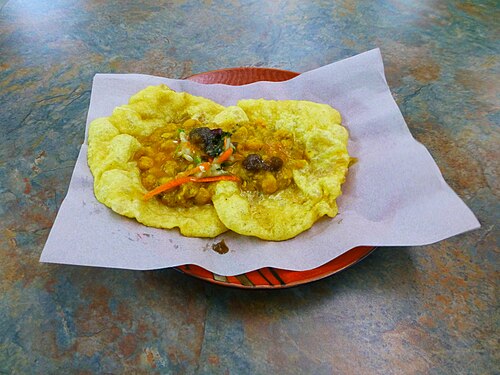

- Anguilla – rice, peas and fish
- Antigua and Barbuda – fungee and pepperpot
- Bahamas – Guava duff, Conch Salad, Peas n' Rice, and conch fritters
- Barbados – cou-cou and flying fish
- Belize – rice and beans, stew chicken with potato salad; white rice, stew beans and fry fish with cole slaw
- British Virgin Islands – fish and fungee
- Cayman Islands – turtle stew, turtle steak, grouper, conch stew, Cayman-style beef with rice and beans, cassava cake
- Colombian Caribbean – rice with coconut milk, arroz con pollo, sancocho, Arab cuisine (due to the large Arab population)
- Cuba – platillo Moros y Cristianos, ropa vieja, lechon, maduros, ajiaco
- Dominica – mountain chicken, rice and peas, dumplings, saltfish, dashin, bakes (fried dumplings), coconut confiture, curry goat, cassava farine, oxtail
- Dominican Republic – arroz con pollo with stewed red kidney beans, pan fried or braised beef, salad/ ensalada de coditos, empanadas, mangú, sancocho
- Grenada – oil down, Roti and rice & chicken
- Guyana – roti and curry, pepperpot, cook-up rice, metemgee, pholourie
- Haiti – griot (fried pork) served with du riz a pois or diri ak pwa (rice and beans)
- Jamaica – ackee and saltfish, callaloo, jerk chicken, curry chicken
- Montserrat – Goat water
- Puerto Rico – yellow rice with green pigeon peas, saltfish stew, roasted pork shoulder, Puerto Rican style pasteles (root vegetable meat patties), chicken fricassée, pasteles, mofongo, tripe soup, tostones, alcapurria, codfish fritters, coconut custard, rice pudding, guava turnovers, Mallorca bread
- Saint Kitts and Nevis – goat water, coconut dumplings, spicy plantain, saltfish, breadfruit
- Saint Lucia – callaloo, dal roti, dried and salted cod, green bananas, rice and beans
- Saint Vincent and the Grenadines – roasted breadfruit and fried jackfish
- Suriname – brown beans and rice, roti and curry, peanut soup, battered fried plantain with peanut sauce, nasi goreng, moksi-alesi, bara, pom
- Trinidad and Tobago – doubles, curry with roti or dal bhat, aloo pie, phulourie, callaloo, bake and shark, curry crab and dumpling
- United States Virgin Islands – stewed goat, oxtail or beef, seafood, callaloo, fungee
- Venezuela Caribbean – fried fish with salad and rise, tostones, sancocho, patacon, pabellon
See also

.svg/500px-North_America_(orthographic_projection).svg.png)
- African diaspora
- Anchor coinage
- British African-Caribbean people
- British Indo-Caribbean people
- Caribbean people
- Climate change in the Caribbean
- CONCACAF
- Council on Hemispheric Affairs
- Culture of the Caribbean
- Economy of the Caribbean
- Indian diaspora
- Indo-Caribbean
- Indo-Caribbean American
- List of Caribbean music genres
- List of sovereign states and dependent territories in the Caribbean
- Non-resident Indian and person of Indian origin
- Piracy in the Caribbean
- Politics of the Caribbean
- Democracy in the Caribbean
- Tourism in the Caribbean
Geography:
Notes
- ^ The Lucayan Archipelago is excluded from some definitions of "Caribbean" and instead classified as Atlantic; this is primarily a geological rather than cultural or environmental distinction.
References
- ^ a b "World Population Prospects 2022". United Nations Department of Economic and Social Affairs, Population Division. Retrieved July 17, 2022.
- ^ a b "World Population Prospects 2022: Demographic indicators by region, subregion and country, annually for 1950-2100" (XSLX) ("Total Population, as of 1 July (thousands)"). United Nations Department of Economic and Social Affairs, Population Division. Retrieved July 17, 2022.
- ^ McWhorter, John H. (2005). Defining Creole. Oxford University Press US. p. 379. ISBN 978-0-19-516670-5.
- ^ a b Allsopp, Richard; Allsopp, Jeannette (2003). Dictionary of Caribbean English Usage. University of the West Indies Press. p. 136–. ISBN 978-976-640-145-0.
- ^ Engerman, Stanley L. (2000). "A Population History of the Caribbean". In Haines, Michael R.; Steckel, Richard Hall (eds.). A Population History of North America. Cambridge University Press. pp. 483–528. ISBN 978-0-521-49666-7. OCLC 41118518.
- ^ Hillman, Richard S.; D'Agostino, Thomas J., eds. (2003). Understanding the contemporary Caribbean. London, UK: Lynne Rienner. ISBN 978-1588266637. OCLC 300280211.
- ^ a b Rogoziński, Jan (1999). A Brief History of the Caribbean (Revised ed.). New York: Facts on File, Inc. pp. 3–4. ISBN 0-8160-3811-2. Retrieved 15 July 2024 – via Internet Archive.
- ^ Higman, B. W. (2011). A Concise History of the Caribbean. Cambridge: Cambridge University Press. p. xi. ISBN 978-0521043489.
- ^ "North America" Archived 3 May 2015 at the Wayback Machine. Britannica Concise Encyclopedia; "... associated with the continent is Greenland, the largest island in the world, and such offshore groups as the Arctic Archipelago, the Bahamas, the Greater and Lesser Antilles, the Queen Charlotte Islands, and the Aleutian Islands," but also "North America is bounded ... on the south by the Caribbean Sea," and "according to some authorities, North America begins not at the Isthmus of Panama but at the narrows of Tehuantepec."
- ^ The World: Geographic Overview, The World Factbook, Central Intelligence Agency; "North America is commonly understood to include the island of Greenland, the isles of the Caribbean, and to extend south all the way to the Isthmus of Panama"
- ^ The Netherlands Antilles: The joy of six, The Economist Magazine, 29 April 2010
- ^ "Carib". Encyclopædia Britannica. Archived from the original on 30 April 2008. Retrieved 20 February 2008.
inhabited the Lesser Antilles and parts of the neighbouring South American coast at the time of the Spanish conquest.
- ^ Elster, Charles Harrington. "Caribbean", from The Big Book of Beastly Mispronunciations Archived 17 March 2023 at the Wayback Machine. p.78. (2d ed. 2005)
- ^ In the early 20th century, only the pronunciation with the primary stress on the third syllable was considered correct, according to Frank Horace Vizetelly, A Desk-Book of Twenty-five Thousand Words Frequently Mispronounced (Funk and Wagnalls, 1917), p. 233.
- ^ Ladefoged, Peter; Johnson, Keith (2011). A Course in Phonetics. Cengage Learning. pp. 86–. ISBN 978-1-4282-3126-9.
- ^ Random House Dictionary
- ^ American Heritage Dictionary
- ^ Merriam Webster
- ^ See, e.g., Elster, supra.
- ^ a b Oxford Online Dictionaries
- ^ "SPP Background". CommerceConnect.gov. Security and Prosperity Partnership of North America. Archived from the original on 18 June 2008. Retrieved 14 November 2010.
- ^ "Ecoregions of North America". United States Environmental Protection Agency. Archived from the original on 14 May 2011. Retrieved 30 May 2011.
- ^ "What's the difference between North, Latin, Central, Middle, South, Spanish and Anglo America?". About.com. Archived from the original on 10 April 2016. Retrieved 21 February 2023.
- ^ Unless otherwise noted, land area figures are taken from "Table 3: Population by sex, rate of population increase, surface area and density" (PDF). Demographic Yearbook. United Nations Statistics Division. 2008. Archived from the original on 25 December 2018. Retrieved 14 October 2010.
- ^ Since the Lucayan Archipelago is located in the Atlantic Ocean rather than Caribbean Sea, the Bahamas are part of the West Indies but are not technically part of the Caribbean, although the United Nations groups them with the Caribbean.
- ^ a b c Population estimates are taken from the Central Bureau of Statistics Netherlands Antilles. "Statistical information: Population". Government of the Netherlands Antilles. Archived from the original on 1 May 2010. Retrieved 14 October 2010.
- ^ Because of ongoing activity of the Soufriere Hills volcano beginning in July 1995, much of Plymouth was destroyed and government offices were relocated to Brades. Plymouth remains the de jure capital.
- ^ Since the Lucayan Archipelago is located in the Atlantic Ocean rather than Caribbean Sea, the Turks and Caicos Islands are part of the West Indies but are not technically part of the Caribbean, although the United Nations groups them with the Caribbean.
- ^ Lawler, Andrew (23 December 2020). "Invaders nearly wiped out Caribbean's first people long before Spanish came, DNA reveals". National Geographic. Archived from the original on 30 January 2021. Retrieved 4 January 2021.
- ^ Beazley, C. Raymond; Olson, Julius E.; Bourne, Edward Gaylord (April 1907). "The Northmen, Columbus and Cabot, 985-1503". The American Historical Review. 12 (3): 654. doi:10.2307/1832434. hdl:2027/loc.ark:/13960/t7mp5d39r. ISSN 0002-8762. JSTOR 1832434.
- ^ Livi-Bacci, Massimo (June 2006). "The Depopulation of Hispanic America after the Conquest". Population and Development Review. 32 (2): 199–232. doi:10.1111/j.1728-4457.2006.00116.x. ISSN 0098-7921.
- ^ "End of Slavery in Cuba". www.historyofcuba.com. Archived from the original on 19 December 2022. Retrieved 19 December 2022.
- ^ Dosal, Paul. "THE CARIBBEAN WAR. The United States in the Caribbean, 1898–1998" (PDF). University of South Florida. Archived (PDF) from the original on 7 August 2004. Retrieved 22 June 2023.
- ^ ten Brink, Uri. "Puerto Rico Trench 2003: Cruise Summary Results". National Oceanic and Atmospheric Administration. Archived from the original on 24 July 2013. Retrieved 21 February 2008.
- ^ "Summary Climatological Normals 1981–2010" (PDF). Departamento Meteorologico Aruba. Archived (PDF) from the original on 9 September 2020. Retrieved 15 October 2012.
- ^ "Climate Data Aruba". Departamento Meteorologico Aruba. Archived from the original on 9 December 2020. Retrieved 15 October 2012.
- ^ "Average Weather for Mayaguez, PR – Temperature and Precipitation". Weather.com. Archived from the original on 6 February 2019. Retrieved 7 June 2012.
- ^ "World Weather Information Service – Havana". Cuban Institute of Meteorology. June 2011. Archived from the original on 9 December 2020. Retrieved 26 June 2010.
- ^ "Casa Blanca, Habana, Cuba: Climate, Global Warming, and Daylight Charts and Data". Archived from the original on 23 June 2011. Retrieved 26 June 2010.
- ^ Spalding, Mark; Ravilious, Corinna; Green, Edmund Peter (10 September 2001). World Atlas of Coral Reefs. University of California Press. ISBN 978-0-520-23255-6. Retrieved 25 June 2012.
- ^ Littler, D. and Littler, M. (2000) Caribbean Reef Plants. OffShore Graphics, Inc., ISBN 0967890101.
- ^ Minter, D.W., Rodríguez Hernández, M. and Mena Portales, J. (2001) Fungi of the Caribbean. An annotated checklist. PDMS Publishing, ISBN 0-9540169-0-4.
- ^ Kirk, P. M.; Ainsworth, Geoffrey Clough (2008). Ainsworth & Bisby's Dictionary of the Fungi. CABI. ISBN 978-0-85199-826-8.
- ^ "Fungi of Cuba – potential endemics". cybertruffle.org.uk. Archived from the original on 27 September 2011. Retrieved 9 July 2011.
- ^ "Fungi of Puerto Rico – potential endemics". cybertruffle.org.uk. Archived from the original on 27 September 2011. Retrieved 9 July 2011.
- ^ "Fungi of the Dominican Republic – potential endemics". cybertruffle.org.uk. Archived from the original on 27 September 2011. Retrieved 9 July 2011.
- ^ "Fungi of Trinidad & Tobago – potential endemics". cybertruffle.org.uk. Archived from the original on 27 September 2011. Retrieved 9 July 2011.
- ^ "North American Extinctions v. World". The Great Story. Archived from the original on 27 September 2019. Retrieved 23 August 2010.
- ^ "Caribbean Coral Reefs". coral-reef-info.com. 9 November 2020. Archived from the original on 8 July 2011. Retrieved 29 October 2010.
- ^ Hoegh-Guldberg, O.; Mumby, P. J.; Hooten, A. J.; Steneck, R. S.; Greenfield, P.; Gomez, E.; Harvell, C. D.; Sale, P. F.; et al. (2007). "Coral Reefs Under Rapid Climate Change and Ocean Acidification". Science. 318 (5857): 1737–42. Bibcode:2007Sci...318.1737H. CiteSeerX 10.1.1.702.1733. doi:10.1126/science.1152509. PMID 18079392. S2CID 12607336.
- ^ "Caribbean coral reefs may disappear within 20 years: Report". IANS. news.biharprabha.com. Archived from the original on 16 August 2014. Retrieved 3 July 2014.
- ^ Rogoziński, Jan (2000). A Brief History of the Caribbean. Penguin. p. 65. ISBN 978-0-452-28193-6.
- ^ Rogoziński, Jan (2000). A Brief History of the Caribbean. Penguin. p. 356. ISBN 978-0-452-28193-6.
- ^ a b "Life expectancy at birth, total". The World Bank Group. 30 May 2024. Retrieved 16 June 2024.
- ^ "Life expectancy at birth, male". The World Bank Group. 30 May 2024. Retrieved 16 June 2024.
- ^ "Life expectancy at birth, female". The World Bank Group. 30 May 2024. Retrieved 16 June 2024.
- ^ Byrne, Joseph Patrick (2008). Encyclopedia of Pestilence, Pandemics, and Plagues: A-M. ABC-CLIO. p. 413. ISBN 978-0-313-34102-1.[permanent dead link]
- ^ Engerman, p. 486
- ^ The Sugar Revolutions and Slavery Archived 22 June 2011 at the Wayback Machine, U.S. Library of Congress
- ^ Engerman, pp. 488–492
- ^ Engerman, Figure 11.1
- ^ Engerman, pp. 501–502
- ^ Engerman, pp. 504, 511
- ^ Table A.2, Database documentation, Latin America and the Caribbean (LAC) Population Database, version 3, International Center for Tropical Agriculture, 2005. Accessed on line 20 February 2008.
- ^ Christianity in its Global Context Archived 2013-08-15 at the Wayback Machine
- ^ Gowricharn, Ruben. Caribbean Transnationalism: Migration, Pluralization, and Social Cohesion, Lanham: Lexington Books, 2006. p. 5 ISBN 0-7391-1167-1
- ^ Hillman, p. 150
- ^ Hillman, p. 165
- ^ a b Serbin, Andres (1994). "Towards an Association of Caribbean States: Raising Some Awkward Questions". Journal of Interamerican Studies and World Affairs. 36 (4): 61–90. doi:10.2307/166319. JSTOR 166319. S2CID 158660832.
- ^ Hillman, p. 123
- ^ "The U.S.-EU Banana Agreement". USTR. 2001. Archived from the original on 6 May 2009. Retrieved 23 November 2008. See also: Sanders, Ronald (16 May 2008). "Dominica: Poverty and Potential". BBC. Archived from the original on 5 December 2008. Retrieved 6 December 2008.
- ^ "WTO rules against EU banana import practices". eubusiness.com. 29 November 2007. Archived from the original on 16 April 2009. Retrieved 23 November 2008.
- ^ "No truce in banana war". BBC News. 8 March 1999. Archived from the original on 2 December 2010. Retrieved 23 August 2010.
- ^ Clinton In Caribbean: No Bananas Today, 11 May 1997, NY Times.
- ^ "World: Americas St Vincent hit by banana war". BBC News. 13 March 1999. Archived from the original on 2 December 2010. Retrieved 23 August 2010.
- ^ "Concern for Caribbean farmers". Bbc.co.uk. 7 January 2005. Archived from the original on 2 December 2010. Retrieved 23 August 2010.
- ^ African Union 6th Region Diaspora Headquarters to be established in Accompong, Jamaica Archived 11 March 2023 at the Wayback Machine, 24 January 2018.
- ^ "Barbados inks MOU with African Export-Import Bank". Archived from the original on 17 July 2022. Retrieved 17 July 2022.
- ^ AfDB, CDB move to deepen Africa, Caribbean cooperation, sign MoU Archived 25 June 2022 at the Wayback Machine, 18 June 2022
- ^ "CANTO Caribbean portal". Canto.org. Archived from the original on 20 November 2008. Retrieved 6 December 2008.
- ^ "Caribbean Educators Network". CEN. Archived from the original on 14 April 2009. Retrieved 6 December 2008.
- ^ "Carilec". Carilec.com. Archived from the original on 3 December 2008. Retrieved 6 December 2008.
- ^ "Who we are". The Caribbean Environment Programme and Cartagena Convention Secretariat. United Nations Environment Programme. Retrieved 8 July 2024.
- ^ "About Us". Caribbean Hotel & Tourism Association. Archived from the original on 2 April 2014. Retrieved 17 June 2014.
- ^ "Caribbean Regional Environmental Programme". Crepnet.net. Archived from the original on 11 June 2008. Retrieved 6 December 2008.
- ^ "Caribbean Regional Fisheries Mechanism". Caricom-fisheries.com. Archived from the original on 24 October 2008. Retrieved 6 December 2008.
- ^ "Official website of the RNM". Crnm.org. Archived from the original on 22 April 2009. Retrieved 6 December 2008.
- ^ "University of the West Indies". Uwi.edu. Archived from the original on 4 December 2008. Retrieved 6 December 2008.
- ^ "West Indies Cricket Board WICB Official Website". Windiescricket.com. Archived from the original on 3 January 2014. Retrieved 6 December 2008.
Bibliography
- Engerman, Stanley L. "A Population History of the Caribbean", pp. 483–528 in A Population History of North America Michael R. Haines and Richard Hall Steckel (Eds.), Cambridge University Press, 2000, ISBN 0-521-49666-7.
- Hillman, Richard S., and Thomas J. D'agostino, eds. Understanding the Contemporary Caribbean, London: Lynne Rienner, 2003 ISBN 1-58826-663-X.
Further reading
- Develtere, Patrick R. 1994. "Co-operation and development: With special reference to the experience of the Commonwealth Caribbean" ACCO, ISBN 90-334-3181-5
- Gowricharn, Ruben, ed. Caribbean Transnationalism: Migration, Pluralization, and Social Cohesion. Lanham, Maryland: Lexington Books, 2006. ISBN 978-0-7391-1167-3
- Henke, Holger, and Fred Reno, eds. Modern Political Culture in the Caribbean. Kingston: University of West Indies Press, 2003. ISBN 976-640-135-7
- Heuman, Gad. Brief Histories: The Caribbean. London: Hodder Arnold, 2006. ISBN 9780340763636
- de Kadt, Emanuel, (editor). Patterns of foreign influence in the Caribbean, Oxford University Press, 1972. ISBN 0-19-214988-1
- Knight, Franklin W. and Colin A. Palmer, eds. The Modern Caribbean (The University of North Carolina Press, 1989). ISBN 0-8078-1825-9
- Kurlansky, Mark. 1992. A Continent of Islands: Searching for the Caribbean Destiny. Addison-Wesley Publishing. ISBN 0-201-52396-5
- Langley, Lester D. The United States and the Caribbean in the Twentieth Century. London: University of Georgia Press, 4th edition, 1989. ISBN 0-8203-1153-7
- Maingot, Anthony P. The United States and the Caribbean: Challenges of an Asymmetrical Relationship. Westview Press, 1994. ISBN 0-8133-2242-1
- Palmié, Stephan, and Francisco A. Scarano, eds. The Caribbean: A History of the Region and Its Peoples (University of Chicago Press; 2011); 660 pp.; writings on the region since the pre-Columbian era. ISBN 978-0-226-64506-3
- Ramnarine, Tina K. Beautiful Cosmos: Performance and Belonging in the Caribbean Diaspora. London: Pluto Press, 2007. ISBN 978-0-7453-1767-0
- Rowntree, Lester, Martin Lewis, Marie Price, William Wyckoff. Diversity Amid Globalization: World Regions, Environment, Development, Upper Saddle River, New Jersey: Pearson Prentice Hall, 4th edition, 2009. ISBN 978-0-13-600554-4
External links
Caribbean at Wikipedia's sister projects
 Definitions from Wiktionary
 Media from Commons
 News from Wikinews
 Quotations from Wikiquote
 Texts from Wikisource
 Textbooks from Wikibooks
 Resources from Wikiversity
 Travel information from Wikivoyage
- Caribbean at Curlie
- Digital Library of the Caribbean
- Latin American, Caribbean, Latinx, and Iberian Free Online Resources (LACLI)).
- Manioc, open access digital Library, books, images, conferences, articles about the Caribbean
- Federal Research Division of the U.S. Library of Congress: Caribbean Islands (1987)
- Media related to Caribbean at Wikimedia Commons
14°31′32″N 75°49′06″W / 14.52556°N 75.81833°W / 14.52556; -75.81833