↑ Webley, Kayla (2010年10月13日). 「ヨーロッパで迫害されるロマ、米国では目立たないように生活」 . Time . 2015年10月3日閲覧。現在、米国におけるロマの数は推定で約100万人である。
↑ "Falta de políticas públicas para ciganos é desafio para o governo" [ロマニに対する公共政策の欠如は行政にとっての課題である] (ポルトガル語)。R7. 2011年。2012年1月11日のオリジナルからアーカイブ。 2012年1月22日取得。人種平等促進特別事務局は、ブラジルの「シガノ」(ロマニ)の数を80万人(2011年)と推定している。2010年のIBGEブラジル国勢調査では、ブラジルの5,565の自治体のうち291でロマニのキャンプが確認された。
↑ "Türkiye'deki Çingene nüfusu tam bilinmiyor. 2, hatta 5 milyon gibi rakamlar dolaşıyor Çingenelerin arasında" .フリイェット(トルコ語)。TR。 2005 年 5 月 8 日。2009年 10 月 7 日のオリジナルからアーカイブ。2016 年1 月 2 日に取得。
↑ Tunay, T. (2022). トルコ社会におけるロマの認識:ツイートの感情分析。中央ヨーロッパ大学。
↑ "Критичен доклад относно Преброяването на населението и жилищния фонд, проведено към 1 февруари 2011 година" [ 2011 年 2 月 1 日に実施された人口および住宅国勢調査に関する重要な報告書] (ブルガリア語)。ブルガリア国立統計研究所。 2011年。
↑Население по местоживеене, възраст и етническа група[居住地別、年齢別、民族別の人口統計](ブルガリア語)。ブルガリア国立統計研究所。 2012年6月2日にオリジナルからアーカイブ。 2015年6月22日取得。自己申告
↑ヴコビッチ、ガブリエラ (2018)。Mikrocenzus 2016 – 12. Nemzetiségi adatok [ 2016 microcensus – 12. Ethnic data ] (PDF) (ハンガリー語)。ブダペスト: ハンガリー中央統計局。ISBN978-963-235-542-92019年1月9日に取得。
↑ペンゼス、ヤーノス。パトリック、タトライ。ゾルタン、パストル・イシュトヴァーン(2018)。「A roma népesség területi megoszlásának változása Magyarországon az elmúlt évtizedekben」[過去数十年間におけるハンガリーのロマ人口の空間分布の変化] (PDF)。Területi Statisztika (ハンガリー語)。58 (1): 3–26 .土井: 10.15196/TS580101。ISSN 0018-7828。S2CID 197566729。
↑Всеукраїнський перепис населення '2001: Розподіл населення за національністю та рідною мовою[ウクライナ国勢調査、2001年:国籍別および母語別の人口分布](ウクライナ語)。UA :ウクライナ国家統計局。2003年。 2017年9月15日取得。
↑ "Población Gitana o Rrom de Columbia Resultados del Censo Nacional de Población y Vivienda 2018" [コロンビアのジプシーまたはロム人口 2018 年全国人口および住宅国勢調査の結果] (PDF)。dane.gov.co (スペイン語)。ボゴタ。 2019年10月16日。
↑マトラス、ヤロン(2005)。キース・ブラウン(編)。ロマ語(PDF) (第 2版)。オックスフォード:エルゼビア。 p. 2.ISBN9780080547848. Archived from the original(PDF) on 22 November 2022. Retrieved 25 May 2023.{{cite book}}: |work= ignored (help)
↑Cole, Jeffrey (2011). "Roma". Ethnic Groups of Europe: An Encyclopedia. United Kingdom: ABC-CLIO. p.297. ISBN9781598843033.
↑"Rom, n.² & adj., Etymology". Oxford English dictionary. Oxford University Press. doi:10.1093/OED/1014238047. Retrieved 24 February 2026.
↑Hancock, Ian; Dowd, Siobhan; Djurić, Rajko (2004). The Roads of the Roma: a PEN anthology of Gypsy Writers. Hatfield, United Kingdom: University of Hertfordshire Press. pp.14–15. ISBN978-0-900458-90-3.
12"Migrations of the Romani People"(PDF). The National Geographic Society. Retrieved 16 May 2024.
12Kenrick, Donald (5 July 2007). Historical Dictionary of the Gypsies (Romanies) (2nded.). Scarecrow Press. p.xxxvii. ISBN978-0-8108-6440-5.
↑Randall, Kay (23 June 2003). "What's in a Name? Professor take on roles of Romani activist and spokesperson to improve plight of their ethnic group". Archived from the original on 5 February 2005. Retrieved 30 January 2013.
12Pickering (2010). "The Romani"(PDF). Northern Michigan University. p.1. Archived from the original(PDF) on 18 November 2020. Retrieved 24 May 2021.
↑Bambauer, Nikki (2 August 2018). "The Plight of the Romani People-Europe's Most Persecuted Minority". JFCS Holocaust Center. The Romani people are frequently referred to as "gypsies," but many of them consider this exonym a derogatory term.
↑Alison McFadden; Lindsay Siebelt; Anna Gavine; Karl Atkin; Kerry Bell; Nicola Innes; Helen Jones; Cath Jackson; Haggi Haggi; Steve MacGillivray (February 2018). "Gypsy, Roma and Traveller access to and engagement with health services: a systematic review". European Journal of Public Health. 28 (1): 74–81. doi:10.1093/eurpub/ckx226. PMID29346666.
12"Gypsy, Roma and Irish Traveller ethnicity summary". gov.uk. His Majesty's Government. Retrieved 24 May 2023.
↑"Tackling inequalities faced by Gypsy, Roma and Traveller communities". UK Parliament. 5 April 2019. Retrieved 19 June 2026.
123Webley, Kayla (13 October 2010). "Hounded in Europe, Roma in the U.S. Keep a Low Profile". Time Magazine. Archived from the original on 19 October 2010.
12Corrêa Teixeira, Rodrigo. "A história dos ciganos no Brasil"(PDF). Dhnet.org.br. Archived from the original on 18 July 2011. Retrieved 9 November 2017.
12Matras, Yaron (2015). The Romani Gypsies. Harvard University Press. p.27. ISBN978-0-674-36838-5.
↑Cole, Jeffrey E. (25 May 2011). Ethnic Groups of Europe: An Encyclopedia. Bloomsbury Publishing USA. p.297. ISBN978-1-59884-303-3.
12King, Arienne (3 April 2023). "Romani". World History Encyclopedia.
↑"The Romani language". Museu Virtual del Poble Gitano a Catalunya. Retrieved 2 August 2025.
↑"Romani and Slavic Contact". Encyclopedia of Slavic Languages and Linguistics Online. doi:10.1163/2589-6229_eslo_com_032594. Retrieved 5 October 2025.
↑Friedman, Victor A. (2020), "The Impact of Turkish on Romani", in Matras, Yaron; Tenser, Anton (eds.), The Palgrave Handbook of Romani Language and Linguistics, Cham: Springer International Publishing, pp.231–260, doi:10.1007/978-3-030-28105-2_8, ISBN978-3-030-28104-5, retrieved 14 June 2026
↑"Romani"(PDF). Encyclopedia of Language and Linguistics. Oxford: Elsevier. p.1. Archived from the original(PDF) on 11 October 2017. Retrieved 30 August 2009. In some regions of Europe, especially the western margins (Britain, the Iberian peninsula), Romani-speaking communities have given up their language in favor of the majority language, but have retained Romani-derived vocabulary as an in-group code. Such codes, for instance Angloromani (Britain), Caló (Spain), or Rommani (Scandinavia) are usually referred to as Para-Romani varieties.
12"Romani". Collins. Retrieved 6 December 2025.
12"Rom, N. (2) & Adj." Oxford English Dictionary, Oxford UP, September 2024, https://doi.org/10.1093/OED/1117377491.
↑"Romani og romanes". Språkrådet (in Norwegian Bokmål).
↑OED "Romany" first use 1812 in a slang dictionary; "Rom" and "Roma" as plural, first uses by George Burrow in the Introduction to his The Zincali (1846 edition), also using "Rommany"
↑Marushiakova, Elena; Popov, Vesselin (2001), "Historical and ethnographic background; gypsies, Roma, Sinti", in Guy, Will (ed.), Between Past and Future: The Roma of Central and Eastern Europe [with a Foreword by Dr. Ian Hancock], University of Hertfordshire Press, p.52
↑Klimova-Alexander, Illona (2005), The Romani Voice in World Politics: The United Nations and Non-State Actors, Burlington, VT: Ashgate, p.13
↑Kenrick, Donald (2004). Gypsies: from the Ganges to the Thames. Interface collection. Hatfield: Univ. of Hertfordshire Press. ISBN978-1-902806-23-5.
↑Rothéa, Xavier. "Les Roms, une nation sans territoire?". Theyliewedie.org (in French). Retrieved 31 July 2008.
12Garner, Bryan A (2011). Dictionary of Legal Usage. Oxford University Press. p.400. ISBN978-0-19-538420-8.
↑O'Nions, Helen (2007). Minority rights protection in international law: the Roma of Europe. Ashgate. p.6. ISBN978-1-4094-9092-0.
12"Roma, Sinti, Gypsies, Travellers...The Correct Terminology about Roma", In Other Words project, Web Observatory & Review for Discrimination alerts & Stereotypes deconstruction, archived from the original on 5 October 2012
↑"List of ethnic groups". ethnicity-facts-figures.service.gov.uk. Retrieved 26 May 2022.
↑"Dom: The Gypsy community in Jerusalem". The Institute for Middle East Understanding. 13 February 2007. Archived from the original on 23 May 2007. Retrieved 17 September 2010.
↑Harper, Douglas (13 February 2007). "Etymology of Romani". Online Etymology Dictionary. Retrieved 17 September 2010.
↑"Now sometimes considered derogatory or offensive, the term Gypsy has been steadily replaced in official contexts by Romani or (in plural) Roma. Nevertheless, Gypsy remains the most widely used term for this group among English-speakers." "Gypsy, N. & Adj." Oxford English Dictionary, Oxford UP, December 2024, https://doi.org/10.1093/OED/1201363216.
12Soulis, G. (1961), The Gypsies in the Byzantine Empire and the Balkans in the Late Middle Ages, Dumbarton Oaks Papers, Trustees for Harvard University, pp.15, 141–165
12White, Karin (1999). "Metal-workers, agriculturists, acrobats, military-people and fortune-tellers: Roma (Gypsies) in and around the Byzantine empire". Golden Horn. 7 (2). Archived from the original on 20 March 2001. Retrieved 26 August 2007.
↑Hancock, Ian (1995). A Handbook of Vlax Romani. Slavica Publishers. p.17.
↑" In Romania in 2009, following an IMAS study, at the demand of the National Agency for the Roma (NAR), sixty-six percent of respondents identified themselves as "gypsies," thirty percent as "Roma," and the remaining four percent did not know or refused to answer. The situation is similar to other countries. The natural question, starting from these results, is whether, in the unifying process (one name, one people, one history), the Roma leaders and organizations take into account the desire of the community as it is expressed in censuses or surveys." Iov, Claudia Anamaria. 2020. Rethinking (In)Security in the European Union: The Migration-Identity-Security Nexus, p. 119. Cambridge Scholars Publishing.
↑Pocket guide to English usage. Springfield, MA: Merriam-Webster. 1998. p.178. ISBN978-0-87779-514-8.
↑Wedeck, H. E.; Baskin, Wade (1973). Dictionary of gypsy life and lore. New York: Philosophical Library. ISBN978-0-8065-2985-1.
↑Report in Roma Educational Needs in Ireland(PDF), Pavee point, archived from the original(PDF) on 5 November 2013
↑House of Commons Women & Equalities Committee (5 April 2019). "Tackling inequalities faced by Gypsy, Roma and Traveller communities". UK Parliament. Retrieved 13 May 2021.
↑"Etymology of the Turkish word Çingene". Nişanyan Sözlük.
↑Starr, J. (1936), An Eastern Christian Sect: the Athinganoi, Dumbarton Oaks Papers, Trustees for Harvard University, pp.29, 93–106
↑Bates, Karina. "A Brief History of the Rom". Archived from the original on 10 August 2007. Retrieved 26 August 2007.
↑"Book Reviews"(PDF). Population Studies. 48 (2): 365–72. July 1994. doi:10.1080/0032472031000147856.
12"European effort spotlights plight of the Roma". USA Today. 1 February 2005. Retrieved 10 May 2013.
↑Chiriac, Marian (29 September 2004). "It Now Suits the EU to Help the Roma". Other-news.info. Archived from the original on 15 September 2017. Retrieved 14 September 2017.
↑"FACTBOX: Eastern Europe's Roma people". Reuters. 13 August 2009.
↑"Roma integration in the EU". European Commission. Retrieved 18 April 2022.
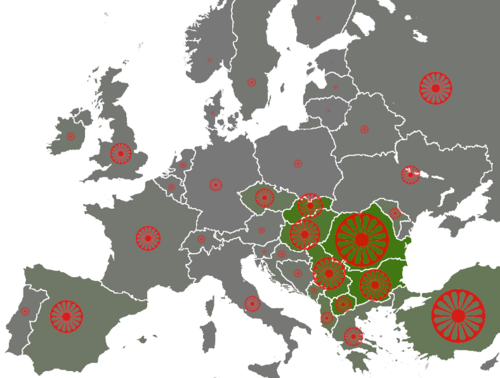
↑"Compilation of population estimates". Council of Europe. Archived from the original on 22 June 2007.
↑"Roma Travellers Statistics" at the Wayback Machine(archived 6 October 2009), Council of Europe, compilation of population estimates. Archived from the original, 6 October 2009.
↑"Roma ghettos in the heart of the EU". El País. 6 September 2019.
↑Pan, Christoph; Pfeil, Beate Sibylle (2003). National Minorities in Europe: Handbook. Braumüller. p.27f. ISBN978-3-7003-1443-1.
↑Liégois, Jean-Pierre (2007), Roms en Europe, Éditions du Conseil de l'Europe
↑Horvátová, Jana (2002). Kapitoly z dějin Romů(PDF) (in Czech). Praha: Lidové noviny. p.12. Archived from the original(PDF) on 12 March 2005. Mnohočetnost romských skupin je patrně pozůstatkem diferenciace Romů do původních indických kast a podkast. [The multitude of Roma groups is apparently a relic of Roma differentiation to Indian castes and subcastes.]
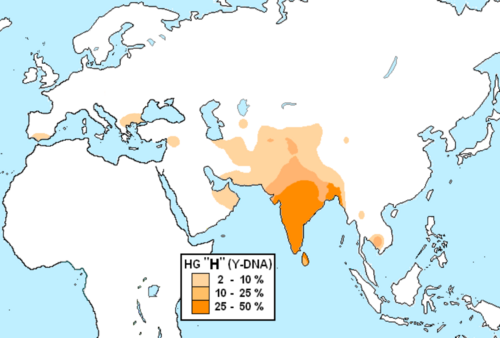
↑N. Rai et al., 2012, "The Phylogeography of Y-Chromosome Haplogroup H1a1a-M82 Reveals the Likely Indian Origin of the European Romani Populations" (23 September 2016)
↑Isabel Fonseca, Bury Me Standing: The Gypsies and their Journey, Random House, p. 100.
↑Hancock, Ian (2010). Danger! Educated Gypsy: Selected Essays. Univ of Hertfordshire Press. pp.130–. ISBN978-1-907396-30-4.
1234Jurová, Anna (2003). Vaščka, Michal; Jurásková, Martina; Nicholson, Tom (eds.). "From Leaving The Homeland to the First Assimilation Measures"(PDF). Čačipen Pal O Roma – A Global Report on Roma in Slovakia. Slovakia: 17. Archived from the original(PDF) on 3 December 2013. Retrieved 7 September 2013. the Sinti lived in German territory, the Manusha in France, the Romanitsel in England, the Kale in Spain and Portugal, and the Kaale in Finland.
↑"RomArchive". romarchive.eu. Retrieved 12 June 2022.
↑Wisely, Andrew (2019). "War against "Internal Enemies": Dr. Franz Lucas's Sterilization of Sinti and Roma in Ravensbrück Men's Camp in January 1945". Central European History. 52 (4): 654. doi:10.1017/S0008938919000852. S2CID214237801. Archived from the original(PDF) on 20 September 2022. Retrieved 21 September 2022.
↑Lewy, Guenter (April 1999). "Himmler and the 'Racially Pure Gypsies'". Journal of Contemporary History. 34 (2): 201–214. doi:10.1177/002200949903400202. ISSN0022-0094. PMID21977563. S2CID37085059. One spokesman was to serve the Lalleri Gypsies, a closely-knit tribe originally from the German-speaking part of Bohemia and Moravia that in 1939 had become a German protectorate.
↑"GENOCIDE OF EUROPEAN ROMA (GYPSIES), 1939–1945". Romacenter.org. Archived from the original on 14 July 2022. Retrieved 22 February 2023. In the autumn of 1941, German police authorities deported 5,007 Sinti and Lalleri Gypsies from Austria to the ghetto for Jews in Lodz, where they resided in a segregated section
12345Research Directorate (2001). "Romania: Traditional Roma name for the various Roma clans and description of their traditional occupations; whether these occupations still exist today; distinguishing characteristics of the clans". Canada: Immigration and Refugee Board of Canada. Retrieved 27 July 2021.
↑Crowe, David (1995). A History of the Gypsies of Eastern Europe and Russia. New York: St. Martin's Griffin. p.123. ISBN978-1-349-60671-9.
↑Dicționarul etimologic român (in Romanian), quoted in DEX-online (see lemmarudár (sing.), rudári (pl.) followed by both definitions: "gold-miner" and "wood crafter").
↑Jurová, Anna (2003). Vaščka, Michal; Jurásková, Martina; Nicholson, Tom (eds.). "From Leaving The Homeland to the First Assimilation Measures"(PDF). Čačipen Pal O Roma – A Global Report on Roma in Slovakia. Slovak Republic: 17. Archived from the original(PDF) on 3 December 2013. Retrieved 7 September 2013. The word "manush" is also included in all dialects of Romany. It means man, while "Manusha" equals people. This word has the same form and meaning in Sanskrit as well, and is almost identical in other Indian languages.
↑Gypsy Studies – Cigány Tanulmányok(PDF), HU: Forraykatalin, archived from the original(PDF) on 13 May 2015, retrieved 9 July 2015
123Kalaydjieva, Luba; Gresham, David; Calafell, Francesc (2 April 2001). "Genetic studies of the Roma (Gypsies): A Review". BMC Medical Genetics. 2 (5): 5. doi:10.1186/1471-2350-2-5. PMC31389. PMID11299048.
12345Mendizabal, Isabel; Lao, Oscar; Marigorta, Urko M.; Wollstein, Andreas; Gusmão, Leonor; Ferak, Vladimir; Ioana, Mihai; Jordanova, Albena; Kaneva, Radka; Kouvatsi, Anastasia; Kučinskas, Vaidutis; Makukh, Halyna; Metspalu, Andres; Netea, Mihai G.; de Pablo, Rosario; Pamjav, Horolma; Radojkovic, Dragica; Rolleston, Sarah J.H.; Sertic, Jadranka; Macek, Milan; Comas, David; Kayser, Manfred (December 2012). "Reconstructing the Population History of European Romani from Genome-wide Data". Current Biology. 22 (24): 2342–2349. Bibcode:2012CBio...22.2342M. doi:10.1016/j.cub.2012.10.039. hdl:10230/25348. PMID23219723.
↑Peter Boyd-Bowman (ed.), Indicegeobiográfico de cuarenta mil pobladores españoles de América en el siglo XVI, vol. 1: 1493–1519 (Bogota: Instituto Caro y Cuervo, 1964), 171.
↑The Historical Encyclopedia of World Slavery, Volume 1; Volume 7 By Junius P. Rodriguez
↑"Brazil: Fatal altercation between police and Romani family launches campaign of mass murder against local Roma". Romea.cz – Everything about Roma in one place. 26 July 2021.
↑Amaral, Fernanda Pattaro (15 October 2014). A Orillas Del Mar (in Spanish). Clube de Autores. ISBN978-1-5024-2120-3. Retrieved 10 December 2022.
↑Melegh, Bela I.; Banfai, Zsolt; Hadzsiev, Kinga; Miseta, Attila; Melegh, Bela (31 August 2017). "Refining the South Asian Origin of the Romani people". BMC Genetics. 18 (1) 82. doi:10.1186/s12863-017-0547-x. ISSN1471-2156. PMC5580230. PMID28859608. Our results show that Northwest India could play an important role in the South Asian ancestry of Roma, however, the origin of Romani people might include the area of Pakistan as well.
↑Ena, Giacomo Francesco; Aizpurua-Iraola, Julen; Font-Porterias, Neus; Calafell, Francesc; Comas, David (8 November 2022). "Population Genetics of the European Roma—A Review". Genes. 13 (11): 2068. doi:10.3390/genes13112068. ISSN2073-4425. PMC9690732. PMID36360305. Based on genome-wide SNP arrays and whole-genome sequences, it has been determined that the Romani people carry approximately 20–35% South Asian ancestry [4,7], and North-West India constitutes the major source of this component [4,7,54][...] In general, Romani people carry approximately 65–80% West Eurasian (European, Middle Eastern and Caucasian) ancestry, estimated to have been acquired by extensive gene flow.
↑Hernández-Arrieta, Stefany (7 August 2023). "The definition of being Romani". Barcelona Biomedical Research Park (PRBB) – El·lipse. Retrieved 16 February 2024. This population[...] migrated from northern India to Europe over 1,500 years ago[...] The Romani community are genetically diverse, and Romani groups established in different locations are highly varied.
↑Beňo, Matúš (5 November 2022). "Romani disappearing from Roma communities". The Slovak Spectator. Retrieved 16 February 2024. What is the current state of the language? It is used less and less today in Romani communities. The young generation in some localities, such as Humenné, Michalovce, or Trebišov in eastern Slovakia, no longer speak the language at all.
↑Hübschmannová, Milena (2002). "Origin of Roma". RomBase. Karl-Franzens-Universität Graz. Archived from the original on 7 April 2022. Retrieved 3 September 2013.
↑Digard, Jean-Pierre. "GYPSY i. Gypies of Persia". Encyclopædia Iranica. Retrieved 22 July 2013.
↑Šebková, Hana; Žlnayová, Edita (1998), Nástin mluvnice slovenské romštiny (pro pedagogické účely)(PDF), Ústí nad Labem: Pedagogická fakulta Univerzity J. E. Purkyně v Ústí nad Labem, p.4, ISBN978-80-7044-205-0, archived from the original(PDF) on 4 March 2016
↑"What is Domari?". University of Manchester. Romani Linguistics and Romani Language Projects. Archived from the original on 10 April 2016. Retrieved 23 July 2008.
123Hancock, Ian (2007). "On Romani Origins and Identity". The Romani Archives and Documentation Center. Archived from the original on 17 July 2011.
12Hancock, Ian F; Dowd, Siobhan; Djurić, Rajko (2004). The Roads of the Roma: a PEN anthology of Gypsy Writers. Hatfield, United Kingdom: University of Hertfordshire Press. pp.14–15. ISBN978-0-900458-90-3.
12Thakur, Harish K. (October 2013). "Theories of Roma Origins and the Bengal Linkage". Mediterranean Journal of Social Sciences. 4 (10): 22–26. doi:10.5901/mjss.2013.v4n10p22. S2CID41787985.
12"Romani"(PDF). Encyclopedia of Language and Linguistics. Oxford: Elsevier. Archived from the original(PDF) on 11 October 2017. Retrieved 30 August 2009.
↑Hancock, Ian (2007). "On Romani Origins and Identity". RADOC.net. Archived from the original on 17 July 2011.
↑"5 Intriguing Facts About the Roma". Live Science. 23 October 2013.
↑N Rai; G Chaubey; R Tamang; A K Pathak; V K Singh; etal. (2012). "The Phylogeography of Y-Chromosome Haplogroup H1a1a-M82 Reveals the Likely Indian Origin of the European Romani Populations". PLOS ONE. 7 (11) e48477. Bibcode:2012PLoSO...748477R. doi:10.1371/journal.pone.0048477. PMC3509117. PMID23209554.
↑"Romani have Indian ancestry". Nature. 492 (7428): 156. 2012. doi:10.1038/492156c. S2CID256746341.
↑"Origin of the Romani People Pinned Down". Live Science. 6 December 2012.
12Font-Porterias, N.; Arauna, L. R.; Poveda, A.; Bianco, E.; Rebato, E.; Prata, M. J.; Calafell, F.; Comas, D. (2019). "European Roma groups show complex West Eurasian admixture footprints and a common South Asian genetic origin". PLOS Genetics. 15 (9) e1008417. doi:10.1371/journal.pgen.1008417. PMC6779411. PMID31545809.
↑Kalaydjieva, Luba; Calafell, Francesc; Jobling, Mark A; Angelicheva, Dora; de Knijff, Peter; Rosser, Zoe H; Hurles, Matthew; Underhill, Peter; Tournev, Ivailo; Marushiakova, Elena; Popov, Vesselin (2011), "Patterns of inter- and intra-group genetic diversity in the Vlax Roma as revealed by Y chromosome and mitochondrial DNA lineages"(PDF), European Journal of Human Genetics, 9 (2): 97–104, doi:10.1038/sj.ejhg.5200597, PMID11313742, S2CID21432405, archived from the original(PDF) on 9 December 2014
↑Bianco, Erica; Laval, Guillaume; Font-Porterias, Neus; García-Fernández, Carla; Dobon, Begoña; Sabido-Vera, Rubén; Sukarova Stefanovska, Emilija; Kučinskas, Vaidutis; Makukh, Halyna; Pamjav, Horolma; Quintana-Murci, Lluis; Netea, Mihai G.; Bertranpetit, Jaume; Calafell, Francesc; Comas, David (2020). "Recent Common Origin, Reduced Population Size, and Marked Admixture Have Shaped European Roma Genomes". Molecular Biology and Evolution. 37 (11): 3175–3187. doi:10.1093/molbev/msaa156. hdl:2066/229486. PMID32589725.
12Gresham, D; Morar, B; Underhill, PA; Passarino, G; Lin, AA; Wise, C; Angelicheva, D; Calafell, F; Oefner, PJ; Shen, Peidong; Tournev, Ivailo; De Pablo, Rosario; Kuĉinskas, Vaidutis; Perez-Lezaun, Anna; Marushiakova, Elena; Popov, Vesselin; Kalaydjieva, Luba (2001). "Origins and Divergence of the Roma (Gypsies)". American Journal of Human Genetics. 69 (6): 1314–31. doi:10.1086/324681. PMC1235543. PMID11704928.
↑Morar, Bharti; Gresham, David; Angelicheva, Dora; Tournev, Ivailo; Gooding, Rebecca; Guergueltcheva, Velina; Schmidt, Carolin; Abicht, Angela; Lochmüller, Hanns; Tordai, Attila; Kalmár, Lajos; Nagy, Melinda; Karcagi, Veronika; Jeanpierre, Marc; Herczegfalvi, Agnes; Beeson, David; Venkataraman, Viswanathan; Warwick Carter, Kim; Reeve, Jeff; de Pablo, Rosario; Kučinskas, Vaidutis; Kalaydjieva, Luba (October 2004). "Mutation History of the Roma/Gypsies". The American Journal of Human Genetics. 75 (4): 596–609. doi:10.1086/424759. PMC1182047. PMID15322984.
1234Peričić, Marijana; Lauc, Lovorka Barać; Klarić, Irena Martinović; Rootsi, Siiri; Janićijević, Branka; Rudan, Igor; Terzić, Rifet; Čolak, Ivanka; Kvesić, Ante; Popović, Dan; Šijački, Ana; Behluli, Ibrahim; Đorđević, Dobrivoje; Efremovska, Ljudmila; Bajec, Đorđe D.; Stefanović, Branislav D.; Villems, Richard; Rudan, Pavao (October 2005). "High-Resolution Phylogenetic Analysis of Southeastern Europe Traces Major Episodes of Paternal Gene Flow Among Slavic Populations". Molecular Biology and Evolution. 22 (10): 1964–1975. doi:10.1093/molbev/msi185. PMID15944443.
↑Jankova-Ajanovska, R; Zimmermann, B; Huber, G; Röck, AW; Bodner, M; Jakovski, Z; Janeska, B; Duma, A; Parson, W (16 June 2016). "Mitochondrial DNA control region analysis of three ethnic groups in the Republic of Macedonia". Forensic Science International. Genetics. 13: 1–2. doi:10.1016/j.fsigen.2014.06.013. PMC4234079. PMID25051224.
12"Y chromosonal haplogroup distributionanddiversities in seven populations investigated". S009.radikal.ru. Archived from the original(PDF) on 26 September 2016. Retrieved 20 December 2016.
12Martínez-Cruz, Begoña; Mendizabal, Isabel; Harmant, Christine; de Pablo, Rosario; Ioana, Mihai; Angelicheva, Dora; Kouvatsi, Anastasia; Makukh, Halyna; Netea, Mihai G; Pamjav, Horolma; Zalán, Andrea; Tournev, Ivailo; Marushiakova, Elena; Popov, Vesselin; Bertranpetit, Jaume; Kalaydjieva, Luba; Quintana-Murci, Lluis; Comas, David (June 2016). "Origins, admixture and founder lineages in European Roma". European Journal of Human Genetics. 24 (6): 937–943. doi:10.1038/ejhg.2015.201. PMC4867443. PMID26374132.
↑Regueiro, Maria; Stanojevic, Aleksandar; Chennakrishnaiah, Shilpa; Rivera, Luis; Varljen, Tatjana; Alempijevic, Djordje; Stojkovic, Oliver; Simms, Tanya; Gayden, Tenzin; Herrera, Rene J. (January 2011). "Divergent patrilineal signals in three Roma populations". American Journal of Physical Anthropology. 144 (1): 80–91. Bibcode:2011AJPA..144...80R. doi:10.1002/ajpa.21372. PMID20878647.
↑Bosch, E.; Calafell, F.; Gonzalez-Neira, A.; Flaiz, C.; Mateu, E.; Scheil, H.-G.; Huckenbeck, W.; Efremovska, L.; Mikerezi, I.; Xirotiris, N.; Grasa, C.; Schmidt, H.; Comas, D. (July 2006). "Paternal and maternal lineages in the Balkans show a homogeneous landscape over linguistic barriers, except for the isolated Aromuns". Annals of Human Genetics. 70 (4): 459–487. doi:10.1111/j.1469-1809.2005.00251.x. PMID16759179. S2CID23156886.
12Petrejcíková, Eva; Soták, Miroslav; Bernasovská, Jarmila; Bernasovský, Ivan; Sovicová, Adriana; Bôziková, Alexandra; Boronová, Iveta; Gabriková, Dana; Švícková, Petra; Maceková, Sona; Cverhová, Valéria (2010). "The genetic structure of the Slovak population revealed by Y-chromosome polymorphisms". Anthropological Science. 118 (1): 23–30. doi:10.1537/ase.090203. S2CID83899895.
↑"Croatian national reference Y-STR haplotype database"(PDF). Draganprimorac.com. Retrieved 20 December 2016.
↑"Y Chromosome Single Nucleotide Polymorphisms Typing by SNaPshot Minisequencing"(PDF). Bjmg.edu.mk. Retrieved 20 December 2016.
↑Karachanak, S; Grugni, V; Fornarino, S; Nesheva, D; Al-Zahery, N; Battaglia, V; Carossa, V; Yordanov, Y; Torroni, A; Galabov, AS; Toncheva, D; Semino, O (2013). "Y-chromosome diversity in modern Bulgarians: new clues about their ancestry". PLOS ONE. 8 (3) e56779. Bibcode:2013PLoSO...856779K. doi:10.1371/journal.pone.0056779. PMC3590186. PMID23483890.
↑"Participate to the DNA ancestry project for Germany, Austria and Switzerland". Eupedia.com. 10 January 2014. Retrieved 20 December 2016.
↑Bánfai, Zsolt; Melegh, Béla I.; Sümegi, Katalin; Hadzsiev, Kinga; Miseta, Attila; Kásler, Miklós; Melegh, Béla (13 June 2019). "Revealing the Genetic Impact of the Ottoman Occupation on Ethnic Groups of East-Central Europe and on the Roma Population of the Area". Frontiers in Genetics. 10 558. doi:10.3389/fgene.2019.00558. PMC6585392. PMID31263480.
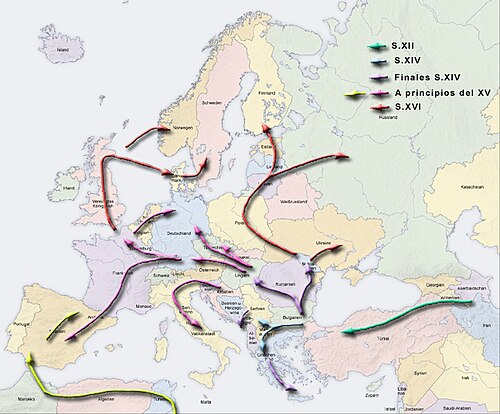
↑Hancock, Ian; Dowd, Siobhan; Djurić, Rajko (2004). The Roads of the Roma: a PEN anthology of Gypsy Writers. Hatfield, United Kingdom: University of Hertfordshire Press. pp.14–15. ISBN978-0-900458-90-3.
↑Taylor, Becky (2014). Another Darkness Another Dawn. London UK: Reaktion Books Ltd. p.22. ISBN978-1-78023-257-7.
12"Migration Overview". Rroma Foundation. Retrieved 2 August 2025.
123Kenrick, Donald (2004). Gypsies: from the Ganges to the Thames. Interface collection. Hatfield: Univ. of Hertfordshire Press. pp.27–29. ISBN978-1-902806-23-5.
↑Trehan, Nidhi (January 2017). "The Contentious Politics of the Indo-Romani Relationship: Reflections on the "International Roma Conference and Cultural Festival" in New Delhi, February 2016 and Its Antecedents". The Indian Journal of Social Work. 78 (1). Tata Institute of Social Sciences: 12–13. ISSN0019-5634.
↑"Romas are India's children: Sushma Swaraj". India.com. 12 February 2016. Retrieved 3 September 2017.
↑"'India should declare Romas as national minority of Indian origin'". Hindustan Times. 12 February 2016. Retrieved 30 August 2025.
↑"Can Romas be part of Indian diaspora?". khaleejtimes.com. 29 February 2016. Retrieved 4 March 2016.
↑"In Croatia, a Roma conference ponders whether the community can be termed Indian diaspora". The Indian Express. 12 April 2022. Retrieved 29 August 2025.
↑Hancock, Ian (2007). "The Struggle for the Control of Identity". In Haodha, M. O.; Hancock, I. F. (eds.). Migrant and Nomad: European Visual Culture and the Representation of 'Otherness'(PDF). Blaue Eule Verlag. pp.41–60.
↑"Study shows Roma descended from Indian 'untouchables'".
↑Sharma, Rama (28 January 1995). Scavenger in Indian Society: Marginality, Identity, and Politicization of the Community. M.D. Publications Pvt. ISBN978-81-85880-70-9.
↑2010, Gabriela Brozba, Between reality and myth: A corpus-based analysis of the stereotypic image of some Romanian ethnic minorities, page 42
↑"Athinganoi". Oxford Reference. Retrieved 28 July 2021.
↑Harper, Douglas (November 2001). "Bohemian etymology". Online Etymology Dictionary. Retrieved 27 December 2008.
↑Dudley, William, ed. (2000), The 1960s (America's decades), San Diego: Greenhaven Press, pp. 193–194
12"Travellers as 'genetically different' from settled Irish as Spanish". Irish Times.
↑Refugees, United Nations High Commissioner for (June 2008). "Refworld | World Directory of Minorities and Indigenous Peoples – Ireland: Travellers". Refworld. Retrieved 26 December 2022.
↑Gmelch, Sharon (1991) [1986]. "Preface". Nan: The life of an Irish Travelling woman (Biography) (Reissue with changesed.). Long Grove, IL: Waveland Press. pp.11–14. ISBN978-0-88133-602-3.
↑Leo Lucassen: "A Blind Spot: Migratory and Travelling Groups in Western European Historiography". In: International Review of Social History 38 (1993), 209–23.
↑King, Arienne (3 April 2023). "Romani - World History Encyclopedia". World History Encyclopedia. Retrieved 27 January 2024.
↑"Sterilization in Norway – a dark chapter?". 9 April 2003.
↑"Racism's cruelest cut: coercive sterilisation of Romani women and their fight for justice in the Czech Republic (1966–2016)". 24 January 2017.
↑"Body and Soul: Forced Sterilization and Other Assaults on Roma Reproductive Freedom". June 2003.
12"Gypsy child couple separated". 2 October 2003. Retrieved 8 August 2022.
↑"Explanatory Dictionary of the Romanian Language, 1998; New Explanatory Dictionary of the Romanian Language, 2002" (in Romanian). Dexonline.ro. Archived from the original on 17 May 2016. Retrieved 25 September 2010.
↑Karachanak et al., 2012. Karachanak, S., V. Carossa, D. Nesheva, A. Olivieri, M. Pala, B. Hooshiar Kashani, V. Grugni, et al. "Bulgarians vs the Other European Populations: A Mitochondrial DNA Perspective." International Journal of Legal Medicine 126 (2012): 497.
↑Kushniarevich, A; Utevska, O; Chuhryaeva, M; Agdzhoyan, A; Dibirova, K; Uktveryte, I; Möls, M; Mulahasanovic, L; Pshenichnov, A; Frolova, S; Shanko, A; Metspalu, E; Reidla, M; Tambets, K; Tamm, E; Koshel, S; Zaporozhchenko, V; Atramentova, L; Kučinskas, V; Davydenko, O; Goncharova, O; Evseeva, I; Churnosov, M; Pocheshchova, E; Yunusbayev, B; Khusnutdinova, E; Marjanović, D; Rudan, P; Rootsi, S; etal. (2015). "Genetic Heritage of the Balto-Slavic Speaking Populations: A Synthesis of Autosomal, Mitochondrial and Y-Chromosomal Data". PLOS ONE. 10 (9) e0135820. Bibcode:2015PLoSO..1035820K. doi:10.1371/journal.pone.0135820. PMC4558026. PMID26332464.
12Bereznay, András (2021). Historical Atlas of the Gypsies: Romani History in Maps. Méry Ratio. p.18/1. ISBN978-615-6284-10-5.
↑Popov, Shakir M. (2023). Marushiakova, Elena; Popov, Vesselin; Kovacheva, Lilyana (eds.). "History of the Gypsies in Bulgaria and Europe: Roma". University of St. Andrews. pp.8–12.
↑Anfuso, Linda (24 February 1994). "gypsies". Newsgroup:rec.org.sca. Usenet:PaN9Hc2w165w@tinhat.stonemarche.org. Archived from the original on 24 August 2007. Retrieved 5 December 2014.
↑Keil, Charles; Blau, Dick; Keil, Angeliki; Feld, Steven (9 December 2002). Bright Balkan Morning: Romani Lives and the Power of Music in Greek Macedonia. Wesleyan University Press. pp.50–51. ISBN978-0-8195-6488-7.
↑History, Connor Brighton January 2, 2024 in (2 January 2024). "The Ottoman Empire: Early Expansion Into Europe And Egypt". WorldAtlas. Retrieved 19 October 2025.{{cite web}}: CS1 maint: multiple names: authors list (link) CS1 maint: numeric names: authors list (link)
↑King, Arienne (2023). "Romani Migration in the Middle Ages". World History Encyclopedia. Retrieved 16 May 2024.
↑Dr Ian Law; Dr Sarah Swann (28 January 2013). Ethnicity and Education in England and Europe: Gangstas, Geeks and Gorjas. Ashgate Publishing. p.11. ISBN978-1-4094-9484-3. Retrieved 20 December 2016.
↑Ernst Hĺkon Jahr (1992). Language Contact: Theoretical and Empirical Studies. Walter de Gruyter. p.42. ISBN978-3-11-012802-4. Retrieved 20 December 2016.
↑Simon Broughton; Mark Ellingham; Richard Trillo (1999). World Music: Africa, Europe and the Middle East. Rough Guides. p.148. ISBN978-1-85828-635-8. Retrieved 20 December 2016.
↑Radu, Delia (8 July 2009), "'On the Road': Centuries of Roma History", World Service, BBC
↑"Romani History is American History". EAS Miscellany. Retrieved 27 January 2024.
↑Pinos, Jaume Castan (3 October 2018). Kosovo and the Collateral Effects of Humanitarian Intervention. Routledge. ISBN978-1-351-37476-7.
↑Hancock, Ian. "Romanies and the holocaust: a reevaluation and an overview". Radoc.net. Archived from the original on 5 March 2016. Retrieved 14 February 2009.
↑"United States Holocaust Memorial Museum". Retrieved 2 December 2012.
↑Hancock, Ian (2005). "True Romanies and the Holocaust: A Re-evaluation and an overview". The Historiography of the Holocaust. Palgrave Macmillan. pp.383–96. ISBN978-1-4039-9927-6. Archived from the original on 9 June 2019. Retrieved 14 February 2009.
12Denysenko, Marina (12 March 2007). "Sterilised Roma accuse Czechs". BBC News. Retrieved 15 September 2017.
↑Thomas, Jeffrey (16 August 2006). "Coercive Sterilization of Romani Women Examined at Hearing: New report focuses on Czech Republic and Slovakia". Washington File. Bureau of International Information Programs, U.S. Department of State. Archived from the original on 13 February 2008.
↑Želinský, Tomáš; Gorard, Stephen; Siddiqui, Nadia (19 May 2021). "Increasing understanding of the aspirations and expectations of Roma students". British Journal of Sociology of Education. 42 (4): 588–606. doi:10.1080/01425692.2021.1872366. ISSN0142-5692.
↑Surdu, Laura; Surdu, Mihai (2006). Broadening the Agenda: The Status of Romani Women in Romania (Technical report). p.31–42. JSTORresrep27094.9.
↑Henry, Declan (7 September 2022). Gypsies, Roma and Travellers: A Contemporary Analysis. Critical Publishing. ISBN978-1-915080-05-9– via Google Books.
↑Dumitrescu, Cristian (2010). "The Stranger in Our Midst, the Gypsies"(PDF). Andrews University.
↑"The ground beneath our feet | New Internationalist". newint.org. 8 February 2022. Retrieved 25 May 2025.
↑Fonseca, I. (1995). Bury Me Standing: The Gypsies and Their Journey. Alfred A. Knopf.
↑Hancock, I. (2002). We are the Romani People. University of Hertfordshire Press.
↑"Information about Gypsies and Travellers". Cheshire West and Chester Council. Retrieved 25 May 2025.
↑Mayall, D. (2004). Gypsy Identities 1500–2000: From Egipcyans and Moon-men to the Ethnic Romany. Routledge.
↑Weyrauch, Walter Otto (2001), Gypsy Law: Romani Legal Traditions and Culture, University of California Press, p.210, ISBN978-0-520-22186-4, Rom have preserved and modified Indian caste system
↑"INTRODUCTION TO ROMA CULTURE"(PDF). Archived from the original(PDF) on 27 October 2011.
↑"Romani Customs and Traditions: Death Rituals and Customs". Patrin Web Journal. Archived from the original on 21 August 2007. Retrieved 26 August 2007.
↑Heppell, Sharon (27 September 2024). "Romany Gypsies and Fortune-telling". Travellers Times. Retrieved 26 March 2025.
↑West, Tamara (1 October 2022). "Marginality and Modernity on the South Shore: Blackpool's Fortune Tellers, Authenticity and Belonging". European History Quarterly. 52 (4): 572–592. doi:10.1177/02656914221097595. ISSN0265-6914.
12"Fortune Telling as Part of the Roma Culture". Human Rights Fund Progress. 1 July 2017. Retrieved 26 March 2025.
↑Stern, Stephen (1991). Creative Ethnicity: Symbols and Strategies of Contemporary Ethnic Life. Utah State University Press. ISBN978-0-87421-148-1.
↑Lalith Kumar Dharavath, Dr (21 March 2025). Roma -Banjara Cultural Contribution to Advancing World and India (With special reference to Creator and Originator). Chyren Publication. ISBN978-93-49076-15-0.
↑Lucassen, Leo; Willems, Wim; Cottaar, Anne-Marie (30 December 2015). Gypsies and Other Itinerant Groups: A Socio-Historical Approach. Springer. ISBN978-1-349-26341-7.
↑Schaefer, Richard T.; Zellner, William W. (22 October 2015). Extraordinary Groups. Waveland Press. ISBN978-1-4786-3183-5.
↑Saul, Nicholas; Tebbut, Susan (2005). Saul, Nicholas; Tebbutt, Susan (eds.). The Role of the Romanies: Images and Counter-Images of 'Gypsies'/Romanies in European Cultures. Liverpool University Press. pp.218–219. ISBN978-0-85323-689-4.
↑The Columbia Encyclopedia (8thed.). New York, NY: Columbia University Press. 2018 – via Credo Reference.
12Marushiakova, Elena; Popov, Vesselin (2018). "Roma Communities on the Balkans: History and Identities". University of St. Andrews. pp.13–14.
↑"The Muslim Gypsies in Romania"(PDF). Universiteit Leiden. Retrieved 22 June 2025.
↑"Restless Beings Project: Roma Engage". Restless Beings. 2008–2012. Archived from the original on 1 January 2013. Retrieved 26 December 2012.
↑Boretzky, Norbert (1995). Romani in Contact: The History, Structure and Sociology of a Language. Amsterdam, NL: John Benjamins. p.70.
↑Liégeois, Jean-Pierre (1 January 1994). Roma, Gypsies, Travellers. Council of Europe. ISBN978-92-871-2349-7.
↑Cortés, Carlos E. (15 August 2013). Multicultural America: A Multimedia Encyclopedia. SAGE Publications. p.1850. ISBN978-1-5063-3278-9.
↑"Blessed Ceferino Gimenez Malla 1861–1936". Visit the Saviour. Voveo. December 2012. Archived from the original on 5 February 2013. Retrieved 26 December 2012.
↑La Bas, Damian (2018). The Stopping Places: A journey through Gypsy Britain. Chatto & Windus. pp.179 & 190. ISBN978-1-78474-103-7.
12Lee, Ronald (2002). "The Romani Goddess Kali Sara". Romano Kapachi. Retrieved 26 December 2012.
↑Ian Hancock (2001). "Romani ("Gypsy") Religion". In Jeff Kaplan; Bron Taylor; Samuel S. Hill (eds.). The Encyclopedia of Religion and Nature. Archived from the original on 25 September 2011. Retrieved 12 October 2023– via Radoc.
↑Koinova, Maria. Dimitras, Panayote (ed.). "Roma of Albania"(PDF). CORE. Center for Documentation and Information on Minorities in Europe – Southeast Europe. p.3.
12345678910Marushiakova, Elena; Popov, Veselin (2012). "Roma Muslims in the Balkans". Education of Roma Children in Europe. Council of Europe. Archived from the original on 13 April 2012. Retrieved 26 December 2012.
↑Kozubik M, Bobakova DF, Mojtova M, Tokovska M, van Dijk JP (September 2022). "Roma Religion: 1775 and 2018 Compared over Time". Int J Environ Res Public Health. 19 (18) 11645. doi:10.3390/ijerph191811645. PMC9517071. PMID36141906.
↑Gattermann, Claus Heinrich (2005). Die Baranya in den Jahren 1686 bis 1713: Kontinuität und Wandel in einem ungarischen Komitat nach dem Abzug der Türken (Thesis) (in German). Göttingen: Universitätsverlag. pp.87–88. ISBN978-3-938616-32-1.
↑Visoka, Gezim. "6. Political Parties and Minority Participation: Case of Roma, Ashkalia and Egyptians in Kosovo"(PDF). CORE. p.156.
↑Census 2002, by religion. (PDF). INS. Retrieved on 29 May 2024.
↑Stropnik, Nada (2011). "Promoting Social Inclusion of Roma"(PDF). Peer Review Social Inclusion EU. p.6.
↑Niedźwiecka, Dorota (27 September 2016). "Wiara po romsku".
↑Landy, Thomas (23 May 2018). "The feast of the Saintes and its meaning for Gypsies and other Gens du Voyage". Catholics and Cultures. Retrieved 15 December 2024.
↑Area Handbook for Romania – Volume 550, Issue 160. p.100.
↑Marketing in a Multicultural World: Ethnicity, Nationalism, and Cultural Identity.
↑""Perverting the Taste of the People": Lăutari and the Balkan Question in Romania".
↑Alan Ashton-Smith (2017). Gypsy Music: The Balkans and Beyond. Reaktion Books. ISBN978-1-78023-865-4.
↑Rethinking (In)Security in the European Union: The Migration-Identity-Security Nexus. p.148.
↑Martinez, Emma (24 February 2011), Flamenco: All You Wanted to Know(Google books), Mel Bay Publications, p.21, ISBN978-1-60974-470-0
↑"Gypsy Legends on Vampires". BGSU Blogs. 17 April 2010.
↑Buckland, Raymond (1 May 2010). Buckland's Book of Gypsy Magic: Travelers' Stories, Spells, and Healings. Weiser Books. ISBN978-1-60925-165-9. Retrieved 14 December 2023– via Google Books.
↑"Romani Cuisine and Cultural Persistence". Paste. 27 June 2016.
↑Hancock, Ian F. (2002). We are the Romani People. Univ of Hertfordshire Press. p.80. ISBN978-1-902806-19-8.
↑"Meet Your Neighbors"(PDF). opensourcefoundations.org.
↑Brogyanyi, Bela; Lipp, Reiner (6 May 1993). Comparative-Historical Linguistics. John Benjamins. ISBN978-90-272-7698-8.
↑Gordon, Raymond G Jr., ed. (2005). "Caló: A language of Spain". Ethnologue (Free All): Languages of the World (15thed.). Dallas, TX: SIL International. ISBN978-1-55671-159-6.
123Matras, Yaron. "Romani Linguistics and Romani Language Projects". Humanities. The University of Manchester. Archived from the original on 6 November 2018. Retrieved 24 February 2015.
12Matras, Yaron (October 2005). "The status of Romani in Europe"(PDF). Report Submitted to the Council of Europe's Language Policy Division: 4. Archived from the original(PDF) on 3 May 2019. Retrieved 4 March 2015.
↑Grigore, Delia; Petcuț, Petre; Sandu, Mariana (2005). Istoria și tradițiile minorității rromani (in Romanian). Bucharest: Sigma. p.36.
↑Ștefănescu, Ștefan (1991), Istoria medie a României (in Romanian), vol.I, Bucharest: Editura Universității din București
12"Timeline of Romani History". Patrin Web Journal. Archived from the original on 11 November 2007. Retrieved 26 August 2007.
↑"Cap. 2: 2.1 Apuntes sobre la situación de la comunidad gitana en la sociedad Española – Anexo III. 'Gitanos malos, gitanos buenos'"[Chap. 2: 2.1 Notes on the situation of the gypsy community in Spanish society – Affix III. 'Bad gypsies, good gypsies'] (in Spanish). The Barañí Project – Roma Women. 29 February 2000. Archived from the original on 12 July 2001. Retrieved 27 July 2016.
↑Taylor, Becky (2014). Another Darkness Another Dawn. London UK: Reaktion Books Ltd. p.105. ISBN978-1-78023-257-7.
↑"Roma, Sinti, Travellers". United Nations. Retrieved 5 October 2025.
12Samer, Helmut (December 2001). "Maria Theresia and Joseph II: Policies of Assimilation in the Age of Enlightened Absolutism". Rombase. Karl-Franzens-Universitaet Graz. Archived from the original on 6 April 2015. Retrieved 3 October 2015.
↑Fraser, Angus (2005). Los gitanos. Ariel. ISBN978-84-344-6780-4.
↑Texto de la pragmática en la Novísima Recopilación. Ley XI, pg. 367 y ss.
↑"Gitanos. History and Cultural Relations". World Culture Encyclopedia. Retrieved 26 August 2007.
↑Kenrick, Donald. "Roma in Norway". Patrin Web Journal. Archived from the original on 29 April 2013. Retrieved 13 March 2012.
↑"Genocide of European Roma (Gypsies), 1939–1945". Holocaust Encyclopedia.
↑Re. Holocaust Victim Assets Litigation (Swiss Banks) Special Master's Proposals(PDF), 11 September 2000, archived from the original(PDF) on 9 April 2004
↑Stone, D, ed. (2004), "Romanies and the Holocaust: A Reevaluation and an Overview", The Historiography of the Holocaust (article), Basingstoke and New York: Palgrave, archived from the original on 13 November 2013, retrieved 14 February 2009
↑"Council of Europe website". Archived from the original on 21 February 2009. Retrieved 6 October 2009. European Roma and Travellers Forum (ERTF). 2007. Archived from the originalArchived 21 October 2013 at the Wayback Machine on 6 July 2007.
↑Bilefsky, Dan (19 October 2013). "Are the Roma primitive or just poor?". The New York Times (review).
↑Molnar, Lorena (2021). "The Imperative Need for Criminological Research on the European Roma: A Narrative Review". Trauma, Violence, & Abuse, 24(2), 1016-1031. https://doi.org/10.1177/15248380211048448 (Original work published 2023)
↑"Demolita la 'bidonville' di Ponte Mammolo"[The 'slum' of Mammolo Bridge demolished]. il Giornale (in Italian). IT. 5 December 2007. Retrieved 14 September 2017.
↑Di Caro, Paola (4 November 2007). "Fini: impossibile integrarsi con chi ruba"[Fini: it's impossible to integrate those who steal]. Corriere della Sera (in Italian). Retrieved 14 September 2017.
↑"Europe must break cycle of discrimination facing Roma" (Press release). Amnesty International. 7 April 2010. Retrieved 2 January 2016.
↑"Europe Roma". Amnesty International. February 2002. Archived from the original on 12 October 2007. Retrieved 6 May 2009.
↑Colin Woodard (13 February 2008). "Hungary's anti-Roma militia grows". Christian Science Monitor. Retrieved 15 September 2010.
↑"Roma". SI: Human Rights Press Point. Archived from the original on 10 March 2012. Retrieved 6 May 2009.
↑Polansky, Paul (June 2005). "Results of an Enquiry into the Situation of Roma und Ashkali in Kosovo (Dec.2004 to May 2005) – Roma and Ashkali in Kosovo: Persecuted, driven out, poisoned". GFBV. Archived from the original on 6 August 2007. Retrieved 6 May 2009.
↑"National Roma Integration Strategies: a first step in the implementation of the EU Framework"(PDF). European Commission. 21 May 2012. Retrieved 3 May 2014.
↑"Mother tongue, religion and ethnic affiliation". ABOUT CENSUS. Archived from the original on 15 July 2023. Retrieved 10 November 2023.
↑Relief, UN (2010). "Roma in Serbia (excluding Kosovo) on 1 January 2009"(PDF). UN Relief. 8 (1).
↑Alexander, Harriet (17 February 2014). "Roma on the rubbish dump". CIA World Factbook. Retrieved 21 February 2014.
123Ringold, Dena; Orenstein, Mitchell Alexander; Wilkens, Erika (2005). Roma in an Expanding Europe – Breaking the Poverty Cycle. World Bank. ISBN0-8213-5457-4.
↑"Europe's Roma Do Not Have Equal Education". Voice of America. 21 November 2017. Retrieved 12 June 2026.
↑Cahn, Claude (1 January 2007). "Birth of a Nation: Kosovo and the Persecution of Pariah Minorities". German Law Journal. 8 (1): 81–94. doi:10.1017/S2071832200005423. S2CID141025735.
↑Bricker, Mindy Kay (12 June 2006). "For Gypsies, Eugenics is a Modern Problem / Czech Practice Dates to Soviet Era". Newsdesk.
↑"Final Statement of the Public Defender of Rights in the Matter of Sterilisations Performed in Contravention of the Law and Proposed Remedial Measures". The Office of The Public Defender of Rights, Czech Republic. 23 December 2005. Archived from the original on 28 November 2007. Retrieved 15 September 2010.
↑Hooper, John (2 November 2007). "Italian woman's murder prompts expulsion threat to Romanians". The Guardian. London. Retrieved 14 September 2017.
↑de Zulueta, Tana (30 March 2009). "Italy's new ghetto?". The Guardian. London. Retrieved 14 September 2017.
↑"Italy fingerprints thousands of Gypsies". NBC News. 4 July 2008. Retrieved 15 July 2022.
↑Kooijman, Hellen (6 April 2012). "Bleak horizon". EU: Presseurop. Archived from the original on 7 April 2012. Retrieved 6 April 2012.
↑"The gypsy in my soul: Sinti and Roma in the Netherlands". Radio Netherlands Archives. 19 September 1999.
↑"Negative opinions about Roma, Muslims in several European nationsArchived 3 April 2019 at the Wayback Machine". Pew Research Center. 11 July 2016.
↑"European Public Opinion Three Decades After the Fall of Communism — 6. Minority groups". Pew Research Center. 14 October 2019.
↑"Sondaj IRES: 7 din 10 români nu au încredere în romi". Radio Free Europe Romania (in Romanian). 8 February 2020.
↑"We need to talk about the rising wave of anti-Roma attacks in Europe". The Independent. 28 July 2019.
↑"Unemployment keeps Kosovo's Roma on the margins". Deutsche Welle. 17 February 2018.
↑"To Europe's shame, Roma remain stigmatised outsiders – even when they live in mansions". The Conversation. 25 April 2019.
↑"Discrimination against Roma remains widespread in Slovakia says Amnesty International report". The Slovak Spectator. 22 February 2018.
↑"Anti-Roma protests take place in Bulgarian city of Gabrovo". The Associated Press. 12 April 2019.
↑"'Everybody hates us': on Sofia's streets, Roma face racism every day". The Guardian. 20 October 2019.
↑"Roma ghettos in the heart of the EU". El País. 6 September 2019.
↑"Zpráva o stavu romské menšiny: V Česku bylo loni podle odhadů 830 ghett se 127 tisíci obyvateli". iROZHLAS (in Czech). 12 October 2019. Retrieved 28 July 2020.
↑"Roma in the Czech Republic". Minority Rights Group. Retrieved 13 March 2024.
↑"Deadly Attack Escalates Violent Trend Against Ukrainian Roma". Radio Free Europe/Radio Liberty. 25 June 2018.
↑"Attacked and abandoned: Ukraine's forgotten Roma". Al-Jazeera. 23 November 2018.
↑"'Meet us before you reject us': Ukraine's Roma refugees face closed doors in Poland". The Guardian. 10 May 2022. Retrieved 18 May 2022.
↑"Roma refugees from Ukraine face Czech xenophobia". EU Observer. 17 May 2022. Retrieved 18 May 2022.
↑"Undocumented Roma Refugees Facing Discrimination As They Flee Ukraine". Vice. 23 March 2022. Retrieved 18 May 2022.
↑"Roma women in nine EU Member States"(PDF). European Union Agency for Fundamental Rights. 2019. p.27. Retrieved 30 May 2024.
↑"Roma: what discrimination do they face and what does EU do?". 21 September 2020.
↑Rossella Carnevali; Valentina Mancini; Marzia Albanese; Giancarlo Santone (eds.). "Roma and mental health: the role of discrimination"(PDF). aslroma1.it.
↑European Union Agency for Fundamental Rights. (2022). Roma in 10 European Countries – Main Results(PDF) (Reported.). Luxembourg: Publications Office of the European Union. doi:10.2811/529185. ISBN978-92-9489-126-6. Retrieved 7 September 2025.
↑"France sends Roma Gypsies back to Romania". BBC News. 20 August 2010. Retrieved 28 February 2016.
↑"Troops patrol French village of Saint-Aignan after riot". BBC News. 10 July 2010. Retrieved 22 August 2010.
↑"Q&A: France Roma expulsions". BBC News. 15 September 2010. Retrieved 16 September 2010.
↑"France Begins Controversial Roma Deportations". Der Spiegel. 19 August 2010. Retrieved 20 August 2010.
↑"EU may take legal action against France over Roma". BBC News. 14 September 2010. Retrieved 15 September 2010.
↑Marushiakova, Elena; Popov, Vesselin (2016). Gypsies in Central Asia and the Caucasus. Springer. ISBN978-3-319-41057-9.
↑"Лидер крымских татар опроверг миф о цыганском попрошайничестве". islam.in.ua. 3 April 2012.
123Kizilov, Mikhail (2021). "Уничтожение цыган Симферополя и "решение" цыганского вопроса в оккупированном Крыму". Историческое Наследие Крыма (in Russian) (32).
12Geisenhainer, Katja; Lange, Katharina (2005). Bewegliche Horizonte: Festschrift zum 60. Geburtstag von Bernhard Streck (in German). Leipziger Universitätsverlag. ISBN978-3-86583-078-4.
↑"Крымские цыгане, или чингене: кто они?" (in Russian). Avdet. 28 July 2019. Archived from the original on 2 August 2019. Retrieved 27 December 2019.
↑Marushiakova, Elena; Popov, Vesselin (2004). "Segmentation vs. consolidation: The example of four Gypsy groups in CIS"(PDF). Romani Studies. 14 (2): 145–191. doi:10.3828/rs.2004.6.
↑Mamchits, Roman (20 March 2010). "Крымская Атлантида: урмачели Часть I. Племя скрипачей". chaskor.ru. Archived from the original on 29 March 2010.
↑Kucherenko, Olga (2016). Soviet Street Children and the Second World War: Welfare and Social Control under Stalin. Bloomsbury Publishing. p.210. ISBN978-1-4742-1343-1.
12Brea, Unai Hiretzat goli kherautzen dinat, erromeetako gazi mindroa Argia, San Sebastián (03-2008)
↑""Erromintxelak erakusten du posible dela elkarbizitza" – Durango". Anboto.org (in Basque).
↑Taylor, Becky (2014). Another Darkness, Another Dawn: A History of Gypsies, Roma and Travellers. Reaktion books. ISBN978-1-78023-297-3.
↑Beekman, Else (23 September 2024). "This forgotten language in Spain faces extinction". InSpain.news.
↑Fundación Goteo. "Gure Hizkuntza Gure Indarra". Goteo.org (in Spanish).
↑"For Roma, Life in US Has Challenges". Voice of America. 6 April 2011.
↑Solo, Romano Yehudi (2001). Gypsy Pie. Little Red Apple Publishing. ISBN978-1-875329-20-5.
↑Anthonj, Carmen; Setty, Karen E.; Ezbakhe, Fatine; Manga, Musa; Hoeser, Christoph (May 2020). "A systematic review of water, sanitation and hygiene among Roma communities in Europe: Situation analysis, cultural context, and obstacles to improvement". International Journal of Hygiene and Environmental Health. 226 113506. Bibcode:2020IJHEH.22613506A. doi:10.1016/j.ijheh.2020.113506. PMID32247253.
↑European Roma Rights Centre. (21 March 2024). Still thirsting for justice: Roma denied access to clean water and sanitation across Europe. https://www.errc.org/news/still-thirsting-for-justice-roma-denied-access-to-clean-water-and-sanitation-across-europe
↑United Nations General Assembly. (28 July 2010). The human right to water and sanitation (A/RES/64/292). https://undocs.org/en/A/RES/64/292
↑Centre for Roma & Migration & Civil Rights Defenders. (8 April 2023). Unnatural disaster: Environmental racism and Europe's Roma—Clean water and sanitation: (p. 2). Civil Rights Defenders. https://crd.org/wp-content/uploads/2023/04/UnnaturalDisaster-report2023.pd f
↑District court Piešťany (Slovakia), judgment no. 6C/29/2019 of 19 September 2019, https://www.justice.gov.sk/sudy-a-rozhodnutia/sudy/rozhodnutia/d7f87935-f1dd-4594-9d95-1d734df397d7:cec8584c-2c17-4c37-bd58-9e849e519024; MINOTEE minority case law database v1, 2025, CEU, https://ir.ceu.edu/cases-table#m09192019
↑Heidegger, P. & Wiese, K. (2020). Pushed to the Wastelands: Environmental Racism against Roma Communities in Central and Eastern Europe — European Environmental Bureau report, Brussels, 2020, p. 19. Available at: https://eeb.org/wp-content/uploads/2020/04/Pushed-to-the-Wastelands.pdf
↑Bryant, Alice (21 November 2017). "Europe's Roma Do Not Have Equal Education". Voice of America - VOA News. Retrieved 16 February 2020.
↑Jacquot, Dominique (2006). Le musée des Beaux-Arts de Strasbourg— Cinq siècles de peinture. Strasbourg: Éditions des Musées de Strasbourg. p.76. ISBN978-2-901833-78-9.
Fraser, Angus (1992), The Gypsies, Oxford, UK: Blackwell, ISBN978-0-631-15967-4
Hancock, Ian (2001), Ame sam e rromane džene, New York: The Open Society Institute
Hancock, Ian (2002) [2001]. Ame Sam E Rromane Dz̆ene. Univ of Hertfordshire Press. ISBN978-1-902806-19-8.
Helsinki Watch (1991), Struggling for Ethnic Identity: Czechoslovakia's Endangered Gypsies, New York: Helsinki Watch
Hübshmanová, Milena (2003). "Roma – Sub Ethnic Groups". Rombase. Karl-Franzens-Universität Graz. Archived from the original on 11 December 2022. Retrieved 3 October 2015.
Lemon, Alaina (2000). Between Two Fires: Gypsy Performance and Romani Memory from Pushkin to Post-Socialism. Durham: Duke University Press. ISBN978-0-8223-2456-0.
Matras, Yaron; Popov, Vesselin (2001). Gypsies in the Ottoman Empire. Hatfield: University of Hertfordshire Press.{{cite book}}: CS1 maint: publisher location (link)
Matras, Yaron (2005). Romani: A Linguistic Introduction. Cambridge University Press. ISBN978-0-521-02330-6.
Matras, Yaron (2002). Romani: A Linguistic Introduction. Cambridge University Press. ISBN978-0-521-63165-5.
"Gypsies, The World's Outsiders", National Geographic, pp.72–101, April 2001
Nemeth, David J. (2002). The Gypsy-American. Lewiston, NY: Edwin Mellen.
Sutherland, Ann (1986). Gypsies: The Hidden Americans. Waveland. ISBN978-0-88133-235-3.
Silverman, Carol (1995). "Persecution and Politicization: Roma (Gypsies) of Eastern Europe". Cultural Survival Quarterly.
Further reading
Leland, Charles (1891). Gypsy Sorcery and Fortune Telling
Leland, Charles (1882). The Gypsies
Kalwant Bhopal; Martin Myers (2008). Insiders, Outsiders and Others: Gypsies and Identity. Univ of Hertfordshire Press. ISBN978-1-902806-71-6.
Werner Cohn (1973). The Gypsies(PDF). Addison-Wesley Publishing Company. ISBN978-0-201-11362-4.
De Soto, Hermine; Beddies, Sabine; Gedeshi, Ilir (2005). Roma and Egyptians in Albania: From Social Exclusion to Social Inclusion (Report). Washington, DC: World Bank Publications.
Fonseca, Isabel (1995). Bury me standing: the Gypsies and their journey. New York: AA Knopf. ISBN978-0-679-40678-5.
V. Glajar; D. Radulescu (2008). Gypsies in European Literature and Culture. Palgrave Macmillan US. ISBN978-0-230-61163-4.
Gresham, David; Morar, Bharti; Underhill, Peter A.; Passarino, Giuseppe; Lin, Alice A.; Wise, Cheryl; Angelicheva, Dora; Calafell, Francesc; Oefner, Peter J.; Shen, Peidong; Tournev, Ivailo; de Pablo, Rosario; Kuĉinskas, Vaidutis; Perez-Lezaun, Anna; Marushiakova, Elena; Popov, Vesselin; Kalaydjieva, Luba (December 2001). "Origins and Divergence of the Roma (Gypsies)". The American Journal of Human Genetics. 69 (6): 1314–1331. doi:10.1086/324681. PMC1235543. PMID11704928.
Kalaydjieva, Luba; Calafell, Francesc; Jobling, Mark A; Angelicheva, Dora; de Knijff, Peter; Rosser, ZoëH; Hurles, Matthew E; Underhill, Peter; Tournev, Ivailo; Marushiakova, Elena; Popov, Vesselin (February 2001). "Patterns of inter- and intra-group genetic diversity in the Vlax Roma as revealed by Y chromosome and mitochondrial DNA lineages". European Journal of Human Genetics. 9 (2): 97–104. doi:10.1038/sj.ejhg.5200597. PMID11313742. S2CID21432405.
Ringold, Dena (2000), Roma & the Transition in Central & Eastern Europe: Trends & Challenges, Washington, DC: World Bank.
Turner, Ralph L (1926), "The Position of Romani in Indo-Aryan", Journal of the Gypsy Lore Society, 3rd, 5 (4): 145–188
McDowell, Bart (1970). Gypsies, wanderers of the world. National Geographic Society. Special Publications Division. ISBN978-0-87044-088-5.
Sancar Seckiner's comprehensible book South (Güney), 2013, consists of 12 article and essays. One of them, Ikiçeşmelik, highlights Turkish Romani life. Ref. ISBN978-605-4579-45-7.
Sancar Seckiner' s new book Thilda's House (Thilda'nın Evi), 2017, underlines the struggle of the Romani in Istanbul who have been swept away from nearby Kadikoy. Ref. ISBN978-605-4160-88-4.
ラデネス・ジュリアン(2014)。Recherches sur l'histoire des Tsiganes。
オージアス、クレア (2002)、『歴史の歴史』 (フランス語) (Éditions la Digitale編)、Baye: La Digitale







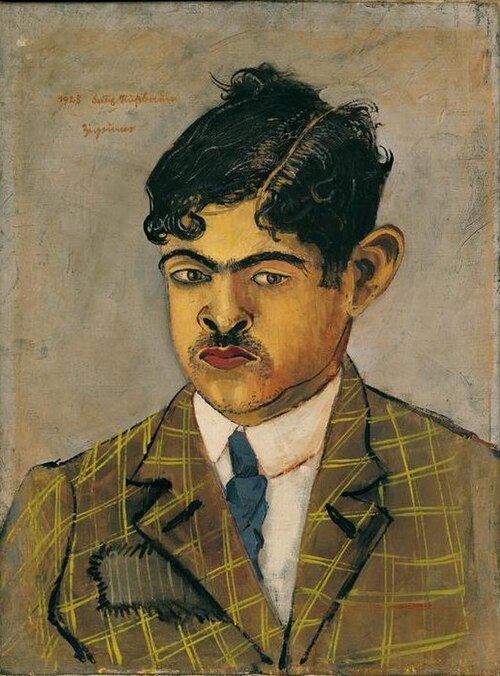

 ウィキメディア・コモンズにあるロマ民族に関するメディア