
Loading article…
モンタナ | |
|---|---|
| ニックネーム: ビッグスカイカントリー、宝の州 | |
| モットー: | |
| 国歌:「モンタナ」 | |
 モンタナ州が強調表示されたアメリカ合衆国の地図 | |
| 国 | アメリカ合衆国 |
| 州になる前 | モンタナ準州 |
| 連合に加入 | 1889年11月8日(第41回) |
| 資本 | ヘレナ |
| 最大の都市 | ビリングス |
| 最大の郡または同等の郡 | イエローストーン |
| 最大の大都市圏と都市圏 | ビリングス |
| 政府 | |
| • 知事 | グレッグ・ジャンフォルテ(右) |
| • 副知事 | クリステン・ジュラス(右) |
| 立法府 | 立法府 |
| • 上院 | 上院 |
| • 下院 | 衆議院 |
| 司法 | モンタナ州最高裁判所 |
| 米国上院議員 | ジョン・テスター( D ) スティーブ・デインズ(R) |
| 米国下院代表団 |
|
| エリア | |
| • 合計 | 147,040 [1] 平方マイル (380,800 km 2 ) |
| • 土地 | 145,552 [2] 平方マイル (376,980 km 2 ) |
| • 水 | 1,491平方マイル(3,862 km 2) 1% |
| • ランク | 4番目 |
| 寸法 | |
| • 長さ | 255マイル(410 km) |
| • 幅 | 630マイル(1,015 km) |
| 標高 | 3,400 フィート (1,040 メートル) |
| 最高標高 (グラナイトピーク[3] [4]) | 12,807 フィート (3,903.5 メートル) |
| 最低標高 | 1,804 フィート (557 メートル) |
| 人口 (2023) | |
| • 合計 | 1,132,812 |
| • ランク | 43位 |
| • 密度 | 7.7/平方マイル (3.0/km 2 ) |
| • ランク | 48番目 |
| • 世帯収入の中央値 | 56,539ドル[5] |
| • 所得順位 | 40日 |
| 異名 | モンタナン |
| 言語 | |
| • 公用語 | 英語 |
| タイムゾーン | UTC−07:00 (山岳部) |
| • 夏 ( DST ) | UTC−06:00 ( MDT ) |
| USPSの略称 | MT |
| ISO 3166 コード | 米国-MT |
| 伝統的な略語 | モン。 |
| 緯度 | 北緯44度21分から北緯49度 |
| 経度 | 西経104度2分から西経116度3分 |
| Webサイト | 政府 |
| 州のシンボル一覧 | |
|---|---|
 | |
 | |
| 鳥 | ウエスタンマウチヒバリ |
| 蝶 | 喪服 |
| 魚 | ウエストスロープ・カットスロート・トラウト |
| 花 | ビタールート |
| 哺乳類 | ハイイログマ |
| 木 | ポンデローサ松 |
| 化石 | マイアサウラ・ピーブルソラム |
| 宝石 | サファイア、瑪瑙 |
| 州道標識 | |
 | |
| アメリカ合衆国の州のシンボルのリスト | |
モンタナ( / m ɒ n ˈ t æ n ə / モンタナ州(Montana State、略称モンタナ州、略称: モンタナ州、英語: Mon- -ə)[6]アメリカ合衆国西部マウンテン・ウェスト地域にある内陸の州。西はアイダホ州東はノースダコタ州南東はサウスダコタ州ワイオミング州、のアルバータ州、ブリティッシュコロンビア、サスカチュワン面積では4番目に大きい州であるが、人口は8番目に少なく、人口密度は3番目に低い。州都ヘレナで、最も人口の多い都市ビリングスである。州の西半分は数多くの山脈が広がり、東半分は西部の草原地帯とバッドランズ、州内各地に小規模な山脈が見られる。
モンタナ州の大部分は、1803年にフランスからルイジアナを買収したことにより初めてアメリカの領有下に入り、その後すぐにルイス・クラーク探検隊によって探検された。[7]毛皮猟師がそれに続き、1852年に金が発見されるまで、この地域の主な経済活動であった。その後のゴールドラッシュと1862年のホームステッド法の可決により、多くのアメリカ人入植者がモンタナ州にやって来た。[7]急速な人口増加と発展により、1889年11月8日に州として昇格した。特にビュートとヘレナ周辺の鉱業は、20世紀半ばまで州の主要な経済エンジンであり続けた。
モンタナ州には公式の愛称はないが、非公式の愛称がいくつかあり、最も有名なのは「ビッグスカイカントリー」、「宝の州」、「輝く山々の地」、「最後の最高の場所」などである。[8]州の経済は主に農業に基づいており、牧場経営や穀物栽培が含まれる。その他の重要な経済資源には、石油、ガス、石炭、鉱業、木材などがある。医療、サービス、防衛、政府部門も州経済にとって重要である。モンタナ州で最も急成長している部門は観光業で、毎年1,260万人の観光客(2019年現在)が州を訪れている。[9]
語源
モンタナという名前はスペイン語のmontañaに由来し、これはラテン語のmontaneaに由来し、「山」またはより広義には「山岳地帯」を意味します。[10] [11] モンターニャ・デル・ノルテ(「北の山」) は、初期のスペイン人探検家が西部の山岳地帯全体に付けた名前です。[11]モンタナという名前は、1863年に米国下院領土委員会(当時はオハイオ州のジェームズ・アシュリーが委員長を務めていた) がアイダホ準州となる地域について提出した法案に追加されました。[12]
この名前は、ヘンリー・ウィルソン議員(マサチューセッツ州)とベンジャミン・F・ハーディング議員(オレゴン州)によって変更された。彼らは、モンタナには「意味がない」と不満を述べた。[12]アシュリーは、1864年にアイダホ州から切り離して新しい領土を作るための臨時政府を設立する法案を提出したが、彼は再びモンタナ準州を選んだ。[13]今回は、同じくオハイオ州のサミュエル・コックス議員がこの名前に異議を唱えた。[13]コックスは、領土のほとんどが山岳地帯ではないことを考えるとこの名前は誤称であると不満を述べ、スペイン語の名前よりもネイティブアメリカンの名前のほうが適切だと考えた。[13]ショーショーニーなどの他の名前も提案されたが、領土委員会は名前を選ぶ裁量権があると判断し、元のモンタナという名前が採用された。[13]
歴史

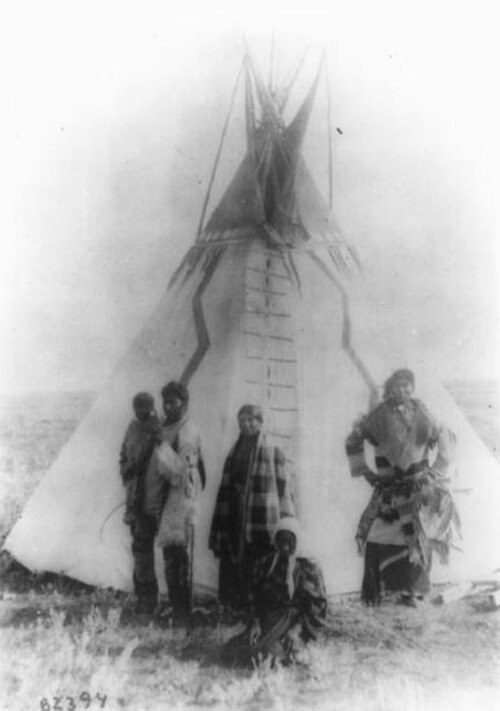
何千年もの間、様々な先住民族が現在のモンタナ州の土地に住んでいた。ヨーロッパ人やアメリカからの移住者が遭遇した歴史的な部族には、南中央部のクロウ族、南東部のシャイアン族とラコタ族、中央部と北中央部のブラックフット族、アシニボイン族、グロス・ヴェントル族、西部のクーテナイ族とサリッシュ族(セリシュ族または「フラットヘッド」)が含まれていた。(クリスペ族またはペンド・ドレイユ族)とカリスペル族は、それぞれフラットヘッド湖の近くと西部の山岳地帯に住んでいた。モンタナ州南東部の一部は、クロウ族とノースダコタ州の同族のヒダーツァ族との間の回廊として使われていた。[14]
ミズーリ川流域の一部であるモンタナ州の大陸分水嶺の東側の土地はすべて、ハドソン湾流域の一部である北東部の小さな部分を除いて、1803年のルイジアナ買収の一部でした。ルイスとクラーク探検隊の後、特にその後の数十年間は、ヨーロッパ、カナダ、アメリカの貿易商が毛皮貿易を行い、この地域の東部と西部の両方で先住民と交易しました。毛皮商人と先住民の間の交流の増加はしばしば利益を生むパートナーシップであることが証明されましたが、アメリカ人の罠猟師とブラックフット族の間の紛争のように、先住民の利益が脅かされると紛争が勃発しました。この地域の先住民はまた、免疫のない毛皮商人によって持ち込まれた病気によっても壊滅しました。[15] [16] 1807年、クロウ・インディアン居留地に交易拠点のフォート・レイモンド(1807年 - 1811年)が建設された。 [17] 1846年のオレゴン条約まで、大陸分水嶺の西側の土地はイギリス政府とアメリカ政府の間で争われ、オレゴン・カントリーと呼ばれていた。今日のモンタナ州におけるヨーロッパ系アメリカ人による最初の恒久的な入植地は、1841年に現在のスティーブンスビルの近くに設立されたセント・メアリーズであった。[18] 1847年、ミズーリ川の上流の毛皮交易拠点としてフォート・ベントンが建設された。[19] 1850年代、開拓者はオレゴン・トレイルからビーバーヘッド渓谷とビッグホール渓谷、そしてクラークス・フォーク渓谷に移り住み始めた。 [20]
モンタナ州で最初に金が発見されたのは、1852年、現在のギャリソン付近のゴールド クリークでした。この地域のゴールド ラッシュは、1862年から本格的に始まりました。州西部で一連の大きな鉱物が発見され、金、銀、銅、鉛、石炭 (後には石油) が見つかり、何万人もの鉱山労働者がこの地域に集まりました。最も豊富な金の砂金採掘は、バージニア シティの町が設立されたアルダー ガルチで発見されました。その他の豊富な砂金鉱床は、現在ヘレナ市があるラスト チャンス ガルチ、コンフェデレート ガルチ、シルバー ボウ、エミグラント ガルチ、クック シティで発見されました。1862年から1876年までの金の産出量は1億4,400万ドルに達し、その後銀がさらに重要になりました。最大の採掘作業はビュートで行われ、重要な銀鉱床と広大な銅鉱床がありました。
モンタナ準州

モンタナ準州 (1864–1889) の創設以前、現在のモンタナ州内の地域は、オレゴン準州(1848–1859)、ワシントン準州(1853–1863)、アイダホ準州 (1863–1864)、およびダコタ準州(1861–1864) の一部でした。モンタナ準州は、 1864 年5 月 26 日に米国の準州になりました。最初の準州都はバナック に置かれました。シドニー エドガートンが最初の準州知事を務めました。首都は 1865 年にバージニア シティに、1875 年にヘレナに移されました。1870年、モンタナ準州の非インディアン人口は 20,595 人でした。[22] 1865年2月2日にバージニアシティに設立されたモンタナ歴史協会は、ミシシッピ川以西(ルイジアナ州を除く)で最も古い歴史を持つ団体です。[ 23 ] 1869年と1870年に、クック・フォルサム・ピーターソン探検隊とウォッシュバーン・ラングフォード・ドーン探検隊がヘレナからイエローストーン上流地域に向けて出発しました。これらの探検隊による驚くべき発見と報告により、1872年にイエローストーン国立公園が設立されました。
紛争
1850年代から1870年代にかけてモンタナ州に移住者が住み始めると、主に土地の所有権と支配権をめぐってネイティブアメリカンとの紛争が続いた。1855年、ワシントン準州知事アイザック・スティーブンスは、アメリカ政府とモンタナ州西部のサリッシュ族、ペンド・ドレイユ族、クーテナイ族との間でヘルゲート条約を交渉し、部族国家の境界を定めた。この条約は1859年に批准された。 [24]この条約により後にフラットヘッド・インディアン居留地となる地域が設立されたが、通訳とのトラブルや条約条件をめぐる混乱により、白人はビタールート渓谷が入植に開放されていると信じたが、部族国家はその条項に異議を唱えた。[25]サリッシュ族は1891年までビタールート渓谷に留まった。[26]
モンタナ州に最初に設置された米軍駐屯地は、1866年にミズーリ川沿いにフォートベントンへの蒸気船の交通を守るためのキャンプクックであった。州内には12以上の追加の軍事前哨地が設立された。モンタナ州と周辺州のさまざまな場所で金が発見されたため、土地の所有権と管理をめぐる圧力が高まった。モンタナ州では、レッドクラウド戦争、 1876年の大スー戦争、ネズ・パース戦争、およびピーガン・ブラックフット族との紛争中に大きな戦闘が発生した。最も有名なのは、マリアスの虐殺(1870年)、リトルビッグホーンの戦い(1876年)、ビッグホールの戦い(1877年)、ベアポーの戦い(1877年)である。モンタナ州で最後に記録された米軍とネイティブアメリカンの間の紛争は、1887年にビッグホーン地方で起こったクロウエージェンシーの戦いである。条約に署名したネイティブの生存者は、通常、居留地への移住を要求された。[27]

これらの紛争と同時期に、先住民が何世紀にもわたって生き延びてきたキーストーン種であり主要なタンパク源であるバイソンが破壊されつつあった。専門家は、1870年には約1,300万頭のバイソンがモンタナ州を歩き回っていたと推定している。 [28] 1875年、フィリップ・シェリダン将軍は、先住民から食料源を奪うためにバイソンの群れの虐殺を認可するよう連邦議会の合同会議に嘆願した。 [29] 1884年までに、商業的な狩猟によりバイソンは絶滅の危機に瀕し、米国全体で約325頭のバイソンしか残っていなかった。[30]
牛の牧場経営
1850年代にジョニー・グラントがディアロッジ渓谷で冬季飼育する牛の飼育を始め、肥沃なモンタナの渓谷で肥えた牛をオレゴン・トレイルの移民と取引して以来、モンタナ州の歴史と経済において牧畜業は中心的な存在となっている。 [31] ネルソン・ストーリーは1866年に最初のテキサスロングホーン牛をこの地域に持ち込んだ。 [32] [33] グランビル・スチュアート、サミュエル・ハウザー、アンドリュー・J・デイビスは1879年にファーガス郡で大規模な放牧牛の飼育を始めた。 [34] [35]ディアロッジにあるグラント・コーズ牧場国定史跡は、19世紀後半の牧場経営の伝統を残すものとして今日も維持されている。国立公園局が運営するこの牧場は、1,900エーカー(7.7 km 2)の牧場である。[36]
鉄道

ノーザン・パシフィック鉄道(NPR)の線路は、1881年に西から、1882年に東からモンタナ州に到達した。しかし、この鉄道は1870年代にアメリカ先住民部族との緊張を高める大きな要因となった。NPR社長のジェイ・クックは1871年、1872年、1873年にイエローストーン渓谷への大規模な調査を開始したが、シッティング・ブル酋長率いるスー族がこれに強く反対した。これらの衝突が1873年恐慌(モンタナ州への鉄道建設を遅らせた財政危機)の一因となった。 [37] 1874年、1875年、1876年の調査は、1876年のスー戦争の引き金となった。大陸横断NPRは1883年9月8日、ゴールド・クリークで完成した。
1881年、ユニオン・パシフィック鉄道の支線であるユタ・アンド・ノーザン鉄道が、ユタ州北部からビュートまでの狭軌線を完成させた。 [38] 1881年から20世紀にかけて、オレゴン・ショート・ライン、モンタナ鉄道、ミルウォーキー鉄道など、モンタナ州ではいくつかの小規模な支線が運行されていた。
グレートノーザン鉄道(GNR)の線路は1887年にモンタナ州東部に到達し、1890年にロッキー山脈北部に到達すると、GNRはグレイシャー国立公園地域への観光の重要な推進者となった。大陸横断GNRは1893年1月6日にワシントン州シーニックで完成し[39] 、ハイラインとして知られ、米国最北の大陸横断鉄道線となった。
州の地位
準州知事トーマス・ミーガーの下、モンタナ州民は1866年に憲法制定会議を開催したが、州昇格には失敗した。1884年にヘレナで開催された2回目の憲法制定会議では、1884年11月にモンタナ州民の3対1で批准された憲法が制定された。政治的な理由から、議会は1889年2月までモンタナ州の州昇格を承認せず、グロバー・クリーブランド大統領は、適切な州憲法が作成された時点でモンタナ州、ノースダコタ州、サウスダコタ州、ワシントン州に州昇格を認める包括法案に署名した。1889年7月、モンタナ州民は3回目の憲法制定会議を招集し、住民と連邦政府に受け入れられる憲法を制定した。1889年11月8日、ベンジャミン・ハリソン大統領はモンタナ州を連邦第41番目の州と宣言した。[42] 1880年代、ヘレナ(州都)には米国の他のどの都市よりも人口当たりの億万長者の数が多かった。[43]
開拓
1862年のホームステッド法は、中西部と米国西部の連邦政府所有地160エーカー(0.65 km 2 )を請求し「証明」できる入植者に無料の土地を提供した。モンタナ州では、この法律によって大規模な移民流入は見られなかった。なぜなら、160エーカーでは、乾燥した地域で家族を養うには通常不十分だったからである。[44]モンタナ州でこの法律に基づく最初のホームステッド請求は、1868年にヘレナ近郊でデビッド・カーペンターによってなされた。女性による最初の請求は、ウォームスプリングスクリーク近郊で、ディアロッジ・モンタナの開拓者モーガン・エバンスの娘、グウェンリアン・エバンスによってなされた。[45] 1880年までに、農場は中央部と西部モンタナのより緑豊かな谷間に存在したが、東部の平原にはほとんど存在しなかった。[46]
1877年の砂漠地帯法は西部の乾燥地帯への入植を認めるために制定され、1エーカーあたり25セントの料金と土地の灌漑を約束する条件で、640エーカー(2.6 km 2)の土地を入植者に割り当てた。3年後、1エーカーあたり1ドルの料金が支払われ、入植者が土地を所有することになった。この法律により、主に牛や羊の牧場主がモンタナに移住したが、その多くは3年間モンタナの草原で家畜を放牧し、土地の灌漑にはほとんど手を出さず、最終的な料金を支払わずに土地を放棄した。[45] 1880年代から1890年代にかけてグレートノーザン鉄道とノーザンパシフィック鉄道の到来とともに、比較的少数ではあったが、農民も移住した。[47]

1900年代初頭、グレート・ノーザン鉄道のジェームズ・J・ヒルは、列車に開拓者と物資を積むため、モンタナ州の大草原への入植を推進し始めた。他の鉄道会社もこれに倣った。[48] 1902年、開拓法が可決され、モンタナ州東部の川沿いの渓谷に灌漑プロジェクトを建設することが可能となった。1909年、議会は拡張ホームステッド法を可決し、無料で利用できる土地の面積を1家族あたり160エーカーから320エーカー(0.6~1.3 km 2)に拡大し、1912年には土地の請求を「証明」する期間を3年に短縮した。[49] 1916年、畜産ホームステッド法により、灌漑に適さない地域に640エーカーのホームステッドを建設することが許可された。[50]この宣伝とホームステッド法の改正の組み合わせにより、何万人もの開拓者が無料の土地に誘われてやって来た。第一次世界大戦で小麦価格が特に高騰していた。さらに、モンタナ州は一時的に例年よりも降水量が多かった時期だった。[51]この時期にやってきた開拓者は「ホニオッカー」または「シザービル」と呼ばれた。[47]ホニオッカーという言葉は、おそらく民族差別用語のフニャックから派生したもので、 [52]開拓者を「新米」、「仕事に不慣れ」、「準備不足」と蔑称して使われた。[53]しかし、これらの新しい入植者の多くは農業経験があったが、多くはなかった。[54]
ホニオッカー、シザービル、巣作り…彼は半世紀前のジョードであり、敵地へと群れをなしてやって来た。出発時には騙され、到着時には強奪された。希望に満ち、勇敢で、野心的。彼は独立か冒険、快適さと安全を求めた…ホニオッカーは農夫、独身女性、深海ダイバー、バイオリン弾き、医師、バーテンダー、料理人であった。彼はミネソタ州かウィスコンシン州、マサチューセッツ州かメイン州に住んでいた。そこでニュースが彼を探し出した。トレジャー ステートで無料の土地が手に入るというジム ヒルのニュース…
— ジョセフ・キンゼイ・ハワード『モンタナ、高くて広くてハンサム』(1964年)[45]
しかし、農民は多くの問題に直面した。巨額の負債がその一つだった。[55]また、ほとんどの入植者は湿潤地域から来ており、乾燥した気候、樹木の不足、水資源の乏しさに備えていなかった。[56]さらに、320エーカー(130ヘクタール)未満の小さな農家は環境に適していなかった。100度子午線の西側では、天候と農業条件ははるかに厳しく乾燥している。[57]その後、1917年から1921年の干ばつが壊滅的であった。多くの人々が去り、州内の銀行の半分は返済できない住宅ローンを提供したために破産した。[58]その結果、農場の規模は拡大し、農場の数は減少した。[57]
1910年までに、開拓者は500万エーカー以上の土地の申請を行い、1923年までに9300万エーカー以上が耕作された。[59] 1910年には、グレートフォールズ土地事務所だけで毎月1000件以上の開拓申請があり、[60] 1917年から1918年のピーク時には、毎年14,000の新しい開拓地があった。[55] 1919年の干ばつ後、大幅な減少が起こった。[57]
モンタナと第一次世界大戦
第一次世界大戦が勃発すると、モンタナ州選出でアメリカ初の女性連邦議会議員となったジャネット・ランキンは、アメリカの宣戦布告に反対票を投じた。彼女の行動は、戦争への支持と愛国心の強いモンタナ州で広く批判された。[61] 1917年から1918年にかけて、モンタナ州の人口の計算ミスにより、州人口の10%にあたる約4万人のモンタナ州民[61]が軍隊に志願または徴兵された。これは人口一人当たりで他のどの州よりも25%高い戦争への人的貢献を示した。約1,500人のモンタナ州民が戦争で死亡し、2,437人が負傷したが、これも人口一人当たりで他のどの州よりも高かった。[62]モンタナ州マイルズシティのリマウントステーションは、国内の他のどの陸軍基地よりも多くの1万頭の騎兵馬を戦争に提供した。戦争により軍需物資と食糧の需要が増加し、モンタナ州の鉱業、木材、農業が活況を呈した。[61]
1917年6月、米国議会は1917年スパイ法を可決し、これは1918年治安妨害法によって拡大された。[63] 1918年2月、モンタナ州議会は連邦版のモデルとなったモンタナ治安妨害法を可決した。[64]これらの法律を組み合わせることで、言論やその他の手段による米国政府、軍、またはシンボルへの批判は犯罪となった。モンタナ法によって200人以上が逮捕され、主にドイツ系またはオーストリア系の78人が有罪判決を受けた。40人以上が刑務所に収監された。2006年5月、当時のブライアン・シュバイツァー知事は、モンタナ治安妨害法違反で有罪判決を受けたすべての人に対して、死後に完全な恩赦を出した。[65]
アメリカの参戦に反対したモンタナ州民の中には、ドイツ系やアイルランド系の移民グループや、フッター派やメノ派などの平和主義のアナバプテスト派の人々も含まれており、彼らの多くはやはりドイツ系の血を引いていた。その一方で、サミュエル・V・スチュワート知事が設立したモンタナ州防衛協議会や地元の「忠誠委員会」など、戦争支持のグループも形成された。 [61]
戦争感情は労働問題によって複雑化した。銅生産の史上最高潮にあったアナコンダ銅会社[66]はモンタナ州で極めて強力な勢力であったが、社会主義的な新聞や組合員の利益のために奮闘する労働組合からの批判や反対にも直面していた。[67]ヨーロッパからの移民人口が相当数いる多民族コミュニティであるビュートでは、労働組合、特に新しく結成された金属鉱山労働組合は、戦争は主に大手木材会社と鉱山会社の利益になるという理由で戦争に反対した。[61]鉱山生産の増大と1917年6月のスペキュレーター鉱山の惨事を受けて、 [61] 世界産業労働組合の組織者フランク・リトルが鉱山労働者を組織するためにビュートに到着した。彼は扇動的な反戦レトリックを含む演説を行った。1917年8月1日、彼は覆面をした自警団員によって下宿から引きずり出され、鉄道の架台から吊るされた。これはリンチと見なされた。[68]リトルの殺害とそれに続くストライキの結果、秩序回復のために州兵がビュートに派遣された。[61]全体的に反ドイツ、反労働者感情が高まり、翌年2月にモンタナ州治安維持法が可決される運動が起こった。[69]さらに、国防評議会は州機関となり、同法に違反したとみなされる個人を起訴し処罰する権限が与えられた。評議会はまた、公共の集会を制限し、公共の場でドイツ語を話すことを禁止する規則を可決した。[61]
1918 年の立法措置を受けて、感情が高まった。起訴された人々を起訴または有罪にすることを躊躇した連邦検事バートン・K・ウィーラーと数人の地方裁判所判事は、強く批判された。ウィーラーは国防会議に召喚されたが、正式な手続きは避け、フォーサイス地方裁判所判事は弾劾された。ドイツ語の本の焼却と数件の絞首刑寸前事件が発生した。ドイツ語の使用禁止は 1920 年代初頭まで有効であった。戦時中の闘争を複雑にしたのは、1918 年のインフルエンザの大流行で5,000 人以上のモンタナ人が死亡したことである。[61]市民の自由が抑圧されたため、一部の歴史家はこの時期を「モンタナの苦悩」と名付けた。[67]
大恐慌時代
第一次世界大戦後、モンタナ州では経済不況が始まり、大恐慌を経て第二次世界大戦が始まるまで続いた。このため、農民、牧場主、鉱山労働者は大きな苦難を強いられた。[70] [71]
モンタナと第二次世界大戦
1941年12月8日にアメリカが第二次世界大戦に参戦するまでに、多くのモンタナ人が、前10年間の国家経済の悪化から逃れるために軍に入隊した。宣戦布告後1年でさらに4万人以上のモンタナ人が軍に入隊し、戦争が終わるまでに5万7千人以上が入隊した。これらの数字は州人口の約10%を占め、モンタナ州は再び人口当たりの兵士数が最も多い州の一つとなった。入隊者の中には多くのネイティブアメリカンがおり、クロウ族の兵士はコードトーカーとなった。少なくとも1,500人のモンタナ人が戦争で亡くなった。[72]モンタナ州はまた、第1特殊部隊、または「悪魔の旅団」の訓練場でもあった。これはアメリカとカナダの合同コマンドースタイルの部隊で、配備前に山岳地帯や冬の環境での経験を積むためにフォートウィリアムヘンリーハリソンで訓練された。 [72] [73]グレートフォールズ、ルイスタウン、カットバンク、グラスゴーに空軍基地が建設され、そのいくつかはソ連の同盟軍に送られる飛行機を準備するための準備場所として使用されました。戦争中、約30個の日本軍風船爆弾「ふごう」がモンタナ州に着弾したことが記録されていますが、死傷者や大規模な森林火災は発生しませんでした。[72]
1940年、ジャネット・ランキンは再び連邦議会議員に選出された。1941年、彼女は1917年と同様に、日本軍の真珠湾攻撃後の米国の宣戦布告に反対票を投じた。彼女が投じた票は戦争に反対した唯一の票であり、彼女の投票に対する世論の抗議を受けて、ランキンはしばらくの間警察の保護を必要とした。他の平和主義者は、一般的に戦争に反対する「平和教会」の出身者が多かった。良心的兵役拒否者を主張する多くの個人が、戦時中、煙突ジャンパーやその他の森林火災消火活動の任務のためにモンタナ州に派遣された。[72]
1942年、アメリカ陸軍は冬季に犬ぞりを訓練する目的でヘレナ近郊に キャンプ・リミニを設立した。
その他の軍事
第二次世界大戦中、計画されていた戦艦 USSモンタナは州にちなんで命名されたが、完成することはなかった。モンタナ州は、完成した戦艦に州名が付けられていない最初の48州のうち唯一の州である。アラスカ州とハワイ州には、それぞれにちなんで名付けられた原子力潜水艦がある。モンタナ州は、州にちなんで名付けられた現代の海軍艦艇がない連邦内で唯一の州である。しかし、2007年8月、ジョン・テスター上院議員は、潜水艦にUSSモンタナと命名するよう求めた。[74]レイ・メイバス海軍長官は、2015年9月3日に、バージニア級攻撃型潜水艦SSN-794がこの名前を持つ2番目の就役艦になると発表した。[75]
冷戦時代のモンタナ
第二次世界大戦後の冷戦時代には、モンタナ州はC-54スカイマスターによる空輸訓練のため、米国空軍 軍事航空輸送サービス(1947年)の受け入れ地となり、最終的には1953年に戦略航空軍の航空およびミサイル部隊がグレートフォールズのマルムストロム空軍基地に駐留することとなった。この基地は1953年から1968年まで防空軍第29戦闘迎撃飛行隊の駐留地でもあった。1959年12月、マルムストロム空軍基地は新型のミニットマンI大陸間弾道ミサイルの拠点として選ばれた。最初の運用可能なミサイルは1962年初頭に設置され、準備が整った。1962年後半には、第341戦略ミサイル航空団に配属されたミサイルがキューバ危機で大きな役割を果たした。ソ連がキューバからミサイルを撤去したとき、ジョン・F・ケネディ大統領は、ソ連が撤退したのは、彼が「切り札」を持っていることを知っていたからだと述べた。これはモンタナ州のミニットマンミサイルを指している。モンタナ州は最終的に、23,500平方マイル(61,000 km 2)に及ぶ米国最大のICBMフィールドの本拠地となった。[76]
地理
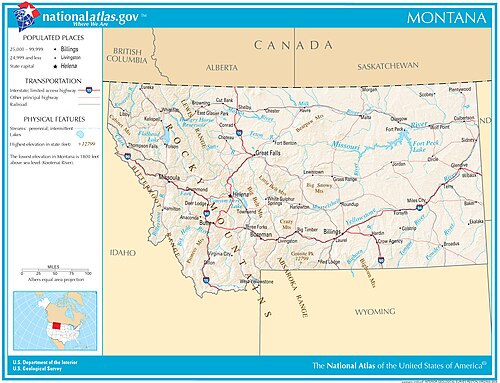
モンタナ州は、アメリカ西部として知られる地域の北部に位置する8 つの山岳州のうちの 1 つです。東はノースダコタ州およびサウスダコタ州と接しています。南はワイオミング州、西と南西はアイダホ州、北はカナダのブリティッシュ コロンビア州、アルバータ州、サスカチュワン州と接しており、カナダの 3 つの州と接する唯一の州となっています。
モンタナ州の面積は147,040平方マイル(380,800 km 2)で、[1]日本よりわずかに大きい。アラスカ、テキサス、カリフォルニアに次いで米国で4番目に大きい州であり、[77]最大の内陸州でもある。[78]
地形

州の地形は大陸分水嶺によって大まかに定義されており、この分水嶺は州の大部分を東部と西部に明確に分けている。[79]モンタナ州の100以上の山脈のほとんどは州の西半分にあり、そのほとんどは地質学的にも地理的にも北部ロッキー山脈の一部である。[79] [80]州の南中央部にあるアブサロカ山脈とベアトゥース山脈は、厳密には中央ロッキー山脈の一部である。 [81]ロッキー山脈前線は州の北中部の重要な地形であり、[82]州の中央部と東部によく見られる草原の景観を遮る孤立した島嶼山脈である。 [83]州の約60パーセントは草原で、北部グレートプレーンズの一部である。[84]
ビタールート山脈は、アラスカからメキシコにかけてのロッキー山脈の中で最も長い連続山脈の一つであり[85]、コー・ダレーン山脈やキャビネット山脈などのより小さな山脈とともに、アイダホ州と州を分断している。ビタールート山脈の南3分の1は、大陸分水嶺に溶け込んでいる。[86]分水嶺の西側にある他の主要な山脈には、キャビネット山脈、アナコンダ山脈、ミッション山脈、ガーネット山脈、サファイア山脈、フリントクリーク山脈がある。[87]
分水嶺の北部は、山脈が急速に草原に変わる場所で、ロッキー山脈前線の一部である。[88]前線は、主にグレイシャー国立公園に位置するルイス山脈で最も顕著である。[89]グレイシャー国立公園の山脈の構成により、アラスカのスワード半島に始まる北部分水嶺[90]は、この地域を横切り、モンタナ州のトリプルディバイドピークで東に曲がる。[91]これにより、ウォータートン川、ベリー川、セントメアリー川が北に流れ、カナダのアルバータ州に入る。[92]そこで、それらはサスカチュワン川と合流し、最終的にハドソン湾に注ぐ。[93]
分水嶺の東には、グレイベリー山脈、マディソン山脈、ガラティン山脈、アブサロカ山脈、ベアトゥース山脈など、ほぼ平行に連なる山脈が州の南部を覆っている。[94]ベアトゥース高原は、アメリカ本土で標高10,000フィート (3,000 m) を超える最大の連続した陸地である。[95]ここには、州の最高地点であるグラナイトピーク(12,799 フィート (3,901 m)) がある。[95]これらの山脈の北には、ビッグベルト山脈、ブリッジャー山脈、タバコルーツ、そしてクレイジー山脈やリトルベルト山脈などの島嶼山脈がいくつかある。[96]
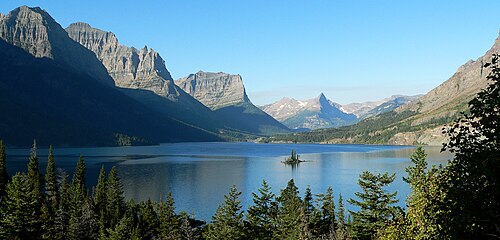
多くの山脈の間には、豊かな川の谷がいくつかあります。ビッグホール[97] 、ビタールート[98] 、 ガラティン[99] 、フラットヘッド[100]、[101]、パラダイス渓谷[102]には、豊富な農業資源と、観光やレクリエーションの機会がたくさんあります。
この移行地帯の東と北には、広大で人口のまばらな北部平原があり、台地のプレーリー、小さな島状の山脈、バッドランズがある。[103]分水嶺の東にある孤立した島状の山脈には、ベア・ポー山脈、[104 ]ブル山脈、[105]キャッスル山脈、 [106] クレイジー山脈、[107 ]ハイウッド山脈、[ 108]ジュディス山脈、[108]リトル・ベルト山脈、[106]リトル・ロッキー山脈、[108]プライアー山脈、[107]リトル・スノーウィー山脈、ビッグ・スノーウィー山脈、[105]スウィート・グラス・ヒルズ、[105]および、州の南東端のエカラカ付近にはロング・パインズがある。 [ 80]これらの孤立した東部山脈の多くは、約1億2000万年から6600万年前に、内部から湧き出たマグマが割れて地球の表面が湾曲したときに形成されました。 [109]
州の北中部にある分水嶺の東側の地域は、ミズーリ・ブレイクスやその他の重要な岩層で知られている。[110]グレートフォールズの南にある3つのビュートは、カスケード、クラウン、スクエア、ショー、ビュートという主要なランドマークである。[111]ラコリスとして知られるこれらは、火成岩が堆積岩の割れ目から突き出たときに形成された。[111]下層の表面は砂岩と頁岩からなる。[112]この地域の表土は非常に多様であり、氷河平原、山間の盆地、山の麓、または台地など、地元の地質に大きく影響されている。[113]山麓地域は、風化した石や砕けた粘板岩で覆われている場合が多く、または露出した岩(通常は火成岩、珪岩、砂岩、または頁岩)で構成されている。 [114]山間盆地の土壌は通常、粘土、砂利、砂、シルト、火山灰で構成されており、その多くは3300万年から2300万年前の漸新世にこの地域を覆っていた湖によって堆積したものです。 [115]テーブルランドはしばしば粘土質の砂利と風化した珪岩で覆われ、時には頁岩が下にあります。[116]氷河平野は一般に、氷河前縁のグレートフォールズ湖が残した粘土、砂利、砂、シルト、または85,000年から11,000年前のウィスコンシン氷河作用によって残されたモレーンまたは砂利で覆われた旧湖盆によって覆われています。 [117]さらに東のグレンダイブ近くのマコシカ州立公園やエカラカ近くのメディシンロックス州立公園などの地域には、州で最も風光明媚なバッドランズ地域がいくつかあります。 [118]
モンタナ州北東部のヘルクリーク層は恐竜の 化石の主要な産地である。[119] ボーズマンのロッキー博物館の古生物学者 ジャック・ホーナーは、いくつかの重要な発見によりこの層を世界の注目を集めた。[120]
川、湖、貯水池
モンタナ州には何千もの川や小川があり、[121]そのうち450マイル(720 km)は「ブルーリボン」 マス釣りで知られています。[122] [123]モンタナ州の水資源は、レクリエーション、水力発電、作物や飼料の灌漑、鉱業、そして人間の消費のための水を提供しています。
モンタナ州は、河川が3つの主要な流域(2つの大陸分水嶺が交差する場所)の一部を形成する世界でも数少ない地理的地域の一つである。モンタナ州の河川は太平洋、メキシコ湾、ハドソン湾に流れ込む。流域はグレイシャー国立公園のトリプルディバイドピークで分岐する。 [124]ハドソン湾が北極海の一部とみなされる場合、トリプルディバイドピークは3つの異なる海に水が流入する地球上で唯一の場所である。
太平洋流域

分水嶺より西のモンタナ州の水はすべてコロンビア川に流れ込む。コロンビア川のクラークフォーク(イエローストーン川のクラークフォークとは別)はビュート付近で発し[125] 、北西にミズーラまで流れ、そこでブラックフット川とビタールート川と合流する。[126]さらに下流でフラットヘッド川と合流し、ペンドオレイル湖付近でアイダホ州に入る。[92] [127]ペンドオレイル川はペンドオレイル湖の流出路となっている。ペンドオレイル川はコロンビア川と合流し、太平洋に流れ込むため、長さ579マイル(932 km)のクラークフォーク/ペンドオレイル(単一河川システムとみなされる)はロッキー山脈で最長の川となっている。[128] [129]モンタナ州北西部のクーテナイ川はコロンビア川のもう一つの主要支流である。[130]
メキシコ湾流域
分水嶺の東側では、スリーフォークス付近でジェファーソン川、マディソン川、ガラティン川が合流して形成されたミズーリ川[131]が、州の西中央部を真北に流れ、グレートフォールズに至る。[132]この地点から、比較的平坦な農地とミズーリブレイクスを東に流れ、フォートペック貯水池に至る。[133]フォートベントンとフォートペック貯水池の西境にあるフレッドロビンソン橋の間の川の区間は、1976年に国立野生および景観河川に指定された。 [133]ミズーリ川はフォートユニオン付近でノースダコタ州に入り、[134]モンタナ州の陸地面積の半分以上(82,000平方マイル(210,000 km 2))を流下している。[132]モンタナ州にあるミズーリ川のほぼ3分の1は、トストン、キャニオンフェリー、ハウザー、ホルター、ブラックイーグル、レインボー、コクラン、ライアン、モロニー、フォートペックの10のダムの背後にあります。[135]ミズーリ川の他の主要なモンタナ州の支流には、スミス川、[136] 、ミルク川、[137] 、マリアス川、[138] 、ジュディス川、[139]、マッセルシェル川があります。[140]モンタナ州はまた、グレートフォールズのすぐ外にある世界最短の川であるロー川の所有権を主張しています。[141]これらの川はミズーリ川を通って最終的にミシシッピ川に合流し、メキシコ湾に流れ込みます。[142]
ヘル・ロアリング・クリークはモンタナ州南部に源を発し、レッドロック川、ビーバーヘッド川、ジェファーソン川、ミズーリ川、ミシシッピ川と合わせて北米最長、世界でも4番目に長い川です。
イエローストーン川は、ワイオミング州ティトン荒野のユンツピーク近くの大陸分水嶺に源を発しています。[143]イエローストーン国立公園を北に流れ、ガーディナー付近でモンタナ州に入り、パラダイスバレーを通ってリビングストンに至ります。[144]その後、北東に流れて[144]、ビリングス、マイルズシティ、グレンダイブ、シドニーを通り、州を横切ります。[145]イエローストーン川は、ノースダコタ州フォートユニオンの東でミズーリ川に合流します。[146]イエローストーン川は、アメリカ合衆国本土で最も長いダムのない自由に流れる川であり、[147] [148]モンタナ州の約4分の1(36,000平方マイル(93,000 km 2))を流れています。 [ 132]イエローストーン川の主な支流には、ボルダー川、[149 ]スティルウォーター川、[150]クラークフォーク川、[151]ビッグホーン川、[152]タン川、[153]パウダー川などがあります。[154]
ハドソン湾流域
ノーザン・ディバイドはモンタナ州のトリプル・ディバイド・ピークで東に曲がり、ウォータートン川、ベリー川、セント・メアリー川を北に流してアルバータ州に入る。そこでサスカチュワン川と合流し、最終的にハドソン湾に注ぐ。[93]
湖と貯水池
モンタナ州には、アメリカ西部最大の自然淡水湖であるフラットヘッド湖を含め、約3,000の湖や貯水池がある。その他の主な湖には、フラットヘッド渓谷のホワイトフィッシュ湖、グレイシャー国立公園のマクドナルド湖とセントメアリー湖がある。州内最大の貯水池はミズーリ川のフォートペック貯水池で、世界で2番目に大きな土手ダムと世界最大の水圧ダムに保持されている。[155]その他の主な貯水池には、フラットヘッド川のハングリーホース、クーテナイ川のクーカヌサ湖、マリアス川のエルウェル湖、ビーバーヘッド川のクラークキャニオン、ビッグホーン川のイエローテイル、キャニオンフェリー、ハウザー、ホルター、レインボー、ミズーリ川のブラックイーグルがある。
動植物

州の植生には、ロッジポールパイン、ポンデローサパイン、ダグラスモミ、カラマツ、トウヒ、ポプラ、カバノキ、アメリカスギ、ツガ、トネリコ、ハンノキ、ロッキーマウンテンメープル、ハコヤナギなどがある。森林は州の約25%を占めている。モンタナ州原産の花には、アスター、ビタールート、デイジー、ルピナス、ポピー、サクラソウ、オダマキ、ユリ、ラン、ドリュウゼツランなどがある。数種のヤマヨモギやサボテン、多くの種のイネ科植物がよく見られる。また、多くの種のキノコや地衣類[156]も州内で見られる。
モンタナ州には、14種の両生類[157]、90種の魚類[158] 、 117種の哺乳類[159]、20種の爬虫類[160]、427種の鳥類[161]を含む多様な動物が生息しています。さらに、 180種の軟体動物と30種の甲殻類を含む10,000種以上の無脊椎動物が生息しています。モンタナ州は、下48州で最大のハイイログマの個体群を誇ります。 [162]モンタナ州には、クロアシイタチ、アメリカシロヅル、コアジサシ、シロチョウザメの5種の連邦政府指定絶滅危惧種と、ハイイログマ、カナダオオヤマネコ、ブルトラウトを含む7種の絶滅危惧種が生息しています。[163] [a]再導入以来、オオカミの個体数は約900頭で安定しており、絶滅危惧種から除外されました。[164]モンタナ州魚類野生生物公園局は、少なくとも17種の狩猟魚(マス、ウォールアイ、コクチバスの7種を含む)と、少なくとも29種の狩猟鳥類(キジ、灰色ヤマウズラ、ヘラジカ、プロングホーンアンテロープ、ミュールジカ、オジロジカ、オジロジカ、オオカミ、オオツノヒツジを含む)の釣りと狩猟シーズンを管理しています。[166]
保護された土地
.jpg/500px-Pompeys_Pillar_NM_(9424545304).jpg)
モンタナ州には、「大陸の王冠」と呼ばれるグレイシャー国立公園と、イエローストーン国立公園の一部(公園の 5 つの入口のうち 3 つを含む)があります。連邦政府に認定されているその他の場所には、リトルビッグホーン国定公園、ビッグホーンキャニオン国立レクリエーションエリア、ビッグホール国立戦場跡があります。CSKTバイソン保護区はサリッシュ・クーテナイ連合部族によって管理されており、アメリカンプレーリーは非営利団体によって所有および運営されています。
連邦政府と州政府機関は、モンタナ州の土地の 35 パーセントにあたるおよそ 31,300,000 エーカー (127,000 km 2 ) を管理しています。米国農務省 森林局は、10 の国有林で 16,800,000 エーカー (68,000 km 2 ) の森林地帯を管理しています。1964年の荒野保護法により確立された国立荒野保護システムの一部である12 の独立した荒野地域には、およそ 3,300,000 エーカー (13,000 km 2 ) の荒野があります。米国内務省土地管理局は、8,100,000 エーカー (33,000 km 2 ) の連邦政府所有地を管理しています。米国内務省魚類野生生物局は、モンタナ州の国立野生生物保護区と水鳥生産地域の 110 万エーカーのうち110,000 エーカー (450 km 2 ) を管理しています。米国内務省開拓局は、州内の約 300,000 エーカー (1,200 km 2 ) の陸地と水面を管理しています。モンタナ州魚類野生生物公園局は、州の川と湖にある約 275,265 エーカー (1,113.96 km 2 ) の州立公園とアクセス ポイントを運営しています。モンタナ州天然資源保全局は、1889 年にモンタナ州が州に昇格した際に、 1785 年の土地条例に基づいて連邦政府から州に譲渡された5,200,000 エーカー (21,000 km 2 ) の学校信託地を管理しています。これらの土地は州内の公立学校や公共施設の利益のために州によって管理されている。[167]

国立公園局が管理する地域には以下のものが含まれる。[168]
- ウィズダム近くのビッグホール国立戦場跡
- フォートスミス近郊のビッグホーンキャニオン国立レクリエーションエリア
- グレイシャー国立公園
- ディアロッジのグラント・コールズ牧場国定史跡
- ルイス・クラーク国立歴史トレイル
- クロウ・エージェンシー近くのリトルビッグホーン戦場国定公園
- ネズ・パース国立歴史公園
- イエローストーン国立公園
気候


モンタナ州は、地理、地形、標高にかなりの変化がある大きな州であり、気候も同様に多様です。州は、北緯45度線(赤道と北極の等距離線)より南から北緯49度線に及び、海抜2,000フィート(610メートル)以下から13,000フィート(4,000メートル)近くまで及びます。西半分は山岳地帯で、多くの大きな谷が点在しています。モンタナ州東部は、丘陵と孤立した山脈に分断された平原と荒地で構成され、半乾燥大陸性気候(ケッペンの気候区分 BSk)です。大陸分水嶺は、太平洋からの暖かい空気が東へ移動するのを、また大陸の乾燥した空気が西へ移動するのを制限するため、気候にかなりの影響を与えます。分水嶺の西側の地域は、北太平洋沿岸気候の影響を受けており、冬は穏やか、夏は涼しく、風は少なく、生育期は長い。[169]分水嶺の西側の谷では冬に低い雲や霧が発生することが多いが、東側ではほとんど見られない。[170]
日中の平均気温は、1月の28 °F(-2.2 °C)から7月の84.5 °F(29.2 °C)まで変化します。[171] [検証が必要]地理的な変化により、気温も大きく変化します。観測された夏の最高気温は、 1893年7月20日のグレンダイブでの117 °F(47.2 °C)と、1937年7月5日のメディシンレイクでの1937年7月5日の1937年7月5日の1937年7月5日の1937年7月5日の1937年7月5日の1937年7月5日です。州全体で、夏の夜は一般的に涼しく快適です。極端に暑い天候は、標高4,000フィート(1,200メートル)を超えるとあまり一般的ではありません。 [169]モンタナ州中部と西部の山岳地帯では、年間を通じて降雪が記録されていますが、7月と8月はまれです。[169]
モンタナ州で記録された最低気温は、アメリカ合衆国本土でも最低気温となっている。1954年1月20日、ロジャーズ峠近くの金鉱採掘場で−70°F(−56.7°C)が記録された。寒い夜の気温は大きく変動し、南東40マイル(64km)離れたヘレナでは同日、最低気温が−36°F(−37.8°C)にとどまり、史上最低気温は−42°F(−41.1°C)となった。[169]冬の寒波は通常、カナダから南に流れる冷たい大陸性の空気によって起こる。前線はしばしば明確に定義され、24時間の間に大きな気温低下を引き起こす。逆に、南西からの気流は「チヌーク」をもたらす。これらの安定した時速25~50マイル(40~80キロメートル)(またはそれ以上)の風は、モンタナ州の一部、特に山脈の東側の地域を突然暖め、気温が10日間以上50~60°F(10.0~15.6°C)まで上昇することがあります。[169] [172]
ロマは、米国で24時間以内の気温変化が最も極端に記録された場所です。1972年1月15日、チヌーク風が吹き込み、気温が-54°Fから49°C(-47.8°Cから9.4°C)に上昇しました。その差は103°F(49.4°C)でした。[173]
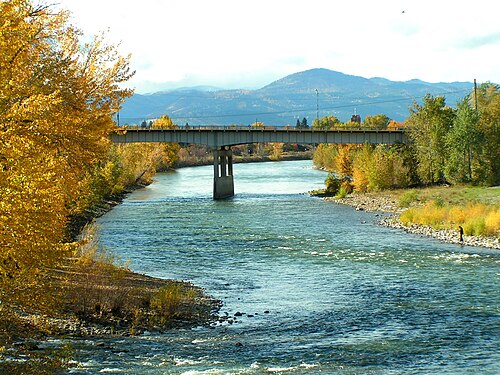
年間降水量の平均は15インチ(380 mm)ですが、大きな変動が見られます。山脈が湿った太平洋の空気を遮り、西部の谷に湿気を保ち、東に雨陰を作り出します。西部のヘロンは最も降水量が多く、34.70インチ(881 mm)です。山脈の東側(風下側)の谷ははるかに乾燥しています。ローンパインでは平均11.45インチ(291 mm)、ディアロッジでは11.00インチ(279 mm)の降水量です。山脈では100インチ(2,500 mm)を超える降水量があり、たとえばグレイシャー国立公園のグリンネル氷河では105インチ(2,700 mm)の降水があります。[170]ベルフライの南西の地域では、16年間の平均降水量はわずか6.59インチ(167 mm)でした。大都市のほとんどでは、毎年30~50インチ(0.76~1.27メートル)の積雪があります。山脈では、冬の間に300インチ(7.62メートル)の積雪があります。大雪は9月から5月にかけて発生することがありますが、ほとんどの降雪は11月から3月にかけてです。[169]
モンタナ州の気候は温暖化しており、1900年以降、平均気温は米国本土の平均よりも高い割合で約2.5°F(1.3°C)上昇し、その傾向は続いています。[174]グレイシャー国立公園の氷河は後退しており、数十年以内に完全に溶けると予想されています。[175] 2007年7月、モンタナ州の多くの都市で気温記録が更新され、これはモンタナ州で記録された中で最も暑い月となりました。[176] [177]冬も暖かくなり、寒波が減りました。以前は、これらの寒波でキクイムシが死滅していましたが、現在ではキクイムシがモンタナ州西部の森林を襲っています。[178] [179]この地域の冬が暖かくなったことで、さまざまな種が生息域を拡大し、繁殖することができました。[180]温暖な気候、甲虫の襲来、不適切な管理の組み合わせにより、モンタナ州の森林火災の深刻度が大幅に増加しました。[ 176] [179]ハーバード大学工学応用科学大学院が米国環境保護庁のために行った研究によると、モンタナ州の一部では山火事による焼失面積が200%増加し、関連する大気汚染が80%増加すると予想されています。[181] [182]
以下の表は、モンタナ州の 7 大都市の最も暖かい月と最も寒い月の平均気温を示しています。最も寒い月は場所によって 12 月から 1 月まで異なりますが、数字は全体的にほぼ同じです。
反対側
モンタナ州は、コロラド州とともに陸地の反対側に位置する数少ない隣接州のうちの1つである。ケルゲレン諸島はモンタナ州、サスカチュワン州、アルバータ州の境界線の反対側に位置する。ケルゲレン島の反対側に位置する町はないが、チェスターとラドヤードは近い。[184]
都市と町

モンタナ州には56の郡があり、アメリカ合衆国国勢調査局の定義によると合計364の「地域」がある。後者は129の法人化された地域と235の国勢調査指定地域から構成される。法人化された地域は52の市、75の町、および2つの統合された市郡から構成される。[185]
モンタナ州には、人口10万人を超える都市がビリングス1つと、人口5万人を超える都市がミズーラ、グレートフォールズ、ボーズマンの3つある。また、州内にはボーズマン、ビュート、ヘレナ、カリスペル、ハバーを中心とする5つの小都市統計地域がある。[186]
これらの地域(ハバーを除く)は、一貫して州内で最も人口の多い7つのコミュニティであるため、非公式に「ビッグセブン」と呼ばれています(2010年の米国国勢調査によると、人口の順位はビリングス、ミズーラ、グレートフォールズ、ボーズマン、ビュート、ヘレナ、カリスペルです)。[187] 2013年の国勢調査の数字に基づくと、これらの地域にはモンタナ州の人口の35%が含まれており、[188]これらの地域が位置する郡には、州人口の62%が住んでいます。[189]
モンタナ州の人口の地理的中心は、人口の少ないミーガー郡のホワイトサルファースプリングスの町にあります。
人口統計


.svg/500px-Population_of_Montana_1870%E2%80%932018_(est.).svg.png)
アメリカ合衆国国勢調査局によれば、2023年7月1日時点のモンタナ州の人口は1,132,812人で、2020年の国勢調査から4.5%増加している。[191] 2020年の国勢調査では、モンタナ州の人口は1,084,225人となっている。新世紀の最初の10年間、増加は主にモンタナ州の7つの最大の郡に集中しており、最も高い成長率はガラティン郡で、2010年から2020年にかけて人口が32.9%増加した。成長率が最も高かった都市はカリスペルで40.1%、実際の居住者の増加が最も大きかった都市はビリングスで、2010年から2020年にかけて人口が12,946人増加した。
2012年1月3日、モンタナ州商務省の国勢調査経済情報センター(CEIC)は、モンタナ州の人口が2011年11月から12月の間に100万人を突破したと推定した。[192]
HUDの2022年ホームレス評価報告書によると、モンタナ州には推定1,585人のホームレスがいる。[193] [194]
2018年、モンタナ州への移民の出身国上位はカナダ、メキシコ、ドイツ、中国、ベトナムであった。[195]
2020年の国勢調査によると、人口の88.9%は白人(87.8%が非ヒスパニック系白人)、6.7%がアメリカインディアンとアラスカ先住民、4.1%がヒスパニックとラテン系(あらゆる人種)、0.9%がアジア人、0.6%が黒人またはアフリカ系アメリカ人、0.1%がハワイ先住民とその他の太平洋諸島民、2.8%が2つ以上の人種の混血であった。[196] 2010年時点でモンタナ州で最も多かったヨーロッパ系の祖先グループは、ドイツ系(27.0%)、アイルランド系(14.8%)、イギリス系(12.6%)、ノルウェー系(10.9%)、フランス系(4.7%)、イタリア系(3.4%)であった。[197]
州内の人口統計
モンタナ州は、数的にも割合的にも、アメリカのほとんどの州よりもネイティブアメリカンの人口が多い。人口では45位(2010年の国勢調査)で、ネイティブアメリカンの数では19位であり、[201]州人口の6.5%を占め、全50州の中で6番目に高い割合である。[201]モンタナ州の56郡のうち、ビッグホーン、グレイシャー、ルーズベルトの3郡ではネイティブアメリカンが多数を占めている。 [ 202 ]ネイティブアメリカンの人口が多い他の郡には、ブレイン、カスケード、ヒル、ミズーラ、イエローストーンの各郡がある。[203]モンタナ州のネイティブアメリカンの人口は1980年から1990年の間に27.9%増加し(モンタナ州全体の人口が1.6%増加した時期)、[203] 2000年から2010年の間に18.5%増加しました。[204]

伝説
2009年現在、州内のネイティブアメリカンのほぼ3分の2が都市部に住んでいる。[203]モンタナ州の20大都市のうち、2010年にネイティブアメリカンの居住者の割合が最も高かったのは、ポルソン(15.7%)、ハバー(13.0%)、グレートフォールズ(5.0%)、ビリングス(4.4%)、アナコンダ(3.1%)だった。[205]ビリングス(4,619)、グレートフォールズ(2,942)、ミズーラ(1,838)、ハバー(1,210)、ポルソン(706)には、最も多くのネイティブアメリカンが住んでいる。[205]州の7つの居留地には、12を超える異なるネイティブアメリカンの民族言語グループが含まれている。[206]
モンタナ州で最も人口の多いヨーロッパ系アメリカ人はドイツ人(オーストリア人やスイス人などを含む可能性もある)だが、農業が盛んな北部および東部のプレーリー地域には、近隣のノースダコタ州やミネソタ州と並行して、スカンジナビア系の人々が数多く居住している。アイルランド系、スコットランド系、イングランド系の農民もモンタナ州に定住した。ビュートなど、モンタナ州西部の歴史的に鉱業が盛んなコミュニティには、より幅広いヨーロッパ系アメリカ人の民族が居住している。フィンランド人、東欧人、特にアイルランド系入植者がこの地域に消えない痕跡を残したほか、コーンウォール、デボン、ウェールズなどのイギリスの鉱山地域出身の人々もこの地域に居住している。近くのヘレナ市も鉱山キャンプとして設立され、同様の混合人口に加え、小さなチャイナタウンがあった。[206]モンタナ州の歴史的な伐採コミュニティの多くは、もともとスコットランド人、スカンジナビア人、スラブ人、イングランド人、スコットランド系アイルランド人の子孫を引き付けていた。[要出典]
スイスに起源を持つアナバプテスト派のフッター派はモンタナ州に定住し、今日ではサウスダコタ州に次いで米国で2番目に多いフッター派人口を誇り、州内にはいくつかの集落がある。1990年代半ばから、オハイオ州やペンシルベニア州の都市化が進む地域からモンタナ州に移住してきたアーミッシュの流入もあった。[207]
モンタナ州のヒスパニック系人口は、モンタナ州中南部のビリングス地域に集中しており、この地域にはモンタナ州のメキシコ系アメリカ人の多くが何世代にもわたって州内に住んでいます。グレートフォールズは人口に占めるアフリカ系アメリカ人の割合が最も高いですが、ビリングスにはグレートフォールズよりも多くのアフリカ系アメリカ人居住者がいます。[205]
モンタナ州における中国人の割合は、今日では低いが、歴史的には重要な存在であった。1870年までに約2,000~3,000人の中国人鉱夫がモンタナ州の鉱山地帯におり、1890年には2,500人に達した。しかし、1890年代には中国人に対する世論がますます否定的になり、1900年までに州のアジア人人口のほぼ半数が同州を去った。 [208]今日、ミズーラ地域には多くのモン族の人口がおり[209] 、フィリピン系を祖先とする約3,000人のモンタナ州民は州内で最大のアジア系アメリカ人グループである。[206]
2015年の米国国勢調査の推計によると、モンタナ州は米国軍の退役軍人居住率が2番目に高い州だった。アラスカ州だけがモンタナ州よりも高い割合で、アラスカ州では18歳以上の人口の約14%が退役軍人であり、モンタナ州では18歳以上の人口の約12%が退役軍人である。[210]
ネイティブアメリカン

2020年、モンタナ州では67,612人がネイティブアメリカンであると自認し、100,578人が他の人種と組み合わせて自認しました。[211]インディアン歳出法(1851年)、ドーズ法(1887年)、インディアン再編成法(1934年)を含む多くの条約と連邦法により、モンタナ州には連邦政府に認定された11の部族国家を含む7つのインディアン居留地が設立されました。 12番目の部族であるグレートフォールズのチッペワ・インディアンのリトル・シェル族は、2020年に連邦政府に承認されました。 [212]ブラックフット族は、ブラウニングのブラックフット・インディアン居留地(1851年) 、クロウ・エージェンシーのクロウ・インディアン居留地(1868年)[213]、パブロのフラットヘッド・インディアン居留地(1855年)の連合サリッシュ・アンド・クーテナイ族とペンド・ドレイユ族、レイム・ディアのノーザン・シャイアン・インディアン居留地(1884年)のノーザン・シャイアン族、フォート・ベルナップ・エージェンシーのアッシニボイン族とグロス・ヴァントル族、ポプラーのフォート・ペック・インディアン居留地(1888年)のアッシニボイン族とスー族、ボクスエルダー近郊のボーイズインディアン居留地(1916年)。先住民の約63%が居留地外で暮らしており、モンタナ州の大都市に集中している。都市部に住むインディアンが最も集中しているのはグレートフォールズである。州にはメティスの人口もわずかながら存在し、1990年の国勢調査によると、モンタナ州には275もの部族が住んでいた。[214]
モンタナ州憲法には、「州はアメリカインディアンの独特でユニークな文化遺産を認め、教育目標において彼らの文化的完全性を保護することを約束する」と明記されている。[215]モンタナ州は、このような憲法上の義務を負う米国唯一の州である。この義務に資金を提供し、確実に実施するために、1999年にインディアン全員教育法が可決された。[216]この法律は、すべての学校が幼稚園から大学までアメリカインディアンの歴史、文化、遺産を教えることを義務付けている。[217]幼稚園から12年生まで、モンタナ州教育局の「インディアン全員教育」カリキュラムがすべての学校で無料で利用できる。[218]州は2004年に資金不足で訴えられ、プログラムへの支援を強化した。[216] サウスダコタ州は2007年に同様の法律を可決し、ウィスコンシン州はこのモデルとモンタナ州の学校の現在の慣行に基づいて独自のプログラムを強化する取り組みを行っていた。[216]州内の各インディアン居留地には、完全に認可された部族大学がある。モンタナ大学は「すべての部族大学と二重入学協定を結んだ最初の大学であり、部族大学からの学生の編入を積極的に促進した国内初の機関である。」[217]
現在のモンタナ州には、クロウ族、ブラックフット族、アシニボイン族、グロスヴァントル族、クーテナイ族、フラットヘッド・サリッシュ族、カリスペル族、カイオワ族、スー族、アラパホ族、アリカラ族、バノック族、シャイアン族、オジブウェ族、ヒダーツァ族、クリー族、ネズ・パース族、マンダン族、ショーショーニ族、スポケーン族などの部族が様々な時期に住んでいました。[219] [220] 2010年の国勢調査では、多くのモンタナ州民が様々なネイティブアメリカンの部族に属していると報告しており、その中で最も多かったのはブラックフット族(12,831人)、クロウ族(8,680人)、シャイアン族( 5,912人)、アシニボイン・スー族(5,828人)、チッペワ・クリー族(5,495人)、サリッシュ・クーテナイ連合部族(4,809人)、オジブウェー族(4,284人)、スー族(2,698人)、アシニボイン族(2,673人)、グロスヴァントル族(2,484人)、サリッシュ部族集団(1,915人)であった。その他の部族には、クリー族、MHAネーション、クーテナイ族、フォートベルナップインディアンコミュニティ、アラパホ族などが含まれていた。[221]
出生データ
注: 表の出生数は一致しません。ヒスパニック系は民族と人種の両方でカウントされるため、全体の数が多くなります。
- 2016 年以降、白人ヒスパニック系の出生に関するデータは収集されておらず、1 つのヒスパニック系グループに含められています。ヒスパニック系の出生者はどの人種でもかまいません。
言語
モンタナ州の公用語は英語である。 2000年の国勢調査によると、5歳以上の人口の94.8%が家庭で英語を話している。[232]スペイン語は次に家庭でよく話されている言語であり、2011年には州内に約13,040人のスペイン語話者がいる(人口の1.4%)。[233]また、15,438人(州人口の1.7%)が英語またはスペイン語以外のインド・ヨーロッパ語族の言語を話し、10,154人(1.1%)がアメリカ先住民の言語を話し、4,052人(0.4%)がアジアまたは太平洋諸島の言語を話していた。[233]
モンタナ州で話されている他の言語(2013年現在)には、アシニボイン語(モンタナ州とカナダで約150人)、ブラックフット語(約100人)、シャイアン語(約1,700人)、プレーンズクリー語(約100人)、クロウ語(約3,000人)、ダコタ語(約17,800人、2010年にはモンタナ州で700人)、[234]ドイツフッター語(約5,600人)、グロヴァントル語(約10人)、カリスペル・ペンド・オレイル語(約64人)、クテナイ語(約6人)、ラコタ語(ミネソタ州、モンタナ州、ネブラスカ州、ノースダコタ州、サウスダコタ州で6,000人)がある。[235]
アメリカ合衆国教育省は2009年に、モンタナ州の5,274人の生徒が自宅で英語以外の言語を話していると推定した。これにはネイティブアメリカンの言語(64%)、ドイツ語(4%)、スペイン語(3%)、ロシア語(1%)、中国語(0.5%未満)が含まれていた。[236]
宗教
ピュー研究所が2014年に発表したデータによると、モンタナ州の住民の宗教的所属は主にキリスト教徒で、同州では成人人口の65%がキリスト教信者だった。[ 240] 2020年の公共宗教研究所(PRRI)の調査では、成人人口の57%がキリスト教徒だった。カトリックは州内で最大のキリスト教グループだったが、主流派プロテスタントと福音派プロテスタントがキリスト教全体を支配していた。[241]公共宗教研究所の2022年の調査では、キリスト教は人口全体の62%にまで増加し、プロテスタントが43%、カトリックが17%、モルモン教による復古主義が2%だった。
2010年時点でモンタナ州で最大のキリスト教宗派は、信者数127,612人のカトリック教会、信者数46,484人の末日聖徒イエス・キリスト教会、信者数38,665人のアメリカ福音ルーテル教会、および信者数27,370人の無宗派福音派プロテスタントであった。[242] 2020年、信者数で最大のキリスト教宗派は、カトリック教会(112,389人)、無宗派プロテスタント(54,540人)、末日聖徒イエス・キリスト教会(50,552人)であった。[243]
2014年には人口の30%が無宗教で、2020年の別の調査では人口の34%が無宗教でした。2022年のPRRI調査では、非キリスト教徒のうち無宗教の人が人口の32%を占めていました。ニューエイジのスピリチュアリティは人口の2%、ユダヤ教は1%、仏教は1%でした。その他の宗教は州の人口の2%を占めていました。
経済
.svg/500px-Craft_Breweries_Per_Capita_(US).svg.png)

2022年現在[update]、米国経済分析局はモンタナ州の国内総生産は670億7,200万ドル(全国47位)、一人当たりの個人所得は60,984ドル(全国28位)と推定している。[244]
- 総雇用数:371,239人(2018年現在[update])[245]
- 雇用主事業所総数:38,720(2018年現在[update])[245]
モンタナ州は比較的地ビール醸造の中心地で、2011年には人口1人当たりのクラフトビール醸造所の数で全米第3位となった。 [246]木材や鉱物の採掘が盛んな産業で、州の資源には金、石炭、銀、タルク、バーミキュライトなどがある。資源採掘に対する環境税は数多くある。1974年の石炭に対する州の分離税(20~30%の範囲)は、 Commonwealth Edison Co. v. Montana、453 US 609 (1981)において米国最高裁判所によって支持された。 [247]
観光業も経済にとって重要であり、グレイシャー国立公園、フラットヘッド湖、ミズーリ川源流、リトルビッグホーンの戦いの跡地、イエローストーン国立公園の5つの入り口のうち3つには、年間1000万人以上の観光客が訪れます。[248]
モンタナ州の個人所得税は7段階に区分され、税率は1.0~6.9%である。モンタナ州には消費税はなく、家庭用品は固定資産税が免除される。しかし、家畜、農業機械、重機、自動車、トラック、業務用機器には固定資産税が課される。固定資産税の額は、資産の価値だけで決まるわけではない。資産の価値にモンタナ州議会が定めた税率を掛けて課税価値が決まる。課税価値に市や郡政府、学区などさまざまな課税管轄区域が定めたミル課税が掛けられる。[249]
1980 年代、州の観光産業に結びついたコミュニティにとって、消費税の不在は経済的に有害となった。住民から得られる所得税と財産税の収入は、非居住目的の旅行、特に道路の修理による影響を賄うには極めて微々たるものだったからだ。1985 年、モンタナ州議会は、コミュニティの収入の半分以上が観光業によるものである場合、住民が 5,500 人未満の町と 2,500 人未満の非法人コミュニティにリゾート税を課すことを認める法律を可決した。リゾート税は、ホテル、モーテル、その他の宿泊施設やキャンプ施設、レストラン、ファーストフード店、その他の食品サービス施設、酒類を提供する居酒屋、バー、ナイトクラブ、ラウンジ、その他の公共施設、および目的地のスキーリゾートやその他の目的地のレクリエーション施設に適用される消費税である。[250]
また、この税は「贅沢品」にも適用される。贅沢品とは、法律で「一般市民や短期滞在者、観光客に通常販売される品目」と定義されており、調理されていない、または提供されていない食品、医薬品、医療用品およびサービス、電化製品、金物類、工具、生活必需品は含まれない。[251] 2018年にモンタナ州を訪れた非居住者は約1,220万人で、人口は106万人と推定されている。住民が税金を納めるのに対し、非居住者が州の資金で賄われるサービスやインフラを利用するというこの極めて不均衡な比率により、モンタナ州のリゾート税は、頻繁に使用される道路や高速道路を安全に維持し、州立公園を保護し保全するために極めて重要となっている。
2021年8月現在[update]、州の失業率は3.5%です。[252]
教育
大学
モンタナ大学システムは以下で構成されています:
- ドーソンコミュニティカレッジ
- フラットヘッドバレーコミュニティカレッジ
- マイルズコミュニティカレッジ
- モンタナ州立大学ボーズマン校
- ガラティン大学 モンタナ州立大学ボーズマン
- モンタナ州立大学ビリングス校
- モンタナ州立大学シティカレッジ ビリングスビリングス
- モンタナ州立大学ノーザンハバー校
- グレートフォールズカレッジ モンタナ州立大学グレートフォールズ
- モンタナ大学ミズーラ校
- ミズーラカレッジ モンタナ大学ミズーラ校
- モンタナ工科大学モンタナビュート校
- モンタナ工科大学ビュート校ハイランズカレッジ
- モンタナ大学ウェスタンディロン校
- ヘレナカレッジ モンタナ大学ヘレナ校
- ビタールートカレッジ モンタナ大学ハミルトン校
モンタナ州の部族大学には以下のものがあります。
- アニー・ナコダ・カレッジ・ハーレム
- ブラックフットコミュニティカレッジブラウニング
- チーフ・ダル・ナイフ・カレッジ・ラメ・ディア
- フォートペックコミュニティカレッジポプラ
- リトルビッグホーンカレッジクロウエージェンシー
- サリッシュ・クーテナイ・カレッジパブロ
- ストーンチャイルドカレッジボックスエルダー
モンタナ州には 4 つの私立大学があります。
学校
モンタナ準州は、1864年4月26日に米国で有機法が可決されたときに形成された。[253]家族がこの地域に定住し始めたため、正式に準州になる前から学校が設立され始めた。最初の学校は、通常、教師の自宅で行われる会費制の学校だった。記録に残る最初の正式な学校は、1862年にビタールート渓谷のフォートオーウェンにあった。生徒はインディアンの子供とフォートオーウェンの従業員の子供だった。最初の学期は初冬に始まり、2月28日までしか続かなかった。授業はロビンソン氏が担当した。[254]別の初期の会費制学校は、1863年にバージニアシティでトーマスディムズデールによって始められた。この学校では、生徒は週1.75ドルの授業料を支払った。[255]モンタナ準州議会は1864年に最初の会議を開催した。[256 [257]マディソン郡は、新たに認可された税金を最初に利用し、1886年にバージニアシティで最初の公立学校を設立しました。[255]最初の学年は1866年1月に開始する予定でしたが、悪天候のために3月に開始が延期されました。最初の学年は夏まで続き、8月17日に終了しました。学校の最初の教師の1人はサラ・レイモンドでした。彼女は25歳の女性で、1865年に幌馬車隊でバージニアシティに旅してきました。認定教師になるために、レイモンドは自宅で試験を受け、教員免許を取得するために6ドルの金粉を支払いました。助手教師のファーリー夫人の助けを借りて、[258]レイモンドは、学校に在籍する81人の生徒のうち毎日50人から60人の生徒を教える責任がありました。サラ・レイモンドの月給は125ドル、ファーリー夫人の月給は75ドルでした。学校では教科書は使用されませんでした。その代わりに、様々な移民が持ち込んだ様々な本が置かれていた。[259]サラは翌年教師を辞めたが、後にマディソン郡の教育長になった。[258]
文化
過去130年間、多くの著名な芸術家、写真家、作家がモンタナ州の土地、文化、人々を記録してきました。「カウボーイ芸術家」として知られる画家で彫刻家のチャールズ・マリオン・ラッセルは、アメリカ西部やカナダのアルバータ州を舞台にしたカウボーイ、ネイティブアメリカン、風景を描いた絵画を2,000点以上制作しました。[260]モンタナ州グレートフォールズにあるCMラッセル博物館には、ラッセルの芸術作品、私物、工芸品が2,000点以上収蔵されています。
先駆的なフェミニスト作家、映画製作者、メディアパーソナリティであるメアリー・マクレーンは、 1902 年にビュートでの 3 か月の生活を綴った回想録『メアリー・マクレーンの物語』で国際的な名声を獲得しました。彼女はその後もずっとビュートについて言及しており、ビュートとその人々に対する批判と愛情が入り混じった彼女の発言は、今でも物議を醸す人物となっています。
テリー出身の博物学者で写真家のエヴリン・キャメロンは、 20世紀初頭のモンタナ州の大草原での生活を記録し、カウボーイ、羊飼い、結婚式、川の渡り、貨車、働く人々、荒野、ワシ、コヨーテ、オオカミなど、周囲のあらゆるものを驚くほど鮮明に撮影しました。[261]
モンタナ州の著名な作家の多くは、フィクションとノンフィクションの両方の作品でモンタナ州の生活を記録したり、そこからインスピレーションを得たりしている。グレートフォールズ出身のピューリッツァー賞受賞者ウォレス・アール・ステグナーは、「西部作家の長老」と呼ばれていた。[262] ブラウニング出身のジェームズ・ウィラード・シュルツ(「アピクニ」)は、ブラックフット族の生活に関する多くの物語と、グレイシャー国立公園の著名な地形の命名に貢献したことで最もよく知られている。[263]
主要な文化イベント
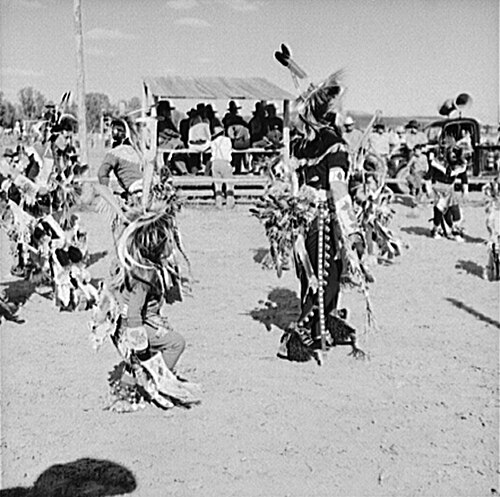
モンタナ州では毎年、数多くの芸術・文化フェスティバルやイベントが開催されます。主なイベントは次のとおりです。
- ボーズマンはかつて、食用エンドウ豆の豊作にちなんで「スイートピーの首都」として知られていました。この地域の宣伝と繁栄を祝うため、地元の事業主はパレードや女王コンテストを含む「スイートピー カーニバル」を始めました。この毎年恒例のイベントは 1906 年から 1916 年まで続きました。主催者は、食べられないものの香りがよく色鮮やかなスイートピーの花をこのお祭りの象徴として使いました。1977 年、「スイートピー」のコンセプトは収穫祭ではなく芸術祭として復活し、モンタナ州最大のお祭りの 1 つである 3 日間のイベントに成長しました。[264]
- モンタナ・シェイクスピア・イン・ザ・パークスは、1973年以来、モンタナ州および北西部地域でシェイクスピアやその他の古典劇の無料ライブ演劇を上演している。この組織は、モンタナ州立大学ボーズマン校の芸術・建築学部の一部であるアウトリーチ活動である。[265]モンタナ・シェイクスピア・カンパニーはヘレナに拠点を置いている。[266]
- 1909年以来、ハーディン近郊のクロウフェアとロデオはクロウエージェンシーで毎年8月に開催される年中行事であり、約45,000人の観客と参加者を集める最大の北部ネイティブアメリカンの集まりです。[267] 1952年以来、北米インディアンデーはブラウニングで毎年7月に開催されています。[268]
- レイムディアでは毎年、ノーザン シャイアン パウワウが開催されます。
スポーツ

プロスポーツ
モンタナ州の人口は比較的少なく分散しているため、メジャーリーグのスポーツフランチャイズはありませんが、州内ではいくつかのマイナーリーグチームがプレーしています。野球は州で最も長い歴史を持つマイナーリーグスポーツであり、モンタナ州には、すべてパイオニアリーグのメンバーであるビリングス・マスタングス、グレートフォールズ・ボイジャーズ、ミズーラ・パドルヘッズ、グレイシャー・レンジ・ライダーズの4 つの独立チームが本拠地を置いています。
大学スポーツ
モンタナ州の4年制大学はすべて大学対抗スポーツチームを擁している。2大大学であるモンタナ大学とモンタナ州立大学はビッグスカイカンファレンスのメンバーであり、20世紀初頭から激しいスポーツのライバル関係を保ってきた。モンタナ州の小規模な4年制大学のうち6校はフロンティアカンファレンスのメンバーである。[269] 1校はグレートノースウェストアスレチックカンファレンスのメンバーである。[270]
その他のスポーツ
モンタナ州の高校では様々なスポーツが提供されている。[271]モンタナ州では、最も小規模な「クラスC」高校で6人制のフットボールチームを運用することが認められており、[272] 2002年の独立系映画「スローター・ルール」でドラマ化されている。[273]
モンタナ州にはジュニアアイスホッケーチームがあり、そのうち 3 つは北米 3 ホッケーリーグに加盟しています。ボーズマン アイスドッグス、グレートフォールズ アメリカンズ、ヘレナ ビッグホーンズです。
オリンピック選手
- スキージャンプのチャンピオンであり、米国スキー殿堂入りしたキャスパー・オイモエンは、アナコンダに住んでいた1936年冬季オリンピックで米国オリンピックチームのキャプテンを務めた。彼はその年13位となり、それ以前には1932年冬季オリンピックで5位に入賞していた。[274] [275]
- モンタナ州は男子フィギュアスケートで2人の全米チャンピオンとオリンピック選手を輩出しており、両者ともグレートフォールズ出身である。ジョン・ミーシャ・ペトケビッチは大学入学前にモンタナ州に住み、トレーニングを積んでおり、1968年と1972年の冬季オリンピックに出場した。 [276] [277]スコット・デイビスもグレートフォールズ出身で、1994年の冬季オリンピックに出場した。[278]
- ミズーリ出身のトミー・モーは、 1994年冬季オリンピックのダウンヒルスキーとスーパー大回転で金メダルと銀メダルを獲得し、冬季オリンピックで2つのメダルを獲得した初のアメリカ人スキーヤーとなった。[279]
- ミズーラ出身のエリック・ベルグーストは、 1998年冬季オリンピックのフリースタイルエアリアルスキー競技で金メダルを獲得し、1994年、2002年、2006年のオリンピックにも出場し、ワールドカップで13回優勝した。[280]
- ホワイトフィッシュ出身のマギー・ヴォワザンは、2018年と2022年の冬季オリンピックにスキー選手として出場した。彼女は2014年の冬季オリンピックにも出場資格を持っていたが、トレーニング中に足首を骨折したため出場できなかった。[281]
スポーツでの功績
モンタナ州民は、数々の主要なスポーツの功績に貢献してきました。
- 1889年、スポケーンはケンタッキーダービーを制した最初のそして唯一のモンタナ州の馬となった。この功績により、この馬は2008年にモンタナ州カウボーイの殿堂入りを果たした。[282] [283]
- 1904年、フォートショー出身の若いネイティブアメリカン女性バスケットボールチームは、前シーズン無敗の成績を残した後、 1904年にセントルイスで開催されたルイジアナ購入博覧会に参加し、すべての挑戦チームを破り、世界チャンピオンに輝きました。[284]
- 1923年、ヘビー級ボクシング選手権をかけたジャック・デンプシー対トミー・ギボンズの物議を醸した試合がシェルビーで行われ、デンプシーが勝利した。[285]

アウトドアレクリエーション
モンタナ州は、住民や観光客に一年中アウトドアレクリエーションの機会を提供しています。ハイキング、釣り、狩猟、水上バイクレクリエーション、キャンプ、ゴルフ、サイクリング、乗馬、スキーなどが人気のアクティビティです。[286]
釣りと狩猟
モンタナ州は1930年代から世界クラスのマス漁場として知られてきました。[287] 川や湖での在来種や外来種のマスを狙うフライフィッシングは、州内の住民にも観光客にも人気があります。モンタナ州はフライフィッシャー連盟の本拠地であり、同団体の年次会合の多くを主催しています。州西部ではレイクトラウトやコカニーサーモンのレクリエーション漁場が盛んで、ウォールアイは州の多くの場所で見つかります。一方、東部モンタナ州の海域では、ノーザンパイク、スモールマウスバス、ラージマウスバス、ナマズ、ヘラチョウザメが見つかります。[288]ロバート・レッドフォードが1992年にノーマン・マクリーンの小説「リバーランズ・スルー・イット」を映画化した作品はモンタナ州で撮影され、フライフィッシングと州に全国的な注目を集めました。[289]釣りはモンタナ州の観光産業全体の経済生産高のかなりの部分を占めています。2017年には、非居住者が47億ドルの経済生産高を生み出し、そのうち13億ドルはガイド付き釣り体験に参加した訪問者グループによって生み出されました。[290]
秋にはヘラジカ、プロングホーン、オジロジカ、ミュールジカの狩猟シーズンと一般狩猟シーズンがある。無作為抽選により、限られた数のヘラジカ、シロイワヤギ、オオツノヒツジの許可証が交付される。春にはアメリカクロクマの狩猟シーズンがあり、イエローストーン国立公園を離れるバイソンの狩猟が限定的に許可されている。現行法では、ハンターと罠猟師の両方に、オオカミとマウンテンライオンの指定数(「制限」)が認められている。特定の季節には毛皮のある様々な動物の罠猟が許可されており、渡り鳥や高地の鳥の狩猟の機会も数多くある。[291] [292]野生生物の生息地を保護し、狩猟の伝統を促進する ロッキーマウンテンエルク財団はモンタナ州で設立された。
冬季スポーツ


モンタナ州ではダウンヒルスキーとクロスカントリースキーの両方が人気があり、一般に開放されている開発されたダウンヒルスキー場が15か所あります。[ 293]
- ハーヴル近郊のベア・ポー・スキーボウル
- ビッグスカイのビッグスカイリゾート
- レイクサイド近くのブラックテイルマウンテンスキー場
- ボーズマン近郊のブリッジャーボウルスキー場
- フィリップスバーグ近郊のディスカバリースキー場
- ヘレナ近郊のグレートディバイドスキー場
- モンタナ州とアイダホ州の州境にある州間高速道路90号線沿いのルックアウト パス スキー アンド レクリエーション エリア
- ダービー近郊のロストトレイルパウダーマウンテン
- ディロン近郊のマーベリックマウンテンスキー場
- ミズーラ近郊のモンタナ スノーボウル
- レッドロッジ近くのレッドロッジマウンテンリゾート
- ホワイトサルファースプリングス近くのショーダウンスキー場
- ショトー近くのティトン パス スキー場
- リビー近郊のターナーマウンテンスキーリゾート
- ホワイトフィッシュ近くのホワイトフィッシュマウンテンリゾート
ビッグスカイリゾートとホワイトフィッシュマウンテンリゾートは目的地リゾートですが、残りのエリアにはスキー場に宿泊施設はありませんが、いくつかのリゾートにはレストランやその他のアメニティがあります。[293]
モンタナ州には、9つの国有林とグレイシャー国立公園にクロスカントリースキーに開放された数百万エーカーの土地もあります。ほとんどのダウンヒルスキー場にクロスカントリーコースがあるほか、13の民間クロスカントリースキーリゾートもあります。[294]イエローストーン国立公園でもクロスカントリースキーが許可されています。[295]
モンタナ州ではスノーモービルが人気で、冬には4,000マイル以上のトレイルと凍った湖が楽しめる。[296]スノーモービルトレイルが整備されているエリアは24か所あり、そのほとんどは整備されていないトレイルも提供している。[297] ウェストイエローストーンには多くのトレイルがあり、イエローストーン国立公園へのスノーモービル旅行の主な出発点となっている。[ 298]ここでは「雪上」車両の使用は厳しく制限されており、通常はガイド付きツアーに限られており、規制はかなり流動的である。[299]
スノーコーチツアーは、ビッグスカイ、ホワイトフィッシュ、ウェストイエローストーン、イエローストーン国立公園で提供されています。[300]モンタナ州では、乗馬スキージョリングが盛んで、毎年恒例のホワイトフィッシュウィンターカーニバルの一環として、ホワイトフィッシュで世界スキージョリング選手権が開催されています。[301]
健康
モンタナ州にはビリングスクリニック病院に外傷I病院が1つあり[302]、ミズーラ、ビリングス、グレートフォールズに外傷II病院があります。 [303] 2013年、AARPマガジンはビリングスクリニックを米国で最も安全な病院の1つに選びました。 [304]
2014年のギャラップ調査によると、モンタナ州は米国で最も肥満率の低い州であり、肥満率は19.6%となっている。[305]
モンタナ州の自殺率は2020年に10万人あたり26.1人で、米国の州の中で3番目に高い数値でした。米国の人口密度の低い州では自殺率が高いのは一般的です。[306] [307]
メディア
2010年現在、ニールセン・メディア・リサーチのランキングによると、ミズーラは米国で166番目に大きなメディア市場である。一方、ビリングスは170位、グレートフォールズは190位、ビュート/ボーズマン地域は191位、ヘレナは206位である。[308]モンタナ州には、米国の主要ネットワークを代表する25のテレビ局がある。[309] 2013年8月現在、モンタナ州では527のFCC認可FMラジオ局が放送されており、114のAM局がある。[310] [311]
銅王の時代には、モンタナ州の銅会社はそれぞれ独自の新聞を持っていました。1959年にリー・エンタープライズがモンタナ州の新聞社をいくつか買収したことで状況は変わりました。[312] [313]モンタナ州で発行部数が最も多い日刊都市紙は、ビリングス・ガゼット(発行部数39,405部)、グレートフォールズ・トリビューン(26,733部)、ミズーリアン(25,439部)です。[314]
2023年5月、モンタナ州はソーシャルメディアアプリTikTokとオンラインマーケットプレイスTemuを禁止した米国初の州となった。[315] [316] [317]
交通機関

1880年代以来、鉄道はモンタナ州の重要な交通手段となっている。歴史的に、州内にはミルウォーキー鉄道、グレートノーザン鉄道、ノーザンパシフィック鉄道という3つの東西大陸横断鉄道の主要線が通っていた。今日、BNSF鉄道は州最大の鉄道であり、その主要大陸横断路線には州を横断する旧グレートノーザン鉄道の主要線が組み込まれている。民間所有のクラスII鉄道であるモンタナレールリンクは、BNSFに買収される前はモンタナ州西部で旧ノーザンパシフィック鉄道の線路を運営していた。
さらに、アムトラックのエンパイア・ビルダー号は州北部を走り、リビー、ホワイトフィッシュ、ウェスト・グレイシャー、エセックス、イースト・グレイシャー・パーク、ブラウニング、カット・バンク、シェルビー、ハバー、マルタ、グラスゴー、ウルフ・ポイントに停車します。
モンタナ州の都市間バスサービスは、ジェファーソン ラインズとエクスプレス アローによって提供されています。
ボーズマン・イエローストーン国際空港はモンタナ州で最も利用者数の多い空港で、2013年春にはビリングス・ローガン国際空港を上回った。 [318] [319]モンタナ州の他の主要空港には、ミズーラ国際空港、グレートフォールズ国際空港、グレイシャーパーク国際空港、ヘレナ地域空港、バート・ムーニー空港、イエローストーン空港がある。8つの小規模なコミュニティには、必須航空サービスプログラムの下で商業サービスに指定された空港がある。[320]
歴史的に、米国ルート 10 はモンタナ州を東西に横断する主要な幹線道路で、州南部の主要都市を結んでいました。現在でも、この州で最も重要な東西移動回廊であるこのルートには、現在、ノーザン パシフィックとほぼ同じルートをたどる州間高速道路 90 号線と州間高速道路 94 号線が通っています。米国ルート 2 号線と12 号線、およびモンタナ州道 200 号線も、州全体を東西に横断しています。
モンタナ州で唯一の南北を結ぶ州間高速道路は州間高速道路 15 号線です。その他の主要な南北を結ぶ高速道路には、アメリカ国道 87 号線、89 号線、93 号線、191 号線があります。
モンタナ州とサウスダコタ州は、舗装道路が通っていない陸上の境界線を持つ唯一の州である。両州を結ぶ主要な舗装道路である国道212号線は、モンタナ州とサウスダコタ州の間のワイオミング州の北東の角を通っている。[321] [322]
法律と政府
憲法
モンタナ州は憲法によって統治されている。最初の憲法は、州昇格の準備として1889年に憲法制定会議で起草された。その文言の90%は、国家の政治的理由により議会で採択されなかった1884年の憲法から来ている。1889年の憲法は、アメリカ合衆国憲法の構造を模倣し、市民の市民権と政治的権利をほぼ同じように概説した。しかし、1889年のモンタナ州憲法は州政府の権限を大幅に制限し、議会は行政府よりもはるかに強力であり、地方裁判所の管轄権は非常に具体的に規定されていた。[323]モンタナ州の有権者は、1889年から1972年の間に1889年の憲法を37回修正した。 [324] 1914年、モンタナ州は女性に投票権を与えた。1916年、モンタナ州は女性、進歩主義共和党員の ジャネット・ランキンを連邦議会に選出した最初の州となった。 [325] [326]
1971年、モンタナ州の有権者は州憲法制定会議の招集を承認した。新しい憲法が起草され、立法府と行政府の権力はより平等になり、権限、義務、管轄権の規定はより緩やかになった。[327]草案には、市民権と政治的権利の拡大された進歩的なリスト、これらの権利を初めて子供にまで拡大、財産税の管理を州から郡に移管、新しい水利権を実施、主権免除を廃止、税収を支出する議会の権限拡大などが盛り込まれた。憲法は116,415票対113,883票の僅差で承認され、1972年6月20日に批准が宣言された。憲法制定会議で解決できなかった3つの問題は、憲法案と同時に有権者に提示された。有権者は、賭博の合法化、二院制議会、死刑の維持を承認した。[328]
1972年の憲法は、2015年までに31回改正されている。[329]主な改正には、採掘された土地を修復するための(天然資源の採掘に対する税金で賄われる)開拓信託の設立(1974年)、各院で3分の2の賛成多数で承認された場合の主権免除の回復(1974年)、90日間の(年次ではなく)2年ごとの立法セッションの設立(1974年)、石炭採掘に対する税金で賄われる石炭税信託基金の設立(1976年)、郡政府の義務的な10年ごとのレビューを各郡の住民によって承認または不承認される任意のものに変更(1978年)、公的扶助の提供を義務的な公民権から非基本的立法特権に変更(1988年)、同性婚の禁止(2004年)、不動産の売却または譲渡に対する新たな課税の禁止(2010年)などである。[329] 1992年、有権者は、州全体で選出される特定の行政府役職(知事、副知事、州務長官、州監査役、司法長官、公立学校長)およびモンタナ州議会議員の任期制限を実施する憲法修正案を承認した。犯罪被害者に対する広範な新しい憲法上の権利は、2016年に承認された。[331]
1972年の憲法では、有権者が20年ごとに新しい憲法制定会議を開催するかどうかを決定することが義務付けられている。有権者は1990年に新しい憲法制定会議の開催を拒否し(84%が反対)、 2010年にも再び拒否した(58.6%が反対)。[333]
エグゼクティブ
モンタナ州には、立法、行政、司法の3つの州政府があります。行政府は、選挙で選ばれた知事が率いています。知事は、 2020年に選出された共和党員のグレッグ・ジャンフォルテです。行政府には、副知事、司法長官、国務長官、州監査役(証券保険委員も兼任)、公立学校監督官の9つの州全体で選出される役職もあります。地域ごとに選出される公務員委員は5人います。(公務員委員会の管轄は州全体です。)
行政部門を構成する部局は 18 あり、管理、農業、監査役 (証券および保険)、商務省、矯正局、環境品質局、魚類・野生生物・公園局、司法、労働産業、畜産局、軍事局、天然資源・保全局、公衆衛生・社会サービス局、歳入局、国務省、運輸局があります。初等および中等教育は、知事が任命する公教育委員会と協力して、公教育局 (公選の公教育長が率いる) によって監督されています。高等教育は、知事が任命する理事会によって監督され、理事会は高等教育コミッショナーを任命します。高等教育コミッショナー局は理事会に代わって行政権を担い、州が運営するモンタナ大学システムを監督します。
省庁や事務所に属していない独立した州機関には、モンタナ芸術評議会、モンタナ州犯罪対策委員会、モンタナ州歴史協会、モンタナ州公務員退職年金局、政治活動委員、モンタナ州宝くじ、州公選弁護人事務所、公務員委員会、モンタナ州聾・盲学校、モンタナ州基金(州の失業保険、労働者災害補償、自己保険業務を運営)、モンタナ州立図書館、モンタナ州教職員退職年金制度などがあります。
モンタナ州はアルコール飲料規制州である。[334]公平な財産分与と無過失離婚を認める州である。消費税のない5州のうちの1つである。[335]
立法
モンタナ州議会は二院制で、50 名のモンタナ州上院と 100 名のモンタナ州下院から構成されています。議会は、奇数年にヘレナのモンタナ州議会議事堂で、年の最初の平日から 90 日間開催されます。議員が一般法案を提出できる期限は、議会開会の 40 日目です。議員が歳出法案、歳入法案、または住民投票法案を提出できる期限は、議会開会の 62 日目です。上院議員の任期は 4 年、下院議員の任期は 2 年です。すべての議員は、16 年間の任期中に 8 年を超えて在任することはできません。
司法
モンタナ州の裁判所はモンタナ州憲法によって設立されています。憲法はモンタナ州最高裁判所とモンタナ州地方裁判所の設立を義務付けており、議会が適切と考える 司法裁判所、市裁判所、地方裁判所、その他の下級裁判所を設立することを認めています。
モンタナ州最高裁判所は、モンタナ州の裁判制度における最終審裁判所である。1889年の憲法では、最高裁判所判事3名以上と最高裁判所長官1名の選挙が定められている。各判事の任期は6年である。議会は1919年に判事の数を5人に増やした。1972年の憲法では、任期を8年に延長し、判事の最小数を5人と定めた。これにより議会は判事の数を2人増やすことができ、1979年に議会はそれを行った。モンタナ州最高裁判所は、モンタナ州憲法または米国憲法の下で、議会および行政府の行為が違憲であると宣言する権限を有する。その判決に対しては、米国最高裁判所に直接上訴することができる。モンタナ州最高裁判所の書記官も選挙で選ばれ、任期は6年である。判事も書記官も任期制限はない。
モンタナ州地方裁判所は、モンタナ州の一般管轄裁判所です。中間控訴裁判所はありません。地方裁判所は、主にほとんどの民事訴訟、州に対する金銭請求を含む訴訟、重罪刑事訴訟、遺言検認、およびコモンローおよびエクイティ上の訴訟を管轄しています。議会によって許可された場合、行政機関の行動は地方裁判所に直接上訴できます。地方裁判所は、下級裁判所 (市裁判所、司法裁判所、および地方裁判所) からのde novo上訴管轄権も持ち、帰化手続きを監督します。地方裁判所の裁判官は選挙で選ばれ、6 年の任期を務めます。任期制限はありません。モンタナ州には 22 の司法区があり、56 の地方裁判所と 46 人の地方裁判所裁判官が管轄しています。地方裁判所は過剰な作業量に悩まされており、議会は問題の解決策を見つけるのに苦労しています。
モンタナ州少年裁判所は、1974 年のモンタナ州少年裁判所法により設立されました。裁判所は地方裁判所判事によって監督されます。裁判所は、主任保護観察官、1 名以上の少年保護観察官、およびサポート スタッフで構成されます。少年裁判所は、法律に基づいて少年として起訴された者が犯した軽犯罪および重罪行為を管轄します。すべての司法管轄区に少年裁判所があり、少年裁判所の判決はモンタナ州最高裁判所に直接上訴できます。
モンタナ州労働者災害補償裁判所は、1975 年にモンタナ州労働者災害補償法により設立されました。労働者災害補償裁判所は 1 つだけです。裁判所には、知事が任命する 1 人の裁判官がいます。労働者災害補償裁判所は州全体の管轄権を持ち、ビリングス、グレート フォールズ、ヘレナ、カリスペル、ミズーラで裁判を行います。裁判所は、モンタナ州労働者災害補償法に基づいて生じた訴訟を審理し、モンタナ州労働産業省が発行した命令や規則の審査に関する第一審管轄裁判所です。裁判所の判決は、モンタナ州最高裁判所に直接上訴できます。
モンタナ水裁判所は、1979 年のモンタナ水裁判所法により設立されました。水裁判所は、首席水裁判官 1 名と 4 人の地区水裁判官 (ミズーリ川下流域、ミズーリ川上流域、イエローストーン川流域、クラーク フォーク川流域) で構成されています。裁判所は 12 人の常任特別マスターを雇用しています。モンタナ州司法指名委員会は、5 人の水裁判官全員の候補者リストを作成し、その後、モンタナ州最高裁判所の首席判事が (モンタナ州上院による承認を条件として) 裁判官を任命します。水裁判所は、1973 年のモンタナ水使用法に基づいて水利権の申し立てを裁定し、州全体の管轄権を有します。地区裁判所は水裁判所の決定を執行する権限を有しますが、水裁判所の決定を再検討する権限を有するのはモンタナ州最高裁判所のみです。
1889年から1909年まで、モンタナ州の司法官選挙は党派的であった。1909年以降、これらの選挙は無党派となった。モンタナ州最高裁判所は1911年に技術的な理由で無党派法を無効としたが、1935年に新しい法律が制定され、政党が司法候補者を支持、寄付、または支持または反対して支出することを禁止した。2012年、米国最高裁判所は、American Tradition Partnership, Inc. v. Bullock、567 US ____ (Sup.Ct. 2012) において、モンタナ州の司法無党派選挙法を無効とした。候補者は無党派のままでなければならないが、党派団体による支出は現在許可されている。州最高裁判所の選挙への支出は2014年に160万ドルに急増し、2016年には160万ドルを超えました(どちらも新記録)。
連邦政府機関および裁判所
The U.S. Constitution provides each state with two senators. Montana's two U.S. senators are Jon Tester (Democrat), who was reelected in 2018, and Steve Daines (Republican), first elected in 2014 and later reelected in 2020. The U.S. Constitution provides each state with a single representative, with additional representatives apportioned based on population. From statehood in 1889 until 1913, Montana was represented in the United States House of Representatives by a single representative, elected at-large. Montana received a second representative in 1913, following the 1910 census and reapportionment. Both members, however, were still elected at-large. Beginning in 1919, Montana moved to district, rather than at-large, elections for its two House members. This created Montana's 1st congressional district in the west and Montana's 2nd congressional district in the east. In the reapportionment following the 1990 census, Montana lost one of its House seats. The remaining seat was again elected at-large.
In the reapportionment following the 2020 census, Montana regained a House seat, increasing the state's number of representatives in the House to two after a thirty-year break, starting from 2023.[336] Republicans Matt Rosendale and Ryan Zinke are the current officeholders.
Montana's Senate district is the fourth largest by area, behind Alaska, Texas, and California. The most notorious of Montana's early senators was William A. Clark, a "Copper King" and one of the 50 richest Americans ever. He is well known for having bribed his way into the U.S. Senate. Among Montana's most historically prominent senators are Thomas J. Walsh (serving from 1913 to 1933), who was President-elect Franklin D. Roosevelt's choice for attorney general when he died; Burton K. Wheeler (serving from 1923 to 1947), an oft-mentioned presidential candidate and strong supporter of isolationism; Mike Mansfield, the longest-serving Senate majority leader in U.S. history; Max Baucus (served 1978 to 2014), longest-serving U.S. senator in Montana history, and the senator who shepherded the Patient Protection and Affordable Care Act through the Senate in 2010; and Lee Metcalf (served 1961 to 1978), a pioneer of the environmental movement.
Montana's House district is the largest congressional district in the United States by population, with just over 1,023,000 constituents. It is the second-largest House district by area, after Alaska's at-large congressional district. Of Montana's House delegates, Jeannette Rankin was the first woman to hold national office in the United States when she was elected to the U.S. House of Representatives in 1916.[337] Also notable is Representative (later Senator) Thomas H. Carter, the first Catholic to serve as chairman of the Republican National Committee (from 1892 to 1896).[338]
Federal courts in Montana include the United States District Court for the District of Montana and the United States Bankruptcy Court for the District of Montana. Three former Montana politicians have been named judges on the U.S. District Court: Charles Nelson Pray (who served in the U.S. House of Representatives from 1907 to 1913), James F. Battin (who served in the U.S. House of Representatives from 1961 to 1969), and Paul G. Hatfield (who served as an appointed U.S. Senator in 1978). Brian Morris, who served as an associate justice of the Montana Supreme Court from 2005 to 2013, currently serves as a judge on the court.
Politics

Elections in the state have been historically competitive, particularly for state-level offices. The Democratic Party's strength in the state is gained from support among unionized miners and railroad workers, while farmers generally vote Republican.
Montana has a history of voters splitting their tickets and filling elected offices with individuals from both parties. Through the mid-20th century, the state had a tradition of "sending the liberals to Washington and the conservatives to Helena". Between 1988 and 2006, the pattern flipped, with voters more likely to elect conservatives to federal offices. There have also been long-term shifts in party control. From 1968 through 1988, the state was dominated by the Democratic Party, with Democratic governors for a 20-year period, and a Democratic majority of both the national congressional delegation and during many sessions of the state legislature. This pattern shifted, beginning with the 1988 election when Montana elected a Republican governor for the first time since 1964 and sent a Republican to the U.S. Senate for the first time since 1948. This shift continued with the reapportionment of the state's legislative districts that took effect in 1994, when the Republican Party took control of both chambers of the state legislature, consolidating a Republican party dominance that lasted until the 2004 reapportionment produced more swing districts and a brief period of Democratic legislative majorities in the mid-2000s.[340]
Montana has voted for the Republican nominee in all but two presidential elections since 1952.[341] The state last supported a Democrat for president in 1992, when Bill Clinton won a plurality victory. However, since 1889 the state has voted for Democratic governors 60 percent of the time, and Republican governors 40 percent of the time. In the 2008 presidential election, Montana was considered a swing state and was ultimately won by Republican John McCain by a narrow margin of two percent.[342]
At the state level, the pattern of split-ticket voting and divided government holds. Democrats hold one of the state's two U.S. Senate seats with Jon Tester. The state's congressional seats (now two districts, but until 2023, one at-large district) have been Republican since 1996, and its Class 2 Senate seat has been held by Republican Steve Daines since 2014. The two chambers of the state's legislature had split party control from 2004 to 2010, when that year's mid-term elections decisively returned both branches to Republican control. The Montana Senate is, as of 2021, controlled by Republicans 31 to 19, and the House of Representatives is currently 67 to 33. Historically, Republicans are strongest in the east, while Democrats are strongest in the west.
Montana had only one representative in the U.S. House after having lost its second district in the 1990 census reapportionment. However, it regained its second district due to reapportionment following the 2020 census. Before the 2020 reapportionment, Montana's at-large congressional district held the largest population of any district in the country, which means its one member in the House of Representatives represented more people than any other member of the U.S. House (see List of U.S. states by population).[343] Montana's population grew at about the national average during the 2000s, but it had failed to regain its second seat in 2010.[344]
In a 2020 study, Montana was ranked as the 21st easiest state for citizens to vote in.[345]
See also

- Index of Montana-related articles
- List of the oldest buildings in Montana
- Outline of Montana
- Timeline of Montana history
Notes
- ^ However, the grizzly bear and Canadian lynx are listed as a threatened species only for the mainland 48 states. In general, the grizzly bear and Canadian lynx are not threatened species; the IUCN lists both as "least concern".
References
- ^ a b "United States Summary: 2010, Population and Housing Unit Counts, 2010 Census of Population and Housing" (PDF) (PDF). United States Census Bureau. September 2012. p. 41 (Table 18). Archived (PDF) from the original on October 19, 2012. Retrieved April 11, 2014.
- ^ "Area of Montana Counties". Montana.gov. Archived from the original on February 3, 2020. Retrieved February 2, 2020.
- ^ a b National Geodetic Survey 2008.
- ^ a b Geological Survey 2001.
- ^ "US Census Bureau QuickFacts: Montana". US Census Bureau. July 1, 2021. Archived from the original on October 19, 2020. Retrieved May 28, 2022.
- ^ "Montana". Merriam-Webster.com Dictionary. Merriam-Webster. Retrieved March 8, 2024.
- ^ a b Graetz, Rick; Graetz, Susie. "Gold Gives Birth to Western Montana". This is Montana. University of Montana. Archived from the original on January 5, 2024. Retrieved January 5, 2024.
- ^ Robbins, J. 2008.
- ^ "UM Travel Institute: 2020 Tests Montana Tourism". University of Montana. August 18, 2020. Archived from the original on October 25, 2022. Retrieved October 25, 2022.
- ^ Montana Historical Society (1910). Contributions to the Historical Society of Montana. Rocky Mountain Publishing Company. p. 47.
- ^ a b Malone, Roeder & Lang 1991, pp. 95–96.
- ^ a b Sanders 1910, pp. 15–60.
- ^ a b c d Library of Congress 1864.
- ^ Wood & Thiessen 1987, pp. 156–220.
- ^ Binnema, Ted; Dobak, William A. (Fall 2009). ""Like the greedy wolf" : the Blackfeet, the St. Louis fur trade, and war fever, 1807–1831". Journal of the Early Republic. 29 (3): 411–440. doi:10.1353/jer.0.0089. ISSN 0275-1275. JSTOR 40541856. S2CID 143630848.
- ^ Holmes 2009, pp. 92–93, Ch. 5.
- ^ Hoxie1995, p. 54.
- ^ Montana Catholic 2010.
- ^ National Historic Landmark Program 2013.
- ^ Kittredge & Krauzer 1986, pp. 14–23.
- ^ Tom (August 8, 2016). "1865 Map of the Territory of Montana". Cool Old Photos. Retrieved March 5, 2019.
- ^ Malone, Roeder & Lang 1976, pp. 92–113.
- ^ Montana's Museum 2007.
- ^ Hellgate Treaty 1855.
- ^ Montana Office of Public Instruction 2010.
- ^ Holmes 2009, pp. 123–146, Ch. 7.
- ^ Malone, Roeder & Lang 1976, pp. 114–144.
- ^ Malone, Roeder & Lang 1976, pp. 145–171.
- ^ Bergman 2004.
- ^ Fish and Wildlife Service—Bison 2013.
- ^ National Park Service-Grant-Kohrs 2013.
- ^ Schontzler 2011.
- ^ Ultimate Montana 2010.
- ^ Montana Historical Society 2013.
- ^ Milner II & O'Connor 2009, pp. 161–184.
- ^ Grant-Kohrs Ranch 2013.
- ^ Lubetkin 2006, pp. xv–xviii.
- ^ Union Pacific Railroad 2013.
- ^ Great Northern Railway 2013.
- ^ "A Sovereign People". The Helena Independent. November 9, 1889. p. 1. Archived from the original on February 20, 2021. Retrieved May 13, 2019. Article's text is here Archived February 20, 2021, at the Wayback Machine.
- ^ "We Crow for Montana". The Butte Daily Miner. November 9, 1889. p. 1. Archived from the original on July 20, 2020. Retrieved July 20, 2020.
- ^ Malone, Roeder & Lang 1976, pp. 172–200.
- ^ Fanselow 2007, pp. 170–171.
- ^ Holmes 2009, p. 253, Ch.13.
- ^ a b c Lux 1964, pp. 333–348.
- ^ Holmes 2009, p. 253, Ch. 13.
- ^ a b Toole1 1959, p. 228.
- ^ Toole1 1959, pp. 223–224.
- ^ Holmes 2009, p. 254, Ch. 13.
- ^ Holmes 2009, p. 255, Ch. 13.
- ^ Holmes 2009, pp. 256–258, Ch. 13.
- ^ Howard 1959, p. 181.
- ^ Stuart 1913, pp. 133–137.
- ^ Toole1 1959, p. 229.
- ^ a b Holmes 2009, p. 261, Ch. 13.
- ^ Toole1 1959, pp. 229–230.
- ^ a b c Libecap & Hansen 2002, pp. 86–120.
- ^ Extension Service 2013.
- ^ Toole1 1959, p. 230.
- ^ Holmes 2009, p. 259, Ch. 13.
- ^ a b c d e f g h i Montana Historical Society—WWI 2013.
- ^ Howard 1959, pp. 202–203.
- ^ History Channel 2013.
- ^ University of Montana 2005.
- ^ Montana Sedition Project 2013.
- ^ Butte-Anaconda Historic District 2006, p. 18.
- ^ a b Murphy 1980.
- ^ New York Times 1917.
- ^ Foner 1987, p. 289.
- ^ Brief History of Montana 2013.
- ^ McDean 1986, pp. 117–126.
- ^ a b c d Montana Historical Society-WWII 2013.
- ^ Werner & Welply 2006, pp. 5, 10, 66.
- ^ Tester 2007.
- ^ Goare, Aja. "U.S. Navy submarine will be named U.S.S. Montana". Archived from the original on September 5, 2015. Retrieved September 4, 2015.
- ^ Malmstrom 2013.
- ^ Anderson 2012, p. 4.
- ^ "Montana | Capital, Population, Climate, Map, & Facts". Encyclopedia Britannica. Archived from the original on March 16, 2021. Retrieved February 17, 2021.
- ^ a b Malone, Roeder & Lang 1991, p. 6.
- ^ a b Madej & Jones 2007.
- ^ Elias 2002, p. 55.
- ^ Graetz & Clemenz 1984, p. 59.
- ^ Aarstad et al. 2009, p. 58.
- ^ Malone, Roeder & Lang 1991, pp. 6–7.
- ^ Cooper 2009, p. 11.
- ^ Cooper 2009, p. 45.
- ^ Merrill-Maker 2006, pp. 57–63.
- ^ Kudray & Cooper 2006, p. 1.
- ^ Ross 1959, p. 10.
- ^ Enright 2010, p. xxiii.
- ^ Temple 2008, p. 493.
- ^ a b Ross 1959, p. 8.
- ^ a b Canadian Council for Geographic Education 2013.
- ^ Burger 2004, pp. 10–11.
- ^ a b Cunningham 1990, p. 77.
- ^ Montana State Library 2013.
- ^ Florence, Nystrom & Gierlich 2001, pp. 506–507.
- ^ Florence, Nystrom & Gierlich 2001, pp. 501–502.
- ^ Florence, Nystrom & Gierlich 2001, pp. 575–577.
- ^ Malone, Roeder & Lang 1991, p. 357.
- ^ Peterson 2012, p. 24.
- ^ Florence, Nystrom & Gierlich 2001, pp. 579–580.
- ^ Merrill-Maker 2006, p. 50.
- ^ Fletcher et al. 2008, p. 93.
- ^ a b c Vasapolli 2003, p. 16.
- ^ a b United States Forest Service 2007, p. 207.
- ^ a b Merrill-Maker 2006, p. 58.
- ^ a b c Mining and Scientific Press 1899, p. 408.
- ^ Jewell & McRae 2012, p. 439.
- ^ Ballard 2008, pp. 92–94.
- ^ a b Merrill-Maker 2006, p. 49.
- ^ Fisher 1908, pp. 23–24.
- ^ Soil Conservation Service 1953, p. 4.
- ^ Soil Conservation Service 1953, pp. 7–8.
- ^ Soil Conservation Service 1953, p. 8.
- ^ Soil Conservation Service 1953, pp. 10–11.
- ^ Soil Conservation Service 1953, p. 11.
- ^ Montana Outdoors 2002.
- ^ Archibald 1997, p. 223.
- ^ Newsmakers-Jack Horner 2013.
- ^ Geological Survey—search 2013.
- ^ Therriault 2010, p. 93.
- ^ Fischer & Fischer 2008, p. 2.
- ^ Naiman, Décamps & McClain 2005, p. 4.
- ^ Diamond 2006, p. 38.
- ^ Geographical Dictionary Of The World 1900, p. 423.
- ^ Palmer 1998, p. 168.
- ^ Palmer 1998, pp. 168–169.
- ^ Waterbody Report-Clark Fork River 2013.
- ^ Waterbody Report-Kootenai River 2013.
- ^ Huser 2004, p. 85.
- ^ a b c Moody, Chase & Aronson 1986, p. 310.
- ^ a b Florence, Nystrom & Gierlich 2001, p. 597.
- ^ Matzko 2001, p. 27.
- ^ Huser 2004, pp. 84–85.
- ^ Waterbody Report-Smith River 2013.
- ^ Waterbody Report-Milk River 2013.
- ^ Waterbody Report-Marias River 2013.
- ^ Waterbody Report-Judith River 2013.
- ^ Waterbody Report-Musselshell River 2013.
- ^ Finnerty 2011, pp. 42–43.
- ^ National Atlas 2013.
- ^ Malone, Roeder & Lang 1991, p. 80.
- ^ a b Robbins, C. 2008, p. 331.
- ^ Hellmann 2013, pp. 650, 653–654, 659.
- ^ Parry 2001, p. 216.
- ^ Fish and Wildlife Service 2001.
- ^ Paddling Montana 2000.
- ^ Waterbody Report-Boulder River 2013.
- ^ Waterbody Report-Stillwater River 2013.
- ^ Waterbody Report-Clarks Fork Yellowstone River 2013.
- ^ Waterbody Report-Bighorn River 2013.
- ^ Waterbody Report-Tongue River 2013.
- ^ Waterbody Report-Powder River 2013.
- ^ Fort Peck Dam 2013.
- ^ Montana Field Guide-Lichens 2013.
- ^ Montana Field Guide-Amphibians 2013.
- ^ Montana Field Guide-Fish 2013.
- ^ Montana Field Guide-Mammals 2013.
- ^ Montana Field Guide-Reptiles 2013.
- ^ Montana Audubon 2008.
- ^ Kaush & Thompson 2012, p. 258.
- ^ Fish and Wildlife Service 2013.
- ^ Eli Francovich (June 1, 2018). "Montana's wolf population remains strong". The Spokesman-Review. Archived from the original on August 7, 2020. Retrieved January 24, 2020.
- ^ Montana Fishing Regulations 2013.
- ^ Montana Hunting Season 2013.
- ^ Montana Interagency Access Council 2001.
- ^ National Park Service 2013.
- ^ a b c d e f Western Regional Climate Center 2013.
- ^ a b Animal Range and Sciences 2013.
- ^ Montana Office of Tourism—FAQ 2013.
- ^ Climate Information 2007.
- ^ Horvitz et al. 2002.
- ^ Frankson, Rebekah; Kunkel, Kenneth E.; Champion, Sarah M.; Easterling, David R.; Jencso, Kelsey (2022). "State Climate Summaries for the United States 2022. NOAA Technical Report NESDIS 150". NOAA National Centers for Environmental Information. Archived from the original on May 24, 2023. Retrieved May 17, 2023.
- ^ United States Geological Survey 2012.
- ^ a b McKee 2007.
- ^ National Climate Data Center 2007.
- ^ Backus 2005.
- ^ a b Backus 2007.
- ^ Bentz, Barbara J.; et al. (2010). "Climate Change and Bark Beetles of the Western United States and Canada: Direct and Indirect Effects". BioScience. 60 (8): 602–613. doi:10.1525/bio.2010.60.8.6. S2CID 1632906.
- ^ Billings Gazette—Forecast 2009.
- ^ Spracklen et al. 2009.
- ^ "Montana climate averages". Weatherbase. Archived from the original on January 28, 2016. Retrieved January 22, 2016.
- ^ Peakbagger 2012.
- ^ Census Bureau 2012.
- ^ Core Based Statistical Area 2010.
- ^ KRTV 2010.
- ^ Montana Setting 2013.
- ^ Swanson 2004.
- ^ "Historical Population Change Data (1910–2020)". Census.gov. United States Census Bureau. Archived from the original on April 29, 2021. Retrieved May 1, 2021.
- ^ "QuickFacts Montana; UNITED STATES". 2023 Population Estimates. United States Census Bureau, Population Division. April 2, 2024. Retrieved April 2, 2024.
- ^ Gravlee 2012.
- ^ "2007-2022 PIT Counts by State". Archived from the original on March 14, 2023. Retrieved March 11, 2023.
- ^ "The 2022 Annual Homelessness Assessment Report (AHAR) to Congress" (PDF). Archived (PDF) from the original on March 11, 2023. Retrieved March 11, 2023.
- ^ "Immigrants in Montana" (PDF). Archived (PDF) from the original on August 18, 2023. Retrieved August 18, 2023.
- ^ a b "U.S. Census Bureau QuickFacts: Montana; United States". www.census.gov. Archived from the original on May 9, 2022. Retrieved January 14, 2022.
- ^ Brittingham & de la Cruz 2004, p. 6.
- ^ "Historical Census Statistics on Population Totals By Race, 1790 to 1990, and By Hispanic Origin, 1970 to 1990, For The United States, Regions, Divisions, and States". Archived from the original on July 25, 2008.
- ^ "Population of Montana - Census 2010 and 2000 Interactive Map, Demographics, Statistics, Quick Facts". CensusViewer. Archived from the original on June 27, 2018. Retrieved June 27, 2018.
- ^ "Decennial Census by Decades". The United States Census Bureau. Archived from the original on July 6, 2022. Retrieved March 7, 2021.
- ^ a b Census Bureau-Annual Estimates of Race 2012.
- ^ Rural Policy Research Institute 2006, p. 4.
- ^ a b c Montana Office of Public Instruction 2009, p. 64.
- ^ Norris, Vines & Hoeffel 2012.
- ^ a b c Redistricting Data Summary 2011.
- ^ a b c Census Bureau 2010a.
- ^ Tode 2004.
- ^ Morris 1997, pp. 113–124.
- ^ Montana Arts Council 2013.
- ^ "Percent Veterans By State". The United States Census Bureau. Archived from the original on January 22, 2021. Retrieved January 17, 2021.
- ^ "Race and Ethnicity in the United States: 2010 Census and 2020 Census".
- ^ "Who We Are". Little Shell Tribe of Chippewa Indians of Montana. Archived from the original on January 24, 2023. Retrieved January 24, 2023.
- ^ Kappler1904, pp. 1008–1011.
- ^ Montana Office of Public Instruction 2009, p. [page needed].
- ^ "Montana Constitution, Article X, section 1". Montana Code Annotated. Archived from the original on October 30, 2013. Retrieved October 27, 2013.
- ^ a b c Jawort, Adrian (April 12, 2012). "Montana Schools Try to Keep Indian Students Engaged by Teaching Indian Culture to All". Indian Country Today. Archived from the original on October 20, 2016. Retrieved June 5, 2016.
- ^ a b "Native American Center Facts". The University of Montana. Archived from the original on October 29, 2013. Retrieved October 27, 2013.
- ^ "Indian Education for All Lesson Plans". Archived from the original on October 28, 2013. Retrieved October 27, 2013.
- ^ "Montana Indian Tribes and Languages". www.native-languages.org. Retrieved September 2, 2024.
- ^ Swanton, John Reed. The Indian Tribes of North America. pp. 387–398.
- ^ "American Indian and Alaska Native Tribes in the United States and Puerto Rico: 2010".
- ^ National Center for Health Statistics (January 7, 2015). "National Vital Statistics Reports Volume 64, Number 1, January 15, 2015" (PDF). Archived (PDF) from the original on September 11, 2017. Retrieved December 11, 2020.
- ^ National Center for Health Statistics (December 8, 2015). "National Vital Statistics Reports, Volume 64, Number 12, December 23, 2015 (The general fertility rate for 2014 on page 4 was corrected to read 62.9 on December 23, 2015.)" (PDF). Archived (PDF) from the original on February 14, 2017. Retrieved December 11, 2020.
- ^ National Vital Statistics Reports (December 22, 2016). "National Vital Statistics Reports, Volume 66, Number 1, January 5, 2017" (PDF). Archived (PDF) from the original on August 31, 2017. Retrieved December 11, 2020.
- ^ National Center for Health Statistics (January 19, 2018). "National Vital Statistics Reports Volume 67, Number 1, January 31, 2018" (PDF). Archived (PDF) from the original on June 3, 2018. Retrieved December 11, 2020.
- ^ National Vital Statistics Reports (October 26, 2018). "National Vital Statistics Reports Volume 67, Number 8, November 7, 2018" (PDF). Archived (PDF) from the original on February 1, 2019. Retrieved December 11, 2020.
- ^ "Data" (PDF). www.cdc.gov. Archived (PDF) from the original on November 28, 2019. Retrieved December 21, 2019.
- ^ "Data" (PDF). www.cdc.gov. Archived (PDF) from the original on June 23, 2021. Retrieved March 30, 2021.
- ^ "Data" (PDF). www.cdc.gov. Archived (PDF) from the original on February 10, 2022. Retrieved February 20, 2022.
- ^ "Data" (PDF). www.cdc.gov. Archived (PDF) from the original on February 1, 2023. Retrieved February 3, 2022.
- ^ "Data" (PDF). www.cdc.gov. Archived (PDF) from the original on April 4, 2024. Retrieved April 5, 2024.
- ^ Modern Language Association 2007.
- ^ a b Census Bureau 2011.
- ^ "Dakota". MLA Language Map Data Center. Archived from the original on April 21, 2024. Retrieved April 21, 2024.
- ^ Lewis, Simons & Fennig 2013.
- ^ Ballantye & Rasmussen 2011, p. 10.
- ^ "Montana—Languages". city-data.com. Archived from the original on February 22, 2015. Retrieved February 22, 2015.
- ^ "Cheyenne". Ethnologue. Archived from the original on February 25, 2021. Retrieved March 7, 2021.
- ^ "American Values Atlas: Religious Tradition in Montana". Public Religion Research Institute. February 24, 2023. Archived from the original on April 4, 2017. Retrieved April 3, 2023.
- ^ "Religious Landscape Study". Pew Research Center's Religion & Public Life Project. Archived from the original on May 25, 2022. Retrieved September 17, 2022.
- ^ "PRRI – American Values Atlas". ava.prri.org. Archived from the original on April 4, 2017. Retrieved September 17, 2022.
- ^ "The Association of Religion Data Archives—Maps & Reports". www.thearda.com. Archived from the original on December 2, 2013. Retrieved June 27, 2014.
- ^ "2020 Congregational Membership". www.thearda.com. Archived from the original on April 15, 2023. Retrieved April 15, 2023.
- ^ "Personal Income for Montana". BEARFACTS. Bureau of Economic Analysis. September 29, 2023. Archived from the original on January 17, 2024. Retrieved January 17, 2024.
- ^ a b "QuickFacts – Montana". United States Census Bureau. Archived from the original on October 19, 2020. Retrieved October 24, 2020.
- ^ Brewers Association 2013.
- ^ 453 U.S. 609 (1981)
- ^ Tourism in Montana 2007.
- ^ Department of Revenue 2012.
- ^ "Local Resort Tax". Montana Department of Revenue. Archived from the original on October 20, 2019. Retrieved December 8, 2019.
- ^ "7-6-1501. Definitions, MCA". leg.mt.gov. Archived from the original on November 2, 2019. Retrieved December 8, 2019.
- ^ "Local Area Unemployment Statistics". U.S. Bureau of Labor Statistics. October 20, 2020. Archived from the original on March 18, 2019. Retrieved October 24, 2020.
- ^ Judicial Branch Montana. "Montana Laws". Archived from the original on February 28, 2014. Retrieved March 7, 2014.
- ^ "Education". Archived from the original on March 7, 2014.
- ^ a b Sievert, Ken and Ellen (August 26, 1993). Virginia City and Alder Gulch. Farcounty Press.
- ^ Malcomson, Jeff. "Legislative History Guide". Archived from the original on February 14, 2015. Retrieved February 22, 2015.
- ^ "Montana Legislature". Archived from the original on February 22, 2015. Retrieved February 22, 2015.
- ^ a b Briggeman, Kim (March 3, 2012). "MONTANA HISTORY ALMANAC: First school opens doors in Virginia City". Archived from the original on May 16, 2016. Retrieved February 22, 2015.
- ^ O'Brien 2003, pp. 14–16.
- ^ University of Toronto 2000.
- ^ Montana Travel 2010.
- ^ Boswell 2006.
- ^ Hanna 1988, pp. 95–111.
- ^ Hurlbut & Davis 2009, pp. 179–181.
- ^ Shakespeare in the Parks 2012.
- ^ Lincoln 2012.
- ^ Scandale 2011.
- ^ North American Indian Days 2013.
- ^ Frotier Conference 2013.
- ^ Great Northwest Athletic Conference 2013.
- ^ Montana High School Association 2013.
- ^ Montana High School Association-Football 2013, pp. 139–141.
- ^ Holden 2002.
- ^ Dawson, Amelie Trufant (March 27, 2009). "Beef Trail Ski Area: A Montana Original". Montana Living. Archived from the original on October 20, 2014. Retrieved October 10, 2014.
- ^ Eriksmoen, Curt (February 23, 2014). "Ski jumper competed in two Olympics". Bismarck Tribune. Archived from the original on December 10, 2015. Retrieved October 10, 2014.
- ^ Sports Reference 2013.
- ^ Ottum 1968.
- ^ Ice Network 2012.
- ^ Staff. "Tommy Moe". Bio. Archived from the original on October 17, 2014. Retrieved October 10, 2014.
- ^ Staff. "125 Montana Newsmakers: Eric Bergoust". Great Falls Tribune. Archived from the original on October 10, 2014. Retrieved October 10, 2014.
- ^ "Maggie Voisin". Team USA. March 23, 2022. Archived from the original on July 9, 2023. Retrieved March 23, 2022.
- ^ Kentucky Derby 2013.
- ^ Montana Cowboy Hall of Fame 2013.
- ^ Peavey & Smith 2008.
- ^ Johnson 1966.
- ^ Montana Outdoor Recreation 2013.
- ^ Schullery 2006a, pp. 31–50.
- ^ Fisheries Management Plan 2013.
- ^ Schullery 2006b, pp. 167–186.
- ^ "2017 Economic Contribution and Industry-Client Analysis". guide-x.io. Archived from the original on May 13, 2021. Retrieved May 13, 2021.
- ^ Montana Hunting Regulations 2012.
- ^ Montana Trapping 2013.
- ^ a b Winter Montana—Resorts 2010.
- ^ Winter Montana—XC 2010.
- ^ National Park Service-Yellowstone 2013.
- ^ Montana Snowmobiling 2013.
- ^ Winter Montana-Snowmobiling 2010.
- ^ Winter Montana-West Yellowstone 2010.
- ^ National Park Service-Yellowstone in Winter 2013.
- ^ Winter Montana-Snowcoaches 2010.
- ^ Whitefish Skijoring 2013.
- ^ The First & Only Level I Trauma Center in Montana and Wyoming Archived August 6, 2023, at the Wayback Machine Bilings Clinic
- ^ Trauma Centers 2013.
- ^ HowardB 2013, pp. 46–50.
- ^ Levy, Jenna (March 4, 2014). "Gallup Obesity Poll". Archived from the original on February 21, 2015. Retrieved February 22, 2015.
- ^ "National Center for Health Statistics — Suicide Mortality by State". cdc.gov. Archived from the original on June 30, 2022. Retrieved June 30, 2022.
- ^ "National Center for Health Statistics — Montana". cdc.gov. March 2022. Archived from the original on May 17, 2019. Retrieved June 30, 2022.
- ^ Nielsen 2010.
- ^ Station Index 2013.
- ^ FCC-FM 2013.
- ^ FCC-AM 2013.
- ^ Lee Enterprises-Newspapers 2013.
- ^ Lee Enterprises-History 2013.
- ^ Mondo Times 2013.
- ^ Peters, Jay (May 17, 2023). "Montana bans Telegram, WeChat, and Temu from government devices". The Verge. Archived from the original on May 20, 2023. Retrieved May 21, 2023.
- ^ "Montana becomes first US state to pass TikTok ban". BBC News. April 14, 2023. Archived from the original on April 18, 2023. Retrieved April 18, 2023.
- ^ Marino, Michael (June 2, 2023). "TikTok Banned in Montana". Yellowstone County News. p. 2.
- ^ Bacaj 2013.
- ^ KTVQ 2013.
- ^ Department of Transportation 2012.
- ^ Sites 2012.
- ^ Montana Transportation 2013.
- ^ Elison & Snyder 2001, pp. 3–4, 144.
- ^ Montana Constitutional Convention (1972). Proposed 1972 Constitution for the State of Montana: Official Text With Explanation (Report). Helena, Mont. p. 3. Retrieved February 24, 2017.
- ^ Women's National History 2013.
- ^ Jeannette Rankin 2011.
- ^ Elison & Snyder 2001, p. 144.
- ^ Elison & Snyder 2001, pp. 16–18.
- ^ a b Montana Secretary of State (June 8, 2015). 1972–Current Historical Constitutional Initiatives and Constitutional Amendments (PDF) (Report). Helena, Mont. p. 7. Archived (PDF) from the original on March 28, 2017. Retrieved February 24, 2017.
- ^ Elison & Snyder 2001, pp. 19–20.
- ^ Lin, Frances (December 6, 2016). "'Marsy's Law' ballot measure certified". KXLH.com. Archived from the original on February 26, 2017. Retrieved February 25, 2017.
- ^ Elison & Snyder 2001, p. 19.
- ^ "Election 2010: Montana". The New York Times. November 2010. Archived from the original on February 7, 2017. Retrieved February 25, 2017.
- ^ "Utah Dept of Alcoholic Beverage Control". abc.utah.gov. Archived from the original on January 31, 2017. Retrieved September 24, 2017.
- ^ "businesses_information". revenue.mt.gov. Archived from the original on September 24, 2017. Retrieved September 24, 2017.
- ^ Samuels, Iris (April 27, 2021). "Rapid population growth gives Montana 2nd US House seat". Associated Press. Archived from the original on September 14, 2021. Retrieved September 30, 2021.
- ^ "RANKIN, Jeannette | US House of Representatives: History, Art & Archives". history.house.gov. Archived from the original on January 29, 2019. Retrieved January 28, 2019.
- ^ Roeder, Richard B. (1989). "Thomas H. Carter, Spokesman for Western Development". Montana: The Magazine of Western History. 39 (2): 23–29. JSTOR 4519213.
- ^ Leip, David. "Presidential General Election Results Comparison – Montana". US Election Atlas. Archived from the original on January 4, 2023. Retrieved January 3, 2023.
- ^ Montana Legislature 2012.
- ^ Montana 2012 Election 2013.
- ^ 2008 Election 2008.
- ^ "Congressional Apportionment: 2010 Census Briefs" Archived November 19, 2011, at the Wayback Machine (PDF). census.gov. United States Census Bureau. November 2011. Retrieved October 9, 2019.
- ^ Congressional Delegation 2013.
- ^ J. Pomante II, Michael; Li, Quan (December 15, 2020). "Cost of Voting in the American States: 2020". Election Law Journal: Rules, Politics, and Policy. 19 (4): 503–509. doi:10.1089/elj.2020.0666. S2CID 225139517.
Bibliography
- Archibald, J. David (1997), "I. Extinction, Cretaceous", in Currie, Philip J.; Padian, Kevin (eds.), Encyclopedia of Dinosaurs, San Diego, Calif.: Academic Press, pp. 221–230, ISBN 978-0-12-226810-6
- Aarstad, Rich; Arguimbau, Ellen; Baumler, Ellen; Porsild, Charlene (2009). Montana Place Names From Alzada to Zortman. Helena, MT: Montana Historical Society Press. ISBN 978-0-9759196-1-3.
- Anderson, Donald (2012). Gathering Noise From My Life: A Camouflaged Memoir. Iowa City, IA: University of Iowa Press. p. 4. ISBN 978-1-60938-111-0.
- Avery, Jonathan E.; Siebeneck, Todd P.; Tate, Robert P. (July 2011). "Gross Domestic Product by State – Advance Statistics for 2010 and Revised Statistics for 2007–2009" (PDF). Bureau of Economic Analysis. Archived from the original (PDF) on September 24, 2012. Retrieved May 11, 2013.
- Bacaj, Jason (January 29, 2013). "Billings Logan International Remains Busiest in Montana". Bozeman Daily Chronicle. Archived from the original on January 18, 2017. Retrieved April 21, 2013.
- Backus, Perry (July 31, 2005). "Beetles Shaping Montana's Forest Lands". The Missoulian. Archived from the original on January 18, 2017. Retrieved April 6, 2013.
- Backus, Perry (February 14, 2007). "Forest Service Finds Varied Beetle Activity". The Missoulan. Archived from the original on January 18, 2017. Retrieved March 30, 2013.
- Ballantyne, Keira G.; Rasmussen, Mari B. (February 2011). "Resources for Working With the Indigenous Languages of North America and the Pacific Islands" (PDF). National Clearinghouse for English Language Acquisition, George Washington University. Retrieved August 28, 2013.[permanent dead link]
- Ballard, Jack (2008). Elk Hunting Montana: Finding Success on the Best Public Lands. Guildford, Conn.: Lyons Press. ISBN 978-1-59921-154-1.
- Beaver, Janice Cheryl (2006). "U.S. International Borders: Brief Facts" (PDF). Washington, D.C.: Congressional Research Service. Archived (PDF) from the original on April 1, 2019. Retrieved March 27, 2013.
- Bergman, Brian (February 16, 2004). "Bison Back from Brink of Extinction". Maclean's. Archived from the original on September 1, 2007. Retrieved April 8, 2013.
- Boswell, Evelyn (October 5, 2006). "New Stegner Professor to Hit the Ground Running". Montana State University News Service. Archived from the original on August 20, 2007. Retrieved May 5, 2013.
- Brittingham, Angela; de la Cruz, G. Patricia (June 2004). "Ancestry 2000 (C2KBR-35)" (PDF). United States Bureau of the Census. Archived from the original (PDF) on September 20, 2004. Retrieved August 28, 2013.
- Burger, H. Robert (2004). "General Geology and Tectonic Settong of the Tobacco Root Mountains. Special Paper 377.". In John Brady; Charles J. Vitaliano; William S. Cordua (eds.). Precambrian Geology of the Tobacco Root Mountains, Montana. Boulder, Colo.: Geological Society of America. pp. 1–14. ISBN 978-0-8137-2377-8.
- Cooper, Ed (2009). Soul of the Rockies-Portrait of America's Largest Mountain Range. Guilford, CT: Globe Pequot Press. ISBN 978-0-7627-4941-6.
- Cunningham, Bill (1990). Montana Wildlands: From Northwest Peaks to Deadhorse Badlands. Helena, Mont.: Farcountry Press. ISBN 978-0-938314-93-6.
- "Cyaniding at Gilt Edge, Montana". Mining and Scientific Press. October 7, 1899. Retrieved August 1, 2013.
- Diamond, Jared (2006). Collapse: How Societies Choose to Fail or Succeed. New York: Penguin Books. ISBN 978-0-670-03337-9.
- Elias, Scott (2002). Rocky Mountains. Washington, D.C.: Smithsonian Institution Press. ISBN 978-1-58834-042-9.
- Elison, Larry M.; Snyder, Fritz (2001). The Montana State Constitution: A Reference Guide. Westport, Conn.: Greenwood Press. ISBN 9780313273469.
- Enright, Kelly (2010). America's Natural Places: Rocky Mountains and Great Plains. Santa Barbara, Calif.: Greenwood Press/ABC-CLIO. ISBN 978-0-313-35314-7.
- Fanselow, Julie (2007). Traveling the Lewis and Clark Trail. Guilford, CT: Falcon Guides. ISBN 978-0-7627-4437-4.[permanent dead link]
- Finnerty, Jim (2011). A Pleasant Stroll to Everest. Bloomington, Ind.: Xlibris Corp. ISBN 978-1-4628-4928-4.[self-published source]
- Fischer, Hank; Fischer, Carol (2008). Paddling Montana. Guildford, CT: FalconGuides. ISBN 978-0-7627-4352-0.
- Fisher, Cassius A. (1908). Geology and Water Resources of the Great Falls Region, Montana. Water-Supply Paper No. 221. Washington, D.C.: U.S. Geological Survey.
- Fletcher, Robert H.; Bradshaw, Glenda Clay; Axline, Jon; Shope, Irvin (2008). Montana's Historical Highway Markers. Helena, Mont.: Montana Historical Society. ISBN 978-0-917298-31-8.
- Florence, Mason; Nystrom, Andrew Dean; Gierlich, Marisa (2001). Rocky Mountain States. London: Lonely Planet. ISBN 978-1-86450-327-2.
- Foner, Philip S. (1987). Labor and World War I, 1914–1918. Vol. 7. New York: International Publishers. ISBN 978-0-7178-0638-6.
- French, Brett (March–April 2002). "A Good Time in Montana's Badlands". Montana Outdoors. Archived from the original on April 23, 2013. Retrieved April 10, 2013.
- French, Brett (July 29, 2009). "Forecast: More Air Pollution, Study Predicts Global Warming Will Increase Fires in Northern Rockies". Billings Gazette. Archived from the original on September 3, 2010. Retrieved April 7, 2013.
- Graetz, Rick; Clemenz, Bob (1984). Beautiful Montana. Wilsonville, OR: Beautiful America Publishing. ISBN 978-0-915796-25-0.
- Gravlee, Sarah (January 3, 2012). "Montana Reaches One Million Mark". kulr8.com. KULR-8 Television. Archived from the original on April 11, 2013. Retrieved April 27, 2013.
- Hanna, Warren L. (1988). "James Willard Schultz-The Pikuni Storyteller". Stars Over Montana-Men Who Made Glacier National Park History. West Glacier, MT: Glacier Natural History Association. ISBN 978-0-09-167906-4.
- Heilprin, Angelo; Heilprin, Louis, eds. (1900), "Clark's (Clarke's) River, Flathead River", Geographical Dictionary Of The World In The Early 20th Century With Pronouncing Gazetteer, vol. 1, A to L, Philadelphia, Pa.: J. B. Lippincott, p. 423
- Hellman, Paul T. (2013). Historical Gazetteer of the United States. Florence, Ky.: Routledge. ISBN 978-1-135-94859-7.
- Holden, Stephen (March 29, 2002). "The Slaughter Rule (2002)". The New York Times. Archived from the original on May 9, 2022. Retrieved April 30, 2013.
- Holmes, Krys (2009). Montana: Stories of the Land. Helena, Montana: Montana Historical Society Press. ISBN 978-0-9759196-3-7. Archived from the original on January 17, 2024.
- Howard, Beth. "Top Hospitals for Safety". AARP the Magazine (April–May 2013).
- Howard, Joseph Kinsey (1959). Montana-High, Wide and Handsome. New Haven, CT: Yale University Press. ISBN 978-0-8032-7339-9.
- Horvitz, Andrew H.; Stephens, Scott; Helfert, Michael; Goodge, Grant; Redmond, Kelly T.; Pomeroy, Ken; Purdy, Ed (2002). "A National Temperature Record at Loma, Montana" (PDF). American Meteorological Society. Archived (PDF) from the original on February 25, 2006. Retrieved April 6, 2013.
- Hoxie, Frederick E. (1995). Parading Through History. The making of the Crow Nation in America, 1805-1935. New York, New York: Cambridge University Press. ISBN 978-0-521-48057-4.
- Hurlbut, Brian; Davis, Seabring (2009). Insiders' Guide to Yellowstone and Grand Teton. Globe Pequot. ISBN 978-0-7627-5041-2.
- Huser, Verne (2004). On the River With Lewis and Clark. College Station, Tex.: Texas A&M University Press. ISBN 978-1-58544-320-8.
- Jewell, Judy; McRae, Bill (2012). Moon Montana. Berkeley, Calif.: Avalon Travel. ISBN 978-1-61238-262-3.
- Johnson, James W. (Body) (July 4, 1966). "The Fight That Won't Stay Dead". Sports Illustrated. Archived from the original on April 10, 2013. Retrieved April 15, 2013.
- Kappler, Charles J. (1904). Indian Affairs. Laws and Treaties. Vol. 2. Washington, D.C.: U.S. Government Printing Office.
- Kaush, Arha; Thompson, Barton H. Jr. (2012). The Endangered Species Act and Federalism: Effective Conservation Through Greater State Commitment (2 ed.). Routledge. ISBN 978-1-58592-042-6.
- Kittredge, William; Krauzer, Steven M. (Autumn 1986). "'Mr. Montana' Revised: Another Look at Granville Stuart". Montana: The Magazine of Western History. 36 (4): 14–23. JSTOR 4519007.
- Kudray, Gregory M.; Cooper, Steven V. (2006). "Montana's Rocky Mountain Front: Vegetation Map and Type Descriptions. Report to the United States Fish and Wildlife Service" (PDF). Helena, MT: Montana Natural Heritage Program. Retrieved July 29, 2013.
- Kugler, Eileen Gale (2013). Innovative Voices in Education: What It Takes to Engage Diverse Communities. Lanham, MD: Rowman & Littlefield Education. ISBN 978-1-61048-539-5.
- Lewis, M. Paul; Simons, Gary F.; Fennig, Charles D. (2013). "Ethnologue: Languages of the World". SIL International. Archived from the original on October 13, 2011. Retrieved August 28, 2013.
- Libecap, Gary D.; Hansen, Zeynep Kocabiyik (March 2002). ""Rain Follows the Plow" and Dryfarming Doctrine: The Climate Information Problem and Homestead Failure in the Upper Great Plains, 1890–1925". Journal of Economic History. 62 (1): 86–120. JSTOR 2697973.
- Lincoln, Marga (April 19, 2012). "Montana Shakespeare Company Finds New Home at Helena Civic Center". Helena Independent Record. Archived from the original on January 18, 2017. Retrieved May 13, 2013.
- Lubetkin, M. John (2006). Jay Cooke's Gamble-The Northern Pacific Railroad, The Sioux, and the Panic of 1873. Norman, OK: University of Oklahoma Press. ISBN 978-0-8061-3740-7.
- Lux, Mabel (1964). "Honyockers of Harlem-Honyockers of Zurich". In Kennedy, Michael S. (ed.). Cowboys and Cattlemen-A Roundup of Montana, The Magazine of Western History. New York: Hastings House. pp. 333–348.
- Madej, Ed; Jones, Cedron (September 14, 2007). "Mountain Ranges of Montana" (PDF). Natural Resource Information System. Montana State Library. Archived from the original (PDF) on May 15, 2013. Retrieved March 30, 2013.
- Malone, Michael P.; Roeder, Richard B.; Lang, William L. (1976). "Montana Territory". Montana: A History of Two Centuries. Seattle: University of Washington Press. ISBN 978-0-295-97129-2.
- Malone, Michael P.; Roeder, Richard B.; Lang, William L. (1991). Montana: A History of Two Centuries. Seattle: University of Washington Press. ISBN 978-0-295-97120-9.
- Matzko, John (2001). Reconstructing Fort Union. Lincoln, NE: University of Nebraska Press. ISBN 978-0-8032-3216-7.
- McDean, Harry C. (January 1, 1986). "Dust Bowl Historiography". Great Plains Quarterly. Archived from the original on February 9, 2014. Retrieved May 25, 2013.
- McKee, Jennifer (August 27, 2007). "UM Climate Expert Says Triple-digit Julys Will Be Norm". Billings Gazette. Archived from the original on January 18, 2017. Retrieved April 6, 2013.
- Merrill-Maker, Andrea (2006). "Natural Treasures". Montana Almanac-The First, Best Source for Information About Big Sky Country. Guildford, CT: Globe Pequot Press. ISBN 978-0-7627-3655-3.
- Milner II, Clyde A.; O'Connor, Carol A. (2009). As Big as the West: The Pioneer Life of Granville Stuart. Oxford: Oxford University Press. ISBN 978-0-19-512709-6.
- Moody, David W.; Chase, Edith B.; Aronson, David A. (1986). National Water Summary—1985: Hydrologic Events and Surface-Water Resources. U.S. Geological Survey Water-Supply Paper 2300. Washington, D.C.: U.S. Government Printing Office.
- Morris, Patrick F. (1997). Anaconda, Montana: Copper Smelting Boom Town on the Western Frontier. Burnet, TX: Swann Publishing. ISBN 978-0-9657209-2-2.
- Murphy, Paul L. (1980). "Montana's Agony: Years of War and Hysteria, 1917–1921". The Journal of American History. 67 (2): 436. doi:10.2307/1890476. JSTOR 1890476.
- Naiman, Robert J.; Décamps, Henri; McClain, Michael E. (2005). Riparia: Ecology, Conservation, and Management of Streamside Communities. Boston: Elsevier Academic. ISBN 978-0-12-663315-3.
- Norris, Tina; Vines, Paula L.; Hoeffel, Elizabeth M. (January 2012). "The American Indian and Alaska Native Population: 2010" (PDF). United States Bureau of the Census. Archived (PDF) from the original on May 5, 2012. Retrieved August 28, 2013.
- O'Brien, Mary (2003). Days on the Road: Crossing the Plains in 1865, The Diary of Sarah Raymond Herndon. Morris Books Publishing. ISBN 978-0-7627-2581-6.[permanent dead link]
- Ottum, Bob (January 29, 1968). "Bold Bourkey For John Misha". Sports Illustrated. Archived from the original on October 12, 2009. Retrieved April 20, 2013.
- Palmer, Tim (1998). America By Rivers. Washington, D.C.: Island Press. ISBN 978-1-59726-912-4.
- Parry, Ellis Roberts (2001). Montana Dateline. Guilford, Conn.: TwoDot Press. ISBN 978-1-56044-956-0.
- Peavey, Linda; Smith, Ursula (2008). Full-Court Quest. Norman, OK: University of Oklahoma Press. Reviewed by Nykolaiszyn, Juliana M. (Summer–Fall 2011). "Full-Court Quest". Oral History Review. 38 (2): 420–422. doi:10.1093/ohr/ohr087. S2CID 160257569.
- Peterson, Eric (2012). Frommer's Montana and Wyoming. Hoboken, N.J.: John Wiley & Sons. ISBN 978-0-470-59150-5.
- Robbins, Chuck (2008). Great Places Montana: A Recreational Guide to Montana's Public Lands and Historic Places for Birding, Hiking, Photography, Fishing, Hunting, and Camping. Belgrade, MT: Wilderness Adventures Press. ISBN 978-1-932098-59-4.
- Robbins, Jim (August 17, 2008). "In Montana, a Popular Expression Is Taken Off the Endangered List". The New York Times. Archived from the original on February 9, 2014. Retrieved March 29, 2013.
- Ross, Clyde P. (1959). Geology of Glacier National Park and the Flathead Region, Northwestern Montana. Geological Survey Professional Paper 296. Washington, D.C.: U.S. Government Printing Office.
- Sanders, Wilbur Edgerton (1910). "Montana, Organization, Name and Naming: The Word, its Significance, Derivation, and Historical Use". Contributions to the Historical Society of Montana. Vol. 7. Helena, MT: Rocky Mountain Publishing.
- Ruckman, Shannon (May 11, 2007). "Overcast tune named official Montana lullaby". Prairie Star. Archived from the original on January 18, 2017. Retrieved April 27, 2013.
- Scandale, Maria (August 18, 2011). "93rd Annual Crow Fair Celebration Under the Big Sky". Indian Country Today Media Network. Archived from the original on April 8, 2013. Retrieved May 5, 2013.
- Schontzler, Gail (January 23, 2011). "Nelson Story—Hero, Scoundrel Legend". Bozeman Daily Chronicle. Archived from the original on January 18, 2017. Retrieved April 8, 2013.
- Schullery, Paul (2006). "Fly Fishing in Western Culture". Cowboy Trout-Western Fly Fishing As If It Matters. Helena, MT: Montana Historical Society Press. ISBN 978-0-9721522-7-3.
- Schullery, Paul (2006). "A River Runs Through It as Folklore and History". Cowboy Trout-Western Fly Fishing As If It Matters. Helena, MT: Montana Historical Society Press. ISBN 978-0-9721522-7-3.
- Sites, Phillip (January 19, 2012). "Most Remote State Borders". The Weekend Roady. Archived from the original on February 2, 2014. Retrieved April 28, 2013.
- Spracklen, D. V.; Mickley, L. J.; Logan, J. A; Hudman, R. C.; Yevich, R.; Flannigan, M. D.; Westerling, A. L. (October 27, 2009). "Impacts of Climate Change From 2000 to 2050 on Wildfire Activity and Carbonaceous Aerosol Concentrations in the Western United States" (PDF). Journal of Geophysical Research. 114 (D20): D20301. Bibcode:2009JGRD..11420301S. doi:10.1029/2008JD010966. Archived (PDF) from the original on July 19, 2011. Retrieved July 30, 2009.
- Stephens, Patia. "When Speech Wasn't Free". Montanan (Fall 2006). Archived from the original on April 24, 2013. Retrieved April 19, 2013.
- Stuart, Mabel Lewis (July 17, 1913). "The Lady Honyocker-How Girls Take Up Claim and Make Their Homes on the Prairie". The Independent. LXXV (3372).
- Temple, Robert D. (2006). Edge Effects: The Border-Name Places. New York: iUniverse. ISBN 978-0-595-50433-6.[self-published source]
- Therriault, Ednor (2010). Montana Curiosities: Quirky Characters, Roadside Oddities & Other Offbeat Stuff. Guildford, CT: Globe Pequot Press. ISBN 978-0-7627-6572-0.
- Tode, Laura (March 7, 2004). "Amish Call Montana Home". Independent Record. Archived from the original on January 18, 2017. Retrieved July 14, 2013.
- Toole, K. Ross (1959). Montana: An Uncommon Land. Norman: University of Oklahoma Press. ISBN 978-0-8061-1890-1.
- Swanson, Larry (December 2004). "Economics". Montana Fish, Wildlife and Parks. Archived from the original on April 29, 2013. Retrieved April 30, 2013.
- Thackeray, Lorna (October 17, 2009). "National-park visitors boost Montana's tourism stats". Billings Gazette. Archived from the original on September 8, 2011. Retrieved March 30, 2013.
- United States Forest Service (2007). Final Environmental Impact Statement: Little Belt, Castle, and North Half Crazy Mountains Travel Management Plan. Washington, D.C.: U.S. Department of the Interior.
- Vasapolli, Salvatore (2003). Montana. Portland, Ore.: Graphic Arts Center Pub. ISBN 978-1-55868-696-0.
- Werner, Bret; Welply, Michael (2006). First Special Service Force 1942–44. Oxford: Osprey Publishing. ISBN 978-1-84176-968-4.[permanent dead link]
- Work, Clemens P. (2005). Darkest Before Dawn: Sedition and Free Speech in the American West. Albuquerque: University of New Mexico Press. ISBN 978-0-8263-3793-1.
- "1889 Spokane Wins!". Kentucky Derby. Archived from the original on May 3, 2013. Retrieved April 14, 2013.
- "2008 Election Results". CNN. 2008. Archived from the original on November 7, 2008. Retrieved April 21, 2013.
- "2010 Census Redistricting Data Summary File, Table P1" (CSV). United States Bureau of the Census. March 15, 2011. Archived from the original on October 6, 2015. Retrieved August 28, 2013.
- "2012/2013 Hunting Regulations". Montana Fish, Wildlife and Parks. Archived from the original on April 24, 2013. Retrieved April 22, 2013.
- "About Shakespeare in the Parks". Montana Shakespeare in the Parks. Archived from the original on June 9, 2013. Retrieved May 5, 2013.
- "About the State Seal". Montana Secretary of State. Archived from the original on February 5, 2009. Retrieved April 29, 2013.
- "AM Query Results". Federal Communications Commission. Archived from the original on May 9, 2022. Retrieved August 24, 2013.
- "Annual Estimates of the Population for the United States, Regions, States, and Puerto Rico: April 1, 2010 to July 1, 2012". 2012 Population Estimates. Census Bureau. December 2012. Archived from the original (CSV) on February 5, 2009. Retrieved March 28, 2013.
- "Annual Estimates of the Resident Population by Sex, Race, and Hispanic Origin for the United States, States, and Counties: April 1, 2010 to July 1, 2012". United States Bureau of the Census. 2012. Archived from the original on February 12, 2020. Retrieved August 28, 2013.
- "About Liquor Licensing". Montana Department of Revenue. April 19, 2013. Archived from the original on April 28, 2013. Retrieved April 26, 2013.
- "Antipodes: The Other Side of the World". Peakbagger. Archived from the original on April 12, 2013. Retrieved April 10, 2013.
- "Biography of Governor Judy Martz". Montana Governor. Archived from the original on May 3, 2013. Retrieved April 14, 2013.
- "Bozeman Airport now the Busiest in Montana". KTVQ. June 17, 2013. Archived from the original on July 22, 2013. Retrieved July 14, 2013.
- "Bozeman Cemetery". Ultimate Montana — New Times Media. Archived from the original on May 22, 2013. Retrieved April 16, 2013.
- "Bridger Bowl, Bozeman Montana ~ Vacation Planning". Bridger Bowl. 2011. Archived from the original on April 17, 2013. Retrieved April 21, 2013.
- "Brief History of Montana". State of Montana. Archived from the original on December 27, 2013. Retrieved May 25, 2013.
- "Butte-Anaconda Historic District" (PDF). National Park Service. March 21, 2006. Archived (PDF) from the original on November 11, 2013. Retrieved April 20, 2013.
- "Census 2010–20 Largest Montana Cities, Counties". KRTV. December 21, 2010. Archived from the original on May 29, 2013. Retrieved April 30, 2013.
- "Climate in Montana". Animal Range and Sciences Extension Service, Montana State University. Archived from the original on February 6, 2012. Retrieved April 5, 2013.
- "Climate of 2007—July in Historical Perspective". National Climatic Data Center. National Oceanic and Atmospheric Administration. August 15, 2007. Archived from the original on April 24, 2013. Retrieved April 6, 2013.
- "Climate Information". Montana Department of Tourism. 2007. Archived from the original on October 29, 2013. Retrieved May 10, 2013.
- "Climate of Montana". Desert Research Institute, Western Regional Climate Center. Archived from the original on September 26, 2007. Retrieved April 5, 2013.
- "Congressional Delegation". State of Montana. Archived from the original on May 3, 2013. Retrieved April 23, 2013.
- "Congressional Globe, 38th Congress, 1st session". Library of Congress. March 17, 1864. Archived from the original on December 6, 2013. Retrieved April 1, 2013.
- "Continental Divides in North Dakota and North America". National Atlas, Department of the Interior. January 14, 2013. Archived from the original on May 13, 2008. Retrieved April 2, 2013.
- "Council Grove" (PDF). Montana Office of Public Instruction. January 2010. Archived from the original (PDF) on December 29, 2013. Retrieved April 3, 2013.
- "Cross-Country Skiing in Montana". Winter Montana. Montana Office of Tourism. 2010. Archived from the original on April 24, 2013. Retrieved April 20, 2013.
- "Cross Country Skiing and Snowshoeing in Yellowstone — Yellowstone National Park". National Park Service. March 28, 2013. Archived from the original on December 21, 2012. Retrieved April 13, 2013.
- "Current List of Eligible EAS Communities". Department of Transportation. Archived from the original on January 1, 2014. Retrieved April 23, 2013.
- "Davis Finds Joy, Value in Being Technical Specialist". Ice Network. January 20, 2012. Archived from the original on January 14, 2014. Retrieved April 21, 2013.
- "Daily Newspapers". Archived from the original on August 17, 2014. Retrieved August 24, 2013.
- "Demographic and Economic Profile: Montana" (PDF). Rural Policy Research Institute. 2006. Archived from the original (PDF) on August 19, 2016. Retrieved August 28, 2013.
- "Detailed Waterbody Report-Bighorn River". Montana Fish, Wildlife and Parks. Archived from the original on March 29, 2013. Retrieved April 2, 2013.
- "Detailed Waterbody Report-Boulder River". Montana Fish, Wildlife and Parks. Archived from the original on March 29, 2013. Retrieved April 2, 2013.
- "Detailed Waterbody Report-Clark Fork River". Montana Fish, Wildlife and Parks. Archived from the original on March 29, 2013. Retrieved March 30, 2013.
- "Detailed Waterbody Report-Clarks Fork of the Yellowstone". Montana Fish, Wildlife and Parks. Archived from the original on March 29, 2013. Retrieved April 2, 2013.
- "Detailed Waterbody Report-Judith River". Montana Fish, Wildlife and Parks. Archived from the original on February 10, 2014. Retrieved April 2, 2013.
- "Detailed Waterbody Report-Kootenai River". Montana Fish, Wildlife and Parks. Archived from the original on February 10, 2014. Retrieved March 30, 2013.
- "Detailed Waterbody Report-Marias River". Montana Fish, Wildlife and Parks. Archived from the original on March 29, 2013. Retrieved April 2, 2013.
- "Detailed Waterbody Report-Milk River". Montana Fish, Wildlife and Parks. Archived from the original on March 29, 2013. Retrieved April 2, 2013.
- "Detailed Waterbody Report-Musselshell River". Montana Fish, Wildlife and Parks. Archived from the original on March 29, 2013. Retrieved April 2, 2013.
- "Detailed Waterbody Report-Powder River". Montana Fish, Wildlife and Parks. Archived from the original on March 29, 2013. Retrieved April 2, 2013.
- "Detailed Waterbody Report-Smith River". Montana Fish, Wildlife and Parks. Archived from the original on March 29, 2013. Retrieved April 2, 2013.
- "Detailed Waterbody Report-Stillwater River". Montana Fish, Wildlife and Parks. Archived from the original on March 29, 2013. Retrieved April 2, 2013.
- "Detailed Waterbody Report-Tongue River". Montana Fish, Wildlife and Parks. Archived from the original on March 29, 2013. Retrieved April 2, 2013.
- "Dry Farming in the North Central Montana "Triangle"". Montana State University Extension Service. Archived from the original on December 24, 2013. Retrieved May 12, 2013.
- "Economic Sectors". Governor's Office of Economic Development. Archived from the original on April 1, 2013. Retrieved March 30, 2013.
- "Elevations and Distances in the United States". United States Geological Survey. 2001. Archived from the original on October 15, 2011. Retrieved March 29, 2013.
- "FAQ". Montana Office of Tourism. Archived from the original on July 1, 2013. Retrieved April 5, 2013.
- "FM Query Results". Federal Communications Commission. Retrieved August 24, 2013.
- "Football" (PDF). Montana High School Association. Retrieved April 30, 2013.[permanent dead link]
- "Fort Benton". National Historic Landmark Program. November 5, 1961. Archived from the original on April 13, 2008. Retrieved April 7, 2013.
- "Fort Peck Today". Fort Peck. Archived from the original on January 21, 2013. Retrieved April 3, 2013.
- "Frontier Conference Members". Frontier Conference. Archived from the original on May 9, 2013. Retrieved May 5, 2013.
- "Glacier Monitoring Research". Monitoring and Assessing Glacier Changes and Their Associated Hydrologic and Ecologic Effects in Glacier National Park. United States Geological Survey. Archived from the original on February 18, 2013. Retrieved April 6, 2013.
- "Granite Peak". National Geodetic Survey. 2008. Archived from the original on December 6, 2013. Retrieved March 28, 2013.
- "Grant-Kohrs Ranch National Historic Site — Cowboys and Cattlemen". National Park Service. April 9, 2013. Archived from the original on December 14, 2013. Retrieved April 14, 2013.
- "Grant-Kohrs Ranch — People". National Park Service. March 22, 2013. Archived from the original on December 14, 2013. Retrieved April 14, 2013.
- "Granville Stuart" (PDF). Montana Historical Society. Archived (PDF) from the original on December 16, 2013. Retrieved April 7, 2013.
- "GNAC Permanent Members". Great Northwest Athletic Conference. 2013. Archived from the original on March 6, 2013. Retrieved April 5, 2013.
- "Great Seal, Montana Code Annotated: 1-1-501". Montana Legislative Services. 2011. Archived from the original on May 7, 2013. Retrieved May 6, 2013.
- "Hellgate Treaty" (PDF). Confederate Salish Kootenai Tribes. 1855. Archived from the original (PDF) on September 3, 2013. Retrieved April 3, 2013.
- "Highest Circulation Montana Newspapers". Mondo Times. Archived from the original on May 9, 2022. Retrieved April 23, 2013.
- "History and Preservation — The Montana Historical Society: Montana's Museum". Montana Department of Tourism. Archived from the original on May 30, 2013. Retrieved April 7, 2013.
- "History of Lee". Archived from the original on August 4, 2012. Retrieved August 24, 2013.
- "History of Malmstrom Air Force Base". Malmstrom Air Force Base. Archived from the original on February 21, 2013. Retrieved May 5, 2013.
- "Hmong Qeej Music: Tou Yang — Mai K. Moua, Missoula". From the Heart and Hand. Montana Arts Council. Archived from the original on October 1, 2013. Retrieved May 10, 2013.
- "Hunting-Season Dates". Montana Fish, Wildlife and Parks. Archived from the original on March 28, 2013. Retrieved April 5, 2013.
- "Indian Education for All – Montana Indians: Their History and Location" (PDF). Montana Office of Public Instruction. April 2009. Archived from the original (PDF) on February 2, 2013. Retrieved April 15, 2013.
- "I.W.W. Strike Chief Lynched At Butt" (PDF). The New York Times. August 2, 1917. Archived (PDF) from the original on February 24, 2021. Retrieved April 17, 2013.
- "Jack Horner". Great Falls Tribune. Archived from the original on January 24, 2012. Retrieved April 10, 2013.
- "Jeannette Rankin". Women's Hall of Fame. Great Women. 2011. Archived from the original on October 29, 2013. Retrieved April 26, 2013.
- "John Misha Petkevich Bio, Stats, and Results". Sports Reference. 2013. Archived from the original on April 18, 2020. Retrieved April 15, 2013.
- "Language Map Data Center". Modern Language Association. July 17, 2007. Archived from the original on May 24, 2013. Retrieved March 20, 2013.
- "Local Television Market Universe Estimates" (PDF). September 25, 2010. Archived from the original (PDF) on August 9, 2013. Retrieved August 18, 2013.
- "Montana". National Park Service. March 15, 2013. Archived from the original on March 30, 2013. Retrieved March 30, 2013.
- "Montana". United States Department of Labor—Bureau of Labor Statistics. December 30, 2014. Archived from the original on January 11, 2015. Retrieved December 30, 2014.
- "Montana". Census Bureau. October 18, 2012. Archived from the original on April 12, 2013. Retrieved April 23, 2013.
- "Montana 2012 Election". 270towin. 2013. Archived from the original on April 25, 2013. Retrieved April 29, 2013.
- "Montana Access Guide to State and Federal Lands" (PDF). Montana Interagency Access Council. August 1, 2001. Archived from the original (PDF) on October 19, 2013. Retrieved April 15, 2013.
- "Montana and World War I 1914–1918" (PDF). Montana Historical Society. Archived from the original (PDF) on December 28, 2013. Retrieved April 17, 2013.
- "Montana Core Based Statistical Areas (CBSA) Metropolitan and Micropolitan Statistical Areas" (PDF). Montana Department of Commerce-Census and Economic Information Center. Archived from the original (PDF) on August 26, 2010. Retrieved April 10, 2013.
- "Montana Field Guide-Fish". Montana Fish, Wildlife and Parks. Archived from the original on March 25, 2013. Retrieved April 3, 2013.
- "Montana Field Guide-Lichens". Montana Fish, Wildlife and Parks. Archived from the original on March 28, 2013. Retrieved April 3, 2013.
- "Montana Field Guide-Mammals". Montana Fish, Wildlife and Parks. Archived from the original on March 13, 2013. Retrieved April 3, 2013.
- "Montana Field Guide-Reptiles". Montana Fish, Wildlife and Parks. Archived from the original on April 7, 2013. Retrieved April 3, 2013.
- "Montana Fishing Regulations". Montana Fish, Wildlife and Parks. 2013. Archived from the original on April 30, 2013. Retrieved April 5, 2013.
- "Montana Field Guide-Amphibians". Montana Fish, Wildlife and Parks. Archived from the original on April 7, 2013. Retrieved April 3, 2013.
- "Montana Highway Map" (PDF). Montana Department of Transportation. Archived (PDF) from the original on January 17, 2013. Retrieved April 23, 2013.
- "Montana Legislature 63rd Session—Majority and Minority Party Numbers 1889–Present". Montana Legislature. December 17, 2012. Archived from the original on May 3, 2013. Retrieved April 27, 2013.
- "Montana Mountain Ranges" (PDF). Natural Resource Information System. Montana State Library. Archived (PDF) from the original on February 27, 2012. Retrieved March 30, 2013.
- "Montana Official State Bird List". Montana Audubon. 2008. Archived from the original on July 25, 2011. Retrieved April 4, 2013.
- "Montana Sedition Project". University of Montana School of Journalism. Archived from the original on November 3, 2013. Retrieved April 20, 2013.
- "Montana Television Stations". Station Index. 2013. Archived from the original on September 26, 2013. Retrieved August 18, 2013.
- "North American Indian Days". Browning, Montana. 2013. Archived from the original on July 15, 2013. Retrieved May 13, 2013.
- "Paddling Montana: Yellowstone River ~~ Excerpted from Paddling Montana by Hank Fisher". Montana Office of Tourism. 2011. Archived from the original on March 14, 2013. Retrieved April 1, 2013.
- "Plants & Animals- Maiasaura". Montana Department of Tourism. 2007. Archived from the original on March 15, 2013. Retrieved April 28, 2013.
- "Population and Population Centers by State: 2000". Census Bureau. 2000. Archived from the original on September 18, 2008. Retrieved May 5, 2013.
- "Population of Gallatin County, Montana: Census 2010 and 2000 Interactive Map". Census Viewer. Archived from the original on June 15, 2013. Retrieved May 5, 2013.
- "Profile of General Population and Housing Characteristics: 2010". Census Bureau. October 5, 2010. Archived from the original on May 21, 2019. Retrieved May 8, 2013.
- "Property Tax Liability, Billing and Collection". Montana Department of Revenue. January 31, 2012. Archived from the original on July 28, 2013. Retrieved July 14, 2013.
- "Recreation". Montana Fish, Wildlife and Parks. Archived from the original on April 24, 2013. Retrieved April 14, 2013.
- Resident Population Data (2010). "Resident Population Data (Text Version)". Census Bureau. Archived from the original on July 19, 2018. Retrieved May 5, 2013.
- Dippie, Brian W. (2005). "Russell, Charles Marion". In Cook, Ramsay; Bélanger, Réal (eds.). Dictionary of Canadian Biography. Vol. XV (1921–1930) (online ed.). University of Toronto Press.
- "Saskatchewan River-From Glaciers to Grasslands". Canadian Council for Geographic Education. Archived from the original on March 17, 2013. Retrieved March 30, 2013.
- "Schweitzer Could Win Sen. nom in '14 but Maybe not MT in '16" (PDF). December 7, 2011. Archived (PDF) from the original on November 27, 2013. Retrieved April 28, 2013.
- "Selected Social Characteristics in the United States. 2007–2011 American Community Survey 5-Year Estimates". United States Bureau of the Census. 2012. Archived from the original on February 12, 2020. Retrieved August 28, 2013.
- "Setting". Historical Society. Archived from the original on February 28, 2013. Retrieved April 23, 2013.
- "Shaped by Winter". Winter Montana. Montana Office of Tourism. 2010. Archived from the original on April 24, 2013. Retrieved April 20, 2013.
- "Ski & Stay Packages". Discovery Ski Area. Archived from the original on April 7, 2013. Retrieved April 11, 2013.
- "Snowcoaches". Winter Montana. 2010. Archived from the original on April 24, 2013. Retrieved April 22, 2013.
- "Snowmobiling". Montana Fish, Wildlife and Parks. Archived from the original on April 28, 2013. Retrieved April 14, 2013.
- "Snowmobiling in Montana". Winter Montana. 2010. Archived from the original on April 25, 2013. Retrieved April 21, 2013.
- "Snowmobiling in West Yellowstone". Winter Montana. 2010. Archived from the original on April 24, 2013. Retrieved April 21, 2013.
- Soil Conservation Service (February 1953). Soil Survey (Reconnaissance): Central Montana. Series 1940, No. 9. Washington, D.C.: U.S. Department of Agriculture.
- "Some Shifts In 2010 Census Numbers Due to Boundary Changes, Not All Growth". Bureau of Business and Economic Research, University of Montana. April 11, 2011. Archived from the original on May 6, 2013. Retrieved August 28, 2013.
- "Spokane, Montana's Kentucky Derby Winner". Montana Cowboy Hall of Fame. Archived from the original on May 9, 2013. Retrieved April 14, 2013.
- "State Animal Grizzly Bear". Montana Department of Tourism. 2007. Archived from the original on March 15, 2013. Retrieved April 28, 2013.
- "State Bird Western Meadowlark". Montana Department of Tourism. 2007. Archived from the original on March 15, 2013. Retrieved April 23, 2013.
- "State Fish Blackspotted Cutthroat Trout". Montana Department of Tourism. 2007. Archived from the original on March 15, 2013. Retrieved April 28, 2013.
- "State Fish, Montana Code Annotated: 1-1-507". Montana Legislative Services. 2011. Archived from the original on January 17, 2013. Retrieved May 7, 2013.
- "State Flower Bitterroot". Montana Department of Tourism. 2007. Archived from the original on February 8, 2013. Retrieved April 23, 2013.
- "State Gemstones Sapphire and Agate". Montana Department of Tourism. 2007. Archived from the original on May 30, 2013. Retrieved April 28, 2013.
- "State Grass Bluebunch Wheatgrass". Montana Department of Tourism. 2007. Archived from the original on April 21, 2013. Retrieved April 28, 2013.
- "State Membership Reports-Montana". Association of Religion Data Archives. Archived from the original on January 25, 2012. Retrieved April 30, 2013.
- "TITLE 1. GENERAL LAWS AND DEFINITIONS – CHAPTER 1. GENERAL PROVISIONS – Part 5. State Symbols – Official Designations". Montana Code Annotated 2019. Archived from the original on October 18, 2020. Retrieved October 24, 2020.
- "State Song". Montana Department of Tourism. 2007. Archived from the original on January 1, 2014. Retrieved April 28, 2013.
- "State Songs". Welcome to America. Archived from the original on November 11, 2020. Retrieved May 6, 2013.
- "State Symbols". Montana Department of Tourism. 2007. Archived from the original on March 17, 2013. Retrieved March 27, 2013.
- "State Tree Ponderosa Pine". Montana Department of Tourism. 2007. Archived from the original on March 15, 2013. Retrieved April 28, 2013.
- "Statewide Fisheries Management Plan". Montana Fish, Wildlife and Parks. Archived from the original on April 24, 2013. Retrieved April 21, 2013.
- "St. Mary's Mission in Stevensville designated National Historic District". Montana Catholic. 26 (9). September 27, 2010. Archived from the original on March 22, 2012. Retrieved May 11, 2013.
- "Terry". Montana Office of Tourism. 2010. Archived from the original on July 17, 2011. Retrieved May 5, 2013.
- "Tester Asks Navy to Christen Submarine USS Montana". Tester Senate. August 20, 2007. Archived from the original on August 29, 2007. Retrieved April 16, 2013.
- "Threatened, Endangered and Candidate Species in Montana-Endangered Species Act" (PDF). United States Fish and Wildlife Service. February 2013. Archived from the original (PDF) on June 2, 2013. Retrieved April 5, 2013.
- "Time Line of the American Bison". United States Fish and Wildlife Service. Archived from the original on February 11, 2021. Retrieved April 7, 2013.
- "Tourism in Montana". Montana Department of Tourism. 2007. Archived from the original on July 1, 2013. Retrieved July 14, 2013.
- "Trapping and Furbearer Management in Montana". Montana Fish, Wildlife and Parks. Archived from the original on April 24, 2013. Retrieved April 22, 2013.
- "Upper Yellowstone River Mapping Project" (PDF). United States Fish and Wildlife Service. July 2001. Archived from the original (PDF) on March 9, 2012. Retrieved March 30, 2013.
- "Union Pacific in Montana" (PDF). Union Pacific Railroad. March 2013. Archived from the original (PDF) on December 15, 2013. Retrieved April 1, 2013.
- "U.S. Congress Passes Espionage Act". History Channel. June 15, 1917. Archived from the original on March 13, 2013. Retrieved April 17, 2013.
- "USGS Geonames Search Result-Montana+Stream". United States Geological Survey. Archived from the original on May 9, 2022. Retrieved March 30, 2013.
- "Verified Trauma Centers". American College of Surgeons. March 20, 2013. Archived from the original on July 7, 2014. Retrieved March 30, 2013.
- "Vermont Remains Top State in Capita per Brewery". Brewers Association. Archived from the original on March 17, 2012. Retrieved April 8, 2013.
- "Welcome to the Montana High School Association". Montana High School Association. Archived from the original on June 13, 2013. Retrieved May 12, 2013.
- "Welcome to the World Ski Joring Championships". Whitefish Skijoring. Archived from the original on June 2, 2013. Retrieved April 21, 2013.
- "What was the Great Northern Railway?". Great Northern Railway Historical Society. Archived from the original on September 24, 2005. Retrieved April 12, 2013.
- "Woman Suffrage Timeline (1840–1920)". National Women's History Museum. Archived from the original on April 24, 2013. Retrieved April 27, 2013.
- Wood, Raymond W.; Thiessen, T.D. (1987). Early Fur Trade on the Northern Plains. Canadian traders Among the Mandan and Hidatsa Indians, 1738-1818. Norman and London: University of Oklahoma Press. ISBN 978-0-8061-1899-4.
- "World War II in Montana 1939–1945" (PDF). Montana Historical Society. Archived from the original (PDF) on May 28, 2013. Retrieved May 7, 2013.
- "Yellowstone in Winter: Current Management and Planning". National Park Service. Archived from the original on February 14, 2015. Retrieved April 21, 2013.
Further reading
External links
Montana at Wikipedia's sister projects
 Definitions from Wiktionary
 Media from Commons
 News from Wikinews
 Quotations from Wikiquote
 Texts from Wikisource
 Textbooks from Wikibooks
 Resources from Wikiversity
 Travel information from Wikivoyage
- Census of Montana
- General Information About Montana Archived November 27, 2020, at the Wayback Machine
 Geographic data related to Montana at OpenStreetMap
- List of Searchable Databases Produced by Montana State Agencies
- Montana Energy Data & Statistics—From the U.S. Department of Energy
- Montana Historical Society
- Montana Official Travel Information Site Archived February 18, 2021, at the Wayback Machine
- Montana Official Website Archived May 12, 2021, at the Wayback Machine
- Montana at Curlie
- Montana State Facts From the U.S. Department of Agriculture Archived July 14, 2014, at the Wayback Machine
- USGS Real-time, Geographic, and Other Scientific Resources of Montana Archived April 12, 2014, at the Wayback Machine
47°N 110°W / 47°N 110°W / 47; -110 (State of Montana)
ウィキメディア・コモンズのモンタナ関連メディア