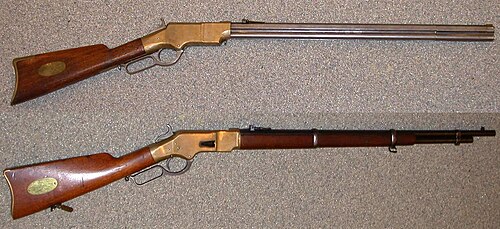
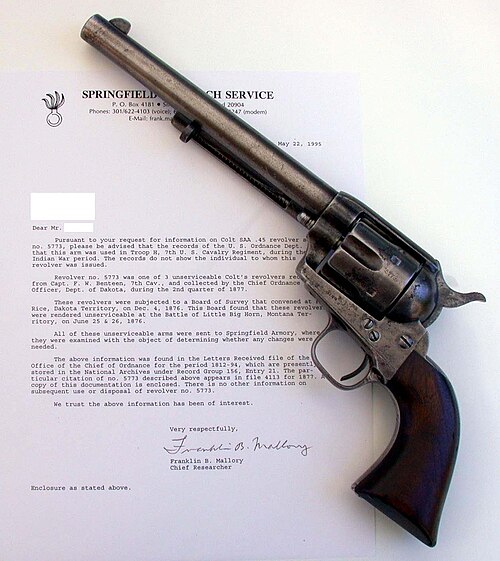
Gallear points out that lever-action rifles, after a burst of rapid discharge, still required a reloading interlude that lowered their overall rate of fire; Springfield breechloaders "in the long run, had a higher rate of fire, which was sustainable throughout a battle."[202]
The breechloader design patent for the Springfield's Erskine S. Allin trapdoor system was owned by the US government and the firearm could be easily adapted for production with existing machinery at the Springfield Armory in Massachusetts.[203] At time when funding for the post-war Army had been slashed, the prospect for economical production influenced the Ordnance Board member selection of the Springfield option.[204]
Malfunction of the Springfield carbine extractor mechanism
Whether the reported malfunction of the Model 1873 Springfield carbine issued to the 7th Cavalry contributed to their defeat has been debated for years.[205]
That the weapon experienced jamming of the extractor is not contested, but its contribution to Custer's defeat is considered negligible. This conclusion is supported by evidence from archaeological studies performed at the battlefield, where the recovery of Springfield cartridge casing, bearing tell-tale scratch marks indicating manual extraction, were rare. The flaw in the ejector mechanism was known to the Army Ordnance Board at the time of the selection of the Model 1873 rifle and carbine, and was not considered a significant shortcoming in the overall worthiness of the shoulder arm.[206] With the ejector failure in US Army tests as low as 1:300, the Springfield carbine was vastly more reliable than the muzzle-loading Springfields used in the Civil War.[207][208]
Gallear addresses the post-battle testimony concerning the copper .45–55 cartridges supplied to the troops in which an officer is said to have cleared the chambers of spent cartridges for a number of Springfield carbines.[209] This testimony of widespread fusing of the casings offered to the Chief of Ordnance at the Reno Court of Inquiry in 1879 conflicts with the archaeological evidence collected at the battlefield. Field data showed that possible extractor failures occurred at a rate of approximately 1:30 firings at the Custer Battlefield and at a rate of 1:37 at the Reno-Benteen Battlefield.[210][211][212]
1991年のテレビミニシリーズ『Son of the Morning Star』は、ジョージ・A・カスター中佐と第7騎兵隊の生涯に基づいている。物語はリトルビッグホーンの戦いで幕を閉じ、そこで第7騎兵隊の5個中隊が全滅し、ジョージ・カスター、トーマス・カスター、ボストン・カスター、そして兄弟の甥であるヘンリー・A・“オーティ”・リードも命を落とす。
↑ Charles Windolph、Frazier Hunt、Robert Hunt、Neil Mangum、『 I Fought with Custer: The Story of Sergeant Windolph, Last Survivor of the Battle of the Little Big Horn: with Explanatory Material and Contemporary Sidelights on the Custer Fight』、ネブラスカ大学出版局、1987年、86ページ。
1 2 3 Reno, Marcus A. (1951). 「1876年6月25日~26日のリトルビッグホーンの戦いにおけるマーカス・A・リノ少佐(第7アメリカ騎兵連隊)の行動を調査するため、アメリカ合衆国大統領が1879年1月13日にイリノイ州シカゴで招集した調査委員会の公式記録」。
1 2 3 4 5 6 7 8 9 Fox, Richard A. (1993). Archaeology, History and Custer's Last Battle . Norman: University of Oklahoma Press. ISBN0-8061-2998-02016年6月24日にオリジナルからアーカイブされました。
↑ Nichols, Ronald H. (編) (2007) p. 417, 419. 「Reno Court of Inquiry, In The Case of Major Marcus A. Reno」編纂・編集、Ronald H. Nichols、Custer Battlefield Historical & Museum Assn., Inc.、Hardin, MT 59034
↑ Brust, JS; Pohanka, BC; Barnard, S. (2005). Where Custer Fell: Photographs of the Little Bighorn Battlefield Then and Now . University of Oklahoma Press. p. 57.
↑Sklenar, 2000, p. 72: On Reno's [June 10 to June 18] reconnaissance "the Gatling guns proved to be an annoying burden...they either fell apart or had to be disassembled and carried in pieces over rough terrain." And p. 79: "During the Reno scout [reconnoitering], the two guns were actually abandoned (and retrieved later) because soldiers got tired of dragging them over rough spots...[I]f Custer did not already have a fully formed negative opinion of the Gatlings on such an expedition, the experience of the Reno [reconnaissance of early June] surely convinced him."
↑Philbrick, 2010, p. 73: "The biggest problem with the [Gatling] gun was transporting it to where it might be of some use... [in the week preceding the Battle of the Little Bighorn], the Gatling, not the mules, proved to be the biggest hindrance to the expedition."
↑Donovan, 2008, p. 175: "...Reno had taken one [Gatling gun] along [on his June reconnaissance], and it had been nothing but trouble." And p. 195: Custer, in comments to his officer staff before the Battle of the Little Bighorn, said that "...if hostiles could whip the Seventh [Cavalry]...they could defeat a much larger force."
↑Hatch, 1997, pp. 80–81: The Gatling guns "were cumbersome and would cause delays over the traveled route. The guns were drawn by four condemned horses [and] obstacles in the terrain [would] require their unhitching and assistance of soldier to continue...Terry's own battery [of Gatling guns]—the one he had offered to Custer—[would have] a difficult time keeping up with the march of Colonel John Gibbon's infantry."
↑Lawson, 2007, p. 50: "[Custer] turned down General Terry's offer to bring the three Gatling guns, because they would slow down his movement."
↑Philbrick, 2010, p. 99: "Custer knew he had to move quickly to accomplish his objective. That was why he ultimately declined the offer of the Gatling guns that had proven such a bother to Reno."
↑Sklenar, 2000, p. 79: After the 7th Cavalry's departure up Rosebud Creek, "even Brisbin would acknowledge that everyone in Gibbon's command understood [that]...the Seventh was the primary strike force."
↑Philbrick, 2010, p. 99: "Thinking his regiment powerful enough to handle anything it might encounter, [Custer, in addition to declining the Gatling guns] declined the offer of four additional cavalry companies from [Gibbon's] Montana column." And p. 114: Custer told his officer staff days before the battle that he "opted against the Gatling guns...so as not to 'hamper our movements'"
↑Sklenar, 2000, p. 92: Custer "on the evening of 22 June...[informed his officer staff]...why he had not accepted the offers...of Gatling guns (he thought they might hamper his movements at a critical moment)."
↑Lawson, 2007 p. 50: "Custer...refused Major James Brisbin's offer to include his Second Cavalry Regiment [200 troopers], told Terry "the 7th can handle anything it meets."
↑Donovan, 2008, p. "Explaining his refusal of the Gatling gun detachment and the Second Cavalry battalion, he convolutedly reaffirmed his confidence in the Seventh's ability to defeat any number of Indians they could find."
↑Hatch, 1997, p. 24: "Brisbin argued with Terry that Custer was undermanned, and requested that his troops [which had the] Gatling guns – with Terry in command because Brisbin did not want to serve under Custer—be permitted to accompany [Custer's] column. Custer refused the assistance, and Terry abided by that."
↑Sklenar, 2000, pp. 78–79: "Apparently, Terry offered [Major James] Brisbin's battalion and Gatling gun battery to accompany the Seventh, but Custer refused these additions for several reasons. First of all, Custer and Brisbin did not get along and Custer thus would not have wanted to place Brisbin in a senior command position. Custer was on the verge of abolishing the wings led by Reno and Benteen, and the inclusion of Brisbin would have complicated the arrangement he had in mind. Also, Custer retained the conviction that the Seventh could handle any force of Indians it might encounter, and he may have reasoned that taking the Second Cavalry would leave [Colonel John] Gibbon's column susceptible to attack and defeat..."
↑Hatch, 1997, p. 80: "The offer of 3 Gatling Guns...was made to Custer by General Alfred Terry [at the] urging of Major James Brisbin, who also desired his Second Cavalry to become part of Custer's detachment. Custer respectfully declined both offers, state that the Gatlings would impede his march.
↑Hatch, 1997, p. 80: "The Gatling Guns would have brought formidable firepower into play; this rapid fire artillery could fire up to 350 rounds in 1 minute."
↑Donovan, 2008, p. 175: "Each of these heavy, hand-cranked weapons could fire up to 350 rounds a minute, an impressive rate, but they were known to jam frequently.
↑Hatch, 1997, pp. 80–81: "The Gatlings had major drawbacks, such as frequent jamming due to residue from black powder..."
↑Philbrick, 2010, p. 73: "Military traditionalists like to claim the gun was unreliable, but in actuality the Gatling functioned surprisingly well."
↑Hatch, 1997, p. 81: "...The [Gatling] guns were mounted on large [diameter] wheels, which meant that in order to operate them the gun crews would [necessarily] be standing upright, making them [extremely vulnerable] to Indian snipers."
↑Gallear, 2001: "The Indians were well equipped with hand-to-hand weapons and these included lances, tomahawks, war clubs, knives and war shields were carried for defense. Such weapons were little different from the shock and hand-to-hand weapons, used by the cavalry of the European armies, such as the sabre and lance... [in addition] the Indians were clearly armed with a number of sophisticated firearms".Hatch, 1997, p. 184: "Sioux and Cheyenne weapons included... clubs, bows and arrows, lances, and hatchets [as well as] an array of new and old [model] firearms: muzzleloaders, Spenser, Sharps, Henry and Winchester repeating rifles, and... Springfield carbines taken from Reno's dead cavalrymen."Robinson, 1995, p. xxix: "Indians carried at least forty-one different kinds of firearms in the fight."
↑Flaherty, 1993, p. 208: "By 1873, Indians 'used the traditional bow and arrows and war club along with firearms such as the muzzle-loading Leman rifle, issued as part of treaty agreements, and rapid-fire Henry and Winchester rifles, obtained through civilian traders'."
↑Gallear, 2001: "Trade guns were made up until the 1880s by such gunsmiths as Henry Leman, J.P. Lower and J. Henry & Son."
↑Gallear, 2001: "These guns were crudely made for Indian trade and were given out as a sweetener for treaties."
↑Gallear, 2001: "Civil War type muzzleloader rifles would have had an effective range of about 500 yards, but with volley fire were effective to 1000 yards."
↑Donovan, 2008, p. 188: "Though most of the men in the village carried the bow and arrow in battle... over the past decade [1866–1876] the sale and trade of arms to the Indians had increased significantly... The latest Winchester magazine rifles were available for the right price... Many men carried older guns—muzzleloaders, for which some molded their own bullets; Henry and Spencer repeaters; Springfield, Enfield [rifled muskets], Sharps breechloaders and many different pistols. All told, between one-third and one-half of the gathering warriors had a gun."
↑Gallear, 2001: "The bow's effective range was about 30 yards and was unlikely to kill a man instantly or even knock him off his horse. However, it would incapacitate and few troopers would fight on after an arrow hit them."
↑Gallear, 2001: "There is also evidence that some Indians were short of ammunition and it is unclear how good a shot they were. They certainly did not have the ammunition to practice, except whilst hunting buffalo, and this would suggest that the Indians generally followed the same technique of holding their fire until they were at very close range".
↑Donovan, 2008, p. 188 (fragment of quote)Utley, 1993, p. 39: "The Indians had grown to depend on the goods [white traders] supplied, especially firearms and ammunition ... they could be obtained only though white men, directly, of through Indian intermediaries."Gallear, 2001: "Indian trade muskets ... could be legitimately obtained from traders at Indian agencies ... The Sioux [however] were keen to obtain metal cartridge weapons [available] from half-breed Indian traders out of Canada or unsupervised traders at Missouri River posts in Montana ... By 1876 almost all [Model 1860 Henry rifles] in civilian use would have disappeared so Indian use must have come from ex-Civil War stocks sold off cheaply and bought by Indian traders, such as the Métis."Flaherty, 1993, p. 208: By 1873, Indians "used the traditional bow and arrows and war club along with firearms such as the muzzle-loading Leman rifle, issued as part of treaty agreements, and rapid-fire Henry and Winchester rifles, obtained through civilian traders."Donovan, 2008, p. 188: "there were many ... ways a warrior could acquire a rifle. Post-traders on some reservations supplied illegal arms to non-treat[y] [Indians]; so did unlicensed traders—primarily the half-breed Canadian Métis gunrunners to the north in the desolate area known as Burning Ground below the Black Hills."Robinson, 1995, p. xxix: "Studies of the cartridge cases recovered in archaeological investigations of the Little Big Horn show the Indians carried at least forty-one different kinds [models] if firearms in that fight, and it estimated that at least 25 to 30 percent [of Lakota and Cheyenne combatants] were armed with modern sixteen-shot Winchester and Henry repeating rifles ... they also armed themselves with captured Springfield carbines ... [and] carried traditional weapons... bows and arrows, hatchets ... and war clubs."
↑Donovan, 2008, p. 118: Reynolds "best white scout in Dakota Territory ... had earned Custer's respect for his excellent work ... report[ed] to Custer that Lakotas under Sitting Bull were 'gathering in force'. They had been preparing for war by collecting Winchester repeating rifles and plenty ammunition."
12Hatch, 1997, p. 184: "It has been estimated that perhaps 200 repeating rifles were possessed by the Indians, nearly one for each [man in Custer's battalion]."
↑Sklenar, 2000, p. 163: "the village contained possibly 1,200 lodges, plus several hundred wikiups housing individual warriors. The total population of men, woman and children probably reached 6,000 to 7,000 at its peak, with 2,000 of these being able-bodied warriors".
↑Lawson, 2007, pp. 52–53: "The troops of the 7th Cavalry were each armed with two standard weapons, a rifle and a pistol. The rifle was a .45/55-caliber Springfield carbine and the pistol was a .45-caliber Colt revolver... both weapons were models [introduced in] 1873 [though] they did not represent the latest in firearm technology."
↑Lawson, 2007, p. 53: "Although each soldier was also issued a sword or saber, Custer ordered these weapons boxed before the strike force departed [up Rosebud Creek]... the lack of swords would prove to be a disadvantage during some of the close fighting that lay ahead. Gunpowder of the day is now known as black powder. It causes substantial fouling within the firearm. After about 25 rounds are fired from the M1873 revolver using black powder, the cylinder binds on the cylinder pin. The cavalry trooper would then have used his saber. However, their inclusion would not have changed the ultimate outcome."
↑Gallear, 2001: "No bayonet or hand to hand weapon was issued apart from the saber, which under Custer's orders was left behind."
↑Lawson, 2008, p. 53: "Many of the officers and most of the civilians brought along their own weapons."
↑Donovan, 2008, p. 191: "each enlisted man carried the regulation single-action breech-loading, M1873 Springfield carbine... the standard issue sidearm was the reliable [single-action] M1873 Colt .45 cal. pistol."
↑Gallear, 2001: "Officers purchased their own carbines or rifles for hunting purposes...[however] these guns may have been left with the baggage and is unclear how many officers actually used these weapons in the battle. However, there is evidence that Reno's men did make use of long-range hunting rifles. White Scouts would have been better armed and seemed to favor long-range buffalo hunting type rifles over fast-shooting lever actions... Henrys, Spencers and Winchester M1866s would also have been popular choices... Some Scouts would have been armed with both types of weapons plus a variety of side arms."
↑Donovan, 2008, p. 191: "[Each] trooper carried 100 rounds of carbine ammunition and 24 pistol cartridges with him—as many as 50 on a belt or in a pouch, and the remainder in his saddlebag (the pack train mules carried 26,000 more carbine rounds [approximately 50 extra per trooper])."
↑Hatch, 1997, p. 184: "not a wide disparity" in arms of the opposing forces.
↑Gallear, 2001: "the .44 rim-fire round fired from the Henry rifle is the most numerous Indian gun fired with almost as many individual guns identified as the Cavalry Springfield Model 1873 carbine."
↑Gallear, 2001: "by the time of the Little Bighorn the U.S. Army was standardizing on the Springfield rifle and carbine [and] saw breech-loading rifles and carbines as the way forward."
↑Lawson, 2008, p. 93: "The rapid fire power of the Henry repeaters was intimidating, especially to inexperienced soldiers. Their use was probably a significant cause of the confusion and panic among the soldiers so widely reported by Native American eyewitnesses."
↑Lawson, 2007, pp. 91–93: "[Henryville] was named in the mid-1980s by archaeologists after they discovered a large artifact collection there, which included numerous .44-caliber Henry cartridges. The number of cartridges indicated that about 20 warriors at this position were using Henry repeating rifles. These weapons were less powerful than the cavalry's Springfield rifles, especially at long range; however, they had the advantage of providing rapid fire ... The rapid fire power ... was intimidating, especially to inexperienced soldiers. Their use was probably a significant a confusion and panic among the soldiers so widely reported by Native American eyewitnesses ... Survivors of the assaults ... fled north to seek safety with Keogh's Company I ... they could react quickly enough to prevent the disintegration of their own unit."
↑Donovan, 2008, p. 191: "The Springfield had won out over many other American and foreign rifles, some of them repeaters, after extensive testing supervised by an army board that had included Marcus Reno and Alfred Terry."
↑Gallear, 2001: "In 1872 the Army tested a number of foreign and domestic single-shot breechloaders".
↑Robinson, 1995, p. xxviii: "the Model 1873 Springfield rifle, in caliber .45–70 for the infantry, and .45–55 light carbine for cavalry."
↑Gallear, 2001: "The established wisdom is that the U.S. Army did not adopt lever-action multiple shot weapons during the Civil War because of the problems they would create regarding the supply of ammunition. However, I believe that by the time of the Indian Wars the Army viewed the lever-actions weapons as under-powered novelty weapons and that they were equipping their men to fight wars against European equipped enemies or to re-fight the Civil War. The Indian Wars were seen as a minor sideshow in which troops armed to fight on European battlefields would be more than a match for fighting any number of Indians."
↑Donovan, 2008, p. 191: "a solid weapon with superior range and stopping power".
↑Gallear, 2001: "The Army saw breech-loading rifles and carbines as the way forward. They could fire a much more powerful round at longer ranges than lever-actions."
↑Gallear, 2001: "The Allin System had been developed at the Government Armories to reduce the cost, but the U.S. Treasury had already been forced to pay $124,000 to inventors whose patents it infringed. The adoption of the Allin breech gave the advantages of being already familiar throughout the Army, involved no more royalties, and existing machinery at the Springfield Armory could easily be adapted to its manufacture.
↑Donovan, 2008, p. 191: "Army appropriations were at an all-time low, and a key factor in the Springfield's favor was its low production cost."
↑Gallear, 2001: "some authorities have blamed the gun's reliability and tendency for rounds to jam in the breech for the defeat at the Little Bighorn".
↑Hatch, 1997, p. 124: "This defect was noted by the board of officers (which included Major Reno) that selected the weapon in 1872, but was not considered particularly serious at the time."
↑Gallear, 2001: "A study of .45–55 cases found at the battle concludes that extractor failure amounted to less than 0.35% of some 1,751 cases tested ... the carbine was in fact more reliable than anything that had preceded it in U.S. Army service. These weapons were vastly more reliable than the muzzle-loading weapons of the Civil War, which would frequently misfire and cause the soldier to uselessly load multiple rounds on top of each other in the heat of battle."
↑Hatch, 1997, p. 124: "Scholars have for years debated the issue of whether or not the Model 1873 Springfield carbine carried by cavalrymen, malfunctioned during the battle and [whether this] was one reason for the defeat" and "No definitive conclusion can be drawn [as to] the possible malfunction ... as being a significant cause of Custer's defeat. Writers of both pro- and anti-Custer material over the years ... have incorporated the theory into their works".
↑Donovan, 2008, p. 440: footnote, "the carbine extractor problem did exist, though it probably had little impact on the outcome of the battle. DeRudio testified that 'the men had to take their knives to extract cartridges after firing 6 to 10 rounds.' ... but 'the men' seems to have been an exaggeration. Private Daniel Newall mentioned the problem".
↑Hatch, 1997, p. 124: "The controversy results from the known failure of the carbine to [eject] the spent .45–55 caliber cartridge [casings]. The cartridge cases were made of copper, which expands when hot. That—coupled with a faulty extractor mechanism and dirt—could cause the head of the cartridge to be torn away when the block was opened, and the cartridge cylinder would then be left inside the chamber ... The casings would have to be removed manually with a pocketknife before [reloading and] firing again. This defect was noted by the board of officers (which included Major Reno) that selected the weapon in 1872, but was not considered particularly serious at the time."
↑Hatch, 1997, p. 124: "How often did this defect [ejector failure] occur and cause the [Springfield carbines] to malfunction on June 25, 1876? According to Dr. Richard Fox in Archeology, History and Custer's Last Battle (1993), there were very few .45–55 caliber cartridge casings found during the digs on the battlefield that showed any evidence to pry or scratch marks [indicating manual extraction]. Only 3 of 88 [3.4%] found on the Custer [battalion] portion of the battlefield could possibly have been removed in an extraction jam. On the Reno-Benteen defense site [Reno Hill], 7 of 257 fit this category [2.7%]. If this was a representative number it would appear that malfunction from that source was minimal."
↑Hatch, 1997, p. 124: "Both sides [troopers and Indians] apparently believed that some weapons malfunctioned. Indian testimony ... reported that some soldiers threw down their long guns and fought with their short guns. Could this indicate a malfunctioning [carbine] that was discarded and therefore could not have left its marked [pry scratched] casings on the field? ... No definitive conclusion can be drawn about the possible malfunction ... as being a significant cause of Custer's defeat. Writers of both pro- and anti-Custer material over the years ... have incorporated the theory into their works".
↑Hatch, 1997, p. 124: "On a final note: the Springfield carbine remained the official cavalry firearm until the early 1890s"
↑"Young John Martin". Custer's Bugler: The Life of John Martin (Giovanni Martino). December 23, 2012. Retrieved January 22, 2025.
↑Harris, Ethan E. (2012). Custer Survivors 101: The Impostor Roster (E-book). Warrior's Quill. Introduction.
↑Stewart, Edgar I. (1980). Custer's Luck. Norman, Oklahoma: University of Oklahoma Press. p.490. ISBN978-0-8061-1632-7.
↑Van de Water, Frederic F. (1988). Glory-Hunter: A Life of General Custer. Lincoln, Nebraska: University of Nebraska Press. p.5. ISBN978-0-8032-9607-7. Archived from the original on January 17, 2017. Retrieved May 16, 2014.
↑Ege, Robert J. (2008). Curse Not His Curls. Old Army Press. p.121.
↑Nunnally, Michael L. (2005). I Survived Custer's Last Stand. p.38.
↑Graham, W. A. (1995). The Custer Myth: A source book of Custeriana with a new introduction by Brian C. Pohanka. Mechanicsburg, Pennsylvania: Stackpole Books. pp.353–357, 413. ISBN0-8117-0347-9.
↑"Charles Kuhlman Papers, 1896–1959". University of Montana Library. Archived from the original on December 21, 2013. Retrieved June 10, 2013.
↑Kuhlman, Charles (1968). The Frank Finkel Story. Omaha, Nebraska: Citizen Printing Co. p.20.
↑Ellison, Douglas W. (1983). Sole Survivor: An Examination of the Frank Finkel Narrative. North Plains Press. p.128.
↑Boyes, William (1977). No Custer Survivors: Or, The Unveiling of Frank Finkel. WJBM Associates. p.16.
↑Nunnally, Michael L. (2008). The Frank Finkel Hoax: No Survivor of Custer's Last Stand. Old Scout Books. p.32.
↑Raymond Hatfield Gardner (1944). The Old Wild West: Adventures of Arizona Bill (1sted.). San Antonio, Texas: Naylor Company.
↑The Autobiography of Frank Tarbeaux, as Told to Donald Henderson Clarke. Vanguard Press. 1930. p.287.
↑Ryan, Ed (1951). Me and The Black Hills. Custer, South Dakota: Ed Ryan. p.89.
↑Gardner, Raymond Hatfield (2009). The Old Wild West: Adventures of Arizona Bill. Kessinger Publishing. p.326. ISBN978-1-104-84859-0.
↑Clarke, Donald Henderson (1930). The Autobiography of Frank Tarbeaux. New York: Vanguard Press. p.286.
↑Winkler, A. (2013). "The case for a Custer Battalion survivor: Private Gustave Korn's story". The Magazine of Western History, 63(1)
↑"A Pretended Custer Survivor: Another Attempt to Pose As a Survivor Punctured by the Regiment's Clerk". The Big Horn Searchlight. Retrieved August 2, 2012.
↑Shanks, Jenny (June 26, 2007). "Comanche: The Horse that Survived the Battle of the Little Bighorn, Part 2". NewWest. Archived from the original on October 25, 2012. Retrieved January 15, 2017.
↑Connell, Evan S. (1984). Son of the Morning Star: Custer and the Little Bighorn. Macmillan. ISBN0-88394-088-4. Retrieved January 15, 2017.
↑National Park Service website for the Little Bighorn Battlefield.
↑"The Indian Memorial Peace Through Unity – Little Bighorn Battlefield National Monument (U.S. National Park Service)". www.nps.gov. Archived from the original on April 13, 2015. Retrieved April 7, 2015.
↑"Martin Pate"Archived November 23, 2010, at the Wayback Machine, Friends Of The Little Bighorn Battlefield, retrieved April 24, 2010.
↑Rankin, Charles E., ed. (1997). Legacy: New perspectives on the Battle of the Little Bighorn; (proceedings of the Little Bighorn Legacy Symposium, held in Billings, Montana, August 3–6, 1994) (Nachdr.ed.). Helena, Mont.: Historical Soc. Press. p.310. ISBN0-917298-41-1.
↑Russell, D. Custer's List: A Checklist of Pictures Relating to the Battle of the Little Big Horn. Fort Worth: Amon Carter Museum of Western Art, 1969
↑"Kansas Historical Quarterly – The Pictorial Record of the Old West, 4". Kansas Historical Society. Archived from the original on July 29, 2010. Retrieved March 15, 2012.
↑"Custer's Last Stand – Artist E.S. Paxson". Home1.gte.net. Archived from the original on February 26, 2012. Retrieved March 15, 2012.
↑Fraser, Harry L. (September 15, 1926), General Custer at the Little Big Horn (Drama, Western), Sunset Productions, retrieved November 11, 2021
↑Rollins, Peter (2011). Hollywood's Indian: The Portrayal of the Native American in Film. University Press of Kentucky. pp.121–136. ISBN978-0-8131-3165-8.
↑Square-Enix (September 2, 1994). Live A Live (Super Famicom). Level/area: The Wild West. 保安部「聞いた事がある… 第7騎兵隊は… スー•シャイアンの連合軍によって 全滅させられた… ただ一頭の 馬を残して…/アニー「あの馬に死んでいった騎兵達の憎しみが集まったのかしら" Translation: "Sheriff: I've heard of this... The 7th Cavalry Regiment was annihilated by the combined forces of the Sioux and Cheyenne... A horse was the only survivor.../Annie: All the dead cavalrymen's hatred probably congregated in that horse.
↑Custer's Last StandArchived November 2, 2016, at the Wayback Machine. BBC Two, Friday 23 Feb 2007.
↑"The War for the Black Hills". March 31, 2017. Archived from the original on October 7, 2017.
↑Ryan, Des (October 28, 2024). The Ballad of Thomas Patrick Downing: A Memoir of one of General Custer's Irish Cavalrymen. Ttt Press. ISBN978-1-0686728-0-4.
References
Barnard, Sandy (1998). Digging into Custer's Last Stand. Terre Haute, Indiana: AST Press. ISBN0-9618087-5-6.
Brininstool, E. A. (1994). Troopers With Custer. Mechanicsburg, Pennsylvania: Stackpole Books. ISBN0-8117-1742-9.
Cornut, David (2012). Little Big Horn: Autopsie d'une bataille légendaire. Parçay-sur-Vienne: Anovi. ISBN978-2-360351-34-3.
Dickson, Ephriam D. III. "Prisoners in the Indian Camp: Kill Eagle's Band at the Little Bighorn"(PDF). Greasy Grass. 27 (May 2011): 3–11. OCLC38114524.
Donovan, James (2008). A Terrible Glory: Custer and the Little Bighorn. Little, Brown, and Co. ISBN978-0-316-15578-6.
Dustin, Fred (1939). The Custer Tragedy: Events Leading Up to and Following the Little Big Horn Campaign of 1876. Ann Arbor, Michigan: Edwards Brothers. OCLC4387990.
Elliot, M.A. (2007). Custerology: The Enduring Legacy of the Indian Wars and George Armstrong Custer. University of Chicago Press. ISBN978-0-226-20146-7.
Flaherty, Thomas H., ed. (1993). The Wild West. New York: Time-Life Books. ISBN0-446-51761-5.
Gallear, Mark (2001). Guns at the Little Bighorn. Custer Association of Great Britain. Archived from the original on September 8, 2006.
Goodrich, Thomas (1997). Scalp Dance: Indian Warfare on the High Plains, 1865–1879. Mechanicsburg, PA: Stackpole Books. ISBN0-8117-1523-X.
Graham, Col. William A. (1953). The Custer Myth: A Source Book for Custeriana. New York: Bonanza Books. OCLC944258.
Gray, John S. (1991). Custer's Last Campaign: Mitch Boyer and the Little Bighorn Reconstructed. Lincoln: University of Nebraska Press. ISBN0-8032-7040-2.
Hammer, Kenneth (2000). Nichols, Ronald H. (ed.). Men with Custer: Biographies of the 7th Cavalry: June 25, 1876. Hardin, Montana: Custer Battlefield Historical and Museum Association. ISBN1-892258-05-6.
Hammer, Kenneth, ed. (1976). Custer in '76: Walter Camp's notes on the Custer Fight. Provo: Brigham Young University. ISBN0-8061-2279-X.
Hardorff, R. G., ed. (1997). Camp, Custer and the Little Big Horn. El Segundo, California: Upton and Sons. ISBN0-912783-25-7.
Hardorff, R. G. (1993). Hokahey! A Good Day to Die! The Indian Casualties of the Custer Fight. University of Nebraska Press. ISBN0-8032-7322-3.
Hatch, Thom (1997). Custer and the Little Bighorn: An Encyclopedia. London: McFarland & Company, Inc. ISBN0-7864-0154-0.
Keegan, John (1996). Warpaths. London: Pimlico. ISBN1-55013-621-6.
Lawson, Michael L. (2007). Little Bighorn: Winning the Battle, Losing the War. New York: Chelsea House Publishers. ISBN978-0-7910-9347-4.
Michno, Gregory F. (1994). The Mystery of E Troop: Custer's Grey Horse Company at the Little Bighorn. Missoula, Montana: Mountain Press Publishing. ISBN0-87842-304-4.
Miller, David, H. (1985). Custer's Fall: The Native American Side of the Story. University of Nebraska Press. ISBN0-452-01095-0.{{cite book}}: CS1 maint: multiple names: authors list (link)
Nevin, David (1973). The Old West: Soldiers. New York: Time-Life Books.
Nichols, Ronald H., ed. (1996). Reno Court of Inquiry. Hardin, Montana: Custer Battlefield Historical and Museum Association. OCLC45499454.
Perrett, Bryan (1993). Last Stand!: Famous Battles Against the Odds. London: Arms & Armour. ISBN1-85409-188-3.
Philbrick, Nathaniel (2010). The Last Stand: Custer, Sitting Bull, and The Battle of The Little Bighorn. Viking Press. ISBN978-0-14-242769-9.
Rice, Earle Jr. (1998). The Battle or the Little Bighorn. World History Series. San Diego: Lucent Books. ISBN978-1-56006-453-4.
Robinson, Charles M. III (1995). A Good Year to Die: the story of the great Sioux war. New York: Random House. ISBN0-679-43025-3.
Scott, Douglas D.; Connor, Melissa (1997). "Context Delicti: Archaeological Context in Forensic Work". In Haglund, W.D.; Sorg, M.H. (eds.). Forensic Taphonomy: The Postmortem Fate of Human Remains. Boca Raton: CRC Press. pp.27–38. ISBN978-0-8493-9434-8.
Sklenar, Larry (2000). To Hell with Honor, General Custer and the Little Big Horn. Norman: University of Oklahoma Press. ISBN0-8061-3472-0.
Utley, Robert M. (1993). The Lance and the Shield: the life and times of Sitting Bull. New York: Henry Holt & Company. ISBN0-8050-1274-5.
Utley, Robert M. (2001). Cavalier in Buckskin: George Armstrong Custer and the Western Military Frontier (Reviseded.). Norman: University of Oklahoma Press. ISBN0-8061-2292-7.
Viola, Herman J. (1999). Little Bighorn Remembered: The Untold Indian Story of Custer's Last Stand. Westminster, Maryland: Times Books. ISBN0-8129-3256-0.
Welch, James; Stekler, Paul (1994). Killing Custer: The Battle of the Little Bighorn and the Fate of the Plains Indians. New York: Norton. ISBN0-393-32939-9.
Wert, Jeffry D. (1996). Custer: The Controversial Life of George Armstrong Custer. New York: Simon & Schuster. ISBN0-684-81043-3.