
Loading article…
Jesus was put to death by crucifixion, being nailed to an instrument made by the Romans for capital punishment, commonly named as a cross (Latin: crux). The instrument of crucifixion is taken to be an upright wooden beam to which was added a transverse wooden beam, thus forming a "cruciform" or T-shaped structure. His crucifixion occurred in 1st-century Judaea, most likely in AD 30 or AD 33. The event is described in the Bible's four canonical gospels, referred to in the New Testament epistles, and later attested to by other ancient sources. Scholars nearly universally accept the historicity of Jesus' crucifixion,[1][2][3] although there is no consensus on the details.[4][5][6] According to the canonical gospels, Jesus was arrested and tried before the Sanhedrin, and then sentenced byPontius Pilate to be scourged, and finally crucified by the Romans.[7][8][9]
Jesus was stripped of his clothing and offered vinegar mixed with myrrh or gall (likely posca) to drink. At Calvary (Golgotha), he was then hung between two convicted thieves and, according to the Gospel of Mark, was crucified at the third hour (9 a.m.), and died by the ninth hour of the day (at around 3:00 p.m.). During this time, the soldiers affixed a sign to the top of the cross stating "Jesus of Nazareth, King of the Jews" which, according to the Gospel of John, was written in three languages (Hebrew, Latin, and Greek). They then divided his garments among themselves and cast lots for his seamless robe, according to the Gospel of John. John also states that, after Jesus' death, one soldier (named in extra-biblical tradition as Longinus) pierced his side with a spear to be certain that he had died, then blood and water gushed from the wound. The Bible describes seven statements that Jesus made while he was on the cross, as well as several supernatural events that occurred.
Collectively referred to as the Passion, Jesus' suffering and redemptive death by crucifixion are the central aspects of Christian theology concerning the doctrines of salvation and atonement.[10]
Paul is the earliest surviving source to document Jesus' crucifixion.[11] Scholars have used Paul's chronology as evidence for the date of the crucifixion.[12] However, the earliest detailed accounts of the death of Jesus are contained in the four canonical gospels.[13] In the Synoptic Gospels, Jesus predicts his death in three separate places.[14] All four gospel accounts conclude with an extended narrative of Jesus' arrest, initial trial at the Sanhedrin and final trial at Pilate's court, where Jesus is flogged, condemned to death, is led to the place of crucifixion initially carrying his cross before Roman soldiers induce Simon of Cyrene to carry it, and then Jesus is crucified, entombed, and resurrected from the dead. In each gospel account these five events in the life of Jesus are treated with more intense detail than any other portion of that Gospel's narrative. Scholars note that the reader receives an almost hour-by-hour account of what is happening.[15]:p.91

カルバリ(ゴルゴタとも呼ばれる)に到着した後、イエスは没薬または胆汁(おそらくポスカ)[ 16 ]を混ぜたワインを飲むように勧められた。マルコによる福音書とマタイによる福音書の両方に、イエスがこれを拒否したことが記されている。その後、イエスは十字架につけられ、2人の囚人の間に吊るされた。ギリシャ語原文のいくつかの翻訳によると、囚人は山賊かユダヤ人の反逆者であった可能性がある。[ 17 ]マルコの福音書によれば、イエスは第 3 時 (午前 9 時頃から正午までの間) から十字架刑の苦痛に耐え、[ 18 ]第 9 時 (午後 3 時頃) に亡くなりました。[ 19 ]兵士たちはイエスの頭上に「ナザレのイエス、ユダヤ人の王」と書かれた札を掲げました。ヨハネの福音書によれば、それは3 つの言語(ヘブライ語、ラテン語、ギリシャ語) で書かれており、その後、イエスの衣服を分け、縫い目のない衣のためにくじを引きました。ヨハネの福音書によれば、ローマ兵は、十字架にかけられた 2 人の囚人に対して行ったように、イエスの足を折ることはしませんでした (足を折ると死期が早まる)。イエスはすでに死んでいたからです。各福音書には、イエスの最期の言葉がそれぞれ記されており、全部で7 つの言葉があります。[ 20 ]

4つの福音書すべてに、イエスの死後、アリマタヤのヨセフがイエスの遺体を引き取り、岩を掘って作った墓に埋葬したと記されている。[ 21 ]マタイによる福音書だけが、ヨセフがこの目的のために自分の墓を用意したことを示唆している。[ 22 ]
共観福音書3つには、キレネのシモンが十字架を担いでいたこと[ 23 ]、群衆がイエスを嘲笑していたこと[ 24 ]、十字架につけられた他の2人の男たちも嘲笑していたこと[ 25 ] 、 6時から9時まで暗闇が続いたこと[ 26 ]、神殿の幕が上から下まで裂けたこと[ 27 ]が記されている。共観福音書には、百人隊長[28]や遠くから見ていた数人の女性[29]など、数人の目撃者についても言及されており、そのうち2人は埋葬の際に立ち会っていた[ 30 ] 。
ルカによる福音書は、葦に乗せてイエスに捧げられた酸っぱいワインの混合物の詳細を省略している唯一の福音書であり[ 31 ]、マルコとヨハネだけが、ヨセフが実際に十字架から遺体を下ろしたことを記述している[ 32 ] 。
福音書の中で、一つの福音書にしか記載されていない詳細がいくつかあります。例えば、マタイ福音書だけが地震、復活した聖徒たちが街へ行ったこと、ローマ兵が墓を守るために派遣されたことを述べています[ 33 ]。一方、マルコ福音書だけが十字架刑の時刻( 午前9時、つまり第三時。ただし、おそらく正午まで遅れた)[ 34 ]と百人隊長によるイエスの死の報告[ 35 ]を述べています。ルカ福音書の独自の記述としては、嘆き悲しむ女性たちへのイエスの言葉、ある犯罪者が別の犯罪者を叱責したこと、「胸を叩きながら」去っていった群衆の反応、安息日に休む前に香料や軟膏を用意した女性たちのことなどが挙げられます。[ 36 ]ヨハネは、イエスの足を折るようにという要求と、兵士がイエスの脇腹を刺したこと(旧約聖書の預言の成就として)に言及している唯一の人物であり、また、ニコデモがヨセフの埋葬を手伝ったことにも言及している。[ 37 ]
コリント人への第一の手紙によれば、[ 38 ]イエスは死から復活し(十字架刑の日を1日目として「3日目」に)、正典福音書によれば、天に昇る前に弟子たちに何度か現れた。[ 39 ]使徒言行録の記述では、イエスは使徒たちと40日間一緒にいたとされているが、ルカによる福音書の記述では、復活祭の日曜日と昇天の出来事を明確に区別していない。[ 40 ] [ 41 ]ほとんどの聖書学者は、ルカの著者が使徒言行録もルカによる福音書の記述の続編として書いたことに同意しており、この2つの作品は全体として考えなければならない。[ 42 ]
マルコ福音書では、イエスは二人の反逆者とともに十字架につけられ、太陽は三時間暗くなるか、あるいは隠される。[ 43 ]イエスは神に叫び、それから叫び声をあげて死ぬ。[ 43 ]神殿の幕が二つに裂ける。[ 43 ]マタイ福音書はマルコ福音書に倣っているが、地震と聖人の復活について言及している。[ 44 ]ルカ福音書もマルコ福音書に倣っているが、反逆者を普通の犯罪者と描写しており、そのうちの一人がイエスを弁護し、イエスは自分(イエス)と犯罪者が楽園で一緒になると約束する。[ 45 ]ルカ福音書は、イエスが十字架刑に直面しても無表情であると描写している。[ 46 ]ヨハネ福音書にはマルコ福音書に見られる要素がいくつか含まれているが、それらは異なる扱いを受けている。[ 47 ]
以下の比較は、新国際版聖書に基づいています。


イエスの磔刑に関する初期の非キリスト教的言及としては、73 年以降、3 世紀以前に書かれたマラ・バル・セラピオンの息子への手紙が挙げられる可能性が高い。 [ 51 ] [ 52 ] [ 53 ]この手紙にはキリスト教的なテーマは含まれておらず、著者はユダヤ人でもキリスト教徒でもないと推測されている。[ 51 ] [ 52 ] [ 54 ]この手紙は、ソクラテス、ピタゴラス、そしてユダヤ人の「賢王」という3 人の賢者に対する不当な扱いに対する報復について言及している。 [ 51 ] [ 53 ]一部の学者は、「ユダヤ人の王」の処刑への言及がイエスの磔刑についてであることに疑いの余地はないと考えているが、他の学者は、言及の曖昧さからこの手紙の価値を低く評価している。[ 54 ] [ 55 ]
ユダヤの歴史家ヨセフスは、ユダヤ古代誌(紀元93年頃執筆)の中で、イエスはピラトによって十字架にかけられたと述べており(Ant. 18.3 )、次のように記している。 [ 56 ]
さて、この頃、イエスという賢人がいた。 …彼は多くのユダヤ人と多くの異邦人を自分のところに引き寄せた 。…そして、ピラトは、我々の中の指導者たちの提案によって、イエスを十字架刑に処した 。…
現代の学者のほとんどは、このヨセフスの箇所(「テスティモニウム・フラウィアヌム」と呼ばれる)には後世の加筆が含まれているものの、元々はピラトによるイエスの処刑に言及した真正な核から成っていたという点で一致している。[ 7 ] [ 8 ]ジェームズ・ダンは、「テスティモニウム」におけるイエスの磔刑への真正な言及の性質について、学者たちの間で「幅広い合意」があると述べている。[ 57 ]
2 世紀初頭には、ローマ史上最も偉大な歴史家の 1 人と考えられているタキトゥスによって、イエスの磔刑について別の言及がなされた。 [ 58 ] [ 59 ]タキトゥスは『年代記』 (紀元116年頃)の中で、ネロによるキリスト教徒の迫害について述べ、ピラトがイエスの処刑を命じたと述べている( 『年代記』15.44 )。 [ 56 ] [ 60 ]
ネロは、忌まわしい行いで民衆から憎まれていたキリスト教徒と呼ばれる階級に罪を着せ、極めて残酷な拷問を加えた。キリストという名の由来となったキリストは、ティベリウス帝の治世中に、我々の総督の一人であるポンティウス・ピラトゥスの手によって極刑に処された。
学者たちは一般的に、タキトゥスによるピラトによるイエスの処刑に関する記述は真正であり、独立したローマの史料として歴史的価値があると考えている。[ 58 ] [ 61 ] [ 62 ] [ 63 ] [ 64 ] [ 65 ]エディとボイドは、タキトゥスがイエスの磔刑について非キリスト教的な裏付けを提供していることは「確固として確立されている」と述べている。[ 66 ]
2世紀の風刺作家ルキアノスは、風刺書簡『ペレグリヌスの死』の中で、イエスの磔刑について言及している。
キリスト教徒は、今日に至るまで、新しい儀式を導入し、そのために十字架にかけられた傑出した人物を崇拝しているのです。[ 67 ]
ルキアノスのキリスト教の伝統に対する理解には大きな欠落や誤りがあるため、彼の著作はキリスト教徒自身から影響を受けたとは考えにくく、イエスの磔刑について独自の見解を示している可能性がある。[ 68 ]
2世紀にイエスの磔刑について言及したもう一つの例は、ギリシャの哲学者で初期キリスト教の反対者であったケルススによるものである。彼の著作『真の言葉』は、ケルススのキリスト教に関する主張を反駁するためにアレクサンドリアのオリゲネスが248年に書いた『ケルスス駁論』の中で引用されている部分のみで現存している。 [ 69 ]オリゲネスはケルススが次のように述べていると引用している。
あなた方は、私たちの神々の像を嘲り、侮辱する。しかし、もしあなた方がバッカスやヘラクレスを面と向かって侮辱したなら、おそらく罰を受けずに済んだとは限らない。しかし、人々の前であなた方の神を十字架につけた者たちは、その時も、生涯を通じても、何の罰も受けなかった。[ 70 ]
十字架刑(「吊るす」、ルカ23:39、ガラテヤ3:13参照)へのもう一つの可能性のある言及は、バビロニア・タルムードに見られる。
イエスは過越祭の前夜に絞首刑に処せられた。処刑の40日前から、使者が出てきてこう叫んだ。「彼は魔術を行い、イスラエルを背教に誘ったので、石打ちの刑に処せられる。彼のために何か弁明できる者は、前に出て彼のために弁護せよ。」しかし、彼のために弁護する者は誰も現れなかったので、彼は過越祭の前夜に絞首刑に処せられた。
—サンヘドリン43a、バビロニア・タルムード(ソンチノ版)
イェシュとイエスの同一性については議論されることもあるが、多くの歴史家は上記の3~4世紀の記述はイエスに関するものである可能性が高いという点で一致しており、ピーター・シェーファーはタルムードの処刑に関するこの記述がナザレのイエスを指していることに疑いの余地はないと述べている。[ 71 ]ロバート・ヴァン・ヴォーストは、サンヘドリン43aのイエスへの言及は、言及自体だけでなく、それを取り巻く文脈からも確認できると述べている。[ 72 ]しかし逆に、サンヘドリン43aは、イェシュがユダヤの王室政府によって死刑を宣告されたと述べているが、この家系は紀元前37年にヘロデ大王が王位に就いた際にすべての法的権威を剥奪されたため、処刑はイエスが生まれる40年近く前に行われたに違いない。[ 73 ] [ 74 ]
トーリダーに保存されているサマリア人の伝承では、イエスの死はティベリウス帝の治世中に起こり、サマリア人の大祭司ヤフナタンの指揮下にあったポンティウス・ピラトによるものとされている。
「ヤフナタンの時代、マリアの子であり、大工ヨセフの子であり、姦通した女の子であるイエスは、ローマ王ティベリウスの治世中に、アルコンのピラトによって『呪われたサレム』で殺された。」
この記述は、マリアとエルサレムの両方について、非常に論争的な言葉で言及している。[ 75 ]
Muslims maintain that Jesus was not crucified and that those who thought they had killed him had mistakenly killed someone else in his place, whether Judas Iscariot, Simon of Cyrene, or someone else.[76] They hold this belief based on various interpretations of Quran 4:157–158, which states: "they killed him not, nor crucified him, but so it was made to appear to them [or, it appeared so unto them], ... Nay, Allah raised him up unto Himself".[76]
Some early Christian Gnostic sects, believing Jesus did not have a physical substance, denied that he was crucified.[77][78] In response, Ignatius of Antioch insisted that Jesus was truly born and was truly crucified and wrote that those who held that Jesus only seemed to suffer only seemed to be Christians.[79][80]

In scholarship on the historical Jesus, the baptism of Jesus and his crucifixion are considered to be the two most certain historical facts about Jesus.[81][82][6][83][84][note 1]Various criteria are used to determine the historicity of the elements of the New Testamentical narratives, and help to establish the crucifixion of Jesus as a historical event.[83] The criterion of embarrassment argues that Christians would not have invented the painful death of their leader.[83] The criterion of multiple attestation is the confirmation by more than one source,[85] including multiple non-Christian sources,[note 2] and the criterion of coherence argues that it fits with other historical elements.[85]
According to biblical scholar Gerd Lüdemann, "Three conclusions can be drawn from this mode of death: (a) Romans put Jesus to death; (b) there were Roman legal proceedings beforehand; (c) Jesus was condemned for a political crime."[86]
Although scholars agree on the historicity of the crucifixion, they differ on the reason and context for it.[87] For example, both E. P. Sanders and Paula Fredriksen support the historicity of the crucifixion, but contend that Jesus did not foretell his own crucifixion and that his prediction of the crucifixion is a "church creation".[88]:126 On the other hand, Michael Patrick Barber argues that the Historical Jesus predicted his violent death.[89] Tucker Ferda argues that the Historical Jesus did believe he might die.[90]Geza Vermes also views the crucifixion as a historical event, but provides his own explanation and background for it.[88]Bart Ehrman states that Jesus portrayed himself as the leader of the future Kingdom and that a number of criteria – the criterion of multiple attestation and criterion of dissimilarity – establishes the crucifixion of Jesus as an enemy of state.[91]
Although almost all ancient sources relating to crucifixion are literary, in 1968, an archeological discovery just northeast of Jerusalem uncovered the body of a crucified man dated to the 1st century, which provided good confirmatory evidence that crucifixions occurred during the Roman period roughly according to the manner in which the crucifixion of Jesus is described in the gospels.[92] The crucified man was identified as Yehohanan ben Hagkol and probably died about AD 70, around the time of the Jewish revolt against Rome. The analyses at the Hadassah Medical School estimated that he died in his late 20s.[93][94] Another relevant archaeological find, which also dates to the 1st century AD, is an unidentified heel bone with a spike discovered in a Jerusalem gravesite, now held by the Israel Antiquities Authority and displayed in the Israel Museum.[95]
There is no consensus regarding the exact date of the crucifixion of Jesus, although it is generally agreed by biblical scholars that it was on a Friday on or near Passover (Nisan 14), during the governorship of Pontius Pilate (who ruled AD 26–36).[96] Various approaches have been used to estimate the year of the crucifixion, including the canonical Gospels, the chronology of the life of Paul, as well as different astronomical models. Scholars have provided estimates in the range AD 30–33,[97][98][99][12] with Rainer Riesner stating that "the fourteenth of Nisan (7 April) of the year 30 AD is, apparently in the opinion of the majority of contemporary scholars as well, far and away the most likely date of the crucifixion of Jesus."[100] Another preferred date among scholars is Friday, 3 April, AD 33.[101][102]
The consensus of scholarship is that the New Testament accounts represent a crucifixion occurring on a Friday, but a Thursday or Wednesday crucifixion have also been proposed.[103] Some scholars explain a Thursday crucifixion based on a "double sabbath" caused by an extra Passover sabbath falling on Thursday dusk to Friday afternoon, ahead of the normal weekly Sabbath.[104] Some have argued that Jesus was crucified on Wednesday, not Friday, on the grounds of the mention of "three days and three nights" in Matthew 12:40 before his resurrection, celebrated on Sunday. Others have countered by saying that this ignores the Jewish idiom by which a "day and night" may refer to any part of a 24-hour period, that the expression in Matthew is idiomatic, not a statement that Jesus was 72 hours in the tomb, and that the many references to a resurrection on the third day do not require three literal nights.[105] Furthermore, a few scholars have made the case that Matthew used the phrase "the heart of the earth" to refer to Jerusalem, and thus the period includes the entirety of the time Jesus spent in Jerusalem following his return from Bethany on Thursday, which lasted exactly three days and three nights.[106][107]
マルコによる福音書 15:25では、十字架刑は 3 時 (午前9 時) に行われ、イエスの死は 9 時 (午後 3 時) に行われた。[ 108 ]ヨハネによる福音書 19:14では、イエスは 6 時になってもピラトの前にいる。[ 109 ]学者たちはこの問題に対処するために多くの議論を提示しており、ローマの時刻がヨハネで使用されていることに基づくと、ローマの時刻は真夜中から始まるため、6 時がピラトの前にいるということは午前 6 時であることを意味するという和解を示唆するものもあるが、議論を否定する者もいる。[ 109 ] [ 110 ] [ 111 ]数人の学者は、時計の標準化や正確な時間と分の記録が利用できなかった時代に書かれた福音書の記述に、現代の時刻の正確さを遡って読み込むべきではないと主張しており、時間はしばしば最も近い 3 時間単位で近似されていた。[ 109 ] [ 112 ] [ 113 ]

3つの共観福音書は、イエスが最初に十字架を担いだ後、ローマ兵がシモン・オブ・キュレネという男に十字架を担ぐよう命じたことに言及しているが[ 114 ] 、ヨハネの福音書はイエスが自分の十字架を「担いだ」とだけ述べている[ 115 ] 。
ルカの福音書には、イエスが、彼について行った嘆き悲しむ群衆の中の女性たちと交わしたやり取りも記されており、イエスはこう言ったと伝えられています。「エルサレムの娘たちよ、私のために泣いてはいけません。あなた方自身とあなた方の子どもたちのために泣きなさい。見よ、やがて『子を産まない女、子を産んだことのない胎、乳を与えたことのない乳房は幸いである』と言う日が来る。その時、人々は山に向かって『私たちの上に倒れよ』と言い、丘に向かって『私たちを覆え』と言うだろう。木が青々としている時にこのようなことが起こるなら、枯れた木が青々としている時にはどうなるだろうか。」[ 116 ]
ルカによる福音書では、イエスはこれらの女性たちを「エルサレムの娘たち」と呼んでおり、同じ福音書で「ガリラヤからイエスについてきた女性たち」と表現され、イエスの磔刑に立ち会った女性たちと区別している。[ 117 ]
Traditionally, the path that Jesus took is called Via Dolorosa (Latin for "Way of Grief" or "Way of Suffering") and is a street in the Old City of Jerusalem. It is marked by nine of the fourteen Stations of the Cross. It passes the Ecce Homo Church and the last five stations are inside the Church of the Holy Sepulchre.
There is no reference to a woman named Veronica in the Gospels,[118] but sources such as Acta Sanctorum describe her as a pious woman of Jerusalem who, moved with pity as Jesus carried his cross to Golgotha, gave him her veil that he might wipe his forehead.[119][120][121][122]
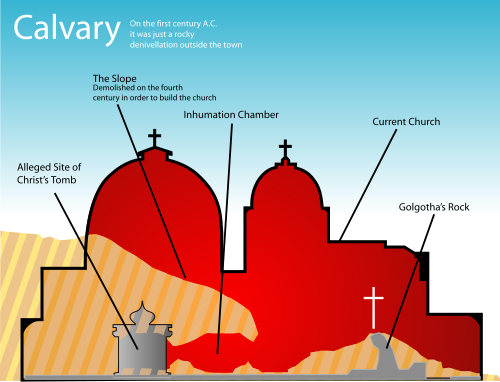
The precise location of the crucifixion remains a matter of conjecture, but the biblical accounts indicate that it was outside the city walls of Jerusalem,[123] accessible to passers-by[124] and observable from some distance away.[125]Eusebius identified its location only as being north of Mount Zion,[126] which is consistent with the two most popularly suggested sites of modern times.
Calvary as an English name for the place is derived from the Latin word for skull (calvaria), which is used in the Vulgate translation of "place of a skull", the explanation given in all four Gospels of the Aramaic word Gûlgaltâ (transliterated into the Greek as Γολγοθᾶ (Golgotha)), which was the name of the place where Jesus was crucified.[127] The text does not indicate why it was so designated, but several theories have been put forward. One is that as a place of public execution, Calvary may have been strewn with the skulls of abandoned victims (which would be contrary to Jewish burial traditions, but not Roman). Another is that Calvary is named after a nearby cemetery (which is consistent with both of the proposed modern sites). A third is that the name was derived from the physical contour, which would be more consistent with the singular use of the word, i.e., the place of "a skull". While often referred to as "Mount Calvary", it was more likely a small hill or rocky knoll.[128]
The traditional site, inside what is now occupied by the Church of the Holy Sepulchre in the Christian Quarter of the Old City, has been attested since the 4th century. A second site (commonly referred to as Gordon's Calvary[129]), located further north of the Old City near a place popularly called the Garden Tomb, has been promoted since the 19th century.

The Gospels describe various women at the crucifixion, some of whom are named. According to Mark, many women were present, among them Mary Magdalene, Mary, mother of James and Mary of Clopas,[130] commonly known as "the Three Marys". The Gospel of Matthew also mentions several women being present, among them Mary Magdalene, Mary, mother of James and the mother of Zebedee's children.[131] Although a group of women is mentioned in Luke, neither is named.[132] The Gospel of John speaks of women present, among them the mother of Jesus, Mary Magdalene and Mary of Clopas.[133]
Aside from these women, the three Synoptic Gospels speak of the presence of others: "the chief priests, with the scribes and elders",[134] two crucified criminals, to Jesus' right and left,[135] "the soldiers",[136] "the centurion and those who were with him, keeping watch over Jesus",[137] passers-by,[138] "bystanders",[139] "the crowds that had assembled for this spectacle",[140] and "his acquaintances".[132] The two criminals are described as λῃσταί (variously translated as robbers, rebels or thieves) and further discussed in the Gospel of Luke as the penitent thief and the impenitent thief.[141]
The Gospel of John mentions the soldiers[142] and "the disciple whom Jesus loved", who is with the women.[143]
The Gospels also tell of the arrival, after the death of Jesus, of Joseph of Arimathea (in the four Gospels)[144] and of Nicodemus (only in John).[145]


Most Christians believe the gibbet on which Jesus was executed was the traditional two-beamed cross.[146]Jehovah's Witnesses hold the distinctive view that a single upright stake was used.[147] The Greek and Latin words used in the earliest Christian writings are ambiguous. The Koine Greek terms used in the New Testament are stauros (σταυρός) and xylon (ξύλον). The latter means wood (a live tree, timber or an object constructed of wood); in earlier forms of Greek, the former term meant an upright stake or pole, but in Koine Greek it was used also to mean a cross.[146] The Latin word crux was also applied to objects other than a cross.[148]
Early Christian writers who speak of the shape of the particular gibbet on which Jesus died invariably describe it as having a cross-beam. For instance, the Epistle of Barnabas, which was certainly earlier than 135,[149] and may have been of the 1st century AD,[150] the time when the gospel accounts of the death of Jesus were written, likened it to the letter T (the Greek letter tau, which had the numeric value of 300),[151] and to the position assumed by Moses in Exodus 17:11–12.[152]Justin Martyr (100–165) explicitly says the cross of Christ was of two-beam shape: "That lamb which was commanded to be wholly roasted was a symbol of the suffering of the cross which Christ would undergo. For the lamb, which is roasted, is roasted and dressed up in the form of the cross. For one spit is transfixed right through from the lower parts up to the head, and one across the back, to which are attached the legs of the lamb."[153]Irenaeus, who died around the end of the 2nd century, speaks of the cross as having "five extremities, two in length, two in breadth, and one in the middle, on which [last] the person rests who is fixed by the nails."[154]
The assumption of the use of a two-beamed cross does not determine the number of nails used in the crucifixion and some theories suggest three nails while others suggest four nails.[155] Throughout history, larger numbers of nails have been hypothesized, at times as high as 14 nails.[156] These variations are also present in the artistic depictions of the crucifixion.[157] In Western Christianity, before the Renaissance usually four nails would be depicted, with the feet side by side. After the Renaissance most depictions use three nails, with one foot placed on the other.[157] Nails are almost always depicted in art, although Romans sometimes just tied the victims to the cross.[157] The tradition also carries to Christian emblems, e.g. the Jesuits use three nails under the IHS monogram and a cross to symbolize the crucifixion.[158]
釘を手のひらや手首のどこに打ったのかも定かではない。いくつかの説では、ギリシャ語で手を意味するcheir(χείρ)には手首も含まれており、ローマ人は一般的にデストットの間(有頭骨と月状骨の間)に釘を打つ訓練を受けており、骨折は起こさなかったとされている。[ 159 ]また別の説では、ギリシャ語で手を意味する言葉には前腕も含まれており、釘は前腕の橈骨と尺骨の近くに打たれたとされている。[ 160 ]釘の使用に加えて、ロープを使って手を縛ることもあったかもしれない。[ 161 ]
もう一つの議論の的となっているのは、手が体重を支えきれない可能性があったため、足を支えるための台座としてハイポディウムを使用したことである。17世紀には、ラスムス・バルトリンがこのテーマについていくつかの分析シナリオを検討した。[ 156 ] 20世紀には、法医学病理学者のフレデリック・ズギベが、ロープを使って様々な角度や手の位置で人間を吊るす磔刑実験を数多く行った。[ 160 ]彼の実験は、斜め吊り、二本の梁でできた十字架、そしておそらく何らかの足の支えを支持している。なぜなら、第二次世界大戦中にナチスがダッハウ強制収容所で使用したような、まっすぐな杭からの吊り下げ(アウフビンデン)では、死がかなり早く訪れるからである。[ 162 ]

福音書には、イエスが十字架上で語った様々な最後の言葉が次のように記されている。[ 163 ]
マルコとマタイの福音書に記されている十字架上のイエスの言葉は、詩篇22篇からの引用のみである。 マイケル・リコナは、ヨハネがマタイ、マルコ、ルカに記録されているイエスの真正な発言を編集したと示唆している。[ 167 ]ジェームズ・ダンは、マルコ/マタイの言葉は初期教会にとって恥ずべきものであり、おそらく創作されたものではないとして、その信憑性を主張した。 [ 168 ]ゲザ・ヴェルメスは、この聖句が通常のヘブライ語ではなくアラム語で引用されていること、そしてイエスの時代にはこのフレーズが日常的に使われることわざになっていたことを指摘した。[ 169 ]彼が「神学的に正しく安心できる」と評する他の福音書の記述と比較すると、このフレーズは「予想外で不安を掻き立て、結果としてより可能性が高い」ため、本物であるように見えると考えている。[ 170 ] [ 171 ]レイモンド・ブラウンは、見捨てられたという感情を文字通りに解釈することに反対する説得力のある議論は見つからなかったが、[ 172 ]アリソンとデイヴィスによれば、イエスが神に見捨てられたと表現したのは、信仰の喪失ではなく、困難な状況における苦痛の叫びであり、マタイによる福音書の次の記述は、神がイエスを見捨てなかったことを示している。[ 173 ]
ルカによる福音書には、マタイとマルコの福音書に記されているイエスの前述の叫びは含まれていない。[ 177 ]
十字架上のイエスの言葉、特に最期の言葉は、幅広いキリスト教の教えや説教の主題となっており、多くの著者がキリストの最期の言葉に特化した本を執筆している。[ 181 ] [ 182 ] [ 183 ] [ 184 ] [ 185 ] [ 186 ]
The synoptics report various miraculous events during the crucifixion.[187][188] Mark mentions a period of darkness in the daytime during Jesus' crucifixion, and the Temple veil being torn in two when Jesus dies.[43] Luke follows Mark;[45] as does Matthew, additionally mentioning an earthquake and the resurrection of dead saints.[44] No mention of any of these appears in John.[189]

In the synoptic narrative, while Jesus is hanging on the cross, the sky over Judaea (or the whole world) is "darkened for three hours," from the sixth to the ninth hour (noon to mid-afternoon). There is no reference to darkness in the Gospel of John account, in which the crucifixion does not take place until after noon.[190]
Some ancient Christian writers considered the possibility that pagan commentators may have mentioned this event and mistook it for a solar eclipse, pointing out that an eclipse could not occur during the Passover, which takes place during the full moon when the moon is opposite the sun rather than in front of it. Christian traveler and historian Sextus Julius Africanus and Christian theologian Origen refer to Greek historian Phlegon, who lived in the 2nd century AD, as having written "with regard to the eclipse in the time of Tiberius Caesar, in whose reign Jesus appears to have been crucified, and the great earthquakes which then took place".[191]
Sextus Julius Africanus further refers to the writings of historian Thallus: "This darkness Thallus, in the third book of his History, calls, as appears to me without reason, an eclipse of the sun. For the Hebrews celebrate the Passover on the 14th day according to the moon, and the passion of our Saviour falls on the day before the Passover; but an eclipse of the sun takes place only when the moon comes under the sun."[192] Christian apologist Tertullian believed the event was documented in the Roman archives.[193]
オックスフォード大学のコリン・ハンフリーズとグレアム・ワディントンは、日食ではなく月食が起こった可能性を検討した。[ 194 ] [ 195 ]彼らは、西暦33年4月3日にエルサレムでそのような日食が見られ、そのピークは エルサレム時間午後5時15分であったが、日没後(安息日と過越祭の始まり)に30分間見えたと結論付けた。ルカによる福音書の最も古い写本のいくつかには、十字架刑の時に「太陽が日食になった」(23:45 )とある。著者らは、これは書記が暗闇を説明するために「月」という言葉を「太陽」に変えたためか、あるいは「日食」という言葉がシビュラの神託の一節のように単に暗くなった、または隠されたという意味だったためかもしれないと示唆している。歴史家のデイビッド・ヘニージはこの説明を「擁護できない」として退けている。 [ 196 ]より客観的に、天文学者のブラッドリー・シェーファーは後に、月の出の時点では空の明るさのために月食は見えず、本影(赤くなる部分)も数分後に消えるまで見えなかっただろうと結論付けた。[ 197 ] [ 198 ]
BBCラジオ4の番組「イン・アワー・タイム」の「日食」という回で、オックスフォード大学名誉物理学教授のフランク・クローズは、いくつかの歴史的資料にはキリスト磔刑の夜に「月が血のように赤く昇った」とあり、月食があったことを示していると指摘した。さらに彼は、過越祭は満月の日に行われるため、計算によると、西暦33年4月3日金曜日の過越祭の夜に実際に月食があり、日没直後に現代のイスラエル、古代ユダヤの地域で見られたであろうことを確認した。[ 199 ]
現代の聖書学では、共観福音書の記述はマルコ福音書の著者が創作したもので、ルカ福音書とマタイ福音書では修正され、神学的に重要な出来事とみなされた事柄の重要性を高めることを意図したものであり、文字通りに解釈されるべきものではないとされている。[ 200 ]この地を覆う暗闇のイメージは、古代の読者には理解されていたであろう。フィロン、ディオ・カッシウス、ウェルギリウス、プルタルコス、ヨセフスなどの著述家による王やその他の重要人物の死の描写における典型的な要素である。[ 201 ]ゲーザ・ヴェルムスは、この暗闇の記述を「主の日に関するユダヤ教の終末論的イメージ」の典型であると述べ、これを日付が特定できる日食と解釈する者は「見当違いをしている」と述べている。[ 202 ]
共観福音書によれば、神殿の幕が上から下まで裂けたと記されている。
マタイによる福音書には、地震、岩が割れる、死んだ聖人の墓が開くといった出来事が記されており、復活した聖人たちが聖都に入り、多くの人々の前に現れた様子が描写されている。[ 203 ]
マルコとマタイの福音書では、百人隊長が事件について「まことにこの人は神の子であった!」[ 204 ]または「まことにこの人は神の子であった!」[ 205 ]と述べている。ルカの福音書では、百人隊長が「確かにこの人は無実だった!」 [ 206 ] [ 207 ]と言ったと記されている。
3世紀初頭の歴史家セクストゥス・ユリウス・アフリカヌスは、キリストの磔刑の日について次のように記している。「全世界に恐ろしい暗闇が覆い、地震によって岩が引き裂かれ、ユダヤと世界の他の多くの場所が崩れ落ちた。タロスは『歴史』の第3巻で、この暗闇を日食として片付けている。…」[ 208 ]
A widespread earthquake of magnitude at least 5.5 has been confirmed to have taken place in the region between AD 26 and 36. This earthquake was dated by counting varves (annual layers of sediment) between the disruptions in a core of sediment from En Gedi caused by it and by an earlier known quake in 31 BC.[209] The authors concluded that either this was the earthquake in Matthew and it occurred more or less as reported, or else Matthew "borrowed" this earthquake which actually occurred at another time or simply inserted an "allegorical fiction".
A number of theories to explain the circumstances of the death of Jesus on the cross have been proposed by physicians and Biblical scholars. In 2006, Matthew W. Maslen and Piers D. Mitchell reviewed over 40 publications on the subject with theories ranging from cardiac rupture to pulmonary embolism.[210]
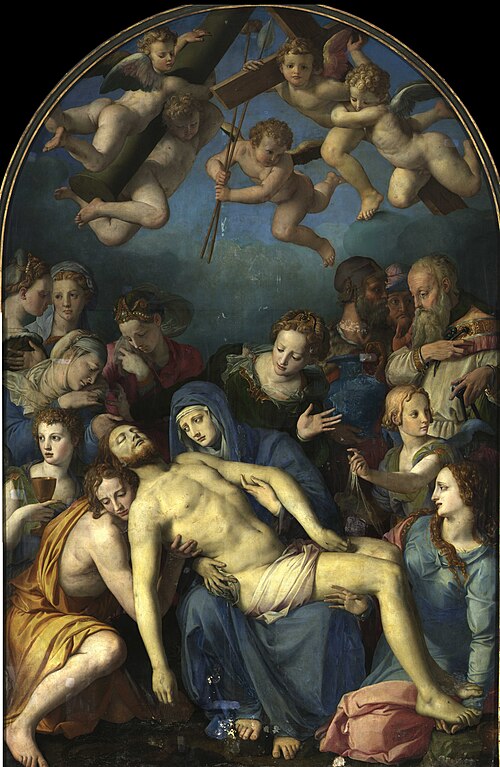
In 1847, physician William Stroud proposed the ruptured heart theory as the cause of Jesus' death, drawing on the reference in the Gospel of John (John 19:34) to blood and water flowing from his side when pierced with a spear; this early theory went on to influence a number of others.[211][212]
The cardiovascular collapse theory is a prevalent modern explanation that proposes that Jesus died of profound shock. According to this theory, the scourging, the beatings, and the nailing to the cross left Jesus dehydrated, weak, and critically ill and this led to cardiovascular collapse.[213]
In 1986, physician William Edwards and his colleagues, writing in the Journal of the American Medical Association, supported the combined cardiovascular collapse (via hypovolemic shock) and exhaustion asphyxia theories, interpreting the flow of water from Jesus' side described in the Gospel of John was pericardial fluid.[214]
医師であり法医学者でもあるフレデリック・ズギベは、著書『イエスの磔刑』の中で、イエスの死の状況について非常に詳細に研究した。[ 215 ] [ 216 ]ズギベは検死官を務めていた数年間、自身の理論を検証するために数多くの実験を行った。[ 217 ]これらの研究には、特定の重量のボランティアを特定の角度で吊り下げ、足も固定した場合と固定しない場合で、各手にかかる引っ張る力を測定する実験が含まれていた。これらの場合、引っ張る力とそれに伴う痛みは有意であることがわかった。[ 217 ]
フランスの医師でパリのサン・ジョセフ病院の主任外科医であったピエール・バルベ[ 218 ]は、イエスが疲労による窒息に直面して、最後の言葉を発するのに十分な空気を得るために筋肉を弛緩させたという仮説を立てた[ 219 ] 。釘の位置など、バルベのいくつかの理論はズギベによって異議を唱えられている。
整形外科医のキース・マックスウェルは、磔刑の医学的側面を分析しただけでなく、イエスがヴィア・ドロローサで十字架を担いで歩いたことによる肉体的負担についても考察した。[ 220 ] [ 221 ]
2003年、歴史家のFP RetiefとL. Cilliersは、ローマ人が行った磔刑の歴史と病理を検証し、死因はしばしば複数の要因の組み合わせであったと示唆した。彼らはまた、ローマの警備兵は死が起こるまで現場を離れることを禁じられていたとも述べている。[ 222 ]

キリスト教徒は、イエスの死が人類と神との関係を回復させる上で重要な役割を果たしたと信じている。[ 223 ] [ 224 ]キリスト教徒は、イエスの死と復活を通して、人々は神と和解し、この世と永遠の命において喜びと力の両方を受け取ることができると信じている。[ 225 ] [ 226 ]このように、イエスの十字架刑と復活は、神の臨在、愛、恵みの活気に満ちた体験と永遠の命への確信へのアクセスを回復させる。[ 227 ]
The accounts of the crucifixion and subsequent resurrection of Jesus provide a rich background for Christological analysis, from the canonical Gospels to the Pauline epistles.[228] Christians believe Jesus' suffering was foretold in the Old Testament, such as in Psalm 22, and Isaiah 53 prophecy of the suffering servant.[229]
In Johannine "agent Christology" the submission of Jesus to crucifixion is a sacrifice made as an agent of God or servant of God, for the sake of eventual victory.[230][231] This builds on the salvific theme of the Gospel of John which begins in John 1:29 with John the Baptist's proclamation: "The Lamb of God who takes away the sins of the world".[232][233]
A central element in the Christology presented in the Acts of the Apostles is the affirmation of the belief that the death of Jesus by crucifixion happened "with the foreknowledge of God, according to a definite plan".[234] In this view, as in Acts 2:23, the cross is not viewed as a scandal, for the crucifixion of Jesus "at the hands of the lawless" is viewed as the fulfillment of the plan of God.[234][235]
Paul's Christology has a specific focus on the death and resurrection of Jesus. For Paul, the crucifixion of Jesus is directly related to his resurrection and the term "the cross of Christ" used in Galatians 6:12 may be viewed as his abbreviation of the message of the gospels.[236] For Paul, the crucifixion of Jesus was not an isolated event in history, but a cosmic event with significant eschatological consequences, as in 1 Corinthians 2:8.[236] In the Pauline view, Jesus, obedient to the point of death (Philippians 2:8) died "at the right time" (Romans 4:25) based on the plan of God.[236] For Paul the "power of the cross" is not separable from the resurrection of Jesus.[236] Furthermore, Paul highlighted the idea that Jesus on the cross defeated the spiritual forces of evil "Kosmokrator", literally 'the rulers of this world' (used in plural in Ephesians 6:12), thus highlighting the idea of victory of light over darkness, or good over evil, through Jesus.[237]
Belief in the redemptive nature of Jesus' death predates the Pauline epistles, to the earliest days of Christianity and the Church of Jerusalem.[238] The Nicene Creed's statement that "for our sake he was crucified" is a reflection of this core belief's formalization in the 4th century.[239]
ジョン・カルヴァンは「神の代理人」キリスト論を支持し、ピラトの法廷での裁判においてイエスは無罪を主張できたはずなのに、父なる神への従順さから十字架刑を受け入れたと主張した。[ 240 ] [ 241 ]このキリスト論的テーマは、東方キリスト教と西方キリスト教の両方で20世紀まで続いた。東方キリスト教では、セルゲイ・ブルガコフが、イエスの十字架刑はアダムの堕落によって引き起こされた恥辱から人類を贖うために、世界の創造以前に父なる神によって「永遠に」決定されていたと主張した。[ 242 ]西方キリスト教では、カール・ラーナーが、十字架刑で流された神の子羊の血(およびイエスの脇腹から流れた水)には洗礼の水と同様の清めの性質があるという類推を詳しく述べた。[ 243 ]
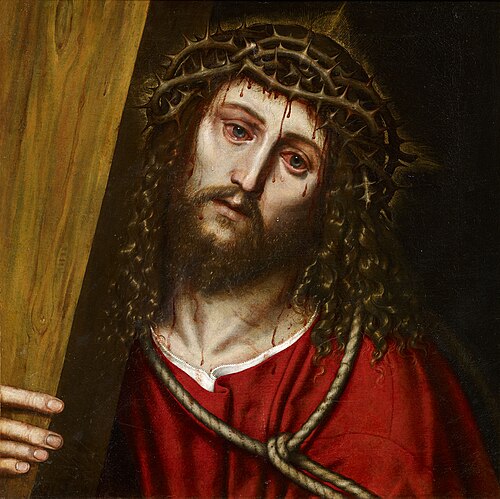
イエスの死と復活は、人類に救いが与えられる方法に関するさまざまな神学的解釈の根拠となっている。これらの解釈は、イエスの言葉と比較して、死と復活にどれだけ重点を置くかという点で大きく異なっている。 [ 244 ]身代わりの贖罪の見解によれば、イエスの死は中心的な重要性を持ち、イエスは復活後、神を喜ばせる愛の犠牲として完全な服従の行為として自ら進んで犠牲になった。[ 245 ]対照的に、道徳的影響による贖罪の理論は、イエスの教えの道徳的内容にずっと重点を置き、イエスの死を殉教と見なしている。[ 246 ]中世以来、西洋キリスト教内ではこれら2つの見解の間で対立があった。福音派プロテスタントは一般的に身代わりの見解を持ち、特に刑罰的身代わりの理論を支持している。自由主義プロテスタントは一般的に身代わりの贖罪を拒否し、道徳的影響による贖罪の理論を支持している。どちらの見解もローマ・カトリック教会内では広く受け入れられており、償いの教義は懺悔の概念に組み込まれている。[ 245 ]
In the Roman Catholic tradition this view of atonement is balanced by the duty of Roman Catholics to perform the Acts of Reparation to Jesus Christ[247] which in the encyclical Miserentissimus Redemptor of Pope Pius XI were defined as "some sort of compensation to be rendered for the injury" with respect to the sufferings of Jesus.[248]Pope John Paul II referred to these acts of reparation as the "unceasing effort to stand beside the endless crosses on which the Son of God continues to be crucified."[249]
Among Eastern Orthodox Christians, another common view is Christus Victor.[250] This holds that Jesus was sent by God to defeat death and Satan. Because of his perfection, voluntary death, and resurrection, Jesus defeated Satan and death, and arose victorious. Therefore, humanity was no longer bound in sin, but was free to rejoin God through the repentance of sin and faith in Jesus.[251]
The Church of Jesus Christ of Latter-day Saints teaches that the crucifixion of Jesus was part of the atonement and a "redeeming ransom" both for the effect of the fall of Adam upon all humankind and "for the personal sins of all who repent, from Adam to the end of the world."[252]
The Catholic Church denounces the idea of Jewish deicide, believing that all sinners are the authors and ministers of Jesus' crucifixion, and admonishes Christians that their own guilt is greater when they sin with knowledge of Jesus, than when others sin without it.[253][254]
Nevertheless, through most of its history, the mainstream Christian intellectual tradition blames the Jews at the time and forever for the crucifixion of Jesus. This blame is incorrect as an established historical fact. The Gospels shifted blame from Roman gentiles to the Jews as a way to explain away their rejection of the divinity of Jesus and to make Christianity more palatable to gentiles. According to Lüdemann, this claim "can still be heard and is not sufficiently contradicted."[255]
歴史的に、キリスト教においてドケティズムは、イエスの現象、すなわち彼の歴史的かつ肉体的な存在、そして何よりもイエスの人間としての姿は、真の現実を伴わない単なる見せかけに過ぎないという教義であった。[ 256 ]ドケティズム信奉者は、イエスの肉体は幻影であるため、イエスが本当に苦しみ、死んだことはあり得ないと否定し、十字架刑は起こったように見えるだけの出来事だと考えた。[ 257 ]
ナグ・ハマディ文書群にあるヤコブの第一啓示によれば、イエスは十字架にかけられた後、ヤコブの前に現れ、自分の代わりに別の人物が十字架にかけられたと述べた。
師が彼の前に現れた。彼は祈りをやめ、師を抱きしめ、口づけをして言った。「ラビ、あなたを見つけました。あなたが耐え忍んだ苦しみを聞いて、私は大変心を痛めました。あなたは私の慈悲深さをご存知です。このことを思い巡らすと、二度とこの人たちに会いたくないと思いました。彼らは自分たちの行いに対して裁かれなければなりません。彼らの行いは正しくないからです。」師は言った。「ヤコブよ、私やこの人たちのことを心配するな。私は私の内にいた者である。私は全く苦しんだことも、悩んだこともなかった。この人たちは私に害を与えなかった。むしろ、これらすべては支配者たちの象徴に降りかかったことであり、この象徴が彼らによって滅ぼされるのは当然のことだった。」[ 258 ]
イスラム教のほとんどの伝統は、イエスが十字架上であろうと他の方法であろうと、肉体的に死んだことを断固として否定している。この否定はコーランにも明記されており、次のように述べられている。
そして彼らは、「我々は確かに、アッラーの使徒であるマリアの子イエス、メシアを殺した」と言う。しかし彼らは彼を殺したわけでも、十字架につけたわけでもない。そう見えるように仕向けられただけである。そして確かに、このことで意見が分かれる者たちは、疑念を抱いている。彼らは憶測に従う以外に、このことについて何の知識も持っていない。そして彼らは確かに彼を殺していない。(157)むしろアッラーは彼を御自身のもとに引き上げられた。アッラーは常に力と英知において至高であられる。(158)
イスラム教の伝承では、イエスは十字架にかけられることなく天に昇ったが、神が別の人物をイエスと全く同じ姿に変え、代わりに十字架にかけたと教えている。この見解の古代の先例は、2世紀のアレクサンドリアのグノーシス主義者バシリデスの教義に関するイレナイオスの記述に見られる。イレナイオスは、イエスの死を否定する異端説だと彼が信じるものを反駁している。 [ 260 ]
Some scriptures identified as Gnostic reject the atonement of Jesus' death by distinguishing the earthly body of Jesus and his divine and immaterial essence. According to the Second Treatise of the Great Seth, Yaldabaoth (the Creator of the material universe) and his Archons tried to kill Jesus by crucifixion, but only killed their own man (that is the body). While Jesus ascended from his body, Yaldabaoth and his followers thought Jesus to be dead.[261][262] In Apocalypse of Peter, Peter talks with the savior whom the "priests and people" believed to have killed.[263]
Manichaeism, which was influenced by Gnostic ideas, adhered to the idea that not Jesus, but somebody else was crucified instead.[264]:41 Jesus suffering on the cross is depicted as the state of light particles (spirit) within matter instead.[265]
According to Bogomilism, the crucifixion was an attempt by Lucifer to destroy Jesus, while the earthly Jesus was regarded as a prophet, Jesus himself was an immaterial being that can not be killed. Accordingly, Lucifer failed and Jesus' sufferings on the cross were only an illusion.[266]
According to some Christian sects in Japan, Jesus Christ did not die on the cross at Golgotha. Instead his younger brother, Isukiri,[267] took his place on the cross, while Jesus fled across Siberia to Mutsu Province, in northern Japan. Once in Japan, he became a rice farmer, married, and raised a family with three daughters near what is now Shingō. While in Japan, it is asserted that he traveled, learned, and eventually died at the age of 106. His body was exposed on a hilltop for four years. According to the customs of the time, Jesus' bones were collected, bundled, and buried in a mound.[268][269] There is also a museum in Japan which claims to have evidence of these claims.[270]
In Yazidism, Jesus is thought of as a "figure of light" who could not be crucified. This interpretation could be either taken from the Quran or Gnostics.[271]

イエスの磔刑以来、十字架はキリスト教の象徴の重要な要素となり、磔刑の場面はキリスト教美術の重要な要素となり、 「十字架を担うキリスト」、 「十字架の掲げ方」 、「スターバト・マーテル」、 「十字架降架」、「キリストの哀悼」といった特定の芸術的テーマを生み出してきた。
今日最も広く認識されているキリスト教のシンボルの1つである十字架の象徴性は、キリスト教の初期の時代から用いられていました。165年に亡くなったユスティノス殉教者は、十字架像が登場したのは後であるにもかかわらず、すでにそれがシンボルとして用いられていたことを示唆するような形で十字架について述べています。[ 272 ] [ 273 ]
キリスト教徒の間では、十字架刑の過程とイエスの苦しみに基づいた信心業が広く行われています。十字架の道行きは、イエスの十字架刑の段階に基づいた一連の祈りであり、聖なる傷のロザリオは、十字架刑の一部としてのイエスの傷について黙想するために用いられます。
ジョット、フラ・アンジェリコ、マサッチオ、ラファエロ、ボッティチェッリ、ヴァン・ダイク、ティツィアーノ、カラヴァッジョ、エル・グレコ、スルバラン、ベラスケス、ルーベンス、レンブラントといった巨匠たちは皆、作品の中で磔刑の場面を描いている。ティソの「十字架から見た磔刑」は、 19世紀末にイエスの視点から磔刑の場面を描いた斬新なアプローチを提示した。[ 274 ] [ 275 ]
ヨハネの福音書に記されている十字架の下に聖母マリアがいたことは、それ自体がマリア美術の主題であり、奇跡のメダルや聖母十字架をあしらった教皇ヨハネ・パウロ2世の紋章など、よく知られたカトリックの象徴となっています。また、多くのマリア崇敬もカルバリの丘に聖母マリアがいたことを前提としており、例えば教皇ヨハネ・パウロ2世は「マリアは十字架上でイエスと結びついた」と述べています。[ 277 ] [ 278 ]ラファエロ(モンドの磔刑)やカラヴァッジョ(キリストの埋葬)などの巨匠によるキリスト教美術の有名な作品では、聖母マリアが磔刑の場面の一部として描かれています。


無神論者の新約聖書学者ゲルト・リューデマンは、「偽死や欺瞞の仮説が時折提示されるにもかかわらず、十字架刑の結果としてイエスが死んだという事実は議論の余地がない」と述べている。ジョエル・B・グリーンは、「キリスト教、ユダヤ教、ローマの資料からの複数の証拠が、ナザレのイエスに関する入手可能なデータの中で、ポンティウス・ピラトの命令によるローマの十字架での処刑ほど議論の余地のないものはないという主張を裏付けている」と結論付けている。
イエスはユダヤ人で、説教者であり教師として知られており、ローマ皇帝ティベリウスの治世中にエルサレムで十字架刑(ローマ式の処刑)に処せられました。当時、ポンティウス・ピラトはユダヤの総督でした。「ポンティウス・ピラトによるイエスの十字架刑は、もちろん文脈的に信憑性があります。ローマ人は常に多くの人々を十字架につけていました。そしてこれは、マルコ、M、L、ヨハネ、使徒言行録の説教、言うまでもなくヨセフスやタキトゥスなど、豊富に証拠のある伝承の一つです。1テモテでは独立して言及されています。十字架刑自体は、(ピラトなしで)パウロ全体と、1ペテロ、ヘブライ人への手紙など、他のさまざまな独立した資料で証明されています。これはイエスに関する最も確かな伝承の一つであり、後述するように、次の基準も難なくクリアするものである。
The approximate period of his death (c. CE 30, plus or minus one or two years) is confirmed by the requirements of the chronology of Paul.
。 最もよく利用される3つの出口は、西に1つ、東に1つ、北に1つです。北側から街に入ると、通りの方向の状況から、最初の聖地は、コンスタンティヌスがそれほど昔ではないときに非常に敬意を込めて建てた、マルティリウムと呼ばれる教会です。次に、西に行くと、ゴルゴタとアナスタシスを結ぶ場所を訪れます。実際、アナスタシスは復活の場所にあり、ゴルゴタはアナスタシスとマルティリウムの中間、主の受難の場所にあり、そこにはかつて主が背負った十字架に耐えた岩が今も残っています。これらはシオン山の外側にある離れた場所で、その場所の崩れた隆起が北に広がっています。