Loading article…
漢服(簡体字中国語:汉服;繁体字中国語:漢服;ピンイン: Hànfú、文字通り「漢の衣服」)は、漢装(簡体字中国語:汉装; 繁体字中国語:漢裝; ピンイン: Hànzhuāng、「漢の衣装」)または伝統的な中国の衣服としても知られており、 [ 1 ]少なくとも紀元前2千年紀から西暦17世紀半ばまで、つまり明王朝末期までの中国の記録された歴史のほぼすべてを網羅して、多数派の漢民族が着用していた歴史的な中国の衣服です。清王朝による暴力的な征服と強制的な同化により、ティファイフとして知られる歴史的出来事で満州族の七装と馬瓢に取って代わられました。 21世紀初頭からの中国の台頭により、現在、中国本土および華人ディアスポラの若い世代の間で、漢服を中国文化と美意識の真の正統的な代表として復活させ、再確立しようとする文化運動が拡大している[ 2 ] [ 3 ] [ 4 ] [ 5 ]。これは、満州族に影響を受けた旗袍や湯荘、日本の学校制服(学ラン)に影響を受けた毛沢東服とは対照的である。
漢服には、襦群(上着の上に高く着る長いスカート)、澳群(長いアンダースカートが付いた上着)、貝子(ゆったりとした前開きのコート) 、申衣(ワンピースのローブ)[ 2 ]、そして山椀(ズボンが付いた上着) [ 6 ] : 24など、いくつかの代表的なスタイルがあります。歴史的に、漢服の最も一般的なフォーマルなスタイルは、男性の場合は袍服と呼ばれる幅広の袖のローブ、女性の場合は襦(ジャケット)と呼ばれる上着と群(スカート)と呼ばれる下着の組み合わせです。これらのスタイルのほぼすべてにおいて、上着または下着のどちらか一方に、交差襟(襦襄と呼ばれる)があり、左前身頃が右前身頃と重なり、右腰(耀仁と呼ばれる)で結び紐で留められています。漢服には衣服の他に、様々な形の帽子、履物、そして帯やバックル、宝飾品、玉佩、扇子などのアクセサリーも含まれる。[ 2 ]
多くの中国の伝統物と同様に、漢服はその名前を、国際的な影響力を持つ中国初の黄金時代である漢王朝に由来しています。漢王朝の何世紀にもわたる繁栄と安定により、特に養蚕の急速な進歩とともに、繊維生産と染色の多くの技術的進歩により、漢服はさまざまなスタイルに発展しました。[ 7 ]極東における中国の歴史的な優位性により、漢服は、韓国の韓服[ 8 ]、日本の着物[ 9 ] [ 10 ] 、琉球の流装[ 11 ] [ 12 ] 、ベトナムのアオジャオリンなど、中国文化圏内の多くの近隣諸国の伝統的なファッションにも影響を与えています。[ 13 ] [ 14 ]漢服のデザイン要素は西洋ファッションにも影響を与えており、特にシノワズリファッションを通じて、17世紀以降ヨーロッパや北米でシノワズリが人気を博したことがその影響を及ぼしている。 [ 15 ]

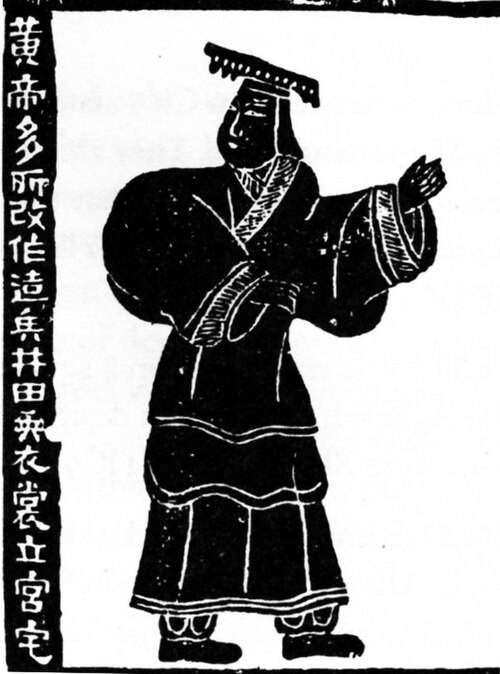
漢服は一般的に、3千年以上の歴史を持つ漢民族のあらゆる歴史的な衣服の分類を包含する。[ 16 ] [ 17 ]歴代の王朝はそれぞれ独自の服装規定を生み出し、その時代の社会文化的環境を反映していた。[ 18 ] [ 19 ]絹で作られた衣服は当初、装飾や儀式の目的で使用されていた。しかし、絹の栽培は織物の発展をもたらし、漢王朝の時代には、錦織、ダマスク織、サテン、ガーゼなどが開発されていた。[ 20 ]
漢服の歴史の始まりから、 (特にエリート層の間では)絹と養蚕の技術は切り離せないものであり、養蚕は黄帝の妃である雷祖によって発見されたとされ、彼女は養蚕の女神としても崇拝されていた。[ 21 ] [ 22 ]『易経』には次のような言葉もある。[ 23 ]
黄帝、堯、舜は(ただ)上着と下着(衣裳;衣裳)を着用し(民衆の手本として)、天下は秩序正しく保たれた。
漢服は、一般的に殷王朝時代に起源を持つとされているが、時代とともに変化し進化してきた。初期のデザインは、後期のものに比べて性別にとらわれず、よりシンプルなカットが特徴である。後期の衣服は複数のパーツから構成され、男性はズボン、女性はスカートを着用するのが一般的となった。女性の衣服は、上着の襟を巻き付けたり、帯でウエストを締めたりすることで、体の自然な曲線美を強調するようになっている。
古代から、漢服の上着である汝は、通常、前で巻きつけるスタイルで着用され、これは襄陵汝人と呼ばれるスタイルで、左側が右側を覆い、着用者の右腰まで伸びます。当初、このスタイルは、右利きの着用者が右側を先に巻く習慣があったために使用されました。後に、中国中央平原の人々は、左利きを不自然、野蛮、未開、不幸なこととみなし、左利きを奨励しませんでした。汝人の襟は陰陽理論に従っており、左の襟は陽(生命を象徴)を表し、陰(死を象徴)を抑制します。したがって、汝人は生きている人の衣服であり、反対に着用すると左人と呼ばれるスタイルになり、衣服は埋葬の衣服となり、タブーとみなされます。[ 19 ]左人は中国の一部の少数民族グループでも使用されています。[ 24 ] [ 25 ]
古代中国のファッションには、信仰、宗教、戦争、皇帝の個人的な好みなど、多くの要因が影響を与えてきた。[ 26 ]秦王朝以降、漢民族の奢侈禁止令で用いられる色は、道教の五行説と陰陽説に基づき、象徴的な意味を持つようになった。各王朝は特定の色を好んだ。[ 27 ]漢服の要素の中には、近隣の文化圏の衣服、特に北方の遊牧民や、シルクロードを経由して西方の中央アジア文化の影響を受けたものもある。[注1 ] [ 28 ] : 44–46 [ 29 ] [ 30 ] : 312
中国では、衣服の体系的な構造が最初に開発されたのは殷王朝時代で、色、デザイン、使用に関する規則が社会階層全体に適用されました。[ 7 ]当時の技術水準から、原色(赤、青、黄)と緑のみが使用されました。[ 31 ]
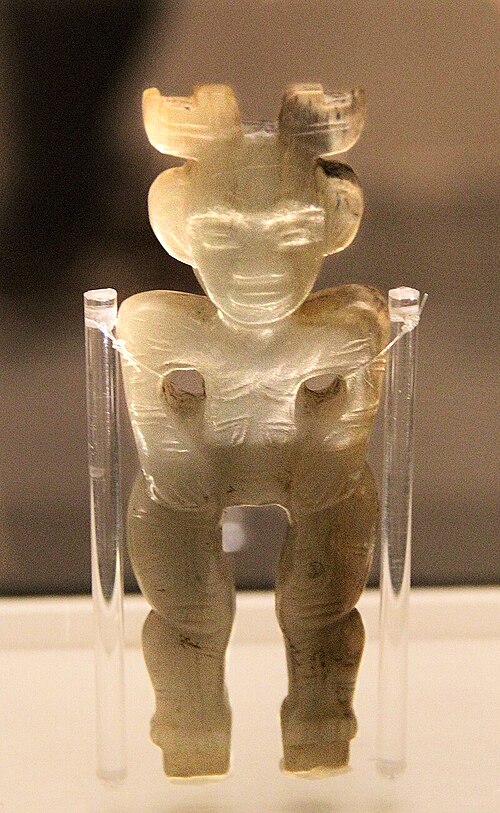
漢服の基礎はこの時期に発展しました。上着と下着の組み合わせである「衣昌」は通常、袈裟と一緒に着用されました。[ 32 ] [ 33 ] [ 31 ]上着の一種である「襦陵友人衣」はこの時期に着用され始めました。[ 34 ]冬には、中綿入りのジャケットが着用されました。[ 31 ]膝丈のズボンで、ふくらはぎで結び、太ももは露出した「く」または「静衣」は、昌の下に着用されました。[ 35 ]この時期、この服装スタイルは男女兼用でした。[ 31 ]絹は裕福な人だけが着用し、貧しい人は麻や苧麻で作られたゆったりとしたシャツとくを着用し続けました。[ 31 ]殷王朝の衣装の一例として、安陽の傅好墓から出土した人型の玉像が挙げられる。この像は、細長い袖の衣を着て、腰に幅広の帯を巻き、その下にスカートを履いている人物を描いている。[ 36 ] [ 37 ] [ 38 ]この衣は貴族階級向けにデザインされたものと思われる。[ 36 ]


殷王朝の後、西周王朝は衣服に関する新たな礼儀作法と儀礼体系を確立し、衣服に新たな儀礼的、政治的、文化的意義を与えた。これにより、ファッションは人々の儀礼や文化と結びつき、 2000年にわたり東アジア文化を支配した儒教の禮正統派の基礎となった。これに関連して、孔英達の『春秋左伝』などの儒教文献では、華夏という言葉は中央諸国の儀礼的礼儀作法と、それらの国の住民が着用する衣服の両方を指していたと示唆している。[ 39 ] [ 40 ] [ 41 ] [ 42 ]
この慣習の原則は、上衣下裳(上衣と下衣、つまり上着と下着を2つのアイテムに分けること)と呼ばれる衣服のスタイルの標準化でした。[ 43 ] [ 44 ]ファッションは徐々に進化し、神衣などのスタイルに取って代わられましたが、上衣下裳は依然として面府や朝府などの正装や儀式用の衣服の基礎として維持されました。[ 45 ]これにより、衣服を身分を示す基準として用いる厳格な階層社会が生まれ、必然的に、身分の高さが衣装の華やかさに影響を与えました。衣装は儀式での使用によっても区別されました。これが、後世のすべての時代と王朝の複雑な衣服システムの先駆けとなりました。[ 24 ] [ 46 ] : 255–261そのため、『周礼』や『礼記』に記録されているように、官服や綿服などの品物が重要視された。[ 47 ]官服は社会的身分を区別するために用いられ、官服の使用は漢服制度の特徴の一つであり、男性は官礼と呼ばれる成人式を終えた後にのみ着用することができた。[ 33 ] : 16身分を示すその他の指標には、生地の素材、衣服の形、大きさ、色、装飾模様、スカートの長さ、袖の幅、装飾の程度などがあった。[ 46 ] : 255–261皇帝、封建領主、高官、兵士、祖先崇拝者、花嫁、喪に服す者の衣服には厳格な規定があった。[ 46 ] : 255–261 [ 48 ]
綿袈裟は最も格式の高い正装で、礼拝や追悼の儀式で着用されました。複雑な構造を持ち、象徴的な意味を持つ様々な装飾が施されていました。綿袈裟には6つの等級があり、皇帝、王子、官僚はそれぞれの称号に応じて着用しました。[ 33 ]皇帝は官僚と会うときや公務を行うときには、また、綿袈裟に次ぐ等級の袈裟も着用しました。 [ 33 ]皇帝が宮廷にいないときは、玄端袈裟を着用しました。[ 46 ] : 255–261 [ 49 ]玄端袈裟は、王子が供犠の際に着用したり、学者が朝に両親に敬意を表するために着用したりすることもできました。[ 33 ]綿袍、袍袍、宣端はいずれも、下にスカート、真ん中にローブ、上に袈裟、そして長い布の帯である大帯(中国語:大帯)の4つの部分から構成されていた。[ 33 ]西周王朝と同様に、東周王朝初期の服装規定は、社会秩序を維持し、社会階級を区別するために用いられる厳格な規則によって支配されていた。[ 36 ]
これらの階級指向の発展に加えて、この時代の日常の漢服は、殷王朝の基本的な形を維持しながら、ややゆったりとした形になった。[ 24 ]袖は幅広と幅狭の両方が共存していた。袖は腰に巻く帯で閉じられ、帯には玉の装飾が吊り下げられることもあった。[ 24 ] [ 51 ]スカートと褶の長さは、膝丈から地面まで様々だった。[ 24 ]周王朝の庶民、中国南西部の少数民族も含め、麻を主原料とした衣服を着用していた。[ 20 ]
周王朝では、女性が妾を着用することを、婚約後に行われる成人式である妾礼で正式に定めた。妾を着用することは、その女性がすでに結婚の約束を交わしていることを示していた。[ 52 ]男性も妾だけを着用できたが、より一般的には、男性は妾を冠と一緒に着用して頭飾りを固定した。[ 53 ]
この儀式は、幼少期から成人期への重要な移行を示すものであり、女性の結婚への準備と社会における新たな責任を象徴している。これらの簪は、シンプルな簪からより精巧な簪へと進化しており、王朝様式の変化や中国の宝飾品の芸術性の高まりを反映していることが多かった。翡翠、白檀、貴金属などの素材は、美的魅力だけでなく、美徳、自然とのつながり、地位を表す文化的、象徴的な意味合いも考慮して選ばれた。[1] [ 54 ]
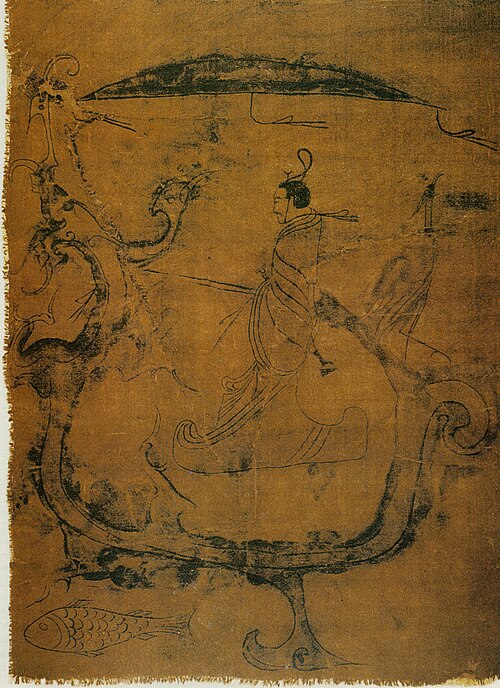


春秋時代と戦国時代には、中国では儒教を含む多くの思想学派が出現し、それらの異なる思想学派は当然ながら衣服の発展に影響を与えた。[ 51 ]さらに、戦国時代に頻繁に戦争が起こったため、さまざまな礼儀作法が徐々に廃止された。[ 55 ]東周王朝の服装規定は戦国時代の中期までに衰退し始めた。[ 36 ]その後、多くの地域が周王朝の制度に従わないことを決定し、この時期の衣服は7つの主要国(楚、漢、秦、魏、燕、斉、趙の国)間で異なっていた。[ 7 ] [ 46 ]: 255-261 [ 55 ]さらに、紀元前307年は、趙の武陵王によって軍服の最初の改革が実施された重要な年でもあった。この改革は一般に胡府旗社と呼ばれ、戦闘能力を高めるために、趙の兵士全員に東湖、臨湖、楼帆の人々の胡府式の軍服を着用することを義務付けた。 [ 33 ] [ 46 ] : 257 [ 56 ]その後、ゆったりとした股上の赫蘆が導入された。[ 33 ] [ 35 ] [ 57 ]
東周王朝時代の考古学的遺物に基づくと、一般の男性、農民、労働者は、袖の狭い長い臥人衣を着ており、その上に腰で碇嘗(したとう)と呼ばれる細い絹の帯を結んでいた。[ 36 ] [ 50 ]また、臥人衣は動きやすさを向上させるために升(一般的には山升と呼ばれる様式)と一緒に着用されたが、絹ではなく普通の布で作られていた。[ 36 ]この時代の山升は胡茗にも影響を与えた。[ 36 ]しかし、貴族はそのような衣服は着ておらず、腰で帯を締めた袖の広い長い臥茗を着ていた。一例として、滎陽戦国時代の墓から出土した木像が挙げられる。 [注2 ] [ 36 ] [ 50 ]幽仁の留め具には、蛟陵幽仁や曲居幽仁など、さまざまな形状のものがある。[ 36 ]
考古学的遺物や彫刻された青銅像に基づくと、戦国時代にもスカートが着用されていたようで、[ 58 ]シャンチュンまたはルチュンとして着用されていた。[注3 ] [ 59 ]シャンチュンを着用した青銅像の考古学的例としては、曽の易侯墓から出土した鐘を掲げた青銅製の武装戦士像がある。[ 59 ]戦国時代後期の濃い黄色のスカートも、湖北省江陵県馬山遺跡の楚墓(M1)で発見されている。[ 60 ] [ 61 ] [ 62 ]


戦国時代には、神衣も発展した。[ 63 ] : 9–14 [ 46 ]螺旋状に巻かれ、袖がゆったりとした神衣の一種である曲襤袍は、同時代の墓の土偶に着用されていたことが分かっている。 [ 6 ] : 24 [ 64 ]墓から出土した衣服からは、楚の国の貴族が神衣を着用していたことが示されている。 [ 65 ]神衣の人気が高まったのは、儒教の影響も一因であった可能性がある。[ 24 ]神衣は、周王朝から秦王朝、そして漢王朝まで、漢服の主流であり続けた。[ 66 ] [ 46 ] : 255–261

秦王朝は短命であったが、後世に大きな影響を与える一連の制度を確立した。 7つの国を統一した後、秦の始皇帝は、距離や階級に関係なく、衣服を含むあらゆる文化面で一連の規則に従うよう民衆に命じた。[ 46 ]そのため、秦の服装様式は統一されていた。[ 67 ]秦王朝は色分けされた衣服制度を採用し、地位の高い人々(三級以上の官吏)は緑色の神衣を、一般の人々は通常の白色の神衣を着用した。[ 68 ] : 183 [ 33 ]漢民族は神衣を正装として着用し、官帽と靴と一緒に着用した。[ 33 ] : 16秦王朝は周王朝の綿府階級制度を廃止し、皇帝には袀玄と呼ばれる統一された黒色の神衣[後漢書1 ]と、綿官の代わりに通天官を採用した[ 69 ] [ 70 ]。官僚もこれに倣い、同じ黒色の袀玄を着用した[ 6 ] : 24 [ 68 ] : 183朝廷では、官僚は帽子をかぶり、腰から彫刻刀をぶら下げたゆったりとした袀玄を着用し、毫を持ち、頭と耳の間に墨筆を挟んでいた[ 6 ] : 24 [ 68 ] : 183男性の間では、袖口に紐の付いた大きな袖の袀玄が人気を集めた[ 6 ] : 24 [ 68 ] : 183


平時は、男性はルクを、女性はルクンを着用していた。[ 33 ] : 16商人は、その富に関係なく、絹製の衣服を着用することは決して許されなかった。[ 71 ]庶民や労働者は、袖の狭い賈玲袍、ズボン、スカートを着用し、髪を編むか、単に頭巾とスカーフを身につけていた。[ 6 ] : 23–33 [ 68 ] : 183 [ 60 ]秦の時代の竹簡『制衣』には、様々な種類の裙(スカート、秦の時代には衺と呼ばれた) 、上襦(ジャケット)、大襦(アウター)、く(ズボン)の製作が記録されている。 [ 60 ] [ 61 ] 兵馬俑には、兵士と将校の服装の違いも示されており、エリートは長いガウンを着用し、一般人は皆短いジャケットを着用していた。また、彼らはシンプルな頭巾から正式な官帽まで、様々な頭飾りを着用していた。[ 72 ]騎兵隊員は長袖で腰丈のジャケットとパッド入りのズボンを着用している姿も描かれている。[ 72 ]


漢王朝の時代になっても神衣は人気を保ち、曲襦襦と志襦襦の2種類に発展した。[ 63 ] : 9–14性別に関係なく、服の裁断と構造は似ていた。ベルトや帯で留める巻き留めで、大きな袖は狭い袖口に集められていた。しかし、服の生地、色、装飾は性別によって異なっていた。[ 56 ]しかし、後漢の時代には神衣を着る人はほとんどいなくなった。[ 73 ]


漢王朝初期には、庶民の服装に制限はなかった。[ 7 ]西漢時代には、一般の服装に関する勅令は、民衆を制限するほど具体的ではなく、あまり厳格に施行されなかった。[ 7 ]服装は季節に応じて異なり、春は青または緑、夏は赤、秋は黄色、冬は黒であった。[ 7 ] [ 48 ] [ 63 ]: 4漢の明帝は、西暦59年、東漢時代に漢王朝の服装規定を正式に定め、秦王朝の以前の軍訓から面府制度の儀礼的な使用を復活させた。[ 46 ] : 255–261 [後漢書 2 ]新しい服装規定によれば、皇帝は黒色の上着と黄土色の下着を着用しなければならなかった。[ 46 ] : 255–261『尚書益稷』には、かつて社会階級を区別するために用いられた祭祀用の衣服に用いられる12の装飾品が記録されている。 [ 74 ] [ 75 ]さらに、皇帝、参事、公、王子、大臣、官吏が用いる装飾品に関する規定も明記された。[ 46 ] : 255–261 [ 74 ]社会階級に基づく明確な服装様式があり、これらの規定には儒教の儀式が伴っていた。[ 67 ]役人を区別するために、さまざまな種類の帽子、織物や生地の素材、役人の印章に付けられたリボンも使用されました。[ 33 ] : 16 [ 67 ]役人の印章は革の袋に入れられ、着用者の腰に付けられ、階級を示すためにさまざまな色、サイズ、質感のリボンが袋の外側に垂れ下がりました。[ 67 ]
漢王朝時代を通して、女性は様々な色の襦袢(ルクン)を身に着けるのが一般的でした。 [ 7 ]女性の衣服における上下の衣服の組み合わせは、やがて後の世代の漢民族の服装のモデルとなりました。[ 63 ]: 4秦漢王朝時代には、女性は4枚の布を縫い合わせたスカートを着用していました。帯はスカートに付けられていることが多かったのですが、別の帯を使用することもありました。[ 51 ]: 36


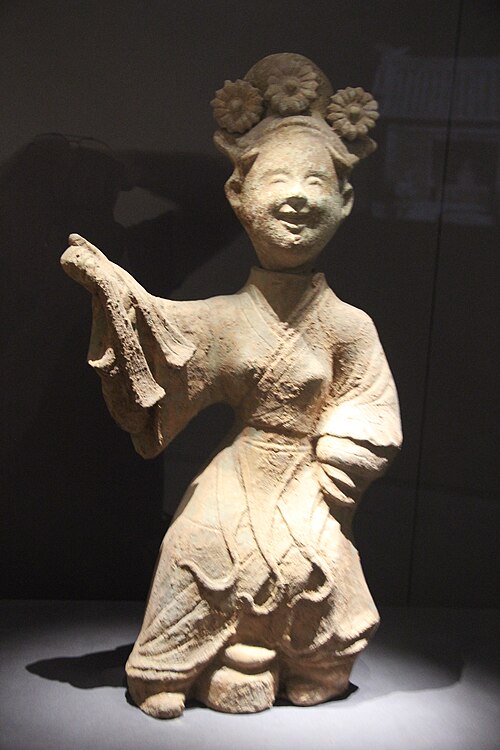

漢王朝時代には、農民、労働者、商人、学者といった男性は皆、似たような服装をしていた。男性労働者は上着、エプロン、そしてドゥビクンまたはレギンスを着用していた。[ 35 ] [ 73 ] [ 56 ]肉体労働に従事する男性が着用していた上着は、ジジュパオの短いバージョンと表現され、ズボンと合わせて着用されていた。[ 51 ] [ 56 ]ジンイーは漢王朝初期にも引き続き着用されていた。この時代の他のズボンにはダコウクとダシャオがあり、どちらも武陵王が導入したヘダンクのゆったりとした股上から発展したものである。[ 35 ]漢王朝の男性は頭にスカーフまたはグアンも着用していた。 [ 68 ] : 181–203冠は高い地位の象徴として用いられ、高貴な出自の人だけが着用できた。[ 68 ] : 181–203 [ 33 ] : 16皇帝は臣下と会う際に通天冠を着用し、遠遊冠は公爵や王子が着用し、進賢冠は文官が着用し、武官は武冠を着用した。[ 33 ] : 16頭巾は頭に巻く衣服であり、男性の成人の地位を象徴していた。[ 68 ] : 181–203頭巾の一種に帻があり、寒い時期に頭を暖かく保つためのヘッドバンドであった。時が経つにつれ、梵帽は頭を覆う巾(じん)と結び付けられ、巾帻(じんざ)と呼ばれる帽子へと発展した。 [後漢書 3 ]巾帻は広く普及し、軍人や庶民に広く着用された。軍用の巾帻は赤色で、赤帻(ちざ)とも呼ばれた。屋根型の頂部を持つ介帻(じえざ)と呼ばれる別の種類は官吏が使用し、通常は夏季までは緑がかった黒色である。[ 76 ] [後漢書 4 ]男性も女性も、パオフと呼ばれる裏地付きの長いローブを着用していた。[ 63 ]: 12-13
漢王朝末期に仏教が中国に伝来すると、仏教僧の袈裟が作られ始めた。[ 26 ] [ 72 ]漢王朝で着用された衣服は、後世の王朝の衣服の発展の基礎を築いた。[ 51 ]


漢王朝の時代には、指輪、イヤリング、ブレスレット、ネックレス、かんざし、かんざしなどの装飾品や宝飾品が中国で一般的に着用されていた。 [ 78 ] : 384–417 [ 79 ]元々のかんざしである杵は、装飾が増えて簪子へと進化した。[ 80 ]また、漢王朝時代に発明された新しいタイプの女性の髪飾りは、簪子にぶら下がる装飾が加えられ、着用者が歩くと揺れる、漢民族の女性特有のものである誅葦であった。 [ 78 ] : 384–417 [ 81 ] [後漢書 7 ]
漢王朝で着用された袈裟は進化を続けた。西暦220年から589年のこの時期には、袈裟は着用者の体にゆるやかになり、幅広の帯がベルトとしてフィット感を調整するために使用され、袈裟の袖は手首で絞るのではなく「大きく開いた」形に変わった。このスタイルは袈裟裟戴と呼ばれ、通常はインナーシャツとズボンと一緒に着用された。[ 63 ] [ 30 ]: 312-330 [ 56 ]場合によっては、袈裟の上部はゆるやかで開いており、インナーは着用されなかった。このスタイルの袈裟を着た男性は、絵画「竹林七賢人」に描かれている。[ 30 ] : 312–330宝衣の様式は北漢民族の様式であったようで、このローブの人気は道教の普及の結果である。[ 30 ] : 312–330 [ 51 ]特に晋王朝では、漢王朝の衣服の多くが維持された一方で、学者や新道教の信奉者は伝統的な宮廷服を拒否し、厳格な儒教体系から後退した。これは彼らの服装にも表れていた。[ 82 ]男性の宝衣の様式は徐々にシンプルでカジュアルなスタイルに変化し、女性の宝衣の様式はより複雑になった。[ 63 ]三国時代と晋時代、特に東晋時代(西暦317~420年)には、貴族の女性たちは東漢王朝の倫理規範の崩壊後、気ままな生活様式を求めました。このような生活様式は女性の衣服の発展に影響を与え、衣服はより精巧なものになりました。[ 63 ]この時代の典型的な女性の服装は桂衣で、袖の広い袈裟に髾(長い渦巻き状の絹のリボン)と襳(三角形の装飾刺繍布の一種)が裾に飾られ、旗のように垂れ下がり、「重ね着効果」を生み出していました。[ 83 ] [ 63 ] [ 84 ] [ 85 ]この衣服はその後も着用され続けました。司馬金龍の北魏墓(紀元483年頃)で発見された漆塗りの衝立に見られるように、南北両王朝の男女両方が衣装を制作したが、ウエストラインが高くなり、袖口が大きく広がるなど、衣装には若干の変更が加えられた。 [ 56 ]


この時期に履かれていた靴には、lü(履;正装用の通常の靴)、ji(屐;カジュアルな服装用の背の高い木製の木靴)、つま先が上向きにカールした靴などがあった。[ 30 ]: 312-330 [ 79 ]つま先が上向きにカールした靴は、後に唐の時代に非常に人気のあるファッションとなった。[ 79 ]革製のブーツ(靴、xue)、quekua(缺胯;襟が開いていて袖がタイトなローブ;下着を覆うことはできない)、フードとケープのセットは、中国北部の遊牧民によってもたらされた。[ 30 ] : 312–330この時期に発見された墓目録には、方衣(方衣)、シャン(衫; シャツ)、クン、ハンシャン(汗衫; スウェットシャツ)、ル(じゅ; 裏地付きジャケット)、ク(裤)、クン(裈)、梁堂(两裆; ベスト)、アオ(袄; 袄; 袄; 袄、クン、裤)が含まれます。多層裏地付きジャケット)、xi(褶、ジャケットの一種)、bixi ;女性の服装スタイルは通常ruqun (裏地付きのジャケットとロングスカート) とshanqun (衫裙; シャツとロングスカート) でしたが、男性の服装スタイルはローブ、シャンク、シク(褶裤; ジャケットとズボン) です。[ 30 ] : 312–330この時期には、平らな頂部と両側に耳が付いた黒いガーゼの帽子が登場し、男女ともに人気を博した。[ 51 ]
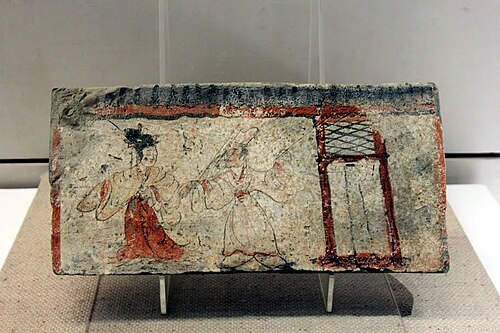
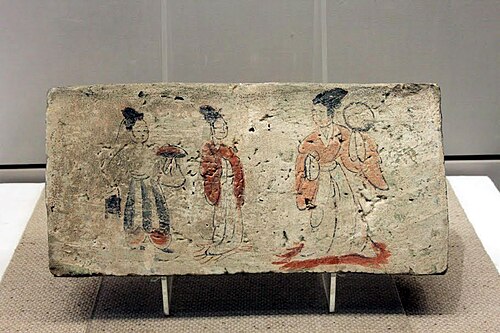
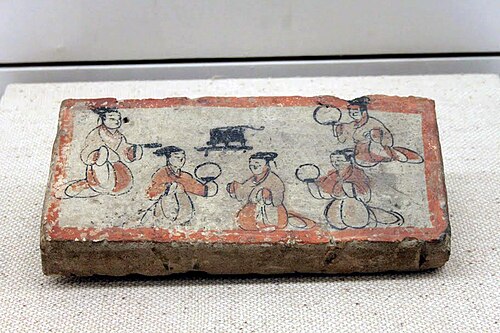
曹魏(西暦220~266年)と西晋(西暦266~316年)の王朝は独自の文化的アイデンティティを持っていたものの、漢王朝の文化的遺産を受け継いでいた。 [ 78 ]: 384~417三国時代の衣服と晋王朝(西暦266~420年)の衣服は、基本的な形は漢王朝とほぼ同じで、スタイルに特徴があった。当時着用されていた主な衣服は、襦群(上着とスカート)、裘、裘(毛皮のコート)であった。[ 87 ]この時期、エリートは一般的に袍袍を着用し、農民は短い上着と裘からなる山裘を着用していた。[ 6 ]: 23~33男性庶民は漢王朝の男性庶民と同様の服装をしていた。この時代の考古学的遺物には、男性の庶民が長袖で膝丈の袈裟を着ている姿が描かれている。男性の髪型は通常、髷か平帽で頭を覆っている。[ 30 ] : 312-330女性の庶民は男性と同様の服装をしていたが、袈裟はより長く描かれる場合もあり、長いスカートやズボンを着用していた。一方、従者(召使いと混同しないように)は、二重の衣服を着用し、地面まで届く長いスカートと、ゆったりとした長袖の袈裟を着ている姿が描かれている。[ 30 ] : 312-330袈裟はベルトや留め具で留められている場合もある。[ 30 ] : 312-330三国時代から晋時代にかけて、庶民は白を身に着けていた。[ 87 ]この時代の庶民の服装は、嘉峪関のレンガ絵にも見られる。[ 30 ] : 312-330
ダコウクは人気を保った。[ 35 ] 膝を紐で縛ったダコウクはフクとも呼ばれ、西晋時代にはフェルト紐でダコウクを縛るのが流行した。[ 30 ] : 312–330 [ 56 ]膝丈のぴったりとした綿入りのローブと合わせてクジェと呼ばれる服装として着用された。[ 35 ]クジェは南北朝時代に非常に人気のある服装スタイルで、非漢民族の文化を取り入れて作られた漢服だった。[ 35 ]西晋時代には、「晋式」と呼ばれるバックル付きの新しい形のベルトもデザインされた。[ 78 ]: 384-417「晋式」の帯は後にいくつかの外国の民族(慕容鮮卑、扶余王国、初期のテュルク人、ユーラシアのアヴァール人など)に輸出され、その後慕容鮮卑と扶余によって模倣され、高句麗と新羅の金色の儀式用帯(金属製のストラップが垂れ下がっている)へと発展した。[ 78 ]: 384-417

この時代の頻繁な戦争により、大規模な移住が発生し、複数の民族が交流しながら共に暮らすようになりました。そのため、この時期は衣服の文化交流を含む文化の統合と融合の重要な時期となりました。[ 68 ] : 181–203 [ 88 ]南部に住む漢民族は、北方の少数民族の運転服であるズボンと褶(褶; ぴったりとした袖で体にフィットする長いジャケットで、股下から膝上までの長さ)を好み、一方、北方の少数民族の支配者は漢民族の宮廷服を好みました。[ 33 ]黄河周辺地域では、十六国時代と南北朝時代には、少数民族の胡服の人気が高く、漢民族の衣服とほぼ同等でした。 [ 46 ]
両裆(りゃんだん)は、 16国時代に中国北部で着用された下着または胴着の一種である。 [ 89 ] [ 90 ]この時代に着用された、同じく両裆と呼ばれる両面装甲鎧の一種と混同してはならない。[ 30 ] : 333–334
南北朝時代には、服装は三国時代や晋朝時代の様式に倣い、ローブ、スカート、ズボン、短いジャケット、袖なしジャケットが着用され、毛皮のコート、特にテンのコートは非常に稀であった。[ 91 ]若者はズボンを好んで着用したが、女性がズボンを履くことはあまり好まれず、女性はスカートを着用した。[ 91 ]南朝時代の墓像に基づくと、この時代に着用されたローブは、長く幅広の袖とユーレンの開きの伝統を受け継いでいたことが知られている。[ 79 ]ローブは引き続き帯で留められ、首のまっすぐな下着の上に着用された。[ 79 ]この時代の召使いとして描かれた墓像も、スカート、エプロン、ズボン、縦開きまたはユーレンの開いた上着を着用している姿が描かれている。[ 79 ]召使いは袖の細い上着を着ていたが、付き添いの者は袖が広く、手首の上で結ぶことができた。[ 79 ]宮廷服は依然として玄衣(暗い色の布)であったが、使用される生地の素材に関して規定があった。[ 91 ]


北朝時代(西暦386年~581年)には、一般の女性は常に短いジャケットやコートを着ていた。[ 91 ]鮮卑族は西暦398年に北魏王朝を建国し、西暦494年頃、北魏の孝文帝が鮮卑族の文化(言語、鮮卑族の姓など)に対する多くの禁止事項とともに鮮卑族の衣服の禁止を布告し、鮮卑族と中国のエリートとの婚姻を許可するまで、伝統的な部族の遊牧民の衣服を着続けて支配階級の一員であることを示すようになった。[ 18 ] [ 24 ] [ 93 ] [ 94 ]魏書は、鮮卑族の支配者は漢民族ではないにもかかわらず、漢民族と同様に黄帝の子孫であると主張した。 [ 94 ]『魏書』には、北魏の孝文帝が、着用者の地位や宮廷および儀礼上の役職を示すために、宮廷で中国式の長衣と官冠を奨励したことも記録されている。[ 95 ]例えば、5世紀には男性と女性の後援者が鮮卑風の服装で現れており、これは特に大同近郊の雲崗石窟や龍門の初期の彫刻に見られるが、6世紀の最初の3分の1には、龍門の北魏の石窟の大部分で後援者は中国式の服装で現れる傾向がある。この服装様式の変化は、北魏の宮廷で中国式の服装を採用することに関する中国化政策の結果であると示唆されている。[ 56 ] [ 78 ] : 384–417中国の遊牧民鮮卑族の服装の最も古いイメージは、膝丈のチュニックで、袖が細く、前開きになっているのが一般的で、襟なし、丸襟、時にはVネックの襟が付いている。男性はズボンの上に、女性は地面まで届く長いスカートの上に、この膝丈のチュニックを着用する傾向がある。[ 56 ] [ 94 ] [ 96 ]チュニックに襟が付いている場合、襟の開きは典型的には左人であった。[ 78 ] : 384–417 [ 97 ]鮮卑族はまた、鮮卑族風の外套と鮮卑帽(鮮卑帽; 鮮卑帽)を着用した。[ 30] : 312–330 [ 94 ]


北魏朝廷による漢化政策の試みにもかかわらず、遊牧民風の衣服は唐代まで中国に存在し続けた。[ 30 ]: 312-330 [ 99 ]例えば、遊牧生活によく適応した細くてタイトな袖が好まれ、漢民族に採用されるようになった。[ 30 ]: 424北王朝に遡る香塘山石窟の水玉寺では、男性の参拝者は通常鮮卑風の服装をしており、女性はスカートとハイウエストの巻き布で袖の広い漢民族風の服装をしている。[ 56 ]さらに、北魏の滅亡後、西魏(より漢化が進んでいた)と東魏(漢化が進んでおらず、北魏の漢化された朝廷に反感を抱いていた)の間で緊張が高まり始めた。[ 99 ]政治情勢の変化により、北魏の後継国家間で漢民族と非漢民族の民族的緊張が生じた。[ 99 ]また鮮卑風の衣服が再び現れたが、その衣服にはわずかな変化があった。[ 78 ] : 384–417
南北朝末期には、外国からの移民が中国に定住し始めました。これらの移民のほとんどは、中央アジア出身の商人や仏教宣教師でした。[ 100 ]文化的多様性は、西暦6世紀の中国で最も顕著な特徴でもありました。[ 99 ]北斉の徐顕秀墓で発見された壁画には、北斉の国際主義と多文化主義を反映した様々な種類の服装が描かれており、服装のスタイルの多くは中央アジアや遊牧民のデザインに由来しています。[ 101 ]徐顕秀の妻は飛鳥の髷を結って描かれており、漢民族の交差襟で袖の広い服装を着用しています。この服装は、基本的なデザインは漢王朝の服装に由来し、ハイウエストや幅広の立ち襟など、いくつかのデザインが変更されています。[ 56 ] [ 101 ]徐先秀は中央アジア風のコート、鮮卑風のチュニック、ズボン、ブーツを着用している姿で描かれている。[ 56 ] [ 101 ]徐先秀の墓の壁画に描かれた女性使用人の中には、この時代には踊り子や身分の低い芸能人と関連付けられる傾向のあるソグディア風のドレスを着ている者もいるが、徐先秀の妻の侍女たちは、鮮卑風または中央アジア風の衣服により近いと思われる細袖の衣服を着ている。しかし、この鮮卑風の服装は、西暦500年以前に着用されていた鮮卑風の服装の描写とは異なる。[ 56 ] [ 101 ]徐仙秀墓の壁画に描かれている男性(兵士、花婿、男性の従者など)は、黒または茶色のハイブーツ、ベルト、帽子、鮮卑風の衣服、すなわちVネックで膝下丈の長いチュニック(前身頃の左襟が右襟を覆う)、丸襟の下着の上に着る細袖のチュニックを着用している様子が描かれている。[ 56 ] [ 101 ]中央アジアから伝わったと思われるハイウエストのスカートスタイルも、北魏時代に漢民族に導入された。[ 102 ]


注目すべきは、漢王朝の滅亡後に中国北部に定住した鮮卑族やその他のテュルク系民族によって最初に導入された衣服の形態に大きな変化が生じたことである。例えば、5世紀に遡る美術や文学では、彼らの男性の衣服は着用者の民族を表しているように見えたが、6世紀には、その衣服は民族的な意味を失い、着用者が鮮卑族であるか非漢民族であるかを示すものではなくなった。[ 56 ]その代わりに、遊牧民の衣服は、民族に関係なく、隋王朝と唐王朝初期には男性の一般的な衣服の一種となった。[ 56 ] [ 103 ]一方、鮮卑族の女性は徐々に鮮卑族の民族衣装を捨て、漢民族風や中央アジア風の衣服を採用し、隋王朝までには中国の女性は草原の衣服を着なくなった。[ 103 ]
隋と唐の王朝は、社会的地位を区別するための衣服の色分けシステムである品色服を発展させました。この衣服の色分けシステムは、その後の王朝でも発展し続けました。[ 104 ] [ 105 ]
隋王朝による中国統一後、隋朝廷は北周の儀礼を廃止し、漢王朝と曹魏王朝の儀礼、慣習、思想を採用し、漢王朝の服装規定を復活させた。[ 63 ] [ 99 ]隋の制度は西晋と北斉の制度にも基づいていた。[ 106 ]隋の初代皇帝である高祖は、盛大な行事には通天服を、郊外の儀式や祖廟への参拝には衮衣(龍衣)を着用した。 [ 106 ]また、彼は赤色を宮廷の皇帝の服の権威ある色と定め、これには皇帝の衣服と皇子の儀式用の衣服が含まれていた。[ 107 ]深紅は武装(すなわち、侍従、護衛、将軍、公爵将軍)の色であり、召使いはフードとゆったりとしたズボンからなる紫色の服を着ていた。[ 107 ]高祖帝の時代には、宮廷官吏の衣服は、色が黄色である点を除けば、庶民の衣服と似ていた。[ 106 ]高祖帝時代の宮廷監察官は、饗妃官を着用していた。[ 106 ]
煬帝は後に古代の慣習に従って服装規定を改革し、新しい皇帝服一式が作られた。[ 106 ]西暦605年には、五位以上の官吏は深紅または紫色の服を着なければならないと布告され、西暦611年には、皇帝と共に遠征に同行する官吏は軍服を着なければならないと布告された。[ 107 ]西暦610年には、皇帝の遠征中に付き添う官吏が着用していた戎衣が戎衣に置き換えられた。[ 106 ]煬帝はまた、五面、白紗帽、五帽帽など、いくつかの種類の皇帝の帽子を着用した。[ 106 ]文官は金仙冠を着用し、五帽帽は人気があり、朝廷の官吏から庶民まで着用された。[ 106 ] quefeiguanはxiezhiguanに置き換えられ、これは使用された資料に基づいて検閲官の階級を示すためにも使用されました。[ 106 ]
隋王朝時代には、衣服の色を規定する勅令により、下層階級はくすんだ青または黒の衣服しか着用できず、一方、上層階級は赤や青などの明るい色の衣服を着用することが許されていた。[ 108 ]女性は短いジャケットと長いスカートからなる襤襤(るくん)を着用した。 [ 63 ]女性のスカートはハイウエストが特徴で、ナポレオン時代のフランスの帝政ドレスに似たシルエットを作り出していた。しかし、その構成は西洋諸国で着用されていたものとは異なり、漢民族の女性の襤襤はスカートと上着が別々になっており、胸元が大きく開いていた。[ 6 ] : 23–33この時代には、一般の男性はもはやスカートを着用しなくなった。[ 109 ]


唐王朝の衣服の伝統の多くの要素は隋王朝から受け継がれた。[ 68 ] : 181–203唐王朝では、黄色のローブやシャツは皇帝のために確保されており、この伝統は清王朝まで維持された。[ 68 ] : 181–203さらに、唐王朝の臣民は黄土色の使用を禁じられていた。これは、高祖皇帝が普段着にこの色を使用していたためである。[ 68 ] : 181–203 [ 107 ]官服は袈裟頭に置き換えられた。[ 33 ]学者や官僚は袈裟頭と萬陵蘭山を着用した。[ 110 ]衣服の色と生地の素材は引き続き階級を区別する役割を果たした。例えば、上位3階級の官吏と王子は紫色のローブを着用し、5階級以上の官吏は赤色のローブを着用し、6階級と7階級の官吏は緑色のローブを着用し、8階級と9階級の官吏は青色のローブを着用しなければならなかった。[ 33 ] [ 68 ]: 181-203三本爪の龍の紋章も、3階級以上の宮廷官吏や王子の衣服に描かれるようになった。これらの龍のローブは、武則天の治世中の西暦694年に初めて記録された。[ 111 ]: 33庶民は白、兵士は黒の服を着ていた。[ 33 ]


唐の時代の女性の一般的な服装には、衫(長い上着または長いブラウス)、襦(短いセーター)、半碧(バンビ) 、披帛(ピボ)、裙(通常は足首近くまである幅広でゆったりとしたスカート)などがあった。披帛(ピボ)は唐の時代には帔(ペイ)とも呼ばれ、長い絹のスカーフだが、首を覆うために使われるのではなく、肩を覆うこともあれば、肘から垂らすだけのこともある。[ 46 ] [ 112 ] [ 113 ] [ 114 ]社会的地位に関係なく、唐の時代の女性は上着、スカート、披帛(ピボ)の3つの部分からなる衣服を着る傾向があった。[ 46 ]唐の時代には、女性のスカートのウエストラインには、自然なウエストライン、低いウエストライン、バストまで達する高いウエストライン、バストより上の高いウエストラインの4種類があり、それぞれ異なる女性のシルエットを作り出し、当時の女性の理想像を反映していた。[ 115 ]この唐時代の衣装は、唐の時代以降も明の時代を中心に何度か再登場し、韓国の韓服に影響を与えた。[ 72 ]
唐代初期の女性の衣服は隋代の衣服とよく似ており、上着は袖丈の短いローカットのジャケット、下着は体にぴったりとしたスカートで、一般的には腰より上で結ばれていましたが、脇の下まで結ばれることもあり、肩にはスカーフが巻かれていました。[ 6 ]: 23-33 [ 116 ] [ 117 ] 7世紀には、半袍は無地のトップスの上に着用されることが多く、ハイウエストの縞模様または単色のAラインスカートと合わせて着用されていました。[ 114 ]唐代には赤いスカートが非常に人気がありました。[ 7 ]: 5


唐王朝中期には、ふくよかな体型の女性が好まれ、衣服はゆったりとし、袖は長く幅広くなり、上着は肩紐がなくなり、裏地のない絹の上着が着られるようになった。彼女たちは「胸当て」を着用した。[ 118 ]この女性の理想的な体型の変化は、唐の玄宗皇帝の寵妃である楊貴妃に起因するとされているが、考古学的証拠によれば、この女性の体型の理想は楊貴妃が宮廷で権力を握る以前から存在していたことが示されている。[ 119 ]


唐王朝の女性の服装で流行したもう 1 つの形式は、男性の服を着ることでした。特に開元と天宝 (西暦 742 ~ 756 年) の期間、女性が公の場や日常生活で男性の服を着ることが流行しました。この流行は貴族や女官の間で始まり、徐々に社会に広まりました。[ 120 ] [ 118 ]唐王朝の男性の服装は通常、ズボン、元陵袍、腰帯、袈頭、黒革のブーツと合わせて着るローブで構成されていました。[ 2 ] [ 35 ] [ 63 ] [ 121 ]唐王朝は、魏晋南北朝で着用されていたあらゆる形の帯を受け継ぎ、軍人や文官の公式の服装に採用しました。[ 78 ] : 384–417しかし、場合によっては、漢民族風のローブが宮廷官僚を描いた美術作品に引き続き登場した。[ 56 ]唐の時代には、円霊袍は男女ともに着用された。[ 2 ]


漢民族が履いていた靴は、履(lü)、賽( xi、厚底の靴)、女性用ブーツ、そして泥道などの屋外を歩く際に履かれた2本の鋲が付いた屐( ji、木製の下駄)などであった。南部では、靴屐(xueji、ブーツのような下駄の一種)が発展した。[ 121 ]一部の靴は、つま先が湾曲しており、鳳凰の形をしていた。[ 7 ]: 5


唐王朝は中国の歴史における黄金時代であり、芸術、科学、経済が繁栄した時代である。特に女性の服装や装飾品は、中国の国境を越えた異文化や哲学との前例のない貿易や交流が見られたこの時代の新しいビジョンを反映している。唐王朝は漢王朝や隋王朝などの前王朝の服装を引き継いでいるものの、その国際的な文化や芸術の影響も受けている。以前は中国の女性は儒教の古い規範によって体にぴったりと巻きつけるような服装に制限されていたが、唐王朝の女性の服装は徐々にゆったりとして、窮屈さがなくなり、露出度も高まった。[ 122 ]唐王朝では、漢民族が外国文化の要素を容易に受け入れ、中国の慣習と融合させた。唐の中国で広く見られた外国の影響には、ガンダーラ、トルキスタン、ペルシャ、ギリシャの文化が含まれる。これらの文化の様式的な影響は唐時代の衣服に融合し、特定の文化が特に目立つことはなかった。[ 72 ] [ 123 ]
An example of foreign influence on Tang women's clothing is the use of garments with a low-cut neckline.[46] Women were also allowed to fashion themselves in hufu.[note 4][124][125][114] Popular menswear such as Persian-style round collared robes with tight sleeves and a central band decorated with flowers on the front was also popular among the Tang dynasty's women;[102] this Persian-style round collared robe is different from the local worn yuanlingpao. Long Persian trousers and knickers were also worn by women as a result of the cultural and economic exchanges which took place.[35] Striped trousers were also worn.[115] The Chinese trousers during this period were narrow compared to the dashao and the dakouku which were worn in the preceding dynasties.[35] In the 7th and 8th centuries, the kuapao, which originated from Central Asia could be worn by men and were also used as main garment for cross-dressing attendants or could be draped across the shoulders like a cloak.[102]:311[126] The headwear of women during the Tang dynasty also demonstrates evidence of foreign clothing inclusion in their attire. In the Taizong era, women wore a burqa-like mili which concealed the entire body when horse back riding; the trend changed to the use of weimao during the reign of Emperor Gaozong of Tang and Wu Zetian; and after that, during the early reign of Emperor Xuanzong of Tang, women started wearing a veil-less hat called humao; women eventually stopped wearing hats when horse riding, and by the 750's, women dressing in men's garments became popular.[124][121][127] Noble women of the Tang dynasty wore the veil, and after the Yonghui reign the veil with hat was worn.[128][129][130] After the mid-seventh century, the social expectation that women had to hide their faces in public disappeared.[103]
It was also fashionable for noble women to wear Huihuzhuang after the An Lushan Rebellion.[131][114][119][132] Another trend which emerged after the An Lushan Rebellion is the sad and depressed-look while looking exquisite which reflected the instability of the political situation in this period.[133] Of note, just like women in the Tang dynasty period incorporated Central Asian-styles in their clothing, Central Asian women were also wearing some Hanfu-style clothing from the Tang dynasty and/or would combine elements of the Han Chinese-style attire and ornamental aesthetic in their ethnic attire.[134]:74[135] In 840 AD, the Uyghur empire collapsed, the Uyghur refugees fled to Xinjiang and to the Southeast of Tang frontier to seek refuge, and in 843 AD, all the Uighur living in China had to wear Chinese-style clothing.[136]
The influence of hufu eventually faded after the High Tang period, and women's clothing gradually regained a broad, loose fitting, and more traditional Han style.[125][116] The sleeve width of garments for ordinary women was more than 1.3 meters.[125] The daxiushan, for example, was made of an almost transparent, thin silk; it featured beautiful designs and patterns and its sleeves were so broad that it was more than 1.3 meters.[51] Based on the painting, "Court ladies adorning their hair with flowers" (簪花仕女圖; Zanhua shinü tu), a painting attributed to the painter Zhou Fang, women's clothing was depicted as a sleeveless gown which was worn under a robe with wide sleeves, with the use of a shawl as an ornament; some of the women painted are fashioned with skirts while others are seen wearing an overskirt above an underskirt; it is speculated that shawls and cloaks during this period were made from a silk-netted sheer gauze fabric material.[119][114]


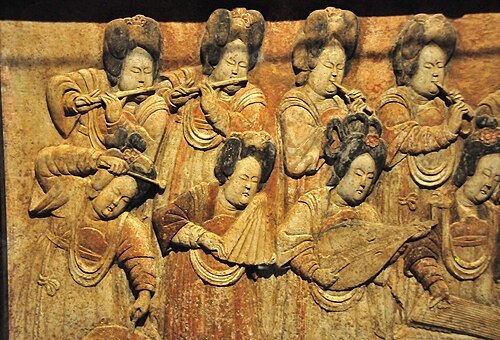


The Song dynasty clothing system was established at the beginning of the Northern Song dynasty. Clothes could be classified into two major types: officials garments (further differentiated between court clothing and daily wear), and the garment for ordinary people.[46][137]:1–7 Some features of Tang dynasty clothing were carried into the Song dynasty, such as court dress.[138]
Song dynasty court dress often used red colour, with accessories made of different colours and materials, black leather shoes and hats.[46][138] The officials had specific clothing for different occasions: (1) the sacrificial dress, a vermillion colour garment worn when attending ancestral temple or grand ceremonies, which they had to wear with the proper hats, i.e. jinxianguan, diaochanguan, andxiezhiguan; (2) the court dress, which was worn when attending court meeting held by the Emperor and sometimes during sacrificial rituals; and (3) the official gown, worn daily by officials who held ranks.[137]:1–7
The form of officials' daily dresses had the same design regardless of rank: yuanlingpao with long and loose sleeves; however, the officials were bound to wear different colours according to ranks.[46][68]:181–203[137]:1–7 As the Song dynasty followed the Tang dynasty's clothing system, officials of third ranks and above wore purple gown; fifth ranks officials wore vermillion gown; seventh ranks officials and above wore green gowns; and the ninth rank officials and above wore black gown.[137]:1–7 However, after the Yuanfeng period, changes were imposed on the colour system of the official gowns: officials of the fourth rank and above wore purple gown, the sixth rank and above wore crimson gown; and the ninth rank and above officials wore green gown; this noted the removal of black colour as a colour for the official dress.[137]:1–7 Officials also wore leather belts and kerchiefs as ornaments.[46][137]:1–7 If senior officials were allowed to wear purple or crimson official garments, they had to wear a silver or gold fish-shaped bag as ornament.[46][137]:1–7 The official gown were worn with different styles of futou and guan. For example, jinxianguan was worn by general officials; diaochanguan was worn by senior officials; and xiezhiguan was worn by enforcement officials.[33][137]:1–7 Flowers pinning was a well-liked custom in the Song dynasty; people regardless of their age, gender, and social ranks would pin flowers on themselves; these flowers could be either artificial flowers (i.e. made of silk, rice-paper plant flower, coloured glaze flower, etc.) or natural fresh flowers.[137]:645–648 Since the early Song dynasty, the Emperor would bestow valuable flowers to his officials.[137]:645–648 Court eunuchs would pin flowers on the futou of the Princes and the Grand councillors whereas other officials would also ornate their futou with flowers by themselves.[137]:645–648 This custom was developed and extended up until Southern Song, when regulations on the number of flowers which could be worn based on the official's rank were made.[137]:645–648 These rules on these flower ornaments on futou could not be broken without permission.[137]:645–648 The apparels for court gathering in the Song dynasty was tongtianguanfu; it was worn by the most senior officials who served the emperor directly; it was the most important clothing after the clothing worn by the emperor.[132]


The clothes worn by Song dynasty emperors are collectively called tianzi apparel (天子服饰; the emperor's apparel).[137]:1–7 The apparels worn when attending sacrificial and worshipping ceremonies were daqiumian (大裘冕; a type of mianfu), gunmian (衮冕; a type of mianfu), and lüpao (履袍).[137]:1–7 The emperor's daily wears were shanpao (衫袍) and zhaipao (窄袍). The yuyue fu (御阅服) was the formal military uniform worn by the Song dynasty Emperors and only came into existence in the Southern Song dynasty.[137]:1–7 The crown prince would wear the gunmian (衮冕) when he would accompanied the emperor to sacrificial ceremonies, and he would wear yuanyouguanfu (远游冠服) and zhumingfu (朱明衣) on less formal but important occasions such as nobility conferring and appointment, when paying visits to the founding ancestor's temple and when attending court meetings which are held by the Emperor.[137]:1–7 The Crown prince also wear purple official dress, gold and jade waistband, and wore a folding-up black muslin scarf on his head.[137]:1–7
Although some of clothing in the Song dynasty have similaritiesref name="dx.doi.org" /> In the 7th and 8th centuries, the kuapao, which originated from Central Asia could be worn by men and were also used as main garment for cross-dressing attendants or could be draped across the shoulders like a cloak. with previous dynasties, some unique characteristics separate it from the rest.[68]:181–203[138] While most of them following the Tang dynasty style,[68]:181–203 the revival of Confucianism influenced the women clothing of the Song dynasty; Confucians in the Song dynasty revered antiquity and wanted to revive some old ideas and customs and encouraged women to reject the extravagance of the Tang dynasty fashion.[139] Due to the shift in philosophical thought, the aesthetics of the Song dynasty clothing showed simplicity and became more traditional in style.[51] Palace ladies searched for guidance in the Rites of Zhou on how to dress accordingly to ceremonial events and carefully chose ornaments which were graded for each occasion based on the classic rituals.[139] While women of the Tang dynasty liked clothing which emphasized on body curves and sometimes revealed décolletage, women in the Song dynasty perceived such styles as obscene and vulgar and preferred slender body figure.[139] Donning clothing which looked simple and humble instead of extravagant was interpreted as expressing sober virtue.[139] The Song dynasty clothing system also specified how women of the imperial court had to dress themselves and this included the Song empresses, the imperial concubines, and the titled gentlewomen; their clothing would also change depending on occasions.[137]:1–7,31 Song dynasty empresses wear the huiyi;[51] they often had three to five distinctive jewelry-like marks on their face (two side of the cheek, other two next to the eyebrows and one on the forehead).[140] The everyday clothing of the Empresses and Imperial concubines included: long skirts, loose-sleeves garments, tasselled capes and beizi.[137]:1–7,31 Imperial concubines like the colour yellow and red; the pomegranate colour skirt was also popular in the Song dynasty.[46][7]:5 Collar edges and sleeve edges of all clothes that have been excavated were decorated with laces or embroidered patterns. Such clothes were decorated with patterns of peony, camellia, plum blossom, and lily, etc.[138] Pleated skirts were introduced and became the characteristic skirts of the upper social class.[7]:5


According to the Song dynasty's regulations, ordinary people were only allowed to wear white clothes; but at some point, the regulations changed and ordinary people, as well as administrative clerks and intellectuals, were able to wear black clothes.[46]:272,275 However, in reality, the clothing worn by civilians were much more colourful than what was stipulated as many colours were used in the garments and skirts.[46] Ordinary people also dressed differently accordingly to their social status and occupations.[51]
One of the common clothing styles for woman during the Song dynasty was beizi, which were usually regarded as shirt or jacket and could be matched with ru, which was a necessary clothing for daily life of commoners, a qun (裙; skirt) or ku (袴; trousers).[46][137]:32–59 There are two size of beizi: the short one is crown rump length and the long one extended to the knees.[140] According to the sacrificial and ceremonial apparel system drafted by Zhu Xi, women should wear an overcoat, a long skirt, and the beizi.[137]:32–59 Women also wore the liangpian qun (两片裙), a wrap skirt which consist of two pieces of fabric sewn to a separate, single waistband with ties.[58][141]


A painting, called Sericulture, by the painter Liang Kai in Southern Song dynasty depicts rural labourers in the process of making silk.[143]Foot binding also became popular in the Song dynasty at the end of the dynasty.[46][139]


Other casual forms of clothing included: the pao (袍; the gown which could be broad or narrow-sleeved), ao (襖; a necessary coat for commoner in their daily lives), duanhe (短褐; a short, coarse cloth jacket worn by people of low socioeconomic status), lanshan, and zhiduo.[138]
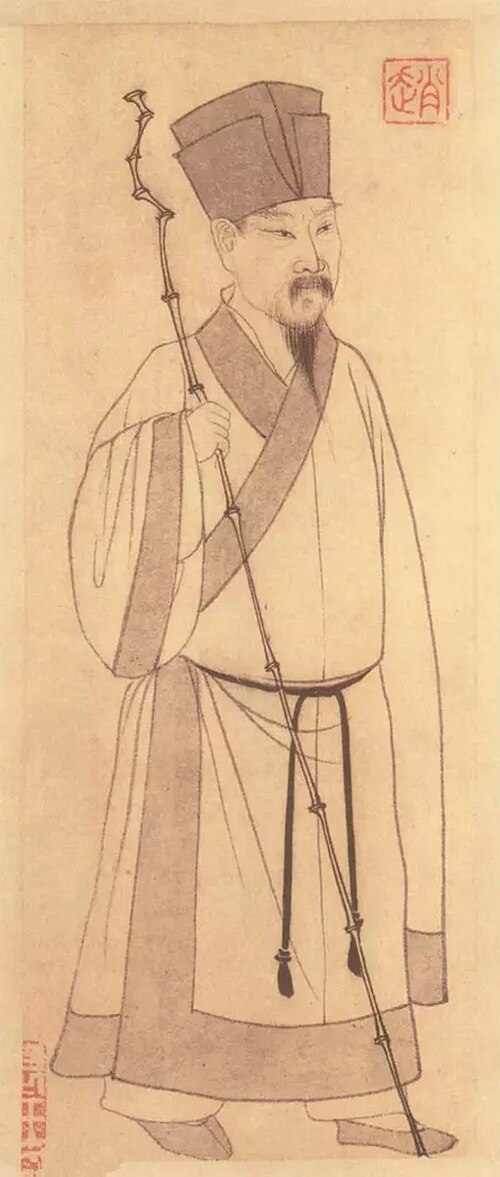


In addition, Neo-Confucian philosophies also determined the conduct code of the scholars.[68]:181–203 The Neo-Confucians re-constructed the meaning of the shenyi, restored, and re-invented it as the attire of the scholars.[144] Some Song dynasty scholars, such as Zhu Xi and Shaoyong, made their own version of the scholar gown, shenyi, based on The book of Rites, while scholars such as Jin Lüxiang promoted it among his peers.[137]:15 However, the shenyi used as a scholar gown was not popular in the Song dynasty and was even considered as "strange garment" despite some scholar-officials appreciated it.[144][137]:15

In the capital of Southern Song, clothing-style from Northern China were popular.[7]:5 The Song dynasty court repeatedly banned people (i.e. common people, literati, and women) from wearing clothing and ornaments worn by Khitan people, such as felt hats, and from the wearing of exotic clothing.[137]:32–59 They also banned clothing with colours which was associated to Khitan clothing; such as aeruginous or yellowish-black.[137]:32–59 They also banned people, except for drama actors, from wearing Jurchen and Khitan diaodun (釣墩; a type of lower garment where the socks and trousers were connected to each other) due to its foreign ethnic nature.[137]:32–59[145] Song dynasty women also wore the Song-dynasty gaitou, when they would ride animals, such as horses and donkeys, to relieve embarrassment and to conceal their bodies.[127] These veils originated from the Tang dynasty women's weimao which covered the head and upper body; they were revived in Song after they fell out of fashion in Tang dynasty and were worn despite its masculine and barbarian origin, probably because Song women were unaware of its origins.[127] Many of Song dynasty clothing was later adopted in the Yuan and Ming dynasties.
The rulers of the Liao dynasty adopted a clothing system which allowed the coexistence of Han Chinese and Khitan clothing.[137]:32–59 The Khitan court adopted both the guofu (國服; Khitan National garments) and hanfu, which the Khitan inherited from the Later Jin dynasty and were actually clothing from the Tang dynasty.[134]:15[146] The guofu of the Liao dynasty was also heavily influenced by the Hanfu system.[137]:57
The Han Chinese men living in the Liao dynasty were not required to wear the shaved Khitan hairstyle which Khitan men wore to distinguish their ethnicity, unlike the Qing dynasty which mandated wearing of the Manchu hairstyle for men.[147] In Han Chinese tombs dating from Liao dynasty, there are tombs murals which depicts purely Chinese customs and Chinese clothing.[148] Tombs in haner families, for example the Zhang and Hann families, often depicts men dressed in Khitan clothing in corridors and antechambers while inner culture shows haner culture.[note 5][149] Some Han Chinese or Haner men adopted and/or combined Hanfu with Khitan clothing and boots, wore Hanfu or wore Khitan clothes. Han women on the other hand did not adopt Khitan dress and continued wearing Hanfu.[149]:48,52–53[150] For example, the tomb of Hann Shixun (a man from distinguished haner families) who died in the early 12th century during the late Liao dynasty depict Khitan-style clothing in the antechamber whereas women in Hanfu-style clothing is seen in the painting found in the inner chamber.[149]:44–45 Another example can be seen in a mural painting found in the tomb of Zhao Wenzao, where children and servants are depicted wearing Khitan hairstyles and Khitan-style clothing, while the woman who is standing behind the table is depicted in Han Chinese clothing.[149]:46–47 Han Chinese women living in the Southern Division and Haner women were culture bearers, who generally preserved Han Chinese culture and continued to wear Hanfu which was worn prior to the conquest.[149] Both Khitan women and Han Chinese women in the Liao wore Han style Tang-Song dress.[134]


The Jin dynasty rulers imitated the Song dynasty and decided to establish their own carriages and apparel system.[137]:32–59 In the early period of the Jin dynasty, the Jin dynasty court first attempted to impose Jurchen hairstyle and clothes on the Han Chinese population in 1126 AD and in 1129 AD.[151]:281 The Hanfu-style clothing was prohibited and the people had to wear a short scarf and left-lapelled clothing; if they did not obey, they were put to death.[137]:32–59 The Jurchen queue and shaving hairstyle was not enforced on the Han Chinese in the Jin after an initial attempt to do so which was a rebuke to Jurchen values.[147][152] However, the rules were not observed and the order was taken back under the Emperor Wanyan Liang who was Pro-Chinese allowing the Han Chinese to wear their Han clothing by lifting the ban in 1150 AD.[151]:281 After the occupation of the Northern Song territories by the Jurchens in 1127 AD, the Han Chinese who were living in Northern Song territories became the majority while the Jurchen became an ethnic minority; this led the Jurchens to make political concessions allowing the Han Chinese to practice Han Chinese culture.[153][149] In 1138 AD, the Jin court adopted the Chinese robes for the emperor and the officials.[153]
In 1161-1189 AD, many Jurchens appear to have begun adopting Han Chinese behavior and forgetting their own traditions and languages; therefore, the Emperor Shizong of Jin prohibited the Jurchens from dressing like the Han Chinese in 1191 AD as he wanted to revitalize the old Jurchen culture.[149][151]:281[153] However, despite his efforts, the influence of the Han Chinese living in the Northern Song territories had a significant influence and by the mid-twelve century, the Jurchens were sinicized so much that they were almost indistinguishable from the Han Chinese in terms of dress, literacy and social customs.[149] Based on Han Chinese tombs of the Jin dynasty, it appears that ordinary Jurchen clothing may have been a symbol of lower class status as servants and lower-class women tend to be portrayed as wearing modified Jurchen-style clothing whereas women from the upper class wear Hanfu-style clothing.[149] Yet despite the Han Chinese influence on Jurchens, travellers from the Southern Song dynasty who visited the former territories of the Song dynasty noted that there have been changes in the people's culture and that the Han Chinese's clothing style had also been influenced by the Jurchens in terms of adoption of items; they also noted that the only thing which had not changed much was the women's clothing style.[137]:32–59[149] However, the clothing-style of the Han Chinese women living the Jin dynasty was outdated compared to those living in the Southern Song territories.[149] The yunjian was worn in the Jin dynasty and was adopted in the Yuan dynasty as a signature pattern on men's and women's clothing.[134]:51


Emperor Jingzong, the first emperor of Western Xia, rejected Han Chinese silk clothing over the leather and wool clothing of the nomadic people from the Steppe; he argued that the Tanguts had traditionally worn leather-based and wool clothing and since the Tanguts men were military, they also had no use for silk materials.[134]:15 Yet, silk clothing was still worn in Western Xia during his reign.[134]:15 The Hanfu-style and the Tangut-style clothing were distinguished from each other, but both were used in the Western Xia.[134]:15 The Hanfu-style clothing was worn by officials whereas the Tangut-style clothing was worn by the military.[134]:15 Civil officials wore futou, boots, purple or crimson gown.[137]:32–59 Emperor Jingzong also ordered that every people in Western Xia must be shaved in an attempt to restore old Xianbei customs, and disobedience was death penalty.[137]:32–59 However, in 1061 AD, Emperor Yizong, the son of Emperor Jingzong, decided to replace Tangut clothing with Hanfu in his court.[154] In his wish list to the Song dynasty court, Emperor Yizong asked permission to use Han Chinese rites and clothing to greet Song dynasty envoys and seek permission to buy Chinese official clothing; both of these requests were granted.[154]


During the Yuan dynasty, Mongol dress was the clothing of elite for both genders.[155] The Mongol attire for both men and women worn in the 13th-14th century was completely different from the Hanfu which had been worn in the Tang dynasty and Song dynasty.[156] The Mongol attire was shared by people of different social ranking due to its practicality which contrasted with the dress code of the Han Chinese; as such, Mongol attire was popular.[156] The Mongols never imposed Mongol customs on the Han Chinese.[18]
Many Han Chinese and other ethnicities readily adopted Mongol clothing in Northern China to show their allegiance to the Mongols; however, in Southern China, Mongol clothing was rarely seen as both men and women continued to dress in Song-style garments.[155][134] In the tomb of a woman from a Southern Song site, dating from the late-Yuan dynasty in Fuzhou, Fujian, the two-pieces system of Southern Song clothing (i.e., ruqun) has been found instead of the Mongol women's one-piece robe.[155] Burial clothing and tomb paintings in the southern territories of the Yuan dynasty also show that women wore the Song-style attire, which looked slimmer when compared to the Mongol court robe. The Song-style clothing is also depicted as consisting of jackets, which were open in the front and had long, narrow and thin sleeves, and sometimes women are depicted as wearing a sleeveless vest-type jackets with front openings.[134] For example, in the Yuan dynasty mural paintings from Dongercun from 1269 AD in Shaanxi[157] and in the mural painting in tomb M2 at Kangzhuangcun in Tunliu from 1276 AD,[158] maids and servants are seen wearing Song-style attire.[134]


The type of clothing worn in the Yuan dynasty may have also served as a political statement; for example, despite not being the clothing of the ruling elite, the Tang-Song style clothing worn in multiple layers continued to be worn by families who showed that they were resisting the rule of the Mongols.[134] A form of skirts worn in the Yuan dynasty is a skirt which consist of two parts sewn to a separate single waistband which may also be pleated.[58]


The Ming dynasty had many Mongol clothes and cultural aspects abolished and enforced Tang dynasty style Han Chinese clothing.[145]
As soon as the Hongwu Emperor conquered the Yuan dynasty, he decried the "barbarian customs" of the Yuan dynasty and how people imitated the Mongols for personal gains; and so, he called for the restoration of Han Chinese traditions, which included the proper forms of dress, hairstyles, and attires.[159][160][161] According to the Veritable Records of Hongwu Emperor (太祖實錄), a detailed official account of daily activities of Hongwu Emperor written by court historians, he restored the entire clothing system to the standard of the Tang dynasty shortly after the founding of Ming dynasty:
洪武元年二月壬子...至是,悉命復衣冠如唐制,士民皆束髮於頂,官則烏紗帽,圓領袍,束帶,黑靴。
[On the Renzi day in the second month of the first year of Hongwu era (February 29, 1368 CE), Hongwu emperor decreed that all fashions of clothing and headwear shall be restored to the standard of Tang, all citizens shall gather their hairs on top of their heads, and officials shall wear the wushamao (black-cloth hats), round-collar robes, belts, and black boots.]
—Veritable Records of Hongwu Emperor (太祖實錄)
The attempt was to signified the Han Chinese cultural identity after defeating the Yuan dynasty.[28]:44–46[159][160] The new clothing system that the Hongwu Emperor formulated was based on the dress code of the previous dynasties, which included the dress codes of the Zhou, Han, Tang, and Song dynasties.[68]:181–203 He also promulgated several decrees to ban Mongol and nomadic clothing style.[156] However, fashionable Mongol attire, items and hats were still sometimes worn by early Ming royals, such as Hongwu Emperor himself and Zhengde Emperor.[29][162] Thus, many Ming dynasty clothing styles absorbed elements of both Han Chinese and Mongol clothing.[145]
The Ming dynasty developed a new attire from Yuan dynasty's terlig: tieli; it is a cross-collared, long sleeved robe with dense and narrow pleats all around the lower hem.[163][164] The tieli was mainly worn by the upper class and rarely worn by the lower class.[163] In the Veritable Records of the Joseon Dynasty, tieli were recorded as ch'obli (帖裡), bestowed as present by the Ming dynasty from the year 1424; however, the terlig-style attires found in both countries differed from each other in terms of form and historical development.[164] The jisün that had been popular in the Yuan dynasty was also worn by the court bodyguards, the xiaowei (校尉; guards of honour), the brocade guards, and by court servants.[156] The yesa robe, which mixed Han and Mongol elements was worn as an informal attire by emperors, princes, ministers, and officials in early Ming dynasty; it was worn as a formal uniforms during the middle period of the Ming dynasty; it was worn as a casual dress worn by scholar-officials during the mid-to-late period of the Ming dynasty; and eventually it was worn by Ming court eunuchs, servants and commoners in the late Ming.[156]
The boli hat worn by the Mongols in the Yuan dynasty influenced the Han Chinese and continued to be used widely in the Ming dynasty in the form of the damao, which was worn by the government clerks and family servants. The use of the damao by the family servants of the Ming officials and the imperial family contributed popularity spread of that hat which eventually become a symbol of low-ranking servants.[156]
Other new Ming dynasty attires influenced by the Yuan dynasty include the buttoned jackets known as bijia (比甲) or zhaojia (罩甲), small hat (小帽; xiaomao) or liuheyitong mao (六合一統帽), and the dahu.[163] Archeological evidence from the tombs of Ming dynasty princes show that the Mongol-style attire continued to exist well until the 15th century.[159] The Ming dynasty also adopted humao, and a waistcoat with buttons at the front from Yuan dynasty.[28]:44–46[165]:31[163]


The founder of the Ming dynasty, the Hongwu Emperor, saw the fundamentality of making a new dress code to consolidate his rule; he spent almost all his reigning years developing and institutionalizing dressing regulations, which were recorded in various compilation of texts, such as the Collected Statutes of the Ming Dynasty.[159][160] The dressing regulations were based on the dressing system of the Tang and Song dynasties.[159][163] Moreover, the Ming dynasty dressing regulations were strongly related to the ritual system; the Confucian codes and ideals that were popularized during the Ming dynasty also had a significant effect on those regulations.[166] The dressing regulations determined what attire and ornaments could be worn depending on one's social ranks.[159][160][166] For example, the Ming dynasty's basic dressing principles, announced in 1392, included the following:[160]
Officials' robes should fit their bodies. The length of those worn by civil officials is one inch from the ground. The sleeves should be long enough to reach the elbows when they are folded back from the end of the hands; they should be one foot wide, with cuffs of nine inches wide. The sizes of nobles (gonghou), and imperial sons-in-law's robes are the same as civil officials’. So are the sizes of seniors and primary degree holders’ robe, except for the sleeves, which are three inches from the elbow when folded from the hands. A commoners’ robe is five inches from the ground. So is a military official's; their sleeves should be seven inches over their hands, with cuffs as broad as their fists. Soldiers’ clothes are seven inches from the ground, with sleeves five inches longer than their hands, and seven inches wide. Their cuffs are wide enough only for their fists to stretch out[.]
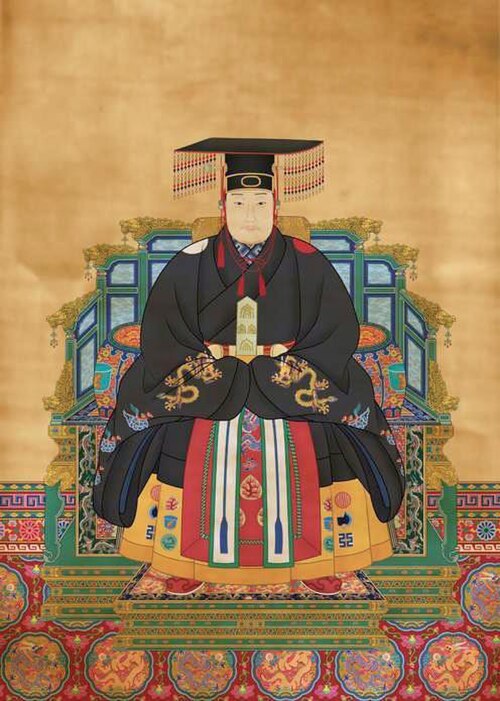
In the Ming dynasty, the inner garment that people wore were called neidan (内单).[166] The fabric material of the outer garment are determined by one's social status.[159] The emperors tend to wear yellow satin gown with dragon designs, jade belts, and yishanguan (翼善冠; philanthropy crown, with wings folded upwards).[33] The yishanguan were only worn by emperors and other members of the royal family on formal occasions.[33]:18 Officials wore different wore robes of various colours and patterns; they also wore gauze hats.[33] Civil and military officials wore different types of guanfu (官服), depending on occasions and events: chaofu (朝服; court dress), the jifu (祭服; sacrificial ceremony dress), the gongfu (公服; public service dress), the changfu (常服; everyday dress), and the yanfu (燕服; casual or leisure clothing).[159][160] The officials' robes are usually patched with embroidered square pattern of animals on the back and the front; the patches are called the Mandarin square, and were differentiated between officials' ranks. Minor differences can be observed between the Mandarin squares decreed by the Hongwu Emperor and the Jiajing Emperor.[33][159]

The Ming dynasty empresses appeared to be wearing similar dress as their Song dynasty counterparts.[160] The queens wore crown with decorations of dragons and phoenixes, and wore a red large-sleeves upper garments also decorated with dragon and phoenixes.[33] The dressing of officials' wives and mothers who were bestowed the title of "appointed lady" (mingfu; 命妇) were also strictly regulated.[160] The Emperors could bestow special types of robes to people that he favoured, such as the mangfu, the douniufu (斗牛服; "fighting bull" robe; the "fighting bull" is a two-horned dragon-like creature), and the feiyufu.[74][159][160] The illegal use and production of those special robes were prohibited by imperial decree and could result to severe punishment or death.[159]
The Jiajing Emperor was the last ruler of the Ming dynasty; he made significant changes to the Ming dynasty dressing code to consolidate his imperial authority.[159] The Jiajing Emperor was very focused in reforming the yanfu (燕服; casual or leisure clothing), as he found his own yanfu too vulgar and too common to befit his imperial status.[159] At the end of 1528 AD, yanfu's new statutes, adjusted from the ancient xuanduan, were decreed. The yanbian guanfu (燕弁冠服; "Dress of the Casual Hat"), designed for the emperor, was in colour black bordered with a green trim and featured 143 dragons, with a dragon medallion on the front of the clothing.[159] The zhongjing guanfu (忠靜冠服 or 忠靖冠服; "Dress of Loyalty and Tranquility"), designed for the ranked officials, was dark green in colour; while cloud patterns were granted to the robe for third-rank and above officials, fourth-rank and below officials had to wear plain robes.[159] The baohe guanfu (保和冠服; "Dress of Preserving Harmony"), designed for the royal princes), was in colour green and bordered with a green trim, and had two rank badges that showed dragon designs.[159]
The shenyi suddenly made a comeback among Han Chinese and became the formal scholar official robe when the Ming dynasty was founded in 1368 AD.[144] The scholar officials wore chengziyi (程子衣) as leisure clothing.[166][167] Hats worn by the scholars and literati were: the sifang pingding jin (四方平定巾; flat-top square hat), the dongpo jin (東坡巾; "Dongpo hat"), and the fangjin (方巾).[167][110] The daopao was worn as a casual dress by all levels of society, including the External officials and eunuchs.[167][160] The zhishen was also worn by eunuchs sometimes to show their superiority.[160] Commoner men usually wore plain-coloured clothing while commoner women wore upper garments and skirts of light colours.[33]


Though the Ming dynasty restored Hanfu, the dynasty also brought many changes.[163] For example, the formal robes of the early Ming emperors had close-fitting sleeves instead of the Song dynasty's voluminous sleeves.[155] The collar of the Ming dynasty clothing changed from the symmetrical type of the Song dynasty to the circular type.[163] Moreover, under the influence of the Yuan dynasty's court dress, the xiongbei (胸背; central badges) found on the official cloths became square in shape, different from Song dynasty's round shape.[134]:51 Compared with the clothing of the Tang dynasty, the proportion of the upper outer garment to lower skirt in the Ming dynasty was significantly inverted.[163] Since the upper garment was shorter and the lower garment was longer, the jacket gradually became longer to cover the exposed skirt.[163]
The Ming dynasty implemented the use of gold and silver interlocking buckles to close clothing and collars.[163][168] In the middle of the Ming dynasty, the interlocking buttons were often paired with the upper garment with standing collar; it was commonly used by women partially because they wanted to cover their bodies to show modesty and preserve their chastity and because of the cold climate period.[168] Skirts with pleats became very popular and the skirt colour tended to be light.[163] Another form of skirt which was worn in the Ming dynasty is a skirt with two pieces which was deeply pleated and was sewn to a separate, single waistband.[58] In the late Ming dynasty, Ming dynasty women wore the pifeng daily, the ru (short jacket) with a skirt and a short over skirt (yaoqun), the ao (袄; a long jacket) which is worn with a skirt, and the bijia.[28]:48–51 The shuitianyi was also worn in the late Ming dynasty.[28]:48–51 Han Chinese women also wore dudou as an undergarment.[169]


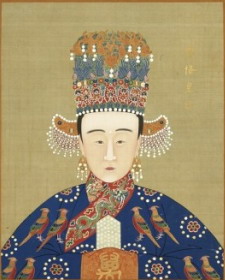

While clothing regulation were strictly enforced in the early Ming dynasty; it started to weaken in the Mid-Ming dynasty (around the early 16th century) which has been attributed to the failing of ritual practice and the expansion of commercialization which has led to a weakened state control over the clothing system, and thus to an eventual dress code transgression.[160] In the late Ming, the dress code was widely transgressed by sons of officials and eunuchs who clothes which did not denote their real social status.[159][160] Fashion changed quickly relatively to the earlier years during the late Ming which caused distress to the literati.[159][160] The literati were also concerned about the wives of the elites who would parade and show off their clothing and ornaments without having anyone to reproach them.[159][160] Despite the attempts of Confucians scholars to urge the ban of illegal and/or improper dress, the dressing code was not enforced by the imperial court.[160]
When Han Chinese ruled the Vietnamese in the Fourth Chinese domination of Vietnam due to the Ming dynasty's conquest during the Ming–Hồ War they imposed the Han Chinese style of men wearing long hair on short haired Vietnamese men. Vietnamese were ordered to stop cutting and instead grow their hair long and switch to Hanfu in only a month by a Ming official. Ming administrators said their mission was to civilized the unorthodox Vietnamese barbarians.[170] The Ming dynasty only wanted the Vietnamese to wear long hair and to stop teeth blackening so they could have white teeth and long hair like Chinese.[171] A royal edict was issued by Vietnam in 1474 forbidding Vietnamese from adopting foreign languages, hairstyles and clothes like that of the Lao, Champa or the "Northerners" which referred to the Ming. The edict was recorded in the 1479 Complete Chronicle of Dai Viet of Ngô Sĩ Liên in the Later Lê dynasty.[172] The Vietnamese had adopted the Chinese political system and culture during the 1,000 years of Chinese rule so they viewed their surrounding neighbours like Khmer Cambodians as barbarians and themselves as a small version of China (the Middle Kingdom).[173] By the Nguyen dynasty the Vietnamese themselves were ordering Cambodian Khmer to adopt Han Chinese culture by ceasing "barbarous" habits like cropping hair and ordering them to grow it long besides making them replace skirts with trousers.[174]
Hanbok was influenced by the Hanfu of the Ming dynasty. The Joseon dynasty monarchy looked to Ming China for cultural inspiration. The upper classes and the court of Joseon wore Ming-style clothing but also made a few modifications to make the clothing look distinctively Korean; this led to the formation of the women's hanbok style.[175][176] The lower class of Joseon imitated the clothing of the upper class.[175]
In the Liao, Jin, Yuan, and Ming dynasties, Jurchen people mainly wore Zuojun gowns. The robes and clothes of the Manchus before entering the customs are called "yijie" in Manchu. They are clothes worn by men, women and children throughout the year. Each gown is cut from a whole piece of clothing. The basic structure is a round neck, a large flap, a left gusset, four-sided slits, a waistband and horseshoe sleeves.[177]
It was mistakenly thought that the hunting ancestors of the Manchus skin clothes became Qing dynasty clothing, due to the contrast between Ming dynasty clothes' unshaped cloth's straight length contrasting to the odd-shaped pieces of Qing dynasty longpao and chaofu.[178]:103 Scholars from the west initially wrongly thought these clothing were purely Manchu as the early Manchu rulers wrote several edicts stressing on maintaining their traditions and clothing.[178]:103 However, there is evidence from excavated tombs which indicates that China had a long tradition of garments that led to the development of the Qing chaofu, and it was not invented or introduced by Manchus in the Qing dynasty or Mongols in the Yuan dynasty. In some cases, the Qing dynasty went further than the Ming dynasty in imitating ancient China to display legitimacy with resurrecting ancient Chinese rituals to claim the Mandate of Heaven after studying Chinese classics. Qing sacrificial ritual vessels deliberately resemble ancient Chinese ones even more than Ming vessels.[178]:106Tungusic people on the Amur river like Udeghe, Ulchi and Nanai adopted Chinese influences in their religion and clothing with Chinese dragons on ceremonial robes, scroll and spiral bird and monster mask designs, Chinese New Year, using silk and cotton, iron cooking pots, and heated house from China during the Ming dynasty.[179]
Moreover, the Manchus originally did not have their own dragon robes or weave textiles and they had to obtain Ming dragon robes, Chaofu and cloth when they paid tribute to the Ming or traded with the Ming.[169] Therefore, Manchu clothes were modified the Hanfu of Ming China to form their court costume, making it easier to use while hunting.[169] The development of Manchu clothing in the late Ming Dynasty mainly imitated Mongolian clothing, such as the characteristic buttoned jackets, and the arrow sleeves are obviously characteristics of Mongolian clothing.[180] The Ming dragon robes were simply modified, cut, and tailored by Manchus at the sleeves and waist to make them narrow around the arms and waist instead of wide and added a new narrow cuff to the sleeves;[181]:157 they also made slits in the skirt to make it suitable for falconry, horse riding and archery.[181]:158 The new cuff was made out of fur. The robe's jacket waist had a new strip of scrap cloth put on the waist while the waist was made snug by pleating the top of the skirt on the robe.[181]:159 The Manchus added sable fur skirts, cuffs and collars to Ming dragon robes and trimming sable fur all over them before wearing them.[165]:25 However, some denied that the popular Manchu jackets in the Qing Dynasty originated from the Hanfu in the Ming Dynasty.[182][183] Han Chinese court costume (chaofu) was modified by the Manchu by adding a ceremonial big collar (daling) or shawl collar (pijianling); the clothing was also reduced in bulk, the sleeves made narrower, and the side-fastening changed from cross-collared to a curved overlapping right front.[169][184] The clothing was fastened with loops and buttons.[169] The Manchu also decorated their early Qing robes with dragons similarly to the Ming chaofu.[169]


The Spencer Museum of Art has six longpao robes that belonged to Han Chinese nobility of the Qing dynasty which shows the diversity of the late 18th and 19th century non-imperial dragon robes.[178]:115 Ranked officials and Han Chinese nobles had two slits in the skirts while Manchu nobles and the Imperial family had 4 slits in skirts. All first, second and third rank officials as well as Han Chinese and Manchu nobles were entitled to wear 9 dragons by the Qing Illustrated Precedents. Qing sumptuary laws only allowed four clawed dragons for officials, Han Chinese nobles and Manchu nobles while the Qing Imperial family, emperor and princes up to the second degree and their female family members were entitled to wear five clawed dragons. However officials violated these laws all the time and wore 5 clawed dragons and the Spencer Museum's 6 long pao worn by Han Chinese nobles have 5 clawed dragons on them.[178]:117

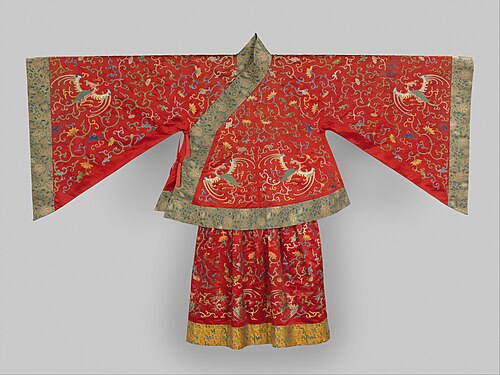
Wives of Han Chinese noblemen and high-ranking officials had to wear semi-official formal dresses on ceremonial events; their clothing consisted of a mang ao (a four-clawed dragon loose fitting jacket with wide sleeves), a xiapei, a mang chu (a dragon skirt which was embroidered with dragons and phoenixes on the front and back skirt panels), a jiao dai (a rigid hooped belt which was worn around the jacket) and a phoenix coronet.[169] The women mang ao was red in colour if the wearer was a man's principle wife; it was originally undecorated but started to be decorated with dragon by the 18th century.[169] The xiapei was developed from the xiapei worn in Ming dynasty; the xiapei in Qing was first worn when the wedding day of a woman; after the wedding, she would wear it for special important events which were connected with her husband's status.[169]
The Qing dynasty court continued to reform and regulate the clothing of its subjects, but discussion on ethnic clothing was a sensitive topic even after the Qing dynasty had consolidated its rule.[145] By 1759 AD, the Qianlong Emperor commissioned the Illustrated Precedents for the Ritual Paraphernalia of the Imperial Court (Huangchao Liqi Tushi) which was published and enforced by 1766; this publication covered several aspects including the dressing and accessories of the emperors, princes, noblemen and their consorts, Manchu officials, their wives and daughters, and the dress codes for Han Chinese men officials who had reached the rank of mandarin and were employed and their wives; as well as Han Chinese men who were waiting for an official appointment.[111]:2–3[169] The aim of this edict was made to preserve the Manchu identity once again, but at the same time, it also attempted to align the image of the emperor with Confucian ideas and codes of behaviours and manners.[185] The dress code designed in the Huangchao Liqi Tushi continued to be used as the standard for the court attire until the end of the Qing dynasty.[111]:2–3 The Manchu continued to use the five colours symbolism in their clothing which was in line with the previous Han Chinese dynasties; however, they chose the colour blue as their dynasty colour and generally avoided the use of red colour in their clothing because red was the dynasty colour of Ming dynasty.[169] On the other hand, Han Chinese continued to view red as a lucky colour because of its connection with rulers of Ming dynasty, and used it extensively in celebratory events and at weddings.[169]


When the Manchus established the Qing dynasty, the authorities issued decrees having Han Chinese men to adopt Manchu hairstyle by shaving their hair on the front of the head and braiding the hair on the back of the head into pigtails. The resistances against the hair shaving policy were suppressed.[186] Han Chinese did not object to wearing the queue braid on the back of the head as they traditionally wore all their hair long, but fiercely objected to shaving the forehead so the Qing government exclusively focused on forcing people to shave the forehead rather than wear the braid. Han rebels in the first half of the Qing who objected to Qing hairstyle wore the braid but defied orders to shave the front of the head. One person was executed for refusing to shave the front but he had willingly braided the back of his hair.[187]

The Qing imposed the shaved head hairstyle on men of all ethnicities under its rule even before 1644 like upon the Nanai people in the 1630s who had to shave their foreheads.[188][189] In 1645, tifayifu edict was issued;[190] however it was strongly opposed by the Han Chinese, in particular those who belonged to the late Ming dynasty scholars class and literati.[191] Qing Manchu prince Dorgon initially canceled the order for all men in Ming territories south of the Great wall (post 1644 additions to the Qing) to shave. It was a Han official from Shandong, Sun Zhixie and Li Ruolin who voluntarily shaved their foreheads and demanded Qing Prince Dorgon impose the queue hairstyle on the entire population which led to the queue order.[192][193] Even after a decade following tifayifu policy implementation, Han Chinese still resisted against the order of shaving the hair and changing into Manchu clothing frequently.[191] Even during emperor Kangxi's reign, a large number of ordinary people continued to wear Ming dynasty hairstyles and clothing; however, the Han Chinese officials and military generals had to wear the queue and Manchu clothing.[191] The men of certain ethnicities who came under Qing rule later like Salar people and Uyghur people already shaved all their heads bald so the shaving order was redundant.[194] However, the shaving policy was not enforced in the Tusi autonomous chiefdoms in Southwestern China where many minorities lived. There was one Han Chinese Tusi, the Chiefdom of Kokang populated by Han Kokang people.


During the Qianlong reign, Liu Zhenyu was executed for urging the return of presumably Ming dynasty clothing.[195] However, during this period, Manchu style clothing was only required for scholar-official elite, such as the Eight Banners members and Han men serving as government officials, but not the entire male population; therefore, Han Chinese men were allowed to continue to dress in Ming dynasty clothing.[195] But over time, some Han Chinese civilian men voluntarily adopted Manchu clothing, such as the changshan and magua.[195][196] In the early middle of the Qing Dynasty, the rhetoric and resistance against the Manchu clothing system subsided slightly.[145] By the end of the Qing Dynasty, some officials, literati, and civilians began to wear Manchu clothing, but there were still many officials, literati, and civilians who still wore Hanfu.[195][196]


In the Edo period, the Tokugawa Shogunate of Japan passed orders for Japanese men to shave the pate on the front of their head (the chonmage hairstyle) and shave their beards, facial hair and side whiskers.[197]:217 This was similar to the Qing dynasty queue order imposed by Dorgon making men shave the pates on the front of their heads.[197]:214

During the Edo period, Japan partially preserved the Hanfu clothing of the Ming dynasty. In China, after the Qing conquest, wearing the official robes of the Ming dynasty and performing its court music were prohibited. However, thanks to Wei Zhiyan (ca. 1617–1689), who fled to Japan, the court music of the Ming dynasty—known in Japan as Mingaku (明楽)—was transmitted and thus escaped extinction. In Japan, performers of Mingaku traditionally wore Ming-style clothing as formal attire during performances.
During the late Qing dynasty, the Vietnamese envoy to Qing were still wearing the official attire in Ming dynasty style. Some of the locals recognized their clothing, yet the envoy received both amusement and ridicule from those who did not.[198]
The implementation of tifayifu policy, the early Qing dynasty court also prohibited Han Chinese from wearing some specific Manchu items and prohibited banner-women from dressing as Han Chinese women to maintain ethnic distinction.[199] The early Qing dynasty policies also mainly applied to Han Chinese men.[199][195] Those who were exempted from such policies were women, children, Buddhist and Taoist monks, and Qing dynasty rebels; moreover, men in their living had to wear Manchu-clothing, but they could be buried in Hanfu after their death.[199][195][200] However, this was not fully implemented. Women, men, children, and the elderly still wore Hanfu at home and in daily life, festivals, and ceremonies until the end of the Qing Dynasty.


Han Chinese rebels who went against the Qing dynasty even retained their queue braids on the back but the symbol of their rebellion against the Qing was the growing of hair on the front of the head, causing the Qing government to view shaving the front of the head as the primary sign of loyalty to the Qing rather than wearing the braid on the back which did not violate Han customs and which traditional Han did not object to.[200][201]Koxinga insulted and criticized the Qing hairstyle by referring to the shaven pate looking like a fly.[202]:77 Koxinga and his men objected to shaving when the Qing demanded they shave in exchange for recognizing Koxinga as a feudatory.[202]:86The Qing demanded that Zheng Jing and his men on Taiwan shave to receive recognition as a fiefdom. His men and Ming prince Zhu Shugui fiercely objected to shaving.[202]:187His men and the last Ming dynasty prince, Zhu Shugui (1617 – 1683 AD), fiercely objected to the shaving decree.[202]:187

In the Taiping Heavenly Kingdom, Qing dynasty's clothing and queue braids were opposed and forbidden on cultural and nationalistic grounds, as many in the Taiping Heavenly Kingdom were of Hakka descent who opposed the rule of Manchu. In an attempt to restore the identity of the Han Chinese, the Taiping rebels established their own clothing system, which introduced dedicated uniforms and features of Hakka fashion, removing characteristics of qizhuang such as the matixiu or horse-hoof cuffs and hats used by the Qing.[203] The rebels let their hair grow, wearing headscarves or red turbans over them, while others kept their queues hidden under the turbans. Though many of the male fashion still retained many similarities with that of the Qing dynasty.[204][205][206] The kings and princes of the Heavenly Kingdom were the only people allowed to wear yellow dragon robe.[206]
At the same during the Taiping Rebellion, the Red Turban Rebellion broke out in the Guangdong region, whom among their leaders was the locally popular Red Boat Opera Company performer Li Wenmao. Due to opera costumes being exempt from the ban on hanfu, and opera's role in the vernacular culture and identity of the Han Chinese, many of the rebels dressed in opera costumes and organized themselves in roles similar to that of historical opera plays, with Li Wenmao himself supposedly donning the Ming dynasty mangfu. Newly selected civil and military officials also wore respective opera costumes of civil official and military character roles that were analogous to their stations.[207][208] The clothing worn by Taiping Heavenly Kingdom were similarly based on confiscated or repurposed paofu from the opera stages, including the dragon robes worn by the leaders of the rebellion.[209][210]
As a result, Ming dynasty style clothing was even retained in some places in China during the Xinhai Revolution in 1911 AD.[211] In the late Qing dynasty, some members of the White Lotus sect cut down their queues in an act of defiance while most of them only remove a hair strand or unbraided their hair and let it loose.[204] After the Qing dynasty was toppled in the 1911 Xinhai revolution, the Taoist dress and topknot was adopted by the ordinary gentry and "Society for Restoring Ancient Ways" (Fuguhui) on the Sichuan and Hubei border where the White Lotus and Gelaohui operated.[212] It was only later westernized revolutionaries, influenced by western hairstyle who began to view the braid as backward and advocated adopting short haired western hairstyles.[187]


Neither Taoist priests nor Buddhist monks were required to wear the queue by the Qing; they continued to wear their traditional hairstyles, completely shaved heads for Buddhist monks, and long hair in the traditional Chinese topknot for Taoist priests.[195][213][214][187]
Taoist priests also continued to wear Taoist traditional dress and did not adopt Qing Manchu dress. Remains of the Ming dynasty subjects also invented various ways to preserve their hairstyle and their Han-style clothing (for example, in remote places).[145] To avoid wearing the queue and shaving the forehead, the Ming loyalist Fu Shan became a Daoist priest after the Qing took over Taiyuan.[215]


After death, their hair could also be combed into a topknot similar to the ones worn by the Han Chinese in Ming; a practice which was observed by the Europeans;[204] men who were wealthy but held no official rank were allowed to be buried in a deep-blue silk shenyi which was edged with bright blue or white band.[169] Men who were in mourning were also exempted;[195] however, since the mourners were not allowed to wear topknot in accordance to the Confucian rites, the men simply untied their queues and left their loose hair dishevelled.[204] Women from wealthy families could also be buried in a variation of shenyi called the bai shou yi (lit. "longevity jacket"), a deep blue or black ao with the character shou for longevity embroidered in gold all over the ao.[169] The bai shou yi was worn with a white pleated skirt which was edged with blue satin; the skirt was embroidered with the many blue shou character.[169]
The ban of Hanfu also did not apply to performers who wore and displayed Hanfu-style costumes when performing dramas.[199]
For women's clothing, Manchu and Han fashions of clothing coexisted.[195][7]:7 The Han Chinese women carefully maintained their pure Han Chinese ethnicity and did not wear Manchu clothing.[169] Throughout the Qing dynasty, Han women continued to wear clothing from Ming dynasty; however, with time, the Ming dynasty customs started to be forgotten and influence from the Manchu started to influence the women's clothing.[169][216] Yet, Manchu women and Han Chinese women never emulated each other's clothing; and as a result, by the end of the nineteenth century, Manchu and Han Chinese women had maintained distinctive clothing.[195]
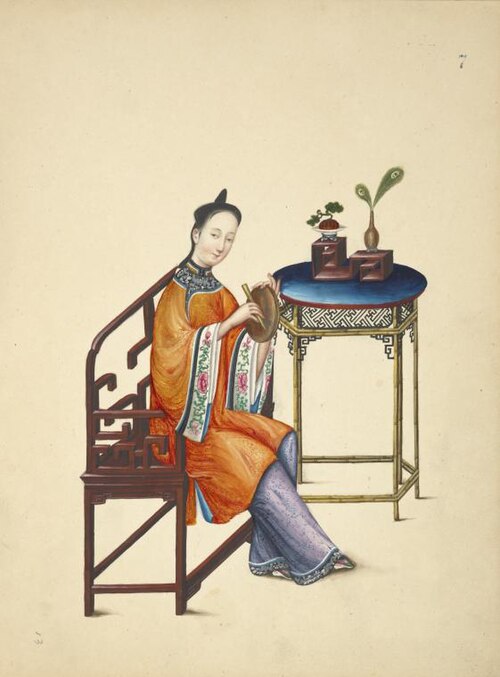
At the beginning of the Qing dynasty, Han Chinese women were expected to continue the Han Chinese clothing of the Ming dynasty.[169] Manchu women wore a long, one-piece robe with a curving robe whereas Han Chinese women continued to wear the combination upper and lower garment.[195][7]:7[217][6]:31 As Han Chinese women were not forced to change in to Manchu clothing, most of the clothing elements of the Han Chinese women in the Qing dynasty continued to follow the style of the Ming dynasty's ao coat.[218] Following the Ming dynasty customs, Han Chinese women would wear ruqun and aoqun,[195][6]:31 which was a popular fashion in the Qing dynasty.[219] Trousers were sometimes worn under the skirts if they were commoners or unmarried.[58][6]:31 Han Chinese women, who were unmarried or were peasants, would wear shanku without any overskirt.[6]:31 Wearing skirts were generally considered a symbol of maturity and was reserved for married women.[169]
In the middle of the Qing dynasty, Manchu and Han Chinese women started to influence each other's clothing; however, they still maintain the uniqueness of their respective clothing styles.[7]:7 The late Qing dynasty, Han Chinese women in the gentry and aristocratic classes started to imitate the clothing of the Manchu; similarly, the Manchu women started to imitate the clothing of the Han Chinese women; and thus, they influenced each other.[191][7]:7
In the late Qing dynasty, Han Chinese's ao continued to share some similarities with the ao worn in the Ming dynasty.[218] However, the clothing worn by the Han Chinese women was also influenced by Manchu culture to some degree; for example, in terms of clothing colour, embroidery and binding.[218] The late Qing dynasty ao had large sleeves, a slant opening and was waist-length.[169][218] Elderly Chinese women wore an ao with round standing collar, which had a planket by the right, flat sleeves, sleeves which were wrist-length and had a wide cuff.[218] The collar of the Han Chinese ao may be standing collar or low collar stand, and there were slits on both sides of the ao.[218] The waist-length ao could also have narrow sleeves and a front opening.[218] Women clothing in the late Qing dynasty also had piped edges.[33]
The silk skirts which are indigenous to Han Chinese women are a representative garment of the Qing dynasty clothing.[58] A popular form of skirts during the Qing dynasty was the mamianqun, a skirt made of two separate pieces of fabric which are not sewn together from the waistline to the hemline; this skirt allowed women with bounded feet to walk with greater ease.[58][220] The mamianqun had very subtle changes in both the cut and decorations throughout the Qing dynasty.[58] Other Han Chinese women skirts which were popular in the Qing dynasty were the baijianqun (百襇裙; hundred pleated skirt), the yuehuaqun (月華裙; moonlight skirt) which was popular in the early Qing, the phoenix tail skirt which was popular during the reign of Kangxi and Qianlong,[63]:80–83 and the ‘fish-scale’ skirt.[220] At the end of the Qing dynasty, a skirt decorated with sword-shaped ribbons with bells hanging at the sharp corner appear.[63]:80–83 Han Chinese women also wore dudou, which was developed from the Ming dynasty dudou.[169]
Outside China in 1911, the magazine Vogue recommended shopping for a set of attire called "boudoir set" which consisted of the Qing dynasty aoqun with wide hems and wide sleeves, and shoes.[221] However, by the Xinhai revolution in 1911, the wide hemmed and wide sleeved Qing dynasty aoqun was no more popular among urban Han Chinese women in China; instead they started to make their clothing narrower.[221] Ready-to-wear Western clothing had little popularity among Chinese consumers as due to proportion misfit of Western clothing.[221]



Infants would wear dudou, which was embroidered with luck charms, as their only clothing in hot summer months until they reach the age of two to three years old.[169] Han Chinese children were spared from the tifayifu policy and could be dressed in Hanfu;[199] their clothing was fastened to the right side in the Ming dynasty–style.[169] Their daily clothing was made of silk, and they would wear satin and silk clothing for special occasions; the colours of the clothing were bright and the clothing were typically red and pink as these were auspicious colours.[169]
They also wore a baijiayi in the Qing dynasty to wish a child good fortune and as a protection from evil,[169] as well as different style of hats, such as the "rice bowl hat", the "tiger head hat", and the "dog head hat", which aim to protect against evil spirits and later on to attract good fortune when they have to take important examinations.[169][7]
In 1912 AD, the Republic of China was established and government ministers were required to western-style clothing. Official attire for both men and women were regulated and published in the government gazettes; the men had to wear western-style clothing on formal days and evening, and in informal time, they could wear either Western suit or changshanmagua. Women had to wear Qing style aoqun Women started to wear more western-style clothing, Foot binding was legally abolished.
During the early years of the republic, cutting off the queue was a pre-requisite for provincial election votes, and in 1914, policemen cut off the queue of any anyone arrested wearing queues.[204]
After the fall of the Qing dynasty, Yuan Shikai revived the Sacrifice at the Temple of Heaven ceremony; he also proclaimed himself as Emperor Hongxian and the beginning of a new dynasty; the robe and hat which specially designed for him to wear on the day of this ceremony was based on the ceremonial dress worn by the Han and Ming dynasty emperors on sacrificial ceremonies.[222] However, Yuan Shikai did not adhere to the Han dynasty and Ming dynasty fashion completely and these gowns showed differences in design, i.e. the use of roundels.[222] A manual, called the Jisi guanfutu (祭祀冠服圖; The Illustrated Manual of Dress for Ritual Sacrifices), was specially prepared and produced in 1914 AD by the Zhengshitang lizhiguan (政事堂禮制館; Bureau of Rites of the Executive Affairs department); this manual provided a detailed description of the attire worn by Yuan Shikai and the participants of the ceremony on this 1914 public, ceremonial event.[222] Yuan Shikai's ceremonial gown was jiaoling youren (i.e. fastened over the right side), made of black satin which was bordered with gold brocade and was decorated with twelve roundels which depicted the full twelve Imperial symbols (shier zhang; 十二章). Officials gowns were also designed for officials who had to participate in the ceremony; the officials gown were made of black satin and the edges were made with blue brocade.Laws regarding the official dress were also decreed:

Those imperial emblems which were used in the roundels originated from the twelve emblems which were documented in the Shangshu. This ceremonial gown was worn over a purple satin apron skirt which would be edged with either blue or gold brocade; a belt of matching colour was also worn around the waist.[169] They also wore flat hats, and some of them had string of pearls which hung over their faces just like the hats which were worn by the Han Chinese emperors of the earlier dynasties. Yuan Shikai's deliberate way of dressing up to pay respect to Heaven was not only made in accordance to the old imperial traditions, but it can also be considered as a public declaration to the Chinese people and to the world that the old Chinese customs were still relevant in modern society. When Yuan Shikai died in 1916, he was buried in imperial gown which was decorated with nine golden dragons. However, since his reign was short-lived, the attempts at restoring ancient Chinese ceremonial and official gowns failed and gradually disappeared.[222][169]


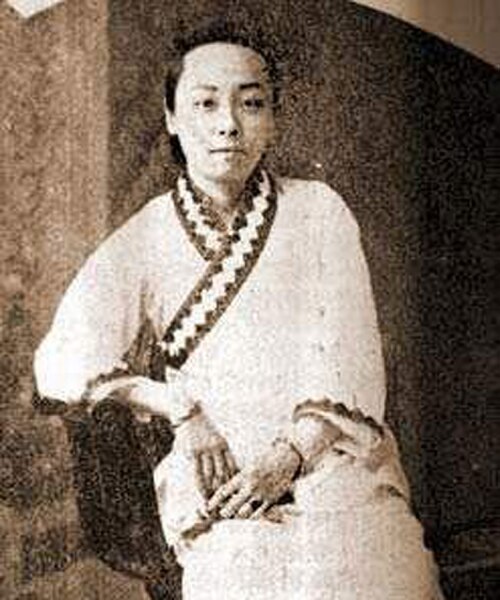


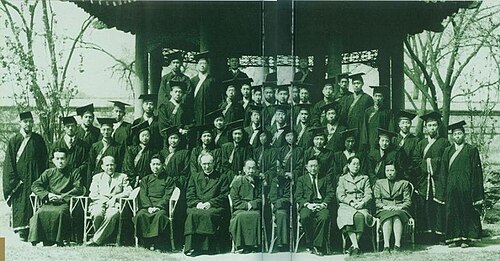
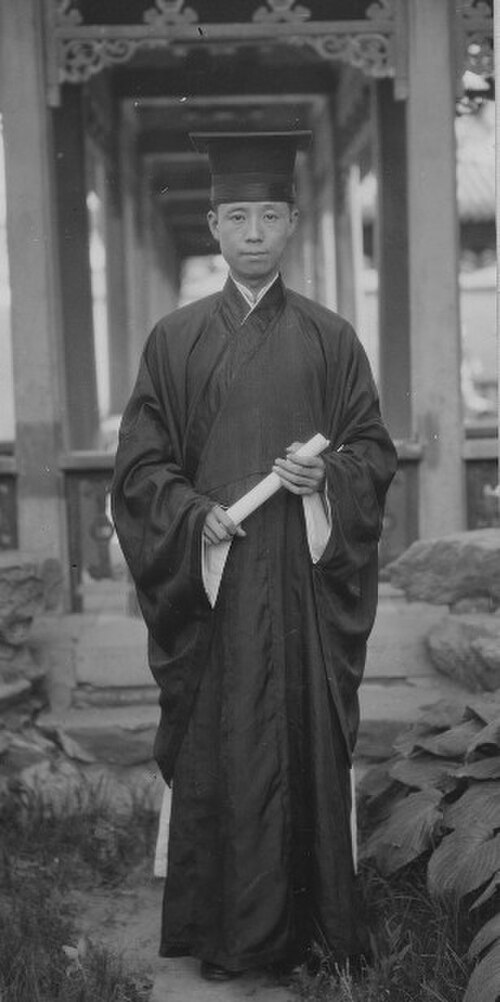


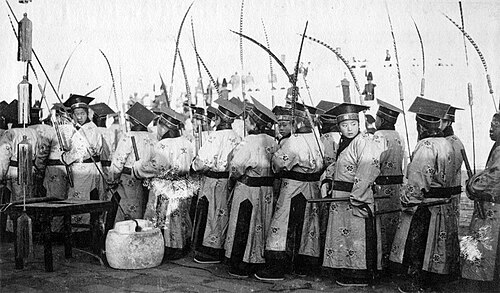


In 1919, women aoqun evolved; the ao became slimmer and longer until it reached below the narrow; the sleeves became narrower to the wrists, and the side slits were shortened; the collars became very high with some corners turning down sometimes and other collars reaching up to the ears.[169] The edges of the ao became narrow contrasting to the wide bands of embroidery which was popular in the past.[169] The ao was worn with a one-piece ankle length skirt.[169]
In the early 1920s, the ao became more fitted and was shortened reaching only the top of the hip with a rounded hem, the sleeves were also shortened to three quarter of its length. The skirt became plainer, cut with a simple flared style, and wide waistband was replaced by narrow band in which a cord or elastic was threaded.[169] The qipao, also known as cheongsam, was eventually created in the middle of 1920s.[169]
In 1927, changshan and magua was established as the formal, official wear for men, and they were worn for important ceremonies, such as weddings, temple and ancestral halls worship.[169] Women's formal wear was either a black ao and blue skirt with the same style as the earlier outfit or the cheongsam.[169]
In the mid-1930s as men started to adopt more Western clothing. Under the Japanese occupation, more men started to wear even more Western suits and ties, and the men traditional clothing was worn on informal occasions.[169] In 1932, the Nationalist government began to force Miao, Yao, and Kam people to wear hanfu.[223]
During the Cultural Revolution, traditional Chinese clothing, as a broad term, was considered as being part of one of the "four olds" and the Mao suit was popularized for both genders.[169] Skirts also disappeared as they were considered being both impractical for manual work and ideologically inappropriate during this time period.[169] In 1974, Jiang Qing, the fourth wife of Mao Zedong, wanted to make an attire, known as the Jiang Qing dress, as the national dress for the Chinese women.[28]:248–255[224] The Jiang Qing dress, which she personally designed, consisted of pleated skirts instead of trousers, the sleeves were nearly elbow-length, there was a central opening, and the neckline was V-shaped and was delineated by a wide, white band; the skirt was based on the pleated skirts (i.e. the "one hundred pleats" skirt) worn by the court ladies worn in Tang dynasty paintings.[28]:248–255[224] The earliest form of Jiang Qing dress is documented and appear in the 1974 Asian Games photos.[28]:248–255 Jiang Qing tried to popularize the dress in diverse ways through public and foreign avenues; however, her dress failed to win popularity and was disliked.[28]:248–255 Since the late 1970s, skirts and dresses reappeared and western-style clothing became popular in daily lives.[28]:257–265
Since the 20th century, hanfu and hanfu-style clothing has been used frequently as ancient costumes in Chinese and foreign television series, films and other forms of entertainment media, and was widely popularized since the late 1980s dramas.[24][225][25][226] One example of historically inaccurate hanfu-style costume is the costume worn by Disney's Mulan, where the wide sleeves of the hanfu were reduced to narrow sleeves reflecting modern fashion and to reflect the character of Disney's Mulan.[226]


Many elements and costumes styles worn in Chinese opera are derived from the Ming dynasty clothing and may be blended with the clothing style from the Tang to Qing dynasty.[227] The opera costumes worn in Kunqu opera is primarily based on the clothing worn in Ming dynasty.[228] And, most of the style of costumes depicted in Cantonese opera are also derived from the clothing of the Ming dynasty, with a few exception being derived from the Qing dynasty clothing.[229][230] Costumes of Cantonese opera uses the Ming-style clothing for opera which are set in all dynasties, except for the ones set in the Qing dynasty; those costumes follow the Qing-style.[231][232]


Modern Taoist monks and Taoism practitioners continue to style their long hair into a touji (頭髻; a topknot hairstyle) and wear traditional clothing.[233][234][235][236] Some modern taoist abbess and priests also wear cross-collared jiaoling youren robes and hats.[237][238]
![Taoist clergy of Baxian Temple [zh], Xi'an, wearing daopao and hechang, 1910–1911.](https://img-server.japedia.wiki/wikipedia/commons/thumb/9/9e/%E4%B8%87%E5%AF%BF%E5%85%AB%E4%BB%99%E5%AE%AB.jpg/500px-%E4%B8%87%E5%AF%BF%E5%85%AB%E4%BB%99%E5%AE%AB.jpg)


The Hanfu Movement is an ongoing social movement which aims at popularizing hanfu and integrating historical Chinese elements into the design of modern clothing, as a way to promote a Chinese identity.
On 22 November 2003, a man named Wang Letian wore a DIY shenyi in public; his hanfu story was published in Lianhe Zaobao newspaper and attracted the public attention. This is commonly perceived as the beginning of the modern Hanfu Movement.[144][239]
Entering the 21st century, Hanfu has become a fashion trend and lucrative business sector. In 2018, it was estimated that the Hanfu market consisted of 2 million potential consumers.[2] The estimated revenue sales for 2019 was 1.4 billion yuan (US$199.3 million).[2] According to the iiMedia 2018 survey, women make up 88.2% of the Hanfu enthusiasts and 75.8% of the Hanfu stores on Taobao and Tmall platforms only sell Hanfu for women.[2]
In 2019, it was estimated that there were 1,188 online Hanfu stores on Tmall and Taobao, which shows an increase of 45.77% over the previous year.[2] The Hanfu stores Chong Hui Han Tang ranked third on Tmall in 2019 after the Hanfu store Hanshang Hualian and Shisanyu.[2] In the 2019 edition of the Xitang Hanfu Culture Week, it was estimated that it attracted 40,000 Hanfu enthusiast participants.[2]
A study done by Forward Industry Research Institute (a Chinese research institute) shows that by 2020, the number of Hanfu enthusiasts in China has reached 5.163 million, creating a market size equivalent to 6.36 billion yuan (US$980 million), a proportional increase of over 40% compared to the previous year. Meanwhile, it is projected that by the end of 2021, the total number of Hanfu enthusiasts across China will exceed 7 million, and that the market size of Hanfu will exceed 9 billion yuan (US$1.39 billion).[240]
The 21st century Hanfu is still referred as Hanfu within the Hanfu cultural community for ease of expression.[19] On 8 March 2021, the magazine Vogue published an article on modern Hanfu defining it as a "type of dress from any era when Han Chinese ruled" and reported that the styles based on the Tang, Song, Ming periods were the most popular.[241]
According to some contemporary scholars, modern day Hanfu can be classified into three categories:
Most modern hanfu are based on sculptures, paintings, art objects, historical records, and historical clothing. Ming dynasty Han Chinese robes given by the Ming Emperors to the Chinese noble Dukes Yansheng descended from Confucius are still preserved in the Confucius Mansion after over five centuries. Robes from the Qing emperors are also preserved there.[244][245][246][247] The Jurchens in the Jin dynasty and Mongols in the Yuan dynasty continued to patronize and support the Confucian Duke Yansheng.[248] Around the year 2007 or 2008, a group of young people from Minghang district, Shanghai, started a project to restore Chinese clothing from ancient dynasties based on rigorous research, spending their days reading ancient documents and looking at paintings to find detailed information about the styles, materials, colours and patterns used in ancient times; this group is called the Ancient Chinese Clothing Restoration Team; Archived 15 April 2021 at the Wayback Machine.[249]
It is also worth noting that an important feature of the modern hanfu (regardless of the three categories it belongs to) is its jiaoling youren characteristic. In fact, this design bear special cultural moral and ethical values. It is said the left collar covering the right represents the perfection of human culture on human nature and the overcoming of bodily forces by the spiritual power of ethical ritual teaching; the expansive cutting and board sleeve represents a moral, concordant relation between nature and human creative power; the use of the girdle to fasten the garment over the body represents the constraints of Han culture to limit human's desire that would incur amoral deed.[250] As a result, jiaoling youren has become an inseparable part of modern hanfu design.
The modern hanfu also changes to a style that can be worn daily, and these styles combined with western clothing or even clothing from other cultures.[251] For example, the recent emergence of Christmas-theme hanfu trend (which occurred especially for Christmas season) on social media and online shops combines hanfu with Christmas elements and Christmas colour hues.[252][253] Another trend is the incorporation of (western-style) lace elements to the hanfu; however, those designs are not considered as authentic hanfu but are considered being clothing with Han elements (or hanyuansu).[2]


The style of historical Han clothing can be summarized as containing garment elements that are arranged in distinctive and sometimes specific ways. A complete set of garment is assembled from several pieces of clothing into an attire:
There is differences between traditional garment of Han ethnic and other ethnic groups in China, most notably the Manchu-influenced clothes, qipao. A general comparison of the two styles can be seen as the following provides:[254]
There were many rules of etiquette which controlled people's daily lives, and this included the use and etiquette of shoe and sock wearing.[255] The rules of Zhou stipulated that shoes had to be removed before entering a house; shoes and socks had to be removed at banquets, and ministers who had to meet with the emperor had to remove both their shoes and socks.[255] Being barefoot was considered a taboo on ceremonial worship occasions.[255]

On top of the garments, hats (for men) or hairpieces (for women) may be worn. One can often tell the profession or social rank of someone by what they wear on their heads. The typical types of male headwear are called jin (巾) for soft caps, mao (帽) for stiff hats and guan for formal headdress. Officials and academics have a separate set of hats, typically the putou, the wushamao, the si-fang pingding jin (四方平定巾; or simply, fangjin: 方巾) and the Zhuangzi jin (莊子巾). A typical hairpiece for women is the hairpin called ji (笄) that appeared since Neolithic time, and there are more elaborate hairpieces.
In addition, managing hair was also a crucial part of ancient Han people's daily life. Commonly, males and females would stop cutting their hair once they reached adulthood. This was marked by the Chinese coming of age ceremony Guan Li, usually performed between ages 15 to 20. They allowed their hair to grow long naturally until death, including facial hair. This was due to Confucius' teaching "Shenti fa fu, shou zhu fumu, bu gan huishang, xiaozhi shi ye (身體髮膚,受諸父母,不敢毀傷,孝之始也)" – which can be roughly translated as 'My body, hair and skin are bestowed by my father and mother, I dare not damage any of them, as this is the least I can do to honor and respect my parents'. In fact, cutting one's hair off in ancient China was considered a legal punishment called 'Kun (髡)',[199] designed to humiliate criminals, as well as applying a character as a facial tattoo to notify one's criminality, the punishment is referred to as 'Qing (黥)', since regular people wouldn't have tattoos on their skin attributed to the same philosophy.

Children were exempt from the above commandment; they could cut their hair short, make different kinds of knots or braids, or simply just let them hang without any care, especially because such a decision was usually made by the parents rather than the children themselves; therefore, parental respect was not violated. However, once they entered adulthood, every male was obliged to tie his long hair into a bun called ji (髻) either on or behind his head and always cover the bun up with different kinds of headdresses (except Buddhist monks, who would always keep their heads completely shaved to show that they're "cut off from the earthly bonds of the mortal world"; and Taoist monks, who would usually just use hair sticks called zan to hold the buns in place without concealing them). Thus the 'disheveled hair', a common but erring depiction of ancient Chinese male figures seen in most modern Chinese period dramas or movies with hair (excluding facial hair) hanging down from both sides and/or in the back are historically inaccurate.[256] Females on the other hand, had more choices in terms of decorating their hair as adults. They could still arrange their hair into as various kinds of hairstyles as they pleased. There were different fashions for women in various dynastic periods.
Such strict "no-cutting" hair tradition was implemented all throughout Han Chinese history since Confucius' time up until the end of Ming dynasty (1644 CE), when the Qing Prince Dorgon forced the male Han people to adopt the hairstyle of Manchu men, which was shave their foreheads bald and gather the rest of the hair into the queue to show that they submitted to Qing authority, the so-called "Queue Order" (薙髮令). Han children and females were spared from this order, also Taoist monks were allowed to keep their hair and Buddhist monks were allowed to keep all their hair shaven. Han defectors to the Qing like Li Chengdong and Liu Liangzuo and their Han troops carried out the queue order to force it on the general population. Han Chinese soldiers in 1645 under Han General Hong Chengchou forced the queue on the people of Jiangnan while Han people were initially paid silver to wear the queue in Fuzhou when it was first implemented.[187]
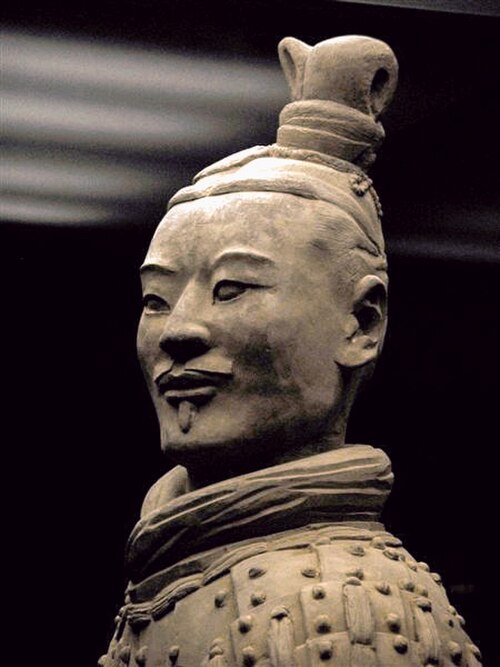
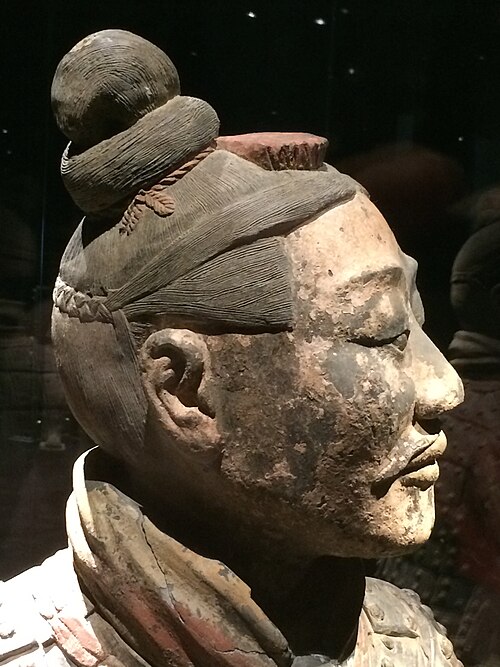


Hanfu also consists of many forms of accessories, such as jewelry, waist ornaments, ribbons, shawls, scarves, and other hand-held items. rdized: the upper ring (珩, héng), middle ring (琚, jū), lower ring (璜, huáng), with jade beads (冲牙, chōngyá) strung between. Each piece corresponded to a cardinal virtue — benevolence, righteousness, propriety, wisdom, and fidelity. The quality of jade indicated social rank: imperial princes wore white jade from Khotan, officials wore green jade, and commoners were restricted to soapstone or glass imitations. Empress dowager Cixi was known to own over 3,000 jade pieces, including a set of twelve pendants each carved from a single flawless block.
The waist sash was the defining structural element of Hanfu. Unlike modern belts, the Chinese sash (绦, tāo) was a wide silk band wrapped multiple times around the waist and tied in specific knots. The knot style indicated the wearer's region and social context: butterfly knots for festive occasions, double-loop knots for formal court attire, and simple hanging knots for everyday wear. During the Ming Dynasty, the xiaopei (霞帔) — a embroidered waist ornament worn over the shoulders — became mandatory court attire for wives of officials, the embroidery pattern strictly regulated by rank. Wives of first-rank officials wore gold-threaded phoenixes; ninth-rank officials' wives wore plain silk with no embroidery. The xiaopei was fastened with a silver clasp called the yinkou (银扣) and hung with jade pendants that clicked audibly when the wearer moved.
The pibo was a long silk scarf, typically two to three meters in length, draped over the shoulders and arms. It originated during the Han Dynasty as a practical garment for palace women to cover their shoulders, but reached its artistic peak in the Tang Dynasty, where dancers used the pibo as an extension of their movement. Tang dynasty poet Bai Juyi described a dancer "sending the flying ribbon to the clouds" in his poem Song of the Rainbow Skirt and Feathered Coat (霓裳羽衣歌). The pibo was worn across all social classes but distinguished by material: imperial consorts wore Sichuan brocade with gold-wrapped threads, while common women wore hemp or plain silk. In Buddhist cave murals at Dunhuang, celestial apsaras are consistently depicted with flowing pibos — indicating the accessory's association with otherworldly grace. The pibo declined during the Ming Dynasty as women adopted the xiapei and higher-collared garments, but has seen a major revival in the modern Hanfu movement.
The round silk fan (团扇, tuánshàn) — also called the palace fan (宫扇) — was the most socially complex Hanfu accessory. It served as a cooling implement, a communication device, and a status symbol simultaneously. In Chinese poetic tradition, the fan carried layered meanings: a woman's dropped fan signaled romantic interest; a deliberately closed fan indicated displeasure; fanning slowly was a mark of refinement. The tuánshàn reached its highest artistic form during the Song Dynasty, when court painters created fans that were genuine works of art — one side painted with birds and flowers, the other inscribed with calligraphy. These fans were mounted on handles of sandalwood, ivory, or bamboo and carried by both men and women. Folding fans (折扇, zhéshàn) were introduced from Japan via Korea during the Northern Song Dynasty and became the preferred accessory of Ming scholars, who used them to display their own calligraphy and painting. The folding fan's ribs were counted as status markers: 16 ribs for scholars, 20 for officials, 24 for imperial princes.
Hair accessories in Hanfu formed a complete language of age, marital status, and social rank. Unmarried girls wore their hair in simple styles with fabric flowers (簪花, zānhuā). The jifaLi (笄礼), the traditional coming-of-age ceremony for girls at age fifteen, involved the first formal insertion of a hairpin — marking her transition to adulthood and eligibility for marriage. After marriage, women wore their hair in a bun secured with multiple pins (发簪, fàzān): the zān was a single-pronged pin, the chai (钗) had two prongs and was often decorated with pendants that swayed with movement, and the buyao (步摇, "step-shake") featured dangling ornaments that trembled with each step. The fengguan (凤冠, phoenix crown) was the most elaborate Hanfu headpiece — a coronet worn by brides and imperial consorts. Empress Zhu Yousi's wedding coronet, recorded in Ming Dynasty archives, featured: six dragon-and-phoenix panels in gold filigree, 3,426 pearls, 1,728 kingfisher feathers (点翠, diǎncùi), and ninety-five rubies. The kingfisher feather technique, now banned due to the species' protected status, was a uniquely Chinese art form that produced an iridescent blue-green color that no dye could replicate.
Hanfu footwear followed strict rules of form and color. Men wore black silk boots with white felt soles for formal occasions and plain cloth shoes at home. Women's shoes were elaborately embroidered — the xiuhuaxie (绣花鞋) featured needlework that matched the season and occasion: lotuses for summer, chrysanthemums for autumn, plum blossoms for winter. The curved-toe style (翘头履, qiàotóulǚ), where the toe curved upward into a small hook, was the most distinctive Hanfu shoe shape — it prevented the long robe hem from being stepped on and created a graceful line from hem to toe. During the Tang Dynasty, court ladies wore platform shoes (高头履, gāotóulǚ) with soles up to fifteen centimeters thick, layered with white, blue, and red felt. The height of the platform indicated status — the Empress's platform shoes were the tallest.
The xiangnang (香囊) was a small embroidered bag filled with aromatic herbs and spices — typically wormwood, angelica, cinnamon, and musk. Worn at the waist or tucked into the sleeve, it served multiple purposes: warding off evil spirits (herbs were believed to have protective properties), freshening the air, preventing illness, and signaling refined taste. During the Dragon Boat Festival (端午节), children wore especially elaborate incense pouches as protection against disease during the summer months. The xiangnang also functioned as a love token — a woman would embroider a ● pouch with paired symbols (mandarin ducks, lotuses, butterflies) and fill it with her preferred fragrance, giving it to her beloved as an implicit declaration of affection. The practice was recorded as early as the Han Dynasty and continued unbroken into the twentieth century.
A Chinese man and woman in traditional Chinese clothing, or hanfu.
古時炎黃之胄常自稱,「華夏」有時又作「諸夏」《左傳》定公十年(西元前 500 年)有:裔不謀夏,夷不亂華。對於此句其疏曰:中國有禮儀之大,故稱夏;有服章之美,謂之華。
To quote an ancient text, 'there is grand ceremonial etiquette so it is called xia (夏), and there is the beauty of apparel which is called hua (华).'[1] (And that's how China is also called huaxia [华夏].) [...] [1] 'The Tenth Year of Duke Ding of Lu' (定公十年), Zuo Qiuming's Commentary on Spring and Autumn Annals (左傳), explained by Yan Shigu (顏師古, 581–645).
女子許嫁,笄而醴之,稱字。
皮弁笄,爵弁笄,緇組紘,纁邊,同篋。
通天冠,本秦制。高九寸,正竖,顶少斜却,乃直下,铁为卷梁,前有展筒,冠前加金博山述,乘舆所常服也。
介帻服文吏,平上帻服武官也
鹖,毅鸟也,毅不知死。状类鸡,首有冠,性敢于斗,死犹不置,是不知死也。《左传》:鹖冠,武土戴之,象其勇也。
簪珥。珥。耳珰垂珠也。簪以玳瑁为擿,长一尺,端为华胜,上为凤皇爵,以翡翠为毛羽,下有白珠,垂黄金镊。左右一横簪之,以安蔮结。诸簪珥皆同制,其擿有等级焉。
步搖,上有垂珠,步則搖也。
'通天冠,本秦制。高九寸,正竖,顶少斜却,乃直下,铁为卷梁,前有展筒,冠前加金博山述,乘舆所常服也。' '武冠,一名武弁,一名大冠,一名繁冠,一名建冠,一名笼冠,即古之惠文冠。或曰赵惠文王所造,因以为名。亦云,惠者蟪也,其冠文轻细如蝉翼,故名惠文。或云,齐人见千岁涸泽之神,名曰庆忌,冠大冠,乘小车,好疾驰,因象其冠而服焉。汉幸臣闳孺为侍中,皆服大冠。天子元服亦先加大冠,左右侍臣及诸将军武官通服之。侍中、常侍则加金珰,附蝉为饰,插以貂毛,黄金为竿,侍中插左,常侍插右。'
{{cite book}}: CS1 maint: location missing publisher (link)上觀百世,下觀百世,經世大法,惟本朝為善變。入關之初,即下剃髮之令,頂戴翎枝,端罩馬褂,古無有也,則變服色矣。
滿洲之服,其筩袖鎧之緒也。軍容入國,以便趨走,亡咎。若其右方重衽,溫暖不均。於左削袂上起而合手者,如拼矣。嬰絡以效桑門,絳繩以被氈笠,比是觀之,將相驚以精鬽。物極而移,異服者眾,猶曰西服者,苟以隨時。諸解辮有常刑,幸其若是,胡漢猶彌以相惡。蒙古朝祭以冠幞,私燕以質孫,胡服隱也。滿洲遊學以短衣,常居以嬰絳,胡服箸也。
Dorgon did not want to see anything go wrong in a province and this might be the main reason why the government ... When the Chinese were ordered to wear the queue, Sun and Li took the initiative in changing their Ming hairstyle to ...
清朝承平日久…唯衣服之製度不改,滿俗終乏雅觀…自清朝入帝中國,四方薙髮變服,二百年來,人已慣耳目[…]不曾又識初來華夏樣矣。我國使部來京,穿戴品服,識者亦有竊羨華風,然其不智者,多群然笑異,見襆頭網巾衣帶,便皆指為倡優樣格,胡俗之移人,一至浩歎如此
秦以戰國即天子位,滅去禮學,郊祀之服皆以袀玄。漢承秦故。
显宗遂就大业,初服旒冕,衣裳文章,赤舄絇屦,以祠天地,养三老五更于三雍,于时致治平矣。
二年春正月辛未,宗祀光武皇帝於明堂,帝及公卿列侯始服冠冕、衣裳、玉佩、絇屨以行事
古者有冠無幘,其戴也,加首有頍,所以安物。故詩曰「有頍者弁」,此之謂也。三代之世,法制滋彰,下至戰國,文武並用。秦雄諸侯,乃加其武將首飾為絳袙,以表貴賤,其後稍稍作顏題。漢興,續其顏,卻摞之,施巾連題,卻覆之,今喪幘是其制也。名之曰幘。幘者,賾也,頭首嚴賾也。至孝文乃高顏題,續之為耳,崇其巾為屋,合後施收,上下群臣貴賤皆服之。文者長耳,武者短耳,稱其冠也。尚書幘收,方三寸,名曰納言,示以忠正,顯近職也。迎氣五郊,各如其色,從章服也。
皁衣群吏春服青幘,立夏乃止,助微順氣,尊其方也。武吏常赤幘,成其威也。未冠童子幘無屋者,示未成人也。入學小童幘也句卷屋者,示尚幼少,未遠冒也。喪幘卻摞,反本禮也。升數如冠,與冠偕也。期喪起耳有收,素幘亦如之,禮輕重有制,變除從漸,文也。
武冠,俗谓之大冠,环缨无蕤,以青系为绲,加双鹖尾,竖左右,为鹖冠云
进贤冠,古缁布冠也,文儒者之服也。前高七寸,后高三寸,长八寸。公侯三梁,中二千石以下至博士两梁,自博士以下至小史私学弟子,皆一梁。宗室刘氏亦两梁冠,示加服也。
步摇以黄金为山题,贯白珠为桂枝相缪...