
Loading article…
 | |
| 別名 |
|
|---|---|
| 言語 | 168 スクリプト(リスト) |
| 標準 | ユニコード標準 |
| エンコード形式 | (珍しい) (廃止) |
| 先行 | ISO/IEC 8859など |
| |
ユニコード(Unicode Standard)[注 1]は、ユニコードコンソーシアムが管理するテキストエンコード標準であり、デジタル化可能な世界中のあらゆる書記体系のテキストの使用をサポートするように設計されています。標準のバージョン16.0 [A]では、154,998の 文字と168のスクリプト[3]が、日常、文学、学術、技術のさまざまな文脈で使用されています。
数字、句読点、その他の記号を含む多くの一般的な文字は、標準内で統一されており、特定の書記体系に固有のものとして扱われていません。Unicodeは3790の絵文字をエンコードしており、その継続的な開発は標準の一部としてコンソーシアムによって行われています。[4]さらに、Unicodeの広範な採用は、日本国外での絵文字の初期の普及に大きく貢献しました。Unicodeは最終的に110万を超える文字をエンコードできます。
Unicode は、さまざまなロケールやさまざまなコンピュータ アーキテクチャで使用されていた、互換性のない無数の文字セットの以前の環境をほぼ置き換えました。Unicode は、ほとんどのWeb ページを含むインターネット上のテキストの大部分をエンコードするために使用されており、関連する Unicode サポートは、現代のソフトウェア開発において一般的な考慮事項となっています。
Unicode文字レパートリーはISO/IEC 10646と同期しており、各文字はコード単位で同一です。しかし、Unicode 標準は文字が割り当てられているレパートリー以上のものです。開発者や設計者を支援するために、この標準ではチャートや参照データも提供され、さまざまな文字に関係する概念を説明して実装のガイダンスを提供する付録もあります。これらの付録で取り上げられているトピックには、文字の正規化、文字の構成と分解、照合、方向性などがあります。[5]
Unicode テキストは、標準の抽象化された文字コードをバイトシーケンスに変換する方法を定義する、いくつかのエンコーディングのいずれかを使用してバイナリデータとして処理および保存されます。Unicode標準自体は、 UTF-8、UTF-16、UTF-32の 3 つのエンコーディングを定義していますが、他にもいくつか存在します。これらのうち、 UTF-8 は、 ASCIIとの下位互換性があるため、圧倒的に最も広く使用されています。
起源と発展
Unicode は元々、それまでに設計されたすべてのテキスト エンコーディングに存在する制限を克服する目的で設計されました。つまり、各エンコーディングはそれぞれのコンテキストで使用するために依存されていましたが、他のエンコーディングとの互換性は特に期待されていませんでした。実際、選択された 2 つのエンコーディングを一緒に使用すると、一方にエンコードされたテキストがもう一方には文字化けとして解釈され、まったく機能しないことがよくありました。ほとんどのエンコーディングは、少数のスクリプト (多くの場合、主に特定のスクリプトとラテン文字)間の相互運用性を容易にするために設計されたものであり、多数のスクリプト間の相互運用性は考慮されておらず、サポートされているすべてのスクリプトが一貫した方法で扱われることも想定されていませんでした。
Unicode の根底にある考え方は、文字の単なる異体字とみなされるグラフィカルな区別ではなく、基礎となる文字(グラフィカル素とグラフィカル素のような単位) をエンコードすることを目指しています。グラフィカルな区別は、書体、マークアップの使用、またはその他の手段によって最も適切に処理されます。特に複雑なケース、たとえば漢字の綴り方の異体字の扱いでは、どの違いが独自のエンコードを正当化し、どの違いが他の文字のグラフィカルな異体字にすぎないかについて、かなりの意見の相違があります。
最も抽象的なレベルでは、Unicode は各文字にコード ポイントと呼ばれる一意の番号を割り当てます。サイズ、形状、スタイルなど、視覚的な表現に関する多くの問題は、 Web ブラウザーやワード プロセッサなど、実際にテキストをレンダリングするソフトウェアの裁量に委ねられています。ただし、迅速な採用を促進するという目的もあり、この元のモデルの単純さは時間の経過とともにいくぶん複雑になり、標準の開発の過程でさまざまな実用的な譲歩がなされてきました。
最初の 256 個のコード ポイントは、すでに西ヨーロッパのスクリプトで記述されているテキストの変換を簡素化する目的で、ISO/IEC 8859-1標準を反映しています。さまざまなレガシー エンコーディングによる区別を保持し、それによってそれらのエンコーディングと Unicode の間で情報の損失なしに変換できるようにするため、外観と意図された機能の両方で他の文字とほぼ同じ多くの文字に、個別のコード ポイントが割り当てられました。たとえば、半角および全角フォームブロックには、ラテン アルファベットの意味の完全な複製が含まれています。これは、レガシーCJK エンコーディングに「全角」(CJK 文字の幅に一致) と「半角」(通常のラテン スクリプトに一致) の両方の文字が含まれていたためです。
ユニコード・ブルドッグ賞は、ユニコードの開発に影響を与えたとみなされる人々に贈られ、受賞者には小林達夫、トーマス・ミロ、ルーズベ・ポルナダー、ケン・ルンデ、マイケル・エバーソンなどが含まれる。[6]
歴史
ユニコードの起源は、1980年代にゼロックス社の文字コード標準(XCCS)に関係する個人のグループにまで遡ります。 [7] 1987年、ゼロックス社の従業員であるジョー・ベッカーは、アップル社の従業員であるリー・コリンズとマーク・デイビスとともに、ユニバーサル文字セット作成の実用性について調査を始めました。[8]ピーター・フェンウィックとデイブ・オプスタッドからの追加の情報を得て、[7]ベッカーは1988年8月に「暫定的にユニコードと呼ばれる国際的/多言語テキスト文字エンコーディングシステム」の草案を発表しました。彼は「「ユニコード」という名前は、ユニークで統一されたユニバーサルエンコーディングを示唆することを意図している」と説明しています。[7]
この文書「Unicode 88」では、ベッカーは16ビット文字を使用したスキームを概説した。[7]
Unicode は、実用的で信頼性の高い世界共通のテキスト エンコーディングのニーズに応えることを目的としています。Unicode は、世界中のすべての言語の文字を網羅するために 16 ビットに拡張された「ワイドボディASCII」と大まかに説明できます。適切に設計された設計では、文字あたり 16 ビットでこの目的には十分すぎるほどです。
この設計上の決定は、「現代」で使用される文字と文字のみがエンコードを必要とするという仮定に基づいて行われました。[7]
Unicode は、過去の遺物を保存することよりも、将来の有用性を確保することを優先しています。Unicode は、まず現代のテキスト (たとえば、1988 年に世界中で印刷されたすべての新聞と雑誌の統合) に掲載されている文字を対象としていますが、その数は間違いなく 2 14 = 16,384 よりはるかに少ないです。これらの現代使用の文字以外の文字はすべて、廃止または希少と定義できます。これらは、一般的に役立つ Unicode の公開リストを混雑させるよりも、私的使用の登録に適しています。
1989 年初頭、Unicode ワーキング グループは拡大し、Metaphor の Ken Whistler と Mike Kernaghan、Research Libraries Groupの Karen Smith-Yoshimura と Joan Aliprand 、Sun Microsystemsの Glenn Wright が参加しました。1990 年には、 Microsoftの Michel Suignard と Asmus Freytag 、NeXTの Rick McGowan もグループに加わりました。1990 年末までに、既存の標準の再マッピング作業のほとんどが完了し、Unicode の最終レビュー ドラフトが完成しました。
ユニコードコンソーシアムは1991年1月3日にカリフォルニアで設立され、[9]その年の10月にユニコード標準の第1巻が出版されました。漢字を追加した第2巻は1992年6月に出版されました。
1996年、Unicode 2.0でサロゲート文字メカニズムが実装され、Unicodeは16ビットに制限されなくなりました。これにより、Unicodeのコードスペースが100万コードポイント以上に増加し、エジプトの象形文字などの多くの歴史的文字や、標準に含まれることが想定されていなかった数千のまれにしか使用されない文字や廃止された文字をエンコードできるようになりました。これらの文字の中には、まれにしか使用されないさまざまなCJK文字があり、その多くは主に固有名詞に使用されているため、元のUnicodeアーキテクチャが想定していたよりもユニバーサルエンコードにはるかに必要です。[10]
1992 年に公開された Microsoft の TrueType 仕様のバージョン 1.0 では、命名テーブルのプラットフォーム ID に「Unicode」ではなく「Apple Unicode」という名前が使用されていました。
ユニコードコンソーシアム
Unicodeコンソーシアムは、Unicodeの開発を調整する非営利団体です。正会員には、Adobe、Apple、Google、IBM、Meta(旧Facebook)、Microsoft、Netflix、SAPなど、テキスト処理標準に関心を持つほとんどの主要なコンピュータソフトウェアおよびハードウェア企業(および他の少数の企業)が含まれます。[11]
長年にわたり、いくつかの国や政府機関がユニコードコンソーシアムの会員となってきました。現在、投票権を持つ正会員はオマーンの宗教省のみです。 [11]
コンソーシアムは、既存の文字エンコード方式を最終的に Unicode とその標準 Unicode 変換形式 (UTF) 方式に置き換えるという野心的な目標を掲げています。これは、既存の方式の多くはサイズと範囲が制限されており、多言語環境と互換性がないためです。
対象となるスクリプト
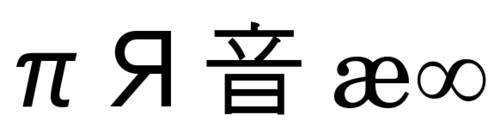
Unicodeは現在使用されている主要な表記体系のほとんどをカバーしています。[12] [より良い情報源が必要]
2024年現在、最新バージョンのUnicodeには[update]合計168の文字[13]が含まれています(アルファベット、アブギダ、音節文字をカバー)が、特に歴史的、典礼的、学術的な文脈で主に使用される文字など、まだエンコードされていない文字が残っています。すでにエンコードされている文字への文字の追加や、特に数学や音楽用の記号(音符やリズム記号の形式)の追加も行われています。
Unicodeロードマップ委員会(マイケル・エバーソン、リック・マクゴーワン、ケン・ウィスラー、VS・ウママヘスワラン)[14]は、エンコードの候補または潜在的候補となっている文字のリストと、それらの暫定的なコードブロック割り当てを、UnicodeコンソーシアムのウェブサイトのUnicodeロードマップ[15]ページで管理している。ロードマップ上の一部の文字、例えば女真文字や契丹大文字については、エンコードの提案がなされており、承認プロセスが進められている。ヌミディア文字やロンゴロンゴ文字など、他の文字についてはまだ提案がなされておらず、文字のレパートリーやその他の詳細について、関係するユーザーコミュニティからの合意を待っている。
まだ Unicode に含まれていない (例:テングワール) または実世界で使用されていないために Unicode に含める資格がない (例:クリンゴン) 現代の発明文字の一部は、非公式だが広く使用されている私的使用領域のコード割り当て とともに、ConScript Unicode レジストリにリストされています。
また、特殊な中世ラテン文字に焦点を当てた 中世 Unicode フォント イニシアチブもあります。これらの提案の一部はすでに Unicode に含まれています。
スクリプトエンコーディングイニシアチブ
スクリプトエンコーディングイニシアチブ[16]は、カリフォルニア大学バークレー校のデボラ・アンダーソンが運営するプロジェクトで、まだ標準にエンコードされていないスクリプトの提案に資金を提供することを目的として2002年に設立されました。このプロジェクトは近年、標準への追加提案の主要な情報源となっています。[17]
バージョン
Unicode コンソーシアムは、 Unicode 標準の最初の公開に続いてISO と共同で共有レパートリーを開発しました。Unicode と ISO のUniversal Coded Character Set (UCS) は、同一の文字名とコード ポイントを使用します。ただし、Unicode バージョンは、ISO の同等バージョンとは 2 つの重要な点で異なります。
UCS は単純な文字マップですが、Unicode は異なるプラットフォームや言語間の相互運用性を実現するために必要なルール、アルゴリズム、プロパティを規定しています。したがって、Unicode 標準には、ビット単位のエンコード、照合、レンダリングなどの詳細なトピックを網羅したより多くの情報が含まれています。また、双方向テキストのサポートに必要な文字プロパティを含む包括的な文字プロパティカタログや、実装者を支援するための視覚的なチャートと参照データ セットも提供しています。以前は、Unicode 標準は、完全なコア仕様、標準の付録、[注 2]、およびコードチャートを含む印刷版として販売されていました。ただし、2006 年に発行されたバージョン 5.0 が、この方法で印刷された最後のバージョンでした。バージョン 5.2 からは、オンデマンド印刷のペーパーバックとして発行されたコア仕様のみを購入できます。[18]一方、全文は Unicode の Web サイトで無料の PDF として公開されています。
この公開方法の実際的な理由は、UCS と Unicode の 2 つ目の大きな違い、つまり更新バージョンのリリースと新しい文字の追加頻度を浮き彫りにしています。Unicode標準は、毎年定期的に拡張バージョンをリリースしており、暦年に複数のバージョンがリリースされることもあれば、予定されていたリリースを延期しなければならないこともまれにあります。たとえば、バージョン 13.0 が公開されてから 1 か月後の 2020 年 4 月、Unicode コンソーシアムは、COVID-19 パンデミックの影響でバージョン 14.0 のリリース予定日を 6 か月延期し、2021 年 9 月にすると発表しました。
最新バージョンのUnicode 16.0は、2024年9月10日にリリースされました。5,185の文字と7つの新しい文字(ガライ、グルン・ケマ、キラット・ライ、オル・オナル、スヌワール、トドリ、トゥル・ティガラリ)が追加されました。[19]
これまでに、 Unicode標準の以下のバージョンが公開されています。文字レパートリーの変更を含まない更新バージョンは、3番目の数字(例:バージョン4.0.1)で示され、以下の表では省略されています。[20]
- ^ 私用文字、制御文字、非文字、およびサロゲート コード ポイントを除くグラフィック文字と書式文字の合計数。
- ^
- 2.0 修正案 5、6、7 を追加
- 2.1 修正第 18 号から 2 つの文字を追加しました。
- ^ 3.2 修正案 1 を追加しました。
- ^
- 4.1 修正1を追加
- 5.0では、修正第2条と修正第3条の4文字が追加されました。
- 5.1 修正第4号を追加
- 5.2 修正案5および6を追加
- ^ インドルピー記号も
- ^
- 6.2トルコリラ記号を追加
- 6.3 5つの追加キャラクターを追加
- 7.0 修正案 1 および 2 とルーブル記号を追加
- ^ さらに修正第1号、ラリ文字、9つのCJK統一表意文字、41の絵文字が追加されました。 [43]
9.0では修正第2号、アドラム文字、ネワ文字、日本のテレビ記号、74の絵文字と記号が追加されました。[44] - ^
- さらに、56 個の絵文字、285 個の変体仮名、3 個のザナバザール スクエア文字
- 11.0では、46個のムタヴルリ語大文字、5個のCJK統合表意文字、および66個の絵文字が追加されました。
- 12.0 では 62 個の追加文字が追加されました。
計画バージョン
ユニコードコンソーシアムは通常、年に1回ユニコード標準の新バージョンをリリースします。次のメジャーバージョンであるバージョン17.0には、4301の新しい統合CJK文字が含まれる予定です。[57] [58]
アーキテクチャと用語
コードスペースとコードポイント
ユニコード標準では、コード空間[59]を定義しています。これは、0から12の範囲のコードポイント[60]と呼ばれる整数のシーケンスです。1 114 111、標準ではU+0000 – U+10FFFFと表記されます。[61]コードスペースは、Unicode標準の体系的でアーキテクチャに依存しない表現です。実際のテキストは、 UTF-8などのいくつかのUnicodeエンコーディングのいずれかを介してバイナリデータとして処理されます。
この規範的表記では、2文字のプレフィックスはU+常にコードポイントの前に付けられ、[62]コードポイント自体は16進数で書かれる。少なくとも4桁の16進数が常に書かれ、必要に応じて先頭にゼロが付けられる。たとえば、コードポイントU+00F7 ÷ DIVISION SIGNは先頭に2つのゼロが付けられるが、U+13254 𓉔 EGYPTIAN HIEROGLYPH O004 (  )はパディングされていない。[63]
合計は 2 20 + (2 16 − 2 11 ) =コードスペース内の有効なコード ポイントは1 112 064 個です。(この数は、 UTF-16文字エンコードの制限から生じます。UTF-16 文字エンコードは、U+0000からU+FFFFの範囲の2 16個のコード ポイントをエンコードできますが、 U+D800からU+DFFFの範囲の2 11 個のコード ポイントはエンコードできません。これらのコードは、U+10000からU+10FFFFの範囲の2 20 個のコード ポイントをエンコードするためのサロゲート ペアとして使用されます。)
コードプレーンとブロック
Unicode コード空間は 0 から 16 までの 17 のプレーンに分かれています。プレーン 0 は基本多言語プレーン(BMP) で、最もよく使用される文字が含まれています。BMP 内のすべてのコード ポイントは、UTF-16 エンコードでは単一のコード ユニットとしてアクセスされ、UTF-8 では 1、2、または 3 バイトでエンコードできます。プレーン 1 から 16 (補助プレーン) のコード ポイントは、UTF-16ではサロゲート ペアとしてアクセスされ、 UTF-8では 4 バイトでエンコードされます。
各プレーン内では、文字は関連する文字の名前付きブロック内に割り当てられます。ブロックのサイズは常に 16 の倍数で、多くの場合 128 の倍数ですが、それ以外は任意です。特定のスクリプトに必要な文字は、コード空間内の複数の異なる、分離する可能性のあるブロックに分散している場合があります。
一般カテゴリプロパティ
各コード ポイントには分類が割り当てられ、コード ポイントの一般カテゴリプロパティとしてリストされます。ここで、最上位レベルでは、コード ポイントは文字、マーク、数字、句読点、記号、区切り文字、その他のいずれかに分類されます。各カテゴリの下で、各コード ポイントはさらにサブカテゴリ化されます。ほとんどの場合、特定のコード ポイントのすべての特性を適切に記述するには、他のプロパティを使用する必要があります。
のU+D800~U+DBFFの範囲の1024ポイントはハイサロゲートコードポイントと呼ばれ、U+DC00~U+DFFFの範囲のコードポイントはハイサロゲートコードポイントと呼ばれます(上位サロゲートコード ポイント(1024コード ポイント以上) は、下位サロゲート コード ポイントと呼ばれます。上位サロゲート コード ポイントの後に下位サロゲート コード ポイントが続くと、 UTF-16 でサロゲート ペアが形成され、 U+FFFFより大きいコード ポイントを表します。原則として、これらのコード ポイントはそれ以外の場合は使用できませんが、実際には、特に UTF-16 を使用しない場合は、このルールが無視されることがよくあります。
A small set of code points are guaranteed never to be assigned to characters, although third-parties may make independent use of them at their discretion. There are 66 of these noncharacters: U+FDD0–U+FDEF and the last two code points in each of the 17 planes (e.g. U+FFFE, U+FFFF, U+1FFFE, U+1FFFF, ..., U+10FFFE, U+10FFFF). The set of noncharacters is stable, and no new noncharacters will ever be defined.[64] Like surrogates, the rule that these cannot be used is often ignored, although the operation of the byte order mark assumes that U+FFFE will never be the first code point in a text. The exclusion of surrogates and noncharacters leaves 1111998 code points available for use.
Private-use code points are considered to be assigned, but they intentionally have no interpretation specified by The Unicode Standard[65] such that any interchange of such code points requires an independent agreement between the sender and receiver as to their interpretation. There are three private-use areas in the Unicode codespace:
- Private Use Area: U+E000–U+F8FF (6400 characters),
- Supplementary Private Use Area-A: U+F0000–U+FFFFD (65534 characters),
- Supplementary Private Use Area-B: U+100000–U+10FFFD (65534 characters).
Graphic characters are those defined by The Unicode Standard to have particular semantics, either having a visible glyph shape or representing a visible space. As of Unicode 16.0, there are 154826 graphic characters.
Format characters are characters that do not have a visible appearance but may have an effect on the appearance or behavior of neighboring characters. For example, U+200C ZERO WIDTH NON-JOINER and U+200D ZERO WIDTH JOINER may be used to change the default shaping behavior of adjacent characters (e.g. to inhibit ligatures or request ligature formation). There are 172 format characters in Unicode 16.0.
65 code points, the ranges U+0000–U+001F and U+007F–U+009F, are reserved as control codes, corresponding to the C0 and C1 control codes as defined in ISO/IEC 6429. U+0089 LINE TABULATION, U+008A LINE FEED, and U+000D CARRIAGE RETURN are widely used in texts using Unicode. In a phenomenon known as mojibake, the C1 code points are improperly decoded according to the Windows-1252 codepage, previously widely used in Western European contexts.
Together, graphic, format, control code, and private use characters are collectively referred to as assigned characters. Reserved code points are those code points that are valid and available for use, but have not yet been assigned. As of Unicode 15.1, there are 819467 reserved code points.
Abstract characters
The set of graphic and format characters defined by Unicode does not correspond directly to the repertoire of abstract characters representable under Unicode. Unicode encodes characters by associating an abstract character with a particular code point.[66] However, not all abstract characters are encoded as a single Unicode character, and some abstract characters may be represented in Unicode by a sequence of two or more characters. For example, a Latin small letter "i" with an ogonek, a dot above, and an acute accent, which is required in Lithuanian, is represented by the character sequence U+012F; U+0307; U+0301. Unicode maintains a list of uniquely named character sequences for abstract characters that are not directly encoded in Unicode.[67]
All assigned characters have a unique and immutable name by which they are identified. This immutability has been guaranteed since version 2.0 of The Unicode Standard by its Name Stability policy.[64] In cases where a name is seriously defective and misleading, or has a serious typographical error, a formal alias may be defined that applications are encouraged to use in place of the official character name. For example, U+A015 ꀕ YI SYLLABLE WU has the formal alias YI SYLLABLE ITERATION MARK, and U+FE18 ︘ PRESENTATION FORM FOR VERTICAL RIGHT WHITE LENTICULAR BRAKCET (sic) has the formal alias PRESENTATION FORM FOR VERTICAL RIGHT WHITE LENTICULAR BRACKET.[68]
Ready-made versus composite characters
Unicode includes a mechanism for modifying characters that greatly extends the supported repertoire of glyphs. This covers the use of combining diacritical marks that may be added after the base character by the user. Multiple combining diacritics may be simultaneously applied to the same character. Unicode also contains precomposed versions of most letter/diacritic combinations in normal use. These make the conversion to and from legacy encodings simpler, and allow applications to use Unicode as an internal text format without having to implement combining characters. For example, é can be represented in Unicode as U+0065 e LATIN SMALL LETTER E followed by U+0301 ◌́ COMBINING ACUTE ACCENT), and equivalently as the precomposed character U+00E9 é LATIN SMALL LETTER E WITH ACUTE. Thus, users often have multiple equivalent ways of encoding the same character. The mechanism of canonical equivalence within The Unicode Standard ensures the practical interchangeability of these equivalent encodings.
An example of this arises with the Korean alphabet Hangul: Unicode provides a mechanism for composing Hangul syllables from their individual Hangul Jamo subcomponents. However, it also provides 11172 combinations of precomposed syllables made from the most common jamo.
CJK characters presently only have codes for uncomposable radicals and precomposed forms. Most Han characters have either been intentionally composed from, or reconstructed as compositions of, simpler orthographic elements called radicals, so in principle Unicode could have enabled their composition as it did with Hangul. While this could have greatly reduced the number of required code points, as well as allowing the algorithmic synthesis of many arbitrary new characters, the complexities of character etymologies and the post-hoc nature of radical systems add immense complexity to the proposal. Indeed, attempts to design CJK encodings on the basis of composing radicals have been met with difficulties resulting from the reality that Chinese characters do not decompose as simply or as regularly as Hangul does.
The CJK Radicals Supplement block is assigned to the range U+2E80–U+2EFF, and the Kangxi radicals are assigned to U+2F00–U+2FDF. The Ideographic Description Sequences block covers the range U+2FF0–U+2FFB, but The Unicode Standard warns against using its characters as an alternate representation for characters encoded elsewhere:
This process is different from a formal encoding of an ideograph. There is no canonical description of unencoded ideographs; there is no semantic assigned to described ideographs; there is no equivalence defined for described ideographs. Conceptually, ideographic descriptions are more akin to the English phrase "an 'e' with an acute accent on it" than to the character sequence <U+0065, U+0301>.
Ligatures
Many scripts, including Arabic and Devanāgarī, have special orthographic rules that require certain combinations of letterforms to be combined into special ligature forms. The rules governing ligature formation can be quite complex, requiring special script-shaping technologies such as ACE (Arabic Calligraphic Engine by DecoType in the 1980s and used to generate all the Arabic examples in the printed editions of The Unicode Standard), which became the proof of concept for OpenType (by Adobe and Microsoft), Graphite (by SIL International), or AAT (by Apple).
Instructions are also embedded in fonts to tell the operating system how to properly output different character sequences. A simple solution to the placement of combining marks or diacritics is assigning the marks a width of zero and placing the glyph itself to the left or right of the left sidebearing (depending on the direction of the script they are intended to be used with). A mark handled this way will appear over whatever character precedes it, but will not adjust its position relative to the width or height of the base glyph; it may be visually awkward and it may overlap some glyphs. Real stacking is impossible but can be approximated in limited cases (for example, Thai top-combining vowels and tone marks can just be at different heights to start with). Generally, this approach is only effective in monospaced fonts but may be used as a fallback rendering method when more complex methods fail.
Standardized subsets
Several subsets of Unicode are standardized: Microsoft Windows since Windows NT 4.0 supports WGL-4 with 657 characters, which is considered to support all contemporary European languages using the Latin, Greek, or Cyrillic script. Other standardized subsets of Unicode include the Multilingual European Subsets:[70] MES-1 (Latin scripts only; 335 characters), MES-2 (Latin, Greek, and Cyrillic; 1062 characters)[71] and MES-3A & MES-3B (two larger subsets, not shown here). MES-2 includes every character in MES-1 and WGL-4.
The standard DIN 91379[72] specifies a subset of Unicode letters, special characters, and sequences of letters and diacritic signs to allow the correct representation of names and to simplify data exchange in Europe. This standard supports all of the official languages of all European Union countries, as well as the German minority languages and the official languages of Iceland, Liechtenstein, Norway, and Switzerland. To allow the transliteration of names in other writing systems to the Latin script according to the relevant ISO standards, all necessary combinations of base letters and diacritic signs are provided.
Rendering software that cannot process a Unicode character appropriately often displays it as an open rectangle, or as U+FFFD to indicate the position of the unrecognized character. Some systems have made attempts to provide more information about such characters. Apple's Last Resort font will display a substitute glyph indicating the Unicode range of the character, and the SIL International's Unicode fallback font will display a box showing the hexadecimal scalar value of the character.
Mapping and encodings
Several mechanisms have been specified for storing a series of code points as a series of bytes.
Unicode defines two mapping methods: the Unicode Transformation Format (UTF) encodings, and the Universal Coded Character Set (UCS) encodings. An encoding maps (possibly a subset of) the range of Unicode code points to sequences of values in some fixed-size range, termed code units. All UTF encodings map code points to a unique sequence of bytes.[73] The numbers in the names of the encodings indicate the number of bits per code unit (for UTF encodings) or the number of bytes per code unit (for UCS encodings and UTF-1). UTF-8 and UTF-16 are the most commonly used encodings. UCS-2 is an obsolete subset of UTF-16; UCS-4 and UTF-32 are functionally equivalent.
UTF encodings include:
- UTF-8, which uses one to four 8-bit units per code point,[note 3] and has maximal compatibility with ASCII
- UTF-16, which uses either one or two 16-bit units per code point, but cannot encode surrogate characters
- UTF-32, which uses one 32-bit unit per code point
- UTF-EBCDIC, not specified as part of The Unicode Standard, which uses one to five 8-bit units per code point, intended to maximize compatibility with EBCDIC
UTF-8 uses one to four 8-bit units (bytes) per code point and, being compact for Latin scripts and ASCII-compatible, provides the de facto standard encoding for the interchange of Unicode text. It is used by FreeBSD and most recent Linux distributions as a direct replacement for legacy encodings in general text handling.
The UCS-2 and UTF-16 encodings specify the Unicode byte order mark (BOM) for use at the beginnings of text files, which may be used for byte-order detection (or byte endianness detection). The BOM, encoded as U+FEFF ZERO WIDTH NO-BREAK SPACE, has the important property of unambiguity on byte reorder, regardless of the Unicode encoding used; U+FFFE (the result of byte-swapping U+FEFF) does not equate to a legal character, and U+FEFF in places other than the beginning of text conveys the zero-width non-break space.
The same character converted to UTF-8 becomes the byte sequence EF BB BF. The Unicode Standard allows the BOM "can serve as a signature for UTF-8 encoded text where the character set is unmarked".[74] Some software developers have adopted it for other encodings, including UTF-8, in an attempt to distinguish UTF-8 from local 8-bit code pages. However RFC 3629, the UTF-8 standard, recommends that byte order marks be forbidden in protocols using UTF-8, but discusses the cases where this may not be possible. In addition, the large restriction on possible patterns in UTF-8 (for instance there cannot be any lone bytes with the high bit set) means that it should be possible to distinguish UTF-8 from other character encodings without relying on the BOM.
In UTF-32 and UCS-4, one 32-bit code unit serves as a fairly direct representation of any character's code point (although the endianness, which varies across different platforms, affects how the code unit manifests as a byte sequence). In the other encodings, each code point may be represented by a variable number of code units. UTF-32 is widely used as an internal representation of text in programs (as opposed to stored or transmitted text), since every Unix operating system that uses the gcc compilers to generate software uses it as the standard "wide character" encoding. Some programming languages, such as Seed7, use UTF-32 as an internal representation for strings and characters. Recent versions of the Python programming language (beginning with 2.2) may also be configured to use UTF-32 as the representation for Unicode strings, effectively disseminating such encoding in high-level coded software.
Punycode, another encoding form, enables the encoding of Unicode strings into the limited character set supported by the ASCII-based Domain Name System (DNS). The encoding is used as part of IDNA, which is a system enabling the use of Internationalized Domain Names in all scripts that are supported by Unicode. Earlier and now historical proposals include UTF-5 and UTF-6.
GB18030 is another encoding form for Unicode, from the Standardization Administration of China. It is the official character set of the People's Republic of China (PRC). BOCU-1 and SCSU are Unicode compression schemes. The April Fools' Day RFC of 2005 specified two parody UTF encodings, UTF-9 and UTF-18.
Adoption
Unicode, in the form of UTF-8, has been the most common encoding for the World Wide Web since 2008.[75] It has near-universal adoption, and much of the non-UTF-8 content is found in other Unicode encodings, e.g. UTF-16. As of 2024[update], UTF-8 accounts for on average 97.8% of all web pages (and 987 of the top 1,000 highest-ranked web pages).[76] Although many pages only use ASCII characters to display content, UTF-8 was designed with 8-bit ASCII as a subset and almost no websites now declare their encoding to only be ASCII instead of UTF-8.[77] Over a third of the languages tracked have 100% UTF-8 use.
All internet protocols maintained by Internet Engineering Task Force, e.g. FTP,[78] have required support for UTF-8 since the publication of RFC 2277 in 1998, which specified that all IETF protocols "MUST be able to use the UTF-8 charset".[79]
Operating systems
Unicode has become the dominant scheme for the internal processing and storage of text. Although a great deal of text is still stored in legacy encodings, Unicode is used almost exclusively for building new information processing systems. Early adopters tended to use UCS-2 (the fixed-length two-byte obsolete precursor to UTF-16) and later moved to UTF-16 (the variable-length current standard), as this was the least disruptive way to add support for non-BMP characters. The best known such system is Windows NT (and its descendants, 2000, XP, Vista, 7, 8, 10, and 11), which uses UTF-16 as the sole internal character encoding. The Java and .NET bytecode environments, macOS, and KDE also use it for internal representation. Partial support for Unicode can be installed on Windows 9x through the Microsoft Layer for Unicode.
UTF-8 (originally developed for Plan 9)[80] has become the main storage encoding on most Unix-like operating systems (though others are also used by some libraries) because it is a relatively easy replacement for traditional extended ASCII character sets. UTF-8 is also the most common Unicode encoding used in HTML documents on the World Wide Web.
Multilingual text-rendering engines which use Unicode include Uniscribe and DirectWrite for Microsoft Windows, ATSUI and Core Text for macOS, and Pango for GTK+ and the GNOME desktop.
Input methods
Because keyboard layouts cannot have simple key combinations for all characters, several operating systems provide alternative input methods that allow access to the entire repertoire.
ISO/IEC 14755,[81] which standardises methods for entering Unicode characters from their code points, specifies several methods. There is the Basic method, where a beginning sequence is followed by the hexadecimal representation of the code point and the ending sequence. There is also a screen-selection entry method specified, where the characters are listed in a table on a screen, such as with a character map program.
Online tools for finding the code point for a known character include Unicode Lookup[82] by Jonathan Hedley and Shapecatcher[83] by Benjamin Milde. In Unicode Lookup, one enters a search key (e.g. "fractions"), and a list of corresponding characters with their code points is returned. In Shapecatcher, based on Shape context, one draws the character in a box and a list of characters approximating the drawing, with their code points, is returned.
MIME defines two different mechanisms for encoding non-ASCII characters in email, depending on whether the characters are in email headers (such as the "Subject:"), or in the text body of the message; in both cases, the original character set is identified as well as a transfer encoding. For email transmission of Unicode, the UTF-8 character set and the Base64 or the Quoted-printable transfer encoding are recommended, depending on whether much of the message consists of ASCII characters. The details of the two different mechanisms are specified in the MIME standards and generally are hidden from users of email software.
The IETF has defined[84][85] a framework for internationalized email using UTF-8, and has updated[86][87][88][89] several protocols in accordance with that framework.
The adoption of Unicode in email has been very slow.[citation needed] Some East Asian text is still encoded in encodings such as ISO-2022, and some devices, such as mobile phones,[citation needed] still cannot correctly handle Unicode data. Support has been improving, however. Many major free mail providers such as Yahoo! Mail, Gmail, and Outlook.com support it.
Web
All W3C recommendations have used Unicode as their document character set since HTML 4.0. Web browsers have supported Unicode, especially UTF-8, for many years. There used to be display problems resulting primarily from font related issues; e.g. v6 and older of Microsoft Internet Explorer did not render many code points unless explicitly told to use a font that contains them.[90]
Although syntax rules may affect the order in which characters are allowed to appear, XML (including XHTML) documents, by definition,[91] comprise characters from most of the Unicode code points, with the exception of:
- FFFE or FFFF.
- most of the C0 control codes,
- the permanently unassigned code points D800–DFFF,
HTML characters manifest either directly as bytes according to the document's encoding, if the encoding supports them, or users may write them as numeric character references based on the character's Unicode code point. For example, the references Δ, Й, ק, م, ๗, あ, 叶, 葉, and 말 (or the same numeric values expressed in hexadecimal, with &#x as the prefix) should display on all browsers as Δ, Й, ק ,م, ๗, あ, 叶, 葉, and 말.
When specifying URIs, for example as URLs in HTTP requests, non-ASCII characters must be percent-encoded.
Fonts
Unicode is not in principle concerned with fonts per se, seeing them as implementation choices.[92] Any given character may have many allographs, from the more common bold, italic and base letterforms to complex decorative styles. A font is "Unicode compliant" if the glyphs in the font can be accessed using code points defined in The Unicode Standard.[93] The standard does not specify a minimum number of characters that must be included in the font; some fonts have quite a small repertoire.
Free and retail fonts based on Unicode are widely available, since TrueType and OpenType support Unicode (and Web Open Font Format (WOFF and WOFF2) is based on those). These font formats map Unicode code points to glyphs, but OpenType and TrueType font files are restricted to 65,535 glyphs. Collection files provide a "gap mode" mechanism for overcoming this limit in a single font file. (Each font within the collection still has the 65,535 limit, however.) A TrueType Collection file would typically have a file extension of ".ttc".
Thousands of fonts exist on the market, but fewer than a dozen fonts—sometimes described as "pan-Unicode" fonts—attempt to support the majority of Unicode's character repertoire. Instead, Unicode-based fonts typically focus on supporting only basic ASCII and particular scripts or sets of characters or symbols. Several reasons justify this approach: applications and documents rarely need to render characters from more than one or two writing systems; fonts tend to demand resources in computing environments; and operating systems and applications show increasing intelligence in regard to obtaining glyph information from separate font files as needed, i.e., font substitution. Furthermore, designing a consistent set of rendering instructions for tens of thousands of glyphs constitutes a monumental task; such a venture passes the point of diminishing returns for most typefaces.
Newlines
Unicode partially addresses the newline problem that occurs when trying to read a text file on different platforms. Unicode defines a large number of characters that conforming applications should recognize as line terminators.
In terms of the newline, Unicode introduced U+2028 LINE SEPARATOR and U+2029 PARAGRAPH SEPARATOR. This was an attempt to provide a Unicode solution to encoding paragraphs and lines semantically, potentially replacing all of the various platform solutions. In doing so, Unicode does provide a way around the historical platform-dependent solutions. Nonetheless, few if any Unicode solutions have adopted these Unicode line and paragraph separators as the sole canonical line ending characters. However, a common approach to solving this issue is through newline normalization. This is achieved with the Cocoa text system in Mac OS X and also with W3C XML and HTML recommendations. In this approach, every possible newline character is converted internally to a common newline (which one does not really matter since it is an internal operation just for rendering). In other words, the text system can correctly treat the character as a newline, regardless of the input's actual encoding.
Issues
Character unification
Han unification
The Ideographic Research Group (IRG) is tasked with advising the Consortium and ISO regarding Han unification, or Unihan, especially the further addition of CJK unified and compatibility ideographs to the repertoire. The IRG is composed of experts from each region that has historically used Chinese characters. However, despite the deliberation within the committee, Han unification has consistently been one of the most contested aspects of The Unicode Standard since the genesis of the project.[94]
Existing character set standards such as the Japanese JIS X 0208 (encoded by Shift JIS) defined unification criteria, meaning rules for determining when a variant Chinese character is to be considered a handwriting/font difference (and thus unified), versus a spelling difference (to be encoded separately). Unicode's character model for CJK characters was based on the unification criteria used by JIS X 0208, as well as those developed by the Association for a Common Chinese Code in China.[95] Due to the standard's principle of encoding semantic instead of stylistic variants, Unicode has received criticism for not assigning code points to certain rare and archaic kanji variants, possibly complicating processing of ancient and uncommon Japanese names. Since it places particular emphasis on Chinese, Japanese and Korean sharing many characters in common, Han unification is also sometimes perceived as treating the three as the same thing.[96]
Less-frequently-used alternative encodings exist, often predating Unicode, with character models differing from this paradigm, aimed at preserving the various stylistic differences between regional and/or nonstandard character forms. One example is the TRON Code favored by some users for handling historical Japanese text, though not widely adopted among the Japanese public. Another is the CCCII encoding adopted by library systems in Hong Kong, Taiwan and the United States. These have their own drawbacks in general use, leading to the Big5 encoding (introduced in 1984, four years after CCCII) having become more common than CCCII outside of library systems.[97] Although work at Apple based on Research Libraries Group's CJK Thesaurus, which was used to maintain the EACC variant of CCCII, was one of the direct predecessors of Unicode's Unihan set, Unicode adopted the JIS-style unification model.[95]
The earliest version of Unicode had a repertoire of fewer than 21,000 Han characters, largely limited to those in relatively common modern usage. As of version 16.0, the standard now encodes more than 97,000 Han characters, and work is continuing to add thousands more—largely historical and dialectal variant characters used throughout the Sinosphere.
Modern typefaces provide a means to address some of the practical issues in depicting unified Han characters with various regional graphical representations. The 'locl' OpenType table allows a renderer to select a different glyph for each code point based on the text locale.[98] The Unicode variation sequences can also provide in-text annotations for a desired glyph selection; this requires registration of the specific variant in the Ideographic Variation Database.
Italic or cursive characters in Cyrillic
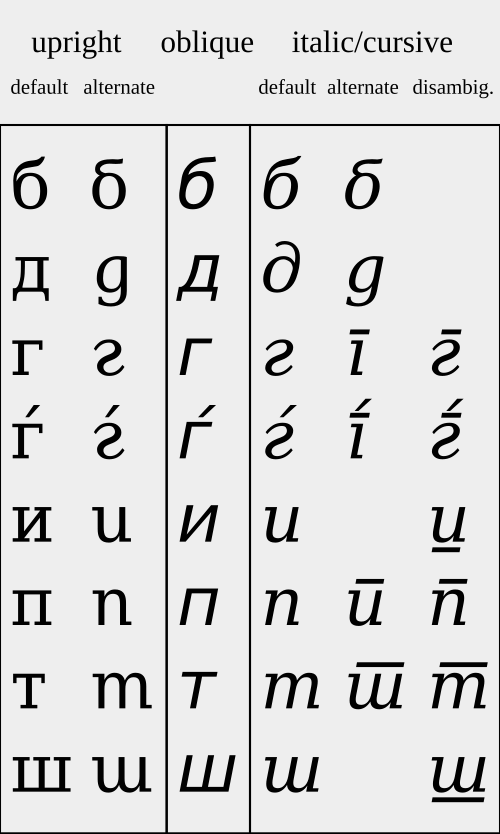
If the appropriate glyphs for characters in the same script differ only in the italic, Unicode has generally unified them, as can be seen in the comparison among a set of seven characters' italic glyphs as typically appearing in Russian, traditional Bulgarian, Macedonian, and Serbian texts at right, meaning that the differences are displayed through smart font technology or manually changing fonts. The same OpenType 'locl' technique is used.[99]
Localised case pairs
For use in the Turkish alphabet and Azeri alphabet, Unicode includes a separate dotless lowercase I (ı) and a dotted uppercase I (İ). However, the usual ASCII letters are used for the lowercase dotted I and the uppercase dotless I, matching how they are handled in the earlier ISO 8859-9. As such, case-insensitive comparisons for those languages have to use different rules than case-insensitive comparisons for other languages using the Latin script.[100]
By contrast, the Icelandic eth (ð), the barred D (đ) and the retroflex D (ɖ), which usually[note 4] look the same in uppercase (Đ), are given the opposite treatment, and encoded separately in both letter-cases (in contrast to the earlier ISO 6937, which unifies the uppercase forms). Although it allows for case-insensitive comparison without needing to know the language of the text, this approach also has issues, requiring security measures relating to homoglyph attacks.[101]
Diacritics on lowercase I

Whether the lowercase letter I is expected to retain its tittle when a diacritic applies also depends on local conventions.
Security
Unicode has a large number of homoglyphs, many of which look very similar or identical to ASCII letters. Substitution of these can make an identifier or URL that looks correct, but directs to a different location than expected.[102] Additionally, homoglyphs can also be used for manipulating the output of natural language processing (NLP) systems.[103] Mitigation requires disallowing these characters, displaying them differently, or requiring that they resolve to the same identifier;[104] all of this is complicated due to the huge and constantly changing set of characters.[105][106]
A security advisory was released in 2021 by two researchers, one from the University of Cambridge and the other from the University of Edinburgh, in which they assert that the BiDi marks can be used to make large sections of code do something different from what they appear to do. The problem was named "Trojan Source".[107] In response, code editors started highlighting marks to indicate forced text-direction changes.[108]
Mapping to legacy character sets
Unicode was designed to provide code-point-by-code-point round-trip format conversion to and from any preexisting character encodings, so that text files in older character sets can be converted to Unicode and then back and get back the same file, without employing context-dependent interpretation. That has meant that inconsistent legacy architectures, such as combining diacritics and precomposed characters, both exist in Unicode, giving more than one method of representing some text. This is most pronounced in the three different encoding forms for Korean Hangul. Since version 3.0, any precomposed characters that can be represented by a combined sequence of already existing characters can no longer be added to the standard to preserve interoperability between software using different versions of Unicode.
Injective mappings must be provided between characters in existing legacy character sets and characters in Unicode to facilitate conversion to Unicode and allow interoperability with legacy software. Lack of consistency in various mappings between earlier Japanese encodings such as Shift-JIS or EUC-JP and Unicode led to round-trip format conversion mismatches, particularly the mapping of the character JIS X 0208 '~' (1-33, WAVE DASH), heavily used in legacy database data, to either U+FF5E ~ FULLWIDTH TILDE (in Microsoft Windows) or U+301C 〜 WAVE DASH (other vendors).[109]
Some Japanese computer programmers objected to Unicode because it requires them to separate the use of U+005C \ REVERSE SOLIDUS (backslash) and U+00A5 ¥ YEN SIGN, which was mapped to 0x5C in JIS X 0201, and a lot of legacy code exists with this usage.[110] (This encoding also replaces tilde '~' 0x7E with macron '¯', now 0xAF.) The separation of these characters exists in ISO 8859-1, from long before Unicode.
Indic scripts
Indic scripts such as Tamil and Devanagari are each allocated only 128 code points, matching the ISCII standard. The correct rendering of Unicode Indic text requires transforming the stored logical order characters into visual order and the forming of ligatures (also known as conjuncts) out of components. Some local scholars argued in favor of assignments of Unicode code points to these ligatures, going against the practice for other writing systems, though Unicode contains some Arabic and other ligatures for backward compatibility purposes only.[111][112][113] Encoding of any new ligatures in Unicode will not happen, in part, because the set of ligatures is font-dependent, and Unicode is an encoding independent of font variations. The same kind of issue arose for the Tibetan script in 2003 when the Standardization Administration of China proposed encoding 956 precomposed Tibetan syllables,[114] but these were rejected for encoding by the relevant ISO committee (ISO/IEC JTC 1/SC 2).[115]
Thai alphabet support has been criticized for its ordering of Thai characters. The vowels เ, แ, โ, ใ, ไ that are written to the left of the preceding consonant are in visual order instead of phonetic order, unlike the Unicode representations of other Indic scripts. This complication is due to Unicode inheriting the Thai Industrial Standard 620, which worked in the same way, and was the way in which Thai had always been written on keyboards. This ordering problem complicates the Unicode collation process slightly, requiring table lookups to reorder Thai characters for collation.[96] Even if Unicode had adopted encoding according to spoken order, it would still be problematic to collate words in dictionary order. E.g., the word แสดง [sa dɛːŋ] "perform" starts with a consonant cluster "สด" (with an inherent vowel for the consonant "ส"), the vowel แ-, in spoken order would come after the ด, but in a dictionary, the word is collated as it is written, with the vowel following the ส.
Combining characters
Characters with diacritical marks can generally be represented either as a single precomposed character or as a decomposed sequence of a base letter plus one or more non-spacing marks. For example, ḗ (precomposed e with macron and acute above) and ḗ (e followed by the combining macron above and combining acute above) should be rendered identically, both appearing as an e with a macron (◌̄) and acute accent (◌́), but in practice, their appearance may vary depending upon what rendering engine and fonts are being used to display the characters. Similarly, underdots, as needed in the romanization of Indic languages, will often be placed incorrectly.[citation needed] Unicode characters that map to precomposed glyphs can be used in many cases, thus avoiding the problem, but where no precomposed character has been encoded, the problem can often be solved by using a specialist Unicode font such as Charis SIL that uses Graphite, OpenType ('gsub'), or AAT technologies for advanced rendering features.
Anomalies
The Unicode Standard has imposed rules intended to guarantee stability.[116] Depending on the strictness of a rule, a change can be prohibited or allowed. For example, a "name" given to a code point cannot and will not change. But a "script" property is more flexible, by Unicode's own rules. In version 2.0, Unicode changed many code point "names" from version 1. At the same moment, Unicode stated that, thenceforth, an assigned name to a code point would never change. This implies that when mistakes are published, these mistakes cannot be corrected, even if they are trivial (as happened in one instance with the spelling BRAKCET for BRACKET in a character name). In 2006 a list of anomalies in character names was first published, and, as of June 2021, there were 104 characters with identified issues,[117] for example:
- U+034F ͏ COMBINING GRAPHEME JOINER: Does not join graphemes.[117]
- U+2118 ℘ SCRIPT CAPITAL P: This is a small letter. The capital is U+1D4AB 𝒫 MATHEMATICAL SCRIPT CAPITAL P.[118]
- U+A015 ꀕ YI SYLLABLE WU: This is not a Yi syllable, but a Yi iteration mark.
- U+FE18 ︘ PRESENTATION FORM FOR VERTICAL RIGHT WHITE LENTICULAR BRAKCET: bracket is spelled incorrectly.[119] (Spelling errors are resolved by using Unicode alias names.)
While Unicode defines the script designator (name) to be "Phags_Pa", in that script's character names, a hyphen is added: U+A840 ꡀ PHAGS-PA LETTER KA.[120][121] This, however, is not an anomaly, but the rule: hyphens are replaced by underscores in script designators.[120]
See also
- Comparison of Unicode encodings
- International Components for Unicode (ICU), now as ICU-TC a part of Unicode
- List of binary codes
- List of Unicode characters
- List of XML and HTML character entity references
- Lotus Multi-Byte Character Set (LMBCS), a parallel development with similar intentions
- Open-source Unicode typefaces
- Religious and political symbols in Unicode
- Standards related to Unicode
- Unicode symbol
- Universal Coded Character Set
Notes
- ^ Sometimes abbreviated as TUS.[1][2]
- ^ "A Unicode Standard Annex (UAX) forms an integral part of The Unicode Standard, but is published as a separate document."[1]
- ^ a code point is an abstract representation of an UCS character by an integer between 0 and 1,114,111 (1,114,112 = 220 + 216 or 17 × 216 = 0x110000 code points)
- ^ Rarely, the uppercase Icelandic eth may instead be written in an insular style (Ꝺ) with the crossbar positioned on the stem, particularly if it needs to be distinguished from the uppercase retroflex D (see African Reference Alphabet).
References
- ^ The Unicode Standard, Version 16.0.0. South San Francisco, CA: The Unicode Consortium. 2024-09-10. ISBN 978-1-936213-34-4.
- ^ "Unicode Technical Report #28: Unicode 3.2". Unicode Consortium. 2002-03-27. Retrieved 2022-06-23.
- ^ Jenkins, John H. (2021-08-26). "Unicode Standard Annex #45: U-source Ideographs". Unicode Consortium. §2.2 The Source Field. Retrieved 2022-06-23.
- ^
- "Unicode Character Count V16.0". The Unicode Consortium. 2024-09-10.
- "Unicode 16.0 Versioned Charts Index". The Unicode Consortium. 2024-09-10.
- "Supported Scripts". The Unicode Consortium. 2024-09-10. Retrieved 2024-09-11.
- ^ "Emoji Counts, v16.0". The Unicode Consortium. Retrieved 2024-09-10.
- ^ "The Unicode Standard: A Technical Introduction". 2019-08-22. Retrieved 2024-09-11.
- ^ "Unicode Bulldog Award". Unicode. Archived from the original on 2023-11-11.
- ^ a b c d e Becker, Joseph D. (1998-09-10) [1988-08-29]. "Unicode 88" (PDF). Unicode Consortium. Archived (PDF) from the original on 2016-11-25. Retrieved 2016-10-25.
In 1978, the initial proposal for a set of "Universal Signs" was made by Bob Belleville at Xerox PARC. Many persons contributed ideas to the development of a new encoding design. Beginning in 1980, these efforts evolved into the Xerox Character Code Standard (XCCS) by the present author, a multilingual encoding that has been maintained by Xerox as an internal corporate standard since 1982, through the efforts of Ed Smura, Ron Pellar, and others.
Unicode arose as the result of eight years of working experience with XCCS. Its fundamental differences from XCCS were proposed by Peter Fenwick and Dave Opstad (pure 16-bit codes) and by Lee Collins (ideographic character unification). Unicode retains the many features of XCCS whose utility has been proved over the years in an international line of communication multilingual system products. - ^ "Summary Narrative". Unicode. 2006-08-31. Retrieved 2010-03-15.
- ^ "History of Unicode Release and Publication Dates". Unicode. Retrieved 2023-03-20.
- ^ Searle, Stephen J. "Unicode Revisited". Retrieved 2013-01-18.
- ^ a b "The Unicode Consortium Members". Retrieved 2024-02-12.
- ^ "Unicode FAQ". Retrieved 2020-04-02.
- ^ "Supported Scripts". Unicode. Retrieved 2022-09-16.
- ^ "Roadmap to the BMP". Unicode Consortium. Retrieved 2018-07-30.
- ^ "Roadmaps to Unicode". Unicode. Archived from the original on 2023-12-08.
- ^ "script encoding initiative". Berkeley Linguistics. Archived from the original on 2023-03-25.
- ^ "About The Script Encoding Initiative". The Unicode Consortium. Retrieved 2012-06-04.
- ^ "Unicode 6.1 Paperback Available". announcements_at_unicode.org. Retrieved 2012-05-30.
- ^ "Unicode 16.0.0". Unicode. Retrieved 2024-09-13.
- ^ "Enumerated Versions of The Unicode Standard". Retrieved 2016-06-21.
- ^
- The Unicode Standard, Version 1.0.0. Mountain View, CA: The Unicode Consortium. October 1991.
- "1.0.0/UnicodeData.txt (reconstructed)". 2004. Retrieved 2010-03-16.
- ^
- The Unicode Standard, Version 1.0.1. Mountain View, CA: The Unicode Consortium. June 1992.
- "Unicode Data 1.0.1". Retrieved 2010-03-16.
- ^
- The Unicode Standard, Version 1.1.5. Mountain View, CA: The Unicode Consortium. July 1995.
- "Unicode Data 1995". Retrieved 2010-03-16.
- ^
- The Unicode Standard, Version 2.0.0. Mountain View, CA: The Unicode Consortium. July 1996.
- "Unicode Data-2.0.14". Retrieved 2010-03-16.
- ^ a b
- The Unicode Standard, Version 2.1.2. Mountain View, CA: The Unicode Consortium. May 1998.
- "Unicode Data-2.1.2". Retrieved 2010-03-16.
- ^
- The Unicode Standard, Version 3.0.0. Mountain View, CA: The Unicode Consortium. September 1999.
- "Unicode Data-3.0.0". Retrieved 2023-10-02.
- ^
- The Unicode Standard, Version 3.1.0. Mountain View, CA: The Unicode Consortium. March 2001.
- "Unicode Data-3.1.0". Retrieved 2023-10-02.
- ^
- The Unicode Standard, Version 3.2.0. Mountain View, CA: The Unicode Consortium. March 2002.
- "Unicode Data-3.2.0". Retrieved 2023-10-02.
- ^
- The Unicode Standard, Version 4.0.0. Mountain View, CA: The Unicode Consortium. April 2003. ISBN 0-321-18578-1.
- "Unicode Data-4.0.0". Retrieved 2023-10-02.
- ^
- The Unicode Standard, Version 4.1.0. Mountain View, CA: The Unicode Consortium. March 2004. ISBN 0-321-18578-1.
- "Unicode Data-4.1.0". Retrieved 2010-03-16.
- ^ "Named Sequences-4.1.0". Retrieved 2010-03-16.
- ^ The Unicode Standard, Version 5.0.0. Mountain View, CA: The Unicode Consortium. 2006-07-14. ISBN 0-321-48091-0.
- ^ "Unicode Data 5.0.0". Retrieved 2010-03-17.
- ^
- The Unicode Standard, Version 5.1.0. Mountain View, CA: The Unicode Consortium. 2008-04-04. ISBN 0-321-48091-0.
- "Unicode Data 5.1.0". Retrieved 2010-03-17.
- ^
- The Unicode Standard, Version 5.2.0. Mountain View, CA: The Unicode Consortium. 2009-10-01. ISBN 978-1-936213-00-9.
- "Unicode Data 5.2.0". Retrieved 2010-03-17.
- ^
- The Unicode Standard, Version 6.1.0. Mountain View, CA: The Unicode Consortium. 2012-01-31. ISBN 978-1-936213-02-3.
- "Unicode Data 6.0.0". Retrieved 2010-10-11.
- ^ "Unicode 6.0 Emoji List". emojipedia.org. Retrieved 2022-09-21.
- ^
- The Unicode Standard, Version 6.1.0. Mountain View, CA: The Unicode Consortium. 2012-01-31. ISBN 978-1-936213-02-3.
- "Unicode Data 6.1.0". Retrieved 2012-01-31.
- ^
- The Unicode Standard, Version 6.2.0. Mountain View, CA: The Unicode Consortium. 2012-09-26. ISBN 978-1-936213-07-8.
- "Unicode Data 6.2.0". Retrieved 2012-09-26.
- ^
- The Unicode Standard, Version 6.3.0. Mountain View, CA: The Unicode Consortium. 2013-09-30. ISBN 978-1-936213-08-5.
- "Unicode Data 6.3.0". Retrieved 2013-09-30.
- ^
- The Unicode Standard, Version 7.0.0. Mountain View, CA: The Unicode Consortium. 2014-06-16. ISBN 978-1-936213-09-2.
- "Unicode Data 7.0.0". Retrieved 2014-06-15.
- ^
- The Unicode Standard, Version 8.0.0. Mountain View, CA: The Unicode Consortium. 2015-06-17. ISBN 978-1-936213-10-8.
- "Unicode Data 8.0.0". Retrieved 2015-06-17.
- ^ The Unicode Standard, Version 8.0.0. Mountain View, CA: The Unicode Consortium. 2015-06-17. ISBN 978-1-936213-10-8.
- ^ The Unicode Standard, Version 9.0.0. Mountain View, CA: The Unicode Consortium. 2016-06-21. ISBN 978-1-936213-13-9.
- ^
- The Unicode Standard, Version 9.0.0. Mountain View, CA: The Unicode Consortium. 2016-06-21. ISBN 978-1-936213-13-9.
- "Unicode Data 9.0.0". Retrieved 2016-06-21.
- ^ Lobao, Martim (2016-06-07). "These Are The Two Emoji That Weren't Approved For Unicode 9 But Which Google Added To Android Anyway". Android Police. Retrieved 2016-09-04.
- ^ The Unicode Standard, Version 10.0.0. Mountain View, CA: The Unicode Consortium. 2017-06-20. ISBN 978-1-936213-16-0.
- ^ The Unicode Standard, Version 11.0.0. Mountain View, CA: The Unicode Consortium. 2018-06-05. ISBN 978-1-936213-19-1.
- ^ The Unicode Standard, Version 12.0.0. Mountain View, CA: The Unicode Consortium. 2019-03-05. ISBN 978-1-936213-22-1.
- ^ "Unicode Version 12.1 released in support of the Reiwa Era". The Unicode Blog. Retrieved 2019-05-07.
- ^
- The Unicode Standard, Version 13.0.0. Mountain View, CA: The Unicode Consortium. 2020-03-10. ISBN 978-1-936213-26-9.
- "Announcing The Unicode Standard, Version 13.0". The Unicode Blog. Retrieved 2020-03-11.
- ^ "The Unicode Standard, Version 13.0– Core Specification Appendix C" (PDF). Unicode Consortium. Retrieved 2020-03-11.
- ^
- The Unicode Standard, Version 14.0.0. Mountain View, CA: The Unicode Consortium. 2021-09-14. ISBN 978-1-936213-29-0.
- "Announcing The Unicode Standard, Version 14.0".
- ^ The Unicode Standard, Version 15.0.0. Mountain View, CA: The Unicode Consortium. 2022-09-13. ISBN 978-1-936213-32-0.
- ^
- The Unicode Standard, Version 15.1.0. South San Francisco, CA: The Unicode Consortium. 2023-09-12. ISBN 978-1-936213-33-7.
- ^ The Unicode Standard, Version 16.0.0. South San Francisco, CA: The Unicode Consortium. 2024-09-10. ISBN 978-1-936213-34-4.
- ^ "Proposed New Characters: The Pipeline". Unicode. 2024-09-10. Retrieved 2024-09-13.
- ^ "Unicode Version 16.0". emojipedia.org. Retrieved 2023-09-13.
- ^ "Glossary of Unicode Terms". Retrieved 2010-03-16.
- ^ "2.4 Code Points and Characters". The Unicode Standard Version 16.0 – Core Specification. 2024.
- ^ "3.4 Characters and Encoding". The Unicode Standard, Version 16.0. 2024.
- ^ "Re: Origin of the U+nnnn notation". Unicode Mail List Archive (Mailing list). 2005-11-08.
- ^ "Appendix A: Notational Conventions". The Unicode Standard. Unicode Consortium. September 2024.
- ^ a b "Unicode Character Encoding Stability Policy". Retrieved 2010-03-16.
- ^ "Properties". Retrieved 2024-09-13.
- ^ "Unicode Character Encoding Model". Retrieved 2023-09-12.
- ^ "Unicode Named Sequences". Retrieved 2022-09-16.
- ^ "Unicode Name Aliases". Retrieved 2010-03-16.
- ^ "JanaSanskritSans". Archived from the original on 2011-07-16.
- ^ CWA 13873:2000 – Multilingual European Subsets in ISO/IEC 10646-1 CEN Workshop Agreement 13873
- ^ Kuhn, Markus (1998). "Multilingual European Character Set 2 (MES-2) Rationale". University of Cambridge. Retrieved 2023-03-20.
- ^ "DIN 91379:2022-08: Characters and defined character sequences in Unicode for the electronic processing of names and data exchange in Europe, with CD-ROM". Beuth Verlag. Retrieved 2022-08-21.
- ^ "UTF-8, UTF-16, UTF-32 & BOM". Unicode.org FAQ. Retrieved 2016-12-12.
- ^ The Unicode Standard, Version 6.2. The Unicode Consortium. 2013. p. 561. ISBN 978-1-936213-08-5.
- ^ Davis, Mark (2008-05-05). "Moving to Unicode 5.1". Official Google Blog. Retrieved 2021-02-19.
- ^ "Usage Survey of Character Encodings broken down by Ranking". W3Techs. Retrieved 2023-01-16.
- ^ "Usage Statistics and Market Share of US-ASCII for Websites, October 2021". W3Techs. Retrieved 2020-11-01.
- ^ B. Curtin (July 1999). Internationalization of the File Transfer Protocol. doi:10.17487/RFC2640. RFC 2640. Retrieved 2022-08-17.
- ^ H. Alvestrand (January 1998). IETF Policy on Character Sets and Languages. doi:10.17487/RFC2277. BCP 18. RFC 2277. Retrieved 2022-08-17.
- ^ Pike, Rob (2003-04-30). "UTF-8 history".
- ^ "ISO/IEC JTC1/SC 18/WG 9 N" (PDF). Retrieved 2012-06-04.
- ^ Hedley, Jonathan (2009). "Unicode Lookup".
- ^ Milde, Benjamin (2011). "Unicode Character Recognition".
- ^ J. Klensin; Y. Ko (July 2007). Overview and Framework for Internationalized Email. doi:10.17487/RFC4952. RFC 4952. Retrieved 2022-08-17.
- ^ J. Klensin; Y. Ko (February 2012). Overview and Framework for Internationalized Email. doi:10.17487/RFC6530. RFC 6530. Retrieved 2022-08-17.
- ^ J. Yao; W. Mao (February 2012). SMTP Extension for Internationalized Email. doi:10.17487/RFC6531. RFC 6531. Retrieved 2022-08-17.
- ^ A. Yang; S. Steele; N. Freed (February 2012). Internationalized Email Headers. doi:10.17487/RFC6532. RFC 6532. Retrieved 2022-08-17.
- ^ C. Newman; A. Gulbrandsen; A. Melnikov (June 2008). Internet Message Access Protocol Internationalization. doi:10.17487/RFC5255. RFC 5255. Retrieved 2022-08-17.
- ^ R. Gellens; C. Newman (February 2010). POP3 Support for UTF-8. doi:10.17487/RFC5721. RFC 5721. Retrieved 2022-08-17.
- ^ Wood, Alan. "Setting up Windows Internet Explorer 5, 5.5 and 6 for Multilingual and Unicode Support". Alan Wood. Retrieved 2012-06-04.
- ^ "Extensible Markup Language (XML) 1.1 (Second Edition)". Retrieved 2013-11-01.
- ^ Bigelow, Charles; Holmes, Kris (September 1993). "The design of a Unicode font" (PDF). Electronic Publishing. 6 (3): 292.
- ^ "Fonts and keyboards". Unicode Consortium. 2017-06-28. Retrieved 2019-10-13.
- ^ A Brief History of Character Codes, Steven J. Searle, originally written 1999, last updated 2004
- ^ a b "Appendix E: Han Unification History". The Unicode Standard Version 16.0 – Core Specification. Unicode Consortium. 2024.
- ^ a b Topping, Suzanne (2013-06-25). "The secret life of Unicode". IBM. Archived from the original on 2013-06-25. Retrieved 2023-03-20.
- ^ Wittern, Christian (1995-05-01). "Chinese character codes: an update". International Research Institute for Zen Buddhism / Hanazono University. Archived from the original on 2004-10-12.
- ^ "Noto CJK fonts". Noto Fonts. 2023-02-18.
Select this deployment format if your system supports variable fonts and you prefer to use only one language, but also want full character coverage or the ability to language-tag text to use glyphs that are appropriate for the other languages (this requires an app that supports language tagging and the OpenType 'locl' GSUB feature).
- ^ Preuss, Ingo. "OpenType Feature: locl – Localized Forms". preusstype.com.
- ^ "Case Folding Properties". Unicode Character Database. Unicode Consortium. 2023-05-12.
- ^ "confusablesSummary.txt". Unicode Security Mechanisms for UTS #39. Unicode Consortium. 2023-08-11.
- ^ "UTR #36: Unicode Security Considerations". Unicode.
- ^ Boucher, Nicholas; Shumailov, Ilia; Anderson, Ross; Papernot, Nicolas (2022). "Bad Characters: Imperceptible NLP Attacks". 2022 IEEE Symposium on Security and Privacy (SP). San Francisco, CA, US: IEEE. pp. 1987–2004. arXiv:2106.09898. doi:10.1109/SP46214.2022.9833641. ISBN 978-1-66541-316-9. S2CID 235485405.
- ^ Engineering, Spotify (2013-06-18). "Creative usernames and Spotify account hijacking". Spotify Engineering. Retrieved 2023-04-15.
- ^ Wheeler, David A. (2020). "Countermeasures". Initial Analysis of Underhanded Source Code: 4–1.
- ^ "UTR #36: Unicode Security Considerations". Unicode. Retrieved 2022-06-27.
- ^ Boucher, Nicholas; Anderson, Ross. "Trojan Source: Invisible Vulnerabilities" (PDF). Retrieved 2021-11-02.
- ^ "Visual Studio Code October 2021". code.visualstudio.com. Retrieved 2021-11-11.
- ^ AFII contribution about WAVE DASH, "An Unicode vendor-specific character table for japanese". 2011-04-22. Archived from the original on 2011-04-22. Retrieved 2019-05-20.
- ^ ISO 646-* Problem, Section 4.4.3.5 of Introduction to I18n, Tomohiro Kubota, 2001
- ^ "Arabic Presentation Forms-A" (PDF). Retrieved 2010-03-20.
- ^ "Arabic Presentation Forms-B" (PDF). Retrieved 2010-03-20.
- ^ "Alphabetic Presentation Forms" (PDF). Retrieved 2010-03-20.
- ^ "Proposal on Tibetan BrdaRten Characters Encoding for ISO/IEC 10646 in BMP" (PDF). 2002-12-02.
- ^ Umamaheswaran, V. S. (2003-11-07). "Resolutions of WG 2 meeting 44" (PDF). Resolution M44.20.
- ^ "Character Encoding Stability". Unicode. Archived from the original on 2024-01-01.
- ^ a b "Unicode Technical Note #27: Known Anomalies in Unicode Character Names". Unicode. 2021-06-14.
- ^ "Unicode chart: "actually this has the form of a lowercase calligraphic p, despite its name"" (PDF).
- ^ "Misspelling of BRACKET in character name is a known defect" (PDF).
- ^ a b "Unicode Standard Annex #24: Unicode Script Property". The Unicode Consortium. 2021. 2.2 Relation to ISO 15924 Codes. Retrieved 2022-04-29.
- ^ "Scripts-15.1.0.txt". The Unicode Consortium. 2023. Retrieved 2023-09-12.
Further reading
- Julie D. Allen. The Unicode Standard, Version 6.0, The Unicode Consortium, Mountain View, 2011, ISBN 9781936213016, (Unicode 6.0.0).
- The Complete Manual of Typography, James Felici, Adobe Press; 1st edition, 2002. ISBN 0-321-12730-7
- The Unicode Standard, Version 3.0, The Unicode Consortium, Addison-Wesley Longman, Inc., April 2000. ISBN 0-201-61633-5
- The Unicode Standard, Version 4.0, The Unicode Consortium, Addison-Wesley Professional, 27 August 2003. ISBN 0-321-18578-1
- The Unicode Standard, Version 5.0, Fifth Edition, The Unicode Consortium, Addison-Wesley Professional, 27 October 2006. ISBN 0-321-48091-0
- Unicode Demystified: A Practical Programmer's Guide to the Encoding Standard, Richard Gillam, Addison-Wesley Professional; 1st edition, 2002. ISBN 0-201-70052-2
- Unicode Explained, Jukka K. Korpela, O'Reilly; 1st edition, 2006. ISBN 0-596-10121-X
- Unicode: A Primer, Tony Graham, M&T books, 2000. ISBN 0-7645-4625-2.
- Haralambous, Yannis; Martin Dürst (2019). "Unicode from a Linguistic Point of View". In Haralambous, Yannis (ed.). Proceedings of Graphemics in the 21st Century, Brest 2018. Brest: Fluxus Editions. pp. 167–183. doi:10.36824/2018-graf-hara1. ISBN 978-2-9570549-1-6.
External links
Unicode at Wikipedia's sister projects
 Media from Commons
 Textbooks from Wikibooks
- Unicode, Inc.
- Unicode Technical Site
- The Unicode Standard
- Unicode Character Code Charts
- Unicode Character Name Index
- The Unicode Standard
- Unicode Technical Site
- Alan Wood's Unicode Resources – contains lists of word processors with Unicode capability; fonts and characters are grouped by type; characters are presented in lists, not grids.
- Unicode at Curlie
- Unicode BMP Fallback Font – displays the Unicode 6.1 value of any character in a document, including in the Private Use Area, rather than the glyph itself.
- The World's Writing Systems, all 293 known writing systems with their Unicode status (128 not yet encoded as of June 2024[update])