
Loading article…
多様なゲルマン民族がイギリスに定住したことで、新たなアングロサクソン文化のアイデンティティと共通のゲルマン語である古英語が誕生した。古英語は北海の反対側の古フリジア語に最も近い言語である。永住した最初のゲルマン語話者は、おそらく4世紀かそれ以前にローマ政権によって徴兵された兵士であったと思われる。5世紀初頭、ブリテン島におけるローマ支配の終焉とローマ経済の崩壊後、より多くの人が移住し、地元の文化や政治への影響が増した。
アングロサクソン人の定住の規模、時期、性質、そして現在のイングランドの以前の居住者に何が起こったかについては、多くの疑問が残っています。入手可能な証拠には、暴力の時代を物語るわずかな文書記録だけでなく、考古学的および遺伝学的情報も含まれます。さらに、英国ケルト語は古英語の語彙にほとんど影響を与えなかったため、これは多数のゲルマン語話者が比較的突然重要になったことを示唆しています。そのような証拠に基づいて、現在のイングランドの大部分から以前の居住者が追い出されたとさえ主張されています。しかし、20世紀後半に支持を得た見解では、移住には比較的少数の個人が関与しており、おそらく戦士のエリートがローマの制度の崩壊後に非ローマのアイデンティティを普及させたと示唆しています。この仮説は、入ってきた言語と物質文化への先住民の大規模な文化変容を示唆しています。これを裏付けるように、考古学者は、暴力的な混乱の証拠があるにもかかわらず、物質文化の大きな変化にもかかわらず、居住パターンと土地利用はローマ・ブリテンの過去と多くの連続性を示していることを発見しました。[1]
2022年に行われた、さまざまな時代と地域のDNAサンプルを使用した大規模な遺伝子研究では、現在のドイツ北西部またはその付近の地域からかなりの移民がいたこと、またこれらの移民が地元のブリトン人と結婚していたことが実証されました。これらの研究は、中世初期と近代の両方で大きな地域差があり、移民の遺伝的影響は東部で最も高く、西部に向かうにつれて低下していることを示しています。この証拠は、ローマ時代に始まり、中世初期から8世紀まで増加した、男性と女性の両方の大規模な移住の理論を裏付けています。これは、急速な文化変容の証拠と並んでおり、中世初期の地元または移民の祖先の個人が、同じ新しい方法で互いに近くに埋葬されています。
この時代について書かれた数少ない記録の 1 つが、 6 世紀初頭のギルダスによるものである。彼の記録は後の著作に影響を与え、後の著作はより精巧で詳細になったが、この初期の時代についてはそれらの記録を当てにすることはできない。ギルダスは、彼より数世代前に、ピクト人やスコットランド人の襲撃に対する防衛にローマ・ブリテン王国の指導者がサクソン人の外国人集団を招いたことがきっかけで、大きな紛争が起きたと報告している。長い戦争の後、ギルダスはローマ・ブリテン王国が支配権を回復したと報告している。平和は回復したが、ブリテン島は今や暴君によって支配されていた。外国人との紛争ではなく国内紛争があったが、外国人の存在により、ブリテン人がイングランドやウェールズの一部の地域に旅行するのは依然として困難だった。ギルダスは、この特定の紛争の前後のサクソン人や他のゲルマン人に関するその他の情報は提供していない。他の地元の文書による記録は、はるか後まで残っていない。ギルダスから1世紀以上経ったベーダの時代までには、アングロサクソン王国が現在のイングランドの大部分を支配するようになっていた。対照的に、ベーダやその後のウェールズ人、アングロサクソン人の著述家たちは、ヨーロッパから到着した集団によって新しいアングロサクソン王国がブリテン島に建国され続けたと信じていた。彼らは、後のアングロサクソン王とギルダスが言及した最初の侵略者とを結びつける神話的な系図さえ与えている。実際、多くの現代の歴史家は、アングロサクソン文化とアイデンティティ、さらには王国の発展には、ゲルマン系移民だけでなく、地元のブリテン人を祖先に持つ人々も関与していたと考えている。
ローマ後期のブリテンとサクソン人

これには北ヨーロッパからの移民コミュニティが関与していたが、アングロサクソン人の文化はそこから移植されたのではなく、むしろブリテン島で発展した。[2] 400年、ローマのブリタニア属州は長い間ローマ帝国の一部であった。帝国の政府と軍隊は、マグヌス・マクシムスやコンスタンティヌス3世などブリテン島で始まった簒奪などにより、過去数世紀にわたって何度か内部紛争で分裂していた。しかし、全体的な継続性と相互関連性はあった。400年より前、ローマの資料では、北海沿岸で問題を引き起こしていた沿岸の襲撃者を指してサクソン人という言葉を使用していた。現在のイングランド南東部に、ローマ人は一連の沿岸要塞の監視を任された軍司令官を設置し、これをサクソン海岸と呼んだ。[3]これらのザクセン人侵略者の故郷は現存する史料では明確には記されていないが、ライン川下流のフランク人の北の隣国であったことは明らかである。[4]同時に、ブリテン島(および帝国の他の地域)のローマ政権は、現在のドイツにあるこれらの同じ地域から同盟軍の兵士を募集しており、ローマ内部の権力闘争中に野戦軍が撤退した後、同盟軍の重要性が高まった可能性が高い。[5]
ガリアで書かれた年代記である452年のガリア年代記によると、ブリテン島は409年か410年にサクソン人の侵略者によって荒廃した。これはコンスタンティヌス3世がブリテン島でローマ皇帝と宣言されてからわずか数年後で、彼が大陸で反乱を起こしていたブリテン島のローマ軍を率いていた時期だった。反乱は最終的に鎮圧されたが、伝えられるところによるとこの時期にローマ系ブリテン人はローマの役人を追放し、二度とローマ帝国に復帰することはなかった。[6] 6世紀半ばの著作でプロコピウスは、 411年にコンスタンティヌス3世が打倒された後、「ローマ人はブリテン島を取り戻すことに成功せず、その時からブリテン島は暴君の支配下にあった」と述べている。[7]
ローマ系ブリトン人は、それでもなお、サクソン人だけでなく、ピクト人やスコットランド人の攻撃を撃退するために、帝国に助けを求めた。オーセールの聖ゲルマヌスの聖人伝によると、ゲルマヌスは429年にピクト人とサクソン人の侵略に対する防衛の指揮を助けたという。430年頃までに、ブリトンの考古学的記録は、ローマの物質文化が比較的急速に崩壊し、アングロサクソンの物質文化に取って代わられたことを示し始めている。数世代後のギルダスは、445年から454年の間のいつか、ブリトン人がガリアのローマ軍指導者アエティウスにも手紙を書いて助けを求めたが、成果はなかったと報告している。絶望したある無名の「傲慢な暴君」は、その後、ピクト人とスコットランド人からブリトンを守るためにサクソン人をブリテンに招いた。ギルダスは、当初東部に駐留していたサクソン人が、イギリス軍が毎月十分な物資を供給していないと主張し、最終的に国全体を制圧した経緯を詳しく述べている。「しばらくすると、残忍な盗賊たちは故郷に戻った。」(一時は介入し、一時は後退し、その後は荒々しい野蛮な行為が繰り返される。)[8]その後、イギリス軍はアンブロシウス・アウレリアヌスの下で首尾よく団結し、反撃した。歴史家ニック・ハイアムはこれを「サクソン連合戦争」と呼んでいる。この戦争は「モンス・バドニクス」の包囲戦の後に終結した。(ハイアムは、平和の代償としてサクソン人に対してより良い条約が結ばれ、イギリスの低地全域の人々から貢物を受け取ることができるようになったと主張している。[9])
ギルダスはこの招待の年については報告していない。おそらく同じ出来事のどこかの段階について言及していると思われるが、452年のガリア年代記には441年について「この時までにさまざまな敗北と不幸に見舞われていたブリテン諸州は、サクソン人の支配下におかれた」と記録されている。しかし、数世紀後に書いたベーダは、これらの兵士が到着したのは449年になってからであると論じ、その「高慢な暴君」をヴォーティガーンと名付けた。ベーダのこれらの出来事の理解は疑問視されてきた。たとえば、聖ゲルマヌスがこの紛争が始まった後にブリテンに来たと報告しているが、その時にはすでに亡くなっていたはずである。[10] 9世紀に書かれた『ブリトン人の歴史』では2つの異なる年が記されているが、これは明らかに428年に起こったという考えに基づいており、おそらくゲルマヌスが実際に訪れた429年の日付に基づいていると思われる。 [11]実際、文献と考古学的証拠の両方から、新しい「アングロサクソン」文化(北ドイツに類似するもの)は、ベーダが報告した450年代よりかなり前の430年代までにブリテン島で顕著になっていたことがわかる。[12]ハルソールなどの歴史家は、考古学的記録では明らかではないが、430年より何年も前からゲルマン人がローマの支配下にあった可能性があると指摘している。これはローマの物質文化がまだ威信を保っていたためである。[13]
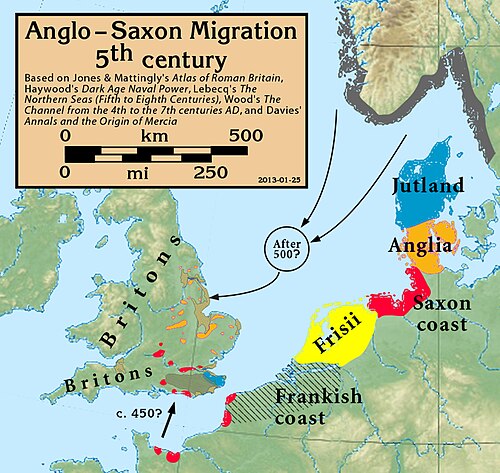
ベーダの半神話的な記述では、「アングル人またはサクソン人」(ラテン語:Anglorum sive Saxonum gens )への呼びかけに、当初はヘンギストとホルサ(「牡馬と馬」)の兄弟とヘンギストの息子オイスクが率いる3隻の船が応じた。彼らにはブリテン島東部の地域が割り当てられた。[14]ゲルマニアの3大部族、アングル人、サクソン人、ジュート人からなる大艦隊がこれに続き、やがて恐ろしい群れがこれに続いた。ベーダの有名な一節によると:[15]
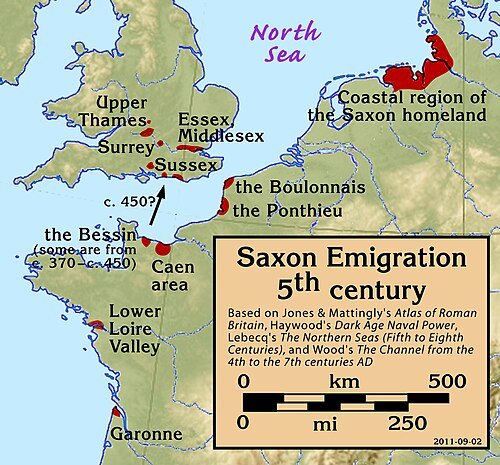
- サクソン人は、ベーダが古ザクセンと呼んだ地域からやって来て、ウェセックス、サセックス、エセックスに定住しました。(ベーダの時代に、「古サクソン人」という用語は、ヨーロッパでフランク人の隣人であったサクソン人と、ブリテン島のサクソン人を区別するために使われ始めました。)
- 現在のデンマークの一部を含む半島であるユトランド半島は、ケントとワイト島に定住したジュート族の故郷でした。
- アングル人 (またはイングランド人) は「アングリア」の出身で、ベーダはこの移住によって無人になったと理解しており、その国はサクソン人とジュート人の故郷の間にあった。アングリアは通常、古いシュレースヴィヒ=ホルシュタイン州(現在のデンマークとドイツの国境にまたがる) の近く、現在のアンゲルンを含むと解釈されている。
別の一節でベーダは、アングロサクソン人の大陸の祖先はより多様であり、長い期間にわたって到着したと明らかにした。彼は、8世紀にまだドイツ(ゲルマニア)に住んでいた異教徒の民族の名前を挙げ、「現在ブリテン島に住んでいるアングル人またはサクソン人は、この民族から起源を派生したと知られている。そのため、ブリトン人の隣国では、彼らは今でもガーマン人と呼ばれている」。フリース人、ルギニ人(おそらくリューゲン島出身)、デンマーク人、「フン人」(この時期のパンノニアのアヴァール人。その影響は北の中央ヨーロッパのスラブ語圏にまで及んだ)、「古サクソン人」(アンティキ・サクソン人)、そしてリッペ川近くのブルクテリの古い土地に住んでいたと推定される「ボルクチュアリイ」である。[16]
アングロサクソン人が、これほど早い時期にブリトン人を排除するほどの広範な政治力と軍事力を行使したという構想は、いまだに異論が唱えられている。ローマ帝国支配下のブリテン島で、1世紀以上にわたって自らの政治的、軍事的運命を支配しながら存続するという最も発展した構想は、ケネス・ダークの構想である[17]。彼は、ローマ帝国支配下のエリート層が、文化、政治、軍事力において、 570年頃まで存続したと示唆している。[18]しかし、ベードは、定住を3つの段階に分類している。傭兵が居住人口を守るためにやって来た探検段階、アングリアが放棄されたという記述からもわかるように、大規模な移住段階、そして、ベードの部族の起源に関する記述からもわかるように、アングロサクソン人が地域を支配し始めた確立段階である。[19]
ギルダスの時代のローマ・ブリテン王国の地が、およそ1世紀後のベーダの時代にアングロサクソン王国の地へとどのように変貌したかは定かではない。これを征服として説明しようとするベーダの学問的かつ愛国的な試みは、今でも大きな影響力を持っている。対照的に、ギルダスは最初の戦争の後にサクソン人に何が起こったのかを説明していない。(しかし、ブリテン島の精神生活について論じる中で、蛮族によって引き起こされた国の分割( divortium )のために、市民( cives )はセントオールバンズとカーリーオンにある殉教者の聖地で礼拝することを妨げられたと述べている。[20])彼は代わりに、ブリテン島は腐敗したローマ・ブリテンの専制政治によって支配されており、もはや法と秩序を期待できないと報告した。彼は平和があり、外国人との戦闘ではなく内部の戦闘しかないと明確に指摘した。
サクソン人の到来を示す文献上の証拠
5世紀または6世紀のブリテン島の歴史記録は、歴史家がアングロサクソン人の定住地を理解するのに役立つものはほとんどありません。ガリア年代記はおそらくガリア南東部で書かれたもので、断片的な情報しか含まれていません。[21] [22]この年代記では、409年のブリテン島襲撃に関する記述が、ローマの力が弱まり、敵の数が増えていることについての一般的なコメントとともに紹介されています。この記述は、同時期に侵略を受けたガリアとスペインでの出来事とグループ化されています。[23] [24] [25]
ギルダスはローマ支配が終わった6世紀に生きただけであり、彼の著書『ブリタニアの征服と解放』は入手可能な記録の中で最も詳細で同時代のものである。しかし、それはローマ・ブリタニアの政治、社会、宗教に対する非常に様式化された批判であり、サクソン人を神から送られた罰として扱い、日付などの詳細はほとんど示しておらず、各章は単一の一連の出来事を表すことを意図していなかった可能性がある。[26]ギルダスはサクソン人を過去に招かれた兵士として描写し、移住や進行中の紛争、さらには彼の時代にサクソン人が存在したことについては何も述べていない。
その代わりに、アングロサクソン人の定住についての歴史家たちは、はるか後の著述家であり学者でもあるイギリスの修道士ベーダ(672/673-735)に頼ることが多い。ベーダは『イングランド人の教会史』の中で、初期のアングロサクソン史における出来事の年代を算出しようとした。主として教会史について著作を書いているにもかかわらず、ベーダは参考文献を引用し、王家の名簿ではなく日付に従って出来事を列挙した点で、イギリス初の真の歴史家と見なされている。[27]このことから、ベーダが初期の出来事についてギルダスに大きく依存していたことがわかっている。ベーダがホルサとヘンギストの到着の年代を定めたのは、ギルダスの報告に基づいているとされている。ギルダスによれば、ブリトン人が初めてアエティウスに懇願したのは446年のことで、アエティウスが3度目の執政官を務めていたときだった。[28]

ギルダスと同時代の6世紀のローマの資料には、東ローマ帝国に住み著述家であったプロコピオスがおり、西方で起こった出来事について聞いた話に疑問を呈している。彼によれば、ブリタニアではないとされるブリティアという島に、アンギリ人、フリッソネス人、ブリトン人の3つの民族が住み、それぞれ王が統治していた。それぞれの民族は非常に繁殖力があり、毎年フランク人のもとに大勢の人々を送り、フランク人は彼らを領土内の人の住んでいない地域に植え付けた。彼はサクソン人やジュート人については一切触れておらず、アングル人の大陸の親戚はワリニ人と呼ばれ、ドナウ川から大洋まで広がる王国を持っていたと彼は信じていた。ニューイングランドのベイツ大学の歴史家マイケル・ジョーンズは、「しかし、プロコピオス自身はこの特定の一節について疑問を抱いており、この章のその後の詳細は、6世紀のイギリスの人口に関する手がかりとしての信頼性を損なっている」と述べている。[29]
ギルダスのブリタニアエの統治と征服
ギルダスの著作は、ローマ系ブリテン人が自らの苦難の原因であると非難するという一貫したテーマに基づいている。サクソン紛争はその一例にすぎない。これらの出来事に至るまで、彼らはローマ帝国内で反抗的であり、帝国を支配しようとした多くの簒奪者を支援していた。これらの暴君は5世紀と6世紀の歴史記述の大部分を占めており、著作はブリテンにおける治世から君主制への移行について多くを語っている。[30]ギルダスの発言は、同胞の脆弱性と彼らの無視と内紛に対する彼の継続的な懸念を反映している。たとえば、「この民族は(現在もそうだが)敵の武器を撃退することには弱いが、内戦と罪の重荷に耐えることには強い」[31]
ギルダスはサクソン人を指す後期ローマ語の正しい用語「foederati」を使用した。foederatiはよく使われていた条約制度の下でブリテン島にやって来た人々である。この種の条約は他の場所でも使われ、ローマ帝国に人々を導き、道路や川に沿って移動させ、軍隊とともに働かせた。[32]ギルダスは彼らをサクソン人と呼んだが、これはおそらくイギリスで入植者を指す一般的な用語だった。ギルダスがサクソン人とピクト人に関して使った「 patria(祖国)」という言葉は、当時サクソン人の一部がブリテン島の原住民とみなされていたことを示唆している。[33]
ビードのヒストリア エクレシアスティカ ジェンティス アングロラム

ギルダスを含む様々な資料は、ベーダが731年頃に執筆した『アングロサクソン人の教会史』で使用された。ベーダのブリトン人に対する見方は、アングロサクソン人の抑圧の抑圧された被抑圧者としてのブリトン人の描写に部分的に責任がある。一部の言語学者や考古学者はこれを利用して、大量虐殺、強制移住、奴隷化を含む侵略と定住の理論を生み出した。[34] 『教会史』におけるブリトン人の描写は、サクソン人をブリトン人に対する神の罰と見なしたギルダスの著作の影響を受けています。ウィンディ・マッキニーは、「ベーダはこの点に焦点を当て、ギルダスのビジョンを拡張し、異教徒のアングロサクソン人を堕落したブリトン人に対する神の天罰ではなく、ブリトン人の救済の代理人として描写した。したがって、ギルダスが恐れていた恐ろしいシナリオは、ベーダによって冷静に説明されている。ブリトン人は神の恩寵を失い、神の怒りを招いたため、どんな粗暴な扱いも必要であり、神によって定められたのだ」と述べている。[35]「ベーダ自身は民族的に『純粋な』アングロサクソン人ではなかったかもしれない」と示唆するマッキニーは、ベーダが民族用語を使用したのは「伝統と宗教的思想の表現、権威に対する人々の忠誠心と結びついており、歴史が展開するにつれて変化する可能性がある。したがって、ベーダがアングリという用語で包括した人々がすべて人種的にゲルマン人であったかどうかは議論の余地がある」と主張している。[35]
初期のアングロサクソン王国に関する証拠
イングランド王国の起源に関する伝統的な半神話的記述は、ベーダと、さらに後の『ブリトン人の歴史』によって提供された。これらの記述は、未知の情報源に基づいてギルダスに多くの詳細を追加している。しかし、これらは現代の学者によって疑わしいと考えられている。他のいくつかの種類の証拠が関連していると考えられている。
部族の隠れ家
部族の隠れ家は、7世紀から9世紀の間にアングロサクソン時代のイングランドで編纂された35の部族のリストである。エルメットの住民が含まれていることから、サイモン・ケインズは、部族の隠れ家がウルフヘレ王の治世中の670年代初期に編纂されたと推測している。エルメットはその後ノーサンブリアの支配下に戻ったと思われるからである。[36]
この文書には、独立した王国とその他の小さな領土がいくつか含まれており、それぞれにいくつかのハイドが割り当てられています。ハイドとは、世帯を養うのに十分な土地のことです。部族のリストはマーシア族が先頭にあり、ハンバー川の河口の南とマーシア王国を取り囲む領土の南に住んでいた人々だけでほぼ構成されていますが、その中には学者によって十分に特定されていないものもあります。この文書には問題がありますが、人々、土地、そして彼らが組織した部族や集団との関係を垣間見ることができるため、歴史家にとって非常に重要です。
リストにある個々の単位は、部族集団の居住地から発展したもので、その一部は300ハイドほどの小さなものであった。イースト・ウィクナやスワード・オラなど、その名前は見つけるのが難しい。このリストが明らかにしているのは、部族や家族のマイクロアイデンティティが最初から重要だったということである。このリストは、他の歴史的資料にある単一の政治的実体よりも複雑な居住地の証拠である。[37]
王様リストとアングロサクソン年代記
8世紀、あるいは7世紀には、アングロサクソンの学者たちが、定住期以降にわたる祖先を記録したとされる王のリストや系図を書き始めた。その代表的なものとしては、アングリア王名簿やウェストサクソン系図王家名簿(アングリア名簿と出典を共有している可能性がある)がある。[38] [39]王家名簿は、今度はアングロサクソン年代記の出典となり、その関連部分は9世紀後半に現存する形に編集された。年代記には、5世紀と6世紀のより詳細な項目も含まれており、表面上は移住、アングロサクソンのエリート、さまざまな重要な歴史的出来事の歴史的証拠となっている。しかし、バーバラ・ヨーク、パトリック・シムズ・ウィリアムズ、デイヴィッド・ダンヴィルらは、5世紀と6世紀の王室名簿とアングロサクソン年代記の多くの特徴が、それらが信頼できる記録であるという考えと明らかに矛盾していることを実証した。 [39] [40] [41] [42]明らかな虚構を否定すれば、そこに記載されている情報の一部には真実の核心が含まれているかもしれない(例えば、ポーツマスは501年に到着した侵略者ポートにちなんで名付けられたという主張など)。例えば、サセックスのエルに関連する一連の出来事(日付は必ずしもそうではないが)などである。[43]しかし、真実と創作をふるい分ける根拠はほとんどない。ダンヴィルがアングロサクソン年代記について指摘したように、「中世の歴史学は、特にフィクションとノンフィクションの区別に関して、私たちのものとは異なる前提を持っている」。[44]
言語的証拠

言語の変化、特に古英語の台頭を説明することは、アングロサクソン人の英国移住に関するあらゆる記述において極めて重要である。ハイアムによれば、アングロサクソン人のエリート層の言語、ならびに物質的文化や伝統の採用は、「社会構造内での地位向上を求め、この目的のために徹底的な文化変容を企てた多数の現地住民による」ものであり、これがローマ・ブリテン語からアングロサクソン語への移行を理解する鍵である。この言語習得の漸進的性質と、支配的グループとの血縁関係の「遡及的再加工」は、最終的に「英国における彼らの起源の説明として、社会全体を移民に結び付ける神話」につながった。[46] 21世紀の最初の数十年間のコンセンサスは、ローマの経済と行政の崩壊によりラテン語が有用性と威信を失った状況で、少数のゲルマン語を話す移民が政治的、社会的に支配的になったことで英語が広まったと説明できるというものだった。ハイアムの評価では、「言語は初期のイングランドでは民族性の重要な指標だった。法律上の自由、親族による承認、後援へのアクセス、武器の使用または所有がすべてゲルマン系であると主張できる人々だけに限定されていた状況では、ラテン語やブリトン語の抑揚のない古英語を話すことはかなりの価値があった」とされている。[47]
証拠

ローマ帝国時代のブリテン島に関するあらゆる言語的証拠は、住民のほとんどが英国ケルト語および/または英国ラテン語を話していたことを示唆している。しかし、ローマ帝国崩壊後の言語状況に関する広範な証拠が次に利用可能になった8世紀までには、現在の東イングランドと南イングランドの支配的な言語は古英語であり、その前身である西ゲルマン語は現在のネーデルラントと北ドイツで話されていたことが明らかになっている。 [49]古英語はその後数世紀にわたって西と北へと広がり続けた。この展開は、例えばローマ帝国崩壊後のガリア、イベリア、北アフリカでゲルマン語を話す侵略者が徐々に現地の言語に切り替えたのとは著しく異なっている。[50] [51] [52]古英語にはケルト語やラテン語の話し言葉からの明らかな影響はほとんど見られず、例えばブリトン語起源の英語の単語はほとんど存在しない。[53] [54] [55]さらに、コーンウォールを除いて、イングランドの地名の大部分は古英語(または後のヴァイキングの影響により古ノルド語)と簡単に語源が特定でき、ローマ帝国崩壊後のイングランドで英語が優勢であったことを示しています。[56]ここ数十年にわたるケルト語の地名学に関する集中的な研究により、イングランドと南スコットランドの地名がかつて考えられていたよりも多くがブリトン語、時にはラテン語に由来していることが明らかになりましたが、[57]それでも、イングランドの東半分のブリトン語とラテン語の地名は非常にまれであり、西半分では著しく多いものの、それでもごく少数であることは明らかです(たとえばチェシャーでは2%)。 [58]
議論
20世紀後半まで、ギルダスとベーダの記述を無批判に解釈した学者たちの英語へのケルトの影響の欠如に関する通常の説明は、ゲルマン語を話す侵略者が彼らが定住した地域の以前の住民を殺害、追い払い、および/または奴隷にしたため、主に古英語が優勢になったというものだった。ここ数十年、少数の専門家がこの解釈を支持し続けており、[59] [60] [61]、ピーター・シュライバーは「ローマ帝国後期のブリテン島における人口動態の変化について、劇的なシナリオで考える責任があるのは主に言語学である」と述べた。[62]
しかし、接触言語学の研究に影響を受けた21世紀最初の数十年の専門家のコンセンサスでは、ごく少数の古英語話者による政治的支配が、この言語変化の痕跡をほとんど残さずに、多数の英国人を古英語を採用させるきっかけとなった可能性があるとされている。[54] [63] [64]ブリテン島のローマ経済と行政機構の崩壊により、英国人はアングロサクソン人の隣人と技術的に類似した社会に暮らすことになったようで、アングロサクソン人がなじみのない概念を表すために言葉を借用する必要はなかったと思われる。[65]古英語が特定の地域で最も権威のある言語になった場合、他の言語の話者はバイリンガルになることが有利であることに気づき、数世代かけてそれほど権威のない言語(この場合は英国ケルト語および/または英国ラテン語)を話すのをやめた可能性がある。個人または世帯が言語を変えるのは、エリート層に奉仕するため、または経済的または法的に何らかの利点をもたらすためである。[66]政治的に優位なゲルマン語を話す少数の移民が英国に来たことを要求するこの説明は、ローマ帝国崩壊後の英国でケルト語とラテン語の話し言葉が徐々に消滅したことに対する「標準的な説明」となっている。[67] [68] [69] [70] [71]
同様に、学者たちは、大規模な人口動態の変化以外にも、移住前のケルト地名が失われたさまざまなメカニズムを仮定している。学者たちは、ローマ時代のウェールズ語とコーンウォール語の地名が英語のものより生き残る可能性は高くないと強調している。「明らかに地名の喪失はローマ・ブリテンの現象であり、アングロサクソン人の移住者と関連した現象ではない」。[72] [73]ローマ時代の地名が置き換えられた他の説明としては、ケルト語の名前が古英語から来ているように見えるように適応したこと、[74] [75] [76] [77] [78]ケルト語の名前がかつて想定されていたよりも徐々に失われたこと、[79] [80] [81]定住地と土地保有の不安定さのために(新たに支配的になった英語で)新しい名前が作られたことなどがある。[80] [81]
21世紀の研究
英国ケルト語が古英語の音韻、形態、統語論に微妙な基質的影響を与えたかどうかについては、現在も広範囲にわたる研究が行われている[82] [83] [84] [ 85] [86] [66] (また、英国ラテン語話者がアングロサクソン人の支配から逃れて西に英国高地に移った際に、ブリトン語に影響を与えたかどうかについても)。[87] [88] [89]しかし、これらの議論はまだコンセンサスのある見解にはなっていない。そのため、2012年の総合研究では、「古英語へのケルト語の影響の証拠はやや乏しいが、それは単にそれが捉えどころのないままであるということを意味するだけで、存在しなかったというわけではない」と結論付けている。[90]
多くのブリトン語話者が英語に移行したという前提のもと、議論が続いています。たとえば、言語の移行をもたらすのに少なくとも一部のゲルマン語話者の農民階級の移民が関与していたに違いないかどうか、どのような法的または社会的構造(奴隷制度やアパルトヘイトのような慣習など)が英語の高い地位を促進した可能性があるか、ブリトン語(およびイギリスラテン語)がさまざまな地域でどのくらいゆっくりと消滅したかなどについて議論が続いています。
広く注目を集めた特異な見解は、スティーブン・オッペンハイマーの、英語にケルト語の影響がないのは、ローマ時代の終わり以前に、すでにイギリスで英語の祖先がベルガエ人によって広く話されていたためだという主張である。 [91]しかし、オッペンハイマーの考えは、既知の事実を説明するのに役立たないことが判明している。5世紀以前にイギリスでゲルマン語が確立されていたという証拠はなく、オッペンハイマーの考えは、ケルト語とラテン語の使用に関する広範な証拠と矛盾している。[92] [52]
エリートの個人名
多くの研究は、下層社会の英国人が相当数生き残り、これらの人々が「エリート支配」メカニズムの作用により時間の経過とともに英国化していく可能性が高いことを認めているが、英国のエリートが生き残り、英国化しているという証拠もある。アングロサクソンのエリートは、2つの方法で形成される可能性がある。北ゲルマンからやって来た首長とその軍団が英国の一部を占領するか、英国出身の首長とその軍団がアングロサクソンの文化と言語を採用するかである。[93]
数多くの「アングロサクソン」王朝の王家の系図にイギリスのケルト系の個人名が見られることは、後者の過程を強く示唆している。ウェセックス王家の血統は、伝統的にセルディックという名の人物によって築かれたが、これは間違いなくケルト系の名前であり、2人のイギリス王に与えられた名前であるセルティックと同一であり、最終的にはブリトン語の*カラティコスに由来する。[94]これはセルディックが生粋のブリトン人であり、彼の王朝が時とともに英語化されたことを示しているのかもしれない。[95] [93]セルディックの子孫とされる人々も、ケルト系の名前を持っており、その中には「ブレトワルダ」セアウリンも含まれる。[96]この王朝で最後にイギリス人の名前が見られたのは、689年に亡くなったカドワラ王の名である。 [97]イギリス人の名前であるカドバードはリンジーの王たちの系図に見られ、この地域にもイギリス人のエリートが生き残っていたことを示唆している。[98]マーシア王家の系図では、ペンダ王や他の王の名前は、ゲルマン語よりもブリトン語の語源であることがより明らかであるが、既知のウェールズ人の個人名とは一致しない。[99] [100]
ベーダは、その主要著作の中で、イングランド教会の上流階級の兄弟4人の経歴を記している。ベーダは彼らをノーサンブリア人、つまり「イングランド人」と呼んでいる。[101]しかし、聖チャド・オブ・マーシア(著名な司教)とその兄弟セッド(司教)、シニビル、ケリン(セアウリンの異綴り)の名前は、アングロサクソン語ではなくイギリス語である。[102] [103]
少なくとも、南ブリテン(特にウェセックス、ケント、エセックス、および南イースト・アングリアの一部)は、ゲルマン系の祖先やつながりを持つ王朝によって支配されたが、その起源はイギリスのエリート層に遡るか、彼らと結婚したという説が有力である。[93] [104]
考古学的証拠

移住や文化変容の証拠を理解しようとする考古学者は、まず「アイデンティティの考古学」として初期アングロサクソン考古学を理解しなければならない。この概念は、考古学の一側面を孤立させて考えることを防ぎ、性別、年齢、民族、宗教、地位など、以前は別々に考えられていたさまざまなトピックを一緒に考えることを保証する。[105]
解釈作業は、アングロサクソン時代全般、特に初期の考古学的総合研究が不足しているために妨げられてきた。しかし、新たな総合研究と年代学の研究、特にキャサリン・ヒルズとサム・ルーシーによるスポング・ヒルの証拠に関する研究により、大陸の物質文化との総合の可能性が開かれ、この集落の年代学が西暦450年よりも前に移動し、現在ではかなりの数の遺物が歴史的に定められたこの日付より前の段階にあることが明らかになった。[12]
ローマの遺産を理解する
5 世紀と 6 世紀にイギリス固有のアイデンティティとゲルマン文化が出現したことを示す考古学的証拠は、まずローマ統治末期の時代を考慮する必要がある。5 世紀初頭のある時期にローマの物質文化が崩壊したため、考古学的記録に空白が生じ、その空白は侵入してきたアングロサクソンの物質文化によって急速に埋められたが、一方で固有の文化は考古学的にはほとんど見えなくなった。ただし、最近の埋蔵品や金属探知機による発見は、貨幣の使用と輸入が西暦 410 年に突然停止したわけではないことを示している。[b] [108]
イギリス国内のローマ軍のシステムに関する考古学はよく知られているが、よく理解されていない。例えば、サクソン海岸は防衛のためだったのか、それとも物資の輸送を容易にするためだったのか。アンドリュー・ピアソンは、「サクソン海岸の砦」やその他の沿岸施設は、一般に認識されている以上に重要な経済的、物流的役割を果たしており、これらの砦の名前に基づくサクソンやその他の大陸の海賊行為の伝統はおそらく神話であると示唆している。[109]
ローマ後期(およびローマ時代以後)のイギリスの考古学は、農民や奴隷よりも、主にエリート層に焦点を当ててきました。彼らの別荘、家、モザイク、家具、備品、銀食器などです。[110]このグループは、富をどのように誇示するかについて厳格な規則を持っており、これが豊かな物質文化をもたらし、「ブリトン人」を特定しています。最も裕福な人と最も貧しい人の間には大きな格差があり、後者の装飾品は考古学的研究の焦点があまり当てられていません。しかし、4世紀と5世紀の農民の考古学は、大家族に関連する「はしご」式畑システムまたは囲い地が主流であり、イングランドの南部と東部では、木造の建物や農場が広く使用されており、数的にはるかに少ないエリートの家よりもローマの建築方法への関与が低いことを示しています。[111]
入植者の証拠
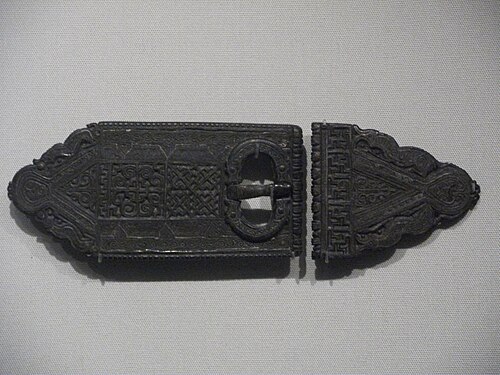
アングロサクソン人が連合軍として使われていたことは、後期ローマ軍に支給されたタイプの軍事装備を身に着けたアングロサクソン人の埋葬によって確認されている。これらの装備は、ウィンチェスターやコルチェスターのローマ墓地などの後期ローマ時代の文脈と、マッキング(エセックス)のような純粋に「アングロサクソン人」の田舎の墓地の両方で発見されているが、[112]これはローマ系ブリテン人が利用していた集落でのことである。最古のアングロサクソン人の遺跡と地名がローマ人の集落と道路の近くに分布していることは、初期のアングロサクソン人の集落がローマ系ブリテン人によって支配されていたことを示していると解釈されている。[113]
キャサリン・ヒルズは、初期の入植者全員を連邦軍とみなす必要はなく、この解釈は一部の考古学者によってあまりにも安易に用いられてきたと示唆している。[114]ローマ時代のブリテン人と入植したアングロサクソン人の間には、さまざまな関係があった可能性がある。より広い考古学的見地からすると、ブリテン島のアングロサクソン人入植地すべてを説明できるモデルはなく、地域によってかなりのばらつきがあったことが示唆される。[115]入植地の密度は、イングランド南部と東部内でも異なっていた。ノーフォークには、隣接するイースト・アングリア州のサフォークよりも多くの大きなアングロサクソン人の墓地があり、東ヨークシャー(アングロサクソン王国デイラの中核)には、ノーサンブリアの他の地域よりもはるかに多くの墓地がある。[116]入植者は皆同じタイプではなかった。中には武器を装備したまま埋葬された戦士もいたが、これらすべてがローマ系ブリテン人のコミュニティを守るために招かれた客人だったとは考えるべきではない。おそらく、後のバイキング移住者のように、最初は海賊として始まり、後に土地を奪い、定住した人々もいたかもしれない。他の移住者は、武器をほとんど持たず、栄養失調に苦しんだ、はるかに卑しい人々だったようだ。ソニア・チャドウィック・ホークスは、これらの人々をゲルマン人の「ボートピープル」、つまり悪化する気候条件で居住不可能になった北海の密集した居住地からの難民と特徴づけた。[117]
部族の特徴

キャサリン・ヒルズは、アングロサクソン考古学を民族学の研究としてのみ捉え、アイデンティティが「アングロサクソン民族全体とはあまり関係がなく、家族や部族、キリスト教徒か異教徒か、エリートか農民かといったメンバーシップと関係している」ことを考慮に入れないことは簡単すぎると指摘している。[118]「アングロサクソン人」や「ブリトン人」は、今日の国民ほど均質ではなく、男性/女性、老人/若者、金持ち/貧乏人、農民/戦士、あるいはギルダスのパトリア(同胞)、シベス(先住民)、ホステス(敵)といった多様な特徴を示していただろう。また、言語の多様性も見られた。これらに加えて、初期のアングロサクソン時代には、アイデンティティは地域的なものだった。人々は隣人を知っていただろうが、衣服、特に留め具の細部で部族への忠誠心を示すことが重要だったかもしれない。[119]この時代について考えるとき、時代錯誤的な19世紀のナショナリズムの考えを持ち込まないようにするのは、時として難しい。実際、人々が自分たちをアングロサクソン人だと考えていた可能性は低く、むしろ彼らは部族や地域の一部であり、パトロンの子孫か指導者の追随者だった。考古学的証拠は、このアイデンティティを理解し、特定しようとしており、それがどのようにして個別のアイデンティティグループ、あるいは相互に結びついたアイデンティティを支えているのかを検討している。[120]
1999年、ピーターバラ近郊のアルウォルトンにある、異教時代の埋葬・火葬混合墓地の一部が発掘された。5世紀から6世紀にかけての28体の骨壷入り火葬と2体の骨壷なし火葬、および5世紀後半から7世紀前半にかけての34体の埋葬が発見された。火葬と埋葬の両方に薪や副葬品が用意され、埋葬物の中には豪華な家具が備え付けられていたものもあった。発掘調査では、さまざまな慣習と象徴的な衣服が混在していた証拠が見つかった。これらは、部族や家族の忠誠心と関連していると思われる地域の違いを反映していた。特にこの衣服の使用は非常に象徴的であり、墓地内のグループ間で明確な違いが見られた。[121]
しかし、最近の研究では、民族社会学の現在のアプローチでは、純粋に考古学的な手段で民族的アイデンティティを証明することは不可能ではないにしても極めて困難であり、そのため、家具付きの埋葬品やペプロス服の使用などの衣服習慣、またはアルウォルトンで発見されたような遺物に見られる特定の芸術的スタイルを、異教の信仰や部族や民族の所属に関する文化的記憶の証拠として使う根拠を否定している。[122] [123]
以前の記念碑の再利用
初期アングロサクソン時代の記念碑の再利用の証拠は、この習慣の重要な側面をいくつか明らかにしている。古代の記念碑は、初期アングロサクソンの風景の中で死者の配置を決定する最も重要な要素の1つであった。先史時代とローマ時代の遺跡におけるアングロサクソン人の二次的活動は、伝統的に実用的な観点から説明されてきた。ハワード・ウィリアムズの見解では、これらの説明は、再利用された記念碑と墓(別荘から墳墓まで)の数と種類を説明できなかった。[124]
アングロサクソン人の古墳埋葬は6世紀後半に始まり、8世紀初頭まで続いた。特に先史時代の古墳は土地の所有権と祖先とのつながりを物理的に表現したものとみなされており、ジョン・シェパードはこの解釈をアングロサクソン人の古墳にまで広げた。[125]エヴァ・テートはローマ帝国崩壊後のイングランドにおける記念碑の再利用の大陸起源を強調し、[126]ハワード・ウィリアムズはこの習慣の主な目的は移民が空虚だと思わなかった風景に意味を与えることだったと示唆した。[124]
7 世紀と 8 世紀には、記念碑の再利用が広まり、サクソン以前の過去の目に見える記念碑の隣にエリート層の埋葬地が意図的に配置されたことを強く示唆するほどになったが、この時期の「普通の」墓地も先史時代の墳墓の隣に配置されることが多かった。この種の空間的関連性が 5 世紀/6 世紀から 7 世紀/8 世紀にかけて相対的に増加したことは顕著である。ウィリアムズによる 2 つのよく文書化されたサンプルの分析では、アッパー テムズ地域のアングロサクソン人の埋葬地が 32% から 50% に、1945 年以降に発掘されたアングロサクソン人の墓地が 47% から 71% に増加していることが示されている。ハーケは、記念碑の再利用が増加した背景の 1 つは、「支配的な移民の物質文化を原住民が取り入れたこと」かもしれないと示唆している。[127]
景観考古学
アングロサクソン人は、かつて信じられていたように、放棄された土地に定住し、そこに新しいタイプの集落や農業を押し付けたわけではない。4世紀後半までに、イングランドの田園地帯は大部分が開拓され、一般的には散在する農場や村落で占められ、それぞれが独自の畑に囲まれているが、他の資源を共有することが多かった(「内外畑耕作」と呼ばれる)。[128]このような畑は、先史時代またはローマ時代の起源を問わず、別々にも一緒にも見られる2つの非常に一般的なタイプに分類される。1つは不規則なレイアウトで、何世紀にもわたって耕作可能な中心地に畑が次々と追加されてきた。もう1つは、大規模な土地分割の結果生じた、多くの場合、地元の地形にほぼ沿った規則的な直線的なレイアウトである。こうした安定は、5 世紀の数十年以内に逆転しました。初期の「アングロサクソン」農民は、ローマ帝国の崩壊と、おそらく 500 年頃にピークに達した気候の悪化の両方の影響を受けて、自給自足に専念し、以前に耕作されていた土地の広大な地域を牧草地に転換したからです。しかし、耕作地が放棄されたという証拠はほとんどありません。
イングランド南部と中部全域の証拠は、先史時代とローマ時代の畑の配置が、継続的に耕作されていたかどうかにかかわらず、アングロサクソン時代まで、そして場合によってはその全期間にわたって存続していたことをますます示している。オックスフォードシャーのヤーントンとエセックスのマッキングの景観は5世紀を通じて変化がなく、オックスフォードシャーのバートンコートでは、ローマ人の別荘地の「溝を掘ったパドックまたはクローズの格子」が、そこにおけるアングロサクソン人の居住地の一般的な枠組みを形成していた。[129]同様の証拠がバークシャーのサットン・コートネイでも見つかっている。 [130]ハンプシャーのチャルトンとキャサリントンのチャーチダウン、バッキンガムシャーのボウ・ブリックヒル、エセックスのヘイヴァリングにあるローマ時代のブリテンの畑は、すべて7世紀まで耕作されていた。[131] [132]
スーザン・ウーストハイゼンはこれをさらに進め、「耕作地の集団的組織化」の側面が、先史時代およびローマ時代のブリテンの畑に反映されていることを示す証拠を確立した。[133]特に、多数の耕作者が共有しながらも個別に収穫するオープンフィールドシステム、耕作地と共通の牧草地の権利とのつながり、統治構造、および地代または税金として地元の領主に剰余金の一部を支払う義務。これらを合わせると、血縁関係と社会関係は5世紀から6世紀にかけて継続しており、領主による画一化や破壊、侵略者の残忍な行為、またはシステムの崩壊の証拠はなかったことが明らかになる。これは、7世紀と8世紀の発展など、後の発展がどのように考慮されるかに影響する。
景観研究は、さまざまな地形学、考古学、文献資料に依拠している。アングロサクソンの勅許境界を、文書記録のないローマ領地の境界と関連づけようとすると、大きな問題が生じる。また、アングロサクソン時代の終わりまでに、景観の構成に大きな変化が起こり、以前の取り決めが不明瞭になる可能性もある。[134]また、後期ローマの行政取り決めが不明確であることも、解釈を妨げている。しかし、全国各地で「ブリテン」地域と「アングロサクソン」地域で行われた研究では、領土境界の連続性の例が見つかっており、たとえば、ローマの別荘地の境界は、初期の勅許状で定められた中世の領地の境界と同一であったようだが、定義された領土内の居住地は移動する可能性がある。[135]これらの例に見られるのは、おそらく、開発単位ではなく、行政単位としての領地または領土の連続性である。[136]ローマの町を基盤とした上位レベルの行政は5世紀には消滅したようだが、地方の区画を基盤とした補助的なシステムは存続した可能性がある。[137]
アングロサクソン王国とそのケルト系近隣諸国の国内組織の基礎は、広大な農村地域であり、その中にはアングロサクソン人がラテン語でヴィラ、古英語でトゥーンと呼んだ中央の住居に従属する多数の補助的な集落が含まれていた。これらの発展は、初期のアングロサクソン地方行政(または初期の王や伯爵の居住地)の基本的なインフラストラクチャが、後期ローマ時代またはローマ帝国時代以降のブリテンから受け継がれたことを示唆している。[138]
集落の分布
初期のアングロサクソン人の集落を移住者集落と見分けるのは、いくつかの困難を伴う。これは、初期のアングロサクソン人の集落のほとんどが陶器と骨以外の遺物はほとんど発見されていないためである。航空写真では、これらの集落の多くが分散していたため、集落の特定は容易ではない。[139]
既知の集落の分布も不明瞭なままで、ウェストミッドランズや北西部では集落はほとんど見つかっていない。初期アングロサクソン人の考古学が豊富な地域であるケントでさえ、発掘された集落の数は予想よりも少ない。しかし、対照的に、ノーサンプトンシャー、オックスフォードシャー、サフォーク、ケンブリッジシャーの各州は初期の集落が比較的豊富である。これらのことから、初期アングロサクソン人の集落は河川の段丘に関連する軽い土壌にある傾向があることが明らかになった。[139]
内陸部の集落の多くは、ローマ時代には主要な航行ルートであった川沿いにある。[140] [141]テムズ川上流のドーチェスター・オン・テムズなどのこれらの場所は、アングロサクソン人が使用した喫水の浅いクリンカー製の船で簡単に行くことができた。ウーズ川、トレント川、ウィザム川、ネン川沿いやテムズ川下流の湿地帯沿いの集落についても同様である。物的証拠が不足しているためあまり知られていないが、現存する地名によって証明されているのは、ワイト島と近くのハンプシャー南岸 にユタ人の集落があったことである。
ローマ時代の町の近くや町内にはアングロサクソン人の居住地が数多くあるが、ローマ・ブリトン人が同時に町を占領し、近くにアングロサクソン人の居住地があったかどうか(つまり、関係があるかどうか)は確認されていない。例えば、ローマ時代のケイスター・バイ・ノリッジでは、最近の分析により、町が事実上放棄された後に墓地が作られたことが示唆されている。[142]
墓地の証拠
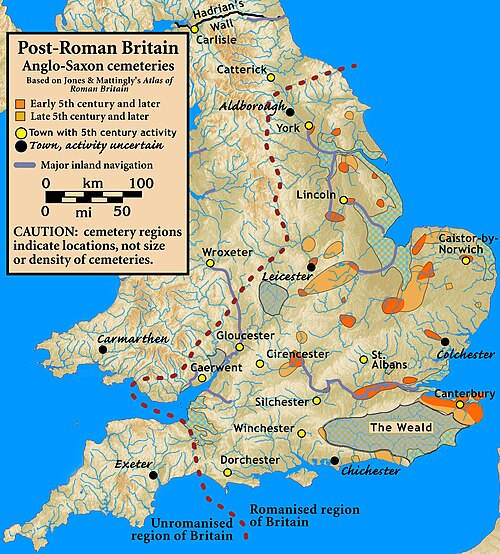
アングロサクソン人として分類できる最も古い墓地は、かなり離れた地域で発見されており、5世紀初頭のものとされている。[143]例外はケントで、墓地と遺物の密度から、アングロサクソン人の定住が非常に多かったか、早い時期から定住が続いていたか、またはその両方であることが示唆される。5世紀後半までには、アングロサクソン人の墓地がさらに増え、そのいくつかは以前の墓地に隣接していたが、他の地域にも大きく拡大し、現在ではサセックスの南海岸もその範囲に含まれている。[144]
2000年までに、およそ1万点の初期「アングロサクソン」の火葬と埋葬が発見され、葬儀の儀式のスタイルと種類に大きな多様性が見られました。[145]これは、多くのミクロ文化と地元の慣習の証拠と一致しています。墓地の証拠は、衣服、宝石、武器、鍋、個人の持ち物などの物質文化が依然として主流ですが、骨格、骨、歯からの物理的および分子的証拠がますます重要になっています。
ケントの初期の墓地を考えると、関連性のある発見のほとんどは、ヨーロッパ大陸との明確なつながりを持つ家具付きの墓から出土している。しかし、壺や壷、特にブローチ[146]など、ユニークな品々もいくつかある。ブローチは、現代の安全ピンのように留め具として機能した、女性の衣服の重要な要素である。ブローチ(クォイトと呼ばれる)のスタイルは、西暦5世紀の南イングランドに特有のもので、ケントに最も集中している。鈴木誠一は、デザイン構成の分析を通じてこのスタイルを定義し、英国やヨーロッパ大陸のほぼ同時代のスタイルと比較することで、このスタイルをユニークにする特徴を特定している。鈴木は、クォイト ブローチのスタイルは、当時の政治的不安定な時期に新しいグループ アイデンティティを構築するプロセスの一環として作成および再作成されたと示唆し、このスタイルの発展を、台頭してきたポストローマ社会の社会文化的ダイナミクスの文脈に位置付けている。このブローチは、文化が単に大陸から移入されたのではなく、初期段階から新しい「アングロサクソン」文化が発展していたことを示しています。[146]
女性のファッション(交易品ではなかったと考えられている民族衣装)は、移住者を区別し識別するために使用されてきました[147] 。また、大陸の特定の地域に関連し得る他の発見物によって補完されています。ケントでは多数のフランク人の遺物が発見されており、これらは初期の移住ではなく、貿易と商業を反映していると解釈されています。たとえば、ヨーク(初期中世のウェセックス、1995年)は、一部のフランク人の定住が可能であるとのみ認めています。 [148]フランク人の海上襲撃は260年には早くも記録されており[149]、次の世紀には一般的になりましたが、フランク人の関心が南に向かい、その後北ガリアとゲルマニアの支配と占領に焦点が当てられたため、367年頃にはイギリスへの襲撃は終了しました[150]。
ハンバー川河口とイースト・アングリアの間の沿岸地域に北ゲルマンのものと確認できる遺物が存在することは、スカンジナビア人がイギリスに移住したことを示している。 [151] [152] [153] [154]しかし、これはスカンジナビア人がアングル人と同時に到着したことを示唆するものではない。彼らはほぼ1世紀遅れて到着した可能性があり、[154] [155]到着時の地位と影響力は不明である。特に、サットン・フー船に関連するスウェーデンの影響とイースト・アングリアのウッフィンガ王朝のスウェーデン起源については、両方の可能性が現在では不確かであると考えられている。[156]
移民と現地人の混合と同化の過程を物質文化で解明するのは事実上不可能だが、骨格の証拠がいくらか解明の糸口となるかもしれない。アングロサクソン人の墓地に埋葬された7世紀/8世紀の男性の平均身長は、5世紀/6世紀の平均に比べて15 mm ( 5 ⁄ 8インチ) 低下している。 [157]この変化はウェセックスで最も顕著で、平均身長は24 mm (1インチ) 低下している。[158]この低下は環境の変化では簡単に説明できない。7世紀/8世紀に食生活が変化したという証拠はなく、この時期にさらなる移民が流入したという証拠もない。ブリトン人の平均身長が低いことを考えると、最もありそうな説明は、先住民居住地の物質文化が徐々にサクソン化または英国化され、先住民がアングロサクソン人コミュニティに同化し、アングロサクソン人の間で移民と先住民の結婚が増えたということだろう。ハンプシャーから出土した後期ローマ時代と初期アングロサクソン時代の人骨が直接比較された。都市ローマの埋葬地に代表される体格は消滅も絶滅もせず、その後のアングロサクソン時代の埋葬地にも引き続きよく表れているという結論が下された。[159]
初期アングロサクソン人の居住地域の西端に位置するストレットン・オン・フォッセ II (ウォリックシャー) では、武器を所持している成人男性の割合が 82% で、イングランド南部の平均を大きく上回っています。アングロサクソン人の埋葬地である墓地 II は、2 つのローマ・ブリテン墓地、ストレットン・オン・フォッセ I と III に隣接しており、後者はアングロサクソン人の埋葬地からわずか 60 メートル (200 フィート) しか離れていません。この遺跡の原住民女性人口の継続性は、織物技術の継続性 (ローマ・ブリテン時代からアングロサクソン時代への移行期には珍しい) と、ローマ人埋葬地からアングロサクソン人の埋葬地へのエピジェネティックな特徴の継続性から推測されています。同時に、骨格の証拠は、ローマ時代以降に、隣接するローマ・ブリテン墓地の男性よりも細身で背の高い新しい体型の男性が現れたことを示している。[160]総合すると、観察結果は、おそらくほとんどまたは全員がゲルマン人である男性グループの流入を示唆しており、彼らは地元のコミュニティを支配し、現地の女性と結婚した。詳細な骨格やその他の補足情報がなければ、このような「戦闘集団」の定住の事例を確認することは容易ではないが、そのような事例が武器の埋葬の割合が非常に高いことで示されていると仮定すると、このタイプの定住は親族グループモデルよりもはるかに少ない頻度であった。[127]
ハイアム氏は主な疑問点を次のように概説している。
「アングロサクソンの墓地のほとんどが、人口全体、特に全年齢層を代表していないことは明らかです。したがって、これはさまざまな要因に基づいて死者の処分について決定を下したコミュニティでしたが、その要因についてはほとんど推測できません。一部の個人が含まれ、すべての個人が含まれなかったのは、政治的統制や文化的選別の対象だったのでしょうか。これは民族の印だったのでしょうか、それとも特定の血縁関係、現実または作り出された血縁関係、または特定のカルトの信奉者を表していたのでしょうか。それは身分によるもので、人口の大半を占めていたであろう農村のプロレタリア階級は除外されていたのでしょうか。したがって、これらの墓地の多くは、特定の高身分の家庭と関連しており、特に成人向けに重点が置かれているのでしょうか。私たちにはわかりませんが、コミュニティの特定の部分が輸入された、ある意味では「ゲルマン的」な火葬の儀式にかなり熱心だったようで、説明が必要です。」[161]
分子的証拠
研究者たちは、アングロサクソン系イングランドの形成における移民、原住民の文化変容、異人種間の結婚の相対的な重要性を調査するために、さまざまな形の分子的証拠を採用してきました。
古代の全ゲノムDNA研究
2022年に行われた研究では、特にアングロサクソン人の定住の問題に焦点を当て、イングランド、アイルランド、オランダ、ドイツ、デンマークから西暦200年から1300年頃の460人の個人をサンプリングし、他の現代および古代のサンプルセットと比較しました。著者らは、現代のイングランド人のDNAの25%から47%がアングロサクソン人の移民に由来すると推定していますが、地域によって大きなばらつきがあり、西部では低く、サセックス、イーストミッドランズ、イーストアングリアでは最も高いとされています。[162]この研究では、イングランド東部では、ローマ時代以降に男性と女性の両方を含む大規模な移民が行われたと結論付けています。中部および東部イングランドの初期中世の人々の中には、祖先の75%から100%が、オランダ北部からドイツ北部、デンマークに広がる地域の初期中世の人々と一致する集団から派生したものもありました。こうした人々は、100%地元の血統を持つ人々と共存し、混血していた。彼らは現代および中世のアイルランド人、ウェールズ人、スコットランド人と遺伝的に類似していた。研究の著者の一人であるダンカン・セイヤーは次のようにコメントした。「[このデータ]が示しているのは、大量移住が確かに存在するということだ。これ以上議論の余地はない。だから私たちにできることは、その移住が実際何なのか、その人々は誰なのか、彼らはどのように交流し、どのようにコミュニティを築いたのかについて話し始めることだ。」[163]
2020年の研究では、ヨーロッパ各地のバイキング時代の埋葬地数百か所から採取したDNAを用いて、現代のイギリス人のサンプルは、平均してイギリスの「北大西洋」出身の人口から38%の遺伝的寄与、デンマーク系人口から37%の寄与を示していることがわかった。研究者らは、後者の特徴の最大6%はデンマークのバイキングに由来し、残りはアングロサクソン人に起因すると推定した。[164]
2018年にアイルランドの遺伝学に焦点を当てた研究では、以前の研究の両方からの古代データを組み合わせて、英国とアイルランド全土の多数の現代のサンプルと比較しました。この研究では、現代のイングランド南部、中央部、東部の人口は「主にアングロサクソンのような祖先」であるのに対し、イングランド北部と南西部の人々はより先住民起源の度合いが高いことがわかりました。[165]
2016年、研究者らは古代DNA技術を用いてケンブリッジシャーの埋葬地を調査した結果、アングロサクソン人の入植初期に混血結婚があった証拠を発見した。調査された埋葬地で最も地位の高い墓は、付随品から判断すると、地元の英国出身の女性の墓だった。他の2人の女性はアングロサクソン出身で、もう1人は混血の兆候が見られた。原住民、移民、混血の人々が、同じ物質文化の副葬品とともに、識別できる区別なく同じ墓地に埋葬されていた。著者らは、この結果は、原住民と移住者の間に厳格な生殖上の分離があったとするこれまでの理論に反するものだ、と述べている。希少な対立遺伝子を研究し、全ゲノム配列解析を行うことで、古代の遺跡の起源が大陸か島嶼かが判別できると主張され、現代の英国人の祖先の25~40%は大陸の「アングロサクソン」起源であると算出された。この研究で示された推定値を現代の英国人集団に細分化した結果、東イングランドの人口は平均38%がアングロサクソン系で、25~50%と大きくばらつきがあることが判明し、ウェールズとスコットランドのサンプルは平均30%がアングロサクソン系で、やはり大きくばらつきがあることが判明した。この研究では、現代英国の3つのサンプルグループの平均値には小さいながらも有意な差があり、東イングランドのサンプルはオランダ人と対立遺伝子をわずかに多く共有し、スコットランドのサンプルは鉄器時代(ケルト)のサンプルに似ていることも判明した。[166] [167]
2016年の別の研究では、北イギリスの人々の古代ゲノム9つを分析した。7つはヨークにあるローマ時代の墓地から、残りはそれ以前の鉄器時代とそれ以降のアングロサクソン人の埋葬地からのものだった。ローマ人のゲノムのうち6つは、ウェールズ人など現代のイギリスのケルト人集団との類似性を示したが、東イングランドのサンプルとは大幅に異なっていた。それらはまた、以前の鉄器時代のゲノムと類似しており、集団の継続性を示唆したが、後期アングロサクソン人のゲノムとは異なっていた。後期アングロサクソン人のゲノムは、イースト・アングリアやケンブリッジシャーの他のアングロサクソン時代の埋葬地からのサンプルと類似していることが判明した(上記参照)。[168]このパターンは、アングロサクソン時代の移住が大きな影響を与えたことを裏付けることが判明した。著者らは、イングランドの人口は多様性を示しており、東部と南部のサンプルはアングロサクソン人の埋葬地との類似性が高く、北部と西部のサンプルはローマ時代と鉄器時代の埋葬地に近いとコメントした。[169]
現代の人口研究
2015年にレスリーらが行った「英国人口の微細遺伝構造」に関する大規模な研究では、遺伝的差異の地域的パターンが明らかになり、遺伝子クラスターは歴史的な人口動態イベントを反映し、時には歴史的な政体の地理的境界に対応していることが明らかになった。2つの別々の分析に基づいて、この研究では、現代のイングランドでアングロサクソン人の移住の明確な証拠が見つかり、これらの移住からの遺伝物質を運んでいない地域が特定された。著者らは、中央/南部イングランドにおける「サクソン人」祖先の割合はおそらく10%~40%の範囲であると主張した。さらに、英国の「非サクソン人」地域では、均質な「ケルト人」人口ではなく、さまざまな遺伝的サブグループが見つかった。[170]
同位体分析
同位体分析は、アングロサクソン人の移住に関する不確かな点を解明するために利用され始めている。この分析により、個人が埋葬地の近くに常に住んでいたかどうかがわかる。しかし、このような研究では祖先を明確に区別することはできない。したがって、英国で生まれた移民の子孫は、英国生まれの人と区別がつかないように見えるだろう。[127]
ウェスト・ヘスラートンにある5~7世紀の墓地のストロンチウムデータは、2つのグループの存在を示唆した。1つは「地元」起源、もう1つは「非地元」起源である。この研究では、地域的変動の限界を定義して移民を自信を持って特定することはできないと示唆しているが、問題に関する有用な説明を与えることはできる。[171]オックスフォードシャー州アッパー・テムズ・バレー、ベリンズフィールドのウォーリー・コーナーにある初期アングロサクソン墓地の酸素およびストロンチウム同位体データでは、サンプルのわずか5.3%が大陸ヨーロッパ起源であることが判明し、文化変容の仮説を裏付けている。さらに、一部の女性を除いて、このパターンは時間の経過とともに変化していないことがわかった。[172] 2018年にサセックス州イーストボーン近郊で発見された骨格から実施された別の同位体テストでは、従来の侵入モデルもエリート文化変容モデルも適用できないという結論に達した。この研究では、原住民よりも裕福ではないと思われる男性と女性の移民が多数発見された。初期のアングロサクソン時代を通じて移住が継続していた証拠があった。[173]
別の同位体法は、初期アングロサクソン人の食事におけるタンパク質源が地理的な場所、年齢、性別によって変化したかどうかを調べるために採用されました。これは社会的優位性の証拠となります。結果は、タンパク質源が地理的な場所によってほとんど変化せず、すべての場所で陸上の食物が優勢であったことを示唆しています。[174]
Y染色体の証拠
分子証拠を用いて英国人の祖先を調べる初期の試みの多くは、Y染色体DNAに着目した。ヒトゲノムの性別特異的要素の継承により、ミトコンドリアDNAとY染色体DNAをそれぞれ使用して、女性のみの系統と男性のみの系統を別々に研究することができる。[175]ミトコンドリアDNA(「mtDNA」)とY染色体DNAは、両親の遺伝子の組み合わせから形成されるのではない点で、二倍体核染色体のDNAと異なる。むしろ、男性は父親から直接Y染色体を受け継ぎ、男女ともに母親から直接mtDNAを受け継ぐ。その結果、それらは突然変異によってのみ変化する遺伝記録を人から子孫へと保存する。
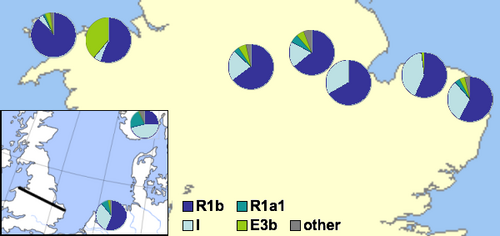
イングランドとウェールズを東西に横断する横断線で採取されたY染色体の変異の調査が、フリースラント(東フリースラントと西フリースラント)で採取された同様のサンプルと比較された。フリースラントは、アングロサクソン移民の起源とみなされ、古英語とフリースラント語の類似性から、研究対象に選ばれた。ノルウェーのサンプルも、後のバイキング移住の起源であるため、選択された。イングランドでは、小規模な集団サンプルで、父方の遺伝的継承の50%から100%が北海のゲルマン沿岸地域出身の人々から受け継がれていることが判明した。[176]
2003年に発表された、より大きなサンプル集団とより多くの英国人集団から得られた他の研究では、ケントを含むイングランド南部では、大陸(北ドイツおよびデンマーク)の父系遺伝的影響は25%から45%の範囲で、平均は37%であることが示唆された。イースト・アングリア、イースト・ミッドランズ、ヨークシャーはすべて50%を超えていた。後者では多くのバイキングの定住が確認されている。この研究では北ドイツ人とデンマーク人の集団を区別できなかったため、アングロサクソン人の定住とその後のデンマークのバイキングの植民地化に由来する遺伝的影響の相対的な割合は確認できなかった。[177]この研究におけるゲルマン人の遺伝的影響の平均値は54%と計算された。[178]
トーマスらの論文では、少数の入植者が現代の遺伝子プールに大きく貢献できた理由を説明するために、「アパルトヘイトのような社会構造」理論を展開した。[179]この見解は、JE パティソンによって批判されており、彼は、Y 染色体の証拠は、アパルトヘイトのような構造のない人々の小さな定住地という考えを依然として支持できると示唆した。[180]また、北海の両側の人々の遺伝的類似性は、おそらく歴史的に証明されているアングロサクソン人の形成やバイキングの侵略よりかなり前に始まった、人口移動の累積的なプロセスを反映している可能性があると提案されている。[181]「アパルトヘイト理論」は、特にその理論的根拠となる遺伝学研究について、かなりの批判を受けている。特に、ウィールの研究設計の問題と、一部の集団遺伝学研究によって証明された歴史的無知のレベルが強調されている。[182] [183] [184] [185] [186]
スティーブン・オッペンハイマーはウィールとカペリの研究をレビューし、遺伝子頻度の相関関係は、問題となっている地域の遺伝的先史に関する知識がなければ何の意味もないと示唆した。これらの研究に対する彼の批判は、ギルダスとプロコピウスの歴史的証拠に基づいてモデルを作成し、これらの集団に対してテストするための方法論を選択したことである。ウィールの横断図は、ベルギーが遺伝子地図でノースウォルシャム、アスボーン、フリースラントよりも西にあることを強調している。オッペンハイマーの見解では、これは、ベルギー人や他の大陸の人々、つまりアングロサクソン人に帰せられるものと区別がつかない大陸の遺伝子マーカーが、5世紀に特定の地域や領域に早く到着し、すでに強力であった証拠である。[91]オッペンハイマーは、ウィールとカペリの研究を基に、ローマ人以降の侵略はいずれもブリテン諸島の遺伝子プールに大きな影響を与えておらず、先史時代の住民はイベリア人の遺伝子グループに属していると主張している。彼によると、ブリテン諸島のほとんどの人々は、ウェールズの90%からイーストアングリアの66%まで、スペイン北部とフランス南西部のバスク人と遺伝的に類似している。[91]オッペンハイマーは、イングランドの西部と東部の分裂はアングロサクソン人の侵略によるものではなく、最終氷期極大期の直後に発生した大西洋沿岸からの遺伝子流動と、大陸ヨーロッパの近隣地域からの遺伝子流動の2つの主要なルートに起因すると示唆している。[91]オックスフォード大学の元遺伝学者 ブライアン・サイクスも、オッペンハイマーとほぼ同じ結論に達した。
最近の研究では、オッペンハイマーとサイクスの理論に異議を唱えている。デイヴィッド・ライヒのハーバード研究室は、下ライン川流域のベル・ビーカー人はイベリア人や他の南欧人と遺伝的関係がほとんどないことを発見した。イギリスへのビーカー・コンプレックスの到来は、数百年以内にイギリスの遺伝子プールの約90%の置き換えと関連しており、400年前にステップ関連の祖先を中央ヨーロッパと北ヨーロッパにもたらした東から西への拡大の継続であった。 [187]現代の常染色体遺伝子クラスタリングはこの事実の証拠であり、イギリス人とアイルランド人は、イベリア人、ガリシア人、バスク人、または南フランスの人ではなく、他の北ヨーロッパの集団と遺伝的に非常に密接にクラスタリングしている。[188] [189]さらに、より最近の研究(以下を参照)は、イングランド人とウェールズ人の遺伝的差異は、先史時代の移住イベントではなく、アングロサクソン人の定住に起源があるという考えを広く支持している。
批判
一部の学者は、民族的・文化的アイデンティティを分子的証拠によって明らかにされたパターンと混同することがそもそも正当であるのか疑問視している。[190] [191] [192] 2018年のネイチャー誌の論説では[193]、このカテゴリーのデータを単純に使用すると、20世紀初頭に導入された考古学研究の「文化-歴史」モデルに似てしまう危険性があるが、現代の考古学者の多くはこれを問題があると考えていると主張した。例えば、「ゲルマン」民族がローマ民族誌で構築されたもの以外に何らかの形の文化的または民族的統一性を共有していたと考えられるかどうかという問題は決着がついておらず、「ゲルマン」民族が同じ言語族の言語を話すこと以外に強い文化的親和性を持っていたかどうか疑問視する学者もいる。[194]
移住と文化変容の理論
さまざまな学者が証拠を統合してモデルを提示し、アングロサクソン人の定住をめぐる疑問に対する答えを示唆してきました。これらの疑問には、移住者の数、アングロサクソン人が政治的に優位に立った時期、彼らが占領した地域でローマ系ブリテン人に何が起こったかなどが含まれます。後期アングロサクソン人は、侵略者、移住者、文化変容した先住民の混合体でした。アングロサクソン人の定住当時のこれらの形成要素の比率と関係が調査対象です。ブリテン定住の伝統的な解釈は、学者が移住と文化変容の両方の証拠を受け入れ、大幅に再評価されています。ハインリッヒ・ハーケは、この合意の性質を次のように説明しています。
アングロサクソン人は単に大陸から移住してきたゲルマン人の侵略者や入植者ではなく、島嶼間の交流と変化の結果であるということは、現在では広く認められている。しかし、この民族形成のプロセスが具体的にどのように機能したかを示す明確なモデルはまだ存在しない。[127]
大陸からの移住者の数を推定する
学者たちは、この時期にイギリスに入国した移民の数について合意に達していない。ハーケは、その数はおよそ 10 万から 20 万であると主張している。[127]ブライアン・ワード・パーキンスも、最大 20 万人の移住者を主張している。[195]キャサリン・ヒルズは、その数は 2 万人に近いと示唆している。[196] [197]コンピューターシミュレーションでは、ヨーロッパ大陸から 25 万人の移住が 38 年で達成された可能性があることが示された。[127]最近の遺伝子および同位体研究は、男性と女性の両方を含む移住が数世紀にわたって続いたことを示唆しており、[198] [199]おそらく、これまで考えられていたよりもはるかに多くの新しい到着者が存在する可能性がある。 500 年頃までに、アングロサクソン人のコミュニティがイギリス南部と東部に設立された。[200]
Härke and Michael Wood estimate that the British population in the area that eventually became Anglo-Saxon England was around one million by the start of the fifth century;[127][201] however, what happened to the Britons has been debated. The traditional explanation for their archaeological and linguistic invisibility[202] is that the Anglo-Saxons either killed them or drove them to the mountainous fringes of Britain, a view broadly supported by the few available sources from the period. However, there is evidence of continuity in the systems of landscape and local governance,[203] decreasing the likelihood of such a cataclysmic event, at least in parts of England. Thus, scholars have suggested other, less violent explanations by which the culture of the Anglo-Saxons, whose core area of large-scale settlement was likely restricted to what is now southeastern England, East Anglia and Lincolnshire,[204][205][206][207] could have come to be ubiquitous across lowland Britain. Härke has posited a scenario in which the Anglo-Saxons, in expanding westward, outbred the Britons, eventually reaching a point where their descendants made up a larger share of the population of what was to become England.[127] It has also been proposed that the Britons were disproportionately affected by plagues arriving through Roman trade links, which, combined with a large emigration to Armorica,[204][208] could have substantially decreased their numbers.[207][209][210]

Even so, there is general agreement that the kingdoms of Wessex, Mercia and Northumbria housed significant numbers of Britons.[211] Härke states that "it is widely accepted that in the north of England, the native population survived to a greater extent than in the south," and that in Bernicia, "a small group of immigrants may have replaced the native British elite and took over the kingdom as a going concern."[127] Evidence for the natives in Wessex, meanwhile, can be seen in the late seventh century laws of King Ine, which gave them fewer rights and a lower status than the Saxons.[212] This might have provided an incentive for Britons in the kingdom to adopt Anglo-Saxon culture. Higham points out that "in circumstances where freedom at law, acceptance with the kindred, access to patronage, and the use and possession of weapons were all exclusive to those who could claim Germanic descent, then speaking Old English without Latin or Brittonic inflection had considerable value."[213]
There is evidence for a British influence on the emerging Anglo-Saxon elite classes. The Wessex royal line was traditionally founded by a man named Cerdic, an undoubtedly Celtic name cognate to Ceretic (the name of two British kings, ultimately derived from *Corotīcos). This may indicate that Cerdic was a native Briton and that his dynasty became anglicised over time.[214][93] A number of Cerdic's alleged descendants also possessed Celtic names, including the 'Bretwalda' Ceawlin.[215] The last man in this dynasty to have a Brittonic name was King Caedwalla, who died as late as 689.[216] In Mercia, too, several kings bear seemingly Celtic names, most notably Penda.[217] As far east as Lindsey, the Celtic name Caedbaed appears in the list of kings.[218]
Recent genetic studies, based on data collected from skeletons found in Iron Age, Roman and Anglo-Saxon era burials, have concluded that the ancestry of the modern English population contains large contributions from both Anglo-Saxon migrants and Romano-British natives.[219][220][221]
Knowing the number of migrants who came from the continent provides a context from which scholars can build an interpretation framework and understanding of the events of the 5th and 6th centuries. Robert Hedges in discussing this point observes that "archaeological evidence only addresses these issues indirectly."[222] The traditional methodology used by archaeology to estimate the number of migrants starts with a figure for the population in Roman Britannia in the 3rd and 4th centuries. This is usually estimated at between 2 and 4 million.[223] From this figure, Heinrich Härke and Michael Wood have argued that taking into account declines associated with political collapses, the population of what was to become Anglo-Saxon England had fallen to 1 million by the fifth century.[127][224]
Within 200 years of their first arrival, the settlement density has been established as an Anglo-Saxon village every 2–5 kilometres (1.2–3.1 miles), in the areas where evidence has been gathered.[225] Given that these settlements are typically of around 50 people, this implies an Anglo-Saxon population in southern and eastern England of 250,000. The number of migrants therefore depends on the population increase variable. If the population rose by 1 per cent per year (slightly less than the present world population growth rate), this would suggest a migrant figure of 30,000. However, if the population rose by 2 per cent per year (similar to India in the last 20 years), the migrant figure would be closer to 5,000.[222] The excavations at Spong Hill revealed over 2,000 cremations and inhumations in what is a very large early cemetery. However, when the period of use is taken into account (over 200 years) and its size, it is presumed to be a major cemetery for the entire area and not just one village; such findings point to a smaller rather than larger number of original immigrants, possibly around 20,000.[226]
Härke concluded that "most of the biological and cultural evidence points to a minority immigration on the scale of 10 to 20% of the native population. The immigration itself was not a single 'invasion', but rather a series of intrusions and immigrations over a considerable period, differing from region to region, and changing over time even within regions. The total immigrant population may have numbered somewhere between 100,000 and 200,000 over about a century, but the geographical variations in numbers, and in social and ethnic composition, should have led to a variety of settlement processes."[127]
However, there is a discrepancy between, on the one hand, some archaeological and historical ideas about the scale of the Anglo-Saxon immigration, and on the other, estimates of the genetic contribution of the Anglo-Saxon immigrants to the modern English gene pool (see "Molecular evidence" above). Härke, Mark Thomas, and Michael Stumpf created a statistical study of those who held the "migrant" Y chromosomes and those that did not, and examined the effect of differential reproductive success between those groups, coupled with limited intermarriage between the groups, on the spread of the genetic variant to discover whether the levels of migration needed to meet a 50% contribution to the modern gene pool had been attained. Their findings demonstrated that a genetic pool can rise from less than 5% to more than 50% in as little as 200 years with the addition of a slight increase in reproduction advantage of 1.8 (meaning a ratio 51.8 to 50) and restricting the amount of female (migrant genes) and male (indigenous genes) inter-breeding to at most 10%.[179]
Generally, however, the problems associated with seeking estimates for the population before AD 1089 were set out by Thomas, Stumpf, and Härke, who write that "incidental reports of numbers of immigrants are notoriously unreliable, and absolute numbers of immigrants before the Norman period can only be calculated as a proportion of the estimated overall population."[227] Recent isotope and genetic evidence[228][229] has suggested that migration continued over several centuries, possibly allowing for significantly more new arrivals than has been previously thought.
Saxon political ascendancy in Britain
A re-evaluation of the traditional picture of decay and dissolution in post-Roman Britain has occurred, with sub-Roman Britain being thought to have been more a part of the Late Antique world of western Europe than was customary a half century ago.[230] As part of this re-evaluation some suggest that sub-Roman Britain, in its entirety, retained a significant political, economic and military momentum across the fifth century and even the bulk of the sixth. This in large part stems from attempts to develop visions of British success against the incoming Anglo-Saxons, as suggested by the Chronicles which were written in the ninth and mid-tenth century. However, recent scholarship has contested the extent to which either can be credited with any level of historicity regarding the decades around AD 500.[231]
The representation of long-lasting British triumphs against the Saxons appears in large parts of the Chronicles, but stems ultimately from Gildas's brief and elusive reference to a British victory at Mons Badonicus – Mount Badon (see historical evidence above). Higham suggests that the war between Britons and Saxons seems to have ended in some sort of compromise, which conceded a very considerable sphere of influence within Britain to the incomers. Kenneth Dark, on the other hand, has argued for a continuation of British political, cultural and military power well into the latter part of the sixth century, even in the eastern part of the country. Dark's argument rests on the very uneven distribution of Anglo-Saxon cemeteries and the proposition that large gaps in that distribution necessarily represent strong British polities which excluded Anglo-Saxon settlers by force.[232] Cremation cemeteries in eastern Britain north of the Thames begin during the second quarter of the fifth century,[233] backed up by new archaeological phases before 450 (see Archaeological evidence above). The chronology of this "adventus" of cremations is supported by the Gallic Chronicle of 452, which states that wide parts of Britain fell under Saxon rule in 441.
Romano-Britons' fate in the south-east
Multiple theories have been proposed as to the reason behind the invisibility of the Romano-Britons in the archaeological and historical records of the Anglo-Saxon period.
One theory, first set out by Edward Augustus Freeman, suggests that the Anglo-Saxons and the Britons were competing cultures, and that through invasion, extermination, slavery, and forced resettlement the Anglo-Saxons defeated the Britons and consequently their culture and language prevailed.[234] This view has influenced much of the scholarly and popular perceptions of the process of anglicisation in Britain. It remains the starting point and 'default position', to which other hypotheses are compared in modern reviews of the evidence.[235] Widespread extermination and displacement of the native peoples of Britain is still considered a viable possibility by a number of scholars.[236][237][238] Such a view is broadly supported by the linguistic and toponymic evidence, as well as the few primary sources from the time.
Another theory has challenged this view and proposes that the Anglo-Saxon migration was an elite takeover, similar to the Norman Conquest, rather than a large-scale migration, and that the bulk of the population was composed of Britons who adopted the culture of the conquerors. Bryan Ward-Perkins argues that while "culturally, the later Anglo-Saxons and English did emerge as remarkably un-British, ... their genetic, biological make-up is none the less likely to have been substantially, indeed predominantly, British".[239] Within this theory, two processes leading to Anglo-Saxonisation have been proposed. One is similar to culture changes observed in Russia, North Africa and parts of the Islamic world, where a politically and socially powerful minority culture becomes, over a rather short period, adopted by a settled majority. This process is usually termed 'elite dominance'.[240] The second process is explained through incentives, such as the wergild outlined in the law code of Ine of Wessex. The wergild of an Englishman was set at a value twice that of a Briton of similar wealth. However, some Britons could be very prosperous and own five hides of land, which gave thegn-like status, with a wergild of 600 shillings.[241] Ine set down requirements to prove guilt or innocence, both for his English subjects and for his British subjects, who were termed 'foreigners/wealas' ('Welshmen').[242] The difference in status between the Anglo-Saxons and Britons could have produced an incentive for a Briton to become Anglo-Saxon or at least English speaking.[179]
While most scholars currently accept a degree of population continuity from the Roman period, this view has not gone without criticism. Stefan Burmeister notes that "to all appearances, the settlement was carried out by small, agriculturally-oriented kinship groups. This process corresponds most closely with a classic settler model. The absence of early evidence of a socially demarcated elite underscores the supposition that such an elite did not play a substantial role. Rich burials such as are well-known from Denmark have no counterparts in England until the 6th century."[243] Richard Coates points out that linguistically, "the case of the Britons in England appears consistent with the withdrawal of speakers of the previously dominant language, rather than the assimilation of the dominant classes by the incomers."[244]
Several theories have been proposed by which numbers of native Britons could have been lowered without resorting to violent means. There is linguistic and historical evidence for a significant movement of Brittonic-speakers to Armorica, which became known as Brittany.[245][246] Meanwhile, it has been speculated that plagues arriving through Roman trade links could have disproportionately affected the Britons.[247][248][249]
Regional variation in settlement patterns
In recent years, scholars have sought to combine elements of the mass migration and elite dominance models, emphasizing that no single explanation can be used to account for cultural change across the entirety of England. Heinrich Härke writes that "the Anglo-Saxon migration [was] a process rather than an event, with implications for variations of the process over time, resulting in chronological and geographical diversity of immigrant groups, their origins, composition, sizes and settlement areas in Britain. These variations are, to a certain extent, reported in the written sources."[127] According to Toby Martin, "Regional variation may well provide the key to resolution, with something more akin to mass migration in the south-east, gradually spreading into elite dominance in the north and west."[250] This view has support in the toponymic evidence. In the southeastern counties of England, Brittonic place names are nearly nonexistent, but moving north and west, they gradually increase in frequency.[251]
East Anglia has been identified by a number of scholars, including Härke, Martin, Catherine Hills, and Kenneth Dark, as a region in which a large-scale continental migration occurred,[127][252][253] possibly following a period of depopulation in the fourth century.[254] Lincolnshire has also been cited by Hills and Martin as a key centre of early settlement from the continent.[252][253] Alexander Mirrington argues that in Essex, the cultural change seen in the archaeological record is so complete that "a migration of a large number of people is the most logical and least extreme solution."[255] In Kent, according to Sue Harrington and Stuart Brookes, "the weight of archaeological evidence and that from literary sources favours migrations" as the main reason for cultural change.[256]
Immigration into the area that was to become Wessex occurred from both the south coast and the Upper Thames valley. The earlier, southern settlements may have been more prosaic than descriptions in the Anglo-Saxon Chronicle imply. Jillian Hawkins suggests that powerful Romano-British trading ports around the Solent were able to direct significant numbers of Germanic settlers inland into areas such as the Meon valley, where they formed their own communities.[257] In areas that were settled from the Thames, different processes may have been at play, with the Germanic immigrants holding a greater degree of power. Bruce Eagles argues that the later population of areas such as Wiltshire would have included large numbers of Britons who had adopted the culture of the socially dominant Saxons, while also noting that "it seems reasonable to consider that there must have been sufficient numbers of widely dispersed immigrants to bring about this situation in a relatively short space of time."[258]
In the northern kingdom of Bernicia, however, Härke states that "a small group of immigrants may have replaced the native British elite and took over the kingdom as a going concern."[127] Linguist Frederik Kortlandt agrees, commenting that in this region "there was a noticeable Celtic contribution to art, culture and possibly socio-military organization. It appears that the immigrants took over the institutions of the local population here."[259] In a study of place names in northeastern England and southern Scotland, Bethany Fox concluded that the immigration that did occur in this region was centred on the river valleys, such as those of the Tyne and the Tweed, with the Britons moving to the less fertile hill country and becoming acculturated over a longer period.[260]
Aspects of the success of the Anglo-Saxon settlement
The reasons for the success of Anglo-Saxon settlements remain uncertain. Helena Hamerow has made an observation that in Anglo-Saxon society "local and extended kin groups remained ... the essential unit of production throughout the Anglo-Saxon period". "Local and extended kin groups" is one of a number of possible reasons for success, along with societal advantages, freedom and the relationship to an elite, that allowed the Anglo-Saxons' culture and language to flourish in the fifth and sixth centuries.[261]
Anglo-Saxon political formation
Higham is convinced that the success of the Anglo-Saxon elite in gaining an early compromise shortly after the Battle of Badon is a key to the success of the culture. This produced a political ascendancy across the south and east of Britain, which in turn required some structure to be successful.[262]
The Bretwalda concept is taken as evidence for a presence of a number of early Anglo-Saxon elite families and a clear unitary oversight. Whether the majority of these leaders were early settlers, descendant from settlers, or especially after the exploration stage they were Roman-British leaders who adopted Anglo-Saxon culture is unclear. The balance of opinion is that most were migrants, although it should not be assumed they were all Germanic. There is agreement that these were small in number and proportion, yet large enough in power and influence to ensure "Anglo-Saxon" acculturation in the lowlands of Britain.[263] Most historians believe these elites were those named by Bede, the Anglo-Saxon Chronicle and others, although there is discussion regarding their floruit dates. Importantly, whatever their origin or when they flourished, they established their claim to lordship through their links to extended kin ties. As Helen Geake jokingly points out "they all just happened to be related back to Woden".[264]
The Tribal Hidage is evidence of the existence of numerous smaller provinces, meaning that southern and eastern Britain may have lost any macro-political cohesion in the fifth and sixth centuries and fragmented into many small autonomous units, though late Roman administrative organisation of the countryside may have helped dictate their boundaries. By the end of the sixth century the leaders of these communities were styling themselves kings, with the majority of the larger kingdoms based on the south or east coasts.[265] They include the provinces of the Jutes of Hampshire and Wight, the South Saxons, Kent, the East Saxons, East Angles, Lindsey and (north of the Humber) Deira and Bernicia. Several of these kingdoms may have their foundation the former Roman civitas and this has been argued as particularly likely for the provinces of Kent, Lindsey, Deira and Bernicia, all of whose names derive from Romano-British tribal or district names.[43]
The southern and east coasts were, of course, the areas settled first and in greatest numbers by the settlers and so presumably were the earliest to pass from Romano-British to Anglo-Saxon control. Once established they had the advantage of easy communication with continental territories in Europe via the North Sea or the Channel. The east and south coast provinces may never have fragmented to the extent of some areas inland and by the end of the sixth century they were already beginning to expand by annexing smaller neighbours. Barbara Yorke suggests that such aggressiveness must have encouraged areas which did not already possess military protection in the form of kings and their armies to acquire their own war-leaders or protection alliances.[115] By the time of the Tribal Hidage there were also two large 'inland' kingdoms, those of the Mercians and West Saxons, whose spectacular growth we can trace in par in our sources for the seventh century, but it is not clear how far this expansion had proceeded by the end of the sixth century.[265]
What Bede seems to imply in his Bretwalda list of the elite is the ability to extract tribute and overawe and/or protect communities, which may well have been relatively short-lived in any one instance, but ostensibly "Anglo-Saxon" dynasties variously replaced one another in this role in a discontinuous but influential and potent roll call of warrior elites, with very few interruptions from other "British" warlords.[266] The success of this elite was felt beyond their geography, to include neighbouring British territories in the centre and west of what later became England, and even the far west of the island. Again, Bede was very clear that English imperium could on occasion encompass British and English kingships alike,[267] and that Britons and Angles marched to war together in the early seventh century, under both British and English kings.[268] It is Bede who provides the most vivid picture of a late sixth- and early seventh-century Anglian warlord in action, in the person of Æthelfrith of Northumbria, King of Bernicia (a kingdom with a non-English name), who rapidly built up a personal 'empire' by military victories over the Britons of the North, the Scots of Dalriada, the Angles of Deira and the Britons of north-eastern Wales, only ultimately to experience disaster at the hands of Rædwald of East Anglia.[269]
Rural freedoms and kinship groups
Where arable cultivation continued in early Anglo-Saxon England, there seems to have been considerable continuity with the Roman period in both field layout and arable practices, although we do not know whether there were also changes to patterns of tenure or the regulation of cultivation. The greatest perceptible alterations in land usage between about AD 400 and 600 are therefore in the proportions of the land of each community that lay under grass or the plough, rather than in changes to the layout or management of arable fields.[270]
The Anglo-Saxons settled in small groups covering a handful of widely dispersed local communities.[271] These farms were for the most part mobile. This mobility, which was typical across much of Northern Europe took two forms: the gradual shifting of the settlement within its boundaries or the complete relocation of the settlement. These shifting settlements (called Wandersiedlungen or "wandering settlements") were a common feature since the Bronze Age. Why farms became abandoned and then relocated is much debated. However it is suggested that this might be related to the death of a patron of the family or the desire to move to better farmlands.[272]
These farms are often falsely supposed to be "peasant farms". However, a ceorl, who was the lowest ranking freeman in early Anglo-Saxon society, was not a peasant but an arms-owning male with access to law, support of a kindred and the wergild, situated at the apex of an extended household working at least one hide of land. It is the ceorl that we should associate with the standard 8–10 metres (26–33 feet) x 4–5 metres (13–16 feet) post-hole building of the early Anglo-Saxon period, grouped with others of the same kin group. Each such household head had a number of less-free dependants and slaves.[273]
The success of the rural world in the 5th and 6th centuries, according to the landscape archaeology, was due to three factors: the continuity with the past, with no evidence of up-rooting in the landscape; farmers' freedom and rights over lands, with provision of a rent or duty to an overlord, who provided only slight lordly input; and the common outfield arable land (of an outfield-infield system) that provided the ability to build kinship and group cultural ties.
Material culture
The origins of the timber building tradition seen in early Anglo-Saxon England have generated much debate which has mirrored a wider debate about the cultural affinities of Anglo-Saxon material culture.
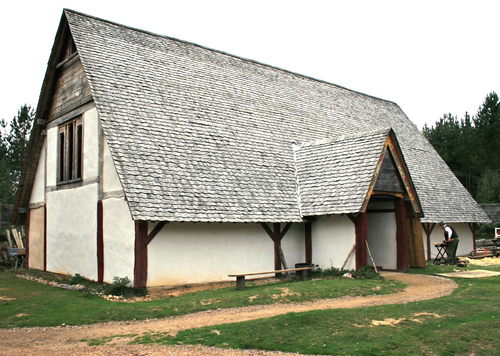
Philip Rahtz asserted that buildings seen in West Stow and Mucking had late Roman origins.[274] Archaeologist Philip Dixon noted the striking similarity between Anglo-Saxon timber halls and Romano-British rural houses. The Anglo-Saxons did not import the 'long-house', the traditional dwelling of the continental Germanic peoples, to Britain. Instead they upheld a local vernacular British building tradition dating back to the late first century. This has been interpreted as evidence of the endurance of kinship and household structures from the Roman into the Anglo-Saxon period.[275][276]
However, this has been considered too neat an explanation for all the evidence. Anne and Gary Marshall summarise the situation:
"One of the main problems in Anglo-Saxon archaeology has been to account for the apparent uniqueness of the English timber structures of the period. These structures seem to bear little resemblance either to earlier Romano-British or to continental models. In essence, the problem is that the hybrid Anglo-Saxon style seems to appear full-blown with no examples of development from the two potentially ancestral traditions ... The consensus of the published work was that the Anglo-Saxon building style was predominantly home-grown."[277]
In the Sutton Hoo burial, perhaps that of the East Anglian king Raedwald, a long and complex iron chain, used for suspending a cauldron from the beams of a hall, was found. It was the product of a continuous British smithing tradition dating to pre-Roman times. This was, however, a high-status object.[278]
For Bryan Ward-Perkins the answer to the relative lack of native influence on everyday objects is found in the success of the Anglo-Saxon culture and highlights the micro-diversity and larger cohesion that produced a dynamic force in comparison to the Brittonic culture.[240] From beads and quoits to clothes and houses, there is something unique happening in the early Anglo-Saxon period. The material culture evidence shows that people adopted and adapted styles based on set roles and styles. John Hines, commenting on the diversity of nearly a thousand glass beads and many different clothes clasps from Lakenheath, states that these reveal a "society where people relied on others to fulfill a role" and "what they had around them was making a statement", not one about the individual, but about "identity between small groups not within small groups".[279]
Julian Richards commenting on this and other evidence suggests:
"[The Anglo-Saxon settlement of Britain] was more complex than a mass invasion bringing fully formed lifestyles and beliefs. The early Anglo-Saxon, just like today's migrants, were probably riding different cultural identities. They brought from their homelands the traditions of their ancestors. But they would have been trying to work out not only who they were, but who they wanted to be ... and forge an identity for those who followed."[280]
Looking beyond simplistic 'homeland' scenarios, and explaining the observations that 'Anglo-Saxon' houses and other aspects of material culture do not find exact matches in the 'Germanic homelands' in Europe, Halsall explains the changes within the context of a larger 'North Sea interaction zone', including lowland England, Northern Gaul and northern Germany. These areas experienced marked social and cultural changes in the wake of Roman collapse—experienced not only within the former Roman provinces (Gaul, Britain) but also in Barbaricum itself. All three areas experienced changes in social structure, settlement patterns and ways of expressing identities, as well as tensions which created push and pull factors for migrations in, perhaps, multiple directions.[281]
Culture of belief
The study of pagan religious practice in the early Anglo-Saxon period is difficult. Most of the texts that may contain relevant information are not contemporary, but written later by Christian writers who tended to have a hostile attitude to pre-Christian beliefs, and who may have distorted their portrayal of them. Much of the information used to reconstruct Anglo-Saxon paganism comes from later Scandinavian and Icelandic texts and there is a debate about how relevant these are. The study of pagan Anglo-Saxon beliefs has often been approached with reference to Roman or even Greek typologies and categories. Archaeologists therefore use such terms as gods, myths, temples, sanctuaries, priests, magic and cults. Charlotte Behr argues that this provides a worldview of Anglo-Saxon practice culture which is unhelpful.[282]
Peter Brown employed a new method of looking at the belief systems of the fifth to seventh centuries, by arguing for a model of religion which was typified by a pick and choose approach. The period was exceptional because there was no orthodoxy or institutions to control or hinder the people. This freedom of culture is seen also in the Roman-British community and is very evident in the complaints of Gildas.[283]
One Anglo-Saxon cultural practice that is better understood are the burial customs, due in part to archaeological excavations at various sites including Sutton Hoo, Spong Hill, Prittlewell, Snape and Walkington Wold, and the existence of around 1,200 furnished inhumation and cremation cemeteries, which were once assumed to be pagan but whose religious affiliation is now substantially debated in scholarship. There was no set form of burial, with cremation being preferred in the north and inhumation in the south, although both forms were found throughout England, sometimes in the same cemeteries. When cremation did take place, the ashes were usually placed within an urn and then buried, sometimes along with grave goods.[284] According to archaeologist Dave Wilson, "the usual orientation for an inhumation in a pagan Anglo-Saxon cemetery was west–east, with the head to the west, although there were often deviations from this."[285] Indicative of possible religious belief, grave goods were common amongst inhumation burials as well as cremations; free Anglo-Saxon men were buried with at least one weapon in the pagan tradition, often a seax, but sometimes also with a spear, sword, or shield, or a combination of these.[284] There are also a number of recorded cases of parts of animals being buried within such graves. Most common amongst these were body parts belonging to either goats or sheep, although parts of oxen were also relatively common, and there are also isolated cases of goose, crab apples, duck eggs, and hazelnuts being buried in graves. It is widely thought therefore that such items constituted a food source for the deceased.[286] In some cases, animal skulls, particularly oxen but also pig, were buried in human graves, a practice that was also found earlier in Roman Britain.[284]
Despite this earlier confidence in the ability to use burial customs to understand cultures of belief, mortuary archaeologists have now challenged the notion that burial with grave-goods either in post-Roman Britain,[287][288][289] or further afield in early medieval Europe,[290][291][292][293] need have anything at all to do with paganism or other forms of belief in the afterlife. Howard Williams, summarising general trends in the scholarship, has pointed out
The emergence of furnished cremation and inhumation graves is thus no longer regarded as reflecting a single and coherent 'Anglo-Saxon paganism'; nor need the decline in accompanied burial relate directly or exclusively to Christian conversion. Indeed, the very term 'pagan Anglo-Saxon burial' compounds the conceptually naïve assumption that there existed a one-to-one correlation between ethnic affiliation, religious beliefs and ritual practice that archaeologists have been so keen to move beyond.[294]
There is also evidence for the continuation of Christianity in south and east Britain. The Christian shrine at St Albans and its martyr cult survived throughout the period (see Gildas above). There are references in Anglo-Saxon poetry, including Beowulf, that show some interaction between pagan and Christian practices and values. While there is little scholarly focus on this subject, there is enough evidence from Gildas and elsewhere that it is safe to assume some continuing – perhaps more free – form of Christianity survived. Richard Whinder states "(The Church's pre-Augustine) characteristics place it in continuity with the rest of the Christian Church in Europe at that time and, indeed, in continuity with the Catholic faith ... today."[295]
Anglo-Saxon paganism was not based on faith, but on rituals intended to bring benefits to individuals and the community. As kingship developed, it probably came into conflict with the entrenched priestly class. Conversion to Christianity provided kings with priests who were under their protection and thus under their influence, and Christianisation seems to have been mainly sponsored by kings.[296]
See also




- History of Anglo-Saxon England
- Timeline of conflict in Anglo-Saxon Britain
- History of England
- Sub-Roman Britain – Period in late antiquity in Great Britain
- Romano-British culture – Pre-Saxon England
- Modern immigration to the United Kingdom – Immigration to the United Kingdom since the independence of Ireland in 1922
Notes
- ^ Based on Jones & Mattingly's Atlas of Roman Britain (ISBN 978-1-84217-067-0, 1990, reprinted 2007); Mattingly's Imperial Possession (ISBN 978-0-14-014822-0, 2006); Higham's Rome, Britain, and the Anglo-Saxons (ISBN 978-1-85264-022-4, 1992); Frere's Britannia (ISBN 978-0-7102-1215-3, 1987); and Snyder's An Age of Tyrants (ISBN 978-0-631-22260-6) — the sources are cited in the image legend — Locations of towns (fortified and unfortified) are given on p. 156, with tribal civitates and coloniae specified on p. 154, of Atlas of Roman Britain. Specification of the Romanised regions of Britain are also from the Atlas, p. 151. The "Departure Dates" are found in the cited sources, and are generally known. The Pictish, Saxon, and Scoti raids are found in the cited sources, as is the date of the Irish settlements in Wales. Frere suggests (p. 355) that it was the Irish who sacked Wroxeter c. 383. The locations of the Irish settlements is from the locations of inscription stones given in File:Britain.Deisi.Laigin.jpg as of 2010[update]-10-11, which cites its sources of information.
- ^ Helen Cool investigates late assemblages, in her paper, from the period between the end of the Roman occupation and the Anglo-Saxon period. It lists all assemblages, that were known, at the time of publication of the paper.[106] Simon Esmonde Cleary attempts to characterise and analyse the change in the nature of the archaeological record in England in the mid-first millennium AD. [107]
Citations
- ^ Higham & Ryan 2013:104–105
- ^ In the abstract for: Härke, Heinrich. "Anglo-Saxon Immigration and Ethnogenesis." Medieval Archaeology 55.1 (2011): 1–28.
- ^ Drinkwater, John F. (2023), "The 'Saxon Shore' Reconsidered", Britannia, 54: 275–303, doi:10.1017/S0068113X23000193
- ^ Springer, Matthias (2004), Die Sachsen
- ^ Halsall 2013, p. 218.
- ^ Halsall 2013, p. 13.
- ^ Dewing, H B (1962). Procopius: History of the Wars Books VII and VIII with an English Translation (PDF). Harvard University Press. pp. 252–255. Archived from the original (PDF) on 3 March 2020. Retrieved 1 March 2020.
- ^ Gildas (1899), The Ruin of Britain, David nutt, pp. 60–61
- ^ Higham, Nicholas (1995). An English Empire: Bede and the Early Anglo-Saxon Kings. Manchester University Press. p. 2. ISBN 978-0-7190-4424-3.
- ^ Halsall 2013, pp. 13–15, 185–186, 246.
- ^ Halsall 2013, pp. 194, 203.
- ^ a b Hills, C.; Lucy, S. (2013). Spong Hill IX: Chronology and Synthesis. Cambridge: McDonald Institute for Archaeological Research. ISBN 978-1-902937-62-5.
- ^ Halsall 2013, pp. 186, 246.
- ^ Bede's Ecclesiastical History, Bk I, Ch 15 and Bk II, Ch 5.
- ^ Giles 1843a:72–73, Bede's Ecclesiastical History, Bk I, Ch 15.
- ^ Giles 1843b:188–189, Bede's Ecclesiastical History, Bk V, Ch 9.
- ^ Dark, K., Civitas to Kingdom: British Political Continuity 300–80 (London, Leicester University Press, 1994)
- ^ Higham, Nick. "From sub-Roman Britain to Anglo-Saxon England: Debating the Insular Dark Ages." History Compass 2.1 (2004).
- ^ Brugmann, B. I. R. T. E. "Migration and endogenous change." The Oxford Handbook of Anglo-Saxon Archaeology (2011): 30–45.
- ^ De Excidio I, 5, Winterbottom, Gildas, pp. 13–14.
- ^ Halsall 2013, pp. 81–83.
- ^ Jones & Casey 1988, pp. 367–98.
- ^ Halsall 2013, p. 81.
- ^ Wood 1984, p. 19.
- ^ Jones & Casey 1988, pp. 367–398.
- ^ Halsall 2013, p. 189.
- ^ Gransden 1974, pp. 13–25.
- ^ Halsall 2013, p. 59.
- ^ Jones, Michael E. (1998). The End of Roman Britain. Cornell University Press. p. 54. ISBN 978-0-8014-8530-5. Retrieved 1 March 2020.
- ^ Snyder 1998, Age of Tyrants.
- ^ De Excidio XXI, 1, Winterbottom, Gildas, p. 24.
- ^ Heather, Peter J., and P. J. Heather. Goths and Romans, 332–489. Clarendon Press, 1991.
- ^ Daniell, Christopher. "The geographical perspective of Gildas." Britannia 25 (1994): 213–217.
- ^ See Coates 2007 for such a view
- ^ a b McKinney, Windy A. "Creating a gens Anglorum: Social and Ethnic Identity in Anglo-Saxon England through the Lens of Bede's Historia Ecclesiastica." (2011).
- ^ Keynes, Simon. "England, 700–900." The New Cambridge Medieval History 2 (1995): 18–42.
- ^ Davies, Wendy & Hayo Vierck – The Contexts of the Tribal Hidage: Social Aggregates and Settlement Patterns, Frühmittelalterliche Studien 8, 1974
- ^ David N. Dumville, 'The Anglian Collection of Royal Genealogies and Regnal Lists', Anglo-Saxon England, 5 (1976), 23–50
- ^ a b David N. Dumville, 'The West Saxon Genealogical Regnal List and the Chronology of Early Wessex', Peritia, 4 (1985), 21–66.
- ^ Barbara Yorke, 'Fact or Fiction? The Written Evidence for the Fifth and Sixth Centuries AD', Anglo-Saxon Studies in Archaeology and History, 6 (1993), 45–50.
- ^ Barbara Yorke, Wessex in the Early Middle Ages (London: Leicester University Press, 1995), pp. 32–34.
- ^ Patrick Sims-Williams, 'The Settlement of England in Bede and the Chronicle', Anglo-Saxon England, 12 (1983), 1–41.
- ^ a b Laycock, Stuart. Britannia – The Failed State: Tribal Conflict and the End of Roman Britain. History Press, 2012.
- ^ Kooper, Erik, ed. The Medieval Chronicle II: Proceedings of the 2nd International Conference on the Medieval Chronicle, Driebergen/Utrecht 16–21 July 1999. Vol. 144. Rodopi, 2002. p167
- ^ Kenneth Hurlstone Jackson, Language and History in Early Britain: A Chronological Survey of the Brittonic Languages, First to Twelfth Century A.D., Edinburgh University Publications, Language and Literature, 4 (Edinburgh: Edinburgh University Press, 1953), p. 220.
- ^ Higham, N. 1992. Rome, Britain and the Anglo-Saxons. Guildford: Seaby p 229–230
- ^ Higham, Nicholas J., and Martin J. Ryan. The Anglo-Saxon World. Yale University Press, 2013.
- ^ Map by Alaric Hall, first published here [1] as part of Bethany Fox, 'The P-Celtic Place-Names of North-East England and South-East Scotland', The Heroic Age, 10 (2007).
- ^ Cf. Hans Frede Nielsen, The Continental Backgrounds of English and its Insular Development until 1154 (Odense, 1998), pp. 77–9; Peter Trudgill, New-Dialect Formation: The Inevitability of Colonial Englishes (Edinburgh, 2004), p. 11.
- ^ Ward-Perkins, 'Why did the Anglo-Saxons', 258, suggested that the successful native resistance of local, militarised tribal societies to the invaders may perhaps account for the fact of the slow progress of Anglo-Saxonisation as opposed to the sweeping conquest of Gaul by the Franks.
- ^ Chris Wickham, Framing the Early Middle Ages: Europe and the Mediterranean 400–800 (Oxford: Oxford University Press, 2005), p. 311-12.
- ^ a b Hills C.M. (2013). Anglo-Saxon Migrations. The Encyclopedia of Global Human Migration. Wiley-Blackwell. doi:10.1002/9781444351071.wbeghm029.
- ^ Kastovsky, Dieter, 'Semantics and Vocabulary', in The Cambridge History of the English Language, Volume 1: The Beginnings to 1066, ed. by Richard M. Hogg (Cambridge: Cambridge University Press, 1992), pp. 290–408 (pp. 301–20).
- ^ a b Matthew Townend, 'Contacts and Conflicts: Latin, Norse, and French', in The Oxford History of English, ed. by Lynda Mugglestone, rev. edn (Oxford: Oxford University Press, 2012), pp. 75–105 (pp. 78–80).
- ^ A. Wollmann, 'Lateinisch-Altenglische Lehnbeziehungen im 5. und 6. Jahrhundert', in Britain 400–600, ed. by A. Bammesberger and A. Wollmann, Anglistische Forschungen, 205 (Heidelberg: Winter, 1990), pp. 373–96.
- ^ Nicholas J. Higham and Martin J. Ryan, The Anglo-Saxon World (New Haven: Yale University Press, 2013), pp. 99–101.
- ^ E.g. Richard Coates and Andrew Breeze, Celtic Voices, English Places: Studies of the Celtic impact on place-names in Britain(Stamford: Tyas, 2000).
- ^ Nicholas J. Higham and Martin J. Ryan, The Anglo-Saxon World (New Haven: Yale University Press, 2013), pp. 98–101.
- ^ D. Hooke, 'The Anglo-Saxons in England in the seventh and eighth centuries: aspects of location in space', in The Anglo-Saxons from the Migration Period to the Eighth Century: an Ethnographic Perspective, ed. by J. Hines (Woodbridge: Boydell, 1997), 64–99 (p. 68).
- ^ O. J. Padel. 2007. "Place-names and the Saxon conquest of Devon and Cornwall." In Britons in Anglo-Saxon England [Publications of the Manchester Centre for Anglo-Saxon Studies 7], N. J. Higham (ed.), 215–230. Woodbridge: Boydell.
- ^ R. Coates. 2007. "Invisible Britons: The view from linguistics." In Britons in Anglo-Saxon England [Publications of the Manchester Centre for Anglo-Saxon Studies 7], N. J. Higham (ed.), 172–191. Woodbridge: Boydell.
- ^ Peter Schrijver, Language Contact and the Origins of the Germanic Languages, Routledge Studies in Linguistics, 13 (New York: Routledge, 2014), quoting p. 16.
- ^ D. Gary Miller, External Influences on English: From Its Beginnings to the Renaissance (Oxford: Oxford University Press, 2012), pp. 35–40).
- ^ Kastovsky, Dieter, 'Semantics and Vocabulary', in The Cambridge History of the English Language, Volume 1: The Beginnings to 1066, ed. by Richard M. Hogg (Cambridge: Cambridge University Press, 1992), pp. 290–408 (pp. 317–18).
- ^ Chris Wickham, The Inheritance of Rome: A History of Europe from 400 to 1000 (London: Allen Lane, 2009), p. 157.
- ^ a b Killie, Kristin. "Old English–Late British language contact and the English progressive." Language Contact and Development Around the North Sea 321 (2012): p119
- ^ Quoting Matthew Townend, 'Contacts and Conflicts: Latin, Norse, and French', in The Oxford History of English, ed. by Lynda Mugglestone, rev. edn (Oxford: Oxford University Press, 2012), pp. 75–105 (p. 80).
- ^ Alaric Hall, 'The Instability of Place-names in Anglo-Saxon England and Early Medieval Wales, and the Loss of Roman Toponymy', in Sense of Place in Anglo-Saxon England, ed. by Richard Jones and Sarah Semple (Donington: Tyas, 2012), pp. 101–29 (pp. 102–3).
- ^ Pryor 2005 Pryor, Francis. Britain AD: A Quest for Arthur, England and the Anglo-Saxons. HarperCollins UK, 2009.
- ^ D. Gary Miller, External Influences on English: From Its Beginnings to the Renaissance (Oxford: Oxford University Press, 2012), pp. 35–40.
- ^ Nicholas J. Higham and Martin J. Ryan, The Anglo-Saxon World (New Haven: Yale University Press, 2013), pp. 97–99.
- ^ Quoting Nicholas J. Higham and Martin J. Ryan, The Anglo-Saxon World (New Haven: Yale University Press, 2013), p. 99.
- ^ Alaric Hall, 'The Instability of Place-names in Anglo-Saxon England and Early Medieval Wales, and the Loss of Roman Toponymy', in Sense of Place in Anglo-Saxon England, ed. by Richard Jones and Sarah Semple (Donington: Tyas, 2012), pp. 101–29 (pp. 112–13).
- ^ Higham and Ryan (2013), p. 100.
- ^ Smith, C. 1980. "The survival of Romano-British toponymy." Nomina 4: 27–40.
- ^ Carole Hough. 2004. The (non?)-survival of Romano-British toponymy. Neuphilologische Mitteilungen 105:25–32.
- ^ Bethany Fox, 'The P-Celtic Place-Names of North-East England and South-East Scotland', The Heroic Age, 10 (2007), § 23.
- ^ Alaric Hall, 'A gente Anglorum appellatur: The Evidence of Bede's Historia ecclesiastica gentis Anglorum for the Replacement of Roman Names by English Ones During the Early Anglo-Saxon Period', in Words in Dictionaries and History: Essays in Honour of R. W. McConchie, ed. by Olga Timofeeva and Tanja Säily, Terminology and Lexicography Research and Practice, 14 (Amsterdam: Benjamins, 2011), pp. 219–31.
- ^ Barrie Cox, 'The Place-Names of the Earliest English Records', Journal of the English Place-Name Society, 8 (1975–76), 12–66.
- ^ a b Alaric Hall, 'The Instability of Place-names in Anglo-Saxon England and Early Medieval Wales, and the Loss of Roman Toponymy', in Sense of Place in Anglo-Saxon England, ed. by Richard Jones and Sarah Semple (Donington: Tyas, 2012), pp. 101–29 (pp. 108–9).
- ^ a b Nicholas J. Higham and Martin J. Ryan, The Anglo-Saxon World (New Haven: Yale University Press, 2013), pp. 100–101.
- ^ Filppula, Markku, and Juhani Klemola, eds. 2009. Re-evaluating the Celtic Hypothesis. Special issue of English Language and Linguistics 13.2.
- ^ The Celtic Roots of English, ed. by Markku Filppula, Juhani Klemola and Heli Pitkänen, Studies in Languages, 37 (Joensuu: University of Joensuu, Faculty of Humanities, 2002).
- ^ Hildegard L. C. Von Tristram (ed.), The Celtic Englishes, Anglistische Forschungen 247, 286, 324, 3 vols (Heidelberg: Winter, 1997–2003).
- ^ Peter Schrijver, Language Contact and the Origins of the Germanic Languages, Routledge Studies in Linguistics, 13 (New York: Routledge, 2014), pp. 12–93.
- ^ Poussa, Patricia. 1990. 'A Contact-Universals Origin for Periphrastic Do, with Special Consideration of OE-Celtic Contact'. In Papers from the Fifth International Conference on English Historical Linguistics, ed. Sylvia Adamson, Vivien Law, Nigel Vincent, and Susan Wright, 407–34. Amsterdam: Benjamins.
- ^ Paul Russell, 'Latin and British in Roman and Post-Roman Britain: methodology and morphology', Transactions of the Royal Philological Society, 109.2 (July 2011), 138–57.
- ^ Peter Schrijver, Language Contact and the Origins of the Germanic Languages, Routledge Studies in Linguistics, 13 (New York: Routledge, 2014), pp. 31–91.
- ^ D. Gary Miller, External Influences on English: From Its Beginnings to the Renaissance (Oxford: Oxford University Press, 2012), pp. 25–28.
- ^ Quoting D. Gary Miller, External Influences on English: From Its Beginnings to the Renaissance (Oxford: Oxford University Press, 2012), pp. 35–40 (p. 39).
- ^ a b c d Oppenheimer, Stephen (2006). The Origins of the British: A Genetic Detective Story: Constable and Robinson, London. ISBN 978-1-84529-158-7.
- ^ Alaric Hall, 'A gente Anglorum appellatur: The Evidence of Bede's Historia ecclesiastica gentis Anglorum for the Replacement of Roman Names by English Ones During the Early Anglo-Saxon Period', in Words in Dictionaries and History: Essays in Honour of R. W. McConchie, ed. by Olga Timofeeva and Tanja Säily, Terminology and Lexicography Research and Practice, 14 (Amsterdam: Benjamins, 2011), pp. 219–31 (pp. 220–21).
- ^ a b c d Myres, J.N.L. (1989) The English Settlements. Oxford University Press, pp. 146–147
- ^ Parsons, D. (1997) British *Caraticos, Old English Cerdic, Cambrian Medieval Celtic Studies, 33, pp, 1–8.
- ^ Koch, J.T., (2006) Celtic Culture: A Historical Encyclopedia, ABC-CLIO, ISBN 978-1-85109-440-0, pp. 392–393.
- ^ Ward-Perkins, B., Why did the Anglo-Saxons not become more British? The English Historical Review 115.462 (June 2000): p513.
- ^ Yorke, B. (1990), Kings and Kingdoms of Early Anglo-Saxon England, London: Seaby, ISBN 978-1-85264-027-9 pp. 138–139
- ^ Basset, S. (ed.) (1989) The Origins of Anglo-Saxon Kingdoms, Leicester University Press
- ^ Koch, J.T., (2006) Celtic Culture: A Historical Encyclopedia, ABC-CLIO, ISBN 978-1-85109-440-0, p. 60
- ^ Higham and Ryan (2013), pp. 143, 178
- ^ Bede, Ecclesiastical History of the English People, Book 3, chapter 23
- ^ Koch, J.T., (2006) Celtic Culture: A Historical Encyclopedia, ABC-CLIO, ISBN 978-1-85109-440-0, p. 360
- ^ Higham and Ryan (2013), p. 143
- ^ Catherine Hills (2003) Origins of the English, Duckworth, pp. 55, 105
- ^ Díaz-Andreu, Margarita, and Sam Lucy. Archaeology of Identity. Routledge, 2005.
- ^ Cool 2000, pp. 47–65.
- ^ Cleary 1993, pp. 57–63.
- ^ Härke, H 2007a, 'Invisible Britons, Gallo-Romans and Russians: perspectives on culture change', in Higham (ed), 57–67.
- ^ Pearson, A. F. "Barbarian piracy and the Saxon Shore: a reappraisal." Oxford Journal of Archaeology 24.1 (2005): 73–88.
- ^ Creary. S "The Ending(s) of Roman Britain", The Oxford Handbook of Anglo-Saxon Archaeology (2011): 3–12.
- ^ Hingley, Rural Settlements in Roman Britain 1989
- ^ Jones, M U 1980: 'Mucking and Early Saxon rural settlement in Essex.' Buckley (ed) 1980, 82–6
- ^ Myres, J N L 1986: The Anglo-Saxon Settlements. Oxford
- ^ Hills, C 1979: 'The archaeology of Anglo-Saxon England in the pagan period: a review.' Anglo-Saxon England 8, 297–329
- ^ a b Yorke, Barbara. Kings and kingdoms of early Anglo-Saxon England. Routledge, 2002.
- ^ Arnold, C. 1988a: An Archaeology of the Early Anglo-Saxon Kingdoms. London
- ^ Hawkes, S Chadwick 1982: 'Anglo-Saxon Kent c 425–725.' Archaeology in Kent to AD 1500. ed P E Leach, London
- ^ Hills, Catherine. "Overview: Anglo-Saxon identity." The Oxford Handbook of Anglo-Saxon Archaeology (2011):4
- ^ Hills, Catherine. "Overview: Anglo-Saxon identity." The Oxford Handbook of Anglo-Saxon Archaeology (2011): 3–12.
- ^ Brooks, Nicholas. "The formation of the Mercian Kingdom", The Origins of Anglo-Saxon Kingdoms (1989): 159–170.
- ^ Gibson, C. 2007. Minerva: an early Anglo-Saxon mixed-rite cemetery in Alwalton, Cambridgeshire. In Semple, S. and Williams, H. (eds.), Early Medieval Mortuary Practices: Anglo-Saxon Studies in Archaeology and History, 14, 238–350. Oxford: Oxford University School of Archaeology.
- ^ Halsall, Guy (2011). "Ethnicity and early medieval cemeteries" (PDF). Arqueología y Territorio Medieval. 18: 15–27. doi:10.17561/aytm.v18i0.1462. Retrieved 27 October 2020.
- ^ Harland, James M. (2019). "Memories of Migration? The 'Anglo-Saxon' Burial Costume of the 5th Century AD". Antiquity. 93 (370): 954–969. doi:10.15184/aqy.2019.60.
- ^ a b Williams, Howard. "Ancient Landscapes and the Dead: The Reuse of Prehistoric and Roman Monuments as Early Anglo-Saxon Burial Sites." (1997).
- ^ Shephard, J 1979, 'The social identity of the individual in isolated barrows and barrow cemeteries in Anglo-Saxon England', in B C Burnham and J Kingsbury (eds), Space, Hierarchy and Society, Brit Archaeol Rep Int Ser 59, 47–79.
- ^ Thäte, E 1996, 'Alte Denkmäler und frühgeschichtliche Bestattungen: Ein sächsisch-angelsächsischer Totenbrauch und seine Kontinuität', Archäol Inf 19, 105–16
- ^ a b c d e f g h i j k l m n Härke, Heinrich (2011). "Anglo-Saxon Immigration and Ethnogenesis". Medieval Archaeology. 55 (1): 1–28. doi:10.1179/174581711X13103897378311. S2CID 162331501.
- ^ Taylor, Christopher. Village and farmstead: a history of rural settlement in England. G. Philip, 1983: 83–106
- ^ Hamerow 2002, pp. 123–124.
- ^ Hamerow et al. 2007: 'Anglo-Saxon settlement near Drayton Road, SuttonCourtenay, Berkshire'. Archaeological Journal 164: p115
- ^ Gaimster, M. and Bradley, J. 2003,'Medieval Britain and Ireland, 2002'. Medieval Archaeology 47: p242
- ^ Everitt, A 1986: Continuity and Colonization. The Evolution of Kentish Settlement. Leicester: pp 69–92
- ^ Oosthuizen, Susan. Tradition and Transformation in Anglo-Saxon England: Archaeology, Common Rights and Landscape. Bloomsbury Academic, 2013.
- ^ Hall, D 1988: 'The late Saxon countryside: villages and their fields.' Hooke (ed) 1988, 99–122
- ^ Rodwell, W J and Rodwell, K A 1985: Rivenhall: Investigations of a Villa, Church and Village, 1950–1977.
- ^ Rippon, Stephen, et al. "The Fields of Britannia: Continuity and Discontinuity in the Pays and Regions of Roman Britain." Landscapes 14.1 (2013): 33–53.
- ^ Foard, G 1985: 'The administrative organization of Northamptonshire in the Saxon period.' Anglo-Saxon Studies in Archaeology and History 4, 185–222
- ^ Wareham, Andrew. Lords and communities in early medieval East Anglia. Boydell Press, 2005
- ^ a b Hamerow, Helena, David A. Hinton, and Sally Crawford, eds. The Oxford Handbook of Anglo-Saxon Archaeology. OUP Oxford, 2011. p 119–124
- ^ Jones 1990:199, An Atlas of Roman Britain. The major inland navigation routes are shown.
- ^ Zaluckyj 2001:13, Mercia, "Mercia: The Beginnings", by Sarah Zaluckyj. Zaluckyj states that the Angles travelled up river valleys, specifically mentioning the Trent and Nene.
- ^ Russo 1998:71, Town Origins and Development in Early England.
- ^ Jones 1990:317, An Atlas of Roman Britain
- ^ Jones 1990:318, An Atlas of Roman Britain
- ^ Lucy, Sam. The Anglo-Saxon way of death: burial rites in early England. Sutton Publishing, 2000.
- ^ a b Suzuki, Seiichi. The quoit brooch style and Anglo-Saxon settlement: a casting and recasting of cultural identity symbols. Boydell & Brewer, 2000.
- ^ Yorke 2006:57, The Conversion of Britain c.600–800.
- ^ Yorke 1995:43, Wessex in the Early Middle Ages.
- ^ Haywood 1999:47, Dark Age Naval Power.
- ^ Haywood 1999:111, Dark Age Naval Power.
- ^ Yorke 1995:31, Wessex in the Early Middle Ages.
- ^ Jones 1990:308–309, Atlas of Roman Britain.
- ^ Yorke 1990:61, Kings and Kingdoms of Early Anglo-Saxon England, "The East Angles".
- ^ a b Brown 2001:151, Mercia, "The Archaeology of Mercia", by Martin Welch.
- ^ Snyder 2003:86, The Britons, "Britons and Saxons". Snyder says that they arrived in the late 5th century.
- ^ Kirby 2000:16, The Earliest English Kings.
- ^ Härke, H 1992a, Angelsächsische Waffengräber des 5. bis 7. Jahrhunderts, Zeitschrift für Archäologie des Mittelalters Beiheft 6.
- ^ Pace Stuckert, C M 1980, Roman to Saxon: population biology and archaeology. Paper presented at the Society for American Archaeology Forty-Fifth Annual Meeting 1–3 May 1980, Philadelphia, Pennsylvania, 4–5, who worked with a significantly smaller sample and less refined dating; her unpublished work was quoted by Arnold, C J 1984, Roman Britain to Saxon England, London: Croom Helm., 129–30, to support the continuity argument.
- ^ Arnold, C J 1984, Roman Britain to Saxon England, London: Croom Helm., 130
- ^ Ford, W J 2002, 'The Romano-British and Anglo-Saxon settlement and cemeteries at Stretton on-Fosse, Warwickshire', Trans Birmingham Warwickshire Archaeol Soc 106, 1–115.
- ^ Higham 2004.
- ^ Gretzinger, J; Sayer, D; Justeau, P (2022), "The Anglo-Saxon migration and the formation of the early English gene pool", Nature, 610 (7930): 112–119, Bibcode:2022Natur.610..112G, doi:10.1038/s41586-022-05247-2, PMC 9534755, PMID 36131019
- ^ Musgrove, David. "New light on the end of Roman Britain". History Extra.
- ^ Margaryan, A., Lawson, D.J., Sikora, M. et al. Population genomics of the Viking world. Nature 585, 390–396 (2020) See Supplementary Note 11 in particular
- ^ Byrne, Ross P; Martiniano, Rui; Cassidy, Lara M; Carrigan, Matthew; Hellenthal, Garrett; Hardiman, Orla; Bradley, Daniel G; McLaughlin, Russell (25 January 2018). "Insular Celtic population structure and genomic footprints of migration". PLOS Genetics. 14 (1): e1007152. doi:10.1371/journal.pgen.1007152. PMC 5784891. PMID 29370172.
- ^ Rincon, Paul (19 January 2016). "English DNA 'one-third' Anglo-Saxon – BBC News". Retrieved 17 February 2016.
- ^ Schiffels, S. et al. (2016) Iron Age and Anglo-Saxon genomes from East England reveal British migration history, Nature Communications 7, Article number:10408 doi:10.1038/ncomms10408
- ^ Stephan Schiffels and Duncan Sayer, "Investigating Anglo-Saxon migration history with ancient and modern DNA" (2017)
- ^ Martiniano et al. (2016) Genomic signals of migration and continuity in Britain before the Anglo-Saxons.
 Material was copied from this source, which is available under a Creative Commons Attribution 4.0 International License.
- ^ Leslie, Stephen; Winney, Bruce; Hellenthal, Garrett; Davison, Dan; Boumertit, Abdelhamid; Day, Tammy; Hutnik, Katarzyna; Royrvik, Ellen C; Cunliffe, Barry; Lawson, Daniel J; Falush, Daniel; Freeman, Colin; Pirinen, Matti; Myers, Simon; Robinson, Mark (19 March 2015). "The fine scale genetic structure of the British population". Nature. 519 (7543): 309–314. Bibcode:2015Natur.519..309.. doi:10.1038/nature14230. ISSN 0028-0836. PMC 4632200. PMID 25788095.
- ^ Montgomery, Janet, et al. "Continuity or colonization in Anglo-Saxon England? Isotope evidence for mobility, subsistence practice, and status at West Heslerton." American Journal of Physical Anthropology 126.2 (2005): 123–138.
- ^ Hughes, Susan S., et al. "Anglo-Saxon origins investigated by isotopic analysis of burials from Berinsfield, Oxfordshire, UK." Journal of Archaeological Science 42 (2014): 81–92.
- ^ Hughes, Susan S. and Millard, Andrew R. and Chenery, Carolyn A. and Nowell, Geoff and Pearson, D. Graham (2018) 'Isotopic analysis of burials from the early Anglo-Saxon cemetery at Eastbourne, Sussex, U.K.', Journal of archaeological science : reports., 19 . pp. 513-525.
- ^ Mays, S., and N. Beavan. "An investigation of diet in early Anglo-Saxon England using carbon and nitrogen stable isotope analysis of human bone collagen." Journal of Archaeological Science 39.4 (2012): 867–874.
- ^ Renfrew, C. & Bahn, P. 2008. Archaeology: Theories, Methods and Practice. London: Thames & Hudson p. 464
- ^ Weale, M.E et al. (2003) Y chromosome evidence for Anglo-Saxon mass migration, Molecular Biology and Evolution 19, 7, pp. 1008–1021
- ^ Capelli, C. et al. (2003) A Y chromosome census of the British Isles. Curr. Biol. 13, 979–984. (doi:10.1016/S0960-9822(03)00373-7)
- ^ Härke, Heinrich; Thomas, Mark G; Stumpf, Michael P H. "Integration versus apartheid in post-Roman Britain: A response to Pattison".
- ^ a b c Thomas, Mark G., Michael PH Stumpf, and Heinrich Härke. "Evidence for an apartheid-like social structure in early Anglo-Saxon England." Proceedings of the Royal Society B: Biological Sciences 273.1601 (2006): 2651–2657.
- ^ Pattison, John E. "Is it necessary to assume an apartheid-like social structure in Early Anglo-Saxon England?." Proceedings of the Royal Society B: Biological Sciences 275.1650 (2008): 2423–2429.
- ^ Hills, C. (2003), Origins of the English, Duckworth, London. ISBN 978-0-7156-3191-1, p. 67
- ^ Higham, C. 2008, "Whither Archaeogenetics? A view from the trenches". In Simulations, Genetics and Human Prehistory—a focus on islands. S. Matsumura, P. Forster, and C. Renfrew, eds. Cambridge, UK: McDonald Institute for Archaeological Research, 183–187. Published by: Wayne State University Press
- ^ Green, C. (2012), Britons and Anglo-Saxons: Lincolnshire AD 400–650. History of Lincolnshire Committee, Lincoln (critique of Weale on pp. 124–125)
- ^ Pattison J.E. (2011) Integration Versus Apartheid in Post-Roman Britain: A Response to Thomas et al. (2008), Human Biology 83(6):715–733
- ^ Woolf, A. (2007). Apartheid and economics in Anglo-Saxon England. In: Britons in Anglo-Saxon England. N. J. Higham, ed. Woodridge, UK: Boydell & Brewer, 115–129.
- ^ Hills, C. (2009). 'Anglo-Saxon DNA?', in Sayer & Williams, eds, Mortuary Practices and Social Identities in the Middle Ages., University of Exeter Press, p. 129
- ^ Olalde, I.; Brace, S.; Allentoft, M.E.; Armit, I.; Kristiansen, K.; Rohland, N.; Mallick, S.; Booth, T.; Szécsényi-Nagy, A.; Mittnik, A.; Altena, E.; Lipson, M.; Lazaridis, I.; Patterson, N.J.; Broomandkhoshbacht, N.; Diekmann, Y.; Faltyskova, Z.; Fernandes, D.M.; Ferry, M.; Harney, E.; de Knijff, P.; Michel, M.; Oppenheimer, J.; Stewardson, K.; Barclay, A.; Alt, K.W.; Avilés Fernández, A.; Bánffy, E.; Bernabò-Brea, M.; et al. (2018). "The Beaker phenomenon and the genomic transformation of northwest Europe". Nature. 555 (7695): 190–196.
- ^ Novembre, J.; Johnson, T.; Bryc, K.; Kutalik, Z.; Boyko, A.R.; Auton, A.; Indap, A.; King, K.S.; Bergmann, S.; Nelson, M.R.; Stephens, M.; Bustamante, C.D. (2008). "Genes mirror geography within Europe". Nature. 456 (7218): 98–101.
- ^ Lao, O.; Lu, T.T.; Nothnagel, M.; Junge, O.; Freitag-Wolf, S.; Caliebe, A.; Balascakova, M.; Bertranpetit, J.; Bindoff, L.A.; Comas, D.; Holmlund, G.; Kouvatsi, A.; Macek, M.; Mollet, I.; Parson, W.; Palo, J.; Ploski, R.; Sajantila, A.; Tagliabracci, A.; Gether, U.; Werge, T.; Rivadeneira, F.; Hofman, A.; Uitterlinden, A.G.; Gieger, C.; Wichmann, H.; Rüther, A.; Schreiber, S.; Becker, C.; Nürnberg, P.; Nelson, M.R.; Krawczak, M.; Kayser, M. (2008). "Correlation between genetic and geographic structure in Europe". Current Biology. 18 (16): 1241–1248.
- ^ Jobling, Mark A. (2012). "The impact of recent events on human genetic diversity". Philosophical Transactions of the Royal Society B: Biological Sciences. 367 (1590): 793–799. doi:10.1098/rstb.2011.0297. PMC 3267116. PMID 22312046.
- ^ Sebastian Brather, "New Questions instead of Old Answers: Archaeological Expectations of aDNA Analysis," Medieval Worlds 4 (2016): pp. 5–21.
- ^ Guy Halsall, Worlds of Arthur: Facts & Fictions of the Dark Ages (Oxford: Oxford University Press, 2013), pp. 242-5.
- ^ "On the use and abuse of ancient DNA". Nature. 555 (7698): 559. 2018. Bibcode:2018Natur.555R.559.. doi:10.1038/d41586-018-03857-3.
- ^ Matthias Friedrich and James M. Harland (eds.), Interrogating the "Germanic": A Category and its Use in Late Antiquity and the Early Middle Ages (Berlin, De Gruyter, 2020); Mischa Meier, Geschichte der Völkerwanderung (Munich, C.H. Beck, 2019), pp. 99-116; Guy Halsall, Barbarian Migrations and the Roman West (Cambridge, Cambridge University Press, 2008), p. 24; Walter Pohl, Die Germanen (Munich, Oldenbourg, 2002), pp. 50-51; Walter Goffart, "Two Notes on Germanic Antiquity Today", Traditio 50: pp. 9-30 (1995)
- ^ Bryan Ward-Perkins, "Why did the Anglo-Saxons not become more British?" in The English Historical Review, Oxford University Press (2000)
- ^ Hills 2003:11–20 Origins of the English
- ^ Hills 2003, p. 11-20.
- ^ Schiffels, S. and Sayer, D., "Investigating Anglo-Saxon migration history with ancient and modern DNA," 2017, H.H. Meller, F. Daim, J. Frause and R. Risch (eds) Migration and Integration form Prehisory to the Middle Ages. Tagungen Des Landesmuseums Für Vorgeschichte Halle, Saale
- ^ Hughes, Susan S. and Millard, Andrew R. and Chenery, Carolyn A. and Nowell, Geoff and Pearson, D. Graham (2018) 'Isotopic analysis of burials from the early Anglo-Saxon cemetery at Eastbourne, Sussex, U.K.', Journal of archaeological science : reports., 19 . pp. 513–525.
- ^ Brooks, Nicholas. "The formation of the Mercian Kingdom." The Origins of Anglo-Saxon Kingdoms (1989): 159–170.
- ^ Wood, Michael (25 May 2012). "Viewpoint: The time Britain slid into chaos". BBC News. Archived from the original on 25 May 2012.
- ^ Coates, Richard. "Invisible Britons: The view from linguistics. Paper circulated in connection with the conference Britons and Saxons, 14–16 April. University of Sussex Linguistics and English Language Department." (2004)
- ^ Hamerow, H. Early Medieval Settlements: The Archaeology of Rural Communities in North-West Europe, 400–900. Oxford: Oxford University Press.
- ^ a b Dark, Ken R. (2003). "Large-scale population movements into and from Britain south of Hadrian's Wall in the fourth to sixth centuries AD" (PDF). Archived (PDF) from the original on 9 October 2022.
- ^ Toby F. Martin, The Cruciform Brooch and Anglo-Saxon England, Boydell and Brewer Press (2015), pp. 174–178
- ^ Kortlandt, Frederik (2018). "Relative Chronology" (PDF). Archived (PDF) from the original on 9 October 2022.
- ^ a b Coates, Richard. "Celtic whispers: revisiting the problems of the relation between Brittonic and Old English" (PDF).
- ^ Jean Merkale, King of the Celts: Arthurian Legends and Celtic Tradition (1994), pp. 97–98
- ^ Nicholas Ostler, Ad Infinitum: A Biography of Latin (2009: Bloomsbury Publishing), p. 141
- ^ Jim Storr, King Arthur's Wars: The Anglo-Saxon Conquest of England (2016), p. 114
- ^ Jean Manco, The Origins of the Anglo-Saxons (2018: Thames & Hudson), pp. 131–139
- ^ Martin Grimmer, "Britons in Early Wessex: The Evidence of the Law Code of Ine," in Britons in Anglo-Saxon England, ed. Nick Higham (2007: Boydell and Brewer)
- ^ Higham, Nicholas J., and Martin J. Ryan. The Anglo-Saxon World. Yale University Press, 2013.
- ^ Koch, J.T., (2006) Celtic Culture: A Historical Encyclopedia, ABC-CLIO, ISBN 978-1-85109-440-0, pp. 392–393.
- ^ Ward-Perkins, B., "Why did the Anglo-Saxons not become more British?" The English Historical Review 115.462 (June 2000): p. 513.
- ^ Yorke, B. (1990), Kings and Kingdoms of Early Anglo-Saxon England, London: Seaby, ISBN 978-1-85264-027-9 pp. 138–139
- ^ Celtic culture: a historical encyclopedia, ABC-CLIO, 2006ISBN 1851094407, 9781851094400, page. 60
- ^ Mike Ashley, The Mammoth Book of British Kings and Queens (2012: Little, Brown Book Group)
- ^ Schiffels, Stephan; Haak, Wolfgang; Paajanen, Pirita; Llamas, Bastien; Popescu, Elizabeth; Loe, Louise; Clarke, Rachel; Lyons, Alice; Mortimer, Richard; Sayer, Duncan; Tyler-Smith, Chris; Cooper, Alan; Durbin, Richard (19 January 2016). "Iron Age and Anglo-Saxon genomes from East England reveal British migration history". Nature Communications. 7 (1): 10408. Bibcode:2016NatCo...710408S. doi:10.1038/ncomms10408. PMC 4735688. PMID 26783965 – via www.nature.com.
- ^ Martiniano, Rui; Caffell, Anwen; Holst, Malin; Hunter-Mann, Kurt; Montgomery, Janet; Müldner, Gundula; McLaughlin, Russell L.; Teasdale, Matthew D.; van Rheenen, Wouter; Veldink, Jan H.; van den Berg, Leonard H.; Hardiman, Orla; Carroll, Maureen; Roskams, Steve; Oxley, John; Morgan, Colleen; Thomas, Mark G.; Barnes, Ian; McDonnell, Christine; Collins, Matthew J.; Bradley, Daniel G. (19 January 2016). "Genomic signals of migration and continuity in Britain before the Anglo-Saxons". Nature Communications. 7 (1): 10326. Bibcode:2016NatCo...710326M. doi:10.1038/ncomms10326. PMC 4735653. PMID 26783717. S2CID 13817552.
- ^ Ross P. Byrne, Rui Martiniano, Lara M. Cassidy, Matthew Carrigan, Garrett Hellenthal, Orla Hardiman, Daniel G. Bradley, Russell L. McLaughlin, "Insular Celtic population structure and genomic footprints of migration," PLOS Genetics (January 2018)
- ^ a b Hedges, Robert (2011). "Anglo-Saxon migration and the molecular evidence". In Hamerow, Helena; Hinton, David A.; Crawford, Sally (eds.). The Oxford Handbook of Anglo-Saxon Archaeology. Oxford, UK: Oxford University Press. pp. 81–83. ISBN 978-0-19-921214-9.
- ^ Millet, Martin. "The Romanization of Britain." An Essay in Archaeological Interpretation (1990).
- ^ Wood, Michael (25 May 2012). "Viewpoint: The time Britain slid into chaos". BBC News.
- ^ Hamerow, Helena. "The earliest Anglo-Saxon kingdoms." The New Cambridge Medieval History 1 (2005): 263–90.
- ^ The Anglo-Saxon Cemetery at Spong Hill, North Elmham. Norfolk Archaeological Unit, 1995.
- ^ Thomas, Mark G., Michael PH Stumpf, and Heinrich Härke. "Integration versus apartheid in post-Roman Britain: a response to Pattison." Proceedings of the Royal Society B: Biological Sciences 275.1650 (2008): 2419–2421.
- ^ Schiffels, S. and Sayer, D., "Investigating Anglo-Saxon migration history with ancient and modern DNA," 2017, H.H. Meller, F. Daim, J. Frause and R. Risch (eds) Migration and Integration form Prehisory to the Middle Ages. Tagungen Des Landesmuseums Für Vorgeschichte Halle, Saale
- ^ Hughes, Susan S. and Millard, Andrew R. and Chenery, Carolyn A. and Nowell, Geoff and Pearson, D. Graham (2018) 'Isotopic analysis of burials from the early Anglo-Saxon cemetery at Eastbourne, Sussex, U.K.', Journal of archaeological science : reports., 19 . pp. 513-525.
- ^ A. S. Esmonde Cleary, 'The Roman to medieval transition', in Britons and Romans: advancing an archaeological agenda, eds S. James and M. Millett (York, Council for British Archaeology Research Report 125, 2001), pp. 90–7.
- ^ D. N. Dumville, 'Sub-Roman Britain: History and legend', History, 62, 1977, pp. 173–92; Dumville, 'The historical value of the Historia Brittonum', Arthurian Literature, 6, 1986, pp. 1–26
- ^ Dark, K., Civitas to Kingdom: British Political Continuity 300–80 (London, Leicester University Press, 1994) p 97–104
- ^ J. Hines, 'Philology, Archaeology and the Adventus Saxonum vel Anglorum', in Britain 400–600: Language and History, eds A. Bammesberger and A. Wollman (Heidelberg, Carl Winter, 1990), pp. 17–36.
- ^ Freeman, E.A. (1869) Old English History for Children, MacMillan, London, pp. 7, 27–28
- ^ Grimmer, M. (2007) Invasion, Settlement or Political Conquest: Changing Representations of the Arrival of the Anglo-Saxons in Britain, Journal of the Australian Early Medieval Association, 3(1) pp. 169–186.
- ^ Ausenda, G. (1997) Current issues and future directions in the study of the early Anglo-Saxon period, in Hines, J. (ed.) The Anglo-Saxons from Migration Period to the Eighth Century, Studies in Historical Archaeoethnology, pp. 411–450
- ^ O. J. Padel. 2007. "Place-names and the Saxon conquest of Devon and Cornwall." In Britons in Anglo-Saxon England [Publications of the Manchester Centre for Anglo-Saxon Studies 7], N. Higham (ed.), 215–230. Woodbridge: Boydell.
- ^ R. Coates. 2007. "Invisible Britons: The view from linguistics." In Britons in Anglo-Saxon England [Publications of the Manchester Centre for Anglo-Saxon Studies 7], N. Higham (ed.), 172–191. Woodbridge: Boydell.
- ^ Ward-Perkins, Bryan. "Why did the Anglo-Saxons not become more British?." The English Historical Review 115.462 (2000): page 523
- ^ a b Ward-Perkins, Bryan. "Why did the Anglo-Saxons not become more British?." The English Historical Review 115.462 (2000): 513–533.
- ^ Lavelle, R. (2010) Alfred's Wars: Sources and Interpretations of Anglo-Saxon Warfare in the Viking Age, Boydell & Brewer p. 85
- ^ Attenborough. The laws of Ine and Alfred. pp. 35–61
- ^ Burmeister, Stefan. "Archaeology and Migration".
- ^ Coates, Richard (2017). "Celtic whispers: revisiting the problems of the relation between Brittonic and Old English" (PDF). Namenkundliche Informationen (Journal of Onomastics). 109/110. Leipziger Universitätsverlag: 166. ISBN 978-3-96023-186-8.
- ^ Dark, Ken R. (2003). "Large-scale population movements into and from Britain south of Hadrian's Wall in the fourth to sixth centuries AD" (PDF).
- ^ Jean Merkale, King of the Celts: Arthurian Legends and Celtic Tradition (1994), pp. 97-98
- ^ Coates, Richard (2017). "Celtic whispers: revisiting the problems of the relation between Brittonic and Old English" (PDF). Namenkundliche Informationen (Journal of Onomastics). 109/110. Leipziger Universitätsverlag: 150. ISBN 978-3-96023-186-8.
- ^ Nicholas Ostler, Ad Infinitum: A Biography of Latin (2009: Bloomsbury Publishing), p. 141
- ^ Jim Storr, King Arthur's Wars: The Anglo-Saxon Conquest of England (2016), p. 114
- ^ Toby F. Martin, The Cruciform Brooch and Anglo-Saxon England (2015: Boydell and Brewer), pp. 173-174
- ^ Coates, Richard. "Celtic whispers: revisiting the problems of the relation between Brittonic and Old English".
- ^ a b Toby F. Martin, The Cruciform Brooch and Anglo-Saxon England (2015: Boydell and Brewer), pp. 174-175
- ^ a b Catherine Hills, "The Anglo-Saxon Migration: An Archaeological Case Study of Disruption," in Migration and Disruptions: Toward a Unifying Theory of Ancient and Contemporary Migrations, ed. Brenda J. Baker and Takeyuki Tsuda (2015: University Press of Florida), pp. 47-48
- ^ Ken R. Dark, "Large-scale population movements into and from Britain south of Hadrian's Wall in the fourth to sixth centuries AD" (2003)
- ^ Alexander D. Mirrington, Transformations of Identity and Society in Anglo-Saxon Essex: A Case Study of an Early Medieval North Atlantic Community (2019: Amsterdam University Press), p. 98
- ^ Stuart Brookes and Susan Harrington, The Kingdom and People of Kent, AD 400-1066, p. 24
- ^ Jillian Hawkins, "Words and Swords: People and Power along the Solent in the 5th Century" (2020)
- ^ Bruce Eagles, From Roman Civitas to Anglo-Saxon Shire: Topographical Studies on the Formation of Wessex (2018: Oxbow Books), pp. 74, 139
- ^ Kortlandt, Frederik (2018). "Relative Chronology" (PDF).
- ^ Fox, Bethany. "The P-Celtic Place Names of North-East England and South-East Scotland".
- ^ Hamerow, Helena. Rural Settlements and Society in Anglo-Saxon England. Oxford University Press, 2012.p166
- ^ Higham Nicholas J. "From Tribal Chieftains to Christian Kings." The Anglo-Saxon World (2013): 126.
- ^ Yorke, Barbara. "The vocabulary of Anglo-Saxon overlordship." Anglo-Saxon Studies in Archaeology and History. BAR British Series 92 (1981): 171–200.
- ^ Britain AD: King Arthur's Britain, Programme 2 – Three part Channel 4 series. 2004
- ^ a b Davies, Wendy, and Hayo Vierck. "The contexts of Tribal Hidage: social aggregates and settlement patterns." Issues 44 (2011).
- ^ Bede, Historia Ecclesiastica, II, 5.
- ^ As in his remarks on Edwin's imperium: Historia Ecclesiastica, II, 5, 9.
- ^ As in his remarks concerning Cædwallon and Penda, Historia Ecclesiastica, II, 20.
- ^ Bede, Historia Ecclesiastica, I, 34; II, 12.
- ^ Oosthuizen 2016, pp. 179–227.
- ^ Wickham 2009:157, The Inheritance of Rome.
- ^ Hamerow 2002, p. 105.
- ^ Higham, Nicholas J. An English Empire: Bede, the Britons, and the Early Anglo-Saxon Kings. Vol 2 p244
- ^ Rahtz, Philip. "Buildings and rural settlement." The Archaeology of Anglo-Saxon England 44 (1976): p 56
- ^ Hodges, R. (1989) The Anglo-Saxon Achievement Duckworth, London. ISBN 978-0-7156-2130-1, pp. 34–36
- ^ Dixon, Philip. "How Saxon is the Saxon house?" Structural reconstruction. Oxford (1982).
- ^ Marshall, Anne, and Garry Marshall. "A survey and analysis of the buildings of Early and Middle Anglo-Saxon England." Medieval Archaeology 35 (1991): 29
- ^ Bruce-Mitford 1983, 511–553.
- ^ John Hines: "Stories from the Dark Earth: Meet the Ancestors Revisited" Episode 4 BBC 2013
- ^ Julian Richards: "Stories from the Dark Earth: Meet the Ancestors Revisited" Episode 4 BBC 2013
- ^ Halsall (2011, p. 35)
- ^ Behr, Charlotte. Review "Signals of Belief in Early England: Anglo-Saxon Paganism Revisited, edited by Martin Carver, Alex Sanmark & Sarah Semple, 2010. Oxford: Oxbow Books; ISBN 978-1-84217-395-4". in Cambridge Archaeological Journal 21.02 (2011): 315–316.
- ^ Brown, Peter. The Rise of Western Christendom. Oxford, 2003.
- ^ a b c Hutton 1991. p. 274.
- ^ Wilson 1992. p. 87.
- ^ Wilson 1992. pp. 98–100.
- ^ Halsall 2013, pp. 228–229.
- ^ D.M. Hadley, "Burial, Belief and Identity in Later Anglo-Saxon England," in Reflections: 50 Years of Medieval Archaeology, 1957–2007, ed. Roberta Gilchrist and Andrew Reynolds (London: Routledge, 2009)
- ^ Harland, James M. (2019). "Memories of Migration? The 'Anglo-Saxon' Burial Costume of the 5th Century AD". Antiquity. 93 (370): 954–969, here 959–963. doi:10.15184/aqy.2019.60.
- ^ B.K. Young, "Merovingian Funeral Rites and the Evolution of Christianity: A Study in the Historical Interpretation of Archaeological Material (diss., Univ. of Pennsylvania, 1975)
- ^ Bailey K. Young, 'Paganisme, christianisme et rites funéraires mérovingiens', Archéologie Médiévale 7 (1977), pp. 5–81
- ^ G. Halsall, 'La Christianisation de la région de Metz à travers les sources archéologiques (5ème–7ème siècle): problèmes et possibilités', in M. Polfer ed., L'Évangélisation des régions entre Meuse et Moselle et la Fondation de l'Abbaye d'Echternach (Ve–IXe siècle), (Luxembourg, 2000), pp. 123–46
- ^ G. Halsall, "Examining the Christianization of the Region of Metz from Archaeological Sources", Cemeteries and Society in Merovingian Gaul (Leiden: Brill, 2010), 261–284
- ^ Howard Williams, "At the Funeral," in Signals of Belief in Early England: Anglo-Saxon Paganism Revisited, edited by Martin Carver, Alex Sanmark and Sarah Semple (London: Oxbow Books, 2010), 67–82, 67
- ^ Whinder, R, Christianity in Britain before St Augustine Catholic History Society 2008
- ^ Higham and Ryan (2013), pp. 152-153
References
General
- Halsall, Guy (2013). Worlds of Arthur: Facts & Fictions of the Dark Ages. Oxford University Press. ISBN 978-0-19-870084-5.
- Hamerow, Helena; Hinton, David A.; Crawford, Sally, eds. (2011), The Oxford Handbook of Anglo-Saxon Archaeology., Oxford: OUP, ISBN 978-0-19-921214-9
- Gransden, Antonia (1974), Historical Writing in England c 550 – c1307, London: Routledge, ISBN 978-0-203-44203-6
- Higham, Nicholas J.; Ryan, Martin J. (2013), The Anglo-Saxon World, Yale University Press, ISBN 978-0-300-12534-4
- Hills, Catherine (2003), Origins of the English, London: Duckworth, ISBN 978-0-7156-3191-1
- Keynes, Simon (1995), "England, 700–900", The New Cambridge Medieval History, vol. 2, pp. 18–42
- Koch, John T. (2006), Celtic Culture: A Historical Encyclopedia, Santa Barbara and Oxford: ABC-CLIO, ISBN 978-1-85109-440-0
- Pryor, Francis (2005), Britain AD: A Quest for Arthur, England and the Anglo-Saxons, London: Harper Perennial (published 2001), p. 320, ISBN 978-0-00-718187-2
- Pryor, Francis (2004), Britain AD: King Arthur's Britain, Channnel 4
Archaeology
- Behr, Charlotte (2010). "Review of Signals of Belief in Early England". Anglo-Saxon England. 21 (2). Cambridge: Cambridge University Press.
- Millett, Martin (1990), The Romanization of Britain: An Essay in Archaeological Interpretation, Cambridge University Press, ISBN 978-0-521-36084-5
- Bruce-Mitford, Rupert (1983). The Sutton Hoo Ship-Burial, Volume 3: Late Roman and Byzantine silver, hanging-bowls, drinking vessels, cauldrons and other containers, textiles, the lyre, pottery bottle and other items. Vol. II. London: British Museum Publications. ISBN 978-0-7141-0530-7.
- Brugmann, Birte (2011), Migration and endogenous change: The Oxford Handbook of Anglo-Saxon Archaeology., Oxford: OUP, ISBN 978-0-19-921214-9
- Cleary, Simon Esmonde (1993), "Approaches to the differences between late Romano-British and early Anglo-Saxon archaeology", Anglo-Saxon Studies in Archaeology and History 6
- Cool, HEM (2000), Wilmott, T; Wilson, P (eds.), "The parts left over: material culture into the 5th century", The Late Roman Transition in the North (299), BAR
- Dixon, Philip (1982), How Saxon is the Saxon house, in Structural Reconstruction. Approaches to the interpretation of the excavated remains of buildings, British Archaeological Reports British Series 110, Oxford
{{citation}}: CS1 maint: location missing publisher (link) - Marshall, Anne; Marshall, Garry (1991), A survey and analysis of the buildings of Early and Middle Anglo-Saxon England." Medieval Archaeology 35
- Halsall, Guy (2011), "Archaeology and Migration: Rethinking the debate", in Rica Annaert; Tinne Jacobs; Ingrid In 't Ven; Steffi Coppens (eds.), The very beginning of Europe? Cultural and Social Dimensions of Early-Medieval Migration and Colonisation (5th–8th century), Flanders Heritage Agency, pp. 29–40, ISBN 978-90-7523-034-5
- Halsall, Guy (2006), "Movers and Shakers: Barbarians and the Fall of Rome", in Noble, Thomas (ed.), From Roman Provinces to Medieval Kingdoms, Psychology Press, ISBN 978-0-415-32742-8
- Hamerow, Helena (1993), Buildings and rural settlement, in The Archaeology of Anglo-Saxon England 44
- Hamerow, Helena (2002), Early Medieval Settlements: The Archaeology of Rural Communities in Northwest Europe, 400–900, Oxford University Press, ISBN 978-0-19-924697-7
- Hamerow, Helena.; Hinton, David A.; Crawford, Sally., eds. (2011), The Oxford Handbook of Anglo-Saxon Archaeology., Oxford: OUP, ISBN 978-0-19-921214-9
- Hamerow, Helena (5 July 2012), Rural Settlements and Society in Anglo-Saxon England, Oxford University Press, ISBN 978-0-19-920325-3
- Higham, Nick (2004), "From sub-Roman Britain to Anglo-Saxon England: Debating the Insular Dark Ages", History Compass, 2: **, doi:10.1111/j.1478-0542.2004.00085.x
- Hodges, Richard (1 January 1989), The Anglo-Saxon Achievement: Archaeology & the Beginnings of English Society, Duckworth, ISBN 978-0-7156-2130-1
- Hughes, S. S.; Millard, A. R.; Lucy, S. J.; Chenery, C. A.; Evans, J. A.; Nowell, G.; Pearson, D. G. (2014), "Anglo-Saxon origins investigated by isotopic analysis of burials from Berinsfield, Oxfordshire, UK.", Journal of Archaeological Science, in Journal of Archaeological Science, 42, 42: 81–92, Bibcode:2014JArSc..42...81H, doi:10.1016/j.jas.2013.10.025
- Jantina, Helena Looijenga (1997), Runes around the North Sea and on the continent AD 150 – 700, Groningen University: SSG Uitg., ISBN 978-90-6781-014-2
- Oosthuizen, Susan (2016), "Recognizing and Moving on from a Failed Paradigm: The Case of Agricultural Landscapes in Anglo-Saxon England c. AD 400–800", Journal of Archaeological Research 24, 24 (2): 179–227, doi:10.1007/s10814-015-9088-x, JSTOR 43956802, S2CID 254605550
- Rahtz, Philip (1976), Excavations at Mucking, Volume 2: The Anglo-Saxon Settlement, in Archaeological Report-Historic Buildings and Monuments Commission For England 21
- Myres, John (1989), The English Settlements, Oxford University Press, ISBN 978-0-19-282235-2
- Suzuki, Seiichi (2000), The quoit brooch style and Anglo-Saxon settlement: a casting and recasting of cultural identity symbols., Woodbridge, Eng. & Rochester N.Y.: Boydell & Brewer, ISBN 978-0-85115-749-8
- Williams, H. (2002), Remains of Pagan Saxondom, in Sam Lucy; Andrew J. Reynolds, eds., Burial in Early Medieval England and Wales, Society for Medieval Archaeology, ISBN 978-1-902653-65-5
History
- Bazelmans, Jos (2009), "The early-medieval use of ethnic names from classical antiquity: The case of the Frisians", in Derks, Ton; Roymans, Nico (eds.), Ethnic Constructs in Antiquity: The Role of Power and Tradition, Amsterdam: Amsterdam University, pp. 321–337, ISBN 978-90-8964-078-9
- Bede (1990), Farmer, D.H. (ed.), Bede:Ecclesiastical History of the English People, translated by Sherley-Price, Leo; Latham, R.E., London: Penguin, ISBN 978-0-14-044565-7
- Brown, Michelle P.; Farr, Carol A., eds. (2001), Mercia: An Anglo-Saxon Kingdom in Europe, Leicester: Leicester University Press, ISBN 978-0-8264-7765-1
- Charles-Edwards, Thomas, ed. (2003), After Rome, Oxford: Oxford University Press, ISBN 978-0-19-924982-4
- Dornier, Ann, ed. (1977), Mercian Studies, Leicester: Leicester University Press, ISBN 978-0-7185-1148-7
- Elton, Charles Isaac (1882), "Origins of English History", Nature, 25 (648), London: Bernard Quaritch: 501–502, Bibcode:1882Natur..25..501T, doi:10.1038/025501a0, S2CID 4097604
- Frere, Sheppard Sunderland (1987), Britannia: A History of Roman Britain (3rd, revised ed.), London: Routledge & Kegan Paul, ISBN 978-0-7102-1215-3
- Giles, John Allen, ed. (1841), "The Works of Gildas", The Works of Gildas and Nennius, London: James Bohn
- Giles, John Allen, ed. (1843a), "Ecclesiastical History, Books I, II and III", The Miscellaneous Works of Venerable Bede, vol. II, London: Whittaker and Co. (published 1843)
- Giles, John Allen, ed. (1843b), "Ecclesiastical History, Books IV and V", The Miscellaneous Works of Venerable Bede, vol. III, London: Whittaker and Co. (published 1843)
- Härke, Heinrich (2003), "Population replacement or acculturation? An archaeological perspective on population and migration in post-Roman Britain.", Celtic-Englishes, III (Winter): 13–28, retrieved 18 January 2014
- Haywood, John (1999), Dark Age Naval Power: Frankish & Anglo-Saxon Seafaring Activity (revised ed.), Frithgarth: Anglo-Saxon Books, ISBN 978-1-898281-43-6
- Higham, Nicholas (1992), Rome, Britain and the Anglo-Saxons, London: B. A. Seaby, ISBN 978-1-85264-022-4
- Higham, Nicholas (1993), The Kingdom of Northumbria AD 350–1100, Phoenix Mill: Alan Sutton Publishing, ISBN 978-0-86299-730-4
- Jones, Barri; Mattingly, David (1990), An Atlas of Roman Britain, Cambridge: Blackwell Publishers (published 2007), ISBN 978-1-84217-067-0
- Jones, Michael E.; Casey, John (1988), "The Gallic Chronicle Restored: a Chronology for the Anglo-Saxon Invasions and the End of Roman Britain", Britannia, XIX (November): 367–98, doi:10.2307/526206, JSTOR 526206, S2CID 163877146, retrieved 6 January 2014
- Kirby, D. P. (2000), The Earliest English Kings (Revised ed.), London: Routledge, ISBN 978-0-415-24211-0
- Laing, Lloyd; Laing, Jennifer (1990), Celtic Britain and Ireland, c. 200–800, New York: St. Martin's Press, ISBN 978-0-312-04767-2
- McGrail, Seàn, ed. (1988), Maritime Celts, Frisians and Saxons, London: Council for British Archaeology (published 1990), pp. 1–16, ISBN 978-0-906780-93-0
- Mattingly, David (2006), An Imperial Possession: Britain in the Roman Empire, London: Penguin Books (published 2007), ISBN 978-0-14-014822-0
- Morris, John (1985) [1965], "Dark Age Dates", in Jarrett, Michael; Dobson, Brian (eds.), Britain and Rome
- Pryor, Francis (2004), Britain AD, London: Harper Perennial (published 2005), ISBN 978-0-00-718187-2
- Russo, Daniel G. (1998), Town Origins and Development in Early England, c. 400–950 A.D., Greenwood Publishing Group, ISBN 978-0-313-30079-0
- Snyder, Christopher A. (1998), An Age of Tyrants: Britain and the Britons A.D. 400–600, University Park: Pennsylvania State University Press, ISBN 978-0-271-01780-8
- Snyder, Christopher A. (2003), The Britons, Malden: Blackwell Publishing (published 2005), ISBN 978-0-631-22260-6
- Wickham, Chris (2005), Framing the Early Middle Ages: Europe and the Mediterranean, 400–800, Oxford: Oxford University Press (published 2006), ISBN 978-0-19-921296-5
- Wickham, Chris (2009), "Kings Without States: Britain and Ireland, 400–800", The Inheritance of Rome: Illuminating the Dark Ages, 400–1000, London: Penguin Books (published 2010), pp. 150–169, ISBN 978-0-14-311742-1
- Wood, Ian (1984), "The end of Roman Britain: Continental evidence and parallels", in Lapidge, M. (ed.), Gildas: New Approaches, Woodbridge: Boydell, p. 19
- Wood, Ian (1988), "The Channel from the 4th to the 7th centuries AD", in McGrail, Seàn (ed.), Maritime Celts, Frisians and Saxons, London: Council for British Archaeology (published 1990), pp. 93–99, ISBN 978-0-906780-93-0
- Yorke, Barbara (1990), Kings and Kingdoms of Early Anglo-Saxon England, B. A. Seaby, ISBN 978-0-415-16639-3
- Yorke, Barbara (1995), Wessex in the Early Middle Ages, London: Leicester University Press, ISBN 978-0-7185-1856-1
- Yorke, Barbara (2006), Robbins, Keith (ed.), The Conversion of Britain: Religion, Politics and Society in Britain c.600–800, Harlow: Pearson Education Limited, ISBN 978-0-582-77292-2
- Zaluckyj, Sarah, ed. (2001), Mercia: The Anglo-Saxon Kingdom of Central England, Little Logaston: Logaston, ISBN 978-1-873827-62-8
Genetics
- Gretzinger, J., Sayer, D., Justeau, P. et al. "The Anglo-Saxon migration and the formation of the early English gene pool". In: Nature (21 September 2022). https://doi.org/10.1038/s41586-022-05247-2