
Loading article…


後期更新世から完新世の初めにかけて、世界の大型動物(通常、体重が 44 キログラム(97 ポンド)を超える動物種と定義される)の大半が絶滅し、[1]、その結果、地球全体で動物の密度と多様性が崩壊した。[2]後期更新世の絶滅は、大型動物への極端なサイズの偏り(小型動物はほとんど影響を受けなかった)、これらの絶滅した大型動物種に代わる生態学的継承の広範な欠如、 [3]、および結果として以前に確立された動物相の関係と生息地の体制シフトによって、以前の絶滅と区別される。絶滅の時期と深刻さは地域によって異なり、人為的要因と気候的要因のさまざまな組み合わせによって引き起こされたと考えられている。[3]大型動物の個体群に対する人為的影響は、狩猟(「過剰」)、 [4] [5]およびおそらく環境の変化によって引き起こされたと考えられている。 [6]絶滅における人為的要因と気候的要因の相対的な重要性は、長年にわたる論争の対象となっている。[3]
大規模な絶滅は、オーストラリア・ニューギニア(サフル)で約5万年前に始まり、アメリカ大陸では約13,000年前に発生し、これらの地域への初期の人類の移住と時期を同じくしています。 [7]ユーラシア北部での絶滅は、5万年前から1万年前までの数万年にわたって段階的に発生しましたが、[2]アメリカ大陸での絶滅は事実上同時に発生し、最大でも3000年しか続きませんでした。[4] [8]全体として、後期更新世には世界中の大型動物種の約65%が絶滅し、[9]北米では72%、南米では83%、オーストラリアでは88%にまで増加し、[10]オーストラリアとアメリカ大陸では体重1,000キログラム(2,200ポンド)を超えるすべての哺乳類が絶滅し、[11]世界全体では約80%が絶滅しました。[12]アフリカ、南アジア、東南アジアでは他の地域よりも穏やかな絶滅が見られました。[10]
生物地理学的領域による絶滅
まとめ
導入
_in_each_TDWG_country_during_the_last_132_000_years,_only_counting_extinctions_earlier_than_1000_years_BP.jpg/500px-thumbnail.jpg)
後期更新世には体重40キログラム(88ポンド)以上の哺乳類が多数絶滅し、その中には体重1トン以上の哺乳類の約80%が含まれていた。大型動物の絶滅の割合は、アフリカからの人間の移住距離が遠くなるにつれて次第に大きくなり、オーストラリア、北米、南米で絶滅率が最も高かった。[12]
絶滅の拡大は、現代人の移住パターンを反映している。アフリカから遠く離れれば離れるほど、人間がその地域に居住したのが最近であるほど、その環境(大型動物を含む)が人間に慣れるのに要した時間は短くなる(そしてその逆もまた同様)。
この絶滅を説明する主な仮説は 2 つあります。
現在入手可能なデータと先史時代の過剰絶滅仮説の間には矛盾がいくつかある。例えば、オーストラリアの大型動物の絶滅の時期については曖昧な点がある。[14]先史時代の過剰絶滅仮説を裏付ける証拠には、大陸に生息していた同族が姿を消した後も、いくつかの島で大型動物が数千年にわたって生息し続けたことがある。例えば、地上性ナマケモノは南北アメリカの地上性ナマケモノが絶滅した後もアンティル諸島で生き延び、ケナガマンモスは本土で絶滅してから6000年後に遠く離れたウランゲル島で絶滅し、ステラーカイギュウは北太平洋の大陸岸から姿を消した後も、孤立した無人のコマンドル諸島沖で数千年にわたって生息し続けた。[15]これらの島の種のその後の絶滅は、これらの島々への後の人類の入植と相関している。
大型動物絶滅の主な原因が人類の到来時期か気候変動かという当初の議論は、必然的に古生物学的証拠と地質学的年代測定技術の組み合わせに基づいていた。最近、生き残った大型動物集団の遺伝子分析によって新たな証拠がもたらされ、「特に過去 75,000 年間の大型動物の個体数の減少を気候が予測できないということは、この時期の大型動物の動態の主な要因は人間の影響であったことを示唆している」という結論に至った。[16]
最近の研究では、それぞれの種が環境の変化に対して異なる反応を示しており、単一の要因だけでは多様な絶滅を説明できないことが示されています。原因には、気候変動、種間の競争、不安定な個体群動態、人間の捕食の相互作用が関係している可能性があります。[17]
アフリカ
アフリカは最も影響を受けていない地域の一つであるが、それでも絶滅に見舞われ、特に後期更新世から完新世への移行期には顕著であった。これらの絶滅は主に草原の生息地の変化による気候的要因によるものと考えられる。[18]
- 有蹄類
- 偶蹄類
- イノシシ科
- メトリディオコエルス (亜種)
- コルポコエルス(亜種)
- ウシ科(ウシ、カモシカ)
- 巨大な水牛( Syncerus antiquus )
- メガロトラガス
- ルシンゴリクス
- ミナミスプリングボック( Antidorcas australis )
- ボンドスプリングボック( Antidorcas bondi )
- ダマリスクス・ヒプソドン
- ダマリスクス・ニロ
- 大西洋ガゼル( Gazella atlantica )
- ガゼラ・ティンギタナ
- カプリナエ
- シカ科
- メガセロイデス・アルジェリクス(北アフリカ)
- イノシシ科
- 奇蹄類
- 偶蹄類
- 長鼻類
- ゾウ科(ゾウ)
- Palaeoloxodon iolensis ? (他の著者は、この分類群は中期更新世の終わりに絶滅したと示唆している)
- ゾウ科(ゾウ)
- 齧歯類
- Paraethomys filfilae ?
南アジアと東南アジア
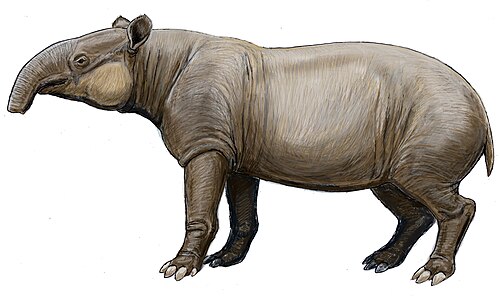
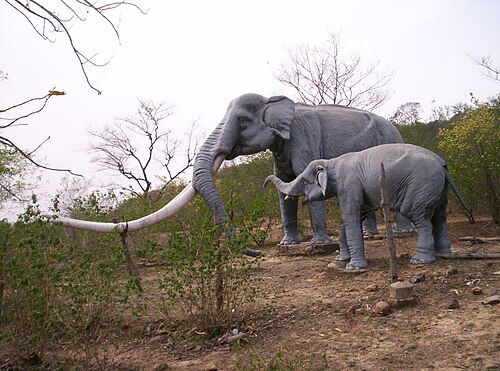
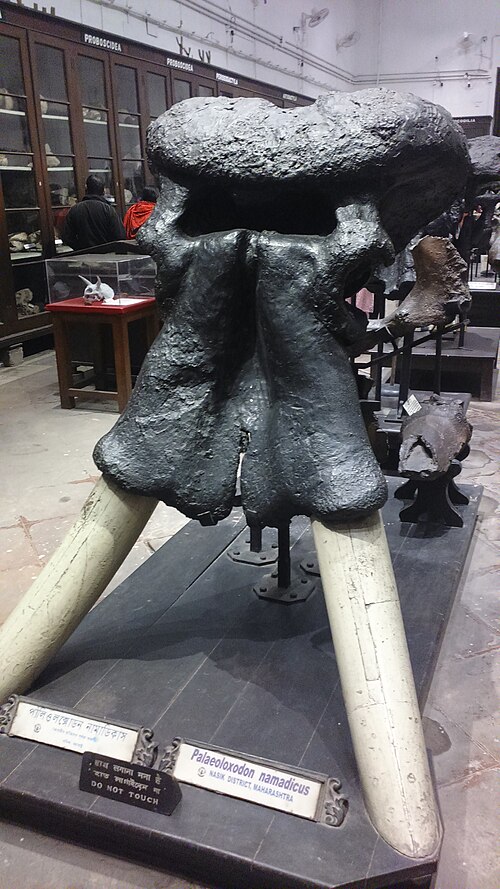

インド亜大陸における絶滅の時期は、信頼できる年代測定がないため不明である。[20]中国の遺跡でも同様の報告があるが、その地域で大型動物の分類群が完新世まで生き延びたという証拠はない。[21]東南アジアと中国南部での絶滅は、開けた森林生息地から閉じた森林生息地への環境の変化の結果であると提案されている。[22]
- 有蹄類
- フォリドタ
- オオセンザンコウ ( Manis palaeojavanica )
- 食肉類
- イヌ目
- ヒキガエル科
- クマ
- パンダ(ジャイアントパンダの祖先)
- クマ
- ヒキガエル科
- イヌ目
- アフロテリア
- 鳥類
- 飛べないカモ(シリヤネッタハセガワ)[27]
- レプトプティロス・ロブストゥス
- 爬虫類
- 霊長類
- いくつかのサル(Simiiformes)属。
- ポンゴ(オランウータン)
- ポンゴ・ウェイデンレイチ(中国南部)
- さまざまなホモ属(旧人類)
- ホモ・エレクトス・ソロエンシス(ジャワ)
- ホモ・フローレシエンシス(フローレス)
- ホモ・ルゾネンシス(フィリピン、ルソン島)
- デニソワ人(ホモ属)
- ポンゴ(オランウータン)
- いくつかのサル(Simiiformes)属。
ヨーロッパ、北アジア、東アジア


Rhinoc%C3%A9rosEnFuite.jpg/500px-16_PanneauDesLions(CentreGauche)Rhinoc%C3%A9rosEnFuite.jpg)
.jpg/500px-Lions_painting,_Chauvet_Cave_(museum_replica).jpg)


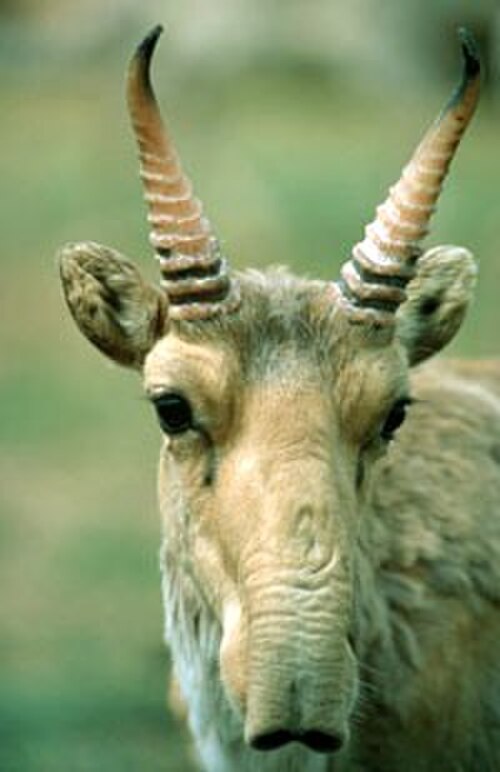
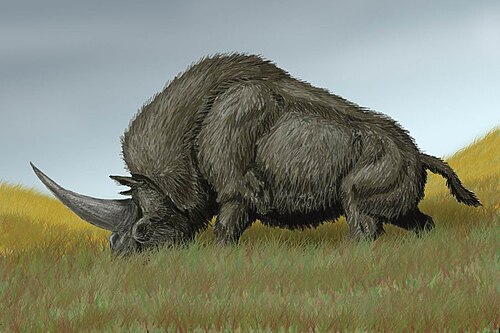
旧北区はヨーロッパ大陸全体に広がり、北アジア、コーカサス、中央アジアを経て中国北部、シベリア、ベーリング地峡にまで広がっている。絶滅はアフリカや南アジア、東南アジアよりも北ユーラシアで深刻だった。これらの絶滅は数万年にわたって段階的に起こり、約5万年前から1万年前までの間に発生し、温帯に適応したハタハタゾウやナナフシサイなどの種は、寒帯に適応したマンモスやケナガサイなどの種よりも一般的に早く絶滅した。気候変動は絶滅の大きな要因であると考えられており、おそらく人間の狩猟と相まってそうである。[2]
- 有蹄類
- 偶蹄類哺乳類
- ウシ科
の各種
- 草原バイソン( Bison priscus )
- バイカルヤク ( Bos baikalensis ) [28]
- ヨーロッパスイギュウ( Bubalus murrensis )
- ヨーロッパタール( Hemitragus cedrensis ) [29] [30]
- オオジャコウウシ( Praeovibos priscus ) [31]
- サイガ(サイガボレアリス)[32]
- ねじれた角を持つカモシカ(Spirocerus kiakhtensis)[33] [34]
- ヤギツネレイヨウ(パラブバリス・カプリコルニス)[33] [34]
- Bubalus wansijocki(中国北部原産の絶滅した水牛)
- 様々なシカ(Cervidae)種。
- オオジカ/ アイルランドヘラジカ ( Megaloceros giganteus )
- クレタ島鹿( Candiacervus spp.)
- ハプロイドセロス・メディテラネウス[35] [36]
- シノメガセロス属(日本ではシノメガセロス・ヤベイ、中国ではシノメガセロス・オルドシアヌス、おそらくシノメガセロス・パキオステウスを含む)。 [37]
- ドワーフリュウクジカ( Cervus astylodon )
- 在来種のカバ類すべて[38]
- Camelus knocklochi [39]およびその他のCamelus属
- ウシ科
の各種
- 奇蹄類哺乳類
- 様々なエクウス属
- さまざまな野生馬の亜種 (例: Equus c. gallicus、[40] [41] Equus c. latipes、[34] [40] [42] Equus c. uralensis [40] )
- エクウス・ダリアンエンシス(中国北部に生息する野生馬の一種)
- ヨーロッパノロバ( Equus hydruntinus ) (アナトリアの避難所で完新世後期まで生き延びた)
- Equus ovodovi(完新世後期まで中国北部の避難所で生き延びた)
- すべての在来サイ(Rhinocerosidae)種。
- 様々なエクウス属
- 偶蹄類哺乳類
- 食肉類
- イヌ目
- イヌ科
- ヒキガエル科
- 各種のUrsus属。
- ステップヒグマ( Ursus arctos " priscus ") [44]
- ガムスルゼンホラアナグマ( Ursus ingressus ) [45]
- 更新世の小型洞窟クマ( Ursus rossicus )
- 洞窟クマ( Ursus spelaeus )
- 巨大なホッキョクグマ( Ursus maritimus tyrannus )
- イタチ科
- イタチ科
- いくつかのカワウソ科(Lutrinae)属。
- 頑強な更新世のヨーロッパカワウソ( Cyrnaonyx )
- アルガロルトラ
- サルデーニャオオカワウソ( Megalenhydris barbaricina )
- サルデーニャコビトカワウソ( Sardolutra )
- クレタカワウソ( Lutrogale cretensis )
- いくつかのカワウソ科(Lutrinae)属。
- イタチ科
- 各種のUrsus属。
- フェリフォルミア
- ネコ科のさまざまな種。
- ホモテリウム・ラティデンス(シミター歯猫とも呼ばれる)
- 洞窟オオヤマネコ( Lynx pardinus spelaeus ) [46]
- イソワールオオヤマネコ( Lynx issiodorensis )
- パンサー属
- ヨーロッパホラアナライオン( Panthera spelaea )
- ヨーロッパ氷河期ヒョウ( Panthera pardus spelaea )
- ハイエナ科
- 洞窟ハイエナ( Crocuta crocuta spelaeaおよびCrocuta crocuta ultima )
- 「ハイエナ」プリスカ
- ネコ科のさまざまな種。
- イヌ目
- すべての在来ゾウ(ゾウ科)種。
- マンモス
- ケナガマンモス( Mammuthus primigenius )
- ドワーフサルデーニャマンモス( Mammuthus lamarmorai )
- インドゾウ( Palaeoloxodon antiquus ) (ヨーロッパ)
- ナウマンニ古生代化石(日本、おそらく韓国と中国北部にも生息)
- パレオロクソドン・フアイホエンシス(中国)
- ドワーフゾウ
- パレオロクソドン・クロイツブルギ(クレタ島)
- キプロスゾウ( Palaeoloxodon cypriotes )
- パレオロクソドン・ムナイドリエンシス(シチリア島)
- マンモス
- げっ歯類
- アロクリケトゥス
- Cricetus major(別名、 Cricetus cricetus major)
- Dicrostonyx gulielmi (北極レミングの祖先)
- オオヤマアラシ( Hystrix refossa )
- レイシア属(マルタとシチリアのオオヤマネ) [47]
- マルモタ パレオカウカシカ
- ミクロタス・グラフィ
- ミモミス属
- M.ピレナイカス
- M. シャンドレンシス
- プリオミス・レンキ
- スペルモフィルス・シテロイデス
- スペルモフィルス・セヴェルスケンシス
- スペルモフィルス・スーパーシリオサス
- Trogontherium cuvieri(大型ビーバー)
- ウサギ目
- Lepus tanaiticus (別名Lepus timidus tanaiticus )
- ナキウサギ( Ochotona ) 属など
- オオナキウサギ( Ochotona whartoni )
- トノモチョタ属
- T. カサネンシス
- T.シコタナ
- T.メジャー
- 鳥類
- 霊長類
- 爬虫類
- Solitudo sicula ;約 12,500 年前までシチリア島で生き残っていました。
- ラケルタ シクリメリテンシス;マルタから。
北米
北米における絶滅は、現在からおよそ13,800~11,400年前、後期更新世の終わりに集中しており、これはヤンガードリアス寒冷期の始まりと狩猟採集民のクローヴィス文化の出現と一致している。北米の絶滅における人間と気候要因の相対的な重要性は、大きな論争の的となっている。絶滅した種は、約35属に上る。[4]アラスカ・ユーコン地域以南の北米の放射性炭素記録は、信頼できる年表を構築するには「不十分」であるとされている。[48]
_1_(15257877377).jpg/500px-Bison_latifrons_fossil_buffalo_(Pleistocene;_North_America)_1_(15257877377).jpg)
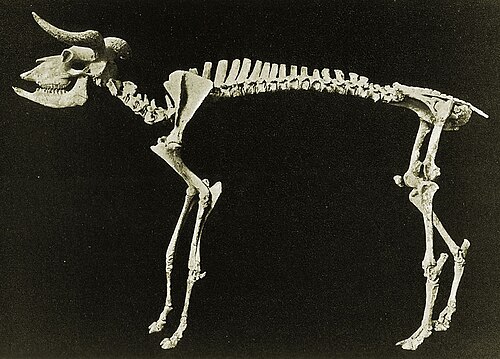


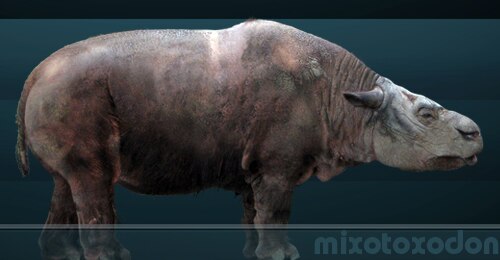

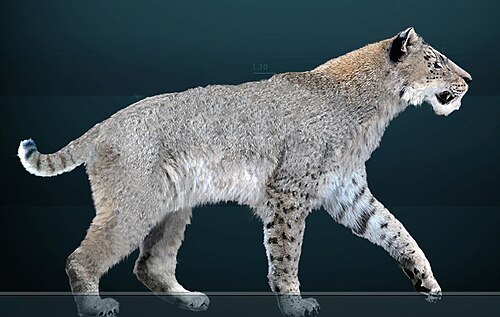


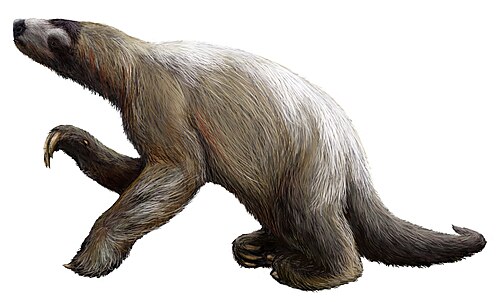


北米の絶滅(草食動物 (H)または肉食動物(C)として記載)には以下が含まれます。
- 有蹄類
- 偶蹄類哺乳類
- ウシ科
の各種
- 更新世のバイソンのほとんどの形態(北米のバイソンとユーラシアの
バイソン・ボナサスのみが生き残った)
- 古代バイソン( Bison antiquus ) ( H )
- オオバイソン( Bison latifrons ) ( H )
- 草原バイソン( Bison priscus ) ( H )
- バイソン オクシデンタリス( H )
- Caprinae属のいくつかの種(ジャコウウシは生き残った)
- オオジャコウウシ( Praeovibos priscus ) ( H )
- シュラブオックス( Euceratherium collinum ) ( H )
- ハーランジャコウウシ( Bootherium bombifrons ) ( H )
- セルゲルの牛( Soergelia mayfieldi ) ( H )
- ハリントンシロイワヤギ( Oreamnos harringtoni ;現存する近縁種よりも小型で、分布は南方である) ( H )
- サイガ(Saiga tatarica ; 絶滅)(H)
- 更新世のバイソンのほとんどの形態(北米のバイソンとユーラシアの
バイソン・ボナサスのみが生き残った)
- 鹿
- クワガタヘラジカ( Cervalces scotti ) ( H )
- アメリカシカ( Odocoileus lucasi ) ( H )
- トロントセロス ヒプノゲオス( H )
- 様々なAntilocapridae属(プロングホーンは生き残った)
- カプロメリクス( H )
- ストコセロス( H )
- テトラメリクス( H )
- パシフィックプロングホーン( Antilocapra pacifica ) ( H )
- いくつかのペッカリー(Tayassuidae)種。
- フラットヘッドペッカリー( Platygonus ) ( H )
- ナガバペッカリー( Mylohyus ) ( H )
- クビワペッカリー( Dicotyles tajacu ; 絶滅、分布域は半再定着) ( H ) ( Muknalia minimusは新参シノニム)
- ラクダ科の様々な種
- ウシ科
の各種
- 奇蹄類哺乳類
- ウマ科の在来種すべて
- 北アメリカの後期更新世に生息していたカバル系の馬(Equus cf. ferus )は、歴史的にはEquus fraternus、Equus scotti、Equus lambeiなど多くの異なる種に分類されてきたが、これらの馬の分類学は不明瞭であり、これらの種の多くは互いに同義語である可能性があり、おそらく単一の種のみを表している可能性がある。[49] [50] [51]
- 竹馬( Haringtonhippus francisci / Equus francisci ; ( H )
- バク ( Tapirus ; 3種)
- ウマ科の在来種すべて
- †ノトゥングラタ目
- ミクソトキソドン[52] [53] ( H )
- 偶蹄類哺乳類
- 食肉類
- フェリフォルミア
- いくつかのネコ科の種。
- サーベルタイガー ( †マカイロドン亜科)
- スミロドン・ファタリス(サーベルタイガー) ( C )
- ホモテリウム血清シミター歯ネコ( C)
- アメリカチーター( Miracinonyx trumani ; 真のチーターではない)
- クーガー(Puma concolor ;北米から絶滅した大型動物の生態形態、南米の個体群が以前の生息域に再定着)( C)
- ジャガランディ( Herpailurus yagouaroundi ; 絶滅、範囲が半再定着) ( C )
- マーゲイ( Leopardus weidii ; 絶滅) ( C )
- オセロット(Leopardus pardalis ;絶滅したが、生息域はわずかに再定着した)(C)
- ジャガー
- 更新世の北米ジャガー(Panthera onca augusta ; 分布域は他の亜種によって部分的に再植民化されている)(C)
- 北米ジャガー
- Panthera balamoides (疑わしいが、短頭熊類Arctotheriumの同義語ではないかと示唆されている)
- ライオンズ
- サーベルタイガー ( †マカイロドン亜科)
- いくつかのネコ科の種。
- イヌ目
- イヌ科
- ヒキガエル科
- イタチ科
- メフィティダエ
- スズメバチ(Brachyprotoma obtusata)[55](C)
- イタチ科
- ステップケナガイタチ(Mustela eversmanii ; 絶滅)[56](C)
- メフィティダエ
- クマ科の
各種
- アルクトドゥス・シムス(C)
- フロリダメガネグマ( Tremarctos floridanus ) ( C )
- 南米ヒメグマ(Arctotherium wingei)[57] [54] ( C )
- 巨大なホッキョクグマ( Ursus maritimus tyrannus ; 生息者の可能性あり) ( C )
- イタチ科
- フェリフォルミア
- アフロテリア
- エウアルコントグリレス
- コウモリ
- ストックス吸血コウモリ( Desmodus stocki ) ( C )
- 原始のヒゲコウモリ( Pteronotus ( Phylodia ) pristinus ) ( C )
- げっ歯類
- ジャイアントビーバー( Castoroides ) 属
- オヒオエンシス( H )
- カストロイデス・レイセヨラム( H)
- クラインヤマアラシ ( Erethizon kleini ) [59] ( H )
- オオシロイバネズミ( Peromyscus nesodytes ) ( C )
- ネオコエルス属など
- ピンクニーカピバラ( Neochoerus pinckneyi ) ( H )
- ネオコエルス・アエソピ( H)
- ネオトマ・フィンドレイ
- ネオトマ・ピグマエア
- シナプトミス・オーストラリス
- すべてのジャイアント フーティア (Heptaxodontidae) 属。
- 鈍歯オオヒメグマ( Amblyrhiza inundata ;アメリカクロクマほどの大きさに成長する) ( H )
- 板歯巨大フティア( Elasmodontomys obliquus ) ( H )
- ねじれ歯ネズミ( Quemisia gravis ) ( H )
- オズボーンズキーマウス( Clidomys osborn's ) ( H )
- サイマカ フルボプルビス( H )
- ジャイアントビーバー( Castoroides ) 属
- ウサギ目
- コウモリ
- エウリポティフラ
- 異節動物
- 鳥類
- 水鳥
- アヒル
- バミューダ飛べないカモ( Anas pachyscelus ) ( H )
- カリフォルニア飛べない海ガモ( Chendytes lawi ) ( C )
- メキシコオオカモ( Oxyura zapatima ) [57] ( H )
- ネオチェンバルバディアナ( H )
- アヒル
- トルコ( Meleagris ) 属
- カリフォルニアターキー( Meleagris californica ) ( H )
- メレアグリス・クラッシペス[57] ( H )
- ツル目魚類各種
- すべての洞窟クイナ(Nesotrochis)属
- アンティル洞窟レール( Nesotrochis debooyi ) ( C )
- バルバドスクイナ( Incertae sedis ) ( C )
- キューバ飛べないヅル( Antigone cubensis ) ( H )
- ラ ブレア クレーン( Grus pagei ) ( H )
- すべての洞窟クイナ(Nesotrochis)属
- フラミンゴ(Phoenicopteridae)の各種種。
- ドウツボシドリ( Fratercula dowi ) ( C )
- 更新世のメキシコダイバー属
- プリオリンバス・バリオステウス( C )
- ポディセプス属
- ポディセプス・パルヴス[57] ( C )
- コウノトリ
- ラ・ブレア/アスファルトコウ(Ciconia maltha)[57](C)
- ウェットモアコウノトリ(Mycteria wetmorei)[57](C)
- 更新世メキシコウ属( Phalacrocorax属)[57]
- ゴレテンシス( C )
- ファラクロコラックス・チャパレンシス( C )
- 残りのテラトルニ科(Teratornithidae)属
すべて。
- アイオロニス・インクレディビリス( C )
- ニシキヘビ( C)
- オスカラビス・オルソニ( C )
- テラトルニス・メリアミ( C)
- テラトルニス・ウッドバーネンシス( C )
- いくつかの新世界ハゲワシ類(Cathartidae)種。
- 更新世クロコンドル(Coragyps occidentalis ssp.)(C)
- 大型動物相 カリフォルニアコンドル( Gymnogyps amplus ) ( C )
- クラークコンドル( Breagyps clarki ) ( C )
- キューバコンドル( Gymnogyps varonai ) ( C )
- いくつかのタカ科の種。
- アメリカハゲワシ( Neophrontops americanus ) [57] [70] ( C )
- アメリカワシ( Amplibuteo woodwardi ) ( C )
- キューバオオタカ( Buteogallus borrasi ) ( C )
- ダゲットワシ( Buteogallus daggetti ) ( C )
- ワシ( Buteogallus fragilis ) ( C )
- キューバオオタカ(Gigantohierax suarezi)[71] [72](C)
- エララントワシ( Neogyps errans ) ( C )
- グリンネルズクレステッドワシ ( Spizaetus grinnelli ) [57] ( C )
- ウィレットクマタカ(Spizaetus willetti)[57](C)
- カリブタイタンホーク(Titanohierax)(C)
- いくつかのフクロウ(Strigiformes)属の種。
- ブレアミニチュアフクロウ( Asphaltoglaux ) ( C )
- クロチキンのコビトフクロウ( Glaucidium kurochkini ) ( C )
- ブレアフクロウ( Oraristix brea ) ( C )
- キューバオオフクロウ(オルニメガロニクス) ( C )
- バミューダキツツキ( Colaptes oceanicus ) ( C )
- いくつかのカラカラ(Caracarinae)属。
- バハマ陸生カラカラ ( Caracara sp.) ( C )
- プエルトリコ陸生カラカラ ( Caracara sp.) ( C )
- ジャマイカ カラカラ( Carcara Tellustris ) ( C )
- キューバカラカラ ( Milvago sp.) ( C )
- イスパニオラン カラカラ ( Milvago sp.) ( C )
- オウムガイ
- オウム目
- メキシコオオハシインコ(Rhynchoppsitta phillipsi)[57](H)
- オウム目
- 水鳥
- いくつかの巨大なカメの種。
- ヘスペロテストゥド( H )
- ゴフェラス属
- ゴフェラス・ドンラロイ( H )
- ケロノイディス属
- ケロノイディス・マルカノイ( H )
- ケロノイディス・アルブリオルム( H )
生き残った種も、ある意味では絶滅した種と同じくらい重要です。バイソン( H )、ハイイロオオカミ( C )、オオヤマネコ( C )、ハイイログマ( C )、アメリカクロクマ( C )、シカ(例:カリブー、ヘラジカ、ワピチ (ヘラジカ)、Odocoileus spp.) ( H )、プロングホーン( H )、メジロペッカリー( H )、ジャコウウシ( H )、オオツノヒツジ( H )、シロイワヤギ( H ) です。生き残った種のリストには、第四紀の絶滅イベントで絶滅したが、中期完新世の間に南米の残存個体群から少なくとも生息域の一部に再定着した種も含まれています。たとえば、クーガー( C )、ジャガー( C )、オオアリクイ( C )、クビワペッカリー( H )、オセロット( C )、ジャガランディ( C ) などです。プロングホーンとオオアリクイを除くすべての動物は、人間の捕食者とともに進化したアジアの祖先の子孫である。[73]プロングホーンは(チーターに次いで)2番目に速い陸上哺乳類であり、それがハンターの目を逃れるのに役立ったのかもしれない。過剰殺害という文脈で説明するのがより難しいのは、バイソンの生き残りである。なぜなら、これらの動物が最初に北米に現れたのは24万年未満であり、したがってかなりの期間、地理的に人間の捕食者から隔離されていたからである。[74] [75] [76]古代のバイソンが現生のバイソンに進化したため、[ 77] [78]更新世の終わりに大陸全体でバイソンが絶滅することはなかった(ただし、この属は多くの地域で地域的に絶滅した)。したがって、完新世および近年までバイソンが生き残ったことは、過剰殺害のシナリオと矛盾している。[要出典]更新世の終わり、人類が初めて北米大陸に到達したとき、これらの大型動物は 20 万年以上にわたって人間の集中的な狩猟から地理的に隔離されていました。この膨大な地質学的時間を考慮すると、バイソンは北米原産の大型哺乳類と同じくらい無知であったことはほぼ間違いありません。[[要出典]
北米における絶滅の波と関連づけられている文化は、大型動物を殺すために槍投げ器を使用していたと考えられているクローヴィス人(参照) に関連する古アメリカ文化です。「先史時代の過剰殺戮仮説」に対する主な批判は、当時の人類の人口が少なすぎたり、地理的に十分に広まっていなかったりしたため、生態学的に重大な影響を与えることはできなかったというものです。この批判は、絶滅を説明する気候変動シナリオが自動的にデフォルトで優先されることを意味するものではありませんが、気候変動の議論の弱点が過剰殺戮を支持するものとみなされる可能性があるのと同じです。両方の要因が何らかの形で組み合わさっている可能性はあり得ますが、気候変動によってすでにストレスを受けている人口では、過剰殺戮の方が大規模な絶滅を達成するのがはるかに簡単でしょう。
南アメリカ
.jpg/500px-Macrauchenia_(reconstruction).jpg)

)_(Aenocyon_dirus).jpg/500px-The_American_Museum_journal_(c1900-(1918))_(Aenocyon_dirus).jpg)

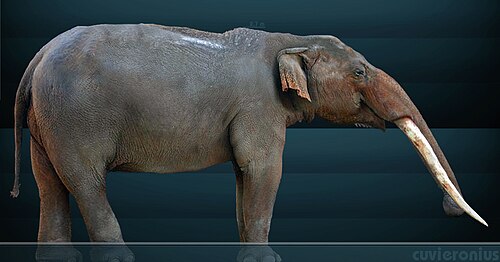
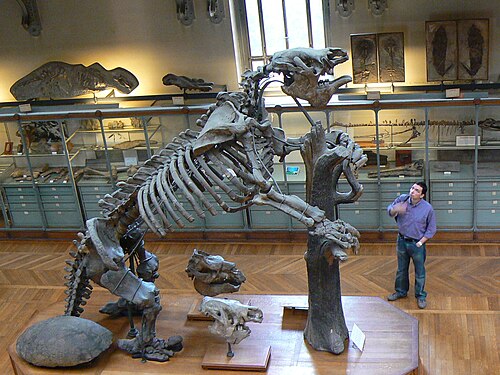
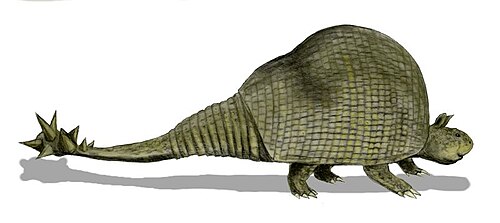


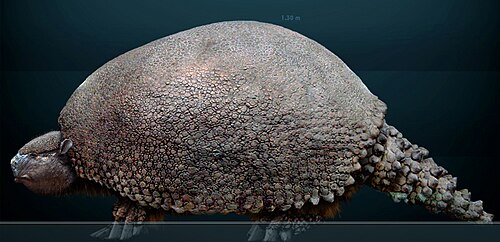
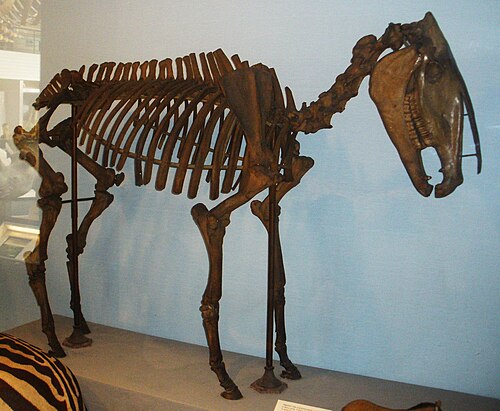
南米は大陸の中で最も深刻な損失を被り、大型動物の約83%が絶滅した。[10]これらの絶滅は、約15,000年前に南米に現生人類が到着した後のことである。様々な著者によって、人為的要因と気候的要因の両方が絶滅の要因であるとされている。[79]一部の大型動物は歴史的に、放射性炭素年代に基づいて完新世初期まで生き延びたと示唆されてきたが、これは汚染による年代測定の誤りの結果である可能性がある。[80]これらの絶滅は、南極の寒冷逆転(北半球のヤンガードリアスよりも早く、より軽度の寒冷期)の終焉と、南米全土に広まった魚の尾のような尖頭器官の出現と一致している。魚の尾のような尖頭器は大型動物の狩猟に使われたと考えられているが、人間が絶滅した大型動物を搾取したという直接的な証拠はまれである。 [79]ただし、大型動物の搾取は多くの場所で記録されている。[80] [81]魚の尾のような尖頭器は大型動物の絶滅後に急速に姿を消し、より小型の獲物を狩るのに適した他の形状のものに取って代わられた。[79]一部の著者は「壊れたジグザグ」モデルを提唱しており、人間による狩猟と気候変動により大型動物が好む開けた生息地が減少したことが、南米における大型動物の絶滅の相乗要因であったとしている。[82]
- 有蹄類
- 霊長類
- 食肉類
- フェリフォルミア
- いくつかのネコ科の種。
- サーベルタイガー(スミロドン)属[93]
- スミロドン・ファタリス(南アメリカ北西部)
- スミロドン・ポピュレーター(南アメリカ東部および南部)
- パタゴニアジャガー(Panthera onca mesembrina )(一部の研究者は、これらの遺骨は実際にはアメリカライオンのものであると示唆している[94])
- サーベルタイガー(スミロドン)属[93]
- いくつかのネコ科の種。
- イヌ目
- イヌ科
- ダイアウルフ ( Aenocyon dirus )
- ネーリングのオオカミ ( Canis nehringi )
- プロトキオン[95]
- 更新世ブッシュドッグ ( Speothos pacivorus )
- クマ科
- 南米のコガネグマ(Arctotherium属)
- アルクトテリウム・ボナイレンセ
- アルクトテリウム・タリイエンセ
- アルクトテリウム・ウィンゲイ
- 南米のコガネグマ(Arctotherium属)
- イヌ科
- フェリフォルミア
- げっ歯類
- コウモリ
- オオ吸血コウモリ ( Desmodus draculae )
- 長鼻類(ゾウとその近縁種)
- 異節族
- 残りの地上ナマケモノ属
- 残りのGlyptodontinae属すべての種。
- ドエディクロス[96] [97] [98] [99]
- グリプトドン/クラミドテリウム[100]
- ヘテログリプトドン[101]
- ホプロフォロス
- ロマフォラス
- ネオスクレロカリプタス
- ネウリュルス[100] [102]
- パノクトゥス
- パラパノクトゥス[100] [103]
- プラクシャプルス
- スクレロカリプタス
- いくつかのDasypodidae属。
- 美しいアルマジロ ( Dasypus bellus )
- ユータトゥス
- パキアルマテリウム
- プロパオプス[38] [86]
- Pampatheriidae科のすべての種。
- 鳥類
- カラカリナエ亜科
の各種
- ベネズエラのカラカラ (カラカラ メジャー) [107]
- シーモアのカラカラ (カラカラ セイモウリ) [108]
- ペルーのカラカラ (ミルバゴ・ブロドコルビ) [109]
- ニシキヘビ科の各種
- 各種のTadorninae属
- プシロプテルス(小型の恐怖鳥の化石は後期更新世に遡るが、 [110] [111]議論の余地がある) [112]
- カラカリナエ亜科
の各種
- 爬虫類
- クロックス&ゲイターズ
- テッチュディン
- Chelonoidis lutzae(アルゼンチン)
- ペルトセファルス・マチュリン[113]
サフル(オーストラリア・ニューギニア)と太平洋


確実に年代測定された大型動物の骨の堆積物が不足しているため、特定の地域での大型動物の絶滅のタイムラインを構築することが困難であり、大型動物の種がいつ、どのように絶滅したかについての研究者の間で分裂が生じています。[114] [115]
オーストラリアの大型動物の絶滅に関しては、少なくとも 3 つの仮説があります。
- 彼らはオーストラリア先住民が大陸に到着した際に絶滅した。
- 自然の気候変動により絶滅したと考えられています。
.png/500px-Marsupial_lion_(Thylacoleo_carnifex).png)
この理論は、大型動物が4万年前まで生き残っていたという証拠、つまりホモ・サピエンスが初めてオーストラリアに上陸してから実に3万年も経った後まで生き残っていたという証拠、つまり2つのグループが長きにわたって共存していたという証拠に基づいています。これらの動物が当時存在していたという証拠は、化石記録と海洋堆積物から得られています。まず、オーストラリア南西部のインド洋で掘削された堆積物コアは、植物食哺乳類の糞で生き延びたスポロルミエラと呼ばれる菌類の存在を示しています。4万5000年前より前の堆積物にこれらの胞子が豊富に存在していたことは、その時点まで南西オーストラリアの地形に多くの大型哺乳類が存在していたことを示しています。堆積物データはまた、大型動物の個体数が数千年以内、つまり4万5000年前頃に激減したことを示しており、急速な絶滅イベントがあったことを示唆しています。[116]さらに、オーストラリア北部で最も新しい大型動物の遺跡であるサウスウォーカークリークで発見された化石は、少なくとも16種の大型動物が4万年前までそこに生息していたことを示しています。さらに、 4万年前にホモサピエンスがサウスウォーカークリークに生息していたという確固たる証拠はないため、これらの大型動物の絶滅は人間が原因ではないと言えます。しかし、4万年前にサウスウォータークリークで大きな環境悪化の証拠があり、それが絶滅を引き起こした可能性があります。これらの変化には、火災の増加、草原の減少、淡水の喪失が含まれます。[117]当時のオーストラリア全土で同様の環境悪化が見られ、気候変動の議論をさらに強化しています。当時のオーストラリアの気候は、降水量の減少により地形が全体的に乾燥し、その結果、淡水の利用可能性が低下し、干ばつ状態が増えたと表現するのが最も適切です。全体として、これは植生の変化、火災の増加、草原の全体的な減少、そしてすでに不足している淡水をめぐる競争の激化につながりました。[118]これらの環境変化はオーストラリアの大型動物にとって対処するには大きすぎることが判明し、大型動物種の90%が絶滅しました。
- 一部の科学者が共有している3番目の仮説は、人間の影響と自然の気候変動がオーストラリアの大型動物の絶滅につながったというものです。オーストラリアの約75%は半乾燥または乾燥地帯であるため、大型動物種が人間と同じ淡水資源を使用していたことは理にかなっています。この競争により、大型動物の狩猟が増えた可能性があります。[119]さらに、ホモサピエンスは火農法[要説明]を使用して、通行不能[要説明]な土地を焼き払いました。これにより、すでに消滅しつつあった草地がさらに減少しました。草食性の大型動物の主要な食物成分である植物が含まれていました。これについては科学的なコンセンサスはありませんが、ホモサピエンスと自然の気候変動が複合的に影響を及ぼしたと考えられます。全体として、人間が原因であることを示す証拠は多数ありますが、オーストラリアの大型動物絶滅の原因として気候変動を完全に排除することで、全体像を把握することはできません。 45,000年前のオーストラリアの気候変動により生態系が不安定になり、人間による狩猟や火を使った農業に対して特に脆弱になりました。これがオーストラリアの大型動物の絶滅につながったと考えられます。
いくつかの研究は、気候変動がオーストラリアの更新世に大型動物相の絶滅を引き起こしたという証拠を示しています。ある研究者グループは、オーストラリア南東部のカディスプリングスで発見された化石の歯を分析しました。酸素同位体を分析することで乾燥度を測定し、炭素同位体と歯の微細摩耗組織分析を分析することで、大型動物相の食事と植生を評価しました。中期更新世の間、南東部オーストラリアはC4植物を食べる動物相を含む草食動物が主流でした。後期更新世までに、C4植物の食事成分はかなり減少しました。この変化は、食事制限を引き起こした可能性のあるますます乾燥した状況によって引き起こされた可能性があります。卵殻とウォンバットの歯の他の同位体分析も、45 Ka以降のC4植生の衰退を示しています。このC4植生の衰退は、乾燥度の上昇と一致しています。後期更新世におけるオーストラリア南東部のますます乾燥した気候は、大型動物にストレスを与え、その減少に寄与した可能性がある。[120]
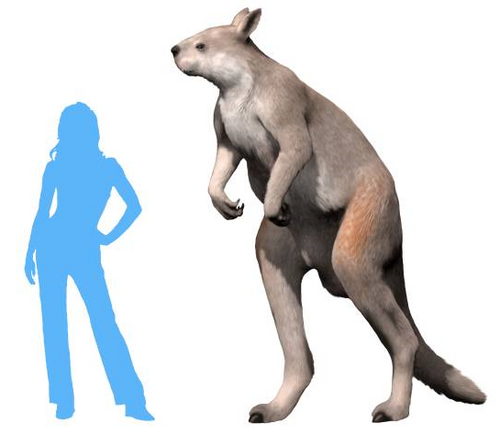


サフル(かつてオーストラリア大陸とニューギニアで構成されていた)では、世界の他の地域よりも早く、突然の大規模な絶滅の波が起こった。[121] [122] [123] [124]ほとんどの証拠は、紀元前63,000年頃の人類の到着から20,000年間を示していますが、[125]正確な日付の範囲については科学的な議論が続いています。[126]太平洋の残りの地域(ニューカレドニアやオセアニアなどの他のオーストラリア諸島)では、いくつかの点ではるかに後ではあるものの、固有種の動物相も、後期更新世から前期完新世に人類が到着するとすぐに絶滅するのが一般的でした。
- 有袋類
- ディプロトドン科の様々な種
- パロルケステス(「有袋類のバク」)
- ボンバチ科の様々な種
- Lasiorhinus angustidens (巨大ウォンバット)
- ファスコロヌス(巨大ウォンバット)
- ラマサイア・マグナ(巨大ウォンバット)
- Vombatus hacketti(ハケットウォンバット)
- ワレンジャ・ウェイクフィールディ(ドワーフ・ウォンバット)
- セドファスコロミス(巨大ウォンバット)
- コアラ(巨大コアラ)
- 有袋類ライオン( Thylacoleo carnifex)
- ボルンガブーディー(巨大ポトルー)
- カンガルー科のさまざまな種(カンガルー、ワラビーなど)
- サルコフィラス(タスマニアデビル)
のさまざまな形態
- サルコフィラス・ラニアリウス(現生種より25%大きいが、現生のタスマニアデビルとは別種であるかどうかは不明[131])
- サルコフィラス・ムルナエンシス
- 単孔類:卵を産む哺乳類。
- 鳥類
- コヒクイドリ ( Casuarius lydekkeri )
- ゲニオルニス(体高2メートル(6.6フィート)のドロモルニス類)
- オオツチハシ( Progura gallinacea )
- クリプトジプス ラセルトサス
- ダイナトエトゥス・ガファエ
- いくつかのPhoenicopteridae属。
- Xenorhynchopsis属(オーストラリアフラミンゴ) [132]
- ゼノリンクシス・マイナー
- ゼノリンクシス・ティビアリス
- 爬虫類

原因
研究の歴史
大型動物の絶滅は、19世紀にはすでに一部の科学者によって独自の現象として認識されていました。[133] [134]
[南アメリカ] の変わり果てた状態を振り返ると、深い驚きを感じずにはいられません。かつてはアフリカ南部のように巨大な怪物が群がっていたに違いありませんが、今ではバク、グアナコ、アルマジロ、カピバラしか見られません。先祖の種族に比べれば、単なる小動物です... 彼らがいなくなってから、この国の自然に大きな物理的変化は起きていません。では、これほど多くの生き物を絶滅させたものは何なのでしょうか?
— チャールズ・ダーウィン『ビーグル号航海記』(1834年)
したがって、私たちは今、地球の歴史においてまったく例外的な時期にいるのは明らかです。私たちは動物学的に貧しい世界に住んでおり、最近になって最も巨大で、最も獰猛で、最も奇妙な形態の動物がすべて姿を消しました。そして、それらがいなくなった今、私たちにとって世界ははるかに良いものになっていることは間違いありません。しかし、これほど多くの大型哺乳類が、一箇所だけではなく、地球の陸地の半分以上で突然死滅したことは、確かに驚くべき事実であり、十分に論じられていない事実です。この大きな変化には何らかの物理的原因があったに違いないと考えざるを得ません。そして、それは地球の表面の大部分にほぼ同時に作用する原因であり、少なくとも第三紀に関する限り、例外的な性質のものでした。
— アルフレッド・ラッセル・ウォレス『動物の地理的分布、現存動物と絶滅動物の関係の研究による地球表面の過去の変化の解明』(1876年)
この問題に関する議論は20世紀に広まり、特に1960年代にポール・シュルツ・マーティンが「過剰狩猟仮説」を提唱して以降、さらに広まった。20世紀末までに、この問題に関して2つの「陣営」の研究者が出現し、1つは気候変動を支持し、もう1つは絶滅の主な原因として人間の狩猟を支持した。[134]
狩猟
The hunting hypothesis suggests that humans hunted megaherbivores to extinction, which in turn caused the extinction of carnivores and scavengers which had preyed upon those animals.[135][136][137] This hypothesis holds Pleistocene humans responsible for the megafaunal extinction. One variant, known as blitzkrieg, portrays this process as relatively quick. Some of the direct evidence for this includes: fossils of some megafauna found in conjunction with human remains, embedded arrows and tool cut marks found in megafaunal bones, and European cave paintings that depict such hunting. Biogeographical evidence is also suggestive: the areas of the world where humans evolved currently have more of their Pleistocene megafaunal diversity (the elephants and rhinos of Asia and Africa) compared to other areas such as Australia, the Americas, Madagascar and New Zealand without the earliest humans. The overkill hypothesis, a variant of the hunting hypothesis, was proposed in 1966 by Paul S. Martin,[138] Professor of Geosciences Emeritus at the Desert Laboratory of the University of Arizona.[139]
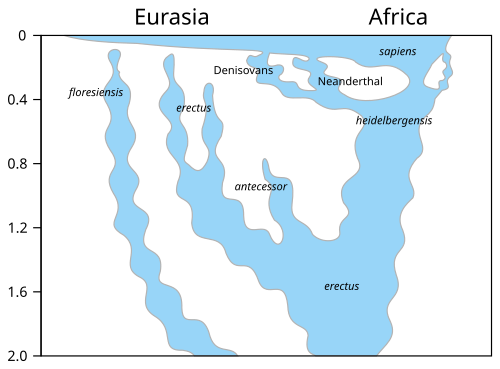

Circumstantially, the close correlation in time between the appearance of humans in an area and extinction there provides weight for this scenario.[140][9][3] Radiocarbon dating has supported the plausibility of this correlation being reflective of causation.[141] The megafaunal extinctions covered a vast period of time and highly variable climatic situations. The earliest extinctions in Australia were complete approximately 50,000 BP, well before the Last Glacial Maximum and before rises in temperature. The most recent extinction in New Zealand was complete no earlier than 500 BP and during a period of cooling. In between these extremes megafaunal extinctions have occurred progressively in such places as North America, South America and Madagascar with no climatic commonality. The only common factor that can be ascertained is the arrival of humans.[142][143] This phenomenon appears even within regions. The mammal extinction wave in Australia about 50,000 years ago coincides not with known climatic changes, but with the arrival of humans. In addition, large mammal species like the giant kangaroo Protemnodon appear to have succumbed sooner on the Australian mainland than on Tasmania, which was colonised by humans a few thousand years later.[144][145] A study published in 2015 supported the hypothesis further by running several thousand scenarios that correlated the time windows in which each species is known to have become extinct with the arrival of humans on different continents or islands. This was compared against climate reconstructions for the last 90,000 years. The researchers found correlations of human spread and species extinction indicating that the human impact was the main cause of the extinction, while climate change exacerbated the frequency of extinctions. The study, however, found an apparently low extinction rate in the fossil record of mainland Asia.[146][147] A 2020 study published in Science Advances found that human population size and/or specific human activities, not climate change, caused rapidly rising global mammal extinction rates during the past 126,000 years. Around 96% of all mammalian extinctions over this time period are attributable to human impacts. According to Tobias Andermann, lead author of the study, "these extinctions did not happen continuously and at constant pace. Instead, bursts of extinctions are detected across different continents at times when humans first reached them. More recently, the magnitude of human driven extinctions has picked up the pace again, this time on a global scale."[148][149] On a related note, the population declines of still extant megafauna during the Pleistocene have also been shown to correlate with human expansion rather than climate change.[16]
The extinction's extreme bias towards larger animals further supports a relationship with human activity rather than climate change.[150] There is evidence that the average size of mammalian fauna declined over the course of the Quaternary,[151] a phenomenon that was likely linked to disproportionate hunting of large animals by humans.[5]
Extinction through human hunting has been supported by archaeological finds of mammoths with projectile points embedded in their skeletons, by observations of modern naive animals allowing hunters to approach easily[152][153][154] and by computer models by Mosimann and Martin,[155] and Whittington and Dyke,[156] and most recently by Alroy.[157]

Major objections have been raised regarding the hunting hypothesis. Notable among them is the sparsity of evidence of human hunting of megafauna.[158][159][160] There is no archeological evidence that in North America megafauna other than mammoths, mastodons, gomphotheres and bison were hunted, despite the fact that, for example, camels and horses are very frequently reported in fossil history.[161] Overkill proponents, however, say this is due to the fast extinction process in North America and the low probability of animals with signs of butchery to be preserved.[162] The majority of North American taxa have too sparse a fossil record to accurately assess the frequency of human hunting of them.[10] A study by Surovell and Grund concluded "archaeological sites dating to the time of the coexistence of humans and extinct fauna are rare. Those that preserve bone are considerably more rare, and of those, only a very few show unambiguous evidence of human hunting of any type of prey whatsoever."[163] Eugene S. Hunn points out that the birthrate in hunter-gatherer societies is generally too low, that too much effort is involved in the bringing down of a large animal by a hunting party, and that in order for hunter-gatherers to have brought about the extinction of megafauna simply by hunting them to death, an extraordinary amount of meat would have had to have been wasted.[164]
Second-order predation
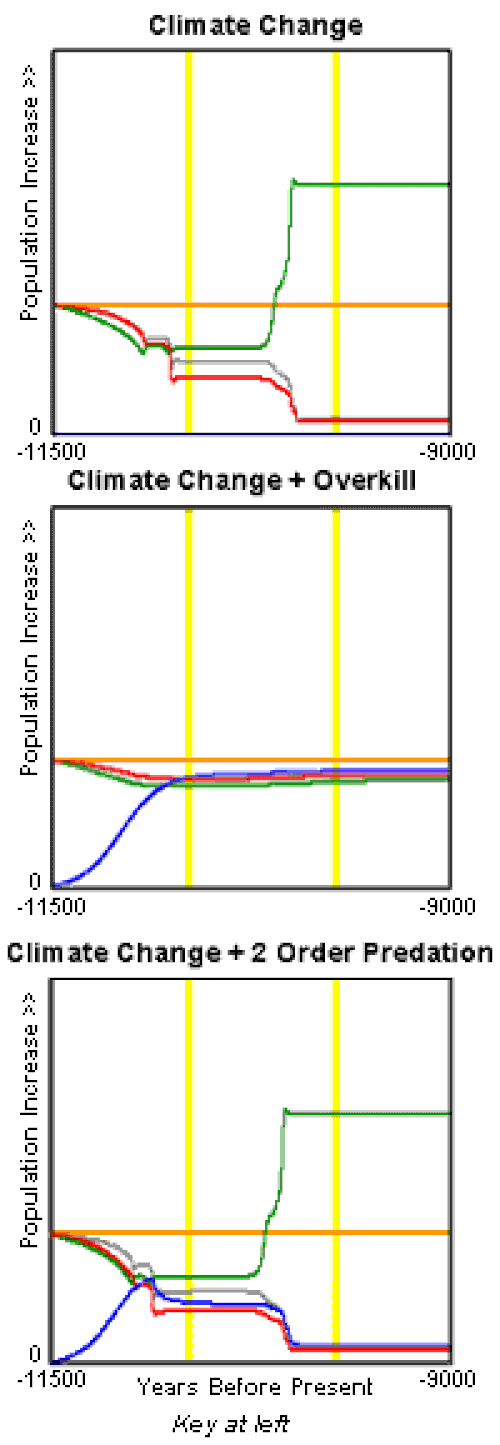
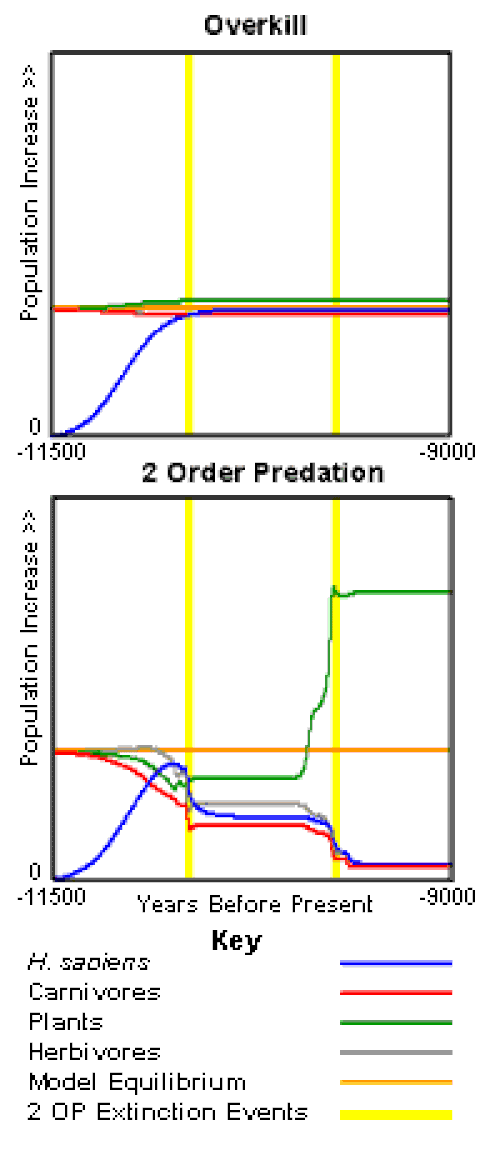
The Second-Order Predation Hypothesis says that as humans entered the New World they continued their policy of killing predators, which had been successful in the Old World but because they were more efficient and because the fauna, both herbivores and carnivores, were more naive, they killed off enough carnivores to upset the ecological balance of the continent, causing overpopulation, environmental exhaustion, and environmental collapse. The hypothesis accounts for changes in animal, plant, and human populations.
The scenario is as follows:
- After the arrival of H. sapiens in the New World, existing predators must share the prey populations with this new predator. Because of this competition, populations of original, or first-order, predators cannot find enough food; they are in direct competition with humans.
- Second-order predation begins as humans begin to kill predators.
- Prey populations are no longer well controlled by predation. Killing of nonhuman predators by H. sapiens reduces their numbers to a point where these predators no longer regulate the size of the prey populations.
- Lack of regulation by first-order predators triggers boom-and-bust cycles in prey populations. Prey populations expand and consequently overgraze and over-browse the land. Soon the environment is no longer able to support them. As a result, many herbivores starve. Species that rely on the slowest recruiting food become extinct, followed by species that cannot extract the maximum benefit from every bit of their food.
- Boom-bust cycles in herbivore populations change the nature of the vegetative environment, with consequent climatic impacts on relative humidity and continentality. Through overgrazing and overbrowsing, mixed parkland becomes grassland, and climatic continentality increases.
The second-order predation hypothesis has been supported by a computer model, the Pleistocene extinction model (PEM), which, using the same assumptions and values for all variables (herbivore population, herbivore recruitment rates, food needed per human, herbivore hunting rates, etc.) other than those for hunting of predators. It compares the overkill hypothesis (predator hunting = 0) with second-order predation (predator hunting varied between 0.01 and 0.05 for different runs). The findings are that second-order predation is more consistent with extinction than is overkill[165][166] (results graph at left). The Pleistocene extinction model is the only test of multiple hypotheses and is the only model to specifically test combination hypotheses by artificially introducing sufficient climate change to cause extinction. When overkill and climate change are combined they balance each other out. Climate change reduces the number of plants, overkill removes animals, therefore fewer plants are eaten. Second-order predation combined with climate change exacerbates the effect of climate change.[167] (results graph at right). The second-order predation hypothesis is further supported by the observation above that there was a massive increase in bison populations.[168]
However, this hypothesis has been criticised on the grounds that the multispecies model produces a mass extinction through indirect competition between herbivore species: small species with high reproductive rates subsidize predation on large species with low reproductive rates.[157] All prey species are lumped in the Pleistocene extinction model. Also, the control of population sizes by predators is not fully supported by observations of modern ecosystems.[169] The hypothesis further assumes decreases in vegetation due to climate change, but deglaciation doubled the habitable area of North America. Any vegetational changes that did occur failed to cause almost any extinctions of small vertebrates, and they are more narrowly distributed on average, which detractors cite as evidence against the hypothesis.
Competition for water
In southeastern Australia, the scarcity of water during the interval in which humans arrived in Australia suggests that human competition with megafauna for precious water sources may have played a role in the extinction of the latter.[119]
Landscape alteration
One consequence of the colonisation by humans of lands previously uninhabited by them may have been the introduction of new fire regimes because of extensive fire use by humans.[7] There is evidence that anthropogenic fire use had major impacts on the local environments in both Australia[6] and North America.[170]
Climate change
At the end of the 19th and beginning of the 20th centuries, when scientists first realized that there had been glacial and interglacial ages, and that they were somehow associated with the prevalence or disappearance of certain animals, they surmised that the termination of the Pleistocene ice age might be an explanation for the extinctions.
The most obvious change associated with the termination of an ice age is the increase in temperature. Between 15,000 BP and 10,000 BP, a 6 °C increase in global mean annual temperatures occurred. This was generally thought to be the cause of the extinctions. According to this hypothesis, a temperature increase sufficient to melt the Wisconsin ice sheet could have placed enough thermal stress on cold-adapted mammals to cause them to die. Their heavy fur, which helps conserve body heat in the glacial cold, might have prevented the dumping of excess heat, causing the mammals to die of heat exhaustion. Large mammals, with their reduced surface area-to-volume ratio, would have fared worse than small mammals. A study covering the past 56,000 years indicates that rapid warming events with temperature changes of up to 16 °C (29 °F) had an important impact on the extinction of megafauna. Ancient DNA and radiocarbon data indicates that local genetic populations were replaced by others within the same species or by others within the same genus. Survival of populations was dependent on the existence of refugia and long distance dispersals, which may have been disrupted by human hunters.[171]
Other scientists have proposed that increasingly extreme weather—hotter summers and colder winters—referred to as "continentality", or related changes in rainfall caused the extinctions. It has been shown that vegetation changed from mixed woodland-parkland to separate prairie and woodland.[172][173][174] This may have affected the kinds of food available. Shorter growing seasons may have caused the extinction of large herbivores and the dwarfing of many others. In this case, as observed, bison and other large ruminants would have fared better than horses, elephants and other monogastrics, because ruminants are able to extract more nutrition from limited quantities of high-fiber food and better able to deal with anti-herbivory toxins.[175][176][177] So, in general, when vegetation becomes more specialized, herbivores with less diet flexibility may be less able to find the mix of vegetation they need to sustain life and reproduce, within a given area. Increased continentality resulted in reduced and less predictable rainfall limiting the availability of plants necessary for energy and nutrition.[178][179][180] It has been suggested that this change in rainfall restricted the amount of time favorable for reproduction.[181][182] This could disproportionately harm large animals, since they have longer, more inflexible mating periods, and so may have produced young at unfavorable seasons (i.e., when sufficient food, water, or shelter was unavailable because of shifts in the growing season). In contrast, small mammals, with their shorter life cycles, shorter reproductive cycles, and shorter gestation periods, could have adjusted to the increased unpredictability of the climate, both as individuals and as species which allowed them to synchronize their reproductive efforts with conditions favorable for offspring survival. If so, smaller mammals would have lost fewer offspring and would have been better able to repeat the reproductive effort when circumstances once more favored offspring survival.[183] A study looking at the environmental conditions across Europe, Siberia and the Americas from 25,000 to 10,000 YBP found that prolonged warming events leading to deglaciation and maximum rainfall occurred just prior to the transformation of the rangelands that supported megaherbivores into widespread wetlands that supported herbivore-resistant plants. The study proposes that moisture-driven environmental change led to the megafaunal extinctions and that Africa's trans-equatorial position allowed rangeland to continue to exist between the deserts and the central forests, therefore fewer megafauna species became extinct there.[171]
Evidence in Southeast Asia, in contrast to Europe, Australia, and the Americas, suggests that climate change and an increasing sea level were significant factors in the extinction of several herbivorous species. Alterations in vegetation growth and new access routes for early humans and mammals to previously isolated, localized ecosystems were detrimental to select groups of fauna.[184]
Some evidence from Europe also suggests climatic changes were responsible for extinctions there, as the individuals extinctions tended to occur during times of environmental change and did not correlate particularly well with human migrations.[2]
In Australia, some studies have suggested that extinctions of megafauna began before the peopling of the continent, favouring climate change as the driver.[185]
In Beringia, megafauna may have gone extinct because of particularly intense paludification and because the land connection between Eurasia and North America flooded before the Cordilleran Ice Sheet retreated far enough to reopen the corridor between Beringia and the remainder of North America.[186] Woolly mammoths became extirpated from Beringia because of climatic factors, although human activity also played a synergistic role in their decline.[187] In North America, a Radiocarbon-dated Event-Count (REC) modelling study found that megafaunal declines in North America correlated with climatic changes instead of human population expansion.[188]
In the North American Great Lakes region, the population declines of mastodons and mammoths have been found to correlate with climatic fluctuations during the Younger Dryas rather than human activity.[189]
In the Argentine Pampas, the flooding of vast swathes of the once much larger Pampas grasslands may have played a role in the extinctions of its megafaunal assemblages.[8]
Critics object that since there were multiple glacial advances and withdrawals in the evolutionary history of many of the megafauna, it is rather implausible that only after the last glacial maximum would there be such extinctions. Proponents of climate change as the extinction event's cause like David J. Meltzer suggest that the last deglaciation may have been markedly different from previous ones.[190] Also, one study suggests that the Pleistocene megafaunal composition may have differed markedly from that of earlier interglacials, making the Pleistocene populations particularly vulnerable to changes in their environment.[191]
Studies propose that the annual mean temperature of the current interglacial that we have seen for the last 10,000 years is no higher than that of previous interglacials, yet most of the same large mammals survived similar temperature increases.[192][193][194] In addition, numerous species such as mammoths on Wrangel Island and St. Paul Island survived in human-free refugia despite changes in climate.[195] This would not be expected if climate change were responsible (unless their maritime climates offered some protection against climate change not afforded to coastal populations on the mainland). Under normal ecological assumptions island populations should be more vulnerable to extinction due to climate change because of small populations and an inability to migrate to more favorable climes.[citation needed]
Critics have also identified a number of problems with the continentality hypotheses. Megaherbivores have prospered at other times of continental climate. For example, megaherbivores thrived in Pleistocene Siberia, which had and has a more continental climate than Pleistocene or modern (post-Pleistocene, interglacial) North America.[196][197][198] The animals that became extinct actually should have prospered during the shift from mixed woodland-parkland to prairie, because their primary food source, grass, was increasing rather than decreasing.[199][198][200] Although the vegetation did become more spatially specialized, the amount of prairie and grass available increased, which would have been good for horses and for mammoths, and yet they became extinct. This criticism ignores the increased abundance and broad geographic extent of Pleistocene bison at the end of the Pleistocene, which would have increased competition for these resources in a manner not seen in any earlier interglacials.[191] Although horses became extinct in the New World, they were successfully reintroduced by the Spanish in the 16th century—into a modern post-Pleistocene, interglacial climate. Today there are feral horses still living in those same environments. They find a sufficient mix of food to avoid toxins, they extract enough nutrition from forage to reproduce effectively and the timing of their gestation is not an issue. Of course, this criticism ignores the obvious fact that present-day horses are not competing for resources with ground sloths, mammoths, mastodons, camels, llamas, and bison. Similarly, mammoths survived the Pleistocene Holocene transition on isolated, uninhabited islands in the Mediterranean Sea until 4,000 to 7,000 years ago,[201] as well as on Wrangel Island in the Siberian Arctic.[202] Additionally, large mammals should have been able to migrate, permanently or seasonally, if they found the temperature too extreme, the breeding season too short, or the rainfall too sparse or unpredictable.[203] Seasons vary geographically. By migrating away from the equator, herbivores could have found areas with growing seasons more favorable for finding food and breeding successfully. Modern-day African elephants migrate during periods of drought to places where there is apt to be water.[204] Large animals also store more fat in their bodies than do medium-sized animals and this should have allowed them to compensate for extreme seasonal fluctuations in food availability.[205]
Some evidence weighs against climate change as a valid hypothesis as applied to Australia. It has been shown that the prevailing climate at the time of extinction (40,000–50,000 BP) was similar to that of today, and that the extinct animals were strongly adapted to an arid climate. The evidence indicates that all of the extinctions took place in the same short time period, which was the time when humans entered the landscape. The main mechanism for extinction was probably fire (started by humans) in a then much less fire-adapted landscape. Isotopic evidence shows sudden changes in the diet of surviving species, which could correspond to the stress they experienced before extinction.[206][207][208]
Some evidence obtained from analysis of the tusks of mastodons from the American Great Lakes region appears inconsistent with the climate change hypothesis. Over a span of several thousand years prior to their extinction in the area, the mastodons show a trend of declining age at maturation. This is the opposite of what one would expect if they were experiencing stresses from deteriorating environmental conditions, but is consistent with a reduction in intraspecific competition that would result from a population being reduced by human hunting.[209]
It may be observed that neither the overkill nor the climate change hypotheses can fully explain events: browsers, mixed feeders and non-ruminant grazer species suffered most, while relatively more ruminant grazers survived.[210] However, a broader variation of the overkill hypothesis may predict this, because changes in vegetation wrought by either Second Order Predation (see below)[167][211] or anthropogenic fire preferentially selects against browse species.[citation needed]
Disease
The hyperdisease hypothesis, as advanced by Ross D. E. MacFee and Preston A. Marx, attributes the extinction of large mammals during the late Pleistocene to indirect effects of the newly arrived aboriginal humans.[212][213][214] In more recent times, disease has driven many vulnerable species to extinction; the introduction of avian malaria and avipoxvirus, for example, has greatly decreased the populations of the endemic birds of Hawaii, with some going extinct.[215] The hyperdisease hypothesis proposes that humans or animals traveling with them (e.g., chickens or domestic dogs) introduced one or more highly virulent diseases into vulnerable populations of native mammals, eventually causing extinctions. The extinction was biased toward larger-sized species because smaller species have greater resilience because of their life history traits (e.g., shorter gestation time, greater population sizes, etc.). Humans are thought to be the cause because other earlier immigrations of mammals into North America from Eurasia did not cause extinctions.[212] A similar suggestion is that pathogens were transmitted by the expanding humans via the domesticated dogs they brought with them.[216] A related theory proposes that a highly contagious prion disease similar to chronic wasting disease or scrapie that was capable of infecting a large number of species was the culprit. Animals weakened by this "superprion" would also have easily become reservoirs of viral and bacterial diseases as they succumbed to neurological degeneration from the prion, causing a cascade of different diseases to spread among various mammal species. This theory could potentially explain the prevalence of heterozygosity at codon 129 of the prion protein gene in humans, which has been speculated to be the result of natural selection against homozygous genotypes that were more susceptible to prion disease and thus potentially a tell-tale of a major prion pandemic that affected humans of or younger than reproductive age far in the past and disproportionately killed before they could reproduce those with homozygous genotypes at codon 129.[217]
If a disease was indeed responsible for the end-Pleistocene extinctions, then there are several criteria it must satisfy (see Table 7.3 in MacPhee & Marx 1997). First, the pathogen must have a stable carrier state in a reservoir species. That is, it must be able to sustain itself in the environment when there are no susceptible hosts available to infect. Second, the pathogen must have a high infection rate, such that it is able to infect virtually all individuals of all ages and sexes encountered. Third, it must be extremely lethal, with a mortality rate of c. 50–75%. Finally, it must have the ability to infect multiple host species without posing a serious threat to humans. Humans may be infected, but the disease must not be highly lethal or able to cause an epidemic.[citation needed]
As with other hypotheses, a number of counterarguments to the hyperdisease hypothesis have been put forth. Generally speaking, disease has to be very virulent to kill off all the individuals in a genus or species. Even such a virulent disease as West Nile fever is unlikely to have caused extinction.[218] The disease would need to be implausibly selective while being simultaneously implausibly broad. Such a disease needs to be capable of killing off wolves such as Canis dirus or goats such as Oreamnos harringtoni while leaving other very similar species (Canis lupus and Oreamnos americanus, respectively) unaffected. It would need to be capable of killing off flightless birds while leaving closely related flighted species unaffected. Yet while remaining sufficiently selective to afflict only individual species within genera it must be capable of fatally infecting across such clades as birds, marsupials, placentals, testudines, and crocodilians. No disease with such a broad scope of fatal infectivity is known, much less one that remains simultaneously incapable of infecting numerous closely related species within those disparate clades. On the other hand, this objection does not account for the possibility of a variety of different diseases being introduced around the same era.[citation needed] Numerous species including wolves, mammoths, camelids, and horses had emigrated continually between Asia and North America over the past 100,000 years. For the disease hypothesis to be applicable there it would require that the population remain immunologically naive despite this constant transmission of genetic and pathogenic material.[citation needed] The dog-specific hypothesis in particular cannot account for several major extinction events, notably the Americas (for reasons already covered) and Australia. Dogs did not arrive in Australia until approximately 35,000 years after the first humans arrived there, and approximately 30,000 years after the Australian megafaunal extinction was complete.[citation needed]
Extraterrestrial impact
An extraterrestrial impact, which has occasionally been proposed as a cause of the Younger Dryas,[219] has been suggested by some authors as a potential cause of the extinction of North America's megafauna due to the temporal proximity between a proposed date for such an impact and the following megafaunal extinctions.[220][4] However, the Younger Dryas impact hypothesis lacks widespread support among scholars due to various inconsistencies in the hypothesis,[221][222] and has been comprehensively refuted.[223]
Geomagnetic field weakening
Around 41,500 years ago, the Earth's magnetic field weakened in an event known as the Laschamp event. This weakening may have caused increased flux of UV-B radiation and has been suggested by a few authors as a cause of megafaunal extinctions in the Late Quaternary.[224] The full effects of such events on the biosphere are poorly understood, however these explanations have been criticized as they do not account for the population bottlenecks seen in many megafaunal species and nor is there evidence for extreme radio-isotopic changes during the event. Considering these factors, causation is unlikely.[225][226]
Effects
The extinction of the megafauna has been argued by some authors to be disappearance of the mammoth steppe rather than the other way around. Alaska now has low nutrient soil unable to support bison, mammoths, and horses. R. Dale Guthrie has claimed this as a cause of the extinction of the megafauna there; however, he may be interpreting it backwards. The loss of large herbivores to break up the permafrost allows the cold soils that are unable to support large herbivores today. Today, in the arctic, where trucks have broken the permafrost grasses and diverse flora and fauna can be supported.[227][228] In addition, Chapin (Chapin 1980) showed that simply adding fertilizer to the soil in Alaska could make grasses grow again like they did in the era of the mammoth steppe. Possibly, the extinction of the megafauna and the corresponding loss of dung is what led to low nutrient levels in modern-day soil and therefore is why the landscape can no longer support megafauna.
However, more recent authors have viewed it as more likely that the collapse of the mammoth steppe was driven by climatic warming, which in turn impacted the megafauna, rather than the other way around.[229]
Megafauna play a significant role in the lateral transport of mineral nutrients in an ecosystem, tending to translocate them from areas of high to those of lower abundance. They do so by their movement between the time they consume the nutrient and the time they release it through elimination (or, to a much lesser extent, through decomposition after death).[230] In South America's Amazon Basin, it is estimated that such lateral diffusion was reduced over 98% following the megafaunal extinctions that occurred roughly 12,500 years ago.[231][232] Given that phosphorus availability is thought to limit productivity in much of the region, the decrease in its transport from the western part of the basin and from floodplains (both of which derive their supply from the uplift of the Andes) to other areas is thought to have significantly impacted the region's ecology, and the effects may not yet have reached their limits.[232] The extinction of the mammoths allowed grasslands they had maintained through grazing habits to become birch forests.[233] The new forest and the resulting forest fires may have induced climate change.[233] Such disappearances might be the result of the proliferation of modern humans.[234][235]
Large populations of megaherbivores have the potential to contribute greatly to the atmospheric concentration of methane, which is an important greenhouse gas. Modern ruminant herbivores produce methane as a byproduct of foregut fermentation in digestion, and release it through belching or flatulence. Today, around 20% of annual methane emissions come from livestock methane release. In the Mesozoic, it has been estimated that sauropods could have emitted 520 million tons of methane to the atmosphere annually,[236] contributing to the warmer climate of the time (up to 10 °C warmer than at present).[236][237] This large emission follows from the enormous estimated biomass of sauropods, and because methane production of individual herbivores is believed to be almost proportional to their mass.[236]
Recent studies have indicated that the extinction of megafaunal herbivores may have caused a reduction in atmospheric methane. One study examined the methane emissions from the bison that occupied the Great Plains of North America before contact with European settlers. The study estimated that the removal of the bison caused a decrease of as much as 2.2 million tons per year.[238] Another study examined the change in the methane concentration in the atmosphere at the end of the Pleistocene epoch after the extinction of megafauna in the Americas. After early humans migrated to the Americas about 13,000 BP, their hunting and other associated ecological impacts led to the extinction of many megafaunal species there. Calculations suggest that this extinction decreased methane production by about 9.6 million tons per year. This suggests that the absence of megafaunal methane emissions may have contributed to the abrupt climatic cooling at the onset of the Younger Dryas. The decrease in atmospheric methane that occurred at that time, as recorded in ice cores, was 2–4 times more rapid than any other decrease in the last half million years, suggesting that an unusual mechanism was at work.[239]
The extermination of megafauna left many niches vacant, which has been cited as an explanation for the vulnerability and fragility of many ecosystems to destruction in the later Holocene extinction. The comparative lack of megafauna in modern ecosystems has reduced high-order interactions among surviving species, reducing ecological complexity.[240] This depauperate, post-megafaunal ecological state has been associated with diminished ecological resilience to stressors.[241] Many extant species of plants have adaptations that were advantageous in the presence of megafauna but are now useless in their absence.[242] The demise of megafaunal ecosystem engineers in the Arctic that maintained open grassland environments has been highly detrimental to shorebirds of the genus Numenius.[243]
Relationship to later extinctions
There is no general agreement on where the Quaternary extinction event ends, and the Holocene, or anthropogenic, extinction begins, or if they should be considered separate events at all.[244][245] Some authors have argued that the activities of earlier archaic humans have also resulted in extinctions, though the evidence for this is equivocal.[246]
This hypothesis is supported by rapid megafaunal extinction following recent human colonisation in Australia, New Zealand and Madagascar,[247] in a similar way that any large, adaptable predator moving into a new ecosystem would. In many cases, it is suggested even minimal hunting pressure was enough to wipe out large fauna, particularly on geographically isolated islands.[248][249] Only during the most recent parts of the extinction have plants also suffered large losses.[250]
See also
- Australian megafauna – Large animals in Australia, past and present era
- Holocene extinction – Ongoing extinction event caused by human activity
- Late Quaternary prehistoric birds – Extinct bird species
- List of Ice Age species preserved as permafrost mummies
- List of quaternary mammalian fauna of China
- Megafauna – Large animals
- Pleistocene rewilding – Ecological practice
- Toba catastrophe theory – Volcanic supereruption 74,000 years ago in Indonesia
References
- ^ Pires MM (30 May 2024). "The Restructuring of Ecological Networks by the Pleistocene Extinction". Annual Review of Earth and Planetary Sciences. 52 (1): 133–158. doi:10.1146/annurev-earth-040722-104845. ISSN 0084-6597. S2CID 266133527.
- ^ a b c d Stuart AJ (1999), MacPhee RD (ed.), "Late Pleistocene Megafaunal Extinctions: A European Perspective", Extinctions in Near Time, Boston, MA: Springer US, pp. 257–269, doi:10.1007/978-1-4757-5202-1_11, ISBN 978-1-4419-3315-7, retrieved 28 May 2023
- ^ a b c d Sandom C, Faurby S, Sandel B, Svenning JC (22 July 2014). "Global late Quaternary megafauna extinctions linked to humans, not climate change". Proceedings of the Royal Society B: Biological Sciences. 281 (1787): 20133254. doi:10.1098/rspb.2013.3254. ISSN 0962-8452. PMC 4071532. PMID 24898370.
- ^ a b c d Faith JT, Surovell TA (8 December 2009). "Synchronous extinction of North America's Pleistocene mammals". Proceedings of the National Academy of Sciences of the United States of America. 106 (49): 20641–20645. Bibcode:2009PNAS..10620641F. doi:10.1073/pnas.0908153106. ISSN 0027-8424. PMC 2791611. PMID 19934040.
- ^ a b Dembitzer J, Barkai R, Ben-Dor M, Meiri S (15 January 2022). "Levantine overkill: 1.5 million years of hunting down the body size distribution". Quaternary Science Reviews. 276: 107316. Bibcode:2022QSRv..27607316D. doi:10.1016/j.quascirev.2021.107316. S2CID 245236379.
- ^ a b Bird MI, Hutley LB, Lawes MJ, Lloyd J, Luly JG, Ridd PV, Roberts RG, Ulm S, Wurster CM (July 2013). "Humans, megafauna and environmental change in tropical Australia" (PDF). Journal of Quaternary Science. 28 (5): 439–452. Bibcode:2013JQS....28..439B. doi:10.1002/jqs.2639. S2CID 129936890.
- ^ a b Koch PL, Barnosky AD (1 January 2006). "Late Quaternary Extinctions: State of the Debate". Annual Review of Ecology, Evolution, and Systematics. 37 (1): 215–250. doi:10.1146/annurev.ecolsys.34.011802.132415. S2CID 16590668.
- ^ a b Prado JL, Martinez-Maza C, Alberdi MT (May 2015). "Megafauna extinction in South America: A new chronology for the Argentine Pampas". Palaeogeography, Palaeoclimatology, Palaeoecology. 425: 41–49. Bibcode:2015PPP...425...41P. doi:10.1016/j.palaeo.2015.02.026.
- ^ a b Frédérik Saltré, Marta Rodríguez-Rey, Barry W. Brook, Christopher N. Johnson (2016). "Climate change not to blame for late Quaternary megafauna extinctions in Australia". Nature Communications. 7: 10511. Bibcode:2016NatCo...710511S. doi:10.1038/ncomms10511. PMC 4740174. PMID 26821754.
- ^ a b c d Anthony D. Barnosky, Paul L. Koch, Robert S. Feranec, Scott L. Wing, Alan B. Shabel (2004). "Assessing the Causes of Late Pleistocene Extinctions on the Continents". Science. 306 (5693): 70–75. Bibcode:2004Sci...306...70B. CiteSeerX 10.1.1.574.332. doi:10.1126/science.1101476. PMID 15459379. S2CID 36156087.
- ^ Pires MM (30 May 2024). "The Restructuring of Ecological Networks by the Pleistocene Extinction". Annual Review of Earth and Planetary Sciences. 52 (1): 133–158. doi:10.1146/annurev-earth-040722-104845. ISSN 0084-6597. S2CID 266133527.
- ^ a b Svenning JC, Lemoine RT, Bergman J, Buitenwerf R, Le Roux E, Lundgren E, Mungi N, Pedersen RØ (2024). "The late-Quaternary megafauna extinctions: Patterns, causes, ecological consequences and implications for ecosystem management in the Anthropocene". Cambridge Prisms: Extinction. 2. doi:10.1017/ext.2024.4. ISSN 2755-0958.
- ^ Putshkov PV (1997). "Were the Mammoths killed by the warming? (Testing of the climatic versions of the Wurm extinctions)". Vestnik Zoologii (Supplement No.4).
- ^ a b Gillespie R (2008). "Updating Martin's global extinction model". Quaternary Science Reviews. 27 (27–28): 2522–2529. Bibcode:2008QSRv...27.2522G. doi:10.1016/j.quascirev.2008.09.007.
- ^ Anderson PK (July 1995). "Competition, Predation, and the Evolution and Extinction of Steller's Sea Cow, Hydrodamalis Gigas". Marine Mammal Science. 11 (3): 391–4. Bibcode:1995MMamS..11..391A. doi:10.1111/j.1748-7692.1995.tb00294.x.
- ^ a b Bergman J, Pedersen RØ, Lundgren EJ, Lemoine RT, Monsarrat S, Pearce EA, Schierup MH, Svenning JC (24 November 2023). "Worldwide Late Pleistocene and Early Holocene population declines in extant megafauna are associated with Homo sapiens expansion rather than climate change". Nature Communications. 14 (1): 7679. Bibcode:2023NatCo..14.7679B. doi:10.1038/s41467-023-43426-5. ISSN 2041-1723. PMC 10667484. PMID 37996436.
- ^ Lan T, Lindqvist C (2018). "Paleogenomics: Genome-Scale Analysis of Ancient DNA and Population and Evolutionary Genomic Inferences". In Lindqvist C, Rajora O (eds.). Population Genomics. pp. 323–360. doi:10.1007/13836_2017_7. ISBN 978-3-030-04587-6.
- ^ Faith JT (January 2014). "Late Pleistocene and Holocene mammal extinctions on continental Africa". Earth-Science Reviews. 128: 105–121. Bibcode:2014ESRv..128..105F. doi:10.1016/j.earscirev.2013.10.009.
- ^ Heinrich E (31 October 2013). "Ancient Nubia" (PDF). Cambridge Online Histories.
- ^ Turvey ST, Sathe V, Crees JJ, Jukar AM, Chakraborty P, Lister AM (January 2021). "Late Quaternary megafaunal extinctions in India: How much do we know?" (PDF). Quaternary Science Reviews. 252: 106740. Bibcode:2021QSRv..25206740T. doi:10.1016/j.quascirev.2020.106740. S2CID 234265221.
- ^ Turvey ST, Tong H, Stuart AJ, Lister AM (September 2013). "Holocene survival of Late Pleistocene megafauna in China: a critical review of the evidence". Quaternary Science Reviews. 76: 156–166. Bibcode:2013QSRv...76..156T. doi:10.1016/j.quascirev.2013.06.030.
- ^ Louys J, Roberts P (15 October 2020). "Environmental drivers of megafauna and hominin extinction in Southeast Asia". Nature. 586 (7829): 402–406. Bibcode:2020Natur.586..402L. doi:10.1038/s41586-020-2810-y. hdl:10072/402368. ISSN 0028-0836. PMID 33029012. S2CID 222217295.
- ^ Rozzi R (1 February 2017). "A new extinct dwarfed buffalo from Sulawesi and the evolution of the subgenus Anoa: An interdisciplinary perspective". Quaternary Science Reviews. 157: 188–205. Bibcode:2017QSRv..157..188R. doi:10.1016/j.quascirev.2016.12.011.
- ^ Jukar AM, Patnaik R, Chauhan PR, Li HC, Lin JP (10 September 2019). "The youngest occurrence of Hexaprotodon Falconer and Cautley, 1836 (Hippopotamidae, Mammalia) from South Asia with a discussion on its extinction". Quaternary International. AMS 14C Applications II. 528: 130–137. Bibcode:2019QuInt.528..130J. doi:10.1016/j.quaint.2019.01.005. ISSN 1040-6182. S2CID 133765385.
- ^ "Rock paintings show species that roamed India". www.newindianexpress.com. Archived from the original on 16 September 2017. Retrieved 14 September 2016.
- ^ Feldhamer GA, Drickamer LC, Vessey SH, Merritt JF, Krajewski C (2015). Mammalogy: Adaptation, Diversity, Ecology. JHU Press. ISBN 978-1-4214-1588-8.
- ^ Watanabe J, Matsuoka H (2 November 2015). "Flightless diving duck (Aves, Anatidae) from the Pleistocene of Shiriya, northeast Japan". Journal of Vertebrate Paleontology. 35 (6): e994745. Bibcode:2015JVPal..35E4745W. doi:10.1080/02724634.2014.994745. S2CID 83689129.
- ^ Hoffecker JF, Elias SA (29 May 2012). Human Ecology of Beringia. Columbia University Press. ISBN 978-0-231-50388-4.
- ^ Rivals F (2006). "Découverte de Capra caucasica et d'Hemitragus cedrensis (Mammalia, Bovidae) dans les niveaux du Pléistocène supérieur de la Caune de l'Arago (Tautavel, France): Implication biochronologique dans le contexte du Bassin Méditerranéen". Geobios. 39 (1): 85–102. Bibcode:2006Geobi..39...85R. doi:10.1016/j.geobios.2004.08.004.
- ^ Creégut-Bonnoure E (12 March 2009). "Biochronologie et grands mammifères au Pléistocène moyen et supérieur en Europe occidentale: l'Apport des genres hemitragus et capra". Quaternaire (in French). 20: 481–508. doi:10.4000/quaternaire.5345.
- ^ Kurtén B (2008). Pleistocene mammals of Europe. Aldine Transaction. ISBN 978-0-202-30953-8. OCLC 751413776.
- ^ Baryshnikov G, Tikhonov A (1 October 1994). "Notes on skulls of Pleistocene Saiga of Northern Eurasia". Historical Biology. 8 (1–4): 209–234. Bibcode:1994HBio....8..209B. doi:10.1080/10292389409380478.
- ^ a b c d Hoffecker JF, Elias SA (29 May 2012). Human Ecology of Beringia. Columbia University Press. ISBN 978-0-231-50388-4.
- ^ a b c Vereshchagin NK, Baryshnikov GF (1 January 1991). "The ecological structure of the "Mammoth Fauna" in Eurasia". Annales Zoologici Fennici. 28 (3/4): 253–259. JSTOR 23735450.
- ^ Sanz M, Daura J, Brugal JP (1 January 2014). "First occurrence of the extinct deer Haploidoceros in the Iberian Peninsula in the Upper Pleistocene of the Cova del Rinoceront (Castelldefels, Barcelona)". Comptes Rendus Palevol. 13 (1): 27–40. Bibcode:2014CRPal..13...27S. doi:10.1016/j.crpv.2013.06.005.
- ^ Rivals F, Sanz M, Daura J (1 May 2016). "First reconstruction of the dietary traits of the Mediterranean deer (Haploidoceros mediterraneus) from the Cova del Rinoceront (NE Iberian Peninsula)". Palaeogeography, Palaeoclimatology, Palaeoecology. 449: 101–107. Bibcode:2016PPP...449..101R. doi:10.1016/j.palaeo.2016.02.014.
- ^ Geist V (1998). Deer of the World: Their Evolution, Behaviour, and Ecology. Stackpole Books. ISBN 978-0-8117-0496-0.
- ^ a b Elias S, Mock C (25 March 2013). Encyclopedia of Quaternary Science. Newnes. ISBN 978-0-444-53642-6.
- ^ "Habitat conditions for Camelus knoblochi and factors in its extinction by Vadim V. Titov" (PDF).
- ^ a b c Foronova I (2006). "Late quaternary equids (genus Equus) of South-western and South-central Siberia". In M. Mashkour (ed.). Equids in time and space. Papers in honour of Véra Eisenmann. Proceedings of the 9th conference of the International Council of Archaeozoology, Durham, August 2002. Oxbow Books. pp. 20–30.
- ^ Chase PG (2009). The Cave of Fontéchevade: Recent Excavations and Their Paleoanthropological Implications. Cambridge University Press. ISBN 978-0-521-89844-7.
- ^ Yanko-Hombach V, Gilbert AS, Panin N, Dolukhanov PM (15 November 2006). The Black Sea Flood Question: Changes in Coastline, Climate and Human Settlement. Springer Science & Business Media. ISBN 978-1-4020-5302-3.
- ^ Lu D, Yang Y, Li Q, Ni X (30 July 2021). "A late Pleistocene fossil from Northeastern China is the first record of the dire wolf (Carnivora: Canis dirus) in Eurasia". Quaternary International. Cave Deposits from Luotuo Hill, Northeast China: A Geochronologically Calibrated Mammalian Biostratigraphic Standard for the Quaternary of Eastern Asia. 591: 87–92. Bibcode:2021QuInt.591...87L. doi:10.1016/j.quaint.2020.09.054. ISSN 1040-6182. S2CID 224877090.
- ^ Marciszak A, Schouwenburg C, Lipecki G, Talamo S, Shpansky A, Malikov D, Gornig W (1 December 2019). "Steppe brown bear Ursus arctos "priscus" from the Late Pleistocene of Europe". Quaternary International. Quaternary Stratigraphy and Hominids Around Europe:: SEQS 2017 Meeting. 534: 158–170. Bibcode:2019QuInt.534..158M. doi:10.1016/j.quaint.2019.02.042. ISSN 1040-6182. S2CID 133750923.
- ^ Münzel SC, Rivals F, Pacher M, Döppes D, Rabeder G, Conard NJ, Bocherens H (7 August 2014). "Behavioural ecology of Late Pleistocene bears (Ursus spelaeus, Ursus ingressus): Insight from stable isotopes (C, N, O) and tooth microwear". Quaternary International. Fossil remains in karst and their role in reconstructing Quaternary paleoclimate and paleoenvironments. 339: 148–163. Bibcode:2014QuInt.339..148M. doi:10.1016/j.quaint.2013.10.020.
- ^ Ghezzo E, Boscaini A, Madurell-Malapeira J, Rook L (16 December 2014). "Lynx remains from the Pleistocene of Valdemino cave (Savona, Northwestern Italy), and the oldest occurrence of Lynx spelaeus (Carnivora, Felidae)". Rendiconti Lincei. 26 (2): 87–95. doi:10.1007/s12210-014-0363-4. hdl:11336/59435. S2CID 85194755.
- ^ "Search for images at Natural History Museum Picture Library". piclib.nhm.ac.uk. Archived from the original on 19 April 2016. Retrieved 20 April 2016.
- ^ Stuart AJ (May 2015). "Late Quaternary megafaunal extinctions on the continents: a short review: LATE QUATERNARY MEGAFAUNAL EXTINCTIONS". Geological Journal. 50 (3): 338–363. doi:10.1002/gj.2633. S2CID 128868400.
- ^ Vershinina AO, Heintzman PD, Froese DG, Zazula G, Cassatt-Johnstone M, Dalén L, Der Sarkissian C, Dunn SG, Ermini L, Gamba C, Groves P, Kapp JD, Mann DH, Seguin-Orlando A, Southon J (December 2021). "Ancient horse genomes reveal the timing and extent of dispersals across the Bering Land Bridge". Molecular Ecology. 30 (23): 6144–6161. Bibcode:2021MolEc..30.6144V. doi:10.1111/mec.15977. hdl:10995/118212. ISSN 0962-1083. PMID 33971056. S2CID 234360028.
- ^ Cirilli O, Machado H, Arroyo-Cabrales J, Barrón-Ortiz CI, Davis E, Jass CN, Jukar AM, Landry Z, Marín-Leyva AH, Pandolfi L, Pushkina D, Rook L, Saarinen J, Scott E, Semprebon G (24 August 2022). "Evolution of the Family Equidae, Subfamily Equinae, in North, Central and South America, Eurasia and Africa during the Plio-Pleistocene". Biology. 11 (9): 1258. doi:10.3390/biology11091258. ISSN 2079-7737. PMC 9495906. PMID 36138737.
- ^ Mitchell KJ, Bover P, Salis AT, Mudge C, Heiniger H, Thompson M, Hockett B, Weyrich LS, Cooper A, Meachen JA (20 February 2023). "Evidence for Pleistocene gene flow through the ice-free corridor from extinct horses and camels from Natural Trap Cave, Wyoming". Quaternary International. 647: 71–80. Bibcode:2023QuInt.647...71M. doi:10.1016/j.quaint.2021.11.017.
- ^ Lundelius EL, Bryant VM, Mandel R, Thies KJ, Thoms A (2013). "The First Occurrence of a Toxodont (Mammalia, Notoungulata) in the United States". Journal of Vertebrate Paleontology. 33 (1): 229–232. Bibcode:2013JVPal..33..229L. doi:10.1080/02724634.2012.711405. hdl:1808/13587. JSTOR 23361085. S2CID 53601518. Retrieved 23 January 2016.
- ^ Rodriguez-de la Rosa, Ruben A., Guzman Gutierrez, Jose Ruben, Mendoza, Carlos (December 2001). "A New Occurrence of Toxodonts in the Pleistocene of México". Current Research in the Pleistocene. 28: 29–30. Retrieved 23 January 2016.
- ^ a b Schubert BW, Chatters JC, Arroyo-Cabrales J, Samuels JX, Soibelzon LH, Prevosti FJ, Widga C, Nava A, Rissolo D, Erreguerena PL (31 May 2019). "Yucatán carnivorans shed light on the Great American Biotic Interchange". Biology Letters. 15 (5): 20190148. doi:10.1098/rsbl.2019.0148. PMC 6548739. PMID 31039726.
- ^ Youngman PM (1 March 1986). "The extinct short-faced skunk Brachyprotoma obtusata (Mammalia, Carnivora): first records for Canada and Beringia". Canadian Journal of Earth Sciences. 23 (3): 419–424. Bibcode:1986CaJES..23..419Y. doi:10.1139/e86-043.
- ^ Anderson E (1973). "Ferrets from the pleistocene of central Alaska". J. Mammal. 54 (3): 778–779. doi:10.2307/1378982. JSTOR 1378982.
- ^ a b c d e f g h i j k Sanz N (31 December 2015). Human origin sites and the World Heritage Convention in Americas. Vol. 1. Paris: UNESCO. ISBN 978-92-3-100140-6. OCLC 1002234186.
- ^ Sanchez G, Holliday VT, Gaines EP, Arroyo-Cabrales J, Martínez-Tagüeña N, Kowler A, Lange T, Hodgins GW, Mentzer SM (29 July 2014). "Human (Clovis)–gomphothere (Cuvieronius sp.) association ~13,390 calibrated yBP in Sonora, Mexico". Proceedings of the National Academy of Sciences. 111 (30): 10972–10977. Bibcode:2014PNAS..11110972S. doi:10.1073/pnas.1404546111. PMC 4121807. PMID 25024193.
- ^ "Fossilworks: Erethizon kleini". fossilworks.org. Archived from the original on 13 December 2021. Retrieved 17 December 2021.
- ^ Ceballos G, Arroyo-Cabrales J, Ponce E (2010). "Effects of Pleistocene environmental changes on the distribution and community structure of the mammalian fauna of Mexico". Quaternary Research. 73 (3): 464–473. Bibcode:2010QuRes..73..464C. doi:10.1016/j.yqres.2010.02.006. S2CID 73620371.
- ^ Lucas SG, Morgan GS, Spielmann JA, Prothero DR (2008). Neogene Mammals: Bulletin 44. New Mexico Museum of Natural History and Science.
- ^ McDonald HG, Chatters JC, Gaudin TJ (4 May 2017). "A new genus of megalonychid ground sloth (Mammalia, Xenarthra) from the late Pleistocene of Quintana Roo, Mexico". Journal of Vertebrate Paleontology. 37 (3): e1307206. Bibcode:2017JVPal..37E7206M. doi:10.1080/02724634.2017.1307206. ISSN 0272-4634. S2CID 90414512.
- ^ "Ice Age Predators Found Alongside Oldest Human in Americas". 25 August 2017. Archived from the original on 25 August 2017. Retrieved 13 October 2017.
- ^ Stinnesbeck SR, Frey E, Olguín JA, Stinnesbeck W, Zell P, Mallison H, González AG, Núñez EA, Morlet AV (1 June 2017). "Xibalbaonyx oviceps, a new megalonychid ground sloth (Folivora, Xenarthra) from the Late Pleistocene of the Yucatán Peninsula, Mexico, and its paleobiogeographic significance". PalZ. 91 (2): 245–271. Bibcode:2017PalZ...91..245S. doi:10.1007/s12542-017-0349-5. ISSN 0031-0220. S2CID 134188352.
- ^ "Ancient Giant Sloth Fossil Found in Underwater Cave". 18 August 2017. Archived from the original on 19 August 2017. Retrieved 13 October 2017.
- ^ Debus A (June 2002). Dinosaur Memories. iUniverse. ISBN 978-0-595-22988-8.
- ^ McDonough CM, Loughry WJ (18 March 2013). The Nine-Banded Armadillo: A Natural History. University of Oklahoma Press. ISBN 978-0-8061-8921-5.
- ^ Zicha O. "BioLib: Biological library". www.biolib.cz. Retrieved 12 April 2016.
- ^ "Fossilworks: Phoenicopterus copei". fossilworks.org. Archived from the original on 12 December 2021. Retrieved 17 December 2021.
- ^ Feduccia A (1999). The Origin and Evolution of Birds. Yale University Press. ISBN 978-0-300-07861-9.
- ^ Gillespie RG, Clague DA (2009). Encyclopedia of Islands. University of California Press. ISBN 978-0-520-25649-1.
- ^ Turvey S (28 May 2009). Holocene Extinctions. Oxford: Oxford University Press. ISBN 978-0-19-953509-5.
- ^ MacPhee, R.D.E. (1999). Extinctions in Near Time: Causes, Contexts, and Consequences. Kluwer Academic Publishers. ISBN 978-0-306-46092-0.[page needed]
- ^ Bell, C.J., et al. (2004). "The Blancan, Irvingtonian, and Rancholabrean mammal ages". In Woodburne, M.O. (ed.). Late Cretaceous and Cenozoic Mammals of North America: Biostratigraphy and Geochronology. New York: Columbia Univ. Press. pp. 232–314. ISBN 978-0-231-13040-0.
- ^ Scott, E., Cox, S.M. (2008). "Late Pleistocene distribution of Bison (Mammalia; Artiodactyla) in the Mojave Desert of Southern California and Nevada". In Wang, X., Barnes, L.G. (eds.). Geology and Vertebrate Paleontology of Western and Southern North America. Los Angeles: Natural History Museum of Los Angeles County. pp. 359–382.
- ^ Sanders, A.E., R.E. Weems, L.B. Albright III (2009). "Formalization of the mid-Pleistocene "Ten Mile Hill beds" in South Carolina with evidence for placement of the Irvingtonian–Rancholabrean boundary". In Albright III, L.B. (ed.). Papers on Geology, Vertebrate Paleontology, and Biostratigraphy in Honor of Michael O. Woodburne. Flagstaff: Museum of Northern Arizona. pp. 369–375.
- ^ Shapiro, B., et al. (2004). "Rise and Fall of the Beringian Steppe Bison". Science. 306 (5701): 1561–1565. Bibcode:2004Sci...306.1561S. doi:10.1126/science.1101074. PMID 15567864. S2CID 27134675.
- ^ Wilson, M.C., L.V. Hills, B. Shapiro (2008). "Late Pleistocene northward-dispersing Bos antiquus from the Bighill Creek Formation, Gallelli Gravel Pit, Alberta, Canada, and the fate of Bison occidentalis". Canadian Journal of Earth Sciences. 45 (7): 827–859. Bibcode:2008CaJES..45..827W. doi:10.1139/E08-027. S2CID 129131047.
- ^ a b c Prates L, Perez SI (12 April 2021). "Late Pleistocene South American megafaunal extinctions associated with rise of Fishtail points and human population". Nature Communications. 12 (1): 2175. Bibcode:2021NatCo..12.2175P. doi:10.1038/s41467-021-22506-4. ISSN 2041-1723. PMC 8041891. PMID 33846353.
- ^ a b Politis GG, Messineo PG, Stafford TW, Lindsey EL (March 2019). "Campo Laborde: A Late Pleistocene giant ground sloth kill and butchering site in the Pampas". Science Advances. 5 (3): eaau4546. Bibcode:2019SciA....5.4546P. doi:10.1126/sciadv.aau4546. ISSN 2375-2548. PMC 6402857. PMID 30854426.
- ^ Bampi H, Barberi M, Lima-Ribeiro MS (December 2022). "Megafauna kill sites in South America: A critical review". Quaternary Science Reviews. 298: 107851. Bibcode:2022QSRv..29807851B. doi:10.1016/j.quascirev.2022.107851. S2CID 253876769.
- ^ Cione A, Tonni E, Soilbenzon L (2003). "The Broken Zig-Zag: Late Cenozoic large mammal and tortoise extinction in South America" (PDF). Revista del Museo Argentino de Ciencias Naturales. 5: 1–19. doi:10.22179/REVMACN.5.26.
- ^ "Fossilworks: Agalmaceros". fossilworks.org. Archived from the original on 12 December 2021. Retrieved 17 December 2021.
- ^ "Fossilworks: Agalmaceros blicki". fossilworks.org. Retrieved 17 December 2021.[permanent dead link]
- ^ "Fossilworks: Odocoileus salinae". fossilworks.org. Archived from the original on 8 June 2023. Retrieved 17 December 2021.
- ^ a b Turvey ST (28 May 2009). Holocene Extinctions. Oxford University Press. ISBN 978-0-19-157998-1.
- ^ a b MacFadden BJ (20 March 2013). "Dispersal of Pleistocene Equus (Family Equidae) into South America and Calibration of GABI 3 Based on Evidence from Tarija, Bolivia". PLOS ONE. 8 (3): e59277. Bibcode:2013PLoSO...859277M. doi:10.1371/journal.pone.0059277. ISSN 1932-6203. PMC 3603859. PMID 23527150.
- ^ Pereira JC, Lopes RP, Kerber L (2012). "New remains of Late Pleistocene mammals from the Chuí Creek, Southern Brazil". Revista Brasileira de Paleontologia. 15 (2): 228–239. doi:10.4072/rbp.2012.2.10.
- ^ Ransom JI, Kaczensky P (15 May 2016). Wild Equids: Ecology, Management, and Conservation. JHU Press. ISBN 978-1-4214-1910-7.
- ^ "Late Pleistocene vertebrates from Touro Passo Creek (Touro Passo Formation), southern Brazil: A review". Revista Mexicana de Ciencias Geológicas. 31 (2): 248–259. Retrieved 2 September 2017.
- ^ "Fossilworks: Macraucheniopsis". fossilworks.org. Archived from the original on 13 December 2021. Retrieved 17 December 2021.
- ^ Gaudioso PJ, Gasparini GM, Herbst R, Barquez RM (16 March 2017). "First record of the Neolicaphrium recens Frenguelli, 1921 (Mammalia, Litopterna) in the Pleistocene of Santiago del Estero Province, Argentina". Papéis Avulsos de Zoologia. 57 (3): 23–29. doi:10.11606/0031-1049.2017.57.03. hdl:11336/56638. ISSN 1807-0205.
- ^ Kurtén B, Werdelin L (1990). "Relationships between North and South American Smilodon". Journal of Vertebrate Paleontology. 10 (2): 158–169. Bibcode:1990JVPal..10..158K. doi:10.1080/02724634.1990.10011804. JSTOR 4523312.
- ^ Chimento NR, Agnolin FL (November 2017). "The fossil American lion ( Panthera atrox ) in South America: Palaeobiogeographical implications". Comptes Rendus Palevol. 16 (8): 850–864. Bibcode:2017CRPal..16..850C. doi:10.1016/j.crpv.2017.06.009. hdl:11336/65990.
- ^ Prevosti FJ, Tonni EP, Bidegain JC (1 December 2009). "Stratigraphic range of the large canids (Carnivora, Canidae) in South America, and its relevance to quaternary biostratigraphy". Quaternary International. The Ensenadan Stage/Age in southern South America. 210 (1): 76–81. Bibcode:2009QuInt.210...76P. doi:10.1016/j.quaint.2009.06.034. hdl:11336/103725. ISSN 1040-6182.
- ^ Haynes G (23 December 2008). American Megafaunal Extinctions at the End of the Pleistocene. Springer Science & Business Media. ISBN 978-1-4020-8793-6.
- ^ Prothero DR (15 November 2016). The Princeton Field Guide to Prehistoric Mammals. Princeton University Press. ISBN 978-1-4008-8445-2.
- ^ Eisenberg JF, Redford KH (15 May 2000). Mammals of the Neotropics, Volume 3: Ecuador, Bolivia, Brazil. University of Chicago Press. ISBN 978-0-226-19542-1.
- ^ Fariña RA, Vizcaíno SF, Iuliis GD (22 May 2013). Megafauna: Giant Beasts of Pleistocene South America. Indiana University Press. ISBN 978-0-253-00719-3.
- ^ a b c Oliveira ÉV, Porpino KO, Barreto AF (2010). "On the presence of Glyptotherium in the Late Pleistocene of Northeastern Brazil, and the status of "Glyptodon" and "Chlamydotherium". Paleobiogeographic implications". Neues Jahrbuch für Geologie und Paläontologie - Abhandlungen. 258 (3): 353–363. doi:10.1127/0077-7749/2010/0116.
- ^ Martin PS (2005). Twilight of the Mammoths: Ice Age Extinctions and the Rewilding of America. University of California Press. ISBN 978-0-520-23141-2.
- ^ "Fossilworks: Neuryurus". fossilworks.org. Archived from the original on 18 June 2022. Retrieved 17 December 2021.
- ^ "Fossilworks: Parapanochthus". fossilworks.org. Retrieved 17 December 2021.[permanent dead link]
- ^ Martin RA, Martin RA, Barnosky AD (6 October 2005). Morphological Change in Quaternary Mammals of North America. Cambridge University Press. ISBN 978-0-521-02081-7.
- ^ Turvey S (28 May 2009). Holocene Extinctions. Oxford: Oxford University Press. ISBN 978-0-19-953509-5.
- ^ a b Góis F, Ruiz LR, Scillato-Yané GJ, Soibelzon E (17 June 2015). "A Peculiar New Pampatheriidae (Mammalia: Xenarthra: Cingulata) from the Pleistocene of Argentina and Comments on Pampatheriidae Diversity". PLOS ONE. 10 (6): e0128296. Bibcode:2015PLoSO..1028296G. doi:10.1371/journal.pone.0128296. PMC 4470999. PMID 26083486.
- ^ Jones W, Rinderknecht A, Migotto R, Blanco RE (2013). "Body Mass Estimations and Paleobiological Inferences on a New Species of Large Caracara (Aves, Falconidae) from the Late Pleistocene of Uruguay". Journal of Paleontology. 87 (1): 151–158. Bibcode:2013JPal...87..151J. doi:10.1666/12-026R.1. JSTOR 23353814. S2CID 83648963.
- ^ Suárez W, Olson SL (1 September 2014). "A new fossil species of small crested caracara (Aves: Falconidae: Caracara) from the Pacific lowlands of western South America". Proceedings of the Biological Society of Washington. 127 (2): 299–310. doi:10.2988/0006-324X-127.2.299. ISSN 0006-324X. S2CID 130085421.
- ^ "Fossilworks: Milvago brodkorbi". fossilworks.org. Archived from the original on 12 December 2021. Retrieved 17 December 2021.
- ^ Jones W, Rinderknecht A, Alvarenga H, Montenegro F, Ubilla M (30 December 2017). "The last terror birds (Aves, Phorusrhacidae): new evidence from the late Pleistocene of Uruguay". PalZ. 92 (2): 365–372. doi:10.1007/s12542-017-0388-y. ISSN 0031-0220. S2CID 134344096.
- ^ Alvarenga H, Jones W, Rinderknecht A (1 May 2010). "The youngest record of phorusrhacid birds (Aves, Phorusrhacidae) from the late Pleistocene of Uruguay". Neues Jahrbuch für Geologie und Paläontologie, Abhandlungen. 256 (2): 229–234. doi:10.1127/0077-7749/2010/0052.
- ^ Agnolin F (2013). "La posición sistemática de Hermosiornis (Aves, Phororhacoidea) y sus implicancias filogenéticas". Revista del Museo Argentino de Ciencias Naturales. Nueva Series. 15 (1): 39–60. doi:10.22179/revmacn.15.167. ISSN 1853-0400.
- ^ Ferreira GS, Nascimento ER, Cadena EA, Cozzuol MA, Farina BM, Pacheco ML, Rizzutto MA, Langer MC (March 2024). "The latest freshwater giants: a new Peltocephalus (Pleurodira: Podocnemididae) turtle from the Late Pleistocene of the Brazilian Amazon". Biology Letters. 20 (3). doi:10.1098/rsbl.2024.0010. ISSN 1744-957X. PMC 10932709. PMID 38471564.
- ^ David B, Arnold LJ, Delannoy JJ, Fresløv J, Urwin C, Petchey F, McDowell MC, Mullett R, Mialanes J, Wood R, Crouch J, Berthet J, Wong VN, Green H, Hellstrom J, GunaiKurnai Land, Waters Aboriginal Corporation (1 February 2021). "Late survival of megafauna refuted for Cloggs Cave, SE Australia: Implications for the Australian Late Pleistocene megafauna extinction debate". Quaternary Science Reviews. 253: 106781. Bibcode:2021QSRv..25306781D. doi:10.1016/j.quascirev.2020.106781. ISSN 0277-3791. S2CID 234010059.
- ^ Price GJ, Zhao Jx, Feng YX, Hocknull SA (1 February 2009). "New U/Th ages for Pleistocene megafauna deposits of southeastern Queensland, Australia". Journal of Asian Earth Sciences. 34 (2): 190–197. Bibcode:2009JAESc..34..190P. doi:10.1016/j.jseaes.2008.04.008. ISSN 1367-9120.
- ^ "Humans, not climate change, wiped out Australian megafauna". CU Boulder Today. 20 January 2017. Retrieved 5 May 2021.
- ^ Wilson LV (18 May 2020). "Mysteries of megafauna extinction unlocked". Newsroom. Retrieved 5 May 2021.
- ^ Hocknull SA, Lewis R, Arnold LJ, Pietsch T, Joannes-Boyau R, Price GJ, Moss P, Wood R, Dosseto A, Louys J, Olley J (18 May 2020). "Extinction of eastern Sahul megafauna coincides with sustained environmental deterioration". Nature Communications. 11 (1): 2250. Bibcode:2020NatCo..11.2250H. doi:10.1038/s41467-020-15785-w. ISSN 2041-1723. PMC 7231803. PMID 32418985.
- ^ a b Saltré F, Chadoeuf J, Peters KJ, McDowell MC, Friedrich T, Timmermann A, Ulm S, Bradshaw CJ (22 November 2019). "Climate-human interaction associated with southeast Australian megafauna extinction patterns". Nature Communications. 10 (1): 5311. Bibcode:2019NatCo..10.5311S. doi:10.1038/s41467-019-13277-0. ISSN 2041-1723. PMC 6876570. PMID 31757942.
- ^ DeSantis LR, Field JH, Wroe S, Dodson JR (26 January 2017). "Dietary responses of Sahul (Pleistocene Australia–New Guinea) megafauna to climate and environmental change". Paleobiology. 43 (2): 181–195. Bibcode:2017Pbio...43..181D. doi:10.1017/pab.2016.50. ISSN 0094-8373.
- ^ a b Lourandos H (28 February 1997). Continent of Hunter-Gatherers: New Perspectives in Australian Prehistory. Cambridge University Press. ISBN 978-0-521-35946-7.
- ^ a b MacPhee R (1999). Extinctions in Near Time: Causes, Contexts, and Consequences. Kluwer Academic Publishers. p. 251. ISBN 978-0-306-46092-0.
- ^ Long JA, Archer M (2002). Prehistoric Mammals of Australia and New Guinea: One Hundred Million Years of Evolution. UNSW Press. ISBN 978-0-86840-435-6.
- ^ Tyndale-Biscoe H (22 April 2005). Life of Marsupials. Csiro Publishing. ISBN 978-0-643-09921-0.
- ^ Marwick B. "Buried tools and pigments tell a new history of humans in Australia for 65,000 years". The Conversation. Retrieved 7 September 2017.
- ^ Webb S (27 February 2013). Corridors to Extinction and the Australian Megafauna. Newnes. ISBN 978-0-12-407840-6.
- ^ "Megafauna". austhrutime.com. Retrieved 20 April 2017.
- ^ "Anaspides.net". www.anaspides.net. Archived from the original on 20 July 2017. Retrieved 20 April 2017.
- ^ Webb S (27 February 2013). Corridors to Extinction and the Australian Megafauna. Newnes. ISBN 978-0-12-407840-6.
- ^ Long JA, Archer M (2002). Prehistoric Mammals of Australia and New Guinea: One Hundred Million Years of Evolution. UNSW Press. ISBN 978-0-86840-435-6.
- ^ White LC, Saltré F, Bradshaw CJ, Austin JJ (January 2018). "High-quality fossil dates support a synchronous, Late Holocene extinction of devils and thylacines in mainland Australia". Biology Letters. 14 (1): 20170642. doi:10.1098/rsbl.2017.0642. ISSN 1744-9561. PMC 5803592. PMID 29343562.
- ^ Bayly IA (1993). "The fauna of athalassic saline waters in Australia and the Altiplano of South America: Comparisons and historical perspectives". In Hurlbert SH (ed.). Saline Lakes V. Developments in Hydrobiology. Vol. 87. Springer Netherlands. pp. 225–231. doi:10.1007/978-94-011-2076-0_18. ISBN 978-94-010-4921-4.
- ^ S.F. Vizcaíno, R.A. Fariña, J.C. Fernicola Young Darwin and the ecology and extinction of Pleistocene South American fossil mammals Rev. Asoc. Geol. Argent., 64 (1) (2009), pp. 160-169
- ^ a b Flannery TF (8 January 1999). "Debating Extinction". Science. 283 (5399): 182–183. doi:10.1126/science.283.5399.182. ISSN 0036-8075.
- ^ Martin, P. S. (1963). The last 10,000 years: A fossil pollen record of the American Southwest. Tucson, AZ: Univ. Ariz. Press. ISBN 978-0-8165-1759-6.
- ^ Martin, P. S. (1967). "Prehistoric overkill". In Martin, P. S., Wright, H. E. (eds.). Pleistocene extinctions: The search for a cause. New Haven: Yale Univ. Press. ISBN 978-0-300-00755-8.
- ^ Martin, P. S. (1989). "Prehistoric overkill: A global model". In Martin, P.S., Klein, R.G. (eds.). Quaternary extinctions: A prehistoric revolution. Tucson, AZ: Univ. Arizona Press. pp. 354–404. ISBN 978-0-8165-1100-6.
- ^ Weston P (25 November 2022). "Humans v nature: our long and destructive journey to the age of extinction". The Guardian. Retrieved 28 November 2022.
- ^ Martin PS (1966). "Africa and Pleistocene overkill" (PDF). Nature. 212 (5060): 339–342. Bibcode:1966Natur.212..339M. doi:10.1038/212339a0. S2CID 27013299. Archived from the original (PDF) on 29 November 2020. Retrieved 31 July 2019.
- ^ Barnosky AD, Lindsey EL (15 April 2010). "Timing of Quaternary megafaunal extinction in South America in relation to human arrival and climate change". Quaternary International. Faunal Dynamics and Extinction in the Quaternary: Studies in Honor of Ernest L. Lundelius, Jr. 217 (1): 10–29. Bibcode:2010QuInt.217...10B. doi:10.1016/j.quaint.2009.11.017. ISSN 1040-6182. Retrieved 2 January 2024 – via Elsevier Science Direct.
- ^ Surovell TA, Pelton SR, Anderson-Sprecher R, Myers AD (26 January 2016). "Test of Martin's overkill hypothesis using radiocarbon dates on extinct megafauna". Proceedings of the National Academy of Sciences of the United States of America. 113 (4): 886–891. Bibcode:2016PNAS..113..886S. doi:10.1073/pnas.1504020112. ISSN 0027-8424. PMC 4743775. PMID 26504205.
- ^ Martin PS (2005). Twilight of the Mammoths: Ice Age Extinctions and the Rewilding of America. University of California Press. ISBN 978-0-520-23141-2.
- ^ Burney DA, Flannery, T. F. (July 2005). "Fifty millennia of catastrophic extinctions after human contact" (PDF). Trends in Ecology & Evolution. 20 (7): 395–401. doi:10.1016/j.tree.2005.04.022. PMID 16701402. Archived from the original (PDF) on 10 June 2010.
- ^ Diamond J (2008). "Palaeontology: The last giant kangaroo". Nature. 454 (7206): 835–6. Bibcode:2008Natur.454..835D. doi:10.1038/454835a. PMID 18704074. S2CID 36583693.
- ^ Turneya CS, Flannery TF, Roberts RG, Reid C, Fifield LK, Higham TF, Jacobs Z, Kemp N, Colhoun EA, Kalin RM, Ogle N (26 August 2008). "Late-surviving megafauna in Tasmania, Australia, implicate human involvement in their extinction". Proc. Natl. Acad. Sci. U.S.A. 105 (34): 12150–3. Bibcode:2008PNAS..10512150T. doi:10.1073/pnas.0801360105. PMC 2527880. PMID 18719103.
- ^ "Humans responsible for demise of gigantic ancient mammals". University of Exeter. 13 August 2015. Retrieved 14 August 2015.
- ^ Lewis J. Bartlett, David R. Williams, Graham W. Prescott, Andrew Balmford, Rhys E. Green, Anders Eriksson, Paul J. Valdes, Joy S. Singarayer, Andrea Manica (2016). "Robustness despite uncertainty: regional climate data reveal the dominant role of humans in explaining global extinctions of Late Quaternary megafauna". Ecography. 39 (2): 152–161. Bibcode:2016Ecogr..39..152B. doi:10.1111/ecog.01566. hdl:1983/94b9d1da-e339-47d9-803e-fa5a64cff28c.
- ^ "Humans, not climate, have driven rapidly rising mammal extinction rate". phys.org. Retrieved 9 October 2020.
- ^ Andermann T, Faurby S, Turvey ST, Antonelli A, Silvestro D (September 2020). "The past and future human impact on mammalian diversity". Science Advances. 6 (36). eabb2313. Bibcode:2020SciA....6.2313A. doi:10.1126/sciadv.abb2313. ISSN 2375-2548. PMC 7473673. PMID 32917612.
 Text and images are available under a Creative Commons Attribution 4.0 International License.
- ^ Lemoine RT, Buitenwerf R, Svenning JC (1 December 2023). "Megafauna extinctions in the late-Quaternary are linked to human range expansion, not climate change". Anthropocene. 44: 100403. Bibcode:2023Anthr..4400403L. doi:10.1016/j.ancene.2023.100403. ISSN 2213-3054.
- ^ Smith FA, et al. (20 April 2018). "Body size downgrading of mammals over the late Quaternary". Science. 360 (6386): 310–313. Bibcode:2018Sci...360..310S. doi:10.1126/science.aao5987. PMID 29674591.
- ^ Flannery T (16 October 2002). The future eaters: an ecological history of the Australasian lands and people. New York: Grove/Atlantic, Inc. ISBN 978-0-8021-3943-6. OCLC 32745413.
- ^ Diamond, J. (1984). "Historic extinctions: a Rosetta stone for understanding prehistoric extinctions". In Martin, P.S., Klein, R.G. (eds.). Quaternary extinctions: A prehistoric revolution. Tucson, AZ: Univ. Arizona Press. pp. 824–62. ISBN 978-0-8165-1100-6.
- ^ Diamond, J. (1997). Guns, germs, and steel; the fates of human societies. New York: Norton. ISBN 978-0-393-31755-8.
- ^ Mossiman, J. E., Martin, P. S. (1975). "Simulating Overkill by Paleoindians". American Scientist. 63 (3): 304–13. Bibcode:1975AmSci..63..304M.
- ^ Whittington, S. L., Dyke, B. (1984). "Simulating overkill: experiment with the Mossiman and Martin model". In Martin, P.S., Klein, R.G. (eds.). Quaternary extinctions: A prehistoric revolution. Tucson, AZ: Univ. Arizona Press. pp. 451–66. ISBN 978-0-8165-1100-6.
- ^ a b Alroy, J. (2001). "A multispecies overkill simulation of the end-Pleistocene megafaunal mass extinction" (PDF). Science. 292 (5523): 1893–6. Bibcode:2001Sci...292.1893A. doi:10.1126/science.1059342. PMID 11397940. S2CID 35769639. Archived from the original (PDF) on 11 May 2008. Retrieved 9 August 2008.
- ^ Grayson DK, Meltzer DJ (1 April 2015). "Revisiting Paleoindian exploitation of extinct North American mammals". Journal of Archaeological Science. Scoping the Future of Archaeological Science: Papers in Honour of Richard Klein. 56: 177–193. Bibcode:2015JArSc..56..177G. doi:10.1016/j.jas.2015.02.009. ISSN 0305-4403. Retrieved 2 January 2024 – via Elsevier Science Direct.
- ^ Grayson DK, Meltzer DJ, Breslawski RP (1 April 2021). "Overkill and the North American archaeological record—not guilty by association? A comment on Wolfe and Broughton (2020)". Journal of Archaeological Science. 128: 105312. Bibcode:2021JArSc.128j5312G. doi:10.1016/j.jas.2020.105312. ISSN 0305-4403. S2CID 233572352. Retrieved 2 January 2024 – via Elsevier Science Direct.
- ^ Meltzer DJ (21 October 2015). "Pleistocene Overkill and North American Mammalian Extinctions". Annual Review of Anthropology. 44 (1): 33–53. doi:10.1146/annurev-anthro-102214-013854. ISSN 0084-6570.
- ^ Grayson D, Meltzer D (2003). "A requiem for North American overkill". Journal of Archaeological Science. 30 (5): 585–593. Bibcode:2003JArSc..30..585G. CiteSeerX 10.1.1.399.1153. doi:10.1016/s0305-4403(02)00205-4.
- ^ Fiedel, S., Haynes, G. (2004). "A premature burial: comments on Grayson and Meltzer's Requiem for overkill". Journal of Archaeological Science. 31 (1): 121–131. Bibcode:2004JArSc..31..121F. doi:10.1016/j.jas.2003.06.004.
- ^ Surovell TA, Brigid S Grund (2012). "The associational critique of Quaternary overkill". American Antiquity. 77 (4): 673–688. doi:10.7183/0002-7316.77.4.672. S2CID 163726293.
- ^ Nadasdy, Paul (2006). "Transcending the Debate over the Ecologically Noble Indian: Indigenous Peoples and Environmentalism". Ethnohistory. 52 (2): 291–331. doi:10.1215/00141801-52-2-291. S2CID 52037849.
- ^ Whitney-Smith, E. (2004). "Late Pleistocene extinctions through second-order predation". In Barton, C.M., Clark, G.A., Yesner, D.R. (eds.). Settlement of the American Continents: A Multidisciplinary Approach to Human Biogeography. Tucson, AZ: University of Arizona Press. ISBN 978-0-8165-2323-8.
- ^ Whitney-Smith, E. (2009). The Second-Order Predation Hypothesis of Pleistocene Extinctions: A System Dynamics Model. Saarbruken, Germany: VDM Verlag. ISBN 978-3-639-11579-6.
- ^ a b Whitney-Smith, E. (2006). Clovis and Extinctions – Overkill, Second Order Predation, Environmental Degradation in a Non-equilibrium Ecosystem "Clovis Age Continent". University of New Mexico Press.
- ^ Scott, E. (2010). "Extinctions, scenarios, and assumptions: Changes in latest Pleistocene large herbivore abundance and distribution in western North America". Quat. Int.
- ^ Fløjgaard C, Pedersen PB, Sandom CJ, Svenning JC, Ejrnæs R (January 2022). "Exploring a natural baseline for large-herbivore biomass in ecological restoration". Journal of Applied Ecology. 59 (1): 18–24. Bibcode:2022JApEc..59...18F. doi:10.1111/1365-2664.14047. ISSN 0021-8901. S2CID 243489626.
- ^ O'Keefe FR, Dunn RE, Weitzel EM, Waters MR, Martinez LN, Binder WJ, Southon JR, Cohen JE, Meachen JA, DeSantis LR, Kirby ME, Ghezzo E, Coltrain JB, Fuller BT, Farrell AB, Takeuchi GT, MacDonald G, Davis EB, Lindsey EL (18 August 2023). "Pre–Younger Dryas megafaunal extirpation at Rancho La Brea linked to fire-driven state shift". Science. 381 (6659): eabo3594. doi:10.1126/science.abo3594. ISSN 0036-8075. PMID 37590347. S2CID 260956289. Retrieved 2 January 2024.
- ^ a b Rabanus-Wallace MT, Wooller MJ, Zazula GD, Shute E, Jahren AH, Kosintsev P, Burns JA, Breen J, Llamas B, Cooper A (2017). "Megafaunal isotopes reveal role of increased moisture on rangeland during late Pleistocene extinctions". Nature Ecology & Evolution. 1 (5): 0125. Bibcode:2017NatEE...1..125R. doi:10.1038/s41559-017-0125. PMID 28812683. S2CID 4473573.
- ^ Birks, H.H. (1973). "Modern macrofossil assemblages in lake sediments in Minnesota". In Birks, H.J.B., West, R.G. (eds.). Quaternary plant ecology: the 14th symposium of the British Ecological Society, University of Cambridge, 28–30 March 1972. Oxford: Blackwell Scientific. ISBN 0-632-09120-7.
- ^ Birks, H.J.B., Birks, H.H. (1980). Quaternary paleoecology. Baltimore: Univ. Park Press. ISBN 978-1-930665-56-9.
- ^ Davis, M. B. (1976). "Pleistocene biogeography of temperate deciduous forests". Geoscience and man: Ecology of the Pleistocene. Vol. 13. Baton Rouge: School of Geoscience, Louisiana State Univ.
- ^ Guthrie, R. D. (1988). Frozen Fauna of the Mammoth Steppe: The Story of Blue Babe. University Of Chicago Press. ISBN 978-0-226-31122-7.
- ^ Guthrie, R. D. (1989). "Mosaics, allochemics, and nutrients: an ecological theory of Late Pleistocene megafaunal extinctions". In Martin, P.S., Klein, R.G. (eds.). Quaternary extinctions: A prehistoric revolution. Tucson, AZ: Univ. Arizona Press. pp. 259–99. ISBN 978-0-8165-1100-6.
- ^ Hoppe, P.P. (1978). "Rumen fermentation in African ruminants". Proceedings of the 13th Annual Congress of Game Biologists. Atlanta.
- ^ Bryson, R.A., Baerreis, D.A., Wendland, W.M. (1970). "The character of late-glacial and post-glacial climatic changes". In Dort Jr., W., Jones, Jr. J.K. (eds.). Pleistocene and recent environments of the central Great Plains. Lawrence: Univ. Press Kan. ISBN 978-0-7006-0063-2. Univ. Kan. Spec. Pub. 3.
- ^ Graham, R.W., Lundelius, E.L. (1989). "Coevolutionary disequilibrium and Pleistocene extinctions". In Martin, P.S., Klein, R.G. (eds.). Quaternary extinctions: A prehistoric revolution. Tucson, AZ: Univ. Arizona Press. pp. 354–404. ISBN 978-0-8165-1100-6.
- ^ King, J.E., Saunders, J.J. (1989). "Environmental insularity and the extinction of the American mastodont". In Martin, P.S., Klein R.G. (eds.). Quaternary extinctions: A prehistoric revolution. Tucson, AZ: Univ. Arizona Press. pp. 354–404. ISBN 978-0-8165-1100-6.
- ^ Axelrod, D. I. (1967). "Quaternary extinctions of large mammals". University of California Publications in Geological Sciences. 74: 1–42. ASIN B0006BX8LG.
- ^ Slaughter, B. H. (1967). "Animal ranges as a clue to late-Pleistocene extinction". In Martin, P.S., Wright H.E. (eds.). Pleistocene extinctions: The search for a cause. New Haven: Yale Univ. Press. ISBN 978-0-300-00755-8.
- ^ Kilti, R. A. (1988). "Seasonality, gestation time, and large mammal extinctions". In Martin, P.S., Klein R.G. (eds.). Quaternary extinctions: A prehistoric revolution. Tucson, AZ: Univ. Arizona Press. pp. 354–404. ISBN 978-0-8165-1100-6.
- ^ Louys J, Curnoe, D., Tong, H. (2007). "Characteristics of Pleistocene megafauna extinctions in Southeast Asia" (PDF). Palaeogeography, Palaeoclimatology, Palaeoecology. 243 (1–2): 152–173. Bibcode:2007PPP...243..152L. doi:10.1016/j.palaeo.2006.07.011.
- ^ Wroe S, Field JH, Archer M, Grayson DK, Price GJ, Louys J, Faith JT, Webb GE, Davidson I, Mooney SD (28 May 2013). "Climate change frames debate over the extinction of megafauna in Sahul (Pleistocene Australia-New Guinea)". Proceedings of the National Academy of Sciences of the United States of America. 110 (22): 8777–8781. Bibcode:2013PNAS..110.8777W. doi:10.1073/pnas.1302698110. ISSN 0027-8424. PMC 3670326. PMID 23650401.
- ^ Mann DH, Groves P, Reanier RE, Gaglioti BV, Kunz ML, Shapiro B (17 November 2015). "Life and extinction of megafauna in the ice-age Arctic". Proceedings of the National Academy of Sciences of the United States of America. 112 (46): 14301–14306. Bibcode:2015PNAS..11214301M. doi:10.1073/pnas.1516573112. ISSN 0027-8424. PMC 4655518. PMID 26578776.
- ^ MacDonald GM, Beilman DW, Kuzmin YV, Orlova LA, Kremenetski KV, Shapiro B, Wayne RK, Van Valkenburgh B (12 June 2012). "Pattern of extinction of the woolly mammoth in Beringia". Nature Communications. 3 (1): 893–. Bibcode:2012NatCo...3..893M. doi:10.1038/ncomms1881. ISSN 2041-1723. PMC 3621396. PMID 22692536.
- ^ Stewart M, Carleton WC, Groucutt HS (16 February 2021). "Climate change, not human population growth, correlates with Late Quaternary megafauna declines in North America". Nature Communications. 12 (1): 965. Bibcode:2021NatCo..12..965S. doi:10.1038/s41467-021-21201-8. hdl:21.11116/0000-0007-FE54-D. ISSN 2041-1723. PMC 7886903. PMID 33594059.
- ^ Broughton JM, Weitzel EM (21 December 2018). "Population reconstructions for humans and megafauna suggest mixed causes for North American Pleistocene extinctions". Nature Communications. 9 (1): 5441. Bibcode:2018NatCo...9.5441B. doi:10.1038/s41467-018-07897-1. ISSN 2041-1723. PMC 6303330. PMID 30575758.
- ^ Meltzer DJ (17 November 2020). "Overkill, glacial history, and the extinction of North America's Ice Age megafauna". Proceedings of the National Academy of Sciences of the United States of America. 117 (46): 28555–28563. Bibcode:2020PNAS..11728555M. doi:10.1073/pnas.2015032117. ISSN 0027-8424. PMC 7682371. PMID 33168739.
- ^ a b Scott, E. (2010). "Extinctions, scenarios, and assumptions: Changes in latest Pleistocene large herbivore abundance and distribution in western North America". Quaternary International. 217 (1–2): 225–239. Bibcode:2010QuInt.217..225S. doi:10.1016/j.quaint.2009.11.003.
- ^ Andersen, S. T. (1973). "The differential pollen productivity of trees and its significance for the interpretation of a pollen diagram from a forested region". In Birks, H.J.B., West, R.G. (eds.). Quaternary plant ecology: the 14th symposium of the British Ecological society, University of Cambridge, 28–30 March 1972. Oxford: Blackwell Scientific. ISBN 0-632-09120-7.
- ^ Ashworth, C.A. (1980). "Environmental implications of a beetle assemblage from the Gervais formation (Early Wisconsinian?), Minnesota". Quat. Res. 13 (2): 200–12. Bibcode:1980QuRes..13..200A. doi:10.1016/0033-5894(80)90029-0. S2CID 130045540.
- ^ Bradley, R. S. (1985). Quaternary Paleoclimatology: Methods of Paleoclimatic Reconstruction. Winchester, MA: Allen & Unwin. ISBN 978-0-04-551068-9.
- ^ Vartanyan SL, Arslanov KA, Tertychnaya TV, Chernov SB (1995). "Radiocarbon dating evidence for mammoths on Wrangel Island, Arctic Ocean, until 2000 BC". Radiocarbon. 37 (1): 1–6. Bibcode:1995Radcb..37....1V. doi:10.1017/S0033822200014703.
- ^ Flereov, C.C. (1967). "On the origin of the mammalian fauna of Canada". In Hopkins, D.M. (ed.). The Bering Land Bridge. Palo Alto: Stanford Univ. Press. pp. 271–80. ISBN 978-0-8047-0272-0.
- ^ Frenzel, B. (1968). "The Pleistocene vegetation of northern Eurasia". Science. 161 (3842): 637–49. Bibcode:1968Sci...161..637F. doi:10.1126/science.161.3842.637. PMID 17801456.
- ^ a b McDonald, J. (1989). "The reordered North American selection regime and late Quaternary megafaunal extinctions". In Martin, P.S., Klein, R.G. (eds.). Quaternary extinctions: A prehistoric revolution. Tucson, AZ: Univ. Arizona Press. pp. 354–404. ISBN 978-0-8165-1100-6.
- ^ Birks, H.J.B., West, R.G. (1973). "A Symposium of the British Ecological Society". Quaternary plant ecology: the 14th symposium of the British Ecological society, University of Cambridge, 28–30 March 1972. Oxford: Blackwell Scientific. ISBN 0-632-09120-7.
- ^ McDonald, J. (1981). North American Bison: Their classification and evolution. Berkeley: Univ. Calif. Press. ISBN 978-0-520-04002-1.
- ^ Burney, D. A. (1993). "Recent animal extinctions: recipes for disaster". American Scientist. 81 (6): 530–41. Bibcode:1993AmSci..81..530B.
- ^ Vartanyan, S.L., Garutt, V.E., Sher, A.V. (1993). "Holocene dwarf mammoths from Wangel Island in the Siberian Arctic". Nature. 362 (6418): 337–40. Bibcode:1993Natur.362..337V. doi:10.1038/362337a0. PMID 29633990. S2CID 4249191.
- ^ Pennycuick, C.J. (1979). "Energy costs of locomotion and the concept of "Foraging radius"". In Sinclair A.R.E., Norton-Griffiths M. (eds.). Serengetti: Dynamics of an Ecosystem. Chicago: Univ. Chicago Press. pp. 164–85. ISBN 978-0-226-76029-2.
- ^ Wing, L.D., Buss, I.O. (1970). "Elephants and Forests". Wildl. Mong. (19).
- ^ Owen-Smith, R.N. (1992). Megaherbivores: The influence of very large body size on ecology. Cambridge studies in ecology. Cambridge: Cambridge Univ. Press. ISBN 978-0-521-42637-4.
- ^ Presenter: Willis, Paul; Producer: Bryce, Clay; Producer: Searle, Mike (17 August 2006). "Thylacoleo "The Beast of the Nullarbor"". Catalyst. Australian Broadcasting Commission. Archived from the original on 30 September 2020.
- ^ Prideaux GJ, Long JA, Ayliffe LK, et al. (January 2007). "An arid-adapted middle Pleistocene vertebrate fauna from south-central Australia". Nature. 445 (7126): 422–425. Bibcode:2007Natur.445..422P. doi:10.1038/nature05471. PMID 17251978. S2CID 4429899.
- ^ Roberts RG, Flannery TF, Ayliffe LK, et al. (June 2001). "New ages for the last Australian megafauna: continent-wide extinction about 46,000 years ago". Science. 292 (5523): 1888–92. Bibcode:2001Sci...292.1888R. doi:10.1126/science.1060264. PMID 11397939. S2CID 45643228.
- ^ Fisher DC (2009). "Paleobiology and Extinction of Proboscideans in the Great Lakes Region of North America". In Haynes G (ed.). American Megafaunal Extinctions at the End of the Pleistocene. Vertebrate Paleobiology and Paleoanthropology. Springer. pp. 55–75. doi:10.1007/978-1-4020-8793-6_4. ISBN 978-1-4020-8792-9. S2CID 21544285.
- ^ Whitney-Smith E (2008). "The Evolution of an Ecosystem: Pleistocene Extinctions". In Minai AA, Bar-Yam Y (eds.). Unifying themes in complex systems IV proceedings of the Fourth International Conference on Complex Systems. Springer. ISBN 978-3-540-73849-7.
- ^ Whitney-Smith E (2012). "Creating the tiniest bison: A system dynamics model of ecological evolution". In Mendes RE (ed.). Ruminants: Anatomy, Behavior, and Diseases. Nova Biomedical. ISBN 978-1-62081-064-4.
- ^ a b MacFee RD, Marx PA (1997). "Humans, hyperdisease and first-contact extinctions". In Goodman S, Patterson BD (eds.). Natural Change and Human Impact in Madagascar. Washington DC: Smithsonian Press. pp. 169–217. ISBN 978-1-56098-683-6.
- ^ MacFee RD, Marx PA (1998). "Lightning Strikes Twice: Blitzkrieg, Hyperdisease, and Global Explanations of the Late Quaternary Catastrophic Extinctions". American Museum of Natural History. Archived from the original on 3 September 2011.
- ^ MacFee RD, Marx PA (1997). The 40,000-year Plague: Humans, Hyperdisease, and First-contact Extinctions. Natural Change and Human Impact in Madagascar. Washington DC: Smithsonian Institution Press. pp. 169–217.
- ^ Lapointe DA, Atkinson CT, Samuel MD (2012). "Ecology and conservation biology of avian malaria". Annals of the New York Academy of Sciences. 1249 (1): 211–26. Bibcode:2012NYASA1249..211L. doi:10.1111/j.1749-6632.2011.06431.x. PMID 22320256. S2CID 1885904.
- ^ Fiedel S (2005). "Man's best friend: mammoth's worst enemy?". World Archaeology. 37: 11–35. doi:10.1080/0043824042000329540. S2CID 161477134.
- ^ Nyström S, Hammarström P (7 January 2014). "Is the prevalent human prion protein 129M/V mutation a living fossil from a Paleolithic panzootic superprion pandemic?". Prion. 8 (1): 2–10. doi:10.4161/pri.27601. PMC 7030913. PMID 24398570.
- ^ Lyons K, Smith FA, Wagner PJ, White EP, Brown JH (2004). "Was a 'hyperdisease' responsible for the late Pleistocene megafaunal extinction?" (PDF). Ecology Letters. 7 (9): 859–68. Bibcode:2004EcolL...7..859K. doi:10.1111/j.1461-0248.2004.00643.x.
- ^ Bunch TE, Hermes RE, Moore AM, Kennett DJ, Weaver JC, Wittke JH, DeCarli PS, Bischoff JL, Hillman GC, Howard GA, Kimbel DR, Kletetschka G, Lipo CP, Sakai S, Revay Z, West A, Firestone RB, Kennett JP (10 July 2012). "Very high-temperature impact melt products as evidence for cosmic airbursts and impacts 12,900 years ago". Proceedings of the National Academy of Sciences of the United States of America. 109 (28): E1903-12. Bibcode:2012PNAS..109E1903B. doi:10.1073/pnas.1204453109. ISSN 0027-8424. PMC 3396500. PMID 22711809.
- ^ Firestone RB, West A, Kennett JP, Becker L, Bunch TE, Revay ZS, Schultz PH, Belgya T, Kennett DJ, Erlandson JM, Dickenson OJ, Goodyear AC, Harris RS, Howard GA, Kloosterman JB (9 October 2007). "Evidence for an extraterrestrial impact 12,900 years ago that contributed to the megafaunal extinctions and the Younger Dryas cooling". Proceedings of the National Academy of Sciences of the United States of America. 104 (41): 16016–16021. Bibcode:2007PNAS..10416016F. doi:10.1073/pnas.0706977104. ISSN 0027-8424. PMC 1994902. PMID 17901202.
- ^ Pinter N, Scott AC, Daulton TL, Podoll A, Koeberl C, Anderson RS, Ishman SE (1 June 2011). "The Younger Dryas impact hypothesis: A requiem". Earth-Science Reviews. 106 (3): 247–264. Bibcode:2011ESRv..106..247P. doi:10.1016/j.earscirev.2011.02.005. ISSN 0012-8252. Retrieved 2 January 2024 – via Elsevier Science Direct.
- ^ Boslough M (March 2023). "Apocalypse!". Skeptic Magazine. 28 (1): 51–59.
- ^ Holliday VT, Daulton TL, Bartlein PJ, Boslough MB, Breslawski RP, Fisher AE, Jorgeson IA, Scott AC, Koeberl C, Marlon JR, Severinghaus J, Petaev MI, Claeys P (December 2023). "Comprehensive refutation of the Younger Dryas Impact Hypothesis (YDIH)". Earth-Science Reviews. 247: 104502. Bibcode:2023ESRv..24704502H. doi:10.1016/j.earscirev.2023.104502.
- ^ Channell JE, Vigliotti L (29 May 2019). "The Role of Geomagnetic Field Intensity in Late Quaternary Evolution of Humans and Large Mammals". Reviews of Geophysics. 57 (3): 709–738. Bibcode:2019RvGeo..57..709C. doi:10.1029/2018RG000629. ISSN 8755-1209.
- ^ Voosen P (19 February 2021). "Kauri trees mark magnetic flip 42,000 years ago". Science. 371 (6531): 766. Bibcode:2021Sci...371..766V. doi:10.1126/science.371.6531.766. ISSN 0036-8075. PMID 33602836.
- ^ Panovska S (7 March 2024). Long-term changes of the geomagnetic field: recent progress, challenges and applications (Report). Copernicus Meetings. doi:10.5194/egusphere-egu24-10977.
- ^ Kershaw, G.P. (1984). "Tundra plant communities of the Mackenzie mountains, Northwest Territories; floristic characteristics of long term surface disturbances". In Olson, R., Hastings, R., Geddes, F. (eds.). Northern Ecology and Resource Management: Memorial Essays honoring Don Gill. Edmonton, Canada: Univ. Alberta Press. pp. 239–311. ISBN 978-0-88864-047-5.
- ^ Webber, P.J., Miller, P.C., Chapin, F.S. III, MacCown, B.H. (1980). "The vegetation: pattern and succession". In Brown, J., Miller, P.C., Tieszen, L.L., Bunnell, F.L. (eds.). An Arctic ecosystem: the coastal tundra at Barrow, Alaska. US/IBP Synthesis. Stroudsburg, PA: Dowden Hutchinson & Ross. pp. 186–219. 12.
- ^ Dehasque M, Pečnerová P, Muller H, Tikhonov A, Nikolskiy P, Tsigankova VI, Danilov GK, Díez-del-Molino D, Vartanyan S, Dalén L, Lister AM (May 2021). "Combining Bayesian age models and genetics to investigate population dynamics and extinction of the last mammoths in northern Siberia". Quaternary Science Reviews. 259: 106913. Bibcode:2021QSRv..25906913D. doi:10.1016/j.quascirev.2021.106913.
- ^ Wolf A, Doughty CE, Malhi Y (2013). "Lateral Diffusion of Nutrients by Mammalian Herbivores in Terrestrial Ecosystems". PLoS ONE. 8 (8): e71352. Bibcode:2013PLoSO...871352W. doi:10.1371/journal.pone.0071352. PMC 3739793. PMID 23951141.
- ^ Marshall M (11 August 2013). "Ecosystems still feel the pain of ancient extinctions". New Scientist. Retrieved 12 August 2013.
- ^ a b Doughty CE, Wolf A, Malhi Y (2013). "The legacy of the Pleistocene megafauna extinctions on nutrient availability in Amazonia". Nature Geoscience. 6 (9): 761–764. Bibcode:2013NatGe...6..761D. doi:10.1038/ngeo1895.[permanent dead link]
- ^ a b Doughty CE, Wolf A, Field CB (2010). "Biophysical feedbacks between the Pleistocene megafauna extinction and climate: The first human-induced global warming?". Geophysical Research Letters. 37 (15): n/a. Bibcode:2010GeoRL..3715703D. doi:10.1029/2010GL043985. S2CID 54849882.
- ^ Vignieri S (25 July 2014). "Vanishing fauna (Special issue)". Science. 345 (6195): 392–412. Bibcode:2014Sci...345..392V. doi:10.1126/science.345.6195.392. PMID 25061199.
- ^ Sandom C, Faurby S, Sandel B, Svenning JC (4 June 2014). "Global late Quaternary megafauna extinctions linked to humans, not climate change". Proceedings of the Royal Society B. 281 (1787): 20133254. doi:10.1098/rspb.2013.3254. PMC 4071532. PMID 24898370.
- ^ a b c Wilkinson DM, Nisbet EG, Ruxton GD (2012). "Could methane produced by sauropod dinosaurs have helped drive Mesozoic climate warmth?". Current Biology. 22 (9): R292–R293. Bibcode:2012CBio...22.R292W. doi:10.1016/j.cub.2012.03.042. PMID 22575462.
- ^ "Dinosaur gases 'warmed the Earth'". BBC Nature News. 7 May 2012. Archived from the original on 1 December 2015. Retrieved 8 May 2012.
- ^ Kelliher FM, Clark, H. (15 March 2010). "Methane emissions from bison—An historic herd estimate for the North American Great Plains". Agricultural and Forest Meteorology. 150 (3): 473–577. Bibcode:2010AgFM..150..473K. doi:10.1016/j.agrformet.2009.11.019.
- ^ Smith FA, Elliot, S. M., Lyons, S. K. (23 May 2010). "Methane emissions from extinct megafauna". Nature Geoscience. 3 (6): 374–375. Bibcode:2010NatGe...3..374S. doi:10.1038/ngeo877. S2CID 128832000.
- ^ Tóth AB, Lyons SK, Barr WA, Behrensmeyer AK, Blois JL, Bobe R, Davis M, Du A, Eronen JT, Faith JT, Fraser D, Gotelli NJ, Graves GR, Jukar AM, Miller JH (20 September 2019). "Reorganization of surviving mammal communities after the end-Pleistocene megafaunal extinction". Science. 365 (6459): 1305–1308. Bibcode:2019Sci...365.1305T. doi:10.1126/science.aaw1605. ISSN 0036-8075. PMID 31604240. Retrieved 2 January 2024.
- ^ Smith FA, Elliott Smith EA, Villaseñor A, Tomé CP, Lyons SK, Newsome SD (27 September 2022). "Late Pleistocene megafauna extinction leads to missing pieces of ecological space in a North American mammal community". Proceedings of the National Academy of Sciences of the United States of America. 119 (39): e2115015119. Bibcode:2022PNAS..11915015S. doi:10.1073/pnas.2115015119. ISSN 0027-8424. PMC 9522422. PMID 36122233.
- ^ Galetti M, Moleón M, Jordano P, Pires MM, Guimarães PR, Pape T, Nichols E, Hansen D, Olesen JM, Munk M, de Mattos JS, Schweiger AH, Owen-Smith N, Johnson CN, Marquis RJ (9 October 2017). "Ecological and evolutionary legacy of megafauna extinctions". Biological Reviews. 93 (2): 845–862. doi:10.1111/brv.12374. ISSN 1464-7931. PMID 28990321. S2CID 4762203. Retrieved 2 January 2024 – via Wiley Online Library.
- ^ Tan HZ, Jansen JJ, Allport GA, Garg KM, Chattopadhyay B, Irestedt M, Pang SE, Chilton G, Gwee CY, Rheindt FE (7 August 2023). "Megafaunal extinctions, not climate change, may explain Holocene genetic diversity declines in Numenius shorebirds". eLife. 12. doi:10.7554/eLife.85422. ISSN 2050-084X. PMC 10406428. PMID 37549057.
- ^ Doughty CE, Wolf A, Field CB (2010). "Biophysical feedbacks between the Pleistocene megafauna extinction and climate: The first human-induced global warming?". Geophys. Res. Lett. 37 (15): L15703. Bibcode:2010GeoRL..3715703D. doi:10.1029/2010GL043985. S2CID 54849882.
- ^ Grayson DK, Meltzer DJ (December 2012). "Clovis Hunting and Large Mammal Extinction: A Critical Review of the Evidence". Journal of World Prehistory. 16 (4): 313–359. doi:10.1023/A:1022912030020. S2CID 162794300.
- ^ Faith JT, Rowan J, Du A, Barr WA (July 2020). "The uncertain case for human-driven extinctions prior to Homo sapiens". Quaternary Research. 96: 88–104. Bibcode:2020QuRes..96...88F. doi:10.1017/qua.2020.51. ISSN 0033-5894.
- ^ Kolbert E (2014). The Sixth Extinction: An Unnatural History. Bloomsbury Publishing. ISBN 978-1-4088-5121-0.
- ^ Perry GL, Wheeler AB, Wood JR, Wilmshurst JM (1 December 2014). "A high-precision chronology for the rapid extinction of New Zealand moa (Aves, Dinornithiformes)". Quaternary Science Reviews. 105: 126–135. Bibcode:2014QSRv..105..126P. doi:10.1016/j.quascirev.2014.09.025.
- ^ Crowley BE (1 September 2010). "A refined chronology of prehistoric Madagascar and the demise of the megafauna". Quaternary Science Reviews. Special Theme: Case Studies of Neodymium Isotopes in Paleoceanography. 29 (19–20): 2591–2603. Bibcode:2010QSRv...29.2591C. doi:10.1016/j.quascirev.2010.06.030.
- ^ Li S (20 September 2012). "Has Plant Life Reached Its Limits?". Green Blog. Retrieved 22 January 2016.
External links
Hyperdisease hypothesis
- MacFee RD, Marx PA (1998). "Lightning Strikes Twice: Blitzkrieg, Hyperdisease, and Global Explanations of the Late Quaternary Catastrophic Extinctions". American Museum of Natural History. Archived from the original on 3 September 2011.
- J.H. Brown. "Was a hyperdisease responsible?" (PDF). Archived from the original (PDF) on 27 May 2006.
Second-order predation
- Elin Whitney-Smith. "Quaternary.Net". Archived from the original on 3 December 2020. Retrieved 9 August 2008.
Other links
- "Ice Age Bay Area". Archived from the original on 26 December 2008.
- "The Extinct Late Pleistocene Mammals of North America". PBS.
- Peter Tyson. "End of the Big Beasts". PBS. Archived from the original on 21 December 2012. Retrieved 3 September 2017.
- S. Kathleen Lyons, Felisa A. Smith, James H. Brown (2004). "Of mice, mastodons and men: human-mediated extinctions on four continents" (PDF). Evolutionary Ecology Research. 6: 339–358.
- "Return to the Ice Age: The La Brea Exploration Guide". Archived from the original on 12 August 2011.