Loading article…

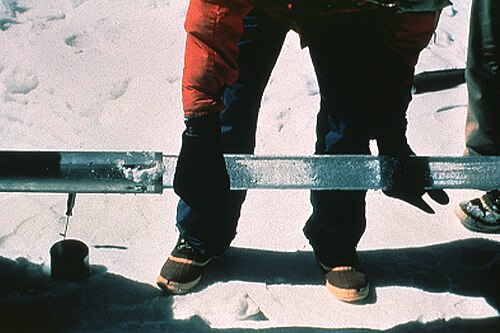
アイスコアとは、氷床や高山氷河から採取されるコアサンプルのことです。氷は毎年積もる雪の層が徐々に積み重なって形成されるため、下層は上層よりも古く、アイスコアには様々な年代に形成された氷が含まれています。コアは、手動オーガー(浅い穴の場合)または電動ドリルで掘削され、深さ3.2km(2マイル)を超えるものもあり、最大80万年前の氷が含まれていることがあります。
氷とその中に閉じ込められた物質の物理的特性を利用することで、コアの年代範囲における気候を復元することができます。酸素と水素の同位体比は古代の気温に関する情報を提供し、微細な気泡に閉じ込められた空気を分析することで、二酸化炭素などの大気ガスの濃度を測定できます。大きな氷床では熱の流れが非常に遅いため、掘削孔の温度も過去の気温を示す指標となります。これらのデータを組み合わせることで、利用可能なすべてのデータに最もよく適合する気候モデルを見つけることができます。
氷床コアに含まれる不純物は場所によって異なる場合がある。沿岸地域では、海塩イオンなどの海洋由来の物質が含まれる可能性が高い。 グリーンランドの氷床コアには、過去の寒冷で乾燥した時期に風によって 吹き飛ばされた塵の層が含まれており、その時期には寒冷な砂漠が風によって削られていた。天然由来または核実験によって生成された放射性元素は、氷層の年代測定に利用できる。地球全体に物質を拡散させるほど強力な火山活動は、多くの異なる氷床コアに痕跡を残しており、それらの年代を同期させるために利用できる。
氷床コアは20世紀初頭から研究されており、国際地球観測年(1957~1958年)の結果としていくつかのコアが掘削されました。400メートルを超える深さに達し、1960年代には南極の バード基地で2164メートルまで記録が延長されました。南極でのソ連の氷床掘削プロジェクトには、ボストーク基地での数十年にわたる作業が含まれており、最も深いコアは3769メートルに達しました。西南極氷床プロジェクトや、英国南極調査隊と国際南極横断科学探検隊が管理するコアなど、南極では長年にわたって他にも多数の深層コアが完了しています。グリーンランドでは、1970年代にグリーンランド氷床プロジェクトで一連の共同プロジェクトが始まりました。複数のフォローアッププロジェクトが実施されており、最も新しいのは東グリーンランド氷床コアプロジェクトで、当初は2020年に東グリーンランドで深層コアの採取を完了する予定でしたが、その後延期されました。[ 1 ]

氷床コアは氷河を垂直に貫通した柱で、年間降雪と融解のサイクルで形成された層を採取します。[ 2 ]雪が積もると、各層が下の層を押し、密度が高くなり、最終的にフィルンになります。フィルンは空気の漏れを防ぐほど密度が高くはありませんが、密度が約 830 kg/m 3になると氷に変わり、内部の空気は気泡に閉じ込められ、氷が形成された時の大気の組成が記録されます。[ 3 ]この現象が起こる深さは場所によって異なりますが、グリーンランドと南極では 64 m から 115 m の範囲です。[ 4 ]降雪速度は場所によって異なるため、フィルンが氷に変わる年齢は大きく異なります。グリーンランドのサミット キャンプでは、深さが 77 m で氷の年齢は 230 年です。南極のドーム Cでは、深さが 95 m で年齢は 2500 年です。[ 5 ]さらに層が積み重なると圧力が上昇し、約 1500 mで氷の結晶構造が六方晶から立方晶に変化し、空気分子が立方晶の中に入り込んでクラスレートを形成する。気泡は消え、氷はより透明になる。[ 3 ]
2~3フィートの積雪が、1フィート未満の氷になることがあります。[ 3 ]上部の重みで、より深い氷の層が薄くなり、外側に流れます。氷は氷河の端で氷山になったり、夏の融解によって失われたりしますが、氷河全体の形状は時間の経過とともにあまり変化しません。[ 6 ]外側への流れは層を歪める可能性があるため、流れが非常に少ない場所で深い氷のコアを掘削することが望ましいです。これらの場所は、流線の地図を使用して特定できます。[ 7 ]
氷に含まれる不純物は、氷が堆積した当時の環境に関する情報を提供します。これには、森林火災や火山からのすす、灰、その他の種類の粒子、宇宙線によって生成されたベリリウム10などの同位体、 微小隕石、花粉などが含まれます。[ 2 ]氷河の最下層は基底氷と呼ばれ、多くの場合、氷底の融解水が再凍結して形成されます。厚さは約20mにも達することがあり、科学的価値はありますが(たとえば、氷底の微生物群集が含まれている可能性があります)、[ 8 ]地層情報は保持されないことがよくあります。[ 9 ]
コアは、南極大陸や中央グリーンランドなど、気温が雪を溶かすほど暖かくなることがほとんどない地域でよく掘削されますが、夏の太陽光は雪に変化をもたらすことがあります。極地では、太陽は現地の夏の間は昼夜を問わず見え、冬の間は見えません。太陽は雪を昇華させ、表面の約 1 インチほどを密度の低い状態にすることがあります。太陽が空の最も低い位置に近づくと、気温が下がり、最上層に霜が形成されます。翌年以降に積もった雪の下に埋もれた粗粒の霜は圧縮され、冬の雪よりも軽い層になります。その結果、氷床コアには明るい氷と暗い氷が交互に並んだ帯が見られます。[ 10 ]

氷床コアは、円柱状の氷の周囲を切断して地表に持ち上げられるようにして採取されます。初期のコアは手動オーガーで採取されることが多く、短い穴を掘る場合は今でも手動オーガーが使われています。氷床コアオーガーの設計は1932年に特許を取得しており、それ以来ほとんど変わっていません。オーガーは基本的に円筒形で、外側にらせん状の金属製のリブ(フライトと呼ばれる)が巻き付けられており、その下端に切断刃が付いています。手動オーガーはT字型ハンドルまたはブレースハンドルで回転させることができ、中には電動ドリルに取り付けて回転させるものもあります。オーガーを上下させるための三脚 を使えば、最大50mの深さまでコアを採取できますが、エンジン駆動のオーガーでは実用的な限界は約30m 、手動オーガーではそれよりも浅いです。この深さより下では、電気機械式または熱式ドリルが使用されます。[ 11 ]
ドリルの切削装置は、ドリルバレル(ドリルが下向きに切削する際にコアを囲む管)の底端にあります。切削屑(ドリルによって削り取られた氷の破片)は、穴から引き上げて処分しなければ、ドリルの切削効率が低下します。[ 12 ]切削屑は、穴の壁やコアに圧縮したり、空気循環(ドライドリル)[ 12 ] [ 13 ] 、または掘削液の使用(ウェットドリル) [ 14 ]によって除去できます。ドライドリルは、約400mの 深さまでしか適用できません。それより深い場所では、上部の氷の重みで氷が変形し、穴が塞がってしまうためです。[ 15 ]
掘削液は、穴が安定した状態を保つように圧力のバランスを取るように選ばれます。[ 13 ]掘削液は、トリッピング時間(掘削装置を穴から引き上げて穴の底に戻すのにかかる時間)を短縮するために、動粘度が低い必要があります。コアの各セグメントの回収にはトリッピングが必要なので、掘削液を通過する速度が遅いと、プロジェクトにかなりの時間(深い穴の場合は1年以上)がかかる可能性があります。掘削液は、氷をできるだけ汚染しないようにする必要があります。安全性と環境への影響を最小限に抑えるために、毒性が低い必要があります。妥当なコストで入手できる必要があります。輸送が比較的容易である必要があります。 [ 16 ]歴史的に、氷掘削液には主に3つのタイプがあります。灯油のような製品をベースに、密度を高めるためにフッ素化合物と混合した2成分液。水性エチレングリコールとエタノール溶液を含むアルコール化合物。n-ブチルアセテートを含むエステル。新しいエステル系流体、低分子量ジメチルシロキサン油、脂肪酸エステル、および発泡剤を混合した灯油系流体など、より新しい流体が提案されている。[ 17 ]
Rotary drilling is the main method of drilling for minerals and it has also been used for ice drilling. It uses a string of drill pipe rotated from the top, and drilling fluid is pumped down through the pipe and back up around it. The cuttings are removed from the fluid at the top of the hole and the fluid is then pumped back down.[14] This approach requires long trip times, since the entire drill string must be hoisted out of the hole, and each length of pipe must be separately disconnected, and then reconnected when the drill string is reinserted.[12][18] Along with the logistical difficulties associated with bringing heavy equipment to ice sheets, this makes traditional rotary drills unattractive.[12] In contrast, wireline drills allow the removal of the core barrel from the drill assembly while it is still at the bottom of the borehole. The core barrel is hoisted to the surface, and the core removed; the barrel is lowered again and reconnected to the drill assembly.[19] Another alternative is flexible drill-stem rigs, in which the drill string is flexible enough to be coiled when at the surface. This eliminates the need to disconnect and reconnect the pipes during a trip.[18]

The need for a string of drillpipe that extends from the surface to the bottom of the borehole can be eliminated by suspending the entire downhole assembly on an armoured cable that conveys power to the downhole motor. These cable-suspended drills can be used for both shallow and deep holes; they require an anti-torque device, such as leaf-springs that press against the borehole, to prevent the drill assembly rotating around the drillhead as it cuts the core.[20] The drilling fluid is usually circulated down around the outside of the drill and back up between the core and core barrel; the cuttings are stored in the downhole assembly, in a chamber above the core. When the core is retrieved, the cuttings chamber is emptied for the next run. Some drills have been designed to retrieve a second annular core outside the central core, and in these drills the space between the two cores can be used for circulation. Cable-suspended drills have proved to be the most reliable design for deep ice drilling.[21][22]
Thermal drills, which cut ice by electrically heating the drill head, can also be used, but they have some disadvantages. Some have been designed for working in cold ice; they have high power consumption and the heat they produce can degrade the quality of the retrieved ice core. Early thermal drills, designed for use without drilling fluid, were limited in depth as a result; later versions were modified to work in fluid-filled holes but this slowed down trip times, and these drills retained the problems of the earlier models. In addition, thermal drills are typically bulky and can be impractical to use in areas where there are logistical difficulties. More recent modifications include the use of antifreeze, which eliminates the need for heating the drill assembly and hence reduces the power needs of the drill.[23] Hot-water drills use jets of hot water at the drill head to melt the water around the core. The drawbacks are that it is difficult to accurately control the dimensions of the borehole, the core cannot easily be kept sterile, and the heat may cause thermal shock to the core.[24]
When drilling in temperate ice, thermal drills have an advantage over electromechanical (EM) drills: ice melted by pressure can refreeze on EM drill bits, reducing cutting efficiency, and can clog other parts of the mechanism. EM drills are also more likely to fracture ice cores where the ice is under high stress.[25]
When drilling deep holes, which require drilling fluid, the hole must be cased (fitted with a cylindrical lining), since otherwise the drilling fluid will be absorbed by the snow and firn. The casing has to reach down to the impermeable ice layers. To install casing a shallow auger can be used to create a pilot hole, which is then reamed (expanded) until it is wide enough to accept the casing; a large diameter auger can also be used, avoiding the need for reaming. An alternative to casing is to use water in the borehole to saturate the porous snow and firn; the water eventually turns to ice.[4]
Ice cores from different depths are not all equally in demand by scientific investigators, which can lead to a shortage of ice cores at certain depths. To address this, work has been done on technology to drill replicate cores: additional cores, retrieved by drilling into the sidewall of the borehole, at depths of particular interest. Replicate cores were successfully retrieved at WAIS divide in the 2012–2013 drilling season, at four different depths.[26]
The logistics of any coring project are complex because the locations are usually difficult to reach, and may be at high altitude. The largest projects require years of planning and years to execute, and are usually run as international consortiums. The EastGRIP project, for example, which as of 2017 is drilling in eastern Greenland, is run by the Centre for Ice and Climate (Niels Bohr Institute, University of Copenhagen) in Denmark,[27] and includes representatives from 12 countries on its steering committee.[28] Over the course of a drilling season, scores of people work at the camp,[29] and logistics support includes airlift capabilities provided by the US Air National Guard, using Hercules transport planes owned by the National Science Foundation.[30] In 2015 the EastGRIP team moved the camp facilities from NEEM, a previous Greenland ice core drilling site, to the EastGRIP site.[31] Drilling is expected to continue until at least 2020.[32]

With some variation between projects, the following steps must occur between drilling and final storage of the ice core.[33]
The drill removes an annulus of ice around the core but does not cut under it. A spring-loaded lever arm called a core dog can break off the core and hold it in place while it is brought to the surface. The core is then extracted from the drill barrel, usually by laying it out flat so that the core can slide out onto a prepared surface.[33] The core must be cleaned of drilling fluid as it is slid out; for the WAIS Divide coring project, a vacuuming system was set up to facilitate this. The surface that receives the core should be aligned as accurately as possible with the drill barrel to minimise mechanical stress on the core, which can easily break. The ambient temperature is kept well below freezing to avoid thermal shock.[34]
コアの長さや採取深度などのコアに関する情報はログに記録され、コアの向きを示すためにマーキングされることがあります。通常、コアは短いセクションに切断され、米国では標準的な長さは1メートルです。その後、コアは現場で保管され、温度管理を容易にするために通常は雪面より下のスペースに置かれますが、追加の冷蔵設備を使用することもできます。さらに掘削液を除去する必要がある場合は、コアに空気を吹き付けることができます。予備分析に必要なサンプルが採取されます。その後、コアは袋に入れられ、多くの場合ポリエチレンで包装され、出荷のために保管されます。緩衝材などの追加の梱包材が追加されます。コアが掘削現場から飛行機で運ばれる場合、低温を維持するために航空機の操縦室は暖房されません。船で輸送される場合は、冷蔵ユニットに保管する必要があります。[ 34 ]
世界には、米国国立氷床コア研究所など、氷床コアを保管している場所がいくつかあります。これらの場所では、サンプルを検査のために利用できます。各コアのかなりの部分は、将来の分析のためにアーカイブされています。 [ 34 ] [ 35 ]


脆性氷帯と呼ばれる深度範囲では、氷の中に大きな圧力で気泡が閉じ込められています。コアが表面に引き上げられると、気泡が氷の引張強度を超える応力を及ぼし、ひび割れや剥離を引き起こすことがあります。[ 36 ]さらに深い場所では、空気は包接化合物に消え、氷は再び安定します。[ 36 ] [ 37 ] WAIS Divide サイトでは、脆性氷帯は深度 520 m から 1340 m でした。[ 36 ]
脆い氷のゾーンでは、通常、コアの他の部分よりも質の低いサンプルが得られます。この問題を軽減するためにいくつかの対策を講じることができます。コアを地表に引き上げる前に、ドリルバレル内にライナーを設置してコアを囲むことができますが、これにより掘削液の洗浄が難しくなります。鉱物掘削では、特殊な機械を使用してコアサンプルを坑底圧力で地表に引き上げることができますが、これはほとんどの掘削現場のアクセスできない場所では費用がかかりすぎます。処理施設を非常に低い温度に保つことで、熱衝撃を制限できます。コアは地表付近で最も脆いため、別の方法として、 穴の中で1mの長さに切断します。コアをドリルバレルからネットに押し出すと、コアが粉砕された場合でもまとまりやすくなります。脆いコアは、氷が徐々に緩和されるように、掘削シーズンの間に最長1年間、掘削現場で保管されることもよくあります。[ 36 ] [ 38 ]
氷床コアに対しては、視覚的な層数え、電気伝導率や物理的特性の試験、ガス、粒子、放射性核種、およびさまざまな分子種の含有量の分析など、さまざまな種類の分析が行われます。これらの試験結果が古環境の復元に役立つためには、氷の深さと年代の関係を決定する方法が必要です。最も単純なアプローチは、元の年間積雪層に対応する氷の層を数えることですが、これは常に可能とは限りません。別の方法として、氷の蓄積と流れをモデル化して、特定の降雪が特定の深さに達するのにかかる時間を予測する方法があります。別の方法としては、放射性核種や微量大気ガスを、地球の軌道パラメータの周期性などの他の時間スケールと相関させる方法があります。[ 39 ]
氷床コア年代測定の難しさの一つは、ガスが積雪層を拡散するため、特定の深さの氷が、その中に閉じ込められたガスよりもかなり古い可能性があることです。その結果、特定の氷床コアには、氷の年代と閉じ込められたガスの年代の2つの年代が存在します。この2つの関係を決定するために、特定の場所でガスが閉じ込められる深さのモデルが開発されていますが、その予測は必ずしも信頼できるとは限りません。[ 40 ] [ 41 ]ボストークのように降雪量が非常に少ない場所では、氷とガスの年代の差の不確実性は1,000年を超えることがあります。[ 42 ]
The density and size of the bubbles trapped in ice provide an indication of crystal size at the time they formed. The size of a crystal is related to its growth rate, which in turn depends on the temperature, so the properties of the bubbles can be combined with information on accumulation rates and firn density to calculate the temperature when the firn formed.[43]
Radiocarbon dating can be used on the carbon in trapped CO2. In the polar ice sheets there is about 15–20 μg of carbon in the form of CO2 in each kilogram of ice, and there may also be carbonate particles from wind-blown dust (loess). The CO2 can be isolated by subliming the ice in a vacuum, keeping the temperature low enough to avoid the loess giving up any carbon. The results have to be corrected for the presence of 14C produced directly in the ice by cosmic rays, and the amount of correction depends strongly on the location of the ice core. Corrections for 14C produced by nuclear testing have much less impact on the results.[44] Carbon in particulates can also be dated by separating and testing the water-insoluble organic components of dust. The very small quantities typically found require at least 300 g of ice to be used, limiting the ability of the technique to precisely assign an age to core depths.[45]
Timescales for ice cores from the same hemisphere can usually be synchronised using layers that include material from volcanic events. It is more difficult to connect the timescales in different hemispheres. The Laschamp event, a geomagnetic reversal about 40,000 years ago, can be identified in cores;[46][47] away from that point, measurements of gases such as CH4 (メタン) は、グリーンランドのコア (例えば) の年代と南極のコアの年代を関連付けるために使用できます。 [ 48 ] [ 49 ]火山噴出物が場合はアルゴン/アルゴン年代測定を使用して年代測定し、氷の年代測定の固定点を提供できます。 [ 50 ] [ 51 ]ウラン崩壊も氷床コアの年代測定に使用されています。 [ 50 ] [ 52 ]別のアプローチは、ベイズ確率を使用して、複数の独立した記録の最適な組み合わせを見つけることです。このアプローチは 2010 年に開発され、その後、ソフトウェア ツール DatIce になりました。 [ 53 ] [ 54 ]
約11,700年前の更新世と完新世の境界は、現在、グリーンランドの氷床コアのデータに基づいて正式に定義されています。地層境界の正式な定義により、異なる場所にいる科学者が研究結果を相関させることができます。これには、氷床コアには存在しない化石記録が関係することが多いですが、コアには他の気候指標と相関させることができる非常に正確な古気候情報が含まれています。 [ 55 ]
氷床の年代測定は、古気候記録の年代を提供する上で重要な要素であることが証明されています。リチャード・アリーによれば、「多くの点で、氷床コアは、地球上のどこでも決定された最良の年代を使用して、正確に年代が付けられた古気候記録のグローバルネットワークを構築することを可能にする『ロゼッタストーン』です」[ 43 ] 。

コアには目に見える層があり、これはコア採取地点の年間降雪量に対応しています。新雪に薄い壁で隔てられた一対の穴を掘り、一方の穴に屋根をかけると、屋根付きの穴の中にいる観察者は、太陽光が差し込むことで明らかになる層を見ることができます。6フィートの穴には、場所によっては1年未満の積雪から数年分の積雪までが見られる可能性があります。毎年雪の中に残されたポールは、毎年蓄積された雪の量を示しており、これを利用して、雪穴の目に見える層が1年間の降雪量に対応していることを確認できます。[ 57 ]
In central Greenland a typical year might produce two or three feet of winter snow, plus a few inches of summer snow. When this turns to ice, the two layers will make up no more than a foot of ice. The layers corresponding to the summer snow will contain bigger bubbles than the winter layers, so the alternating layers remain visible, which makes it possible to count down a core and determine the age of each layer.[58] As the depth increases to the point where the ice structure changes to a clathrate, the bubbles are no longer visible, and the layers can no longer be seen. Dust layers may now become visible. Ice from Greenland cores contains dust carried by wind; the dust appears most strongly in late winter, and appears as cloudy grey layers. These layers are stronger and easier to see at times in the past when the Earth's climate was cold, dry, and windy.[59]
Any method of counting layers eventually runs into difficulties as the flow of the ice causes the layers to become thinner and harder to see with increasing depth.[60] The problem is more acute at locations where accumulation is high; low accumulation sites, such as central Antarctica, must be dated by other methods.[61] For example, at Vostok, layer counting is only possible down to an age of 55,000 years.[62]
When there is summer melting, the melted snow refreezes lower in the snow and firn, and the resulting layer of ice has very few bubbles so is easy to recognise in a visual examination of a core. Identification of these layers, both visually and by measuring density of the core against depth, allows the calculation of a melt-feature percentage (MF): an MF of 100% would mean that every year's deposit of snow showed evidence of melting. MF calculations are averaged over multiple sites or long time periods in order to smooth the data. Plots of MF data over time reveal variations in the climate, and have shown that since the late 20th century melting rates have been increasing.[63][64]
In addition to manual inspection and logging of features identified in a visual inspection, cores can be optically scanned so that a digital visual record is available. This requires the core to be cut lengthwise, so that a flat surface is created.[65]
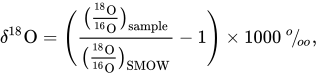
The isotopic composition of the oxygen in a core can be used to model the temperature history of the ice sheet. Oxygen has three stable isotopes, 16O, 17O and 18O.[66] The ratio between 18O and 16Oは雪が降った時の気温を示します。[ 67 ] 16Oは18より軽いO 、 16を含む水Oはわずかに蒸気になりやすく、18を含む水はOは水蒸気から雨や雪の結晶に凝縮する可能性がわずかに高い。低温では、その差はより顕著になる。18 を記録する標準的な方法O / 16O比は、標準平均海水(SMOW)として知られる標準の比を差し引くことです。 [ 67 ]
ここで、‰記号は千分率を表します。[ 67 ]同じ18のサンプルO / 16SMOWのδ18O比は0‰のサンプル。18Oは負のδ18Oを持つ[ 67 ] δ18Oを組み合わせる採取深度における掘削孔温度で氷床コア試料を測定すると、追加情報が得られ、場合によってはδ¹⁸Oから推定される温度に大きな補正が加えられる。データ。[ 68 ] [ 69 ]すべてのボーリング孔がこれらの分析に使用できるわけではありません。過去にその場所で著しい融解があった場合、ボーリング孔はもはや正確な温度記録を保持しません。[ 70 ]
水素比は温度履歴の計算にも使用できます。重水素(2Hまたは D) は水素 ( 1 )より重いH)は、水の凝縮を促進し、蒸発を抑制します。A δD比はδ18Oと同様の方法で定義できる。[ 71 ] [ 72 ] δ18Oの間には線形関係があるおよびδ D : [ 73 ]
ここで d は重水素過剰量です。かつては、特定のコアで両方の比率を測定する必要がないと考えられていましたが、1979 年に Merlivat とJouzel は、重水素過剰量が水分の起源となった海洋の温度、相対湿度、風速を反映していることを示しました。それ以来、両方を測定するのが慣例となっています。[ 73 ]
グリーンランドのキャンプセンチュリーとダイ3のコアで分析された水の同位体記録は、ダンスガード・オシュガーイベント(間氷期の開始時の急速な温暖化とその後の緩やかな冷却)の発見に重要な役割を果たした。 [ 74 ]他の同位体比も研究されており、例えば13と13の比率などが挙げられる。Cと12Cは炭素循環の過去の変化に関する情報を提供することができる。この情報を、氷床コアから得られる二酸化炭素濃度の記録と組み合わせることで、 CO2の変化のメカニズムに関する情報が得られる。2時間の経過とともに。 [ 75 ]
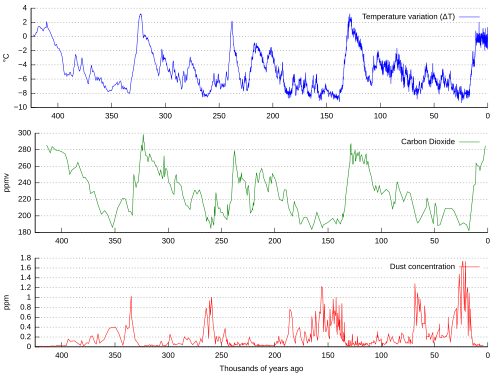

1960年代には、氷床コアに閉じ込められた空気を分析することで古大気に関する有用な情報が得られることが理解されていたが、信頼できる抽出方法が開発されたのは1970年代後半になってからだった。初期の成果には、 CO2が氷床コアに閉じ込められた空気を分析することで古大気に関する有用な情報が得られるという実証が含まれていた。2最終氷期最盛期、産業革命直前と比べて30%低かったCO2つのレベルと氷の同位体データから計算された温度。 [ 77 ]
CHのため4メタン (CH4) は湖沼や湿地で生成され、大気中の量はモンスーン低緯度夏の日射量の強さと相関がある軌道周期に依存し、その時間スケールは他の情報源から入手可能であるため、CH44は、コア深度と年齢の関係を決定するために使用できる。 [ 61 ] [ 62 ] N2 O(亜酸化窒素) 濃度も氷河期サイクルと相関関係にあるが、低温ではグラフはCO2とCH4つのグラフ。 [ 77 ] [ 78 ]同様に、 Nの比率2(窒素)とO2 (oxygen) can be used to date ice cores: as air is gradually trapped by the snow turning to firn and then ice, O2 is lost more easily than N2, and the relative amount of O2 correlates with the strength of local summer insolation. This means that the trapped air retains, in the ratio of O2 to N2, a record of the summer insolation, and hence combining this data with orbital cycle data establishes an ice core dating scheme.[61][79]
Diffusion within the firn layer causes other changes that can be measured. Gravity causes heavier molecules to be enriched at the bottom of a gas column, with the amount of enrichment depending on the difference in mass between the molecules. Colder temperatures cause heavier molecules to be more enriched at the bottom of a column. These fractionation processes in trapped air, determined by the measurement of the 15N/14N ratio and of neon, krypton and xenon, have been used to infer the thickness of the firn layer, and determine other palaeoclimatic information such as past mean ocean temperatures.[69] Some gases such as helium can rapidly diffuse through ice, so it may be necessary to test for these "fugitive gases" within minutes of the core being retrieved to obtain accurate data.[34]Chlorofluorocarbons (CFCs), which contribute to the greenhouse effect and also cause ozone loss in the stratosphere,[80] can be detected in ice cores after about 1950; almost all CFCs in the atmosphere were created by human activity.[80][81]
Greenland cores, during times of climatic transition, may show excess CO2 in air bubbles when analysed, due to CO2 production by acidic and alkaline impurities.[82]
グリーンランドの夏の雪には、周囲の海から吹き寄せられた海塩が含まれています。冬には海面の大部分が流氷に覆われるため、海塩の量は少なくなります。同様に、過酸化水素は夏の雪にのみ存在します。これは、大気中で過酸化水素を生成するには日光が必要だからです。これらの季節的な変化は、氷の電気伝導率の変化につながるため、検出することができます。高電圧をかけた2つの電極を氷床コアの表面に置くと、その地点の伝導率が測定されます。電極をコアの長さに沿って移動させ、各地点での伝導率を記録すると、年間周期を示すグラフが得られます。このようなグラフは、森林火災や大規模な火山噴火など、季節とは関係のない出来事によって引き起こされる化学変化も特定します。 1783年のアイスランドのラキ火山の噴火など、既知の火山噴火が氷床コアの記録から特定できる場合、層数えによって決定された年代のクロスチェックとなります。[ 83 ]ラキ火山の噴火物質はグリーンランドの氷床コアで確認できるが、南極大陸まで拡散しなかった。インドネシアのタンボラ火山の1815年の噴火は成層圏に噴出物質を放出し、グリーンランドと南極の氷床コアの両方で確認できる。噴火の日付が不明でも、複数のコアで確認できる場合は、氷の年代測定によって噴火の日付を特定でき、それを基準層として使用できる。[ 84 ]例えば、西暦535年から550年の気候の分析でこの方法が用いられた。この期間は、西暦533年頃に発生した、それまで知られていなかった熱帯の噴火の影響を受けたと考えられていたが、実際には西暦535年または536年初頭と、539年または540年の2つの噴火によって引き起こされたことが判明した。[ 85 ]約72,000年前のトバ火山の噴火など、より古い参照点もある。 [ 84 ]
氷床コアからは、他にも多くの元素や分子が検出されている。[ 86 ] 1969年には、グリーンランドの氷中の鉛濃度が産業革命以前から200倍以上に増加していることが発見され、銅、カドミウム、亜鉛など、工業プロセスによって生成される他の元素の増加も記録されている。[ 87 ]氷床コアの元素組成の分析は、古代社会の活動を特定するためにも用いられてきた。例えば、グリーンランドの氷床コアに鉛が存在することは、ローマ帝国時代の戦争や資源採掘の時期と一致する。[ 88 ]硝酸と硫酸( HNO₃)の存在3とH2 SO4 ) 降水量の増加は、時間の経過とともに燃料燃焼の増加と相関することが示されています。メタンスルホン酸塩(MSA) (CH3 SO − 3 ) は海洋生物によって大気中で生成されるため、MSA の氷床コア記録は海洋環境の歴史に関する情報を提供する。2 O2 ) およびホルムアルデヒド(HCHO植生からの排出物や森林火災に関連するカーボンブラックなどの有機分子とともに研究されています。 [ 86 ]カルシウムやアンモニウムなどの一部の種は、強い季節変動を示します。場合によっては、特定の種に複数の供給源からの寄与があります。たとえば、Ca++は塵と海洋の両方の供給源から来ています。海洋からの流入は塵からの流入よりもはるかに大きいため、2 つの供給源のピークは年間の異なる時期に現れますが、全体的なシグナルは海洋からの流入が最大となる冬にピークを示します。 [ 89 ]季節的なシグナルは、地表風によって蓄積量が少ない場所では消去される可能性があります。このような場合、2 つの基準層の間の個々の氷層の年代を特定することはできません。 [ 90 ]
堆積した化学種の中には氷と相互作用するものもあるため、氷床コアで検出されるものは必ずしも最初に堆積したものとは限りません。例としては、HCHOやHなどが挙げられます。2 O2.もう一つの複雑な点は、積雪率の低い地域では、霧からの沈着によって雪中の濃度が上昇し、場合によっては大気中の濃度が2倍も過大評価される可能性があることである。 [ 91 ]

銀河宇宙線は10大気中に存在する速度は太陽磁場に依存します。磁場の強さは太陽放射の強度に関係しているので、 10のレベル大気中に存在する物質は気候の 指標となる。加速器質量分析法は10の低濃度を検出できる。氷床コアには約10,000個の原子が含まれており、これらは太陽活動の長期記録を提供するために使用できる。[ 93 ]トリチウム(31950年代と1960年代の核兵器実験によって生成されたHは氷床コアで確認されており、[ 94 ] 36Clと239プルトニウムは南極とグリーンランドの氷床コアから発見されている。 [ 95 ] [ 96 ] [ 97 ]半減期が301,000年の塩素36は、クリプトン( 85)と同様に、コアの年代測定に使用されている。Kr(半減期11年)、鉛( 210)鉛(22年)、シリコン( 32年)Si、172年)。 [ 90 ]
極地の氷に落下する隕石や微小隕石は、局所的な環境プロセスによって濃縮されることがあります。たとえば、南極には風によって表面の氷が蒸発し、隕石を含む残された固体が濃縮される場所があります。融解水池にも隕石が含まれていることがあります。南極点基地では、井戸の氷を溶かして水を供給する際に微小隕石が残ります。これらはロボットの「掃除機」で収集され、調査され、そのフラックスと質量分布の推定精度が向上しました。[ 98 ]この井戸は氷床コアではありませんが、溶けた氷の年代がわかっているので、回収された粒子の年代を決定できます。井戸は毎年約10m深くなるため、ある年に収集された微小隕石は前年のものより約100年古いことになります。[ 99 ]堆積物コアの重要な構成要素である花粉も氷床コアで見つかります。植生の変化に関する情報を提供する。[ 100 ]
コア中の不純物や水の同位体組成に加えて、氷の物理的特性も調べられます。結晶の大きさや軸の向きなどの特徴は、氷床内の氷の流れのパターンの歴史を明らかにすることができます。結晶の大きさは、浅いコアに限られますが、年代を決定するためにも使用できます。[ 101 ]

1841年と1842年に、ルイ・アガシーはアルプスのウンターアール氷河に穴を掘りました。これらの穴は鉄棒で掘られ、コアは得られませんでした。最も深い穴は60mでした。 1902年と1903年のエーリッヒ・フォン・ドライガルスキーの南極探検では、ケルゲレン諸島の南の氷山に30mの穴が掘られ、温度が測定されました。雪のサンプリングツールを最初に作った科学者は、パヴェル・タラライが「現代の雪の調査の父」と評したジェームズ・E・チャーチでした。1908年から1909年の冬、チャーチは最大3mの長さの雪のコアを採取するために、スロットと切断ヘッドを備えた鋼管を製作しました。同様の装置は現在も使用されており、約9mの深さまでサンプリングできるように改良されています。これらは雪に押し込んで手で回転させるだけです。[ 102 ]
The first systematic study of snow and firn layers was by Ernst Sorge, who was part of the Alfred Wegener Expedition to central Greenland in 1930–1931. Sorge dug a 15 m pit to examine the snow layers, and his results were later formalized into Sorge's Law of Densification by Henri Bader, who went on to do additional coring work in northwest Greenland in 1933.[103] In the early 1950s, a SIPRE expedition took pit samples over much of the Greenland ice sheet, obtaining early oxygen isotope ratio data. Three other expeditions in the 1950s began ice coring work: a joint Norwegian-British-Swedish Antarctic Expedition (NBSAE), in Queen Maud Land in Antarctica; the Juneau Ice Field Research Project (JIRP), in Alaska; and Expéditions Polaires Françaises, in central Greenland. Core quality was poor, but some scientific work was done on the retrieved ice.[104]
The International Geophysical Year (1957–1958) saw increased glaciology research around the world, with one of the high priority research targets being deep cores in polar regions. SIPRE conducted pilot drilling trials in 1956 (to 305 m) and 1957 (to 411 m) at Site 2 in Greenland; the second core, with the benefit of the previous year's drilling experience, was retrieved in much better condition, with fewer gaps.[105] In Antarctica, a 307 m core was drilled at Byrd Station in 1957–1958, and a 264 m core at Little America V, on the Ross Ice Shelf, the following year.[106] The success of the IGY core drilling led to increased interest in improving ice coring capabilities, and was followed by a CRREL project at Camp Century, where in the early 1960s three holes were drilled, the deepest reaching the base of the ice sheet at 1387 m in July 1966.[107] The drill used at Camp Century then went to Byrd Station, where a 2164 m hole was drilled to bedrock before the drill was frozen into the borehole by sub-ice meltwater and had to be abandoned.[108]
French, Australian and Canadian projects from the 1960s and 1970s include a 905 m core at Dome C in Antarctica, drilled by CNRS; cores at Law Dome drilled by ANARE, starting in 1969 with a 382 m core; and Devon Ice Cap cores recovered by a Canadian team in the 1970s.[109]

Soviet ice drilling projects began in the 1950s, in Franz Josef Land, the Urals, Novaya Zemlya, and at Mirny and Vostok in the Antarctic; not all these early holes retrieved cores.[110] Over the following decades work continued at multiple locations in Asia.[111] Drilling in the Antarctic focused mostly on Mirny and Vostok, with a series of deep holes at Vostok begun in 1970.[112] The first deep hole at Vostok reached 506.9 m in April 1970; by 1973 a depth of 952 m had been reached. A subsequent hole, Vostok 2, drilled from 1971 to 1976, reached 450 m, and Vostok 3 reached 2202 m in 1985 after six drilling seasons.[113] Vostok 3 was the first core to retrieve ice from the previous glacial period, 150,000 years ago.[114] Drilling was interrupted by a fire at the camp in 1982, but further drilling began in 1984, eventually reaching 2546 m in 1989. A fifth Vostok core was begun in 1990, reached 3661 m in 2007, and was later extended to 3769 m.[109][114] The estimated age of the ice is 420,000 years at 3310 m depth; below that point it is difficult to interpret the data reliably because of mixing of the ice.[115]
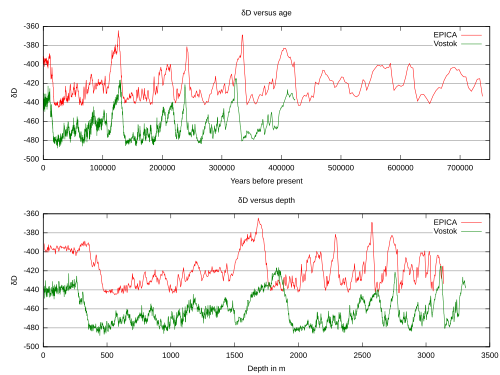
EPICA, a European ice coring collaboration, was formed in the 1990s, and two holes were drilled in East Antarctica: one at Dome C, which reached 2871 m in only two seasons of drilling, but which took another four years to reach bedrock at 3260 m; and one at Kohnen Station, which reached bedrock at 2760 m in 2006. The Dome C core had very low accumulation rates, which mean that the climate record extended a long way; by the end of the project the usable data extended to 800,000 years ago.[115]
その他の南極深層コアには、1996年にドームFで2503mに達した日本のプロジェクトがあり 、コア底部の推定年代は33万年でした。また、同じ場所で 2006年に3035mに達した次の掘削孔では、72万年前の氷に達したと推定されています。[ 115 ]米国のチームは1990年代にマクマード基地、テイラードーム( 1994年に554m)、シプルドーム( 1999年に1004m)で掘削を行い、両方のコアは最後の氷期の氷に達しました。[ 115 ] [ 116 ] 2011年に完了した西南極氷床(WAIS)プロジェクトは3405mに達しました。この場所は積雪量が多いため、氷は 62,000 年までしか遡れませんが、その結果、コアはカバーする期間の高解像度データを提供します。[ 61 ] 2002 年から 2005 年にかけて英国南極調査局が管理するプロジェクトにより、バークナー島で948 m のコアが掘削され、最後の氷河期まで及んでいます。[ 61 ]また、イタリアが管理するITASEプロジェクトは、2007 年にタロス ドームで1620 m のコアを完成させました。[ 61 ] [ 117 ]
2016年、南極のアランヒルズで、古い氷が地表近くに残っている地域からコアが採取された。コアはカリウム-アルゴン年代測定法で年代測定された。すべての層が存在しないため、従来の氷床コア年代測定法は不可能である。最も古いコアには270万年前の氷が含まれていることが判明した。これは、コアから年代測定された氷の中でこれまでで最も古いものである。[ 118 ]
1970年に科学的な議論が始まり、その結果、グリーンランド氷床プロジェクト(GISP)が設立されました。これは、1981年まで続いたグリーンランド氷床に関する多国籍調査です。深層コアの理想的な場所を決定するために、何年にもわたる現地調査が必要でした。現地調査には、ダイ3( 1971年に372m)、ミルセント( 1973年に398m)、クレタ( 1974年に405m)など、いくつかの中深度コアが含まれていました。グリーンランド中北部の場所が理想的とされましたが、財政的な制約により、グループは代わりにダイ3で掘削せざるを得ず、1979年から開始しました。この穴は 1981年に2037mの岩盤に到達しました 。最終的に、1990年代初頭に、ヨーロッパのコンソーシアムであるGRIPと、米国の大学グループであるGISP-2の2つのグループによって、中北部の場所に30km離れた2つの穴が掘削されました。 GRIPは 1992年に3029mの岩盤に到達し、GISP-2は 翌年に3053mの岩盤に到達した。[ 119 ]両コアとも約10万年分の気候情報しか得られず、これは掘削地点の氷床下の岩盤の地形と関係があると考えられたため、 GRIPの北200kmに新たな地点が選定され、デンマーク主導の国際コンソーシアムとしてNorthGRIPという新たなプロジェクトが開始された。掘削は1996年に開始され、最初の孔は 1997年に1400mで断念せざるを得ず、1999年に新たな孔が開始され、 2003年に3085mに達した。この孔は岩盤には達せず、氷底河川で終了した。このコアは12万3000年前まで遡る気候データを提供し、これは最後の間氷期の一部をカバーしている。その後の北グリーンランドエーミアン(NEEM)プロジェクトでは 、2010年にさらに北の地点から2537mのコアが採取され、気候記録が12万8500年前まで延長されました。[ 114 ] NEEMに続いて、2015年に東グリーンランドで開始され、2020年に完了する予定だったEastGRIPが行われました。 [ 120 ] 2020年3月、進行中のCOVID-19パンデミック のため、2020年のEGRIPフィールドキャンペーンは中止されました。EastGRIPは2022年にフィールドワークを再開し、CryoEggは200バールを超える圧力と約-30℃の温度で氷の中の新たな深さに到達しました。[ 121 ] [ 122 ]
極地から離れた場所、特にヒマラヤ山脈やアンデス山脈で氷床コアが掘削されている。これらのコアの中には最後の氷河期まで遡るものもあるが、エルニーニョ現象や南アジアのモンスーンシーズンの記録としてより重要である。 [ 61 ]また、キリマンジャロ山[ 61 ]、アルプス[ 61 ] 、インドネシア[123 ] 、ニュージーランド[ 124 ] 、アイスランド[ 125 ]、スカンジナビア[ 126 ]、カナダ[127]、米国[ 128 ]でもコアが掘削されている。
IPICS(氷床コア科学における国際パートナーシップ)は、氷床コア科学コミュニティの将来の課題と科学的目標を概説する一連のホワイトペーパーを作成しました。これには、次の計画が含まれます。[ 129 ]
温暖化する気候は、研究者が環境事象の歴史的記録として利用している、時間的に順序付けられたエアロゾルの層を洗い流す氷河の融解水を生み出すことがわかっています。[ 130 ]アイスメモリー財団は、この差し迫ったデータ損失に備えて、南極に追加の氷床コアを保管する計画を立てています。[ 130 ]