Loading article…
| Camel Temporal range:
| |
|---|---|

| |
| Dromedary (Camelus dromedarius) | |
| |
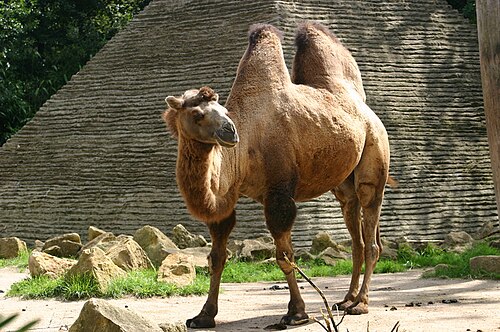
| Bactrian camel (Camelus bactrianus) | |
Scientific classification 
| |
| Domain: | Eukaryota |
| Kingdom: | Animalia |
| Phylum: | Chordata |
| Class: | Mammalia |
| Order: | Artiodactyla |
| Family: | Camelidae |
| Tribe: | Camelini |
| Genus: | Camelus Linnaeus, 1758 |
| Type species | |
| Camelus dromedarius [6] Linnaeus, 1758
| |
| Species | |
| |
| |
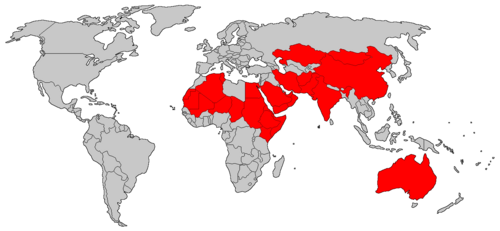
| Distribution of camels worldwide | |
| Synonyms | |
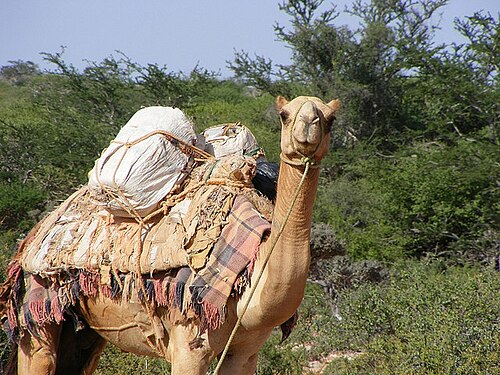
A camel (from Latin: camelus and Greek: κάμηλος (kamēlos) from Ancient Semitic: gāmāl[7][8]) is an even-toed ungulate in the genus Camelus that bears distinctive fatty deposits known as "humps" on its back. Camels have long been domesticated and, as livestock, they provide food (camel milk and meat) and textiles (fiber and felt from camel hair). Camels are working animals especially suited to their desert habitat and are a vital means of transport for passengers and cargo. There are three surviving species of camel. The one-humped dromedary makes up 94% of the world's camel population, and the two-humped Bactrian camel makes up 6%. The wild Bactrian camel is a distinct species that is not ancestral to the domestic Bactrian camel, and is now critically endangered, with fewer than 1,000 individuals.
The word camel is also used informally in a wider sense, where the more correct term is "camelid", to include all seven species of the family Camelidae: the true camels (the above three species), along with the "New World" camelids: the llama, the alpaca, the guanaco, and the vicuña, which belong to the separate tribe Lamini.[9] Camelids originated in North America during the Eocene, with the ancestor of modern camels, Paracamelus, migrating across the Bering land bridge into Asia during the late Miocene, around 6 million years ago.
Taxonomy
Extant species
Three species are extant:[10][11]
Biology
The average life expectancy of a camel is 40 to 50 years.[12] A full-grown adult dromedary camel stands 1.85 m (6 ft 1 in) at the shoulder and 2.15 m (7 ft 1 in) at the hump.[13] Bactrian camels can be a foot taller. Camels can run at up to 65 km/h (40 mph) in short bursts and sustain speeds of up to 40 km/h (25 mph).[14] Bactrian camels weigh 300 to 1,000 kg (660 to 2,200 lb) and dromedaries 300 to 600 kg (660 to 1,320 lb). The widening toes on a camel's hoof provide supplemental grip for varying soil sediments.[15]
The male dromedary camel has an organ called a dulla in his throat, a large, inflatable sac that he extrudes from his mouth when in rut to assert dominance and attract females. It resembles a long, swollen, pink tongue hanging out of the side of the camel's mouth.[16] Camels mate by having both male and female sitting on the ground, with the male mounting from behind.[17] The male usually ejaculates three or four times within a single mating session.[18] Camelids are the only ungulates to mate in a sitting position.[19]
Ecological and behavioral adaptations
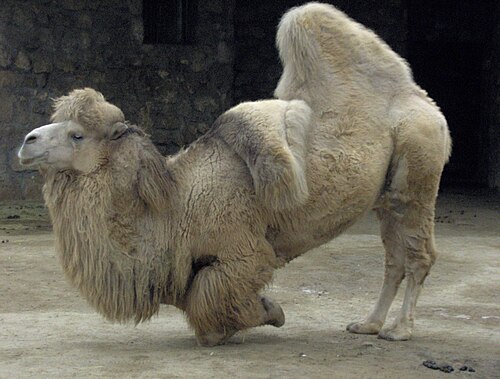
Camels do not directly store water in their humps; they are reservoirs of fatty tissue. When this tissue is metabolized, it yields a greater mass of water than that of the fat processed. This fat metabolization, while releasing energy, causes water to evaporate from the lungs during respiration (as oxygen is required for the metabolic process): overall, there is a net decrease in water.[20][21]

Camels have a series of physiological adaptations that allow them to withstand long periods of time without any external source of water.[23] The dromedary camel can drink as seldom as once every 10 days even under very hot conditions, and can lose up to 30% of its body mass due to dehydration.[24] Unlike other mammals, camels' red blood cells are oval rather than circular in shape. This facilitates the flow of red blood cells during dehydration[25] and makes them better at withstanding high osmotic variation without rupturing when drinking large amounts of water: a 600 kg (1,300 lb) camel can drink 200 L (53 US gal) of water in three minutes.[26][27][failed verification]
Camels are able to withstand changes in body temperature and water consumption that would kill most other mammals. Their temperature ranges from 34 °C (93 °F) at dawn and steadily increases to 40 °C (104 °F) by sunset, before they cool off at night again.[23] In general, to compare between camels and the other livestock, camels lose only 1.3 liters of fluid intake every day while the other livestock lose 20 to 40 liters per day.[28] Maintaining the brain temperature within certain limits is critical for animals; to assist this, camels have a rete mirabile, a complex of arteries and veins lying very close to each other which utilizes countercurrent blood flow to cool blood flowing to the brain.[29] Camels rarely sweat, even when ambient temperatures reach 49 °C (120 °F).[30] Any sweat that does occur evaporates at the skin level rather than at the surface of their coat; the heat of vaporization therefore comes from body heat rather than ambient heat. Camels can withstand losing 25% of their body weight in water, whereas most other mammals can withstand only about 12–14% dehydration before cardiac failure results from circulatory disturbance.[27]
When the camel exhales, water vapor becomes trapped in their nostrils and is reabsorbed into the body as a means to conserve water.[31] Camels eating green herbage can ingest sufficient moisture in milder conditions to maintain their bodies' hydrated state without the need for drinking.[32]

The camel's thick coat insulates it from the intense heat radiated from desert sand; a shorn camel must sweat 50% more to avoid overheating.[33] During the summer the coat becomes lighter in color, reflecting light as well as helping avoid sunburn.[27] The camel's long legs help by keeping its body farther from the ground, which can heat up to 70 °C (158 °F).[34][35] Dromedaries have a pad of thick tissue over the sternum called the pedestal. When the animal lies down in a sternal recumbent position, the pedestal raises the body from the hot surface and allows cooling air to pass under the body.[29]
Camels' mouths have a thick leathery lining, allowing them to chew thorny desert plants. Long eyelashes and ear hairs, together with nostrils that can close, form a barrier against sand. If sand gets lodged in their eyes, they can dislodge it using their translucent third eyelid (also known as the nictitating membrane). The camels' gait and widened feet help them move without sinking into the sand.[34][36]
The kidneys and intestines of a camel are very efficient at reabsorbing water. Camels' kidneys have a 1:4 cortex to medulla ratio.[37] Thus, the medullary part of a camel's kidney occupies twice as much area as a cow's kidney. Secondly, renal corpuscles have a smaller diameter, which reduces surface area for filtration. These two major anatomical characteristics enable camels to conserve water and limit the volume of urine in extreme desert conditions.[38] Camel urine comes out as a thick syrup, and camel faeces are so dry that they do not require drying when used to fuel fires.[39][40][41][42]
The camel immune system differs from those of other mammals. Normally, the Y-shaped antibody molecules consist of two heavy (or long) chains along the length of the Y, and two light (or short) chains at each tip of the Y.[43] Camels, in addition to these, also have antibodies made of only two heavy chains, a trait that makes them smaller and more durable.[43] These "heavy-chain-only" antibodies, discovered in 1993, are thought to have developed 50 million years ago, after camelids split from ruminants and pigs.[43] Camels suffer from surra caused by Trypanosoma evansi wherever camels are domesticated in the world,[44]: 2 and resultantly camels have evolved trypanolytic antibodies as with many mammals. In the future, nanobody/single-domain antibody therapy will surpass natural camel antibodies by reaching locations currently unreachable due to natural antibodies' larger size.[45]: 788 Such therapies may also be suitable for other mammals.[45]: 788 Tran et al. 2009 provides a new reference test for surra (T. evansi) of camel.[46] They use recombinant Invariant Surface Glycoprotein 75 (rISG75, an Invariant Surface Glycoprotein) and ELISA.[46] The Tran test has high test specificity and appears likely to work just as well for T. evansi in other hosts, and for a pan-Trypanozoon test, which would also be useful for T. b. brucei, T. b. gambiense, T. b. rhodesiense, and T. equiperdum.[46]
Genetics
The karyotypes of different camelid species have been studied earlier by many groups,[47][48][49][50][51][52] but no agreement on chromosome nomenclature of camelids has been reached. A 2007 study flow sorted camel chromosomes, building on the fact that camels have 37 pairs of chromosomes (2n=74), and found that the karyotype consisted of one metacentric, three submetacentric, and 32 acrocentric autosomes. The Y is a small metacentric chromosome, while the X is a large metacentric chromosome.[53]