
Loading article…
| シャルル5世 | |
|---|---|
| ローマ帝国皇帝 | |
,_formerly_attributed_to_Titian_(Alte_Pinakothek,_Munich).jpg/500px-Portrait_of_Charles_V,_Holy_Roman_Emperor,_seated_(1500%E2%80%931558),_formerly_attributed_to_Titian_(Alte_Pinakothek,_Munich).jpg) シャルル5世の肖像、1548年 | |
| 神聖ローマ皇帝 | |
| 治世 | 1519年6月28日 – 1556年8月27日[a] |
| 戴冠式 | |
| 前任者 | マクシミリアン1世 |
| 後継 | フェルディナンド1世 |
| スペイン国王(jure matris) カルロス1世 | |
| 治世 | 1516年3月14日 – 1556年1月16日 |
| 前任者 | フェルディナンド2世 |
| 後継 | フィリップ2世 |
| 共同君主 | ジョアンナ1世 (1555年まで) |
| オーストリア大公 カール1世 | |
| 治世 | 1519年1月12日 – 1521年4月21日 |
| 前任者 | マクシミリアン1世 |
| 後継 | フェルディナンド1世 (1556年までカール5世の名で) |
| チャールズ2世として | |
| 治世 | 1506年9月25日 – 1555年10月25日 |
| 前任者 | フィリップ・ザ・ハンサム |
| 後継 | スペイン国王フェリペ2世 |
| 生まれる | 1500年2月24日 プリンセンホフ・フォン・ゲント、フランドル、ハプスブルク家ネーデルラント、神聖ローマ帝国 |
| 死亡 | 1558年9月21日(58歳)スペイン、カスティーリャ王国、 ユステ修道院 |
| 埋葬 | エル・エスコリアル、スペイン |
| 配偶者 | |
| さらに問題 ... | |
| 家 | ハプスブルク家 |
| 父親 | フィリップ・ザ・ハンサム |
| 母親 | カスティーリャとアラゴンの女王ジョアンナ |
| 宗教 | カトリック教会 |
| サイン |  |
カール5世[c] [d](ヘント、1500年2月24日 - 1558年9月21日)は、1519年から1556年まで神聖ローマ帝国皇帝、オーストリア大公、 1516年から1556年までスペイン国王、1506年から1555年まで名目上のブルゴーニュ公としてネーデルラントの領主であった。カール5世は、台頭しつつあったハプスブルク家の後継者となり、その後同家の当主となった。ヨーロッパにおけるカール5世の領土には、ドイツから北イタリアに広がる神聖ローマ帝国(オーストリアの世襲領土とブルゴーニュ低地諸国を支配) 、およびスペインとその南イタリア王国であるナポリ、シチリア、サルデーニャ島が含まれていた。アメリカ大陸では、スペインによる植民地化の継続と、ドイツによる短期間の植民地化を監督した。彼が統治したヨーロッパとアメリカの領土の個人的な統合は、「太陽の沈まない帝国」と呼ばれる最初の王国の集合体でした。[9]
カールはフランドルで、ハプスブルク家のフィリップ美男大公(神聖ローマ皇帝マクシミリアン1世とブルゴーニュ公マリーの息子)と、カスティーリャ王女イサベル1世とアラゴン王フェルナンド2世の次女ジョアナの子として生まれた。祖父母の後継者であったカールは、若くして一族の領地を相続した。1506年に父が死去した後、低地諸国を相続した。[10] 1516年にカールは母とともにカスティーリャとアラゴンの共同君主としてスペイン国王となった。スペインの領土には、西インド諸島とスパニッシュ・メインのカスティーリャ植民地のほか、ナポリ、シチリア、サルデーニャ島が含まれていた。1519年に祖父マクシミリアンが死去すると、カールはオーストリアの世襲領を相続し、神聖ローマ皇帝に選出された。彼は皇帝の名であるカール5世を称号として採用し、新たなカール大帝と称した。[11]
カール1世は中世の普遍的な君主制の概念を復活させた。固定した資本を持たず、彼は統治するさまざまな国家を40回も旅し、治世の4分の1を領土内での旅に費やした。 [12] 帝国は平和裏に築き上げられたが、彼は人生の大半を戦争に費やし、宗教改革、オスマン帝国の拡大、そしてフランスとの戦争から神聖ローマ帝国の統一を守ろうとする中で、歳入を使い果たし、負債を残していった。[13] [14]カール1世はドイツとイタリアの銀行家から借金をし、その返済には低地諸国の富と、スペインによるアステカ帝国とインカ帝国の征服後に彼の支配下に入り、広範囲にわたるインフレを引き起こしたヌエバ・エスパーニャとペルーからの銀の流入に頼った。
アーヘンでドイツ王に即位したカール5世は、教皇レオ10世に味方し、1521年のヴォルムス帝国議会でマルティン・ルターを無法者と宣言した。 [15]同年、ハプスブルク家の領土に囲まれたフランス国王フランソワ1世はイタリアで戦争を開始し、パヴィアの戦い(1525年)に至った。1527年、ローマはカール5世の反乱軍により略奪された。その後、カール5世はトルコからウィーンを防衛し、教皇クレメンス7世からイタリア王および神聖ローマ皇帝の戴冠を得た。1535年、カール5世はミラノを占領し、チュニスを占領した。しかし、ハンガリー紛争中のブダの喪失と1540年代初頭のアルジェ遠征により、彼の反オスマン政策は挫折した。数年の交渉の後、カール5世は教皇パウルス3世とトリエント公会議(1545年)の組織について合意に達した。ルター派のシュマルカルデン同盟が公会議の正当性を認めなかったため戦争が勃発し、シャルル1世が勝利した。しかし、フランス国王アンリ2世はルター派の大義に新たな支援を申し出、スレイマン1世とのフランス・オスマン同盟を強化した。
最終的にカール5世はアウクスブルクの和議を受け入れ、1556年に退位して多国籍計画を放棄し、世襲および帝国の領土を息子のスペイン王フェリペ2世が率いるスペイン・ハプスブルク家と、弟のフェルディナンドが率いるオーストリア・ハプスブルク家に分割した。[16] [17] [18] 1557年、カール5世はエストレマドゥーラのユステ修道院に隠棲し、1年後にそこで亡くなった。
祖先
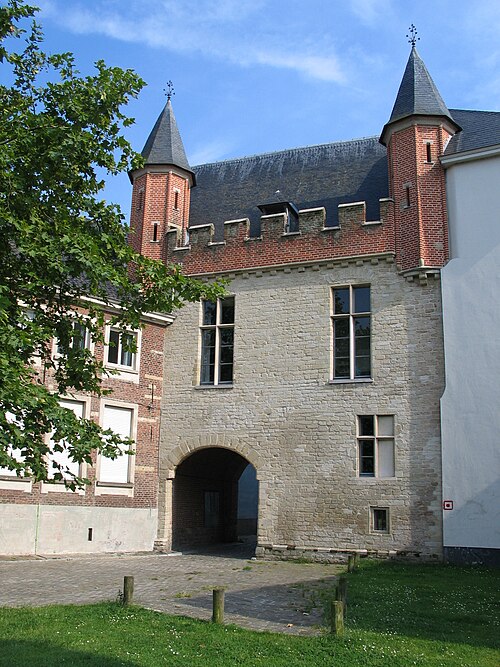
カール・フォン・オーストリアは、1500年2月24日、ハプスブルク家のネーデルラントのフランドル都市ゲントのプリンセンホフで、オーストリアのフィリップとトラスタマラのジョアンナの子として生まれた。[19]父フィリップは美男フィリップと呼ばれ、神聖ローマ皇帝でオーストリア大公のマクシミリアン1世とブルゴーニュ公国相続人のブルゴーニュ公マリーの長男だった。カール・フォン・オーストリアの母ジョアンナは、トラスタマラ家出身のスペインのカトリック両王、アラゴンのフェルナンド2世とカスティーリャのイサベル1世の次女だった。フィリップとジョアンナの政略結婚は、イタリア戦争中にフランス王国に対抗するためにヴェネツィア同盟の一環として設立されたオーストリア・スペイン同盟を締結するためにマクシミリアン1世がフェルナンドに送った手紙の中で初めて構想された。 [ 20]
1486年にローマ王となった瞬間から、カール1世の父方の祖父マクシミリアンは、オーストリアの世襲領地の資源に主に依存し、最大限の拡張主義という非常に財政的にリスクの高い政策を実行した。 [ 21 ]カール5世とハプスブルク家が広大な帝国を築いたのは平和政策(マティアス・コルヴィヌスが語ったとされる「他国に戦争をさせておけばよいが、汝、幸福なオーストリアよ、結婚せよ。マルスが他国に与えた王国は、ヴィーナスが汝に与えるのだ」[23] [24 ] )によって実証されている)によってであるとしばしば示唆されているが、マクシミリアンとその子孫は数多くの戦争を経験した(マクシミリアン1人で40年間の統治の間に27の戦争を戦った)。[25] [ 26]彼の一般的な戦略は、同盟、戦争、軍事的脅迫、結婚の申し込みなどの複雑なシステムを組み合わせて、自らの拡張主義的な野心を実現することだった。最終的に彼はボヘミア、ハンガリー、ポーランドを強制的にハプスブルク家の拡張計画に従わせることに成功した。[26] [27] [28]
しかしながら、もともとフランスに対する婚姻同盟として考えられていたハプスブルク家とトラスタマラ家との結婚によって、カスティーリャとアラゴンの王位がマクシミリアン1世の男系にもたらされるという事実は予想外のことであった。 [29] [30]
フェリペとジョアンナの婚姻契約は1495年に調印され、1496年に祝賀会が行われた。フェリペは、1482年のマリーの死により既にブルゴーニュ公爵位(ブルゴーニュ公国自体はフランス王室に奪われていた)を有しており、オーストリアの名誉大公として法定相続人でもあった。対照的にジョアンナはスペイン継承順位では兄のアストゥリアス公ジョアンと姉のアラゴン王イザベラに次ぐ3位であった。カスティーリャとアラゴンの王位継承者であるジョアンとイザベラはともに1498年に死去し、カトリック両王はスペイン王国をイベリア人の手に留めておきたいと考え、ポルトガル人の孫ミゲル・ダ・パスをアストゥリアス公に任命してスペインの推定相続人に指名したが、彼は1500年に幼少時に死去した。[31]
誕生と幼少期
1500年2月、舞踏会の最中にシャルルの母親が陣痛に襲われた。シャルルはブルゴーニュ公国を領土にしようとしたブルゴーニュ公シャルル勇敢公にちなんで名付けられた。シャルルが生まれたとき、宮廷の詩人は、ゲントの人々が「3時間にわたって街中でオーストリアとブルゴーニュを叫んだ」と伝え、シャルルの誕生を祝った。[20]
王朝の状況から、生まれたばかりのシャルルは、もともとブルゴーニュ低地諸国の名誉あるルクセンブルク公爵としてのみ、オーストリア公爵位の継承権を持ち、幼少期は単に「ゲントのカール」と呼ばれていた。彼はトゥルネー司教により聖ヨハネ教会で洗礼を受けた。ブルゴーニュ貴族のシャルル1世・ド・クロイとジョン3世・フォン・グライムスが彼の名付け親、義理の祖母マーガレット・オブ・ヨークと義理の叔母マーガレット・オブ・オーストリアが彼の名付け親であった。シャルルの洗礼の贈り物は剣と兜であった。これらはブルゴーニュ騎士道の伝統に則り、それぞれ戦争の道具と平和の象徴を表している。[32] 1500年7月、母方の祖父母のイベリア王国の推定相続人であった若いミゲル・デ・パスが亡くなったため、赤ん坊のシャルルの将来の相続地はカスティーリャ、アラゴン、およびアメリカ大陸の海外領土にまで拡大される可能性がありました。

1501年、両親のフィリップとジョアンナは、シャルルをフィリップの義理の祖母であるヨーク公マーガレットに託し、メヘレンでスペインに向かった。スペインでの任務の主な目的は、前年にミゲル王子が亡くなったことを受けて、ジョアンナをアストゥリアス王女として承認することだった。彼らは、ハプスブルク家の継承の基盤を作ることに消極的だったカスティーリャ議会の反対に直面したが、成功した。1504年、母イサベルが亡くなると、ジョアンナはカスティーリャ女王となった。[33]シャルルが父と再会したのは1503年で、母が戻ったのは1504年(スペインでフェルナンドを出産した後)だった。スペイン大使グティエッレ・ゴメス・デ・フエンサリダは、フィリップが頻繁に訪ねてきて、とても楽しい時間を過ごしたと報告している。しかし、夫婦の不幸な結婚生活とジョアンナの不安定な精神状態は多くの困難を引き起こし、子供たちが両親と一緒にいるのは危険だった。[34]
1506年、フェリペはカスティーリャ王として認められた。フェリペはその後まもなく死去し、精神的に不安定だったジョアンナは完全に正気を失ったと言われている。ジョアンナはトルデシリャス王宮に引きこもって隠遁生活を送っていた。シャルル1世の祖父フェルナンドは、シャルル1世の権利を守るという名目でスペイン全土の王国を掌握したが、シャルル1世は実際には権利を逃れたかった。フェルナンドとジェルメーヌ・ド・フォワの再婚ではトラスタマラ人の王位継承者が生まれず、シャルル1世はイベリア王国の推定相続人のままとなった。父が亡くなり母が幽閉されたため、シャルル1世はブルゴーニュ公となり、アストゥリアス公(カスティーリャ王位継承者)および名誉大公(オーストリア王位継承者)として認められた。[35]
相続


ブルゴーニュ公の継承地には、低地諸国を形成していた多数の領主領から成り、現在のベルギー、ネーデルラント、ルクセンブルクに及んだハプスブルク家のネーデルラントが含まれていた。1477年にフランスに併合されたブルゴーニュ本土はフランシュ=コンテを除いて含まれていなかった。1506年にフィリップが死去すると、カール2世はブルゴーニュ公シャルル2世の称号を与えられ、ネーデルラントの領主と認められた。幼少期から十代にかけて、カール2世は姉妹のメアリー、エレノア、イザベラとともに、叔母のサヴォイア公爵夫人マルグリットの宮廷でメッヘレンに住んでいた。ウィリアム・ド・クロイ(後の首相)とユトレヒトのアドリアン(後の教皇アドリアン6世)がカール2世の家庭教師を務めた。低地諸国の文化と宮廷生活は、カール2世の信仰の発展に重要な役割を果たした。幼少期にブルゴーニュ金羊毛騎士団の一員となり、後に騎士団長となったカール1世は、中世騎士の理想と異教徒と戦うためのキリスト教統一の願いについて教育を受けた。[36]カール1世の治世中、ネーデルラント地方は経済的にも文化的にも非常に豊かであった。カール1世は祖国に強い愛着を持ち、人生の大半をブリュッセルやフランドルのさまざまな都市で過ごした。
カスティーリャ王とアラゴン王の王朝的統合によって生じたスペインの継承地には、スペインのほか、アメリカ大陸(スペイン領西インド諸島およびティエラ・フィルメ州)のカスティーリャ領と、ナポリ、シチリア、サルデーニャのアラゴン王国が含まれていた。ジョアナは1516年に幽閉中にこれらの領土を相続したが、これは精神を病んでいたためとされている。そのため、カルロス1世は王位を自分の所有として主張し、こうしてジョアナとの共同君主となり、カスティーリャ・アラゴン王カルロス1世、あるいはスペイン王カルロス1世となった。カスティーリャとアラゴンはカルロス1世の個人的所有地の中で最大のものであり、また多くの将軍やテルシオ(当時の強力なスペイン歩兵隊)を輩出した。一方、ジョアナは死ぬまでトルデシリャスに幽閉されていた。フランス語からラテン語に翻訳された「Plus Ultra」は、シャルル1世の個人的なモットー「Plus Oultre」(さらにその先へ)を翻訳したもので、後にスペインの国のモットーとなり、18世紀以来スペインの国章の一部として国の国旗に描かれている。しかし、イベリア王位に就いたシャルル1世は、外国人王子と見なされていた。[37]
1520年代、ゲルマニア人の反乱とコムネロスの反乱という2つの反乱がカール1世の統治に異議を唱えた。これらの反乱の後、カール1世はスペイン人の顧問官を権力の座に就け、晩年を修道院で過ごしたことを含め、人生の大半をカスティーリャで過ごした。実際、カール1世の息子で後継者となったフェリペ2世はカスティーリャで生まれ育った。しかし、スペイン人の多くは、自分たちの資源(主にアメリカ大陸からの銀の流れ)が、国の利益にならない帝国-ハプスブルク家の政策を支えるために使われていると信じていた。[37]
カールは1519年にオーストリアの世襲領を相続し、オーストリア皇帝カール1世となり、フランス王の立候補を破って神聖ローマ皇帝に選出された。皇帝選挙以来、彼はドイツ国外でも皇帝カール5世として知られていた。カールが用いたハプスブルク家の家訓はAEIOU(「オーストリアは世界を支配する運命にある」)であったが、その正確な意味は議論の余地がある。ルター派が広まる中、カールはカトリックを断固として擁護した。多くのドイツ諸侯は宗教的理由でカールと袂を分かつことになり、カールと戦った。カールがドイツに滞在すると、宗教的・政治的統一を保つために帝国議会が組織されることが多かった。[38] [39]
彼は北イタリアに頻繁に出向き、プロテスタントの台頭に対処するため教皇との複雑な交渉にしばしば参加した。しかし、ドイツのカトリック教徒が皇帝を支持していたことは特筆すべきことである。カールはナッサウ家などのドイツの有力な一族と親密な関係にあり、その多くが皇帝の宮廷に代表を送っていた。多くのドイツの王子、貴族、将軍がフランスやオスマン帝国に対するカールの軍事作戦を率いたり、旅に同行したりし、彼の軍隊の大半は一般にドイツ軍、特に帝国軍ランツクネヒトで構成されていた。[38] [39]
治世

ブルゴーニュと低地諸国

1506年、シャルルは父のブルゴーニュ領を相続した。これにはフランシュ=コンテと、特に低地諸国が含まれていた。低地諸国の領土は、ほとんどが神聖ローマ帝国とその国境内にあったが、正式には神聖ローマ帝国の封土とフランスの封土に分割されていた。フランドルは百年戦争で強力なプレーヤーであったブルゴーニュ公国の最後の名残であり、シャルルの出生地であった。シャルルが未成年だったため、叔母のマルグリット・ドートリッシュが皇帝マクシミリアン1世の任命により1515年まで摂政を務めた。彼女はすぐに、シャルルが父と同じようにフランドルに対してフランス王に忠誠を誓うという要求をめぐってフランスと戦争状態になった。その結果、フランスは1528年にフランドルに対する古来の主張を放棄した。
1515年から1523年にかけて、ネーデルラントのカール1世の政府は、フリースラントの農民の反乱(ピエール・ゲルロフス・ドニアとウィヤール・イェルカマが率いる)にも対処しなければならなかった。反乱軍は当初は成功したが、一連の敗北の後、残りの指導者たちは1523年に捕らえられ、処刑された。
シャルル1世はトゥルネー、アルトワ、ユトレヒト、フローニンゲン、ゲルデンを併合し、ブルゴーニュ領土を拡大した。17州はシャルル1世のブルゴーニュ人先祖によって統一されていたが、名目上はフランスまたは神聖ローマ帝国の領地であった。シャルル1世は最終的にゲルデン戦争に勝利し、すべての州を統一して統治し、最後の州はゲルデン公国となった。1549年、シャルル1世は実用的勅令を発布し、低地諸国は統一された実体であり、シャルル1世の家族がその継承者となることを宣言した。[42]
低地諸国は帝国にとって重要な位置を占めていました。カール 5 世にとって、低地諸国は故郷であり、生まれて幼少時代を過ごした地域でした。貿易と産業、そしてこの地域の都市の富により、低地諸国は帝国の財政にとっても重要な収入源でした。
ブルゴーニュ領土は、カールの治世中、概してカールに忠誠を誓っていた。1539年、重要な都市ゲントはカールが要求した重税のため反乱を起こした。しかし、カールの軍事的対応は迅速で、アルバ公フェルナンド・アルバレス・デ・トレド(第3代)[42]の援軍も加わり、ゲントの反乱軍は屈辱を受けたため、反乱は長く続かなかった。[43] [44]
スペイン王国


1506年のバリャドリッドのカスティーリャ議会と1510年のマドリードのカスティーリャ議会において、カルロスは母であるジョアンナ王妃の推定相続人としてアストゥリアス公に就任する宣誓を行った。[47]一方、1502年にアラゴンの議会はサラゴサに集まり、ジョアンナを推定相続人として宣誓したが、サラゴサ大司教アロンソ・デ・アラゴン(フェルナンド王の庶子)は、議会と国王の間で正式な合意がない限り、この宣誓は法理を確立することはできない、つまり継承権を変更することはできないと強く主張した。[48] [49]それで、1516年1月23日にアラゴン王フェルナンド2世が死去すると、ジョアナはアラゴン、マヨルカ、カタルーニャ、バレンシア、ナポリ、シチリア、サルデーニャからなるアラゴン王位を継承し、カールは総督になった。[50]それにもかかわらず、フランドル人はカールが王位を継承することを望み、これは皇帝マクシミリアン1世と教皇レオ10世によって支持された。
こうして、1516年3月14日のフェルナンド2世の葬儀のあと、カールは母とともにカスティーリャとアラゴンの王位を共同で宣言された。最終的に、カスティーリャの摂政ヒメネス・デ・シスネロス枢機卿が既成事実を受け入れ、カールの王位を宣言したいという願いを受け入れ、王国中にカールの即位を強制した。[51]カールは1517年秋に新しい王国に到着した。ヒメネス・デ・シスネロスはカールに会いに来たが、途中で病気になり、毒を盛られた疑いもあり、王のもとに着く前に亡くなった。[52]
カルロスが母である正統な王妃の存命中に王位を継承するという不規則な手続きのため、バリャドリッド(1518年)でのカスティーリャ議会との交渉は困難を極めた。 [53]最終的にカルロスは、カスティーリャ語を学ぶこと、外国人を任命しないこと、カスティーリャからキント・レアルを越えて貴金属を持ち出すことを禁じられること、母であるジョアンナ女王の権利を尊重することを条件に受け入れられた。議会は1518年2月にバリャドリッドでカルロスに敬意を表した。その後、カルロスはアラゴン王位へと旅立った。[54]
彼はアラゴン議会とカタルーニャ議会の抵抗を克服し、[55]母と共同でアラゴン王およびバルセロナ伯として認められたが、母は幽閉され、名ばかりの統治しかできなかった。[54]ナバラ王国は1512年にアラゴンのフェルナンドとカスティーリャの共同侵略を受けたが、彼は王国を尊重する正式な誓いを立てた。 シャルルがスペイン王位に就くと、ナバラ議会(議会)は彼に戴冠式(ナバラ王カルロス4世となる)に出席するよう要求した。 それでも、この要求は聞き入れられず、議会は不満を募らせ続けた。
スペイン人は帝政様式に不安を感じていたが、カールは君主として受け入れられた。スペイン王国は伝統が様々だった。カスティーリャは権威主義的で高度に中央集権化された王国となり、君主自身の意志が立法機関や司法機関を容易に無視するようになった。[56]対照的に、アラゴン王国、特にピレネー山脈のナバラ王国では法が優先され、君主制は人々との契約と見なされていた。[57]これはカール5世とその後の王たちにとって不都合で論争の的となった。なぜなら、王国固有の伝統が彼らの絶対的な権力を制限していたからである。カールの治世下で政府はより絶対的になったが、1555年に母親が亡くなるまでカールは国内で絶対的な権力を握っていなかった。
すぐに皇帝への抵抗が起こった。これはカスティーリャ人がほとんど関心を示さない外国戦争を支援するための重税と、カールがカスティーリャ人とアメリカの高官にカスティーリャ人の候補者を無視してフラマン人を選任する傾向があったためである。この抵抗はコムネロスの反乱で頂点に達したが、カールはこれを鎮圧した。コムネロスはジョアンナを釈放し、カールを廃位させてジョアンナが単独の君主となるよう支援しようとした。ジョアンナは息子の廃位を拒否したが、同様の事態が起こるのを防ぐために、反乱後も監禁が続いた。カスティーリャの反乱を鎮圧した直後、カールはアンリ2世が王国の再征服を企てたため、再びナバラ問題の火種に直面した。主な軍事作戦は1524年にオンダリビアがカールの軍に降伏するまで続いたが、西ピレネー山脈での頻繁な国境を越えた衝突が止んだのは1528年になってからであった(マドリード条約およびカンブレー条約)。
これらの出来事の後も、ナバラは1世紀にわたって国内外の訴訟の対象となっていた(フランス王朝の王位継承権は1830年の7月革命まで終わらなかった)。シャルル1世は、息子で後継者のフィリップ2世とナバラの女相続人ジャンヌ・ダルブレとの結婚を望んだ。ジャンヌは代わりにユリッヒ=クレーヴ=ベルク公ウィリアムと結婚させられたが、子供のいないこの結婚は4年後に無効とされた。ジャンヌは次にアントワーヌ・ド・ブルボンと結婚し、彼女と息子のアンリ・ド・ナバラはフランス宗教戦争でフィリップ2世に対抗することになる。
カスティーリャはカール5世の帝国に統合された後、効果的な軍事部隊を保証し、アメリカ領は帝国の財源の大部分を供給した。しかし、カール5世の相反する2つの戦略、すなわち一族の財産を増やしながらプロテスタントの異端者からカトリックを守るという戦略は、スペイン経済の発展から資源をそらした。スペインのエリート層は、オスマン帝国とバルバリ海賊に脅かされていた商業ネットワークの保護強化を求めた。カール5世は代わりにドイツとオランダのプロテスタントを倒すことに注力したが、これは無駄な活動であることが判明した。そのいずれも、次の世代のスペイン帝国の経済的衰退を早めた。[58]カール5世の治世中に蓄積された莫大な財政赤字と王国を襲ったインフレにより、フェリペ2世の治世中に破産宣告に至った。[59]
イタリアの州
.jpg/500px-Papa_Clemente_VII_e_l'imperatore_Carlo_V_a_cavallo_sotto_un_baldacchino_(8_de_agosto_de_2018,_Museo_degli_affreschi_Giovanni_Battista_Cavalcaselle,_Verona).jpg)
カールが継承したアラゴン王位には、ナポリ王国、シチリア王国、サルデーニャ王国が含まれていた。神聖ローマ皇帝として、カールはイタリア王として北イタリアのいくつかの州を統治していた。しかし、ミラノ公国はフランスの支配下にあった。フランスは、 1515年のマリニャーノの戦いでスイスに勝利した後、ミラノをスフォルツァ家から奪った。
1521年、皇帝と教皇の軍隊は、カール5世と教皇レオ10世の同盟のもと、ミラノでフランチェスコ2世スフォルツァを復位させることに成功した。フランスとスイスの軍隊は、1522年のビコッカの戦いでロンバルディアから追い出された。1524年、フランスのフランソワ1世が主導権を取り戻し、ロンバルディアに渡ったが、ミラノは他のいくつかの都市とともに再び彼の攻撃に遭った。パヴィアだけが持ちこたえ、1525年2月24日(カール25歳の誕生日)、シャルル・ド・ラノワ率いるカール軍はフランソワを捕らえ、パヴィアの戦いで彼の軍隊を壊滅させた。
1535年、フランチェスコ2世スフォルツァが後継者を残さずに死去し、カール5世は前公爵の最も影響力のある廷臣の一人であるマッシミリアーノ・スタンパの助けを借りて、空位となった帝国領土としてこの地域を併合した。 [60]カール5世はイタリア戦争中に何度も侵略されたものの、イタリア全土の領土を保持することに成功した。
さらに、地中海におけるハプスブルク家の貿易は、オスマン帝国とその属国であるバルバリア海賊によって絶えず妨害された。1538年、オスマン帝国を追い払うためにイタリア諸国とスペイン王国すべてからなる神聖同盟が結成されたが、プレヴェザの海戦で敗北した。決定的な海戦の勝利はカール大帝の手中にはなく、1571年のレパントの海戦でカール大帝が死去するまで達成されなかった。
神聖ローマ帝国

1519年に父方の祖父マクシミリアンが死去した後、カール1世はハプスブルク家の君主権を継承した。彼はまた、祖父の後を継いで神聖ローマ皇帝となる選帝侯の当然の候補者でもあった。 1519年の皇帝選挙でカール1世はザクセン王フリードリヒ3世、フランス王フランソワ1世、イングランド王ヘンリー8世の立候補を破った。一説によると、カール1世が皇帝になったのは、選帝侯に多額の賄賂を贈り、最高額を提示したためだという。彼は1519年6月28日に帝位を勝ち取った。1520年10月23日にドイツで戴冠し、約10年後の1530年2月24日、ボローニャで教皇クレメンス7世によって神聖ローマ皇帝に戴冠された。教皇の戴冠を受けた最後の皇帝となった。[8] [61] [62]選帝侯には報酬が支払われていたが、それが結果の理由ではなかった、あるいはせいぜい小さな役割を果たしただけだと指摘する者もいる。[63]最終決定を左右した重要な要因は、フリードリヒが申し出を拒否し、オスマン帝国に対抗する強力な指導者が必要であり、カールには資源があり、ドイツ系の王子であるという理由でカールを支持する演説をしたことである。[64] [65] [66] [67]
統治の初めからすでに彼の地位は前任者の誰よりも強大であったが、帝国の分権化された構造は、宗教改革のおかげで特に強固であることが証明された。まさにこの重要な時期に、カール5世とフェルディナンドはドイツ以外の問題で忙しく、オーバードイツの帝国都市が帝国の権力から疎外されるのを防ぐことができなかった。[68]
カール5世はオスマン帝国の脅威に直面し、オーストリア、ハンガリー戦線と地中海戦線、そしてドイツ、ブルグント、イタリア戦線でのドイツ新教徒諸侯やフランスとの戦争において調整に苦労したため、中央ヨーロッパの防衛と帝国の運営に関わる多くの責任はフェルディナンドに下請け委託された。カール5世は1522年にオーストリア大公の地位を退位し、その9年後にドイツ諸侯にフェルディナンドをローマ王に選出させ、フェルディナンドを皇帝の後継者に指名した。この動きは「南東ヨーロッパの国家形成に重大な影響を及ぼした」。その後、フェルディナンドは地元の貴族やドイツの家臣の支援を得て、ボヘミア、クロアチア、ハンガリーの支配権を獲得した。[69] [70] [71]
1556年、カールは弟のフェルディナンドに皇帝の地位を譲ったが、長い議論と官僚的手続きのため、帝国議会は1558年2月24日まで退位を承認せず(したがって法的に有効としなかった)、その日までカールは皇帝の称号を使い続けた。
フランスとの戦争


シャルル1世の治世の大半はフランスとの紛争に費やされた。フランスはシャルル1世の帝国に包囲されていたが、イタリアでは依然として野望を抱いていた。1520年、シャルル1世はイングランドを訪れ、叔母のキャサリン・オブ・アラゴンが夫のヘンリー8世に皇帝と同盟を組むよう促した。1508年、チャールズ1世はヘンリー7世からガーター勲章を授与された。[72]彼が着ていたガーター勲章の盾はセントジョージ礼拝堂に現存している。
シャルル1世の宿敵であるフランス国王フランソワ1世との最初の戦争は1521年に始まりました。シャルル1世はイングランドおよび教皇レオ10世と同盟を組み、フランスおよびヴェネツィアと戦い、大きな成功を収め、フランス軍をミラノから追い出し、1525年のパヴィアの戦いでフランソワ1世を破って捕らえました。 [73]フランソワ1世は自由を得るために、マドリード条約でブルゴーニュをシャルル1世に譲渡し、ナバラに対するアンリ2世の主張への支持を放棄しました。
しかし、フランソワは釈放されると、パリ高等法院に条約が強制的に調印されたとして非難させた。その後フランスは、イタリアの帝国支配に抵抗するために、教皇クレメンス7世がイングランド王ヘンリー8世、ヴェネツィア、フィレンツェ、ミラノと結成したコニャック同盟に加盟した。その後の戦争では、シャルル1世のローマ略奪(1527年)と、1527年の教皇クレメンス7世の事実上の投獄により、教皇はイングランド王ヘンリー8世とシャルル1世の叔母キャサリン・オブ・アラゴンの結婚を無効にすることができず、ヘンリーは最終的にローマと決別し、イングランド宗教改革につながった。[74] [75]その他の点では、戦争は決着がつかなかった。カンブレー条約(1529年)は、シャルル1世の叔母とフランソワ1世の母の間で交渉されたため「婦人和平」と呼ばれ、フランソワ1世はイタリアにおける領有権を放棄したが、ブルゴーニュの支配権は保持した。
1536年に第三次戦争が勃発した。フランチェスコ2世スフォルツァの死後、フランソワ1世の主張にもかかわらず、カール1世は息子のフィリップをミラノ公国に据えた。この戦争も決着はつかなかった。フランソワ1世はミラノの征服には失敗したが、カール3世の同盟者であるサヴォイア公カール3世の領土のほとんどを、首都トリノを含めて征服することに成功した。1538年にニースでウティ・ポッシデティスに基づく休戦協定が結ばれ、戦争は終結したが、長くは続かなかった。1542年に戦争が再開され、フランソワ1世はオスマン帝国のスルタン、スレイマン1世と同盟を結び、カール1世は再びヘンリー8世と同盟を結んだ。フランスとオスマン帝国の艦隊がニースを征服したにもかかわらず、フランス軍はミラノへ進軍することができなかった。一方、シャルル1世自らが率いたイギリスと帝国の北フランスへの共同侵攻は、ある程度の成功を収めたものの最終的には中止され、1544年に再び和平が成立し、戦前の状態に戻った。
1551年、フランソワ1世の息子で後継者のアンリ2世との間で最後の戦争が勃発した。アンリはロレーヌで初期の勝利を収め、メスを占領したが、イタリアでのフランスの攻勢は失敗した。カール1世はこの紛争の途中で退位し、その後の戦争の指揮を息子のフィリップ2世と、弟で神聖ローマ皇帝フェルディナンド1世に託した。
オスマン帝国との紛争

Charles fought continually with the Ottoman Empire and its sultan, Suleiman the Magnificent. The defeat of Hungary at the Battle of Mohács in 1526 "sent a wave of terror over Europe."[76][77] The Muslim advance in Central Europe was halted at the Siege of Vienna (1529), followed by a counter-attack of Charles V across the Danube river. However, by 1541, central and southern Hungary fell under Ottoman control.
Suleiman won the contest for mastery of the Mediterranean, in spite of Christian victories such as the conquest of Tunis in 1535.[78] The regular Ottoman fleet came to dominate the Eastern Mediterranean after its victories at Preveza in 1538 and Djerba in 1560 (shortly after Charles's death), which severely decimated the Spanish Navy. At the same time, the Muslim Barbary corsairs, acting under the general authority and supervision of the sultan, regularly devastated the Spanish and Italian coasts and crippled Spanish trade. The advance of the Ottomans in the Mediterranean and central Europe chipped at the foundations of Habsburg power and diminished Imperial prestige.
In 1536, Francis I allied France with Suleiman against Charles. While Francis was persuaded to sign a peace treaty in 1538, he again allied himself with the Ottomans in 1542 in a Franco-Ottoman alliance. In 1543, Charles allied himself with Henry VIII and forced Francis to sign the Truce of Crépy-en-Laonnois. Later, in 1547, Charles signed a humiliating[79] treaty with the Ottomans to gain himself some respite from the huge expenses of their war.[80]
Charles V made overtures to the Safavid Empire to open a second front against the Ottomans, in an attempt at creating a Habsburg–Persian alliance. Contacts were positive, but rendered difficult by enormous distances. In effect, however, the Safavids did enter in conflict with the Ottoman Empire in the Ottoman–Safavid War, forcing it to split its military resources.[81]
During the 1541 expedition of Algiers, the losses amongst the invading force were heavy with 150 ships lost, plus large numbers of sailors and soldiers.[82] A Turkish chronicler confirmed that the Berber tribes massacred 12,000 invaders.[83] Leaving war materiel, including 100 to 200 guns which would be recovered to furnish the ramparts of Algiers, Charles' army was taken prisoner in such numbers that the markets of Algiers were filled with slaves.
Protestant Reformation

.jpg/500px-Archive-ugent-be-79D46426-CC9D-11E3-B56B-4FBAD43445F2_DS-263_(cropped).jpg)
The issue of the Reformation was first brought to the imperial attention under Charles V. As Holy Roman Emperor, Charles called Martin Luther to the Diet of Worms in 1521, promising him safe conduct if he would appear. After Luther defended the Ninety-five Theses and his writings, the Emperor commented: "that monk will never make me a heretic". Charles V relied on religious unity to govern his various realms, otherwise unified only in his person, and perceived Luther's teachings as a disruptive form of heresy. He outlawed Luther and issued the Edict of Worms, declaring:
You know that I am a descendant of the Most Christian Emperors of the great German people, of the Catholic Kings of Spain, of the Archdukes of Austria, and of the Dukes of Burgundy. All of these, their whole life long, were faithful sons of the Roman Church ... After their deaths they left, by natural law and heritage, these holy catholic rites, for us to live and die by, following their example. And so until now I have lived as a true follower of these our ancestors. I am therefore resolved to maintain everything which these my forebears have established to the present.
Charles V, however, kept his word, and left Martin Luther free to leave the city. Frederick III, Elector of Saxony and protector of Luther, lamented the outcome of the Diet. On the road back from Worms, Luther was kidnapped by Frederick's men and hidden in a distant castle in Wartburg. There, he began to work on his German translation of the bible. The spread of Lutheranism led to two major revolts: that of the knights in 1522–1523 and that of the peasants led by Thomas Muntzer in 1524–1525. While the pro-Imperial Swabian League, in conjunction with Protestant princes afraid of social revolts, restored order, Charles V used the instrument of pardon to maintain peace.
Following this, Charles V took a tolerant approach and pursued a policy of reconciliation with the Lutherans. The 1530 Imperial Diet of Augsburg was requested by Emperor Charles V to decide on three issues: first, the defence of the Empire against the Ottoman threat; second, issues related to policy, currency and public well-being; and, third, disagreements about Christianity, in attempt to reach some compromise and a chance to deal with the German situation.[85] The Diet was inaugurated by the emperor on 20 June. It produced numerous outcomes, most notably the 1530 declaration of the Lutheran estates known as the Augsburg Confession (Confessio Augustana), a central document of Lutheranism. Luther's assistant Philip Melanchthon went even further and presented it to Charles V. The Emperor strongly rejected it, and in 1531 the Schmalkaldic League was formed by Protestant princes. In 1532, Charles V recognized the League and effectively suspended the Edict of Worms with the standstill of Nuremberg. The standstill required the Protestants to continue to take part in the Imperial wars against the Turks and the French, and postponed religious affairs until an ecumenical council of the Catholic Church was called by the Pope to solve the issue.
Due to Papal delays in organizing a general council, Charles V decided to organize a German summit and presided over the Colloquy of Regensburg between Catholics and Lutherans in 1541, but no compromise was achieved. In 1545, the Council of Trent was finally opened and the Counter-Reformation began. The Catholic initiative was supported by a number of the princes of the Holy Roman Empire. However, the Schmalkaldic League refused to recognize the validity of the council and occupied territories of Catholic princes.[86] Therefore, Charles V outlawed the Schmalkaldic League and opened hostilities against it in 1546.[87] The next year his forces drove the League's troops out of southern Germany, and defeated John Frederick, Elector of Saxony, and Philip of Hesse at the Battle of Mühlberg, capturing both. At the Augsburg Interim in 1548, he created a solution giving certain allowances to Protestants until the Council of Trent would restore unity. However, members of both sides resented the Interim and some actively opposed it.
The council was re-opened in 1550 with the participation of Lutherans, and Charles V set up the Imperial court in Innsbruck, Austria, sufficiently close to Trent for him to follow the evolution of the debates. In 1552 Protestant princes, in alliance with Henry II of France, rebelled again and the Second Schmalkaldic War began. Maurice of Saxony, instrumental for the Imperial victory in the first conflict, switched side to the Protestant cause and bypassed the Imperial army by marching directly into Innsbruck with the goal of capturing the Emperor. Charles V was forced to flee the city during an attack of gout and barely made it alive to Villach in a state of semi-consciousness carried in a litter. After failing to recapture Metz from the French, Charles V returned to the Low Countries for the last years of his emperorship. In 1555, he instructed his brother Ferdinand to sign the Peace of Augsburg in his name. The agreements led to the religious division of Germany between Catholic and Protestant princedoms.[88]
Abdications and death
Division of the Habsburgs


Between 1554 and 1556, Charles V gradually divided the Habsburg empire and the House of Habsburg between a senior Spanish line and a German-Austrian branch. His abdications all occurred at the Palace of Coudenberg in Brussels. First he abdicated the thrones of Sicily and Naples, the latter a Papal fief, and the Imperial Duchy of Milan, in favour of his son Philip on 25 July 1554. Philip was secretly invested with Milan already in 1540 and again in 1546, but only in 1554 did the Emperor make it public. Upon the abdications of Naples and Sicily, Philip was invested by Pope Julius III with the Kingdom of Naples on 2 October and with the Kingdom of Sicily on 18 November.[89]
The most famous – and only public – abdication took place a year later, on 25 October 1555, when Charles announced to the States General of the Netherlands (reunited in the great hall where he was emancipated forty years before by Emperor Maximilian) his abdication of those territories in favour of his son Philip as well as his intention to step down from all of his positions and retire to a monastery.[89] During the ceremony, the gout-afflicted Emperor Charles V leaned on the shoulder of his advisor William the Silent and, crying, pronounced his resignation speech:
When I was nineteen ... I undertook to be a candidate for the Imperial crown, not to increase my possessions but rather to engage myself more vigorously in working for the welfare of Germany and my other realms ... and in the hopes of thereby bringing peace among the Christian peoples and uniting their fighting forces for the defense of the Catholic faith against the Ottomans...I had almost reached my goal, when the attack by the French king and some German princes called me once more to arms. Against my enemies I accomplished what I could, but success in war lies in the hands of God, Who gives victory or takes it away, as He pleases ... I must for my part confess that I have often misled myself, either from youthful inexperience, from the pride of mature years, or from some other weakness of human nature. I nonetheless declare to you that I never knowingly or willingly acted unjustly ... If actions of this kind are nevertheless justly laid to my account, I formally assure you now that I did them unknowingly and against my own intention. I therefore beg those present today, whom I have offended in this respect, together with those who are absent, to forgive me.[90]
He concluded the speech by mentioning his voyages: ten to the Low Countries, nine to Germany, seven to Spain, seven to Italy, four to France, two to England, and two to North Africa. His last public words were, "My life has been one long journey."
With no fanfare, in 1556 he finalised his abdications. On 16 January 1556, he gave Spain and the Spanish Empire in the Americas to Philip. On 27 August 1556, he abdicated as Holy Roman Emperor in favour of his brother Ferdinand, elected King of the Romans in 1531. The succession was recognized by the prince-electors assembled at Frankfurt only in 1558, and by the Pope only in 1559.[1][91][92] The Imperial abdication also marked the beginning of Ferdinand's legal and suo jure rule in the Austrian possessions, that he governed in Charles's name since 1521–1522 and were attached to Hungary and Bohemia since 1526.[16]
According to scholars, Charles decided to abdicate for a variety of reasons: the religious division of Germany sanctioned in 1555; the state of Spanish finances, bankrupted with inflation by the time his reign ended; the revival of Italian Wars with attacks from Henry II of France; the never-ending advance of the Ottomans in the Mediterranean and central Europe; and his declining health, in particular attacks of gout such as the one that forced him to postpone an attempt to recapture the city of Metz where he was later defeated.
Retirement, death and burial

In September 1556, Charles left the Low Countries and sailed to Spain accompanied by his sisters, Mary of Hungary and Eleanor of Austria. He arrived at the Monastery of Yuste of Extremadura in 1557. He continued to correspond widely and kept an interest in the situation of the empire, while suffering from severe gout. He lived alone in a secluded monastery, surrounded by paintings by Titian and with clocks lining every wall, which some historians believe were symbols of his reign and his lack of time.[93] In August 1558, Charles was taken seriously ill with what was revealed in the twenty-first century to be malaria.[94] He died in the early hours of the morning on 21 September 1558, at the age of 58, holding in his hand the cross that his wife Isabella had been holding when she died.[95] Following his death, there were a plethora of commemorations in his empire, including in Mexico and Peru. Some 30,000 masses were arranged for the soul of the Emperor and some 30,000 gold ducats that he had set aside for the ransom of prisoners, poor virgins, and paupers were distributed, but he owed huge debts from his constant warfare far beyond the funds on hand, which his heirs spent decades paying off.[96]
Charles was originally buried in the chapel of the Monastery of Yuste, but he left a codicil in his last will and testament asking for the establishment of a new religious foundation in which he would be reburied with Isabella.[97] Following his return to Spain in 1559, their son Philip undertook the task of fulfilling his father's wish when he founded the Monastery of San Lorenzo de El Escorial. After the Monastery's Royal Crypt was completed in 1574, the bodies of Charles and Isabella were relocated and re-interred into a small vault directly underneath the altar of the Royal Chapel, in accordance with Charles's wishes to be buried "half-body under the altar and half-body under the priest's feet" side by side with Isabella. They remained in the Royal Chapel while the famous Basilica of the Monastery and the Royal tombs were still under construction. In 1654, after the Basilica and Royal tombs were finally completed during the reign of their great-grandson Philip IV, the remains of Charles and Isabella were moved into the Royal Pantheon of Kings, which lies directly under the Basilica.[98] On one side of the Basilica are bronze effigies of Charles and Isabella, with effigies of their daughter Maria of Austria and Charles's sisters Eleanor of Austria and Maria of Hungary behind them. Exactly adjacent to them on the opposite side of the Basilica are effigies of their son Philip with three of his wives and their ill-fated grandson Carlos, Prince of Asturias.
Administration

Given the vast dominions of the House of Habsburg, Charles was often on the road and needed deputies to govern his realms for the times he was absent from his territories. His first Governor of the Netherlands was Margaret of Austria (succeeded by his sister Mary of Hungary and Emmanuel Philibert, Duke of Savoy). His first Regent of Spain was Adrian of Utrecht (succeeded by Isabella of Portugal and Philip II of Spain). For the regency and governorship of the Austrian hereditary lands, Charles named his brother Ferdinand archduke in the Austrian lands under his authority at the Diet of Worms (1521). Charles also agreed to favor the election of Ferdinand as King of the Romans in Germany, which took place in 1531. By virtue of these agreements Ferdinand became Holy Roman Emperor and obtained hereditary rights over Austria at the abdication of Charles in 1556.[16][99] Charles de Lannoy, Carafa and Antonio Folc de Cardona y Enriquez were viceroys of the kingdoms of Naples, Sicily and Sardinia, respectively.
Overall, Charles V travelled ten times to the Low Countries, nine to Germany,[100] seven to Spain,[101] seven to Italy,[102] four to France, two to England, and two to North Africa.[103] During all his travels, the Emperor left a documentary trail in almost every place he went, allowing historians to surmise that he spent 10,000 days in the Low Countries, 6,500 days in Spain, 3,000 days in Germany, and 1,000 days in Italy. He further spent 195 days in France, 99 in North Africa and 44 days in England. For only 260 days his exact location is unrecorded, all of them being days spent at sea travelling between his dominions.[104] As he put it in his last public speech: "my life has been one long journey".[103]
Charles never traveled to his overseas possessions in the Americas, since such a transatlantic crossing to a place not central to his political interests at the time was unthinkable.
The New World was an increasingly important part of the balance of power, but it was completely subordinate to European considerations. The Spanish colonial empire took up relatively little of Charles V's time. Its principal function was to provide resources to support his ambitions on the near side of the Atlantic: again and again, it was bullion from the Indies – a fifth of total revenue – which either funded campaigns against the French, Turks, and German princes directly, or provided the security against which the Emperor could borrow the great banking house of Fugger in Augsburg. For example, of nearly 2 million escudos' worth of treasury, the largest recipient was Germany, followed by the Low Countries. Charles's travels throughout his reign also show his priority quite clearly: he visited Italy on seven occasions, France on four, and England and Africa on two, and spent six long stays in Spain itself, but he travelled to Flanders and Germany on no fewer than nineteen occasions; he never visited the Americas. His imperial status stemmed from the Imperium Romanum, not the global sweep of his lands. In short, the Holy Roman Empire, not the emerging Spanish empire, provided the Imperial context in which the ambitions of Charles V played out.
— Europe, the Struggle for Supremacy, 1453 to the Present, p.87, Brendan Simms
He did, however, establish strong administrative structures to rule them, including the European-based Council of the Indies in 1524 and the establishment of the Viceroyalty of New Spain and the Viceroyalty of Peru when the Aztec and Inca civilizations were conquered in his name.
In 1534, Charles accepted a personal audience with Maxixcatzin, a nobleman from Tlaxcala who demanded and received several special privileges for his city and its people.[105] The Tlaxcallans had formed an alliance with Spain and were instrumental in the overthrow of the Aztecs and other conquests in the Americas. Charles’ decrees recognized their contributions and promised that Tlaxcala’s autonomy would be preserved. His treatment of the Tlaxcallans and other friendly native peoples as important allies rather than conquered subjects ensured strong support from Tlaxcala and other allied native groups for the next three centuries.[106]
Europe
Military system


Under the organization and patronage of Maximilian I, Southern Germany had become the leading arms industry region of the 16th century, rivalled only by Northern Italy with the chief centers being Nuremberg, Augsburg, Milan, and Brescia.[108][109][110] Charles V continued with the development of mass production (and standardization of gun caliber), which greatly affected warfare.[111][112]
The Helmschmied of Augsburg and the Negroli of Milan were among the foremost families of armourers of the time. Under Charles V, the Spanish arms industry was also significantly expanded, with significant improvements of the muskets.[113][114]
The Landsknechte, originally recruited and organized by Maximilian and Georg von Frundsberg, formed the bulk of Charles V's Imperial army. They surpassed the Swiss mercenaries in quality and quantity as the "best and most easily available mercenaries in Europe" and were considered best fighting troops in the first half of the 16th century for their brutal and ruthless efficiency, with a French saying going "a Landsknecht thrown out heaven couldn't get in hell because he would frighten the devil".[115][116][117][118] Terrence McIntosh notes that, Charles V, like his grandfather, "relied heavily on German military manpower, fearsome landsknechts, as well as redoubtable Swiss-German mercenaries. Maximilian invaded northern Italy in 1496, 1508, and repeatedly between 1509 and 1516. Soon after the Imperial election in 1519, Charles V was waging war there. His overwhelmingly German troops won the Battle of Pavia and captured the French king in 1525; two years later they sacked the city of Rome, murdering between six and twelve thousand residents and pillaging for eight months."
His expansionist and aggressive policy, in combination with the brutal behaviours of the Landsknechte, which incidentally happened right at the formation of the early modern German nation, would leave an indelible mark on his neighbours' impression of the German polity, despite the fact that in the long term, it was in general not belligerent.[119]
Charles V also favoured German heavy cavalry, although costly.[120] Many cavalrymen and noblemen fighting for Charles V were of Burgundian extraction, often part of the Order of the Golden Fleece. Italian condottieri were also recruited.
In Spain, inheriting the reform work of Gonzalo Fernández de Córdoba, in 1536, Charles reorganized his infantry and created the first units of the tercios.[121][122][123][124][125] Later they would become "the most formidable fighting force of the sixteenth century".[126][127] The original tercios were exclusively Spanish and this situation remained until Philip II organized the Italian tercios in 1584.[122]
Finance

Charles's main sources of revenue were from Castile, Naples and the Low Countries, which yielded in total an annual amount of around 2.8 million Spanish ducats in the 1520s and about 4.8 million Spanish ducats in the 1540s. Ferdinand I's annual revenue totalled between 1.7 million and 1.9 million Venetian ducats (2.15–2.5 million florin or Rhine gulden). Their chief enemy, the Ottomans, had a more streamlined and profitable system, yielding in total 10 million gold ducats in 1527–1528 and also did not suffer from deficit.[128][129]
He often had to depend on loans from bankers. He borrowed 28 million ducats in total during his reign, of which 5.5 million ducats came from the Fuggers and 4.2 million from the Welsers of Augsburg. Other creditors were from Genoa, Antwerp and Spain.[130]
Communication, diplomatic, and espionage systems

The Habsburg expansion and consolidation of rule was accompanied by remarkable development of communication, diplomatic and espionage systems. In 1495, Emperor Maximilian and Franz von Taxis (from the Thurn und Taxis family) developed the Niederländische Postkurs, a postal system that connected the Low Countries with Innsbruck. The system quickly converged with the European trade system and an emerging market for news,[131] spurring a pan-Europe communication revolution[132][133]
The system was developed further by Philip the Handsome, who negotiated new standards for the systems with the Taxis, and unified communication between Germany, the Netherlands, France and Spain by adding stations in Granada, Toledo, Blois, Paris and Lyon in 1505.[134]
After his father's death, Charles, as Duke of Burgundy, continued to develop the system. Behringer notes that, "Whereas the status of private mail remains unclear in the treaty of 1506, it is obvious from the contract of 1516 that the Taxis company had the right to carry mail and keep the profit as long as it guaranteed the delivery of court mail at clearly defined speeds, regulated by time sheets to be filled in by the post riders on the way to their destination. In return, imperial privileges guaranteed exemption from local taxes, local jurisdiction, and military service. 21 The terminology of the early modern communications system and the legal status of its participants were invented at these negotiations."[135] He confirmed Jannetto's son Giovanni Battista as Postmaster General (chief et maistre general de noz postes par tous noz royaumes, pays, et seigneuries) in 1520. By Charles V's time, "the Holy Roman Empire had become the centre of the European communication(s) universe."[131]
Charles V also inherited efficient multinational diplomatic networks from both the Trastámara and Habsburg-Burgundian dynasties. Following the example of the papal curia, in the late fifteenth century, both dynasties also began to employ permanent envoys (earlier than other secular powers). The Habsburg network developed in parallel to their postal system.[136][137][138] Charles V combined the Spanish and the Imperial systems into one.[137]
His opponents, chiefly France, found a counterweight though, by the alliance with the Ottoman Empire, which Francis I admitted to be the only force that could prevent the Habsburgs from transforming European states into a Europe-wide empire.[139] Moreover, Charles V's military might frightened other European rulers, thus while he was able to make the pope a reluctant agent like his grandfather Ferdinand had done, no lasting alliance could be achieved. After the Battle of Pavia, the European rulers united to prevent harsh terms from being placed upon France.[140]
In the 1530s, in the context of the conflict between the Habsburg empire and their greatest opponent, the Ottomans, an espionage network was built by Charles and Don Alfonso Granai Castriota, the marquis of Atripalda, who conducted its operations. Naples became the main rearguard of the system. Gennaro Varriale writes that, "on the eve of the Tunis campaign, Emperor Charles V possessed a network of spies based in the Kingdom of Naples that watched over all the corners of the Ottoman Empire."[141]
Patronage of the arts and architecture
Several notable men were recognized with patronage by Charles. Noted Spanish poet Garcilaso de la Vega, a nobleman and ambassador in the Imperial court of Charles, was first appointed contino (imperial guard) of the Emperor in 1520. Alfonso de Valdés, twin brother of the humanist Juan de Valdés and secretary of the Emperor, was a Spanish humanist. Peter Martyr d'Anghiera, an Italian historian at the service of Spain, wrote the first accounts of explorations in Central and South America in a series of letters and reports, grouped in the original Latin publications of 1511 to 1530 into sets of ten chapters called "decades". His Decades are of great value in the history of geography and discovery. His De Orbe Novo (On the New World, 1530) describes the first contacts of Europeans and Native Americans, Native American civilizations in the Caribbean and North America, as well as Mesoamerica, and includes, for example, the first European reference to India rubber.
Martyr was given the post of chronicler (cronista) in the newly formed Council of the Indies (1524), commissioned by Charles V to describe what was occurring in the explorations of the New World. In 1523 Charles gave him the title of Count Palatine, and in 1524 called him once more into the Council of the Indies. Martyr was invested by Pope Clement VII, as proposed by Charles V, as Abbot of Jamaica. Juan Boscán Almogáver was a poet who participated with Garcilaso de la Vega in giving naval assistance to the Isle of Rhodes during a Turkish invasion. Boscà fought against the Turks again in 1532 with Álvarez de Toledo and Charles in Vienna. During this period, Boscán had made serious progress in his mastery of verse in the Italian style.[142]
Charles commissioned several portraits from the painter Titian, including the Portrait of Charles V and the Equestrian Portrait of Charles V, becoming a friend of the artist. These portraits helped to spread the image of Charles as a powerful ruler and protector of Christendom, promoting his image as an enlightened Renaissance ruler.
The building of the Palace of Charles V was commissioned Charles, who wished to establish his residence close to the Alhambra palaces. Although the Catholic Monarchs had already altered some rooms of the Alhambra after the conquest of the city in 1492, Charles V intended to construct a permanent residence befitting an emperor. The project was given to Pedro Machuca, an architect whose life and development are poorly documented. At the time, Spanish architecture was immersed in the Plateresque style, with traces of Gothic architecture still visible. Machuca built a palace corresponding stylistically to Mannerism, a mode then in its infancy in Italy. The exterior of the building uses a typically Renaissance combination of rustication on the lower level and ashlar on the upper. The building has never been a home to a monarch and stood roofless until 1957.[143][144]
Americas

From his maternal grandmother, Isabella I of Castile, who had funded Christopher Columbus's first voyage in 1492, Charles inherited Castile's overseas territories in the Americas. Spanish colonization of the Americas began in 1493, but these permanent settlements in the Caribbean and Spanish Main were marginal to Charles's European empire and not the focus of his attention.[145] Through the Treaty of Tordesillas (1494), Spain and Portugal had agreed on a division of overseas territories, so that with the exception of Brazil, which Portugal could claim, Charles could claim the rest of the New World.
The realm of his known possessions expanded with the Spanish conquest of the Aztec Empire (1519–21) under conquistador Hernán Cortés and by Magellan's circumnavigation of the globe in 1522. These successes convinced Charles of his divine mission to become the leader of Christendom, which still perceived a significant threat from Islam.[146] The conquest of central Mexico, bringing a high indigenous civilization under Spanish rule, compelled Charles to grapple with creating structures of institutional rule in the Americas. Charles had begun creating councils to oversee aspects of his realms, first reorganizing the existing Council of Castile, established by the Catholic Monarchs. Indicating the Americas' importance, he founded the Council of the Indies in 1524 to deal with the complexities of Castile's overseas possessions.
Unlike his European possessions that were not consolidated geographically but were nonetheless all relatively near each other, ruling the Americas had to take into account the Atlantic Ocean. Prior to the creation of the viceroyalties, he established a high court audiencia to administer justice. He formalized conversion of indigenous populations to Christianity, the so-called "spiritual conquest", by sending Franciscan, Dominican, and Augustinian friars starting in the mid-1520s. With the discovery of large deposits of silver in northern Mexico in the 1540s and in 1545 in Peru at Potosí, Charles's advisors urged regulation of mining to ensure that bullion was directed to crown coffers.
Ad hoc administrative solutions of the early conquest period gave way to Charles's establishment of the Viceroyalty of New Spain in Mexico City (1535), the Spanish capital founded on the ruins of the Aztec capital of Tenochtitlan. After the Spanish conquest of the Inca Empire in the 1530s, Charles established the Viceroyalty of Peru in the newly founded Spanish capital of Lima (1544). As it became clear that establishing royal control was important, Charles sought to undermine growing power of the group of conquistadors in Mexico and Peru, awarded personal grants of indigenous labor in perpetuity, by issuing the New Laws of 1542, ending grant holders' rights in perpetuity. Dominican friar Bartolomé de las Casas's long term campaign to protect indigenous populations from Spanish conquerors' exploitation influenced Charles's new policy. In Peru, it resulted in a major Spanish rebellion against the crown when the newly appointed viceroy, Blasco Núñez Vela, attempted to implement the measure. In Mexico, Viceroy don Antonio de Mendoza prudently did not. In Peru, the new viceroy was murdered. "To many Spanish settlers the New Laws seemed like a declaration of war, and their hostile reaction was swift and overwhelming."[147] The violent uprising necessitated a major military response, organized by Pedro de la Gasca, to whom Charles granted sweeping powers in order to re-establish royal authority. The rebellion in Peru coincided with one in Germany. In the Americas, Charles was forced to temper the initial order ending inheritance, allowing grants to be passed on to one further generation, but he refused to yield on the question of allowing enslavement of the indigenous.
Regarding the Spanish rebels supporting the cause of Gonzalo Pizarro, who might have set up a kingdom of Peru with himself as ruler, Charles fully supported Pizarro's beheading and his supporters' execution and confiscation of property. This was similar to the treatment of comunero rebels early in his Iberian rule. Pizarro's execution marks the end of Spanish rebellion against the crown.[148][149][150] Relatively early in his rule, Charles assigned a concession (1528) in Venezuela Province to Bartholomeus V. Welser, in compensation for his inability to repay debts owed. The concession, known as Klein-Venedig (little Venice), was revoked in 1546 during the rebellion in Peru by Spanish colonists against Charles.
The question of labor and treatment of indigenous populations had occupied Charles's maternal grandparents, and as indigenous populations in the Caribbean were decimated by disease and overwork, transshipment of African slaves to replace the labor force began. On 28 August 1518, Charles issued a charter authorizing the transportation of slaves directly from Africa to the Americas. Up until that point (since at least 1510), African slaves had usually been transported to Castile or Portugal and had then been transshipped to the Caribbean. Charles's decision to create a direct, more economically viable Africa to America slave trade fundamentally changed the nature and scale of the transatlantic slave trade.[151]
Protection of indigenous populations against Spaniards' exploitation was the key motivation behind Charles's issuance of the 1542 New Laws. With Gasca's suppression of Spanish colonists' rebellion in Peru, Charles was still concerned about the welfare of his indigenous subjects. So, on 3 July 1549,[152][153][154] Charles ordered the Council of the Indies to stop all the conquests until it was certain that Spain was acting in accordance with the moral law, so penetration into the American continent was suspended until 1556.[155] This was because philosophical questions arose, especially from Catholic jurists and scholastic philosophers, about whether the Hispanic Monarchy had the moral right to legally conquer the Indies.
Since the year 1542, a moral crisis was developing in the government because of the Spanish colonization in America, while the Crown of Castile was overwhelmed by the constant denunciations of abuses it was receiving, especially from the conquests in Peru and those that occurred in the New Kingdom of Granada, which could cause anguish in people of all Estates, even if they were prelates or knights of the Spanish nobility.[156] Thus, Charles, influenced by the reflections of Francisco de Vitoria and the School of Salamanca, together with the pressure of missionaries, wanted to be sure that their power was beyond reproach. Therefore, it was ordered to stop all military companies in the overseas domains until a board of wise men ruled on the fairest way to carry them out, seriously considering the total or partial abandonment of the New World until the imperial doubt was resolved, regarding how to avoid in the future the possibility of abusive discoveries, overwhelming conquests and predatory colonizations that were based on the oppressive exploitation of indigenous labor.
In 1550, Charles convened a conference at Valladolid in order to consider the morality of the force used against the indigenous populations of the New World, which included figures such as Bartolomé de las Casas,[157] from which conceptions of the human rights of the Indians would arise according to the Thomistic natural law, making the Hispanic Monarchy a pioneer, both in theory and in practice, on how to approach respect for the conquered.[152] Theologians and jurists from all parts of the empire began to arrive in the capital, presenting themselves with the best souls of Spain, such as Domingo de Soto, Bartolomé Carranza, Melchor Cano, and also Pedro de la Gasca (Peru's first peacemaker after Civil Wars between the conquerors of Peru) together with the jurisconsults of the Council of the Indies. Bartolomé de las Casas would defend that the wars of conquest were unjust, while Juan Ginés de Sepúlveda would defend the opposite. The court, after long debates, voted and tied, so there was no official sentence, but there were several binding reports in which the purpose was to ensure that the treatment given to the natives was correct. It was the first time that kings and philosophers conceded that men have fundamental rights for the mere fact of being men (Ius gentium), rights of the eternal Law that are prior to any positive law written in the treaties. Never before had a European people wondered in such depth where their own rights of the victor ended, and where the rights of the defeated begin.[citation needed]
Finally, Spain did not abandon the Indies, largely based on the sayings of Vitoria: "After many barbarians have converted there, it would not be convenient or lawful for the prince to abandon the administration of those provinces."[155] Therefore, Spanish rule was maintained as Sepúlveda claimed, but it was recognized that the Indians were people with their own rights as de las Casas paid for and enshrined in the New Laws, together with the papal bull Sublimis Deus. Given this, there was no longer talks about conquest, but about pacification, so urbanization was resumed, with specific instructions to avoid harm to the Indians. The regulations on how to act in the future, in terms of discoveries and colonizations, were the following:[156]
-In the discoveries: They would be made with a license from the Audiencia and carrying at least one religious designated by it. On these trips it was forbidden to steal the goods from the natives and take them by force, except for some of them who wanted to go as interpreters. No Viceroy or Governor would undertake new voyages of discovery on their own. Neither by sea nor by land. -In the colonizations: parcels would be prohibited from the first life; Indian slaves would be freed (it was forbidden to make them slaves in the future); a revision of the repartimientos de indios (to the Audiencias) would be ordered so that those that some Spaniards had in excess would pass to the Crown; All the Indians that private individuals had without legitimate title would be transferred to the Crown; it would be forbidden to charge the natives (except where it was inexcusable); moderate rates would be imposed on taxes and services; Rates and tributes would be completely abolished in those places where the Indians had been subjected to fierce exploitation (The Antilles).
Dynasty and private life
Ancestors
Education
His father's sister Margaret was the mother figure in his life. She was a huge influence on Charles. A canny, learned, and artistic woman, with a court that included artists Bernard van Orley and Albrecht Dürer and master tapestry-maker Pieter van Aelst, she taught her nephew "above all that a court could be a salon."[164] She saw to his education, securing as tutor Adrian of Utrecht, a member of the Brethren of the Common Life, which advocated simplicity and promoted a cult of indigence and deprivation. The Brethren had many important members, including Thomas à Kempis. Adrian later became Pope Adrian VI.[165] A third major influence in Charles's early life was William de Croÿ, Sieur de Chièves, who became his "governor and grand chamberlain", giving Charles a chivalrous education. He was tough taskmaster, and when questioned about it he said "Cousin, I am the defender and guardian of his youth. I do not want him to be incapable because he has not understood affairs nor been trained to work."[166]
Languages
Charles spoke several languages from political necessity, though he does not seem to have been a very natural linguist. He was raised speaking French, which remained his most natural language, and is used in most surviving letters handwritten by him. He learnt some Dutch, being given lessons from the age of thirteen. He later added an acceptable Castilian Spanish, which he was required to learn by the Castilian Cortes Generales. He could also speak some Basque, acquired by the influence of the Basque secretaries serving in the royal court.[167] He gained a decent command of German following the Imperial election, though he never spoke it as well as French.[168] By 1532, Charles was proficient in Portuguese, and spoke Latin.[169] A witticism sometimes attributed to Charles is: "I speak Spanish/Latin (depending on the source) to God, Italian to women, French to men and German to my horse."[170] A variant of the quote is attributed to him by Jonathan Swift in his 1726 Gulliver's Travels, but there are no contemporary accounts referencing the quotation (which has many other variants) and it is often attributed instead to Frederick the Great.[171]
Appearance and health
Charles suffered from an enlarged lower jaw (mandibular prognathism), a congenital deformity that became considerably worse in later Habsburg generations, giving rise to the term Habsburg jaw. This deformity may have been caused by the family's long history of repeated intermarriages between close family members, as commonly practiced in royal families of that era to maintain dynastic control of territory.[172]
Some advisors considered him physically weak and used that as a reason for him to delay his marriage to Mary Tudor. A diplomat in Charles's court described him as "not much of a womaniser" and did not have out of wedlock children during his marriage.[173] He suffered from fainting spells, which might have been epilepsy.[174] He was seriously afflicted with gout, presumably caused by a diet consisting mainly of red meat.[175]
As he aged, his gout progressed from painful to crippling. In his retirement, he was carried around the Monastery of Yuste in a sedan chair. A ramp was specially constructed to allow him easy access to his rooms.[citation needed]
Siblings

Marriage


On 21 December 1507, Charles was betrothed to 11-year-old Mary, the daughter of King Henry VII of England and younger sister to the future King Henry VIII of England, who was to take the throne in two years. However, the engagement was called off in 1513, on the advice of Cardinal Thomas Wolsey, and Mary was instead married to King Louis XII of France in 1514.
After his ascension to the Spanish thrones of Castile and Aragon, negotiations for Charles's marriage began shortly after his arrival in Castile, with the Castilian nobles expressing their wishes for him to marry his first cousin Isabella of Portugal, the daughter of King Manuel I of Portugal and Charles's aunt Maria of Aragon. The nobles desired Charles's marriage to a princess of Castilian blood, and a marriage to Isabella would have secured an alliance between Castile and Portugal. However, the 18-year-old King was in no hurry to marry and ignored the nobles' advice, exploring other marriage options.[176] Instead of marrying Isabella, he sent his sister Eleanor to marry Isabella's widowed father, King Manuel, in 1518.
In 1521, on the advice of his Flemish counsellors, especially William de Croÿ, Charles became engaged to his other first cousin, Mary, daughter of his aunt, Catherine of Aragon, and King Henry VIII, in order to secure an alliance with England. However, this engagement was very problematic because Mary was only six years old at the time, sixteen years Charles's junior, which meant that he would have to wait for her to be old enough to marry.
By 1525, Charles could not wait any longer to marry and have legitimate children as heirs. He had abandoned the idea of an English alliance, cancelled his engagement to Mary and decided to marry Isabella and form an alliance with Portugal. He wrote to Isabella's brother, King John III of Portugal, making a double marriage contract – Charles would marry Isabella and John would marry Charles's youngest sister, Catherine. A marriage to Isabella was more beneficial for Charles, as she was closer to him in age, was fluent in Spanish and provided him with a very handsome dowry of 900,000 doblas de oro castellanas would help to solve the financial problems brought on by the Italian Wars. The marriage brought him the additional titles as "monarch of the Canaries [Canary Islands] and of the [Portuguese] Indies, the isles of mainland, and the Ocean Sea." Marrying Isabella would allow Charles to have her serve as regent in Spain whenever he left.[177] Ultimately this union would result in their son Philip having the strongest claim to the Portuguese throne when the House of Aviz died out in 1580, resulting in the Iberian Union.
On 10 March 1526, Charles and Isabella met at the Alcázar of Seville. The marriage was originally a political arrangement, but on their first meeting, the couple fell deeply in love: Isabella captivated the Emperor with her beauty and charm. They were married that very same night in a quiet ceremony in the Hall of Ambassadors, just after midnight. Following their wedding, Charles and Isabella spent a long and happy honeymoon at the Alhambra in Granada. Charles began the construction of the Palace of Charles V in 1527, wishing to establish a permanent residence befitting an emperor and empress in the Alhambra palaces. However, the palace was not completed during their lifetimes and remained roofless until the late 20th century.[178]
Despite the Emperor's long absences due to political affairs abroad, the marriage was a happy one, as both partners were always devoted and faithful to each other.[179] The Empress acted as regent of Spain during her husband's absences, and she proved herself to be a good politician and ruler, thoroughly impressing the Emperor with many of her political accomplishments and decisions.
The marriage lasted for 13 years until Isabella's death in 1539. The Empress contracted a fever during the third month of her seventh pregnancy, which resulted in antenatal complications that caused her to miscarry a stillborn son. Her health further deteriorated due to an infection, and she died two weeks later on 1 May 1539, aged 35. Charles was left so grief-stricken by his wife's death that for two months he shut himself up in a monastery, where he prayed and mourned for her in solitude.[180] Charles never recovered from Isabella's death, dressing in black for the rest of his life to show his eternal mourning, and, unlike most kings of the time, he never remarried. In memory of his wife, the Emperor commissioned the painter Titian to paint several posthumous portraits of Isabella; the finished portraits included Titian's Portrait of Isabella of Portugal and La Gloria.[181] Charles kept these paintings with him whenever he travelled, and they were among those that he brought with him after his retirement to the Monastery of Yuste in 1557.[182] In 1540, Charles paid tribute to Isabella's memory when he commissioned the Flemish composer Thomas Crecquillon to compose new music as a memorial to her. Crecquillon composed his Missa 'Mort m'a privé in memory of the Empress. It expresses the Emperor's grief and great wish for a heavenly reunion with his beloved wife.[183]
During his lifetime, Charles V had several nonmarital liaisons, including some that produced children. One relationship was with his step-grandmother, Germaine de Foix, which may have produced a child, Isabel.[184] After the death of his wife, Charles "seduced Barbara Blomberg, a teenager exactly the same age as his son Philip." He kept the relationship and the existence of this out-of-wedlock son secret, "no doubt because he felt ashamed of his affair with a teenager when he was forty-six." The child named Gerónimo, later became known as John of Austria; the emperor made provisions for the child in a secret codicil to his will. As with his other out-of-wedlock children, the baby was taken from the mother. He met this son once. The relationship was not revealed to his legitimate children in his lifetime, but they became aware of the relationship after his death.[185]
Issue
Charles and Isabella had seven legitimate children, but only three of them survived to adulthood. Charles also had natural children before he married and after he was widowed.
Due to Philip II being a grandson of Manuel I of Portugal through his mother he was in the line of succession to the throne of Portugal, and claimed it after his uncle's death (Henry, the Cardinal-King, in 1580), thus establishing the personal union between Spain and Portugal.
Charles also had six children out of wedlock:
- Infanta Isabella of Castile (20 August 1518 – 1537), perhaps daughter of Charles's maternal step-grandmother, Germaine of Foix,[184] but strongly disputed by biographer Geoffrey Parker;[186] Isabella died at the age of 19, never married, and had no issue.
- Margaret of Austria (1522–1586), daughter of Johanna Maria van der Gheynst, who Charles recognized[187][188] a servant of Charles I de Lalaing, Seigneur de Montigny, daughter of Gilles Johann van der Gheynst and wife Johanna van der Caye van Cocamby. Married firstly with Alessandro de' Medici, Duke of Florence, and secondly with Ottavio Farnese, Duke of Parma.
- Joanna of Austria (1522–1530), daughter of Catalina de Rebolledo (or de Xériga), lady-in-waiting of Queen Joanna I of Castile and Aragon[189] or attached to the household of Henry of Nassau. She was brought up in an Augustinian convent in Madrigal de las Altas Torres.[187]
- Tadea of Austria (1523? – c. 1562), daughter of Orsolina della Penna. Married to Sinibaldo di Copeschi.[190]
- Cornelis de Hooghe (1541-1583), Dutch cartographer
- John of Austria (1547–1578), victor of the Battle of Lepanto, son of Barbara Blomberg.[191]
-
 Margaret of Parma
 -
 John of Austria

Titles and coat of arms

Charles V styled himself as Holy Roman Emperor after his election, according to a Papal dispensation conferred to the Habsburg family by Pope Julius II in 1508 and confirmed in 1519 to the prince-electors by the legates of Pope Leo X. Although Papal coronation was no longer necessary to confirm the Imperial title, Charles V was crowned in the city of Bologna by Pope Clement VII in the medieval fashion.
Charles V accumulated a large number of titles due to his vast inheritance of Burgundian, Spanish, and Austrian realms. Following the Pacts of Worms (21 April 1521) and Brussels (7 February 1522), he secretly gave the Austrian lands to his younger brother Ferdinand and elevated him to the status of archduke. Nevertheless, according to the agreements, Charles continued to style himself as archduke of Austria and maintained that Ferdinand acted as his vassal and vicar.[192][193] Furthermore, the pacts of 1521–1522 imposed restrictions on the governorship and regency of Ferdinand. For example, all of Ferdinand's letters to Charles V were signed "your obedient brother and servant".[194] Nonetheless, the same agreements promised Ferdinand the designation as future emperor and the transfer of hereditary rights over Austria at the imperial succession.
Following the death of Louis II, King of Hungary and Bohemia, at the Battle of Mohacs in 1526, Charles V favoured the election of Ferdinand as king of Hungary (and Croatia) and Bohemia. Despite this, Charles also styled himself as king of Hungary and Bohemia and retained this titular use in official acts (such as his testament) as in the case of the Austrian lands. As a consequence, cartographers and historians have described those kingdoms both as realms of Charles V and as possessions of Ferdinand, not without confusion. Others, such as the Venetian envoys, reported that the states of Ferdinand were "all held in common with the Emperor".[195]
Therefore, although he had agreed on the future division of the dynasty between Ferdinand and Philip II of Spain, during his own reign Charles V conceived the existence of a single "House of Austria" of which he was the sole head.[196] In the abdications of 1554–1556, Charles left his personal possessions to Philip II and the Imperial title to Ferdinand. The titles of king of Hungary, Croatia, etc., were also nominally left to the Spanish line (in particular to Carlos, Prince of Asturias and son of Philip II). However, Charles's Imperial abdication marked the beginning of Ferdinand's suo jure rule in Austria and his other lands: despite the claims of Philip and his descendants, Hungary and Bohemia were left under the nominal and substantial rule of Ferdinand and his successors. Formal disputes between the two lines over Hungary and Bohemia were to be solved with the Onate treaty of 1617.
As part of Andreas Palaiologos' will, he theoretically inherited the title of Eastern Roman Emperor from Ferdinand II of Aragon and Isabella I of Castille,[197][198][199] therefore cementing the claim of the Holy Roman Empire of inheriting the Roman legacy since the Fall of Constantinople. However, the Byzantine imperial title was never formally hereditary and rested on possession of that city, which led to imperial status being claimed by the Ottoman sultans.
Charles's full titulature went as follows:[citation needed]
Charles, by the grace of God, Emperor of the Romans, forever August, King in (of) Germany, King of Italy, King of all Spains, of Castile, Aragon, León, of Hungary, of Dalmatia, of Croatia, Navarra, Grenada, Toledo, Valencia, Galicia, Majorca, Sevilla, Cordova, Murcia, Jaén, Algarves, Algeciras, Gibraltar, the Canary Islands, King of both Hither and Ultra Sicily, of Sardinia, Corsica, King of Jerusalem, King of the Indies, of the Islands and Mainland of the Ocean Sea, Archduke of Austria, Duke of Burgundy, Brabant, Lorraine, Styria, Carinthia, Carniola, Limburg, Luxembourg, Gelderland, Neopatria, Württemberg, Landgrave of Alsace, Prince of Swabia, Asturia and Catalonia, Count of Flanders, Habsburg, Tyrol, Gorizia, Barcelona, Artois, Burgundy Palatine, Hainaut, Holland, Seeland, Ferrette, Kyburg, Namur, Roussillon, Cerdagne, Drenthe, Zutphen, Margrave of the Holy Roman Empire, Burgau, Oristano and Gociano, Lord of Frisia, the Wendish March, Pordenone, Biscay, Molin, Salins, Tripoli and Mechelen.
Below is the coat of arms of Charles V according to the description: Arms of Charles added to those of Castile, Leon, Aragon, Two Sicilies and Granada present in the previous coat, those of Austria, ancient Burgundy, modern Burgundy, Brabant, Flanders and Tyrol. Charles I also incorporates the pillars of Hercules with the inscription "Plus Ultra", representing the overseas Spanish empire and surrounding coat with the collar of the Golden Fleece, as sovereign of the Order ringing the shield with the imperial crown and Acola double-headed eagle of the Holy Roman Empire and behind it the Cross of Burgundy. From 1520 added to the corresponding quarter to Aragon and Sicily, one in which the arms of Jerusalem, Naples and Navarre are incorporated.
-
 Coat of arms of Charles I as king of Spain before becoming Holy Roman Emperor.
 -
 Coat of Arms of Charles V as Holy Roman Emperor.
 -
 Arms of Charles, Infante of Spain, Archduke of Austria, Duke of Burgundy, KG at the time of his installation as a knight of the Most Noble Order of the Garter.
 -
 Variant of the Royal Bend of Castile used by Charles V, Holy Roman Emperor.
.svg/500px-Coat_of_Arms_of_Charles_I_of_Spain_(1516-1518).svg.png)
.svg/500px-Greater_Coat_of_Arms_of_Charles_I_of_Spain,_Charles_V_as_Holy_Roman_Emperor_(1530-1556).svg.png)

Historiography, commemoration, and popular culture

Charles V has traditionally attracted considerable scholarly attention. There are differences among historians regarding his character, his rule and achievements (or failures) in the countries in his personal empire as well as various social movements and wider problems associated with his reign. Historically seen as a great ruler by some or a tragic failure of a politician by others, he is generally seen by modern historians as an overall capable politician, a brave and effective military leader, although his political vision and financial management tend to be questioned.[200][201][202][203] References to Charles in popular culture include a large number of legends and folk tales; literary renderings of historical events connected to his life and romantic adventures, his relationship to Flanders, and his abdication; and products marketed in his name.[204]
Charles V as a ruler has been commemorated over time in many parts of Europe. An imperial resolution of Franz Joseph I of Austria, dated 28 February 1863, included Charles V in the list of the "most famous Austrian rulers and generals worthy of everlasting emulation", and honored him with a life-size statue, made by the Bohemian sculptor Emanuel Max, located at the Museum of Military History, Vienna.[205] The 400th anniversary of his death, celebrated in 1958 in Francoist Spain, brought together the local national catholic intelligentsia and a number of European (Catholic) conservative figures, underpinning an imperial nostalgia for Charles V's Europe and the Universitas Christiana, also propelling a peculiar brand of europeanism.[206] In 2000, celebrations for the 500th anniversary of Charles's birth took place in Belgium.[207]
Public monuments


Unusually among major European monarchs, Charles V discouraged monumental depictions of himself during his lifetime.
- The Charles V Monument in Palermo was erected in 1631 and depicts him triumphant following the Conquest of Tunis.
- Among other posthumous depictions, there are statues of Charles on the façade of the Ghent City Hall and the Royal Palace of Caserta.
- A statue of Charles, donated by the city of Toledo, was erected in 1966 in the Prinsenhof in Ghent where he was born.[208]
- The Plaza del Emperador Carlos V is a square in the city of Madrid that is named after Charles V.
Literature
- In De heerelycke ende vrolycke daeden van Keyser Carel den V, published by Joan de Grieck in 1674, the short stories, anecdotes, citations attributed to the emperor, and legends about his encounters with famous and ordinary people, depict a noble Christian monarch with a perfect cosmopolitan personality and a strong sense of humour. Conversely, in Charles De Coster's masterpiece Thyl Ulenspiegel (1867), after his death Charles V is consigned to Hell as punishment for the acts of the Inquisition under his rule, his punishment being that he would feel the pain of anyone tortured by the Inquisition. De Coster's book also mentions the story on the spectacles in the coat of arms of Oudenaarde, the one about a paysant of Berchem in Het geuzenboek (1979) by Louis Paul Boon, while Abraham Hans (1882–1939) included both tales in De liefdesavonturen van keizer Karel in Vlaanderen.
- Lord Byron's Ode to Napoleon Buonaparte refers to Charles as "The Spaniard".
- Charles V is a notable character in Simone de Beauvoir's All Men Are Mortal.
Plays
- Charles V appears as a character in the play Doctor Faustus by the Elizabethan playwright Christopher Marlowe. In Act 4 Scene 1 of the A Text, Faustus attends Court by the Emperor's request and with the assistance of Mephistopheles conjures up spirits representing Alexander the Great and his paramour as a demonstration of his magical powers.
Opera
- Ernst Krenek's opera Karl V (opus 73, 1930) examines the title character's career via flashbacks.
- In the third act of Giuseppe Verdi's opera Ernani, the election of Charles as Holy Roman Emperor is presented. Charles (Don Carlo in the opera) prays before the tomb of Charlemagne. With the announcement that he is elected as Carlo Quinto he declares an amnesty including the eponymous bandit Ernani who had followed him there to murder him as a rival for the love of Elvira. The opera, based on the Victor Hugo play Hernani, portrays Charles as a callous and cynical adventurer whose character is transformed by the election into a responsible and clement ruler.
- In another Verdi opera, Don Carlo, the final scene implies that it is Charles V, now living the last years of his life as a hermit, who rescues his grandson, Don Carlo, from his father Philip II and the Inquisition, by taking Carlo with him to his hermitage at the monastery in Yuste.
Television and film
- Charles V is portrayed by Hans Lefebre and is figured prominently in the 1953 film Martin Luther, covering Luther's years from 1505 to 1530.
- Charles V is portrayed by Torben Liebrecht and is figured prominently in the 2003 film Luther covering the life of Martin Luther up until the Diet of Augsburg.
- Charles V is portrayed by Sebastian Armesto in one episode of the Showtime series The Tudors.
- Charles V is the main subject of the TVE series Carlos, Rey Emperador and is portrayed by Álvaro Cervantes.
- Charles V is played by Adrien Brody in the upcoming movie Emperor.[209]
- Charles V is portrayed by Rupert Everett in The Serpent Queen.
Male-line family tree
See also
Notes
- ^ Several sources claim he abdicated on 27 August,[1][2] while others give 3 August[3] or 7 September[4][5] Moreover, his abdication was not recognized by the prince-electors until February 1558, on either the 24th[1][2] or 28th.[6][7]
- ^ Monarchs from the House of Habsburg ruled the Low Countries with the titular title of Duke/Duchess of Burgundy.
- ^
- ^ Charles V as Holy Roman Emperor; Charles I as King of Spain and Archduke of Austria; Charles II as Duke of Burgundy.
References
Citations
- ^ a b c Setton, K. (1984). The Papacy and the Levant (1204–1571), Volume IV: The Sixteenth Century from Julius III to Pius V. Memoirs. Vol. 162. Philadelphia: American Philosophical Society. p. 716. ISBN 978-0871691620. ISSN 0065-9738.
- ^ a b Chillany, F. Wilhelm (1865). Europaeische Chronik von 1492 bis Ende April 1865. pp. 16, 78.
- ^ "Instruction for the abdication mission to Ferdinand I", Charles V: The World Emperor, Harald Kleinschmidt, 2011
- ^ Flathe, Theodor (1886). Allgemeine Weltgeschichte. p. 212.
- ^ Karl V Archived 24 September 2021 at the Wayback Machine. Neue Deutsche Biographie.
- ^ Bruno Gebhardt (1890). Gebhardts Handbuch der deutschen geschichte. p. 92.
- ^ William H. Prescott (1856). Historia del reinado de Felipe Segundo, Rey de España. p. 321.
- ^ a b Carlos V: La coronación del Emperador Archived 25 July 2021 at the Wayback Machine. National Geographic
- ^ Pagden, Anthony quoting Ariosto, Peoples and Empires: A Short History of European Migration, Exploration, and Conquest from Greece to the Present. New York: Random House 2007, p. 76 ISBN 978-0307431592
- ^ Charles Quint, prince des Pays-Bas (in French). La Renaissance du Livre. 1943.
- ^ Leitch, S. (2010). Mapping Ethnography in Early Modern Germany: New Worlds in Print Culture. Springer. ISBN 978-0230112988 – via Google Books.
- ^ Ferer, Mary Tiffany (2012). Music and Ceremony at the Court of Charles V: The Capilla Flamenca and the Art of Political Promotion. Boydell Press. ISBN 978-1843836995.
- ^ MacCulloch, D. (2 September 2004). Reformation: Europe's House Divided 1490–1700. p. 216. ISBN 978-0141926605.
- ^ Armitage, D. (2000). The Ideological Origins of the British Empire. Cambridge University Press. p. 32. ISBN 978-0521789783.
- ^ Smedley, Edward (1845). Encyclopædia metropolitana; Volume 17. London.
- ^ a b c Kanski, Jack J. (2019). History of the German speaking nations. Troubador Publishing. ISBN 978-1789017182.
- ^ Pavlac, Brian A.; Lott, Elizabeth S. (2019). The Holy Roman Empire: A Historical Encyclopedia [2 volumes]. ABC-CLIO. ISBN 978-1440848568 – via Google Books.
- ^ Wilson, Peter H. (2010). The Thirty Years War, a sourcebook. Palgrave Macmillan. ISBN 978-1137069771. Archived from the original on 7 April 2022.
- ^ Emperor Charles V: The Growth and Destiny of a Man and of a World-empire, Karl Brandi
- ^ a b Emperor, a new life of Charles V, Geoffrey Parker
- ^ Haemers, Jelle (2014). De strijd om het regentschap over Filips de Schone : opstand, facties en geweld in Brugge, Gent en Ieper (1482–1488) (PDF). Gent. pp. 203, 204. ISBN 978-9038224008. Archived (PDF) from the original on 9 October 2022. Retrieved 7 January 2022.
{{cite book}}: CS1 maint: location missing publisher (link) - ^ Erasmus, Desiderius (1997). Erasmus: The Education of a Christian Prince with the Panegyric for Archduke Philip of Austria. Cambridge University Press. ISBN 978-0-521-58811-9.
- ^ Hare, Christopher (1907). The high and puissant princess Marguerite of Austria, princess dowager of Spain, duchess dowager of Savoy, regent of the Netherlands. Harper & Brothers. p. 48.
- ^ Ingrao, Charles W. (2019). The Habsburg Monarchy, 1618–1815. Cambridge University Press. p. 4. ISBN 978-1108499255. Retrieved 10 November 2021.
- ^ Baumann, Anette; Schmidt-von Rhein, Georg (2002). Kaiser Maximilian I. : Bewahrer und Reformer; [Katalog zur gleichnamigen Ausstellung vom 2.8. bis 31.10.2002 im Reichskammergerichtsmuseum Wetzlar]. Ramstein: Paqué. p. 117. ISBN 978-3935279338.
- ^ a b Skjelver, Danielle Mead; Wiesflecker, Hermann (18 March 2021). "Maximilian I". Encyclopedia Britannica. Archived from the original on 28 December 2018. Retrieved 7 January 2022.
- ^ From Pax Mongolica to Pax Ottomanica: War, Religion and Trade in the Northwestern Black Sea Region (14th–16th Centuries). Brill. 2020. p. 197. ISBN 978-9004422445. Retrieved 7 January 2022.
- ^ Haemers 2014, p. 204.
- ^ Fleming, Gillian B. (2018). Juana I: Legitimacy and Conflict in Sixteenth-Century Castile. Springer. p. 21. ISBN 978-3319743479. Retrieved 7 January 2022.
- ^ Mortimer, Geoff (2015). The Origins of the Thirty Years War and the Revolt in Bohemia, 1618. Springer. p. 3. ISBN 978-1137543851. Retrieved 7 January 2022.
- ^ The Habsburgs: The Rise and Fall of a World Power, Martyn Rady
- ^ Charles V and the end of the Respublica Christiana, José Hernando Sanchez
- ^ Colmeiro, Manuel (1884). "Cortes de los antiguos reinos de León y de Castilla; Manuel Colmeiro (1883)". Archived from the original on 10 June 2008. Retrieved 23 August 2012.,Colmeiro, Manuel (1884). "XXIII". Archived from the original on 10 June 2008. Retrieved 23 August 2012.
- ^ Parker, Geoffrey (2019). Emperor: A New Life of Charles V. Yale University Press. pp. 9, 10. ISBN 978-0300241020. Retrieved 7 January 2022.
- ^ Charles was made honorific Archduke by Maximilian in 1508, and was recognized Prince of Asturias by the Castilian cortes in 1504 and 1510. Colmeiro, Manuel (1884). "Cortes de los antiguos reinos de León y de Castilla; Manuel Colmeiro (1883)". Archived from the original on 10 June 2008. Retrieved 23 August 2012.,Colmeiro, Manuel (1884). "XXIII". Archived from the original on 10 June 2008. Retrieved 23 August 2012.
- ^ Heath, Richard (2018). Charles V: Duty and Dynasty – The Emperor and his Changing World 1500–1558. CreateSpace Independent Publishing Platform. p. 23. ISBN 978-1725852785.
- ^ a b History of Spain, Joseph Perez
- ^ a b Charles V, Pierre Chaunu
- ^ a b Germany in the Holy Roman Empire, Whaley
- ^ Papadopoulos, Alex G. (1996). Urban Regimes and Strategies: Building Europe's Central Executive District in Brussels. University of Chicago Press. p. 72. ISBN 978-0226645599 – via Internet Archive.
Brussels was the imperial capital of Charles V.
- ^ Maitland, Robert; Ritchie, Brent W. (2019). City Tourism: National Capital Perspectives. CABI. ISBN 978-1845935467 – via Google Books.
- ^ a b Kamen, Henry (2005). Spain, 1469–1714: a society of conflict (3rd ed.). Harlow, UK: Pearson Education. ISBN 0582784646.
- ^ "Gentenaars Stropdragers". Archived from the original on 4 January 2014. Retrieved 7 November 2015.
- ^ "Gilde van de Stroppendragers". Archived from the original on 4 March 2016. Retrieved 7 November 2015.
- ^ Martínez Gil, Fernando (2007). "Corte renacentista". La invención de Toledo. Imágenes históricas de una identidad urbana. Almud, ediciones de Castilla-La Mancha. pp. 113–121. ISBN 978-8493414078.
- ^ Martínez Gil, Fernando (1999). "Toledo es Corte (1480–1561)". Historia de Toledo. Azacanes. pp. 259–308. ISBN 8488480199.
- ^ Colmeiro, Manuel (1884). "'Cortes de los antiguos reinos de León y de Castilla'; Manuel Colmeiro (1883)". Archived from the original on 10 June 2008. Retrieved 23 August 2012.,Colmeiro, Manuel (1884). "XXIII". Archived from the original on 10 June 2008. Retrieved 23 August 2012.
- ^ Estudio documental de la moneda castellana de Carlos I fabricada en los Países Bajos (1517); José María de Francisco Olmos Archived 5 February 2012 at the Wayback Machine, Revista General de Información y Documentación 2003, vol 13, núm.2 (Universidad complutense de Madrid), p. 137
- ^ Estudio documental de la moneda castellana de Juana la Loca fabricada en los Países Bajos (1505–1506); José María de Francisco Olmos Archived 14 January 2012 at the Wayback Machine, Revista General de Información y Documentación 2002, vol 12, núm.2 (Universidad complutense de Madrid), p. 299
- ^ Estudio documental de la moneda castellana de Carlos I fabricada en los Países Bajos (1517); José María de Francisco Olmos, p. 138 Archived 2012-02-05 at the Wayback Machine
- ^ Estudio documental de la moneda castellana de Carlos I fabricada en los Países Bajos (1517); José María de Francisco Olmos, pp. 139–140 Archived 5 February 2012 at the Wayback Machine
- ^ Chisholm, Hugh, ed. (1911). . Encyclopædia Britannica. Vol. 15 (11th ed.). Cambridge University Press. p. 416.
- ^ "Cortes de los antiguos reinos de León y de Castilla". Archived from the original on 24 February 2013. Retrieved 1 June 2016.; Manuel Colmeiro (1883), chapter XXIV
- ^ a b Fueros, observancias y actos de corte del Reino de Aragón; Santiago Penén y Debesa, Pascual Savall y Dronda, Miguel Clemente (1866) Archived 2008-06-10 at the Wayback Machine, page 64 Archived 10 June 2008 at the Wayback Machine
- ^ Historia general de España; Modesto Lafuente (1861) Archived 4 April 2023 at the Wayback Machine, pp. 51–52.
- ^ Monreal, Gregorio; Jimeno, Roldan (2012). Conquista e Incorporación de Navarra a Castilla. Pamplona-Iruña: Pamiela. pp. 37–43. ISBN 978-8476817360.
- ^ The Albany Law Journal: A Monthly Record of the Law and the Lawyers. Weed, Parsons. 1899.
- ^ Aurelio Espinosa, "The grand strategy of Charles V (1500–1558): Castile, war, and dynastic priority in the Mediterranean." Journal of Early Modern History 9.3 (2005): 239–283. Online[dead link]
- ^ Elliot, J.H. Imperial Spain 1469–1716. Penguin Books (New York: 2002), p. 208.
- ^ Litta, Count Pompeo. Famous Italian Families, Stampa di Milano.
- ^ Brinckmeier, Eduard (1882). Praktisches Handbuch der historischen Chronologie aller Zeiten und Völker, besonders des Mittelalters. p. 311.
- ^ Claims that he gained the imperial crown through bribery have been questioned. H.J. Cohn, "Did Bribes Induce the German Electors to Choose Charles V as Emperor in 1519?" German History (2001) 19#1 pp 1–27
- ^ Cohn, H.J. (1 January 2001). "Did Bribes Induce the German Electors to Choose Charles V as Emperor in 1519?". German History. 19 (1): 1–27. doi:10.1191/026635501672200203.
- ^ Holborn, Hajo (1982). A History of Modern Germany: The Reformation. Princeton University Press. p. 47. ISBN 978-0691007953. Retrieved 9 December 2021.
- ^ Justi, Ferdinand; Stevenson, Sara Yorke; Jastrow, Morris (1905). A History of All Nations. Lea Brothers. p. 56. Retrieved 9 December 2021.
- ^ Mahan, J. Alexander (2011). Maria Theresa of Austria. Read Books Ltd. p. 59. ISBN 978-1446545553. Retrieved 9 December 2021.
- ^ Beard, Joseph (2010). The Administration of Spain Under Charles V, Spain's New Charlemagne. LAP Lambert Acad. Publ. pp. 20–40. ISBN 978-3838339641. Retrieved 9 December 2021.
- ^ Whaley, Joachim (2011). Germany and the Holy Roman Empire: Volume I: Maximilian I to the Peace of Westphalia, 1493–1648. Oxford University Press. pp. 239, 284. ISBN 978-0191617218. Retrieved 5 September 2022.
- ^ Simms, Brendan (2013). Europe: The Struggle for Supremacy, from 1453 to the Present. Basic Books. p. 1737. ISBN 978-0465065950. Retrieved 30 August 2022.
- ^ Hendrix, Scott H. (2004). Recultivating the Vineyard: The Reformation Agendas of Christianization. Westminster John Knox Press. p. 165. ISBN 978-0664227135. Retrieved 5 September 2022.
- ^ Potter, Philip J. (2014). Monarchs of the Renaissance: The Lives and Reigns of 42 European Kings and Queens. McFarland. p. 334. ISBN 978-0786491032. Retrieved 5 September 2022.
- ^ "Royal Collection – The Knights of the Garter under Henry VIII". royalcollection.org.uk. Archived from the original on 6 December 2011. Retrieved 16 December 2015.
- ^ Angus Konstam, Pavia 1525: the climax of the Italian Wars (Osprey, 1996).
- ^ Holmes (1993), p. 192
- ^ Froude (1891), pp. 35, 90–91, 96–97[permanent dead link] Note: the link goes to p. 480, then click the View All option
- ^ Quoted from: Bryan W. Ball. A Great Expectation. Brill Publishers, 1975. ISBN 9004043152. p. 142.
- ^ Sandra Arlinghaus. "Life Span of Suleiman The Magnificent, 1494–1566". Personal.umich.edu. Archived from the original on 21 November 2010. Retrieved 8 June 2012.
- ^ Bruce Ware Allen, "Emperor vs. Pirate Tunis, 1535." MHQ: Quarterly Journal of Military History (Winter 2014) 26#2 pp 58–63.
- ^ In particular, in this Truce of Adrianople (1547) Charles was only referred to as "King of Spain" instead of by his extensive titulature. (see Crowley, p. 89)
- ^ Stanley Sandler, ed. (2002). Ground Warfare: An International Encyclopedia, Volume 1. Abc-Clio. ISBN 1576077330.
- ^ "A Habsburg–Persian alliance against the Ottomans finally brought a respite from the Turkish threat in the 1540s. This entanglement kept Suleiman tied down on his eastern border, relieving the pressure on Carlos V" in The Indian Ocean in world history? Milo Kearney – 2004 – p. 112
- ^ "The Story of the Barbary Corsairs, by Stanley Lane-Poole". www.gutenberg.org. Retrieved 18 April 2024.
- ^ Garcés, María Antonia (2005). Cervantes in Algiers: A Captive's Tale (2nd ed.). Vanderbilt University Press. p. 24. ISBN 0826514707.
- ^ "Théâtre de tous les peuples et nations de la terre avec leurs habits et ornemens divers, tant anciens que modernes, diligemment depeints au naturel par Luc Dheere peintre et sculpteur Gantois [manuscript]". lib.ugent.be. Archived from the original on 29 October 2020. Retrieved 25 August 2020.
- ^ Gottfried G. Krodel, "Law, Order, and the Almighty Taler: The Empire in Action at the 1530 Diet of Augsburg." Sixteenth Century Journal (1982): 75–106 online Archived 7 April 2022 at the Wayback Machine.
- ^ Christopher W. Close, "Estate Solidarity and Empire: Charles V's Failed Attempt to Revive the Swabian League." Archiv für Reformationsgeschichte (2013 104#1 pp. 134–157), in English.
- ^ Paula Sutter Fichtner, "When Brothers Agree: Bohemia, The Habsburgs, and the Schmalkaldic Wars, 1546–1547." Austrian History Yearbook (1975), Vol. 11, pp. 67–78.
- ^ Tracy 2002, pp. 229–248.
- ^ a b Fernand Braudel (1995). The Mediterranean and the Mediterranean World in the Age of Philip II. University of California Press. pp. 935–936. ISBN 978-0520203303. Retrieved 23 February 2016.
- ^ Alfred Kohler, ed., Quellen zur Geschichte Karls V. Darmstadt: WBG, 1990, pp. 466–468, 480–482
- ^ Robinson, H., ed. (1846). Zurich Letters. Cambridge University Press. p. 182.
- ^ Joachim Whaley (2012). Germany and the Holy Roman Empire: Volume I: Maximilian I to the Peace of Westphalia, 1493–1648. OUP Oxford. p. 343. ISBN 978-0198731016. Retrieved 23 February 2016.
- ^ Alonso, Jordi; J. de Zulueta; et al. (August 2006). "The severe gout of Holy Roman Emperor Charles V". N. Engl. J. Med. 355 (5): 516–520. doi:10.1056/NEJMon060780. PMID 16885558.
- ^ de Zulueta, J. (June 2007). "The cause of death of Emperor Charles V". Parassitologia. 49 (1–2): 107–109. PMID 18412053.
- ^ Kamen 1997, p. 65.
- ^ Parker, Emperor, 490–494
- ^ "El Escorial History – El Escorial". el-escorial.com. Archived from the original on 16 July 2017. Retrieved 19 July 2017.
- ^ "A-Panteo.Pdf" (PDF). Archived (PDF) from the original on 27 January 2012. Retrieved 10 June 2019.
- ^ Rady, Martyn (2014). The Emperor Charles V. Routledge. ISBN 978-1317880820 – via Google Books.
- ^ Including Austria
- ^ including his last voyage after the abdication
- ^ Including one visit to Sicily and Sardinia
- ^ a b Jenkins, Everett Jr. (2015). The Muslim Diaspora (Volume 2, 1500–1799): A Comprehensive Chronology of the Spread of Islam in Asia, Africa, Europe and the Americas. McFarland. ISBN 978-1476608891 – via Google Books.
- ^ Emperor, a new life of Charles V, by Geoffrey Parker, p. 8.
- ^ "Royal Writ of the Foundation of the City of Tlaxcala". Library of Congress, Washington, D.C. 20540 USA. Retrieved 18 May 2024.
- ^ McEnroe, Sean F., ed. (2012), "Tlaxcalan Vassals of the North", From Colony to Nationhood in Mexico: Laying the Foundations, 1560–1840, Cambridge: Cambridge University Press, pp. 21–56, doi:10.1017/CBO9781139026253.002, ISBN 978-1-107-00630-0, retrieved 18 May 2024
- ^ Paredes, Cecilia (28 December 2014). 'The Confusion of the Battlefield: A New Perspective on the Tapestries of the Battle of Pavia (c. 1525–1528)', RIHA Journal 0102. p. 6. Archived from the original on 26 March 2023. Retrieved 5 September 2022.
- ^ Loades, Mike (2011). Swords and Swordsmen. Casemate Publishers. p. 260. ISBN 978-1848847033.
- ^ Puype, Jan Piet (2018). "Wilfried Tittmann, Die Nürnberger Handfeuerwaffen vom Spätmittelalter bis zum Frühbarock: Der Beitrag Nürnbergs zur Militärischen Revolution der frühen Neuzeit (= The Portable Firearms of Nuremberg from the Late Middle Ages to the Early Modern Age)". Arms & Armour. Graz: Akademische Druck- und Verlagsanstalt: 4. doi:10.1080/17416124.2020.1791406. S2CID 227060405.
- ^ Springer, Carolyn (2010). Armour and Masculinity in the Italian Renaissance. University of Toronto Press. p. 17. ISBN 978-1442699021. Retrieved 5 September 2022.
- ^ Jaeger, Friedrich (2017). Enzyklopädie der Neuzeit: Band 11: Renaissance–Signatur (in German). Springer-Verlag. p. 480. ISBN 978-3476000606. Retrieved 5 September 2022.
- ^ Zunckel, Julia (1997). Rüstungsgeschäfte im dreissigjährigen Krieg: Unternehmerkräfte, Militärgüter und Marktstrategien im Handel zwischen Genua, Amsterdam und Hamburg (in German). Duncker & Humblot. p. 79. ISBN 978-3428088072. Retrieved 5 September 2022.
- ^ Tucker, Spencer; Arnold, James R.; Wiener, Roberta (2011). The Encyclopedia of North American Indian Wars, 1607–1890: A Political, Social, and Military History. ABC-CLIO. p. 526. ISBN 978-1851096978. Retrieved 5 September 2022.
- ^ "Famous Makers of Arms and Armors and European Centers of Production". www.metmuseum.org. Archived from the original on 5 September 2022. Retrieved 5 September 2022.
- ^ Jean-Marie Le Gall, « Les Combattants de Pavie. Octobre 1524 – 24 février 1525 », Revue historique, Paris, Presses universitaires de France, no 671, juillet 2014, pp. 567–596
- ^ Major, Ralph Hermon (1941). Fatal Partners, War and Disease. Doubleday, Doran, Incorporated. p. 80. Retrieved 5 September 2022.
- ^ Kortüm, Hans-Henning (2010). Transcultural Wars: from the Middle Ages to the 21st Century. Walter de Gruyter. p. 65. ISBN 978-3050049953. Retrieved 5 September 2022.
- ^ Singer, P. W. (2011). Corporate Warriors: The Rise of the Privatized Military Industry. Cornell University Press. p. 27. ISBN 978-0801459603. Retrieved 5 September 2022.
- ^ "H-German Roundtable on Smith, Germany: A Nation in Its Time Before, During, and After Nationalism, 1500–2000 H-German H-Net". networks.h-net.org. Archived from the original on 26 January 2022. Retrieved 5 February 2022.
- ^ Tracy, James (2008). The Founding of the Dutch Republic: War, Finance, and Politics in Holland, 1572–1588. OUP Oxford. p. 27. ISBN 978-0191607288. Retrieved 5 September 2022.
- ^ López, Ignacio J. N. (2012). The Spanish Tercios 1536–1704. Bloomsbury Publishing. pp. 7–15. ISBN 978-1780968735. Retrieved 5 September 2022.
- ^ a b Mesa, Eduardo de (2014). The Irish in the Spanish Armies in the Seventeenth Century. Boydell & Brewer Ltd. p. 9. ISBN 978-1843839514. Retrieved 5 September 2022.
- ^ Sandberg, Brian (2016). War and Conflict in the Early Modern World: 1500–1700. John Wiley & Sons. p. 178. ISBN 978-1509503025. Retrieved 5 September 2022.
- ^ Kamen, Henry (1969). The War of Succession in Spain, 1700–15. Indiana University Press. p. 61. ISBN 978-0253190253. Retrieved 5 September 2022.
- ^ Maltby, William (2017). The Reign of Charles V. Bloomsbury Publishing. p. 83. ISBN 978-0230629080. Retrieved 5 September 2022.
- ^ Fuentes, Carlos (1999). The Buried Mirror: Reflections on Spain and the New World. Houghton Mifflin Harcourt. p. 168. ISBN 978-0395924990. Retrieved 5 September 2022.
- ^ Phillips, Andrew (2010). War, Religion and Empire: The Transformation of International Orders. Cambridge University Press. p. 95. ISBN 978-1139494014. Retrieved 5 September 2022.
- ^ Ágoston, Gábor (2021). The Last Muslim Conquest: The Ottoman Empire and Its Wars in Europe. Princeton University Press. pp. 273–275. ISBN 978-0691205380. Retrieved 5 September 2022.
- ^ Sherer, Idan (2017). Warriors for a Living: The Experience of the Spanish Infantry during the Italian Wars, 1494–1559. Brill. p. 42. ISBN 978-9004337725. Retrieved 5 September 2022.
- ^ Häberlein, Mark (2012). The Fuggers of Augsburg: Pursuing Wealth and Honor in Renaissance Germany. University of Virginia Press. p. 67. ISBN 978-0813932446. Retrieved 5 September 2022.
- ^ a b Behringer 2011, p. 349.
- ^ Meinel, Christoph; Sack, Harald (2014). Digital Communication: Communication, Multimedia, Security. Springer Science & Business Media. p. 31. ISBN 978-3642543319. Archived from the original on 26 September 2021. Retrieved 20 September 2021.
- ^ Pavlac, Brian A.; Lott, Elizabeth S. (2019). The Holy Roman Empire: A Historical Encyclopedia [2 volumes]. ABC-CLIO. p. 255. ISBN 978-1440848568. Retrieved 7 February 2022.
- ^ Brisman, Shira (2017). Albrecht Dürer and the Epistolary Mode of Address. University of Chicago Press. p. 48. ISBN 978-0226354897. Retrieved 16 December 2021.
- ^ Behringer, Wolfgang (2011). "Core and Periphery: The Holy Roman Empire as a Communication(s) Universe". The Holy Roman Empire, 1495–1806 (PDF). Oxford: Oxford University Press. pp. 350, 351. ISBN 978-0199602971. Archived (PDF) from the original on 9 October 2022. Retrieved 7 August 2022.
- ^ Cauchies, Jean-Marie (5 September 2020). "Bibliographie Maximilien d'Autriche, cinq cents ans après. Diplomatie et propagande". Le Moyen Âge (in French) (1): 99–105. doi:10.3917/rma.261.0099. ISSN 0027-2841. S2CID 242643244. Archived from the original on 3 June 2022. Retrieved 3 June 2022.
- ^ a b Mainka, Peter Johann (April 2022). "Diplomacia e Estado na primeira modernidade". Revista Brasileira de História. 42 (89): 39–60. doi:10.1590/1806-93472022v42n89-04. S2CID 247214976.
- ^ Metzig, Gregor (2016). Kommunikation und Konfrontation: Diplomatie und Gesandtschaftswesen Kaiser Maximilians I. (1486–1519) (in German). Walter de Gruyter GmbH & Co KG. pp. 48, 53, 98, 99. ISBN 978-3110454574. Retrieved 5 September 2022.
- ^ Yurdusev, A. Nuri (2016). Ottoman Diplomacy: Conventional or Unconventional?. Springer. p. 22. ISBN 978-0230554436. Retrieved 5 September 2022.
- ^ Knutsen, Torbjørn L. (1999). The Rise and Fall of World Orders. Manchester University Press. p. 33. ISBN 978-0719040580. Retrieved 5 September 2022.
- ^ Varri̇ale, Gennaro (2021). "The Power of the Quill: Espionage under Charles V during the Tunisian Campaign". Osmanlı Araştırmaları. 58 (58): 1–27. doi:10.18589/oa.1041507. ISSN 0255-0636. S2CID 245485372. Archived from the original on 26 March 2023. Retrieved 5 September 2022.
- ^ Goodwin, Robert, Spain, the Center of the World.
- ^ "The Alhambra in Granada: Carlos V Palace". granadainfo.com. Archived from the original on 11 November 2016. Retrieved 22 February 2018.
- ^ SL, Alhambra Valparaiso Ocio y Cultura. "La Alhambra de Granada - alhambra.org". La Alhambra de Granada (in European Spanish). Archived from the original on 19 October 2016. Retrieved 22 February 2018.
- ^ Simms, Brendan, Europe, the Struggle for Supremacy, 1453 to the Present, p. 87
- ^ Prescott, William Hickling (1873). History of the Conquest of Mexico, with a Preliminary View of Ancient Mexican Civilization, and the Life of the Conqueror, Hernando Cortes (3rd ed.). Electronic Text Center, University of Virginia Library. ISBN 1152295705. Archived from the original on 29 August 2012. Retrieved 11 December 2008.
- ^ Parker, Emperor: A New Life of Charles V, 361.
- ^ Parker, ''Emperor: A New Life of Charles V, pp. 364–367
- ^ Burkholder, Mark A. "New Laws of 1542" in Encyclopedia of Latin American History and Culture, v. 4, p. 177
- ^ Cook David Noble, "Gonzalo Pizarro" in Encyclopedia of Latin American History and Culture, v. 4, 417–418
- ^ Keys, David (17 August 2018). "Details of horrific first voyages in transatlantic slave trade revealed". The Independent. Archived from the original on 21 August 2018. Retrieved 21 August 2018.
- ^ a b admin (7 August 2018). "La Efeméride : 3 de Julio de 1549". Centro Diego de Covarrubias (in Spanish). Retrieved 3 June 2023.
- ^ Hernandez, Bonar Ludwig. "The Las Casas-Sepúlveda Controversy: 1550–1551". Ex Post Facto. 10. San Francisco State University: 95–104. Retrieved 13 April 2021.
- ^ Hanke, Lewis (1974). All Mankind is One: A study of the Disputation Between Bartolomé de Las Casas and Juan Ginés de Sepúlveda in 1550 on the Intellectual and Religious Capacity of the American Indian. Illinois: Northern Illinois University Press. p. 67.
- ^ a b "Indígenas sin explotación, esclavitud y exclusión" (in European Spanish). Retrieved 3 June 2023.
- ^ a b Salmoral, Manuel Lucena (9 November 2017), Lavou Zoungbo, Victorien (ed.), "Planteamiento de la 'duda indiana' (1534–1549). Crisis de la conciencia nacional: las dudas de Carlos V", Bartolomé de Las Casas : Face à l'esclavage des Noir-e-s en Amériques/Caraïbes. L'aberration du Onzième Remède (1516), Études (in Spanish), Perpignan: Presses universitaires de Perpignan, pp. 159–183, ISBN 978-2-35412-284-3, retrieved 3 June 2023
- ^ Heath, Richard (2018). Charles V: Duty and Dynasty – The Emperor and his Changing World 1500–1558. CreateSpace Independent Publishing Platform. pp. 269–272. ISBN 978-1725852785.
- ^ a b Wurzbach, Constantin von, ed. (1861). . Biographisches Lexikon des Kaiserthums Oesterreich [Biographical Encyclopedia of the Austrian Empire] (in German). Vol. 7. p. 112 – via Wikisource.
- ^ a b Chisholm, Hugh, ed. (1911). . Encyclopædia Britannica. Vol. 15 (11th ed.). Cambridge University Press. p. 421.
- ^ a b Holland, Arthur William (1911). . In Chisholm, Hugh (ed.). Encyclopædia Britannica. Vol. 17 (11th ed.). Cambridge University Press. pp. 922–932.
- ^ a b Poupardin, René (1911). . In Chisholm, Hugh (ed.). Encyclopædia Britannica. Vol. 5 (11th ed.). Cambridge University Press. pp. 932–933.
- ^ a b Chisholm, Hugh, ed. (1911). . Encyclopædia Britannica. Vol. 10 (11th ed.). Cambridge University Press. pp. 266–267.
- ^ a b Chisholm, Hugh, ed. (1911). . Encyclopædia Britannica. Vol. 14 (11th ed.). Cambridge University Press. p. 859.
- ^ Thomas, The Golden Empire, 26
- ^ Thomas, The Golden Empire, 26–27
- ^ Thomas, The Golden Empire, 28
- ^ Madariaga Orbea, Juan (2014). Sociedad y lengua vasca en los siglos XVII y XVIII. Euskaltzaindia. p. 712.
- ^ Charles V, Pierre Chaunu and Michèle Escamilla
- ^ Parker, Emperor: A New Life of Charles V, p. 377
- ^ Cornelius August Wilkens (1897). "VIII. Juan de Valdés". Spanish Protestants in the Sixteenth Century. William Heinemann. p. 66. Retrieved 24 July 2015.
- ^ Burke, "Languages and communities in early modern Europe" p. 28; Holzberger, "The letters of George Santayana" p. 299
- ^ Francisco C. Ceballos, and G. Álvarez, "Royal dynasties as human inbreeding laboratories: the Habsburgs." Heredity 111.2 (2013): 114–121 online Archived 4 May 2021 at the Wayback Machine.
- ^ Parker, Emperor, 67
- ^ H. Schneble. "German Epilepsy Museum Kork". Epilepsiemuseum.de. Archived from the original on 28 November 2009. Retrieved 8 June 2012.
- ^ "Tests confirm old emperor's gout diagnosis." His The Record. 4 August 2006, Nation.
- ^ "Henry VIII: June 1518, 1–15 pp. 1302–1311 Letters and Papers, Foreign and Domestic, Henry VIII, Volume 2, 1515–1518. Originally published by Her Majesty's Stationery Office, London, 1864". British History Online. Archived from the original on 11 June 2020. Retrieved 11 June 2020.
- ^ Thomas, The Golden Empire, 84, 88
- ^ Palace of Charles V Archived 24 September 2016 at the Wayback Machine, Alhambra.org
- ^ Kamen, H. (1997). Philip of Spain. Yale University Press. p. 2. ISBN 978-0300070811.
- ^ Kamen 1997, pp. 6–7.
- ^ "The Glory – The Collection". Museo Nacional del Prado. Archived from the original on 7 August 2018. Retrieved 28 July 2017.
- ^ "Empress Isabella of Portugal – The Collection". Museo Nacional del Prado. Archived from the original on 8 March 2021. Retrieved 10 June 2019.
- ^ "Thomas Crecquillon: Missa 'Mort m'a privé', motets and chansons". The Brabant Ensemble. Archived from the original on 24 December 2019. Retrieved 10 June 2019.
- ^ a b Thomas, The Golden Empire, 38
- ^ Parker, Emperor, pp. 400–401
- ^ Parker, Emperor, 545–546
- ^ a b Thomas, The Golden Empire, 37
- ^ Fletcher 2016, p. 50.
- ^ "La hija secreta de Carlos V". hoy.es (in Spanish). 12 January 2020. Archived from the original on 21 February 2021. Retrieved 31 May 2021.
- ^ Thomas, The Golden Empire, 37–38
- ^ Parker, Geoffrey. Emperor, pp. 400–401, 483–484, 560
- ^ Thomas A Brady JR (2009). German Histories in the Age of Reformations, 1400–1650. Cambridge University Press. ISBN 978-1139481151.
- ^ Foulke, Roland Roberts (1920). "A Treatise on International Law: With an Introductory Essay on the Definition and Nature of the Laws of Human Conduct".
- ^ Vehse, Carl Eduard (1856). "Memoirs of the Court, Aristocracy, and Diplomacy of Austria".
- ^ Relazione di Germania 1526 in Relazioni degli ambasciatori Veneti al Senato: Germania
- ^ Rady, Martyn (2014). The Emperor Charles V. Routledge. ISBN 978-1317880820.
- ^ Setton 1978, p. 463.
- ^ Enepekides 1960, pp. 138–143.
- ^ Freiberg 2014, p. 152.
- ^ Dixon, C. Scott (2005). The Histories of Emperor Charles V: Nationale Perspektiven Von Persönlichkeit und Herrschaft. Aschendorff. p. 10. ISBN 978-3402065747. Retrieved 10 February 2022.
- ^ Boone 2021.
- ^ Ferdinandy 2021.
- ^ Kohler, Alfred. "Kohler on Tracy, 'Emperor Charles V, Impresario of War: Campaign Strategy, International Finance, and Domestic Politics'". Habsburg – H-Net reviews. Archived from the original on 10 February 2022. Retrieved 10 February 2022.
- ^ Heymans, Frans (4 June 2007). "Keizer Karel in de literatuur". Overzichten (in Dutch). Literair Gent, an initiative by the Municipal Public Library of Ghent and 'Gent Cultuurstad'. Archived from the original on 27 September 2007. Retrieved 20 July 2007.
- ^ Johann Christoph Allmayer-Beck : The Museum of Military History in Vienna. The museum and its representative rooms. Kiesel Verlag, Salzburg 1981, ISBN 3702301135, p. 30.
- ^ Alares, Gustavo (2020). "Nostalgias de Europa. La conmemoración del IV Centenario de la muerte de Carlos V en 1958". Mélanges de la Casa de Velázquez. 50 (2). Madrid: Casa de Velázquez: 117–140. Archived from the original on 17 April 2021. Retrieved 20 March 2021.
- ^ Dixon, C. Scott (1 January 2003). "Charles V and the Historians: Some Recent German Works on the Emperor and his Reign". German History. 21 (1): 104–124. doi:10.1191/0266355403gh277xx. Retrieved 11 February 2022.
- ^ "Prinsenhof: Medieval gem in the city centre". VisitGent. Archived from the original on 30 December 2019. Retrieved 30 December 2019.
- ^ "Every Upcoming Adrien Brody Movie & TV Show". ScreenRant. 23 August 2021. Archived from the original on 8 February 2022. Retrieved 8 February 2022.
Bibliography
- Boone, Rebecca Ard (2021). "Charles V, Emperor". Oxford Bibliographies Online (obo). Archived from the original on 9 February 2022. Retrieved 8 February 2022.
- Enepekides, P. K. (1960). "Das Wiener Testament des Andreas Palaiologos vom 7. April 1502" [The Vienna Testament of Andreas Palaiologos from 7 April 1502]. Akten des 11. Internat. Byzantinisten-Kongresses 1958 (in German). Munich: C.H. Beck. pp. 138–143. OCLC 761003148.
- Ferdinandy, Michael de (2021). Charles V: Holy Roman emperor. Archived from the original on 9 May 2015. Retrieved 14 October 2022.
- Fletcher, Catherine (2016). The Black Prince of Florence: The Spectacular Life and Treacherous World of Alessandro de' Medici. Oxford University Press.
- Freiberg, Jack (2014). Bramante's Tempietto, the Roman Renaissance, and the Spanish Crown. New York: Cambridge University Press. ISBN 978-1107042971.
- Setton, Kenneth M. (1978). The Papacy and the Levant (1204–1571), Volume II: The Fifteenth Century. Philadelphia: The American Philosophical Society. ISBN 0-87169-127-2.
- Tracy, James D. (2002). Emperor Charles V, Impresario of War: Campaign Strategy, International Finance, and Domestic Politics. Cambridge UP.
Further reading
English
- Atkins, Sinclair. "Charles V and the Turks", History Today (Dec 1980) 30#12 pp. 13–18
- Blockmans, W. P., and Nicolette Mout. The World of Emperor Charles V (2005)
- Blockmans, Wim. Emperor Charles V, 1500–1558. (Oxford University Press, 2002). online
- Brandi, Karl. The Emperor Charles V: The growth and destiny of a man and of a world-empire (1939) online
- Espinosa, Aurelio. "The Grand Strategy of Charles V (1500–1558): Castile, War, and Dynastic Priority in the Mediterranean", Journal of Early Modern History (2005) 9#3 pp. 239–283. online
- Espinosa, Aurelio. "The Spanish Reformation: Institutional Reform, Taxation, and the Secularization of Ecclesiastical Properties under Charles V", Sixteenth Century Journal (2006) 37#1 pp 3–24. JSTOR 20477694.
- Espinosa, Aurelio. The Empire of the Cities: Emperor Charles V, the Comunero Revolt, and the Transformation of the Spanish System (2008)
- Ferer, Mary Tiffany. Music and Ceremony at the Court of Charles V: The Capilla Flamenca and the Art of Political Promotion (Boydell & Brewer, 2012). ISBN 978-1843836995
- Froude, James Anthony (1891). The Divorce of Catherine of Aragon. Kessinger, reprint 2005. ISBN 1417971096. Archived from the original on 20 November 2022. Retrieved 20 November 2022.
- Grant, Neil. Charles V: Holy Roman Emperor. London: Franklin Watts (1970)
- Headley, John M. The Emperor and His Chancellor: A Study of the Imperial Chancellery under Gattinara (1983) covers 1518 to 1530.
- Heath, Richard. Charles V: Duty and Dynasty: The Emperor and his Changing World 1500–1558. (2018) ISBN 978-1725852785
- Holmes, David L. (1993). A Brief History of the Episcopal Church. Continuum International Publishing Group. ISBN 1563380609. Retrieved 23 February 2016.
- Kleinschmidt, Harald. Charles V: The World Emperor ISBN 978-0750924047
- MacDonald, Stewart. Charles V: Ruler, Dynast and Defender of the Faith 1500–58 Access to History series (1992; 2nd ed. 2000) ISBN 978-0340749227
- Merriman, Roger Bigelow. The Rise of the Spanish Empire in the Old World and the New: Volume 3 The Emperor (1925) online
- Norwich, John Julius. Four Princes: Henry VIII, Francis I, Charles V, Suleiman the Magnificent and the Obsessions that Forged Modern Europe (2017), popular history;
- Parker, Geoffrey. Emperor: A New Life of Charles V. New Haven: Yale University Press (2019) ISBN 978-0300254860
- Reston Jr., James. Defenders of the Faith: Charles V, Suleyman the Magnificent, and the Battle for Europe, 1520–1536 (2009), popular history.
- Richardson, Glenn. Renaissance Monarchy: The Reigns of Henry VIII, Francis I and Charles V (2002) 246 pp., covers 1497 to 1558.
- Robertson, William. History of the Reign of the Emperor Charles V, with a View of the Progress of Society in Europe (1769).
- Rodriguez-Salgado, Mia. Changing Face of Empire: Charles V, Philip II and Habsburg Authority, 1551–1559 (1988), 375 pp.
- Rosenthal, Earl E. Palace of Charles V in Granada (1986) 383 pp.
- Saint-Saëns, Alain, ed. Young Charles V. (New Orleans: University Press of the South, 2000).
- Thomas, Hugh. The Golden Empire: Spain, Charles V, and the Creation of America. New York: Random House 2010. ISBN 978-1400061259
Other languages
- Salvatore Agati (2009). Carlo V e la Sicilia. Tra guerre, rivolte, fede e ragion di Stato, Giuseppe Maimone Editore, Catania 2009, ISBN 978-8877512871 (in Italian)
- D'Amico, Juan Carlos. Charles Quint, Maître du Monde: Entre Mythe et Realite 2004, 290p. (in French)
- Norbert Conrads: Die Abdankung Kaiser Karls V. Abschiedsvorlesung, Universität Stuttgart, 2003 (text Archived 17 July 2011 at the Wayback Machine) (in German)
- Stephan Diller, Joachim Andraschke, Martin Brecht: Kaiser Karl V. und seine Zeit. Ausstellungskatalog. Universitäts-Verlag, Bamberg 2000, ISBN 3933463068 (in German)
- Alfred Kohler: Karl V. 1500–1558. Eine Biographie. C. H. Beck, München 2001, ISBN 3406453597 (in German)
- Alfred Kohler: Quellen zur Geschichte Karls V. Wissenschaftliche Buchgesellschaft, Darmstadt 1990, ISBN 3534048202 (in German)
- Alfred Kohler, Barbara Haider. Christine Ortner (Hrsg): Karl V. 1500–1558. Neue Perspektiven seiner Herrschaft in Europa und Übersee. Verlag der Österreichischen Akademie der Wissenschaften, Wien 2002, ISBN 3700130546 (in German)
- Ernst Schulin: Kaiser Karl V. Geschichte eines übergroßen Wirkungsbereichs. Kohlhammer Verlag, Stuttgart 1999, ISBN 3170156950 (in German)
- Ferdinant Seibt: Karl V. Goldmann, München 1999, ISBN 3442755115 (in German)
- Manuel Fernández Álvarez: Imperator mundi: Karl V. – Kaiser des Heiligen Römischen Reiches Deutscher Nation.. Stuttgart 1977, ISBN 3763011781 (in German)
External links

Wikiquote has quotations related to Charles V, Holy Roman Emperor.

Wikimedia Commons has media related to Charles V, Holy Roman Emperor.
- Armstrong, Edward (1911). . In Chisholm, Hugh (ed.). Encyclopædia Britannica. Vol. 5 (11th ed.). Cambridge University Press. pp. 899–905.
- Beach, Chandler B., ed. (1914). . . Vol. 1. Chicago: F. E. Compton and Co.
- Genealogy history of Charles V and his ancestors
- The Life and Times of Emperor Charles V 1500–1558
- The Library of Charles V preserved in the National Library of France
- Luminarium Encyclopedia biography of Charles V, Holy Roman Emperor
- New Advent Catholic Encyclopedia biography of Charles V, Holy Roman Emperor
- Charles V the Habsburg emperor, video