
Loading article…
 2007 年のピカデリー駅の航空写真 | |||||
| 一般情報 | |||||
| 位置 | マンチェスター、グレーター・マンチェスター、 イングランド | ||||
| 座標 | 北緯53度28分37秒 西経2度13分48秒 / 北緯53.477度 西経2.230度 / 53.477; -2.230 | ||||
| グリッド参照 | SJ847978 | ||||
| 管理者 | ネットワークレール | ||||
| 交通局 | グレーター・マンチェスター | ||||
| プラットフォーム | 14 (ナショナルレール) 2 (マンチェスターメトロリンク) | ||||
| その他の情報 | |||||
| 駅コード | 男 | ||||
| 運賃ゾーン | 市(D) | ||||
| 分類 | DfT カテゴリーA | ||||
| 重要な日付 | |||||
| 1842 | ストアストリートとしてオープン | ||||
| 1847 | マンチェスター・ロンドン・ロードに改名 | ||||
| 1861 | 再建 | ||||
| 1881 | 拡大 | ||||
| 1960 | 改装され、マンチェスター・ピカデリーに改名 | ||||
| 2002 | 改装済み | ||||
| 乗客 | |||||
| 2018/19 |  3,013 万3千人 3,013 万3千人 | ||||
| 2019/20 | 3219 万9千人 | ||||
| 2020/21 |  518 万8千人 518 万8千人 | ||||
| 2021/22 | 1,958万1千人 | ||||
| 交換 | 123万6千人 | ||||
| 2022/23 | 2,355万8千人 | ||||
| 交換 | 204万6千人 | ||||
指定建造物– グレード II | |||||
| 特徴 | ピカデリー駅の列車庫 | ||||
| 指定された | 1994年6月6日 | ||||
| 参照番号 | 1283014 [1] | ||||
| |||||
| |||||



マンチェスター・ピカデリー駅は、イングランドのグレーター・マンチェスター都市圏にあるマンチェスター市の主要鉄道駅です。1842年にストア・ストリートとして開業し、1847年にマンチェスター・ロンドン・ロードに改名され、1960年にマンチェスター・ピカデリーになりました。市中心部の南東に位置し、ロンドン、バーミンガム、ノッティンガム、グラスゴー、エディンバラ、カーディフ、ブリストル、エクセター、プリマス、レディング、サウサンプトン、ボーンマスなど国内各地への長距離都市間および国内横断列車、リバプール、リーズ、シェフィールド、ニューカッスル、ヨークなど北イングランド各地への地域列車、グレーター・マンチェスター周辺のローカル通勤列車が発着しています。ネットワーク・レールが管理する19の主要駅の1つです。駅には 14 のプラットホームがあり、そのうち 12 はターミナル、2 つは直通プラットホーム (13 番と 14 番) です。ピカデリー駅はメトロリンクライトレール システムとの主要な乗り換え駅でもあり、地下に 2 つの路面電車プラットホームがあります。
ピカデリー駅はマンチェスター駅群の中で最も利用者数の多い駅で、2019年4月から2020年3月の間に3,000万人以上 の乗客が乗り降りしている(マンチェスターの他の主要駅はオックスフォードロード駅とヴィクトリア駅である)。2023年12月現在、ロンドン以外ではイギリスで3番目に利用者数の多い駅(バーミンガムニューストリート駅とリーズ駅に次ぐ)であり[2] 、ロンドン以外では最も利用者数の多い乗換駅の一つでもあり、年間200万人以上の 乗客が乗り換えを行っている。[3]この駅では6つの鉄道運行会社がサービスを提供しています。
1990年代後半から2000年代初頭にかけて、ピカデリー駅は5年の歳月と1 億ポンド(2002年)の費用をかけて改修され、当時のイギリスの鉄道網で最も高額な改良となった。[4]さらなる改良と拡張計画が提案されている。2014年12月、マンチェスター・ピカデリーとマンチェスター・オックスフォード道路容量計画の一環として、2つの直通プラットフォームを建設するための運輸・公共事業法の申請が提出された。[5] [6] 2023年現在、この申請は現政権によって承認されていないが、ネットワーク・レールは2019年9月にマンチェスターを通るキャッスルフィールド回廊が「混雑している」と宣言した。 [7] [8] [9]
歴史
起源
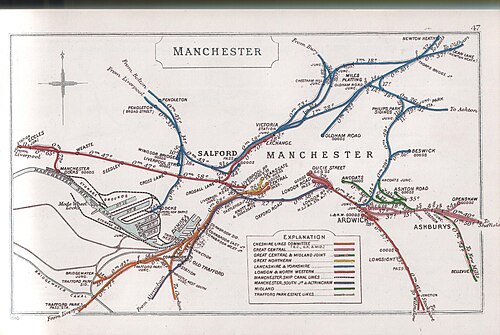
1840年6月、マンチェスター・アンド・バーミンガム鉄道(M&BR)は、トラヴィス・ストリートにストックポート行きの路線の仮ターミナルを開設した。長さ1,700フィート(518メートル)、幅500フィート(152メートル)の広大な敷地からテラスハウスや工場施設が撤去され、地上30フィート(9メートル)の高さの高架橋の上に建設されたストア・ストリート駅が建設された。駅は1842年5月8日にロンドン・ロードに隣接して開業した。駅には2つのプラットホーム、事務所、旅客用設備があり、その時点で路線はクルーまで延長されていた。[10] [11]
ストアストリート駅は、ストックポート高架橋を含む路線の多くの構造物を設計したM&BRの主任技師ジョージ・W・バックによって設計された。[12]チャールズ・ハットン・グレゴリーが助手技師だった。駅は、1837年に発起人によって締結された合意に従い、当初からシェフィールド・アシュトン・アンダー・ライン・アンド・マンチェスター鉄道(SA&MR)と共有されていた。[10]
M&BRは他の鉄道会社と合併し、 1846年にロンドン・アンド・ノース・ウェスタン鉄道(LNWR)を設立した。SA&MRは3年後にマンチェスター・シェフィールド・アンド・リンカンシャー鉄道(MS&LR)に社名を変更した。[13]
マンチェスター ロンドン ロード
1847年、駅はロンドンロードに改名された。[12] 1849年、マンチェスター・サウス・ジャンクション・アンド・アルトリンチャム鉄道(MSJA&R)は、マンチェスター・オックスフォード・ロードからの路線が延長された後、この駅の使用を開始した。1849年8月1日に駅の主要部分の南に隣接して開業したこの単一のプラットフォームは、直通プラットフォーム13と14の前身であった。MSJA&Rの路線は駅の南で本線に接続し、リバプール行きのLNWRの路線への直通ルートを形成した。[11] [14]


1850年代までに、ロンドンロード駅は混雑し、LNWRとMS&LRの関係は悪化した。これは、後者がグレートノーザン鉄道と提携して、駅からロンドンへのライバルサービスを提供することを決定したためであり、これはLNWRと直接競合していた。それでも、両者は協力して駅を改築し、拡張した。1862年に始まった改築により、駅は分割され、MS&LRが北東側、LNWRが南西側を占めることになった。駅には新しい入口ビルとコンコースが設けられ、各社は別々の切符売り場と旅客施設を持つようになった。ターミナルプラットホーム上には、長さ656フィート (200 m) の鉄とガラスでできた列車庫が建設された。この列車庫には幅95フィート (29 m) のアーチ型スパンが2つあり、1つはLNWRプラットホームを覆い、もう1つはMS&LRプラットホームを覆うものであった。[15] 1866年1月20日、屋根の建設中に致命的な事故が発生し、屋根の一部が崩落して作業員2名が死亡、30名が負傷した。調査の結果、崩落は強風と大雪が原因と判明した。同時に、駅の南側にあるアードウィックまでの高架橋が拡張され、4線が通るようになり、両社は旅客駅の北側に貨物駅と倉庫を建設した。 [15] [16]
10年以内に、交通量が増加し続けたため駅は再び混雑し、拡張が必要になった。1880年から1883年にかけて、LNWRは駅の側を拡張し、より多くのプラットフォームを建設した。プラットフォームは、列車庫への幅69フィート(21メートル)のアーチ型スパン2つで覆われていた。同時に、MSJ&ARプラットフォームは取り外され、フェアフィールドストリートに架かる桁橋上の島式プラットフォームとして再建され、歩道橋でメインステーションと接続された。1882年5月、改良部分がオープンした。[11] [17]
1897年、MS&LRは社名をグレート・セントラル鉄道(GCR)に変更し、 1899年に駅からロンドンまでの直通路線を開設した。[17]
1910年、ロンドンロードの混雑緩和のため、隣接するメイフィールド駅が4つのプラットホームを備えて開業した。駅は歩道橋で結ばれていた。[17]メイフィールド駅は1960年に旅客営業を停止し、1986年には全面的に閉鎖された。需要緩和のために再オープンするなどの再開発計画が提案されているにもかかわらず、廃駅のままとなっている。 [18] 2013年10月、安全上の懸念から駅の屋根/天蓋が取り壊された。

1923年の鉄道統合に続いて、LNWRは他の鉄道会社数社と合併してロンドン・ミッドランド・アンド・スコティッシュ鉄道(LMS)を設立し、GCRは他の鉄道会社と合併してロンドン・アンド・ノース・イースタン鉄道(LNER)を設立した。[19]駅の区分は維持され、1948年の鉄道国有化後も2つの別々の駅として運営され続けた。片側はイギリス鉄道のロンドン・ミッドランド地域が使用し、もう一方はイースタン地域が使用した。[11]
マンチェスター ピカデリー

1958年から1966年にかけて、ロンドンロードはイギリス鉄道が実施したウェストコースト本線近代化計画の一環として再建された。1960年9月12日に「マンチェスターピカデリー」に改名された。ピカデリーは道路の名前であり、ピカデリーガーデンもその近くにある。[11]

ロンドン・ミッドランド地方政府は、ロンドンへの電車の運行に備えて、175万ポンド (2024年の価格で5164万ポンドに相当[20])をかけて駅を再建した。駅の大部分は再建されたが、ヴィクトリア朝時代の列車庫はほとんどそのまま残された。ただし、1880年代の2つのスパンはコンコースの端に向かって短縮された。駅は1958年から1960年と1963年から1966年の2段階で再建された。中断は、鉄道近代化のための資金を制限する全国的な信用収縮の結果であった。[21]
フェアフィールド ストリートの旧 MSJA&R 直通プラットフォームと橋は、線路の側面が片持ちのプレストレスト コンクリートスラブ橋の上に再建されました。列車庫のレイアウトは、複数のプラットフォームを追加するために再構成されました。新しいコンコースと入口が建設され、その横にはイギリス国鉄の職員が住む 10 階建てのオフィス ビルがありました。 [12] 1966 年 5 月 11 日、ロンドンへの急行電車の導入工事が完了しました。[21] [22]
駅へのアプローチも再開発された。駅のアプローチ沿いにあったLNWR貨物倉庫は1965年に閉鎖され、その場所に湾曲したオフィスビル、ゲートウェイハウスが1969年にオープンした。[21] [12]
ピカデリー駅は再建工事の間も営業を続けていたが、混乱が生じ、多くの列車がマンチェスター・メイフィールド駅やマンチェスター・セントラル駅に迂回された。工事が完了すると、これらの駅は不要となり、閉鎖され、列車はピカデリー駅に迂回された。[21]
ピク・ヴィックトンネルとメトロリンク
1970年代初頭、ピカデリー・ローレベルという地下鉄駅がピクヴィック・トンネル計画の一環として提案された。[23]この計画では、マンチェスター市中心部の地下にトンネルと複数の地下鉄駅を建設し、ピカデリーとマンチェスター・ヴィクトリアを結ぶ直通の鉄道リンクを建設することが提案された。このプロジェクトは1970年代後半に高コストのため中止され、交通計画者は低コストの選択肢としてライトレールに目を向けた。その結果、1990年代初頭にマンチェスター・メトロリンク・システムが開通し、2つの駅が路面電車で結ばれ、鉄道路線を改造してアルトリンチャムとベリーにつながった。駅の地下にある路面電車の停留所は1992年に開業した。[11] [18]
ウィンザーリンク
1988年から1989年にかけて、ピカデリー駅の直通ホーム13番と14番は、サルフォードのウィンザーリンクコードの開通に合わせてさらに延長され、 [24] [25] 、ボルトン、プレストン、ブラックプール、スコットランドなどマンチェスター北部からの列車が直通ホームを経由してピカデリー駅に直接乗り入れ、南のストックポート、バクストン、(1993年以降は)マンチェスター空港などの目的地まで続くことが可能になった。完成すると、北部からの多くの列車が、規模が縮小されたマンチェスター・ヴィクトリア駅に迂回されるようになった。これにより、マンチェスターの主要駅としてのピカデリー駅の地位が強化された。リンクは1988年に開通し、翌年には全面運用開始が宣言された。[26] [27]
2002年の再開発

1998年から2002年にかけて、 2002年コモンウェルスゲームズの準備として、駅は1億ポンドの再開発を受けた。グレードIIの指定建造物 である列車庫のガラス屋根[1]は、再度ガラス張りされ、再塗装された。BDPによって設計された新しいメインエントランスと中二階のある拡張されたコンコースは、駅を定期的に利用する乗客の数に対して不十分になった1960年代の構造に取って代わった。以前は長い距離を歩く必要があったコンコースから駅の南側にあるプラットフォーム13と14まで乗客を運ぶ動く歩道が設置された。フェアフィールドストリートにも別のエントランスが作られ、新しいタクシー乗り場へのアクセスと自家用車の降車場所を提供している。[18] [11] [4] [28]
電化
この駅は、2つの異なる架空電化システムを採用している点で珍しい。ロンドンロード駅への最初の電化路線は、通勤客の多い路線であるアルトリンチャム行きのMSJA&R線であった。この路線は1931年に1,500Vの直流で通電され、架空線で電化された。ロンドンロード駅は、直通プラットホームまで続く電化計画の終点であった。[19]
1,500 V DCを使用して電化された2番目の路線は、マンチェスターからシェフィールドまでのLNERのウッドヘッドルートでした。この計画の作業は1930年代後半に開始されましたが、第二次世界大戦のために中断され、1950年代初頭に再開されました。電化は1954年9月に完了しました。 [29] 2本の1,500 V DC電線は駅の異なる部分に走っていました。[要出典]
イギリス国鉄が国家標準として採用した25kV交流架空電化は、1950年代後半に始まった西海岸本線電化計画でロンドンロード/ピカデリーに導入された。本線は1960年までにクルーまで、1966年までにロンドンまで電化された。同時に、アルトリンチャム線の1,500V電化はオックスフォードロードまで削減され、南から新システムが延長された。[30]アルトリンチャム線は1971年に25kVに転換された。[31]
2つのシステムは長年共存していた。ウッドヘッドルートは1981年に直通線としては廃止されたが、グロソップとハドフィールドへのローカルサービスは、1984年に路線が25kVに変更されるまで、1,500Vの列車で運行され続けた。[32]
2010年代には、ノーザンハブ計画により、 2015年にマンチェスターからリバプールまで電化が延長され 、[33] 2019年にはマンチェスターからプレストン、そしてブラックプールまで電化が延長されました。[34]
建築

1番線と12番線の間の幅が105メートル(344フィート)ある文化遺産の 列車庫の屋根は4つのスパンから成り、そのうち2つのスパンは長さ185メートル(607フィート)で、1860年代に駅の東側に建設され、西側の150メートル(490フィート)の残りの2つは1880年代初頭に建設された。屋根は外縁の石積みの壁で支えられており、1番線と12番線沿いには丸窓があり、内部空間にはプラットフォームに沿って鋳鉄製の 柱が並んでいる。屋根スパンには錬鉄製の トラスが配置され、桁の上に鋳鉄製の支柱が等間隔で並んでいる。[1]
建設当初、屋根は大部分がスレート板で覆われ、一部にガラスが貼られていたが、時が経つにつれてスレート板はフェルト板に置き換えられた。1997年から1999年にかけて、駅の屋根は改修され、伝統的な外装は錬鉄製トラスの上に「浮かぶ」約1万枚の強化ガラスに置き換えられた。ガラスが割れた場合に落下するガラスを受け止めるために、何層にもネットが設置されている。[12]
列車庫の下には貨物駅として使われていた地下室がある。鋳鉄製の柱とレンガ造りのアーチが真上にあるターミナルプラットフォームを支えている。1990年代初頭から、地下室にはメトロリンク駅、その線路、側線、駐車場が置かれている。 [12]メトロリンクに再利用される前は、地下室全体の鋳鉄製の柱は衝突防止対策としてコンクリートで覆われていた。[12]
ジョージ・W・バックはフェアフィールド・ストリートにかかるオリジナルの斜めアーチ橋を設計した。この橋には、レンガ造りのアーチ高架橋の一部を形成する10本の鋳鉄製アーチリブがあり、上部には開いた石造りの欄干が設けられていた。その後、橋は拡張され、鉄製のアーチプレートで縦方向の梁を支えるために錬鉄製のプレートガーダーと横桁が追加されました。1960年代の再建計画では、鋳鉄製のアーチとスパンドレルがコンクリートで覆われました。[35] [12]この橋の上には、プラットホーム13と14があります。
1960年代に、新しい駅舎を建設するため、多くの元々の駅舎が取り壊された。[12]正面玄関は地上階のコンコースに通じ、2000年代以降は中二階に通じている。フェアフィールド ストリートの入口は地下にあるメトロリンク駅に通じており、エスカレーターで鉄道のプラットホームとつながっている。1997年から2002年にかけて、再開発計画により駅のレイアウトが改訂され、コンコースとプラットホームを分ける改札口付きのガラスの仕切り壁が建設された。[36]ピカデリーの端に通じる駅のアプローチは、建築家リチャード ザイファートが設計した「波型」の正面を持つゲートウェイ ハウスとともに1969年に建設された。ゲートウェイ ハウスは2003年に近代化された。[12]
設備

_5.19.jpg/500px-Manchester_Piccadilly_concourse_(1)_5.19.jpg)
フェアフィールド ストリートの入口は地下にあり、駐車場、タクシー乗り場、メトロリンク駅に通じています。その上の線路レベルには、メイン エントランスがつながるコンコースがあり、チケット オフィス、インフォメーション ポイント、座席、時刻表、トイレ、ショップ、飲食店があります。コンコースの上には、2 階の飲食店とバー、アバンティ ウェスト コーストファースト クラス ラウンジがあります。メイン コンコースには、大きなガラスの仕切り壁にある出入り口があり、プラットフォーム 1 から 12 にアクセスできます。上部のコンコースには、歩道橋、階段、エレベーターでつながる歩道橋とプラットフォーム 13 と 14 につながっている、島型ラウンジには、小売店、トイレ、出発ラウンジがあります。プラットフォーム 13 と 14 には、自動販売機、待合室、スナック バーがあります。[要出典]
マンチェスター ピカデリーは身体障害者にもアクセス可能で、すべての階にエスカレーターとエレベーターがあり、広い出入り口とゲート、点字標識、聴覚ループ、身体障害者用トイレ設備も備えています。[出典が必要]
自転車ラックはフェアフィールド通りと長期駐車場、駅前のタワーブロックの隣に設置されている。2010年3月、マンチェスター市議会とネットワークレールは、安全な施設と現場でのメンテナンスおよびレンタルサービスを提供する「サイクルセンター」の計画を発表した。駅にはタクシー乗り場、降車/乗車場所、短期および長期駐車場がある。[37]フェアフィールド通りからアクセスできる。[37]長期立体駐車場は駅の裏側にある。
ヴァージン・トレインズの申請を受けて、2016年秋に3番線と7番線の間に改札口が設置された。[38]トランスペナイン・エクスプレスによって1番線から3番線までの改札口が設置され、9番線から12番線までは改札口がないが、ほとんどの時間帯に検札係が配置されている。[要出典]
レイアウト

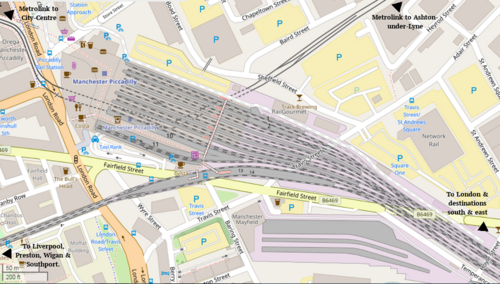
1番線ホームは駅の北側、13番線と14番線ホームは南側にあります。終点ホームのうち、
- プラットフォーム 1 - 4 は通常、ホープ バレー線経由でローズ ヒル、ニュー ミルズ、シェフィールドへ向かう東行きの列車、グロッソップ線の列車、ハダーズフィールド行きのトランスペナインエクスプレスの列車が発着する。クルー行きの北行きの列車も、これらのプラットフォームから頻繁に発着する。
- プラットフォーム 5 ~ 9 は最も長く、主にAvanti West CoastおよびCrossCountryサービスが利用しています。プラットフォーム 5 は通常、チェスターとストーク オン トレント行きのローカル ノーザン サービスが利用しています。プラットフォーム 9 は、クリーソープス - マンチェスター空港からのトランスペナイン エクスプレス サービスが利用しています。
- 10番線から12番線は他の線路よりもかなり短く、通常はクルーやマンチェスター空港行きのローカル列車、ミッドチェシャー線、バクストン線、サウスウェールズ行きの列車が停車する。12番線は最も短く、4両の客車しか停車できない。[39]
- 13番線と14番線は直通ホームで、マンチェスター・オックスフォード・ロードから北ウェールズ、リバプール・ライム・ストリート、北西イングランド、ヨークシャー、北東イングランド、グラスゴー・セントラル、エディンバラ・ウェイバリーへの直通列車、およびマンチェスター空港からの直通列車が運行しています。
メインの入口とコンコースはターミナル プラットフォームの正面にあり、タクシーと車の降車口はフェアフィールド ストリートの南側にあります。メトロリンクの路面電車の路線は地下を通って駅の下を通ります。そのプラットフォームはコンコースと鉄道プラットフォームの下にあります。ピカデリーの南、フェアフィールド ストリートの反対側には、1986 年に鉄道利用が中止された廃墟となったマンチェスター メイフィールド駅があります。
サービス


駅にはマンチェスター南部からの列車が発着するターミナルプラットホームが 12 基あり、直通プラットホームは 13 番と 14 番です。プラットホームは A セクションと B セクションに分かれており、複数の列車が停車できます。直通プラットホーム 13 番と 14 番は、マンチェスター オックスフォード ロードを経由して北ウェールズ、リバプール、北西イングランド、ヨークシャー、北東イングランド、グラスゴー、エディンバラへ向かう直通列車と、マンチェスター空港からの直通列車が利用しています。
マンチェスター・ピカデリー駅には現在 6 つの鉄道会社が運行しています。
アヴァンティ ウェストコースト
- ロンドン・ユーストン行きの列車は毎時3本運行されており、停車パターンはそれぞれ異なります。
- ストックポート、ストーク・オン・トレント、ナニートンに1tphが寄港
- ストックポート、マクルズフィールド、ストーク・オン・トレント、ラグビー、ミルトン・キーンズ・セントラルに1tphで寄港
- ストックポート、ウィルムスロー、クルー、スタッフォードに1tphが寄港
クロスカントリー
- ボーンマス行き1tph 、ストックポート、マクルズフィールド、ストーク・オン・トレント、スタッフォード、ウォルバーハンプトン、バーミンガム・ニューストリート、バーミンガム・インターナショナル、コベントリー、レミントン・スパ、バンベリー、オックスフォード、レディング、ベイジングストーク、ウィンチェスター、サウサンプトン・エアポート・パークウェイ、サウサンプトン・セントラル、ブロッケンハースト、ボーンマスに停車。
- ブリストル・テンプル・ミーズ行きの列車は毎時1便運行しており、ストックポート、マクルズフィールド、ストーク・オン・トレント、ウォルヴァーハンプトン、バーミンガム・ニュー・ストリート、チェルトナム・スパ、ブリストル・パークウェイ、ブリストル・テンプル・ミーズに停車します。
イーストミッドランズ鉄道
- マンチェスター・オックスフォード・ロード、ウォリントン・セントラル、ウィドネス、リバプール・サウス・パークウェイ、リバプール・ライム・ストリートに停車するリバプール・ライム・ストリート行き1tph
- ノッティンガム経由でノリッジまで毎時1便運行。ストックポート、シェフィールド、ドロンフィールド(不定期)、チェスターフィールド、ノッティンガム、グランサム、ピーターバラ、エリー、セットフォード、ノリッジに停車。
ノーザン・トレインズ
- ランカスター行き1tph 、マンチェスター・オックスフォード・ロード、ディーンゲート、ボルトン、チョーリー、プレストン、ランカスター
に停車
- 11tpdはバロー・イン・ファーネスへ向かい、カーンフォース、シルバーデール、アーンサイド、グレンジ・オーバー・サンズ、ケンツ・バンク(不定期)、カーク&カートメル、アルバーストン、ダルトン、ルース、バロー・イン・ファーネスに寄港します。
- 4tpdはウィンダミアへ向かい、オクセンホルム湖水地方、ケンダル、バーンサイド、ステイブリー、ウィンダミアに立ち寄ります。
- ブラックプール ノース行きは 2tph で、マンチェスター オックスフォード ロード、ディーンゲート、サルフォード クレセント、ボルトン、ロストック、ホーウィッチ パークウェイ、ブラックロッド(1tph)、アドリントン(1tph)、チョーリー、バックショー パークウェイ、レイランド、プレストン、カーカム & ウェシャム、ポールトン ル フィルド、レイトン(1tph)、ブラックプール ノースに停車します。日曜日はすべての駅で 1tph に減便されます。
- ニュートン ル ウィロウズ経由でリバプール ライム ストリートまで 1 時間あたり 1 便運行。途中、マンチェスター オックスフォード ロード、ディーンゲート、エクルズ、パトリクロフト、ニュートン ル ウィロウズ、アールズタウン、セント ヘレンズ ジャンクション、リー グリーン、レインヒル、ウィストン、ヒュートン、ロビー、ブロードグリーン、ウェーヴァーツリー テクノロジー パーク、エッジ ヒル、リバプール ライム ストリートに停車します。
- マンチェスター空港行きの列車は毎時 5 本運行されており、それぞれ停車パターンが異なります。イースト ディズベリーに停車するマンチェスター空港行きの追加列車は、ウェールズ鉄道により運行されています。
- 2tph は、モールデス ロード、バーネージ、イースト ディズベリー、ガトリー、ヒールド グリーン、マンチェスター空港に停車し、そのうち 1 便はクルーまで運行されます (下記参照)。日曜日は 1tph です。
- ヒールドグリーンとマンチェスター空港に1tphで停車します。
- 1tph はGatleyと Manchester Airportに停車します。日曜日には、このサービスはrws|Gatley の代わりにEast DidsburyとHeald Greenに停車します。
- マンチェスター空港のみで1tphの通話が可能です。月曜日から土曜日のみ。
- マンチェスター空港経由でクルー行きの列車は毎時1本運行され、途中、モールデスロード、バーネージ、イースト ディズベリー、ガトリー、ヒールド グリーン、マンチェスター空港、スタイアル、ウィルムズロー、アルダリー エッジ、ホームズ チャペル、サンドバッハ、クルーに停車します。日曜日には、この列車はウィルムズローで終点となります。
- 1tphでストックポート経由でクルーへ。途中、レベンシュルム、ヒートン チャペル、ストックポート、チードル ハルム、ハンドフォース、ウィルムズロー、アルダリー エッジ、チェルフォード、グーストリー、ホームズ チャペル、サンドバッハ、クルーに停車します。
- アルダリー エッジ行きの列車は毎時 1 便運行し、レベンシュルム、ヒートン チャペル、ストックポート、チードル ハルム、ハンドフォース、ウィルムスロー、アルダリー エッジに停車します。月曜日から土曜日のみ。
- ストーク・オン・トレント行きは1 日 1 本で、ストックポート、チードル・ハルム、ブラムホール、ポイントン、アドリントン、プレストベリー、マクルズフィールド、コングルトン、キッズグローブ、ストーク・オン・トレントに停車します。朝のピーク時間帯の追加サービスはマクルズフィールドから出発します。日曜サービスは 6 本です。
- ノースウィッチ経由でチェスターまで毎時 1 本の列車が運行され、ストックポート、ナビゲーション ロード、アルトリンチャム、ヘイル、アシュリー、モバリー、ナッツフォード、プラムリー、ロストック グララム、ノースウィッチ、グリーンバンク、カディントン、デラミア、モールズワース、チェスターに停車します。日曜の運行は 2 時間に 1 本です。
- バクストン行きの1tph列車は、レベンシュルム、ヒートン チャペル、ストックポート、ダベンポート、ウッズムア、ヘイゼルグローブ、ミドルウッド(1tp2h)、ディスリー、ニュー ミルズ ニュータウン、ファーネス ヴェール、ホエリー ブリッジ、チャペル アンルフリス、ダブホールズ(1tp2h)、バクストンに停車します。ピーク時には追加の列車が運行されます。ミドルウッドとダブ ホールズには代替列車が運行されます。
- ヘーゼル グローブ行きの 1tph便は、レベンシュルム、ヒートン チャペル、ストックポート、ダベンポート、ウッズムーア、ヘーゼル グローブに停車します。月曜日から土曜日のみ。
- ハドフィールド行きの2tph便は、アシュベリーズ、ガイドブリッジ、フラワリーフィールド、ニュートンに停車し、その後ハイド、ゴドリー、ハッターズリー、ブロードボトム、ディンティング、グロソップ、ハドフィールドへ向かいます。日曜日にはゴートン便も運行されます。
- ローズ ヒル マープル行きの 4 時間 3 時間の列車は、ゴートン、フェアフィールド、ガイド ブリッジ、ハイド ノース、ハイド セントラル、ウッドリー、ロミリー、ローズ ヒル マープルに停車します。月曜日から土曜日のみ。
- ニューミルズ セントラル行き 1tph で、アシュベリーズ、ベル ビュー、ライダー ブラウ、レディッシュ ノース、ブリニントン、ブレッドベリー、ロミリー、マープル、ストリンズ、ニューミルズ セントラルに停車します。月曜日から土曜日のみ。
- シェフィールド行きの1tphは、レディッシュ ノース、ブリニントン、ブレッドベリー、ロミリー、マープル、ニュー ミルズ セントラル、チンリー、イーデール、ホープ、バンフォード、ハザーセージ、グリンドルフォード、ドーア & トトリー、シェフィールドに停車します。ストリンズは、ピーク時と日曜日の終日運行されます。
トランスペナインエクスプレス
トランスペナイン・エクスプレスは3つの路線でサービスを運営しています。
ノーストランスペナイン
- マンチェスター空港まで1時間あたり1便直行便。日曜日はガトリーに寄港します。
- ソルトバーン行きの1tph列車は、マンチェスター・オックスフォード・ロード、マンチェスター・ビクトリア、ハダーズフィールド、デューズベリー、リーズ、ヨーク、サースク、ノーサラートン、ヤーム、ソーナビー、ミドルスブラ、レッドカー・セントラル、ソルトバーンに停車します。
- ヨーク行き1tph 、スタリーブリッジ、ハダーズフィールド、デューズベリー、リーズ、ヨークに停車
- 1tp2h はスカーバラまで続き、マルトン、シーマー、スカーバラに寄港します。
- 1tp2h はニューカッスルまで続き、ノーサラートン、ダーリントン、ダラム、チェスター・ル・ストリート、ニューカッスルに停車します。
- ハダーズフィールド行きの列車は毎時1便運行され、スタリーブリッジ、モズリー、グリーンフィールド、マースデン、スレイスウェイト、ハダーズフィールドに停車します。
サウストランスペナイン
- クリーソープス行き1tph 、ストックポート、ドーア&トトリー(限定)、シェフィールド、メドウホール、ドンカスター、スカンソープ、バーネットビー、ハブロー、グリムズビータウン、クリーソープスに寄港。
- リバプール ライム ストリート行き 1tph で、アームストン、アーラム、バーチウッド、ウォリントン セントラル、ウォリントン ウェスト(限定)、リバプール サウス パークウェイ、リバプール ライム ストリートに停車します。日曜のサービスは常にウォリントン ウェストに停車し、アームストンやアーラムには停車しません。
イギリス・スコットランドルート
- カーライル行き1tph 、マンチェスター・オックスフォード・ロード、プレストン、ランカスター、オクセンホルム湖水地方、ペンリス・ノース・レイクス、カーライルに停車
- 1tp2hはロッカービー、ヘイマーケット、エディンバラ・ウェイバリーに寄港し、エディンバラ・ウェイバリーまで続きます。
- 1tp2h continue to Glasgow Central calling at Lockerbie, Motherwell and Glasgow Central
- 1tph non-stop to Manchester Airport.
Transport for Wales
- 1tph to Llandudno via the North Wales Main Line calling at Manchester Oxford Road, Newton-le-Willows, Earlestown, Warrington Bank Quay, Runcorn East, Frodsham, Helsby, Chester, Shotton, Flint, Prestatyn, Rhyl, Abergele & Pensarn, Colwyn Bay, Llandudno Junction, Deganwy and Llandudno. Two trains per day run to Holyhead on weekdays only and some evening terminate at Chester.
- 1tph to Manchester Airport calling at East Didsbury and Manchester Airport.
- 1tph to Cardiff Central via the Welsh Marches line calling at Stockport, Wilmslow, Crewe, Shrewsbury, Church Stretton (irregular), Craven Arms (irregular), Ludlow, Leominster, Hereford, Abergavenny, Pontypool & New Inn (irregular), Cwmbran (irregular), Newport and Cardiff Central, continuing alternately to Carmarthen or Milford Haven.
Piccadilly tram stop
Piccadilly | ||||||||||||||||||||||||||||||||||||||||||||||||||||||||||||||||||||||||||||||||||||||||||||||||||||||||||||||||||||||||||||||
|---|---|---|---|---|---|---|---|---|---|---|---|---|---|---|---|---|---|---|---|---|---|---|---|---|---|---|---|---|---|---|---|---|---|---|---|---|---|---|---|---|---|---|---|---|---|---|---|---|---|---|---|---|---|---|---|---|---|---|---|---|---|---|---|---|---|---|---|---|---|---|---|---|---|---|---|---|---|---|---|---|---|---|---|---|---|---|---|---|---|---|---|---|---|---|---|---|---|---|---|---|---|---|---|---|---|---|---|---|---|---|---|---|---|---|---|---|---|---|---|---|---|---|---|---|---|---|
| Metrolink station | ||||||||||||||||||||||||||||||||||||||||||||||||||||||||||||||||||||||||||||||||||||||||||||||||||||||||||||||||||||||||||||||
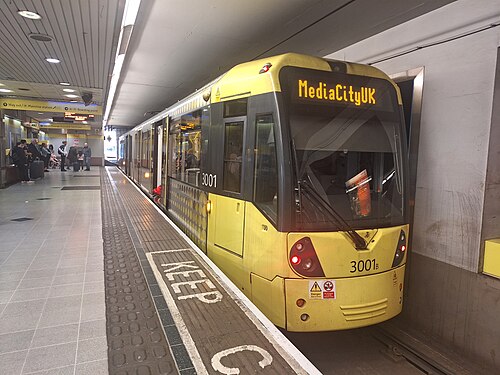 Piccadilly tram stop in July 2024, showing the westbound platform, the eastbound platform is behind the wall on the right. | ||||||||||||||||||||||||||||||||||||||||||||||||||||||||||||||||||||||||||||||||||||||||||||||||||||||||||||||||||||||||||||||
| General information | ||||||||||||||||||||||||||||||||||||||||||||||||||||||||||||||||||||||||||||||||||||||||||||||||||||||||||||||||||||||||||||||
| Location | Manchester city centre, City of Manchester England | |||||||||||||||||||||||||||||||||||||||||||||||||||||||||||||||||||||||||||||||||||||||||||||||||||||||||||||||||||||||||||||
| Coordinates | 53°28′37″N 2°13′50″W / 53.4770°N 2.2306°W / 53.4770; -2.2306 | |||||||||||||||||||||||||||||||||||||||||||||||||||||||||||||||||||||||||||||||||||||||||||||||||||||||||||||||||||||||||||||
| Grid reference | SJ848978 | |||||||||||||||||||||||||||||||||||||||||||||||||||||||||||||||||||||||||||||||||||||||||||||||||||||||||||||||||||||||||||||
| Line(s) | Piccadilly spur | |||||||||||||||||||||||||||||||||||||||||||||||||||||||||||||||||||||||||||||||||||||||||||||||||||||||||||||||||||||||||||||
| Platforms | 2 | |||||||||||||||||||||||||||||||||||||||||||||||||||||||||||||||||||||||||||||||||||||||||||||||||||||||||||||||||||||||||||||
| Other information | ||||||||||||||||||||||||||||||||||||||||||||||||||||||||||||||||||||||||||||||||||||||||||||||||||||||||||||||||||||||||||||||
| Status | In operation | |||||||||||||||||||||||||||||||||||||||||||||||||||||||||||||||||||||||||||||||||||||||||||||||||||||||||||||||||||||||||||||
| Fare zone | 1 | |||||||||||||||||||||||||||||||||||||||||||||||||||||||||||||||||||||||||||||||||||||||||||||||||||||||||||||||||||||||||||||
| History | ||||||||||||||||||||||||||||||||||||||||||||||||||||||||||||||||||||||||||||||||||||||||||||||||||||||||||||||||||||||||||||||
| Opened | 20 July 1992 | |||||||||||||||||||||||||||||||||||||||||||||||||||||||||||||||||||||||||||||||||||||||||||||||||||||||||||||||||||||||||||||
| Original company | Manchester Metrolink | |||||||||||||||||||||||||||||||||||||||||||||||||||||||||||||||||||||||||||||||||||||||||||||||||||||||||||||||||||||||||||||
| ||||||||||||||||||||||||||||||||||||||||||||||||||||||||||||||||||||||||||||||||||||||||||||||||||||||||||||||||||||||||||||||
| ||||||||||||||||||||||||||||||||||||||||||||||||||||||||||||||||||||||||||||||||||||||||||||||||||||||||||||||||||||||||||||||


































Piccadilly Metrolink tram stop is located at ground level in the undercroft underneath the main line station; an area of the station which was historically used for warehousing,[11] it is one of nine stops serving Manchester city centre, within the system's Zone 1. Trams enter the stop from the streets in each direction via short tunnels. There are two platforms: one for eastbound trams towards Etihad Campus and Ashton-under-Lyne, and one for north and westbound trams towards Bury, Eccles and Altrincham. There are steps, lifts and escalators between the platform level and a mezzanine level, along with further steps, lifts and escalators that connect with the main line station's concourse. There are also multiple entrances present at ground level from the surrounding streets.[40]

The tram station was first opened on 20 July 1992, originally being known as Piccadilly Undercroft. As the stop was located directly underneath the main line station platforms, the then station operator British Rail required that it be built inside a protective concrete box, in order to protect the cast iron supports for the main line platforms from the possibility of collision or fire damage.[40][41]
As Piccadilly originally served as a terminus of the system, early operations saw one platform being used for arrivals from Altrincham, Bury and later Eccles, with the other platform used for departures. Empty trams ran from the arrival platform into a nearby reversing siding in a tunnel, where they would reverse and then enter the departure platform. From the onset, the stop had been designed with future extension in mind; as such, since the opening of the extension towards Ashton in 2013, the former arrivals platform has also been used for departures towards Ashton as well as terminating trams, while the former departures platform also handles arrivals from Ashton. Terminating trams use a reversing siding on the Ashton line between Piccadilly and New Islington tram stops.[40][41]
During 2008, the tram station was refurbished, after which it became the first station to display the new Metrolink corporate identity.[42] Station signage bears the yellow and silver livery as applied to the new generation of trams since 2009.[43]
According to TfGM, the Piccadilly tram station is one of the most frequented stops on the Metrolink network.[44]
It has been proposed by High Speed Two Limited that the existing Piccadilly stop be moved to a four-platform underground station beneath Manchester Piccadilly High Speed station.[45] Provision for a second stop at ground-level to the east of the high speed station called Piccadilly Central is also proposed to provide for future expansions of the Metrolink network.
Metrolink services
As of 2024, Piccadilly tram stop is the terminus for Metrolink services to Bury, and Altrincham at most operating times (see table below), and a major stop on the through services to Eccles, MediaCityUK, Etihad Campus, and Ashton-under-Lyne.[46] Services run every twelve minutes on each route at most operating times.[47]

Wikimedia Commons has media related to Manchester Piccadilly Metrolink station.
Future proposals
In 2009, the Greater Manchester Integrated Transport Authority advocated reopening the neighbouring derelict Mayfield station to alleviate capacity problems but the proposal was not advanced; plans focused on increasing track capacity on the cross-city route between Piccadilly and Oxford Road stations were pursued.[48]
Northern Hub
During the early 2010s, Network Rail promoted its Northern Hub plans, estimated to cost in excess of £560 million to improve the heavily congested rail network on the approach into Manchester.[49] A pair of through platforms would be constructed at Piccadilly and the station linked to Manchester Victoria via the Ordsall Chord, cutting journey times on Trans-Pennine routes.[50][51] The construction of the Ordsall Chord made it possible for trains from the airport to travel via platforms 13 and 14 and Oxford Road to Manchester Victoria and Leeds and via the Calder Valley Line to Bradford Interchange.[52]
Phase 2 aims to alleviate congestion at platforms 13 and 14 by constructing a parallel elevated island platform and allow the minimum time between trains to be decreased from four to three minutes, improving reliability. It will allow four more trains per hour to be timetabled to Oxford Road including a second freight to Trafford Park.[53][54] Approval for the platforms, at an estimated cost of £200 million, was announced during July 2012.[55]
The proposals would simplify train operations at Piccadilly, creating close associations between pairs of lines leading out of the station and particular platforms while requiring only a few crossing moves. Platforms 1 to 4 would be primarily used for services on the 'east' lines, to and from Marple, Glossop and Huddersfield; platforms 5 to 12 would be for services on the 'fast' lines, to and from Crewe and Stoke; through platforms 13 to 16 would be dedicated to services on the present 'slow' lines, to and from Manchester Airport and Hazel Grove.[56]
In July 2013, Network Rail consulted on three options for the additional platforms at Piccadilly, all of which would affect local roads and the Grade II listed Star and Garter public house.[57]
Construction was originally due to begin in 2016, but the project was delayed indefinitely.[58] In 2023, Network Rail stated plans for the new platforms had been shelved to allow improvements to Manchester Victoria and Salford Crescent stations to go ahead instead.[59]
High Speed 2

To accommodate High Speed 2 (HS2), an extension would require four platforms and a 7.5 miles (12.1 km) tunnel under south Manchester to join the West Coast Main Line at Ardwick. Journey times to Manchester Airport would be reduced to 9 minutes from 18, Birmingham 41 minutes from 86 minutes, and London 68 minutes from 128. Station upgrades could include enhanced Metrolink services, improved road access and car parking. The line is planned to be completed by 2032.[60]
A major redevelopment of the station and surrounding area has been proposed to complement the HS2 proposals involving the construction of a canopy over the HS2 platforms, the creation of a new entrance, and office, retail and residential development. Designs indicate that the derelict Mayfield Station and the Gateway House office block will be demolished.[61][62] The plans were approved by the Government in November 2016.[63][64]
In October 2023 the portion of HS2 north of Birmingham was announced to be cancelled at the Conservative Party conference in Manchester.[65]
Northern Powerhouse Rail
Northern Powerhouse Rail (NPR) proposals include the construction of new platforms under Piccadilly station and the proposed HS2 platforms. The 2016 'Manchester Piccadilly Options Assessment' by the National Infrastructure Commission stated: "Addition of Northern Powerhouse Rail and Station to the Manchester Piccadilly system will be the last step of the process of transforming the station in to [sic] a transport super hub. The NPR station and its construction will need to be considered throughout the design and implementation of the other station improvements, which form the station concept but which are delivered earlier. The NPR station is proposed to stay underground on its way east as it passes through Manchester city. This provides opportunities and offers location and orientation alternatives. Staying under the existing Piccadilly station or positioning NPR under the HS2 station box will maximise interchange efficiencies and travel distances. The orientation will also dictate the number of vertical connection cores also referred to as “drums” and their locations. The drums will have the function to connect all levels of transport to one and other [sic] at critical junction points."[66]
During October 2017, according to a report to the Manchester City Council’s executive of the various proposals submitted, the development of an underground station has been selected as the preferred option for accommodating the envisioned NPR services, which are speculated to involve the running of up to eight trains per hour, as well as connecting services with the in-development HS2. The importance of directly integrating this underground facility with the existing Piccadilly Station has been emphasised as well; however, the report observes that the necessary financing for the programme is still lacking.[67]
References
Citations
- ^ a b c Historic England. "Train shed at Piccadilly Station (1283014)". National Heritage List for England. Retrieved 16 October 2012.
- ^ "ORR Statistics 2022-23" (PDF).
- ^ "Office of Rail and Road".
- ^ a b "£100m station revamp opens". BBC News. 9 December 2002. Retrieved 4 September 2011.
- ^ "Network Rail - Enhancements Delivery Plan". Network Rail. September 2016. p. 11. Archived from the original on 29 September 2012. Retrieved 8 January 2017.
- ^ "Watch: How Piccadilly and Oxford Road stations could look after £1bn redevelopment". Manchester Evening News. 8 October 2014. Retrieved 20 October 2018.
- ^ "Piccadilly Station should get two new platforms – but does 'crass stupidity' mean it might never happen?". Manchester Evening News. 8 February 2017.
- ^ "Castlefield Corridor - Congested Infrastructure Report: Capacity Analysis – System Operator" (PDF). Network Rail. 6 September 2019. Archived from the original (PDF) on 17 April 2022. Retrieved 2 December 2019.
- ^ "Twenty Fourth Supplemental Agreement to the Track Access Contract" (PDF). ORR. 24 June 2019. Retrieved 2 December 2019.
It noted that Network Rail had highlighted that the Corridor has congestion issues between 0700 and 2000 and would be more than happy to contractually agree to the additional rights being confined to the proposed hours of operation.
- ^ a b Hooper 1995, p. 3.
- ^ a b c d e f g h "Network Rail Archive – Manchester Piccadilly". Network Rail. Archived from the original on 5 August 2016. Retrieved 3 November 2012.
{{cite web}}: CS1 maint: bot: original URL status unknown (link) - ^ a b c d e f g h i j Manchester Piccadilly Station, Engineering Timelines, retrieved 25 November 2011
- ^ Hooper 1995, p. 4.
- ^ Hooper 1995, pp. 4–5.
- ^ a b Hooper 1995, pp. 5–6.
- ^ "Manchester Piccadilly Warehouses". Grace's Guide. Retrieved 4 August 2020.
- ^ a b c Hooper 1995, p. 8.
- ^ a b c Coward, Andy (4 January 2017). "Winning Station". Rail. Peterborough. Retrieved 17 April 2017.
- ^ a b Hooper 1995, p. 12.
- ^ UK Retail Price Index inflation figures are based on data from Clark, Gregory (2017). "The Annual RPI and Average Earnings for Britain, 1209 to Present (New Series)". MeasuringWorth. Retrieved 7 May 2024.
- ^ a b c d Hooper 1995, pp. 13–16.
- ^ Hooper 1995, pp. 53–64.
- ^ SELNEC Picc-Vic Line, SELNEC PTE, October 1971 publicity brochure
- ^ Whatley, Peter. "Manchester Piccadilly - platforms 9-14 (December 88)". geograph.org. Retrieved 17 April 2017.
- ^ Whatley, Peter. "Manchester Piccadilly - platforms 9-14 (March 89)". geograph.org. Retrieved 27 April 2017.
- ^ "A Brief Rail History of Manchester: 1980s developments". Light Rail Transit Association. Archived from the original on 15 August 2017. Retrieved 17 April 2017.
- ^ Holt, Geoffery (1986). A Regional History of the Railways of Great Britain, Volume 10, The North West. David St John Thomas. p. 244. ISBN 0-946537-34-8.
- ^ "Case Studies: Manchester Piccadilly". CABE. Archived from the original on 18 January 2011. Retrieved 16 April 2017.
{{cite web}}: CS1 maint: bot: original URL status unknown (link) - ^ Hooper 1995, p. 13.
- ^ Hooper 1995, p. 16.
- ^ "The Manchester South Junction & Altrincham (BR Class 505) Stock". LNER Encyclopedia. Retrieved 16 April 2017.
- ^ Fry, Eric, ed. (April 1990). Railcars and Electric Stock. Locomotives of the L.N.E.R. Vol. Part 10B. Lincoln: Railway Correspondence and Travel Society. pp. 141–143. ISBN 0-901115-66-5.
- ^ "Better rail services become a reality between Liverpool Lime Street and Manchester Airport station". Network Rail Media Centre. Network Rail. 5 March 2015. Archived from the original on 9 March 2015. Retrieved 5 March 2015.
- ^ "First electric passenger trains finally entering service in Bolton". The Bolton News. 12 February 2019. Retrieved 7 August 2019.
- ^ Fairfield Street Bridge, M&BR, Engineering Timelines, retrieved 25 November 2011
- ^ Piccadilly Station, BDP, retrieved 3 March 2012
- ^ a b "Parking – Manchester Piccadilly". National Rail. Retrieved 2 March 2012.
- ^ "Application for Ticket Gatelines – Manchester Piccadilly". Manchester City Council. Archived from the original on 9 November 2016. Retrieved 8 November 2016.
- ^ Johnston, Peter. "Behind the curve - The Ordsall Chord is a poor choice". Rail technology Magazine. Retrieved 12 February 2018.
- ^ a b c "Metrolink in the City Centre". Light Rail Transit Association. Retrieved 7 December 2016.
- ^ a b "Metrolink Tram Stops: Piccadilly". TheTrams.co.uk. Retrieved 9 July 2009.
- ^ "Work: a taster". Hemisphere Design and Marketing Consultants. 2008. Archived from the original on 14 March 2009. Retrieved 13 June 2009.
- ^ "Tram design on the right track". Manchester Evening News. 4 October 2008. Retrieved 31 January 2009.
- ^ "Transport Statistics Greater Manchester 2017 Public Transport Section". TfGM. 5 December 2019. Retrieved 14 December 2019.
- ^ "Phase 2b Western Leg Information Paper F1: Manchester Piccadilly Station" (PDF). gov.uk. 24 January 2022. Retrieved 28 January 2022.
- ^ "Metrolink route map (pdf)" (PDF). TfGM. Archived from the original (PDF) on 3 July 2014. Retrieved 7 December 2016.
- ^ "Transport for Greater Manchester tram times". TfGM. Archived from the original on 23 August 2016. Retrieved 7 December 2016.
- ^ "Forgotten station may return". Manchester Evening News. 24 March 2009. Archived from the original on 22 March 2015. Retrieved 22 March 2015.
- ^ “Manchester Hub Rail Study.” ‘’Network Rail’’, February 2010.
- ^ "£200 million boost for rail in Budget proposals". Railnews. Stevenage. 23 March 2011. Retrieved 24 November 2011.
- ^ "The Missing Link: Rail line between Manchester Piccadilly and Victoria stations to boost jobs and business". Manchester Evening News. 5 April 2011. Retrieved 4 November 2011.
- ^ “Ordsall Chord.” Archived 25 February 2017 at the Wayback Machine ‘’Network Rail’’, Retrieved: 6 July 2018.
- ^ “Manchester Hub Rail Study.” ‘’Network Rail’’, February 2010. page 49.
- ^ “Route Specifications 2011 – London North Western.” ‘’Network Rail’’, 2011. page 35. See also pp. 25 to 30.
- ^ “Investing in rail, investing in jobs and growth.” ‘’Department for Transport,’’ 16 July 2012.
- ^ “Manchester Hub Rail Study.” ‘’Network Rail’’, February 2010. page 57.
- ^ "Our plans: Manchester Piccadilly". Network Rail. July 2013. Archived from the original on 18 July 2013. Retrieved 22 March 2015.
- ^ "Plans sit on Chris Grayling's Desk". Manchester Evening News. 6 January 2019. Retrieved 13 April 2019.
- ^ "Salford Crescent: Station upgrade and track revamp planned". BBC News. 25 May 2023. Retrieved 25 May 2023.
- ^ "Phase Two Command Paper" (PDF). gov.uk. 28 January 2013. Retrieved 28 January 2013.
- ^ "Mayfield SRF" (PDF). Bennetts Associates. 2014. Archived from the original (PDF) on 2 April 2015. Retrieved 21 March 2015.
- ^ "Portfolio: HS2 Manchester Strategic Regeneration Framework". Bennetts Associates. Archived from the original on 22 March 2015. Retrieved 22 March 2015.
- ^ "HS2: North West and Yorkshire routes confirmed". BBC News. 15 November 2016.
- ^ "High Speed Two: From Crewe to Manchester, the West Midlands to Leeds and beyond." Department for Transport, Cm9355. November 2016.
- ^ "HS2 West Midlands-Manchester line to be scrapped". BBC News. 3 October 2023. Retrieved 4 February 2024.
- ^ "Manchester Piccadilly Options Assessment" (PDF). 16 March 2016. Retrieved 25 February 2018.
- ^ "Underground Northern Powerhouse Rail station proposed for Piccadilly." placenorthwest.co.uk, 16 October 2017.
Bibliography
- Hooper, John (1995). An Illustrated Historical Survey of a Great Provincial Station: Manchester London Road. Challenger Publications. ISBN 1-899624-05-8.
Further reading
- Mitchell, Vic; Smith, Keith (2013). Chester Northgate to Manchester. Middleton Press. figs. 119-120. ISBN 9781908174512. OCLC 892704846.
- Mitchell, Vic; Smith, Keith (2014). Crewe to Manchester. Middleton Press. figs. 109-120. ISBN 9781908174574. OCLC 892047119.
- Johnston, Howard (23 September – 6 October 1998). "Piccadilly: Regeneration is still not enough...". RAIL. No. 340. EMAP Apex Publications. pp. 42–44. ISSN 0953-4563. OCLC 49953699.
- "Manchester Piccadilly to close for major works". RAIL. No. 346. EMAP Apex Publications. 16–29 December 1998. p. 7. ISSN 0953-4563. OCLC 49953699.
External links
Wikimedia Commons has media related to Manchester Piccadilly station.
- Train times and station information for Manchester Piccadilly station from National Rail
- Station information on Manchester Piccadilly station, provided by Network Rail
- Tram times and station information for Piccadilly tram stop from Manchester Metrolink
- ^ https://www.eastmidlandsrailway.co.uk/media/3150/download?inline