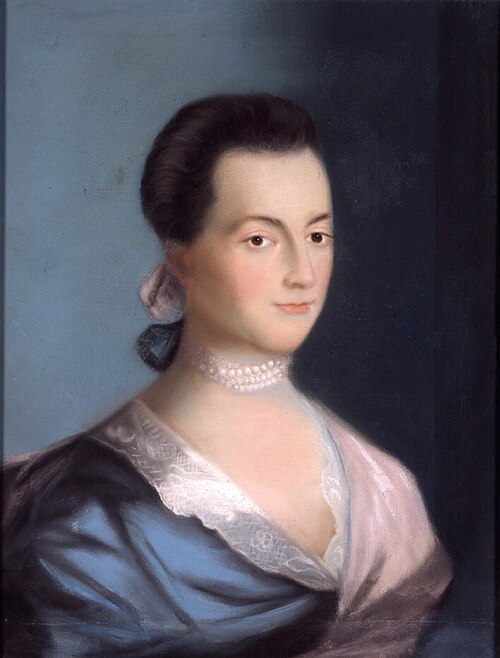
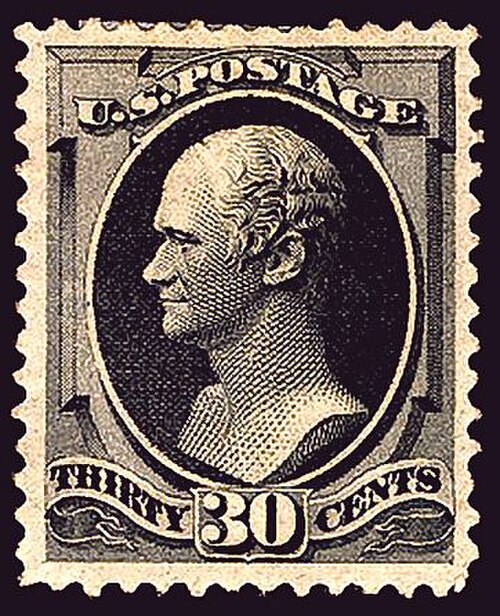
John Marshall served with George Washington at Valley Forge and later would be the first to refer to him as "the Father of his country". Appointed the fourth chief justice of the U.S. Supreme Court under John Adams, Marshall defined the authority of the court and ensured the stability of the federal government during the first three decades of the 19th century.[57][58][59][60]
James Monroe, elected to the Virginia legislature (1782); member of the Continental Congress (1783–1786);[61] fifth president of the United States for two terms (1817–1825);[62] Negotiated the Louisiana Purchase along with Robert Livingston.[63]
James Otis Jr., pamphleteer, one of the earliest proponents of patriotic causes, an opponent of slavery, and leader of Massachusetts' Committee of Correspondence, all in the 1760s.[64][65]
Thomas Paine, author of Common Sense and other influential pamphlets in the 1770s; sometimes referred to as "Father of the American Revolution".[57][66][67] While John Adams strongly criticized Paine for failing to see the need for a separation of powers in government, Common Sense proved crucial in building support for independence following its publication in January 1776.[68][69]
↑ Westcott, Reed (nd). "Hugh Henry Brackenridge, Digital Encyclopedia of George Washington" . George Washington's Mount Vernon (mountvernon.org) . 2023年1月23日取得。ヒュー・ヘンリー・ブラッケンリッジは、スコットランド生まれのペンシルベニアの牧師、政治家、作家、法学者であり、厳密には建国の父ではないものの、ジェームズ・マディソンをはじめとする数人の建国の父と親交が深かった。
↑"A Guide to the United States' History of Recognition, Diplomatic, and Consular Relations, by Country, since 1776: Sweden". Office of the Historian. Retrieved October 5, 2022.
↑"Gov. Benjamin Franklin". National Governors Association. January 15, 2019. Retrieved October 5, 2022.
↑Letter to Horatio G. Spafford, March 17, 1814. "In every country and in every age, the priest has been hostile to liberty. He is always in alliance with the despot, abetting his abuses in return for protection to his own."
↑Horton, James O. (2004). "Alexander Hamilton: Slavery and Race in a Revolutionary Generation". New York Journal of American History. 91 (3): 1151–1152. doi:10.2307/3663046. JSTOR3663046. Retrieved October 29, 2016.
↑Jeffrey K. Tulis and Nicole Mellow, Legacies of losing in American politics (U of Chicago Press, 2018), p. 2. -
↑Eric Foner, The Second Founding: How the Civil War and Reconstruction Remade the Constitution (2020) excerpt
↑Ilan Wurman, The Second Founding: An Introduction to the Fourteenth Amendment ( 2020) excerpt
↑See also Garrett Epps, "Second Founding: The Story of the Fourteenth Amendment". Oregon Law Review 85 (2006) pp: 895–911 online.
↑David Hackett Fischer, African Founders: How Enslaved People Expanded American Ideals (Simon and Schuster, 2022) pp 1–3.excerpt
↑David W. Blight, Frederick Douglass: Prophet of Freedom (Simon and Schuster, 2018) p. xv; winner of Pulitzer Prize; excerpt.
↑Trefousse, Hans Louis (1969). The Radical Republicans Lincoln's Vanguard for Racial Justice. New York: Alfred A. Knopf. pp.vii–viii./ref> Paul Rego, Lyman Trumbull and the Second Founding of the United States (University Press of Kansas, 2022) pp. 1–2. excerpt.
↑Risen, Clay (2014). The Bill of the Century: The Epic Battle for the Civil Rights Act. New York: Bloomsbury Press. pp.2–5. ISBN978-1608-19824-5.
↑Kaplan, Sidney (1964). "The History of New-Hampshire: Jeremy Belknap as Literary Craftsman". The William and Mary Quarterly. 21 (1): 18–39. doi:10.2307/1923354. JSTOR1923354.
↑Furstenberg, François (2006). In the Name of the Father: Washington's Legacy: Slavery and the Making of a Nation. New York: Penguin Press. ISBN978-1594200922. OCLC66527258.
↑Webster, Daniel (1897). Webster's First Bunker Hill Oration. Boston: Silver, Burdett and Company. p.24.
Bibliography
Books
Adams, John (1961). Diary and Autobiography of John Adams. Cambridge, MA: Belknap Press of Harvard University Press.
Adler, Bill (2015). America's Founding Fathers: Their Uncommon Wisdom and Wit. Lanham, Maryland; Boulder; New York: Rowman & Littlefield.
Alexander, John K. (2002). Samuel Adams: America's Revolutionary Politician. Lanham, MD: Rowman & Littlefield. ISBN978-0742521148.
Allain, Jean, ed. (2012). The Legal Understanding of Slavery: From the Historical to the Contemporary. Oxford, UK: Oxford University Press. ISBN978-0199660469.
Allen, Steven W. (2002). Founding Fathers: Uncommon Heroes. Mesa, Arizona: Legal Awareness Series. ISBN1879033763.
Ammerman, David (1974). In the Common Cause: American Response to the Coercive Acts of 1774. Charlottesville: University Press of Virginia. ISBN978-0813905259.
Andrilk, Todd (2012). Reporting the Revolutionary War: Before It Was History, It Was News. Naperville, Illinois: Sourcebooks. ISBN978-1402269677.
Beard, Charles A. (1914). An Economic Interpretation of the Constitution of the United States. New York: The Macmillan Company.
Beeman, Richard R. (2009). Plain, Honest Men: The Making of the American Constitution. New York: Random House. ISBN978-1400065707.
Bernstein, Richard B. (1987). Are We to Be a Nation? The Making of the Constitution. Cambridge, MA: Harvard University Press. ISBN978-0674044753.
—— (2011) [2009]. The Founding Fathers Reconsidered. New York: Oxford University Press. ISBN978-0199832576.
Boston City Council (1925). Celebration of the Sesquicentennial Anniversary of the Battle of Bunker Hill, June 17, 1925. Boston: Boston City Council.
Bowen, Catherine (1986) [1966]. Miracle at Philadelphia: The Story of the Constitutional Convention, May to September 1787. New York: Little, Brown. ISBN978-0316102612.
Bowman, John Stewart (2005). The Founding Fathers: The Men Behind the Nation. North Deighton, Massachusetts: World Publications Group. ISBN1572154365.
Bradford, Melvin Eustace (1994). Founding Fathers: Brief Lives of the Framers of the United States Constitution. Lawrence: University Press of Kansas. ISBN978-0700606566.
Braff, David (2009). "Forgotten Founding Father: The Impact of Thomas Paine". In Joyce Chumbley (ed.). Forgotten Founding Father: The Impact of Thomas Paine; In Search of the Common Good. Spokesman Books.
Brands, H. W. (2000). The First American: The Life and Times of Benjamin Franklin. New York: Doubleday. ISBN978-0385495400.
Burnett, Edmund Cody (1941). The Continental Congress. New York: The Macmillan Company.
Callahan, Kerry P. (2003). The Articles of Confederation: A Primary Source Investigation Into the Document That Preceded the U.S. Constitution. New York: Rosen Primary Source. ISBN978-0823937998.
Campbell, Norine Dickson (1969). Patrick Henry: Patriot and Statesman. New York: Devin-Adair Co. ISBN978-0815965015.
Carp, Benjamin L. (2010). Defiance of the Patriots: The Boston Tea Party and the Making of America. Yale University Press. ISBN978-0300117059.
Cary, John Henry (1961). Joseph Warren: Physician, Politician, Patriot. Urbana: University of Illinois Press.
Chaffin, Robert J. (1999). "The Townshend Acts crisis, 1767–1770". In Jack P. Greene; J.R. Pole (eds.). The Blackwell Encyclopedia of the American Revolution. Malden, Massachusetts: Blackwell. ISBN1557865477.
Chernow, Ron (2010). Washington: A Life. Penguin Press. ISBN978-1594202667.
—— (2004). Alexander Hamilton. New York: Penguin Press. ISBN978-0143034759.
Chorlton, Thomas Patrick (2011). The First American Republic 1774–1789. AuthorHouse. ISBN978-1456753887.
Cogliano, Francis D. (2006). Thomas Jefferson: Reputation and Legacy. Charlottesville: University of Virginia Press. ISBN978-0813927336.
Conant, Sean (2015). The Gettysburg Address: Perspectives on Lincoln's Greatest Speech. New York: Oxford University Press. ISBN978-0190227456.
Concise Dictionary of American Biography. Vol.1 (5ed.). New York: Scribner. 1997. ISBN0684805499.
Concise Dictionary of American Biography. Vol.2 (5ed.). New York: Scribner. 1997. ISBN0684805499.
Congress, United States (1800). Journals of Congress: Containing Their Proceedings from September 5, 1774, to January 1, 1776. Philadelphia: Folwell's Press.
Dangerfield, George (1960). Chancellor Robert R. Livingston of New York, 1746–1813. New York: Harcourt, Brace and Co.
Deetz, James F. (1996). In Small Things Forgotten: An Archaeology of Early American Life. New York: Anchor Books, Doubleday. ISBN978-0385080316.
Dolbeare, Kenneth M.; Cummings, Michael S. (2010). American political thought (6ed.).
Dugan, Nicholas (2010). Gallatin: America's Swiss Founding Father. New York University Press. ISBN978-0814721124.
Ellis, Joseph J. (2007). American Creation. New York: Knopf Doubleday Publishing Group. ISBN978-0307267740.
—— (2000). Founding Brothers: The Revolutionary Generation. New York: Alfred A. Knopf. ISBN978-0375405440.
—— (2015). The Quartet: Orchestrating the Second American Revolution, 1783–1789. New York: Alfred A. Knopf. ISBN978-0385353403.
Ellis, Joseph. Founding Fathers: The Essential Guide to the Men Who Made America (Encyclopædia Britannica: John Wiley and Sons, 2007) online; short biographies of leaders
Farrand, Max (1913). The Framing of the Constitution of the United States. New Haven, CT: Yale University Press.ISBN978-0300004458.
Ferling, John (2007). Almost a Miracle: The American Victory in the War of Independence. Oxford University Press. ISBN978-0199758470.
—— (2014). Jefferson and Hamilton: The Rivalry That Forged a Nation. New York: Bloomsbury Press. ISBN978-1608195435.
—— (1996). John Adams, A Life. New York: Henry Holt & Co. ISBN978-0805045765.
—— (2002). Setting the World Ablaze: Washington, Adams, Jefferson, and the American Revolution. New York: Oxford University Press. ISBN0195134095.
Fowler, William M. (1980). The Baron of Beacon Hill: A Biography of John Hancock. Boston: Houghton Mifflin. ISBN0395276195.
Franklin, Benjamin (1895) [1790]. Henry Altemus (ed.). Autobiography of Benjamin Franklin with His Essays and Will. Chicago: W. B. Conkey Co.
Frazer, Gregg L. (2012). The religious beliefs of America's founders: Reason, Revelation, and Revolution. Lawrence, Kansas.: University Press of Kansas. ISBN978-0700618453.
—— (1904). The Declaration of independence, an interpretation and an analysis. New York: The Macmillan Company.
Furstenberg, François (2006). In the Name of the Father: Washington's Legacy: Slavery and the Making of a Nation. New York: Penguin Press. ISBN978-1594200922. OCLC66527258.
Garraty, John Arthur; Carnes, Mark Christopher, eds. (1999). American National Biography. Vol.1. New York: Oxford University Press. ISBN0195206355.
Gelfand, Ravina (1969). The freedom of religion in America. Minneapolis, Lerner Publications Co. ISBN978-0822502197.
Goodall, Jane (2013). Seeds of Hope: Wisdom and Wonder from the World of Plants. Grand Central Publishing. ISBN978-1455513215.
Grafton, Anthony (1990). Forgers and Critics: Creativity and Duplicity in Western Scholarship. Princeton, N.J.: Princeton University Press. ISBN978-0691191836.
Griswold, Rufus Wilmot (1855). The Republican Court, or, American Society in the Days of Washington. D. Appleton & Co.
Grossberg, Michael; Tomlins, Christopher, eds. (2008). The Cambridge History of Law in America. Vol.1–3.
Hart, Albert Bushnell, ed. (1904–1918). The American Nation – A History. Vol.I. New York: Harper & Bros.
Isaacson, Walter (2004). Benjamin Franklin: An American Life. New York: Simon & Schuster. ISBN978-0684807614.
Jensen, Merrill (1968). The Founding of a Nation: A History of the American Revolution, 1763–1776. New York: Oxford University Press.
—— (1964). The Making of the American Constitution. Princeton, NJ: Van Nostrand.ISBN0442000758.
—— (1950). The New Nation 1781–1789. New York: Alfred A. Knopf, Inc.
Jillson, Calvin C.; Wilson, Rick K. (1994). Congressional Dynamics: Structure, Coordination, and Choice in the First American Congress, 1774–1789. Stanford University Press. ISBN978-0804722933.
—— (2016) [2009]. American Government: Political Development and Institutional Change (8thed.). New York: Routledge. ISBN978-1317666790.
Kann, Mark E. (1999). The Gendering of American Politics: Founding Mothers, Founding Fathers, and Political Patriarchy. Westport, CT: Praeger. ISBN978-0275961121.
Kendall, Joshua C. (2010). The Forgotten Founding Father: Noah Webster's Obsession and the Creation of an American Culture. G. P. Putnam's Sons. ISBN978-1101486542.
Kidd, Thomas S. (2011). Patrick Henry: First Among Patriots. New York: Basic Books. ISBN978-0465009282.
Labunski, Richard E. (2006). James Madison and The Struggle for the Bill of Rights. Oxford University Press. ISBN978-0199740994.
Lambert, Franklin T. (2003). The Founding Fathers and the Place of Religion in America. Princeton, New Jersey: Princeton University Press (published 2006). ISBN978-0691126029.
Levy, Michael I., ed. (2010). The Founding Fathers. New York: Fall River Press (Encyclopædia Britannica). ISBN978-1435123892.
MacDonald, William, ed. (1899). Select charters and other documents illustrative of American history, 1606–1775. New York: Macmillan Co.
Maier, Pauline (1998). American Scripture: Making the Declaration of Independence. New York: Vintage Books. ISBN978-0307791955.
—— (2010). Ratification: The People Debate the Constitution, 1787–1788. New York: Simon & Schuster. ISBN978-0684868547.
Malone, Dumas (1932). Dictionary of American biography. Vol.III. New York: Charles Scribner's Sons.
Malone, Dumas (1930). Dictionary of American biography. Vol.IV. New York: Charles Scribner's Sons.
—— (1932). Dictionary of American biography. Vol.V. New York: Charles Scribner's Sons.
—— (1932). Dictionary of American biography. Vol.VI. New York: Charles Scribner's Sons.
—— (1932). Dictionary of American biography. Vol.VII. New York: Charles Scribner's Sons.
—— (1932). Dictionary of American biography. Vol.IX. New York: Charles Scribner's Sons.
—— (1932). Dictionary of American biography. Vol.X. New York: Charles Scribner's Sons.
—— (1932). Dictionary of American biography. Vol.XI. New York: Charles Scribner's Sons.
—— (1934). Dictionary of American biography. Vol.XIII. New York: Charles Scribner's Sons.
—— (1934). Dictionary of American biography. Vol.XIV. New York: Charles Scribner's Sons.
—— (1935). Dictionary of American biography. Vol.XVII. New York: Charles Scribner's Sons.
—— (1936). Dictionary of American biography. Vol.XVIII. New York: Charles Scribner's Sons.
—— (1936). Dictionary of American biography. Vol.XX. New York: Charles Scribner's Sons.
Martin, James Kirby (1973). Men in Rebellion: Higher Governmental Leaders and the coming of the American Revolution. New Brunswick, NJ: Rutgers University Press. ISBN978-0813507507.
McCullough, David G. (2001). John Adams. New York: Simon & Schuster. ISBN978-0743218290.
—— (2006). 1776. New York: Simon & Schuster. ISBN0743226712.
McLaughin, Andrew Cunningham (2002). The Foundations of American Constitutionalism. The Lawbook Exchange. ISBN978-1584772279.
Meacham, Jon (2012). Thomas Jefferson. Random House. ISBN978-0307990877.
Meany, William Barry (1911). Commodore John Barry, the father of the American navy: a survey of extraordinary episodes in his naval career. Harper & brothers, New York, London.
Morris, Richard B. (1973). Seven Who Shaped Our Destiny: The Founding Fathers as Revolutionaries. New York: Harper & Row. ISBN978-0060904548.
—— (1965). The Peacemakers: The Great Powers & American Independence. New York: Harper & Row. ISBN978-0930350369.
Morton, Joseph (2006). Shapers of the Great Debate at the Constitutional Convention of 1787: A Biographical Dictionary. Westport, CT: Greenwood Press. ISBN978-0313330216.
O'Brien, Michael Joseph (1937). Hercules Mulligan, confidential correspondent of General Washington. New York: P.J. Kenedy & Sons.
Onuf, Peter S. (2007). The Mind of Thomas Jefferson, Chapter:'Jefferson's Religion: Priestcraft, Enlightenment and the Republican Revolution. University of Virginia Press. ISBN978-0813926117.
Perry, Richard L. (1959). Sources of our liberties; documentary origins of individual liberties in the United States Constitution and Bill of rights. Chicago: American Bar Foundation.
Phillips, Kevin (2012). 1775: A Good Year for Revolution. New York: Viking Press. ISBN978-0670025121.
Rakove, Jack N. (2010). Revolutionaries: Inventing an American Nation. London: William Heinemann. ISBN978-0434010578.
Renehan, Edward (2007). The Treaty of Paris: The Precursor to a New Nation. Infobase Publishing. ISBN978-1438104300.
Roberts, Cokie (2004). Founding Mothers: The Women Who Raised Our Nation. New York: Harper Large Print. ISBN0060533315.
Scaife, Lauriston L. (1921). Milton and the Suffolk resolves. Milton Historical Society.
Sehat, David (2015). The Jefferson rule: how the founding fathers became infallible and our politics inflexible. New York: Simon & Schuster. ISBN978-1-4767-7977-5.
Schwartz, Laurens R. (1987). Jews and the American Revolution: Haym Salomon and Others. McFarland. ISBN978-0899502205.
Serfilippi, Jessie (November 2020). An Odious and Immoral aThing(PDF). New York State Office of Parks, Recreation, and Historic Preservation.
Stewart, David O. (2015). Madison's Gift: Five Partnerships That Built America. Simon & Schuster. ISBN978-1451688597.
Umbreit, Kenneth Bernard (1941). Founding Fathers: Men Who Shaped Our Tradition. Harper & Brothers. Retrieved June 9, 2022.
Unger, Harlow (2009). James Monroe: The Last Founding Father. New York: Da Capo Press. ISBN978-0306818080.
Van Doren, Carl (1986) [1st published 1948]. The Great Rehearsal: The Story of the Making and Ratifying of the Constitution of the United States. New York: Viking Press. ISBN978-0140089653.
Walsh, James J. (1935). Education of the Founding Fathers of the Republic: Scholasticism in the Original Colleges. New York: Fordham University Press.
Warren, Charles (1928). The Making of the Constitution. Boston: Little, Brown, and Company.
Wood, Gordon S. (1969). The Creation of the American Republic, 1776–1787. University of North Carolina Press. ISBN978-0807847237.
—— (2006). Revolutionary Characters: What Made the Founding Fathers Different. New York: Penguin Books. ISBN978-1594200939.
Wright, William D. (2002). Critical Reflections on Black History. Westport, Connecticut: Praeger Publishers. p.125. ISBN978-0275974435.
Yafa, Stephen (2006). Cotton: The Biography of a Revolutionary Fiber. Penguin. p.75. ISBN978-0143037224.
Young, Alfred F.; Nash, Gary B.; Raphael, Ray, eds. (2011). Revolutionary Founders: Rebels, Radicals, and Reformers in the Making of the Nation. New York: Alfred A. Knopf. ISBN978-0-307-27110-5.
Journal articles
Altman, John A. (May 2003). "The Articles and the Constitution: Similar in Nature, Different in Design". Pennsylvania Legacies. 3 (1). University of Pennsylvania Press: 20–21. JSTOR27764871.
Bellia, Anthony J.; Clark, Bradford R. (May 2020). "The International Law Origins of American Federalism". Columbia Law Review. 120 (4). Columbia Law Review Association: 835–940. JSTOR26915803.
Bowling, Kenneth R. (1976). "Good-by "Charle": The Lee-Adams Interest and the Political Demise of Charles Thomson, Secretary of Congress, 1774–1789". The Pennsylvania Magazine of History and Biography. 100 (3): 314–335. JSTOR20091077.
Boyd, Julian P. (January 1950). "The Disputed Authorship of the Declaration on the Causes and Necessity of Taking Up Arms, 1775". The Pennsylvania Magazine of History and Biography. 74 (1): 51–73. JSTOR20088116.
Brown, Richard D. (July 1976). "The Founding Fathers of 1776 and 1787: A Collective View". The William and Mary Quarterly. 33 (3): 465–480. doi:10.2307/1921543. JSTOR1921543.
Buchanan, John (April 2007). "Founding Fighters: The Battlefield Leaders Who Made American Independence (review)". The Journal of Military History. 71 (2): 522–524. doi:10.1353/jmh.2007.0098. S2CID159710300.
Cooney, Charles W. (July 10, 1967). The American revolution and the Post-Revolutionary Generation of American Historians(PDF) (Master of Arts). Milwaukee, Wisconsin: Marquette University.
de Roulhac Hamilton, J.G. (1933). "Southern Members of the Inns of Court"(PDF). The North Carolina Historical Review. 10 (4): 273–286. JSTOR23514971. Retrieved October 4, 2022.
"Founding Father Thomas Paine: He Genuinely Abhorred Slavery". The Journal of Blacks in Higher Education (48): 45. 2005. JSTOR25073236.
Freehling, William W. (February 1972). "The Founding Fathers and Slavery". The American Historical Review. 77 (1): 81–93. doi:10.2307/1856595. JSTOR1856595.
Friedenwald, Herbert (1895). "The Continental Congress". The Pennsylvania Magazine of History and Biography. 19 (2). University of Pennsylvania Press: 197–207. JSTOR20083644.
Greene, Jack P. (March 1973). "The Social Origins of the American Revolution: An Evaluation and an Interpretation". Political Science Quarterly. 88 (1): 1–22. doi:10.2307/2148646. JSTOR2148646.
Lutz, Donald S. (Winter 1990). "The Articles of Confederation as the Background to the Federal Republic". Publius. 20 (1). Oxford University Press: 55–70. doi:10.1093/oxfordjournals.pubjof.a037862. JSTOR3330362.
McWilliams, J. (June 1976). "The Faces of Ethan Allen: 1760–1860". The New England Quarterly. 49 (2): 257–282. doi:10.2307/364502. JSTOR364502.
Murison, Justine S. (October 2013). "Anachronism, Literary Historicism, and Miraculous Plagues". The William and Mary Quarterly. 70 (4). Omohundro Institute of Early American History and Culture: 821–823. doi:10.5309/willmaryquar.70.4.0821. JSTOR10.5309/willmaryquar.70.4.0821.
Padover, Saul K. (1958). "The World of the Founding Fathers". Social Research. 25 (2): 191–214. JSTOR40982556.
Ramage, C.J. (1922). "Randolph". The Virginia Law Register. 8 (6): 415–418. doi:10.2307/1105871. JSTOR1105871.
Gordon-Reed, Annette (January 2000). "Engaging Jefferson: Blacks and the Founding Father". The William and Mary Quarterly. 57 (1). Omohundro Institute of Early American History and Culture: 171–182. doi:10.2307/2674364. JSTOR2674364. PMID18273995.
Swindler, William F. (February 1981). "Our First Constitution: The Articles of Confederation". American Bar Association Journal. 67 (2). American Bar Association: 166–169. JSTOR20746978.
Wright, R. E. (Autumn 1996). "Thomas Willing (1731–1821): Philadelphia Financier and Forgotten Founding Father". Pennsylvania History. 63 (4): 525–560. JSTOR27773931.
Young, Rowland L. (November 1977). "The Articles of Confederation and Perpetual Union". American Bar Association Journal. 63 (11). American Bar Association: 1572–1575. JSTOR20745080.
Online sources
Adams, John Quincy (July 11, 1826). "Executive Order [on the deaths of Thomas Jefferson and John Adams]". The American Presidency Project. Online by Gerhard Peters and John T. Woolley. University of California Santa Barbara. Retrieved June 9, 2022.
Adams, John Quincy (March 4, 1825). "Inaugural Address of John Quincy Adams". avalon.law.yale.edu. The Avalon Project, Lillian Goldman Law Library, Yale University. Retrieved June 9, 2022.
Harding, Warren G. (March 4, 1921). "Inaugural Address of Warren G. Harding". avalon.law.yale.edu. The Avalon Project, Lillian Goldman Law Library, Yale University. Retrieved June 9, 2022.
Horan, Katherine. "First Continental Congress". mountvernon.org. George Washington's Mount Vernon. Retrieved March 4, 2022.
Jefferson, Thomas (March 4, 1805). "Thomas Jefferson Second Inaugural Address". avalon.law.yale.edu. The Avalon Project, Lillian Goldman Law Library, Yale University. Retrieved June 9, 2022.
Journal of the American Revolution (December 1, 2015). "How Do You Define Founding Fathers?". allthingsliberty.com. Retrieved March 3, 2022.
Livingston, Robert R. "The Robert Livingston Papers". gothamcenter.org. The Gotham Center for New York City History. Retrieved June 10, 2022.
Massachusetts Court System. "John Adams & the Massachusetts Constitution". mass.gov. Retrieved March 4, 2022.
McKinley, William (March 4, 1897). "First Inaugural Address of William McKinley". avalon.law.yale.edu. The Avalon Project, Lillian Goldman Law Library, Yale University. Retrieved June 9, 2022.
Morris, Charles R.; Webster, Mary Phillips (1973). "The Story of the Suffolk Resolves"(PDF). Milton, Massachusetts: Milton Historical Commission. Retrieved July 26, 2022.
Morris, Richard B. "Essay: John Jay and the Constitution". columbia.edu. Columbia University Libraries. Retrieved March 4, 2022.
National Archives (November 2, 2015). "Meet the Framers of the Constitution". archives.gov. Retrieved March 3, 2022.
National Archives (November 6, 2015). "Signers of the Declaration of Independence". archives.gov. Retrieved March 3, 2022.
Ohio Historical Society. "Confederation Congress". Archived from the original on April 25, 2011. Retrieved October 23, 2010.
Polk, James (March 4, 1845). "Inaugural Address of James Knox Polk". avalon.law.yale.edu. The Avalon Project, Lillian Goldman Law Library, Yale University. Retrieved June 9, 2022.
Reagan, Ronald (January 21, 1985). "Second Inaugural Address of Ronald Reagan". avalon.law.yale.edu. The Avalon Project, Lillian Goldman Law Library, Yale University. Retrieved June 9, 2022.
Van Buren, Martin (March 4, 1837). "Martin Van Buren: Inaugural Address". presidency.ucsb.edu. The American Presidency Project, University of California at Santa Barbara. Retrieved June 9, 2022.
"The Dickinson Story: The Birth of a New College". Pennsylvania, Dickinson College. Retrieved November 10, 2022.
Further reading
Books
Ackerman, Bruce (2005). The Failure of the Founding Fathers: Jefferson, Marshall, and the Rise of Presidential Democracy. Cambridge, MA: Belknap Press of Harvard University Press. ISBN0-674-01866-4.
Adair, Douglass (1998). Fame and the Founding Fathers: Essays. Indianapolis, IN: Liberty Fund, Inc. ISBN0865971927.
Bailyn, Bernard (2003). To Begin the World Anew: The genius and ambiguities of the American founders. New York: Knopf. ISBN0375413774.
—— (1968). The Origins of American Politics. New York: Vintage Books.
Barlow, J. Jackson; Levy, Leonard Williams (1988). The American Founding: Essays on the Formation of the Constitution. New York: Greenwood Press. ISBN978-0313256103.
Bickford, Charlene Bangs; Bowling, Kenneth R. (1989). Birth of the Nation: The First Federal Congress, 1789–1791. Madison, WI: Madison House. ISBN978-0945612148.
Bordewich, Fergus M. (2016). The First Congress: How James Madison, George Washington, and A Group of Extraordinary Men Invented the Government. New York: Simon & Schuster. ISBN978-1451691931.
Brown, Roger H. (1993). Redeeming the Republic: Federalists, Taxation, and the Origins of the Constitution. Johns Hopkins University Press. ISBN978-0801863554.
Ellis, Joseph, Founding Fathers: the Essential Guide to the Men who Made America (Encyclopædia Britannica, 2007)—the introduction states: "The following 10, presented alphabetically, represent the 'gallery of greats' that has stood the test of time: John Adams, Samuel Adams, Benjamin Franklin, Alexander Hamilton, Patrick Henry, Thomas Jefferson, James Madison, John Marshall, George Mason, and George Washington. There is a nearly unanimous consensus that George Washington was the Foundingest Father of them all."—The book has short bios of 46 "founding Fathers" (and mothers). online
Fischer, David Hackett. African Founders: How Enslaved People Expanded American Ideals (2022) excerpt; also see online review
Flower, Milton Embick, John Dickinson, Conservative Revolutionary, University Press of Virginia, Charlottesville, Virginia (1983)
Foner, Eric (2019). The Second Founding: How The Civil War And Reconstruction Remade The Constitution. New York: W.W. Norton & Company, Inc. ISBN978-0-393-35852-0.excerpt
Gibson, Alan (2006). Interpreting the Founding: Guide to the Enduring Debates over the Origins and Foundations of the American Republic. Lawrence, KS: University Press of Kansas. ISBN978-0700617050.
Gilhooley, Simon J. The Antebellum Origins of the Modern Constitution: Slavery and the Spirit of the American Founding (Cambridge University Press, 2020).
Graebner, Norman A., Richard Dean Burns, and Joseph M. Siracusa. Foreign affairs and the founding fathers: From confederation to constitution, 1776–1787 (Praeger, 2011).
Green, Steven K. (2015). Inventing a Christian America: The Myth of the Religious Founding. Oxford University Press.
Harris, Matthew; Kidd, Thomas, eds. (2012). The founding fathers and the debate over religion in revolutionary America: a history in documents. (Oxford University Press).
Harris, P.M.G. (1969). "The Social Origins of American Leaders: The Demographic Foundations". Perspectives in American History. Vol.3. pp.159–364 harris1969.
Holton, Woody (1999). Forced Founders: Indians, Debtors, Slaves, and the Making of the American Revolution in Virginia. Chapel Hill, NC: University of North Carolina Press (published for the Omohundro Institute of Early American History and Culture, Williamsburg, Virginia). ISBN0-8078-2501-8.
Koch, Adrienne (1961). Power, Morals, and the Founding Fathers: Essays in the Interpretation of the American Enlightenment. Ithaca, NY: Cornell University Press.
Kostyal, K. M. (2014). Founding Fathers: The Fight for Freedom and the Birth of American Liberty
Labaree, Leonard Woods (1948). Conservatism in Early American History. New York: New York University.
Lefer, David (2013). The Founding Conservatives: How a Group of Unsung Heroes Saved the American Revolution. New York: Sentinel. ISBN978-1595230690.
McDonald, Forrest (1985). Novus Ordo Seclorum: The Intellectual Origins of the Constitution. Lawrence: University Press of Kansas. ISBN978-0700603114.
Moreland-Capuia, Alisha. "The Role of Fear in the Founding of the United States: A Historical and Philosophical Perspective" in The Trauma of Racism: Exploring the Systems and People Fear Built (Cham: Springer International Publishing, 2021) pp.13–33.
Newman, Richard S. Freedom's Prophet: Bishop Richard Allen, the AME Church, and the Black Founding Fathers (2008). online
Read, James H. (2000). Power Versus Liberty: Madison, Hamilton, Wilson, and Jefferson. Charlottesville: University Press of Virginia. ISBN978-0813919119.
Trees, Andrew S. The Founding Fathers and the Politics of Character, Princeton University Press (2005)
Unger, Harlow Giles. First Founding Father: Richard Henry Lee and the Call to Independence (2017)
Unger, Harlow Giles. Dr. Benjamin Rush: The Founding Father Who Healed a Wounded Nation (2018)
Unger, Harlow Giles. Lion of Liberty: Patrick Henry and the Call to a New Nation (Da Capo Press, 2010).
Unger, Harlow Giles. Thomas Paine and the clarion call for American independence (Da Capo Press, 2019).
Unger, Harlow Giles. John Marshall: The Chief Justice Who Saved the Nation. (Da Capo Press, 2014).
Unger, Harlow Giles. John Hancock: Merchant King and American Patriot (John Wiley & Sons, 2000).
Valsania, Maurizio. The French Enlightenment in America: Essays on the Times of the Founding Fathers (U of Georgia Press, 2021).
Journal articles
—— (January 1962). "Political Experience and Enlightenment Ideas in Eighteenth-Century America". The American Historical Review. 67 (2): 339–351. doi:10.2307/1843427. JSTOR1843427. Retrieved October 19, 2022.
Burnard, Trevor. "The Founding Fathers in Early American Historiography: A View from Abroad". William and Mary Quarterly 62#4 (2005), pp.745–76 online
Dreisbach, Daniel L. Reading the Bible with the Founding Fathers (2017) online review
Mason, Matthew. "A Missed Opportunity? The Founding, Postcolonial Realities, and the Abolition of Slavery". Slavery & Abolition 35.2 (2014): 199–213.
Newman, Richard S. and Roy E. Finkenbine. "Black Founders in the New Republic" William and Mary Quarterly (2007) 64#1 pp.83–94 online