
Loading article…
| アメリカ南北戦争 | |||||||||
|---|---|---|---|---|---|---|---|---|---|
 上から時計回りに: | |||||||||
| |||||||||
| 交戦国 | |||||||||
.svg/500px-Flag_of_the_United_States_(1861-1863).svg.png) アメリカ合衆国 アメリカ合衆国 |
.svg/500px-Flag_of_the_Confederate_States_(1861%E2%80%931863).svg.png) 南部連合 南部連合 | ||||||||
| 指揮官とリーダー | |||||||||
| 強さ | |||||||||
|
| ||||||||
| 死傷者と損失 | |||||||||
|
| ||||||||
| |||||||||

アメリカ南北戦争(1861年4月12日 - 1865年5月26日、別名)は、アメリカ合衆国における北軍(「北部」)と南部連合(「南部」)の間で起こった内戦である。南部連合は1861年に連邦から脱退した州によって結成された。戦争に至る中心的な対立は、奴隷制度を西部領土に拡大して奴隷州を増やすか、それとも奴隷制度を最終的に消滅させると多くの人が信じていたそれを禁止するかという論争であった。[ 14] [15]
奴隷制度をめぐる数十年にわたる論争は、奴隷制度の拡大に反対していたエイブラハム・リンカーンが1860年の大統領選挙で勝利したことで頂点に達した。南部の7つの奴隷州はリンカーンの勝利に応えて米国から脱退し、南部連合を結成した。南部連合は州内の米国の砦やその他の連邦政府の資産を押収した。戦争は1861年4月12日、南部連合がサウスカロライナ州のサムター要塞を砲撃したときに始まった。戦争への熱狂の波が北部と南部を席巻し、軍の募集が急増した。戦争開始後、さらに4つの南部州が脱退し、ジェファーソン・デイヴィス大統領の指揮の下、南部連合は11州で米国人口の3分の1を支配するようになった。主に南部で4年間の激しい戦闘が続いた。
1861年から1862年にかけて、西部戦線では北軍が永続的な利益を得たが、東部戦線では決着がつかなかった。1863年1月1日、リンカーンが奴隷解放宣言を発布し、反乱州の奴隷はすべて自由であると宣言し、国内の奴隷400万人のうち350万人以上に適用されたことで、奴隷制度の廃止が北軍の戦争目標となった。西部では、北軍はまず1862年夏までに南軍の河川海軍を壊滅させ、続いて西部軍の大半を壊滅させ、ニューオーリンズを占領した。1863年の北軍によるビックスバーグ包囲戦の成功により、ミシシッピ川で南軍は2分され、南軍のロバート・E・リー将軍の北への侵攻はゲティスバーグの戦いで失敗した。西部戦線の勝利により、1864年にはユリシーズ・グラント将軍が北軍全軍の指揮を執ることになった。南軍の港に対する海軍の封鎖をますます厳重にしながら、北軍は資源と人員を動員して南軍を全方位から攻撃した。この結果、1864年にアトランタは北軍のウィリアム・シャーマン将軍によって陥落し、続いて海への進軍が行われた。最後の重要な戦闘は、南軍の首都リッチモンドへの玄関口であるピーターズバーグの10か月に及ぶ包囲戦を中心に激化した。南軍はリッチモンドを放棄し、1865年4月9日、アポマトックス・コートハウスの戦いの後、リー将軍はグラント将軍に降伏し、戦争の終結が始まった。[f]リンカーンはこの勝利を生き延びたが、 4月14日に銃撃され、翌日死亡した。
戦争の終わりまでに、南部のインフラの多くは破壊された。南部連合は崩壊し、奴隷制度は廃止され、奴隷にされていた 400 万人の黒人が解放された。戦争で荒廃した国はその後、国家の再建、旧南部連合諸州の米国への復帰、解放奴隷への公民権付与を目指して、レコンストラクション時代に入った。この戦争は、米国史上最も広範に研究され、書かれたエピソードの 1 つである。文化的、歴史学的な議論の対象であり続けている。特に興味深いのは、南部連合の失われた大義という根強い神話である。この戦争は、産業戦争が行われた最初の戦争の 1 つであった。鉄道、電信、蒸気船、装甲艦、大量生産された武器が広く使用された。この戦争では62万人から75万人の兵士が死亡し、民間人の犠牲者も数え切れないほど出たため、南北戦争はアメリカ史上最悪の軍事紛争となった。[g]南北戦争の技術と残虐性は、その後に続く世界大戦の前兆となった。
起源
戦争の起源を研究する歴史家たちの意見の一致は、奴隷制度の維持が、アメリカ合衆国(連邦)からの脱退を宣言し、アメリカ連合国(「南部連合」として知られる)を形成するために団結した11の南部州(戦争勃発前に7州、勃発後に4州)の主な目的であったという点である。[15]しかし、21世紀の歴史家たちは、奴隷制度が戦争の中心であったことについては同意しているものの、この戦争のどの側面(イデオロギー、経済、政治、社会)が最も重要であったか、そして北部が南部の州の脱退を認めなかった理由については、大きく意見が分かれている。[16]疑似歴史的失われた大義イデオロギーの支持者は、奴隷制が脱退の主な原因であったことを否定しているが、この見解は、脱退した州の脱退文書の一部など、それに反する圧倒的な歴史的証拠によって反証されている。[17]
南部の脱退につながった主な政治的争いは、奴隷制が州となる予定の西部領土に拡大するのを認めるかどうかだった。当初、連邦議会は新しい州を奴隷州と自由州のペアで連邦に認めていた。これにより上院では地域的均衡が保たれたが、下院ではそうではなかった。自由州が有権者数で奴隷州を上回っていたためである。[18]そのため、19世紀半ばには、新しい領土の自由州対奴隷州の地位は、反奴隷感情が高まっていた北部にとっても、奴隷制度廃止への恐れが高まっていた南部にとっても、重要な問題だった。脱退と連合国の形成につながったもう1つの要因は、その前の数十年間に南部の白人ナショナリズムが発展したことであった。 [19]北部が脱退を拒否した主な理由は、アメリカのナショナリズムに基づく大義である連邦を維持するためであった。[20]
南北戦争に至るまでの背景要因としては、党派政治、奴隷制度廃止論、無効化と脱退、南部と北部のナショナリズム、拡張主義、経済、南北戦争前の近代化などがあった。2011年に歴史家パネルが強調したように、「奴隷制度とその多様で多面的な不満が分離の主因であったが、分離自体が戦争を引き起こした」[21]。歴史家デイビッド・M・ポッターは次のように書いている。「リンカーンの時代に奴隷の自由を望んだアメリカ人にとっての問題は、南部人がその反対を望んだというだけでなく、彼ら自身が相反する価値観を抱いていたことだった。彼らは奴隷制度を保護する憲法が尊重されることを望み、奴隷所有者との同盟である連邦が維持されることを望んだ。したがって、彼らは論理的に調和できない価値観に傾倒していた。」[22]
リンカーンの選挙

1860年11月のリンカーンの選出は、脱退の最終的な引き金となった。[23]南部の指導者たちは、リンカーンが奴隷制度の拡大を阻止し、消滅へと向かわせることを恐れた。[24]しかし、リンカーンは1861年3月4日まで就任せず、南部は1860年から1861年の冬の間に脱退し、戦争に備える時間ができた。[25]
リンカーンによれば、アメリカ国民は共和国の樹立と運営に成功したが、国民の投票に基づいて共和国を破壊しようとする試みに直面しながら共和国を維持するという3番目の課題が国に直面していた。 [26]
戦争の勃発
分離の危機
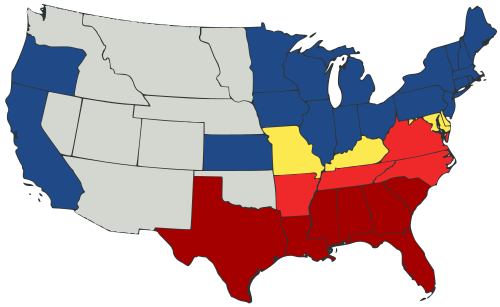
1861 年の州の状況
1861年4月15日以前に脱退した奴隷州
1861年4月15日以降に脱退した奴隷州
奴隷制を認めたが脱退しなかった南部の国境州(ケンタッキー州とミズーリ州はどちらも南部連合と北部連合の二重政権が競合していた)
奴隷制を禁止した連邦州
領土
リンカーンの当選は、サウスカロライナ州議会に脱退を検討する州会議を招集するきっかけとなった。サウスカロライナ州は、州には連邦法を無効にし、脱退する権利があるという考えを他のどの州よりも推進してきた。1860年12月20日、会議は満場一致で脱退を可決し、脱退宣言を採択した。宣言では奴隷所有者に対する州の権利を主張したが、北部の州が逃亡奴隷の返還を支援する義務を果たしていないとして、連邦逃亡奴隷法への抵抗という形で北部の州の権利に不満を述べた。ミシシッピ、フロリダ、アラバマ、ジョージア、ルイジアナ、テキサスの「綿花州」もこれに倣い、1861年1月と2月に脱退した。[25]
脱退条例のうち、テキサス、アラバマ、バージニアの条例では、北部の奴隷制度廃止論者の手による「奴隷所有州」の窮状に言及していた。残りの条例では奴隷制度については触れられておらず、議会による連邦とのつながりの解消の短い発表であった。[27]しかし、少なくとも4州、サウスカロライナ、[28]ミシシッピ、[29]ジョージア、[30]テキサス[31]は脱退の詳細な理由を示しており、いずれも奴隷制度廃止運動とそれが北部に及ぼす影響を非難していた。南部の州は逃亡奴隷条項によって奴隷所有が憲法上の権利となったと信じていた。これらの州は1861年2月4日、新たな連邦政府、アメリカ連合国を結成することに合意した。 [32] 3月4日に任期が満了したジェームズ・ブキャナン大統領の抵抗もほとんどなく、州境内の連邦砦やその他の資産を掌握した。ブキャナンは、ドレッド・スコット判決は南部諸州が脱退する理由がなく、連邦は「永続するはずだった」ことの証拠だと述べた。しかし、彼は「武力によって州を連邦に残留させる権限」は「議会に与えられた列挙された権限」には含まれていないと付け加えた。[33] 2月、アメリカ軍の4分の1、テキサス駐屯軍が、南部連合に加わった将軍デビッド・E・トゥイッグスによって州軍に引き渡された。[34]
南部人が上院と下院の議席を辞任したため、共和党はこれまで阻止されていた計画を通過させることができた。これにはモリル関税、土地付与大学、ホームステッド法、大陸横断鉄道、[35]国立銀行法、1862年法定通貨法による米国紙幣の認可、コロンビア特別区における奴隷制の廃止などが含まれる。1861年歳入法は戦争資金を調達するために所得税を導入した。 [36]

1860年12月、ミズーリ妥協案の線を再構築するクリッテンデン妥協案が提案された。これは、ミズーリ妥協案の北側の領土では奴隷制を憲法で禁止し、南側では奴隷制を認めるというものだった。この妥協案はおそらく脱退を阻止するものだったが、リンカーンと共和党はこれを拒否した。[37]リンカーンは、奴隷制を拡大するいかなる妥協も連邦を崩壊させると述べた。[38] 2月にワシントンで平和会議が開催され、この妥協案に似た解決策が提案されたが、議会で拒否された。共和党は、奴隷制が存在する地域ではこれに干渉しないという代替案としてコーウィン修正案を提案したが、南部は不十分だとみなした。残りの8つの奴隷州は、4月4日のバージニア州の第1回脱退者会議で反対票が投じられたことを受けて、南部連合への加盟嘆願を却下した。[39]
3月4日、リンカーンは大統領に就任した。就任演説で、リンカーンは合衆国憲法は以前の連合規約や永久連合よりも完全な連合であり、拘束力のある契約であると主張し、脱退は「法的に無効」であると述べた。[40]リンカーンは南部諸州を侵略するつもりはなく、奴隷制が存在する場所でそれを終わらせるつもりもなかったが、押収された砦、兵器庫、造幣局、税関を含む連邦政府の財産の保持のために武力を行使すると述べた。 [ 40 ]政府は郵便局の回復を試みず、抵抗された場合、郵便配達は州境で終了する。連邦法の平和的執行が不可能な状況では、合衆国保安官と裁判官は撤退する。造幣局から失われた金塊については言及されなかった。彼は「関税と輸入税を徴収する」のが米国の政策であると述べた。 「いかなる場所においても、武装革命を正当化するような侵略や武力の使用は行われない」。彼の演説は、二つの地域を結びつける「記憶の神秘的な弦」に呼びかけ、連合の絆の回復を訴えて締めくくられた。[40]
新しい連合国のデイビス政権は、平和条約を交渉するためにワシントンに代表団を派遣した。リンカーンは、連合国は正当な政府ではなく、連合国と条約を結ぶことは連合国を正当な政府として承認することになるとの理由で交渉を拒否した。[42]リンカーンは代わりに、脱退した州の知事と直接交渉しようとし、その州の政権を承認し続けた。[43]
リンカーンの危機を鎮めようとする試みを複雑にしたのは、共和党の指名をめぐってリンカーンのライバルだった国務長官ウィリアム・H・スワードだった。敗北に憤慨したスワードは、当時リンカーンに次ぐ権力を持つと考えられていた行政府の地位が保証されて初めて、リンカーンの立候補を支持することに同意した。リンカーンの大統領就任当初、スワードはリンカーンをあまり評価していなかった。それはリンカーンが経験不足だと思われていたためだった。スワードは、自分を事実上の政府のトップ、玉座の背後にいる「首相」だと考えていた。スワードは許可されていない間接的な交渉に加わろうとしたが、失敗した。 [42]リンカーンは、バージニア州のモンロー砦、フロリダ州のピケンズ砦、ジェファーソン砦、テイラー砦、サウスカロライナ州のサムター砦など、南軍に残っていた北軍の砦をすべて保持する決意だった。[44]
サムター要塞の戦い

アメリカ南北戦争は、1861年4月12日、南軍が北軍の占拠するサムター要塞に砲撃を開始したことで始まった。サムター要塞はサウスカロライナ州チャールストンの港にある。 [45]その地位をめぐっては、何ヶ月も論争が続いていた。退任するブキャナン大統領は、ロバート・アンダーソン少佐が指揮するサムター要塞の守備隊の増強をためらっていた。アンダーソンは自ら問題に取り組み、1860年12月26日、闇に紛れて、不利な立地のモールトリー要塞から堅固な島サムター要塞へと守備隊を移動させた。[46]アンダーソンの行動により、彼は北部で英雄の地位に躍り出た。1861年1月9日の要塞への補給の試みは失敗し、その時に戦争が勃発しそうになったが、非公式の休戦が維持された。[47] 3月5日、リンカーンは要塞の物資が不足していると知らされた。[48]
サムター要塞はリンカーン政権にとって重要な難題であった。[48]スワードと南軍との裏交渉はリンカーンの意思決定を弱体化させ、スワードは撤退を望んだ。[49]しかしリンカーンの強硬な姿勢は、リンカーンの忠実な同盟者であったスワードを従わせた。リンカーンは要塞を保持すること、そのためには要塞の強化が必要であるが、それが唯一の実行可能な選択肢であると決定した。4月6日、リンカーンはサウスカロライナ州知事に、食料は積んでいるが弾薬は積んでいない船が要塞に補給を試みるだろうと伝えた。歴史家マクファーソンは、この双方に利益のあるアプローチを「リンカーンの大統領職を特徴づける最初の巧妙さの兆候」と表現している。補給して要塞を保持できれば北軍は勝利し、飢えた兵士を補給する非武装の船に南軍が発砲すれば南軍は攻撃者となる。[50] 4月9日の南軍閣議の結果、デイビスはPGTボーリガード将軍に補給が到着する前に要塞を占領するよう命じた。[51]
4月12日午前4時30分、南軍は4,000発の砲弾のうち最初の1発を砦に発射し、翌日砦は陥落した。サムター要塞の喪失は北軍の愛国心を燃え上がらせた。[52] 4月15日、リンカーンは各州に90日間75,000人の志願兵を派遣するよう要請し、熱心な北軍各州はすぐに割り当て数を満たした。 [53] 1861年5月3日、リンカーンは3年間でさらに42,000人の志願兵を要請した。[54] [55]この直後、バージニア州、テネシー州、アーカンソー州、ノースカロライナ州が脱退し、南軍に加わった。バージニア州への報奨として、南軍の首都はリッチモンドに移された。[56]
国境諸国の態度
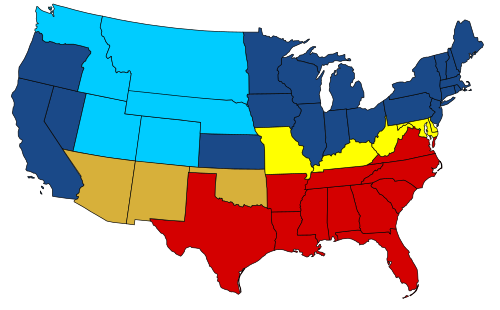
連合州
奴隷制を認めない連邦直轄領
(これらの州のうちの 1 つであるウェストバージニア州は 1863 年に設立されましたが、ケンタッキー州、ウェストバージニア州、ミズーリ州では南部連合と北部連合の政府が競合していました) 南部連合諸州
戦争開始時には奴隷制を認めていた(南部連合が領有権を主張)が、1862年に米国によって奴隷制が禁止された連邦直轄地
メリーランド、デラウェア、ミズーリ、ウェストバージニア、ケンタッキーは奴隷州であり、住民は北部と南部の事業や家族に忠誠を誓っていた。北軍に入隊した者もいれば、南軍に入隊した者もいた。[57] ウェストバージニアはバージニアから分離し、1863年6月20日に連邦に加盟したが、郡の半分は脱退派だった。[58]
メリーランド州の領土はワシントン D.C.を取り囲んでおり、北部から切り離すことができた。[59]メリーランド州には反リンカーン派の役人がおり、ボルチモアでの反軍暴動や橋の焼き打ちを容認していたが、どちらも南部への軍隊の通過を妨害することが目的だった。メリーランド州議会は連邦に留まることに圧倒的多数で投票したが、南部の隣国との敵対行為は拒否し、戦争に利用されるのを防ぐためメリーランド州の鉄道を閉鎖することに投票した。[60]リンカーンはこれに応じて戒厳令を敷き、メリーランド州での人身保護令状請求権を一方的に停止し、民兵部隊を派遣した。[61]リンカーンはメリーランド州議会が再開した日にその議員の3分の1を逮捕するなど、著名人を逮捕してメリーランド州とコロンビア特別区を掌握した。 [60] [62]全員が裁判なしで拘留されたが、リンカーンは1861年6月1日に最高裁判所長官ロジャー・タニーが下した、連邦議会のみが人身保護令状を停止できるという判決を無視した(メリーマン側による一方的判決)。連邦軍は、リンカーンがタニーの判決を無視したとして社説でリンカーンを批判したボルチモアの新聞編集者フランク・キー・ハワードを投獄した。[65]
ミズーリ州では、選出された脱退会議で連邦残留が決議された。南部連合支持派のクレイボーン・F・ジャクソン知事が州民兵を召集すると、ナサニエル・ライアン将軍率いる連邦軍が攻撃し、知事と州兵の残りをミズーリ州南西部まで追った(ミズーリ州脱退を参照)。戦争初期には南部連合はミズーリ州政府を通じてミズーリ州南部を支配していたが、1862年以降は追い出された。その結果生じた空白の中で、脱退会議が再び招集され、ミズーリ州の連邦派暫定政府として権力を握った。[66]
ケンタッキー州は脱退せず、中立を宣言した。1861年9月に南軍が侵攻すると、中立は終了し、州は奴隷制を維持しながら連邦の地位を再確認した。1861年の南軍の侵攻中、南軍の支持者とケンタッキー州68郡の代表が脱退ラッセルビル会議を組織し、影のケンタッキー州政府を結成し、知事を就任させ、1861年12月10日にケンタッキーは南軍に加盟した。その管轄権はコモンウェルス内の南軍戦線までしか及ばず、最大で州の半分以上を占め、1862年10月以降は追放された。[67]
バージニア州の脱退後、ホイーリングの連邦政府は1861年10月に48郡に新州創設条例の採決を求めた。投票率は34%で州法案は承認された(96%が承認)。[68] 24の脱退派郡が新州に含まれ、[69]続いて起こったゲリラ戦では、戦争の大半で連邦軍約4万人が投入された。[70] [71]連邦議会は1863年6月20日にウェストバージニア州を連邦に加盟させた。ウェストバージニア州民は戦争で両陣営に約2万人の兵士を派遣した。[72]東テネシー州で連邦派の脱退未遂事件が発生したが、南軍によって鎮圧され、連邦への忠誠を疑われた3,000人以上の男が逮捕されたが、裁判も行われずに拘留された。[73]
戦争
南北戦争は激しい戦闘が頻繁に起こったことで特徴づけられた。4年間で237の戦闘が行われたほか、小規模な戦闘も数多く行われたが、その多くは激しい戦闘と高い死傷者を出した。歴史家ジョン・キーガンは南北戦争を「史上最も残忍な戦争の一つ」と評し、多くの場合、唯一の標的は敵の兵士だけだったとしている。[74] [75]
動員

南部連合諸州が組織化すると、アメリカ陸軍の兵力は16,000人となり、北部の知事たちは民兵を動員し始めた。[76]南部連合議会は2月に10万人の兵力派遣を承認した。5月までにジェファーソン・デイヴィスは1年間またはその期間中さらに10万人の兵力派遣を要求し、米国議会もそれに応えた。[77] [78]
戦争の最初の年、両陣営とも、効果的に訓練し装備できる以上の志願兵を抱えていた。当初の熱意が薄れると、毎年成人する若者に頼るだけでは不十分だった。両陣営は、志願兵を奨励または強制するために徴兵法(徴兵)を制定したが、徴兵されたのは比較的少数だった。南部連合は、監督官、政府高官、聖職者を例外として、18~35歳の男性を対象とした徴兵法を1862年4月に可決した。米国議会は7月にこれに続き、志願兵で定員を満たせない州内での民兵徴兵を認可した。ヨーロッパからの移民は大量に北軍に加わり、ドイツ生まれの17万7000人とアイルランド生まれの14万4000人が含まれた。[79]約5万人のカナダ人が従軍し、そのうち約2500人が黒人だった。[80]
1863年1月に奴隷解放宣言が発効すると、州の割当数を満たすために元奴隷が精力的に募集された。州や地方自治体は白人志願兵に高額の現金ボーナスを提供した。議会は1863年3月に徴兵法を厳格化した。徴兵で選ばれた男性は代理を立てることができ、1864年半ばまでは代替金を支払うことができた。多くの適格者は徴兵された人の費用を賄うために金を出し合った。家族は代理規定を利用して、どの男性が軍隊に行き、どの男性が家に残るか選択した。特にカトリック地域では、徴兵を忌避したり抵抗したりする者が多かった。 1863年7月のニューヨーク市徴兵暴動には、市の民主党政治機構の票を増やすために市民として登録されたアイルランド移民が関与していたが、それが自分たちが徴兵対象になることに気付いていなかった。[81]徴兵によって北軍に徴集された168,649人のうち、117,986人が補充兵であり、徴兵されたのは50,663人だけだった。[82]
北部と南部では、徴兵法は非常に不評だった。北部では、約 12 万人の男性が徴兵を逃れ、その多くはカナダに逃げ、さらに 28 万人の兵士が戦争中に脱走した。[83]少なくとも 10 万人の南部人が脱走し、これは全体の約 10 パーセントにあたる。南部の脱走率が高いのは、兵士の多くが南部の大義よりも地元の運命を心配していたためである。[84]北部では、「賞金稼ぎ」が高額のボーナスを狙って入隊し、脱走した後、別の名前で再入隊して 2 回目のボーナスを狙った。141 人が捕らえられ、処刑された。[85]
1860年に小さな辺境軍だった北軍と南軍は、数年のうちに「世界最大かつ最も有能な軍隊」に成長した。当時のヨーロッパの観察者の中には、彼らをアマチュアで非専門家として軽視する者もいたが[86]、歴史家ジョン・キーガンは、北軍と南軍はいずれもフランス軍、プロイセン軍、ロシア軍を圧倒し、大西洋がなければ、どの軍も敗北の脅威にさらされていただろうと結論付けた[87] 。
囚人
戦争が始まった当初は仮釈放制度が施行され、捕虜は交換されるまで戦闘を行わないことに同意した。捕虜は自国の軍隊が運営する収容所に収容され、給料は支払われたが、軍務に就くことは許されなかった。[88]交換制度は1863年に南軍が黒人捕虜の交換を拒否したため崩壊した。その後、409,000人の捕虜のうち約56,000人が刑務所で死亡し、戦争での死者数の10%を占めた。[89]
女性
歴史家エリザベス・D・レナードは、 500人から1,000人の女性が男性に変装して両軍の兵士として入隊したと書いている。[90]女性たちはスパイ、レジスタンス活動家、看護師、病院職員としても働いた。[91]女性たちは北軍の病院船レッド・ローバーに乗り込み、野戦病院で北軍と南軍の兵士を看護した。[92] メアリー・エドワーズ・ウォーカーは名誉勲章を受章した唯一の女性で、北軍に従軍し、戦争中に負傷者を治療したことで勲章を受章した。[93] [94]
海軍戦術

1861年の小規模なアメリカ海軍は、1865年までに士官6,000人、水兵45,000人にまで急速に拡大し、総トン数は671隻、総トン数は510,396トンとなった。 [95] [96]その任務は、南軍の港を封鎖し、河川システムを制御し、公海上で南軍の襲撃者から防衛し、イギリス海軍との戦争に備えることであった。[97]主な河川戦争は、南軍の中心地に通じる大河が流れている西部で戦われた。アメリカ海軍は最終的にレッド川、テネシー川、カンバーランド川、ミシシッピ川、オハイオ川を支配した。東部では、海軍は南軍の砦を砲撃し、沿岸軍の作戦を支援した。[98]
南北戦争は産業革命の初期に起こり、海軍の革新、特に装甲艦の登場につながった。南軍は北軍の海軍の優位に対抗する必要性を認識し、装甲艦26隻を含む130隻以上の船を建造または改造した。[99]努力にもかかわらず、南軍の船は北軍の装甲艦に対してほとんど成果を上げなかった。[100]北軍の海軍は木材被覆船、ティンクラッド船、装甲砲艦を使用した。カイロ、イリノイ州、セントルイスの造船所では蒸気船の建造または改造が行われた。[101]
南軍は、成功しなかった潜水艦 CSS ハンリーと、沈没した北軍の艦メリマックから再建された装甲艦CSS バージニアで実験した。[102] 1862年3月8日、バージニアは北軍の木造艦隊に大きな損害を与えたが、翌日、北軍の最初の装甲艦であるUSS モニターがチェサピーク湾に到着し、これに挑んだ。その結果生じた3時間にわたるハンプトン・ローズ海戦は引き分けとなり、装甲艦が効果的な軍艦であることを証明した。[103]南軍はバージニアの拿捕を防ぐために自沈し、北軍はモニターの複製を多数建造した。南軍がイギリスから軍艦を獲得しようとした努力は失敗した。イギリスはより強い敵と戦争中の国に軍艦を売るつもりはなく、米国との関係悪化を恐れたためである[104]。
連合の封鎖

1861年初頭までに、ウィンフィールド・スコット将軍は、流血を最小限に抑えて戦争に勝つためのアナコンダ計画を考案し、南部を窒息させて降伏させるために南軍を封鎖することを要求した。 [105]リンカーンは計画の一部を採用したが、より積極的な戦争戦略を選択した。[106] 1861年4月、リンカーンは南部のすべての港を封鎖すると発表。商業船は保険をかけられず、定期的な航行が停止した。封鎖が完全に効力を発揮する前に綿花の輸出を禁じるという失策を犯した南部は、この決定を覆す頃には手遅れだった。「綿花王」は死んだ。南部は綿花の10%未満しか輸出できなかったからだ。封鎖により、綿花のほとんどを輸送していた鉄道の終点がある10の南軍港が閉鎖された。1861年6月までに、軍艦が南部の主要港の沖に駐留し、1年後には300隻近くの船が就航していた。[107]
封鎖突破船

南軍は農業国である南部では生産できない軍事物資が不足した状態で戦争を開始した。北部の武器製造業者は禁輸措置により制限され、南部との既存および将来の契約は終了した。南軍は外国の供給源に目を向け、イギリスのS・アイザック・キャンベル・アンド・カンパニーやロンドン武器庫などの金融業者や企業と提携し、南軍の主な武器供給源となった。[108] [109]
武器を安全に南部連合に輸送するため、イギリスの投資家たちは小型で高速な蒸気駆動の封鎖突破船を建造し、イギリスからバミューダ、キューバ、バハマを経由して高価な綿花と引き換えに武器や物資を輸送した。その多くは軽量でスピードを重視した設計で、少量の綿花のみをイギリスに運んだ。[110]北軍が封鎖突破船を拿捕すると、船と積荷は戦争の戦利品として没収され、売却され、その収益は海軍の水兵に渡された。捕らえられた乗組員のほとんどはイギリス人だったが、解放された。[111]
経済への影響
南部の経済は、深刻な食糧不足、鉄道の破綻、主要な河川の制御の喪失、北軍による食料調達、南軍による家畜や作物の押収など、さまざまな要因により、戦争中にほぼ崩壊した。[112]歴史家は、封鎖が南軍経済を破滅させた主な要因であることに同意している。しかし、ワイズは、封鎖突破者が、国内経済ではもはや供給できない40万丁のライフル、鉛、毛布、ブーツなどの物資を提供し、リーがさらに数か月間戦い続けるのに十分な生命線を提供したと主張している。[112]
サーダムは、封鎖は強力な武器であり、戦闘で命を落とす人はほとんどいなかったものの、最終的には南部の経済を破滅させたと主張している。南軍の綿花の収穫はほとんど役に立たなくなり、南軍の主な収入源が断たれた。重要な輸入品は不足し、沿岸貿易もほぼ終了した。[113]封鎖の成功は、封鎖をくぐり抜けた数隻の船ではなく、封鎖を試みなかった数千隻の船で測られた。ヨーロッパの商船は保険をかけることができず、封鎖をくぐり抜けるには遅すぎたため、南軍の港に寄港しなくなった。[114]
攻勢戦争を戦うために、南部連合はイギリスで武器を購入し、イギリス製の船を通商破壊船に改造した。60万個の武器を密輸したおかげで南部連合はさらに2年間戦い続けることができた。[115] [116]通商破壊船は大西洋と太平洋でアメリカ商船を標的にした。保険料率は急騰し、アメリカの国旗は国際水域から事実上姿を消したが、船をヨーロッパの国旗に張り替えることで妨害を受けずに航行を続けることができた。 [100]戦後、アメリカ政府はイギリスに対し、イギリスの港に配備された封鎖突破船と通商破壊船によって引き起こされた損害の賠償を要求した。イギリスは1871年に1500万ドルを支払ったが、それは通商破壊に対してのみだった。[117]
ディンカスランは、封鎖のもう一つの結果は石油が重要な商品として台頭したことであると主張する。衰退しつつあった鯨油産業は、ストーン・フリートのような多くの古い捕鯨船が封鎖活動に使われ、南軍の襲撃者が北軍の捕鯨船を攻撃したため、打撃を受けた。石油製品、特に灯油はランプの鯨油に取って代わり、燃焼エンジンの燃料になるずっと前から石油の重要性が高まっていた。[118]
外交
_(1909)_(14782634093).jpg/500px-thumbnail.jpg)
南部連合はイギリスとフランスが連合に対抗するために協力してくれることを期待していたが、その見込みはなかったので、両国を調停者として引き入れようとした。[119] [120]連合はこれを阻止しようとし、いずれかの国が南部連合を承認した場合は戦争を起こすと脅した。1861年、南部人はヨーロッパで経済不況を引き起こしてイギリスを参戦させようと、自発的に綿花の輸出を禁輸したが、これは失敗した。さらに悪いことに、ヨーロッパは綿花をエジプトとインドに求め、そちらの方が優れていると考えたため、南部の戦後復興が妨げられた。[121] [122]
綿花外交は失敗に終わり、ヨーロッパでは綿花が余剰となり、1860年から1862年にかけてヨーロッパで起きた不作により北部の穀物輸出が極めて重要になった。また、ヨーロッパの世論が南部連合に反対する方向に転じるきっかけにもなった。米国の穀物輸入がイギリスの輸入量の4分の1からほぼ半分に増えたため、「穀物王は綿花王よりも強大」と言われていた。[121]一方、戦争により武器製造業者、鉄工、武器輸送船の雇用が創出された。[122]
リンカーン政権は当初、ヨーロッパの世論に訴えるのに苦労した。当初、外交官は、米国は奴隷制を終わらせるつもりはないと説明し、脱退の違憲性に関する法的議論を強調した。しかし、南部連合の代表は、自由のための闘争、自由貿易への取り組み、ヨーロッパ経済における綿花の重要な役割に焦点を当てた。[123]ヨーロッパの貴族は、「アメリカの大失敗は、民衆による政治の実験全体が失敗した証拠であると大喜びで宣言した。ヨーロッパの政府指導者は、台頭するアメリカ共和国の分裂を歓迎した。」[124]しかし、リベラルな感性を持つヨーロッパの世論は残っており、米国は国際報道機関とのつながりを築くことで、彼らに訴えようとした。1861年までに、カール・シュルツなどの北軍外交官は、奴隷制との戦いを強調することが、ヨーロッパの世論を動かす上で北軍の最も効果的な道徳的資産であることを認識した。スワードは、再統一の過度に過激な主張は、綿花に関心を持つヨーロッパの商人を困惑させるのではないかと懸念した。それでも彼は、公共外交の広範なキャンペーンを支持した。[125]
駐英米国公使チャールズ・フランシス・アダムスは有能な手腕を発揮し、英国が北軍の封鎖に抵抗しないよう説得した。南軍は英国の民間造船所から軍艦を購入したが、最も有名なのはCSS アラバマ号で、かなりの損害を引き起こし、戦後の深刻な紛争につながった。しかし、奴隷制反対運動が強かった英国では、奴隷制反対の世論が政治家にとって政治的な負担となった。[126]
1861年後半、トレント事件をめぐって米英間に戦争の危機が迫った。この事件は米海軍が英艦トレント号に乗り込み、南軍の外交官2人を拘束したことに端を発した。しかし、リンカーンが2人を釈放すると、ロンドンとワシントンはこれを収拾した。[127] トレント事件の間、アルバート王子は死の床からライアンズ卿に外交指示を出した。彼の要請は尊重され、その結果、イギリスの米国に対する反応は和らぎ、戦争は回避された。[128] 1862年、イギリス政府は北軍と南軍の調停を検討したが、そのような申し出は米国との戦争を招くリスクがあった。英首相パーマストン卿は、決断を下すにあたり『アンクル・トムの小屋』を3回読んだと伝えられている。 [127]
アンティータムの戦いで北軍が勝利したため、イギリスはこの決定を遅らせた。奴隷解放宣言により、南軍支援の政治的責任が増大した。南軍がテキサスを支配している限りワシントンはメキシコに介入できないと悟ったフランスは、 1861年にメキシコに侵攻し、ハプスブルク家のオーストリア大公 マクシミリアン1世を皇帝に据えた。[129]ワシントンはフランスによるモンロー主義違反を繰り返し抗議した。南軍への同情にもかかわらず、フランスはメキシコを占領したことで、最終的に北軍との戦争を思いとどまらせた。戦争末期に南軍が外交承認と引き換えに奴隷制を廃止するという申し出は、ロンドンやパリでは真剣に検討されなかった。1863年以降、ロシアに対するポーランドの反乱によりヨーロッパ諸国の注意がさらに逸らされ、中立を維持した。[130]
ロシアは、主に米国が地政学的なライバルである英国に対するカウンターバランスとして機能すると信じていたため、連合を支持した。1863年、ロシア海軍のバルト海艦隊と太平洋艦隊は、それぞれアメリカのニューヨークとサンフランシスコの港で冬を過ごした。[131]
東部劇場

東部戦線は、バージニア州、ウェストバージニア州、メリーランド州、ペンシルベニア州、コロンビア特別区、ノースカロライナ州の沿岸要塞や港湾を含むアパラチア山脈の東側での軍事作戦を指します。[132]
背景
ポトマック軍
ジョージ・B・マクレラン少将は1861年7月26日に北軍ポトマック軍の指揮を執り、1862年に戦争が本格的に始まった。1862年の北軍の戦略は、4つの軸に沿って同時に前進することを求めていた。[133]
- マクレランはバージニア州のリッチモンド方面への主力攻撃を率いる予定だった。
- オハイオ州軍はケンタッキー州を通ってテネシー州へ進軍するだろう。
- ミズーリ管区はミシシッピ川に沿って南へ進む予定だ。
- 最も西側の攻撃はカンザス州から始まるだろう。
北バージニア軍

東部戦線における南軍の主力は北バージニア軍であった。同軍は、1861年6月20日に北バージニアの全作戦部隊から編成された(南軍の)ポトマック軍として発足した。7月20日と21日には、シェナンドー軍とハーパーズ・フェリー地区の部隊が加わった。 1862年3月14日から5月17日の間に、北西軍の部隊がポトマック軍に統合された。ポトマック軍は3月14日に北バージニア軍に改名された。1862年4月12日には半島軍がこれに統合された。
1861年4月にバージニア州が脱退を宣言したとき、ロバート・E・リーは、国がそのまま残ることを望み、北軍の上級司令官の申し出があったにもかかわらず、故郷の州に従うことを選んだ。リーの伝記作家ダグラス・S・フリーマンは、1862年6月1日にリーが指揮権を握る命令を出したときに、軍は最終的にその名前をもらったと主張している。 [134]しかし、フリーマンは、その日付より前にリーが陸軍指揮官の前任者であるジョセフ・E・ジョンストン准将と手紙をやり取りし、ジョンストンの指揮を北バージニア軍と呼んでいたことは認めている。この混乱の一部は、ジョンストンが北バージニア軍団を指揮していた(1861年10月22日時点)という事実に起因しており、北バージニア軍という名称は、その親軍団の名前から非公式に派生したものと見なすことができる。ジェファーソン・デイヴィスとジョンストンはこの名前を採用しなかったが、3月14日時点の部隊編成はリーが6月1日に受け取ったものと同じであったことは明らかであり、そのため、たとえ後から振り返ってみれば正しいとはいえ、今日では一般的に北バージニア軍と呼ばれている。
7 月 4 日、ハーパーズ フェリーで、トーマスJ. ジャクソン大佐はジェブ スチュアートにシェナンドー軍の全騎兵中隊の指揮を 任せました。彼は最終的に北バージニア軍の騎兵隊を指揮しました。
戦闘
1861 年 7 月、最初の注目度の高い戦闘の 1 つである第 1 次ブルランの戦いで、アーヴィン・マクドウェル少将 の指揮下にある北軍がワシントン近郊でボーリガード率いる南軍を攻撃し、撃退されました。
北軍は当初優勢で、防御陣地を固めていた南軍をほぼ敗走に追い込んだが、ジョセフ・E・ジョンストン率いる南軍の援軍が鉄道でシェナンドー渓谷から到着し、戦闘の流れは急速に変わった。バージニア陸軍士官学校出身の比較的無名の准将トーマス・J・ジャクソン率いるバージニア旅団は持ちこたえ、その結果ジャクソンは有名なニックネーム「ストーンウォール」をもらった。
リンカーン大統領の攻撃開始の要請を受けて、マクレランは1862年春、リッチモンド南東のヨーク川とジェームズ川の間の半島を経由してバージニアを攻撃した。マクレラン軍は半島作戦でリッチモンドの門に到達した。[135] [136] [137]

1862 年の春には、シェナンドー渓谷でストーンウォール ジャクソンが渓谷方面作戦を指揮した。ジャクソンの 17,000 人の部隊は、内陸線で大胆に急速かつ予測不可能な動きをし、48 日間で 646 マイル (1,040 km) を行軍し、ナサニエル P. バンクスやジョン C. フリーモントの部隊を含む 3 つの北軍 (52,000 人) と交戦して小規模な戦闘に勝利し、リッチモンドに対する北軍の攻勢を阻止した。ジャクソンの部隊の素早さから、「徒歩騎兵隊」というあだ名が付けられた。
ジョンストンはセブンパインズの戦いでマクレランの進撃を阻止したが、戦闘中に負傷し、ロバート・E・リーが指揮官の地位を引き継いだ。リーと部下のジェームズ・ロングストリートとストーンウォール・ジャクソンは七日間の戦いでマクレランを打ち破り、撤退を余儀なくした。[138]
第二次ブルランの戦いを含む北バージニア方面作戦は、またしても南部の勝利に終わった。[139]マクレランは、ジョン・ポープ率いる北軍バージニア軍に援軍を送るよう命じたハレック将軍の命令に抵抗し、そのおかげでリーの南軍は敵軍の総勢2倍の兵力を破りやすくなった。[140]
第二次ブルランの戦いで勢いづいた南軍は、メリーランド方面作戦で初めて北部に侵攻した。9月5日、リーは北バージニア軍の4万5千人の兵士を率いてポトマック川を渡りメリーランドに侵入した。リンカーンはその後、ポープ将軍の軍隊をマクレラン将軍のもとに復帰させた。マクレラン将軍とリーは1862年9月17日、メリーランド州シャープスバーグ近郊でアンティータムの戦いで戦ったが、これは米国軍事史上最も血なまぐさい一日となった。[138] [141]ついに抑えられたリー軍は、マクレラン将軍が壊滅させる前にバージニアに戻った。アンティータムの戦いは、リー軍の北部侵攻を阻止し、リンカーンが奴隷解放宣言を発表する機会を与えたため、北軍の勝利とみなされている。[142]
慎重なマクレランがアンティータムへの追撃に失敗すると、アンブローズ・バーンサイド少将が交代した。バーンサイドは1862年12月13日のフレデリックスバーグの戦い[143]で敗北し、マリーズ高地への無駄な正面攻撃で12,000人以上の北軍兵士が死亡または負傷した。[144]戦闘後、バーンサイドはジョセフ・フッカー少将に交代した。[145]

フッカーもまた、リー軍を破ることができなかった。南軍の2倍以上の兵力で優勢だったにもかかわらず、チャンセラーズヴィル方面作戦は効果がなく、1863年5月のチャンセラーズヴィルの戦いで屈辱を味わった。 [146]チャンセラーズヴィルは、はるかに大きな敵軍がいる中で軍を分割するというリーの危険な決断が南軍の大きな勝利をもたらしたため、リーの「完璧な戦い」として知られている。ストーンウォール・ジャクソンは、戦闘中に味方の銃撃で左腕と右手を撃たれた。腕は切断されたが、肺炎で死亡した。[147]リーは、「彼は左腕を失ったが、私は右腕を失った」という有名な言葉を残している。[148]
戦闘で最も激戦となり、南北戦争で2番目に血なまぐさい日となった5月3日は、リーがチャンセラーズヴィルの北軍陣地に対して何度も攻撃を仕掛けた日だった。同日、ジョン・セジウィックはラッパハノック川を渡り、第二次フレデリックスバーグの戦いでマリーズハイツの南軍の小部隊を破り、その後西に移動した。南軍はセイラム教会の戦いで遅滞作戦を成功させた。[149]
6月のリー軍の第二次北部侵攻の際、フッカー将軍はジョージ・ミード少将に交代した。ミードはゲティスバーグの戦い(1863年7月)でリー軍を破った。[150]これは最も血なまぐさい戦いであり、戦争の転換点と呼ばれている。7月3日のピケットの突撃は、南軍の重大な勝利の脅威が崩れたことを告げるものであったため、南軍の最高潮と見なされている。リー軍の死傷者は28,000人、ミード軍の死傷者は23,000人であった。[151]
西洋演劇
西部戦線は、アパラチア山脈とミシシッピ川の間の軍事作戦を指し、アラバマ州、ジョージア州、フロリダ州、ミシシッピ州、ノースカロライナ州、ケンタッキー州、サウスカロライナ州、テネシー州、ルイジアナ州の一部が含まれます。[152]
背景
テネシー軍とカンバーランド軍
.jpg/500px-Gen._Ulysses_S._Grant_(4228634580).jpg)
この戦域における北軍の主力は、テネシー軍とカンバーランド軍であり、テネシー川とカンバーランド川の2つの川にちなんで名付けられた。ミードの秋の作戦が決着をつかなかった後、リンカーンは西部戦域に新たな指導者を求めた。同時に、南軍の拠点であるビックスバーグが降伏し、北軍がミシシッピ川を掌握することになり、西部連合は永久に孤立し、リンカーンが必要としていた新しい指導者、ユリシーズ・グラントが誕生した。[153]
テネシー軍
西部戦線における南軍の主力はテネシー軍であった。この軍は1862年11月20日、ブラクストン・ブラッグ将軍が旧ミシシッピ軍を改名して結成された。南軍は東部戦線では成功を収めたが、西部戦線では何度も敗北した。[152]
戦闘
北軍の西部における主要な戦略家および戦術家はユリシーズ・グラントであり、ヘンリー砦(1862年2月6日)とドネルソン砦(1862年2月11日から16日)で勝利を収め、「無条件降伏」グラントというあだ名を得た。これらの勝利により、北軍はテネシー川とカンバーランド川の支配権を獲得した。[154]ネイサン ・ベッドフォード・フォレストは4,000人近い南軍兵士を結集し、彼らをカンバーランド川を渡って逃走させた。こうしてナッシュビルとテネシー州中部は北軍の手に落ち、地元の食糧供給と家畜の消耗と社会組織の崩壊を招いた。[要出典]
南軍の将軍レオニダス・ポークのコロンバス侵攻により、ケンタッキー州の中立政策は終わり、南軍に敵対することになった。グラントは川の輸送と西部艦隊のアンドリュー・ハル・フットの砲艦を使って、ケンタッキー州コロンバスの南軍の「西のジブラルタル」を脅かした。ベルモントでは撃退されたが、グラントはコロンバスを遮断した。南軍は砲艦を失い撤退を余儀なくされ、北軍は西ケンタッキーを支配し、1862年3月にテネシー州を解放した。[155]
1862年4月、テネシー州シャイローで行われたシャイローの戦いで、南軍は夜になると奇襲を仕掛け、北軍を川の方へ押しやった。その夜、海軍は援軍を上陸させ、グラントは反撃した。グラントと北軍は決定的な勝利を収めた。これは、その後何度も繰り返されることになる高い死傷率を伴った最初の戦いであった。[156]南軍は、リーが出現する前は最高の将軍と考えられていたアルバート・シドニー・ジョンストンを失った。 [157]
北軍の初期の目標の一つは、ミシシッピ川を占領して南軍を半分に減らすことだった。ミシシッピ川は、アイランドNo.10とミズーリ州ニューマドリッド、そしてテネシー州メンフィスを占領することで、テネシー州南部の国境まで北軍の交通に開放された。[158]
1862年4月、北軍海軍はニューオーリンズを占領した。[158]「川の鍵は、南部最大の港であり、最大の産業中心地であるニューオーリンズだった。」[159]ファラガット指揮下の米海軍は、ニューオーリンズ南部の南軍防衛線を突破した。南軍はニューオーリンズを放棄し、北軍に南部奥地の重要な拠点を与えた。[160]これにより、北軍はミシシッピ川を遡上することができた。メンフィスは1862年6月6日に北軍の手に落ち、ミシシッピ川沿いに南へさらに前進するための重要な基地となった。ミシシッピ州の要塞都市ビックスバーグだけが、北軍による川全体の支配を阻止した。[161]
南軍のハートランド攻勢におけるブラッグの2度目のケンタッキー侵攻では、リッチモンドの戦いでのカービー・スミスの勝利や、1862年9月3日のケンタッキー州都フランクフォートの占領など、初期の成功を収めた。 [162]しかし、この作戦はペリービルの戦いでドン・カルロス・ビューエル少将に無意味な勝利を収めて終わった。ブラッグは兵站支援と歩兵新兵の不足により、ケンタッキー侵攻の試みを中止し撤退せざるを得なかった。[163]ブラッグはストーンズ川作戦のクライマックスであるテネシー州のストーンズ川の戦いでウィリアム・ローズクランズ少将に僅差で敗れた。[164]
海軍は長く複雑なビックスバーグ作戦でグラントを支援し、1863年7月のビックスバーグの戦いで南軍は降伏し、ミシシッピ川の北軍支配が確固たるものとなり、戦争の転換点の一つとなった。[165] [166]
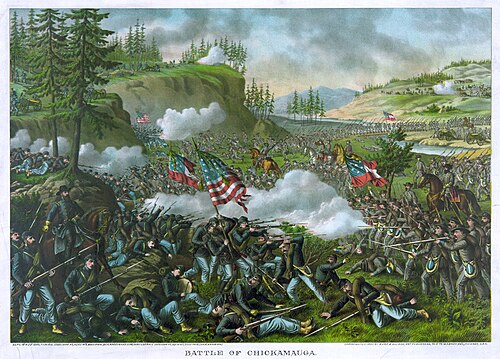
西部における南軍の唯一の明らかな勝利はチカマウガの戦いであった。ローズクランズのタラホーマ方面作戦の成功後、ブラッグはジェームズ・ロングストリート中将の軍団の援軍を得て、ジョージ・ヘンリー・トーマス少将の防御にもかかわらずローズクランズを破った。[要出典]
ローズクランズはチャタヌーガに撤退したが、ブラッグはチャタヌーガ方面作戦でこれを包囲した。グラントはローズクランズの救援に向かい、第三次チャタヌーガの戦いでブラッグを破った。[167]最終的にロングストリートはノックスビル方面作戦を断念し、南軍をテネシー州から追い出し、アトランタと南軍の中心地への道を切り開いた。[168]
トランスミシシッピ劇場
背景
トランスミシシッピ戦域は、ミシシッピ川以西の軍事作戦を指し、ミズーリ州、アーカンソー州、ルイジアナ州、現在のオクラホマ州のインディアン準州の大部分を網羅している。トランスミシシッピ地区は、南軍がベン・マカロックのアーカンソー州とルイジアナ州の部隊指揮、スターリング・プライスのミズーリ州兵、およびインディアン準州を含み西部軍を除いたアール・ヴァン・ドーンの指揮下の一部をよりよく調整するために結成された。北軍の指揮はトランスミシシッピ師団、または西ミシシッピ軍事師団であった。[169]
戦闘
.jpg/500px-Wilson's_Creek_charge_of_1st_Iowa_(rotate).jpg)
ミシシッピ川以西の戦域での最初の戦闘はウィルソンズクリークの戦い(1861年8月)であった。南軍は戦争初期にピーリッジの戦いでミズーリ州から追い出された。[171]
ミシシッピ川以西の地域ではゲリラ戦が頻発した。南軍には北軍の支配に対抗できる正規軍を支援する兵力と兵站がなかったためである。[172] [173]クァントリルの襲撃隊などの南軍の放浪部隊が田舎を恐怖に陥れ、軍事施設や民間人の居住地を襲撃した。[174]「自由の息子達」と「アメリカ騎士団」は北軍支持者、選出公職者、非武装の制服兵士を攻撃した。これらのパルチザンは北軍の正規歩兵師団全体が投入されるまでミズーリ州から追い出すことができなかった。1864年までに、これらの暴力行為はリンカーンの再選に反対する全国的な反戦運動に打撃を与えた。ミズーリ州は北軍に留まっただけでなく、リンカーンは再選に70パーセントの票を獲得した。[175]
ミズーリ州の南と西では、インディアン準州とニューメキシコ準州を北軍が支配しようと小規模な軍事行動が行われた。グロリエタ峠の戦いはニューメキシコ方面作戦の決定的な戦いとなった。北軍は1862年に南軍のニューメキシコ侵攻を撃退し、追放されたアリゾナ政府はテキサスに撤退した。インディアン準州では部族間の内戦が勃発した。約1万2千人のインディアン戦士が南軍のために戦ったが、北軍の戦士は少数だった。[176]最も著名なチェロキー族は、降伏した最後の南軍将軍であるスタンド・ワティー准将であった。 [177]
1863年7月にビックスバーグが陥落した後、ジェファーソン・デイヴィスはテキサスのカービー・スミス将軍に、ミシシッピ川以東からの援助は期待できないと伝えた。彼は北軍に勝つための資源がなかったが、タイラーに強力な兵器庫を築き、鉄道建設や国際密輸を含むテキサスの事実上の「独立領地」であるカービー・スミス領経済を築いた。北軍は彼と直接交戦することはなかった。[178] 1864年のルイジアナ州シュリーブポートを奪取するためのレッドリバー作戦は失敗し、テキサスは戦争中ずっと南軍の手中に留まった。[179]
ローワーシーボード劇場
背景
ローワーシーボード戦域は、南東部の沿岸地域とミシシッピ川南部付近で行われた軍事作戦と海軍作戦を指す。北軍の海軍活動はアナコンダ計画によって指示された。[180]
戦闘
.jpg/500px-Naval_Triumph_on_the_Mississippi_below_New_Orleans_1862_(cropped).jpg)
最も初期の戦闘の 1 つは、チャールストンの南にあるポート ロイヤル サウンドで戦われた(1861 年 11 月)。サウス カロライナ沿岸での戦争の多くは、チャールストンの占領に集中していた。チャールストンを占領しようとして、北軍は 2 つのアプローチを試みた。ジェームズ島またはモリス島を陸路で通過するか、港を通るかである。しかし、南軍はそれぞれの攻撃を撃退することができた。有名な陸上攻撃は、第 2 次ワグナー砦の戦いで、この戦いにはマサチューセッツ第 54 歩兵連隊が参加した。北軍は深刻な敗北を喫し、1,515 人の兵士を失ったのに対し、南軍は 174 人の損失にとどまった。しかし、第 54 歩兵連隊はその勇敢さを称賛され、アフリカ系アメリカ人兵士を北軍に採用することが一般的に受け入れられ、北軍の数的優位が強化された。[181]
ジョージア海岸のプラスキー砦は北軍海軍の初期の目標であった。ポートロイヤルの占領後、クインシー・A・ギルモア大尉の指揮の下、工兵部隊による遠征隊が組織され、南軍の降伏を強制した。北軍は砦を修復した後、戦争の残りの期間そこを占領した。[182]
1862年4月、デイビッド・D・ポーター司令官率いる北軍海軍機動部隊が、ニューオーリンズへの南からの川の入り口を守っていたジャクソン砦とセントフィリップ砦を攻撃した。艦隊の一部が砦を砲撃している間に、他の艦船が川の障害物を突破し、残りの艦隊が川を遡ってニューオーリンズに向かうことができた。ベンジャミン・バトラー少将率いる北軍の部隊が砦の近くに上陸し、降伏を強いた。バトラーはニューオーリンズでの物議を醸した指揮により「野獣」というあだ名が付けられた。[183]
翌年、ナサニエル・P・バンクス少将が指揮する北軍の湾岸軍は、ポート・ハドソンを8週間近く包囲したが、これはアメリカ軍史上最長の包囲戦であった。南軍はバイユー・テッシュ作戦で防衛を試みたが、ビックスバーグの戦いで降伏した。この降伏により北軍はミシシッピ川の支配権を得た。[153]
フロリダではいくつかの小さな小競り合いがあったが、大きな戦闘はなかった。最大のものは1864年初頭のオルスティの戦いであった。 [要出典]
太平洋岸劇場
太平洋岸戦域とは、太平洋および大陸分水嶺の西側の州および準州における軍事作戦を指す。[184]
バージニアの征服

1864年初め、リンカーンはグラントを全北軍の司令官に任命した。グラントはポトマック軍に司令部を置き、ウィリアム・シャーマン少将に西部軍の大半の指揮を任せた。グラントは総力戦の概念を理解しており、リンカーンやシャーマンと同様に、南軍とその経済基盤の完全な敗北のみが戦争を終わらせると信じていた。[185]これは民間人を殺害するのではなく、食料や飼料を奪い、家屋、農場、鉄道を破壊する総力戦であり、グラントは「さもなければ脱退や反乱の支援に使われていただろう。この政策は終戦を早めるのに重大な影響を及ぼしたと私は信じている」と述べた。[186]
グラントは南軍全体を複数の方向から攻撃する協調戦略を考案した。ミード将軍とベンジャミン・バトラー将軍はリッチモンド近郊でリー将軍に攻撃を命じられ、フランツ・シーゲル将軍はシェナンドー渓谷を攻撃し、シャーマン将軍はアトランタを占領して大西洋へ進軍し、ジョージ・クルック将軍とウィリアム・W・アヴェレル将軍はウェストバージニア州の鉄道補給線を攻撃し、ナサニエル・P・バンクス少将はアラバマ州モビールを占領することになっていた。[187]
グラントのオーバーランド作戦
グラントの軍隊はオーバーランド方面作戦に出発し、リー軍をリッチモンドの防衛に引きずり込み、南軍を釘付けにして壊滅させようとした。北軍はまずリー軍を突破しようとし、ウィルダーネス、スポットシルバニア、コールドハーバーでいくつかの戦闘を行った。この結果、双方に大きな損失が出て、リーの南軍は何度も後退を余儀なくされた。[188]イエロータバーンの戦いでは、南軍はジェブ・スチュアートを失った。[189]
南からリー軍の側面を突こうとしたが、バトラーはバミューダハンドレッド川の湾曲部で閉じ込められ、失敗した。各戦闘は北軍にとって、以前の将軍の下で彼らが被ったのと同じような挫折をもたらしたが、彼らと違ってグラントは撤退するのではなく戦い続けることを選んだ。グラントは粘り強く、リーの北バージニア軍をリッチモンドまで押し返し続けた。リーがリッチモンド攻撃の準備をしている間に、グラントは予期せず南に方向を変えてジェームズ川を渡り、ピーターズバーグの長期にわたる包囲戦を開始した。この包囲戦で両軍は9か月以上も塹壕戦を繰り広げた。 [190]
シェリダンの谷の戦い

グラントはついに、1864年の渓谷作戦で勝利を収めるほど攻撃的な指揮官、フィリップ・シェリダン将軍を見つけた。シェリダンはニューマーケットの戦いで南軍のジョン・C・ブレッキンリッジ将軍に撃退された。ニューマーケットの戦いは南軍の最後の大勝利であり、10代のVMI士官候補生の突撃も含まれていた。シェリダンは努力を倍加させた後、シーダークリークの戦いでの決定的な敗北を含む一連の戦いの初期にジュバル・A・シェリダン少将を破った。シェリダンはその後、シェナンドー渓谷の農業基盤の破壊に着手したが、これは後にジョージア州でシャーマンが採用した戦術に類似した戦略であった。[191]
シャーマンの海への行進
一方、シャーマンはチャタヌーガからアトランタへ進軍し、南軍のジョセフ・E・ジョンストン将軍とジョン・ベル・フッド将軍を破った。 1864年9月2日のアトランタ陥落はリンカーンの再選を確実なものにした。[192]フッドはアトランタ地域を離れ、シャーマンの補給線を脅かし、フランクリン・ナッシュビル方面作戦でテネシー州に侵攻した。北軍のジョン・スコフィールド少将はフランクリンの戦いでフッドを破り、ジョージ・H・トーマスはナッシュビルの戦いでフッドに大敗を与え、フッド軍を事実上壊滅させた。[193]
シャーマン軍は補給基地のあるアトランタを出発し、目的地も定めずに進軍し、ジョージア州の農場の約20%を「海への行軍」で破壊した。1864年12月、シャーマン軍はジョージア州サバンナで大西洋に到達した。シャーマン軍の後には何千人もの解放奴隷が続いたが、行軍中に大きな戦闘はなかった。シャーマン軍はサウスカロライナ州とノースカロライナ州を北上し、南から南軍バージニア軍の陣地に接近し、リー軍への圧力を強めた。[194]
南軍のワーテルロー
リー軍は脱走や死傷者で勢力が弱まり、グラント軍よりも規模が小さくなっていた。北軍のピーターズバーグ支配を破ろうとする南軍の最後の試みは、 4月1日のファイブフォークスの戦いで失敗した。北軍はリッチモンド・ピーターズバーグの周囲全体を支配し、南軍から完全に切り離した。首都を失ったことを悟ったリー軍と南軍政府は撤退を余儀なくされた。南軍の首都は4月2日から3日にかけて、黒人部隊で構成された北軍第25軍団によって陥落した。残りの南軍部隊は4月6日のセイラーズクリークでの敗北後、西へ逃げた。[195]
戦争の終結
リーは降伏するつもりはなく、補給品が待機しているアポマトックス駅で再集結し、その後戦争を続ける計画だった。グラントはリーを追いかけて彼の前に立ちはだかったので、リーの軍隊がアポマトックス・コートハウスの村に到着したとき、彼らは包囲されていた。最初の戦闘の後、リーは戦いに望みがないと判断し、1865年4月9日、マクリーン・ハウスでの会談中に北バージニア軍をグラントに降伏させた。[198] [199]伝統的ではないジェスチャーとして、そしてグラントの敬意と平和的に南軍諸州を連邦に復帰させるという期待の表れとして、リーは剣と馬トラベラーを保持することを許された。彼の部下は釈放され、南軍の一連の降伏が始まった。[200]
1865年4月14日、リンカーンは南軍支持者のジョン・ウィルクス・ブースに銃撃され、翌朝早くに死亡した。リンカーンの副大統領アンドリュー・ジョンソンは、暗殺しようとしたジョージ・アツェロットが怖気付いた ため無傷で、ジョンソンは直ちに大統領に就任した。
一方、リー将軍の降伏の知らせが南部全域の南軍に伝わり、降伏した。[i] 4月26日、ボストン・コーベット軍曹がタバコ小屋でブースを殺害したのと同じ日に、ジョンストンはベネット・プレイス(現在のノースカロライナ州ダーラム近郊)でテネシー軍の約9万人の兵士をシャーマンに降伏させた。これは南軍の最大の降伏となった。5月4日、ミシシッピ川以東のアラバマ、ミシシッピ、ルイジアナに残っていた南軍全軍がリチャード・テイラー中将の指揮下で降伏した。 [201]南軍のデイビス大統領は5月10日、ジョージア州アーウィンビルでの撤退中に捕らえられた。[202]
最後の陸上戦闘は1865年5月13日、テキサス州パルミト牧場の戦いで行われた。 [203] [204] [205] 1865年5月26日、エドマンド・スミスの代理として南軍のサイモン・B・バックナー中将がミシシッピ川以西の管区の南軍を降伏させる軍事協定に署名した。[206] [207]この日付は、同時代の人々や歴史家によって戦争の実質的な終結日としてしばしば引用されている。[a] [b] 6月2日、ほとんどの部隊がすでに帰国していたため、気乗りしないカービー・スミスには正式な降伏文書に署名する以外に選択肢がなかった。[208] [209] 6月23日、チェロキー族の指導者で准将のスタンド・ワティーが、部隊を降伏させた最後の南軍将軍となった。[210] [211]
1865年6月19日、北軍のゴードン・グレンジャー少将は一般命令第3号を発表し、テキサスで奴隷解放宣言を発効させ、南軍最後の奴隷を解放した。[212]この日を記念したものが現在ではジューンティーンスとして祝われている。[213]
戦争の海軍部分はよりゆっくりと終結した。それはリー将軍の降伏の2日後の4月11日に始まった。リンカーンは、外国はもはや「主張も口実も」米国の軍艦に対する海上権利と歓待の平等を否定できず、事実上、南軍の船が中立港を米国の軍艦からの安全な避難所として利用する権利は終了するべきであると宣言した。[214] [215]リンカーンの宣言に反応しなかったジョンソン大統領は、5月10日付の同様の宣言を出し、戦争はほぼ終結しており、まだ海上にいて米国の船を攻撃する準備ができている反乱軍の巡洋艦は、安全な外国の港や海域を利用して攻撃する権利を持たないとより直接的に述べた。[216]イギリスは最終的に6月6日に、外務大臣ジョン・ラッセル(初代ラッセル伯爵)からの書簡を海軍大臣らに送り、南軍の軍艦がイギリスの港や海域に入る権利を剥奪した。[217]アメリカ合衆国国務長官スワードは南軍への譲歩撤回を歓迎した。[218]最終的に10月18日、ラッセルは海軍本部に、6月のメッセージで指定された期限が経過し、「イギリスの港、港湾、海域におけるアメリカの軍艦に対するあらゆる制限的措置は、終了したものとみなされる」と通告した。[219]それにもかかわらず、南軍の最終的な降伏はイギリスのリバプールで行われ、そこでCSSシェナンドーの艦長ジェームズ・アイアデル・ワデルが11月6日に巡洋艦をイギリス当局に引き渡した。[220]
法的には、戦争は1866年8月20日まで終結しなかった。この日、ジョンソン大統領は「この反乱は終結し、アメリカ合衆国全土に平和、秩序、平穏、そして行政の権威が確立した」と宣言した。[j]
連合の勝利とその後

戦争の原因、戦争の結果の理由、そして戦争の名前さえも、長引く論争の的となっている。北部と西部は富裕になり、かつては豊かだった南部は1世紀にわたって貧しくなった。奴隷所有者と裕福な南部人の国家政治力は終焉した。歴史家たちは、戦後の復興の結果、特に解放奴隷の二級市民権と貧困について確信が持てない。[221]
歴史家たちは、南軍がこの戦争に勝てたかどうかについて議論してきた。ジェームズ・M・マクファーソンを含むほとんどの学者は、南軍の勝利は可能だったと主張している。 [222]マクファーソンは、北部が人口と資源で優位に立っていたため、勝利の可能性は高かったが、保証はされていなかったと主張する。彼は、南軍が非伝統的な戦術で戦っていたら、北軍を疲弊させるまで持ちこたえることがより容易だっただろうと論じている。 [223]南軍は勝つために敵の領土を侵略して保持する必要はなく、勝利の代償が高すぎることを北部に納得させるために防衛戦争を戦うだけでよかった。北軍は、敵の領土の広大な範囲を征服して保持し、南軍を打ち負かす必要があった。[223]リンカーンは軍事独裁者ではなく、アメリカ国民が戦争を支持する限り戦うことができた。南軍はリンカーンよりも長く存続することで独立を勝ち取ろうとした。しかし、アトランタが陥落し、リンカーンが1864年の選挙でマクレランを破った後、南部の政治的勝利の望みは終わった。リンカーンは共和党、戦争民主党、国境諸州、解放奴隷、そしてイギリスとフランスの中立の支持を確保していた。民主党とマクレランを破ったことで、彼は南部連合との和平交渉を望んでいたカッパーヘッド派を破った。 [224]
一部の学者は、北軍は工業力と人口の面で南軍に対して長期的には克服できないほどの優位性を持っていたと主張している。彼らは、南軍の行動は敗北を遅らせただけだと主張している。[230] [231]歴史家シェルビー・フットはこの見解を簡潔に表現した。
北軍は片手を背中に隠してあの戦争を戦ったと私は思う。もし南軍がもっと勝利していれば、北軍はもう片方の手を背中から出していただろう。南軍にはあの戦争に勝つチャンスはなかったと思う。[232]
A minority view among historians is that the Confederacy lost because, as E. Merton Coulter put it, "people did not will hard enough and long enough to win."[233][234] However, most historians reject the argument.[235] McPherson, after reading thousands of letters written by Confederate soldiers, found strong patriotism that continued to the end; they truly believed they were fighting for freedom and liberty. Even as the Confederacy was visibly collapsing in 1864–65, most Confederate soldiers were fighting hard.[236] Historian Gary Gallagher cites General Sherman, who in early 1864 commented, "The devils seem to have a determination that cannot but be admired." Despite their loss of slaves and wealth, with starvation looming, Sherman continued, "yet I see no sign of let-up—some few deserters—plenty tired of war, but the masses determined to fight it out."[237]
Also important were Lincoln's eloquence in articulating the national purpose and his skill in keeping the border states committed to the Union cause. The Emancipation Proclamation was an effective use of the President's war powers.[238] The Confederate government failed to get Europe involved militarily. Southern leaders needed to get European powers to help break the blockade the Union had created around Southern ports. Lincoln's naval blockade was 95 percent effective at stopping trade goods; as a result, imports and exports to the South declined significantly. The abundance of European cotton and Britain's hostility to slavery, along with Lincoln's naval blockades, severely decreased any chance that Britain or France would enter the war.[239]
Historian Don H. Doyle has argued that the Union victory had a major impact on world history.[240] The Union victory energized popular democratic forces. A Confederate victory, on the other hand, would have meant a new birth of slavery, not freedom. Historian Fergus Bordewich, following Doyle, argues that:
The North's victory decisively proved the durability of democratic government. Confederate independence, on the other hand, would have established an American model for reactionary politics and race-based repression that would likely have cast an international shadow into the 20th century and perhaps beyond.[241]
Scholars have debated what the effects of the war were on political and economic power in the South.[242] The prevailing view is that the southern planter elite retained its powerful position in the South.[242] However, a 2017 study challenges this, noting that while some Southern elites retained their economic status, the turmoil of the 1860s created greater opportunities for economic mobility in the South, than in the North.[242]
Casualties
The war resulted in at least 1,030,000 casualties (3 percent of the population), including about 620,000 soldier deaths—two-thirds by disease—and 50,000 civilians.[9] J. David Hacker believes the number of soldier deaths was approximately 750,000, 20 percent higher than traditionally estimated, and possibly as high as 850,000.[12][243] A novel way of calculating casualties, by looking at the deviation of the death rate of men of fighting age from the norm, through analysis of census data, found at least 627,000 and at most 888,000 people, but most likely 761,000 people, died in the war.[244] This would break down to approximately 350,000 Confederate and 411,000 Union military deaths, going by the proportion of Union to Confederate battle losses.[245] As McPherson notes, the war's "cost in American lives was as great as in all of the nation's other wars combined through Vietnam."[246]
Based on 1860 census figures, 8 percent of all white men aged 13–43 died in the war, including 6 percent in the North and 18 percent in the South.[247][248] About 56,000 soldiers died in prison camps during the War.[249] An estimated 60,000 soldiers lost limbs.[250]
Of the 359,528 Union Army dead, amounting to 15 percent of the over two million who served:[5]
- 110,070 were killed in action (67,000) or died of wounds (43,000).
- 199,790 died of disease (75 percent was due to the war, the remainder would have occurred in civilian life anyway)
- 24,866 died in Confederate prison camps
- 9,058 were killed by accidents or drowning
- 15,741 other/unknown deaths
In addition, there were 4,523 deaths in the Navy (2,112 in battle) and 460 in the Marines (148 in battle).[6]
After the Emancipation Proclamation authorized freed slaves to "be received into the armed service of the United States", former slaves who escaped from plantations or were liberated by the Union Army were recruited into the United States Colored Troops regiments of the Union Army, as were black men who had not been slaves. The US Colored Troops made up 10 percent of the Union death toll—15 percent of Union deaths from disease and less than 3 percent of those killed in battle.[5] Losses among African Americans were high. In the last year and a half and from all reported casualties, approximately 20 percent of all African Americans enrolled in the military died during the war. Their mortality rate was significantly higher than white soldiers. While 15 percent of US Volunteers and just 9 percent of white Regular Army troops died, 21 percent of US Colored Troops died.[251]: 16

While the figures of 360,000 army deaths for the Union and 260,000 for the Confederacy remained commonly cited, they are incomplete. In addition to many Confederate records being missing, partly as a result of Confederate widows not reporting deaths due to being ineligible for benefits, both armies only counted troops who died during their service and not the tens of thousands who died of wounds or diseases after being discharged. This often happened only days or weeks later. Francis Amasa Walker, superintendent of the 1870 census, used census and surgeon general data to estimate a minimum of 500,000 Union military deaths and 350,000 Confederate military deaths, a total of 850,000 soldiers. While Walker's estimates were originally dismissed because of the 1870 census's undercounting, it was later found that the census was only off by 6.5 percent and that the data Walker used would be roughly accurate.[12]
Losses were far higher than during the war with Mexico, which saw roughly 13,000 American deaths, including fewer than two thousand killed in battle, between 1846 and 1848. One reason for the high number of battle deaths in the civil war was the continued use of tactics similar to those of the Napoleonic Wars, such as charging. With the advent of more accurate rifled barrels, Minié balls, and (near the end of the war for the Union) repeating firearms such as the Spencer repeating rifle and the Henry repeating rifle, soldiers were mowed down when standing in lines in the open. This led to the adoption of trench warfare, a style of fighting that defined much of World War I.[252]
Deaths among former slaves has proven hard to estimate, due to the lack of reliable census data, though they were known to be considerable, as former slaves were set free or escaped in massive numbers in areas where the Union army did not have sufficient shelter, doctors, or food for them. Professor Jim Downs states that tens of thousands to hundreds of thousands of slaves died during the war from disease, starvation, or exposure, and that if these deaths are counted in the war's total, the death toll would exceed 1 million.[253]
It is estimated that during the war, of the equines killed, including horses, mules, donkeys and even confiscated children's ponies, over 32,600 of them belonged to the Union and 45,800 the Confederacy. However, other estimates place the total at 1,000,000.[254]
It is estimated that 544 Confederate flags were captured during the war by the Union. The flags were sent to the War Department in Washington.[255][256] The Union flags captured by the Confederates were sent to Richmond.[citation needed]
Emancipation

Abolition of slavery during or shortly after the American Revolution
The Northwest Ordinance, 1787
Gradual emancipation in New York (starting 1799, completed 1827) and New Jersey (starting 1804, completed by Thirteenth Amendment, 1865)
The Missouri Compromise, 1821
Effective abolition of slavery by Mexican or joint US/British authority
Abolition of slavery by Congressional action, 1861
Abolition of slavery by Congressional action, 1862
Emancipation Proclamation as originally issued, January 1, 1863
Subsequent operation of the Emancipation Proclamation in 1863
Abolition of slavery by state action during the Civil War
Operation of the Emancipation Proclamation in 1864
Operation of the Emancipation Proclamation in 1865
Thirteenth Amendment to the US constitution, December 18, 1865
Territory incorporated into the US after the passage of the Thirteenth Amendment
Abolishing slavery was not a Union war goal from the outset, but quickly became one.[257] Lincoln's initial claims were that preserving the Union was the central goal.[258] In contrast, the South fought to preserve slavery.[257] While not all Southerners saw themselves as fighting for slavery, most officers and over a third of the rank and file in Lee's army had close family ties to slavery. To Northerners, the motivation was primarily to preserve the Union, not to abolish slavery.[259] However, as the war dragged on, and it became clear slavery was central to the conflict, and that emancipation was (to quote the Emancipation Proclamation) "a fit and necessary war measure for suppressing [the] rebellion," Lincoln and his cabinet made ending slavery a war goal, culminating in the Emancipation Proclamation.[257][260] Lincoln's decision to issue the Proclamation angered Peace Democrats ("Copperheads") and War Democrats, but energized most Republicans.[260] By warning that free blacks would flood the North, Democrats made gains in the 1862 elections, but they did not gain control of Congress. The Republicans' counterargument that slavery was the mainstay of the enemy steadily gained support, with the Democrats losing decisively in the 1863 elections in the Northern state of Ohio, when they tried to resurrect anti-black sentiment.[261]
Emancipation Proclamation
Slavery for the Confederacy's 3.5 million blacks effectively ended in each area when Union armies arrived; they were nearly all freed by the Proclamation. The last Confederate slaves were freed on June 19, 1865, celebrated as the modern holiday of Juneteenth. Slaves in the border states and those in some former Confederate territory occupied before the Emancipation Proclamation were freed by state action or (on December 6, 1865) by the Thirteenth Amendment.[262][263] The Emancipation Proclamation enabled African Americans, both free blacks and escaped slaves, to join the Union Army. About 190,000 volunteered, further enhancing the numerical advantage the Union armies enjoyed over the Confederates, who did not dare emulate the equivalent manpower source for fear of undermining the legitimacy of slavery.[n]
During the war, sentiment concerning slaves, enslavement, and emancipation in the United States was divided. Lincoln's fears of making slavery a war issue were based on a harsh reality: abolition did not enjoy wide support in the west, the territories, and the border states.[265][o] In 1861, Lincoln worried that premature attempts at emancipation would mean the loss of the border states, and that "to lose Kentucky is nearly the same as to lose the whole game."[o] Copperheads and some War Democrats opposed emancipation, although the latter eventually accepted it as part of the total war needed to save the Union.[266]
At first, Lincoln reversed attempts at emancipation by Secretary of War Simon Cameron and Generals Frémont and David Hunter, to keep the loyalty of the border states and the War Democrats. Lincoln warned the border states that a more radical type of emancipation would happen if his plan of gradual compensated emancipation and voluntary colonization was rejected.[267] But compensated emancipation occurred only in the District of Columbia, where Congress had the power to enact it. When Lincoln told his cabinet about his proposed emancipation proclamation, which would apply to the states still in rebellion on January 1, 1863, Seward advised Lincoln to wait for a Union military victory before issuing it, as to do otherwise would seem like "our last shriek on the retreat".[268] Walter Stahr, however, writes, "There are contemporary sources, however, that suggest others were involved in the decision to delay", and Stahr quotes them.[269]
Lincoln laid the groundwork for public support in an open letter published in response to Horace Greeley's "The Prayer of Twenty Millions"; the letter stated that Lincoln's goal was to save the Union, and that, if he freed the slaves, it would be as a means to that end.[270][271][272] He also had a meeting at the White House with five African American representatives on August 14, 1862. Arranging for a reporter to be present, he urged his visitors to agree to the voluntary colonization of black people. Lincoln's motive for both his letter to Greeley and his statement to the black visitors was apparently to make his forthcoming Emancipation Proclamation more palatable to racist white people.[273] A Union victory in the Battle of Antietam on September 17, 1862, provided Lincoln with an opportunity to issue the preliminary Emancipation Proclamation, and the War Governors' Conference added support for the proclamation.[274]
Lincoln issued his preliminary Emancipation Proclamation on September 22, 1862. It stated that slaves in all states in rebellion on January 1, 1863, would be free. He issued his final Emancipation Proclamation on January 1, 1863, keeping his promise. In his letter to Albert G. Hodges, Lincoln explained his belief that "If slavery is not wrong, nothing is wrong .... And yet I have never understood that the Presidency conferred upon me an unrestricted right to act officially upon this judgment and feeling .... I claim not to have controlled events, but confess plainly that events have controlled me."[275][p]
Lincoln's moderate approach succeeded in inducing the border states to remain in the Union and War Democrats to support the Union. The border states, which included Kentucky, Missouri, Maryland, Delaware, and Union-controlled regions around New Orleans, Norfolk, Virginia, and elsewhere, were not covered by the Emancipation Proclamation. Nor was Tennessee, which had come under Union control.[277] Missouri and Maryland abolished slavery on their own; Kentucky and Delaware did not.[278] Still, the proclamation did not enjoy universal support. It caused much unrest in what were then considered western states, where racist sentiments led to a great fear of abolition. There was some concern that the proclamation would lead to the secession of western states, and its issuance prompted the stationing of Union troops in Illinois in case of rebellion.[265]
Since the Emancipation Proclamation was based on the President's war powers, it applied only in territory held by Confederates at the time it was issued. However, the Proclamation became a symbol of the Union's growing commitment to add emancipation to the Union's definition of liberty.[279] The Emancipation Proclamation greatly reduced the Confederacy's hope of being recognized or otherwise aided by Britain or France.[280] By late 1864, Lincoln was playing a leading role in getting the House of Representatives to vote for the Thirteenth Amendment, which mandated the ending of chattel slavery.[281]
Reconstruction

The war devastated the South and posed serious questions of how it would be reintegrated into the Union. The war destroyed much of the South's wealth, in part because wealth held in enslaved people (at least $1,000 each for a healthy adult prior to the war) was wiped off the books.[282] All accumulated investment in Confederate bonds was forfeited; most banks and railroads were bankrupt. The income per person dropped to less than 40 percent of that of the North, and that lasted into the 20th century. Southern influence in the federal government, previously considerable, was greatly diminished until the second half of the 20th century.[283] Reconstruction began during the war, with the Emancipation Proclamation of January 1863, and it continued until 1877.[284] It comprised multiple complex methods to resolve the outstanding issues of the aftermath, the most important of which were the three "Reconstruction Amendments" to the Constitution: the 13th outlawing slavery (1865), the 14th guaranteeing citizenship to former slaves (1868), and the 15th ensuring voting rights to former male slaves (1870). From the Union perspective, the goals of Reconstruction were to consolidate victory by reuniting the Union, to guarantee a "republican form of government" for the ex-Confederate states, and to permanently end slavery—and prevent semi-slavery status.[285]
President Johnson, who took office in April 1865, took a lenient approach and saw the achievement of the main war goals as realized in 1865, when each ex-rebel state repudiated secession and ratified the Thirteenth Amendment. Radical Republicans demanded proof that Confederate nationalism was dead and that the slaves were truly free. They overrode Johnson's vetoes of civil rights legislation, and the House impeached him, although the Senate did not convict him. In 1868 and 1872, the Republican candidate Grant won the presidency. In 1872, the "Liberal Republicans" argued that the war goals had been achieved and Reconstruction should end. They chose Horace Greeley to head a presidential ticket in 1872 but were decisively defeated. In 1874, Democrats, primarily Southern, took control of Congress and opposed further reconstruction. The Compromise of 1877 closed with a national consensus, except on the part of former slaves, that the war had finally ended.[286] With the withdrawal of federal troops, however, whites retook control of every Southern legislature, and the Jim Crow era of disenfranchisement and legal segregation was ushered in.[287]
The war had a demonstrable impact on American politics. Many veterans on both sides were elected to political office, including five U.S. Presidents: Ulysses Grant, Rutherford B. Hayes, James A. Garfield, Benjamin Harrison, and William McKinley.[288]
Memory and historiography
The war is a central event in American collective memory. There are innumerable statues, commemorations, books, and archival collections. The memory includes the home front, military affairs, the treatment of soldiers, both living and dead, in the war's aftermath, depictions of the war in literature and art, evaluations of heroes and villains, and considerations of the moral and political lessons of the war.[289] The last theme includes moral evaluations of racism and slavery, heroism in combat and behind the lines, and issues of democracy and minority rights, as well as the notion of an "Empire of Liberty" influencing the world.[290]
Historians have paid more attention to the causes of the war than to the war itself. Military history has largely developed outside academia, leading to a proliferation of studies by non-scholars who nevertheless are familiar with the primary sources and pay close attention to battles and campaigns and who write for the general public.[291][292] Practically every major figure in the war, both North and South, has had a serious biographical study.[citation needed]
Even the name used for the conflict has been controversial, with many names used for it. During and immediately after the war, Northern historians often used a term like "War of the Rebellion". Writers in rebel states often referred to the "War for Southern Independence". Some Southerners have described it as the "War of Northern Aggression".[293]
Lost Cause
The memory of the war in the white South crystallized in the myth of the "Lost Cause": that the Confederate cause was just and heroic. The myth shaped regional identity and race relations for generations.[294] Alan T. Nolan notes that the Lost Cause was expressly a rationalization, a cover-up to vindicate the name and fame of those in rebellion. Some claims revolve around the insignificance of slavery as a cause; some appeals highlight cultural differences between North and South; the military conflict by Confederate actors is idealized; in any case, secession was said to be lawful.[295] Nolan argues that the adoption of the Lost Cause perspective facilitated the reunification of the North and the South while excusing the "virulent racism" of the 19th century, sacrificing black American progress to white man's reunification. He also deems the Lost Cause "a caricature of the truth. This caricature wholly misrepresents and distorts the facts of the matter" in every instance.[296] The Lost Cause myth was formalized by Charles A. Beard and Mary R. Beard, whose The Rise of American Civilization (1927) spawned "Beardian historiography". The Beards downplayed slavery, abolitionism, and issues of morality. Though this interpretation was abandoned by the Beards in the 1940s, and by historians generally by the 1950s, Beardian themes still echo among Lost Cause writers.[297][298][additional citation(s) needed]
Battlefield preservation
The first efforts at Civil War battlefield preservation and memorialization came during the war, with the establishment of National Cemeteries at Gettysburg, Mill Springs and Chattanooga. Soldiers began erecting markers on battlefields beginning with the First Battle of Bull Run in 1861. The oldest surviving monument is the Hazen Brigade Monument near Murfreesboro in Central Tennessee, built in the summer of 1863 by soldiers in Union Col. William B. Hazen's brigade to mark the spot where they buried their dead, following the Battle of Stones River.[299]
In the 1890s, the government established five Civil War battlefield parks under the jurisdiction of the War Department, beginning with the creation of the Chickamauga and Chattanooga National Military Park at Fort Oglethorpe, Georgia, and the Antietam National Battlefield in Sharpsburg, Maryland, in 1890. The Shiloh National Military Park was established in 1894 in Shiloh, Tennessee, followed by the Gettysburg National Military Park in 1895, and Vicksburg National Military Park in 1899. In 1933, these five parks and other national monuments were transferred to the National Park Service.[300] Chief among modern efforts to preserve Civil War sites has been the American Battlefield Trust, with more than 130 battlefields in 24 states.[301][302] The five major battlefield parks operated by the National Park Service had a combined 3 million visitors in 2018, down 70% from 10 million in 1970.[303]
Commemoration
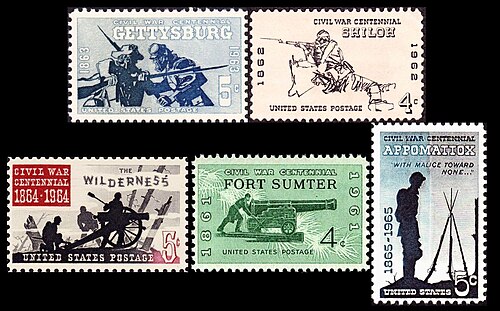
The Civil War has been commemorated in many capacities, ranging from the reenactment of battles to statues and memorial halls erected, films, stamps and coins with Civil War themes being issued, all of which helped to shape public memory. These commemorations occurred in greater numbers on the 100th and 150th anniversaries of the war.[304] Hollywood's take on the war has been especially influential in shaping public memory, as in such film classics as The Birth of a Nation (1915), Gone with the Wind (1939), and Lincoln (2012). Ken Burns's PBS television series The Civil War (1990) is well-remembered, though criticized for its historical inaccuracy.[305][306]
Technological significance
Technological innovations during the war had a great impact on 19th-century science. The war was an early example of an "industrial war", in which technological might is used to achieve military supremacy.[307] New inventions, such as the train and telegraph, delivered soldiers, supplies and messages at a time when horses had been the fastest way to travel.[308][309] It was also in this war that aerial warfare, in the form of reconnaissance balloons, was first used.[310] It saw the first action involving steam-powered ironclad warships in naval warfare history.[311] Repeating firearms such as the Henry rifle, Spencer rifle, Colt revolving rifle, Triplett & Scott carbine and others, first appeared during the Civil War; they were a revolutionary invention that would soon replace muzzle-loading and single-shot firearms. The war saw the first appearances of rapid-firing weapons and machine guns such as the Agar gun and Gatling gun.[312]
In works of culture and art

The Civil War is one of the most studied events in American history, and the collection of cultural works around it is enormous.[313] This section gives an abbreviated overview of the most notable works.
Literature
- When Lilacs Last in the Dooryard Bloom'd and O Captain! My Captain! (1865) by Walt Whitman, famous eulogies to Lincoln
- Battle-Pieces and Aspects of the War (1866) poetry by Herman Melville
- The Rise and Fall of the Confederate Government (1881) by Jefferson Davis
- The Private History of a Campaign That Failed (1885) by Mark Twain
- Texar's Revenge, or, North Against South (1887) by Jules Verne
- An Occurrence at Owl Creek Bridge (1890) by Ambrose Bierce
- The Red Badge of Courage (1895) by Stephen Crane
- The Challenge to Sirius (1917) by Sheila Kaye-Smith
- Gone with the Wind (1936) by Margaret Mitchell
- North and South (1982) by John Jakes
- The March: A Novel (2005) by E. L. Doctorow, fictionalized account of Sherman's March to the Sea
Film
- The Birth of a Nation (1915, US)
- The General (1926, US)
- Operator 13 (1934, US)
- Gone with the Wind (1939, US)
- The Red Badge of Courage (1951, US)
- The Horse Soldiers (1959, US)
- Shenandoah (1965, US)
- The Good, the Bad and the Ugly (1966, Italy-Spain-FRG)
- The Beguiled (1971, US)
- The Outlaw Josey Wales (1976, US)
- North and South (miniseries; 1985–1994, US)
- Glory (1989, US)
- The Civil War (1990, US)
- Gettysburg (1993, US)
- The Last Outlaw (1993, US)
- Cold Mountain (2003, US)
- Gods and Generals (2003, US)
- Lincoln (2012, US)
- Free State of Jones (2016, US)
Music
Video games
- North & South (1989, FR)
- Sid Meier's Gettysburg! (1997, US)
- Sid Meier's Antietam! (1999, US)
- American Conquest: Divided Nation (2006, US)
- Forge of Freedom: The American Civil War (2006, US)
- The History Channel: Civil War – A Nation Divided (2006, US)
- AGEOD's American Civil War (2007, US/FR)
- History Civil War: Secret Missions (2008, US)
- Call of Juarez: Bound in Blood (2009, US)
- Darkest of Days (2009, US)
- Victoria II: A House Divided (2011, US)
- AGEOD's American Civil War II (2013, US/FR)
- Ultimate General: Gettysburg (2014, UKR)
- Ultimate General: Civil War (2016, UKR)
- War of Rights (TBD, US)
See also

- American Civil War by state
- Foreign enlistment in the American Civil War
- African Americans in the American Civil War
- German Americans in the American Civil War
- Hispanics in the American Civil War
- Irish Americans in the American Civil War
- Italian Americans in the Civil War
- Native Americans in the American Civil War
- Outline of the American Civil War
- Removal of Confederate monuments and memorials
Notes
- ^ a b
- "End of the Rebellion; The Last Rebel Army Disbands. Kirby Smith Surrenders the Land and Naval Forces Under His Command. The Confederate Flag Disappears from the Continent. The Era of Peace Begins. Military Prisoners During the War to be Discharged. Deserters to be Released from Confinement. [Official.] From Secretary Stanton to Gen. Dix". The New York Times. United States Department of War. May 29, 1865. Archived from the original on September 15, 2018. Retrieved July 29, 2022.
- Greeley 1866, p. 757. "Though the war on land ceased, and the Confederate flag utterly disappeared from this continent with the collapse and dispersion of Kirby Smith's command...."
- Draper 1870, p. 618. "On the 26th of the same month General Kirby Smith surrendered his entire command west of the Mississippi to General Canby. With this, all military opposition to the government ended."
- Davis 1881, p. 630. "With General E. K. Smith's surrender the Confederate flag no longer floated on the land."
- Davis 1881, p. 663. "When the Confederate soldiers laid down their arms and went home, all hostilities against the power of the Government of the United States ceased."
- Grant 1886, p. 522. "General E. Kirby Smith surrendered the trans-Mississippi department on the 26th of May, leaving no other Confederate army at liberty to continue the war."
- Dyer 1908, p. 7. "Alphabetical Index of Campaigns, Battles, Engagements, Actions, Combats, Sieges, Skirmishes, Reconnaissances, Scouts and Other Military Events Connected with the "War of the Rebellion" During the Period of Actual Hostilities, From April 12, 1861, to May 26, 1865"
- Stephenson 1919, p. 202. "The surrender of the forces of the Trans-Mississippi on May 26, 1865, brought the war to a definite conclusion."
- Robertson 1963, p. 31. "Lee's surrender left Johnston with no place to go. On April 26, near Durham, N.C., the Army of Tennessee laid down its arms before Sherman's forces. With the surrender of isolated forces in the Trans-Mississippi West on May 4, 11, and 26, the most costly war in American history came to an end."
- Catton 1965, p. 445. "and on May 26 he [E. Kirby Smith] surrendered and the war was over"
- Gallagher et al. 2003, p. 308. "By 26 May, General Edward Kirby Smith had surrendered the Rebel forces in the trans-Mississippi west. The war was over."
- Blair 2015, p. [page needed]. "The sheer weight of scholarship has leaned toward portraying the surrenders of the Confederate armies as the end of the war."
- ^ a b Among the many other contemporary sources and later historians citing May 26, 1865 as the end date for the American Civil War hostilities are George Templeton Strong, who was a prominent New York lawyer; a founder, treasurer, and member of the Executive Committee of United States Sanitary Commission throughout the war; and a diarist. A diary excerpt is published in Gienapp, William E. (ed.). The Civil War and Reconstruction: A Documentary Collection. New York: W.W. Norton & Co., 2001, pp. 313–314 ISBN 978-0-393-97555-0. A footnote in Gienapp shows the excerpt was taken from an edited version of the diaries by Allan Nevins and Milton Halsey Thomas, eds., The Diary of George Templeton Strong, vol. 2 (New York: The Macmillan Company), pp. 600–601, which differs from the volume and page numbers of the original diaries; the page in Strong's original handwriting is shown at "Volume 4, pages 124–125: diary entries for May 23 (continued)–June 7, 1865". Archived from the original on November 16, 2022 – via New-York Historical Society Museum & Library.
- ^ 211,411 Union soldiers were captured, and 30,218 died in prison. The ones who died have been excluded to prevent double-counting of casualties.
- ^ 462,634 Confederate soldiers were captured and 25,976 died in prison. The ones who died have been excluded to prevent double-counting of casualties.
- ^ The Union was the U.S. government and included the states that remained loyal to it, both the non-slave states and the border states (Missouri, Kentucky, Maryland, and Delaware) where slavery was legal. Missouri and Kentucky were also claimed by the Confederacy and given full state delegations in the Confederate Congress for the duration of the war.
- ^ Appomattox is referred to symbolically as the end of the war, although arguably there are different dates for the war's conclusion. Lee's surrender to Grant set off a wave of Confederate surrenders. The last military department of the Confederacy, the Trans-Mississippi Department disbanded on May 26.
- ^ Assuming Union and Confederate casualties are counted together—more Americans were killed in World War II than in either the Union or Confederate Armies if their casualty totals are counted separately.
- ^ Historians disagree as to whether Roger Taney heard Ex parte Merryman as a U.S. circuit judge or as a Supreme Court justice in chambers.[63][64]
- ^ Unaware of the surrender of Lee, on April 16 the last major battles of the war were fought at the Battle of Columbus, Georgia, and the Battle of West Point.
- ^
- Murray 1967, p. 336
- Neff 2010, p. 207
- Trudeau 1994, p. 396. In United States v. Anderson, 76 U.S. 56 (1869), "The U.S. attorneys argued that the Rebellion had been suppressed following the surrender of the Trans-Mississippi Department, as established in the surrender document negotiated on May 26, 1865."
- Trudeau 1994, p. 397. The Supreme Court decided that the "legal end of the American Civil War had been decided by Congress to be August 20, 1866—the date of Andrew Johnson's final proclamation on the conclusion of the Rebellion."
- ^ "Union population 1864" aggregates 1860 population, average annual immigration 1855–1864, and population governed formerly by CSA per Kenneth Martis source. Contrabands and after the Emancipation Proclamation freedmen, migrating into Union control on the coasts and to the advancing armies, and natural increase are excluded.
- ^ "Slave 1864, CSA" aggregates 1860 slave census of Virginia, North Carolina, South Carolina, Georgia and Texas. It omits losses from contraband and after the Emancipation Proclamation, freedmen migrating to the Union controlled coastal ports and those joining advancing Union armies, especially in the Mississippi Valley.
- ^ "Total Union railroad miles" aggregates existing track reported 1860 @ 21800 plus new construction 1860–1864 @ 5000, plus southern railroads administered by USMRR @ 2300.[229]
- ^ In spite of the South's shortage of soldiers, most Southern leaders—until 1865—opposed enlisting slaves. They used them as laborers to support the war effort. As Howell Cobb said, "If slaves will make good soldiers our whole theory of slavery is wrong." Confederate generals Patrick Cleburne and Robert E. Lee argued in favor of arming blacks late in the war, and Jefferson Davis was eventually persuaded to support plans for arming slaves to avoid military defeat. The Confederacy surrendered at Appomattox before this plan could be implemented.[264]
- ^ a b
- Lincoln's letter to O. H. Browning, September 22, 1861.
- Wittke 1952, p. [page needed]. "Sentiment among German Americans was largely antislavery especially among Forty-Eighters, resulting in hundreds of thousands of German Americans volunteering to fight for the Union."
- Keller 2009.
- for primary sources, see Walter D. Kamphoefner and Wolfgang Helbich, eds., Germans in the Civil War: The Letters They Wrote Home (2006). "On the other hand, many of the recent immigrants in the North viewed freed slaves as competition for scarce jobs, and as the reason why the Civil War was being fought."
- Baker 2003. "Due in large part to this fierce competition with free blacks for labor opportunities, the poor and working class Irish Catholics generally opposed emancipation. When the draft began in the summer of 1863, they launched a major riot in New York City that was suppressed by the military, as well as much smaller protests in other cities."
- Schecter 2007, ch. 6. "Many Catholics in the North had volunteered to fight in 1861, sending thousands of soldiers to the front and suffering high casualties, especially at Fredericksburg; their volunteering fell off after 1862."
- ^ In late March 1864 Lincoln met with Governor Bramlette, Archibald Dixon, and Albert G. Hodges, to discuss recruitment of African American soldiers in the state of Kentucky. In a letter dated April 4, 1864, Lincoln summarized his stance on slavery, at Hodges' request.[276]
References
- ^ "Size of the Union Army in the American Civil War". Archived from the original on January 30, 2016.
Of which 131,000 were in the Navy and Marines, 140,000 were garrison troops and home defense militia, and 427,000 were in the field army
- ^ a b c d "Facts". National Park Service.
- ^ "The war of the rebellion: a compilation of the official records of the Union and Confederate armies; Series 4 – Volume 2". United States War Dept. 1900. Archived from the original on July 25, 2017.
- ^ Long 1971, p. 705.
- ^ a b c d e Fox, William F. (1889). Regimental losses in the American Civil War. Archived from the original on May 25, 2017.
{{cite book}}: CS1 maint: unfit URL (link) - ^ a b c d "U.S. Military Casualties: Principal Wars 1775–1991". Defence Casuality Analysis System (DCAS).
- ^ Chambers & Anderson 1999, p. 849.
- ^ a b Rhodes, James Ford (1893). History of the United States from the Compromise of 1850. New York: Harper & Bros. pp. 507–508.
- ^ a b Nofi, Al (June 13, 2001). "Statistics on the War's Costs". Louisiana State University. Archived from the original on July 11, 2007. Retrieved October 14, 2007.
- ^ Downs 2012. "The rough 19th century estimate was that 60,000 former slaves died from the epidemic, but doctors treating black patients often claimed that they were unable to keep accurate records due to demands on their time and the lack of manpower and resources. The surviving records only include the number of black patients whom doctors encountered; tens of thousands of other slaves had no contact with army doctors, leaving no records of their deaths."
- ^ Toward a Social History of the American Civil War Exploratory Essays, Cambridge University Press, 1990, p. 4.
- ^ a b c Hacker, J. David (September 20, 2011). "Recounting the Dead". The New York Times. Associated Press. Archived from the original on September 25, 2011. Retrieved September 22, 2011.
- ^ Downs 2012. "An 2 April 2012 New York Times article, 'New Estimate Raises Civil War Death Toll', reports that a new study ratchets up the death toll from an estimated 650,000 to a staggering 850,000 people. As horrific as this new number is, it fails to reflect the mortality of former slaves during the war. If former slaves were included in this figure, the Civil War death toll would likely be over a million casualties ...".
- ^ "The Declaration of Causes of Seceding States. Primary Sources". American Battlefield Trust. Retrieved December 30, 2023.
- ^ a b Woods, Michael E. (August 20, 2012). "What Twenty-First-Century Historians Have Said about the Causes of Disunion: A Civil War Sesquicentennial Review of the Recent Literature". Journal of American History. 99 (2): 415–439. doi:10.1093/jahist/jas272. ISSN 0021-8723.
- ^ Sheehan-Dean, Aaron (2005). "A Book for Every Perspective: Current Civil War and Reconstruction Textbooks". Civil War History. 51 (3): 317–324. doi:10.1353/cwh.2005.0051.
- ^ Loewen, James W. (2011). "Using Confederate Documents to Teach About Secession, Slavery, and the Origins of the Civil War". OAH Magazine of History. 25 (2): 35–44. doi:10.1093/oahmag/oar002. ISSN 0882-228X. JSTOR 23210244.
Confederate leaders themselves made it plain that slavery was the key issue sparking secession.
- ^ Patrick Karl O'Brien (2002). Atlas of World History. Oxford University Press. p. 184. ISBN 978-0-19-521921-0. Archived from the original on September 5, 2015. Retrieved October 25, 2015.
- ^ John McCardell, The Idea of a Southern Nation: Southern Nationalists and Southern Nationalism, 1830–1860 (1981)
- ^ Susan-Mary Grant, North Over South: Northern Nationalism and American Identity in the Antebellum Era (2000)
- ^ David A. Walsh. Highlights from the 2011 Annual Meeting of the Organization of American Historians in Houston, Texas. Archived from the original on December 4, 2011.
Elizabeth Varon, Bruce Levine, Marc Egnal, and Michael Holt at a plenary session of the organization of American Historians, March 17, 2011
- ^ Potter & Fehrenbacher 1976, pp. 44–45.
- ^ Potter & Fehrenbacher 1976, p. 485.
- ^ McPherson 1988, pp. 254–255.
- ^ a b "1861 Time Line". Civil War Glass Negatives and Related Prints. Library of Congress. Retrieved January 22, 2022.
- ^ Jaffa, Harry V. (2004). A New Birth of Freedom: Abraham Lincoln and the Coming of the Civil War. Rowman & Littlefield. p. 1. ISBN 978-0-8476-9953-7.
- ^ "Ordinances of Secession of the 13 Confederate States of America". Archived from the original on June 11, 2004. Retrieved November 28, 2012.
- ^ "Confederate States of America – Declaration of the Immediate Causes which Induce and Justify the Secession of South Carolina from the Federal Union". The Avalon Project. Archived from the original on February 20, 2019. Retrieved November 28, 2012.
- ^ "A Declaration of the Immediate Causes which Induce and Justify the Secession of the State of Mississippi from the Federal Union". The Avalon Project. Archived from the original on October 10, 2014. Retrieved November 28, 2012.
- ^ "Confederate States of America – Georgia Secession". The Avalon Project. Archived from the original on July 14, 2011. Retrieved November 28, 2012.
- ^ "Confederate States of America – A Declaration of the Causes which Impel the State of Texas to Secede from the Federal Union". The Avalon Project. Archived from the original on August 11, 2011. Retrieved November 28, 2012.
- ^ McPherson 1988, p. 24.
- ^ President James Buchanan (December 3, 1860). "Fourth Annual Message". Archived from the original on December 20, 2008. Retrieved November 28, 2012 – via The American Presidency Project.
- ^ Winters 1963, p. 28.
- ^ "Profile Showing the Grades upon the Different Routes Surveyed for the Union Pacific Rail Road Between the Missouri River and the Valley of the Platte River". World Digital Library. 1865. Retrieved July 16, 2013.
- ^ "Abraham Lincoln imposes first federal income tax". History.com. Retrieved June 12, 2021.
- ^ McPherson 1988, pp. 252–254.
- ^ McPherson 1988, p. 253.
- ^ McPherson 1988, pp. 234–266.
- ^ a b c Abraham Lincoln, First Inaugural Address, Monday, March 4, 1861.
- ^ McPherson 1988, p. 262.
- ^ a b Potter & Fehrenbacher 1976, pp. 572–573.
- ^ Harris, William C. (Winter 2000). "The Hampton Roads Peace Conference: A Final Test of Lincoln's Presidential Leadership". Journal of the Abraham Lincoln Association. 21 (1). hdl:2027/spo.2629860.0021.104. ISSN 1945-7987.
- ^ Hardyman, Robyn (2016). What Caused the Civil War?. Gareth Stevens Publishing LLLP. p. 27. ISBN 978-1-4824-5180-1.
- ^ McPherson 1988, p. 264.
- ^ McPherson 1988, p. 265.
- ^ McPherson 1988, p. 266.
- ^ a b McPherson 1988, p. 267.
- ^ McPherson 1988, p. 268.
- ^ McPherson 1988, p. 272.
- ^ McPherson 1988, p. 273.
- ^ McPherson 1988, pp. 273–274.
- ^ McPherson 1988, p. 274.
- ^ McPherson 1988, p. 278.
- ^ McPherson 1988, pp. 276–307.
- ^ Jones 2011, pp. 203–204.
- ^ Jones 2011, p. 21.
- ^ "Civil War and the Maryland General Assembly, Maryland State Archives". msa.maryland.gov. Retrieved May 28, 2017.
- ^ a b "Teaching American History in Maryland – Documents for the Classroom: Arrest of the Maryland Legislature, 1861". Maryland State Archives. 2005. Archived from the original on January 11, 2008. Retrieved February 6, 2008.
- ^ McPherson 1988, pp. 284–287.
- ^ Harris, William C. (2011). Lincoln and the Border States: Preserving the Union. University Press of Kansas. p. 71.
- ^ White, Jonathan W. (2011). Abraham Lincoln and Treason in the Civil War: The Trials of John Merryman. Baton Rouge: Louisiana State University Press. pp. 38–39.
- ^ Vladeck, Stephen I. (Summer 2007). "The Field Theory: Martial Law, The Suspension Power, and The Insurrection Act". Temple Law Review. Vol. 80, no. 2. p. 391, n. 2. Archived from the original on September 27, 2022.
- ^ Howard, F. K. (1863). Fourteen Months in American Bastiles. London: H.F. Mackintosh. Retrieved August 18, 2014.
- ^ Nevins, The War for the Union (1959), 1:119–29.
- ^ Nevins, The War for the Union (1959), 1:129–36.
- ^ "A State of Convenience, The Creation of West Virginia". West Virginia Archives & History. Archived from the original on May 18, 2012. Retrieved April 20, 2012.
- ^ Curry, Richard Orr (1964), A House Divided: A Study of the Statehood Politics and the Copperhead Movement in West Virginia, University of Pittsburgh Press, map on p. 49.
- ^ McPherson 1988, p. 303.
- ^ Weigley 2004, p. 55.
- ^ Snell, Mark A. (2011), West Virginia and the Civil War, History Press, Charleston, SC, p. 28.
- ^ Neely 1993, pp. 10–11.
- ^ Keegan 2009, p. 73. "Over 10,000 military engagements took place during the war, 40 percent of them in Virginia and Tennessee."
- ^ Gabor Boritt (ed.). War Comes Again (1995), p. 247.
- ^ "The Civil War, 1861" (PDF). American Military History. pp. 199–221. Archived (PDF) from the original on October 17, 2012.
With an actual strength of 1,080 officers and 14,926 enlisted men on June 30, 1860, the Regular Army...
- ^ Nicolay, John George; Hay, John (1890). Abraham Lincoln: A History. Century Company. p. 264.
- ^ Coulter 1950, p. 308.
- ^ Faust, Albert Bernhardt (1909). The German Element in the United States: With Special Reference to Its Political, Moral, Social, and Educational Influence. Houghton Mifflin Company.
- ^ Reid, Richard M. (2014). African Canadians in Union Blue: Volunteering for the Cause in the Civil War. Vancouver, BC: UBC Press. pp. 4–5, 40. ISBN 978-0-7748-2745-4.
- ^ Schecter 2007, p. [page needed].
- ^ Eugene Murdock, One Million Men: the Civil War draft in the North (1971).
- ^ Judith Lee Hallock (1983). "The Role of the Community in Civil War Desertion" (PDF). Civil War History. 29 (2): 123–134. doi:10.1353/cwh.1983.0013.
- ^ Bearman, Peter S. (1991). "Desertion as Localism: Army Unit Solidarity and Group Norms in the U.S. Civil War". Social Forces. 70 (2): 321–342. doi:10.1093/sf/70.2.321. JSTOR 2580242.
- ^ Robert Fantina, Desertion and the American Soldier, 1776–2006 (2006), p. 74.
- ^ Ryan Nadeau (January 5, 2015). "A Prussian Observes the American Civil War". The Gettysburg Compiler. Retrieved January 6, 2022.
- ^ Keegan 2009, p. 57.
- ^ Roger Pickenpaugh (2013). Captives in Blue: The Civil War Prisons of the Confederacy. University of Alabama Press. pp. 57–73. ISBN 978-0-8173-1783-6.
- ^ Tucker, Pierpaoli & White 2010, p. 1466.
- ^ Leonard 1999, pp. 165, 310–311.
- ^ Leonard 1999, p. 240.
- ^ "Highlights in the History of Military Women". Women In Military Service For America Memorial. Archived from the original on April 3, 2013. Retrieved June 22, 2013.
- ^ Pennington, Reina (2003). Amazons to Fighter Pilots: A Biographical Dictionary of Military Women. Vol. 2. Greenwood Press. pp. 474–475. ISBN 0-313-32708-4.
- ^ "The Case of Dr. Walker, Only Woman to Win (and Lose) the Medal of Honor". The New York Times. June 4, 1977. Retrieved January 6, 2018.
- ^ Welles, Gideon (January 1865). "Secretary of the Navy's Report". The Sailors' Magazine and Seamen's Friend. Vol. 37, no. 5. American Seamen's Friend Society. p. 152.
- ^ Tucker, Pierpaoli & White 2010, p. 462.
- ^ Canney 1998, p. [page needed].
- ^ "American Civil War: The naval war". Britannica. Encyclopaedia Britannica. Retrieved January 24, 2022.
- ^ Nelson 2005, p. 92.
- ^ a b Anderson 1989, p. 300.
- ^ Myron J. Smith, Tinclads in the Civil War: Union Light-Draught Gunboat Operations on Western Waters, 1862–1865 (2009).
- ^ Gerald F. Teaster and Linda and James Treaster Ambrose, The Confederate Submarine H. L. Hunley (1989).
- ^ Nelson 2005, p. 345.
- ^ Fuller 2008, p. 36.
- ^ Richter 2009, p. 49.
- ^ Johnson 1998, p. 228.
- ^ Anderson 1989, pp. 288–289, 296–298.
- ^ Wise 1991, p. 49.
- ^ Mendelsohn 2012, pp. 43–44.
- ^ Stern 1962, pp. 224–225.
- ^ Neely, Mark E. (June 1986). "The Perils of Running the Blockade: The Influence of International Law in an Era of Total War". Civil War History. 32 (2): 101–118. doi:10.1353/cwh.1986.0012.
- ^ a b Wise 1991, p. [page needed].
- ^ Surdam, David G. (1998). "The Union Navy's blockade reconsidered". Naval War College Review. 51 (4): 85–107.
- ^ Surdam, David G. (2001). Northern Naval Superiority and the Economics of the American Civil War. University of South Carolina Press.
- ^ David Keys (June 24, 2014). "Historians reveal secrets of UK gun-running which lengthened the American civil war by two years". The Independent.
- ^ Kevin Dougherty (2010). Weapons of Mississippi. University Press of Mississippi. p. 87. ISBN 9-7816-0473-4522.
- ^ Jones 2002, p. 225.
- ^ Dinçaslan 2022, p. 73.
- ^ McPherson 1988, pp. 546–557.
- ^ Herring 2011, p. 237.
- ^ a b McPherson 1988, p. 386.
- ^ a b Allan Nevins, War for the Union 1862–1863, pp. 263–264.
- ^ Doyle 2015, pp. 69–70.
- ^ Doyle 2015, p. 8.
- ^ Doyle 2015, pp. 70–74.
- ^ Richard Huzzeym, Freedom Burning: Anti-Slavery and Empire in Victorian Britain (2013).
- ^ a b Stephen B. Oates, The Approaching Fury: Voices of the Storm 1820–1861, p. 125.
- ^ "The Trent Affair: Diplomacy, Britain, and the American Civil War – National Museum of American Diplomacy". January 5, 2022. Retrieved January 18, 2022.
- ^ Shawcross, Edward (2021). The Last Emperor of Mexico: The Dramatic Story of the Habsburg Archduke Who Created a Kingdom in the New World. New York: Basic Books. ISBN 978-1541-674196. Also titled The Last Emperor of Mexico: A Disaster in the New World. London: Faber & Faber, 2022.
- ^ Herring 2011, p. 261.
- ^ Norman E. Saul, Richard D. McKinzie, eds. Russian-American Dialogue on Cultural Relations, 1776–1914. Columbia, Missouri, and London, UK: University of Missouri Press, p. 95. ISBN 978-0826210975.
- ^ "Eastern Theater of the Civil War – Legends of America". www.legendsofamerica.com. Retrieved April 22, 2024.
- ^ Anderson 1989, p. 91.
- ^ Freeman, Douglas Southall (1934). R. E. Lee: A Biography. Vol. II. New York: Charles Scribner's Sons. p. 78 and footnote 6.
- ^ Foote 1974, pp. 464–519.
- ^ Bruce Catton, Terrible Swift Sword, pp. 263–296.
- ^ McPherson 1988, pp. 424–427.
- ^ a b McPherson 1988, pp. 538–544.
- ^ McPherson 1988, pp. 528–533.
- ^ "Overview of the Battle". history.army.mil. Retrieved September 13, 2024.
On 3 August, General Halleck directed General McClellan to begin his final withdrawal from the Peninsula and to return to Northern Virginia to support Pope. McClellan protested and did not begin his redeployment until 14 August. The situation created an opportunity for General Lee. The removal of the Army of the Potomac as a threat meant that there would be a short period when he could turn on Pope's force and actually outnumber it before the merger of the two Federal armies.
- ^ McPherson 1988, pp. 543–545.
- ^ McPherson 1988, pp. 557–558.
- ^ McPherson 1988, pp. 571–574.
- ^ Matteson, John, A Worse Place Than Hell: How the Civil War Battle of Fredericksburg Changed a Nation, New York: W. W. Norton and Company, 2021.
- ^ Jones, Wilmer L. (2006). Generals in Blue and Gray: Lincoln's Generals. Stackpole Books. pp. 237–38. ISBN 978-1-4617-5106-9.
- ^ McPherson 1988, pp. 639–645.
- ^ Jonathan A. Noyalas (2010). Stonewall Jackson's 1862 Valley Campaign. Arcadia Publishing. p. 93. ISBN 978-1-61423-040-3.
- ^ Thomas, Emory M. (1997). Robert E. Lee: A Biography. W.W. Norton & Co. p. 287. ISBN 978-0-393-31631-5.
- ^ "Salem Church". National Park Service. October 5, 2021. Retrieved March 30, 2022.
- ^ McPherson 1988, pp. 653–663.
- ^ McPherson 1988, p. 664.
- ^ a b Bowery, Charles R. (2014). The Civil War in the Western Theater, 1862. Washington, DC: Center of Military History. pp. 58–72. ISBN 978-0160923166. OCLC 880934087.
- ^ a b "Vicksburg". American Battlefield Trust. Retrieved September 27, 2022.
- ^ McPherson 1988, pp. 405–413.
- ^ Whitsell, Robert D. (1963). "Military and Naval Activity between Cairo and Columbus". Register of the Kentucky Historical Society. 62 (2): 107–21.
- ^ Frank & Reaves 2003, p. 170.
- ^ "Death of Albert Sidney Johnston – Tour Stop #17 (U.S. National Park Service)". www.nps.gov. Retrieved March 12, 2022.
- ^ a b McPherson 1988, pp. 418–420.
- ^ Kennedy, p. 58.[full citation needed]
- ^ Symonds & Clipson 2001, p. 92.
- ^ "10 Facts: The Vicksburg Campaign". American Battlefield Trust. January 31, 2013. Retrieved September 13, 2022.
- ^ Brown, Kent Masterson (2000). The Civil War in Kentucky: Battle for the Bluegrass State. Mason City, IA: Savas Publishing Company. p. 95. ISBN 978-1-882810-47-5.
- ^ McPherson 1988, pp. 419–420.
- ^ McPherson 1988, pp. 480–483.
- ^ Ronald Scott Mangum (1991). "The Vicksburg Campaign: A Study In Joint Operations" (PDF). Parameters: U.S. Army War College. 21 (3): 74–86. Archived from the original (PDF) on November 27, 2012.
- ^ Miller, Donald L. Vicksburg: Grant's Campaign that Broke the Confederacy. New York: Simon & Schuster, 2019. ISBN 978-1-4516-4137-0.
- ^ McPherson 1988, pp. 677–680.
- ^ "Sherman's March to the Sea". American Battlefield Trust. September 17, 2014.
- ^ Jones 2011, p. 1476.
- ^ Keegan 2009, p. 100.
- ^ McPherson 1988, pp. 404–405.
- ^ James B. Martin (2012). Third War: Irregular Warfare on the Western Border 1861–1865. Leavenworth papers, no. 23. Fort Leavenworth, KS: Combat Studies Institute Press. OCLC 1029877004.
- ^ Michael Fellman (1989). Inside War: The Guerrilla Conflict in Missouri during the Civil War. New York: Oxford University Press.
Missouri alone was the scene of over 1,000 engagements between regular units, and uncounted numbers of guerrilla attacks and raids by informal pro-Confederate bands, especially in the recently settled western counties.
- ^ Bohl, Sarah (2004). "A War on Civilians: Order Number 11 and the Evacuation of Western Missouri". Prologue. 36 (1): 44–51.
- ^ Keegan 2009, p. 270.
- ^ Graves, William H. (1991). "Indian Soldiers for the Gray Army: Confederate Recruitment in Indian Territory". Chronicles of Oklahoma. 69 (2): 134–45.
- ^ Neet, J. Frederick Jr. (1996). "Stand Watie: Confederate General in the Cherokee Nation". Great Plains Journal. 6 (1): 36–51.
- ^ Keegan 2009, pp. 220–221.
- ^ "Red River Campaign". Encyclopedia Britannica. Archived from the original on March 27, 2022.
- ^ Symonds, Craig L. (2012). The Civil War at sea. New York: Oxford University Press. p. 110. ISBN 978-0-19-993168-2. OCLC 777948477.
- ^ "Second Battle of Fort Wagner | Summary | Britannica". www.britannica.com. Retrieved January 25, 2022.
- ^ Lattimore, Ralston B. "Battle for Fort Pulaski – Fort Pulaski National Monument (U.S. National Park Service)". www.nps.gov. Retrieved April 20, 2022.
- ^ Trefousse, Hans L. (1957). Ben Butler: The South Called Him Beast!. New York: Twayne. OCLC 371213.
- ^ "War in the West · Civil War · Digital Exhibits". digitalexhibits.wsulibs.wsu.edu. Retrieved March 7, 2022.
- ^ Neely, Mark E. (December 2004). "Was the Civil War a Total War?". Civil War History. 50 (4): 434–458. doi:10.1353/cwh.2004.0073.
- ^ Grant, Ulysses S. (1990). Personal Memoirs of U.S. Grant; Selected Letters. Library of America. p. 247. ISBN 978-0-940450-58-5.
- ^ Ron Field (2013). Petersburg 1864–65: The Longest Siege. Osprey Publishing. p. 6. ISBN 978-1-4728-0305-4.[permanent dead link]
- ^ McPherson 1988, pp. 724–735.
- ^ McPherson 1988, p. 728.
- ^ McPherson 1988, pp. 724–742.
- ^ McPherson 1988, pp. 778–779.
- ^ McPherson 1988, pp. 773–776.
- ^ McPherson 1988, pp. 812–815.
- ^ McPherson 1988, pp. 825–830.
- ^ McPherson 1988, pp. 846–847.
- ^ "Union / Victory! / Peace! / Surrender of General Lee and His Whole Army". The New York Times. April 10, 1865. p. 1.
- ^ "Most Glorious News of the War / Lee Has Surrendered to Grant ! / All Lee's Officers and Men Are Paroled". Savannah Daily Herald. Savannah, GA. April 16, 1865. pp. 1, 4.
- ^ Simpson, Brooks D. (1991). Let Us Have Peace: Ulysses S. Grant and the Politics of War and Reconstruction, 1861–1868. Chapel Hill and London: The University of North Carolina Press. p. 84.
- ^ William Marvel (2002) Lee's Last Retreat: The Flight to Appomattox, pp. 158–181.
- ^ Winik, Jay (2001). April 1865: the month that saved America. New York: HarperCollins Publishers. pp. 188–189. ISBN 0-06-018723-9. OCLC 46543709.
- ^ Long 1971, p. 685.
- ^ Arnold, James R.; Wiener, Roberta (2016). Understanding U.S. Military Conflicts through Primary Sources [4 volumes]. ABC-CLIO. p. 15. ISBN 978-1-61069-934-1.
- ^ Long 1971, p. 688.
- ^ Bradley 2015, p. 68.
- ^ Hunt 2015, p. 5.
- ^ Long 1971, p. 690.
- ^ Dunkerly 2015, p. 117.
- ^ Long 1971, p. 692.
- ^ "Ulysses S. Grant: The Myth of 'Unconditional Surrender' Begins at Fort Donelson". American Battlefield Trust. April 17, 2009. Archived from the original on February 7, 2016.
- ^ Morris, John Wesley (1977). Ghost Towns of Oklahoma. University of Oklahoma Press. p. 68. ISBN 978-0-8061-1420-0.
- ^ Bradley 2015, p. 69. "The 58-year-old Cherokee chieftain was the last Confederate general to lay down his arms. The last Confederate-affiliated tribe to surrender was the Chickasaw nation, which capitulated on 14 July."
- ^ Conner, Robert C. General Gordon Granger: The Savior of Chickamauga and the Man Behind "Juneteenth". Havertown, PA: Casemate Publishers, 2013. ISBN 978-1-61200-186-9. p. 177.
- ^ Gates, Henry Louis Jr. (January 16, 2013). "What Is Juneteenth?". PBS. Retrieved June 12, 2020.
- ^ Neff 2010, p. 205.
- ^ Abraham Lincoln (April 11, 1865). "Proclamation 128—Claiming Equality of Rights with All Maritime Nations". The American Presidency Project. Online by Gerhard Peters and John T. Woolley. University of California, Santa Barbara. Archived from the original on November 16, 2022. Retrieved July 25, 2022. The proclamation did not use the term "belligerent rights."
- ^ Andrew Johnson (May 10, 1865). "Proclamation 132—Ordering the Arrest of Insurgent Cruisers". The American Presidency Project. Online by Gerhard Peters and John T. Woolley. University of California, Santa Barbara. Archived from the original on November 16, 2022. Retrieved July 25, 2022. The proclamation did not use the term "belligerent rights".
- ^ "Withdrawal of Belligerent Rights by Great Britain". Army and Navy Journal. 2 (44). New York: American News Company: 695. June 24, 1865. Retrieved July 25, 2022.
- ^ "England and the Termination of the Rebellion". Army and Navy Journal. 2 (48). New York: American News Company: 763. July 22, 1865. Retrieved July 25, 2022.
- ^ "Withdrawal of British Restrictions Upon American Naval Vessels". Army and Navy Journal. 3 (11). New York: American News Company: 172. November 4, 1865. Retrieved July 25, 2022.
- ^ Heidler, Heidler & Coles 2002, pp. 703–706.
- ^ McPherson 1988, p. 851.
- ^ McPherson 1988, p. 855.
- ^ a b Gabor S. Boritt (ed.). Why the Confederacy Lost.
- ^ McPherson 1988, pp. 771–772.
- ^ "Manufactures of the United States in 1860; Compiled from the original returns of the Eight Census" (PDF). Archived from the original (PDF) on August 17, 2017.
- ^ Carter, Susan B. (ed.). The Historical Statistics of the United States: Millennial Edition (5 vols), 2006.
- ^ Martis, Kenneth C. (1994). The Historical Atlas of the Congresses of the Confederate States of America: 1861–1865. Simon & Schuster. p. 27. ISBN 978-0-13-389115-7. At the beginning of 1865, the Confederacy controlled one third of its congressional districts, which were apportioned by population. The major slave populations found in Louisiana, Mississippi, Tennessee, and Alabama were effectively under Union control by the end of 1864.
- ^ Chauncey Depew, ed. (1968). One Hundred Years of American Commerce 1795–1895. New York: Greenwood Press. p. 111.
- ^ "U.S. Railroad Construction, 1860–1880". Digital History Reader. Virginia Tech. Archived from the original on June 11, 2016. Retrieved August 21, 2012.
- ^ Murray, Bernstein & Knox 1996, p. 235.
- ^ Heidler, Heidler & Coles 2002, pp. 1207–1210.
- ^ Ward 1990, p. 272.
- ^ Coulter 1950, p. 566.
- ^ Beringer, Richard E.; Hattaway, Herman; Jones, Archer; Still, William N. Jr. (1991). Why the South Lost the Civil War. ch. 1.
- ^ Farmer, Alan (2005). "Why was the Confederacy Defeated?". History Review. pp. 15–20. Archived from the original on March 23, 2014 – via History Today.
- ^ McPherson 1997, pp. 169–172.
- ^ Gallagher, Gary W. (1999). The Confederate War. Cambridge, MA: Harvard University Press. p. 57. ISBN 978-0-674-16056-9.
- ^ Fehrenbacher, Don (2004). "Lincoln's Wartime Leadership: The First Hundred Days". Journal of the Abraham Lincoln Association. 9 (1). University of Illinois. Retrieved October 16, 2007.
- ^ McPherson 1988, pp. 382–388.
- ^ Doyle 2015.
- ^ Fergus M. Bordewich (February 6, 2015). "The World Was Watching: America's Civil War slowly came to be seen as part of a global struggle against oppressive privilege". The Wall Street Journal. Archived from the original on February 21, 2017.
- ^ a b c Dupont, Brandon; Rosenbloom, Joshua L. (2018). "The Economic Origins of the Postwar Southern Elite". Explorations in Economic History. 68: 119–131. doi:10.1016/j.eeh.2017.09.002.
- ^ "U.S. Civil War Took Bigger Toll Than Previously Estimated, New Analysis Suggests". Science Daily. September 22, 2011. Retrieved September 22, 2011.
- ^ Hacker, J. David (December 2011). "A Census-Based Count of the Civil War Dead". Civil War History. 57 (4): 307–348. doi:10.1353/cwh.2011.0061. PMID 22512048. S2CID 30195230.
- ^ The Cost of War: Killed, Wounded, Captured, and Missing
- ^ McPherson 1988, p. 854.
- ^ Vinovskis 1990, p. 7.
- ^ Richard Wightman Fox (2008). "National Life After Death". Slate.
- ^ Yancey Hall (July 1, 2003). "U.S. Civil War Prison Camps Claimed Thousands". National Geographic News. Archived from the original on July 7, 2003.
- ^ Riordan, Teresa (March 8, 2004). "When Necessity Meets Ingenuity: Art of Restoring What's Missing". The New York Times. Associated Press. Retrieved December 23, 2013.
- ^ Herbert Aptheker, "Negro Casualties in the Civil War", The Journal of Negro History, Vol. 32, No. 1. (January 1947).
- ^ "American Civil War Fortifications (2)". United States.
- ^ Jim Downs, Sick from Freedom: African-American Illness and Suffering during the Civil War and Reconstruction, Oxford University Press, 2012.
- ^ "The Battle of Gettysburg & the History of the Civil War Horse". June 25, 2013. Retrieved January 2, 2024.
- ^ J. William Jones (ed.). "1.37: Confederate States' flags". Southern Historical Society Papers. Vol. 32. Retrieved January 9, 2024 – via Perseus Digital Library.
- ^ "Returned Flags Booklet, 1905 | A State Divided". Retrieved January 9, 2024 – via PBS LearningMedia.
- ^ a b c McPherson 1988, pp. vii–viii.
- ^ Foner 2010, p. 74.
- ^ Foner 1981, p. [page needed].
- ^ a b McPherson 1988, pp. 506–508.
- ^ McPherson 1988, p. 686.
- ^ Cathey, Libby (June 17, 2021). "Biden signs bill making Juneteenth, marking the end of slavery, a federal holiday". ABC News. Retrieved June 17, 2021.
- ^ Claudia Goldin, "The economics of emancipation." The Journal of Economic History 33#1 (1973): 66–85.
- ^ McPherson 1988, pp. 831–837.
- ^ a b Donald 1995, pp. 417–419.
- ^ Baker 2003.
- ^ McPherson, James M., "Lincoln and the Strategy of Unconditional Surrender", in Boritt, Gabor S. (ed.). Lincoln, the War President, pp. 52–54; also in McPherson, James M., Abraham Lincoln and the Second American Revolution, pp. 83–85.
- ^ Oates, Stephen B., Abraham Lincoln: The Man Behind the Myths, p. 106.
- ^ Stahr, Walter, Stanton: Lincoln's War Secretary, New York: Simon & Schuster, 2017, p. 226.
- ^ "Horace Greeley (1811–1872). "The Prayer of Twenty Millions". Stedman and Hutchinson, eds. 1891. A Library of American Literature: An Anthology in 11 Volumes". www.bartleby.com. June 14, 2022.
- ^ Lincoln's letter was published first in the Washington National Intelligencer on August 23, 1862. Holzer, Harold, Lincoln and the Power of the Press: The War for Public Opinion, New York: Simon & Schuster, 2014, p. 401.
- ^ Abraham Lincoln (August 24, 1862). "A LETTER FROM PRESIDENT LINCOLN.; Reply to Horace Greeley. Slavery and the Union The Restoration of the Union the Paramount Object". The New York Times. The New York Times. ISSN 0362-4331. Wikidata Q116965145.
- ^ White, Jonathan W., A House Built by Slaves: African American Visitors to the Lincoln White House, Lanham, MD: Rowman & Littlefield, 2022, ch. 3.
- ^ Pulling, Sr. Anne Frances, Altoona: Images of America, Arcadia Publishing, 2001, 10.
- ^ Lincoln's Letter to A. G. Hodges, April 4, 1864.
- ^ "Lincoln Lore – Albert G. Hodges". apps.legislature.ky.gov. Retrieved January 20, 2022.
- ^ "Andrew Johnson and Emancipation in Tennessee – Andrew Johnson National Historic Site (U.S. National Park Service)". www.nps.gov.
- ^ Harper, Douglas (2003). "Slavery in Delaware". Archived from the original on October 16, 2007. Retrieved October 16, 2007.
- ^ McPherson, James (March 1990). "A War that Never Goes Away". American Heritage Magazine. Vol. 41, no. 2.
- ^ Asante & Mazama 2004, p. 82.
- ^ Holzer & Gabbard 2007, pp. 172–174.
- ^ Rhodes-Pitts, Sharifa (October 9, 2014). "The Worth of Black Men, From Slavery to Ferguson". The New York Times. ISSN 0362-4331. Retrieved December 25, 2023.
- ^ "Finally Passing". The Economist. March 31, 2011. pp. 23–25. Archived from the original on April 20, 2011.
- ^ Hans L. Trefousse, Historical Dictionary of Reconstruction (Greenwood, 1991) covers all the main events and leaders.
- ^ Eric Foner's A Short History of Reconstruction (1990) is a brief survey.
- ^ C. Vann Woodward, Reunion and Reaction: The Compromise of 1877 and the End of Reconstruction (2nd ed. 1991).
- ^ Williams, Susan Millar; Hoffius, Stephen G. (2011). Upheaval in Charleston: Earthquake and Murder on the Eve of Jim Crow. University of Georgia Press. ISBN 978-0-8203-3715-9. JSTOR j.ctt46nc9q.
- ^ "Presidents Who Were Civil War Veterans". Essential Civil War Curriculum.
- ^ Joan Waugh and Gary W. Gallagher, eds. (2009), Wars within a War: Controversy and Conflict over the American Civil War (University of North Carolina Press).
- ^ David W. Blight (2001) Race and Reunion: The Civil War in American Memory.
- ^ Woodworth 1996, p. 208.
- ^ Cushman, Stephen (2014). Belligerent Muse: Five Northern Writers and How They Shaped Our Understanding of the Civil War. UNC Press Books. pp. 5–6. ISBN 978-1-4696-1878-4.
- ^ Oscar Handlin; Arthur M. Schlesinger Sr.; Samuel Eliot Morison; Frederick Merk; Arthur M. Schlesinger; Paul Herman Buck (1954), Harvard Guide to American History, Belknap Press, pp. 385–98, Wikidata Q118746838
- ^ Gaines M. Foster (1988), Ghosts of the Confederacy: Defeat, the Lost Cause and the Emergence of the New South, 1865–1913.
- ^ Nolan 2000, pp. 14–19.
- ^ Nolan 2000, pp. 28–29.
- ^ Charles A. Beard and Mary R. Beard, The Rise of American Civilization (1927), 2:54.
- ^ Richard Hofstadter (2012) [1968]. Progressive Historians. Knopf Doubleday. p. 304. ISBN 978-0-307-80960-5.
- ^ Mike West (April 27, 2007). "Hazen's Monument a rare, historic treasure". Murfreesboro Post. Archived from the original on November 18, 2018. Retrieved May 30, 2018.
- ^ Timothy B. Smith, "The Golden Age of Battlefield Preservation" (2008; The University of Tennessee Press).
- ^ Bob Zeller, "Fighting the Second Civil War: A History of Battlefield Preservation and the Emergence of the Civil War Trust", (2017: Knox Press)
- ^ "Saved Land". American Battlefield Trust. Archived from the original on August 12, 2019. Retrieved May 30, 2018.
- ^ Cameron McWhirter (May 25, 2019). "Civil War Battlefields Lose Ground as Tourist Draws". The Wall Street Journal. Archived from the original on October 10, 2019.
- ^ Gary Gallagher, Causes Won, Lost, and Forgotten: How Hollywood and Popular Art Shape What We Know about the Civil War (Univ of North Carolina Press, 2008).
- ^ "Debate over Ken Burns Civil War doc continues over decades". The Spokesman-Review. Retrieved May 4, 2020.
- ^ Merritt, Keri Leigh. "Why We Need a New Civil War Documentary". Smithsonian Magazine. Retrieved May 4, 2020.
- ^ Bailey, Thomas; Kennedy, David (1987). The American Pageant. p. 434.[full citation needed]
- ^ Dome, Steam (1974). "A Civil War Iron Clad Car". Railroad History. 130 (Spring 1974). The Railway & Locomotive Historical Society: 51–53.
- ^ William Rattle Plum, The Military Telegraph During the Civil War in the United States, Christopher H. Sterling (ed.) (New York: Arno Press, 1974) vol. 1 p. 63.
- ^ Buckley, John (2006). Air Power in the Age of Total War. Routledge. pp. 6, 24. ISBN 978-1-135-36275-1.
- ^ Sondhaus, Naval Warfare 1815–1914 p. 77.
- ^ Keegan 2009, p. 75.
- ^ Hutchison, Coleman (2015). A History of American Civil War Literature. Cambridge University Press. ISBN 978-1-316-43241-9.
Bibliography
Sources referenced
- Anderson, Bern (1989). By Sea and By River: The naval history of the Civil War. United Kingdom: Hachette Books. ISBN 978-0-306-80367-3.
- Asante, Molefi Kete; Mazama, Ama (2004). Encyclopedia of Black Studies. Thousand Oaks, CA: SAGE Publications. ISBN 978-0-7619-2762-4.
- Baker, Kevin (February–March 2003). "Violent City". American Heritage Magazine. Vol. 54, no. 1. Archived from the original on October 19, 2010. Retrieved July 29, 2010.
- Blair, William A. (2015). "Finding the Ending of America's Civil War". The American Historical Review. 120 (5). Oxford University Press: 1753–1766. doi:10.1093/ahr/120.5.1753. ISSN 0002-8762. JSTOR 43697075.
- Bradley, Mark L. (2015). The Civil War Ends (PDF). US Army, Center of Military History. Archived (PDF) from the original on May 26, 2022. Retrieved May 26, 2022.
- Canney, Donald L. (1998). Lincoln's Navy: The Ships, Men and Organization, 1861–65. Annapolis, MD: Naval Institute Press. ISBN 978-1-55750-519-4.
- Chambers, John W.; Anderson, Fred (1999). The Oxford Companion to American Military History. Oxford; New York: Oxford University Press. ISBN 978-0-19-507198-6.
- Catton, Bruce (1965). The Centennial History of the Civil War. Vol. 3, Never Call Retreat. Garden City, NY: Doubleday.
- Coulter, E. Merton (1950). The Confederate States of America, 1861–1865: A History of the South. LSU Press. ISBN 978-0-8071-0007-3.
- Davis, Jefferson (1881). The Rise And Fall Of The Confederate Government. Vol. II. New York: D. Appleton and Co. OCLC 1249017603.
- Dinçaslan, M. Bahadırhan (2022). Amerikan İç Savaşı El Kitabı [American Civil War Handbook] (in Turkish). Ankara, Turkey: Altınordu Yayınları Press. ISBN 978-6-257-61066-7.
- Donald, David Herbert (1995). Lincoln. New York: Simon & Schuster. ISBN 978-0-684-80846-8.
- Doyle, Don H. (2015). The Cause of All Nations: An International History of the American Civil War. New York: Basic Books.
- Draper, John William (1870). History of the American Civil War. Vol. 3. New York: Harper & Brothers. OCLC 830251756. Retrieved July 28, 2022.
- Dunkerly, Robert M. (2015). To the Bitter End: Appomattox, Bennett Place and the Surrenders of the Confederacy. El Dorado Hills, CA: Savas Beatie. ISBN 978-1-61121-252-5.
- Dyer, Frederick H. (1908). A compendium of the War of the Rebellion. Des Moines, IA: Dyer Publishing Co. OCLC 8697590.
- Foner, Eric (1981). Politics and Ideology in the Age of the Civil War. Oxford; New York: Oxford University Press. ISBN 978-0-19-502926-0. Retrieved April 20, 2012.
- Foner, Eric (2010). The Fiery Trial: Abraham Lincoln and American Slavery. New York: W. W. Norton & Co. ISBN 978-0-393-34066-2.
- Foote, Shelby (1974). The Civil War: A Narrative. Volume 1: Fort Sumter to Perryville. New York: Vintage Books. ISBN 978-0-394-74623-4.
- Frank, Joseph Allan; Reaves, George A. (2003). Seeing the Elephant: Raw Recruits at the Battle of Shiloh. Urbana, IL: University of Illinois Press. ISBN 978-0-252-07126-3.
- Fuller, Howard J. (2008). Clad in Iron: The American Civil War and the Challenge of British Naval Power. Annapolis, MD: Naval Institute Press. ISBN 978-1-59114-297-3.
- Gallagher, Gary W.; Engle, Stephen D.; Krick, Robert K.; Glatthaar, Joseph T. (2003). The American Civil War: This Mighty Scourge of War. New York: Osprey Publishing. ISBN 978-1-84176-736-9.
- Grant, Ulysses S. (1886). Personal Memoirs of U.S. Grant. Vol. 2. New York: Charles L. Webster & Company. OCLC 255136538.
- Greeley, Horace (1866). The American Conflict: A History of the Great Rebellion in the United States, 1860–'65. Vol. II. Hartford: O. D. Case & Company. OCLC 936872302.
- Heidler, David S.; Heidler, Jeanne T.; Coles, David J. (2002). Encyclopedia of the American Civil War: A Political, Social, and Military History. Santa Barbara, CA: ABC-CLIO. ISBN 978-1-57607-382-7.
- Herring, George C. (2011). From Colony to Superpower: U.S. Foreign Relations since 1776. Oxford; New York: Oxford University Press. ISBN 978-0-19-976553-9.[permanent dead link]
- Holzer, Harold; Gabbard, Sara Vaughn, eds. (2007). Lincoln and Freedom: Slavery, Emancipation, and the Thirteenth Amendment. Carbondale: Southern Illinois University Press. ISBN 978-0-8093-2764-5.
- Hunt, Jeffrey Wm (2015). The Last Battle of the Civil War: Palmetto Ranch. Austin: University of Texas Press. ISBN 978-0-292-73461-6.
- Johnson, Timothy D. (1998). Winfield Scott: The Quest for Military Glory. Lawrence: University Press of Kansas. ISBN 978-0-7006-0914-7.
- Jones, Howard (2002). Crucible of Power: A History of American Foreign Relations to 1913. Wilmington, DE: Rowman & Littlefield. ISBN 978-0-8420-2916-2.
- Jones, Terry L. (2011). Historical Dictionary of the Civil War. Scarecrow Press. ISBN 978-0-8108-7953-9.
- Keegan, John (2009). The American Civil War: A Military History. New York: Alfred A. Knopf. ISBN 978-0-307-26343-8. Google Books
- Keller, Christian B. (January 2009). "Flying Dutchmen and Drunken Irishmen: The Myths and Realities of Ethnic Civil War Soldiers". Journal of Military History. 73 (1): 117–145. doi:10.1353/jmh.0.0194.
- Leonard, Elizabeth D. (1999). All the Daring of the Soldier: Women of the Civil War Armies. W.W. Norton & Co. ISBN 0-3930-4712-1.
- Long, E.B. (1971). The Civil War Day by Day: An Almanac, 1861–1865. Garden City, NY: Doubleday. OCLC 68283123.
- McPherson, James M. (1988). Battle Cry of Freedom: The Civil War Era. Oxford; New York: Oxford University Press. ISBN 978-0-19-503863-7.
- McPherson, James M. (1997). For Cause and Comrades: Why Men Fought in the Civil War. Oxford; New York: Oxford University Press. ISBN 978-0-19-974105-2.
- Mendelsohn, Adam (2012). "Samuel and Saul Isaac: International Jewish Arms Dealers, Blockade Runners, and Civil War Profiteers" (PDF). Journal of the Southern Jewish Historical Society. 15. Southern Jewish Historical Society: 41–79. Archived (PDF) from the original on October 9, 2022.
- Murray, Robert B. (Autumn 1967). The End of the Rebellion. The North Carolina Historical Review.
- Murray, Williamson; Bernstein, Alvin; Knox, MacGregor (1996). The Making of Strategy: Rulers, States, and War. Cabmbridge; New York: Cambridge University Press. ISBN 978-0-521-56627-8.
- Neely, Mark E. (1993). Confederate Bastille: Jefferson Davis and Civil Liberties. Milwaukee, WI: Marquette University Press. ISBN 978-0-87462-325-3.
- Neff, Stephen C. (2010). Justice in Blue and Gray: A Legal History of the Civil War. Cambridge, MA: Harvard University Press. ISBN 978-1-61121-252-5.
- Nelson, James L. (2005). Reign of Iron: The Story of the First Battling Ironclads, the Monitor and the Merrimack. New York: HarperCollins. ISBN 978-0-06-052404-3.
- Nolan, Alan T. (2000). Gallagher, Gary W.; Nolan, Alan T. (eds.). The Myth of the Lost Cause and Civil War History.
- Potter, David M.; Fehrenbacher, Don E. (1976). The Impending Crisis, 1848–1861. New York: Harper & Row. ISBN 978-0-06-013403-7.
- Richter, William L. (2009). The A to Z of the Civil War and Reconstruction. Lanham: Scarecrow Press. ISBN 978-0-8108-6336-1.
- Robertson, James I. Jr. (1963). The Civil War. Washington, DC: Civil War Centennial Commission. OCLC 299955768.
- Schecter, Barnet (2007). The Devil's Own Work: The Civil War Draft Riots and the Fight to Reconstruct America.
- Stephenson, Nathaniel W. (1919). The Day of the Confederacy. Vol. 30, A Chronicle of the Embattled South. The Chronicles Of America Series. New Haven: Yale University Press; Toronto: Glasgow, Brook & Co.; London: Oxford University Press.
- Stern, Phillip Van Doren (1962). The Confederate Navy. Doubleday & Company.
- Symonds, Craig L.; Clipson, William J. (2001). The Naval Institute Historical Atlas of the U.S. Navy. Naval Institute Press. ISBN 978-1-55750-984-0.
- Trudeau, Noah Andre (1994). Out of the Storm: The End of the Civil War, April–June 1865. Boston: Little, Brown and Company. ISBN 978-0-316-85328-6.
- Tucker, Spencer C.; Pierpaoli, Paul G.; White, William E. (2010). The Civil War Naval Encyclopedia. Santa Barbara, CA: ABC-CLIO. ISBN 978-1-59884-338-5.
- Vinovskis, Maris (1990). Toward a Social History of the American Civil War: Exploratory Essays. Cambridge: Cambridge University Press. ISBN 978-0-521-39559-5.
- Ward, Geoffrey R. (1990). The Civil War: An Illustrated History. New York: Alfred A. Knopf. ISBN 978-0-394-56285-8.
- Weigley, Frank Russell (2004). A Great Civil War: A Military and Political History, 1861–1865. Bloomington: Indiana University Press. ISBN 978-0-253-33738-2.
- Winters, John D. (1963). The Civil War in Louisiana. Baton Rouge: Louisiana State University Press. ISBN 978-0-8071-0834-5.
- Wise, Stephen R. (1991). Lifeline of the Confederacy: Blockade Running During the Civil War. University of South Carolina Press. ISBN 978-0-8724-97993. Borrow book at: archive.org
- Wittke, Carl (1952). Refugees of Revolution. Philadelphia: University of Pennsylvania Press. ISBN 978-1-5128-0874-2.
- Woodworth, Steven E. (1996). The American Civil War: A Handbook of Literature and Research. Wesport, CT: Greenwood Press. ISBN 978-0-313-29019-0.
Web sources
- Downs, James (April 13, 2012). "Colorblindness in the demographic death toll of the Civil War". Oxford University Press blog. Archived from the original on January 19, 2018.
Further reading
- Ahlstrom, Sydney E. (1972). A Religious History of the American People. New Haven, CT: Yale University Press. ISBN 978-0-300-01762-5.
- Beringer, Richard E.; Hattaway, Herman; Jones, Archer; Still, William N. Jr. (1986). Why the South Lost the Civil War. Athens, GA: University of Georgia Press. ISBN 9780820308159. Influential analysis of factors; an abridged version is Beringer, Richard E. (1988). The Elements of Confederate Defeat: Nationalism, War Aims, and Religion. Athens, GA: University of Georgia Press. ISBN 9780820310770.
- Bestor, Arthur (1964). "The American Civil War as a Constitutional Crisis". American Historical Review. 69 (2): 327–352. doi:10.2307/1844986. JSTOR 1844986.
- Gallagher, Gary W. (2011). The Union War. Cambridge, MA: Harvard University Press. ISBN 978-0-674-06608-3.
- Gallagher, Gary W.; Varon, Elizabeth R., eds. (2019). New Perspectives on the Union War. New York: Fordham University Press. doi:10.2307/j.ctvh1dnpx. ISBN 9780823284566. JSTOR j.ctvh1dnpx.
- Gara, Larry (1964). "The Fugitive Slave Law: A Double Paradox". In Unger, Irwin (ed.). Essays on the Civil War and Reconstruction. New York: Holt, Rinehart and Winston (published 1970). ISBN 9780030796401. (originally published in Civil War History, Vol. 10, No. 3, September 1964, pp. 229–240).
- Hofstadter, Richard (1938). "The Tariff Issue on the Eve of the Civil War". American Historical Review. 44 (1): 50–55. doi:10.2307/1840850. JSTOR 1840850.
- Johannsen, Robert W. (1973). Stephen A. Douglas. New York: Oxford University Press. ISBN 978-0-19-501620-8.
- Krannawitter, Thomas L. (2008). Vindicating Lincoln: defending the politics of our greatest president. Lanham, MD: Rowman & Littlefield Publishers. ISBN 978-0-7425-5972-1.
- McPherson, James M. (2007). This Mighty Scourge: Perspectives on the Civil War. Oxford; New York: Oxford University Press. ISBN 978-0-19-539242-5.
- Nevins, Allan. Ordeal of the Union, an 8-volume set (1947–1971). the most detailed political, economic and military narrative; by Pulitzer Prize-winner.
- Ordeal of the Union: Fruits of Manifest Destiny, 1847–1852; online;
- Ordeal of the Union: A House Dividing, 1852–1857;
- The Emergence of Lincoln: Douglas, Buchanan, and Party Chaos, 1857–1859;
- The Emergence of Lincoln: Prologue to Civil War, 1859–1861;
- War for the Union: The Improvised War, 1861–1862;
- War for the Union: War Becomes Revolution, 1862–1863; online;
- War for the Union: The Organized War, 1863–1864;
- War for the Union: The Organized War to Victory, 1864–1865
- Olsen, Christopher J. (2002). Political Culture and Secession in Mississippi: Masculinity, Honor, and the Antiparty Tradition, 1830–1860. Oxford; New York: Oxford University Press. ISBN 978-0-19-516097-0.
- Potter, David M. (1962). "The Historian's Use of Nationalism and Vice Versa". American Historical Review. 67 (4): 924–950. doi:10.2307/1845246. JSTOR 1845246.
- Ritter, Charles F.; Wakelyn, Jon L., eds. (1998). Leaders of the American Civil War: A Biographical and Historiographical Dictionary. Provides short biographies and historiographical summaries.
- Russell, Robert R. (1966). "Constitutional Doctrines with Regard to Slavery in Territories". Journal of Southern History. 32 (4): 466–486. doi:10.2307/2204926. JSTOR 2204926.
- Sheehan-Dean, Aaron (April 2014). A Companion to the U.S. Civil War. 2-Volume Set. New York: Wiley-Blackwell. ISBN 978-1-444-35131-6. 1232 pp; 64 Topical chapters by scholars and experts; emphasis on historiography.
- Stampp, Kenneth M. (1990). America in 1857: A Nation on the Brink. Oxford; New York: Oxford University Press. ISBN 978-0-19-503902-3.
- Thornton, Mark; Ekelund, Robert Burton (2004). Tariffs, Blockades, and Inflation: The Economics of the Civil War. Wilmington, DE: SR Books. ISBN 978-0-8420-2961-2.
- Varon, Elizabeth R. (2008). Disunion!: The Coming of the American Civil War, 1789–1859. Chapel Hill, NC: University of North Carolina Press. ISBN 978-0-8078-3232-5.
- Weeks, William E. (2013). The New Cambridge History of American Foreign Relations. Vol. 1. Cambridge; New York: Cambridge University Press. ISBN 978-1-107-00590-7.
Soldier life: North and South
- Carmichael, Peter S. The War for the Common Soldier: How Men Thought, Fought, and Survived in Civil War Armies (UNC Press Books, 2018) online
- Frank, Joseph Allan, and George A. Reaves. Seeing the Elephant: Raw Recruits at the Battle of Shiloh (Greenwood, 1989)
- Hesseltine, William Best (ed.). Civil War Prisons. (Kent State University Press, 1972)
- Linderman, Gerald. Embattled Courage: The Experience of Combat in the American Civil War (Free Press, 1987)
- Livermore, Thomas Leonard. Numbers and Losses in the Civil War in America, 1861–65 (Houghton, Mifflin, 1900) online
- McPherson, James M. For Cause and Comrades: Why Men Fought in the Civil War (Oxford University Press, 1997) online
- Manning, Chandra. What This Cruel War Was Over. (Vintage, 2007) Uses letters, diaries, and regimental newspapers to probe the world view of soldiers—black and white, Yankee and Rebel. Interview with author
- Mitchell, Reid. Civil War Soldiers: Their Expectations and Their Experiences (Penguin, 1997)
- Robertson, James I. Soldiers Blue and Gray (University of South Carolina Press, 1988)
- Shively, Kathryn J. Nature's Civil War: Common Soldiers and the Environment in 1862 Virginia (UNC Press Books, 2013) online
- Wiley, Bell I. The Life of Johnny Reb and The Life of Billy Yank (1943 and 1951; reprint 1994), two standard scholarly histories combined; 960pp. online
External links
American Civil War at Wikipedia's sister projects
 Definitions from Wiktionary
 Media from Commons
 News from Wikinews
 Quotations from Wikiquote
 Texts from Wikisource
 Textbooks from Wikibooks
 Resources from Wikiversity
 Travel information from Wikivoyage
- West Point Atlas of Civil War Battles
- Civil War photos at the National Archives
- View images from the Civil War Photographs Collection at the Library of Congress
- The short film A House Divided (1960) is available for free viewing and download at the Internet Archive.
- "American Civil World" maps at the Persuasive Cartography, The PJ Mode Collection, Cornell University Library
- Statements of each state as to why they were seceding, battlefields.org
- National Park Service Civil War Places
- Civil War Battlefield Places from the National Park Service
- American Battlefield Trust – A non-profit land preservation and educational organization with two divisions, the Civil War Trust and the Revolutionary War Trust, dedicated to preserving America's battlefields through land acquisitions.
- Civil War Era Digital Collection at Gettysburg College – This collection contains digital images of political cartoons, personal papers, pamphlets, maps, paintings and photographs from the Civil War Era held in Special Collections at Gettysburg College.
- The Civil War – site with 7,000 pages, including the complete run of Harper's Weekly newspapers from the Civil War