
Loading article…

東側陣営は、共産主義陣営(コンブロック)、社会主義陣営、ソビエト陣営とも呼ばれ、冷戦時代(1947年 - 1991年)に存在した、ソビエト連邦と連携していた中央・東ヨーロッパ、アジア、アフリカ、ラテンアメリカの共産主義諸国の非公式な連合体の総称である。これらの国々は、資本主義の西側陣営に対抗し、マルクス・レーニン主義のイデオロギーに従っていた。東側陣営はしばしば「第二世界」と呼ばれ、「第一世界」という用語は西側陣営を指し、「第三世界」は主にアフリカ、アジア、ラテンアメリカの非同盟諸国を指したが、注目すべきことに、ヨーロッパに位置していた1948年以前の旧ソ連の同盟国であるユーゴスラビアも含まれていた。
西ヨーロッパでは、東側諸国という用語は一般にソ連とコメコンの中央および東ヨーロッパ諸国(東ドイツ、ポーランド、チェコスロバキア、ハンガリー、ルーマニア、ブルガリア、アルバニア)を指していた。[a]アジアでは、東側諸国はモンゴル、ベトナム、ラオス、カンボジア、北朝鮮、南イエメン、シリア、中国で構成されていた。[b] [c]南北アメリカでは、ソ連と同盟を結んだ国には1961年からのキューバと、限られた期間ではあったがニカラグアとグレナダが含まれていた。[1]
用語
「東側諸国」という用語は、「第二世界」という用語と互換的に使用されることが多かった。この用語の最も広い用法には、毛沢東時代の中国やカンボジアだけでなく、第二東トルキスタン共和国(1944年~1949年)、アゼルバイジャン人民共和国(1945年~1946年)、マハバード共和国(1946年)などの短命だったソ連の衛星国、そして冷戦終結前に第二世界と第三世界にまたがっていたマルクス・レーニン主義国家、すなわちイエメン人民民主共和国(1967年~)、コンゴ人民共和国(1969年~)、ベナン人民共和国、アンゴラ人民共和国、モザンビーク人民共和国(1975年~)、グレナダ人民革命政府(1979年~1983年)、エチオピア人民民主共和国(1974年~)、ソマリア民主共和国(1969年~1983年)も含まれる。 1977年のオガデン戦争でソ連は敗北した。 [2] [3] [4] [5]マルクス・レーニン主義ではないものの、バース党のシリア指導部は公式には同国を社会主義圏の一部とみなし、ソ連と緊密な経済的、軍事的同盟を結んだ。[6] [7]
多くの国は、非同盟運動に参加していたにもかかわらず、西側諸国から東側諸国であると非難された。東側諸国の最も限定的な定義では、旧ソ連の衛星国としてワルシャワ条約機構加盟国とモンゴル人民共和国のみが含まれる。キューバがソ連の完全な支配に抵抗したことは注目に値するもので、ソ連が反対してもキューバが第三世界の国々に介入することがあったため、衛星国として完全に除外されることもあった。[1]
1991年以降、「東側諸国」という用語の使用は、もはや共産主義国家ではないワルシャワ条約機構(1955年 - 1991年)とモンゴル(1924年 - 1991年)を形成する国々を指すために、より限定的である可能性がある。 [8] [9]時には、より一般的に「共産主義下の東ヨーロッパ諸国」と呼ばれることもあり、[10]モンゴルは除外されるが、1960年代までにソ連から分離したユーゴスラビアとアルバニアは含まれる。 [11]
ユーゴスラビアは社会主義国であったが、コメコンやワルシャワ条約機構の加盟国ではなかった。1948年にソ連と袂を分かったユーゴスラビアは東側に属していなかったが、社会主義体制と非同盟運動の創設メンバーとしての地位のために西側に属してもいなかった。[12]しかし、一部の情報源ではユーゴスラビアは東側諸国のメンバーであると考えられている。[11] [13] [14] [ 15] [ 16] [ 17] [18] [19]他の人は、1948年のチトーとスターリンの分裂でソ連の政策と決別したため、ユーゴスラビアはメンバーではないと考えている。[20] [21] [12]
州の一覧

コメコン(1949年~1991年)とワルシャワ条約機構(1955年~1991年)
 アルバニア(1946年~1991年、1961年にコメコンとワルシャワ条約機構の活動への参加を中止し、1968年にワルシャワ条約機構から、1987年にコメコンから正式に脱退)
 ブルガリア(1946年~1990年)
 キューバ(1959年以降)
 チェコスロバキア(1948年~1989年)
 東ドイツ(1949年~1989年、以前はソ連占領地域であったドイツ、1945年~1949年)
 ハンガリー(1949年~1989年)
 モンゴル(1924年~1990年)
 ポーランド(1947–1989)
 ルーマニア(1947年~1989年、1964年以降はワルシャワ条約機構の活動に限定的に参加) [d]
 ソビエト連邦(1922年 - 1991年、以前はロシアSFSR、1917年 - 1922年)
 ベラルーシ共和国(1919年~1991年、1945年から国連加盟国)
 ウクライナソビエト社会主義共和国(1919年~1991年、1945年から国連加盟国)
 ベトナム(1976年~1989年、以前は北ベトナム(1945年~1976年)、南ベトナム共和国( 1975年~1976年))
.svg/500px-Flag_of_Albania_(1946%E2%80%931992).svg.png)
.svg/500px-Flag_of_Bulgaria_(1971%E2%80%931990).svg.png)
.svg/500px-Flag_of_Hungary_(1949-1956;_1-2_aspect_ratio).svg.png)
.svg/500px-Flag_of_the_Mongolian_People's_Republic_(1945%E2%80%931992).svg.png)
.svg/500px-Flag_of_Poland_(1928%E2%80%931980).svg.png)
.svg/500px-Flag_of_Romania_(1965%E2%80%931989).svg.png)
.svg/500px-Flag_of_the_Byelorussian_Soviet_Socialist_Republic_(1951%E2%80%931991).svg.png)
.svg/500px-Flag_of_the_Ukrainian_Soviet_Socialist_Republic_(1949%E2%80%931991).svg.png)
その他の共産主義国家
 アフガニスタン(1978年~1991年)
 アンゴラ(1975年~1991年)
 ベナン(1975年~1990年)
 ブルキナファソ(1983–1987)
 中国(1949–1961)[e]
 コンゴ(1963年~1991年)
 エリトリア(1991)
 エチオピア(1987年~1991年、以前はエチオピア社会主義暫定軍事政権、1974年~1987年)
 ガンビア(1981)
 グレナダ(1979年~1983年)
 カンボジア(1979年~1989年)
 北朝鮮(1948年~1990年、以前はソ連民政局、1945年~1948年)
 ラオス(1975年~1989年)
 マダガスカル(1975–1990)
 モザンビーク(1975年~1990年)
 ニカラグア(1979–1990)
 ソマリア(1969年~1991年、1978年に分離)
 南イエメン(1967年~1990年)
 ユーゴスラビア(1945–1948) [f]
.svg/500px-Flag_of_Afghanistan_(1980%E2%80%931987).svg.png)
.svg/500px-Flag_of_Benin_(1975%E2%80%931990).svg.png)


.svg/500px-Flag_of_Ethiopia_(1987%E2%80%931991).svg.png)

.svg/500px-Flag_of_North_Korea_(1948%E2%80%931992).svg.png)
.svg/500px-Flag_of_Mozambique_(1975%E2%80%931983).svg.png)
.svg/500px-Flag_of_Yugoslavia_(1946-1992).svg.png)
他の同盟国
 アルジェリア(1962年~1991年)
 バングラデシュ人民共和国(1971年~1975年)
 ボリビア(1976–1991)
 ビルマ( 1962–1988 )
 ブルンジ(1966年~1991年)
 カーボベルデ(1975–1990)
 チャド(1962年~1975年)
 チリ(1970–1973)[g] [22]
 コモロ(1975年~1978年)
 ジブチ(1981年~1991年)
 エジプト(1954年~1974年)
 赤道ギニア(1968年~1979年)
 フィンランド(1973–1991)
 ガーナ(1964–1966)
 ギニア(1960年~1984年)
 ギニアビサウ(1973年~1991年)
 ガイアナ(1980–1991)
 インド(1971年~1991年)
 インドネシア( 1959–1965 )
 イラン(1979年~1991年)
 イラク( 1958–1963 ; 1968–1990 )
 イスラエル(1948年 - 1953年)[23]
 リビア(1969年~1991年)
 マリ(1960年~1991年)
 モーリタニア(1961年~1984年)
 メキシコ(1975–1991)
 ネパール(1974年~1991年)
 ペルー( 1968–1975 )
 ポルトガル(1976–1991)
 サハラ・アラブ民主共和国(1976年~1991年)
 サントメ・プリンシペ(1975年~1991年)
 セネガル(1960年~1981年)
 セイシェル(1977年~1991年)
 シエラレオネ(1978–1991)
 スリランカ(1978–1991)
 スーダン(1969年~1971年)
 スリナム(1975–1991)
 スウェーデン(1967–1975)
 シリア(1958年 - 1961年、1963年 - 1991年)[24] [6] [7]
 タンザニア(1964–1985)
 トーゴ(1967–1991)
 チュニジア(1964–1988)
 ウガンダ(1969年~1971年)
 バヌアツ(1977–1991)
 ベネズエラ(1967年~1991年)
 イエメン・アラブ共和国(北イエメン)(1962年~1972年)
 ザンビア(1964年~1991年)
 ジンバブエ(1980-1991)
.svg/500px-Flag_of_Myanmar_(1974%E2%80%932010).svg.png)
.svg/500px-Flag_of_Cape_Verde_(1975%E2%80%931992).svg.png)
.svg/500px-Flag_of_the_Comoros_(1975%E2%80%931978).svg.png)
.svg/500px-Flag_of_Egypt_(1952%E2%80%931958).svg.png)
.svg/500px-Flag_of_Ghana_(1964%E2%80%931966).svg.png)
.svg/500px-Flag_of_Iraq_(1963%E2%80%931991).svg.png)
.svg/500px-Flag_of_Libya_(1977%E2%80%932011).svg.png)
.svg/500px-Flag_of_Mauritania_(1959%E2%80%932017).svg.png)
.svg/500px-Flag_of_Seychelles_(1977%E2%80%931996).svg.png)
.svg/500px-Flag_of_Togo_(3-2).svg.png)
.svg/500px-Flag_of_Venezuela_(1930%E2%80%932006).svg.png)
財団の歴史
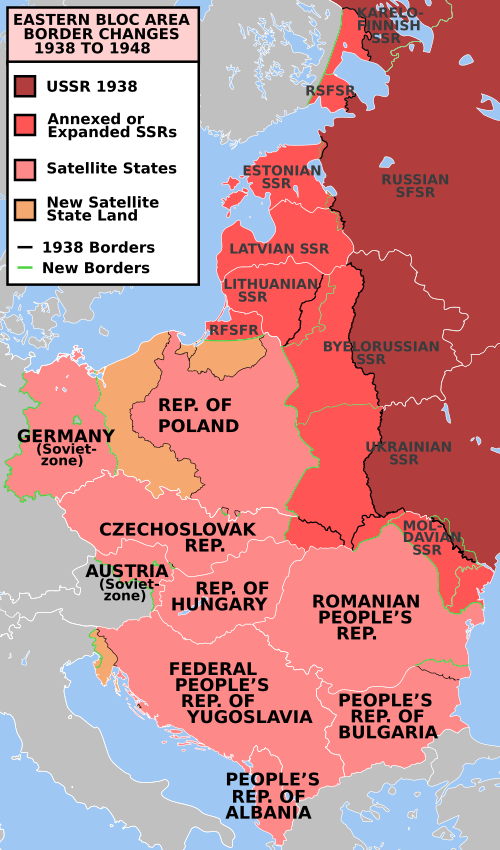
1922年、ロシアSFSR、ウクライナSSR、ベラルーシSSR、ザカフカースSFSRは、ソ連創設条約とソ連創設宣言を承認し、ソビエト連邦を形成した。[25]ソ連を「社会主義の島」と見なしていたソ連の指導者ヨシフ・スターリンは、ソ連は「現在の資本主義の包囲網を社会主義の包囲網に置き換える」必要があると述べた。[26]
1939年から1940年にかけてのソ連の拡大
1939年、ソ連はナチスドイツとモロトフ・リッベントロップ協定を締結した[27]。この協定には、ルーマニア、ポーランド、ラトビア、リトアニア、エストニア、フィンランドをドイツとソ連の勢力圏に分割する秘密議定書が含まれていた。[27] [28]東ポーランド、ラトビア、エストニア、フィンランド、ルーマニア北部のベッサラビアは、ソ連の勢力圏の一部として認められた。[28]リトアニアは1939年9月の2番目の秘密議定書で追加された。[29]
ソ連は、ドイツがポーランド西部に侵攻した2週間後に、モロトフ・リッベントロップ条約で割り当てられたポーランド東部の地域に侵攻し、続いてポーランドのドイツ軍と連携した。[30] [31]ソ連による東ポーランド占領中、ソ連はポーランド国家を解体し、ドイツ・ソ連会議で「ポーランド地域」の将来の構造が話し合われた。[32]ソ連当局は、新たにソ連に併合された地域のソビエト化キャンペーンを直ちに開始した。[33] [ 34] [35] [36] [37]ソ連当局は農業を集団化し、[38]ポーランドの私有財産と国有財産を国有化し、再分配した。 [39] [40] [41]
ソ連によるバルト諸国の最初の占領は1940年6月中旬に始まり、ソ連のNKVD部隊がリトアニア、エストニア、ラトビアの国境検問所を襲撃し、[42] [43]続いて国家行政が解体され、ソ連の幹部が就任した。[42] [44]国会議員やその他の役職の選挙は候補者を一人だけ挙げて実施され、公式結果は捏造され、エストニアでは92.8%、ラトビアでは97.6%、リトアニアでは99.2%の有権者がソ連支持の候補者を支持したとされた。[45] [46]不正に設置された「人民議会」は直ちに、3か国をそれぞれ「ソ連社会主義共和国」と宣言し、「スターリンのソ連への加盟」を要求した。この結果、1940年8月にソ連は正式にリトアニア、ラトビア、エストニアを併合した。[45]国際社会はバルト三国の併合を非難し、違法であるとみなした。[47] [48]
1939年、ソ連はフィンランド侵攻を試みたが失敗に終わり、[49]その後両国は暫定平和条約を締結し、ソ連にカレリア東部(フィンランド領土の10%)を与えた。[49]そして、割譲された領土をKASSRと合併させてカレロ・フィンランド・ソビエト社会主義共和国が樹立された。1940年6月、ソ連がルーマニアにベッサラビア、ブコヴィナ、ヘルツァ地方を要求する最後通牒を発した後、 [50] [51]ソ連はこれらの地域に侵攻し、ルーマニアはソ連の要求に屈し、ソ連はこれらの地域を占領した。[50] [52]
東部戦線と連合国会議
_(B&W).jpg/500px-Yalta_Conference_(Churchill,_Roosevelt,_Stalin)_(B&W).jpg)
1941年6月、ドイツはモロトフ・リッベントロップ協定を破り、ソ連に侵攻した。この侵攻から1944年まで、ソ連に併合された地域はドイツの東方領土の一部であった(モルダビア・ソビエト社会主義共和国を除く)。その後、ソ連は東部戦線での一連の戦闘を通じてドイツ軍を西方へと押し進め始めた。
第二次世界大戦後のソ連・フィンランド国境では、1944年に両国がソ連に割譲する新たな平和条約に署名し、その後ソ連はカレロ・フィンランド・ソビエト社会主義共和国の一部として、前回の暫定平和条約とほぼ同じ東フィンランドの領土を併合した。[53]
1943年から1945年にかけて、戦後ヨーロッパに関する会議が数回開催され、その一部はソ連が中央ヨーロッパ諸国を併合し支配する可能性について議論した。戦後、中央ヨーロッパの国家秩序については連合国がさまざまな計画を練っていた。ヨシフ・スターリンはできるだけ多くの国をソ連の支配下に置こうとしたが、イギリスの首相ウィンストン・チャーチルはこれらの国々をドイツとロシアに対抗するために中央ヨーロッパ・ドナウ連邦を望んだ。[54]チャーチルの中央ヨーロッパに関するソ連の政策は、アメリカの大統領フランクリン・D・ルーズベルトの政策とは大きく異なり、チャーチルはソ連の指導者スターリンを邪悪な体制を率いる「悪魔」のような暴君だと信じていた。[55]
スターリン独裁政権がヨーロッパの一部を支配する可能性があると警告されたとき、ルーズベルトはスターリンとの関係の根拠を要約した声明で応答した。「スターリンはそういう人間ではないという予感がする。…私が彼にできる限りのすべてを与え、見返りに何も求めなければ、つまりノブレス・オブリージュであれば、彼は何も併合しようとせず、民主主義と平和の世界のために私と協力してくれると思う」。[56] 1943年にテヘランでスターリンとルーズベルトと会談したチャーチルは、英国はポーランドを政治的に独立した国として復活させることに非常に興味を持っていると述べた。[57]英国は、それが同盟国間の摩擦の原因になることを恐れて、この問題を追及しなかった。[57]
1945年2月、ヤルタ会談でスターリンは中央ヨーロッパにソ連の政治的影響圏を設けるよう要求した。[58]スターリンは最終的にチャーチルとルーズベルトの説得を受け、ドイツを分割しないよう説得された。[58]スターリンは、ソ連は1939年の侵攻ですでに奪取したポーランド東部の領土を一部の例外を除いて保持し、ポーランドの残りの地域では親ソ連のポーランド政府が権力を握ることを望んでいると述べた。[58]チャーチルとルーズベルトの抵抗の後、スターリンはポーランドの現在の親ソ連政府をより広範な民主的基盤の上に再編することを約束した。[58]彼は、新政府の主な任務は選挙の準備であると述べた。[59]しかし、1946年のポーランド国民投票(「3度目の賛成」国民投票として知られる)とそれに続く1947年のポーランド議会選挙は民主的な基準を満たさず、大幅に操作された。[60]
ヤルタ会談の当事者らはさらに、解放されたヨーロッパ諸国と旧枢軸衛星国が「自らの選択で民主的な制度を創設する」ことが認められ、「すべての国民が自らが暮らす政治形態を選択する権利」に基づいていることにも合意した。[61]当事者らはまた、これらの国々が「自由選挙を通じて可能な限り早期に樹立することを約束し」暫定政府を樹立するのを支援し、「必要に応じてそのような選挙の実施を促進する」ことにも合意した。[61]
1945年7月から8月にかけてドイツが無条件降伏した後のポツダム会談の初めに、スターリンはチャーチルに対して、中央ヨーロッパの「ソビエト化」は行わないという以前の約束を繰り返した。 [62]賠償金に加えて、スターリンは「戦利品」を推し進めた。これは、ソ連が量的または質的制限なしに征服国から財産を直接押収することを許可するものだった。 [63]これには、いくつかの制限付きでこれを許可する条項が追加された。[63]
隠された変革のダイナミクス
当初、ソ連は他の東側諸国の政治における自らの役割を隠し、その変革は西側の「ブルジョア民主主義」の修正として見せかけた。[64]東ドイツで若い共産主義者が言われたように、「民主主義的に見える必要があるが、すべてを自分たちの管理下に置かなければならない」。[65]スターリンは、物質的基盤、生産手段の分配が社会的および政治的関係を形作るというマルクス・レーニン主義の見解を反映して、ソ連の支配を確立するには社会経済的変革が不可欠であると感じていた。[66]ソ連はまた、いくつかの文化的共通点に言及することで、東ヨーロッパ諸国を自らの影響圏に取り込んだ。[67]
モスクワで訓練を受けた幹部は、社会政治的変革に関する命令を遂行するために重要な権力の地位に就いた。[66]土地と工業所有権の没収によるブルジョアジーの社会的および財政的権力の排除は絶対的な優先事項とされた。 [64]これらの措置は、社会経済的変革ではなく「改革」として公に宣伝された。[64]チェコスロバキアの初期を除き、政党の活動は「ブロック政治」に従わなければならず、政党は最終的に「反ファシストブロック」への加盟を受け入れなければならず、相互の「合意」によってのみ行動することを義務付けられた。[68]ブロックシステムにより、ソ連は間接的に国内統制を行うことができた。[69]
人事、一般警察、秘密警察、青年を担当する重要な部門は、厳密に共産主義者によって運営された。[69]モスクワの幹部は「進歩的な勢力」と「反動的な要素」を区別し、両者を無力化した。このような手順は、共産主義者が無制限の権力を獲得し、ソビエトの政策を無条件に支持する政治家だけが残るまで繰り返された。[70]
より厳しい規制を促す初期の出来事
マーシャルプランの拒否
1947年6月、ソ連がドイツの発展に対する制限を緩和する交渉を拒否した後、米国は、ソ連と東欧諸国を含む参加を希望するすべてのヨーロッパ諸国に対する米国の包括的援助計画であるマーシャル・プランを発表した。 [71]ソ連はこの計画を拒否し、米国と非共産主義ヨーロッパ諸国に対して強硬な姿勢を取った。[72]しかし、チェコスロバキアは米国の援助を熱心に受け入れ、ポーランド政府も同様の態度を示しており、これはソ連にとって大きな懸念であった。[73]

ソ連がこの地域を支配していたことを示す最も明白な兆候の一つとして、チェコスロバキアの外務大臣ヤン・マサリクがモスクワに召喚され、マーシャル・プランへの参加を検討していたとしてスターリンに叱責されたことが挙げられる。ポーランドの首相ユゼフ・チランキエヴィチは、ポーランドがマーシャル・プランを拒否したことに対する報酬として、4億5000万ドルの融資、20万トンの穀物、重機、工場を含む5年間の巨額の貿易協定を結んだ。[74]
1947年7月、スターリンはこれらの国々に対し、ヨーロッパ復興計画に関するパリ会議から撤退するよう命じた。この会議は、第二次世界大戦後のヨーロッパの分断における「正念場」と言われた。 [75]その後、スターリンは他の東側諸国に対する統制を強化し、民主的な制度の従来の様相を捨て去った。[76] 1947年8月のハンガリー選挙では、強い圧力にもかかわらず、非共産党が40%を超える票を獲得する可能性があると見られ、独立した政治勢力を排除するために弾圧が行われた。[76]
同月、ソ連の幹部による継続的な指示に基づき、ブルガリアの反対派の殲滅が始まった。[76] [77] 1947年9月下旬、シュクラルスカ・ポレンバで行われた全共産党の会議で、[78]東側諸国の共産党は、マーシャル・プランに至るまでの過程で、それぞれの国で非共産主義者によるわずかな影響さえも許していたとして非難された。[76]
ベルリン封鎖と空輸

ソ連占領下のドイツに囲まれた旧ドイツの首都ベルリンでは、スターリンが1948年6月24日にベルリン封鎖を実施し、西ベルリンへの食糧、物資、物資の到着を阻止した。[79]この封鎖は、1946年10月の早期地方選挙でドイツ社会主義統一党(SED)が拒否され、SEDの2.5倍の票を獲得した社会民主党が勝利したことが一因であった。[80]米国、英国、フランス、カナダ、オーストラリア、ニュージーランド、その他数カ国が大規模な「ベルリン空輸」を開始し、西ベルリンに食糧やその他の物資を供給した。[81]
ソ連は西側の政策変更に反対する広報活動を展開し、共産主義者は1948年の選挙で大きな敗北を喫する前に選挙を妨害しようとした。 [82]一方、30万人のベルリン市民はデモを行い、国際空輸の継続を求めた。[83] 1949年5月、スターリンは封鎖を解除し、西側諸国からのベルリンへの物資輸送の再開を許可した。[84] [85]
チトーとスターリンの分裂
ユーゴスラビアの指導者ヨシップ・ブロズ・チトーとソ連の間でギリシャとアルバニアをめぐる意見の相違の後、チトーとスターリンの分裂が起こり、続いて1948年6月にユーゴスラビアはコミンフォルムから追放され、ベオグラードで短期間のソ連のクーデターが失敗した。[86]この分裂により、ヨーロッパに2つの別々の共産主義勢力が生まれた。[86]東側諸国では直ちにチトー主義に対する激しい反対運動が開始され、あらゆる場所で西側とチトーのエージェントが破壊活動に従事していると述べた。[86]
スターリンは、コミンフォルムを他の東側諸国の政党の内部情勢を監視および統制するための手段に転換するよう命じた。 [ 86 ]彼はまた、コミンフォルムを高位の逸脱者を処罰するための手段に転換することも一時検討したが、非現実的であるとしてその考えは却下された。 [86]その代わりに、紛争を通じて共産党指導者を弱体化させる動きが始まった。[86]東側諸国の共産党および国家の役職に就いているソ連の幹部は、指導部内の紛争を助長し、互いに不利な情報を伝達するよう指示された。[86]これに伴い、「国家主義的逸脱」、「ソ連の役割に対する不十分な認識」、チトーとのつながり、「ユーゴスラビアへのスパイ活動」といった非難が絶え間なく続いた。[87]その結果、東ドイツを含む多くの主要党幹部が迫害された。[87]
このアプローチを経験した最初の国はアルバニアであり、同国の指導者エンヴェル・ホジャは直ちにユーゴスラビア支持から反対へと方針を転換した。[87]ポーランドでは、以前に親ユーゴスラビア発言をしていた指導者ヴワディスワフ・ゴムルカが1948年9月初旬に党書記長の座を解かれ、その後投獄された。 [87]ブルガリアでは、モスクワの幹部ではないトライホ・コストフが次の指導者になると思われると、1949年6月、スターリンはコストフの逮捕を命じ、その後すぐに死刑判決と処刑が下された。[87]他のブルガリアの高官数名も投獄された。[87]スターリンとハンガリーの指導者マチャーシュ・ラーコシはモスクワで会談し、ラーコシの対立候補であるラースロー・ライクの見せしめ裁判を画策し、その後ライクは処刑された。[88]ソビエト圏の維持は、東ヨーロッパにおけるモスクワの影響力と地元の共産主義エリートの権力を固定化するイデオロギー的統一感を維持することにかかっていた。[89]
港湾都市トリエステは第二次世界大戦後、特に注目を集めた。ティトーとスターリンの決裂まで、西側諸国と東側諸国は妥協することなく対立していた。1947年に国連の支援を受けて設立された中立緩衝国トリエステ自由地域は、西側諸国とティトーの緊張緩和により、1954年と1975年に分割され解体された。[90] [91]
政治
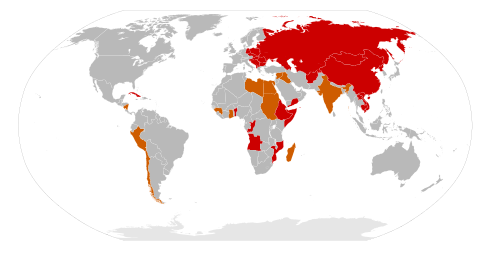
東側諸国では、ヨシフ・スターリンが共産主義の制度設計を最初に実施したが、その後の展開は国によって異なっていた。 [92]衛星国では、平和条約が最初に締結された後、反対派は基本的に一掃され、社会主義への基本的なステップが強制され、クレムリンの指導者たちはそこでの統制を強化しようとした。[93]スターリンは最初から、市場経済、資本主義議会民主主義(ソ連の用語では「ブルジョア民主主義」と呼ばれた)、そして国家による裁量的介入を抑制する法の支配という西側の制度的特徴を拒否するシステムを指揮した。[94]その結果生まれた国々は、広範かつ活発な抑圧装置に支えられた政治の中心の完全な統制と、マルクス・レーニン主義イデオロギーの中心的役割を志向した。[94]
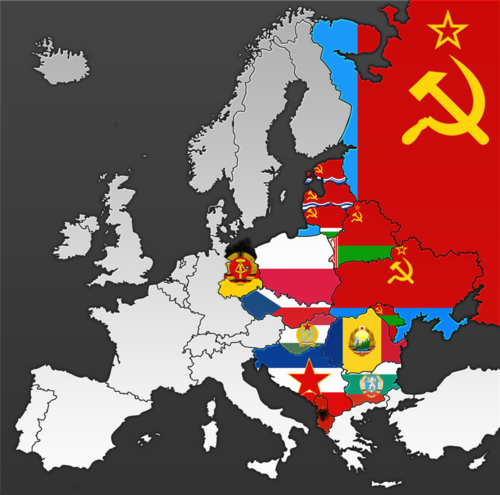
しかし、民主主義制度の痕跡が完全に破壊されることはなく、議会など、事実上統治者の決定に承認を与えるだけの西洋式の制度や、当局による遵守が限定的であったり、まったく存在しなかったりする憲法といった制度が表面化した。[94]議会は依然として選挙で選ばれていたが、その会合は年に数日しか開かれず、政治局の決定を正当化するためだけに開かれ、議会にはほとんど注目されなかったため、議員の中には実際に亡くなっていた者もおり、選挙で負けた議員を議席に就かせると当局者は公然と述べていた。[95]
各共産党の中央委員会の第一書記長または書記長は、各政権で最も権力を握っていた。[96]政治局が支配する政党は大衆政党ではなく、レーニン主義の伝統に従い、国の人口の3〜14%の完全な服従を受け入れた小規模な選抜政党であった。[97]この選抜グループのメンバーシップを獲得した人々は、高品質の国内外の商品(菓子、アルコール、葉巻、カメラ、テレビなど)の品揃えが豊富な特別低価格店の利用、特別な学校、休暇施設、住宅、高品質の国内外の家具、芸術作品、年金、海外旅行の許可、警察などが遠くからメンバーを識別できる独自のナンバープレートの公用車など、かなりの特典を受け取りました。[97]
政治的および民事上の制限
移民制限に加えて、党の国家統制の外で政治活動の領域として定義された市民社会は、1980年代のポーランドを除いて、しっかりと根付くことを許されなかった。[98]共産主義システムの制度設計は法の支配の拒否に基づいていたが、法的基盤は、イデオロギーの衰退と自治法の代替を反映した変化から免れられなかった。[98]当初、チェコスロバキアを除くすべての国で共産党は小規模であったため、行政、警察、その他の専門職に就く政治的に「信頼できる」人材が深刻に不足していた。[99]そのため、当初は「政治的に信頼できない」非共産主義者がそのような役割を果たさなければならなかった。[99]共産主義当局に従わない者は追放され、モスクワの幹部は政治的要件を満たす人材を養成するための大規模な党プログラムを開始した。[99]かつての中流階級のメンバーは公式には差別されていたが、国家が彼らのスキルを必要とし、良き共産主義市民として自分自身を再発明する機会が与えられたため、多くの人が成功を収めることができた。[100]
東側諸国の共産主義政権は、共産主義権力の基盤となる野党知識人の周縁集団を潜在的な脅威とみなしていた。[101]反対派や反対派の抑圧は権力維持の主要条件と考えられていたが、一部の国の国民を秘密裏に監視するために莫大な費用がかかったことは合理的ではなかったかもしれない。[101]全体主義的な初期段階に続いて、スターリンの死後、共産主義統治の主な手段が大量テロから選択的弾圧へと移行し、正当性付与と忠誠心の確保というイデオロギー的、社会政治的戦略も変化した。 [102]陪審員は、信頼できる党関係者である専門の裁判官と2人の素人陪審員で構成される法廷に置き換えられた。 [ 103 ]
警察は党の指示に反対する行為を抑止し、抑制した。[103]政治警察はシステムの中核として機能し、その名前はむき出しの権力と、個人が国家に対して行動を起こした場合の暴力的な報復の脅威と同義となった。[103]いくつかの州警察と秘密警察組織が共産党の統治を強制し、その中には以下が含まれる。
- 東ドイツ -シュタージ、フォルクスポリツァイ、KdA
- ソビエト連邦 – KGB
- チェコスロバキア – STBおよびLM
- ブルガリア – KDS
- アルバニア –シグリミ
- ハンガリー – ÁVH およびMunkásőrség
- ルーマニア –セキュリターテとGP
- ポーランド – Urząd Bezpieczeństwa、Służba Bezpieczeństwa、ZOMO
メディアと情報の制限

共産主義時代の報道機関は国家機関であり、共産党に完全に依存し従属していた。[104] 1980年代後半以前は、東側諸国のラジオやテレビ局は国有であったが、印刷メディアは通常、政治組織、主に地方共産党によって所有されていた。[105]青年新聞や雑誌は共産党に所属する青年組織によって所有されていた。[105]
メディア統制は共産党自身によって直接行われ、また、同じく党によって統制されていた国家検閲によっても行われた。[105]メディアは情報と社会に対する重要な統制手段として機能した。[106]知識の普及と描写は、代替概念や批判を抑圧することで共産主義の存続に不可欠であると当局は考えていた。[106]共産党の国営新聞がいくつか発行されており、その中には以下が含まれる。
- ソ連の中央新聞
- トリブナ・ルドゥ(ポーランド)
- Czerwony Sztandar (ヴィリニュス) (1953–1990)、リトアニア ソビエト社会主義共和国のポーランド語新聞
- Népszabadság (1956 年までSzabad Nép、ハンガリー)
- ノイエス・ドイチュラント (東ドイツ)
- ラボトニチェスコ・デロ(ブルガリア)
- ルーデ・プラヴォ(チェコスロバキア)
- ラーヴァ・ヘル(旧エストニアを併合)
- プラウダ(スロバキア)
- カウノ・ディエナ(併合された旧リトアニア)
- シンテイア(ルーマニア)
- ズビャズダ(ベラルーシ)。
ソ連電信局(TASS)は、ソ連のすべての新聞、ラジオ、テレビ局の国内外のニュースを収集、配信する中央機関として機能していた。NKVDやGRUなどのソ連の諜報機関や治安機関が頻繁に潜入していた。TASS は、リトアニアSSR、ラトビアSSR、エストニアSSR、モルダビアSSR、ウクライナSSR 、ベラルーシSSRを含む14のソ連共和国に支局を持っていた。
西側諸国は、当局による放送妨害の試みにもかかわらず、 BBC、VOA、ラジオ・フリー・ヨーロッパ(RFE)などの放送サービスを東側諸国で聞くことができるようにした強力な送信機に多額の投資を行った。
宗教

多くの東側諸国の国家無神論の下で、宗教は積極的に抑圧された。 [107]これらの国の中には、民族的伝統を国教会に結び付けている国もあったため、ソ連は国民と教会の両方を標的にした。[108] [109]
組織
1949年、ソ連、ブルガリア、チェコスロバキア、ハンガリー、ポーランド、ルーマニアは、中央ヨーロッパの小国に対するソ連の支配を強化し、マーシャル・プランに関心を示していた一部の国をなだめるというスターリンの願望に沿ってコメコンを設立した。[110] [111]これらの国は、西ヨーロッパの伝統的な市場や供給者からますます切り離されつつあった。[75]スターリンは、コメコンの間接的な洗練よりも、他の党首との直接的なつながりを好んだため、コメコンの役割は曖昧になり、1950年代の経済計画では重要な役割を担わなかった。[112]当初、コメコンはソ連が東側諸国から資材や設備を調達するための隠れ蓑として機能していたが、1970年代までにソ連が安価な原材料と粗悪な完成品を交換することで東側諸国の純補助金を出すようになり、バランスが変わった。[113]
1955年、ワルシャワ条約機構が結成されたのは、 NATOが西ドイツを加盟させたことへの対応と、ソ連がハンガリーに赤軍部隊を留めておく口実が必要だったためである。[111] 35年間、ワルシャワ条約機構は、帝国の拡大と東ヨーロッパの衛星国に対する支配に基づくソ連の国家安全保障というスターリン主義の概念を永続させた。[114]ソ連が東側諸国における安全保障関係を公式化したことは、東中央ヨーロッパにおける継続的な存在が西側に対する防衛の基盤であるというモスクワの基本的な安全保障政策の原則を反映していた。[114]ワルシャワ条約機構は、その制度的構造を通じて、1953年の死去以来のヨシフ・スターリンの個人的な指導力の不在を部分的に補った。[114]ワルシャワ条約機構は、統一されたソ連の指揮系統の下でソ連の将校と治安部隊が勤務する他のブロック加盟国の軍隊を統合した。[115]
1964年以降、ルーマニアはより独立した道を歩み始めた。 [ 116 ]コメコンやワルシャワ条約機構を否定したわけではないが、どちらにおいても重要な役割を果たすことはなくなった。[116] 1年後にニコラエ・チャウシェスクが指導者に就任したことで、ルーマニアはますます独立の方向へと進んだ。[116]スターリン主義指導者エンヴェル・ホジャの下で脱スターリン化に続き孤立を深めたアルバニアは、 1961年にアルバニアとソ連の分裂を経験し、1968年にワルシャワ条約機構のチェコスロバキア侵攻を受けてワルシャワ条約機構から脱退した。[117 ]
移民制限と亡命者
1917年、ロシアはパスポート管理を導入し、交戦国の国民の出国を禁じることで移民を制限した。[119] 1922年、ソ連成立条約後、ウクライナ・ソビエト社会主義共和国とロシア・ソビエト社会主義共和国はともに、事実上すべての出国を禁じる旅行に関する一般規則を発布し、合法的な移民を不可能にした。[120]その後、国境管理が強化され、1928年までには違法な出国さえ事実上不可能になった。[120]これには後に国内パスポート管理も含まれ、これは個々の都市の居住地許可証や、しばしば101キロメートルと呼ばれる国内の移動の自由の制限と相まって、ソ連の狭い地域内での移動さえも大幅に制限した。[121]

東側諸国の成立後、限られた状況を除いて、新たに占領された国々からの移民は 1950 年代初頭に事実上停止され、ソ連の国民移動管理手法は東側諸国の大半によって模倣された。[122]しかし、東ドイツでは、占領地域間のドイツ内陸国境を利用して、数十万人が西ドイツに逃亡し、その数は1950年には197,000人、1951年には165,000人、1952年には182,000人、1953年には331,000人に上った。[123] [124] 1953年の急増の理由の1つは、1952年後半から1953年初頭にかけてのヨシフ・スターリンのますます偏執的な[疑わしい-議論する]行動により、ソビエト化がさらに進む可能性があるという恐れだった。 [125] 1953年の最初の6か月だけで226,000人が逃亡した。[126]
1952年にドイツ国内の国境が正式に閉鎖されたが、[127]ベルリン市街地の国境は4つの占領国すべてによって管理されていたため、他の国境よりもかなりアクセスしやすいままであった。[128]したがって、それは事実上、東側諸国の市民が西に移動できる「抜け穴」を構成していた。[127] 1961年までに国を離れた350万人の東ドイツ人は、共和国脱出と呼ばれ、東ドイツ全土の人口の約20%を占めた。[129] 1961年8月、東ドイツは有刺鉄線の障壁を設置したが、これは最終的にベルリンの壁の建設によって拡張され、抜け穴を事実上閉じた。[130]
従来の移民はほとんど存在しなかったため、1950年から1990年の間に東側諸国から移住した人々の75%以上は、「民族移民」に関する二国間協定に基づいて移住した。[131]約10%は1951年のジュネーブ条約に基づく難民移民であった。 [131]この時期に出国を許可されたソ連民のほとんどは、1970年に一連の恥ずかしい亡命が起こり、ソ連が民族移民を非常に限定的に開放した後、イスラエルへの移住を許可された民族ユダヤ人であった。[132]鉄のカーテンの崩壊は、ヨーロッパの東西間の移住の大幅な増加を伴った。[131]有名な東側諸国からの亡命者には、1967年の亡命後にスターリンを非難したヨシフ・スターリンの娘スベトラーナ・アリルーエワがいた。 [133]
人口
ソ連などの東側諸国では人口増加率が高かった。1917年、現在の国境地帯におけるロシアの人口は9100万人だった。ロシア内戦での破壊にもかかわらず、 1926年には人口は9270万人に増加した。1939年には人口は17%増加して1億800万人となった。第二次世界大戦中、2000万人以上が死亡したにもかかわらず、ロシアの人口は1959年に1億1720万人に増加した。1989年のソ連国勢調査では、ロシアの人口は1億4700万人と示された。[134]
ソ連の経済・政治体制は、例えばバルト諸国でさらなる結果をもたらした。バルト諸国の人口は、1939年から1990年にかけて、デンマーク、フィンランド、ノルウェーなどの類似国と比較して、本来あるべき人口の約半分にとどまった。劣悪な住宅は、東側諸国全体で出生率が大幅に低下した要因の1つであった。[135]しかし、出生率は西欧諸国よりも高かった。経口避妊薬や子宮内避妊具が定期的に不足し、これらのシステムが信頼できないため、中絶に依存したことも[136]、出生率を低下させ、1960年代後半までに中絶に対する厳しい規制や、10人以上の子供を産んだルーマニア人女性に「英雄的な母親」の称号を与えるなどの宣伝活動を含む、出生促進政策への転換を余儀なくされた。 [137]
1966年10月、ルーマニアでは人工避妊が禁止され、出産可能年齢の女性には定期的な妊娠検査が義務付けられ、妊娠中絶が発覚した者には厳しい罰則が科せられた。[138]このような制限にもかかわらず、出生率は低迷し続け、その一因は未熟な人工妊娠中絶であった。[137]東側諸国の人口は次の通りである。[139] [140]
社会構造
東側諸国の社会は、平等主義的要素が強い反能力主義の原則のもとで運営されていた。例えば、チェコスロバキアは、資格の低い個人を優遇し、ノメンクラトゥーラや適切な階級や政治的背景を持つ人々に特権を与えていた。東側諸国の社会は、パベル・マホニンが「党政政治」と呼んだ共産党支配だった。[141]かつての中流階級のメンバーは、公式には差別されていたが、彼らのスキルの必要性から、良き共産主義市民として生まれ変わることができた。[100] [142]
ハウジング
東側諸国では住宅不足が蔓延していた。ヨーロッパでは、主に第二次世界大戦中の荒廃が原因であった。1975年以降、住宅に利用できる国家資源が大幅に削減されたため、建設活動は停滞した。 [143]都市は大規模なシステム建築のアパートで溢れるようになった。 [144]住宅建設政策は、かなりの組織的問題を抱えていた。[145]さらに、完成した住宅の仕上げ品質は著しく低かった。[145]
住宅の質
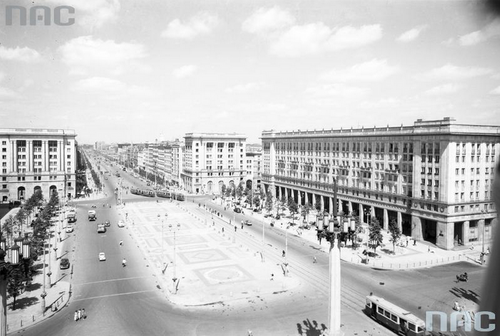
1970年代から1980年代にかけて、東側諸国の都市では、ほぼ全面的に大規模アパート群が重視されていた。[146] 東ドイツ当局は、プラッテンバウアパート群の建設には大きなコスト上の利点があると考えたため、大都市の郊外では、東側諸国の崩壊までそのような建築物の建設が続いた。[146]チェコスロバキアのパネラークやハンガリーのパネハーズなどの建物。1970年代から1980年代にかけて、国家の役割を強化したいと考えたニコラエ・チャウシェスクは、既存の集落、村、町、都市の全部または一部の取り壊しと再建からなる体系化プログラムを制定し、全国で標準化されたアパート群(ブロックリ)を建設する場所を確保した。[146]このイデオロギーの下、チャウシェスクは1980年代にブカレストの旧歴史地区の場所に 議会宮殿を含むブカレスト市民センターを建設した。
1980年代後半になっても、東側諸国の衛生状態は概して十分とは程遠いものであった。 [147]データが存在するすべての国において、1966年から1975年の間に、60%の住宅で1部屋当たり1人を超える密度があった。 [147]データが利用可能な西側諸国の平均は、1部屋当たり約0.5人であった。[147]新築住宅の仕上げの質が悪く、居住者が一定量の仕上げ作業や追加修理を受けることが多かったため、問題はさらに悪化した。[147]
1970年代と1980年代の住宅不足の悪化は、1970年から1986年にかけて人口に対する住宅ストックの量が増加した時期に発生した。[150]新築住宅でさえ、東側諸国の平均住宅面積はわずか61.3平方メートル(660平方フィート)であるのに対し、比較可能なデータが利用可能な西側10か国では113.5平方メートル(1,222平方フィート)であった。[150]空間基準には大きなばらつきがあり、1986年のソ連の平均的な新築住宅は、ハンガリーの同等の住宅のわずか68%の面積であった。[150] 1980~1986年の東ドイツや1970~1980年のブルガリアなどの例外的なケースを除けば、東側諸国の解体前に新築住宅の空間基準は上昇した。[150]住宅の規模は時代によって大きく変化しており、特に東側諸国の石油危機以降は顕著であった。例えば、1990年代の西ドイツの住宅の平均床面積は83平方メートル(890平方フィート)であったのに対し、1967年の東ドイツの平均住宅面積は67平方メートル(720平方フィート)であった。[151] [152]
劣悪な住宅は、東側諸国全体の出生率低下につながった4つの主な要因(他の要因としては劣悪な生活環境、女性の雇用増加、避妊手段としての推奨される中絶)の1つであった。[135]
経済

市場シグナルの欠如により、東側諸国の経済は中央計画者による誤った発展を経験した。[154] [155]東側諸国はまた、大量の物資をソ連に依存していた。[154] [156]
技術の遅れは西側諸国からの輸入への依存を招き、その結果西側通貨の需要が高まった。東側諸国はパリクラブ(中央銀行)とロンドンクラブ(民間銀行)から多額の借入を行っていたが、1980年代初頭までにその大半が債権者に破産を通告せざるを得なくなった。しかしこの情報は国民には秘密にされ、プロパガンダによってこれらの国々は社会主義への最善の道を歩んでいるという見方が広まった。[157] [158] [159]
社会状況
第二次世界大戦と東ヨーロッパにおけるドイツ占領の結果、この地域の大半は産業、インフラの甚大な破壊と民間人の死に見舞われた。ポーランドだけでも、略奪と搾取の政策により、ポーランドの産業(62%が破壊された) [160] 、農業、インフラ、文化的建造物に莫大な物質的損失がもたらされ、その損失は2004年の為替価値でおよそ5250億ユーロ、または6400億ドルと推定されている[161] 。
東側諸国では、ソ連でも他のソ連諸国でも、ロシアは目立つ存在とみなされ、「最も卓越した国民」、「指導的人民」と呼ばれていた。 [ 162 ]ソ連は、ロシアの行動と特徴への尊敬と、東側諸国におけるソ連の構造的ヒエラルキーの構築を推進した。[162]
.jpg/500px-Bucur_Obor_(1986).jpg)
スターリン主義 全体主義の特徴は、国家と社会、経済の独特な共生であり、その結果、政治と経済は自律的で区別可能な領域としての特徴を失ってしまった。[92]スターリンは当初、市場経済、民主的統治(ソ連の用語では「ブルジョア民主主義」と呼ばれた)、国家による裁量的介入を抑制する法の支配といった西側の制度的特徴を拒否するシステムを指揮した。 [94]
ソ連は私有財産の没収と国有化を命じた。 [163]ブロック内に出現したソ連式の「複製政権」は、ソ連の統制経済を再現しただけでなく、ヨシフ・スターリンが用いた残忍な方法とソ連式の秘密警察を採用し、現実の反対派と潜在的な反対派を抑圧した。[163]
東側諸国のスターリン主義政権は、スターリン主義権力の基盤のせいで、反対派知識人の少数派でさえも潜在的な脅威とみなしていた。[101]反対意見や反体制派の抑圧は、東側諸国内でスターリン主義権力を安定させるための中心的な前提条件であったが、反対意見や反体制派の抑圧の程度は、東側諸国全体において国や時期によって異なっていた。[101]
さらに、東側諸国のメディアは国家機関であり、ソ連政府に完全に依存し従属しており、ラジオやテレビ局は国有であったが、印刷メディアは通常、政治組織、主に地方政党によって所有されていた。[104] 1945年から1949年にかけて1500万人以上の東側諸国の住民が西へ移住したが、[164] 1950年代初頭には移住は事実上停止し、ソ連の国民運動統制の手法は東側諸国のほとんどに模倣された。[122]
初期の変更
改革と称される変革

ソ連では、ヨシフ・スターリン政権下で厳重な秘密主義が敷かれていたため、第二次世界大戦後何年もの間、最も情報に通じた外国人でさえソ連経済の運営について事実上知ることはできなかった。[165]スターリンは1935年以降(そして死去するまで)ソ連への外部からのアクセスを封鎖し、事実上、ソ連国内への外国人の渡航を一切認めなかったため、ソ連内で起こっている政治プロセスについて部外者は知る由もなかった。[166]この期間中、そしてスターリン死去後25年間もの間、ソ連国内への入国を許可された数少ない外交官や外国人特派員は、通常モスクワから数キロ以内に制限され、電話は盗聴され、住居は外国人専用に制限され、ソ連当局に常に尾行されていた。[166]
ソ連はまた、ソ連以外の東側諸国の経済をソ連の指令経済路線に沿って模倣した。[167]第二次世界大戦前、ソ連は、農業の集団化や強制収容所制度で集められた大規模な労働軍の活用など、すべての資産を国家計画通りに投資するという指令の遵守を確実にするために、厳格な手続きを採用していた。[168]この制度は、第二次世界大戦後、他の東側諸国に広く押し付けられた。[168]プロレタリア階級の改善の宣伝が制度変更を伴っていたが、その結果として生じた冷酷なスターリン主義の恐怖と脅迫により、主張されている利益に対する感情は曖昧になった。[113]
スターリンは、ソ連の支配を確立するには社会経済的変革が不可欠であると感じていた。これは、物質的基盤、生産手段の分配が社会的、政治的関係を形作るというマルクス・レーニン主義の見解を反映していた。 [66]モスクワで訓練された幹部は、社会政治的変革に関する命令を遂行するために重要な権力の地位に就いた。[66]土地と工業所有権の没収によるブルジョアジーの社会的、財政的権力の排除は絶対的な優先事項とされた。[64]
これらの措置は、公的には社会経済的変革ではなく改革として宣伝された。[64]チェコスロバキアを除く東側諸国全体で、労働組合や様々な社会的、職業的、その他のグループを代表する協会などの「社会組織」が、競争を排除した各カテゴリーにつき1つの組織のみで設立された。[64]これらの組織はスターリン主義の幹部によって運営されていたが、初期の段階ではある程度の多様性が認められていた。[68]
資産移転
同時に、戦争の終結時にソ連は東欧の工業資産をソ連に物理的に輸送し移転させる「略奪政策」を採用した。 [169]東側諸国はソ連の再建のために石炭、工業設備、技術、鉄道車両、その他の資源の提供を義務付けられた。[170] 1945年から1953年の間に、ソ連は東側諸国からおよそ140億ドルの資源の純移転を受けたが、これはマーシャル・プランにおける米国から西欧への純移転額に匹敵する。[170] [171] 「賠償」には、ポーランドの鉄道の解体と、ソ連支配と同時期に1944年から1948年の間にソ連に支払われた18億ドル相当のルーマニアの賠償金が含まれた。[168]
さらに、ソ連は企業をソ連が支配権を持つ株式会社として再編した。 [171] [172]この管理手段を使って、チェコスロバキアと東ドイツのウラン鉱山、ポーランドの炭鉱、ルーマニアの油井など、いくつかの企業は世界価格よりも安い価格でソ連に製品を販売することを義務付けられた。[173]
貿易とコメコン
東側諸国の貿易パターンは大きく変化した。[174]第二次世界大戦前、これらの国の貿易のうちソ連との貿易は1~2%以下であった。[174] 1953年までに、そのような貿易のシェアは37%に跳ね上がった。[174] 1947年、ヨシフ・スターリンもマーシャル・プランを非難し、すべての東側諸国がそれに参加することを禁じた。[175]
ソ連の優位性は、東側諸国の経済を相互経済援助会議(CMEA)またはコメコンを通じてモスクワにさらに結び付けた。[ 174 ]この会議は、各国の投資配分と東側諸国内で取引される製品を決定した。[176]コメコンは1949年に発足したが、スターリンは会議の間接的な洗練よりも他の党首との直接的なつながりを好んだため、その役割は曖昧になった。1950年代の経済計画では、コメコンは重要な役割を果たさなかった。[112]
当初、コメコンはソ連が東側諸国から資材や設備を調達するための隠れ蓑として機能していたが、1970年代までにソ連が安価な原材料と粗悪な完成品の交換を通じて東側諸国の純補助金供給国となり、バランスが変わった。[113]石油、木材、ウランなどの資源は当初、他の東側諸国へのアクセスを魅力的にしていたが、ソ連はすぐにそれらの国々で結束を維持するためにソ連の原材料を輸出しなければならなくなった。[168]ルーマニアの鉱物資源を採掘し、農業生産を多用するというコメコンの計画に抵抗した後、ルーマニアは1964年に独立志向になり始めた。[116]ルーマニアはコメコンを否定しなかったが、特にニコラエ・チャウシェスクが権力を握った後は、コメコンの運営に重要な役割を果たすことはなかった。[116]
重工業重視
ソ連の公式プロパガンダによれば、住宅、医療、教育は前例のないほど安価だったという。[177] [信頼できない情報源? ]アパートの家賃は平均して家計のわずか1%で、自治体のサービスを含めると4%に達する。路面電車の切符は20コペイカ、パン1斤は15コペイカ。エンジニアの平均月給は140~160ルーブルだった。[178]
ソ連は、国内の消費財部門の発展において大きな進歩を遂げた。1970年、ソ連は6億7900万足の革靴を生産したが、米国は5億3400万足だった。一人当たりの靴生産量が世界一だったチェコスロバキアは、靴生産のかなりの部分を他国に輸出していた。[179]
社会主義下での生活水準の向上により、労働時間は着実に減少し、余暇が増加した。1974年、ソ連の工業労働者の週平均労働時間は40時間だった。1968年には有給休暇は最低15日に達した。1970年代半ばには、年間休日、休日、休暇の数は128~130日となり、過去10年間のほぼ2倍となった。[180]
このような経済では市場のシグナルが欠如していたため、中央計画者による誤った開発が起こり、その結果、これらの国々は急速な成長を達成するために、集約的(効率的な資源利用)開発ではなく、広範的(非効率的に使用される資本、労働、エネルギー、原材料の投入の大規模な動員)開発の道をたどることになった。[154] [181]東側諸国は、軽工業やその他の部門を犠牲にして重工業を過度に重視するソ連モデルに従う必要があった。[182]
このモデルは天然資源やその他の資源の浪費的な搾取を伴うため、一種の「焼き畑」方式と評されてきた。[181]ソビエト体制はプロレタリア独裁を目指していたが、多くの東欧諸国にはプロレタリア階級がほとんど存在せず、プロレタリア階級を生み出すには重工業を建設する必要があった。 [182]各体制は、所有権の定義が曖昧であること、市場均衡価格の欠如、類似の市場経済に比べて誇張された、または歪んだ生産能力など、国家指向経済特有のテーマを共有していた。[92]
資源の配分と分配システムにおいて、大きな誤りと無駄が生じていた。[144]党が運営する国家機関が一枚岩であったため、これらのシステムは、コスト、浪費、非効率、無駄を抑制するための効果的なメカニズムやインセンティブを提供していなかった。[144]重工業は、軍産複合体とエンジニアリング部門にとっての重要性から、優先された。[183]
工場は非効率的な場所に配置され、高い輸送コストがかかることがあり、一方で工場の組織が不十分なために生産が滞り、独占的な中間体供給者に依存する他の産業に波及効果が生じることもあった。[184]例えば、アルバニアを含む各国は、エネルギーや鉱石などの必要な資源が不足しているかどうかにかかわらず製鉄所を建設した。[182]ブルガリアでは、鉱石をソ連から輸入し、ブルガスの港から320キロ(200マイル)輸送しなければならなかったにもかかわらず、大規模な冶金工場が建設された。[182] 1980年のワルシャワのトラクター工場には、使われず錆びて役に立たなくなった機器のリストが52ページにわたってあった。[182]
This emphasis on heavy industry diverted investment from the more practical production of chemicals and plastics.[176] In addition, the plans' emphasis on quantity rather than quality made Eastern Bloc products less competitive in the world market.[176] High costs passed through the product chain boosted the 'value' of production on which wage increases were based, but made exports less competitive.[184] Planners rarely closed old factories even when new capacities opened elsewhere.[184] For example, the Polish steel industry retained a plant in Upper Silesia despite the opening of modern integrated units on the periphery while the last old Siemens-Martin process furnace installed in the 19th century was not closed down immediately.[184]
Producer goods were favoured over consumer goods, causing consumer goods to be lacking in quantity and quality in the shortage economies that resulted.[155][181]
By the mid-1970s, budget deficits rose considerably and domestic prices widely diverged from the world prices, while production prices averaged 2% higher than consumer prices.[185] Many premium goods could be bought either in a black market or only in special stores using foreign currency generally inaccessible to most Eastern Bloc citizens, such as Intershop in East Germany,[186] Beryozka in the Soviet Union,[187] Pewex in Poland,[188][189] Tuzex in Czechoslovakia,[190] Corecom in Bulgaria, or Comturist in Romania. Much of what was produced for the local population never reached its intended user, while many perishable products became unfit for consumption before reaching their consumers.[144]
Black markets
As a result of the deficiencies of the official economy, black markets were created that were often supplied by goods stolen from the public sector.[191][192] The second, "parallel economy" flourished throughout the Bloc because of rising unmet state consumer needs.[193] Black and gray markets for foodstuffs, goods, and cash arose.[193] Goods included household goods, medical supplies, clothes, furniture, cosmetics and toiletries in chronically short supply through official outlets.[189]
Many farmers concealed actual output from purchasing agencies to sell it illicitly to urban consumers.[189] Hard foreign currencies were highly sought after, while highly valued Western items functioned as a medium of exchange or bribery in Stalinist countries, such as in Romania, where Kent cigarettes served as an unofficial extensively used currency to buy goods and services.[194] Some service workers moonlighted illegally providing services directly to customers for payment.[194]
Urbanization
The extensive production industrialization that resulted was not responsive to consumer needs and caused a neglect in the service sector, unprecedented rapid urbanization, acute urban overcrowding, chronic shortages, and massive recruitment of women into mostly menial and/or low-paid occupations.[144] The consequent strains resulted in the widespread used of coercion, repression, show trials, purges, and intimidation.[144] By 1960, massive urbanisation occurred in Poland (48% urban) and Bulgaria (38%), which increased employment for peasants, but also caused illiteracy to skyrocket when children left school for work.[144]
Cities became massive building sites, resulting in the reconstruction of some war-torn buildings but also the construction of drab, dilapidated, system-built apartment blocks.[144] Urban living standards plummeted because resources were tied up in huge long-term building projects, while industrialization forced millions of former peasants to live in hut camps or grim apartment blocks close to massive polluting industrial complexes.[144]
Agricultural collectivization

Collectivization is a process pioneered by Joseph Stalin in the late 1920s by which Marxist–Leninist regimes in the Eastern Bloc and elsewhere attempted to establish an ordered socialist system in rural agriculture.[195] It required the forced consolidation of small-scale peasant farms and larger holdings belonging to the landed classes for the purpose of creating larger modern "collective farms" owned, in theory, by the workers therein. In reality, such farms were owned by the state.[195]
In addition to eradicating the perceived inefficiencies associated with small-scale farming on discontiguous land holdings, collectivization also purported to achieve the political goal of removing the rural basis for resistance to Stalinist regimes.[195] A further justification given was the need to promote industrial development by facilitating the state's procurement of agricultural products and transferring "surplus labor" from rural to urban areas.[195] In short, agriculture was reorganized in order to proletarianize the peasantry and control production at prices determined by the state.[196]
The Eastern Bloc possesses substantial agricultural resources, especially in southern areas, such as Hungary's Great Plain, which offered good soils and a warm climate during the growing season.[196] Rural collectivization proceeded differently in non-Soviet Eastern Bloc countries than it did in the Soviet Union in the 1920s and 1930s.[197] Because of the need to conceal the assumption of control and the realities of an initial lack of control, no Soviet dekulakisation-style liquidation of rich peasants could be carried out in the non-Soviet Eastern Bloc countries.[197]
Nor could they risk mass starvation or agricultural sabotage (e.g., holodomor) with a rapid collectivization through massive state farms and agricultural producers' cooperatives (APCs).[197] Instead, collectivization proceeded more slowly and in stages from 1948 to 1960 in Bulgaria, Romania, Hungary, Czechoslovakia, and East Germany, and from 1955 to 1964 in Albania.[197] Collectivization in the Baltic republics of the Lithuanian SSR, Estonian SSR and Latvian SSR took place between 1947 and 1952.[198]
Unlike Soviet collectivization, neither massive destruction of livestock nor errors causing distorted output or distribution occurred in the other Eastern Bloc countries.[197] More widespread use of transitional forms occurred, with differential compensation payments for peasants that contributed more land to APCs.[197] Because Czechoslovakia and East Germany were more industrialized than the Soviet Union, they were in a position to furnish most of the equipment and fertilizer inputs needed to ease the transition to collectivized agriculture.[181] Instead of liquidating large farmers or barring them from joining APCs as Stalin had done through dekulakisation, those farmers were utilised in the non-Soviet Eastern Bloc collectivizations, sometimes even being named farm chairman or managers.[181]
Collectivisation often met with strong rural resistance, including peasants frequently destroying property rather than surrendering it to the collectives.[195] Strong peasant links with the land through private ownership were broken and many young people left for careers in industry.[196] In Poland and Yugoslavia, fierce resistance from peasants, many of whom had resisted the Axis, led to the abandonment of wholesale rural collectivisation in the early 1950s.[181] In part because of the problems created by collectivisation, agriculture was largely de-collectivised in Poland in 1957.[195]
The fact that Poland nevertheless managed to carry out large-scale centrally planned industrialisation with no more difficulty than its collectivised Eastern Bloc neighbours further called into question the need for collectivisation in such planned economies.[181] Only Poland's "western territories", those eastwardly adjacent to the Oder-Neisse line that were annexed from Germany, were substantially collectivised, largely in order to settle large numbers of Poles on good farmland which had been taken from German farmers.[181]
Economic growth
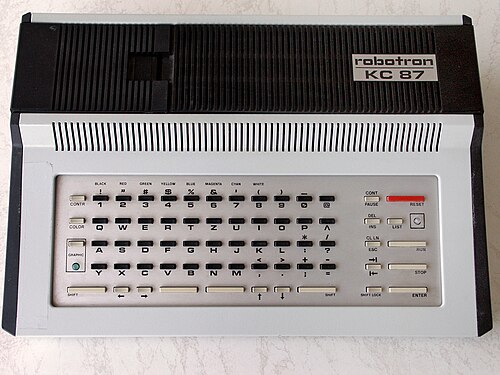
There was significant progress made in the economy in countries such as the Soviet Union. In 1980, the Soviet Union took first place in Europe and second worldwide in terms of industrial and agricultural production, respectively. In 1960, the USSR's industrial output was only 55% that of America, but this increased to 80% in 1980.[177][unreliable source?]
With the change of the Soviet leadership in 1964, there were significant changes made to economic policy. The Government on 30 September 1965 issued a decree "On improving the management of industry" and the 4 October 1965 resolution "On improving and strengthening the economic incentives for industrial production". The main initiator of these reforms was Premier A. Kosygin. Kosygin's reforms on agriculture gave considerable autonomy to the collective farms, giving them the right to the contents of private farming. During this period, there was the large-scale land reclamation program, the construction of irrigation channels, and other measures.[177] In the period 1966–1970, the gross national product grew by over 35%. Industrial output increased by 48% and agriculture by 17%.[177] In the eighth Five-Year Plan, the national income grew at an average rate of 7.8%. In the ninth Five-Year Plan (1971–1975), the national income grew at an annual rate of 5.7%. In the tenth Five-Year Plan (1976–1981), the national income grew at an annual rate of 4.3%.[177]
The Soviet Union made noteworthy scientific and technological progress. Unlike countries with more market-oriented economies, scientific and technological potential in the USSR was used in accordance with a plan on the scale of society as a whole.[199]
In 1980, the number of scientific personnel in the USSR was 1.4 million. The number of engineers employed in the national economy was 4.7 million. Between 1960 and 1980, the number of scientific personnel increased by a factor of 4. In 1975, the number of scientific personnel in the USSR amounted to one-fourth of the total number of scientific personnel in the world. In 1980, as compared with 1940, the number of invention proposals submitted was more than 5 million. In 1980, there were 10 all-Union research institutes, 85 specialised central agencies, and 93 regional information centres.[200]
The world's first nuclear power plant was commissioned on 27 June 1954 in Obninsk.[citation needed] Soviet scientists made a major contribution to the development of computer technology. The first major achievements in the field were associated with the building of analog computers. In the USSR, principles for the construction of network analysers were developed by S. Gershgorin in 1927 and the concept of the electrodynamic analog computer was proposed by N. Minorsky in 1936. In the 1940s, the development of AC electronic antiaircraft directors and the first vacuum-tube integrators was begun by L. Gutenmakher. In the 1960s, important developments in modern computer equipment were the BESM-6 system built under the direction of S. A. Lebedev, the MIR series of small digital computers, and the Minsk series of digital computers developed by G.Lopato and V. Przhyalkovsky.[201]
Author Turnock claims that transport in the Eastern Bloc was characterised by poor infrastructural maintenance.[202] The road network suffered from inadequate load capacity, poor surfacing and deficient roadside servicing.[202] While roads were resurfaced, few new roads were built and there were very few divided highway roads, urban ring roads or bypasses.[203] Private car ownership remained low by Western standards.[203]


A Trabant 601 Limousine (left), manufactured between 1964 and 1989; and a Wartburg 353 (right), manufactured between 1966 and 1989; they were made in East Germany and exported throughout the Eastern Bloc.
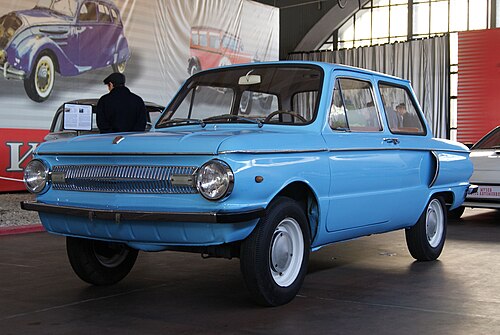
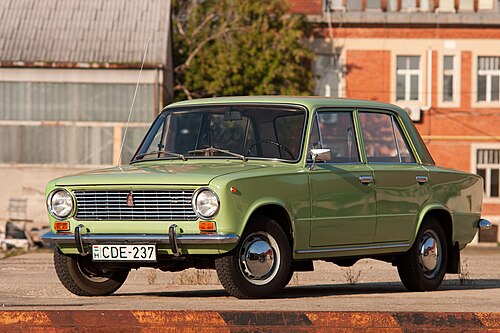
A Soviet-made ZAZ-968, manufactured between 1971 and 1994 (left) and a VAZ-2101/Lada 1200, manufactured between 1970 and 1988 (right)


A Polish-made Polski Fiat 126p, manufactured between 1973 and 2000 (left) and an FSO Polonez 1500, manufactured between 1978 and 1991 (right)
_in_Bucharest.jpg/500px-1982_Dacia_1310_(GDR_export_model)_in_Bucharest.jpg)
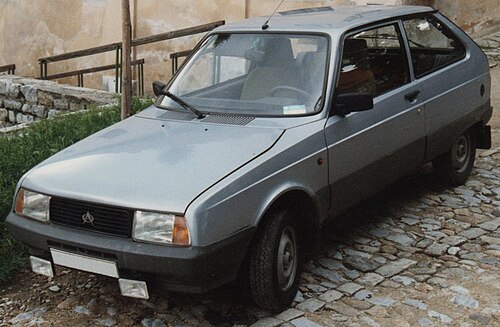
A Romanian-made Oltcit Club, manufactured between 1981 and 1995 (left); and a Dacia 1300, manufactured between 1969 and 2004 (right)


A Yugoslav-made Zastava/Yugo Koral, manufactured between 1980 and 2008 (left); and a Zastava 101, manufactured between 1971 and 2008 (right)
Vehicle ownership increased in the 1970s and 1980s with the production of inexpensive cars in East Germany such as Trabants and the Wartburgs.[203] However, the wait list for the distribution of Trabants was ten years in 1987 and up to fifteen years for Soviet Lada and Czechoslovakian Škoda cars.[203] Soviet-built aircraft exhibited deficient technology, with high fuel consumption and heavy maintenance demands.[202] Telecommunications networks were overloaded.[202]
Adding to mobility constraints from the inadequate transport systems were bureaucratic mobility restrictions.[204] While outside of Albania, domestic travel eventually became largely regulation-free, stringent controls on the issue of passports, visas and foreign currency made foreign travel difficult inside the Eastern Bloc.[204] Countries were inured to isolation and initial post-war autarky, with each country effectively restricting bureaucrats to viewing issues from a domestic perspective shaped by that country's specific propaganda.[204]
Severe environmental problems arose through urban traffic congestion, which was aggravated by pollution generated by poorly maintained vehicles.[204] Large thermal power stations burning lignite and other items became notorious polluters, while some hydro-electric systems performed inefficiently because of dry seasons and silt accumulation in reservoirs.[205] Kraków was covered by smog 135 days per year while Wrocław was covered by a fog of chrome gas.[specify][206]
Several villages were evacuated because of copper smelting at Głogów.[206] Further rural problems arose from piped water construction being given precedence over building sewerage systems, leaving many houses with only inbound piped water delivery and not enough sewage tank trucks to carry away sewage.[207] The resulting drinking water became so polluted in Hungary that over 700 villages had to be supplied by tanks, bottles and plastic bags.[207] Nuclear power projects were prone to long commissioning delays.[205]
The catastrophe at the Chernobyl nuclear plant in the Ukrainian SSR was caused by an irresponsible safety test on a reactor design that is normally safe,[208] some operators lacking an even basic understanding of the reactor's processes and authoritarian Soviet bureaucracy, valuing party loyalty over competence, that kept promoting incompetent personnel and choosing cheapness over safety.[209][210] The consequent release of fallout resulted in the evacuation and resettlement of over 336,000 people[211] leaving a massive desolate Zone of alienation containing extensive still-standing abandoned urban development.
Tourism from outside the Eastern Bloc was neglected, while tourism from other Stalinist countries grew within the Eastern Bloc.[212] Tourism drew investment, relying upon tourism and recreation opportunities existing before World War II.[213] By 1945, most hotels were run-down, while many which escaped conversion to other uses by central planners were slated to meet domestic demands.[213] Authorities created state companies to arrange travel and accommodation.[213] In the 1970s, investments were made to attempt to attract western travelers, though momentum for this waned in the 1980s when no long-term plan arose to procure improvements in the tourist environment, such as an assurance of freedom of movement, free and efficient money exchange and the provision of higher quality products with which these tourists were familiar.[212] However, Western tourists were generally free to move about in Hungary, Poland and Yugoslavia and go where they wished. It was more difficult or even impossible to go as an individual tourist to East Germany, Czechoslovakia, Romania, Bulgaria and Albania. It was generally possible in all cases for relatives from the west to visit and stay with family in the Eastern Bloc countries, except for Albania. In these cases, permission had to be sought, precise times, length of stay, location and movements had to be known in advance.
Catering to western visitors required creating an environment of an entirely different standard than that used for the domestic populace, which required concentration of travel spots including the building of relatively high-quality infrastructure in travel complexes, which could not easily be replicated elsewhere.[212] Because of a desire to preserve ideological discipline and the fear of the presence of wealthier foreigners engaging in differing lifestyles, Albania segregated travelers.[214] Because of the worry of the subversive effect of the tourist industry, travel was restricted to 6,000 visitors per year.[215]
Growth rates
Growth rates in the Eastern Bloc were initially high in the 1950s and 1960s.[167] During this first period, progress was rapid by European standards and per capita growth within the Eastern Bloc increased by 2.4 times the European average.[184] Eastern Europe accounted for 12.3 percent of European production in 1950 but 14.4 in 1970.[184] However, the system was resistant to change and did not easily adapt to new conditions. For political reasons, old factories were rarely closed, even when new technologies became available.[184] As a result, after the 1970s, growth rates within the bloc experienced relative decline.[216] Meanwhile, West Germany, Austria, France and other Western European nations experienced increased economic growth in the Wirtschaftswunder ("economic miracle"), Trente Glorieuses ("thirty glorious years") and the post-World War II boom.
From the end of World War II to the mid-1970s, the economy of the Eastern Bloc steadily increased at the same rate as the economy in Western Europe, with the non-reformist Stalinist nations of the Eastern Bloc having a stronger economy than the reformist-Stalinist states.[217] While most western European economies essentially began to approach the per capita gross domestic product (GDP) levels of the United States during the late 1970s and early 1980s, the Eastern Bloc countries did not,[216] with per capita GDPs trailing significantly behind their comparable western European counterparts.[218]
The following table displays a set of estimated growth rates of GDP from 1951 onward, for the countries of the Eastern Bloc as well as those of Western Europe as reported by The Conference Board as part of its Total Economy Database. In some cases data availability does not go all the way back to 1951.
The United Nations Statistics Division also calculates growth rates, using a different methodology, but only reports the figures starting in 1971 (for Slovakia and the constituent republics of the USSR data availability begins later). Thus, according to the United Nations growth rates in Europe were as follows:


The following table lists the level of nominal GDP per capita in certain selected countries, measured in US dollars, for the years 1970, 1989, and 2015:
While it can be argued the World Bank estimates of GDP used for 1990 figures underestimate Eastern Bloc GDP because of undervalued local currencies, per capita incomes were undoubtedly lower than in their counterparts.[218] East Germany was the most advanced industrial nation of the Eastern Bloc.[186] Until the building of the Berlin Wall in 1961, East Germany was considered a weak state, hemorrhaging skilled labor to the West such that it was referred to as "the disappearing satellite".[222] Only after the wall sealed in skilled labor was East Germany able to ascend to the top economic spot in the Eastern Bloc.[222] Thereafter, its citizens enjoyed a higher quality of life and fewer shortages in the supply of goods than those in the Soviet Union, Poland or Romania.[186]
While official statistics painted a relatively rosy picture, the East German economy had eroded because of increased central planning, economic autarky, the use of coal over oil, investment concentration in a few selected technology-intensive areas and labor market regulation.[223] As a result, a large productivity gap of nearly 50% per worker existed between East and West Germany.[223][224] However, that gap does not measure the quality of design of goods or service such that the actual per capita rate may be as low as 14 to 20 per cent.[224] Average gross monthly wages in East Germany were around 30% of those in West Germany, though after accounting for taxation the figures approached 60%.[225]
Moreover, the purchasing power of wages differed greatly, with only about half of East German households owning either a car or a color television set as late as 1990, both of which had been standard possessions in West German households.[225] The Ostmark was only valid for transactions inside East Germany, could not be legally exported or imported[225] and could not be used in the East German Intershops which sold premium goods.[186] In 1989, 11% of the East German labor force remained in agriculture, 47% was in the secondary sector and 42% in services.[224]
Once installed, the economic system was difficult to change given the importance of politically reliable management and the prestige value placed on large enterprises.[184] Performance declined during the 1970s and 1980s due to inefficiency when industrial input costs, such as energy prices, increased.[184] Though growth lagged behind the West, it did occur.[176] Consumer goods started to become more available by the 1960s.[176]
Before the Eastern Bloc's dissolution, some major sectors of industry were operating at such a loss that they exported products to the West at prices below the real value of the raw materials.[226] Hungarian steel costs doubled those of western Europe.[226] In 1985, a quarter of Hungary's state budget was spent on supporting inefficient enterprises.[226] Tight planning in Bulgaria's industry meant continuing shortages in other parts of its economy.[226]
Development policies

In social terms, the 18 years (1964–1982) of Brezhnev's leadership saw real incomes grow more than 1.5 times. More than 1.6 billion square metres of living space were commissioned and provided to over 160 million people. At the same time, the average rent for families did not exceed 3% of the family income. There was unprecedented affordability of housing, health care and education.[177]
In a survey by the Sociological Research Institute of the USSR Academy of Sciences in 1986, 75% of those surveyed said that they were better off than the previous ten years. Over 95% of Soviet adults considered themselves "fairly well off". 55% of those surveyed felt that medical services improved, 46% believed public transportation had improved and 48% said that the standard of services provided public service establishments had risen.[227]
During the years 1957–1965, housing policy underwent several institutional changes with industrialisation and urbanisation had not been matched by an increase in housing after World War II.[228] Housing shortages in the Soviet Union were worse than in the rest of the Eastern Bloc due to a larger migration to the towns and more wartime devastation and were worsened by Stalin's pre-war refusals to invest properly in housing.[228] Because such investment was generally not enough to sustain the existing population, apartments had to be subdivided into increasingly smaller units, resulting in several families sharing an apartment previously meant for one family.[228]
The prewar norm became one Soviet family per room, with the toilets and kitchen shared.[228] The amount of living space in urban areas fell from 5.7 square metres per person in 1926 to 4.5 square metres in 1940.[228] In the rest of the Eastern Bloc during this time period, the average number of people per room was 1.8 in Bulgaria (1956), 2.0 in Czechoslovakia (1961), 1.5 in Hungary (1963), 1.7 in Poland (1960), 1.4 in Romania (1966), 2.4 in Yugoslavia (1961) and 0.9 in 1961 in East Germany.[228]
After Stalin's death in 1953, forms of an economic "New Course" brought a revival of private house construction.[228] Private construction peaked in 1957–1960 in many Eastern Bloc countries and then declined simultaneously along with a steep increase in state and co-operative housing.[228] By 1960, the rate of housebuilding per head had picked up in all countries in the Eastern Bloc.[228] Between 1950 and 1975, worsening shortages were generally caused by a fall in the proportion of all investment made housing.[229] However, during that period the total number of dwellings increased.[230]
During the last fifteen years of this period (1960–1975), an emphasis was made for a supply side solution, which assumed that industrialised building methods and high rise housing would be cheaper and quicker than traditional brick-built, low-rise housing.[230] Such methods required manufacturing organisations to produce the prefabricated components and organisations to assemble them on site, both of which planners assumed would employ large numbers of unskilled workers-with powerful political contacts.[230] The lack of participation of eventual customers, the residents, constituted one factor in escalating construction costs and poor quality work.[231] This led to higher demolition rates and higher costs to repair poorly constructed dwellings.[231] In addition, because of poor quality work, a black market arose for building services and materials that could not be procured from state monopolies.[231]
In most countries, completions (new dwellings constructed) rose to a high point between 1975 and 1980 and then fell as a result presumably of worsening international economic conditions.[232] This occurred in Bulgaria, Hungary, East Germany, Poland, Romania (with an earlier peak in 1960 also), Czechoslovakia and Yugoslavia while the Soviet Union peaked in 1960 and 1970.[232] While between 1975 and 1986, the proportion of investment devoted to housing actually rose in most of the Eastern Bloc, general economic conditions resulted in total investment amounts falling or becoming stagnant.[229]
The employment of socialist ideology in housing policy declined in the 1980s, which accompanied a shift in authorities looking at the need of residents to an examination of potential residents' ability to pay.[229] Yugoslavia was unique in that it continuously mixed private and state sources of housing finance, stressed self-managed building co-operatives along with central government controls.[229]
Shortages
The initial year that shortages were effectively measured and shortages in 1986 were as follows:[233]
These are official housing figures and may be low. For example, in the Soviet Union the figure of 26,662,400 in 1986 almost certainly underestimates shortages for the reason that it does not count shortages from large Soviet rural-urban migration; another calculation estimates shortages to be 59,917,900.[234] By the late 1980s, Poland had an average 20-year wait time for housing while Warsaw had between a 26- and 50-year wait time.[235][226] In the Soviet Union, widespread illegal subletting occurred at exorbitant rates.[236] Toward the end of the Eastern Bloc allegations of misallocations and illegal distribution of housing were raised in Soviet CPSU Central Committee meetings.[236]
In Poland, housing problems were caused by slow rates of construction, poor home quality (which was even more pronounced in villages) and a large black market.[145] In Romania, social engineering policy and concern about the use of agricultural land forced high densities and high-rise housing designs.[237] In Bulgaria, a prior emphasis on monolithic high-rise housing lessened somewhat in the 1970s and 1980s.[237] In the Soviet Union, housing was perhaps the primary social problem.[237] While Soviet housing construction rates were high, quality was poor and demolition rates were high, in part because of an inefficient building industry and lack of both quality and quantity of construction materials.[237]
East German housing suffered from a lack of quality and a lack of skilled labor, with a shortage of materials, plot and permits.[238] In staunchly Stalinist Albania, housing blocks (panelka) were spartan, with six-story walk-ups being the most frequent design.[238] Housing was allocated by workplace trade unions and built by voluntary labor organised into brigades within the workplace.[238] Yugoslavia suffered from fast urbanisation, uncoordinated development and poor organisation resulting from a lack of hierarchical structure and clear accountability, low building productivity, the monopoly position of building enterprises and irrational credit policies.[238]
Revolts
1953 East Germany uprising
Three months after the death of Joseph Stalin, a dramatic increase of emigration (Republikflucht, brain drain) occurred from East Germany in the first half-year of 1953. Large numbers of East Germans traveled west through the only "loophole" left in the Eastern Bloc emigration restrictions, the Berlin sector border.[239] The East German government then raised "norms" – the amount each worker was required to produce – by 10%.[239] Already disaffected East Germans, who could see the relative economic successes of West Germany within Berlin, became enraged.[239] Angry building workers initiated street protests, and were soon joined by others in a march to the Berlin trade union headquarters.[239]
While no official spoke to them at that location, by 2:00 pm, the East German government agreed to withdraw the "norm" increases.[240] However, the crisis had already escalated such that the demands were now political, including free elections, disbanding the army and resignation of the government.[240] By 17 June, strikes were recorded in 317 locations involving approximately 400,000 workers.[240] When strikers set ruling SED party buildings aflame and tore the flag from the Brandenburg Gate, SED General Secretary Walter Ulbricht left Berlin.[240]
A major emergency was declared and the Soviet Red Army stormed some important buildings.[240] Within hours, Soviet tanks arrived, but they did not immediately fire upon all workers.[240] Rather, a gradual pressure was applied.[240] Approximately 16 Soviet divisions with 20,000 soldiers from the Group of Soviet Forces in Germany using tanks, as well as 8,000 Kasernierte Volkspolizei members, were employed. Bloodshed could not be entirely avoided, with the official death toll standing at 21, while the actual casualty toll may have been much higher.[240] Thereafter, 20,000 arrests took place along with 40 executions.[240]
Hungarian Revolution of 1956
After Stalin's death in 1953, a period of de-Stalinization followed, with reformist Imre Nagy replacing Hungarian Stalinist dictator Mátyás Rákosi.[241] Responding to popular demand, in October 1956, the Polish government appointed the recently rehabilitated reformist Władysław Gomułka as First Secretary of the Polish United Workers' Party, with a mandate to negotiate trade concessions and troop reductions with the Soviet government. After a few tense days of negotiations, on 19 October, the Soviets finally gave in to Gomułka's reformist requests.[242]
The revolution began after students of the Technical University compiled a list of Demands of Hungarian Revolutionaries of 1956 and conducted protests in support of the demands on 22 October.[243] Protests of support swelled to 200,000 by 6 pm the following day,[244][245] The demands included free secret ballot elections, independent tribunals, inquiries into Stalin and Rákosi Hungarian activities and that "the statue of Stalin, symbol of Stalinist tyranny and political oppression, be removed as quickly as possible." By 9:30 pm the statue was toppled and jubilant crowds celebrated by placing Hungarian flags in Stalin's boots, which was all that remained the statue.[245] The ÁVH was called, Hungarian soldiers sided with the crowd over the ÁVH and shots were fired on the crowd.[246][247]
By 2 am on 24 October, under orders of Soviet defense minister Georgy Zhukov, Soviet tanks entered Budapest.[248] Protester attacks at the Parliament forced the dissolution of the government.[249] A ceasefire was arranged on 28 October, and by 30 October most Soviet troops had withdrawn from Budapest to garrisons in the Hungarian countryside.[250] Fighting had virtually ceased between 28 October and 4 November, while many Hungarians believed that Soviet military units were indeed withdrawing from Hungary.[251]
_k%C3%B6z_sarok,_h%C3%A1tt%C3%A9rben_a_Kili%C3%A1n_laktanya_romos_%C3%A9p%C3%BClete._Ki%C3%A9gett_szovjet_T-34-85_harckocsi._Fortepan_24857.jpg/500px-J%C3%B3zsef_k%C3%B6r%C3%BAt_-_Corvin_(Kisfaludy)_k%C3%B6z_sarok,_h%C3%A1tt%C3%A9rben_a_Kili%C3%A1n_laktanya_romos_%C3%A9p%C3%BClete._Ki%C3%A9gett_szovjet_T-34-85_harckocsi._Fortepan_24857.jpg)
The new government that came to power during the revolution formally disbanded ÁVH, declared its intention to withdraw from the Warsaw Pact and pledged to re-establish free elections. The Soviet Politburo thereafter moved to crush the revolution. On 4 November, a large Soviet force invaded Budapest and other regions of the country.[252] The last pocket of resistance called for ceasefire on 10 November. Over 2,500 Hungarians and 722 Soviet troops were killed and thousands more were wounded.[253][254]
Thousands of Hungarians were arrested, imprisoned and deported to the Soviet Union, many without evidence.[255] Approximately 200,000 Hungarians fled Hungary,[256] some 26,000 Hungarians were put on trial by the new Soviet-installed János Kádár government, and of those, 13,000 were imprisoned.[257] Imre Nagy was executed, along with Pál Maléter and Miklós Gimes, after secret trials in June 1958. Their bodies were placed in unmarked graves in the Municipal Cemetery outside Budapest.[258] By January 1957, the new Soviet-installed government had suppressed all public opposition.
Prague Spring and the 1968 invasion of Czechoslovakia
A period of political liberalization in Czechoslovakia called the Prague Spring took place in 1968. The event was spurred by several events, including economic reforms that addressed an early 1960s economic downturn.[259][260] The event began on 5 January 1968, when reformist Slovak Alexander Dubček came to power. In April, Dubček launched an "Action Program" of liberalizations, which included increasing freedom of the press, freedom of speech and freedom of movement, along with an economic emphasis on consumer goods, the possibility of a multiparty government and limiting the power of the secret police.[261][262]
Initial reaction within the Eastern Bloc was mixed, with Hungary's János Kádár expressing support, while Soviet leader Leonid Brezhnev and others grew concerned about Dubček's reforms, which they feared might weaken the Eastern Bloc's position during the Cold War.[263][264] On 3 August, representatives from the Soviet Union, East Germany, Poland, Hungary, Bulgaria, and Czechoslovakia met in Bratislava and signed the Bratislava Declaration, which affirmed unshakable fidelity to Marxism–Leninism and proletarian internationalism and declared an implacable struggle against "bourgeois" ideology and all "anti-socialist" forces.[265]

On the night of 20–21 August 1968, Eastern Bloc armies from five Warsaw Pact countries (the Soviet Union, Poland, East Germany, Hungary and Bulgaria) invaded Czechoslovakia.[266] The invasion comported with the Brezhnev Doctrine, a policy of compelling Eastern Bloc states to subordinate national interests to those of the Bloc as a whole and the exercise of a Soviet right to intervene if an Eastern Bloc country appeared to shift towards capitalism.[267][268] The invasion was followed by a wave of emigration, including an estimated 70,000 Czechoslovaks initially fleeing, with the total eventually reaching 300,000.[269]
In April 1969, Dubček was replaced as first secretary by Gustáv Husák and a period of "normalization" began.[270] Husák reversed Dubček's reforms, purged the party of liberal members, dismissed opponents from public office, reinstated the power of the police authorities, sought to re-centralize the economy and re-instated the disallowance of political commentary in mainstream media and by persons not considered to have "full political trust".[271][272]
Dissolution
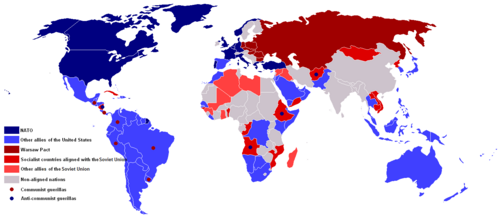
Soviet control of the Eastern Bloc was first tested by the 1948 Czechoslovak coup d'état and the Tito–Stalin split over the direction of the People's Federal Republic of Yugoslavia, the Chinese Communist Revolution (1949) and Chinese participation in the Korean War. After Stalin's death in 1953, the Korean War ceased with the 1954 Geneva Conference. In Europe, anti-Soviet sentiment provoked the East German uprising of 1953. Nikita Khrushchev's 1956 anti-Stalinist speech On the Cult of Personality and Its Consequences was a factor in the Hungarian Revolution of 1956, which the Soviet Union suppressed, and the Sino–Soviet split. The Sino–Soviet split gave North Korea and North Vietnam more independence from both and facilitated the Albanian–Soviet split. The Cuban Missile Crisis and the failure of the Bay of Pigs Invasion preserved the Cuban Revolution from rollback by the United States but Cuban leader Fidel Castro became increasingly independent of Soviet influence afterwards, most notably during the 1975 Cuban intervention in Angola.[1] In 1975, the communist victory in former French Indochina following the end of the Vietnam War gave the Eastern Bloc renewed confidence after it had been frayed by Soviet leader Leonid Brezhnev's 1968 invasion of Czechoslovakia to suppress the Prague Spring. This led to the People's Republic of Albania withdrawing from the Warsaw Pact, briefly aligning with Mao Zedong's China until the Sino-Albanian split.
Under the Brezhnev Doctrine, the Soviet Union reserved the right to intervene in other socialist states. In response, China moved towards the United States following the Sino-Soviet border conflict and later reformed and liberalized its economy while the Eastern Bloc saw the Era of Stagnation in comparison with the capitalist First World. The Soviet–Afghan War nominally expanded the Eastern Bloc, but the war proved unwinnable and too costly for the Soviets, challenged in Eastern Europe by the civil resistance of Solidarity. In the late 1980s, Soviet leader Mikhail Gorbachev pursued policies of glasnost (openness) and perestroika (restructuring) to reform the Eastern Bloc and end the Cold War, which brought forth unrest throughout the bloc.
During the mid-to-late 1980s, the weakened Soviet Union gradually stopped interfering in the internal affairs of Eastern Bloc nations and numerous independence movements took place.

Following the Brezhnev stagnation, the reform-minded Soviet leader Mikhail Gorbachev in 1985 signaled the trend towards greater liberalization. Gorbachev rejected the Brezhnev Doctrine, which held that Moscow would intervene if socialism were threatened in any state.[273] He announced what was jokingly called the "Sinatra Doctrine" after the singer's "My Way" to allow the countries of Central and Eastern Europe to determine their own internal affairs during this period.
Gorbachev initiated a policy of glasnost (openness) in the Soviet Union, and emphasized the need for perestroika (economic restructuring). The Soviet Union was struggling economically after the long war in Afghanistan and did not have the resources to control Central and Eastern Europe.
The start of the disintegration of the Eastern Bloc can be attributed to June 1989 Polish parliamentary election, the opening of a border gate between Austria and Hungary at the Pan-European Picnic in August 1989. In 1990 East Germany reunited with West Germany following the 1989 fall of the Berlin Wall. Unlike previous Soviet leaders in 1953, 1956 and 1968, Gorbachev refused to use force to end the 1989 Revolutions against Marxist–Leninist rule in Eastern Europe. The fall of the Berlin Wall and end of the Warsaw Pact spread nationalist and liberal ideals throughout the Soviet Union. In 1991, Conservative communist elites launched a 1991 Soviet coup d'état attempt, which hastened the end of Marxist–Leninist rule in Eastern Europe. However, the 1989 Tiananmen Square protests in China were violently repressed by the communist government there, which maintained its grip on power.
In 1989, a wave of revolutions, sometimes called the "Autumn of Nations",[citation needed] swept across the Eastern Bloc.[274]
Major reforms occurred in Hungary following the replacement of János Kádár as General Secretary of the Communist Party in 1988.[275] In Poland in April 1989, the Solidarity organization was legalized and allowed to participate in parliamentary elections. It captured 99% of available parliamentary seats.[276]

The opening of the Iron Curtain between Austria and Hungary at the Pan-European Picnic on 19 August 1989 then set in motion a chain reaction, at the end of which there was no longer an East Germany and the Eastern Bloc had disintegrated. Extensive advertising for the planned picnic was made by posters and flyers among the GDR holidaymakers in Hungary. The Austrian branch of the Paneuropean Union, which was then headed by Karl von Habsburg, distributed thousands of brochures inviting them to a picnic near the border at Sopron.[277][278] It was the largest escape movement from East Germany since the Berlin Wall was built in 1961. After the picnic, which was based on an idea by Otto von Habsburg to test the reaction of the USSR and Mikhail Gorbachev to an opening of the border, tens of thousands of media-informed East Germans set off for Hungary.[279] Hungary was then no longer prepared to keep its borders completely closed or to commit its border troops to use force of arms. Erich Honecker dictated to the Daily Mirror for the Paneuropa Picnic: "Habsburg distributed leaflets far into Poland, on which the East German holidaymakers were invited to a picnic. When they came to the picnic, they were given gifts, food and Deutsche Mark, and then they were persuaded to come to the West". The leadership of the GDR in East Berlin did not dare to completely block the borders of their own country and the USSR did not respond at all. Thus the bracket of the Eastern Bloc was broken.[280][281][282]
.jpg/500px-Bundesarchiv_Bild_183-R1220-401,_Erich_Honecker_(cropped).jpg)

On 9 November 1989, following mass protests in East Germany and the relaxing of border restrictions in Czechoslovakia, tens of thousands of Eastern Berliners flooded checkpoints along the Berlin Wall and crossed into West Berlin.[283] Parts of the wall was torn down, leading to the reunification of Germany on 3 October 1990; around this time, most of the remains of the wall was torn down. In Bulgaria, the day after the mass crossings through the Berlin Wall, the leader Todor Zhivkov was ousted by his Politburo and replaced with Petar Mladenov.[284]
In Czechoslovakia, following protests of an estimated half-million Czechs and Slovaks demanding freedoms and a general strike, the authorities, which had allowed travel to the West, abolished provisions guaranteeing the ruling Communist Party its leading role.[285] President Gustáv Husák appointed the first largely non-Communist government in Czechoslovakia since 1948 and resigned in what was called the Velvet Revolution.[285]
Since 1971, Romania had reversed the program of de-Stalinization. Following growing public protests, dictator Nicolae Ceaușescu ordered a mass rally in his support outside Communist Party headquarters in Bucharest, but mass protests against Ceaușescu proceeded.[286] The Romanian military sided with protesters and turned on Ceaușescu. They executed him after a brief trial three days later.[287]
Even before the Eastern Bloc's last years, all of the countries in the Warsaw Pact did not always act as a unified bloc. For instance, the 1968 invasion of Czechoslovakia was condemned by Romania, which refused to take part in it. Albania withdrew from the Pact, and the Eastern Bloc altogether, in response to the invasion. In Cambodia, communist rule ended in 1989 and monarchy was restored in 1993.
The only surviving communist states are China, Vietnam, Cuba, and Laos. Their state-socialist experience was more in line with decolonization from the Global North and anti-imperialism towards the West instead of the Red Army occupation of the former Eastern Bloc. Syria is still led by the same neo-Ba'athist leadership as during the Cold War, though it was not a Marxist–Leninist state. The five states all adopted economic reforms to varying degrees. China and Vietnam are usually described as more state capitalist than the more traditionalist Cuba and Laos. The exception is North Korea, where all references to Marxism–Leninism in its nationalist ideology of Juche were gradually eliminated. This was previously the case in Kazakhstan fellow post-Soviet states until 2022, Uzbekistan until 2016, Turkmenistan until 2006, Kyrgyzstan until 2005, Azerbaijan and Georgia until 2003, Armenia until 1998, Moldova until 1997, Ukrainia and Belarus until 1994, Tajikistan until 1992. All presidents of post-Soviet Russia were members of the Communist Party of the Soviet Union (Boris Yeltsin before 1990, Vladimir Putin and Dmitry Medvedev before 1991). Azerbaijan is an authoritarian dominant-party state and North Korea is a totalitarian one-party state led by the heirs of their Eastern Bloc leaders, yet both have officially eliminated mentions of communism from their constitutions.
Legacy
Aftermath
Writing in 2016, German historian Philipp Ther asserted that neoliberal policies of liberalization, deregulation, and privatization "had catastrophic effects on former Soviet Bloc countries", and that the imposition of Washington Consensus-inspired "shock therapy" had little to do with future economic growth.[288]
An estimated seven million premature deaths took place in the former USSR after it collapsed, with around four million in Russia alone.[289] Russia experienced the largest drop in life expectancy during peacetime in recorded history after the fall of the USSR.[290][291] The scholars Kristen Ghodsee and Mitchell A. Orenstein have referred to this as the "mortality belt of the European former Soviet Union" and assert that it could have been avoided with the implementation of "an aggressive health policy intervention" which could have "prevented tens of thousands of excess deaths."[292]
Poverty skyrocketed after the fall of the USSR; by the end of the 1990s, the number of people living below the international poverty line went from 3% in 1987–88 to 20%, or around 88 million people.[293] Only 4% of the region lived on $4 a day or less before the USSR dissolved, but by 1994, this number skyrocketed to 32%.[290] In Russia, Boris Yeltsin's IMF-backed rapid privatization and austerity policies resulted in unemployment rising to double digits and half the Russian population falling into destitution by the early to mid 1990s.[294]
Crime, alcohol use, drug use and suicides all skyrocketed after the fall of the Eastern Bloc.[290][293] The GDP fell as much as 50% in some republics during the 1990s. By 2000, Russia's GDP was between 30 and 50% of its pre-collapse output.[295][296][297][298]
In 2011, The Guardian published an analysis of the former Soviet countries twenty years after the fall of the USSR. They found that "GDP fell as much as 50 percent in the 1990s in some republics... as capital flight, industrial collapse, hyperinflation and tax avoidance took their toll", but that there was a rebound in the 2000s, and by 2010 "some economies were five times as big as they were in 1991." Life expectancy has grown since 1991 in some of the countries, but fallen in others; likewise, some held free and fair elections, while others remained authoritarian.[295]
.png/500px-Eastern_Bloc_Life-expectancy_(1).png)
However, the Central European states of the former Eastern Bloc–Poland, Hungary, the Czech Republic and Slovakia–showed healthy increases in life expectancy from the 1990s onward, compared to nearly thirty years of stagnation under Communism.[299][300][301][302][303] Bulgaria and Romania followed this trend after the introduction of more serious economic reforms in the late 1990s.[304][305] By the turn of the century, most of their economies had strong growth rates, boosted by the enlargement of the European Union in 2004 and 2007 which saw Poland, the Czech Republic, Slovakia, Hungary, the Baltic States, Romania and Bulgaria admitted to the European Union. This led to significant improvements in living standards, quality of life, human health and economic performance in the post-Communist Central European states, relative to the late Communist and early post-Communist periods.[306] Certain former Eastern Bloc countries have even become wealthier than certain Western European ones in the decades since 1989. In 2006, the Czech Republic was reported to have become wealthier than Portugal, something also reported to be true of Poland in 2019.[307][308]
In 2016, the libertarian think tank Cato Institute stated that the analyses done of post-communist countries in the 1990s were "premature" and "that early and rapid reformers by far outperformed gradual reformers" on GDP per capita, the United Nations Human Development Index, political freedom, and developed better institutions. The institute also stated that the process of privatization in Russia was "deeply flawed" due to Russia's reforms being "far less rapid" than those of Central Europe and the Baltic states.[309]
A 2009 Pew Research Center poll showed that 72% of Hungarians, 62% of both Ukrainians and Bulgarians, 48% of both Lithuanians and Slovaks, 45% of Russians, 39% of Czechs, and 35% of Poles felt that their lives were worse off after 1989, when free markets were made dominant.[310] A follow-up poll by Pew Research Center in 2011 showed that 45% of Lithuanians, 42% of Russians, and 34% of Ukrainians approved of the change to a market economy.[311] Writing in 2018, the scholars Kristen R. Ghodsee and Scott Sehon assert that "subsequent polls and qualitative research across Russia and eastern Europe confirm the persistence of these sentiments as popular discontent with the failed promises of free-market prosperity has grown, especially among older people".[312]
In 2019, a Pew Research Survey on European public opinion asked citizens of Russia, Ukraine, Lithuania, Bulgaria, Poland, Czechia, Slovakia, Hungary and the former East Germany two questions: whether they approved of the change to a multi-party democracy, and whether they approved of the change to a market economy. The change to a multi-party democracy was approved by 85% of Poles and East Germans, 82% of Czechs, 74% of Slovaks, 72% of Hungarians, 70% of Lithuanians, 54% of Bulgarians, 51% of Ukrainians and 43% of Russians. The transition to a market economy was approved by 85% of Poles, 83% of East Germans, 76% of Czechs, 71% of Slovaks, 70% of Hungarians, 69% of Lithuanians, 55% of Bulgarians, 47% of Ukrainians, and 38% of Russians.[313]
List of existing communist states
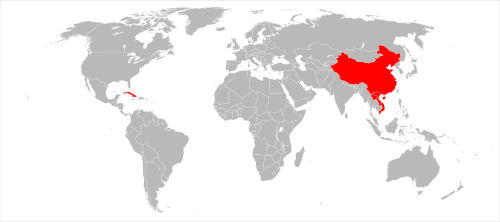
Since 1993, the following countries have remained communist states:
See also
.svg/500px-Europe_(orthographic_projection).svg.png)


- Communist nostalgia
- Eastern European Group
- Eurasian Economic Union
- Military occupations by the Soviet Union
- Soviet empire
- Telephone tapping in the Eastern Bloc
- State socialism
Notes
- ^ Hong Kong and Macau are administered under the "One country, two systems" principle.
- ^ Albania was a member of the Eastern Bloc until the Albanian–Soviet split from 1961 to 1970.
- ^ Until the Sino-Soviet split in 1961.
- ^ Sources:
- Loth, Wilfried, The Division of the World, 1941–1955, Routledge, 1988, ISBN 0-415-00365-2, p. 297
- Haggett, Peter, Encyclopedia of World Geography, Marshall Cavendish, 2001, ISBN 0-7614-7289-4, p. 1,850
- Rees, G. Wyn. International Politics in Europe: The New Agenda, Routledge, 1993, ISBN 0-415-08282-X, p. 6
- Satyendra, Kush (2003), Encyclopaedic Dictionary of Political Science, Sarup & Sons, p. 65, ISBN 978-81-7890-071-1,
... the countries of Eastern Europe under communism ... .
- Janzen, Jörg; Taraschewski, Thomas (2009). Shahshahānī, Suhaylā (ed.). Cities of Pilgrimage. Iuaes-series. Vol. 4. Münster: LIT Verlag. p. 190. ISBN 9783825816186. Archived from the original on 5 September 2015.
Until 1990, despite being a formally independent state, Mongolia had de facto been an integral part of the Soviet-dominated Eastern Bloc.
- Gasztold-Seń, Trentin, Adamec, Przemysław, Przemysław, Jan (2014). Syria During the Cold War: The East European Connection. University of St Andrews, Centre for Syrian Studies. ISBN 9780956873224.
{{cite book}}: CS1 maint: multiple names: authors list (link) - Ginat, Rami (April 2000). "The Soviet Union and the Syrian Ba'th regime: From hesitation to Rapprochement". Middle Eastern Studies. 36 (2): 150–171. doi:10.1080/00263200008701312. JSTOR 4284075. S2CID 144922816 – via JSTOR.
- ^ See De-satellization of Communist Romania
- ^ See Sino–Soviet split
- ^ See Tito–Stalin split
- ^ Soviet-Chilean alliance ended with the overthrow of the Allende government in a military coup, after which Chile became a Cold War ally of the United States. The Soviet Union would later support an armed insurgency against the military government until Chile returned to democracy in 1990.
References
Citations
- ^ a b c Piero Gleijeses, Conflicting Missions: Havana, Washington, and Africa, 1959–1976, ISBN 978-0-8078-5464-8.
- ^ Ludlow, N. Piers, European integration and the Cold War: Ostpolitik-Westpolitik, 1965–1973, Routledge, 2007, ISBN 0-415-42109-8, page 37, 39
- ^ Ahonen, Pertti, After the expulsion: West Germany and Eastern Europe, 1945–1990, Oxford University Press, 2003, ISBN 0-19-925989-5, page 125-126 & 183
- ^ Zwass, Adam, Globalization of Unequal National Economies: Players and Controversies, M.E. Sharpe, 2002, ISBN 0-7656-0731-X, page 214
- ^ Skinner, Kiron F., The strategy of campaigning: lessons from Ronald Reagan & Boris Yeltsin, University of Michigan Press, 2007, ISBN 0-472-11627-4, page 137-8
- ^ a b Gasztold-Seń, Trentin, Adamec, Przemysław, Przemysław, Jan (2014). Syria During the Cold War: The East European Connection. University of St Andrews, Centre for Syrian Studies. ISBN 9780956873224.
{{cite book}}: CS1 maint: multiple names: authors list (link) - ^ a b Ginat, Rami (April 2000). "The Soviet Union and the Syrian Ba'th regime: From hesitation to Rapprochement". Middle Eastern Studies. 36 (2): 150–171. doi:10.1080/00263200008701312. JSTOR 4284075. S2CID 144922816 – via JSTOR.
- ^ Satyendra, Kush (2003), Encyclopaedic Dictionary of Political Science, Sarup & Sons, p. 65, ISBN 978-81-7890-071-1,
The countries of Eastern Europe under communism
- ^ Janzen, Jörg; Taraschewski, Thomas (2009). Shahshahānī, Suhaylā (ed.). Cities of Pilgrimage. Iuaes-series. Vol. 4. Münster: LIT Verlag. p. 190. ISBN 9783825816186. Archived from the original on 5 September 2015.
Until 1990, despite being a formally independent state, Mongolia had de facto been an integral part of the Soviet-dominated Eastern Bloc.
- ^ Satyendra, Kush, Encyclopaedic dictionary of political science, Sarup & Sons, 2003, ISBN 81-7890-071-8, page 65
- ^ a b Hirsch, Donald; Kett, Joseph F.; Trefil, James S. (2002), The New Dictionary of Cultural Literacy, Houghton Mifflin Harcourt, p. 316, ISBN 978-0-618-22647-4,
Eastern Bloc. The name applied to the former communist states of eastern Europe, including Yugoslavia and Albania, as well as the countries of the Warsaw Pact
- ^ a b Glisic, Jelena (1976), East-West Trade and Japanese-Yugoslav Relations during the Cold War, Acta Slavica Iaponica, p. 120 and 121,
The Eastern bloc was composed of socialist states, who were members of the Warsaw Pact and The Council for Mutual Economic Assistance (COMECON), led by the USSR. ... In works examining the Western bloc countries' relations with the Eastern bloc, Yugoslavia was not considered part of the Eastern bloc.
- ^ Teichova, Alice; Herbert, Matis (2003), Nation, state, and the economy in history, Cambridge University Press, p. 150, ISBN 978-0-521-79278-3,
Within the Eastern Bloc, Poland, Yugoslavia and Hungary tended to be reformist and deviated most from the rigid Soviet model
- ^ Cook 2001, p. 897: "In the Eastern Bloc, only Yugoslavia, alongside efforts to eradicate or at least degrade previously existing nationalisms, made the gallant attempt to both foster a new nationalism and a new identify, that of being a Yugoslav."
- ^ Ahonen, Pertti (2003), After the Expulsion: West Germany and Eastern Europe, 1945–1990, Oxford University Press, p. 212,
The other Eastern bloc states – except Romania's fellow mavericks Albania and Yugoslavia – reacted to the breakthrough between Bonn and Bucharest by coordinating their own stances towards the Federal Republic.
- ^ White, N. D. (1990), The United Nations and the maintenance of international peace and security, Manchester University Press, p. 183, ISBN 978-0-7190-3227-1,
Nevertheless, the Eastern Bloc countries, including Albania, Bulgaria, and Yugoslavia, argued that UNSCOB had been constituted illegally
- ^ Library of Congress (1980), The Quarterly journal of the Library of Congress, vol. 37, Library of Congress,
80 Yugoslavia is perhaps the most international of the Eastern Bloc countries.
- ^ Ryan, James; Mastrini, Hana; Baker, Mark (2009), Eastern Europe, John Wiley and Sons, p. 651, ISBN 978-0-470-39908-8,
Tito played his cards right and – unlike other Eastern Bloc countries – Yugoslavia enjoyed a fairly open relationship with the rest of the world
- ^ Stanilov, Kiril (2007), The post-socialist city: urban form and space transformations in Central and Eastern Europe after socialism, Springer, p. 362, ISBN 978-1-4020-6052-6,
During the socialist period, Yugoslavia was marked by a system of socialist self-management, which place greater importance not he development of market-type relations in the economy than any of the other socialist countries of Europe. This strategy was a significant factor in achieving a higher standard of living and a lower level of under-urbanization compared to other members of the Eastern Bloc.
- ^ Hawkesworth, M. E.; Paynter, John (1992), Encyclopedia of government and politics, Routledge, p. 1244, ISBN 978-0415072250,
The processes of change in the Eastern Bloc affected Yugoslavia as well, although this country, having been outside the bloc since 1948, had evolved specific political, economic and federal systems of its own.
- ^ Binder, David (1982), "Many from Eastern Bloc Seek Yugoslav Asylum", The New York Times
- ^ "Soviet Intelligence in Latin America During the Cold War Archived 28 February 2010 at the Wayback Machine", Lectures by General Nikolai Leonov, Centro de Estudios Publicos (Chile), 22 September 1999.
- ^ Kass, Ilana (September 1977). "The Forgotten Friendship: Israel and the Soviet Bloc 1947–1953". American Political Science Review. 71 (3): 1304–1305. doi:10.2307/1960285. ISSN 0003-0554. JSTOR 1960285. S2CID 146764535.
- ^ Sunayama, Sonoko (2007). Syria and Saudi Arabia: Collaboration and Conflicts in the Oil Era. New York, USA: I.B. Tauris. p. 31. ISBN 978-1-84511-302-5.
- ^ Julian Towster. Political Power in the U.S.S.R., 1917–1947: The Theory and Structure of Government in the Soviet State Oxford Univ. Press, 1948. p. 106
- ^ Tucker 1992, p. 46
- ^ a b Encyclopædia Britannica, German-Soviet Nonaggression Pact, 2008
- ^ a b Text of the Nazi-Soviet Non-Aggression Pact Archived 14 November 2014 at the Wayback Machine, executed 23 August 1939
- ^ Christie, Kenneth, Historical Injustice and Democratic Transition in Eastern Asia and Northern Europe: Ghosts at the Table of Democracy, RoutledgeCurzon, 2002, ISBN 0-7007-1599-1
- ^ Roberts 2006, p. 43
- ^ Sanford, George (2005), Katyn and the Soviet Massacre Of 1940: Truth, Justice And Memory, London, New York: Routledge, ISBN 978-0-415-33873-8
- ^ Nekrich, Ulam & Freeze 1997, p. 131
- ^ Adam Sudol, ed. (1998), Sowietyzacja Kresów Wschodnich II Rzeczypospolitej po 17 wrzesnia 1939 (in Polish), Bydgoszcz: Wyzsza Szkola Pedagogiczna, p. 441, ISBN 978-83-7096-281-4
- ^ Myron Weiner, Sharon Stanton Russell, ed. (2001), "Stalinist Forced Relocation Policies", Demography and National Security, Berghahn Books, pp. 308–315, ISBN 978-1-57181-339-8
- ^ The Soviets organized staged elections,(in Polish) Bartlomiej Kozlowski Wybory" do Zgromadzen Ludowych Zachodniej Ukrainy i Zachodniej Bialorusi Archived 23 September 2009 at the Wayback Machine, NASK, 2005, Polska.pl, the result of which was to become a legitimization of Soviet annexation of eastern Poland. Jan Tomasz Gross, Revolution from Abroad Archived 27 September 2015 at the Wayback Machine, Princeton University Press, 2003, page 396 ISBN 0-691-09603-1
- ^ Soviet authorities attempted to erase Polish history and culture, Trela-Mazur, Elzbieta, Sowietyzacja oswiaty w Malopolsce Wschodniej pod radziecka okupacja 1939–1941 (Sovietization of Education in Eastern Lesser Poland During the Soviet Occupation 1939–1941), ed. Wlodzimierz Bonusiak, et al. (eds.), Wyzsza Szkola Pedagogiczna im. Jana Kochanowskiego, 1997, ISBN 978-83-7133-100-8
- ^ Soviet authorities withdrew the Polish currency without exchanging rubles,(in Polish), Karolina Lanckoronska Wspomnienia wojenne; 22 IX 1939 – 5 IV 1945, 2001, ed, page 364, Chapter I – Lwów Archived 27 March 2009 at the Wayback Machine, ZNAK, ISBN 83-240-0077-1
- ^ "okupacja sowiecka ziem polskich 1939–41" [Soviet occupation of Polish territories 1939–41]. Encyklopedia PWN (in Polish). Archived from the original on 24 March 2019. Retrieved 6 April 2019.
- ^ Piotrowski 2007, p. 11
- ^ Soviet authorities regarded service for the pre-war Polish state as a "crime against revolution" Gustaw Herling-Grudziński, A World Apart: Imprisonment in a Soviet Labor Camp During World War II, 1996, page 284, Penguin Books, ISBN 0-14-025184-7 and "counter-revolutionary activity",(in Polish) Władysław Anders, Bez ostatniego rozdzialu, 1995, page 540, Test, ISBN 83-7038-168-5 and subsequently started arresting large numbers of Polish citizens.
- ^ During the initial Soviet invasion of Poland, between 230,000 to 450,000 Poles were taken as prisoner, some of which were executed (see also Katyn massacre).Sanford, Google Books, p. 20-24. Archived 28 September 2015 at the Wayback Machine; Fischer, Benjamin B., "The Katyn Controversy: Stalin's Killing Field Archived 24 March 2010 at the Wayback Machine", Studies in Intelligence, Winter 1999–2000; Stalin's Killing Field Archived 9 July 2008 at the Wayback Machine
- ^ a b Wettig 2008, p. 20
- ^ Senn, Alfred Erich, Lithuania 1940 : revolution from above, Amsterdam, New York, Rodopi, 2007 ISBN 978-90-420-2225-6
- ^ 34,250 Latvians, 75,000 Lithuanians and almost 60,000 Estonians were deported or killed. Simon Sebag Montefiore, Stalin: The Court of the Red Tsar, page 334
- ^ a b Wettig 2008, p. 21
- ^ Furthermore, the Latvian results are known to be fabrications, having been accidentally released to the press in London and published a day ahead of schedule. Visvaldis, Mangulis, Latvia in the Wars of the 20th century, 1983, Princeton Junction: Cognition Books, ISBN 0-912881-00-3, Chapter=VIII. September 1939 to June 1941; Švābe, Arvīds. The Story of Latvia. Latvian National Foundation. Stockholm. 1949. Feldbrugge, Ferdinand et al., Encyclopedia of Soviet Law, 1985, Brill, ISBN 90-247-3075-9, page 460
- ^ Smith et al. 2002, p. xix
- ^ O'Connor 2003, p. 117
- ^ a b Kennedy-Pip, Caroline (1995), Stalin's Cold War, Manchester University Press, ISBN 978-0-7190-4201-0
- ^ a b Roberts 2006, p. 55
- ^ Shirer 1990, p. 794
- ^ The occupation accompanied religious persecution during the Soviet occupation of Bessarabia and Northern Bukovina and Soviet deportations from Bessarabia and Northern Bukovina.
- ^ "Armistice Agreement". 1997. Retrieved 27 August 2019.
- ^ "Churchill and the Germans" in Der Spiegel, 13 August 2010.
- ^ Miscamble 2007, p. 51
- ^ Miscamble 2007, p. 52
- ^ a b Wettig 2008, p. 44
- ^ a b c d Roberts 2006, p. 241 & 244
- ^ Wettig 2008, pp. 47–8
- ^ Nohlen, Dieter; Stöver, Philip, eds. (2010). Elections in Europe: A Data Handbook. Nomos Verlagsgesellschaft. p. 1475. ISBN 978-3832956097.
- ^ a b 11 February 1945 Potsdam Report, reprinted in Potsdam Ashley, John, Soames Grenville and Bernard Wasserstein, The Major International Treaties of the Twentieth Century: A History and Guide with Texts, Taylor & Francis, 2001 ISBN 0-415-23798-X
- ^ Roberts 2006, pp. 274–78
- ^ a b Wettig 2008, pp. 90–1
- ^ a b c d e f Wettig 2008, p. 37
- ^ Crampton 1997, p. 211
- ^ a b c d Wettig 2008, p. 36
- ^ Lewkowicz, Nicolas (2018). The United States, the Soviet Union and the Geopolitical Implications of the Origins of the Cold War. New York: Anthem Press. p. 119. ISBN 978-1783087990.
- ^ a b Wettig 2008, p. 38
- ^ a b Wettig 2008, p. 39
- ^ Wettig 2008, p. 41
- ^ Miller 2000, p. 16
- ^ Wettig 2008, p. 139
- ^ Wettig 2008, p. 138
- ^ "Carnations". Time. 9 February 1948. Archived from the original on 14 January 2009. Retrieved 1 February 2009.
- ^ a b Bideleux, Robert and Ian Jeffries, A History of Eastern Europe: Crisis and Change, Routledge, 1998, ISBN 0-415-16111-8
- ^ a b c d Wettig 2008, p. 148
- ^ Wettig 2008, p. 149
- ^ Wettig 2008, p. 140
- ^ Gaddis 2005, p. 33
- ^ Turner 1987, p. 19
- ^ Miller 2000, pp. 65–70
- ^ Turner 1987, p. 29
- ^ Fritsch-Bournazel, Renata, Confronting the German Question: Germans on the East-West Divide, Berg Publishers, 1990, ISBN 0-85496-684-6, page 143
- ^ Gaddis 2005, p. 34
- ^ Miller 2000, pp. 180–81
- ^ a b c d e f g Wettig 2008, p. 156
- ^ a b c d e f Wettig 2008, p. 157
- ^ Wettig 2008, p. 158
- ^ Lewkowicz, Nicolas (2020). The Role of Ideology in the Origins of the Cold War. Saarbrucken: Scholar's Press. p. 55. ISBN 978-620-2317269.
- ^ Christian Jennings "Flashpoint Trieste: The First Battle of the Cold War", (2017), pp 244.
- ^ Karlo Ruzicic-Kessler "Togliatti, Tito and the Shadow of Moscow 1944/45-1948: Post-War Territorial Disputes and the Communist World", In: Journal of European Integration History, (2/2014).
- ^ a b c Hardt & Kaufman 1995, p. 11
- ^ Wettig 2008, pp. 108–9
- ^ a b c d Hardt & Kaufman 1995, p. 12
- ^ Crampton 1997, p. 246
- ^ Crampton 1997, p. 244
- ^ a b Crampton 1997, p. 245
- ^ a b Hardt & Kaufman 1995, p. 18
- ^ a b c Wettig 2008, p. 40
- ^ a b Mark, James (June 2005). "Discrimination, opportunity, and middle-class success in early Communist Hungary" (PDF). The Historical Journal. 48 (2): 499–521. doi:10.1017/S0018246X05004486. Archived from the original (PDF) on 27 April 2019.
- ^ a b c d Pollack & Wielgohs 2004, p. xiv
- ^ Pollack & Wielgohs 2004, p. xv
- ^ a b c Crampton 1997, p. 247
- ^ a b O'Neil 1997, p. 15
- ^ a b c O'Neil 1997, p. 125
- ^ a b O'Neil 1997, p. 1
- ^ Hobby, Jeneen (2009). Worldmark Encyclopedia of Cultures and Daily Life: Europe. Gate. ISBN 978-1-4144-6430-5.
- ^ President of Lithuania: Prisoner of the Gulag a Biography of Aleksandras Stulginskis by Afonsas Eidintas Genocide and Research Center of Lithuania ISBN 9986-757-41-X / 9789986757412 / 9986-757-41-X pg 23 "As early as August 1920 Lenin wrote to Ephraim Sklyansky, President of the Revolutionary War Soviet: "We are surrounded by the greens (we pack it to them), we will move only about 10–20 versty and we will choke by hand the bourgeoisie, the clergy and the landowners. There will be an award of 100,000 rubles for each one hanged." He was speaking about the future actions in the countries neighboring Russia.
- ^ Christ Is Calling You : A Course in Catacomb Pastorship by Father George Calciu Published by Saint Hermans Press April 1997 ISBN 978-1-887904-52-0
- ^ Germany (East), Library of Congress Country Study, Appendix B: The Council for Mutual Economic Assistance Archived 1 May 2009 at the Wayback Machine
- ^ a b Crampton 1997, p. 240
- ^ a b Turnock 1997, p. 26
- ^ a b c Turnock 1997, p. 27
- ^ a b c Michta & Mastny 1992, p. 31
- ^ Michta & Mastny 1992, p. 32
- ^ a b c d e Crampton 1997, pp. 312–3
- ^ Cook 2001, p. 18
- ^ Crampton 1997, p. 378
- ^ Dowty 1989, p. 68
- ^ a b Dowty 1989, p. 69
- ^ Dowty 1989, p. 70
- ^ a b Dowty 1989, p. 114
- ^ Bayerisches Staatsministerium für Arbeit und Sozialordnung, Familie und Frauen, Statistik Spätaussiedler Archived 19 March 2009 at the Wayback Machine, Bundesgebiet Bayern, Dezember 2007, p.3 (in German)
- ^ Loescher 2001, p. 60
- ^ Loescher 2001, p. 68
- ^ Dale 2005, p. 17
- ^ a b Harrison 2003, p. 99
- ^ Dowty 1989, p. 121
- ^ Dowty 1989, p. 122
- ^ Pearson 1998, p. 75
- ^ a b c Böcker 1998, p. 209
- ^ Krasnov 1985, p. 1&126
- ^ Krasnov 1985, p. 2
- ^ "Г.А.Зюганов. Система вымирания. Лидер КПРФ анализирует безрадостные итоги правления Путина. Демографическая проблема отражает все недуги общества". Kprf.ru. 13 April 2008. Archived from the original on 2 April 2015. Retrieved 19 November 2013.
- ^ a b Sillince 1990, p. 35
- ^ Frucht 2003, p. 851
- ^ a b Turnock 1997, p. 17
- ^ Crampton 1997, p. 355
- ^ Turnock 1997, p. 15
- ^ Andreev, E.M., et al., Naselenie Sovetskogo Soiuza, 1922–1991. Moscow, Nauka, 1993. ISBN 978-5-02-013479-9
- ^ Machonin, Pavel (1993). "The Social Structure of Soviet-Type Societies, Its Collapse and Legacy". Czech Sociological Review. 1 (2): 234–235. JSTOR 43945192. Retrieved 17 May 2024.
- ^ Tchouikina, Sofia (2009). "Collective Memory and Reconversion of Elite: Former Nobles in Soviet Society after 1917". In Packard, Noel (ed.). Sociology of Memory: Papers from the Spectrum. Newcastle upon Tyne: Cambridge Scholars Publishing. pp. 63–99. ISBN 978-1-4438-0199-7. Retrieved 17 May 2024.
- ^ Sillince 1990, p. 1
- ^ a b c d e f g h i Bideleux & Jeffries 2007, p. 475
- ^ a b c Sillince 1990, p. 2
- ^ a b c Turnock 1997, p. 54
- ^ a b c d Sillince 1990, p. 18
- ^ Sillince 1990, pp. 19–20
- ^ "Központi Statisztikai Hivatal". www.nepszamlalas.hu. Archived from the original on 29 January 2005. Retrieved 23 March 2015.
- ^ a b c d Sillince 1990, p. 14
- ^ Pugh 2008, p. 135
- ^ "Germany – Housing". Country-data.com. Archived from the original on 23 September 2015. Retrieved 19 November 2013.
- ^ Sillince 1990, p. 15
- ^ a b c Hardt & Kaufman 1995, p. 15
- ^ a b Dale 2005, p. 85
- ^ Hardt & Kaufman 1995, p. 16
- ^ "Agreements concluded with Paris Club". clubdeparis.org. Archived from the original on 23 September 2018. Retrieved 12 December 2017.
- ^ "Agreements concluded with Paris Club". clubdeparis.org. Archived from the original on 23 September 2018. Retrieved 12 December 2017.
- ^ "Agreements concluded with Paris Club". clubdeparis.org. Archived from the original on 23 September 2018. Retrieved 12 December 2017.
- ^ Historia Polski 1918–1945: Tom 1 Czesław Brzoza, Andrzej Sowa, page 697, Wydawnictwo Literackie, 2006
- ^ Poles Vote to Seek War Reparations Archived 3 April 2010 at the Wayback Machine, Deutsche Welle, 11 September 2004
- ^ a b Graubard 1991, p. 150
- ^ a b Roht-Arriaza 1995, p. 83
- ^ Böcker 1998, pp. 207–9
- ^ Laqueur 1994, p. 23
- ^ a b Laqueur 1994, p. 22
- ^ a b Turnock 1997, p. 23
- ^ a b c d Turnock 2006, p. 267
- ^ Pearson 1998, pp. 29–30
- ^ a b Bideleux & Jeffries 2007, p. 461
- ^ a b Black et al. 2000, p. 86
- ^ Crampton 1997, p. 211
- ^ Black et al. 2000, p. 87
- ^ a b c d Black et al. 2000, p. 88
- ^ Black et al. 2000, p. 82
- ^ a b c d e Frucht 2003, p. 382
- ^ a b c d e f "Советская экономика в эпоху Леонида Брежнева". 8 November 2010. Archived from the original on 2 April 2015. Retrieved 23 March 2015.
- ^ "Ирония нашей судьбы : Социум : Еженедельник 2000". 2000.net.ua. Archived from the original on 20 October 2013. Retrieved 19 November 2013.
- ^ The world hides, skins, leather and footwear economy. Food and Agriculture Organization of the United Nations, 1970. p.85
- ^ Planning of manpower in the Soviet Union. Progress Publishers. 1975. p.101
- ^ a b c d e f g h Bideleux & Jeffries 2007, p. 474
- ^ a b c d e Crampton 1997, p. 251
- ^ Turnock 1997, p. 29
- ^ a b c d e f g h i Turnock 1997, p. 24
- ^ Zwass 1984, p. 12
- ^ a b c d Zwass 1984, p. 34
- ^ Adelman, Deborah, The "children of Perestroika" come of age: young people of Moscow talk about life in the new Russia, M.E. Sharpe, 1994, ISBN 978-1-56324-287-8, page 162
- ^ Nagengast, Carole, Reluctant Socialists, Rural Entrepreneurs: Class, Culture, and the Polish State, Westview Press, 1991, ISBN 978-0-8133-8053-7, page 85
- ^ a b c Bugajski & Pollack 1989, p. 189
- ^ Graubard 1991, p. 130
- ^ Crampton 1997, p. 252
- ^ Frucht 2003, p. 204
- ^ a b Bugajski & Pollack 1989, p. 188
- ^ a b Bugajski & Pollack 1989, p. 190
- ^ a b c d e f Frucht 2003, p. 144
- ^ a b c Turnock 1997, p. 34
- ^ a b c d e f Bideleux & Jeffries 2007, p. 473
- ^ O'Connor 2003, p. xx–xxi
- ^ Aleksandr Andreevich Guber. USSR: Intensified Economy and Progress in Science and Technology. Novosti Press Agency Publishing House, 1985. p.14
- ^ Yearbook the USSR. Novosti Press Agency Publishing House, 1982. p.174
- ^ "Sergey A. Lebedev". Computer.org. Archived from the original on 25 July 2013. Retrieved 19 November 2013.
- ^ a b c d Turnock 1997, p. 42
- ^ a b c d Turnock 1997, p. 41
- ^ a b c d Turnock 1997, p. 43
- ^ a b Turnock 1997, p. 39
- ^ a b Turnock 1997, p. 63
- ^ a b Turnock 1997, p. 64
- ^ "NEI Source Book: Fourth Edition (NEISB_3.3.A1)". 8 September 2010. Archived from the original on 8 September 2010.
- ^ Medvedev, Grigori (1989). The Truth About Chernobyl. VAAP. First American edition published by Basic Books in 1991. ISBN 978-2-226-04031-2.
- ^ Medvedev, Zhores A. (1990). The Legacy of Chernobyl. W. W. Norton & Company. ISBN 978-0-393-30814-3.
- ^ "Geographical location and extent of radioactive contamination". Swiss Agency for Development and Cooperation. Archived from the original on 30 June 2007. (quoting the "Committee on the Problems of the Consequences of the Catastrophe at the Chernobyl NPP: 15 Years after Chernobyl Disaster", Minsk, 2001, p. 5/6 ff., and the "Chernobyl Interinform Agency, Kiev und", and "Chernobyl Committee: MailTable of official data on the reactor accident")
- ^ a b c Turnock 1997, p. 45
- ^ a b c Turnock 1997, p. 44
- ^ Turnock 2006, p. 350
- ^ Turnock 1997, p. 48
- ^ a b Hardt & Kaufman 1995, p. 16
- ^ Teichova & Matis 2003, p. 152
- ^ a b Hardt & Kaufman 1995, p. 17
- ^ "Total Economy Database, November 2016. Output, Labor, and Labor Productivity, 1950–2016". Archived from the original on 17 May 2017. Retrieved 4 August 2017.
- ^ "UN Statistics Division, December 2016. Growth Rate of GDP and its breakdown". Retrieved 4 August 2017.
- ^ "Un statistics Division December 2016". Retrieved 7 March 2017.
- ^ a b Graubard 1991, p. 8
- ^ a b Lipschitz & McDonald 1990, p. 52
- ^ a b c Teichova & Matis 2003, p. 72
- ^ a b c Lipschitz & McDonald 1990, p. 53
- ^ a b c d e Turnock 1997, p. 25
- ^ Update USSR, Volumes 53. April 1986. N.W.R. Publications. p. 11
- ^ a b c d e f g h i Sillince 1990, pp. 36–7
- ^ a b c d Sillince 1990, p. 748
- ^ a b c Sillince 1990, p. 49
- ^ a b c Sillince 1990, p. 50
- ^ a b Sillince 1990, p. 7
- ^ Sillince 1990, pp. 11–12
- ^ Sillince 1990, p. 17
- ^ Sillince 1990, p. 27
- ^ a b Sillince 1990, p. 33
- ^ a b c d Sillince 1990, p. 3
- ^ a b c d Sillince 1990, p. 4
- ^ a b c d Crampton 1997, p. 278
- ^ a b c d e f g h i Crampton 1997, p. 279
- ^ János M. Rainer (4 October 1997), Stalin and Rákosi, Stalin and Hungary, 1949–1953, archived from the original on 9 September 2006, retrieved 8 October 2006 (Paper presented on 4 October 1997 at the workshop "European Archival Evidence. Stalin and the Cold War in Europe", Budapest, 1956 Institute).
- ^ "Notes from the Minutes of the CPSU CC Presidium Meeting with Satellite Leaders, 24 October 1956" (PDF). The 1956 Hungarian Revolution, A History in Documents. George Washington University: The National Security Archive. 4 November 2002. Archived (PDF) from the original on 8 September 2006. Retrieved 2 September 2006.
- ^ Internet Modern History Sourcebook: Resolution by students of the Building Industry Technological University: Sixteen Political, Economic, and Ideological Points, Budapest, 22 October 1956 Archived 6 March 2009 at the Wayback Machine. Retrieved 22 October 2006.
- ^ UN General Assembly Special Committee on the Problem of Hungary (1957) "Chapter II. A (Meetings and demonstrations), para 54 (p. 19)" (PDF). Archived (PDF) from the original on 20 March 2009. Retrieved 9 March 2009. (1.47 MB)
- ^ a b UN General Assembly Special Committee on the Problem of Hungary (1957) "Chapter II. C (The First Shots), para 55 (p. 20)" (PDF). Archived (PDF) from the original on 20 March 2009. Retrieved 9 March 2009. (1.47 MB)
- ^ UN General Assembly Special Committee on the Problem of Hungary (1957) "Chapter II. C (The First Shots), para 56 (p. 20)" (PDF). Archived (PDF) from the original on 20 March 2009. Retrieved 9 March 2009. (1.47 MB)
- ^ UN General Assembly Special Committee on the Problem of Hungary 1956 (1957) "Chapter II. C (The First Shots), paragraphs 56–57 (p. 20)" (PDF). Archived (PDF) from the original on 20 March 2009. Retrieved 9 March 2009. (1.47 MB)
- ^ UN General Assembly Special Committee on the Problem of Hungary (1957) "Chapter II.C, para 58 (p. 20)" (PDF). Archived (PDF) from the original on 20 March 2009. Retrieved 9 March 2009. (1.47 MB)
- ^ UN General Assembly Special Committee on the Problem of Hungary (1957) "Chapter II.F, para 65 (p. 22)" (PDF). Archived (PDF) from the original on 20 March 2009. Retrieved 9 March 2009. (1.47 MB)
- ^ UN General Assembly Special Committee on the Problem of Hungary (1957) "Chapter II. F (Political Developments) II. G (Mr. Nagy clarifies his position), paragraphs 67–70 (p. 23)" (PDF). Archived (PDF) from the original on 20 March 2009. Retrieved 9 March 2009. (1.47 MB)
- ^ Video: Revolt in Hungary "1956-44". Archived from the original on 17 November 2007. Retrieved 8 February 2016. Narrator: Walter Cronkite, producer: CBS (1956) – Fonds 306, Audiovisual Materials Relating to the 1956 Hungarian Revolution, OSA Archivum, Budapest, Hungary ID number: HU OSA 306-0-1:40
- ^ UN General Assembly Special Committee on the Problem of Hungary (1957) "Chapter IV. E (Logistical deployment of new Soviet troops), para 181 (p. 56)" (PDF). Archived (PDF) from the original on 20 March 2009. Retrieved 9 March 2009. (1.47 MB)
- ^ Mark Kramer, "The Soviet Union and the 1956 Crises in Hungary and Poland: Reassessments and New Findings", Journal of Contemporary History, Vol. 33, No. 2, April 1998, p. 210.
- ^ Péter Gosztonyi, "Az 1956-os forradalom számokban", Népszabadság (Budapest), 3 November 1990.
- ^ "Report by Soviet Deputy Interior Minister M. N. Holodkov to Interior Minister N. P. Dudorov (15 November 1956)" (PDF). The 1956 Hungarian Revolution, A History in Documents. George Washington University: The National Security Archive. 4 November 2002. Archived (PDF) from the original on 8 September 2006. Retrieved 2 September 2006.
- ^ Cseresnyés, Ferenc (Summer 1999), "The '56 Exodus to Austria", The Hungarian Quarterly, XL (154): 86–101, archived from the original on 27 November 2004, retrieved 9 October 2006.
- ^ Molnár, Adrienne; Kõrösi Zsuzsanna (1996). "The handing down of experiences in families of the politically condemned in Communist Hungary". IX. International Oral History Conference. Gotegorg. pp. 1169–1166. Archived from the original on 7 June 2007. Retrieved 10 October 2008.
- ^ "On This Day 16 June 1989: Hungary reburies fallen hero Imre Nagy" Archived 25 April 2009 at the Wayback Machine British Broadcasting Corporation (BBC) reports on Nagy reburial with full honors. Retrieved 13 October 2006.
- ^ "Photius.com, (info from CIA world Factbook)". Photius Coutsoukis. Archived from the original on 16 January 2009. Retrieved 20 January 2008.
- ^ Williams 1997, p. 5
- ^ Ello (ed.), Paul (April 1968). Control Committee of the Communist Party of Czechoslovakia, "Action Plan of the Communist Party of Czechoslovakia (Prague, April 1968)" in Dubcek's Blueprint for Freedom: His original documents leading to the invasion of Czechoslovakia. William Kimber & Co. 1968, pp 32, 54
- ^ Von Geldern, James; Siegelbaum, Lewis. "The Soviet-led Intervention in Czechoslovakia". Soviethistory.org. Archived from the original on 17 August 2009. Retrieved 7 March 2008.
- ^ "Document #81: Transcript of Leonid Brezhnev's Telephone Conversation with Alexander Dubček, August 13, 1968". The Prague Spring '68. The Prague Spring Foundation. 1998. Archived from the original on 17 January 2008. Retrieved 23 January 2008.
- ^ Navrátil 2006, pp. 36 & 172–181
- ^ Navrátil 2006, pp. 326–329
- ^ Ouimet, Matthew (2003), The Rise and Fall of the Brezhnev Doctrine in Soviet Foreign Policy, University of North Carolina Press, Chapel Hill and London, pp. 34–35
- ^ Grenville 2005, p. 780
- ^ Chafetz, Glenn (30 April 1993), Gorbachev, Reform, and the Brezhnev Doctrine: Soviet Policy Toward Eastern Europe, 1985–1990, Praeger Publishers, p. 10, ISBN 978-0-275-94484-1
- ^ Čulík, Jan. "Den, kdy tanky zlikvidovaly české sny Pražského jara". Britské Listy. Archived from the original on 28 September 2007. Retrieved 23 January 2008.
- ^ Williams 1997, p. xi
- ^ Goertz 1995, pp. 154–157
- ^ Williams 1997, p. 164
- ^ Crampton 1997, p. 338
- ^ E. Szafarz, "The Legal Framework for Political Cooperation in Europe" in The Changing Political Structure of Europe: Aspects of International Law, Martinus Nijhoff Publishers. ISBN 0-7923-1379-8. p.221.
- ^ Crampton 1997, p. 381
- ^ Crampton 1997, p. 392
- ^ Hilde Szabo: Die Berliner Mauer begann im Burgenland zu bröckeln (The Berlin Wall began to crumble in Burgenland – German), in Wiener Zeitung 16 August 1999; Otmar Lahodynsky: Paneuropäisches Picknick: Die Generalprobe für den Mauerfall (Pan-European picnic: the dress rehearsal for the fall of the Berlin Wall – German), in: Profil 9 August 2014.
- ^ Ludwig Greven "Und dann ging das Tor auf", in Die Zeit, 19 August 2014.
- ^ Miklós Németh in Interview, Austrian TV – ORF "Report", 25 June 2019.
- ^ Otmar Lahodynsky "Eiserner Vorhang: Picknick an der Grenze" (Iron curtain: picnic at the border – German), in Profil 13 June 2019.
- ^ Thomas Roser: DDR-Massenflucht: Ein Picknick hebt die Welt aus den Angeln (German – Mass exodus of the GDR: A picnic clears the world) in: Die Presse 16 August 2018.
- ^ Andreas Rödder, Deutschland einig Vaterland – Die Geschichte der Wiedervereinigung (2009).
- ^ Crampton 1997, pp. 394–5
- ^ Crampton 1997, pp. 395–6
- ^ a b Crampton 1997, p. 398
- ^ Crampton 1997, p. 399
- ^ Crampton 1997, p. 400
- ^ Ther, Philipp (2016). Europe since 1989: A History. Princeton University Press. ISBN 9780691167374. Archived from the original on 2 April 2019. Retrieved 13 March 2019.
- ^ Azarova, Aytalina; Irdam, Darja; Gugushvili, Alexi; Fazekas, Mihaly; Scheiring, Gábor; Horvat, Pia; Stefler, Denes; Kolesnikova, Irina; Popov, Vladimir; Szelenyi, Ivan; Stuckler, David; Marmot, Michael; Murphy, Michael; McKee, Martin; Bobak, Martin; King, Lawrence (1 May 2017). "The effect of rapid privatisation on mortality in mono-industrial towns in post-Soviet Russia: a retrospective cohort study". The Lancet Public Health. 2 (5): e231–e238. doi:10.1016/S2468-2667(17)30072-5. ISSN 2468-2667. PMC 5459934. PMID 28626827.
- ^ a b c Ciment, James (21 August 1999). "Life expectancy of Russian men falls to 58". BMJ: British Medical Journal. 319 (7208): 468. doi:10.1136/bmj.319.7208.468a. ISSN 0959-8138. PMC 1116380. PMID 10454391.
- ^ Men, Tamara; Brennan, Paul; Boffetta, Paolo; Zaridze, David (25 October 2003). "Russian mortality trends for 1991-2001: analysis by cause and region". BMJ: British Medical Journal. 327 (7421): 964. doi:10.1136/bmj.327.7421.964. ISSN 0959-8138. PMC 259165. PMID 14576248.
- ^ Ghodsee, Kristen; Orenstein, Mitchell A. (2021). Taking Stock of Shock: Social Consequences of the 1989 Revolutions. New York: Oxford University Press. pp. 195–196. doi:10.1093/oso/9780197549230.001.0001. ISBN 978-0197549247.
In the mortality belt of the European former Soviet Union, an aggressive health policy intervention might have prevented tens of thousands of excess deaths, or at least generated a different perception of Western intentions. Instead, Western self-congratulatory triumphalism, the political priority to irreversibly destroy the communist system, and the desire to integrate East European economies into the capitalist world at any cost took precedence.
- ^ a b Izyumov, Alexei (2010). "Human Costs of Post-communist Transition: Public Policies and Private Response". Review of Social Economy. 68 (1): 93–125. doi:10.1080/00346760902968421. ISSN 0034-6764. JSTOR 41288494. S2CID 154520098.
- ^ Mattei, Clara E. (2022). The Capital Order: How Economists Invented Austerity and Paved the Way to Fascism. University of Chicago Press. pp. 301–303. ISBN 978-0-226-81839-9.
"If, in 1987–1988, 2 percent of the Russian people lived in poverty (i.e., survived on less than $4 a day), by 1993–1995 the number reached 50 percent: in just seven years half the Russian population became destitute.
- ^ a b Rice-Oxley, Mark; Sedghi, Ami; Ridley, Jenny; Magill, Sasha (17 August 2011). "End of the USSR: visualising how the former Soviet countries are doing, 20 years on | Russia". The Guardian. Archived from the original on 28 January 2021. Retrieved 21 January 2021.
- ^ "Great Depression | Definition, History, Dates, Causes, Effects, & Facts". Encyclopedia Britannica. Retrieved 21 January 2021.
- ^ "13 mind-blowing facts about Russia's economy". markets.businessinsider.com. Retrieved 21 January 2021.
- ^ "What Explains the Post-Soviet Russian Economic Collapse?". The Wire. Retrieved 21 January 2021.
- ^ Hauck, Owen (2 February 2016) Average Life Expectancy in Post-Communist Countries—Progress Varies 25 Years after Communism. Peterson Institute for International Economics. Retrieved 4 January 2021.
- ^ Gerr, Christopher J., Yulia Raskina & Daria Tsyplakova (28 October 2017)Convergence or Divergence? Life Expectancy Patterns in Post-communist Countries, 1959–2010 Social Indicators Research. Retrieved 4 January 2021.
- ^ Safaei, Jalil (31 August 2011). Post-Communist Health Transitions in Central and Eastern Europe. Economics Research International. Retrieved 4 January 2021
- ^ Mackenbach, Johan. Political conditions and life expectancy in Europe, 1900-2008. Social Science and Medicine. December 2012
- ^ Leon, David A. "Trends in European Life Expectancy: a Salutary View". OUPblog, Oxford University Press, 23 April 2013. Retrieved 12 March 2021.
- ^ C Dolea, E Nolte, M McKee. Changing life expectancy in Romania after the transition Journal of Epidemiology and Community Health. Retrieved 4 January 2021.
- ^ Chavez, Lesly Allyn (June 2014). The Effects of Communism on Romania's Population. Retrieved 4 January 2021]
- ^ "'This is the golden age': Eastern Europe's extraordinary 30-year revival". The Guardian. 26 October 2019.
- ^ "Czech republic leapfrogs Portugal in wealth terms" EU Observer.
- ^ "Poland became richer than Portugal in 2019: IMF Archived 28 January 2021 at the Wayback Machine"
- ^ Havrylyshyn, Oleh; Meng, Xiaofan; Tupy, Marian L. (12 July 2016). "25 Years of Reforms in Ex-Communist Countries". Cato Institute. Retrieved 7 July 2023.
- ^ "End of Communism Cheered but Now with More Reservations". Pew Research Center's Global Attitudes Project. 2 November 2009. Archived from the original on 19 May 2018. Retrieved 14 May 2018.
- ^ "Confidence in Democracy and Capitalism Wanes in Former Soviet Union". Pew Research Center's Global Attitudes Project. 5 December 2011. Archived from the original on 20 May 2018. Retrieved 14 May 2018.
- ^ Ghodsee, Kristen R.; Sehon, Scott (22 March 2018). "Anti-anti-communism". Aeon. Archived from the original on 25 September 2018. Retrieved 26 September 2018.
- ^ "European Public Opinion Three Decades After the Fall of Communism". Pew Research Center's Global Attitudes Project. 15 October 2019. Retrieved 25 September 2020.
Works cited
- Bideleux, Robert; Jeffries, Ian (2007), A History of Eastern Europe: Crisis and Change, Routledge, ISBN 978-0-415-36626-7
- Black, Cyril E.; English, Robert D.; Helmreich, Jonathan E.; McAdams, James A. (2000), Rebirth: A Political History of Europe since World War II, Westview Press, ISBN 978-0-8133-3664-0
- Böcker, Anita (1998), Regulation of Migration: International Experiences, Het Spinhuis, ISBN 978-90-5589-095-8
- Bugajski, Janusz; Pollack, Maxine (13 June 1989). East European Fault Lines: Dissent, Opposition, And Social Activism. Avalon Publishing. ISBN 978-0-8133-7714-8.
- Cook, Bernard A. (2001), Europe Since 1945: An Encyclopedia, Taylor & Francis, ISBN 978-0-8153-4057-7
- Crampton, R. J. (1997), Eastern Europe in the twentieth century and after, Routledge, ISBN 978-0-415-16422-1
- Dale, Gareth (2005), Popular Protest in East Germany, 1945–1989: Judgements on the Street, Routledge, ISBN 978-0714654089
- Dowty, Alan (1989), Closed Borders: The Contemporary Assault on Freedom of Movement, Yale University Press, ISBN 978-0-300-04498-0
- Frucht, Richard C. (2003), Encyclopedia of Eastern Europe: From the Congress of Vienna to the Fall of Communism, Taylor & Francis Group, ISBN 978-0-203-80109-3
- Gaddis, John Lewis (2005), The Cold War: A New History, Penguin Press, ISBN 978-1-59420-062-5
- Goertz, Gary (1995), Contexts of International Politics, Cambridge University Press, ISBN 978-0-521-46972-2
- Grenville, John Ashley Soames (2005), A History of the World from the 20th to the 21st Century, Routledge, ISBN 978-0-415-28954-2
- Graubard, Stephen R. (1991), Eastern Europe, Central Europe, Europe, Westview Press, ISBN 978-0-8133-1189-0
- Hardt, John Pearce; Kaufman, Richard F. (1995), East-Central European Economies in Transition, M.E. Sharpe, ISBN 978-1-56324-612-8
- Harrison, Hope Millard (2003), Driving the Soviets Up the Wall: Soviet-East German Relations, 1953–1961, Princeton University Press, ISBN 978-0-691-09678-0
- Krasnov, Vladislav (1985), Soviet Defectors: The KGB Wanted List, Hoover Press, ISBN 978-0-8179-8231-7
- Laqueur, Walter (1994), The dream that failed: reflections on the Soviet Union, Oxford University Press, ISBN 978-0-19-510282-6
- Lipschitz, Leslie; McDonald, Donogh (1990), German unification: economic issues, International Monetary Fund, ISBN 978-1-55775-200-0
- Loescher, Gil (2001), The UNHCR and World Politics: A Perilous Path, Oxford University Press, ISBN 978-0-19-829716-1
- Michta, Andrew A.; Mastny, Vojtech (1992), East Central Europe after the Warsaw Pact: Security Dilemmas in the 1990s, Greenwood Press, ISBN 978-92-64-02261-4
- Miller, Roger Gene (2000), To Save a City: The Berlin Airlift, 1948–1949, Texas A&M University Press, ISBN 978-0-89096-967-0
- Miscamble, Wilson D. (2007), From Roosevelt to Truman: Potsdam, Hiroshima, and the Cold War, Cambridge University Press, ISBN 978-0-521-86244-8
- Navrátil, Jaromír (2006), The Prague Spring 1968: A National Security Archive Document Reader (National Security Archive Cold War Readers), Central European University Press, ISBN 978-963-7326-67-7
- Nekrich, Aleksandr Moiseevich; Ulam, Adam Bruno; Freeze, Gregory L. (1997), Pariahs, Partners, Predators: German–Soviet Relations, 1922–1941, Columbia University Press, ISBN 978-0-231-10676-4
- O'Connor, Kevin (2003), The history of the Baltic States, Greenwood Publishing Group, ISBN 978-0-313-32355-3
- O'Neil, Patrick (1997), Post-communism and the Media in Eastern Europe, Routledge, ISBN 978-0-7146-4765-4
- Pearson, Raymond (1998), The Rise and Fall of the Soviet Empire, Macmillan, ISBN 978-0-312-17407-1
- Philipsen, Dirk (1993), We were the people: voices from East Germany's revolutionary autumn of 1989, Duke University Press, ISBN 978-0-8223-1294-9
- Piotrowski, Tadeusz (2007), Poland's Holocaust: Ethnic Strife, Collaboration with Occupying Forces and Genocide in the Second Republic, 1918-1947, McFarland, ISBN 978-0-7864-2913-4
- Pollack, Detlef; Wielgohs, Jan (2004), Dissent and Opposition in Communist Eastern Europe: Origins of Civil Society and Democratic Transition, Ashgate Publishing, Ltd., ISBN 978-0-7546-3790-5
- Pugh, Emily (2008). "East Berlin: The Search for a National Building Style and Heimat-GDR" (PDF). The Berlin Wall and the urban space and experience of East and West Berlin, 1961–1989 (PhD). City University of New York. pp. 123–157. Retrieved 10 February 2023.
- Roberts, Geoffrey (2006), Stalin's Wars: From World War to Cold War, 1939–1953, Yale University Press, ISBN 978-0-300-11204-7
- Shirer, William L. (1990), The Rise and Fall of the Third Reich: A History of Nazi Germany, Simon and Schuster, ISBN 978-0-671-72868-7
- Sillince, John (1990), Housing policies in Eastern Europe and the Soviet Union, Routledge, ISBN 978-0-415-02134-0
- Smith, David James; Pabriks, Artis; Purs, Aldis; Lane, Thomas (2002), The Baltic States: Estonia, Latvia and Lithuania, Routledge, ISBN 978-0-415-28580-3
- Roht-Arriaza, Naomi (1995), Impunity and human rights in international law and practice, Oxford University Press, ISBN 978-0-19-508136-7
- Teichova, Alice; Matis, Herbert (2003), Nation, State, and the Economy in History, Cambridge University Press, ISBN 978-0-521-79278-3
- Tucker, Robert C. (1992), Stalin in Power: The Revolution from Above, 1928–1941, W. W. Norton & Company, ISBN 978-0-393-30869-3
- Turner, Henry Ashby (1987), The Two Germanies Since 1945: East and West, Yale University Press, ISBN 978-0-300-03865-1
- Turnock, David (1997), The East European economy in context: communism and transition, Routledge, ISBN 978-0-415-08626-4
- Turnock, David (2006). The Economy of East Central Europe 1815-1989: Stages of Transformation in a Peripheral Region. Routledge. ISBN 978-0-415-18053-5.
- Wettig, Gerhard (2008), Stalin and the Cold War in Europe, Rowman & Littlefield, ISBN 978-0-7425-5542-6
- Williams, Kieran (1997), The Prague Spring and its Aftermath: Czechoslovak Politics, 1968–1970, Cambridge University Press, ISBN 978-0-521-58803-4
- Zwass, Adam (1984). The Economies of Eastern Europe in a Time of Change. M.E. Sharpe. ISBN 978-0-87332-245-4.
Further reading
- Applebaum, Anne (2012), Iron Curtain: the Crushing of Eastern Europe, 1944–56, Allen Lane
- Fuchs-Schündeln, Nicola, and Matthias Schündeln. "The long-term effects of communism in Eastern Europe". Journal of Economic Perspectives 34.2 (2020): 172–191. online
- Grogin, Robert C. (2001), Natural Enemies: The United States and the Soviet Union in the Cold War, 1917–1991, Lexington Books, ISBN 978-0-7391-0160-5
- Maddison, Angus (2006), The world economy, OECD Publishing, ISBN 978-92-64-02261-4
- Myant, Martin; Drahokoupil, Jan (2010), Transition Economies: Political Economy in Russia, Eastern Europe, and Central Asia, Wiley-Blackwell, ISBN 978-0-470-59619-7
- Olsen, Neil (2000), Albania, Oxfam, ISBN 978-0-85598-432-8
- Overy, R. J. (2004), The Dictators: Hitler's Germany and Stalin's Russia, W. W. Norton & Company, ISBN 978-0-393-02030-4
- Puddington, Arch (2003), Broadcasting Freedom: The Cold War Triumph of Radio Free Europe and Radio Liberty, University Press of Kentucky, ISBN 978-0-8131-9045-7
- Roberts, Geoffrey (2002), Stalin, the Pact with Nazi Germany, and the Origins of Postwar Soviet Diplomatic Historiography, vol. 4
- Saxonberg, Steven (2001), The Fall: A Comparative Study of the End of Communism in Czechoslovakia, East Germany, Hungary and Poland, Routledge, ISBN 978-90-5823-097-3
- Stanek, Łukasz (2020), Architecture in Global Socialism: Eastern Europe, West Africa, and the Middle East in the Cold War, Princeton University Press, ISBN 978-0691168708
- Taagepera, Rein (1993), Estonia: Return to Independence, Westview Press, ISBN 978-0-8133-1703-8
External links

Wikimedia Commons has media related to Eastern Bloc.

- "Photographs of Russia in 1967". Archived from the original on 31 January 2008.
- Candid photos of the Eastern Bloc September–December 1991, in the last months of the USSR
- Photographic project "Eastern Bloc" "Eastern Bloc" examines the specificities and differences of living in totalitarian and post totalitarian countries. The project is divided into chapters, each dedicated to one of the Eastern European countries—Slovak Republic, Poland, ex-GDR, Hungary, Czech Republic and ex-Yugoslavia.
- RFE/RL East German Subject Files, Blinken Open Society Archives, Budapest
- RFE Czechoslovak Unit, Blinken Open Society Archives, Budapest
- Museum of occupations of Estonia – Project by the Kistler-Ritso Estonian Foundation
- Gallery of events from Poznań 1956 protests
- OSA Digital Archive Videos of the 1956 Hungarian Revolution
- RADIO FREE EUROPE Research, RAD Background Report/29: (Hungary) 20 October 1981, A CHRONOLOGY OF THE HUNGARIAN REVOLUTION, 23–4 October November 1956, compiled by RAD/Hungarian Section-Published accounts
- Chronology Of Events Leading To The 1968 Czechoslovakia Invasion
- Solidarity, Freedom and Economical Crisis in Poland, 1980–81 Archived 8 March 2011 at the Wayback Machine
- "1961 JFK speech clarifying limits of American protection during the 1961 Berlin Wall crisis". Archived from the original on 19 February 2006.
- "Berlin 1983: Berlin and the Wall in the early 1980s". Archived from the original on 28 September 2007.
- The Lost Border: Photographs of the Iron Curtain