
Loading article…
シエラレオネ共和国 Ripɔblik fɔ Siera Liɔn (クリオ) | |
|---|---|
| モットー: 「団結、自由、正義」 | |
| 国歌: 「自由の王国よ、われらは汝を高く讃える」 | |
.svg/500px-Sierra_Leone_(orthographic_projection).svg.png) シエラレオネの位置(濃い緑) | |
| 資本 そして最大の都市 | フリータウン 08°30′00″N 12°06′00″W / 8.50000°N 12.10000°W / 8.50000; -12.10000 |
| 公用語 | 英語 |
| 公認国語 | クリオ語[要出典] |
| 民族グループ (2015年[2]) | |
| 宗教 (2020年)[3] | |
| 異名 | シエラレオネ |
| 政府 | 大統領 制単一共和国 |
• 社長 | ジュリアス・マーダの略歴 |
• 副社長 | モハメド・ジュルデ・ジャロ |
• 首相 | デビッド・センゲ |
• 国会議長 | アバス・チェルノール・ブンドゥ |
| 立法府 | 議会 |
| 独立 イギリスから | |
• ドミニオン | 1961年4月27日 |
• 共和国 | 1971年4月19日 |
| エリア | |
• 合計 | 71,740 km 2 (27,700平方マイル) ( 117位) |
• 水 (%) | 1.1 |
| 人口 | |
• 2023年の推定 | 8,908,040 [4] ( 100番目) |
• 密度 | 124/km 2 (321.2/平方マイル) ( 114番目) |
| GDP (購買力平価) | 2024年推定 |
• 合計 |  189億4200万ドル[5] ( 154位) 189億4200万ドル[5] ( 154位) |
• 一人当たり | 2,189ドル[5] ( 177位) |
| GDP (名目) | 2024年推定 |
• 合計 | 45億5800万ドル[5](155位) |
• 一人当たり | 527ドル[5] ( 185位) |
| ジニ (2024) | 33.7 [6] 中程度の不平等 |
| HDI (2024年) |  0.458 [7]最低 (184位) 0.458 [7]最低 (184位) |
| 通貨 | レオーネ( SLE ) |
| タイムゾーン | UTC (グリニッジ標準時) |
| 日付形式 | 年/月/日 |
| ドライブを続ける | 右 |
| 呼び出しコード | +232 |
| ISO 3166 コード | SL |
| インターネットTLD | .sl |
| |


シエラレオネ, ( / s i ˌ ɛr ə l i ˈ oʊ n ( i )/ きょうわこく 、英:/ s i ˌ ɛər ə -/、米:/ ˌ s ɪər ə -/ );[8][9]クリオ語:Salone[10])は、正式にはシエラレオネ共和国と西アフリカ南西部の海岸にある国です。南東はリベリア、北はギニア2(27,699 sq mi)です。[11]熱帯気候でサバンナ熱帯雨林まで様々な環境が広がっ。2015年の国勢調査によると、シエラレオネの人口は7,092,113人でした。[2]フリータウンは首都であり最大の都市です。国は5つの行政区に分かれており、さらに16の地区。[12][13]
シエラレオネは大統領制共和国であり、一院制議会と直接選挙で選出される 大統領を有する。世俗国家である。憲法では政教分離と良心の自由(思想と宗教の自由の両方を含む)を規定している。[14] イスラム教徒は人口の4分の3を占め、キリスト教徒の少数派も存在する。特筆すべきは、宗教的寛容性が非常に高いことである。これは社会規範であると同時に、国の文化的アイデンティティの一部でもある。[15]
シエラレオネの現在の領土構成は、イギリス帝国によって2つの歴史的段階を経て確立されました。1808年に、奴隷貿易の廃止後に帰国したアフリカ人を再び定住させる場所として沿岸のシエラレオネ植民地が設立されました。その後、1884年から1885年のベルリン会議の結果として、1896年に内陸の保護領が設立されました。これにより、領土はシエラレオネ植民地および保護領、またはイギリス領シエラレオネとして正式に承認されました。[16] [17]シエラレオネは、シエラレオネ人民党(SLPP)のミルトン・マルガイ首相の指導の下、1961年にイギリスから独立し、英連邦王国に移行し、シエラレオネ自治領に指定されました。[18]
1971年、全人民会議(APC)のシアカ・スティーブンス首相の下、シエラレオネは新憲法を採択し、大統領制共和国となり、スティーブンスが初代大統領に就任した。1978年、スティーブンスはAPCが唯一の法的に認められた政党であると宣言した。1985年、ジョセフ・サイドゥ・モモが後を継いだ。モモが1991年に制定した新憲法により、複数政党制が再導入された。同年、政府と革命統一戦線(RUF)反乱軍との間で長期にわたる内戦が勃発した。複数回のクーデターを特徴とするこの紛争は、11年間続いた。ECOMOG軍、後にイギリスによる介入の結果、2002年にRUFは敗北し、比較的安定した時代が到来し、戦争の荒廃からの回復に向けた努力が行われた。残る二大政党はAPCとSLPPである。
シエラレオネは文化的に多様な国で、約18の民族が暮らしており、テムネ族とメンデ族が主流である。解放されたアフリカ系アメリカ人、アフリカ系カリブ海諸国の奴隷、解放されたアフリカ人の子孫であるクレオール人は、人口の約1.2%を占める。公用語は英語で、共通語はクリオ語で、人口の97%が話している。この国は天然資源が豊富で、特にダイヤモンド、金、ボーキサイト、アルミニウムが豊富。2019年の最新調査によると、人口の59.2%が多次元貧困の影響を受けており、さらに21.3%が多次元貧困の影響を受けやすい。[19]シエラレオネは、国連、アフリカ連合、西アフリカ諸国経済共同体(ECOWAS)、英連邦など、いくつかの国際機関に加盟している。
語源
シエラレオネの国名は、首都フリータウン近郊のライオン山脈に由来する。1462年にポルトガルの探検家ペドロ・デ・シントラによってセラ・レオア(ポルトガル語で「雌ライオンの山」の意味)と名付けられたが、現在の国名は、ヴェネツィアの探検家アルヴィーゼ・カダモストによって導入され、その後他のヨーロッパの地図製作者にも採用されたヴェネツィア語の綴りに由来している。[20]
歴史
初期の歴史


シエラレオネの歴史は、少なくとも2,500年にわたる継続的な人間の居住によって特徴づけられており、[21]アフリカ全土からの移住の影響を受けています。[22] 9世紀までに鉄の技術が採用され、1000年までに沿岸で農業が確立されました。[23]何世紀にもわたる気候変動により生態系ゾーンが変化し、移住と征服のダイナミクスに影響を与えました。[24]
この地域の密生した熱帯雨林と沼地は、マンデ族が飼育していた馬やコブ牛に致命的な病気を運ぶツェツェバエの存在と相まって、マンディンカ帝国や他のアフリカ帝国の侵略に対する自然の防御となり、 [24] [25]マリ帝国の影響を制限し、外部の支配から土着の文化を守りました。18世紀にスス族の貿易商、商人、移民によってイスラム教が導入されたことで、文化はさらに豊かになり、最終的には北部に強力な足場が築かれました。サモリー・トゥーレによる北東部の征服により、ヤルンカ族、クランコ族、リンバ族の間でイスラム教が定着しました。 [26]
ヨーロッパの貿易
15世紀はヨーロッパ人とシエラレオネの交流の始まりであり、ポルトガルの探検家 ペドロ・デ・シントラが1462年にこの地域の地図を作成し、雌ライオンの山にちなんで名付けたことがその代表例である。[27] [28]この命名は歴史的に再解釈されており、ヨーロッパ人がこの地域について以前から知っていたことを示唆している。シントラの後、ヨーロッパの商人たちは要塞化された拠点を築き、主に奴隷貿易に従事し、それが社会経済的な景観を大きく形作った。[29]
オランダ、イギリス、フランスなどのヨーロッパからの商人がシエラレオネにやって来て、交易所を設立し始めた。これらの交易所はすぐに奴隷を主に扱うようになり、領土をめぐる争いを抱える内陸部の先住民商人が海岸に連れてきた奴隷を扱っていた。ヨーロッパ人は、地代、貢物、交易権として、コールと呼ばれる支払いを地域の王に支払った。地元のアフリカ系ヨーロッパ人商人が仲介人として働くことが多く、ヨーロッパ人は彼らに先住民商人との交易品を前払いし、奴隷や象牙と交換することが多かった。[30] [31]

初期のポルトガル人との交流
ポルトガルの貿易商たちは、特に地元 の象牙細工に惹かれ、角、サピの塩入れ、スプーンなどの象牙工芸品の取引が盛んになった。サピ族は、西大西洋諸語を話し、現在のシエラレオネの地域に住む一群の民族である。ポルトガル人と接触する以前から、この地域には彫刻文化が確立しており、シエラレオネを訪れた多くの旅行者は、当初彼らの彫刻技術に感銘を受け、地元の象牙の角をヨーロッパに持ち帰った。[32] 16世紀初頭のパチェコによる注目すべき記述には、次のように記されている。「この国[シエラレオネ]では、美しいヤシの葉の敷物や象牙のネックレスが作られている[...]:この地では、他のどの国よりも繊細に彫刻された象牙のネックレスや、非常に細かくて美しいヤシの葉の敷物が作られており、これは「ビカス」と呼ばれ、非常に美しくて上質である。」

ロンドンの黒人貧困層
18世紀後半、アメリカ独立戦争中にイギリス王室のために戦ったアフリカ系アメリカ人はシエラレオネに再定住し、ブラック・ロイヤリストと呼ばれるコミュニティを形成した。この再定住計画はロンドンの社会問題に部分的に動機付けられており、シエラレオネ再定住計画は黒人貧困層に新たな始まりを提供したが、多くの課題を伴っていた。
黒人ロイヤリストの再定住
18世紀後半、多くのアフリカ系アメリカ人が英国王室の保護を主張した。アメリカ独立戦争中に英国軍に加わったアフリカ系アメリカ人のブラック・ロイヤリストは数千人いた。[33]多くは奴隷から逃亡し、自由の約束(解放)に誘われて英国軍に加わった。『黒人の書』として知られる公式文書には、英国が新生アメリカ合衆国から避難させ、英国領北アメリカの他の植民地に再定住させた何千人もの解放奴隷が記載されている。
奴隷制擁護派は、18世紀のロンドンで起きた犯罪の大部分は黒人貧困層によるものだと非難した。黒人貧困層のコミュニティには女性も含まれていたが、黒人貧困層は男性のみで構成されていたようで、その男性の中には地元の女性と関係を持ち、結婚する者もいた。奴隷所有者のエドワード・ロングは黒人男性と白人女性の結婚を批判した。[34]しかし、イギリスのプリマスとシエラレオネ間の航海には、70人のヨーロッパ人の恋人や妻が黒人貧困層入植者に同行した。[35]

ロンドンでは、黒人をシエラレオネに移住させれば貧困から抜け出せると考えた人が多かった。[37]シエラレオネ移住計画は昆虫学者ヘンリー・スミースマンが提案し、グランヴィル・シャープのような人道主義者の関心を集めた。シャープは、黒人が新植民地の運営に貢献できることを奴隷制擁護団体に示す手段だと考えた。政府関係者もすぐにこの計画に関与するようになったが、彼らの関心は、大勢の貧しい市民を他の場所に移住させる可能性に刺激された。[38]首相でトーリー党の党首でもあった ウィリアム・ピットは、この計画に積極的に関心を示した。なぜなら、彼はこの計画を黒人貧困者をアフリカに送還する手段だと考えていたからである。「彼らをどこかに送って、ロンドンの街をはびこらせないようにする必要がある」からである。[34]
自由州の設立
1787年1月、アトランティック号とベリサリウス号はシエラレオネに向けて出航したが、悪天候のためプリマスに迂回せざるを得ず、その間に約50人の乗客が死亡した。さらに24人が下船し、23人が逃亡した。最終的に、さらに乗客を募集し、1787年4月に411人の乗客がシエラレオネに向けて出航した。プリマスとシエラレオネ間の航海で96人の乗客が死亡した。[34] [39] [40] [41]
1787年、英国王室はシエラレオネの「自由の州」と呼ばれる地域に入植地を設立した。約400人の黒人入植者と60人の白人入植者が1787年5月15日にシエラレオネに到着した。彼らがグランビルタウンを建設した後、最初の入植者グループの大半は、彼らの侵略に抵抗したアフリカ先住民(テムネ)との病気や戦争で亡くなった。9月に船が出発したとき、入植者は「212人の黒人男性、30人の黒人女性、5人の白人男性、29人の白人女性の計276人」にまで減っていた。[34]
残った入植者たちは地元のアフリカ人首長から土地を強制的に奪ったが、首長は報復として入植地を攻撃し、入植者は39人の黒人男性、19人の黒人女性、6人の白人女性からなるわずか64人にまで減少した。黒人入植者は悪徳商人に捕らえられ奴隷として売られ、残った入植者たちは自らの身を守るために武装を強いられた。[34]残った64人の入植者たちは第2のグランビルタウンを建設した。[42] [43]
ノバスコシア州民
アメリカ独立戦争後、カナダのノバスコシア州出身の黒人ロイヤリストがシエラレオネに移住し、フリータウンを建設し、この地域を特徴づけることになる クリオ族とクリオ語の発展に大きく貢献しました。
アメリカ独立戦争後、3,000人以上の黒人ロイヤリストもノバスコシアに定住し、最終的に土地を与えられた。彼らはバーチタウンを建設したが、厳しい冬と近隣のシェルバーンからの人種差別に直面した。トーマス・ピーターズは英国当局に救済とさらなる援助を強く求めた。英国の奴隷制度廃止論者ジョン・クラークソンとともに、西アフリカで運命を賭けたい黒人ロイヤリストを移住させるためシエラレオネ会社が設立された。1792年、ノバスコシアから約1,200人が大西洋を渡り、シエラレオネ第2の(そして唯一の恒久的な)植民地を建設し、 1792年3月11日にフリータウンの入植地を築いた。シエラレオネでは彼らはノバスコシア人入植者、ノバスコシア人、または入植者と呼ばれた。クラークソンは当初、グランビルタウンの生存者が新しい入植地に参加することを禁止し、グランビルタウンの衰退は彼らのせいだと非難した。[34]入植者たちはアメリカ南部での生活で知っていたスタイルでフリータウンを建設し、アメリカのファッションやマナーも継承した。さらに、多くがフリータウンで メソジストの信仰を続けた。
1790年代、成人女性を含む入植者たちは初めて選挙で投票した。[44] 1792年、イギリスの女性参政権運動の前兆となる動きとして、全世帯主(その3分の1は女性)に投票権が与えられた。[45]シエラレオネの黒人入植者たちは、ヨーロッパ諸国の白人入植者たちよりもはるかに大きな自治権を享受していた。黒人移民たちは、入植者たち12人ごとに代表する「100人代表」と、より多額の代表者を選出する「100人代表」という異なるレベルの政治代表を選出した。このような代表はノバスコシアにはなかった。[46]フリータウンにおける社会構築の初期過程は厳しい闘いだった。国王は十分な基本物資や食料を供給せず、入植者たちは違法な奴隷取引と再奴隷化の危険に常に脅かされていた。[47]
ジャマイカのマルーンと解放されたアフリカ人
ロンドンの投資家が支配するシエラレオネ会社は、入植者に土地の 自由占有権を与えることを拒否した。1799年、入植者の一部が反乱を起こした。王室は1800年にノバスコシア経由でカドジョーズタウン(トレローニータウン)から移送した500人以上のジャマイカ人マルーンの軍隊を投入して反乱を鎮圧した。モンタギュー・ジェームズ大佐の指揮の下、マルーンたちは植民地軍が反乱を鎮圧するのを支援し、その過程でシエラレオネのジャマイカ人マルーンたちは最良の家屋と農場を確保した。[48]
1808年1月1日、シエラレオネ会社の総督で奴隷制度廃止運動の指導者でもあったトーマス・ラドラムが会社の認可を返上した。これにより、16年間に及ぶ植民地の運営は終了した。英国王室はシエラレオネ会社をアフリカ協会として再編し、地元経済の改善を目的とした。そのメンバーは、地元の起業家を刺激したいと願う英国人と、シエラレオネ貿易の(英国の)独占権を持っていたマコーリー・アンド・バビントン会社に関心を持つ人々の両方を代表していた。[49]
ほぼ同じ頃(奴隷貿易を廃止した1807年奴隷貿易法に続いて)、イギリス海軍の乗組員は、違法な奴隷船から解放した何千人もの元奴隷のアフリカ人をフリータウンに引き渡した。これらの解放されたアフリカ人または再捕虜は、白人入植者、ノバスコシア州入植者、ジャマイカのマルーンたちに徒弟として一人当たり20ドルで売られた。解放されたアフリカ人の多くは、最初の入植者の一部が彼らを所有物とみなしたため、ひどい扱いを受け、虐待されることさえあった。さまざまな故郷や伝統から切り離された解放されたアフリカ人は、入植者やマルーンの西洋風に同化することを余儀なくされた。たとえば、解放されたアフリカ人の中には、より西洋風の名前に変更することを余儀なくされた人もいた。[50]コミュニティの一部であると考えてこれらの変更を喜んで受け入れた人もいたが、これらの変更を快く思わず、自分たちのアイデンティティを保持したい人もいた。解放されたアフリカ人の多くは非常に不満を抱いていたため、奴隷として再び売られる危険を冒してシエラレオネを離れ、元の村に戻った。[50]解放されたアフリカ人は最終的に、ノバスコシア人、マルーン人、ヨーロッパ人の習慣を取り入れて習慣を変えたが、民族的伝統の一部は保持した。[51]解放されたアフリカ人が貿易で成功し[50]西アフリカ中にキリスト教を広めると、ノバスコシア人やマルーン人と結婚し、最終的にこの2つのグループはアフリカ社会と西洋社会の融合となった。[51] : 3–4, 223–255
これらの解放されたアフリカ人はアフリカの多くの地域から来たが、主に西海岸から来た。18世紀から19世紀にかけて、解放されたアフリカ系アメリカ人、一部のアメリカ系リベリア人の「難民」、特にアフリカ系カリブ人、主にジャマイカのマルーンたちも移住し、フリータウンに定住した。これらの人々は一緒にクレオール/クリオ民族と英語ベースのクレオール語(クリオ)を形成し、それは国内の多くの民族の間で共通語であり、事実上の 国語となっている。 [52] [53] [54] [55]
植民地時代(1800年~1961年)
植民地時代、シエラレオネはイギリス統治下で発展し、奴隷貿易の廃止後に移住したアフリカ人で構成される独特の居住パターンを形成しました。シエラレオネは西アフリカの教育の中心地として発展し、1827年にフォーラベイ大学が設立され、地域全体から英語を話すアフリカ人が集まりました。
1800年代のシエラレオネの入植は、1807年にイギリスが奴隷貿易を廃止した後に移住したアフリカ人が住民を構成していたという点で独特だった。シエラレオネに到着すると、再捕虜となった人々には登録番号が与えられ、身体的特徴に関する情報が解放アフリカ人登録簿に記入された。文書は主観的であることが多く、不正確な記載となり、追跡が困難だった。1808年の解放アフリカ人登録簿と1812年の捕虜黒人リスト(1808年の文書を模倣したもの)の違いは、特に名前において記載内容に不一致があることを明らかにした。多くの再捕虜は名を英語風に変更することを決めたため、到着後に追跡が困難になった。[56]
19世紀初頭、フリータウンは、この地域のイギリス植民地総督の住居として機能し、総督はゴールドコースト(現在のガーナ)とガンビアの入植地も統治した。シエラレオネは、イギリス領西アフリカの教育の中心地として発展した。[57]イギリスは1827年にフォーラ・ベイ・カレッジを設立し、同カレッジは西海岸の英語圏のアフリカ人を惹きつけた。1世紀以上にわたり、同カレッジはサハラ以南アフリカ西部で唯一のヨーロッパ式の大学であった。サミュエル・アジャイ・クロウザーが最初の入学者であった。[58]フォーラ・ベイ・カレッジはすぐに、イギリス領西アフリカで高等教育を求めるクレオール人/クリオ人やその他のアフリカ人を惹きつけた。これらには、特に神学と教育の分野で、ナイジェリア人、ガーナ人、コートジボワール人などが含まれた。フリータウンとその周辺地域には優れた学校が数多くあったため、フリータウンは「アフリカのアテネ」として知られていた。 [59]
イギリスは主にフリータウンのクリオ族と交流し、内陸部の先住民との交易の大半はクリオ族が行っていた。教育を受けたクリオ族は植民地政府で多くの役職に就き、地位と高給の地位を得ていた。 1884年から85年のベルリン会議の後、イギリスはヨーロッパ列強が「実効占領」と称するものを満たすために内陸部に対する支配権をさらに確立する必要があると判断した。1896年、イギリスはこれらの地域を併合し、シエラレオネ保護領と宣言した。[60]この変化に伴い、イギリスはこの地域の行政を拡大し始め、イギリス国民を役職に採用し、クリオ族を政府の役職やフリータウンの望ましい居住地域からさえも追い出した。[60]

シエラレオネにおけるイギリスの併合の間、同国の北部と南部の首長たちは、植民地行政官が課した「小屋税」に抵抗した。北部では、アルマミー・スルクという名のリンバ族の首長が領土を守るために戦い、外交術を使って保護領行政官を欺き、カセの著名なテムネ族の首長で「小屋税」に反対していたバイ・ブレを支援するために戦士を派遣した。この戦争は後に1898年の小屋税戦争として知られるようになった。
マダム・ヨーコ( 1849年頃- 1906年) は教養と野心に満ちた女性でした。彼女は友好的なコミュニケーション能力を駆使して、クパア・メンデ族の首長領の統治権を英国に譲るよう説得しました。彼女は外交術を使って、英国との友好関係を信用しない地元の首長と交渉しました。マダム・ヨーコが英国を支持したため、一部の副首長が反乱を起こし、ヨーコは警察の宿舎に避難することになりました。彼女の忠誠心により、彼女はヴィクトリア女王から銀メダルを授与されました。1906年まで、マダム・ヨーコは新しい英国保護領の最高首長として統治しました。

イギリスによる保護領併合は、先住民族の首長の主権を侵害した。イギリスは、以前の慣例のように首長を個別に扱うのではなく、首長を地方政府の単位として指定した。イギリスは、後に小屋税戦争の主たる扇動者として不当に描写されたバイ・ブレのような長年の同盟者とさえ関係を維持しなかった。[61]

保護領の軍事総督フレデリック・カーデュー大佐は1898年に住居に対する新たな税を設け、酋長たちに住民を使って道路の維持管理をするよう要求した。税金は住居の価値を上回ることが多く、24人の酋長がカーデューへの嘆願書に署名し、これがいかに破壊的であるかを訴えた。彼らの民は自給自足の農業を休む余裕がなかった。彼らは税金の支払いに抵抗し、新しい植民地の要件をめぐる緊張と酋長たちに対する行政の疑念が小屋税につながった。イギリス軍が先に発砲し、主にテムネ族からなる北部戦線はバイ・ブレが指揮した。主にメンデ族からなる南部戦線は、他の理由でやや遅れて紛争に加わった。
.jpg/500px-Bai_Bureh_(1898).jpg)
数か月間、ブレの戦士たちは圧倒的に強力なイギリス軍に対して優位に立っていたが、双方とも数百人の死者を出した。[62]ブレは1898年11月11日に降伏し、領土と住居の破壊を止めた。イギリス政府は寛大な処置を勧めたが、カーデューは首長と2人の同盟者をゴールドコーストに追放することを主張し、政府は首長の戦士96人を絞首刑にした。ブレは1905年に帰還を許され、カセの首長職に復帰した。[61]ハット税戦争でテムネ族とメンデ族が敗北したことで、保護領と植民地政府に対する大規模な抵抗は終結したが、植民地時代を通じて断続的な暴動と労働争議が続いた。1955年と1956年の暴動には、保護領の「数万人」のシエラレオネ人が関与した。[63]

国内奴隷制度は、地元のアフリカのエリート層によって引き続き行われていたが、1928年に廃止された。 [64] 1935年の注目すべき出来事は、デビアスが運営するシエラレオネ・セレクション・トラストに鉱物採掘の独占権が与えられたことである。独占は98年間続く予定だった。東部でのダイヤモンドやその他の鉱物の採掘が拡大し、国の他の地域から労働者がそこに集まってきた。
1924年、英国政府はシエラレオネの行政を植民地と保護領に分割し、それぞれに異なる政治体制を敷いた。植民地はフリータウンとその沿岸地域であり、保護領は地元の首長が支配する内陸地域と定義された。1947年、植民地と保護領の両方に単一の政治体制を設ける提案が提出され、2つの主体間の対立は白熱した議論にまでエスカレートした。ほとんどの提案は保護領の指導者から出されたもので、保護領の人口は植民地の人口をはるかに上回っていた。アイザック・ウォレス・ジョンソン率いるクリオ族は、提案が植民地におけるクリオ族の政治力を弱めることになるとして反対した。
1951年、ラミナ・サンコー(出生名:エセルドレッド・ジョーンズ)は、ミルトン・マルガイ卿、シアカ・スティーブンス、モハメド・サヌシ・ムスタファ、ジョン・カレファ・スマート、カンデ・ブレ、アルバート・マルガイ卿、アマドゥ・ウリー、バンジャ・テジャン・シー卿を含むさまざまなグループの教育 を受けた保護領指導者と協力し、保護領の有力な最高首長らとともに、保護領の政党としてシエラレオネ人民党(SLPP)を結成した。ミルトン・マルガイ卿率いるSLPP指導部は、独立を達成するためにイギリスおよびフリータウンに拠点を置く教育を受けたクリオ族が支配する植民地と交渉した。[65]ミルトン・マルガイの抜け目のない政治のおかげで、教育を受けた保護領エリートたちは、クリオ族の強硬な態度に直面しながらも最高首長らと力を合わせることができた。その後、マルガイは同じスキルを使って野党指導者と穏健派クリオ人勢力を説得し、英国からの独立を果たした。[66]
1951年11月、マルガイは新憲法の起草を監督し、植民地と保護領に分かれていた議会を統合し、脱植民地化の枠組みを提供した。[67] 1953年、シエラレオネは地方大臣の権限を与えられ、マルガイはシエラレオネの首相に選出された。 [67]新憲法により、シエラレオネはイギリス連邦内で議会制度を持つことが保証された。[67] 1957年5月、シエラレオネは初の議会選挙を実施した。当時シエラレオネ植民地で最も人気のある政党であり、各州の強力な最高首長たちからも支持されていたSLPPが議会で最多の議席を獲得し、マルガイは圧倒的な票差で首相に再選された。
独立と独立後の時代
シエラレオネは1961年に英国から独立を認められ、独自の統治構造を持つ国家へと移行しましたが、独立後は一党独裁国家の樹立や内乱の期間など、大きな政治的不安定に直面しました。
1960年独立会議
1960年4月20日、ミルトン・マルガイは24名のシエラレオネ代表団を率いて、ロンドンで行われた独立交渉においてエリザベス2世女王の政府とイギリス植民地大臣イアン・マクロードとの間で行われた憲法会議に出席した。[68] [69]
1960年5月4日にロンドンで行われた会談の結果、イギリスは1961年4月27日にシエラレオネに独立を認めることに同意した。[68] [69]
独立(1961年)とマルガイ政権(1961年~1964年)
1961年4月27日、ミルトン・マルガイ卿がシエラレオネをイギリスから独立させ、同国の初代首相となった。シエラレオネには独自の議会と首相がおり、100%独自の法律を制定する権限があったが、カナダやオーストラリアなどの国と同様に、シエラレオネは「自治領」のままであり、エリザベス女王は独立したシエラレオネ自治領の女王であった。[70] [71]何千人ものシエラレオネ人が祝賀のために街頭に繰り出した。シエラレオネ自治領は議会制を維持し、イギリス連邦の一員であった。主要野党の全人民会議(APC)のリーダー、シアカ・スティーブンスと、SLPP政府を公然と批判していたアイザック・ウォレス・ジョンソンは、独立祝賀行事を妨害したとして他の16名とともにフリータウンで逮捕され、自宅軟禁された。[72]
1962年5月、シエラレオネは独立国家として初の総選挙を実施した。シエラレオネ人民党(SLPP)が議会で最多議席を獲得し、ミルトン・マルガイが首相に再選された。
マルガイは権力の座にあった間、シエラレオネ国民の間で人気があり、控えめな性格で知られていた。腐敗もせず、権力や地位を誇示することもなかった。[73]彼は法の支配と三権分立を基盤とし、複数政党制の政治制度とかなり実行可能な代表制を敷いた。マルガイは保守的なイデオロギーを用いて、あまり争いもなくシエラレオネを導いた。彼は様々な民族グループを代表する政府職員を任命した。マルガイは政党や利益団体の間で権力を分担する仲介型の政治を採用し、特に各州の有力な最高首長の関与を促した。彼らのほとんどは彼の政府の主要な同盟者だった。[要出典]
ミルトン・マーガイの死後、アルバート・マーガイの在任期間(1964年~1967年)
1964年にミルトン・マルガイが突然死去すると、彼の異母弟であるサー・アルバート・マルガイが議会により首相に任命された。サー・アルバートのリーダーシップは、サー・アルバートのSLPP指導者の地位継承に疑問を呈した外務大臣ジョン・カレファ=スマートによって一時的に挑戦された。カレファ=スマートは、アルバート・マルガイ首相に反対するSLPP党内の有力な少数派派閥を率いた。しかし、カレファ=スマートは、アルバート・マルガイをSLPP党首および首相の双方から追放しようとする試みにおいて、SLPP内で幅広い支持を得ることができなかった。SLPP党員の大多数は、カレファ=スマートよりもアルバート・マルガイを支持した。アルバート・マルガイは首相に就任して間もなく、カレファ=スマートを含め、兄サー・ミルトンの政府に勤めていた政府高官数名を政権への脅威とみなして解雇した。
アルバート卿は抗議活動への対応としてますます権威主義的な行動に訴え、野党の全人民会議に対していくつかの法律を制定し、一党独裁国家の樹立を試みた。[68] [69]アルバート卿は、亡き兄ミルトン卿の同盟者であった多くの最高指導者たちに行政権を認めるという植民地時代の遺産に反対していた。したがって、彼らはアルバート卿を全国の支配家に対する脅威と見なし始めた。マルガイは、クレオール民族グループのメンバーによって支配されていた首都の公務員を全体的に多様化するため、フリータウンの国の公務員に多くの非クレオール人を任命した。その結果、アルバート・マルガイは、その多くがミルトン卿を支持していたクレオール社会で不人気となった。マルガイは、自分の民族グループであるメンデ族[74]のみで軍隊を均質化しようとし、メンデ族のメンバーを重要な地位に優遇していると非難された。
1967年、フリータウンでマルガイの政策に反対する暴動が勃発した。これに対し、マルガイは国中に非常事態を宣言した。アルバート卿は汚職とメンデ族に有利な積極的差別是正政策をとったとして告発された。 [75]また、彼はシエラレオネを民主主義から一党独裁国家に変えようと努めた。[76]
1967年総選挙と軍事クーデター(1967年~1968年)
シアカ・スティーブンス率いるAPCは、1967年の総選挙で接戦となり、SLPPを僅差で破り、議会の議席の過半数を獲得した。スティーブンスは1967年3月21日に首相に就任した。
スティーブンスは就任後数時間で、シエラレオネ軍司令官 デイビッド・ランサナ准将が率いる無血軍事クーデターで追放された。ランサナ准将は1964年にスティーブンスを首相に任命したアルバート・マルガイの側近だった。ランサナ准将はスティーブンスをフリータウンで自宅軟禁し、首相の決断は下院の部族代表の選挙を待つべきだと主張した。スティーブンスは後に釈放されて国外に逃亡し、隣国ギニアに亡命した。しかし、1967年3月23日、アンドリュー・ジャクソン=スミス准将率いるシエラレオネ軍の軍人グループがランサナ司令官に対して反クーデターを起こした。彼らは政府を掌握し、ランサナを逮捕して憲法を停止した。このグループは国家改革評議会(NRC)を設立し、アンドリュー・ジャクソン=スミスを議長および国家元首に任命した。[77]
1968年4月18日、ジョン・アマドゥ・バングラ准将率いるシエラレオネ軍の下級兵士グループが反汚職革命運動(ACRM)と名乗り、NRC軍事政権を打倒した。ACRM軍事政権は多くのNRC幹部を逮捕した。彼らは憲法を復活させ、スティーブンスに権力を戻し、スティーブンスはついに首相に就任した。[78]
スティーブンスは1970年にバングラを逮捕し、陰謀と反逆罪で告発した。スティーブンスの権力復帰につながったのはバングラの行動であったにもかかわらず、彼は有罪となり死刑を宣告された。[79]最初のクーデター(1967年)に関わった主要な陸軍将校であるランサナ准将とヒンガ・ノーマンは、軍隊から無礼にも解雇され、刑務所で服役させられた。ノーマンはヘンリー・ライトフット・ボストン総督 の護衛だった。[18]ランサナは後に裁判にかけられ、1975年に反逆罪で有罪となり死刑を宣告された。[18]
一党独裁国家と「共和国」の幕開け(1968年~1991年)

一連のクーデターの後、スティーブンスは1968年に再び首相に就任し、大きな希望と野心を抱いていた。[18]スティーブンスは多党制政治を擁護し、多くの信頼が寄せられた。スティーブンスは社会主義の原則のもとで部族を団結させるという綱領を掲げて選挙運動を行っていた。政権に就いて最初の10年ほどの間に、スティーブンスは前任者であるSLPPのアルバート・マルガイとNRCのジャクソン=スミスが契約した「役に立たない事前融資制度」の一部を再交渉した。SLPPとNRCによるこれらの政策の一部は、国を経済的に困窮した状態に陥れたと言われている。[18]
スティーブンスは国の石油精製所、政府所有のケープシエラホテル、セメント工場を再編した。[80]彼はジャクソン=スミスがビクトリア公園(現在は2017年からフリータウン遊園地として知られている)の敷地内に教会とモスクを建設することを中止した。スティーブンスは後に州とフリータウン市の間の交通と移動を改善する取り組みを始めた。州では道路と病院が建設され、パラマウントチーフと州の人々はフリータウンで重要な勢力となった。
実際に起こった、あるいは起こったと思われたクーデターの試みの数々による圧力を受け、スティーブンスの統治はますます独裁主義的になり、一部の熱烈な支持者との関係は悪化した。スティーブンスは、暴力と脅迫を用いて、SLPP党を総選挙での競争政治から排除したと考える者もいた。軍の支持を維持するため、スティーブンスは人気のあるジョン・アマドゥ・バングラをシエラレオネ軍のトップとして留任させた。
民政復帰後、補欠選挙が実施され(1968年秋から)、全員がAPCの内閣が任命された。平穏は完全に回復したわけではなかった。1968年11月、地方での騒乱により、スティーブンスは国全体に非常事態を宣言した。シエラレオネ軍の多くの上級将校はスティーブンスの政策とシエラレオネ軍の扱いに大いに失望したが、スティーブンスに対抗できる者はいなかった。スティーブンスを首相に復帰させたバングラ准将は、スティーブンスを制御できる唯一の人物であると広く考えられていた。軍はバングラに傾倒しており、そのため彼はスティーブンスにとって潜在的に危険であった。1970年1月、バングラは逮捕され、スティーブンス政府に対するクーデターを企てた陰謀と計略の罪で起訴された。数か月に及んだ裁判の後、バングラは有罪判決を受け、死刑を宣告された。 1970年3月29日、バングラ准将はフリータウンで絞首刑に処された。
バングラの処刑後、処刑された将軍に忠誠を誓う兵士の一団がフリータウンや国内の他の地域でスティーブンス政権に反対する反乱を起こした。数十人の兵士が大統領に対する反乱に参加したとしてフリータウンの軍法会議で逮捕され、有罪判決を受けた。逮捕された兵士の中には、あまり知られていない陸軍伍長のフォデイ・サンコーがいた。彼はバングラの強力な支持者で、後に革命統一戦線 (RUF)を結成することになる。サンコー伍長は有罪判決を受け、フリータウンのパデンバ・ロード刑務所で7年間投獄された。
1971年4月、新しい共和制憲法が採択され、スティーブンスが大統領に就任した。1972年の補欠選挙では、野党SLPPがAPCと民兵による脅迫と手続き妨害を訴えた。これらの問題は深刻になり、SLPPは1973年の総選挙をボイコットした。その結果、APCは85議席中84議席を獲得した。[81]
1974年、スティーブンス大統領を打倒しようとする陰謀が失敗し、首謀者たちは処刑された。1974年半ば、スティーブンスが当時のギニア大統領アハメド・セク・トゥーレの側近であったことから、スティーブンスの要請によりギニア軍が彼の権力維持を支援するためギニアに駐留した。1976年3月、スティーブンスは対立候補なしで大統領に選出され、2期目の5年間の任期となった。1975年7月19日、デビッド・ランサナ、元閣僚モハメド・ソリエ・フォルナ(作家アミナッタ・フォルナの父)、准将イブラヒム・バシュ・タキ、中尉ハビブ・ランサナ・カマラを含む14人の軍と政府の高官が、スティーブンス大統領の政府を打倒するクーデター未遂の罪で有罪となり、処刑された。
1977年、政府に対する全国的な学生デモがシエラレオネの政治を混乱させた。デモはすぐに軍とスティーブンス個人の特別保安部(SSD)によって鎮圧された。SSDはスティーブンスが身を守り権力を維持するために作った重武装の準軍事組織だった。[82] SSDの職員はスティーブンスに忠実で、スティーブンス政府に対する反乱や抗議を取り締まるために全国に展開された。その年の後半に総選挙が実施されたが、そこでは再び汚職が蔓延し、APCは74議席、SLPPは15議席を獲得した。1978年、APCが多数を占める議会は新憲法を承認し、国を一党独裁国家とした。1978年の憲法では、APCがシエラレオネで唯一の合法政党となった。[83]この動きにより、国中の多くの場所で政府に対する別の大規模なデモが発生したが、これも軍とスティーブンスのSSD部隊によって鎮圧された。
スティーブンスは独裁的なやり方と政府の腐敗で一般的に批判されているが、彼は国を安定させ、内戦の崩壊を防いだ。彼が創設した政府機関は今も使われている。スティーブンスは、さまざまな民族グループのメンバーを彼が率いる APC 政府に組み込むことで、政府内の民族的二極化を軽減した。
シアカ・スティーブンスは1985年11月、18年間政権を握った後、政界から引退した。APCは1985年11月にフリータウンで開催された党の最後の代議員会議で、スティーブンスの後継となる新しい大統領候補を指名した。候補者はシエラレオネ軍司令官のジョセフ・サイドゥ・モモ少将 で、スティーブンスが自ら後継者として選んだ人物である。軍司令官として、モモ少将はスティーブンスに忠誠を誓っており、スティーブンスが彼をその地位に任命した。スティーブンスと同様、モモも少数民族リンバ族の一員であった。
モモは唯一の候補者として反対なしで大統領に選出され、1985年11月28日にフリータウンでシエラレオネの第2代大統領に宣誓した。1986年5月、APCメンバーによる一党制の議会選挙が実施された。モモ大統領は、かつての軍の同僚で重要な同盟者であるモハメド・タラワリー少将を、後任としてシエラレオネ軍のトップに任命した。タラワリー少将はモモの強力な支持者で、重要な支持者でもあった。モモ大統領は、ジェームズ・バンベイ・カマラをシエラレオネ警察のトップに任命した。バンベイ・カマラもモモの強力な支持者で、支持者でもあった。モモは、強力なSSDを特別な準軍事組織としてシエラレオネ警察に統合することで、シアカ・スティーブンス前大統領と決別した。スティーブンス大統領の下では、SSDはシエラレオネ軍やシエラレオネ警察から独立した、彼の権力維持のために利用された強力な個人部隊であった。バンベイ・カマラ氏の指揮下にあるシエラレオネ警察は、モモ大統領の政府を批判する人々に対して身体的暴力、逮捕、脅迫を行ったとして告発された。
モモ大統領は軍との強いつながりと汚職に対する激しい攻撃により、当初はシエラレオネ国民から切望されていた支持を得た。モモ大統領率いるAPCの新内閣には新顔がおらず、スティーブンス政権の古参メンバーの多くが復帰したため、モモ大統領はスティーブンス政権を単に継続させているだけだという批判がすぐに起こった。
モモフ政権下のその後の数年間は汚職が蔓延したが、モモフは数人の上級閣僚を解任することで汚職を鎮圧した。汚職との戦いを公式化するため、モモフ大統領は「政治指導者と公務員の行動規範」を発表した。1987年3月にモモフ大統領を打倒しようとしたとされる試みの後、フランシス・ミナ副大統領を含む60人以上の政府高官が逮捕された。ミナ副大統領は職務を解かれ、クーデターを企てた罪で有罪となり、1989年に他の5人とともに 絞首刑に処された。
シエラレオネ内戦(1991年~2002年)とNPRC政権(1992年~1996年)
残忍な内戦はシエラレオネに多大な影響を及ぼし、内外の要因が暴力の蔓延につながった。特に英国と国連による国際的介入が平和回復に決定的な役割を果たした。

1990年10月、国内外から政治・経済改革を求める圧力が高まったため、モモ大統領は1978年の一党制憲法を評価する憲法審査委員会を設置した。委員会の勧告に基づき、複数政党制を再構築する憲法がAPC単独議会で60%の多数決で承認され、1991年10月1日に発効した。APC政権下では権力の濫用がますます顕著になり、モモ大統領が政治改革の約束を真剣に受け止めていないのではないかという強い疑念が持たれた。
隣国リベリアで続いていた残忍な内戦が、シエラレオネでの戦闘勃発に重要な役割を果たした。当時リベリア国民愛国戦線の指導者だったチャールズ・テイラーは、シエラレオネ北部トンコリリ地区出身のテムネ族で、元シエラレオネ陸軍伍長フォデイ・サイバナ・サンコーの指揮下で革命統一戦線(RUF)の結成を支援したと伝えられている。サンコーは英国で訓練を受けた元陸軍伍長で、リビアでもゲリラ訓練を受けていた。テイラーの狙いは、リベリアでの彼の反乱運動に反対するナイジェリア主導のシエラレオネ平和維持部隊の基地をRUFが攻撃することだった。
1992年4月29日、シエラレオネ軍の若い兵士のグループが、サール・サンディ中尉、バレンタイン・シュトラッサー大尉、ソロモン・「SAJ」・ムサ中尉、コンバ・モンデ大尉、トム・ニュマ中尉、ジュリアス・マーダ・ビオ大尉、コンバ・カンボ大尉[85]の7人の陸軍将校に率いられ、軍事クーデターを起こしてモモ大統領をギニアに亡命させ、若い兵士たちは国家暫定統治評議会(NPRC)を設立し、25歳のバレンタイン・シュトラッサー大尉を議長および国家元首に据えた。[86] NPRC軍事政権は直ちに憲法を停止し、すべての政党を禁止し、言論と報道の自由を制限し、法令による統治政策を制定し、兵士には起訴や裁判なしに無制限に行政拘留する権限が与えられ、そのような拘留に対する法廷での異議申し立ては禁止された。
シュトラッサーの幼なじみであるSAJムサは、国家人民革命党政府の副議長および副党首になった。シュトラッサーは25歳の誕生日のわずか3日後に権力を掌握し、世界最年少の国家元首となった。国家人民革命党の軍事政権は、軍の最高司令部およびすべての問題における最終権限として国家最高評議会を設立し、シュトラッサー自身やモモ大統領を倒した最初の兵士を含む最高位の国家人民革命党兵士のみで構成されていた。[86]
NPRC軍事政権の最高位の兵士の一人で、シュトラッサーの信頼する盟友であったサール・サンディ中尉が、追放されたモモ大統領の主要支持者であるSIM・トゥレイ少佐によって暗殺されたとされている。サンディ中尉の殺害者を見つけるために、重武装した軍による捜索が国中で行われた。しかし、主な容疑者であるSIM・トゥレイ少佐は身を潜め、命の危険を感じてギニアへ逃亡した。追放されたモモ大統領に忠誠を誓う兵士数十人が逮捕され、その中にはカホタ・M・ドゥンブヤ大佐やヤヤ・トゥレイ少佐も含まれていた。サンディ中尉は国葬となり、フリータウンの大聖堂で行われた葬儀の祈祷には、シュトラッサー自身やNPRC副リーダーのソロモン・ムサ軍曹など、NPRC軍事政権の高官が多数参列した。
NPRC軍事政権はECOWASとの関係を維持し、リベリア戦争で戦うシエラレオネに拠点を置くECOMOG部隊への支援を強化した。1992年12月28日、拘束されていたヤヒヤ・カヌ大佐、カホタ・MS・ドゥンブヤ大佐、元警察監察総監バンベイ・カマラの解放を狙った、シュトラッサーNPRC政府に対するクーデター未遂事件が阻止された。モハメド・ラミン・バングラ軍曹率いる数人の下級陸軍将校がクーデター計画の背後にいたことが判明した。クーデター計画の結果、17人の兵士が銃殺刑に処された。処刑された者の中には、カホタ・ドゥンブヤ大佐、ヤヤ・カヌ少佐、モハメド・ラミン・バングラ軍曹などがいる。パ・デンバ・ロード刑務所に拘留されていたモモ政権の主要メンバー数名、元警察監察総監バンベイ・カマラも処刑された。[87]
1994年7月5日、フリータウンを中心に一般大衆に人気があったSAJムサは、シュトラッサーを倒すクーデターを計画していたと告発され、逮捕され、国外追放された。SAJムサはこの告発を否定した。シュトラッサーはムサに代わってNPRC副議長にビオ大尉を任命し、ビオ大尉は即座に准将に昇進した。
NPRC の努力は、RUF 反乱軍の撃退において、追放されたモモ政権とほぼ同程度に効果がなかった。RUF 戦闘員の手中に陥る国土はますます広がり、1994 年までに RUF はダイヤモンドの豊富な東部州の大半を掌握し、首都フリータウンに迫っていた。これに対し、NPRC は南アフリカに拠点を置く民間軍事会社 エグゼクティブ アウトカムズに数百人の傭兵を雇い、RUF 反乱軍の侵攻への対応を強化した。1 か月以内に、NPRC は RUF 戦闘員をシエラレオネ国境沿いの飛び地まで追い返し、シエラレオネのコノ ダイヤモンド産出地域から RUF を一掃した。
シュトラッサーの最も上級のNPRCの同盟者で指揮官であるサール・サンディ中尉とソロモン・ムサ中尉が彼を擁護できなくなったため、NPRCの最高国家評議会におけるシュトラッサーの指導力は脆弱になった。1996年1月16日、権力の座に就いてから約4年後、シュトラッサーはフリータウンの防衛本部でビオ准将率いるNPRCの同僚兵士らが起こした宮廷クーデターで逮捕された。[88]シュトラッサーは直ちに軍用ヘリコプターでギニアのコナクリに亡命した。1996年のクーデター後、ビオ准将は国民に向けた最初の放送で、シエラレオネを民主的に選出された文民政府に復帰させることを支持し、内戦を終わらせると約束したことがクーデターの動機であると述べた。[89]
カバの在任期間: 政府、「新共和国の夜明け」、AFRC、内戦の終結 (1996-2007)
民政復帰の約束は、ビオによって果たされた。選挙を実施する前に、シエラレオネ国民と国際的利害関係者は、国が長期にわたる内戦を終わらせることに注力すべきか、それとも選挙を実施して、長期にわたる平和と国家の繁栄の基盤となる複数政党制の議会による民政主導の政権に統治を戻すべきかについて、大きな議論を交わした。1995年にフリータウンのビントゥマニ ホテルで行われた「ビントゥマニ I」と呼ばれる国家諮問会議に続いて、フリータウンの同じビントゥマニ ホテルで「ビントゥマニ II」と呼ばれる別の国家諮問会議がビオ政権によって開始され、国内および国際的利害関係者の両方が参加して、国を悩ませている問題に対する実行可能な解決策を見つける努力が行われた。[ 90]「選挙前の平和 vs 平和前の選挙」は主要な議論のテーマとなり、すぐに全国的な議論の焦点となった。最終的に、ビオ政権や国連を含む主要な利害関係者との協議は、戦争を終わらせるための平和的解決法を見出す努力は続けるべきであるが、総選挙はできるだけ早く実施されるべきであるという点で合意に達した。[90] 1996年初頭の選挙でカバー氏が勝利した後、ビオ氏はSLPPのアフマド・テジャン・カバー氏に権力を委譲した。カバー大統領は内戦を終わらせるという大きな約束を掲げて権力を握った。政権を握った後、カバー大統領は直ちにRUFとの対話を開始し、RUFのリーダーであるフォデイ・サンコー氏を和平交渉に招いた。[91]
1997 年 5 月 25 日、拘留されていたジョニー ポール コロマ少佐に忠誠を誓うタンバ グボリー伍長率いるシエラレオネ軍の兵士 17 名が軍事クーデターを起こし、カバー大統領をギニアに亡命させ、軍事革命評議会(AFRC) を設立した。グボリー伍長はすぐにニューイングランドのフリータウンにあるシエラレオネ放送局本部に行き、衝撃を受ける国民にクーデターを知らせ、全国の兵士全員に警備任務につくよう警告した。兵士たちは直ちにコロマを刑務所から釈放し、彼を議長および国家元首に据えた。
コロマ大統領は憲法を停止し、デモを禁止し、国内の民間ラジオ局をすべて閉鎖し、RUFに新軍事政権への参加を呼びかけ、そのリーダーであるフォデイ・サンコー氏がAFRC-RUF連合新軍事政権の副議長に就任した。数日のうちに、フリータウンは数千人規模で市内に集結したRUF戦闘員の存在に圧倒された。サムエル・ヒンガ・ノーマン副国防大臣の指揮下にある、主にメンデ族の伝統的戦闘員集団である カマジョールは、カバー大統領に忠誠を誓い、兵士たちからシエラレオネ南部を防衛した。
政権発足から9ヶ月後、ナイジェリア主導のECOMOG軍によって軍事政権は打倒され、民主的に選出されたカバー大統領の政府が1998年2月に復活した。1998年10月19日、シエラレオネ軍の兵士24人(グボリー、ハッサン・カリム・コンテ准将、サミュエル・フランシス・コロマ大佐、クラ・サンバ少佐、アブドゥル・カリム・セサイ大佐を含む)がフリータウンの軍法会議で有罪判決を受け、銃殺された。有罪判決を受けたのは、カバー大統領を打倒した1997年のクーデターを画策した罪や、反乱を覆せなかった罪などであった。[92]
1999年10月、国連は秩序回復と反政府勢力の武装解除を支援するために平和維持軍を派遣することに合意した。6,000人からなる部隊の最初の部隊は12月に到着し始め、国連安全保障理事会は2000年2月に部隊を11,000人に、後に13,000人に増員することを決議した。しかし5月、ほぼすべてのナイジェリア軍が撤退し、国連軍がシエラレオネ東部でRUFの武装解除を試みていたとき、サンコーの部隊は国連軍と衝突し、約500人の平和維持軍が人質に取られ、和平協定は事実上崩壊した。人質事件によりRUFと政府の間でさらなる戦闘が起こり、国連軍は包囲を解くためにククリ作戦を開始した。作戦はインドとイギリスの特殊部隊が主力部隊 となり成功した。
国内の状況は悪化し、当初は外国人避難のためだけにイギリス軍がパリサー作戦に派遣された。しかし、イギリス軍は当初の任務を超えて全面的な軍事行動に出て、最終的に反乱軍を打倒し秩序を回復した。イギリス軍は内戦を終結させた停戦のきっかけを作った。撤退後もイギリス軍の一部は行政官や政治家とともに留まり、軍の訓練、国のインフラ整備、財政的・物的援助を行った。イギリス介入当時のイギリス首相トニー・ブレアはシエラレオネ国民から英雄視されており、国民の多くはイギリスのさらなる関与を熱望している。[93]
1991年から2001年にかけて、シエラレオネの内戦で約5万人が殺害された。数十万人が家を追われ、多くがギニアやリベリアに難民となった。2001年、国連軍は反乱軍支配地域に進攻し、反乱軍兵士の武装解除を開始した。2002年1月、戦争終結が宣言された。2002年5月、カバー大統領は圧倒的な票差で再選された。2004年までに武装解除プロセスは完了した。また2004年には、国連が支援する戦争犯罪裁判所が戦争の両陣営の幹部の裁判を開始した。2005年12月、国連平和維持軍はシエラレオネから撤退した。
2007年総選挙とその後
2007年と2012年の選挙は多党制民主主義への回帰を示し、アーネスト・バイ・コロマの選出は内戦からの安定と復興の時代を告げるものとなった。[94]
エボラ出血熱との闘い(2014~2016年)
2014年のエボラ出血熱の流行は重大な健康危機を引き起こし、国家非常事態につながり、公衆衛生と統治が直面している継続的な課題を浮き彫りにしました。[95]
地理
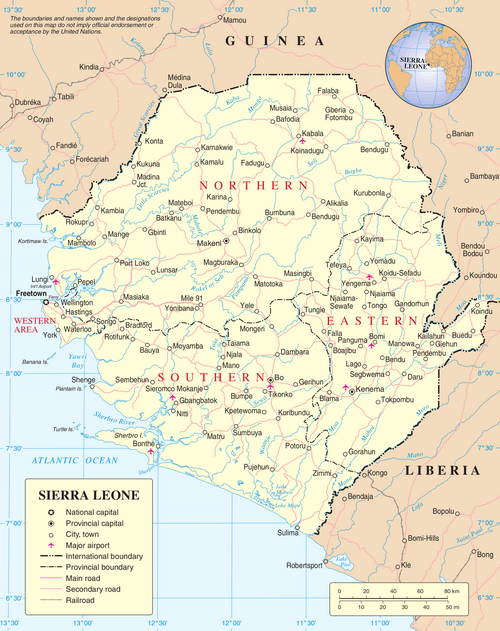
シエラレオネは西アフリカの南西海岸に位置し、大部分は北緯7度から10度(一部7度より南)、経度は10度から14度の間である。北と東はギニア、南東はリベリア、西と南西は大西洋に面している。 [96]
シエラレオネの総面積は71,740 km 2 (27,699 平方マイル)で、陸地71,620 km 2 (27,653 平方マイル)、水域120 km 2 (46 平方マイル)に分かれている。[97]この国は4つの異なる地理的地域に分かれている。シエラレオネ東部では高原に高い山々が点在し、ビントゥマニ山は標高1,948 m (6,391 フィート)で国内最高峰である。モア川の流域の上流部はこの地域の南に位置する。
国土の中央部は低地 平野で、森林、灌木、農地があり、[96]シエラレオネの国土面積の約43%を占めています。この地域の北部は世界自然保護基金によってギニアの森林・サバンナモザイク 生態地域の一部に分類されており、南部は熱帯雨林の平野と農地です。
シエラレオネの西部には、約 400 km (249 マイル) におよぶ大西洋の海岸線があり、海洋資源が豊富で、魅力的な観光地となっています。海岸には、低地のギニアマングローブ湿地帯があります。首都フリータウンは、シエラレオネ港に隣接する 海岸半島にあります。
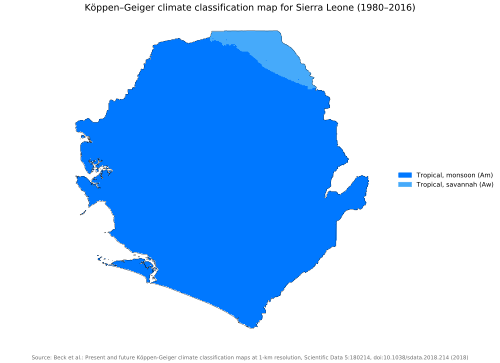
気候は熱帯性で、農業サイクルは2つの季節によって決まる。5月から11月までの雨期と、 12月から5月までの乾期である。乾期にはハルマッタンが含まれ、この時期にはサハラ砂漠から冷たく乾燥した風が吹き込み、夜間の気温は16℃(60.8℉)まで下がる。平均気温は26℃(78.8℉)で、年間を通じて26~36℃(78.8~96.8℉)の範囲で変動する。[98] [99]
生物多様性
シエラレオネには、ギニア山岳森林、西ギニア低地森林、ギニア森林サバンナモザイク、ギニアマングローブの4つの陸上生態地域があります。[100]
シエラレオネにおける土地劣化の原因あるいは一因となっているとされる人間の活動には、持続不可能な農地利用、不適切な土壌・水管理、森林破壊、自然植生の除去、薪の消費、そして程度は低いが過放牧や都市化などがある。[101]
森林破壊は、商業用木材のためと農業用地確保のための両方で大きな懸念事項であり、国の自然経済的豊かさの莫大な損失を意味します。[101]採鉱と土地転換のための焼畑(牛の放牧など)により、1980年代以降、シエラレオネの森林地帯は劇的に減少しました。同国は、森林被覆率が低く森林破壊率が高い(LFHD)国として、排出懸念国に挙げられています。[102]北部のタマ・トンコリ森林保護区で大規模な伐採が続いていることが懸念されています。伐採業者は、東部州コノ地区のニミニ、西部地域西部農村地区のジュイ、北部州コイナドゥグのロマ山脈国立公園にまで事業を拡大しており、東部州ケネマ地区のカンブイ森林保護区でも事業を開始する計画があります。[102]この国の2019年の森林景観完全性指数の平均スコアは2.76/10で、世界172カ国中154位でした。[103]
アフリカリカオン(Lycaon pictus )の生息地の劣化が進み、このイヌ科動物はシエラレオネでは絶滅したとみなされている。[104]
シエラレオネでは、数万人の死者を出した内戦のため、2002年まで森林管理システムがなかった。森林破壊率は内戦終結以来7.3%増加している。[105]書類上は、2003年時点で55の保護区がシエラレオネの4.5%を占めている。この国には、2,090種の高等植物、147種の哺乳類、626種の鳥類、67種の爬虫類、35種の両生類、99種の魚類が生息していることが知られている。 [ 105 ]戦争中の無制限の狩猟により、ゾウ、ライオン、スイギュウなど多くの動物の個体数が減少した。これらの動物の多くは現在、保護区でしか見ることができない。ツェツェバエが現在この地域で優勢であり、睡眠病という病気の蔓延を増加させている。それでも、シエラレオネの鳥類の個体数はほぼ変わらず、カッコウ、フクロウ、ハゲワシなどの在来種の鳥類も含まれる。ティワイ島野生生物保護区とゴラ森林保護区は、内戦後の野生生物を保護するための人道的取り組みのほんの一例である。[106]
環境正義財団は、近年シエラレオネの海域における違法漁船の数がいかに増加しているかを記録している。違法漁業の多さにより魚類資源は著しく枯渇し、地元の漁業コミュニティは生存のための重要な資源を奪われている。10年以上続いた内戦からまだ回復途上にある国では、多くのコミュニティにとって漁業が唯一の収入源となっているため、状況は特に深刻である。[107]
2005年6月、英国王立鳥類保護協会(RSPB)とバードライフインターナショナルは、シエラレオネ南東部のゴラ森林(シエラレオネに残る重要な熱帯雨林の一部)における保全と持続可能な開発プロジェクトを支援することに合意した[108]。
政府と政治
シエラレオネは、直接選挙で選ばれる大統領と一院制の議会を持つ立憲共和国である。シエラレオネ政府の現在の体制は、 1991年のシエラレオネ憲法に基づいている。シエラレオネは、支配的な単一 中央政府と弱い地方政府を持っている。シエラレオネ大統領が率いるシエラレオネ政府の行政府は、広範な権限と影響力を持っている。大統領は、シエラレオネで最も強力な政府職員である。[109]
大統領は国家元首、政府の長、シエラレオネ軍の最高司令官です。大統領は内閣を任命し、その長を務めます。内閣は議会の承認を受けなければなりません。大統領は国民投票で選出され、任期は最長 2 期 5 年です。大統領はシエラレオネ政府内で最高位かつ最も影響力のある役職です。
シエラレオネの大統領に選出されるには、候補者は少なくとも55%の票を獲得する必要がある。55%を獲得した候補者がいない場合は、上位2人の候補者による第2回決選投票が行われる。 [110]
シエラレオネの現大統領は、元軍事政権指導者のジュリアス・マーダ・ビオである。[111]ビオは、同国で大接戦となった2018年の大統領選挙で、与党全人民会議(APC)のサムラ・カマラを破った。ビオは、2018年4月4日に最高裁判所長官のアブドゥライ・チャムによって宣誓就任し、退任するアーネスト・バイ・コロマ大統領の後任となった。ビオは、シエラレオネの現在の与党である シエラレオネ人民党の党首である。
大統領の次にいるのは副大統領で、シエラレオネ政府の行政部門で2番目に高い地位にある政府職員です。シエラレオネ憲法の規定により、大統領が死亡、辞任、または解任された場合、副大統領がシエラレオネの新大統領になります。
議会
シエラレオネ議会は一院制で、149議席を有する。国内の16の各地区が議会に代表される。135人の議員は大統領選挙と同時に選出され、残りの14議席は行政地区の最高首長によって占められる。[112]シエラレオネ議会は国会議長によって率いられ、国会議員によって直接選出される国会議長が議会の全体的な指導者である。シエラレオネ議会の現在の議長はアバス・ブンドゥであり、2014年1月21日に国会議員によって選出された。
シエラレオネの現在の国会議員は、2023年のシエラレオネ総選挙で選出された。APCは現在、135議席のうち54議席を占め、シエラレオネ人民党(SLPP)は81議席を占めている。シエラレオネの2大政党であるAPCとSLPPは、2023年のシエラレオネ国会議員選挙で国会議員の議席をすべて獲得した。国会議員は、21歳以上のシエラレオネ国民であり、選挙人登録をしており、英語に堪能でなければならない。[109]
1961年の独立以来、シエラレオネの政治はSLPPとAPCという2大政党によって支配されてきた。他の小規模政党も存在したが、大きな支持は得られなかった。[113]
司法

シエラレオネの司法権は司法府に与えられており、シエラレオネ最高裁判所が最高裁判所を構成し、シエラレオネ最高裁判所はシエラレオネの最高裁判所の最高裁判所に相当します。したがって、最高裁判所の判決に対しては控訴できません。その他の裁判所には、高等裁判所、控訴裁判所、治安判事裁判所、および地方の村の伝統的裁判所があります。大統領が3つの裁判所の裁判官を任命し、議会が承認します。司法府は、国全体のすべての民事および刑事事件の管轄権を持ちます。シエラレオネの現在の最高裁判所長官は、デズモンド・ババトゥンデ・エドワーズです。
外交関係
シエラレオネ外務国際協力省はシエラレオネの外交政策を担当している。シエラレオネは中国、ロシア、[114]リビア、イラン、キューバと外交関係を結んでいる。
シエラレオネは米国を含む西側諸国と良好な関係を維持しており、イギリス連邦加盟国として英国やその他の旧英国植民地との歴史的なつながりを維持している。[115]英国は2000年に内戦終結のために介入して以来、行政支援や軍事訓練とともに旧植民地への援助提供に大きな役割を果たしてきた。
シアカ・スティーブンス前大統領の政権は、西アフリカ諸国経済共同体(ECOWAS)の下で他の西アフリカ諸国との緊密な関係を求めており、この政策は現政権にも引き継がれている。シエラレオネは、リベリア、コートジボワール、ギニアとともにマノ川同盟(MRU)を形成している。この同盟は主に、開発プロジェクトを実施し、4カ国間の地域経済統合を促進することを目的としている。 [116]
シエラレオネは、国連とその専門機関、アフリカ連合、アフリカ開発銀行(AFDB)、イスラム協力機構(OIC)、非同盟運動(NAM)にも加盟している。[117]シエラレオネは、米軍を保護する二国間免除協定(第98条に規定)を締結した国際刑事裁判所の加盟国でもある。
2024年世界平和指数によると、シエラレオネは世界で66番目に平和な国です。[118]
軍隊
シエラレオネ軍、正式にはシエラレオネ共和国軍(RSLAF)は、シエラレオネの国境の領土安全保障と、国際義務の枠組み内でシエラレオネの国益を守る責任を持つシエラレオネの統一軍である。この軍は、1961年の独立後に、同国に駐留していた旧英国王立西アフリカ国境軍の要素を基にして結成された。シエラレオネ軍は、約15,500人の人員で構成され、最大のシエラレオネ陸軍、 [119]、シエラレオネ海軍、シエラレオネ航空団で構成される。 [120]
シエラレオネ大統領は軍の最高司令官であり、国防政策と軍隊の編成を担当する国防大臣である。 [121] [122]
シエラレオネが1961年に独立したとき、西アフリカ国境軍のシエラレオネ大隊から王立シエラレオネ軍が創設された。[123] 1968年に軍が権力を掌握し、国民改革評議会が権力の座についた。1971年4月19日、シエラレオネが共和国になると、王立シエラレオネ軍はシエラレオネ共和国軍(RSLMF)に改名された。[123] [124] RSLMFは、1979年にシエラレオネ海軍が設立されるまで、単一軍組織のままであった。1995年に国防本部が設立され、シエラレオネ航空団が編成された。RSLMFはシエラレオネ共和国軍(AFRSL)に改名された。
法執行
シエラレオネにおける法執行は、主にシエラレオネ警察(SLP)が担当しており、内務大臣(大統領が任命)に対して責任を負っています。シエラレオネ警察は1894年にイギリス植民地によって設立され、西アフリカで最も古い警察組織の1つです。犯罪の防止、生命と財産の保護、犯罪者の摘発と起訴、公共秩序の維持、安全と治安の確保、司法へのアクセスの強化に取り組んでいます。シエラレオネ警察は、シエラレオネ大統領が任命するシエラレオネ警察の専門職のトップである警察監察総監が率いています。
シエラレオネの14の地区はそれぞれ、その地区の専門職の長である地区警察長官によって率いられています。これらの警察長官は、フリータウンのシエラレオネ警察本部の警察総監に直接報告します。現在の警察総監はウィリアム・ファイヤ・セルであり、2020年3月からその職に就いていたアンブローズ・ソヴラの後任として、2022年7月27日にジュリアス・マッダ・ビオ大統領によって任命されました。[125] [126]
人権
男性同性間の性行為は、1861年人身犯罪法第61条で違法とされており、終身刑となる可能性がある。[127] [128]
警察の過度の暴力も頻繁に問題となっている。抗議活動参加者は治安部隊に殺害され、刑務所の暴徒も同様である(パデンバロード刑務所での事件では、受刑者30人と刑務官1人が殺害された)。COVID-19のロックダウン期間中、警察が生活必需品を入手しようとする人々を攻撃したとの疑惑が複数浮上した。[129]
世界統治イニシアチブにおけるリーダーシップ
シエラレオネは、世界憲法を起草するための会議を招集する協定の署名国の一つである。[130] [131]その結果、1968年に人類史上初めて、地球連邦憲法を起草し採択するための世界制憲議会が招集された。[132]当時のシエラレオネ大統領ミルトン・マルガイは、世界制憲議会招集の協定に署名した。[133]
行政区分

シエラレオネ共和国は、北部州、北西州、南部州、東部州、西部地域の 5 つの地域で構成されています。4 つの州はさらに 14 の地区に分かれており、西部地域は 2 つの地区に分かれています。
州は186の首長国に分かれており、1896年に英国政府がシエラレオネ保護領を組織した際に承認した最高首長が伝統的に率いてきた。最高首長は、特に村や小さな田舎町で影響力を持つ。[134]各首長国には、その時点で承認された統治一族があり、地元の名士で構成される部族当局が統治一族の中から最高首長を選出する。[134]通常、首長は「税金を引き上げ、司法制度を統制し、田舎で最も重要な資源である土地を割り当てる」権限を持つ。[135]
地方自治の文脈では、地区は地域として統治されている。各地区には直接選出された地方地区議会があり、地方レベルで権限を行使し、機能を遂行する。[136] [137]合計で19の地方議会があり、13の地区議会は12の地区それぞれに1つ、西部地域農村部に1つずつあり、6つの自治体にも選出された地方議会がある。6つの自治体には、西部地域都市地区の地方政府として機能するフリータウン、ボ、ボンテ、ケネマ、コイドゥ、マケニが含まれる。[136] [138] [139]
地区議会はそれぞれの州政府の監督下にあります。一方、市町村は地方自治・コミュニティ開発省の直接監督下にあり、したがって行政上は地区や州政府から独立しています。
経済

.svg/500px-Sierra_Leone_Product_Exports_(2019).svg.png)
1990年代までに経済活動は衰退し、経済インフラは深刻な劣化に陥った。その後10年間、国の内戦で正式な経済の多くが破壊された。2002年1月の戦闘終結以来、外部からの大規模な援助がシエラレオネの復興を助けた。[151]
回復の成否は、多くの人が内戦の主因だと考えている役人の汚職を抑制する政府の取り組みが成功するかどうかに大きく左右されるだろう。成功の重要な指標は、ダイヤモンド産業に対する政府の管理の有効性となるだろう。
失業率は高く、特に若者と元戦闘員の間で高い。当局は公務員制度改革の実施が遅れており、民営化計画のペースも鈍化しており、ドナーはそれを推進するよう促している。2019年の最新調査によると、人口の59.2%が引き続き多次元貧困の影響を受けており、さらに21.3%が多次元貧困の影響を受けやすい。[19]
通貨はレオンです。中央銀行はシエラレオネ銀行です。シエラレオネは変動為替レート制を採用しており、商業銀行、公認外貨両替所、ほとんどのホテルで外貨を両替できます。シエラレオネではクレジットカードの使用は制限されていますが、一部のホテルやレストランでは使用できます。フリータウンには、ProCredit Bank が運営する、 Visa カードを受け付ける国際的にリンクされた自動現金自動預け払い機がいくつかあります。
農業

シエラレオネの人口の3分の2は自給農業に直接従事している。[152] 2007年には農業が国内総生産(GDP)の58%を占めた。[150]
Agriculture is the largest employer with 80 per cent of the population working in the sector.[153] Rice is the most important staple crop in Sierra Leone with 85 per cent of farmers cultivating rice during the rainy season[154] and an annual consumption of 76 kg (167.5 lbs) per person.[155]
Mining
Rich in minerals, Sierra Leone has relied on mining, especially diamonds, for its economic base. The country is among the top ten diamond producing countries. Mineral exports remain the main currency earner. Sierra Leone is a major producer of gem-quality diamonds. Though rich in diamonds, it has historically struggled to manage their exploitation and export.
Sierra Leone is known for its blood diamonds that were mined and sold to diamond conglomerates during the civil war, to buy the weapons that fuelled its atrocities.[156] In the 1970s and early 1980s, economic growth rate slowed because of a decline in the mining sector and increasing corruption among government officials.
Annual production of Sierra Leone's diamond estimates a range between US$250 million–$300 million. Some of that is smuggled, where it is possibly used for money laundering or financing illicit activities. Formal exports have dramatically improved since the civil war, with efforts to improve the management of them having some success. In October 2000, a UN-approved certification system for exporting diamonds from the country was put in place which led to a dramatic increase in legal exports. In 2001, the government created a mining community development fund (DACDF), which returns a portion of diamond export taxes to diamond mining communities. The fund was created to raise local communities' stakes in the legal diamond trade.
Sierra Leone has one of the world's largest deposits of rutile, a titanium ore used as paint pigment and welding rod coatings.
Transport infrastructure

There are several systems of transport in Sierra Leone, which has a road, air and water infrastructure, including a network of highways and several airports. There are 11,300 kilometres (7,000 miles) of highways in Sierra Leone, of which 904 km (562 mi)[97] are paved (about 8% of the roads). Sierra Leone's highways are linked to Conakry, Guinea, and Monrovia, Liberia.
Sierra Leone has the largest natural harbour on the African continent, allowing international shipping through the Queen Elizabeth II Quay in the Cline Town area of eastern Freetown or through Government Wharf in central Freetown. There are 800 km (497 mi) of waterways in Sierra Leone, of which 600 km (373 mi) are navigable year-round. Major port cities are Bonthe, Freetown, Sherbro Island and Pepel.
There are ten regional airports in Sierra Leone, and one international airport. The Freetown International Airport located in the coastal town of Lungi in Northern Sierra Leone is the primary airport for domestic and international travel to or from Sierra Leone. Passengers cross the river to Aberdeen Heliports in Freetown by hovercraft, ferry or a helicopter. Helicopters are also available from the airport to other major cities in the country. The airport has paved runways longer than 3,047 metres (9,997 feet). The other airports have unpaved runways, and seven have runways from 914 to 1,523 metres (2,999 to 4,997 feet) long; the remaining two have shorter runways.
Sierra Leone appears on the EU list of prohibited countries with regard to the certification of airlines. This means that no airline registered in Sierra Leone may operate services of any kind within the European Union. This is due to substandard safety standards.[157]
As of March 2023, the country's only international airport had regularly scheduled direct flights to Istanbul, Paris, Brussels and most major cities in West Africa.
In September 2014 there were many Districts with travel restrictions including Kailahun, Kenema, Bombali, Tonkolili, and Port Loko because of Ebola.[158]
Energy in Sierra Leone

Overview
As of 2016, about 12% of the population of Sierra Leone had access to electricity. Of that 12%, 10% was in the capital Freetown, and the remaining 90% of the country used 2% of the nation's electricity.[159] The majority of the population relies on biomass fuels for their daily survival, with firewood and coal used most prevalently.[160] The burning of these sources has been reported to have adverse health effects on women and children.[160] A 2012 study was done on the correlation between Acute Respiratory Infection (ARI), and burning biomass fuels in the home. The results were that 64% of children were diagnosed with ARI where firewood stoves were used, and 44% where charcoal stoves were used.[160] The use of coal and firewood has also posed environmental concerns as they are both in conflict with the push for more sustainable sources of energy.[161] As a result, the commercialisation of firewood and coal has been a point of contention with aid donors and government agencies such as the Ministry of Energy and Water Resources and the Forestry Division.[161] There have been strong pushes for both solar and hydropower to become the dominant sources of energy in Sierra Leone because of the UN's Sustainable Development Goals, particularly goal number seven (affordable and clean energy). Sierra Leone's tropical climate, heavy annual rainfall, and abundance of rivers give it the potential to realistically pursue more solar and hydropower alternatives.[162]
Solar energy
In conjunction with the UK's Department for International Development (DFID), Sierra Leone has set the goal to provide solar power to all of its citizens by 2025.[163] This overarching goal has been broken down into smaller goals as well. The first of these goals is to provide solar power to at least 50,000 homes in 2016, the second is 250,000 homes by 2017, and finally to provide power to 1,000,000 people by 2020.[163] This initiative falls under the Energy Africa access campaign which seeks to provide electricity to 14 different African countries by 2030.[159] Previous to this compact agreement, Sierra Leone's private sector for solar energy was weak, as it provided energy to less than 5% of the target population.[159] Part of the reason for this was due to the import duties and taxes and the lack of quality control.[159] To ensure that the Energy Africa goal is met, Sierra Leone has agreed to remove its import duties and Value Added Tax (VAT) on certified solar products.[163] This change will attempt to encourage foreign investment while providing affordable, quality solar products to its citizens. It is estimated that there will be a 30% to 40% cost reduction on solar products with the lack of duties and taxes.[159]
Hydroelectric power
As of 2012, Sierra Leone has 3 main hydroelectric plants. The first is the Guma plant which was decommissioned in 1982, the second is the Dodo Plant which is located in the Eastern Province, and finally the Bumbuna plant.[162] There is also potential for several new hydroelectric plants to be opened on the Sewa River, Pampana River, Seli River, Moa River, and Little Scarcies.[162] Amongst all these projects, both finished and potential, the Bumbuna dam still remains the largest of the hydroelectric projects in Sierra Leone.[162] It is located near the Seli River and Freetown and was estimated to produce about 50 megawatts of electricity.[164] There were plans to increase its capacity 400 megawatts by 2017 which would cost around $750 million.[165] It has been projected that the Bumbuna dam could potentially reduce the amount of spending on foreign fuel and save the country at least $2 million a month.[166] In the past this project received its funding of over $200 million from a combination of the World Bank, the African Development Bank, and the Italian company Salini Impregilo.[164]
Demographics

In 2019 Sierra Leone had a population of 7,813,215[167] and a growth rate of 2.216% a year.[97] The country's population is mostly young, with an estimated 41.7% under 15, and rural, with an estimated 62% of people living outside the cities.[97] As a result of migration to cities, the population is becoming more urban with an estimated rate of urbanisation growth of 2.9% a year.[97][168]
Population density varies greatly within Sierra Leone. The Western Area Urban District, including Freetown, the capital and largest city, has a population density of 1,224 persons per square km. The largest district geographically, Koinadugu, has a much lower density of 21.4 persons per square km.[168]
English is the official language,[169] spoken at schools, government administration and in the media. Krio (derived from English and several indigenous African languages, and the language of the Sierra Leone Creole people) is the most widely spoken language in virtually all parts of Sierra Leone. As the Krio language is spoken by 96% of the country's population,[97][170] it unites all the different ethnic groups, especially in their trade and interaction with each other.[171] Krio is the primary language of communication among Sierra Leoneans at home and abroad,[172] and has also heavily influenced Sierra Leonean English.[173]
After the contribution made by the Bangladesh UN Peacekeeping Force in the Sierra Leone Civil War under the United Nations Mission in Sierra Leone, the government of Ahmad Tejan Kabbah declared Bengali an honorary official language in December 2002.[174][175]
According to the World Refugee Survey 2008, published by the US Committee for Refugees and Immigrants, Sierra Leone had a population of 8,700 refugees and asylum seekers at the end of 2007. Nearly 20,000 Liberian refugees voluntarily returned to Liberia over the course of 2007. Of the refugees remaining in Sierra Leone, nearly all were Liberian.[176]
The populations quoted above for the five largest cities are from the 2004 census. The figure for Freetown is for the Western Urban Area (Greater Freetown). Other figures are estimates from the source cited. Different sources give different estimates. Some claim that Magburaka should be included in the above list, but there is considerable difference among sources. One source estimates the population at 14,915,[178] whilst another puts it as high as 85,313.[179] "Pandebu-Tokpombu" is presumably the extended town of Torgbonbu, which had a population of 10,716 in the 2004 census. "Gbendembu" had a larger population of 12,139 in that census. In the 2004 census, Waterloo had a population of 34,079.
Religion
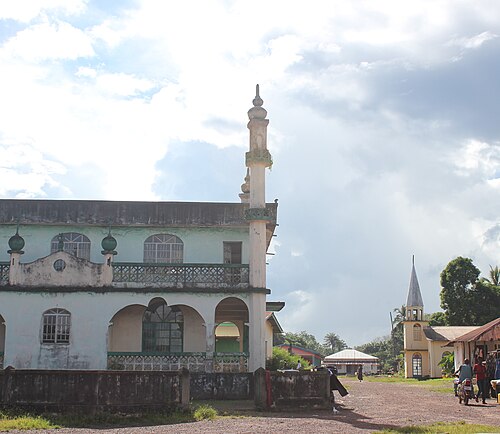
Sierra Leone is officially a secular state. Islam and Christianity are the two main religions in the country. The constitution of Sierra Leone provides for freedom of religion and the Sierra Leone Government generally protects it. The Sierra Leonean Government is constitutionally forbidden from establishing a state religion, though Muslim and Christian prayers are usually held in the country at the beginning of major political occasions, including presidential inaugurations and the official opening of the new session of Parliament.
Surveys of the religious make up of Sierra Leone vary widely, though Muslims make up the majority of the population. Based on 2015 estimates of the population of Sierra Leone, 77% of the population are Muslims, 22% are Christians, and 1% practise African traditional religion.
According to 2020 estimates by the Pew Research Center[180] 78.5% of Sierra Leone's population are Muslims (mostly Sunni), 20.4% are Christians (mostly Protestants) and 1.1% belong to a traditional African religion or other beliefs. The Inter-Religious Council of Sierra Leone estimated that 77% of Sierra Leone's population are Muslims, 21% are Christians, and 2% are followers of traditional African religions.[181] Most of Sierra Leone's ethnic groups are Muslim majority, including the country's two largest ethnic groups: the Mende and Temne.
Sierra Leone is regarded as one of the most religiously tolerant countries in the world.[182][183][184] Most of the major Muslim and Christian holidays are officially national holidays in the country, and religious conflict is rare.[185]
The country is home to the Sierra Leone Inter-Religious Council, which is made up of both Christian and Muslim religious leaders to promote peace and tolerance throughout the country.[186][187][188] The Islamic holidays of Eid al-Fitr, Eid al-Adha and Maulid-un-Nabi (Birthday of the Islamic prophet Muhammad) are observed as national holidays in Sierra Leone. The Christian holidays of Christmas, Boxing Day, Good Friday and Easter are also national holidays in Sierra Leone. In politics, the overwhelming majority of Sierra Leoneans vote for a candidate without regard of the candidate being a Muslim or a Christian.[citation needed] All of Sierra Leone's Heads of State have been Christians except Ahmad Tejan Kabbah, who was a Muslim.
The overwhelming majority of Sierra Leonean Muslims are adherent to the Sunni tradition of Islam in practice. Most of the Mosques and Islamic schools across Sierra Leone are based on Sunni Islam. Ahmadiyya Muslims make up about 10% of the country's Muslim population. Sierra Leone has a vibrant Ahmaddiya Muslim population, especially in the southern city of Bo, which is home to a large Ahmadiyya Muslim population. There are five hundred Ahmadiyya Mosques across Sierra Leone.[189] Shia Islam does not have a strong presence in Sierra Leone, and there are virtually no Shia Muslims in the country. Most Sierra Leonean Muslims of the Sunni and Ahmadiyya sect generally pray together in the same mosque.[190][191] The vast majority of Sierra Leonean Muslims are adherent to the Maliki school of Sunni Islam. The Maliki school is by far the largest and most dominant Islamic school of jurisprudence across Sierra Leone. Many Ahmadiyya Muslims in Sierra Leone also follow the Maliki Jurisprudence.
The Sierra Leone Islamic Supreme Council is the highest Islamic religious organisation in Sierra Leone and is made up of the country's Imams, Islamic scholars, and other Islamic clerics across the country. Sheikh Muhammad Taha Jalloh is the president of the Sierra Leone Supreme Islamic Council.[192] The United Council of Imams is an influential Islamic religious body in Sierra Leone that is made up of all imams of mosques throughout Sierra Leone. The president of the United Council of Imam is Sheikh Alhaji Muhammad Habib Sheriff.[193] The two largest mosques in Sierra Leone are the Freetown Central Mosque and the Ghadafi Central Mosque (built by former Libyan dictator Muammar Gaddafi), both located in the capital Freetown.
The large majority of Sierra Leonean Christians are Protestant, of which the largest groups are the Wesleyan – Methodists.[194][195][196][197][198] Other Christian Protestant denominations with significant presence in the country include Presbyterians,[199] Baptists,[200] Seventh-day Adventists,[201] Anglicans,[202] Lutherans,[203][204] and Pentecostals.[205] The Council of Churches is the Christian religious organisation that is made up of Protestant churches across Sierra Leone. Recently there has been an increase of Pentecostal churches, especially in Freetown.
In September 2017, a Sierra Leone-based Nigerian Pentecostal Christian pastor name Victor Ajisafe was arrested by the Sierra Leone Police and held in jail after he made controversial remarks against Islam and Sierra Leonean Muslims in particular at his church sermon in the capital Freetown. Ajisafe was apparently angry after a Zimbabwean Muslim cleric Mufti Menk had visited Sierra Leone and preached to large crowds.[206] Many Christian organisations in Sierra Leone, including the Council of Churches, condemned Ajisafe's sermon against Islam and Muslims. Ajisafe's church was temporarily shut down by the Sierra Leone government and his church licence was temporarily suspended too. The incident brought religious tension in Sierra Leone, in a country known for its high level of religious tolerance, as many Sierra Leonean Muslims at home and abroad called for Ajisafe to be deported back to his home country of Nigeria. The pastor while in Sierra Leone police custody apologised to Sierra Leonean Muslims and to the government of Sierra Leone. After several days in jail, Ajisafe was released, his church licence was given back to him, and his church was later reopened under strict government conditions during several months of probation.
Non-denominational Protestants form a significant minority of Sierra Leone's Christian population.[207] Catholics are the largest group of non-Protestant Christians in Sierra Leone, forming about 8% of Sierra Leone's population and 26% of the Christian population in Sierra Leone.[208] The Jehovah's Witnesses[209] and the Church of Jesus Christ of Latter-day Saints[210][211] are the two most prominent non-Trinitarian Christians in Sierra Leone, and they form a small but significant minority of the Christian population in Sierra Leone. A small community of Orthodox Christians resides in the capital Freetown.[212]
Ethnic groups
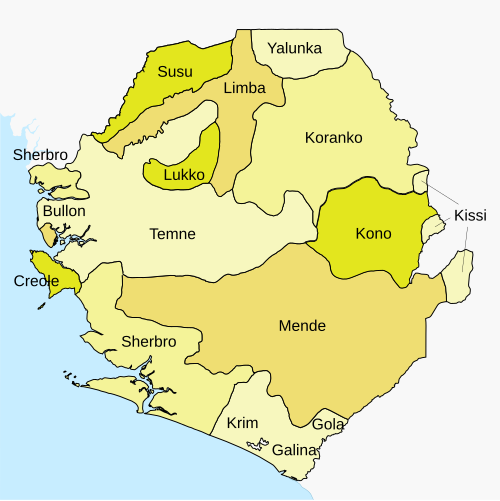
Sierra Leone is home to about sixteen ethnic groups, each with its own language. The largest and most influential are the Temne at about 35.5% and the Mende at about 33.2%. The Temne predominate in the Northern Sierra Leone and some areas around the capital of Sierra Leone. The Mende predominate in South-Eastern Sierra Leone (with the exception of Kono District).
The vast majority of Temne are Muslims at over 85%, with a significant Christian minority at about 10%. The Mende are also Muslim majority at about 70%, though with a large Christian minority at about 30%. Sierra Leone's national politics centres on the competition between the north-west, dominated by the Temne, and the south-east dominated by the Mende. The vast majority of the Mende support the Sierra Leone People's Party; while the majority of the Temne support the All People's Congress.[213]
The Mende, who are believed to be descendants of the Mane,[citation needed] originally occupied the Liberian hinterland. They began moving into Sierra Leone slowly and peacefully in the eighteenth century. The Temne are said to have migrated from Futa Jallon, which is in present-day Guinea.
The third-largest ethnic group is the Limba at about 8.4% of the population. The Limba are native people of Sierra Leone. They have no tradition of origin, and it is believed that they have lived in Sierra Leone since before the European encounter. The Limba are primarily found in Northern Sierra Leone, particularly in Bombali, Kambia and Koinadugu District. The Limba are about 60% Christian and 40% Muslim. The Limba are close political allies of the neighbouring Temne.
Since independence, the Limba have traditionally been influential in Sierra Leone's politics, along with the Mende. The vast majority of Limba support the All People's Congress (APC) political party. Sierra Leone's first and second presidents, Siaka Stevens and Joseph Saidu Momoh, respectively, were both ethnic Limba. Sierra Leone's former defense minister Alfred Paolo Conteh is an ethnic Limba.
One of the biggest minority ethnic groups are the Fula at around 3.8% of the population. Descendants of seventeenth- and eighteenth-century Fula migrant settlers from the Fouta Djalon region of Guinea, they live primarily in the northeast and the western area of Sierra Leone. The Fula are virtually all Muslims at over 99%. The Fula are primarily traders, and many live in middle-class homes.[citation needed] Because of their trading, the Fulas are found in nearly all parts of the country.
The other ethnic groups are the Mandingo (also known as Mandinka). They are descendants of traders from Guinea who migrated to Sierra Leone during the late nineteenth to mid-twentieth centuries. The Mandinka are predominantly found in the east and the northern part of the country. They predominate in the large towns, most notably Karina, in Bombali District in the north; Kabala and Falaba in Koinadugu District in the north; and Yengema, Kono District in the east of the country. Like the Fula, the Mandinka are virtually all Muslims at over 99%. Sierra Leone's third president, Ahmad Tejan Kabbah, and Sierra Leone's first Vice-President, Sorie Ibrahim Koroma, were both ethnic Mandingo.
Next in proportion are the Kono, who live primarily in Kono District in Eastern Sierra Leone. The Kono are descendants of migrants from Guinea; today their workers are known primarily as diamond miners. The majority of the Kono ethnic group are Christians, though with an influential Muslim minority. Sierra Leone's former Vice-President Alhaji Samuel Sam-Sumana is an ethnic Kono.
The small but significant Creole or Krio people (descendants of freed African American, West Indian and Liberated African slaves who settled in Freetown between 1787 and about 1885) make up about 3% of the population. They primarily occupy the capital city of Freetown and its surrounding Western Area. Creole or Krio culture reflects the Western culture and ideals within which many of their ancestors originated – they also had close ties with British officials and colonial administration during years of development.
The Creoles or Krio have traditionally dominated Sierra Leone's judiciary and Freetown's elected city council. One of the first ethnic groups to become educated according to Western traditions, they have traditionally been appointed to positions in the civil service, beginning during the colonial years. They continue to be influential in the civil service. The Creoles or Krios are virtually all Christians at about 99%.
The Oku people are the descendants of liberated Muslim Yorubas from Southwest Nigeria, who were released from slave ships and resettled in Sierra Leone as Liberated Africans or came as settlers in the mid-19th century. The Oku people primarily reside in the communities of Fourah Bay, Fula Town, and Aberdeen in Freetown. The Oku are virtually all Muslims at about 99%.
Other minority ethnic groups are the Kuranko, who are related to the Mandingo and are largely Muslims. The Kuranko are believed to have begun arriving in Sierra Leone from Guinea in about 1600 and settled in the north, particularly in Koinadugu District. The Kuranko are primarily farmers; leaders among them have traditionally held several senior positions in the Military. The current Governor of the Bank of Sierra Leone Kaifala Marah is an ethnic Kuranko. The Kuranko are largely Muslim majority.
The Loko in the north are native people of Sierra Leone, believed to have lived in Sierra Leone since the time of European encounter. Like the neighbouring Temne, the Loko are Muslim majority. The Susu and their related Yalunka are traders; both groups are primarily found in the far north in Kambia and Koinadugu District close to the border with Guinea. The Susu and Yalunka kingdom was established in the early fifth seventh century[clarification needed] before the Mali empire, which was extended from Mali, Senegal, Guinea Bissau, Guinea Conakry to the northern part of Sierra Leone. They are the original owners of the Futa Djallon region covered by a vars land area both the Susu and Yalunka people are descendants of the Mande people. They are virtually all Muslims. The Yalunka also spelled Jallonke, Yalonga, Djallonké, Djallonka or Dialonké, are Mande people who have lived in the Djallon, a mountainous region in Sierra Leone, Mali, Senegal, Guinea Bissau, and Guinea Conakry West Africa over 520 years ago. The name Yalunka literally means "inhabitants of the Jallon (mountains)". Manga Sewa was born in Falaba, Solima chiefdom, in the Northern Province of British Sierra Leone to Yalunka parents. His father was a Yalunka paramount chief of Solima, a prosperous chieftaincy. Its capital, Falaba, was on the rich trading routes leading to the coast. Manga Sewa's father had several wives and dozens of children. are traders; both groups are primarily found in the far north in Kambia and Koinadugu District close to the border with Guinea. The Susu and Yalunka are both descendants of migrants from Guinea; they both are virtually all Muslims at over 99%.
The Kissi live further inland in South-Eastern Sierra Leone. They predominate in the large town of Koindu and its surrounding areas in Kailahun District. The vast majority of Kissi are Christians. The much smaller Vai and Kru peoples are primarily found in Kailahun and Pujehun Districts near the border with Liberia. The Kru predominate in the Kroubay neighbourhood in the capital of Freetown. The Vai are largely Muslim majority at about 90%, while the Kru are virtually all Christians at over 99%.
On the coast in Bonthe District in the south are the Sherbro. Native to Sierra Leone, they have occupied Sherbro Island since it was founded. The Sherbro are primarily fisherman and farmers, and they are predominantly found in Bonthe District. The Sherbro are virtually all Christians, and their paramount chiefs had a history of intermarriage with British colonists and traders.
A small number of Sierra Leoneans are of partial or full Lebanese ancestry, descendants of traders who first came to the territory in the 19th century. They are locally known as Sierra Leonean-Lebanese. The Sierra Leonean-Lebanese community are primarily traders and they mostly live in middle-class households in the urban areas, primarily in Freetown, Bo, Kenema, Koidu Town and Makeni.
Gender equality
Household
Although women account for about 50 percent of the population in Sierra Leone, only 28 percent are household heads.[214] As in the rest of the countries, education is a key factor in succeeding in aspects such as a well-paid job and covering the needs of a house. Rural areas are the most common to lack access to education having only male-headed four percent ahead of females with basic education and 1.2 percent more at the post-graduate level.[214]
In Sierra Leone, normally, men are automatically positioned as household heads; and their status does not change if their marital status changes over time.[214] However, a female household does change depending on their marital status. A woman can be the head of the house only if she remains single for the rest of her life. But if a woman gets married, she will not be entitled to be the head of the house anymore.[214] Females can take over the household head if they become widowed or divorced.[214]
In the labour field, it is expected that the household will financially provide for the needs of the family. However, females face gender discrimination making them the target of lower incomes and financial struggles.[214] In numbers, females present a lower percentage (6.3) versus males (15.2) when it comes to being paid employees.[214]
War
Children who have been forced to be part of a war have experienced severe mental and emotional damage in Sierra Leone. However, the damage and way to deal with the effects of war depends on the gender of the kids. Both genders experienced and were involved in high levels of violence. Females, experiencing higher levels of rapes, presented greater signs of depression and anxiety.[215] Males, on the other hand, presented higher levels of anxiety and hostility.[215] Males also showed to be more vulnerable to depression after losing a caregiver.[215]
Female economy
Women face discrimination when it comes to obtaining financial, social, and cultural help to start a business.[74] It is difficult to avoid the economic paralysis in Sierra Leone given that more than half of the population in the country is women.[74] Due to the lack of access to basic education, women are the least prepared when it comes to processing business licences, registering names or contracting.[74] Not having the capital to start a new business is the biggest barrier for women.[74] With the lack of technology, mostly in all Sierra Leone, it is hard to help a business to function.[74]
Education

Education in Sierra Leone is legally required for all children for six years at primary level (Class P1-P6) and three years in junior secondary education,[216] but a shortage of schools and teachers has made implementation impossible.[84] Two thirds of the adult population of the country are illiterate.[217]
The Sierra Leone Civil War resulted in the destruction of 1,270 primary schools, and in 2001, 67% of all school-age children were out of school.[84] The situation has improved considerably since then with primary school enrolment doubling between 2001 and 2005 and the reconstruction of many schools since the end of the war.[218] Students at primary schools are usually 6 to 12 years old, and in secondary schools 13 to 18. Primary education is free and compulsory in government-sponsored public schools.
The country has three universities: Fourah Bay College, founded in 1827 (the oldest university in West Africa),[219] University of Makeni (established initially in September 2005 as The Fatima Institute, the college was granted university status in August 2009, and assumed the name University of Makeni, or UNIMAK), and Njala University, primarily located in Bo District. Njala University was established as the Njala Agricultural Experimental Station in 1910 and became a university in 2005.[220] Teacher training colleges and religious seminaries are found in many parts of the country.
Health
The CIA estimated that the average life expectancy in Sierra Leone was 57.39 years.[221]
The prevalence of HIV/AIDS in the population is 1.6%, higher than the world average of 1% but lower than the average of 6.1% across Sub-Saharan Africa.[222]
Medical care is not readily accessible, with doctors and hospitals out of reach for many villagers. While free health care may be provided in some villages, the medical staff is poorly paid and sometimes charge for their services, taking advantage of the fact that the villagers are not aware of their right to free medical care.[223]
A dialysis machine, the first of its kind in the country, was donated by Israel.[224]
According to an Overseas Development Institute report, private health expenditure accounts for 85.7% of total spending on health.[225]
Emergency medical response
Having had no formal emergency medical services previously, the First Responder Coalition of Sierra Leone (FRCSL) was formed in June 2019 in Makeni to facilitate the development of emergency first responder programs nationwide.[226] The founding members of the Coalition included the Sierra Leone Red Cross Society (the first chairing organisation), LFR International (proposed the formation), the University of Makeni, Agency for Rural Community Transformation, and the Holy Spirit Hospital.[226] The establishment of the Coalition was concurrent with the declaration by the 72nd World Health Assembly that emergency care systems are essential to universal health coverage.[227] Between June and July 2019, the FRCSL trained 1,000 community members from Makeni to be first responders and equipped each trainee with a first aid kit.[228]
Endemic and infectious diseases
Sierra Leone suffers from epidemic outbreaks of diseases, including yellow fever, cholera, Ebola, lassa fever and meningitis.[229][230] Yellow fever and malaria are endemic to Sierra Leone.[230]
Maternal and child health
According to 2017 estimates, Sierra Leone has the third highest maternal mortality rate in the world.[231] For every 100 liveborn children, one mother dies due to complications of giving birth.[231]
In the Multiple Indicator Cluster Survey (MICS) conducted by UNICEF in 2012, the prevalence of female genital mutilation in Sierra Leone was 94%.[232] As of 2014[update], Sierra Leone was estimated as having the 11th highest infant mortality rate in the world.[233]
One of the consequences women in Sierra Leone face after a prolonged and obstructed labour that would have required a c-section is obstetric fistula. This condition often drives women into poverty and isolation.[234]
The AWC- Aberdeen Women's Centre in Freetown, the second busiest hospital in Sierra Leone, delivering up to 3000 babies each year.[235] The centre provides free surgery for women suffering from this condition.
The centre provides a variety of maternal and child health services and is supported by not-for-profit organisations such as Freedom from Fistula,[236] The Aminata Maternal Foundation,[237][better source needed] and UNFPA.[238]
Mental health
Mental healthcare in Sierra Leone is almost non-existent. Many sufferers try to cure themselves with the help of traditional healers.[239] During the Civil War (1991–2002), many soldiers took part in atrocities and many children were forced to fight. This left them traumatised, with an estimated 400,000 people (by 2009) being mentally ill. Thousands of former child soldiers have fallen into substance abuse as they try to blunt their memories.[240]
Potable water supply
The water supply in Sierra Leone is characterised by limited access to safe drinking water. Despite efforts by the government and numerous non-governmental organisations, access has not much improved since the end of the Sierra Leone Civil War in 2002, stagnating at about 50% and even declining in rural areas.[241] It is hoped that a new dam in Orugu, for which China committed financing in 2009, will alleviate water scarcity.[242]
According to a national survey carried out in 2006, 84% of the urban population and 32% of the rural population had access to an improved water source. Those with access in rural areas were served almost exclusively by protected wells. The 68% of the rural population without access to an improved water source relied on surface water (50%), unprotected wells (9%) and unprotected springs (9%). Only 20% of the urban population and 1% of the rural population had access to piped drinking water in their home. Compared to the 2000 survey access has increased in urban areas, but has declined in rural areas, possibly because facilities have broken down because of a lack of maintenance.[241][243]
With a new decentralisation policy, embodied in the Local Government Act of 2004, responsibility for water supply in areas outside the capital was passed from the central government to local councils. In Freetown, the Guma Valley Water Company remains in charge of the water supply.

2014 Ebola outbreak
Ebola is prevalent in Africa where social and economic inequalities are common. The central African countries are the most prevalent of EVD, like the Democratic Republic of Congo, Sudan, Uganda, and Gabon.[244]
In 2014 there was an outbreak of the Ebola virus in West Africa. As of 19 October 2014, there had been 3,706 cases of Ebola in Sierra Leone, and 1,259 deaths, including that of the leading physician trying to control the outbreak, Sheik Umar Khan.[245][246] In early August 2014 Guinea closed its borders to Sierra Leone to help contain the spreading of the virus, which originated in Guinea, as more new cases of the disease were being reported in Sierra Leone than in Guinea. Aside from the human cost, the outbreak was severely eroding the economy. By September 2014, with the closure of borders, the cancellation of airline flights, the evacuation of foreign workers and a collapse of cross-border trade, the national deficit of Sierra Leone and other affected countries was widening to the point where the IMF was considering expanding its financial support.[247]
Culture
Polygamy
As of 2019, 30% of women and 14% of men were in a polygamous unions in Sierra Leone. "The percentage of women with one or more co-wives has decreased gradually over time, from 37% in 2008 and 35% in 2013 to 30% in 2019."[248]
Food and customs

Rice is the staple food of Sierra Leone and is consumed at virtually every meal daily. The rice is prepared in numerous ways, and topped with a variety of sauces made from some of Sierra Leone's favourite toppings, including potato leaves, cassava leaves, crain crain, okra soup, fried fish and groundnut stew.[249]
Along the streets of towns and cities across Sierra Leone, one can find foods consisting of fruit, vegetables and snacks such as fresh mangoes, oranges, pineapple, fried plantains, ginger beer, fried potato, fried cassava with pepper sauce; small bags of popcorn or peanuts, bread, roasted corn, or skewers of grilled meat or shrimp.
Poyo is a popular Sierra Leonean drink. It is a sweet, lightly fermented palm wine,[250] and is found in bars in towns and villages across the country. Poyo bars are areas of lively informal debate about politics, football, basketball, entertainment and other issues.
Media

Media in Sierra Leone began with the introduction of the first printing press in Africa at the start of the 19th century. A strong free journalistic tradition developed with the creation of several newspapers. In the 1860s, the country became a journalist hub for Africa, with professionals travelling to the country from across the continent. At the end of the 19th century, the industry went into decline, and when radio was introduced in the 1930s, it became the primary communication media in the country.
The Sierra Leone Broadcasting Service (SLBS) was created by the colonial government in 1934 making it the earliest English language radio broadcaster service in West Africa. The service began broadcasting television in 1963, with coverage extended to all the districts in the country in 1978. In April 2010, the SLBS merged with the United Nations peacekeeping radio station in Sierra Leone to form the Sierra Leone Broadcasting Corporation,[251][252] the government-owned current national broadcaster in Sierra Leone.
The Sierra Leone constitution guarantees freedom of speech, and freedom of the press; however, the government maintains strong control of media, and at times restricts these rights in practice.[253][254][255][256][257][258] Some subjects are seen as taboo by society and members of the political elite; imprisonment and violence have been used by the political establishment against journalists.[259][260]
Under legislation enacted in 1980, all newspapers must register with the Ministry of Information and pay sizeable registration fees. The Criminal Libel Law, including Seditious Libel Law of 1965, is used to control what is published in the media.[260]
In 2006, President Ahmad Tejan Kabbah committed to reforming the laws governing the press and media to create a freer system for journalists to work in.[260] As of 2013[update] Sierra Leone is ranked 61st (up two slots from 63rd in 2012) out of 179 countries on Reporters Without Borders' Press Freedom Index.[261]
Print media is not widely read in Sierra Leone, especially outside Freetown and other major cities, partially due to the low levels of literacy in the country.[262] In 2007 there were 15 daily newspapers in the country, as well as those published weekly.[263] Among newspaper readership, young people are likely to read newspapers weekly and older people daily. The majority of newspapers are privately run and are often critical of the government. The standard of print journalism tends to be low owing to lack of training, and people trust the information published in newspapers less than that found on the radio.[262]

Radio is the most popular and most-trusted media in Sierra Leone, with 85% of people having access to a radio and 72% of people in the country listening to the radio daily.[262] These levels do vary between areas of the country, with the Western Area having the highest levels and Kailahun the lowest. Stations mainly consist of local commercial stations with a limited broadcast range, combined with a few stations with national coverage – Capital Radio Sierra Leone being the largest of the commercial stations.
The United Nations Mission in Sierra Leone (UNIOSIL) ran one of the most popular stations in the country, broadcasting programs in a range of languages. The UN mission was restructured in 2008 and it was decided that the UN Radio would be merged with SLBS to form the new Sierra Leone Broadcasting Corporation (SLBC). This merger eventually happened in 2011 after the necessary legislation was enacted. SLBC transmits radio on FM and has two television services, one of which is uplinked by satellite for international consumption. FM relays of the BBC World Service (in Freetown, Bo, Kenema and Makeni), Radio France Internationale (Freetown only) and Voice of America (Freetown only) are also broadcast.
Outside the capital Freetown and other major cities, television is not watched by a great many people, although Bo, Kenema and Makeni are served by their own relays of the main SLBC service. There are three free terrestrial television stations in Sierra Leone, one run by the government SLBC and the other two are private stations in Freetown, Star TV which is run by the owner of the Standard-Times newspaper and AYV – Africa Young Voices. Several religious funded TV stations operate intermittently. Two other commercial TV operators (ABC and AIT) closed after they were not profitable. In 2007, a pay-per-view service was also introduced by GTV as part of a pan-African television service in addition to the nine-year-old sub-Saharan Digital satellite television service (DStv) originating from Multichoice Africa in South Africa. GTV subsequently went out of business, leaving DStv as the only provider of subscription satellite television in the country. Several organisations planned to operate digital terrestrial subscription TV services, with Multichoice's Go TV having built infrastructure ahead of getting a licence and ultimately failing to get a licence. ITV and SATCON are currently operational.
Internet access in Sierra Leone has been sparse but is on the increase, especially since the introduction of 3G/4G cellular phone services across the country. There are several main internet service providers (ISPs) operating in the country. Freetown has internet cafés and other businesses offering internet access. Problems experienced with access to the Internet include an intermittent electricity supply and a slow connection speed in the country outside Freetown.
Arts
The arts in Sierra Leone are a mixture of tradition and hybrid African and western styles.[264][265][266]
-
 Odelay mask by Temne people. Brooklyn Museum.
 -
 The Koindu dance
Sports

Association football is by far the most popular sport in Sierra Leone. Children, youth and adult are frequently seen playing street football across Sierra Leone. There are organised youth and adult football tournaments across the country, and there are various primary and secondary schools with football teams across Sierra Leone.
The Sierra Leone national football team, popularly known as the Leone Stars, represents the country in international competitions. It has never qualified for the FIFA World Cup but participated in the 1994 and 1996 African Cup of Nations. When the national football team, the Leone Stars, have a match, Sierra Leoneans across the country come together united in support of the national team and people rush to their local radio and television stations to follow the live match. The country's national television network, The Sierra Leone Broadcasting Corporation (SLBC) broadcasts the national football team live match, along with many local radio stations across the country.
When the Leone Stars win an important match, many youth across the county rush to the street to celebrate. Many of the Sierra Leone national team footballers play for teams based in Europe although virtually all of them started professional football in the Sierra Leone National Premier League. Many of the national team footballers are celebrities across Sierra Leone and they are often well known by the general population. Some of Sierra Leonean international footballers include Mohamed Kallon, Mohamed Bangura, Rodney Strasser, Kei Kamara, Ibrahim Teteh Bangura, Mustapha Dumbuya, Christian Caulker, Alhassan Bangura, Sheriff Suma, Osman Kakay, Mohamed Kamara, Umaru Bangura and Julius Gibrilla Woobay.
The Sierra Leone National Premier League is the top professional football league in Sierra Leone and is controlled by the Sierra Leone Football Association. Fourteen clubs from across the country compete in the Sierra Leone Premier League. The two biggest and most successful football clubs are East End Lions and Mighty Blackpool. East End Lions and Mighty Blackpool have an intense rivalry and when they play each other the national stadium in Freetown is often sold out and supporters of both clubs often clash with each other before and after the game. There is a huge police presence inside and outside the national stadium during a match between the two great rivals to prevent a clash. Many Sierra Leonean youth follow the local football league.
Many Sierra Leonean youth, children and adults follow the major football leagues in Europe, particularly the English Premier League, Italian Serie A, Spanish La Liga, German Bundesliga and French Ligue 1.
The Sierra Leone cricket team represents Sierra Leone in international cricket competitions and is among the best in West Africa. It became an affiliate member of the International Cricket Council in 2002. It made its international debut at the 2004 African Affiliates Championship, where it finished last of eight teams. But at the equivalent tournament in 2006, Division Three of the African region of the World Cricket League, it finished as runner-up to Mozambique, and just missed promotion to Division Two.
In 2009, the Sierra Leone Under-19 team finished second in the African Under-19 Championship in Zambia, thus qualifying for the Under-19 World Cup qualifying tournament with nine other teams.[267] However, the team was unable to obtain Canadian visas to play in the tournament, which was held in Toronto.[268]
Sierra Leone is the first African country to join the International Floorball Federation.
Tourism
Sierra Leone's Freetown is a favourite destination for tourists. Although the sector was seriously affected during the Civil War, there has been a steady improvement in recent years.[269] There is a vast expanse of beaches stretching along the Freetown Peninsula. The Lumley-Aberdeen beach stretches all the way from Cape Sierra Leone down to Lumley. There are also other popular beaches like the world renowned River Number 2 Beach, Laka Beach, Tokeh Beach, Bureh Beach, and Mama Beach. The Tacugama Chimpanzee Sanctuary, which is located within the peninsula's vast rainforest reserve, just a few kilometres from the centre of Freetown, has a collection of rare and endangered chimpanzees. Other popular destinations for tourists include the Freetown Cotton Tree, located in Central Freetown, a significant national monument and integral to the founding of the city; Bunce Island, which is a boat ride from the city, is home to the ruins of the slave fortress that was being used during the Transatlantic slave trade; the Sierra Leone Museum, which has a collection of both precolonial as well as colonial artifacts and other items of historical significance; the National Railway Museum; or take a journey around the city's coastline with the popular Sea Coach Express. The Aberdenn-Lumley area is a favourite destination for those venturing into the city's nightlife.
See also
.svg/500px-Africa_(orthographic_projection).svg.png)
Notes
References
- ^ Lewis, M. Paul; Simons, Gary F.; Fennig, Charles D., eds. (2015). "Liberia". Ethnologue (18th ed.). Dallas, Texas: SIL International.
- ^ a b c "Sierra Leone 2015 Population and Housing Census National Analytical Report" (PDF). Statistics Sierra Leone. Retrieved 28 March 2020.
- ^ a b "Religions in Sierra Leone | PEW-GRF". Archived from the original on 20 February 2018. Retrieved 9 December 2017.
- ^ "Sierra Leone". The World Factbook (2024 ed.). Central Intelligence Agency. Retrieved 22 June 2023.
- ^ a b c d "World Economic Outlook Database, October 2023 Edition. (SL)". IMF.org. International Monetary Fund. 10 October 2023. Retrieved 21 October 2023.
- ^ "GINI index (World Bank estimate) – Sierra Leone". World Bank. Retrieved 22 March 2020.
- ^ "HUMAN DEVELOPMENT REPORT 2023-24" (PDF). United Nations Development Programme. United Nations Development Programme. 13 March 2024. pp. 274–277.
- ^ Wells, John C. (2008), Longman Pronunciation Dictionary (3rd ed.), Longman, ISBN 9781405881180
- ^ "Sierra Leone". Merriam-Webster.com Dictionary. Merriam-Webster. Retrieved 22 April 2019.
- ^ Salone Definition
- ^ "Sierra Leone (country)". Encarta Encyclopedia. Archived from the original on 28 February 2008. Retrieved 19 February 2008.
- ^ "National Electoral Commission – Press Release" (PDF). 6 September 2017. Archived from the original (PDF) on 14 November 2017. Retrieved 1 February 2018.
- ^ "Sierra Leone unveils new geographical map". Africa Review. Archived from the original on 21 February 2018. Retrieved 1 February 2018.
- ^ "Sierra Leone". United States Department of State. Retrieved 6 March 2024.
- ^ United Nations (5 July 2013), "Inter-religious cooperation can be vital asset for rebuilding Sierra Leone – UN expert". Archived. Retrieved October 26, 2021.
- ^ Hargreaves, J. D. (January 1956). "IV. The Establishment of the Sierra Leone Protectorate and the Insurrection of 1898". Cambridge Historical Journal. 12 (1): 56–80. doi:10.1017/S1474691300000330. ISSN 2051-9818.
- ^ UNITED NATIONS INTEGRATED PEACEBUILDING OFFICE IN SIERRA LEONE. ABOUT SIERRA LEONE: HISTORY. Archived. Retrieved October 26, 2021.
- ^ a b c d e Fisher, Humphrey J. (December 1969). "Elections and Coups in Sierra Leone, 1967". The Journal of Modern African Studies. 7 (4): 611–636. doi:10.1017/S0022278X00018863. ISSN 1469-7777.
- ^ a b "Multidimensional Poverty Index 2023 Sierra Leone" (PDF). United Nations Development Programme Human Development Reports. 2023. Retrieved 26 July 2024.
- ^ Goddard, Thomas Nelson (1925). "Early History". The Handbook of Sierra Leone. G. Richards limited. pp. 11–12.
- ^ Countries and Their Cultures. "Culture of Sierra Leone". Retrieved 22 February 2008.
- ^ "Sierra Leone History". Encyclopædia Britannica. Retrieved 19 February 2008.
- ^ "Sierra Leone – History". Encyclopedia of the Nations. Retrieved 22 February 2008.
- ^ a b Fyfe, Christopher (July 1995). "Weighing the Probabilities - Landlords and Strangers: Ecology, Society and Trade in Western Africa, 1000–1630. By George E. Brooks. Boulder: Westview Press, 1994. Pp. xvi + 360. £14.95, paperback (ISBN 0-8133-1263-9)". The Journal of African History. 36 (2): 319–320. doi:10.1017/S0021853700034174. ISSN 1469-5138.
- ^ Utting (1931), p. 33.
- ^ Utting (1931), p. 8.
- ^ Kingfisher Geography Encyclopedia. ISBN 1-85613-582-9, p. 180.
- ^ "Pedro da çintra did not name Sierra Leone: An Exploration into available evidence". Sierra Leone Concord Times. 22 June 2017. Archived from the original on 6 August 2017. Retrieved 26 May 2017.
- ^ LeVert, Suzanne (2006). Cultures of the World: Sierra Leone. Marshall Cavendish. p. 22. ISBN 978-0-7614-2334-8.
- ^ Christopher Fyfe, A History of Sierra Leone, Introduction.
- ^ Sibthorpe, A. B. C. (1970). The History of Sierra Leone. Routledge. p. 7. ISBN 978-0-7146-1769-5.
- ^ Mota 1975: 586-87; Bassani 1981
- ^ Cassandra Pybus, Epic Journeys of Freedom: Runaway Slaves of the American Revolution and Their Global Quest for Liberty (Beacon Press, Boston, 2006); Graham Russell Hodges, Susan Hawkes Cook, Alan Edward Brown (eds.), The Black Loyalist Directory: African Americans in Exile After the American Revolution. JSTOR 2947159.
- ^ a b c d e f Siva, Michael (Winter 2021). "Why Did the Black Poor of London Not Support the Sierra Leone Resettlement Scheme?". History Matters Journal. 1 (2): 25–47.
- ^ Sivapragasam, Michael, "Why Did Black Londoners not join the Sierra Leone Resettlement Scheme 1783–1815?" Unpublished master's dissertation (London: Open University, 2013), pp. 40–43.
- ^ "Houses at Sierra-Leone". The Wesleyan Juvenile Offering: A Miscellany of Missionary Information for Young Persons. X: 55. May 1853. Retrieved 29 February 2016.
- ^ Peter Fryer in Staying Power: The History of Black People in Britain (London: Pluto Press, 1984; p. 195) quotes a contemporary commentator who called them "indigent, unemployed, despised and forlorn", saying that "it was necessary they should be sent somewhere, and be no longer suffered to invest [sic] the streets of London" (C. B. Wadström, An Essay on Colonization, 1794–5, II, 220).
- ^ "Freed slaves in Sierra Leone". The Guardian. 31 August 2005. ISSN 0261-3077. Retrieved 20 September 2020.
- ^ "Black Loyalist Heritage Society". Archived from the original on 28 September 2007. Retrieved 19 October 2007.
{{cite web}}: CS1 maint: bot: original URL status unknown (link) - ^ "Gustavus Vassa: Olaudah Equiano". Plymouth City Council. Archived from the original on 13 October 2007. Retrieved 19 October 2007.
- ^ "Economic History of Sierra Leone". Archived from the original on 3 March 2016. Retrieved 10 October 2016.
- ^ Pham, John-Peter (2005). Child Soldiers, Adult Interests: The Global Dimensions of the Sierra Leonean Tragedy. Nova Publishers. pp. 4–8. ISBN 978-1-59454-671-6. Retrieved 17 June 2014.
- ^ Michael Sivapragasam, Why Did Black Londoners Not Join the Sierra Leone Resettlement Scheme 1783–1815? London: Open University, 2013.
- ^ "Sierra Leone's struggle for progress". The Economist. 11 December 2008. Retrieved 22 August 2010.
- ^ Schama, Simon (2006), Rough Crossings, p. 363.
- ^ Gilbert, Alan. Black Patriots and Loyalists: Fighting for Emancipation in the War for Independence. University of Chicago 2012, p. 229
- ^ Fyfe, Christopher (1992). Our Children Free and Happy: Letters from Black Settlers in Africa in the 1790s. Edinburgh University Press.
- ^ Schama, Simon, Rough Crossings (London: 2005), pp. 380–383.
- ^ Harris, Sheldon H. (1972), Paul Cuffe: Black America and the African Return, New York: Simon and Schuster, pp. 32–33, especially note 15 on p. 140.
- ^ a b c Schwarz, Suzanne (2021) Reconstructing the Life Histories of Liberated Africans: Sierra Leone in the Early Nineteenth Century. History in Africa, Vol. 39 (2012), pp. 175–207 (33). Cambridge University Press. Archived. Retrieved 27 October 2021.
- ^ a b Dixon-Fyle, Mac; Cole, Gibril Raschid (2006). "Introduction". New Perspectives on the Sierra Leone Krio. New York: Peter Lang. pp. 2–3. ISBN 978-0-8204-7937-8.
A substantial part of this ex-slave population was Yoruba, but members of ethnic groups from other regions of the Atlantic (Igbo, Efik, Fante, etc) were also very much in evidence in this coterie of Liberated Africans. Individuals from ethnic communities indigenous to Sierra Leone were significantly represented among the Liberated Africans [...] Many a Temne, Limba, Mende, and Loko resident of Freetown, influenced by local European officials and missionaries, would come in time to shed their indigenous names, and cultural values, to take on a Creole identity which gave them a better chance of success in the rarefied Victorian ambience [sic] of a progressively westernized Freetown society.
- ^ Thayer, James Steel (1991). A Dissenting View of Creole Culture in Sierra Leone. pp. 215–230. https://www.persee.fr/doc/cea_0008-0055_1991_num_31_121_2116
- ^ Browne-Davies, Nigel (2014). A Precis of Sources relating to genealogical research on the Sierra Leone Krio people. Journal of Sierra Leone Studies, Vol. 3; Edition 1, 2014 https://www.academia.edu/40720522/A_Precis_of_Sources_relating_to_genealogical_research_on_the_Sierra_Leone_Krio_people
- ^ Walker, James W (1992). "Chapter Five: Foundation of Sierra Leone". The Black Loyalists: The Search for a Promised Land in Nova Scotia and Sierra Leone, 1783–1870. Toronto: University of Toronto Press. pp. 94–114. ISBN 978-0-8020-7402-7., originally published by Longman & Dalhousie University Press (1976).
- ^ Taylor, Bankole Kamara (February 2014). Sierra Leone: The Land, Its People and History. New Africa Press. p. 68. ISBN 9789987160389.
- ^ Schwarz, Suzanne (5 January 2013). "Reconstructing the Life Histories of Enslaved Africans: Sierra Leone, c. 1808–19".
- ^ Paracka, Daniel (2003). The Athens of West Africa: A History of International Education at Fourah Bay College, Freetown, Sierra Leone. Routledge. ISBN 978-0-415-94795-4.
- ^ Kopytoff, Jean Herskovits. A Preface to Modern Nigeria: The "Sierra Leonians" in Yoruba, 1830–1890. University of Wisconsin Press. p. 35.
- ^ Nwauwa, Apollos O. (2003) Book review: "The Athens of West Africa: A History of International Education at Fourah Bay College, Freetown, Sierra Leone by Daniel J. Paracka Jr. New York: Routledge". Comparative Education Review, Vol 49(4). Archived. Retrieved 29 October 2021.
- ^ a b Harris, David (2012), Civil War and Democracy in West Africa: Conflict Resolution, Elections and Justice in Sierra Leone and Liberia, I.B. Tauris, p. 40.
- ^ a b Abraham, Arthur (1974). "Bai Bureh, The British, and the Hut Tax War". The International Journal of African Historical Studies. 7 (1): 99–106. doi:10.2307/216556. ISSN 0361-7882. JSTOR 216556.
- ^ History
- ^ Killson, Martin (1966), Political Change in a West African State: A Study of the Modernization Process in Sierra Leone, Cambridge, Massachusetts, USA, pp. 60; also pp. 106, 107, 110, 111, 186–188 on other riots and strikes.
- ^ The Committee Office, House of Commons (6 March 2006). "House of Commons – International Development – Memoranda". Publications.parliament.UK. Archived from the original on 22 July 2015. Retrieved 17 June 2014.
- ^ "Sierra Leone Web – Sierra Leonean Heroes – Achievement of Independence". www.sierra-leone.org.
- ^ "How Independence Was Won". Newafricanmagazine.com. Archived from the original on 29 October 2013. Retrieved 19 March 2014.
- ^ a b c Advocate Nations of Africa: Sierra Leone Archived 5 December 2014 at the Wayback Machine
- ^ a b c Murtala Mohammed Kamara (28 February 2011). "Sierra Leone was ripe for Independence: Exclusive interview with Reginald Boltman". News.sl. Archived from the original on 26 November 2013. Retrieved 17 June 2014.
- ^ a b c Momoh, John (4 May 2011). "Sierra Leone: Viewpoint – Celebrating a New Nation!". allAfrica.com. Retrieved 20 May 2012.
- ^ Kargbo, Michael S. (2006). British Foreign Policy and the Conflict in Sierra Leone, 1991–2001. Peter Lang. p. 70. ISBN 9783039103324. Retrieved 19 November 2017.
- ^ Fyle, Magbaily C. (2006). Historical Dictionary of Sierra Leone. Lanham, Maryland: Scarecrow Press. pp. XVII–XXII. ISBN 978-0-8108-5339-3.
- ^ "BBC On This Day | 27 | 1961: Sierra Leone wins independence". BBC News. 27 April 1961. Retrieved 20 May 2012.
- ^ "Sierra Leone Web – Sierra Leonean Heroes – Achievement of Independence". www.sierra-leone.org. Retrieved 28 November 2018.
- ^ a b c d e f Harkness, Kristen A. (2016). "SAGE Journals: Your gateway to world-class journal research". Journal of Conflict Resolution. 60 (4): 587–616. doi:10.1177/0022002714545332. hdl:10023/9391. ISSN 0022-0027. S2CID 54538341.
- ^ Pham, John-Peter (2005). Child soldiers, adult interests: the global dimensions of the Sierra Leonean tragedy. Nova Publishers. pp. 33–35. ISBN 978-1-59454-671-6. Retrieved 17 June 2014.
- ^ "End of The Exception". Time. 31 March 1967. Archived from the original on 29 June 2011.
- ^ "History of Sierra Leone". Worldrover.com. Retrieved 20 May 2012.
- ^ Gberie, Lansana (2005). A dirty war in West Africa: the RUF and the destruction of Sierra Leone. C. Hurst & Co. Publishers. pp. 26–27. ISBN 978-1-85065-742-2. Retrieved 17 June 2014.
- ^ "focus-on-sierra-leone.co.uk". www.focus-on-sierra-leone.co.uk. Archived from the original on 12 July 2018. Retrieved 11 July 2018.
- ^ David Harris. Sierra Leone: A Political History, pp. 67–70, New York: Oxford University Press, 2014. ISBN 9780199361762. $30.00
- ^ Rotberg, Robert I. (2003). State failure and state weakness in a time of terror. Brookings Institution Press. p. 80. ISBN 978-0-8157-7574-4. Retrieved 17 June 2014.
- ^ Tam-Baryoh, David, ["Politicized security forces or tribalized national politics; which is which?"] Newstime Africa. Archived 1 September 2012 at the Wayback Machine. Retrieved 26 February 2013.
- ^ Gberie, Lansana (1998). War and state collapse: The case of Sierra Leone (M.A. thesis) Wilfrid Laurier University
- ^ a b c "Sierra Leone". 2001 Findings on the Worst Forms of Child Labor. Bureau of International Labor Affairs, U.S. Department of Labor. 2002. Archived from the original on 2 November 2013. This article incorporates text from this source, which is in the public domain.
- ^ Kamara, Sayoh (27 July 2005). "NPRC's Komba Kambo Speaks After Eleven Years Of Silence!: Sierra Leone News". Awareness Times. News.sl. Archived from the original on 22 February 2014. Retrieved 17 June 2014.
- ^ a b "SIERRA LEONE NOW: Attempts To Launder Maada Bio's Battered Image Fail... We Were Not Supreme Council Members – Civilians In NPRC Deny Involvement In Atrocities". Salonenow.blogspot.com. Retrieved 20 March 2014.
- ^ "Standard Times Press Sierra Leone's NPRC's Ruthlessness No Death Certificates For 29 Sierra Leoneans". Standardtimespress.org. 23 June 2010. Archived from the original on 4 September 2015. Retrieved 20 May 2012.
{{cite web}}: CS1 maint: unfit URL (link) - ^ "FSL Vol 2 No 1". Focus-on-sierra-leone.co.uk. Archived from the original on 28 September 2013. Retrieved 23 September 2013.
- ^ "How Sierra Leone fell into the hands of young soldiers". Thefreelibrary.com. Retrieved 20 May 2012.
- ^ a b Kandeh, J. D. (September, 1998), "Transition without Rupture: Sierra Leone's Transfer Election of 1996". African Studies Review Flight. 41, No. 2 (September 1998), pp. 91–111. Cambridge University Press. Archived. Retrieved October 25, 2021.
- ^ University of Central Arkansas. 41. Sierra Leone (1961-Present). Archived. Retrieved 22 October 2021.
- ^ "Campaigns | Sierra Leone: Imminent execution / death penalty / legal concern". Amnesty.org. Amnesty International. 11 October 1998. Retrieved 26 February 2013.
- ^ Renton, Alex (17 April 2010). "Sierra Leone: one place where Tony Blair remains an unquestioned hero". The Guardian. Retrieved 8 February 2021.
- ^ "7 March 2018 Election in Sierra Leone by numbers" (PDF). 15 March 2018. Archived (PDF) from the original on 15 March 2018. Retrieved 8 February 2021.
- ^ Sierra Leone. Internationalsos.com. Retrieved 24 February 2017.
- ^ a b LeVert, Suzanne (2006). Cultures of the World: Sierra Leone. Marshall Cavendish. p. 7. ISBN 978-0-7614-2334-8.
- ^ a b c d e f "Sierra Leone". The World Factbook. CIA. Retrieved 15 September 2011.
- ^ Blinker, Linda (September 2006). Country Environment Profile (CEP) Sierra Leone. Freetown, Sierra Leone: Consortium Parsons Brinckerhoff. p. 12. Archived from the original on 27 September 2013. Retrieved 2 July 2013.
- ^ LeVert, Suzanne (2006). Cultures of the World: Sierra Leone. Marshall Cavendish. pp. 8–9. ISBN 978-0-7614-2334-8.
- ^ Dinerstein, Eric; et al. (2017). "An Ecoregion-Based Approach to Protecting Half the Terrestrial Realm". BioScience. 67 (6): 534–545. doi:10.1093/biosci/bix014. ISSN 0006-3568. PMC 5451287. PMID 28608869.
- ^ a b UNCCD (2004). "National Report on the Implementation of the United Nations Convention to Combat Desertification (UNCCD): Sierra Leone" (PDF). p. 39. Archived from the original (PDF) on 18 February 2012. Retrieved 24 November 2011.
- ^ a b Angelsen, Arild; et al. (2009). "Reducing Emissions from Deforestation and Forest Degradation (REDD): An Options Assessment Report" (PDF). Meridian Institute for the Government of Norway. pp. 75–77. Archived from the original (PDF) on 29 July 2020. Retrieved 24 November 2011.
- ^ Grantham, H. S.; et al. (2020). "Anthropogenic modification of forests means only 40% of remaining forests have high ecosystem integrity – Supplementary Material". Nature Communications. 11 (1): 5978. Bibcode:2020NatCo..11.5978G. doi:10.1038/s41467-020-19493-3. ISSN 2041-1723. PMC 7723057. PMID 33293507.
- ^ Hogan, C. Michael (2009). Painted Hunting Dog: Lycaon pictus Archived 9 December 2010 at the Wayback Machine. GlobalTwitcher.com.
- ^ a b Butler, Rhett (2005). Sierra Leone: Environmental Profile, mongabay.com
- ^ "Freetown | Sierra Leone, History, Map, & Facts | Britannica". www.britannica.com. 14 November 2023. Retrieved 21 November 2023.
- ^ "Sierra Leone". Environmental Justice Foundation. 17 September 2009. Archived from the original on 10 October 2008.
- ^ BBC News, Sierra Leone sets up forest park, 10 December 2007
- ^ a b Hanatu Kabbah (November 2006). Sierra Leone Legal System and Legal Research. nyulawglobal.org
- ^ "Frequently asked questions about election results" (PDF). ecslmedia.ec.gov.sl. National Electoral Commission of Sierra Leone.
- ^ Adebayo, Bukola. "Sierra Leone declares former junta head president". CNN. Retrieved 5 April 2018.
- ^ "Parliament of Sierra Leone > Home". 1 June 2019. Archived from the original on 1 June 2019. Retrieved 8 February 2021.
- ^ "Sierra Leone National Election Commission Bulletin". September–December 2011. Archived from the original on 14 November 2012. Retrieved 25 February 2012.
- ^ Ambassade de la Fédération de Russie en République de Guinée. "Russia and Sierra Leone diplomatic relations". mid.ru. Archived from the original on 16 August 2017. Retrieved 2 May 2017.
- ^ "Background Note: Sierra Leone". U.S. Department of State. October 2008. Retrieved 7 October 2008.
- ^ "Welcome to the Mano River Union Website". Mano River Union. 2006. Archived from the original on 6 July 2008. Retrieved 7 October 2008.
- ^ "Ministry of Foreign Affairs and International Relations". Sierra Leone Encyclopedia. 2007. Archived from the original on 23 February 2009. Retrieved 7 October 2008.
- ^ "2024 Global Peace Index" (PDF).
- ^ Armed forces (Sierra Leone) Jane's Sentinel Security Assessments, June 2008
- ^ "Summary (Sierra Leone) – Jane's World Air Forces". Janes.com. 30 July 2010. Retrieved 22 August 2010.
- ^ [1]
- ^ "Radio Democracy". Archived from the original on 7 November 2014. Retrieved 6 August 2023.
- ^ a b Area Handbook for Sierra Leone, Irving Kaplan, U.S. Government Printing Office, 1976, page 337
- ^ "Partners: Sierra Leone Armed Forces". Daco-sl.org. Archived from the original on 11 January 2010. Retrieved 20 May 2012.
- ^ [http://wwwhttps[permanent dead link]://radiodemocracy.sl/.
- ^ "An Open Letter to Willam Fayia Sellu – Sierra Leone's new Inspector General of Police". 29 July 2022.
- ^ Lucas Paoli Itaborahy, ed. (May 2012). "State Sponsored Homophobia: A world survey of laws criminalising same-sex sexual acts between consenting adults" (PDF). The International Lesbian, Gay, Bisexual, Trans and Intersex Association. p. 35. Archived from the original (PDF) on 11 June 2012.
- ^ Avery, Daniel (4 April 2019). "71 Countries Where Homosexuality is Illegal". Newsweek.
- ^ "SIERRA LEONE 2020". Amnesty International. Retrieved 28 January 2022.
- ^ "Letters from Thane Read asking Helen Keller to sign the World Constitution for world peace. 1961". Helen Keller Archive. American Foundation for the Blind. Retrieved 1 July 2023.
- ^ "Letter from World Constitution Coordinating Committee to Helen, enclosing current materials". Helen Keller Archive. American Foundation for the Blind. Retrieved 3 July 2023.
- ^ "Preparing earth constitution | Global Strategies & Solutions | The Encyclopedia of World Problems". The Encyclopedia of World Problems | Union of International Associations (UIA). Archived from the original on 19 July 2023. Retrieved 15 July 2023.
- ^ Amerasinghe, Terence P. (2009). Emerging World Law, Volume 1. Institute for Economic Democracy. p. 50. ISBN 978-1-933567-16-7.
- ^ a b Tristan Reed and James A. Robinson, The Chiefdoms of Sierra Leone, Scholar, Harvard University, 15 July 2013, accessed 30 April 2014
- ^ Daron Acemoglu, Tristan Reed. and James A. Robinson. "Chiefs: Economic Development and Elite Control of Civil Society in Sierra Leone" Archived 5 March 2016 at the Wayback Machine, Stanford University, 29 August 2013, accessed 30 April 2014
- ^ a b Renner-Thomas, Ade (2010). Land Tenure in Sierra Leone: The Law, Dualism and the Making of a Land Policy. AuthorHouse. pp. 6–7. ISBN 978-1-4490-5866-1. Retrieved 17 June 2014.
- ^ "ActionAid launches Perception survey as new local councils struggle to survive". ActionAid. Archived from the original on 25 September 2022. Retrieved 26 February 2011.
- ^ "Sierra Leone". Commonwealth Local Government Forum. Retrieved 12 January 2018.
- ^ "Sierra Leone Human Development Report 2007 – Empowering Local Government for Sustainable Development and Poverty Reduction – The District Focus Approach to Development" (PDF). United Nations Development Programme. Retrieved 12 January 2018.
- ^ "Final Results 2004 population and housing census" (PDF). Statistics Sierra Leone. p. 3. Retrieved 17 June 2014.
- ^ "Provisional Results" (PDF). Sierra Leone 2015 Population and Housing Census. Statistics Sierra Leone. March 2016.
- ^ "Bombali – profile of geographical entity including name variants". World Gazetteer. Retrieved 20 May 2012.[dead link]
- ^ a b "Port Loko". World-gazetteer.com. Retrieved 20 May 2012.[dead link]
- ^ "Tonkolili – profile of geographical entity including name variants". World Gazetteer. Retrieved 20 May 2012.[dead link]
- ^ "Kambia – profile of geographical entity including name variants". World Gazetteer. Retrieved 20 May 2012.[dead link]
- ^ "Kenema – profile of geographical entity including name variants". World Gazetteer. Retrieved 20 May 2012.[dead link]
- ^ a b "Kailahun – profile of geographical entity including name variants". World Gazetteer. Retrieved 20 May 2012.[dead link]
- ^ "Bo – profile of geographical entity including name variants". World Gazetteer. Retrieved 20 May 2012.[dead link]
- ^ "Bonthe". World-gazetteer.com. Archived from the original on 16 December 2012. Retrieved 20 May 2012.
- ^ a b African Development Bank, OECD – Organisation for Economic Co-operation and Development (2009). African Economic Outlook 2009: Country Notes: Volumes 1 and 2. OECD Publishing. pp. 561–562. ISBN 978-92-64-07618-1.
- ^ Jackson, Emerson Abraham (2 July 2017). "Economic Methodology: Paradox of Ceteris Paribus Law in the Context of Sierra Leone". Méthod(e)s: African Review of Social Sciences Methodology. 2 (1–2): 31–40. doi:10.1080/23754745.2017.1354553. S2CID 31830778.
- ^ a b "Settling for a future in Sierra Leone". New Agriculture. November 2007. Archived from the original on 4 August 2020. Retrieved 20 February 2011.
- ^ König, Dirk (2008). Linking Agriculture to Tourism in Sierra Leone – a Preliminary Research. GRIN Verlag. p. 67. ISBN 978-3-638-94680-3.
- ^ Catling, David (1992). Rice in deep water. Int. Rice Res. Inst. p. 372. ISBN 978-971-22-0005-2.
- ^ Rice today, Volume 3:Rice facts. International Rice Research. 2004. p. 48.
- ^ "UN targets 'blood diamonds' trade". BBC News. 1 August 2003. Retrieved 28 April 2011.
- ^ "List of banned E.U. air carriers" (PDF). Archived from the original (PDF) on 25 March 2009. Retrieved 11 July 2007.. ec.Europa.eu
- ^ Sierra Leone News : Africell Presents Second Consignment of Food to all Quarantined Homes Archived 6 October 2014 at the Wayback Machine. News.sl. Retrieved 24 February 2017.
- ^ a b c d e "Energy Africa Access Campaign Policy Compact Sierra Leone Final Report" (PDF). assets.publishing.service.gov.uk. Retrieved 16 December 2018.
- ^ a b c Taylor, Eldred Tunde; Nakai, Satoshi (19 June 2012). "Prevalence of Acute Respiratory Infections in Women and Children in Western Sierra Leone due to Smoke from Wood and Charcoal Stoves". International Journal of Environmental Research and Public Health. 9 (6): 2252–2265. doi:10.3390/ijerph9062252. ISSN 1660-4601. PMC 3397376. PMID 22829802.
- ^ a b Munro, Paul; van der Horst, Greg; Healy, Stephen (June 2017). "Energy justice for all? Rethinking Sustainable Development Goal 7 through struggles over traditional energy practices in Sierra Leone". Energy Policy. 105: 635–641. Bibcode:2017EnPol.105..635M. doi:10.1016/j.enpol.2017.01.038. ISSN 0301-4215.
- ^ a b c d "NATIONAL ENERGY PROFILE OF SIERRA LEONE [JUNE, 2012]" (PDF). www.undp.org. Archived from the original (PDF) on 7 August 2020. Retrieved 16 December 2018.
- ^ a b c "Sierra Leone solar push aims to bring electricity to all by 2025". Reuters. 11 May 2016. Retrieved 16 December 2018.
- ^ a b "The endgame of the Bumbuna hydroelectric plant project". Centre for Public Impact (CPI). Retrieved 16 December 2018.
- ^ "Sierra Leone signs MoU for $750 million hydropower boost". Reuters. 26 May 2011. Retrieved 16 December 2018.
- ^ "Hydro brings light and hope to Sierra Leone". Reuters. 24 September 2009. Retrieved 16 December 2018.
- ^ "Population, total - Sierra Leone | Data".
- ^ a b Renner-Thomas, Ade (2010). Land Tenure in Sierra Leone: The Law, Dualism and the Making of a Land Policy. AuthorHouse. p. 5. ISBN 978-1-4490-5866-1. Retrieved 17 June 2014.
- ^ "Sierra Leone Overview". United Nations Development Programme. Archived from the original on 11 May 2011. Retrieved 3 June 2008.
- ^ "Krio Translation Services". Language9.com. Retrieved 20 May 2012.
- ^ Oyètádé, B. Akíntúndé; Fashole-Luke, Victor (15 February 2008). "Sierra Leone: Krio and the Quest for National Integration". Language and National Identity in Africa. Oxford: Oxford University Press. pp. 122–140. ISBN 978-0-19-928675-1.
- ^ Thompson, V. A. D. (2013). The Transformation of Freetown Christianity, 1960–2000. Doctoral Dissertation, University of London.
- ^ Saidu Bangura, 2015 A Roadmap to Sierra Leone English: A Sociohistorical and Ecological Perspective, Universidad de Las Palmas de Gran Canaria, PhD thesis, p. 124, 222, 232-242.
- ^ Ahmed, Nazir (21 February 2017). "Recounting the sacrifices that made Bangla the State Language". Archived from the original on 27 August 2023. Retrieved 21 May 2020.
- ^ "Sierra Leone makes Bengali official language". Daily Times. 29 December 2002. Archived from the original on 27 September 2013.
- ^ "World Refugee Survey 2008". U.S. Committee for Refugees and Immigrants. 19 June 2008. Archived from the original on 28 December 2012.
- ^ "Final Results 2004 population and housing census" (PDF). Government of Sierra Leone. 2006. Retrieved 26 February 2011.
- ^ "Population of Magburaka". Population-of.com. Retrieved 22 August 2010.
- ^ "Exaf". Exaf.EU. Archived from the original on 20 July 2011. Retrieved 22 August 2010.
- ^ [2][dead link]
- ^ Sierra Leone. state.gov
- ^ "All things happily to all men". The Economist.
- ^ "Major Religions of Sierra Leone". WorldAtlas. 4 April 2018. Retrieved 30 April 2021.
- ^ "Sierra Leone Hailed for Religious Tolerance". AYV Newspaper. 3 March 2016. Archived from the original on 1 April 2019.
- ^ Brima, Abdul. "Preventing religious conflict in Sierra Leone: a careful balancing act". Peace Insight. Retrieved 4 April 2021.
- ^ "Media Centre – In Sierra Leone, partnerships with religious leaders help combat child mortality" (Press release). UNICEF. 29 November 2010. Archived from the original on 22 August 2018. Retrieved 20 March 2014.
- ^ "Conflict Transformation". Religions for Peace International. Archived from the original on 28 February 2014. Retrieved 20 March 2014.
- ^ "Interreligious Community Advocates for Peace in Sierra Leone with photos". Gbgm-umc.org. Archived from the original on 17 July 2013. Retrieved 20 March 2014.
- ^ Bharwana, Abdul Shafi (12 January 2014). "Progress of Ahmadiyyat in Sierra Leone". The Muslim Times. Retrieved 28 August 2021.
- ^ Bah, Hadi. "Ahmadiyya Movement Goes Mainstream in Sierra Leone". sierraleone365.com. Archived from the original on 25 April 2017. Retrieved 6 December 2016.
- ^ Sierra Leone: Bo Ahmadiya Muslim Secondary School Golden Jubilee, Former Principal and Secretary-General Honoured. Ahmadiyya Times (23 March 2010)
- ^ onedeentech (10 April 2018). "National President of the Supreme Islamic Council of Sierra Leone Congratulates H.E (Rtd) Juilius Maada Bio and his vice, Dr Mohamed Juldeh Jalloh". Sierra Leone Islamic Web.
- ^ "*Sierra Leone Imams present new president to Hon. Minister responsible for Religious Affairs* – Cocorioko". Retrieved 11 September 2020.
- ^ "United Methodists elect bishop for Sierra Leone". UMC.org. 22 December 2008. Archived from the original on 6 May 2010. Retrieved 23 September 2013.
- ^ "Methodist Church Sierra Leone — World Council of Churches". Oikoumene.org. 28 January 2013. Retrieved 23 September 2013.
- ^ "Crosspoint United Methodist Church – Welcome » Sierra Leone". Xpointumc.org. Archived from the original on 27 September 2013. Retrieved 23 September 2013.
- ^ "The History of the Evangelical Fellowship of Sierra Leone". Efsl.evang.org. 24 August 1959. Archived from the original on 28 September 2013. Retrieved 23 September 2013.
- ^ "The Evangelical College of Theology Sierra Leone". Tectsl.org. Retrieved 23 September 2013.
- ^ "Evangelical Presbyterian Church, Sierra Leone Presbytery Organization [WO-486]". Epc.org. Archived from the original on 23 September 2013. Retrieved 23 September 2013.
- ^ "Sierra Leone ::: A Place to Belong, Not Just Attend". Tmbcdetroit.org. 23 July 2010. Retrieved 23 September 2013.
- ^ "Seventh-day Adventist Church, Sierra Leone – HOME". Sdachurchsierraleone.org. Archived from the original on 27 September 2013. Retrieved 23 September 2013.
- ^ "West Africa-Freetown (Sierra Leone)". Anglican Communion. Retrieved 23 September 2013.
- ^ "elcsl.weebly.com". elcsl.weebly.com. Retrieved 20 March 2014.
- ^ "Sierra Leone – Evangelical Lutheran Church in America". Elca.org. 16 June 2010. Archived from the original on 17 October 2013. Retrieved 23 September 2013.
- ^ "Sierra Leone Christians Preparing for PilgrFile: Sierra Leone News". News.sl. Archived from the original on 4 March 2014. Retrieved 17 June 2014.
- ^ "Archived copy". Archived from the original on 1 April 2019. Retrieved 8 May 2018.
{{cite web}}: CS1 maint: archived copy as title (link) - ^ "Sierra Leone: in wake of brutal war, churches full: News Headlines". Catholic Culture. 28 September 2011. Retrieved 23 September 2013.
- ^ "catholicchurchsl.org". catholicchurchsl.org. Archived from the original on 4 May 2017. Retrieved 20 March 2014.
- ^ "Visitors & Tours: Jehovahs Witnesses Office in Sierra Leone". Jw.org. Archived from the original on 5 October 2013. Retrieved 23 September 2013.
- ^ "Sierra Leone – LDS Statistics and Church Facts | Total Church Membership". churchofjesuschrist.org. 24 July 2007. Retrieved 23 September 2013.
- ^ Avant, Gerry (2 December 2012). "Historic milestone: Sierra Leone stake marks LDS Church's 3,000th". Deseret News. Archived from the original on 27 September 2013. Retrieved 23 September 2013.
- ^ Tsolakidou, Stella (30 January 2013). "Troubled Orthodox Mission in Sierra Leone". GreekReporter.com. Retrieved 24 February 2017.
- ^ Mohamed Idriss Kanu (29 April 2012). "Sierra Leone: The Temnes and the Politics of the All Peoples' Congress (APC)". The New People. Archived from the original on 17 October 2014. Retrieved 17 June 2014.
- ^ a b c d e f g Fatou Taqi; Marian Vinnie-Wilson; Alimatu Vandi (2015). "Sierra Leone 2015 Population and Housing Census Thematic Report on Gender" (PDF).
- ^ a b c Betancourt, Theresa S.; Borisova, Ivelina I.; de la Soudière, Marie; Williamson, John (1 July 2011). "Sierra Leone's Child Soldiers: War Exposures and Mental Health Problems by Gender". Journal of Adolescent Health. 49 (1): 21–28. doi:10.1016/j.jadohealth.2010.09.021. ISSN 1054-139X. PMC 3124662. PMID 21700152.
- ^ Wang, Lianqin (2007). Education in Sierra Leone: Present Challenges, Future Opportunities. World Bank Publications. p. 2. ISBN 978-0-8213-6868-8.
- ^ "Human Development Report 2009 – Proportion of international migrant stocks residing in countries with high levels of human development (%)". Hdrstats.undp.org. Archived from the original on 6 June 2009. Retrieved 22 August 2010.
- ^ Wang, Lianqin (2007). Education in Sierra Leone: Present Challenges, Future Opportunities. World Bank Publications. p. 1 and 3. ISBN 978-0-8213-6868-8.
- ^ Jones-Parry, Rupert, ed. (2006). Commonwealth Education Partnerships 2007. Nexus Strategic Partnerships Ltd. ISBN 978-0-9549629-1-3. Retrieved 17 June 2014.
- ^ "Njala University College (Nuc)". Sierra Leone Encyclopedia. Sierra Leone. July 2007. Archived from the original on 11 March 2007. Retrieved 25 June 2008.
{{cite encyclopedia}}: CS1 maint: location missing publisher (link) - ^ "CIA – The World Factbook Life Expectancy". The World Factbook. Cia.gov. Archived from the original on 29 December 2018. Retrieved 25 June 2014.
- ^ "2006 Report on the global AIDS epidemic". UNAIDS. 2006. Archived from the original (PDF) on 17 January 2008. Retrieved 24 January 2008.
- ^ Anne Jung (December 2012). "Wealth, but no health". D+C Development and Cooperation/ dandc.eu. Archived from the original on 15 October 2013. Retrieved 17 June 2014.
- ^ Cashman, Greer Fay (3 November 2015). "Envoys from five countries present credentials to president". The Jerusalem Post.
- ^ DuBois, Marc, and Caitlin Wake, with Scarlett Sturridge and Christina Bennett (2015) "The Ebola response in West Africa: Exposing the politics and culture of international aid" Archived 28 September 2020 at the Wayback Machine. London: Overseas Development Institute
- ^ a b "Makeni: Coalition of First Responders formed". The Patriotic Vanguard. 4 July 2019. Retrieved 5 July 2019.
- ^ "World Health Assembly Update, 25 May 2019". www.who.int. Retrieved 5 July 2019.
- ^ Thomas, Abdul Rashid (5 July 2019). "Sierra Leone's road accident First Responder Coalition to save thousands of lives". Archived from the original on 5 July 2019. Retrieved 5 July 2019.
- ^ Donaldson, Ross (2009). The Lassa Ward: One Man's Fight Against One Of The World's Deadliest Diseases. Macmillan. pp. 34–35. ISBN 9781429987073.
- ^ a b "The Primary Health Care Hand Book Policing". Ministry of Health & Sanitation. 25 May 2007. Archived from the original (doc) on 17 February 2008. Retrieved 24 January 2008.
- ^ a b Country Comparison: Maternal Mortality Rate Archived 12 August 2021 at the Wayback Machine. The World Factbook Central Intelligence Agency.
- ^ Sipsma, Heather L., et al. "Female Genital Cutting: Current Practices and Beliefs in Western Africa." Bulletin of the World Health Organization 90.2 (2012): 120–127F. Print.
- ^ Country Comparison :: Infant Mortality Rate Archived 7 February 2018 at the Wayback Machine. The World Factbook Central Intelligence Agency.
- ^ Gagnon, Alys. "A woman covered in urine taught this Sydney mum a lesson about dignity". www.kidspot.com.au.[permanent dead link]
- ^ "FFF". freedomfromfistula.org. Archived from the original on 4 November 2019. Retrieved 4 November 2019.
- ^ "Freedom From Fistula | obstetric fistula caused by obstructed childbirth". www.freedomfromfistula.org. Archived from the original on 3 November 2019. Retrieved 1 January 2020.
- ^ "Aminata Maternal Foundation". The Aminata Maternal Foundation. Archived from the original on 3 November 2019. Retrieved 3 November 2019.
- ^ "Fistula camp helps women and girls in Sierra Leone regain their dignity". www.unfpa.org.
- ^ "Unreported World 2009 series, ep.4: Sierra Leone: Insanity of War". Channel4.com. 3 April 2009. Retrieved 20 May 2012.
- ^ Lisk, Radcliffe (2007). "Sierra Leone". Practical Neurology. 7 (3): 198–201. doi:10.1136/jnnp.2007.120089. PMID 17515600. S2CID 219201682.
- ^ a b WHO/UNICEF Joint Monitoring Programme for Water Supply and Sanitation (updated March 2010) "Estimates for the use of Improved Drinking-Water Sources, Sierra Leone" (PDF). Archived from the original (PDF) on 26 December 2011. Retrieved 6 August 2011.
- ^ "China Lends $28.8 Million USD to Sierra Leone for Orugu Dam". OOSKAnews. 15 June 2009. Archived from the original on 30 January 2013. Retrieved 20 May 2012.
- ^ Nataliya Pushak; Vivien Foster (June 2011). "Sierra Leone's Infrastructure. A Continental Perspective" (PDF). Policy Research Working Paper 571. World Bank. pp. 31–35. Retrieved 6 August 2011.
- ^ Agyepong I. "A Systems View and Lesson from the Ongoing Ebola Virus Disease Outbreak in West Africa". Ghana Medical Journal [serial online]. September 2014;48(3):168–172. Available from: Academic Search Complete, Ipswich, MA. Retrieved 28 October 2014.
- ^ "Ebola Response Roadmap Situation Report". WHO (22 October 2014)
- ^ Ebola virus epidemic in Sierra Leone#cite note-Ebola WHO 22 oct-1
- ^ "The economic impact of Ebola may kill more people than the virus itself". Big News Network.com. 6 September 2014. Retrieved 8 September 2014..
- ^ Statssl, Statistics Sierra Leone- (October 2020). "Sierra Leone Demographic and Health Survey 2019". The DHS Program.
- ^ Massaquoi, Rachel C. J. (2011). Foods of Sierra Leone and Other West African Countries: A Cookbook. AuthorHouse. p. 5. ISBN 9781449081546. Retrieved 17 June 2014.
- ^ Albala, Ken (2011). Food Cultures of the World Encyclopedia. ABC-CLIO. p. 165. ISBN 9780313376276. Retrieved 17 June 2014.
- ^ "At Long Last, Recruitment Begins at Sierra Leone Broadcasting Corporation | ICFJ – International Center for Journalists". ICFJ. 17 March 2011. Archived from the original on 29 October 2013. Retrieved 20 March 2014.
- ^ "Sierra Leone Broadcasting Corporation (SLBC) Maiden Report 2010-2011" (PDF). Archived from the original (PDF) on 11 August 2013.
- ^ Reporters Without Borders (24 October 2013). "Sierra Leone – Editorial criticizing president prompts multiple proceedings". Trust.org. Archived from the original on 2 April 2014. Retrieved 20 March 2014.
- ^ "Sierra Leone editors arrested after publishing article comparing pres..." The Washington Post. 25 October 2013. Archived from the original on 25 October 2013. Retrieved 27 January 2019.
- ^ Greenslade, Roy (25 October 2013). "Editor arrested for comparing Sierra Leone president to a rat | Media". The Guardian. Retrieved 20 March 2014.
- ^ "Sierra Leone editors arrested after publishing article comparing president to a rat". Fox News. 23 October 2013. Retrieved 20 March 2014.
- ^ Cham, Kemo (21 October 2013). "Sierra Leone intensifies media crackdown – News". africareview.com. Archived from the original on 18 July 2014. Retrieved 20 March 2014.
- ^ "Sierra Leone: In Sierra Leone, Journalists Held On Libel, Sedition Charges". allAfrica.com. 24 October 2013. Retrieved 20 March 2014.
- ^ Wilson, Harry (2005). "Press Freedoms and Human Rights:2005 Year End Press Freedom Brief". Commonwealth Press Union. Archived from the original on 24 November 2007. Retrieved 20 April 2008.
- ^ a b c "Sierra Leone – Annual report 2006". Reporters without Borders:For Press Freedom. 2006. Archived from the original on 14 June 2009. Retrieved 20 April 2008.
- ^ "Press Freedom Index 2013". Reporters without Borders. 2013. Archived from the original on 15 February 2013. Retrieved 2 July 2013.
- ^ a b c "Media use, and attitudes towards media in Sierra Leone:A comprehensive baseline study" (PDF). BBC World Service. June 2007. Retrieved 19 April 2007.
- ^ Jalloh, Tanu (28 December 2007). "Sierra Leone: Newspaper Development". Freetown, Sierra Leone: Concord Times. Retrieved 19 April 2008.
- ^ Banham, Martin (2004). A history of theatre in Africa. Cambridge University Press. p. 171. ISBN 978-0-521-80813-2. Retrieved 17 June 2014.[permanent dead link]
- ^ Conteh, Prince Sorie (2009). Traditionalists, Muslims, and Christians in Africa: interreligious encounters and dialogue. Cambria Press. pp. 23–24. ISBN 978-1-60497-596-3. Retrieved 17 June 2014.
- ^ Manson, Katrina; Knight, James (2009). Sierra Leone. Bradt Travel Guides. pp. 42–45. ISBN 978-1-84162-222-4. Retrieved 17 June 2014.
- ^ "Cricinfo article Uganda and Sierra Leone Win Through". Cricinfo.com. 5 May 2009. Retrieved 20 May 2012.
- ^ "Visa Issues End Sierra Leone's World Cup Dream". Cricinfo article. 7 September 2009. Retrieved 20 May 2012.
- ^ Sylvester Gasopan Goba (August 2014) Sierra Leone Tourism: sector overview. International Growth Centre. Archived. Retrieved 18 November 2021.
Further reading
- Acemoglu, Daron; Reed, Tristan; Robinson, James A. (April 2014). "Chiefs: Economic Development and Elite Control of Civil Society in Sierra Leone". Journal of Political Economy. 122 (2): 319–368. CiteSeerX 10.1.1.650.1005. doi:10.1086/674988. S2CID 15212378.
- Harris, David (2012). Civil War and Democracy in West Africa: Conflict Resolution, Elections and Justice in Sierra Leone and Liberia, I.B. Tauris.
- Imodale Caulker-Burnett, The Caulkers of Sierra Leone: The Story of a Ruling Family and Their Times (Xlibris, 2010)[self-published source]
- Keen, David (2005). Conflict and Collusion in Sierra Leone. Oxford: James Currey. ISBN 978-0-85255-883-6. Retrieved 17 June 2014.
- Kup, Alexander Peter (1961). A History of Sierra Leone, 1400–1787. Cambridge: Cambridge University Press. ISBN 978-0-7864-1814-5.
- Sierra Leone Truth and Reconciliation Commission (2004). TRC Report. Accra, Ghana: Graphic Packaging Ltd./GPL Press. ISBN 9988-8097-6-X. Retrieved 14 May 2016.
- Sillinger, Brett (2003). Sierra Leone: Current Issues and Background. New York: Nova Science Publishers. ISBN 978-1-59033-662-5.
- Utting, Francis A. (1971) [1931]. The Story of Sierra Leone. Hallendale, Florida: New World Book Manufacturing. ISBN 978-0-8369-6704-3.
Fiction and memoir
- Massucco W. Life does not lose its value/La Vita non perde valore, documentary, Bluindaco Productions, 2012. Link: La vita non perde valore.
- Bonnet, Laurent. Salone, a novel en Terre Krio, Vents d'Ailleurs, 2012
- Beah, Ishmael. A Long Way Gone: Memoirs of a Boy Soldier (2007). Sarah Crichton Books: New York. Link: A Long Way Gone.
- Jarrett-Macauley, Delia, Moses, Citizen & Me – novel, Granta Books (2005), ISBN 186207741X. Winner of the Orwell Prize 2006.
- The Peace Corps, Sierra Leone, and Me
Secondary sources
- Levinson, Robby (1998). Ethnic Groups Worldwide: A Ready Reference Handbook. Phoenix: Oryx Press. ISBN 978-1-57356-019-1.
External links
Sierra Leone at Wikipedia's sister projects
 Definitions from Wiktionary
 Media from Commons
 News from Wikinews
 Quotations from Wikiquote
 Texts from Wikisource
 Textbooks from Wikibooks
 Resources from Wikiversity
 Travel information from Wikivoyage
- Government
- The Republic of Sierra Leone official government site
- Chief of State and Cabinet Members Archived 5 September 2015 at the Wayback Machine
- Ministry of Mineral Resources official government minerals site
- The Patriotic Vanguard – official government newspaper
- General information
- Country Profile, BBC News
- Sierra Leone. The World Factbook. Central Intelligence Agency.
- Sierra Leone, UCB Libraries GovPubs
- Sierra Leone at Curlie
 Wikimedia Atlas of Sierra Leone
 Geographic data related to Sierra Leone at OpenStreetMap
- Key Development Forecasts for Sierra Leone, International Futures
- News media
- Awareness Times, Newspaper
- News headline links, AllAfrica.com
- Sierra Leone News & Blog Archived 19 September 2015 at the Wayback Machine, Current Sierra Leone News & Blog
- Trade
- Sierra Leone 2002 Summary Trade Statistics
- Tourism
- Sierra Leone National Tourist Board, Official Government site
- Telecommunication
- Sierra Leone, telecom
- Other
- Friends of Sierra Leone
- Schools for Salone, non-profit dedicated to rebuilding schools
- ENCISS civil society and governance
- The Auradicals Club, Student Club in Fourah Bay College
- Sierra Leone Web
- Sweet Salone, 2008 film on new music in Sierra Leone
- War Crimes Trials in Sierra Leone
- Hurrarc – Human Rights Respect Awareness Raising Campaigners, Sierra Leone NGO
- Environmental Justice Foundation's report on pirate fishing in Sierra Leone
- Stories from Lakka Beach, 2011 documentary about life in a post-conflict beach town