
Loading article…
| 2003 年のイラク侵攻 غزو العراق (アラビア語) | |||||||
|---|---|---|---|---|---|---|---|
| 対テロ戦争とイラク戦争の一部 | |||||||
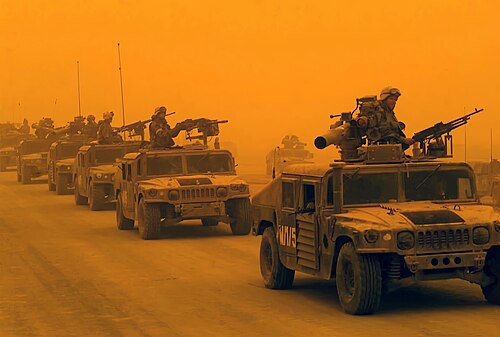
左上から時計回りに:第1海兵連隊第2大隊 のアメリカ兵がイラクの捕虜を砂漠の収容所まで護送する。砂嵐の中、イラク北部を走るハンビーのアメリカ車列。バグダッドのフィルドス広場でアメリカ兵がサダム・フセインの銅像を倒すとイラクの民間人が歓声を上げる。第325空挺歩兵連隊第2大隊のアメリカ兵がサマワでイラク準軍事組織の本部が燃えるのを見守る。 | |||||||
| |||||||
| 交戦国 | |||||||
有志連合
 クルディスタン地域 クルディスタン地域
.svg/500px-Iraqi_National_Congress_flag_(2003).svg.png) イラク国民会議 イラク国民会議
|
| ||||||
| 指揮官とリーダー | |||||||
 ジョージ・W・ブッシュ ディック・チェイニー ドナルド・ラムズフェルド コリン・パウエル トミー・フランクス ジョージ・W・ブッシュ ディック・チェイニー ドナルド・ラムズフェルド コリン・パウエル トミー・フランクス トニー・ブレア ジェフ・フーン ブライアン・バリッジ トニー・ブレア ジェフ・フーン ブライアン・バリッジ.svg/500px-Flag_of_Australia_(converted).svg.png) ジョン・ハワード・アハメド・チャラビ ジョン・ハワード・アハメド・チャラビ |
.svg/500px-Flag_of_Iraq_(1991%E2%80%932004).svg.png) サダム・フセイン クサイ・フセイン ウダイ・フセイン アビド・ハミド・マフムード アリ・ハッサン・アル・マジド バルザン・イブラヒム・アル・ティクリーティ イザット・イブラヒム・アル・ドゥーリ ラアド・アル・ハムダニ タハ・ヤシン・ラマダン タリク・アジズ サダム・フセイン クサイ・フセイン ウダイ・フセイン アビド・ハミド・マフムード アリ・ハッサン・アル・マジド バルザン・イブラヒム・アル・ティクリーティ イザット・イブラヒム・アル・ドゥーリ ラアド・アル・ハムダニ タハ・ヤシン・ラマダン タリク・アジズ | ||||||
| 強さ | |||||||
|
合計: 589,799 .svg/500px-Flag_of_the_United_States_(Pantone).svg.png) 466,985人[8] 50,000人の兵士2,000人の兵士 466,985人[8] 50,000人の兵士2,000人の兵士 194の特殊部隊[9] 70,000人の兵士[10] 620人の兵士 194の特殊部隊[9] 70,000人の兵士[10] 620人の兵士 |
合計: 1,311,000 イラク軍:現役53万8千人、予備役65万人[11] [12] 戦車4,000台[13] 装甲兵員輸送車および歩兵戦闘車3,700台 砲 2,300門 戦闘機300機[14]  12,000円 RG : 75,000 12,000円 RG : 75,000 フェダーイン・サダム:3万人 フェダーイン・サダム:3万人アラブ義勇兵:6,000人[15] | ||||||
| 死傷者と損失 | |||||||
合計: 747+
|
合計: 30,000+
| ||||||
イラク民間人の
推定死者数:
| |||||||







2003年のイラク侵攻[ b]はイラク戦争の第一段階であった。侵攻は2003年3月20日に始まり、1か月余り続いた[24]。この中には、米国主導の米国、英国、オーストラリア、ポーランドの連合軍がイラク共和国に侵攻した26日間の大規模戦闘作戦が含まれていた。侵攻初日から22日後、 6日間に及ぶバグダッドの戦いの後、4月9日に連合軍が首都バグダッドを占領した。戦争の初期段階は、5月1日にジョージ・W・ブッシュ米大統領が任務完了演説で「主要な戦闘作戦の終了」を宣言したことで正式に終了し、[25]その後、 2005年1月のイラク初の議会選挙に至るまでの一連の暫定政府の最初のものとして連合暫定当局(CPA)が設立された。米軍はその後、2011年に撤退するまでイラクに留まった。[26]
連合軍は3月19日から5月1日まで続いた最初の侵攻段階で16万人の兵士をイラクに派遣した。[27]約73%にあたる13万人の兵士はアメリカ兵で、イギリス兵約4万5千人(25%)、オーストラリア兵2千人(1%)、ポーランドのJW GROMコマンドー約200人(0.1%)であった。その余波には36カ国が関与した。侵攻に備えて、2月18日までに10万人の米軍がクウェートに集結した。[27]連合軍はイラク・クルディスタンのペシュメルガからも支援を受けた。
ジョージ・W・ブッシュ米大統領とトニー・ブレア英首相によると、連合軍は「イラクから大量破壊兵器[WMD]を廃棄し、サダム・フセインによるテロ支援を終わらせ、イラク国民を解放する」ことを目指していたが、ハンス・ブリックス率いる国連査察団は侵攻開始直前にWMDの存在を示す証拠は見つからなかったと宣言していた。[28] [29]他の人々は、 9月11日の攻撃の影響、それが米国の戦略計算を変える上で果たした役割、そして自由の課題の台頭をはるかに重視している。[30] [31]ブレアによると、きっかけは、米国と英国の当局者が世界平和に対する差し迫った容認できない脅威と呼んだ核兵器、化学兵器、生物兵器とされる兵器をイラクが廃棄する「最後の機会」を逃したことだった。[32]
2003年1月のCBSの世論調査では、アメリカ人の64%がイラクに対する軍事行動を支持していたが、63%はブッシュ大統領が戦争ではなく外交的解決を見出すことを望み、62%は戦争により米国に対するテロの脅威が高まると考えていた。[33]侵攻はフランス、ドイツ、ニュージーランド政府を含む米国の長年の同盟国から強く反対された。[34] [35] [36]これらの国の指導者は、イラクに大量破壊兵器があるという証拠はなく、UNMOVICの2003年2月12日の報告書の文脈ではイラク侵攻は正当化されないと主張した。イラク戦争中に約5,000個の化学弾頭、砲弾、航空爆弾が発見されたが、これらは1991年の湾岸戦争以前のサダム・フセイン政権時代に製造され、放棄されたものである。[37] [38] 2004年9月、当時の国連事務総長コフィー・アナン氏は、この侵攻は国際法に違反し、国連憲章に違反する行為であると述べた。[39]
2003年2月15日、イラク侵攻の1か月前には、世界中でイラク戦争に反対する抗議行動が起こり、ローマでは300万人が参加した集会が開かれ、ギネス世界記録では史上最大の反戦集会とされている。[40]フランスの学者ドミニク・レイニエによると、2003年1月3日から4月12日の間に、世界中で3600万人がイラク戦争に反対する抗議行動約3000件に参加した。[41]
侵攻に先立ち、2003年3月20日にはバグダッドの大統領官邸が空爆された。翌日、連合軍はイラク・クウェート国境に近い集結地点からバスラ県への侵攻を開始した。特殊部隊がバスラと周囲の石油田を確保するためペルシャ湾から水陸両用強襲を開始した一方、侵攻の主力軍はイラク南部に移動して同地域を占領し、 3月23日にナシリーヤの戦いに参加した。国土全域およびイラクの司令部に対する大規模な空爆により、防衛軍は混乱に陥り、効果的な抵抗を妨げられた。3月26日、第173空挺旅団が北部の都市キルクークの近くに空挺降下し、クルド人反政府勢力と合流してイラク軍とのいくつかの戦闘を行い、国の北部を確保した。
連合軍の主力はイラクの中心部への進撃を続け、ほとんど抵抗に遭わなかった。イラク軍の大半はすぐに敗れ、連合軍は4月9日にバグダッドを占領した。4月10日のキルクークの占領と占領、4月15日のティクリートへの攻撃と占領など、イラク軍の拠点に対するその他の作戦が行われた。連合軍が国の占領を完了すると、イラクのサダム・フセイン大統領と中央指導部は潜伏した。5月1日、ジョージ・W・ブッシュ大統領は主要な戦闘作戦の終了を宣言し、これにより侵攻期間が終了し、軍事占領期間が始まった。サダム・フセインは12月13日に米軍に 捕らえられた。
侵略の前兆

湾岸戦争の敵対行為は、国連連合軍とイラクの間で停戦交渉が成立し、1991年2月28日に停止された。[42]米国とその同盟国は、経済制裁に加え、 32度線(1996年に33度線に拡大)南の空域を監視および制御する任務を負った南西アジア統合任務部隊(JTF-SWA)が実施したサザン・ウォッチ作戦などの軍事行動でサダムを牽制しようとした。1980年代初め、イラクにおける生物兵器計画が、1972年の生物兵器禁止条約(BWC)に違反して、米国とヨーロッパの意図しない[43] [44]支援を受けて開始されたことが明らかになった。生物兵器計画の詳細は、化学兵器計画とともに、湾岸戦争(1990~91年)後に、サダム政権下のイラクの戦後軍縮を担っていた国連特別委員会(UNSCOM)による調査で明らかになった。調査では、この計画は戦後継続されていなかったという結論に達した。その後、米国とその同盟国はイラクに対する「封じ込め」政策を維持した。この政策には、国連安全保障理事会による数多くの経済制裁、イラク政府による空襲からイラク・クルディスタンのクルド人と南部のシーア派を守るために米国と英国が宣言したイラクの飛行禁止空域の施行、継続的な査察が含まれていた。イラク軍のヘリコプターと飛行機は定期的に飛行禁止空域を侵犯した。[45] [46]
1998年10月、イラク解放法の制定により、イラク政府の排除が米国の公式外交政策となった。前年の8月に国連の兵器査察官が追放されたことを受けて制定されたこの法律は、イラクの「民主的反対派組織」に「イラクの民主化を支援するプログラムを確立する」ために9,700万ドルを提供した。 [ 47]この法律は、武器と兵器プログラムに焦点を当て、政権交代については言及していない国連安全保障理事会決議687に定められた条件とは対照的であった。 [48]イラク解放法の成立から1か月後、米国と英国は砂漠の狐作戦と呼ばれるイラク爆撃作戦を開始した。この作戦の明確な根拠は、サダム・フセイン政権の化学兵器、生物兵器、核兵器の製造能力を妨害することであったが、米国の諜報員はそれがサダムの権力の掌握を弱めるのに役立つことも期待していた。[49]
2000年にジョージ・W・ブッシュが大統領に選出されると、米国は対イラク政策をより攻撃的にする方向に動いた。 2000年の選挙における共和党の選挙公約は、サダムを「排除」する計画の「出発点」としてイラク解放法の「完全実施」を求めた。[50]ジョージ・W・ブッシュ政権を去った後、財務長官ポール・オニールは、イラク攻撃はブッシュ政権の就任以来計画されており、最初の米国国家安全保障会議では侵攻について議論されたと述べた。オニールは後に、これらの議論はクリントン政権によって最初に導入された外交政策の継続の一部であったと述べて、発言を撤回した。[ 51]
ブッシュ政権はイラク侵攻に関心があると表明していたが、 9月11日の攻撃まで侵攻に向けた正式な動きはほとんどなかった。例えば、政権はイラク上空を飛行中に空軍パイロットが撃墜された場合に積極的に対応するため、砂漠のバジャー作戦を準備していたが、これは実現しなかった。ドナルド・ラムズフェルド国防長官は、11日正午までに入手可能だったアルカイダの責任を示唆する国家安全保障局(NSA)の傍受データを否定し、午後半ばまでに国防総省にイラク攻撃計画を準備するよう命じた。[52]その日、国立軍事司令センターに同席していた補佐官によると、ラムズフェルド長官は「最良の情報を早く。サダム・フセインを同時に攻撃するのに十分かどうか判断してほしい。オサマ・ビン・ラディンだけではなく。」と要求したという。 [53]ラムズフェルド長官が2001年11月に書いたメモはイラク戦争について検討している。[54] 9/11への対応としてイラクに侵攻した根拠は、サダム・フセインとアルカイダの間に協力関係がなかったことから、広く疑問視されてきた。[55]
2001 年 9 月 20 日、ブッシュは議会合同会議で演説し(世界同時生中継)、新たな「対テロ戦争」を発表した。この発表には、後にブッシュ ドクトリンと呼ばれることになる「先制」軍事行動の教義が伴っていた。サダム フセインとアルカイダの関係を主張したのは、一部の米国政府関係者で、彼らは 1992 年から 2003 年にかけて、イラク情報局 (IIS)が関与したとされる一連の会合を通じて、サダムとイスラム過激派武装組織アルカイダの間に極秘の関係があったと主張した。ブッシュの顧問の中には、イラクへの即時侵攻を支持する者もいれば、国際連合を結成し、国連の承認を得ることを主張する者もいた。[56]ブッシュは最終的に、国連の承認を求めることを決定したが、承認なしで侵攻する選択肢も残していた。[57]
デイヴィッド・ペトレイアス将軍は、侵攻前の経験をインタビューで振り返り、「イラク侵攻の準備を進めていたとき、バグダッドまで長く厳しい戦いになるだろう、そしてバグダッドを占領するのは本当に難しいだろうというのが一般的な見解だった。第101空挺師団にとって非常に厳しい展開への道は、市街地での軍事作戦に関するセミナーから始まった。なぜなら、それがイラク政権の打倒と大量破壊兵器の発見と破壊における決定的な出来事とみなされていたからだ」と述べた。[58]
戦争の準備
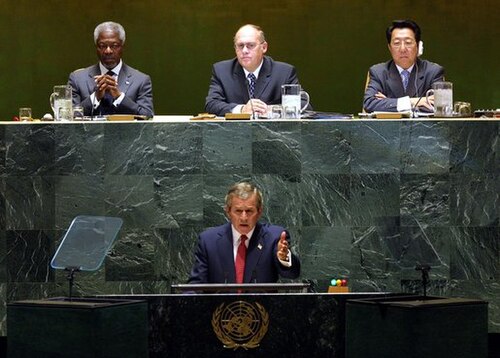

イラクに対する行動については以前から議論されていたが、ブッシュ政権は2002年9月まで行動を待った。ホワイトハウスのアンドリュー・カード首席補佐官は「マーケティングの観点から言えば、8月に新製品を発表することはない」と述べた。[59]ブッシュは2002年9月12日の国連総会での演説で、イラク侵攻の必要性を国際社会に正式に訴え始めた。[60]
英国は米国の行動に賛成したが、フランスとドイツはイラク侵攻計画に批判的で、外交と兵器査察の継続を主張した。かなりの議論の末、国連安全保障理事会は妥協案として国連安全保障理事会決議1441を採択し、兵器査察の再開を認可し、不遵守には「重大な結果」を約束した。安全保障理事会メンバーのフランスとロシアは、これらの結果にはイラク政府を転覆させるための武力の使用は含まれていないと明言した。[61]国連駐在の米国大使ジョン・ネグロポンテと英国大使ジェレミー・グリーンストックはともにこの決議の解釈を公に認め、決議1441は安全保障理事会のさらなる協議なしに侵攻するための「自動性」や「隠れた引き金」を規定していないことを保証した。[62]
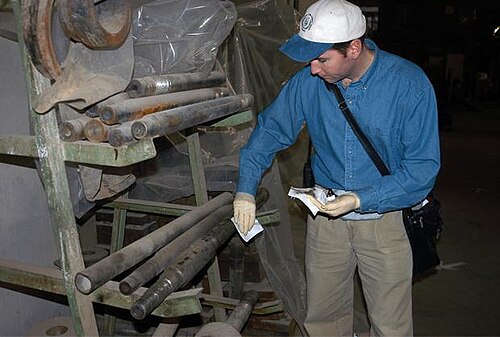
決議1441はイラクに「軍縮義務を遵守する最後の機会」を与え、国連監視検証査察委員会(UNMOVIC)と国際原子力機関(IAEA)による査察を設定した。サダムは11月13日に決議を受諾し、査察官はUNMOVIC議長ハンス・ブリックスとIAEA事務局長モハメド・エルバラダイの指示の下、イラクに戻った。2003年2月時点で、IAEAは「イラクで核兵器計画が復活したという証拠やもっともらしい兆候は見つからなかった」。IAEAは、アルミニウム管など核濃縮遠心分離機に使用されていた可能性のある特定の品目は、実際には他の用途に意図されていたと結論付けた。[63] UNMOVICは「大量破壊兵器計画の継続または再開の証拠」や大量の禁止品目を発見しなかった。 UNMOVICは、少数の空の化学ロケット弾頭、イラクが申告し1998年にUNSCOMが封印したマスタードガス50リットル、マスタードガスの前駆物質の実験室量、およびイラクが許容される150kmの射程距離を超えないと述べたが、テストでは183kmまで飛んだとされる設計のアル・サムードミサイル約50発の破壊を監督した。侵攻の直前、UNMOVICは、イラクが決議1441を順守しているかどうかを確認するには「数か月」かかると述べた。[64] [65] [66]
2002年10月、米国議会はイラク決議を可決し、大統領はイラクに対して「必要なあらゆる手段」を講じることができるようになった。2003年1月に行われた世論調査では、米国民は侵攻よりも外交的対応を広く支持した。しかし、その年の後半には、米国民はブッシュの計画に賛同し始めた。米国政府は、国民に戦争を売り込むために、手の込んだ国内広報キャンペーンを展開した。米国民の圧倒的多数は、サダムが大量破壊兵器を保有していると信じていた。査察官がそれらの兵器を発見していないにもかかわらず、85%がそう答えた。イラクがどこかに兵器を隠していると考えている人のうち、約半数が、それらの兵器は戦闘では発見されないと回答した。2003年2月までに、米国民の64%がサダムを権力から排除するために軍事行動を取ることを支持した。[33]

中央情報局の特別活動部(SAD)チームは、準軍事組織の作戦責任者と第10特殊部隊グループの兵士で構成され、2002年7月、主な侵攻前にイラクに入った最初の米軍であった。地上に到着すると、彼らはクルド人ペシュメルガを組織するためにその後到着する米軍特殊部隊に備えた。この合同チーム(北イラク連絡部隊(NILE)と呼ばれる)[67]は、イラク・クルディスタンでアルカイダとつながりのあるグループ、アンサル・アル・イスラムを打倒するために協力した。この戦いは、アンサル・アル・イスラムが占領していた地域の制御をめぐる戦いであった。これは、SADと陸軍第10特殊部隊グループの準軍事組織の作戦責任者によって遂行された。この戦いでアンサルは打倒され、サルガトの化学兵器施設は制圧された。[67]サルガトはイラク戦争で発見された唯一の施設であった。[68] [69]
SADチームはまた、敵陣の背後で指揮官の標的を特定する任務を遂行した。これらの任務は、サダムとその将軍たちに対する最初の空爆につながった。サダムに対する攻撃は彼を殺害することには失敗したが、彼の部隊の指揮統制能力を事実上終わらせた。イラクの将軍たちに対する攻撃はより成功し、米国主導の侵攻軍に対するイラク軍の対応能力と機動能力を著しく低下させた。[67] [70] SADの作戦将校たちは、戦闘が始まるとすぐにイラク軍の主要将校たちに部隊を降伏させることに成功した。[68]
NATO加盟国トルコは、自国領土を越えてイラク北部に米軍が侵入するのを拒否した。そのため、SADと陸軍特殊部隊の合同チームとペシュメルガがイラク軍に対抗する北部軍全体を構成した。彼らは、南部から迫りくる米軍主導の連合軍に対抗する同僚たちを北部の師団が支援するのを許さず、北部の師団をその場に留めておくことに成功した。 [71]これらのCIA職員のうち4人は、その行動によりインテリジェンス・スターを授与された。 [68] [69]

2003年の一般教書演説で、ブッシュ大統領は「1990年代後半のイラクには移動式生物兵器研究所がいくつかあったことを我々は知っている」と述べた。[72] 2003年2月5日、コリン・パウエル米国務長官は国連総会で演説し、国連の侵攻承認を得るための米国の努力を継続した。国連安全保障理事会へのプレゼンテーションには、コンピュータで生成された「移動式生物兵器研究所」の画像が含まれていた。しかし、この情報は、ドイツに住むイラク人移民でコードネーム「カーブボール」のラフィド・アハメド・アルワン・アル・ジャナビの主張に基づいていたが、後に彼は自分の主張が虚偽であったことを認めた。
パウエルはまた、イラクがアルカイダと関係があるという虚偽の主張も行った。パウエルの発表を受けて、米国、英国、ポーランド、イタリア、オーストラリア、デンマーク、日本、スペインはイラクでの武力行使を承認する決議案を提案したが、カナダ、フランス、ドイツはロシアとともに外交継続を強く求めた。フランスとロシアの拒否権発動の可能性と敗北の恐れに直面し、米国、英国、ポーランド、スペイン、デンマーク、イタリア、日本、オーストラリアは最終的に決議案を撤回した。[73] [74]
侵攻に対する反対は、2003年2月15日に世界中で反戦デモとして結集し、800以上の都市で600万から1000万人が参加した。ギネスブックによれば、これは人類史上最大のデモであった。[要出典] [40]

2003年3月16日、スペインのホセ・マリア・アスナール首相、イギリスのトニー・ブレア首相、アメリカのジョージ・W・ブッシュ大統領、そしてホスト役のポルトガルのジョゼ・マヌエル・ドゥラン・バローゾ首相がアゾレス諸島で会談し、イラク侵攻とスペインの潜在的戦争関与、そして侵攻開始について話し合った。この会談はスペインで非常に物議を醸し、今でもアスナール政権にとって非常に敏感な問題となっている。[75]それからほぼ1年後、マドリードはロッカービー爆弾テロ以来ヨーロッパで最悪のテロ攻撃に見舞われた。これはスペインのイラク戦争参加決定がきっかけで、スペイン人の一部は首相の責任を非難した。[76]

2003年3月、アメリカ、イギリス、ポーランド、オーストラリア、スペイン、デンマーク、イタリアは、さまざまな広報活動と軍事行動を駆使してイラク侵攻の準備を始めた。2003年3月17日の国民向け演説で、ブッシュ大統領はサダムとその二人の息子、ウダイとクサイに48時間以内に降伏してイラクから撤退するよう要求した。[77]
英国下院は2003年3月18日に開戦に関する討論を行い、政府の動議は賛成412票、反対149票で可決された。[78]この投票はブレア政権史上重要な瞬間であった。なぜなら、投票に反対した政府議員の数は、 1846年の穀物法の廃止以来最大であったからである。ジョン・デナム、キングス・ヒースのハント卿、そして当時の下院議長ロビン・クックの3人の政府大臣が戦争に抗議して辞任した。辞任後の下院での熱のこもった演説で、クックは「私を悩ませているのは、もしフロリダの『ハング・チャド』が逆の方向に進んでいてアル・ゴアが選出されていたら、我々は今頃イギリス軍をイラクでの行動に投入しようとはしていなかったのではないかという疑念だ」と述べた。討論中、司法長官は以前の国連決議の下では戦争は合法であると助言していたと述べられた。
戦争回避の試み
2002年12月、イラク情報局長官のタヒル・ジャリル・ハブシュ・アル・ティクリーティー将軍の代表が、元中央情報局対テロ部門長ヴィンセント・カニストラロに連絡を取り、サダムは「9月11日に自分を結びつけ、大量破壊兵器(WMD)を保有していることを証明しようとするキャンペーンがあることを知っていた」と述べた。カニストラロはさらに、「イラク人はこれらの懸念を解消する準備ができていた。私は国務省の上級レベルに会話を報告したが、私は傍観し、彼らがそれを処理すると言われた」と付け加えた。カニストラロは、提案はすべてジョージ・W・ブッシュ政権によって「却下」されたと述べた。なぜなら、提案はサダムの権力の維持を許すものであり、それは受け入れられない結果と見なされたからである。サダム・フセインは10億ドルを保持することを許されるなら亡命する用意があったと示唆されている。[79]
エジプトのホスニ・ムバラク大統領の国家安全保障顧問オサマ・エルバズ氏は、イラクが大量破壊兵器を保有し、アルカイダと関係があるという非難について協議したいと米国務省にメッセージを送った。イラクはまた、シリア、フランス、ドイツ、ロシアの諜報機関を通じて米国との接触を試みた。
2003年1月、レバノン系アメリカ人のイマド・ハーゲは米国防総省特別計画局のマイケル・マルーフと会談した。ベイルート在住のハーゲは、テロとの戦いを支援するために同省に採用されていた。彼は、シリアのアサド大統領の側近であるモハメド・ナシフが、シリアが米国と接触することの難しさについて不満を表明し、彼を仲介者として利用しようとしたと報告した。マルーフは、ハーゲが当時国防政策委員会の委員長だった民間人のリチャード・パールと会談できるよう手配した。[80] [81]
2003年1月、ヘイジはイラク情報部の対外活動部長ハッサン・アル・オベイディと会談した。オベイディはヘイジに対し、バグダッドは自分たちがなぜ標的にされたのか理解しておらず、大量破壊兵器も持っていないと語った。その後、オベイディはワシントンに2000人のFBI捜査官を派遣して確認するよう提案した。さらに石油の譲歩も提案したが、サダムに権力を放棄させるまでには至らず、代わりに2年後に選挙を行えると示唆した。その後、オベイディはヘイジにバグダッドへ行って会談するよう提案し、ヘイジはそれを受け入れた。[80]
その月の後半、ヘイジはハブッシュ将軍とイラクのタリク・アジズ副首相と会談した。ヘイジは、石油と鉱業権益における米国企業への最優先権、国連監視下の選挙、米国の査察(査察官最大5,000人)、誠意の証としてアルカイダ工作員アブドゥル・ラーマン・ヤシン(1994年以来イラクで拘束中)の引き渡し、イスラエル・パレスチナ和平プロセスにおける「米国のあらゆる計画を全面的に支持する」ことを提案された。また、米国高官との面会も希望していた。2月19日、ヘイジはマルーフにこの旅行の報告をファックスした。マルーフはジェイミー・デュランに提案を伝えたと報告している。国防総省は、デュランの上司であるウォルフォウィッツとラムズフェルドのどちらもこの計画を知っていたことを否定している。[80]
2月21日、マルーフは電子メールで、リチャード・パールがペンタゴンの許可があればヘイジとイラク人と会いたがっているとデュランに伝えた。デュランは「マイク、作業中だ。厳重に管理しておいてくれ」と返答した。3月7日、パールはナイツブリッジでヘイジと会い、ワシントンの人々とこの件についてさらに追求したいと述べた(両者とも会ったことを認めている)。数日後、パールはワシントンが提案について話し合うためにハブッシュと会うことを拒否したとヘイジに伝えた(ヘイジによると、パールの返答は「ワシントンの総意はそれはだめだということ」だった)。パールはタイムズ紙に「メッセージは『バグダッドで会うと伝えてくれ』だった」と語った。[82]
開戦理由と根拠
トミー・フランクス将軍によると、侵攻の目的は「第一に、サダム・フセイン政権を終わらせること。第二に、イラクの大量破壊兵器を特定、隔離、除去すること。第三に、その国からテロリストを捜索、捕らえ、追放すること。第四に、テロリストのネットワークに関連する情報を可能な限り収集すること。第五に、違法な大量破壊兵器の世界的ネットワークに関連する情報を可能な限り収集すること。第六に、制裁を終了し、避難民や多くの困窮するイラク国民に人道支援を直ちに届けること。第七に、イラク国民のものであるイラクの油田と資源を確保すること。そして最後に、イラク国民が代表制自治政府への移行のための条件を整えるのを支援すること」であった。[83]
2002 年を通じて、ブッシュ政権は、国際平和と安全を回復するためにサダムを権力から排除することが主要な目標であると主張した。この「政権交代」政策の主な正当化理由は、イラクが大量破壊兵器を継続的に生産していること、テロ組織とのつながりが知られていること、そしてイラクが国連安全保障理事会の決議に継続的に違反していることが、米国と国際社会に対する脅威となっていることであった。
ジョージ・W・ブッシュは2002年10月の演説で「米国の公言した政策は政権交代である。しかし、サダムが国連の条件、私が誰もが理解できる言葉で非常に明確に説明した条件をすべて満たすならば、それ自体が政権交代の合図となるだろう」と述べた。[84]ブッシュは2003年3月6日、特定の情報筋からの報告を引用し、サダムが国連決議1441に従っていないと考えていると述べた。[85]
大量破壊兵器
主な容疑は、サダムが大量破壊兵器を保有していたか、あるいは製造しようとしていたこと、サダム・フセインがハラブジャなどの場所で使用していたこと、[86] [87]、特にイランとイスラエルの両国によるバグダッドの核兵器製造施設への2度の攻撃が兵器開発の進展を遅らせたとされていることを考慮すると、保有し、入手しようと努力していたこと、さらに、サダムがテロリスト、特にアルカイダとつながりを持っていたことであった。


Wikisource にはこの記事に関連する原文があります:
コリン・パウエルの2003年2月5日の国連安全保障理事会での演説
ブッシュ政権のイラク侵攻の全体的な根拠は、2003年2月5日に米国国務長官コリン・パウエルによって国連安全保障理事会に詳細に提示された。要約すると、彼は次のように述べた。
サダム・フセインが大量破壊兵器を保持する決意を固めていること、さらに大量破壊兵器を製造する決意を固めていることは周知の事実である。サダム・フセインの侵略の歴史、彼のテロリストとのつながり、そして彼に反対する者への復讐を決意していることを考えると、世界が対応できる立場にないときに、彼がいつの日か、自分の選んだ時と場所と方法でこれらの兵器を使用しないというリスクを負うべきだろうか。米国は米国民にそのようなリスクを負わせるつもりはなく、負わせることもできない。サダム・フセインにさらに数ヶ月、あるいは数年大量破壊兵器を保有させるという選択肢はない。9月11日以降の世界では、それはあり得ない。[88]
2002年9月、トニー・ブレアは議会の質問に答えて、「イラクの政権交代は素晴らしいことだ。しかし、それは我々の行動の目的ではない。我々の目的はイラクの大量破壊兵器の武装解除である」と述べた。 [89]同年11月、ブレアはさらに「我々の目的である限り、それは軍縮であり、政権交代ではない。それが我々の目的だ。私はサダム政権が非常に残忍で抑圧的な政権であり、イラク国民に多大な損害を与えていると思う。だからサダムがイラクにとって非常に悪い存在であることに疑いはないが、一方で、国連による我々の挑戦の目的は大量破壊兵器の武装解除であり、政権交代ではないことにも疑いはない」と述べた。[90]
2003年1月31日の記者会見で、ブッシュは再び侵攻の唯一のきっかけはイラクの武装解除の失敗であると繰り返した。「サダム・フセインは、もし彼が武装解除しなければ、平和のために我々は他の国々と共にサダム・フセインの武装解除に踏み切ることを理解しなければならない。」[91] 2003年2月25日になっても、侵攻の唯一の理由は武装解除の失敗であるとの公式見解は変わっていなかった。ブレアは下院での声明で「私は彼の政権を嫌悪している。しかし、今でも彼は国連の要求に従うことで政権を救うことができる。今でさえ、我々は平和的に軍縮を達成するためにさらなる一歩を踏み出す用意がある。」と明言した。[92]
2002年9月、ブッシュ政権は、イラクが数千本の高強度アルミ管を入手しようとしたことは、核爆弾用の濃縮ウランを製造する秘密計画を示唆していると述べた。パウエルは戦争直前の国連安全保障理事会での演説で、アルミ管について言及した。しかし、2002年に科学国際安全保障研究所が発表した報告書では、アルミ管がウラン濃縮に使われる可能性は極めて低いと報告されている。パウエルは後に、イラクの兵器に関して国連に不正確な主張をしていたことを認めた。その根拠は、間違った情報源に基づいており、場合によっては「故意に誤解を招く」ものだった。[93] [94] [95]
ブッシュ政権は、サダム政権がニジェールからイエローケーキウランを購入しようとしていたと主張した。[96] 2003年3月7日、米国は諜報文書を証拠として国際原子力機関に提出した。これらの文書はIAEAによって偽造として却下され、外部の専門家もその判断に同意した。当時、米国当局者は、証拠は出所を知らずにIAEAに提出されたと述べ、間違いがあったとしても「悪意ではなく無能による可能性が高い」と述べた。
侵攻以来、イラクの兵器計画とアルカイダとのつながりに関する米国政府の声明は信用を失ったが[97] 、占領期間中にイラクで化学兵器が発見された。[98]イラクが将来化学兵器、生物兵器、核兵器を開発する意図があったかどうかの議論は未解決のままであるが、18か月以上続いた包括的な査察にもかかわらず、侵攻以来イラクで大量破壊兵器は発見されていない。[99] 2001年2月24日、カイロでコリン・パウエルは「[サダムは]大量破壊兵器に関していかなる重要な能力も開発していない。彼は近隣諸国に対して通常兵器を投射することができない」と述べ、そのことを予測していた。[100]
テロリストとのつながり
もう一つの正当化理由としては、サダム・フセイン政権と、 2001年9月11日のテロ攻撃の際に米国を攻撃したアルカイダなどのテロ組織とのつながりが疑われていたことが挙げられる。
ジョージ・W・ブッシュ政権はイラクと9月11日の攻撃との明確な関連性を一度も示さなかったが、その関連性を繰り返しほのめかし、米国民に誤った印象を与えた。1993年の世界貿易センター爆破事件裁判の大陪審証言では、砂漠の嵐作戦におけるイラク軍の降伏の2周年を記念した最初の攻撃において、爆撃犯とバグダッド、イラク情報局第13部との直接的なつながりが数多く挙げられた。例えば、ワシントン・ポスト紙は次のように指摘している。
2001年9月11日のテロ攻撃についてイラクの責任を明確には述べなかったが、政権当局者はさまざまな場面でその関連性をほのめかした。2001年後半、チェイニーは、攻撃の首謀者であるモハメド・アタがイラクの上級情報当局者と会ったことは「かなり確証されている」と述べた。後にチェイニーは、イラクを「長年にわたり、特に9月11日に我々を攻撃してきたテロリストの地理的拠点」と呼んだ。[101]
メリーランド大学国際政策態度プログラム(PIPA)のディレクター、スティーブン・カルは、2003 年 3 月に「政権は、9 月 11 日とサダム・フセインの間に何らかのつながりがあるという印象を作り出すことに成功した」と述べている。これは、ニューヨーク・タイムズ紙とCBS 紙の世論調査で、アメリカ人の 45% が、9 月 11 日の残虐行為にサダム・フセインが「個人的に関与」していたと信じていることが示された後のことである。クリスチャン・サイエンス・モニター紙が当時指摘したように、「米国の諜報機関に詳しい情報筋によると、サダムが 9 月 11 日の攻撃に関与したという証拠はなく、またサダムがアルカイダを支援していた、または現在支援しているという証拠もない。…ホワイトハウスは、イラクに対する戦争の可能性に対する米国の支持を維持し、サダム政権に目的の真剣さを示すために、この誤った印象を助長しているようだ」。 CSMはさらに、「2001年9月11日直後」に収集された世論調査データではイラクやサダム・フセインに言及したのはわずか3%だったが、2003年1月までに態度は「変化」し、ナイト・リッダーの世論調査では、アメリカ人の44%が9月11日のハイジャック犯の「ほとんど」または「一部」はイラク国民だったと信じていることが示されたと報告した。[102]
BBCはまた、ブッシュ大統領が「元イラク指導者がニューヨークとワシントンへの攻撃に関与したと直接非難したことは一度もない」が、「9 月 11 日以来の基調演説で、この 2 つを繰り返し関連付けた」と指摘し、「政権の幹部も同様にこの 2 つを混同している」と付け加えた。たとえば、BBC の報道では、2003 年 2 月のコリン・パウエルの発言を引用し、「イラクがアルカイダのメンバーに爆弾や毒物、致死性ガスの製造を訓練したことが判明した。また、9 月 11 日以降、サダム・フセイン政権がアメリカへのテロ攻撃を大喜びで祝ったこともわかっている」と述べている。同じ BBC の報道では、最近の世論調査の結果も取り上げており、「アメリカ人の 70% が、イラク指導者が攻撃に個人的に関与したと考えている」と示唆している。[103]
また、2003年9月、ボストン・グローブ紙は「イラクで暴力が続く中、ホワイトハウスの外交政策を擁護しようと躍起になっているディック・チェイニー副大統領は、9月11日の攻撃にサダム・フセインが関与していた可能性があるという、広く信用されていない主張を否定しなかったことで、今週、情報分析官や政権メンバーさえも驚かせた」と報じた。[104] 1年後、大統領候補のジョン・ケリーは、チェイニーが「イラク侵攻を世界的な対テロ戦争の一部にしようと、サダム・フセインと9/11を結び付けて、アメリカ国民を故意に誤解させ続けている」と非難した。[105]
侵攻以来、イラク政権とアルカイダの作戦上のつながりに関する主張は諜報機関によってほとんど信用されておらず、パウエル国防長官自身も後に証拠がないことを認めた。[97]
イラクのドローン
2002年10月、イラクに対する軍事力行使の承認決議に対する米国上院の採決の数日前、約75人の上院議員は非公開会議で、イラク政府が米国の大西洋岸沖の船舶から発射して米国東海岸の都市を攻撃できる無人航空機(UAV)ドローンで生物・化学大量破壊兵器を運搬する手段を持っていると告げられた。コリン・パウエルは国連でのプレゼンテーションで、UAVはイラクから輸送され、米国に対して発射される可能性があると示唆した。
実際、イラクには攻撃用の無人機艦隊はなく、船舶に無人機を搭載する能力もなかった。[106]イラクの無人機艦隊は、旧式のチェコ製の訓練用ドローン数機で構成されていた。[107]当時、CIAのイラクの無人機艦隊に関する結論が正確であるかどうかについて、諜報機関内で激しい論争があった。米空軍は、イラクが攻撃用の無人機能力を持っていることを完全に否定した。[108]
人権
さまざまな時期に使用された追加の正当化理由には、イラクによる国連決議違反、イラク政府による国民の弾圧、および1991年の停戦違反などが含まれていました。[28]
イラクの大量破壊兵器とテロとのつながりに関する米国と英国の告発を裏付ける証拠が弱まるにつれ、侵攻を支持する人々の中には、サダム政権による人権侵害を正当化の根拠とする者が増えてきた。[109]しかし、ヒューマン・ライツ・ウォッチなどの主要な人権団体は、人権問題が侵攻の中心的な正当化理由になったことは一度もないと主張し、また、軍事介入が人道的見地から正当化できるとも考えていない。最も重要な理由は、「当時のイラクでの殺害は、そのような介入を正当化するような例外的な性質のものではなかった」ためである。[110]
侵略の合法性
米国国内法
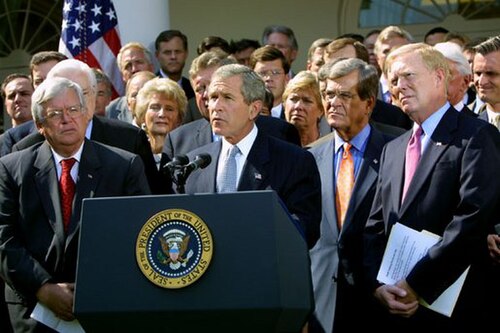
2002年のイラクに対する軍事力行使の承認決議は、共和党の上院での賛成98%、下院での賛成97%で議会を通過した。民主党は、上院と下院でそれぞれ58%と39%の賛成を得て、この共同決議を支持した。 [111] [112]この決議は、米国憲法と議会によって大統領が反米国テロと戦う権限が与えられていると主張している。 1998年のイラク解放法を引用し、この決議はサダム・フセイン政権を排除し、民主的な政権の樹立を推進することが米国の政策であるべきであると改めて強調した。
この決議は、ジョージ・W・ブッシュ大統領による「国連安全保障理事会を通じてイラクに関するすべての関連安保理決議を厳格に履行する」外交努力と、「イラクが遅延、回避、不遵守の戦略を放棄し、イラクに関するすべての関連安保理決議を迅速かつ厳格に遵守することを確実にするために、安保理による迅速かつ断固たる行動を確保する」外交努力を「支持」し、「奨励」した。この決議は、ブッシュ大統領が「必要かつ適切と判断する限り」米国軍を「イラクによる継続的な脅威から米国の国家安全保障を守り、イラクに関する すべての関連安保理決議を履行する」権限を与えた。
国際法
イラク侵攻の国際法上の合法性は、その開始以来、さまざまな方面で異議を唱えられており、侵攻国すべての著名な侵攻支持者らは、公的にも私的にもその合法性に疑問を投げかけてきた。米国および英国政府は、国連安全保障理事会の承認があったため、侵攻は完全に合法であると主張してきた。[113]国際法学者委員会、31人のカナダの著名な法学教授のグループ、米国を拠点とする核政策に関する法律家委員会などの国際法の専門家は、この論理を非難している。[114] [115] [116]
2003年11月20日木曜日、ガーディアン紙に掲載された記事は、政権の防衛政策委員会諮問委員会の上級委員であるリチャード・パール氏が、侵攻は違法ではあるものの正当化されることを認めたと主張した。[117] [118]
国連安全保障理事会は、1990 年のイラクによるクウェート侵攻以来、イラクとクウェートに関する決議を 60 件近く採択している。この問題に最も関連しているのは、1990 年 11 月 29 日に採択された決議678である。この決議は、「クウェート政府と協力する加盟国が、(1) イラクによるクウェート占領の終了とクウェート領土からのイラク軍の撤退を求める安全保障理事会決議660およびその他の決議を実施し、(2) 「その地域における国際平和と安全を回復する」ために、あらゆる必要な手段を使用することを認めている。決議678は、その後の決議によって撤回または無効化されておらず、1991 年以降、イラクがクウェートに侵攻した、または侵攻すると脅迫したとの申し立てはなされていない。
決議1441は戦争の直前に最も注目を集め、侵攻の1か月前にコリン・パウエル国務長官が安全保障理事会で行った演説の主な背景となった。 [119]オランダ政府が設置した独立調査委員会によると、国連決議1441は「(オランダ政府が行ったように)個々の加盟国が軍事力を使ってイラクに安全保障理事会の決議を遵守させる権限を与えると合理的に解釈することはできない」とのこと。したがって、オランダ委員会は2003年の侵攻は国際法に違反していると結論付けた。[120]

同時に、ブッシュ政権当局者は、1990年のイラクのクウェート侵攻への対応として武力行使を承認した以前の決議を用いて、同様の法的議論を展開した。この論理によれば、イラクは武装解除と武器査察に応じなかったことで国連安全保障理事会決議660号と678号に違反しており、米国は軍事手段を通じてイラクに法的遵守を強制できる。
国連決議に基づく法的根拠の批判者と支持者は、決議をどのように執行するかを決定する法的権利は個々の国家ではなく安全保障理事会のみにあるため、イラク侵攻は国際法上合法ではなく、国連憲章第2条(4)に直接違反していると主張している。
2006年2月、国際刑事裁判所の主任検察官ルイス・モレノ・オカンポは、戦争の合法性に関する個別の通信を240件受け取ったと報告した。その多くは、イギリスの侵略への参加に関するものだった。[121]原告に宛てた手紙の中で、モレノ・オカンポ氏は、戦争中の行動に関する問題しか検討できず、侵略犯罪の根底にある合法性については、「犯罪を定義し、裁判所が管轄権を行使できる条件を規定する」条項がまだ採択されていないため検討できないと説明した。2007年3月のサンデー・テレグラフ紙のインタビューで、モレノ・オカンポは、イラクに対し、同裁判所が戦争犯罪容疑に関する訴訟を起こせるよう登録するよう奨励した。[122]
米国オハイオ州選出の下院議員デニス・クシニッチは2007年4月24日夜に記者会見を開き、下院決議333号およびディック・チェイニー副大統領に対する3つの弾劾条項を明らかにした。クシニッチはチェイニー副大統領がイラクの兵器計画の証拠を操作し、イラクとアルカイダのつながりについて国民を欺き、国連憲章に違反してイランへの侵略を脅かしていると非難した。
軍事的側面
多国間支援

2002年11月、NATO首脳会議のため欧州を訪問していたジョージ・W・ブッシュ大統領は、「イラクのサダム・フセイン大統領が武装解除を選択しない場合、米国は有志連合を率いて武装解除を行う」と宣言した。[123]その後、ブッシュ政権は、 2003年以来のイラクでの軍事行動とその後のイラク侵攻後の駐留を軍事的または口頭で支持した国々を指すために、有志連合という用語を短期間使用した。2003年3月に作成された最初のリストには、49か国が含まれていた。[124]この49か国のうち、米国以外に侵攻軍に兵力を派遣したのは6か国のみ(英国、オーストラリア、ポーランド、スペイン、ポルトガル、デンマーク)で、33か国は侵攻完了後の占領を支援するために一定の兵力を派遣した。6か国は軍隊を持たず、つまり完全に兵力を差し控えた。
侵攻軍
米中央軍、連合軍航空部隊司令官の報告によると、2003年4月30日現在、イラク侵攻のために466,985人の米軍要員が派遣されていた。これには以下が含まれる。[8]
地上部隊: 336,797人
- アメリカ陸軍、233,342
- アメリカ陸軍予備役、10,683
- 陸軍州兵、8,866
- アメリカ海兵隊、74,405
- アメリカ海兵隊予備役、9,501
空軍部隊: 64,246人
海軍部隊: 63,352人
- アメリカ海軍、61,296人(沿岸警備隊681人を含む)
- アメリカ海軍予備役、2,056
侵攻には、アメリカ軍約14万8千人、イギリス軍5万人、オーストラリア軍2千人、ポーランド軍特殊部隊GROM所属の兵士194人がクウェートに派遣された。[9]侵攻軍は、推定7万人を超えるイラクのクルド人 ペシュメルガ戦闘員の支援も受けた。 [10]侵攻後期には、イラク国民会議派の反体制派620人がイラク南部に展開した。[2]
カナダは、この作戦にひそかに軍事資源を提供した。例えば、イラクでの作戦でアメリカの飛行機に搭乗してプラットフォームの訓練を行ったカナダ空軍の人員や、 AWACS機に搭乗したカナダ人乗務員11名などである。[125] [126]カナダ軍は、不朽の自由作戦の支援のためペルシャ湾の河口に艦船、航空機、カナダ海軍の人員1,200名を派遣した。また、米国の極秘ブリーフィング電報には、カナダ当局はこれらの資産をイラク戦争の支援には使用しないと公約していたが、「海峡での護衛サービスにも利用可能であり、その他の点でもひそかに軍事活動に役立つだろう」と記されていた。[127]しかし、国防省は海軍司令官に対し、アメリカ主導の作戦を支援するいかなる行為も行わないよう命令を出しており、この命令が破られたかどうかは不明である。[127]当時のジョン・マッカラム国防大臣の首席参謀だったユージン・ラングは、カナダ軍が間接的にアメリカの作戦を支援した可能性は「かなりある」と述べた。[127]ラングによると、カナダ軍はアフガニスタン戦争ではなくイラク戦争に参加することを強く主張し、カナダは主にアメリカとの良好な関係を維持するために湾岸地域に資産を保持することを決定した。[127]侵攻後、カナダ陸軍のウォルター・ナティンチク准将が、イラク全土に展開する10個旅団に所属する35,000人のアメリカ兵からなる多国籍軍団イラク副司令官を務めた。 [128]
北部で第二戦線を開く計画は、トルコがそのような目的での領土の使用を拒否したため、大きく妨げられた。[129]トルコの決定に応じて、米国は第173空挺旅団から数千人の空挺部隊をイラク北部に降下させたが、これは米国が当初北部戦線に配備する予定だった1万5000人の第4歩兵師団より大幅に少ない数であった。 [130]
準備
.jpg/500px-Kurdish-inhabited_area_by_CIA_(1992).jpg)

CIA特殊活動部(SAD)とMI6(E中隊)の準軍事組織は、2003年の侵攻前の2002年7月にイラクに入った。地上に到着すると、彼らはその後の米英軍の到着に備えた。その後、SADチームは米軍特殊部隊と合流し、クルド人 ペシュメルガを組織した。この合同チームは、イラク北東部の戦闘でアルカイダの同盟国であるアンサル・アル・イスラムを破った。米国側の作戦は、SADと陸軍第10特殊部隊グループの準軍事組織将校によって遂行された。[67] [68] [69]
SADチームはまた、イラクの戦線の背後で高リスクの特別偵察任務を遂行し、上級指導部の標的を特定した。これらの任務は、サダム・フセインとその主要な将軍に対する最初の攻撃につながった。サダムに対する最初の攻撃は独裁者や将軍の殺害には失敗したが、イラク軍の指揮統制能力を事実上終わらせることには成功した。主要な将軍に対する他の攻撃は成功し、南からやってくる米国主導の侵攻軍に対する司令部の対応能力と機動能力を大幅に低下させた。[67] [69]
MI6は、イラクの大量破壊兵器に関する話をメディアに流し、侵攻への支持を高めるための作戦「マス・アピール作戦」を遂行した。MI6はまた、サダムの最も近い同盟国の多くに賄賂を贈り、情報や諜報を引き渡させた。
SAD作戦将校らはまた、戦闘が始まれば部隊を降伏させ、侵攻軍に抵抗しないようイラク軍の主要将校らを説得することに成功した。[68] NATO加盟国のトルコは、自国の領土を侵攻に利用することを拒否した。その結果、侵攻中、SAD/SOGと米軍特殊部隊の合同チーム、およびクルド人ペシュメルガが政府軍に対抗する北部軍全体を構成した。彼らの努力により、イラク軍第5軍団は連合軍に対抗するために移動するのではなく、クルド人に対する防衛に留まることができた。
トミー・フランクス将軍によると、外交官として潜入捜査していたアメリカ人将校エイプリル・フールにイラク諜報員が近づき、フランクス将軍のチームが提供したイラクの偽の「極秘」侵攻計画を売りつけた。この欺瞞により、イラク軍はトルコやヨルダン経由の攻撃を予想してイラク北部と西部に大部隊を配備することになったが、結局攻撃は行われなかった。これによりイラクの残りの地域の防衛能力は大幅に低下し、南東部 のクウェートとペルシャ湾経由の実際の攻撃が容易になった。
防衛軍
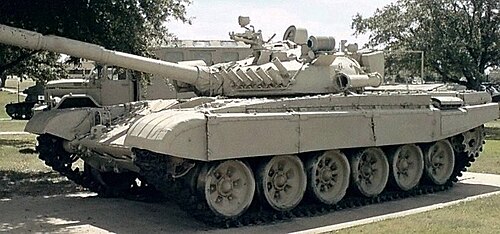
戦争前のイラク軍の人員数は不明だが、装備は貧弱だったと考えられている。 [131] [132]国際戦略研究所は、イラク軍の兵力は389,000人(イラク陸軍350,000人、イラク海軍2,000人、イラク空軍20,000人、防空軍17,000人)、準軍事組織のフェダーイン・サダム44,000人、共和国防衛隊80,000人、予備役650,000人と推定している。[133]
別の推定では、陸軍と共和国防衛隊はそれぞれ 280,000 ~ 350,000 人と 50,000 ~ 80,000 人[要出典]、準軍事組織は 20,000 ~ 40,000 人[要出典]とされている。推定では歩兵師団は13 個、機械化および装甲師団は 10 個、さらに特殊部隊もいくつかあった。イラク空軍と海軍は、この紛争でほとんど役割を果たさなかった。
侵攻中、外国人志願兵がシリアからイラクに渡り、通常はフェダイン・サダムの指揮下で戦闘に参加した。2003年にイラクで何人の外国人戦闘員が戦ったかは正確には分からないが、米国第1海兵隊の情報将校は、イラク中部のイラク人戦闘員の50%が外国人であると推定した。[134] [135]
さらに、クルド人イスラム過激派グループ、アンサル・アル・イスラムは、サダム・フセインの支配下ではないイラク北部の小さな地域を支配していた。アンサル・アル・イスラムは2001年以来、世俗的なクルド人勢力と戦ってきた。侵攻当時、彼らは約600人から800人の戦闘員を擁していた。[136]アンサル・アル・イスラムは、後にイラク反乱軍の重要な指導者となるヨルダン生まれの過激派アブ・ムサブ・アル・ザルカウィによって率いられていた。アンサル・アル・イスラムは、3月下旬にバイキング・ハンマー作戦中にアメリカとクルド人の合同部隊によってイラクから追い出された。
軍事装備
劣化ウラン
アメリカ軍からオランダ国防省に提供された情報によると、侵攻中に30万発以上の劣化ウラン弾が発射されたと推定されており、その多くはサマワ、ナシリーヤ、バスラを含むイラクの人口密集地域内またはその近くで、その大部分はアメリカ軍によって発射された。情報の中で、アメリカ軍はオランダ国防省に劣化ウラン弾のGPS座標、標的と発射数のリストを提供した。その後、オランダ国防省は情報公開法に基づいてオランダの平和団体パックスにデータを公開した。[137] [138]
焼夷兵器
米軍は2004年のモスルの戦いと第二次ファルージャの戦いで白リン弾とナパーム弾を焼夷兵器として使用した。2005年3月、米軍が発行する雑誌「野戦砲兵」は、ファルージャの戦いで白リン弾が使用されたという報告を掲載した。英国国防省は、戦争中に米軍がマーク77爆弾を使用したことを確認した。 [139]
クラスター爆弾
米軍主導の連合軍は、1991年の湾岸戦争中に2000万個の子弾を含むクラスター弾61,000個を使用し、2003年の侵攻とその後の反乱では200万個の子弾を含むクラスター弾13,000個を使用した。 [140] [141]侵攻と過去の戦争で使用されたクラスター弾、地雷、その他の不発弾を含む数千個の不発弾は、2022年現在も民間人に脅威を与え続けている。[142]
侵入
_listen_to_a_pre-flight_brief_in_one_of_the_squadron_ready_rooms_aboard_USS_Constellation_(CV_64).jpg/500px-thumbnail.jpg)
1991年の湾岸戦争以来、米国と英国はイラクの飛行禁止空域を執行中にイラクの防空軍の攻撃を受けていた。[45] [46]これらの空域とそれを執行するための攻撃は、元国連事務総長のブトロス・ブトロス=ガリとフランスの外相ユベール・ヴェドリーヌによって違法とされた。他の国々、特にロシアと中国もまた、これらの空域はイラクの主権を侵害するものだと非難した。[143] [144] [145] 2002年半ば、米国はイラクの軍の指揮系統を混乱させるため、イラク南部の標的をより慎重に選び始めた。執行戦術の変更は当時認識されていたが、これがサザンフォーカス作戦と呼ばれる計画の一部であることは公表されなかった。
2001年と2002年に連合軍の航空機によってイラクの陣地に投下された爆弾の量は、クリントン政権時代の1999年と2000年よりも少なかった。 [146]しかし、英国自由民主党が入手した情報によると、英国が2002年後半にイラクに投下した爆弾の数は、2001年全体の2倍であった。英国の投下爆弾のトン数は、2002年3月の0トン、2002年4月の0.3トンから、5月から8月には毎月7トンから14トンに増加し、9月には戦前最高の54.6トンに達した。これは、米国議会が10月11日に侵攻を承認する前のことである。
9月5日の攻撃には、イラク西部の主要な防空基地に対する100機以上の航空機による攻撃が含まれていた。ニュー・ステイツマン紙の論説によると、この基地は「シーア派への攻撃を防ぐために巡回する必要のある地域から遠く離れた、南部の飛行禁止区域の最端に位置していたが、巡回部隊にとって脅威だったからではなく、ヨルダンから作戦中の同盟軍特殊部隊が気付かれずにイラクに入ることを可能にするために破壊された」とのことである。[147]
イラク侵攻を指揮したトミー・フランクスは、その後、この爆撃は1991年の湾岸戦争の始まりとなった空襲と同様に、イラクの防空軍を「弱体化」させる目的で計画されたと認めている。当時の英国国防長官ジェフ・フーンの言葉を借りれば、これらの「活動の急増」は「イラク政権に圧力をかける」ため、あるいはタイムズ紙が報じたように「サダム・フセインを挑発して同盟国に戦争の口実を与える」ためだった。この点で、英国外務省のリークされた法的助言は、戦争を始めるために計画された挑発行為として、このような攻撃は国際法上違法であると結論付けた。[148] [149]
戦争を誘発するもう一つの試みは、2003年1月31日のジョージ・W・ブッシュとトニー・ブレアの会談のメモが漏洩したことで言及されている。この会談でブッシュはブレアに対し、「米国は国連色に塗装されたU2偵察機を戦闘機で援護し、イラク上空を飛行させることを考えている。サダムが攻撃すれば、違反行為となるだろう」と語ったとされている。 [150] 2003年3月17日、ジョージ・W・ブッシュ米大統領はサダム・フセインに対し、息子のウダイとクサイとともに48時間以内に国を離れるよう命じ、さもなければ戦争に直面するとした。[151]
アルカイムでの特殊部隊の先行任務
2003年3月17日の夜、タスクフォース14に指定されているイギリス第22SAS連隊のB中隊とD中隊の大半は、アルカイム市の水処理施設の化学兵器の疑いのある場所への地上攻撃を行うため、ヨルダンから国境を越えた。その場所はスカッドミサイルの発射場か貯蔵所だった可能性があると報告されており、作家のマーク・ニコルはSAS将校の言葉を引用して「そこは過去にイスラエルにミサイルが発射された場所であり、大量破壊兵器の物資にとって戦略的に重要な場所だった」と伝えている。D中隊の60名のメンバーは、彼らの「ピンキー」砂漠哨戒車両(退役前に最後に使用された車両)とともに、6機のMH-47Dに3波に分けて120km(75マイル)イラクへ飛行した。突入後、D中隊はアルカイム郊外の遠隔地に哨戒基地を設置し、ヨルダンから陸路でやって来たB中隊の到着を待った。工場への接近は危険にさらされ、銃撃戦が起こり、1機の小指が放棄され破壊された。工場への攻撃の試みは何度も中止され、SASは空爆を要請して敵を沈黙させた。[152]
先制攻撃:ドラファームのストライキ
2003年3月19日の早朝、サダム・フセインがバグダッド郊外のアル・ドラ農業共同体内のドラ農場で息子のウダイとクサイを訪問しているという報告を受けて、米軍はイラク高官55名に対する最初の非核攻撃計画を断念した。[153]バグダッド時間午前4時42分頃、[154]第8遠征戦闘飛行隊[155]のF-117ナイトホークステルス戦闘機2機が、強化された衛星誘導式の2,000ポンドGBU-27「バンカーバスター」4機を農場に投下した。空爆を補完したのは、最初の攻撃を行ったとされるタイコンデロガ級巡洋艦USS カウペンス[156]、アーレイ・バーク級駆逐艦USS ドナルド・クックとUSS ポーター、そして紅海とペルシャ湾の潜水艦2隻を含む複数の艦艇から発射された約40発のトマホーク巡航ミサイルであった[157]。
1発の爆弾は完全に敷地を外れ、他の3発は目標を外して宮殿敷地の壁の反対側に着弾した。[158]サダム・フセインもイラク指導部も現場にはいなかった。[153] [159]この攻撃で民間人1人が死亡、男性4人、女性9人、子供1人の計14人が負傷した。[160]その後の情報筋によると、サダム・フセインはこの農場を1995年以来訪れていなかったという。[157]一方、他の情報筋によると、サダムはその日の朝敷地にいたものの、攻撃前に立ち去ったという。攻撃はブッシュ大統領が48時間の期限が切れるまで延期するよう命じていた。[154]
オープニングアタック
2003年3月19日21:00、作戦の最初の攻撃が第160特殊作戦群のメンバーによって実行された。1編のMH-60L DAP(直接攻撃侵攻機)と4編の「ブラック スウォーム」編隊(それぞれ2機のAH-6Mリトルバーズと、AH-6の標的を識別するFLIR装備のMH-6Mで構成され、各ブラック スウォーム編隊には2機のA-10Aが割り当てられていた)が、イラクの南部および西部国境沿いのイラク視覚監視所を攻撃した。7時間以内に70以上の施設が破壊され、イラク軍は侵攻の早期警告を事実上奪われた。施設が排除されると、ヨルダンのH-5空軍基地から最初のヘリボーン特殊部隊チームが発進した。これには第160特殊作戦群のMH-47Dで輸送されたイギリスとオーストラリアの車両搭載パトロール隊も含まれていた。タスクフォース・ダガー、タスクフォース20、タスクフォース14、タスクフォース64の地上部隊は早朝、イラクとヨルダン、サウジアラビア、クウェートの国境沿いの砂の堤防を突破し、イラクに進攻した。非公式には、イギリス、オーストラリア、タスクフォース20は数週間前にイラクにいた。[161] [162]
2003年3月20日、協定世界時で午前2時30分頃、現地時間午前5時34分に、バグダッドで爆発音が聞こえた。CIAの北イラク連絡部隊の特殊活動部門の特殊作戦部隊がイラク全土に潜入し、早期の空爆を要請した。[67]協定世界時午前3時16分、東部標準時午後10時16分に、ジョージ・W・ブッシュはイラクの「軍事的に重要な特定の標的」に対する攻撃を命じたと発表した。[163] [164]この命令が出ると、待機していた部隊は国境を越えてイラクに入った。

侵攻前、多くの観測者は、1991年の湾岸戦争や2001年のアフガニスタン侵攻を例に挙げ、地上作戦の前にはより長期にわたる空爆作戦が行われると予想していた。実際には、米国の計画では、イラク軍を速やかに無力化するために空中と地上の同時攻撃を想定しており、その結果、ショックと畏怖の軍事作戦はほとんどの場合、イラク軍の部隊と都市を迂回しようとした。連合軍の優れた機動性と連携により、イラクの指揮系統の中核を攻撃して短期間で破壊することができ、これにより民間人の死者とインフラへの損害を最小限に抑えることができると想定されていた。指導部の排除はイラク軍と政府の崩壊につながり、政府が弱体化すれば国民の多くが侵略者を支持すると予想された。都市の占領と周辺の軍事部隊への攻撃は、望ましくない陽動と見なされていた。
トルコが自国領土のいかなる公式使用も否定する決定を下したため、連合軍は南北からの同時攻撃の計画を変更せざるを得なくなった。[165] CIAと米軍の特殊作戦部隊はクルド人ペシュメルガを組織し、北部への効果的な攻撃部隊に育て上げた。侵攻の主要基地はクウェートと他のペルシア湾岸諸国にあった。その結果、侵攻予定の師団の1つが移転を余儀なくされ、戦争がかなり進むまで侵攻に参加できなかった。連合軍は侵攻に十分な数の兵士を投入したが、侵攻終了後に撤退した兵士が多すぎたため、都市を占領できなかったことで地元の支援が期待に応えられず、国全体の安全と秩序の確保に大きな不利を被ったと多くの観測者が感じていた。
米国は、湾岸戦争の実質的な作戦継続としてイラク侵攻を開始した。その主な目的は、イラク軍を壊滅させ、その戦闘能力を麻痺させ、イラク政府を解体することだった。[166]しかし、イラク軍はすぐに適応し、非伝統的な戦術を使い始めた。開戦からわずか2日後の3月22日には、米国人は後に戦争を特徴づける反乱戦術を初めて体験した。第3歩兵師団騎兵部隊のクレイジーホース小隊の小隊長、アンソニー・ブロードヘッド一等軍曹は、侵攻ルート上にあるサマーワの橋に向かう戦車に乗っていた。彼はイラク人の集団に手を振ったが、彼らは手を振り返す代わりに、AK-47ライフル、ロケット推進擲弾、迫撃砲で米国戦車を攻撃し始めた。こうした準軍事組織は武装がしっかりしていたものの、民間人と区別がつかなかったため、イラク戦争を通じて米軍にとって大きな脅威となった。[167]

侵攻そのものは迅速で、約3週間でイラク政府とイラク軍は崩壊した。イラクの石油インフラは、その間に最小限の被害で速やかに占拠・確保された。石油インフラの確保は非常に重要と考えられていた。第一次湾岸戦争では、イラク軍はクウェートから撤退する際に、多くの油井に火を放ち、湾岸海域に石油を投棄した。これは、部隊の動きを偽装し、連合軍の注意をそらすためだった。2003年の侵攻の前に、イラク軍はバスラとアルファウ半島周辺の約400の油井に爆薬を仕掛けていた。[168] [169] [170]連合軍は、3月19日の終盤にアルファウ半島への 航空および水陸両用攻撃を開始し、同地の油田を確保した。水陸両用攻撃は、イギリス海軍、ポーランド海軍、オーストラリア海軍の軍艦の支援を受けた。
その間に、イギリス空軍の第9飛行隊と第617飛行隊のトーネード機がバグダッドを守るレーダー防衛システムを攻撃したが、3月22日にクウェートの空軍基地に戻る途中、アメリカのパトリオットミサイルによって撃墜され、トーネード機とパイロットおよび航法士(ケビン・メイン中尉とデイブ・ウィリアムズ中尉)を失った。[171] 4月1日には、USSキティホークのF-14がエンジン故障によりイラク南部で墜落し、[172] S-3Bバイキングが故障によりUSSコンステレーションの甲板から墜落し、AV-8BハリアージャンプジェットがUSSナッソーに着陸しようとしてメキシコ湾に墜落した。[173]
イギリス軍第3コマンド旅団は、アメリカ海軍の特殊舟艇チーム22、タスクユニット2 [174] 、アメリカ海兵隊第15海兵遠征部隊、ポーランド特殊部隊GROMとともにウンム・カスル港を攻撃した。そこでイラク軍の激しい抵抗に遭い、連合軍兵士14名とイラク軍兵士30~40名が死亡し、イラク人450名が捕虜となった。イギリス陸軍第16空挺旅団はイギリス空軍連隊の一部と共にルマイラなどのイラク南部の油田を確保し、一方ポーランドのコマンド部隊は港近くの沖合石油プラットフォームを占拠して破壊を防いだ。侵攻軍の急速な前進にもかかわらず、イラク軍の爆発物や偶発的な発砲により約44の油井が破壊され炎上した。しかし、油井はすぐに封印され、火は消し止められたため、湾岸戦争の終結時に生じた生態系への被害と石油生産能力の喪失は防がれた。
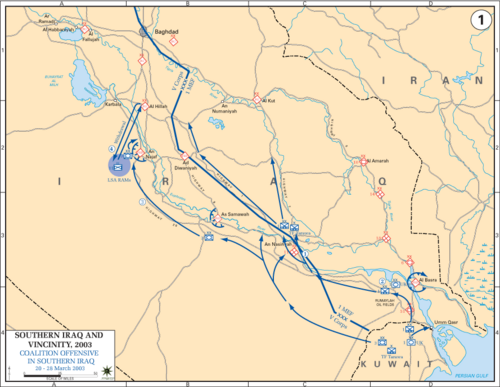
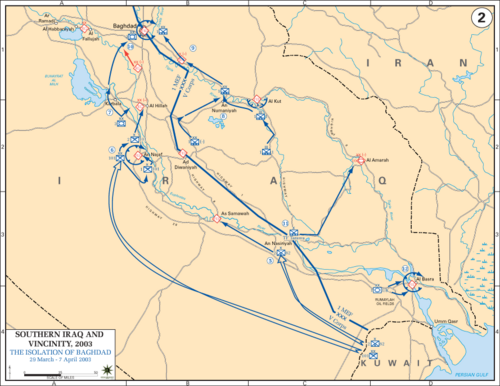
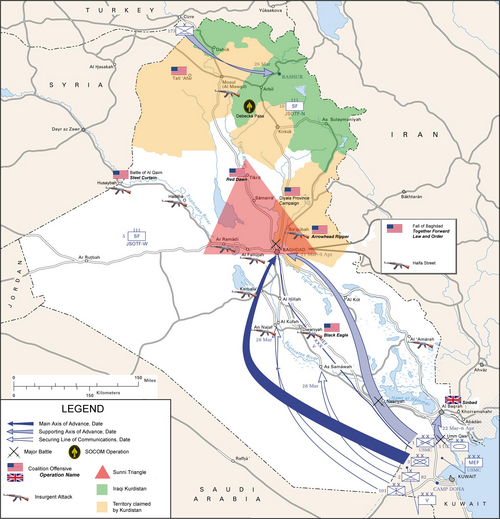
急速な前進計画に従い、アメリカ第3歩兵師団は西へ進み、その後西部砂漠を通ってバグダッドに向けて北進し、一方第1海兵遠征軍は国道1号線に沿って国土の中央部を進み、第1(イギリス)機甲師団は東部の湿地帯を通って北進した。
戦争の最初の週に、イラク軍はクウェートのドーハ基地にあるアメリカの戦場最新評価センターにスカッドミサイルを発射した。ミサイルは施設に着弾する数秒前にパトリオットミサイルによって迎撃され撃墜された。その後、2機のA-10ウォートホグがミサイル発射装置を攻撃した。
ナシリヤの戦い
当初、第1海兵師団(アメリカ)はルマイラ油田を突破し、北のナシリーヤへ移動した。ナシリーヤは中規模でシーア派が多数を占める都市であり、主要道路の交差点として戦略的に重要な位置にあり、近くのタリル飛行場にも近い。また、ユーフラテス川にかかる戦略的に重要な橋の近くに位置していた。この都市は、イラク正規軍、バース党支持者、イラク国内外のフェダーインの混成部隊によって防衛されていた。アメリカ陸軍第3歩兵師団は、飛行場周辺に陣取っていたイラク軍を破り、都市を西へ迂回した。
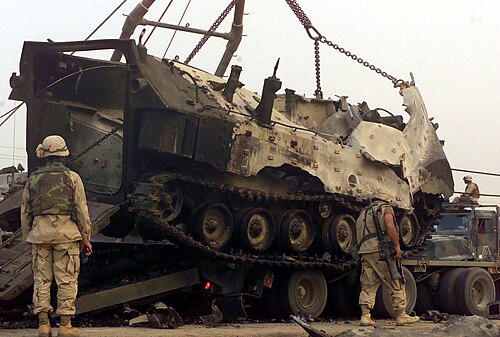
3月23日、女性アメリカ人兵士のジェシカ・リンチ、ショシャナ・ジョンソン、ロリ・ピエステワを含む第3歩兵師団の車列が、市内に間違って入った後、待ち伏せ攻撃を受けた。11人の米兵が死亡し、リンチとジョンソンを含む7人が捕虜になった。[175]ピエステワは捕虜になった直後に負傷により死亡し、残りの5人の捕虜は後に救出された。アリゾナ州ツバシティ出身でホピ族に登録されていたピエステワは、外国の戦争で戦闘中に死亡した最初のネイティブアメリカン女性と考えられている。 [176]同日、第2海兵師団の米海兵隊がナシリヤに大挙して入隊し、市内の2つの主要な橋を確保しようと移動中に激しい抵抗に直面した。市街戦でのフェダインとの銃撃戦で数人の海兵隊員が死亡した。サダム運河では、イラク軍との激しい戦闘でさらに18人の海兵隊員が死亡した。空軍のA-10が誤って米軍の水陸両用車両を攻撃し、6人の海兵隊員が死亡する友軍誤射事件に巻き込まれた。RPGと小火器の集中砲火で車内の海兵隊員のほとんどが死亡し、他の2台の車両が破壊された。[177]海兵航空管制グループ28の海兵隊員1人が敵の銃撃で死亡し、海兵隊の工兵2人がサダム運河で溺死した。橋は確保され、第2海兵師団が都市の周囲に境界線を設定した。

3月24日の夕方、第1連隊戦闘チーム(RCT-1)に所属する第2軽装甲偵察大隊がナシリーヤを突破し、市の北15kmに境界線を張った。クートからのイラク増援部隊は数回の反撃を開始した。海兵隊は間接射撃と近接航空支援を使用してこれを撃退した。最後のイラクの攻撃は夜明けに撃退された。大隊は200〜300人のイラク兵が死亡したが、米軍の死傷者は一人もいなかったと推定した。ナシリーヤは安全が宣言されたが、イラクのフェダーインによる攻撃は続いた。これらの攻撃は協調性がなく、銃撃戦となり多くのフェダーインが死亡した。ナシリーヤは道路の交差点という戦略的な位置にあったため、北進する米軍が市の周囲の高速道路に集中したため、大きな交通渋滞が発生した。
ナシリヤとタリルの飛行場を確保した連合軍は、イラク南部に重要な兵站拠点を確保し、ナシリヤから約 10 マイル (16 km) 離れた場所に FOB/EAF ジャリバを設置しました。この前進基地を通じて、すぐに追加の部隊と物資が運び込まれました。第101 空挺師団は、第 3 歩兵師団の支援を受けて北方への攻撃を続けました。
3月28日までに激しい砂嵐が連合軍の進撃を遅らせ、第3歩兵師団はナジャフとカルバラの中間地点で北進を中止した。第101空挺師団からの援軍を運ぶ予定だったヘリコプターによる航空作戦は3日間阻止された。特にクーフルの町の近くの橋の周辺では激しい戦闘があった。
ナジャフの戦い

もう一つの激戦はナジャフで、イギリスの航空支援を受けた米軍の空挺部隊と機甲部隊がイラク正規軍、共和国防衛隊、準軍事組織と激しい戦闘を繰り広げた。米軍のAH-64アパッチガンシップヘリコプターが共和国防衛隊の機甲部隊攻撃任務に出発したことから始まった。低空飛行中、アパッチは激しい対空砲火、小火器、RPGの砲火にさらされ、多くのヘリコプターが大きな損害を受け、1機が撃墜され、攻撃は失敗に終わった。[178]彼らは3月26日に再び攻撃に成功したが、今回は任務前の集中砲火の後、F/A-18ホーネットジェットの支援を受け、ガンシップの損失はなかった。[179]
03年3月24日遅く、第1旅団戦闘団の防空砲台はCOLT(戦闘観測レーザー照射チーム)と旅団偵察隊の支援を受け、アル・キフルの橋を確保するために移動した。ADA中隊が橋の西岸を確保できなかったため、指揮官は増援を要請した。グリムズリー大佐は、マルコーネ中佐第3-69機甲部隊にADA中隊を支援するため即応部隊を派遣するよう命じた。マルコーネ中佐はB第3-7歩兵隊を派遣して橋の掃討と確保を依頼した。ブラボー中隊は、M2A2ブラッドレー戦闘車両を装備した2個歩兵小隊と、M1A2エイブラムス戦車1個小隊で構成されていた。ブラボー第3-7歩兵隊は橋を確保し、砂嵐の中36時間戦った。その間、兵士たちはイラク軍とフェダイン軍と戦った。36時間後、B中隊第3-7歩兵隊は3月26日に交代した。 [要出典]
第101空挺師団は3月29日、第1機甲師団の1個大隊の支援を受け、イマーム・アリ・モスク付近の市南部でイラク軍を攻撃し、ナジャフの飛行場を占領した。[180]自爆テロによりアメリカ人4名が死亡した。3月31日、第101空挺師団はナジャフへの偵察を行った。4月1日、第70機甲連隊の一部が「サンダーラン」と呼ばれるナジャフ市中心部への装甲突撃を開始し、航空支援を受けて数日間の激しい戦闘の末、イラク軍を破った。4月4日までに市は確保された。[要出典]
バスラの戦い

イラクの港湾都市ウンム・カスルがイギリス軍にとって最初の障害となった。ポーランド、イギリス、アメリカの合同部隊は予想外に激しい抵抗に遭遇し、イラク軍を追い出すのに数日を要した。さらに北では、イギリスの第7機甲旅団(「砂漠のネズミ」)が4月6日にイラク第2の都市バスラに進入したが、正規軍とフェダインによる絶え間ない攻撃を受け、一方第3空挺連隊大隊は車両が進入できない市内の「旧市街」を掃討した。バスラへの進入は、3月27日にロイヤル・スコッツ・ドラグーン・ガーズがイラク軍の戦車14両を破壊した戦車戦を含む2週間の激しい戦闘の末に達成された。イギリス特殊部隊D中隊の数名がイラク南部に派遣され、バスラへの連合軍の進撃を支援した。チームは前進ルートの偵察を行い、市内に潜入し、バアス党支持派の指導部を攻撃した。[181] [182]
4月9日、第1(英国)機甲師団の一部がアル・アマラ周辺の米軍陣地に向けて北進を開始した。紛争中は以前からあった電力と水の不足が続き、イラク軍が崩壊するにつれて略奪が始まった。連合軍が秩序維持のために地元のイラク警察と協力し始める一方で、英国陸軍の王立工兵隊と王立兵站部隊で構成された合同チームは、港湾都市ウンム・カスルに到着した船舶から人道支援物資が届き始めるよう、造船所の設備を迅速に設置・修復した。
急速な前進の後、最初の大きな停滞はカルバラー近郊で発生した。そこで米軍部隊は、ユーフラテス川沿いの都市や重要な橋を守るイラク軍の抵抗に遭遇した。これらの部隊は、米軍が北進するにつれ補給路を遮断すると脅した。最終的に、米軍第101空挺師団の部隊がナジャフとカルバラーの都市を確保し、第3歩兵師団がバグダッドに向けて前進する中、同師団の通信線に対するイラク軍の反撃を阻止した。
イギリス兵11人が死亡し、イラク兵、非正規兵、フェダイン395~515人が死亡した。
イギリス軍の努力により、港からバグダッドまでの鉄道線路の再建が容易になった。
カルバラーの戦い
カルバラー峡谷は、東にユーフラテス川、西にラザザ湖がある幅20~25マイルの細長い土地である。この細長い土地は、イラク軍司令官によってバグダッドへの重要なアプローチとして認識されており、イラク共和国防衛隊の最も優秀な部隊によって守られていた。イラク軍最高司令部は当初、カルバラー峡谷を封鎖するために共和国防衛隊の2個師団を配置していた。 [183] ここでこれらの部隊は連合軍の激しい空襲に見舞われた。しかし、連合軍は3月初旬から、米第4歩兵師団がトルコからイラク北部に大規模な攻撃を仕掛けるとイラク人に信じ込ませる戦略的欺瞞作戦を行っていた。 [184]
特殊作戦

初期侵入
デルタフォースのB中隊(通称「ウルヴァリンズ」)は、いくつかの空軍特殊戦術チーム、デルタ諜報・目標捕捉チーム[説明が必要]、いくつかの軍用犬チーム、および2人のイラク系アメリカ人通訳を伴い、カスタマイズされたピンツガウアー6x6特殊作戦車両15台と武装したトヨタハイラックスピックアップトラック数台でサウジアラビアのアラルから国境を越え、イラク西部に入った最初の米国特殊部隊であった。タスクフォース20の一部として、彼らの正式な役割は、ハディーサダム複合施設に向かう前に、疑わしい化学兵器施設で選択された高優先度の現場調査を行うことだった。その途中で、デルタはH-3空軍基地の占拠を支援し、また、イラク人を西部の連合軍の配置について混乱させる多数の欺瞞作戦を実行した。侵攻開始の1週間前、南部からは、特殊ボートチーム22のデルタ分遣隊の2名と、第539突撃飛行隊イギリス海兵隊コマンドスの指揮官が、ウムカスル港への今後の攻撃のための重要な情報を収集するために、クウェートの諜報員によってイラク南部に潜入した。[185] [186]
オペレーション・ロウとファルコナー
2003年3月18日、イギリス第22SAS連隊のB中隊とD中隊は、オーストラリアSASR第1中隊と共にイラクに完全侵攻し(D中隊は空から、B中隊は陸から)、 H-2およびH-3空軍基地に向かった。彼らは監視所を設置し、空爆を要請してイラクの防衛軍を打ち破った。イギリスとオーストラリアの合同中隊は、事実上抵抗を受けることなくH-2を占領した。H-3は、デルタフォースのメンバーと第5特殊部隊群第1大隊ブラボー中隊のグリーンベレーODAの支援により3月25日に確保された。第45コマンドーのレンジャーと海兵隊の中隊がヨルダンから基地に飛行機で向かい、基地は彼らに引き渡された。 SASチームは次の目標であるバグダッドとシリア、ヨルダンを結ぶ2つの主要高速道路の交差点に移動した。[187] [188]そこで両飛行隊は、シリアへ向かうイラク指導者の逃亡阻止活動に従事した。[182]
以前、D中隊の第16(航空)部隊がシリア国境付近のイラク軍施設の騎馬偵察を実施し、続いてその施設に嫌がらせ攻撃を行ったが、他の2つの部隊は、その地域のイラク部隊に対して機動待ち伏せ攻撃を行ったが、彼ら自身も、技術装備のフェダイン・サダムの大規模な部隊に追われていた。[182]
3月上旬、イラク北部で、イギリス特殊舟艇部隊M中隊の小さな偵察チームがホンダのATVに乗り、ヨルダンからイラクに侵入した。最初の任務は、イラク空軍基地アル・サハラの偵察だった。このチームは、対特殊部隊フェダーイン部隊に侵入されたが、上空から援護した米軍F-15Eとフェダーインの「鼻先」からチームを救出した英空軍チヌークのおかげで、かろうじて逃れた。2回目のより大規模なSBS作戦は、M中隊が全力でランドローバーとATVを駆使してH-2空軍基地からイラク北部に展開し、その目的は、ティクリートを過ぎたどこかでイラク第5軍団の位置を特定し、接触して降伏させ、後続部隊の一時的な着陸に適した地域を調査してマークすることだった。しかし、この中隊はヤギ飼いに侵入されてしまった。 SBSは数日間移動したが、彼らは知らなかったが、対特殊部隊のフェダーイン部隊が彼らを追跡した。モスル近郊の夜間の陣地で、フェダーインはDShK重機関銃とRPGで中隊を待ち伏せし、SBSは反撃し、T-72からの射撃を受け始めた。中隊は散り散りになり、巧妙に構築された罠から脱出した。近くのワジで数台のランドローバーが動けなくなったため、彼らは車両に地雷を仕掛けて放棄したが、数台は不発に終わり、捕獲されてイラクのテレビで放映された。SBSは今や3つのはっきりとしたグループに分かれていた。1つは数台の稼働可能なランドローバーを擁し、イラクのハンター部隊に追跡されていた。2つめは主にATVを装備し、身を潜めて脱出の手配をしようとしていた。3つめはATVに乗ったわずか2人のオペレーターを乗せ、シリア国境に向けて疾走した。最初のグループは連合軍の攻撃機を要請しようとしたが、SBSには赤外線ストロボが装備されていなかったため、航空機は友軍を識別できなかった。彼らの車両にはブルーフォーストラッカーユニットが装備されていたが、彼らは最終的に緊急ランデブーポイントにたどり着き、イギリス空軍のチヌークによって救出された。2番目のグループもイギリス空軍のチヌークによって救出され、3番目のグループはシリアにたどり着き、解放交渉が行われるまでそこに留まったが、SBSの死傷者はいなかった。[189]
バイキングハンマー作戦

2003年3月21日未明、ヴァイキング・ハンマー作戦の一環として、トマホーク巡航ミサイル64発がアンサル・アル・イスラムのキャンプと周辺地域を襲った。約700人のテロリスト集団は、小さなクルド人分派とともにイラク・クルディスタンのハラブジャ近くの谷に居住していた。彼らは対空機関銃を含む多くの防御陣地を準備し、将来のテロ攻撃のために化学兵器や生物兵器が開発され保管されている可能性があると米情報部は疑っていた施設を維持していた。ヴァイキング・ハンマー作戦は3月21日に開始される予定だったが、第10特殊部隊グループ第3大隊の大半をイラクに潜入させる問題で、地上作戦は数日遅れた。[190]クルディスタン・イスラム集団は、3月21日の攻撃で100人の死者を出し、降伏した。[191]
2003年3月28日、ヴァイキングハンマー作戦の地上部隊がついに6方向からの前進で開始され、各方向は第3大隊、第10特殊部隊群からの複数のODAと1,000人以上のクルド人ペシュメルガ戦闘員で構成されていた。主力前進はサルガト(化学兵器と生物兵器の設置が疑われる場所)に向けて出発したが、部隊はすぐに周囲の丘からのDShK重機関銃の射撃によって釘付けになった。部隊からの緊急CAS要請に応えて、米海軍の F/A-18戦闘機2機がアンサル・アル・イスラムの機関銃陣地に500ポンドのJDAM2発を投下し、燃料不足のため撤退する前に20mm機関砲で陣地を機銃掃射した。前進は再開されたが、準備されていたDShKとPKMの機関銃陣地からの射撃によって再び阻止された。ODA 081のグリーンベレーはトヨタ・タコマの後部からMk 19グレネードランチャーを展開し、銃座を制圧したため、ペシュメルガはテロリストを襲撃し殲滅することができた。部隊はガルプの町を占領した後、サルガト村へと進撃を続けた。この村は、DShKと迫撃砲、さらに数丁のBM-21グラッドを備えた要塞化された戦闘陣地で厳重に守られていた。ペシュメルガが近かったため空爆を要請することができなかったグリーンベレーの軍曹は、下車したM2 HMGを使用して塹壕に潜むテロリストを制圧した。彼の行動により、ペシュメルガは独自の82mm迫撃砲とグラッドを前進させることができ、アンサル・アル・イスラムの戦闘員は撤退を余儀なくされた。タスクフォース・バイキングは、岩壁の洞窟に囲まれたダラマール渓谷を確保するために前進した。ペシュメルガは再び小火器とRPGで攻撃され、ペシュメルガとODAは重火器で反撃したが、航空支援なしではこれ以上前進できないことが明らかになった。テロリストを追い出すために、 ODAに所属する戦闘管制官は米海軍のF/A-18で誘導し、500ポンドのJDAMを6発投下してそれ以上の抵抗を封じた。夜間には、4機のAC-130ガンシップが、イラン国境に向かって撤退するアンサル・アル・イスラムのテロリストに圧力をかけ続けた。翌日、タスクフォース・バイキングは高地を占領し、谷を通って進軍し、アンサル・アル・イスラムの残党の小さな集団を包囲して殺害した。目的を達成した第3大隊とペシュメルガは、キルクークとモスルへの攻撃を支援するためにグリーンラインに戻った。サルガトでの発見を記録するために専門のSSEチームが派遣され、チームはリシンを含むいくつかの化学物質の痕跡、 NBC防護服、アトロピン注射器、化学兵器とIEDに関するアラビア語のマニュアルの在庫を発見した。建設中。アンサル・アル・イスラムの死者は300人以上と推定され、その多くは外国人戦闘員である一方、ペシュメルガの戦闘員はわずか22人しか殺されなかった。[192]
イラク北部での特殊作戦

また北部では、第10特殊部隊グループ(10th SFG)と同グループの特殊活動部門のCIA準軍事組織将校が、1991年以来イラク・クルディスタンの事実上の支配者であるクルド人政党、クルディスタン愛国同盟とクルディスタン民主党を支援し、キルクークとモスル付近に位置する13のイラク師団に対抗するという任務を負っていた。[193] [194]トルコは公式に連合軍による自国の基地や空域の使用を禁止していたため、第10 SFGの先導部隊は迂回して侵入しなければならなかった。飛行時間は4時間のはずが、実際には10時間を要した。[194] 2003年3月22日、ヴァイキング任務部隊の第10特殊部隊群第2、第3大隊の大半が、ルーマニアのコンスタンツァの前線基地から6機のMC-130Hコンバットタロンに搭乗してアルビル近郊に飛んだ。イラク北部への飛翔中に数機がイラクの防空軍と交戦した(1機は大きな損傷を受けたため、インジルリク空軍基地に緊急着陸を余儀なくされた)。最初の輸送では、グリーンベレーのODA19機とODB4機がイラク北部に展開した。[195]最初の飛翔から数時間後、トルコは空域の使用を許可し、第10特殊部隊群の残りが侵入した。予備任務は、アルカイダとつながりがあると考えられているクルド人テロリスト集団アンサル・アル・イスラムの基地を破壊することだった。同時進行の任務とその後続の任務には、北部のイラク軍を攻撃して足止めし、南部戦線へのイラク軍の展開と侵攻の主力を阻止することが含まれていた。[194]最終的に、タスクフォース・バイキングは、クルド愛国同盟(PUK)の約6万人のクルド人ペシュメルガ民兵とともに、51のODAとODBを擁することになった。[196]
2003年3月26日、第173空挺旅団は、当時第10特殊部隊とクルド人ペシュメルガの部隊が支配していたイラク北部のバシュール飛行場にパラシュート降下し、侵攻の北部戦線を強化した。2003年4月10日、第10特殊部隊、CIA準軍事部隊、クルド人ペシュメルガによってキルクークが陥落したことで、第173空挺旅団の計画していた攻撃が早まり、侵攻中に部隊がイラク軍との戦闘に参加することはなくなった。[197]
ハディーサダムの戦いの後、デルタフォースはダムをレンジャー部隊に引き渡し、北に向かい、ティクリートの上の高速道路に沿って待ち伏せ攻撃を行い、その地域のイラク軍を足止めし、シリアへの逃亡を試みる重要目標を捕らえようとした。[198]
4月2日、デルタは、以前SBSと戦った同じ対特殊部隊フェダイーンの武装技術者6名と交戦した。デルタのオペレーター2名が負傷し(1名が重傷)、トラックで運ばれたイラクの増援部隊が到着したため、飛行隊は緊急の航空医療避難と即時の近接航空支援を要請した。パラジャンパー医療チームを乗せた2機のMH-60Kブラックホークと、第160特殊作戦群の2機のMH-60L DAPが応戦してイラク軍と交戦し、デルタのオペレーターは負傷者を緊急HLZに移動させることができ、2機のA-10Aに護衛されてH-1に救急搬送されたが、マスター・サージェントのジョージ・フェルナンデスが死亡した。 DAPは配置に留まり、イラク軍との交戦を続け、迫撃砲を積んだトラックと数個歩兵小隊を破壊した。一方、デルタの狙撃兵はDAPに発砲するイラク歩兵を殺害し、別の2機のA-10Aが到着し、デルタの陣地から20メートル以内に500ポンドの空中炸裂爆弾を投下し、ワジに集まっていた多数のイラク歩兵を殺害した。DAPはイラク軍部隊数機を発見し、燃料が危険なほど少なくなるまで交戦した。[199]
ヴァイキング任務部隊はアインシフニの町を占領する作戦を開始した。この町はモスルに通じる幹線道路にまたがっているため戦略的に重要であった。この町が陥落すれば、連合軍がモスルに進軍するのは明らかであった。第3および第10特殊部隊グループのODAは町内および周辺のイラク駐屯地への空爆を要請し、多くのイラク人徴兵兵が逃亡した。2003年4月5日までに、町に残っていたイラク人小隊はわずか2個小隊のみとなった。4月6日、ODA 051、055、056が町を襲撃した。ODA 055と056はペシュメルガ重火器チームと共に火力支援を行い、ODA 51が実際に町を襲撃した。 ODA 51が慎重に村に進軍すると、激しい砲火にさらされた。イラク軍の2個小隊は大隊に迫る戦力で、82mm迫撃砲、対空砲、大砲などの重火器を装備していた。ODA 055と056からのF/A-18の空爆と重火器の絶え間ない射撃が4時間続いた後、突撃部隊はアイン・シフニに入った。その後すぐにイラク歩兵が数門の迫撃砲の支援を受けて反撃し、町を奪還しようとしたが、ODA 51とクルド人によって撃退された。[200]
2003年4月6日、第3特殊部隊群のODA391とODA392、そして約150人のクルド人戦闘員を擁する第10特殊部隊群のODA044がデベツカ峠の戦いに参加した主力部隊であった。[201]
4月9日、FOB103から派遣された9つのODAが、市街地への進入路を見下ろす尾根を奪取するために激しい戦闘を繰り広げた後、キルクークを包囲した。近くのトゥズ市を先に奪取したことでイラク軍の意志はほぼ砕かれ、キルクークに残っていたのはフェダインだけだった。最初のODA部隊は翌日市街地に入り、1週間後には第173空挺師団が市の責任を引き継いだ。いくつかの小規模な小競り合いの後、フェダイン軍は逃走した。[202] MSSグリズリーから出発したデルタは、ハイウェイ1でバース党のHVTを阻止する作戦を開始し(イラク西部のハイウェイ2と4はイギリスSASとオーストラリアSASのチームが確保していた)、4月9日、この合同チームはティクリート近郊の飛行場を占拠した。[203]
キルクーク占領の成功は、グリーンラインの戦い(クルド自治区の非公式な境界線)とそれに続くカニ・ドムラン山脈の戦い(キルクークの北西から南東に走る稜線)を含む約2週間の戦闘の後に達成された。後者は、イラク第1軍団に対して第3大隊、第10特殊部隊グループ、およびクルド人ペシュメルガによってのみ戦われた。第173旅団は数日後にキルクークの責任を引き継ぎ、対反乱戦闘に参加し、1年後に再展開するまでそこに留まった。[197]
4月11日、FOB 102から30名弱のグリーンベレーからなる先遣隊がモスルに進撃した。この進撃は、モスルを防衛するイラク軍3個師団に対する数日間の激しい空爆の後に行われたものだった。4月13日、第3特殊部隊第3大隊と第10山岳師団の大隊が、第10特殊部隊とそのペシュメルガ同盟軍を救援するためモスルに向かうよう命令された。[204]イラク北部での作戦をさらに強化するため、第6艦隊上陸部隊として活動する第26海兵遠征部隊(特殊作戦能力あり)は、4月に海兵隊のKC-130便でエルビル、続いてモスルに展開した。[205]第26海兵遠征部隊(特殊作戦能力あり)は、第101空挺師団の救援があるまでモスル飛行場とその周辺地域の警備に当たった。[206]
イラク南部での特殊作戦
_(15th_MEU_(SOC)),_moves_his_Marines_to_their_objective_during_a_mission_in_the_Iraq_War.jpg/500px-thumbnail.jpg)
3月21日、第5特殊部隊第2大隊ブラボー中隊のODA554は、後に英国軍が確保したルメイラ油田の占拠を支援するため、米海兵隊とともに国境を越えた。その後、チームの半分はバスラ郊外まで車で行き、油田の破壊を防ぐためCIAに採用されていたイラク石油産業技術者4人を無事に拾った。彼らは後にチームの残り半分と合流し、フェダインの一団と戦った。ODAの次の任務は、CIAが採用したシェイクと協力し、バスラ周辺の標的を特定する英国軍を支援することだった。ODAはすぐに情報提供者ネットワークを確立し、最終的に英国軍が市内でフェダイン約170人を逮捕するのを支援した。彼らは最終的に第22SAS連隊G中隊のメンバーに取って代わられた。[207]
ハディーサダムの戦い
ハディーサ・ダムの戦いは2003年3月24日に発生し、第75レンジャー連隊第3大隊のレンジャー部隊がH-1空軍基地に戦闘用パラシュート降下を実施し、西部での作戦の拠点としてこの場所を確保した。デルタフォースの偵察員はカスタマイズされたATVでハディーサ・ダム周辺のイラク軍の戦線を突破し、連合軍の空爆の目標をマークし、最終的に多数のイラク装甲車両と対空システムを破壊した。デルタによるダムの偵察により、ダムを占拠するにはより大規模な部隊が必要であることが示されたため、フォート・ブラッグから第2デルタ中隊をさらに1個レンジャー大隊、第2大隊第70機甲連隊C中隊のM1A1エイブラムス戦車とともに派遣するよう要請され承認された。 C-17は中隊をタリルからH-1へ、そしてMSS(ミッションサポートサイト)グリズリーへ飛ばした。グリズリーはハディーサとティクリートの間にあるデルタフォースによって設立された砂漠の滑走路である。デルタフォースのC中隊はMSSグリズリーへ直接飛行した。[185]
4月1日、C中隊、デルタフォース、第3/75レンジャー連隊は、ピンツガウアーとGMVでハディーサダム複合施設に対して夜間地上攻撃を実施した。3個小隊のレンジャーが当初はほとんど抵抗を受けずにダムの管理棟を占拠し、その上空では2機のAH-6Mシックスガンが旋回していた。夜明け後、レンジャーの狙撃手がダムの西側でRPGを運ぶイラク人3人を射殺し、東側のレンジャーは歩兵を乗せたトラックと交戦し、1時間に及ぶ戦闘となった。ダムの南では、別のレンジャー小隊がダムの発電所と変圧器を破壊行為から守っており、別の小隊はダム複合施設への主要道路で封鎖陣地の設置に追われていた。封鎖陣地は散発的な迫撃砲射撃を受け、AH-6Mは迫撃砲陣地を沈黙させるために何度も砲撃を行った。別の迫撃砲チームは小さな島から発砲し、レンジャージャベリンチームと交戦して沈黙させた。イラク軍は5日間、ダムでレンジャーを嫌がらせし続け、主に散発的な砲撃と迫撃砲の射撃、および封鎖陣地に対する数回の歩兵反撃を行った。HIMARSロケットシステムはダムで初めて実戦投入され、対砲兵任務を発砲した。4月3日、封鎖陣地でレンジャー3人がVBIEDによって殺害された。車を運転していたのは、苦しそうな様子で水を求めていた妊娠中のイラク人女性だった。レンジャーは、民間人に扮したイラク人前線観測員がカヤックを50口径の銃弾で沈めた後、捕らえた。観測員はレンジャー陣地の地図を持っていた。[208]
目標ビーバー
諜報機関は、アル・カディシヤ貯水池の岸沿いの政府庁舎や住宅ビルに囲まれたアル・カディシヤ研究センターとして知られる複合施設に化学兵器と生物兵器の備蓄が置かれている可能性があることを示していた。3月26日夕方、第2大隊B中隊、第75レンジャー連隊の支援を受けたDEVGRU強襲部隊が複合施設を襲撃した(コードネーム「目標ビーバー」)。4機のMH-60Kのうち最初の1機がレンジャー隊を阻止位置に送り込んだとき、近くの建物から小火器による射撃を受けた。AH-6Mが銃口の閃光を発見し、2.75インチロケット弾をその場所に発射して小火器による射撃を鎮圧した。2機目のMH-60Kも小火器による射撃を受けたが、ドアガンナーがこれを制圧した。 A-10Aは近くの変圧器と交戦し、エリアを停電させることに成功したが、その結果、一連の爆発と、それに伴う発電所での火災が起こり、空が劇的に明るくなり、敵の武装勢力が周回中のヘリコプターを正確に特定することができた。最後の2機のMH-60Kが阻止チームを挿入すると小火器による射撃が増加し、レンジャー1名が負傷し、ミッションを支援する2組のAH-6MとMH-60L DAPは目標の制圧を続け、DEVGRU主力攻撃部隊を乗せた4機のMH-47Eが激しい敵の小火器による射撃にさらされながら挿入され、2機のMH-6Mに搭乗したDEVGRU狙撃チームは多数の武装勢力と車両と交戦し、MH-47Eが離陸するとナイトストーカーの乗組員1名が負傷した。 SEALsは急いでSSEを実施し、その間にレンジャーの阻止陣地は銃撃を受け、反撃し、AH-6Mと空中狙撃兵は敵の銃撃兵と交戦を続け、DAPは増援が近づかないようにさらに前進し、多数のフェダイン武装技術兵と交戦し、破壊した。建物の大きさと迷路のような構造のため、SSEは予想よりも長くかかったが、ミッションは45分後に完了し、その後DEVGRUが回収した物質の検査では、目標ビーバーに化学兵器や生物兵器の証拠はなかった。[209]
イラク西部での作戦
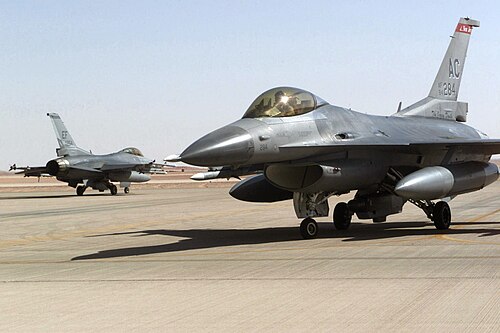
第 5 特殊部隊第 1 大隊のブラボー中隊とチャーリー中隊は、H 時間にクウェート国境を越え、ODA 531 は破砕爆薬を使って砂の土手に道を切り開いた。チャーリー中隊の 7 台の ODA は 35 台の車両に分かれて西部砂漠の南東作戦区域を進み、ヌキャブ、ハバリヤ、ムディアシスの各町に向かった。ODA 534 と 532 は分かれてヌキャブ周辺に向かい、移動式スカッド B TEL 発射場を探した。ODA 532 は移動式気象観測所も設置し、作戦計画担当者に戦闘地域の重要なリアルタイム気象情報を提供した。ブラボー中隊は中央の町アル ルトバとH-3 空軍基地に向けて出発した。6 機の ODA と支援 ODB (Operational Detachment Bravo) が参加。ODA 523 と 524 はスカッド B の保管施設と思われる場所を捜索し、ODA 521 と 525 は放棄された飛行場数か所の掃討任務を負ったが、スカッド発射装置の痕跡は見つからず、ODA 525 は特別偵察チームを派遣してアル ルトバの町で生活パターンの監視を行った。2 人組のチームは、近くで F-16C ファイティング ファルコン 2 機を呼び寄せ、特定したイラク軍の無線方向探知施設を破壊した。 ODA 525の第2偵察隊はアル・ルートバに通じる2本の幹線道路を警備するために展開したが、アル・ルートバのイラク軍駐屯地に隊の存在と位置を密告した放浪ベドウィン族に隊の危険にさらされたため、フェダインが乗った武装したイラク人技術者が隊の捜索に車で出動した。そこでグリーンベレーはGMVに乗り、隠れ場所を離れてフェダインを待ち伏せする位置を見つけたが、激しい砲火の下、フェダイン軍は撤退した。ODA 525は2人組の偵察隊と合流し、安全な場所へ撤退させようとしたが、多数のイラク人車両が町から彼らに向かって走り出し始めたため、ODAは直ちに航空支援を要請した。待っている間、偵察チームと目標捕捉海兵隊は、サプレッサー付きのMK12狙撃銃でフェダイン指導者に発砲し、町の東で容疑者を排除していたODA 521と連絡を取り、ODA 525を増援した。数分以内にF-16Cが到着し、フェダイン車両と交戦し、別のフェダイン車列がODA 525の側面を攻撃しようとしたが、ODA 524の銃撃に遭遇した。包囲するフェダインに対する4時間にわたる絶え間ない激しい空爆の後、ODA 521と525の8機のGMVがB-1B戦略爆撃機の援護を受けて無防備な偵察チームを救出することに成功し、車両はアル・ルトバ南方のODB 520の拠点エリアに撤退した。100人以上のフェダイン戦闘員が死亡し、4台の武装技術者が破壊された。西ではODA523がODA524を増強したが、高速道路で武装した技術者2名に遭遇した。両名はGMVに撃破された。イラクの子供たちを乗せた民間のステーションワゴンが銃撃戦の真っ只中に突っ込んできたため、グリーンベレーは発砲を止めた。ODA522はまた、高速道路をODA523に向かって進んでくるフェダイン武装技術者2名を特定し、彼らを待ち伏せして車両を破壊し、フェダイン15名を殺害した。[210]
米陸軍特殊部隊ODAの戦略的意図は、主要な補給ルートを遮断し、アル・ルートバ周辺と戦略的に重要なH-3空軍基地へのアクセスを断つことだった。同基地はイラク軍大隊と相当数の機動・固定対空砲で守られていた。2003年3月24日、タスクフォース7(イギリス特殊空挺部隊)とタスクフォース64(オーストラリア特殊空挺連隊)の支援を受けた周囲のODAは、SOFLAM標的指示装置を使用してH-3に対する精密空爆を24時間絶え間なく要請した。空爆によりイラク軍車両は基地を離れ、バグダッドに向かわざるを得なくなった。彼らが走行していた高速道路を監視していたODA 521は車列を待ち伏せしてZU-23搭載トラックを破壊し、車列は混乱に陥った。砂嵐のためにODAは空爆を要請できず、車列は砂漠に散り散りになった。第5特殊部隊集団ブラボー中隊と連合軍特殊部隊が飛行場を確保し、ローランド地対空ミサイルシステム、 ZSU-23-4 シルカを含む約80門の各種対空砲、SA-7 グレイル手持ち地対空砲、および大量の弾薬を発見した。H-3はブラボー中隊の高度作戦基地として設置され、物資はC-130とMH-47Eで運ばれた。ODA 581車両検問所は、H-3の指揮官であったイラク人将軍が私服で逃走しようとしていたところを捕らえることに成功し、3月28日にCIA特殊作戦航空隊の無記名リトルバードに捕らえられ、さらなる尋問のために飛ばされた。さらにODA 523はH-3の敷地内の実験室で化学兵器のサンプルと思われるものを発見した。[211]
ブラボー中隊はアル・ルトバに注意を向け、SOT-A(支援作戦チーム - アルファ)による信号の傍受と、ベドウィンや町の住民の間の情報提供ネットワークから、約800人のフェダインが町に残っていることが判明した。町からのフェダイン巡回部隊は、周囲のグリーンベレーに交戦し、捕らえられた。ODAは町外れのフェダイン対空砲への精密空爆を誘導し、空爆に加えて、フェダイン民兵の大集団をジャベリンミサイルで攻撃した。4月9日、9つのODAが町への主要道路を確保し、固定翼航空機とアパッチヘリコプターからのほぼ絶え間ない最後の空爆の一日を開始した。町の民間人がグリーンベレーに近づいて爆撃を止めるよう求めたため、グリーンベレーは民間人と取引を行い、翌日町に入った。グリーンベレーが町に入ると、B-52と2機のF-16Cが町の上空で威嚇飛行を行い、フェダイン隊は住民に溶け込んだ。数日のうちに、グリーンベレーは町の市長選出や市場の開設、電力網の60%の稼働、水道の修復を支援した。ODA521と525は引き続きこの地域で活動し、外国人戦闘員を乗せたトラック数台を止め、武装解除して詳細を記録し、シリアに送る前に二度と戻ってこないよう警告した。5月下旬、このチームは第3機甲騎兵連隊に交代した。[212]
その他の特殊作戦

アメリカ陸軍特殊部隊(グリーンベレー)第5特殊部隊グループ第2大隊は、バスラ、カルバラーなどの都市やその他の場所で偵察活動を行った。[213]
サルガトが占領された後、第10特殊部隊群第3大隊のブラボー中隊とCIA準軍事組織の将校らは、クルド人同盟軍とともに南下し、ティクリートおよびイラク北部の周辺の町々へと進撃した。[214]以前、グリーンラインの戦いでは、第3/10ブラボー中隊とそのクルド人同盟軍がイラク第13歩兵師団を押し戻し、壊滅させ、敗走させた。[215]同じ中隊がティクリートを占領した。イラクはベトナム戦争以来最大の米特殊部隊の展開となった。[216]
ODA 563 worked in support of the US Marines around Al Diwaniyah with local Sheikhs and their militias supported by AV-8Bs and F/A-18s; managing to capture the city of Qwam al Hamza. The following day ODA 563, their local Sheikh and his militia and a small Force Recon team captured the bridge leading to Diwaniyah and the militia attacked Iraqi positions over the bridge, forcing the Iraqi army and Fedayeen to flee toward Baghdad while being harassed by Marine Corps aircraft.[217]
Jessica Lynch rescue
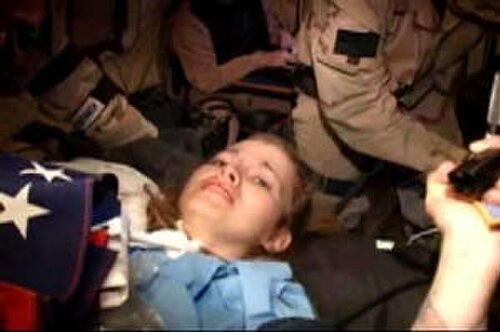
Private first class Jessica Lynch of the 507th Maintenance Company was seriously injured and captured after her convoy was ambushed by Iraqi forces during the Battle of Nasiriyah. Initial intelligence that led to her rescue was provided by an informant who approached ODA 553 when it was working in Nasiriyah, the intelligence was passed on and Task Force 20 planned a rescue mission. Launching from the recently captured airfield at Tallil, the rescue force consisted of 290 Rangers from 1st and 2nd battalion, 75th Ranger Regiment, around 60 SEALs from DEVGRU along with Pararescue Jumpers and Combat Controllers from the 24th Special Tactics Squadron conventional Marines from Task Force Tarawa then currently fighting through the city and aviators from the Army, Marines and Air Force. The plan called for Task Force Tarawa to conduct a deception mission by seizing the bridges across the Euphrates to draw attention away from the hospital Lynch was held at, an airstrike by US Marine AV-8 Harriers would be conducted against one of the bridges to confuse the opposition further and US Marine AH-1W Cobras were tasked to fly over the area to conceal the sound of incoming SOF helicopters. Air cover as provided by an AC-130 Spectre and a Marine EA-6 Prowler to jam any enemy SAM systems that might be present. With the deception mission underway, the SEAL and select Ranger elements would be inserted by MH-60K Blackhawks and four MH-6 Little Birds, supported by four AH-6 attack helicopters and two MH-60L DAPs, the other Rangers would be flown in by Marine CH-46s and CH-53 transport helicopters to establish a cordon around the hospital grounds. The main assault force of SEALs would arrive by a ground convoy of AGMS Pandur forearmed vehicles and GMV trucks while the hostage rescue element landed directly on the objective in MH-6 Little Birds.[218]
At 0100 on 1 April 2003, the Marines commenced their deception mission, CIA elements cut the city's power as the helicopters approached their objective, the AH-6s led the way, behind them the MH-6s dropped off Task Force 20 sniper teams at strategic locations around and on the hospital. The DAPs and the AH-6s covered the MH-60Ks as they dropped off assault teams on the hospital roof and another by the front door, the ground assault convoy arrived and the assaulters raced inside and onto the second floor where Lynch was located. 13 minutes later, a MH-60K touched down near the hospital entrance with a team of PJs and SOAR medics on board and transported Lynch to Tallil where it rendezvoused with a standby medical flight and then onto Kuwait and finally the United States. The hospital was devoid of any Fedayeen, although evidence suggested they were using it as a base; the Ranger blocking teams experienced some sporadic direct fire, the SEALs and the Rangers eventually recovered the remains of eight members of Lynch's unit that had been killed or died of their wounds. Task Force 20 carried out the first successful U.S. prisoner of war rescue mission since World War II.[219]
Fall of Baghdad (April 2003)
Three weeks into the invasion, the Army's 3rd Infantry Division, with the 1st Marine Division also present, moved into Baghdad.[220] Units of the Iraqi Special Republican Guard led the defence of the city. The rest of the defenders were a mixture of Republican Guard units, regular army units, Fedayeen Saddam, and non-Iraqi Arab volunteers. Initial plans were for coalition units to surround the city and gradually move in, forcing Iraqi armor and ground units to cluster into a central pocket in the city, and then attack with air and artillery forces.
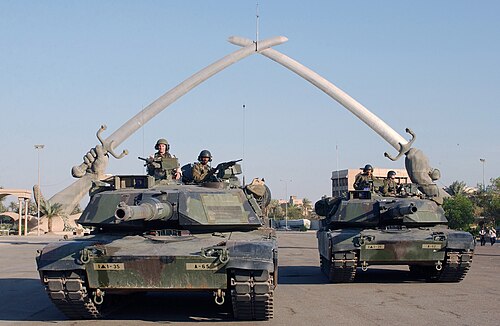
This plan soon became unnecessary, as an initial engagement of armored units south of the city saw most of the Republican Guard's assets destroyed and routes in the southern outskirts of the city occupied. On 5 April, Task Force 1–64 Armor of the U.S. Army's 3rd Infantry Division executed a raid, later called the "Thunder Run", to test remaining Iraqi defenses, with 29 tanks and 14 Bradley armored fighting vehicles advancing to the Baghdad airport. They met significant resistance, but were successful in reaching the airport, and eventually secured it after heavy fighting.
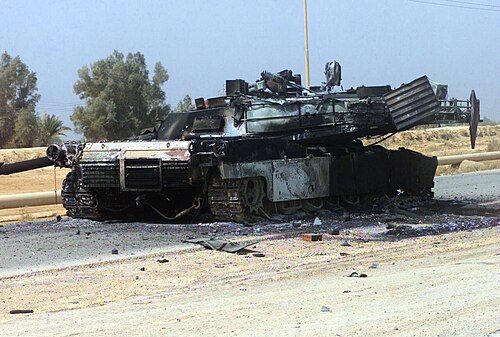
The next day, another brigade of the 3rd Infantry Division attacked downtown Baghdad and occupied one of the palaces of Saddam Hussein in fierce fighting. U.S. Marines also faced heavy shelling from Iraqi artillery as they attempted to cross a river bridge, but the river crossing was successful. The Iraqis managed to inflict some casualties on the U.S. forces near the airport from defensive positions but suffered severe casualties from air bombardment. Within hours of the palace seizure and with television coverage of this spreading through Iraq, U.S. forces ordered Iraqi forces within Baghdad to surrender, or the city would face a full-scale assault. Iraqi government officials had either disappeared or had conceded defeat, and on 9 April 2003, Baghdad was formally occupied by coalition forces. Much of Baghdad remained unsecured however, and fighting continued within the city and its outskirts well into the period of occupation. Saddam had vanished, and his whereabouts were unknown.

On 10 April, a rumor emerged that Saddam Hussein and his top aides were in a mosque complex in the Al Az'Amiyah District of Baghdad. Three companies of Marines were sent to capture him and came under heavy fire from rocket-propelled grenades, mortars, and assault rifles. One Marine was killed and 20 were wounded, but neither Saddam or any of his top aides were found. U.S. forces supported by mortars, artillery, and aircraft continued to attack Iraqi forces still loyal to Saddam Hussein and non-Iraqi Arab volunteers. U.S. aircraft flying in support were met with Iraqi anti-aircraft fire. On 12 April, by late afternoon, all fighting had ceased. A total of 34 American soldiers and 2,320 Iraqi fighters were killed.

Many Iraqis celebrated the downfall of Saddam by vandalizing the many portraits and statues of him together with other pieces of his cult of personality. One widely publicized event was the dramatic toppling of a large statue of Saddam in Baghdad's Firdos Square. This attracted considerable media coverage at the time. As the British Daily Mirror reported,
For an oppressed people this final act in the fading daylight, the wrenching down of this ghastly symbol of the regime, is their Berlin Wall moment. Big Moustache has had his day."[221]
As Staff Sergeant Brian Plesich reported in On Point: The United States Army in Operation Iraqi Freedom,
The Marine Corps colonel in the area saw the Saddam statue as a target of opportunity and decided that the statue must come down. Since we were right there, we chimed in with some loudspeaker support to let the Iraqis know what it was we were attempting to do... Somehow along the way, somebody had gotten the idea to put a bunch of Iraqi kids onto the wrecker that was to pull the statue down. While the wrecker was pulling the statue down, there were Iraqi children crawling all over it. Finally they brought the statue down.[222]
The fall of Baghdad saw the outbreak of regional, sectarian violence throughout the country, as Iraqi tribes and cities began to fight each other over old grudges. The Iraqi cities of Al-Kut and Nasiriyah launched attacks on each other immediately following the fall of Baghdad to establish dominance in the new country, and the U.S.-led coalition quickly found themselves embroiled in a potential civil war. U.S.-led coalition forces ordered the cities to cease hostilities immediately, explaining that Baghdad would remain the capital of the new Iraqi government. Nasiriyah responded favorably and quickly backed down; however, Al-Kut placed snipers on the main roadways into town, with orders that invading forces were not to enter the city. After several minor skirmishes, the snipers were removed, but tensions and violence between regional, city, tribal, and familial groups continued.
U.S. General Tommy Franks assumed control of Iraq as the supreme commander of the coalition occupation forces. Shortly after the sudden collapse of the defense of Baghdad, rumors were circulating in Iraq and elsewhere that there had been a deal struck (a "safqua") wherein the U.S.-led coalition had bribed key members of the Iraqi military elite and/or the Ba'ath party itself to stand down. In May 2003, General Franks retired, and confirmed in an interview with Defense Week that the U.S.-led coalition had paid Iraqi military leaders to defect. The extent of the defections and their effect on the war are unclear.
U.S.-led coalition troops promptly began searching for the key members of Saddam Hussein's government. These individuals were identified by a variety of means, most famously through sets of most-wanted Iraqi playing cards. Later during the military occupation period after the invasion, on 22 July 2003 during a raid by the U.S. 101st Airborne Division and men from Task Force 20, Saddam Hussein's sons Uday and Qusay, and one of his grandsons were killed in a massive fire-fight. Saddam Hussein himself was captured on 13 December 2003 by the U.S. Army's 4th Infantry Division and members of Task Force 121 during Operation Red Dawn.
Other areas
U.S. special forces had also been involved in the extreme south of Iraq, attempting to occupy key roads to Syria and air bases. In one case two armored platoons were used to convince Iraqi leadership that an entire armored battalion was entrenched in the west of Iraq.[citation needed]
On 15 April, U.S. forces took control of Tikrit, the last major outpost in central Iraq, with an attack led by the Marines' Task Force Tripoli. About a week later the Marines were relieved in place by the Army's 4th Infantry Division.
Coalition aircraft flew over 41,000 sorties,[223] of which over 9,000 were tanker sorties.[224]
Aftermath of the invasion
After the invasion, several factors contributed to the destabilization of Iraq. On 23 May, L. Paul Bremer issued Coalition Provisional Authority Order Number 2, dissolving the Iraqi Army and other entities of the former Ba'athist state. Ba'athists were excluded from the newly formed Iraqi government.[225] The first postwar election was won by the United Iraqi Alliance, an electoral coalition composed of mainly Shi’ite groups, which proceeded to ostracize Sunnis. Shia militia groups pushed Sunnis out of several areas, even emptying entire Sunni neighborhoods in Baghdad during the 2007 troop surge.[226][227][228][229] The US military established prison camps where disgruntled Iraqis, former Ba'athists and Jihadist met. Abu Bakr al-Baghdadi, future leader of the Islamic State, joined Al-Qaeda in Iraq while detained at Camp Bucca in 2004. Future leader of al-Nusra Front in Syria, Abu Mohammad al-Julani, who was a member of Al-Qaeda in Iraq, was also held there and released in 2008. All these factors contributed to Iraq's sectarian violence and the formation and spread of terrorist organizations.[230][231][232][233][234][235]
Bush declares "End of major combat operations" (May 2003)
_Mission_Accomplished.jpg/500px-USS_Abraham_Lincoln_(CVN-72)_Mission_Accomplished.jpg)
On 1 May 2003, Bush landed on the aircraft carrier USS Abraham Lincoln, in a Lockheed S-3 Viking, where he gave a speech announcing the end of major combat operations in the Iraq war. Bush's landing was criticized by opponents as an unnecessarily theatrical and expensive stunt. Clearly visible in the background was a banner stating "Mission Accomplished." The banner, made by White House staff and supplied by request of the United States Navy,[236] was criticized as premature. The White House subsequently released a statement that the sign and Bush's visit referred to the initial invasion of Iraq and disputing the charge of theatrics. The speech itself noted: "We have difficult work to do in Iraq. We are bringing order to parts of that country that remain dangerous."[237] Post-invasion Iraq was marked by a long and violent conflict between U.S.-led forces and Iraqi insurgents that entailed a very high number of casualties.
Coalition and Allied contingent involvement

Members of the coalition included Australia: 2,000 invasion, Poland: 200 invasion—2,500 peak, Spain: 1,300 invasion, United Kingdom: 46,000 invasion, United States: 150,000 to 250,000 invasion. Other members of the coalition were Afghanistan, Albania, Angola, Azerbaijan, Bulgaria, Colombia, Costa Rica, the Czech Republic, Denmark, Dominican Republic, El Salvador, Eritrea, Estonia, Ethiopia, Georgia, Honduras, Hungary, Iceland, Italy, Japan, Kuwait, Latvia, Lithuania, Macedonia, Marshall Islands, Micronesia, Mongolia, the Netherlands, Nicaragua, Palau, Panama, the Philippines, Portugal, Romania, Rwanda, Singapore, Slovakia, Solomon Islands, South Korea, Tonga, Turkey, Uganda, Ukraine, and Uzbekistan.[238] BBC News said 15 other countries were "providing assistance, such as over-flight rights, but which do not want to declare support."[239]
Australia
_team_members_inspect_camouflaged_mines_hidden_inside_oil_barrels_on_the_deck_of_an_Iraqi_shipping_barge.jpg/500px-thumbnail.jpg)
Australia contributed approximately 2,000 Australian Defence Force personnel, including a special forces task group, three warships and 14 F/A-18 Hornet aircraft.[240] On 16 April 2003, Australian special operations forces captured the undefended Al Asad air base west of Baghdad. The base would later become the second largest coalition facility post-invasion.
Poland
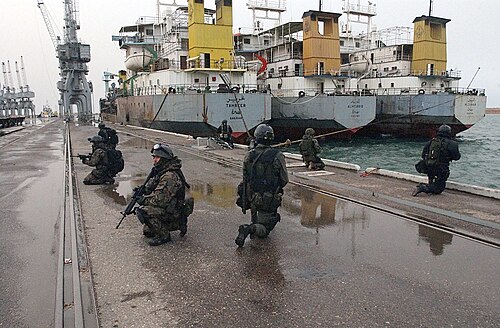
The Battle of Umm Qasr was the first military confrontation in the Iraq War, with its objective the capture of the port. Polish GROM troops supported the amphibious assault on Umm Qasr with the British 3 Commando Brigade of the Royal Marines, and the US 15th Marine Expeditionary Unit.[241] After the waterway was de-mined by a Detachment from HM-14 and Naval Special Clearance Team ONE of the U.S. Navy and reopened, Umm Qasr played an important role in the shipment of humanitarian supplies to Iraqi civilians.[242]
United Kingdom
British troops, in what was codenamed Operation (or Op) TELIC participated in the 2003 Invasion of Iraq. The 1st Armoured Division was deployed to the Persian Gulf and commanded British forces in the area, securing areas in southern Iraq, including the city of Basra during the invasion. A total of 46,000 troops of all the British services were committed to the operation at its start, including some 5,000 Royal Navy and Royal Fleet Auxiliary sailors and 4,000 Royal Marines, 26,000 British Army soldiers, and 8,100 Royal Air Force airmen. The British special forces deployment was codenamed Operation Row and were known as Task Force 7 under Combined Joint Special Operations Task Force-West (Task Force Dagger).[243]
Summary of the invasion

The U.S.-led coalition forces toppled the government and captured the key cities of a large nation in only 26 days. The invasion did require a large army build-up like the 1991 Gulf War, but many did not see combat and many were withdrawn after the invasion ended. This proved to be short-sighted, however, due to the requirement for a much larger force to combat the irregular Iraqi forces in the Iraqi insurgency. General Eric Shinseki, U.S. Army Chief of Staff, recommended "several hundred thousand"[244] troops be used to maintain post-war order, but then Secretary of Defense Donald Rumsfeld—and especially his deputy, civilian Paul Wolfowitz—strongly disagreed. General Abizaid later said General Shinseki had been right.[245]
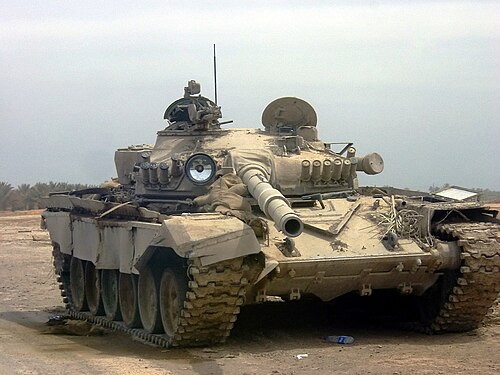
The Iraqi army, armed mainly with older Soviet and Eastern European built equipment,[246] was overall ill-equipped in comparison to the American and British forces. Attacks on U.S. supply routes by Fedayeen militiamen were repulsed. The Iraqis' artillery proved largely ineffective, and they were unable to mobilize their air force to attempt a defense. The Iraqi T-72 tanks, the most powerful armored vehicles in the Iraqi army, were both outdated and ill-maintained, and when they were mobilized they were rapidly destroyed, thanks in part to the coalition air supremacy. The U.S. Air Force, Marine Corps and Naval Aviation, and British Royal Air Force operated with impunity throughout the country, pinpointing heavily defended resistance targets and destroying them before ground troops arrived. The main battle tanks of the U.S. and UK forces, the U.S. M1 Abrams and British Challenger 2, functioned well in the rapid advance across the country. Despite the many RPG attacks by irregular Iraqi forces, few U.S. and UK tanks were lost, and no tank crew-members were killed by hostile fire, although nearly 40 M1 Abrams were damaged in the attacks.[247] The only tank loss sustained by the British Army was a Challenger 2 of the Queen's Royal Lancers that was hit by another Challenger 2, killing two crew members.
The Iraqi army suffered from poor morale, even among the elite Republican Guard. Entire units disbanded into the crowds upon the approach of invading troops, or actually sought out U.S. and UK forces to surrender to. Many Iraqi commanding officers were bribed by the CIA or coerced into surrendering. The leadership of the Iraqi army was incompetent – reports state that Qusay Hussein, charged with the defense of Baghdad, dramatically shifted the positions of the two main divisions protecting Baghdad several times in the days before the arrival of U.S. forces, and as a result the units were confused, and further demoralized when U.S. forces attacked. The invasion force did not see the entire Iraqi military thrown against it; U.S. and UK units had orders to move to and seize objective target points rather than seek to engage Iraqi units. This resulted in most regular Iraqi military units emerging from the war without having been engaged, and fully intact, especially in southern Iraq. It is assumed that most units disintegrated to return to their homes.
According to a declassified Pentagon report, "The largest contributing factor to the complete defeat of Iraq's military forces was the continued interference by Saddam." The report, designed to help U.S. officials understand in hindsight how Saddam and his military commanders prepared for and fought the invasion, paints a picture of an Iraqi government blind to the threat it faced, hampered by Saddam's inept military leadership and deceived by its own propaganda and inability to believe an invasion was imminent without further Iraqi provocation. According to the BBC, the report portrays Saddam Hussein as "chronically out of touch with reality – preoccupied with the prevention of domestic unrest and with the threat posed by Iran."[248]
Casualties
Death toll
Estimates on the number of casualties during the invasion in Iraq vary widely. Estimates on civilian casualties are more variable than those for military personnel. According to Iraq Body Count, a group that relies on press reports, NGO-based reports and official figures to measure civilian casualties, approximately 7,500 civilians were killed during the invasion phase.[249] The Project on Defense Alternatives study estimated that 3,200–4,300 civilians died during the invasion.[19]
War crimes and allegations
Fedayeen Saddam militia, Republican Guard and Iraqi security forces were reported to have executed Iraqi soldiers who tried to surrender on multiple occasions, as well as threatening the families of those who refused to fight.[250][251][252] One such incident was directly observed during the Battle of Debecka Pass.[253]
Many incidents of Fedayeen fighters using human shields were reported from various towns in Iraq.[254] Iraqi Republican Guard units were also reported to be using human shields.[255] Some reports indicate that the Fedayeen used ambulances to deliver messages and transport fighters into combat. On 31 March, Fedayeen in a Red Crescent-marked ambulance attacked American soldiers outside Nasiriyah, wounding three.[255][256] During the Battle of Basra, British forces of the Black Watch (Royal Highland Regiment) reported that on 28 March, Fedayeen forces opened fire on thousands of civilian refugees fleeing the city.[257][258]
After the ambush of the 507th Maintenance Company during the Battle of Nasiriyah on 23 March, the bodies of several U.S. soldiers who had been killed in the ambush were shown on Iraqi television. Some of these soldiers had visible gunshot wounds to the head, leading to speculation that they had been executed. Except for Sgt. Donald Walters, no evidence has since surfaced to support this scenario and it is generally accepted that the soldiers were killed in action. Five live prisoners of war were also interviewed on the air, a violation of the Third Geneva Convention.[259][260] Sergeant Walters was initially reported to have been killed in the ambush after killing several Fedayeen before running out of ammunition. However, an eyewitness later reported that he had seen Walters being guarded by several Fedayeen in front of a building. Forensics work later found Walters' blood in front of the building and blood spatter suggesting he died from two gunshot wounds to the back at close range. This led the Army to conclude that Walters had been executed after being captured, and he was posthumously awarded the Prisoner of War Medal in 2004.[261][262] It was alleged in the authorized biography of Pfc. Jessica Lynch that she was raped by her captors after her capture, based on medical reports and the pattern of her injuries, though this is not supported by Ms Lynch.[263] Mohammed Odeh al-Rehaief, who later helped American forces rescue Lynch, stated that he saw an Iraqi Colonel slap Lynch while she was in her hospital bed.[264] The staff at the hospital where Lynch was held later denied both stories, saying that Lynch was well cared for.[265] While Lynch suffers from amnesia due to her injuries, Lynch herself has denied any mistreatment while in captivity.
Also on 23 March, a British Army engineering unit made a wrong turn near the town of Az Zubayr, which was still held by Iraqi forces. The unit was ambushed and Sapper Luke Allsopp and Staff Sergeant Simon Cullingworth became separated from the rest. Both were captured and executed by Iraqi irregular forces. In 2006, a video of Allsopp lying on the ground surrounded by Iraqi irregular forces was discovered.[266]
During the Battle of Nasiriyah, Iraqi irregulars feigned surrender to approach an American unit securing a bridge. After getting close to the soldiers, the Iraqis suddenly opened fire, killing 10 soldiers and wounding 40.[255] In response, American forces reinforced security procedures for dealing with prisoners of war.[267]
Marine Sergeant Fernando Padilla-Ramirez was reported missing from his supply unit after an ambush north of Nasiriyah on 28 March. His body was later dragged through the streets of Ash-Shatrah and hung in the town square, and later taken down and buried by sympathetic locals. The corpse was discovered by U.S. forces on 10 April.[268][269][270]
On 20 March 2023, on the 20th anniversary of the invasion, Amnesty International released a report calling for accountability and reparations for human rights violations perpetrated by the US-led coalition during the invasion and subsequent occupation between 2003 and 2011. They cited violations of international humanitarian law including secret prisons, torture and other cruel treatment of detainees, indiscriminate attacks that killed and injured civilians, and forced disappearances.[271] The report stated that both President Bush[272] and former Defense Secretary Donald Rumsfeld[273] had publicly confessed to involvement in secret detentions and faced no criminal accountability. The report also noted that despite the conclusions of the International Criminal Court in 2020 that British forces had committed war crimes in Iraq, including deliberate killings, rape and torture, no senior British officials have been held criminal accountable.[271]
Security, looting and war damage
Massive looting took place in the days following the 2003 invasion.[274] According to U.S. officials, the "reality of the situation on the ground" was that hospitals, water plants, and ministries with vital intelligence needed security more than other sites. There were only enough U.S. troops on the ground to guard a certain number of the many sites that ideally needed protection, and so, apparently, some "hard choices" were made.
It was reported that The Iraq Museum was among the looted sites. The FBI was soon called into Iraq to track down the stolen items. It was found that the initial allegations of looting of substantial portions of the collection were heavily exaggerated. Initial reports asserted a near-total looting of the museum, estimated at upwards of 170,000 inventory lots, or about 501,000 pieces. The more recent estimate places the number of stolen pieces at around 15,000, and about 10,000 of them probably were taken in an "inside job" before U.S. troops arrived, according to Bogdanos. Over 5,000 looted items have since been recovered.[275] An assertion that U.S. forces did not guard the museum because they were guarding the Ministry of Oil and Ministry of Interior is disputed by investigator Colonel Matthew Bogdanos in his 2005 book Thieves of Baghdad. Bogdanos notes that the Ministry of Oil building was bombed, but the museum complex, which took some fire, was not bombed. He also writes that Saddam Hussein's troops set up sniper's nests inside and on top of the museum, and nevertheless U.S. Marines and soldiers stayed close enough to prevent wholesale looting.
"Two great libraries, with priceless ancient collections"—the Awqaf Library (Library of the Ministry of Religious Endowments) and the National Library of Iraq and National Centre for Archives (the House of Wisdom)—"have been burned," The Boston Globe reported in 2003, adding that the libraries at the University of Mosul and University of Basra had been looted. András Riedlmayer, a specialist in Islamic architecture at Harvard University,[276] said the U.S. State Department had asked him for advice before the invasion, and that "everybody warned them that the greatest danger was not from Tomahawk missiles but from looting." Noting that Iraq had been unified only in 1922 and that relatively little attention had been paid to this local history, Keith D. Waterpaugh, a specialist in Ottoman history, said, "Imagine if we could not go back and read The New York Times from 1922 on. If we are going to help the Iraqi people build a new nation, we don't do it by letting their past be destroyed."[277]
More serious for the post-war state of Iraq was the looting of cached weaponry and ordnance which fueled the subsequent insurgency. As many as 250,000 tons of explosives were unaccounted for by October 2004.[278] Disputes within the US Defense Department led to delays in the post-invasion assessment and protection of Iraqi nuclear facilities. Tuwaitha, the Iraqi site most scrutinized by UN inspectors since 1991, was left unguarded and was looted.[279][280]
Zainab Bahrani, professor of Ancient Near Eastern Art History and Archaeology at Columbia University, reported that a helicopter landing pad was constructed in the heart of the ancient city of Babylon, and "removed layers of archeological earth from the site. The daily flights of the helicopters rattle the ancient walls and the winds created by their rotors blast sand against the fragile bricks. When my colleague at the site, Maryam Moussa, and I asked military personnel in charge that the helipad be shut down, the response was that it had to remain open for security reasons, for the safety of the troops."[281] Bahrani also reported that in the summer of 2004, "the wall of the Temple of Nabu and the roof of the Temple of Ninmah, both sixth century BC, collapsed as a result of the movement of helicopters."[281] Electrical power is scarce in post-war Iraq, Bahrani reported, and some fragile artifacts, including the Ottoman Archive, would not survive the loss of refrigeration.[281]
Media coverage
U.S. media coverage

The U.S. invasion of Iraq was the most widely and closely reported war in military history.[282] Television network coverage was largely pro-war and viewers were six times more likely to see a pro-war source as one who was anti-war.[283] The New York Times ran a number of articles describing Saddam Hussein's attempts to build weapons of mass destruction. The 8 September 2002 article titled "U.S. Says Hussein Intensifies Quest for A-Bomb Parts" would be discredited, leading The New York Times to issue a public statement admitting it was not as rigorous as it should have been.[284]
At the start of the war in March 2003, as many as 775 reporters and photographers were traveling as embedded journalists.[285] These reporters signed contracts with the military that limited what they were allowed to report on.[286] When asked why the military decided to embed journalists with the troops, Lt. Col. Rick Long of the U.S. Marine Corps replied, "Frankly, our job is to win the war. Part of that is information warfare. So we are going to attempt to dominate the information environment."[287]
In 2003, a study released by Fairness and Accuracy in Reporting stated the network news disproportionately focused on pro-war sources and left out many anti-war sources. According to the study, 64% of total sources supported the Iraq War while total anti-war sources made up 10% of the media (only 3% of US sources were anti-war). The study looked only at 6 American news networks after 20 March for three weeks. The study stated that "viewers were more than six times as likely to see a pro-war source as one who was anti-war; with U.S. guests alone, the ratio increases to 25 to 1."[288]
A September 2003 poll revealed that seventy percent of Americans believed Saddam Hussein was involved in the attacks of 9/11.[289] 80% of Fox News viewers were found to hold at least one such belief about the invasion, compared to 23% of PBS viewers.[290] Ted Turner, founder of CNN, charged that Rupert Murdoch was using Fox News to advocate an invasion.[291] Critics have argued that this statistic is indicative of misleading coverage by the U.S. media since viewers in other countries were less likely to have these beliefs.[292] A post-2008 election poll by FactCheck.org found that 48% of Americans believe Saddam played a role in the 9/11 attacks, the group concluded that "voters, once deceived, tend to stay that way despite all evidence."[293]
Independent media coverage
Independent media also played a prominent role in covering the invasion. The Indymedia network, among many other independent networks including many journalists from the invading countries, provided reports on the Iraq war. In the United States Democracy Now, hosted by Amy Goodman has been critical of the reasons for the 2003 invasion and the alleged crimes committed by the U.S. authorities in Iraq.
The Israeli Military Censor have released gag orders to Fresh and Rotter news platforms preventing them releasing any information about events and action related to the invasion.[294]
On the other side, among media not opposing to the invasion, The Economist stated in an article on the matter that "the normal diplomatic tools—sanctions, persuasion, pressure, UN resolutions—have all been tried, during 12 deadly but failed years" then giving a mild conditional support to the war stating that "if Mr Hussein refuses to disarm, it would be right to go to war".[295]
Australian war artist George Gittoes collected independent interviews with soldiers while producing his documentary Soundtrack To War. The war in Iraq provided the first time in history that military on the front lines were able to provide direct, uncensored reportage themselves, thanks to blogging software and the reach of the internet. Dozens of such reporting sites, known as soldier blogs or milblogs, were started during the war. These blogs were more often than not largely pro-war and stated various reasons why the soldiers and Marines felt they were doing the right thing.[296]
International media coverage
International coverage of the war differed from coverage in the U.S. in a number of ways. The Arab-language news channel Al Jazeera and the German satellite channel Deutsche Welle featured almost twice as much information on the political background of the war.[297] Al Jazeera also showed scenes of civilian casualties rarely seen in the U.S. media.
Criticism
Opponents of the military intervention in Iraq have attacked the decision to invade Iraq along a number of lines, including the human cost of war,[298] calling into question the evidence used to justify the war, arguing for continued diplomacy, challenging the war's legality, suggesting that the U.S. had other more pressing security priorities, (i.e., Afghanistan and North Korea) and predicting that the war would destabilize the Middle East region. In 2010, an independent commission of inquiry set up by the government of the Netherlands, maintained that UN resolution 1441 "cannot reasonably be interpreted (as the Dutch government did) as authorising individual member states to use military force to compel Iraq to comply with the Security Council's resolutions." Accordingly, the Dutch commission concluded that the invasion violated international law.[120]
Rationale based on faulty evidence
The central U.S. justification for launching the war was that Saddam Hussein's alleged development of nuclear and biological weapons and purported ties to al-Qaeda made his regime a "grave and growing"[299] threat to the United States and the world community.[300] During the lead-up to the war and the aftermath of the invasion, critics cast doubt on the evidence supporting this rationale. Concerning Iraq's weapons programs, prominent critics included Scott Ritter, a former U.N. weapons inspector who argued in 2002 that inspections had eliminated the nuclear and chemical weapons programs, and that evidence of their reconstitution would "have been eminently detectable by intelligence services ..." Although it is popularly believed[citation needed] that Saddam Hussein had forced the IAEA weapons inspectors to leave Iraq, they were withdrawn at the request of the US before Operation Desert Fox, the 1998 American bombing campaign. After the build-up of U.S. troops in neighboring states, Saddam welcomed them back and promised complete cooperation with their demands. Experienced IAEA inspection teams were already back in Iraq and had made some interim reports on its search for various forms of WMD.[301][302][303][304][305] American diplomat Joseph C. Wilson investigated the contention that Iraq had sought uranium for nuclear weapons in Niger and reported that the contention had no substance.[306][307]
Similarly, alleged links between Iraq and al-Qaeda were called into question during the lead-up to the war, and were discredited by a 21 October 2004 report from U.S. Senator Carl Levin, which was later corroborated by an April 2006 report from the Defense Department's inspector general.[308] These reports further alleged that Bush Administration officials, particularly former undersecretary of defense Douglas J. Feith, manipulated evidence to support links between al-Qaeda and Iraq.[309]
During his 2003–2004 interrogation, Saddam asserted that the majority of Iraq's WMD stockpiles had been destroyed in the 1990s by UN inspectors, and the remainder were destroyed unilaterally by Iraq; the illusion of maintaining a WMD program and WMDs was maintained as a deterrent against possible Iranian invasion.[310] An FBI agent who interrogated Saddam during this time also believes that while Iraq may not have possessed WMDs after the 1990s, Saddam likely intended to restart the WMD program if given the opportunity to do so.[310]
Lack of a U.N. mandate
One of the main questions in the lead-up to the war was whether the United Nations Security Council would authorize military intervention in Iraq. It became increasingly clear that U.N. authorization would require significant further weapons inspections. Many criticized their effort as unwise, immoral, and illegal. Robin Cook, then the leader of the United Kingdom House of Commons and a former foreign secretary, resigned from Tony Blair's cabinet in protest over the UK's decision to invade without the authorization of a U.N. resolution. Cook said at the time that: "In principle I believe it is wrong to embark on military action without broad international support. In practice I believe it is against Britain's interests to create a precedent for unilateral military action."[311] In addition, senior government legal advisor Elizabeth Wilmshurst resigned, stating her legal opinion that an invasion would be illegal.[citation needed]
United Nations Secretary-General Kofi Annan said in an interview with the BBC in September 2004, "[F]rom our point of view and from the Charter point of view [the war] was illegal."[312] This drew immediate criticism from the United States and was immediately played down.[313] His annual report to the General Assembly for 2003 included no more than the statement: "Following the end of major hostilities which resulted in the occupation of Iraq..."[314] A similar report from the Security Council was similarly terse in its reference to the event: "Following the cessation of hostilities in Iraq in April 2003 ..."[315] The United Nations Security Council has passed nearly 60 resolutions on Iraq and Kuwait since Iraq's invasion of Kuwait in 1990. The most relevant to this issue is Resolution 678, passed on 29 November 1990. It authorizes "member states co-operating with the Government of Kuwait... to use all necessary means" to (1) implement Security Council Resolution 660 and other resolutions calling for the end of Iraq's occupation of Kuwait and withdrawal of Iraqi forces from Kuwaiti territory and (2) "restore international peace and security in the area."
Military intervention vs diplomatic solution
Wikisource has original text related to this article:
French address on Iraq at the UN Security Council
Criticisms about the evidence used to justify the war notwithstanding, many opponents of military intervention objected, saying that a diplomatic solution would be preferable, and that war should be reserved as a truly last resort. This position was exemplified by French Foreign Minister Dominique de Villepin, who responded to U.S. Secretary of State Colin Powell's 5 February 2003 presentation to the U.N Security Council by saying that: "Given the choice between military intervention and an inspections regime that is inadequate because of a failure to cooperate on Iraq's part, we must choose the decisive reinforcement of the means of inspections."[316] In response to Donald Rumsfeld's reference to European countries that did not support the invasion of Iraq as 'Old Europe',[317] Dominique de Villepin ended his speech with words that would later come to embody the French-German political, economic, and military alliance throughout the beginning of the 21st century: "This message comes to you today from an old country, France, from a continent like mine, Europe, that has known wars, occupation and barbarity. (...) Faithful to its values, it wishes resolutely to act with all the members of the international community. It believes in our ability to build together a better world."[318] The direct opposition between diplomatic solution and military intervention involving France and the United States which was personified by Chirac versus Bush and later Powell versus de Villepin, became a milestone in the Franco-American relations. Anti-French propaganda exploiting the classic Francophobic clichés immediately ensued in the United States and the United Kingdom. A call for a boycott on French wine was launched in the United States and the New York Post covered on the 1944 "Sacrifice" of the GIs that France had forgotten. It was followed a week later, on 20 February, by the British newspaper The Sun publishing a special issue entitled "Chirac is a worm" and including ad hominem attacks such as "Jacques Chirac has become the shame of Europe".[319] Actually both newspapers expressed the opinion of their owner, U.S. billionaire Rupert Murdoch, a military intervention supporter and a George W. Bush partisan as argued by Roy Greenslade in The Guardian published on 17 February.[319][320]
Distraction from the war on terrorism and other priorities
Both supporters and opponents of the Iraq War widely viewed it within the context of a post–11 September world, where the U.S. has sought to make terrorism the defining international security paradigm. Bush often described the Iraq War as a "central front in the war on terror".[321] Some critics of the war, particularly within the U.S. military community, argued pointedly against the conflation of Iraq and the war on terror, and criticized Bush for losing focus on the more important objective of fighting al-Qaeda. As Marine Lieutenant General Greg Newbold, the Pentagon's former top operations officer, wrote in a 2006 Time article, "I now regret that I did not more openly challenge those who were determined to invade a country whose actions were peripheral to the real threat—al-Qaeda."[322]
Critics within this vein have further argued that containment would have been an effective strategy for the Saddam government, and that the top U.S. priorities in the Middle East should be encouraging a solution to the Israeli–Palestinian conflict, working for the moderation of Iran, and solidifying gains made in Afghanistan and Central Asia. In an October 2002 speech, Retired Marine Gen. Anthony Zinni, former head of Central Command for U.S. forces in the Middle East and State Department's envoy to the Israeli–Palestinian conflict, called Iraq "maybe six or seven," in terms of U.S. Middle East priorities, adding that "the affordability line may be drawn around five."[323] However, while commander of CENTCOM, Zinni held a very different opinion concerning the threat posed by Iraq. In testimony before the Senate Armed Services Committee in February 2000, Zinni said: "Iraq remains the most significant near-term threat to U.S. interests in the Persian Gulf region. This is primarily due to its large conventional military force, pursuit of WMD, oppressive treatment of Iraqi citizens, refusal to comply with United Nations Security Council Resolutions (UNSCR), persistent threats to enforcement of the No Fly Zones (NFZ), and continued efforts to violate UN Security Council sanctions through oil smuggling."[324] However, it is important to note that Zinni specifically referred to "the Persian Gulf region" in his Senate testimony, which is a significantly smaller region of the world than the "Middle East", which he referred to in 2007.
Potential to destabilize the region
Besides arguing that Iraq was not the top strategic priority in the war on terrorism or in the Middle East, critics of the war also suggested that it could potentially destabilize the surrounding region. Prominent among such critics was Brent Scowcroft, who served as National Security Advisor to George H. W. Bush. In a 15 August 2002 The Wall Street Journal editorial entitled "Don't attack Saddam", Scowcroft wrote that, "Possibly the most dire consequences would be the effect in the region ... there would be an explosion of outrage against us ... the results could well destabilize Arab regimes", and, "could even swell the ranks of the terrorists."[325] In an October 2015 CNN interview with Fareed Zakaria, former British Prime Minister Tony Blair apologized for his 'mistakes' over Iraq War and admitted there were 'elements of truth' to the view that the invasion helped promote the rise of ISIS.[326] In the opinion of Hayder al-Khoei, Iraq was already "destined for chaos" before 2003.[327]
Public opinion
In a March 2003 Gallup poll, the day after the invasion, 76 percent of Americans supported the military action against Iraq.[328] In a March 2003 YouGov poll, 54 percent of Britons had approved of military action against Iraq.[329]
By July 2007, opposition to the Iraq war had increased to 62 percent among Americans in a USA Today\Gallup poll.[330] On the tenth anniversary of the invasion, in March 2013, a Gallup poll found that 53 percent of Americans surveyed believed the Iraq War was a mistake.[331]
On the 20th anniversary of the invasion, in March 2023, an Axios/Ipsos poll found that 61 percent of Americans surveyed stated that the U.S did not make the right decision by invading Iraq.[332]
Related phrases
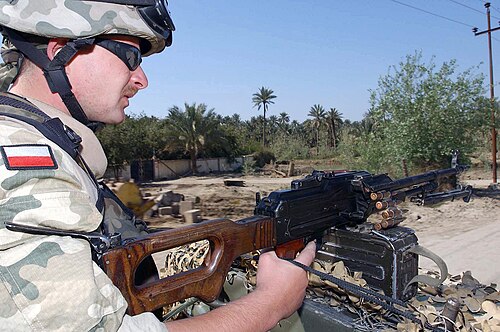
This campaign featured a variety of new terminology, much of it initially coined by the U.S. government or military. The military official name for the invasion was Operation Iraqi Freedom. Also notable was the usage "death squads" to refer to Fedayeen paramilitary forces. Members of the Saddam Hussein government were called by disparaging nicknames – e.g., "Chemical Ali" (Ali Hassan al-Majid), "Baghdad Bob" or "Comical Ali" (Muhammed Saeed al-Sahaf), and "Mrs. Anthrax" or "Chemical Sally" (Huda Salih Mahdi Ammash).
Terminology introduced or popularized during the war include:
- "Axis of evil", originally used by Bush in the 2002 State of the Union speech on 29 January 2002 to refer to the countries of Iran, Iraq, and North Korea.[333]
- "Coalition of the willing", a term that originated in the Clinton era (e.g. an ABC interview with Clinton dated 8 June 1994), and used by the Bush administration for the countries contributing troops in the invasion, of which the U.S. and UK were the primary members.
- "Decapitating the regime", a euphemism for killing Saddam Hussein.
- "Embedding", United States practice of assigning civilian journalists to U.S. military units.
- "Freedom fries", a euphemism for French fries invented to protest the non-participation of France.
- "Mother of all bombs", a bomb developed and produced to support Operation Iraqi Freedom. Its name echoed Saddam's phrase "Mother of all battles" to describe the first Gulf War.[334]
- "Old Europe", Rumsfeld's term for European governments not supporting the war: "You're thinking of Europe as Germany and France. I don't. I think that's old Europe."
- "Regime change", a euphemism for overthrowing a government.
- "Shock and awe", the strategy of reducing an enemy's will to fight through displays of overwhelming force.
Many slogans and terms coined came to be used by Bush's political opponents, or those opposed to the war. For example, in April 2003 John Kerry, the Democratic candidate in the presidential election, said at a campaign rally: "What we need now is not just a regime change in Saddam Hussein and Iraq, but we need a regime change in the United States."[335]
George W. Bush's press secretary Ari Fleischer talked about "Operation Iraqi liberation" in a 2003 press briefing,[336] and "Operation Iraqi Liberation (OIL)" was also used by David Rovics, a popular folk protest singer.
See also
- Governmental positions on the Iraq War prior to the 2003 invasion of Iraq
- Investment in post-invasion Iraq
- Occupation of Iraq timeline
- Protests against the Iraq War
- Popular opinion in the United States on the invasion of Iraq
Intrigues:
Lists:
- List of invasions in the 21st century
- List of aviation accidents and incidents during the Iraq War
- 2003 invasion of Iraq order of battle
- Operation Telic order of battle
General:
- Carter Doctrine
- Democracy in the Middle East
- Jus ad bellum
- Petrodollar
- 2011 military intervention in Libya
Notes
- ^ The conflict occasionally spilled over into Kuwait due to the Iraqi military firing missiles across the international border to attack American and Kuwaiti targets.[5][6][7]
- ^ It was named the Decisive War (Arabic: معركة الحواسم) by Iraqi officials.[23]
References
- ^ Graham, Bradley (7 April 2003). "U.S. Airlifts Iraqi Exile Force For Duties Near Nasiriyah". The Washington Post. Archived from the original on 8 August 2007. Retrieved 13 September 2009.
- ^ a b "Deploying the Free Iraqi Forces – U.S. News & World Report". Usnews.com. 7 April 2003. Archived from the original on 4 February 2004. Retrieved 9 December 2015.
- ^ [1][2]
- ^ Ephraim Kahana; Muhammad Suwaed (2009). The A to Z of Middle Eastern Intelligence. Scarecrow Press. p. 208. ISBN 978-0-8108-7070-3.
- ^ "CNN.com – U.S.: Patriots down Iraqi missiles – Mar. 20, 2003". edition.cnn.com. Retrieved 5 September 2023.
- ^ "CNN.com – Missile hits Kuwait City mall – Mar. 28, 2003". edition.cnn.com. Retrieved 5 September 2023.
- ^ "Iraq launches Scud missiles | World news | The Guardian". amp.theguardian.com. Retrieved 5 September 2023.
- ^ a b Carter, Linwood B. (28 November 2005). "Iraq: Summary of U.S. Forces" (PDF). Archived (PDF) from the original on 11 May 2009. Retrieved 19 July 2009.
- ^ a b Australian Department of Defence (2004). The War in Iraq. ADF Operations in the Middle East in 2003 Archived 9 October 2016 at the Wayback Machine. Page 11.
- ^ a b Isaac J. Peltier. "Surrogate Warfare: The Role of U.S. Army Special Forces" (PDF). p. 2. Archived (PDF) from the original on 24 May 2013. Retrieved 21 February 2013.
- ^ Anthony H. Cordesman (28 June 2002). "If We Fight Iraq: Iraq and The Conventional Military Balance" (PDF). Center for Strategic and International Studies. Archived from the original (PDF) on 7 August 2011. Retrieved 18 July 2011.
- ^ Toby Dodge (16 November 2002). "Iraqi army is tougher than US believes". The Guardian. Archived from the original on 5 March 2017. Retrieved 10 November 2012.
- ^ Ricks, Thomas E. (2006). Fiasco: The American Military Adventure in Iraq. Penguin. p. 117. ISBN 978-1-59420-103-5.
- ^ "IRAQ: Iraq's Prewar Military Capabilities". Council on Foreign Relations. Archived from the original on 14 December 2018. Retrieved 14 December 2018.
- ^ "Foreign Irregulars in Iraq". washingtoninstitute.org. 10 April 2003. Archived from the original on 3 April 2019. Retrieved 3 April 2019.
- ^ "Iraq Coalition Casualties: Fatalities by Year and Month" Archived 6 February 2016 at the Wayback Machine iCasualties.org. Retrieved 1 November 2009.
- ^ icasualties Iraq Coalition Casualties: U.S. Wounded Totals Archived 24 December 2011 at the Wayback Machine
- ^ Willing to face Death: A History of Kurdish Military Forces – the Peshmerga – from the Ottoman Empire to Present-Day Iraq (page 67) Archived 29 October 2013 at the Wayback Machine, Michael G. Lortz
- ^ a b c "The Wages of War: Iraqi Combatant and Noncombatant Fatalities in the 2003 Conflict". Commonwealth Institute of Cambridge. Archived from the original on 2 September 2009. Retrieved 13 September 2009.
- ^ "Wages of War – Appendix 1. Survey of reported Iraqi combatant fatalities in the 2003 war". Commonwealth Institute of Cambridge. Archived from the original on 2 September 2009. Retrieved 13 September 2009.
- ^ "Body counts". By Jonathan Steele. The Guardian. 28 May 2003.
- ^ Iraq Body Count project Archived 9 November 2009 at the Wayback Machine. Source of IBC quote on undercounting by media is Press Release 15 :: Iraq Body Count.
- ^ Malovany, Pesach (21 July 2017). Wars of Modern Babylon: A History of the Iraqi Army from 1921 to 2003. University Press of Kentucky. ISBN 9780813169453 – via Google Books.
- ^ "U.S. Periods of War and Dates of Recent Conflicts" (PDF). Congressional Research Service. 29 November 2022. Archived (PDF) from the original on 28 March 2015. Retrieved 4 April 2015.
- ^ "Political Circus: 'Mission Accomplished' finds a home". www.cnn.com. Retrieved 24 February 2022.
- ^ Gordon, Michael; Trainor, Bernard (1 March 1995). The Generals' War: The Inside Story of the Conflict in the Gulf. New York: Little Brown & Co.
- ^ a b "U.S. has 100,000 troops in Kuwait". CNN. 18 February 2003. Archived from the original on 8 November 2012. Retrieved 29 October 2011.
- ^ a b "President Discusses Beginning of Operation Iraqi Freedom". Archived from the original on 31 October 2011. Retrieved 29 October 2011.
- ^ "UN INSPECTORS FOUND NO EVIDENCE OF PROHIBITED WEAPONS PROGRAMMES AS OF 18 MARCH WITHDRAWAL, HANS BLIX TELLS SECURITY COUNCIL | Meetings Coverage and Press Releases". www.un.org. Retrieved 15 February 2022.
- ^ "US Hardliners search for a Saddam connection". Gulf States Newsletter's Middle East Insider (9). September 2001. Archived from the original on 16 May 2013. Retrieved 7 March 2013.
- ^ Oz Hassan (2012) Constructing America's Freedom Agenda for the Middle East
- ^ "President Bush Meets with Prime Minister Blair". Georgewbush-whitehouse.archives.gov. 31 January 2003. Archived from the original on 12 March 2011. Retrieved 13 September 2009.
- ^ a b "Poll: Talk First, Fight Later" . CBS, 24 January 2003. Retrieved 23 April 2007.
- ^ An exception was Denmark, where even the popular opinion supported the invasion and Denmark as a member of the coalition. Joint Declaration by Russia, Germany and France on Iraq France Diplomatie 10 February 2003
- ^ NZ praised for 'steering clear of Iraq war' Archived 15 May 2011 at the Wayback Machine The Dominion Post, 7 December 2008.
- ^ Beltrame, Julian (31 March 2003). "Canada to Stay out of Iraq War". Maclean's. Archived from the original on 18 May 2008. Retrieved 19 January 2009.
- ^ Hoar, Jennifer (23 June 2006). "Weapons Found In Iraq Old, Unusable". CBS News. Archived from the original on 1 April 2019. Retrieved 14 March 2019.
- ^ Chivers, C.J. (14 October 2014). "The Secret Casualties of Iraq's Abandoned Chemical Weapons". The New York Times. Archived from the original on 7 January 2015.
- ^ MacAskill, Ewen; Borger, Julian (15 September 2004). "Iraq war was illegal and breached UN charter, says Annan". The Guardian. Retrieved 3 November 2022.
- ^ a b "Guinness World Records, Largest Anti-War Rally". Guinness World Records. Archived from the original on 4 September 2004. Retrieved 11 January 2007.
- ^ Callinicos, Alex (19 March 2005). "Anti-war protests do make a difference". Socialist Worker. Archived from the original on 21 March 2006. Retrieved 9 December 2015.
- ^ "Gulf War Timeline". CNN. 2001. Archived from the original on 28 April 2005. Retrieved 22 December 2008.
- ^ "A U.S. Gift to Iraq: Deadly Viruses". Businessweek. September 20, 2002. Archived from the original on January 17, 2010. Retrieved May 7, 2022.
- ^ "Iraq got seeds for bioweapons from U.S." Baltimore Sun. Associated Press. 1 October 2002. Archived from the original on 30 November 2005. Retrieved 9 June 2006.
- ^ a b "Iraq tests no-fly zone". CNN. 4 January 1999. Archived from the original on 10 September 2006. Retrieved 25 May 2006.
- ^ a b "Coalition planes hit Iraq sites in no-fly zone". CNN. 28 November 2002. Archived from the original on 11 August 2004. Retrieved 25 May 2006.
- ^ "Iraq Liberation Act of 1998 (Enrolled as Agreed to or Passed by Both House and Senate)". Library of Congress. Archived from the original on 11 July 2008. Retrieved 25 May 2006.
- ^ "RESOLUTION 687 (1991)". 8 April 1991. Archived from the original on 23 May 2006. Retrieved 25 May 2006.
- ^ William, Arkin (17 January 1999). "The Difference Was in the Details". The Washington Post. p. B1. Archived from the original on 9 September 2006. Retrieved 23 April 2007.
- ^ "REPUBLICAN PLATFORM 2000". CNN. Archived from the original on 21 April 2006. Retrieved 25 May 2006.
- ^ "O'Neill: 'Frenzy' distorted war plans account". CNN. 14 January 2004. Archived from the original on 15 August 2006. Retrieved 26 May 2006.
- ^ Richard Aldrich, 'An extra copy for Mr Philby,' in Times Literary Supplement, 19 February 2010 pp.7–8, p.7
- ^ "Plans For Iraq Attack Began On 9/11". CBS News. 4 September 2002. Archived from the original on 25 May 2006. Retrieved 26 May 2006.
- ^ Michael Isikoff (16 March 2013). "'Building momentum for regime change': Rumsfeld's secret memos". MSNBC. Archived from the original on 22 March 2013. Retrieved 31 March 2013.
- ^ Smith, Jeffrey R. "Hussein's Prewar Ties To Al-Qaeda Discounted" Archived 11 April 2007 at the Wayback Machine. The Washington Post, Friday, 6 April 2007; Page A01. Retrieved 23 April 2007.
- ^ Gause, F. Gregory III (2009). The International Relations of the Persian Gulf. Cambridge: Cambridge University Press. p. 196. doi:10.1017/cbo9780511818264.007. ISBN 978-0-511-81826-4.
- ^ "Chronology of the Bush Doctrine" Archived 22 August 2017 at the Wayback Machine. Frontline.org. Retrieved 23 April 2007.
- ^ Petraeus, David (14 September 2017). "Reflections on Wars in Iraq and Afghanistan". ndupress.ndu.edu.
- ^ William Schneider (9 December 2015). "Marketing Iraq: Why now?". CNN. Archived from the original on 7 May 2005. Retrieved 4 September 2006.
- ^ George W. Bush, "President's Remarks at the United Nations General Assembly: Archived 2 September 2017 at the Wayback Machine Remarks by the President in Address to the United Nations General Assembly, New York City", official transcript, press release, The White House, 12 September 2002. Retrieved 24 May 2007.
- ^ "France threatens rival UN Iraq draft" Archived 8 March 2008 at the Wayback Machine. BBC News, 26 October 2002. Retrieved 23 April 2007
- ^ "U.S. Wants Peaceful Disarmament of Iraq, Says Negroponte". Embassy of the United States in Manila. 8 November 2002. Archived from the original on 3 January 2006. Retrieved 26 May 2006.
- ^ "Statements of the Director General". IAEA. 6 March 2003. Archived from the original on 3 September 2006.
- ^ Blix, Hans (13 May 2003), Thirteenth quarterly report of the Executive Chairman of the United Nations Monitoring, Verification and Inspection Commission in accordance with paragraph 12 of Security council resolution 1284 (1999), UNMOVIC
- ^ "Selected Security Council Briefings". UNMOVIC. Archived from the original on 28 September 2002. Retrieved 7 September 2002.
- ^ Hans Blix's briefing to the security council. Retrieved 30 January 2008.
- ^ a b c d e f Plan of Attack, Bob Woodward, Simon and Schuster, 2004.
- ^ a b c d e Tucker, Mike; Charles Faddis (2008). Operation Hotel California: The Clandestine War inside Iraq. The Lyons Press. ISBN 978-1-59921-366-8.
- ^ a b c d "Charles Faddis 'Operation Hotel California' (Lyons Press)". The Diane Rehm Show. 17 October 2008. WAMU. Archived from the original on 30 September 2011. Retrieved 29 October 2011.
- ^ "Behind lines, an unseen war," Faye Bowers, The Christian Science Monitor, April 2003.
- ^ Woodward, Bob (2004). Plan of Attack. Simon & Schuster, Inc. ISBN 978-0-7432-5547-9.
- ^ s:George W. Bush's Third State of the Union Address
- ^ "US, Britain and Spain Abandon Resolution". Associated Press. 17 March 2003. Archived from the original on 2 August 2006. Retrieved 6 August 2006.
- ^ "Bush: Iraq is playing 'willful charade'". CNN. 7 March 2003. Archived from the original on 26 December 2004. Retrieved 6 August 2006.
- ^ "Azores: el día que Aznar puso a España al frente de la invasión de Irak por unas armas inexistentes". 20minutos.es – Últimas Noticias. 16 March 2013. Archived from the original on 3 April 2019. Retrieved 3 April 2019.
- ^ "Bin Laden: "El 11-M es el castigo a España por sus acciones en Irak, Afganistán y Palestina"". El País. 15 April 2004. Archived from the original on 3 April 2019. Retrieved 3 April 2019.
- ^ "President Says Saddam Hussein Must Leave Iraq Within 48 Hours" (Press release). White House Office of the Press Secretary. 17 March 2003. Archived from the original on 6 May 2013. Retrieved 28 July 2010.
- ^ "Division No. 117 (Iraq)". Hansard. 401 (365). Parliament of the United Kingdom. 18 March 2003. Archived from the original on 23 November 2011. Retrieved 29 October 2011.
- ^ Jason Webb (26 September 2007). "Bush thought Saddam was prepared to flee: report". The Washington Post. Reuters. Archived from the original on 10 June 2012. Retrieved 27 September 2007.
- ^ a b c "Could War Have Been Avoided". CNN. Archived from the original on 29 June 2011. Retrieved 1 July 2011.
- ^ Risen, James; Lichtblau, Eric (11 December 2003). "A REGION INFLAMED: BACK CHANNELS; U.S. Opens Firearms Charge Against Iraq-U.S. Contact". The New York Times. Archived from the original on 5 September 2010. Retrieved 29 March 2010.
- ^ James Risen (6 November 2003). "THE STRUGGLE FOR IRAQ: DIPLOMACY; Iraq Said to Have Tried to Reach Last-Minute Deal to Avert War". The New York Times. Archived from the original on 15 September 2017. Retrieved 22 September 2017.
- ^ Sale, Michelle (11 April 2003). "Missions Accomplished?". The New York Times. Archived from the original on 30 June 2012. Retrieved 10 November 2012.
- ^ Bob Kemper (23 October 2002). "Saddam can keep rule if he complies: Bush". Daily Times. Archived from the original on 25 August 2004. Retrieved 9 December 2015.
- ^ "News Release". White House. Archived from the original on 8 July 2011. Retrieved 1 July 2011.
- ^ "BBC ON THIS DAY; 1988: Thousands die in Halabja gas attack". BBC News. 16 March 1988. Archived from the original on 31 March 2010. Retrieved 15 January 2011.
- ^ "Halabja, the massacre the West tried to ignore – Times Online". Archived from the original on 28 January 2010.
- ^ "Transcript of Powell's U.N. Presentation: Archived 8 February 2007 at the Wayback Machine... a Transcript of U.S. Secretary of State Colin Powell's Presentation to the U.N. Security Council on the U.S. Case Against Iraq". cnn.com, 6 February 2003. Retrieved 24 May 2007. (Part 5 on "Iraq's Biological Weapons Program" inc. still photo of Powell with sample anthrax vial from Powell's presentation of 5 February 2003.) Cf.Press release Archived 11 July 2017 at the Wayback Machine and The White House video clip of full presentation, 5 February 2003. Retrieved 24 May 2007.
- ^ "Tony Blair: Answer to Parliamentary Question". Hansard. Archived from the original on 29 June 2011. Retrieved 1 July 2011.
- ^ "PM gives interview to Radio Monte Carlo". Archived from the original on 22 June 2002. Retrieved 9 December 2015.
- ^ "Bush, Blair: Time running out for Saddam". CNN. 31 January 2003. Archived from the original on 14 January 2015. Retrieved 29 October 2011.
- ^ "Tony Blair: Parliamentary Statement". Hansard. Archived from the original on 13 February 2004. Retrieved 9 December 2015.
- ^ "Evidence on Iraq Challenged," Joby Warrick, The Washington Post, 19 September 2002
- ^ Colin Powell's speech to the UN Archived 13 January 2004 at the Wayback Machine, 5 February 2003
- ^ Meet the Press, NBC, 16 May 2004
- ^ Lichtblau, Eric. "2002 Memo Doubted Uranium Sale Claim" Archived 17 October 2015 at the Wayback Machine, The New York Times, 18 January 2006. Retrieved 10 May 2007.
- ^ a b Marquis, Christopher (9 January 2004). "Powell Admits No Hard Proof in Linking Iraq to Al Qaeda". The New York Times. Archived from the original on 9 January 2012. Retrieved 29 October 2011.
- ^ Chivers, C.J. (14 October 2014). "The Secret Casualties of Iraq's Abandoned Chemical Weapons". The New York Times. Archived from the original on 22 October 2014. Retrieved 18 February 2019.
Ford, Dana (15 October 2014). "Report: United States kept secret its chemical weapons finds in Iraq". CNN. Archived from the original on 19 February 2019. Retrieved 18 February 2019.
Schwarz, Jon (10 April 2015). "Twelve Years Later, US Media Still Can't Get Iraqi WMD Story Right". The Intercept. Archived from the original on 21 February 2019. Retrieved 18 February 2019.
Mathis-Lilley, Ben (15 October 2014). "U.S. Covered Up Evidence of Long-Abandoned Chemical Weapons Program in Iraq". Slate. Archived from the original on 19 February 2019. Retrieved 18 February 2019.
Withnall, Adam (15 October 2014). "Iraq's 'hidden' chemical weapons: US 'covered up' discovery of chemical weapons after 2003 invasion – with many are now in Isis's hands". Independent. United Kingdom. Archived from the original on 19 February 2019. Retrieved 18 February 2019.
Neuman, Scott (15 October 2014). "Pentagon Reportedly Hushed Up Chemical Weapons Finds In Iraq". United States: NPR. Archived from the original on 19 February 2019. Retrieved 18 February 2019. - ^ "CIA's final report: No WMD found in Iraq". NBC News. 25 April 2005. Retrieved 10 November 2012.
- ^ "Pilger claims White House knew Saddam was no threat". The Sydney Morning Herald. Australian Associated Press. 23 September 2003. Archived from the original on 6 December 2011. Retrieved 29 October 2011.
- ^ Milbank, Dana (18 June 2004). "Bush Defends Assertions of Iraq-Al Qaeda Relationship". The Washington Post. p. A09. Archived from the original on 16 May 2008. Retrieved 22 October 2007.
- ^ Feldmann, Linda (14 March 2003). "The impact of Bush linking 9/11 and Iraq". The Christian Science Monitor. Archived from the original on 30 September 2007. Retrieved 22 October 2007.
- ^ "Bush administration on Iraq 9/11 link". BBC News. 18 September 2003. Archived from the original on 3 September 2007. Retrieved 22 October 2007.
- ^ Kornblut, Anne E.; Bender, Bryan (16 September 2003). "Cheney link of Iraq, 9/11 challenged". The Boston Globe. Archived from the original on 3 March 2016. Retrieved 21 May 2023.
- ^ "Kerry challenges Bush on Iraq-9/11 connection". CNN. 13 September 2004. Archived from the original on 17 April 2008. Retrieved 22 October 2007.
- ^ Senator Bill Nelson (28 January 2004) "New Information on Iraq's Possession of Weapons of Mass Destruction", Archived 20 April 2016 at the Wayback Machine Congressional Record
- ^ Lowe, C. (16 December 2003) "Senator: White House Warned of UAV Attack," Archived 19 September 2011 at the Wayback Machine Defense Tech
- ^ Hammond, J. (14 November 2005) "The U.S. 'intelligence failure' and Iraq's UAVs" The Yirmeyahu Review
- ^ Senators Slam Shifting Iraq War Justification. Archived 19 September 2011 at the Wayback Machine Islamonline. 30 July 2003.
- ^ Roth, Ken. "War in Iraq: Not a Humanitarian Intervention" Archived 4 April 2007 at the Wayback Machine Human Rights Watch. January 2004. Retrieved 6 April 2007.
- ^ "107th Congress-2nd Session 455th Roll Call Vote of by members of the House of Representatives". Clerk.house.gov. 10 October 2002. Archived from the original on 5 January 2011. Retrieved 15 January 2011.
- ^ "107th Congress-2nd Session 237th Roll Call Vote by members of the Senate". Senate.gov. Archived from the original on 15 January 2011. Retrieved 15 January 2011.
- ^ "Saddam Hussein's Defiance of UNSCRs". Georgewbush-whitehouse.archives.gov. Archived from the original on 11 July 2017. Retrieved 10 November 2012.
- ^ "Links to Opinions of Legality of War Against Iraq". Robincmiller.com. Archived from the original on 31 March 2009. Retrieved 13 September 2009.
- ^ "Law Groups Say U.S. Invasion Illegal". Commondreams.org. 21 March 2003. Archived from the original on 15 February 2004. Retrieved 9 December 2015.
- ^ "International Commission of Jurists". Icj.org. 18 March 2003. Archived from the original on 7 April 2003. Retrieved 9 December 2015.
- ^ Burkeman, Oliver (21 November 2003). "Invasion right but 'illegal', says US hawk". The Age. Melbourne. Archived from the original on 15 July 2006. Retrieved 26 May 2006.
- ^ Oliver Burkeman; Julian Borger (20 November 2003). "War critics astonished as US hawk admits invasion was illegal". The Guardian. London. Archived from the original on 8 May 2006. Retrieved 26 May 2006.
- ^ Transcript of Powell's U.N. Presentation Archived 8 February 2007 at the Wayback Machine. CNN.
- ^ a b "Iraq Invasion Violated International Law, Dutch Inquiry Finds: Investigation into the Netherlands' Support for 2003 War Finds Military Action was Not Justified under UN Resolutions". The Guardian. 12 January 2010. Archived from the original on 21 December 2016. Retrieved 18 December 2016.
- ^ Richard Norton-Taylor, "International court hears anti-war claims", The Guardian, 6 May 2005.
- ^ Chamberlin, Gethin. "Court 'can envisage' Blair prosecution" Archived 20 April 2008 at the Wayback Machine. The Sunday Telegraph, 17 March 2003. Retrieved 25 May 2005.
- ^ "Bush: Join 'coalition of willing'". CNN. 20 November 2002. Archived from the original on 9 August 2007.
- ^ "Coalition Members". The White House. 27 March 2003. Archived from the original on 25 January 2010.
- ^ "Common Ground – Feb 08". 3 September 2012. Archived from the original on 3 September 2012. Retrieved 24 September 2020.
- ^ Defence, National (11 December 2018). "Operation IRAQI FREEDOM". aem. Retrieved 24 September 2020.
- ^ a b c d Weston, Greg (15 May 2011). "WESTON: Canada offered to aid Iraq invasion: WikiLeaks". CBC News. Retrieved 24 September 2020.
- ^ "Governor General announces awarding of Meritorious Service Decorations". archive.gg.ca. Retrieved 24 September 2020.
- ^ for more information about Turkey's policy during the invasion look, Ali Balci and Murat Yesiltas, "Turkey's New Middle East Policy: The Case of the Meeting of the Foreign Ministers of Iraq's Neighboring Countries", Journal of South Asian and Middle Eastern Studies, XXIX (4), Summer 2006, pp. 18–38
- ^ Ford, Peter. "A weak northern front could lengthen Iraq War" Archived 27 February 2008 at the Wayback Machine. Christian Science Monitor, 3 April 2003. Retrieved 7 May 2003.
- ^ "Saddam's Last Line of Defense". CBS. 26 March 2003. Archived from the original on 12 September 2005. Retrieved 6 August 2006.
- ^ Burgess, Mark (12 November 2002). "CDI Primer: Iraqi Military Effectiveness". Center for Defense Information. Archived from the original on 30 November 2005. Retrieved 6 August 2006.
- ^ Windle, David (29 January 2003). "Military muscle". New Scientist. Archived from the original on 4 January 2006. Retrieved 6 August 2006.
- ^ Evan Wright, Generation Kill, page 249. Berkley Publishing Group, 2004. ISBN 978-0-399-15193-4
- ^ David Zucchino, Thunder Run, page 189. Grove Press, 2004. ISBN 978-0-8021-4179-8
- ^ Peterson, Scott (16 October 2003). "The rise and fall of Ansar al-Islam". The Christian Science Monitor. Archived from the original on 20 September 2011. Retrieved 29 October 2011.
- ^ Hastings, Deborah (12 August 2006). "Is an Armament Sickening U.S. Soldiers?". Associated Press. Archived from the original on 3 July 2014. Retrieved 30 March 2015.
- ^ Edwards, Rob (19 June 2014). "US fired depleted uranium at civilian areas in 2003 Iraq war, report finds". theguardian.
- ^ "Indiscriminate and Especially Injurious Weapons". Global Policy.
- ^ "Timeline: Use of controversial cluster bombs in past conflicts". aljazeera. 10 July 2023.
- ^ "Use of cluster bombs".
- ^ Losh, Jack (12 February 2022). "In Iraq, the Bitter Legacy of War Still Lies Hidden Underground". Foreign policy.
- ^ "A People Betrayed, John Pilger". znetwork.org. 23 February 2003. Archived from the original on 14 November 2007. Retrieved 13 September 2009.
- ^ "Labour claims its actions are lawful while it bombs Iraq, starves its people and sells arms to corrupt states, John Pilger". Johnpilger.com. 7 August 2000. Archived from the original on 15 November 2010. Retrieved 13 September 2009.
- ^ "No-fly zones: The legal position". BBC News. 19 February 2001. Archived from the original on 29 September 2009. Retrieved 13 September 2009.
- ^ House of Commons Department of the Official Report (Hansard). "UK Parliamentary transcript". Parliament.the-stationery-office.co.uk. Archived from the original on 20 July 2008. Retrieved 13 September 2009.
- ^ Smith, Michael (30 May 2005). "The war before the war". New Statesman. UK. Archived from the original on 10 December 2006. Retrieved 6 August 2006.
- ^ Smith, Michael (29 May 2005). "RAF bombing raids tried to goad Saddam into war". The Times. London. Archived from the original on 27 July 2008. Retrieved 1 September 2008.
- ^ Smith, Michael (19 June 2005). "British bombing raids were illegal, says Foreign Office – Times Online". The Times. London. Archived from the original on 26 March 2007. Retrieved 1 September 2008.
- ^ Mcsmith, Andy (3 February 2006). "Bush 'plotted to lure Saddam into war with fake UN plane'". The Independent. London. Archived from the original on 17 October 2007. Retrieved 13 September 2009.
- ^ Address to the Nation on Iraq, 39 WCPD 338
- ^ Neville, Leigh, The SAS 1983–2014 (Elite), Osprey Publishing, 2016, ISBN 1472814037 ISBN 978-1472814036, p.34, p.36
- ^ a b "A chronology of the six-week invasion of Iraq". PBS. 26 February 2004. Archived from the original on 31 March 2008. Retrieved 19 March 2008.
- ^ a b "Ex-CIA officer on the strike that could have averted Iraq War". CBS News. 19 March 2013.
- ^ "The First Shot". Airman Magazine. July 2003. Archived from the original on 17 May 2008. Retrieved 18 June 2008.
- ^ "USS Cowpens". National Park Service. United States Department of Interior. 23 April 2013. Archived from the original on 15 April 2013. Retrieved 27 April 2013.
- ^ a b Gordon, Michael R.; Trainor, Bernard E. (12 March 2006). "Iraqi Leader, in Frantic Flight, Eluded U.S. Strikes". The New York Times. Archived from the original on 24 February 2011. Retrieved 19 March 2008.
- ^ "At Saddam's Bombed Palace: New Details About The First Strike On Saddam". CBS Evening News. 28 May 2003. Archived from the original on 29 January 2008. Retrieved 19 March 2008.
- ^ "Transcript: The Invasion of Iraq". PBS. Archived from the original on 26 October 2012. Retrieved 5 June 2011.
- ^ Wilkinson, Marian (23 March 2003). "Decapitation attempt was worth a try, George". The Sydney Morning Herald. Archived from the original on 5 August 2011. Retrieved 9 June 2008.
- ^ Neville, Leigh, The SAS 1983–2014 (Elite), Osprey Publishing, 2016, ISBN 1472814037 ISBN 978-1472814036, p.34,
- ^ Neville, Leigh, Special Forces in the War on Terror (General Military), Osprey Publishing, 2015 ISBN 978-1-4728-0790-8, p. 97
- ^ "President Bush Addresses the Nation" (Press release). Office of the White House Press Secretary. 19 March 2003. Archived from the original on 29 May 2013. Retrieved 29 October 2011.
- ^ Address to the Nation on Iraq, 39 WCPD 342
- ^ Operation Hotel California: The Clandestine War inside Iraq, Mike Tucker, Charles Faddis, 2008, The Lyons Press.
- ^ Ricks, Thomas E. (3 May 2007). Fiasco: The American Military Adventure in Iraq. Penguin Books Limited. p. 117. ISBN 978-0-14-190230-2.
- ^ Ricks, Thomas E. (3 May 2007). Fiasco: The American Military Adventure in Iraq. Penguin Books Limited. p. 118. ISBN 978-0-14-190230-2.
- ^ Markus, William (2003). "Boots & Coots tames Iraq's oil well fires during war" (PDF). DRILLING CONTRACTOR. Retrieved 29 December 2020.
- ^ "CNN.com – UK: Iraq torches seven oil wells – Mar. 21, 2003". CNN.
- ^ "Kuwait Oil Company". 19 May 2015. Archived from the original on 19 May 2015.
- ^ "Coroner condemns 'glaring failures' that led to US missile killing RAF crew". The Guardian. 31 October 2006. Archived from the original on 5 March 2017.
- ^ "f-14". Archived from the original on 26 June 2015. Retrieved 12 June 2015.
- ^ "The following was received from a PJ in Operation Iraqi Freedom". Archived from the original on 24 September 2015.
- ^ Gray, J.D., Garn, P.G., WARBOATS 55 Years of Naval Special Warfare Combatant Craft History. Blossom Books. 2019. p. 408-413
- ^ "Attack on the 507th Maintenance Company". The United States Army. 17 July 2003. Archived from the original on 10 August 2009. Retrieved 19 July 2009.
- ^ Billy House; Mark Shaffer (10 April 2003). "Mom, Hopi, hero: Piestewa an icon". Arizona Republic.
- ^ Lowe, Christian (8 September 2003). "Stopping Blue-on-Blue". The Daily Standard. Archived from the original on 23 October 2006. Retrieved 7 August 2006.
- ^ "IRAQIS BASH CHOPPERS One U.S. copter downed, crew captured by Saddam's guards". Daily News. New York. 25 March 2003. Archived from the original on 5 June 2011. Retrieved 9 December 2015.
- ^ "On Point - The United States Army in Operation Iraqi Freedom"
- ^ ""The Battle for An Najaf" by James Dietz". Valorstudios.com. Archived from the original on 3 July 2007. Retrieved 9 December 2015.
- ^ Urban, Mark (2012). Task Force Black: The Explosive True Story of the Secret Special Forces War in Iraq. St. Martin's: Griffin. p. 9. ISBN 978-1250006967.
- ^ a b c Neville, Leigh, The SAS 1983-2014 (Elite), Osprey Publishing, 2016, ISBN 1472814037 ISBN 978-1472814036, p.36,
- ^ "Battle through, around Karbala Gap likely to be 'hell of a fight'". Stars and Stripes. 1 April 2003. Archived from the original on 18 April 2003. Retrieved 29 October 2011.
- ^ Michael Kelly (3 April 2003). "Across the Euphrates". Jewish World Review. Archived from the original on 23 December 2010. Retrieved 15 January 2011.
- ^ a b Neville, Leigh, Special Forces in the War on Terror (General Military), Osprey Publishing, 2015 ISBN 978-1-4728-0790-8, p.93, p.127-128
- ^ Gray, J.D., Garn, P.G., WARBOATS 55 Years of Naval Special Warfare Combatant Craft History. Blossom Books. 2019. p. 411-412
- ^ Urban, Mark, Task Force Black: The Explosive True Story of the Secret Special Forces War in Iraq, St. Martin's Griffin, 2012, ISBN 978-1-250-00696-7, p.10
- ^ Neville, Leigh, Special Forces in the War on Terror (General Military), Osprey Publishing, 2015 ISBN 978-1-4728-0790-8, p.118-119
- ^ Neville, Leigh, Special Forces in the War on Terror (General Military), Osprey Publishing, 2015 ISBN 978-1-4728-0790-8, p.121-123
- ^ Neville, Leigh, Special Forces in the War on Terror (General Military), Osprey Publishing, 2015 ISBN 978-1-4728-0790-8, p.98, p.100
- ^ "Masters of Chaos, Chapter 13" (PDF). Archived from the original (PDF) on 14 February 2012.
- ^ Neville, Leigh, Special Forces in the War on Terror (General Military), Osprey Publishing, 2015 ISBN 978-1-4728-0790-8, p.100-101
- ^ Anthony H. Cordesman (2003). The Iraq War: Strategy, Tactics, and Military Lessons. CSIS. p. 59. ISBN 978-0-89206-432-8. Archived from the original on 19 September 2015. Retrieved 16 June 2015.
- ^ a b c Peltier, Issac J. (26 May 2005). "Surrogate Warfare: The Role of U.S. Army SpecialForces". School of Advanced Military Studies. United States Army Command and General Staff College. Archived from the original on 7 July 2013. Retrieved 18 March 2015.
- ^ Neville, Leigh, Special Forces in the War on Terror (General Military), Osprey Publishing, 2015 ISBN 978-1-4728-0790-8, p. 97-98
- ^ Neville, Leigh, Special Forces in the War on Terror (General Military), Osprey Publishing, 2015 ISBN 978-1-4728-0790-8, p.98
- ^ a b Gregory Fontenot; E. J. Degen; David Tohn (2004). On Point: The United States Army in Operation Iraqi Freedom. Naval Institute Press. pp. 222–232. ISBN 978-1-59114-279-9. Archived from the original on 18 September 2015. Retrieved 16 June 2015.
- ^ Neville, Leigh, Special Forces in the War on Terror (General Military), Osprey Publishing, 2015 ISBN 978-1-4728-0790-8, p.128-130
- ^ Neville, Leigh, Special Forces in the War on Terror (General Military), Osprey Publishing, 2015 ISBN 978-1-4728-0790-8, p.93, p.130
- ^ Neville, Leigh, Special Forces in the War on Terror (General Military), Osprey Publishing, 2015 ISBN 978-1-4728-0790-8, p.102
- ^ Neville, Leigh, Special Forces in the War on Terror (General Military), Osprey Publishing, 2015 ISBN 978-1-4728-0790-8, p.102-105
- ^ Neville, Leigh, Special Forces in the War on Terror (General Military), Osprey Publishing, 2015 ISBN 978-1-4728-0790-8, p.105
- ^ Neville, Leigh, Special Forces in the War on Terror (General Military), Osprey Publishing, 2015 ISBN 978-1-4728-0790-8, p.93, p.130-131
- ^ Neville, Leigh, Special Forces in the War on Terror (General Military), Osprey Publishing, 2015 ISBN 978-1-4728-0790-8, p.102, p.105
- ^ "26th MEU History". 26th Marine Expeditionary Unit, United States Marine Corps. Archived from the original on 20 March 2015. Retrieved 18 March 2015.
- ^ After Saddam: Prewar Planning and the Occupation of Iraq. Rand Corporation. 2008. p. 85. ISBN 978-0-8330-4458-7. Archived from the original on 18 September 2015. Retrieved 16 June 2015.
- ^ Neville, Leigh, Special Forces in the War on Terror (General Military), Osprey Publishing, 2015 ISBN 978-1-4728-0790-8, p.116
- ^ Neville, Leigh, Special Forces in the War on Terror (General Military), Osprey Publishing, 2015 ISBN 978-1-4728-0790-8, p.93, p.128-130
- ^ Neville, Leigh, Special Forces in the War on Terror (General Military), Osprey Publishing, 2015 ISBN 978-1-4728-0790-8, p.133-134
- ^ Neville, Leigh, Special Forces in the War on Terror (General Military), Osprey Publishing, 2015 ISBN 978-1-4728-0790-8, p.108-111
- ^ Neville, Leigh, Special Forces in the War on Terror (General Military), Osprey Publishing, 2015 ISBN 978-1-4728-0790-8, p.111-112
- ^ Neville, Leigh, Special Forces in the War on Terror (General Military), Osprey Publishing, 2015 ISBN 978-1-4728-0790-8, p.113-114
- ^ "SF in Iraq Long Before War Began". U.S. Army Special Forces Groups (Airborne). Archived from the original on 21 March 2015. Retrieved 18 March 2015.
"US Special Forces in Iraq Long Before War Began – 2003-04-29". Voice of America. 28 April 2003. Archived from the original on 20 March 2015. Retrieved 18 March 2015. - ^ Leigh Neville (1 January 2012). Special Operations Forces in Iraq. Osprey Publishing. pp. 12–13. ISBN 978-1-84908-826-8. Archived from the original on 14 September 2015. Retrieved 16 June 2015.
- ^ Frank Antenori; Hans Halberstadt (24 May 2011). Roughneck Nine-One. St. Martin's Press. pp. 133–136. ISBN 978-0-312-54414-0. Archived from the original on 15 September 2015. Retrieved 16 June 2015.
- ^ Alexander Stillwell (1 December 2012). Special Forces in Action: Elite Forces Operations, 1991–2011. Amber Books Ltd. p. 199. ISBN 978-1-909160-42-2. Archived from the original on 19 September 2015. Retrieved 16 June 2015.
- ^ Neville, Leigh, Special Forces in the War on Terror (General Military), Osprey Publishing, 2015 ISBN 978-1-4728-0790-8, p.117-118
- ^ Neville, Leigh, Special Forces in the War on Terror (General Military), Osprey Publishing, 2015 ISBN 978-1-4728-0790-8, p.131
- ^ Neville, Leigh, Special Forces in the War on Terror (General Military), Osprey Publishing, 2015 ISBN 978-1-4728-0790-8, p.132
- ^ Sipress, Alan (5 April 2003). "U.S. Forces Enter the Heart of Baghdad". The Washington Post. Archived from the original on 21 August 2018. Retrieved 19 November 2006.
- ^ Anton Antonowicz, "Toppling Saddam's Statue Is The Final Triumph For These Oppressed People", The Mirror, 10 April 2003.
- ^ Staff Sergeant Brian Plesich, team leader, Tactical Psychological Operations Team 1153, 305th Psychological Operations Company, interview by Lieutenant Colonel Dennis Cahill, 31 May 2003 in Col. Gregory Fontenot, Lt. Col. E.J. Degen, and Lt. Col. David Tohn: On Point: The United States Army in Operation Iraqi Freedom, Chapter 6 "Regime Collapse" (PDF). 10 October 2007. p. 338.
- ^ "Operation Iraqi Freedom". Air Force Historical Support Division. United States Air Force. 16 October 2014. Archived from the original on 13 March 2015. Retrieved 16 March 2015.
n the first six weeks, coalition air forces flew more than 41,000 sorties and the USAF accounted for more than 24,000 of the total.
Benjamin Benjamin Lambeth (15 October 2013). The Unseen War: Allied Air Power and the Takedown of Saddam Hussein. Naval Institute Press. p. 135. ISBN 978-1-61251-312-6. - ^ Anthony H. Cordesman (2003). The Iraq War: Strategy, Tactics, and Military Lessons. CSIS. p. 204. ISBN 978-0-89206-432-8.
- ^ L. Paul Bremer (23 May 2003). "Coalition Provisonal Suthority[sic] Order Number 2: Dissoulution[sic] of Entities" (PDF). Archived from the original (PDF) on 1 July 2004. Retrieved 9 December 2008.
- ^ Sjursen, Danny (9 March 2017). "I Was Part of the Iraq War Surge. It Was a Disaster". Retrieved 9 April 2020.
- ^ Kingsbury, Alex. "Why the 2007 surge in Iraq actually failed – The Boston Globe". Boston Globe.
- ^ Beaumont, Peter (4 March 2007). "Sects slice up Iraq as US troops 'surge' misfires". The Guardian. Retrieved 9 April 2020.
- ^ Cole, Juan (24 July 2008). "A Social History of the Surge". Informed Comment. Retrieved 9 April 2020.
- ^ Stern, Jessica; McBride, Megan. "Terrorism after the 2003 Invasion of Iraq" (PDF). Brown University. Retrieved 9 April 2020.
- ^ Byman, Daniel L. (2007). "Iraq and the Global War on Terrorism". Brookings. Retrieved 9 April 2020.
- ^ McCoy, Terrence (4 November 2014). "How the Islamic State evolved in an American prison". The Washington Post. Retrieved 5 November 2014.
- ^ Richard Barrett (November 2014). "The Islamic State" (PDF). soufangroup.com. The Soufan Group. Archived from the original (PDF) on 13 July 2015. Retrieved 12 December 2014.
The alliance between members of AQI and ex-Ba'athist was also strengthened by many of them finding themselves thrown together in United States detention centers in Iraq such as Camp Bucca.
- ^ Martin Chulov (11 December 2014). "Isis: the inside story". The Guardian. Retrieved 11 December 2014.
We could never have all got together like this in Baghdad, or anywhere else," he told me. "It would have been impossibly dangerous. Here, we were not only safe, but we were only a few hundred metres away from the entire al-Qaida leadership
- ^ "Elusive Al-Qaeda leader in Syria stays in shadows". The Times of Israel. 4 November 2013. Retrieved 15 June 2015.
- ^ Bash, Dana (29 October 2003). "White House pressed on 'mission accomplished' sign". CNN. Archived from the original on 15 July 2006. Retrieved 21 July 2006.
- ^ "Text of Bush Speech". CBS News. Associated Press. 1 May 2003. Archived from the original on 12 April 2008. Retrieved 21 July 2006.
- ^ "Operation Iraqi Freedom". Conflict 21. United States Air Force. 13 March 2006. Archived from the original on 19 August 2014. Retrieved 12 September 2014.
- ^ Steve Schifferes (18 March 2003). "US names 'coalition of the willing'". BBC News. Archived from the original on 25 February 2008. Retrieved 17 February 2013.
- ^ Dennis et al. (2008), p. 248.
- ^ "Fierce battle around port," The Guardian, 24 March 2003
- ^ "Iraq aid confined to south", The Guardian, 2 April 2003
- ^ Neville, Leigh, Special Forces in the War on Terror (General Military), Osprey Publishing, 2015 ISBN 978-1-4728-0790-8, p.90
- ^ Dave Moniz, USA Today, 2 June 2003
- ^ Knowlton, Brian (15 November 2006). "Top U.S. general resists calls for pullout from Iraq". International Herald Tribune. Archived from the original on 19 September 2011. Retrieved 29 October 2011.
- ^ Thomas C. Bruneau; Florina Cristiana Matei (12 November 2012). The Routledge Handbook of Civil-Military Relations. Routledge. pp. 139–140. ISBN 978-1-136-25320-1. Archived from the original on 15 September 2015. Retrieved 16 June 2015.
- ^ "During Operation Iraqi Freedom, as many as 40 Abrams tanks were damaged by RPGs. Most were repaired." Battle Tanks: Power in the Field, Page 33, Enslow Publishers, 2006
- ^ "Russia denies Iraq secrets claim". BBC News. 25 March 2006. Archived from the original on 23 December 2006. Retrieved 7 August 2006.
- ^ "Iraq Body Count: A Dossier of Civilian Casualties in Iraq, 2003–2005". Archived from the original on 9 November 2009. Retrieved 2 May 2007.
- ^ "ThunderingThird". Warchronicle.com. Archived from the original on 21 November 2008. Retrieved 1 September 2008.
- ^ Lacey, Jim; Bennett, Brian; Ware, Michael; Perry, Alex; Robinson, Simon; Gupta, Sanjay (7 April 2003). "We Are Slaughtering Them". Time. Archived from the original on 30 January 2012. Retrieved 29 October 2011.
- ^ "Pentagon Briefing". CNN. Archived from the original on 22 May 2011. Retrieved 1 September 2008.
- ^ "Raytheon Company: Special Interest Stories: The Battle of Debecka Pass Iraq". Raytheon.com. Archived from the original on 8 November 2008. Retrieved 1 September 2008.
- ^ "Iraqi use of human shields". Human Rights Watch. Archived from the original on 27 July 2009. Retrieved 13 September 2009.
- ^ a b c "Saddam Hussein's Violations of the Geneva Convention". Heritage Foundation. Archived from the original on 26 September 2009. Retrieved 13 September 2009.
- ^ "Human Rights Watch Iraqi abuse of Red Cross and Red Crescent emblems". Human Rights Watch. Archived from the original on 27 July 2009. Retrieved 13 September 2009.
- ^ Oliver, Mark (28 March 2003). "Iraqi militia 'fired on fleeing civilians'". The Guardian. London. Archived from the original on 26 August 2009. Retrieved 13 September 2009.
- ^ "Civilians fired on in Basra: UK". ABC News. Australia. 28 March 2003. Archived from the original on 23 November 2010.
- ^ "Iraqi TV shows US dead and POWs". The Sydney Morning Herald. 24 March 2003. Archived from the original on 12 November 2010. Retrieved 13 September 2009.
- ^ "How POW TV violates the Geneva Conventions". Slate. March 2003. Archived from the original on 17 October 2015. Retrieved 9 September 2015.
- ^ Mike Mount (28 May 2004). "Status changed for soldier killed in Iraq: Investigation shows POW was murdered". CNN. Archived from the original on 24 April 2009. Retrieved 13 September 2009.
- ^ "U.S. military: Iraqis captured, murdered soldier in the 507th". USA Today. 28 May 2004. Archived from the original on 25 March 2009. Retrieved 13 September 2009.
- ^ Rick Hampson (7 November 2003). "Lynch book tells of rape by captors". USA Today. Archived from the original on 27 April 2007. Retrieved 24 April 2007.
- ^ Lynch, David J. (3 April 2003). "Iraqi lawyer's courage leads Marines to Lynch". USA Today. Archived from the original on 17 April 2009. Retrieved 20 April 2015.
- ^ "House panel to probe reports on Tillman, Jessica Lynch". CNN. 10 April 2007. Archived from the original on 1 June 2008. Retrieved 24 April 2007.
- ^ Payne, Stewart (30 September 2006). "Soldier killed in convoy ambush 'was alive for four hours surrounded by mob'". The Telegraph. London. Archived from the original on 4 December 2008. Retrieved 13 September 2009.
- ^ "U.S. troops' 'blood is up' over fake surrender". San Francisco Chronicle. 24 March 2003. Archived from the original on 10 November 2011. Retrieved 13 September 2009.
- ^ "Invasion: Into the breach". The Arizona Republic. Retrieved 1 September 2008.
- ^ "Defenselink News Release: Dod Announces Change In Marine Casualty Status". Defenselink.mil. Archived from the original on 10 September 2008. Retrieved 1 September 2008.
- ^ Evan Wright, Generation Kill, page 228. Berkley Publishing Group, 2004. ISBN 978-0-399-15193-4
- ^ a b "Iraq: 20 years since the US-led coalition invaded Iraq, impunity reigns supreme". Amnesty International. 20 March 2023.
- ^ Messerschmidt, James W. (6 August 2018). Masculinities and Crime (25 ed.). Rowman & Littlefield Publishers. ISBN 978-1442220386.
- ^ "Donald Rumsfeld". Global Policy.
- ^ Johnson, I.M. "The impact on libraries and archives in Iraq of war and looting in 2003 – a preliminary assessment of the damage and subsequent reconstruction efforts". International Information and Library Review, 37 (3), 2005, 209–271.
- ^ Harms, William (15 April 2004). "Archaeologists review loss of valuable artifacts one year after looting". The University of Chicago Chronicle. Archived from the original on 30 April 2010. Retrieved 7 August 2006.
- ^ "András Riedlmayer". Harvard Library. Archived from the original on 23 March 2020. Retrieved 23 March 2020.
- ^ Mehegan, David (21 April 2003). "Reconstruction time again". The Boston Globe. p. B7 and B11.
The Awqaf Library (Library of the Ministry of Religious En- dowments), which contained 8,500 Islamic manuscript codices (an ancient type of book) in Ara-bic, as well as hundreds of manu-scripts in Persian and Ottoman Turkish. It also contained ancient illuminated Korans. Its oldest work was a scriptural commen-tary by the ninth-century scholar Ibn Qutayba, copied in 1079. The National Library of Iraq and National Centre for Archives, known as the House of Wisdom, comparable to the US Library of Congress. It held 417,000 books, 2,618 periodicals from the late Ottoman era and modern times, and a collection of 4,412 rare books and manuscripts.
- ^ "Pentagon: Some explosives possibly destroyed". Associated Press. 29 October 2004. Retrieved 7 August 2006.
- ^ Large, John H. (2004). "Video and Other Material and Data acquired by Greenpeace International at and around the Iraq Tuwaitha Nuclear Site During 2003" (PDF). Greenpeace. Archived from the original (PDF) on 20 September 2009. Retrieved 23 July 2006.
- ^ Gellman, Barton (25 April 2003). "U.S. Has Not Inspected Iraqi Nuclear Facility". The Washington Post. p. A14. Archived from the original on 2 March 2010. Retrieved 7 August 2006.
- ^ a b c Bahrani, Zainab (31 August 2004). "Days of plunder". The Guardian. London. Retrieved 7 August 2006.
- ^ "Reporters, commentators conduct an in-depth postmortem of Iraq war's media coverage". Archived from the original on 9 June 2007.
- ^ "Amplifying Officials, Squelching Dissent". Archived from the original on 16 October 2011. Retrieved 29 October 2011.
- ^ "The Times and Iraq". The New York Times. 26 May 2004. Archived from the original on 8 June 2010. Retrieved 29 March 2010.
- ^ "Reporters, commentators visit Berkeley to conduct in-depth postmortem of Iraq war coverage". Archived from the original on 9 June 2007.
- ^ "Pros and Cons of Embedded Journalism". PBS. Archived from the original on 4 July 2007.
- ^ "Postmortem: Iraq war media coverage dazzled but it also obscured". Archived from the original on 10 June 2007.
- ^ Steve Rendall; Tara Broughel (2003). "Amplifying Officials, Squelching Dissent". Extra!. Fairness and Accuracy in Reporting. Archived from the original on 16 October 2011. Retrieved 29 October 2011.
- ^ "Poll: 70% believe Saddam, 9-11 link". USA Today. 6 September 2003. Archived from the original on 18 May 2007.
- ^ "Misperceptions, the Media and the Iraq War". Archived from the original on 28 September 2011. Retrieved 29 October 2011.
- ^ "Murdoch helped start war on Iraq, says Turner". Archived from the original on 23 December 2011. Retrieved 29 October 2011.
- ^ "Bush and Iraq: Mass Media, Mass Ignorance". Archived from the original on 11 January 2012. Retrieved 29 October 2011.
- ^ Our Disinformed Electorate. By Kathleen Hall Jamieson and Brooks Jackson. FactCheck.org Published 12 December 2008. Archived 17 December 2008 at the Wayback Machine
- ^ Censorship instructions – American Attack on Iraq Archived 17 October 2015 at the Wayback Machine, fas.org
- ^ "Dealing with Saddam Hussein – Why war would be justified". The Economist. 20 February 2003. Archived from the original on 14 October 2008. Retrieved 29 October 2011.
- ^ "The Secret Letter From Iraq". Time. 6 October 2006. Archived from the original on 7 September 2008. Retrieved 1 September 2008.
- ^ International comparison of TV news coverage of Iraq. Archived 29 February 2012 at the Wayback Machine
- ^ Yamada, Seiji; Fawzi, Mary C. Smith; Maskarinec, Gregory G.; Farmer, Paul E. (2006). "Casualties: narrative and images of the war on Iraq". International Journal of Health Services: Planning, Administration, Evaluation. 36 (2): 401–415. doi:10.2190/6PXW-LQ3B-DWN6-XD97. ISSN 0020-7314. PMID 16878399. S2CID 26895631.
- ^ "President's Remarks at the United Nations General Assembly, 12 September 2002". Archived from the original on 26 October 2011. Retrieved 29 October 2011.
- ^ "Transcript of Powell's U.N. presentation". CNN. 6 February 2003. Archived from the original on 8 February 2007. Retrieved 6 April 2007.
- ^ ElBaradei, Dr. Mohamed (7 March 2003). "Mission Possible: Nuclear Weapons Inspections in Iraq". IAEA. Archived from the original on 3 August 2009. Retrieved 19 July 2009.
- ^ ElBaradei, Dr. Mohamed (14 February 2003). "The Status of Nuclear Inspections in Iraq: 14 February 2003 Update". IAEA. Archived from the original on 20 November 2011. Retrieved 29 October 2011.
- ^ Blix, Hans; ElBaradei, Dr. Mohamed (9 February 2003). "Transcript of Hans Blix Feb. 9, 2003, press conference" (PDF). IAEA. Archived from the original (PDF) on 7 November 2011. Retrieved 29 October 2011.
- ^ "IAEA Media Advisory 2003/1003". IAEA. 10 March 2003. Archived from the original on 23 December 2011. Retrieved 29 October 2011.
- ^ Nichols, John (6 February 2003). "Media Miss War Dissent in Congress". The Capital Times. p. 12A. Archived from the original on 28 January 2013. Retrieved 19 July 2009.
- ^ Pitt, William R. War On Iraq: What Team Bush Doesn't Want You to Know. 2002, Context Books, New York. ISBN 978-1-893956-38-4.
- ^ Wilson, Joseph C. (6 July 2003). "What I Didn't Find in Africa". The New York Times. Archived from the original on 7 June 2007. Retrieved 17 April 2007.
- ^ Jehl, Douglas. "Pentagon official distorted intelligence, report says". International Herald Tribune, 22 October 2004. Retrieved 18 April 2007. Archived 24 July 2008 at the Wayback Machine
- ^ Pincus, Walter and R. Jeffrey Smith. "Official's Key Report on Iraq is Faulted" Archived 2 August 2017 at the Wayback Machine. The Washington Post, Friday, 9 February 2007; Page A01
- ^ a b "Interrogator Shares Saddam's Confessions". cbsnews.com. 24 January 2008.
- ^ Tempest, Matthew. "Cook resigns from cabinet over Iraq" Archived 23 April 2007 at the Wayback Machine. The Guardian, 17 March 2003. Retrieved 17 April 2007.
- ^ "Excerpts: Annan interview". BBC News. 16 September 2004. Archived from the original on 1 March 2007. Retrieved 7 August 2007.
- ^ Lynch, Colum (17 September 2004). "U.S., Allies Dispute Annan on Iraq War". The Washington Post. p. A18. Archived from the original on 8 August 2007. Retrieved 25 May 2006.
- ^ United Nations General Assembly Session 58 Document A/58/1 page 9. 28 August 2003.
- ^ United Nations General Assembly Session 58 Document A/58/2 page 20. 23 September 2003.
- ^ "Nations take sides after Powell's speech" Archived 8 March 2008 at the Wayback Machine. CNN, 6 February 2003. Retrieved 17 April 2006.
- ^ "Old Europe". MSNBC. 22 January 2003. Archived from the original on 6 June 2013.
- ^ "Statement by Dominique de Villepin to the UNSC". Foreignpolicy.org.tr. 14 February 2003. Archived from the original on 24 December 2010. Retrieved 5 November 2010.
- ^ a b 20 heures le journal : émission du 20 février 2003 (National Audiovisual Institute archives) Archived 16 January 2009 at the Wayback Machine, French news national edition, France 2 French public channel, 20 February 2003
- ^ Roy Greenslade (17 February 2003). "Their master's voice". The Guardian. London. Retrieved 29 March 2010.
- ^ Office of the Press Secretary. "President Addresses Nation, Discusses Iraq, War on Terror" Archived 11 July 2017 at the Wayback Machine. White House Press Release, 28 June 2005. Retrieved 17 April 2007.
- ^ Newbold, Greg. "Why Iraq Was a Mistake". Archived 27 August 2013 at the Wayback Machine Time, 9 April 2006. Retrieved 16 April 2007.
- ^ Boehlert, Eric. "I'm not sure which planet they live on" Archived 3 February 2009 at the Wayback Machine. Salon, 17 October 2002. Retrieved 17 April 2007.
- ^ "Statement of General Anthony C. Zinni, Commander in Chief, US Central Command, before the U.S. Senate Committee on the Armed Services" (PDF). Archived from the original (PDF) on 2 September 2009. Retrieved 13 September 2009.
- ^ Scowcroft, Brent. "Don't attack Saddam" Archived 19 April 2010 at the Wayback Machine. The Wall Street Journal, 15 August 2002. Retrieved 17 April 2007. By A.k. Singh
- ^ Tony Blair apologises for 'mistakes' over Iraq War and admits 'elements of truth' to view that invasion helped rise of Isis Archived 22 July 2017 at the Wayback Machine, The Independent, Richard Osley, 25 October 2015 Retrieved 28 October 2015.
- ^ al-Khoei, Hayder (6 July 2016). "Iraq was destined for chaos – with or without Britain's intervention". The Guardian. Retrieved 18 December 2020.
- ^ "Seventy-Two Percent of Americans Support War Against Iraq". Gallup. 24 March 2003. Archived from the original on 23 July 2018. Retrieved 23 July 2018.
- ^ "Surveys reveal how we remember opposing the Iraq war – but at the time we supported it". The Independent. 5 June 2015. Archived from the original on 23 July 2018. Retrieved 23 July 2018.
- ^ Page, Susan (10 July 2007). "Bush approval lowest ever". The Californian. Retrieved 15 October 2023.
- ^ "On 10th Anniversary, 53% in U.S. See Iraq War as Mistake". Gallup.com. 18 March 2013.
- ^ Dave, Lawler (18 March 2023). "20 years on, most Americans say Iraq invasion was the wrong decision". Axios.
- ^ "The President's State of the Union Address". 29 January 2002. Archived from the original on 2 May 2009. Retrieved 21 July 2006.
- ^ Kaplan, Fred (13 March 2003). "Meet the Air Force's 'palace buster.'". MSN. Archived from the original on 26 August 2005. Retrieved 21 September 2009.
- ^ Balz, Dan (3 April 2003). "Kerry Angers GOP in Calling For 'Regime Change' in U.S." The Washington Post. p. A10. Archived from the original on 2 March 2010. Retrieved 21 July 2006.
- ^ Ari, Fleischer (24 March 2003). "Press Briefing by Ari Fleischer". The White House. Retrieved 16 March 2022.
Works cited
- Allen, Mike and Juliet Eilperin. Monday, 26 August 2002. Page A01 The Washington Post "Bush Aides Say Iraq War Needs No Hill Vote". Retrieved 2008-05-21.
- CNN.com/Inside Politics (2002-10-11). "Senate approves Iraq war resolution". Retrieved 6 June 2005.
- Donnelly, Thomas (2000). Rebuilding America's Defenses: Strategy, Forces and Resources For a New Century (PDF). Washington D.C.: Project for the New American Century. OCLC 223661155. Archived from the original (PDF) on 8 August 2007. Retrieved 29 October 2011.
- McCain, John. "Finishing the Job in Iraq" (PDF). Air Force Magazine (July 2004). Archived (PDF) from the original on 24 May 2011. Retrieved 3 August 2009.
- Office of U.S. Representative Ron Paul (2002). "Paul Calls for Congressional Declaration of War with Iraq". Retrieved 6 June 2005.
- Reynolds, Nicholas E. (1 May 2005). Basrah, Baghdad, and Beyond: U.S. Marine Corps in the Second Iraq War. Naval Institute Press. ISBN 978-1-59114-717-6.
- Ricks, Thomas E. (2006). Fiasco: The American Military Adventure in Iraq. Penguin. ISBN 978-1-59420-103-5.
- Woods, Kevin M (2006). Iraqi Perspectives Project: A View of Operation Iraqi Freedom from Saddam's Senior Leadership (PDF). United States Joint Forces Command, Joint Center for Operational Analysis. ISBN 978-0-9762550-1-7. Retrieved 29 October 2011.
- Wright, Steven. The United States and Persian Gulf Security: The Foundations of the War on Terror. Ithaca Press: 2007. ISBN 978-0-86372-321-6.
- Zucchino, David (2004). Thunder Run: The Armored Strike to Capture Baghdad. New York: Atlantic Monthly Press. ISBN 978-0-87113-911-5.
Further reading
- Petraeus, D., Collins, J., White, N. (2017) Reflections by General David Petraeus, USA (ret.) on the Wars in Afghanistan and Iraq (Vol. 1, pp. 150–167)
- Mortenson, Christopher R., and Paul J. Springer. Daily Life of U.S. Soldiers from the American Revolution to the Iraq War. Greenwood, an Imprint of ABC-CLIO, LLC, 2019. 3 vols.
- Stieb, Michael. 2021. The Regime Change Consensus: Iraq in American Politics, 1990–2003. Cambridge University Press.
- "The Gulf in 2003" Archived 29 December 2013 at the Wayback Machine Gulf States Newsletter, complete 2003 PDF archive
- The Three Trillion Dollar War by Nobel Prize laureate Joseph Stiglitz and Harvard professor Linda Bilmes
- Shadow Warriors: The Untold Story of Traitors, Saboteurs, and the Party of Surrender by Kenneth R. Timmerman. Three Rivers Press. 2008. ISBN 978-0-307-35209-5 (Paperback edition)
- Lessons on Political Violence from America's Post–9/11 Wars by Christoph Mikulaschek and Jacob Shapiro (2018). Journal of Conflict Resolution 62(1): p. 174–202. JSTOR 48597293
- Spring 2007 Dissent, "Exporting Democracy: Lessons from Iraq," a symposium featuring Paul Berman, Mitchell Cohen, Seyla Benhabib and others.
- Masters of Chaos: The Secret History of the Special Forces by Linda Robinson (2009) Public Affairs ISBN 9780786738151
- Heavy Metal a Tank Company's Battle to Baghdad by Captain Jason Conroy and Ron Martz
- Cobra II : The Inside Story of the Invasion and Occupation of Iraq by Michael R. Gordon and Bernard E. Trainor
- Iraq and the Evolution of American Strategy by Steven Metz. ISBN 978-1-59797-196-6
- The Iraq War by Williamson Murray and Robert H. Scales, Jr. (2003) Harvard University Press ISBN 9780674012806
- The Iraq War by John Keegan (2010) Random House ISBN 9781407064383
- Hans Köchler, The Iraq Crisis and the United Nations. Power Politics vs. the International Rule of Law Studies in International Relations, XXVIII. Vienna: I.P.O., 2004, ISBN 978-3-900704-22-3,
- Bibliography: The Second U.S.–Iraq War (2003–) by Edwin Moise
- Williams, C (2011). "Learning to redress preemptive deceit: The "Iraq Dossier". SAGE Open. 1 (3). doi:10.1177/2158244011427060. ISSN 2158-2440. Based on analysis submitted to the Iraq Inquiry. See: Jones, Brian (2009) 'Dossier demolished', Iraq Digest www.iraqinquirydigest.org/?p=5355
External links
- H.J.Res. 114 U.S. Senate results to authorize the use of United States Armed Forces against Iraq.
- "Operation Iraqi Freedom – The Invasion of Iraq". PBS Frontline. Retrieved 28 October 2011. Chronology of invasion.
- Occupation of Iraq Archived 17 January 2010 at the Wayback Machine Timeline at the History Commons
- War in Iraq: Day by Day Guide
- Frontline: "The Dark Side" PBS documentary on Dick Cheney's remaking of the Executive and infighting leading up to the war in Iraq
- 1999 Desert Crossing War Game to Plan Invasion of Iraq and to Unseat Saddam Hussein
- "War in Iraq". CNN. May 2003.
- "Military Resources: War in Iraq". The U.S. National Archives and Records Administration. 15 August 2016.