
Loading article…
| フランス外人部隊 | |
|---|---|
| 異邦人部隊 | |
 外人部隊の手榴弾の紋章 | |
| アクティブ | 1831年3月10日 – 現在 |
| 国 |  フランス フランス |
| 支店 | .svg/500px-Logo_of_the_French_Army_(Armee_de_Terre).svg.png) フランス軍 フランス軍 |
| タイプ | 突撃部隊 軽歩兵 外人部隊 |
| 役割 | 陸上戦 遠征戦 空挺部隊 特殊作戦能力 |
| サイズ | 9,000人の兵士 |
| ニックネーム | ラ・レギオン 「レギオン」 |
| パトロン | 聖アントニウス[1] |
| モットー | Honneur et Fidélité Legio Patria Nostra [2] |
| 枝の色 ベレー帽の色 | 赤と緑 緑[3] [4] |
| 行進 | ル・ブーダン[5] |
| 記念日 | キャメロンの日(4月30日) |
| エンゲージメント |
|
| Webサイト | legion-etrangere.com(公式ウェブサイト) legion-recrute.com(公式採用ウェブサイト) |
| 司令官 | |
| 司令官 | シリル・ユークチェンコ准将[7] |
| 著名な 指揮官 | ポール ・フレデリック・ロレ将軍 |
| 記章 | |
| 非儀式用旗 |  |
| 略語 | FFL (英語) L.É. (フランス語) |
フランス外人部隊(フランス語: Légion étrangère )は、歩兵、騎兵、工兵、空挺部隊からなるフランス軍のエリート部隊である。[8] 1831年に外国人がフランス軍に入隊できるように創設された。 [9] 1962年のアルジェリア戦争の終結まで、北アフリカにおけるフランスの植民地計画に関連したフランス軍の部隊であるArmée d'Afriqueの一部を形成していた。[10]
フランス外人部隊は高度な訓練を受けた兵士であり、フランス軍に従軍する意思のある外国人新兵を受け入れるという点でフランス外人部隊はユニークである。今日、部隊は伝統的な軍事技術と強い団結心を重視した訓練を行う部隊として知られている。これは、部隊の兵士がさまざまな国や文化から来ているためである。その結果、訓練は肉体的に厳しいだけでなく、精神的にも非常にストレスがかかるとよく言われる。部隊員は3年間の勤務後、または「流血のフランス人」として知られる条項の下でフランスのための戦闘中に負傷した直後にフランス国籍を申請することができる。[11]
歴史
外人部隊は、フランス国王ルイ・フィリップ[12]によって1831年3月10日に創設され、フランス王国の外国人連隊からフランス軍に外国人を編入することを認めた。[13]新兵には、ブルボン王朝の解散したばかりのスイス人およびドイツ人外国人連隊の兵士も含まれていた。[14]新連隊設立に関する王令では、募集された外国人はフランス国外でのみ任務に就くことができると規定されていた。[15] 1830年にアルジェを占領したフランス遠征軍は増援を必要としており、それに応じて外人部隊はトゥーロンから海路でアルジェリアへ分遣隊として移送された。[11] [16] 1831年の設立以来、レジオンは最盛期には数十万人の現役兵で構成され、フランス、アルジェリア、モロッコ、チュニジア、マダガスカル、西アフリカ、メキシコ、イタリア、クリミア、スペイン、インドシナ、ノルウェー、シリア、チャド、ザイール、レバノン、中央アフリカ、ガボン、クウェート、ルワンダ、ジブチ、旧ユーゴスラビア、ソマリア、コンゴ共和国、コートジボワール、アフガニスタン、マリなどで合計4万人近くの兵士が亡くなりました[17]。レジオンは19世紀に主にフランス植民地帝国の防衛と拡大を支援するために使用されました。外人部隊は当初アルジェリアにのみ駐留し、植民地の鎮圧と開発に携わった。その後、外人部隊は1835年の第一次カルリスタ戦争、1854年のクリミア戦争、 1859年の第二次イタリア独立戦争、1863年のフランスのメキシコ介入、1870年の普仏戦争、トンキン作戦など、数多くの紛争に派遣された。1883年の清仏戦争では、サハラ以南アフリカにおけるフランス植民地帝国の拡大を支え、 1892年の第二次仏ダホメ戦争、1895年の第二次マダガスカル遠征、1894年のマンディンゴ戦争でも外人部隊が活躍した。第一次世界大戦では、西部戦線で多くの重要な戦闘に参加した。第二次世界大戦では第一次世界大戦ほど大きな役割は果たさなかったが、ノルウェー、シリア、北アフリカでの作戦に参加した。第一次インドシナ戦争(1946年~1954年)では、外人部隊の兵力が増大した。ベトナムでは、ベトミン軍との悲惨なディエンビエンフーの戦いで、外人部隊は多数の兵士を失った。
その後の軍事作戦には、スエズ危機、アルジェの戦い、およびモーリス・シャール将軍が開始したオラニエ作戦やジュメル作戦を含むアルジェリアでのさまざまな攻勢が含まれていた。アルジェリア独立戦争(1954年 - 1962年)の間、一部の将校、兵士、そして多くの勲章を受けた第1外国人落下傘連隊(1 er REP)が将軍たちのクーデターに参加した後、外人部隊は解散寸前まで追い込まれた。1960年代と1970年代には、外人部隊の連隊は、フランスの利益を保護するために、旧アフリカ植民地およびその他の国で部隊を迅速展開部隊として派遣するという追加の役割を担った。また、世界中の紛争地域にいつでも派遣できるよう準備を整えた部隊という原点に戻った。
注目すべき作戦としては、1969年~1972年(アルジェリア戦争後、外国人部隊が作戦に派遣されたのはこれが初めて)、1978年~1979年、1983年~1987年のチャド・リビア紛争、 1978年5月の現在のコンゴ民主共和国のコルウェジでの作戦などがある。1981年、第1外国人部隊連隊と外国人部隊連隊はレバノンの多国籍軍に参加した。1990年、外国人部隊連隊はペルシャ湾に派遣され、ダゲット師団の一部であるダゲット作戦に参加した。1990年代の湾岸戦争後、外国人部隊はルワンダ、ガボン、ザイールでフランス国民と外国人の避難を支援した。外国人部隊はカンボジア、ソマリア、サラエボ、ボスニア・ヘルツェゴビナにも派遣された。 1990年代半ばから後半にかけて、外人部隊は中央アフリカ共和国、コンゴ共和国、コソボに派遣された。フランス外人部隊は1990年から1994年にかけてルワンダでの作戦にも参加し、 2002年から現在までコートジボワールでも作戦に参加している。2000年代には、外人部隊はアフガニスタンの不朽の自由作戦、コートジボワールのリコルヌ作戦、チャドのEUFORチャド/RCA、マリ北部紛争のセルヴァル作戦に派遣された。[18]
後述するように、他の国々もフランス外人部隊のモデルを模倣しようと試みてきた。外人部隊は主にアフリカ軍の一部として19世紀にフランス植民地帝国の防衛と拡大に使用されたが、普仏戦争、第一次世界大戦、第二次世界大戦を含むほぼすべてのフランスの戦争にも参加した。外人部隊はフランス軍の重要な部分であり続け、フランス海軍に守られた海上輸送は3つの共和国、第二帝政、2つの世界大戦、大量徴兵軍の興亡、フランス植民地帝国の解体、そして外人部隊の基地であったアルジェリアの喪失を乗り越えた。
アルジェリア征服 1830-1847
「フランス本土外で」戦うために創設された外人部隊はアルジェリアに駐留し、アルジェリアの湿地帯の干拓など、植民地の平定と開発に参加した。外人部隊は当初、6つの「民族大隊」(スイス、ポーランド、ドイツ、イタリア、スペイン、オランダ・ベルギー)に分かれていた。[19] 1832年12月に記録された10人のイギリス人などのより小さな民族グループは、ランダムに配置されたようである。
1831年後半、最初の外国人部隊員がアルジェリアに上陸した。アルジェリアは外国人部隊の性格を形成し、130年にわたって外国人部隊の本拠地となった。アルジェリアでの初期は外国人部隊にとって厳しいものだった。最悪の駐屯地に送られ、最悪の任務を与えられることが多く、メンバーは概してフランスの新しい植民地に興味を示さなかった。[20]外国人部隊は、1832年に結成されたアフリカ軽歩兵大隊と共に活動した。アフリカ軽歩兵大隊は、刑務所の記録がありまだ兵役に就かなければならない男性や深刻な規律問題を抱えた兵士で構成された懲罰部隊であった。
外国人部隊のアルジェリアでの最初の任務は、他の場所で必要とされたため、わずか4年で終了しました。
カルリスタ戦争 1835–1839
フランス政府は、スペイン王位を叔父に対抗して主張するイサベル2世を支援するため、外人部隊をスペインに派遣した。1835年6月28日、部隊はスペイン政府に引き渡された。外人部隊は8月17日に約1,400名を率いて海路タラゴナに上陸したが、彼らは以前の任務のため、すぐに地元民から ロス・アルジェリノス(アルジェリア人)と呼ばれた。
外人部隊の指揮官は、団結心を高めるために、直ちに各国の大隊を解散した。その後、独立性と柔軟性を高めるために、既存の部隊から3個槍騎兵中隊と砲兵中隊も創設した。外人部隊は、500名にまで減少した1838年12月8日に解散した。生き残った兵士はフランスに戻り、その多くがかつての敵であるカルリスタの多くとともに、新しい外人部隊に再入隊した。
クリミア戦争
1854年6月9日、フランス船ジャン・バール号は クリミア半島に向けて外人部隊の4個大隊を乗せた。さらに1個大隊が旅団補給所としてガリポリに駐留した。[21]外人部隊の両連隊から8個中隊がアルマの戦い(1854年9月20日)に参加した。海からの増援により、外人部隊は旅団の規模にまで増強された。「外人旅団」として、1854年から1855年の冬、セヴァストポリ包囲戦に参加した。 [22]
装備の不足は特に困難で、連合軍遠征軍はコレラに見舞われた。しかし、「革の腹帯」(腰ベルトに付けた大きな弾薬袋からロシア軍兵士に付けられたあだ名)はよく働いた。1855 年 6 月 21 日、第 3 大隊はコルシカ島を出発しクリミアに向かった。
9月8日、セヴァストポリへの最後の攻撃が開始された。2日後、第2外国人連隊は旗を掲げ、楽隊の演奏を先頭にセヴァストポリの街を行進した。当初、外国人連隊をアフリカ以外で使用するかどうかについては懸念が表明されていたが、[21]クリミアでの経験により、ヨーロッパでの戦争での任務に適していることが証明され、また、以前は2つの別々の外国人連隊であったものが1つのまとまった組織になった。[23]クリミアでの外国人連隊の死傷者は、戦闘と病気によるフランス軍の総損失95,615人のうち、1,703人が死亡または負傷した。[24]
1859年のイタリア戦役
「アフリカ軍」の他の部隊と同様に、外人部隊もイタリア戦役に派遣された。2つの外人連隊は第2ズアーブ連隊と組み、マクマオン軍団第2師団第2旅団の一部であった。外人部隊はマジェンタの戦い(1859年6月4日)とソルフェリーノの戦い(6月24日)でオーストリア軍に対して特に善戦した。部隊の損失は大きく、第2外人連隊は指揮官のシャブリエール大佐を失った。ミラノ市は感謝の意を表して1909年に「救援記念メダル」を授与し、現在も第2連隊の連隊旗に飾られている。[25]
メキシコ遠征 1863–1867

1862年から1863年にかけて海路でメキシコに派遣された3万8000人のフランス遠征軍には、外人部隊の2個大隊が含まれていたが、1866年までに6個大隊に増強された。小規模な騎兵と砲兵部隊はメキシコで任務に就いていた外人部隊から編成された。当初の意図は、外人部隊がメキシコに最大6年間留まり、メキシコ帝国軍の中核となることだった。[26]しかし、外人部隊は1867年2月から3月にかけて他のフランス軍とともに撤退した。
1863年4月30日、メキシコにおいて、レギオンはその伝説的な地位を獲得した。ジャン・ダンジュー大尉率いる、レギオン兵62名とレギオン士官3名からなる中隊が、包囲されたプエブラ市への車列を護衛していたところ、メキシコ王党派3,000名に攻撃され包囲された。 [27]この軍団は、歩兵2,200名と騎兵800名の2個大隊に編成されていた。 [要出典]ダンジュー、ジャン・ビラン副中尉 [fr]、クレマン・モーデ副中尉 [fr] [28]率いるレギオン派遣隊は、カマロネ村近くの農場、アシエンダ・デ・ラ・トリニダードに抵抗した。弾薬が尽き、生存者が6名しか残らなかったとき、銃剣攻撃が開始され、6名のうち3名が死亡した。残りの3人の負傷者はメキシコ軍司令官ミラン大佐の前に連れて行かれ、ダンジューの遺体の儀仗兵としてフランス軍の前線に戻ることを許可された。大尉は木製の手を持っていたが、これは後に外国人部隊に返還され、現在はオーバーニュの外国人部隊博物館のケースに保管され、毎年カメロンデーにパレードされている。これは外国人部隊の最も貴重な遺物である。
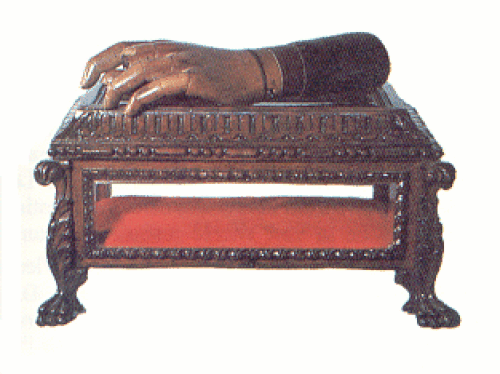
メキシコ戦役中、6,654人のフランス人が死亡した。このうち1,918人はフランス軍の1個連隊の兵士であった。[29]
普仏戦争 1870
フランス法によれば、外人部隊は国家侵略の場合を除きフランス本土では使用できないことになっていたため[30] 、セダンで降伏したナポレオン3世の帝国軍には含まれなかった。帝国軍の敗北により、フランス第二帝政は崩壊し、第三共和政が樹立された。
新たな第三共和政では、スダンの戦いに続いて訓練された兵士がひどく不足していたため、外人部隊に派遣隊を提供するよう命じられた。1870年10月11日、2個臨時大隊が海路トゥーロンに上陸した。これは外人部隊がフランス国内に配備された初めてのケースであった。外人部隊はドイツ軍の防衛線を突破してパリの包囲を解こうとした。オルレアンを奪還することに成功したが、包囲を破ることはできなかった。1871年1月、フランスは降伏したが、すぐに内戦が勃発し、革命と短命のパリ・コミューンにつながった。外人部隊はコミューンの鎮圧に参加し、[31]コミューンは大流血で鎮圧された。
トンキン作戦と清仏戦争 1883-1888

外人部隊第1大隊(ドニエ中佐)は、清仏戦争(1884年8月から1885年4月)に先立つ宣戦布告のない戦闘期間中の1883年後半にトンキンへ航海し、12月16日にソンタイの西門を襲撃した攻撃隊の一部を形成した。第2および第3歩兵大隊(ディゲ大隊長およびシェーファー中佐)もその後まもなくトンキンに配備され、清仏戦争のすべての主要な作戦に参加した。有名なトゥエンクアン包囲戦( 1884年11月24日から1885年3月3日)では、2つの外人部隊中隊が防衛を指揮した。 1885年1月、外人部隊第4大隊(chef de bataillon Vitalis)は、台湾の基隆にあるフランス軍の橋頭保に配備され、基隆作戦の後半の戦闘に参加した。この大隊は、1885年3月のジャック・デュシェーヌ大佐の攻勢において重要な役割を果たし、ラ・ターブルと竹砦という中国軍の重要拠点を占領し、基隆から撤退した。
1883 年 12 月、バクニン作戦に参加するためトンキンへ出発する前夜の第 2 軍団大隊の観閲中に、フランソワ・ド・ネグリエ将軍は有名なモットーを宣言しました: Vous, légionnaires, vous êtes soldats pour mourir, et je vous envoie où l'on meurt!(「軍団兵の皆さん、あなた方は死ぬために兵士です、そして私はあなた方を死ぬ場所に送ります!」)
アフリカの植民地化

アフリカ軍の一部として、外人部隊はサハラ以南のアフリカにおけるフランス植民地帝国の拡大に貢献した。同時に、外人部隊はアルジェリアの平和化にも参加し、さまざまな部族の反乱や暴動を鎮圧した。
第二次フランス・ダホメ戦争 1892–1894
1892年、ベハンザン国王はダホメの古い境界線を再び主張するため、グランポポとポルトノボ(現在のベナン)付近の村を攻撃するよう兵士に命じた。ベハンザン国王はフランスからの苦情を拒否し、フランスは宣戦布告した。
フォラックス・モンティエ司令官率いる大隊は、第1外国人連隊の2個中隊と第2連隊の2個中隊から編成された。コトヌーから、軍団兵はダホメ王国の首都アボメイを占領するために進軍した。ダホメの戦士、特に王のアマゾネス族との度重なる戦闘を犠牲にして、この都市に到達するまでに2か月半を要した。ベハンジン王は1894年1月に降伏し、軍団兵に捕らえられた。
第二次マダガスカル探検 1894-1895
1895年、第1および第2外国人連隊から編成された大隊が、島を征服することを任務とする遠征軍の一部としてマダガスカル王国に派遣された。この外国人大隊は、マダガスカルの首都アンタナナリボに進水した部隊の中核を形成した。数回の小競り合いの後、ラナヴァロナ3世女王は速やかに降伏した。[32] [33]外国人部隊は226名を失ったが、そのうち実際の戦闘で亡くなったのは10分の1に過ぎなかった。その他の者も、遠征軍の多くと同様、熱帯病で亡くなった。[32]遠征は成功したものの、散発的な反乱の鎮圧には、ジョセフ・ガリエニ率いるフランス軍によって島が完全に平定された1905年までさらに8年を要した。[ 32] [34]ラナヴァロナ3世女王は1897年1月に廃位され、アルジェリアのアルジェに追放され、1917年にそこで亡くなった。[35]
マンディンゴ戦争 1898
1882年から捕らえられるまで、ワッスル帝国の統治者サモリ・トゥーレはフランス植民地軍と戦い、フランスの重砲を前にしてウォヨワヤンコで大勝利を収めるなど、何度も勝利を収めた。しかし、1886年から1889年の間に、サモリはフランスに領土を割譲する条約に何度か署名せざるを得なかった。サモリは着実に撤退を開始したが、他の抵抗軍、特にシカソのバベンバ・トラオレが倒れたことで、植民地軍は彼の軍に集中攻撃を仕掛けることが可能になった。1894年初頭、ニジェールの平定のため、第2外国人連隊から2個中隊からなる大隊が編成された。ウイヤ要塞でのレジオネラの勝利と、その地域での警察の巡回により、部族の服従が加速した。 1898年9月29日、サモリ・トゥーレはフランスの司令官グローによって捕らえられ、ガボンに追放され、ワッスル帝国は終焉を迎えた。
外国人部隊の行進連隊
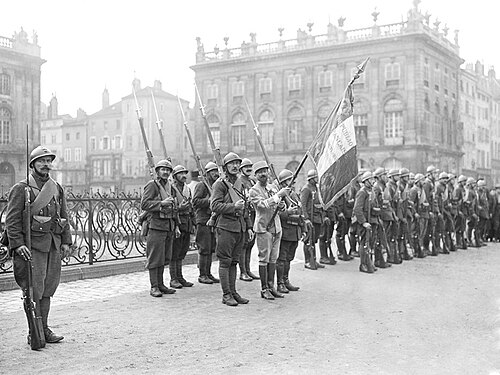
第一次世界大戦 1914–1918


を着て
1871年にドイツがアルザスとロレーヌを併合したことにより、両地域から多数の志願兵が外人部隊に入隊し、兵役終了後にフランス国籍を取得する選択肢が与えられた。[36]
1914 年 7 月 29 日の宣戦布告により、フランス在住の外国人に移住先の国を支援するよう呼びかけられました。正規のフランス軍に直接入隊したいと考える人が多かったものの、すぐに利用できる唯一の選択肢は外国人部隊でした。1914 年 8 月 3 日、パリの外国人部隊募集事務所に 8,000 人の志願者が入隊を申し込んだと報告されています。
第一次世界大戦では、外人部隊は西部戦線のアルトワ、シャンパーニュ、ソンム、エーヌ、ベルダン(1917年)などの重要な戦闘に数多く参加し、1918年には大きな損害を被った。外人部隊はダーダネルス海峡やマケドニア戦線にも参加し、その活躍で多くの勲章を授与された。1914年に戦争が勃発すると、多くの若い外国人が外人部隊に志願した。1914年の理想主義的な志願兵と旧外人部隊の屈強な兵士たちの間には著しい違いがあり、同化は困難だった。しかし、新旧の外人部隊の兵士たちは西部戦線の激しい戦闘で戦い、命を落とした。ソンムの戦いでは、詩人のアラン・シーガーが機関銃で致命傷を負った後、前進する大隊の残りを激励した。[37]
戦間期 1918–1939

レジオンの父
西部戦線で多大な犠牲を払いながらも、外人部隊は第一次世界大戦から高い評価を得て、フランス軍で最も多くの勲章を受けた部隊の一つとなって脱却した。[38] 1919年、スペイン政府はフランス外人部隊をモデルにスペイン外人部隊を結成した。 [38]ジャン・モルダック将軍は、外人部隊を歩兵のみの伝統的な役割を廃止し、より大規模な軍事組織として再建するつもりだった。[38]モルダック将軍は、連隊ではなく、部隊の主力である歩兵に加えて、騎兵、工兵、砲兵連隊を含む師団で構成される外人部隊を構想した。[38] 1920年、騎兵連隊と砲兵連隊の設立を法令で定めた。[38]休戦直後、外人部隊は入隊者数の増加を経験した。[39]外人部隊は再編成とアルジェリアへの再配備のプロセスを開始した。[38]

外国人部隊は、1920年から1925年のリーフ戦争で重要な役割を果たした。1932年、外国人部隊は3万人で構成され、6個大隊連隊に所属していた。その中には、アルジェリア、シリア、レバノンの第1外国人歩兵連隊1 er REI、モロッコ、レバノンの第2外国人歩兵連隊2 ème REI、第3外国人歩兵連隊3 ème REI、第4外国人歩兵連隊4 ème REI、インドシナの第5外国人歩兵連隊5 ème REI、レバノン、チュニジア、モロッコの第1外国人騎兵連隊1 er RECが含まれていた。 1931年、ポール・フレデリック・ロレ将軍は、彼の発案で創設された外国人部隊の第一監察官に就任した。第1外国人歩兵連隊大佐(1925年 - 1931年)の在任中、ロレは外国人部隊の創立100周年記念式典の企画を担当し、この行事を1931年4月30日のカマロンの日に予定した。彼はその後、外国人部隊の伝統の多くを復活または創設し、外国人部隊の現代的な神秘性の多くを生み出したと評価されている。
第二次世界大戦 1939–1945

外人部隊は、第一次世界大戦ほどヨーロッパ大陸では大きな役割を果たさなかったが、海上輸送の護衛からノルウェー、シリア・レバノン、北アフリカ戦線に至るまで、多くの戦域外での作戦に参加した。ノルウェーでの任務のために編成された第13半旅団は、フランス休戦(1940年6月)の時点で英国におり、北アフリカでイギリス第8軍に配備され、ビル・アケイムの戦い(1942年)で活躍した。当時の部隊編成を反映して、外人部隊の一部は自由フランス運動に参加し、他の一部はヴィシー政府に仕えた。ドイツは北アフリカでドイツ軍団兵をドイツ国防軍第90軽歩兵師団に編入した。[40]
1941年6月のシリア・レバノン戦役では、第13外国歩兵連隊(DBLE)と第6外国人歩兵連隊( REI)がダマスカスで衝突し、軍団同士の戦いが繰り広げられた。それにもかかわらず、第6外国人歩兵連隊6e(1941年12月31日に解散)の多くの兵士は、1942年に外国人部隊RMLEの行軍連隊に統合されました。後に、ヴィシー外国人部隊の兵士1,000人が自由フランス軍の第13e DBLEに加わりました。この軍は(1944年9月の時点で)ジャン・ド・ラトル・ド・タシニーのフランス解放軍(フランス語:Armée française de la Libération)の成功した合併体の一部でもありました。この合併体(40万人)は休戦軍、自由フランス軍、フランス内陸軍で構成され、B軍を形成し、後にフランスレジスタンスからも派遣された部隊と共にフランス第1軍の一部となりました。
アルザス=ロレーヌ
第二次世界大戦後、フランス語を話す元ドイツ兵の多くが、ドイツではもはや不可能な軍人としてのキャリアを追求するために外人部隊に入隊した。その中にはマルグレヌーのフランス系ドイツ兵も含まれている。アルザス=ロレーヌ出身の兵士たちがフランス語を話せなかったら問題視されただろう。インドシナ戦争中、これらのフランス語を話す元ドイツ兵は外人部隊の60パーセントを占めていた。しかし、一般に信じられているのとは反対に、フランスの政策は武装親衛隊の元隊員を排除することであり、入隊候補者は、特徴的な血液型のタトゥー、あるいはそれを隠す傷跡さえあれば拒否された。[41]
ドイツ人の割合が高いことは、単一の民族を優勢とする通常の方針に反しており、最近では外人部隊の構成に占めるドイツ人の割合ははるかに小さくなっている。[42]
第一次インドシナ戦争 1946–1954
第一次インドシナ戦争(1946年~1954年)の間、外人部隊は第二次世界大戦の退役軍人の編入によりその数が増加した。外人部隊は1880年代から活動していた地域では目覚ましい活躍を見せたが、この戦争では多大な犠牲も払った。絶えず作戦に展開していた外人部隊は、要塞化された谷が1954年5月7日に最終的に陥落する前のクライマックスのディエンビエンフーの戦いで特に大きな損失を被った。8年間の戦争中、72,833人もの兵士がインドシナで従軍した。外人部隊は戦闘で10,283人の兵士を失った。内訳は将校309人、副将校1082人、兵士9092人である。
インドシナに関与したいくつかの軍団のうちの1つに過ぎなかったが、第1外国人空挺大隊(1 er BEP)は特に目立った活躍を見せたが、2度全滅した。3度目の再編後、第1外国人空挺連隊(1 er REP)に改名された。 [43]
第1大隊は11月12日にインドシナに向けて出航し、その後トンキンで戦闘作戦に従事した。[43] 1950年11月17日、大隊はタットケにパラシュート降下し、コックサで大きな損失を被った。1951年3月1日に再編成された大隊は、チョーベン、黒河、アンナムでの戦闘作戦に参加した。[43] 1953年11月21日、再編成された第1大隊はディエンビエンフーにパラシュート降下した。[43]この戦闘で、部隊は575人が死亡または行方不明になった。[43] 1954年5月19日に3度目の再編成が行われ、大隊は1955年2月8日にインドシナを出発した。 [43] 1 er BEPはインドシナでの功績により5回の表彰とミリテール勲章[43]を授与された。1 er BEPは1955年9月1日にアルジェリアで第1外国人落下傘連隊(1 er REP)となった。
ディエンビエンフーは1954年5月7日17時30分に陥落した。[44]現在、戦場となった数ヘクタールの土地はトウモロコシ畑になっており、その周囲には戦死者を追悼する石碑が建てられている。ディエンビエンフーの守備隊にはフランス正規軍、北アフリカ軍、現地で徴兵された部隊(インドシナ人)が含まれていたが、この戦いは特に外人部隊の空挺部隊と結び付けられるようになった。
インドシナ戦争中、在郷軍人会は数本の装甲列車を運行し、フランス領インドシナの占領期間中、その象徴として長く使われました。また、在郷軍人会は大陸間の紛争に関連して、さまざまな輸送中隊も運営していました。
アルジェリア戦争 1954–1962
外人部隊空挺部隊
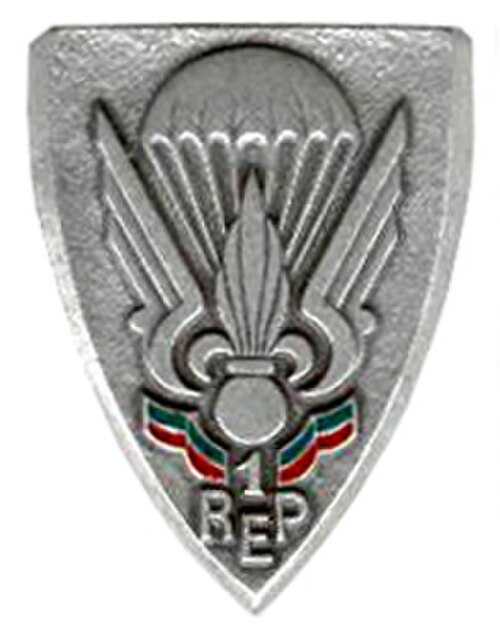
第1外国人空挺連隊はピエール・ポール・ジャンピエール中佐(1912年 - 1958年)によって編成され、指揮された[45]
この軍団は、民族解放戦線および国民解放軍 (ALN)との戦闘に深く関与した。1954年から1962年までの主な活動は、第10空挺師団および第25空挺師団の作戦の一環として行われた。第1外国人空挺連隊(1 er REP)は、第10空挺師団 (フランス) の10 ème DP の指揮下にあり、第2外国人空挺連隊(2 ème REP) は、第25空挺師団 (フランス)の25 ème DPの指揮下にあった。第 1 外国人空挺連隊 (1 er REP) と第 2 外国人空挺連隊 (2 ème REP)はともにフランス空挺師団(1956 年に設立された 10 ème DP と 25 ème DP) の作戦の一部であったが、在郷軍人会の第 1 外国人空挺連隊(1 er REP) と第 2 外国人空挺連隊(2 ème REP) はフランス師団よりも古い。1 er REP は 3 回再編された元第 1 外国人空挺大隊( 1 er BEP )であり、2 ème REP は元第2 外国人空挺大隊( 2 ème BEP ) であった。両大隊は改名され、所属する軍団員は1954年8月1日にインドシナから1954年11月1日までにアルジェリアに移送された。両大隊の起源は、第3外国人歩兵連隊のパラシュート中隊であり、第3/1アルジェリア共産党連隊に所属していたジャック・モラン軍団中尉が指揮していた。[46]
1954年11月1日にアルジェリア戦争 が始まると、インドシナから帰還した2つの外国参加空挺大隊、第1外国空挺大隊(1 er BEP、III Formation)と第2外国空挺大隊(2 ème BEP)は、まだフランスの空挺師団に所属しておらず、それぞれ1955年9月と12月1日まで連隊として指定されていませんでした。

アルジェリア戦争中の主な作戦には、アルジェの戦いと国境の戦いがあり、フランス軍と在郷軍人会の空挺部隊を含む6万人の兵士が戦った。在郷軍人会の空挺部隊では、第1外国人空挺連隊(1 er REP)と第2外国人空挺連隊(2 ème REP)が唯一の外国人現役空挺連隊として知られ、1 er REPについてはピエール・ポール・ジャンピエールが、2 ème REP については空挺部隊司令官が専属で指揮していた。[47]フランス軍の残りのフランス空挺部隊は、ジャック・マスー、ビュション、マルセル・ビジェール、ポール・オサレスが指揮した。1959年の山岳地帯におけるレギオンの他の攻勢には、オーレス県でのジュメル作戦、シガール作戦、アリエージュ作戦、そしてカビリエ県での最後の作戦が含まれていた。[45]
1961年の将軍たちのクーデター[45]でエリートの第1外国人空挺連隊( 1 er REP)が主導的な役割を果たしたことで、専門的かつ非政治的な部隊としての在郷軍人会のイメージは傷つき、その後解散した。 この連隊は第10空挺師団の一部でもあった。
将軍たちのクーデターと外人部隊の縮小

困難なインドシナ紛争を抜け出した外人部隊は、基礎訓練期間を延長することで結束を強化した。この移行期間中の努力は実を結んだが、1960年12月に将軍たちの反乱が起こり、陸軍部隊に信頼を置いていた外人部隊に危機が襲いかかった。[49]
1961 年 4 月の将軍たちのクーデターに加わったため、第 10 空挺師団の第 1 外国人空挺連隊は1961 年 4 月 30 日にゼラルダで解散されました。
1961年、クーデターの発生時に、外人部隊第1サハラ騎馬中隊[50](フランス語:1 er Escadron Saharien Porté de la Légion Etrangère、1 er ESPLE )が監視と警備の任務を負った。
1962年のアルジェリアのフランスからの独立は、1842年に設置されたシディ・ベル・アッベスの兵舎司令部が強制的に放棄されるという結末を迎えたため、トラウマとなった。エリート連隊が解散し、再配置するよう通知を受けた第1レムリア軍団の兵士たちは、1884年のトゥエンクアン包囲戦後に獲得した中国館を焼き払った。その後、ジャン・ダンジュー大尉の木手を含む軍団の歴史博物館の遺物は、軍団とともにフランスへ渡った。また、シディ・ベル・アッベスからは、将軍 ポール・フレデリック・ロレ(軍団の父)、軍団将校のオーゲ・フォン・ローゼンボー伯爵王子、軍団兵ハインツ・ツィンメルマン(アルジェリア最後の犠牲者)の象徴的な遺骨も移動された。

在郷軍人会は、1961 年のアルジェ反乱の後、再配置のため兵舎を離れる副将校と在郷軍人会兵が歌った 1960 年のエディット ピアフの歌である「いいえ、私は何も後悔していません」というパレード ソングを獲得しました。この歌は、それ以来在郷軍人会の伝統の一部となっています。
第1外国人空挺連隊1 er REPは1961年4月30日に解散した。[45]しかし、第2外国人空挺連隊2 ème REPは存続し、サハラ中隊の人員のほとんどはそれぞれ第1外国人歩兵連隊、第2外国人歩兵連隊、第4外国人歩兵連隊に編入された。
ポスト植民地アフリカ
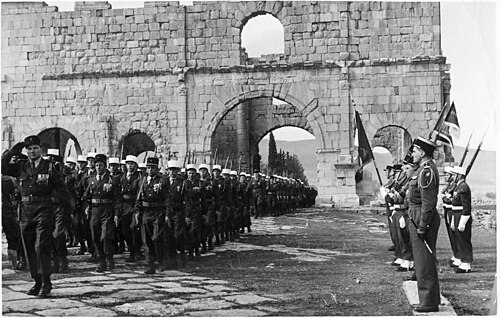
1960年代半ばまでに、レジオンはフランス領アルジェリアにおける伝統的かつ精神的な拠点を失い、エリート部隊は解散された。[43]ドゴール大統領は、完全に解散することも考えたが、行軍連隊のこと、第13半旅団が1940年に大統領のために最初に宣言した部隊の一つであったこと、また様々なサハラ部隊の効果的な働きと他のレジオン部隊の働きを考慮して、レジオンを4万人から8千人に縮小し、フランス本土に移転することを選択した。[51]レジオンの部隊は、北アフリカではないものの、海外任務に引き続き配属された(下記参照)。
1962年~現在
1960 年代初頭、進行中の世界的な急速な展開に加えて、軍団はさまざまな機能ユニットを運用しながら、さまざまな大陸に部隊を駐留させました。
外国人部隊の主要懲戒中隊 (CDLE) は、1931 年にロレ将軍が定めた規則と規制に基づき、アルジェリア、モロッコ、チュニジア、レバント、トンキン (第 5 外国人歩兵連隊の特別部隊、その後 1963 年には第 5e REI と第 2 外国人歩兵連隊のサハラ懲戒部隊の一部) に駐屯または活動する外国人部隊連隊から送られた重犯罪者を受け入れました。この部隊は 1964 年 7 月 1 日に解散しました。
1965年から1967年にかけて、レギオンは、主にサハラ砂漠からの避難を担当する第5重量輸送中隊(CTGP)を含むいくつかの中隊を運営しました。これらの部隊の一部の責任範囲は、サハラ砂漠の中間地帯から地中海まで広がっていました。2年後とその後の数年間に行われた継続的な介入と迅速な展開には、次のようなものがありました。
- 1969–1971 :チャドへの介入
- 1978年~現在:地中海周辺での平和維持活動、テロとの戦いにおけるレバノンの国連暫定軍を含む
- 1978–1978 :コルウェジの戦い(ザイール)
- 1981年~1984年 :レバノン内戦の間、国連多国籍軍の軍団と第31外人旅団(第1外国人連隊1 er RE)が協力してレバノンで平和維持活動を行った。エポラールI作戦の先鋒はベルナール・ジャンビエ中佐が務めた。多国籍軍には、イギリス軍第1女王近衛竜騎兵連隊、アメリカ海兵隊とアメリカ海軍の米派遣部隊、フランス海軍、フランス空挺部隊連隊、中隊、第11空挺旅団の部隊、第2外国人空挺連隊2 e REPを含むフランス軍専用28連隊も含まれていた。多国籍軍には、アイルランド軍、フランス国家憲兵隊、イタリアのフォルゴレ旅団の空挺部隊、ベルサリエーリ連隊の歩兵部隊、サンマルコ大隊の海兵隊も含まれていた。
湾岸戦争 1990–1991
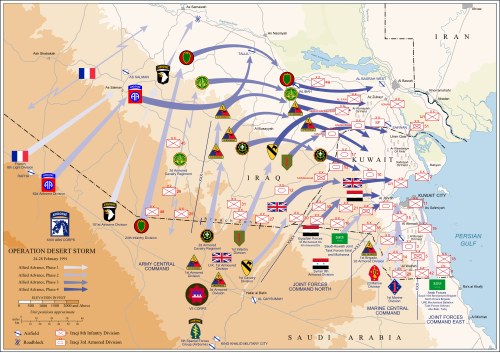
1990年9月、第1外国人連隊、第1外国人騎兵連隊、第2外国人空挺連隊、第2外国人歩兵連隊、第6外国人工兵連隊は、第1スパヒ連隊、第11海兵砲兵連隊、第3海兵歩兵連隊、第21海兵歩兵連隊、フランス陸軍軽航空隊、海兵連隊、第35空挺砲兵連隊の一部、第1空挺騎兵連隊、第17空挺工兵連隊とともに、ダゲ作戦の一環としてペルシア湾に派遣された。ダゲ師団はベルナール・ジャンヴィエ旅団長が指揮した。

27の異なる国籍から構成されたレギオン部隊は、連合軍の左翼を守る任務を負ったフランス第6軽装甲師団に所属していた。 [52]
4週間の空爆作戦の後、連合軍は地上攻勢を開始した。彼らはすぐにイラクの奥深くまで侵入し、フランス外人部隊は抵抗にほとんど遭わずにサルマン空港を占領した。地上での100時間の戦闘の後、戦争は終結し、フランス外人部隊の死傷者はごくわずかだった。戦争中、フランス外人部隊の技術者は米陸軍第82空挺師団を支援し、同師団にEODサービスを提供した。停戦後、彼らはオーストラリア海軍の 掃海ダイバーと共同で地雷除去作戦を実施した。
1991年以降
- 1991年:ルワンダ、ガボン、ザイールにおけるフランス国民および外国人の避難。
- 1992年:カンボジアとソマリア
- 1993年:サラエボ、ボスニア・ヘルツェゴビナ
- 1995年:ルワンダ
- 1996年:中央アフリカ共和国
- 1997年:コンゴ共和国
- 1999年以来:コソボと北マケドニアにおけるKFOR
2001年~現在
- 2001年~2014年:アフガニスタン戦争における不朽の自由作戦
- 2002–2003:コートジボワールのリコルヌ作戦
- 2008年:チャドにおけるEUFORチャド/RCA
- 2013年~2014年:マリ北部紛争におけるセルヴァル作戦[53]
- 2015–現在:フランス首都圏のセンチネル作戦。
組織
運用面では、外国人部隊はフランス軍の様々な旅団や地域司令部に所属している。[54]一方、行政管理(募集、伝統、訓練を含む)に関しては、これらの部隊はフランス軍に従属する外国人部隊司令部(COMLE)に依存している。 [55]
連隊は現在、主にフランス本土に駐留しており、一部の部隊は海外県や海外領土(主にフランス領ギアナ)に駐留している。[54]
- フランス本土
- 1er Régiment Étranger (1 er RE)、フランスのオーバーニュに拠点を置く(本部、選抜と管理、その他の特定の任務)
- 1er Régiment Étranger de Cavalerie (1 er REC)、フランスのCamp de Carpiagne [fr]に拠点を置く
- 1er Régiment Étrange de Génie (1 er REG)、フランスの ローダンに拠点を置く
- 2e Régiment Étranger d'Infanterie (2 ème REI)、フランスのニームに拠点を置く
- 2e Régiment Étranger de Génie (2 ème REG)、フランスの サンクリストルに拠点を置く
- 2e Régiment Étranger de Parachutistes (2 ème REP)、コルシカ島カルヴィに拠点を置く
- 4e レジメント エトランジェ(4 ème RE)、本拠地はフランスの カステルノーダリ
- Groupement de Recrutement de la Légion Etrangere (GRLE)、フランスのフォート・ド・ノジャンに拠点を置く
- 13e Demi-Brigade de Légion Étrangere (13 ème DBLE)、フランスのラ・カヴァレリーに拠点を置く
- フランス海外領土および海外集団、フランス
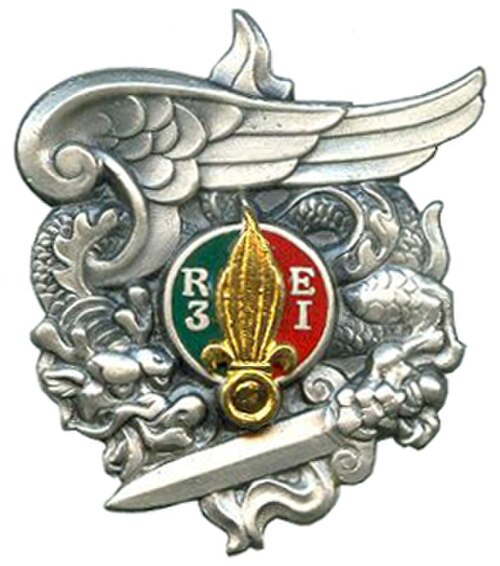
- 3e Régiment Étranger d'Infanterie (3 ème REI)、フランス領ギアナに拠点を置く
- マヨット軍団分遣隊(DLEM)
現在の展開
これらは以下の展開である: [56]
注: 国または地域の英語名は括弧内に表示されます。
- 外部作戦(本拠地または通常の任務以外)
DINOPS、PCG、コマンドス
- 2はREP コマンド パラシュート グループ( GCP ) に属し、直接行動、特殊偵察、IMEX の資格を持つパスファインダーです。
- 第1期エトランジェ・ド・ジェニー第1期REG;パラシュート水中破壊PCGチーム (Combat Engineer Divers、フランス語: Plongeurs Commando グループ)、Nautical Subaquatic Intervention Operational Detachment (フランス語: Détachement d'Intervention Nautique Operationnelle Subaquatique )のDINOPSチーム。
- 2e レジメント・エトランジェ・ド・ジェニ2 ème REG;パラシュート水中破壊PCGチーム (Combat Engineer Divers、フランス語: Plongeurs du Combat du Génie )、海洋亜水中介入作戦分遣隊の DINOPS チーム (フランス語: Détachement d'Intervention Nautique Operationnelle Subaquatique )、および山岳コマンドー グループ( GCM ) が 2 名になる場合もある特産品。[57]
構成
フランス軍団はフランス軍の不可欠な部分であり、現在、フランス軍の兵力の約7~8%(フランス軍の作戦部隊である地上作戦部隊(FOT)の11%)を占めています。[58]
外人部隊はフランス軍で唯一、国籍を問わず入隊できる部隊である。外人部隊員の多くは依然としてヨーロッパ諸国出身だが、ラテンアメリカやアジア出身者の割合も増加している。[59]外人部隊の士官のほとんどはフランス人で、約10%は階級を昇進した外人部隊員である。[60]
メンバーは140カ国から来ている。かつて、在郷軍人会の隊員は偽名(「申告身元」)で入隊することを強制された。この方針は、人生をやり直したい新兵が入隊できるようにするために考案された。在郷軍人会は、すべての新兵に申告身元を使用させる方が公平であると信じていた。[11]フランス国民は、申告された架空の外国国籍(一般的にはフランス語圏の国籍で、ベルギー、カナダ、スイスのものが多い)で入隊できる。[61] 2010年9月20日現在、新兵は実名または申告身元で入隊できる。申告身元で入隊した新兵は、1年間の勤務後、本当の身元で状況を正規化できる。[62]外国人部隊で3年間勤務した後、在郷軍人はフランス国籍を申請できる。[11]彼は本名で勤務し、当局と問題を起こしておらず、「名誉と忠誠」をもって勤務していなければならない。[62]
外人部隊は女性を受け入れていないが、第二次世界大戦中に自由フランス軍に入隊したイギリス人女性スーザン・トラヴァースという女性隊員が1人いる。彼女は戦後外人部隊の一員となり、その後第一次インドシナ戦争中にベトナムで従軍した。[61] 2000年10月、女性の入隊禁止は撤回された。[63]しかし、この発表は1か月後に撤回され、「コミュニケーションミス」が原因とされた。スポークスマンは、女性を外人部隊から排除する方針は変更されないことを確認した。[64]
国別の会員数
2008 年現在、在郷軍人会の出身国は 140 か国に上ります。下士官の大半はフランス国外の出身ですが、将校団の大半はフランス人です。新兵の多くは東ヨーロッパ[どこ]とラテンアメリカ[どこ]の出身です。デイリー テレグラフ紙のニール トゥイーディー氏は、ドイツは伝統的に多くの新兵を輩出しており、「2 つの世界大戦で在郷軍人会が血なまぐさい役割を果たしたことを考えると、皮肉なことです」と述べています。
2024年現在、ロシアのウクライナ侵攻により、ベラルーシ人とロシア人は軍団に入隊できなくなった。[65]
アルザス=ロレーヌ
外人部隊の出身国籍は、彼らが入隊した当時の歴史的出来事を反映している。元ドイツ国防軍人の多くは第二次世界大戦後に入隊した[66]。民間人に戻った兵士の多くが安定した職に就くのに苦労したためである。ジャン=ドニ・ルパージュは「外人部隊はドイツの捕虜収容所からひそかに徴兵した」と報告しているが[67] 、これらの徴兵者の数はその後誇張されたと付け加えている。フランス政府の支持者であったバーナード・B・フォールは、第一次インドシナ戦争の文脈で執筆し、当時の外人部隊が主にドイツ人であったという考えに疑問を呈し、次のように述べている。
[a] デマ...それらのドイツ人は全員、少なくとも SS 将軍と他の指名手配中の戦争犯罪者だったという派生説。通常、そして特定の国が外人部隊を近衛兵にすることを防ぐため、特定の国籍の構成員は全体の約 25 パーセントに抑えられています。たとえフランスの募集担当者が候補者を熱望して、スイス、オーストリア、スカンジナビア、および関連する民族的背景を持つ他の国籍のドイツ人を入隊登録したと仮定しても (もちろんこれは事実です)、外人部隊のドイツ人の数が 35 パーセントを超えることはまずありません。したがって、損失、ローテーション、除隊などを考慮に入れなければ、一度にインドシナで戦ったドイツ人の最大数は 278,000 人中おそらく 7,000 人に達しました。元ナチスに関しては、初期に到着した兵士の中には戦争犯罪者であることが知られている人はいませんでした。フランスの諜報機関がそれを確認しました。
インドシナの厳しい気候を考えると、熱帯地域での経験がない年配の男性は有利というより不利であったため、外人部隊の入隊者の平均年齢は約23歳だった。ディエンビエンフーの戦いの当時、その年齢層の兵士は、第三帝国が崩壊したときに「ヒトラーユーゲント」のショートパンツをはいた最悪の状態だった。[68]
外人部隊は、自国の国籍以外で入隊する人々を受け入れている。スイス人とベルギー人の一部は、実際には発覚を避けたいフランス人である可能性が高い。[69]さらに、多くのアルザス人は、アルザスがドイツ帝国の一部であったときに外人部隊に入隊したと言われており、自分たちをフランス人だと考えながらドイツ人として記録された可能性がある。
外国人部隊の募集条件については、このテーマを専門とする公式ページ(英語)を参照のこと。[70]年齢制限については、17歳半(親の同意があれば)から39歳半までが募集対象となっている。
外人部隊契約後の就労を認める国
欧州連合の枠組みでは、在郷軍人会入隊後の扱いは明確ではありません。デンマーク、ノルウェー、ドイツ、ポルトガルでは、在郷軍人会入隊後の扱いが認められています。欧州連合の二重のスレッドは、二重国籍のステータスが認められているか、憲法条項で制限されているようです。
米国は、グリーンカード保持者で職業軍人(大尉まで)の退役後の州兵入隊を認めている。[要出典]
イスラエルは在郷軍人会退役後の入隊を許可している。[要出典]
ポーランド軍団の最大の民族グループの一つはポーランド人である。ポーランドの法律では外国軍への従軍が認められているが、ポーランド国防省の書面による許可が必要となっている。[71]
採用プロセス
基礎訓練
レジオンの兵員は全員、「外国人ステータス」(à titre étranger)で勤務することが義務付けられているが、フランス国籍であっても、下士官および将校はフランス国籍または外国人ステータスで勤務することができる。[11]外国人ステータスの下士官および将校は階級から昇進した者のみが対象であり、レジオンの将校団の10%を占める。[72]フランス国籍の将校は、レジオンに所属するフランス軍の他の部隊のメンバー、またはフランス国籍になることを選択した昇進したレジオン兵である。
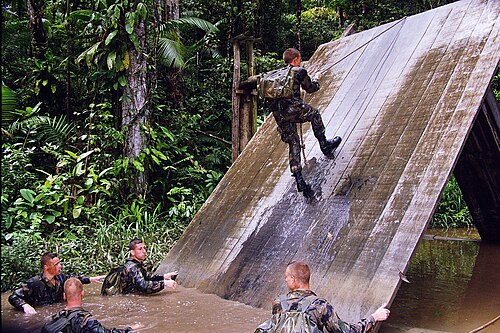
外国人部隊の基礎訓練は第 4 外国人連隊で行われます。これは実戦戦闘連隊であり、新兵が実戦部隊に配属される前に 15 ~ 17 週間の訓練コースが行われます。
- 「農場」(La Ferme)での 4 ~ 6 週間の初期トレーニング - 軍隊生活、屋外およびフィールド活動の紹介。
- ケピ・ブラン行進 ( Marche Képi Blanc ) – フル装備で 2 日間 (1 日 25 km) かけて 50 キロメートル行進し、3 日目にケピ・ブランの儀式が行われます。
- 技術および実践的なトレーニング(兵舎と野外トレーニングを交互に実施) – 3 週間。
- 山岳トレーニング(フランス・ピレネー山脈のフォルミゲール) – 1 週間。
- 技術および実践的なトレーニング(兵舎と野外トレーニングを交互に実施) – 3 週間。
- 初級技術証明書(CTE)の試験と取得 – 1 週間。
- レイド行進 ( Marche Raid ) - 3 日間で完了しなければならない 120 キロメートルの最終行進。
- 軽自動車運転者教育(運転免許) – 1 週間。
- 割り当てられた作戦連隊に報告する前にオーバーニュに戻ります(1 週間)。
フランス語教育(読み、書き、発音)は、基礎訓練全体を通して毎日行われます。
伝統
外人部隊は様々な国籍や背景を持つ兵士で構成されているため、強い団結心を育むことが必要であり、[46]それは仲間意識の育成、[46]特定の伝統、兵士の忠誠心、訓練の質、エリート部隊の兵士であることの誇りを通じて達成される。[46]
名誉の規範
「レジオンの信条」[73] [74]はレジオンの信条であり、フランス語のみで朗読される。[75] [76]この信条は1980年代に採択された。[73]
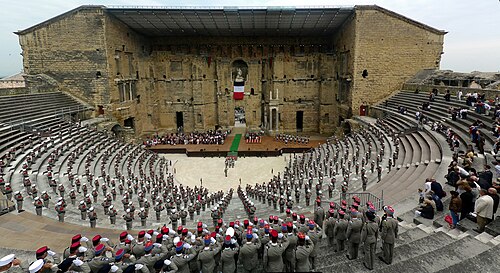

モットー
名誉と忠誠
他のフランス軍部隊とは対照的に、外人部隊の連隊旗に刺繍された標語はHonneur et Patrie(名誉と祖国)ではなくHonneur et Fidélité(名誉と忠誠)である。[77]
レギオ・パトリア・ノストラ
外国人部隊は我らの祖国(フランス語ではLa Légion est notre Patrie、英語ではThe Legion is our Fatherland)は、外国人部隊のラテン語の標語である。 [77]外国人部隊を新たな「祖国」として採用することは、外国人部隊員が元の国籍を放棄することを意味するものではない。外国人部隊は、出身国に反抗する任務に就く可能性がある状況に置かれる前に、外国人部隊員の同意を得る必要がある。
連隊のモットー
- 1 er RE :オヌールとフィデリテ
- GRLE :名誉と忠誠
- 1 er REC : Honneur et FidélitéおよびNec Pluribus Impar (他に同等のものなし)
- 2 e REP:名誉と忠誠、そしてより一層の敬意[78](我が国の退役軍人[79]のやり方、やり方、伝統に従って)
- 2 e REI : Honneur et FidélitéとÊtre prêt (準備を整えてください)
- 2 e REG : Honneur et FidélitéおよびRien n'empêche (何も妨げるものはありません)
- 3 e REI : Honneur et FidélitéとLegio Patria Nostra
- 4 e RE : Honneur et FidélitéおよびCreuset de la Légion et Régiment des fortes têtes (軍団の坩堝と強力な右翼連隊)
- 1e REG : Honneur et Fidélité and Ad Unum (最後の一人まで連隊のために、全員一つの目的のために)
- 13 e DBLE : Honneur et Fidélité and More Majorum [78] (「我々の退役軍人外国連隊のやり方、やり方、伝統において」)
- DLEM : Honneur et FidélitéとPericula Ludus (危険ゲーム-第 2 外人騎兵連隊の「危険は私の喜び」連隊向け)
記章
ランク
外人部隊のすべての志願兵は、基礎兵としてキャリアを開始し、4人に1人が最終的に下士官になる。[ 82 ]入隊すると、新兵は食事と宿泊に加えて月額1,572ユーロの給与を受け取る。[83]また、新兵には新しいライフルが与えられるが、外人部隊の言い伝えによれば、そのライフルを戦場に残してはならない。[11]昇進はフランス軍の階級と同時に行われる。

下士官および准尉

礼装の記章は、階級章、連隊章、勤続年数を示すシェブロンの 3 つの要素で構成されています。写真の 3 つの上向きの金色のシェブロンは、軍曹長を示しています。ダイヤモンド形の連隊章 ( Écusson ) は、手榴弾の記章を囲む 3 つの緑色のダイヤモンド形で、3 つのダイヤモンドは植民地部隊を示し、1 つのダイヤモンドは正規軍部隊、2 つのダイヤモンドは予備軍部隊を示します。レジオンの手榴弾の記章には、通常の 5 つではなく 7 つの炎があり、2 つの下向きの勤続年数を示すシェブロンは、少なくとも 10 年の勤務を示します。一部の軍曹長長は、30 年以上勤務したことを示すために、6 つの勤続年数を示すシェブロンを持つ場合があります。このスタイルの記章は礼装の左袖にのみ着用され、連隊のダイヤモンドと年功章のない同様のサイズの記章が右袖に着用されます。パイオニア部隊の右袖記章には例外があり、階級に応じて金色または緑色のパイオニアの紋章が組み込まれていますが、年功章は組み込まれていません。年功章は、前述のように連隊のダイヤモンドの下の左袖記章に着用されます。
准尉を含む下士官(NCO)は、現在の外人部隊の総人員の 25% を占めています。
任命された将校
将校のほとんどはフランス陸軍の正規軍人であるが、およそ10%は下士官から昇進した元将校である。[82]
年功序列のシェブロン
外国人部隊は、下向きの金色のシェブロン(chevrons d'ancienneté)を使用して、勤続年数を示します。これは、通常の部隊兵と下士官が礼服の左袖の階級章と連隊章の下に着用し、[88]各シェブロンは、外国人部隊での5年間の勤務を意味します。勤続年数を示すシェブロンは、士官は着用しません。
名誉階級
フランス軍は 1796 年以来、並外れた勇敢な行為を行った個人に名誉階級を授与してきました。外人部隊では、ポール・フレデリック・ロレ将軍が20 世紀初頭に民間人、軍人を問わず著名な個人に名誉外人部隊の階級を授与する慣例を導入しました。
これらの名誉称号の受章者は、在外部隊の部隊で模範的な活躍をしたか、非戦闘状況で在外部隊に並外れた貢献をした人々である。[89] 1,200人以上の個人が在外部隊の名誉階級を授与されている。これらの賞の大部分は戦時中の軍人に対して授与されており、レジオンネール・ドヌールやレジオンドヌール勲章サージェント・シェフなどの称号が授与されているが、その他の受章者には、外人部隊に功績のあった看護師、ジャーナリスト、画家、牧師などが含まれている。[89]
パイオニア

ピオニエ(先駆者)は戦闘工兵であり、外人部隊の伝統的な部隊である。工兵は伝統的に大きなあごひげを生やし、革のエプロンと手袋を着用し、斧を持っている。工兵はナポレオン時代のヨーロッパの軍隊では非常に一般的であったが、19世紀には徐々に姿を消した。フランス軍は、外人部隊を含めて1870年に連隊工兵小隊を解散した。しかし、1931年に外人部隊の創立100周年を記念して復活したいくつかの伝統の1つは、ひげを生やしたピオニエの復活であった。[90]
フランス軍では、18 世紀以来、すべての歩兵連隊に小規模な開拓部隊が含まれていました。道路建設や塹壕工事に加え、こうした部隊は斧やシャベルを使って敵の攻撃下で障害物を取り除き、残りの歩兵が通れるようにする任務を負っていました。こうした任務の危険性が認識されていたため、ひげを生やすことが認められるなど、一定の特権が与えられていました。
現在の外国人部隊の先駆小隊は、外国人部隊の補給所と本部連隊によって公的儀式のために提供されている。[91]この部隊は、ナポレオンの工兵のシンボルであるひげ、斧、革のエプロン、交差した斧の記章、革の手袋を再導入した。外国人部隊のパレードがこの部隊によって開かれるのは、兵士たちに「道を開く」という工兵の伝統的な役割を記念するためである。[90]
行進のリズムと歌

外人部隊の行進の速さも注目に値する。他のフランス部隊の行進の速さが 1 分あたり 116 歩であるのに対し、外人部隊の行進の速さは 1 分あたり 88 歩である。これは、外人部隊が参加する式典のパレードや公開展示で見られるもので、特に 7 月 14 日 (フランス革命記念日の軍事パレード) にパリでパレードしているときによく見られる。驚くほど遅いペースのため、外人部隊はどのパレードでも常に最後に行進する部隊である。外人部隊は通常、独自の楽団を伴奏にしており、この楽団は、実際にパレードに参加している部隊以外の外人部隊の連隊の行進曲を演奏するのが伝統となっている。各部隊の連隊歌と「ル・ブーダン」は、直立不動の姿勢で立っている兵士によって歌われる。また、外人部隊は常に団結していなければならないため、他のフランス軍部隊のように大統領観覧席に近づく際に隊列を二つに分けることはせず、部隊の団結を保つようにしている。
一般に信じられていることとは反対に、外人部隊がゆっくりとした行軍速度を採用したのは、アルジェリアの灼熱の太陽の下での長い行軍中に体力と水分を温存する必要があったからではない。正確な起源は不明だが、公式の説明では、このペース規制は1945年以前には制定されていなかったようだが、アンシャン・レジームのゆっくりとした行軍ペースに由来しており、その再導入は「伝統的なルーツへの回帰」であったという。[92]これは実際、外人部隊の祖先部隊、つまりアンシャン・レジームのフランス軍の外国人連隊、大陸軍の外国人部隊、および1831年以前の外国人連隊の行軍ペースであった。
行進曲
「ル・ブーダン「

「ル・ブーダン」[5] [93]は外人部隊の行進曲である。
その他の曲
- 「ノン、ジェ・ネ・リグレット・リアン」、第1外国人落下傘連隊
- 「パリの空よ」フランス外人部隊合唱団
- 『Anne Marie du 3 e』 REI (ドイツ語) [94]
- 「さようなら、さようなら」
- 「軍人」
- 『アン・マリー・ドゥ・2・REI』[95]
- 「さようならヨーロッパ [fr]」
- 「オニヨンの歌」
- 「シャント・デュ・カトリエーム・エスカドロン」
- 「3e で私たちに会いに来てください」
- 「それは4つ」
- 「コネセヴー・セ・オム」
- 「ベトナム人と戦う」(外国人部隊第 13 半旅団の歌。後に第 1 外国人空挺連隊の行進曲として採用された)
- 「クラヴァテ ヴェール エ ケピ ブラン」
- 「ダンス・ラ・ブルーム、ラ・ロカイユ」
- 「3とREIのファイル」
- 「エーデルワイスを飼おう」
- 「エコー」
- 「アフリカ」
- 「アン・アルジェリー」 (1 er RE) [96]
- 「Es steht eine Mühle」(ドイツ語)
- 「ウジェニー」
- 「レ・ケピ・ブラン」 (1 e RE) [97]
- 「名誉、忠誠」
- 「Ich hatt' einen Kamiraden」(ドイツ語)
- 「私はムーランだ」
- 「友情を持て」
- 「カメラマン(ドイツ語)」
- 「La colonne」(1位)
- 「ラ・レジオン・マルシェ」 (2 e REP) [48]
- 「月は明るい」
- 「ル・カイド」
- 「ル・シャン・デ・マレ [fr]」
- 「ルートのカイユー・シュール・イル・ヤ・デ・カイユー」
- 「レギオンのファン」
- 「ル・ソレイユ・ブリユ」
- 「Lefront haut et l'âme fière」 (5 e RE)
- 「レジオネール・ド・ラ・アフリカ」
- 「マサリ・マリー [fr]」
- 「モニカ」
- 「Sous le Soleil brûlant d'Afrique」 (13 e DBLE)
- 「Nous sommes tous des volontaires」 (1 er RE) [98]
- 「私たちはレジオンの一員です」
- 「ラ・プティット・ピスト」
- 「情熱を注いでください」
- 「1 RECの最初の歌」
- 「最高の人生を送りましょう」
- 「Rien n'empêche」 (2 er REG) [99]
- 「サプール、鉱夫、そしてバティシュール」 (6 e REG)
- 「レジオン・エトランジェールの兵士」
- 「過ぎ去った記念品」
- 「スザンナ」
- 「風車」
- 「喜んで」
- 「ヴェロニカ」
ユニフォーム
創設から第一次世界大戦まで、外人部隊は、いくつかの特別な特徴はあるものの、行進の際にはフランス軍の制服を着用するのが普通だった。[100]基本的には、濃紺のコート(後にチュニック)に赤いズボンという構成だった。野戦服は、外人部隊が従軍した気候や地形の極端さの影響を受けて、しばしば改良された。シャコー帽はすぐに、北アフリカの条件にはるかに適した軽い布製のケピ帽に置き換えられた。行進時には厚手のカポテ(グレートコート)を着用し、兵舎では作業着としてベスト(腰までの短いジャケット)を着用する慣習は、創設当初から外人部隊が踏襲していた。[101]短期間続いた例外としては、1856年にクリミア戦争 への従軍のためスイスで募集された外人部隊が緑の制服を着用したことが挙げられる。[102]クリミア半島(1854-59)では、冬の服装としてフード付きのコートと赤または青の腰帯が採用され、[103]メキシコ介入(1863-65)の際には麦わら帽子やソンブレロがケピ帽の代わりに使われることもあった。[104] [105]ケピ帽を着用する際は、通常、白い「ハブロック」(麻のカバー)で覆った。これは、外人部隊のシンボルとなる白いケピ帽の前身である。1870-71年の普仏戦争中にフランスで活動した外人部隊は、記章の細部以外はフランス歩兵の大部分と区別がつかなかった。しかし、その後の植民地作戦では、1884年から1885年のトンキンでの襟なしのケオ・ブラウス、 1892年のダホメでのカーキ色のドリルジャケット[106] 、1895年のマダガスカルでの真っ白な作業服と合わせたくすんだ色の覆われたトピー[107]など、暑い季節に着る特別な衣服の使用が増えました。[108]

In the early 20th century the legionnaire wore a red kepi with blue band and piping, dark blue tunic with red collar, red cuff patches, and red trousers.[109] Distinctive features were the green epaulettes (replacing the red of the line) worn with red woollen fringes;[110] plus the embroidered Legion badge of a red flaming grenade, worn on the kepi front instead of a regimental number.[111] In the field a light khaki cover was worn over the kepi, sometimes with a protective neck curtain attached. The standard medium-blue double breasted greatcoat (capote) of the French infantry was worn, usually buttoned back to free the legs for marching.[112] From the 1830s the legionnaires had worn a broad blue woollen sash around the waist,[113] like other European units of the French Army of Africa (such as the Zouaves or the Chasseurs d'Afrique), while indigenous units of the Army of Africa (spahis and tirailleurs) wore red sashes. White linen trousers tucked into short leather leggings were substituted for red serge in hot weather.[114] This was the origin of the "Beau Geste" image.
In barracks a white bleached kepi cover was often worn together with a short dark blue jacket ("veste") or white blouse plus white trousers. The original kepi cover was khaki and due to constant washing turned white quickly. The white or khaki kepi cover was not unique to the Foreign Legion at this stage but was commonly seen amongst other French units in North Africa. It later became particularly identified with the Foreign Legion as the unit most likely to serve at remote frontier posts (other than locally recruited tirailleurs who wore fezzes or turbans). The variances of climate in North Africa led the French Army to the sensible expedient of letting local commanders decide on the appropriate "tenue de jour" (uniform of the day) according to circumstances. Thus a legionnaire might parade or walk out in blue tunic and white trousers in hot weather, blue tunic and red trousers in normal temperatures or wear the blue greatcoat with red trousers under colder conditions. The sash could be worn with greatcoat, blouse or veste but not with the tunic. Epaulettes were a detachable dress item worn only with tunic or greatcoat for parade or off duty wear.[115]
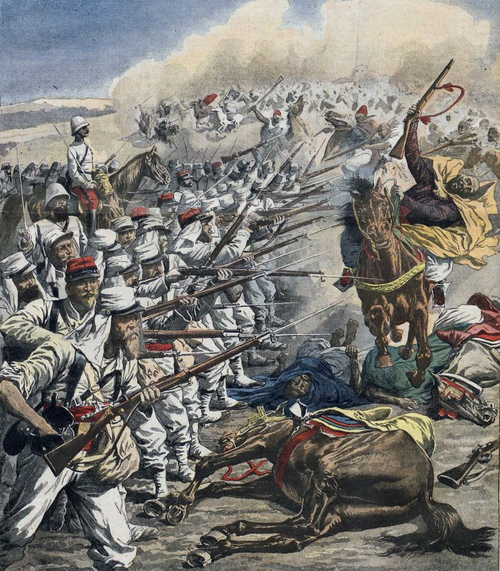
Officers wore the same dark blue (almost black) tunics as those of their colleagues in the French line regiments, except that black replaced red as a facing colour on collar and cuffs.[116] Gold fringed epaulettes were worn for full dress and rank was shown by the number of gold rings on both kepi and cuffs. Trousers were red with black stripes or white according to occasion or conditions. All-white or light khaki uniforms (from as early as the 1890s) were often worn in the field or for ordinary duties in barracks.[117] Non-commissioned officers were distinguished by red or gold diagonal stripes on the lower sleeves of tunics, vestes and greatcoats.[118] Small detachable stripes were buttoned on to the front of the white shirt-like blouse.
Prior to 1914 units in Indo-China wore white or khaki Colonial Infantry uniforms with Foreign Legion insignia, to overcome supply difficulties.[119] This dress included a white sun helmet of a model that was also issued to Foreign Legion units serving in the outposts of Southern Algeria, though never popular with its wearers.[120] During the initial months of World War I, Foreign Legion units serving in France wore the standard blue greatcoat and red trousers of the French line infantry, distinguished only by collar patches of the same blue as the capote, instead of red.[121] After a short period in sky-blue the Foreign Legion adopted khaki, in common with other units of the Armée d'Afrique, with steel helmets, from early 1916.[122][123] A mustard shade of khaki drill had been worn on active service in Morocco from 1909, replacing the classic blue and white.[124] The latter continued to be worn in the relatively peaceful conditions of Algeria throughout World War I, although increasingly replaced by khaki drill. The pre-1914 blue and red uniforms could still be occasionally seen as garrison dress in Algeria until stocks were used up about 1919.
During the early 1920s plain khaki drill uniforms of a standard pattern became universal issue for the Foreign Legion with only the red and blue kepi (with or without a cover) and green collar braiding to distinguish the Legionnaire from other French soldiers serving in North African and Indo-China. The neck curtain ceased to be worn from about 1915, although it survived in the newly raised Foreign Legion Cavalry Regiment into the 1920s. The white blouse (bourgeron) and trousers dating from 1882 were retained for fatigue wear until the 1930s.[125]
At the time of the Foreign Legion's centennial in 1931, a number of traditional features were reintroduced at the initiative of the then commander Colonel Rollet.[126] These included the blue sash and green/red epaulettes. In 1939 the white covered kepi won recognition as the official headdress of the Foreign Legion to be worn on most occasions, rather than simply as a means of reflecting heat and protecting the blue and red material underneath. The Third Foreign Infantry Regiment adopted white tunics and trousers for walking-out dress during the 1930s[127] and all Foreign Legion officers were required to obtain full dress uniforms in the pre-war colours of black and red from 1932 to 1939.
During World War II the Foreign Legion wore a wide range of uniform styles depending on supply sources. These ranged from the heavy capotes and Adrian helmets of 1940 through to British battledress and American field uniforms from 1943 to 1945. The white kepi was stubbornly retained whenever possible.
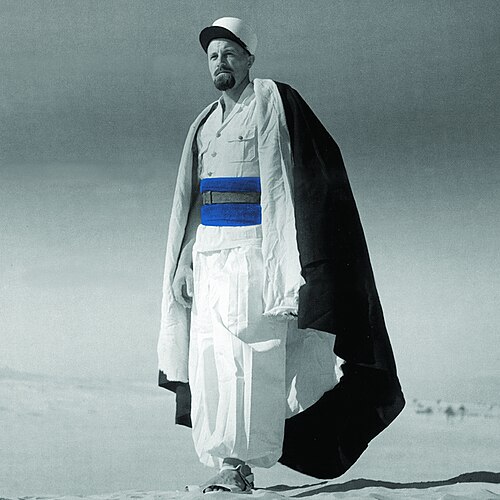
From 1940 until 1963 the Foreign Legion maintained four Saharan Companies (Compagnies Sahariennes) as part of the French forces used to patrol and police the desert regions to the south of Morocco and Algeria. Special uniforms were developed for these units, modeled on those of the French officered Camel Corps (Méharistes) having prime responsibility for the Sahara. In full dress these included black or white zouave style trousers, worn with white tunics and long flowing cloaks. The Legion companies maintained their separate identity by retaining their distinctive kepis, sashes and fringed epaulettes.
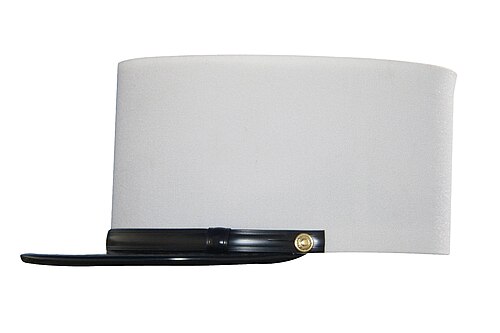
The white kepis, together with the sash[128] and epaulettes survive in the Foreign Legion's modern parade dress. Since the 1990s the modern kepi has been made wholly of white material rather than simply worn with a white cover. Officers and senior noncommissioned officers still wear their kepis in the pre-1939 colours of dark blue and red. A green tie and (for officers) a green waistcoat recall the traditional branch colour of the Foreign Legion. From 1959 a green beret (previously worn only by the legion's paratroopers) became the universal ordinary duty headdress, with the kepi reserved for parade and off duty wear.[129][130] Other items of currently worn dress are the standard issue of the French Army.
Equipment
The Legion is basically equipped with the same equipment as similar units elsewhere in the French Army. These include:
- The FAMAS assault rifle, a French-made automatic bullpup-style rifle, chambered in the 5.56×45mm NATO round. The FAMAS is being replaced by the Heckler & Koch HK416. The 13e DBLE, was the first French Army regiment to use the new rifle.
- The SPECTRA is a ballistic helmet, designed by the French military, fitted with real-time positioning and information system, and with light amplifiers for night vision.
- The FÉLIN suit, an infantry combat system that combines ample pouches, reinforced body protections and a portable electronic platform.
Command
French Foreign Legion command (1931–1984)
Legacy
Beyond its reputation as an elite unit often engaged in serious fighting, the recruitment practices of the Foreign Legion have also led to a somewhat romanticised view of it being a place for disgraced or "wronged" men looking to leave behind their old lives and start new ones. This view of the legion is common in literature, and has been used for dramatic effect in many films, not the least of which are the several versions of Beau Geste. Three songs by Edith Piaf, most notably "Non, je ne regrette rien" (No, I regret nothing), became associated with the legion, during the 1960s when members of the Legion were accused of being implicated in a failed coup d'état during the Algerian War.[131] Today it is still a popular Legion "chant" sung when on parade, adapting it to their unique marching cadence of 88 steps to the minute. Various fictional portrayals and references to the legion have been made over the years, such as in film, television, music, video games[132] and art. The comic strip Crock, which depicted life in the legion, ran from 1975 to 2012.
Emulation by other countries
Chinese Ever Victorious Army
The Ever Victorious Army was the name given to a Chinese imperial army in the late 19th century. Commanded by Frederick Townsend Ward, the new force originally comprised about 200 mostly European mercenaries, recruited in the Shanghai area from sailors, deserters and adventurers. Many were dismissed in the summer of 1861, but the remainder became the officers of the Chinese soldiers recruited mainly in and around Sungkiang (Songjiang). The Chinese troops were increased to 3,000 by May 1862, all equipped with Western firearms and equipment by the British authorities in Shanghai. Throughout its four-year existence the Ever Victorious Army was mainly to operate within a thirty-mile radius of Shanghai. It was disbanded in May 1864 with 104 foreign officers and 2,288 Chinese soldiers being paid off. The bulk of the artillery and some infantry transferred to the Chinese Imperial forces. It was the first Chinese army trained in European techniques, tactics, and strategy.
Israeli Mahal
In Israel, Mahal (Hebrew: מח"ל, an acronym for Mitnadvei Ḥutz LaAretz, which means Volunteers from outside the Land [of Israel]) is a term designating non-Israelis serving in the Israeli military. The term originates with the approximately 4,000 both Jewish and non-Jewish volunteers who went to Israel to fight in the 1948 Arab–Israeli War including Aliyah Bet.[133] The original Mahalniks were mostly World War II veterans who had previously served in the American and British armed forces.[134]
Today, there is a program, Garin Tzabar, within the Israeli Ministry of Defense that administers the enlistment of non-Israeli citizens in the country's armed forces. Programs enable foreigners to join the Israel Defense Forces if they are of Jewish descent (which is defined as at least one grandparent).
Netherlands KNIL Army
Though not named "Foreign Legion", the Dutch Koninklijk Nederlandsch-Indische Leger (KNIL), or Royal Dutch (East) Indies Army (in reference to the Dutch East Indies, now Indonesia), was created in 1830, a year before the French Foreign Legion, and is therefore not an emulation but an entirely original idea and had a similar recruitment policy. It stopped being an army of foreigners around 1900 when recruitment was restricted to Dutch citizens and to the indigenous peoples of the Dutch East Indies. The KNIL was finally disbanded on 26 July 1950, seven months after the Netherlands formally recognised Indonesia as a sovereign state, and almost five years after Indonesia declared its independence.[135]
Rhodesian Light Infantry and 7 Independent Company
During the Rhodesian Bush War of the 1960s and 1970s, the Rhodesian Security Forces enlisted volunteers from overseas on the same pay and conditions of service as locally based regulars.[136] The vast majority of the Rhodesian Army's foreigners joined the Rhodesian Light Infantry (RLI), a heliborne commando regiment with a glamorous international reputation;[137] this unit became colloquially known as the "Rhodesian foreign legion" as a result, even though foreigners never made up more than about a third of its men. According to Chris Cocks, an RLI veteran, "the RLI was a mirror of the French Foreign Legion, in that recruiters paid little heed as to a man's past and asked no questions. ... And like the Foreign Legion, once in the ranks, a man's past was irrelevant."[138] Just as French Foreign Legionnaires must speak French, the Rhodesian Army required its foreigners to be English-speakers. Many of them were professional soldiers, attracted by the regiment's reputation—mostly former British soldiers, or Vietnam veterans from the United States, Australian and New Zealand forces—and these became a key part of the unit.[139] Others, with no military experience, were often motivated to join the Rhodesian Army by their opposition to communism, or a desire for adventure or to escape the past.[138]
After the Rhodesians' overseas recruiting campaign for English-speakers, started in 1974, proved successful, they began recruiting French-speakers as well, in 1977. These francophone recruits were placed in their own unit, 7 Independent Company, Rhodesia Regiment, which was commanded by French-speaking officers and operated entirely in French. The experiment was not generally considered a success by the Rhodesian commanders, however, and the company was disbanded in early 1978.[140]
Russian "Foreign Legion"
In 2010 the service conditions of the Armed Forces of the Russian Federation changed to allow foreigners. The actual term Russian "Foreign Legion" is a colloquial expression without any official recognition. Under the plan, foreigners without dual citizenship are able to sign up for five-year contracts and will be eligible for Russian citizenship after serving three years. Experts say the change opens the way for Commonwealth of Independent States citizens to get fast-track Russian citizenship, and counter the effects of Russia's demographic crisis on its army recruitment.[141]
Donetsk & Luhansk Peoples Republic "Novo-Russia Foreign Legion"
After the 2014 Russian Annexation of Crimea and the succeeding war in the Donbass, the separatist states of Donetsk and Luhansk peoples republics had a manpower shortage in their army which resulted in a campaign to recruit foreigners who were ideologically aligned to Russia to come fight for them. this resulted in the formation of the Novo-Russia Foreign legion which was made as "the new French foreign legion"[142] and resulted in "Hundreds flocking"[142] to the Donbass to fight, prominent separatist figure and American, Russell Bentley or "Tex", stated that "We have Spaniards, we have guys from Colombia, India, Italy, France. I'm not the only American here either. There are also many Serbian fighters". Ukraine reported that in 2015 around 30,000[143] foreign fighters were fighting for the separatist with the main nationalities being Russian and Serbian, with westerners making up a minority of fighters. many of whom have faced prosecution upon returning to their home countries such as in February 2015 eight Spanish's nationals were arrested upon returning to Spain from the Donbass.[143] after the 2022 Russian Invasion of Ukraine it is unclear if this unit still exists.
Spanish "Foreign Legion"
The Spanish Tercio de Extranjeros was created in 1920, in direct emulation of the French Foreign Legion. It subsequently had a significant role in Spain's colonial wars in Morocco and in the Spanish Civil War on the Nationalist side. The Spanish Foreign Legion recruited foreigners until 1986 but unlike its French model, the number of non-Spanish recruits never exceeded 25%, most of these from Latin America. It is now called the Spanish Legion and has been involved in several modern conflicts and operations, including Afghanistan and the UN Mission in Lebanon UNIFIL .[144][145][146]
Ukrainian International Legion & Georgian Legion
The Georgian Legion was formed fighting on the side of Ukraine in the war in Donbas and the Russo-Ukrainian War.[147] The unit was organized in 2014,[148] and in 2016 it was transferred under the control of the Ukrainian Army, under the 25th Mechanized Infantry Battalion "Kyiv Rus".[149] Although formed by mostly ethnic Georgian volunteers, and commanded by veteran Georgian officer Mamuka Mamulashvili,[150][148] the legion was noted as being particularly good at recruiting Americans;[151] before the formation of the International Legion of Ukraine in 2022, most foreign fighters served the Georgian Legion.[152]
In response to the 2022 Russian invasion of Ukraine, the government of Ukraine quickly established a component of its Territorial Defense Forces consisting of volunteers from foreign countries.[153] Within the International Legion, some single nationality battalions were established to avoid language barriers in order to facilitate their rapid response to the invasion.[154]
Notable members
The following is a list of notable people who are or were members of the Foreign Legion:
- Jean Danjou – Commander at the Battle of Camarón.
- Mamady Doumbouya – Guinean military officer who led the 2021 Guinean coup d'état and is currently Guinea's head of state acting as the Chairman of the National Committee of Reconciliation and Development.
- Roger Faulques
- Ante Gotovina
- Aarne Juutilainen
- Jean-Marie Le Pen
- Patrice MacMahon
- Peter Ortiz
- George Edward Massee
- Alan Seeger
- Susan Travers[155]
- Aly Khan
- Ernst Jünger
- Henri, Count of Paris (1908–1999)
- Prince Aage, Count of Rosenborg – A Danish Prince who served in the Foreign Legion and died with the rank of lieutenant-colonel.
- Louis, Prince Napoléon
See also
- Airborne units of France
- Brigade of Gurkhas
- List of battles involving the Foreign Legion
- Foreign Legion Museum
- Wild Geese – Irish soldiers who fought for France
- List of militaries that recruit foreigners
- Spanish Legion
- International Legion
- International Brigades
- Memorial to the American Volunteers, Paris
- Lafayette Escadrille, a World War I volunteer air squadron
- Beau Geste, a novel (with many film adaptations)
- James Waddell, a New Zealander, highly decorated officer
References
- ^ "Le saviez-vous ? Les militaires aussi ont leurs saints patrons!". Ministère des Armées. 21 January 2022.
- ^ Official Website of the General Command of the Foreign Legion
- ^ "French Foreign Legion Traditions". Foreign Legion Info. 30 June 2016.
- ^ "French Foreign Legion Uniforms". Foreign Legion Info.
- ^ a b c Musique de la Légion étrangère (16 April 2013). "Le Boudin – Musique de la Légion étrangère (vidéo officielle)". Archived from the original on 11 December 2021 – via YouTube.
- ^ "United Nations Interim Force in Lebanon (UNIFIL)".
- ^ "The COMLE". Legion Etrangere (in French).
- ^ "L'essentiel sur la Légion". www.legion-etrangere.com (in French). Retrieved 11 January 2022.[permanent dead link]
- ^ "Légion étrangère". www.legion-recrute.com. Retrieved 10 March 2022.
- ^ Jean, Des Vallières (1963). Et voici la Legion Etrangere. Éditions André Bonne. OCLC 155659405.; Anthony Clayton, "France, Soldiers, and Africa," Brassey's, 1988.
- ^ a b c d e f Wharton, James. "Can I run away and join the French Foreign Legion?". Forces Network. Retrieved 2 March 2022.
- ^ The Duke of Orleans was a former Lieutenant-General.
- ^ "Is Foreign Legion still an elite, international fighting force?". RFI. 11 March 2021. Retrieved 14 January 2022.
- ^ Douglas Porch (1991). The French Foreign Legion: A Complete History. Macmillan. pp. 3–4. ISBN 978-0-333-58500-9.
- ^ Douglas Porch (1991). The French Foreign Legion: A Complete History. Macmillan. p. 1. ISBN 978-0-333-58500-9.
- ^ Douglas Porch (1991). The French Foreign Legion: A Complete History. Macmillan. pp. 11–13. ISBN 978-0-333-58500-9.
- ^ Maurin, Jean, Général (4 November 2016). "La Légion ne pleure pas ses morts, elle les honore !". French Foreign legion (in French). Archived from the original on 7 October 2019. Retrieved 7 October 2019.
{{cite web}}: CS1 maint: multiple names: authors list (link) - ^ Hinshaw, Drew; Gauthier-Villars, David (15 January 2013). "France Widens Military Effort in Mali". The Wall Street Journal.
- ^ Douglas Porch (1991). The French Foreign Legion: A Complete History. Macmillan. p. 14. ISBN 978-0-333-58500-9.
- ^ Porch pp. 17–18
- ^ a b Douglas Porch (1991). The French Foreign Legion: A Complete History. Macmillan. p. 124. ISBN 978-0-333-58500-9.
- ^ Pierre Montagnon (2012). L'Armee d'Afriqu2. Pygmalion. pp. 56–57. ISBN 978-2-7564-0574-2.
- ^ Douglas Porch (1991). The French Foreign Legion: A Complete History. Macmillan. pp. 127–128. ISBN 978-0-333-58500-9.
- ^ Pierre Montagnon (2012). L'Armee d'Afrique. Pygmalion. p. 63. ISBN 978-2-7564-0574-2.
- ^ In Le livre d'or de la Légion étrangère, p. 66.
- ^ René Chartrand, The Mexican Adventure 1861–67, p. 19, ISBN 978-1855324305
- ^ "About the Foreign Legion". Retrieved 9 March 2007.
- ^ "Historique du 2 REI, La Creation (Creation)", Official Website of the 2nd Foreign Infantry Regiment, archived from the original on 30 June 2015, retrieved 13 July 2015
- ^ Neeno, Timothy. "The French Intervention in Mexico (1862–67)". Military History Online. Archived from the original on 30 March 2017. Retrieved 26 February 2011.
- ^ Martin Windrow, p. 5, Our Friends Beneath the Sands, ISBN 978-0-297-85213-1
- ^ Lepage, Jean-Denis G.G. (2008). The French Foreign Legion: An Illustrated History. US: Mc Farland & Co. Inc. p. 60. ISBN 978-0786432394.
- ^ a b c Philip D. Curtin (1998). Disease and Empire: The Health of European Troops in the Conquest of Africa. Cambridge University Press. p. 186. ISBN 978-0-521-59835-4.
- ^ Cambridge history of Africa, p. 530
- ^ Herbert Ingram Priestly (1967). France Overseas: A Study Of Modern Imperialism, 1938. Routledge. p. 308. ISBN 978-0-7146-1024-5.
- ^ Musée de l'Armée exhibit, Paris
- ^ a b c d e f g h i j k l m "(C.O.M.L.E), Editorial of C.O.M.L.E in Képi Blanc", Official Website of General Command of Foreign Legion
- ^ Shortly before his death, Seeger wrote, "I have a rendez-vous with Death, at some disputed barricade. ... And I to my pledged word am true, I shall not fail that rendezvous."
- ^ a b c d e f Porch pp. 382–383
- ^ Windrow
- ^ Littlejohn, David (1979). Foreign Legions of the Third Reich: Volume 1: Norway, Denmark and France. San Jose: R. James Bender. p. 199. ISBN 0912138173.
- ^ Porch, Douglas (1991). The French Foreign Legion: A Complete History of the Legendary Fighting Force. HarperCollins Canada, Limited. p. 531. ISBN 978-1616080686.
- ^ Jean-Dominique Merchet. "Secret Défense – La Légion étrangère s'accroche à ses effectifs – Libération.fr". liberation.fr. Archived from the original on 11 December 2014. Retrieved 6 November 2008.
- ^ a b c d e f g h i "History of the 2e REP, the 1st Foreign Parachute Battalion 1er Bataillon Etranger de Parachutistes", Official Website of the 2nd Foreign Parachute Regiment, archived from the original on 1 July 2015, retrieved 10 August 2015
- ^ "Section Historique, L'Indochine of the 1st Parachute Chasseur Regiment", Official Website of the 1st Parachute Chasseur Regiment 1st RCP, archived from the original on 3 March 2012
- ^ a b c d e f g "History of the 2e REP, the 1st Foreign Parachute Regiment 1er Régiment Etranger de Parachutiste", Official Website of the 2nd Foreign Parachute Regiment, archived from the original on 1 July 2015, retrieved 10 August 2015
- ^ a b c d e "History of the 2e REP, The origins", Official Website of the 2nd Foreign Parachute Regiment, archived from the original on 29 August 2015, retrieved 10 August 2015
- ^ "Ils ont commandé le 2éme REP, Regimental Commanders", Official Website of the 2nd Foreign Parachute Regiment, archived from the original on 29 August 2015, retrieved 19 August 2015
- ^ a b "Traditions, Chant du 2e REP", Official Website of the 2nd Foreign Parachute Regiment, archived from the original on 13 June 2015, retrieved 5 August 2015
- ^ Comor André-Paul, "La Légion étrangère dans la guerre d'Algérie, 1954–1962", Guerres mondiales et conflits contemporains, 1/2010 (n° 237), pp. 81–93.
- ^ Note that in the French language, the designation of "Mounted Company" (French: Compagnie Portée) means mounted and could be applied for both Motorized or Mounted by other means. The designation of "Motorized Company" (French: Compagnie Motorisée) would be strictly limited to being motorized which is not the word being used even if it was motorized. The referral of "Mounted" Saharan Companies (French: Compagnie Saharienne "Portée") is used instead of motorized strictly, even if these units were motorized, to also describe the packing of artillery. The companies could be described as Motorized Saharan Companies of the Legion; however their strict French limitation to motorized only in terms of translation and function would be incorrect as they should be referred to as "Mounted" which would apply for both Motorized or mounting other means.
- ^ "Gallery". Legion of the Lost. Archived from the original on 23 August 2018. Retrieved 20 October 2010.
- ^ Kent, Arthur; Brokaw, Tom (13 November 1990). "French Foreign Legion Prepares for Persian Gulf War" (Video News Report). NBC Nightly News. NBCUniversal Media, LLC. Retrieved 7 December 2014.
Glen Slick is an American bearing arms for President Mitterrand, not President Bush. He's one of 27 nationalities here with the French Foreign Legion.
- ^ Drew Hinshaw; David Gauthier-Villars (15 January 2013). "France Widens Military Effort in Mali". The Wall Street Journal.
- ^ a b "Régiments et unités composant la Légion étrangère". www.legion-etrangere.com (in French). Retrieved 29 January 2022.[permanent dead link]
- ^ "Foreign Legion Command | French Foreign Legion Information". Retrieved 29 January 2022.
- ^ a b c "Les missions de l'armée de Terre | Sengager.fr". www.sengager.fr (in French). Retrieved 27 March 2022.
- ^ "2e Regiment Etranger de Genie (2e REG); Structure du 2ème Régiement Etranger de Génie", Official Website of the 2nd Foreign Engineer Regiment, archived from the original on 3 October 2015, retrieved 30 July 2015
- ^ "French Foreign Legion structure in 2018 | French Foreign Legion Information". Retrieved 2 March 2022.
- ^ "French Foreign Legion structure in 2018 | French Foreign Legion Information". Retrieved 29 January 2022.
- ^ "Ranks | French Foreign Legion Information". Retrieved 29 January 2022.
- ^ a b Windrow, Martin (2013). The Foreign Legion. Osprey Publishing Ltd. ISBN 978-1-4728-0636-9. OCLC 881163349.
- ^ a b "Is Foreign Legion still an elite, international fighting force?". RFI. 11 March 2021. Retrieved 29 January 2022.
- ^ Joy Lichfield (13 October 2000). "Women can run off and join the Legion". The Independent.
- ^ Daley, Suzanne (5 November 2000). "Who Says Sexism Is Legion? Not France". The New York Times. Retrieved 13 June 2024.
- ^ "Foreign legion 'proud' to provide security at Paris Olympics". 31 May 2024.
- ^ Sharpe, Michael. (2008) Waffen SS Elite Forces 1: Leibstandarte and Das Reich (p. 183) ISBN 978-0-7858-2323-0.
- ^ Jean-Denis G. G. Lepage (2008). The Foreign Legion: An Illustrated History. McFarland. p. 170. ISBN 978-0-7864-3239-4.
- ^ Bernard B. Fall (1994). Street Without Joy: The French Debacle in Indochina. Stackpole Books. p. 279. ISBN 978-0-8117-1700-7.
- ^ Moudjahid, El (3 May 2018), "La Légion étrangère démoralisée", Écrits sur l'aliénation et la liberté, La Découverte, pp. 557–564, doi:10.3917/dec.fanon.2018.01.0557, ISBN 9782348036262, retrieved 28 February 2022
- ^ "Foreign Legion – Recruiting". Legion-recrute.com. Archived from the original on 22 November 2013.
- ^ "Uzyskaj zgodę na służbę w obcym wojsku lub w obcej organizacji wojskowej - Ministerstwo Obrony Narodowej - Portal Gov.pl". Ministerstwo Obrony Narodowej (in Polish). Retrieved 4 September 2024.
- ^ a b "Officier servant à titre étranger". French Foreign Legion. 2 December 2016.
- ^ a b "Code d'honneur du Légionnaire", Official Website of General Command of Foreign Legion (COMLE)
- ^ 4th Foreign Regiment, Code d'honneur du Légionnaire, archived from the original on 28 September 2015, retrieved 5 August 2015
- ^ Archived at Ghostarchive and the Wayback Machine: "Remise Képi Blanc". YouTube. 5 December 2010.
- ^ Archived at Ghostarchive and the Wayback Machine: "Code d'honneur du légionnaire". YouTube. 13 March 2013.
- ^ a b "Legio patria nostra", Official Website of the General Command of the Foreign Legion (COMLE)
- ^ a b "More Majorum". French Foreign Legion. Général de division Jean Maurin Commandant la Légion étrangère (Képi-blanc Magazine).
- ^ The French word "Anciens" means literary in English, that which is old (as in more senior) or ancient. In the context word in reference, the use of "Anciens" (plural form, singular form being "Ancien") is referring to that which is old and senior. For the Legion, the context word in reference is referencing the veterans (French: Anciens legionnaires) and veteran foreign regiments (French: Anciens régiment étranger) of the Legion, in case of the CEPs, BEPs and REPs, the context reference is referring to the paratrooper veterans (French: Anciens legionnaires parachusites) and veteran foreign paratrooper companies (CEP)s, battalions (BEP)s (French: Anciens bataillons étrangers de parachutistes) and regiments (REP)s (French: Anciens régiments étrangers de parachutistes) of the Legion, in this case the 2e REP (French: 2e Régiment étrangers de parachutistes) of the Legion.
- ^ "History of the 2e REP, 2nd Foreign Parachute Battalion,2e Bataillon Etranger de Parachutistes", Official Website of the 2nd Foreign Parachute Regiment, archived from the original on 1 July 2015, retrieved 10 August 2015
- ^ a b "Official Website of the 2nd Foreign Parachute Regiment, History of the 2e REP, the 3rd Foreign Parachute Battalion "3e Bataillon Etranger de Parachutistes"". Archived from the original on 1 July 2015. Retrieved 10 August 2015.
- ^ a b "Contracts & career within the legion | Légion étrangère". www.legion-recrute.com. Retrieved 12 January 2022.
- ^ "Examples".
- ^ AuPasCamarade (8 October 2012). "Légion Etrangère – Le salut au Caïd". Archived from the original on 11 December 2021 – via YouTube.
- ^ French rank Sergent-Major (similar to sergeant major), existed until 1971 and could come close to but is not like the French rank of major. The last Sergent-Major retired in 1985
- ^ "Ranks | French Foreign Legion Information".
- ^ "Official Website of the Commandement de la Légion Etrangère". legion-etrangere.com. Retrieved 14 January 2016.
- ^ "Chevrons d'ancienneté". legion-etrangere.cc. Retrieved 15 July 2011.
- ^ a b Official Website of the General Command COMLE, Section L’honorariat à la Légion Etrangère (Honorary rank induction in the Foreign Legion)
- ^ a b Douglas Porch, page 418, The French Foreign Legion. A Complete History, ISBN 0-333-58500-3
- ^ Martin Windrow (1981). Uniforms of the French Foreign Legion 1831–1981. Blandford. ISBN 978-0-7137-1010-6.
- ^ Szecsko, p. 17
- ^ TheMarches09 (8 February 2010). "Marche de la Légion / Le Boudin". Archived from the original on 11 December 2021 – via YouTube.
{{cite web}}: CS1 maint: numeric names: authors list (link) - ^ "Chant du régiment". Archived from the original on 4 March 2016. Retrieved 5 August 2015.
- ^ "Le chant du 2ème REI". legion-etrangere.com. Archived from the original on 30 June 2015. Retrieved 5 August 2015.
- ^ "Les chants du 1er RE et des compagnies". Archived from the original on 3 October 2015. Retrieved 5 August 2015.
- ^ "Les chants du 1er RE et des compagnies: Les Képis Blancs". Archived from the original on 18 September 2016. Retrieved 5 August 2015.
- ^ "Les chants du 1er RE et des compagnies". Archived from the original on 3 October 2015. Retrieved 5 August 2015.
- ^ "Les chants du 2e REG et des compagnies". Archived from the original on 3 October 2015. Retrieved 5 August 2015.
- ^ Encyclopædia Britannica 1911 Edition, page 587, Vol. 27
- ^ Martin Windrow (1981). Uniforms of the French Foreign Legion 1831–1981. Blandford. p. 16. ISBN 978-0-7137-1010-6.
- ^ Martin Windrow (1981). Uniforms of the French Foreign Legion 1831–1981. Blandford. p. 42. ISBN 978-0-7137-1010-6.
- ^ Martin Windrow (1981). Uniforms of the French Foreign Legion 1831–1981. Blandford. p. 39. ISBN 978-0-7137-1010-6.
- ^ Martin Windrow (1981). Uniforms of the French Foreign Legion 1831–1981. Blandford. p. 43. ISBN 978-0-7137-1010-6.
- ^ Pages 26–29 "La Legion Etrangere 1831/1945, Raymond Guyader, Hors Serie No. 6 Gazette des Uniformes 1997
- ^ Martin Windrow (2010). The French Foreign Legion 1872–1914. Osprey. pp. 43–44. ISBN 978-1-84908-326-3.
- ^ Pages 38–41 "La Legion Etrangere 1831/1945, Raymond Guyader, Hors Serie No. 6 Gazette des Uniformes 1997
- ^ Martin Windrow (1981). Uniforms of the French Foreign Legion 1831–1981. Blandford. p. 26. ISBN 978-0-7137-1010-6.
- ^ Page 41 "La Legion Etrangere 1831/1945", Raymond Guyader, Hors Serie No. 6 Gazette des Uniformes 1997
- ^ Frederic Martyn, Life in the Legion: from a Soldier's Point of View (New York: Charles Scribner's Sons, 1911), pp. 83–84. Read online at archive.org
- ^ Martin Windrow (1981). Uniforms of the French Foreign Legion 1831–1981. Blandford. p. 58. ISBN 978-0-7137-1010-6.
- ^ Jouineau, Andre (2008). French Army Volume 1: 1914. Amber Books Limited. p. 58. ISBN 978-2-35250-104-6.
- ^ Martin Windrow (1981). Uniforms of the French Foreign Legion 1831–1981. Blandford. p. 18. ISBN 978-0-7137-1010-6.
- ^ Martin Windrow (1981). Uniforms of the French Foreign Legion 1831–1981. Blandford. pp. 54–55. ISBN 978-0-7137-1010-6.
- ^ Pages 44–46 "La Legion Etrangere 1831/1945", Raymond Guyader, Hors Serie No. 6 Gazette des Uniformes 1997
- ^ Pages 47–49 "La Legion Etrangere 1831/1945, Raymond Guyader, Hors Serie No. 6 Gazette des Uniformes 1997
- ^ Page 42 "La Legion Etrangere 1831/1945", Raymond Guyader, Hors Serie No. 6 Gazette des Uniformes 1997
- ^ Page 46 "La Legion Etrangere 1831/1945, Raymond Guyader, Hors Serie No. 6 Gazette des Uniformes 1997
- ^ Martin Windrow (2010). The French Foreign Legion 1872–1914. Osprey. pp. 44–45. ISBN 978-1-84908-326-3.
- ^ Martin Windrow (1981). Uniforms of the French Foreign Legion 1831–1981. Blandford. p. 75. ISBN 978-0-7137-1010-6.
- ^ Mirouze, Laurent (2007). The French Army in the First World War – to Battle 1914. Militaria. p. 223. ISBN 978-3-902526-09-0.
- ^ Jouineau, Andre (2009). Officers and Soldiers of the French Army Volume 2: 1915–18. Amber Books Limited. pp. 54 & 55. ISBN 978-2-35250-105-3.
- ^ "Notice descriptive des nouveaux uniformes. (Décision ministérielle du 9 décembre 1914 mise à jour avec le modificatif du 28 janvier 1915)" (in French). Paris: Ministère de la Guerre. 1915. Retrieved 30 July 2021 – via Bibliothèque Nationale de France.
- ^ Martin Windrow (1981). Uniforms of the French Foreign Legion 1831–1981. Blandford. pp. 85–89. ISBN 978-0-7137-1010-6.
- ^ Windrow, Martin (26 March 1999). French Foreign Legion 1814–1945. Bloomsbury USA. p. 40. ISBN 1-85532-761-9.
- ^ Douglas Porch (1 January 1991). The French Foreign Legion: A Complete History. Macmillan. p. 422. ISBN 978-0-333-58500-9.
- ^ Windrow, Martin (26 March 1999). French Foreign Legion 1814–1945. Bloomsbury USA. p. 42. ISBN 1-85532-761-9.
- ^ Galliac, Paul (2012). L'Armee Française. Histoire & Collections. p. 88. ISBN 978-2-35250-195-4.
- ^ "Lib.ru".
- ^ "Lib.ru".
- ^ Porch, Douglas (1991). The French Foreign Legion: A Complete History. London: Macmillan. ISBN 0-333-43427-7
- ^ Rowley, Jim (22 January 2021). "The Entire Hitman Timeline Explained". Looper.com. Retrieved 16 October 2021.
- ^ Benny Morris, 1948, 2008, p.85.
- ^ Weiss, Amy (2020). "1948's Forgotten Soldiers?: The Shifting Reception of American Volunteers in Israel's War of Independence". Israel Studies. 25 (1): 149–173. doi:10.2979/israelstudies.25.1.07. ISSN 1084-9513. JSTOR 10.2979/israelstudies.25.1.07.
- ^ Moses, Dirk (2014). Colonial Counterinsurgency and Mass Violence: The Dutch Empire in Indonesia (Routledge Studies in the Modern History of Asia Book 99). Taylor & Francis. ISBN 9781317663157.
- ^ Moorcraft, Paul L.; McLaughlin, Peter (April 2008) [1982]. The Rhodesian War: A Military History. Barnsley: Pen and Sword Books. p. 52. ISBN 978-1-84415-694-8.
- ^ Abbott, Peter; Botham, Philip (June 1986). Modern African Wars: Rhodesia, 1965–80. Oxford: Osprey Publishing. p. 17. ISBN 978-0-85045-728-5.
- ^ a b Binda, Alexandre (May 2008). The Saints: The Rhodesian Light Infantry. Johannesburg: 30° South Publishers. p. 126. ISBN 978-1-920143-07-7.
- ^ Binda, Alexandre (May 2008). The Saints: The Rhodesian Light Infantry. Johannesburg: 30° South Publishers. pp. 186–188. ISBN 978-1-920143-07-7.
- ^ Montfort, Robert (September 1987). Micheletti, Eric (ed.). "La Septième Compagnie indépendante: les volontaires français en Rhodésie" [The Seventh Independent Company: the French volunteers in Rhodesia]. RAIDS (in French) (16). Paris: Histoire et Collections: 16–20.; Montfort, Robert (October 1987). Micheletti, Eric (ed.). "La Septième Compagnie indépendante: les volontaires français en Rhodésie (II)" [The Seventh Independent Company: the French volunteers in Rhodesia (part II)]. RAIDS (in French) (17). Paris: Histoire et Collections: 28–31.
- ^ Okorokova, Lidia (25 November 2010). "Russia's new Foreign Legion". The Moscow News. Archived from the original on 5 April 2012. Retrieved 17 July 2011.
- ^ a b "Hundreds of foreign fighters join pro-Russian rebels in eastern Ukraine". ABC News. 21 September 2015. Retrieved 19 January 2023.
- ^ a b Madrid, Agence France-Presse in (27 February 2015). "Spain arrests eight nationals for fighting with pro-Russia separatists in Ukraine". the Guardian. Retrieved 19 January 2023.
- ^ 20minutos (31 October 2006). "La Legión asume el mando en Líbano tras culminar Infantería de Marina su misión". www.20minutos.es – Últimas Noticias (in Spanish). Retrieved 2 May 2022.
{{cite web}}: CS1 maint: numeric names: authors list (link) - ^ "La Moncloa. 20/09/2017. "La Legión is one of the units most highly recognised and loved by the people of Spain", says María Dolores de Cospedal [Government/News]". www.lamoncloa.gob.es. Retrieved 2 May 2022.
- ^ "..:: ---> LA LEGIÓN – ENTRA EN LA LEYENDA". 23 December 2005. Archived from the original on 23 December 2005. Retrieved 2 May 2022.
- ^ "Foreign Fighters Vow to Support Ukraine Against Russian Invasion". Coffee or Die Magazine. 24 December 2021. Archived from the original on 19 February 2022. Retrieved 20 January 2022.
- ^ a b Waller, Nicholas (26 February 2016). "American Ex-Paratrooper Joins Georgian Legion Fighting in Ukraine". Georgia Today. Archived from the original on 1 April 2020. Retrieved 3 February 2019.
- ^ "Georgian Legion join Ukraine Armed Force". Ukrinform. 24 February 2016. Retrieved 3 February 2019.
- ^ "The Georgians of Ukraine. Who are they? • Ukraїner ∙ Expedition through Ukraine!". Ukraїner ∙ Expedition through Ukraine!. 11 August 2019. Retrieved 27 January 2020.
- ^ Olmstead, Molly (10 March 2022). "Who Are the Americans Who Went to Fight in Ukraine?". Slate. Retrieved 13 March 2022.
- ^ "Foreign Fighters Are Rushing to Join Ukraine's New International Battalion". www.vice.com. 28 February 2022. Retrieved 7 May 2022.
- ^ Hay, Andrew; Nickel, Rod (1 March 2022). "Americans, Canadians answer Ukraine call for foreign fighters". Reuters.
- ^ Blackwell, Tom (9 March 2022). "Exclusive: So many Canadian fighters in Ukraine, they have their own battalion, source says". National Post.
- ^ Holden, Wendy (24 September 2009). "The only woman in the French Foreign Legion". BBC News. Retrieved 23 April 2023.
Further reading
- Tony Geraghty (1987). March or Die: A New History of the French Foreign Legion. New York: Facts on File. ISBN 978-0-8160-1794-2.
- Evan McGorman (2002). Life in the French Foreign Legion: How to Join and What to Expect When You Get There. Hellgate Press. ISBN 978-1-55571-633-2.
- Douglas Porch (1992). The French Foreign Legion: Complete History of the Legendary Fighting Force. Harper Perennial. ISBN 978-0-06-092308-2.
- Simon Murray, Legionnaire: An Englishman in the French Foreign Legion, Sidgwick & Jackson, 1978.
- Roger Rousseau, The French Foreign Legion in Kolwezi, 2006. ISBN 978-2-9526927-1-7
- Tibor Szecsko (1991). Le grand livre des insignes de la Légion étrangère. ISBN 978-2-9505938-0-1.
- Chris Dickon, A Rendezvous with Death: Alan Seeger in Poetry, at War, 2019 ISBN 978-1689382588
- Edward Morlae, A Soldier of the Legion, 1916
- John Bowe, Soldiers of the Legion, 1918
- Paul Ayres Rockwell, American Fighters in the Foreign Legion, 1930
- Jatczak Z., Schramm K., I Regret Nothing, Warsaw 2021, ISBN 978-83-66687-15-8
- Erwan Bergot, The French Foreign Legion, Allan Wingate, 1975.
External links

Wikimedia Commons has media related to Légion étrangère.
- Official Website (in French)
- Official Website Archived 13 June 2012 at the Wayback Machine (in English)
- French Foreign Legion Blog (in English)
- Le Musée de la Légion étrangère (Foreign Legion museum)
- Website about the French Daguet Division (First Gulf War 1990–1991) Archived 29 December 2011 at the Wayback Machine
- Recrute Website – Recrute Website(in English)
- Foreign Legion Information – unofficial website about the French Foreign Legion (in English)
- Books
- In the Foreign Legion (1910) – by Erwin Rosen (born 1876)
- Books on Legion from 1905 to Present
43°17′33″N 5°33′12″E / 43.2925°N 5.5534°E / 43.2925; 5.5534