
Loading article…
シンシナティ | |
|---|---|
 ロゴ | |
| ニックネーム: プロ野球発祥の地、西の女王、西のアテネ、[1]シンシナティ、リトルパリ、[1]アメリカのパリ、ポークポリス、クイーンシティ、ナティ | |
| モットー: Juncta Juvant (ラテン語) 「団結の強さ」 | |
 シンシナティのインタラクティブマップ | |
  シンシナティ  シンシナティ  シンシナティ | |
| 座標: 39°06′00″N 84°30′45″W / 39.10000°N 84.51250°W / 39.10000; -84.51250 | |
| 国 |  アメリカ合衆国 アメリカ合衆国 |
| 州 |  オハイオ州 オハイオ州 |
| 郡 | ハミルトン |
| 解決した | 1788年 |
| 法人化(町) | 1802年1月1日[2] |
| 法人化(市) | 1820年3月1日[3] |
| 名前の由来 | シンシナティとシンシナタス協会 |
| 政府 | |
| • タイプ | 市長・議会 |
| • 体 | シンシナティ市議会 |
| • 市長 | アフタブ・ピュアヴァル( D ) |
| • シティマネージャー | シェリル・ロング |
| エリア [4] | |
| • 市 | 79.64平方マイル(206.26 km 2) |
| • 土地 | 77.91平方マイル(201.80 km 2) |
| • 水 | 1.72平方マイル(4.46 km 2) |
| • メトロ | 4,808平方マイル(12,450 km 2) |
| 標高 [5] | 742 フィート (226 メートル) |
| 人口 (2020年) | |
| • 市 | 309,317 |
| • 見積もり (2023年)[6] | 311,097 |
| • ランク | 米国: 64位 |
| • 密度 | 3,969.98/平方マイル (1,532.81/km 2 ) |
| • 都会的な | 1,686,744 (米国: 33位) |
| • 都市の密度 | 2,242.2/平方マイル (865.7/km 2 ) |
| • メトロ | 2,265,051 (米国: 30位) |
| • 異名 | シンシナティアン |
| 国内総生産 [7] | |
| • シンシナティ(MSA) | 1,570億ドル(2022年) |
| タイムゾーン | UTC−5(東部標準時) |
| • 夏 ( DST ) | UTC−4 ( EDT ) |
| 郵便番号 | 452XX、45999 [8] |
| 市外局番 | 513と283 |
| FIPS コード | 39-15000 [9] |
| GNISフィーチャ ID | 1086201 [5] |
| Webサイト | シンシナティ-オハイオ |
.jpg/500px-Downtown_Cincinnati_viewed_from_Mt._Adams_(cropped).jpg)


.jpg/500px-Great_American_Ball_Park_(15550307823).jpg)

.jpg/500px-The_Genius_of_Water_-_panoramio_(cropped).jpg)


シンシナティ(/ ˌ s ɪ n s ɪ ˈ n æ t i / SIN -sin- AT -ee、愛称はCincy )は、アメリカ合衆国オハイオ州ハミルトン郡の都市であり、同郡の郡庁所在地である。 [10] 1788年に開拓されたこの都市は、リッキング川とオハイオ川の合流点の北側に位置し、後者はケンタッキー州との州境となっている。シンシナティの人口は2020年の時点で309,317人で、オハイオ州ではコロンバス、クリーブランドに次いで3番目に人口の多い都市であり、米国では64番目に人口の多い都市となっている。この都市は、オハイオ州で最も人口の多い都市圏であり、 226万5000人以上の住民を抱える国内で30番目に大きい都市圏であるシンシナティ大都市圏の経済と文化の中心地である。[11]
19世紀の大半を通じて、シンシナティは人口で米国のトップ10都市に入っていた。この都市は、蒸気船による貨物輸送のための川沿いの町として発展し、米国北部と南部の交差点に位置していたため、同時期の東海岸の都市に比べると移民が少なく、ヨーロッパの影響も少なかった。しかし、かなりの数のドイツ語圏の移民を受け入れ、市内の多くの文化施設を設立した。後に、製造業で工業化経済が発展した。市街地の中心部の多くの構造物は200年間そのまま残っており、1800年代後半には、ミュージックホール、シンシナティアンホテル、ローブリング橋などの野心的な建築プロジェクトにより、シンシナティは「アメリカのパリ」と呼ばれていた。[12]
シンシナティはアメリカで28番目、中西部では5番目に大きい経済を誇り、クローガー、プロクター・アンド・ギャンブル、フィフス・サード・バンクなど、フォーチュン500企業が数多く拠点を置いている。[13]シンシナティは、メジャーリーグベースボールのシンシナティ・レッズ、ナショナル・フットボール・リーグのシンシナティ・ベンガルズ、メジャーリーグサッカーのFCシンシナティという3つのプロスポーツチームの本拠地であり、マイナーリーグのアイスホッケーチーム、シンシナティ・サイクロンズの本拠地でもある。市内最大の高等教育機関であるシンシナティ大学は、1819年に市立大学として設立され、現在ではアメリカでも50番目に大きな大学としてランクされている。[14]第6巡回控訴裁判所は市内に置かれている。
シンシナティは、アメリカ合衆国第27代大統領および第10代最高裁判所長官であるウィリアム・ハワード・タフトの出身地です。最近、シンシナティは世界で最も住みやすい都市トップ100に選ばれ、第88位にランクインしました。また、 Livability.comやUS News & World Reportなど、多くの「住みやすい都市」リストにも載っています。フォーブスは、 2023年にシンシナティを若手プロフェッショナルにとって5番目に住みやすい都市にランク付けしました。[15]
歴史
語源
当時「ロザンティヴィル」と呼ばれていた入植地の設立から2年後、北西部領土の知事アーサー・セントクレアは、おそらく測量士のイスラエル・ラドローの提案により、その名前を「シンシナティ」に変更しました。[16]シンシナティ協会に敬意を表して。[17]セントクレアは当時、独立戦争の大陸軍将校で構成された協会の会長でした。 [18]クラブは、共和政ローマ初期の独裁者ルキウス・クィンクティウス・キンキナトゥスにちなんで名付けられました。キンキナトゥスはローマを危機から救い、その後権力に留まることを望まなかったため農業に引退し、ローマの市民的美徳の象徴となりました。[19] [20] [a]
初期の歴史
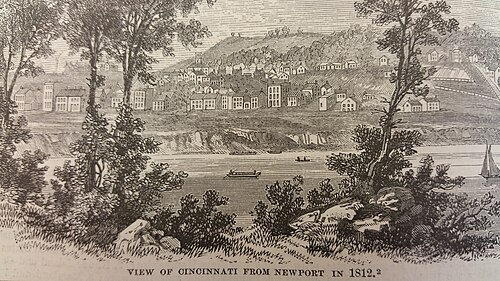
シンシナティは、1788年にマティアス・デンマン、ロバート・パターソン大佐、イスラエル・ラドローがオハイオ川の北岸、リッキング川の河口の反対側の地点に上陸し、そこに定住することを決めたときに始まりました。最初の測量士ジョン・フィルソンは、フランス語とラテン語の音節を組み合わせた「ロザンティビル」と名付けました。これは「リッキング川の河口の反対側の町」を意味するものでした。[23] [24] 1790年1月4日、セントクレアはシンシナティ協会に敬意を表して入植地の名前を変更しました。[25]
1811年、オハイオ川に蒸気船が導入されたことで、市の貿易はより迅速な輸送が可能になり、市はセントルイス、ミズーリ、下流のニューオーリンズとの商業関係を確立しました。シンシナティは1819年3月1日に市として法人化されました。[26]豚肉製品と干し草を輸出し、この地域の豚肉加工の中心地になりました。1810年から1830年にかけて、市の人口は9,642人から24,831人にほぼ3倍になりました。[27]
マイアミ・エリー運河の建設は1825年7月21日に始まり、当時はグレートマイアミ川に起源を持つことからマイアミ運河と呼ばれていました。運河の最初の区間は1827年に開業しました。[28] 1827年、運河はシンシナティと近隣のミドルタウンを結び、1840年までにはトレドまで到達しました。
鉄道はシンシナティに到来した次の主要な商業輸送手段であった。1836年、リトルマイアミ鉄道が認可された。[29] [要ページ]その後すぐに、シンシナティとマッド・リバー・アンド・レイク・エリー鉄道を結び、エリー湖のサンダスキー湾の港へのアクセスを提供するための建設が始まった。[28] [要ページ]
当時、雇用主は十分な人材を雇うのに苦労していました。1840年代後半にアイルランド人とドイツ人の移民の大きな波が起こるまで、街は労働力不足に陥っていました。その後20年間で街は急速に成長し、1850年には人口115,000人に達しました。[18]
この急速な拡大と隆盛の時期に、シンシナティの住民はこの都市を「クイーン・シティ」と呼ぶようになった。[30]
産業の発展と金ぴか時代

シンシナティは自由州オハイオと奴隷州ケンタッキーの境に位置していたため、奴隷が奴隷所有の南部から逃れるための重要な場所となっていた。この時期、多くの著名な奴隷制度廃止論者もシンシナティを故郷と呼び、地下鉄道の人気停車地となった。[31] 2004年、ダウンタウンのフリーダムウェイ沿いに国立地下鉄道フリーダムセンターが完成し、この都市の地下鉄道への関与を称えた。[32]
1859年、シンシナティは6本の路面電車の路線を敷設した。車両は馬に引かれ、路線のおかげで人々は市内を移動しやすくなった。[29] 1872年までに、シンシナティの住民は市内を路面電車で移動し、丘陵地帯への移動には鉄道車両に乗り換えることができるようになった。シンシナティ・インクライン・プレーン社はその年、オーバーン山の頂上まで人々を輸送し始めた。[28] 1889年、シンシナティの路面電車システムは馬車を電気路面電車に改造し始めた。[33]
婦人キリスト教禁酒同盟の第2回年次総会は1875年11月にシンシナティで開催された。[34]
1880年、市政府はテネシー州チャタヌーガまでのシンシナティ・サザン鉄道を完成させた。この鉄道は2024年3月にノーフォーク・サザン鉄道に売却されるまで、米国で唯一の市営州間鉄道であった。[35] [36]
1884年、多くの観察者が明らかに殺人事件だと思っていた事件で過失致死の判決が下されたことに対する怒りが、アメリカ史上最も破壊的な暴動の一つである裁判所暴動を引き起こした。3日間で56人が死亡し、300人以上が負傷した。[37]この暴動により共和党のリーダーであるトーマス・C・キャンベルの政権は終焉を迎えた。
20世紀
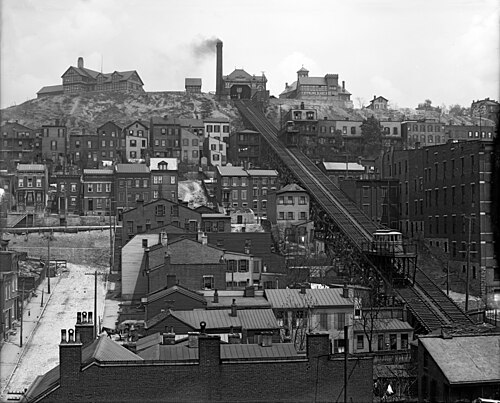
20世紀初頭、シンシナティの人口は325,902人だった。同市は20世紀に、1903年に完成したインガルス・ビルを皮切りに、多くの野心的なプロジェクトを完成させた。ダウンタウンの早期再開発は1920年代に始まり、次の10年間にはシンシナティ・ユニオン・ターミナル、米国裁判所兼郵便局、シンシナティ地下鉄、そして完成当時は市内で最も高いビルであった49階建ての カルー・タワーの建設で続いた。シンシナティは、鉄道で商品を輸送するよりも安価だった河川貿易の復活により、同規模のアメリカの都市のほとんどよりも大恐慌をうまく乗り切った。 1937年のオハイオ川の洪水は、米国史上最悪の洪水の1つであり、オハイオ渓谷沿いの多くの地域を破壊した。[38]その後、市は防潮堤を建設した。第二次世界大戦後、シンシナティは都心の近代化につながる都市再開発のマスタープランを発表した。1950年代、シンシナティの人口は509,998人でピークに達した。1950年代以降、2億5000万ドルが地域の改善、清潔で安全な低・中所得者向け住宅の建設、雇用の創出、経済成長の促進に費やされた。[39]
21世紀から現在まで
2000年代初頭、シンシナティの人口は331,285人でした。2000年のポール・ブラウン・スタジアム(現在はペイコー・スタジアムとして知られています)の建設は、ハミルトン郡での売上税の引き上げに起因しており、グレート・アメリカン・ボール・パークの建設開始も同様に、2003年にオープンしました。
2001年、シンシナティ暴動が発生し、企業に推定360万ドル、市自体に150万~200万ドルの損害が発生しました。その後、特にオーバーザライン地区の高級化の過程で、大きな変化が起こりました。
2018年、MLSはFCシンシナティの加入を発表し、同市で3番目のプロスポーツチームとなった。その後、シンシナティの西端に位置するTQLスタジアムが建設され、2021年にオープンした。特筆すべきことに、2020年の国勢調査ではシンシナティの人口が増加したことが明らかになっており、1950年の国勢調査以来初めての増加となった。
2022年1月4日、アフタブ・ピュアヴァルがシンシナティの第70代市長に就任しました。
ニックネーム
シンシナティには多くのニックネームがあり、シンシー、クイーン・シティ[40] 、西部の女王[41]、ブルーチップ・シティ[42] 、 [43]、[44]、セブン・ヒルズのシティ[45]などがある。これらはブルーチップ・クッキーズのようなレストラン名を含め、職業上、学術上、広報上の都市への言及とより典型的に関連付けられており、地元の人々が日常会話ではあまり使用しないが、シンシーは不在時に都市を指すためによく使用される。[要出典]
「七つの丘の街」という呼称は、1853年6月発行のウェスト・アメリカン・レビュー誌の「第3条 シンシナティ:西部および南部との関係」に由来しており、7つの丘が具体的に描写され、名前が付けられている。その丘は、市の周囲を三日月形に形作っており、マウント・アダムス、ウォルナット・ヒルズ、マウント・オーバーン、ヴァイン・ストリート・ヒル、カレッジ・ヒル、フェアモント(現在はフェアマウント)、マウント・ハリソン(現在はプライス・ヒルとして知られている)である。この名前は、7つの丘の上に築かれたとされる古代ローマに由来している。[要出典]
「クイーンシティ」は1819年の新聞記事[46]から引用され、1854年の詩「カトーバワイン」によってさらに不滅のものとなった。その中でヘンリー・ワズワース・ロングフェローはこの都市について次のように書いている。
そしてこのブドウの木の歌、
私のこの挨拶を、
風と鳥が、 花輪を飾った
西の女王に、 美しい川のほとりで届けるでしょう。[47]
長年、シンシナティは「ポークポリス」としても知られていました。このニックネームは、市内の大規模な豚肉産業に由来しています。[48]
「The 'Nati」のような新しいニックネームも登場し、さまざまな文化的文脈で使用されようとしています。たとえば、地元のKeep America Beautifulの関連団体であるKeep Cincinnati Beautifulは、 1998年にゴミ防止キャンペーンの一環として「Don't Trash the 'Nati」というキャッチフレーズを導入しました。[49] [50] [51]
地理
市は新たな開発と民間投資により大きな変化を遂げている。これには、グレートアメリカンボールパークからペイコルスタジアムまで広がるアパート、小売店、レストラン、オフィスを含む、長らく停滞しているバンクスプロジェクトの建物が含まれる。フェーズ1Aはすでに完了しており、2013年初頭の時点で100%が入居している。スメールリバーフロントパークはバンクスとともに開発されており、シンシナティで最も新しい公園である。シンシナティ(北ケンタッキー州を含む)の都心部に約35億ドルが投資されている。この開発の多くは3CDCによって行われている。シンシナティベルコネクターは2016年9月に開始された。 [52] [53]
シンシナティは、川を挟んでペンシルベニア州ピッツバーグ市とイリノイ州カイロ市の中間に位置している。ダウンタウンはリッキング川の河口近くにあり、合流地点に最初の入植地が形成された。[54] シンシナティ都市圏はオハイオ州南部、インディアナ州南東部、ケンタッキー州北部にまたがっており、国勢調査局の測定によると市域は79.54平方マイル(206.01 km 2)で、そのうち77.94平方マイル(201.86 km 2)が陸地、1.60平方マイル(4.14 km 2)が水域である。[55]市は、ブルーグラス地域のオハイオ川を見下ろす数多くの丘陵、断崖、低い尾根に広がっている。[56]この3州は地理的には中西部のアップランド・サウスの最北端に位置している。
市域にはノーウッド、エルムウッド プレイス、セントバーナードの3 つの自治体が広がっています。ノーウッドは商業と工業の街で、エルムウッド プレイスとセントバーナードは主に住宅地である小さな村です。シンシナティには飛び地はありませんが、市政府は市域外にいくつかの土地を所有しています。アンバーリービレッジのフレンチ パークとブルー アッシュの旧ブルー アッシュ空港の使われていない滑走路です。
都市景観
.jpg/500px-Downtown_Cincinnati,_Ohio,_USA_Panorama_Taken_from_Covington_(cropped).jpg)

シンシナティには、その地域全体に多くのランドマークがあります。これらのランドマークのいくつかは全国的に知られていますが、他のランドマークは地元の人々によく知られています。これらのランドマークには、ユニオンターミナル、カルータワー、グレートアメリカンタワー、ファウンテンスクエア、ワシントンパーク、グレートアメリカンボールパークなどがあります。
シンシナティには、前述のカリュータワー、スクリップスセンター、インガルスビル、シンシナティユニオンターミナル、アイザックM.ワイズ寺院など、その建築的特徴や歴史的関連性で注目に値する建造物が数多くあります。[57] クイーンシティスクエアは2011年1月にオープンしました。この建物はシンシナティで最も高く、オハイオ州で3番目に高い建物で、高さは665フィート(203メートル)に達します。[58]
1922年4月1日以来、シンシナティのオハイオ川の洪水位は、ジョン・A・ローブリング吊り橋から測って52フィート(16メートル)と公式に設定されています。この深さで、ミルクリークの河口にあるポンプ場が稼働します。 [59] [60] 1873年から1898年まで、洪水位は45フィート(14メートル)でした。1899年から1922年3月31日までは、50フィート(15メートル)でした。[60]オハイオ川は1881年に最低水位である2フィート(0.61メートル)未満に達しました。逆に、史上最高水位は79フィート11です。+シンシナティでは、洪水の規模によって洪水の危険度が異なります。洪水の規模は、洪水の規模によっても異なります。洪水の規模は、洪水の規模によって異なります。洪水の規模は、洪水の規模によって異なります。洪水の規模は、洪水の規模によって異なります。洪水の規模は、洪水の規模によって異なります。洪水の規模は、洪水の規模によって異なります。洪水の規模は、洪水の規模によって異なります。洪水の規模は、 洪水の規模によって異なります。洪水の規模は、洪水の規模によって異なります。洪水の規模は、洪水の規模 によって異なります。洪水の規模は、洪水の規模によって異なります。
近隣地域

シンシナティは52の地区から成ります。これらの地区の多くはかつては村でしたが、市に併合され、ウォルナットヒルズやマウントオーバーンなど、多くは以前の名前を保持しています。[64] ウエストウッドは市内で最も人口の多い地区で、CUF (シンシナティ大学がある)やプライスヒルなどの他の重要な地区があります。[65]
シンシナティのダウンタウンは市の中心ビジネス地区で、オハイオ川とアップタウンの間の平地に多くの地区がある。これらの地区には、オーバーザライン、ペンドルトン、クイーンズゲート、ウェストエンドなどがある。オーバーザラインは、米国で最大かつ最も保存状態の良い都市歴史地区の1つである。 [66]オーバーザラインの華麗なレンガ造りの建物のほとんどは、1865年から1880年代にかけてドイツ人移民によって建てられたものである。[67]この地区は21世紀に大規模な再開発が行われ、中小企業の育成に重点が置かれている。[68]
気候
| オハイオ州シンシナティ | ||||||||||||||||||||||||||||||||||||||||||||||||||||||||||||
|---|---|---|---|---|---|---|---|---|---|---|---|---|---|---|---|---|---|---|---|---|---|---|---|---|---|---|---|---|---|---|---|---|---|---|---|---|---|---|---|---|---|---|---|---|---|---|---|---|---|---|---|---|---|---|---|---|---|---|---|---|
| 気候図(説明) | ||||||||||||||||||||||||||||||||||||||||||||||||||||||||||||
| ||||||||||||||||||||||||||||||||||||||||||||||||||||||||||||
| ||||||||||||||||||||||||||||||||||||||||||||||||||||||||||||
冬と夏の紅葉のピアット公園
シンシナティは、湿潤大陸性気候帯 (ケッペンの区分: Dfa )の南限 (0 °C または 32 °F の等温線を考慮) にあり、湿潤亜熱帯気候帯 ( Cfa ) に接しています。
夏は暑くて湿度が高く、毎月かなりの降雨量があり、年間21日間は最高気温が90°F(32°C)以上に達し、露点と湿度が高くなることが多い。7月は最も暖かい月で、1日の平均気温は75.9°F(24.4°C)である。[69]
冬は寒く、雪が適度に降る傾向があり、最も寒い1月の平均気温は30.8 °F (−0.7 °C) です。[69]最低気温が0 °F (−18 °C) に達するのは、年間平均2.6夜です。[69]平均的な冬には約22.1インチ (56 cm) の降雪があり、年間降水量は42.5インチ (1,080 mm) で、降雨量は春にピークを迎えます。[70]極端な場合は、1977年1月18日の−25 °F (−32 °C) から、1934年7月21日と22日の108 °F (42 °C) まであります。[71]
シンシナティの降雪は五大湖に近い他の多くの都市ほど激しくはありませんが、1978年の大吹雪や、1994年、 1999年、2007年、2021年のさらに顕著な暴風雪など、激しい降雪が記録されたことがあります。
暖かい時期には激しい雷雨がよく発生し、竜巻もまれではあるものの、全くないわけではなく、最近では1974年、1999年、2012年、2017年にメトロシンシナティ地域で竜巻が発生しています。[72]
生のグラフ データを表示または編集します。
人口統計
.png/500px-Race_and_ethnicity_2010-_Cincinnati_(5560448832).png)
1950年、シンシナティの人口は503,998人に達し、ピークを迎えました。その後、1960年から2010年までのすべての国勢調査で人口が減少しました。20世紀後半には、産業再編により雇用が失われました。最近では、人口は回復し始めています。2020年の国勢調査では、人口は309,317人で、2010年の296,945人から4.2%増加しています。[83]これは、1950年の国勢調査以来初めての人口増加であり、60年間の人口減少傾向を逆転させました。
2020年の国勢調査では、[84] 309,317人、138,696世帯、62,319家族が市内に居住していた。人口密度は1平方マイルあたり3,809.9人(1,471.0/km 2 )であった。平均密度は1平方マイルあたり2,066.9(798.0/km 2 )で、161,095の住宅があった。市の人種構成は、白人50.3% 、アフリカ系アメリカ人41.4% 、ネイティブアメリカン0.1% 、アジア人2.2% 、太平洋諸島系0.1%、その他の人種1.2% 、2つ以上の人種が混在4.6%であった。ヒスパニックまたはラテン系の人種は、人口の4.2%であった。
世帯数は138,696世帯で、18歳未満の子供が同居している世帯は25.4%、夫婦同居は23.2%、女性世帯主で夫がいない世帯は19.1%、男性世帯主で妻がいない世帯は4.4%、非家族世帯は53.3%であった。全世帯の43.4%は単身世帯であり、9.9%は65歳以上の単身世帯であった。平均世帯人数は2.09人、平均家族人数は3.00人であった。
市の平均年齢は32.5歳。住民の21.6%は18歳未満、14.6%は18歳から24歳、28.4%は25歳から44歳、24.1%は45歳から64歳、10.8%は65歳以上であった。市の性別構成は男性が48.4%、女性が51.6%であった。[85]
2022年の国勢調査の推計によると、シンシナティ都市圏の人口は2,265,051人で、国内で30番目に大きな都市統計地域となっている。この都市圏には、オハイオ州のハミルトン、バトラー、ウォーレン、クレルモン、クリントン、ブラウンの各郡、ケンタッキー州のブーン、ブラッケン、キャンベル、ガラティン、グラント、ケントン、ペンドルトンの各郡、インディアナ州のディアボーン、フランクリン、ユニオン、オハイオの各郡が含まれる。
経済
シンシナティ大都市圏は、米国で28番目に大きい経済規模を誇り、シカゴ、ミネアポリス・セントポール、デトロイト、セントルイスに次いで中西部で5番目に大きい経済規模を誇ります。2016年には、中西部で最も急速に成長した経済首都となりました。[13] 2015年のこの地域の国内総生産は1270億ドル(2023年には約1600億ドル)でした。[86]住宅価格の中央値は158,200ドルで、シンシナティの生活費は全国平均より8%低いです。2022年9月現在、失業率は3.3%で、全国平均を下回っています。[87] [88]
クローガー、プロクター・アンド・ギャンブル、ウェスタン・アンド・サザン・ファイナンシャル・グループ、フィフス・サード・バンク、アメリカン・ファイナンシャル・グループ、シンタスなど、フォーチュン500企業の本社がシンシナティにある。ゼネラル・エレクトリックはグローバル・オペレーション・センターの本社をシンシナティに置いており、GEエアロスペースはエベンデールに拠点を置いている。[89]クローガー社は地元で2万人以上の従業員を雇用しており、市内最大の雇用主となっている。他の4つの大雇用主は、シンシナティ小児病院、トライヘルス、シンシナティ大学、セント・エリザベス・ヘルスケアである。[90]シンシナティにはクリーブランド連邦準備銀行の支店がある。[91]
芸術と文化
社会

シンシナティは、スコットランド系アイルランド人、開拓者、キールボート乗りなどのアメリカ人開拓者によって区画分けされ、増加した。1世紀半以上もの間、シンシナティはオハイオ州で最も重要な都市として誰にも負けず、1879年のニューアメリカン百科事典では「オハイオ州の主要都市」というあだ名がつけられた。この本に加えて、数え切れないほどの他の本が、都市と開拓者の社会史を記録している。[92] [93] [94] [95]著名なアングロアメリカ人一家の市の創始者は、米国聖公会信者であった。初期の巡回馬上説教師に触発された初期のメソジスト派も重要であった。北西部領土で最初に確立されたメソジスト階級は、1797年に近くのミルフォードにやって来た。1879年までに、市内には162の教会建築物が記録されていた。このため、最初からプロテスタントはシンシナティの精神を形成する上で重要な役割を果たしてきた。クライストチャーチ大聖堂は、歴史協会によって市民史の要石として注目されているシンシナティの初期の英国国教会指導者の遺産を引き継いでいる。メソジスト機関の中には、クライスト病院やドイツメソジスト教会のプロジェクトなどがある。[96]シンシナティのメソジストの最大の支持者の一人は、ウィリアム・プロクターとともにプロクター・アンド・ギャンブルを設立したアイルランド移民のジェームズ・ギャンブルである。敬虔なメソジストであったことに加え、ギャンブルと彼の遺産は、シンシナティ大都市圏全体にメソジスト教会を建設するために資金を寄付した。[97]

Cincinnati, being a rivertown crossroads, depended on trade with the slave states south of the Ohio River at a time when thousands of black people were settling in the free state of Ohio. Most of them came after the American Civil War and were from Kentucky and Virginia with many of them fugitives who had sought freedom and work in the North. In the antebellum years, the majority of native-born whites in the city came from northern states, primarily Pennsylvania.[98] Though 57 percent of whites migrated from free states, 26 percent were from southern states and they retained their cultural support for slavery. This quickly led to tensions between pro-slavery residents and abolitionists who sought lifting restrictions on free black people, as codified in the "Black Code" of 1804.[99] In the pre-Civil War period, Cincinnati had been called "a Southern city on free soil".[100]: 44 Volatile social conditions saw riots in 1829, when many black people lost their homes and property. As the Irish entered the city in the late 1840s, they competed with black people at the lower levels of the economy. White-led riots against black people occurred in 1836, when an abolitionist press was twice destroyed; and in 1842.[99] More than 1,000 black people abandoned the city after the 1829 riots. Black people in Philadelphia and other major cities raised money to help the refugees recover from the destruction. By 1842 black people had become better established in the city; they defended themselves and their property in the riot, and worked politically as well.[101]

Germans were among the earliest newcomers, migrating from Pennsylvania, Virginia and Tennessee. David Ziegler succeeded Arthur St. Clair in command at Fort Washington. After the conclusion of the Northwest Indian War and removal of Native Americans to the west, he was elected as Cincinnati's first town president in 1802.[102][103] Cincinnati was influenced by Irishmen, and Prussians and Saxons (northern Germans), seeking to emigrate away from crowding and strife. In 1830, residents with German roots made up 5% of the population, as many had migrated from Pennsylvania; ten years later this had increased to 30%.[104] Thousands of Germans entered the city after the German revolutions of 1848–49, and by 1900, more than 60 percent of its population was of Prussian background.[105] The menial-jobbed, aggravated Irish often organized mobs, and the Germans, far away from their Pennsylvania Dutch connections, did the same. Traditions and celebrations of the city's immigrant communities have been sustained; nearby Waynesville hosts the yearly Ohio Sauerkraut Festival,[106] and Cincinnati hosts several big yearly events which commemorate connections to the Old World. Oktoberfest Zinzinnati,[107] Bockfest,[108] and the Taste of Cincinnati feature local restaurateurs.
Cincinnati's Jewish community was developed by those from England and Germany. A large segment of the community, led by Isaac M. Wise, developed Reform Judaism in response to the influences of the Enlightenment and making their new lives in the United States. Rabbi Wise, known as a founding father of the Reform movement, and his contemporaries, bore a great influence on the Jewish faith in Cincinnati, the United States, and worldwide.[109]
The NRHP-listed Potter Stewart United States Courthouse is a federal court, the United States Court of Appeals for the Sixth Circuit, one of thirteen United States courts of appeals. Federal Reserve Bank of Cleveland Cincinnati Branch is located across the street from the East Fourth Street Historic District.

Museums
The Cincinnati Art Museum is an art museum in the Eden Park neighborhood. Founded in 1881, it was the first purpose-built art museum west of the Allegheny Mountains. Its collection of over 67,000 works spanning 6,000 years of human history make it one of the most comprehensive collections in the Midwest.[110] The Contemporary Arts Center was established in 1939 as one of the first contemporary art institutions in the country. The Art Academy of Cincinnati also features three public galleries, in addition to the Taft Museum of Art collection.[111]

The city's Cincinnati Museum Center complex operates out of the Cincinnati Union Terminal in the Queensgate neighborhood. Within the complex are the Cincinnati History Museum, Museum of Natural History & Science, Robert D. Lindner Family Omnimax Theater, Cincinnati History Library and Archives, and Duke Energy Children's Museum.[112] The National Underground Railroad Freedom Center opened in 2004 along the riverfront based on the history of the Underground Railroad, recognizing the role the city played in its history as thousands of slaves escaped to freedom by crossing the Ohio River from the southern slave states.[111] U.S. president and chief justice William Howard Taft's childhood home, now the William Howard Taft National Historic Site, in Mount Auburn features exhibits on Taft's life and accomplishments.[113]
The American Sign Museum features over 200 signs and other objects on display ranging from the late nineteenth century to the 1970s.[114]
Music

Music-related events include the Cincinnati May Festival, Bunbury Music Festival, and Cincinnati Bell/WEBN Riverfest. Cincinnati hosted the World Choir Games in 2012 with the mantra "Cincinnati, the City that Sings!"
Cincinnati has given rise or been home to popular musicians and singers, including Lonnie Mack, Doris Day, Odd Nosdam, Dinah Shore, Fats Waller, Rosemary Clooney, Bootsy Collins, The Isley Brothers, Merle Travis, Hank Ballard, Otis Williams, Mood, Midnight Star, Calloway, The Afghan Whigs, Over the Rhine, Blessid Union of Souls, Freddie Meyer, 98 Degrees, The Greenhornes, The Deele, Enduser, Heartless Bastards, The Dopamines, Adrian Belew, The National, Foxy Shazam, Why?, Wussy, H-Bomb Ferguson, Sudan Archives and Walk the Moon, and alternative hip hop producer Hi-Tek calls the Metro Cincinnati region home. Andy Biersack, the lead vocalist for the rock band Black Veil Brides, was born in Cincinnati.
The Cincinnati May Festival Chorus is an amateur choir that has been in existence since 1880. The city is home to the Cincinnati Symphony Orchestra, Cincinnati Opera, Cincinnati Boychoir, and Cincinnati Ballet. Metro Cincinnati is also home to several regional orchestras and youth orchestras, including the Starling Chamber Orchestra and the Cincinnati Symphony Youth Orchestra. Music Director James Conlon and Chorus Director Robert Porco lead the Chorus through an extensive repertoire of classical music. The May Festival Chorus is the mainstay of the oldest continuous choral festival in the Western Hemisphere. Cincinnati Music Hall was built to house the May Festival.
Cincinnati is the subject of a Connie Smith song written by Bill Anderson, called Cincinnati, Ohio. Cincinnati is the main scenario for the international music production of Italian artist and songwriter Veronica Vitale called "Inside the Outsider". She embedded the sounds of the trains at Baltimore and Ohio Railroad Downtown Cincinnati, filmed her music single "Mi Sono innamorato di Te" at the American Sign Museum and recorded her heartbeat sound at Cincinnati Children's Hospital replacing it to the drums for her song "The Pulse of Light" during the broadcasting at Ryan Seacrest's studio. Furthermore, she released the music single "Nobody is Perfect" featuring legendary Cincinnati's bass player Bootsy Collins.[115]
Cincinnati was a major early music recording center and was home to King Records, which helped launch the career of James Brown, who often recorded there, as well as Jewel Records, which helped launch Lonnie Mack's career, and Fraternity Records. Cincinnati had a vibrant jazz scene from the 1920s to today. Louis Armstrong's first recordings were done in the Cincinnati area, at Gennett Records, as were Jelly Roll Morton's, Hoagy Carmichael's, and Bix Beiderbecke, who took up residency in Cincinnati for a time. Fats Waller was on staff at WLW in the 1930s.
Theater
.jpg/500px-Trevor_Noah_2019-02-01_-_Aronoff_Center_crowd_(46151350875).jpg)
Professional theatre has operated in Cincinnati since at least as early as the 1800s.[citation needed] Among the professional companies based in the city are Ensemble Theatre Cincinnati, Cincinnati Shakespeare Company, the Know Theatre of Cincinnati, Stage First Cincinnati, Cincinnati Public Theatre, Cincinnati Opera, The Performance Gallery and Clear Stage Cincinnati. The city is also home to Cincinnati Playhouse in the Park, which hosts regional premieres, and the Aronoff Center, which hosts touring Broadway shows each year via Broadway Across America. The city has community theatres, such as the Cincinnati Young People's Theatre, the Showboat Majestic (which is the last surviving showboat in the United States and possibly[original research?] the world), and the Mariemont Players.
Since 2011, Cincinnati Opera and the University of Cincinnati College-Conservatory of Music have partnered to sponsor the Opera Fusion: New Works project. The Opera Fusion: New Works project acts as a program for composers or librettists to workshop an opera in a 10-day residency. This program is headed by the Director of Artistic Operations at Cincinnati Opera, Marcus Küchle, and the Head of Opera at CCM, Robin Guarino.
In 2015, Cincinnati held the USITT 2015 Conference and Stage Expo at the Duke Energy Convention Center, bringing 5,000+ students, university educators, theatrical designers and performers, and other personnel to the city.[116] The USITT Conference is considered the main conference for Theatre, Opera, and Dance in the United States.[citation needed]
Film and literature
A Rage in Harlem was filmed entirely in the Cincinnati neighborhood of Over the Rhine because of its similarity to 1950s Harlem. Movies that were filmed in part in Cincinnati include The Best Years of Our Lives (aerial footage early in the film), Ides of March, Fresh Horses, The Asphalt Jungle (the opening is shot from the Public Landing and takes place in Cincinnati although only Boone County, Kentucky, is mentioned), Rain Man, Miles Ahead, Airborne, Grimm Reality, Little Man Tate, City of Hope, An Innocent Man, Tango & Cash, A Mom for Christmas, Lost in Yonkers, Summer Catch, Artworks, Dreamer, Elizabethtown, Jimmy and Judy, Eight Men Out, Milk Money, Traffic, The Pride of Jesse Hallam, The Great Buck Howard, In Too Deep, Seven Below, Carol, Public Eye, The Last Late Night,[117] and The Mighty.[citation needed] In addition, Wild Hogs is set, though not filmed, in Cincinnati.[118]
The Cincinnati skyline was prominently featured in the opening and closing sequences of the CBS/ABC daytime drama The Edge of Night from its start in 1956 until 1980, when it was replaced by the Los Angeles skyline; the cityscape was the stand-in for the show's setting, Monticello. Procter & Gamble, the show's producer, is based in Cincinnati. The sitcom WKRP in Cincinnati and its sequel/spin-off The New WKRP in Cincinnati featured the city's skyline and other exterior shots in its credits, although was not filmed in Cincinnati. The city's skyline has also appeared in an April Fool's episode of The Drew Carey Show, which was set in Carey's hometown of Cleveland. 3 Doors Down's music video "It's Not My Time" was filmed in Cincinnati, and features the skyline and Fountain Square. Also, Harry's Law, the NBC legal dramedy created by David E. Kelley and starring Kathy Bates, was set in Cincinnati.[119]
The Hollows series of books by Kim Harrison is an urban fantasy that takes place in Cincinnati. American Girl's Kit Kittredge sub-series also took place in the city, although the film based on it was shot in Toronto.
Cincinnati also has its own chapter (or "Tent") of The Sons of the Desert (The Laurel and Hardy Appreciation Society), which meets several times per year.[120]
Cuisine

Along with American cuisine, Cincinnati is host to numerous flavors infused from around the culinary world. Frisch's Big Boy, Graeter's ice cream, Kroger, LaRosa's Pizzeria, Montgomery Inn, Skyline Chili, Gold Star Chili, Aglamesis Bro's and United Dairy Farmers are Cincinnati eateries that sell their brand commodities in grocery markets and gas stations. Glier's goetta is produced in the Cincinnati area and is a popular local food. The Maisonette in Cincinnati was Mobil Travel Guide's longest-running five-star restaurant in the United States, holding that distinction for 41 consecutive years until it closed in 2005. Its former head chef, Jean-Robert de Cavel, has opened four new restaurants in the area since 2001.
One of the United States's oldest[122] and most celebrated[123] bars, Arnold's Bar and Grill in downtown Cincinnati has won awards from Esquire magazine's "Best Bars in America",[124] Thrillist's "Most Iconic Bar in Ohio",[125] The Daily Meal's "150 Best bars in America"[126] and Seriouseats.com's "The Cincinnati 10".[127] "If Arnold's were in New York, San Francisco, Chicago, or Boston—somewhere, in short, that people actually visit—it would be world-famous," wrote David Wondrich.[128]
The Filet-O-Fish was created in 1962 by Lou Groen, the owner of the first McDonald's franchise in the Cincinnati area, to cater to Catholic patrons who abstained from meat on Fridays.[129]
Traditional local delicacies include opera creams[130] and nectar soda,[131] both served at Graeter's and Aglamesis Bro's ice cream parlors. Grippo's and Pringles potato chips also have their origins in the area, the latter produced by local company Procter & Gamble. Other foodstuffs of local origin include Frank's RedHot sauce[132] and Slush Puppies.
Cincinnati chili

Cincinnati chili, a spiced sauce served over noodles, usually topped with cheese and often with diced onions and/or beans, is the area's "best-known regional food".[133][134] A variety of recipes are served by respective parlors, including Skyline Chili, Gold Star Chili, and Dixie Chili and Deli, plus independent chili parlors including Camp Washington Chili, Empress Chili[135] and Moonlight Chili.[136] It was first developed by Macedonian immigrant restaurateurs in the 1920s. Cincinnati has been called the "Chili Capital of America" and "of the World" because it has more chili restaurants per capita than any other city in the United States or in the world.[137]
Goetta
Goetta is a meat-and-grain sausage or mush[138] of German inspiration. It is primarily composed of ground meat (pork, or pork and beef), pin-head oats and spices.[139]
Mock turtle soup
Similarly to goetta's origins, mock turtle soup was a dish popularized by the influx of German immigrants in the late 19th century. Originally made with offal, today Cincinnati-style mock turtle soup is characterized by ground beef, hard-boiled eggs, and ketchup. The only remaining commercial canner of the soup, Worthmore, has produced it in Cincinnati since 1918.[140][141]
Dialect

For a list of words relating to Cincinnati, see the Cincinnati English category of words in Wiktionary, the free dictionary.
The citizens of Cincinnati speak in a General American dialect. Unlike the rest of the Midwest, Southwest Ohio shares some aspects of its vowel system with northern New Jersey English.[142][143] Most of the distinctive local features among speakers float as Midland American.[144] There is also some influence from the Southern American dialect found in Kentucky.[145] A touch of northern German is audible in the local vernacular: some residents use the word please when asking a speaker to repeat a statement. This usage is taken from the German practice, when bitte (a shortening of the formal "Wie bitte?" or "How please?" rendered word-for-word from German into English), was used as shorthand for asking someone to repeat.[146][147]
Sports
Cincinnati has three major league teams, three minor league teams, five college institutions with sports teams, and seven major sports venues. Cincinnati's three major league teams are Major League Baseball's Reds, who were named for America's first professional baseball team, the Cincinnati Red Stockings;[148][149][150] the Bengals of the National Football League; and FC Cincinnati, which became a Major League Soccer franchise in 2019. WalletHub has ranked Cincinnati as the No. 12 best sports city.
On Major League Baseball Opening Day, Cincinnati has the distinction of holding the "traditional opener" in baseball each year, due to its baseball history. Children have been known to skip school on Opening Day, and it is commonly thought of as a holiday.[151] The Cincinnati Reds have won five World Series titles, in 1919, 1940, 1975, 1976, and 1990. The Reds had one of the most successful baseball clubs of all time in the mid-1970s, known as The Big Red Machine.
The Bengals have made three Super Bowl appearances since the franchise was founded, in 1982, 1989, and 2022, but have yet to win a championship. The Bengals enjoy strong rivalries with the Cleveland Browns and Pittsburgh Steelers, both of whom are also members of the AFC North division. Whenever the Bengals and Carolina Panthers play against each other in an inter-conference matchup that occurs every four years, their games are dubbed the "Queen City Bowl", as Charlotte, North Carolina, the home city of the Panthers, is also known as the Queen City.[152]
FC Cincinnati is a soccer team that plays in Major League Soccer. FC Cincinnati made its home debut in the USL on April 9, 2016, before a crowd of more than 14,000 fans.[153] On their next home game against Louisville City FC, FC Cincinnati broke the all-time USL attendance record with a crowd of 20,497; on May 14, 2016, it broke its own record, bringing in an audience of 23,375 on its 1–0 victory against the Pittsburgh Riverhounds.[154] After breaking the USL attendance record on several additional occasions, the club moved to Major League Soccer (MLS) for the 2019 season.[155] FC Cincinnati was awarded an MLS bid on May 29, 2018, and moved to TQL Stadium in the West End neighborhood just northwest of downtown in 2021.[156]
Cincinnati is also home to two men's college basketball teams: the Cincinnati Bearcats and Xavier Musketeers. These two teams face off as one of college basketball's rivalries known as the Crosstown Shootout. In 2011, the rivalry game erupted in an on-court brawl at the end of the game that saw multiple suspensions follow. The Musketeers have made 10 of the last 11 NCAA tournaments while the Bearcats have won two Division I National Championships.[157] Previously, the Cincinnati Royals competed in the National Basketball Association from 1957 to 1972; they are now known as the Sacramento Kings.
The Flying Pig Marathon is a yearly event attracting many runners and acts as a qualifier to the Boston Marathon.
The Cincinnati Open, a historic international men's and women's tennis tournament that is part of the ATP Tour Masters 1000 Series and the WTA 1000 Series, was established in the city in 1899 and has been held at the Lindner Family Tennis Center in suburban Mason since 1979.
The Cincinnati Cyclones are a minor league AA-level professional hockey team playing in the ECHL. Founded in 1990, the team plays at the Heritage Bank Center. They won the 2010 Kelly Cup Finals, their 2nd championship in three seasons.
The Cincinnati Sizzle is a women's minor professional tackle football team that plays in the Women's Football Alliance. The team was established in 2003, by former Cincinnati Bengals running back Ickey Woods. In 2016 the team claimed their first National Championship Title in the United States Women's Football League.
The Kroger Queen City Championship debuted on the LPGA Tour in 2022 at Kenwood Country Club. It was the first time since 1963 that women's professional golf returned to Cincinnati.
The table below shows sports teams in the Cincinnati area that average more than 5,000 fans per game:
Parks and recreation

The Cincinnati Park Board maintains and operates all city parks in Cincinnati. Established in 1911 with the purchase of 168 acres (0.68 km2), today the board services more than 5,000 acres (20 km2) of city park space. Notable historic public parks and landscapes include the 19th-century Spring Grove Cemetery and Arboretum, Eden Park, and Mount Storm Park, all designed by Prussian émigré landscape architect Adolph Strauch.[164] The city also has several public golf courses, including the historic Avon Fields Golf Course.
Downtown Cincinnati towers about Fountain Square, the public square and event locale. Fountain Square was renovated in 2006.[165] Cincinnati rests along 22 miles (35 km) of riverfront about northern banks of the Ohio, stretching from California to Sayler Park, giving the Ohio a prominent place in the life of the city.[166]
The Cincinnati Zoo & Botanical Garden in Avondale is the second-oldest zoo in the United States.[167] It was appointed as a National Historic Landmark in 1987. The zoo houses over 500 species, 1,800 animals and 3,000 plant species. In addition, the zoo also has conducted several breeding programs in its history. The zoo is frequently cited among the best in the country.[168][169]
Government and politics

The city proper operates with a nine-member city council, whose members are elected at-large. Prior to 1924, city council members were elected through a system of wards. The ward system was subject to corruption due to partisan rule. From the 1880s to the 1920s, the Republican Party dominated city politics, with the political machine of George B. "Boss" Cox exerting control.
A reform movement arose in 1923 which ended machine rule. It was led by another Republican, Murray Seasongood. He founded the Charter Committee, which used ballot initiatives in 1924 to replace the ward system with the current at-large system. They gained approval by voters for a council–manager government form of government, in which a smaller council hires a professional manager to operate the daily affairs of the city. From 1924 to 1957, the council was elected by proportional representation and single transferable voting. Starting with Ashtabula in 1915, several major cities in Ohio adopted this electoral system, which had the practical effect of reducing ward boss and political party power. For that reason, such groups opposed it.
In an effort to overturn the charter that provided for proportional representation, opponents in 1957 fanned fears of black political power, at a time of increasing civil rights activism.[170] The PR/STV system had enabled minorities to enter local politics and gain seats on the city council more than they had before, in proportion to their share of the population. This made the government more representative of the residents of the city.[171] Overturning that charter, in 1957, all candidates had to run in a single race for the nine city council positions. The top nine vote-getters were elected (the "9-X system"), which favored candidates who could appeal to the entire geographic area of the city and reach its residents with campaign materials. The mayor was elected by the council. In 1977, 33-year-old Jerry Springer, later a notable television talk show host, was chosen to serve one year as mayor.
To have their votes count more, starting in 1987, the top vote-getter in the city council election was automatically selected as mayor. Starting in 1999, the mayor was elected separately in a general at-large election for the first time. The city manager's role in government was reduced.[citation needed] These reforms were referred to as the "strong mayor" reforms,[by whom?] to make the publicate accountable to voters. Cincinnati politics include the participation of the Charter Party, the political party with the third-longest history of winning in local elections.[citation needed] On October 5, 2011, the Council became the first local government in the United States to adopt a resolution recognizing freedom from domestic violence as a fundamental human right.[172] On January 30, 2017, Cincinnati's mayor declared the city a sanctuary city.[173]
Cincinnati is home to the United States Court of Appeals for the Sixth Circuit, based in the Potter Stewart United States Courthouse. It has appellate jurisdiction over Kentucky, Michigan, Ohio, and Tennessee.
Police and fire services
.png/500px-Cincinnati_Serious_Crime_(2000-2019).png)
The city of Cincinnati's emergency services for fire, rescue, EMS, hazardous materials and explosive ordnance disposal is handled by the Cincinnati Fire Department. On April 1, 1853, the Cincinnati Fire Department became the first paid professional fire department in United States.[175] The Cincinnati Fire Department operates out of 26 fire stations, located throughout the city in 4 districts, each commanded by a district chief.[176][177][178]
.jpg/500px-Cincinnati_Ohio_Police_Ford_Explorer_Utility_(34494183035).jpg)
The Cincinnati Fire Department is organized into 4 bureaus: Operations,[177] Personnel and Training,[179] Administrative Services,[180] and Fire Prevention.[181] Each bureau is commanded by an assistant chief, who in turn reports to the chief of department.
The Cincinnati Police Department has more than 1,000 sworn officers. Before the riots of 2001, Cincinnati's overall crime rate had been dropping steadily and by 1995 had reached its lowest point since 1992 but with more murders and rapes.[182] After the riot, violent crime increased, but crime has been on the decline since.[183] The Cincinnati Police Department was featured on TLC's Police Women of Cincinnati and on A&E's reality show The First 48. Cincinnati had 71 homicides in 2023, down from 78 in 2022.[184]
Race relations

Due to its location on the Ohio River, Cincinnati was a border town in a free state, across from Kentucky, which was a slave state. Residents of Cincinnati played a major role in abolitionism. Many fugitive slaves used the Ohio River at Cincinnati to escape to the North. Cincinnati had numerous stations on the Underground Railroad, but there were also runaway slave catchers active in the city, who put escaping slaves at risk of recapture.
Given its southern Ohio location, Cincinnati had also attracted settlers from the Upper South, who traveled along the Ohio River into the territory. Tensions between abolitionists and slavery supporters broke out in repeated violence, with whites attacking black people in 1829. Anti-abolitionists attacked black people in the city in a wave of destruction that resulted in 1,200 black people leaving the city and the country; they resettled in Canada.[185] The riot and its refugees were topics of discussion throughout the country, and black people organized the first Negro Convention in 1830 in Philadelphia to discuss these events.
White riots against black people took place again in Cincinnati in 1836 and 1842.[185] In 1836 a mob of 700 pro-slavery men attacked black neighborhoods, as well as a press run by James M. Birney, publisher of the anti-slavery weekly The Philanthropist.[186] Tensions increased after congressional passage in 1850 of the Fugitive Slave Act, which required cooperation by citizens in free states and increased penalties for failing to try to recapture escaped slaves.
Levi Coffin made the Cincinnati area the center of his anti-slavery efforts in 1847.[187] Harriet Beecher Stowe lived in Cincinnati for a time, met escaped slaves and used their stories as a basis for her novel Uncle Tom's Cabin (1852). The National Underground Railroad Freedom Center, which opened in 2004 on the Cincinnati riverfront in the middle of "The Banks" area between Great American Ballpark and Paul Brown Stadium, commemorates the volunteers who aided refugee slaves and their drive for freedom, as well as others who have been leaders for social justice.
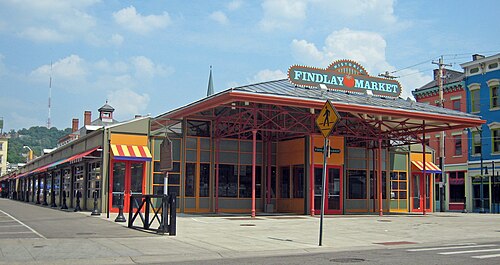
Located in a free state and attracting many European immigrants, Cincinnati has historically had a predominantly white population.[81] By 1940, the Census Bureau reported the city's population as 87.8 percent white and 12.2 percent black.[81]
In the second half of the 20th century, Cincinnati, along with other rust belt cities, underwent a vast demographic transformation. By the early 21st century, the city's population was 40% black. Predominantly white, working-class families who constituted the urban core during the European immigration boom in the 19th and early 20th centuries, moved to newly constructed suburbs before and after World War II. Black people, fleeing the oppression of the Jim Crow South in hopes of better socioeconomic opportunity, had moved to these older city neighborhoods in their Great Migration to the industrial North. The downturn in industry in the late 20th century caused a loss of many jobs, leaving many people in poverty and homeless. In 1968 passage of national civil rights legislation had raised hopes for positive change, but the assassination of national leader Martin Luther King Jr. resulted in riots in many black neighborhoods in Cincinnati; unrest occurred in black communities in nearly every major U.S. city after King's murder.
More than three decades later, in April 2001, racially charged riots occurred after police fatally shot a young unarmed black man, Timothy Thomas, during a foot pursuit to arrest him, mostly for outstanding traffic warrants.[188] After the 2001 riots, the ACLU, Cincinnati Black United Front, the city and its police union agreed upon a community-oriented policing strategy. The agreement has been used as a model across the country for building relationships between police and local communities.[189]
On July 19, 2015, Samuel DuBose, an unarmed black motorist, was fatally shot by white University of Cincinnati Police Officer Ray Tensing after a routine traffic stop for a missing front license plate. The resulting legal proceedings in late 2016[190] have been a recurring focus of national news media.[191] Several protests involving the Black Lives Matter movement have been carried out.[192][193] Tensing was indicted on charges of murder and voluntary manslaughter, but a November 2016 trial ended in mistrial[194] after the jury became deadlocked. A retrial began in May 2017, which also ended in mistrial after deadlock. The prosecution then announced they did not plan to try Tensing a third time.[195] The University of Cincinnati has settled with the DuBose family for $4.8 million[196] and free tuition for each of the 12 children.
Education
Primary and secondary education

Cincinnati Public Schools (CPS) include sixteen high schools all with citywide acceptance. CPS, the third-largest school cluster by student population in Ohio, was the largest to have an overall 'effective' rating from the State.[197][failed verification] The district currently includes public Montessori schools, including the first public Montessori high school established in the United States, Clark Montessori.[198] Cincinnati Public Schools' top-rated school is Walnut Hills High School, ranked 34th on the national list of best public schools by Newsweek. Walnut Hills offers 28 Advanced Placement courses. Cincinnati is also home to the first Kindergarten – 12th grade Arts School in the country, the School for Creative and Performing Arts.
The Jewish community has several schools, including the all-girl RITSS (Regional Institute for Torah and Secular Studies) high school,[199] and the all-boy Yeshivas Lubavitch High School.[200]
The Roman Catholic Archdiocese of Cincinnati operates sixteen high schools in Cincinnati, ten of which are single-sex. There are six all-female high schools[201] and four all-male high schools in the city, with additional schools in the metro area.[202]
Higher education

The Greater Cincinnati Collegiate Connection is a consortium consisting of all of the accredited colleges and universities in the Cincinnati area.
The University of Cincinnati is a public research university founded in 1819. It is the oldest institution of higher education in Cincinnati and has an annual enrollment of over 50,000 students, making it the second largest university in Ohio.[203] It is part of the University System of Ohio. The university's primary uptown campus and medical campus are located in the Heights and Corryville neighborhoods. The university is renowned in architecture and engineering, liberal arts, music, nursing, and social science. Notable divisions include the University of Cincinnati Medical Center and the College-Conservatory of Music.
Xavier University, a Roman Catholic college along with Mount St. Joseph University, was at one time affiliated with the Athenaeum of Ohio, the seminary of the Roman Catholic Archdiocese of Cincinnati. Xavier is primarily an undergraduate, liberal arts institution based in the Jesuit tradition. Antonelli College, a career training school, is based in Cincinnati with several satellite campuses in Ohio and Mississippi. Hebrew Union College – Jewish Institute of Religion (HUC-JIR), founded by Isaac Mayer Wise, is a seminary for training of Reform rabbis and others religious.
Cincinnati State Technical and Community College is a small technical and community college that includes the Midwest Culinary School. The Art Academy of Cincinnati, nicknamed AAC was founded as the 'McMicken School of Design in 1869. Also located in Cincinnati were Cincinnati Christian University and Chatfield College before they permanently closed in 2019 and 2023, respectively. Five hundred years since the Reformation Cincinnati provided a global distinguished lecture marking the layout of books and research for stirred city goers[204] and the Cincinnati Art Museum staff built Albrecht Durer: The Age of Reformation and Renaissance,[205] with more crafting by the university design, art, and architecture program given for the city.[206]
Libraries
The city has an extensive library system, both the city's public libraries and university facilities. The Cincinnati and Hamilton County Public Library system was the second largest in the nation by number of holdings in 2016.[207]
Healthcare
Media

Newspapers
Cincinnati's daily newspaper is The Cincinnati Enquirer, which was established in 1841. The city is home to several alternative, weekly, and monthly publications, among which are free weekly print magazine publications including CityBeat[208] and La Jornada Latina. The city's weekly African American newspaper, The Cincinnati Herald, was founded by Gerald Porter in 1955 and purchased by Sesh Communications in 1996.
Television

According to Nielsen Media Research, Cincinnati is the 36th largest television market in the United States as of the 2021 television season[update].[209] Twelve television stations broadcast from Cincinnati. Major commercial stations in the area include WLWT 5 (NBC), WCPO-TV 9 (ABC), WKRC-TV 12 (CBS, with CW on DT2), WXIX-TV 19 (Fox), WSTR-TV 64 (MyNetworkTV), and WBQC-LD 25 (Telemundo), which is a sister station to WXIX-TV through owner Gray Television's purchase of the station. WCET channel 48, now known as CET, is the United States' oldest licensed public television station (License #1, issued in 1951).[210] It is now co-owned with WPTO 14, a satellite of WPTD in nearby Dayton.
Radio
As of September 2022[update], Cincinnati is the 33rd largest radio market in the United States, with an estimated 1.8 million listeners aged 12 and above.[211] Major radio station operators include iHeartMedia and Cumulus Media. WLW and WCKY, both owned by iHeartMedia, are both clear-channel stations that broadcast at 50,000 watts, covering most of the eastern United States at night. Cincinnati Public Radio includes WVXU for news (an NPR member station) and WGUC for classical music.
Online
Soul Serum is a Cincinnati-based promotion and production company that provides the local music scene with live shows, music videos, podcasts, and more.[212]
Transportation
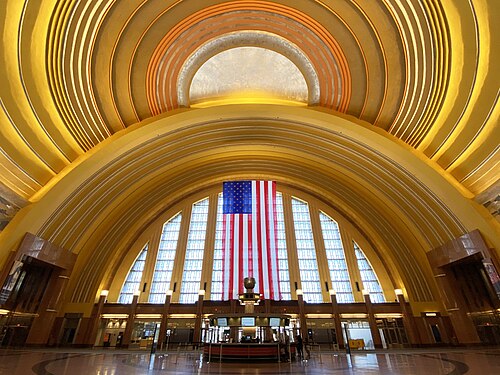
Cincinnati has several standard modes of transportation including sidewalks, roads, public transit, bicycle paths and airports. The city's hills preclude the regular street grid common to many cities built up in the 19th century, and outside of the downtown basin, regular street grids are rare except for in patches of flat land where they are small and oriented according to topography.
Most trips are made by car, with transit and bicycles having a relatively low share of total trips; in a region of just over 2 million people, less than 80,000 trips were made with transit on an average day in 2012.[213] Like many other Midwestern cities, however, bicycle use grew rapidly in the 2000s and 2010s.[214] The city of Cincinnati has a higher than average percentage of households without a car. In 2015, 19.3 percent of Cincinnati households lacked a car and the figure increased slightly, to 21.2 percent, in 2016. The national average was 8.7 percent in 2016. Cincinnati averaged 1.3 cars per household in 2016, compared to a national average of 1.8.[215]
The development of a light rail system had long been a goal for Cincinnati, with several proposals emerging over many decades. The city grew rapidly during its streetcar era of the late 19th and early 20th centuries, and is today served by the Connector. In 1917, citizens voted to spend $6 million (~$116 million in 2023) to build the Cincinnati Subway. The subway was planned to be a 16-mile (26 km) loop around the city hitting the suburbs of St. Bernard, Norwood, Oakley and Hyde Park before returning Downtown.[216] World War I delayed commencement of construction until 1920 and inflation raised the cost to over $13 million (~$150 million in 2023), causing the Oakley portion never to be built. Mayor Murray Seasongood, who took office later in the decade, argued it would cost too much money to finish the system, and construction stalled after the Wall Street Crash of 1929.
Public transportation
.jpg/500px-Cincinnati_Bell_Connector_on_Race_St_at_Glass_Alley_(2017).jpg)
The Connector streetcar line in Downtown and Over-the-Rhine opened for service on September 9, 2016, crossing directly above the unfinished subway on Central Parkway downtown.[52][53][217][218][219][220][221] Today the streetcar boasts over 3.5 miles of track and 16 hours of service per day on weekdays.[222] It had an annual ridership of over 846,000 in 2022.[223]
Cincinnati is served by the Southwest Ohio Regional Transit Authority (SORTA), the Transit Authority of Northern Kentucky (TANK) and the Clermont Transportation Connection. SORTA and TANK primarily operate 40-foot (12 m) diesel buses, though some lines are served by longer articulated or hybrid-engine buses. SORTA buses operate under the "Metro" name and are referred to by locals as such.
A system of public staircases known as the Steps of Cincinnati guides pedestrians up and down the city's many hills. In addition to practical use linking hillside neighborhoods, the 400 stairways provide visitors with scenic views of the Cincinnati area.[224]
Cincinnati is served by Amtrak's Cardinal, an intercity passenger train which makes three weekly trips in each direction between Chicago and New York City through Cincinnati Union Terminal.
Roadways

Bus traffic is heavy in Cincinnati. Several motor coach companies operate out of Cincinnati, making trips within the Midwest and beyond. The city has a beltway, Interstate 275 (which is the third-longest beltway overall in the United States at 85 miles or 137 kilometers) and a spur, Interstate 471, to Kentucky. It is also served by Interstate 71, Interstate 74, Interstate 75 and numerous U.S. highways: US 22, US 25, US 27, US 42, US 50, US 52, and US 127. The Riverfront Transit Center, built underneath 2nd Street, is about the size of eight football fields. It is only used for sporting events and school field trips. At its construction, it was designed for public transit buses, charter buses, school buses, city coach buses, light rail, and possibly commuter rail. When not in use for sporting events, it is closed off and rented to a private parking vendor.[225][226][227]
Air
The city is served by Cincinnati/Northern Kentucky International Airport (IATA: CVG) which is located in Hebron, Kentucky. The airport is a focus city for Allegiant Air and a global cargo hub for both Amazon Air and DHL Aviation.[228] The airport offers non-stop passenger service to over 50 destinations in North America and to European cities including Paris and London.[229] CVG is the 6th busiest airport in the United States by cargo traffic and is additionally the fastest-growing cargo airport in North America.
Other airports include Cincinnati Municipal Lunken Airport (IATA: LUK) which has daily service on commercial charter flights. The airport serves as a hub for Ultimate Air Shuttle and Flamingo Air.
Notable people
Sister cities
Cincinnati's sister cities are:[230][231]




See also
- City Plan for Cincinnati
- National Register of Historic Places listings in Cincinnati
- USS Cincinnati, 5 ships
- Vine Street, Cincinnati
Explanatory notes
- ^ Cincinnati's connection with Rome still exists today through its nickname of "The City of Seven Hills"[21] (a phrase commonly associated with Rome) and the town twinning program of Sister Cities International.
- ^ Mean monthly maxima and minima (i.e. the expected highest and lowest temperature readings at any point during the year or given month) calculated based on data at said location from 1991 to 2020.
- ^ Official records for Cincinnati kept at downtown from January 1871 to March 1915, at the Cincinnati Abbe Observatory just north of downtown from April 1915 to March 1947, and at KCVG near Hebron, Kentucky since April 1947. For more information, see Threadex and History of Weather Observations Cincinnati, Ohio 1789–1947.
References
- ^ a b Luten, Winifred (January 11, 1970). "How Losantiville Became The Athens of the West". The New York Times. p. 411. Archived from the original on June 19, 2020. Retrieved June 18, 2020 – via The New York Times Archive.
- ^ Greve 1904, p. 27: "The act to incorporate the town of Cincinnati was passed at the first session of the second General Assembly held at Chillicothe and approved by Governor St. Clair on January 1, 1802."
- ^ Greve 1904, pp. 507–508: "This act was passed February 5, 2851, and by virtue of a curative act passed three days later took effect on March 1, of the same year."
- ^ "ArcGIS REST Services Directory". United States Census Bureau. Archived from the original on January 19, 2022. Retrieved September 20, 2022.
- ^ a b U.S. Geological Survey Geographic Names Information System: Cincinnati
- ^ a b c "QuickFacts Cincinnati city, Ohio". United States Census Bureau. Retrieved May 16, 2024.
- ^ "Total Real Gross Domestic Product for Cincinnati, OH-KY-IN (MSA)". fred.stlouisfed.org. Archived from the original on October 21, 2019. Retrieved October 21, 2019.
- ^ "Zip Code Lookup". USPS. Archived from the original on February 11, 2012. Retrieved May 14, 2021.
- ^ "U.S. Census website". United States Census Bureau. Archived from the original on May 12, 2015. Retrieved January 31, 2008.
- ^ "Find a County". National Association of Counties. Archived from the original on June 8, 2011. Retrieved June 7, 2011.
- ^ "2020 Population and Housing State Data". United States Census Bureau, Population Division. August 12, 2021. Archived from the original on August 24, 2021. Retrieved August 14, 2021.
- ^ "When Cincinnati was 'the Paris of America'". Building Cincinnati. April 19, 2010. Archived from the original on April 19, 2012.
- Picturesque Cincinnati. Cincinnati, Ohio: John Shillito Company. 1883. p. 154. OCLC 3402849.
- Peterson, Lucas (July 13, 2016). "From Chili to the Underground Railroad, Cincinnati on a Budget". The New York Times. Archived from the original on February 16, 2018.
- Morgan, Michael D. (2010). "Side-Door Sundays in the Paris of America". Over-the-Rhine: When Beer Was King. Arcadia Publishing. ISBN 9781614231981. Archived from the original on March 27, 2024. Retrieved May 23, 2019.
- ^ a b "Cincinnati economy fastest-growing in the Midwest". Cincinnati.com. Archived from the original on October 22, 2020. Retrieved December 1, 2016.
- ^ Rieselman, Deborah. "Brief history of University of Cincinnati". UC Magazine. University of Cincinnati University Relations. Archived from the original on February 19, 2017. Retrieved February 12, 2014.
- ^ "Top 10 Places For Young Professionals To Live – Forbes Advisor". www.forbes.com. Archived from the original on August 3, 2023. Retrieved August 3, 2023.
- ^ Teetor, Henry Benton (May–October 1885). "Israel Ludlow and the naming of Cincinnati". Magazine of Western History. 2. Cleveland: 251–257.
The fair and reasonable presumption is that after consultation (certainly with Ludlow, the surveyor of the town, the proprietor of a two-thirds' interest in his own right, and as agent of Denman), St. Clair adopted the name suggested by Ludlow—a name which, as may seen from the following testimony, was not only mentioned for more than a year prior to the coming of St. Clair, but was selected and adopted by Denman, Patterson and Ludlow in the winter of 1788–9, and was inscribed upon the plat made by Ludlow to take the place of the one first made by Filson, which was destroyed in a personal altercation between Colonel Ludlow and Joel Williams.
- ^ Suess, Jeff (December 28, 2013). "Cincinnati's beginning: The origin of the settlement that became this city". The Cincinnati Enquirer. Archived from the original on March 17, 2019. Retrieved August 11, 2018.
On Jan. 2, 1790, Gen. Arthur St. Clair, governor of the Northwest Territory, came to inspect Fort Washington. He was pleased with the fort but disliked the name Losantiville. Two days later, he changed it to Cincinnati, after the Society of the Cincinnati, a military society for officers in the Continental Army during the Revolutionary War.
- ^ a b "How Cincinnati Became A City". Archived from the original on September 28, 2006. Retrieved December 11, 2006.
- ^ "46 Interesting Facts about Ancient Rome – Page 15 of 44". April 6, 2017. Archived from the original on June 23, 2018. Retrieved November 29, 2017.
- ^ Suess, Jeff (December 28, 2013). "Cincinnati's beginning: The origin of the settlement that became this city". Cincinnati.com. Archived from the original on March 17, 2019. Retrieved January 24, 2020.
- ^ "Cincinnati.com". Cincinnati.com. Archived from the original on June 29, 2006. Retrieved March 31, 2018.
- ^ Lossing, Benson (1868). The Pictorial Field-Book of the War of 1812. Harper & Brothers, Publishers. p. 476.
- ^ History of Cincinnati, Ohio. Cleveland, O., L.A. Williams & Co. 1881. Archived from the original on May 22, 2017. Retrieved February 24, 2017.
- ^ Cincinnati: The Queen City Bicentennial Edition ISBN 0-911497-11-0, Cincinnati Historical Society, 1988, p. 15.
- ^ Suess, Jeff. "Our history: Who was Cincinnatus, inspiration for city's name?". The Enquirer. Archived from the original on May 5, 2021. Retrieved March 5, 2021.
- ^ Greve 1904, pp. 507–508.
- ^ a b "Population of the 100 largest cities 1790–1990". The United States Census Bureau. Archived from the original on July 14, 2007. Retrieved July 29, 2007.
- ^ a b c Condit, Carl W. (1977). The Railroad and the City: A Technological and Urbanistic History of Cincinnati. Ohio State University Press. ISBN 9780814202654.
- ^ a b Vexler, Robert. Cincinnati: A Chronological & Documentary History.
- ^ Suess, Jeff. "Why is Cincinnati called the Queen City?". The Enquirer. Archived from the original on January 25, 2021. Retrieved March 5, 2021.
- ^ "Lost City: Underground Railroad Sites - Cincinnati Magazine". Cincinnati Magazine. May 18, 2017. Archived from the original on November 18, 2018. Retrieved November 14, 2018.
- ^ Wessels, Joe (February 16, 2012). "National Underground Railroad Freedom Center plans to merge". Reuters. Archived from the original on May 2, 2021. Retrieved March 5, 2021.
- ^ O'Neill, Tom (August 18, 2001). "Exhibit commemorates the streetcar era". The Cincinnati Enquirer. Archived from the original on March 27, 2024. Retrieved January 3, 2014.
- ^ Stevenson, Katharine Lent (1907). "1875-Cincinnati". A Brief History of the Woman's Christian Temperance Union: Outline Course of Study for Local Unions (Third ed.). Evanston, Illinois: Union Signal. pp. 11–13. Archived from the original on October 3, 2023. Retrieved October 1, 2023.
 This article incorporates text from this source, which is in the public domain.
- ^ Wetterich, Chris (February 8, 2019). "City-owned railroad (no, not that one) will fund more housing". Cincinnati Business Courier. Archived from the original on June 18, 2021. Retrieved March 5, 2021.
- ^ "NS, City close sale of Cincinnati Southern Railway". Progressive Railroading. March 19, 2024. Retrieved September 20, 2024.
- ^ Stradling 2003, p. 67.
- ^ "WATCH: Flood of 1937 in one-of-a-kind video". WCPO. January 21, 2016. Archived from the original on May 2, 2021. Retrieved March 5, 2021.
- ^ United States Congress Senate Committee on Banking, Housing, and Urban Affairs Subcommittee on Housing and Urban Affairs (1973). Oversight on Housing and Urban Development Programs, Washington, D.C.: Hearings Before the Subcommittee on Housing and Urban Affairs of the Committee on Banking, Housing and Urban Affairs, United States Senate, Ninety-third Congress, First Session. U.S. Government Printing Office. p. 35. Archived from the original on March 27, 2024. Retrieved September 9, 2023.
{{cite book}}: CS1 maint: multiple names: authors list (link) - ^ Close to home: Across the region, dozens of sites have historic ties to the Underground Railroad, The Cincinnati Enquirer, Sunday, August 15, 2004, "The poet Longfellow, recognizing the town's rising stature, immortalized Cincinnati as the "Queen City of the West". [1] Archived April 25, 2016, at the Wayback Machine accessed May 3, 2008
- ^ "Frequently Asked Questions about Cincinnati, Ohio". Archived from the original on November 1, 2013. Retrieved September 4, 2018.
- ^ "Cincinnati: many discounters say it's a 'blue chip' investment". Discount Store News. 1988. Archived from the original on May 27, 2009. Retrieved September 4, 2018.
- ^ Lawley, Lauren (July 17, 1998). "Cookie firm swallows parent: The local Blue Chip Cookies franchisee is buying the company's San Francisco franchiser". Cincinnati Business Courier. American City Business Journals. Archived from the original on January 18, 2013. Retrieved May 3, 2008.
In 1984, the Greater Cincinnati Chamber of Commerce began its 'Blue Chip City' campaign, a marketing strategy it continued through last year.
- ^ "Great cities test: How does Cincinnati stack up to its regional rivals?". The Cincinnati Enquirer. March 11, 2001. Archived from the original on July 29, 2012. Retrieved February 23, 2019.
Cincinnati's dated 'Blue Chip City' nickname is being replaced with 'Let the spirit move you.' To where?
- ^ "Ups and downs: The hills are alive, but don't try counting". The Cincinnati Enquirer. Archived from the original on June 29, 2006. Retrieved February 23, 2019.
- ^ "Letter from Alfred Kleinne-Krautzmann to Robert M. Evanson" (PDF). May 7, 1990. Archived from the original (PDF) on March 24, 2016. Retrieved February 23, 2019.
- ^ "Cincinnati FAQs | Cincinnati History Library and Archives". Archived from the original on November 1, 2013. Retrieved September 4, 2018.
- ^ Clark, S. J. (1912). Cincinnati, the Queen City, 1788–1912, Volume 2. The S. J. Clarke Publishing Company. p. 334. Archived from the original on March 27, 2024. Retrieved May 20, 2013.
- ^ "Don't Trash the 'Nati". Archived from the original on September 26, 2008. Retrieved September 4, 2018., Keep Cincinnati Beautiful website, accessed May 3, 2008
- ^ Rosen, Jill (March 13, 2007). "Getting city to pick it up". The Baltimore Sun. pp. 1A, 4A. Archived from the original on March 27, 2024. Retrieved January 1, 2022 – via Newspapers.com. [2] Archived March 27, 2024, at the Wayback Machine
- ^ Howard, Allen (July 21, 2005). "Initial caddy scholarship sending New Richmond woman to Miami". The Cincinnati Enquirer. p. C3. Archived from the original on March 27, 2024. Retrieved January 1, 2022 – via Newspapers.com.
- ^ a b Rinehart, Bill (September 9, 2016). "Cincinnati's Streetcar Is Open For Business". WVXU. Archived from the original on September 10, 2016. Retrieved September 10, 2016.
- ^ a b Coolidge, Sharon; Tweh, Bowdeya; Williams, Jason (September 9, 2016). "It's a go: Streetcar finally opens". The Cincinnati Enquirer. Archived from the original on February 2, 2019. Retrieved September 10, 2016.
- ^ Charles Theodore Greve (1904). Centennial History of Cincinnati and Representative Citizens, Volume 1. Biographical Publishing Company. p. 13. Retrieved May 22, 2013.
- ^ "US Gazetteer files 2010". United States Census Bureau. Archived from the original on January 25, 2012. Retrieved January 6, 2013.
- ^ Ohio Division of Geological Survey (1998). "Physiographic Regions of Ohio" (PDF). Ohio Department of Natural Resources, Division of Geological Survey. Archived from the original (PDF) on May 28, 2012. Retrieved February 13, 2014.
- ^ wisetemple.org
- ^ "Sights in Cincinnati, Ohio". Archived from the original on December 30, 2007.
- ^ a b c Van Sant, Rick (January 23, 1996). "Flooding by the Numbers". The Cincinnati Post. Archived from the original on January 24, 2016. Retrieved October 20, 2015.
- ^ a b "History of Riverfront Development". The Banks Public Partnership. Archived from the original on January 24, 2016. Retrieved October 20, 2015.
- ^ Singer, Allen J. (October 20, 2004). Cincinnati on the Go: History of Mass Transit. Images of America. Charleston, South Carolina: Arcadia Publishing. p. 24. ISBN 9781439615119. Archived from the original on December 3, 2016. Retrieved November 13, 2019 – via Google Books.
- ^ "History". Coney Island. Archived from the original on October 9, 2015. Retrieved October 20, 2015.
- ^ Pilcher, James (March 14, 2015). "Flood expands, but impact not yet as bad as in past". The Cincinnati Enquirer. Archived from the original on January 24, 2016. Retrieved October 20, 2015.
- ^ Kenny, Daniel J. (1895). "Illustrated Guide to Cincinnati and the World's Columbian Exposition". R. Clarke. p. 52. Archived from the original on October 3, 2023. Retrieved May 22, 2013.
- ^ "A neighborhood comparison: Population". The Cincinnati Enquirer. February 24, 2022. Archived from the original on September 9, 2023. Retrieved September 9, 2023.
- ^ Over-the-Rhine Foundation. Guide to OTR Architecture Archived May 21, 2023, at the Wayback Machine. Accessed on 2009-08-13.
- ^ MAAG, CHRISTOPHER (November 25, 2006). "In Cincinnati, Life Breathes Anew in Riot-Scarred Area". New York Times.
- ^ Woodard, Colin (June 16, 2016). "How Cincinnati Salvaged the Nation's Most Dangerous Neighborhood". Politico. Archived from the original on August 26, 2023. Retrieved June 14, 2018.
- ^ a b c d "Station: Cincinnati Northern KY AP, KY". U.S. Climate Normals 2020: U.S. Monthly Climate Normals (1991–2020). National Oceanic and Atmospheric Administration. Archived from the original on February 6, 2024. Retrieved May 9, 2021.
- ^ a b "NowData—NOAA Online Weather Data". National Oceanic and Atmospheric Administration. Retrieved May 9, 2021.
- ^ a b "Records for Cincinnati". National Weather Service. Retrieved April 13, 2012.
- ^ "National Weather Service: 5 tornadoes hit Tri-State on Wednesday". WCPO. March 3, 2017. Archived from the original on September 29, 2017. Retrieved September 29, 2017.
- ^ "WMO Climate Normals for CINCINNATI/GREATER CINCINNATI,KY 1961–1990". National Oceanic and Atmospheric Administration. Archived from the original on February 6, 2024. Retrieved July 25, 2020.
- ^ "Cincinnati, Ohio, USA - Monthly weather forecast and Climate data". Weather Atlas. Retrieved July 4, 2019.
- ^ "Decennial Census of Population and Housing". Census.gov. Archived from the original on April 26, 2015. Retrieved October 19, 2022.
- ^ "1980–1990 Population of Places With 100,000 or More Inhabitants". The United States Census Bureau. Archived from the original on August 8, 2007. Retrieved July 29, 2007.
- ^ "2009 Estimates for Ohio Cities". citypopulation.de. Archived from the original on June 5, 2019. Retrieved February 26, 2010.
- ^ "U.S. Census Bureau QuickFacts". United States Census Bureau. April 1, 2020. Archived from the original on February 17, 2021. Retrieved December 5, 2022.
- ^ "Cincinnati (city), Ohio". State & County QuickFacts. U.S. Census Bureau. Archived from the original on May 24, 2015. Retrieved May 17, 2015.
- ^ "Cincinnati Population: Race, Age by Statistical Neighborhoods Census 2000". www.cincinnati-oh.gov. Archived from the original on October 18, 2017.
- ^ a b c d e "Ohio – Race and Hispanic Origin for Selected Cities and Other Places: Earliest Census to 1990". U.S. Census Bureau. Archived from the original on August 12, 2012. Retrieved April 16, 2012.
- ^ From 15% sample
- ^ "Census.gov". Census.gov. Archived from the original on December 27, 1996. Retrieved November 5, 2021.
- ^ "U.S. Census website". United States Census Bureau. Archived from the original on February 17, 2021. Retrieved December 5, 2022.
- ^ "Cincinnati (city) QuickFacts from the US Census Bureau". census.gov. Archived from the original on May 24, 2015. Retrieved May 17, 2015.
- ^ "U.S. Census Bureau QuickFacts: Cincinnati city, Ohio". www.census.gov. Retrieved November 16, 2017.
- ^ "Midwest Economy - Labor Force Statistics : Midwest Information Office : U.S. Bureau of Labor Statistics". www.bls.gov. Archived from the original on November 7, 2022. Retrieved November 7, 2022.
- ^ "U.S. Bureau of Labor Statistics". Retrieved November 7, 2022.
- ^ "GE's big addition to the Cincinnati riverfront". Cincinnati.com. Archived from the original on December 13, 2017. Retrieved December 1, 2016.
- ^ Drilling, Joanne (July 7, 2023). "Greater Cincinnati's Largest Employers, 2023". Cincinnati Business Courier. Archived from the original on March 27, 2024. Retrieved October 12, 2023.
- ^ "About Us". Federal Reserve Bank of Cleveland. June 29, 2023. Archived from the original on August 17, 2023. Retrieved September 24, 2023.
- ^ Aaron, Daniel (1992). Cincinnati: Queen City of the West, 1819-1838. Ohio State University Press. ISBN 0814205704.
- ^ Cayton, Andrew R. L. (2002). Ohio: The History of a People. Ohio State University Press. ISBN 0814208991.
- ^ Hurley, Daniel (1982). Cincinnati: The Queen City. Cincinnati Historical Society. ISBN 978-0911497007.
- ^ McCullough, David (2019). The Pioneers. Simon & Schuster. ISBN 978-1501168680.
- ^ Dixon, Barbara (2011). A Forgotten Heritage: The German Methodist Church. Little Miami Publishing Company. ISBN 978-1932250961.
- ^ "Shiloh Methodist Church". www.delhihistoricalsociety.org. March 27, 2018. Archived from the original on November 16, 2022. Retrieved April 30, 2022.
- ^ Taylor (2005), Frontiers of Freedom, pp. 20–21
- ^ a b Aaron, Daniel (1992). Cincinnati, Queen City of the West: 1819–1838. Ohio State University Press. p. 300ff. ISBN 978-0-8142-0570-9. Archived from the original on January 13, 2016. Retrieved October 24, 2010.
- ^ Thomas, Benjamin Platt (1950). Theodore Weld, crusader for freedom. New Brunswick, New Jersey: Rutgers University Press. OCLC 6655058.
- ^ Nikki Marie Taylor (2005). Frontiers of Freedom: Cincinnati's Black Community, 1802–1868. Ohio University Press. ISBN 978-0-8214-1579-5. Archived from the original on March 27, 2024. Retrieved October 16, 2015.
- ^ Greve 1904, p. 440: "This explains a common confusion of ideas as to the first mayor of Cincinnati. David Ziegler was the first president of the town, William Corry the first mayor of the town, and Isaac G. Burnet the first mayor of the city."
- ^ Clark, S. J. (1912). Cincinnati, the Queen City, 1788–1912, Volume 2. The S. J. Clarke Publishing Company. p. 9. Archived from the original on March 27, 2024. Retrieved May 20, 2013.
- ^ ":: Cincinnati, A City of Immigrants". Cincinnati-cityofimmigrants.com. Archived from the original on July 24, 2013. Retrieved July 10, 2013.
- ^ Hetzer, Laura. "Cincinnati: Our German History". Yahoo!. Archived from the original on November 2, 2012.[unreliable source?]
- ^ "Ohio Sauerkraut Festival". SauerkrautFestival.Com. December 16, 2017. Archived from the original on January 17, 2018. Retrieved December 6, 2019.
- ^ "Oktoberfest Zinzinnati: Hey, Fonzie: Welcome to town!". Cincinnati.com. September 16, 2014. Archived from the original on January 24, 2016. Retrieved January 22, 2015.
- ^ [3] Archived January 22, 2015, at the Wayback Machine, Cincy USA website
- ^ One or more of the preceding sentences incorporates text from a publication now in the public domain: Adler, Cyrus; Philipson, David (1901–1906). "WISE, ISAAC MAYER". In Singer, Isidore; et al. (eds.). The Jewish Encyclopedia. New York: Funk & Wagnalls. Retrieved December 3, 2015.
Jewish Encyclopedia bibliography:- I. M. Wise, Reminiscences, transl. from the German and ed. by David Philipson, Cincinnati, 1901;
- Skolnik, Fred; Berenbaum, Michael. Encyclopaedia Judaica. Vol. XXI. New York: Macmillan. p. 100.
...Wise's foresightedness and tenacity in laying its three institutional cornerstones earned him the title 'founding father' of the indigenous Reform movement in America
- The American Israelite, 1854–1900, passim, and the Jubilee number, June 30, 1904.
- ^ "Art, Exhibitions, Online Collections & Resources". Cincinnati Art Museum. Archived from the original on October 3, 2023. Retrieved October 3, 2023.
- ^ a b Felix Winternitz & Sacha DeVroomen Bellman (2007). Insiders' Guide to Cincinnati. Globe Pequot. p. 13. ISBN 9780762741809. Retrieved October 3, 2023.[permanent dead link]
- ^ "Union Terminal: Cincinnati's Art Deco gem shines again". October 31, 2018. Archived from the original on October 13, 2023. Retrieved October 3, 2023.
- ^ "William Howard Taft National Historic Site - Things To Do". U.S. National Park Service. Archived from the original on October 13, 2023. Retrieved October 3, 2023.
- ^ Edward Rothstein. "Bright Lights, Wide Eyes: Nostalgic Collections That Speak Volumes Archived October 13, 2023, at the Wayback Machine". New York Times. June 21, 2009. Retrieved on February 5, 2010.
- ^ "Fox News presents Veronica Vitale working in Cincinnati". YouTube. Retrieved October 10, 2017.[dead YouTube link]
- ^ Garrett, Ian (March 29, 2015). "USITT 2015 Smashes Attendance Records in Cincinnati". USITT at PQ 2015. Archived from the original on March 19, 2024. Retrieved March 19, 2024.
- ^ "Shot Here". Greater Cincinnati & Northern Kentucky Film Commission. Archived from the original on February 20, 2014. Retrieved February 13, 2014.
- ^ "Wild About Moves". Archived from the original on October 18, 2007. Retrieved October 21, 2007.
- ^ Campbell, Polly. "Cincinnati will get more airtime on 'Harry's Law'". The Cincinnati Enquirer. Archived from the original on July 22, 2011. Retrieved July 18, 2011.
- ^ "The Laurel and Hardy Appreciation Society of Cincinnati, Ohio". Archived from the original on October 18, 2017. Retrieved November 29, 2011.
- ^ Taste of Cincinnati, About Taste Archived June 1, 2010, at the Wayback Machine. Accessed on December 27, 2009.
- ^ Wondrich, David (June 2013). "The Best Bars in America". Esquire. Archived from the original on January 24, 2016. Retrieved January 13, 2016.
- ^ "Arnold's Website Awards Section". Arnold's. Archived from the original on April 10, 2016. Retrieved April 29, 2016.
- ^ Weldon, Casey (May 27, 2013). "Downtown fixture Arnold's Bar and Grill voted among '16 Best Bars in America' by Esquire Magazine". WCPO. Archived from the original on June 2, 2016. Retrieved January 13, 2016.
- ^ Breslour, Lee (April 8, 2015). "The most iconic bar in every state (and DC)". Thrillist. Archived from the original on January 24, 2016. Retrieved January 13, 2016.
- ^ Steigerwald, Shauna (April 23, 2015). "Daily Meal puts Arnold's in '150 Best Bars in America'". The Daily Meal. Archived from the original on July 14, 2018. Retrieved April 29, 2016.
- ^ Pandolfi, Keith (February 29, 2016). "The Cincinnati 10". Serious Eats. Archived from the original on May 9, 2016. Retrieved April 29, 2016.
- ^ "Arnold's Way". Cincy Magazine. Archived from the original on April 8, 2016. Retrieved February 10, 2019.
- ^ "How a Catholic Businessman Put the Filet-O-Fish on the McDonald's Menu". NCR. March 7, 2019. Retrieved August 21, 2024.
- ^ Covrett, Donna (April 21, 2011). "Local Flavor: Opera Creams". Cincinnati Magazine. Retrieved August 21, 2024.
- ^ Woellert, Dann (2017). Cincinnati Candy: A Sweet History. Arcadia Publishing. ISBN 978-1-4671-3795-9.
- ^ Suess, Jeff. "Who knew? Frank's RedHot Hot Sauce was founded in Cincinnati more than 100 years ago". The Enquirer. Retrieved August 21, 2024.
- ^ Coleman, Brent (August 27, 2015). "How Skyline Chili became a Cincinnati icon". WCPO-TV. Archived from the original on August 29, 2015. Retrieved August 29, 2015.
- ^ Stern, Jane and Michael (2009). 500 Things to Eat Before it's Too Late:and the Very Best Places to Eat Them. p. 244.
- ^ Clint (November 21, 2010). "Cincinnati Coney Quest: History of Empress Chili". Cincinnati Coney Quest. Archived from the original on May 2, 2021. Retrieved March 27, 2021.
- ^ Woellert, Dann (2013). The Authentic History of Cincinnati Chili. The History Press. ISBN 978-1-60949-992-1. Archived from the original on January 14, 2016. Retrieved October 16, 2015.
- ^ Gilewicz, Nicholas. "Food Capitals of America". MSN City Guides. Archived from the original on October 9, 2009. Retrieved July 23, 2009.
- ^ "Seven Innovative Takes on Cincinnati Goetta to Change Your Mind About the Meat". City Beat. August 7, 2018. Archived from the original on October 27, 2018. Retrieved October 27, 2018.
- ^ Smith, Steve; et al. (2007). "Are You Ready For Cincinnati?". Cincinnati Magazine. Cincinnati USA City Guide. p. 144. Archived from the original on March 27, 2024. Retrieved May 6, 2013.
- ^ Pandolfi, Keith (July 18, 2021). "Why Cincinnati is the world capital of mock turtle soup". Cincinnati Enquirer. Archived from the original on March 27, 2024. Retrieved December 7, 2021.
- ^ Woellert, Dann (2015). Historic Restaurants of Cincinnati. American Palate. p. 171. ISBN 9781625855398. Archived from the original on April 8, 2023. Retrieved March 19, 2023.
- ^ Labov, William; Ash, Sharon; Boberg, Charles (2006). The Atlas of North American English: Phonetics, Phonology, and Sound Change. Vol. 1. Walter de Gruyter. p. 276. ISBN 978-3110167467. Archived from the original on December 4, 2016. Retrieved November 13, 2019.
- ^ Labov, William (July 5, 2011). Principles of Linguistic Change: Cognitive and Cultural Factors. New York City: John Wiley & Sons. 15.6.3. ISBN 978-1444351460. Archived from the original on December 4, 2016. Retrieved November 13, 2019.
- ^ Boberg, Charles; Strassel, Stephanie M. (June 2000). "Short-a in Cincinnati: A Change in Progress". Journal of English Linguistics. 28 (2): 108–126. doi:10.1177/00754240022004929. ISSN 0075-4242. S2CID 144201079.
- ^ Ash, Sharon (January 1, 2006). "The North American Midland as a dialect area". In Murray, Thomas Edward; Simon, Beth Lee (eds.). Language Variation and Change in the American Midland: A New Look at 'Heartland' English. Amsterdam: John Benjamins Publishing Company. p. 55. ISBN 978-90-272-4896-1. Archived from the original on March 27, 2024. Retrieved November 13, 2019.
- ^ "UC Idioms and Jargon". University of Cincinnati. Archived from the original on February 21, 2014. Retrieved February 13, 2014.
- ^ Vaccariello, Linda (January 21, 2014). "How To: Speak Cincinnatiese". Cincinnati. Archived from the original on December 19, 2014. Retrieved December 19, 2014.
- ^ "1866 to 1875". Archived from the original on February 17, 2008.
- ^ "1876 to 1881". Archived from the original on April 20, 2008.
- ^ "1882 to 1889". Archived from the original on April 19, 2008.
- ^ "Today, dads let kids skip school". Sarasota Herald-Tribune. Sarasota, Florida. April 3, 2000. p. 5C. Archived from the original on December 8, 2013. Retrieved May 30, 2010.
'We'd skip school,' Ken Griffey Jr. said Sunday, when asked for his favorite opening day memory. 'My son's skipping school on opening day. It's a tradition. Cincinnati expects that a lot of kids are not going to be there.'
- ^ "Mayors want 'Queen City' debate settled in Carolina-Cincy game". Sports Illustrated. October 7, 2014. Archived from the original on December 10, 2019. Retrieved December 10, 2019.
- ^ "Monday kickaround: Andy Najar ACL injury, MLS refs, NWSL and USL crowds". The Washington Post. Archived from the original on May 8, 2016. Retrieved April 21, 2016.
- ^ Brennan, Patrick (May 14, 2016). "Another record crowd turns out to watch FC Cincy win". The Cincinnati Enquirer. Archived from the original on March 27, 2019. Retrieved October 7, 2016.
- ^ "Cincinnati awarded MLS expansion club, will start play in 2019" (Press release). Major League Soccer. May 29, 2018. Archived from the original on June 12, 2018. Retrieved May 31, 2018.
- ^ Creditor, Avi. "Cincinnati Follows Nashville With Winning MLS Expansion Bid in Growth to 28 Teams". Sports Illustrated. Archived from the original on March 29, 2019. Retrieved December 10, 2019.
- ^ "DI Men's National Championship History". ncaa.com. Archived from the original on June 26, 2015. Retrieved March 5, 2024.
- ^ "2023 Major League Baseball Attendance". ESPN. 2023. Archived from the original on November 13, 2023. Retrieved November 13, 2023.
- ^ "2016 National College Football Attendance" (PDF). National Collegiate Athletic Association. April 19, 2017. Archived (PDF) from the original on June 5, 2017. Retrieved June 28, 2017.
- ^ a b "2016 NCAA Men's Basketball Attendance" (PDF). National Collegiate Athletic Association. April 19, 2017. Archived (PDF) from the original on May 17, 2017. Retrieved June 28, 2017.
- ^ "2022 NFL Football Attendance". ESPN. 2023. Archived from the original on September 23, 2023.
- ^ "ECHL 2019-20 Attendance Graph". hockeyDB.com. Archived from the original on April 25, 2021. Retrieved April 25, 2021.
- ^ "USL Total Attendance Soars by 33 Percent in 2016". United Soccer League. September 28, 2016. Archived from the original on July 8, 2017. Retrieved June 28, 2017.
- ^ Linden-Ward, Blanche (Spring 1993). "The Greening of Cincinnati: Adolph Strauch's Legacy in Park Design" (PDF). Queen City Heritage: 20–39. Archived from the original (PDF) on July 26, 2019. Retrieved April 28, 2020.
- ^ The Fountain. 2016. "Fountain Square". Archived from the original on May 13, 2020. Retrieved February 14, 2020.
- ^ "Odds & Ends: Riverfront plan, food and disease, easy governing". Editorial. The Cincinnati Enquirer. November 4, 1981. p. A6. Archived from the original on March 9, 2024. Retrieved October 20, 2015 – via Newspapers.com.
- ^ "History, Mission and Vision – The Cincinnati Zoo & Botanical Garden". Archived from the original on May 2, 2011. Retrieved July 1, 2016.
- ^ "Best US Zoos: 10Best Readers' Choice Travel Awards". 10best.com. May 21, 2014. Archived from the original on March 5, 2018. Retrieved September 24, 2018.
- ^ "Best zoo in North America? Readers choose Cincinnati Zoo & Botanical Garden". USA Today 10 Best. USA Today. May 3, 2019. Archived from the original on June 10, 2023. Retrieved October 18, 2023.
- ^ Douglas J. Amy, "A Brief History of Proportional Representation in the United States" Archived September 16, 2014, at the Wayback Machine, revised version of "The Forgotten History of the Single Transferable Vote in the United States", in Representation 34, number 1 (Winter 1996/7), accessed March 30, 2015
- ^ Kathleen L. Barber, PROPORTIONAL REPRESENTATION AND ELECTION REFORM IN OHIO (excerpt) Archived May 2, 2015, at the Wayback Machine, Columbus: Ohio State University Press, 1995, pp. Introduction
- ^ "City of Cincinnati Council, Resolution No. 47-2011" (PDF). October 5, 2011.[permanent dead link]
- ^ "Cincinnati now a 'sanctuary city.' What's that mean?". Cincinnati.com. January 30, 2017. Archived from the original on August 31, 2019. Retrieved September 4, 2019.
- ^ "Dave's Redistricting". Archived from the original on November 14, 2023. Retrieved November 16, 2023.
- ^ "Home – Fire". Archived from the original on November 29, 2014. Retrieved September 25, 2014.
- ^ "About The Cincinnati Fire Department – Fire". Archived from the original on October 25, 2014. Retrieved September 25, 2014.
- ^ a b "Operations Bureau – Fire". cincinnati-oh.gov. Archived from the original on December 3, 2013. Retrieved November 24, 2013.
- ^ "Cincinnati Fire Department History and Photos". Archived from the original on November 29, 2014. Retrieved September 25, 2014.
- ^ "Personnel & Training – Fire". Archived from the original on November 29, 2014. Retrieved September 25, 2014.
- ^ "Administrative Services Bureau – Fire". Archived from the original on November 29, 2014. Retrieved September 25, 2014.
- ^ "Fire Prevention Bureau – Fire". Archived from the original on October 30, 2014. Retrieved September 25, 2014.
- ^ "Crime Rate Dropping Slightly Murders, Rapes Up, Says New FBI Study". Archived from the original on August 27, 2011. Retrieved December 11, 2006.
- ^ Semuels, Alana (May 29, 2015). "How to Fix a Broken Police Department". Route Fifty. Atlantic Media. Archived from the original on September 5, 2015. Retrieved June 1, 2015.
- ^ Wetterich, Chris (January 2, 2024). "Nearly every Cincinnati council member mentioned gun violence as they took office". Cincinnati Business Courier. Archived from the original on March 27, 2024. Retrieved January 3, 2024.
- ^ a b Woodson, Carter G.; Wesley, Charles Harris (1922). The Negro in Our History. Associated Publishers (digitized from original at University of Michigan Library). p. 140. Retrieved October 1, 2013.
- ^ "The Pro-Slavery Riot in Cincinnati" Archived September 18, 2008, at the Wayback Machine, Abolitionism 1830–1850, Uncle Tom's Cabin and American Culture, University of Virginia, 1998–2007, accessed January 14, 2009
- ^ Levi Coffin, Reminiscences of Levi Coffin, the reputed president of the underground railroad: being a brief history of the labors of a lifetime in behalf of the slave, with the stories of numerous fugitives, who gained their freedom through his instrumentality, and many other incidents, Cincinnati: Western Tract Society, University of Michigan Library
- ^ "Cincinnati.Com – Your Key to the City". cincinnati.com. Archived from the original on July 6, 2010. Retrieved June 27, 2010.
- ^ "Ohio – 2001 riots led to top-down change for Cincinnati police". USA Today. Archived from the original on March 6, 2015. Retrieved January 29, 2015.
- ^ Ferrell, Nikki (November 28, 2016). "Everything you should know about the Ray Tensing murder mistrial". WLWT. Archived from the original on December 2, 2016. Retrieved December 1, 2016.
- ^ Blau, Max. "Ray Tensing trial explained: What to know". CNN. Archived from the original on December 2, 2016. Retrieved December 1, 2016.
- ^ "Black Lives Matter finds allies to protest Tensing decision". Cincinnati.com. Archived from the original on December 2, 2020. Retrieved December 1, 2016.
- ^ Hamrick, Brian (July 27, 2015). "Black Lives Matter holds rally on UC campus for Sam Dubose". WLWT. Archived from the original on December 2, 2016. Retrieved December 1, 2016.
- ^ Sanchez, Ray. "Mistrial in murder trial of Ex-University of Cincinnati cop". CNN. Archived from the original on December 2, 2016. Retrieved December 1, 2016.
- ^ Noble, Greg (July 18, 2017). "Prosecutor Joe Deters decides not to try Ray Tensing third time in killing of Sam DuBose". WCPO. Archived from the original on July 21, 2017. Retrieved July 24, 2017.
- ^ McKee, Marais Jacon-Duffy, Pat LaFleur, Tom (October 25, 2016). "Family of Sam DuBose settles with UC for $4.8M plus free tuition for 12 children". WCPO. Archived from the original on December 2, 2016. Retrieved December 1, 2016.
{{cite news}}: CS1 maint: multiple names: authors list (link) - ^ "Ohio school district rankings". The Columbus Dispatch. Archived from the original on February 11, 2015.
- ^ "Clark Montessori". Clark.cps-k12.org. Archived from the original on October 5, 2013. Retrieved October 1, 2013.
- ^ "RabbiHorowitz.com". Archived from the original on April 2, 2015. Retrieved January 20, 2015.
- ^ "Brochure" (PDF). ylcincinnati.com. Archived (PDF) from the original on January 21, 2015. Retrieved January 20, 2015.
- ^ Aiesha D Little (August 2007). "A League of Their Own". Cincinnati Magazine. Archived from the original on March 27, 2024. Retrieved June 23, 2015.
...girls get the extra leadership and academic push they need to get on to the path to success in college and in life... Mother of Mercy High School... Mt Notre Dame High School... Notre Dame Academy... St Ursula Academy... McAuley High School... Ursuline Academy of Cincinnati...
- ^ Katherine L Sontag (August 2007). "No Girls Allowed". Cincinnati Magazine. Archived from the original on March 27, 2024. Retrieved June 23, 2015.
The all-male prep schools in the share similar traits-- faith-based service opportunities, strong sports programs, tradition, and lots of testosterone...Covington Catholic High School...Elder High School... La Salle High School... Archbishop Moeller High School...Stephen T Badin High School... St Xavier High School
- ^ "UC growth continues as Big 12 newbie admits largest class". University of Cincinnati. September 15, 2023. Archived from the original on November 7, 2023. Retrieved November 6, 2023.
- ^ "Langsam Library Exhibit Marks the 500th Anniversary of the Reformation". The University of Cincinnati. September 11, 2017. Archived from the original on December 25, 2017. Retrieved December 26, 2017.
- ^ "Albrecht Dürer: The Age of Reformation and Renaissance". The Cincinnati Art Museum. Archived from the original on December 27, 2017. Retrieved December 26, 2017.
- ^ "Albrecht Dürer: A Reformation-Era Artist @ DAAP Library". The University of Cincinnati. November 15, 2017. Archived from the original on December 27, 2017. Retrieved December 26, 2017.
- ^ "The Nation's Largest Public Libraries: Top 25 Rankings". American Library Association. Archived from the original on December 1, 2023. Retrieved October 9, 2023.
- ^ "City Beat". City Beat. Archived from the original on May 13, 2007. Retrieved October 1, 2013.
- ^ "2017 Nielsen DMA Rankings – Full List – Lyons Broadcast PR" (PDF). Out of Home Advertising Association of America. January 19, 2017. Archived from the original (PDF) on February 24, 2022. Retrieved September 21, 2022.
- ^ Watson-Rouslin, Virginia (February 1978). "Channel 48: A Muttering Voice in the T.V. Wilderness". Cincinnati Magazine: 53. Archived from the original on June 3, 2013. Retrieved November 17, 2009.
- ^ "#30 Cincinnati". Radio Online. December 2017. Archived from the original on January 11, 2018. Retrieved January 10, 2018.
- ^ "Soul Serum Brings Back Live Hip-Hop". November 2, 2022. Archived from the original on January 19, 2023. Retrieved January 19, 2023.
- ^ "Transit Ridership in Selected Urbanized Areas - US Census Bureau" (PDF). Archived from the original (PDF) on October 20, 2011.
- ^ "Is Bicycle Commuting Really Catching On? And if So, Where?". Bloomberg.com. September 21, 2011. Archived from the original on January 31, 2017. Retrieved February 2, 2017.
- ^ "Car Ownership in U.S. Cities Data and Map". Governing. December 9, 2014. Archived from the original on May 11, 2018. Retrieved May 4, 2018.
- ^ Singer, Allen J. (May 26, 2003). The Cincinnati Subway: History of Rapid Transit. Images of America Series. Mount Pleasant, SC: Arcadia Publishing. p. 36. ISBN 978-0-7385-2314-9. Archived from the original on March 27, 2024. Retrieved July 23, 2011.
- ^ "Cincinnati's Abandoned Subway". Archived from the original on July 27, 2019. Retrieved December 6, 2019.
- ^ "CINCINNATI SUBWAY". Archived from the original on February 17, 2016. Retrieved February 16, 2016.
- ^ "Report: Supplier issues may delay Cincinnati streetcar delivery". August 4, 2015. Archived from the original on February 23, 2016. Retrieved February 16, 2016.
- ^ "Top 10 Misrepresentations of the Cincinnati Streetcar Project". Archived from the original on July 16, 2013. Retrieved February 16, 2016.
- ^ "It's official: Cincinnati Streetcar is under budget – Cincinnati Business Courier". Archived from the original on September 11, 2016. Retrieved August 30, 2016.
- ^ "Hours, Route and Station Stops". www.cincinnati-oh.gov. Archived from the original on September 23, 2022. Retrieved August 24, 2022.
- ^ "Cincinnati Bell Connector | Ridership data - Streetcar". Archived from the original on March 27, 2024. Retrieved September 8, 2023.
- ^ "Hillside Steps – Transportation & Engineering". Cincinnati-oh.gov. Archived from the original on May 24, 2013. Retrieved July 10, 2013.
- ^ "Riverfront Transit Center". Archived from the original on July 28, 2020. Retrieved February 14, 2020.
- ^ Keefe, Brendan (October 31, 2011). "I-Team: $48 million transit station sits empty". Archived from the original on February 16, 2016. Retrieved February 16, 2016.
- ^ "Cincinnati's Riverfront Transit Center Attracts Criticism". July 7, 2009. Archived from the original on November 12, 2016. Retrieved February 16, 2016.
- ^ Wetterich, Chris (June 13, 2013). "DHL opens super-hub at CVG". Cincinnati Business Courier. Archived from the original on December 5, 2014. Retrieved January 25, 2015.
- ^ "CVG Airport - Nonstop Destinations". CVG Airport. Archived from the original on October 1, 2023. Retrieved September 26, 2023.
- ^ "Sister Cities". Cincinnati Sister City Association. Archived from the original on January 5, 2022. Retrieved January 5, 2022.
- ^ "Mayor Cranley welcomes Mayor Akel Biltaji to Cincinnati". City of Cincinnati. June 10, 2015. Archived from the original on September 5, 2015. Retrieved January 5, 2022.
Further reading
- George W. Engelhardt, Cincinnati: The Queen City. Cincinnati, Ohio: George W. Engelhardt Co., 1901.
- Charles Frederic Goss, Cincinnati: The Queen City, 1788–1912. In Four Volumes. Chicago: S.J. Clarke Publishing Co., 1912.
- Volume 1 | Volume 2 | Volume 3 | Volume 4
- Greve, Charles Theodore (1904). Centennial History of Cincinnati and Representative Citizens. Vol. 1. Chicago: Biographical Publishing Company – via Google Books.
- Holli, Melvin G., and Jones, Peter d'A., eds. Biographical Dictionary of American Mayors, 1820-1980 (Greenwood Press, 1981) short scholarly biographies each of the city's mayors 1820 to 1980. online; see index at pp. 406–411 for list.
- William C. Smith, Queen City Yesterdays: Sketches of Cincinnati in the Eighties. Crawfordsville, Indiana: R. E. Banta, 1959.
- Stradling, David (2003). Cincinnati: From River City to Highway Metropolis. Mount Pleasant, South Carolina: Arcadia Publishing. p. 67ff. ISBN 978-0-7385-2440-5.
External links
Cincinnati at Wikipedia's sister projects
 Definitions from Wiktionary
 Media from Commons
 News from Wikinews
 Quotations from Wikiquote
 Texts from Wikisource
 Textbooks from Wikibooks
 Resources from Wikiversity
 Travel information from Wikivoyage
- Official website
- Cincinnati Parks – Official City of Cincinnati Public Parks website
- Greater Cincinnati Convention & Visitors Bureau
- Cincinnati USA: Official Visitors and Tourist Site
- Adelina Patti and Oscar Wilde in Cincinnati 1882
- Cincinnati at Curlie

.svg/500px-North_America_(orthographic_projection).svg.png)