
Loading article…
| 1948年 アラブ・イスラエル戦争 | |||||||||
|---|---|---|---|---|---|---|---|---|---|
| 1948年のパレスチナ戦争とアラブ・イスラエル紛争の一部 | |||||||||
| |||||||||
| |||||||||
| 交戦国 | |||||||||
|
1948年5月26日以前: 1948年5月26日以降: 外国人ボランティア: マハル |
イレギュラーズ: .svg/500px-Flag_of_Hejaz_(1920).svg.png) 聖戦軍 聖戦軍 | ||||||||
| 指揮官とリーダー | |||||||||
 ダビド・ベングリオン イスラエル・ガリリ ヤコブ・ドリ イガエル・ヤディン ミッキー・マーカス (戦死) イガル・アロン イツハク・ラビン デビッド・シャルティエル モシェ・ダヤン シモン・アヴィダン モシェ・カーメル イツハク・サデ ダビド・ベングリオン イスラエル・ガリリ ヤコブ・ドリ イガエル・ヤディン ミッキー・マーカス (戦死) イガル・アロン イツハク・ラビン デビッド・シャルティエル モシェ・ダヤン シモン・アヴィダン モシェ・カーメル イツハク・サデ |
 アッザム・パシャ アッザム・パシャ.svg/500px-Flag_of_Egypt_(1922%E2%80%931952).svg.png) ファルーク1世 アハメド・アリ・アル・ムワウィ ムハンマド・ナギーブ ファルーク1世 アハメド・アリ・アル・ムワウィ ムハンマド・ナギーブ アブダラ1世 ジョン・バゴット・グラブ ハビス・マジャリ アブダラ1世 ジョン・バゴット・グラブ ハビス・マジャリ.svg/500px-Flag_of_Iraq_(1924%E2%80%931959).svg.png) ムザヒム・アル・パチャチ ムザヒム・アル・パチャチ.svg/500px-Flag_of_Syria_(1930%E2%80%931958,_1961%E2%80%931963).svg.png) シュクリ・アル・クワトゥリ ハジ・アミン・アル・フセイニ ハサン・サラマ (戦死) シュクリ・アル・クワトゥリ ハジ・アミン・アル・フセイニ ハサン・サラマ (戦死).svg/500px-Arab_Liberation_Army_(bw).svg.png) ファウジ・アル・カウクジ ファウジ・アル・カウクジ | ||||||||
| 強さ | |||||||||
|
イスラエル:29,677(当初) 117,500(最終)[注1] |
エジプト: 当初1万人、2万人に増加[要出典] トランスヨルダン: 7,500 ~1万人 [10] [11] イラク: 当初2,000人[10] 、 15,000~18,000人に増加[要出典] シリア: 2,500人[要出典] -5,000人[10] レバノン: 436人[12] サウジアラビア: 800~1,200人(エジプト司令部) イエメン: 300人[要出典] アラブ解放軍: 3,500~6,000人 合計: 13,000人(当初) 51,100人(最小) 63,500人(最大)[注 2] | ||||||||
| 死傷者と損失 | |||||||||
| 6,373人が死亡(戦闘員約4,000人、民間人約2,400人)[13] |
アラブ軍: 3,700~7,000人が死亡 パレスチナのアラブ人: 3,000~13,000人が死亡(戦闘員と民間人の両方)[14] [15] | ||||||||

_(cropped).jpg/500px-Raising_the_Ink_Flag_at_Umm_Rashrash_(Eilat)_(cropped).jpg)

.jpg/500px-Israeli_soldiers_in_battle_with_the_Arab_village_of_Sassa_(cropped).jpg)








.svg/500px-Flag_of_Saudi_Arabia_(1938%E2%80%931973).svg.png)

1948年の第一次アラブ・イスラエル戦争としても知られるアラブ・イスラエル戦争は、パレスチナ委任統治領での内戦に続いて、 1948年パレスチナ戦争の第二段階かつ最終段階として起こった。1948年5月14日のイスラエル独立宣言、真夜中のイギリス委任統治領パレスチナの終了、翌朝のアラブ諸国の軍事連合によるパレスチナ委任統治領への侵入により、内戦は個々の国家間の戦争となった。戦争は、グリーンラインを確立した1949年の休戦協定によって正式に終結した。
1917年のバルフォア宣言と1920年のイギリス委任統治領パレスチナの創設以来、シオニズムとヨーロッパのユダヤ人のパレスチナへの大量移住を背景に、アラブ人、ユダヤ人、イギリス人の間には緊張と対立が存在していた。イギリスの政策はアラブ人とユダヤ人の両方を不満にさせた。アラブ人の反対は1936~1939年のパレスチナにおけるアラブ反乱へと発展し、ユダヤ人の反対は1944~1947年のパレスチナにおけるユダヤ人の反乱へと発展した。
内戦は、1947年11月29日にパレスチナをアラブ国家、ユダヤ人国家、そしてエルサレムとベツレヘムの都市を含む特別国際体制に分割することを計画した、国連のパレスチナ分割案が採択された翌日に始まった。 1948年4月に始まった一連の攻勢で、シオニスト軍はユダヤ人国家樹立の準備としてパレスチナ委任統治領の都市と領土を征服し、シオニスト指導者は1948年5月14日にイスラエル独立宣言を発表した。[16]翌朝、イギリス委任統治の終了後、エジプト、トランスヨルダン、シリア、そしてイラクからの遠征軍がパレスチナに入った。[17] [18] [19] [20]侵略軍はアラブ地域を制圧し、イスラエル軍といくつかのユダヤ人入植地を攻撃した。[21] [22] [23] 10か月に及ぶ戦闘は主にイギリス委任統治領とシナイ半島、南レバノンで行われ、数回の休戦期間が挟まれた。[24]
戦争の結果、イスラエル国は、国連がユダヤ人国家として提案した地域と、アラブ国家として提案された地域のほぼ60% [25]を支配し、ヤッファ、リダ、ラムレ地域、上ガリラヤ、ネゲブの一部、ガザ市までの東海岸、テルアビブ-エルサレム道路に沿った広い帯状地域が含まれていた。イスラエルはまた、エルサレムとその周辺の国際地域の一部となるはずだった西エルサレムも支配した。トランスヨルダンは東エルサレムとヨルダン川西岸として知られるようになった地域を支配し、翌年それを併合した。ガザ地区となった地域はエジプトに占領された。
70万人以上のパレスチナ系アラブ人が、イスラエルとなった地域の自宅から逃亡または追放され、パレスチナ難民問題の始まりとなった。[26]彼らはこれをナクバ(アラビア語で「大惨事」)と呼んでいる。戦争後の3年間で、同様の数のユダヤ人がイスラエルに移住し、その中には周辺のアラブ諸国からの26万人も含まれている。[27] [28] [29]
背景

1947年11月29日、国連総会は、イギリス委任統治領パレスチナをアラブ国家とユダヤ人国家の2つとエルサレム市に分割する計画の採択と実施を勧告する決議を採択した。[30]
国連総会の分割決議は、ユダヤ人社会で大喜びし、アラブ世界では激しい怒りを呼んだ。パレスチナでは、すぐに暴力が勃発し、報復と反報復の連鎖が続いた。緊張が高まり、小規模な紛争となり、すぐに本格的な内戦にエスカレートしたため、英国は介入を控えた。[31] [32] [33] [34] [35] [36]
1月以降、作戦はますます軍事化され、パレスチナ国内のアラブ解放軍のいくつかの連隊が介入した。各連隊は、さまざまな沿岸都市周辺のさまざまな異なる地域で活動していた。彼らはガリラヤとサマリアでの存在感を強化した。[37] アブド・アル・カディル・アル・フサイニは、聖戦軍の数百人の兵士とともにエジプトからやって来た。数千人の志願兵を募集したアル・フサイニは、エルサレムのユダヤ人居住者10万人の封鎖を組織した。[38]
これに対抗するため、イシューブ当局は最大100台の装甲車両からなる車列を市内に供給しようとしたが、救援車列の死傷者数が急増するにつれ、作戦はますます非現実的になっていった。3月までに、アル・フサイニの戦術は功を奏した。ハガナーの装甲車両はほぼ全て破壊され、封鎖は完全に機能し、市内に物資を運び込もうとしたハガナーのメンバー数百人が殺害された。[39]極めて孤立したネゲブとガリラヤ北部のユダヤ人入植地に住む人々の状況はさらに深刻であった。
ユダヤ人はいかなる犠牲を払ってでもどこにいても自分の立場を守るよう厳しい命令を受けていたが[40] 、アラブ人は国が直面していた一般的な不安定な状況の影響をより強く受けた。ハイファ、ヤッファ、エルサレム、またはユダヤ人が多数を占める地域の都市部の上流階級と中流階級のアラブ人最大10万人が国外または東のアラブ人の中心地に避難した[41] 。
この状況により、米国は分割案への支持を撤回し、アラブ連盟はアラブ解放軍に強化されたパレスチナのアラブ人がこの計画に終止符を打てると信じるようになった。しかし、イギリスは1948年2月7日に、トランスヨルダンによるパレスチナのアラブ部分の併合を支持することを決定した。[42]
イシューブ支持者の間で疑念が広がったが、彼らの明らかな敗北は弱さよりも様子見政策によるものだった。[要出典] ダヴィド・ベングリオンはハガナーを再編し、徴兵を義務化した。国内のユダヤ人男女は全員、軍事訓練を受けなければならなかった。ゴルダ・メイアが米国の同調者から集めた資金と、スターリンがシオニストの大義を支持すると決定したおかげで、パレスチナのユダヤ人代表は東部で非常に重要な兵器契約に署名することができた。他のハガナーのエージェントは第二次世界大戦の備蓄品を回収し、軍の装備と兵站の改善に役立った。バラク作戦により、3月末までに初めて武器やその他の装備品の輸送が可能になった。[43]

ベングリオンはイガエル・ヤディンに、イギリス軍の撤退時期に合わせた攻撃計画を立案する責任を委ねた。この戦略はダレット計画と呼ばれ、3月までに準備され、4月末に実行された。[44]エルサレムの包囲を解くために、ナクション作戦という別の計画が考案された。[45]ハガナーのギヴァティ旅団とパルマッハのハレル旅団の1500人が4月5日から20日の間に出撃し、エルサレムへのルートを解放した。両陣営は、エルサレムをユダヤ人にもアラブ人にも管轄されない分離体と見なす分割計画を無視して攻撃的に行動した。アラブ人はこの計画を受け入れなかったが、ユダヤ人はエルサレムの国際化に反対し、ユダヤ人国家の一部として確保しようと決意していた。[46]
この作戦は成功し、2か月分の食糧がトラックでエルサレムに運ばれ、ユダヤ人に配給された。[47]この作戦の成功は、戦闘中のアル・フサイニの死によって助けられた。この間、ハガナーやダレット計画の枠組みとは無関係に、イルグンとレヒの非正規戦闘員がデイル・ヤシーンで相当数のアラブ人を虐殺した。この事件は主要なユダヤ人指導者によって公に非難され、批判されたものの、アラブ人の士気に深い影響を与え、アラブ人の国外脱出を生む一因となった。[要出典]
同じ時期に、アラブ解放軍はミシュマル・ハエメクで初の大規模作戦で大敗し、 [48]同盟国のドゥルーズ派が離反して失われたことと同時期に起こった。 [49]
ダレット計画で予見されたユダヤ人の領土連続性の確立の枠組みの中で、ハガナー、パルマッハ、イルグン軍は混在地域の征服を企図した。パレスチナのアラブ社会は動揺した。ティベリア、ハイファ、サフェド、ベイサン、ヤッファ、アッコが陥落し、25万人以上のパレスチナのアラブ人が逃亡した。[50]
英国は実質的に軍を撤退させた。このため近隣のアラブ諸国の指導者たちは介入を余儀なくされたが、十分な準備が整っておらず、戦況を逆転させるのに十分な兵力を結集することができなかった。パレスチナ・アラブ人の希望の大部分は、トランスヨルダンのアラブ軍団の君主、アブドラ1世に託されていたが、彼はパレスチナのアラブ人が統治する国家を創設するつもりはなかった。なぜなら、彼はパレスチナに対する英国委任統治領の領土をできるだけ多く併合したいと考えていたからだ。彼はアラブ連盟と同程度にユダヤ当局と接触するという二重の策略を弄していた。[要出典]
攻勢に備えて、ハガナーはガリラヤのユダヤ人入植地を確保するためのイフタ作戦[51]とベン・アミ作戦[52]、そしてエルサレム周辺に統一戦線を形成するキルション作戦を成功裏に開始した。ゴルダ・メイアとアブドラ1世の決着のつかない会談、それに続く5月13日のアラブ軍団によるクファル・エツィオンの虐殺により、エルサレムの戦いは容赦ないものになるとの予測が生まれた。[要出典]
1948年5月14日、ダヴィド・ベングリオンはイスラエル国家の樹立を宣言し、1948年のパレスチナ戦争はアラブ諸国の軍隊の介入と1948年アラブ・イスラエル戦争の始まりとともに第二段階に入った。[要出典]
軍隊
1947年9月までに、ハガナーは「10,489丁のライフル、702丁の軽機関銃、2,666丁のサブマシンガン、186丁の中型機関銃、672丁の2インチ迫撃砲、92丁の3インチ(76 mm)迫撃砲」を保有していた。[53]
武器の輸入
.png/500px-Avia_S-199_in_June_1948_(Israeli_Air_Force).png)
1946年、ベングリオンは、イスラエルがパレスチナのアラブ人と近隣のアラブ諸国の両方から自国を防衛しなければならない可能性が高いと判断し、「西側諸国で大規模かつ秘密裏に武器獲得キャンペーン」を開始し、戦闘の最初の数か月間にさらに多くの武器を獲得した。[54]
イシューブは、イギリスの封鎖が解除されたらパレスチナに輸送するために、秘密裏に海外で武器や軍事装備を集めた。アメリカでは、イシューブのエージェントがボーイング B-17 フライングフォートレス爆撃機 3 機 (うち 1 機は 1948 年 7 月にカイロを爆撃した)、カーティス C-46 コマンド輸送機数機、および塗装し直して「農業用装備」とされたハーフトラック数十台を購入した。西ヨーロッパでは、ハガナーのエージェントがフランス製の 65 mm 山砲 50 門、120 mm 迫撃砲 12 門、H-35軽戦車 10 台、およびハーフトラックを多数集めた。 5月中旬頃までに、イシューブはチェコスロバキアからアヴィアS-199戦闘機25機(メッサーシュミットBf109の劣化版)、重機関銃200丁、軽機関銃5,021丁、ライフル24,500丁、弾薬5,200万発を購入した。これは全部隊に装備させるには十分だが、重火器はまだ足りなかった。[55]チェコスロバキアからの空中武器密輸作戦は「バラク作戦」というコード名がつけられた。
空中密輸作戦は、元米航空輸送司令部の航空技師アル・シュワイマーが指揮し、主にアメリカ人飛行士(ユダヤ人と非ユダヤ人)によって遂行された。[56]シュワイマーの作戦には、アラブ人に対する最初のイスラエル空襲の指揮官であるルー・レナートなどの戦闘機パイロットの募集と訓練も含まれていた。シュワイマーを含む数人のアメリカ人は、後に1939年の中立法違反で米国政府に起訴された。[57] [58]
武器生産
イシューブはまた「比較的進んだ兵器生産能力」を有しており、1947年10月から1948年7月の間に「9mm弾300万発、ミルズ手榴弾15万発、サブマシンガン(ステンガン)16,000丁、3インチ(76mm)迫撃砲210門を生産した」[53] 。さらに、独自に設計・生産された「ダビドカ」迫撃砲も数門生産した。ダビドカ迫撃砲は精度は低かったが、大きな爆発音で敵の士気をくじいた。イスラエル軍が使用した弾薬の多くは、アヤロン・キブツの地下にある秘密の弾薬工場、アヤロン研究所で生産されたもので、ステンガン用の弾薬約250万発を生産した。アヤロン研究所で生産された弾薬は、戦争中に不足しなかった唯一の供給源だったと言われている。地元で生産された爆発物も豊富だった。イスラエルの独立後、これらの秘密兵器製造活動は地上に移された。ハガナーの兵器製造はすべて集中化され、後にイスラエル軍事産業となった。[59]
人材
1947年11月、ハガナーは1920年から1921年のアラブ暴動以来、1929年の暴動、1936年から1939年の大蜂起、[53]および第二次世界大戦を通じて、高度に組織化された国家軍として存在していた地下準軍事組織であった。ハガナーには、 2,000人の常勤戦闘員(男女)と10,000人の予備役(全員18歳から25歳)を擁する機動部隊HISHと、2,100人の戦闘員と1,000人の予備役からなるエリート部隊パルマッハがあった。予備役は月に3、4日訓練を行い[要出典]、残りの時間は民間人としての生活に戻っていた。これらの機動部隊は、25歳以上の人々で構成される駐屯部隊HIM(ハイル・ミシュマル、直訳すると警備隊)に頼ることができた。イシューブの総兵力は約35,000人で、そのうち15,000~18,000人の戦闘員と約20,000人の駐屯部隊で構成されていた。[53] [60]
また、第二次世界大戦で英国軍に従軍した男女数千人もいたが、彼らは地下民兵組織には所属していなかったものの、戦争中に貴重な軍事経験を提供してくれた。[61]ワリド・ハリディは、イシューブには約1万2000人のユダヤ人入植地警察、ガドナ青年大隊、武装入植者などの追加部隊があったと述べている。[ 62] 1947年12月までに訓練を受けた部隊はわずかだった。[53] 1947年12月5日、17歳から25歳までのすべての男女に徴兵制が導入され、3月末までに2万1000人が徴兵された。 [63] 3月30日、召集は26歳から35歳までの男性と独身女性にまで拡大された。5日後、40歳未満のすべての男性に総動員命令が出された。[64]
1948年3月までに、イシューブは数的に優位に立ち、ハガナーのために動員・配備された戦闘員は35,780人に達し、[65] [66]レヒとイルグンの指揮下にある3,000人、そして武装した入植者数千人となった。 [67]イルグンは最終的にユダヤ防衛軍に吸収された。[68]イルグンの活動はMI5によって監視され、パレスチナにおけるイギリス委任統治末期に、列車攻撃やイギリス軍人の誘拐など「多数のテロ行為に関与または関与していた」ことが判明した。[68]
アラブ軍
ベニー・モリスによれば、1947年末までに、パレスチナ人はすでに「イシューブの軍事力に対して健全かつ士気をくじくほどの尊敬の念を抱いていた」ため、戦闘になればパレスチナ人は負けると予想していた。11月29日にエルサレムで最初の暴力事件が勃発したとき、アラブ高等委員会は武器の不足をよく知っていたため、3日間の攻撃を要請した。市内で最も過激なパレスチナ人グループは44人の戦闘員で構成され、ライフル12丁、拳銃数丁、および数キロの爆発物を備えていた。[69]
アラブ戦闘員の実効数は、一部の歴史家によって12,000人まで増加したとされている[70]が、他の歴史家は最終的なアラブ軍の総兵力は約23,500人であると計算しており、これはイシューブの兵力とほぼ同じか多かれ少なかれ同じである。しかし、イスラエルは戦争中に最も有能な国民のほとんどを動員したが、アラブ軍ははるかに多い人口のわずかな割合に過ぎなかったため、イシューブの兵力は戦争中に着実に劇的に増加した。[71]
政治的目的
イシューブ
イシューブの目的は戦争中に変化した。[72]総力戦に向けた動員が組織された。[73]当初、その目的は「単純で控えめ」なものだった。パレスチナのアラブ人とアラブ諸国の攻撃を生き延びることだった。「シオニストの指導者たちは、ちょうど終わったばかりのホロコーストが中東で再現されることを深く、心から恐れていた。アラブ人の公の言辞は、この恐れを強めた」。戦争が進むにつれて、国連の分割境界線を越えてユダヤ人国家を拡大するという目的が浮かび上がった。最初は孤立したユダヤ人入植地の集団を統合し、後には国家に領土を追加して防御可能な国境を与えることだった。4、5か月後に政治および軍事指導者の間で浮上した3番目のさらなる目的は、「イスラエルの将来的に強力になる可能性のある第5列と見なされる、大規模で敵対的なアラブ少数派の規模を、好戦的行動と追放によって縮小すること」だった。[72]
シェイ・ハズカニの研究によると、ベングリオンと一部の宗教的シオニスト指導者は、この戦争と聖書の絶滅戦争との類似点を指摘し、これは異端の立場ではないと述べている。イスラエル国防軍の教化パンフレットは新兵に配布され、神は「理由もなく我々を傷つけようとする者には容赦なく絶滅の復讐を要求する」と教えている。[74] [75]
ダレット計画(ヘブライ語:תוכנית ד'、トクニット・ダレット)は、ユダヤ人の準軍事組織でイスラエル国防軍の前身であるハガナーが1947年秋から1948年春にかけて策定した計画であり、1948年3月初旬にハガナー部隊に送られた。ダレット計画の意図については多くの論争があり、一方の極端な歴史家は完全に防衛目的だったと主張し、もう一方の極端な歴史家はパレスチナ人の最大限の征服と追放を目指した計画だったと主張している。ワリド・ハリディとイラン・パッペによると、その目的はパレスチナの可能な限り多くの部分を征服し、できるだけ多くのパレスチナ人を追放することだったが、[62] [76]ベニー・モリスによるとそのような意図はなかった。パペは著書『パレスチナの民族浄化』の中で、ダレット計画はパレスチナの農村部と都市部の両方を縮小することを目的とした「民族浄化の青写真」であったと主張している。[77]
ヨアヴ・ゲルバーによれば、計画では抵抗があった場合、征服した村の住民はユダヤ国家の境界外に追放されることが明記されていた。抵抗に遭遇しなければ、住民は軍の統治下でその場に留まることができる。[78]モリスによれば、D計画では国連が支援するユダヤ国家内の地域、それらの地域外のユダヤ人の密集地域(西エルサレムと西ガリラヤ)、そして侵略するアラブ軍の攻撃が予想される道路沿いの地域を占領することが求められていた。[79]
イシューブは、アラブ人の侵略の危険が自分たちの存在そのものを脅かすと認識していた。アラブ人の真の軍事力について実際のところ知らなかったユダヤ人は、アラブ人のプロパガンダを文字通りに受け止め、最悪の事態に備え、それに応じた対応をした。[80] [議論あり–議論]
アラブ連盟全体

アラブ連盟は国連の分割案を全会一致で拒否し、アラブ国家と並んでユダヤ人国家が樹立されることに反対した。
アラブ連盟は分割前、パレスチナの独立の権利を主張する一方で、パレスチナ政府の樹立を阻止していた。[要説明] 1947年末、連盟はイラク退役将軍イスマイル・サフワットが指揮する軍事委員会を設立し、その任務はパレスチナ人がユダヤ人に対して勝利する可能性を分析することだった。[81]彼の結論は、パレスチナ人に勝利の可能性はなく、アラブ正規軍の侵攻が必須であるというものだった。[81]しかし政治委員会はこれらの結論を拒否し、正規軍の参加を除外した分割案に対する武装反対を支持することを決定した。[82]
4月、パレスチナの敗北、パレスチナからの難民の流入、そして世論の圧力により、アラブの指導者たちはパレスチナ侵攻を決定した。[81]
アラブ連盟は電報でパレスチナ侵攻の理由を次のように述べた。 [83]
- アラブ諸国は、法と秩序を回復し、さらなる流血を阻止するために介入せざるを得ない状況に陥っている。
- パレスチナ委任統治は終了し、法的に設立された権威は残っていない。
- パレスチナ問題の唯一の解決策は、統一パレスチナ国家の樹立である。
イギリスの外交官アレック・カークブライドは、1976年の回想録の中で、軍が進軍する1週間前にアラブ連盟のアザム・パシャ事務総長と交わした会話について次のように書いている。「...私が彼にユダヤ軍の規模を推定するよう尋ねたところ、彼は手を振ってこう言った。『数に関わらず、我々は彼らを海に掃討するだろう。』」[84]
ゲルバーによれば、アラブ諸国は「パレスチナ・アラブ人とアラブ解放軍の崩壊によって戦争に引き込まれ、アラブ諸国政府の第一の目的はパレスチナ・アラブ人の完全な破滅と自国へのさらなる難民の流入を防ぐことだった。彼ら自身の認識によれば、侵攻が行われなかったら、パレスチナにはハガナーの攻撃を阻止できるアラブ軍は存在しなかっただろう」という。[80]
トランスヨルダン国王アブドラ1世
2007年のユージン・ローガンとアヴィ・シュライムの論文によると、アブドラ国王はアラブ軍団の司令官であり、この戦争に参加したアラブ軍の中で最強だったという。 [85](対照的に、モリスは2008年にエジプト軍が最も強力で脅威的な軍隊だったと書いている。[86])アラブ軍団には約1万人の兵士がおり、イギリス軍将校によって訓練され、指揮されていた。

1946年から47年にかけて、アブドラは「パレスチナ分割とユダヤ人国家の創設に抵抗したり妨害したりする意図はない」と述べた。 [87]理想的には、アブドラはパレスチナ全土を併合したかったが、妥協する用意があった。[88] [89]彼は分割を支持し、アラブ国家に割り当てられたイギリス委任統治領のヨルダン川西岸地域をヨルダンに併合するつもりだった。[90]アブドラはユダヤ人機関と秘密会議を開き(この会議には、将来のイスラエル首相 ゴルダ・メイアも代表団にいた)、ヨルダンによるヨルダンのヨルダン併合にユダヤ人が干渉しないという合意に達した(ただし、アブドラはネゲブ砂漠を通って地中海への出口を獲得するという目標を達成できなかった)、また、国連分割決議に含まれるユダヤ人国家の地域を攻撃しないというヨルダンの合意に達した(この決議では、エルサレムはアラブ国家にもユダヤ人国家にも与えられず、国際管理地域となることになっていた)。アラブ国家併合計画への支持を維持するために、アブドラはイギリスに対しユダヤ国家を攻撃しないと約束した。[91]
近隣のアラブ諸国は、アブドラに対し、新設のイスラエルに対する「全アラブ軍事侵攻」に参加するよう圧力をかけた。アブドラは、西洋やユダヤの指導者との比較的良好な関係に疑念を抱くようになったアラブ世界における自身の威信を回復するために、この圧力を利用した。[87]ヨルダンの分割線を越えないという約束は額面通りには受け取られなかった。ヨルダンは将来のアラブ国家に割り当てられた地域のみを占領するという確約を繰り返したが、戦争前夜、タウフィク・アブ・アル・フダはイギリスに対し、他のアラブ軍がイスラエルに進攻すれば、ヨルダンもそれに倣うだろうと語った。[92] 5月23日、アブドラはアンマンのフランス領事に「シオニズムと戦い、王国の国境にイスラエル国家が樹立されるのを阻止する決意だ」と語った。[93]
この戦争におけるアブドラの役割は重要なものとなった。彼は自らを「アラブ軍の最高司令官」とみなし、「アラブ連盟を説得してこの地位に任命させた」[94] 。彼のリーダーシップの下、アラブ人は1948年の戦争でアブドラの政治的目標を達成するために戦った。
その他のアラブ諸国
エジプトのファルーク国王は、アブドラ国王がパレスチナにおけるアラブ世界の主力チャンピオンとみなされることを阻止しようと懸命だった。それがアラブ世界における自身のリーダーシップの野望を損なうことを恐れたからだ。[88]さらに、ファルーク国王はパレスチナ南部のすべてをエジプトに併合したいと考えていた。[88]ガマール・アブドゥル・ナーセルによると、エジプト国防省の最初の声明では、パレスチナ作戦をシオニスト「ギャング」に対する懲罰的な遠征に過ぎないと表現している。 [95]これは、ハガナーのパレスチナ戦闘員に関する報告書で頻繁に使用される用語である。[96] 2019年の調査によると、「カイロの英国高官、軍将校、外交官は、国王をイスラエルに対するアラブ諸国の戦争連合に参加させるための秘密の計画に深く関与していた」。[97]これらの諜報員は英国政府の承認や知識なしに行動した。[97]
イラクの独裁者ヌーリ・アッサードは、肥沃な三日月地帯全体をイラクの指導下に置くという野望を抱いていた。[88]シリアとレバノンはともにパレスチナ北部の特定の地域を占領することを望んでいた。[88]
様々なアラブ指導者の野望の結果、パレスチナ国家の樹立を望むすべてのパレスチナ指導者に対する不信と、互いに対する相互不信が生じた。[88]戦争中、様々なパレスチナ派閥とアラブ軍の間の協力は非常に乏しかった。[88]
アミン・アル・フサイニのアラブ高等委員会
アブドラ国王が、以前ユダヤ機関と秘密裏に進めていたイスラエルとの二国間交渉を再開するという噂を受けて、エジプトが率いるアラブ連盟は、9月8日にムフティの名目上の指導の下、ガザに全パレスチナ政府を設立することを決定した。 [98]アブドラ国王は、アル・フサイニの聖戦軍を復活させようとする試みを自身の権威への挑戦とみなし、アラブ軍団が支配する地域で活動するすべての武装組織を解散させた。グルブ・パシャは、この命令を容赦なく、かつ効率的に遂行した。[99] [100]
初期の部隊編成
軍事評価
イスラエル国は近隣のアラブ諸国の強力な軍隊に直面していたが、以前の戦闘により、パレスチナ人自身は5月中旬までに軍隊としてほとんど存在していなかった。[101]英国情報部とアラブ連盟軍も同様の結論に達した。[102]
英国外務省とCIAは、戦争になればアラブ諸国が最終的に勝利すると信じていた。[103] [104] マーティン・ヴァン・クレフェルドは、人員面では両陣営はほぼ互角だったと述べている。[105]
5月、エジプトの将軍たちは政府に対し、侵攻は「何のリスクもないパレード」であり、テルアビブは「2週間で」占領されるだろうと語った。[106]エジプト、イラク、シリアはいずれも空軍を保有しており、エジプトとシリアは戦車を保有し、いずれも近代的な砲兵を有していた。[107]当初、ハガナーには重機関銃、大砲、装甲車、対戦車兵器、対空兵器は存在せず、 [61]軍用機や戦車もなかった。[53] 5月15日に侵攻した4つのアラブ軍は、当初遭遇したハガナーの部隊よりもはるかに強力だった。[108]
侵攻の3日前の5月12日、ダヴィド・ベングリオンは、イスラエルがアラブ諸国との戦争に勝つ可能性はほぼ互角であると、首席軍事顧問(アラブ軍の規模と投入される兵士の数と効率を過大評価していた。アラブの将軍たちがユダヤ人戦士の強さを誇張する傾向があったのと同様だ)から告げられた。[107]
イシューブ/イスラエル軍
委任統治終了時にイシューブが保有していた武器の量については、情報源によって意見が分かれている。バラク作戦の一環としてチェコスロバキアから武器が到着する前のエフライム・カーシュによると、戦闘員3人につき武器が1丁程度あり、パルマッハでさえ活動中の隊員3人のうち2人しか武装できなかったという。[61]ラリー・コリンズとドミニク・ラピエールによると、1948年4月までにハガナーは、書類上は3万5千人の兵士に対して、ライフルとステンガンを2万丁ほどしか蓄えていなかった。[109]ワリド・ハリディによると、「これらの部隊が保有していた武器は豊富だった」という。[62]フランスは5月13日にエールフランスにテルアビブへの貨物輸送を許可した。 [110]
イシューブ軍は9個旅団に編成され、イスラエル独立後には数が増え、最終的には12旅団にまで拡大した。戦争開始から数か月間は双方とも兵力を増やしたが、イスラエル社会の漸進的な動員と毎月平均1万300人の移民の流入により、イスラエル軍は着実に勢力を拡大した。[111] 1948年末までに、イスラエル国防軍は6万人の戦闘員を含む8万8033人の兵士を擁していた。[112]
侵攻後:フランスはチェコスロバキアから武器を積んだ航空機がイスラエルへ輸送中にフランス領に着陸することを許可し、実際にはイスラエル向けであった「ニカラグア」への2回の武器輸送を許可した。[110]
チェコスロバキアは戦争中、イスラエルに数千丁のvz. 24ライフル、MG 34およびZB 37機関銃、数百万発の弾薬を含む膨大な量の武器を供給した。チェコスロバキアは当初10機のアビアS-199戦闘機 を含む戦闘機も供給した。
西ヨーロッパのハガナーのエージェントは、フランス製の65mm山砲50門、120mm迫撃砲12門、H-35軽戦車10両、そして多数のハーフトラックを調達していた。ハガナーは、委任統治領の終了時にイギリスの封鎖が解除され次第、ヨーロッパの港湾全体に12隻の貨物船を準備して装備品を輸送し、出航させる予定だった。[115] [116]
イスラエルの独立後、イスラエルは放棄されたイギリスの兵器庫で見つかった廃材から3台のシャーマン戦車を製造することに成功した。 [117]
.jpg/500px-Tanks_of_the_Israeli_8th_Armoured_Brigade_(1948).jpg)
ハガナーはまた、イギリス軍の撤退の物流上の複雑さと多くの役人の汚職により、イギリス軍の武器の在庫を入手することに成功した。[118]

1948年6月29日、最後のイギリス軍がハイファを去る前日、イスラエルに同情的なイギリス兵2人がハイファ港湾地域の武器庫からクロムウェル戦車2両を盗み、無防備な門を破壊してイスラエル国防軍に加わった。この2両の戦車がイスラエル機甲軍団の基礎となった。[119]

最初の休戦後、1948年7月までにイスラエルは空軍、海軍、戦車大隊を設立した。[116]
第二次休戦後、チェコスロバキアはスーパーマリン・スピットファイア戦闘機を供給し、ユーゴスラビア政府の同意を得て、ユーゴスラビアの放棄されたドイツ空軍滑走路を経由してイスラエルに密輸された。 [120]チェコスロバキアからの空中武器密輸作戦は「バラク作戦」というコード名が付けられた。
アラブ軍
侵攻時には、非正規のパレスチナ民兵グループに加えて、エジプト、トランスヨルダン、シリア、レバノン、イラクの5つのアラブ諸国が正規軍の遠征軍を派遣して戦争に参加した。サウジアラビアとイエメンからも追加の派遣隊が派遣された。戦争前夜、投入される可能性のあるアラブ軍の数は、すでに存在していた非正規のパレスチナ人に加えて、23,500人から26,500人(エジプト10,000人、ヨルダン4,500人、イラク3,000人、シリア3,000~6,000人、ALA志願兵2,000人、レバノン1,000人、サウジアラビア数百人)であった。これらのアラブ軍は、イギリスとフランスの教官によって訓練されており、これは特に、ジョン・グラブ中将(通称グラブ・パシャ)指揮下のヨルダンのアラブ軍団に当てはまった。[121]
シリアはアラブ解放軍のためにチェコスロバキアから大量の小火器を購入したが、ハガナー軍の介入によりその積荷は到着しなかった。[122]
アラブ諸国
ヨルダンのアラブ軍団は、最も有能なアラブ軍と考えられていた。イギリス人将校によって武装、訓練、指揮されたこの8,000~12,000人の強力な部隊は、約40門の砲と75台の装甲車に支援された4個の歩兵/機械化連隊に編成されていた。[123] 1948年1月まで、3,000人の強力なトランスヨルダン国境軍によって増強された。[124] 48人ものイギリス人将校がアラブ軍団に勤務した。[125]軍団司令官のグルブ・パシャは、部隊を次のように4個旅団に編成した。
アラブ軍団は1948年5月に戦争に参加したが、戦ったのはアブドラ国王がヨルダンのために確保したいと望んでいた地域、つまり東エルサレムを含むヨルダン川西岸地区のみだった。
フランスは、英国外務省の仲介によるスイスの企業によるエチオピアへの大規模な武器売却(実際にはエジプトとヨルダン向けだった)を阻止し、4月末にはトランスヨルダンに向かう途中の英国航空機の着陸を求める英国の要請を拒否し、ベルギーに対してアラブ諸国への武器売却を停止するよう外交圧力をかけた。[110]
ヨルダン軍は、おそらくすべての戦闘員の中で最もよく訓練されていた。他の戦闘員は、戦略的決定と戦術的機動を行う能力が欠けていた。[128]ラトルンに第4連隊を配置したことからもそれが明らかである。ラトルンはヨルダン軍の到着前にALA戦闘員によって放棄され、その重要性はハガナーによって十分に理解されていなかった。戦争の後半では、ラトルンはエルサレムの運命を決定づける要因となった。[要出典]
1948年、イラク軍は12個旅団に21,000人の兵士を擁し、イラク空軍は主にイギリス製の航空機100機を保有していた。当初イラク軍は4個歩兵旅団、1個装甲大隊、支援要員を含む約3,000人の兵士を戦争遂行に投入した[129]。これらはヨルダンの指導の下で活動することになっていた[130] 。最初に展開されたイラク軍はヌールッディーン・マフムード将軍の指揮の下、1948年4月にヨルダンに到着した[131] 。
1948年、エジプト軍が戦場に投入できた兵士は最大で約4万人であり、兵役年齢の男性人口の80%は兵役に適さず、その初期兵站システムは国境を越えて地上部隊を支援する能力が限られていた。[要出典]当初、1万人の遠征軍がアハメド・アリ・アル・ムワウィ少将の指揮下でパレスチナに派遣された。これは5個歩兵大隊、イギリスの軽戦車Mk VIとマチルダ戦車を装備した1個装甲大隊、16門の25ポンド砲の大隊、8門の6ポンド砲の大隊、および支援部隊を伴った1個中型機関銃大隊で構成されていた。[要出典]
エジプト空軍は30機以上のスピットファイア、4機のホーカーハリケーン、そして粗雑な爆撃機に改造された20機のC47を保有していた。[132]
1948年の戦争開始時、シリアには12,000人の兵士がおり、3個歩兵旅団と大隊規模の機甲部隊に分かれていた。シリア空軍は50機の航空機を保有しており、そのうち最新の10機は第二次世界大戦時のモデルだった。[要出典]
フランスは、すでに締結された契約にもかかわらず、シリアへの武器販売を停止した。[110]
レバノン軍はアラブ諸国の中で最小の規模で、3,500人の兵士で構成されていた。[124]ゲルバーによれば、1947年6月にベングリオンは「数千ポンドの費用をかけてレバノンのマロン派宗教指導者と合意に達し、レバノン軍を独立戦争とアラブ軍連合から遠ざけた」という。[133] 436人の兵士からなる名ばかりの部隊が北ガリラヤに渡り、小競り合いの末に2つの村を占領し、撤退した。[12]その後イスラエルが侵攻し、戦争が終わるまで南レバノンを占領した。[134]
第二次休戦までに、エジプト軍は135両の戦車と90門の大砲を装備した13個大隊、計2万人の兵士を戦場に展開していた。[135]
最初の停戦中に、イラク軍は兵力を約1万人に増強した。[136]最終的に、イラク遠征軍は約1万8千人となった。[137] [138]
サウジアラビアは、アラブ軍に加わるために何百人もの志願兵を派遣した。1948年2月、約800人の部族民がネゲブに侵攻するためにアカバ近くに集まったが、ライバルであるサウジアラビアのアブドラ国王がヨルダン領土の通過を拒否したため、エジプトに渡った。[139]サウジアラビア軍は戦争中ずっとエジプトの指揮下におり、[140]総兵力は1,200人と推定されている。[141] [142] 1948年7月までに、サウジアラビア軍はエジプト遠征軍の中に3個旅団を構成し、ガザ市とラファの間に警備として駐留した。[143]この地域は10月のヨアブ作戦中に激しい空爆を受け、[144] 12月下旬からは地上攻撃に直面し、新年1月上旬のラファの戦いで最高潮に達した。その後1949年2月24日に休戦が成立し、約4,000人のアラブ軍兵士と民間人がガザから避難した後、サウジアラビア軍はアリーシュを経由して撤退し、サウジアラビアに帰還した。[145]
最初の停戦の間、スーダンはエジプトと共に戦うために正規軍6個中隊を派遣した。[146]イエメンも小規模な遠征軍を戦争遂行のために派遣し、モロッコからの派遣隊もアラブ軍に加わった。[6]
戦争の経過
最後の瞬間、数人のアラブ指導者は、大惨事を回避するために、少なくともあと1年間はパレスチナに留まるようイギリスに秘密裏に要請した。[147] [148]
第一段階: 1948年5月15日~6月11日


1948年5月14日、真夜中にイギリス委任統治領パレスチナが終了する数時間前にイスラエル国家の樹立が宣言され、委任統治領パレスチナの内戦は国家間の戦争に発展した。翌朝、近隣のアラブ諸国(エジプト、トランスヨルダン、シリア)の正規軍が、国連のパレスチナ分割案 に従って将来のアラブ国家に割り当てられた旧パレスチナ委任統治領の領土に侵攻した。[149] [150]
ダレット計画を通じて、シオニスト軍は4月1日から5月14日までの間に、13回の本格的な軍事作戦のうち8回を、分割によってユダヤ人国家に割り当てられた地域の外ですでに実施しており、作戦指揮官のイガル・アロンは後に、アラブの侵攻がなかったらハガナーの軍隊は「イスラエル西部の自然国境」に到達していただろうと述べた。 [151]アラブの侵攻は米国、ソ連、国連事務総長トリグヴェ・リーによって非難されたが、中華民国と他の国連加盟国からの支持を得た。[148]
当初のアラブの計画では、シリアとレバノン軍が北から侵攻し、ヨルダンとイラク軍が東から侵攻してナザレで合流し、その後ハイファまで共に前進することになっていた。南部ではエジプトが前進してテルアビブを占領することになっていた。[152] 5月11日から13日にダマスカスで開催されたアラブ連盟の会議で、アブドラは同盟国が彼の軍隊なしで戦争を始めることを恐れているという事実を利用して、シリアの利益にかなうこの計画を拒否した。彼は、イラク軍がイズレエル渓谷を攻撃し、アラブ軍団がラマラとナブルスに入り、ヘブロンでエジプト軍と合流することを提案した。[152]これは、分割案によってアラブ国家に割り当てられた領土を占領するという彼の政治目的にもっと合致しており、分割案によってユダヤ国家に割り当てられた領土を侵略しないと約束していた。さらに、レバノンは、依然として影響力のあるキリスト教徒の反対とユダヤ人の賄賂のために、最後の瞬間に戦争に参加しないことを決定した。[81]
1948年5月12日にエルサレムのフランス領事館から提供されたアラブ軍の侵攻部隊と新国家への侵攻計画の修正に関する情報は、イスラエルがアラブの侵攻に抵抗する上での成功に貢献した。[153]
ユダヤ軍の最初の任務は、アラブ軍に抵抗し、阻止することだったが、アラブ軍は大きな優位性(主導権、圧倒的に優れた火力)を享受していた。[154]英国がユダヤ人移民の流入と武器供給の阻止をやめると、イスラエル軍は大量の移民と武器で着実に成長し、ハガナーは準軍事組織から本物の軍隊へと変貌を遂げた。当初、戦闘は主にハガナーと、より小規模なユダヤ人過激派グループであるイルグンとレヒによって行われていた。1948年5月26日、イスラエルはイスラエル国防軍(IDF)を設立し、これらの部隊を中央司令部の下にある1つの軍隊に統合した。[要出典]
南部戦線 – ネゲブ

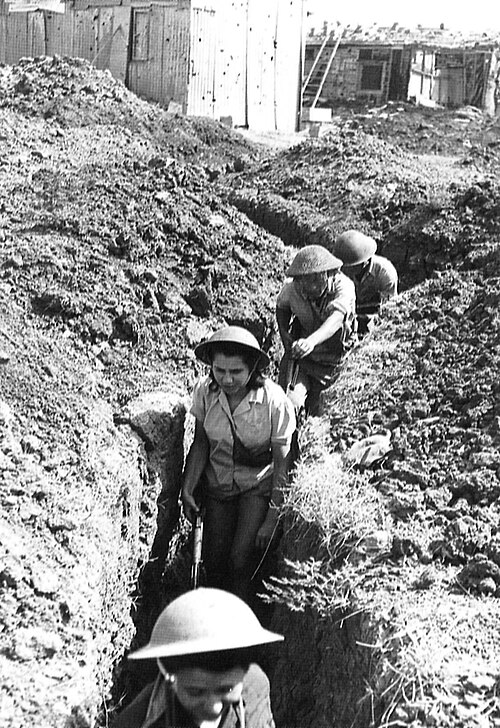
アラブ軍の中で最大規模のエジプト軍が南から侵攻した。
1948年5月15日、エジプト軍は2つの入植地を攻撃した。ニリム入植地は砲兵、大砲を積んだ装甲車、ブレン砲を積んだ。[22]クファル・ダロム入植地[22]は砲兵、戦車、航空機を使用した。エジプト軍の攻撃は両入植地の守備隊の少数かつ軽装備による激しい抵抗に遭い、失敗した。5月19日、エジプト軍はヤド・モルデハイを攻撃した。そこでは、ライフル、中型機関銃、 PIAT対戦車兵器しか持たない劣勢のイスラエル軍100名が、装甲、砲兵、航空部隊の強力な支援を受けたエジプト軍2,500名の縦隊を5日間足止めした。[155]エジプト軍は大きな損失を被ったが、守備隊の損失は比較的軽微であった。[156]
エジプト軍の2つの主力部隊のうち1つは、現在のガザ地区を通って海岸線に沿って北進し、もう1つの部隊は東のベエルシェバに向かって前進した。[156] [157]側面を守るため、エジプト軍はネゲブのクファル・ダロム、ニリム、ヤド・モルデハイ、ネグバといったキブツを攻撃し包囲した。[156] [158]イスラエル軍は、圧倒的に優勢な軍に対して数日間激しく持ちこたえ、イスラエル国防軍のギヴァティ旅団がエジプト軍のテルアビブ侵攻を阻止する準備をする貴重な時間を稼ぐことができた。
5月28日、エジプト軍は北進を再開し、イスドゥド北方の破壊された橋で停止した。ギヴァティ旅団はこの進撃を報告したが、エジプト軍と対峙する戦闘員は派遣されなかった。エジプト軍がテルアビブ方面へ北進を続けようとしていたら、イスラエル軍はそれを阻止できなかっただろう。[159] [160]
5月29日から6月3日まで、イスラエル軍はプレシェット作戦でエジプトの北進を阻止した。イスラエルの新生空軍による最初の戦闘任務では、4機のアヴィアS-199が、イスドゥドに向かう500台の車両からなるエジプトの装甲車列を攻撃した。イスラエル機は70キログラムの爆弾を投下し、車列を機銃掃射したが、機関銃はすぐに弾が当たって弾が当たらなかった。2機が墜落し、パイロット1名が死亡した。この攻撃でエジプト軍は散り散りになり、再集結するまでに主導権を失っていた。この空襲の後、イスラエル軍はイスドゥドのエジプト軍をナポレオンチック砲で絶えず砲撃し、イスラエル国防軍の哨戒隊はエジプト軍の戦線に対する小規模な嫌がらせを行った。反撃は撃退されたものの、エジプトが攻撃戦略から防御戦略へと転換したためエジプトの攻勢は停止し、主導権はイスラエルに移った。[161] [より詳しい情報源が必要]
6月6日、ニツァニムの戦いでエジプト軍はマジダルとイスドゥドの間に位置するニツァニムのキブツを攻撃し、イスラエルの防衛軍は5日間の抵抗の後に降伏した。
ラトゥルンの戦い
最も激しい戦闘はエルサレムとエルサレム・テルアビブ道路で、ヨルダンのアラブ軍とイスラエル軍の間で起こった。[162]エジプト軍の進撃に対処するための再配置の一環として、イスラエル軍はエルサレムへの主要幹線道路を見下ろすラトゥルン要塞を放棄したが、アラブ軍は直ちにこれを占領した。[163]アラブ軍はラトゥルン修道院も占領した。これらの拠点から、ヨルダン軍はエルサレムのイスラエル戦闘員と民間人への補給を断つことができた。[164]
イスラエル軍は5月24日から7月18日までの一連の戦闘でラトルン要塞を奪取しようとした。アラブ軍団はラトルンを占領し、攻撃を撃退した。[164]ラトルンを奪取しようとした際、イスラエル軍は約586人の死傷者を出し、その中にはイスラエル初の将軍ミッキー・マーカスが友軍の誤射で死亡したこともあった。アラブ軍団も損失を出し、5月29日までに90人が死亡、約200人が負傷した。[165]
-
 ビルマ道路の建設
 -
 1948 年 6 月、「ビルマ道路」でブルドーザーがトラックを牽引している
 -
 エリアマップ
.png/500px-Latroun_(11_juin).png)
包囲されたイスラエルのエルサレムは、いわゆる「ビルマ道路」の開通によってのみ救われた。これはイスラエル軍が建設した間に合わせの迂回路で、イスラエルの補給車列がエルサレムに入ることができた。[164]道路が建設された地域の一部は5月にヨルダンの狙撃兵から一掃され、道路は6月14日に完成した。補給品は道路が完成する前からすでに通過し始めており、最初の車列は6月1日から2日の夜に通過した。ヨルダン軍は活動を発見し、道路を砲撃しようとしたが、道路が見えなかったため効果はなかった。しかし、ヨルダンの狙撃兵は道路作業員数名を殺害し、6月9日の攻撃ではイスラエル人8名が死亡した。7月18日、ハレル旅団の一部はビルマ道路のエリアを拡大し確保するためにラトルンの南にある約10の村を占領した。[要出典]
アラブ軍団はラトゥルンへのイスラエル軍の攻撃を撃退した。ヨルダン軍は2度の反撃を開始し、ベイト・スシンを一時的に占領したが、その後押し戻され、激しい戦闘の末ゲゼルを占領したが、同日夜にパルマッハ軍の2個小隊がゲゼルを奪還した。[166]
-
 1948年にエルサレムを砲撃するヨルダンの砲兵
 -
![旧市街の最も神聖なシナゴーグ「フルヴァ」の廃墟に立つアラブ軍団の兵士。[167]](https://img-server.japedia.wiki/wikipedia/commons/thumb/3/35/Arab_Legion_soldier_in_ruins_of_Hurva.jpg/500px-Arab_Legion_soldier_in_ruins_of_Hurva.jpg)
-
 旧市街の戦闘中に逃げるエルサレムのユダヤ人住民
エルサレムの戦い

ラトルンのヨルダン軍は西エルサレムへの補給を遮断した。[164]軍需品を中心とした補給品が市内に空輸されたが、食料、水、燃料、医薬品の不足は深刻だった。イスラエル軍は食料、水、弾薬が深刻に不足していた。[164]
アブドラ国王は、 5月17日にアラブ軍団の司令官グルブ・パシャにエルサレムに入るよう命じた。アラブ軍団は1日1万発の砲弾と迫撃砲を発射し、[164]西エルサレムを狙撃した。
5月19日から28日にかけて激しい戸別戦闘が起こり、アラブ軍団は最終的にイスラエル軍をエルサレムのアラブ人居住区と旧市街のユダヤ人街から追い出すことに成功した。 [164]旧市街のユダヤ人街に住んでいた1,500人のユダヤ人は追放され、数百人が拘留された。ユダヤ人は、虐殺を企むパレスチナのアラブ暴徒から守るため、アラブ軍団によって護送されなければならなかった。[168]
5月22日、アラブ軍はエルサレム南部のラマト・ラケル・キブツを攻撃した。激しい戦闘でヨルダン人31人とイスラエル人13人が死亡し、ラマト・ラケルの守備隊は撤退したが、翌日にはキブツを部分的に奪還した。戦闘は5月26日まで続き、キブツ全体が奪還された。レーダーヒルもアラブ軍から奪取され、5月26日まで保持されたが、ヨルダン軍が奪還した戦闘でイスラエル人19人とヨルダン人2人が死亡した。[169]この戦争でハレル旅団はレーダーヒルを奪取しようと合計23回試みたが失敗した。 [要出典]
同日、エルサレム駐在の米国総領事で国連停戦委員会の委員であるトーマス・C・ワッソンが西エルサレムで射殺された。ワッソンを殺したのはアラブ人かイスラエル人かは議論の的となっている。[要出典]
1948年10月中旬から下旬にかけて、ハレル旅団はエルサレム回廊を確保するために、ハハル作戦として知られる攻勢を開始した。[要出典]
北サマリア

イラク軍は2個歩兵旅団と1個機甲旅団からなり、北ヨルダンからヨルダン川を渡り、イスラエルのゲシェル入植地を攻撃したが、ほとんど成果はなかった。[22]この敗北の後、イラク軍はアラブの町ナブルス、ジェニン、トゥルカームに囲まれた戦略的三角地帯に進軍した。5月25日、イラク軍はネタニヤに向かっていたが、阻止された。[170] 5月29日、イスラエル軍のイラク軍への攻撃により、ジェニンをめぐる3日間の激しい戦闘が起こったが、イラク軍はなんとか陣地を保った。[170]これらの戦闘の後、イラク軍は停滞し、戦争への関与は事実上終了した。[131] [170]
イラク軍はイスラエルの入植地への攻撃に失敗し、最も有名な戦闘はゲシェルで起こったが、代わりにジェニン、ナブルス、トゥルカーム周辺に防御陣地を築き、そこからイスラエルの中央に圧力をかけることができなかった。[要出典] [171] 5月25日、イラク軍はトゥルカームから前進し、ゲウリムを占領し、トゥルカーム-ネタニヤ道路のクファル・ヨナとアイン・ヴェレドに到達した。その後、アレクサンドロニ旅団がイラク軍の前進を阻止し、ゲウリムを奪還した。イスラエル国防軍のカルメリ旅団とゴラン旅団は5月31日に開始された攻勢中にジェニンを占領しようとしたが、その後の戦闘でイラク軍の反撃により敗れた。 [要出典]
北側戦線 – ガリラヤ湖

5月14日、シリアは第1歩兵旅団を率いてパレスチナに侵入した。この旅団は装甲車大隊、フランス軍のR35戦車とR37戦車中隊、砲兵大隊、その他の部隊の支援を受けた。[172]シリア大統領シュクリ・アル・クワトリは前線の部隊に「シオニストを殲滅せよ」と指示した。ベングリオンはイスラエル内閣に「状況は非常に深刻だ。ライフルが足りない。重火器もない」と語った。 [173] [174] 5月15日、シリア軍はガリラヤ湖の東岸と南岸に転じ、サマフ、隣接するテガルト要塞、シャアル・ハゴラン、アイン・ゲブの入植地を攻撃したが、抵抗に遭い足止めされた。[22]その後、彼らは戦車と航空機を使ってサマフを攻撃し、5月18日にサマフの征服に成功し[172]、放棄されたシャアール・ハゴランを占領した。[22]
5月21日、シリア軍は北部のデガニア・アレフ・キブツで足止めされた。そこでは、カルメリ旅団の部隊によって増強された地元民兵が、火炎瓶、手榴弾、PIAT 1台でシリアの装甲部隊を食い止めた。火炎瓶と手榴弾で無力化された戦車1台が今もキブツに残っている。残りのシリア軍は翌日、ナポレオンチック山砲4門で追い払われた。これはイスラエルが戦争中に初めて砲兵を使用した例である。[175]数日後、シリア軍はデガニアで敗北した後、サマフ村を放棄した。[172]シリア軍は前進する代わりにキブツを包囲せざるを得なかった。[170]ある著者は、シリアの敗北の主な理由は、シリア軍がイスラエル軍を軽視していたためであり、アラブ軍に対して立ち上がって戦うことはないと考えたためだと主張している。[174]
6月6日、レバノン軍第3大隊はアル・マルキヤとカダスを占領したが、これは戦争中レバノン軍の唯一の介入となり、両町をアラブ解放軍に引き渡し、7月8日に撤退した。[12]
6月6日、シリア軍はミシュマル・ハヤルデンを攻撃したが、撃退された。6月10日、シリア軍はミシュマル・ハヤルデンを制圧し、幹線道路まで前進したが、オデッド旅団の部隊に阻止された。[176]その後、シリア軍は防御態勢に戻り、小規模で無防備なイスラエル入植地への小規模な攻撃を数回行ったのみであった。[172]
パレスチナ軍

1947年に始まったユダヤ軍とアラブ軍の間の内戦の継続として、イスラエル軍とパレスチナのアラブ民兵の間で戦闘が起こり、特にリダ、アルラムラ、エルサレム、ハイファの地域で戦闘が行われた。5月23日、アレクサンドロニ旅団はハイファ南部のタントゥラをアラブ軍から奪取した。6月2日、聖戦軍司令官ハサン・サラマはラス・アル・アインでのハガナーとの戦闘で戦死した。[要出典]
航空作戦


1947年11月、ユダヤ人の航空資産はすべてシェルート・アヴィール(航空サービス、SAとして知られる)の管理下に置かれ、翌月にはテルアビブ郊外のスデ・ドブと呼ばれる小さな民間空港から飛行作戦が開始され、最初の地上支援作戦(RWD-13による)[177]が12月17日に実施された。ガリラヤ飛行隊は1948年3月にヤブネエルで編成され、ネゲブ飛行隊は4月にニル・アムで編成された。SAが最初の戦闘損失を被った5月10日までに、3つの飛行部隊、航空スタッフ、整備施設、兵站支援があった。5月15日の戦争勃発時に、SAはイスラエル空軍となった。軽飛行機の艦隊[178]を擁するイギリス軍は、戦争の最初の数週間、T-6、スピットファイア、C-47、アブロアンソンを擁するアラブ軍に太刀打ちできませんでした。
5月15日、戦争が始まると、エジプト空軍(REAF)のスピットファイア4機がテルアビブを攻撃し、シェルート・アヴィルの航空機の大半が集中していたスデ・ドブ飛行場とレディング発電所を爆撃した。数機が破壊され、他の数機も損傷し、イスラエル人5人が死亡した。その後数時間にわたって、エジプト軍の航空機がテルアビブ周辺の標的を爆撃し機銃掃射したが、これらの襲撃はほとんど効果を示さなかった。スピットファイア1機が対空砲火で撃墜され、パイロットは捕虜になった。[179]
その後6日間、エジプト空軍はテルアビブへの攻撃を続け、民間人に犠牲者を出した。5月18日、エジプト軍機がテルアビブ中央バスターミナルを攻撃し、42人が死亡、100人が負傷した。エジプト軍はテルアビブへの攻撃に加え、農村部や飛行場を爆撃したが、これらの攻撃で犠牲者はほとんど出なかった。[179]
戦争当初、REAFはイスラエルの戦闘機が迎撃する能力がなかったため、ほとんど罰を受けることなくイスラエルを攻撃することができ、[180]地上からの砲火のみに遭遇した。
より効果的な防空部隊がテルアビブに移されると、エジプト軍は相当数の航空機の損失を被り始めた。これらの損失と、エジプト軍が誤ってイギリス空軍ラマト・ダビド基地を攻撃した際にイギリス軍が撃墜したスピットファイア5機の損失により、エジプト軍の空襲は頻度が減った。1948年5月末までに、エル・アリシュに拠点を置くイギリス空軍スピットファイア飛行隊のほぼ全員が、最も優秀なパイロットの多くを含めて失われた。[要出典]
戦闘機や爆撃機がなかったにもかかわらず、戦争の最初の数日間、イスラエルの初期の空軍は軽飛行機を即席の爆撃機として利用してアラブの野営地や列を攻撃し、アラブの標的を攻撃した。襲撃はアラブの戦闘機による迎撃を避けるため、主に夜間に行われた。これらの攻撃は通常、士気を低下させる以外にほとんど効果はなかった。[要出典]

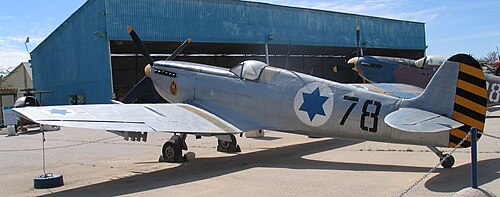

チェコスロバキアから25機のアヴィアS-199が到着し、航空戦力のバランスはすぐにイスラエル空軍に有利に傾き始めた。最初の1機は5月20日に到着した。皮肉なことに、イスラエルはエジプトが飛行するイギリス設計のスピットファイアに対抗するためにナチスドイツで設計されたBf109の劣った派生型であるアヴィアS-199を使用していた。戦争の残りの期間、イスラエルはさらに多くのアヴィア戦闘機とチェコスロバキアからの62機のスピットファイアを取得することになる。1948年5月28日、シェルト・アヴィールはイスラエル空軍になった。[181]
イスラエル空軍で戦ったパイロットの多くは、第二次世界大戦の退役軍人を含む外国人志願兵や傭兵であった。[182]
6月3日、イスラエルのパイロット、モディ・アロンがテルアビブを爆撃したエジプトのDC-3戦闘機2機を撃墜し、イスラエルは空中戦で最初の勝利を収めた。テルアビブは戦闘機による追加襲撃を受けたが、戦争の残りの期間、爆撃機による襲撃はなかった。その時から、イスラエル空軍はアラブ空軍と空対空戦闘を開始した。最初のドッグファイトは6月8日に発生し、ギデオン・リヒトマン操縦のイスラエル戦闘機がエジプトのスピットファイアを撃墜した。1948年秋までに、イスラエル空軍は制空権を獲得し、優れた火力と、第二次世界大戦での戦闘経験を持つより知識豊富な人員を有していた。[183] イスラエルの飛行機は爆撃任務中のアラブの航空機を迎撃し、交戦し始めた。
イスラエル軍がエジプトとイラクの縦隊を空襲した後、エジプト軍はイスラエル空軍の戦闘機が駐留していたエクロン飛行場を繰り返し爆撃した。5月30日の空襲では、エクロンを狙った爆弾がレホヴォト中心部を襲い、民間人7名が死亡、30名が負傷した。これと、おそらくはラトルンでのヨルダンの勝利への報復として、イスラエルはアラブ諸都市の標的への爆撃を開始した。5月31日/6月1日の夜、アラブの首都に対するイスラエル初の空襲が行われ、3機のイスラエル空軍機がアンマンに飛来し、55ポンド爆弾と110ポンド爆弾数十発を投下し、王宮と隣接するイギリス軍飛行場を襲った。約12名が死亡、30名が負傷した。この攻撃でイギリス空軍の格納庫が被害を受け、イギリス軍の航空機数機も損傷した。イギリスは、同様の攻撃が再度行われた場合には、攻撃機を撃墜し、イスラエルの飛行場を爆撃すると脅迫し、その結果、イスラエル機は戦争の残りの期間、アンマンを再び攻撃することはなかった。イスラエルはまた、アリーシュ、ガザ、ダマスカス、カイロを爆撃した。チェコスロバキアからイスラエルへ飛来したイスラエルのボーイングB-17フライングフォートレス爆撃機は、その途中でエジプトを爆撃した。[184] [185]
海戦

戦争開始時、イスラエル海軍はイギリス軍に拿捕されハイファ港の防波堤に係留されていた元アリーヤ・ベット船3隻で構成されていた。イスラエル独立直前に海軍創設作業が開始され、この3隻は軍事的背景を持つという理由で選ばれた。1隻のINSエイラートは元アメリカ沿岸警備隊の砕氷船であり、他の2隻のINSハガナーとINSウェッジウッドはカナダ海軍のコルベットであった。[186] [187]
船は、港湾労働者や港湾職員に扮した請負業者によって、最低限の運転状態に整備され、機関室や甲板下で作業することができた。イギリスの疑いを招かないように、作業は秘密裏に行われなければならなかった。1948年5月21日、3隻の船はテルアビブに向けて出航し、外国の所有者が商業目的で購入した船のように見せかけられた。テルアビブでは、船に19世紀後半の小型野砲と対空砲が取り付けられた。[186] [187]
6月30日にイギリス軍がハイファ港を出港した後、ハイファはイスラエル海軍の主要基地となった。1948年10月、アメリカから潜水艦追跡船が購入された。軍艦には元商船員、アリーヤ・ベット船の元乗組員、第二次世界大戦中にイギリス海軍に勤務したイスラエル人、外国人ボランティアが乗船した。新しく改装され乗組員が乗った軍艦は沿岸警備任務に従事し、ガザ地区周辺のエジプト沿岸施設をポートサイドまで砲撃した。[186] [187] [より良い情報源が必要]
第一段階の終了

その後数日間、アラブ人はイスラエルの激しい抵抗により限られた前進しかできず、イスラエルの反撃により新たな占領地からすぐに追い出された。[要出典]
戦争が進むにつれて、イスラエル国防軍はアラブ軍よりも多くの兵力を投入するようになった。1948 年 7 月、イスラエル国防軍の兵力は 63,000 人だったが、1949 年初春には 115,000 人になった。アラブ軍の兵力は 1948 年 7 月には推定 40,000 人だったが、1948 年 10 月には 55,000 人に増加し、1949 年春にはさらに若干増加した。[引用が必要]
停戦の実施により、イスラエル国防軍は9つのアラブ都市と町、または混合都市と町を支配した:新エルサレム、ヤッファ、ハイファ、アッコ、サフェド、ティベリア、ベイサン(ベイト・シェアン)、サマク、イブナ(ヤブネ)。ジェニンという別の都市は占領されなかったが、住民は逃げた。アラブ連合軍は14のユダヤ人入植地を占領したが、決議181に従って提案されたユダヤ人国家の領域内にあったのはそのうちの1つ、ミシュマル・ハヤルデンだけだった。[188]
提案されたユダヤ人国家の境界内には、ユダヤ人の支配に抵抗した、あるいは侵略してきたアラブ軍に占領されたアラブの村が12あった。さらに、提案されたユダヤ人国家の境界内にあるロッド空港とアンティパトリス近くのポンプ場もアラブ人の支配下にあった。イスラエル国防軍は、提案されたユダヤ人国家の境界外にある約50の大きなアラブの村と、さらに多くの村落とベドウィンの野営地を占領した。提案されたユダヤ人国家の350平方キロメートルはアラブ軍の支配下にあり、提案されたアラブ国家の700平方キロメートルはイスラエル国防軍の支配下にあった。この数字は、どちらの側も絶対的な支配下になかったネゲブ砂漠を無視している。[188] [ページが必要]
侵攻から最初の停戦までの間に、シリア軍は315人が死亡、400~500人が負傷した。イラク遠征軍は200人が死亡、500人が負傷した。ヨルダン・アラブ軍団は300人が死亡、400~500人が負傷した(ヨルダン軍の下で戦っていた非正規軍とパレスチナ人義勇兵を含む)。エジプト軍は600人が死亡、1,400人が負傷した(ムスリム同胞団の非正規軍を含む)。6月初旬に戦闘に戻ったALAは100人が死亡または負傷した。800人のユダヤ人がアラブ人に人質に取られ、1,300人のアラブ人がユダヤ人(ほとんどがパレスチナ人)に人質に取られた。[188] [ページが必要]
最初の休戦: 1948年6月11日~7月8日
国連は5月29日に停戦を宣言し、6月11日に発効して28日間続いた。停戦は28日間続くように設計されており、どちらの側も停戦から利益を得ないようにするために武器禁輸が宣言された。どちらの側も停戦を尊重せず、課せられた制限を回避する方法を見つけた。[189]イスラエルとアラブの双方がこの時間を利用して自分たちの立場を改善したが、これは停戦条件に直接違反した。[190]
増援
休戦当時、イギリスの見解は「ユダヤ人は武器が弱すぎて、目覚ましい成功を収めることはできない」というものだった。[189]休戦が始まると、ハイファに駐留していたイギリス軍将校は、4週間の休戦は「ユダヤ人が軍事訓練と再編成を継続するために利用されるのは確実で、アラブ人は戦利品の将来の分配をめぐる争いで彼らを無駄にするだろう」と述べた。[190]休戦中、イスラエルは大量の武器を輸入して軍の強化を図った。[189]この間、イスラエル国防軍はチェコスロバキアから武器を入手し、軍の訓練と軍の再編成を改善することができた。戦争当時のイスラエル国防軍司令官で、後にイスラエルの第5代首相となったイツハク・ラビンは、「チェコスロバキアからの武器がなければ、戦争を遂行できたかどうかは非常に疑わしい」と述べた。[192]
イスラエル軍は、動員とイスラエルへの継続的な移民により、停戦中に約3万~3万5千人から6万5千人に兵力を増やした。また、武器の供給も2万5千丁以上のライフル、5千丁の機関銃、5千万発の弾丸にまで増やすことができた。[190]武器と人員の禁輸を破っただけでなく、アラブの敵国が行ったのと同様に、新兵を前線に送り込んだ。[190]

停戦中、イルグンはアルタレナという船に私的な武器を積んで持ち込もうとした。イルグンによるクーデターを恐れたベングリオンは(当時、イスラエル国防軍は独立前のさまざまな政治派閥を統合する過程にあった)、武器を強制的に没収するよう命じた。何らかの誤解があった後、ベングリオンは軍に船を沈めるよう命じた。戦闘でイルグンのメンバー16人とイスラエル国防軍兵士3人が死亡した。[193]
国連調停者ベルナドッテ

停戦は、国連の調停人フォルケ・ベルナドッテと、ベルギー、米国、スウェーデン、フランスの陸軍将校からなる国連監視団によって監視された。[194] [より詳しい情報源が必要] ベルナドッテは、国連総会によって「聖地の安全を確保し、住民の福祉を守り、そして『パレスチナの将来の状況の平和的調整』を促進する」ために選出された。[190] フォルケ・ベルナドッテは次のように報告した。
停戦期間中、重大な違反が 3 件発生しました。
- 6月21日、イルグン・ズヴァイ・レウミがアルタレナ号に乗って軍需物資と移民(兵役年齢の男性を含む)をパレスチナに持ち込もうとした試み...
- もう一つの停戦違反は、エジプト軍がネゲブにあるユダヤ人入植地への救援車列の通過を拒否したことで発生した。
- 停戦の3度目の違反は、トランスヨルダン軍とイラク軍がエルサレムへの水の流れを許可しなかった結果として生じた。[195]
停戦が成立した後、ベルナドッテは政治的解決を達成するという問題に取り組み始めた。彼の意見では、主な障害は「アラブ世界が、その国境がどこであろうとユダヤ人国家の存在を否定し続けていること、軍事力の増大に基づく、分割境界線を無視して可能な限り領土を征服するというイスラエルの新たな『哲学』、そして新たに出現したパレスチナ・アラブ難民問題」であった。[190]
ベルナドッテは、すべての問題を考慮し、新しい分割案を提示した。彼は、イスラエルの横にパレスチナのアラブ国家を置き、「イスラエルとヨルダン(現在はヨルダン川西岸を含む)の2つの主権国家の間に「連合」を樹立する、ネゲブまたはその一部をアラブ国家に、西ガリラヤまたはその一部をイスラエルに組み込む、エルサレム全体をアラブ国家の一部とし、ユダヤ人地域は自治体の自治権を享受し、リダ空港とハイファを「自由港」とする(おそらくイスラエルやアラブの主権から自由になる)」ことを提案した。[190]イスラエルは、特にエルサレムの支配権を失うという点を理由にこの提案を拒否したが、停戦をさらに1か月延長することには同意した。アラブ側は停戦延長と提案の両方を拒否した。[190]
第 2 段階: 1948 年 7 月 8 日~18 日 (「10 日間の戦い」)
停戦期限切れの前日の7月8日、ムハンマド・ナギーブ将軍率いるエジプト軍はネグバを攻撃して戦争を再開した。[196]翌日、イスラエル空軍はクネイトラからアリシュに至る3つの戦線すべてで同時攻撃を開始し、エジプト空軍はテルアビブ市を爆撃した。[197]戦闘中、イスラエル軍は包囲されたキブツのいくつかへのライフラインを開くことができた。[189]
戦闘は10日間続き、国連安全保障理事会は7月18日に第二次停戦を発令した。この10日間の戦闘は、イスラエルの大規模な攻勢とアラブ側の防御姿勢が中心となった。[要出典]
南部戦線

南部では、イスラエル国防軍はアンファール作戦や侵略者への死作戦など、いくつかの攻勢を実施した。南側の側面にいた第11旅団第1大隊の任務は村落を占領することだったが、その作戦は地元の非正規軍の抵抗もほとんどなく順調に進んだ。パルマッハの南部戦線のベテランであるアムノン・ノイマンによると、南部のアラブ人村落は、貧弱な資金と武器の不足のため反撃することはほとんどなく、追い出されたという。[198]わずかな抵抗も砲撃で鎮圧され、続いて村が襲撃され、住民は追い出され家屋が破壊された。[199]
7月12日、エジプト軍は攻勢を開始し、 3個歩兵大隊、1個装甲大隊、1個砲兵連隊を用いて、以前に占領できなかったネグバを再び攻撃した。その後の戦闘でエジプト軍は撃退され、200~300人の死傷者を出し、イスラエル軍は5人が死亡、16人が負傷した。[200]
ネグバ占領に失敗したエジプト軍は、より孤立した集落や陣地へと目を向けた。7月14日、エジプト軍のガルオンへの攻撃は地雷原とガルオン住民の抵抗によって撃退された。[201] [ページが必要]
その後、エジプト軍は防御の手薄なベエロト・イツハク村を襲撃した。エジプト軍は村の境界を突破したが、守備隊は村の内側の陣地に集中し、イスラエル国防軍の援軍が到着して攻撃隊を追い払うまでエジプト軍の進撃を阻止した。エジプト軍は推定200人の死傷者を出し、イスラエル軍は17人が死亡、15人が負傷した。この戦闘は戦争中のエジプトの最後の攻撃行動の1つであり、エジプト軍はこの戦闘以降イスラエルの村を攻撃しなかった。[要出典]
リダとアル・ラムラ
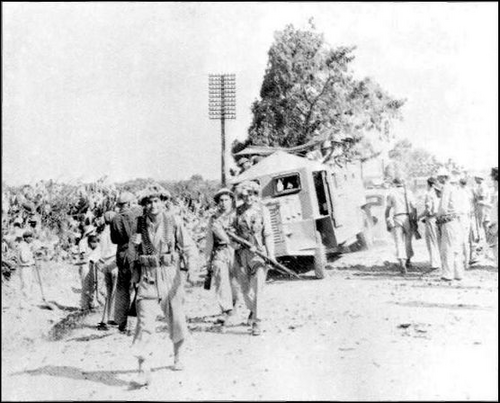
7月10日、グルブ・パシャは防衛中のアラブ軍団に「偽りの戦争の準備をせよ」と命じた。[202]イスラエルのダニー作戦はイスラエルにとって最も重要な攻勢であり、沿道の都市ロッド(リッダ)とラムレを占領することでエルサレムとテルアビブ間の回廊を確保し、拡大することを目指していた。作戦の第二段階では、テルアビブ・エルサレム高速道路を見下ろすラトゥルンの要塞化された陣地とラマラ市も占領することになっていた。ラトゥルン近郊のハディタはイスラエル軍に占領され、9人の死者が出た。[要出典]
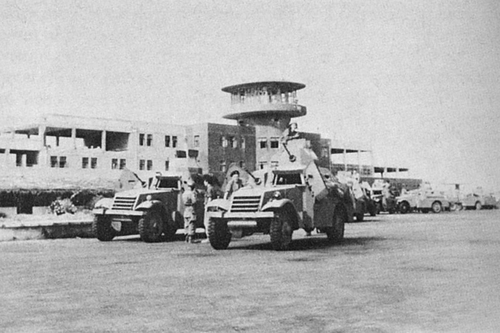

ダニー作戦の目的は、テルアビブ東部の領土を占領し、その後内陸に進攻してエルサレムのユダヤ人と軍隊を救出することだった。リダは地域の重要な軍事拠点となり、他の場所でのアラブ軍の活動を支援しており、ラムレはユダヤ人の移動を阻む主要な障害物の一つだった。リダは、約1,000人の住民からなる地元民兵と、 125~300人のアラブ軍団によって守られていた。[203]
市街地攻撃に集まったイスラエル国防軍は約8,000人。複数の旅団が参加した初の作戦となった。市街地は北からはマジダル・サディクとアル・ムザイリア経由で、東からはクルダ、アル・クバブ、ジムズ、ダニヤル経由で攻撃された。また、紛争で初めて爆撃機が市街地の爆撃に使用された。イスラエル国防軍は7月11日に市街地を占領した。[189]
450人ほどのアラブ人と9~10人のイスラエル兵が殺害された。翌日、ラムレは陥落した。[189]リダとラムレの民間人はアラブの前線に逃げるか追放され、リダでの抵抗の後、そこの住民は輸送手段の提供なしに追放された。追放された人の中には、7月の暑い太陽の下での長い道のりで亡くなった人もいた。[204]
7月15日から16日にかけてラトルンへの攻撃が行われたが、砦を占領することはできなかった。[189] 7月18日には、クロムウェル戦車2台を含む装甲車両を装備したイフタフ旅団の部隊による必死の2度目の攻撃があったが、この攻撃も失敗した。7月18日に始まった2度目の停戦にもかかわらず、ラトルンを征服しようとするイスラエルの努力は7月20日まで続いた。[要出典]
エルサレム

ケデム作戦の目的はエルサレム旧市街の確保だったが、割り当てられた資源は少なかった。作戦は失敗した。[205]当初作戦は7月8日、最初の停戦直後にイルグンとレヒの部隊によって開始される予定だった。しかし、ハガナーの支援なしにデイル・ヤシンを占領できなかったため、彼らの能力を信用しなかったためか、デイヴィッド・シャルティエルによって延期された。[要出典]
イェフダ・ラピドット指揮下のイルグン軍は新門を突破し、レヒは新門からヤッファ門まで伸びる壁を突破し、ベイト・ホロン大隊はシオン山から攻撃することになっていた。[要出典]
戦闘は、戦争の2回目の停戦の2日前、安息日の7月16日20:00に開始される予定だった。計画は最初から失敗し、最初は23:00に、その後は深夜に延期された。戦闘が実際に始まったのは02:30になってからだった。イルグンはなんとかニューゲートを突破したが、他の部隊は任務を果たせなかった。7月17日05:45、シャルティエルは撤退と戦闘停止を命じた。[要出典]
1948 年 7 月 14 日、イルグンは激しい戦闘の末、アラブ人の村マルハを占領した。数時間後、アラブ人は反撃を開始したが、イスラエルの援軍が到着し、17 人が死亡して村は奪還された。[出典が必要]
南ガリラヤ
2番目の計画はデケル作戦であり、ナザレを含む下ガリラヤの占領を目的とした。ナザレは7月16日に占領され、7月18日19:00に第二次休戦が発効するまでに、ハイファ湾からガリラヤ湖までの下ガリラヤ全域がイスラエルに占領された。[要出典]
東ガリラヤ
ブロシュ作戦は、シリア軍を東ガリラヤとベノト・ヤコブ橋から追い出す試みとして開始されたが、失敗した。作戦中にシリア人200人とイスラエル人100人が死亡した。[要出典]
第二次休戦: 1948年7月18日~10月15日
7月18日19時、国連の熱心な外交努力の結果、紛争の2度目の停戦が発効した。
9月16日、フォルケ・ベルナドッテ伯爵はパレスチナの新たな分割案を提案した。ネゲブ地方はヨルダンとエジプトに分割され、ヨルダンはリダとラムラを併合する。ガリラヤ全域にユダヤ人国家が成立し、国境はファルージャから北東のラムラとリダに向かって伸びる。エルサレムは国際化され、市内のユダヤ人とアラブ人の住民に自治体としての自治権が与えられ、ハイファ港は自由港、リダ空港は自由空港となる。パレスチナ難民全員に帰還権が与えられ、帰還を望まない難民には失われた財産が補償される。国連はユダヤ人の移民を管理・規制する。[206]
この計画は再び双方から拒否された。翌日の9月17日、ベルナドッテはエルサレムで過激なシオニスト集団レヒによって暗殺された。4人組の部隊がエルサレムでベルナドッテの車列を待ち伏せし、ベルナドッテと隣に座っていたフランス人の国連監視員を殺害した。レヒはベルナドッテをイギリスとアラブの傀儡とみなし、したがって新興のイスラエル国家に対する深刻な脅威とみなし、暫定イスラエル政府が破滅的だとみなしたこの計画を受け入れることを恐れた。レヒは知らなかったが、政府はすでに計画を拒否し、1か月以内に戦闘を再開することを決定していた。ベルナドッテの副官であるアメリカ人ラルフ・バンチが彼に代わって就任した。[207] [208] [209] [210]
1948年9月22日、イスラエル臨時国家評議会は、管轄権と権限の領域に関する条例5708-1948を可決した。この法律は、戦争開始以来イスラエルが占領したすべての土地を併合することで、イスラエルの領土を公式に拡大した。また、それ以降、イスラエル軍が占領したパレスチナのどの地域も自動的にイスラエルの一部となると宣言した。[211]
小さな三角ポケット
ハイファ南部の「リトル・トライアングル」として知られる地域のアラブ人村民は、テルアビブからハイファへの幹線道路沿いのイスラエル軍の交通に繰り返し発砲し、北サマリアのイラク軍から補給を受けていた。[212]交通への狙撃は第二次休戦の間も続いた。6月18日と7月8日の計画不十分な攻撃では、アラブ民兵を優位な位置から追い出すことはできなかった。イスラエル軍は、ハイファへの幹線道路を制圧し、その地域の敵をすべて殲滅するために、7月24日にショター作戦を開始した。 [212]
7月24日と25日のイスラエル軍の攻撃は強固な抵抗にあって撃退された。イスラエル軍はその後、激しい砲撃と爆撃を援護とする歩兵と装甲車の連合攻撃でアラブ軍の防衛を突破した。3つのアラブ村が降伏し、住民のほとんどは攻撃前と攻撃中に逃げた。イスラエル軍兵士と航空機はアラブ軍の退路の1つを攻撃し、60人のアラブ軍兵士を殺害した。[疑わしい–議論する]。住民のほとんどは攻撃前と攻撃中に逃げ、北サマリアにたどり着いた。その後数日間で数百人が強制的に追放された。少なくとも100人の民兵と民間人が殺害された。[212]
アラブ人はイスラエルがアラブ民間人を虐殺したと主張したが、イスラエル側はこれを否定した。[疑わしい–議論する]国連の調査では虐殺の証拠は見つからなかった。作戦後、テルアビブ・ハイファ間の道路はイスラエル軍と民間人の交通に開放され、ルート沿いのアラブ人の検問所は撤去された。ハイファ・ハデラ沿岸鉄道の交通も回復した。
第三段階: 1948年10月15日~1949年3月10日

イスラエルはアラブ軍を追い出し、イスラエルの北と南の国境を守るために一連の軍事作戦を開始した。
北方戦線 – ガリラヤ


10月22日、第三次停戦が発効した。[213]非正規のアラブ軍は停戦を認めず、イスラエル軍と北部の入植地への嫌がらせを続けた。停戦発効の同日、アラブ解放軍は停戦に違反してマナラを攻撃し、シェイク・アベドの拠点を占領し、現地イスラエル部隊の反撃を撃退し、マナラ救援を試みたイスラエル軍を待ち伏せした。イスラエル国防軍のカルメリ旅団は33人が死亡、40人が負傷した。[214]マナラとミスガブ・アムは完全に孤立し、イスラエルが国連で抗議しても状況は変わらなかった。
10月24日、イスラエル国防軍はヒラム作戦を開始し、ガリラヤ北部全域を占領し、アラブ軍をレバノンに追い返し、シリア軍1個大隊を奇襲して全滅させた。[215]イスラエル軍は4個歩兵旅団で構成され、モシェ・カルメルが指揮を執った。[215]作戦全体はわずか60時間で終了し、その間に多くの村が占領されたが、その多くは地元住民やアラブ軍の抵抗によるものだった。[215]アラブ側の損失は400人が死亡、550人が捕虜になったと推定され、イスラエル側の死傷者は少なかった。[215]
イスラエル軍によって処刑された囚人もいたと伝えられている。推定5万人のパレスチナ難民がレバノンに逃れ、その一部は進軍に先んじて逃げ、一部は抵抗した村から追放されたが、平和を保っていた村のアラブ人住民は留まることを許され、イスラエル国民となった。イクリットとビリムの村民はイスラエル当局に説得されて家を離れ、帰還を認めると約束された。イスラエルは最終的に彼らの帰還を認めないことを決定し、金銭的補償を申し出たが、彼らはこれを拒否した。[216]
その月の終わりまでに、イスラエル国防軍はガリラヤ全域を制圧し、ALA軍をイスラエルから追い出し、レバノンのリタニ川まで8キロ(5マイル)進撃し、[217]レバノンの13の村を占領した。フラ村では、ハイファ製油所虐殺への報復として、イスラエル軍将校2人が35人から58人の囚人を殺害した。両将校は後にその行為について裁判にかけられた。
ネゲブ


イスラエルはアラブ軍を追い出し、イスラエル国境を守るために一連の軍事作戦を開始した。しかし、ヨルダン川西岸地区への侵攻は、拡大するイスラエル国の国境内に、収容しきれないほどのアラブ人人口を流入させる恐れがあった。ネゲブ砂漠は拡大のための空き地であったため、10月初旬から主な戦争活動はネゲブに移った。[218]イスラエルは、エジプトの前線が恒久的な国境としては脆弱すぎるため、エジプト遠征軍を破壊するか、少なくとも追い出すことを決定した。[219]
10月15日、イスラエル国防軍はネゲブ北部でヨアブ作戦を開始した。 [189]その目的は、海岸沿いとベエルシェバ-ヘブロン-エルサレム道路沿いのエジプト軍の間に楔を打ち込み、最終的にはネゲブ全土を征服することだった。[189]これはイスラエル側にとって特別な懸念事項だった。なぜなら、ネゲブ全土をエジプトとヨルダンに引き渡そうとするイギリスの外交キャンペーンがあったため、ベングリオンはイスラエル軍ができるだけ早くネゲブを制圧することを切望していたからである。[189]
ヨアブ作戦は南部戦線の指揮官イガル・アロンが指揮した。ヨアブには3個歩兵旅団と1個機甲旅団が投入され、エジプト軍の戦線を突破する任務を与えられた。[215]エジプト軍の陣地は縦深防御が欠如していたため、ひどく弱体化しており、ひとたびイスラエル国防軍がエジプト軍の戦線を突破すれば、彼らを止めるものはほとんどなかった。 [ 215 ]この作戦は大成功を収め、エジプト軍の戦列を粉砕し、エジプト軍を北ネゲブ、ベエルシェバ、アシュドッドから追い出した。[215]
いわゆる「ファルージャ・ポケット」では、包囲されたエジプト軍は1949年の休戦協定まで4か月間持ちこたえ、その後村は平和的にイスラエルに移譲され、エジプト軍は撤退した。[215]イスラエル海軍の4隻の軍艦がアシュケロン地域のエジプトの海岸施設を砲撃し、エジプト海軍が海路で撤退するエジプト軍を阻止することで支援した。 [186] [より良い情報源が必要]
10月19日、エルサレム回廊でハハル作戦が開始され、マジダル近郊でも海戦が発生し、イスラエルのコルベット艦3隻が航空支援を受けたエジプトのコルベット艦と対峙した。イスラエルの水兵1人が死亡、4人が負傷し、2隻の艦艇が損傷した。エジプトの飛行機1機が撃墜されたが、コルベット艦は逃走した。イスラエル海軍艦艇は10月17日にマジダルを砲撃し、10月21日にはイスラエル空軍の航空支援を受けてガザを砲撃した。同日、イスラエル国防軍はベエルシェバを占領し、エジプト兵120人を捕虜にした。10月22日、イスラエル海軍の特殊部隊は爆発艇を使用してエジプトの旗艦エミール・ファルークを沈め、エジプトの掃海艇に損傷を与えた。[215]
1948 年 11 月 9 日、イスラエル国防軍はイラク スウェイダン村のテガート砦を占領するためシュモーネ作戦を開始した。砦のエジプト軍は、ヨアブ作戦中の 2 回を含め、これまでに 8 回の砦奪取の試みを撃退していた。イスラエル軍は砦を砲撃し、その後砲撃と B-17 爆撃機による空爆で攻撃を開始した。イスラエル軍は抵抗を受けることなく周囲のフェンスを突破した後、砦の外壁に穴を開け、砦に駐留していた 180 人のエジプト軍兵士は戦うことなく降伏した。この敗北により、エジプト軍はイスラエル国防軍が武力で奪取できなかった丘を含む近隣のいくつかの陣地から撤退した。一方、イスラエル国防軍は激しい戦闘の末、イラク スウェイダンを奪取し、6 名が死亡、14 名が負傷した。[要出典]
12月5日から7日にかけて、イスラエル国防軍は西ネゲブを制圧するためにアサフ作戦を実施した。主攻撃は機械化部隊が先鋒となり、ゴラン旅団の歩兵が後方を守った。エジプト軍の反撃は撃退された。エジプト軍は再度反撃を計画したが、イスラエル軍の航空偵察によりエジプト軍の準備が明らかになり失敗、イスラエル軍は先制攻撃を開始した。エジプト軍約100名が死亡、戦車5両が破壊され、イスラエル軍は5名が死亡、30名が負傷した。[要出典]
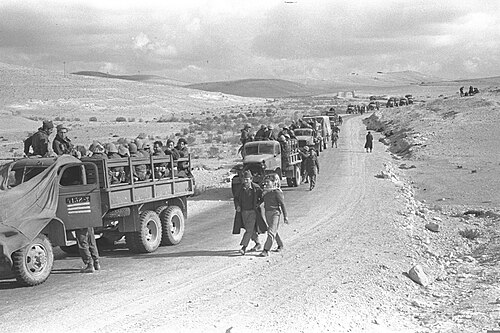
12月22日、イスラエル国防軍はホレフ作戦(別名アイン作戦)を開始した。[215]この作戦の目的は、ネゲブに残っていたエジプト軍をすべて追い出し、イスラエル南部のコミュニティに対するエジプトの脅威を排除し、エジプトに停戦を強いることだった。5日間の戦闘で、イスラエル軍は西ネゲブを確保し、その地域からエジプト軍をすべて追い出した。[215]
イスラエル軍はその後ニツァナ地域への襲撃を開始し、12月28日にシナイ半島に入った。イスラエル国防軍はウンム・カテフとアブ・アゲイラを占領し、アル・アリシュに向かって北進し、エジプト遠征軍全体を包囲することを目標とした。イスラエル軍は、英米の共同圧力と英国の軍事行動の脅迫を受けて、1949年1月2日にシナイから撤退した。イスラエル国防軍はガザ地区との国境で再編成した。イスラエル軍は翌日ラファを攻撃し、数日間の戦闘の後、ガザ地区のエジプト軍は包囲された。エジプトは1月7日に停戦交渉に同意し、その後イスラエル国防軍はガザから撤退した。 [215]モリスによると、「不公平で不公正な交戦規則。アラブ人は罰を受けることなく攻撃を開始できたが、国際介入は常にイスラエルの反撃を妨害し抑制した。」[220]
12月28日、アレクサンドロニ旅団はファルージャ・ポケットを占領することはできなかったが、イラク・エル・マンシエを占領し、一時的に保持することに成功した。[221]エジプト軍は反撃したが、友軍と間違われて前進を許し、多数の兵士が閉じ込められた。イスラエル軍は87人の兵士を失った。[要出典]
3月5日、ヨルダンから南ネゲブ地方を確保することを目的としたウヴダ作戦が、約1か月に及ぶ偵察活動の末に開始された。イスラエル国防軍は同地方に進入して確保したが、その途中で大きな抵抗に遭遇することはなかった。同地方は国連の分割案ですでにユダヤ人国家の一部に指定されており、作戦は同地方を実際に征服するのではなく、イスラエルの主権を確立することを目的としていたためである。ゴラン旅団、ネゲブ旅団、アレクサンドロニ旅団が、いくつかの小規模な部隊と海軍の支援を受けて作戦に参加した。[222]
3月10日、イスラエル軍は南ネゲブ地方を制圧し、パレスチナ南端の紅海沿岸のウンム・ラシュラッシュ(後にエイラートが建設された場所)に到達し、戦闘なしで占領した。イスラエル兵は3月10日16時に手作りのイスラエル国旗(「インク旗」)を掲げ、ウンム・ラシュラッシュはイスラエルの領有であると主張した。インク旗の掲揚は戦争の終結と見なされている。[223]
英イスラエルの空中衝突
As the fighting progressed and Israel mounted an incursion into the Sinai, the Royal Air Force began conducting almost daily reconnaissance missions over Israel and the Sinai. RAF reconnaissance aircraft took off from Egyptian airbases and sometimes flew alongside Royal Egyptian Air Force planes. High-flying British aircraft frequently flew over Haifa and Ramat David Airbase, and became known to the Israelis as the "shuftykeit."[224]
On 20 November 1948, an unarmed RAF photo-reconnaissance De Havilland Mosquito of No. 13 Squadron RAF was shot down by an Israeli Air Force P-51 Mustang flown by American volunteer Wayne Peake as it flew over the Galilee towards Hatzor Airbase. Peake opened fire with his cannons, causing a fire to break out in the port engine. The aircraft turned to sea and lowered its altitude, then exploded and crashed off Ashdod. The pilot and navigator were both killed.[224][225]
Just before noon on 7 January 1949, four Spitfire FR18s from No. 208 Squadron RAF on a reconnaissance mission in the Deir al-Balah area flew over an Israeli convoy that had been attacked by five Egyptian Spitfires fifteen minutes earlier. The pilots had spotted smoking vehicles and were drawn to the scene out of curiosity. Two planes dived to below 500 feet altitude to take pictures of the convoy, while the remaining two covered them from 1,500 feet.[224][226]
Israeli soldiers on the ground, alerted by the sound of the approaching Spitfires and fearing another Egyptian air attack, opened fire with machine guns. One Spitfire was shot down by a tank-mounted machine gun, while the other was lightly damaged and rapidly pulled up. The remaining three Spitfires were then attacked by patrolling IAF Spitfires flown by Chalmers Goodlin and John McElroy, volunteers from the United States and Canada respectively. All three Spitfires were shot down, and one pilot was killed.[224][226]
Two pilots were captured by Israeli soldiers and taken to Tel Aviv for interrogation, and were later released. Another was rescued by Bedouins and handed over to the Egyptian Army, which turned him over to the RAF. Later that day, four RAF Spitfires from the same squadron escorted by seven Hawker Tempests from No. 213 Squadron RAF and eight from No. 6 Squadron RAF went searching for the lost planes, and were attacked by four IAF Spitfires. The Israeli formation was led by Ezer Weizman. The remaining three were manned by Weizman's wingman Alex Jacobs and American volunteers Bill Schroeder and Caesar Dangott.[224][226]
The Tempests found they could not jettison their external fuel tanks, and some had non-operational guns. Schroeder shot down a British Tempest, killing pilot David Tattersfield, and Weizman severely damaged a British plane flown by Douglas Liquorish. Weizman's plane and two other British aircraft suffered light damage during the engagement. During the battle, British Tempest pilots treated British Spitfires as potential Israeli aircraft until the British Spitfire pilots were told by radio to wiggle their wings to be more clearly identifiable. The engagement ended when the Israelis realised the danger of their situation and disengaged, returning to Hatzor Airbase.[224][226]
Israeli Prime Minister David Ben-Gurion personally ordered the wrecks of the RAF fighters that had been shot down to be dragged into Israeli territory. Israeli troops subsequently visited the crash sites, removed various parts, and buried the other aircraft. However, the Israelis did not manage to conceal the wrecks in time to prevent British reconnaissance planes from photographing them. An RAF salvage team was deployed to recover the wrecks, entering Israeli territory during their search. Two were discovered inside Egypt, while Tattersfield's Tempest was found north of Nirim, 6 km (4 mi) inside Israel. Interviews with local Arabs confirmed that the Israelis had visited the crash sites to remove and bury the wrecks. Tattersfield was initially buried near the wreckage, but his body was later removed and reburied at the British War Cemetery in Ramla.[224][227]
In response, the RAF readied all Tempests and Spitfires to attack any IAF aircraft they encountered and bomb IAF airfields. British troops in the Middle East were placed on high alert with all leave cancelled, and British citizens were advised to leave Israel. The Royal Navy was placed on high alert. At Hatzor Airbase, the general consensus among the pilots, most of whom had flown with or alongside the RAF during World War II, was that the RAF would not allow the loss of five aircraft and two pilots to go without retaliation, and would probably attack the base at dawn the next day. That night, in anticipation of an impending British attack, some pilots decided not to offer any resistance and left the base, while others prepared their Spitfires and were strapped into the cockpits at dawn, preparing to repel a retaliatory airstrike. However, despite pressure from the squadrons involved in the incidents, British commanders refused to authorise any retaliatory strikes.[224][228]
The day following the incident, British pilots were issued a directive to regard any Israeli aircraft infiltrating Egyptian or Jordanian airspace as hostile and to shoot them down, but were also ordered to avoid activity close to Israel's borders. Later in January 1949, the British managed to prevent the delivery of aviation spirit and other essential fuels to Israel in retaliation for the incident. The British Foreign Office presented the Israeli government with a demand for compensation over the loss of personnel and equipment.[224][229]
UN Resolution 194
In December 1948, the UN General Assembly passed Resolution 194. It called to establish a UN Conciliation Commission to facilitate peace between Israel and Arab states. However, many of the resolution's articles were not fulfilled, since these were opposed by Israel, rejected by the Arab states, or were overshadowed by war as the 1948 conflict continued.
Weapons
Largely leftover World War II era weapons were used by both sides. Egypt had some British equipment; the Syrian army had some French. German, Czechoslovak and British equipment was used by Israel.[230]
According to Amitzur Ilan, "Israel's ability to cope better with the embargo situation was, by far, her greatest strategic asset."[231][232]
Israeli usage of biological warfare
Research by Israeli historians Benny Morris and Benjamin Kedar show that during the 1948 war, Israel conducted a biological warfare operation codenamed Cast Thy Bread. According to Morris and Kedar, the Haganah initially used typhoid bacteria to contaminate water wells in newly cleared Arab villages to prevent the population including militiamen from returning. Later, the biological warfare campaign expanded to include Jewish settlements that were in imminent danger of being captured by Arab troops and inhabited Arab towns not slated for capture. There were also plans to expand the biological warfare campaign into other Arab states including Egypt, Lebanon and Syria, but they were not carried out.[233]
Aftermath
1949 Armistice Agreements

Boundaries defined in the 1947 UN Partition Plan for Palestine:
Area assigned for a Jewish state
Area assigned for an Arab state
Armistice Demarcation Lines of 1949 (Green Line):
Israeli controlled territory from 1949
In 1949, Israel signed separate armistices with Egypt on 24 February, Lebanon on 23 March, Transjordan on 3 April, and Syria on 20 July. The Armistice Demarcation Lines, as set by the agreements, saw the territory under Israeli control encompassing approximately three-quarters of the prior British administered Mandate as it stood after Transjordan's independence in 1946. Israel controlled territories of about one-third more than was allocated to the Jewish State under the UN partition proposal.[234] After the armistices, Israel had control over 78% of the territory comprising former Mandatory Palestine[235][236] or some 21,000 km2 (8,000 sq mi), including the entire Galilee and Jezreel Valley in the north, the whole Negev in south, West Jerusalem and the coastal plain in the center.
The armistice lines were known afterwards as the "Green Line". The Gaza Strip and the West Bank (including East Jerusalem) were occupied by Egypt and Transjordan respectively. The United Nations Truce Supervision Organization and Mixed Armistice Commissions were set up to monitor ceasefires, supervise the armistice agreements, to prevent isolated incidents from escalating, and assist other UN peacekeeping operations in the region.[citation needed]
Just before the signing of the Israel-Transjordan armistice agreement, general Yigal Allon proposed a military offensive to conquer the West Bank up to the Jordan River as the natural, defensible border of the state. Ben-Gurion refused, although he was aware that the IDF was militarily strong enough to carry out the conquest. He feared the reaction of Western powers and wanted to maintain good relations with the United States and not to provoke the British. Moreover, the results of the war were already satisfactory and Israeli leaders had to build a state.[237][238][239]
Casualties
Israel lost 6,373 of its people, about 1% of its population at the time, in the war. About 4,000 were soldiers and the rest were civilians.[13]
The exact number of Arab casualties is unknown. One estimate places the Arab death toll at 7,000, including 3,000 Palestinians, 2,000 Egyptians, 1,000 Jordanians, and 1,000 Syrians.[116] In 1958, Palestinian historian Aref al-Aref calculated that the Arab armies' combined losses amounted to 3,700, with Egypt losing 961 regular and 200 irregular soldiers and Transjordan losing 362 regulars and 200 irregulars. According to Henry Laurens, the Palestinians suffered double the Jewish losses, with 13,000 dead, 1,953 of whom are known to have died in combat situations. Of the remainder, 4,004 remain nameless but the place, tally and date of their death is known, and a further 7,043, for whom only the place of death is known, not their identities nor the date of their death. According to Laurens, the largest part of Palestinian casualties consisted of non-combatants and corresponds to the successful operations of the Israelis.[14]
Demographic outcomes
Arabs
During the 1947–1948 Civil War in Mandatory Palestine and the 1948 Arab–Israeli War that followed, around 750,000 Palestinian Arabs fled or were expelled from their homes, out of approximately 1,200,000 Arabs living in former British Mandate of Palestine, a displacement known to Palestinians as the Nakba. In 1951, the UN Conciliation Commission for Palestine estimated that the number of Palestinian refugees displaced from Israel was 711,000.[240]
This number did not include displaced Palestinians inside Israeli-held territory. More than 400 Arab villages, and about ten Jewish villages and neighbourhoods, were depopulated during the Arab–Israeli conflict, most of them during 1948. According to estimate based on earlier census, the total Muslim population in Palestine was 1,143,336 in 1947.[241] The causes of the 1948 Palestinian exodus are a controversial topic among historians.[242] After the war, around 156,000 Arabs remained in Israel and became Israeli citizens.[243]
Displaced Palestinian Arabs, known as Palestinian refugees, were settled in Palestinian refugee camps throughout the Arab world. The United Nations established UNRWA as a relief and human development agency tasked with providing humanitarian assistance to Palestinian refugees. Arab nations refused to absorb Palestinian refugees, instead keeping them in refugee camps while insisting that they be allowed to return.[244][245]
Refugee status was also passed on to their descendants, who were also largely denied citizenship in Arab states, except in Transjordan.[246] The Arab League instructed its members to deny Palestinians citizenship "to avoid dissolution of their identity and protect their right of return to their homeland." More than 1.4 million Palestinians still live in 58 recognised refugee camps,[244][245] while more than 5 million Palestinians live outside Israel and the Palestinian territories.
Palestinian refugees and displaced persons and the lack of a Palestinian right of return remain major issues in the Arab–Israeli conflict.
Jews
In the three years from May 1948 to the end of 1951, 700,000 Jews settled in Israel, mainly along the borders and in former Arab lands,[28] doubling the Jewish population there.[247] Of these, upwards of 300,000 arrived from Asian and North African states.[248][249] Among them, the largest group, over 100,000, was from Iraq. The remaining came mostly from Europe, including 136,000 from the 250,000 displaced Jews of World War II living in refugee camps and urban centers in Germany, Austria, and Italy,[250] and more than 270,000 coming from Eastern Europe,[251] mainly Romania and Poland, over 100,000 each.
On the establishment of the state, a top priority was given to a policy for the "ingathering of exiles", and the Mossad LeAliyah Bet gave key assistance to the Jewish Agency to organise immigrants from Europe and the Middle East, and arrange for their transport to Israel. For Ben-Gurion, a fundamental defect of the State was that 'it lacked Jews'.[252]
Jewish immigrants from Arab and Muslim countries left for numerous reasons. The war's outcome had exacerbated Arab hostilities to local Jewish communities. News of the victory aroused messianic expectations in Libya and Yemen; Zionism had taken root in many countries; active incentives for making aliyah formed a key part of Israeli policy; and better economic prospects and security were to be expected from a Jewish state.[248]
Some Arab governments, Egypt, for example, held their Jewish communities hostage at times. Persecution, political instability, and news of a number of violent pogroms also played a role. Some 800,000–1,000,000 Jews eventually left the Arab world over the next three decades as a result of these various factors.[248] An estimated 650,000 of the departees settled in Israel.[253]
Historiography
Since the war, different historiographical traditions have interpreted the events of 1948 differently; in the words of the New Historian Avi Shlaim, "each side subscribes to a different version of events."[254] In the Israeli narrative, the war is Israel's War of Independence.[254] In the Palestinian narrative, the War of 1948 is inextricable from the Nakba, the Zionist movement is one of settler colonialism,[255] and the Israelis are seen as conquerors and the Palestinians as victims.[254] The different narratives of 1948 reflect these different perceptions.[254]
An issue affecting the historiography of 1948 is access to sources and archives, which may have been destroyed, appropriated, censored, or otherwise made unavailable to some or all researchers.[254][256] Linguistic barriers represent another hurdle, as most research is published exclusively in the author's native language and is not translated.[256]
The historiography of 1948 is tied to political legitimacy in the present and has implications for the Israeli–Palestinian conflict.[257] According to Avraham Sela and Neil Caplan:
A major reason for this grip of the past over the present is the unfulfilled quest of both Israelis and Palestinians for legitimacy, in one or more of the following three senses: (a) each party's sense of its own legitimacy as a national community entitled to its own sovereign state; (b) each party's willingness to grant legitimacy to at least part of the competing national narrative of the other; and (c) the international community's extension of legitimacy to the competing rights and claims of Israelis and Palestinians.[257]
The narratives of 1948 have also had implications for Palestinian refugees.[256]: 211
Israeli narratives
The Israelis, whether or not they were conquerors, were irrefutably the victors of the war, and for this reason among others, "they were able to propagate more effectively than their opponents their version of this fateful war."[254] Only in 1987 was that narrative effectively challenged outside the Arab world.[254]
Zionist narrative
Avi Shlaim gives the conventional Zionist narrative or the "old history" of the 1948 war as follows:
The conflict between Jews and Arabs in Palestine came to a head following the passage, on 29 November 1947, of the United Nations partition resolution that called for the establishment of two states, one Jewish and one Arab. The Jews accepted the U.N. plan despite the painful sacrifices it entailed, but the Palestinians, the neighboring Arab states, and the Arab League rejected it. Great Britain did everything in its power toward the end of the Palestine Mandate to frustrate the establishment of the Jewish state envisaged in the UN plan. With the expiry of the Mandate and the proclamation of the State of Israel, seven Arab states sent their armies into Palestine with the firm intention of strangling the Jewish state at birth. The subsequent struggle was an unequal one between a Jewish David and an Arab Goliath. The infant Jewish state fought a desperate, heroic, and ultimately successful battle for survival against overwhelming odds. During the war, hundreds of thousands of Palestinians fled to the neighboring Arab states, mainly in response to orders from their leaders and despite Jewish pleas to stay and demonstrate that peaceful coexistence was possible. After the war, the story continues, Israeli leaders sought peace with all their heart and all their might but there was no one to talk to on the other side. Arab intransigence was alone responsible for the political deadlock, which was not broken until President Anwar Sadat's visit to Jerusalem thirty years later.[254]
According to Shlaim, this narrative is "not history in the proper sense of the word," as most of the literature on the war was produced – not by professional academic historians – but rather by participants in the war, politicians, soldiers, and state-sponsored historians, as well as by sympathetic journalists, chroniclers, and biographers.[254] It also portrays Israelis as morally superior, lacks political analysis, and gives undue weight to "the heroic feats of the Israeli fighters."[254] This nationalist narrative was taught in Israeli schools and used for gaining legitimacy internationally.[254]
New Historians
The standard Zionist narrative of the war remained unchallenged outside the Arab world until the war's fortieth anniversary, when a number of critical books came out, including Simha Flapan's The Birth of Israel: Myths and Realities (1987), Benny Morris's The Birth of the Palestinian Refugee Problem (1987), Ilan Pappé's Britain and the Arab-Israeli Conflict, 1948–51 (1988), and Shlaim's Collusion Across the Jordan: King Abdullah, the Zionist Movement and the Partition of Palestine (1988).[254] These writers came to be known as New Historians or "post-Zionists."[258]
According to Shlaim, the new historians disagreed with the Zionist narrative on six main points: British policy with regard to the Yishuv at the end of the Palestine Mandate, the military balance in 1948, the origins of the Palestinian refugee problem, the nature of relations between Israelis and Jordanians during the war, Arab aims in the war, and the reasons peace remained elusive after the war.[254]
Among their most vitriolic critics was Shabtai Teveth, biographer of David Ben-Gurion, who published "The New Historians," a series of four weekly full-page articles attacking the new historians, in Haaretz May 1989.[254] Teveth claimed that the new historiography was flawed in its practice and that it was politically motived, that it was pro-Palestinian and aimed to delegitimize the State of Israel.[254]
Neo-Zionist narratives
Ilan Pappé identifies a turn in predominant Israeli narratives about 1948 in September 2000. In the climate of the Second Intifada and in the Post-9/11 period, "not only were Israel's brutal military operations against the Palestinians during the new intifada seen as justified, but so was their systematic expulsion in 1948."[258] Evidence of the expulsions, massacres, and war crimes of 1948 brought to light by the New Historians could no longer be ignored, but writers of what Pappé calls a "neo-Zionist" narrative justified these as necessary or unavoidable.[258]
In this period, the focus of Israeli historical writing on 1948 shifted largely from its human impact back to its military aspects.[258] Neo-Zionist writers were given selective access to top-secret material, to which writers critical of Zionism would not have been given access, and much of their work was published by the Israeli Ministry of Defense.[258]
Among those Pappé associated with the neo-Zionist perspective were Benny Morris (who had become more outspokenly defensive of Zionism by this time), Daniel Gutwein, Mordechai Bar-On, Yoav Gelber, Tamir Goren, Arnon Golan, Alon Kadish, and Yoav Peleg, as well as the journal Techelet .[258]
Palestinian narratives
Unlike Israeli narratives that shifted over the decades, Palestinian narratives of 1948 have been more or less constant, focusing on Palestinians' indigenous rights to Palestine, Palestinian victimhood, dispossession, displacement, exile, statelessness, and more "unrequited grievances against colonialism and Zionism."[256]: 209–211 The term 'Nakba' to describe the Palestinian catastrophe in the war of 1948 was coined in Constantin Zureiq's 1948 book Ma'na an-Nakba.[259] Aref al-Aref wrote a six volume work titled an-Nakba that was published in Arabic in the 1950s.[260]
Palestinian narratives have focused on countering the dominant Zionist narrative; the preeminent Palestinian historian of 1948 Walid Khalidi has dedicated much of his career to disproving the official Israeli narrative that the 1948 Palestinian expulsion and flight was voluntary.[256]: 211
Rashid Khalidi and other historians hold that "there is no established, authoritative Palestinian master narrative."[256]: 212 They attribute this to, among other reasons, the dispersed and fragmented state of the Palestinian community and the loss, destruction, or appropriation by Israel of relevant documents and libraries.[261][256]: 212 Without access to much in the way of archival materials, Palestinian historians have made use of oral history.[262][256]: 214
Arab narratives
In the narratives of the wider Arab-Muslim world, 1948 is seen as an "Arab debacle," representative of the region's social and political decline from its "glorious distant past."[256]: 210 The official narratives of Arab states on 1948 tended to be apologetic with the goal of defending their political legitimacy, while the Arab nationalists wrote with a focus on distilling and extracting historical lessons to galvanize Arab society, politics, and ideology in preparation for the next conflict with Israel – neither approach bridled itself too much with historical accuracy.[263]: 6
Western narratives
In the United States
The American journalist Joan Peters' 1984 book From Time Immemorial had a massive impact on how 1948 was understood in popular and political narratives in the United States.[264][265]
Ilan Pappé asserts the neo-Zionist narrative was pushed in the United States most passionately by Michael Walzer, and by Anita Shapira and Derek Penslar with their 2003 Israeli Historical Revisionism: From Left to Right.[258]
In popular culture
- In 1948, the Egyptian film A Girl from Palestine tells the story of an Egyptian fighter pilot.[266]
- A 2015 PBS documentary, A Wing and a Prayer, depicts the Al Schwimmer-led airborne smuggling missions to arm Israel.[267]
See also
- List of battles and operations in the 1948 Palestine war
- List of modern conflicts in the Middle East
- List of wars involving Israel
Notes
- ^ This includes the entire military personnel count – both combat units and logistical units.[9]
- ^ At maximum, not half of the forces of the Israelis but these numbers include only the combat units sent to the former mandate-territory of Palestine, not the entire military strength.[9]
- ^ Lebanon had decided to not participate in the war and only took part in the battle of al-Malikiya on 5–6 June 1948.[4]
- ^ Final armistice agreement concluded on 20 July 1949.
References
- ^ Palestine Post, "Israel's Bedouin Warriors", Gene Dison, August 12, 1948
- ^ AFP (24 April 2013). "Bedouin army trackers scale Israel social ladder". Al Arabiya English. Al Arabiya. Archived from the original on 31 March 2022. Retrieved 7 May 2015.
- ^ a b c d Oren 2003, p. 5.
- ^ Morris (2008), p. 260.
- ^ Gelber, pp. 55, 200, 239
- ^ a b Morris, Benny (2008), 1948: The First Arab-Israeli War, Yale University Press, p. 205, New Haven, ISBN 978-0-300-12696-9.
- ^ Anita Shapira, L'imaginaire d'Israël : histoire d'une culture politique (2005), Latroun : la mémoire de la bataille, Chap. III. 1 l'événement pp. 91–96
- ^ Benny Morris (2008), p. 419.
- ^ a b Gelber (2006), p. 12.
- ^ a b c Micheal Clodfelter (2017). Warfare and Armed Conflicts: A Statistical Encyclopedia of Casualty and Other Figures, 1492–2015 (4th ed.). McFarland & Company. p. 571. ISBN 978-0-7864-7470-7. Archived from the original on 20 March 2023. Retrieved 28 September 2020.
- ^ Tucker, Spencer (2010). The Encyclopedia of Middle East Wars: The United States in the Persian Gulf. ABC-CLIO. p. 662. ISBN 978-1-85109-948-1. Archived from the original on 20 March 2023. Retrieved 5 October 2019.
- ^ a b c Hughes, Matthew (Winter 2005). "Lebanon's Armed Forces and the Arab-Israeli War, 1948–49". Journal of Palestine Studies. 34 (2): 24–41. doi:10.1525/jps.2005.34.2.024. ISSN 0377-919X. S2CID 154088601.
- ^ a b Adam M. Garfinkle (2000). Politics and Society in Modern Israel: Myths and Realities. M.E. Sharpe. p. 61. ISBN 978-0-7656-0514-6.
- ^ a b Laurens 2007 p. 194
- ^ Morris 2008, pp. 404–406.
- ^ Khalidi, Walid (1 October 1988). "Plan Dalet: Master Plan for the Conquest of Palestine". Journal of Palestine Studies. 18 (1): 4–19. doi:10.2307/2537591. ISSN 0377-919X. JSTOR 2537591.
'Plan Dalet' or 'Plan D' was the name given by the Zionist High Command to the general plan for military operations within the framework of which the Zionists launched successive offensives in April and early May 1948 in various parts of Palestine. These offensives, which entailed the destruction of the Palestinian Arab community and the expulsion and pauperization of the bulk of the Palestine Arabs, were calculated to achieve the military fait accompli upon which the state of Israel was to be based.
- ^ David Tal, War in Palestine, 1948: Israeli and Arab Strategy and Diplomacy, p. 153.
- ^ Shlamim, Avi (19 November 2007), "Israel and the Arab coalition in 1948", The War for Palestine, Cambridge University Press, pp. 228–247, doi:10.1017/cbo9781139167413.014, archived from the original on 20 March 2023, retrieved 13 August 2022,
In the first phase of the conflict, from the passage of the United Nations partition resolution on 29 November 1947 until the proclamation of statehood on 14 May 1948, the Yishuv had to defend itself against attacks from Palestinian irregulars and volunteers from the Arab world. Following the proclamation of the state of Israel, however, the neighboring Arab states and Iraq committed their regular armies to the battle against the Jewish state
- ^ Book: What Happened Where Archived 22 December 2022 at the Wayback Machine, p. 307, by Chris Cook and Diccon Bewes, published by Routledge, section from book: Arab-Israeli War 1948–9: Israel was invaded by the armies of its Arab neighbours on the day the British Mandate ended, 15 May 1948. After initial Arab gains, Israel counter-attacked successfully, enlarging its national territory...
- ^ Tal, David (2004). War in Palestine, 1948: Israeli and Arab Strategy and Diplomacy. Routledge. p. 163. ISBN 978-0-415-76137-6. OCLC 881747492. Archived from the original on 20 March 2023. Retrieved 13 August 2022.
The invasion of Palestine by the Arab Armies started on 15 May, when the Iraqi, Syrian, Jordanian and Egyptian forces crossed the international border.
- ^ Benny Morris (2008), p. 401.
- ^ a b c d e f Morris, 2008, pp. 236, 237, 247, 253, 254
- ^ Zeev Maoz, Defending the Holy Land, University of Michigan Press, 2009 p. 4: 'A combined invasion of a Jordanian and Egyptian army started ... The Syrian and the Lebanese armies engaged in a token effort but did not stage a major attack on the Jewish state.'
- ^ Rogan and Shlaim 2007 p. 99.
- ^ Cragg 1997 pp. 57, 116.
- ^ Benny Morris, 2004. The Birth of the Palestinian Refugee Problem Revisited, pp. 602–604. Cambridge University Press; ISBN 978-0-521-00967-6. "It is impossible to arrive at a definite persuasive estimate. My predilection would be to opt for the loose contemporary British formula, that of 'between 600,000 and 760,000' refugees; but, if pressed, 700,000 is probably a fair estimate";
– Memo US Department of State, 4 May 1949 Archived 12 July 2019 at the Wayback Machine, FRUS, 1949, p. 973.: "One of the most important problems which must be cleared up before a lasting peace can be established in Palestine is the question of the more than 700,000 Arab refugees who during the Palestine conflict fled from their homes in what is now Israeli occupied territory and are at present living as refugees in Arab Palestine and the neighbouring Arab states.";
– Memorandum on the Palestine Refugee Problem, 4 May 1949 Archived 12 July 2019 at the Wayback Machine, FRUS, 1949, p. 984.: "Approximately 700,000 refugees from the Palestine hostilities, now located principally in Arab Palestine, Transjordan, Lebanon and Syria, will require repatriation to Israel or resettlement in the Arab states." - ^ Hacohen, Dvora (2003). "Aliyah to Israel by Country of Origin and Year of Aliyah, 14 May 1948–31 December 1953". Immigrants in Turmoil: Mass Immigration to Israel and Its Repercussions in the 1950s and After. Syracuse University Press. ISBN 978-0-8156-2969-6. Retrieved 18 February 2024.
- ^ a b Morris, 2001, pp. 259–260.
- ^ Fischbach, Michael R. Jewish Property Claims Against Arab Countries. Columbia University Press, 2008, p. 27
- ^ United Nations: General Assembly: A/RES/181(II): 29 November 1947: Resolution 181 (II). Future government of Palestine. Archived 24 May 2012 at the Wayback Machine
- ^ Greg Cashman, Leonard C. Robinson, An Introduction to the Causes of War: Patterns of Interstate Conflict from World War 1 to Iraq, Rowman & Littlefield 2007 p. 165.
- ^ Benjamin Grob-Fitzgibbon,Imperial Endgame: Britain's Dirty Wars and the End of Empire, Palgrave/Macmillan 2011 p. 57
- ^ Ilan Pappé (2000), p. 111
- ^ Benny Morris (2008). 1948: A History of the First Arab-Israeli War. Yale University Press. p. 76. ISBN 978-0-300-14524-3. Archived from the original on 20 March 2023. Retrieved 14 November 2015.
- ^ Efraïm Karsh (2002), p. 30
- ^ Benny Morris (2003), p. 101
- ^ Yoav Gelber (2006), pp. 51–56
- ^ Dominique Lapierre et Larry Collins (1971), chap. 7, pp. 131–153
- ^ Benny Morris (2003), p. 163
- ^ Dominique Lapierre et Larry Collins (1971), p. 163
- ^ Benny Morris (2003), p. 67
- ^ Henry Laurens (2005), p. 83
- ^ Arnold Krammer (1974), p. 89
- ^ David Tal, War in Palestine, 1948: Israeli and Arab Strategy and Diplomacy, Routledge 2004 p. 89.
- ^ Benny Morris (2008). 1948: a history of the first Arab-Israeli war. Yale University Press. p. 116. ISBN 978-0-300-12696-9. Archived from the original on 19 January 2023. Retrieved 13 July 2013.
At the time, Ben-Gurion and the HGS believed that they had initiated a one-shot affair, albeit with the implication of a change of tactics and strategy on the Jerusalem front. In fact, they had set in motion a strategic transformation of Haganah policy. Nahshon heralded a shift from the defensive to the offensive and marked the beginning of the implementation of tochnit dalet (Plan D) – without Ben-Gurion or the HGS ever taking an in principle decision to embark on its implementation.
- ^ David Tal, pp. 89–90.
- ^ Dominique Lapierre et Larry Collins (1971), pp. 369–381
- ^ Benny Morris (2003), pp. 242–243
- ^ Benny Morris (2003), p. 242
- ^ Henry Laurens (2005), pp. 85–86
- ^ Benny Morris (2003), pp. 248–252
- ^ Benny Morris (2003), pp. 252–254
- ^ a b c d e f Morris, 2003, p. 16.
- ^ Leonard Slater (1970), p. 31
- ^ Martin Van Creveld, Sword and the Olive: A Critical History of the Israeli Defense Force, Public Affairs (1998) 2002 p. 78
- ^ Leonard Slater (1970), p. 100
- ^ "A Wing and a Prayer". American Public Television. Archived from the original on 11 October 2016. Retrieved 15 December 2015.
- ^ "Al Schwimmer, Founder of Israel Aircraft Industries, Dies at 94". Haaretz. Retrieved 7 December 2023.
- ^ Kamin, Debra (15 April 2013). "How a Fake Kibbutz Was Built to Hide a Bullet Factory". Haaretz. Archived from the original on 12 June 2019. Retrieved 16 September 2013.
- ^ Gelber, p. 73; Karsh 2002, p. 25.
- ^ a b c Karsh 2002, p. 25
- ^ a b c W. Khalidi, 'Plan Dalet: Master Plan for the Conquest of Palestine', J. Palestine Studies 18(1), pp. 4–33, 1988 (reprint of a 1961 article)
- ^ Joseph, Dov (1960). The faithful city: the siege of Jerusalem, 1948. Simon and Schuster. pp. 23, 38. LCCN 60-10976. OCLC 266413.
- ^ Levin, Harry. "Jerusalem Embattled – A Diary of the City under Siege." Cassels, 1997. ISBN 978-0-304-33765-1. pp. 32, 117. Pay £P2 per month. c.f. would buy 2lb of meat in Jerusalem, April 1948. p. 91.
- ^ Benny Morris (2004), p. 16
- ^ Gelber (2006), p. 73
- ^ D. Kurzman, "Genesis 1948", 1970, p. 282.
- ^ a b "Mi5 Files of Jewish Interest "the activities of Irgun, the Jewish organisation involved or implicated in numerous acts of terrorism in the closing years of the British mandate in Palestine"". Nationalarchives.gov.uk. Archived from the original on 16 October 2015. Retrieved 29 June 2014.
- ^ Henry Laurens, La Question de Palestine, vol.3, Fayard 2007 p. 41
- ^ Henry Laurens, La Question de Palestine, vol. 3, Fayard 2007 p. 70
- ^ Bregman, Ahron (2010). Israel's Wars : A History Since 1947 (3rd ed.). London: Taylor & Francis. pp. 23, 24. ISBN 978-0-415-42438-7. Archived from the original on 20 March 2023. Retrieved 19 April 2015.
- ^ a b Morris, 2008, pp. 397–98.
- ^ Moshe Naor,Social Mobilization in the Arab/Israeli War of 1948: On the Israeli Home Front, Routledge 2013 p. 15.
- ^ Shay Hazkani,Dear Palestine:A Social History of the 1948, Archived 22 December 2022 at the Wayback Machine Stanford University Press 2021 ISBN 978-1-503-61465-9.
- ^ Josh Ruebner, 'Unsettling 1948: A Review of Shay Hazkani's ‘Dear Palestine’,' Archived 24 June 2021 at the Wayback Machine Mondoweiss 24 June 2021
- ^ Pappe, Ilan. The Ethnic Cleansing of Palestine.
- ^ Pappé, 2006, pp. xii, 86–126
- ^ Gelber 2006 p. 306
- ^ Morris 2008 p. 119
- ^ a b Yoav Gelber, 2006, p. 137.
- ^ a b c d Gelber (2006), p. 11
- ^ Henry Laurens, La Question de Palestine, Fayard, 2007 p. 32.
- ^ "Cablegram dated 15 May 1948 addressed to the Secretary-General by the Secretary-General of the League of Arab States". UN.org. 16 May 1948. Retrieved 6 November 2023.
- ^ Morris 2008 p. 187; quoting p. 24 of Kirkbride's memoirs
- ^ Rogan and Shlaim 2007 p. 110.
- ^ Morris, 2008, p. 310
- ^ a b Sela, 2002, p. 14.
- ^ a b c d e f g Karsh 2002, p. 26
- ^ Karsh 2002, p. 51
- ^ Morris (2008), pp. 190–192
- ^ Avi Shlaim (1988). The Politics of Partition: King Abdullah, the Zionists and Palestine 1921–1951. Columbia University Press. ISBN 978-0-231-07365-3.
- ^ Tal,War in Palestine, 1948: Israeli and Arab Strategy and Diplomacy, p. 154.
- ^ Zamir, 2010, p. 34
- ^ Tripp, 2001, p. 137.
- ^ Nasser, Gamal Abdel (Winter 1973). "Nasser's Memoirs of the First Palestine War". Journal of Palestine Studies. 2 (2). Translated and annotated by Walid Khalidi: 9. doi:10.2307/2535478. ISSN 0377-919X. JSTOR 2535478. Archived (PDF) from the original on 28 September 2011. Retrieved 22 February 2024 – via JSTOR.
- ^ Morris, Benny (2004). The Birth of the Palestinian Refugee Problem Revisited (PDF). Cambridge University Press. pp. 76, 82, 104, 126, 130, 202, 253. ISBN 978-0-521-81120-0.
- ^ a b Zamir, Meir (28 May 2019). "The role of MI6 in Egypt's decision to go to war against Israel in May 1948". Intelligence and National Security. 34 (6): 775–799. doi:10.1080/02684527.2019.1616389. ISSN 0268-4527. S2CID 191785036.
- ^ Shlaim, 2001, p. 97.
- ^ Shlaim, 2001, p. 99.
- ^ Benny Morris (2003), p. 189.
- ^ Martin Van Creveld,Sword and the Olive: A Critical History of the Israeli Defense Force,, Public Affairs (1998) 2002 p. 75
- ^ Morris (2003), pp. 32–33.
- ^ Morris (2008), p. 81.
- ^ Benny (2008), p. 174.
- ^ Martin Van Creveld,Sword and the Olive: A Critical History of the Israeli Defense Force, Archived 22 December 2022 at the Wayback Machine, Public Affairs (1998) 2002 p. 78
- ^ Morris 2008 p. 185
- ^ a b Morris, 2003, p. 35.
- ^ Morris, 2008, p. 401
- ^ Collins and LaPierre, 1973 p. 355
- ^ a b c d Zamir, Meir (January 2010). "'Bid' for Altalena: France's Covert Action in the 1948 War in Palestine". Middle Eastern Studies. 46 (1). Routledge: 22. doi:10.1080/00263200903432258. S2CID 143924379.
a) the suspension of arms sales to Syria, notwithstanding signed contracts; b) prevention of a large sale of arms by a Swiss company to Ethiopia, which was actually destined for Egypt and Transjordan; c) diplomatic pressure on Belgium to suspend arms sales to the Arab states; d) denial of a British request at the end of April to permit the landing of a squadron of British aircraft on their way to Transjordan; e) authorization of Air France to transport cargo to Tel Aviv on 13 May; f) allowing aircraft [carrying arms from Czechoslovakia] to land on French territory in transit to Israel; g) discreet French diplomatic support for Israel in the UN; h) two arms shipments to 'Nicaragua', which were actually intended for Israel.
- ^ Bregman, Ahron (2002). Israel's Wars: A History since 1947. Routledge. p. 24. ISBN 978-0-415-28716-6. Archived from the original on 20 March 2023. Retrieved 28 September 2020.
- ^ Morgan, Michael L.:The Philosopher as Witness: Fackenheim and Responses to the Holocaust, p. 182
- ^ Ben Gurion, David War Diaries, 1947–1949. Arabic edition translated by Samir Jabbour. Institute of Palestine Studies, Beirut, 1994. p. 303.
- ^ Later, in the midst of the war, Yitzhak Rabin was succeeded by Joseph Tebenkin who led Operation Ha-Har.
- ^ Morris, 2008: pp. 176–177
- ^ a b c "Wars of the World: Israeli War of Independence 1948–1949". Onwar.com. Archived from the original on 6 April 2012. Retrieved 29 June 2014.
- ^ Laffin, John: The Israeli Army in the Middle East Wars 1948–73, p. 8
- ^ Laurens, vol. 3 p. 69.
- ^ a b Yaakov, Yifa (2 February 2014). "British deserter who stole tanks for Haganah dies". Timesofisrael.com. Archived from the original on 25 January 2022. Retrieved 29 June 2014.
- ^ Arnold Krammer (1974), p. 103
- ^ Kennedy, Greg (2007). Imperial Defence: The Old World Order, 1856–1956. Routledge. p. 212. ISBN 978-1-134-25246-6. Archived from the original on 20 March 2023. Retrieved 10 March 2022.
- ^ Gelber (2006), p. 50.
- ^ Karsh 2002, pp. 26–27
- ^ a b Karsh 2002, p. 27
- ^ "Trans-Jordan: Chess Player & Friend". Time. 16 February 1948. Archived from the original on 1 February 2011. Retrieved 20 April 2010.
- ^ Ma'an Abu Nawar, The Jordanian-Israeli war, 1948–1951: a history of the Hashemite Kingdom of Jordan, p. 393.
- ^ Benny Morris, Victimes : histoire revisitée du conflit arabo-sioniste, 2003, pp. 241, 247–255.
- ^ Pollack 2004, p. ?.
- ^ D. Kurzman, 'Genesis 1948', 1972, p. 382.
- ^ I. Pappe, "The ethnic cleansing of Palestine", 2006, p. 129.
- ^ a b Pollack, 2002, pp. 149–155.
- ^ Pollack, Kenneth (2002). Arabs at War : Military Effectiveness, 1948–1991. Lincoln: University of Nebraska Press. p. 32. ISBN 978-0-8032-3733-9. OCLC 49225708.
- ^ "Yoav Gelber, 2006, 'Sharon's Inheritance'" (PDF). Archived from the original (PDF) on 5 June 2013.
- ^ Rogan and Shlaim 2001, p. 8.
- ^ Pollack, 2002, pp. 15–27.
- ^ D. Kurzman, "Genesis 1948", 1972, p. 556.
- ^ Charles Tripp (2002). A History of Iraq. Cambridge University Press. p. 73. ISBN 978-0-521-52900-6.
.= Iraq had dispatched 3,000 troops to the front in May and in the months that followed a further 15,000 troops were sent, making them the largest single Arab force in Palestine (also – The War for Palestine: Rewriting the History of 1948, edited by Eugene L. Rogan, Avi Shlaim, chapter at pp. 125–49)
- ^ Pollack, 2002, p. 150.
- ^ Gelber, p. 55
- ^ Morris, 2008, pp. 322, 326.
- ^ Uthman Hasan Salih. Dawr Al-Mamlaka Al-'Arabiyya Al-Sa'udiyya Fi Harb Filastin 1367H/1948 (The role of Saudi Arabia in the Palestine war of 1948), Revue d'Histoire Maghrébine [Tunisia] 1986 13(43–44): 201–221. ISSN 0330-8987.
- ^ Morris, 2008, p. 205; cites British diplomatic communications.
- ^ Gelber, p. 200
- ^ Gelber, p. 203
- ^ Gelber, p. 239
- ^ Morris, 2008, p. 269.
- ^ Benny Morris (1 October 2008). 1948: A History of the First Arab-Israeli War. Yale University Press. p. 185. ISBN 978-0-300-14524-3. Retrieved 14 July 2013.
King Abdullah had always acknowledged Arab (as distinct from Jordanian) weakness, and his son, Prince Talal, openly predicted defeat. at the last moment, several leaders, including King Ibn Sagud and Azzam Pasha – to avert catastrophe – secretly appealed to the British to soldier on in Palestine for at least another year. Egypt's foreign minister, Khashaba, had already done so. He 'wished they would remain, and suggested that it was their duty to do so.'
- ^ a b Tucker, Spencer C. (2008). The Encyclopedia of the Arab-Israeli Conflict: A Political, Social, and Military History. ABC-CLIO. p. 528. ISBN 978-1-85109-841-5. Archived from the original on 20 March 2023. Retrieved 19 March 2016.
- ^ Yoav Gelber, Palestine 1948, 2006 – Chap. 8 "The Arab Regular Armies' Invasion of Palestine".
- ^ "Communication dated 11 May 1948 from J. Fletcher-Cooke of the United Kingdom delegation to the United Nations Commission on Palestine to Dr. Ralph J. Bunche, Principal Secretary to the Commission: Retrieved 15 December 2013". Unispal.un.org. 12 May 1948. Archived from the original on 12 December 2013. Retrieved 29 June 2014.
- ^ Sean F. McMahon,The Discourse of Palestinian-Israeli Relations: Persistent Analytics and Practices, Routledge 2010 p. 37: "If it wasn't for the Arab invasion there would have been no stop to the expansion of the forces of Haganah who could have, with the same drive, reached the natural borders of western Israel". Walid Khalidi, "Plan Dalet: Master Plan for the Conquest of Palestine," Journal of Palestine Studies, Vol. 18, No. 1, Special Issue: Palestine 1948, (Autumn,1988), pp. 4–33, p. 19.
- ^ a b Yoav Gelber (2006), p. 130.
- ^ Zamir, Meir (January 2010). "'Bid' for Altalena: France's Covert Action in the 1948 War in Palestine". Middle Eastern Studies. 46 (1). Routledge: 21, 32. doi:10.1080/00263200903432258. S2CID 143924379.
Intelligence provided by the French consulate in Jerusalem on 12 May 1948 on the Arab armies' revised plan to invade the new state was crucial in Israel's success in withstanding the Arab invasion
- ^ Morris, 2008, p. 263
- ^ Karsh 2002, p. 57
- ^ a b c Karsh 2002, p. 56
- ^ Wallach et al. (Volume 2, 1978), p. 29
- ^ Tal, 2004, p. 179
- ^ Morris, 2008, p. 239
- ^ Tal, 2004 p. 182
- ^ "1948: The War of Independence". Jewishvirtuallibrary.org. Archived from the original on 3 December 2016. Retrieved 26 June 2010.
- ^ Karsh 2002, pp. 61–62
- ^ Karsh 2002, p. 61
- ^ a b c d e f g Karsh 2002, p. 62
- ^ War in Palestine, 1948: Israeli and Arab Strategy and Diplomacy. David Tal.
- ^ Morris, 2008, pp. 229–230
- ^ Benny Morris (2008). 1948: A History of the First Arab-Israeli War. Yale University Press. p. 218. ISBN 978-0-300-14524-3. Retrieved 14 July 2013.
On 26–27 May, the Legionnaires took the Hurvat Israel (or "Hurva") Synagogue, the quarter's largest and most sacred building, and then, without reason, blew it up. 'This affair will rankle for generations in the heart of world Jewry,' predicted one Foreign Office official. The destruction of the synagogue shook Jewish morale.
- ^ (Morris (2008), "1948: The First Arab-Israeli War", Yale University Press, New Haven, ISBN 978-0-300-12696-9, p. 219).Mordechai Weingarten
- ^ Netanel Lorch (1961), p. 192
- ^ a b c d Karsh 2002, p. 60
- ^ The Palestine Post: State of Israel is Born (1948)
- ^ a b c d Pollack 2002, pp. 448–457
- ^ Morris, 2008, pp. 253–254
- ^ a b Tal, 2004, p. 251
- ^ Dupuy, Trevor N. (2002). Elusive Victory: The Arab–Israeli Wars, 1947–1974. Military Book Club. p. 49. ISBN 978-0-9654428-0-0.
- ^ Khalidi, Walid (1992). All That Remains: The Palestinian Villages Occupied and Depopulated by Israel in 1948. Institute for Palestine Studies. p. 480. ISBN 978-0-88728-224-9.
- ^ "Virtual Aviation Museum – RWD 13". Luftfahrtmuseum.com. Archived from the original on 3 March 2016. Retrieved 29 June 2014.
- ^ Hayles, John (19 September 1999). "Israel Air Force Aircraft Types". John Hayles, aeroflight.co.uk. Archived from the original on 22 February 2007.
- ^ a b Morris (2008), p. 261
- ^ Morris, 2008, p. 235
- ^ "Focus on Israel: MACHAL – Overseas Volunteers". Israel Ministry of Foreign Affairs. Archived from the original on 27 November 2021. Retrieved 30 November 2021.
- ^ David Bercuson (1984), p. 74
- ^ Morris, 2001, pp. 217–218.
- ^ Morris, 2008, p. 262.
- ^ Aloni, 2001, pp. 7–11.
- ^ a b c Gershoni, pp. 46–47
- ^ a b c Gelber, 2004 [page needed]; Kinneret, p. 220
- ^ a b c d e f g h i j Karsh 2002, p. 64
- ^ a b c d e f g h Morris, 2008, pp. 269–71
- ^ Bregman, 2002, p. 24 citing Ben Gurion's diary of the war
- ^ Ahron Bregman; Jihan El-Tahri (1999). The Fifty Years War: Israel and the Arabs. BBC Books. ISBN 978-1-57500-057-2.
- ^ Dov Joseph (1960), p. 239
- ^ "The First Truce". Archived from the original on 9 May 2008. Retrieved 22 February 2009.
- ^ Security Council, S/1025, 5 October 1948, Report by the United Nations, Mediator on the Observtation of the Truce in, Palestine in the Period from 11 June, to 9 July 1948 Archived 3 December 2013 at the Wayback Machine, During the period of the truce, three violations occurred ... of such a serious nature... the Altalena incident, the Negeb convoys, and the question of the water supply to Jerusalem....
- the attempt by ...the Irgun Zvai Leumi to bring war materials and immigrants, including men of military age, into Palestine aboard the ship Altalena on 21 June...
- Another truce violation occurred through the refusal of Egyptian forces to permit the passage of relief convoys to Jewish settlements in the Negeb...
- The third violation of the truce arose as a result of the failure of the Transjordan and Iraqi forces to permit the flow of water to Jerusalem.
- ^ Alfred A. Knopf. A History of Israel from the Rise of Zionism to Our Time. New York. 1976. p. 330. ISBN 978-0-394-48564-5.
- ^ Gelber, 2006[page needed]; Kinneret, p. 226
- ^ Gideon Levy and Alex Levac, 'Drafting the blueprint for Palestinian refugees' right of return,' Archived 16 October 2015 at the Wayback Machine at Haaretz 4 October 2013: 'In all the Arab villages in the south almost nobody fought. The villagers were so poor, so miserable, that they didn't even have weapons ... The flight of these residents began when we started to clean up the routes used by those accompanying the convoys. Then we began to expel them, and in the end they fled on their own.'
- ^ David Tal, War in Palestine, 1948: Israeli and Arab Strategy and Diplomacy, Routledge 2004 p. 307.
- ^ Herzog and Gazit, 2005, p. 86
- ^ Lorch, Netanel (1998). History of the War of Independence
- ^ Benny Morris (2008). 1948: A History of the First Arab-Israeli War. Yale University Press. p. 287. ISBN 978-0-300-14524-3.
- ^ Kadish, Alon, and Sela, Avraham. (2005) "Myths and historiography of the 1948 Palestine War revisited: the case of Lydda," The Middle East Journal, 22 September 2005; and Khalidi, Walid. (1998) Introduction to Munayyer, Spiro. The fall of Lydda. Journal of Palestine Studies, Vol. 27, No. 4, pp. 80–98.
- ^ Benny Morris (1987). The Birth of the Palestinian Refugee Problem, 1947–1949. Cambridge University Press. pp. 203–11. ISBN 978-0-521-33889-9.
- ^ Map of the Attacks Archived 14 April 2005 at the Wayback Machine.
- ^ Karsh 2002, p. 76
- ^ A. Ilan, Bernadotte in Palestine, 1948 (Macmillan, 1989) p. 194
- ^ J. Bowyer Bell, Assassination in International Politics, International Studies Quarterly, vol. 16, March 1972, pp. 59–82.
- ^ Haberman, Clyde (22 February 1995). "Terrorism Can Be Just Another Point of View". The New York Times. Archived from the original on 20 June 2019. Retrieved 28 December 2008.
Mr. Shamir, nearly 80, still speaks elliptically about the Bernadotte assassination. Years later, when Ben-Gurion moved to a kibbutz in the Negev desert, Sdeh Bokker, one of his closest friends there was Yehoshua Cohen, who had been one of the assassins.
Review of Kati Marton's biography. - ^ Cowell, Alan (2 November 1991). "The Middle East Talks: Reporter's Notebook; Syria Offers Old Photo To Fill an Empty Chair". The New York Times. Archived from the original on 27 March 2022. Retrieved 28 December 2008.
In recent years, several members of the group known by the British as the Stern Gang have acknowledged responsibility for the killing. Mr. Shamir, who was a member of the Stern Gang, has declined to discuss the killing, and one of his spokesman has said he had no role in it.
- ^ "Area of Jurisdiction and Powers Ordinance (1948)". Israellawresourcecenter.org. Archived from the original on 24 June 2017. Retrieved 18 January 2013.
- ^ a b c Benny Morris (2008). 1948: a history of the first Arab-Israeli war. Yale University Press. p. 116. ISBN 978-0-300-12696-9. Archived from the original on 19 January 2023. Retrieved 13 July 2013.
'the Little Triangle': Ijzim, Ein Ghazal, and Jaba. The villages repeatedly fired at Israeli traffic along the coast road and were supplied by the Iraqis from northern Samaria. … Sniping at traffic continued after the start of the Second Truce, …on 24 July Israel launched mivtza shoter (Operation Policeman). The aim was 'to gain control' of the coast road between Zikhron Yaakov and Haifa 'and to destroy all the enemy in the area.'… By 26 July it was over. Most of the inhabitants fled before and during the attack, reaching northern Samaria; hundreds of others were forcibly expelled during the following days. At least a hundred militiamen and civilians were killed.
- ^ Shapira, Anita. Yigal Allon; Native Son; A Biography Translated by Evelyn Abel, University of Pennsylvania Press ISBN 978-0-8122-4028-3 p. 247
- ^ Gelber, 2006, p. 33
- ^ a b c d e f g h i j k l Karsh 2002, p. 68
- ^ Hussein, Hussein Abu (2003). Access Denied: Palestinian Land Rights in Israel. Zed Books. p. 85. ISBN 978-1-84277-122-8.
- ^ "Operation Hiram". Zionism-israel.com. Archived from the original on 24 May 2019. Retrieved 29 June 2014.
- ^ Shlomo Ben-Ami (Shlomo Ben-Ami (2006), pp. 41–42)
- ^ Benny Morris (2008). 1948: a history of the first Arab-Israeli war. Yale University Press. p. 320. ISBN 978-0-300-12696-9. Archived from the original on 19 January 2023. Retrieved 13 July 2013.
If the front lines of 14 October were to turn into permanent borders, Israel would be truncated and extremely vulnerable. Moreover, the no-peace, no-war situation was untenable. As David Ben-Gurion put it to his ministers on 26 September, "A protracted truce will break us. The Egyptian expeditionary force had to be destroyed or, at the least, driven from Palestine
- ^ Morris 2008, p. 404
- ^ Khalidi, Walid (1992). All That Remains: The Palestinian Villages Occupied and Depopulated by Israel in 1948. Institute for Palestine Studies. p. 108. ISBN 978-0-88728-224-9. Archived from the original on 20 March 2023. Retrieved 28 September 2020.
- ^ Weissenstein, Rudi; Dvir, Ori (2008). Rudi Weissenstein: Israel Early Photographs. Modan Publishing House. p. 32. ISBN 978-965-7141-10-6. Archived from the original on 20 March 2023. Retrieved 28 September 2020.
- ^ Dan, Uri (1988). To the Promised Land: The Birth of Israel. Doubleday Religious Publishing Group. p. 267. ISBN 978-0-385-24597-5.
- ^ a b c d e f g h i "Iaf V Raf". Spyflight.co.uk. Archived from the original on 14 April 2018. Retrieved 26 June 2010.
- ^ Aloni, 2001, p. 18.
- ^ a b c d Aloni, 2001, p. 22.
- ^ Cohen, Michael Joseph: Truman and Israel (1990)
- ^ Adrian, p. 7
- ^ Adrian, p. 59
- ^ "Weapons of the Arab-Israeli Wars". Archived from the original on 9 January 2009. Retrieved 11 January 2018.
- ^ Ilan, Amitzur (1996). The Origin of the Arab-Israeli Arms Race. St Antony's Series. London: Palgrave Macmillan. doi:10.1007/978-1-349-13696-4. ISBN 978-1-349-13698-8.
- ^ Ovendale, Ritchie (1997). "Review of The Origin of the Arab-Israeli Arms Race: Arms, Embargo, Military Power and Decision in the 1948 Palestine War". The American Historical Review. 102 (4): 1198–1199. doi:10.2307/2170732. ISSN 0002-8762. JSTOR 2170732.
- ^ Morris, Benny; Kedar, Benjamin Z. (1 January 2022). "'Cast thy bread': Israeli biological warfare during the 1948 War". Middle Eastern Studies. 59 (5): 752–776. doi:10.1080/00263206.2022.2122448. ISSN 0026-3206. S2CID 252389726.
- ^ L. Carl Brown (2013), p. 126.
- ^ "Legal Status in Palestine". Lawcenter.birzeit.edu. Archived from the original on 3 November 2007. Retrieved 29 June 2014.
- ^ Tobin, Maurine and Robert (2002). How Long O Lord?: Christian, Jewish, and Muslim Voices from the Ground and visions for the future in Israel–Palestine. Cowley Publications. ISBN 978-1-56101-214-5. Archived from the original on 20 March 2023. Retrieved 28 September 2020.
- ^ Anita Shapira (2014). Ben-Gurion: Father of Modern Israel. Yale University Press. pp. 173–. ISBN 978-0-300-18273-6.
(Ben Gurion) He also did not flinch from provoking the United Nations by breaking the truce agreement. But the limit of his fearlessness was a clash with a Western power. Vainly, the right and Mapam accused him of defeatism. He did not flinch from confronting them but chose to maintain good relations with the United States, which he perceived as a potential ally of the new state, and also not to provoke the British lion, even though its fangs had been drawn. At the end of the war, when Yigal Allon, who represented the younger generation of commanders that had grown up in the war, demanded the conquest of the West Bank up to the Jordan River as the natural, defensible border of the state, Ben-Gurion refused. He recognized that the IDF was militarily strong enough to carry out the conquest, but he believed that the young state should not bite off more than it had already chewed. There was a limit to what the world was prepared to accept. Furthermore, the armistice borders – which later became known as the Green Line – were better than those he had dreamed of at the beginning of the war. In Ben-Gurion's opinion, in terms of territory Israel was satisfied. It was time to send the troops home and start work on building the new nation.
- ^ Benny Morris (2009). One state, two states: resolving the Israel/Palestine conflict. Yale University Press. p. 79. ISBN 978-0-300-12281-7.
in March 1949, just before the signing of the Israel-Transjordan armistice agreement, when IDF general Yigal Allon proposed conquering the West Bank, Ben-Gurion turned him down flat. Like most Israelis, Ben-Gurion had given up the dream
- ^ Zaki Shalom (2002). David Ben-Gurion, the State of Israel and the Arab World, 1949–1956. Sussex Academic Press. pp. 174–. ISBN 978-1-902210-21-6.
The clearest expression of this 'activist' approach is found in a "personal, top secret" letter sent by Yigal Allon to BG shortly after ... We cannot imagine a border more stable than the Jordan River, which runs the entire length of the country
- ^ General Progress Report and Supplementary Report of the United Nations Conciliation Commission for Palestine, Covering the Period from 11 December 1949 to 23 October 1950 Archived 20 May 2014 at the Wayback Machine, published by the United Nations Conciliation Commission, 23 October 1950. (U.N. General Assembly Official Records, 5th Session, Supplement No. 18, Document A/1367/Rev. 1)
- ^ Government of Palestine, A Survey of Palestine, Supplement, p. 10 (1946)
- ^ http://www.history.ac.uk/reviews/paper/hughesMatthew.html The War for Palestine. Rewriting the History of 1948 by Eugene L. Rogan and Avi Shlaim . Retrieved 8 August 2009. Archived 11 August 2009.
- ^ "Dr. Sarah Ozacky-Lazar, Relations between Jews and Arabs during Israel's first decade (in Hebrew)". Archived from the original on 6 June 2013. Retrieved 29 June 2013.
- ^ a b "Palestine refugees". Unrwa.org. Archived from the original on 16 January 2013. Retrieved 18 January 2013.
- ^ a b "Re-claiming Palestine: The Legal Basis for Rights of Return and Restitution". Thejerusalemfund.org. 2 August 2005. Archived from the original on 6 June 2013. Retrieved 18 January 2013.
- ^ Joseph Ginat and Edward Joseph Perkins (2001). The Palestinian Refugees: Old Problems – new Solutions. University of Oklahoma Press. p. 140. ISBN 978-0-8061-3393-5.
In order to highlight the plight of the refugees and to put pressure on Israel to admit responsibility for them, Arab countries (except Transjordan) have denied citizenship rights to the Palestinians in their midst; in so doing, they claimed they were serving the interests of the Palestinians and supporting their right of return.
- ^ Population, by Religion and Population Group (Report). Israel Central Bureau of Statistics. 2006. Archived from the original on 30 September 2007. Retrieved 7 August 2007.
- ^ a b c Sachar, pp. 395–403.
- ^ Devorah Hakohen, Immigrants in Turmoil: Mass Immigration to Israel and Its Repercussions in the 1950s and after, Syracuse University Press 2003 p. 267
- ^ Displaced Persons Archived 30 March 2010 at the Wayback Machine retrieved on 29 October 2007 from the U.S. Holocaust Museum.
- ^ Tom Segev, 1949. The First Israelis, Owl Books, 1986, p. 96.
- ^ Devorah Hakohen, Immigrants in Turmoil: Mass Immigration to Israel and Its Repercussions in the 1950s and after, Syracuse University Press 2003 pp. 24, 31, 42, 45.
- ^ Beker 2005, p. 4.
- ^ a b c d e f g h i j k l m n o Shlaim, Avi (1995). "The Debate about 1948". International Journal of Middle East Studies. 27 (3): 287–304. doi:10.1017/S0020743800062097. ISSN 0020-7438. JSTOR 176252. S2CID 55258863.
- ^ Khalidi, Rashid (2020). The Hundred Years' War on Palestine : A History of Settler Colonialism and Resistance, 1917–2017 (First ed.). New York: Henry Holt and Company. ISBN 978-1-62779-855-6. OCLC 1090697006.
- ^ a b c d e f g h i Avraham Sela; Alon Kadish, eds. (2016). The war of 1948 : representations of Israeli and Palestinian memories and narratives. Bloomington: Indiana University Press. ISBN 978-0-253-02341-4. OCLC 957554870.
- ^ a b Sela, Avraham; Caplan, Neil (2016). "Epilogue: Reflections on Post-Oslo Israeli and Palestinian History and Memory of 1948". In Avraham Sela; Alon Kadish (eds.). The war of 1948 : representations of Israeli and Palestinian memories and narratives. Bloomington: Indiana University Press. ISBN 978-0-253-02341-4. OCLC 957554870.
- ^ a b c d e f g Pappé, Ilan (1 October 2009). "The Vicissitudes of the 1948 Historiography of Israel". Journal of Palestine Studies. 39 (1): 6–23. doi:10.1525/jps.2010.XXXIX.1.6. hdl:10871/15209. ISSN 0377-919X.
- ^ Khalidi, Rashid (2007). "1 The Palestinians and 1948: the underlying causes of failure". In Eugene L. Rogan; Avi Shlaim (eds.). The war for Palestine : rewriting the history of 1948 (2nd ed.). Cambridge: Cambridge University Press. ISBN 978-0-511-37135-6. OCLC 192047956.
- ^ Gelber, Yoav (23 April 2010). "The History of Zionist Historiography: From Apologetics to Denial". Making Israel. Benny Morris. University of Michigan Press. ISBN 978-0-472-02652-4.
- ^ Khalidi, Rashid (2006). The Iron Cage : The Story of the Palestinian Struggle for Statehood. Oneworld Publications. ISBN 978-1-78074-808-5. OCLC 1050548811.
- ^ Khalidi, Rashid R. (1988). "Revisionist Views of the Modern History of Palestine: 1948". Arab Studies Quarterly. 10 (4): 425–432. ISSN 0271-3519. JSTOR 41857981. Archived from the original on 4 March 2023. Retrieved 4 March 2023.
- ^ Eugene L. Rogan; Avi Shlaim, eds. (2007). The war for Palestine : rewriting the history of 1948 (2nd ed.). Cambridge: Cambridge University Press. ISBN 978-0-511-37135-6. OCLC 192047956.
- ^ Said, Edward W. (1 January 1986). "The Joan Peters Case*: From Time Immemorial: The Origins of the Arab-Jewish Conflict Over Palestine, by Joan Peters". Journal of Palestine Studies. 15 (2): 144–150. doi:10.2307/2536835. ISSN 0377-919X. JSTOR 2536835.
- ^ Finkelstein, N. G. 1988. "Disinformation and the Palestine Question: The Not-So-Strange Case of Joan Peters's From Time Immemorial". In Blaming the Victims, Spurious Scholarship and the Palestinian Question, ed. E. W. Said and C. Hitchens, pp. 33–69. London: Verso.
- ^ Armes, Roy (2008). Dictionary of African Filmmakers. Indiana University Press. ISBN 978-0-253-35116-6.
- ^ "Israeli Air Force, particularly its scrappy beginnings, inspires 3 films". Jewish Telegraphic Agency. 12 May 2015. Archived from the original on 17 November 2015. Retrieved 10 December 2015.
Bibliography
Works by involved parties
- Dunkelman, Ben (1976) Dual Allegiance: An Autobiography. Macmillan Company of Canada, Toronto. ISBN 978-0-7705-1429-7
- Joseph, Dov (1960). The Faithful City: The Siege of Jerusalem, 1948. Simon and Schuster. LCCN 60-10976. OCLC 266413.
- Kagan, Benjamin (1966) The Secret Battle for Israel. World Publishing, Cleveland. LCCN 66-24991
- Lorch, Netanel (1961) The Edge of the Sword: Israel's War of Independence, 1947–1949. New York, London: G. P. Putnam's Sons LCCN 61-8345
Secondary sources
- Adrian, Nathan (2004). Britain, Israel and Anglo-Jewry 1949–57. Routledge
- Aloni, Shlomo (2001). Arab-Israeli Air Wars 1947–82. Osprey Publishing. ISBN 978-1-84176-294-4
- Beckman, Morris (1999). The Jewish Brigade: An Army With Two Masters, 1944–45. Sarpedon Publishers. ISBN 978-1-86227-423-5
- Beker, A. (2005). "The Forgotten Narrative: Jewish Refugees From Arab Countries". Jewish Political Studies Review. 17 (3/4): 3–19. JSTOR 25834637.
- Ben-Ami, Shlomo (2006). Scars of War, Wounds of Peace: The Israeli-Arab Tragedy. Oxford University Press. ISBN 978-0-19-518158-6
- Benvenisti, Meron (2002). Sacred Landscape. University of California Press. ISBN 978-0-520-23422-2
- Bercuson, David (1983). The Secret Army. Stein and Day, New York. ISBN 978-0-8128-2984-6
- Bickerton, Ian and Hill, Maria (2003). Contested Spaces: The Arab-Israeli Conflict. McGraw-Hill. ISBN 978-0-07-471217-7
- Black, Ian (1992). Israel's Secret Wars: A History of Israel's Intelligence Services. Grove Press. ISBN 978-0-8021-3286-4
- Bowyer Bell, John (1996). Terror Out of Zion: The Fight For Israeli Independence. Transaction Publishers. ISBN 978-1-56000-870-5
- Bregman, Ahron (2002). Israel's Wars: A History Since 1947. London: Routledge. ISBN 978-0-415-28716-6
- Cragg, Kenneth. Palestine. The Prize and Price of Zion. Cassel, 1997. ISBN 978-0-304-70075-2
- Van Creveld, Martin (2004). Moshe Dayan. Weidenfeld & Nicolson. ISBN 978-0-297-84669-7
- Collins, Larry and Lapierre, Dominique (1973). O Jerusalem!, Pan Books. ISBN 978-0-330-23514-3
- El-Nawawy, Mohammed (2002), The Israeli-Egyptian Peace Process in the Reporting of Western Journalists, Ablex/Greenwood, ISBN 978-1-56750-544-3
- Flapan, Simha (1987), The Birth of Israel: Myths and Realities, Pantheon Books, New York.
- Geddes, Charles L. (1991). A Documentary History of the Arab-Israeli Conflict. Praeger. ISBN 978-0-275-93858-1
- Gelber, Yoav (1997). Jewish-Transjordanian Relations 1921–48: Alliance of Bars Sinister. London: Routledge. ISBN 978-0-7146-4675-6
- Gelber, Yoav (2004). Israeli-Jordanian Dialogue, 1948–1953: Cooperation, Conspiracy, or Collusion?. Sussex Academic Press.
- Gelber, Yoav (2004) "Independence Versus Nakba"; Kinneret Zmora-Bitan Dvir Publishing, ISBN 978-965-517-190-7
- Gelber, Yoav (2006). Palestine 1948. War, Escape and the Emergence of the Palestinian Refugee Problem. Sussex Academic Press. ISBN 978-1-84519-075-0
- Gershoni, Haim (1989). Israel: The Way it was. Associated University Presses.
- Gilbert, Martin (1998). Israel: A History Archived 27 October 2022 at the Wayback Machine. Black Swan. ISBN 978-0-552-99545-0
- Gilbert, Martin (1976). The Arab-Israeli Conflict: Its History in Maps Weidenfeld & Nicolson. ISBN 978-0-297-77241-5
- Gold, Dore (2007), The Fight for Jerusalem: Radical Islam, the West, and the Future of the Holy City, Regnery Publishing, ISBN 978-1-59698-029-7
- Israel Foreign Ministry, Foreign Ministry of the Russian Federation, Israel State Archives, Russian Federal Archives, Cummings Center for Russian Studies Tel Aviv University, Oriental Institute (2000). Documents on Israeli Soviet Relations, 1941–53. London: Routledge. ISBN 978-0-7146-4843-9
- Kaniuk, Yoram (2001). Commander of the Exodus. Grove Press. ISBN 978-0-8021-3808-8
- Karsh, Efraim (2002), The Arab-Israeli Conflict. The Palestine War 1948, Osprey, ISBN 978-1-84176-372-9
- Fischbach, Michael R. 'Land'. In Philip Mattar (ed.) Encyclopedia of the Palestinians, Infobase Publishing. 2005. pp. 291–298
- Heller, Joseph. The Birth of Israel, 1945–1949: Ben-Gurion and His Critics, University Press of Florida, 2001
- Katz, Sam (1988). Israeli Units Since 1948. Osprey Publishing. ISBN 978-0-85045-837-4
- Khalaf, Issa Politics in Palestine: Arab Factionalism and Social Disintegration, 1939–1948. SUNY Press, 1991
- Khalidi, Rashid (2001). "The Palestinians and 1948: the underlying causes of failure." In Eugene Rogan and Avi Shlaim (eds.). The War for Palestine (pp. 12–36). Cambridge: Cambridge University Press. ISBN 978-0-521-79476-3
- Khalidi, Rashid (2006). The Iron Cage:The Story of the Palestinian Struggle for Statehood. Boston: Beacon Press. ISBN 978-0-8070-0309-1
- Khalidi, Walid (1987). From Haven to Conquest: Readings in Zionism and the Palestine Problem Until 1948. Institute for Palestine Studies. ISBN 978-0-88728-155-6
- Khalidi, Walid (ed.) (1992). All that remains. Institute for Palestine Studies. ISBN 978-0-88728-224-9
- Krämer, Gudrun, A History of Palestine: From the Ottoman Conquest to the Founding of the State of Israel, Princeton UP 2011.
- Krammer, Arnold. (1974). The Forgotten Friendship: Israel and the Soviet Bloc 1947–53. University of Illinois Press, Urbana. ISBN 978-0-252-00396-7
- Kurzman, Dan (1970). Genesis 1948 – the first Arab-Israeli war. New York: New American Library. LCCN 77-96925.
- Landis, Joshua. "Syria and the Palestine War: fighting King 'Abdullah's 'Greater Syria plan.'" Rogan and Shlaim. The War for Palestine. 178–205.
- Levenberg, Haim (1993). Military Preparations of the Arab Community in Palestine: 1945–1948. London: Routledge. ISBN 978-0-7146-3439-5
- Levin, Harry. Jerusalem Embattled – A Diary of the City under Siege. Cassels, 1997. ISBN 978-0-304-33765-1
- Lockman, Zachary. Comrades and Enemies: Arab and Jewish Workers in Palestine, 1906–1948. University of California Press, 1996
- Makdisi Saree, Palestine Inside Out: An Everyday Occupation, W.W. Norton & Company 2010
- Masalha, Nur (1992). Expulsion of the Palestinians: The Concept of 'Transfer' in Zionist Political Thought, 1882–1948, Institute for Palestine Studies, ISBN 978-0-88728-235-5
- Morris, Benny (1988), The Birth of the Palestinian Refugee Problem, 1947–1949, Cambridge Middle East Library
- Morris, Benny (1994), 1948 and after; Israel and the Palestinians
- Morris, Benny (2001). Righteous Victims: A History of the Zionist-Arab Conflict, 1881–2001. Vintage Books. ISBN 978-0-679-74475-7
- Morris, Benny (2004), The Birth of the Palestinian Refugee Problem Revisited, Cambridge University Press, Cambridge, UK, ISBN 978-0-521-81120-0
- Morris, Benny (2008), 1948: The First Arab-Israeli War, Yale University Press, New Haven, ISBN 978-0-300-12696-9
- Oring, Elliott (1981). Israeli Humor – The Content: The Content and Structure of the Chizbat of the Palmah. SUNY Press. ISBN 978-0-87395-512-6
- Pappe, Ilan (2006), The Ethnic Cleansing of Palestine, Oneworld Publications, Oxford, England, ISBN 978-1-85168-467-0
- Pollack, Kenneth Michael (2004). Arabs at War: Military Effectiveness, 1948–1991. Lincoln: University of Nebraska Press. ISBN 978-0-8032-0686-1. Archived from the original on 20 March 2023. Retrieved 19 May 2020.
- Reiter, Yitzhak, "National Minority, Regional Majority: Palestinian Arabs Versus Jews in Israel" (Syracuse Studies on Peace and Conflict Resolution), (2009) Syracuse Univ Press (Sd). ISBN 978-0-8156-3230-6
- Rogan, Eugene L. and Avi Shlaim, eds. The War for Palestine: Rewriting the History of 1948. Cambridge: Cambridge UP, 2001
- Rogan, Eugene L. and Avi Shlaim, eds. The War for Palestine: Rewriting the History of 1948. 2nd ed. Cambridge: Cambridge UP, 2007
- Rogan, Eugene L. "Jordan and 1948: the persistence of an official history." Rogan and Shlaim. The War for Palestine. pp. 104–124
- Sadeh, Eligar (1997). Militarization and State Power in the Arab-Israeli Conflict: Case Study of Israel, 1948–1982. Universal Publishers. ISBN 978-0-9658564-6-1
- Sachar, Howard M. (1979). A History of Israel, New York: Knopf. ISBN 978-0-679-76563-9
- Sayigh, Yezid (2000). Armed Struggle and the Search for State: The Palestinian National Movement, 1949–1993. Oxford: Oxford University Press. ISBN 978-0-19-829643-0
- Sela, Avraham. "Abdallah Ibn Hussein." The Continuum Political Encyclopedia of the Middle East. Ed. Avraham Sela. New York: Continuum, 2002. pp. 13–14.
- Shapira, Anita (1992). Land and Power: Zionist Resort to Force, 1881–1948. Oxford University Press. ISBN 978-0-19-506104-8
- Sheleg, Yair (2001). "A Short History of Terror" Haaretz.
- Shlaim, Avi (2001). "Israel and the Arab Coalition." In Eugene Rogan and Avi Shlaim (eds.). The War for Palestine (pp. 79–103). Cambridge: Cambridge University Press. ISBN 978-0-521-79476-3
- Slater, Leonard (1970). The Pledge. Simon and Schuster, New York. LCCN 79--10188
- Stearns, Peter N. Citation from The Encyclopedia of World History 6th ed., Peter N. Stearns (general editor), 2001 Houghton Mifflin Company, at Bartleby.com.
- Tripp, Charles. "Iraq and the 1948 War: mirror of Iraq's disorder." in Rogan and Shlaim. The War for Palestine. pp. 125–150.
- Zertal, Idith (2005). Israel's Holocaust and the Politics of Nationhood. Cambridge: Cambridge University Press. ISBN 978-0-521-85096-4
Ancillary works
- Brown, Judith M. and Louis, Wm. Roger (1999). The Oxford History of the British Empire. Oxford: Oxford University Press. ISBN 978-0-19-820564-7
- Flint, Colin. Introduction to Geopolitics, Routledge 2012
- Karsh, Inari & Karsh, Efraim (1999). Empires of the Sand: The Struggle for Mastery in the Middle East, 1789–1923. Harvard University Press. ISBN 978-0-674-00541-9
- Penkower, Monty Noam (2002). Decision on Palestine Deferred: America, Britain and Wartime Diplomacy, 1939–1945. London: Routledge. ISBN 978-0-7146-5268-9
- Oren, Michael, Six Days of War, Random House Ballantine Publishing Group, New York, 2003, ISBN 978-0-345-46192-6
- Richelson, Jeffrey T. (1997). A Century of Spies: Intelligence in the Twentieth Century. Oxford: Oxford University Press. ISBN 978-0-19-511390-7
- Sicker, Martin (1999). Reshaping Palestine: From Muhammad Ali to the British Mandate, 1831–1922. Praeger/Greenwood. ISBN 978-0-275-96639-3
External links

Wikimedia Commons has media related to 1948 Arab-Israeli War.
- The Israeli Knesset: About the War of Independence
- United Nations: System on the Question of Palestine Archived 15 August 2002 at the Wayback Machine
- MidEastWeb: History of Palestine, Israel and the Israeli-Palestinian Conflict
- Stephen R. Shalom: Palestinian viewpoint concerning the context of the 1948 war at the Library of Congress Web Archives (archived 13 September 2002)
- The BBC on the UN Partition Plan
- The BBC on the Formation of Israel
- Avi Shlaim: Israel and the Arab Coalition in 1948
- "I Have Returned". Time Magazine. 15 March 1948. Archived from the original on 3 July 2007. Retrieved 31 October 2009.
- "War for Jerusalem Road". Time Magazine. 19 April 1948. Archived from the original on 30 September 2007. Retrieved 31 October 2009.