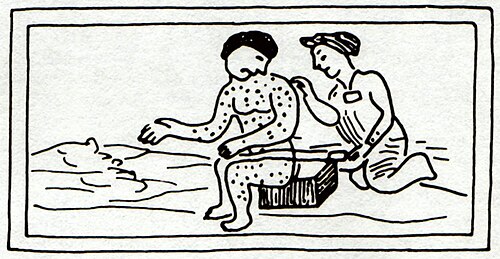
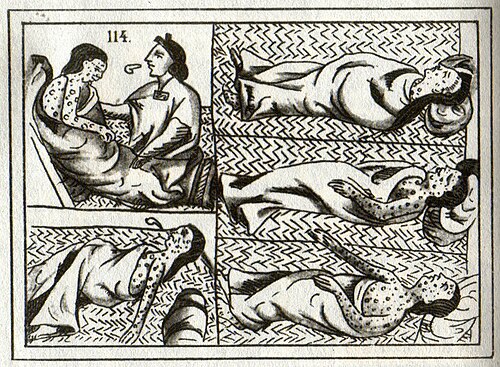
Some 21st-century climate scientists have suggested that a severe reduction of the indigenous population in the Americas and the accompanying reduction in cultivated lands during the 16th, 17th and 18th centuries may have contributed to a global cooling event known as the Little Ice Age.[68][94][95][96][97][98]
The loss of population was so high that it was partially responsible for the myth of the Americas as "virgin wilderness". By the time significant European colonization was underway, native populations had already been reduced by 90%. This resulted in settlements vanishing and cultivated fields being abandoned. Since forests were recovering, the colonists had an impression of a land that was an untamed wilderness.[99]
The virgin soil effects encompass the psychological phenomenon in the aftermath of the population decimation by the plague, whete[sic?] severe disruption of the Native American societies.[100]
Disease had both direct and indirect effects on deaths. High mortality meant that there were fewer people to plant crops, hunt game, and otherwise support the group. Loss of cultural knowledge transfer also affected the community as vital agricultural and food-gathering skills were not passed on to survivors. Missing the right time to hunt or plant crops affected the food supply, thus further weakening the community and making it more vulnerable to the next epidemic. Communities under such crisis were often unable to care for people who were disabled, elderly, or young.[44]
The material and societal realities of disability for Native American communities were tangible.[44] Scarlet fever could result in blindness or deafness, and sometimes both.[44] Smallpox epidemics led to blindness and depigmented scars. Many Native American tribes took pride in their own appearance, and the resulting skin disfigurement of smallpox deeply affected them psychologically. Unable to cope with this condition, tribe members were said to have committed suicide.[101]
↑ Achtman, M.; Zurth, K.; Morelli, G.; Torrea, G.; Guiyoule, A.; Carniel, E. (1999-11-23). "ペストの原因菌であるYersinia pestisは、最近出現したYersinia pseudotuberculosisのクローンである" . Proceedings of the National Academy of Sciences of the United States of America . 96 (24): 14043– 14048. Bibcode : 1999PNAS...9614043A . doi : 10.1073 /pnas.96.24.14043 . ISSN 0027-8424 . PMC 24187. PMID 10570195 .
↑ Roumagnac, Philippe; Weill, François-Xavier; Dolecek, Christiane; Baker, Stephen; Brisse, Sylvain; Chinh, Nguyen Tran; Le, Thi Anh Hong; Acosta, Camilo J.; Farrar, Jeremy; Dougan, Gordon; Achtman, Mark (2006-11-24). "Evolutionary History of Salmonella Typhi" . Science . 314 (5803): 1301– 1304. Bibcode : 2006Sci...314.1301R . doi : 10.1126/science.1134933 . ISSN 0036-8075 . PMC 2652035 . PMID 17124322 .
↑ Wertheim, Joel O.; Smith, Martin D.; Smith, Davey M.; Scheffler, Konrad; Kosakovsky Pond, Sergei L. (2014). "Evolutionary Origins of Human Herpes Simplex Viruses 1 and 2" . Molecular Biology and Evolution . 31 (9): 2356– 2364. doi : 10.1093/molbev/msu185 . ISSN 1537-1719 . PMC 4137711 . PMID 24916030 .
↑ Acuna-Soto, Rodolfo; Stahle, David W.; Therrell, Matthew D.; Gomez Chavez, Sergio; Cleaveland, Malcolm K. (2005 年 1 月). "メソアメリカにおける古典期文化の衰退 (西暦 750 ~ 950 年)、干ばつ、伝染病、および崩壊。大量人口減少の原因としての出血熱" . Medical Hypotheses . 65 (2): 405– 409. doi : 10.1016/j.mehy.2005.02.025 . PMID 15922121 .
↑ Evans, Nicholas P.; Bauska, Thomas K.; Gázquez-Sánchez, Fernando; Brenner, Mark; Curtis, Jason H.; Hodell, David A. (2018-08-03). "Quantification of drought during the collapse of the classic Maya civilization" . Science . 361 (6401): 498–501 . Bibcode : 2018Sci...361..498E . doi : 10.1126/science.aas9871 . PMID 30072537 .
↑ Turner, BL; Sabloff, Jeremy A. (2012-08-28). "中央マヤ低地の古典期崩壊:持続可能性のための人間と環境の関係についての洞察" . Proceedings of the National Academy of Sciences . 109 (35): 13908– 13914. Bibcode : 2012PNAS..10913908T . doi : 10.1073/pnas.1210106109 . PMC 3435155 . PMID 22912403 .
↑ Cook, Benjamin I.; Smerdon, Jason E.; Cook, Edward R.; Williams, A. Park; Anchukaitis, Kevin J.; Mankin, Justin S.; Allen, Kathryn; Andreu-Hayles, Laia; Ault, Toby R.; Belmecheri, Soumaya; Coats, Sloan; Coulthard, Bethany; Fosu, Boniface; Grierson, Pauline; Griffin, Daniel (2022年11月)。「西暦紀元と人新世における巨大干ばつ」。Nature Reviews Earth & Environment。3 ( 11 ): 741– 757。Bibcode : 2022NRvEE...3..741C。doi : 10.1038 /s43017-022-00329-1。ISSN 2662-138X。
↑ Sherwood, Noble P.; Nigg, Clara; Baumgartner, Leona (1926). "アメリカ先住民における猩紅熱に対するディックテストと自然免疫に関する研究". The Journal of Immunology . 11 (5): 343– 360. doi : 10.4049/jimmunol.11.5.343 .
1 2 3 Francis, John M. (2005).イベリア半島とアメリカ大陸の文化、政治、歴史:学際的百科事典. カリフォルニア州サンタバーバラ:ABC-CLIO.
↑ Bos, Kirsten I.; Harkins, Kelly M.; Herbig, Alexander; Coscolla, Mireia; et al. (20 August 2014). "コロンブス以前のマイコバクテリアゲノムが、新世界におけるヒト結核の感染源としてアザラシを明らかにする" . Nature . 514 (7523): 494– 7. Bibcode : 2014Natur.514..494B . doi : 10.1038/nature13591 . PMC 4550673 . PMID 25141181 .
↑ Keyes, Sarah (2018). "Western Adventurers and Male Nurses: Indians, Cholera, and Masculinity in Overland Trail Narratives" . Western Historical Quarterly . 49 : 43–64 . doi : 10.1093/whq/whx107 . 2024年2月2日取得。
1 2 Koch, Alexander; Brierley, Chris; Maslin, Mark M.; Lewis, Simon L. (2019). "1492年以降のヨーロッパ人の到来とアメリカ大陸における大量死の地球システムへの影響" . Quaternary Science Reviews . 207 : 13– 36. Bibcode : 2019QSRv..207...13K . doi : 10.1016/j.quascirev.2018.12.004 .
↑ Acuna-Soto, Rodolfo; et al. (2004). "When half of the population died: the epidemic of hemorrhagic fevers of 1576 in Mexico" . FEMS Microbiology Letters . 240 (1): 1– 5. Bibcode : 2004FEMML.240....1A . doi : 10.1016/j.femsle.2004.09.011 . PMC 7110390. PMID 15500972 .
↑ Crosby, Alfred W. (1967). "Conquistador y Pestilencia: The First New World Pandemic and the Fall of the Great Indian Empires" . The Hispanic American Historical Review . 47 (3): 321–337 . doi : 10.2307/2511023 . ISSN 0018-2168 . JSTOR 2511023 .
1 2 John S Marr; John T Cathey (2010 年 2 月) 「1616 ~ 1619 年のニューイングランドにおけるネイティブ アメリカンの流行の原因に関する新しい仮説」 . Emerg Infect Dis . 16 (2). 8600 Rockville Pike Bethesda, MD 20894: National Library of Medicine: 281–286 . doi : 10.3201/eid1602.090276 . PMC 2957993 . PMID 20113559 .{{cite journal}}: CS1メンテナンス: 場所 (リンク)
↑ Kristiina Vogt; Toral Patel-Weynand; Patricia A. Roads; Asep. S. Suntana; Maura Shelton; John C. Gordon; Patricia A. Roads; Cal Mukumoto; Daniel J Vogt (2012年6月25日). Sustainability Unpacked: Food, Energy and Water for Resilient Environments and Societies . Taylor & Francis. p. 49. ISBN978-1-136-53060-9。
↑ Snow, Dean R.; Gehring, Charles T.; Starna, William A. (1996). In Mohawk Country . Syracuse University Press. p. XX. ISBN0-8156-2723-82016年12月31日にオリジナルからアーカイブされました。2016年10月11日に取得。
↑ Byrne, Joseph Patrick (2008). Encyclopedia of Pestilence, Pandemics, and Plagues [2 Volumes] . Westport, Conn: Greenwood Press. pp. 663–664 . ISBN978-0-313-34101-4。
↑ Rich, EE; Johnson, AM (1952). "Cumberland House Journals and Inland Journals 1775–82". The Canadian Historical Review . London: The Hudson's Bay Record Society.
↑リッチ EE (1967).毛皮貿易と北西部 1875 年まで(第 11版). マクレランド アンド スチュワート リミテッド.
↑ Pearson, J. Diane (2003). "Lewis Cass and the Politics of Disease: The Indian Vaccination Act of 1832". Wíčazo Ša Review . 18 (2): 9– 35. doi : 10.1353/wic.2003.0017 . S2CID 154875430 . Project MUSE 46131 .
↑ Julia Pongratz; Ken Caldeira ; Christian H. Reick; Martin Claussen (20 January 2011). "結合気候-炭素シミュレーションは、西暦800年から1850年の間に戦争と疫病が大気中のCO2に及ぼした地球規模の影響は小さいことを示している". The Holocene . 21 (5): 843– 851. doi : 10.1177/0959683610386981 . ISSN 0959-6836 . Wikidata Q106515792 .
↑ Ruddiman, William F. (2003). "The Anthropogenic Greenhouse Era Began Thousands of Years Ago". Climatic Change . 61 (3): 261– 293. Bibcode : 2003ClCh...61..261R . CiteSeerX 10.1.1.651.2119 . doi : 10.1023/B:CLIM.0000004577.17928.fa . S2CID 2501894 .
↑ Faust, Franz X.; Gnecco, Cristóbal; Mannstein, Hermann; Stamm, Jörg (2006). "Evidence for the Postconquest Demographic Collapse of the Americas in Historical CO2 Levels" (PDF) . Earth Interactions . 10 (11): 1. Bibcode : 2006EaInt..10k...1F . doi : 10.1175/EI157.1 . 2022年10月9日にオリジナルからアーカイブ(PDF) 。
↑デネバン、ウィリアム M. (1992). 「原始神話:1492年のアメリカ大陸の景観」アメリカ地理学会年報82 ( 3): 369–385 . doi : 10.1111/j.1467-8306.1992.tb01965.x . JSTOR 2563351 .
↑ Crosby, Alfred W. (1976), "アメリカ先住民の人口減少の一因としての未開地疫病", The William and Mary Quarterly , 33 (2), Omohundro Institute of Early American History and Culture: 289– 299, doi : 10.2307/1922166 , JSTOR 1922166 , PMID 11633588
↑ Guilmet, George M; Boyd, Robert T; Whited, David L; Thompson, Nile (1991). "The Legacy of Introduced Disease: The Southern Coast Salish" . American Indian Culture and Research Journal . 15 (4): 1– 32. doi : 10.17953/aicr.15.4.133g8x7135072136 (2026年6月18日非アクティブ)。{{cite journal}}: CS1メンテナンス: DOIは2026年6月現在非アクティブです(リンク)
1 2 Fenn, Elizabeth A. (2000). "18世紀北アメリカにおける生物兵器:ジェフリー・アマーストを超えて" . The Journal of American History . 86 (4): 1552– 1580. doi : 10.2307/2567577 . JSTOR 2567577 . PMID 18271127 . ProQuest 224890556 . 2015年4月3日にオリジナルからアーカイブ済み。
Daniels, John D. (1992). 「1492年の北アメリカのインディアン人口」 . The William and Mary Quarterly . 49 (2): 298–320 . doi : 10.2307/2947274 . ISSN 0043-5597 . JSTOR 2947274 .
Snow, Dean R. 「人口統計学的限界の設定:北米の事例」(PDF) . CAAカンファレンス.