Some other sculpted figures also are dated to circa 150 BCE, due to their similarity with equivalent figures in Bharhut. This is the case of a male Chauri-bearer with its sharp lines and stiff expression, held at the Mathura Museum.[83]Sir John Marshall considered the early reliefs of Mathura and Bharhut as part of the same tradition, calling it the "Bharhut-Mathura School", while the reliefs of Sanchi were a second tradition, calling it the "Malwa School of Sanchi".[84]
Crossbar medallion with elephant and riders, Gayatri Tila, Mathura, circa 150 BCE.[85]
Crossbar medallion with horse rider. 2nd-1st century BCE.
An anguiped, also seen in Hellenistic and Roman art, c. 1st century BCE.[89]
Complex narrative reliefs (circa 100 BCE)
Linga inside a railing (left), being worshipped by Gandharvas winged creatures. Circa 100 BCE.[90]
By 100 BCE, the reliefs represent more complex scenes, defining, according to Sonya Rhie Quintanilla, an age of "iconic diversification and narrative maturation", as shown by the Kankali Tila architrave representing centaurs worshipping a Jain stupa, the dance of Nilanjana, and the renunciation of Rsabhanata, or the Katra architrave representing Brahmins with pots in a sacred precinct.[91][92] Another relief from the same period shows a Linga inside a railing on platform and under a pipal tree, being worshipped by Gandharvas, an early depiction of the phallic cult in Shivaism.[90]
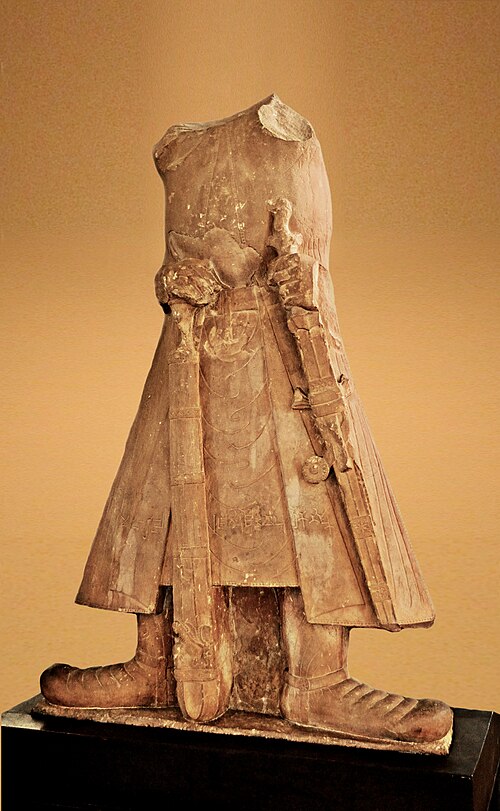
The Kushans vigorously promoted royal portraiture, as can be seen in their dynastic sculptures from Bactria to the region of Mathura.[163] Monumental sculptures of Kushan rulers, particularly Vima Kadphises and Kanishka I has been found in the ruins of the Temple of Mat in Mathura. The statues are characterized by their frontality and martial stance, with Kanishka being shown holding firmly his sword and a huge mace.[163] They are wearing heavy coats and heavy riding boots typical of the clothing of Central Asian nomads at that time, irrespective of the warm climate of India.[163] The coats are richly decorated with hundreds of pearls, which probably symbolize wealth.[163] These grandiose displays of Kushan dynastic power were accompanied by surperlative regnal titles: the statue of Kanishka is inscribed in Brahmi script with the sentence "The Great King, King of Kings, Son of God, Kanishka".[160][163]
To some extent, as the Kushans progressively adapted to life in India, their dress progressively became lighter, and representation less frontal and more natural, although they generally retained characteristic elements of their nomadic dress, such as the trousers and boots, the heavy tunics, and heavy belts.
Monumental statue of Vima Kadphises, 1st century CE, Mathura Museum
Statue of the Saka Prince Chastana, with costume details. 2nd century CE. Mathura Museum
Kushan devotee, Mathura Museum
Saka or Kushan Prince in pointed cap. Mathura Museum
"Kapardin" Bodhisattva statuary (2nd century CE)
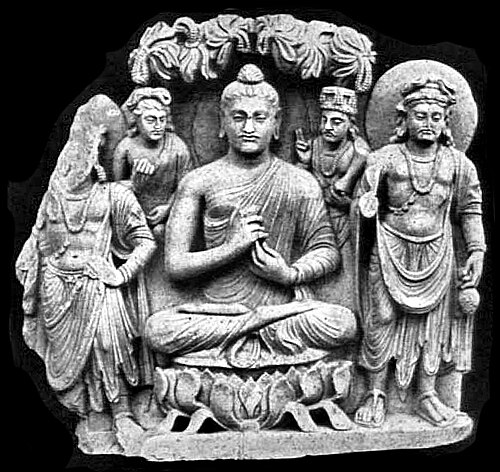
Seated Bodhisattva with attendants("Year 4 of the Great King Kanishka")
Cult images of Vāsudeva continued to be produced during the period, the worship of this Mathuran deity being much more important than that of Vishnu until the 4th century CE.[210] Statues dating to the 2nd and 3rd century show a possibly four-armed Vāsudeva standing with his attributes: the wheel, the mace and the conch, his right hand saluting in Abhaya mudra.[211] Only with the Gupta period, did statues focusing on the worship of Vishnu himself start to appear, using the same iconography as the statues of Vāsudeva, but with the right hand holding a bijapuraka citrus instead of making the abhaya mudra gesture, and with the addition of an aureole starting at the shoulders.[210][212]
A few triads are known from Mathura, dated to the 1st–2nd century CE, showing Vāsudeva and Saṃkarṣaṇa with their attributes, together with a female standing in the middle, thought to be Ekanamsha.[213][214]
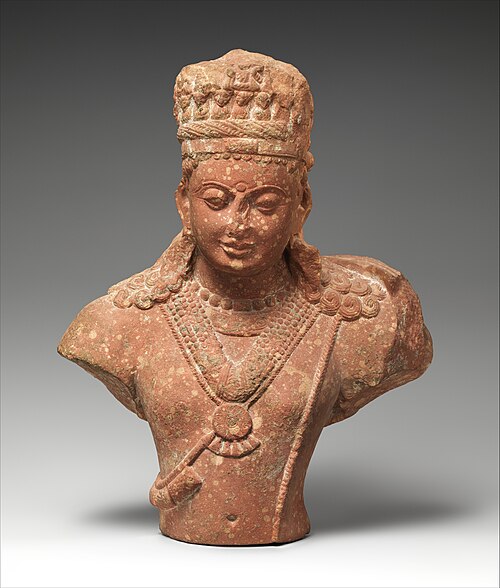
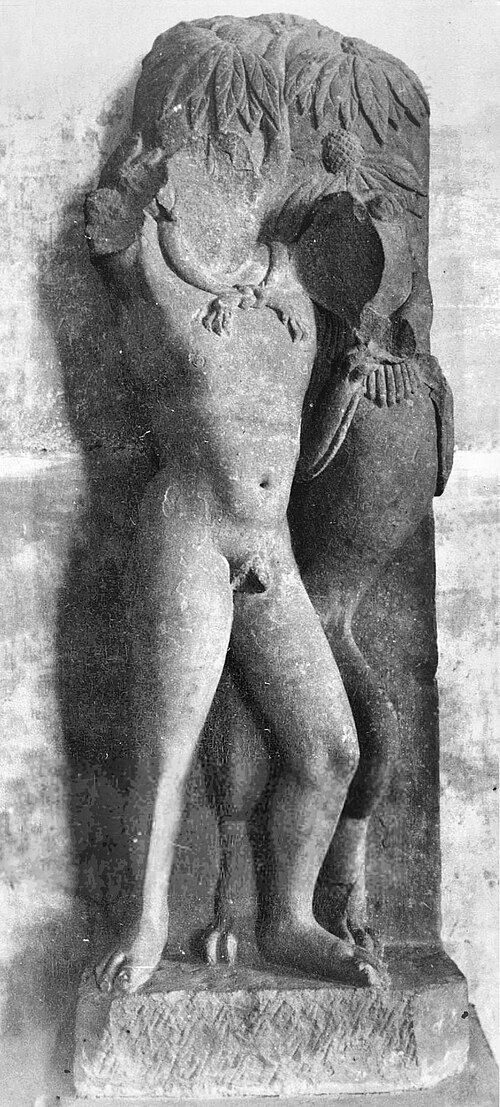
Some sculptures during this period suggest that the "Vyūha doctrine" (Vyūhavāda, "Doctrine of the emanations") was starting to emerge, as images of "Chatur-vyūha" (the "four emanations of Vāsudeva") are appearing.[215] The famous "Caturvyūha" statue in Mathura Museum is an attempt to show in one composition Vāsudeva as the central deity together with the other members of the Vrishni clan of the Pancharatra system emanating from him: Samkarsana, Pradyumna and Aniruddha, with Samba missing.[203][204] The back of the relief is carved with the branches of a Kadamba tree, symbolically showing the genealogical relationship being the different deities.[203] The depiction of Vāsudeva and later Vishnu was stylistically derived from the type of the ornate Bodhisattvas, with rich jewelry and ornate headdress.[186]
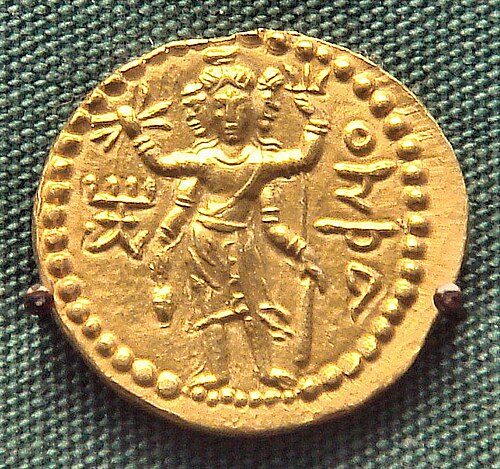
Other statues of Vishnu show him as three-headed (possibly with an implied fourth head in the back), the Vaikuntha Chaturmurti type, where Vishnu or his human emanation Vāsudeva-Krishna is shown with a human head, flanked by the muzzle of a boar (his avatar Varaha) and the head of a lion (his avatar Narasimha), two of his most important and ancient avatars, laid out upon his aureole.[210] A fourth avatar is sometimes shown in the back of the sculptures of Kashmir, showing the avatar Trivikrama, but never in the statuary of Mathura.[210] Recent scholarship considers that these "Vishnu" statues still show the emanation Vāsudeva Krishna as the central human-shaped deity, rather than the Supreme God Vishnu himself.[229][210]
A further variation is Vishnu as three-headed cosmic creator, the Visnu Visvarupa, showing Vishnu with a human head, again flanked by the muzzle of a boar the head of a lion, but with a multitude of beings on his aureole, symbol of the numerous creations and emanations resulting from his creative power.[210] These sculptures can be dated to the 5th century CE.[210]
Incorporation of Lakshmi
In the 3rd–4th century CE, Lakshmi, which had been an independent Goddess of prosperity and luck, was incorporated in the Vaishnava pantheon as the consort of Vishnu.[230] She thus became the Hindu goddess of wealth, good fortune, prosperity and beauty.[231]
Decline with the invasion of the Alchon Huns (6th century CE)
The Huna Mihirakula essentially wiped out the Mathura school of art.[233]
The decline of the Gupta Empire was accompanied by the invasions and the wide-scale destructions of the HunasAlchon Huns circa 460–530 CE, and an ensuing disorganization of society. These events mark the end of Classical Indian civilisation.[234] The art of Mathura suffered greatly from the destructions brought by the Hunas, as did the art of Gandhara in the northwest, and both schools of art were nearly wiped out under the rule of the Huna Mihirakula.[233]
"Towards the middle of the 6th century, the activity of the Mathura school abruptly ceased, undoubtedly following the ravages of the Huns who had invaded the Gupta empire around 455. It must have died with the art of Gandhara under the persecutions by Mihirakula."
In many ways, Gupta art had represented the zenith of the art of Mathura, with its beautiful and elegant creations.[235] In the medieval period, efforts were made at emulating Gupta art, but the technical level in sculpture decreased significantly.[235] Many of the qualities found in Gupta art start to vanish during this period, such as the spituality of the sculptures, their elegant slimness and suppleness.[236] As the country disintegrated, so did the arts, the artistic rendering becoming coarse, formal and stereotyped.[236] Some decadent effects are obtained by the increase in ornament, the enlargement of crowns, the multiplication of arms and the profusion of attendant deities.[236] The rendering of the human figure becomes rather artificial and highly stylized, relying heavily on the curbed Tribhanga pose.[236]
In 1018, Mahmud of Ghazni, ruler of the Ghaznavid Empire, laid waste to the city of Mathura, which was "ruthlessly sacked, ravaged, desecrated and destroyed".[238][239] In particular, Al-utbi mentioned in work Tarikh-e-yamini, that Mahmud Ghaznavi destroyed a "great and magnificent temple" in Mathura.[240] According to Muhammad Qasim Hindu Shah, writing an "History of Hindustan" in the 16th-17th century, the city of Mathura was the richest in India, and was consecrated to Vāsudeva-Krishna. When it was attacked by Mahmud of Ghazni, "all the idols" were burnt and destroyed during a period of twenty days, gold and silver was smelted for booty, and the city was burnt down.[241]
Despite the destructions, some level of artistic production continued afterward, as some Jain statues for example are dated to several decades after the 1018 sack of the city.[237]
Early modern to modern period (16th–21st century)
Seated Shiva, Modern Period
The art of Mathura in the Early modern period was going through a lower period of activity, with comparatively fewer remaining works of art.
12Myer, Prudence R. (1986). "Bodhisattvas and Buddhas: Early Buddhist Images from Mathurā". Artibus Asiae. 47 (2): 107–142. doi:10.2307/3249969. ISSN0004-3648. JSTOR3249969.
123456789Myer, Prudence R. (1986). "Bodhisattvas and Buddhas: Early Buddhist Images from Mathurā". Artibus Asiae. 47 (2): 111–113. doi:10.2307/3249969. ISSN0004-3648. JSTOR3249969.
↑Harle, James C. (1994). The Art and Architecture of the Indian Subcontinent. Yale University Press. pp.63–64. ISBN978-0-300-06217-5.
↑Paul, Pran Gopal; Paul, Debjani (1989). "Brahmanical Imagery in the Kuṣāṇa Art of Mathurā: Tradition and Innovations". East and West. 39 (1/4): 111–143. JSTOR29756891.
↑"But what made Mathura pre-eminent among its peers, is the incomparable role it played as a major centre of religious art as well. Indeed no other ateliers are known to have produced at the same time so many images pertaining to all the three principal religious system of India: Brahmanism, Buddhism and Jainism. The unquestionable supremacy of the Mathura sculptor, at least till the beginning of the Gupta period, is further documented by the discovery of his handiwork from far-flung points of the Indian subcontinent" in Paul, Pran Gopal; Paul, Debjani (1989). "Brahmanical Imagery in the Kuṣāṇa Art of Mathurā: Tradition and Innovations". East and West. 39 (1/4): 111–143. JSTOR29756891.
12345678910Stoneman, Richard (2019). The Greek Experience of India: From Alexander to the Indo-Greeks. Princeton University Press. pp.436–437. ISBN9780691185385.
12Paul, Pran Gopal; Paul, Debjani (1989). "Brahmanical Imagery in the Kuṣāṇa Art of Mathurā: Tradition and Innovations". East and West. 39 (1/4): 111–143, especially 112–114, 115, 125. JSTOR29756891.
↑Paul, Pran Gopal; Paul, Debjani (1989). "Brahmanical Imagery in the Kuṣāṇa Art of Mathurā: Tradition and Innovations". East and West. 39 (1/4): 111–143. ISSN0012-8376. JSTOR29756891. We should do well to remember that the Aryans worshipped purely the elementary forces of nature by means of elaborate sacrifices, together with appropriate hymns. In this scheme of ritual it was not necessary, nor was it possible to substitute the object of exaltation so convincingly by any concrete form, least of all by human figure, without compromising the fundamental attitude of the worshipper to the all-pervasive power that was being propitiated. Such a change in the approach of the tightly-knit Vedic and even post-Vedic society, orchestrated as it was by orthodox priesthood, could not have come of itself. This was possible when such an urge was actually felt by the general masses and that feeling was intensified by the ideological impact of fresh ethnic influx into the Indian social pool.
12Krishan, Yuvraj; Tadikonda, Kalpana K. (1996). The Buddha Image: Its Origin and Development. Bharatiya Vidya Bhavan. p.ix-x. ISBN978-81-215-0565-9. These are ample reasons to believe that the aniconism of early Buddhist art was rooted in Vedism in which the highest Gods were conceived as impersonal forces and amūrta, without form.
1234Shaw, Ian; Jameson, Robert (2008). A Dictionary of Archaeology. John Wiley & Sons. p.248. ISBN978-0-470-75196-1.
12Quintanilla, Sonya Rhie (2007). History of Early Stone Sculpture at Mathura: Ca. 150 BCE – 100 CE. BRILL. pp.1–7. ISBN9789004155374.
↑Quintanilla, Sonya Rhie (2007). History of Early Stone Sculpture at Mathura: Ca. 150 BCE – 100 CE. BRILL. p.8. ISBN9789004155374.
↑Quintanilla, Sonya Rhie (2007). History of Early Stone Sculpture at Mathura: Ca. 150 BCE – 100 CE. BRILL. p.7. ISBN9789004155374.
12345Bautze, Joachim Karl (1994). Iconography of Religions. BRILL. pp.12–13. ISBN978-90-04-09924-1.
↑"Votive Female Figurine". The Walters Art Museum.
12"The relatively high quality of terracotta sculptures recovered from Maurya strata at Mathura suggests some level of artistic activity prior to the second century BCE." Quintanilla, Sonya Rhie (2007). History of Early Stone Sculpture at Mathura: Ca. 150 BCE – 100 CE. BRILL. p.35. ISBN9789004155374.
123Kala, Satish Chandra (1980). Terracottas in the Allahabad Museum. Abhinav Publications. p.5. ISBN9780391022348.
12Singh, Upinder (2008). A History of Ancient and Early Medieval India: From the Stone Age to the 12th Century. Pearson Education India. pp.431–433. ISBN978-81-317-1677-9.
↑"The largest number of mother-goddess figurines has been found in western Uttar Pradesh in Mathura, which in the Mauryan period became an important terracotta making centre outside Magadh." in Sant, Urmila (1997). Terracotta Art of Rajasthan: From Pre-Harappan and Harappan Times to the Gupta Period. Aryan Books International. p.136. ISBN9788173051159.
1234Vishnu, Asha (1993). Material Life of Northern India: Based on an Archaeological Study, 3rd Century B.C. to 1st Century B.C. Mittal Publications. p.141. ISBN9788170994107.
12"Iranian Heads From Mathura, some terracotta male-heads were recovered, which portray the Iranian people with whom the Indians came into closer contact during the fourth and third centuries B.C. Agrawala calls them the representatives of Iranian people because their facial features present foreign ethnic affinities." Srivastava, Surendra Kumar (1996). Terracotta art in northern India. Parimal Publications. p.81.
↑"Mathura has also yielded a special class of terracotta heads in which the facial features present foreign ethnic affinities." Dhavalikar, Madhukar Keshav (1977). Masterpieces of Indian Terracottas. Taraporevala. p.23.
↑"Soldier heads. During the Mauryan period, the military activity was more evidenced in the public life. Possibly, foreign soldiers frequently visited India and attracted Indian modellers with their ethnic features and uncommon uniform. From Mathura in Uttar Pradesh and Basarh in Bihar, some terracotta heads have been reported, which represent soldiers. Artistically, the Basarh terracotta soldier-heads are better, executed than those from Mathura." in Srivastava, Surendra Kumar (1996). Terracotta art in northern India. Parimal Publications. p.82.
↑Vishnu, Asha (1993). Material Life of Northern India: Based on an Archaeological Study, 3rd Century B.C. to 1st Century B.C. Mittal Publications. p.XV. ISBN9788170994107.
↑"The figure of a Persian youth (35.2556) wearing coat, scarf, trousers and turban is a rare item." Museum, Mathura Archaeological (1971). Mathura Museum Introduction: A Pictorial Guide Book. Archaeological Museum. p.14.
↑Sharma, Ramesh Chandra (1994). The Splendour of Mathurā Art and Museum. D.K. Printworld. p.58.
↑Vishnu, Asha (1993). Material Life of Northern India: Based on an Archaeological Study, 3rd Century B.C. to 1st Century B.C. Mittal Publications. p.140. ISBN9788170994107.
1234Gupta, Vinay K. (January 2019). "Vrishnis in Ancient Literature and Art". Indology's Pulse Arts in Context, Doris Meth Srinivasan Festschrift Volume, Eds. Corinna Wessels Mevissen and Gerd Mevissen with Assistance of Vinay Kumar Gupta: 70–72.
123"No doubt, one may be tempted to associate the square copper coins of Agathocles displaying Sahkarshana and Väsudeva and bearing Brähmi as well as Greek inscription (Revue Numismatique, 1974, s.Vl, vol. XVI, pp. 8f) with Mathură, since that region was famous for the cult of Vāsudeva. But the cult could have become well-known also outside of Mathurā by the time of this Indo-Greek king or even in a much earlier age (Com. His. Ind., vol II, p. 883). However, the coins concerned should have been issued in an eastern area of the Indo-Greek kingdom, where Brāhmi, and not Kharoshthi, ( or Brähmi as well as Kharoshthi) was well-known. Such an area might have been not much to the west of Mathura" in Mukherjee, Bratindra Nath (1981). Mathurā and Its Society: The ʼSakæ-Pahlava Phase. Firma K.L.M. p.149. ISBN9780836415896.
1234Singh, Upinder (2008). A History of Ancient and Early Medieval India: From the Stone Age to the 12th Century. Pearson Education India. p.437. ISBN978-81-317-1120-0.
1234Neelis, Jason (2010). Early Buddhist Transmission and Trade Networks: Mobility and Exchange Within and Beyond the Northwestern Borderlands of South Asia. BRILL. pp.102–103. ISBN978-90-04-18159-5.
12Srinivasan, Doris (1997). Many Heads, Arms, and Eyes: Origin, Meaning, and Form of Multiplicity in Indian Art. BRILL. p.215. ISBN978-90-04-10758-8.
↑Paul, Pran Gopal; Paul, Debjani (1989). "Brahmanical Imagery in the Kuṣāṇa Art of Mathurā: Tradition and Innovations". East and West. 39 (1/4): 111–143. ISSN0012-8376. JSTOR29756891.
12Singh, Upinder (2008). A History of Ancient and Early Medieval India: From the Stone Age to the 12th Century. Pearson Education India. pp.436–440. ISBN978-81-317-1120-0.
12"The folk art typifies an older plastic tradition in clay and wood which was now put in stone, as seen in the massive Yaksha statuary which are also of exceptional value as models of subsequent divine images and human figures." in Agrawala, Vasudeva Sharana (1965). Indian Art: A history of Indian art from the earliest times up to the third century A. D. Prithivi Prakashan. p.84.
↑Bopearachchi, Osmund (2017). "Achaemenids and Mauryans: Emergence of Coins and Plastic Arts in India". India and Iran in the Long Durée. p.15. doi:10.1163/9789004460638_003. ISBN978-0-9988632-0-7.
123Osmund Bopearachchi, 2016, Emergence of Viṣṇu and Śiva Images in India: Numismatic and Sculptural Evidence
↑Williams, Joanna Gottfried (1981). Kalādarśana: American Studies in the Art of India. BRILL. p.129. ISBN978-90-04-06498-0.
1234Quintanilla, Sonya Rhie (2007). History of Early Stone Sculpture at Mathura: Ca. 150 BCE – 100 CE. BRILL. pp.8–10. ISBN978-90-04-15537-4.
12Quintanilla, Sonya Rhie (2007). History of Early Stone Sculpture at Mathura: Ca. 150 BCE – 100 CE. BRILL. pp.8–9. ISBN9789004155374.
↑Published in "L'Indo-Grec Menandre ou Paul Demieville revisite," Journal Asiatique 281 (1993) p.113
↑"Some Newly Discovered Inscriptions from Mathura: The Meghera Well Stone Inscription of Yavanarajya Year 160 Recently a stone inscription was acquired in the Government Museum, Mathura." India's ancient past, Shankar Goyal Book Enclave, 2004, p.189
12Quintanilla, Sonya Rhie (2007). History of Early Stone Sculpture at Mathura: Ca. 150 BCE – 100 CE. BRILL. pp.9–10. ISBN9789004155374.
↑Indian Numismatic Studies K. D. Bajpai, Abhinav Publications, 2004, p.105
↑"During the time of Indo-Greek hegemony, art and architecture in the medium of stone began to be produced in the Mathura region" in Quintanilla, Sonya Rhie (2007). History of Early Stone Sculpture at Mathura: Ca. 150 BCE – 100 CE. BRILL. p.10. ISBN978-90-04-15537-4.
↑Quintanilla, Sonya Rhie (2007). History of Early Stone Sculpture at Mathura: Ca. 150 BCE – 100 CE. BRILL. p.10. ISBN9789004155374.
123456Boardman, John (1993). The Diffusion of Classical Art in Antiquity. Princeton University Press. p.112. ISBN0691036802.
↑Dated 150 BCE in Fig. 15-17, general comments p.26-27 in Quintanilla, Sonya Rhie (2007). History of Early Stone Sculpture at Mathura: Ca. 150 BCE – 100 CE. BRILL. ISBN9789004155374.
↑Dated 100 BCE in Fig.88 in Quintanilla, Sonya Rhie (2007). History of Early Stone Sculpture at Mathura: Ca. 150 BCE – 100 CE. BRILL. p.368, Fig. 88. ISBN9789004155374.
12Dated 100 BCE in Fig. 86-87, page 366-367 in Quintanilla, Sonya Rhie (2007). History of Early Stone Sculpture at Mathura: Ca. 150 BCE – 100 CE. BRILL. p.Fig.86, p.366. ISBN9789004155374.
12Dated 150 BCE in Fig. 20, page 33-35 in Quintanilla, Sonya Rhie (2007). History of Early Stone Sculpture at Mathura: Ca. 150 BCE – 100 CE. BRILL. p.Fig. 20, page 33–35. ISBN9789004155374.
↑Quintanilla, Sonya Rhie (2007). History of Early Stone Sculpture at Mathura: Ca. 150 BCE – 100 CE. BRILL. p.368, Fig. 88. ISBN9789004155374.
12Fig. 85 in Quintanilla, Sonya Rhie (2007). History of Early Stone Sculpture at Mathura: Ca. 150 BCE – 100 CE. BRILL. p.Fig.85, p.365. ISBN9789004155374.
↑Dalal, Roshen (2010). The Religions of India: A Concise Guide to Nine Major Faiths. Penguin Books India. p.398. ISBN978-0-14-341517-6.
12Agrawala, Vasudeva S. (1965). Masterpieces of Mathura sculpture. p.3.
↑Marshall, John (1915). Archaeological Survey Of India Annual Report 1911-12. Excavations at Bhita. pp.29–.
12Quintanilla, Sonya Rhie (2007). History of Early Stone Sculpture at Mathura: Ca. 150 BCE – 100 CE. BRILL. p.13. ISBN9789004155374.
123456Dalal, Roshen (2010). The Religions of India: A Concise Guide to Nine Major Faiths. Penguin Books India. pp.397–398. ISBN978-0-14-341517-6.
↑Singh, Upinder (2008). A History of Ancient and Early Medieval India. New Delhi: Pearson Education. p.430. ISBN978-81-317-1120-0.
↑"yaksha". Encyclopædia Britannica. Retrieved 15 July 2007.
↑Sharma, Ramesh Chandra (1994). The Splendour of Mathurā Art and Museum. D.K. Printworld. p.76. ISBN978-81-246-0015-3.
123Singh, Upinder (2008). A History of Ancient and Early Medieval India: From the Stone Age to the 12th Century. Pearson Education India. pp.430–433. ISBN978-81-317-1677-9.
↑Dated 150 BCE in Quintanilla, Sonya Rhie (2007). History of Early Stone Sculpture at Mathura: Ca. 150 BCE – 100 CE. BRILL. ISBN9789004155374.
↑Costumes & Ornaments As Depicted in the Early Sculpture of Gwalior Museum By Sulochana Ayyar, Mittal Publications, 1 December 1987, p. 29
↑Luders, Heinrich (1961). Mathura Inscriptions. p.179.
↑"A History of Ancient and Early Medieval India: From the Stone Age to the 12 the century" by Upinder Singh p.365
↑"We have no way of knowing whether there was any direct association between the cult of the Yashas and Dionysos during the Indo-Greek era, but this is a distinct possibility" in Carter, Martha L. (1968). "Dionysiac Aspects of Kushān Art". Ars Orientalis. 7: 141. ISSN0571-1371. JSTOR4629244.
↑Carter, Martha L. (1982). "The Bacchants of Mathura: New Evidence of Dionysiac Yaksha Imagery from Kushan Mathura". The Bulletin of the Cleveland Museum of Art. 69 (8): 247–257. ISSN0009-8841. JSTOR25159785.
↑"Perhaps the Bactrian Greek invaders of northern India were the first actively to foster a syncretism involving Dionysos and his bacchants with Kubera and his Yakshas." in Carter, Martha L. (1982). "The Bacchants of Mathura: New Evidence of Dionysiac Yaksha Imagery from Kushan Mathura". The Bulletin of the Cleveland Museum of Art. 69 (8): 253. ISSN0009-8841. JSTOR25159785.
↑"With respect to large-scale iconic statuary carved in the round (...) the region of Mathura not only rivaled other areas but surpassed them in overall quality and quantity throughout the second and early first century BCE." in Quintanilla, Sonya Rhie (2007). History of Early Stone Sculpture at Mathura: Ca. 150 BCE – 100 CE. BRILL. p.24. ISBN9789004155374.
↑Dated to 150 BCE in Fig.2 in Quintanilla, Sonya Rhie (2007). History of Early Stone Sculpture at Mathura: Ca. 150 BCE – 100 CE. BRILL. pp.15–18 and Fig.2. ISBN9789004155374.
123Agrawala, V. S. (1965). "A New Yakshi Image from Mehrauli". Studies in Indian Art: 103.
↑Quintanilla, Sonya Rhie (2007). History of Early Stone Sculpture at Mathura, ca. 150 BCE – 100 CE. BRILL. p.19. ISBN9789047419303.
↑Le, Huu Phuoc (2010). Buddhist Architecture. Grafikol. ISBN9780984404308.
↑Quintanilla, Sonya Rhie (2007). History of Early Stone Sculpture at Mathura: Ca. 150 BCE - 100 CE. BRILL. p.11. ISBN9789004155374.
↑"Dhanabhuti of the Mathura inscription, as held by scholars, belonged to the royal family of Bharhut." in Das, Kalyani (1980). Early Inscriptions of Mathurā: A Study. Punthi Pustak. p.13.
↑Quintanilla, Sonya Rhie (2007). History of Early Stone Sculpture at Mathura: Ca. 150 BCE – 100 CE. BRILL. pp.8–33. ISBN9789004155374.
123456Quintanilla, Sonya Rhie (2007). History of Early Stone Sculpture at Mathura: Ca. 150 BCE – 100 CE. BRILL. pp.15–18. ISBN978-90-04-15537-4.
↑Vishnu, Asha (1993). Material Life of Northern India: Based on an Archaeological Study, 3rd Century B.C. to 1st Century B.C. Mittal Publications. p.28. ISBN978-81-7099-410-7.
12Male a Chauri-bearer discussed in Quintanilla, Sonya Rhie (2007). History of Early Stone Sculpture at Mathura: Ca. 150 BCE - 100 CE. BRILL. pp.19 and Fig.7. ISBN9789004155374.
↑Marshall, Sir John (1902). Monuments Of Sanchi Vol.1. p.106.
↑Quintanilla, Sonya Rhie (2007). History of Early Stone Sculpture at Mathura: Ca. 150 BCE - 100 CE. BRILL. pp.23–25. ISBN9789004155374.
↑"Collections-Virtual Museum of Images and Sounds". vmis.in. American Institute of Indian Studies.
↑Dated 100 BCE in Fig. 85 Quintanilla, Sonya Rhie (2007). History of Early Stone Sculpture at Mathura: Ca. 150 BCE - 100 CE. BRILL. p.Fig.85, p.365. ISBN9789004155374.
↑"Collections-Virtual Museum of Images and Sounds". vmis.in. American Institute of Indian Studies.
↑Quintanilla, Sonya Rhie (2007). History of Early Stone Sculpture at Mathura: Ca. 150 BCE - 100 CE. BRILL. p.132 Note 57. ISBN9789004155374.
12Singh, Upinder (2008). A History of Ancient and Early Medieval India: From the Stone Age to the 12th Century. Pearson Education India. p.435. ISBN978-81-317-1120-0.
↑Quintanilla, Sonya Rhie (2007). History of Early Stone Sculpture at Mathura: Ca. 150 BCE – 100 CE. BRILL. pp.36–51. ISBN9789004155374.
123Kumar, Raj (2003). Essays on Indian Art and Architecture. Discovery Publishing House. pp.50–51. ISBN9788171417155.
↑Cort, John (2010). Framing the Jina: Narratives of Icons and Idols in Jain History. Oxford University Press. pp.25–26. ISBN9780199739578.
↑Quintanilla, Sonya Rhie (2007). History of Early Stone Sculpture at Mathura, ca. 150 BCE – 100 CE. BRILL. p.42. ISBN9789047419303.
↑"The hippocamps, the tritons, centaurs and other weird creatures, which certainly were borrowed from Western Art, occur at Gaya and other places, in the sculptures of the early period. Forms more or less similar occur at Mathura and Arnaravati." Banerjee, Gauranga Nath (1920). Hellenism in ancient India. Calcutta. p.64.
↑Quintanilla, Sonya Rhie (2007). History of Early Stone Sculpture at Mathura: Ca. 150 BCE - 100 CE. BRILL. pp.Fig. 21 and 22. ISBN9789004155374.
↑Quintanilla, Sonya Rhie (2007). History of Early Stone Sculpture at Mathura: Ca. 150 BCE - 100 CE. BRILL. pp.47–49, Fig. 29 and 30. ISBN9789004155374.
↑Dated 2 BCE-6 CE in Fig.213 in Quintanilla, Sonya Rhie (2007). History of Early Stone Sculpture at Mathura: Ca. 150 BCE – 100 CE. BRILL. p.171. ISBN9789004155374.
↑The journal of the Asiatic Society of Bengal. Vol.23. Bishop's College Press. 1854. pp.689–691 Plate XXXV.
↑Allan, John (1936). Catalogue of the coins of ancient India. pp.cxv.
12Rosenfield, John M. (1967). The Dynastic Arts of the Kushans. University of California Press. p.135.
↑Paul, Pran Gopal; Paul, Debjani (1989). "Brahmanical Imagery in the Kuṣāṇa Art of Mathurā: Tradition and Innovations". East and West. 39 (1/4): 130. JSTOR29756891.
↑Neelis, Jason (2011). Early Buddhist Transmission and Trade Networks – PDF. Boston: Brill. p.110.
↑Dated 20 BCE in Fig.200 in Quintanilla, Sonya Rhie (2007). History of Early Stone Sculpture at Mathura: Ca. 150 BCE – 100 CE. BRILL. p.171. ISBN9789004155374.
12Kumar, Ajit (2014). "Bharhut Sculptures and their untenable Sunga Association". Heritage: Journal of Multidisciplinary Studies in Archaeology. 2: 223–241.
↑Bracey, Robert (2018). Problems of Chronology in Gandhāran Art: Proceedings of the First International Workshop of the Gandhāra Connections Project, University of Oxford, 23rd–24th March, 2017. The Classical Art Research Centre. Archaeopress. University of Oxford. p.143.
↑Dated 20 BCE in Fig.200 in Quintanilla, Sonya Rhie (2007). History of Early Stone Sculpture at Mathura: Ca. 150 BCE - 100 CE. BRILL. p.Fig.200. ISBN9789004155374.
↑Śrivastava, Vijai Shankar (1981). Cultural Contours of India: Dr. Satya Prakash Felicitation Volume. Abhinav Publications. p.95. ISBN9780391023581.
1234Quintanilla, Sonya Rhie (2007). History of Early Stone Sculpture at Mathura: Ca. 150 BCE – 100 CE. BRILL. pp.168–179. ISBN9789004155374.
↑Damsteegt, Th (1978). Epigraphical Hybrid Sanskrit: Its Rise, Spread, Characteristics and Relationship to Buddhist Hybrid Sanskrit. BRILL. p.209. ISBN9789004057258.
↑Singh, Upinder (2008). A History of Ancient and Early Medieval India: From the Stone Age to the 12th Century. Pearson Education India. p.437. ISBN978-81-317-1120-0.
↑Quintanilla, Sonya Rhie (2007). History of Early Stone Sculpture at Mathura: Ca. 150 BCE – 100 CE. BRILL. pp.211–213. ISBN978-90-04-15537-4.
123"We have actually discovered in the excavations at the Mora shrine stone torsos representing the Vrishni Heroes (...) Their style closely follows that of the free-standing Yakshas in that they are carved in the round. They are dressed in a dhoti and uttaraya and some types of ornaments as found on the Yaksha figures, their right hand is held in ahbayamudra..." in "Agrawala, Vasudeva Sharana (1965). Indian Art: A history of Indian art from the earliest times up to the third century A.D. Prithivi Prakashan. p.253.
↑This statue appears in Fig.51 as one of the statues excavated in the Mora mound, in Rosenfield, John M. (1967). The Dynastic Arts of the Kushans. University of California Press. pp.151–152 and Fig.51.
12Lüders, H. (1937). Epigraphia Indica Vol.24. pp.199–200.
12345Quintanilla, Sonya Rhie (2007). History of Early Stone Sculpture at Mathura: Ca. 150 BCE – 100 CE. BRILL. p.171. ISBN9789004155374.
1234567Dated 15 CE in Quintanilla, Sonya Rhie (2007). History of Early Stone Sculpture at Mathura: Ca. 150 BCE – 100 CE. BRILL. pp.211–214. ISBN978-90-04-15537-4.
↑Doris Srinivasan (1997). Many Heads, Arms, and Eyes: Origin, Meaning, and Form of Multiplicity in Indian Art. BRILL Academic. pp.211–214, 308–311 with footnotes. ISBN90-04-10758-4.
↑Sonya Rhie Quintanilla (2007). History of Early Stone Sculpture at Mathura: Ca. 150 BCE - 100 CE. BRILL Academic. p.260. ISBN978-90-04-15537-4.
↑Lavanya Vemsani (2016). Krishna in History, Thought, and Culture. ABC-CLIO. pp.202–203. ISBN978-1-61069-211-3.
12Rosenfield, John M. (1967). The Dynastic Arts of the Kushans. University of California Press. pp.151–152 and Fig.51.
↑The Jain stûpa and other antiquities of Mathurâ by Smith, Vincent Arthur Plate XIV
↑Quintanilla, Sonya Rhie (2007). History of Early Stone Sculpture at Mathura: Ca. 150 BCE – 100 CE. BRILL. p.403, Fig. 146. ISBN9789004155374.
1234Quintanilla, Sonya Rhie (2007). History of Early Stone Sculpture at Mathura: Ca. 150 BCE - 100 CE. BRILL. pp.200–201. ISBN9789004155374.
↑The Jain stûpa and other antiquities of Mathurâ by Smith, Vincent Arthur Plate VII
↑"The Ayagapata which had been set up by Simhanddika, anterior to the reign of Kanishka, and which is assignable to a period not later than 1 A.D., is worth notice because of the typical pillars in the Persian-Achaemenian style" in Bulletin of the Baroda Museum and Picture Gallery. The Museum. 1949. p.18.
123Quintanilla, Sonya Rhie (2007). History of Early Stone Sculpture at Mathura: Ca. 150 BCE - 100 CE. BRILL. p.406, photograph and date. ISBN9789004155374.
↑Quintanilla, Sonya Rhie (2007). History of Early Stone Sculpture at Mathura: Ca. 150 BCE - 100 CE. BRILL. p.410, Fig. 156. ISBN9789004155374.
↑Quintanilla, Sonya Rhie (2007). History of Early Stone Sculpture at Mathura: Ca. 150 BCE - 100 CE. BRILL. pp.174–176. ISBN9789004155374.
↑Dated 15 CE in Fig.222 in Quintanilla, Sonya Rhie (2007). History of Early Stone Sculpture at Mathura: Ca. 150 BCE - 100 CE. BRILL. p.Fig.222. ISBN9789004155374.
↑"the massive pillars in the Persian Achaemenian style" in Shah, Chimanlal Jaichand (1932). Jainism in north India, 800 B.C.-A.D. 526. Longmans, Green and co.
↑"The Ayagapata which had been set up by Simhanddika, anterior to the reign of Kanishka, and which is assignable to a period not later than 1 A.D., is worth notice because of the typical pillars in the Persian-Achaemenian style" in Bulletin of the Baroda Museum and Picture Gallery. Baroda Museum. 1949. p.18.
↑Kumar, Ajit (2014). "Bharhut Sculptures and their untenable Sunga Association". Heritage: Journal of Multidisciplinary Studies in Archaeology. 2: 223–241.
12Quintanilla, Sonya Rhie (2007). History of Early Stone Sculpture at Mathura: Ca. 150 BCE – 100 CE. BRILL. p.201. ISBN9789004155374.
12Bracey, Robert (2018). Problems of Chronology in Gandhāran Art: Proceedings of the First International Workshop of the Gandhāra Connections Project, University of Oxford, 23rd–24th March, 2017. The Classical Art Research Centre. Archaeopress. University of Oxford. pp.142–143.
↑"Honeysuckle, grapevine, triton and acanthus mouldings are some of the Hellenistic features." in Sharma, Ramesh Chandra; Ghosal, Pranati (2004). Buddhism and Gandhāra Art. Indian Institute of Advanced Study. p.148. ISBN978-81-7305-264-4.
↑Quintanilla, Sonya Rhie (2007). History of Early Stone Sculpture at Mathura, ca. 150 BCE - 100 CE. BRILL. p.226. ISBN978-90-474-1930-3.
↑Dated 25-50 CE in Quintanilla, Sonya Rhie (2007). History of Early Stone Sculpture at Mathura: Ca. 150 BCE - 100 CE. BRILL. p.Fig. 288. ISBN9789004155374.
↑Buddhist art of Mathurā, Ramesh Chandra Sharma, Agam, 1984 Page 26
123456789Verma, Thakur Prasad (1971). The Palaeography Of Brahmi Script. pp.82–85.
↑Sharma, Ramesh Chandra (1984). Buddhist art of Mathurā. Agam. p.26. ISBN9780391031401.
↑The former calligraphic style would have been: 𑀲𑁆𑀯𑀸𑀫𑀺𑀲𑁆𑀬 𑀫𑀳𑀓𑁆𑀰𑀢𑁆𑀭𑀧𑀲𑁆𑀬 𑀰𑀼𑀤𑀸𑀲𑀲𑁆𑀬
↑Quintanilla, Sonya Rhie (2007). History of Early Stone Sculpture at Mathura: Ca. 150 BCE – 100 CE. BRILL. pp.199–206, 204 for the exact date. ISBN9789004155374.
12"This aniconic tradition was shortly to disappear and the iconic types of the Buddha made their sudden appearance apparently simultaneously in the so-called Hellenic school of Gandhara and the Indian school of Mathura." Bhattacharyya, Narendra Nath (1993). Buddhism in the History of Indian Thoughts. Manohar Publishers & Distributors. p.266. ISBN978-81-7304-017-7.
123Quintanilla, Sonya Rhie (2007). History of Early Stone Sculpture at Mathura: Ca. 150 BCE – 100 CE. BRILL. pp.199–206. ISBN9789004155374.
12"It has also been suggested that the early seated Buddha images owe something to the first-century BC representations of seated kings, as seen on coins of the northwest (nos 27 and 28)." Maues sitting cross-legged and Azes sitting cross-legged in Errington, Elizabeth; Trust, Ancient India and Iran; Museum, Fitzwilliam (1992). The Crossroads of Asia: transformation in image and symbol in the art of ancient Afghanistan and Pakistan. Ancient India and Iran Trust. p.47. ISBN978-0-9518399-1-1.
↑Rhi, Ju-Hyung (1994). "From Bodhisattva to Buddha: The Beginning of Iconic Representation in Buddhist Art". Artibus Asiae. 54 (3/4): 207–225. doi:10.2307/3250056. JSTOR3250056.
12Rhi, Ju-Hyung (1994). "From Bodhisattva to Buddha: The Beginning of Iconic Representation in Buddhist Art". Artibus Asiae. 54 (3/4): 220–221. doi:10.2307/3250056. JSTOR3250056.
↑Quintanilla, Sonya Rhie (2007). History of Early Stone Sculpture at Mathura: Ca. 150 BCE – 100 CE. BRILL. p.237, text and note 30. ISBN9789004155374.
123456Quintanilla, Sonya Rhie (2007). History of Early Stone Sculpture at Mathura: Ca. 150 BCE – 100 CE. BRILL. pp.237–239. ISBN9789004155374.
12345Paul, Pran Gopal; Paul, Debjani (1989). "Brahmanical Imagery in the Kuṣāṇa Art of Mathurā: Tradition and Innovations". East and West. 39 (1/4): 125. ISSN0012-8376. JSTOR29756891.
↑For a modern image see Figure 9 in Myer, Prudence R. (1986). "Bodhisattvas and Buddhas: Early Buddhist Images from Mathurā". Artibus Asiae. 47 (2): 121–123. doi:10.2307/3249969. ISSN0004-3648. JSTOR3249969.
12Lüders, Heinrich (1960). Mathura Inscriptions. pp.31–32.
12Myer, Prudence R. (1986). "Bodhisattvas and Buddhas: Early Buddhist Images from Mathurā". Artibus Asiae. 47 (2): 114. doi:10.2307/3249969. ISSN0004-3648. JSTOR3249969.
12Puri, Baij Nath (1965). India under the Kushāṇas. Bharatiya Vidya Bhavan.
12Stoneman, Richard (2019). The Greek Experience of India: From Alexander to the Indo-Greeks. Princeton University Press. pp.439–440. ISBN9780691185385.
↑"Rare Mathura style Buddha sculpture found", Dawn, 19 March 2008
12345Stokstad, Marilyn; Cothren, Michael W. (2014). Art History 5th Edition CH 10 Art Of South And Southeast Asia Before 1200. Pearson. pp.306–308. ISBN978-0205873470.
↑"Seated Buddha with Two Attendants". www.kimbellart.org. Kimbell Art Museum.
↑"The Buddhist Triad, from Haryana or Mathura, Year 4 of Kaniska (ad 82). Kimbell Art Museum, Fort Worth." in Museum (Singapore), Asian Civilisations; Krishnan, Gauri Parimoo (2007). The Divine Within: Art & Living Culture of India & South Asia. World Scientific Pub. p.113. ISBN9789810567057.
↑Close-up image of the inscription of the Kimbell Buddha in Fussman, Gérard (1988). "Documents épigraphiques kouchans (V). Buddha et Bodhisattva dans l'art de Mathura: deux Bodhisattvas inscrits de l'an 4 et l'an 8". Bulletin de l'École Française d'Extrême-Orient. 77: 27, planche 2. doi:10.3406/befeo.1988.1739.
↑Quintanilla, Sonya Rhie (2007). History of Early Stone Sculpture at Mathura: Ca. 150 BCE – 100 CE. BRILL. p.237. ISBN978-90-04-15537-4.
↑Quintanilla, Sonya Rhie (2007). History of Early Stone Sculpture at Mathura: Ca. 150 BCE – 100 CE. BRILL. p.202. ISBN9789004155374.
12345678910111213Rhi, Ju-Hyung (1994). "From Bodhisattva to Buddha: The Beginning of Iconic Representation in Buddhist Art". Artibus Asiae. 54 (3/4): 207–225. doi:10.2307/3250056. ISSN0004-3648. JSTOR3250056.
↑Bracey, Robert. The Date of Kanishka since 1960 (Indian Historical Review, 2017, 44(1), 1–41). p.4, note 2.
↑"Origin of the Buddha Image, June Coomaraswamy, p.300-301"(PDF). Archived from the original(PDF) on 20 December 2016. Retrieved 17 December 2016.
↑Rhi, Juhyung. Identifying Several Visual Types of Gandharan Buddha Images. Archives of Asian Art 58 (2008). pp.53–56.
↑Rhie, Marylin M. (2010). Early Buddhist Art of China and Central Asia, Volume 3: The Western Ch'in in Kansu in the Sixteen Kingdoms Period and Inter-relationships with the Buddhist Art of Gandh?ra. BRILL. p.105, note 95. ISBN978-90-04-18400-8.
↑Rosenfield, John M. (1967). The Dynastic Arts of the Kushans. University of California Press. p.xiv.
↑Banerjee, Gauranga Nath (1920). Hellenism in ancient India. Calcutta. p.89.
12Hellenism in Ancient India, Gauranga Nath Banerjee, p.96-98
↑Myer, Prudence R. (1986). "Bodhisattvas and Buddhas: Early Buddhist Images from Mathurā". Artibus Asiae. 47 (2): 139, Fig. 22. doi:10.2307/3249969. ISSN0004-3648. JSTOR3249969.
↑Myer, Prudence R. (1986). "Bodhisattvas and Buddhas: Early Buddhist Images from Mathurā". Artibus Asiae. 47 (2): 138, Fig.20. doi:10.2307/3249969. ISSN0004-3648. JSTOR3249969.
12Rhie, Marylin M. (2010). Early Buddhist Art of China and Central Asia, Volume 3: The Western Ch'in in Kansu in the Sixteen Kingdoms Period and Inter-relationships with the Buddhist Art of Gandh?ra. BRILL. p.xxxvii, Fig 6.17a. ISBN978-90-04-18400-8.
123Schopen, Gregory (1987). "The Inscription on the Kuṣān Image of Amitābha and the Charakter of the Early Mahāyāna in India"(PDF). The Journal of the International Association of Buddhist Studies. 10 (2): 99–138. Archived from the original(PDF) on 7 December 2019.
↑Dated 150 CE in Fig.287 in Quintanilla, Sonya Rhie (2007). History of Early Stone Sculpture at Mathura: Ca. 150 BCE - 100 CE. BRILL. ISBN9789004155374.
↑Mitra, Debala (2001). Sanchi. Archeological Survey of India. p.7 Note 1. ISBN9788187780182.
↑Kuraishi, Mohammad Hamid; Kak, Ram Chandra; Chanda, Ramaprasad; Marshall, John Hubert (1922). Catalogue of the Museum of Archaeology at Sanchi, Bhopal State. Calcutta, Superintendent Government Printing, India. pp.29–32.
↑Vogel, J.P. (1910). Annual report 1909-10. Archaeological Survey of India. p.69, and Plate XXIII, d.
12345Bautze-Picron, Claudine (2013). "A neglected Aspect of the Iconography of Viṣṇu and other Gods and Goddesses". Journal of the Indian Society of Oriental Arts. XXVIII–XXIX: 81–92.
12Kuraishi, Mohammad Hamid; Kak, Ram Chandra; Chanda, Ramaprasad; Marshall, John Hubert (1922). Catalogue of the Museum of Archaeology at Sanchi, Bhopal State. Calcutta, Superintendent Government Printing, India. pp.29–32.
↑History of Early Stone Sculpture at Mathura: Ca. 150 BCE – 100 CE by Sonya Rhie Quintanilla p.158
↑The Dynastic Arts of the Kushans by John M. Rosenfield p.9
↑Carter, Martha L. (1968). "Dionysiac Aspects of Kushān Art". Ars Orientalis. 7: 121–146. ISSN0571-1371. JSTOR4629244.
12Carter, Martha L. (1982). "The Bacchants of Mathura: New Evidence of Dionysiac Yaksha Imagery from Kushan Mathura". The Bulletin of the Cleveland Museum of Art. 69 (8): 252. ISSN0009-8841. JSTOR25159785.
↑The Art of the Kushans, Rosenfield, University of California Press 1967
↑Sircar, Dineschandra (1971). Studies in the Religious Life of Ancient and Medieval India. Motilal Banarsidass Publ. ISBN978-81-208-2790-5.
↑Sastri, H. krishna (1923). Epigraphia Indica Vol-17. pp.11–15.
↑Luders, Heinrich (1961). Mathura Inscriptions. pp.148–149.
↑Bachhofer, Ludwig (1929). Early Indian sculpture vol.2. p.Notice 97.
↑Harle, James C. (1994). The Art and Architecture of the Indian Subcontinent. Yale University Press. p.68. ISBN978-0-300-06217-5.
1234Paul, Pran Gopal; Paul, Debjani (1989). "Brahmanical Imagery in the Kuṣāṇa Art of Mathurā: Tradition and Innovations". East and West. 39 (1/4): 132–136, for the photograph p.138. ISSN0012-8376. JSTOR29756891.
12Srinivasan, Doris (1979). "Early Vaiṣṇava Imagery: Caturvyūha and Variant Forms". Archives of Asian Art. 32: 39–40. ISSN0066-6637. JSTOR20111096.
↑Paul, Pran Gopal; Paul, Debjani (1989). "Brahmanical Imagery in the Kuṣāṇa Art of Mathurā: Tradition and Innovations". East and West. 39 (1/4): 136 [26]. ISSN0012-8376. JSTOR29756891.
↑Blurton, T. Richard (1993). Hindu Art. Harvard University Press. p.103. ISBN978-0-674-39189-5.
12Balasubramaniam, R. (2005). Story of the Delhi Iron Pillar. Foundation Books. p.15. ISBN978-81-7596-278-1. There is strong archaeological evidence in favour of Mathura being a centre of Buddhist religious activities (and not Vaishnava worship) during the Gupta period. (...) In fact the Hindu images which appear at Mathura in the pre-Gupta days are very few in number...
↑Honour, Hugh; Fleming, John (2005). A World History of Art. Laurence King Publishing. p.244. ISBN978-1-85669-451-3.
↑Paul, Pran Gopal; Paul, Debjani (1989). "Brahmanical Imagery in the Kuṣāṇa Art of Mathurā: Tradition and Innovations". East and West. 39 (1/4): 111–143. ISSN0012-8376. JSTOR29756891.
1234567891011121314For English summary, see page 80 Schmid, Charlotte (1997). "Les Vaikuṇṭha gupta de Mathura: Viṣṇu ou Kṛṣṇa?". Arts Asiatiques. 52: 60–88. doi:10.3406/arasi.1997.1401.
↑Fig.1 Fig.2 Fig.3 in Schmid, Charlotte (1997). "Les Vaikuṇṭha gupta de Mathura: Viṣṇu ou Kṛṣṇa?". Arts Asiatiques. 52: 60. doi:10.3406/arasi.1997.1401.
↑"Allahabad Museum statuette of Vishnu". museumsofindia.gov.in.
↑Couture, André; Schmid, Charlotte (2001). "The Harivaṃśa, the Goddess Ekānaṃśā, and the Iconography of the Vṛṣṇi Triads". Journal of the American Oriental Society. 121 (2): 181, image of the trio in Figure 1. doi:10.2307/606559. ISSN0003-0279. JSTOR606559.
↑Williams, Joanna Gottfried (1981). Kalādarśana: American Studies in the Art of India. BRILL. p.130. ISBN978-90-04-06498-0.
↑Singh, Upinder (2008). A History of Ancient and Early Medieval India: From the Stone Age to the 12th Century. Pearson Education India. p.439. ISBN978-81-317-1677-9.
↑Srinivasan, Doris (1981). Kalādarśana: American Studies in the Art of India. BRILL. p.127. ISBN978-90-04-06498-0.
↑Srinivasan, Doris (1981). Kalādarśana: American Studies in the Art of India. BRILL. pp.128–129. ISBN978-90-04-06498-0.
↑Srinivasan, Doris (1981). Kalādarśana: American Studies in the Art of India. BRILL. p.128. ISBN978-90-04-06498-0.
↑Revire, Nicolas (1 January 2017). "Kinsman of the Sun: An Early Buddha Image in the Asian Art Museum, Berlin, and Solar Symbolism". Indo-Asiatische Zeitschrift. 20–21: 3–14 [10].
↑Paul, Pran Gopal; Paul, Debjani (1989). "Brahmanical Imagery in the Kuṣāṇa Art of Mathurā: Tradition and Innovations". East and West. 39 (1/4): 128. ISSN0012-8376. JSTOR29756891.
↑Pal, Pratapaditya (1986). Indian sculpture, Volume 1. p.199.
↑Rosenfield, John M. (1967). The Dynastic Arts of the Kushans. University of California Press. p.93.
↑"Naigamesa was a popular deity in the Kushana period and we have at least eight figures of this god from Mathura assignable to c. 1st to 3rd century A.D. (GMM., E. 1, 15.909, 15, 1001, 15. 1046, 15. 1115, 34.2402, 34. 2547, SML., J 626, etc)" in Joshi, Nilakanth Purushottam (1986). Mātr̥kās, Mothers in Kuṣāṇa Art. Kanak Publications. p.41.
↑Smith, Vincent Arthur (1911). A history of fine art in India and Ceylon, from the earliest times to the present day. Oxford: Clarendon Press. pp.170–171.{{cite book}}: CS1 maint: publisher location (link)
↑"Collections-Virtual Museum of Images and Sounds". vmis.in. American Institute of Indian Studies.
12"Collections-Virtual Museum of Images and Sounds". vmis.in. American Institute of Indian Studies.
↑"Because they date to a period when the Pancharatra sect was most influential, these two images are probably best identified as Chaturvyuha (or Four-Vyuha) Vishnu. The central face is that of Vishnu's most supreme, most transcendent vyuha, or emanation, known as Vasudeva. The subsequent, less abstract vyuhas, in the form of a lion and a boar, appear at either side, with another vyuha implied at the back. The positions of the lion and boar heads differ in these two pieces, indicating that there was some disagreement about the way the viewer should read such an icon." "Brooklyn Museum". www.brooklynmuseum.org.
↑"By about the 3rd/4th century CE, Shri Lakshmi was absorbed into the Vaishnava pantheon as the consort of Vishnu" in Singh, Upinder (2008). A History of Ancient and Early Medieval India: From the Stone Age to the 12th Century. Pearson Education India. p.438. ISBN978-81-317-1677-9.
↑James G. Lochtefeld (2002). The Illustrated Encyclopedia of Hinduism: A-M. The Rosen Publishing Group. pp.385–386. ISBN978-0-8239-3179-8. Archived from the original on 28 December 2016. Retrieved 15 October 2016.; Quote: "[Goddess] Lakshmi is associated with wealth, good fortune, and prosperity, and is considered the embodiment of all these things."
123Parmentier, Henri (1930). "J. Ph. Vogel: La sculpture de Mathurâ". Bulletin de l'École Française d'Extrême-Orient. 30 (1): 457. English translation: "Towards the middle of the 6th century, the activity of the Mathura school abruptly ceased, undoubtedly following the ravages of the Huns who had invaded the Gupta empire around 455. It must have died with the art of Gandhara under the persecutions by Mihirakula"French original: "Vers le milieu du VIe siécle, l'activité de l'école de Mathura cesse brusquement sans doute à la suite des ravages des Huns qui avaient envahi l'empire Gupta vers 455. Elle a dû mourir avec l'art du Gandhara sous les persécussions de Mihirakula"
↑The First Spring: The Golden Age of India by Abraham Eraly pp. 48–
12"The art in the Gupta age had reached its zenith achieving the highest aim in harmonising the beauty with spirit. The Medieval artist for some time strived hard to follow the Gupta idiom but could not successfully handle the chisel" in Sharma, Ramesh Chandra (1994). The Splendour of Mathurā Art and Museum. D.K. Printworld. p.163. ISBN978-81-246-0015-3.
1234Sharma, Ramesh Chandra (1994). The Splendour of Mathurā Art and Museum. D.K. Printworld. p.163. ISBN978-81-246-0015-3.
123The Jain Stupa And Other Antiquities Of Mathura. 1901. p.53.
↑Grousset, René (1970). The Empire of the Steppes: A History of Central Asia. Rutgers University Press. p.146. ISBN978-0-8135-1304-1.
↑Sethi, R. R.; Saran, Parmatma; Bhandari, D. R. (1951). The March of Indian History. Ranjit Printers & Publishers. p.269.
↑Sharma, Ramesh Chandra (1994). The Splendour of Mathurā Art and Museum. D.K. Printworld. p.38. ISBN978-81-246-0015-3.
↑Firishtah, Muḥammad Qāsim Hindū Shāh Astarābādī (2003). The history of Hindustan. Vol. 1. Motilal Banarsidass Publisher. p.60. ISBN978-81-208-1994-8.
Sources
Agrawal, Ashvini (1989). Rise and Fall of the Imperial Guptas. Motilal Banarsidass Publ. ISBN978-81-208-0592-7. Retrieved 6 March 2021.
Paul, Pran Gopal; Paul, Debjani (1989). "Brahmanical Imagery in the Kuṣāṇa Art of Mathurā: Tradition and Innovations". East and West. 39 (1/4): 111–143. ISSN0012-8376. JSTOR29756891.
Quintanilla, Sonya Rhie (2007). History of Early Stone Sculpture at Mathura: Ca. 150 BCE – 100 CE. BRILL. ISBN9789004155374.
Salomon, Richard (1998). Indian Epigraphy: A Guide to the Study of Inscriptions in Sanskrit, Prakrit, and the other Indo-Aryan Languages. Oxford University Press. ISBN978-0-19-535666-3.
Srinivasan, Doris (1997), Many Heads, Arms, and Eyes: Origin, Meaning, and Form of Multiplicity in Indian Art, BRILL, ISBN9789004107588
Media related to Art of Mathura at Wikimedia Commons














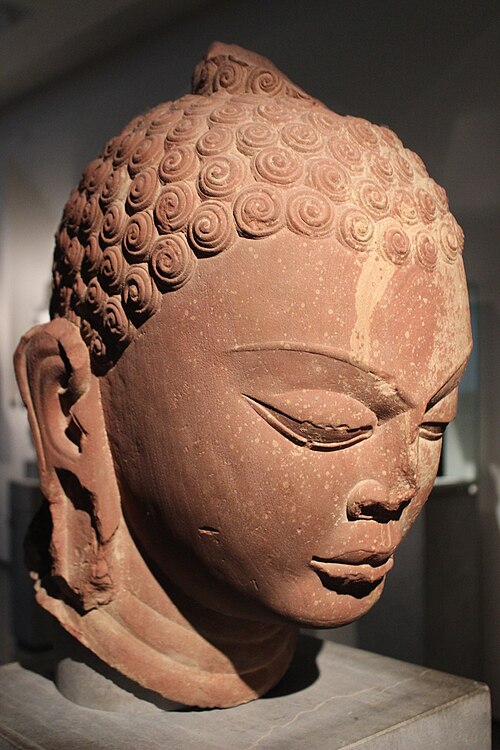


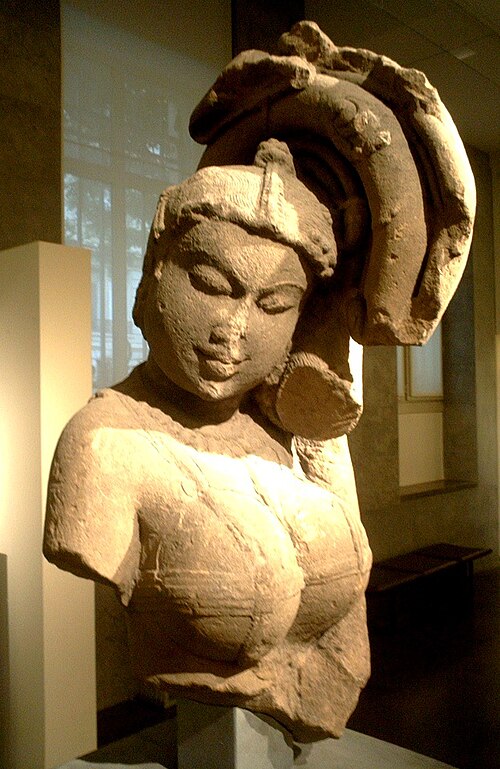



 Media related to Art of Mathura at Wikimedia Commons