Loading article…
 2021年11月の斜め下側ビュー | |
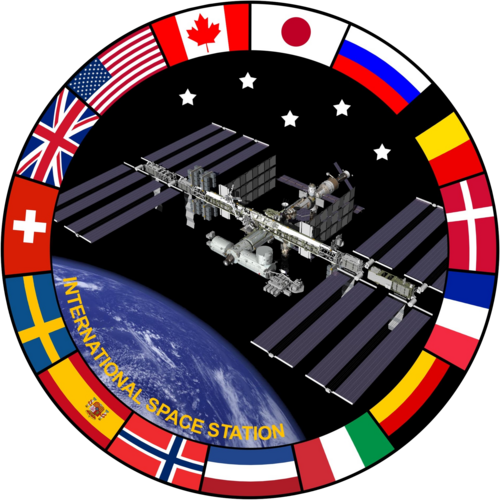 国際宇宙ステーション計画のエンブレムと最初の署名国の国旗 | |
| ステーション統計 | |
|---|---|
| コスパーID | 1998-067A |
| SATCAT番号 | 25544 |
| コールサイン | アルファ、ステーション |
| クルー |
|
| 打ち上げ | 1998年11月20日 |
| 発射台 | |
| 質量 | 450,000 kg (990,000 ポンド) [1] |
| 長さ | 109メートル(358フィート)(全体)、94メートル(310フィート)(トラス)[2] |
| 幅 | 73メートル(239フィート)(太陽電池アレイ)[2] |
| 加圧容積 | 1,005.0 m 3 (35,491 立方フィート) [2] |
| 大気圧 | 1 atm (101.3 kPa ; 14.7 psi ) 窒素79%、酸素21% |
| 近地点高度 | 413 km (256.6 mi) AMSL [3] |
| 遠地点高度 | 422 km (262.2 mi) AMSL [3] |
| 軌道傾斜角 | 51.64° [3] |
| 軌道速度 | 7.67 km/s; 27,600 km/h; 17,100 mph [4] |
| 軌道周期 | 92.9分[5] |
| 1日あたりの周回回数 | 15.5 [3] |
| 軌道時代 | 8月16日 16:19:30 [6] |
| 軌道上での日数 | 2024年10月2日現在25年10ヶ月11日 |
| 占有日数 | 2024年10月2日現在23年10ヶ月29日 |
| 軌道数 | 2023年8月現在141,117人[6][update] |
| 軌道の減衰 | 2 km/月(1.2 マイル/月) |
| 2022年12月22日時点の統計 (特に記載がない限り) 参考文献:[2] [3] [7] [8] [9] | |
| 構成 | |
 | |
国際宇宙ステーション(ISS)は、 NASA (米国)、ロスコスモス(ロシア)、ESA(欧州)、JAXA(日本)、CSA (カナダ)の5つの宇宙機関とその契約者が協力して組み立てられ、地球低軌道上で維持されている大型宇宙ステーションです。ISSはこれまでに建造された宇宙ステーションの中で最大のものです。その主な目的は、微小重力と宇宙環境の実験を行うことです。[10]
運用上、ステーションは2つのセクションに分かれています。ロスコスモスが組み立てたロシア軌道セグメント(ROS) と、NASA、JAXA、ESA、CSAが組み立てた米国軌道セグメント(USOS) です。 ISSの際立った特徴は、大型の太陽電池パネルとラジエーターを与圧モジュールに接続する統合トラス構造です。与圧モジュールは、研究、居住、保管、宇宙船制御、エアロック機能に特化しています。訪問宇宙船は、8つのドッキングおよび停泊ポートを介してステーションにドッキングします。 ISSは平均高度400キロメートル (250マイル) [11]の軌道を維持し、約93分で地球を一周し、1日に15.5周します。[12]
ISSプログラムは、有人地球周回ステーションを建設する2つの以前の計画、米国が計画したスペースステーションフリーダムと、ソ連が計画したミール2ステーションを組み合わせたものである。最初のISSモジュールは1998年に打ち上げられた。主要なモジュールは、プロトンロケットとソユーズロケット、およびスペースシャトル打ち上げシステムによって打ち上げられた。最初の長期滞在者である第1次長期滞在者は、2000年11月2日に到着した。それ以来、ステーションは23年335日間継続的に居住されており、これは宇宙での人間の連続滞在としては最長である。2024年3月現在、22か国から279人が宇宙ステーションを訪れた。[13] ISSには追加のモジュール(たとえば、アクシオム軌道セグメント)が設置される予定で、2030年末まで運用され、その後は専用のNASA宇宙船によって軌道から外される予定である。[14] [update]
概念
1970 年代初頭、宇宙開発競争が終焉に近づくと、米国とソ連は宇宙空間におけるさまざまな協力の可能性を検討し始めました。これは 1975 年のアポロ・ソユーズ テスト プロジェクトで最高潮に達し、2 つの異なる宇宙開発国の宇宙船が初めてドッキングしました。ASTP は成功と見なされ、さらなる共同ミッションも検討されました。
そうした構想の一つが国際スカイラブで、アポロとソユーズの有人宇宙船が複数回訪れるミッションのために、バックアップのスカイラブB宇宙ステーションを打ち上げることを提案した。 [15]さらに野心的なのは、スカイラブBをソ連のサリュート宇宙ステーションにドッキングすることを提案したスカイラブ・サリュート宇宙実験室だった。1970年代後半の予算減少と冷戦の緊張の高まりにより、これらの構想は、スペースシャトルをサリュート宇宙ステーションにドッキングさせるという別の計画とともに、頓挫した。[16]
1980年代初頭、NASAはサリュート宇宙ステーションとミール宇宙ステーションのカウンターパートとして、フリーダムと呼ばれるモジュール式宇宙ステーションの打ち上げを計画しました。1984年にESAはフリーダム宇宙ステーションへの参加を招待され、ESAは1987年までにコロンバス実験室を承認しました。[17]日本の実験モジュール(JEM)、通称きぼうは、 1982年のNASAの要請に応えて 、フリーダム宇宙ステーションの一部として1985年に発表されました。
1985年初頭、欧州宇宙機関(ESA)加盟国の科学大臣らは、当時同機関が実施した宇宙における最も野心的な取り組みであるコロンブス計画を承認した。ドイツとイタリアが主導したこの計画には、フリーダムに取り付けられ、今世紀末までに本格的な欧州の軌道上基地に進化する能力を備えたモジュールが含まれていた。[18]
1990年代初頭、コストの増大によりこれらの計画は疑問視された。議会はフリーダムの建造と運用に十分な資金を提供することを望まず、増大するコストを賄うためにNASAに国際的な参加を増やすよう要求し、さもなければプロジェクト全体を完全に中止するとした。[19]
同時に、ソ連はミール2宇宙ステーションの計画を進めており、1980年代半ばまでに新しいステーションのモジュールの建設を開始していた。しかし、ソ連の崩壊により、これらの計画は大幅に縮小され、ミール2はまもなく打ち上げられない危機に瀕した。[20]両方の宇宙ステーション計画が危機に瀕していたため、アメリカとロシアの当局者が会談し、それらを統合することを提案した。[21]
1993年9月、アメリカのアル・ゴア副大統領とロシアのヴィクトル・チェルノムイルジン首相は、後に国際宇宙ステーションとなる新しい宇宙ステーションの計画を発表した。[22]また、両氏はこの新しいプロジェクトの準備として、シャトル・ミール計画において、アメリカのシャトルのドッキングを含むミール計画にアメリカが関与することに合意した。[23]目的
ISSはもともと、研究室、観測所、工場としての機能を果たすとともに、輸送、メンテナンス、そして将来の月、火星、小惑星へのミッションのための低地球軌道の中継基地としての役割も担うことが意図されていました。しかし、 NASAとロスコスモスの間で最初に交わされた覚書で想定されていた用途の全てが実現されたわけではありません。[24] 2010年の米国国家宇宙政策では、ISSに商業、外交、 [25]および教育目的の追加の役割が与えられました。[26]
科学研究
ISSは、実験をサポートする電力、データ、冷却、乗組員を備えた科学研究を行うためのプラットフォームを提供します。小型の無人宇宙船も、特に無重力や宇宙への露出を伴う実験のためのプラットフォームを提供できますが、宇宙ステーションは、人間の研究者が簡単にアクセスできる、数十年にわたる研究を実行できる長期的な環境を提供します。[27] [28]
ISSでは、実験グループが同じ打ち上げと乗組員の時間を共有できるようにすることで、個々の実験を簡素化しています。研究は、宇宙生物学、天文学、物理科学、材料科学、宇宙天気、気象学、宇宙医学や生命科学を含む人類の研究など、さまざまな分野で行われています。[29] [30] [31] [32]地球上の科学者は、データにタイムリーにアクセスし、乗組員に実験の変更を提案することができます。後続の実験が必要な場合は、定期的に予定されている補給船の打ち上げにより、比較的簡単に新しいハードウェアを打ち上げることができます。[28]乗組員は数か月間の遠征飛行を行い、6人の乗組員で1週間あたり約160時間の労働を提供します。ただし、乗組員のかなりの時間はステーションのメンテナンスに費やされます。[33]
おそらく最も注目すべきISSの実験はアルファ磁気分光計(AMS)であり、これは暗黒物質を検出し、宇宙に関する他の基本的な疑問に答えることを目的としています。NASAによると、AMSはハッブル宇宙望遠鏡と同じくらい重要です。現在ステーションにドッキングされていますが、電力と帯域幅の必要性から、自由飛行衛星プラットフォームに簡単に収容することはできませんでした。[34] [35] 2013年4月3日、科学者はAMSによって暗黒物質の兆候が検出された可能性があると報告しました。 [36] [37] [38] [39] [40] [41]科学者によると、「宇宙搭載アルファ磁気分光計からの最初の結果は、地球に向かう宇宙線に説明のつかない高エネルギー陽電子の過剰を確認しました」。[引用が必要]
宇宙環境は生命にとって過酷です。宇宙空間での無防備な生活は、強力な放射線場(主に太陽風からの陽子やその他の亜原子荷電粒子、さらに宇宙線)、高真空、極度の温度、微小重力によって特徴付けられます。[42]極限環境生物と呼ばれる単純な生命体の一部[43]やクマムシと呼ばれる小さな無脊椎動物[44]は、乾燥によって極度に乾燥した状態でもこの環境で生き残ることができます。
医学研究により、筋萎縮、骨量減少、体液移動など、長期間の宇宙滞在が人体に与える影響についての知識が向上します。これらのデータは、長期間の有人宇宙飛行や宇宙植民地化が実現可能かどうかを判断するために使用されます。2006年、骨量減少と筋萎縮に関するデータから、火星への旅行に必要な6か月間などの長期の惑星間航行の後に宇宙飛行士が惑星に着陸した場合、骨折や運動障害の重大なリスクがあることが示唆されました。[45] [46]
ISSでは、国立宇宙生物医学研究所(NSBRI)の委託により医学研究が行われています。その中でも特に有名なのが、微小重力下での先進的超音波診断研究で、宇宙飛行士が遠隔地の専門家の指導の下で超音波スキャンを実施します。この研究では、宇宙での病状の診断と治療を検討しています。通常、ISSには医師が搭乗しておらず、病状の診断は困難です。遠隔誘導による超音波スキャンは、訓練を受けた医師の診察が難しい緊急時や田舎での医療現場で地球上で応用されると予想されています。[47] [48] [49]
2020年8月、科学者らは国際宇宙ステーションで行われた研究に基づき、地球の細菌、特に環境ハザードに対する耐性が高いデイノコッカス・ラジオデュランス細菌が宇宙空間で3年間生存することが判明したと報告した。これらの発見は、宇宙塵、流星体、小惑星、彗星、小惑星、汚染された宇宙船など、さまざまな方法で分布し、宇宙全体に生命が存在するというパンスペルミア説の概念を裏付けた。[50] [51]
2011年に米国軌道セグメントが完成した後、2010年代にはISSでの地球のリモートセンシング、天文学、深宇宙研究が大幅に増加しました。 20年以上にわたるISSプログラムを通じて、ISS搭乗者と地上の研究者は、地球の大気中のエアロゾル、オゾン、雷、酸化物、および宇宙の太陽、宇宙線、宇宙塵、反物質、暗黒物質を調査しました。 ISSで飛行した地球観測リモートセンシング実験の例としては、軌道上炭素観測衛星3、ISS-RapidScat、ECOSTRESS、全球生態系ダイナミクス調査、雲エアロゾル輸送システムなどがあります。 ISSに設置された天文望遠鏡や実験には、SOLAR、中性子星内部組成探査機、熱量測定電子望遠鏡、全天X線画像モニター(MAXI)、アルファ磁気分光計などがある。[29] [52]
フリーフォール

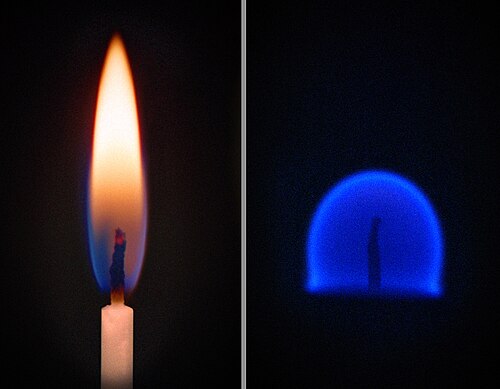
国際宇宙ステーションの高度での重力は地球表面の約90%の強さですが、軌道上の物体は継続的に自由落下しているため、見かけ上は無重力状態になります。[53]この無重力状態は、5つの影響によって乱されます。[54]
- 残留大気からの抗力。
- 機械システムと乗組員の動きによる振動。
- 搭載姿勢制御モーメントジャイロスコープの作動。
- 姿勢または軌道変更のためのスラスタの噴射。
- 重力勾配効果、別名潮汐効果。ISS 内の異なる場所にあるアイテムは、ステーションに接続されていない場合、わずかに異なる軌道をたどります。機械的に接続されているため、これらのアイテムは小さな力を受け、ステーションを剛体として動かし続けます。
研究者たちは、宇宙ステーションのほぼ無重力の環境が植物や動物の進化、発達、成長、内部プロセスに与える影響を調査している。NASAは、いくつかのデータを受けて、微小重力が三次元の人間のような組織の成長や宇宙で形成される可能性のある珍しいタンパク質結晶に与える影響を調査したいと考えている。[29]
微小重力下での流体の物理を研究することで、流体の挙動に関するより優れたモデルが得られる。微小重力下では流体がほぼ完全に混ざり合うため、物理学者は地球上では混ざりにくい流体を研究している。低重力と低温によって遅くなる反応を調べることで、超伝導に関する理解が深まるだろう。[29]
材料科学の研究はISSの重要な研究活動であり、地球上で使用される技術の改善を通じて経済的利益を得ることを目的としています。[55]その他の関心分野には、燃焼の効率と排出物および汚染物質の制御の研究を通じて、低重力が燃焼に与える影響が含まれます。これらの発見は、エネルギー生産に関する知識を向上させ、経済的および環境的利益につながる可能性があります。[29]
探検
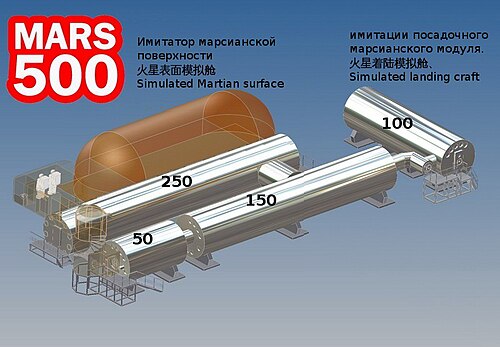
ISS は、月や火星への長期ミッションに必要な宇宙船システムをテストするための、比較的安全な低地球軌道上の場所を提供します。これにより、軌道上での運用、保守、修理、交換活動の経験が得られます。これにより、地球から遠く離れた宇宙船を運用するための必須スキルの開発、ミッションのリスクの軽減、惑星間宇宙船の能力の向上に役立ちます。[56]地球上で実施される乗組員隔離実験であるMARS-500実験について、ESA は「ISS は無重力、放射線、その他の宇宙特有の要因の影響の可能性に関する質問に答えるために不可欠ですが、長期間の隔離や閉じ込めの影響などの側面は、地上でのシミュレーションによってより適切に対処できます」と述べています。[57]ロシアの宇宙機関ロスコスモスの有人宇宙飛行プログラムの責任者であるセルゲイ・クラスノフは、2011 年に MARS-500 の「短縮版」を ISS で実施する可能性があることを示唆しました。[58]
2009年、セルゲイ・クラスノフはパートナーシップの枠組み自体の価値を指摘し、「パートナーが個別に行動する場合と比較すると、パートナーが補完的な能力とリソースを開発することで、宇宙探査の成功と安全性についてより一層の保証が得られる。ISSは、地球近傍宇宙探査のさらなる進歩と、月や火星を含む太陽系の将来的な研究および探査プログラムの実現に貢献している」と書いている。[59] 火星への有人ミッションは、現在のISSパートナーシップ以外の宇宙機関や国々を巻き込んだ多国間の取り組みになる可能性がある。2010年、ESAのジャン=ジャック・ドルダン事務局長は、同局が他の4つのパートナーに、中国、インド、韓国をISSパートナーシップに招待するよう提案する用意があると述べた。[60] NASAのチャールズ・ボールデン長官は、2011年2月に「火星へのミッションはどれも世界的な取り組みになる可能性が高い」と述べた。[61]現在、米国連邦法は、FBIと議会の承認なしにNASAが中国と宇宙プロジェクトで協力することを禁止している。 [62]
教育と文化普及

ISSの乗組員は、学生が開発した実験を実行したり、教育的なデモンストレーションを行ったり、ISSの実験の教室版に学生が参加できるようにしたり、ラジオや電子メールを使用して学生と直接関わったりすることで、地球上の学生に機会を提供しています。 [63] [64] ESAは、教室で使用できるようにダウンロードできる幅広い無料の教材を提供しています。[65] 1つのレッスンで、学生はISSの内部と外部の3Dモデルを操作し、リアルタイムで解決する自発的な課題に取り組むことができます。[66]
宇宙航空研究開発機構(JAXA)は、子どもたちに「ものづくりの精神を追求」させ、「生命の大切さと社会における責任に対する意識」を高めることを目指している。[67]一連の教育ガイドを通じて、生徒たちは有人宇宙飛行の過去と近い将来、そして地球と生命についてより深い理解を深める。[68] [69] JAXAの「宇宙の種子」実験では、ISSに約9か月間滞在したヒマワリの種を育てることで、ISSに搭載された植物の種子に対する宇宙飛行の突然変異の影響を調査している。 2008年から2010年半ばまでの「きぼう」利用の第一段階では、12以上の日本の大学の研究者がさまざまな分野で実験を行った。[70]
文化活動はISS計画のもう一つの主要目的である。JAXA宇宙環境利用センター長の田中哲夫氏は「宇宙には科学に興味がない人でも感動できる何かがある」と語っている。[71]
国際宇宙ステーションアマチュア無線(ARISS)は、世界中の学生が国際宇宙ステーションの乗組員とアマチュア無線通信する機会を通じて、科学、技術、工学、数学の分野でのキャリアを追求することを奨励するボランティアプログラムです。ARISSは、ヨーロッパの数か国、日本、ロシア、カナダ、米国を含む9か国の代表団で構成される国際ワーキンググループです。無線機器を使用できない地域では、スピーカーフォンで学生を地上局に接続し、地上局から宇宙ステーションへの通話に接続します。[72]
ファースト・オービットは、 2011年に公開された、地球を周回した初の有人宇宙飛行であるボストーク1号に関する長編ドキュメンタリー映画である。地上経路と時刻の点で、国際宇宙ステーションの軌道をボストーク1号の軌道に可能な限り近づけることで、ドキュメンタリー映画監督のクリストファー・ライリーとESAの宇宙飛行士パオロ・ネスポリは、ユーリイ・ガガーリンが先駆的な軌道宇宙飛行で見た景色を撮影することができた。この新しい映像は、ロシア国立公文書館から入手したオリジナルのボストーク1号ミッションの音声録音と一緒に編集された。ネスポリは、このドキュメンタリー映画の撮影監督としてクレジットされており、第26次/第27次長期滞在中にほとんどの映像を自分で録音した。 [73]この映画は、ウェブサイトfirstorbit.orgを通じて無料ライセンスの下で2011年にYouTubeで世界初公開された。 [74]
2013年5月、司令官のクリス・ハドフィールドは宇宙ステーション内でデヴィッド・ボウイの「スペース・オディティ」のミュージックビデオを撮影し、YouTubeで公開した。 [75] [76]これは宇宙で撮影された最初のミュージックビデオであった。[77]
2017年11月、国際宇宙ステーションの第52次/第53次長期滞在に参加していたパオロ・ネスポリは、ウィキペディアの記事で使用するために、自身の音声を2回録音しました(1回は英語、もう1回は母国語であるイタリア語)。これらはウィキペディア専用に宇宙で作成された最初のコンテンツでした。[78] [79]
2021年11月には、ISSでの生活を特集したバーチャルリアリティ展示「The Infinite」が発表された。 [80]
工事
製造業
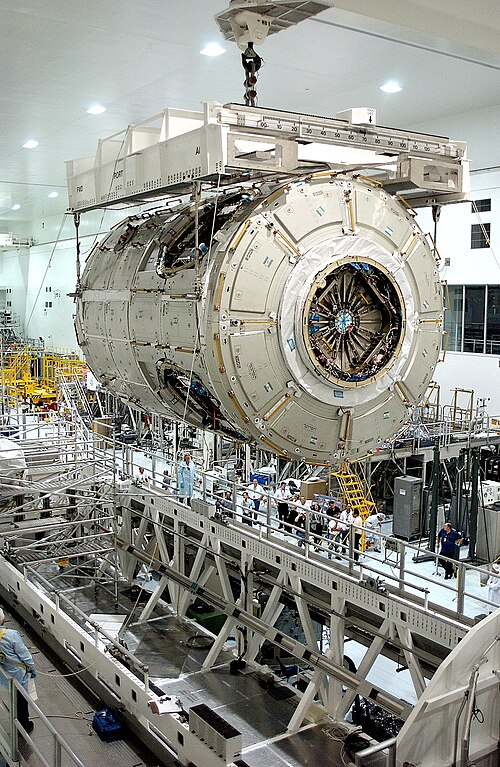
国際宇宙ステーションは世界的な協力の成果であり、その部品は世界中で製造されています。
ザーリャやズヴェズダを含むロシア軌道セグメントのモジュールは、モスクワのフルニチェフ国立研究生産宇宙センターで製造された。ズヴェズダは当初、1985年にミール2宇宙ステーションのコンポーネントとして製造されたが、打ち上げられることはなかった。[81] [82]
デスティニーモジュール、ユニティモジュール、統合トラス構造、太陽電池パネルを含む米国の軌道セグメントの大部分は、アラバマ州ハンツビルにあるNASAのマーシャル宇宙飛行センターとニューオーリンズのミシュー組立施設で製造された。[81]これらの部品は、フロリダ州ケネディ宇宙センターの運用・チェックアウトビルと宇宙ステーション処理施設(SSPF)で打ち上げに向けた最終組み立てと処理が行われた。[83]
米国の軌道セグメントには、欧州宇宙機関が提供しドイツで製造されたコロンバスモジュール、日本が提供し筑波宇宙センターと宇宙科学研究所で製造されたきぼうモジュール、カナダアーム2と米国とカナダの共同プロジェクトであるデクスターも搭載されている。これらのコンポーネントはすべて、打ち上げ処理のためにSSPFに輸送された。[81] [84]
組み立て

宇宙建築における主要な取り組みである国際宇宙ステーションの組み立ては1998年11月に始まりました。[7]
ロシアセグメントのモジュールは、ラスヴェットを除いて、自律的に打ち上げられ、ドッキングした。他のモジュールとコンポーネントはスペースシャトルによって運ばれ、その後、ロボットアームを使用して遠隔操作するか、より正式には船外活動(EVA)と呼ばれる船外活動中に宇宙飛行士によって設置されなければならなかった。2011年6月5日までに、宇宙飛行士はステーションにコンポーネントを追加するために159回以上のEVAを行い、合計1,000時間以上を宇宙で過ごした。[85] [86]

国際宇宙ステーションの基礎は、1998年11月20日にロシア製のザーリャモジュールがプロトンロケットに搭載されて打ち上げられたことで築かれた。ザーリャは推進力、姿勢制御、通信、電力を提供した。2週間後の1998年12月4日、アメリカ製のユニティがSTS-88でスペースシャトル エンデバー号に搭載され、ザーリャと結合した。ユニティは、宇宙ステーションのロシアとアメリカのセグメント間の接続を提供し、将来のモジュールや訪問宇宙船を接続するためのポートを提供する予定だった。
かつて激しいライバル関係にあった国々が、異なる大陸に建設した2つのモジュールを接続することは重要な節目であったが、当初の2つのモジュールには生命維持装置が備わっておらず、ISSはその後2年間無人のままであった。当時、ロシアの宇宙ステーション「ミール」にはまだ人がいた。
転機は2000年7月のズヴェズダ・モジュールの打ち上げで訪れた。居住区と生命維持システムを備えたズヴェズダは、宇宙ステーションでの継続的な人間の滞在を可能にした。最初の乗組員である第1次長期滞在者は、その年の11月にソユーズTM-31に乗って到着した。[87] [88]
ISS はその後数年間にわたり着実に成長し、ロシアのロケットとスペースシャトルの両方によってモジュールが運ばれました。
第1次長期滞在は、スペースシャトルのミッションSTS-92とSTS-97の飛行の中間に到着した。これら2回の飛行ではそれぞれ、ステーションの統合トラス構造の部分が追加され、ステーションにKuバンド通信、USOSの追加質量に必要な追加の姿勢制御、および追加の太陽電池アレイが提供された。[89]その後2年間、ステーションは拡張を続けた。ソユーズUロケットがピアースドッキングコンパートメントを運び込んだ。スペースシャトルディスカバリー、アトランティス、エンデバーは、アメリカのデスティニー実験室とクエストエアロックに加えて、ステーションのメインロボットアームであるカナダアーム2と統合トラス構造のさらにいくつかの部分を 運び込んだ。
2003年にスペースシャトルコロンビア号が失われる という悲劇が起こり、残りのスペースシャトル艦隊は飛行停止となり、ISSの建設は停止した。

組み立ては2006年にSTS-115のアトランティスの到着とともに再開され、ステーションの2番目の太陽電池アレイセットが運ばれました。さらにいくつかのトラスセグメントと3番目のアレイセットがSTS-116、STS-117、およびSTS-118で運ばれました。ステーションの発電能力が大幅に拡張された結果、より多くのモジュールを収容できるようになり、米国のハーモニーモジュールとコロンバスヨーロッパ実験室が追加されました。これに続いてすぐに、日本のきぼう実験室の最初の2つのコンポーネントが続きました。2009年3月、STS-119は、 4番目で最後の太陽電池アレイセットを設置して統合トラス構造を完成させました。きぼうの最後のセクションは2009年7月にSTS-127で運ばれ、その後にロシアのポイスクモジュールが運ばれました。米国のトランクウィリティモジュールは、キューポラとともに2010年2月のSTS-130で運ばれ、続いてロシアの最後から2番目のモジュールであるラスヴェットが2010年5月に運ばれた。ラスヴェットは、 1998年に米国の資金援助を受けたザーリャモジュールをロシアのプロトンが運んだことと引き換えに、STS-132でスペースシャトルアトランティスによって運ばれた。 [90] USOSの最後の与圧モジュールであるレオナルドは、2011年2月にディスカバリー号の最終飛行であるSTS-133でステーションに運ばれた。[91]
ロシアの新しい主要研究モジュール「ナウカ」は、2021年7月にドッキングした。 [92]ロシアの宇宙ステーションのさまざまな場所に自ら移動できる欧州ロボットアームもドッキングした。[93]ロシアの最新の追加モジュールである「プリチャル」は、2021年11月にドッキングした。[94]
2021 年 11 月現在、ステーションには 18 個の加圧モジュール (エアロックを含む) と統合トラス構造が含まれています。
構造
ISS はモジュール式の宇宙ステーションとして機能し、構造にモジュールを追加したり削除したりして適応性を高めることができます。
-
 ISSの設計図(2018年現在)
 -
 ISSのレンダリング(2023年時点)
以下はステーションの主要コンポーネントの図です。UnityノードはDestiny研究所に直接接続されていますが、わかりやすくするために別々に表示されています。構造の他の部分でも同様の例が見られます。
ボックスの背景色のキー:
- 宇宙服を着用せずに乗組員がアクセスできる加圧部品
- ドッキング/バースポート、訪問宇宙船が存在するときに加圧される
- エアロック、加圧環境と非加圧環境の間で人や物を移動させる
- 非加圧ステーション上部構造
- 非加圧コンポーネント
- 一時的に機能停止または非稼働のコンポーネント
- 以前の、現在はインストールされていないコンポーネント
- 将来、まだインストールされていないコンポーネント
加圧モジュール
ザリア
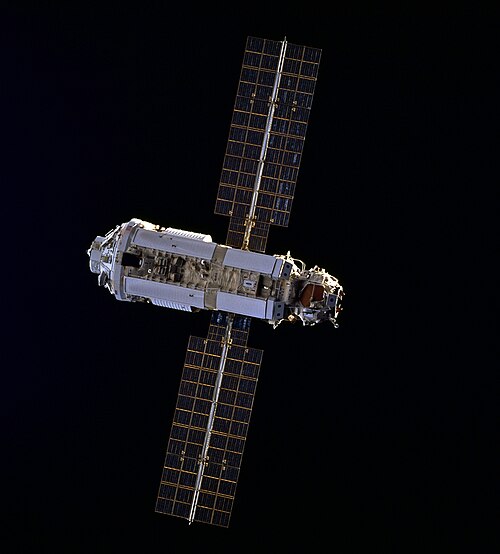
ザーリャ(ロシア語: Заря 、直訳すると「夜明け」[c] )は、機能貨物ブロック(ロシア語:Функционально-грузовой блок )としても知られ、ISSの最初の構成要素であった。1998年に打ち上げられ、当初はISSの電源、貯蔵、推進、誘導システムとして機能した。ステーションの拡張に伴い、ザーリャの役割は主に内部と外部の燃料タンクの両方での貯蔵に移行した。[95]
サリュート計画で使用されたTKS宇宙船の後継機であるザーリャはロシアで建造されたが、米国が所有している。その名前は「夜明け」を意味し、国際宇宙協力の新時代の始まりを象徴している。[96]
団結
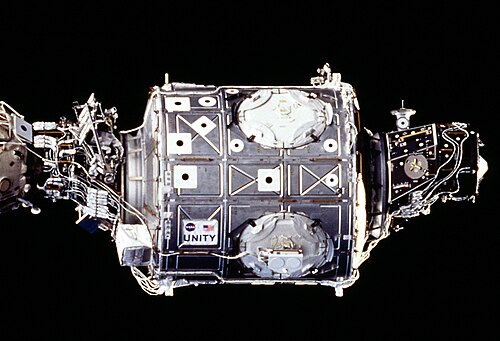
ユニティはノード1としても知られ、ISSの最初の米国製コンポーネントです。[97] [98]ロシアと米国のセグメントの接続として機能するこの円筒形のモジュールには、追加のモジュールを取り付けるための6つの共通結合機構の位置(前方、後方、左舷、右舷、天頂、天底)があります。直径4.57メートル(15.0フィート)、長さ5.47メートル(17.9フィート)のユニティは、ボーイング社によってNASAのためにアラバマ州ハンツビルのマーシャル宇宙飛行センターで鋼鉄で建造されました。これは、ISSの米国セグメントの構造的バックボーンを形成する3つの接続ノード(ユニティ、ハーモニー、トランクウィリティ)の最初のものでした。 [99]
ズヴェズダ
.jpg/500px-Zvezda_(tight_crop).jpg)
ズヴェズダ(ロシア語:Звезда、直訳すると「星」)は2000年7月に打ち上げられ、 ISSのロシア軌道セグメントの中核をなす。当初は不可欠な居住区と生命維持システムを提供し、ISSでの初めての継続的な人間の滞在を可能にした。追加モジュールによりISSの能力は拡大したが、ズヴェズダはロシアセグメントの指揮統制センターとして残っており、緊急時には乗組員が集まる場所となっている。[100] [101] [102]
サリュート計画のDOS宇宙船の後継機であるズヴェズダは、RKKエネルギア社によって建造され、プロトンロケットで打ち上げられた。[103]
運命
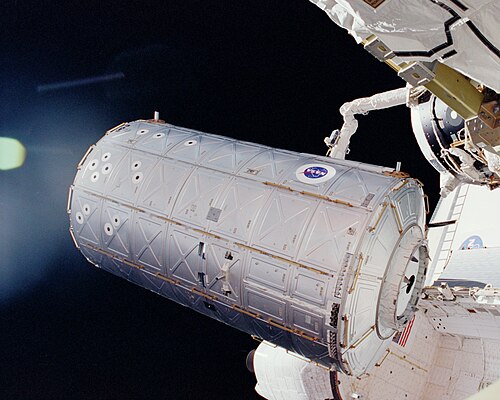
デスティニー研究室は、ISSにおける米国の実験のための主要な研究施設である。スカイラブ以来のNASA初の恒久的な軌道研究ステーションであるこのモジュールは、ボーイング社によって建造され、STS-98中にスペースシャトル アトランティスで打ち上げられた。 2001年2月に5日間にわたってユニティに接続されたデスティニーは、それ以来科学研究の拠点となっている。[104] [105] [106]
デスティニーでは、宇宙飛行士が医学、工学、バイオテクノロジー、物理学、材料科学、地球科学などの分野で実験を行っています。世界中の研究者がこれらの研究の恩恵を受けています。このモジュールには酸素発生システムなどの生命維持システムも搭載されています。[107]
クエストジョイントエアロック

クエストジョイントエアロックは、米国の船外活動ユニット(EMU)またはロシアのオーラン宇宙服を使用した船外活動(EVA)を可能にします。[108]
設置前は、システムや設計のさまざまな違いにより、ISSからの船外活動を行うことは困難でした。ズヴェズダモジュールのトランスファーチャンバー(専用のエアロックではなかった)から使用できるのはオーランスーツのみであり、EMUは訪問中のスペースシャトルのエアロックからしか使用できず、オーランを収容できませんでした。[109]
クエストは、2001年7月にスペースシャトル アトランティスのSTS-104で打ち上げられ、ユニティモジュールに取り付けられた、ボーイング社によって建造された長さ6.1メートル(20フィート)、幅4.0メートル(13フィート)の構造物です。[110]宇宙飛行士の脱出用の乗組員用エアロック、宇宙服を保管するための機器用エアロックが収容されており、減圧症を防ぐための夜間の事前呼吸手順中に宇宙飛行士を収容する設備もあります。[109]
スペース シャトルから派生した乗務員用エアロックには、照明、手すり、最大 2 つの宇宙服に同時に生命維持と通信システムを提供するアンビリカル インターフェイス アセンブリ (UIA) などの必須機器が備わっています。これらは、EMU 2 つ、オーラン スーツ 2 つ、または各デザイン 1 つのいずれかになります。
ポイスク
ポイスク(ロシア語:По́иск、直訳すると「探索」)は、ミニ研究モジュール2(ロシア語:Малый исследовательский модуль 2 )としても知られ、ISSのロシアセグメントの二次エアロックとして機能し、ソユーズとプログレス宇宙船のドッキングをサポートし、プログレス宇宙船からの燃料移送を容易にします。[111] 2009年11月10日に、プログレスM-MIM2と呼ばれる改造されたプログレス宇宙船に取り付けられて打ち上げられました。[112] [113]
ポイスクにはオーラン宇宙服の整備設備があり、内開きハッチが2つ装備されている。ミールからの設計変更である。ミールではエアロック内にわずかに空気圧が残っていたため、外開きハッチが急激に開き、危険な状況に陥った。[114] 2021年にピアースが離脱して以来、ポイスクはロシアセグメントで唯一のエアロックとなっている。
調和
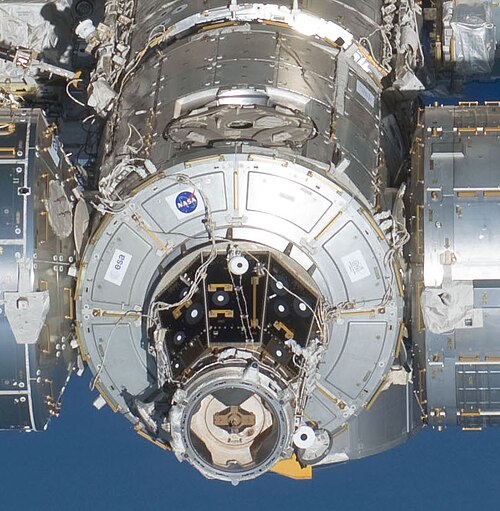
ハーモニー(ノード2)は、ISSの米国セグメントの中央接続ハブであり、米国、ヨーロッパ、日本の研究モジュールを結びます。また、不可欠な電力、データ、生命維持システムを提供するため、ISSの「ユーティリティハブ」とも呼ばれています。このモジュールには、4人の乗組員の寝室もあります。[115]
ハーモニーは2007年10月23日にスペースシャトル ディスカバリー号のSTS-120で打ち上げられ、[116] [117]当初はユニティに取り付けられていましたが[118] [119]、2007年11月14日にデスティニー実験室の正面の恒久的な位置に移動されました。[120]この拡張によりISSの居住スペースが大幅に拡張され、米国セグメントの建設における重要なマイルストーンとなりました。
静けさ

トランクウィリティ(ノード3とも呼ばれる)は、ISSのモジュールです。環境制御システム、生命維持システム、トイレ、運動器具、観測キューポラなどが設置されています。
欧州宇宙機関とイタリア宇宙機関は、タレス・アレニア・スペース社にトランクイリティの製造を委託した。2009年11月20日の式典で、このモジュールの所有権がNASAに移譲された。[121] 2010年2月8日、NASAはスペースシャトルのSTS-130ミッションでこのモジュールを打ち上げた。
コロンバス
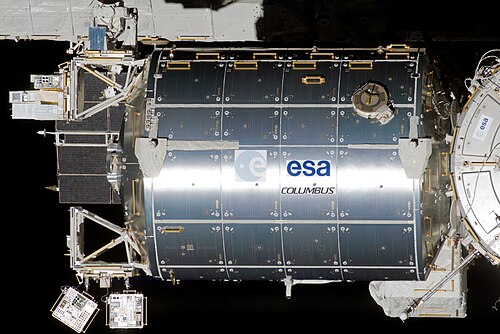
コロンバスは ISS の一部である科学実験室であり、欧州宇宙機関が宇宙ステーションに対して行った最大の貢献です。
ハーモニーおよびトランクィリティモジュールと同様に、コロンバス実験室はイタリアのトリノでタレス アレニア スペースによって建造されました。実験室の機能的な装置およびソフトウェアは、ドイツのブレーメンでEADSによって設計されました。実験室もブレーメンで統合され、その後エアバス ベルーガジェット機でフロリダのケネディ宇宙センターに運ばれました。2008年 2 月 7 日、スペース シャトルアトランティスに搭載され、 STS-122便で打ち上げられました。10 年間の運用が想定されています。モジュールは、ドイツのミュンヘン近郊オーバープファッフェンホーフェンにあるドイツ航空宇宙センターの一部であるドイツ宇宙運用センターにあるコロンバス管制センターによって制御されています。
欧州宇宙機関は、搭載する実験装置やその運用に必要な地上管制インフラを含め、コロンバスの建造に14億ユーロ(約16億米ドル)を費やした。 [122]
キボウ

きぼう(日本語:きぼう、文字通り「希望」) は、国際宇宙ステーション(ISS)にある日本の研究施設である。国際宇宙ステーション(ISS)で最大の単一モジュールであり、加圧実験室、宇宙環境で実験を行うための露出施設、2つの貯蔵室、ロボットアームから構成されている。ハーモニーモジュールに接続されたきぼうは、STS-123、STS-124、STS-127の3回のスペースシャトルミッションにわたって宇宙で組み立てられた。[123]
キューポラ

キューポラは、ESAが建設した ISS の観測モジュールです。その名前は、イタリア語の「ドーム」を意味するcupolaに由来しています。7 つの窓は、実験、ドッキング、地球の観測を行うために使用されます。2010 年 2 月 8 日にスペース シャトル ミッション STS-130 で打ち上げられ、トランクウィリティ(ノード 3) モジュールに取り付けられました。キューポラが取り付けられた状態で、ISS の組み立ては 85% 完了しました。キューポラの中央の窓の直径は 80 cm (31 インチ) です。[124]
ラスベット
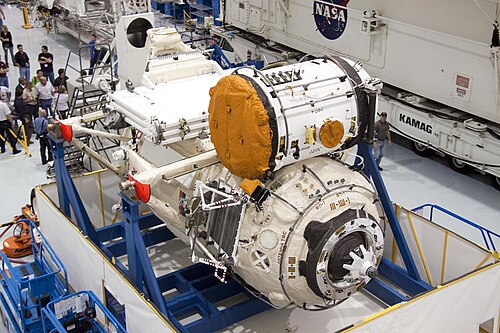
ラスヴェット(ロシア語:Рассвет、直訳すると「最初の光」)は、ミニ研究モジュール1(ロシア語:Малый исследовательский модуль 1)としても知られ、以前はドッキング貨物モジュールとして知られていました。主に貨物の保管と、ISSのロシアセグメントを訪問する宇宙船のドッキングポートとして使用されます。ラスヴェットはキャンセルされたドッキングおよび保管モジュールに代わるもので、1995年に製造されたミールドッキングモジュールをベースにした設計が採用されました。
ラスヴェットは、1998年に米国が資金提供したザーリャモジュールをロシアのプロトンが引き渡したのと引き換えに、2010年5月14日にスペースシャトル アトランティスSTS-132で運ばれました。 [125]その後まもなく、ラスヴェットはザーリャに取り付けられました。 [126]
科学(または実験)エアロック
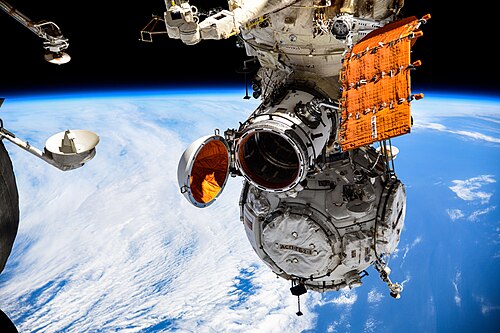
ShKエアロックは、最大1,200 mm × 500 mm × 500 mm(47インチ×20インチ×20インチ)のペイロード用に設計されており、容積は2.1 m 3、重量は1050 kgで、ピーク時の電力消費量は1.5 kWです。MLMをISSに結合させる前に、エアロックはMRM1の一部として収納されます。[127] 2023年5月4日午前1時(UTC)、チャンバーはERAマニピュレーターによって移動され、VKD-57船外活動中にナウカモジュールの与圧ドッキングハブの前方アクティブドッキングポートに結合されました。
- MLMドッキングアダプタからペイロードを抽出し、ステーションの外面に配置するため。
- 科学調査機器を宇宙から取り出し、外部の微小重力環境にさらし、その後、欧州のロボットアームで操作しながら宇宙に戻すことが可能になります。
- ERAマニピュレータからペイロードを受け取り、それをエアロックの内部空間に移動し、さらにMLM加圧アダプタ内に移動します。
- エアロックの内部空間で科学実験を行うため;
- エアロック室の外の拡張されたテーブルの上や特別に整えられた場所で科学実験を行うため。[127] [128]
- ERAの支援を受けてキューブサットを宇宙に打ち上げるためのもので、日本のエアロックや宇宙ステーションの米国セグメントにあるナノラックスのビショップエアロックと非常によく似ている。 [129]
レオナルド
レオナルド常設多目的モジュール (PMM) は、国際宇宙ステーションのモジュールです。2011年2月24日、スペースシャトルSTS-133で宇宙に打ち上げられ、3月1日に設置されました。レオナルドは主に、それまで宇宙ステーション内のさまざまな場所に保管されていた ISS のスペアパーツ、補給品、廃棄物の保管に使用されます。また、米国軌道セグメントに居住する宇宙飛行士の個人衛生エリアでもあります。レオナルドPMM は、2011年以前は多目的物流モジュール(MPLM)でしたが、現在の構成に改造されました。以前は、スペースシャトルで ISS との間で貨物を輸送するために使用されていた 2 つの MPLM のうちの 1 つでした。このモジュールは、イタリアの博学者レオナルド ダ ヴィンチにちなんで名付けられました。
ビゲロー拡張可能アクティビティモジュール
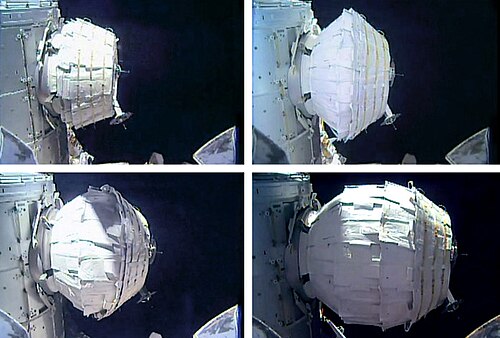
ビゲロー拡張活動モジュール(BEAM)は、ビゲロー・エアロスペースがNASAとの契約に基づき開発した実験的な拡張型宇宙ステーションモジュールであり、2016年から少なくとも2020年まで国際宇宙ステーション(ISS)の臨時モジュールとして試験するために開発された。2016年4月10日にISSに到着し、[130] 4月16日に静かの結節点3でステーションに係留され、2016年5月28日に拡張および加圧された。2021年12月、ビゲローの活動停止に伴い、ビゲロー・エアロスペースはモジュールの所有権をNASAに譲渡した。[131]
国際ドッキングアダプター
国際ドッキング アダプタ(IDA) は、APAS-95 を NASA ドッキング システム (NDS) に変換するために開発された宇宙船ドッキング システム アダプタです。IDAは、 ISSの2つのオープンプレッシャライズド マッチング アダプタ(PMA)のそれぞれに配置され、どちらもハーモニーモジュールに接続されています。
現在、2つの国際ドッキングアダプターがステーションに搭載されている。当初、IDA-1はハーモニーの前方ポートにあるPMA-2に、 IDA-2はハーモニーの天頂にあるPMA-3に搭載される予定だった。IDA-1が打ち上げ事故で破壊された後、IDA-2は2016年8月19日にPMA-2に設置され、[132] IDA-3はその後2019年8月21日にPMA-3に設置された。[133]
ビショップ エアロック モジュール

ナノラックス・ビショップ・エアロック・モジュールは、2020年12月6日にスペースX CRS-21でISSに打ち上げられた商業資金によるエアロック・モジュールである。[134] [135]このモジュールは、ナノラックス、タレス・アレニア・スペース、ボーイングによって製造された。 [136]このモジュールは、NASA、 CASIS 、その他の商業および政府顧客向けのキューブサット、小型衛星、その他の外部ペイロードを展開するために使用される。[137]
ナウカ
.jpg/500px-Russian_Spacewalkers_dwarfed_by_the_Nauka_and_Prichal_modules_2_(cropped).jpg)
ナウカ(ロシア語: Наука、直訳すると「科学」)は、多目的実験モジュール・アップグレード(ロシア語: Многоцелевой labораторный модуль, усоверше́нствованный )としても知られ、ロスコスモスが資金提供したISSの構成要素であり、2021年7月21日14:58 UTCに打ち上げられた。当初のISS計画では、ナウカはドッキング・アンド・ストウッジ・モジュール(DSM)の位置を使用する予定だったが、DSMは後にラスヴェット・モジュールに置き換えられ、ザーリャの天底ポートに移動された。ナウカは2021年7月29日13時29分(UTC)にズヴェズダの天底ポートに正常にドッキングし、ピアースモジュールを交換しました。
プリチャル到着まで、有人・無人ミッション用に天底ポートに仮のドッキングアダプターが取り付けられていたが、到着直前に離陸するプログレス宇宙船によって取り外された。[138]
プリシャル
プリチャール(ロシア語:Причал、直訳すると「桟橋」)は、ISSのロシアセグメントのドッキングハブとして機能する4トン(8,800ポンド)の球形モジュールです。2021年11月に打ち上げられたプリチャールは、ソユーズ宇宙船とプログレス宇宙船、および将来のモジュールの可能性のある追加のドッキングポートを提供します。プリチャールには、前方、後方、左舷、右舷、天頂、天底の6つのドッキングポートがあります。これらのポートの1つはアクティブハイブリッドドッキングシステムを備えており、ナウカモジュールとのドッキングが可能でした。残りの5つのポートはパッシブハイブリッドで、ソユーズ、プログレス、およびより重いモジュール、および改良されたドッキングシステムを備えた将来の宇宙船とのドッキングが可能です。2024年の時点で、前方、後方、左舷、右舷のドッキングポートはカバーされたままです。[139] [140] [141] [142]
非加圧要素
ISSには加圧を必要としない外部コンポーネントが多数あります。その中で最大のものは統合トラス構造(ITS)で、ステーションの主な太陽電池アレイと熱ラジエーターが取り付けられています。[143] ITSは10個の独立したセグメントで構成され、長さ108.5メートル(356フィート)の構造を形成しています。[7]
ステーションには、6 本のロボット アーム、3 つの外部収納プラットフォーム(ESP)、4 つのExPRESS 補給キャリア(ELC) など、いくつかの小型の外部コンポーネントが搭載される予定でした。[144] [145]これらのプラットフォームは、電力を供給し、実験データをローカルで処理することで、実験 ( MISSE、STP-H3、ロボット燃料補給ミッションなど) を宇宙空間で展開して実施することを可能にしますが、その主な機能は予備の軌道上交換ユニット(ORU) を保管することです。ORU は、ポンプ、貯蔵タンク、アンテナ、バッテリー ユニットなど、故障したり設計寿命を過ぎたりした場合に交換できる部品です。このようなユニットは、宇宙飛行士が船外活動中に交換するか、ロボット アームで交換します。[146] STS-129、[147] STS-133 [148]および STS-134など、いくつかのシャトル ミッションは ORU の配送に専念しました。[149] 2011年1月時点で[update]、ORUの輸送手段として使用されたのは、曝露パレット(EP)を介してFHRCとCTC-2を輸送した日本の貨物船HTV-2のみで あった。[150] [更新が必要]
実験モジュールに直接取り付けられた小型の曝露施設もある。きぼう 曝露部はきぼう複合施設の外部「ポーチ」として機能し、[151]欧州コロンバス研究所の施設は、欧州技術曝露施設[152] [153]や宇宙原子時計アンサンブル[154]などの実験に電力とデータ接続を提供する。リモートセンシング機器のSAGE III-ISS は、2017年2月にCRS-10でステーションに運ばれ、[155] NICER実験は2017年6月にCRS-11で運ばれた。[156] ISSに外部搭載された最大の科学的ペイロードは、2011年5月にSTS-134で打ち上げられ、ITSに外部搭載された素粒子物理学実験のアルファ磁気分光計(AMS)である。AMSは宇宙線を測定し、暗黒物質と反物質の証拠を探す。[157] [158]
エアバス社製の商用バルトロメオ外部ペイロードホスティングプラットフォームは、2020年3月6日にCRS-20で打ち上げられ、欧州のコロンバスモジュールに取り付けられました。これにより、 ExPRESSロジスティクスキャリアの8つ、きぼうの10つ、コロンバスの4つに加えて、さらに12の外部ペイロードスロットが提供されます。このシステムはロボットによるメンテナンスができるように設計されており、宇宙飛行士の介入は必要ありません。クリストファー・コロンブスの弟にちなんで名付けられました。[159] [160] [161]
MLM 装備
2010年5月、NASAとの合意に基づき、ナウカ用の機器がSTS-132で打ち上げられ、スペースシャトルアトランティスで運ばれた。重量1.4トンのこの機器は、ラスベット(MRM-1)の外側に取り付けられた。機器には、ナウカとともに打ち上げられた欧州ロボットアーム(ERA)用の予備の肘関節や、船外活動中に使用されるERAポータブル作業柱、RTOdアドオンのヒートラジエーター、加圧実験エアロックに沿った内部ハードウェアなどが含まれていた。[129]
RTOdラジエーターはNaukaに追加の冷却機能を追加し、モジュールでより多くの科学実験を行うことを可能にします。[129]
ERAはRTOdラジエーターをラスベットから取り外すために使用され、 VKD-56船外活動中にナウカに移送された。その後、VKD-58船外活動で起動され、完全に展開された。 [162]このプロセスには数ヶ月を要した。ポータブル作業プラットフォームも2023年8月のVKD-60船外活動中に移送され、ERAの端に取り付けて、宇宙飛行士が船外活動中にアームの端に「乗る」ことができる。[163] [164]しかし、数か月にわたる船外活動の装備とRTOd放熱ラジエーターの設置の後でも、6ヶ月後、ナウカの実際の使用前にRTOdラジエーターが故障した(RTOdの設置目的は、ナウカの実験からの熱を放射することである)。故障、つまり漏れにより、RTOdラジエーターはナウカで使用できなくなった。これは、ソユーズMS-22とプログレスMS-21のラジエーター漏れに続く、ISSのラジエーター漏れの3回目である。予備のRTOdが利用できない場合、ナウカの実験はナウカのメイン打ち上げラジエーターに頼らざるを得なくなり、モジュールをフルに活用することはできなくなります。[165] [166]
もう1つのMLM艤装は、大型ペイロード接続手段(Sredstva Krepleniya Krupnogabaritnykh Obyektov、SKKO)と呼ばれる4セグメントの外部ペイロードインターフェースです。[167]モジュール起動艤装プロセスの一環として、プログレスMS-18(LCCS部品)とプログレスMS-21 (SCCCS部品)の2つの部品でナウカに届けられました。 [168] [169] [170] [171]これはVKD-55船外活動中にナウカのERA後方ベースポイントに持ち出され設置されました。[172] [173] [174] [175]
ロボットアームと貨物クレーン
統合トラス構造 (ITS) は、ステーションの主要なリモート マニピュレータ システムであるモバイル サービス システム(MSS)の基盤として機能し、次の 3 つの主要コンポーネントで構成されています。
- ISS最大のロボットアームであるカナダアーム2は、質量が1,800キログラム(4,000ポンド)で、USOS上の宇宙船やモジュールのドッキングと操作、船外活動中の乗組員や機器の固定、タスク実行のためのデクスターの移動に使用されます。 [176]
- デクスターは2本の腕と回転する胴体を持つ1,560kg(3,440ポンド)のロボットマニピュレーターで、電動工具、ライト、ビデオを備えており、軌道交換ユニット(ORU)の交換や細かい制御を必要とするその他の作業を実行することができます。[177]
- モバイルベースシステム(MBS)は、ステーションのメイントラスの長さに沿ってレール上を走行するプラットフォームであり、カナダアーム2とデクスターの移動ベースとして機能し、ロボットアームがUSOSのあらゆる部分に到達できるようにします。[178]
STS-134ではザーリャにグラップル固定具が追加され、カナダアーム2がROSにインチワームで登れるようになった。[149]また、STS-134では15メートル(50フィート)のオービターブームセンサーシステム(OBSS)も設置された。これはスペースシャトルのミッションで熱シールドタイルを検査するために使用されたもので、ステーションでMSSの到達範囲を広げるために使用できる。[149]地球またはISSのスタッフは遠隔操作でMSSコンポーネントを操作し、船外活動を必要とせずにステーションの外で作業することができる。
きぼうの船外実験プラットフォームにサービスを提供する日本の遠隔操作システム[179]は、 STS-124で打ち上げられ、きぼう与圧部[180]に取り付けられています。このアームは、一方の端が恒久的に取り付けられ、もう一方の端には標準的なグラップル固定具用のラッチエンドエフェクタが付いている点で、スペースシャトルのアームに似ています。
ROSの保守点検を行う欧州ロボットアームは、ナウカモジュールとともに打ち上げられた。[ 181 ] ROSは宇宙船やモジュールを操作する必要がなく、すべての宇宙船とモジュールは自動的にドッキングし、同じ方法で廃棄することができる。乗組員は、船外活動中にROS周辺で乗組員と機器を移動させるために、2台のストレラ(ロシア語:Стрела́、直訳すると「矢印」)貨物クレーンを使用する。各ストレラクレーンの質量は45kg(99ポンド)である。
以前のモジュール
ピルス
ピアース(ロシア語: Пирс、直訳すると「桟橋」)は、2001年9月14日にISS組立ミッション4Rとして、ロシアのソユーズUロケットで打ち上げられ、上段には改造されたプログレス宇宙船であるプログレスM-SO1が使用された。ピアースは、2021年7月26日10:56 UTCにプログレスMS-16によって切り離され、同日14:51 UTCに軌道から外れ、ナウカモジュールを宇宙ステーションに取り付けるための場所を確保した。出発前、ピアースはロシアの宇宙服の保管と改修に使用され、ステーションにおける主要なロシアのエアロックとして機能していた。
計画されているコンポーネント
公理セグメント

2020年1月、NASAはアクシオム・スペースにISSの商用モジュールを建造する契約を授与した。この契約はNextSTEP2プログラムに基づくものである。NASAはアクシオムと固定価格契約で交渉し、宇宙ステーションのハーモニー(ノード2)モジュールの前方ポートに取り付けられるモジュールを建造し納品する。NASAはまだモジュールを1つしか発注していないが、アクシオムはノードモジュール、軌道研究製造施設、乗組員居住施設、「大型窓付き地球観測所」を含む5つのモジュールで構成されるセグメント全体を建造する予定である。アクシオムセグメントは宇宙ステーションの機能と価値を大幅に向上させ、より多くの乗組員や他の組織による民間宇宙飛行を可能にすると期待されている。アクシオムはISSが廃止されたらこのセグメントを独立型宇宙ステーションに転換し、ISSの後継機として機能させることを計画している。[182] [183] [184]カナダアーム2は、アクシオム宇宙ステーションのモジュールをISSに結合させるのにも協力し、2020年代後半にISSが退役した後もアクシオム宇宙ステーションでの運用を継続する予定です。[185]
2023年12月現在、アクシオム・スペースは最初のモジュールであるハブ・ワンを2026年末に打ち上げる予定である。[186]
米国の軌道離脱機
米国の軌道離脱機はNASAが提供する宇宙船で、2030年に運用寿命が終了した後に制御された軌道離脱とステーションの廃止を実行することを目的としています。2024年6月、NASAはSpaceXに軌道離脱機の製造契約を授与しました。[187]
キャンセルされたコンポーネント
ISS計画の過程で、開発または計画されていたいくつかのモジュールがキャンセルされた。その理由には、予算上の制約、モジュールが不要になったこと、2003年のコロンビア号の事故後のステーションの再設計などがある。米国の遠心分離機収容モジュールは、さまざまなレベルの人工重力下で科学実験を行う予定だった。[188]米国の居住モジュールは、ステーションの居住区として機能する予定だった。その代わりに、居住区は現在ステーション全体に分散している。[189]米国の暫定制御モジュールとISS推進モジュールは、打ち上げ失敗の場合にズヴェズダの機能を代替する予定だった。 [190] 2つのロシアの研究モジュールが科学研究用に計画されていた。[191]これらはロシアのユニバーサル・ドッキング・モジュールにドッキングする予定だった。[192]ロシアの科学電力プラットフォームは、 ITS太陽電池アレイとは独立してロシアの軌道セグメントに電力を供給する予定だった。
サイエンスパワーモジュール 1 および 2 (再利用されたコンポーネント)
サイエンスパワーモジュール1(SPM-1 、 NEM-1とも呼ばれる)とサイエンスパワーモジュール2(SPM-2 、 NEM-2とも呼ばれる)は、当初は2024年以降にISSに到着し、ナウカモジュールにドッキングされているプリチャルモジュールにドッキングする予定だったモジュールです。[142] [193] 2021年4月、ロスコスモスは、NEM-1をロシア軌道サービスステーション(ROSS)のコアモジュールとして機能するように再利用し、2027年以降に打ち上げられ、自由飛行するナウカモジュールにドッキングすると発表した。[195] [196] NEM -2は、2028年に打ち上げられる別のコア「ベース」モジュールに改造される可能性があります。[197]
Xベース
ビゲロー・エアロスペース社が設計。2016年8月、ビゲロー社はNASAと、次世代宇宙技術探査パートナーシップの第2フェーズの一環として、B330をベースにした実物大の地上試作型深宇宙居住施設を開発する契約を交渉した。このモジュールは、ビゲロー社が国際宇宙ステーションに取り付けてテストすることを希望していたため、Expandable Bigelow Advanced Station Enhancement (XBASE) と名付けられた。しかし、2020年3月、ビゲロー社は従業員88名全員を解雇し、2024年2月時点で[update]同社は休眠状態のままで、倒産したとみなされているため、[198] [199]、XBASEモジュールが打ち上げられる可能性は低いと思われる。
ノーチラスX遠心分離機のデモンストレーション
2011年に、人工的な部分重力効果のための十分な規模の遠心分離機の宇宙での初の実証の提案が提出された。これはISSの乗組員の睡眠モジュールとなるように設計された。このプロジェクトは予算の制約により他のプロジェクトに取って代わられた。[200]
車載システム
生命維持
重要なシステムは、大気制御システム、給水システム、食料供給設備、衛生設備、火災検知・消火設備です。ロシア軌道セグメントの生命維持システムは、ズヴェズダサービス モジュールに含まれています。これらのシステムの一部は、USOS の機器によって補完されています。ナウカ研究所には、完全な生命維持システム セットがあります。
大気制御システム
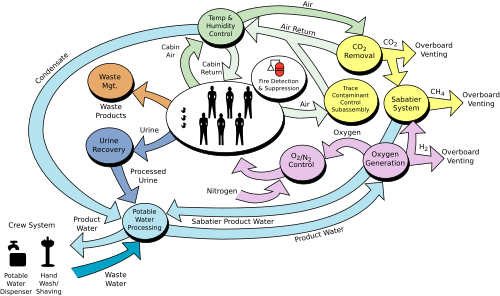
国際宇宙ステーションの大気は地球の大気と似ています。[201]国際宇宙ステーションの通常の気圧は101.3 kPa (14.69 psi) で、[202]地球の海面と同じです。地球のような大気は乗組員の快適性に利点があり、アポロ1号の乗組員の死因となったような火災のリスクが高まるため、純酸素の大気よりもはるかに安全です。[ 203] [より良い情報源が必要]ロシアとソビエトの宇宙船はすべて地球のような大気条件が維持されています。[204]
ズヴェズダのエレクトロンシステムとデスティニーの類似システムは、宇宙ステーション内で酸素を生成する。[205]乗組員は、酸素ボンベと固体燃料酸素生成(SFOG)キャニスター(化学的酸素生成システム)の形でバックアップオプションを持っている。 [ 206]二酸化炭素はズヴェズダのヴォズドゥフシステムによって空気から除去される。腸からのメタンや汗からのアンモニアなど、人間の代謝のその他の副産物は、活性炭フィルターによって除去される。[206]
ROS 大気制御システムの一部は酸素供給である。エレクトロン ユニット、固体燃料ジェネレーター、貯蔵酸素によって三重の冗長性が提供される。酸素の主な供給源はエレクトロン ユニットであり、水の電気分解によってO 2とH 2 を生成し、 H 2 を船外に排出する。1 kW (1.3 hp) のシステムは、乗組員 1 人あたり 1 日あたり約 1 リットルの水を使用する。この水は地球から運ばれるか、他のシステムからリサイクルされる。ミールは、酸素生成にリサイクル水を使用した最初の宇宙船である。二次酸素供給は、酸素生成Vikaカートリッジを燃焼させることによって提供される ( ISS ECLSSも参照)。各「キャンドル」は 450~500 °C (842~932 °F) で分解するのに 5~20 分かかり、600 リットル (130 英ガロン、160 米ガロン) のO 2を生成する。このユニットは手動で操作される。[207]
US軌道セグメント(USOS)には、 2001年に納品されたクエストエアロックモジュールの加圧貯蔵タンクからの冗長酸素供給があり、10年後にはESAが構築したトランクィリティモジュール(ノード3)の高度閉ループシステム(ACLS)によって電気分解でO2が生成され、補充されました。[208]生成された水素はキャビンの大気からの二酸化炭素と結合し、水とメタンに変換されます。
電力と熱の制御
両面ソーラーアレイはISSに電力を供給します。これらの両面セルは片側で直射日光を集め、もう片側で地球からの反射光を集めます。地球で一般的に使用されている片側セルよりも効率が高く、低温で動作します。[209]
ロシアのステーションセグメントは、ほとんどの宇宙船と同様に、 ズヴェズダに搭載された2つの回転式ソーラーアレイからの28Vの 低電圧 DCを使用しています。USOSは、USOS PVアレイからの130〜180V DCを使用しています。電力は160V DCで安定化および配電され、ユーザーが必要とする124V DCに変換されます。配電電圧が高いほど、乗組員の安全性を犠牲にして、より小型で軽量の導体を使用できます。ステーションの2つのセグメントは、コンバーターを使用して電力を共有します。
USOS の太陽電池アレイは 4 組の翼で構成され、合計で 75 ~ 90 キロワットの電力を生産します。[2]これらのアレイは通常、太陽を追跡して発電を最大化します。各アレイの面積は約 375 m 2 (4,036 平方フィート)、長さは 58 m (190 フィート) です。完全な構成では、太陽電池アレイはアルファジンバルを1 周回ごとに 1 回回転させて太陽を追跡します。ベータ ジンバルは、軌道面に対する太陽の角度のより緩やかな変化を追跡します。ナイト グライダー モードでは、夜間に太陽電池アレイを地面と平行にし、ステーションの比較的低い軌道高度での大きな空気抵抗を減らします。[210]
当初、ISSは地球に隠れる90分の軌道の45分間、継続的な電力供給のために充電式ニッケル水素電池(NiH2 )を使用していた。電池は軌道の昼側で充電される。電池の寿命は6.5年(37,000回以上の充電/放電サイクル)で、ISSの予想される20年の寿命にわたって定期的に交換された。 [211] 2016年から、ニッケル水素電池はリチウムイオン電池に置き換えられ、ISSプログラムの終了まで持続すると予想されている。[212]
宇宙ステーションの大型太陽電池パネルは、宇宙ステーションと電離層の間に高い電位差を生み出します。これにより、宇宙船のプラズマシースによってイオンが加速され、絶縁表面をアーク放電したり、導電表面をスパッタリングしたりする恐れがあります。これを緩和するために、プラズマ接触ユニットが宇宙ステーションと周囲の宇宙プラズマの間に電流経路を作り出します。[213]
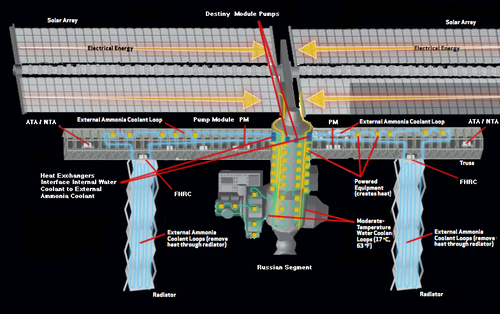
ステーションのシステムと実験は大量の電力を消費し、そのほぼすべてが熱に変換される。内部温度を動作可能な範囲内に保つために、受動熱制御システム(PTCS)は外部表面材料、MLIなどの断熱材、ヒートパイプで構成されている。PTCSが熱負荷に追いつけない場合は、外部能動熱制御システム(EATCS)が温度を維持する。EATCSは、大気を冷却および除湿するために使用される内部の無毒の水冷却ループで構成されており、集められた熱を外部の液体アンモニアループに転送する。熱交換器から、アンモニアは赤外線として熱を放出する外部ラジエーターに送り込まれ、その後アンモニアはステーションに循環して戻される。[214] EATCSは、きぼうやコロンバスを含む米国のすべての与圧モジュールと、S0、S1、P1トラスの主な電力分配電子機器を冷却する。最大70kWを拒否できる。これは、 STS-105で打ち上げられ、P6トラスに設置された初期アンモニアサービサー(EAS)を介した初期外部アクティブ熱制御システム(EEATCS)の14kWをはるかに上回るものである。 [215]
通信とコンピュータ
国際宇宙ステーションは、宇宙ステーションとミッションコントロールセンター間のテレメトリと科学データのリンクを提供するために、さまざまな無線通信システムに依存しています。無線リンクは、ランデブーやドッキング手順中、および乗組員、フライトコントローラー、家族間の音声およびビデオ通信にも使用されます。その結果、国際宇宙ステーションには、さまざまな目的で使用される内部および外部の通信システムが装備されています。[216]
ロシア軌道セグメントは、地上との直接通信に主にズヴェズダに搭載されたリラアンテナを使用している。 [63] [217]また、ルーチデータ中継衛星システムを利用する機能もあった。 [63]このシステムは、ステーションの建設時には荒廃していたが、[63] [218] [219] 2011年と2012年にルーチ5Aとルーチ5Bの打ち上げにより運用状態に回復した。[220]さらに、ボスホートMシステムは、地上管制への内部電話通信とVHF無線リンクを提供している。[221]
米国軌道セグメント(USOS)は、Sバンド(音声、テレメトリ、コマンド - P1/S1トラスに配置)とKuバンド(音声、ビデオ、データ - Z1トラスに配置)システムの2つの独立した無線リンクを使用しています。これらの送信は、静止軌道上の米国追跡およびデータ中継衛星システム(TDRSS)を介してルーティングされ、テキサス州ヒューストンにあるクリストファーC.クラフトジュニアミッションコントロールセンター(MCC-H)とのほぼ継続的なリアルタイム通信が可能になっています。[63] [222] [216]カナダアーム2、欧州コロンバス実験室、日本のきぼうモジュールのデータチャネルも、当初はSバンドとKuバンドシステムを介してルーティングされていましたが、欧州データ中継システムと同様の日本のシステムが、最終的にはこの役割でTDRSSを補完することを目的としていました。[222] [223]
UHF無線は、船外活動を行う宇宙飛行士や宇宙ステーションにドッキングしたり、ドッキング解除したりする他の宇宙船によって使用されます。[63]自動化された宇宙船には独自の通信機器が装備されており、ATVは宇宙船に取り付けられたレーザーとズヴェズダに取り付けられた近接通信装置を使用して、ステーションに正確にドッキングしました。[224] [225]
ISSの米国軌道セグメントには、WindowsまたはLinuxを搭載した市販のノートパソコンが約100台搭載されている。 [226]これらのデバイスは、ステーションの28V DC電源システムを使用するように改造されており、デバイスから発生する熱が無重力環境で滞留する可能性があるため、換気装置が追加されている。NASAはノートパソコンの共通性を高めることを好み、宇宙飛行士が必要に応じてノートパソコンを修理できるようにスペアパーツをステーションに保管している。[227]
ラップトップは、ポータブル コンピュータ システム (PCS) とステーション サポート コンピュータ (SSC) の 2 つのグループに分けられます。
PCSラップトップはLinuxで動作し、ステーションのプライマリコマンド&コントロールコンピュータ(C&C MDM)への接続に使用されます。このコンピュータはDebian Linuxで動作し、[228]信頼性と柔軟性のために2013年にWindowsからスイッチされました。[229]プライマリコンピュータは、ステーションを軌道に乗せ、生命を支える重要なシステムを監視します。[226]プライマリコンピュータにはディスプレイもキーボードもないため、宇宙飛行士はPCSラップトップをUSBから1553アダプタを介してリモートターミナルとして接続します。[230]プライマリコンピュータは2001年、[231] 2007年、[232] 2017年に故障しました。2017年の故障では、外部コンポーネントを交換するために船外活動が必要でした。[233]
SSCのラップトップは、手順の確認、科学実験の管理、電子メールやビデオチャットでの通信、ダウンタイム中の娯楽など、ステーション内の他のすべての用途に使用されます。[226] SSCのラップトップはWi-Fi経由でステーションの無線LANに接続し、 Kuバンド経由で地上に接続します。当初は ステーションからのダウンロード速度が10 Mbit/s 、アップロード速度が3 Mbit/sでしたが、 [234] NASAは2019年にシステムをアップグレードし、速度を600 Mbit/sに向上させました。[235] ISSの乗組員はインターネットにアクセスできます。[236] [237]
オペレーション
遠征
各常駐クルーには遠征番号が与えられる。遠征は打ち上げからドッキング解除まで最長6か月間行われ、「増分」は同じ期間をカバーするが、貨物宇宙船とすべての活動が含まれる。遠征1から6は3人の乗組員で構成されていた。遠征7から12は、NASAのスペースシャトルコロンビアの破壊を受けて、安全最低人数の2人に減らされた。遠征13からは、乗組員は2010年頃に徐々に6人に増えた。[238] [239] 2020年から米国の商用宇宙船に乗った乗組員が到着することから、 [240] NASAは遠征規模をISSが当初設計された人数である7人の乗組員に増やす可能性があることを示唆している。[241] [242]
ゲンナジー・パダルカは、第9次、第19/20次、第31/32次、第43/44次長期滞在のメンバーであり、第11次長期滞在の指揮官で、宇宙で過ごした時間は誰よりも長く、合計878日11時間29分に上る。[243] ペギー・ウィットソンは、アメリカ人の中で最も長い時間を宇宙で過ごしており、第5次、第16次、第50/51/52次長期滞在とアクシオムミッション2に参加した期間に、合計675日3時間48分に上る。[244] [245]
プライベートフライト
宇宙への渡航費を自分で支払う旅行者は、ロスコスモスとNASAによって宇宙飛行参加者と呼ばれ、時には「宇宙旅行者」と呼ばれるが、彼らはこの用語を一般的に嫌っている。 [d] 2023年6月現在[update]、13人の宇宙旅行者がISSを訪れており、9人はロシアのソユーズ宇宙船でISSに輸送され、4人はアメリカのスペースXドラゴン2宇宙船で輸送された。1人の旅行者ミッションの場合、プロの乗組員がソユーズの3つの座席で割り切れない数で交代し、短期滞在の乗組員が送られない場合、予備の座席はスペースアドベンチャーズを通じてミールコープによって販売される。スペースシャトルが退役し、ステーションの乗組員数が6人に削減された2011年に宇宙旅行は中止され、パートナーはステーションへのアクセスにロシアの輸送座席に依存していた。ソユーズの飛行スケジュールは2013年以降増加し、必要な遠征2回(12座席)でソユーズの飛行5回(15座席)が可能になった。[253]残りの座席は、健康診断に合格した一般の人々に1席あたり約4000万ドルで販売される予定だった。ESAとNASAはISSの当初、民間の宇宙飛行を批判し、NASAは当初、 ISSへの渡航費を自費で支払った最初の人物であるデニス・ティトの訓練に抵抗した。[e]
アヌーシェ・アンサリは、 ISSに自費で渡った初の女性であり、宇宙に行った初のイラン人でもある。当局は、彼女の教育と経験は単なる観光客以上のものであり、訓練での彼女のパフォーマンスは「優秀」だったと報告した。[254]彼女は10日間の滞在中に、医学と微生物学を含むロシアとヨーロッパの研究を行った。2009年のドキュメンタリー「スペース・ツーリスト」は、彼女がISSに向かう旅を追ったもので、そこで彼女は「人類の長年の夢、つまり『普通の人』として地球を離れ、宇宙に旅立つこと」を実現した。[255]
2008年、宇宙飛行参加者のリチャード・ギャリオットは、飛行中にISSにジオキャッシュを設置した。 [256]これは現在存在する唯一の地球外ジオキャッシュである。[257]同時に、 8つのデジタル化された人間のDNA配列の電子記録であるイモータリティ・ドライブがISSに設置された。[258]
12年間の中断を経て、ISSへの最初の2回の宇宙観光専用の民間宇宙飛行が実施された。ソユーズMS-20は2021年12月に打ち上げられ、民間企業スペースアドベンチャーズの支援の下、ロスコスモスの宇宙飛行士アレクサンダー・ミスルキンと2人の日本人宇宙旅行者を乗せた。[259] [260] 2022年4月、アクシオム・スペース社はスペースXのドラゴン2宇宙船をチャーターし、自社の従業員宇宙飛行士マイケル・ロペス・アレグリアと3人の宇宙旅行者をアクシオム・ミッション1でISSに送り込んだ。[261] [262] [263]続いて2023年5月には、もう1人の旅行者ジョン・ショフナーが従業員宇宙飛行士ペギー・ウィットソンと2人のサウジアラビア人宇宙飛行士とともにアクシオム・ミッション2に派遣された。[264] [265]
艦隊の運用
様々な有人・無人の宇宙船がISSの活動を支援してきた。ISSへの飛行には、スペースシャトル37回、プログレス89回、[f]ソユーズ71回、ATV5回、HTV9回、ボーイングスターライナー2回、スペースXドラゴン44回[g]、シグナス20回のミッションが含まれる。[266]
現在、訪問宇宙船用のドッキングポートは8つあり、さらに4つのポートが設置されているがまだ運用されていない。[267]
- ハーモニーフォワード( PMA 2およびIDA 2を使用)
- ハーモニーゼニス(PMA 3およびIDA 3付き)
- ハーモニーナディール(CBMポート)
- ユニティナディール( CBMポート)
- プリカル後部[h]
- プリシャルフォワード[h]
- プリチャル最低点
- プリシャル港[h]
- プリシャル右舷[ h]
- ポイスクゼニス
- ラスベット・ナディール
- ズヴェズダ後部
前方ポートは、ステーションの通常の移動方向と向き (姿勢) に応じてステーションの前方にあります。後方はステーションの後部にあります。天底は地球に面し、天頂は地球から離れた方向を向いています。足を地球に向けて移動方向を見ると、左舷は左側、右舷は右側にあります。
宇宙ステーションの軌道再ブーストを実行する貨物宇宙船は、通常、船尾または天底を向いたポートにドッキングします。
有人
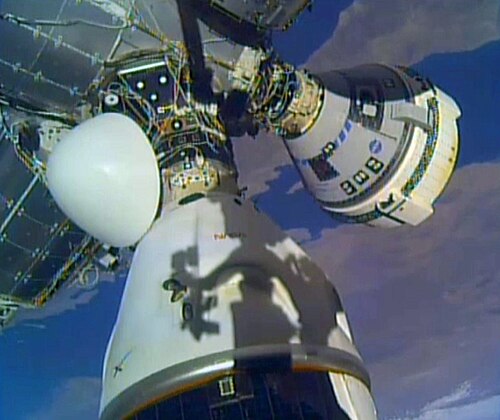
2024年3月25日現在[ref]、23カ国を代表する280人が宇宙ステーションを訪れており、その多くは複数回訪れている。アメリカは163人、ロシアは58人、日本は11人、カナダは9人、イタリアは6人、フランスとドイツはそれぞれ4人、サウジアラビア、スウェーデン、アラブ首長国連邦はそれぞれ2人、ベラルーシ、ベルギー、ブラジル、デンマーク、イスラエル、カザフスタン、マレーシア、オランダ、南アフリカ、韓国、スペイン、トルコ、イギリスからは1人が派遣されている。[268]
無人
無人宇宙飛行は主に貨物を運ぶために行われますが、無人打ち上げの後、ロシアのモジュールもいくつかこの基地にドッキングしています。補給ミッションでは通常、ロシアのプログレス宇宙船、旧ヨーロッパのATV、日本のこうのとり宇宙船、アメリカのドラゴン宇宙船とシグナス宇宙船が使用されます。
現在停泊中
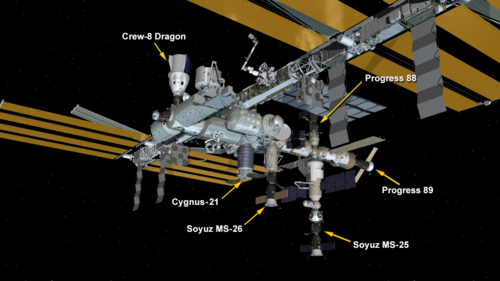
すべての日付はUTCです。出発日は可能な限り早い日付 ( NET ) であり、変更される可能性があります。
予定されているミッション
すべての日付はUTCです。打ち上げ日は可能な限り早い日付 ( NET ) であり、変更される可能性があります。
宇宙船のドッキングと着岸

ロシアの宇宙船は、人間の介入なしに自律的にランデブーし、ステーションとドッキングすることができる。約200キロメートル(120マイル)以内に近づくと、宇宙船はステーションのクルスドッキングナビゲーションシステムから無線信号を受信し始める。宇宙船がステーションに近づくと、レーザーベースの光学機器が宇宙船をドッキングポートに正確に位置合わせし、最終アプローチを制御する。ISSと宇宙船の乗組員は手順を監視しているが、彼らの役割は主に監督であり、介入は緊急時に中止コマンドを発行することに限られている。初期の開発コストは多額であったが、システムの信頼性と標準化されたコンポーネントにより、その後のミッションで大幅なコスト削減が実現した。[270]
アメリカのスペースX社のドラゴン2貨物・有人宇宙船は、人間の介入なしに自律的にステーションにランデブーしドッキングすることができる。しかし、有人ドラゴンミッションでは、宇宙飛行士が介入して手動で宇宙船を飛行させる能力がある。[271]
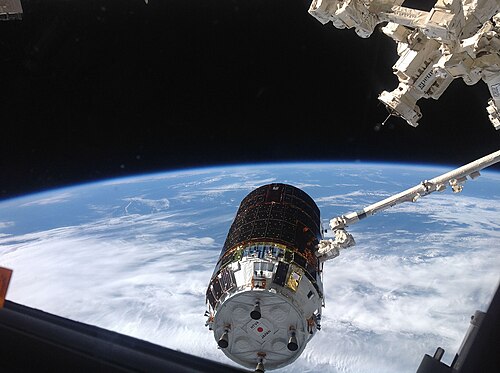
その他の自動貨物宇宙船は、通常、ステーションへの到着時およびステーションからの出発時に半自動プロセスを使用します。これらの宇宙船は、ステーションに接近して近くに駐機するように指示されます。ステーションに搭乗している乗組員の準備が整うと、宇宙船はステーションに近づくように命令され、モバイル サービス システムのロボット アームを使用して宇宙飛行士が宇宙船を掴むことができます。宇宙船とステーションの最終的な結合は、ロボット アームを使用して行われます (バーシングと呼ばれるプロセス)。この半自動プロセスを使用する宇宙船には、米国のCygnusや日本のHTV-X などがあります。現在は退役した米国のSpaceX Dragon 1、欧州のATV、日本のHTVもこのプロセスを使用しました。
起動とドッキングウィンドウ
宇宙船が国際宇宙ステーションにドッキングする前に、ナビゲーションと姿勢制御(GNC)は宇宙船の原産国の地上管制に引き継がれる。GNCは、スラスタを噴射したりジャイロスコープを使って方向転換したりするのではなく、宇宙ステーションが宇宙空間を漂うように設定されている。宇宙ステーションの太陽電池パネルは、入ってくる宇宙船に対して端を向いているため、スラスタの残留物がセルを損傷することはない。シャトルの退役前は、ソユーズよりもシャトルの打ち上げが優先されることが多かったが、乗組員や生物学的実験材料などの緊急性の高い貨物を積んだソユーズの到着が優先されることもあった。[272]
修理
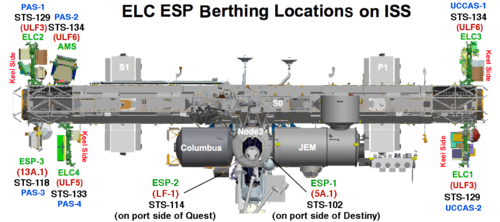
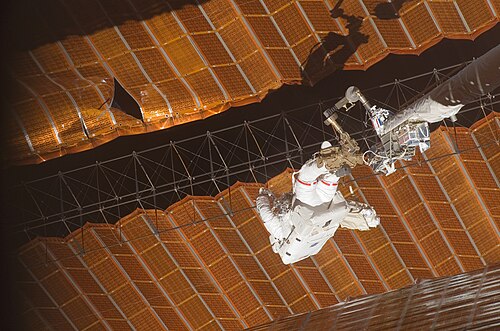

軌道上交換ユニット(ORU) は、ユニットが設計寿命を過ぎたり故障したりした場合に、容易に交換できるスペアパーツです。ORU の例としては、ポンプ、貯蔵タンク、コントローラ ボックス、アンテナ、バッテリ ユニットなどがあります。一部のユニットは、ロボット アームを使用して交換できます。ほとんどのユニットは、ExPRESS Logistics Carriers (ELC)と呼ばれる小さなパレットに載せられるか、科学実験も格納されるExternal Stowage Platforms (ESP) と呼ばれる大きなプラットフォームを共有して、ステーションの外に保管されます。どちらの種類のパレットも、宇宙の寒さで損傷する可能性があり、加熱が必要となる多くの部品に電力を供給します。より大きな物流キャリアには、実験を接続するためのテレメトリ用のローカル エリア ネットワーク (LAN) 接続もあります。NASA のシャトル プログラムが終了する前の 2011 年頃に、ORU を USOS に積載することに重点が置かれるようになりました。これは、商業的に代替される Cygnus と Dragon が、ペイロードの 10 分の 1 から 4 分の 1 を搭載するためです。
予期せぬ問題や故障がステーションの組み立てスケジュールや作業スケジュールに影響を及ぼし、機能低下の期間を招き、場合によっては安全上の理由からステーションの放棄を余儀なくされる可能性もあった。深刻な問題としては、2004年のUSOSからの空気漏れ、[273] 2006年のエレクトロン酸素発生器からの煙の放出、 [274] 2007年のSTS-117中のROSのコンピューターの故障があり、ステーションはスラスタ、エレクトロン、ヴォズドゥク、その他の環境制御システムの操作ができない状態になった。後者のケースでは、根本的な原因は電気コネクタ内の結露によるショートであることが判明した。[275]
2007年のSTS-120では、P6トラスと太陽電池パネルの再配置後、展開中に太陽電池パネルが破れ、適切に展開していないことが確認された。[276]スコット・パラジンスキーが船外活動を行い、ダグラス・ホイロックが補助した。修理は太陽電池パネルが日光にさらされた状態で行われたため、感電の危険を減らすために特別な予防措置が講じられた。[277]同じ年、太陽電池パネルの問題に続いて、ステーションの右舷側で太陽電池パネルを回転させる右舷ソーラーアルファ回転ジョイント(SARJ)にも問題が発生した。太陽電池パネル駆動モーターに過度の振動と高電流スパイクが見られ、原因が判明するまで右舷SARJの動きを大幅に制限するという決定がなされた。 STS-120とSTS-123の船外活動中の検査で、大型駆動ギアに金属の削りくずや破片による広範な汚染が見られ、大型金属ベアリング面の損傷も確認されたため、ジョイントはさらなる損傷を防ぐためにロックされた。[278] [279]ジョイントの修理はSTS-126中に行われ、ジョイントの潤滑と12個のトランドルベアリングのうち11個の交換が行われた。[280] [281]
2008年9月、ソユーズの画像でS1ラジエーターの損傷が初めて確認された。当初、この問題は深刻ではないと考えられていた。[282]画像では、1つのサブパネルの表面が下にある中央構造から剥がれ落ちているのが示されており、これは微小隕石または破片の衝突によるものと思われる。2009年5月15日、損傷したラジエーターパネルのアンモニアチューブは、コンピューター制御のバルブの閉鎖により、冷却システムの残りの部分から機械的に遮断された。その後、同じバルブを使用して損傷したパネルからアンモニアを排出し、アンモニア漏れの可能性を排除した。[282]また、2008年の船外活動中に切り離されたサービスモジュールのスラスタカバーがS1ラジエーターに衝突したことも判明しているが、その影響があったかどうかは不明である。
2010年8月1日の早朝、2つの外部冷却ループのうちの1つである冷却ループA(右舷側)に障害が発生し、ステーションの冷却能力は通常の半分しかなく、一部のシステムの冗長性がゼロになった。[283] [284] [285]問題はアンモニア冷却液を循環させるアンモニアポンプモジュールにあると思われ、4つのCMGのうち2つを含むいくつかのサブシステムが停止した。
ISSでの計画された運用は、冷却システムの問題に対処するために一連の船外活動によって中断された。2010年8月7日の最初の船外活動は、故障したポンプモジュールを交換するために行われたが、4つのクイックディスコネクトのうちの1つからアンモニアが漏れたため、完全には完了しなかった。8月11日の2回目の船外活動では、故障したポンプモジュールが取り外された。[286] [287]ループAを通常の機能に戻すために、3回目の船外活動が必要となった。[288] [289]
USOSの冷却システムは主に米国企業ボーイング社によって製造されており[290] 、同社は故障したポンプの製造元でもある[283] 。
4つのメインバススイッチングユニット(MBSU、S0トラス内)は、4つの太陽電池パネルからISSの残りの部分への電力供給経路を制御している。各MBSUには2つの電力チャネルがあり、太陽電池パネルから2つのDC-DC電力変換器(DDCU)に160V DCを供給し、ステーション内で使用される124Vの電力を供給する。2011年後半、MBSU-1はコマンドに応答しなくなり、健全性を確認するデータを送信しなくなった。電力供給は正常に行われていたが、次の船外活動で交換される予定だった。予備のMBSUが既に搭載されていたが、2012年8月30日の船外活動は、予備ユニットの取り付けを完了するために締め付けていたボルトが電気接続が固定される前に詰まったため、完了できなかった。[291] MBSU-1の喪失により、ステーションの電力容量は通常の75%に制限され、問題が解決されるまで通常業務に若干の制限が必要となった。
2012年9月5日、2度目の6時間の船外活動で、宇宙飛行士のスニタ・ウィリアムズと星出彰彦はMBSU-1の交換に成功し、ISSの電力を100%に回復した。[292]
2013年12月24日、宇宙飛行士はステーションの冷却システム用に新しいアンモニアポンプを設置した。故障した冷却システムは同月初めに故障し、ステーションの科学実験の多くが中止されていた。宇宙飛行士は新しいポンプを設置する間、アンモニアの「ミニブリザード」に耐えなければならなかった。これはNASAの歴史上2度目のクリスマスイブの宇宙遊泳であった。[293]
ミッションコントロールセンター
ISSの構成要素は、世界中のミッションコントロールセンターでそれぞれの宇宙機関によって運用・監視されており、主にヒューストンのクリストファー・C・クラフト・ジュニア・ミッションコントロールセンターとモスクワのRKAミッションコントロールセンター(TsUP)が担当し、日本の筑波宇宙センター、米国アラバマ州ハンツビルのペイロード運用統合センター、ドイツのミュンヘンのコロンバス管制センター、ケベック州サン=テュベールにあるカナダ宇宙庁本部の移動式サービスシステムコントロールからも支援を受けている。
船上での生活
居住区

国際宇宙ステーションの居住・作業スペースは、6つの寝室がある家(寝室7つ、バスルーム2つ、ジム、360度の眺望が楽しめる出窓付き)よりも広い。[294]
クルーの活動

乗組員の典型的な一日は、午前6時の起床から始まり、就寝後の活動とステーションの朝の点検が続く。その後、乗組員は朝食をとり、ミッションコントロールとの毎日の計画会議に参加し、午前8時10分頃に作業を開始する。その日の最初の予定された演習に続いて、乗組員は13時5分まで作業を続行する。1時間の昼休みの後、午後はさらに運動と作業が行われ、その後、乗組員は19時30分から夕食と乗組員会議を含む就寝前の活動を行う。予定された睡眠時間は午後9時30分から始まる。一般的に、乗組員は平日は1日10時間、土曜日は5時間働き、残りの時間はリラックスしたり、仕事の追い込みに充てられる。[295]
国際宇宙ステーションで使用されているタイムゾーンは協定世界時(UTC)です。[296]宇宙ステーションでは1日に16回の日の出と日の入りがあるため、夜間は窓が覆われて暗闇のような印象を与えます。スペースシャトルのミッション訪問中、ISSの乗組員は主にシャトルのミッション経過時間(MET)に従います。METはスペースシャトルミッションの打ち上げ時間に基づいた柔軟なタイムゾーンです。[297] [298] [299]
基地には探検隊の各隊員のための乗組員用宿舎が用意されており、ズヴェズダに2つ、ナウカに1つ、ハーモニーにさらに4つの「睡眠ステーション」が設置されている。[300] [301] [302] [303] USOSの宿舎は、およそ人の大きさのプライベートな防音ブースである。ズヴェズダのROS乗組員用宿舎には小さな窓があるが、換気と防音は劣る。乗組員は、寝袋を縛って寝る、音楽を聴く、ノートパソコンを使う、大きな引き出しやモジュールの壁に取り付けられたネットに私物を保管するなどのことができる。モジュールには読書灯、棚、デスクトップもある。[304] [305] [306]訪問乗組員には睡眠モジュールが割り当てられておらず、壁の空いているスペースに寝袋を取り付ける。基地内を自由に浮遊しながら眠ることも可能だが、敏感な機器にぶつかる可能性があるため、通常は避けられる。[307]乗組員の居住区は換気が十分であることが重要です。換気が不十分だと、宇宙飛行士が吐いた二酸化炭素の泡が頭の周りにできてしまい、酸素不足で息を切らして目覚めることがあります。[304]宇宙ステーションのさまざまな活動や乗組員の休憩時間には、ISS内の照明を暗くしたり、消したり、色温度を調整したりすることができます。[308] [309]
反省と物質文化
個人や乗組員の特徴の反映は、特にステーションの装飾や宗教などの一般的な表現に見られます。[310]後者は、特にステーションとロシアの間に一定の物質的な経済を生み出しました。[311]
宇宙ステーションのミクロ社会、そしてより広い社会、そしておそらくは独特な宇宙ステーション文化の出現[312]は、芸術から塵の蓄積まで、また考古学的にISSの物質がどのように廃棄されてきたかまで、多くの側面を分析することによって研究されています。[313]
食品と個人の衛生
※トイレは両方ともロシアのデザインです。


USOSでは、船内の食料の大半はビニール袋に真空パックされている。缶詰は重くて輸送費がかかることから稀である。保存食は乗組員に高く評価されておらず、微小重力下では味が落ちるため[304]、通常の調理よりも多くのスパイスを使用するなど、食べ物をより美味しくするための努力が払われる。乗組員は地球からの宇宙船が到着するのを楽しみにしており、新鮮な果物や野菜を持ってくる。食べ物がパン粉にならないように注意し、ステーションの機器を汚染しないように固形物よりも液体の調味料が好まれる。乗組員はそれぞれ個別の食料パッケージを持ち、ギャレーで調理する。ギャレーには2つのフードウォーマー、冷蔵庫(2008年11月に追加)、温水と非温水の給水器がある。[305]飲み物は乾燥粉末として提供され、飲む前に水と混ぜる。[305] [306]飲み物やスープはストロー付きのビニール袋からすすり、固形食はナイフとフォークで食べます。ナイフとフォークは磁石でトレイに取り付けられており、浮かんでしまわないようにしています。パンくずなど浮かんでしまった食べ物は、ステーションの空気清浄機やその他の機器を詰まらせないように集めなければなりません。[306]
宇宙ステーションのシャワーは、1970年代初頭にスカイラブとサリュート 3号で導入されました。 [314] : 139 1980年代初頭のサリュート6号では、宇宙でのシャワーは毎月の活動であり、乗組員はシャワーの煩雑さに不満を抱いていました。[315] ISSにはシャワーがありません。代わりに、乗組員はウォータージェットとウェットティッシュ、そして歯磨き粉のチューブのような容器から出てくる石鹸を使って体を洗います。乗組員には、節水のために洗い流さないシャンプーと食べられる歯磨き粉も提供されます。[307] [316]
国際宇宙ステーションにはロシア設計の宇宙トイレが2つあり、ズヴェズダとトランクウィリティに設置されている。[305]これらの廃棄物・衛生区画は、スペースシャトル廃棄物収集システムと同様のファン駆動の吸引システムを使用している。宇宙飛行士はまず、便座にしっかりと固定する。便座には、しっかりと密閉できるようにバネ式の拘束バーが取り付けられている。[304]レバーで強力なファンを操作し、吸引穴がスライドして開き、空気の流れが廃棄物を運び去る。固形廃棄物は個別の袋に集められ、アルミニウム製の容器に保管される。容器がいっぱいになると、プログレス宇宙船に移送されて廃棄される。[305] [317]液体廃棄物は、トイレの前面に接続されたホースによって排出される。このホースには解剖学的に正確な「尿漏斗アダプター」が取り付けられており、男性と女性が同じトイレを使用できる。迂回された尿は収集され、水回収システムに送られ、飲料水として再利用される。[306] 2021年にはナウカモジュールの到着によりISSに3つ目のトイレも設置されました。[318]
乗務員の健康と安全
全体
2019年4月12日、NASAは宇宙飛行士双子研究の医学的結果を報告した。宇宙飛行士スコット・ケリーは国際宇宙ステーションで1年間過ごし、双子の弟は地球で1年間過ごした。双子の片方をもう片方と比較すると、 DNAや認知の変化に関連するものなど、いくつかの長期的な変化が観察された。[319] [320]
2019年11月、研究者らは、11人の健康な宇宙飛行士を対象とした6か月間の研究に基づき、ISS滞在中に宇宙飛行士が深刻な血流と血栓の問題を経験したと報告した。研究者らによると、この結果は火星へのミッションを含む長期宇宙飛行に影響を与える可能性があるという。[321] [322]
放射線
ISS は、地球の磁場によって宇宙環境から部分的に保護されています。地球表面から平均約 70,000 km (43,000 マイル) の距離から、太陽活動に応じて、磁気圏が地球と宇宙ステーションの周囲に太陽風を逸らし始めます。太陽フレアは、乗組員にとって依然として危険であり、乗組員は数分前に警告を受ける可能性があります。2005 年、X-3 クラスの太陽フレアの最初の「陽子嵐」の間、第 10 次長期滞在の乗組員は、この目的のために設計された ROS のより強力にシールドされた部分に避難しました。[323] [324]
原子核以下の荷電粒子、主に宇宙線や太陽風からの陽子は、通常、地球の大気圏に吸収される。十分な量で相互作用すると、その影響はオーロラと呼ばれる現象として肉眼で見える。地球の大気圏外で、ISSの乗組員は1日あたり約1ミリシーベルト(地球上での自然被曝量の約1年分)にさらされ、その結果、がんのリスクが上昇する。放射線は生体組織を貫通し、リンパ球のDNAと染色体に損傷を与える可能性がある。リンパ球は免疫系の中心であるため、これらの細胞に損傷を与えると、宇宙飛行士の免疫力が低下する可能性がある。放射線はまた、宇宙飛行士の白内障の発生率上昇にも関連している。防護シールドと薬剤により、リスクを許容レベルまで下げることができるかもしれない。[45]
国際宇宙ステーションの放射線レベルは1日あたり12~28.8ミリラドで、[325]航空機の乗客や乗務員が受ける放射線量の約5倍である。これは、地球の電磁場が成層圏とほぼ同じレベルの太陽放射線やその他の放射線に対する防護を低軌道でも提供しているためである。たとえば、12時間の飛行では、航空機の乗客は0.1ミリシーベルトの放射線、つまり1日あたり0.2ミリシーベルトの放射線を受ける。これは、低軌道にいる宇宙飛行士が受ける放射線量の5分の1である。さらに、航空機の乗客は数時間の飛行でこのレベルの放射線を受けるが、国際宇宙ステーションの乗務員は宇宙ステーション滞在中ずっと被ばくする。[326]
ストレス
There is considerable evidence that psychosocial stressors are among the most important impediments to optimal crew morale and performance.[327] Cosmonaut Valery Ryumin wrote in his journal during a particularly difficult period on board the Salyut 6 space station: "All the conditions necessary for murder are met if you shut two men in a cabin measuring 18 feet by 20 [5.5 m × 6 m] and leave them together for two months."
NASA's interest in psychological stress caused by space travel, initially studied when their crewed missions began, was rekindled when astronauts joined cosmonauts on the Russian space station Mir. Common sources of stress in early US missions included maintaining high performance under public scrutiny and isolation from peers and family. The latter is still often a cause of stress on the ISS, such as when the mother of NASA astronaut Daniel Tani died in a car accident, and when Michael Fincke was forced to miss the birth of his second child.
A study of the longest spaceflight concluded that the first three weeks are a critical period where attention is adversely affected because of the demand to adjust to the extreme change of environment.[328] ISS crew flights typically last about five to six months.
The ISS working environment includes further stress caused by living and working in cramped conditions with people from very different cultures who speak a different language. First-generation space stations had crews who spoke a single language; second- and third-generation stations have crew from many cultures who speak many languages. Astronauts must speak English and Russian, and knowing additional languages is even better.[329]
Due to the lack of gravity, confusion often occurs. Even though there is no up and down in space, some crew members feel like they are oriented upside down. They may also have difficulty measuring distances. This can cause problems like getting lost inside the space station, pulling switches in the wrong direction or misjudging the speed of an approaching vehicle during docking.[330]
Medical

The physiological effects of long-term weightlessness include muscle atrophy, deterioration of the skeleton (osteopenia), fluid redistribution, a slowing of the cardiovascular system, decreased production of red blood cells, balance disorders, and a weakening of the immune system. Lesser symptoms include loss of body mass, and puffiness of the face.[45]
Sleep is regularly disturbed on the ISS because of mission demands, such as incoming or departing spacecraft. Sound levels in the station are unavoidably high. The atmosphere is unable to thermosiphon naturally, so fans are required at all times to process the air which would stagnate in the freefall (zero-G) environment.
To prevent some of the adverse effects on the body, the station is equipped with: two TVIS treadmills (including the COLBERT); the ARED (Advanced Resistive Exercise Device), which enables various weightlifting exercises that add muscle without raising (or compensating for) the astronauts' reduced bone density;[331] and a stationary bicycle. Each astronaut spends at least two hours per day exercising on the equipment.[304][305] Astronauts use bungee cords to strap themselves to the treadmill.[332][333]
Microbiological environmental hazards
Hazardous molds that can foul air and water filters may develop aboard space stations. They can produce acids that degrade metal, glass, and rubber. They can also be harmful to the crew's health. Microbiological hazards have led to a development of the LOCAD-PTS (a portable test system) which identifies common bacteria and molds faster than standard methods of culturing, which may require a sample to be sent back to Earth.[334] Researchers in 2018 reported, after detecting the presence of five Enterobacter bugandensis bacterial strains on the ISS (none of which are pathogenic to humans), that microorganisms on the ISS should be carefully monitored to continue assuring a medically healthy environment for astronauts.[335][336]
Contamination on space stations can be prevented by reduced humidity, and by using paint that contains mold-killing chemicals, as well as the use of antiseptic solutions. All materials used in the ISS are tested for resistance against fungi.[337] Since 2016, a series of ESA-sponsored experiments have been conducted to test the anti-bacterial properties of various materials, with the goal of developing "smart surfaces" that mitigate bacterial growth in multiple ways, using the best method for a particular circumstance. Dubbed "Microbial Aerosol Tethering on Innovative Surfaces" (MATISS), the programme involves deployment of small plaques containing an array of glass squares covered with different test coatings. They remain on the station for six months before being returned to earth for analysis.[338] The most recent and final experiment of the series was launched on 5 June 2023 aboard the SpaceX CRS-28 cargo mission to ISS, comprising four plaques. Whereas previous experiments in the series were limited to analysis by light microsocopy, this experiment uses quartz glass made of pure silica, which will allow spectrographic analysis. Two of the plaques were returned after eight months and the remaining two after 16 months.[339]
In April 2019, NASA reported that a comprehensive study had been conducted into the microorganisms and fungi present on the ISS. The experiment was performed over a period of 14 months on three different flight missions, and involved taking samples from 8 predefined locations inside the station, then returning them to earth for analysis. In prior experiments, analysis was limited to culture-based methods, thus overlooking microbes which cannot be grown in culture. The present study used molecular-based methods in addition to culturing, resulting in a more complete catalog. The results may be useful in improving the health and safety conditions for astronauts, as well as better understanding other closed-in environments on Earth such as clean rooms used by the pharmaceutical and medical industries.[340][341]
Noise
Space flight is not inherently quiet, with noise levels exceeding acoustic standards as far back as the Apollo missions.[342][343] For this reason, NASA and the International Space Station international partners have developed noise control and hearing loss prevention goals as part of the health program for crew members. Specifically, these goals have been the primary focus of the ISS Multilateral Medical Operations Panel (MMOP) Acoustics Subgroup since the first days of ISS assembly and operations.[344][345] The effort includes contributions from acoustical engineers, audiologists, industrial hygienists, and physicians who comprise the subgroup's membership from NASA, Roscosmos, the European Space Agency (ESA), the Japanese Aerospace Exploration Agency (JAXA), and the Canadian Space Agency (CSA).
When compared to terrestrial environments, the noise levels incurred by astronauts and cosmonauts on the ISS may seem insignificant and typically occur at levels that would not be of major concern to the Occupational Safety and Health Administration – rarely reaching 85 dBA. But crew members are exposed to these levels 24 hours a day, seven days a week, with current missions averaging six months in duration. These levels of noise also impose risks to crew health and performance in the form of sleep interference and communication, as well as reduced alarm audibility.
Over the 19 plus year history of the ISS, significant efforts have been put forth to limit and reduce noise levels on the ISS. During design and pre-flight activities, members of the Acoustic Subgroup have written acoustic limits and verification requirements, consulted to design and choose the quietest available payloads, and then conducted acoustic verification tests prior to launch.[344]: 5.7.3 During spaceflights, the Acoustics Subgroup has assessed each ISS module's in flight sound levels, produced by a large number of vehicle and science experiment noise sources, to assure compliance with strict acoustic standards. The acoustic environment on ISS changed when additional modules were added during its construction, and as additional spacecraft arrive at the ISS. The Acoustics Subgroup has responded to this dynamic operations schedule by successfully designing and employing acoustic covers, absorptive materials, noise barriers, and vibration isolators to reduce noise levels. Moreover, when pumps, fans, and ventilation systems age and show increased noise levels, this Acoustics Subgroup has guided ISS managers to replace the older, noisier instruments with quiet fan and pump technologies, significantly reducing ambient noise levels.
NASA has adopted most-conservative damage risk criteria (based on recommendations from the National Institute for Occupational Safety and Health and the World Health Organization), in order to protect all crew members. The MMOP Acoustics Subgroup has adjusted its approach to managing noise risks in this unique environment by applying, or modifying, terrestrial approaches for hearing loss prevention to set these conservative limits. One innovative approach has been NASA's Noise Exposure Estimation Tool (NEET), in which noise exposures are calculated in a task-based approach to determine the need for hearing protection devices (HPDs). Guidance for use of HPDs, either mandatory use or recommended, is then documented in the Noise Hazard Inventory, and posted for crew reference during their missions. The Acoustics Subgroup also tracks spacecraft noise exceedances, applies engineering controls, and recommends hearing protective devices to reduce crew noise exposures. Finally, hearing thresholds are monitored on-orbit, during missions.
There have been no persistent mission-related hearing threshold shifts among US Orbital Segment crewmembers (JAXA, CSA, ESA, NASA) during what is approaching 20 years of ISS mission operations, or nearly 175,000 work hours. In 2020, the MMOP Acoustics Subgroup received the Safe-In-Sound Award for Innovation for their combined efforts to mitigate any health effects of noise.[346]
Fire and toxic gases
An onboard fire or a toxic gas leak are other potential hazards. Ammonia is used in the external radiators of the station and could potentially leak into the pressurised modules.[347]
Orbit, environment, debris and visibility
Altitude and orbital inclination
The ISS is currently maintained in a nearly circular orbit with a minimum mean altitude of 370 km (230 mi) and a maximum of 460 km (290 mi),[348] in the centre of the thermosphere, at an inclination of 51.6 degrees to Earth's equator with an eccentricity of 0.007.[citation needed] This orbit was selected because it is the lowest inclination that can be directly reached by Russian Soyuz and Progress spacecraft launched from Baikonur Cosmodrome at 46° N latitude without overflying China or dropping spent rocket stages in inhabited areas.[349][350] It travels at an average speed of 28,000 kilometres per hour (17,000 mph), and completes 15.5 orbits per day (93 minutes per orbit).[3][351] The station's altitude was allowed to fall around the time of each NASA shuttle flight to permit heavier loads to be transferred to the station. After the retirement of the shuttle, the nominal orbit of the space station was raised in altitude (from about 350 km to about 400 km).[352][353] Other, more frequent supply spacecraft do not require this adjustment as they are substantially higher performance vehicles.[28][354]
Atmospheric drag reduces the altitude by about 2 km a month on average. Orbital boosting can be performed by the station's two main engines on the Zvezda service module, or Russian or European spacecraft docked to Zvezda's aft port. The Automated Transfer Vehicle is constructed with the possibility of adding a second docking port to its aft end, allowing other craft to dock and boost the station. It takes approximately two orbits (three hours) for the boost to a higher altitude to be completed.[354] Maintaining ISS altitude uses about 7.5 tonnes of chemical fuel per annum[355] at an annual cost of about $210 million.[356]
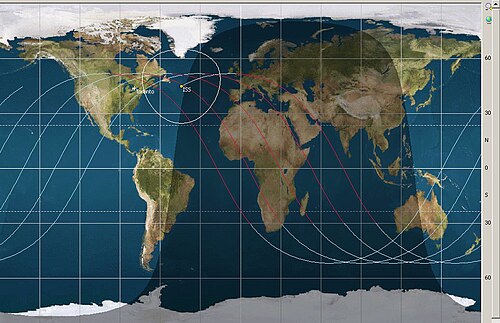
The Russian Orbital Segment contains the Data Management System, which handles Guidance, Navigation and Control (ROS GNC) for the entire station.[357] Initially, Zarya, the first module of the station, controlled the station until a short time after the Russian service module Zvezda docked and was transferred control. Zvezda contains the ESA built DMS-R Data Management System.[358] Using two fault-tolerant computers (FTC), Zvezda computes the station's position and orbital trajectory using redundant Earth horizon sensors, Solar horizon sensors as well as Sun and star trackers. The FTCs each contain three identical processing units working in parallel and provide advanced fault-masking by majority voting.
Orientation
Zvezda uses gyroscopes (reaction wheels) and thrusters to turn itself. Gyroscopes do not require propellant; instead they use electricity to 'store' momentum in flywheels by turning in the opposite direction to the station's movement. The USOS has its own computer-controlled gyroscopes to handle its extra mass. When gyroscopes 'saturate', thrusters are used to cancel out the stored momentum. In February 2005, during Expedition 10, an incorrect command was sent to the station's computer, using about 14 kilograms of propellant before the fault was noticed and fixed. When attitude control computers in the ROS and USOS fail to communicate properly, this can result in a rare 'force fight' where the ROS GNC computer must ignore the USOS counterpart, which itself has no thrusters.[359][360][361]
Docked spacecraft can also be used to maintain station attitude, such as for troubleshooting or during the installation of the S3/S4 truss, which provides electrical power and data interfaces for the station's electronics.[362]
Orbital debris threats
The low altitudes at which the ISS orbits are also home to a variety of space debris,[363] including spent rocket stages, defunct satellites, explosion fragments (including materials from anti-satellite weapon tests), paint flakes, slag from solid rocket motors, and coolant released by US-A nuclear-powered satellites. These objects, in addition to natural micrometeoroids,[364] are a significant threat. Objects large enough to destroy the station can be tracked, and therefore are not as dangerous as smaller debris.[365][366] Objects too small to be detected by optical and radar instruments, from approximately 1 cm down to microscopic size, number in the trillions. Despite their small size, some of these objects are a threat because of their kinetic energy and direction in relation to the station. Spacewalking crew in spacesuits are also at risk of suit damage and consequent exposure to vacuum.[367]
Ballistic panels, also called micrometeorite shielding, are incorporated into the station to protect pressurised sections and critical systems. The type and thickness of these panels depend on their predicted exposure to damage. The station's shields and structure have different designs on the ROS and the USOS. On the USOS, Whipple Shields are used. The US segment modules consist of an inner layer made from 1.5–5.0 cm-thick (0.59–1.97 in) aluminium, a 10 cm-thick (3.9 in) intermediate layers of Kevlar and Nextel (a ceramic fabric),[368] and an outer layer of stainless steel, which causes objects to shatter into a cloud before hitting the hull, thereby spreading the energy of impact. On the ROS, a carbon fibre reinforced polymer honeycomb screen is spaced from the hull, an aluminium honeycomb screen is spaced from that, with a screen-vacuum thermal insulation covering, and glass cloth over the top.[369]
Space debris is tracked remotely from the ground, and the station crew can be notified.[370] If necessary, thrusters on the Russian Orbital Segment can alter the station's orbital altitude, avoiding the debris. These Debris Avoidance Manoeuvres (DAMs) are not uncommon, taking place if computational models show the debris will approach within a certain threat distance. Ten DAMs had been performed by the end of 2009.[371][372][373] Usually, an increase in orbital velocity of the order of 1 m/s is used to raise the orbit by one or two kilometres. If necessary, the altitude can also be lowered, although such a manoeuvre wastes propellant.[372][374] If a threat from orbital debris is identified too late for a DAM to be safely conducted, the station crew close all the hatches aboard the station and retreat into their spacecraft in order to be able to evacuate in the event the station was seriously damaged by the debris. Partial station evacuations have occurred on 13 March 2009, 28 June 2011, 24 March 2012, 16 June 2015,[375] November 2021,[376] and 27 June 2024.[377]
The November 2021 evacuation was caused by a Russian anti-satellite weapon test.[378][379] NASA administrator Bill Nelson said it was unthinkable that Russia would endanger the lives of everyone on ISS, including their own cosmonauts.[380]
-
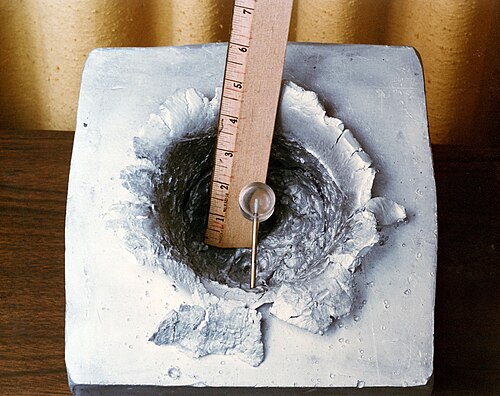 A 7-gram object (shown in centre) shot at 7 km/s (23,000 ft/s), the orbital velocity of the ISS, made this 15 cm (5.9 in) crater in a solid block of aluminium.
 -
 Radar-trackable objects, including debris, with distinct ring of geostationary satellites
 -
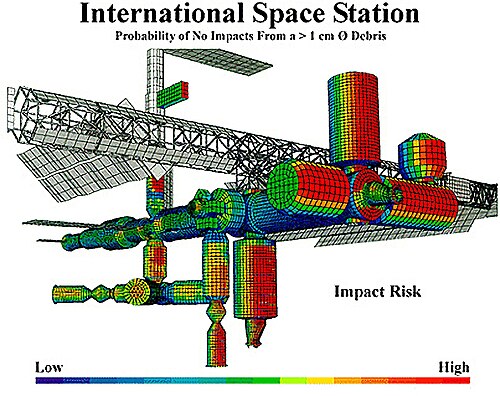 Example of risk management: A NASA model showing areas at high risk from impact for the International Space Station
Visibility from Earth
The ISS is visible in the sky to the naked eye as a visibly moving, bright white dot, when crossing the sky and being illuminated by the Sun, during twilight, the hours after sunset and before sunrise, when the station remains sunlit, outside of Earth's shadow, but the ground and sky are dark.[381] It crosses the skies at latitudes between the polar regions.[382] Depending on the path it takes across the sky, the time it takes the station to move across the horizon or from one to the other may be short or up to 10 minutes, while likely being only visible part of that time because of it moving into or out of Earth's shadow. It then returns around every 90 minutes, with the time of the day that it crosses the sky shifting over the course of some weeks, and therefore before returning to twilight and visible illumination.
Because of the size of its reflective surface area, the ISS is the brightest artificial object in the sky (excluding other satellite flares), with an approximate maximum magnitude of −4 when in sunlight and overhead (similar to Venus), and a maximum angular size of 63 arcseconds.[383]
Tools are provided by a number of websites such as Heavens-Above (see Live viewing below) as well as smartphone applications that use orbital data and the observer's longitude and latitude to indicate when the ISS will be visible (weather permitting), where the station will appear to rise, the altitude above the horizon it will reach and the duration of the pass before the station disappears either by setting below the horizon or entering into Earth's shadow.[384][385][386][387]
In November 2012 NASA launched its "Spot the Station" service, which sends people text and email alerts when the station is due to fly above their town.[388] The station is visible from 95% of the inhabited land on Earth, but is not visible from extreme northern or southern latitudes.[349]
Under specific conditions, the ISS can be observed at night on five consecutive orbits. Those conditions are 1) a mid-latitude observer location, 2) near the time of the solstice with 3) the ISS passing in the direction of the pole from the observer near midnight local time. The three photos show the first, middle and last of the five passes on 5–6 June 2014.
-
 Skytrack long duration exposure of the ISS
 -
 The ISS on its first pass of the night passing nearly overhead shortly after sunset in June 2014
 -
 The ISS passing north on its third pass of the night near local midnight in June 2014
 -
 The ISS passing west on its fifth pass of the night before sunrise in June 2014
Astrophotography

Using a telescope-mounted camera to photograph the station is a popular hobby for astronomers,[389] while using a mounted camera to photograph the Earth and stars is a popular hobby for crew.[390] The use of a telescope or binoculars allows viewing of the ISS during daylight hours.[391]

Transits of the ISS in front of the Sun, particularly during an eclipse (and so the Earth, Sun, Moon, and ISS are all positioned approximately in a single line) are of particular interest for amateur astronomers.[392][393]
International co-operation
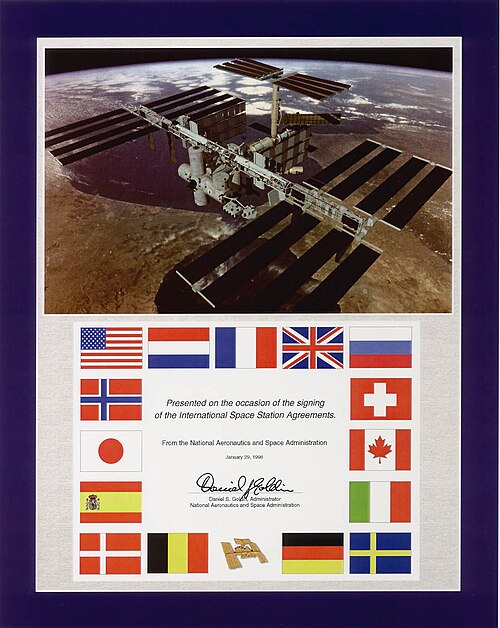
Involving five space programs and fifteen countries,[394] the International Space Station is the most politically and legally complex space exploration programme in history.[394] The 1998 Space Station Intergovernmental Agreement sets forth the primary framework for international cooperation among the parties. A series of subsequent agreements govern other aspects of the station, ranging from jurisdictional issues to a code of conduct among visiting astronauts.[395]
Brazil was also invited to participate in the programme, the only developing country to receive such an invitation. Under the agreement framework, Brazil was to provide six pieces of hardware, and in exchange, would receive ISS utilization rights. However, Brazil was unable to deliver any of the elements due to a lack of funding and political priority within the country. Brazil officially dropped out of the ISS programme in 2007.[396][397]
Following the 2022 Russian invasion of Ukraine, continued cooperation between Russia and other countries on the International Space Station has been put into question. Roscosmos Director General Dmitry Rogozin insinuated that Russian withdrawal could cause the International Space Station to de-orbit due to lack of reboost capabilities, writing in a series of tweets, "If you block cooperation with us, who will save the ISS from an unguided de-orbit to impact on the territory of the US or Europe? There's also the chance of impact of the 500-ton construction in India or China. Do you want to threaten them with such a prospect? The ISS doesn't fly over Russia, so all the risk is yours. Are you ready for it?"[398] (This latter claim is untrue: the ISS flies over all parts of the Earth between 51.6 degrees latitude north and south, approximately the latitude of Saratov.) Rogozin later tweeted that normal relations between ISS partners could only be restored once sanctions have been lifted, and indicated that Roscosmos would submit proposals to the Russian government on ending cooperation.[399] NASA stated that, if necessary, US corporation Northrop Grumman has offered a reboost capability that would keep the ISS in orbit.[400]
On 26 July 2022, Yury Borisov, Rogozin's successor as head of Roscosmos, submitted to Russian President Putin plans for withdrawal from the programme after 2024.[401] However, Robyn Gatens, the NASA official in charge of the space station, responded that NASA had not received any formal notices from Roscosmos concerning withdrawal plans.[402]
Participating countries
.svg/500px-Flag_of_Canada_(Pantone).svg.png)

.svg/500px-Flag_of_Belgium_(civil).svg.png)




.svg/500px-Flag_of_Switzerland_(Pantone).svg.png)

End of mission
Originally the ISS was planned to be a 15-year mission.[403] Therefore, an end of mission had been worked on,[404] but was several times postponed due to the success and support for the operation of the station.[405] As a result, the oldest modules of the ISS have been in orbit for more than 20 years, with their reliability having decreased.[404] It has been proposed to use funds instead elsewhere, for example for a return to the Moon.[405] According to the Outer Space Treaty, the parties are legally responsible for all spacecraft or modules they launch.[406] An unmaintained station would pose an orbital and re-entry hazard.
Russia has stated that it plans to pull out of the ISS program after 2025.[407] However, Russian modules will provide orbital station-keeping until 2028.[404]
The US planned in 2009 to deorbit the ISS in 2016.[405] But on 30 September 2015, Boeing's contract with NASA as prime contractor for the ISS was extended to 30 September 2020. Part of Boeing's services under the contract related to extending the station's primary structural hardware past 2020 to the end of 2028.[408] In July 2018, the Space Frontier Act of 2018 was intended to extend operations of the ISS to 2030. This bill was unanimously approved in the Senate, but failed to pass in the U.S. House.[409][410] In September 2018, the Leading Human Spaceflight Act was introduced with the intent to extend operations of the ISS to 2030, and was confirmed in December 2018.[411][412][413] Congress later passed similar provisions in its CHIPS and Science Act, signed into law by U.S. President Joe Biden on 9 August 2022.[414][415]
If until 2031 Commercial LEO Destinations providers are not sufficient to accommodate NASA's projects, NASA is suggesting to extend ISS operations beyond 2031.[416]
NASA's disposal plans

NASA considered originally several possible disposal options: natural orbital decay with random reentry (as with Skylab), boosting the station to a higher altitude (which would delay reentry), and a controlled de-orbit targeting a remote ocean area.[417]
NASA determined that random reentry carried an unacceptable risk of producing hazardous space debris that could hit people or property and re-boosting the station would be costly and could also create hazards.
Prior to 2010, plans had contemplated using a slightly modified Progress spacecraft to de-orbit the ISS. However, NASA concluded Progress would not be adequate for the job, and decided on a spacecraft specifically designed for the job.[418]


class=notpageimage|
Destination of the deorbiting ISS: the spacecraft cemetery (roughly centered on "Point Nemo", the oceanic pole of inaccessibility) in the Pacific OceanIn January 2022, NASA announced a planned date of January 2031 to de-orbit the ISS using the "U.S. Deorbit Vehicle" and direct any remnants into a remote area of the South Pacific Ocean that has come to be known as the spacecraft cemetery.[419] NASA plans to launch the deorbit vehicle in 2030, docking at the Harmony forward port.[420] The deorbit vehicle will remain attached, dormant, for about a year as the station's orbit naturally decays to 220 km (140 mi). The spacecraft would then conduct one or more orientation burns to lower the perigee to 150 km (93 mi), followed by a final deorbiting burn.[421][422]
NASA began planning for the deorbit vehicle after becoming wary of Russia pulling out of the ISS abruptly, leaving the other partners with few good options for a controlled reentry.[423] In June 2024, NASA selected SpaceX to develop the U.S. Deorbit Vehicle, a contract potentially worth $843 million. The vehicle will consist of an existing Cargo Dragon spacecraft which will be paired with a significantly lengthened trunk module which will be equipped with 46 Draco thrusters (instead of the normal 16) and will carry 30,000 kg (66,000 lb) of propellant, nearly six times the normal load. NASA is still working to secure all the necessary funding to build, launch and operate the deorbit vehicle.[14][423]
Post mission proposals and plans
The follow-up to NASA's program/strategy is the Commercial LEO Destinations Program, meant to allow private industry to build and maintain their own stations, and NASA procuring access as a customer, starting in 2028.[424] Similarly, the ESA has been seeking new private space stations to provide orbital services, as well as retrieve materials, from the ISS.[425][426] Currently Axiom Station is being planned to be assembled docked to the ISS, as a segment of the ISS, starting sometime after 2024.[404] Additionally there even have been suggestions in the commercial space industry that the ISS could be converted to commercial operations after it is retired by government entities,[427] including turning it into a space hotel.[405]
Russia previously has planned to use its orbital segment for the construction of its OPSEK station after the ISS is decommissioned. The modules under consideration for removal from the current ISS included the Multipurpose Laboratory Module (Nauka), launched in July 2021, and the other new Russian modules that are proposed to be attached to Nauka. These newly launched modules would still be well within their useful lives in 2024.[428] At the end of 2011, the Exploration Gateway Platform concept also proposed using leftover USOS hardware and Zvezda 2 as a refuelling depot and service station located at one of the Earth–Moon Lagrange points. However, the entire USOS was not designed for disassembly and will be discarded.[429]
Western space industry has suggested in 2022 using the ISS as a platform to develop orbital salvage capacities, by companies such as CisLunar Industries working on using space debris as fuel,[430] instead of plunging it into the ocean.[407]
NASA has stated that by July 2024 it has not seen any viable proposals for reuse of the ISS or parts of it.[416]
Cost
The ISS has been described as the most expensive single item ever constructed.[431] As of 2010, the total cost was US$150 billion. This includes NASA's budget of $58.7 billion ($89.73 billion in 2021 dollars) for the station from 1985 to 2015, Russia's $12 billion, Europe's $5 billion, Japan's $5 billion, Canada's $2 billion, and the cost of 36 shuttle flights to build the station, estimated at $1.4 billion each, or $50.4 billion in total. Assuming 20,000 person-days of use from 2000 to 2015 by two- to six-person crews, each person-day would cost $7.5 million, less than half the inflation-adjusted $19.6 million ($5.5 million before inflation) per person-day of Skylab.[432]
In culture
The ISS has become an international symbol of human capabilities, particularly human cooperation and science,[433] defining a cooperative international approach and period, instead of a looming commercialized and militarized interplanetary world.[434]
In film
Beside numerous documentaries such as the IMAX documentaries Space Station 3D from 2002,[435] or A Beautiful Planet from 2016,[436] and films like Apogee of Fear (2012)[437] and Yolki 5 (2016)[438][439] the ISS is the subject of feature films such as The Day After Tomorrow (2004),[440] Love (2011),[441] together with the Chinese station Tiangong 1 in Gravity (2013),[442] Life (2017),[443] and I.S.S. (2023).[444]
In 2022, the movie The Challenge (Doctor's House Call) was filmed aboard the ISS, and was notable for being the first feature film in which both professional actors and director worked together in space.[445]
See also
- A Beautiful Planet (2016) – IMAX documentary film showing scenes of Earth, as well as astronaut life aboard the ISS
- Center for the Advancement of Science in Space – operates the US National Laboratory on the ISS
- List of accidents and incidents involving the International Space Station
- List of commanders of the International Space Station
- List of human spaceflights to the International Space Station
- List of International Space Station expeditions
- List of International Space Station spacewalks
- List of space stations
- List of spacecraft deployed from the International Space Station
- Politics of outer space
- Science diplomacy
- Space Station 3D (2002) – Canadian documentary
- Tiangong space station – another permanently crewed station operating in Low Earth orbit
Notes
- ^ Pirs was connected to the nadir port of Zvezda now occupied by Nauka.
- ^ partially retracted
- ^ "Zarya" can have a lot of meanings: "daybreak", "dawn" (in the morning) or "afterglow", "evening glow", "sunset" (in the evening). But usually it means "dawn".
- ^ Privately funded travellers who have objected to the term include Dennis Tito, the first such traveller,[246] Mark Shuttleworth, founder of Ubuntu,[247] Gregory Olsen and Richard Garriott.[248][249] Canadian astronaut Bob Thirsk said the term does not seem appropriate, referring to his crewmate, Guy Laliberté, founder of Cirque du Soleil.[250] Anousheh Ansari denied being a tourist[251] and took offence at the term.[252]
- ^ ESA director Jörg Feustel-Büechl said in 2001 that Russia had no right to send 'amateurs' to the ISS. A 'stand-off' occurred at the Johnson Space Center between Commander Talgat Musabayev and NASA manager Robert Cabana who refused to train Dennis Tito, a member of Musabayev's crew along with Yuri Baturin. Musabayev argued that Tito had trained 700 hours in the last year and was as qualified as any NASA astronaut, and refused to allow his crew to be trained on the USOS without Tito. Cabana would not allow training to begin, and the commander returned with his crew to their hotel.
- ^ Including the modified DC-1, M-MIM2 and M-UM module transports
- ^ Includes both crewed and uncrewed missions
- ^ a b c d The Prichal aft, forward, port and starboard ports still have their protective covers in place and have yet to be used since the module originally docked at the station.
- ^ will later relocate to the zenith port in October 2024
References
- ^ "ISS: International Space Station". Archived from the original on 10 August 2023.
- ^ a b c d e Garcia, Mark (5 January 2023). "About the Space Station: Facts and Figures". NASA. Archived from the original on 6 February 2023. Retrieved 13 January 2023.
- ^ a b c d e f Peat, Chris (21 May 2021). "ISS – Orbit". Heavens-Above. Archived from the original on 25 December 2018. Retrieved 21 May 2021.
- ^ "Live Space Station Tracking Map". NASA. Archived from the original on 10 May 2024. Retrieved 2 May 2024.
- ^ Holman, Joseph (12 October 2022). "ISS (ZARYA)". Satellite Tracking. Archived from the original on 12 October 2022. Retrieved 12 October 2022.
- ^ a b "ARISS TLE". ARISS TLE. 16 August 2023. Archived from the original on 2 April 2023. Retrieved 16 August 2023.
- ^ a b c "On-Orbit Elements" (PDF). NASA. 18 February 2010. Archived from the original (PDF) on 29 October 2009. Retrieved 19 June 2010.
- ^ "STS-132 Press Kit" (PDF). NASA. 7 May 2010. Archived (PDF) from the original on 12 October 2023. Retrieved 19 June 2010.
- ^ "STS-133 FD 04 Execute Package" (PDF). NASA. 27 February 2011. Archived from the original (PDF) on 27 November 2020. Retrieved 27 February 2011.
- ^ "ISS". nasa.gov. 23 May 2023. Archived from the original on 16 May 2024. Retrieved 9 May 2024.
- ^ "NASA – Higher Altitude Improves Station's Fuel Economy". nasa.gov. 14 February 2019. Archived from the original on 25 December 2021. Retrieved 29 May 2019.
- ^ "Current ISS Tracking data". NASA. 15 December 2008. Archived from the original on 25 December 2015. Retrieved 28 January 2009.
 This article incorporates text from this source, which is in the public domain.
- ^ "International Space Station Visitors by Country – NASA". Archived from the original on 23 January 2024. Retrieved 19 March 2023.
- ^ a b "NASA Selects International Space Station US Deorbit Vehicle – NASA". Retrieved 26 June 2024.
- ^ Frieling, Thomas. "Skylab B:Unflown Missions, Lost Opportunities". Quest. 5 (4): 12–21.
- ^ Portree, David S. F. (26 March 2012). "Skylab-Salyut Space Laboratory (1972)". WIRED. Archived from the original on 10 August 2023.
- ^ ESA – Columbus
- ^ "International Space Station". Astronautix.com. Archived from the original on 9 April 2002. Retrieved 1 May 2012.
- ^ Leary, Warren E. (8 June 1993). "Fate of Space Station Is in Doubt As All Options Exceed Cost Goals". The New York Times. Archived from the original on 26 May 2015.
- ^ "Mir-2". Astronautix. Archived from the original on 20 August 2016. Retrieved 12 February 2011.
- ^ "U.S. Proposes Space Station Merger with Russia". The Washington Post. 5 November 1993.
- ^ Heivilin, Donna (21 June 1994). "Space Station: Impact of the Expanded Russian Role on Funding and Research" (PDF). Government Accountability Office. Retrieved 3 November 2006.
- ^ Dismukes, Kim (4 April 2004). "Shuttle–Mir History/Background/How "Phase 1" Started". NASA. Archived from the original on 16 November 2001. Retrieved 12 April 2007.
- ^ "Memorandum of Understanding Between the National Aeronautics and Space Administration of the United States of America and the Russian Space Agency Concerning Cooperation on the Civil International Space Station". NASA. Archived from the original on 15 December 2015. Retrieved 19 April 2009. This article incorporates text from this source, which is in the public domain.
- ^ Payette, Julie (10 December 2012). "Research and Diplomacy 350 Kilometers above the Earth: Lessons from the International Space Station". Science & Diplomacy. 1 (4). Archived from the original on 6 March 2013.
- ^ "National Space Policy of the United States of America" (PDF). White House. 28 June 2010. Archived (PDF) from the original on 27 October 2023. Retrieved 20 July 2011. This article incorporates text from this source, which is in the public domain.
- ^ Trinidad, Katherine; Humphries, Kelly (17 November 2008). "Nations Around the World Mark 10th Anniversary of International Space Station" (Press release). NASA. 08-296. Archived from the original on 21 May 2022. Retrieved 6 March 2009. This article incorporates text from this source, which is in the public domain.
- ^ a b c Oberg, James (2005). "International Space Station". World Book Online Reference Center. Retrieved 3 April 2016.[permanent dead link]
- ^ a b c d e "Fields of Research". NASA. 26 June 2007. Archived from the original on 23 January 2008.
- ^ "Getting on Board". NASA. 26 June 2007. Archived from the original on 8 December 2007. This article incorporates text from this source, which is in the public domain.
- ^ "Monitor of All-sky X-ray Image (MAXI)". JAXA. 2008. Archived from the original on 22 July 2011. Retrieved 12 March 2011.
- ^ "SOLAR: three years observing and ready for solar maximum". esa.int. ESA. 11 March 2011. Archived from the original on 10 August 2023. Retrieved 4 June 2023.
- ^ Hartevelt-Velani, Shamim; Walker, Carl; Elmann-Larsen, Benny (23 November 2009). "The International Space Station: life in space". Science in School (10). Archived from the original on 3 February 2023. Retrieved 17 February 2009.
- ^ "AMS to Focus on Invisible Universe". NASA. 18 March 2011. Archived from the original on 5 March 2023. Retrieved 8 October 2011. This article incorporates text from this source, which is in the public domain.
- ^ "In Search of Antimatter Galaxies". NASA. 14 August 2009. Archived from the original on 14 January 2023. Retrieved 8 October 2011. This article incorporates text from this source, which is in the public domain.
- ^ Aguilar, M. et al. (AMS Collaboration) (3 April 2013). "First Result from the Alpha Magnetic Spectrometer on the International Space Station: Precision Measurement of the Positron Fraction in Primary Cosmic Rays of 0.5–350 GeV" (PDF). Physical Review Letters. 110 (14): 141102. Bibcode:2013PhRvL.110n1102A. doi:10.1103/PhysRevLett.110.141102. ISSN 0031-9007. PMID 25166975. Archived (PDF) from the original on 10 August 2023.
- ^ Staff (3 April 2013). "First Result from the Alpha Magnetic Spectrometer Experiment". AMS Collaboration. Archived from the original on 8 April 2013. Retrieved 3 April 2013.
- ^ Heilprin, John; Borenstein, Seth (3 April 2013). "Scientists find hint of dark matter from cosmos". Associated Press. Archived from the original on 10 May 2013. Retrieved 3 April 2013.
- ^ Amos, Jonathan (3 April 2013). "Alpha Magnetic Spectrometer zeroes in on dark matter". BBC News. Archived from the original on 12 August 2023. Retrieved 3 April 2013.
- ^ Perrotto, Trent J.; Byerly, Josh. "NASA TV Briefing Discusses Alpha Magnetic Spectrometer Results" (Press release). NASA. M13-054. Archived from the original on 9 November 2023. Retrieved 3 April 2013. This article incorporates text from this source, which is in the public domain.
- ^ Overbye, Dennis (3 April 2013). "Tantalizing New Clues into the Mysteries of Dark Matter". The New York Times. Archived from the original on 20 August 2017. Retrieved 3 April 2013.
- ^ Horneck, Gerda; Klaus, David M.; Mancinelli, Rocco L. (March 2010). "Space Microbiology" (PDF). Microbiology and Molecular Biology Reviews. 74 (1). American Society for Microbiology: 121–156. Bibcode:2010MMBR...74..121H. doi:10.1128/MMBR.00016-09. PMC 2832349. PMID 20197502. Archived from the original (PDF) on 30 August 2011. Retrieved 4 June 2011. See Space Environment on p. 122.
- ^ Amos, Jonathan (23 August 2010). "Beer microbes live 553 days outside ISS". BBC News. Archived from the original on 11 August 2023. Retrieved 4 June 2011.
- ^ Ledford, Heidi (8 September 2008). "Spacesuits optional for 'water bears'". Nature. doi:10.1038/news.2008.1087.
- ^ a b c Buckey, Jay (23 February 2006). Space Physiology. Oxford University Press USA. ISBN 978-0-19-513725-5.
- ^ Grossman, List (22 July 2009). "Ion engine could one day power 39-day trips to Mars". New Scientist. Archived from the original on 15 October 2023. Retrieved 8 January 2010.
- ^ Boen, Brooke (1 May 2009). "Advanced Diagnostic Ultrasound in Microgravity (ADUM)". NASA. Archived from the original on 29 October 2009. Retrieved 1 October 2009. This article incorporates text from this source, which is in the public domain.
- ^ Rao, Sishir; et al. (May 2008). "A Pilot Study of Comprehensive Ultrasound Education at the Wayne State University School of Medicine". Journal of Ultrasound in Medicine. 27 (5): 745–749. doi:10.7863/jum.2008.27.5.745. PMID 18424650. S2CID 30566494.
- ^ Fincke, E. Michael; et al. (February 2005). "Evaluation of Shoulder Integrity in Space: First Report of Musculoskeletal US on the International Space Station". Radiology. 234 (2): 319–322. doi:10.1148/radiol.2342041680. PMID 15533948.
- ^ Strickland, Ashley (26 August 2020). "Bacteria from Earth can survive in space and could endure the trip to Mars, according to new study". CNN. Archived from the original on 11 August 2023. Retrieved 26 August 2020.
- ^ Kawaguchi, Yuko; et al. (26 August 2020). "DNA Damage and Survival Time Course of Deinococcal Cell Pellets During 3 Years of Exposure to Outer Space". Frontiers in Microbiology. 11: 2050. doi:10.3389/fmicb.2020.02050. PMC 7479814. PMID 32983036. S2CID 221300151.
- ^ "Earth Science & Remote Sensing Missions on ISS". NASA. Archived from the original on 10 August 2023. Retrieved 9 December 2020.
- ^ May, Sandra (15 February 2012). "What Is Microgravity?". NASA Knows! (Grades 5–8). NASA. Archived from the original on 7 November 2023. Retrieved 3 September 2018. This article incorporates text from this source, which is in the public domain.
- ^ "European Users Guide to Low Gravity Platforms". European Space Agency. 6 December 2005. Archived from the original on 2 April 2013. Retrieved 22 March 2013.
- ^ "Materials Science 101". NASA. 15 September 1999. Archived from the original on 14 June 2009. Retrieved 18 June 2009. This article incorporates text from this source, which is in the public domain.
- ^ "ISS Research Program". NASA. Archived from the original on 13 February 2009. Retrieved 27 February 2009.
- ^ "Mars500: study overview". European Space Agency. 4 June 2011. Archived from the original on 19 August 2023.
- ^ "Space station may be site for next mock Mars mission". New Scientist. 4 November 2011. Archived from the original on 11 July 2017. Retrieved 1 September 2017.
- ^ "The Sustainable Utilisation of the ISS Beyond 2015" (PDF). International Astronautical Congress. Archived from the original (PDF) on 26 April 2012. Retrieved 15 December 2011.
- ^ de Selding, Peter B. (3 February 2010). "ESA Chief Lauds Renewed U.S. Commitment to Space Station, Earth Science". Space News.
- ^ Chow, Denise (8 April 2011). "Space Station Crucial for Going to Mars, NASA Chief Says". Space.com. Archived from the original on 11 August 2023.
- ^ Seitz, Virginia A. (19 September 2011). "Memorandum Opinion for the General Counsel, Office of Science and Technology Policy" (PDF). justice.gov. US Justice Department. p. 3. Archived from the original (PDF) on 13 July 2012. Retrieved 23 May 2012.
- ^ a b c d e f Kitmacher, Gary (2006). Reference Guide to the International Space Station. Apogee Books Space Series. Canada: Apogee Books. pp. 71–80. ISBN 978-1-894959-34-6. ISSN 1496-6921.
- ^ Sandal, Gro M.; Manzey, Dietrich (December 2009). "Cross-cultural issues in space operations: A survey study among ground personnel of the European Space Agency". Acta Astronautica. 65 (11–12): 1520–1529. Bibcode:2009AcAau..65.1520S. doi:10.1016/j.actaastro.2009.03.074. ISSN 0094-5765.
- ^ "Online Materials". European Space Agency. Archived from the original on 11 August 2023. Retrieved 3 April 2016.
- ^ "ISS 3-D Teaching Tool: Spaceflight Challenge I". European Space Agency. 24 May 2011. Archived from the original on 11 August 2023. Retrieved 8 October 2011.
- ^ Building Peace in Young Minds through Space Education (PDF). Committee on the Peaceful Uses of Outer Space. Vol. 53. Vienna, Austria: JAXA. June 2010. Archived (PDF) from the original on 11 August 2023.
- ^ "JAXA Spaceflight Seeds Kids I : Spaceflight Sunflower seeds – Let's make them flower! and learn freshly the Earth environment just by contrast with the Space one". JAXA. 2006. Archived from the original on 18 March 2012.
- ^ "JAXA Seeds in Space I : Let's Cultivate Spaceflight Asagao (Japanese morning glory), Miyako-gusa (Japanese bird's foot trefoil) Seeds and Identify the Mutants!". JAXA. 2006. Archived from the original on 18 March 2012.
- ^ Murakami, Keiji (14 October 2009). "JEM Utilization Overview" (PDF). JAXA. Steering Committee for the Decadal Survey on Biological and Physical Sciences in Space. Archived from the original (PDF) on 29 November 2011. Retrieved 27 September 2011.
- ^ Tanaka, Tetsuo. "Kibo: Japan's First Human Space Facility". JAXA. Archived from the original on 29 November 2011. Retrieved 8 October 2011.
- ^ "Amateur Radio on the International Space Station". 6 June 2011. Archived from the original on 27 May 2011. Retrieved 10 June 2011.
- ^ Riley, Christopher (11 April 2011). "What Yuri Gagarin saw: First Orbit film to reveal the view from Vostok 1". The Guardian. Archived from the original on 10 August 2023.
- ^ "Yuri Gagarin's First Orbit – FAQs". firstorbit.org. The Attic Room Ltd. Archived from the original on 10 August 2023. Retrieved 1 May 2012.
- ^ Warr, Philippa (13 May 2013). "Commander Hadfield bids farewell to ISS with Reddit-inspired Bowie cover". wired.co.uk. Archived from the original on 12 October 2013. Retrieved 22 October 2013.
- ^ "Astronaut bids farewell with Bowie cover version (inc. video)". BBC News. 13 May 2013. Archived from the original on 11 August 2023. Retrieved 24 September 2020.
- ^ Davis, Lauren (12 May 2013). "Chris Hadfield sings "Space Oddity" in the first music video in space". Gizmodo. Archived from the original on 11 August 2023.
- ^ Mabbett, Andy (29 November 2017). "Close encounters of the Wikipedia kind: Astronaut is first to specifically contribute to Wikipedia from space". Diff. Wikimedia foundation. Archived from the original on 4 June 2023. Retrieved 4 December 2017.
- ^ Petris, Antonella (1 December 2017). "Primo contributo 'extraterrestre' su Wikipedia: è di Nespoli" [First 'Extraterrestrial' Contribution on Wikipedia: It's by Nespoli.]. Meteo Web (in Italian). Archived from the original on 11 August 2023. Retrieved 4 December 2017.
- ^ Pearlman, Robert Z. (23 November 2021). "'The Infinite' VR space station tour to premiere spacewalk in Houston". Space.com. Archived from the original on 10 August 2023. Retrieved 27 November 2021.
- ^ a b c "Building ISS". U.S. National Archives & DVIDS. Archived from the original on 28 October 2021. Retrieved 28 October 2021. This article incorporates text from this source, which is in the public domain.
- ^ "ISS Zvezda". Archived from the original on 20 August 2016. Retrieved 5 July 2019.
- ^ Harbaugh, Jennifer, ed. (19 February 2016). "Manufacturing Key Parts of the International Space Station: Unity and Destiny". NASA. Archived from the original on 24 November 2023. Retrieved 15 February 2019.
- ^ Shiflett, Kim (22 April 2008). "KSC-08pd0991". NASA Image and Video Library. Cape Canaveral, Florida. Archived from the original on 24 November 2023. Retrieved 5 July 2019.
In the Space Station Processing Facility at NASA's Kennedy Space Center, an overhead crane moves the Kibo Japanese Experiment Module – Pressurized Module toward the payload canister (lower right). The canister will deliver the module, part of the payload for space shuttle Discovery's STS-124 mission, to Launch Pad 39A. On the mission, the STS-124 crew will transport the Kibo module as well as the Japanese Remote Manipulator System to the International Space Station to complete the Kibo laboratory. The launch of Discovery is targeted for May 31.
- ^ "The ISS to Date". NASA. 9 March 2011. Archived from the original on 11 June 2015. Retrieved 21 March 2011.
- ^ Dismukes, Kim (1 December 2002). "Mission Control Answers Your Questions: STS-113 Q17". spaceflight.nasa.gov. NASA. Archived from the original on 24 July 2020. Retrieved 14 June 2009.
- ^ "NASA Facts. The Service Module: A Cornerstone of Russian International Space Station Modules" (PDF). spaceflight.nasa.gov. NASA. January 1999. IS-1999-09-ISS019JSC. Archived from the original (PDF) on 23 August 2020.
- ^ "STS-88". Science.ksc.nasa.gov. Archived from the original on 6 June 2011. Retrieved 19 April 2011.
- ^ "STS-92". Science.ksc.nasa.gov. Archived from the original on 5 March 2011. Retrieved 19 April 2011.
- ^ "Mini-Research Module 1 (MIM1) Rassvet (MRM-1)". RussianSpaceWeb. Archived from the original on 25 August 2011. Retrieved 12 July 2011.
- ^ "STS-133". NASA. Archived from the original on 20 November 2023. Retrieved 1 September 2014.
- ^ "Crewed spacecraft docked to ISS's module Nauka first time". TASS. 28 September 2011. Archived from the original on 10 August 2023. Retrieved 11 October 2021.
- ^ "Рогозин подтвердил, что на модуль "Наука" поставят баки от разгонного блока "Фрегат"" [Rogozin confirmed that the module 'Science' placed the tanks from the upper stage 'Frigate'] (in Russian). TASS. 25 March 2019. Archived from the original on 10 August 2023. Retrieved 31 March 2019.
- ^ "Новый модуль вошел в состав российского сегмента МКС" [A new module has entered the composition of the Russian segment of the ISS] (Press release) (in Russian). Roscosmos. 26 November 2021. Archived from the original on 27 November 2021. Retrieved 6 May 2022.
- ^ "Zarya Module". NASA. Archived from the original on 18 November 2023. Retrieved 19 April 2014.
- ^ Zak, Anatoly (15 October 2008). "Russian Segment: Enterprise". RussianSpaceWeb. Archived from the original on 11 August 2023. Retrieved 4 August 2012.
- ^ "NASA – NSSDCA – Spacecraft – Details". nssdc.gsfc.nasa.gov. NASA. 1998-069F. Archived from the original on 23 April 2023. Retrieved 6 May 2022.
- ^ Loff, Sarah (15 November 2018). "Unity". NASA. Archived from the original on 5 June 2022. Retrieved 6 May 2022.
- ^ Roy, Steve (20 October 2009). "ET-134's Mission,STS-130: Launching Tranquility". NASA. Archived from the original on 22 March 2023. Retrieved 23 November 2023.
- ^ Williams, Suni (presenter) (3 July 2015). Departing Space Station Commander Provides Tour of Orbital Laboratory (video). NASA. Event occurs at 17.46–18.26. Archived from the original on 14 August 2021. Retrieved 1 September 2019.
- ^ Roylance, Frank D. (11 November 2000). "Space station astronauts take shelter from solar radiation". The Baltimore Sun. Tribune Publishing. Archived from the original on 1 September 2019. Retrieved 1 September 2019.
- ^ Stofer, Kathryn (29 October 2013). "Tuesday/Wednesday Solar Punch". NASA. Archived from the original on 2 December 2020. Retrieved 1 September 2019.
- ^ "Service Module | RuSpace". suzymchale.com. Archived from the original on 21 September 2020. Retrieved 10 November 2020.
- ^ Boeing (2008). "Destiny Laboratory Module". Boeing. Archived from the original on 11 October 2008. Retrieved 7 October 2008.
- ^ "U.S. Destiny Laboratory". NASA. 2003. Archived from the original on 9 July 2007. Retrieved 7 October 2008.
- ^ "STS-98". NASA. 2001. Archived from the original on 30 August 2013. Retrieved 7 October 2008.
- ^ Chris Bergin (12 July 2007). "Oxygen Generating System activated onboard ISS". NASASpaceflight.com. Retrieved 25 January 2010.
- ^ "Quest Airlock". NASA. Archived from the original on 24 October 2023. Retrieved 24 November 2023.
- ^ a b Stockman, Bill; Boyle, Joe; Bacon, John (2010). International Space Station Systems Engineering Case Study (PDF) (Technical report). United States Air Force. pp. 36–38. Archived (PDF) from the original on 24 November 2023. Retrieved 24 November 2023.
- ^ Uri, John (14 July 2021). "Space Station 20th: STS-104 Brings Quest Joint Airlock to the Space Station". NASA. Archived from the original on 24 November 2023. Retrieved 24 November 2023.
- ^ "Pirs Docking Compartment". NASA. 10 May 2006. Archived from the original on 25 October 2005. Retrieved 28 March 2009.
- ^ "August 28, 2009. S. P. Korolev RSC Energia, Korolev, Moscow region". RSC Energia. 28 August 2009. Archived from the original on 21 September 2020. Retrieved 3 September 2009.
- ^ Clark, Stephen (10 November 2009). "Poisk launches to add new room for space station". Spaceflight Now. Archived from the original on 10 August 2023. Retrieved 11 November 2009.
- ^ Zak, Anatoly. "Mir close calls". RussianSpaceWeb. Archived from the original on 11 August 2023. Retrieved 1 May 2012.
- ^ Williams, Suni (presenter) (19 May 2013). Station Tour: Harmony, Tranquility, Unity (video). NASA. Event occurs at 0.06–0.35. Archived from the original on 11 December 2021. Retrieved 31 August 2019.
So this is Node 2 ... this is where four out of six of us sleep.
- ^ NASA (23 October 2007). "STS-120 MCC Status Report #01". NASA. Archived from the original on 28 October 2007. Retrieved 22 September 2019.
- ^ Johnson, Jr., John (24 October 2007). "Shuttle embarks on busy mission". Los Angeles Times. Archived from the original on 12 August 2023. Retrieved 23 October 2007.
- ^ Harwood, William (26 October 2007). "Harmony module pulled from cargo bay". CBS News. Archived from the original on 17 September 2021. Retrieved 26 October 2007.
- ^ Schwartz, John (26 October 2007). "New Room Added to Space Station". The New York Times. Archived from the original on 11 August 2023. Retrieved 26 October 2007.
- ^ NASA (2007). "PMA-3 Relocation". NASA. Archived from the original on 12 October 2007. Retrieved 28 September 2007.
- ^ "NASA – NASA Receives Tranquility". Nasa.gov. 23 October 2010. Archived from the original on 11 August 2023. Retrieved 12 August 2013.
- ^ Harwood, William (11 February 2008). "Station arm pulls Columbus module from cargo bay". Spaceflight Now. Archived from the original on 7 May 2016. Retrieved 7 August 2009.
- ^ Kamiya, Setsuko (30 June 2009). "Japan a low-key player in space race". The Japan Times. p. 3. Archived from the original on 13 August 2013.
- ^ "Thales Alenia Space and ISS modules – Cupola: a window over the Earth". 26 July 2010. Archived from the original on 26 July 2010.
- ^ Gebhardt, Chris (9 April 2009). "STS-132: PRCB baselines Atlantis' mission to deliver Russia's MRM-1". NASASpaceFlight.com. Archived from the original on 12 April 2023. Retrieved 12 November 2009.
- ^ "STS-132 MCC Status Report #09". NASA. 18 May 2010. Archived from the original on 8 April 2013. Retrieved 7 July 2010. This article incorporates text from this source, which is in the public domain.
- ^ a b "Mini-Research Module 1 (MRM1) Rassvet (Dawn)". Reference Guide to the International Space Station (PDF). National Aeronautics and Space Administration. November 2010. p. 62. ISBN 978-0-16-086517-6. LCCN 2010040473. Archived (PDF) from the original on 26 November 2023. Retrieved 18 December 2022.
- ^ "Выход российских космонавтов в открытый космос перенесли на лето" [The spacewalk of Russian cosmonauts has been rescheduled for the summer] (in Russian). RIA Novosti. 17 May 2022. Archived from the original on 10 August 2023. Retrieved 25 November 2022.
- ^ a b c "Многоцелевой лабораторный модуль "Наука"" [Multipurpose Laboratory Module 'Nauka'] (in Russian). Roscosmos. Archived from the original on 14 July 2021. Retrieved 14 July 2021.
- ^ Pearlman, Robert (10 April 2016). "SpaceX Dragon Arrives at Space Station, Delivers Inflatable Room Prototype". Space.com. Archived from the original on 11 June 2023. Retrieved 11 April 2016.
- ^ Foust, Jeff (21 January 2022). "Bigelow Aerospace transfers BEAM space station module to NASA". SpaceNews. Retrieved 13 February 2024.
- ^ Harwood, William (19 August 2016). "Spacewalkers attach docking adapter to space station for commercial vehicles". Spaceflight Now. Archived from the original on 10 August 2023. Retrieved 24 January 2021.
- ^ Garcia, Mark (21 August 2019). "Spacewalkers Complete Installation of Second Commercial Docking Port". NASA Space Station. Archived from the original on 2 June 2020. Retrieved 24 January 2021.
- ^ "Thales Alenia Space reaches key milestone for NanoRacks' airlock module" (Press release). Turin, Italy: Thales Alenia Space. 20 March 2019. Archived from the original on 10 August 2023. Retrieved 22 August 2019.
- ^ Clark, Stephen (2 August 2019). "SpaceX to begin flights under new cargo resupply contract next year". Spaceflight Now. Archived from the original on 2 June 2023. Retrieved 22 August 2019.
- ^ "NanoRacks, Boeing to Build First Commercial ISS Airlock Module" (Press release). NanoRacks. 6 February 2017. Archived from the original on 11 August 2023. Retrieved 22 August 2019.
- ^ Garcia, Mark (6 February 2017). "Progress Underway for First Commercial Airlock on Space Station". NASA. Archived from the original on 12 November 2020. Retrieved 22 August 2019.
- ^ Zak, Anatoly (9 February 2021). "Progress MS-17 lifts off to prepare Prichal module arrival". RussianSpaceWeb. Archived from the original on 11 August 2023. Retrieved 21 October 2021.
- ^ Zak, Anatoly (22 June 2020). "Prichal Node Module, UM". RussianSpaceWeb. Archived from the original on 20 November 2023. Retrieved 23 June 2020.
- ^ Clark, Stephen (25 July 2019). "New docking port, spacesuit and supplies en route to space station". Spaceflight Now. Archived from the original on 10 August 2023. Retrieved 17 August 2019.
- ^ "News January 13, 2011" (Press release). Energia. 13 January 2011. Archived from the original on 2 July 2017. Retrieved 8 October 2011.
- ^ a b Atkinson, Ian (19 August 2020). "Russia's Nauka ISS module arrives at Baikonur for final launch preparations". NASASpaceFlight.com. Archived from the original on 10 August 2023. Retrieved 20 August 2020.
- ^ "Spread Your Wings, It's Time to Fly". NASA. 26 July 2006. Archived from the original on 11 January 2023. Retrieved 21 September 2006. This article incorporates text from this source, which is in the public domain.
- ^ "Consolidated Launch Manifest". NASA. 2008. Archived from the original on 7 March 2009. Retrieved 8 July 2008. This article incorporates text from this source, which is in the public domain.
- ^ "EXPRESS Racks 1 and 2 fact sheet". 1 February 2001. FS-2001-02-34-MSFC. Archived from the original on 29 August 2008. Retrieved 4 October 2009. This article incorporates text from this source, which is in the public domain.
- ^ "Soyuz TMA-03M docks to ISS, returns station to six crewmembers for future ops". NASASpaceFlight.com. 23 December 2011. Archived from the original on 11 August 2023. Retrieved 1 May 2012.
- ^ Welsch, L. D. (30 October 2009). "EVA Checklist: STS-129 Flight Supplement" (PDF). NASA. Archived from the original (PDF) on 29 November 2011. Retrieved 9 July 2011. This article incorporates text from this source, which is in the public domain.
- ^ "Space Shuttle Mission: STS-133 Press Kit" (PDF). NASA. February 2011. Archived (PDF) from the original on 12 October 2023. Retrieved 9 July 2011. This article incorporates text from this source, which is in the public domain.
- ^ a b c "Space Shuttle Mission: STS-134" (PDF). NASA. April 2011. Archived from the original (PDF) on 26 December 2018. Retrieved 9 July 2011. This article incorporates text from this source, which is in the public domain.
- ^ "HTV2: Mission Press Kit" (PDF). Japan Aerospace Exploration Agency. 20 January 2011. Archived (PDF) from the original on 11 August 2023.
- ^ "Exposed Facility:About Kibo". JAXA. 29 August 2008. Archived from the original on 3 August 2009. Retrieved 9 October 2009.
- ^ "NASA–European Technology Exposure Facility (EuTEF)". NASA. 6 October 2008. Archived from the original on 19 October 2008. Retrieved 28 February 2009. This article incorporates text from this source, which is in the public domain.
- ^ "European Technology Exposure Facility (EuTEF)". European Space Agency. 13 January 2009. Archived from the original on 12 August 2023. Retrieved 28 February 2009.
- ^ "Atomic Clock Ensemble in Space (ACES)". ESA. Archived from the original on 9 June 2009. Retrieved 9 October 2009.
- ^ Gebhardt, Chris (10 March 2017). "SpaceX science – Dragon delivers experiments for busy science period". NASASpaceFlight.com. Archived from the original on 10 August 2023. Retrieved 11 January 2019.
- ^ Graham, William (3 June 2017). "Falcon 9 launches with CRS-11 Dragon on 100th 39A launch". NASASpaceFlight.com. Archived from the original on 10 August 2023. Retrieved 11 January 2019.
- ^ "The Alpha Magnetic Spectrometer Experiment". CERN. 21 January 2009. Archived from the original on 11 August 2023. Retrieved 6 March 2009.
- ^ Bergin, Chris (4 April 2013). "Endeavour's ongoing legacy: AMS-02 proving its value". NASASpaceFlight.com. Archived from the original on 10 August 2023. Retrieved 11 January 2019.
- ^ "ESA and Airbus sign partnership agreement for new ISS commercial payload platform Bartolomeo". SpaceDaily. 9 February 2018. Archived from the original on 11 August 2023. Retrieved 10 February 2018.
- ^ "Airbus and ESA to partner on Bartolomeo platform". Aerospace Technology. 8 February 2018. Archived from the original on 10 August 2023. Retrieved 10 February 2018.
- ^ "ISS: Bartolomeo". eoPortal. European Space Agency. 26 October 2016. Archived from the original on 12 August 2023. Retrieved 10 February 2018.
- ^ Garcia, Mark (12 May 2023). "Cosmonauts Deploy Radiator and Complete Spacewalk". NASA Blogs. NASA. Archived from the original on 31 July 2023. Retrieved 12 May 2023.
- ^ "European Robotic Arm Brochure" (PDF). European Space Agency. p. 9. Archived (PDF) from the original on 10 August 2023.
- ^ Harwood, William (9 August 2023). "Russian cosmonauts make spacewalk at International Space Station". Spaceflight Now. Archived from the original on 12 August 2023. Retrieved 10 August 2023.
- ^ "Russian space station laboratory module appears to spring coolant leak – Spaceflight Now". Spaceflight Now. 9 October 2023. Archived from the original on 14 October 2023. Retrieved 10 October 2023.
- ^ "Госкорпорация "Роскосмос"". Telegram (in Russian). Archived from the original on 11 November 2023. Retrieved 10 October 2023.
- ^ "Sredstva Krepleniya Krupnogabaritnykh Obyektov, SKKO" (in Russian). Archived from the original on 6 July 2022. Retrieved 4 April 2022.
- ^ "The Russian Nauka/Multipurpose Laboratory Module (MLM) General Thread". forum.nasaspaceflight.com. Archived from the original on 15 October 2022. Retrieved 15 October 2022.
- ^ "Schedule of ISS flight events (part 2)". forum.nasaspaceflight.com. Archived from the original on 31 July 2022. Retrieved 31 July 2022.
- ^ "The Russian Nauka/Multipurpose Laboratory Module (MLM) General Thread". forum.nasaspaceflight.com. Archived from the original on 4 April 2022. Retrieved 25 March 2022.
- ^ Zak, Anatoly. "Russia to bump its ISS crew back to three". RussianSpaceWeb. Archived from the original on 11 August 2023. Retrieved 25 March 2022.
- ^ Garcia, Mark (16 November 2022). "Cosmonauts Prep for Thursday Spacewalk, Dragon Targets Monday Launch". NASA Blogs. NASA. Archived from the original on 10 August 2023. Retrieved 16 November 2022.
- ^ Lavelle, Heidi (17 November 2022). "Cosmonauts Begin First in a Series of Spacewalks for Station Maintenance". NASA Blogs. NASA. Archived from the original on 10 August 2023. Retrieved 17 November 2022.
- ^ Garcia, Mark (17 November 2022). "Cosmonauts Finish Spacewalk for Work on Science Module". NASA Blogs. NASA. Archived from the original on 29 March 2023. Retrieved 17 November 2022.
- ^ Pearlman, Robert Z. (17 November 2022). "Russian cosmonauts complete station spacewalk to ready radiator for move". Space.com. Archived from the original on 24 November 2023. Retrieved 23 November 2022.
- ^ "Canadarm2 and the Mobile Servicing System". NASA. 8 January 2013. Archived from the original on 23 March 2009. Retrieved 22 June 2015.
- ^ "Dextre, the International Space Station's Robotic Handyman". Canadian Space Agency. 18 April 2011. Archived from the original on 5 April 2023. Retrieved 22 June 2015.
- ^ "Mobile Base System". Canadian Space Agency. Archived from the original on 27 March 2023. Retrieved 22 June 2015.
- ^ "Remote Manipulator System: About Kibo". JAXA. 29 August 2008. Archived from the original on 20 March 2008. Retrieved 4 October 2009.
- ^ "International Space Station Status Report #02-03". NASA. 14 January 2002. Archived from the original on 11 March 2010. Retrieved 4 October 2009.
- ^ "Russia postpones launch of Nauka research module to orbital outpost to 2021". TASS. 2 April 2020. Archived from the original on 10 August 2023. Retrieved 1 March 2021.
- ^ Clark, Stephen (28 January 2020). "Axiom wins NASA approval to attach commercial habitat to space station". Spaceflight Now. Archived from the original on 21 November 2023. Retrieved 29 January 2020.
- ^ Etherington, Darrell (27 January 2020). "NASA taps startup Axiom Space for the first habitable commercial module for the Space Station". TechCrunch. Archived from the original on 28 January 2020. Retrieved 29 January 2020.
- ^ Boyle, Alan (27 January 2020). "NASA clears Axiom Space to put commercial habitat on space station, with Boeing on the team". GeekWire. Archived from the original on 6 April 2023. Retrieved 29 January 2020.
- ^ "Axiom Station Assembly Sequence – Axiom Space Axiom Space". Axiom Space. Archived from the original on 10 August 2023. Retrieved 9 August 2021.
- ^ Foust, Jeff (13 December 2023). "SpaceX yet to select launch pad for next Axiom Space private astronaut mission". SpaceNews. Archived from the original on 24 February 2024. Retrieved 13 December 2023.
Ondler said in the briefing that the first of those modules is now scheduled to launch to the ISS at the end of 2026, about a year later than the company previously announced.
- ^ "Russia's Soyuz MS-24 launches crew for up to yearlong stay on space station". collectSPACE.com. Archived from the original on 6 October 2023. Retrieved 15 September 2023.
- ^ "CAM – location?". NASA Spaceflight Forums. Archived from the original on 11 October 2012. Retrieved 12 October 2009.
- ^ Malik, Tariq (14 February 2006). "NASA Recycles Former ISS Module for Life Support Research". Space.com. Archived from the original on 12 August 2023. Retrieved 11 March 2009.
- ^ "Russian Research Modules". Boeing. Archived from the original on 8 February 2010. Retrieved 21 June 2009.
- ^ Zak, Anatoly. "Russian segment of the ISS". RussianSpaceWeb. Archived from the original on 6 April 2023. Retrieved 3 October 2009.
- ^ Zak, Anatoly (22 June 2020). "Russian space program in 2024". RussianSpaceWeb. Archived from the original on 2 November 2023. Retrieved 23 June 2020.
- ^ "Russia to set up national orbital outpost in 2027 – Roscosmos". TASS. 24 January 2023. Archived from the original on 9 June 2023. Retrieved 31 January 2023.
- ^ "Роскосмос примет решение о пути развития российской орбитальной станции до конца июля" [Roscosmos to decide development path of Russian orbital station by end of July] (in Russian). TASS. 19 July 2021. Archived from the original on 10 August 2023. Retrieved 20 July 2021.
- ^ Zak, Anatoly (16 April 2021). "Russian Orbital Service Station, ROSS". RussianSpaceWeb. Archived from the original on 14 August 2023. Retrieved 26 April 2021.
- ^ "Научно-энергетический модуль запустят на "Ангаре" с Восточного" [The Science Power Module will be launched on an Angara from Vostochny] (in Russian). Roscosmos. 24 April 2021. Archived from the original on 22 August 2022. Retrieved 26 April 2021.
- ^ Foust, Jeff (23 March 2020). "Bigelow Aerospace lays off entire workforce". SpaceNews. Archived from the original on 24 March 2020. Retrieved 2 December 2023.
- ^ Clark, Stephen (4 August 2023). "Trans-Atlantic joint venture aims to build new "international" space station". Ars Technica. Archived from the original on 27 February 2024. Retrieved 15 February 2024.
- ^ Hollingham, Richard (18 November 2014). "The rise and fall of artificial gravity". BBC Home. Retrieved 22 July 2024.
- ^ Freudenrich, Craig (20 November 2000). "How Space Stations Work". Howstuffworks. Archived from the original on 12 December 2008. Retrieved 23 November 2008.
- ^ "5–8: The Air Up There". NASAexplores. NASA. Archived from the original on 18 December 2004. Retrieved 31 October 2008.
- ^ Anderson, Clinton P.; et al. (30 January 1968). Apollo 204 Accident: Report of the Committee on Aeronautical and Space Sciences, United States Senate (PDF) (Report). Washington, D.C.: US Government Printing Office. p. 8. Report No. 956. Archived (PDF) from the original on 10 August 2023.
- ^ Davis, Jeffrey R.; Johnson, Robert & Stepanek, Jan (2008). Fundamentals of Aerospace Medicine. Vol. XII. Philadelphia, Pennsylvania, USA: Lippincott Williams & Wilkins. pp. 261–264.
- ^ Malik, Tariq (15 February 2006). "Air Apparent: New Oxygen Systems for the ISS". Space.com. Archived from the original on 14 August 2023. Retrieved 21 November 2008.
- ^ a b Barry, Patrick L. (13 November 2000). "Breathing Easy on the Space Station". NASA. Archived from the original on 21 September 2008. Retrieved 21 November 2008.
- ^ "RuSpace | ISS Russian Segment Life Support System". Suzymchale.com. Archived from the original on 9 August 2011. Retrieved 8 October 2011.
- ^ "Breathing Easy on the Space Station". NASA. 13 November 2000. Archived from the original on 11 March 2019. Retrieved 8 October 2011.
- ^ Cuevas, Andrés (January 2005). The early history of bifacial solar cell. European Photovoltaic Solar Energy Conference. Vol. 20. WIP Renewable Energies. hdl:1885/84487. Archived from the original on 5 April 2023. Retrieved 14 August 2012.
- ^ G. Landis; C-Y. Lu (1991). "Solar Array Orientation Options for a Space Station in Low Earth Orbit". Journal of Propulsion and Power. 7 (1): 123–125. doi:10.2514/3.23302.
- ^ Miller, Thomas B. (24 April 2000). "Nickel-Hydrogen Battery Cell Life Test Program Update for the International Space Station". grc.nasa.gov. Research & Technology. NASA / Glenn Research Center. Archived from the original on 25 August 2009. Retrieved 27 November 2009.
- ^ Clark, Stephen (13 December 2016). "Japanese HTV makes battery delivery to International Space Station". Spaceflight Now. Archived from the original on 10 August 2023. Retrieved 29 January 2017.
- ^ Patterson, Michael J. (18 June 1999). "Cathodes Delivered for Space Station Plasma Contactor System". grc.nasa.gov. Research & Technology. NASA / Lewis Research Center. Archived from the original on 5 July 2011.
- ^ Price, Steve; Phillips, Tony; Knier, Gil (21 March 2001). "Staying Cool on the ISS". NASA. Archived from the original on 3 February 2023. Retrieved 22 July 2016.
- ^ Active Thermal Control System (ATCS) Overview (PDF) (Technical report). Boeing. Archived (PDF) from the original on 16 October 2023. Retrieved 8 October 2011.
- ^ a b "Communications and Tracking". Integrated Defense Systems. Boeing. Archived from the original on 11 June 2008. Retrieved 30 November 2009.
- ^ Mathews, Melissa; Hartsfield, James (25 March 2005). "International Space Station Status Report: SS05-015". NASA News. NASA. Archived from the original on 11 January 2012. Retrieved 11 January 2010.
- ^ Harland, David (2004). The Story of Space Station Mir. New York: Springer-Verlag New York Incorporated. ISBN 978-0-387-23011-5.
- ^ Harvey, Brian (2007). The rebirth of the Russian space program: 50 years after Sputnik, new frontiers. Springer Praxis Books. p. 263. ISBN 978-0-387-71354-0.
- ^ Zak, Anatoly (4 January 2010). "Space exploration in 2011". RussianSpaceWeb. Archived from the original on 26 June 2010. Retrieved 12 January 2010.
- ^ "ISS On-Orbit Status 05/02/10". NASA. 2 May 2010. Archived from the original on 19 January 2012. Retrieved 7 July 2010.
- ^ a b Catchpole, John E. (2008). The International Space Station: Building for the Future. Springer-Praxis. ISBN 978-0-387-78144-0.
- ^ "Memorandum of Understanding Between the National Aeronautics and Space Administration of the United States of America and the Government of Japan Concerning Cooperation on the Civil International Space Station". NASA. 24 February 1998. Archived from the original on 11 January 2012. Retrieved 19 April 2009.
- ^ "ISS/ATV communication system flight on Soyuz". EADS Astrium. 28 February 2005. Retrieved 30 November 2009.
- ^ Bergin, Chris (10 November 2009). "STS-129 ready to support Dragon communication demo with ISS". NASASpaceFlight.com. Archived from the original on 11 August 2023. Retrieved 30 November 2009.
- ^ a b c Heath, Nick (23 May 2016). "From Windows 10, Linux, iPads, iPhones to HoloLens: The tech astronauts use on the ISS". TechRepublic. Archived from the original on 26 May 2016. Retrieved 29 June 2018.
- ^ Zell, Martin; Suenson, Rosita (13 August 2013). "ESA ISS Science & System – Operations Status Report #150 Increment 36: 13–26 July 2013". European Space Agency. Archived from the original on 12 August 2023. Retrieved 11 July 2018.
- ^ Thomson, Iain (10 May 2013). "Penguins in spa-a-a-ce! ISS dumps Windows for Linux on laptops". The Register. Archived from the original on 11 August 2023. Retrieved 15 May 2013.
- ^ Gunter, Joel (10 May 2013). "International Space Station to boldly go with Linux over Windows". The Daily Telegraph. Archived from the original on 10 January 2022. Retrieved 15 May 2013.
- ^ Keeter, Bill (30 April 2019). "April 2019 – ISS On-Orbit Status Report". blogs.nasa.gov. NASA. Archived from the original on 10 August 2023. Retrieved 5 November 2021.
- ^ Burt, Julie (1 June 2001). "Computer problems overcome during STS-100" (PDF). Space Center Roundup. NASA. Archived from the original (PDF) on 23 December 2016. Retrieved 11 July 2018.
- ^ Klotz, Irene (13 June 2007). "NASA battles failure of space station computer". Reuters. Archived from the original on 10 August 2023. Retrieved 11 July 2018.
- ^ Klotz, Irene (22 May 2017). "NASA Plans Emergency Spacewalk To Replace Key Computer on International Space Station". Huffpost. Reuters. Archived from the original on 11 August 2023. Retrieved 11 July 2018.
- ^ Smith, Will (19 October 2012). "How Fast is the ISS's Internet? (and Other Space Questions Answered)". Tested.com. Archived from the original on 29 April 2014. Retrieved 29 April 2014.
- ^ Williams, Matt (25 August 2019). "Upgraded ISS Now Has a 600 Megabit per Second Internet Connection". Universe Today. Archived from the original on 6 September 2023. Retrieved 23 June 2020.
- ^ Kuksov, Igor (13 September 2019). "Internet in space: Is there Net on Mars?". Kaspersky Daily. Kaspersky Lab. Archived from the original on 31 August 2023. Retrieved 5 December 2022.
- ^ "The ISS Now Has Better Internet Than Most of Us After Its Latest Upgrade". ScienceAlert. 26 August 2019. Archived from the original on 2 November 2023. Retrieved 5 December 2022.
- ^ "International Space Station Expeditions". NASA. 10 April 2009. Archived from the original on 14 August 2011. Retrieved 13 April 2009.
- ^ NASA (2008). "International Space Station". NASA. Archived from the original on 7 September 2005. Retrieved 22 October 2008.
- ^ "SpaceX completes emergency crew escape manoeuvre". BBC News. 19 January 2020. Archived from the original on 11 August 2023.
- ^ Morring, Frank (27 July 2012). "ISS Research Hampered By Crew Availability". Aviation Week. Archived from the original on 1 May 2013. Retrieved 30 July 2012.
A commercial capability would allow the station's crew to grow from six to seven by providing a four-seat vehicle for emergency departures in addition to the three-seat Russian Soyuz capsules in use today.
- ^ Hoversten, Paul (April 2011). "Assembly (Nearly) Complete". Air & Space. Smithsonian Institution. Archived from the original on 7 June 2023. Retrieved 8 May 2011.
In fact, we're designed on the U.S. side to take four crew. The ISS design is actually for seven. We operate with six because first, we can get all our work done with six, and second, we don't have a vehicle that allows us to fly a seventh crew member. Our requirement for the new vehicles being designed is for four seats. So I don't expect us to go down in crew size. I would expect us to increase it.
- ^ "Biographies of USSR/Russian Cosmonauts: Padalka". Spacefacts. Archived from the original on 6 September 2017. Retrieved 28 January 2018.
- ^ "Biographies of U.S. Astronauts: Whitson". Spacefacts. Archived from the original on 18 June 2023. Retrieved 18 June 2023.
- ^ "Record-holding astronaut Peggy Whitson and mission pilot John Shoffner to lead Axiom Space's Ax-2 mission to enable new research in space" (Press release). Axiom Space. 25 May 2021. Archived from the original on 11 November 2023.
- ^ Associated Press, 8 May 2001
- ^ Associated Press, The Spokesman Review, 6 January 2002, p. A4
- ^ Schwartz, John (10 October 2008). "Russia Leads Way in Space Tourism With Paid Trips into Orbit". The New York Times. Archived from the original on 22 July 2016.
- ^ Boyle, Alan (13 September 2005). "Space passenger Olsen to pull his own weight". NBC News. Archived from the original on 12 August 2023.
- ^ "Flight to space ignited dreams | St. Catharines Standard". Stcatharinesstandard.ca. Archived from the original on 12 September 2012. Retrieved 1 May 2012.
- ^ ""I am NOT a tourist"". European Space Agency. 16 February 2007. Archived from the original on 26 November 2023. Retrieved 1 May 2012.
- ^ Goudarzi, Sara (15 September 2006). "Interview with Anousheh Ansari, the First Female Space Tourist". Space.com. Archived from the original on 11 August 2023. Retrieved 1 May 2012.
- ^ Harwood, William (12 January 2011). "Resumption of Soyuz tourist flights announced". Spaceflight Now for CBS News. Archived from the original on 10 August 2023. Retrieved 1 May 2012.
- ^ Maher, Heather (15 September 2006). "U.S.: Iranian-American To Be First Female Civilian in Space". Radio Free Europe/Radio Liberty. Archived from the original on 6 September 2023. Retrieved 1 May 2012.
- ^ "Space Tourists – A Film By Christian Frei". Space-tourists-film.com. Archived from the original on 10 August 2023. Retrieved 1 May 2012.
- ^ "Geocaching – The Official Global GPS Cache Hunt Site". geocaching.com. Archived from the original on 2 December 2014. Retrieved 27 February 2013.
- ^ Cook, John (29 August 2011). "From outer space to the ocean floor, Geocaching.com now boasts more than 1.5 million hidden treasures". Geekwire.com. Archived from the original on 11 August 2023. Retrieved 27 February 2013.
- ^ "American game designer follows father into orbit". United States: ABC News. 12 October 2008. Archived from the original on 10 August 2023. Retrieved 16 May 2016.
- ^ Jefferson, Mark (9 January 2018). "Space Station Experience". Space Adventures. Archived from the original on 25 September 2018.
- ^ "Roscosmos signs new contract on flight of two space tourists to ISS". TASS. 19 February 2019. Archived from the original on 10 August 2023.
- ^ Ralph, Eric (9 March 2020). "SpaceX space tourism ambitions made real with Crew Dragon's first private contract". Teslarati. Archived from the original on 10 August 2023.
- ^ "Axiom Space plans first-ever fully private human spaceflight mission to International Space Station" (Press release). Axiom Space. 5 March 2020. Archived from the original on 12 August 2023.
- ^ "Meet Ax-1, The Beginning of a New Era". Axiom Space. Archived from the original on 24 November 2023. Retrieved 18 June 2023.
- ^ Sheetz, Michael (2 June 2021). "Axiom Space expands SpaceX private crew launch deal, with four total missions to the space station". CNBC. Archived from the original on 29 May 2023. Retrieved 2 August 2022.
- ^ "Ax-2: The second private mission to the International Space Station". Axiom Space. Archived from the original on 24 November 2023. Retrieved 18 June 2023.
- ^ Thompson, Amy (10 August 2021). "Antares rocket launches heaviest Cygnus cargo ship ever to space station for NASA". Space.com. Archived from the original on 5 April 2023. Retrieved 11 August 2021.
- ^ Cook, John; Aksamentov, Valery; Hoffman, Thomas; Bruner, Wes (September 2011). ISS Interface Mechanisms and their Heritage (PDF). AIAA Space. Houston, Texas: Boeing. Archived (PDF) from the original on 10 August 2023. Retrieved 31 March 2015.
Docking is when one incoming spacecraft rendezvous with another spacecraft and flies a controlled collision trajectory in such a manner so as to align and mesh the interface mechanisms. The spacecraft docking mechanisms typically enter what is called soft capture, followed by a load attenuation phase, and then the hard docked position which establishes an air-tight structural connection between spacecraft. Berthing, by contrast, is when an incoming spacecraft is grappled by a robotic arm and its interface mechanism is placed in close proximity of the stationary interface mechanism. Then typically there is a capture process, coarse alignment and fine alignment and then structural attachment.
- ^ Graf, Abby (25 March 2024). "Visitors to the Station by Country". NASA. Retrieved 17 August 2024.
- ^ "Rocket Launch Schedule". Next Spaceflight. Retrieved 7 August 2024.
- ^ Woffinden, David C.; Geller, David K. (July 2007). "Navigating the Road to Autonomous Orbital Rendezvous". Journal of Spacecraft and Rockets. 44 (4): 898–909. Bibcode:2007JSpRo..44..898W. doi:10.2514/1.30734.
- ^ Burghardt, Thomas (3 March 2019). "Crew Dragon successfully conducts debut docking with the ISS". NASASpaceFlight.com. Retrieved 7 August 2024.
- ^ Trinidad, Katherine; Thomas, Candrea (22 May 2009). "NASA's Space Shuttle Landing Delayed by Weather". NASA. Archived from the original on 7 March 2016. Retrieved 26 June 2015.
- ^ Oberg, James (6 January 2004). "Crew finds 'culprit' in space station leak". NBC News. Archived from the original on 12 August 2023. Retrieved 22 August 2010.
- ^ Harwood, William (18 September 2006). "Oxygen Generator Problem Triggers Station Alarm". Spaceflight Now for CBS News. Archived from the original on 11 August 2023. Retrieved 24 November 2008.
- ^ Reindl, J. C. (4 October 2008). "University of Toledo alumnus had role in rescue of space station". Toledo Blade. Toledo, Ohio. Archived from the original on 11 August 2023. Retrieved 31 July 2019.
- ^ Savage, Sam (30 October 2007). "Astronauts notice tear in solar panel". redOrbit.com. Associated Press. Archived from the original on 13 August 2023. Retrieved 30 October 2007.
- ^ Stein, Rob (4 November 2007). "Space Station's Damaged Panel Is Fixed". The Washington Post. Archived from the original on 29 June 2011. Retrieved 4 November 2007.
- ^ Harwood, William (25 March 2008). "Station chief gives detailed update on joint problem". Spaceflight Now for CBS News. Archived from the original on 11 August 2023. Retrieved 5 November 2008.
- ^ Harik, Elliot P.; et al. (2010). The International Space Station Solar Alpha Rotary Joint Anomaly Investigation (PDF). 40th Aerospace Mechanisms Symposium. 12–14 May 2010. Cocoa Beach, Florida. JSC-CN-19606. Archived (PDF) from the original on 6 April 2023.
- ^ "Crew Expansion Prep, SARJ Repair Focus of STS-126". NASA. 30 October 2008. Archived from the original on 28 November 2008. Retrieved 5 November 2008.
- ^ Harwood, William (18 November 2008). "Astronauts prepare for first spacewalk of shuttle flight". Spaceflight Now for CBS News. Archived from the original on 10 August 2023. Retrieved 22 November 2008.
- ^ a b Bergin, Chris (1 April 2009). "ISS concern over S1 Radiator – may require replacement via shuttle mission". NASASpaceFlight.com. Archived from the original on 11 August 2023. Retrieved 3 April 2009.
- ^ a b Harwood, William (31 July 2010). "Spacewalks needed to fix station cooling problem". Spaceflight Now for CBS News. Archived from the original on 11 August 2023. Retrieved 16 November 2010.
- ^ "ISS On-Orbit Status 08/01/10" (Press release). NASA. June 2023. Archived from the original on 17 September 2023. Retrieved 16 November 2010.
- ^ "International Space Station Active Thermal Control System". boeing.com. 21 November 2006. Archived from the original on 30 March 2010. Retrieved 16 November 2010.
- ^ Harwood, William (10 August 2010). "Wednesday spacewalk to remove failed coolant pump". Spaceflight Now for CBS News. Archived from the original on 10 August 2023.
- ^ Gebhardt, Chris (11 August 2010). "Large success for second EVA as failed Pump Module is removed". NASASpaceFlight.com. Archived from the original on 10 August 2023.
- ^ Harwood, William (11 August 2010). "Station's bad pump removed; more spacewalking ahead". Spaceflight Now for CBS News. Archived from the original on 10 August 2023.
- ^ Bergin, Chris (18 August 2010). "ISS cooling configuration returning to normal confirming ETCS PM success". NASASpaceFlight.com. Archived from the original on 24 October 2010.
- ^ Chow, Denise (2 August 2010). "Cooling System Malfunction Highlights Space Station's Complexity". Space.com. Archived from the original on 11 August 2023.
- ^ Harding, Pete (30 August 2012). "Astronaut duo complete challenging first post-Shuttle US spacewalk on ISS". NASASpaceFlight.com. Archived from the original on 11 August 2023. Retrieved 22 October 2013.
- ^ Boucher, Marc (5 September 2012). "Critical Space Station Spacewalk a Success". SpaceRef.
- ^ "Astronauts Complete Rare Christmas Eve Spacewalk". Leaker. Associated Press. 24 December 2013. Archived from the original on 26 December 2013. Retrieved 24 December 2013.
- ^ updated, Elizabeth Howell last (24 August 2022). "International Space Station: Facts, History & Tracking". Space.com. Archived from the original on 1 April 2019. Retrieved 27 April 2024.
- ^ "ISS Crew Timeline" (PDF). NASA. 5 November 2008. Archived from the original (PDF) on 30 July 2016. Retrieved 5 November 2008.
- ^ Mitchell, Gareth. "What time zone do they use on the International Space Station?". BBC Science Focus. Archived from the original on 24 March 2023. Retrieved 26 May 2021.
- ^ "NASA – Time in Space, A Space in Time". nasa.gov. Archived from the original on 20 April 2015. Retrieved 5 May 2015.
- ^ "A Slice of Time Pie". 17 March 2013. Archived from the original on 17 March 2013. Retrieved 5 May 2015.
- ^ "Human Space Flight (HSF) – Crew Answers". spaceflight.nasa.gov. Archived from the original on 21 July 2011. Retrieved 5 May 2015.
- ^ "Новости. Космонавт рассказал, кто может первым заселиться в модуль "Наука" на МКС" [A cosmonaut explained who can be the first to settle in the 'Nauka' module on the ISS] (in Russian). Roscosmos. 11 August 2021. Archived from the original on 22 August 2022. Retrieved 12 August 2021.
- ^ "At Home with Commander Scott Kelly (Video)". International Space Station: NASA. 6 December 2010. Archived from the original on 11 December 2021. Retrieved 8 May 2011.
- ^ "Nauka module prelaunch booklet" (PDF). Roscosmos. Archived from the original (PDF) on 22 August 2022.
- ^ Broyan, James Lee; Borrego, Melissa Ann; Bahr, Juergen F. (2008). International Space Station USOS Crew Quarters Development (PDF). International Conference on Environmental Systems. Vol. 38. San Francisco, California: SAE International. 08ICES-0222. Archived (PDF) from the original on 18 November 2023. Retrieved 8 May 2011.
- ^ a b c d e "Daily life". European Space Agency. 19 July 2004. Archived from the original on 12 August 2023. Retrieved 28 October 2009.
- ^ a b c d e f Mansfield, Cheryl L. (7 November 2008). "Station Prepares for Expanding Crew". NASA. Archived from the original on 4 December 2008. Retrieved 17 September 2009.
- ^ a b c d "Living and Working on the International Space Station" (PDF). CSA. Archived from the original (PDF) on 19 April 2009. Retrieved 28 October 2009.
- ^ a b Malik, Tariq (27 July 2009). "Sleeping in Space is Easy, But There's No Shower". Space.com. Archived from the original on 12 August 2023. Retrieved 29 October 2009.
- ^ Bedtime in space. Event occurs at [time needed]. Archived from the original on 11 December 2021. Retrieved 21 September 2019 – via YouTube.
- ^ "STEMonstrations: Sleep Science" (AV media). NASA Image and Video Library. NASA. 13 December 2018. jsc2018m000902-STEMonstrations_Sleep_Science_MP4. Archived from the original on 25 November 2023. Retrieved 13 June 2020.
- ^ Archaeology, ISS (11 November 2017). "Religious life on ISS". ISS Archaeology. Retrieved 22 July 2024.
- ^ Salmond, Wendy; Walsh, Justin; Gorman, Alice (17 November 2020). "Eternity in Low Earth Orbit: Icons on the International Space Station". Religions. 11 (11): 611. doi:10.3390/rel11110611. ISSN 2077-1444.
- ^ Walsh, Justin St. P.; Gorman, Alice C.; Salmond, Wendy (1 December 2021). "Visual Displays in Space Station Culture: An Archaeological Analysis". Current Anthropology. 62 (6): 804–818. doi:10.1086/717778. ISSN 0011-3204.
- ^ "Life and culture on the International Space Station". News. 10 October 2021. Retrieved 22 July 2024.
- ^ Benson, Charles Dunlap; Compton, William David (January 1983). "Living and Working in Space: A History of Skylab". NASA. SP-4208. Archived from the original on 24 November 2023.
- ^ Portree, David S. F. (March 1995). Mir Hardware Heritage (PDF) (Technical report). NASA. p. 86. OCLC 755272548. Reference Publication 1357. Archived (PDF) from the original on 10 August 2023.
- ^ Nyberg, Karen (12 July 2013). Karen Nyberg Shows How You Wash Hair in Space. NASA. Archived from the original on 11 December 2021. Retrieved 6 June 2015 – via YouTube.
- ^ Lu, Ed (8 September 2003). "Greetings Earthling". NASA. Archived from the original on 1 September 2012. Retrieved 1 November 2009.
- ^ Pesquet, Thomas (18 August 2021). Thomas tours the MLM module (in French with English subtitles available). ESA. Archived from the original on 11 December 2021. Retrieved 29 August 2021 – via YouTube.
- ^ Zimmer, Carl (11 April 2019). "Scott Kelly Spent a Year in Orbit. His Body Is Not Quite the Same". The New York Times. Archived from the original on 22 May 2020. Retrieved 12 April 2019.
NASA scientists compared the astronaut to his earthbound twin, Mark. The results hint at what humans will have to endure on long journeys through space.
- ^ Garrett-Bakeman, Francine E.; et al. (12 April 2019). "The NASA Twins Study: A multidimensional analysis of a year-long human spaceflight". Science. 364 (6436): eaau8650. Bibcode:2019Sci...364.8650G. doi:10.1126/science.aau8650. PMC 7580864. PMID 30975860.
- ^ Strickland, Ashley (15 November 2019). "Astronauts experienced reverse blood flow and blood clots on the space station, study says". CNN. Archived from the original on 11 August 2023. Retrieved 16 November 2019.
- ^ Marshall-Goebel, Karina; et al. (13 November 2019). "Assessment of Jugular Venous Blood Flow Stasis and Thrombosis During Spaceflight". JAMA Network Open. 2 (11): e1915011. doi:10.1001/jamanetworkopen.2019.15011. PMC 6902784. PMID 31722025.
- ^ Than, Ker (23 February 2006). "Solar Flare Hits Earth and Mars". Space.com. Archived from the original on 11 August 2023.
- ^ "A new kind of solar storm". NASA. 10 June 2005. Archived from the original on 16 May 2017. Retrieved 12 July 2017.
- ^ Frost, Robert (13 November 2018). "How Much Radiation Are ISS Astronauts Exposed To?". Forbes. Archived from the original on 10 August 2023. Retrieved 4 September 2022.
- ^ "Galactic Radiation Received in Flight". FAA Civil Aeromedical Institute. Archived from the original on 29 March 2010. Retrieved 20 May 2010.
- ^ Suedfeld, Peter; Wilk, Kasia E.; Cassel, Lindi (2011). "Flying with Strangers: Postmission Reflections of Multinational Space Crews". In Vakoch, Douglas A. (ed.). Psychology of Space Exploration, Contemporary Research in Historical Perspective. CreateSpace Independent Publishing Platform. pp. 143–176. ISBN 978-1-46999770-4.
- ^ Manzey, D.; Lorenz, B.; Poljakov, V. (1998). "Mental performance in extreme environments: Results from a performance monitoring study during a 438-day spaceflight". Ergonomics. 41 (4): 537–559. doi:10.1080/001401398186991. PMID 9557591.
- ^ "Behind the Scenes: The Making of an Astronaut". NASA. 23 August 2004. Archived from the original on 19 July 2016. Retrieved 29 June 2018.
- ^ Robson, David (7 October 2014). "Why astronauts get the 'space stupids'". BBC. Archived from the original on 11 August 2023.
- ^ Schneider, S. M.; Amonette, W. E.; Blazine, K.; Bentley, J.; c. Lee, S. M.; Loehr, J. A.; Moore, A. D.; Rapley, M.; Mulder, E. R.; Smith, S. M. (2003). "Training with the International Space Station Interim Resistive Exercise Device". Medicine & Science in Sports & Exercise. 35 (11): 1935–1945. doi:10.1249/01.MSS.0000093611.88198.08. PMID 14600562.
- ^ "Bungee Cords Keep Astronauts Grounded While Running". NASA. 16 June 2009. Archived from the original on 15 August 2009. Retrieved 23 August 2009.
- ^ Kauderer, Amiko (19 August 2009). "Do Tread on Me". NASA. Archived from the original on 21 August 2009. Retrieved 23 August 2009.
- ^ Bell, Trudy E. (11 May 2007). "Preventing "Sick" Spaceships". NASA. Archived from the original on 14 May 2017. Retrieved 29 March 2015.
- ^ Korn, Anne (23 November 2018). "ISS microbes should be monitored to avoid threat to astronaut health" (Press release). BioMed Central. Archived from the original on 10 August 2023. Retrieved 11 January 2019.
- ^ Singh, Nitin K.; et al. (23 November 2018). "Multi-drug resistant Enterobacter bugandensis species isolated from the International Space Station and comparative genomic analyses with human pathogenic strains". BMC Microbiology. 18 (1): 175. doi:10.1186/s12866-018-1325-2. PMC 6251167. PMID 30466389.
- ^ Barry, Patrick L. (2000). "Microscopic Stowaways on the ISS". Archived from the original on 2 March 2015. Retrieved 29 March 2015.
- ^ "ISS: MATISS". eoportal.org. European Space Agency. 30 June 2023. Archived from the original on 10 August 2023. Retrieved 11 June 2023.
- ^ Khadilkar, Dhananjay (8 June 2023). "Testing antibacterial surfaces on the International Space Station". Ars Technica. Archived from the original on 8 November 2023. Retrieved 11 June 2023.
- ^ Korn, Anne (7 April 2019). "NASA researchers catalogue all microbes and fungi on the International Space Station" (Press release). BioMed Central. Archived from the original on 10 August 2023. Retrieved 30 August 2021.
- ^ Sielaff, Aleksandra Checinska; et al. (8 April 2019). "Characterization of the total and viable bacterial and fungal communities associated with the International Space Station surfaces". Microbiome. 7 (50): 50. doi:10.1186/s40168-019-0666-x. PMC 6452512. PMID 30955503.
- ^ Limardo, José G.; Allen, Christopher S.; Danielson, Richard W. (14 July 2013). "Assessment of Crewmember Noise Exposures on the International Space Station". 43rd International Conference on Environmental Systems. Vail, Colorado: American Institute of Aeronautics and Astronautics. doi:10.2514/6.2013-3516. ISBN 978-1-62410-215-8.
- ^ Nakashima, Ann; Limardo, José; Boone, Andrew; Danielson, Richard W. (31 January 2020). "Influence of impulse noise on noise dosimetry measurements on the International Space Station". International Journal of Audiology. 59 (sup1): S40–S47. doi:10.1080/14992027.2019.1698067. ISSN 1499-2027. PMID 31846378. S2CID 209407363.
- ^ a b "International Space Station Medical Operations Requirements Documents (ISS MORD), SSP 50260 Revision B" (PDF). emits.sso.esa.int. NASA. May 2003. Archived (PDF) from the original on 20 February 2020.
- ^ Allen, Christopher S.; Denham, Samuel A. (17 July 2011). International Space Station Acoustics – A Status Report (PDF). International Conference on Environmental Systems. ntrs.nasa.gov. Portland, Oregon. hdl:2060/20150010438. JSC-CN-24071 / JSC-CN-22173. Archived (PDF) from the original on 18 November 2023.
- ^ "Safe in Sound Winners". safeinsound.us. 2020. Archived from the original on 25 June 2020.
- ^ Williams, Suni (presenter) (3 July 2015). Departing Space Station Commander Provides Tour of Orbital Laboratory (video). NASA. Event occurs at 18.00–18.17. Archived from the original on 14 August 2021. Retrieved 1 September 2019.
And some of the things we have to worry about in space are fire ... or if we had some type of toxic atmosphere. We use ammonia for our radiators so there is a possibility that ammonia could come into the vehicle.
- ^ Garcia, Mark (28 April 2016). "International Space Station Overview". NASA. Archived from the original on 20 November 2023. Retrieved 28 March 2021.
- ^ a b Cooney, Jim. "Mission Control Answers Your Questions". Houston, Texas. Archived from the original on 27 June 2009. Retrieved 12 June 2011.
Jim Cooney ISS Trajectory Operations Officer
- ^ Pelt, Michel van (2009). Into the Solar System on a String : Space Tethers and Space Elevators (1st ed.). New York, New York: Springer New York. p. 133. ISBN 978-0-387-76555-6.
- ^ "Current ISS Tracking data". NASA. 15 December 2008. Archived from the original on 25 December 2015. Retrieved 28 January 2009. This article incorporates text from this source, which is in the public domain.
- ^ "Europe's ATV-2 departs ISS to make way for Russia's Progress M-11M". NASASpaceFlight.com. 20 June 2011. Archived from the original on 11 August 2023. Retrieved 1 May 2012.
- ^ Simberg, Rand (29 July 2008). "The Uncertain Future of the International Space Station: Analysis". Popular Mechanics. Archived from the original on 31 March 2009. Retrieved 6 March 2009.
- ^ a b "ISS Environment". Johnson Space Center. Archived from the original on 13 February 2008. Retrieved 15 October 2007.
- ^ Shiga, David (5 October 2009). "Rocket company tests world's most powerful ion engine". New Scientist. Archived from the original on 10 August 2023. Retrieved 10 August 2017.
- ^ "Executive summary" (PDF). Ad Astra Rocket Company. 24 January 2010. Archived from the original (PDF) on 31 March 2010. Retrieved 27 February 2010.
- ^ Reimers, Claus; Guyomard, Daniel (August 2004). "Exercising Control 49 months of DMS-R Operations" (PDF). on Station. Vol. 17. European Space Agency. Archived (PDF) from the original on 11 August 2023.
- ^ "Russian / US GNC Force Fight" (PDF). pims.grc.nasa.gov. Glenn Research Center. 7 October 2003. Archived from the original (PDF) on 20 July 2012. Retrieved 1 May 2012.
- ^ "International Space Station Status Report #05-7". NASA. 11 February 2005. Archived from the original on 17 March 2005. Retrieved 23 November 2008.
- ^ Roithmayr, Carlos M.; Karlgaard, Christopher D.; Kumar, Renjith R.; Seywald, Hans; Bose, David M. (April 2003). Dynamics and Control of Attitude, Power, and Momentum for a Spacecraft Using Flywheels and Control Moment Gyroscopes (PDF) (Technical report). Hampton, Virginia: NASA. TP-2003-212178. Archived (PDF) from the original on 10 August 2023. Retrieved 12 July 2011.
- ^ Bergin, Chris (14 June 2007). "Atlantis ready to support ISS troubleshooting". NASASpaceFlight.com. Archived from the original on 31 January 2010. Retrieved 6 March 2009.
- ^ Hoffman, Michael (3 April 2009). "National Space Symposium 2009: It's getting crowded up there". Defense News. Retrieved 7 October 2009.[dead link]
- ^ Whipple, F. L. (1949). "The Theory of Micrometeoroids". Popular Astronomy. Vol. 57. p. 517. Bibcode:1949PA.....57..517W.
- ^ Bergin, Chris (28 June 2011). "STS-135: FRR sets 8 July Launch Date for Atlantis – Debris misses ISS". NASASpaceFlight.com. Archived from the original on 11 August 2023. Retrieved 28 June 2011.
- ^ Nahra, Henry (24–29 April 1989). Effect of Micrometeoroid and Space Debris Impacts on the Space Station Freedom Solar Array Surfaces (PDF). Spring Meeting of the Materials Research Society. San Diego, CA: NASA. TM-102287. Archived (PDF) from the original on 25 November 2023. Retrieved 7 October 2009.
- ^ "Space Suit Punctures and Decompression". The Artemis Project. Archived from the original on 15 June 2017. Retrieved 20 July 2011.
- ^ Plain, Charlie (16 July 2004). "Superhero Ceramics!". NASA. Archived from the original on 23 January 2008.
- ^ "International Space Station". Roscosmos. Archived from the original on 27 June 2021. Retrieved 14 May 2020.
- ^ Jorgensen, Kira; Johnson, Nicholas. "Orbital Debris Education Package" (PDF). NASA. Archived from the original (PDF) on 8 April 2008. Retrieved 1 May 2012.
- ^ Courtland, Rachel (16 March 2009). "Space station may move to dodge debris". New Scientist. Archived from the original on 12 August 2023. Retrieved 20 April 2010.
- ^ a b "ISS Maneuvers to Avoid Russian Fragmentation Debris" (PDF). Orbital Debris Quarterly News. 12 (4): 1&2. October 2008. Archived from the original (PDF) on 27 May 2010. Retrieved 20 April 2010.
- ^ "Avoiding satellite collisions in 2009" (PDF). Orbital Debris Quarterly News. 14 (1): 2. January 2010. Archived from the original (PDF) on 27 May 2010. Retrieved 20 April 2010.
- ^ "ATV carries out first debris avoidance manoeuvre for the ISS" (Press release). European Space Agency. 28 August 2008. Archived from the original on 29 September 2022. Retrieved 26 February 2010.
- ^ "ISS crew take to escape capsules in space junk alert". BBC News. 24 March 2012. Archived from the original on 7 November 2023. Retrieved 24 March 2012.
- ^ Tétrault-Farber, Gabrielle (3 December 2021). Coghill, Kim; Jones, Gareth (eds.). "International Space Station swerves to dodge space junk". Reuters. Archived from the original on 10 August 2023. Retrieved 3 December 2021.
- ^ "Russian satellite blasts debris in space, forces ISS astronauts to shelter". CNBC. 27 June 2024. Retrieved 27 June 2024.
- ^ Grush, Loren (15 November 2021). "Russia blows up a satellite, creating a dangerous debris cloud in space". The Verge. Archived from the original on 5 October 2023.
- ^ "Russian Anti-Satellite Missile Test Poses No Threat – Moscow". BBC News. 16 November 2021. Archived from the original on 17 November 2021. Retrieved 19 November 2021.
- ^ Atwood, Kylie; Sciutto, Jim; Fisher, Kristin; Gaouette, Nicole. "US says it "won't tolerate" Russia's "reckless and dangerous" anti-satellite missile test". CNN. Archived from the original on 19 November 2021. Retrieved 20 November 2021.
- ^ Price, Pat (2005). The Backyard Stargazer: An Absolute Beginner's Guide to Skywatching With and Without a Telescope. Gloucester, Massachusetts: Quarry Books. p. 140. ISBN 978-1-59253-148-6.
- ^ Litvinov, Nikita (10 July 2024). "The season of summer visibility of the ISS has begun in Ukraine". Universe Space Tech. Retrieved 22 July 2024.
- ^ "Problem 346: The International Space Station and a Sunspot: Exploring angular scales" (PDF). Space Math @ NASA !. 19 August 2018. Archived (PDF) from the original on 10 August 2023. Retrieved 20 May 2022.
- ^ "International Space Station Sighting Opportunities". NASA. 2 July 2008. Archived from the original on 21 December 2015. Retrieved 28 January 2009.
- ^ "ISS – Information". Heavens-Above.com. Archived from the original on 24 June 2010. Retrieved 8 July 2010.
- ^ Weaver, Harold F. (1947). "The Visibility of Stars Without Optical Aid". Publications of the Astronomical Society of the Pacific. 59 (350): 232. Bibcode:1947PASP...59..232W. doi:10.1086/125956. S2CID 51963530.
- ^ "ISS visible during the daytime". Spaceweather.com. 5 June 2009. Archived from the original on 11 August 2023. Retrieved 5 June 2009.
- ^ "Get notified when the International Space Station is in your area". 3 News NZ. 6 November 2012. Archived from the original on 12 October 2013. Retrieved 21 January 2013.
- ^ "Satellite Watching". HobbySpace. Archived from the original on 11 August 2023. Retrieved 1 May 2012.
- ^ "Space StationAstrophotography – NASA Science". NASA. 24 March 2003. Archived from the original on 11 August 2023. Retrieved 1 May 2012.
- ^ "[VIDEO] The ISS and Atlantis shuttle as seen in broad daylight". Zmescience.com. 20 July 2011. Archived from the original on 20 August 2012. Retrieved 1 May 2012.
- ^ "Space Station Transiting 2017 ECLIPSE, My Brain Stopped Working – Smarter Every Day 175". 22 August 2017. Archived from the original on 11 December 2021 – via YouTube.
- ^ Grossman, Lisa (5 January 2011). "Moon and Space Station Eclipse the Sun". WIRED. Archived from the original on 10 August 2023.
- ^ a b "International Cooperation". NASA. 25 March 2015. Archived from the original on 20 November 2023. Retrieved 12 April 2020.
- ^ Farand, André. "Astronauts' behaviour onboard the International Space Station: regulatory framework" (PDF). UNESCO. Archived from the original (PDF) on 13 September 2006.
- ^ Henriques da Silva, Darly (1 February 2005). "Brazilian participation in the International Space Station (ISS) program: commitment or bargain struck?". Space Policy. 21 (1): 55–63. Bibcode:2005SpPol..21...55H. doi:10.1016/j.spacepol.2004.11.006. ISSN 0265-9646.
- ^ Ansdell, M.; Ehrenfreund, P.; McKay, C. (1 June 2011). "Stepping stones toward global space exploration". Acta Astronautica. 68 (11): 2098–2113. Bibcode:2011AcAau..68.2098A. doi:10.1016/j.actaastro.2010.10.025. ISSN 0094-5765.
- ^ Berger, Eric (25 February 2022). "The Russian invasion of Ukraine will have myriad impacts on spaceflight". Ars Technica. Archived from the original on 5 September 2023. Retrieved 4 March 2022.
- ^ Berger, Eric (2 April 2022). "Russia asked NASA to end sanctions to save the ISS, but the West didn't blink". Ars Technica. Archived from the original on 10 August 2023.
- ^ "Nasa explores how to keep international space station in orbit without Russian help". The Guardian. Agence France-Presse. 1 March 2022. Archived from the original on 5 October 2023. Retrieved 30 April 2022.
- ^ Harwood, William (26 July 2022). "Russia says it will withdraw from the International Space Station after 2024". CBS News. Archived from the original on 10 August 2023. Retrieved 26 July 2022.
- ^ Roulette, Joey; Brunnstrom, David; Hunnicutt, Trevor; Gorman, Steve (27 July 2022). Dunham, Will; Porter, Mark; Oatis, Jonathan; Choy, Marguerita (eds.). "Russia signals space station pullout, but NASA says it's not official yet". Reuters. Archived from the original on 10 October 2023. Retrieved 26 July 2022.
- ^ "Future Plans for the International Space Station". NASA. 24 July 2022. Retrieved 20 July 2024.
- ^ a b c d "What will replace the International Space Station?". BBC Sky at Night Magazine. 7 December 2023. Retrieved 20 July 2024.
- ^ a b c d "The ISS was never supposed to end like this". NBC News. 22 February 2018. Retrieved 20 July 2024.
- ^ United Nations Treaties and Principles on Outer Space (PDF). New York: United Nations. 2002. ISBN 92-1-100900-6. ST/SPACE/11. Archived (PDF) from the original on 7 November 2023. Retrieved 8 October 2011.
- ^ a b O'Callaghan, Jonathan (3 May 2023). "A fiery end? How the ISS will end its life in orbit". BBC Home. Retrieved 20 July 2024.
- ^ Maass, Ryan (30 September 2015). "NASA extends Boeing contract for International Space Station". Space Daily. UPI. Archived from the original on 24 August 2023. Retrieved 2 October 2015.
- ^ "Commercial space bill dies in the House". SpaceNews.com. 22 December 2018. Retrieved 18 March 2019.
- ^ Cruz, Ted (21 December 2018). "S.3277 – 115th Congress (2017–2018): Space Frontier Act of 2018". United States Congress. Archived from the original on 9 January 2019. Retrieved 18 March 2019.
- ^ Nelson, Bill [@SenBillNelson] (20 December 2018). "The Senate just passed my bill to help commercial space companies launch more than one rocket a day from Florida! This is an exciting bill that will help create jobs and keep rockets roaring from the Cape. It also extends the International Space Station to 2030!" (Tweet). Archived from the original on 6 June 2020 – via Twitter.
- ^ "House joins Senate in push to extend ISS". SpaceNews. 27 September 2018. Archived from the original on 21 February 2023. Retrieved 9 May 2021.
- ^ Babin, Brian (26 September 2018). "H.R.6910 – 115th Congress (2017–2018): Leading Human Spaceflight Act". United States Congress. Archived from the original on 12 January 2019. Retrieved 18 March 2019.
- ^ Johnson, Lamar (9 August 2022). "Biden ends slog on semiconductor bill with signature". Politico. Archived from the original on 21 June 2023. Retrieved 24 August 2022.
- ^ Errick, Kirsten (4 August 2022). "NASA Authorization Act Aims to Strengthen U.S. Space Exploration". Nextgov.com. Archived from the original on 10 August 2023. Retrieved 24 August 2022.
- ^ a b International Space Station Deorbit Analysis Summary (PDF) (Technical report). NASA. July 2024. Retrieved 21 July 2024.
- ^ Final Tier 2 Environmental Impact Statement for International Space Station (PDF) (Technical report). NASA. May 1996. TM-111720. Archived (PDF) from the original on 7 April 2023. Retrieved 12 July 2011. This article incorporates text from this source, which is in the public domain.
- ^ Davis, Jason (21 November 2023). "How NASA plans to deorbit the International Space Station". The Planetary Society. Retrieved 8 June 2024.
- ^ "NASA plans to take International Space Station out of orbit in January 2031 by crashing it into 'spacecraft cemetery'". Sky News. 1 February 2022. Archived from the original on 10 October 2023. Retrieved 1 February 2022.
- ^ Harwood, William (18 July 2024). "NASA plans for space station's demise with new SpaceX 'Deorbit Vehicle'". Spaceflight Now. Retrieved 9 August 2024.
- ^ Foust, Jeff (9 May 2023). "NASA proposes 'hybrid' contract approach for space station deorbit vehicle". SpaceNews. Retrieved 10 May 2023.
- ^ Casillas, Beverly (25 July 2024). "NASA, SpaceX Share Updates on ISS Deorbit Vehicle". Space Scout. Retrieved 9 August 2024.
- ^ a b Foust, Jeff (1 May 2024). "Nelson lobbies Congress to fund ISS deorbit vehicle in supplemental spending bill". SpaceNews. Retrieved 3 May 2024.
- ^ "How NASA plans to deorbit the International Space Station". The Planetary Society. 21 November 2023. Retrieved 20 July 2024.
- ^ Lea, Robert (14 November 2023). "European Space Agency signs on to upcoming 'Starlab' space station". Space.com. Retrieved 20 July 2024.
- ^ Speed, Richard (23 May 2024). "ESA to fetch stuff from space before ISS takes the plunge". The Register. Retrieved 20 July 2024.
- ^ Grush, Loren (24 January 2018). "Trump administration wants to end NASA funding for the International Space Station by 2025". The Verge. Archived from the original on 10 August 2023. Retrieved 24 April 2018.
- ^ Zak, Anatoly (22 May 2009). "Russia 'to save its ISS modules'". BBC News. Archived from the original on 24 June 2023. Retrieved 23 May 2009.
- ^ "DC-1 and MIM-2". RussianSpaceWeb. Archived from the original on 10 February 2009. Retrieved 12 July 2011.
- ^ Manov, Elyse (16 May 2023). "Neumann Drive to fuel US Space Force project – SASIC". SASIC. Retrieved 21 July 2024.
- ^ "What Is The Most Expensive Object Ever Built?". Zidbits.com. 6 November 2010. Archived from the original on 5 August 2021. Retrieved 22 October 2013.
- ^ Lafleur, Claude (8 March 2010). "Costs of US piloted programs". The Space Review. Archived from the original on 1 August 2023. Retrieved 18 February 2012. See author correction in comments.
- ^ "The International Space Station (ISS), humanity's shared orbital…". The Planetary Society. 14 March 2019. Retrieved 22 July 2024.
- ^ McNulty, Stephen (28 July 2022). "The International Space Station was a symbol of solidarity. Its impending doom should worry us". America Magazine. Retrieved 22 July 2024.
- ^ "Space Station 3D". IMDb. Archived from the original on 19 March 2022. Retrieved 20 March 2022.
- ^ "A Beautiful Planet – Experience Earth Like Never Before". abeautifulplanet.imax.com. Archived from the original on 21 April 2016. Retrieved 20 March 2022.
- ^ Wall, Mike. "Richard Garriott's "Apogee of Fear," First Sci Fi Movie Ever Shot in Space, Fails To Launch". HuffPost. Archived from the original on 10 April 2023.
- ^ "Бекмамбетов: фильм "Елки-5" могут включить в книгу Гиннесса" [Bekmambetov: the movie 'Yolki-5' might be included in the Guinness Book of Records] (in Russian). RIA Novosti. 12 December 2016. Archived from the original on 27 April 2023.
- ^ Ёлки 5 в 720HD (in Russian), archived from the original on 30 October 2023, retrieved 30 October 2023
- ^ Shaw, Debra Benita (2008). Technoculture: The Key Concepts. Bloomsbury Academic. p. 67. ISBN 978-1-84520-298-9.
- ^ "Love". IMDb. Archived from the original on 20 March 2022. Retrieved 20 March 2022.
- ^ "Gravity". IMDb. Archived from the original on 21 March 2022. Retrieved 21 March 2022.
- ^ "Life". Sony Pictures. Sony Pictures. Archived from the original on 10 August 2023. Retrieved 20 March 2022.
- ^ Coggan, Devan (4 December 2023). "Ariana DeBose is an astronaut at war in trailer for space-set thriller I.S.S." Entertainment Weekly. Archived from the original on 16 January 2024. Retrieved 22 January 2024.
- ^ Kramer, Andrew E. (16 September 2021). "Russia to Open New Frontier in Space, Shooting First Full-Length Movie". The New York Times. Archived from the original on 10 August 2023.
Attributions
This article incorporates public domain material from websites or documents of the National Aeronautics and Space Administration.
This article incorporates public domain material from Building ISS. National Archives and Records Administration.
Further reading
- Reference Guide to the International Space Station (PDF) (Utilization ed.). NASA. September 2015. NP-2015-05-022-JSC. Archived (PDF) from the original on 4 May 2021. Retrieved 11 January 2018.
- Reference Guide to the International Space Station (PDF) (Assembly Complete ed.). NASA. 2010. ISBN 978-0-16-086517-6. NP-2010-09-682-HQ. Archived (PDF) from the original on 3 May 2021. Retrieved 9 January 2018.
- O'Sullivan, John. European Missions to the International Space Station: 2013 to 2019 (Springer Nature, 2020).
- Ruttley, Tara M.; Robinson, Julie A.; Gerstenmaier, William H. (2017). "The International Space Station: Collaboration, Utilization, and Commercialization". Social Science Quarterly. 98 (4): 1160–1174. doi:10.1111/ssqu.12469. ISSN 0038-4941.
External links
International Space Station at Wikipedia's sister projects
 Media from Commons
 News from Wikinews
 Quotations from Wikiquote
 Texts from Wikisource
 Textbooks from Wikibooks
 Resources from Wikiversity
 Travel information from Wikivoyage
- Official website
- ISS Location Archived 14 August 2021 at the Wayback Machine
Agency ISS websites
 Canadian Space Agency Archived 4 April 2009 at the Wayback Machine
 European Space Agency Archived 13 May 2020 at the Wayback Machine
 Centre national d'études spatiales (National Centre for Space Studies) Archived 28 February 2020 at the Wayback Machine
 German Aerospace Center. Archived 7 November 2020 at the Wayback Machine.
 Italian Space Agency Archived 9 August 2020 at the Wayback Machine
 Japan Aerospace Exploration Agency Archived 20 July 2011 at the Wayback Machine
 S.P. Korolev Rocket and Space Corporation Energia. Archived 27 June 2017 at the Wayback Machine.
- Russian Federal Space Agency. Archived 27 June 2021 at the Wayback Machine.
 National Aeronautics and Space Administration Archived 7 September 2005 at the Wayback Machine
Research
- NASA: Daily ISS Reports Archived 3 March 2019 at the Wayback Machine
- NASA: Station Science Archived 16 August 2018 at the Wayback Machine
- ESA: Columbus
- RSC Energia: Science Research on ISS Russian Segment. Archived 11 January 2018 at the Wayback Machine.
Live viewing
- Live ISS webcam Archived 19 October 2013 at the Wayback Machine by NASA at uStream.tv
- Live HD ISS webcams Archived 29 December 2016 at the Wayback Machine by NASA HDEV at uStream.tv
- Sighting opportunities Archived 25 August 2021 at the Wayback Machine at NASA.gov
- Complete Orbital Position Archived 12 October 2022 at the Wayback Machine at KarhuKoti.com
- Real-time position Archived 27 August 2021 at the Wayback Machine at Heavens-above.com
- Real-time tracking and position Archived 17 August 2021 at the Wayback Machine at uphere.space
Multimedia
- Johnson Space Center image gallery Archived 16 August 2021 at the Wayback Machine at Flickr
- ISS tour with Sunita Williams Archived 14 August 2021 at the Wayback Machine by NASA (on YouTube)
- Journey to the ISS Archived 18 August 2021 at the Wayback Machine by ESA (on YouTube)
- The Future of Hope, Kibō module documentary Archived 18 August 2021 at the Wayback Machine by JAXA (on YouTube)
- Seán Doran's compiled videos of orbital photography from the ISS: Orbit – Remastered Archived 17 August 2021 at the Wayback Machine, Orbit: Uncut Archived 18 August 2021 at the Wayback Machine; The Four Seasons Archived 21 August 2021 at the Wayback Machine, Nocturne – Earth at Night Archived 19 August 2021 at the Wayback Machine, Earthbound Archived 18 August 2021 at the Wayback Machine, The Pearl Archived 10 March 2022 at the Wayback Machine (see Flickr album Archived 15 August 2021 at the Wayback Machine for more)
- Amateur Radio ISS Contact with Harrogate Ladies College in 2002 Archived 17 October 2023 at the Wayback Machine