
Loading article…
| 膣 | |
|---|---|
 正常な成人の膣、閉経前(左)と閉経後(右) | |
 女性の生殖器官と卵巣の図 | |
| 詳細 | |
| 前駆 | 尿生殖洞と副腎管 |
| 動脈 | 上部は子宮動脈、中部と下部は膣動脈 |
| 静脈 | 子宮膣静脈叢、膣静脈 |
| 神経 |
|
| リンパ | 上部は内腸骨リンパ節まで、下部は浅鼠径リンパ節まで |
| 識別子 | |
| ラテン | 膣 |
| メッシュ | D014621 |
| TA98 | A09.1.04.001 |
| TA2 | 3523 |
| FMA | 19949 |
| 解剖学用語 [Wikidataで編集] | |
哺乳類やその他の動物において、膣(複数形:vaginasまたはvaginae)[1]は、女性生殖器の弾力性と筋肉質の生殖器官である。ヒトでは、膣は外陰部前庭から子宮頸部(子宮の頸部)まで伸びている。膣口は通常、処女膜と呼ばれる薄い粘膜組織層で部分的に覆われている。膣は性交と出産を可能にする。また、ヒトや近縁の霊長類では月経周期の一環として起こる月経血を膣に流す役割も果たしている。
膣に関する研究は動物によって特に不足しているが、その位置、構造、大きさは種によって異なることが記録されている。哺乳類の雌には通常、外陰部に 2 つの外部開口部があり、尿路用の尿道開口部と生殖路用の膣開口部がある。これは、排尿と生殖の両方に1 つの尿道開口部しかない哺乳類の雄とは異なる。膣開口部は近くの尿道開口部よりもはるかに大きく、ヒトでは両方とも陰唇によって保護されている。両生類、鳥類、爬虫類、単孔類では、総排出口が胃腸管、尿路、生殖路の単一の外部開口部である。
性交やその他の性行為中に膣への挿入をスムーズにするため、人間の女性やその他の哺乳類の雌では性的興奮時に膣の水分が増加します。この水分増加により膣が潤滑され、摩擦が減少します。膣壁の質感により性交中にペニスに摩擦が生じ、射精が促されて受精が可能になります。快楽や絆とともに、女性の他の人との性行為は性感染症(STI)を引き起こす可能性がありますが、推奨される安全な性行為を実践することでそのリスクを軽減できます。その他の健康問題も人間の膣に影響を及ぼす可能性があります。
膣は、歴史を通じて社会において、否定的な認識や言語、文化的タブー、女性のセクシュアリティ、精神性、生命の再生の象徴としての使用など、強い反応を引き起こしてきました。日常会話では、膣という言葉は、外陰部や女性器全般を指すのに誤って使用されることがよくあります。
語源と定義
膣という用語はラテン語の vāgīnaに由来し、「鞘」または「さや」を意味します。[1]膣は、妊娠や出産の文脈では産道と呼ばれることもあります。[2] [3]辞書や解剖学上の定義では、膣という用語は特定の内部構造のみを指しますが、口語的には外陰部、または膣と外陰部の両方を指すために使用されます。[4] [5]
膣という用語を「外陰部」の意味で使うと、医学的または法的混乱を招く可能性がある。例えば、ある人の膣の位置の解釈は、別の人の膣の位置の解釈と一致しない可能性がある。[4] [6]医学的には、膣は処女膜(または処女膜の残骸)と子宮頸部の間の管であると説明されているが、法的には、膣は外陰部(陰唇の間)から始まると説明されている。[4]膣という用語の誤った使用は、男性性器の研究ほど女性性器の解剖学に考慮が払われていないことによる可能性があり、これが一般大衆と医療専門家の両方で女性の外性器の正しい語彙の欠如につながっている。女性性器をよりよく理解することは、女性の発達に関する性的および心理的危害と戦うのに役立つため、研究者は外陰部の正しい用語を支持している。[6] [7] [8]
構造
大まかな解剖学
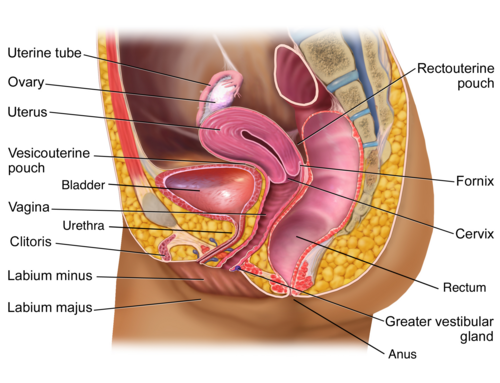
人間の膣は、外陰部から子宮頸部まで伸びる、弾力性のある筋肉の管です。[9] [10]膣の開口部は、尿生殖三角部にあります。尿生殖三角部は会陰の前部の三角形で、尿道口と外性器の関連部分も含みます。[11]膣管は、前方の尿道と後方の直腸の間を上方および後方に伸びています。膣の上部付近では、子宮頸部が前面で約 90 度の角度で膣内に突出しています。[12]膣と尿道の開口部は、陰唇によって保護されています。[13]
性的に興奮していないとき、膣は前壁と後壁がくっついた潰れた管状になっている。側壁、特にその中央部分は比較的硬い。このため、潰れた膣の断面はH字型になっている。[10] [14]後方では、膣上部は直腸子宮嚢によって直腸から分離され、膣中部は疎性結合組織によって、膣下部は会陰小体によって分離されている。[15]膣腔は子宮頸部を取り囲む部分で、前円蓋、後円蓋、右側円蓋、左側円蓋の4つの連続した領域(膣円蓋)に分かれている。 [9] [10]後円蓋は前円蓋よりも深い。[10]
膣を支えているのは、上部、中部、下部の3分の1の筋肉と靭帯です。上部3分の1は、肛門挙筋、経頸靭帯、恥骨頸靭帯、仙頸靭帯です。[9] [16]これは、基靭帯の上部と子宮傍組織によって支えられています。[17]膣の中部3分の1には、尿生殖横隔膜があります。[9]これは、肛門挙筋と基靭帯の下部によって支えられています。[17]下部3分の1は、会陰小体、[9] [18]または尿生殖横隔膜と骨盤横隔膜によって支えられています。[19]下部3分の1は、会陰小体と肛門挙筋の恥骨膣部分によって支えられているとも言えます。[16]
膣口と処女膜
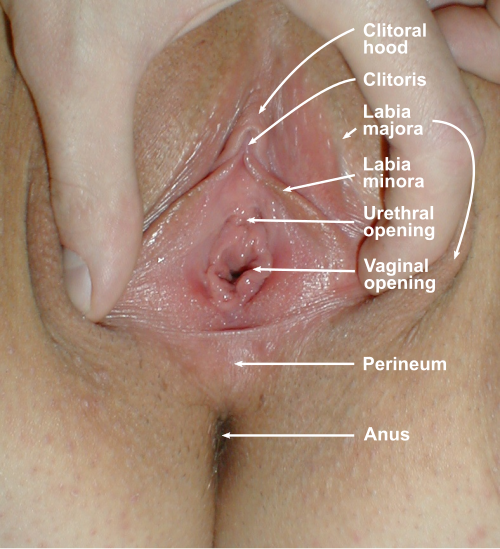
膣口(膣口ともラテン語では ostium vaginae とも呼ばれる) [ 20 ] [ 21]は、外陰部前庭の後端、尿道口の後ろにある。膣口は通常は潰れて閉じているため、膣口という用語の方が「開口部」よりも専門的には正確である。膣口は通常は小陰唇(内唇)で隠されているが、経膣分娩後に露出することがある。[10]
処女膜は、膣口を囲むか部分的に覆う薄い粘膜組織である。 [10]性交や出産が処女膜に与える影響は様々である。破れた箇所は完全に消失するか、ミルティフォルミスと呼ばれる残骸が残る。そうでなければ、非常に弾力性があるため、通常の位置に戻る可能性がある。[22]さらに、病気、怪我、診察、自慰、運動によって処女膜が裂けることもある。これらの理由から、処女膜を検査しても処女であるかどうかを明確に判断することはできない。[22] [23]
バリエーションとサイズ
出産可能年齢の女性では、膣の長さは様々です。膣の前壁に子宮頸部があるため、前壁の長さは約 7.5 cm (2.5 ~ 3 インチ)、後壁の長さは約 9 cm (3.5 インチ) です。 [10] [24] 性的興奮時には、膣は長さと幅の両方が広がります。女性が直立すると、膣管は上方後方を向き、子宮と約 45 度の角度を形成します。[10] [18]膣口と処女膜のサイズも様々です。子供の場合、処女膜は一般的に三日月形に見えますが、さまざまな形状が可能です。[10] [25]
発達

膣板は膣の前身です。[26]発育中、膣板は、ミュラー管の融合端が尿生殖洞の後壁に洞結節として入るところで成長し始めます。膣板が成長するにつれて、子宮頸部と尿生殖洞は大きく分離されます。最終的に、膣板の中央細胞が分解して膣腔を形成します。[26]これは通常、発育の20~24週目までに発生します。腔が形成されない、または不完全な場合、膣中隔と呼ばれる膜が管を横切ってまたは周囲に形成され、後年、流出路の閉塞を引き起こす可能性があります。[26]
膣の発生学的起源については相反する見解がある。多数派の見解は 1933 年の Koff の記述であり、膣の上部 3 分の 2 はミュラー管の尾部から発生し、膣の下部は尿生殖洞から発生するとしている。[27] [28]その他の見解としては、膣上皮は尿生殖洞上皮のみから発生するとする Bulmer の 1957 年の記述[29]や、Koff の記述を再検討して膣洞球部はウォルフ管の下部と同じであると結論付けた Witschi の 1970 年の研究がある。[28] [30] Witschi の見解は、Acién ら、Bok および Drews による研究によって裏付けられている。[28] [30] Robboy らコフとブルマーの理論を再検討し、自身の研究に照らしてブルマーの説明を支持している。[29]議論は、相互に関連する組織の複雑さと、人間の膣の発達に一致する動物モデルが存在しないことに起因している。[29] [31]このため、人間の膣の発達の研究は継続しており、矛盾するデータの解決に役立つ可能性がある。[28]
微細解剖学

膣壁は、内腔から外側に向かって、まず角質化していない重層扁平上皮粘膜と、その下にある粘膜固有層(結合組織の薄い層)から構成されています。次に、縦方向の線維(縦に走る線維)の内側に環状線維の束がある平滑筋の層があります。最後に、外膜と呼ばれる結合組織の外層があります。一部の文献では、粘膜の2つのサブ層(上皮と粘膜固有層)を別々に数えて4層と記載しています。[32] [33]
膣内の平滑筋層は弱い収縮力を持っており、膣腔にいくらかの圧力をかけることができます。出産時など、より強い収縮力は膣の周りの外膜に付着している骨盤底の筋肉から生じます。[34]
粘膜固有層には血管やリンパ管が豊富にある。筋層は平滑筋線維で構成され、外層は縦筋、内層は輪状筋、その間には斜筋線維がある。外層である外膜は薄く密な結合組織の層で、骨盤内臓器間の血管、リンパ管、神経線維を含む疎性結合組織と融合している。[12] [33] [24]膣粘膜には腺がない。襞(横方向の隆起または襞)を形成し、膣の外側3分の1でより顕著になる。襞の機能は、膣の伸展と伸張のための表面積を増やすことである。[9] [10]
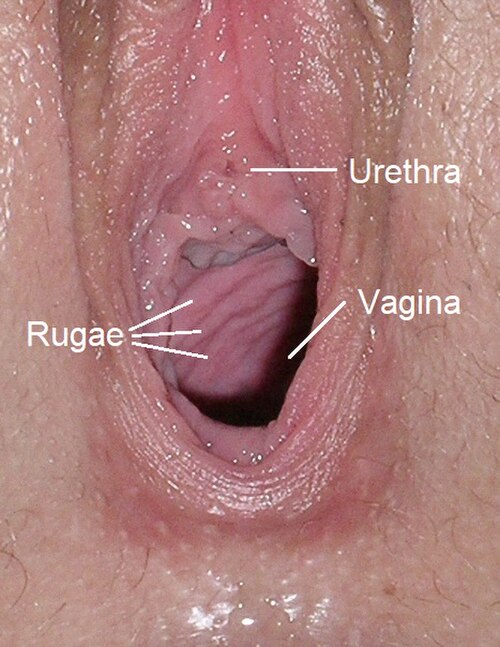
子宮頸管上皮(子宮頸管が膣に伸びる部分)は膣上皮の延長であり、膣上皮と境界を共有している。[35]膣上皮は、基底細胞、傍基底細胞、表層扁平細胞、中間細胞 などの細胞層で構成されている。 [36]上皮の基底層は最も有糸分裂が活発で、新しい細胞を再生する。[37]表層細胞は絶えず脱落し、基底細胞がそれらを置き換える。 [10] [38] [39] エストロゲンは中間細胞と表層細胞にグリコーゲンが充填されるように誘導する。[39] [40]下層の基底層の細胞は、活発な代謝活動から死(アポトーシス)へと移行する。上皮のこれらの中間層では、細胞はミトコンドリアやその他の細胞小器官を失い始める。[37] [41]細胞は体内の他の上皮組織と比較して通常高いレベルのグリコーゲンを保持しています。[37]
母親のエストロゲンの影響で、新生児の膣は出生後2~4週間は厚い重層扁平上皮(または粘膜)で覆われる。それから思春期までは、上皮は薄いままで、グリコーゲンを含まない立方細胞が数層あるだけである。[39] [42] また、上皮には皺もほとんどなく、思春期前は赤色である。[4]思春期が始まると、少女のエストロゲンレベルの上昇の影響で粘膜が厚くなり、再びグリコーゲンを含む細胞を含む重層扁平上皮になる。[39]最後に、閉経期以降はエストロゲンの不足により上皮が薄くなり、最終的にはグリコーゲンを含まなくなる。[10] [38] [43]
扁平化した扁平上皮細胞は、擦り傷や感染に対してより耐性があります。[42]上皮の透過性により、抗体やその他の免疫成分が表面に容易に到達できるため、免疫系からの効果的な反応が可能になります。 [44]膣上皮は、皮膚の同様の組織とは異なります。皮膚の表皮は脂質を多く含んでいるため、水に対して比較的耐性があります。膣上皮には脂質がより少なく含まれています。これにより、水と水溶性物質が組織を通過できます。[44]
角質化は、上皮が乾燥した外部の大気にさらされたときに起こります。[10]骨盤臓器脱などの異常な状況では、粘膜が空気にさらされ、乾燥して角質化することがあります。[45]
血液と神経の供給
膣への血液供給は主に膣動脈を通じて行われ、膣動脈は内腸骨動脈または子宮動脈の枝から出てきます。[9] [46]膣動脈は膣の側面で子宮動脈の頸部枝と吻合し、奇動脈[46]を形成します。奇動脈は前膣と後膣の正中線上にあります。[15]膣に血液を供給する他の動脈には中直腸動脈と内陰部動脈[10]があり、これらはすべて内腸骨動脈の枝です。[15]これらの動脈には3群のリンパ管が伴います。上部の群は子宮動脈の膣枝に伴われ、中部の群は膣動脈に伴われ、下部の群は処女膜の外側の領域からリンパ液を排出し、鼠径リンパ節に排出されます。[15] [47]膣のリンパ管の95%は膣表面から3mm以内にある。[48]
膣からは2本の主な静脈が血液を排出しており、1本は左、もう1本は右にある。これらは膣の両側で膣静脈叢と呼ばれる小さな静脈のネットワークを形成し、子宮、膀胱、直腸の同様の静脈叢とつながっている。これらは最終的に内腸骨静脈に排出される。[15]
膣上部の神経支配は骨盤神経叢の交感神経と副交感神経領域によって行われ、膣下部は陰部神経によって支配されている。[10] [15]
関数
分泌物
膣分泌物は主に子宮、子宮頸管、膣上皮から分泌され、性的興奮によりバルトリン腺から分泌される微量の膣潤滑剤も加わります。[10]膣を潤すのに少量の膣分泌物は必要ありません。性的興奮時、月経中または月経の少し前、または妊娠中に分泌物が増えることがあります。[10]月経(「生理」または「毎月」とも呼ばれる)は、子宮の内膜から膣を通って血液と粘膜組織(月経血)が定期的に排出されることです。[49]膣粘膜は月経周期中に厚さと組成が変化します。[50]月経は女性の生殖器系(具体的には子宮と卵巣)に起こる定期的で自然な変化であり、妊娠を可能にします。[51] [52]タンポン、月経カップ、生理用ナプキンなど、月経血を吸収したり捕らえたりする様々な衛生用品が販売されている。[53]
膣口付近にあるバルトリン腺は、もともと膣潤滑の主な供給源であると考えられていましたが、さらに調べたところ、数滴の粘液しか供給していないことが分かりました。[54]膣潤滑は主に、膣壁からの浸出液として知られる血漿の滲出によって供給されます。これは最初は汗のような液滴として形成され、膣組織内の体液圧の上昇(血管うっ血)によって引き起こされ、その結果、膣上皮を通して毛細血管から浸出液として血漿が放出されます。 [54] [55] [56]
排卵前と排卵中、子宮頸管内の粘液腺はさまざまな種類の粘液を分泌し、膣管内に精子の生存に好ましいアルカリ性の肥沃な環境を提供します。[57]閉経後、膣の潤滑は自然に減少します。[58]
性的刺激
性行為中に膣が刺激されると、膣の神経終末が快感をもたらすことがある。女性は膣の一部から快感を得ることもあれば、膣挿入中の親密感や充満感から快感を得ることもある。[59]膣には神経終末が豊富に存在しないため、女性は膣挿入だけでは十分な性的刺激、つまりオーガズムを得られないことが多い。[59] [60] [61]文献では一般的に、膣の入り口付近(外側3分の1または下部3分の1)に神経終末がより集中しており、したがって感度も高いとされているが、[60] [61] [62]膣壁の神経支配に関する科学的調査では、神経終末の密度が高い特定の領域は示されていない。[63] [64]他の研究では、一部の女性のみに前膣壁の神経終末の密度が高いことが示されている。[63] [65]膣内の神経終末が少ないため、出産時の痛みは大幅に耐えられる。[61] [66] [67]
膣からの快感は様々な方法で得られる。陰茎の挿入に加えて、自慰、指入れ、または特定の性交体位(正常位やスプーン体位など)からも快感が得られる。 [68]異性愛者のカップルは、性的興奮を誘発するための前戯として、または付随行為として、[69] [70]または一種の避妊として、または処女を守るために指入れを行うことがある。[71] [72]それほど一般的ではないが、陰茎と膣を使わない性行為を性的快感の主な手段として用いることもある。[70]対照的に、レズビアンや女性と性交をする他の女性は、一般的に指入れを主な性行為の形態としている。[73] [74]女性やカップルの中には、膣の快感を得るためにバイブレーターやディルドなどの大人のおもちゃを使用する人もいる。[75]
ほとんどの女性は、オーガズムに達するためにクリトリスを直接刺激する必要がある。 [60] [61]クリトリスは膣刺激に関与している。クリトリスは多面構造の性器で、豊富な神経終末を持ち、恥骨弓に広く付着し、陰唇に広範囲の支持組織を持つ。研究によると、膣と組織クラスターを形成している。この組織は、女性によっておそらく広範囲に広がっており、それが膣で感じるオーガズムに寄与している可能性がある。[60] [76] [77]
性的に興奮し、特にクリトリスが刺激されると、膣壁が潤滑する。これは性的興奮の10~30秒後に始まり、女性が興奮している時間が長くなるほど量が増える。[78]これにより、性行為中に陰茎が膣に挿入されたり、その他の方法で膣に挿入されたりすることで生じる摩擦や損傷が軽減される。膣は興奮中に長くなり、圧力に応じてさらに長くなることがある。女性が完全に興奮すると、膣は長さと幅が広がり、子宮頸部は引っ込む。[78] [79]膣の上部3分の2が拡張して長くなると、子宮が大骨盤内に上昇し、子宮頸部が膣底より上に上がり、膣中央面がテント状になる。[78]これはテント状効果またはバルーニング効果として知られている。[80] 膣の弾力性のある壁が骨盤底筋の支えによって伸びたり縮んだりして挿入されたペニス(または他の物体)を包み込むと、[62]ペニスに摩擦が生じ、男性がオーガズムと射精を経験し、受精が可能になります。[81]
膣内の性感帯の可能性がある部位はGスポットである。Gスポットは通常、膣の入り口から数センチ内側の膣前壁に位置すると定義され、性行為中にこの部位を刺激されると、強烈な快感、時にはオーガズムを経験する女性もいる。[63] [65] Gスポットオーガズムは女性の射精に関係している可能性があり、そのため一部の医師や研究者は、Gスポットの快感は膣壁の特定の部位ではなく、女性版前立腺であるスキーン腺から来ると考えている。一方、スキーン腺とGスポット部位のつながりは弱いと考える研究者もいる。[63] [64] [65] Gスポットの存在(および独立した構造としての存在)については、その位置に関する報告が女性によって異なること、一部の女性では存在しないように見えること、そしてGスポットはクリトリスの延長であり、したがって膣で経験されるオーガズムの原因であるという仮説があるため、依然として議論が続いています。[63] [66] [77]
出産
膣は赤ちゃんを出産するための産道です。陣痛が近づくと、膣分泌物や膜の破裂(破水)など、いくつかの兆候が現れることがあります。後者は、膣から羊水が噴出または少量流れ出る原因となります。 [82]破水は、陣痛の開始時に最も一般的に起こります。早期膜破裂の場合は、陣痛の前に起こります。早期膜破裂は、症例の10%に発生します。[83]初めて出産する女性では、ブラクストン・ヒックス収縮が実際の収縮と間違われますが、[84]これは体が本当の陣痛に備える方法です。陣痛の始まりを知らせるものではありません。[85]が、陣痛の前の数日間には通常、非常に強くなります。[84] [85]
体が出産の準備をするにつれ、子宮頸管は柔らかくなり、薄くなり、前方に移動して正面を向き、開き始めます。これにより胎児が骨盤内に落ち着くようになります。このプロセスは、子宮頸管の軽量化と呼ばれます。[86]胎児が骨盤内に落ち着くと、坐骨神経の痛み、膣分泌物の増加、および頻尿が発生する可能性があります。[86]以前に出産した女性の場合、子宮頸管の軽量化は陣痛が始まった後に起こる可能性が高いですが、初めて出産を経験する女性の場合は、出産の10〜14日前に起こることがあります。[87]
子宮収縮が始まると、胎児は子宮頸管の支えを失い始めます。胎児の頭を収容するために子宮頸管が10cmまで開くと、胎児の頭は子宮から膣へと移動します。 [82] [88]膣の弾力性により、赤ちゃんを出産するために通常の直径の何倍にも伸びることができます。[89]
経膣分娩の方が一般的ですが、合併症のリスクがある場合は帝王切開(Cセクション)が行われることがあります。[90]出産後間もなく、膣粘膜に異常な水分蓄積(浮腫)が見られ、薄く、しわもほとんどありません。卵巣が通常の機能を取り戻し、エストロゲンの流れが回復すると、約3週間で粘膜が厚くなり、しわが戻ります。膣口は開いて弛緩し、出産後6~8週間でほぼ妊娠前の状態に戻ります。この時期は産褥期と呼ばれますが、膣は出産前よりも大きいサイズのままです。[91]
出産後には悪露と呼ばれる膣分泌物の排出段階があり、その量や期間は大きく異なりますが、最長6週間続くこともあります。[92]
膣内細菌叢
.jpg/500px-Lactobacilli_(Gram_stain).jpg)
膣内細菌叢は、誕生から閉経まで、生涯を通じて変化する複雑な生態系です。膣微生物叢は、膣上皮の最外層に生息しています。 [44]この微生物叢は、通常、正常な免疫力を持つ女性に症状や感染症を引き起こさない種と属で構成されています。膣内微生物叢は、ラクトバチルス属が優勢です。[93]これらの種はグリコーゲンを代謝して糖に分解します。ラクトバチルスは、糖をグルコースと乳酸に代謝します。[94]エストロゲン、プロゲステロン、卵胞刺激ホルモン(FSH)などのホルモンの影響を受けて、膣生態系は周期的または定期的な変化を起こします。[94]
臨床的意義
骨盤検査


膣の健康は、女性生殖器系のほとんどの器官の健康とともに、骨盤内検査で評価することができます。 [95] [96] [97]このような検査には、パップテスト(または子宮頸部スメア)が含まれます。米国では、パップテストによるスクリーニングは、21歳頃から65歳まで推奨されています。[98] しかし、他の国では、性的に活動していない女性にはパップテストを推奨していません。[99]頻度に関するガイドラインは、3年から5年ごととさまざまです。[99] [100] [101]妊娠しておらず症状もない女性に対する定期的な骨盤内検査は、有益よりも有害である可能性があります。[102]妊婦の骨盤内検査で通常見られる所見は、膣壁の青みがかった色です。[95]
骨盤検査は、分泌物、痛み、予期せぬ出血、排尿障害などの原因不明の症状がある場合に最もよく行われます。[95] [103] [104]骨盤検査では、膣口の位置、対称性、処女膜の有無、形状が評価されます。膣鏡を挿入する前に、検査官が手袋をはめた指で膣の内部を評価し、弱さ、しこり、結節の有無を確認します。炎症や分泌物がある場合は、それらも確認します。この間、スキーン腺とバルトリン腺を触診して、これらの構造の異常を特定します。膣の指診が完了したら、内部構造を視覚化する器具である腟鏡を慎重に挿入して、子宮頸部を見えるようにします。[95]膣の検査は、腔内検索中に行う場合もあります。[105]
性的暴行やその他の性的虐待の際に、膣の裂傷やその他の損傷が発生することがあります。[4] [95]これらには、裂傷、打撲、炎症、擦過傷などがあります。異物による性的暴行は膣を損傷する可能性があり、X線検査で異物の存在が明らかになる場合があります。[4]同意が得られた場合、骨盤検査は性的暴行の評価の一部です。[106]骨盤検査は妊娠中にも行われ、リスクの高い妊娠の女性はより頻繁に検査を受けます。[95] [107]
医薬品
膣内投与は、クリームまたは錠剤として薬剤を膣内に挿入する投与経路である。薬理学的には、他の投与経路と比較して全身的な副作用が限定的であり、主に膣または近傍の構造(子宮頸部の膣部分など)に治療効果を促進するという潜在的な利点がある。 [ 108] [109]子宮頸管を成熟させて陣痛を誘発するために使用される薬剤は、エストロゲン、避妊薬、プロプラノロール、抗真菌薬と同様に、この経路で一般的に投与される。膣リングは、避妊膣リングでの避妊を含む薬剤の投与にも使用できる。これらは膣に挿入され、膣内および全身に継続的かつ低用量で一貫した薬剤レベルを提供する。[110] [111]
赤ちゃんが子宮から出てくる前に、出産時の痛みを抑える注射を膣壁から陰部神経の近くに投与することがある。陰部神経は骨盤筋を支配する運動神経と感覚神経を運ぶため、陰部神経ブロックは出産時の痛みを和らげる。この薬は子供に害を及ぼさず、重大な合併症もない。[112]
感染症、病気、そして安全なセックス
膣感染症や膣疾患には、酵母菌感染症、膣炎、性感染症(STI)、がんなどがある。膣内細菌叢中のガセリ菌やその他の乳酸菌種は、バクテリオシンや過酸化水素を分泌することで、ある程度の感染防御機能を発揮する。[113]出産可能年齢の女性の健康な膣は酸性で、pHは通常3.8~4.5である。[94] pHが低いと、多くの病原性微生物株の増殖が抑制される。[94]膣の酸性バランスは、精液、[114] [115]妊娠、月経、糖尿病またはその他の病気、避妊薬、特定の抗生物質、不健康な食事、ストレスによっても影響を受ける可能性がある。[116]膣の酸性バランスのこれらの変化はいずれも、酵母菌感染症の一因となる可能性がある。[117]膣液のpH値の上昇(4.5以上)は、細菌性膣炎や寄生虫感染症のトリコモナス症のように細菌の過剰増殖によって引き起こされる可能性があり、どちらも膣炎の症状があります。[94] [118]細菌性膣炎の特徴であるさまざまな細菌が生息する膣内細菌叢は、妊娠の不良転帰のリスクを高めます。[119]骨盤検査中に、性感染症やその他の感染症のスクリーニングのために膣液のサンプルを採取することがあります。[95] [120]
膣は自浄作用があるため、通常は特別な衛生管理は必要ありません。[121]臨床医は一般的に、外陰部から膣の健康を維持するために膣洗浄を行うことを推奨していません。[121] [122]膣内細菌叢は病気から身を守るため、このバランスが崩れると感染症や異常な分泌物につながる可能性があります。[121]膣分泌物は、色や臭い、または分泌物に伴う刺激や灼熱感などの症状から、膣感染症を示している可能性があります。[123] [124]異常な膣分泌物は、性感染症、糖尿病、膣洗浄、芳香剤入り石鹸、泡風呂、避妊薬、酵母菌感染症(一般的には抗生物質の使用による)、または別の形の膣炎によって引き起こされる可能性があります。[123]膣炎は膣の炎症であり、感染、ホルモンの問題、または刺激物に起因するが、[125] [126] 膣痙攣は条件反射または病気によって引き起こされる膣挿入中の膣筋肉の不随意の緊張である。[125]酵母感染症による膣分泌物は通常、粘稠でクリーム色で無臭であるが、細菌性膣炎による分泌物は灰白色であり、トリコモナス症による分泌物は通常灰色で粘稠度が薄く、魚のような臭いがする。トリコモナス症症例の25%の分泌物は黄緑色である。[124]
HIV/エイズ、ヒトパピローマウイルス(HPV)、性器ヘルペス、トリコモナス症などは膣に影響を及ぼす性感染症であり、保健当局はこれらの性感染症やその他の性感染症の感染を防ぐために安全な性行為(またはバリア法)を推奨している。[127] [128]安全な性行為ではコンドームの使用が一般的で、女性用コンドーム(女性がよりコントロールできる)が使用されることもある。どちらのタイプも、精液が膣に接触するのを防ぐことで妊娠を防ぐのに役立つ。[129] [130]しかし、女性用コンドームが男性用コンドームと同じくらい性感染症の予防に効果的かどうかについての研究はほとんどなく、[130]女性用コンドームは男性用コンドームよりも妊娠を防ぐ効果がわずかに劣る。これは女性用コンドームが男性用コンドームほどきつくフィットしないか、膣内に滑り込んで精液が漏れる可能性があるためであると考えられる。[131]
膣リンパ節は、膣に由来する癌細胞を捕らえることが多い。これらのリンパ節は、病気の存在を評価できる。膣リンパ節の選択的外科的切除(より侵襲的な全摘出ではなく)は、より根治的な手術に伴う可能性のある合併症のリスクを軽減する。これらの選択的リンパ節は、センチネルリンパ節として機能する。 [48]手術の代わりに、懸念されるリンパ節は、患者の骨盤リンパ節、鼠径リンパ節、またはその両方に放射線療法を施して治療されることがある。[132]
膣がんと外陰がんは非常にまれで、主に高齢の女性に発症します。[133] [134] 子宮頸がん(比較的よく見られます)は膣がんのリスクを高めます。[135]そのため、膣がんが子宮頸がんと同時に、または子宮頸がんの後に発生する可能性がかなり高くなります。原因が同じである可能性があります。[135] [133] [136]子宮頸がんはパップスメア検査とHPVワクチンで予防できますが、HPVワクチンは子宮頸がんの70%の原因であるHPV16型と18型のみを対象としています。[137] [138] 子宮頸がんと膣がんの症状には、性交痛、異常な膣出血または膣分泌物(特に性交後または閉経後)などがあります。[139] [140]しかし、ほとんどの子宮頸がんは無症状です(症状がまったく現れません)。[139]膣腔内小線源治療(VBT)は、子宮内膜がん、膣がん、子宮頸がんの治療に使用されます。アプリケーターを膣に挿入して、がんのできるだけ近くで放射線を照射できるようにします。[141] [142]体外照射療法と比較すると、VBTでは生存率が向上します。[141]膣を使用して、エミッターをがんの増殖にできるだけ近づけることで、放射線療法の全身的影響が軽減され、膣がんの治癒率が高まります。[143]子宮頸がんを放射線療法で治療すると膣がんのリスクが高まるかどうかについては、研究が不明確です。[135]
老化と出産の影響
年齢とホルモンレベルは、膣のpHと有意に相関しています。[144]エストロゲン、グリコーゲン、乳酸菌がこれらのレベルに影響を与えます。[145] [146]出生時には、膣は酸性でpHは約4.5ですが、[144]生後3~6週までに酸性ではなくなり、[147]アルカリ性になります。[148]思春期前の女児の膣pHの平均は7.0です。[145]時期には大きなばらつきがありますが、約7~12歳の女児は、処女膜が厚くなり、膣が約8cmに伸びるにつれて、陰唇の発達が続きます。膣粘膜が厚くなり、膣のpHは再び酸性になります。女児は、白帯下と呼ばれる薄くて白い膣分泌物を経験することもあります。[148] 13歳から18歳の思春期の少女の膣内微生物叢は生殖年齢の女性と似ており[146] 、膣内pHの平均値は3.8~4.5である[94]が、月経前または月経前後の少女でこれが同じかどうかについては研究が明確ではない。 [ 146]閉経期の膣内pHは6.5~7.0(ホルモン補充療法なし)、ホルモン補充療法ありでは4.5~5.0である。[146]

閉経後、体内のエストロゲンの産生は減少します。これが萎縮性膣炎(膣壁の菲薄化と炎症)を引き起こし、[38] [149]膣のかゆみ、灼熱感、出血、痛み、または膣の乾燥(潤滑の低下)につながる可能性があります。[150]膣の乾燥は、それ自体が不快感を引き起こしたり、性交中に不快感や痛みを引き起こしたりする可能性があります。[150] [151] ほてりも閉経期の特徴です。[116] [152]閉経は膣支持構造の構成にも影響を及ぼします。血管構造は加齢とともに減少します。[153] 特定のコラーゲンの組成と比率が変わります。膣の支持構造の弱化は、この結合組織の生理学的変化によるものと考えられています。[154]
更年期症状は、エストロゲン含有膣クリーム[152] 、非処方の非ホルモン薬[150] 、フェムリングなどの膣エストロゲンリング[155]、またはその他のホルモン補充療法[152]によって緩和できますが、ホルモン補充療法にはリスク(副作用を含む)が伴います。[156] [157]膣クリームや膣エストロゲンリングは、他のホルモン補充療法と同じリスクがない可能性があります。[158]ホルモン補充療法は膣の乾燥を治療できますが、[ 155]性交時にのみ膣の乾燥を一時的に改善するために個人用潤滑剤が使用される場合があります。[151]女性の中には、閉経後に性欲が増加する人もいます。[150]更年期に入っても性行為を定期的に続けている女性は、閉経していない女性と同程度の膣の潤いを感じ、性交を十分に楽しむことができるのかもしれない。[150]彼女たちは膣萎縮が少なく、性交に関する問題も少ないかもしれない。[159]
加齢や出産に伴って起こる膣の変化には、粘膜の余剰、肛門管の遠位端から膣口までの距離が短くなる膣後面の丸み、会陰切開の修復不良による恥骨尾骨筋の離開または断裂、膣口の領域を超えて突出する可能性のある水疱などがある。 [160]加齢や出産に関連するその他の膣の変化には、腹圧性尿失禁、直腸瘤、膀胱瘤がある。[160]妊娠、出産、閉経による身体的変化は、腹圧性尿失禁の一因となることが多い。女性の骨盤底筋の支持力が弱く、出産や骨盤手術による組織損傷がある場合、エストロゲンの不足により骨盤筋がさらに弱くなり、腹圧性尿失禁の一因となる可能性がある。[161]直腸瘤や膀胱瘤などの骨盤臓器脱は、骨盤内臓器が正常な位置から下降して膣に圧迫されることを特徴とする。 [162] [163]エストロゲンの減少は直腸瘤、膀胱瘤、子宮脱の原因にはなりませんが、出産や骨盤支持構造の弱化が原因となる可能性があります。[159]子宮摘出、婦人科癌治療、重い物を持ち上げる際に骨盤底が損傷した場合にも脱出が起こることがあります。 [162] [163]ケーゲル体操などの骨盤底筋体操は骨盤底筋を強化し、[164]脱出の進行を予防または阻止するために使用できます。 [165]ケーゲル体操を等張的に行うか、何らかの形の重りを付けて行う方が優れているという証拠はありません。重りを使用すると、膣に異物が入ってしまうため、リスクが高くなります。[166]
出産の第3期、つまり赤ちゃんが生まれる間、膣は大きな変化を遂げます。赤ちゃんが生まれる直前に膣から血が噴き出すのが見られることがあります。出産時に起こりうる膣裂傷は、深さ、重症度、および隣接組織の関与の程度が異なります。[4] [167]裂傷は直腸や肛門にまで及ぶほど広範囲に及ぶことがあります。この出来事は特に新米の母親にとって苦痛となる可能性があります。[167] [168]これが起こると、便失禁が起こり、便が膣から出ることがあります。[167]自然分娩の約85%で何らかの裂傷が起こります。このうち60~70%は縫合が必要です。[169] [170]出産による裂傷は必ずしも起こるわけではありません。[44]
手術
膣は、膣口を含めて、会陰切開、膣切除、膣形成術、または小陰唇形成術などの手術の結果として変化することがある。[160] [171]膣形成術を受ける人は通常、高齢で出産経験がある。[160]膣形成術の前には膣の徹底的な検査が標準であり、膣疾患の可能性を診断するために泌尿器科婦人科医への紹介も行われる。[160]小陰唇形成術に関しては、小陰唇の縮小は支障なく迅速に行われ、合併症は軽微でまれであり、修正可能である。手術による瘢痕は最小限であり、長期的な問題は確認されていない。[160]
During an episiotomy, a surgical incision is made during the second stage of labor to enlarge the vaginal opening for the baby to pass through.[44][141] Although its routine use is no longer recommended,[172] and not having an episiotomy is found to have better results than an episiotomy,[44] it is one of the most common medical procedures performed on women. The incision is made through the skin, vaginal epithelium, subcutaneous fat, perineal body and superficial transverse perineal muscle and extends from the vagina to the anus.[173][174] Episiotomies can be painful after delivery. Women often report pain during sexual intercourse up to three months after laceration repair or an episiotomy.[169][170] Some surgical techniques result in less pain than others.[169] The two types of episiotomies performed are the medial incision and the medio-lateral incision. The median incision is a perpendicular cut between the vagina and the anus and is the most common.[44][175] The medio-lateral incision is made between the vagina at an angle and is not as likely to tear through to the anus. The medio-lateral cut takes more time to heal than the median cut.[44]
Vaginectomy is surgery to remove all or part of the vagina, and is usually used to treat malignancy.[171] Removal of some or all of the sexual organs can result in damage to the nerves and leave behind scarring or adhesions.[176] Sexual function may also be impaired as a result, as in the case of some cervical cancer surgeries. These surgeries can impact pain, elasticity, vaginal lubrication and sexual arousal. This often resolves after one year but may take longer.[176]
Women, especially those who are older and have had multiple births, may choose to surgically correct vaginal laxity. This surgery has been described as vaginal tightening or rejuvenation.[177] While a woman may experience an improvement in self-image and sexual pleasure by undergoing vaginal tightening or rejuvenation,[177] there are risks associated with the procedures, including infection, narrowing of the vaginal opening, insufficient tightening, decreased sexual function (such as pain during sexual intercourse), and rectovaginal fistula. Women who undergo this procedure may unknowingly have a medical issue, such as a prolapse, and an attempt to correct this is also made during the surgery.[178]
Surgery on the vagina can be elective or cosmetic. Women who seek cosmetic surgery can have congenital conditions, physical discomfort or wish to alter the appearance of their genitals. Concerns over average genital appearance or measurements are largely unavailable and make defining a successful outcome for such surgery difficult.[179] A number of sex reassignment surgeries are available to transgender people. Although not all intersex conditions require surgical treatment, some choose genital surgery to correct atypical anatomical conditions.[180]
Anomalies and other health issues

Vaginal anomalies are defects that result in an abnormal or absent vagina.[181][182] The most common obstructive vaginal anomaly is an imperforate hymen, a condition in which the hymen obstructs menstrual flow or other vaginal secretions.[183][184] Another vaginal anomaly is a transverse vaginal septum, which partially or completely blocks the vaginal canal.[183] The precise cause of an obstruction must be determined before it is repaired, since corrective surgery differs depending on the cause.[185] In some cases, such as isolated vaginal agenesis, the external genitalia may appear normal.[186]
Abnormal openings known as fistulas can cause urine or feces to enter the vagina, resulting in incontinence.[187][188] The vagina is susceptible to fistula formation because of its proximity to the urinary and gastrointestinal tracts.[189] Specific causes are manifold and include obstructed labor, hysterectomy, malignancy, radiation, episiotomy, and bowel disorders.[190][191] A small number of vaginal fistulas are congenital.[192] Various surgical methods are employed to repair fistulas.[193][187] Untreated, fistulas can result in significant disability and have a profound impact on quality of life.[187]
Vaginal evisceration is a serious complication of a vaginal hysterectomy and occurs when the vaginal cuff ruptures, allowing the small intestine to protrude from the vagina.[106][194]
Cysts may also affect the vagina. Various types of vaginal cysts can develop on the surface of the vaginal epithelium or in deeper layers of the vagina and can grow to be as large as 7 cm.[195][196] Often, they are an incidental finding during a routine pelvic examination.[197] Vaginal cysts can mimic other structures that protrude from the vagina such as a rectocele and cystocele.[195] Cysts that can be present include Müllerian cysts, Gartner's duct cysts, and epidermoid cysts.[198][199] A vaginal cyst is most likely to develop in women between the ages of 30 and 40.[195] It is estimated that 1 out of 200 women has a vaginal cyst.[195][200] The Bartholin's cyst is of vulvar rather than vaginal origin,[201] but it presents as a lump at the vaginal opening.[202] It is more common in younger women and is usually without symptoms,[203] but it can cause pain if an abscess forms,[203] block the entrance to the vulval vestibule if large,[204] and impede walking or cause painful sexual intercourse.[203]
Society and culture
Perceptions, symbolism and vulgarity
Various perceptions of the vagina have existed throughout history, including the belief it is the center of sexual desire, a metaphor for life via birth, inferior to the penis, unappealing to sight or smell, or vulgar.[205][206][207] These views can largely be attributed to sex differences, and how they are interpreted. David Buss, an evolutionary psychologist, stated that because a penis is significantly larger than a clitoris and is readily visible while the vagina is not, and males urinate through the penis, boys are taught from childhood to touch their penises while girls are often taught that they should not touch their own genitalia, which implies that there is harm in doing so. Buss attributed this as the reason many women are not as familiar with their genitalia, and that researchers assume these sex differences explain why boys learn to masturbate before girls and do so more often.[208]
The word vagina is commonly avoided in conversation,[209] and many people are confused about the vagina's anatomy and may be unaware that it is not used for urination.[210][211][212] This is exacerbated by phrases such as "boys have a penis, girls have a vagina", which causes children to think that girls have one orifice in the pelvic area.[211] Author Hilda Hutcherson stated, "Because many [women] have been conditioned since childhood through verbal and nonverbal cues to think of [their] genitals as ugly, smelly and unclean, [they] aren't able to fully enjoy intimate encounters" because of fear that their partner will dislike the sight, smell, or taste of their genitals. She argued that women, unlike men, did not have locker room experiences in school where they compared each other's genitals, which is one reason so many women wonder if their genitals are normal.[206] Scholar Catherine Blackledge stated that having a vagina meant she would typically be treated less well than her vagina-less counterparts and subject to inequalities (such as job inequality), which she categorized as being treated like a second-class citizen.[209]

Negative views of the vagina are simultaneously contrasted by views that it is a powerful symbol of female sexuality, spirituality, or life. Author Denise Linn stated that the vagina "is a powerful symbol of womanliness, openness, acceptance, and receptivity. It is the inner valley spirit".[213] Sigmund Freud placed significant value on the vagina,[214] postulating the concept that vaginal orgasm is separate from clitoral orgasm, and that, upon reaching puberty, the proper response of mature women is a changeover to vaginal orgasms (meaning orgasms without any clitoral stimulation). This theory made many women feel inadequate, as the majority of women cannot achieve orgasm via vaginal intercourse alone.[215][216][217] Regarding religion, the womb represents a powerful symbol as the yoni in Hinduism, which represents "the feminine potency", and this may indicate the value that Hindu society has given female sexuality and the vagina's ability to deliver life;[218] however, yoni as a representation of "womb" is not the primary denotation.[219]
While, in ancient times, the vagina was often considered equivalent (homologous) to the penis, with anatomists Galen (129 AD – 200 AD) and Vesalius (1514–1564) regarding the organs as structurally the same except for the vagina being inverted, anatomical studies over latter centuries showed the clitoris to be the penile equivalent.[76][220] Another perception of the vagina was that the release of vaginal fluids would cure or remedy a number of ailments; various methods were used over the centuries to release "female seed" (via vaginal lubrication or female ejaculation) as a treatment for suffocatio ex semine retento (suffocation of the womb, lit. 'suffocation from retained seed'), green sickness, and possibly for female hysteria. Reported methods for treatment included a midwife rubbing the walls of the vagina or insertion of the penis or penis-shaped objects into the vagina. Symptoms of the female hysteria diagnosis – a concept that is no longer recognized by medical authorities as a medical disorder – included faintness, nervousness, insomnia, fluid retention, heaviness in abdomen, muscle spasm, shortness of breath, irritability, loss of appetite for food or sex, and a propensity for causing trouble.[221] It may be that women who were considered suffering from female hysteria condition would sometimes undergo "pelvic massage" – stimulation of the genitals by the doctor until the woman experienced "hysterical paroxysm" (i.e., orgasm). In this case, paroxysm was regarded as a medical treatment, and not a sexual release.[221]
The vagina has been given many vulgar names, three of which are pussy, twat, and cunt. Cunt is also used as a derogatory epithet referring to people of either sex. This usage is relatively recent, dating from the late nineteenth century.[222] Reflecting different national usages, cunt is described as "an unpleasant or stupid person" in the Compact Oxford English Dictionary,[223] whereas the Merriam-Webster has a usage of the term as "usually disparaging and obscene: woman",[224] noting that it is used in the United States as "an offensive way to refer to a woman".[225] Random House defines it as "a despicable, contemptible or foolish man".[222] Some feminists of the 1970s sought to eliminate disparaging terms such as cunt.[226] Twat is widely used as a derogatory epithet, especially in British English, referring to a person considered obnoxious or stupid.[227][228] Pussy can indicate "cowardice or weakness", and "the human vulva or vagina" or by extension "sexual intercourse with a woman".[229] In English, the use of the word pussy to refer to women is considered derogatory or demeaning, treating people as sexual objects.[230]
In literature and art
The vagina loquens, or "talking vagina", is a significant tradition in literature and art, dating back to the ancient folklore motifs of the "talking cunt".[231][232] These tales usually involve vaginas talking by the effect of magic or charms, and often admitting to their lack of chastity.[231] Other folk tales relate the vagina as having teeth – vagina dentata (Latin for "toothed vagina"). These carry the implication that sexual intercourse might result in injury, emasculation, or castration for the man involved. These stories were frequently told as cautionary tales warning of the dangers of unknown women and to discourage rape.[233]
In 1966, the French artist Niki de Saint Phalle collaborated with Dadaist artist Jean Tinguely and Per Olof Ultvedt on a large sculpture installation entitled "hon-en katedral" (also spelled "Hon-en-Katedrall", which means "she-a cathedral") for Moderna Museet, in Stockholm, Sweden. The outer form is a giant, reclining sculpture of a woman which visitors can enter through a door-sized vaginal opening between her spread legs.[234]
The Vagina Monologues, a 1996 episodic play by Eve Ensler, has contributed to making female sexuality a topic of public discourse. It is made up of a varying number of monologues read by a number of women. Initially, Ensler performed every monologue herself, with subsequent performances featuring three actresses; latter versions feature a different actress for every role. Each of the monologues deals with an aspect of the feminine experience, touching on matters such as sexual activity, love, rape, menstruation, female genital mutilation, masturbation, birth, orgasm, the various common names for the vagina, or simply as a physical aspect of the body. A recurring theme throughout the pieces is the vagina as a tool of female empowerment, and the ultimate embodiment of individuality.[235][236]
Influence on modification
Societal views, influenced by tradition, a lack of knowledge on anatomy, or sexism, can significantly impact a person's decision to alter their own or another person's genitalia.[178][237] Women may want to alter their genitalia (vagina or vulva) because they believe that its appearance, such as the length of the labia minora covering the vaginal opening, is not normal, or because they desire a smaller vaginal opening or tighter vagina. Women may want to remain youthful in appearance and sexual function. These views are often influenced by the media,[178][238] including pornography,[238] and women can have low self-esteem as a result.[178] They may be embarrassed to be naked in front of a sexual partner and may insist on having sex with the lights off.[178] When modification surgery is performed purely for cosmetic reasons, it is often viewed poorly,[178] and some doctors have compared such surgeries to female genital mutilation (FGM).[238]
Female genital mutilation, also known as female circumcision or female genital cutting, is genital modification with no health benefits.[239][240] The most severe form is Type III FGM, which is infibulation and involves removing all or part of the labia and the vagina being closed up. A small hole is left for the passage of urine and menstrual blood, and the vagina is opened up for sexual intercourse and childbirth.[240]
Significant controversy surrounds female genital mutilation,[239][240] with the World Health Organization (WHO) and other health organizations campaigning against the procedures on behalf of human rights, stating that it is "a violation of the human rights of girls and women" and "reflects deep-rooted inequality between the sexes".[240] Female genital mutilation has existed at one point or another in almost all human civilizations,[241] most commonly to exert control over the sexual behavior, including masturbation, of girls and women.[240][241] It is carried out in several countries, especially in Africa, and to a lesser extent in other parts of the Middle East and Southeast Asia, on girls from a few days old to mid-adolescent, often to reduce sexual desire in an effort to preserve vaginal virginity.[239][240][241] Comfort Momoh stated it may be that female genital mutilation was "practiced in ancient Egypt as a sign of distinction among the aristocracy"; there are reports that traces of infibulation are on Egyptian mummies.[241]
Custom and tradition are the most frequently cited reasons for the practice of female genital mutilation. Some cultures believe that female genital mutilation is part of a girl's initiation into adulthood and that not performing it can disrupt social and political cohesion.[240][241] In these societies, a girl is often not considered an adult unless she has undergone the procedure.[240]
Other animals

The vagina is a structure of animals in which the female is internally fertilized, rather than by traumatic insemination used by some invertebrates. The shape of the vagina varies among different animals. In placental mammals and marsupials, the vagina leads from the uterus to the exterior of the female body. Female marsupials have two lateral vaginas, which lead to separate uteri, but both open externally through the same orifice;[242] a third canal, which is known as the median vagina, and can be transitory or permanent, is used for birth.[243] The female spotted hyena does not have an external vaginal opening. Instead, the vagina exits through the clitoris, allowing the females to urinate, copulate and give birth through the clitoris.[244] The vagina of the female coyote contracts during copulation, forming a copulatory tie.[245]
Birds, monotremes, and some reptiles have a part of the oviduct that leads to the cloaca.[246][247] Chickens have a vaginal aperture that opens from the vertical apex of the cloaca. The vagina extends upward from the aperture and becomes the egg gland.[247] In some jawless fish, there is neither oviduct nor vagina and instead the egg travels directly through the body cavity (and is fertilised externally as in most fish and amphibians). In insects and other invertebrates, the vagina can be a part of the oviduct (see insect reproductive system).[248] Birds have a cloaca into which the urinary, reproductive tract (vagina) and gastrointestinal tract empty.[249] Females of some waterfowl species have developed vaginal structures called dead end sacs and clockwise coils to protect themselves from sexual coercion.[250]
A lack of research on the vagina and other female genitalia, especially for different animals, has stifled knowledge on female sexual anatomy.[251][252] One explanation for why male genitalia is studied more includes penises being significantly simpler to analyze than female genital cavities, because male genitals usually protrude and are therefore easier to assess and measure. By contrast, female genitals are more often concealed, and require more dissection, which in turn requires more time.[251] Another explanation is that a main function of the penis is to impregnate, while female genitals may alter shape upon interaction with male organs, especially as to benefit or hinder reproductive success.[251]
Non-human primates are optimal models for human biomedical research because humans and non-human primates share physiological characteristics as a result of evolution.[253] While menstruation is heavily associated with human females, and they have the most pronounced menstruation, it is also typical of ape relatives and monkeys.[254][255] Female macaques menstruate, with a cycle length over the course of a lifetime that is comparable to that of female humans. Estrogens and progestogens in the menstrual cycles and during premenarche and postmenopause are also similar in female humans and macaques; however, only in macaques does keratinization of the epithelium occur during the follicular phase.[253] The vaginal pH of macaques also differs, with near-neutral to slightly alkaline median values and is widely variable, which may be due to its lack of lactobacilli in the vaginal flora.[253] This is one reason why, although macaques are used for studying HIV transmission and testing microbicides,[253] animal models are not often used in the study of sexually transmitted infections, such as trichomoniasis. Another is that such conditions' causes are inextricably bound to humans' genetic makeup, making results from other species difficult to apply to humans.[256]
See also
.svg/500px-Bisexuality_symbol_(bold,_color).svg.png)

- Artificial vagina
- Stigma (botany)
- Supravaginal portion of cervix
- Uterine inversion
- Vaginal dilator
- Vaginal photoplethysmograph
References
- ^ a b Stevenson A (2010). Oxford Dictionary of English. Oxford University Press. p. 1962. ISBN 978-0-19-957112-3. Archived from the original on June 3, 2021. Retrieved October 27, 2015.
- ^ Nevid J, Rathus S, Rubenstein H (1998). Health in the New Millennium: The Smart Electronic Edition (S.E.E.). Macmillan. p. 297. ISBN 978-1-57259-171-4. Archived from the original on June 3, 2021. Retrieved October 27, 2015.
- ^ Lipsky MS (2006). American Medical Association Concise Medical Encyclopedia. Random House Reference. p. 96. ISBN 978-0-375-72180-9. Archived from the original on June 3, 2021. Retrieved October 27, 2015.
- ^ a b c d e f g Dalton M (2014). Forensic Gynaecology. Cambridge University Press. p. 65. ISBN 978-1-107-06429-4. Archived from the original on September 17, 2020. Retrieved October 27, 2015.
- ^ Jones T, Wear D, Friedman LD (2014). Health Humanities Reader. Rutgers University Press. pp. 231–232. ISBN 978-0-8135-7367-0. Archived from the original on June 3, 2021. Retrieved October 27, 2015.
- ^ a b Kirkpatrick M (2012). Human Sexuality: Personality and Social Psychological Perspectives. Springer Science & Business Media. p. 175. ISBN 978-1-4684-3656-3. Archived from the original on April 22, 2021. Retrieved February 3, 2016.
- ^ Hill CA (2007). Human Sexuality: Personality and Social Psychological Perspectives. SAGE Publications. pp. 265–266. ISBN 978-1-5063-2012-0. Archived from the original on June 3, 2021. Retrieved February 3, 2016.
Little thought apparently has been devoted to the nature of female genitals in general, likely accounting for the reason that most people use incorrect terms when referring to female external genitals. The term typically used to talk about female genitals is vagina, which is actually an internal sexual structure, the muscular passageway leading outside from the uterus. The correct term for the female external genitals is vulva, as discussed in chapter 6, which includes the clitoris, labia majora, and labia minora.
- ^ Sáenz-Herrero M (2014). Psychopathology in Women: Incorporating Gender Perspective into Descriptive Psychopathology. Springer. p. 250. ISBN 978-3-319-05870-2. Archived from the original on April 22, 2021. Retrieved February 3, 2016.
In addition, there is a current lack of appropriate vocabulary to refer to the external female genitals, using, for example, 'vagina' and 'vulva' as if they were synonyms, as if using these terms incorrectly were harmless to the sexual and psychological development of women.'
- ^ a b c d e f g Snell RS (2004). Clinical Anatomy: An Illustrated Review with Questions and Explanations. Lippincott Williams & Wilkins. p. 98. ISBN 978-0-7817-4316-7. Archived from the original on March 10, 2021. Retrieved October 27, 2015.
- ^ a b c d e f g h i j k l m n o p q Dutta DC (2014). DC Dutta's Textbook of Gynecology. JP Medical Ltd. pp. 2–7. ISBN 978-93-5152-068-9. Archived from the original on July 4, 2019. Retrieved October 27, 2015.
- ^ Drake R, Vogl AW, Mitchell A (2016). Gray's Basic Anatomy E-Book. Elsevier Health Sciences. p. 246. ISBN 978-0-323-50850-6. Archived from the original on June 4, 2021. Retrieved May 25, 2018.
- ^ a b Ginger VA, Yang CC (2011). "Functional Anatomy of the Female Sex Organs". In Mulhall JP, Incrocci L, Goldstein I, Rosen R (eds.). Cancer and Sexual Health. Springer. pp. 13, 20–21. ISBN 978-1-60761-915-4. Archived from the original on December 16, 2019. Retrieved August 20, 2020.
- ^ Ransons A (May 15, 2009). "Reproductive Choices". Health and Wellness for Life. Human Kinetics 10%. p. 221. ISBN 978-0-7360-6850-5. Archived from the original on May 6, 2016. Retrieved October 27, 2015.
- ^ Beckmann CR (2010). Obstetrics and Gynecology. Lippincott Williams & Wilkins. p. 37. ISBN 978-0-7817-8807-6. Archived from the original on February 15, 2017. Retrieved January 31, 2017.
Because the vagina is collapsed, it appears H-shaped in cross section.
- ^ a b c d e f Standring S, Borley NR, eds. (2008). Gray's anatomy : the anatomical basis of clinical practice (40th ed.). London: Churchill Livingstone. pp. 1281–4. ISBN 978-0-8089-2371-8.
- ^ a b Baggish MS, Karram MM (2011). Atlas of Pelvic Anatomy and Gynecologic Surgery - E-Book. Elsevier Health Sciences. p. 582. ISBN 978-1-4557-1068-3. Archived from the original on July 4, 2019. Retrieved May 7, 2018.
- ^ a b Arulkumaran S, Regan L, Papageorghiou A, Monga A, Farquharson D (2011). Oxford Desk Reference: Obstetrics and Gynaecology. OUP Oxford. p. 472. ISBN 978-0-19-162087-4. Archived from the original on July 3, 2019. Retrieved May 7, 2018.
- ^ a b Manual of Obstetrics (3rd ed.). Elsevier. 2011. pp. 1–16. ISBN 978-81-312-2556-1.
- ^ Smith RP, Turek P (2011). Netter Collection of Medical Illustrations: Reproductive System E-Book. Elsevier Health Sciences. p. 443. ISBN 978-1-4377-3648-9. Archived from the original on July 3, 2019. Retrieved May 7, 2018.
- ^ Ricci, Susan Scott; Kyle, Terri (2009). Maternity and Pediatric Nursing. Wolters Kluwer Health/Lippincott Williams & Wilkins. p. 77. ISBN 978-0-78178-055-1. Retrieved January 7, 2024.
- ^ Zink, Christopher (2011). Dictionary of Obstetrics and Gynecology. De Gruyter. p. 174. ISBN 978-3-11085-727-6.
- ^ a b Knight B (1997). Simpson's Forensic Medicine (11th ed.). London: Arnold. p. 114. ISBN 978-0-7131-4452-9.
- ^ Perlman SE, Nakajyma ST, Hertweck SP (2004). Clinical protocols in pediatric and adolescent gynecology. Parthenon. p. 131. ISBN 978-1-84214-199-1.
- ^ a b Wylie L (2005). Essential Anatomy and Physiology in Maternity Care. Elsevier Health Sciences. pp. 157–158. ISBN 978-0-443-10041-3. Archived from the original on May 5, 2016. Retrieved October 27, 2015.
- ^ Emans SJ (2000). "Physical Examination of the Child and Adolescent". Evaluation of the Sexually Abused Child: A Medical Textbook and Photographic Atlas (2nd ed.). Oxford University Press. pp. 61–65. ISBN 978-0-19-974782-5. Archived from the original on July 4, 2019. Retrieved August 2, 2015.
- ^ a b c Edmonds K (2012). Dewhurst's Textbook of Obstetrics and Gynaecology. John Wiley & Sons. p. 423. ISBN 978-0-470-65457-6. Archived from the original on May 6, 2016. Retrieved October 27, 2015.
- ^ Herrington CS (2017). Pathology of the Cervix. Springer Science & Business Media. pp. 2–3. ISBN 978-3-319-51257-0. Archived from the original on July 3, 2019. Retrieved March 21, 2018.
- ^ a b c d Woodruff TJ, Janssen SJ, Guillette LJ, Jr, Giudice LC (2010). Environmental Impacts on Reproductive Health and Fertility. Cambridge University Press. p. 33. ISBN 978-1-139-48484-8. Archived from the original on July 3, 2019. Retrieved March 21, 2018.
- ^ a b c Robboy S, Kurita T, Baskin L, Cunha GR (2017). "New insights into human female reproductive tract development". Differentiation. 97: 9–22. doi:10.1016/j.diff.2017.08.002. ISSN 0301-4681. PMC 5712241. PMID 28918284.
- ^ a b Grimbizis GF, Campo R, Tarlatzis BC, Gordts S (2015). Female Genital Tract Congenital Malformations: Classification, Diagnosis and Management. Springer Science & Business Media. p. 8. ISBN 978-1-4471-5146-3. Archived from the original on July 3, 2019. Retrieved March 21, 2018.
- ^ Kurman RJ (2013). Blaustein's Pathology of the Female Genital Tract. Springer Science & Business Media. p. 132. ISBN 978-1-4757-3889-6. Archived from the original on July 4, 2019. Retrieved March 21, 2018.
- ^ Brown L (2012). Pathology of the Vulva and Vagina. Springer Science+Business Media. pp. 6–7. ISBN 978-0-85729-757-0. Archived from the original on April 25, 2016. Retrieved October 27, 2015.
- ^ a b Arulkumaran S, Regan L, Papageorghiou A, Monga A, Farquharson D (2011). Oxford Desk Reference: Obstetrics and Gynaecology. Oxford University Press. p. 471. ISBN 978-0-19-162087-4. Archived from the original on May 6, 2016. Retrieved October 27, 2015.
- ^ Bitzer J, Lipshultz L, Pastuszak A, Goldstein A, Giraldi A, Perelman M (2016). "The Female Sexual Response: Anatomy and Physiology of Sexual Desire, Arousal, and Orgasm in Women". Management of Sexual Dysfunction in Men and Women. Springer New York. p. 202. doi:10.1007/978-1-4939-3100-2_18. ISBN 978-1-4939-3099-9.
- ^ Blaskewicz CD, Pudney J, Anderson DJ (July 2011). "Structure and function of intercellular junctions in human cervical and vaginal mucosal epithelia". Biology of Reproduction. 85 (1): 97–104. doi:10.1095/biolreprod.110.090423. PMC 3123383. PMID 21471299.
- ^ Mayeaux EJ, Cox JT (2011). Modern Colposcopy Textbook and Atlas. Lippincott Williams & Wilkins. ISBN 978-1-4511-5383-5.
- ^ a b c Kurman RJ, ed. (2002). Blaustein's Pathology of the Female Genital Tract (5th ed.). Springer. p. 154. ISBN 978-0-387-95203-1. Archived from the original on July 3, 2019. Retrieved October 27, 2015.
- ^ a b c Beckmann CR (2010). Obstetrics and Gynecology. Lippincott Williams & Wilkins. pp. 241–245. ISBN 978-0-7817-8807-6. Archived from the original on July 3, 2019. Retrieved October 27, 2015.
- ^ a b c d Robboy SJ (2009). Robboy's Pathology of the Female Reproductive Tract. Elsevier Health Sciences. p. 111. ISBN 978-0-443-07477-6. Archived from the original on July 4, 2019. Retrieved December 15, 2017.
- ^ Nunn KL, Forney LJ (September 2016). "Unraveling the Dynamics of the Human Vaginal Microbiome". The Yale Journal of Biology and Medicine. 89 (3): 331–337. ISSN 0044-0086. PMC 5045142. PMID 27698617.
- ^ Gupta R (2011). Reproductive and developmental toxicology. London: Academic Press. p. 1005. ISBN 978-0-12-382032-7.
- ^ a b Hall J (2011). Guyton and Hall textbook of medical physiology (12th ed.). Philadelphia: Saunders/Elsevier. p. 993. ISBN 978-1-4160-4574-8.
- ^ Gad SC (2008). Pharmaceutical Manufacturing Handbook: Production and Processes. John Wiley & Sons. p. 817. ISBN 978-0-470-25980-1. Archived from the original on May 6, 2016. Retrieved October 27, 2015.
- ^ a b c d e f g h Anderson DJ, Marathe J, Pudney J (June 2014). "The Structure of the Human Vaginal Stratum Corneum and its Role in Immune Defense". American Journal of Reproductive Immunology. 71 (6): 618–623. doi:10.1111/aji.12230. ISSN 1600-0897. PMC 4024347. PMID 24661416.
- ^ Dutta DC (2014). DC Dutta's Textbook of Gynecology. JP Medical Ltd. p. 206. ISBN 978-93-5152-068-9. Archived from the original on May 6, 2016. Retrieved October 27, 2015.
- ^ a b Zimmern PE, Haab F, Chapple CR (2007). Vaginal Surgery for Incontinence and Prolapse. Springer Science & Business Media. p. 6. ISBN 978-1-84628-346-8. Archived from the original on July 4, 2019. Retrieved December 3, 2017.
- ^ O'Rahilly R (2008). "Blood vessels, nerves and lymphatic drainage of the pelvis". In O'Rahilly R, Müller F, Carpenter S, Swenson R (eds.). Basic Human Anatomy: A Regional Study of Human Structure. Dartmouth Medical School. Archived from the original on December 2, 2017. Retrieved December 13, 2017.
- ^ a b Sabater S, Andres I, Lopez-Honrubia V, Berenguer R, Sevillano M, Jimenez-Jimenez E, Rovirosa A, Arenas M (August 9, 2017). "Vaginal cuff brachytherapy in endometrial cancer – a technically easy treatment?". Cancer Management and Research. 9: 351–362. doi:10.2147/CMAR.S119125. ISSN 1179-1322. PMC 5557121. PMID 28848362.
- ^ "Menstruation and the menstrual cycle fact sheet". Office of Women's Health. December 23, 2014. Archived from the original on June 26, 2015. Retrieved June 25, 2015.
- ^ Wangikar P, Ahmed T, Vangala S (2011). "Toxicologic pathology of the reproductive system". In Gupta RC (ed.). Reproductive and developmental toxicology. London: Academic Press. p. 1005. ISBN 978-0-12-382032-7. OCLC 717387050.
- ^ Silverthorn DU (2013). Human Physiology: An Integrated Approach (6th ed.). Glenview, IL: Pearson Education. pp. 850–890. ISBN 978-0-321-75007-5.
- ^ Sherwood L (2013). Human Physiology: From Cells to Systems (8th ed.). Belmont, California: Cengage. pp. 735–794. ISBN 978-1-111-57743-8.
- ^ Vostral SL (2008). Under Wraps: A History of Menstrual Hygiene Technology. Lexington Books. pp. 1–181. ISBN 978-0-7391-1385-1. Archived from the original on March 10, 2021. Retrieved March 22, 2018.
- ^ a b Sloane E (2002). Biology of Women. Cengage Learning. pp. 32, 41–42. ISBN 978-0-7668-1142-3. Archived from the original on June 28, 2014. Retrieved October 27, 2015.
- ^ Bourcier A, McGuire EJ, Abrams P (2004). Pelvic Floor Disorders. Elsevier Health Sciences. p. 20. ISBN 978-0-7216-9194-7. Archived from the original on July 4, 2019. Retrieved June 8, 2018.
- ^ Wiederman MW, Whitley BE Jr (2012). Handbook for Conducting Research on Human Sexuality. Psychology Press. ISBN 978-1-135-66340-7. Archived from the original on July 4, 2019. Retrieved June 8, 2018.
- ^ Cummings M (2006). Human Heredity: Principles and Issues (Updated ed.). Cengage Learning. pp. 153–154. ISBN 978-0-495-11308-9. Archived from the original on May 6, 2016. Retrieved October 27, 2015.
- ^ Sirven JI, Malamut BL (2008). Clinical Neurology of the Older Adult. Lippincott Williams & Wilkins. pp. 230–232. ISBN 978-0-7817-6947-1. Archived from the original on July 3, 2019. Retrieved June 8, 2018.
- ^ a b Lee MT (2013). Love, Sex and Everything in Between. Marshall Cavendish International Asia Pte Ltd. p. 76. ISBN 978-981-4516-78-5. Archived from the original on May 6, 2016. Retrieved October 27, 2015.
- ^ a b c d Sex and Society. Vol. 2. Marshall Cavendish Corporation. 2009. p. 590. ISBN 978-0-7614-7907-9. Archived from the original on April 12, 2021. Retrieved August 20, 2020.
- ^ a b c d Weiten W, Dunn D, Hammer E (2011). Psychology Applied to Modern Life: Adjustment in the 21st Century. Cengage Learning. p. 386. ISBN 978-1-111-18663-0. Archived from the original on June 14, 2013. Retrieved October 27, 2015.
- ^ a b Greenberg JS, Bruess CE, Conklin SC (2010). Exploring the Dimensions of Human Sexuality. Jones & Bartlett Publishers. p. 126. ISBN 978-981-4516-78-5. Archived from the original on May 2, 2016. Retrieved October 27, 2015.
- ^ a b c d e Greenberg JS, Bruess CE, Oswalt SB (2014). Exploring the Dimensions of Human Sexuality. Jones & Bartlett Publishers. pp. 102–104. ISBN 978-1-4496-4851-0. Archived from the original on September 10, 2015. Retrieved October 27, 2015.
- ^ a b Hines T (August 2001). "The G-Spot: A modern gynecologic myth". Am J Obstet Gynecol. 185 (2): 359–62. doi:10.1067/mob.2001.115995. PMID 11518892. S2CID 32381437.[permanent dead link]
- ^ a b c Bullough VL, Bullough B (2014). Human Sexuality: An Encyclopedia. Routledge. pp. 229–231. ISBN 978-1-135-82509-6. Archived from the original on May 6, 2016. Retrieved October 27, 2015.
- ^ a b Balon R, Segraves RT (2009). Clinical Manual of Sexual Disorders. American Psychiatric Pub. p. 258. ISBN 978-1-58562-905-3. Archived from the original on June 27, 2014. Retrieved October 27, 2015.
- ^ Rosenthal M (2012). Human Sexuality: From Cells to Society. Cengage Learning. p. 76. ISBN 978-0-618-75571-4. Archived from the original on December 10, 2020. Retrieved October 27, 2015.
- ^ Carroll J (2012). Discovery Series: Human Sexuality. Cengage Learning. pp. 282–289. ISBN 978-1-111-84189-8. Archived from the original on May 5, 2016. Retrieved October 27, 2015.
- ^ Carroll JL (2018). Sexuality Now: Embracing Diversity (1st ed.). Cengage Learning. p. 299. ISBN 978-1-337-67206-1. Archived from the original on July 3, 2019. Retrieved January 16, 2018.
- ^ a b Hales D (2012). An Invitation to Health (1st ed.). Cengage Learning. pp. 296–297. ISBN 978-1-111-82700-7. Archived from the original on July 3, 2019. Retrieved January 16, 2018.
- ^ Strong B, DeVault C, Cohen TF (2010). The Marriage and Family Experience: Intimate Relationship in a Changing Society. Cengage Learning. p. 186. ISBN 978-0-534-62425-5. Archived from the original on July 24, 2020. Retrieved August 20, 2020.
Most people agree that we maintain virginity as long as we refrain from sexual (vaginal) intercourse. But occasionally we hear people speak of 'technical virginity' [...] Data indicate that 'a very significant proportion of teens ha[ve] had experience with oral sex, even if they haven't had sexual intercourse, and may think of themselves as virgins' [...] Other research, especially research looking into virginity loss, reports that 35% of virgins, defined as people who have never engaged in vaginal intercourse, have nonetheless engaged in one or more other forms of heterosexual sexual activity (e.g., oral sex, anal sex, or mutual masturbation).
- ^ See 272 Archived May 1, 2016, at the Wayback Machine and page 301 Archived May 7, 2016, at the Wayback Machine for two different definitions of outercourse (first of the pages for no-penetration definition; second of the pages for no-penile-penetration definition). Rosenthal M (2012). Human Sexuality: From Cells to Society (1st ed.). Cengage Learning. ISBN 978-0-618-75571-4. Archived from the original on September 30, 2015. Retrieved October 2, 2015.
- ^ Carroll JL (2009). Sexuality Now: Embracing Diversity. Cengage Learning. p. 272. ISBN 978-0-495-60274-3. Archived from the original on June 15, 2013. Retrieved August 20, 2020.
- ^ Zenilman J, Shahmanesh M (2011). Sexually Transmitted Infections: Diagnosis, Management, and Treatment. Jones & Bartlett Publishers. pp. 329–330. ISBN 978-0-495-81294-4. Archived from the original on March 12, 2017. Retrieved August 20, 2020.
- ^ Taormino T (2009). The Big Book of Sex Toys. Quiver. p. 52. ISBN 978-1-59233-355-4. Archived from the original on September 5, 2015. Retrieved October 27, 2015.
- ^ a b O'Connell HE, Sanjeevan KV, Hutson JM (October 2005). "Anatomy of the clitoris". The Journal of Urology. 174 (4 Pt 1): 1189–95. doi:10.1097/01.ju.0000173639.38898.cd. PMID 16145367. S2CID 26109805.
- Sharon Mascall (June 11, 2006). "Time for rethink on the clitoris". BBC News.
- ^ a b Kilchevsky A, Vardi Y, Lowenstein L, Gruenwald I (January 2012). "Is the Female G-Spot Truly a Distinct Anatomic Entity?". The Journal of Sexual Medicine. 9 (3): 719–26. doi:10.1111/j.1743-6109.2011.02623.x. PMID 22240236.
- "G-Spot Does Not Exist, 'Without A Doubt,' Say Researchers". The Huffington Post. January 19, 2012.
- ^ a b c Heffner LJ, Schust DJ (2014). The Reproductive System at a Glance. John Wiley & Sons. p. 39. ISBN 978-1-118-60701-5. Archived from the original on April 28, 2016. Retrieved October 27, 2015.
- ^ Silbernagl S, Despopoulos A (2011). Color Atlas of Physiology. Thieme. p. 310. ISBN 978-1-4496-4851-0. Archived from the original on May 7, 2016. Retrieved October 27, 2015.
- ^ Carroll JL (2015). Sexuality Now: Embracing Diversity. Cengage Learning. p. 271. ISBN 978-1-305-44603-8. Archived from the original on July 4, 2019. Retrieved August 21, 2017.
- ^ Brewster S, Bhattacharya S, Davies J, Meredith S, Preston P (2011). The Pregnant Body Book. Penguin. pp. 66–67. ISBN 978-0-7566-8712-0. Archived from the original on May 15, 2015. Retrieved March 4, 2015.
- ^ a b Linnard-Palmer, Luanne; Coats, Gloria (2017). Safe Maternity and Pediatric Nursing Care. F. A. Davis Company. p. 108. ISBN 978-0-8036-2494-8.
- ^ Callahan T, Caughey AB (2013). Blueprints Obstetrics and Gynecology. Lippincott Williams & Wilkins. p. 40. ISBN 978-1-4511-1702-8. Archived from the original on July 3, 2019. Retrieved January 8, 2018.
- ^ a b Pillitteri A (2013). Maternal and Child Health Nursing: Care of the Childbearing and Childrearing Family. Lippincott Williams & Wilkins. p. 298. ISBN 978-1-4698-3322-4. Archived from the original on July 3, 2019. Retrieved January 3, 2018.
- ^ a b Raines, Deborah; Cooper, Danielle B. (2021). Braxton Hicks Contractions. StatPearls Publishing. PMID 29262073.
- ^ a b Forbes, Helen; Watt, Elizabethl (2020). Jarvis's Health Assessment and Physical Examination (3 ed.). Elsevier Health Sciences. p. 834. ISBN 978-0-729-58793-8.
- ^ Orshan SA (2008). Maternity, Newborn, and Women's Health Nursing: Comprehensive Care Across the Lifespan. Lippincott Williams & Wilkins. pp. 585–586. ISBN 978-0-7817-4254-2.
- ^ Hutchison, Julia; Mahdy, Heba; Hutchison, Justin (2022). Stages of Labor. StatPearls Publishing. PMID 31335010.
- ^ Clark–Patterson, Gabrielle; Domingo, Mari; Miller, Kristin (June 2022). "Biomechanics of pregnancy and vaginal delivery". Current Opinion in Biomedical Engineering. 22: 100386. doi:10.1016/j.cobme.2022.100386. ISSN 2468-4511. S2CID 247811789.
- ^ "Pregnancy Labor and Birth". Office on Women's Health, U.S. Department of Health and Human Services. February 1, 2017. Archived from the original on July 28, 2017. Retrieved July 15, 2017.
- ^ Ricci SS, Kyle T (2009). Maternity and Pediatric Nursing. Lippincott Williams & Wilkins. pp. 431–432. ISBN 978-0-7817-8055-1.
- ^ Fletcher, S, Grotegut, CA, James, AH (December 2012). "Lochia patterns among normal women: a systematic review". Journal of Women's Health. 21 (12): 1290–4. doi:10.1089/jwh.2012.3668. PMID 23101487.
- ^ Petrova MI, Lievens E, Malik S, Imholz N, Lebeer S (2015). "Lactobacillus species as biomarkers and agents that can promote various aspects of vaginal health". Frontiers in Physiology. 6: 81. doi:10.3389/fphys.2015.00081. ISSN 1664-042X. PMC 4373506. PMID 25859220.
- ^ a b c d e f King TL, Brucker MC (2010). Pharmacology for Women's Health. Jones & Bartlett Publishers. pp. 951–953. ISBN 978-1-4496-1073-9. Archived from the original on May 2, 2016. Retrieved October 27, 2015.
- ^ a b c d e f g Damico D (2016). Health & physical assessment in nursing. Boston: Pearson. p. 665. ISBN 978-0-13-387640-6.
- ^ "NCI Dictionary of Cancer Terms". National Cancer Institute. February 2, 2011. Archived from the original on September 14, 2018. Retrieved January 5, 2018.
- ^ Vickery DM, Fries JF (2013). Take Care of Yourself: The Complete Illustrated Guide to Medical Self-Care. Da Capo Press. ISBN 978-0-7867-5218-8. Archived from the original on March 10, 2021. Retrieved October 27, 2015.
- ^ "CDC - Cervical Cancer Screening Recommendations and Considerations - Gynecologic Cancer Curriculum - Inside Knowledge Campaign". Centers for Disease Control and Prevention. Archived from the original on January 19, 2018. Retrieved January 19, 2018.
- ^ a b Moyer VA (September 2016). "Screening for cervical cancer: U.S. Preventive Services Task Force recommendation statement". Annals of Internal Medicine. 156 (12): 880–91. doi:10.7326/0003-4819-156-12-201206190-00424. PMID 22711081. S2CID 36965456.
- ^ Saslow D (2012). "American Cancer Society, American Society for Colposcopy and Cervical Pathology, and American Society for Clinical Pathology Screening Guidelines for the Prevention and Early Detection of Cervical Cancer". Journal of Lower Genital Tract Disease. 16 (3): 175–204. doi:10.1097/LGT.0b013e31824ca9d5. PMC 3915715. PMID 22418039.
- ^ "Can Cervical Cancer Be Prevented?". American Cancer Society. November 1, 2017. Archived from the original on December 10, 2016. Retrieved January 7, 2018.
- ^ Qaseem A, Humphrey LL, Harris R, Starkey M, Denberg TD (July 1, 2014). "Screening pelvic examination in adult women: a clinical practice guideline from the American College of Physicians". Annals of Internal Medicine. 161 (1): 67–72. CiteSeerX 10.1.1.691.4471. doi:10.7326/M14-0701. PMID 24979451. S2CID 12370761.[Free text]
- ^ "Pelvic exam - About - Mayo Clinic". www.mayoclinic.org. Archived from the original on January 5, 2018. Retrieved January 4, 2018.
- ^ Hinrichsen C, Lisowski P (2007). Anatomy Workbook. World Scientific Publishing Company. p. 101. ISBN 978-981-256-906-6. Archived from the original on March 10, 2021. Retrieved October 19, 2020.
- ^ Stering R (2004). Police Officer's Handbook: An Introductory Guide. Jones & Bartlett Learning. p. 80. ISBN 978-0-7637-4789-3. Archived from the original on April 3, 2017. Retrieved April 2, 2017.
- ^ a b Hoffman B, Schorge J, Schaffer J, Halvorson L, Bradshaw K, Cunningham F (2012). Williams gynecology (2nd ed.). New York: McGraw-Hill Medical. p. 371. ISBN 978-0-07-171672-7. OCLC 779244257.
- ^ "Prenatal care and tests | womenshealth.gov". womenshealth.gov. December 13, 2016. Archived from the original on April 18, 2019. Retrieved January 5, 2018.
 This article incorporates text from this source, which is in the public domain.
- ^ Ranade VV, Cannon JB (2011). Drug Delivery Systems (3rd ed.). CRC Press. p. 337. ISBN 978-1-4398-0618-0. Archived from the original on May 6, 2016. Retrieved October 27, 2015.
- ^ Lehne RA, Rosenthal L (2014). Pharmacology for Nursing Care. Elsevier Health Sciences. p. 1146. ISBN 978-0-323-29354-9. Archived from the original on May 6, 2016. Retrieved October 27, 2015.
- ^ Srikrishna S, Cardozo L (April 2013). "The vagina as a route for drug delivery: a review". International Urogynecology Journal. 24 (4): 537–543. doi:10.1007/s00192-012-2009-3. ISSN 0937-3462. PMID 23229421. S2CID 25185650.
- ^ "The Benefits of Vaginal Drug Administration—Communicating Effectively With Patients: The Vagina: New Options for the Administration of Medications". www.medscape.org. Medscape. January 8, 2018. Archived from the original on October 18, 2015. Retrieved January 8, 2018.
- ^ Maclean A, Reid W (2011). "40". In Shaw R (ed.). Gynaecology. Edinburgh New York: Churchill Livingstone/Elsevier. pp. 599–612. ISBN 978-0-7020-3120-5.
- ^ Nardis C, Mosca L, Mastromarino P (September 2013). "Vaginal microbiota and viral sexually transmitted diseases". Annali di Igiene: Medicina Preventiva e di Comunita. 25 (5): 443–456. doi:10.7416/ai.2013.1946. ISSN 1120-9135. PMID 24048183.
- ^ Baldewijns, Silke; Sillen, Mart; Palmans, Ilse; Vandecruys, Paul; Van Dijck, Patrick; Demuyser, Liesbeth (July 2, 2021). "The Role of Fatty Acid Metabolites in Vaginal Health and Disease: Application to Candidiasis". Frontiers in Microbiology. 12. doi:10.3389/fmicb.2021.705779. ISSN 1664-302X. PMC 8282898. PMID 34276639.
- ^ Jewanraj, Janine; Ngcapu, Sinaye; Liebenberg, Lenine J. P. (November 2021). "Semen: A modulator of female genital tract inflammation and a vector for HIV-1 transmission". American Journal of Reproductive Immunology. 86 (5): e13478. doi:10.1111/aji.13478. ISSN 1046-7408. PMC 9286343. PMID 34077596.
- ^ a b Leifer G (2014). Introduction to Maternity and Pediatric Nursing - E-Book. Elsevier Health Sciences. p. 276. ISBN 978-0-323-29358-7. Archived from the original on July 3, 2019. Retrieved December 20, 2017.
- ^ AAOS (2011). AEMT: Advanced Emergency Care and Transportation of the Sick and Injured. Jones & Bartlett Publishers. p. 766. ISBN 978-1-4496-8428-0. Archived from the original on July 3, 2019. Retrieved December 20, 2017.
- ^ Alldredge BK, Corelli RL, Ernst ME (2012). Koda-Kimble and Young's Applied Therapeutics: The Clinical Use of Drugs. Lippincott Williams & Wilkins. pp. 1636–1641. ISBN 978-1-60913-713-7. Archived from the original on April 24, 2016. Retrieved October 27, 2015.
- ^ Lamont RF, Sobel JD, Akins RA, Hassan SS, Chaiworapongsa T, Kusanovic JP, Romero R (April 2011). "The vaginal microbiome: new information about genital tract flora using molecular based techniques". BJOG: An International Journal of Obstetrics & Gynaecology. 118 (5): 533–549. doi:10.1111/j.1471-0528.2010.02840.x. ISSN 1471-0528. PMC 3055920. PMID 21251190.
- ^ "NCI Dictionary of Cancer Terms". National Cancer Institute. February 2, 2011. Archived from the original on September 14, 2018. Retrieved January 4, 2018. This article incorporates text from this source, which is in the public domain.
- ^ a b c Grimes JA, Smith LA, Fagerberg K (2013). Sexually Transmitted Disease: An Encyclopedia of Diseases, Prevention, Treatment, and Issues: An Encyclopedia of Diseases, Prevention, Treatment, and Issues. ABC-CLIO. pp. 144, 590–592. ISBN 978-1-4408-0135-8. Archived from the original on July 4, 2019. Retrieved December 11, 2017.
- ^ Martino JL, Vermund SH (2002). "Vaginal douching: evidence for risks or benefits to women's health". Epidemiologic Reviews. 24 (2): 109–24. doi:10.1093/epirev/mxf004. PMC 2567125. PMID 12762087.
- ^ a b McGrath J, Foley A (2016). Emergency Nursing Certification (CEN): Self-Assessment and Exam Review. McGraw Hill Professional. p. 138. ISBN 978-1-259-58715-3.
- ^ a b Wright, WF (2013). Essentials of Clinical Infectious Diseases. Demos Medical Publishing. p. 269. ISBN 978-1-61705-153-1. Archived from the original on July 3, 2019. Retrieved January 3, 2018.
- ^ a b Ferri FF (2012). Ferri's Clinical Advisor 2013. Elsevier Health Sciences. pp. 1134–1140. ISBN 978-0-323-08373-7. Archived from the original on March 26, 2015. Retrieved October 27, 2015.
- ^ Sommers MS, Fannin E (2014). Diseases and Disorders: A Nursing Therapeutics Manual. F.A. Davis. p. 115. ISBN 978-0-8036-4487-8. Archived from the original on July 4, 2019. Retrieved March 10, 2018.
- ^ Hales D (2008). An Invitation to Health Brief 2010-2011. Cengage Learning. pp. 269–271. ISBN 978-0-495-39192-0. Archived from the original on December 31, 2013. Retrieved October 27, 2015.
- ^ Alexander W, Bader H, LaRosa JH (2011). New Dimensions in Women's Health. Jones & Bartlett Publishers. p. 211. ISBN 978-1-4496-8375-7. Archived from the original on July 15, 2014. Retrieved October 27, 2015.
- ^ Knox D, Schacht C (2007). Choices in Relationships: Introduction to Marriage and the Family. Cengage Learning. pp. 296–297. ISBN 978-0-495-09185-1. Archived from the original on July 3, 2019. Retrieved January 16, 2017.
- ^ a b Kumar B, Gupta S (2014). Sexually Transmitted Infections. Elsevier Health Sciences. pp. 126–127. ISBN 978-81-312-2978-1. Archived from the original on July 3, 2019. Retrieved January 16, 2017.
- ^ Hornstein T, Schwerin JL (2012). Biology of Women. Cengage Learning. pp. 126–127. ISBN 978-1-4354-0033-7. Archived from the original on July 3, 2019. Retrieved January 16, 2017.
- ^ "Stage I Vaginal Cancer". National Cancer Institute. National Institutes of Health. February 9, 2017. Archived from the original on April 9, 2019. Retrieved December 14, 2017. This article incorporates text from this source, which is in the public domain.
- ^ a b Salhan S (2011). Textbook of Gynecology. JP Medical Ltd. p. 270. ISBN 978-93-5025-369-4. Archived from the original on May 6, 2016. Retrieved October 27, 2015.
- ^ Paludi MA (2014). The Praeger Handbook on Women's Cancers: Personal and Psychosocial Insights. ABC-CLIO. p. 111. ISBN 978-1-4408-2814-0. Archived from the original on May 6, 2016. Retrieved October 27, 2015.
- ^ a b c "What Are the Risk Factors for Vaginal Cancer?". American Cancer Society. October 19, 2017. Archived from the original on January 6, 2018. Retrieved January 5, 2018.
- ^ Chi D, Berchuck A, Dizon DS, Yashar CM (2017). Principles and Practice of Gynecologic Oncology. Lippincott Williams & Wilkins. p. 87. ISBN 978-1-4963-5510-2. Archived from the original on July 3, 2019. Retrieved December 14, 2017.
- ^ Berek JS, Hacker NF (2010). Berek and Hacker's Gynecologic Oncology. Lippincott Williams & Wilkins. p. 225. ISBN 978-0-7817-9512-8.
- ^ Bibbo M, Wilbur D (2014). Comprehensive Cytopathology E-Book. Elsevier Health Sciences. p. 49. ISBN 978-0-323-26576-8. Archived from the original on July 3, 2019. Retrieved December 14, 2017.
- ^ a b Daniels R, Nicoll LH (2011). Contemporary Medical-Surgical Nursing. Cengage Learning. p. 1776. ISBN 978-1-133-41875-7. Archived from the original on July 3, 2019. Retrieved December 14, 2017.
- ^ Washington CM, Leaver DT (2015). Principles and Practice of Radiation Therapy. Elsevier Health Sciences. p. 749. ISBN 978-0-323-28781-4. Archived from the original on July 4, 2019. Retrieved December 14, 2017.
- ^ a b c "Cervical, Endometrial, Vaginal and Vulvar Cancers - Gynecologic Brachytherapy". radonc.ucla.edu. Archived from the original on December 14, 2017. Retrieved December 13, 2017.
- ^ Sabater S, Andres I, Lopez-Honrubia V, Berenguer R, Sevillano M, Jimenez-Jimenez E, Rovirosa A, Arenas M (August 9, 2017). "Vaginal cuff brachytherapy in endometrial cancer – a technically easy treatment?". Cancer Management and Research. 9: 351–362. doi:10.2147/CMAR.S119125. ISSN 1179-1322. PMC 5557121. PMID 28848362.
- ^ Harkenrider MM, Block AM, Alektiar KM, Gaffney DK, Jones E, Klopp A, Viswanathan AN, Small W (January–February 2017). "American Brachytherapy Task Group Report: Adjuvant vaginal brachytherapy for early-stage endometrial cancer: A comprehensive review". Brachytherapy. 16 (1): 95–108. doi:10.1016/j.brachy.2016.04.005. PMC 5612425. PMID 27260082.
- ^ a b Wilson M (2005). Microbial Inhabitants of Humans: Their Ecology and Role in Health and Disease. Cambridge University Press. p. 214. ISBN 978-0-521-84158-0. Archived from the original on July 3, 2019. Retrieved January 14, 2018.
- ^ a b Long SS, Prober CG, Fischer M (2017). Principles and Practice of Pediatric Infectious Diseases E-Book. Elsevier Health Sciences. p. 362. ISBN 978-0-323-46132-0. Archived from the original on July 3, 2019. Retrieved January 9, 2018.
- ^ a b c d Mack A, Olsen L, Choffnes ER (2014). Microbial Ecology in States of Health and Disease: Workshop Summary. National Academies Press. p. 252. ISBN 978-0-309-29065-4. Archived from the original on July 3, 2019. Retrieved January 9, 2018.
- ^ Wilson CB, Nizet V, Maldonado Y, Remington JS, Klein JO (2014). Remington and Klein's Infectious Diseases of the Fetus and Newborn E-Book. Elsevier Health Sciences. p. 1053. ISBN 978-0-323-34096-0. Archived from the original on July 4, 2019. Retrieved January 14, 2018.
- ^ a b Schafermeyer RW, Tenenbein M, Macias CG, Sharieff G, Yamamoto L (2014). Strange and Schafermeyer's Pediatric Emergency Medicine, Fourth Edition. McGraw Hill Professional. p. 567. ISBN 978-0-07-182924-3.
- ^ Di Saia PH (2012). Clinical Gynecologic Oncology. Elsevier Health Sciences. p. 140. ISBN 978-0-323-07419-3. Archived from the original on May 6, 2016. Retrieved October 27, 2015.
- ^ a b c d e Ward S, Hisley S (2015). Maternal-Child Nursing Care Optimizing Outcomes for Mothers, Children, & Families. F. A. Davis Company. pp. 147–150. ISBN 978-0-8036-4490-8. Archived from the original on July 4, 2019. Retrieved August 13, 2017.
- ^ a b Schuiling, Likis FE (2013). Women's Gynecologic Health. Jones & Bartlett Publishers. p. 305. ISBN 978-0-7637-5637-6. Archived from the original on July 3, 2019. Retrieved January 9, 2018.
- ^ a b c Jones RE, Davis KH (2013). Human Reproductive Biology. Academic Press. p. 127. ISBN 978-0-12-382185-0. Archived from the original on July 3, 2019. Retrieved August 13, 2017.
- ^ Mulhall JP, Incrocci L, Goldstein I (2011). Cancer and sexual health. New York: Humana Press. p. 19. ISBN 978-1-60761-915-4. OCLC 728100149.
- ^ Walters MD, Karram MM (2015). Urogynecology and reconstructive pelvic surgery (4th ed.). Philadelphia: Elsevier Saunders. pp. 60–82. ISBN 978-0-323-11377-9. OCLC 894111717.
- ^ a b Smith BT (2014). Pharmacology for Nurses. Jones & Bartlett Publishers. p. 80. ISBN 978-1-4496-8940-7. Archived from the original on July 4, 2019. Retrieved January 11, 2018.
- ^ Greenstein B, Greenstein A (2007). Concise Clinical Pharmacology. Pharmaceutical Press. p. 186. ISBN 978-0-85369-576-9. Archived from the original on July 3, 2019. Retrieved August 13, 2017.
- ^ Moscou K, Snipe K (2014). Pharmacology for Pharmacy Technicians - E-Book. Elsevier Health Sciences. p. 573. ISBN 978-0-323-29265-8. Archived from the original on July 4, 2019. Retrieved January 11, 2018.
- ^ Gladson B (2010). Pharmacology for Rehabilitation Professionals - E-Book. Elsevier Health Sciences. p. 212. ISBN 978-1-4377-0756-4. Archived from the original on July 3, 2019. Retrieved January 11, 2018.
- ^ a b Lowdermilk DL, Perry SE, Cashion MC, Alden KR (2014). Maternity and Women's Health Care - E-Book. Elsevier Health Sciences. p. 133. ISBN 978-0-323-39019-4. Archived from the original on July 4, 2019. Retrieved January 13, 2018.
- ^ a b c d e f Siemionow MZ, Eisenmann-Klein M (2010). Plastic and Reconstructive Surgery. Springer Science & Business Media. pp. 688–690. ISBN 978-1-84882-513-0. Archived from the original on July 3, 2019. Retrieved August 13, 2017.
- ^ Gulanick M, Myers JL (2016). Nursing Care Plans - E-Book: Nursing Diagnosis and Intervention. Elsevier Health Sciences. p. 111. ISBN 978-0-323-42810-1. Archived from the original on July 4, 2019. Retrieved January 13, 2018.
- ^ a b Ramaseshan AS, Felton J, Roque D, Rao G, Shipper AG, Sanses T (September 19, 2017). "Pelvic floor disorders in women with gynecologic malignancies: a systematic review". International Urogynecology Journal. 29 (4): 459–476. doi:10.1007/s00192-017-3467-4. ISSN 0937-3462. PMC 7329191. PMID 28929201.
- ^ a b "Cystocele (Prolapsed Bladder) | NIDDK". National Institute of Diabetes and Digestive and Kidney Diseases. Archived from the original on June 17, 2018. Retrieved January 15, 2018.
- ^ "Kegel Exercises | NIDDK". National Institute of Diabetes and Digestive and Kidney Diseases. Archived from the original on April 22, 2018. Retrieved January 15, 2018.
- ^ Hagen S, Stark D (2011). "Conservative prevention and management of pelvic organ prolapse in women". Cochrane Database Syst Rev. 12 (12): CD003882. doi:10.1002/14651858.CD003882.pub4. PMID 22161382. S2CID 205171605.
- ^ Herbison GP, Dean N (July 8, 2013). "Weighted vaginal cones for urinary incontinence". The Cochrane Database of Systematic Reviews. 2013 (7): CD002114. doi:10.1002/14651858.CD002114.pub2. PMC 7086390. PMID 23836411.
- ^ a b c Durham R, Chapman L (2014). Maternal-newborn Nursing: The Critical Components of Nursing Care (2nd ed.). Philadelphia: F.A. Davis. pp. 212–213. ISBN 978-0-8036-3704-7. OCLC 829937238.
- ^ Kettle C (August 2010). "Absorbable suture materials for primary repair of episiotomy and second degree tears" (PDF). Journal of Evidence-Based Medicine. 3 (3): 185. doi:10.1111/j.1756-5391.2010.01093.x. ISSN 1756-5391. PMC 7263442. PMID 20556745. Archived (PDF) from the original on August 18, 2019. Retrieved December 3, 2019.
- ^ a b c Kettle C, Dowswell T, Ismail KM (2017). "Comparative analysis of continuous and interrupted suturing techniques for repair of episiotomy or second degree perineal tear". Cochrane Database of Systematic Reviews. 11 (11): CD000947. doi:10.1002/14651858.cd000947.pub3. PMC 7045987. PMID 23152204.
- ^ a b Fernando R (January 2011). "Episiotomy or perineal tears: compared with catgut, synthetic sutures reduce risk of short-term pain and need for resuturing; rapidly absorbing sutures comparable to synthetic but reduce the need for suture removal". Evidence-Based Nursing. 14 (1): 17–18. doi:10.1136/ebn1110. ISSN 1367-6539. PMID 21163794. S2CID 219223164.
- ^ a b Venes D (2009). Taber's Cyclopedic Medical Dictionary. F.A. Davis. p. 2433. ISBN 978-0-8036-2977-6.
- ^ American College of Obstetricians Gynecologists' Committee on Practice Bulletins—Obstetrics (July 2016). "Practice Bulletin No. 165: Prevention and Management of Obstetric Lacerations at Vaginal Delivery". Obstetrics and Gynecology. 128 (1): e1–e15. doi:10.1097/AOG.0000000000001523. PMID 27333357. S2CID 20952144.
- ^ "Episiotomy: MedlinePlus Medical Encyclopedia". Medlineplus.gov. Archived from the original on December 14, 2017. Retrieved December 13, 2017.
- ^ Ellis H, Mahadevan V (2013). Clinical anatomy : applied anatomy for students and junior doctors (13th ed.). Chichester, West Sussex, UK: Wiley-Blackwell. p. 148. ISBN 978-1-118-37377-4. OCLC 856017698.
- ^ Verghese TS, Champaneria R, Kapoor DS, Latthe PM (October 2016). "Obstetric anal sphincter injuries after episiotomy: systematic review and meta-analysis". International Urogynecology Journal. 27 (10): 1459–1467. doi:10.1007/s00192-016-2956-1. ISSN 0937-3462. PMC 5035659. PMID 26894605.
- ^ a b Holland JC, Breitbart WD, Jacobsen PB (2015). Psycho-oncology. Oxford University Press. p. 220. ISBN 978-0-19-936331-5. Archived from the original on July 3, 2019. Retrieved December 12, 2017.
- ^ a b Goodman, MP (2016). Female Genital Plastic and Cosmetic Surgery. John Wiley & Sons. p. 287. ISBN 978-1-118-84848-7. Archived from the original on July 4, 2019. Retrieved January 4, 2018.
- ^ a b c d e f Cardozo L, Staskin D (2017). Textbook of Female Urology and Urogynecology, Fourth Edition - Two-Volume Set. CRC Press. pp. 2962–2976. ISBN 978-1-4987-9661-3. Archived from the original on July 4, 2019. Retrieved January 4, 2018.
- ^ Lloyd J, Crouch NS, Minto CL, Liao LM, Creighton SM (May 2005). "Female genital appearance: 'normality' unfolds". British Journal of Obstetrics and Gynaecology. 112 (5): 643–646. doi:10.1111/j.1471-0528.2004.00517.x. PMID 15842291.
- ^ "Gender Confirmation Surgeries". American Society of Plastic Surgeons. Archived from the original on June 12, 2020. Retrieved January 4, 2018.
- ^ Lawrence S Amesse (April 13, 2016). "Mullerian Duct Anomalies: Overview, Incidence and Prevalence, Embryology". Archived from the original on January 20, 2018. Retrieved January 31, 2018.
- ^ "Vaginal Anomalies-Pediatrics-Merck Manuals Professional Edition". Archived from the original on January 29, 2019. Retrieved January 6, 2018.
- ^ a b Pfeifer SM (2016). Congenital Müllerian Anomalies: Diagnosis and Management. Springer. pp. 43–45. ISBN 978-3-319-27231-3. Archived from the original on July 3, 2019. Retrieved January 31, 2018.
- ^ Zhu L, Wong F, Lang J (2015). Atlas of Surgical Correction of Female Genital Malformation. Springer. p. 18. ISBN 978-94-017-7246-4. Archived from the original on July 3, 2019. Retrieved April 2, 2018.
- ^ Coran AG, Caldamone A, Adzick NS, Krummel TM, Laberge JM, Shamberger R (2012). Pediatric Surgery. Elsevier Health Sciences. p. 1599. ISBN 978-0-323-09161-9. Archived from the original on May 15, 2015. Retrieved March 4, 2015.
- ^ Nucci MR, Oliva E (2015). Gynecologic Pathology E-Book: A Volume in the Series: Foundations in Diagnostic Pathology. Elsevier Health Sciences. p. 77. ISBN 978-94-017-7246-4. Archived from the original on July 3, 2019. Retrieved April 2, 2018.
- ^ a b c Bodner-Adler B, Hanzal E, Pablik E, Koelbl H, Bodner K (February 22, 2017). "Management of vesicovaginal fistulas (VVFs) in women following benign gynaecologic surgery: A systematic review and meta-analysis". PLOS ONE. 12 (2): e0171554. Bibcode:2017PLoSO..1271554B. doi:10.1371/journal.pone.0171554. PMC 5321457. PMID 28225769.
- ^ Köckerling F, Alam NN, Narang SK, Daniels IR, Smart NJ (2015). "Treatment of Fistula-In-Ano with Fistula Plug - a Review Under Special Consideration of the Technique". Frontiers in Surgery. 2: 55. doi:10.3389/fsurg.2015.00055. PMC 4607815. PMID 26528482.
- ^ Priyadarshi V, Singh JP, Bera MK, Kundu AK, Pal DK (June 2016). "Genitourinary Fistula: An Indian Perspective". Journal of Obstetrics and Gynaecology of India. 66 (3): 180–4. doi:10.1007/s13224-015-0672-2. PMC 4870662. PMID 27298528.
- ^ Raassen TJ, Ngongo CJ, Mahendeka MM (December 2014). "Iatrogenic genitourinary fistula: an 18-year retrospective review of 805 injuries". International Urogynecology Journal. 25 (12): 1699–706. doi:10.1007/s00192-014-2445-3. PMC 4234894. PMID 25062654.
- ^ Maslekar S, Sagar PM, Harji D, Bruce C, Griffiths B (December 2012). "The challenge of pouch-vaginal fistulas: a systematic review". Techniques in Coloproctology. 16 (6): 405–14. doi:10.1007/s10151-012-0885-7. PMID 22956207. S2CID 22813363.
- ^ Fernández Fernández JÁ, Parodi Hueck L (September 2015). "Congenital recto-vaginal fistula associated with a normal anus (type H fistula) and rectal atresia in a patient. Report of a case and a brief review of the literature". Investigacion Clinica. 56 (3): 301–7. PMID 26710545.
- ^ Tenggardjaja CF, Goldman HB (June 2013). "Advances in minimally invasive repair of vesicovaginal fistulas". Current Urology Reports. 14 (3): 253–61. doi:10.1007/s11934-013-0316-y. PMID 23475747. S2CID 27012043.
- ^ Cronin B, Sung V, Matteson K (April 2012). "Vaginal cuff dehiscence: Risk factors and management". American Journal of Obstetrics and Gynecology. 206 (4): 284–288. doi:10.1016/j.ajog.2011.08.026. ISSN 0002-9378. PMC 3319233. PMID 21974989.
- ^ a b c d Lallar M, Nandal R, Sharma D, Shastri S (January 20, 2015). "Large posterior vaginal cyst in pregnancy". BMJ Case Reports. 2015: bcr2014208874. doi:10.1136/bcr-2014-208874. ISSN 1757-790X. PMC 4307045. PMID 25604504.
- ^ "Vaginal cysts: MedlinePlus Medical Encyclopedia". medlineplus.gov. Archived from the original on November 2, 2020. Retrieved February 17, 2018.
- ^ Elsayes KM, Narra VR, Dillman JR, Velcheti V, Hameed O, Tongdee R, Menias CO (October 2007). "Vaginal masses: magnetic resonance imaging features with pathologic correlation". Acta Radiologica. 48 (8): 921–933. doi:10.1080/02841850701552926. ISSN 1600-0455. PMID 17924224. S2CID 31444644.
- ^ Ostrzenski A (2002). Gynecology: Integrating Conventional, Complementary, and Natural Alternative Therapy. Lippincott Williams & Wilkins. ISBN 978-0-7817-2761-7. Archived from the original on March 10, 2021. Retrieved October 19, 2020.
- ^ Hoogendam JP, Smink M (April 6, 2017). "Gartner's Duct Cyst". New England Journal of Medicine. 376 (14): e27. doi:10.1056/NEJMicm1609983. PMID 28379795.
- ^ Nucci MR, Oliva E (January 1, 2009). Gynecologic Pathology. Elsevier Health Sciences. p. 96. ISBN 978-0-443-06920-8. Archived from the original on March 10, 2021. Retrieved October 19, 2020.
- ^ Robboy SJ (2009). Robboy's Pathology of the Female Reproductive Tract. Elsevier Health Sciences. p. 117. ISBN 978-0-443-07477-6. Archived from the original on July 3, 2019. Retrieved March 8, 2018.
- ^ Marx J, Walls R, Hockberger R (2013). Rosen's Emergency Medicine - Concepts and Clinical Practice. Elsevier Health Sciences. p. 1314. ISBN 978-1-4557-4987-4. Archived from the original on May 15, 2015. Retrieved February 24, 2015.
- ^ a b c Cash JC, Glass CA (2017). Sternberg's Diagnostic Surgical Pathology, Volume 1. Springer Publishing Company. p. 425. ISBN 978-0-8261-5351-7. Archived from the original on July 3, 2019. Retrieved February 15, 2018.
- ^ Sternberg SS, Mills SE, Carter D (2004). Sternberg's Diagnostic Surgical Pathology, Volume 1. Lippincott Williams & Wilkins. p. 2335. ISBN 978-0-7817-4051-7. Archived from the original on July 4, 2019. Retrieved February 15, 2018.
- ^ Stone L (2002). New Directions in Anthropological Kinship. Rowman & Littlefield. p. 164. ISBN 978-0-585-38424-5. Archived from the original on April 26, 2016. Retrieved October 27, 2015.
- ^ a b Hutcherson H (2003). What Your Mother Never Told You about Sex. Penguin. p. 8. ISBN 978-0-399-52853-8. Archived from the original on May 6, 2016. Retrieved October 27, 2015.
- ^ LaFont S (2003). Constructing Sexualities: Readings in Sexuality, Gender, and Culture. Prentice Hall. p. 145. ISBN 978-0-13-009661-6. Archived from the original on March 10, 2021. Retrieved August 20, 2020.
- ^ Buss DM, Meston CM (2009). Why Women Have Sex: Understanding Sexual Motivations from Adventure to Revenge (and Everything in Between). Macmillan. p. 33. ISBN 978-1-4299-5522-5. Archived from the original on April 26, 2016. Retrieved October 27, 2015.
- ^ a b Blackledge C (2003). The Story of V: A Natural History of Female Sexuality. Rutgers University Press. pp. 4–5. ISBN 978-0-8135-3455-8.
- ^ Rosenthal MS (2003). Gynecological Health : a Comprehensive Sourcebook for Canadian Women. Viking Canada. p. 10. ISBN 978-0-670-04358-3.
The urine flows from the bladder through the urethra to the outside. Little girls often make the common mistake of thinking that they're urinating out of their vaginas. A woman's urethra is two inches long, while a man's is ten inches long.
- ^ a b Hickling M (2005). The New Speaking of Sex: What Your Children Need to Know and When They Need to Know It. Wood Lake Publishing. p. 149. ISBN 978-1-896836-70-6. Archived from the original on April 29, 2016. Retrieved October 27, 2015.
- ^ Rankin L (2011). Sex, Orgasm, and Coochies: A Gynecologist Answers Your Most Embarrassing Questions. Macmillan. p. 22. ISBN 978-1-4299-5522-5. Archived from the original on May 6, 2016. Retrieved October 27, 2015.
- ^ Linn D (2009). Secret Language of Signs. Random House Publishing Group. p. 276. ISBN 978-0-307-55955-5. Archived from the original on May 6, 2016. Retrieved October 27, 2015.
- ^ Laqueur TW (1992). Making Sex: Body and Gender from the Greeks to Freud. Harvard University Press. p. 236. ISBN 978-0-674-54355-3. Archived from the original on May 7, 2016. Retrieved October 27, 2015.
- ^ Zastrow C (2007). Introduction to Social Work and Social Welfare: Empowering People. Cengage Learning. p. 228. ISBN 978-0-495-09510-1. Archived from the original on October 23, 2020. Retrieved October 27, 2015.
- ^ Irvine JM (2005). Disorders of Desire: Sexuality and Gender in Modern American Sexology. Temple University Press. pp. 37–38. ISBN 978-1-59213-151-8. Archived from the original on April 29, 2016. Retrieved August 20, 2020.
- ^ Gould SJ (2002). The Structure of Evolutionary Theory. Harvard University Press. pp. 1262–1263. ISBN 978-0-674-00613-3. Archived from the original on May 27, 2016. Retrieved August 20, 2020.
- ^ Wignaraja P, Hussain A (1989). The Challenge in South Asia: Development, Democracy and Regional Cooperation. United Nations University Press. p. 309. ISBN 978-0-8039-9603-8. Archived from the original on May 7, 2016. Retrieved October 27, 2015.
- ^ Lochtefeld, James G. (2001). The Illustrated Encyclopedia of Hinduism, Volume 2. The Rosen Publishing Group. p. 784. ISBN 978-0-8239-3180-4. Archived from the original on June 2, 2019. Retrieved September 13, 2021.
- ^ Angier N (1999). Woman: An Intimate Geography. Houghton Mifflin Harcourt. p. 92. ISBN 978-0-395-69130-4.
- ^ a b Maines RP (1998). The Technology of Orgasm: "Hysteria", the Vibrator, and Women's Sexual Satisfaction. Baltimore: The Johns Hopkins University Press. pp. 1–188. ISBN 978-0-8018-6646-3. Archived from the original on July 3, 2019. Retrieved December 12, 2017.
- ^ a b Hughes G (2015). An Encyclopedia of Swearing: The Social History of Oaths, Profanity, Foul Language, and Ethnic Slurs in the English-speaking World. Routledge. p. 112. ISBN 978-1-317-47678-8. Archived from the original on July 3, 2019. Retrieved December 12, 2017.
- ^ "cunt". Compact Oxford English Dictionary of Current English (3rd (revised) ed.). Oxford: Oxford University Press. 2008.
- ^ "Definition of CUNT". Dictionary – Merriam-Webster online. Merriam-Webster. Archived from the original on October 22, 2012. Retrieved June 9, 2014.
- ^ "cunt". Merriam-Webster's Learner's Dictionary. Merriam-Webster. Archived from the original on March 23, 2013. Retrieved September 13, 2013.
- ^ Johnston H, Klandermans B (1995). Social Movements and Culture. Routledge. p. 174. ISBN 978-1-85728-500-0.
- ^ "Twat". Dictionary.com. 2015. Archived from the original on January 23, 2017. Retrieved June 16, 2015. This source aggregates material from paper dictionaries, including Random House Dictionary, Collins English Dictionary, and Harper's Online Etymology Dictionary.
- ^ "Definition of twat in English". Oxford Dictionaries. Oxford University Press. British and World English lexicon. Archived from the original on June 4, 2015. Retrieved June 16, 2015.
- ^ "pussy, n. and adj.2". Oxford English Dictionary (3rd ed.). Oxford: Oxford University Press. 2007.
- ^ James D (Winter 1998). "Gender-linked derogatory terms and their use by women and men". American Speech. 73 (4): 399–420. doi:10.2307/455584. JSTOR 455584.
- ^ a b Randolph V, Legman G (1992). Unprintable Ozark Folksongs and Folklore: Blow the candle out. University of Arkansas Press. pp. 819–820. ISBN 978-1-55728-237-8. Archived from the original on March 10, 2021. Retrieved August 20, 2020.
- ^ Zizek S (2004). Organs without bodies: Deleuze and consequences. Routledge. p. 173. ISBN 978-0-415-96921-5. Archived from the original on March 10, 2021. Retrieved August 20, 2020.
- ^ Rankin L (2010). What's Up Down There?: Questions You'd Only Ask Your Gynecologist If She Was Your Best Friend. St. Martin's Press. p. 59. ISBN 978-0-312-64436-9. Archived from the original on March 10, 2021. Retrieved August 20, 2020.
- ^ "Life & Work". nikidesaintphalle.org. 2017. Archived from the original on November 4, 2016. Retrieved November 8, 2014.
- ^ Ensler E (2001). The Vagina Monologues: The V-Day Edition. Random House LLC. ISBN 978-0-375-50658-1. Archived from the original on March 10, 2021. Retrieved August 20, 2020.
- ^ Coleman C (2006). Coming to Read "The Vagina Monologues": A Biomythographical Unravelling of the Narrative. University of New Brunswick. ISBN 978-0-494-46655-1.
- ^ Knox D, Schacht C (2007). Choices in Relationships: Introduction to Marriage and the Family. Cengage Learning. pp. 60–61. ISBN 978-0-495-09185-1. Archived from the original on July 3, 2019. Retrieved January 4, 2018.
- ^ a b c Banyard K (2010). The Equality Illusion: The Truth about Women and Men Today. Faber & Faber. p. 41. ISBN 978-0-571-25866-6.
- ^ a b c Crooks R, Baur K (2010). Our Sexuality. Cengage Learning. pp. 55–56. ISBN 978-0-495-81294-4. Archived from the original on May 6, 2016. Retrieved October 27, 2015.
- ^ a b c d e f g h "Female genital mutilation". Media centre. World Health Organization. Archived from the original on July 2, 2011. Retrieved August 22, 2012.
- ^ a b c d e Momoh C (2005). "Female Genital Mutation". In Momoh C (ed.). Female Genital Mutilation. Radcliffe Publishing. pp. 5–12. ISBN 978-1-85775-693-7. Archived from the original on June 13, 2013. Retrieved October 27, 2015.
- ^ Tyndale-Biscoe, C. Hugh (2005). Life of Marsupials. Csiro Publishing. ISBN 978-0-643-06257-3.
- ^ Hugh Tyndale-Biscoe; Marilyn Renfree (January 30, 1987). Reproductive Physiology of Marsupials. Cambridge University Press. ISBN 978-0-521-33792-2. Archived from the original on February 15, 2017. Retrieved August 18, 2018.
- ^ Szykman M, Van Horn RC, Engh AL, Boydston EE, Holekamp KE (2007). "Courtship and mating in free-living spotted hyenas" (PDF). Behaviour. 144 (7): 815–846. CiteSeerX 10.1.1.630.5755. doi:10.1163/156853907781476418. Archived from the original (PDF) on November 30, 2012. Retrieved April 24, 2014.
- ^ Bekoff M, Diamond J (May 1976). "Precopulatory and Copulatory Behavior in Coyotes". Journal of Mammalogy. 57 (2): 372–375. doi:10.2307/1379696. JSTOR 1379696.
- ^ Iannaccone P (1997). Biological Aspects of Disease. CRC Press. pp. 315–316. ISBN 978-3-7186-0613-9. Archived from the original on May 6, 2016. Retrieved October 27, 2015.
- ^ a b Fishbeck DW, Sebastiani A (2012). Comparative Anatomy: Manual of Vertebrate Dissection. Morton Publishing Company. pp. 66–68. ISBN 978-1-61731-004-1. Archived from the original on April 24, 2016. Retrieved October 27, 2015.
- ^ Chapman RF, Simpson SJ, Douglas AE (2013). The Insects: Structure and Function. Cambridge University Press. pp. 314–316. ISBN 978-0-521-11389-2. Archived from the original on May 6, 2016. Retrieved October 27, 2015.
- ^ "What Is a Bird's Cloaca?". The Spruce. Archived from the original on January 13, 2018. Retrieved January 13, 2018.
- ^ Brennan, P. L. R., Clark, C. J. & Prum, R. O. Explosive eversion and functional morphology of the duck penis supports sexual conflict in waterfowl genitalia. Proceedings: Biological Sciences 277, 1309–14 (2010).
- ^ a b c Yong E (May 6, 2014). "Where's All The Animal Vagina Research?". National Geographic Society. Archived from the original on July 7, 2018. Retrieved June 6, 2018.
- ^ Cooper D (May 7, 2014). "Female genitalia shunned by researchers". ABC Online. Archived from the original on January 11, 2019. Retrieved June 6, 2018.
- ^ a b c d Sarmento B (2015). Vitro Culture Models. Woodhead Publishing. p. 296. ISBN 978-0-08-100114-1. Archived from the original on July 3, 2019. Retrieved January 14, 2018.
- ^ Burton FD (1995). The Multimedia Guide to the Non-human Primates: Print Version. Prentice Hall Canada. p. 290. ISBN 978-0-13-209727-7. Archived from the original on March 10, 2021. Retrieved June 5, 2018.
- ^ Martin R (2013). How We Do It: The Evolution and Future of Human Reproduction. Basic Books. p. 27. ISBN 978-0-465-03015-6. Archived from the original on July 3, 2019. Retrieved June 5, 2018.
- ^ Kumar B, Gupta S (2014). Sexually Transmitted Infections - E-book. Elsevier Health Sciences. p. 1286. ISBN 978-81-312-2978-1. Archived from the original on July 4, 2019. Retrieved January 14, 2018.
External links
- Vagina, Anatomical Atlases, an Anatomical Digital Library (2018)
 Media related to Vaginas at Wikimedia Commons
 The dictionary definition of vagina at Wiktionary