
Loading article…
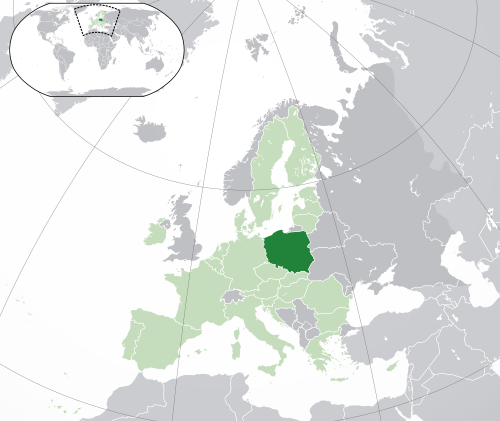
A Polish withdrawal from the European Union, or Polexit (a portmanteau of "Poland" and "exit"), is the name given to a hypothetical Polish withdrawal from the European Union. The term was coined after Brexit, the process of Britain's withdrawal from the EU which took place between 2016 and 2020. Opinion polls held in the country, between 2016 and 2021, indicated majority support for continued membership of the European Union (EU). A 2022 survey indicated that "[at] least eight-in-ten adults in Poland" believed that the EU "promotes peace, democratic values and prosperity".[1] The 2023 Polish parliamentary election was won by a coalition of predominantly pro-EU parties.[2]
Poland joined the European Union in 2004 through the Treaty of Accession 2003. At the time the EU included fifteen countries, mostly from Western, Northern and Southern Europe (see the Maastricht Treaty); the Treaty of Accession 2003 would accept ten more, mostly from Central and Eastern Europe, the Baltic States, and Mediterranean States.
In 2016, following continued political pressures from British Eurosceptics, Britain conducted a referendum on withdrawal from the EU. After the referendum had narrowly favored withdrawal, international media started speculating about the prospects of a similar event taking place in Poland (a so-called Polexit).[3][4][5][6][7]
In 2019, the Supreme Court of Poland warned that the judicial reform planned by the ruling Law and Justice (PiS) party could result in Poland having to leave the EU, as it undermines the independence of the judiciary and challenges the principle of the primacy of EU law, which is a key condition for membership that Poland had signed up to in its Treaty of Accession.[8]
On 22 November 2020, Do Rzeczy, a Polish weekly newspaper, published a front-page article called "Polexit: We have the right to talk about it".[7]
In September 2021, Ryszard Terlecki, Deputy Marshal of the Sejm and head of the Law and Justice parliamentary caucus, said that his party '[wanted] to remain in the EU and to have a cooperative relationship', but that the EU 'should be acceptable to us'. He added that if things were to go the way they were likely to go, they would have to search for a "drastic solution", further contending that the British left the EU because "the dictatorship of the Brussels bureaucracy did not suit them". This led to some people saying Terlecki had thus called for a Polexit.[9][10]
The government of Poland has been making controversial changes to the Polish judiciary, in particular as related to the Polish Constitutional Tribunal, the National Council of the Judiciary, the Supreme Court as well as its Disciplinary Chamber. These have attracted scrutiny from the European Court of Justice, which has been issuing rulings attempting to stop these changes that it sees as undermining the rule of law and judicial independence.[11][12][13] The Tribunal's legitimacy is contested after multiple appointments of judges loyal to the ruling nationalist Law and Justice (PiS) party were made, some of which in controversial circumstances.[14][15]
In March 2021, Prime Minister Mateusz Morawiecki asked the Constitutional Tribunal whether the Polish constitution[a] is above EU regulations and EU court rulings and whether the European Court of Justice acted beyond the powers granted by the EU treaties when controlling the judicial reforms in Poland, which the government insisted was the case.[16]
2021年10月7日、ポーランド憲法裁判所は、 EU条約の一部の条項とEU裁判所の判決がポーランド憲法と矛盾しているとの判決を下し、EU機関が権限の範囲を超えて行動していると主張し、事実上EU法の優位性の概念を否定した。[ 14 ] [ 17 ] BBCニュースとフォーリン・ポリシーは、これがポーランドのEU離脱(Polexit)のリスクを高めると報じたが、[ 17 ] [ 18 ]フィナンシャル・タイムズはこれを「EUからの法的離脱」と呼んだ。[ 19 ]しかし、エコノミスト誌はこの判決によりPolexitは起こりそうにないとし、「汚い残留」について言及した。[ 20 ]
2003年のポーランドのEU加盟に関する国民投票では、有権者の77.6%が賛成票を投じた。ポーランドは翌年EUに加盟し、それ以来、政府の世論調査センター(CBOS)が定期的に実施している世論調査によると、離脱を支持した回答者は4分の1以下であり、支持率は徐々に低下し、2019年にはわずか5%、2021年には6%となった。 [ 21 ]詳細な結果については、下の表を参照のこと。
しかし、EU加盟に関する2回目の国民投票を実施することには一定の支持がある。2021年10月にRzeczpospolitaのために実施された世論調査では、回答者の42.6%が賛成、36.9%が反対だった。[ 41 ]
その月の初めに憲法裁判所が下した判決(前述)を受けて、2021年10月10日には、ポーランドのEU残留を支持するデモに10万人以上のポーランド人が参加し、ワルシャワだけでも8万人から10万人の抗議者が集まった。[ 42 ]
2025年の2つの世論調査では、EU離脱への支持は25%と24%、残留への支持は65%と69%だった。[ 43 ] [ 44 ]
In general, Eurosceptic parties in Poland hold right-wing political views. For instance, the Confederation Liberty and Independence (Konfederacja) party has called for a withdrawal from the European Union on several occasions,[45][46] and its electorate is among the most Eurosceptic on the Polish political arena, with a quarter of voters for the party endorsing Polexit, according to a November 2020 poll.[32]PolEXIT, which emerged on the base of the Congress of the New Right and is centered around Stanisław Żółtek, a former MEP from that party and candidate for 2020 presidential election, is also arguing for secession from the European Union. It is not currently represented in either Polish or European parliament. In 2020, Żółtek received 0,23% of votes in the presidential elections.
Law and Justice (PiS) and Kukiz'15 are also Eurosceptic parties.[47][48] Critics, including Donald Tusk (former President of the European Council as well as leader of the Civic Platform), and currently the Prime Minister of Poland, warn that PiS's actions will eventually lead to Polexit and will jeopardise Poland's future in the EU,[42][49] though Jarosław Kaczyński, its leader, and former Prime Minister Mateusz Morawiecki both dismissed the allegations that PiS is preparing for it as "fake news",[26][50][51][52] while Paweł Kukiz said that "no Polexit would happen because there's no possibility for the EU to expel us".[53] Similar remarks were made by Przemysław Czarnek, the former minister of education.[54]
There are currently no left-wing, left-of-centre or centrist parties represented in parliament endorsing Polexit, and their electorate's support for withdrawal from the European Union is negligible.[32] The somewhat conservative Polish People's Party (PSL) and Poland 2050 are also known as a pro-European political organisations.
親EU政党連合が勝利した総選挙後、首相に選出された。