Loading article…
| エドワード2世 | |
|---|---|
 グロスター大聖堂の彫像 | |
| イングランド国王 | |
| 治世 | 1307年7月7日 – 1327年1月13日/25日 |
| 戴冠式 | 1308年2月25日 |
| 前任者 | エドワード1世 |
| 後継 | エドワード3世 |
| 生まれる | 1284年4月25日 カナーヴォン城、グウィネズ、ウェールズ |
| 死亡 | 1327年9月21日(43歳) バークレー城、グロスターシャー、イングランド |
| 埋葬 | 1327年12月20日 グロスター大聖堂、グロスターシャー |
| 配偶者 | |
| 問題の 詳細 | |
| 家 | プランタジネット |
| 父親 | イングランド王エドワード1世 |
| 母親 | カスティーリャのエレノア |
エドワード2世(1284年4月25日 - 1327年9月21日)は、エドワード・オブ・カーナーヴォンあるいはカーナーヴォンとしても知られ、1307年から1327年1月に廃位されるまでイングランド王であった。エドワード1世の4番目の息子であるエドワードは、兄アルフォンソの死後、王位継承者となった。1300年から、エドワードは父に随伴してスコットランド遠征に参加し、1306年にウェストミンスター寺院で盛大な式典でナイトの位に叙せられた。エドワードは翌年、父の死後、王位を継承した。1308年、イングランドとフランスの王冠の間の緊張を解消するための長期にわたる取り組みの一環として、彼は強力なフランス王フィリップ4世の娘イザベラと結婚した。
エドワードは、1300年に自分の家に加わったピアーズ・ギャヴェストンと親密で物議を醸す関係にあった。エドワードとギャヴェストンの関係が正確にどのようなものであったかは不明であるが、友人、恋人、あるいは義兄弟であった可能性がある。ギャヴェストンの傲慢さとエドワードの寵臣としての権力は、男爵たちとフランス王室の両方に不満を招き、エドワードは彼を追放せざるを得なかった。ギャヴェストンが帰国すると、男爵たちは国王に圧力をかけ、1311年の法令と呼ばれる広範囲にわたる改革に同意させた。新たに権力を得た男爵たちはギャヴェストンを追放したが、エドワードは改革を撤回して寵臣を呼び戻した。エドワードの従兄弟である第2代ランカスター伯爵トーマスに率いられた男爵の一団が1312年にギャヴェストンを捕らえて処刑し、数年にわたる武力衝突が始まった。イングランド軍はスコットランドで押し戻され、1314年のバノックバーンの戦いでエドワードはロバート・ブルースに決定的な敗北を喫した。その後広範囲に飢饉が発生し、国王の統治に対する批判が高まった。
デスペンサー家、特にヒュー・デスペンサー・ザ・ヤンガーはエドワードの親しい友人で相談役となったが、1321年にランカスター公と多くの男爵がデスペンサー家の領地を奪い、国王に追放を強いた。これに対してエドワードは短期間の軍事作戦を指揮し、ランカスター公を捕らえて処刑した。エドワードとデスペンサー家は権力を強め、1311年の改革を取り消し、敵を処刑して領地を没収した。スコットランドで進展が見られなかったエドワードは、ついにロバートと休戦協定に署名した。政権への反対が強まり、1325年にイザベラが和平交渉のためフランスに派遣されると、彼女はエドワードに背き帰国を拒否した。イザベラは追放されていたロジャー・モーティマーと同盟を組み、 1326年に小規模な軍隊を率いてイングランドに侵攻した。エドワードの政権は崩壊し、彼はウェールズに逃げたが、11月に捕らえられた。エドワードは1327年1月に息子のエドワード3世に王位を譲ることを余儀なくされ、 9月21日にバークレー城で亡くなった。おそらく新政権の命令により殺害されたと思われる。
エドワードとギャヴェストンの関係は、クリストファー・マーロウの1592年の戯曲『エドワード2世』や、その他の戯曲、映画、小説、メディアに影響を与えた。これらの多くは、2人の男性の間の性的関係の可能性に焦点を当てている。エドワードの同時代人は、スコットランドでの失策や晩年の圧制を指摘して、王としての彼の働きを批判したが、19世紀の学者は、彼の治世中に議会制度が成長したことは、長期的にはイングランドにとって好ましい発展であったと主張した。エドワードが怠惰で無能な王だったのか、それとも単に消極的で結局は失敗した統治者だったのかについては、21世紀になっても議論が続いている。
背景
エドワード2世は、イングランド王、アイルランド卿で、フランス南西部のガスコーニュ(フランス王の封建的家臣として領有していた)の統治者エドワード1世[ 2 ]と北フランスのポンテュー伯爵夫人エレノアの4男[ 1]であった。エレノアはカスティーリャ王家の出身であった。エドワード1世は優れた軍事指導者であり、1260年代には男爵の反乱を鎮圧し、第9回十字軍に参加した[3]。1280年代には北ウェールズを征服してウェールズの原住民の王子たちを権力の座から排除し、1290年代にはスコットランドの内戦に介入して同国の宗主権を主張した[4] 。彼は同時代の人々から極めて成功した統治者とみなされており、イングランド貴族の上級階級を形成する有力な伯爵たちをほぼ統制することができた。[5]歴史家マイケル・プレストウィッチはエドワード1世を「恐怖と尊敬を呼び起こす王」と表現し、ジョン・ギリンガムは彼を「有能ないじめっ子」と特徴づけている。[6]
エドワード1世は数々の成功を収めたが、1307年に死去した際、息子に解決すべきさまざまな課題を残した。[7]最も重大な課題の1つは、スコットランドにおけるイングランドの統治の問題だった。エドワード1世が死去した当時、スコットランドでは長期にわたるが結局は決着のつかなかった軍事作戦が続いていた。[8]ガスコーニュの支配はフランス王との緊張を生んだ。[9]フランス王は、イングランド王が領土に対して敬意を表するよう要求したが、イングランド王はこの要求を名誉を傷つけるものとみなし、問題は未解決のままだった。[9]エドワード1世はまた、戦争に必要な課税や徴発をめぐって貴族たちからの反対を強め、死去時に息子に約20万ポンドの負債を残した。[10] [a]
初期の人生(1284–1307)
誕生

エドワード2世は、エドワード1世がこの地域を征服してから1年も経たない1284年4月25日に北ウェールズのカーナーヴォン城で生まれたため、カーナーヴォンのエドワードと呼ばれることもある。 [12]国王は、おそらくこの城をエドワードの誕生の地として意図的に選んだのだろう。なぜなら、この城はウェールズ人にとってローマ帝国の歴史と関連のある重要な象徴的な場所であり、北ウェールズの新しい王政の中心地だったからだ。[13]エドワードの誕生は、世界の終末が差し迫っていると信じていた当時の預言者たちから偉大さの予言をもたらした。彼らはエドワードを、イングランドを栄光に導く新しいアーサー王と宣言した。 [14] 16世紀の聖職者デイヴィッド・パウエルは、この赤ん坊は「ウェールズで生まれ、英語を一言も話せない」王子としてウェールズ人に差し出されたと示唆したが、この話を支持する証拠はない。[15]
エドワードの名前は英語に由来し、アングロサクソンの 聖人 エドワード証聖王に由来するものであり、父がエドワードの兄弟に選ばれたより伝統的なノルマン語やカスティーリャ語の名前の代わりに選んだものである。 [16]ジョンとヘンリーはエドワードが生まれる前に亡くなっており、アルフォンソは1284年8月に亡くなり、エドワードが王位継承者となった。[17]エドワードは比較的健康な子供であったが、幼少期を通して、自分も死んで父に男子の跡継ぎがいないのではないかという不安が絶えなかった。[17]誕生後、エドワードはマリオタまたはメアリー・マンセルと呼ばれる乳母に数ヶ月世話されたが、彼女が病気になり、アリス・ド・レイグレイブが養母となった。[18]エドワードは幼少期に父と共にガスコーニュにいた実母のエレノアのことをほとんど知らなかったと思われる。[18]事務員のジャイルズ・オブ・オーデンアルデの指揮の下、スタッフを揃えた正式な家庭が新生児のために設立されました。[19]
幼少期、性格、外見

エドワードが成長するにつれ、彼の個人的な家庭への支出は増加し、1293年にウィリアム・オブ・ブライバラが家計管理人となった。[ 20]エドワードは、1290年に母親が家に招いたドミニコ会の修道士たちから宗教教育を受けたと思われる。 [21]エドワードは祖母の信奉者の一人であるギー・フェレを教化師に任命され、彼の規律を守り、乗馬や軍事技術を訓練した。[22]エドワードがどれほどの教育を受けていたかは定かではない。読み書きができたという証拠はほとんどないが、母親は他の子供たちに十分な教育を受けさせることに熱心であり、フェレ自身も当時としては比較的学識のある人物であった。[23] [24] [b]エドワードは日常生活では主にアングロ・ノルマン・フランス語を話し、それに加えて英語とおそらくラテン語も話していたと思われる。[26] [c]
エドワードは王族の一員として普通の育ち方をした。[28] [d]彼は馬と馬の飼育に興味があり、優れた乗り手になった。また犬、特にグレイハウンドが好きだった。[30]彼の手紙には風変わりなユーモアのセンスが表れており、乗り手を運ぶのを嫌がる馬や、ウサギを捕まえるのに時間がかかりすぎる怠け者の狩猟犬など、満足のいかない動物を友人に送ったと冗談を言っている。[31]彼は狩猟や鷹狩りには特に興味がなかったが、どちらも14世紀に人気のあった活動だった。[32]彼はウェールズ音楽や、当時発明されたばかりの楽器であるクルス、オルガンなどの音楽を楽しんだ。[33]彼は適性がなかったか、身の安全のために参加を禁じられていたため、馬上槍試合には参加しなかったが、このスポーツを熱心に支持していたことは確かである。[34]
エドワードは背が高く筋肉質に成長し、当時の基準ではハンサムとみなされた。[35]彼は有能な演説家としての評判があり、家政婦に対する寛大さでも知られていた。[36]彼は珍しくボート漕ぎや生け垣作り、溝掘りを楽しみ、労働者や他の下層階級の労働者との付き合いを楽しんでいた。[37] [38] [e]この行動は当時の貴族にとって普通ではないと考えられ、同時代の人々から批判を集めた。[39] [38]
1290年、エドワードの父はバーガム条約を承認し、その中で6歳の息子をスコットランド王位継承権を持つ若いマーガレット・オブ・ノルウェーと結婚させることを約束した。 [40]マーガレットはその年の後半に亡くなり、計画は終わった。[41]エドワードの母エレノアもその後まもなく亡くなり、祖母エレノア・オブ・プロヴァンスも続いた。[42]エドワード1世は妻の死に悲しみ、盛大な葬儀を挙行した。息子はエレノアからポンテュー伯領を相続した。 [ 42]次に、フランスとの永続的な平和を確保するために、若いエドワードをフランス人と結婚させることが検討されましたが、エドワード1世が提案したガスコーニュの要塞の解放をフィリップ 4世が拒否したため、1294年にガスコーニュ戦争が勃発しました。[43]このアイデアは、反乱を起こしたフランドル伯ギーの娘との結婚の提案に置き換えられましたが、フィリップ4世が提案された花嫁をパリに送ることができたため、これも失敗しました。[43]
スコットランドにおける初期の作戦
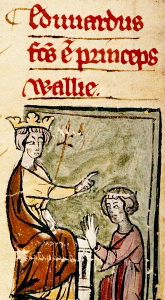
1297年から1298年の間、エドワードはイングランド王がガスコーニュにあるイングランド王の領土の一部を占領していたフィリップ4世に対してフランドルで戦っている間、イングランドの摂政として残された。 [44]帰国後、エドワード1世は和平条約に署名し、フィリップの妹マーガレットを妻に迎え、エドワード王子がやがてフィリップの娘で当時2歳だったイザベラと結婚することに同意した。[45]理論上、この結婚は、係争中のガスコーニュ公国がエドワードとフィリップ双方の子孫に継承されることを意味し、長きにわたる緊張に終止符を打つ可能性があった。[46]若きエドワードは新しい継母とうまくやっていたようで、継母は1300年にトーマス・オブ・ブラザートン、 1301年にエドマンド・オブ・ウッドストックという2人の息子を産んだ。 [47]国王となったエドワードは後に異母兄弟に財政的支援と称号を与えた。[48] [女性]
エドワード1世は1300年に再びスコットランドに戻り、今度は息子を連れてカラヴァロック城の包囲戦で殿軍の指揮官に任命した。[49] 1301年の春、国王はエドワードをプリンス・オブ・ウェールズと宣言し、チェスター伯爵と北ウェールズの領地を与えた。国王は、これがこの地域の平定に役立ち、息子にいくらかの経済的自立を与えることを期待していたようだ。[50]エドワードはウェールズの臣民から敬意を払われ、その後1301年のスコットランド遠征で父に加わった。彼は約300人の兵士の軍隊を率いて北へ行き、ターンベリー城を占領した。[51]エドワード王子は1303年の遠征にも参加し、ブレチン城を包囲し、作戦中に自らの攻城兵器を展開した。[52] 1304年の春、エドワードは国王に代わってスコットランドの反乱軍指導者との交渉を行ったが、交渉が失敗すると父に加わりスターリング城の包囲戦に参加した。[53]
1305年、エドワードと父親はおそらく金銭問題で口論した。[54]エドワード王子は王室の財務官を務めていたウォルター・ラングトン司教と口論になったが、どうやらエドワードが国王から受けた財政支援の額をめぐってのことだったようだ。 [53]国王は財務官を擁護し、エドワード王子とその仲間を宮廷から追放し、財政支援を打ち切った。[55]家族や友人を交えた交渉の後、2人は和解した。[56]
スコットランドの紛争は1306年にロバート・ブルースがライバルのバデノックのジョン・カミン3世を殺害し、自らをスコットランド王と宣言したときに再び燃え上がった。 [57]エドワード1世は新たな軍を動員したが、今度は息子が正式に遠征隊の指揮を執ることにした。[57]エドワード王子はアキテーヌ公に叙せられ、その後、他の多くの若者とともに、ウェストミンスター寺院で「白鳥の饗宴」と呼ばれる豪華な式典でナイトに叙せられた。[58]アーサー王伝説や十字軍の出来事を彷彿とさせる隣のホールでの大規模な饗宴の中で、集会はブルースを倒すという集団的な宣誓を行った。[59]その夏の作戦でエドワード王子の軍がどのような役割を果たしたかは不明である。その作戦では、エドワード1世の命令により、スコットランドのブルース派に対する懲罰的で残忍な報復が行われた。[60] [g]エドワードは9月にイングランドに戻り、イザベラとの結婚式の日取りを決めるための外交交渉が続いた。[62]
ピアーズ・ギャヴェストンとセクシュアリティ

この間、エドワードはピアーズ・ギャヴェストンと親しくなった。[63]ギャヴェストンはガスコーニュに隣接する領地を持つ王の侍従騎士の息子で、1300年におそらくエドワード1世の指示でエドワード王子の侍従となった。[64] 2人は意気投合し、ギャヴェストンは従者となり、すぐにエドワードの親しい仲間と呼ばれるようになり、1306年の白鳥の饗宴で王から騎士に叙せられた。 [65]その後、王は1307年にギャヴェストンをガスコーニュに追放したが、理由は不明である。[66]ある年代記作者によると、エドワードは父にギャヴェストンにポンテュー伯領を与える許可を求め、王は激怒して息子の髪の毛を両手で引っ張ってからギャヴェストンを追放した。[67]しかし、公式の裁判記録によると、ガヴェストンは一時的に追放されただけで、十分な給与を受け取っていた。この命令の理由は示されておらず、王子を罰することを目的とした行為であった可能性があることを示唆している。[68]
エドワードがギャヴェストンやその後の寵臣たちと性的関係を持っていた可能性については、歴史家たちによって広く議論されてきたが、彼らの関係の詳細を確実に決定する証拠がほとんど残っていないため、議論は複雑になっている。[69] [h] 14世紀のイングランドでは、同性愛は異端とみなされ、教会によって激しく非難された。[71]両名とも妻と性的関係を持ち、妻は子供を産んだ。エドワードには私生児もおり、姪のエレノア・ド・クレアと関係を持っていた可能性がある。[72]
彼らの同性愛関係を裏付ける当時の証拠は、主に1320年代の匿名の年代記作者によるもので、エドワードがゲイヴストンに「深い愛情を感じ」、その「不変の契約を交わし、他のすべての人間の前で、解けない愛の絆で彼と結ばれ、しっかりと結び付けられた」と記している。[73]エドワードが男性と性交していたことを具体的に示唆する最初の記録は1334年で、ウィンチェスター司教アダム・オールトンが1326年にエドワードは「ソドミー」であると述べたと非難されたが、オールトンは、エドワードの顧問である小ヒュー・デスペンサーがソドミーであったことを言いたかったのであって、故国王ではないと主張して自己弁護した。[74] 1390年代のモー年代記は、エドワードが「ソドミーという悪徳に身を捧げすぎた」とだけ記している。[75]
あるいは、エドワードとギャヴェストンは単に仕事上の親密な関係にあった友人だったのかもしれない。[76]同時代の年代記作者のコメントは曖昧な表現で、オールトンの告発は少なくとも部分的には政治的動機に基づいており、 1303年に教皇ボニファティウス8世に対して、1308年にテンプル騎士団に対してそれぞれなされた、高度に政治化された同性愛の告発と非常によく似ている。 [77]エドワードの活動に関する後代の年代記作者の記述は、オールトンの最初の告発に遡る可能性があり、エドワードの治世末期の出来事によって確実に不利な色合いを帯びている。[78]マイケル・プレストウィッチやシーモア・フィリップスなどの歴史家は、イングランド王室の公的な性質から、同性愛関係が秘密のままでいることはありそうになかったと主張している。同時代の教会、エドワードの父、義父のいずれも、エドワードの性的行動について不利なコメントをしたようには見えない。[79]
歴史家ピエール・シャプレイスが提唱した最近の説では、エドワードとギャヴェストンは養子縁組の兄弟関係を結んだとされている。[80]養子縁組の契約は、参加者が「戦友」の形で互いに支え合うことを誓約するもので、中世の親しい男性同士の間では珍しいことではなかった。[81]多くの年代記作者はエドワードとギャヴェストンの関係を兄弟関係として描写しており、ある年代記作者はエドワードがギャヴェストンを養子縁組したと明確に述べている。[82]シャプレイスは、2人が正式な契約を結んだのは1300年か1301年で、その後に別れたり別れたりする約束をしたことがあれば、それは強制されたものであり、したがって無効であると考えたはずだと主張している。[83]
初期の統治(1307年~1311年)
戴冠式と結婚
.jpg/500px-Edward_II_-_British_Library_Royal_20_A_ii_f10_(detail).jpg)
エドワード1世は1307年のスコットランド遠征のために別の軍を動員し、その夏にエドワード王子もこれに加わる予定であったが、高齢の王は体調を崩し、7月7日にバラ・バイ・サンズで死去した。[84]エドワードは知らせが届くとすぐにロンドンを出発し、7月20日に国王に即位した。[85]彼は北のスコットランドへと進み、8月4日にダンフリースでスコットランドの支持者から敬意を表した後、遠征を断念して南へと戻った。[85]エドワードは当時亡命中だったピアーズ・ギャヴェストンを速やかに呼び戻してコーンウォール伯に叙し、その後裕福なマーガレット・ド・クレアとの結婚を取り計らった。[86] [i]エドワードはまた、かつての敵対者であったラントン司教を逮捕し、財務官の職を解いた。[88]エドワード1世の遺体は数ヶ月間ウォルサム修道院に安置された後、ウェストミンスターに埋葬され、エドワードは父のために簡素な大理石の墓を建てた。 [89] [j]
1308年、エドワードとフランスのイザベラとの結婚が進められた。[91]エドワードは1月にイギリス海峡を渡ってフランスに渡り、ガヴェストンを王国の統治者として残した。 [92]この取り決めは異例で、特別に刻まれた国璽に裏打ちされた前例のない権限がガヴェストンに委任された。[93]エドワードはおそらく、この結婚によってガスコーニュにおける地位が強化され、切望されていた資金が得られることを期待していた。[9]しかし、最終的な交渉は困難を極めた。エドワードとフィリップ4世は互いに気に入らず、フランス王はイザベラの持参金の額とエドワードのフランス領地の管理の詳細について厳しい交渉を迫った。 [94]合意の一環として、エドワードはアキテーヌ公国をフィリップに譲り渡し、1303年のパリ条約の履行を完了する任務に同意した。[95]
2人は1月25日にブローニュで結婚した。[96]エドワードは結婚祝いとして イザベラに聖歌集を贈り、彼女の父は2万1000リーブル以上の価値のある贈り物と聖十字架の破片を贈った。[97] 2人は2月にイングランドに戻ったが、エドワードは戴冠式と結婚披露宴に備えてウェストミンスター宮殿を豪華に修復するよう命じており、大理石のテーブル、40台のオーブン、ワインとピメント(中世のスパイス入り飲料)を出す噴水も備えていた。 [98]多少の遅れがあったが、式は2月25日にウェストミンスター寺院で、ウィンチェスター司教ヘンリー・ウッドロックの指導のもと行われた。[99]戴冠式の一環として、エドワードは「王国の共同体が選択した正当な法律と慣習」を遵守することを宣誓した。[100]これが何を意味していたのかは定かではない。エドワードに将来の法律を受け入れさせる意図があったのかもしれないし、彼が将来行うかもしれない誓いを覆すことを防ぐために挿入されたのかもしれないし、あるいは国王が男爵たちに気に入られようという試みだったのかもしれない。[101] [k]この行事は、熱心な観客の大群が宮殿になだれ込み、壁を破壊してエドワードを裏口から逃げ出させたことで台無しになった。[102]
イザベラが結婚したとき、まだ12歳で、当時の基準から見ても若く、エドワードは結婚後数年間、愛人と性的関係を持っていたと思われる。[103] [104]この間に、彼は非嫡出子アダムをもうけた。アダムは1307年には誕生していた可能性がある。[103] [104]エドワードとイザベラの最初の息子、後のエドワード3世は、1312年に盛大な祝賀会の中で誕生し、その後さらに3人の子供が生まれた。1316年にジョン、 1318年にエレノア、 1321年にジョーンである。 [104] [105]
ガヴェストンをめぐる緊張

1307年にガヴェストンが亡命先から戻ったことは、当初は男爵たちに受け入れられたが、反対は急速に強まった。[106]彼は王室の政策に過度の影響力を持っていたようで、ある年代記作者は「1つの王国に2人の王が統治しており、1人は名目上、もう1人は実権上」と不満を述べている。[107]ガヴェストンは王室資金を盗み、イザベラの結婚祝いを盗んだという、おそらく事実ではない告発を受けた。[108]ガヴェストンはエドワードの戴冠式で重要な役割を果たし、伯爵の儀式上の優位性と豪華な衣装、そしてエドワードが宴会でイザベラよりもガヴェストンの同席を好んだことにイギリスとフランスの両陣営から激怒を招いた。[109]
1308年2月、議会は白熱した雰囲気の中で開かれた。[110]エドワードは政府改革の可能性について議論したがったが、男爵たちはギャヴェストンの問題が解決するまではそのような議論を始めることに消極的だった。[110]暴力沙汰になりそうだったが、穏健派の第3代リンカーン伯ヘンリー・ド・レイシーの調停により状況は解決し、彼は男爵たちに譲歩するよう説得した。[111] 4月に新たな議会が開催され、男爵たちは再びギャヴェストンを批判して追放を要求したが、今回はイザベラとフランス王室がこれを支持した。[112]エドワードは抵抗したが、最終的には従い、ギャヴェストンが戻ればカンタベリー大司教から破門すると脅してアキテーヌに送ることに同意した。 [113]土壇場でエドワードは考えを変え、代わりにギャヴェストンをダブリンに送り、アイルランド総督に任命した。[114]
エドワードはスコットランドへの新たな軍事作戦を求めたが、この考えはひっそりと放棄され、代わりに国王と男爵たちは1308年8月に改革について議論するために会合を持った。[115]舞台裏でエドワードは、教皇クレメンス5世とフィリップ4世の両者を説得して、ギャヴェストンのイングランドへの帰国を認めさせる交渉を開始し、その見返りとしてイングランドのテンプル騎士団を鎮圧し、ラントン司教を牢獄から釈放することを申し出た。[116]エドワードは1309年1月に教会員と主要な男爵たちの新たな会合を招集し、その後3月と4月に有力な伯爵たちが集まったが、おそらく第2代ランカスター伯トーマスの指導の下であった。[117]続いて別の議会が開かれ、ギャヴェストンのイングランドへの帰国は拒否されたものの、改革計画に同意すればエドワードに追加の税金を課すと申し出た。[118]
エドワードは教皇に、ギャヴェストンの役割をめぐる争いは終わったという確約を送った。[119]これらの約束と、当初の決定がどのようになされたかという手続き上の懸念に基づき、教皇はギャヴェストンを破門するという大司教の脅しを取り消すことに同意し、ギャヴェストンの復帰の可能性が開かれた。[120]ギャヴェストンは6月にイングランドに戻り、エドワードと会った。[121]翌月の議会で、エドワードはギャヴェストンに反対する人々をなだめるために、王室執事と王室元帥の権限を制限すること、国王の不評な調達権限を規制すること、最近制定された関税法の放棄など、さまざまな譲歩をした。その代わりに、議会はスコットランドでの戦争のために新たな税金を課すことに同意した。[122]少なくとも一時的には、エドワードと男爵たちはうまく妥協したように見えた。[123]
1311年の法令
帰国後、ギャヴェストンと主要な男爵との関係はますます困難になっていった。[124]彼は傲慢だとみなされ、伯爵たちを侮辱的な名前で呼ぶようになり、伯爵たちの有力者の一人を「ウォリックの犬」と呼んだ。[125]ランカスター伯とギャヴェストンの敵は、ギャヴェストンが出席するため、1310年の議会に出席することを拒否した。[126]エドワードは、フレスコバルディのイタリア人銀行家に対して2万2千ポンドの負債を抱え、スコットランド戦争の物資調達に彼の私権を行使しているという抗議に直面し、財政難が深刻化していた。 [127]スコットランドのために軍隊を召集する彼の試みは失敗に終わり、伯爵たちは新しい税金の徴収を中止した。[128]
国王と議会は1310年2月に再び会合し、スコットランド政策に関する議論は国内問題の議論に置き換えられた。[129]エドワードは、ガヴェストンを顧問官として解任し、代わりに政府と王室の両方の広範な改革を実行するオルダイナーと呼ばれる21人の選出男爵の助言を採用するよう請願された。 [130]大きな圧力の下、彼は提案に同意し、改革派と保守派がほぼ均等に分かれたオルダイナーが選出された。[131]オルダイナーが改革の計画を開始する間、エドワードとガヴェストンは約4,700人の新しい軍隊を率いてスコットランドに向かったが、そこでは軍事情勢は悪化し続けていた。[132]ロバート・ブルースは戦いを拒否し、冬の間、作戦は効果なく進んだが、1311年に物資と資金が尽き、エドワードは南に帰らざるを得なくなった。[133]
この時までに、聖職者たちは改革のための法令を起草しており、エドワードは10月にそれを受け入れて受け入れる以外に政治的な選択肢はほとんどなかった。[134] 1311年の法令には、国王が戦争に出たり、議会の承認なしに土地を与えたりする権利を制限する条項、議会に王政の管理権を与える条項、賞金制度を廃止する条項、フレスコバルディ銀行家を排除する条項、法令の遵守を監視する制度を導入する条項が含まれていた。[135]さらに、法令は再びギャヴェストンを追放し、今度はガスコーニュとアイルランドを含むエドワードの領土内のどこにも居住することを許可せず、称号を剥奪するという指示を出した。[136]エドワードはウィンザーとキングス・ラングレーの領地に退き、ギャヴェストンはイングランドを離れ、おそらく北フランスかフランドルに向かった。[137]
治世中期(1311年~1321年)
ガヴェストンの死
エドワードと男爵たちの間の緊張は高まる一方であり、国王に反対する伯爵たちは1311年後半まで私兵を動員し続けた。[138]この時までにエドワードは従兄弟のランカスター伯爵と疎遠になっていた。ランカスター伯爵はレスター、リンカーン、ソールズベリー、ダービーの伯爵でもあり、その領地からの収入は年間約11,000ポンドで、次に裕福な男爵のほぼ2倍であった。[139]アランデル、グロスター、ヘレフォード、ペンブルック、ウォリックの伯爵たちの支援を受けたランカスターはイングランドで強力な派閥を率いていたが、彼自身は実際の行政には興味がなく、特に想像力豊かで有能な政治家でもなかった。[140]
エドワードは男爵の脅迫に応じて法令を撤回し、ギャヴェストンをイングランドに召還し、1312年1月にヨークで彼と再会した。[141]男爵たちは激怒してロンドンで会合し、そこでギャヴェストンはカンタベリー大主教により破門され、ギャヴェストンを捕らえてスコットランドへの逃亡を阻止する計画が立てられた。[142]エドワード、イザベラ、ギャヴェストンはランカスターとその追随者たちに追われながらニューカッスルに向けて出発した。[ 143]王室一行は多くの所持品を捨てて船で逃げ、エドワードとイザベラがヨークに戻る間ギャヴェストンはそこに留まった。[144]短い包囲の後、ギャヴェストンはペンブルック伯とサリー伯に降伏し、自分に危害を加えないと約束した。[145]彼はおそらく王室の宝物庫の一部であったであろう膨大な金、銀、宝石のコレクションを所持していたが、後にエドワードから盗んだと非難された。[146]
ペンブルックは北からの帰途、ミッドランド地方のデディントン村に立ち寄り、妻を訪ねる間、ギャヴェストンをそこで警備下に置いた。[147]ウォリック伯はこの機会を利用してギャヴェストンを捕らえ、ウォリック城に連行した。6月18日、ランカスター伯とその一派はそこに集まった。[148]短い裁判で、ギャヴェストンは法令の規定により裏切り者として有罪となり、翌日、ランカスター伯の権威の下、ブラックロー・ヒルで斬首された。 [149]ギャヴェストンの遺体は1315年まで埋葬されず、葬儀はキングス・ラングレー修道院で執り行われた。[150]
ランカスターとフランスとの緊張

ギャヴェストンの死に対する反応は様々であった。[151]エドワードはギャヴェストンの殺害と見て激怒し、ひどく動揺した。彼はギャヴェストンの家族のために準備をし、関与した男爵たちに復讐するつもりだった。[152]ペンブルック伯とサリー伯はウォリックの行動に当惑し憤り、その後エドワードへの支持を変えた。[153]ランカスターとその中核支持者にとって、処刑は合法であり、王国の安定を保つために必要だった。[151]再び内戦が起こる可能性が高いと思われたが、12月にペンブルック伯は両者の間で和平条約の可能性について交渉し、反対派の男爵たちにギャヴェストン殺害の罪を赦免する代わりに、スコットランドでの新たな作戦への支持を求めた。[154]しかし、ランカスターとウォリックは条約をすぐに承認せず、1313年のほとんどの間、交渉は続いた。[155]
一方、ペンブルック伯はガスコーニュの統治をめぐる長年の不和を解決するためフランスと交渉しており、その一環としてエドワードとイザベラは1313年6月にパリへ行きフィリップ4世と会うことに同意した。[156]エドワードはおそらく南フランスの問題を解決し、男爵たちとの争いでフィリップの支持を得ることを望んでいたのだろう。フィリップにとっては、義理の息子に自分の力と富を印象付ける機会だった。[157]この訪問は華々しいものとなり、ノートルダム大聖堂で2人の国王がフィリップの息子と200人の男性に騎士の称号を与える盛大な式典や、セーヌ川沿いでの大規模な晩餐会、両国王と王妃がレヴァントへの十字軍に参加するという公式宣言などが行われた。[158]フィリップはガスコーニュの諸問題を解決するために寛大な条件を提示し、エドワードの宿舎で起きた大火事によってその行事は台無しになった。[159]
フランスから帰国したエドワードは、自分の政治的立場が大いに強化されたことを知った。[160]激しい交渉の末、ランカスター伯やウォリック伯を含む伯爵たちは、1313年10月に、前年12月の協定案と基本的に非常によく似た妥協案に達した。[161]議会が増税に同意したこと、教皇からの16万 フローリン(2万5千ポンド)の融資、フィリップからの3万3千ポンドの借り入れ、そしてエドワードの新しいイタリア人銀行家アントニオ・ペサーニョが手配したさらなる融資のおかげで、エドワードの財政は改善した。[162]エドワードの治世で初めて、エドワードの政府は十分な資金を得た。[163]
バノックバーンの戦い
,_f.40_-_BL_Add_MS_47682.jpg/500px-Peers_and_commoners_fighting_-_The_Holkham_Bible_Picture_Book_(c.1320-1330),_f.40_-_BL_Add_MS_47682.jpg)
1314年までに、ロバート・ブルースは、かつてエドワードが保持していたスコットランドの城のほとんどを奪還し、北イングランドのカーライルまで襲撃隊を追いやった。[164]これに対し、エドワードはランカスターと男爵たちの支援を得て、1万5000人から2万人の大軍を召集し、大規模な軍事作戦を計画した。[165]一方、ロバートはスコットランドの重要な要塞であるスターリング城を包囲していた。城のイングランド人指揮官は、エドワードが6月24日までに到着しなければ降伏すると述べていた。[164]この知らせは5月下旬に国王に届き、国王は城を救出するためにベリック・アポン・ツイードから北への行軍を急ぐことを決めた。[166] ロバートは、主に槍兵からなる5500人から6500人の軍隊を率いて、エドワードの軍がスターリングに到達するのを阻止する準備を整えた。[ 167]
戦闘は6月23日に始まり、イングランド軍は湿地帯に囲まれたバノック・バーンの高地を突破しようとした。 [168]両軍の間で小競り合いが勃発し、ヘンリー・ド・ボーハン卿がロバートと直接戦闘で殺害された。[168]エドワードは翌日も前進を続け、ニューパークの森から出てきたスコットランド軍の大半と遭遇した。[169]エドワードはスコットランド軍がここで戦闘を始めるとは予想していなかったようで、その結果、戦闘隊形ではなく行軍隊形を維持し、通常は敵の槍隊形を打ち破るために使われる弓兵を軍の前線ではなく後方に配置した。 [169]彼の騎兵隊は狭い地形で作戦行動をとるのが難しく、ロバートの槍兵に打ち負かされた。[170]イングランド軍は圧倒され、指揮官たちは統制を取り戻すことができなかった。[170]
エドワードは戦いを続けるために残っていたが、戦いに負けたことが明らかになったペンブルック伯は、スコットランド軍に激しく追われていた国王を戦場から引きずり出した。[171]エドワードは激しい戦闘からかろうじて逃れ、生き延びたらオックスフォードにカルメル会の修道院を建てると誓った。 [171]歴史家ロイ・ヘインズは、この敗北を、戦いで甚大な被害を受けたイングランドにとって「衝撃的な惨事」と表現している。[172]敗北後、エドワードはダンバーに撤退し、船でベリックに行き、その後ヨークに戻った。彼が不在の間、スターリング城はすぐに陥落した。[173]
飢餓と批判
バノックバーンの大失敗の後、ランカスター伯とウォリック伯は政治的影響力が増したことを実感し、エドワードに1311年の法令を再実施するよう圧力をかけた。[174]ランカスターは1316年に王室評議会の長となり、新しい改革委員会を通して法令を進めることを約束したが、他の男爵たちとの意見の不一致やおそらくは健康上の問題もあって、すぐにこの役割を放棄したようである。[175]ランカスターはその後2年間議会でエドワードと会うことを拒否し、効果的な統治は行き詰まった。これによりスコットランドへの新たな遠征の希望は阻まれ、内戦の恐れが高まった。[176]再びペンブルック伯を巻き込んだ長い交渉の後、エドワードとランカスターは1318年8月にようやくリーク条約に同意し、ランカスターとその派閥は赦免されて新しい王室評議会が設立され、一時的に紛争は回避された。[24] [177]
エドワードの困難は、大飢饉として知られる北ヨーロッパのより広範な現象の一部であるイングランド農業の長期にわたる問題によって悪化した。大飢饉は1314年後半の集中豪雨に始まり、非常に寒い冬と翌春の大雨が続き、多くの羊と牛が死んだ。悪天候は1321年までほとんど衰えることなく続き、一連の不作をもたらした。[178]羊毛の輸出による収入は急落し、エドワードの政府が価格を抑制しようとしたにもかかわらず、食料価格は上昇した。[179]エドワードは貯蔵者に食料を放出するよう呼びかけ、国内貿易と穀物の輸入の両方を奨励しようとしたが、ほとんど効果はなかった。[180]飢饉の年に王室のために食料を徴発したことは、緊張を高めるだけだった。[181]
一方、ロバート・ブルースはバノックバーンでの勝利を利用してイングランド北部を襲撃し、最初はカーライルとベリックを攻撃し、さらに南のランカシャーとヨークシャーまで到達し、ヨーク自体を脅かしました。[182]エドワードは1319年に侵攻を食い止めるために費用のかかる失敗に終わった作戦に着手しましたが、飢饉のために守備隊に食糧を補給し続けることがますます困難になりました。[183] 一方、ロバートの兄弟エドワード・ブルースが率いるスコットランドの遠征隊は1315年にアイルランドに侵入することに成功しました。エドワード・ブルースはアイルランド上王を宣言しました。[184]彼は最終的に1318年にフォーハートの戦いでエドワード2世のアイルランド裁判官エドマンド・バトラーに敗れ、エドワード・ブルースの生首はエドワード2世に送り返されました。[185] 1315年にはランカシャーとブリストルでも反乱が起こり、1316年にはウェールズのグラモーガンでも反乱が起こったが、鎮圧された。[186]
飢饉とスコットランド政策は神からの罰とみなされ、エドワードに対する苦情は増大し、ある同時代の詩は「エドワード2世の悪しき時代」を描写している。[187]多くの人がエドワードの「不適切」で卑劣な田舎暮らしへの関心を批判した。[188] 1318年、ジョン・オブ・パウダーハムという精神異常者がオックスフォードに現れ、自分こそが本物のエドワード2世であり、エドワードは生まれつき入れ替わった取り替え子であると主張した。 [189]ジョンは処刑されたが、彼の主張はエドワードに王族らしい振る舞いや安定したリーダーシップの欠如を批判する人々の共感を呼んだ。[189] [190]エドワードの王室寵臣に対する扱いについても反対が高まった。[191]
エドワードは、オルダイナーの排除の試みにもかかわらず、以前の顧問の何人かを留任させ、膨大なド・クレア家の遺産を彼の新しい寵臣である元家臣のヒュー・オードリーとロジャー・ダモリーの2人に分配し、彼らを瞬く間に莫大な富を得た。[192] [l] 1318年に平和的妥協の実現に貢献した穏健派の多くがエドワードに反旗を翻し始め、暴力の可能性がさらに高まった。[194]
後期統治(1321年 - 1326年)
デスペンサー戦争
長らく脅かされていた内戦は、ついに1321年にイングランドで勃発した。 [195]これは、多くの男爵と王の寵臣であるデスペンサー家との間の緊張によって引き起こされた。[196] ヒュー・デスペンサー父王はエドワードとその父王の両方に仕え、一方、ヒュー・デスペンサー子王は裕福なド・クレア家に嫁いで王の侍従となり、 1317年にウェールズ・マーチズのグラモーガンを獲得した。 [197]ヒュー・ザ・ヤンガーはその後、主に他のマーチズ領主を犠牲にして、ウェールズ全土に領地と権力を拡大した。[198]ランカスター伯とデスペンサー家は激しい敵対関係にあり、ランカスター伯に対する反感は、ヘレフォード伯、モーティマー家、最近昇格したヒュー・オードリーやロジャー・ダモリーなど、デスペンサー家の隣人のほとんどと共有されていた。[199]しかしエドワードはデスペンサー家の助言や支援にますます頼るようになり、特に小ヒューと親しく、ある年代記作者はエドワードが「心と精神のすべてにおいて深く愛していた」と記している。[200]
1321年初頭、ランカスターはマーチャー領土全域でデスペンサー家の敵対勢力の連合軍を結成した。[201]エドワードと小ヒューは3月にこの計画に気付き、穏健派のペンブルック伯が率いる交渉で危機が緩和されることを期待して西に向かった。[202]この時、ペンブルックは言い訳をして介入を断り、5月に戦争が勃発した。[203]デスペンサー家の領地はマーチャー領主と地元ジェントリの連合軍によってすぐに接収され、ランカスターは6月に男爵と聖職者の高官会議を開催し、デスペンサー家が法令に違反したことを非難した。[204]エドワードは和解を試みたが、7月に反対派がロンドンを占拠し、デスペンサー家の永久追放を求めた。[205]拒否すれば廃位されるかもしれないと恐れたエドワードは、デスペンサー家を追放し、マーチャー卿たちの行為を赦免することに同意した。[206]
Edward began to plan his revenge.[207] With the help of Pembroke, he formed a small coalition of his half-brothers, a few of the earls and some of the senior clergy, and prepared for war.[208] Edward started with Bartholomew de Badlesmere, 1st Baron Badlesmere, and Isabella was sent to Bartholomew's stronghold, Leeds Castle, to deliberately create a casus belli.[209] Bartholomew's wife, Margaret, took the bait and her men killed several of Isabella's retinue, giving Edward an excuse to intervene.[209] Lancaster refused to help Bartholomew, his personal enemy, and Edward quickly regained control of south-east England.[210] Alarmed, Lancaster now mobilised his own army in the north of England, and Edward mustered his own forces in the south-west.[211] The Despensers returned from exile and were pardoned by the royal council.[212]
In December, Edward led his army across the River Severn and advanced into the Welsh Marches, where the opposition forces had gathered.[213] The coalition of Marcher Lords crumbled and the Mortimers surrendered to Edward,[214] but Damory, Audley, and the Earl of Hereford marched north in January to join Lancaster, who had laid siege the king's castle at Tickhill.[215] Bolstered by fresh reinforcements from the Marcher Lords, Edward pursued them, meeting Lancaster's army on 10 March at Burton-on-Trent. Lancaster, outnumbered, retreated without a fight, fleeing north.[215] Andrew Harclay cornered Lancaster at the Battle of Boroughbridge, and captured the earl.[216] Edward and Hugh the Younger met Lancaster at Pontefract Castle, where, after a summary trial, the earl was found guilty of treason and beheaded.[217]
Edward and the Despensers
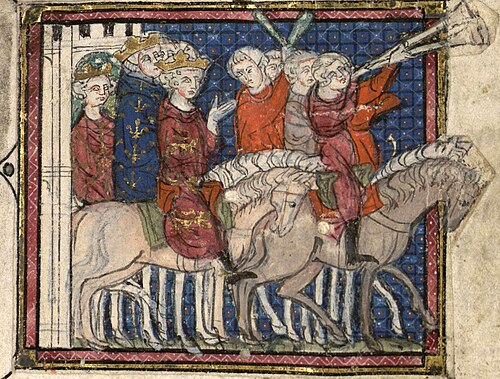
Edward punished Lancaster's supporters through a system of special courts across the country, with the judges instructed in advance how to sentence the accused, who were not allowed to speak in their own defence.[218] Many of these so-called "Contrariants" were simply executed, and others were imprisoned or fined, with their lands seized and their surviving relatives detained.[219] The Earl of Pembroke, whom Edward now mistrusted, was arrested; he was released only after pledging all his possessions as collateral for his own loyalty.[220] Edward was able to reward his loyal supporters, especially the Despenser family, with the confiscated estates and new titles.[221] The fines and confiscations made Edward rich: almost £15,000 was brought in during the first few months, and by 1326, Edward's treasury contained £62,000.[222] A parliament was held at York on 2 May 1322 at which the Ordinances were formally revoked through the Statute of York, and fresh taxes agreed for a new campaign against the Scots.[223]
The English campaign against Scotland was planned on a massive scale, with a force of about 23,000 men.[224] Edward advanced through Lothian towards Edinburgh, but Robert the Bruce declined to meet him in battle, drawing Edward further into Scotland. Plans to resupply the campaign by sea failed, and the large army rapidly ran out of food.[224] Edward was forced to retreat south of the border, pursued by Scottish raiding parties.[224] Edward's illegitimate son, Adam, died during the campaign, and the raiding parties almost captured Isabella, who was staying at Tynemouth and was forced to flee by sea.[225] Edward planned a fresh campaign, backed by a round of further taxes, but confidence in his Scottish policy was diminishing.[226] Andrew Harclay, instrumental in securing Edward's victories the previous year and recently made the Earl of Carlisle, independently negotiated a peace treaty with Robert the Bruce, proposing that Edward would recognise Robert as the King of Scotland and that, in return, Robert would cease to interfere in England.[227] Edward was furious and immediately executed Harclay, but agreed to a thirteen-year truce with Robert.[228]
Hugh Despenser the Younger lived and ruled in grand style, playing a leading role in Edward's government, and executing policy through a wide network of family retainers.[229] Supported by Chancellor Robert Baldock and Lord Treasurer Walter Stapledon, the Despensers accumulated land and wealth, using their position in government to provide superficial cover for what historian Seymour Phillips describes as "the reality of fraud, threats of violence and abuse of legal procedure".[230] Meanwhile, Edward faced growing opposition. Miracles were reported around the late Earl of Lancaster's tomb, and at the gallows used to execute members of the opposition in Bristol.[231] Law and order began to break down, encouraged by the chaos caused by the seizure of lands.[232] The old opposition consisting of Marcher Lords' associates attempted to free the prisoners Edward held in Wallingford Castle, and Roger Mortimer, one of the most prominent of the imprisoned Marcher Lords, escaped from the Tower of London and fled to France.[233]
War with France
The disagreements between Edward and the French Crown over the Duchy of Gascony led to the War of Saint-Sardos in 1324.[234] Charles, Edward's brother-in-law, had become King of France in 1322, and was more aggressive than his predecessors.[235] In 1323, he insisted that Edward come to Paris to give homage for Gascony, and demanded that Edward's administrators in Gascony allow French officials there to carry out orders given in Paris.[236] Matters came to a head in October when a group of Edward's soldiers hanged a French sergeant for attempting to build a new fortified town in the Agenais, a contested section of the Gascon border.[237] Edward denied any responsibility for this incident, but relations between Edward and Charles soured.[238] In 1324, Edward dispatched the Earl of Pembroke to Paris to broker a solution, but the earl died suddenly of an illness along the way. Charles mobilised his army and ordered the invasion of Gascony.[239]
Edward's forces in Gascony were around 4,400 strong, but the French army, commanded by Charles of Valois, numbered 7,000.[240] Valois took the Agenais and then advanced further and cut off the main city of Bordeaux.[240] In response, Edward ordered the arrest of any French persons in England and seized Isabella's lands, on the basis that she was of French origin.[241] In November 1324 he met with the earls and the English Church, who recommended that Edward should lead a force of 11,000 men to Gascony.[242] Edward decided not to go personally, sending instead the Earl of Surrey.[243] Meanwhile, Edward opened up fresh negotiations with the French king.[244] Charles advanced various proposals, the most tempting of which was the suggestion that if Isabella and Prince Edward were to travel to Paris, and the prince was to give homage to Charles for Gascony, he would terminate the war and return the Agenais.[245] Edward and his advisers had concerns about sending the prince to France, but agreed to send Isabella on her own as an envoy in March 1325.[246]
Fall from power (1326–1327)
Rift with Isabella
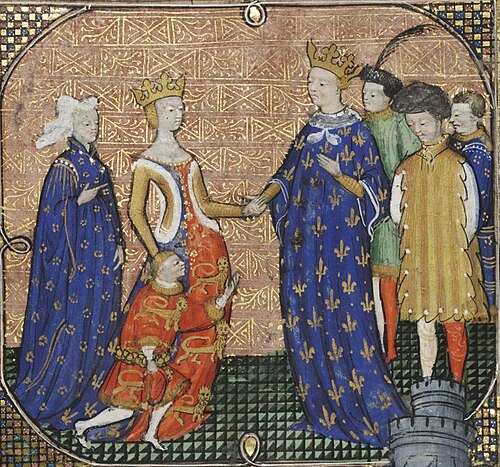
Isabella, with Edward's envoys, carried out negotiations with the French in late March.[247] The negotiations proved difficult, and they arrived at a settlement only after Isabella personally intervened with her brother, Charles.[247] The terms favoured the French Crown: In particular, Edward would give homage in person to Charles for Gascony.[248] Concerned about the consequences of war breaking out once again, Edward agreed to the treaty but decided to give Gascony to his son, Edward, and sent the prince to give homage in Paris.[249] The young Prince Edward crossed the English Channel and completed the bargain in September.[250][m]
Edward now expected Isabella and their son to return to England, but instead she remained in France and showed no intention of making her way back.[252] Until 1322, Edward and Isabella's marriage appears to have been successful, but by the time Isabella left for France in 1325, it had deteriorated.[253] Isabella appears to have disliked Hugh Despenser the Younger intensely, not least because of his abuse of high-status women.[254] Isabella was embarrassed that she had fled from Scottish armies three times during her marriage to Edward, and she blamed Hugh for the final occurrence in 1322.[255] When Edward had negotiated the recent truce with Robert the Bruce, he had severely disadvantaged a range of noble families who owned land in Scotland, including the Beaumonts, close friends of Isabella.[256] She was also angry about the arrest of her household and seizure of her lands in 1324. Finally, Edward had taken away her children and given custody of them to Hugh Despenser's wife.[257]
By February 1326 it was clear that Isabella was involved in a relationship with an exiled Marcher Lord, Roger Mortimer.[258] It is unclear when Isabella first met Mortimer or when their relationship began, but they both wanted to see Edward and the Despensers removed from power.[259][n] Edward appealed for his son to return, and for Charles to intervene on his behalf, but this had no effect.[261]
Edward's opponents began to gather around Isabella and Mortimer in Paris, and Edward became increasingly anxious about the possibility that Mortimer might invade England.[262] Isabella and Mortimer turned to William I, Count of Hainaut, and proposed a marriage between Prince Edward and William's daughter, Philippa.[263] In return for the advantageous alliance with the English heir to the throne, and a sizeable dower for the bride, William offered 132 transport vessels and eight warships to assist in the invasion of England.[264] Prince Edward and Philippa were betrothed on 27 August, and Isabella and Mortimer prepared for their campaign.[265]
Invasion

During August and September 1326, Edward mobilised his defences along the coasts of England to protect against the possibility of an invasion either by France or by Roger Mortimer.[267] Fleets were gathered at the ports of Portsmouth in the south and Orwell on the east coast, and a raiding force of 1,600 men was sent across the English Channel into Normandy as a diversionary attack.[268] Edward issued a nationalistic appeal for his subjects to defend the kingdom, but with little impact.[269] The regime's hold on power at the local level was fragile, the Despensers were widely disliked, and many of those Edward entrusted with the defence of the kingdom proved incompetent or promptly turned against the regime.[270] Some 2,000 men were ordered to gather at Orwell to repel any invasion, but only 55 appear to have actually arrived.[271]
Roger Mortimer, Isabella and thirteen-year-old Prince Edward, accompanied by King Edward's half-brother Edmund of Woodstock, landed in Orwell on 24 September with a small force of men and met with no resistance.[272] Instead, enemies of the Despensers moved rapidly to join them, including Edward's other half-brother, Thomas of Brotherton; Henry, 3rd Earl of Lancaster, who had inherited the earldom from his brother Thomas; and a range of senior clergy.[273] Ensconced in the residence halls of the fortified and secure Tower of London, Edward attempted to garner support from within the capital. The city of London rose against his government, and on 2 October he left London, taking the Despensers with him.[274] London descended into anarchy, as mobs attacked Edward's remaining officials and associates, killing his former treasurer Walter Stapledon in St Paul's Cathedral, and taking the Tower and releasing the prisoners inside.[275]
Edward continued west up the Thames Valley, reaching Gloucester between 9 and 12 October; he hoped to reach Wales and from there mobilise an army against the invaders.[276] Mortimer and Isabella were not far behind. Proclamations condemned the Despensers' recent regime. Day by day they gathered new supporters.[277] Edward and the younger Despenser crossed over the border and set sail from Chepstow, probably aiming first for Lundy and then for Ireland, where the king hoped to receive refuge and raise a fresh army.[278] Bad weather drove them back, though, and they landed at Cardiff. Edward retreated to Caerphilly Castle and attempted to rally his remaining forces.[279]
Edward's authority collapsed in England where, in his absence, Isabella's faction took over the administration with the support of the Church.[280] Her forces surrounded Bristol, where Hugh Despenser the Elder had taken shelter; he surrendered and was promptly executed.[281] Edward and Hugh the Younger fled their castle around 2 November, leaving behind jewellery, considerable supplies, and at least £13,000 in cash, possibly once again hoping to reach Ireland, but on 16 November they were betrayed and captured by a search party north of Caerphilly.[282] Edward was escorted first to Monmouth Castle, and from there back into England, where he was held at the Earl of Lancaster's fortress at Kenilworth.[283] Edward's final remaining forces, by now besieged in Caerphilly Castle, surrendered after four months in March 1327.[284]
Abdication
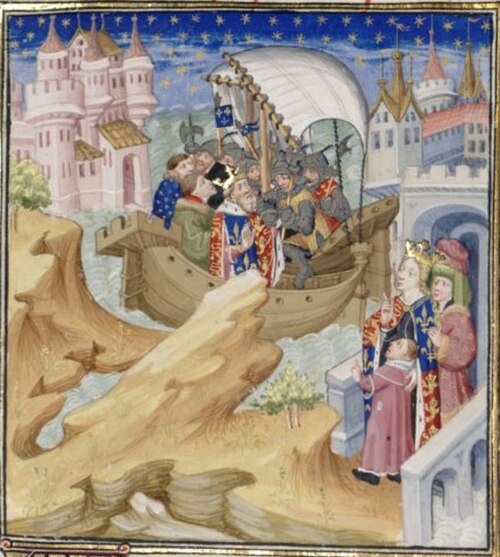
Isabella and Mortimer rapidly took revenge on the former regime. Hugh Despenser the Younger was put on trial, declared a traitor and sentenced to be disembowelled, castrated and quartered; he was duly executed on 24 November 1326.[285] Edward's former chancellor, Robert Baldock, died in Fleet Prison; the Earl of Arundel was beheaded.[286] Edward's position, however, was problematic; he was still married to Isabella and, in principle, he remained the king, but most of the new administration had much to lose were he to be released and potentially regain power.[287]
There was no established procedure for removing an English king.[288] Adam Orleton, the bishop of Hereford, made a series of public allegations about Edward's conduct as king, and in January 1327 a parliament convened at Westminster at which the question of Edward's future was raised; Edward refused to attend the gathering.[289] Parliament, initially ambivalent, responded to the London crowds that called for the king's son Edward to take the throne. On 12 January the leading barons and clergy agreed that Edward II should be removed and replaced by his son.[290] The following day it was presented to an assembly of the barons, where it was argued that Edward's weak leadership and personal faults had led the kingdom into disaster, and that he was incompetent to lead the country.[291]
Shortly after this, a representative delegation of barons, clergy and knights was sent to Kenilworth to speak to the king.[292] On 20 January 1327, the Earl of Lancaster and the bishops of Winchester and Lincoln met privately with Edward in the castle.[293] They informed Edward that if he were to resign as monarch, his son Edward would succeed him, but if he failed to do so, his son might be disinherited as well, and the crown given to an alternative candidate.[294] In tears, Edward agreed to abdicate, and on 21 January, Sir William Trussell, representing the kingdom as a whole, withdrew his homage and formally ended Edward's reign.[295] A proclamation was sent to London, announcing that Edward, now known as Edward of Caernarvon, had freely resigned his kingdom and that his son Edward would succeed him. The coronation took place at Westminster Abbey on 1 February 1327.[296]
Death (1327)
Death and aftermath

Those opposed to the new government began to make plans to free Edward, and Roger Mortimer decided to move him to the more secure location of Berkeley Castle in Gloucestershire, where Edward arrived around 5 April 1327.[297] Once at the castle, he was kept in the custody of Mortimer's son-in-law, Thomas de Berkeley, 3rd Baron Berkeley, and John Maltravers, who were given £5 a day for Edward's maintenance.[298] It is unclear how well cared for Edward was; the records show luxury goods being bought on his behalf, but some chroniclers suggest that he was often mistreated.[298] A poem, the "Lament of Edward II", has been attributed to Edward during his imprisonment by some scholars, but this is disputed.[299][o]
Concerns continued to be raised over fresh plots to liberate Edward, some involving the Dominican order and former household knights, and one such attempt got at least as far as breaking into the prison within the castle.[300] As a result of these threats, Edward was moved around to other locations in secret for a period, before returning to permanent custody at the castle in late summer 1327.[301] The political situation remained unstable, and new plots appear to have been formed to free him.[302]
On 23 September Edward III was informed that his father had died at Berkeley Castle during the night of 21 September.[303] Most historians agree that Edward II did die at Berkeley on that date, although there is a minority view that he died much later.[304][p] His death was, as Mark Ormrod notes, "suspiciously timely", as it simplified Mortimer's political problems considerably, and most historians believe that Edward was probably murdered on the orders of the new regime, although it is impossible to be certain.[305] Several of the individuals suspected of involvement in the death, including Sir Thomas Gurney, Maltravers and William Ockley, later fled.[306][q] If Edward died from natural causes, his death may have been hastened by depression following his imprisonment.[308]
The rule of Isabella and Mortimer did not last long after the announcement of Edward's death. They made peace with the Scots in the Treaty of Northampton, but this move was highly unpopular.[309] Isabella and Mortimer both amassed and spent great wealth, and criticism of them mounted.[310] Relations between Mortimer and Edward III became strained and in 1330 the king conducted a coup d'état at Nottingham Castle.[311] He arrested Mortimer and then executed him on fourteen charges of treason, including the murder of Edward II.[312] Edward III's government sought to blame Mortimer for all the recent problems, effectively politically rehabilitating Edward II.[313] Edward III placed his mother under arrest, but she was released soon after.[314]
Burial and cult
.jpg/500px-Gloucester_Cathedral_20190210_143005_(33746070958).jpg)
Edward's body was embalmed at Berkeley Castle, where it was viewed by local leaders from Bristol and Gloucester.[315] It was then taken to Gloucester Abbey on 21 October, and on 20 December, Edward was buried by the high altar, the funeral having probably been delayed to allow Edward III to attend in person.[316][r] Gloucester was probably chosen because other abbeys had refused or been forbidden to take the king's body, and because it was close to Berkeley.[318][s] The funeral was a grand affair and cost £351 in total, complete with gilt lions, standards painted with gold leaf and oak barriers to manage the anticipated crowds.[320] Edward III's government probably hoped to put a veneer of normality over the recent political events, increasing the legitimacy of the young king's own reign.[321]
A temporary wooden effigy with a copper crown was made for the funeral; this is the first known use of a funeral effigy in England, and was probably necessary because of the condition of the King's body, as he had been dead for three months.[322] Edward's heart was removed, placed in a silver container, and later buried with Isabella at Newgate Church in London.[323] His tomb includes a very early example of an English alabaster effigy, with a tomb chest and a canopy made of oolite and Purbeck stone.[324] Edward was buried in the shirt, coif and gloves from his coronation, and his effigy depicts him as king, holding a sceptre and orb, and wearing a strawberry-leaf crown.[325] The effigy features a pronounced lower lip, and may be a close likeness of Edward.[326][t]
Edward II's tomb rapidly became a popular site for visitors, probably encouraged by the local monks, who lacked an existing pilgrimage attraction.[328] Visitors donated extensively to the abbey, allowing the monks to rebuild much of the surrounding church in the 1330s.[324] Miracles reportedly took place at the tomb, and modifications had to be made to enable visitors to walk around it in larger numbers.[329] The chronicler Geoffrey le Baker depicted Edward as a saintly, tortured martyr, and Richard II gave royal support for an unsuccessful bid to have Edward canonised in 1395.[330] The tomb was opened by officials in 1855, uncovering a wooden coffin, still in good condition, and a sealed lead coffin inside it.[331] The tomb remains in what is now Gloucester Cathedral, and was extensively restored in 2007 and 2008 at a cost of over £100,000.[332]
Controversies
Controversy rapidly surrounded Edward's death.[333] With Mortimer's execution in 1330, rumours began to circulate that Edward had been murdered at Berkeley Castle. Accounts that he had been killed by the insertion of a red-hot iron or poker into his anus slowly began to spread, possibly as a result of deliberate propaganda; chroniclers in the mid-1330s and 1340s disseminated this account further, supported in later years by Geoffrey le Baker's colourful account of the killing.[334] It became incorporated into most later histories of Edward, typically being linked to his possible homosexuality.[335] Most historians now dismiss this account of Edward's death, querying the logic in his captors murdering him in such an easily detectable fashion.[336][u]
Another set of theories surround the possibility that Edward did not really die in 1327. These theories typically involve the "Fieschi Letter", sent to Edward III by an Italian priest called Manuel Fieschi, who claimed that Edward escaped Berkeley Castle in 1327 with the help of a servant and ultimately retired to become a hermit in the Holy Roman Empire.[338] The body buried at Gloucester Cathedral was said to be that of the porter of Berkeley Castle, killed by the assassins and presented by them to Isabella as Edward's corpse to avoid punishment.[339] The letter is often linked to an account of Edward III meeting with a man called William the Welshman in Antwerp in 1338, who claimed to be Edward II.[340] Some parts of the letter's content are considered broadly accurate by historians, although other aspects of its account have been criticised as implausible.[341] A few historians have supported versions of its narrative. Paul C. Doherty questions the veracity of the letter and the identity of William the Welshman, but nonetheless has suspicions that Edward may have survived his imprisonment.[342] The popular historian Alison Weir believes the events in the letter to be essentially true, using the letter to argue that Isabella was innocent of murdering Edward.[343] and Natalie Fryde has claimed that Edward's survival is "a possibility".[344] The historian Ian Mortimer suggests that the story in Fieschi's letter is broadly accurate, but argues that it was in fact Mortimer and Isabella who had Edward secretly released, and who then faked his death, a fiction later maintained by Edward III when he came to power.[345] Ian Mortimer's account was criticised by most scholars when it was first published, in particular by historian David Carpenter, who argues that there is no "convincing evidence for Edward’s survival, let alone for it being the result of a Mortimer plot”.[346][v]
Edward as king
Kingship, government and law
Edward's Great Seal
Edward was ultimately a failure as a king; the historian Michael Prestwich observes that he "was lazy and incompetent, liable to outbursts of temper over unimportant issues, yet indecisive when it came to major issues", echoed by Roy Haines' description of Edward as "incompetent and vicious", and as "no man of business".[348] Edward did not just delegate routine government to his subordinates, but also higher level decision making, and Pierre Chaplais argues that he "was not so much an incompetent king as a reluctant one", preferring to rule through a powerful deputy, such as Piers Gaveston or Hugh Despenser the Younger.[349] Edward's willingness to promote his favourites had serious political consequences, although he also attempted to buy the loyalty of a wider grouping of nobles through grants of money and fees.[350] He could take a keen interest in the minutiae of administration, however, and on occasion engaged in the details of a wide range of issues across England and his wider domains.[351][w]
One of Edward's persistent challenges through most of his reign was a shortage of money; of the debts he inherited from his father, around £60,000 was still owing in the 1320s.[353] Edward worked his way through many treasurers and other financial officials, few of whom stayed long, raising revenues through often unpopular taxes, and requisitioning goods using his right of prise.[354] He also took out many loans, first through the Frescobaldi family, and then through his banker Antonio Pessagno.[354] Edward took a strong interest in financial matters towards the end of his reign, distrusting his own officials and directly cutting back on the expenses of his own household.[355]
Edward was responsible for implementing royal justice through his network of judges and officials.[356] It is uncertain to what extent Edward took a personal interest in dispensing justice, but he appears to have involved himself to some degree during the first part of his reign, and to have increasingly intervened in person after 1322.[357] Edward made extensive use of Roman civil law during his reign when arguing in defence of his causes and favourites, which may have attracted criticism from those who perceived this as abandoning the established principles of English common law.[358] Edward was also criticised by contemporaries for allowing the Despensers to exploit the royal justice system for their own ends; the Despensers certainly appear to have abused the system, although just how widely they did so is unclear.[359] Amid the political turbulence, armed gangs and violence spread across England under Edward's reign, destabilising the position of many of the local gentry; much of Ireland similarly disintegrated into anarchy.[360]
Under Edward's rule, parliament's importance grew as a means of making political decisions and answering petitions, although as the historian Claire Valente notes, the gatherings were "still as much an event as an institution".[361] After 1311, parliament began to include, in addition to the barons, the representatives of the knights and burgesses, who in later years would constitute the "commons".[362] Although parliament often opposed raising fresh taxes, active opposition to Edward came largely from the barons, rather than parliament itself, although the barons did seek to use the parliamentary meetings as a way of giving legitimacy to their long-standing political demands.[363] After resisting it for many years, Edward began intervening in parliament in the second half of his reign to achieve his own political aims.[364] It remains unclear whether he was deposed in 1327 by a formal gathering of parliament or simply a gathering of the political classes alongside an existing parliament.[365]
Court

Edward's royal court was itinerant, travelling around the country with him.[366] When housed in Westminster Palace, the court occupied a complex of two halls, seven chambers and three chapels, along with other smaller rooms, but, due to the Scottish conflict, the court spent much of its time in Yorkshire and Northumbria.[367] At the heart of the court was Edward's royal household, in turn divided into the "hall" and the "chamber"; the size of the household varied over time, but in 1317 was around five hundred people, including household knights, squires, and kitchen and transport staff.[368] The household was surrounded by a wider group of courtiers, and appears to have also attracted a circle of prostitutes and criminal elements.[369]
Music and minstrels were very popular at Edward's court, but hunting appears to have been a much less important activity, and there was little emphasis on chivalric events.[370] Edward was interested in buildings and paintings, but less so in literary works, which were not extensively sponsored at court.[371] There was an extensive use of gold and silver plates, jewels and enamelling at court, which would have been richly decorated.[372][x] Edward kept a camel as a pet and, as a young man, took a lion with him on campaign to Scotland.[373] The court could be entertained in exotic ways: by an Italian snake-charmer in 1312, and the following year by 54 nude French dancers.[374][y]
Religion
Edward's approach to religion was normal for the period, and the historian Michael Prestwich describes him as "a man of wholly conventional religious attitudes".[376] There were daily chapel services and almsgiving at his court, and Edward blessed the sick, although he did this less often than his predecessors.[376] Edward remained close to the Dominican Order, which had helped to educate him, and followed their advice in asking for papal permission to be anointed with the Holy Oil of St. Thomas of Canterbury in 1319; this request was refused, causing the king some embarrassment.[377] Edward supported the expansion of the universities during his reign, establishing King's Hall in Cambridge to promote training in religious and civil law, Oriel College in Oxford and a short-lived university in Dublin.[378]
Edward enjoyed a good relationship with Pope Clement V, despite the king's repeated intervention in the operation of the English Church, including punishing bishops with whom he disagreed.[379] With Clement's support, Edward attempted to gain the financial support of the English Church for his military campaigns in Scotland, including taxation and borrowing money against the funds gathered for the crusades.[380] The Church did relatively little to influence or moderate Edward's behaviour during his reign, possibly because of the bishops' self-interest and concern for their own protection.[381]
Pope John XXII, elected in 1316, sought Edward's support for a new crusade, and was also inclined to support him politically.[382] In 1317, in exchange for papal support in his war with Scotland, Edward agreed to recommence paying the annual Papal tribute, which had been first agreed to by King John in 1213; Edward soon ceased the payments, however, and never offered his homage, another part of the 1213 agreement.[382] In 1325 Edward asked Pope John to instruct the Irish Church to openly preach in favour of his right to rule the island, and to threaten to excommunicate any contrary voices.[383]
Legacy
Historiography
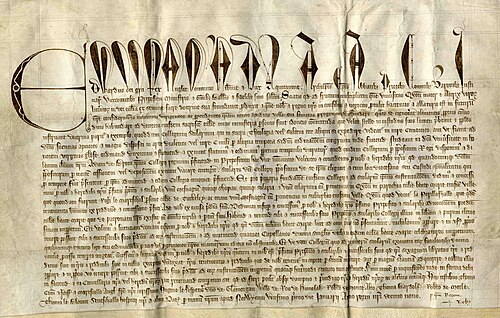
No chronicler for this period is entirely trustworthy or unbiased, often because their accounts were written to support a particular cause, but it is clear that most contemporary chroniclers were highly critical of Edward.[384] The Polychronicon, Vita Edwardi Secundi, Vita et Mors Edwardi Secundi and the Gesta Edwardi de Carnarvon for example all condemned the king's personality, habits and choice of companions.[385] Other records from his reign show criticism by his contemporaries, including the Church and members of his own household.[386] Political songs were written about him, complaining about his failure in war and his oppressive government.[387] Later in the 14th century, some chroniclers, such as Geoffrey le Baker and Thomas Ringstead, rehabilitated Edward, presenting him as a martyr and a potential saint, although this tradition died out in later years.[388]
Historians in the 16th and 17th centuries focused on Edward's relationship with Gaveston, drawing comparisons between Edward's reign and the events surrounding the relationship of Jean Louis de Nogaret de La Valette, Duke of Épernon, and Henry III of France, and between George Villiers, 1st Duke of Buckingham, and Charles I of England.[389] In the first half of the 19th century, popular historians such as Charles Dickens and Charles Knight popularised Edward's life with the Victorian public, focusing on the king's relationship with his favourites and, increasingly, alluding to his possible homosexuality.[390] From the 1870s onwards, however, open academic discussion of Edward's sexuality was circumscribed by changing English values. By the start of the 20th century, English schools were being advised by the government to avoid overt discussion of Edward's personal relationships in history lessons.[391] Views on his sexuality have continued to develop over the years.[38]
By the end of the 19th century, more administrative records from the period had become available to historians such as William Stubbs, Thomas Tout and J. C. Davies, who focused on the development of the English constitutional and governmental system during his reign.[392] Although critical of what they regarded as Edward II's inadequacies as a king, they also emphasised the growth of the role of parliament and the reduction in personal royal authority under Edward, which they perceived as positive developments.[393] During the 1970s the historiography of Edward's reign shifted away from this model, supported by the further publishing of records from the period in the last quarter of the 20th century.[392] The work of Jeffrey Denton, Jeffrey Hamilton, John Maddicott and Seymour Phillips re-focused attention on the role of the individual leaders in the conflicts.[394] With the exceptions of Hilda Johnstone's work on Edward's early years and Natalie Fryde's study of Edward's final years, the focus of the major historical studies for several years was on the leading magnates rather than Edward himself, until substantial biographies of the king were published by Roy Haines and Seymour Phillips in 2003 and 2011.[395]
Cultural references

Several plays have shaped Edward's contemporary image.[396] Christopher Marlowe's play Edward II was first performed around 1592 and focuses on Edward's relationship with Piers Gaveston, reflecting 16th-century concerns about the relationships between monarchs and their favourites.[397] Marlowe presents Edward's death as a murder, drawing parallels between the killing and martyrdom; although Marlowe does not describe the actual nature of Edward's murder in the script, it has usually been performed following the tradition that Edward was killed with a red-hot poker.[398] The character of Edward in the play, who has been likened to Marlowe's contemporaries James VI of Scotland and Henry III of France, may have influenced William Shakespeare's portrayal of Richard II.[399] In the 17th century, the playwright Ben Jonson picked up the same theme for his unfinished work, Mortimer His Fall.[400]
The filmmaker Derek Jarman adapted the Marlowe play into a film in 1991, creating a postmodern pastiche of the original, depicting Edward as a strong, explicitly homosexual leader, ultimately overcome by powerful enemies.[401] In Jarman's version, Edward finally escapes captivity, following the tradition in the Fieschi letter.[402] Edward's current popular image was also shaped by his contrasting appearance in Mel Gibson's 1995 film Braveheart, where he is portrayed as weak and implicitly homosexual, wearing silk clothes and heavy makeup, shunning the company of women and incapable of dealing militarily with the Scots.[403] The film received extensive criticism, both for its historical inaccuracies and for its negative portrayal of homosexuality.[404]

Edward's life has also been used in a wide variety of other media. In the Victorian era, the painting Edward II and Piers Gaveston by Marcus Stone strongly hinted at a homosexual relationship between the pair, while avoiding making this aspect explicit. It was initially shown at the Royal Academy in 1872 but was marginalised in later decades as the issue of homosexuality became more sensitive.[405] More recently, the director David Bintley used Marlowe's play as the basis for the ballet Edward II, first performed in 1995; the music from the ballet forms a part of composer John McCabe's symphony Edward II, produced in 2000.[396] Novels such as John Penford's 1984 The Gascon and Chris Hunt's 1992 Gaveston have focused on the sexual aspects of Edward and Gaveston's relationship, while Stephanie Merritt's 2002 Gaveston transports the story into the 20th century.[396]
Issue

Edward II had four children with Isabella:[406]
- Edward III of England (13 November 1312 – 21 June 1377). Married Philippa of Hainault on 24 January 1328. They had eight sons and five daughters.
- John of Eltham (15 August 1316 – 13 September 1336). Died aged 20. Never married. No issue.
- Eleanor of Woodstock (18 June 1318 – 22 April 1355). Married Reinoud II of Guelders in May 1332 and had two sons.
- Joan of the Tower (5 July 1321 – 7 September 1362). Married David II of Scotland on 17 July 1328 and became Queen of Scots, but had no issue.
Edward also fathered the illegitimate Adam FitzRoy (c. 1307–1322), who accompanied his father in the Scottish campaigns of 1322 and died shortly afterwards.[407]
Ancestry
See also
- History of same-sex relationships, specifically the note on historiographical considerations
- List of earls in the reign of Edward II of England
Notes
- ^ It is impossible to accurately convert sums of medieval money into modern incomes and prices. For comparison, it cost Edward's father, Edward I, around £15,000 to build the castle and town walls of Conwy, while the annual income of a 14th-century nobleman such as Richard le Scrope, 1st Baron Scrope of Bolton, was around £600 a year.[11]
- ^ Earlier histories of Edward II considered him poorly educated, principally because he took his coronation oath in French, rather than Latin, and because of his interest in agricultural crafts. His use of French at his coronation is no longer interpreted in this fashion, but there is little other evidence to show to what extent Edward was educated. The links drawn between an interest in crafts and low intelligence are no longer considered accurate.[25]
- ^ The historian Seymour Phillips considers it probable that Edward possessed some Latin; Roy Haines is less convinced.[24][27]
- ^ Earlier historical accounts of Edward have suggested that his childhood was marred by a lack of contact with his family and an absence of familial affection, influencing his later personality and problems; although Edward's father, Edward I, is still considered an "irascible and demanding" figure, his childhood is no longer thought unusual for the period, or particularly isolated.[29]
- ^ The historian Seymour Phillips notes, however, that there is relatively little hard evidence to support the statements made by contemporaries about Edward's enjoyment of rural pastimes.[38]
- ^ Edward II faced criticism from contemporaries for favouring Gaveston above his half-brothers, although detailed research by Alison Marshall shows more generosity, Marshall arguing that "for once", Edward was criticised unfairly.[48]
- ^ The English 1306 campaign in Scotland was brutal, and the chronicler William Rishanger held Prince Edward responsible for savage attacks on the local population; the historian Seymour Phillips has noted that many of Rishanger's other details are incorrect, and casts doubt on the chronicle's more extreme statements.[61]
- ^ John Boswell puts forward one of the most prominent arguments in favour of Edward and Gaveston having been lovers. Jeffrey Hamilton supports that the relationship was sexual, but that it was probably not overtly so. The historian Michael Prestwich is sympathetic to the argument that Edward and Gaveston had entered into a bond of adoptive brotherhood, but with a "sexual element" to both this and Edward's relationship with Despenser; Roy Haines echoes Prestwich's judgements; Miri Rubin argues in favour of their being friends, with a "very intense working relationship"; Seymour Phillips believes it most likely that Edward regarded Gaveston as his adoptive brother.[38][70]
- ^ Despite Edward appointing Piers Gaveston as the Earl of Cornwall in 1307, Edward's chancery declined to recognise him as such until 1309.[87]
- ^ The story that Edward I had asked his son to swear to boil his body, bury the flesh and take bones on campaign in Scotland was a later invention.[90]
- ^ It is unclear who wrote this part of the coronation oath, or what their intentions where. Historical discussions over the coronation oath have included debate over the tense of the Latin phrase aura eslau, which would change the meaning of the oath from referring to future legislation, to a retrospective statement about respecting existing laws and customs. It is also uncertain to what extent any changes in the coronation oath were driven by wider political disagreements between Edward and the barons, or were specifically focused over concerns with Gaveston's position.[101]
- ^ The de Clare inheritance had belonged to Gilbert de Clare, the late Earl of Gloucester, who died fighting at Bannockburn. The estates were divided up among his three sisters, one of whom was already married to Hugh Despenser the Younger.[193]
- ^ Edward's lawyers put forward various arguments in the dispute with the French kings. One line of argument stemmed from the 1259 treaty agreed by Edward's grandfather, Henry III, under which Henry had agreed to give homage for Gascony; Edward's lawyers observed that this treaty, which underpinned Edward's 1303 treaty with France, had been a bilateral agreement between the two kings, rather than a conventional feudal agreement. As such, Edward's offering homage for Gascony was dependent on the French crown delivering on its own commitments, rather than an absolute duty. Edward's lawyers also argued that Isabella had a potential claim to the lands in the south under customary French law. When granting Gascony to Isabella, Phillip IV appeared to have been dividing up his lands, as was customary at the time, rather than giving a conditional grant, which meant that Gascony was an allod, Edward's personal property, and as such not subject to the French king's laws on the carrying of weapons or money.[251]
- ^ Historian Roy Haines stresses the lack of evidence for any earlier relationship, while Paul Doherty argues that there is no evidence for them having been closely involved before December 1325, although he suspects that they may have been friends by 1323. While agreeing that there is no documentary evidence available, Ian Mortimer takes a more radical perspective, arguing that they met much earlier, and that Isabella helped Mortimer escape from the Tower of London in 1323.[260]
- ^ For a sceptical comment, see Vivian Galbraith; May McKisack reserved judgement, noting that "if he was indeed the author of the Anglo-Norman lament ascribed to him, he knew something of versification"; M. Smallwood feels that "the authorship question has not been settled"; Claire Valente writes "I think it unlikely that Edward II wrote the poem".[299]
- ^ Mainstream historical interpretations of Edward's death include those of Seymour Phillips, who argues that it is "likely that he was murdered, probably by suffocation"; Roy Haines, who suggests that he was probably murdered and that "there is little reason to doubt that Edward of Caernarfon's corpse has remained there [Gloucester Cathedral] undisturbed since December 1327 or thereabouts"; Mira Rubin, who concludes that Edward may have been murdered; Michael Prestwich, who has "no doubt" that Mortimer plotted to murder Edward, and that he "almost certainly died at Berkeley"; Joe Burden, who believes that Mortimer issued orders for Edward to be killed, and that Edward was buried at Gloucester; Mark Ormrod, who argues that Edward was probably murdered, and Edward is buried at Gloucester; Jeffrey Hamilton, who finds the argument that Edward survived Berkeley "fantastic"; and Chris Given-Wilson, who believes it is "almost certainly ... true" that Edward died on the night of 21 September and was murdered.[304]
- ^ Thomas Berkeley was spared by Edward III, after a jury concluded in 1331 that he had not been involved in the killing of the late king. The same jury found that William Ockley and Thomas Gurney had been responsible for the death. Ockley was not heard of again, but Gurney fled and was pursued across Europe, where he was captured in Naples; he died as he was being returned to England. John Maltravers was not formally accused of murdering Edward II but left for Europe and from there contacted Edward III, possibly to make a deal over what he knew about the events of 1327; after a period in exile he was ultimately pardoned and given permission to return to England in 1351.[307]
- ^ The historian Joel Burden notes that this delay in burial was not unusual for the period; the bodies of many other royalty, including Edward I and Isabella of France, remained unburied for a similar period.[317]
- ^ Although it was normal for Westminster Abbey to be used to bury English monarchs by the 14th century, the practice was not as formalised as it later became.[319]
- ^ Earlier scholarship had argued that the effigy on the tomb was an idealised carving, although more recent work has put more emphasis on its likely resemblance to Edward II.[327]
- ^ Initial sources either did not suggest that Edward had been murdered at all, or suggested that he had been suffocated or strangled. The first sources to begin to successfully popularise the "anal rape" narrative were the longer Brut and Polychronicon chronicles in the mid-1330s and 1340s, respectively. One of Edward's biographers, Seymour Phillips, notes that while the hot iron story could be true, it is much more likely that he was suffocated, noting that the account of the red-hot iron seems suspiciously similar to earlier accounts of the murder of King Edmund Ironside; the similarities to this earlier story are also highlighted by Ian Mortimer and Pierre Chaplais. His other biographer, Roy Haines, makes no reference at all to the red-hot poker story. Ian Mortimer, who argues that Edward did not die in 1327, naturally disputes the "anal rape" story. Paul Doherty notes that modern historians take the "lurid description of Edward's death with more than a pinch of salt". Michael Prestwich has noted that most of Geoffrey le Baker's story "belongs to the world of romance rather than of history", but has also noted that Edward "very possibly" died from the insertion of a red-hot iron.[337]
- ^ For a critique of the theory that Edward II survived his imprisonment, see David Carpenter's review in the London Review of Books, and Roy Haines's biography of Edward.[347]
- ^ Most historians suggest that Edward increased his engagement with administration in the 1320s, although Michael Prestwich suggests that many of Edward's later correspondence on governmental issues were written for him by the Despensers. Generally, current historians have tended to stress Edward's later role in governance, even if he did not necessarily prove to be a competent or successful administrator. Miri Rubin argues that he was "deeply involved" in governance and portrays Edward's abilities sympathetically; Anthony Musson stresses Edward's later involvement in the legal system; Seymour Phillips argues that Edward was more closely involved in governmental business than has been previously suggested, although his interest was "sporadic and unpredictable", and heavily influenced by his advisors; Roy Haines notes Edward's "idiosyncrasy" in engaging in business, and the dominant role of the Despensers in setting policy, but stops short of Prestwich's position.[352]
- ^ Among his more esoteric valuables, Edward had a pitcher, allegedly made from a griffin's egg.[372]
- ^ The historian Miri Rubin argues that the displays show a lack of royal decorum. The historian Michael Prestwich notes that these court events imply to many "a decadent extravagance, fitting the familiar stereotype of the king", but goes on to argue that the court was really "conventional, and perhaps even rather dull"; Seymour Phillips questions if the naked French dancers were genuinely extravagant or simply intended to fit in with local French royal culture.[375]
References
- ^ Haines 2003, p. 3.
- ^ Prestwich 1988, pp. 13–14.
- ^ Prestwich 2003, p. 33.
- ^ Prestwich 2003, pp. 5–6.
- ^ Prestwich 2003, p. 38; Phillips 2011, p. 5; Given-Wilson 1996, pp. 29–30.
- ^ Prestwich 2003, p. 38; Phillips 2011, p. 5; Gillingham, John (11 July 2008), "Hard on Wales", Times Literary Supplement, archived from the original on 25 March 2020, retrieved 22 April 2014.
- ^ Haines 2003, p. 25.
- ^ Haines 2003, p. 241.
- ^ a b c Brown 1988, p. 575.
- ^ Phillips 2011, p. 129; Prestwich 2003, pp. 30–31, 93–94.
- ^ Ashbee 2007, p. 9; Given-Wilson 1996, p. 157.
- ^ Phillips 2011, pp. 33, 36.
- ^ Phillips 2011, pp. 35–36; Haines 2003, p. 3.
- ^ Coote 2000, pp. 84–86.
- ^ Phillips 2011, p. 36; Haines 2003, pp. 3–4.
- ^ Phillips 2011, p. 39.
- ^ a b Phillips 2011, p. 40.
- ^ a b Phillips 2011, pp. 37, 47; Chaplais 1994, p. 5; Haines 2003, p. 4.
- ^ Phillips 2011, p. 47.
- ^ Phillips 2011, p. 48.
- ^ Phillips 2006, p. 226.
- ^ Phillips 2011, pp. 53–54.
- ^ Phillips 2011, pp. 55–57.
- ^ a b c Haines 2003, p. 11.
- ^ Phillips 2006, pp. 53; Haines 2003, pp. 11, 45–46.
- ^ Phillips 2011, p. 60.
- ^ Phillips 2006, pp. 53.
- ^ Hamilton 2006, pp. 5–6; Phillips 2011, p. 45.
- ^ Hamilton 2006, pp. 5–6; Phillips 2011, pp. 43–45; Haines 2003, pp. 4–5.
- ^ Hamilton 2006, pp. 6–8.
- ^ Hamilton 2006, p. 8; Haines 2003, p. 7.
- ^ Phillips 2011, pp. 73–74.
- ^ Phillips 2011, pp. 37, 74; Hamilton 2006, p. 9.
- ^ Hamilton 2006, p. 6; Phillips 2011, p. 40.
- ^ Prestwich 2003, p. 71; Phillips 2011, p. 41.
- ^ Prestwich 2003, p. 73; Phillips 2011, p. 61.
- ^ Phillips 2011, pp. 72–73.
- ^ a b c d e Prestwich 2003, p. 72.
- ^ Phillips 2011, p. 72.
- ^ Phillips 2011, p. 41; Haines 2003, p. 19.
- ^ Phillips 2011, p. 42.
- ^ a b Phillips 2011, p. 43.
- ^ a b Phillips 2011, pp. 77–78; Hallam & Everard 2001, p. 360.
- ^ Phillips 2011, pp. 78–79.
- ^ Phillips 2011, pp. 80–81; Rubin 2006, p. 30.
- ^ Brown 1988, p. 574.
- ^ Phillips 2011, pp. 81–82; Marshall 2006, p. 190.
- ^ a b Marshall 2006, pp. 198–199.
- ^ Phillips 2011, pp. 82–84.
- ^ Phillips 2011, pp. 85–87.
- ^ Phillips 2011, pp. 88–90.
- ^ Phillips 2011, pp. 91–93.
- ^ a b Phillips 2011, pp. 94–95.
- ^ Phillips 2011, pp. 104–105.
- ^ Phillips 2011, pp. 95–96.
- ^ Phillips 2011, p. 107.
- ^ a b Phillips 2011, p. 109.
- ^ Phillips 2011, pp. 109–111.
- ^ Phillips 2011, p. 111; Rubin 2006, pp. 29–30; Haines 2003, pp. 16–17.
- ^ Phillips 2011, pp. 111–115.
- ^ Phillips 2006, pp. 113–115.
- ^ Phillips 2011, pp. 116–117.
- ^ Phillips 2011, p. 96.
- ^ Phillips 2011, pp. 96–97.
- ^ Phillips 2011, pp. 96–97, 120; Chaplais 1994, p. 4.
- ^ Phillips 2011, pp. 112, 120–121.
- ^ Phillips 2011, pp. 120–121.
- ^ Phillips 2011, pp. 120–123; Haines 2003, pp. 20–21.
- ^ Ormrod 2006, p. 22; Haines 2003, pp. 20–21.
- ^ Haines 2003, p. 374; Rubin 2006, p. 31; Phillips 2011, p. 102; Ormrod 2006, p. 23; Hamilton 2010, pp. 98–99.
- ^ Ormrod 2006, pp. 23–25; Prestwich 2006, pp. 70, 72.
- ^ Prestwich 2006, p. 71; Phillips 2011, p. 101; Haines 2003, pp. 42–43.
- ^ Phillips 2011, p. 97.
- ^ Mortimer 2006, p. 50.
- ^ Mortimer 2006, p. 52.
- ^ Rubin 2006, pp. 31.
- ^ Mortimer 2006, pp. 51–53.
- ^ Mortimer 2006, p. 52; Phillips 2011, p. 102.
- ^ Prestwich 2006, pp. 70–71; Chaplais 1994, p. 9; Phillips 2011, p. 99.
- ^ Phillips 2011, p. 100; Chaplais 1994, pp. 11–13.
- ^ Chaplais 1994, pp. 14–19.
- ^ Phillips 2011, p. 102.
- ^ Chaplais 1994, pp. 20–22.
- ^ Phillips 2011, p. 123.
- ^ a b Phillips 2011, pp. 125–126.
- ^ Phillips 2011, pp. 126–127.
- ^ Chaplais 1994, p. 53.
- ^ Phillips 2011, p. 129.
- ^ Phillips 2011, p. 131.
- ^ Phillips 2011, p. 123; Prestwich 1988, p. 557.
- ^ Phillips 2011, p. 132.
- ^ Phillips 2011, p. 133.
- ^ Chaplais 1994, pp. 34–41.
- ^ Brown 1988, pp. 574–575, 578, 584; Phillips 2011, pp. 131–134.
- ^ Phillips 2011, pp. 131–134.
- ^ Haines 2003, p. 52.
- ^ Phillips 2011, p. 135; Brown 1988, p. 574.
- ^ Phillips 2011, pp. 135, 139–140.
- ^ Phillips 2011, p. 140.
- ^ Phillips 2011, p. 141.
- ^ a b Phillips 2011, pp. 140–143; Haines 2003, pp. 56–58.
- ^ Phillips 2011, p. 144.
- ^ a b Haines 2003, p. 61.
- ^ a b c Phillips 2011, p. 102.
- ^ Haines 2003, p. 93.
- ^ Prestwich 2003, p. 74; Rubin 2006, p. 31.
- ^ Phillips 2011, pp. 135–137.
- ^ Phillips 2011, pp. 136–138.
- ^ Phillips 2011, pp. 144–146; Chaplais 1994, p. 44.
- ^ a b Phillips 2011, pp. 146–147.
- ^ Phillips 2011, p. 146.
- ^ Phillips 2011, pp. 147–149.
- ^ Phillips 2011, pp. 149–150.
- ^ Phillips 2011, pp. 150–151.
- ^ Phillips 2011, p. 151.
- ^ Phillips 2011, pp. 152–153.
- ^ Phillips 2011, pp. 154–155.
- ^ Phillips 2011, pp. 156–157.
- ^ Phillips 2011, p. 155.
- ^ Phillips 2011, pp. 155, 157–158.
- ^ Phillips 2011, p. 158.
- ^ Phillips 2011, p. 159.
- ^ Phillips 2011, p. 160.
- ^ Phillips 2011, p. 161.
- ^ Phillips 2011, p. 161; Chaplais 1994, p. 68.
- ^ Phillips 2011, p. 162.
- ^ Phillips 2011, pp. 162–163.
- ^ Phillips 2011, p. 163.
- ^ Phillips 2011, pp. 163–164.
- ^ Phillips 2011, pp. 164–166.
- ^ Phillips 2011, p. 166.
- ^ Phillips 2011, pp. 167–170.
- ^ Phillips 2011, pp. 169–171.
- ^ Phillips 2011, p. 176; Haines 2003, p. 76.
- ^ Phillips 2011, pp. 177–178.
- ^ Phillips 2011, pp. 178–179, 182.
- ^ Phillips 2011, pp. 180–181.
- ^ Phillips 2011, pp. 182.
- ^ Phillips 2011, pp. 152, 174–175.
- ^ Phillips 2011, pp. 182, 276; Prestwich 2003, p. 77; Haines 2003, pp. 82–83, 87, 95.
- ^ Phillips 2011, pp. 182–184.
- ^ Phillips 2011, pp. 184–185; Chaplais 1994, p. 82.
- ^ Phillips 2011, pp. 186–187.
- ^ Phillips 2011, p. 187.
- ^ Phillips 2011, pp. 187–188.
- ^ Hamilton 1991, pp. 202–204.
- ^ Phillips 2011, p. 189; Haines 2003, pp. 86–87.
- ^ Phillips 2011, pp. 189–190.
- ^ Phillips 2011, pp. 190–191; Chaplais 1994, p. 88.
- ^ Phillips 2011, p. 241.
- ^ a b Chaplais 1994, p. 89.
- ^ Chaplais 1994, p. 82; Phillips 2011, p. 192.
- ^ Phillips 2011, p. 191; Haines 2003, p. 86.
- ^ Phillips 2011, pp. 193–196, 199–200.
- ^ Phillips 2011, pp. 206–208.
- ^ Phillips 2011, pp. 207–920.
- ^ Phillips 2011, pp. 209–211.
- ^ Phillips 2011, pp. 210–211.
- ^ Phillips 2011, p. 213.
- ^ Phillips 2011, p. 214.
- ^ Phillips 2011, p. 217.
- ^ Phillips 2011, pp. 218–219; Prestwich 2003, p. 16.
- ^ Phillips 2011, pp. 225–226.
- ^ a b Phillips 2011, pp. 223–224.
- ^ Phillips 2011, pp. 225–227; Haines 2003, p. 94.
- ^ Phillips 2011, pp. 223, 227–228.
- ^ Phillips 2011, pp. 228–229.
- ^ a b Phillips 2011, p. 230.
- ^ a b Phillips 2011, pp. 231–232.
- ^ a b Phillips 2011, p. 232.
- ^ a b Phillips 2011, p. 233.
- ^ Phillips 2011, pp. 234–236; Haines 2003, p. 259.
- ^ Phillips 2011, pp. 233, 238.
- ^ Phillips 2011, pp. 239, 243.
- ^ Phillips 2011, pp. 246, 267, 276; Haines 2003, p. 104.
- ^ Phillips 2011, pp. 280, 282–283, 294; Tebbit 2003, p. 205.
- ^ Phillips 2011, pp. 308, 330.
- ^ Jordan 1996, p. 171; Phillips 2011, pp. 252–253.
- ^ Jordan 1996, p. 171; Phillips 2011, p. 253.
- ^ Jordan 1996, pp. 172–174.
- ^ Ormrod 2011, pp. 16–17.
- ^ Phillips 2011, pp. 248, 281, 329, 343–348.
- ^ Phillips 2011, pp. 343–348; Haines 2003, p. 97.
- ^ Phillips 2011, pp. 248, 253–254.
- ^ Phillips 2011, pp. 256–258.
- ^ Phillips 2011, pp. 247–248; Haines 2003, pp. 98–99.
- ^ Rubin 2006, pp. 17, 36; Phillips 2011, p. 328.
- ^ Phillips 2011, p. 277.
- ^ a b Haines 2003, pp. 43–44.
- ^ Childs 1991, pp. 160–162.
- ^ Tebbit 2003, p. 201.
- ^ Tebbit 2003, p. 205; Haines 2003, pp. 104–105.
- ^ Tebbit 2003, p. 205; Haines 2003, p. 259.
- ^ Phillips 2011, p. 336.
- ^ Phillips 2011, pp. 372–378.
- ^ Haines 2003, pp. 121–123.
- ^ Phillips 2011, pp. 364–365.
- ^ Phillips 2011, pp. 365–366.
- ^ Phillips 2011, pp. 364, 366–367.
- ^ Phillips 2011, pp. 367–368.
- ^ Phillips 2011, pp. 374–375.
- ^ Phillips 2011, pp. 375–377.
- ^ Phillips 2011, pp. 376–377.
- ^ Phillips 2011, pp. 377–379; Jordan 1996, p. 84.
- ^ Phillips 2011, pp. 383–387.
- ^ Phillips 2011, p. 390; Haines 2003, pp. 128–129.
- ^ Phillips 2011, p. 394.
- ^ Phillips 2011, pp. 395–397.
- ^ a b Phillips 2011, p. 397.
- ^ Phillips 2011, pp. 397–398.
- ^ Phillips 2011, pp. 399–400.
- ^ Phillips 2011, pp. 400–401.
- ^ Phillips 2011, pp. 403–404.
- ^ Phillips 2011, p. 404.
- ^ a b Phillips 2011, pp. 406–407.
- ^ Phillips 2011, p. 408.
- ^ Phillips 2011, pp. 408–409; Haines 2003, p. 141.
- ^ Phillips 2011, pp. 410–411.
- ^ Phillips 2011, pp. 411–413; Haines 2003, p. 144.
- ^ Phillips 2011, p. 425.
- ^ Phillips 2011, p. 417.
- ^ Phillips 2011, p. 419; Haines 2003, p. 151.
- ^ Phillips 2011, pp. 423–425.
- ^ a b c Phillips 2011, pp. 426–427.
- ^ Phillips 2011, pp. 428–431.
- ^ Phillips 2011, p. 433.
- ^ Phillips 2011, pp. 423–433; Haines 2003, p. 148.
- ^ Phillips 2011, pp. 434–435; Haines 2003, p. 273.
- ^ Phillips 2011, pp. 440–442, 445.
- ^ Phillips 2011, pp. 445–446; Haines 2003, p. 157.
- ^ Phillips 2011, p. 436.
- ^ Phillips 2011, pp. 419–420.
- ^ Phillips 2011, pp. 438, 440–441.
- ^ Phillips 2011, pp. 455–456.
- ^ Phillips 2011, p. 456.
- ^ Phillips 2011, pp. 456–457.
- ^ Phillips 2011, pp. 461–462.
- ^ Haines 2003, pp. 274–275.
- ^ Phillips 2011, pp. 461, 464–465.
- ^ a b Phillips 2011, p. 464.
- ^ Phillips 2011, p. 466.
- ^ Phillips 2011, p. 467.
- ^ Phillips 2011, p. 468.
- ^ Phillips 2011, p. 469.
- ^ Phillips 2011, p. 470.
- ^ Phillips 2011, pp. 470–471.
- ^ a b Phillips 2011, p. 472.
- ^ Phillips 2011, pp. 472–473.
- ^ Phillips 2011, pp. 473–476.
- ^ Phillips 2011, p. 479.
- ^ Hallam & Everard 2001, pp. 322, 387; Haines 2003, pp. 19–20, 305–306.
- ^ Phillips 2011, pp. 485–486; Haines 2003, p. 169.
- ^ Doherty 2004, pp. 78–79.
- ^ Doherty 2004, pp. 74–75.
- ^ Doherty 2004, pp. 75–77.
- ^ Phillips 2011, pp. 437–438.
- ^ Doherty 2004, pp. 79–80.
- ^ Phillips 2011, pp. 488–489.
- ^ Phillips 2011, pp. 489–491; Haines 2003, p. 169.
- ^ Mortimer 2004, p. 284; Doherty 2004, pp. 86–88; Haines 2003, p. 169.
- ^ Phillips 2011, p. 495.
- ^ Phillips 2011, pp. 491–492.
- ^ Phillips 2011, pp. 493–494.
- ^ Phillips 2011, pp. 493–494, 500–501.
- ^ Phillips 2011, pp. 500–501.
- ^ Phillips 2011, p. 519.
- ^ Phillips 2011, pp. 501–502.
- ^ Phillips 2011, p. 502.
- ^ Ruddick 2013, p. 205.
- ^ Haines 2003, pp. 160–164, 174–175.
- ^ Phillips 2011, pp. 501, 504.
- ^ Phillips 2011, p. 504.
- ^ Phillips 2011, pp. 503–504.
- ^ Phillips 2011, p. 505; Haines 2003, pp. 178–179.
- ^ Phillips 2011, pp. 506–507.
- ^ Phillips 2011, p. 508.
- ^ Phillips 2011, pp. 508–509.
- ^ Phillips 2011, pp. 510–511; Haines 2003, p. 181.
- ^ Phillips 2011, p. 512.
- ^ Phillips 2011, pp. 512–513; Haines 2003, p. 187.
- ^ Haines 2003, p. 181.
- ^ Phillips 2011, pp. 514–515.
- ^ Phillips 2011, pp. 515, 518.
- ^ Haines 2003, p. 186.
- ^ Phillips 2011, pp. 516–518.
- ^ Phillips 2011, p. 516.
- ^ Phillips 2011, pp. 520–522.
- ^ Phillips 2011, pp. 523–524.
- ^ Phillips 2011, pp. 524–525.
- ^ Phillips 2011, p. 526.
- ^ Phillips 2011, pp. 529–530.
- ^ Phillips 2011, p. 533.
- ^ Phillips 2011, p. 534; Haines 2003, p. 191.
- ^ Phillips 2011, p. 534.
- ^ Phillips 2011, p. 535; Haines 2003, pp. 191–192.
- ^ Phillips 2011, pp. 536, 539, 541.
- ^ Phillips 2011, pp. 542–543.
- ^ a b Phillips 2011, p. 541.
- ^ a b Galbraith 1935, p. 221; McKisack 1959, p. 2; Smallwood 1973, p. 528; Valente 2002, p. 422.
- ^ Phillips 2011, pp. 543–544.
- ^ Phillips 2011, pp. 546–547.
- ^ Phillips 2011, p. 547.
- ^ Phillips 2011, p. 548.
- ^ a b Rubin 2006, pp. 54–55; Prestwich 2003, p. 88; Burden 2004, p. 16; Ormrod 2004, p. 177; Phillips 2011, p. 563; Haines 2003, pp. 198, 226, 232; Given-Wilson 1996, p. 33; Hamilton 2010, p. 133; Given-Wilson, Chris (9 July 2010), "Holy Fool", Times Literary Supplement, archived from the original on 25 March 2020, retrieved 22 April 2014.
- ^ Ormrod 2004, p. 177.
- ^ Phillips 2011, pp. 572–576; Haines 2003, pp. 235–236.
- ^ Phillips 2011, pp. 575–576; Haines 2003, pp. 236–237.
- ^ Phillips 2011, p. 563.
- ^ Haines 2003, pp. 198–199.
- ^ Haines 2003, pp. 199–200.
- ^ Haines 2003, pp. 214–216.
- ^ Haines 2003, pp. 216–217.
- ^ Ormrod 2004, pp. 177–178.
- ^ Rubin 2006, pp. 55–56.
- ^ Burden 2004, p. 16.
- ^ Duffy 2003, p. 118; Burden 2004, pp. 18–19.
- ^ Duffy 2003, p. 118.
- ^ Duffy 2003, p. 118; Burden 2004, p. 19; Haines 2003, pp. 228–229.
- ^ Burden 2004, p. 20.
- ^ Burden 2004, pp. 16–17, 25.
- ^ Burden 2004, pp. 25–27.
- ^ Duffy 2003, pp. 106, 119; Burden 2004, p. 21.
- ^ Duffy 2003, p. 119.
- ^ a b Duffy 2003, pp. 119, 122; "Edward II's Tomb", Gloucester Cathedral, 2014, archived from the original on 6 March 2014, retrieved 22 April 2014.
- ^ Duffy 2003, pp. 106, 119.
- ^ Duffy 2003, p. 121.
- ^ Duffy 2003, p. 121; Haines 2003, p. 229.
- ^ Duffy 2003, pp. 119, 122; Ormrod 2004, pp. 177–178.
- ^ Duffy 2003, p. 122; "Edward II's Tomb", Gloucester Cathedral, 2014, archived from the original on 6 March 2014, retrieved 22 April 2014.
- ^ Duffy 2003, p. 122; Ormrod 2004, p. 179.
- ^ Duffy 2003, p. 123; Haines 2003, p. 232.
- ^ "Edward II's Tomb", Gloucester Cathedral, 2014, archived from the original on 25 March 2020, retrieved 22 April 2014.
- ^ Rubin 2006, p. 55.
- ^ Prestwich 2003, p. 88; Phillips 2011, p. 562; Ormrod 2006, pp. 37–38; Mortimer 2004, pp. 191–194.
- ^ Ormrod 2006, pp. 37–39.
- ^ Mortimer 2004, pp. 193–194; Phillips 2011, p. 563.
- ^ Phillips 2011, pp. 562–564; Haines 2003; Mortimer 2006, pp. 51, 55; Doherty 2004, p. 131; Prestwich 2007, p. 219.
- ^ Doherty 2004, pp. 185–188.
- ^ Doherty 2004, pp. 186–188.
- ^ Doherty 2004, p. 213.
- ^ Doherty 2004, pp. 189–208; Haines 2003, pp. 222–229.
- ^ Doherty 2004, pp. 213–217.
- ^ Weir 2006, pp. 285–291.
- ^ Bradbury, Jim (2007). The Capetians. London: Continuum Books. p. 286. ISBN 978-1-85285-528-4.
- ^ Mortimer 2005; Mortimer 2008, pp. 408–410.
- ^ Mortimer 2008, p. 408; Carpenter, David (7 June 2007). "What Happened to Edward II?". London Review of Books. pp. 32–34. Retrieved 20 April 2014.
- ^ Carpenter 2007, pp. 32–34; Haines 2003, pp. 234–237.
- ^ Prestwich 2003, p. 73; Haines 2003, pp. 142, 164.
- ^ Chaplais 1994, pp. 2–3.
- ^ Given-Wilson 1996, pp. 31–33, 154.
- ^ Rubin 2006, p. 39.
- ^ Prestwich 2007, p. 219; Rubin 2006, p. 39; Musson 2006, pp. 140–141; Phillips 2011, p. 608; Haines 2003, pp. 164–165.
- ^ Phillips 2011, p. 129; Prestwich 2003, pp. 93–94.
- ^ a b Prestwich 2003, pp. 94–95; Phillips 2011, pp. 218–219.
- ^ Haines 2003, p. 164; Rubin 2006, p. 37.
- ^ Musson 2006, pp. 140–141.
- ^ Musson 2006, pp. 162–163.
- ^ Musson 2006, p. 157.
- ^ Musson 2006, pp. 159–160.
- ^ Haines 2003, pp. 148, 300–301; Rubin 2006, p. 50; Waugh 1991, p. 161.
- ^ Valente 1998, p. 868; Dodd 2006, pp. 165–166; Rubin 2006, pp. 50–52.
- ^ Dodd 2006, pp. 169, 172–173.
- ^ Dodd 2006, pp. 170–171, 175–177; Rubin 2006, p. 32.
- ^ Dodd 2006, pp. 180–182.
- ^ Dodd 2006, pp. 167–168, 179.
- ^ Prestwich 2006, p. 64.
- ^ Prestwich 2006, pp. 64–65; Rubin 2006, p. 33.
- ^ Prestwich 2006, p. 63.
- ^ Prestwich 2006, pp. 63, 65.
- ^ Prestwich 2006, pp. 69, 72.
- ^ Prestwich 2006, pp. 66–68.
- ^ a b Prestwich 2006, p. 69.
- ^ Phillips 2011, p. 75.
- ^ Prestwich 2006, pp. 61, 69; Phillips 2011, p. 75; Rubin 2006, p. 33.
- ^ Prestwich 2006, pp. 61, 74; Phillips 2011, p. 75; Rubin 2006, p. 33.
- ^ a b Prestwich 2006, p. 67.
- ^ Phillips 2011, pp. 65–66.
- ^ Musson 2006, p. 157; Phillips 2011, pp. 61–62.
- ^ Menache 2002, p. 60; Phillips 2011, p. 263.
- ^ Menache 2002, pp. 66, 70–71, 73.
- ^ Haines 2003, p. 337.
- ^ a b Phillips 2011, p. 263.
- ^ Haines 2003, p. 286.
- ^ Chaplais 1994, p. 5; Haines 2003, pp. 36–39; Phillips 2011, p. 9.
- ^ Phillips 2011, pp. 9–14.
- ^ Phillips 2011, pp. 15–17.
- ^ Phillips 2011, pp. 17–19.
- ^ Phillips 2011, pp. 22–23.
- ^ Phillips 2011, pp. 24–25.
- ^ Horne 1999, pp. 34–35.
- ^ Horne 1999, pp. 32, 40–41.
- ^ a b Waugh 1991, p. 241; Phillips 2011, p. 29.
- ^ Phillips 2011, p. 29; Haines 2003, pp. 35–36.
- ^ Waugh 1991, p. 241; Phillips 2011, pp. 29–30.
- ^ Hamilton 2006, p. 5; Alexander 1985, p. 103; Waugh 1991, p. 241; Schofield 2005, p. 1295; Given-Wilson, Chris (9 July 2010), "Holy Fool", Times Literary Supplement, retrieved 26 June 2014.
- ^ a b c Burgtorf 2008, p. 31.
- ^ Lawrence 2006, p. 206; Martin 2010, pp. 19–20.
- ^ Martin 2010, pp. 19–20.
- ^ Logan 2007, pp. 83–84; Perry 2000, pp. 1055–1056, 1062–1063.
- ^ Lawrence 2006, p. 206.
- ^ Burgtorf 2008, p. 31; Prasch 1993, p. 1165.
- ^ Prasch 1993, pp. 1165–1166.
- ^ Brintnell 2011, pp. 40–41; Burgtorf 2008, p. 31; Phillips 2011, p. 31.
- ^ Aberth 2003, pp. 303–304.
- ^ Horne 1999, pp. 31, 40, 42.
- ^ Haines 2003, p. 355; Phillips 2011, p. 102.
- ^ Haines 2003, p. 270; Phillips 2011, pp. 428–429.
- ^ Hamilton 2010, p. viii; Carpenter 2004, pp. 532–536; Prestwich 1988, p. 574; O'Callaghan 1975, p. 681; Durand, Clémencet & Dantine 1818, p. 435; Howell, Margaret (2004–2014), "Eleanor [Eleanor of Provence] (c.1223–1291), Queen of England, Consort of Henry III", Oxford Dictionary of National Biography, Oxford University Press, retrieved 22 April 2014; Parsons, John Carmi (2004–2014), "Eleanor [Eleanor of Castile] (1241–1290), Queen of England, Consort of Edward I", Oxford Dictionary of National Biography, Oxford University Press, retrieved 22 April 2014.
Bibliography
- Aberth, John (2003). A Knight at the Movies: Medieval history on film. London: Routledge. ISBN 978-0-4159-3885-3.
- Alexander, James W. (1985). "A Historiographical Survey: Norman and Plantagenet Kings since World War II". Journal of British Studies. 24 (1): 94–109. doi:10.1086/385826. ISSN 0021-9371. S2CID 154988120.
- Ashbee, Jeremy (2007). Conwy Castle. Cardiff, UK: Cadw. ISBN 978-1-8576-0259-3.
- Brintnell, Kent L. (2011). Ecce Homo: The male-body-in-pain as redemptive figure. Chicago, US: University of Chicago Press. ISBN 978-0-2260-7471-9.
- Brown, Elizabeth A. R. (1988). "The Political Repercussions of Family Ties in the Early Fourteenth Century: The Marriage of Edward II of England and Isabelle of France". Speculum. 63 (3): 573–595. doi:10.2307/2852635. ISSN 0038-7134. JSTOR 2852635. S2CID 154858717.
- Burden, Joel (2004). "Re-writing a Rite of Passage: The Peculiar Funeral of Edward II". In McDonald, Nicola; Ormrod, W. Mark (eds.). Rites of Passage: Cultures of Transition in the Fourteenth Century. Woodbridge, UK: York Medieval Press. pp. 13–30. ISBN 978-1-9031-5315-4.
- Burgtorf, Jochen (2008). "'With my life, his joyes began and ended': Piers Gaveston and King Edward II of England Revisited". In Saul, Nigel (ed.). Fourteenth Century England. Vol. V. Woodbridge, UK: The Boydell Press. pp. 31–51. ISBN 978-1-8438-3387-1.
- Carpenter, David (2004). The Struggle for Mastery: The Penguin History of Britain 1066–1284. London: Penguin. ISBN 978-0-1401-4824-4. OL 7348814M.
- Chaplais, Pierre (1994). Piers Gaveston: Edward II's Adoptive Brother. Oxford University Press. ISBN 978-0-1982-0449-7.
- Childs, Wendy R. (1991). "'Welcome My Brother': Edward II, John of Powderham and the Chronicles, 1318". In Wood, Ian; Loud, G. A. (eds.). Church and Chronicle in the Middle Ages: Essays Presented to John Taylor. London: Hambledon Press. pp. 149–164. ISBN 978-0-8264-6938-0. OL 8976202M.
- Coote, Lesley Ann (2000). Prophecy and Public Affairs in Later Medieval England. Woodbridge, UK: York Medieval Press. ISBN 978-1-9031-5303-1.
- Dodd, Gwilym; Musson, Anthony (2006). The Reign of Edward II: New Perspectives. Woodbridge, UK: York Medieval Press. ISBN 978-1-9031-5319-2. OL 17882067M.
- —— (2006). Parliament and Political Legitimacy in the Reign of Edward II. pp. 165–189. in Dodd & Musson 2006.
- Doherty, Paul (2004). Isabella and the Strange Death of Edward II. London: Robinson. ISBN 978-1-8411-9843-9.
- Duffy, Mark (2003). Royal Tombs of Medieval England. Stroud, UK: Tempus. ISBN 978-0-7524-2579-5.
- Durand, Ursin; Clémencet, Charles; Dantine, Maur-François (1818). L'art de verifier les dates des faits historiques, des chartes, des chroniques et autres anciens monuments depuis la naissance de notre-seigneur (in French). Vol. 12. Paris, France: n.p. OCLC 221519473.
- Galbraith, Vivian Hunter (1935). "The literacy of the medieval English kings". Proceedings of the British Academy. 21: 78–111. ISSN 0068-1202.
- Given-Wilson, Chris (1996). The English Nobility in the Late Middle Ages: The fourteenth-century political community. London: Routledge. ISBN 978-0-4151-4883-2.
- Haines, Roy Martin (2003). King Edward II: His life, his reign and its aftermath, 1284–1330. Montreal, Canada and Kingston, Canada: McGill-Queen's University Press. ISBN 978-0-7735-3157-4.
- Hallam, Elizabeth M.; Everard, Judith A. (2001). Capetian France, 987–1328 (2nd ed.). Harlow, UK: Longman. ISBN 978-0-5824-0428-1.
- Hamilton, J. S. (1991). "Piers Gaveston and the royal treasure". Albion: A Quarterly Journal Concerned with British Studies. 23 (2): 201–207. doi:10.2307/4050602. ISSN 0095-1390. JSTOR 4050602.
- —— (2006). The Character of Edward II: The letters of Edward of Caernarfon reconsidered. pp. 5–21. in Dodd & Musson 2006.
- —— (2010). The Plantagenets: History of a Dynasty. London: Continuum. ISBN 978-1-4411-5712-6.
- Horne, Peter (1999). "The besotted King and his Adonis: Representations of Edward II and Gaveston in late nineteenth-century England". History Workshop Journal. 47 (47): 30–48. doi:10.1093/hwj/1999.47.30. ISSN 1477-4569. PMID 11623897.
- Jordan, William Chester (1996). The Great Famine: Northern Europe in the early fourteenth century. Princeton, US: Princeton University Press. ISBN 978-0-6910-5891-7.
- Lawrence, Martyn (2006). Rise of a Royal Favourite: The Early Career of Hugh Despenser. pp. 204–219. in Dodd & Musson 2006.
- Logan, Robert A. (2007). Shakespeare's Marlowe: The influence of Christopher Marlowe on Shakespeare's artistry. Aldershot, UK: Ashgate. ISBN 978-1-4094-8974-0. OL 10852938M.
- Marshall, Alison (2006). The childhood and household of Edward II's half-brothers, Thomas of Brotherton and Edmund of Woodstock. pp. 190–204. in Dodd & Musson 2006.
- Martin, Matthew R. (2010). "Introduction". In Martin, Matthew R. (ed.). Edward the Second, by Christopher Marlowe. Ontario, Canada: Broadview Press. pp. 9–32. ISBN 978-1-7704-8120-6.
- McKisack, M. (1959). The Fourteenth Century: 1307–1399. Oxford University Press. ISBN 978-0-1982-1712-1.
- Menache, Sophia (2002). Clement V. Cambridge, UK: Cambridge University Press. ISBN 978-0-5215-9219-2.
- Mortimer, Ian (2004). The Greatest Traitor: The life of Sir Roger Mortimer, ruler of England 1327–1330. London: Pimlico. ISBN 978-0-7126-9715-6.
- —— (2005). "The Death of Edward II in Berkeley Castle". English Historical Review. 120 (489): 1175–1224. doi:10.1093/ehr/cei329. ISSN 0013-8266.
- —— (2006). Sermons of sodomy: A reconsideration of Edward II's sodomitical reputation. pp. 48–60. in Dodd & Musson 2006.
- —— (2008). The Perfect King: The life of Edward III, father of the English nation. London: Vintage. ISBN 978-0-0995-2709-1.
- Musson, Anthony (2006). Edward II: The public and private faces of the law. pp. 140–164. in Dodd & Musson 2006.
- O'Callaghan, Joseph F. (1975). A History of Medieval Spain. Ithaca, US: Cornell University Press. ISBN 978-0-8014-0880-9.
- Ormrod, W. Mark (2004). "Monarchy, Martyrdom and Masculinity: England in the Later Middle Ages". In Cullum, P. H.; Lewis, Katherine J. (eds.). Holiness and Masculinity in the Middle Ages. Cardiff, UK: University of Wales Press. pp. 174–191. ISBN 978-0-7083-1894-2.
- —— (2006). The Sexualities of Edward II. pp. 22–47. in Dodd & Musson 2006.
- —— (2011). Edward III. New Haven, US: Yale University Press. ISBN 978-0-3001-1910-7.
- Perry, Curtis (2000). "The politics of access and representations of the sodomite king in early modern England". Renaissance Quarterly. 53 (4): 1054–1083. doi:10.2307/2901456. ISSN 1935-0236. JSTOR 2901456. S2CID 155958161.
- Phillips, Seymour (2006). The Place of the Reign of Edward II. pp. 220–233. in Dodd & Musson 2006.
- —— (2011). Edward II. New Haven, CT & London: Yale University Press. ISBN 978-0-3001-7802-9.
- Prasch, Thomas (1993). "Edward II". American Historical Review. 98 (4): 1164–1166. doi:10.2307/2166608. ISSN 0002-8762. JSTOR 2166608.
- Prestwich, Michael (1988). Edward I. Berkeley, CA & Los Angeles, CA: University of California Press. ISBN 978-0-5200-6266-5.
- Ruddick, Andrea (2013). English Identity and Political Culture in the Fourteenth Century. Cambridge, UK: Cambridge University Press. ISBN 978-1-1070-0726-0.
- Rubin, Miri (2006). The Hollow Crown: A history of Britain in the late Middle Ages. London: Penguin. ISBN 978-0-1401-4825-1. OL 18287761M.
- Schofield, Phillipp R. (2005). "King Edward II: Edward of Caernarfon, his life, his reign, and its aftermath, 1284–1330 by Roy Martin Haines". Speculum (book review). 80 (4): 1295–1296. doi:10.1017/s0038713400001780. ISSN 0038-7134.
- Smallwood, M. (1973). "The Lament of Edward II". Modern Language Review. 68 (3): 521–529. doi:10.2307/3724989. ISSN 0026-7937. JSTOR 3724989.
- Tebbit, Alistair (2003). Written at Durham, UK. Prestwich, Michael; Britnell, Richard; Frame, Robin (eds.). Thirteenth Century England. The Durham Conference. Proceedings of the Durham Conference. Vol. X. Woodbridge, UK: The Boydell Press (published 2005). pp. 197–209. ISBN 978-1-8438-3122-8.
- Waugh, Scott L. (1991). England in the Reign of Edward III. Cambridge, UK: Cambridge University Press. ISBN 978-0-5213-1039-0. OL 1850113M.
- Weir, Alison (2006). Isabella: She-wolf of France, Queen of England. London: Pimlico. ISBN 978-0-7126-4194-4.
- Valente, Claire (1998). "The deposition and abdication of Edward II". The English Historical Review. 113 (453): 852–881. doi:10.1093/ehr/cxiii.453.852. ISSN 0013-8266.
External links
- "Edward II's tomb". Gloucester Cathedral. Archived from the original on 6 August 2019. Retrieved 6 August 2019.
- Edward II at the official website of the British monarchy
- Edward II at BBC History
- "Archival material relating to Edward II of England". UK National Archives.
- Portraits of King Edward II at the National Portrait Gallery, London