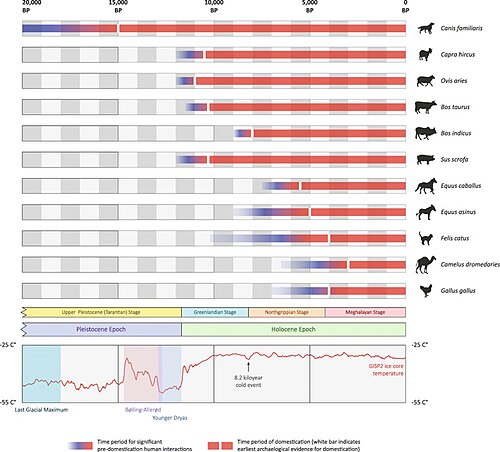
Dogs and sheep were among the first animals to be domesticated, at least 15,000 and 11,000 years ago respectively.[1]Rice was domesticated in China, some 9,000 years ago.[2]
Domestication is a multi-generational mutualistic relationship in which an animal species, such as humans or leafcutter ants, takes over control and care of another species, such as sheep or fungi, to obtain from them a steady supply of resources, such as meat, milk, or labor. The process is gradual and geographically diffuse, based on trial and error. Domestication affects genes for behavior in animals, making them less aggressive. In plants, domestication affects genes for morphology, such as increasing seed size and stopping the shattering of cereal seedheads. Such changes both make domesticated organisms easier to handle and reduce their ability to survive in the wild.
Michael D. Purugganan notes that domestication has been hard to define, despite the "instinctual consensus" that it means "the plants and animals found under the care of humans that provide us with benefits and which have evolved under our control."[17] In 2025, Kathryn Lord and colleagues proposed a new panspecies definition for domestication by humans, namely "evolution ... in response to an anthropogenic niche". It is the process by which a nonhuman population adapts to an environment created through human activity. Furthermore, "the term 'domestic' should refer solely to those populations that are obligate synanthropes and have adapted to an anthropogenic environment to the extent that only sink populations (in which the death rate is higher than the birth rate) exist outside of that niche."[18]
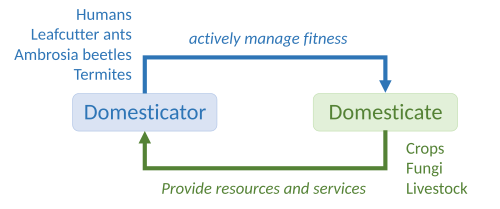
Diagram of domestication as a process where one species, not only humans, actively manages another to obtain resources or services, as defined by Michael D. Purugganan[17]
Domestication syndrome is the suite of phenotypic traits that arose during the initial domestication process and which distinguish domesticated species including crops from their wild ancestors.[19][20] It can also mean a set of differences now observed in domesticated mammals, not necessarily reflecting the initial domestication process. The changes in mammals include increased docility and tameness, coat coloration, reductions in tooth size, craniofacial morphology, ear and tail form (e.g., floppy ears), estrus cycles, levels of adrenocorticotropic hormone and neurotransmitters, prolongations in juvenile behavior, and reductions in brain size and of particular brain regions.[21]
↑ Lawler, Andrew; Adler, Jerry (2012年6月) 「ニワトリはいかにして世界を征服したか」。スミソニアン・マガジン(2012年6月)。
↑ Potts, Simon G.; et al. (2010). "世界の送粉昆虫の減少:傾向、影響、および要因" . Trends in Ecology & Evolution . 25 (6): 345– 353. Bibcode : 2010TEcoE..25..345P . CiteSeerX 10.1.1.693.292 . doi : 10.1016/j.tree.2010.01.007 . PMID 20188434 .
↑ Gon III, Samuel M.; Price, Edward O. (1984 年 10 月). "無脊椎動物の家畜化: 行動上の考察" (PDF) . BioScience . 34 (9): 575– 579. doi : 10.2307/1309600 . JSTOR 1309600 .
↑ Weiss, E., Kislev, ME, Simchoni, O. & Nadel, D. 23,000年前のオハロII遺跡における主食としての小粒の野生草Economic Botany 58:s125-s134.
1 2 3 4 Dillehay, Tom D.; Rossen, Jack; Andres, Thomas C.; Williams, David E. (2007 年 6 月 29 日). 「ペルー北部におけるピーナッツ、カボチャ、綿の土器以前の採用」. Science . 316 (5833). American Association for the Advancement of Science (AAAS): 1890– 1893. Bibcode : 2007Sci...316.1890D . doi : 10.1126/science.1141395 . PMID 17600214 . S2CID 43033764 .
↑ Smith, Bruce D. (2006年8月15日). 「北米東部は植物栽培化の独立した中心地である」 . PNAS . 103 ( 33): 12223– 12228. Bibcode : 2006PNAS..10312223S . doi : 10.1073/pnas.0604335103 . PMC 1567861. PMID 16894156 .
↑ Piperno, Dolores R. (2011年10月)「新世界熱帯における植物栽培と家畜化の起源:パターン、プロセス、そして新たな展開」Current Anthropology . 52 (S4): S453– S470. doi : 10.1086/659998 . S2CID 83061925.メキシコ中央バルサス川流域、トウモロコシの起源地とされる場所…7600年前までに中央アメリカ南部に拡散
↑ Spooner, David M.; McLean, Karen; Ramsay, Gavin; Waugh, Robbie; Bryan, Glenn J. (2005 年 9 月 29 日). "多遺伝子座増幅断片長多型遺伝子型判定に基づくジャガイモの単一栽培化" . Proceedings of the National Academy of Sciences . 102 (41): 14694– 14699. Bibcode : 2005PNAS..10214694S . doi : 10.1073/pnas.0507400102 . PMC 1253605 . PMID 16203994 .
1 2 Gunn, Bee; Baudouin, Luc; Olsen, Kenneth M. (2011). "旧世界の熱帯における栽培ココナッツ (Cocos nucifera L.) の独立した起源" . PLOS One . 6 (6) e21143. Bibcode : 2011PLoSO...621143G . doi : 10.1371/journal.pone.0021143 . PMC 3120816 . PMID 21731660 .
1 2 Zeder, Melinda; Emshwiller, Eve; Smith, Bruce D.; Bradley, Daniel G. (2006 年 3 月). "家畜化の記録: 遺伝学と考古学の交差点" . Trends in Genetics . 22 (3): 139– 55. doi : 10.1016/j.tig.2006.01.007 . PMID 16458995 . 2011 年11 月 28 日取得.
↑ Mutch, Lesley A.; Young, J. Peter W. (2004). "野生および栽培マメ科植物におけるRhizobium leguminosarum biovar viciaeの多様性と特異性" . Molecular Ecology . 13 (8): 2435– 2444. Bibcode : 2004MolEc..13.2435M . doi : 10.1111/j.1365-294X.2004.02259.x . PMID 15245415 . S2CID 1123490 .
↑ Kiers, E. Toby; Hutton, Mark G.; Denison, R. Ford (2007 年 12 月 22 日). 「人間の選択と、効果のない根粒菌に対するマメ科植物の防御の緩和」 . Proceedings of the Royal Society B: Biological Sciences . 274 (1629): 3119–3126 . doi : 10.1098/rspb.2007.1187 . PMC 2293947 . PMID 17939985 .
↑ Shepherd, Lara D.; Lange, Peter J. de; Cox, Simon; McLenachan, Patricia A.; Roskruge, Nick R.; Lockhart, Peter J. (2016年3月24日). 「最近栽培されたニュージーランド固有の根菜、Arthropodium cirratum (Asparagaceae) における強い栽培化ボトルネックの証拠」 . PLOS One . 11 (3) e0152455. Bibcode : 2016PLoSO..1152455S . doi : 10.1371/journal.pone.0152455 . PMC 4806853 . PMID 27011209 .
1 2 Mueller, Ulrich G.; Gerardo, Nicole M.; Aanen, Duur K.; Six, Diana L.; Schultz, Ted R. (2005 年 12 月 1 日). "昆虫における農業の進化" (PDF) . Annual Review of Ecology, Evolution, and Systematics . 36 (1): 563– 595. doi : 10.1146/annurev.ecolsys.36.102003.152626 .
↑ Kasson, Matthew T.; Wickert, Kristen L.; Stauder, Cameron M.; Macias, Angie M.; Berger, Matthew C.; Simmons, D. Rabern; Short, Dylan PG; DeVallance, David B.; Hulcr, Jiri (2016 年 10 月). "攻撃的な木材分解菌 Flavodon ambrosius (タマチョレイタケ目) との共生関係は Ambrosiophilus ambrosia 甲虫のニッチ拡大と共同社会構造を促進する" . Fungal Ecology . 23 : 86– 96. Bibcode : 2016FunE...23...86K . doi : 10.1016/j.funeco.2016.07.002 .
↑ Ranger, Christopher M.; Biedermann, Peter HW; Phuntumart, Vipaporn; Beligala, Gayathri U.; Ghosh, Satyaki; Palmquist, Debra E.; Mueller, Robert; Barnett, Jenny; Schultz, Peter B.; Reding, Michael E.; Benz, J. Philipp (2018年4月24日). "アルコールによる共生生物の選択がアンブロシア甲虫による菌類栽培に利益をもたらす" . PNAS . 115 (17): 4447– 4452. Bibcode : 2018PNAS..115.4447R . doi : 10.1073/pnas.1716852115 . PMC 5924889 . PMID 29632193 .
↑ Hulcr, Jiri; Stelinski, Lukasz L. (2017年1月31日). "アンブロシア共生:進化生態学から実践的管理へ" . Annual Review of Entomology . 62 : 285–303 . doi : 10.1146/annurev-ento-031616-035105 . PMID 27860522 .
↑ Shik, Jonathan Z.; Gomez, Ernesto B.; Kooij, Pepijn W.; Santos, Juan C.; Wcislo, William T.; Boomsma, Jacobus J. (2016年9月6日). "栄養は、キノコ栽培アリにおける栽培品種と農家の対立の発現を媒介する" . PNAS . 113 (36): 10121– 10126. Bibcode : 2016PNAS..11310121S . doi : 10.1073/pnas.1606128113 . PMC 5018747 . PMID 27551065 .
↑ハイム、ロジャー(1942)。 「Nouvelles études descriptives sur les agarics termitophiles d'Afrique Tropice」[熱帯アフリカのシロアリ菌キノコに関する新しい記述研究]。国立自然史博物館アーカイブ(フランス語)。18 (6): 107–166 .