
Loading article…

フランスにおける反ユダヤ主義とは、フランスの地でユダヤ人に対する憎悪の 思想が言葉や行動を通じて表現されることです。
ユダヤ人はローマ帝国のガリアにも存在していたが、4世紀以前の情報は限られている。ローマ帝国がキリスト教化されると、ユダヤ人に対する規制が始まり、多くのユダヤ人が移住し、一部はガリアに移住した。中世にはフランスがユダヤ教の学問の中心地であったが、時が経つにつれて迫害が増し、追放と送還が何度も行われた。
一方、18世紀後半のフランス革命の際、フランスはヨーロッパで最初にユダヤ人を解放した国となった。反ユダヤ主義はその後も周期的に発生し、ドレフュス事件の際や、ドイツ占領下およびヴィシー政権下の1940年代に最高レベルに達した。
第二次世界大戦中、ヴィシー政府はナチス占領軍と協力して、大量のフランス系ユダヤ人と外国のユダヤ人難民を強制収容所に移送した。[1]さらに11万人のフランス系ユダヤ人がフランス領アルジェリアの植民地に住んでいた。[2]戦争の終わりまでに、フランスのユダヤ人の25%がホロコーストで亡くなったが、これはナチス占領下の他のほとんどの国よりも低い割合だった。[3] [4] 1950年代から60年代にかけて、アルジェリア、モロッコ、チュニジアの独立に伴い、これらの国から大量のユダヤ人がフランスに移住したため、フランスのユダヤ人人口は劇的に増加した。
フランスは現在、イスラエルと米国に次いで世界で3番目に多いユダヤ人人口を抱えている。しかし、2000年以降、ユダヤ人やユダヤ人の財産に対する暴行が著しく増加し、「新たな反ユダヤ主義」をめぐる議論が巻き起こり、多くのユダヤ人がフランスで安全を感じられなくなっている。2010年頃から、フランスでの反ユダヤ主義の高まりを受けて、より多くのフランス系ユダヤ人がイスラエルに移住している。[5]
初期
ローマのガリア
ユダヤ人がローマ帝国のガリアにいつから存在し始めたかは定かではない。フランス南部は紀元前122年からローマ帝国の支配下にあった。ユダヤ人は紀元70年の第二神殿の破壊後に広がり、バル・コクバの反乱とエルサレムの破壊後には更に広がった。大半はローマに向かい、そこでユリウス・カエサル、後にはアウグストゥスから保護を受け、その後帝国の辺境へと向かった。ガリアは追放されたローマの政治家たちの流刑地であり、ユダヤ人の中には土地を追われた者もいたため、おそらく彼らの一部もガリアにたどり着いたと思われる。[6]
しかし、ガリアにユダヤ人が存在したという信頼できる記録は4世紀まで残されていない。ユダヤ人は皆がパレスチナ出身というわけではなく、離散したユダヤ人によって改宗された者もいた。313年にキリスト教が公認され、コンスタンティヌスが改宗したことでローマ帝国がキリスト教化されると、ユダヤ人に対する規制が始まり、特にキリスト教化が進んでいなかったガリアへの移住に対する圧力が高まった。ユダヤ人の数は少なく、ナルボンヌやマルセイユなどの海岸沿いに多く住んでいたが、川の渓谷や近隣のコミュニティにも住んでおり、クレルモンフェランやポワティエにまで及んだ。[7]
ガリアのユダヤ人は、212年にローマ皇帝カラカラが帝国の全住民に布告したアントニヌス憲法に由来する一定の権利を有しており、信仰の自由、公職に就く権利、軍隊に従軍する権利などが含まれていた。ユダヤ人はあらゆる商売を営み、他のローマ市民と何ら変わらず、他のローマ人と同じ服装をし、同じ言語を話した。シナゴーグでさえ、ヘブライ語が唯一の言語ではなかった。関係は比較的良好であった。[7]
情報は不十分だが、1世紀に遡る証拠の中には、メス、ポワティエ、アヴィニョンなどに地理的に広範囲に居住していたという証拠がある。5世紀までには、ブルターニュ、オルレアン、ナルボンヌなどに集落があったという証拠がある。[8]
メロヴィング朝

ローマ帝国の崩壊後、メロヴィング朝は5世紀から8世紀にかけてフランスを支配した。[8]テオドシウス2世とウァレンティニアヌス3世はガリア総督アマティウスに勅令を出し(425年7月9日)、ユダヤ人と異教徒が法律を実践したり公職に就いたりすることを禁じた。これはキリスト教徒が彼らに支配され、信仰を変えるようそそのかされることを防ぐためであった。[9]
496年、クロヴィス1世は住民の大多数とともにカトリックに改宗し、ユダヤ人にも改宗を迫った。いくつかの地方の司教は、自分たちの管轄下にあるユダヤ人に洗礼か追放かの選択を与えた。[8] 6世紀には、マルセイユ、アルル、ユゼス、ナルボンヌ、クレルモンフェラン、オルレアン、パリ、ボルドー にユダヤ人がいたことが記録されている。[9]
西ゴート族とフランク族のキリスト教への改宗はユダヤ人の状況をさらに困難なものにした。一連のエキュメニカル会議でユダヤ人の権利は縮小され、 633年にダゴベルト1世がユダヤ人に改宗するかフランスを去るかを強制した。[10] [要ページ]エルヴィラ 公会議(305年)、ヴァンヌ公会議(465年)、オルレアン公会議(533年、538年、541年)、クレルモン公会議(535年)において、教会はユダヤ人がキリスト教徒と一緒に食事をしたり、混血結婚をしたり、安息日の祝いを禁じたりしたが、その目的はユダヤ教が住民に与える影響を制限することだった。 [11]
中世
カペー朝による迫害

1007年以降、フランスではユダヤ人に対する迫害が広まった。[12]これらの迫害は、「敬虔王」と呼ばれたフランス王ロベール2世(972年 - 1031年)によって扇動され、ヘブライ語のパンフレットに記述されている。 [13] [14]また、フランス王は家臣と共謀して、洗礼を受けない領土内のユダヤ人を皆殺しにしようとし、その多くが処刑されたり自殺したりしたとも記されている。ロベールは、地元のユダヤ人の強制改宗や、拒否するユダヤ人に対する暴徒による暴力を主張したとされている。[15]死者の中には、学識のあるシニアラビもいた。敬虔王ロベールは、宗教的寛容さの欠如と異端者に対する憎悪でよく知られている。異端者を火あぶりにするローマ帝国の慣習を復活させたのもロベールである。[16]ノルマンディーでは、ノルマンディー公リチャード2世の治世中にルーアンのユダヤ人はひどい迫害に苦しみ、暴徒の怒りから逃れようと多くの女性が川に飛び込んで溺死した。町の名士でタルムード学者のヤコブ・ベン・イェクティエルは、ロレーヌでの迫害を止めるために教皇ヨハネス18世にとりなしをしようとした(1007年)。 [17]ヤコブはローマへの旅に出たが、妻と4人の息子と共にリチャード公に投獄され、奇跡的な手段でのみ死を免れたとされている。[説明が必要]ヤコブは長男のユダを人質としてリチャードに残し、自分は妻と残りの3人の息子と共にローマへ向かった。ヤコブは教皇に金マルク7枚とポンド200を賄賂として渡し、教皇はロバート王に特使を派遣して迫害を止めるよう命じた。[14] [18]
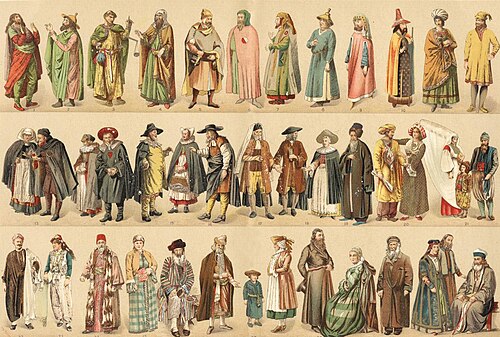
1030年に書いたアデマール・ド・シャバンヌの言葉を信じるならば(彼は捏造者としての評判があった)、反ユダヤ感情は1010年に西方ユダヤ人が東方同胞にサラセン人に対する軍事行動を警告する手紙を送った後に生じた。アデマールによると、教皇セルギウス4世[19]に促されたキリスト教徒は、1009年にイスラム教徒がエルサレムの聖墳墓教会を破壊したことに衝撃を受けた。破壊後、手紙の噂に対するヨーロッパ人の反応は衝撃と落胆であり、クリュニー会の修道士ロドルフス・グラバーは破壊の責任をユダヤ人に負わせた。その年、リモージュ司教アルドゥイン(司教990-1012)は彼の教区のユダヤ人に洗礼か追放かの選択を与えた。 1か月間、神学者たちはユダヤ人と論争したが、大した成果はなかった。信仰を捨てたユダヤ人は3、4人だけで、他の者は自殺し、残りは逃亡するかリモージュから追放された。[20] [21]同様の追放はフランスの他の町でも起こった。[21] 1030年までに、ロドゥルフス・グラバーはこの話についてさらに詳しく知っていた。[22] 1030年の彼の説明によると、オルレアンのユダヤ人は乞食を通して東方に手紙を送り、それが聖墳墓教会の破壊命令を引き起こした。グラバーは、この犯罪が発覚すると、ユダヤ人追放が至る所で布告されたと付け加えた。一部の者は都市から追い出され、他の者は処刑され、一部の者は自殺した。「ローマ世界」に残ったのはほんのわずかだった。ポール・リアン伯爵(1836-1888)は、ユダヤ人とイスラム教徒の関係についてのこの物語全体は、当時の年代記に溢れている一般的な伝説の一つに過ぎないと述べています。[23]
1065年頃、別の激しい騒動が起こった。この日、教皇アレクサンデル2世はナルボンヌ子爵ベランジェと市の司教ギフレッドに手紙を書き、彼らの地区でのユダヤ人虐殺を阻止したことを称賛し、神は流血を是認していないことを思い出させた。1065年にも、アレクサンデルはベネヴェントのランダルフォ6世に「ユダヤ人の改宗は力で獲得すべきではない」と警告した。 [24]また、同じ年に、アレクサンデルはスペインのムーア人に対する十字軍を呼びかけました。 [25]これらの十字軍は、道中で出会ったすべてのユダヤ人を容赦なく殺害しました。
十字軍
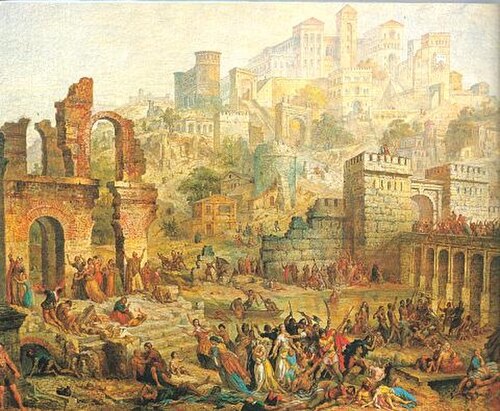
フランスのユダヤ人は第1回十字軍(1096年)の際、十字軍がルーアンのユダヤ人を教会に閉じ込めて、年齢や性別の区別なく殺害し、洗礼を受けた者だけを救ったと述べられている[26] 。ヘブライ語の文書によると、当時フランス全土のユダヤ人は大きな恐怖を感じており、ライン川沿岸諸国の同胞に手紙を書いて恐怖を知らせ、断食と祈りを求めた。ラインラントでは、何千人ものユダヤ人が十字軍によって殺害された(1096年のドイツ十字軍を参照)。[27]
ラインラント虐殺は、1096年のドイツ十字軍としても知られ、[28] 1096年(ユダヤ暦では4856年)に人民十字軍のドイツ人キリスト教徒の暴徒によって行われた一連のユダヤ人の大量虐殺である。この虐殺は、ホロコーストに至るヨーロッパにおける一連の反ユダヤ主義事件の最初のものとみなされている。[29]
虐殺に関わった十字軍の指導者の代表としては、隠者ピョートル1世や特にエミコ伯爵などがいた。[30]この迫害の一環として、シュパイヤー、ヴォルムス、マインツのユダヤ人コミュニティの破壊は「フルバン・シュム(シュムの破壊)」と呼ばれた。[31]

トゥールーズ伯領では、アルビジョワ十字軍が起こるまでユダヤ人は好意的に受け入れられていた。ユダヤ人に対する寛容と好意は、ローマ教会がトゥールーズ伯領に対して抱いていた主な不満の一つだった。十字軍がレーモン6世とレーモン7世との戦いに勝利した後、トゥールーズ伯領は他のキリスト教統治者同様、ユダヤ人を差別することを求められた。1209年、上半身裸に裸足になったレーモン6世は、今後はユダヤ人が公職に就くことを認めないと宣誓することを義務付けられた。1229年、その息子レーモン7世も同様の儀式を受け、今度はパリのノートルダム寺院でユダヤ人の公職を禁止することを義務付けられた。この問題に関する明確な規定は、モー条約(1229年)に盛り込まれた。次の世代の熱心なカトリック教徒の統治者は、何の罪もないユダヤ人を逮捕して投獄し、ユダヤ人の家を襲撃し、現金を押収し、宗教書を没収した。彼らはその後、新たな「税金」を支払った場合にのみ釈放された。ある歴史家は、ユダヤ人に対する組織的かつ公式な迫害が南フランスでの生活の常態となったのはアルビジョア十字軍以降であり、それは教会が差別措置の適用を主張できるほどの力を持つようになったのはその頃だったと主張している。[32]
追放と帰還

ユダヤ人追放の際には財産を没収し、その後身代金を支払って一時的にユダヤ人を入国させるという慣行が中世には行われ、追放も含めて王室の富を増やすために使われていた。[33]
- 1182年にフィリップ・オーギュストによってパリから[要出典]
- 1253年に教皇インノケンティウス3世の命によりウィーンから移送された[要出典]
- 1240年にブルターニュから[34]
- 1249年にポワトゥーから[34]
- 1254年にルイ9世によってフランスから
- 1288年にイングランド王エドワード1世がガスコーニュから[34]
- 1289年にアンジューとメーヌから[34]
- 1294年にヌヴェールから[34]
- 1296年にニオールから[34]
- 1306年にフィリップ4世によって王領から奪われた[34]
- 1322年にカール4世によって
- 1359年にカール5世によって
- 1394年にシャルル6世によって制定されました。
1182年、フィリップ・オーギュストはユダヤ人をフランスから追放し、1198年に再び呼び戻した。13世紀、ルイ8世(1223年 - 1226年)とルイ9世(1226年 - 1270年)の治世には、資本や負債の利子にさまざまな規制があった。カタリ派を抑圧するために設けられていた中世の異端審問は、最終的にキリスト教に改宗した南フランスのユダヤ人の問題にまで及んだ。1306年には国庫がほぼ空になり、国王は翌年テンプル騎士団の件でやろうとしていたように、ユダヤ人を追放に処し、彼らの不動産および動産を強制的に押収した。彼らの家屋、土地、動産は競売にかけられ、ユダヤ人の所有だった住居に埋められていた財宝はすべて国王のものとして留保された。1306年、ルイ10世(1314年 - 1316年)はユダヤ人を呼び戻した。 1315年7月28日の勅令で、彼は彼らに12年間の帰国を許可し、追放前に住んでいた都市に定住することを許可した。
1394 年 9 月 17 日、シャルル 6 世は突然、今後ユダヤ人は領土に居住してはならないという布告を公布しました (「Ordonnances」、vii. 675)。サン ドニの宗教によれば、王は王妃の強い要請によりこの布告に署名しました (「Chron. de Charles VI」、ii. 119)。[35]この布告はすぐには施行されず、ユダヤ人には財産を売却して負債を返済するための猶予が与えられました。ユダヤ人に負債のある者は、定められた期間内に債務を返済するよう命じられました。さもなければ、ユダヤ人は質入れした担保を売却することになりました。司教はユダヤ人を王国の国境まで護衛することになりました。その後、王はキリスト教徒の負債を免除しました。[36]
黒死病

黒死病は 14世紀半ばにヨーロッパを襲い、人口の半分以上が死に、ユダヤ人がスケープゴートにされた。ユダヤ人が井戸に毒を盛ってこの病気を引き起こしたという噂が広まった。何百ものユダヤ人コミュニティが、特にイベリア半島とゲルマン帝国で暴力によって破壊された。プロヴァンスでは、 1348年4月にはすでにトゥーロンで40人のユダヤ人が火あぶりにされた。[37]「ユダヤ人がペストの猛威から免れなかったことは気にしないでほしい。彼らは、あり得ない犯罪を自白するまで拷問を受けたのだ。
「ニュルンベルク、フランクフルト、マインツなどの都市にあった大規模で重要なユダヤ人コミュニティは、この時に一掃された。」(1406) [38]そのようなケースの1つでは、アジメという名の男が、シャンベリーのラビ・ペイレ(ジュネーブ近郊)がヴェネツィア、トゥールーズ、その他の井戸に毒を入れるよう彼に命じたと強要された。アジメの「告白」の余波で、ストラスブールのユダヤ人は1349年2月14日に生きたまま焼かれた。[39] [40]
教皇クレメンス6世は1348年7月6日の教皇勅書と別の1348年勅書でユダヤ人を守ろうとしたが、その数か月後、まだペストが蔓延していなかったストラスブールで900人のユダヤ人が火刑に処された。 [37]クレメンス6世は暴力行為を非難し、ペストをユダヤ人のせいにする人々(鞭打ち刑に処せられた人々も含む)は「あの嘘つき、悪魔に誘惑された」と述べた。[41]
ペストと直接関係する最初の虐殺は1348年4月にトゥーロンで起こった。トゥーロンのユダヤ人街が略奪され、40人のユダヤ人が自宅で殺害された。その後まもなく、バルセロナや他のカタルーニャの都市で暴動が起こった。[42] 1349年には、エアフルトの虐殺、バーゼルの虐殺、アラゴンやフランドルでの虐殺など、ヨーロッパ全土で虐殺と迫害が広がった。[43] [44] 1349年2月14日、ペストがまだ街に影響を与えていなかった「バレンタインデー」のストラスブール虐殺で、2,000人のユダヤ人が生きたまま焼かれた。灰がくすぶっている間に、ストラスブールのキリスト教徒の住民は、火で焼かれなかったユダヤ人の貴重な財産をふるいにかけ、集めた。[45] [37] この時期に何百ものユダヤ人コミュニティが破壊された。この時期に破壊された510のユダヤ人コミュニティの中には、迫害を逃れるために自殺した者もいた。[46] 1349年の春、フランクフルト・アム・マインのユダヤ人コミュニティが壊滅した。これに続いてマインツとケルンのユダヤ人コミュニティが破壊された。マインツの3,000人のユダヤ人は当初自衛し、キリスト教徒の攻撃をなんとか食い止めた。しかし、最終的にはキリスト教徒がユダヤ人ゲットーを制圧し、ユダヤ人全員を殺害した。 [45]シュパイヤー では、ユダヤ人の死体がワイン樽に詰められ、ライン川に投げ込まれた。1349年の終わりまでに、ラインラントにおける最悪のポグロムは終結した。しかし、この頃、バルト海沿岸のハンザ都市近郊や東ヨーロッパでユダヤ人の虐殺が増加し始めた。 1351年までに、反ユダヤ主義の虐殺事件が350件発生し、60の大規模なユダヤ人コミュニティと150の小規模なユダヤ人コミュニティが根絶されました。[要出典]
ステレオタイプと中世美術

中世には、キリスト教徒によって、架空またはステレオタイプ的な方法でユダヤ人を描いた芸術作品が数多く制作された。中世の宗教的物語芸術の大半は聖書の出来事を描いたもので、そこに描かれた人物の大半はユダヤ人であった。しかし、その描写においてこの点がどの程度強調されているかは大きく異なっていた。こうした芸術作品の中には、ユダヤ人の服装や外見に関する先入観や、キリスト教徒がユダヤ人が犯したと信じていた「罪深い」行為に基づいているものもあった。[47]この時代を象徴するシンボルの 1 つがエクレシアとシナゴーグである。これはキリスト教会 (エクレシア) を擬人化した一対の像で、その前身であるイスラエル国家 (シナゴーグ) の横に並んでいた。後者は目隠しをされ、手から滑り落ちる律法の石板を持ち、時には折れた杖も持っている姿で描かれることが多いが、エクレシアは冠をかぶった頭、聖杯、十字架で飾られた杖を持って直立している。[48]これは、モーセに与えられた「古い」契約をキリストの「新しい」契約に置き換えるというキリスト教の交替主義の教義の誤解の結果であることが多く、中世のキリスト教徒はこれをユダヤ人が神の恩寵を失ったことを意味すると解釈しました。[要出典]
中世のキリスト教徒は、ユダヤ人がキリストが救世主であることを認めなかったため、ユダヤ人の「頑固さ」を信じていた。この考えはさらに拡大し、ユダヤ人はキリストを拒絶し、十字架に釘付けにして殺害することを決意した。そのため、ユダヤ人は「キリスト教徒の敵」や「キリスト殺し」とみなされた。[47]この考えは、キリスト教美術におけるユダヤ人の反ユダヤ的描写の背後にある主なインスピレーションの 1 つであった。[要出典]
中世のキリスト教徒によると、ユダヤ人を含め、彼らの信仰の考えに同意しない者は、自動的に悪魔と親しいとみなされ、同時に地獄に落ちる運命にあった。キリスト教美術の多くの描写では、ユダヤ人は悪魔に似せたり、悪魔と交流したりしているように描かれている。これは、ユダヤ人を醜く、邪悪で、グロテスクなものとして描くだけでなく、悪魔とユダヤ人が本質的に似ていることを確立することを意図している。ユダヤ人は地獄の前に置かれ、彼らが地獄に落ちていることをさらに示すこともあった。[47]
12世紀までに、「典型的なユダヤ人」という概念が広く知られるようになった。典型的なユダヤ人は、通常、濃いあごひげ、帽子、大きく曲がった鼻を持つ男性であり、これらはユダヤ人の重要な特徴であった。これらの概念は中世の芸術に描かれ、最終的にユダヤ人が簡単に識別できることを保証した。典型的なユダヤ人の背後にある考え方は、主に彼らを避けて恐れるべき醜い生き物として描くことであった。[47]
アンシャン・レジーム

ルイ14世(在位:1643年~1715年)
アンシャン・レジームは、フランス王国の中世後期(15世紀頃)から1789年のフランス革命までの政治・社会体制であり、初期近代フランスと呼ばれる時代であり、ルイ14世の72年間の治世(1643-1715)に象徴される。革命前のフランスには約4万人から5万人のユダヤ人がおり、主にボルドー、メス、その他いくつかの都市に集中していた。ユダヤ人は金貸し業を除いて権利と機会が非常に限られていたが、その身分は合法であった。[49]
フランスのユダヤ人居住者は、中世から引き継いだ条件のもと、南西部、南東部、北東部の国土の周辺部に住んでいた。パリにはわずか 400 人ほどしかいなかった。彼らの主な関心は居住権の維持だけだったが、居住権の維持にはさまざまな統治者への多額の金銭的支払いが必要で、国王と地方領主の間で権限が分かれていたため、これは複雑だった。その代わりに、ユダヤ人は特定の場所に住み、特に金貸しや中古品販売など、限られた職業に就くことを許された。ユダヤ人は容認された外国人グループであり、一般社会秩序と並行して、しかし完全にその一部ではなく、独自のハラハー法によって統治される自治コミュニティを形成した。社会的反感に苦しんだものの、彼らは宗教を実践することができ、一部の地域ではごく最近になってようやく実践できるようになった。さまざまなユダヤ人コミュニティのうち、主にボルドー出身の南西部のマラーノは、王室から最も商業的に評価され、一般フランス社会に最も社会的に同化していた。 14世紀にフランスから追放された彼らの特権は、銀行家やブローカーとしての経済的有用性を中心に、1723年にルイ15世によって再び認められました。 [50]
革命期のフランス
革命への準備

フランス革命以前、ヴォルテールはユダヤ人に対する敵意から、自身の『哲学辞典』にユダヤ人に向けた次のような訓戒を載せた。「あなた方は計算高い動物だ。考える動物になるように努めよ」[51] 。 1770年代、百科全書の寄稿者やその他の思想指導者の大多数(1714年のアイルランド人哲学者ジョン・トーランドや1716年のプロテスタント牧師ジャック・バスナージュ・ド・ボーヴァル[52]のような稀なユダヤ教愛国主義者を除く)は、アンティル諸島の黒人住民や北アメリカのヒューロン族、その他の部族の公民権を擁護することに忙しく、すぐ隣国であるフランスのユダヤ人の解放を訴えることを忘れ、代わりに彼らを非難したり嘲笑したりした。[52] それにもかかわらず、ディドロは、百科事典の中で最も長い記事の一つである「ユダヤ人」の記事で、「ユダヤ人の運命の重要性と彼らの思想の豊かさを正当に評価している」[53] 。
1784年7月10日の特許状により、アルザスのユダヤ人(約2万人)に対して厳しい措置が取られた。ユダヤ人の数と結婚の制限、経済的制限、その他の措置である。[54] 一方、ルイ16世による1784年1月の勅令は、他のユダヤ人を「ライプツォルの義務、移動、関税[明確化]、およびこの種の他のすべての義務から彼ら自身にのみ」免除した。これは、ユダヤ人をそれまで動物と同等に扱っていた。[55] 1787年、メス王立芸術科学協会は「フランスでユダヤ人をより幸せに、より有用にする方法はあるか?」というコンテストを開始した。[a]
フランス革命
1791年9月27日、国民議会がフランス市民権を可決したことにより、ユダヤ人はフランス市民権と同等の権利を獲得した。後に修正が加えられ、ユダヤ人コミュニティに一定の自治権を与える特権が削除された。これは、ユダヤ人個人が他のフランス市民と同等の権利を持つようにするためであり、それ以上でもそれ以下でもない。[56]
ナポレオンと第一帝政
19世紀初頭、ナポレオン・ボナパルトはヨーロッパでの征服を通じて、革命フランスの近代主義思想、すなわち市民の平等と法の支配を広めた。ナポレオンのユダヤ人に対する個人的な態度は、さまざまな歴史家によってさまざまな方法で解釈されてきた。ナポレオンはさまざまな時期にユダヤ人を支持する発言も、ユダヤ人に反対する発言もしたからである。正統派のラビ、ベレル・ウェインは、ナポレオンはユダヤ人が独自のコミュニティとして繁栄することよりも、同化することを望んでいたと主張した。「ユダヤ人に対するナポレオンの表向きの寛容さと公平さは、実際には完全な同化、異人種間の結婚、改宗によってユダヤ人を完全に消滅させるという彼の壮大な計画に基づいていた。」 [57]
1822年の通信で、ナポレオンは「高利貸しをやめて」そして「ユダヤ人を良き市民にしたい」という願いに基づいてユダヤ人解放を支持すると表明したが[58]、1808年には弟のジェローム・ナポレオンに「私はユダヤ人を改革しようとしたが、彼らをもっと自分の領土に引き入れようとはしなかった。それどころか、人類の中で最も卑劣な者に対する敬意を示すようなことは何も避けてきた」と述べて矛盾した見解を表明していた[59] 。
第三共和国
メディアと組織
1882年から1885年にかけて、反ユダヤ主義の出版物3誌が創刊されたが、長くは続かなかった。『反ユダヤ主義』、『反ユダヤ主義』、『社会の危険』である。[60]
エドゥアール・ドゥリュモンは1886年に1200ページに及ぶ反ユダヤ主義の小冊子『La France juive(ユダヤ人のフランス)』を出版した。 [60]当時のベストセラーとなり、絶大な人気を博し[61] [ページ必要]、初版から2年間で140刷となった。この本は非常に人気があったため、独自の文学ジャンルを生み出し、1887年にはカリクスト・ド・ウォルスキの『ユダヤ人のロシア』やジョルジュ・メイニエの『ユダヤ人のアルジェリア』、1900年にはフランソワ・トロカースの『ユダヤ人のオーストリア』、1913年にはドエダラスの『ユダヤ人のイングランド』が出版された。 [61] [ページ必要]ドゥリュモンの本は1938年、1986年、2012年に再版され、2018年にはデジタル版が出版された。
この本の成功に触発され、ドゥルモンとジャック・ド・ビエ [fr]は1889年にフランス反ユダヤ同盟(Ligue antisémitique de France )を設立した。同同盟はドレフュス事件で活動した。[60] ジュール・ゲランは活動的なメンバーだった。同盟はデモや暴動を組織し、その戦術は後に他の極右組織にも模倣された。[要出典]ゲランは1898年から1899年まで反ユダヤ同盟の公式機関紙として反ドレフュス派の週刊紙「L'Antijuif」を編集した。[62]

最初はエルネスト・ジュアンが、後に自由カトリック連盟 [fr]の指導者であるカノン・シェーファー司祭が主宰した『国際秘密結社レビュー』 [fr]は、1912年の購読者数200人から1932年には2000人にまで増加した。[63]陰謀論の信奉者で、多くの新聞(フランソワ・コティ主宰の『フィガロ』、または「オカルト勢力に対する人種差別的行動の週刊誌」[b]の副題が付けられた『人々の友』 [64]を含む)に寄稿していたカトリックのジャーナリスト、レオン・ド・ポンサンもこの雑誌に参加していた。[64]オカルティストのピエール・ヴィリオンもこの雑誌に参加していた。ヴィリオンは戦後、北アフリカで人種差別法を施行する前に、ヴィシー政権の国防大臣であるウェイガン将軍[65]と共に協会を設立した。[ 64 ]
反ドレフュス派のリュシアン・ペンジャン [fr]、ジャン・ドロ [fr]、アルベール・モニオ [fr]が運営する『ル・グラン・オクシダン』は、1934年に6,000部を印刷した。ジャン・ボワセルのフランス戦線 [fr]の機関紙で、ジャン・ドロ [fr]とユルバン・ゴイエが協力していた『ル・レヴェイユ・デュ・ピープル』は、1939年に3,000部を配布した。[64] 1924年に廃刊となった『ラ・リブル・パロール』は、1928年から1929年にかけて商業的には成功しなかったが、1930年にヘンリー・コストン(別名ジョルジュ・ヴィルボー)が再発行し、戦争まで編集を担当した。この新聞には、ジャック・プロンカール、ジャン・ドロ [fr]、アンリ・ロベール・プティ[ fr ]、アルベール・モニオ[fr] 、マチュー・ドゥゲイユ [fr]、ルイ・トゥルネール [fr]、ジャック・ディット [fr]など、多くの有名な反ユダヤ主義者が寄稿していた。同紙の月刊誌の購読者数は2000人だった。[64]
その他の雑誌はもっと短命で、例えば「ラ・フランス・レエル」( 「ラ・アクション・フランセーズ」に近い) 、ファシストの「ランシュルジェ」(「ロレアル」の創設者ウジェーヌ・シュレールが資金提供した反共産主義、反ユダヤ主義のテロ組織ラ・カグールに近い)などである。後者はユベール・ブールジャンやジャック・デュマ [fr]の記事を掲載した。[64]
パナマ運河スキャンダル

パナマ運河スキャンダルは、 1892年にフランス第三共和政で勃発した汚職事件で、フランス企業がパナマを通る運河建設に失敗したことに関係していた。約5億フランが失われた。フランス政府関係者は、パナマ運河会社の財政難について口を閉ざすために賄賂を受け取っていたが、これは19世紀最大の金融汚職スキャンダルとみなされている。[66]

ハンナ・アーレントは、この事件は、ジャック・ド・ライナック男爵とコルネリウス・ヘルツという2人のドイツ系ユダヤ人が関与していたため、フランスの反ユダヤ主義の発展に非常に大きな影響を与えたと主張している。[67]賄賂を受け取った国会議員や会社の役員ではなかったが、アーレントによれば、賄賂の分配を担当していたのは2人で、ライナックはブルジョア政党の右派に、ヘルツは反教権主義者の急進派に分配した。ライナックは政府の秘密の財務顧問であり、パナマ会社との関係を扱っていた。[67]ヘルツは急進派におけるライナックの連絡係だったが、ヘルツの二重の脅迫が最終的にライナックを自殺に追い込んだ。
しかし、ライナックは死ぬ前に、買収された国会議員のリストを、エドゥアール・ドゥリュモンの反ユダヤ主義日刊紙「ラ・リブル・パロル」に渡し、その見返りとして、同紙はライナック自身の役割を隠蔽した。このニュースにより、一夜にして「ラ・リブル・パロル」は無名の新聞から国内で最も影響力のある新聞の一つに変貌した。犯人のリストは毎朝少しずつ発表されたため、何百人もの政治家が何ヶ月も不安に駆られた。アーレントの見解では、このスキャンダルは、ビジネス界と国家の仲介者がほぼユダヤ人だけであることを示しており、それがドレフュス事件への道を開くのに役立った。[68]
ドレフュス事件

ドレフュス事件は、1894年から1906年に解決するまでフランス第三共和政を二分した政治スキャンダルであった。フランス語で「L'Affaire」として知られるこの事件は、フランス語圏における現代の不正を象徴するものであり、 [69]複雑な冤罪と反ユダヤ主義の最も顕著な例の一つであり続けている。この紛争では、報道機関と世論が果たした役割が大きな影響力を及ぼした。
このスキャンダルは、1894年12月にアルザス系ユダヤ人のアルフレッド・ドレフュス大尉が反逆罪で有罪判決を受けたことから始まった。彼はフランスの軍事機密をドイツに漏らしたとして終身刑を宣告され、フランス領ギアナのデビルズ島に投獄され、そこでほぼ5年間を過ごした。
.jpg/500px-Libre_Parole_illustr%C3%A9e_(1895-04-13).jpg)
反ユダヤ主義は、この事件全体を通じて顕著な要因であった。ドレフュス事件以前から存在し、ブーランギズム事件やパナマ運河スキャンダルの際にも表出していたが、知識階級に限られていた。ドレフュス事件は、ユダヤ人に対する憎悪を社会のあらゆる階層に広めた。この運動は、間違いなく、1886年にエドゥアール・ドリュモンが『ユダヤ人フランス』を成功させたことに始まる。 [70]その後、さまざまな法廷事件や報道キャンペーンによって、15年近くにわたって大きく増幅された。反ユダヤ主義はそれ以降、公式なものとなり、労働者階級を含むさまざまな場面で明らかになった。[71]立法選挙の候補者は、議会選挙のスローガンとして反ユダヤ主義を利用した。この反ユダヤ主義は、1905年の政教分離の危機によって強化され、おそらくフランスで最高潮に達した。ヴィシー政権の出現により反ユダヤ主義的行為が容認され、人種的憎悪の自由かつ抑制されない表現が認められた。[要出典]
反ユダヤ暴動
反ユダヤ暴動はドレフュス事件以前から存在し、東方ではほぼ伝統となっていた。そこでは「フランスで革命が起きるとアルザスの人々はそれを警戒した」[72] 。しかし、1898年のドレフュス事件の際に起きた反ユダヤ暴動は、はるかに広範囲に及んだ。1月から2月にかけて、55の地域で3度の暴動の波が起きた。第1波は1月23日の週に終わり、第2波はその翌週、第3波は2月23日から28日まで続いた[73] 。これらの波とその他の事件により、全国で69件の暴動や騒乱が発生した。 [74]さらに、1月18日から25日にかけてフランス領アルジェリアで暴動が発生した。これらの騒乱に参加したデモ参加者は、石を投げ、スローガンを叫び、ユダヤ人の財産や時にはユダヤ人を攻撃し、警察の阻止努力に抵抗した。市長たちは平静を呼びかけ、騒乱を鎮圧するために騎兵を含む軍隊が召集された。[73]

エミール・ゾラの有名な小説『告発』は1898年1月13日に『ローロール』に掲載されたが、ほとんどの歴史書は、暴動は『告発』の出版とそれに続くゾラ裁判に対する自然発生的な反応だったと示唆しており、「騒々しいデモがほぼ毎日発生した」と報告している。各都市の知事や警察は、地元でのデモを記録し、「元大尉ドレフュスを支持する運動」や「ゾラ氏の介入」、あるいは「反ユダヤ主義デモを引き起こしたと思われる」ゾラ裁判そのものと関連付けた。パリでは、ゾラ裁判をめぐるデモが頻繁に起こり、時には暴力的だった。マルタン・デュ・ガールは、「ユダヤ人の容貌の人物が、巻き上げた『ローロール』のコピーで作った燃える松明を振り回しながら周りで踊る、錯乱した若者たちにつかまれ、取り囲まれ、乱暴に扱われた」と報告している。[73]
しかし、この事件、特にゾラ裁判に対する熱狂的な反応は、部分的には自然発生的なものだった。ナント、リール、ル・アーヴルを含む12の都市で、反ユダヤ主義のポスターが路上に現れ、その後すぐに暴動が起きた。サンテティエンヌでは、「パリ、リヨン、マルセイユ、ナント、トゥールーズの兄弟に倣い、彼らと共に、国家に対する陰謀的な攻撃に抗議するデモに参加しよう」と書かれたポスターが貼られていた。カーン、マルセイユ、その他の都市では、反ユダヤ主義の演説や集会、例えばカーンで宗教社会防衛委員会が主催した集会の後に暴動が起きた。[73]
人民戦線
ヴィシー政権
第二次世界大戦中、ヴィシー政権はナチスドイツと協力して、多数のフランス系ユダヤ人と外国のユダヤ人難民を逮捕し、強制収容所に移送した。[1]戦争の終わりまでに、フランスのユダヤ人人口の25%がホロコーストで死亡した。[3] [4]
アーリア化

フランス語のウィキソースには、この記事に関連する原文があります:
1941 年 7 月 2 日の重要な法規
アーリア化とは、ナチスドイツ、枢軸国、占領地におけるユダヤ人のビジネスから強制的に排除されたことであり、ユダヤ人の財産が「アーリア人」の手に移された。このプロセスは1933年にナチスドイツでユダヤ人の財産の移譲から始まり、ホロコーストで終わった。[75] [76] 一般的に2つの段階が特定されている。第1段階では、ユダヤ人の被害者からの盗難が合法性の見せかけの下に隠蔽され、第2段階では、財産がより公然と没収された。どちらの場合も、アーリア化はナチスの政策に対応しており、ドイツの法務および財務官僚によって定義、支援、実施された。[77] [78] 2005年の[米国]ドルで2,300億ドルから3,200億ドルがヨーロッパ中のユダヤ人から盗まれ、[79]数十万の企業がアーリア化された。

この用語は、歴史家によって、ドイツ占領軍とヴィシー政権が共同で同時に実行したフランス系ユダヤ人の略奪を指すためにも使用されています。これは、1940 年秋に占領地でドイツ軍が容赦なく行ったアーリア化に続く、1941 年 7 月 22 日の「フランス国家」の法律に従ったものです。ユダヤ人の財産の略奪は、長い間無視されてきましたが、1990 年代以降、高度に発達した研究分野となっています。
ユダヤ人の財産没収は、1941年3月29日に創設され、最初はザビエ・ヴァラ、次いでルイ・ダルキエ・ド・ペルポワによって指揮されたユダヤ人総監部の使命宣言に最初から含まれていた。1940年の夏からは、ドイツのさまざまな部門もユダヤ人の財産の盗難に積極的に関与した。オットー・アベッツ大使は、1940年に南フランスへの大規模な脱出に乗じて、 不在のユダヤ人所有者の美術コレクションを盗んだ。1941年末、ドイツ人はフランスのユダヤ人コミュニティに10億フランという法外な罰金を課した。これはユダヤ人の財産の売却時に支払われるものとされ、預金等預託金庫によって管理された。
歴史家ヘンリー・ルッソはアーリア化された企業の数を1万社と推定した。[80]占領下、ユダヤ人の財産を管理する役職に5万人が任命された。1940年までに、多くの職業を禁じるヴィシー法とドイツの法令により、ユダヤ人コミュニティの50%が通常の生計手段を奪われた。[81]
宣伝

「ユダヤ人とフランス」は、ドイツ占領下のフランスで1941年9月5日から1942年1月15日までパリで開催された反ユダヤ主義のプロパガンダ展示会である[82]。この展示会の映画版は1941年10月にフランスの映画館で公開された[83] 。
この展覧会は、ゲシュタポの統制下にあったユダヤ人問題研究所(IEQJ)を通じてフランスにおけるドイツ軍政の宣伝機関によって企画・資金提供され、約50万人の来場者を集めた。 [82] [83]この展覧会は、1940年11月に出版された『ユダヤ人をどのように見分けるか』の著者であるパリの人類学学校のジョルジュ・モンタンドン教授の研究に基づいていた。それは「科学的」であるという自負があった。 1941年9月5日、カールテオ・ツァイチェルとテオドール・ダネッカーによってパレ・ベルリッツで開幕した。[84] [要ページ] [85] [86]
反ユダヤ法

第二次世界大戦中、ヴィシー政権は1940年と1941年に反ユダヤ法を制定し、フランス本土とその海外領土に影響を与えた。これらの法律は、実際には、1940年7月11日時点で議会が失脚していたため、国家元首フィリップ・ペタン元帥の布告であった。この法律制定の動機は自発的なものであり、ドイツから強制されたものではなかった。[87] [88]
1940年7月、ヴィシー政権は1927年の国籍法改正以降に認められた帰化を再検討する特別委員会を設置した。[89] 1940年6月から1944年8月の間に、主にユダヤ人である15,000人が帰化を剥奪された。[90]この官僚的決定は、その後のグリーンチケットによる一斉検挙で彼らを強制収容する上で重要な役割を果たした。[要出典]

ペタンは1940年10月3日の法律を当初のものよりさらに過激な反ユダヤ主義に変えた。これは彼自身の手による草案への注釈からもわかる。[91]この法律は「ニュルンベルク法で定められたユダヤ人の定義を取り入れ」[92] 、ユダヤ人の公民権を剥奪し、多くの職から解雇した。この法律はまた、ユダヤ人が特定の職業(教師、ジャーナリスト、弁護士など)に就くことを禁じた一方、1940年10月4日の法律は、ギュルスなどの南フランスの収容所に外国人ユダヤ人を収容する権限を与えた。
この法令は、ユダヤ人から公職に就く権利を剥奪し、彼らを下層階級とみなし、市民権を剥奪することを目的としていた。[93] [94] [95]その後、多くのユダヤ人がドランシ収容所に集められ、その後ナチスの強制収容所に移送されて絶滅させられた。
パリが解放され、シャルル・ド・ゴール率いる臨時政府が政権を握った後、これらの法律は1944年8月9日に無効と宣言された。[96]
ホロコースト

1940年から1944年の間、占領下のフランス、自由地域、ヴィシー政権下のフランス領北アフリカのユダヤ人、およびロマ人は迫害され、襲撃で一斉に集められ、ナチスの絶滅の収容所に移送された。迫害は1940年に始まり、フランスからナチスドイツとナチス占領下のポーランドのナチス強制収容所へのユダヤ人の移送で最高潮に達した。移送は1942年に始まり、1944年7月まで続いた。1940年にフランス本土/大陸部に住んでいた34万人のユダヤ人のうち、7万5000人以上が絶滅の収容所に移送され、約7万2500人が殺害された。ヴィシー政権とフランス警察はユダヤ人の一斉検挙を組織し、実施した。[97]
ラウンドアップ
フランス警察は第二次世界大戦中にユダヤ人の一斉検挙を何度も行った。その中には1941年のグリーンチケットによる一斉検挙[98] [99]、 1942年のヴェロドローム・ディヴェールでの大規模な一斉検挙(13,000人以上のユダヤ人が逮捕された) [100] [101]、1943年のマルセイユ旧港での一斉検挙[102]などがある。逮捕されたほぼ全員がアウシュビッツや他の絶滅収容所に移送された。
グリーンチケット総括

グリーンチケットによる一斉検挙は、ナチス占領下のフランスで1941年5月14日に行われた。大量逮捕は、フランス警察がパリ在住の外国人ユダヤ人6694人にグリーンカード(フランス語:ビレ・ヴェール)を渡し、「身分確認」のために出頭するよう指示した翌日に始まった。[103]
半数以上が指示通りに報告し、そのほとんどはポーランド人とチェコ人だった。彼らは逮捕され、フランスにある2つの通過収容所の1つに移送された。彼らのほとんどは1年間拘留された後、アウシュビッツに移送され、殺害された。グリーンチケットによる一斉検挙は、ヴィシー政権による最初のユダヤ人の大量検挙であった。[99]
1942年7月ヴェル・ディヴ一斉検挙

1942年7月、フランス警察は、ルネ・ブスケとパリの副官ジャン・ルゲの命令により、国営鉄道会社SNCF当局の協力を得て、ヴェル・ディヴ一斉検挙(Rafle du Vel' d'Hiv )を組織した。警察は7月16日と17日に13,152人のユダヤ人を逮捕し、ヴェロドローム・ディヴェールに投獄した。この中にはゲシュタポが要求していなかった子供4,051人と女性5,082人が含まれていた。彼らはドランシー収容所に連行され、その後貨車に詰め込まれ、鉄道でアウシュビッツ絶滅収容所へ送られた。犠牲者のほとんどは、食糧や水の不足により途中で死亡した。生き残った者たちはガス室で殺害された。この行動だけで、1942年に強制収容所に送られた4万2000人のフランス系ユダヤ人の4分の1以上を占め、そのうち戦争を生き延びたのはわずか811人だった。ナチスがこの行動を指揮したにもかかわらず、フランス警察当局は抵抗することなく積極的に参加した。[104]
1941年パリのシナゴーグ襲撃
1941年10月2日から3日の夜、パリのシナゴーグ6軒がドアのそばに仕掛けられた爆発物によって攻撃され、被害を受けた。[105]
パリのシナゴーグへの攻撃は、ナチス占領治安警察(SIJ)の最高司令官ヘルムート・クノッヘンが命じた。 [ 106 ]ミリスのメンバーが爆弾を仕掛けた。[要出典]極右政党である革命的社会運動(MSR)も攻撃に関与していた。[107]
1941年10月4日土曜日、スイスの新聞『フィーユ・ダヴィ・ド・ヌーシャテル・エ・デュ・ヴィニョブル・ヌーシャテロワ』 のヴィシー特派員は次のように報じている。
木曜日と金曜日の夜、午前1時から5時の間にパリで7つのシナゴーグに対する攻撃があった。トゥルネル通りのシナゴーグ、モンテスパン通りのシナゴーグ、コペルニクス通りのシナゴーグ、ラザレ通りのノートルダムのシナゴーグ、勝利のノートルダムのシナゴーグ、そして名前がまだわからない通りにある6番目のシナゴーグが攻撃された。壁だけが残っているほど被害は大きい。市庁舎近くのパヴェ通りのシナゴーグの爆弾は間に合うように撤去された。2人が負傷した。警察長官のダール提督が現場に到着し、捜査を指揮している。攻撃は贖罪日の翌日に起こった。[108]
犯人は特定されたが逮捕されなかった。[要出典]
組織的略奪
ナチスドイツはドイツ国内および占領したすべての領土から文化財を略奪し、特にユダヤ人の財産を標的にしました。書籍、絵画、その他の文化財を略奪することを目的としていくつかの組織が設立されました。[109]
第二次世界大戦後
アルジェリア
背景
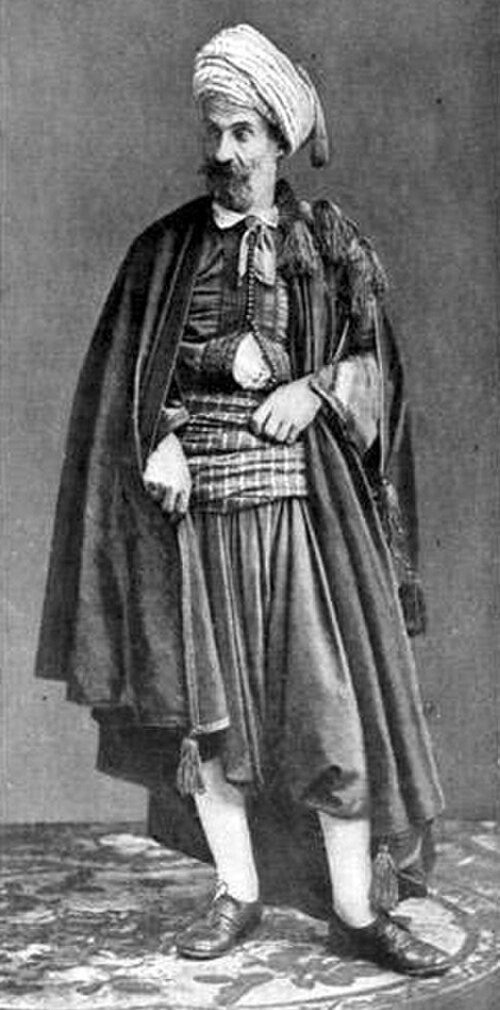
アルジェリアには少なくともローマ時代からユダヤ人が定住していたという証拠がある(マウレタニア・カエサリエンシス)。[110] 7世紀には、西ゴート王シセブト[111]とその後継者による迫害を逃れて北アフリカにやってきたユダヤ人移民によって、北アフリカのユダヤ人居住地が強化された。彼らはマグリブに逃れ、ビザンチン帝国に定住した。後に、1391年のスペインでの迫害と1492年のスペイン異端審問から逃れるため、多くのセファルディ系ユダヤ人がアルジェリアに避難せざるを得なくなった。 [112]彼らは北アフリカの港に押し寄せ、現地のユダヤ人と混ざり合った。16世紀には、オラン、ベジャイア、アルジェなどの場所に大規模なユダヤ人コミュニティがあった。 1830年までにアルジェリアのユダヤ人の人口は15,000人に達し、そのほとんどは沿岸地域に集中しており、アルジェには約6,500人が居住し、人口の5分の1を占めていた。[113]
フランス政府は、当時33,000人ほどいたユダヤ人に、1870年にクレミュー法令に基づきフランス国籍を付与した。 [115]アルジェリア系ユダヤ人に国籍を与える決定は、北アフリカ系ユダヤ人を「後進的」とみなし、近代化を図ろうとしたリベラルで知識階級のフランス系ユダヤ人コミュニティの著名なメンバーからの圧力の結果であった。[要出典]
当初は抵抗があったものの、一世代のうちにほとんどのアルジェリア系ユダヤ人はアラビア語やラディーノ語ではなくフランス語を話すようになり、フランス文化の多くの側面を受け入れた。アルジェリア系ユダヤ人は「フランスらしさ」を受け入れて植民者に加わったが、フランス人にとっては依然として「異質」とみなされていた。一部のユダヤ人はより典型的なヨーロッパの職業に就いたが、「ユダヤ人の大多数はイスラム教徒の顧客を相手にする貧しい職人や店主だった」[116]。さらに、セファルディ系ユダヤ人の宗教法とフランス法の衝突がコミュニティ内での争いを生んだ。彼らは結婚など家庭内の問題に関する変化に抵抗した[117] 。
フランスの反ユダヤ主義はアルジェリアのフランス人駐在員コミュニティに深く根を下ろし、アルジェリアではすべての市議会が反ユダヤ主義者によって支配され、新聞には地元のユダヤ人コミュニティに対する外国人排斥的な攻撃が溢れていた。[118]アルジェでは、エミール・ゾラが1898年にアルフレッド・ドレフュスの公開書簡「告発せよ...!」での弁護で裁判にかけられた際、158軒以上のユダヤ人所有の店が略奪され、放火され、2人のユダヤ人が殺害されたが、軍は傍観し介入を拒否した。[119]
1940年10月7日のヴィシー法(10月8日にアルジェリア公報で公布)によりクレミュー法令は廃止され、アルジェリアのユダヤ人の帰化が剥奪された。[120]
独立のための闘争
アルジェリアのユダヤ人コミュニティは常に脆弱な立場にあった。第二次世界大戦後、アルジェリアのユダヤ人コミュニティは宗教機関を支援し保護するためにいくつかの組織を結成した。コミュニティの運命はアルジェリアの民族主義者の独立闘争によって決定された。1956年にすでに、アルジェリア民族解放戦線は「ユダヤ系アルジェリア人」にアルジェリア国籍を選択するよう呼びかけていた。1958年にFLNがユダヤ人機関の職員2人を誘拐して殺害し、1960年にはアルジェの大シナゴーグとオランのユダヤ人墓地が冒涜され、FLNによって他の人々が殺害されたことで、恐怖は増大した。[121]

1961年当時、アルジェリア系ユダヤ人のほとんどは、紛争の解決を可能にする分割または二重国籍の解決策を依然として望んでおり、アルジェリア社会研究委員会などのグループは、アイデンティティの問題に対処しようと試みた。OAS(秘密軍事組織)とFLNによるテロ活動の増加に伴い恐怖が高まり、1962年半ばには移民が急増し、7万人がフランスへ、5,000人がイスラエルへ向かった。フランス政府はユダヤ人と非ユダヤ人の移民を平等に扱い、32,000人のユダヤ人がパリ地域に定住し、その他多くのユダヤ人がすでにコミュニティが確立していたストラスブールに向かった。アルジェリアのユダヤ人コミュニティの80%がフランスに定住したと推定されている。[121]
1962年のアルジェリア独立後もまだそこに住んでいたユダヤ人にとって、状況は数年間は耐えられるもので、ヨム・キプールには文化大臣が会衆に演説した。しかし、 1965年にウアリ・ブメディエンが権力を握ると、状況は急速に悪化し、重税の導入、裁判所の保護の欠如を含む差別の増加、1967年の報道機関による攻撃、墓地の荒廃、シナゴーグの汚損が続いた。1969年までに、高齢化や家を離れたくないという理由で、残ったユダヤ人は1,000人以下になった。1990年代までに、シナゴーグは1つだけ残り、残りはモスクに改築され、約50人のユダヤ人が残った。[121]
暴行と冒涜
1980年パリのシナゴーグ爆破事件

1980年10月3日、フランスのパリにあるコペルニクス通りのシナゴーグがテロ攻撃で爆破された。この攻撃で4人が死亡、46人が負傷した。爆破はユダヤ教の祝日シムハット・トーラーの期間中、安息日の始まりに近い夕方に起きた。これは第二次世界大戦終結以来、フランスでユダヤ人に対する最初の死傷者を出した攻撃だった。[122]フランス国家欧州行動連盟(FANE)が犯行声明を出したが[123] 、警察の捜査では後にパレスチナ民族主義者が犯行に及んだ可能性が高いと結論付けられた。[124] [125]
1982年パリレストラン爆破事件
1982年8月9日、アブ・ニダル組織はパリのマレ地区にあるユダヤ人レストランで爆破と銃撃事件を起こした。2人の襲撃者は手榴弾をダイニングルームに投げ込み、突入して機関銃を発砲した。[126]彼らはアメリカ人2人を含む6人を殺害し[127] 、22人を負傷させた。ビジネスウィーク誌は後にこれを「第二次世界大戦以来、フランスでユダヤ人が被った最も大きな犠牲」と評した。[128] [129]レストランは2006年に閉店し、元オーナーのジョー・ゴールデンバーグは2014年に亡くなった。[130]
アブ・ニダル組織は長い間疑われていたが、 [131] [132]フランスの裁判官によって匿名を認められていた2人のアブ・ニダル元メンバーの証言によって、攻撃から32年後に初めて同組織の容疑者が特定された。[133]
2020年12月、容疑者の一人であるワリド・アブドゥルラフマン・アブ・ザイードは(ノルウェーの空港で)フランス警察に引き渡され、フランスへ空輸された。[134] [135] [136] 12月後半、彼はパリのラ・サンテ刑務所に拘留された。 [137] 2021年3月現在、彼はまだ刑務所に収監されている。[138]
カルパントラ墓地 1990
1990年5月10日、カルパントラのユダヤ人墓地が冒涜された。これが世論の騒動となり、パリではフランソワ・ミッテランフランス大統領を含む20万人が参加した抗議デモが行われた。数年にわたる捜査の後、 1996年8月2日、極右のフランス・欧州国民党の元党員3人を含む5人が自白した。[139] [140] 1990年6月5日、PNFEの雑誌「トリビューン・ナショナリスト」がフランス当局により発禁処分となった。[141]
2000年以降
フランスは、米国に次いでユダヤ人の離散人口が多く、推定50万~60万人である。パリの人口が最も多く、次いでマルセイユで7万人のユダヤ人がおり、そのほとんどは北アフリカ出身である。反ユダヤ主義の表現は、 1967年の六日戦争と1970年代から1980年代のフランスの反シオニスト運動の間に増加したと見られている。 [142] [143]極右の国民戦線が達成した選挙での成功と、1990年代に一部の人々の間でホロコーストを否定する傾向が強まった後、調査では一般フランス人の間でステレオタイプな反ユダヤ主義的信念が増加したことが示されている。[144] [145] [146] 2024年の調査では、フランスのユダヤ人の68%が反ユダヤ主義の高まりを背景に不安を感じていることが示された。[147]
スピーチとライティング
デュドネ
著名人は、自らが「反シオニスト」と呼ぶ立場で物議を醸してきた。コメディアンのディドネ[148] [ 149]がその一例で、人種憎悪煽動罪で有罪判決を受け[150]、2009年の欧州選挙では、エッセイストで平等と和解党の代表アラン・ソラル、反シオニスト党の創設者ヤヒア・グアスミとともに「反シオニスト候補」 [151]を率いた[152] [153] [154] 。 ユダヤ人コメディアンのエリー・スムンとのコンビで悪名を馳せたにもかかわらず、1997年、ディドネはコメディと公的な人物像に反ユダヤ主義を取り入れ始めた。彼はユダヤ人の陰謀と権力という神話の提唱者であり、しばしば反シオニズムを「ユダヤ人ロビー」や「ユダヤ人メディア」に関する主張と結び付けていた。彼はユダヤ人の奴隷制と黒人やアラブ人に対するユダヤ人の人種差別に対する責任を、ユダヤ人支配に関する自身の信念の理由として喧伝し、ホロコースト否定論者と同盟を結んだ。デュドネはドミニク・ストロス=カーンやベルナール=アンリ・レヴィなど多くの著名なフランス系ユダヤ人に対して反ユダヤ的攻撃を仕掛けた。彼の反ユダヤ主義は彼の政治的、社会的運動の原動力となり、イラン・ハリミの殺害を含むフランス系ユダヤ人に対する反ユダヤ的攻撃の波を引き起こした。[155]デュドネは反ユダヤ的発言に関する名誉毀損で数万ユーロの罰金を科せられた。[156]
サークル エドゥアール ドゥルモン
「エドゥアール・ドリュモンサークル」(反ユダヤ主義のエッセイ『ユダヤのフランス』の著者にちなんで名付けられた)は、この「偉人」であり「民族主義」活動家を「称える」ために2019年に結成された。リベラシオン紙の記者ピエール・プロテュにとって、このサークルは、アクション・フランセーズ[157]の反体制派であるアミティエ・エ・アクション・フランセーズに近い。アミティエ・エ・アクション・フランセーズは、弁護士のエリ・アテム [fr]が率いる会合も主催しており、「出席者リストには、フランスの反ユダヤ主義極右の名士たちが名を連ねている。イヴァン・ベネデッティだけでなく、ジェローム・ブルボン [fr](否定論者の週刊紙リヴァロール [fr])、アラン・エスカーダ(シヴィタスの全国カトリック教会 [fr]の代表)、ソラリア派のマリオン・シゴー [fr]、ピエール=アントワーヌ・プラケヴァン(ソロスと「移民の侵略」に執着している)、ステファニー・ビニョン(シヴィタスに近いテール・エ・ファミーユ出身)、あるいは右派の著名人と親しいシクストゥ・アンリ・ド・ブルボン=パルム王子などだ。全国的なラッセンブルメント。」[158]
攻撃
2002年の過越祭の攻撃
2002年、ユダヤ教の祭日である過越祭と重なる一週間に、フランスでユダヤ人を標的とした一連の攻撃が発生し、少なくとも5つのシナゴーグが攻撃された。[159] [160]標的となったシナゴーグには、リヨンのシナゴーグ、全焼したマルセイユのオルアビブのシナゴーグ、放火により建物の扉とファサードが焼け落ちた後消火されたストラスブールのシナゴーグ、[161]パリ郊外のル・クレムラン・ビセートルのシナゴーグへの放火事件などがある。[160]
リヨンのシナゴーグ
2002年3月30日、フランスのリヨン市ラ・デュシェール [fr]地区にあるシナゴーグの中庭の門に覆面をした男たちの集団が2台の車を押し込み、さらにそのうち1台を祈祷室に突っ込んだ後、車に火を放ち、シナゴーグに深刻な損害を与えた。
襲撃は土曜日の午前1時に発生し、当時建物には誰もいなかった。襲撃者はマスクやフードで顔を覆っており、目撃者は12人から15人の襲撃者を見たと報告している。[162] [163] [159] [164]
2006年イラン・ハリミ殺害
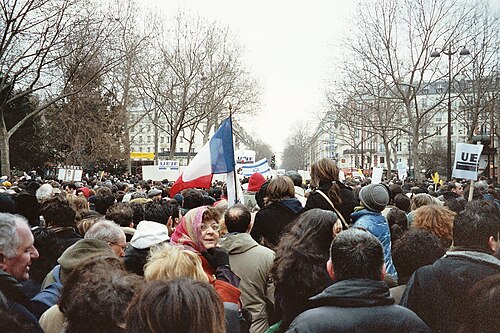
イラン・ハリミは、モロッコ系ユダヤ人の血を引く若いフランス人で、母親と二人の姉妹とともにパリに住んでいた。[165] 2006年1月21日、ハリミは「野蛮人ギャング」と名乗る集団に誘拐された。誘拐犯はユダヤ人は皆金持ちだと信じ、被害者のささやかな財産しかない家族に何度も連絡を取り、多額の金を要求した。[166]
3週間が経過しても犯人の捜索が成功しなかったため、家族と警察は犯人からの連絡を受けなくなった。ハリミは、ひどい拷問を受け、体の80%以上に火傷を負い、 2006年2月13日にサント・ジュヌヴィエーヴ・デ・ボワの道路脇に裸でかろうじて生きたまま遺棄された。通行人が彼を発見し、すぐに救急車を呼んだが、病院へ向かう途中で負傷により死亡した。[要出典]
フランス警察は当初、反ユダヤ主義が犯罪の要因ではないと信じていたため、激しく批判された。[167]この事件は、フランスにおける反ユダヤ主義の例として国内外で注目を集めた。[166]
2012年ユダヤ人デイスクール銃乱射事件
トゥールーズのオザール ハトラー学校は、フランス全土に少なくとも 20 校あるユダヤ人学校チェーンの一部です。この学校は、主にセファルディ系、中東系、北アフリカ系の子供たちを教育しています。これらの子供たちは、20 世紀後半以降フランスに移住したユダヤ人の大半を両親とともに占めています。この学校は中等学校で、ほとんどの生徒が 11 歳から 17 歳です。
2012年3月19日午前8時頃、オザール・ハトラー校に男がバイクで乗り付けた。男はバイクから降りると、すぐに校庭に向かって発砲した。最初の犠牲者は、同校のラビで教師のジョナサン・サンドラーさん(30歳)で、校門の外で、銃撃犯から幼い息子2人を守ろうとして撃たれた。銃撃犯は、5歳のアリエ君と3歳のガブリエル君の2人の少年を撃った後、校庭に入り、校舎に人々を追いかけた。 [168]
建物の中で、犯人は職員、保護者、生徒に発砲した。犯人は校長の娘で8歳のミリアム・モンソネゴ[169]を中庭まで追いかけ、髪を掴んで銃を構え、撃とうとしたが、銃はこの時点で動かなくなった。犯人は、警察が9mm拳銃と特定した銃から45口径の銃に持ち替え、至近距離から少女のこめかみを撃った。[128] [170] [171] [172] 17歳の少年ブライアン・ビジャウイ[173]も撃たれて重傷を負った。[174]犯人はスクーターを回収し、走り去った。
政府はすでに多くのユダヤ人施設に継続的な保護を提供していたが、さらに警備を強化し、テロ警告を最高レベルに引き上げた。ユダヤ人施設のあるフランスの道路はさらなる警備のため交通が封鎖された。[128]選挙運動は中断され、ニコラ・サルコジ大統領と他の大統領選挙候補者は直ちにトゥールーズと学校を訪れた。[175]
スーパーマーケットの包囲
.jpg/500px-The_Wreath_Laid_by_Secretary_Kerry_and_French_Foreign_Minister_Fabius_Is_Pictured_Outside_the_Hyper_Cacher_Kosher_Market_in_Paris_(16106400057).jpg)
2015年1月9日、イラク・レバントのイスラム国に忠誠を誓っていたアメディ・クリバリ[176]が、パリ東部のポルト・ド・ヴァンセンヌにあるユダヤ系食品スーパーマーケット「ハイパーキャッチャー」の人々を襲撃した。彼はユダヤ人4人を殺害し[177] [178]、数人を人質にした[179] [180] 。一部のメディアは、彼には当初内縁の妻であるハヤト・ブメディエンヌではないかと推測されていた女性の共犯者がいたと報じた[181]。
2017年サラ・ハリミ殺害事件
サラ・ハリミ(イルハン・ハリミとは無関係)は、2017年4月4日に自宅アパートで襲撃され殺害された、引退した医師兼教師である。ハリミが住んでいた建物で唯一のユダヤ人居住者であったこと、襲撃者が襲撃中にアッラー・アクバルと叫び、その後「私がシャイターンを殺した」と宣言したことなど、殺害を取り巻く状況は、特にフランスのユダヤ人コミュニティの間で、現代フランスにおける反ユダヤ主義の顕著な例として、この事件に対する世間の認識を固めた。
数か月間、政府と一部のメディアは、ベルナール=アンリ・レヴィなどの著名人から批判を浴び、この殺人を反ユダヤ主義的と分類することをためらった。政府は最終的に、この殺人の動機が反ユダヤ主義的であったことを認めた。裁判官は、独立した精神医学的分析によって、犯人は大麻摂取による精神病発作を起こしていたと判断、犯人は刑事責任を問われないと宣言した。 [182]この決定は最高破毀院に上訴され、[183] 2021年に下級裁判所の判決が支持された。[184]
The killing has been compared to the murder of Mireille Knoll in the same arrondissement less than a year later, and to the murder of Ilan Halimi (no relation) eleven years earlier.[185]
Murder of Mireille Knoll

Mireille Knoll was an 85-year-old French Jewish woman holocaust survivor who was murdered in her Paris apartment on 23 March 2018. The murder has been officially described by French authorities as an antisemitic hate crime.
Of the two alleged assailants, one was a 29-year-old neighbor of Knoll, who suffered from Parkinson's disease,[186] and had known her since he was a child, and the other, an unemployed 21-year-old. The two suspects entered the apartment and reportedly stabbed Knoll eleven times before setting her on fire.[187][188][189]
The Paris prosecutor's office characterized the 23 March murder as a hate crime, a murder committed because of the "membership, real or supposed, of the victim of a particular religion." The New York Times noted, "The speed with which the authorities recognized the hate-crime nature of Ms. Knoll's murder is being seen as a reaction to the anger of France's Jews at the official response to that earlier crime, which prosecutors took months to characterize as antisemitic."[190][191][192]
During the 2023 Israel–Hamas war
In response to a rise in antisemitic incidents in France during the 2023 Israel–Hamas war, the French government banned pro-Palestinian demonstrations in the country. In a televised address on 12 October 2023, French President Emmanuel Macron warned, "Let's remember that antisemitism has always been the precursor to other forms of hate: one day against the Jews, the next against the Christians, then the Muslims, and then all those who are still the target of hate due to their culture, origin or gender."[193]
On 31 October 2023, Stars of David were painted in multiple spots across several building fronts in a southern district of Paris. Similar tags appeared over the weekend in suburbs of the city, including Vanves, Fontenay-aux-Roses and Aubervilliers.[194]
On 1 November 2023, Paris police chief Laurent Nunez opened a probe into antisemitic chants filmed on the Paris metro. In the video, youth are heard chanting, "Fuck the Jews and fuck your mother, long live Palestine. We are Nazis and proud of it."[195]On 17 May 2024, a synagogue in Rouen was set on fire by an Algerian man, who threw a petrol bomb through a small window. The fire inside the synagogue was eventually brought under control by firefighters, with no reported victims other than the arsonist, who was shot by the police. The synagogue was significantly damaged, although the Torah scrolls remained unharmed.[196][197] Since the beginning of the war, there have been approximately 100 antisemitic incidents per month, threatening to become a new norm.[198]
On 17 June 2024, a 12-year-old Jewish girl in Paris was gang-raped by three boys aged 12 to 14 in an abandoned hangar. The attack, which included antisemitic slurs, occurred after the girl’s former boyfriend accused her of hiding her Jewish identity. The suspects were arrested, and investigators found antisemitic content on one of their phones.[199][200][201] Another suspect admitted to hitting the victim due to her negative comments about Palestine.[202] The girl was reportedly called a "dirty Jew" and received death threats.[203]
On 24 August 2024, an explosion outside a synagogue in southern French - deemed a terrorist attack - injured an police officer.[204] The following day, a Jewish woman filed a complaint with French police that a man with a knife approached her on a Paris street, threatening to "kill Jews".[205] In response to the synagogue explosion, a "Citizen rally to say not to antisemitism" was held.[206] French Interior Minister Gérald Darmanin denounced the surge in antisemitism.[207] Following these attacks, some Jews began to express concerns about the future of Jews in France.[208]
Impact and analyses
New antisemitism
Since 2000, France has experienced "an explosion of antisemitism, unprecedented since the Second World War", according to Timothy Peace. Statistics for assaults, attacks on property, and desecration (such as in cemeteries) have increased. Antisemitism in the form of public expression (chants, slogans and placards with "Death to the Jews" and so on) and tensions in public places such as schools have mounted. As a result, the Jewish community is becoming increasingly concerned and fearful; some parents have removed their children from schools, and a record number have been leaving France and emigrating to Israel or other countries. The rise in incidents since 2000 has resulted in numerous books, press, and other media coverage, and gave rise to a debate about a "new antisemitism",[209] whether it exists in France, and if so, who is responsible for committing such acts, and why.[210]
Emigration
Since 2010 or so, more French Jews have been moving to Israel in response to rising antisemitism in France.[5]
Threats and violence from radicalized Islamists have caused heightened security concerns for Jews in France, as well as schools, religious institutions, and other gathering places. The situation is causing many Jews to reevaluate their future in France.[211]
Increasing attacks in France such as the pro-Palestinian demonstrations in 2014 morphed into attacks on the Jewish community as well as individual attacks have affected the sense of personal security among Jews in France. One-third of all French Jews who have emigrated to Israel since its founding in 1948 have done so in the ten years following 2009.[212]
This is of great concern to the French government, which has been both tracking incidents and speaking out against what appears to be a rising tide of antisemitism in the country.[213] Statistics compiled from various sources showed a leap of 74% in antisemitic acts in France in 2018, and a further 27% rise the year following.[214]
See also
- France–Israel relations
- Antisemitic publications in France
- Antisemitism in 21st-century France
- Antisemitism in Spain
- Antisemitism in Christianity
- Catholic Church and Judaism
- Catholic Church and Nazi Germany during World War II
- French Fourth Republic
- French nationalism
- French Third Republic
- German occupation of France
- History of far-right movements in France
- History of the Jews in France
- Jewish disabilities (medieval law)
- Jewish Museum of Belgium shooting
- Law of 3 October 1940 on the Status of Jews
- Mais qui?
- Maurice Papon
- Pope Pius XII and the Holocaust
- Pursuit of Nazi collaborators
- Religious antisemitism
- Rene Bousquet
- Strasbourg Cathedral bombing plot
- The Holocaust in France
- Toulouse and Montauban shootings
- Vichy anti-Jewish legislation
- Vichy Holocaust collaboration timeline
- Zone libre


References
- Notes
- ^ See various essays in Birnbaum (2017)
- ^ Weekly magazine of racialist action against occult forces: in French, Hebdomadaire d'action racique[sic] contre les forces occultes. Not to be confused with the 1789 newspaper of the same name.
- Footnotes
- ^ a b "France". Holocaust Encyclopedia. United States Holocaust Memorial Museum.
- ^ Blumenkranz, Bernhard (1972). Histoire des Juifs en France. Toulouse: Privat. p. 376.
- ^ a b "Le régime de Vichy: Le Bilan de la Shoah en France" [The Vichy regime: The balance sheet of the Shoah in France]. bseditions.fr. Retrieved 25 April 2023.
- ^ a b Croes, Marnix. "The Holocaust in the Netherlands and the Rate of Jewish Survival" (PDF). Yad Vashem. Archived from the original (PDF) on 11 October 2017.
- ^ a b Hall, John (25 January 2016). "Jews are leaving France in record numbers amid rising antisemitism and fears of more Isis-inspired terror attacks". The Independent. Archived from the original on 7 May 2022.
- ^ Benbassa 2001, p. 3.
- ^ a b Benbassa 2001, p. 4.
- ^ a b c Toni L. Kamins (17 September 2013). "1 A Short History of Jewish France". The Complete Jewish Guide to France. St. Martin's Publishing Group. pp. 30–31. ISBN 978-1-4668-5281-5. OCLC 865113295.
- ^ a b Broydé, Isaac Luria; et al. (1906). "France". In Funk, Isaac Kaufmann; Singer, Isidore; Vizetelly, Frank Horace (eds.). The Jewish Encyclopedia. Vol. V. New York: Funk & Wagnalls. hdl:2027/mdp.39015064245445. OCLC 61956716.
- ^ Benbassa 2001.
- ^ Grayzel, Solomon (July 1970). "The Beginnings of Exclusion". The Jewish Quarterly Review. 61 (1): 15–26. doi:10.2307/1453586. JSTOR 1453586.
- ^ Golb, Norman (1998). The Jews in medieval Normandy: a social and intellectual history. New York: Cambridge University Press. ISBN 978-0-521-58032-8. OCLC 36461619.
- ^ Published in Berliner's Magazin iii. 46-48, Hebrew part, reproducing Parma De Rossi MS. No. 563, 23; see also Jew. Encyc. v. 447, s.v. France.
- ^ a b "Jacob Ben Jekuthiel". JewishEncyclopedia.com.
- ^ Toni L. Kamins (September 2001). The Complete Jewish Guide to France. St. Martin's Griffin. ISBN 978-0312244491.
- ^ MacCulloch, Diarmaid (2009). A history of Christianity: the first three thousand years. London: Penguin. p. 396. ISBN 978-0-14-195795-1. OCLC 712795767.
- ^ Berliner's "Magazin," iii.; "Oẓar Ṭob," pp. 46-48.
- ^ "Rouen". encyclopedia.com.
- ^ Monumenta Germaniae Historica, Scriptores, iv. 137.
- ^ Chronicles of Adhémar of Chabannes ed. Bouquet, x. 152; Chronicles of William Godellus ib. 262, according to whom the event occurred in 1007 or 1008.
- ^ a b Bokenkotter, Thomas S. (2004). A concise history of the Catholic Church (Rev. and expanded ed.). New York: Doubleday. pp. 155. ISBN 0385505841. OCLC 50242976.
- ^ Chronicles of Adhémar of Chabannes ed. Bouquet, x. 34
- ^ Riant, Paul Edouard Didier (1880). Inventaire Critique des Lettres Historiques des Croisades — 786–1100. Paris. p. 38.
{{cite book}}: CS1 maint: location missing publisher (link) - ^ Simonsohn, pp 35–37.
- ^ Hoinacki, Lee (1996). El Camino : Walking to Santiago de Compostela. University Park, Pa.: Pennsylvania State University Press. pp. 101. ISBN 0271016124. OCLC 33665024.
- ^ Cantor, Norman Frank (8 December 2015). Church, Kingship, and Lay Investiture in England, 1089-1135. Princeton University Press. p. 127. ISBN 978-1-4008-7699-0.
- ^ Nirenberg, David (31 January 2002). "The Rhineland Massacres of Jews in the First Crusade: Memories Medieval and Modern". Medieval Concepts of the Past. Cambridge University Press: 279–310. doi:10.1017/CBO9781139052320.014. ISBN 9780521780667.
- ^ Gilbert, M. (2010). The Routledge Atlas of Jewish History. Routledge. ISBN 9780415558105. Retrieved 5 October 2014.
- ^ David Nirenberg (2002). Gerd Althoff (ed.). Medieval Concepts of the Past: Ritual, Memory, Historiography. Johannes Fried. Cambridge University Press. p. 279. ISBN 978-0-521-78066-7.
- ^ Chazan, Robert (1996). European Jewry and the First Crusade. U. of California Press. pp. 55–60, 127. ISBN 9780520917767.
- ^ Shum Hebrew: שו"ם were the letters of the three towns as pronounced at the time in old French: Shaperra, Wermieza, and Magenzza.
- ^ Michael Costen, The Cathars and the Albigensian Crusade, p 38
- ^ Mark Avrum Ehrlich (2009). Encyclopedia of the Jewish Diaspora: Origins, Experiences, and Culture. ABC-CLIO. p. 99. ISBN 978-1-85109-873-6. Retrieved 27 July 2021.
- ^ a b c d e f g Lindemann & Levy 2010, p. 75.
- ^ History of the reign of Charles VI, titled Chronique de Religieux de Saint-Denys, contenant le regne de Charles VI de 1380 a 1422, encompasses the king's full reign in six volumes. Originally written in Latin, the work was translated to French in six volumes by L. Bellaguet between 1839 and 1852.
- ^ Barkey, Karen; Katznelson, Ira (2011). "States, regimes, and decisions: why Jews were expelled from Medieval England and France" (PDF). Theory and Society. 40 (5): 475–503. doi:10.1007/s11186-011-9150-8. ISSN 0304-2421. S2CID 143634044.[dead link]
- ^ a b c Stéphane & Gualde 2006, p. 47.
- ^ Johannes, Fried (2015) p. 421. The Middle Ages. Cambridge, Massachusetts: Harvard University Press.
- ^ Hertzberg, Arthur and Hirt-Manheimer, Aron. Jews: The Essence and Character of a People, HarperSanFrancisco, 1998, p. 84. ISBN 0-06-063834-6
- ^ Johannes, Fried (2015) p. 420. The Middle Ages. Cambridge, Massachusetts: Harvard University Press.
- ^ Lindsey, Hal (1990). The Road to Holocaust. Random House Publishing Group. pp. 22–. ISBN 978-0-553-34899-6.
- ^ Foa 2000, p. 13.
- ^ Kantor 2005, p. 203 1349 The Black Death massacres swept across Europe. ... The Jews were savagely attacked and massacred, by sometimes hysterical mobs—normal social order had ...
- ^ Marshall 2006, p. 376 The period of the Black Death saw the massacre of Jews across Germany, and in Aragon, and Flanders
- ^ a b Gottfried 2010, p. 74.
- ^ Durant 1953, p. 730–731.
- ^ a b c d Strickland, Debra Higgs (2003). Saracens, Demons, and Jews: making monsters in Medieval art. Princeton, N.J.: Princeton University Press.
- ^ Kamins, Toni (20 March 2015). "From Notre Dame to Prague, Europe's anti-Semitism is literally carved in stone". Jewish Telegraphic Agency. New York. Archived from the original on 16 April 2019.
- ^ Aston 2000, pp. 72–89.
- ^ Hyman & Sorkin 1998, p. 1-3.
- ^ Voltaire 1829, p. 493.
- ^ a b Birnbaum 2017, Introduction.
- ^ Morin 1989, p. 71-122.
- ^ Feuerwerker 1965.
- ^ Sagnac 1899, p. 209.
- ^ Jack R. Censer; Lynn Hunt (27 September 1791). "Admission of Jews to Rights of Citizenship 27 September 1791". Liberty, Equality, Fraternity: Exploring the French Revolution. Roy Rosenzweig Center for History and New Media. Retrieved 7 November 2021., as compiled from: Hunt, Lynn (1996). The French Revolution and Human Rights: A Brief Documentary History. The Bedford series in history and culture. Boston: Bedford/St. Martin's. pp. 99–101. ISBN 9780312108021. OCLC 243853552.
- ^ Wein, Berel (1990). Triumph of Survival: The Story of the Jews in the Modern Era, 1650-1990. Jewish history, a trilogy, 3. Brooklyn, N.Y.: Shaar Press. p. 71. ISBN 978-1-4226-1514-0. OCLC 933777867.
- ^ Barry Edward O'Meara (1822). "Napoleon in Exile". Retrieved 12 December 2012.
- ^ "New letters of Napoleon I". 1898. Retrieved 15 December 2012.
- ^ a b c Benbassa 2001, p. 209.
- ^ a b Poliakov 1981.
- ^ Whyte, George R. (12 October 2005). The Dreyfus Affair: A Chronological History. Springer. p. 215. ISBN 978-0-230-58450-1.
- ^ Schor 2005, p. 33–34.
- ^ a b c d e Schor 2005, p. 33-34.
- ^ Coston 1979, p. 730.
- ^ "panama". www.ak190x.de.
- ^ a b Anna Yeatman; Charles Barbour; Phillip Hansen; Magdalena Zolkos (21 April 2011). Action and Appearance: Ethics and the Politics of Writing in Hannah Arendt. A&C Black. p. 175. ISBN 978-1-4411-0173-0. Retrieved 3 August 2021.
- ^ Arendt, Hannah (21 March 1973). The Origins of Totalitarianism. Harcourt Brace Jovanovich. pp. 95–99. ISBN 0-15-670153-7. OCLC 760643287.
- ^ Guy Canivet, first President of the Supreme Court, Justice from the Dreyfus Affair, p. 15.
- ^ Winock, Michel (1971). "Édouard Drumont et l'antisémitisme en France avant l'affaire Dreyfus". Esprit. 403 (5): 1085–1106. JSTOR 24261978.
- ^ Duclert, Vincent (2018). L'affaire Dreyfus [The Dreyfus Affair] (in French). La Découverte. p. 95. ISBN 9782348040856.
- ^ Sjzakowski, Zosa (1961). "French Jews during the Revolution of 1830 and the July Monarchy". Historia Judaica. Vol. 22. pp. 116–120. OCLC 460467731. as quoted in Wilson (2007) p. 540
- ^ a b c d Wilson, Stephen (2007) [1st pub. Rutherford:1982]. "Antisemitism in France at the Time of the Dreyfus Affair". In Strauss, Herbert A. (ed.). Hostages of Modernization: Germany, Great Britain, France. Liverpool scholarship online. Oxford: Littman library of Jewish civilization. ISBN 978-1-8003-4099-2. OCLC 1253400456.
- ^ Tombs 2014, p. 475.
- ^ Bopf, Britta (2004). "Arisierung" in Köln: Die wirtschaftliche Existenzvernichtung der Juden 1933-1945. Cologne: Emons Verlag Köln. ISBN 389705311X. Archived from the original on 1 December 2017. Retrieved 11 July 2021.
- ^ Shoah Resource Center. "Aryanization" (PDF). Yad Vashem. Retrieved 10 July 2021.
- ^ "Confiscation of Jewish Property in Europe, 1933–1945 New Sources and Perspectives Symposium Proceedings" (PDF). United States Holocaust Memorial Museum Center For Advanced Holocaust Studies. 2003. Archived from the original (PDF) on 2 December 2017. Retrieved 10 July 2021.
Particularly impressive and equally disturbing is the robbers' effort to ensure that property confiscation was carried out by 'legal' means through a vast array of institutions and organizations set up for this purpose. The immensely bureaucratic nature of the confiscation process emerges from the vast archival trail that has survived. Arguments that no one knew about the Jews' fate become untenable once it is clear how many people were involved in processing their property. 'Legal' measures often masked theft, but blatant robbery and extortion through intimidation and physical assault were also commonplace.
- ^ Döblin, Alfred (28 November 2010). "Plünderung jüdischen Eigentums Billigende Inkaufnahme "Wie Deutsche ihre jüdischen Mitbürger verwerteten": Die Enteignung der Juden ist gut dokumentiert. Wolfgang Dreßen hat die Akten gesichtet" [Looting of Jewish Property Tacit Acceptance of "How Germans Exploited Their Jewish Fellow Citizens": The Expropriation of the Jews is well documented. Wolfgang Dressen has sifted through the files.]. Die Tageszeitung: Taz (in German). Retrieved 10 July 2021.
- ^ Bazyler, Michael J. (2005). Holocaust Justice: The Battle for Restitution in America's Courts. NYU Press. p. xi. ISBN 978-0-8147-2938-0.
- ^ Rousso, Henry (2001). Vichy, l'événement, la mémoire, l'histoire [Vichy, the event, the memory, the history]. Folio/Histoire, 102 (in French). Paris: Gallimard. p. 148 sq. ISBN 978-2-07-041749-0. OCLC 472849444.
- ^ Figures given by Olivier Wieviorka ("La vie politique sous Vichy", in La République recommencée [The Republic Redux], dir. S. Berstein)
- ^ a b Lackerstein, Debbie (22 April 2016) [1st pub. Ashgate:2012]. National Regeneration in Vichy France: Ideas and Policies, 1930–1944. New York: Routledge. p. 263. doi:10.4324/9781315597454. ISBN 978-1-315-59745-4. OCLC 953054560. Retrieved 31 March 2017.
The IEQJ organised the exhibition Le Juif et la France (5 September 1941 to 11 January 1942). The official attendance figure was given as 1 million but it was probably no more than 500,000-700,000 and public opinion reacted against this form of Nazi propaganda.
- ^ a b Judaken, Jonathan (1 December 2006). Jean-Paul Sartre and the Jewish Question: Anti-antisemitism and the Politics of the French Intellectual. Lincoln and London: U of Nebraska Press. pp. 79–80. ISBN 978-0-8032-2612-8. OCLC 474199495. Retrieved 31 March 2017.
- ^ Thalmann, Rita (1991). La mise au pas: idéologie et stratégie sécuritaire dans la France occupée [Keeping in Line: Ideology and Security Strategy in Occupied France]. Pour une histoire du XXe siècle (in French). Paris: Fayard. ISBN 9782213026237. OCLC 243706428.
- ^ Hirschfeld, Gerhard; Marsh, Patrick (1989). Collaboration in France: politics and culture during the Nazi occupation, 1940-44 (Conference publication). New York: Berg. p. 87. ISBN 978-0-85496-237-2. OCLC 62372520. Retrieved 2 May 2018.
- ^ Centre de documentation juive contemporaine (1974). Inventaires des archives. Vol. 3. Paris: Editions du Centre. p. 155. OCLC 3531615. Retrieved 2 May 2018.
- ^ Fresco 2021, p. 20-21.
- ^ Rayski 2005, p. 12.
- ^ Zalc, Claire (16 November 2020). "Discretionary Power in the Hands of an Authoritarian State: A Study of Denaturalizations under the Vichy Regime (1940–1944)". The Journal of Modern History. 92 (4): 817–858. doi:10.1086/711477. ISSN 0022-2801. S2CID 226968304.
- ^ François Masure, "État et identité nationale. Un rapport ambigu à propos des naturalisés" [The State, and national Identity. An ambiguous relationship about naturalized citizens], in Journal des anthropologues, hors-série 2007, pp. 39–49 (see p. 48) (in French)
- ^ "Pétain a durci le texte sur Les Juifs, Selon un document inédit". Le Point. 3 October 2010. Archived from the original on 16 May 2013.
- ^ Yahil 1990, p. 173.
- ^ Epstein 1942, p. xxxv.
- ^ Klarsfeld 1983, p. xiii.
- ^ Joly 2008, p. 25-40.
- ^ "Ordonnance du 9 août 1944 relative au rétablissement de la légalité républicaine sur le territoire continental – Version consolidée au 10 août 1944" [Law of 9 August 1944 Concerning the reestablishment of the legally constituted Republic on the mainland – consolidated version of 10 August 1944]. gouv.fr. Legifrance. 9 August 1944. Archived from the original on 16 July 2009. Retrieved 21 October 2015.
- ^ Marrus, Michael Robert; Paxton, Robert O. (1995) [1st pub. Basic Books (1981)]. Vichy France and the Jews. Stanford University Press. pp. xv, 243–245. ISBN 978-0-8047-2499-9. OCLC 836801478.
- ^ Diamant 1977, p. 22, as quoted in Zuccotti 1999, pp. 146–147
- ^ a b Diamant 1977, as quoted in Rosenberg 2018, p. 297
- ^ "Pourquoi le rafle n'a pas ateint son objectif" (PDF). AIDH.org. p. 52. Archived from the original (PDF) on 3 July 2008. Retrieved 31 December 2009.
- ^ "The Vel' d'Hiv Roundup". The Holocaust in France. Yad Vashem. Archived from the original on 27 April 2014. Retrieved 22 April 2014.
- ^ Maurice Rajsfus, La Police de Vichy. Les Forces de l'ordre françaises au service de la Gestapo, 1940/1944, Le Cherche-midi éditeur, 1995. Chapter XIV, La Bataille de Marseille, pp. 209–217. (in French)
- ^ Laub 2010, p. 217.
- ^ Einaudi, Jean-Luc (2001). Les silences de la police : 16 juillet 1942-17 octobre 1961 (in French). Paris: L'Esprit frappeur. p. 17. ISBN 978-2-84405-173-8.
- ^ Kevin Passmore; Chris Millington (16 July 2015). Political Violence and Democracy in Western Europe, 1918-1940. Palgrave Macmillan UK. p. 195. ISBN 978-1-137-51595-7.
On 2–3 October Deloncle and his men bombed seven synagogues with explosives supplied by the Germans – using terrorism once again to send another message to France, this one tied to their vehement antisemitism.
- ^ "La Police de sécurité allemande et ses auxiliaires en Europe de l'ouest occupée (1940-1945)" [The German Security Police and its auxiliaries in occupied Western Europe]. Ciera. 7 November 2012.
- ^ "Paris Promeneurs – La synagogue de la rue Pavée". www.paris-promeneurs.com. 12 August 2015. Retrieved 29 October 2020.
- ^ "Le terrorisme en France occupée. Attentats contre les synagogues de Paris. Des explosifs ont détruit ainsi sept des lieux de culte Israélite les plus connus de la capitale" (PDF). Feuille d'Avis de Neuchâtel et du Vignoble neuchâtelois. 4 October 1941. p. 1. Retrieved 25 April 2023.
- ^ "Nazi Looting and Plunder". The Holocaust. Retrieved 12 December 2020.
- ^ Karen B. Stern, Inscribing devotion and death: archaeological evidence for Jewish populations of North Africa, Bril, 2008, p. 88
- ^ "Algeria". JewishEncyclopedia.com. Retrieved 10 June 2012.
- ^ "The Edict of Expulsion of the Jews - 1492 Spain". Sephardicstudies.org. Retrieved 10 June 2012.
- ^ Yardeni, Myriam (1980). Les juifs dans l'histoire de France: Premier colloque internationale de Haïfa. BRILL. ISBN 978-9004060272.
- ^ Hyman & Sorkin 1998, p. 83.
- ^ Weil, Patrick (2008). How to Be French: Nationality in the Making since 1789. Duke University Press. pp. 128, 253.
- ^ Friedman, Elizabeth. Colonialism & After. South Hadley, Massachusetts: Bergen, 1988
- ^ Schreier, Joshua (13 January 2011). "Arabs of the Jewish Faith: The Civilizing Mission in Colonial Algeria". University of California Santa Cruz. Retrieved 25 April 2023.
- ^ Kalman, Samuel (2008). The Extreme Right in Interwar France: The Faisceau and the Croix de Feu. Ashgate Publishing. p. 210ff. ISBN 9780754662402.
- ^ Hyman & Sorkin 1998, p. 105.
- ^ Benbassa 2001, p. 168.
- ^ a b c VJL 2021.
- ^ "Jewish Targets: Recent Attacks: Chronology". New York Times. AP. 7 September 1986. ProQuest 426275757.
- ^ "Des Précédents Nombreux". Le Monde. 22 October 1981. Retrieved 25 April 2023.
- ^ Rubin, Barry; Rubin, Judith Colp (2015). Chronologies of Modern Terrorism. Routledge. p. 195. ISBN 9781317474654.
- ^ "Terrorist Incidents against Jewish Communities and Israeli Citizens Abroad, 1968-2003". International Institute for Counter-Terrorism. 20 December 2003. Archived from the original on 26 March 2021. Retrieved 8 July 2021.
- ^ Bisserbe, Noemie (17 June 2015). "Jordan Arrests Suspect in 1982 Attack on Jewish Restaurant in Paris". Wall Street Journal. Archived from the original on 17 June 2018. Retrieved 17 June 2015.
- ^ Vinocur, John (11 August 1982). "P.L.O. Foes Linked to Attack in Paris". The New York Times. Archived from the original on 7 March 2016. Retrieved 14 November 2015.
- ^ a b c Rothman, Andrea (19 March 2012). "4 Dead in Shooting at Jewish School in France". Businessweek. Bloomberg. Archived from the original on 22 March 2012.
- ^ "Paris symbol of Jewish life to disappear". European Jewish Press. 16 January 2006. Archived from the original on 15 August 2017. Retrieved 19 March 2012.
- ^ "Owner of famous Paris Jewish restaurant dies". Jerusalem Post. 12 May 2014. Archived from the original on 20 January 2018. Retrieved 27 February 2017.
- ^ Massoulié, François (2003). Middle East conflicts. Interlink Books. p. 98. ISBN 1566562376.
- ^ Charters, David (1994). The deadly sin of terrorism: its effect on democracy and civil liberty in six countries. Greenwood Publishing Group. p. 108. ISBN 0313289646.
- ^ Samuel, Henry (17 June 2005). "Suspected mastermind of 1982 Paris Jewish restaurant attack 'bailed in Jordan'". The Telegraph. Archived from the original on 17 November 2015. Retrieved 15 November 2015.
- ^ "Un suspect de l'attentat de la rue des Rosiers en 1982 à Paris mis en examen". rts.ch. 5 December 2020.
- ^ Isungset, Odd; Strand, Tormod; Rachline, Vibeke Knoop (4 December 2020). "Norsk-palestiner utlevert i fransk terrorsak" [Norwegian-Palestinian extradited in French terrorism case]. NRK (in Norwegian).
- ^ Isungset, Odd (27 November 2020). "Terrortiltalt norskpalestiner utleveres til Frankrike" [Norwegian-Palestinian terror suspect extradited to France]. NRK (in Norwegian).
- ^ Isungset, Odd (20 December 2020). "Agenter fra Le Bureau fulgte terror-spor til norsk småby" [Le Bureau agents followed terror trail to small Norwegian town]. NRK (in Norwegian).
- ^ Isungset, Odd (10 March 2021). "Norskpalestiner fengslet i Paris" [Norwegian-Palestinian jailed in Paris]. NRK (in Norwegian).
- ^ "Les attentats contre les foyers Sonacotra devant la cour d'assises des Alpes-Maritimes - Les commanditaires occultes de Gilbert Hervochon" [The attacks against the Sonacotra homes before the Alpes-Maritimes Assize Court - The hidden sponsors of Gilbert Hervochon]. Le Monde (in French). 30 October 1991. Retrieved 16 June 2020.
- ^ Smadja, Gilles (17 March 1997). "Le procès de quatre profanateurs néo-nazis après six ans de fausses pistes" [Trial of four neo-Nazi profaners after six years of false leads]. L'Humanité (in French). Archived from the original on 25 April 2023.
- ^ de Boissieu, Laurent (2018). "Parti Nationaliste Français et Européen (PNFE)". France-politique. Archived from the original on 27 February 2013.
- ^ Navon, Emmanuel (2015). "France, Israel, and the Jews: The End of an Era?" (PDF). Israel Journal of Foreign Affairs. 9 (2): 201–211. doi:10.1080/23739770.2015.1042277. S2CID 143292064.
- ^ Gilbert, Alexandre (25 April 2016). "Le Surmoi antisémite de la Télévision Française" [The Anti-Semitic Superego of French Television]. Times of Israel (in French).
- ^ "Holocaust Denial: Key Dates". US Holocaust Museum.
- ^ "Holocaust denial/legal concepts in Europe". Project for Democratic Union. Archived from the original on 1 March 2018. Retrieved 25 April 2023.
- ^ Igounet, Valérie (May 1998). "Holocaust denial is part of a strategy". Le Monde diplomatique. Retrieved 25 April 2023.
- ^ Eichner, Itamar (15 July 2024). "'They called our children filthy Jews': French Jews feel unsafe amid rising antisemitism". YNet. Retrieved 18 July 2024.
- ^ Askolovitch, Claude (24 February 2005). "De la cause noire à la haine des juifs. Dieudonné : Enquête sur un antisémite" [From civil rights to hatred of Jews. Dieudonné: Investigation into an anti-Semite]. Le Nouvel observateur (in French).
- ^ Kahn, Jean-François (19 February 2005). "La double défaite des antiracistes" [The double defeat of anti-racists]. Marianne (in French).
- ^ "Dieudonné condamné en appel pour incitation à la haine raciale" [Dieudonné sentenced on appeal for incitement to racial hatred]. Europe 1 (in French). 15 November 2007.
- ^ "Candidats aux élections européennes 2009" [Candidates for the European elections 2009]. French Ministry of the Interior. Archived from the original on 28 May 2009.
- ^ "Les amis très particuliers du centre Zahra" [The very special friends of the Zahra Center]. L'Express (in French). 26 February 2009.
- ^ "Congrès de l'UOIF : Dieudonné et Soral en vedettes américaines" [UOIF Congress: Dieudonné and Soral as American stars]. Bondy Blog. 14 April 2009. Archived from the original on 17 April 2009. Retrieved 9 July 2021.
À l'entrée du Parc des expositions, une jeune femme distribue des tracts aux participants, annonçant la candidature de Dieudonné, Alain Soral et Yahia Gouasmi, président de la Fédération chiite de France, aux élections européennes du 7 juin sous les couleurs d'un Parti anti sioniste (PAS) [At the entrance of the Parc des expositions, a young woman distributes leaflets to the participants, announcing the candidacy of Dieudonné, Alain Soral and Yahia Gouasmi, president of the Shiite Federation of France, for the European elections of June 7 under the colors of an anti-Zionist Party (PAS).]
- ^ "La géopolitique pour les nuls II - Session de rattrapage" [Geopolitics for Dummies II - Catch-up session]. REFLEXes. 25 January 2009. Footnote 4.
- ^ Wistrich, Robert S. "Liberté, Egalité, Antisémitisme." A Lethal Obsession: Anti-Semitism from Antiquity to the Global Jihad, Random House, New York, 2010, pp. 329–339.
- ^ "Dieudonné doit 65 000 euros pour différentes condamnations" [archive], France TV Info, 3 janvier 2014
- ^ d'Angelo, Robin (18 March 2019). "Une scission et l'Action française ne sait plus comment elle s'appelle" [A schism, and Action Française doesn't know what to call itself anymore]. Liberation.
- ^ Plottu, Pierre (28 February 2020). "A Paris, les obsédés du complot juif se réunissent" [Jewish conspiracy theorists convene in Paris]. Libération.fr (in French).
- ^ a b Diamond, Andrew (1 April 2002). "Weekend of anti-Semitism in France". JTA.
- ^ a b Tagliabue, John (5 April 2002). "Synagogue In Paris Firebombed; Raids Go On". New York Times.
- ^ McNeil, Donald (2 April 2002). "France Vows Harsh Action After More Synagogues Burn". New York Times.
- ^ "Vandals crash cars through French synagogue". Arizona Daily Sun. 30 March 2002 – via AP.
- ^ "Shooting in France in Wave of Anti-Jewish Attacks". New York Times. 1 April 2002.
- ^ Horn, Heather (19 March 2012). "The Jewish School Shooting and Patterns of Violence". The Atlantic.
- ^ Gurfinkiel, Michel (22 February 2006). "Tale of Torture and Murder Horrifies the Whole of France". The New York Sun. Archived from the original on 6 October 2021. Retrieved 8 July 2021.
- ^ a b Fields, Suzanne (3 April 2006). "The Rising Tide of Anti-Semitism". The Washington Times. Retrieved 30 December 2008.
- ^ Bernard, Ariane; Craig S. Smith (23 February 2006). "French Officials Now Say Killing of Jew Was in Part a Hate Crime". The New York Times. Retrieved 30 December 2008.
- ^ "Visite officielle en Israël et dans les Territoires palestiniens". Gouvernement.fr (in French). Retrieved 6 November 2019.
- ^ "חמש שנים אחרי: הורי הנרצחת בטולוז מדברים לראשונה". makorrishon.co.il. Retrieved 6 November 2019.
- ^ Govan, Fiona (20 March 2012). "Toulouse shooting: heartbreaking detail of attack that shocked France and Israel". The Daily Telegraph. Retrieved 20 March 2012.
- ^ "Gunman kills 4 outside Jewish school in France". Associated Press. 19 March 2012. Archived from the original on 9 July 2021. Retrieved 19 March 2012.
- ^ Sayare, Scott; Erlanger, Steven (19 March 2012). "4 Killed at Jewish School in Southwestern France". The New York Times.
- ^ Maiberg, Emanuel (22 March 2012). "French teen who tried to save Toulouse victim still hospitalized". The Times of Israel. Retrieved 30 March 2012.
- ^ "Tuerie de Toulouse : le lycéen blessé va mieux – societe". Elle (in French). Retrieved 30 March 2012.
- ^ "Fusillade de Toulouse : une minute de silence observée mardi dans les écoles" [Toulouse shooting: a minute of silence observed Tuesday in schools]. Le Monde (in French). 19 March 2012. Retrieved 19 March 2012.
- ^ Jane Onyanga-Omara, USA TODAY (11 January 2015). "Video shows Paris gunman pledging allegiance to Islamic State". USATODAY.
- ^ Wiener, Julie (11 January 2015). "A fatal synagogue bombing in Paris". Jewish Telegraphic Agency. Retrieved 25 April 2023.
- ^ Eichner, Itamar; Cadars, Rachel (10 January 2015). "Four victims of terror attack on kosher supermarket named". ynet.
- ^ "Charlie Hebdo attack: Manhunt – live reporting". BBC News. 9 January 2015.
- ^ "Paris shooting updates / Charlie Hebdo attackers take hostage after car chase". Haaretz. 9 January 2015.
- ^ "DIRECT – Porte de Vincennes: plusieurs otages, au moins deux morts". MidiLibre.fr.
- ^ "Sarah Halimi: How killer on drugs escaped French trial for anti-Semitic murder". BBC News. 2 May 2021. Retrieved 15 May 2021.
- ^ Theise, Philippe (1 May 2020). "Hundreds rally in Paris to seek justice for murdered Jewish woman Sarah Halimi". France24. Retrieved 4 June 2020.
- ^ "French top court rules against trying Muslim who killed Sarah Halimi". The Times of Israel. 14 April 2021. Retrieved 10 May 2021.
- ^ McAuley, James (23 July 2017). "In France, murder of a Jewish woman ignites debate over the word 'terrorism'". The Washington Post. Archived from the original on 17 June 2019. Retrieved 29 August 2017.
- ^ BFMTV. "Meurtre de Mireille Knoll: ce que révèle le PV des enquêteurs". BFMTV (in French). Retrieved 6 April 2018.
- ^ Weiss, Bari (30 March 2018). "Jews Are Being Murdered in Paris. Again". The New York Times. Retrieved 3 April 2018.
- ^ Peltier, Elian; Breeden, Aurelien (28 March 2018). "Mireille Knoll, Murdered Holocaust Survivor, Is Honored in Paris". New York Times. Retrieved 28 March 2018.
- ^ Bremmer, Charles (28 March 2018). "Two charged with killing 85-year-old Holocaust survivor Mireille Knoll". The Times (of London). Retrieved 3 April 2018.
- ^ Nossiter, Adam (26 March 2018). "She Survived the Holocaust, to Die in a 2018 Hate Crime". New York Times. Retrieved 28 March 2018.
- ^ "Slain Holocaust survivor's family: She'd known her killer since he was a boy". The Times of Israel. 27 March 2018. Retrieved 10 May 2021.
- ^ Cohen, Ben (10 May 2019). "French Police to Hold Reconstruction of Gruesome Murder of Holocaust Survivor Mireille Knoll". The Algemeiner. Retrieved 10 May 2021.
- ^ Keslassy, Elsa (13 October 2023). "French Government Bans All Pro-Palestinian Protests Amid Rise in Antisemitic Incidents". Variety. Archived from the original on 18 October 2023. Retrieved 19 October 2023.
- ^ "Stars of David spray-painted on Paris buildings 'recall events of 1930s' antisemitism, says mayor". Sky News. 1 November 2023. Archived from the original on 15 November 2023.
- ^ "Prosecutor opens probe over antisemitic chants in Paris metro". Reuters. 1 November 2023. Archived from the original on 5 November 2023. Retrieved 5 November 2023.
- ^ Breeden, Aurelien (17 May 2024). "French Police Shoot and Kill Man Who Set Fire to Synagogue". The New York Times. ISSN 0362-4331. Retrieved 18 May 2024.
- ^ "Rouen: Man shot dead after French synagogue set on fire". www.bbc.com. Retrieved 18 May 2024.
- ^ Michael, Starr (31 July 2024). "Antisemitism in France set to become the new norm, with 100 incidents monthly - SPCJ report". Jerusalem Post. Retrieved 1 August 2024.
- ^ Ynet (18 June 2024). "Jewish girl, 12, gang raped in Paris in apparent antisemitic attack". Ynetnews. Retrieved 18 June 2024.
- ^ Pope, Felix. "Children arrested in France after 12-year-old Jewish girl raped in 'antisemitic attack'". www.thejc.com. Retrieved 18 June 2024.
- ^ "French police probe gang rape of 12-year-old Jewish girl in 'antisemitic crime' - report". The Jerusalem Post | JPost.com. 18 June 2024. Retrieved 18 June 2024.
- ^ "French police probe gang rape of 12-year-old Jewish girl in 'antisemitic crime' - report". The Jerusalem Post | JPost.com. 18 June 2024. Retrieved 18 June 2024.
- ^ Vandoorne, Niamh Kennedy, Emmanuel Miculita, Saskya (20 June 2024). "Alleged rape of 12-year-old Jewish girl sparks antisemitism outcry in France". CNN. Retrieved 22 June 2024.
{{cite web}}: CS1 maint: multiple names: authors list (link) - ^ "Blast outside France synagogue, deemed terror attack; officer wounded". YNet News. 24 August 2024. Retrieved 28 August 2024.
- ^ Eichner, Itamar (26 August 2024). "Man brandishing knife 'to kill Jews' approaches Jewish woman on Paris street". YNET News. Retrieved 28 August 2024.
- ^ Starr, Michael (27 August 2024). "Rallies against antisemitism held in southern France after synagogue terrorist attack". Jerusalem Post. Retrieved 28 August 2024.
- ^ "French interior minister slams 'surge in antisemitism' after synagogue attack near Nîmes". Euro News. 26 August 2024. Retrieved 28 August 2024.
- ^ Starr, Michael (2 September 2024). "Consistory VP: 'Jews are beginning to lose hope for a future in France' - interview". Jerusalem Post. Retrieved 5 September 2024.
- ^ Nossiter, Adam (27 July 2018). "'They Spit When I Walked in the Street': The 'New Anti-Semitism' in France". The New York Times. Retrieved 25 April 2023.
- ^ Peace, Timothy (May 2009). "'Un Antisemitisme Nouveau?' The Debate about a 'New Antisemitism' in France". Patterns of Prejudice. 43 (2). Taylor & Francis: 103–121. doi:10.1080/00313220902793773. hdl:1893/22119. S2CID 143997792.
- ^ Jikeli, Günther (2018). "Antisemitic Acts and Attitudes in Contemporary France: The Effects on French Jews". Antisemitism Studies. 2 (2): 297–320. doi:10.2979/antistud.2.2.06. JSTOR 10.2979/antistud.2.2.06. S2CID 166079350. Retrieved 19 August 2021 – via JSTOR.
- ^ Schwartz, Yardena (20 November 2019). "'Things have only gotten worse': French Jews are fleeing their country". National Geographic. Archived from the original on 17 February 2021. Retrieved 19 August 2021.
- ^ McAuley, James (19 February 2019). "As anti-Semitism rises in France, Macron's government struggles to respond". Washington Post.
- ^ Albessard, Timothée (24 February 2020). "'The darkness drops again': The Rise of Anti-Semitism in France". Institute for a Greater Europe. Archived from the original on 19 August 2021. Retrieved 19 August 2021.
Works cited
- Aston, Nigel (2000). Religion and Revolution in France, 1780-1804. Washington D.C.: Catholic University of America Press. ISBN 978-0-8132-0977-7. OCLC 59522675.
- Benbassa, Esther (2 July 2001) [1st pub. 1997 (in French: Histoire des Juifs de France) Editions du Seuil]. The Jews of France: A History from Antiquity to the Present. Translated by DeBevoise, M.B. Princeton University Press. ISBN 1-4008-2314-5. OCLC 700688446.
- Birnbaum, Pierre (2017). Est-il des moyens de rendre les Juifs plus utiles et plus heureux? : le concours de l'Académie de Metz (1787) [Are there ways to make the Jews more useful and happy? The Metz Academy Competition]. Seuil. ISBN 978-2-02-118317-7.
- Coston, Henry (1 January 1979). Dictionnaire de la politique française [Dictionary of French politics]. Vol. 3. Paris: Henry Coston.
- Diamant, David (1977). Le billet vert: la vie et la résistance à Pithiviers et Beaune-la-Rolande, camps pour juifs, camps pour chrétiens, camps pour patriotes [The green ticket: life and resistance in Pithiviers and Beaune-la-Rolande, camps for Jews, camps for Christians, camps for patriots] (in French). Éditions Renouveau. Retrieved 27 May 2020.
- Durant, Will; Durant, Ariel (1953). The Renaissance: A History of Civilization in Italy from 1304-1576 A.D. Story of civilization, pt. 5. Simon and Schuster. ISBN 978-0-671-61600-7. OCLC 879498943.
- Foa, Anna (19 November 2000). The Jews of Europe After the Black Death. University of California Press. ISBN 978-0-520-08765-1. OCLC 492592706.
- Epstein, Mortimer (1942). "The Statesman's Year-Book : Statistical and Historical Annual of the States of the World for the Year 1942". The Statesman's Year-Book. 79. Palgrave Macmillan. OCLC 1086492287.
Legal position of Jews in Vichy France.—Almost immediately after the armistice, the Vichy government proclaimed its intention to deprive of their civil rights French people who are of Jewish faith or origin, and to place the Jews in the position of legal inferiority in which they find themselves in all other German-dominated countries. On October 3, 1940 (Journel Officiel of October 18), a law was published fixing the conditions under which a person is considered as being of Jewish origin. Access to all public offices, professions, journalism, executive positions in the film industry, etc. was prohibited to all such persons.
- Feuerwerker, David (1965). "Les juifs en France : anatomie de 307 cahiers de doléances de 1789" [The Jews in France: Anatomy of 307 Grievances Registers of 1789]. Annales. 20 (1): 45–61. doi:10.3406/ahess.1965.421760. ISSN 1953-8146. S2CID 161184833 – via Persée.
- Fresco, Nadine (4 March 2021) [1st pub. La mort des juifs. Paris : Seuil, 2008]. On the Death of Jews: Photographs and History. Translated by Clift, Sarah. New York: Berghahn Books. ISBN 978-1-78920-882-5. OCLC 1226797554.
On the preceding page, the law from the day before (3 October 1940), signed by Marshall Philip Pétain and nine of his ministers, is the 'law on the status of the Jews.' We know that those in charge of Vichy, 'complicit even before having understood the inevitable extent of their own compromise', did not wait for it to be imposed by the occupying power before enacting it.73 We also know that whereas the German ordinance of the preceding month defined Jews by 'religion', the French statute of 3 October defined them by race.74
- Gottfried, Robert S. (11 May 2010). Black Death. Simon and Schuster. ISBN 978-1-4391-1846-7. OCLC 1000454039.
- Hyman, Paula E.; Sorkin, David (22 December 1998). The Jews of Modern France. Jewish Communities in the Modern World, 1. Berkeley: University of California Press. ISBN 978-0-520-91929-7. OCLC 1149453952.
- Joly, Laurent (2008). "L'administration française et le statut du 2 juin 1941" [French administration and the law of 2 June 1941]. Archives Juives. Revue d'histoire des juifs de France. 41 (1). Paris: fr:Les Belles Lettres: 25–40. doi:10.3917/aj.411.0025. ISSN 1965-0531. OCLC 793455446. Archived from the original on 21 March 2015.
This ... was reflected in the drafting of the law of 2 June. In close collaboration and in perfect symbiosis with Admiral Darlan's services and the ministries concerned, the General Commission for Jewish Questions tightened the definition of a Jew (in order to escape the increased strictures of the law, "demi-Jews" had to have belonged to some religion other than Judaism before 25 June 1940) and extended the scope of prohibited occupations. Ce ... se ressent dans la rédaction de la loi du 2 juin. En étroite collaboration et en parfaite symbiose avec les services de l'amiral Darlan et les ministères concernés, le commissariat général aux Questions juives aggrave la définition du Juif (les « demi-juifs » doivent obligatoirement avoir adhéré à une religion autre que la religion juive avant le 25 juin 1940 pour échapper aux rigueurs de la loi) et étend le champ des interdictions professionnelles.
- Kantor, Máttis (2005). Codex Judaica: Chronological Index of Jewish History, Covering 5,764 Years of Biblical, Talmudic & Post-Talmudic History. New York: Zichron Press. ISBN 978-0-9670378-3-7. OCLC 62882184.
- Klarsfeld, Serge (1983). Memorial to the Jews Deported from France, 1942-1944: Documentation of the Deportation of the Victims of the Final Solution in France. B. Klarsfeld Foundation. OCLC 970847660.
3) A law of October 3, 1940, on the status of Jews excluded them from most public and private professions and defined Jews on the basis of racial criteria.
- Laub, Thomas J. (2010). After the Fall: German Policy in Occupied France, 1940-1944. Oxford: OUP. p. 217. ISBN 978-0-19-953932-1. Retrieved 27 May 2020.
- Lindemann, Albert S.; Levy, Richard S. (28 October 2010). Antisemitism: A History. Oxford University Press. ISBN 978-0-19-923503-2.
- Marshall, John (30 March 2006). John Locke, Toleration and Early Enlightenment Culture. Cambridge University Press. ISBN 978-0-521-65114-1. OCLC 901461275.
- Morin, Robert (October 1989). "Diderot, l'Encyclopédie et le Dictionnaire de Trévoux". Recherches sur Diderot et sur l'Encyclopédie. 7 (7): 71–122. doi:10.3406/rde.1989.1034. ISSN 1955-2416 – via Persée.
- Poliakov, Léon (1981). Histoire de l'antisémitisme: L'age de la science. Collection points (in French). Calman-Lévy. OCLC 634100022.
- Rayski, Adam; Bédarida, François; Sayers, Will; United States Holocaust Memorial Museum (2005). The Choice of the Jews Under Vichy: Between Submission and Resistance. University of Notre Dame Press. ISBN 978-0-268-04021-5. OCLC 954784575.
"on 3 October, Vichy promulgated the 'Law Concerning the Status of Jews,' signed by Pétain and the principal members of his government.
- Rosenberg, Pnina (10 September 2018). "Yiddish Theatre in the camps of the Occupied Zone". In Dalinger, Brigitte; Zangl, Veronika (eds.). Theater unter NS-Herrschaft: Theatre under Pressure [Theatre under NS rule: Theatre under Pressure]. Theater - Film - Medien (Print) #2. Göttingen: V&R Unipress. p. 297. ISBN 978-3-8470-0642-8. OCLC 1135506612. Retrieved 27 May 2020.
- Sagnac, Philippe (1899). "Les Juifs et la Révolution française (1789-1791)" [The Jews and the French Revolution] (PDF). Revue d'histoire moderne et contemporaine (in French). 1 (3): 209–234. doi:10.3406/rhmc.1899.4130 – via Persée.
- Schor, Ralph (2005). L'antisémitisme en France dans l'entre-deux-guerres : prélude à Vichy [Antisemitism in France between the world wars: prelude to Vichy]. Historiques 144. Brussels: fr:Éditions Complexe. ISBN 2-8048-0050-4. OCLC 907151757.
- Stéphane, Barry; Gualde, Norbert (June 2006). "La plus grande épidémie de l'histoire" [The biggest epidemic in history]. L'Histoire (in French). No. 310. p. 47.
- Tombs, Robert (25 September 2014). France 1814 - 1914. Longman history of France. Oxfordshire: Routledge. ISBN 978-1-317-87143-9. OCLC 903960081.
- "Algeria Virtual Jewish History Tour". Jewish Virtual Library. Gale Group. 8 March 2021. Archived from the original on 8 March 2021.
- Voltaire (1764). "61 Des Juifs". Collection complette des oeuvres de Mr. de Voltaire: Suite des mélanges de littérature, d'histoire et de philosophie. Vol. 5. Cramer. pp. 5–22.
- Voltaire (1821). Oeuvres complètes de Voltaire: Dictionnaire philosophique (in French). Carez, Thomine et Fortic.
Vous etes des animaux calculants; tachez d'etre des animaux pensants.
- Voltaire (1829). "Juifs". In AJQ Beuchot [in French] (ed.). Œuvres de Voltaire, avec préfaces, avertissements, notes, etc. Par M. Beuchot Dictionnaire Philosophique, Tome V. (in French). Vol. XXX. Lefèvre; Firmin Didot frères. pp. 446=493.
- Yahil, Leni (1990). The Holocaust: The Fate of European Jewry, 1932–1945. New York: Oxford University Press. ISBN 0195045238.
- Zuccotti, Susan (1999), "5 Roundups and Deportations", The Holocaust, the French, and the Jews, Lincoln, Nebraska: U of Nebraska Press, p. 81, ISBN 0-8032-9914-1, retrieved 25 May 2020
Further reading
- Adams, Jonathan; Heß, Cordelia (31 January 2018). The Medieval Roots of Antisemitism: Continuities and Discontinuities from the Middle Ages to the Present Day. Taylor & Francis. ISBN 978-1-351-12080-7.
- Bell, Dorian (15 April 2018). Globalizing Race: Antisemitism and Empire in French and European Culture. Northwestern University Press. ISBN 978-0-8101-3690-8.
- Bensoussan, Georges (2018). Le nouvel antisémitisme en France [The new antisemitism in France] (in French). Albin Michel. ISBN 978-2-226-43615-3.
- Birnbaum, Pierre (1992). Anti-semitism in France: A Political History from Léon Blum to the Present. B. Blackwell. ISBN 978-1-55786-047-7.
- Brustein, William I. (13 October 2003). Roots of Hate: Anti-Semitism in Europe Before the Holocaust. Cambridge University Press. ISBN 978-0-521-77478-9.
- Chazan, Robert (18 August 1997). Medieval Stereotypes and Modern Antisemitism. University of California Press. ISBN 978-0-520-91740-8.
- Curtis, Michael (27 January 2015). Verdict on Vichy: Power and Prejudice in the Vichy France Regime. Arcade. ISBN 978-1-62872-481-3.
- Draï, Raphaël (2001). Sous le signe de Sion: l'antisémitisme nouveau est arrivé [Under the sign of Zion] (in French). Michalon. ISBN 978-2-84186-161-3.
- Giniewski, Paul (2005). Antisionisme, le nouvel antisémitisme [Antizionism, the new antisemitism] (in French). Editions Cheminements. ISBN 978-2-84478-353-0.
- Jackson, Julian (5 March 2003). France: The Dark Years, 1940-1944. OUP Oxford. ISBN 978-0-19-162288-5.
- Jordan, William Chester (11 November 2016). The French Monarchy and the Jews: From Philip Augustus to the Last Capetians. University of Pennsylvania Press. ISBN 978-1-5128-0532-1.
- Kalman, Julie (14 December 2009). Rethinking Antisemitism in Nineteenth-Century France. Cambridge University Press. ISBN 978-0-521-89732-7.
- Lazare, Bernard (1903). Antisemitism, Its History and Causes. International library publishing Company.
- Lee, Daniel (June 2014). Pétain's Jewish Children: French Jewish Youth and the Vichy Regime. OUP Oxford. ISBN 978-0-19-870715-8.
- MacShane, Denis (25 September 2008). Globalising Hatred: The New Antisemitism. Orion Publishing Group. ISBN 978-0-297-85747-1.
- Mandel, Maud S. (2 August 2016). Muslims and Jews in France: History of a Conflict. Princeton University Press. ISBN 978-0-691-17350-4.
- Marcus, Jacob R.; Saperstein, Marc (31 December 2016). The Jews in Christian Europe: A Source Book, 315-1791. Hebrew Union College Press. ISBN 978-0-8229-8123-7.
- Mehlman, Jeffrey (1983). Legacies of Anti-semitism in France. U of Minnesota Press. ISBN 978-0-8166-1178-2.
- Michael, Robert; Rosen, Philip (2007). Dictionary of Antisemitism from the Earliest Times to the Present. Scarecrow Press. ISBN 978-0-8108-5868-8.
- Michael, R. (31 March 2008). A History of Catholic Antisemitism: The Dark Side of the Church. Springer. ISBN 978-0-230-61117-7.
- Miedzian, Myriam (15 December 2006). "Anti-French Stereotypes Still Served Up". Huffpost. Retrieved 7 July 2021.
- Roberts, Sophie B. (28 December 2017). Citizenship and Antisemitism in French Colonial Algeria, 1870-1962. New York: Cambridge University Press. ISBN 978-1-107-18815-0. OCLC 987711623.
- Rose, Paul Lawrence (14 July 2014). German Question/Jewish Question: Revolutionary Antisemitism in Germany from Kant to Wagner. Princeton University Press. ISBN 978-1-4008-6111-8.
- Rosenfeld, Alvin H. (9 December 2015). Deciphering the New Antisemitism. Indiana University Press. ISBN 978-0-253-01869-4.
- Samuels, Maurice (2 November 2016). The Right to Difference: French Universalism and the Jews. University of Chicago Press. ISBN 978-0-226-39932-4.
- Shields, James (7 May 2007). The Extreme Right in France: From Pétain to Le Pen. Routledge. ISBN 978-1-134-86111-8.
- Sternhell, Zeev (1988). Antisemitism and the Right in France. Shazar Library, Institute of Contemporary Jewry, Vidal Sassoon International Center for the Study of Antisemitism, Hebrew University of Jerusalem.
- Taguieff, Pierre-André; Camiller, Patrick (2004). Rising from the Muck: The New Anti-semitism in Europe. Ivan R. Dee. ISBN 978-1-56663-571-4.
- Trachtenberg, Joshua (1983). The Devil and the Jews: The Medieval Conception of the Jew and Its Relation to Modern Antisemitism. Jewish Publication Society of America. ISBN 978-0-8276-0227-4.
- Weitzmann, Marc (2019). Hate: The New Brew of an Ancient Poison. Houghton Mifflin Harcourt. ISBN 978-0-544-64964-4.
- Winock, Michel (1998). Nationalism, Anti-semitism, and Fascism in France. Stanford University Press. ISBN 978-0-8047-3287-1.
- Winock, Michel (2004). La France et les juifs: de 1789 à nos jours [France and the Jews: From 1789 to the Present] (in French). Seuil. ISBN 978-2-02-060954-8.
External links

Wikimedia Commons has media related to France.
- 2019 Statistics on antireligious, antisemitic, racist, and xenophobic acts, from the Ministry of the Interior (in French)
- A new anti-Semitism? Why thousands of Jewish citizens are leaving France, PBS NewsHour, 14 Sept 2014
- The State of Antisemitism in France AJC Advocacy Anywhere, American Jewish Committee, 3 February 2022
Wikisource has original text related to this article:
Portal:Hate groups
French Wikisource has original text related to this article:
Les Juifs et l'Antisémitisme from the 1891 Revue des Deux Mondes