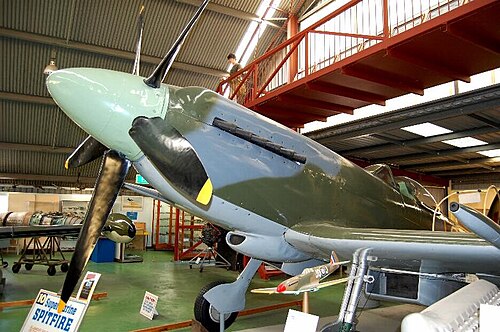
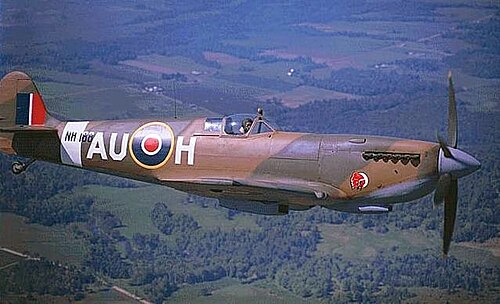
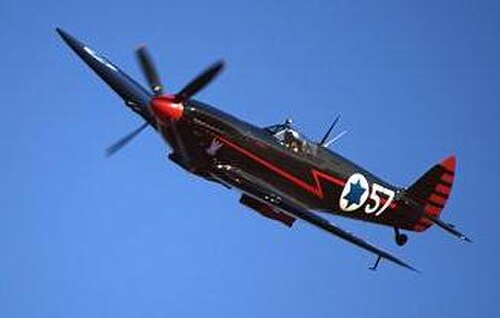
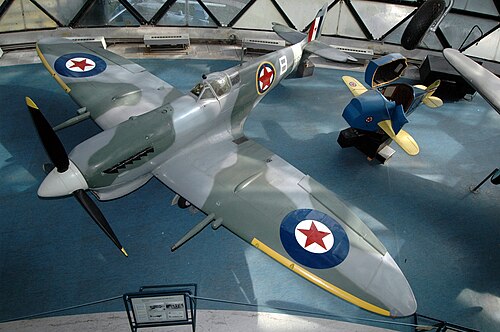
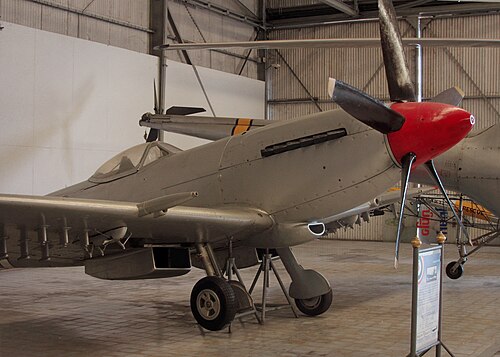
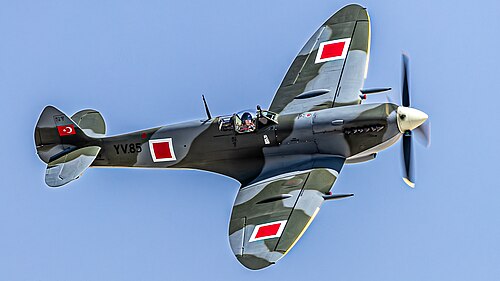
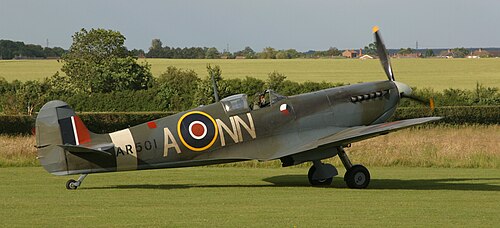
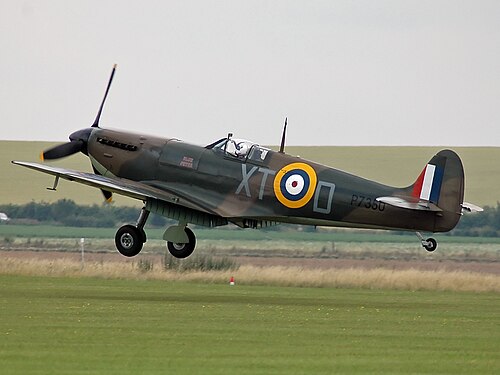
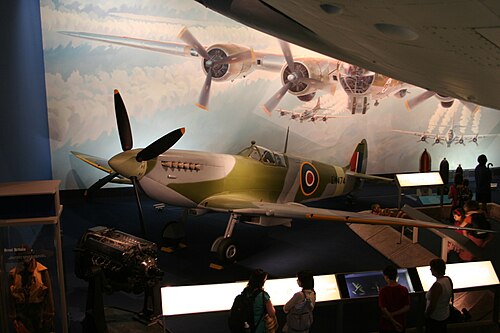
スピットファイア F Mk.Vc/Trop EE853。南オーストラリア州ポートアデレードの南オーストラリア航空博物館に展示されている。この機体は1942年にイギリスのウェストランド社で製造された。A58-146としてオーストラリアに輸送され、ミルン湾のオーストラリア空軍第79飛行隊に所属した。1943年8月28日、キリウィナ島に墜落し、グッドイナフ島に輸送された。1971年にラングドン・バジャーがこの機体を発見し、1973年にアデレードに輸送した。パラフィールド空港で4年間修復した後、ラングドンはアデレードの自宅でスピットファイアを展示した。2001年8月、この機体は博物館に展示された。[ 19 ]
PK481は西オーストラリア州ブルクリークに展示されている。
スピットファイア F Mk.22 PK481。西オーストラリア州ブルクリークにあるRAAF協会航空遺産博物館に展示されている。この機体は1959年に英国王立空軍協会のブライトン&ホーブ支部から取得され、当初は屋外のポールに展示されていたが、1977年に博物館に持ち込まれて修復された。[ 20 ]
修復または保管
スピットファイア F Mk. Ia X4009 (G-EMET)。ハンターファイターコレクション社により飛行可能な状態に修復中。1940年に製造され、1940年8月18日にAZ-Qとしてイギリス空軍第234飛行隊に送られた。X4009で9機撃墜、1機撃墜確実と記録されたパターソン・クラレンス・ヒューズが操縦した。彼は1940年9月7日、ドルニエ Do 17を攻撃し脱出に失敗し、この機体で死亡した。残骸は数年後に回収され、後にG-EMETとして登録された。ロス&アンマリー・ペイ夫妻は2021年に残骸を入手し、オーストラリアの登録慈善団体であるハンターファイターコレクション社にX4009を寄贈した。この機体はオーストラリア、ニューサウスウェールズ州スコーンのビンテージファイターレストレーションズによって飛行可能な状態に修復されている。[ 21 ]
Spitfire F Mk.Vc/Trop BS164 (VH-CIP). Under restoration by Vintage Fighter Restorations. Delivered to the RAAF as A58-63 with No. 54 Squadron RAF in Australia in 1942 as DL-K before being wrecked in a collision with Spitfire LZ845/A58-214 in 1944 while in service with No. 452 Squadron RAAF. The wreckage was recovered in 1975 and later acquired by Peter Croser and Michael Aitchison in 1982 before Michael G. Aitchison solely acquired it in 2008, who had it registered as VH-CIP. Ross Pay of Vintage Fighter Restorations acquired the wreckage in 2019, and is restoring it to airworthy condition.[22]
Spitfire F Mk.Vc/Trop MA353 (VH-CIQ). Under restoration by Vintage Fighter Restorations. Delivered to the RAAF as A58-232 with No. 54 Squadron RAF as DL-A before joining No. 452 Squadron RAAF as QY-Z. The aircraft disappeared in 1944 during operations which took the life of its pilot, Sergeant Colin William Dunning. The aircraft was found in 1946, which was when the pilot's remains were recovered from the wreck and buried. The aircraft was recovered in 1969, with the fuselage going to John Haslett while the Merlin engine and wings were put on display at the Darwin Air Museum. The wreckage eventually came together in the hands of Peter Croser and Michael Aitchison from Melbourne in 1982 before becoming Michael Aitchison's sole ownership in 2006, being registered as VH-CIQ. Vintage Fighter Restorations later acquired the wreck in 2019[22]
Spitfire LF Mk.IXb MJ789. Owned by the Royal Australian Air Force Museum and in storage at Point Cook, Victoria. Ex. 453 (RAAF) Sqn machine, wore the markings MJ789 / FU-B. Crashed in River Orne, near Caen, France, on 11 June 1944 as a result of anti-aircraft fire, claiming the life of pilot Flight Lieutenant Henry 'Lacy' Smith. Both F/L Smith and MJ789 were recovered from the riverbed in November 2010. Subsequently, F/L Smith was buried with full military honours in Normandy and the wreckage of MJ789 was transferred to the RAAF Museum and transported to Australia for conservation with a view to eventual display.[23]
Spitfire FR Mk.XIVc RM921. on display at the Musee Spitfire in Florennes. Delivered to the Belgian Air Force with the tail number SG-57 in August 1948. Written off in a taxiing accident after a partial landing gear collapse in November 1951. Used as a gatekeeper at the Florennes Air Base, mounted on a pole. Restored to static display between 1987 & 1992, displayed as TX995 / RL-D, the personal plane of Raymond Lallemant, though the original TX995 had a bubble canopy.[29]
Brazil
Restoration or stored
Spitfire HF Mk.IXe MA793. In storage after display at Wings of Dreams Museum. MA793 served with the USAAF (believed to be the only surviving Spitfire to have done so) in 1943 before joining the SAAF with serial 5601 in 1948. It became part of a playground in 1954 at a children's hospital in Pretoria until 1967. The aircraft was rebuilt in the markings of PT672, another SAAF Spitfire. The aircraft was regularly flown at airshows around South Africa until it was sold to a purchaser in California in 1986 with the register N930BL, and repainted as EN398, codes JE-J, one of Johnnie Johnson's Spitfires. In 1999, it became the property of Rolls-Royce who sold it to the TAM/Wings of Dreams at São Carlos International Airport in Brazil for public display.[30] The museum closed in 2016 with plans announced in 2018 to have a new location for the museum at São José dos Campos Airport, near the Embraer plant.[31]
Canada
Airworthy
Restored Spitfire CGYQQ Y2K S/N TE294
Spitfire HF Mk.IXe TE294 (C-GYQQ). Previously under restoration to flying condition at Comox, British Columbia, for Vintage Wings of Canada, it arrived at their main base at Gatineau, Quebec in late September 2014 for continued restoration back to airworthy condition. Finished to represent MK304, codes Y2-K. The first flight after restoration took place at Gatineau, Quebec, on 7 June 2017.[32]
Spitfire HF Mk.IXe MA298. After the German occupation, the Royal Danish Air Force acquired 38 HF Mk.IXe and 3 PR Mk.XI Spitfire aircraft. The Spitfires were retired and replaced by jets between 1951 and 1955. All but two were scrapped. For a number of years, one was placed in a children's playground. MA298 is the last of the Danish Spitfires to survive; it was delivered to the Danish Air Force in 1947 and was refurbished for display at the Danmarks Flymuseumz, Stauning Airport after it was retired.[49][50] The aircraft carries the markings of 41-401, which was originally carried by NH417.[51]
Egypt
Static display
Spitfire F Mk. Vc Trop BR491. BR491 served with 92 Squadron and crashed in 1942 in Alexandria, Egypt with the loss of its pilot, Warrant Officer Class I Lloyd George Edwards. The aircraft was recovered in 1999 by the El Alamein Military Museum and put on display in 2001 without the rear tail (presumably deteriorated away while underwater).[52][53]
France
RR263 on display at Musée de l'Air et de l’espace, Le Bourget
Airworthy
Spitfire FR Mk. XIVe RM927 (G-SXIV). Airworthy in the UK. RM927 was built in November 1944 and delivered to the RAF in January 1945, assigned to No. 430 Squadron RCAF as G9-X. After being hit by flak and put into storage for some years, it was sold to the Belgian Air Force in 1947 as SG-25, coded 3R-D, before being stripped of paint and coded IQ-W. In 1957, the aircraft was sold to a scrap dealer but put on display next to NH904 (airworthy in the US) without its wings. It passed through several owners throughout the US and UK, which saw it being delivered to Airframe Assemblies for a rebuild in 2005. The fuselage rebuild was completed in 2009 and got the registration G-JNMA. After some time in storage, the aircraft was sold to the W Air Collection in France in late 2020, with the registration changed to G-SXIV and moved to Sywell to finish the restoration. The restored Spitfire made its first flight on 5 July 2022 out of Sywell[54] and flew to La Ferté-Alais in France a month later.[55]
Spitfire F Mk.XVIIIe - SM986. Former Indian Air Force with the serial HS986. On display at the Indian Air Force Museum, Palam, New Delhi.[66]
Restoration or stored
Spitfire LF Mk. VIIIc NH631. On display at RIAF Museum Palam. It was delivered to the Royal Indian Air Force in 1945 and was airworthy with the Air Museum in India from the 1960s until they stopped flying it in 1989. Plans were announced in 2018 for it to be restored to flying condition by an external company.[67]
Spitfire F Mk.IXe EN145. Built at Chattis Hill, it first flew in 1942 and was delivered to the USAAF in 1943.[70] It was later delivered to the Italian Air Force in 1946 as MM4116 before being delivered to the Israeli Air Force as 20-78. EN145 was acquired by the IDFAF Museum in 1990 and has been on display ever since.[71]
Spitfire LF Mk.IXe SL653. Delivered to the Czechoslovak Air Force before being delivered to the Israeli Air Force as 20-28. It was later acquired by the IDFAF Museum in 1973 where it is on display.[4] This Spitfire was once believed to have been TE578 (it has parts from TE578), but it was confirmed later on during restoration through parts with stencils: 425 (it was given the Burmese number UB425, but never left Israel and the number went to SL633) and the number "28" from the IDFAF 20-28 that it actually is SL653.[72]
Italy
MK805, operated by the Italian Air Force in the very last stages of WWII
Static display
Spitfire LF Mk.IXc MK805. On display at the "Vigna di Valle Museum" (Italian Air Force Museum) Bracciano, Rome, Italy.[73]
Malta
EN199 at the Malta Aviation Museum
Static display
スピットファイア F Mk.IXe EN199 。マルタ航空博物館(マルタ、タ・カリ)に展示。1942年11月28日にイーストリーで初飛行。この機体は、博物館の館長であるレイ・ポリダノによって1992年に修復された。機体はレイ・ポリダノの妻にちなんで「メアリー・ローズ」と名付けられ、操縦した最高位の将校であるロナルド・ベリー中佐 DFC [ 74 ]を記念してコードRBが付けられている。
Spitfire Mk.IX PT989 (G-CWIX). This Spitfire LF IX was built at Castle Bromwich Aircraft Factory in 1944. It was supplied with a Merlin 66 engine. On 31 August 1944, it was transferred to 33 Maintenance Unit and then on 8 September 1944 it was moved to 52 Maintenance Unit. On 24 September 1944, it was loaded onboard merchant ship S256. On 13 October 1944 it departed, as part of convoy JW.61 headed for Hapmat (a code word for the USSR). Arrived on 30 October at Hapmat. 1 November 1944 it was delivered to No.767 Fighter Aviation Regiment of the Murmansk Air Defence Force. It crashed following a mid-air collision with Spitfire PT879 on a training exercise on 18 May 1945. In September 2014 it was rediscovered by aviation archaeologists in Murmansk. Imported to the UK and registered with the CAA in 2022 as G-CWIX by Greg Davis who was the first owner as well as founder of "The Two-Seat Spitfire Page". In June 2025 PT989 was sold to Matt Jones of Spitfires.com. Matt intends to build her as a single seat MkIX.[4]
Spitfire F Mk.IXe RK858 (G-CGJE). This Spitfire was built in 1943 and in 1944 was delivered to the Soviet Air Force. No details about its service in Russia exist, apart from the fact that it was shot down at some point and was recovered in 1992 in a wrecked, but intact state. RK858 was registered as G-JGCA to be restored to flight at Duxford.[254][4]
Spitfire F Mk.IX RK912 (G-CLCS). Built and delivered to Casablanca in 1944 and bounced around Africa until 1945 when it was hit by flak and went down in Italy. In 2010 the remains were recovered and shipped to Duxford, where it was registered G-CLGS and will undergo an airworthy restoration.[255][4]
Spitfire LF Mk. IX SM639 (G-CKYM). Built by Castle Bromwich in 1944 and delivered to the Soviet Air Force in February 1945.[256] It crashed in Russia at some point during service and the wreckage was recovered in 1994. Passing through various owners, it got a civilian registration of G-CKYM to Mark Bennet in 2019.[4]
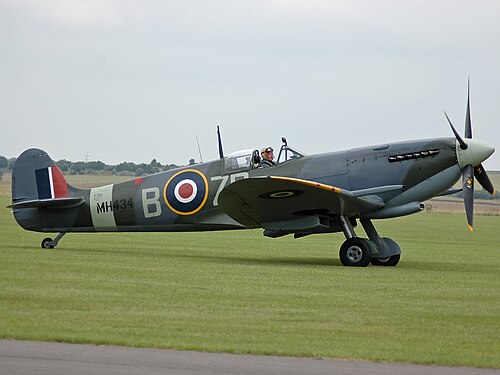
TE566 in the UK before the RAF markings were applied
スピットファイア F Mk. XVIII TZ219。飛行に向けて英国で修復中。1947年にインド空軍にHS683として納入され、1962年に退役し、訓練用機体となった。2019年にインド空軍博物館の所有となった。静態展示の計画だったが、飛行可能な状態に修復することも可能だった。[ 4 ] [ 278 ]最終的にこの機体はサイウェルのエア・リーシングに送られ、インド空軍ヒストリック・フライトのためにインドに返還される前に、飛行可能な状態に修復される予定である。 [ 279 ]
Spitfire PR Mk.XIX PS915. Under major refurbishment at Duxford by the Aircraft Restoration Company. Operated by the RAF Battle of Britain Memorial Flight at RAF Coningsby in Lincolnshire. Entered service too late for the war, joining No.541 Squadron at RAF Benson in June 1945.[280][281] Before entering refurbishment it wore the colours and markings of PS888, a PRXIX of 81 Squadron based at Seletar in Singapore during the Malaya Campaign. This aircraft conducted the last ever operational sortie by an RAF Spitfire when, on 1 April 1954, it flew a photographic mission over an area of jungle in Johore thought to contain hideouts for Communist guerrillas. For the occasion, the aircraft's ground crew painted the inscription 'The Last!’ on the left engine cowling[282]
Spitfire F Mk.22 PK519 (G-SPXX). Under amateur restoration by Peter Arnold in the UK. Delivered to No. 615 Squadron in 1949[283] and lost in a collision with PK518. The wreckage was recovered in 2001 and Peter Arnold acquired it in 2012 for an airworthy restoration.[4]
スピットファイア F Mk. 22 PK624。飛行に向けて修復中。製造後、この機体は数年間 6 MU に保管され、最終的に1948 年 8 月 25 日に RAU-T として614 飛行隊に納入されました。2 年後、この機体は 6 MU で再び保管されました。PK624 は後に 9 MU に送られ、1951 年にシリア空軍への売却準備が行われていましたが、結局売却は行われず、1953 年に退役するまで RAF に保管されました。1957 年、604 飛行隊の隊員数名がこの機体の世話をし、飛行させていました (公式には RAF の機体ではありませんでしたが)。これが、 RAF アクスブリッジのゲート ガーディアン展示に展示される前の最後の飛行となりました。この機体には、何らかの理由で、デ ハビランド チップマンクのシリアル番号であるWP916が塗装されていました。これは1963年に修理され、RAFノースホルト基地に移送され、その後7年間そこに留まりました。1970年に再びRAFアビンドンに移送され、そこで614飛行隊のマーキングに再塗装されました。これが1989年にその価値が認められる前の最後の「配置」となり、当時の他のすべてのゲートガード機と同様に、風雨によるさらなる影響から保護するために降ろされ、PK624はRAFセントアサンに移送されました。ファイターコレクションは1994年に国防省と交渉してスピットファイアを入手し、国防省は時間をかけて機体を清掃し、再び飛行できるように必要な作業を行いました。[ 284 ]
↑ Simpson, Andrew (2013). "Individual History: De Havilland DH9A F1010 Museum Accession Number 77/A/921" (PDF) . RAF Museum. 2016年4月25日にオリジナル(PDF)からアーカイブ済み。 2016年4月16日に取得。
1 2 Restauracija Aviona Spitfajer Iz Zbirke Muzeja Jugoslovenskog Vazduhoplovstva、Đorđe čistogradov、フライト、no.3、ユーゴスラビア航空博物館、2004 年、 ISSN 1450-684X
1 2 3 Spitfajer、A. Kolo および B. Dimitrijević、ベオグラード、1997、 ISBN86-83005-01-1
↑ Restauracija Aviona Spitfajer Iz Zbirke Muzeja Jugoslovenskog Vazduhoplovstva、Đorđe Čistogradov、Flight、no.3、ユーゴスラビア航空博物館、2004 年、 ISSN 1450-684X、セルビア語キリル文字で発行