
Loading article…
反ユダヤ主義(ユダヤ人に対する偏見、憎悪、差別)は、古代文明の時代から長い歴史をもって表現されてきたが、そのほとんどはヨーロッパのキリスト教およびキリスト教以前の文明に端を発している。
この現象は古代ギリシャやローマ帝国の知的・政治的中心地で表現されたとされるが、古代ユダヤ文化の中心地であったエルサレムの解体に伴い、ヨーロッパのキリスト教社会内でより制度化され、ユダヤ人の強制的な隔離や、時にはヨーロッパ社会の公的生活への参加の制限 をもたらした。
20 世紀、特にナチスドイツの支配下でのヨーロッパにおける反ユダヤ主義は、ヨーロッパのユダヤ人人口の大部分を組織的に殺害し、追放する計画である ホロコーストを引き起こしました。
ローマ帝国
中世

中世ヨーロッパにおける反ユダヤ主義は、福音書に記されたポンティウス・ピラトのいわゆる血の呪いによって、ユダヤ人がイエスの死に集団的に責任を負っているというキリスト教の信仰に大きく影響されていた。
1095年に始まった十字軍の時代にはユダヤ人に対する迫害が広まり、特にフランスとラインラントの多くのコミュニティが虐殺された。[1]
ユダヤ人は、キリスト教徒の子供たちを儀式的に殺害したとして、血の誹謗罪で告発されることが多々ありました。最初に知られている血の誹謗罪は、ウィリアム・オブ・ノリッジ(1144年没)の殺害で、この殺害は地元のユダヤ人による儀式的殺人と拷問の告発を引き起こしました。[2]
14世紀にヨーロッパを襲った黒死病もまた、広範囲にわたる迫害を引き起こした。恐ろしいペストの蔓延に直面して、ユダヤ人はスケープゴートにされ、井戸に毒を盛ったと非難された。その結果、西ヨーロッパと中央ヨーロッパの多くのユダヤ人コミュニティが、1348年から1350年の間に起こった一連の暴力で破壊された。[3] [4]たとえば、 1349年2月、ストラスブールでは、ペストが市内に到達する前に、市議会の決定により、約2000人のユダヤ人が焼き殺された。 [5] [6]この時期に、ドイツ諸州では、ユダヤ人が殺害されたり追い出されたりしたため、合計で約300のユダヤ人コミュニティが破壊された。[7]
中世の反ユダヤ主義のもう一つの側面は、ユダヤ人に課せられた多くの制限であった。彼らは地元住民との競争を恐れて多くの職業から排除された。封建制度下では、土地の封土に際して家臣に要求される忠誠の誓約はキリスト教の誓約の形をとっていたため、ほとんどの場合、彼らは土地を所有することができなかったが、例外もあった。[ 8] [9]都市における彼らの居住は、ゲットーとして知られる特定の地域に限定されることが多かった。 1215年の第4回ラテラン公会議の後、ユダヤ人は独特の衣服を着用するよう命じられ、[10] [11]場合によっては円形のバッジを着用することもあった。 [12]バッジを着用するという屈辱的な義務を、地元当局に賄賂を贈ることで逃れたユダヤ人もいた。 [ 13 ]
中世後期には、ユダヤ人は西ヨーロッパ各地やドイツ領から大小さまざまな地域から追放された。これには1290年のイングランドからの君主制全体にわたる追放、 1306年と1394年のフランスからの追放が含まれる。[14]ユダヤ人の最大の追放はスペイン(1492年)とポルトガル(1496年)で、ユダヤ人はそれぞれ6ヶ月と11ヶ月以内にキリスト教に改宗するか国外退去するよう命じられた。[15]
プロテスタント宗教改革では、マルティン・ルターの『ユダヤ人とその嘘について』によって反ユダヤ主義が高まりました。マルティン・ルターと反ユダヤ主義は、プロテスタント教会がユダヤ人に対して悪意を持っていることを証明しました。
16世紀、17世紀、18世紀
ルネッサンス、啓蒙時代、帝国主義の時代は、大陸の大部分が大きな政治改革を経験したにもかかわらず、反ユダヤ主義的な恐怖や憤りの一連の排外主義的かつ非宗教的な表現をもたらした。[16] [17]
西ヨーロッパでは、ユダヤ人は主に地元の君主によって制限されていた。特に、ユダヤ人の主な職業が商業と銀行業であったため、地元の商人との競争に対する恐怖が高まった結果である。注目すべき例としては、1744年にプロイセン王フリードリヒ2世が発令したブレスラウへのユダヤ人定住数の制限と、オーストリア大公女マリア・テレジアによるボヘミアからのユダヤ人追放が挙げられる。彼女は後に、ユダヤ人は国内に留まるには金を払わなければならないと述べた。[18]
銀行制度の発達と、拡大する国家機構に資金を供給するための統治者の必要性から、西ヨーロッパのいくつかの国では「宮廷ユダヤ人」という用語が使われた。宮廷ユダヤ人とは、君主から特権を受け、君主の財務官や徴税人として活動した実業家や銀行家であった。[19] [20]
多くの場合、宮廷ユダヤ人は君主の「右腕」として大きな権力を得たが、他の場合には、宮廷ユダヤ人は国家の財政問題や君主の権力喪失の責任を負わされた。著名な宮廷ユダヤ人の一人は、シュトゥットガルトでヴュルテンベルク公カール・アレクサンダーの財務計画者であったヨーゼフ・ズース・オッペンハイマー(1698年 - 1738年)である。オッペンハイマーは公爵の死後処刑され、彼の物語はナチスのプロパガンダに利用された。[21]
ヨーロッパのユダヤ人人口の大半は、ポーランド・リトアニア共和国の境界内の中央および東ヨーロッパに集中していた。ポーランドのユダヤ人は、 1264年のカリシュ条約以来、前例のない宗教的および文化的自治権を与えられており、この条約はポーランドおよび共和国のその後の王によって批准された。しかし、ポーランド支配下のウクライナでボフダン・フメリニツキーが起こしたコサック蜂起(1648年)は、多くのユダヤ人コミュニティを壊滅させ、数万人のユダヤ人がフメリニツキーのタタール人同盟者によって虐殺、追放、または奴隷として売られた。1648年から1656年の間に、数万人のユダヤ人が反乱軍によって殺害された(信頼できるデータがないため、より正確な数字を確定することは不可能である)。今日に至るまで、フメリニツキー蜂起はユダヤ人にとって歴史上最も悲惨な出来事の一つであると考えられている。[22]
18世紀末のロシア、プロイセン、オーストリアによるポーランド分割後、ポーランドのユダヤ人のほとんどはロシアの支配下に入った。ロシア帝国全土へのユダヤ人の拡散を制限し、ロシア商人を競争から守るため、 1772年にロシア女帝エカチェリーナ2世によって居住制限区域が設けられ、キエフやモスクワなどの大都市に住むことを許可された一部のユダヤ人を除き、ユダヤ人は帝国西部に制限された。[23] [24]
19世紀から20世紀初頭


19世紀末までに、ヨーロッパでは新しいタイプの反ユダヤ主義、人種的反ユダヤ主義が発達し始めた。[25]これは、より広範な人種差別的な世界観と「白人種」が他の「人種」よりも優れているという信念の一部として始まり、既存の偏見は社会ダーウィニズムなどの疑似科学理論によって支えられていた。[26]
ジョゼフ・アーサー・ド・ゴビノーなどの人種理論家が主張する人種的反ユダヤ主義の主たる考え方は、ユダヤ人はヨーロッパ諸国に比べて独特で劣った人種であるというものである。ユダヤ人の非ヨーロッパ起源と文化に重点が置かれ、たとえキリスト教に改宗したとしても救済されないことを意味していた。この現代の反ユダヤ主義は、ユダヤ人をユダヤ教の宗教のためだけではなく、人種として憎むことを強調した。
現代の反ユダヤ主義の台頭とナショナリズムおよび国民国家の台頭は、ユダヤ人が平等な市民としての権利を獲得しようと奮闘する中で、反ユダヤ主義の波をもたらした。ドイツでは、これが1819 年のヘップヘップ暴動を引き起こし、バイエルンのユダヤ人が市民権を主張したために攻撃された。
19世紀の最も有名な例の一つはドレフュス事件である[27] [28]。 1894年、ユダヤ系フランス人将校アルフレッド・ドレフュスが大逆罪で告発された。この裁判はフランスで反ユダヤ主義の波を引き起こしたが、最終的にドレフュスは1906年に無罪となった。この事件はテオドール・ヘルツルに大きなインスピレーションを与えた。
東ヨーロッパでは、産業革命の影響が小さかったため、宗教的な反ユダヤ主義の影響は残っていた。19世紀から20世紀初頭にかけて、ロシアでは反ユダヤ主義の政治運動、1881年の皇帝アレクサンドル2世の暗殺、ユダヤ人がキリスト教徒の子供を殺害したという血の誹謗[29] [30]など、さまざまな要因に触発されて、多くのポグロムが発生した。最も有名な血の誹謗は、 1903年にキエフで行われたベイリス裁判[31] [32]で、地元のユダヤ人がキリスト教徒の少年を殺害したという容疑で無罪となった。
ヨーロッパにおける現代の反ユダヤ主義のもう一つの例は、ユダヤ人の世界経済支配の陰謀説である。これは、1903年にロシアで初めて出版され、 1917年のロシア革命後にロシア国外でも知られるようになった偽書『シオン賢者の議定書』 [33] [34]に記されている。この説は、ロスチャイルド家のようなユダヤ人がヨーロッパの銀行システムで主導的な役割を果たしていたことで強化された。
1881年と1905年の第一次ロシア革命後のユダヤ人虐殺により何千人ものユダヤ人が命を落とし、100万人以上がアメリカに移住した。第二次ロシア革命とその後の内戦により、民族主義民兵と正規軍が国の支配権をめぐって争い、ユダヤ人に対する新たな虐殺の波が巻き起こった。虐殺による犠牲者は数万人と推定されている。[35]
ホロコースト

ホロコーストは、近代ユダヤ人の歴史において最も重要な出来事の一つであり、世界史上最大の大量虐殺の一つです。およそ600万人のユダヤ人がナチスによって殺害され、これはヨーロッパのユダヤ人全体のおよそ3分の2に相当します。
20世紀初頭までに、ドイツのユダヤ人はヨーロッパで最も統合されたユダヤ人であった。1930年代初頭、第一次世界大戦でのドイツの敗北と1929年の経済危機により、ナチスとその明白な反ユダヤ主義政策の台頭により、状況は変化した。ユダヤ人市民を「汚れたユダヤ人」と呼ぶ憎悪表現が、反ユダヤ主義のパンフレットや新聞、例えば『フェルキッシャー・ベオバハター』 [36]や『デア・シュテュルマー』 [37]で頻繁に見られるようになった。さらに、第一次世界大戦でのドイツの敗北の原因はユダヤ人にあると非難された(『ユダヤ人の敗北』を参照)。
ナチスの反ユダヤ主義プログラムは、すぐに単なる言論を超えて拡大した。1933年に始まり、ユダヤ人に対する抑圧的な法律が可決され、1935年のニュルンベルク法で頂点に達した。この法律では、宗教に基づく定義ではなく、血統に基づく人種定義を使用して、ユダヤ人から市民権のほとんどを剥奪した。1938年の水晶の夜の暴動の間、ユダヤ人に対する散発的な暴力が蔓延し、ユダヤ人の住宅、企業、礼拝所が標的となり、ドイツとオーストリア全土で91人が死亡した。
1939年のナチスのポーランド侵攻と第二次世界大戦の勃発とともに、ナチスはヨーロッパでユダヤ人の絶滅を開始した。ユダヤ人はゲットーに集められ、後に強制収容所や絶滅収容所に送られ、そこで即座に、あるいは最終的に殺害された。ソ連の占領地域では、ユダヤ人は死の部隊によって殺害され、時には現地で募集された部隊の助けも受けた。この慣行は後に、ユダヤ人を死の収容所でガス処刑する方法に取って代わられた。その中で最大のものがアウシュビッツであった。
1945年以降
1945年に第二次世界大戦が終結すると、生き残ったユダヤ人は故郷に戻り始めたが、多くは米国、英国、英国支配下のパレスチナへの移住を選んだ。ある程度、ナチス政権の反ユダヤ主義は形を変えて続いた。血の誹謗中傷やユダヤ人迫害の主張は続いたが、これは帰還したユダヤ人がホロコースト中に奪われた財産を取り戻そうとしたり、ナチス占領下の地域で地元住民が行った支援を暴露したりするのではないかという恐れもあった。その一例がキェルツェのポグロムで、1946年にポーランドで発生した。市民がキリスト教徒の子どもが誘拐されたという虚偽の告発に基づきユダヤ人を激しく攻撃した。
戦後、ソ連では反ユダヤ主義の迫害が激化した。1948年、スターリンは「根無し草のコスモポリタン」に対するキャンペーンを開始し、多数のイディッシュ語の詩人、作家、画家、彫刻家が殺害または逮捕された。これは1952年から1953年にかけて発せられた医師陰謀事件で頂点に達し、多数のユダヤ人医師が逮捕され、党の指導者を殺害しようとした罪で告発された。現代の歴史家エドヴァルド・ラジンスキーは、スターリンがソ連のユダヤ人をカザフスタン、シベリア、またはユダヤ人自治州に追放する計画を立てていたとも示唆している。[38]
21世紀
2000年以降、ヨーロッパでは反ユダヤ主義が著しく増加しており、言葉による攻撃や落書きなどの破壊行為、ユダヤ人学校への放火、シナゴーグや墓地の冒涜が増加している。これらの事件はフランスやドイツだけでなく、ベルギー、オーストリア、イギリスでも発生した。これらの国では、殴打、刺傷、その他の暴力を含むユダヤ人に対する身体的暴行が著しく増加し、重傷や死亡に至るケースも少なくない。[39] [40]さらに、オランダとスウェーデンでも2000年以降、反ユダヤ主義攻撃の発生率が一貫して高い。[41]米国務省による2015年の宗教の自由に関する報告書は、「ヨーロッパの反イスラエル感情は一線を越えて反ユダヤ主義に至った」と宣言した。[42]
反ユダヤ主義攻撃の増加は、一方ではイスラム教徒の反ユダヤ主義(後述)と、他方では2008年の経済危機の結果としての極右政党の台頭に関連している。[43] EUには多くの反ユダヤ主義政党があり、[44]オーストリア、フランス、ドイツ、ハンガリー、イタリア、オランダ、ノルウェー、ポーランド、スペイン、英国の10か国での調査では、反ユダヤ主義的態度のレベルが高いことが明らかになった。[45]ギリシャのネオナチ政党「黄金の夜明け」は議会で21議席を獲得したが、これらはすべて2019年までに失われた。[46]
東ヨーロッパでは、21 世紀も反ユダヤ主義が 1990 年代と同程度に続いています。ソ連の崩壊と新国家の不安定化により、民族主義運動が勃興し、ユダヤ人が経済危機の責任を負い、地元企業の支配や政府への賄賂を献金していると非難されるようになりました。また、反ユダヤ主義の伝統的、宗教的動機 (たとえば、流血の誹謗中傷) も現れています。反ユダヤ主義事件のほとんどは、ユダヤ人の墓地や建物 (コミュニティ センターやシナゴーグ) に対するものです。それにもかかわらず、2006年にネオナチがボルシャヤ・ブロンナヤ・シナゴーグで9人を刺した事件や[47] 、 1999年に同じシナゴーグで爆弾テロが失敗に終わった事件[48] 、ウクライナのウマニでユダヤ人巡礼者が脅迫された事件[49] 、 2009年にモルドバで過激派キリスト教組織がメノーラーを襲撃する事件[50]など、モスクワではユダヤ人に対する暴力的な攻撃がいくつかあった。2008年には、ウクライナの急進派スヴォボダ(自由)党が一般投票の10%以上を獲得し、反ユダヤ主義的な言辞で知られる政党に選挙の支持を与えた。彼らはハンガリー議会で公然と反ユダヤ主義を掲げる政党ヨッビクに加わった。 [51]西欧と東欧における極右思想への支持の高まりは、反ユダヤ主義行為の増加をもたらし、そのほとんどはユダヤ人の記念碑、シナゴーグ、墓地への攻撃であるが、ユダヤ人に対する身体的攻撃も数多く発生している。[52]
イスラム教徒のヨーロッパ人
2005年のフランスの調査によると、反ユダヤ的偏見は非宗教的イスラム教徒よりも宗教的イスラム教徒の間で広まっている。フランスでは、非宗教的イスラム教徒の30%に対して、宗教的イスラム教徒の46%が反ユダヤ的感情を表明している。宗教的イスラム教徒のうち、全くそのような偏見を持たない人はわずか28%だった。西欧諸国のイスラム教徒の若者を対象に実施された数少ない調査では、同様の結果が示された。2011年にベルギーの社会学者がブリュッセルのオランダ語学校の小学生を対象に行った調査では、2年生と3年生のイスラム教徒の生徒の約50%が反ユダヤ主義者であると考えられるのに対し、他の生徒では10%だった。また、2011年にギュンター・ジケリはベルリン、パリ、ロンドンの19歳のイスラム教徒の若者117人へのインタビューから得た調査結果を発表した。その多くは反ユダヤ的感情を表明していた。[53]
2009年にイスラエル大使館前で起きた反ユダヤ主義暴動の参加者は主にイスラム教徒の若者で、[53]左翼の自治組織ブリッツ活動家らの支援を受けていたと言われている。[54] [55]
イスラムのテロリストはユダヤ人に対する暴力的な攻撃に関与している。2012年トゥールーズでは、アルジェリア出身のイスラム教徒の両親の子供である武装テロリストのモハメド・メラ[56]がユダヤ人4人を殺害した。メラは以前にもフランス軍兵士を標的にしていた。犯人の兄弟であるアブデルガニ・メラは、自分と兄弟は両親から反ユダヤ主義的な考え方を説かれて育ったと語った。[56] [57]
2024年9月、欧州委員会の反ユダヤ主義対策および欧州におけるユダヤ人の生活促進担当コーディネーターであるカタリーナ・フォン・シュヌールバイン氏は、国連のワークショップで、現在の制吐剤事件の増加は「ヨーロッパの最も暗い時代を思い出させる」と述べた。[58]
世論調査
2004年に「ピュー・グローバル態度プロジェクト」が実施した世論調査の要約では、「ヨーロッパで反ユダヤ主義が高まっているという懸念があるにもかかわらず、過去10年間で反ユダヤ感情が高まったという兆候はない。フランス、ドイツ、ロシアでは、ユダヤ人に対する好感度は1991年よりも高くなっている。とはいえ、ユダヤ人はドイツやロシアよりも米国で好かれている。」と指摘されている。[59]
2005年の名誉毀損防止同盟による調査結果によると、[60]反ユダヤ主義的な態度はヨーロッパで依然として一般的です。調査対象者の30%以上が、ユダヤ人はビジネスであまりにも大きな力を持っていると考えており、回答はデンマークの11%、イギリスの14%と低く、ハンガリーの66%、ポーランドとスペインの40%以上と高くなっています。宗教的な反ユダヤ主義の結果も根強く、ヨーロッパの回答者の20%以上がユダヤ人がイエスの死の原因であることに同意しており、フランスは13%で最低で、ポーランドは39%で最も高い同意者数でした。[61]
2006年にJournal of Conflict Resolutionで発表された研究によると、欧州連合諸国の回答者で自らを反ユダヤ主義者とみなす人はほとんどいなかったものの、反ユダヤ主義的態度は反イスラエルの意見と相関関係にあることがわかった。[62]チャールズ・A・スモールとエドワード・H・カプランは、ヨーロッパ10カ国の人口を調査し、5,000人の回答者を対象に、イスラエルの行動と古典的な反ユダヤ主義のステレオタイプについて質問した。調査では、イスラエル国防軍が意図的に子供を標的にしたり、パレスチナの水源を汚染したりしていると思うかどうかについて質問した。[63]この研究では、「反イスラエル神話を信じる人々は、ユダヤ人がビジネスで正直ではない、二重の忠誠心を持っている、政府と経済を支配している、などと考える傾向があった」ことがわかった。この研究では、反イスラエルの回答者は平均的なヨーロッパ人よりも反ユダヤ主義である可能性が56%高いことがわかった。[63]
2012年に名誉毀損防止同盟(ADL)が実施した世論調査によると、ヨーロッパ10カ国における反ユダヤ主義的態度は「憂慮すべきほど高いレベル」にあり、東ヨーロッパとスペインでピークを迎え、国民の大部分が、ユダヤ人がビジネスで大きな力を持っている、自国よりもイスラエルに忠誠を誓っている、ホロコースト中に何が起こったかについて「語りすぎている」などの古典的な反ユダヤ主義的観念に賛同している。2009年に実施された同様のADLの世論調査と比較すると、いくつかの国では反ユダヤ主義の全体的なレベルが高く、他の国ではより緩やかな増加が見られた。[64]
- オーストリア: 2009 年の 30% から 28% にわずかに減少しました。
- フランス: 反ユダヤ主義の全体的なレベルは、2009 年の 20% から 24% に増加しました。
- ドイツ: 反ユダヤ主義は1パーセントポイント増加し、人口の21パーセントに達した。
- ハンガリー: 2009 年の 47% から 63% に上昇しました。
- ポーランド: 数字は変わらず、国民の48%が根深い反ユダヤ主義的態度を示している。
- スペイン: 人口の 53% (2009 年は 48%)。
- 英国:反ユダヤ主義的態度を持つ人口は、2009年の10%から17%に急増した。
2019年1月、欧州委員会は28カ国を対象にした調査結果を発表し、ヨーロッパにおけるユダヤ人と非ユダヤ人の認識に大きな隔たりがあることを示した。調査対象となったユダヤ人の89%は、過去5年間で反ユダヤ主義が「大幅に増加した」と考えていたが、非ユダヤ人ではわずか36%が同じ考えだった。[65]
2018年にCNNが主催した世論調査では、反ユダヤ主義のステレオタイプがヨーロッパで非常に蔓延していることが明らかになった。調査対象者の5分の1は、ユダヤ人がメディアや政治に過度の影響力を持っていると述べ、3分の1はホロコーストについてほとんど、あるいは全く知らないと述べた。[66]
2023年に調査対象となったヨーロッパ13カ国のユダヤ人8,000人のうち52%が調査前の1年間に公の場で反ユダヤ主義を経験したと答え、90%が過去1年間にオンラインで反ユダヤ主義に遭遇したと回答した。[67]全体として、ヨーロッパのユダヤ人は反ユダヤ主義に対して悲観的であり、悪化すると予想しているが、大半はヨーロッパを離れるつもりはない。[68]
東ヨーロッパと中央ヨーロッパ
2015年から2016年にかけて行われた世論調査データによると、以下の国々において、ユダヤ人を家族、隣人、市民として受け入れることを拒否するキリスト教徒の割合について、次のような結果が出ています。 [69] [70]
国別
アルメニア
アルメニアにおける反ユダヤ主義の大きな原因は、イスラエルとアゼルバイジャンとの強い関係と武器販売である。 2020年のナゴルノ・カラバフ戦争中、ナゴルノ・カラバフのアライク・ハルチュニャン大統領は、イスラエルがアルメニア人に対する「大量虐殺」に加担していると非難した。[71]レバノンのアルメニア人は、その戦争中に抗議活動を行い、イスラエルの国旗、トルコの国旗、アゼルバイジャンの国旗を燃やした。[72]
1998年4月、アルメニアの著名な政治アナリストで経済学者のイゴール・ムラディアン氏は、アルメニアの主要新聞の一つ「アルメニアの声」に反ユダヤ主義的な記事を掲載した。ムラディアン氏は、アルメニア人とユダヤ人の関係の歴史は「アーリア人対セム人」の対立の表れで満ちていると主張した。ムラディアン氏は、ナゴルノ・カラバフ紛争を含む民族紛争を煽動したのはユダヤ人だと非難し、イスラエルとトルコの良好な関係を踏まえてアルメニアの安全を懸念していることを示した。[73]
2002年、ロメン・イェピスコポシアン著『国家システム』が出版され、アルメニア作家連盟で発表された。その本では、ユダヤ人(トルコ人とともに)はアルメニア人の最大の敵とされ、「破壊と腐敗を使命とする国家破壊者」と表現されている。その本の『20世紀最大の偽造』と題された章では、ホロコーストを否定し、それは「アーリア人」の信用を失墜させるためにシオニストが作り上げた神話であると主張している。「人類史上最大の偽造はホロコーストの神話である…ガス室で殺された人はいない。ガス室は存在しなかった。」[74]
同様の非難は、2002年2月11日に、小規模な超国家主義政党アルメニア・アーリア秩序(AAO)の指導者アルメン・アヴェティシアンによっても表明され、イスラエルが1915年のアルメニア人虐殺をホロコーストと同等の扱いにしなかったため、イスラエル大使リヴカ・コーエンをアルメニアで歓迎されない人物に指定するよう求めた。さらに、彼はホロコーストの犠牲者の数は誇張されていると主張した。[75] 2004年、アルメン・アヴェティシアンは、AAOが運営するアルメニア・アーリア新聞のいくつかの号や、いくつかの会議や記者会見で、ユダヤ人に対する過激な発言をした。その結果、彼の政党はアルメニア民族戦線から排除された。[76]彼は2005年1月に民族憎悪を煽動した罪で逮捕された。[77]
その後まもなく、ゴールデンタイムのトークショーで、人民党の指導者でALMテレビ局のオーナーであるティグラン・カラペチャンは、ユダヤ人が1915年のアルメニア人虐殺でオスマン帝国当局を支援したと非難した。インタビューを受けたアルメン・アヴェティシアンは、「アルメニアのアーリア人はユダヤ・フリーメーソンの侵略と戦うつもりであり、自らの巣の中の悪を鎮圧するために必要なことは何でもする」と述べた。アルメニアのユダヤ人コミュニティについて、アヴェティシアンは「ユダヤ人であると自認する700人と、アーリア人がユダヤ人の悪を国から一掃する際にまもなく明らかにする5万人」で構成されていると述べた。アルメニアのユダヤ人評議会は、政府やさまざまな人権団体に懸念を表明し、民族憎悪の助長をやめ、ALMを禁止するよう要求した。しかし、これらの要求はほとんど無視された。[76]
2004年10月23日、民族宗教的少数派問題担当局長のフラノシュ・ハラティアン氏は、アルメニアにおけるいわゆる「ユダヤ教徒」の外国人嫌悪について公にコメントした。同氏は「ユダヤ教徒が金曜の集会で非ユダヤ教徒を牛に例え、彼らに唾をかけ続けるなど、非ユダヤ教徒に対する憎悪を唱え続けているという事実に、なぜ我々は反応しないのか」と述べた。 [76]ハラティアン氏はまた、地元のユダヤ人が「反キリスト教的行動」を呼びかけていると非難した。[78]
アルメニアのユダヤ人評議会はロバート・コチャリアン大統領に公開書簡を送り、最近の反ユダヤ主義の高まりに深い懸念を表明した。アルメン・アヴェティシアンはこれに対し、イラヴンク紙にまたも反ユダヤ主義的な記事を掲載し、「ユダヤ人の少数派がいる国は、安定の面で大きな脅威にさらされている」と述べた。その後、アルメニア国民議会のアルトゥール・バグダサリアン議長と会談した際、アルメニアのユダヤ人評議会のリマ・ヴァルザペティアンは、政府がさらなる反ユダヤ主義行為を阻止するための措置を講じるべきだと強く主張した。アヴェティシアンは2005年1月24日に逮捕された。レヴォン・アナニャン(アルメニア作家組合の代表)や作曲家のルーベン・ハクヴェルディアンなど、著名な学者数名がアヴェティシアンを支持し、当局に釈放を求めた。[79]当局は彼を政治的発言を理由に逮捕したため、野党議員やオンブズマンのラリサ・アラヴェルディアン氏も釈放を要求した。 [80]
2006年9月、アルメニアのヴァルダン・アイヴァジアン環境大臣は、アメリカのグローバル・ゴールド社を批判する記者会見で、「あなた方は誰を擁護しているのか分かっているのか? あなた方はユダヤ人を擁護しているのだ! 彼ら(の本社)に行って、この会社の背後に誰がいるのか、そして彼らをここへ連れて行くべきかどうか調べなさい!」と述べた。 [81] [82]リマ・ヴァルザペティアンの抗議の後、アイヴァジアンはユダヤ人を怒らせるつもりはなく、そのような批判はグローバル・ゴールド社のみに向けたものだと主張した。
2007 年 12 月 23 日、エレバン中心部のユダヤ人ホロコースト記念碑が身元不明の人物によって破壊された。ナチスの スワスティカのシンボルが削られ、シンプルな石に黒いペンキが飛び散った。地元警察に通報した後、国内の小さなユダヤ人コミュニティの首席ラビを務めるチャバド派の使節であるラビ ゲルション ブルシュテイン氏は「先日記念碑を訪れたばかりだが、何も問題なかった。ユダヤ人とアルメニア人の間には素晴らしい関係があるだけに、これはひどいことだ」と述べた。記念碑は過去に何度も汚損され、倒されている。記念碑は市の中心部にある共和国広場から数ブロック北のアラガスト公園にあり、そこには多くの政府庁舎がある。[83]
2021年2月12日、エレバンのホロコースト記念碑が再び破壊された。[84]
オーストリア
オーストリアにおける反ユダヤ主義の歴史は長く、典型的にはウィーンに多数のユダヤ人が住んでいたことに焦点が当てられてきた。ユダヤ人は1938年から1945年にかけて組織的に虐殺された。[85]
今日のオーストリア領にあたる地域にユダヤ人コミュニティが存在した証拠は、12世紀にまで遡ることができる。1848年にユダヤ人は公民権と自治宗教コミュニティを設立する権利を与えられたが、完全な市民権が与えられたのは1867年になってからである。経済的、宗教的、社会的自由の雰囲気の中で、ユダヤ人の人口は1860年の6,000人から1938年にはほぼ185,000人にまで増加した。 [要出典] 1938年3月、オーストリアはナチスドイツに併合され、何千人ものオーストリア系ユダヤ人が強制収容所に送られた。強制収容所に移送されたウィーンのユダヤ人65,000人のうち、生き残ったのはわずか2,000人ほどで、約800人が潜伏して第二次世界大戦を生き延びた。[86]ハプスブルク帝国では、反ユダヤ主義運動はウィーンに集中していた。[87]
反ユダヤ主義は第二次世界大戦後も存在し、政党やメディアに最も強く影響を及ぼし、オーストリアの政治生活や文化の一部であり続けた。オーストリアの社会学者ベルント・マリンは、1945年以降のオーストリアにおける反ユダヤ主義を「ユダヤ人のいない反ユダヤ主義」と特徴づけた。なぜなら、ユダヤ人はオーストリアの人口のわずか0.1%を占めていたからである。反ユダヤ主義は、もはやユダヤ人が住んでいない地域や、以前はユダヤ人がほとんど住んでいなかった地域、そしてユダヤ人と個人的に接触したことがない、あるいは接触していない人々の間で強かった。[88] [89]
戦後、ユダヤ人に対する偏見は公に禁じられ、タブー視されていたため、反ユダヤ主義は実際には「反ユダヤ主義者のいない反ユダヤ主義」であったが、オーストリアの政体ではその表現はさまざまであった。1980年代、反ユダヤ主義的な信念を公然と表現することに対するタブーは残ったが、言語的にそれを回避する手段がその境界を広げ、タブー自体がいくらかその重要性を失ったように見えるようになった。隠されていた反ユダヤ的偏見が表面化し始め、公の場で見られることが増えた。したがって、言葉による反ユダヤ主義はめったに直接表現されず、むしろ暗号化された表現が使用され、それはオーストリアの大きな特徴の1つである過去に対するアンビバレンスと曖昧さを反映していた。[88] [89]
現在、オーストリアのユダヤ人コミュニティは約 8,000 人で構成されています。
2009年と2010年にセルファウスで反ユダヤ主義が報告された。有名なリゾート地にあるいくつかのホテルやアパートは、ユダヤ人の敷地内への立ち入りを禁止する方針を明らかにした。予約は人種プロファイリングに基づいて事前に検出され、正統派ユダヤ人の可能性がある人の宿泊は拒否された。[90]
ベルギー
2009年にベルギーで記録された反ユダヤ主義の攻撃は100件を超え、前年比100%の増加となった。加害者は通常、中東からの移民イスラム教徒の若い男性だった。2009年、ヨーロッパ最後のシュテットルと呼ばれるベルギーの都市アントワープでは、反ユダヤ主義の暴力が急増した。アムステルダム在住でアウシュビッツの生存者であるブローム・エバース=エムデンは、2010年に新聞アフテンポステンで次のように語っている。「現在の反ユダヤ主義はホロコースト以前よりもさらにひどい。反ユダヤ主義はより暴力的になった。今や彼らは私たちを殺すと脅している。」[91]
2012年のシャルベーク市での地方選挙が引き起こした行動を受けて、ベルギーのユダヤ人組織調整委員会のモーリス・ソスノフスキー委員長は「ユダヤ人コミュニティに属する候補者が所属を理由に攻撃され、市は反シオニズムを口実にした憎悪キャンペーンを目にした」と指摘した。[92] 2012年には他にもいくつかの事件が発生した。11月にはアントワープの反イスラエル集会でデモ参加者が「ハマス、ハマス、ユダヤ人全員ガス室へ」と連呼した。10月にはブリュッセルのシナゴーグが身元不明の男性2人によって破壊され、壁に「ユダヤ人に死を」や「爆破」とスプレーで落書きされた。[93]
反ユダヤ主義攻撃の頻度の増加は、2014年5月にブリュッセルのベルギー・ユダヤ博物館で銃撃事件が発生し、4人が死亡したことから始まった。 [94] 2日後、若いイスラム教徒の男性がイベント開催中のCCU(ユダヤ文化センター)に侵入し、人種差別的な言葉を叫んだ。[95] 1か月後、アントワープで5歳のユダヤ人の子供たちを乗せたスクールバスがイスラム教徒の10代の若者のグループに石を投げつけられた。 [96] 2014年8月末には、75歳のユダヤ人女性がユダヤ人風の姓を理由に殴打され、地面に押し倒された。[97]
2020年にイスラエルは反ユダヤ主義を理由にアールストのカーニバルパレードの中止を求めた。[98]
ベルギーの連邦平等機関UNIAは、イスラエル・ハマス戦争勃発後の2か月間に、前年の同時期と比較して反ユダヤ主義事件が1,000%増加したと報告した。[99]これらの驚くべき統計を受けて、国際平和共存運動(IMPAC)は、ベルギーの学校でパレスチナ・イスラエル紛争がどのように紹介されているかに関する偏見の問題について懸念を表明した。[99]
ブルガリア
反ユダヤ主義は19世紀後半にブルガリアで政治勢力となった。[100]第二次世界大戦では、ボリス3世がユダヤ人をナチスに引き渡すことを拒否した ため、約5万人のコミュニティはほぼ保護された 。戦後、そのほとんどはイスラエルに渡った。[101] [102]
現在もブルガリアには約2,000人のユダヤ人が暮らしている。2019年初頭、ブルガリアの首都ソフィアのシナゴーグに石が投げつけられる事件が発生した。けが人は出なかったが、この事件は1945年から1989年までブルガリアを統治した共産主義政権の犠牲者を追悼する記念碑に反ユダヤ主義の落書きが見つかった直後に起きた。[103]
チェコ共和国
チェコの国々は、1899年のヒルスナー事件のように時折反ユダヤ主義が燃え上がることはあったものの、周辺諸国に比べると反ユダヤ主義が少ないことで知られている。19世紀後半、チェコの民族主義者は、ウィーンに拠点を置くドイツ政府を支持する保守派ユダヤ人や、プラハで社会主義政党を組織した急進派ユダヤ人を厳しく批判した。 [104] 1919年以降、チェコスロバキアの初代大統領トマーシュ・ガリグ・マサリクは、反ユダヤ主義に強く反対した。[105] [106]彼は1935年に退任し、その後敵意が高まった。[107]
2019年、AP通信は、特に極右の親ロシア派による反ユダヤ主義が増加していると報じ、2件の身体的攻撃と3件の破壊行為が報告された。[108]
チェコ共和国ユダヤ人コミュニティ連盟(FJC)の2024年度年次報告書によると、2023年の反ユダヤ主義事件は前年(2022年)より90%増加したと報告されている。[109] [110]
デンマーク

デンマークにおける反ユダヤ主義は、他の国ほど広まってはいない。当初、ユダヤ人は他のヨーロッパ諸国と同様に禁止されていたが、17世紀以降、ユダヤ人がゲットーでの生活を強いられていた他のヨーロッパ諸国とは異なり、デンマークでは自由に暮らすことが許された。[111]
1819年、ドイツで起きた一連の反ユダヤ暴動がデンマークを含む近隣諸国に広がり、コペンハーゲンや多くの地方都市でユダヤ人に対する暴徒の襲撃につながった。この暴動は、ドイツのユダヤ人に対する侮辱的なスローガンから「ヘップ!ヘップ!暴動」と呼ばれた。暴動は5か月間続き、その間に店の窓が割られ、商店が略奪され、家が襲撃され、ユダヤ人が身体的に虐待された。
2011年、2012年、2013年には、暴行や身体的嫌がらせ、脅迫、反ユダヤ的発言、破壊行為など、年間平均で約43件の反ユダヤ的事件が発生しました。[ 112] 2014年7月、ガザ戦争の最中に、デンマークのユダヤ人に対する殺害の脅迫が表明され、反ユダヤ的レトリックが増加しました。[113] 2014年8月、コペンハーゲンのユダヤ人学校、幼稚園、託児所の複合施設であるカロリーヌスクールが破壊され、いくつかの窓が割られ、学校の壁にイスラエル軍と過激派グループハマスの間で進行中の紛争に言及する落書きがスプレーで書き込まれました。[114] 2015年2月、コペンハーゲンのメインシナゴーグの外で銃撃があり、ユダヤ人男性1人が死亡、警察官2人が負傷しました。[115]
2017年、コペンハーゲンのイマームは金曜礼拝中にハディースを引用してユダヤ人全員の虐殺を呼びかけた。中東メディア研究所は彼の演説の一部を翻訳し、デンマークのユダヤ人コミュニティに警告した。ユダヤ人コミュニティはデンマーク警察当局にイマームを通報した。 [116]
非医学的理由による幼児割礼を禁止しようとする最近の動きは、一般的に外国人嫌悪、特に反ユダヤ主義に動機づけられているとされている。[117]ヨナタン・コーン氏(AKVAH、ヨディスク・サムファンドの一部門である反ユダヤ的出来事のマッピングと知識共有部門)は、この提案を「若いイスラム教徒の男性」の反ユダヤ主義よりも「ユダヤ系デンマーク人の夜の眠りを奪う」主なものだと述べ、さらに次のように述べている。[118]
割礼論争の特徴である、多くの半真実、誤報、そしてしばしばかなり敵対的な口調といった厄介な側面は別としても、この論争は多くのデンマーク系ユダヤ人に一連の不快な疑問を提起している。もしユダヤ教と文化のこれほど中心的な部分を犯罪とすることが実際に可決されたら、デンマークでの生活はどのくらい続くのだろうか?(中略)アラブ人の暴君たちは、デンマーク系ユダヤ人の間に、宗教を実践し続けるために祖国を離れなければならないかもしれないという、長く続く一般的な不安を植え付けることに成功していない。この疑わしい栄誉は、割礼論争におけるユランズポステンとその友人たちだけに属する。
— ジョナタン・コーン
自らを「少数民族の背景」を持つインタクト・デンマークのメンバーであるイマン・ディアブとギュレイ・ババは、割礼論争に関与したために「反ユダヤ主義者、裏切り者、少数民族の親の迫害者」であると非難されたと報告している。[119]
2024年2月、AP通信は、デンマークのユダヤ人コミュニティのリーダーであるアンリ・ゴールドシュタイン氏によると、デンマークでの反ユダヤ主義事件の数は「第二次世界大戦以来見られなかったレベルに達した」と報じた。ゴールドシュタイン氏は、この反ユダヤ主義の高まりの原因としてイスラエルとハマスの戦争を挙げた。 [120]
エストニア
フランス
21世紀のフランス
フランス人の大多数がユダヤ人に対して好意的な態度をとっているにもかかわらず、[121]反ユダヤ的暴力、財産破壊、人種差別的言語行為は深刻な懸念材料となっている。[122]フランスで報告されているヘイトクライムの大半は反ユダヤ的ヘイトクライムである。[123]フランスの首相マニュエル・ヴァルスによると、「私たちには極右から来る古い反ユダヤ主義があるが、新しい反ユダヤ主義は困難な地域、中東や北アフリカからの移民から来ている」。[124]最も激しい反ユダヤ主義行為は、アラブ系またはアフリカ系のイスラム教徒によって行われている。[125]
ピュー研究所の2006年の世論調査によると、フランスのイスラム教徒の71%がユダヤ人に対して好意的な見方をしており、これは世界で最も高い割合である。[126]国家人権諮問委員会によると、反ユダヤ主義的行為はフランスにおける人種差別行為の大半を占めており、2003年には全体の72%を占めた。[127] 2013年にフランスで行われた人種差別的暴力の40%は、ユダヤ人がフランス人口の1%未満を占めるにもかかわらず、ユダヤ人の少数派を標的としていた。[128]
第二次インティファーダの開始とともに、フランスでは反ユダヤ主義事件が増加した。2002年、フランス人権委員会は、反ユダヤ主義事件が2001年(2002年は193件)の6倍に上ったと報告した。委員会の統計によると、反ユダヤ主義行為はフランス国内のすべての人種差別行為の62%を占めていた(2001年は45%、2000年は80%)。報告書には、人や財産に対する暴力行為313件が記録されており、これには極右スキンヘッドによるマグレブ出身者の負傷者38件と殺人が含まれていた。[129]
2014年、約7,000人のフランス系ユダヤ人がイスラエルに移住した。これはフランス系ユダヤ人全体の1%にあたり、第二次世界大戦以降の記録的な数である。[130]ヨーロッパのユダヤ人コミュニティ内での会話は、フランスにおける反ユダヤ主義的な攻撃が、高い移民数の原動力となっていることを示している。 [131]フランスのマニュエル・ヴァルス首相は、この傾向について懸念を表明した。「スペイン系フランス人10万人が国を去ったとしても、フランスはもはやフランスではないとは決して言いません。しかし、ユダヤ人10万人が国を去れば、フランスはもはやフランスではなくなります。フランス共和国は失敗と判断されるでしょう。」[124]イスラム過激派による暴行や脅迫の増加により、移民増加の傾向は2015年も続いた。[132] 2015年から2020年にかけて移民レベルは毎年減少している。[133]しかし、2024年の調査では、反ユダヤ主義の高まりを受けてフランスのユダヤ人の68%が不安を感じており、多くが移住を検討していることが示された。[134]
ドイツ

中世初期から 18 世紀にかけて、ドイツのユダヤ人は多くの迫害を受けたが、短期間ながら寛容な扱いを受けた時期もあった。19 世紀はユダヤ人に対する一連の暴動とポグロムで始まったが、1848 年に解放が続き、20 世紀初頭までには、ドイツのユダヤ人はヨーロッパで最も統合されたユダヤ人となった。1930 年代初頭、ナチスとその明白な反ユダヤ主義政策の台頭により、状況は一変した。ユダヤ人市民を「汚れたユダヤ人」と呼ぶ憎悪表現が、反ユダヤ主義のパンフレットや、 Völkischer BeobachterやDer Stürmerなどの新聞で一般的になった。さらに、第一次世界大戦でのドイツの敗北の原因はユダヤ人にあると非難された( Dolchstosslegendeを参照)。
反ユダヤ主義のプロパガンダは急速に拡大した。「汚れたユダヤ人」を描いたナチスの漫画には、汚くて、身体的に魅力がなく、服装も粗末な「タルムード派」のユダヤ人が、ハシディズムのユダヤ人が着ているのと似た伝統的な宗教衣装を着ている姿がよく描かれていた。ユダヤ人を攻撃する記事は、著名なユダヤ人の商業活動や政治活動に集中する一方で、血の誹謗など宗教的教義に基づいてユダヤ人を攻撃することが多かった。
ナチスドイツ
ナチスの反ユダヤ主義プログラムは、すぐに単なる言論を超えて拡大した。1933年に始まり、ユダヤ人に対する抑圧的な法律が可決され、ユダヤ人から市民権のほとんどを剥奪するニュルンベルク法で頂点に達した。この法律では、誰がユダヤ人であるかを決定する宗教的定義ではなく、血統に基づいた人種的定義が使用されていた。[135]ユダヤ人に対する散発的な暴力は、ユダヤ人の家、企業、礼拝所を標的とした水晶の夜の暴動で広まり、ドイツとオーストリア全土で数百人が死亡した。反ユダヤ主義の計画は、ホロコーストとして知られるヨーロッパのユダヤ人の 大量虐殺で頂点に達した。
ドイツ 1945 – 2000
1998年、イグナッツ・ブビスは、ユダヤ人はドイツで自由に暮らすことはできないと述べた。2002年、歴史家ユリウス・シェープスは、「反ユダヤ主義を拒否するドイツ議会の決議は最悪の戯言である」と述べ、「こうした効果のない行動は、反ユダヤ主義の非難に対する強力な防御として世界に提示されている。真実は、誰もこれらの問題に本当に興味を持っていないということだ。誰も本当に気にしていないのだ」と述べた。[136]
反ユダヤ主義的な言葉による嫌がらせや身体的暴行の加害者。被害者によって特徴づけられる加害者。加害者は複数のグループに属する場合がある。[137]
21世紀のドイツ
2012年の世論調査では、ドイツ在住のトルコ人の18%がユダヤ人を劣った人間とみなしていることがわかった。 [138] [139]同様の調査では、ドイツ生まれのイスラム教徒の若者や移民の子供たちのほとんどが反ユダヤ主義的な見解を持っていることがわかった。[140]
ビーレフェルト大学が2017年にドイツにおける反ユダヤ主義に対するユダヤ人の見解について行った調査では、極右と極左に属する個人やグループが反ユダヤ主義的な嫌がらせや暴行の加害者として同等に代表されている一方で、攻撃の大部分はイスラム教徒の加害者によって行われていることが判明した。この調査ではまた、参加者の70%が難民の反ユダヤ主義的見解を理由に、移民による反ユダヤ主義の高まりを懸念していることも判明した。 [141]
2019年2月、政府が発表し、デア・ターゲスシュピーゲル紙に掲載された2018年の犯罪データによると、2018年にはユダヤ人への憎悪に関連する犯罪が1,646件発生し、年間10%の増加を示したが、合計はまだ確定していない。身体的攻撃は60%増加した(暴力事件は2017年の37件から62件に増加)。[142]
2020年現在、ドイツにおける反ユダヤ犯罪は統計を取り始めて以来最高レベルに達した。[143]
2023年10月のイスラエル・ハマス戦争勃発後、反ユダヤ主義と反ユダヤ的事件が数年ぶりに急増したと報告されている。[144] 2024年6月の調査では、ドイツにおける反ユダヤ主義は非常に高く、「極度の暴力」が甚大であると指摘されている。2023年だけでも、ドイツ国家警察は5,164件の反ユダヤ犯罪を記録した。[145] [146] [147]
ギリシャ
反ユダヤ主義はギリシャで依然として大きな問題となっている。ギリシャの経済危機は、反ユダヤ主義事件の規模の拡大と、2012年に議会で21議席を獲得したギリシャのネオナチ政党「黄金の夜明け」の台頭の主な要因の一つであった。
近年、国内各地で数々の破壊行為が発生している。2002年、2003年、2010年にはテッサロニキのホロコースト記念碑が破壊され、2009年にはヨアニナのユダヤ人墓地が数回攻撃され、同年にはアテネのユダヤ人墓地も攻撃された。2012年にはロードス島のホロコースト記念碑にスワスティカがスプレー塗装された。[148]
ハンガリー
_1b.jpg/500px-Selection_on_the_ramp_at_Auschwitz-Birkenau,_1944_(Auschwitz_Album)_1b.jpg)
ハンガリーはナチスドイツに次いで反ユダヤ法を制定した最初の国であった。 [149] 1939年、ハンガリーのユダヤ人全員が登録された。[150] 1944年6月、ハンガリー警察は145本以上の列車で約44万人のユダヤ人を移送し、そのほとんどがアウシュビッツに移送された。[151]
ハンガリーにおける反ユダヤ主義は、主に極右の出版物やデモに表れている。ハンガリーの正義と生命党の支持者は、 1848年から1849年の革命を記念して2003年と2004年の3月にブダペストで毎年開催される集会で、反ユダヤ主義のスローガンを叫んだり、米国旗を引き裂いたりするという伝統を続けた。さらに、1956年の蜂起の記念日を祝うデモでは、左派と右派が祝うポスト共産主義の伝統であるが、右派からはイスラエルを戦争犯罪で非難するなど、反ユダヤ主義と反イスラエルのスローガンが聞かれた。中道右派は伝統的に、右派のチュルカ率いる極右デモやその他のデモとは距離を置いている。[152]
2012年に反誹謗中傷連盟が実施した調査では、ハンガリー国民の63%が反ユダヤ主義的な態度をとっていることが判明した。[153]
アイルランド
1904年、カトリックの司祭ジョン・クリーグが、ユダヤ人が「ヒルのように我々にしがみついて血を吸うために我々の土地に来た」と主張し、リムリックのユダヤ人コミュニティに対する2年間のボイコットを扇動した。[154]
2007年の調査によると、アイルランド人の20%はイスラエル人がアイルランド国籍を取得することを禁止することを望み、11%はユダヤ人の帰化に反対している。ユダヤ人を家族に迎え入れることへの反対は、18歳から25歳の層でやや強かった。[155] [156]
2024年には、多くのアイルランド系ユダヤ人がユダヤ人であるために脅迫されていると報告し、[157] [158] [159] [160] 、世界ユダヤ人会議の議長はアイルランドの学校カリキュラムの要素を「あからさまに反ユダヤ的」であると批判した。[161]
イタリア
2012年に反誹謗中傷同盟(ADL)が反ユダヤ主義に関してヨーロッパ5か国を対象に実施した調査にはイタリアも含まれていた。[162]調査対象国は以下の通り。
- イタリア人の23%が強い反ユダヤ主義的見解を抱いている
- イタリア人の58%は、イタリアのユダヤ人はイタリアよりもイスラエルに忠誠を誓っていると信じている。
- 40%は、ユダヤ人が国際金融市場で過大な権力を持っていると信じており、これは欧州連合によって反ユダヤ主義とも定義されています。
- 29% の回答者は、ユダヤ人は自分達の同胞以外の誰にも関心がないと答えています。
- イタリア人の27%は、ユダヤ人は他の人々よりも、自分の望みを叶えるために怪しい行為をいとわないと答えている。
- 43% は、ユダヤ人が依然としてホロコーストについて語りすぎていると考えています。
ラトビア

1993 年、イェルガヴァとビチェルニエキの森でホロコースト記念碑の冒涜が2 回発生しました。ビチェルニエキで射殺された 46,500 人のユダヤ人を追悼するためにビチェルニエキを訪れたラトビアのユダヤ人世界会議の代表者たちは、記念碑に描かれたスワスティカと「ユダヤ人自由」という言葉を見て衝撃を受けました。さらに、反ユダヤ主義的な内容の記事がラトビアの民族主義的な新聞に掲載されました。これらの記事の主なトピックは、ソビエト時代のユダヤ人と共産主義者の協力、西側諸国におけるラトビアの名声を傷つけたユダヤ人、ラトビアの経済を支配しようと奮闘するユダヤ人実業家などでした。
オランダ
オランダは、欧州連合で2番目に反ユダヤ主義事件の発生率が高い。しかし、正確な数字を得るのは困難である。なぜなら、警察の報告書では、攻撃の対象となる特定のグループが具体的に特定されていないためであり、反ユダヤ主義に関する警察のデータの分析は、ユダヤ人やイスラエルなどのキーワード検索に頼っている。オランダの親イスラエル・ロビー団体であるイスラエル情報文書センター(CIDI)によると、[163]オランダ全体で報告された反ユダヤ主義事件の数は、2008年に108件、2009年に93件、2010年に124件であった。このうち約3分の2は攻撃行為である。オランダのユダヤ人は約52,000人である。[164]
NRCハンデルスブラッド紙によると、アムステルダムでの反ユダヤ主義事件の件数は2008年に14件、2009年に30件だった。[165] 2010年、アムステルダムの正統派ラビであるラファエル・エバースはノルウェーの新聞アフテンポステンに対し、ユダヤ人は暴力的な攻撃の危険があるため、もはや市内で安全に過ごすことはできないと語った。「私たちユダヤ人は、オランダではもはやくつろげません。イスラエルへの移住を考えている人がたくさんいます」と彼は語った。[91] 2013年、オランダ差別報告センター(CIDI)は、インターネット上での反ユダヤ主義が17年の歴史の中でかつてないほど増加していると指摘した。[166]
ノルウェー

1814年憲法第2項(ノルウェーではユダヤ人条項として知られている)により、ユダヤ人はノルウェーに居住または入国することが禁止されていた。その条項は当初、「福音ルーテル派の宗教は、国家の公的な宗教であり続ける。その宗教を信仰する住民は、その子供をその宗教に従って育てる義務がある。イエズス会および修道会は許可されない。ユダヤ人は依然として王国への入国が禁止されている」と書かれていた。1851年に最後の文は削除された。修道士は1897年に許可され、イエズス会は1956年より前には許可されなかった。[111]
ユダヤ人条項は、ドイツによるノルウェー占領中の1942年3月13日にヴィドクン・クヴィスリングによって復活したが、1945年5月にノルウェーが解放されると撤回された。デンマーク系ユダヤ人の移送前、ノルウェーには2,173人のユダヤ人がおり、そのうち少なくとも775人が逮捕、拘留、移送され、765人がホロコーストの直接的な結果として死亡した。[167]戦後、法的粛清の後、クヴィスリングは大逆罪(憲法の違法な改正を含む)で有罪となり、銃殺隊により射殺された。
2010年、ノルウェー放送協会は1年間の調査を経て、ノルウェーのイスラム教徒の間で反ユダヤ主義が一般的であることを明らかにした。イスラム教徒の割合が高い学校の教師は、イスラム教徒の生徒が「ユダヤ人を殺害したアドルフ・ヒトラーを賞賛または称賛することが多い」、「イスラム教徒の生徒の大規模なグループではユダヤ人嫌いが正当である」、「イスラム教徒はホロコーストについて教えようとすると笑ったり、教師に止めるよう命じたりする」と明らかにした。[168] [169] [170]
さらに、「テロ支援を表明すると抗議する生徒もいるかもしれないが、ユダヤ人への憎悪を表明しても誰も反対しない」ことや、「コーランにはユダヤ人を殺せと書かれているが、真のイスラム教徒は皆ユダヤ人を憎んでいる」ことなどが挙げられる。これらの生徒のほとんどはノルウェーで生まれ育ったと言われている。あるユダヤ人の父親は、放課後に自分の子供がイスラム教徒の暴徒に連れ去られ(なんとか逃げ出したが)、伝えられるところによると「ユダヤ人であるという理由で森に連れ出され、吊るされた」と語った。 [168] [169] [170]
2012年4月、平和研究と紛争解決の分野の先駆者であるノルウェーの社会学者ヨハン・ガルトゥングが、公の場でのスピーチや講義で反ユダヤ主義的な発言をしていたことが明らかになった。[171]ガルトゥングは、モサドとアンネシュ・ベーリング・ブレイビクの間につながりがある可能性があると主張した。また、反ユダヤ主義者がよく言うように、ユダヤ人の企業6社が米国のメディアの96%を支配していると主張した。ガルトゥングはさらに、アメリカの主要20大学の教授の70%がユダヤ人であると主張し、偽造された反ユダヤ主義の原稿『シオン賢者の議定書』を読むよう人々に勧めた。
ポーランド
14世紀から16世紀頃、ポーランドのユダヤ人は、他のヨーロッパ諸国のユダヤ人やポーランドの非貴族に比べて比較的裕福であり、Paradisus Judaeorum(ユダヤ人の楽園)という言葉で示されている。[172] [173] [174] [175] [176] [177] [178] 17世紀初頭、宗教的寛容の常識は、反ユダヤ主義の増加に取って代わられ始めた。ポーランド王位に就いたスウェーデン王ヴァーサ家のジグムント3世は、対抗宗教改革の強力な支持者であり、ワルシャワ同盟の原則とポーランド・リトアニア共和国における宗教的寛容を損ない始め、すべての非カトリック信仰の特権を剥奪および制限し始めた。1628年には、タルムードを含むヘブライ語の書籍の出版を禁止した。[179]
1650年代、スウェーデンによるポーランド共和国への侵攻(大洪水)とコサックのフメリニツキー蜂起により、ポーランド共和国の人口約1000万人のうち30%以上が死亡または移住し、人口が大幅に減少した。1648年から1655年にかけてのウクライナのポーランド貴族に対する蜂起(シュラフタ)による関連するポグロムでは、約10万人のユダヤ人が虐殺されたが、ポーランドとルーシの農民はしばしばユダヤ人殺害に参加した。[180] [検証に失敗した]蜂起が起こった地域で同様に壊滅した包囲されたシュラフタは、忠実な農民、町民、および土地を借りていたユダヤ人を「賃貸」契約に違反して見捨てることが典型的であった。歴史家ベレル・ウェインは次のように指摘している。
- 「ユダヤ人の歴史ではよくある役割の逆転で、勝利したポーランド人は、コサックの侵略者に協力したとして、その地域の不幸なユダヤ人に怒りをぶつけた!...ほぼ5年間の絶え間ない地獄に動揺したユダヤ人は、ポーランドのコミュニティと組織を放棄した...」[181]
16世紀から18世紀を通じて、多くのシュラフタが農民、町民、ユダヤ人を虐待した。暴徒による暴力の脅威は、当時のポーランド・リトアニア共和国のユダヤ人コミュニティに影を落としていた。1696年のある時、暴徒がヴィテブスクのポシンのユダヤ人コミュニティを虐殺すると脅した。暴徒は、ユダヤ人がポーランド人を殺害したと非難した。最後の瞬間、農民の女性が被害者の衣服を持って現れ、殺人を自白した。ポーランドのユダヤ人に対する実際の暴動の注目すべき例の1つは、多くのユダヤ人が命を落とした1716年の暴動である。その後、1723年に、ダンツィヒ(グダニスク)のローマカトリック司教が数百人のユダヤ人の虐殺を扇動した。
一方、前述の事件にもかかわらず、ポーランド分割と1795年のポーランド・リトアニア共和国の崩壊の時期と比較すると、ポーランド・リトアニア共和国はユダヤ人にとって比較的安全な場所であった(下記の「帝政ロシアとソビエト連邦」を参照)。
1880年代、ロシア皇帝アレクサンドル3世の暗殺未遂事件の後、ロシア帝国軍はポーランド語圏にロシア語を話すリトアニア系ユダヤ人を移住させ始めた。ロシア帝国から経済的、政治的に支援を受けていたロシア語を話すユダヤ人とポーランド人の間に文化的な対立が生じた。
ポアレイ・ツィオンの指導者レオン・カザノビッチは、1918年11月から12月にかけてポーランドの105の町や村で起こったユダヤ人に対するポグロムと迫害を記録した。[182]
ポーランドでは、独立を回復した後も反ユダヤ感情が根強く残っていた。こうした態度の顕著な現れの一つに、1937年にほぼすべてのポーランドの大学でユダヤ人学生の数を減らすよう強制する数制限規則が施行されたことがある。 [183]
第二次世界大戦とホロコーストの間、ポーランドがユダヤ人を支援した例は数多くあるが、反ユダヤ主義的な事件の例も数多くあり、ユダヤ人は自分たちの運命に対するポーランドのキリスト教徒の無関心を確信していた。ポーランド国立記憶研究所は、第二次世界大戦中のユダヤ人に対する24のポグロムを特定しており、最も有名なのは1941年にイェドヴァブネ村で発生したものである(イェドヴァブネでの虐殺を参照)。[要出典] [要出典]その他の事件は戦後あるいは戦後にも発生した(1944年~1946年のポーランドにおける反ユダヤ暴動を参照)。
第二次世界大戦の終結後、残っていた反ユダヤ感情は、共産党や個々の政治家によって、想定された政治的目標を達成するために、ある時点で巧みに利用され、その頂点に達したのが1968 年 3 月の事件でした。
- 「1968年から1971年の間に、12,927人の無国籍のユダヤ国籍ポーランド人が(移住により自動的にポーランド国籍を剥奪された)国を離れた。彼らの公式の行き先はイスラエルだった。国は彼らが行き先としてイスラエルを選択する場合にのみ彼らの渡航を許可した。しかし、実際にそこに行ったのはわずか28%だった。スウェーデン、デンマーク、米国もより大規模なグループを受け入れ、イタリア、フランス、ドイツ、英国にはより少数の人々が渡った。」[要出典]
こうした感情が薄れ始めたのは、1989年にポーランドの共産主義政権が崩壊して、ユダヤ人と土着のキリスト教徒であるポーランド人の間で起きた出来事が再検証され、イェドヴァブネの虐殺など、いくつかの事件が初めて公に議論されるようになったときだった。21世紀のポーランドにおける暴力的な反ユダヤ主義は、他の国と比べると微々たるものだ。[184]それでも、2005年6月7日のブナイ・ブリスの名誉毀損防止連盟の調査結果によると、ポーランドは依然としてヨーロッパ諸国の中で反ユダヤ主義的見解を持つ人の割合が最も高い国の一つである(他にはイタリア、スペイン、ドイツ)。[要出典]
ポーランド国営テレビ局の元副会長ピョートル・ファルファルは、ポーランドのファシストであり、「極右政治活動家であり、反ユダヤ主義を公然と支持するポーランドのスキンヘッド雑誌『フロント』の元編集長」である。ファルファルの任命を支持したポーランドの元副首相兼教育大臣ロマン・ギェルティフも、極右で反ユダヤ主義のポーランド家族連盟の指導者である。[185]
2006年5月27日、ポーランドの首席ラビであるミヒャエル・シュードリッヒがワルシャワ中心部で反ユダヤ主義攻撃の被害者となった。33歳のポーランド人ファシストが、ユダヤ人指導者を催涙スプレーのようなもので襲撃したと自白したのだ。警察によると、犯人はナチス組織とつながりがあり、サッカー関連のフーリガン行為の経歴もあったという。[186]
2023年のハヌカの期間中、ポーランドの国会議員グジェゴシュ・ブラウンは、議会での点灯式の後、消火器を使ってメノーラーを消した。[187]その結果、ポーランド議会は彼の免責特権を剥奪し、起訴される可能性を残した。[187]
ロシアとソ連

居住地境界線は、1792年のロシア帝国の勅令によりユダヤ人の居住が制限された帝政ロシアの西部地域である。この境界線は、多数のユダヤ人が居住していた旧ポーランド・リトアニア共和国の領土と併合された地域、およびクリミア(後に境界線から除外された)から構成されていた。1881年から1884年、1903年から1906年、および1914年から1921年にかけて、反ユダヤ主義のポグロムの波がロシアのユダヤ人コミュニティを席巻した。少なくともいくつかのポグロムは、ロシアのオフラナ(秘密警察)によって組織または支援されたと考えられている。確たる証拠はないが、ロシアの警察と軍は、1903年の3日間にわたる第一次キシナウのポグロムの際など、一般的にポグロムに無関心を示した。
この時期には、5月法政策も施行され、ユダヤ人の農村部や町への立ち入りが禁止され、高等教育や多くの職業に就くことが許されるユダヤ人の数に厳しい割り当てが課された。抑圧的な法律とポグロムの組み合わせにより、大量のユダヤ人の移住が促進され、1920年までに200万人以上のロシア系ユダヤ人が移住し、そのほとんどは米国に移住したが、一部はイスラエルの地へ移住した。
1903年、反ユダヤ主義の論文である『シオン賢者の議定書』がロシアのオフラナによって捏造された。これは、革命活動期間中のロシアの問題をユダヤ人のせいにすることを意図した 文学的な捏造であった。
オールド・ボルシェビキの多くは民族的にはユダヤ人であったが、彼らはユダヤ教とシオニズムを根絶しようとし、この目的を達成するためにエフセクツィヤを設立した。1940年代末までに、旧ソ連の共産党指導部はエフセクツィヤを含むほぼすべてのユダヤ人組織を解散させた。
Joseph Stalin's antisemitic campaign of 1948–1953 against so-called "rootless cosmopolitans", destruction of the Jewish Anti-Fascist Committee, the fabrication of the "Doctors' plot", the rise of "Zionology" and subsequent activities of official organizations such as the Anti-Zionist committee of the Soviet public were officially carried out under the banner of "anti-Zionism," but the use of this term could not obscure the antisemitic content of these campaigns, and by the mid-1950s the state persecution of Soviet Jews emerged as a major human rights issue in the West and domestically. See also: Jackson–Vanik amendment, Refusenik, Pamyat.
Stalin sought to segregate Russian Jews into "Soviet Zion", with the help of Komzet and OZET in 1928[citation needed]. The Jewish Autonomous Oblast with the center in Birobidzhan in the Russian Far East attracted only limited settlement, and never achieved Stalin's goal[citation needed] of an internal exile for the Jewish people.
Around the year 2000, antisemitic pronouncements, speeches, and articles were common in Russia, and there were a number of antisemitic neo-Nazi groups in the republics of the former Soviet Union, leading Pravda to declare in 2002 that "Anti-semitism is booming in Russia."[188] Around 2015–19, there have been bombs attached to antisemitic signs, apparently aimed at Jews, and other violent incidents, including stabbings, have been recorded. Anti-Semitic conspiracy theories were still widespread in Russian media by 2019 as well.[189]
Slovakia

Following Jewish emancipation in 1896, many Jews in Slovakia (then Upper Hungary, part of the Kingdom of Hungary) had adopted Hungarian language and customs in order to advance. Many Jews moved to cities and joined the professions; others remained in the countryside, mostly working as artisans, merchants, and shopkeepers. Their multilingualism helped them advance in business, but put many Jews in conflict with the Slovak national revival.[190] The leader of the Slovak national revival, Ľudovít Štúr, believed that Slovak Jews lacked a common history, culture, and society with Slovaks.[191] Traditional religious antisemitism was joined by the stereotypical view of Jews as exploiters of poor Slovaks (economic antisemitism), and a form of "national anti-Semitism" accusing Jews of Hungarian irredentism, and later Czechoslovakism as Jews came to be associated with the Czechoslovak state. By the mid-1930s, a broad consensus of antisemitism had emerged across Slovak society.[190][192]
Antisemitism in Slovakia has declined from the mid-20th century, which saw the deportation and murder of most of the Slovak Jews by the Slovak People's Party government led by Jozef Tiso. Antisemitism after the war manifested itself in events such as the Topoľčany pogrom in September 1945.[193] More recently, politician Marian Kotleba has promoted the Zionist Occupation Government conspiracy theory and described Jews as "devils in human skin".[194][191]
Slovenia

The first noticeable antisemitic movement dates back to 1496 when the entire Jewish community in the territory of Carinthia and Styria was expelled due to the decree issued by Emperor Maximilian I. He was under strong pressure from the local nobility. The last of these evictions was issued in 1828 but restrictions on settlement and business remained until 1861.
Modern antisemitism emerged in Slovenia in the late 19th century, first among ultra-traditionalist Catholics, such as the Bishop Anton Mahnič. However, this was still a cultural and religious antisemitism, and not a racist one. Racial antisemitism was first advanced in Slovenia by some liberal nationalists, like Josip Vošnjak. At the turn of the 20th century, antisemitism spread widely due to the influence of Austrian Christian Social Movement. The founder of Slovene Christian Socialism, Janez Evangelist Krek, was fiercely antisemitic, although many of his followers were not. However, antisemitism remained a recognizable feature of conservative, ultra-Catholic, and far-right groups in Slovenia until 1945.
About 4,500 Jews lived in Slovene areas before the mass transportation to the concentration camps in 1941. Many of them were refugees from neighboring Austria, while the number of Slovenian Jews with Yugoslav citizenship was much lower. According to the 1931 census, the Jewish community in the Drava Banovina (the administrative unit corresponding to the Yugoslav part of Slovenia) had less than 1,000 members, mostly concentrated in the easternmost Slovenian region of Prekmurje. In the late 1930s, anti-Jewish legislation was adopted by the pro-German regime of the Yugoslav Prime Minister Milan Stojadinović, supported also by the largest political party in Slovenia, the conservative Slovene People's Party. The party's leader, Dr. Anton Korošec had a strong antisemitic discourse and was instrumental in the introduction of the numerus clausus in all Yugoslav universities in 1938.
The vast majority of Slovene Jewry was murdered in Auschwitz and other extermination camps. The Nazis continued deporting Slovene Jews until 1945. The once-noticeable Jewish community of Prekmurje disappeared. Only individuals have returned; many immigrated to Israel soon after 1945.
In 1954, the local Communist party destroyed the last standing synagogue in Slovenia – the synagogue of Murska Sobota, which had survived the two years of Nazi occupation between 1944 and 1945. Before the final destruction, the synagogue was robbed and burned by the members of the party.[195]
After returning from the concentration camps, many Jews realized they had been dispossessed by the new Communist government. Jewish people were automatically marked as an upper class, although the Nazis took most of the property.[clarification needed] Jews who still owned houses or larger apartments were allowed to live in one room; the rest of their properties were owned by the Communist party. Some of the Jews who opposed this policy were told they were "welcome to leave at any time".[196] Jews were also told it was better for them to leave if they wanted peace from OZNA.[197]
During the Yugoslav socialist period, Jews were allowed to leave to go to Israel. However, if they decided to go, all of their properties and any possessions were automatically taken by the Communist party with no possibility of return.[198] After the dissolution of Yugoslavia, some properties were returned to them. Many Jews who had immigrated from Slovenia to Israel have said they are now too old and too tired to start the process of returning.[199]
In the 1990s and 2000s, antisemitism made a resurgence in Slovenia, mostly linked to anti-globalization and far-left movements. Since 1990, antisemitic discourse in Slovenia has been predominantly linked to the left of the political spectrum, while it has been mostly absent from right-wing rhetoric. The Slovenian National Party, which has been described by many as chauvinistic, has not been antisemitic. On the other hand, antisemitic remarks have been frequent among left-wing activists and commentators, as well as among the extra-parliamentary far-right groups.
In January 2009, during the Gaza War, the exterior of the synagogue[which?] was defaced with antisemitic graffiti, including Juden raus and Gaza.[200] Although the synagogue is protected by security cameras, the culprits were never found.[201]
On 15 April 2009, the public broadcaster RTV Slovenija published an article about Adolf Hitler where they wrote: "... 17 million people were killed automatically, among them probably 6 million Jews...." After being criticized for denying the number of Jewish victims, they changed the article. No official statement or explanation was made by RTV.[202]
On 31 January, RTV again made controversial statements about the Holocaust and Israel, during the news. After showing the video of the liberation of Auschwitz, a TV reporter called the surviving Jews "successor of the terror who abuses the innocent people in a ghetto called Gaza with excessive brutal force". They ended an article with a statement, "when victim becomes a criminal." They also stated that Jews are abusing the meaning of Holocaust for political reasons.[203]
Spain
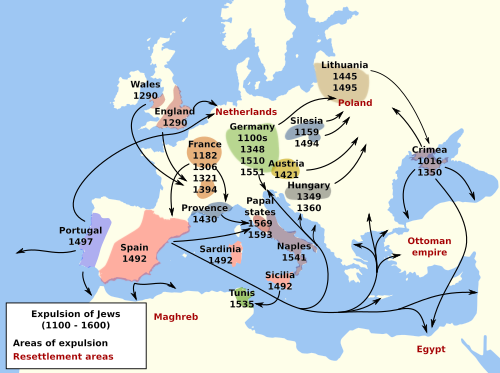
Jews in Islamic-occupied Spain, Al-Andalus, were second-class dhimmis who were targeted in pogroms such as the 1066 Granada massacre. In 1492, via the Alhambra Decree, King Ferdinand and Queen Isabella ordered the expulsion of an estimated 800,000 Jews from the country, and thus put an end to the largest and most distinguished Jewish community in Europe. The coercive baptisms eventually produced the phenomenon of the conversos (Marranos), the Inquisition, and statutes of "blood purity" five centuries before the race laws in Nazi Germany. From the end of the nineteenth century, Jews have been perceived as conspirators, alongside the notion of a universal Jewish conspiracy to control the world. Following the Soviet revolution and the founding of the Spanish Communist Party in 1920, such "anti-Spanish forces" were primarily identified with the "destructive communist virus," often considered to be guided by the Jews.[204]
During the Spanish Civil War, the alliance between Franco's faction and Nazi Germany opened the way for the emergence of antisemitism in the Spanish Right. It was during the 1960s that the first Spanish neo-fascist and neo-Nazi groups appeared, such as CEDADE. Later on, the Spanish neo-Nazis attempted to use antisemitic discourse to explain the political transition to democracy (1976–1982) following the death of General Franco. It drew on the same ideas that had been expressed in 1931 when the Second Spanish Republic was proclaimed – that political turning points could be explained as the result of various "intrigues". From 1948 until 1986, Israel was not recognized by Spain, and Israel and Spain had no diplomatic ties. In 1978, Jews were recognized as full citizens in Spain, and today the Jewish population numbers about 40,000 – 1 percent of Spain's population, 20,000 of whom are registered in the Jewish communities. The majority live in the larger cities of Spain on the Iberian Peninsula, North Africa or the islands.[205]
Many of the prejudices cultivated during the Franco years persist in the twenty-first century. According to some,[206] derived from the fact that almost all Spaniards are Catholic, and Spain remains to this day one of the most homogeneous Western countries, Spanish Judeophobia reflects a national obsession with religious and ethnic unity which is based on the conception of an imaginary "internal enemy" plotting the downfall of the Catholic religion and the traditional social order.[207] However, this assumption clashes with the fact that 21st-century Spain is one of the most secularized countries in Europe,[208][209] with only 3% of Spaniards considering religion as one of their three most important values[210] and thus not linking it to their national or personal identity. Furthermore, in modern Spain there is not an "internal enemy" scare but in far-right circles, which are more often focused against Muslim immigration as well as Catalan and Basque separatism, way more visible phenomena. Modern antisemitic-like attitudes in Spain are actually related to the perceived abusive policies of the State of Israel against Palestinians and in the international scene rather than to any kind of religious or identity obsession,[211][207] and it has been defined by Jewish authors as an "antisemitism without antisemites."[211]
Pablo Iglesias, the founder of the Spanish political party Unidas Podemos, has a history of antisemitic remarks including: "the Holocaust was a mere bureaucratic problem," "the great Wall Street companies are practically all in the hands of Jews," and "the Jewish lobby supports initiatives against the peoples of the world," among others.[212][213]
Sweden
After Germany and Austria, Sweden has the highest rate of antisemitic incidents in Europe, though the Netherlands reports a higher rate of antisemitism in some years.[41] A government study in 2006 estimated that 15% of Swedes agree with the statement: "The Jews have too much influence in the world today".[214] 5% of the total adult population and 39% of adult Muslims "harbour systematic antisemitic views".[214] The former prime minister Göran Persson described these results as "surprising and terrifying". However, the rabbi of Stockholm's Orthodox Jewish community, Meir Horden, said that "It's not true to say that the Swedes are anti-Semitic. Some of them are hostile to Israel because they support the weak side, which they perceive the Palestinians to be."[215]
In October 2010, The Forward reported on the current state of Jews and the level of antisemitism in Sweden. Henrik Bachner, a writer, and professor of history at the University of Lund, claimed that members of the Swedish Parliament have attended anti-Israel rallies where the Israeli flag was burned while the flags of Hamas and Hezbollah were waved, and the rhetoric was often antisemitic—not just anti-Israel. But such public rhetoric is not branded hateful and denounced.[216]
Charles Small, director of the Yale University Initiative for the Study of antisemitism, stated that "Sweden is a microcosm of contemporary antisemitism. It's a form of acquiescence to radical Islam, which is diametrically opposed to everything Sweden stands for." Per Gudmundson, the chief editorial writer for Svenska Dagbladet, has sharply criticized politicians whom he claims offer "weak excuses" for Muslims accused of antisemitic crimes. "Politicians say these kids are poor and oppressed, and we have made them hate. They are, in effect, saying the behavior of these kids is in some way our fault."[216]
Two documentaries, one produced in 2013 and another in 2015, secretly filmed reporters walking around Malmö wearing a kippah. In the 2013 documentary, the reporter only received strange looks and giggles, but in the 2015 documentary, in the mainly Muslim Rosengård neighborhood, the reporter was physically and verbally assaulted and had to flee. Fred Kahn, a leader of the local Jewish community, claimed that most incidents are committed by Muslims or Arabs.[217]
Switzerland
Turkey
Ukraine
There have been Jews in Ukraine since the Greek colonies of the Black Sea coast had their Jewish traders.[218] Antisemitism has existed since at least the time of the Rus Primary Chronicle.[218] Leaders[who?] of the Ukrainian nationalists of OUN (b) participated in the Holocaust during World War II.[219][220] In Ukraine violence against Jews and antisemitic graffiti remains.[221] Antisemitism has declined since Ukrainian independence in 1991.[222]
United Kingdom
In 2004, members of the UK Parliament set up an inquiry into antisemitism, which published its findings in 2006. The inquiry stated that "until recently, the prevailing opinion both within the Jewish community and beyond [had been] that antisemitism had receded to the point that it existed only on the margins of society." It found a reversal of this progress since 2000. It aimed to investigate the problem, identify the sources of contemporary antisemitism and make recommendations to improve the situation.[223][224] As of 2014, 9 percent of the British population held negative attitudes towards Jews.[225] In 2024, there has been a spike in antisemitism.[226]
See also
- Anti–Middle Eastern sentiment
- Geography of antisemitism
- Hilsner Affair
- History of antisemitism
- History of the Jews during World War II
- History of the Jews in Europe
- The Holocaust
- Human rights in Belarus
- Human rights in Europe
- Jewish history
- Far-right politics
- Far-right subcultures
- Fascism in Europe
- Nativism (politics)
- Neo-fascism in Europe
- Neo-Nazism in Europe
- Orientalism
- Racism in Europe
- Radical right (Europe)
- Xenophobia
References
- ^ Riley-Smith, Jonathan (1984). "The First Crusade and the Persecution of the Jews". Studies in Church History. 21. Content available in extract. Cambridge University Press (published 2016): 51–72. doi:10.1017/S0424208400007531. ISSN 0424-2084. S2CID 163783259 – via cambridge.org.
- ^ Bennett, Gillian (2005), "Towards a revaluation of the legend of 'Saint' William of Norwich and its place in the blood libel legend". Folklore, 116(2), pp. 119–21.
- ^ See Stéphane Barry and Norbert Gualde, La plus grande épidémie de l'histoire ("The greatest epidemics in history"), in L'Histoire magazine, n°310, June 2006, p.47 (in French)
- ^ Ben-Sasson, Haim Hillel (2007). "Black Death". In Berenbaum, Michael; Skolnik, Fred (eds.). Encyclopaedia Judaica. Vol. 3 (2nd ed.). Detroit: Macmillan Reference. p. 731. ISBN 978-0-02-866097-4.
- ^ Berenbaum, Michael; Skolnik, Fred, eds. (2007). "Strasbourg". Encyclopaedia Judaica. Vol. 19 (2nd ed.). Detroit: Macmillan Reference. p. 244. ISBN 978-0-02-866097-4.
- ^ Hertzberg, Arthur and Hirt-Manheimer, Aron. Jews: The Essence and Character of a People, HarperSanFrancisco, 1998, p.84. ISBN 0-06-063834-6
- ^ Ben-Sasson, Haim Hillel; et al. (2007). Berenbaum, Michael; Skolnik, Fred (eds.). Encyclopaedia Judaica. Vol. 7 (2nd ed.). Detroit: Macmillan Reference. p. 522. ISBN 978-0-02-866097-4.
{{cite encyclopedia}}: Missing or empty|title=(help) - ^ Breuer, Mordechai (1996). "Prologue: The Jewish Middle Ages." In: Michael A. Meyer (Ed.), German-Jewish History in Modern Times, Volume 1: Tradition and Enlightenment, 1600–1780. Translated from the German by William Templer. New York: Columbia University Press. p. 81-103; here: p. 12. Concerning exceptions: "The fact that the Jews nonetheless managed to acquire land in some regions is only further evidence of the frequent contradiction that existed between theory and practice in their treatment."
- ^ Bein, Alex (1990). The Jewish Question: Biography of a World Problem. Translated from the German by Harry Zohn. Rutherford, NJ: Fairleigh Dickinson University Press. p. 89. Concerning exceptions: "Nevertheless, until well into the Middle Ages there still were Jews in rural settlements, and even beyond the period of the Crusades Jews owned lands, vineyards, and fields here or there in the small country towns and even cultivated them; our chief source for this is the Responsa."
- ^ "Lateran 4 - 1215". ewtn.com.
- ^ "Lateran Council - Roman Catholicism".
- ^ "Jewish Identification: Jewish Badge." The Jewish Virtual Library. Retrieved 14 April 2016.
- ^ Gay, Ruth. The Jews of Germany: A Historical Portrait. New Haven: Yale University Press, 1992. p. 20-21. Gay refers to historian Heinrich Graetz as her source, without a specific citation.
- ^ Stow, Kenneth (2005). "Expulsions, High Middle Ages." In: Richard S. Levy (Ed.), Antisemitism: A Historical Encyclopedia of Prejudice and Persecution. Vol. 1. Santa Barbara, Calif.: ABC-CLIO. p. 216-218; here: p. 216.
- ^ Starr-Lebeau, Gretchen D. (2004). "Jews, Expulsions of (Spain; Portugal)." Europe, 1450 to 1789: Encyclopedia of the Early Modern World; via www.encyclopedia.com. Retrieved 14 April 2016.
- ^ Penslar, Derek J.; Kalmar, Ivan Davidson (2005). "Orientalism and the Jews: An Introduction".
- ^ "Anti-Semitism - Medieval Europe, Prejudice, Persecution | Britannica". www.britannica.com. Retrieved 18 January 2024.
- ^ Newman, Aubrey (1968). "The Expulsion of the Jews from Prague in 1745 and British Foreign Policy". Transactions & Miscellanies (Jewish Historical Society of England). 22: 30–41. ISSN 0962-9688. JSTOR 29778766.
- ^ "Moneylending". www.jewishvirtuallibrary.org. Retrieved 18 January 2024.
- ^ Selma Stern (1950). The Court Jew A Contribution To The History Of The Period Of Absolutism In Central Europe. Universal Digital Library. The Jewish Publication Society of America.
- ^ "Jud Suss The most successful anti-Semitic film ever made. Us www.HolocaustResearchProject.org". holocaustresearchproject.org.
- ^ "The anti-Jewish pogrom in the Khmelnytsky uprising. [Archive] - The Phora". thephora.net. Archived from the original on 31 January 2017. Retrieved 5 March 2016.
- ^ "Pale | History, Pale of Settlement | Britannica". www.britannica.com. Retrieved 18 January 2024.
- ^ "The Pale of Settlement". www.jewishvirtuallibrary.org. Retrieved 18 January 2024.
- ^ Steven Beller (2007) Antisemitism: A Very Short Introduction: 64
- ^ "Antisemitism in History: Racial Antisemitism, 1875–1945". ushmm.org.
- ^ "Dreyfus affair - French history". 5 January 2024.
- ^ "The Dreyfus Affair". jewishhistory.org. 5 January 2012.
- ^ "Blood libel - anti-Semitism". 28 July 2023.
- ^ "Blood Libel: A False, Incendiary Claim Against Jews". Anti-Defamation League.
- ^ "Blood-Libel Trial of Mendel Beilis Reverberates a Century Later". 18 December 2013.
- ^ Levin, Edmund (8 October 2013). "The Last Blood Libel Trial". Slate.
- ^ "The Protocols of the Learned Elders of Zion". history.ucsb.edu.
- ^ "Protocols of the Learned Elders of Zion". bibliotecapleyades.net.
- ^ "Pogroms | Encyclopedia.com".
- ^ "Völkischer Beobachter - German Nazi newspaper".
- ^ "Der Stürmer! www.HolocaustResearchProject.org". holocaustresearchproject.org.
- ^ Edvard Radzinsky. Stalin (in Russian). Moscow, Vagrius, 1997. ISBN 5-264-00574-5; available online. Translated version: "Stalin", 1996, ISBN 0-385-47397-4 (hardcover), 1997, ISBN 0-385-47954-9 (paperback) Ch. 24. "И естественно, последовал новый виток антисемитской истерии. Уже в конце февраля по Москве поползли слухи: евреев будут выселять в Сибирь."
- ^ Susanne Urban (2004). "Anti-Semitism in Germany Today: Its Roots and Tendencies". Jewish Political Studies Review. 16 (3–4): 119.
- ^ "Anti-Semitism up 30% in Belgium". ynet. 27 February 2013. Retrieved 17 June 2015.
- ^ a b The 2005 U.S. State Department Report on Global Antisemitism.
- ^ "Washington: European anti-Israel sentiment crossed the line into anti-Semitism". The Jerusalem Post. 15 October 2015.
- ^ "Special report: The rise of the right in Europe". News. Retrieved 17 June 2015.
- ^ "Antisemitism Summary overview of the situation in the European Union 2002–2012" (PDF). 2013. p. 13. Retrieved 18 January 2024.
Some political parties in EU Member States are openly antisemitic.
- ^ "ADL Survey in Ten European Countries Finds Anti-Semitism at Disturbingly High Levels". www.adl.org. 2012. Retrieved 18 January 2024.
- ^ Verousi, Christina; Allen, Chris (2021). "From Obscurity to National Limelight: The Dramatic Rise, Fall and Future Legacy of Golden Dawn". Political Insight. 12 (1): 22–25. doi:10.1177/20419058211000999. ISSN 2041-9058. S2CID 232050542.
- ^ "Rabbi's son foils bombing attempt at Moscow shul - j. the Jewish news weekly of Northern California". J. 30 July 1999. Retrieved 17 June 2015.
- ^ "World Briefing: Asia, Europe, Americas and Africa". The New York Times. 12 January 2006.
- ^ "Account Suspended". fighthatred.com. Archived from the original on 15 June 2013. Retrieved 26 May 2013.
- ^ "Video: Priest Attacks Menorah - Jewish World". Arutz Sheva. 14 December 2009. Retrieved 17 June 2015.
- ^ "ADL Highlights Top 10 Issues Affecting Jews In 2012". ADL. Retrieved 26 January 2013.
- ^ "Archived copy" (PDF). Archived from the original (PDF) on 12 May 2013. Retrieved 20 April 2013.
{{cite web}}: CS1 maint: archived copy as title (link) - ^ a b Gerstenfeld, Manfred (19 February 2013). "Muslim anti-Semitism in Western Europe". The Jerusalem Post. Retrieved 18 February 2019.
- ^ "Bruker tåregass mot demonstranter utenfor Israels ambassade". Dagbladet (in Norwegian). 4 January 2009.
- ^ "Brukte tåregass på demonstranter" (in Norwegian). NRK. 4 January 2009.
- ^ a b "French gunman who killed Jewish children 'was raised an anti-Semite'". The Guardian. Associated Press. 11 November 2012. ISSN 0261-3077. Retrieved 18 February 2019.
- ^ "Global Anti-Semitism: Selected Incidents Around the World in 2012". ADL. Retrieved 17 June 2015.
- ^ "At UN workshop, envoys warn of 'tsunami of antisemitism' since Oct. 7". Times of Israel. 7 September 2024. Retrieved 12 September 2024.
- ^ "A Year After Iraq War: Mistrust of America in Europe Even Higher, Muslim Anger Persists", Pew Global Attitudes Project. Retrieved 12 March 2006.
- ^ "ADL Survey in 12 European Countries Finds Antisemitic Attitudes Still Strongly Held" Archived 9 June 2005 at the Wayback Machine, Anti-Defamation League, 2005. Retrieved 12 March 2006.
- ^ Flash Map of Attitudes Toward Jews in 12 European Countries (2005) Archived 15 April 2008 at the Wayback Machine, Philo. Sophistry. Retrieved 12 March 2006.
- ^ Kaplan, E. H.; Small, C. A. (2006). "Anti-Israel sentiment predicts anti-Semitism in Europe" (PDF). Journal of Conflict Resolution. 50 (4): 548–561. doi:10.1177/0022002706289184. S2CID 144117610.
- ^ a b Haviv Rettig Gur. Yale expert: Not enough known about anti-Semitism, The Jerusalem Post. 8 August 2007
- ^ "ADL Survey in Ten European Countries Finds Anti-Semitism at Disturbingly High Levels". ADL. Retrieved 26 January 2013.
- ^ "Thousands protest against anti-Semitism in France". BBC News. 20 February 2019. Retrieved 20 February 2019.
- ^ Greene, Richard Allen (2018). "CNN poll reveals depth of anti-Semitism in Europe". CNN. Retrieved 26 June 2024.
- ^ "Jewish People's Experiences and Perceptions of Antisemitism". FRA. 11 July 2024. Retrieved 30 July 2024.
- ^ Bartov, Shira Li (23 July 2024). "Jewish leaders in Europe want to stay there despite pessimism about antisemitism, survey finds". Jerusalem Post. Retrieved 24 July 2024.
- ^ a b "Religious Belief and National Belonging in Central and Eastern Europe – Chapter 8: Democracy, nationalism, and pluralism". Pew Research Center. 10 May 2017. Retrieved 1 April 2018.
- ^ a b c d e David Masci (28 March 2018). "Most Poles accept Jews as fellow citizens and neighbors, but a minority do not". Retrieved 1 April 2018.
- ^ "Armenian leader accuses Israel of aiding 'genocide' against his people". The Times of Israel.
- ^ "Armenians burn Israeli, Azerbaijani and Turkish flags - VIDEO". 27 October 2020.
- ^ Union of Council for Soviet Jews: Antisemitism in Georgia, Azerbaijan, and Armenia Archived 8 July 2008 at the Wayback Machine
- ^ "Antisemitic Book Presented in Armenia; Jewish Leader Heckled". Archived from the original on 4 October 2011. Retrieved 4 October 2011.
{{cite web}}: CS1 maint: bot: original URL status unknown (link). Union of Councils for Soviet Jews. 20 February 2002. Retrieved 27 November 2006. - ^ ""Armenian Aryan Party" Criticizes Israeli Ambassador". Archived from the original on 4 October 2011. Retrieved 4 October 2011.
{{cite web}}: CS1 maint: bot: original URL status unknown (link). Union of Councils for Soviet Jews. 21 February 2002. Retrieved 27 November 2006. - ^ a b c Antisemitism in Armenia Archived 21 October 2007 at the Wayback Machine by Rimma Varzhapetian. The Euro-Asian Jewish Congress (retrieved 6 September 2006)
- ^ Danielyan, Emil (8 April 2008). "Armenia: Country's Jews Alarmed Over Nascent Anti-Semitism". Radio Free Europe/Radio Liberty. Retrieved 4 December 2020.
- ^ "Armenian Official Says Jews "Anti-Christian"". Archived from the original on 4 October 2011. Retrieved 4 October 2011.
{{cite web}}: CS1 maint: bot: original URL status unknown (link). Union of Councils for Soviet Jews. 21 October 2004. Retrieved 27 November 2006. - ^ Intelligentsia Demands from Prosecutor Archived 27 September 2011 at the Wayback Machine (in Russian). A+ News. 18 February 2005. Retrieved 27 November 2006
- ^ "Armenian Parliament Deputies, Ombudsman Demand Release of Detained Anti-Semite". Archived from the original on 4 October 2011. Retrieved 4 October 2011.
{{cite web}}: CS1 maint: bot: original URL status unknown (link). Union of Councils for Soviet Jews. 1 February 2005. Retrieved 27 November 2006. - ^ Jews of Armenia Outraged by Nature Protection Minister's Statements Archived 25 February 2011 at the Wayback Machine.
- ^ Armenian Jewish Community Leader Criticizes Environment Minister for Antisemitic Comment. today.az. (30 September 2006)
- ^ The Jerusalem Post, 23 December 2007 Archived 16 September 2011 at the Wayback Machine. Fr.jpost.com. Retrieved 1 June 2012.
- ^ "Holocaust memorial in Yerevan, Armenia vandalized". 12 February 2021.
- ^ Bruce F. Pauley, From prejudice to persecution: a history of Austrian anti-semitism (Univ of North Carolina Press, 1998).
- ^ "Manifestations of Antisemitism in the EU 2002 - 2003" (PDF). FRA. Retrieved 13 October 2013.
- ^ Fritz, Judith. "The social exponents of Austrian anti-Semitism". Habsburger. Retrieved 13 October 2013.
- ^ a b Wodak, Ruth (1991). "Turning the Tables: Antisemitic Discourse in Post-War Austria". Discourse & Society. 2: 65–83. CiteSeerX 10.1.1.573.5858. doi:10.1177/0957926591002001004. S2CID 29779086. [permanent dead link]
- ^ a b "Austria, the Jews, and Anti-Semitism: Ambivalence and Ambiguity". Jerusalem Center for Public Affairs. Retrieved 12 October 2013.
- ^ German newspaper Sueddeutsche Zeitung on antisemitism in Serfaus. Sz-magazin.sueddeutsche.de. Retrieved 1 June 2012.
- ^ a b AV: per kr. aale. "Hets av jøder er økende i Europa - Aftenposten". Aftenposten.no. Retrieved 29 May 2012.
- ^ "Belgium's local elections cause ‘anti-Semitic flood.’" Jewish Telegraphic Agency. 19 October 2012. 19 October 2012.
- ^ "Global Anti-Semitism: Selected Incidents Around the World in 2012". ADL. Retrieved 17 June 2015.
- ^ "4 killed in shooting outside Jewish Museum in Brussels". CFCA. Archived from the original on 25 May 2014. Retrieved 25 May 2014.
- ^ "Antisemitic threats near the CCU (Jewish Cultural Center) building". The Coordination Forum for Countering Antisemitism. Archived from the original on 5 August 2014. Retrieved 29 June 2014.
- ^ "School bus carrying ultra-Orthodox Jewish children stoned in anti-Jewish attack". The Coordination Forum for Countering Antisemitism. Archived from the original on 3 July 2014. Retrieved 29 June 2014.
- ^ "Antisemitic attack against 75 old woman". CFCA. La- Libre. Archived from the original on 23 August 2014. Retrieved 26 August 2014.
- ^ Israel calls on Belgium to scrap parade over anti-Semitism AP, 20 February 2020
- ^ a b Merlin, Ohad (18 September 2024). "Belgian NGO finds anti-Israel bias, antisemitism in local school materials revolving conflict". Jerusalem Post. Retrieved 19 September 2024.
- ^ William I. Brustein, and Ryan D. King, "Anti-semitism as a response to perceived Jewish power: the cases of Bulgaria and Romania before the Holocaust." Social Forces 83.2 (2004): 691-708 online.
- ^ Michael Bar-Zohar, Beyond Hitler's Grasp: The Heroic Rescue of Bulgaria's Jews (1998) excerpt
- ^ Ethan J. Hollander, "The Final Solution in Bulgaria and Romania: A Comparative Perspective." East European Politics and Societies 22.02 (2008): 203-248.
- ^ "Central Synagogue in Bulgarian Capital Vandalized by Rock-Throwing Assailant". Alegmeiner. Retrieved 21 January 2019.
- ^ Michael A. Riff, "Czech Antisemitism and the Jewish Response before 1914." Wiener Library Bulletin 29.39-40 (1976): 8-20.
- ^ Gruner, Wolf (2015). "Protectorate of Bohemia and Moravia". In Gruner, Wolf; Osterloh, Jörg (eds.). The Greater German Reich and the Jews: Nazi Persecution Policies in the Annexed Territories 1935-1945. Translated by Heise, Bernard. Berghahn Books. pp. 99–135. ISBN 978-1-78238-444-1.
- ^ "Dr. Masaryk, Long Friend of Jews, Resigns Czech Presidency at 85". Jewish Telegraphic Agency. 16 December 1935. Retrieved 23 December 2019.
- ^ Livia Rothkirchen, "Czech Attitudes towards the Jews during the Nazi Regime." in Public Opinion and Relations to the Jews in Nazi Europe (KG Saur, 2011) Pp. 415-448.
- ^ "New report finds anti-Semitism on the rise in Czech Republic". AP News. 3 July 2019. Retrieved 23 December 2019.
- ^ Benakis, Theodoros (6 August 2024). "Antisemitism in the Czech Republic sharply increased in 2023, report indicates". European Interest. Retrieved 7 August 2024.
- ^ "Antisemitic Incidents in Czech Republic Soar in 2023, Jewish Community Reports". Haaretz. 5 August 2024. Retrieved 7 August 2024.
- ^ a b The Virtual Jewish History Tour - Norway Accessed 8 October 2006
- ^ "Report on antisemitic incidents in Denmark 2013". AKVAH. The Jewish Community in Denmark. Archived from the original on 31 March 2014. Retrieved 31 March 2014.
- ^ "Gaza conflict reaches Denmark's Jews". CFCA. Retrieved 26 July 2014.
- ^ "Skoleleder på jødisk skole: Det er grotesk". nyhederne.tv2.dk. 22 August 2014. Retrieved 17 June 2015.
- ^ Stender Pedersen, Mette; Krogh Andersen, Peter (15 February 2015). "Skudoffer ved københavnsk synagoge var en ung jøde". DR Nyheder. Danmarks Radio (DR). Danmarks Radio (DR). Retrieved 15 February 2015.
- ^ "Copenhagen imam accused of calling for killing of Jews". BBC News. 11 May 2017. Retrieved 17 May 2017.
- ^ Andersson, Mikkel (19 April 2018). "Anklager om antisemitisme og beskyldninger om "smålummer tissemandssnak" afsporer debatten om omskæring". Berlingske Tidende. Retrieved 27 April 2019.
- ^ Cohn, Jonatan (6 May 2018). "Omskæring er en afgørende del af den jødiske kultur". Jyllandsposten. Retrieved 27 April 2019.
Udover det foruroligende ved de mange halve sandheder, misinformationer og den ofte ret så fjendske tone, som præger omskæringsdebatten, rejser den en række ubehagelige spørgsmål for mange danske jøder: Skulle en kriminalisering af en så central del af den jødiske religion og kultur rent faktisk blive vedtaget, hvor længe kan man da fortsætte sin tilværelse i Danmark? (...) En sådan vedvarende og generel uro for, at man kan blive nødsaget til at skulle rejse fra sit fædreland, fordi man har i sinde at fortsætte med at praktisere sin religion, har arabiske bøller hidtil ikke formået at skabe blandt de danske jøder. Denne tvivlsomme ære tilfalder alene Jyllands-Posten og dens venner i omskæringsdebatten.
- ^ Diab, Amin; Baba, Güray (20 April 2018). "Anklagerne om antisemitisme og minoritets-forfølgelse er de værste". Berlingske Tidende. Retrieved 27 April 2019.
- ^ Olsen, Jan. "Denmark records highest number of antisemitic incidents since WWII, part of a grim European trend". The Associated Press. Retrieved 12 June 2024.
- ^ "Islamic Extremism: Common Concern for Muslim and Western Publics". Pew Global Attitude Project. 14 July 2005. Archived from the original on 6 July 2006. Retrieved 10 July 2006.
- ^ Thiolay, Boris. "Juif, et alors?" Archived 9 March 2008 at the Wayback Machine, L'Express, 6 June 2005.
- ^ Judah, Ben. "Islam and the French Republic." Standpoint. July/August 2016. 25 July 2016.
- ^ a b Goldberg, Jeffrey. "French Prime Minister Warns: If Jews Flee, the Republic Will Be Judged a Failure." The Atlantic. 10 January 2015. 10 January 2015.
- ^ Harris-Perry, Melissa. "A closer look at the Jewish community in France." Online video clip. MSNBC. Melissa Harris-Perry, 10 January 2015. Web. 10 January 2015.
- ^ "CNN.com - Poll: Muslims, West eye each other through bias - 23 June 2006". CNN. Retrieved 25 April 2010.
- ^ "Communiqués Officiels: Les actes antisémites" Archived 29 November 2005 at the Wayback Machine, Ministère de l'Intérieur et de l'Aménagement du territoire. Retrieved 12 March 2006.
- ^ Report - Antisémitisme, Service de Protection de la Communauté Juive - Jewish Community Security Service
- ^ "2002 : le racisme progresse en France, les actes antisémites se multiplient Archived 5 January 2007 at the Wayback Machine", Le Monde, 28 March 2003
- ^ Boteach, Shmuley. "Rabbi Shmuley: The Last Jews of France." The New York Observer. 12 January 2015. 13 January 2015.
- ^ Tuval, Uri. "France's Jews: 'In Israel we know not to surrender to terror.'" Ynetnews. 11 January 2015. 11 January 2015.
- ^ "Western Europe Jewish migration to Israel hits all-time high". Associated Press. 14 January 2016. Retrieved 17 January 2016.
- ^ Savir, Aryeh (12 July 2020). "Israeli Official Unveils Plan to Rescue French Jewry from Escalating Anti-Semitism". Tazpit News Agency. Jewish Press.
- ^ Eichner, Itamar (15 July 2024). "'They called our children filthy Jews': French Jews feel unsafe amid rising antisemitism". YNet. Retrieved 18 July 2024.
- ^ Time (magazine)
- ^ Interview with Julius Schoeps (German). Berlin-judentum.de. Retrieved 1 June 2012.
- ^ Andreas Zick, Andreas Hövermann, Silke Jensen, Julia Bernstein (2017). Jüdische Perspektiven auf Antisemitismus in Deutschland Ein Studienbericht für den Expertenrat Antisemitismus (PDF). Bielefeld: Universität Bielefeld. p. 25. Archived from the original (PDF) on 28 April 2018.
{{cite book}}: CS1 maint: multiple names: authors list (link) - ^ Liljeberg Research International: Deutsch-Türkische Lebens und Wertewelten 2012 Archived 11 October 2012 at the Wayback Machine, July/August 2012, p. 68
- ^ Die Welt: Türkische Migranten hoffen auf muslimische Mehrheit, 17 August 2012. Retrieved 23 August 2012
- ^ "Israeli flag burning prompts German Foreign Minister Sigmar Gabriel to back outlawing it". DW News. 15 December 2017. Retrieved 17 December 2017.
- ^ Andreas Zick, Andreas Hövermann, Silke Jensen, Julia Bernstein (2017). Jüdische Perspektiven auf Antisemitismus in Deutschland Ein Studienbericht für den Expertenrat Antisemitismus (PDF). Bielefeld: Universität Bielefeld. pp. 4–5. Archived from the original (PDF) on 28 April 2018.
{{cite book}}: CS1 maint: multiple names: authors list (link) - ^ "Anti-Semitism: Germany sees '10% jump in offences' in 2018". BBC News. 13 February 2019. Retrieved 14 February 2019.
- ^ "Anti-Semitic crime rises in Germany, most from far right". ABC News. Retrieved 30 November 2021.
- ^ Diehl, Jörg; Diening, Deike; Großekathöfer, Maik; Rapp, Tobias; Wiedmann-Schmidt, Wolf (27 October 2023). "A New Wave of Anti-Semitism Sweeps Across Germany". Spiegel. Retrieved 26 June 2024.
- ^ "Number of anti-Semitic offenses recorded by the police in Germany 2001-2023". Statista.
- ^ Nöstlinger, Nette (25 June 2024). "Germany records sharp rise in antisemitic incidents". Politico. Retrieved 26 June 2024.
- ^ "Germany - Events of 2022". Human Rights Watch.
- ^ "Global Anti-Semitism: Selected Incidents Around the World in 2012". ADL. Retrieved 17 June 2015.
- ^ Herczl, Moshe Y. Christianity and the Holocaust of Hungarian Jewry (1993) pp 79–170. online
- ^ Alex J. Bellamy. Massacres and Morality: Mass Atrocities in an Age of Civilian Immunity
- ^ HUNGARY AFTER THE GERMAN OCCUPATION, United States Holocaust Memorial Museum, Last Updated: 25 October 2007. Retrieved 19 November 2007
- ^ Stephen Roth Institute: Antisemitism And Racism Archived 8 February 2008 at the Wayback Machine. Tau.ac.il. Retrieved 1 June 2012.
- ^ "ADL Survey In Ten European Countries Finds Anti-Semitism At Disturbingly High Levels." ADL. 20 March 2012. 10 August 2012.
- ^ Ferriter, Diarmaid (5 March 2005). "The deeds and the documents". The Irish Times. Retrieved 4 October 2019.
- ^ Goldhagen, Daniel Jonah (2013). The Devil That Never Dies: The Rise and Threat of Global Antisemitism. Little, Brown. ISBN 9780316250306.
- ^ Dysch, Marcus (2 June 2011). "Guess how many Irish people would ban Israelis from their homes". The Jewish Chronicle. Retrieved 4 October 2019.
- ^ "Antisemitism in Ireland 'Blatant and Obvious' in Wake of Hamas Onslaught, Says Jewish Former Cabinet Minister Alan Shatter". Algemeiner.
- ^ Shtrauchler, Nissan (28 May 2024). "Old antisemitism; new pro-Palestinian trends: Why being Jewish in Ireland has become dangerous". Israel Hayom. Retrieved 7 August 2024.
- ^ "Why being Jewish in Ireland has become dangerous". Jewish News Syndicate.
- ^ "Rachel Moiselle: I'm of Jewish ancestry, studying at Trinity, where hostility has festered". The Irish Times.
- ^ "WJC President Lauder Labels Irish School Curriculum as Unabashedly Antisemitic". World Jewish Congress.
- ^ "ADL Survey of Five European Countries Finds One in Five Hold Strong antisemitic Sentiments; Majority Believes Canard of Jewish Disloyalty". Adl.org. Retrieved 29 May 2012.
- ^ "Over CIDI". Retrieved 17 June 2015.
- ^ "Nieuwe CIDI Monitor antisemitisme". Nieuw Israëlietisch Weekblad. 18 September 2011. Retrieved 17 June 2015.
- ^ Berkhout, Karel. (26 January 2010) "Anti-Semitism on the rise in Amsterdam" Archived 2 March 2010 at the Wayback Machine. Nrc.nl. Retrieved 1 June 2012.
- ^ Algemeiner: "Kipa-Clad Jew Nearly Run Down, Called ‘Cancer,’ by Passersby in Netherlands (VIDEO)" 10 September 2014
- ^ These numbers do not include Jewish Soviet or Polish prisoners of war that died in captivity as a result of murder or mistreatment in Norwegian camps, nor Allied Jewish soldiers killed in action in Norway. There is some evidence that prisoners of war who were found to be Jewish were singled out and were abused. Mendelsohn (1986).
- ^ a b "Jødiske blir hetset". NRK Lørdagsrevyen. 13 March 2010. Archived from the original on 19 April 2010. Retrieved 5 April 2010.
- ^ a b What about Norwegian anti-Semitism? by Leif Knutsenm, The Foreigner (Norwegian News in English), 16 June 2011.
- ^ a b Anti-semitism report shocks officials, Norway International Network, Views and News from Norway, 16 March 2010.
- ^ "'Father of peace studies' makes public anti-Semitic remarks | JTA - Jewish & Israel News". Jewish Telegraphic Agency. 30 April 2012. Retrieved 29 May 2012.
- ^ Haumann, Heiko (1 January 2002). A History of East European Jews. Central European University Press. p. 30. ISBN 9789639241268.
- ^ Geller, Ewa (2018). "Yiddish 'Regimen sanitatis Salernitanum" from Early Modern Poland: A Humanistic Symbiosis of Latin Medicine and Jewish Thought". In Moskalewicz, Marcin; Caumanns, Ute; Dross, Fritz (eds.). Jewish Medicine and Healthcare in Central Eastern Europe. Springer. p. 20 (13–26). ISBN 9783319924809.
- ^ Despard, Matthew K. (2 January 2015). "In Search of a Polish Past". Jewish Quarterly. 62 (1): 40–43. doi:10.1080/0449010x.2015.1010393. ISSN 0449-010X.
- ^ Rosenfeld, Gavriel D. (September 2016). "Mixed Metaphors in Muranów: Holocaust Memory and Architectural Meaning at the POLIN Museum of the History of Polish Jews". Dapim: Studies on the Holocaust. 30 (3): 258–273. doi:10.1080/23256249.2016.1242550. ISSN 2325-6249. S2CID 191753083.
- ^ Daniel Elphick (3 October 2019). Music behind the Iron Curtain: Weinberg and his Polish Contemporaries. Cambridge University Press. p. 18. ISBN 978-1-108-49367-3.
- ^ Klier, John (2011). "Chapter 1: Poland–Lithuania: "Paradise for Jews"". Russia Gathers Her Jews: The Origins of the "Jewish Question" in Russia, 1772-1825. Northern Illinois University Press. p. 3. ISBN 978-0-87580-983-0.
- ^ Hundert, Gershon David (1 October 1997). "Poland: Paradisus Judaeorum". Journal of Jewish Studies. 48 (2): 335–348. doi:10.18647/2003/jjs-1997. ISSN 0022-2097.
- ^ Jones, Derek. "Censorship in Poland: From the Beginnings to the Enlightenment" Archived 1 May 2008 at the Wayback Machine, Censorship: A World Encyclopedia, Fitzroy Dearborn Publishers, 2000.
- ^ The Jews in Poland, Ken Spiro, 2001
- ^ Wein, Berel (1990). Triumph of Survival: The Story of the Jews in the Modern Era 1650-1995. Mesorah Publications. pp. 15–16. ISBN 978-0-89906-498-7.
- ^ L. Khazanovich: The Jewish pogroms in November and December 1918, Acts and Documents, Stockholm, 1918. Jewishgen.org (2 July 2004). Retrieved 1 June 2012.
- ^ Hagen, William W. (June 1996). "Before the "Final Solution": Toward a Comparative Analysis of Political Anti-Semitism in Interwar Germany and Poland". The Journal of Modern History. 68 (2): 351–381. doi:10.1086/600769. ISSN 0022-2801. S2CID 153790671.
In Poland, the semidictatorial government of Piłsudski and his successors, pressured by an increasingly vocal opposition on the radical and fascist right, implemented many anti-Semitic policies tending in a similar direction, while still others were on the official and semiofficial agenda when war descended in 1939... In the 1930s the realm of official and semiofficial discrimination expanded to encompass limits on Jewish export firms... and, increasingly, on university admission itself. In 1921-22 some 25 percent of Polish university students were Jewish, but in 1938-39 their proportion had fallen to 8 percent
- ^ "Major Violent Incidents in 2004: Breakdown by Country" Archived 1 December 2007 at the Wayback Machine, The Steven Roth Institute for the Study of Contemporary Antisemitism and Racism, Tel Aviv University. Retrieved 12 March 2006.
- ^ Greenslade, Roy (25 June 2006). "Top Polish TV post for right-wing extremist". The Guardian. ISSN 0261-3077. Retrieved 5 November 2023.
- ^ "Arrest In Polish Chief Rabbi Attack - CBS News". www.cbsnews.com. 29 June 2006. Retrieved 5 November 2023.
- ^ a b Wright, George (18 January 2024). "Grzegorz Braun: Polish MP who doused Hanukkah candles loses immunity". BBC. Retrieved 15 August 2024.
- ^ Litvinovich, Dmitri. "Explosion of anti-Semitism in Russia", Pravda 30 July 2002.
- ^ Ilya Yablokov [in Russian] (21 October 2019). "Anti-Jewish Conspiracy Theories in Putin's Russia". Antisemitism Studies. 3 (2). Indiana University Press: 291–316. doi:10.2979/antistud.3.2.05. JSTOR 10.2979/antistud.3.2.05. S2CID 208619530. Retrieved 26 February 2022.
- ^ a b Hutzelmann, Barbara (2018). "Einführung: Slowakei" [Introduction: Slovakia]. In Hutzelmann, Barbara; Hausleitner, Mariana; Hazan, Souzana (eds.). Slowakei, Rumänien und Bulgarien [Slovakia, Romania, and Bulgaria]. Die Verfolgung und Ermordung der europäischen Juden durch das nationalsozialistische Deutschland 1933-1945 [The Persecution and Murder of European Jews by Nazi Germany 1933–1945] (in German). Vol. 13. Munich: Institut für Zeitgeschichte. pp. 18–20. ISBN 978-3-11-036500-9.
- ^ a b Paulovičová, Nina (2018). "Holocaust Memory and Antisemitism in Slovakia: The Postwar Era to the Present". Antisemitism Studies. 2 (1). Indiana University Press: 17, 19–22. doi:10.2979/antistud.2.1.02. S2CID 165383570.
On 14 March 2004, in his public speech to commemorate the establishment of the 1939 Slovak state, Marian Kotleba, the leader of the extreme PP-OS (People's Party Our Slovakia), mocked efforts to come to terms with the Holocaust past and marked out Jews as "devils in human skin". Kotleba further promoted the view of Ľudovít Štúr—the leading representative of Slovak national revival in the nineteenth century—that Jews have no historical, cultural, or social ties with Slovaks. When the Jewish community expressed outrage against the demonstration of Kotleba supporters in Komárno in 2005, Kotleba defended the extremists by accusing Jews of plotting "against the Slovak nation, statehood, and Christian traditions" often with the help of the "Magyar chauvinists and domestic traitors". In Kotleba's eyes, every political skirmish in Slovakia is a "very well prepared performance" directed by Z. O. G. (the "Zionist Occupation Government").
- ^ Láníček, Jan (2013). Czechs, Slovaks and the Jews, 1938-48: Beyond Idealisation and Condemnation. New York: Springer. pp. 35, 110. ISBN 978-1-137-31747-6.
- ^ Paulovičová, Nina (2018). "Holocaust Memory and Antisemitism in Slovakia: The Postwar Era to the Present". Antisemitism Studies. 2 (1). Indiana University Press: 5, 10, 14, 25. doi:10.2979/antistud.2.1.02. S2CID 165383570.
- ^ N, Denník (13 March 2016). "My sme národnosti slovenskej, nie židovskej. Čo všetko už Kotleba povedal o slovenskom štáte". Denník N (in Slovak). Retrieved 9 December 2019.
- ^ Jews in Murska Sobota. Inv.si. Retrieved 1 June 2012.
- ^ The story of Eluizabeta Vajs. Inv.si. Retrieved 1 June 2012.
- ^ The story of Alice Gruenwald. Inv.si. Retrieved 1 June 2012.
- ^ Stories of Slovenian Jews. Inv.si. Retrieved 1 June 2012.
- ^ Slovenian Jews of Prekmurje. Inv.si. Retrieved 1 June 2012.
- ^ Pictures. Slovenian pres agency. Sta.si (19 January 2009). Retrieved 1 June 2012.
- ^ Jews and Judaism in Slovenia Archived 24 July 2011 at the Wayback Machine. Ednevnik.si. Retrieved 1 June 2012.
- ^ Hitler: Propadli umetnik, ki je postal diktator. Rtvslo.si (15 April 2009). Retrieved 1 June 2012.
- ^ News on RTV, 31 January. Tvslo.si. Retrieved 1 June 2012.
- ^ Jiménez, José L. Rodríguez. "Antisemitism and the Extreme Right in Spain (1962–1997)". The Vidal Sassoon International Center for the Study of Antisemitism. Archived from the original on 26 September 2013. Retrieved 31 August 2013.
- ^ "Manifestations of Antisemitism in the EU 2002 - 2003" (PDF). EUMC. Retrieved 16 September 2013.
- ^ Wistrich, Robert S. "EUROPEAN ANTI-SEMITISM REINVENTS ITSELF" (PDF). The American Jewish Committee. Archived from the original (PDF) on 2 May 2014. Retrieved 31 August 2013.
- ^ a b Bergman, Werner and Juliane Wetzel. "Manifestations of anti-Semitism in the European Union" (PDF). EUMC. Retrieved 31 August 2013.
- ^ Loewenberg, Samuel (26 June 2005). "As Spaniards Lose Their Religion, Church Leaders Struggle to Hold On". The New York Times. Retrieved 21 October 2008.
- ^ Pingree, Geoff (1 October 2004). "Secular drive challenges Spain's Catholic identity". The Christian Science Monitor. Retrieved 21 October 2008.
- ^ "Eurobarometer 69 - Values of Europeans - page 16" (PDF). Retrieved 24 March 2009.
- ^ a b López, Alejandro Baer, Paula (13 September 2015). "Antisemitismo sin antisemitas". El País.
{{cite news}}: CS1 maint: multiple names: authors list (link) - ^ "La Comunidad Judía critica la "perversión antisemita" de Iglesias y le advierte de acciones legales". okdiario.com (in Spanish). 14 December 2016. Retrieved 11 July 2021.
- ^ Kasnett, Israel (20 April 2021). "Spanish watchdog warns of far-left anti-Semitic parties in regional elections". JNS.org. Retrieved 11 July 2021.
- ^ a b Henrik Bachner and Jonas Ring."Antisemitic images and attitudes in Sweden" (PDF). Archived from the original on 21 February 2007. Retrieved 21 February 2007.
{{cite web}}: CS1 maint: bot: original URL status unknown (link) . levandehistoria.se - ^ Anti-Semitism, in Sweden? Depends who you're asking Archived 18 April 2009 at the Wayback Machine, Haaretz, 9 November 2007.
- ^ a b Donald Snyder. For Jews, Swedish City Is a ‘Place To Move Away From’, The Forward, Published 7 July 2010, issue of 16 July 2010.
- ^ "Swedish reporter assaulted after wearing kippah to test attitudes toward Jews." Haaretz. 24 January 2015. 24 January 2015.
- ^ a b Borderland: A Journey Through the History of Ukraine by Anna Reid, Westview Press, 2000, ISBN 0-8133-3792-5
- ^ Евреи в Украине. Учебно-методические материалы. Составитель И. Б. Кабанчик. — Львов, 2004. — с.186.
- ^ Евреи в Украине. Учебно-методические материалы. Составитель И. Б. Кабанчик. — Львов, 2004. — с.187.
- ^ ANTI-SEMITISM IN UKRAINE IN 2010 Archived 23 January 2016 at the Wayback Machine, Human Rights Watch (7 October 2010)
- ^ Anti-Semitism Worldwide, 1999/2000 by Stephen Roth Institute, University of Nebraska Press, 2002, ISBN 0-8032-5945-X
- ^ All-Party Parliamentary Group against Antisemitism (UK) (September 2006). "Report of the All-Party Parliamentary Inquiry into Antisemitism" (PDF). Archived from the original (PDF) on 14 June 2007. Retrieved 14 February 2007.
- ^ See Anthony Julius, Trials of the Diaspora: A History of Anti-Semitism in England, Oxford University Press. 2010. ISBN 978-0-19-929705-4
- ^ Malik, Kenan. "Muslims and Jews Are Targets of Bigotry in Europe." The New York Times. 21 August 2014.
- ^ "UK Jewish group records all-time high in antisemitic incidents after October 7". Times of Israel. 15 February 2024. Retrieved 3 July 2024.
Further reading
- Hauser, Jakub; Janáčová, Eva, eds. (2021). Visual Antisemitism in Central Europe: Imagery of Hatred. Walter de Gruyter GmbH & Co KG. ISBN 978-3-11-061641-5.
External links

Wikiquote has quotations related to Antisemitism in Europe.
- "USCIRF 2020 Annual Report: "Rising Anti-Semitism in Europe and Elsewhere"" (PDF). Uscirf.gov. Washington, D.C.: United States Commission on International Religious Freedom. April 2020. pp. 87–88. Archived (PDF) from the original on 28 April 2020. Retrieved 30 September 2020.
- The European Forum on Antisemitism Archived 2 April 2018 at the Wayback Machine