
Loading article…
フェルディナンド・マルコス | |||||||||||||||||||||||||||||||||||
|---|---|---|---|---|---|---|---|---|---|---|---|---|---|---|---|---|---|---|---|---|---|---|---|---|---|---|---|---|---|---|---|---|---|---|---|
.jpg/500px-Ferdinand_Marcos_(cropped).jpg) 1982年のマルコス | |||||||||||||||||||||||||||||||||||
| フィリピン第10代大統領 | |||||||||||||||||||||||||||||||||||
| 在任期間 :1965年12月30日~1986年2月25日 | |||||||||||||||||||||||||||||||||||
| 首相 |
| ||||||||||||||||||||||||||||||||||
| 副社長 |
| ||||||||||||||||||||||||||||||||||
| 先行 | ディオスダド・マカパガル | ||||||||||||||||||||||||||||||||||
| 後継者 | コラソン・アキノ | ||||||||||||||||||||||||||||||||||
| フィリピン第3代首相 | |||||||||||||||||||||||||||||||||||
| 在任期間 :1978年6月12日~1981年6月30日 | |||||||||||||||||||||||||||||||||||
| 先行 | オフィスが再開されました。 以前はペドロ・パテルノが務めていた役職 | ||||||||||||||||||||||||||||||||||
| 後継者 | セザール・ヴィラタ | ||||||||||||||||||||||||||||||||||
| 国防長官 | |||||||||||||||||||||||||||||||||||
| 在任期間 :1971年8月28日~1972年1月3日 | |||||||||||||||||||||||||||||||||||
| 社長 | 彼自身 | ||||||||||||||||||||||||||||||||||
| 先行 | フアン・ポンセ・エンリル | ||||||||||||||||||||||||||||||||||
| 後継者 | フアン・ポンセ・エンリル | ||||||||||||||||||||||||||||||||||
| 在任期間 :1965年12月31日~1967年1月20日 | |||||||||||||||||||||||||||||||||||
| 社長 | 彼自身 | ||||||||||||||||||||||||||||||||||
| 先行 | マカリオ・ペラルタ | ||||||||||||||||||||||||||||||||||
| 後継者 | エルネスト・マタ | ||||||||||||||||||||||||||||||||||
| |||||||||||||||||||||||||||||||||||
| 個人情報 | |||||||||||||||||||||||||||||||||||
| 生まれる | フェルディナンド・エマニュエル・エドラリン・マルコス 1917 年 9 月 11 日、フィリピン、北イロコス州 サラット[a] | ||||||||||||||||||||||||||||||||||
| 死亡 | 1989年9月28日(享年72歳)米国ハワイ州 ホノルル | ||||||||||||||||||||||||||||||||||
| 休憩所 |
| ||||||||||||||||||||||||||||||||||
| 政党 | キルサン・バゴン・リプナン(1978–89) | ||||||||||||||||||||||||||||||||||
| その他の政治的 所属 | |||||||||||||||||||||||||||||||||||
| 配偶者たち | |||||||||||||||||||||||||||||||||||
| 子供たち | Imee、Bongbong、Irene、Aimeeを含む9人 | ||||||||||||||||||||||||||||||||||
| 親 |
| ||||||||||||||||||||||||||||||||||
| 母校 | フィリピン大学マニラ校(法学士) | ||||||||||||||||||||||||||||||||||
| 職業 |
| ||||||||||||||||||||||||||||||||||
| サイン | 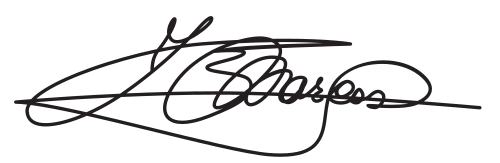 | ||||||||||||||||||||||||||||||||||
| ニックネーム |
| ||||||||||||||||||||||||||||||||||
| 兵役 | |||||||||||||||||||||||||||||||||||
| 忠誠 |
| ||||||||||||||||||||||||||||||||||
| 勤続年数 | 1942–1945 | ||||||||||||||||||||||||||||||||||
| ランク | |||||||||||||||||||||||||||||||||||
| ユニット | |||||||||||||||||||||||||||||||||||
| 戦闘/戦争 | 第二次世界大戦 | ||||||||||||||||||||||||||||||||||
フェルディナンド・エマニュエル・エドラリン・マルコス・シニア[c](1917年9月11日 - 1989年9月28日)は、フィリピンの政治家、独裁者[7] [8] [9]、泥棒政治家[10] [11] [12]であり、1965年から1986年までフィリピンの第10代大統領を務めた。マルコスは1972年から1981年まで戒厳令下で国を統治し[13]、1973年の憲法の下で大幅に拡大された権限をもって、1986年の非暴力革命によって退陣した。マルコスは自身の統治の哲学を「立憲独裁主義」と表現した[14] [15] : 414 フィリピン史上最も物議を醸した人物の一人であるマルコス政権は、腐敗、[16] [17] [18]浪費、[19] [20] [21]残虐行為で悪名高かった。[22] [23] [24]
マルコスは「フィリピンで最も勲章を受けた戦争の英雄」であると主張して政治的な成功を収めたが、[25]彼の主張の多くは虚偽であることが判明しており、[26] [27] [28]アメリカ陸軍の文書では彼の戦時中の主張は「詐欺的」かつ「馬鹿げている」とされている。[29] [30]第二次世界大戦後、彼は弁護士になり、その後1949年から1959年までフィリピン下院議員、 1959年から1965年までフィリピン上院議員を務めた。彼は1965年にフィリピン大統領に選出され、20年間の統治の初めには経済成長を主導したが[31]、最終的には生計の喪失、フィリピン人口のほぼ半数の極度の貧困、 [32] [33]破滅的な債務危機に終わった。[34] [33]彼は対外債務で資金を調達した積極的なインフラ開発計画を推進し、[35] [36]第一期目には人気を博したが、それがインフレ危機を引き起こし、第二期目には社会不安を招いた。[37] [38]マルコスは第二期終了直前の1972年9月23日にフィリピンに戒厳令を敷いた。 [39] [40]戒厳令は1973年に不正な国民投票によって批准された。[41]憲法が改正され、メディアは沈黙させられ、[42]野党、[43] [44] イスラム教徒、[45] 共産主義者と疑われる者、[46] [47] 一般市民に対して暴力と弾圧が行われた。 [ 44 ]
1981年の大統領選挙と国民投票で3期目に当選した後、1983年初めに始まった経済崩壊と、その年の後半に野党指導者ベニグノ・「ニノイ」・アキノ・ジュニア上院議員が暗殺されたことに対する国民の怒りにより、マルコスの人気は大きく低下した。この不満と、その結果生じた1984年の議会選挙での野党の復活、そして彼の財務記録と虚偽の戦争記録を暴露する文書の発見により、マルコスは1986年の早期総選挙を呼びかけました。大規模な不正行為、政治的混乱、人権侵害の申し立てにより、 1986年2月のピープルパワー革命が起こり、マルコスは権力の座から追われた。[48]マニラでマルコス支持派と反マルコス派の軍隊が軍事衝突する可能性があった状況を回避するため、マルコスはポール・ラクサルト上院議員を通じてロナルド・レーガン米大統領から「徹底的に削減」するよう助言された。[49]その後、マルコスは家族とともにハワイに逃亡した。[50]アキノの未亡人であるコラソン・「コリー」・アキノが大統領の座を継承した。[51] [52] [53]
大統領善政委員会(PCGG)が提供した資料によると、[54]マルコス一家はフィリピン中央銀行から50億~100億ドルを盗んだ。[55] [56] PCGGはまた、マルコス一家が退廃的なライフスタイルを楽しみ、1965年から1986年の間にフィリピンから数十億ドルを盗んだと主張した。[57]彼の妻イメルダ・マルコスは、彼女自身と夫の「夫婦独裁」を特徴づける過剰な行為で悪名高く、[60] [61] [62]イメルダ・マルコスという言葉の由来となっている。[63]彼らの2人の子供、イミーとボンボンはフィリピンの政界で活躍しており、ボンボンは2022年の大統領選挙で大統領に選出された。フェルディナンド・マルコスとイメルダ・マルコスは、数十年にわたって政府による史上最大の窃盗のギネス世界記録を保持していたが[64]、ギネスは2022年の選挙の数週間前に定期的な見直しが行われていたため、ウェブサイトから記録を削除した。[65]
私生活

フェルディナンド・エマニュエル・エドラリン・マルコスは、1917年9月11日、イロコス・ノルテ州サラト市で、マリアノ・マルコス(1897年 - 1945年)とホセファ・エドラリン(1893年 - 1988年)の息子として生まれました。[66]マリアノ・マルコスは、フィリピンのイロコス・ノルテ州出身の弁護士および国会議員でした。[67]彼は、第二次世界大戦中に日本の宣伝活動家および協力者であったため、1945年にフィリピンのゲリラによって処刑されました。水牛で引き裂かれ、四つ裂きにされた彼の遺体は木に吊るされたままにされました。[68] [69] [70]ホセファ・マルコスは教師で、夫より長生きした。1986年のピープルパワー革命後、マルコス一家が彼女をマラカニアン宮殿に残して国外に逃亡してから2年後の1988年に亡くなった。そして、息子フェルディナンドが亡くなるわずか1年前だった。[71]
フェルディナンドは最初に洗礼を受け、フィリピン独立教会の信者として育てられました。[72]その後、彼はローマカトリックに改宗し、イメルダ・トリニダード・ロムアルデスと結婚しました。[73]
マルコスは、1949年にミス報道写真賞を受賞したイロカナの混血のカルメン・オルテガという内縁の妻と暮らしていた。二人には3人の子供がおり、サンファンのオルテガ通り204番地に約2年間住んでいた。1953年8月、彼らの婚約がマニラの日刊紙で発表された。[4]
その後オルテガと子供たちに何が起こったのかはあまり知られていないが、マルコスは1954年4月17日、初めて会ってからわずか11日後にイメルダ・トリニダード・ロムアルデスと結婚した。彼らにはフェルディナンド、イメー、アイリーン・マルコスの3人の実子がいた。[74]マルコスとオルテガの間の4番目の子供はイメルダとの結婚後に生まれた。[60]マルコスとイメルダは後にエイミーという娘を養子に迎えた。[75]マルコスは1968年から1970年までアメリカ人女優のドヴィー・ビームスと不倫関係にあった。シドニー・モーニング・ヘラルドの報道によると、マルコスは1970年頃に元プレイボーイモデルのエヴェリン・ヘジェシとも不倫関係にあり、アナリサ・ホセファという子供をもうけた。[76]
マルコスは、比米戦争時のフィリピンの将軍アントニオ・ルナの子孫であると主張したが[77]、この主張は系図学者モナ・マグノ・ベルスによって否定された。[78]また、彼は自分の先祖は16世紀の海賊、リマホン(中国語:林阿鳳)であり、南シナ海沿岸を襲撃していたと主張した。[79] [80]彼は他の多くの大統領と同様に、中国系混血の子孫である。[81]
教育
マルコスはマニラのフィリピン大学(UP)で法律を学び、法学部に通った。彼はカリキュラムと課外活動の両方で優秀で、大学の水泳、ボクシング、レスリングチームのメンバーになった。彼はまた、優れた演説家、討論者、学生新聞のライターでもあった。UP法学部在学中、彼はユプシロン・シグマ・ファイのメンバーになり、そこで将来の政府同僚や彼の最も頑固な批評家の何人かと出会った。[82] [ページが必要] [83] [ページが必要]
1939年の司法試験では、92.35%の得点でトップノッチャー(最高得点者)となった。[84]彼は優秀な成績で卒業し、クラスのトップ10に入り、将来の最高裁判事フェリックス・マカシアルがクラスの優等生となった。[85] [86]彼はパイ・ガンマ・ミューとファイ・カッパ・ファイの国際名誉協会に選出され、後者からは37年後に最優秀会員賞を受賞した。[87]

フェルディナンド・マルコスは1967年にセントラルフィリピン大学から名誉法学博士号(LL.D.)を授与された。 [ 88]
フリオ・ナルンダサンの暗殺
マルコスが初めて全国的に有名になったのは、フリオ・ナルンダサンの殺害事件だった。マリアノ・マルコスの政敵であったナルンダサンは、国民議会の議席をめぐってマルコスを二度破った翌日の1935年9月21日、バタックの自宅でライフル一発で射殺された。[89]
1938年12月、フェルディナンド・マルコスはナルンダサン殺害の容疑で起訴された。マルコス一族の被告は彼だけではなかった。彼の父マリアーノ、叔父のピオ・マルコス、キリノ・リザルドも被告だった。[90] 2人の目撃者によると、4人はナルンダサン暗殺を共謀し、最終的にフェルディナンド・マルコスが引き金を引いたという。1939年1月下旬、彼らはついに保釈を拒否された。[91]
フィリピン大学のライフルチームのメンバーであり、全国ライフルチャンピオンだった若いマルコスに対しては、証拠が強力だった。[92]マルコスのライフルはUP ROTCの武器庫の銃架で発見されたが、チームキャプテンのテオドロ・M・カラウ・ジュニアのライフルは当時行方不明であり、国家捜査局はそれがナルンダサン殺害に使用されたものであるという証拠を持っていた。被告人全員の中で、フェルディナンド・マルコスだけがUPの武器庫にアクセスできた。[89]
その年の後半、フェルディナンドとリザルドは殺人罪で有罪判決を受けた。フェルディナンドは懲役10年から17年の刑を宣告された。[93]マルコス一家はフィリピン最高裁判所に控訴した。[94]
プリミティーボ・ミハレスによれば、多数決を書いたホセ・P・ローレル判事は、若い頃の喧嘩でライバルを殺しかけたこと、第一審で殺人未遂の有罪判決を受けたこと、最高裁に上訴して無罪となったことなどから、若きマルコスに自分自身を重ね、社会への借りを返す機会をマルコスに見出したという。UP法学部長のジョージ・A・マルコムはローレルの教授であり、最高裁の判事でもあった。マルコムは、若きローレルが優秀な学生であることを知っていたため、同僚に彼を無罪にするよう促していた。ローレルはマルコスを自分の鏡とみなし、同僚に無罪にするよう懇願したと伝えられている。[89]
最高裁判所は1940年10月22日に下級裁判所の判決を覆し、マルコス一家を侮辱罪以外のすべての罪で無罪とした。[95] [96]
第二次世界大戦(1939年~1945年)

第二次世界大戦中のマルコスの軍務は、フィリピン国内および国際軍事界で議論と論争の的となっている。[29]
予備役将校訓練を受けていたマルコスは、真珠湾攻撃後、米軍フィリピン駐留軍(USAFIP)に召集された。1941年夏から秋にかけての動員期間中、彼は3等中尉として勤務し、1942年4月まで勤務した後、捕虜となった。[97]マルコスの証言によると、彼は1942年8月4日に日本軍によって釈放され、[97]米軍の記録によると、彼は1944年12月にUSAFIP軍に復帰した。[97]マルコスの軍務は、1945年5月にフィリピン北部ルソンで米軍第14歩兵連隊の少佐として除隊したことで正式に終了した。[98]
マルコスの軍務に関する論争は、日本軍捕虜収容所から釈放された理由[97]、1942年8月の釈放から1944年12月のUSAFIP復帰までの行動[97] 、 USAFIP除隊時の階級[98] 、そして、その多くが偽物であることが判明した多数の軍勲章を受賞したという主張を中心に展開されている。[29]
1986年にワシントンポスト紙が発見した文書によると、1942年8月のマルコスの釈放は、元下院議員で州知事だった父親のマリアーノ・マルコスが広報担当者として「日本軍当局に協力」していたためだと示唆されている。[97]
釈放後、マルコスは1942年8月の釈放から1944年12月のUSAFIPへの復帰までの大部分を、北ルソンのAng Mga Mahárlika(タガログ語で「自由人」)と呼ばれるゲリラ組織のリーダーとして過ごしたと主張した。[99]マルコスの主張によると、この部隊の兵力は9,000人だった。[99]後に、米国軍の調査により彼の主張の多くが虚偽または不正確であることが明らかになり、彼の説明は疑問視されるようになった。[100]
1947年、マルコスが少佐ではなく中佐の階級で通信に署名し始めたときに、別の論争が起こった。これにより、米国当局は、マルコスが「1944年12月12日から除隊日まで、オランダ第14歩兵連隊USAFIPの名簿で少佐として認められていた」と指摘した。[98]
しかし、第二次世界大戦中のマルコスの従軍で起きた最大の論争は、1962年の上院議員選挙運動中に彼が「フィリピンで最も多くの勲章を受けた戦争の英雄」であると主張したことに関係している。 [29]彼は殊勲十字章や名誉勲章を含む33の戦争勲章や勲章を受賞したと主張したが、後に研究者らは、マルコスの戦時中の功績に関する話はほとんどがプロパガンダであり、不正確または虚偽であることが判明した。[101] 33の勲章のうち、戦時中に授与されたのは金十字章と殊勲星章の2つだけであり、どちらもマルコスの上司によって異議を唱えられていた。[101]
第二次世界大戦後および議会での経歴(1949年~1965年)
日本軍が降伏し、第二次世界大戦が終結すると、アメリカ政府は西半球の経済復興を目的としたマーシャル・プランの策定に没頭し、フィリピンへの関心を急速に後退させ、1946年7月4日にフィリピン諸島の独立を認めた。 [102] [103]戦後、マルコスは新政府によって特別検察官として承認されたわずか11人の弁護士の1人となり、法務長官室の特別検察官として、日本軍との協力で告発されたすべての者を「法と正義の手続き」で裁く任務を負った。[104]最終的に、マルコスは父親の旧職であるイロコス・ノルテ第2区の代表に立候補し、3期連続で当選し、1949年から1959年まで下院議員を務めた。[105]
マルコスはナショナリスト党から分裂した「自由派」に加わり、最終的には自由党となった。彼は最終的に自由党の経済問題担当スポークスマンとなり、将来の大統領ディオスダド・マカパガル、将来の副大統領エマニュエル・ペラエス、将来のマニラ市長アルセニオ・ラクソンを含む下院新人連合の議長に任命された。[105]
マルコスは下院商工委員会の委員長となり、国防、歳入、産業、銀行通貨、退役軍人、公務員、企業経済計画の各委員会の委員となった。また、輸入・価格統制特別委員会、賠償特別委員会、下院選挙裁判所の委員も務めた。[105]
マルコスは下院議員を3期務めた後、1959年の選挙で上院議員に当選し、1960年に上院少数派院内総務となった。1961年に自由党の執行副党首となり、1961年から1964年まで党首を務めた。
1963年から1965年まで、彼は上院議長を務めた。これまでのところ、彼はフィリピンの大統領になった最後の上院議長である。彼はいくつかの重要な法案を提出し、その多くが共和国の法令集に取り入れられた。[105]
1965年の大統領選挙の選挙運動中、マルコスの生涯は伝記映画『フェルディナンド・E・マルコス物語』の原作となり、ルイス・ゴンザレスがマルコス役で主演した。
行政と内閣
| フェルディナンド・マルコスの大統領スタイル | |
|---|---|
 | |
| 参照スタイル | 閣下 |
| 話し方 | 閣下 |
| オルタナティブスタイル | 大統領閣下 |
第一期(1965年~1969年)
マルコスの最初の任期は1965年12月30日の就任で始まり、1969年12月30日の2期目の就任で終了した。[106]
外国からの融資で賄われる積極的なインフラ開発計画を推進することで、彼は最初の任期の大半で人気を維持したが、[106] 2期目の選挙運動中に借金による支出がインフレ危機を引き起こし、2度目の就任前の1969年11月から12月にかけて、人気が衰えた。[37] [38]最初の任期の主要プロジェクトの中には、フィリピン文化センター複合施設の建設があり、これは後にマルコス建築群として知られるようになるものの最も初期の例の1つと考えられている。[107] [108]
マルコスは当選後すぐにフィリピン軍将校と緊密な関係を築き、[106]忠実な将軍たちに定年退職後もその地位に留まることを許可したり、文民官職を与えたりすることで軍の拡大を始めた。[109]また、フィリピン市民活動グループを通じてベトナム戦争へのフィリピンの限定的な関与を認めることで、米国のジョンソン政権の支持も得た。[110]
マルコス大統領の最初の任期中には、1968年3月にフィリピン上院がジャビダ虐殺を暴露した。この事件では、ジビン・アルラという名のイスラム教徒の男性が、1968年3月18日にコレヒドール島で大量処刑されたモロ族の軍新兵集団の唯一の生存者であったと証言した。 [111] [112]この暴露での主張は、フィリピンにおけるモロ族の反乱に火をつける大きな火種となった。[112]
大統領選挙
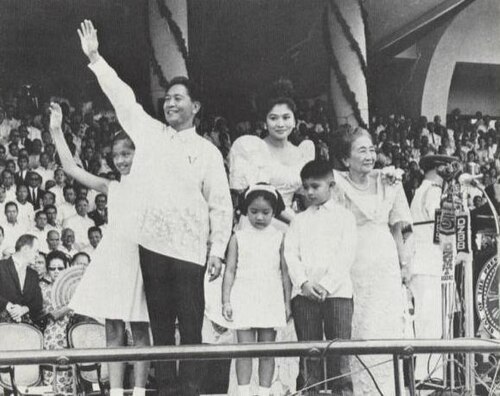
マルコスは、第二次世界大戦から生まれた勲章を授与された戦争の英雄であることを強調する大衆的な選挙運動を展開した。1962年、マルコスは、フィリピン政府とアメリカ政府が兵士に与えることのできるほぼすべての勲章と装飾品を獲得し、フィリピンで最も多くの勲章を授与された戦争の英雄であると主張した。 [113]彼が主張する27個の戦争勲章と装飾品には、殊勲十字章と名誉勲章も含まれている。[113] [114] 『フェルディナンド・マルコスとイメルダ・マルコスの夫婦独裁』の著者プリミティーボ・ミハレスによると、野党の自由党は後に、マルコスの戦争勲章の多くは、大統領選挙ではなく上院再選キャンペーンを支援するために1962年に獲得されたものであると認めた。[60]マルコスは1965年に大統領に就任した。[115]
就任式
フェルディナンド・マルコスは、1965年のフィリピン大統領選挙で現職大統領のディオスダド・マカパガルに勝利し、1965年12月30日にフィリピン第10代大統領として最初の任期に就任した。1935年のフィリピン憲法では、大統領の任期は4年ずつの2期までと制限されていたが、就任はマルコスの20年に及ぶ権力の始まりとなった。
フィリピン軍の拡大
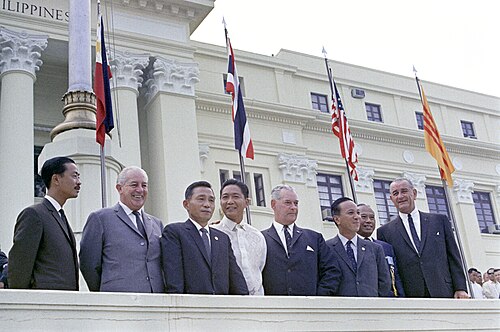
マルコスが大統領に就任して最初に取り組んだことの一つは、フィリピン軍の大幅な増強だった。前例のない行動として、マルコスは国防長官を兼務し、軍の運営に直接関与することを選んだ。[106]また、軍の予算を大幅に増額し、学校建設などの民間プロジェクトに軍を投入した。マルコスに忠誠を誓う将軍たちは定年退職後もその職に留まることを許されたり、報奨として文民官職を与えられたりしたため、 1968年にベニグノ・アキノ・ジュニア上院議員はマルコスが「駐屯国家」を樹立しようとしていると非難した。[109]
ベトナム戦争

リンドン・B・ジョンソン政権からの強い圧力を受け、[110]マルコスは大統領就任前のベトナム戦争へのフィリピン軍派遣の拒否の立場を覆し、[110] [116]限定的な関与に同意し、[117]戦闘工兵部隊の派遣を議会に承認するよう要請した。この新計画に対する反対にもかかわらず、マルコス政権は議会の承認を得て、1966年半ばからフィリピン市民行動グループ (PHILCAG) としてフィリピン軍が派遣された。PHILCAG は1968年に約1,600人の兵力に達し、1966年から1970年の間に1万人以上のフィリピン軍が南ベトナムで主に民間インフラ整備事業に従事した。[118] [119]

建設プロジェクト向け融資
マルコスは、第三共和国で二期目に再選される最初の大統領になることを目指し、再選キャンペーンで約束した「米、道路、学校の建設」に資金を提供するため、巨額の外国からの借入を始めた。税収では、1966年から1970年にかけて政権がインフラ支出を70%増加させたのに資金を賄うことができず、マルコスは外国からの借入を開始し、1961年から1965年にかけてフィリピン政府の年間赤字より72%も高い財政赤字を生み出した。[106]
これが、マルコス政権が1986年にマルコス夫妻が退陣するまで続けた借金による支出パターンの始まりであり、今日でも感じられる経済不安と、フィリピンが2025年まで支払い続けなければならない債務の原因となっていると専門家は指摘している。[106]マルコス政権の最初の任期中に行われた最も壮大なインフラプロジェクト、特にフィリピン文化センター複合施設は、批評家がマルコス夫妻の建造物複合体と呼ぶものの始まりでもあり、宣伝価値のために公的資金が優先される壮大な公共インフラプロジェクトであった。[108] [ページが必要]
ジャビダの暴露とイスラム教徒の反応
1968年3月、ジビン・アルラという名のイスラム教徒の男性が、銃撃されてマニラ湾の海域から引き上げられた。彼は当時のカビテ州知事デルフィン・N・モンタノの元に連れて行かれ、ジャビダ虐殺の話を語り、 1968年3月18日にフィリピン軍(AFP)のメンバーによって多数のモロ軍新兵が一斉に処刑されたと語った。 [111] [より適切な情報源が必要]これは野党の上院議員ベニグノ・アキノ・ジュニアによる上院での暴露の対象となった。[120] [121]
アルーラ以外に生き証人がいなかったため、事件の捜査は著しく妨げられたが、この事件はフィリピンにおけるモロの反乱に火をつける大きな火種となった。[112]多数の裁判や審問を受けたにもかかわらず、虐殺に関与したとされる将校は誰一人として有罪判決を受けず、多くのフィリピン人ムスリムはマニラの「キリスト教」政府は自分たちをほとんど考慮していないと信じるに至った。[122] [123] このことがフィリピンのムスリム社会、特に教育を受けた若者たちの間で大騒ぎを引き起こした。 [124] [ページが必要]そして事件以前には政治に目立った関心のなかったイスラム知識層の間で。[112]教育の有無にかかわらず、ジャビダ虐殺の物語は多くのフィリピン人ムスリムに、キリスト教徒との統合と融和の機会はすべて失われ、さらに疎外されたと思わせた。[125]
これは最終的に1968年にミンダナオ独立運動、1969年にバンサモロ解放機構(BMLO)の結成につながり、1972年10月にこれらのさまざまな勢力がモロ民族解放戦線(MNLF)に統合されました。 [126]
1969年大統領選挙
フェルディナンド・マルコスの2期目選挙運動は、1969年7月のナショナリスト党総会で大統領候補に指名されたことで正式に始まった。党の与党軍事政権は、指名が全会一致であることを保証するために1週間前に会合を開いていた。[127]当時施行されていた1935年フィリピン憲法では、マルコスは大統領として最大2期4年間の任期が認められることになっていた。[106]
1969年の選挙運動中、マルコスは有権者の支持を得るため、5000万ドル相当のインフラ整備事業を立ち上げた。[128]この急速な選挙運動費は莫大で、1970年の国際収支危機の原因となり、インフレの影響で社会不安が高まり、1972年の戒厳令布告まで続いた。[37] [38]マルコスはオスメニャが使った1ペソにつき100ペソを費やしたと報告されており、セブだけで2400万ペソを費やした。[129]
借金による支出で人気が高まっていたマルコスは、選挙に勝つ可能性が非常に高かったが、フィリピン・フリー・プレス紙のナショナル・アーティスト、ニック・ホアキン氏の報道によると、マルコスは「何もかも偶然に任せる」ことを決意した。[127]タイム誌とニューズウィーク誌は、1969年の選挙をフィリピン近代史で「最も汚く、最も暴力的で、最も腐敗した」選挙と呼び、「3つのG」、つまり「銃、ならず者、金」[130] [131]という言葉が作られた[132] 。これは、政権の買収、テロ、票の横取りといった選挙戦術を描写する造語である。[129]
1969年の国際収支危機
選挙期間中、マルコスは借金で賄われたインフラに5000万ドルを費やし、国際収支危機を引き起こした。[133]マルコス政権は国際通貨基金(IMF)に助けを求め、IMFは債務再編を提案した。輸出重視やペソ規制の緩和など、新たな政策が実施された。ペソは低い市場価値で変動することを許され、急激なインフレと社会不安を招いた。[134]
非公式外交
1960年代から、フェルディナンド・マルコスは、中ソ分裂によって形成された方法で、ソ連圏との非公式外交に従事した。[135] [136]公式には非合法な組織であるフィリピン共産党1930は、1965年にマルコスを支持していた。中国と連携したフィリピン共産党の結成は、ソ連と連携したフィリピン共産党1930に対する政府の支援につながった。PKP-1930のメンバーの中には、マルコス政権内で給与制の「研究者」として任命された者もいた。彼らの国境を越えたつながりは、地政学的および経済的観点からソ連との交渉の別の手段となった。[136]
第2期(1969年~1972年)


1969年11月11日に大統領選挙が行われ、マルコスは2期目に再選された。彼は2期目の任期を全うした最初で最後のフィリピン大統領となった。[137] [138] [139] [140]彼の副大統領候補であった現職副大統領フェルナンド・ロペスもフィリピン副大統領として3期目に選出された。
マルコスの2期目は、 1969年のフィリピン国際収支危機に始まる社会不安が特徴的だったが、これはすでに2期目の就任時に進行していた。[106]反対派グループが形成され始め、政治改革を求める「穏健派」グループと、より急進的な左翼思想を唱える「急進派」グループが生まれた。[141] [142] [143]
マルコスは両グループに対して軍事力で対応した。その中で最も顕著だったのは、1970年の最初の3か月間に起きた一連の抗議活動であり、この期間は「第一四半期の嵐」として知られるようになった。[144] [145] [143]
マルコス大統領の第二期におけるもう一つの大きな出来事は、1971年のフィリピン憲法制定会議であったが、1972年5月に代表者が、マルコス夫妻に賛成票を投じるために代議員に金銭が支払われる賄賂計画を暴露したことで、この会議は台無しになった。ファーストレディのイメルダ・マルコス自身も、この賄賂計画に関与していたとされている。[106] : 133 [146]
1971年8月21日、マニラのキアポ地区にあるプラザ・ミランダで野党自由党の政治集会が開かれた。マルコスは当時まだ新生だったフィリピン共産党を非難し、布告第889号を発布して非常事態を宣言し、人身保護令状を停止した。[147]野党は「過激派」と非難されて逮捕された。マルコスの対応は、第一四半期の暴動以来すでに曖昧になっていた穏健派と過激派野党の区別をさらにあいまいにした。これにより、社会主義の地下抵抗運動が大規模に拡大し、穏健派野党の多くは過激派に加わる以外に選択肢がなくなった。[148] [ 149] [143] 1972年にはマニラ首都圏で一連の爆破事件が発生し、緊張が高まった。マルコス大統領は再び共産主義者を非難したが、爆発に関連して逮捕された容疑者はフィリピン警察と関係のある者だけだった。[150] [151]
マルコス大統領の2期目は、1972年9月23日にフィリピンに戒厳令を敷くと発表したことで、2年9か月弱で事実上終了した。[39]
国際収支危機後の社会不安
マルコスは1969年11月の選挙で圧勝し、同年12月30日に就任したが、1969年の大統領選挙運動中にマルコスが多額の資金を投じたことで、国民の不安が高まった。[134]
選挙運動中のマルコスの支出は、ロレンソ・タナダ上院議員、ホビト・サロンガ上院議員、ホセ・W・ディオクノ上院議員などの野党関係者から、マルコスは1935年の憲法で定められた大統領の任期2期を超えても権力の座に留まりたいと考えていると非難される結果となった。[134]
キャンパス内では、学生たちが政治や経済の問題を知る時間と機会があり、反対派グループが急速に成長した。[141] [142]
「穏健派」と「急進派」の反対派
当時のメディア報道では、マルコスに反対する様々な市民社会団体を2つのカテゴリーに分類していた。[141] [142]教会団体、市民自由主義者、国家主義政治家を含む「穏健派」は、政治改革を通じて変化を起こそうとした人々だった。[141]多くの労働団体や学生団体を含む「急進派」は、より広範でより体系的な政治改革を望んだ。[141] [143]
「穏健派」野党
1971年から1973年にかけて憲法制定会議が注目を集め、フェルディナンド・マルコスのますます権威主義的になる政権に反対する政治家たちは、権力内部からの政治的努力に主に力を注いだ。[106]
彼らの懸念は多岐にわたるが、通常は選挙制度改革、超党派の憲法制定会議の要請、そして1935年の憲法で認められたマルコス大統領の任期2期を超えないよう求める要請などが含まれていた。[106] [143]
これには、フィリピン全国学生連合[143] 、全国学生連盟(NSL)[143]、そして後にホセ・W・ディオクノ上院議員が率いる市民の自由を求める憂慮する市民運動(MCCCL) [142]が含まれていました。
MCCCLの集会は、その多様性、穏健派と急進派の両方からの参加者の獲得、そして最大の集会には5万人もの人々が参加したという規模で特に記憶に残っている。[142]
「過激な」反対派
この時期の反対派グループのもう一つの大きなカテゴリーは、より広範で体系的な政治改革を望んだグループであり、通常は国民民主運動の一環として行われた。これらのグループはメディアによって「過激派」とレッテルを貼られたが[141] [143]、マルコス政権はその用語を「穏健派」抗議グループにも適用した[152] 。
当時のメディアによって「過激派」とみなされたグループには以下のものがあった。[143]
- カバタアン・マカバヤン(KM)
- サマハン民主主義カバタン(SDK)
- フィリピン大学学生文化協会(SCAUP)
- フィリピン民主運動(MDP)
- フィリピン学生パワー集会(SPAP)
- マラヤンパグカカイサ ング カバタン フィリピン人(MPKP)
過激化
1965年にマルコスが大統領になったとき、フィリピンの政策と政治は第二次世界大戦後の地政学的枠組みの下で機能していた。[153]その結果、フィリピンは冷戦中に米国が永続させた反共産主義の恐怖にイデオロギー的に巻き込まれた。 [154]そのため、マルコスとフィリピン軍は、1969年のフィリピン共産党の結成が象徴する「脅威」を、たとえそれがまだ小さな組織であったとしても強調した。[145] : 43 部分的には、そうすることがフィリピン軍の予算を増やすのに良かったからである。[145] : "43" [134]その結果、安全保障専門家のリチャード・J・ケスラーは、これが「グループを神話化し、革命的なオーラを吹き込み、より多くの支持者を引き付けた」と指摘している。
1969年から1970年にかけての社会不安と、その結果生じた「第一四半期の嵐」抗議運動の暴力的な解散は、1970年代に多数のフィリピン人学生がマルコス政権に対して過激化した初期の分水嶺的出来事の一つであった。これらの解散により、それまで「穏健派」の立場(つまり、立法改革を求める)をとっていた多くの学生が、より急進的な社会変革を求める以外に選択肢がないと確信するようになった。[148] [149]
後に「穏健派」であった野党メンバーの多くを過激化させることになる他の転換点となった出来事としては、1971年2月のディリマン・コミューン、1971年8月のプラザ・ミランダ爆破事件後の人身保護令状の停止、1972年9月の戒厳令の宣言、1980年のマクリン・ドゥラグの殺害、[144]および1983年8月のニノイ・アキノの暗殺などがある。[143]
1970年までに、キャンパス内でマルクス・レーニン主義の勉強会が一般的になり、多くの学生活動家が国民民主運動(ND)に関連するさまざまな組織に参加していました。たとえば、ホセ・マリア・シソンによって設立されたフィリピン大学学生文化協会(SCAUP)やカバタアン・マカバヤン(KM、愛国青年の意) 、[155] [156]、 SCAUPとKMとは別の組織として若い作家リーダーのグループによって設立されたサマハン・デモクラティコ・ング・カバタアン(SDK)、[ 157 ]などです。
左翼活動家と共産主義者の境界線はますます曖昧になり、過激派活動家の多くがフィリピン共産党に加わった。都市部の過激派活動家は農村部に広く展開し始め、一部はゲリラとなった。[158] [159]
第一四半期の嵐
1970年1月26日、マルコスが2期目の最初の一般教書演説を行った頃には、1969年から1970年の国際収支危機から生まれた不安が爆発し、政府に対する一連のデモ、抗議、行進が起こった。学生グループ(穏健派と急進派)が抗議活動の原動力となり、1970年3月の大学学期末まで続き、「第一四半期の嵐」として知られるようになった。[160] [134]
1970年1月26日のマルコスの国家演説中、穏健派のフィリピン全国学生連合は議会前で抗議活動を組織し、穏健派と急進派の学生団体に参加を呼びかけました。抗議活動に参加した学生の中には、マルコスとその妻イメルダが議会ビルを出る際に棺桶やワニの剥製、石を投げつけるなど、マルコスを罵倒する者もいました。[161]
次の大規模な抗議行動は1月30日に大統領官邸の前で起こり、[162]活動家らは消防車で門を突撃し、門が壊れて崩れると、活動家らは石やトーチカ、火炎瓶を投げながら官邸の敷地内に突入した。警察により少なくとも2人の活動家が死亡し、数人が負傷したことが確認された。
1970年3月17日までの間に、マニラ首都圏でさらに5つの大規模な抗議活動が行われた。これは後に一部のメディアが「第一四半期の嵐による7つの致命的な抗議活動」と称することになる。 [163]これには、2月12日のプラザ・ミランダでの集会、2月18日の「人民会議」と名付けられたデモ(これもプラザ・ミランダで行われるはずだったが早く解散し、抗議者たちは米国大使館に向かいロビーに放火した)、[149] 2月26日の「第二回人民会議」デモ、3月3日のウェルカム・ロトンダからプラザ・ロートンまでの「人民行進」、そして3月17日のプラザ・モリオネスでの第二回「人民行進」が含まれる。[163]
抗議活動の参加者は毎週5万人から10万人に及んだ。 [ 164] [より詳しい情報源が必要]学生たちは1週間の授業ボイコットを宣言し、代わりに抗議集会を組織するために集まった。[149]
さまざまな FQS 抗議運動の暴力的な解散は、1970 年代に多数のフィリピン人学生がマルコス政権に対して過激化した最初の転換点となった出来事の 1 つでした。これらの解散により、以前は「穏健派」の立場 (つまり、立法改革を求める) をとっていた多くの学生が、より急進的な社会変革を求める以外に選択肢がないと確信するようになりました。[148] [よりよい情報源が必要]
1971年憲法制定会議
マルコスの政策に反対し、社会の広範な不平等に対する不満の高まりを理由に、[106]市民社会団体と野党指導者たちは、1967年に1935年フィリピン憲法を改正する憲法制定会議の開催を求める運動を開始した。[165]その年の3月16日、フィリピン議会は制憲議会を構成し、1935年憲法を改正するための憲法制定会議の開催を求める決議第2号を可決した。[166]
マルコスは、この動きを支持して批評家を驚かせたが、歴史家たちは後に、その結果として制定された憲法制定会議が、マルコスが1935年憲法で認められた2期4年の任期を超えて任期を延長するための法的根拠の基礎を築くことになるだろうと指摘した。[106]
1970年11月10日には、大会の代議員を選出するための特別選挙が行われた。[106] : 130 勝者が決まり、大会は1971年6月1日に新しく完成したケソン市庁舎で招集された。[167]合計320人の代議員が大会に選出され、最も著名なのは元上院議員のラウル・マングラプスとロゼラー・T・リムである。他の代議員も影響力のある政治家となり、イラリオ・ダビデ・ジュニア、マルセロ・フェルナン、ソテロ・ラウレル、アキリーノ・ピメンテル・ジュニア、テオフィスト・ギンゴナ・ジュニア、ラウル・ロコ、エドガルド・アンガラ、リチャード・ゴードン、マルガリート・テベス、フェデリコ・デラ・プラナなどがいた。[106] [168]
1972年までに、大会は政治的駆け引きと遅延によってすでに行き詰まっており、1972年5月に代表者が、代表者がマルコス夫妻に投票するために賄賂を受け取る賄賂計画を暴露したことで、その信頼性は深刻な打撃を受けた。この賄賂計画にはファーストレディのイメルダ・マルコス自身も関与していたとされている。[106] : 133 [146]
1972年9月にマルコスが戒厳令を宣言し、野党代表11人を逮捕したため、この計画に関する調査は事実上棚上げとなった。残りの野党代表は亡命か潜伏を余儀なくされた。2か月以内に、特別委員会によってまったく新しい憲法草案が一から作成された。 [169] 1973年に新憲法を批准するために憲法制定国民投票が行われたが、マルコスが秘密投票による投票方法を「市民集会」による口頭投票方式に置き換えたため、批准の有効性が疑問視された。[170] : 213 憲法の批准は、批准訴訟として知られるようになった訴訟で争われた。[171] [172]
CPP新人民軍の初期の成長
1970年12月29日、フィリピン陸軍士官学校の教官ビクター・コープス中尉が新人民軍の反乱軍を率いてPMAの武器庫を襲撃し、ライフル、機関銃、グレネードランチャー、バズーカ砲、数千発の弾薬を押収した。 [173] 1972年、当時毛沢東の人民戦争論の一環としてアジアの共産主義反乱軍を積極的に支援し武装していた中国は、政府打倒作戦を加速させるため、NPA向けにM-14とAK-47ライフル1,200丁をMVカラガタン号に積み込んだ。 [174] [175] [176]
クーデターと暗殺計画の噂
クーデターの噂も広まりつつあった。米国上院外交委員会の報告書によると、1969年のフィリピン大統領選挙の直後、退役した大佐や将軍を中心とするグループが革命政権を組織し、まずマルコス大統領の信用を失墜させ、その後大統領を殺害しようとした。このグループは野党自由党幹部のエレウテリオ・アデボソが率いていた。フィリピン政府関係者が同委員会に提出した文書によると、陰謀の主要人物はフェルナンド・ロペス副大統領とセルヒオ・オスメニャ・ジュニアで、マルコスは1969年の選挙でこの2人を破ったという。[177]
ニューヨーク・タイムズが入手した記事では、クーデターの噂がマルコス大統領によって戒厳令を正当化するために利用される可能性があると推測されていたが、1969年12月には早くも米国大使から米国務次官補へのメッセージの中で、大使は、革命や暗殺に関する話のほとんどは敗北した反対派から来ており、アデボソは反対派の指導的活動家であると述べた。彼はまた、暗殺計画に関して自分が持っている情報は「確かな」、つまり情報源が確かなものであり、それをマルコス大統領に確実に届けなければならないと述べた。[178] [非一次情報源が必要] [179] [非一次情報源が必要]
ミランダ広場爆破事件
ワシントンポスト紙のインタビューで、匿名の元フィリピン共産党関係者は「共産党指導部がプラザ・ミランダ襲撃を計画し、3人の工作員が実行した。これは政府の弾圧を誘発し、国を革命の瀬戸際に追い込むためだった。共産党指導者ホセ・マリア・シソンは、マルコスが挑発されて反対派を取り締まり、何千人もの政治活動家を地下に追い込むことができると計算していたと匿名の元関係者は語った。中国が既に提供に同意していた大量の武器と資金援助を利用するために、緊急に新兵が必要だったと彼らは語った。」と主張した。[180]ホセ・マリア・シソンはこれらの主張を否定し続けており、[181] CPPは事件における彼らの責任を公式に確認したことはない。マルコスとその仲間は、ベニグノ・アキノ・ジュニアが陰謀に関与していたと主張したが、CPP-NPA創設議長ホセ・マリア・シソンはこれを否定した。[182]

歴史家の中には、マルコスが戒厳令の口実として偽旗作戦を利用したことで知られているため、プラザ・ミランダ爆破事件の犯人はマルコスであると主張する者もいる。 [183] [184] 1971年には一連の致命的な爆破事件があり、CIAは非公式に少なくともそのうちの1件はマルコスが犯人であると述べた。[要出典] 1990年代に機密解除された米国の諜報文書には、フィリピン軍内のCIAスパイによって提供された、マルコスが関与していることを示すさらなる証拠が含まれていた。[185]
1972年には、国防大臣フアン・ポンセ・エンリレの暗殺未遂事件という別の偽旗攻撃が発生した。ニクソン大統領は直後にマルコスの戒厳令を承認した。[185]
1971年の令状の停止人身保護令状
ミランダ広場爆破事件への対応として、マルコスは布告第889号を発布し、非常事態権限を行使して人身保護令状を停止した[186]。この行為は、1年以上後に戒厳令が布告される前兆とみなされることになった[147] 。
マルコスによる令状停止は、エドガー・ジョプソンなど穏健派野党の多くのメンバーが急進派に加わることを余儀なくさせる出来事となった。爆破事件の余波で、マルコスは野党全員をひとまとめにして共産主義者と呼び、多くの元穏健派はマルコス軍に逮捕されるのを避けるために急進派野党の山岳キャンプに逃げた。マルコス政権の行き過ぎに幻滅し、1971年以降に野党に加わりたいと思った人々は、単にマルコス政府に声高に反対する唯一のグループを代表していたというだけの理由で、急進派に加わることが多かった。[187] [ページが必要]
1972年マニラ爆破事件
1972年9月23日の夕方、フェルディナンド・マルコス大統領は、フィリピン全土に戒厳令を敷くと発表した。[39]これは、マルコスが1986年2月25日に国外追放されるまで、事実上14年間続く独裁政権の始まりであった。戒厳令を布告する正式な文書である布告第1081号は1981年1月17日に正式に解除されたが、マルコスはエドサ革命によって追放されるまで、独裁者としての権力を事実上すべて保持した。[188]ミランダ広場の直後、マルコスが戒厳令を布告する直前の数か月間に、マニラ首都圏のさまざまな場所で約20件の爆発が発生した。[189]最初の爆破事件は1972年3月15日に発生し、最後の爆破事件は1972年9月11日に発生しました。 [189]その年の9月23日に戒厳令が発令される12日前でした。
マルコス政権は公式に爆発は共産主義の「都市ゲリラ」によるものとし[189]、マルコスはこれを戒厳令布告の正当化となる「扇動事件」のリストに含めた。[150] [追加引用が必要]当時のマルコスの野党は爆発が共産主義者によるものとされることに疑問を呈し、爆発に関連して逮捕された容疑者はフィリピン警察と関係のある者だけだったと指摘した。[150] [追加引用が必要]
1972年のマニラ爆破事件の現場には、マニラのカリエド通りにあるパレス劇場とジョーズ百貨店、フィリピン長距離電話会社(PLDT)、フィリピンオリエント航空、フィリピンアメリカン生命保険会社(フィラムライフ)の事務所、フィリピン信託会社(現在はフィルトラスト銀行として知られている)のクバオ支店、ケソン市にある上院出版局とフィリピン砂糖協会、南ベトナム大使館などがあった。[189]
しかし、これらの事件のうち、カリエドショッピングモールで起きた事件だけが、物的損害を超え、女性1人が死亡し、約40人が負傷した。[150]
戒厳令時代(1972年~1981年)

マルコスの戒厳令宣言は、1972年9月23日に報道官のフランシスコ・タタッドがラジオで[190] [39] [40] 、マルコスが2日前の9月21日に署名したとされる布告第1081号が発効し、マルコスの統治が憲法で定められた2期の期限を超えて延長されると発表したことで、国民に知られるようになった。[191]マルコス は布告により、プロパガンダ機関を強化するために報道の自由やその他の市民の自由をほぼ解体し、議会とメディア機関を閉鎖し、ベニグノ・アキノ・ジュニア上院議員、ホビト・サロンガ上院議員、ホセ・W・ディオクノ上院議員を含む野党指導者と過激派活動家の逮捕を命じた。[192] [193]マルコスは、戒厳令は新たな社会的、政治的価値観に基づく「新社会」であるバゴン・リプナンを創設するための序章であると主張した。[要出典]
戒厳令の初期の頃は、犯罪率の低下をもたらしたと考えられていたため、国民の支持を得ました。[194] [195] [196] [ 197]
逮捕
しかし、起訴されずに拘留されたニノイ・アキノの上院議員の同僚とは異なり、ニノイは共産主義NPA指導者のコルプス中尉とベルナベ・ブスカイノとともに殺人、銃器の不法所持、破壊活動の罪で起訴された。[198]
バゴン・リプナン(新しい社会)

戒厳令を宣言した理由の一つとして、マルコスは「社会を改革する」必要があると述べた。[150] : 66 社会を「善良な独裁者」の支配下に置いて、混乱期に規律のない民衆を導くことができるようにすることである。[150] : 29 [199]彼はこの社会工学の試みを「バゴン・リプナン」または「新しい社会」と呼び、[200] : 13 マルコス政権は、それを宣伝するために、スピーチ、本、講義、スローガン、多数のプロパガンダソングを含むさまざまな宣伝資料を作成した。[200] : 13 [201] [202]
マルコスの著書『新社会についての覚書』によれば、それは貧困層と特権階級が社会の共通目標のために一体となって働き、自己実現を通じてフィリピン国民の解放を達成するよう促す運動であった。[要出典]
マルコス政権は、マルコスの長女イミーが率いるカバタン・バランガイと呼ばれる青年組織を設立した。1975年4月に制定された大統領令684号は、15歳から18歳までの若者にキャンプに行き、ボランティア活動を行うことを奨励した。 [203] [204]
1974年10月、マルコスとPKP-1930は「国家統一協定」を締結し、PKP-1930は土地改革、労働組合改革、ソ連圏との関係再活性化などの新社会主義プログラムを支援することになった。[205] [206]
中国系学校のフィリピン化
フィリピン国民に愛国心を植え付け、増加する中国系学校が外国の思想を広めるのを防ぐため、マルコス大統領は大統領令第176号を発布し、[207]外国人専用の教育機関の設立や外国人専用のカリキュラムの提供を禁止し、[208]中国語の授業を1日100分以内に制限した。[209]
1973年戒厳令国民投票
戒厳令は1973年7月に行われた1973年フィリピン戒厳令国民投票で投票にかけられ、論争を巻き起こし[41] [14]、賛成が90.77%、反対が9.23%となった。
ロレックス12と軍隊
マルコス大統領とともに、国防大臣フアン・ポンセ・エンリレ、フィリピン警察長官フィデル・ラモス、フィリピン軍参謀総長ファビアン・ベルといった彼の「ロレックス12」のメンバーは、1972年から1981年まで戒厳令の最高執行責任者を務め、この3人は1986年に大統領が追放されるまでマルコス大統領の側近であり続けた。「ロレックス12」の他の周辺メンバーには、エドゥアルド・「ダンディング」・コファンコ・ジュニアやルシオ・タンがいた。
1972年から1976年にかけて、マルコスは南ベトナムの共産主義政権の崩壊と東南アジアにおける共産主義の台頭に対応して、フィリピン軍の規模を6万5千人から27万人に増強した。軍将校はさまざまなメディア企業、公共事業、開発プロジェクト、その他の民間企業の役員に就任したが、そのほとんどはフィリピン陸軍士官学校の高等教育を受け、よく訓練された卒業生であった。同時に、マルコスは国内の兵器製造産業の成長を促進する努力をし、軍事費を大幅に増加させた。[210]
多くの人権侵害は、当時大統領となるフィデル・ラモスが率いていたフィリピン警察によるものとされた。共産主義とイスラムの反乱問題と戦うためにマルコス大統領によって組織された、民間軍事地域部隊(CAFGU)の前身である民間国内防衛軍は、特に左翼、NPA、イスラム反乱軍、マルコス政府に対する反乱軍に対する人権侵害を悪名高く加えていると非難されている。[211]
マルコス政権下の米国の外交政策と戒厳令
1977年までに、軍の兵力は4倍に増強され、6万人以上のフィリピン人が政治的理由で逮捕された。1981年、ジョージ・H・W・ブッシュ副大統領はマルコスの「民主主義の原則と民主的な手続きへの忠実さ」を称賛した。[d] 1970年代、東南アジアで共産主義と戦うマルコスの権威を公に疑問視したアメリカの軍人や政治家はいなかった。[要出典]
1972年の戒厳令宣言から1983年まで、米国政府はマルコス政権に対して二国間軍事・経済援助として25億ドル、世界銀行などの多国間機関を通じて約55億ドルを提供した。 [ 216]
1979年の米国上院報告書では、フィリピン政府エージェントが米国でフィリピン反体制派を攻撃していることを1973年初頭から米国当局は把握していたと述べられている。1981年6月、反マルコス派の労働運動家2人がシアトルの労働組合ホールの外で暗殺された。少なくとも1回は、CIAエージェントがフィリピンエージェントに対するFBIの捜査を妨害した。[217]
中華人民共和国を支持する台湾との関係の撤回
マルコス政権以前、フィリピン政府は、1949年の中国共産党革命で中国共産党が勝利したにもかかわらず、台湾島に逃亡した国民党統治の中華民国政府(ROC)と緊密な関係を維持していた。以前の政権は、国内の共産主義反乱軍に対する資金的および軍事的支援のため、中華人民共和国(PRC)を安全保障上の脅威と見なしていた。 [218]
しかし、1969年までに、フェルディナンド・マルコスは、フィリピンが中華人民共和国と外交関係を確立する必要があると公に主張し始めた。1969年の国情演説で、彼は次のように述べた。[219]
アジアの我々は共産主義中国との共存共栄に向けて努力しなければなりません。私は、日々切迫するこの必要性を改めて強調します。間もなく、共産主義中国は核兵器の洗練された運搬システムにより、攻撃力を千倍に増強するでしょう。我々はその日のために備えなければなりません。共産主義中国と平和的に共存する準備をしなければなりません。
— フェルディナンド・マルコス、1969年1月
1975年6月、マルコス大統領は中国を訪問し、フィリピンと中国の関係を正常化する共同声明に署名した。声明では、「中国は一つであり、台湾は中国の領土の不可分の一部である」と認識していることなどが述べられている。一方、周恩来首相も、中国はフィリピンの内政に干渉せず、アジアに中国の政策を押し付けようともしないと誓約した。この動きは、中国が財政的、軍事的に支援してきた現地の共産主義運動を孤立させることとなった。[220] [221]
ワシントンポスト紙は、元フィリピン共産党幹部へのインタビューで、「彼ら(現地共産党幹部)は、(中国)政府の不本意な『客』として中国で10年間も苦しみ、彼ら同士、そしてフィリピンの党指導部と激しく対立した」と暴露した。[180]
その後、政府は1976年にNPAの指導者ベルナベ・ブスカイノを、1977年にホセ・マリア・シソンを逮捕した。[221]
1978年フィリピン議会選挙
1977年までに、「甚だしい人権侵害」の報告により、新しく選出された米国大統領ジミー・カーターを含む国際社会からの圧力が高まり、マルコス政権に対してニノイ・アキノを釈放し、戒厳令の宣言後に「正常化」が始まったことを示すために議会選挙を実施するよう圧力がかかった。[222] : 168 マルコスはアキノを釈放しなかったが、1978年のフィリピン議会選挙は1978年に実施されると発表した。 [222] : 168
1978年4月7日、暫定バタサン・パンバンサ(国の最初の議会)の地方代表166人(全208人中)を選出する選挙が行われた。選挙には、ニノイ・アキノが新たに結成した国民党(LABAN)や、政権党として知られるキルサン・バゴン・リプナン(KBL)など、複数の政党が参加した。
ニノイ・アキノのLABAN党はマニラ首都圏に21人の候補者を擁立した[223] 、ニノイ自身、活動家ジェリー・バリカン、労働党指導者アレックス・ボンカヤオ、 [224] ネプタリ・ゴンザレス、テオフィスト・ギンゴナ・ジュニア、ラモン・ミトラ・ジュニア、アキリーノ・ピメンテル・ジュニア、ジャーナリストを含むナポレオン・ラマ、出版社アレハンドロ・ロセス、詩人・劇作家フランシスコ・ロドリゴ。
選挙中に指摘された不正行為には「投票箱への事前投票、偽の登録、「空飛ぶ有権者」、操作された選挙結果、票の買収」などがあり[225]、LABANの選挙活動は制限に直面し[225] 、その中にはマルコスが選挙活動のためにアキノを刑務所から出すことを拒否したことも含まれていた。アキノを含む同党の候補者全員が選挙に敗れた。

マルコス氏のKBL党は137議席を獲得し、後に少数党院内総務となる ヒラリオ・ダビデ・ジュニア率いるプション・ビサヤ党は13議席を獲得した。
首相
1978年、フェルディナンド・マルコスがフィリピンの首相に就任し、アメリカ占領下のペドロ・パテルノとホルヘ・バルガスの任期以来初めて首相の座が復活した。1973年憲法第9条に基づき、首相は他国の現代の首相に典型的である広範な行政権を有した。首相の地位は正式な政府の長であり、軍の最高司令官であった。1935年憲法に基づく大統領の以前の権限はすべて、新たに復活した首相職に移譲された。首相は国家経済開発庁の長官も務めた。 1981年に大統領に再選されたマルコスの後任として首相に就任したのは、アメリカで教育を受けた指導者で、ウォートン校の卒業生でもあるセザール・ビラタで、ビラタは1978年にカビテ州から国会議員に選出された。ビラタの名前は、フィリピン大学ディリマン校のビジネススクールであるセザール・ビラタ・スクールの名に由来している。
布告第2045号
憲法改正と立法措置を施行した後、[226]マルコス大統領は1981年1月17日に戒厳令を解除する布告2045を発令したが、 [227]反乱および破壊活動関連の犯罪に対する人身保護令状の特権は停止したままであった。 [226]戒厳令の解除は、レーガン米大統領の選出とヨハネ・パウロ2世教皇の訪問に合わせて行われ、レーガン大統領の支持を得て教皇からの批判を最小限に抑えるためであった。[226] [228]
第三期(1981年~1986年)

1981年6月16日、戒厳令解除から6ヶ月後、12年ぶりの大統領選挙が行われた。マルコス大統領は、主要野党である統一民族主義民主組織(UNIDO)、野党連合、LABANが選挙をボイコットする中、立候補した。マルコスは他の候補者に大勝した。[229]
3回目の就任式は1981年6月30日火曜日、マニラのキリノ・グランドスタンドで行われた。 [230]就任宣誓はフィリピン最高裁判所長官 エンリケ・フェルナンドによって執り行われた。就任式には当時の米国副大統領 ジョージ・H・W・ブッシュ、シンガポール首相 リー・クアンユー、将来の中国国家主席 ヤン・シャンクン、タイ首相プレム・ ティンスーラノンダが出席した。このときブッシュはマルコスを「我々はあなたが民主主義の原則と民主的な手続きを忠実に守っていることを賞賛する」と悪名高い賛辞を送った。[231]就任式は暑さと午後の雨を避けるため太平洋標準時午前6時50分(GMT+8)に開始された。就任式はテレビでも生中継された。[232]
CPP-NPAとの武力衝突
1972年9月から1981年1月まで続いた戒厳令期間は、戒厳令の施行により、それまで穏健派だった抗議者らが過激化したため、フィリピン共産党と新人民軍が著しく成長した時期であった。[145] : 43 [134]この傾向は1980年代まで続き、NPAは都市部に勢力を伸ばすことができ、NDFは合法的な反対派組織と関係を築くことができた。これはすべて、1981年1月にマルコスが紛争は「実質的に抑制された」と主張したにもかかわらずである。[226] [227] 1980年代初頭にダバオ市で主要指導者が殺害されたことで、政府は「南部のCPPの背骨が折れた」と主張するに至った。[233] しかし、残った指導者たちはすぐに都市蜂起を含む新しい戦術を試し始め、国際メディアはダバオ市を「キリングフィールド」や「フィリピンの殺人首都」と呼ぶようになった。[234] 暴力は1985年にピークに達し、軍人と警察の死者1,282人、民間人の死者1,362人となった。[221]
1980年代の経済崩壊
マルコス政権の支出は、60年代のマルコス政権の最初の任期以来、借金に大きく依存していた。そのため、1980年から1982年にかけてインフレが高進し、米国が金利を引き上げ、1980年と1981年第3四半期に米国で景気後退が起きた際、フィリピンは脆弱な立場に置かれた。[235] [236]フィリピン経済も1981年に衰退し始め、1983年にベニグノ・アキノ・ジュニアが暗殺されるまで衰退が続いた。経済的および政治的不安定さが相まって、1984年と1985年にはフィリピン史上最悪の景気後退となり、経済は2年連続で7.3%縮小し[236]、貧困率は49%、つまりフィリピン人口のほぼ半分に達した。[237]
アキノ大統領の暗殺

1983年8月21日、野党指導者ベニグノ・アキノ・ジュニアがマニラ国際空港の滑走路で暗殺された。彼は米国での3年間の亡命生活の後にフィリピンに帰国し、マルコス大統領が治療のためフィリピンを出国することを許可した後、命を救うために心臓バイパス手術を受けた。心臓手術の前に、ニノイは共犯者であるNPA指導者ベルナベ・ブスカイノ(ダンテ司令官)とビクター・コルプス中尉とともに、殺人、銃器の不法所持、国家転覆の罪で軍事委員会から死刑判決を受けた。[198]
暗殺の数ヶ月前、ニノイはハーバード大学での研究期間が終了した後、フィリピンに戻ることを決めていた。野党は暗殺の責任をマルコス自身に直接負わせたが、軍と妻イメルダを責める者もいた。一般的な憶測では3人の容疑者が挙げられた。1つ目はマルコス本人であり、信頼する軍司令官ファビアン・バーを通じた犯行である。2つ目はマルコスの妻イメルダが病弱な夫の体力が衰えてきたため、彼女自身の野望が燃え上がったという説である。3つ目はダンディン・コファンコが自身の政治的野心から暗殺を計画したという説である。[238] 1985年にファビアン・バー参謀総長や犯罪で起訴された他の軍高官が無罪となったことは、隠蔽や冤罪であると広く見なされた。
2007年11月22日、ニノイ・アキノ暗殺で有罪判決を受けた兵士の一人、パブロ・マルティネスは、マルコスが腎臓移植から回復中のニノイ・アキノ・ジュニアの暗殺を命じたのはマルコスの取り巻きダンディン・コファンコであると主張した。コファンコはアキノの妻コラソン・コファンコ・アキノの従兄弟である。マルティネスはまた、暗殺を知っていたのは自分とガルマンだけで、ガルマンが実際に銃を撃ったと主張したが、これは事件の他の証拠によって裏付けられていない。[239]
1986年2月のピープルパワー革命でアキノの未亡人が大統領に就任すると、最高裁判所はアキノ暗殺の再審を命じた。[240] [241]サンディガンバヤンは16人の軍人を殺人罪で有罪とし、アキノに配属された軍護衛の一人であるロヘリオ・モレノ巡査一等兵が「致命的な銃弾を発射」し、ガルマンは殺害しなかったと裁定した。[242] [240]
弾劾の試み
1985年8月、56人の議員が、1985年7月のサンノゼ・マーキュリー・ニュースによるマルコス家の米国における数百万ドルの投資と不動産保有に関する暴露を 引用し、米国の援助金を私的に流用した疑いでマルコス大統領の弾劾を求める決議に署名した[243] 。
ファースト・ファミリーが蓄積したとされる資産は、クラウン・ビルディング、リンデンメア・エステート、いくつかの居住用アパート(ニュージャージー州とニューヨーク州)、ニューヨークのショッピング・センター、大邸宅(ロンドン、ローマ、ホノルル)、ハワイのヘレン・クヌーセン・エステート、カリフォルニア州サンフランシスコの3つのコンドミニアムであった。
議会はまた、この告発に「マニラ映画センターの建設のための資金の不正使用と誤用」も含めた。このセンターでは、公衆道徳やフィリピンの習慣や伝統に反する、成人向けやポルノ映画[要出典]が上映されている。しかし、この扇動的な告発にもかかわらず、弾劾の試みはほとんど実効性を得なかった。弾劾決議が付託された委員会は弾劾を勧告せず、憲法上の手続きでマルコスを解任する勢いはすぐに消えた。[要出典]
身体の衰え
マルコス大統領の3期目の間、慢性自己免疫疾患であるエリテマトーデスの合併症である腎臓疾患のため、健康状態は急速に悪化した。1983年8月に腎臓移植を受けたが、最初の腎臓移植が拒絶反応を起こしたため、1984年11月に2度目の移植を受けた。[244]マルコス政権は彼の病状の公表に敏感であり、これらの期間中にマルコスが腎臓移植を受けたと主張した宮廷医師が、その後まもなく殺害されているのが発見された。警察は、彼が共産主義反乱軍に誘拐され殺害されたと述べた。[244]彼の重病と増大する政情不安のため、多くの人々は彼にまだ統治能力があるのか疑問視した。[245]マルコスが病に苦しむ中、権力を持つ妻イメルダが政府の主要な公人として浮上した。マルコス氏はかつては熱心なゴルファーであり、体格を誇示するのが好きなフィットネスマニアだったため、健康状態が悪化しているのではないかという憶測を否定した。
1984年までに、ロナルド・レーガン米大統領は、マルコスが戒厳令を宣言した後も自身と歴代大統領が強く支持してきたマルコス政権から距離を置き始めた。数億ドルの援助を提供してきた米国は、長年にわたりマルコスの統治を支える上で重要な役割を果たしてきたが[246]、カーター政権時代にはジミー・カーター大統領が人権運動でフィリピンを標的にしたことで米国との関係はやや悪化した。
経済パフォーマンス

| 人口 | |
|---|---|
| 1967 | 3,371万 |
| 国内総生産(1985年固定価格) | |
| 1966 |  285,886百万ペソ 285,886百万ペソ |
| 1971 | 361,791万ペソ |
| 成長率、1966~71年の平均 | 4.75% |
| 一人当たり所得(1985年固定価格) | |
| 1967 | ₱8,932 |
| 1971 | ₱9,546 |
| 総輸出額 | |
| 1966 | 70,254百万ペソ |
| 1971 |  63,626百万ペソ 63,626百万ペソ |
| 為替レート | |
| 1米ドル = 6.44 ペソ 1ペソ = 0.16米ドル | |
| 出典: [247] | |

| 人口 | |
|---|---|
| 1985 | 5,430万 |
| 国内総生産(1985年固定価格) | |
| 1972 | 381,497百万ペソ |
| 1985 | 571,883百万ペソ |
| 成長率、1972~85年平均 | 3.43% |
| 一人当たり所得(1985年固定価格) | |
| 1972 | ₱9,802 |
| 1985 | ₱10,524 |
| 為替レート | |
| 1米ドル = 20 ペソ 1ペソ = 0.05米ドル | |
| 出典: [247] [248] | |
フェルディナンド・マルコス政権下のフィリピン経済史における21年間(1965年の選挙から1986年の人民革命による追放まで)は、経済の浮き沈みが著しい時期であった。[249] [236] [106]
フィリピンの年間国内総生産は、1964年の52億7000万ドルから、ニノイ・アキノ暗殺の前年の1982年には371億4000万ドルに増加した。ニノイ暗殺後の政情不安による2年間の景気後退の後、1985年にはGDPは307億ドルに減少した。[250]この資金のかなりの額が、マルコス一家や友人に、遺贈融資の形で渡った。[251]
貧困と不平等
スーザン・キンポは、マルコス政権時代は経済的に厳しい時代だったと回想している。米不足のため国民は米の配給を求めて列に並ばなければならなかったし、政府は国民に代わりにトウモロコシを消費するように指示した。[252]
フランク・セナウトは『フィリピンの形成』の中で(103ページ)、こう述べている。[253]
マルコス自身も多額の政府資金を党の選挙資金に流用した。1972年から1980年の間に、賃金労働者の平均月収は20%減少した。1981年までに、人口の最も裕福な10%の収入は、最も貧しい60%の2倍の収入を得ていた。[254]
借金
マルコス政権は、多くの経済開発プロジェクトの資金調達のため、国際金融機関から多額の借入を行った。[255] [256]フィリピンの対外債務は、 1962年の3億6000万ドルから1985年には262億ドルへと70倍以上に増加し、[257]フィリピンはアジアで最も負債の多い国の一つとなった。[255]
フィリピンの対外債務総額は、マルコス政権下の1970年の23億ドルから1985年には262億ドルに増加した。マルコス批判派は、マルコスとその取り巻きによる汚職と公的資金の略奪が横行し、政策が借金漬けになっていると非難した。このためフィリピンは債務返済危機に陥り、解決するのは2025年とみられている。批評家は、この時期にフィリピンペソが3.9から20.53へと急激に切り下げられたことで国の開発状況が不透明であると指摘している。経済全体では、1人当たりGDPの伸びが鈍化し、賃金水準が低下し、失業率が上昇したが、これは特に1983~84年の不況後のマルコス政権末期に顕著であった。経済学者は、貧困率がマルコスが大統領に就任した1960年代には41%だったのが、権力を失ったときには59%にまで上昇したと指摘している。[258] [259] [260]
米国との貿易への依存
フィリピンはかつてアメリカの植民地であったため、砂糖などの農産物の購入をアメリカ経済に大きく依存していた。[261] c. [262] [ページが必要] [263]
戒厳令下の経済(1973年~1980年)
世界銀行のデータによると、フィリピンの年間国内総生産は1972年の80億ドルから1980年には324.5億ドルへと4倍に増え、インフレ調整後の平均成長率は年間6%であったが、負債は1980年末時点で172億ドルに達した。[250] [258]米国のヘリテージ財団によると、フィリピンは1972年から1979年の間に1945年以来最高の経済発展を遂げた。[264] 1973年の石油危機と1979年のエネルギー危機に続く2度の深刻な世界的石油ショックの中で経済は成長し、石油価格は1973年には1バレル3ドル、1979年には39.5ドルで、1200%の成長を遂げた。米国立経済研究所によると、1979年末までに債務はまだ管理可能であり、債務対GNP比率は韓国とほぼ同じであった。[258]
外国資本は特定の産業プロジェクトへの投資を奨励された。外国資本には、免税特権や利益を外貨で持ち出す特権などの優遇措置が提供された。1980年代の最も重要な経済プログラムの一つは、カウンラランのキルサン・カブハヤン(生計と進歩のための運動)であった。このプログラムは1981年9月に開始された。バランガイの住民が自ら生計を立てるためのプロジェクトに従事することを奨励することで、バランガイの経済発展を促進することを目指した。政府の努力により、1970年から1980年にかけて、国の経済成長率は平均6~7%に上昇した。[265]
戒厳令後の経済(1981年~1985年)

フィリピン経済は米国への輸出に大きく依存しており、1983年8月のアキノ大統領暗殺後、大きな衰退に見舞われた。
国家経済復興計画を立ち上げる試みとして、アメリカ企業からの孤立が深まる中、マルコスは国際復興開発銀行、世界銀行、国際通貨基金(IMF)などの外国債権者と交渉し、フィリピンに債務返済の猶予を与えるため、国の対外債務の再編に取り組んだ。マルコスは政府支出の削減を命じ、その節約分の一部を1984年に設立した生活支援プログラム「サリリン・シカプ(自立)」の資金に充てた。
しかし、政府の復興努力にもかかわらず、いくつかの理由により経済は縮小し続けた。いわゆる政府開発計画のほとんどは実現しなかった。政府の資金はしばしばマルコスやその取り巻きによって流用された。アメリカの投資家は、マルコス政権に蔓延していた汚職に反対するフィリピンの経済エリートによって落胆した。[266] [要ページ]復興計画の失敗は、市民の不安、政府内の横行する汚職と腐敗、そしてマルコスの信頼性の欠如によってさらに悪化した。[要出典]失業率は1975年の3.9%から1985年には12.6%に上昇した。[267]
信用情報機関の設立
1981年、フェルディナンド・マルコスは、法人債務者の破綻が急増していることを受けて、フィリピン中央銀行にフィリピン国内での信用情報機関の設立と運営資金提供の可能性を分析するよう命じる指示書第1107号を発行した。 [268] この命令に従い、フィリピン中央銀行は融資・信用局の下に信用情報交換システムを設立した。これは、個人、機関、事業体、その他の事業体の信用情報の収集、開発、分析を行うために設立された。その目的は、会員と加入者間での信用データの継続的な交換を開発・実施し、債務者、債権者、一般大衆に公平な信用情報源を提供することである。1982年4月14日、Credit Information Bureau, Inc. が非株式非営利法人として設立された。 CIBIは1981年2月16日のLOI No. 1107に基づいて設立され、PD No. 1941によってさらに強化されました。PD No. 1941は、CIBIを金融システムと経済全体における合理的で効率的な信用プロセスの発展と維持を促進するのに適した信用調査機関として認識し、支援しています。1997年にCredit Information Bureau, Inc.が法人化され、民間企業に転換され、 CIBI Information, Inc.になりました。CIBIは、企業、信用、個人向けの情報とインテリジェンスのプロバイダーです。[269]同社はまた、サプライヤー、業界パートナー、さらには専門家の雇用を認定する前にコンプライアンスレポートを提供しています。[270]
突然の総選挙、人民の力による革命、そして追放(1986年)
1986年の総選挙
1985年後半、国民の不満が高まり、外国の同盟国からの圧力にさらされたマルコスは、任期が1年以上残っている中で総選挙を実施した。彼はアルトゥーロ・トレンティーノを副大統領候補に選んだ。マルコスに反対する勢力は、アメリカで教育を受けた2人の指導者、アキノの未亡人コラソンと副大統領候補サルバドール・ラウレルの元に結集した。[271] [272]
この時期、マルコスが日本占領軍と戦った功績で第二次世界大戦中に授与された勲章が外国メディアによって初めて疑問視された。マニラのトンド地区での選挙運動中、マルコスは次のように反論した。[273]
トンドにいて、私の下で戦い、私のゲリラ組織の一員だったあなたたち、あなたたちは、この狂った人々、特に外国の報道機関に答えなさい。私たちの反対派は、マルコスは本当のゲリラではなかったと言います。彼らを見てください。私たちが敵と戦っていたとき、敵に協力していたこれらの人々。今や彼らは私の戦争記録に疑問を投げかける神経を持っています。私は彼らの非難に耳を傾けません。
— フェルディナンド・マルコス、1986年1月

マルコス氏は、大統領候補コラソン・アキノ氏の義父であるベニグノ・アキノ・シニア氏と、副大統領候補サルバドール・ラウレル氏の父で元大統領のホセ・P・ラウレル氏の両者に言及していた。
選挙は1986年2月7日に行われた。[274]公式の選挙管理機関である選挙管理委員会(COMELEC)は、マルコスを勝者と宣言した。COMELECの最終集計では、マルコスが10,807,197票を獲得し、アキノが9,291,761票を獲得して勝利した。一方、公認の選挙監視団体である国民自由選挙運動(NAMFREL)の69%の部分集計では、アキノが7,502,601票を獲得し、マルコスが6,787,556票を獲得して勝利した。双方で不正が報告された。[275]この選挙運動は、暴力や選挙結果の改ざんの広範な報告によって台無しになった。
この不正行為は、少なくとも彼らの証言に基づいて、公式選挙結果がフェルディナンド・マルコスに有利になるように操作されたという主張に抗議して、COMELEC のコンピュータ技術者 35 人がストライキを行ったことで頂点に達した。そのストライキは、リンダ・カプナン[276]が主導し、技術者たちは、彼女の夫であるエドゥアルド・「レッド」・カプナン中佐が率いる 軍事改革運動 (RAM) の将校によって保護された。
マルコス政権の最後の数ヶ月、ソ連は長期にわたる関係を強化し、マルコスの論争の的となった選挙勝利を公式に祝福した唯一の主要国であった。[277] [278]マルコスは、禁止されていたフィリピン共産党が協議のためにソ連を訪問することを許可するなど、ソ連に便宜を図っていた。 [277] [279] [135] 1986年3月のUPIの記事は、「モスクワの外交官は、ソ連政府がマルコスの権力を完全に誤解していたと考えている。彼らは、モスクワはマルコスの法的機関に対する支配力と「冷酷」な態度が、民衆の反対を阻止するだろうと考えていたと推測している。」と報じた。[277]
1986年RAMクーデターとピープルパワー革命
選挙の失敗は「ピープルパワー運動」に決定的な後押しを与えた。エンリレとラモスは後にマルコスを見捨てて寝返り、1986年のピープルパワー革命の背後に身を隠した。この革命は、アメリカで教育を受けたエウヘニオ・ロペス・ジュニア、ハイメ・アウグスト・ゾベル・デ・アヤラ、そして古い政治・経済エリートらの支援を受けた。グレゴリオ・「グリンゴ」・ホナサン中佐が率い、エンリレが支援するラムは、マラカニアン宮殿を占拠し、マルコスとその家族を殺害するクーデターを計画していた。 [280]
革命の真っ最中、フアン・ポンセ・エンリレは、数年前に彼に対して行われたとされる、広く報道された待ち伏せ攻撃は実はでっち上げだったと明かし、それはマルコスが戒厳令を敷く口実を作るためだったと主張した。エンリレは後にこの発言を撤回し、2012年には待ち伏せ攻撃は実際に起こったと主張した。[281]それにもかかわらず、マルコスは、自分がフィリピンの4期目の大統領として正式に選出され宣言されたが、その任期を務める権利を不当かつ違法に奪われたと主張し続けた。1986年2月25日、対立する大統領の就任式が行われたが[282] 、アキノ支持者がマニラの一部を制圧し、国営放送局PTV-4を占拠したため、マルコスは逃亡を余儀なくされた。[283]
ハワイ亡命(1986年~1989年)
ハワイへの逃亡

1986年2月25日太平洋標準時15:00 (GMT+8)、マルコスは、ロナルド・レーガン米大統領の側近であるポール・ラクサルト上院議員と会談し、ホワイトハウスに助言を求めた。ラクサルト議員はマルコスに「きれいに切り捨てろ」と助言したが、マルコスはしばしの沈黙の後、失望を表明した。[284]午後、マルコスはエンリレと会談し、自分と家族の安全な通行を求めたが、ヴェル将軍のような側近も同席させた。最終的に、午後9時に、マルコス一家は4機のシコルスキーHH-3E ヘリコプター[285]でマニラの北約83キロにあるアンヘレス市のクラーク空軍基地に輸送され、その後、グアムのアンダーセン空軍基地行きの米空軍C-130機に搭乗し、最終的にマルコスは2月26日 ハワイのヒッカム空軍基地に到着した。
グアム経由でハワイに逃亡した際、[286]彼はまた、7億1,700万ドル相当の現金22箱、価値不明の宝石類300箱、パンパースのおむつ箱に入った400万ドル相当の未セットの宝石、セイコーとカルティエの腕時計65個、本物の真珠がぎっしり詰まった12×4フィートの箱、ダイヤモンドやその他の宝石で覆われた高さ3フィートの純金像、20万ドル相当の金塊と100万ドル近くのフィリピンペソ、そして米国、スイス、ケイマン諸島の銀行の1億2,400万ドル相当の預金証書を持ち出したが、これらはすべて彼が独裁政権時代に集めたものである。[287]
当初、ワシントンではマルコスとその側近90名をどう扱うべきかで混乱があった。[288]マルコスはレーガンと特別な関係を築いていたため、好意的な扱いを期待していた。しかし、レーガンはマルコス夫妻と距離を置くことになった。国務省は、元マニラ公使代理ロバート・G・リッチ・ジュニアを連絡係に任命した。側近たちは当初、ヒッカム空軍基地の住宅施設に宿泊した。その後、国務省はマルコス夫妻も法的訴追を免れないと発表し、数週間のうちに数百件の訴訟が起こされた。[289]
ハワイ滞在中、彼と家族は贅沢な生活を楽しみ、マキキハイツの豪華な家に住み、州で最も高級な地区の一つで買い物や食事をし、妻のイメルダは様々な豪華なパーティーで客をもてなした。[290]一方、フィリピン国内のフィリピン人は、マルコス一家が統治中に負った負債に苦しんだ。専門家によると、その負債はマルコス独裁政権の崩壊からほぼ40年後の2025年までには完全に返済されない可能性があるという。[291]
マルコスがハワイに持ち込んだ品物に関するその他の詳細も、23ページの米国税関記録から特定された。これには、23個の木箱、12個のスーツケースとバッグ、そして67ラックを埋め尽くすほどの衣類を含む様々な箱、413個の宝石、24個の金のレンガ(「結婚24周年に夫へ」と刻まれている)、そして新しく印刷された紙幣の2,700万フィリピンペソ以上が含まれる。宝石には、宝石をちりばめたカフスボタン70組、銀のマントとダイヤモンドのネックレスをつけた幼子イエスの象牙像が含まれる。これらの品物の合計価値は1,500万ドルであった。[292]一方、抗議者が出発直後にマラカニアン宮殿を襲撃した際、イメルダ夫人がクローゼットに2,700足以上の靴を残していったことが発覚したことは有名である。[293]マラカニアン宮殿を襲撃した抗議者たちはその後宮殿を略奪し、多くが書類、宝石、食料庫の食料、タイプライターなどを盗んだ。略奪以外にも、破壊行為や破壊行為も発生した。[294]
カトリック教会の聖職者層とマニラの中流階級は、この大規模な抗議運動の成功に決定的な役割を果たした。抗議運動はマニラ首都圏のみで起こったという一般的な考えとは裏腹に、マルコスに対する抗議運動はビサヤ諸島やミンダナオ島でも起こった。[295] [296]
復帰計画と「マルコス・テープ」
ピープルパワー革命から1年以上経った1987年、マルコスがフィリピンに帰国してアキノ政権を打倒する意図を持っていたことが米国下院外交委員会の小委員会で明らかになった。武器商人を装った弁護士リチャード・ハーシュフェルドとビジネスコンサルタントのロバート・チャステインという2人のアメリカ人は、マルコスの信頼を得て陰謀を知り、追放されたリーダーとの会話を秘密裏に録音した。
ヒルシュフェルドによると、彼は最初、ハワイのオアフ島にあるマルコスの家族の邸宅で開かれたパーティーに招待された。ヒルシュフェルドの顧客の一人がサウジアラビアのシェイク・モハマド・ファッシであると聞いて、過去にサウジアラビア人とビジネスをしたことがあるマルコスは興味をそそられた。数週間後、マルコスはフィリピンと米国政府によって課せられた渡航制限を回避してフィリピンに戻るために、別の国からパスポートを取得する手助けを求めた。しかし、これは失敗し、その後マルコスはヒルシュフェルドにファッシから1000万ドルの融資を手配するよう依頼した。
1987年1月12日、マルコスはヒルシュフェルドに、「戦闘生命保険」として1万人の兵士に500ドルずつ支払うために、さらに500万ドルの融資が必要だと述べた。ヒルシュフェルドが、フィリピン侵攻について話しているのかと尋ねると、マルコスは「そうです」と答えた。また、ヒルシュフェルドは、この元大統領が、戦車や熱追跡ミサイルを含む1,800万ドル相当の武器と、「軍隊を3か月間維持する」のに十分な弾薬を購入するために、複数の武器商人と交渉中だと述べたことを思い出した。
マルコスは、イロコス・ノルテ州の故郷に飛行機で行き、忠実な支持者たちに迎えられ、コラソン・アキノを誘拐する計画を開始することを考えていた。「私が見たいのは、彼女を人質に取ることだ」とマルコスはチャステインに語った。「彼女を傷つけるためではなく、彼女を傷つける理由もなく、彼女を連れ去るためだ」
この計画を知ったヒルシュフェルドは米国司法省に連絡し、さらなる証拠の提出を求められ、この情報は最終的にロナルド・レーガン大統領の手に渡り、大統領はマルコスを「島嶼拘留」に処し、彼の行動をさらに制限した。[297] [298]
これに対してアキノ政権はマルコスの発言は単なるプロパガンダの策略であるとして一蹴した。[299]
訴訟
マルコスが米国に到着してから2週間以内に、マルコス一家とその取り巻きたちは、ハワイ、サンフランシスコ、ニューヨークで数百件の刑事・民事訴訟を受けた。[289]マルコスは、これらの訴訟に介入して止めるよう、ロナルド・レーガン大統領に個人的に訴えた。1988年6月、国家安全保障担当大統領補佐官の コリン・パウエルは、ニューヨーク南部地区連邦検事 ルディ・ジュリアーニから送られてきた訴訟を検討し、マルコス夫妻の起訴を進めるよう勧告した。レーガン大統領はこれに暗黙の承認を与えた。[300] 8月4日、マルコスは、指紋と掌紋の提出を求める連邦大陪審の召喚状に抵抗する国家元首としての特権を持っていると述べ、捜査官がマルコスの海外銀行口座を調べることに同意しなかった。8月18日には、マルコス夫妻に対して逮捕状が出された。レーガンはマルコスに個人的に手紙を書き、マルコスが告発されている罪状は無実であると信じているが、この事件はマルコスの手に負えないものであることを伝えた。また、米国の司法制度において無実を証明する機会はいくらでもあるとマルコスに保証した。[301]
ルディ・ジュリアーニは、マルコス一家が暴力団対策法(RICO法)に違反したとして起訴されるよう強く求めた。RICO法は特に暴力団活動に焦点を当てており、シンジケートのリーダーが他人に命じた犯罪や手助けをした犯罪で裁かれることを許可しており、抜け穴を塞いでいる。例えば、RICO法が施行される前は、殺人を他人に命じた人物は、本人が犯罪を犯していないため起訴を免れることができた。10月20日にレーガン大統領に宛てた次の手紙で、マルコスはジュリアーニが彼らに与えているのは、有罪を認めること、さらには自分の家族を含む他人に不利な証言をすることの最後通告だけだと不満を述べた。[301]
死と埋葬

マルコスは1989年1月15日に肺炎で入院し、一連の手術を受けた。[302]死期が迫る中、マルコスはサルバドール・ラウレル副大統領の見舞いを受けた。[303]ラウレルとの会談中、マルコスは不正に得た財産の90%をフィリピン国民に返還する代わりに、フィリピンで母親の隣に埋葬すると申し出た。この申し出はエンリケ・ゾベルにも明らかにされた。しかし、マルコスの申し出はアキノ政権とイメルダ・マルコスによって拒否された。 [304] [305] [306]
マルコスは1989年9月28日午前12時40分(ハワイ標準時)、腎臓、心臓、肺の病気のため、72歳の誕生日の17日後にホノルルのセントフランシス医療センターで亡くなった。 [307]その直後、フェルディナンド・ジュニアは亡き父を偲び、「友人も批判者も、彼のビジョン、思いやり、そして国への完全な愛を、彼の人柄を超えて見てくれることを願う」と述べた。[308]
マルコス氏はオアフ島の 平等院にある私設霊廟に埋葬され、マルコス氏の家族や政治的盟友、友人らが毎日遺体を訪れた。
アキノ政権はマルコスの遺体をフィリピンに持ち帰ることを許可しなかった。遺体はマルコスの死後4年経ってフィデル・ラモス大統領の任期中にようやくフィリピンに持ち帰られた。[309]
1993年から2016年まで、マルコスの遺体はイロコス・ノルテ州バタックの冷蔵・冷凍納骨堂に埋葬された。その後、息子のフェルディナンド・ジュニアと長女のイミーがそれぞれ地方知事と国会議員となった。フェルディナンド・マルコスの大きな胸像(ラシュモア山に着想を得たもの)は観光大臣ホセ・アスピラスの依頼でベンゲットの丘の中腹に彫られた。その後、左翼活動家、記念碑建設により避難を余儀なくされた地元部族のメンバー、伝説の山下の財宝を狙う略奪者などが容疑者として破壊された。[310]

2016年11月18日、マルコスの遺体は、さまざまな団体の反対にもかかわらず、ロドリゴ・ドゥテルテ大統領の命令により、リビンガン・ング・ムガ・バヤニに埋葬された。最高裁判所の判決では、野党が再考を求める申し立てを行うのに15日間の猶予が与えられていたため、埋葬は多くの人にとって予想外のものとなった。11月18日の朝、家族と支援者たちはフィリピン軍のヘリコプターを使って、マルコスの遺体をイロコスからマニラに運び、密葬を行った。埋葬については実際に論争があり、当時バタックで冷凍保存されていた遺体は偽物だと言われ、本物の遺体はすでにタギッグに送られていた。しかし、弁護士チェル・ディオクノ氏や他のメディア報道によれば、バタックの冷凍遺体がリビンガン・ング・ムガ・バヤニに実際に移されたという報告、記録、目撃情報はなく、マルコスの実際の遺体の所在についての真実についての憶測が飛び交っている。[1]
数か月前、マルコスのリビンガン・ング・ムガ・バヤニ埋葬についての意見は二分されていた。 2016年2月にSWSが実施した調査では、回答者1,800人のうち50パーセントがマルコスは「リビンガン・ング・ムガ・バヤニに埋葬されるにふさわしい」と答えたのに対し、残りの半分はマルコスを「泥棒」と呼び、英雄の埋葬を拒否した。[311]
予期せぬ埋葬の知らせを聞いて、さまざまな抗議団体がすぐに結成された。埋葬に反対するために集まった人々の中には、若者グループや、リビンガン・ング・ムガ・バヤニへのマルコスの埋葬に反対する人々もいた。フィリピン学生連盟は、マルコスの遺体の移送は「夜盗」のように行われたと述べた。彼らはまた、元大統領を「ファシスト独裁者」と形容した政府の埋葬への関与を批判した。カバターン党も埋葬を非難し、これを「重大な茶番」と呼び、マルコスの埋葬が国民に知られずに計画され、実行されたことに関連して「ガラワン・ホカゲ」と呼んだ。 [312] [313]
裁判と賠償
ロハス対マルコス
フィリピン人のトレジャーハンター、ロヘリオ・ロハスは1971年、バギオ総合病院の地下トンネルで高さ3フィートの黄金の仏像を発見した。ロハスは後に軍人らに逮捕され、拷問を受け、仏像は持ち去られた。マルコス一家が国外追放されると、ロハスは米国にいる友人に権利を譲渡し、元大統領に対する訴訟を進めるゴールデン・ブッダ・コーポレーション(GBC)を設立した。1996年、下級裁判所はGBCに220億ドルの賠償金を命じ、これは米国史上最大の民事訴訟の賠償金となった。1998年11月、ハワイ州最高裁判所は判決を覆したが、ロハスが受けた不法な逮捕と拷問に対する賠償金600万ドルは維持した。[314] [315]
サンディガンバヤン、最高裁判所、国際裁判

2018年11月9日、サンディガンバヤンは、イメルダ・マルコスが1968年から1986年まで政府職員として勤務していた間にスイスで設立された民間組織に対する7件の汚職容疑で「合理的な疑いの余地なく有罪」と判決を下した。しかし、20日も経たないうちに、サンディガンバヤンは、被告に保釈を認める理由として、イメルダの「高齢」と健康状態を挙げた。第5部(サンディガンバヤン)の判決では、「彼女が高齢であり、健康上の理由から、エンリレ対サンディガンバヤンの判決の原則に従い、これら7件の保釈が認められる」とされている。[316]フィリピン最高裁判所は、マルコス夫妻の資産は法定および申告された政府給与を超えており、不正に得た財産とみなされると断言している。しかし1998年、最高裁判所は1993年に汚職で有罪判決を受けていたイメルダ・マルコスに対して無罪判決を下した。
米国第9巡回区控訴裁判所は、イメルダと息子のボンボンの米国における資産に関する侮辱罪の判決を確定した。主題は異なるが、この判決は人権侵害の被害者に3億5,360万ドルの賠償金を命じたもので、控訴裁判所が確定した侮辱罪の賠償金としてはおそらく過去最高額である。
賠償
1995年、約1万人のフィリピン人が、マルコス財団に対して起こされた米国の集団訴訟で勝訴した。この訴訟は、拷問、処刑、失踪の被害者や遺族によって起こされたものである。[317] [318]
スイス政府は当初、盗まれた資金がスイスの口座に保管されていたという疑惑に応じることに消極的だったが、[319]マルコスの隠し金6億8400万ドルを返還した。[320] [321] [322]
コラソン・アキノは、マルコス独裁政権時代に制定された多くの抑圧的な法律を廃止した。彼女は人身保護令状請求権を復活させ、反労働法を廃止し、数百人の政治犯を釈放した。[323]
1989年から1996年にかけて、マルコスとその娘イミーが処刑、拷問、失踪の責任を負っているとして、米国の裁判所に一連の訴訟が提起された。第9巡回裁判所の陪審は、原告と人権侵害の被害者とその家族で構成される集団に20億ドルの賠償金を支払うよう命じた。 [324] 2008年6月12日、米国最高裁判所は(フィリピン共和国対ピメンテルのアンソニー・ケネディ判事による7対2の判決で)「第9巡回控訴裁判所の判決は破棄され、事件は差し戻され、地方裁判所にインタープレーダー訴訟の却下を命じる指示が下される」と判決を下した。裁判所は、フィリピンの人権被害者9,500人(1972-1986年)の権利を決定し、マルコス遺産に対して米国の裁判所で下された20億ドルの判決のうち3,500万ドルを取り戻すために提起されたインタープレーダー訴訟を却下した。これは、フィリピン政府が主権免除によって保護される不可欠な当事者であるためである。フィリピン政府は、マルコスが1972年にアレルマSAに送金した資金の所有権を主張し、アレルマSAはニューヨークのメリルリンチ、ピアース、フェナー&スミス社と共にその資金を投資した。 [325] [326] [327] 2017年7月、フィリピン控訴裁判所は、フェルディナンド・マルコス元大統領の任期中に人権被害者に20億ドルの賠償金を支払うよう命じた米国の裁判所の判決を執行するよう求める申し立てを却下した。[328]
2013年、フィリピン議会は共和国法10368号、または2013年人権被害者賠償・認定法を可決した。 [329]この法律により人権侵害請求委員会が設立され、故フェルディナンド・マルコス独裁政権下で行われた即決処刑、拷問、強制失踪、その他の人権侵害の被害者に賠償金が支払われた。[330]賠償金は、政府がマルコス一家から押収した100億ペソから支払われた。[331] 2018年には戒厳令下での人権侵害の被害者合計11,103人が賠償金を受け取った。 [329] 2020年に議会に提出された法案では、マルコス政権下での国家による暴力の被害者としてまだ公式に認定されていない数万人に賠償することを提案している。[330]
遺産
マルコスは負債、苦難、そして独裁政治の行き過ぎという経済的遺産を残した。[332]
権威主義
フェルディナンド・マルコスは権威主義的な政府を樹立した最初のフィリピンの行政官ではなかったが、第二次世界大戦直後以来初めて権威主義的な政府を樹立した人物であり、また戦後フィリピン全土で権威主義的な政府を樹立した最初の人物であった。[14]
フェルディナンド・マルコスとリー・クアンユーの権威主義的な統治スタイルとシンガポールの成功との比較がなされてきたが[333] 、リーは自伝『第三世界から第一世界へ:シンガポール物語:1965-2000』の中で次のように述べている。
フィリピンは、優しく寛容な文化です。20年以上にわたり国を略奪したフェルディナンド・マルコスのような指導者が、国葬の対象とされるのはフィリピンだけです。略奪品の回収はわずかですが、彼の妻と子供たちは帰国して政治に参加することが許されました。
— リー・クアンユー[334]
人権侵害
As many student activists like Edgar Jopson and Rigoberto Tiglao, farmers like Bernabe Buscayno, journalists like Satur Ocampo, legal political opposition (Ninoy Aquino[335] and fellow candidate in 1978 election Alex Boncayao[223]), and priest and nuns joined or developed relationships with communist rebels,[336] many farmers,[337] student protesters,[338] leftists,[211] political opponents,[339] journalists and members of the media[340][341] accused of being members or sympathizing with the CPP, NPA or MNLF[342] or of plotting against the government were frequent targets of human rights violations. Victims would simply be rounded up with no arrest warrant nor reading of prisoners' rights and kept indefinitely locked up with no charges filed against them.[134] In a keynote speech at the University of the East, journalist Raissa Robles described how anyone could just be arrested (or abducted) with ease through pre-signed Arrest Search and Seizure Orders (ASSO),[343] which allowed the military or police to detain victims on trumped up charges or unclear allegations according to Rappler research.[344] Anybody could be picked up at any time for any reason by the military or the police, according to Raissa's husband, journalist Alan Robles.[345][346]
A 1976 Amnesty International report had listed 88 government torturers, including members of the Philippine Constabulary and the Philippine Army, which was respectively under the direct control of Major General Fidel V. Ramos and Defense Minister Juan Ponce Enrile.[23][347] According to torture victim Rigoberto Tiglao, nearly all of the human rights abuses President Marcos has been accused of were undertaken by Philippine Constabulary units, especially through its national network of "Constabulary Security Units", whose heads reported directly to Fidel V. Ramos. The most dreaded of these was the Manila-based 5th Constabulary Security Unit (CSU), which featured the dreaded torturer Lt. Rodolfo Aguinaldo,[24][134] credited with capturing most of the Communist Party leaders including Jose Ma. Sison and the communist's Manila-Rizal Regional Committee he headed,[348] the Metrocom Intelligence and Security Group (MISG)[344] under the command of Col. Rolando Abadilla,[24] and the Intelligence Service, Armed Forces of the Philippines (ISAFP).[134]
There are various statistics for human rights abuses committed during the Marcos regime.
Task Force Detainees of the Philippines (TFDP) has recorded:[349]
- 2,668 incidents of arrests
- 398 disappearances
- 1,338 salvagings
- 128 frustrated salvagings
- 1,499 killed or wounded in massacres
Amnesty International reports:[350]
- 70,000 imprisoned
- 34,000 tortured
- 3,240 documented as killed
Historian Alfred McCoy gives a figure of 3,257 recorded extrajudicial killings by the military from 1975 to 1985, 35,000 tortured and 70,000 incarcerated.[24][351] The newspaper Bulatlat places the number of victims of arbitrary arrest and detention at 120,000, the extrajudicial execution of activists under martial law at 1,500 and Karapatan (a local human rights group)'s records show 759 involuntarily disappeared with their bodies never found.[352]
According to the late Susan Quimpo, co-author of Subversive Lives, 80,000 was a low figure for the number of persons incarcerated during the Marcos regime.[252]
In addition to these, up to 10,000 Moro Muslims were killed in massacres by the Philippine Army, Philippine Constabulary, and the Ilaga pro-government paramilitary group.[353]
Abductions
Victims were often taken to military "safehouses",[354] a euphemism for hidden places of torture,[355] often blindfolded.[134][356] In a document titled "Open Letter to the Filipino People", martial law martyr Edgar "Edjop" Jopson described safehouses as such: "Safehouses usually have their windows always shut tight. They are usually covered with high walls. One would usually detect [safehouses] through the traffic of motorcycles and cars, going in and out of the house at irregular hours. Burly men, armed with pistols tucked in their waists or in clutch bags, usually drive these vehicles."[357]
Torture
Various forms of torture were used by the military, and these forms of torture were usually combined with each other.[339]
Killings
"Salvagings"
Summary executions were prevalent during the martial law era with bodies being recovered in various places and often bearing signs of torture and mutilation.[357][359] Such cases were referred to as "salvaging" with the term widely believed to have originated from the Spanish word salvaje, meaning savage.[360] Mutilated remains were often dumped on roadsides in public display in order to spread a sense of fear and to intimidate opponents from encouraging actions against the government – turning the Philippines into a theater state of terror.[24]
Anyone could be "salvaged": communist rebels, suspects, innocent civilians and priests included. TFDP documented 1,473 "salvage" cases from 1980 to 1984 alone.[134][358]
Victims included Pamantasan ng Lungsod ng Maynila student Liliosa Hilao,[361] Archimedes Trajano and Juan Escandor.[134] Also included in the list of summary execution victims was 16-year-old Luis Manuel "Boyet" Mijares, who was tortured brutally with his body found with burn marks, all his nails pulled and removed, 33 ice pick wounds around his body, skull bashed in, eyeballs gouged out, and genitals mutilated before being dropped from a helicopter.[362][363][134]
Enforced disappearances
Enforced disappearances, also known "desaparecidos" or "the disappeared" – people who suddenly went missing, sometimes without a trace and with bodies never recovered.[364]
Victims include Primitivo "Tibo" Mijares,[362] Emmanuel Alvarez, Albert Enriquez, Ma. Leticia Ladlad, Hermon Lagman,[362] Mariano Lopez, Rodelo Manaog, Manuel Ontong, Florencio Pesquesa, Arnulfo Resus, Rosaleo Romano, Carlos Tayag, Emmanuel Yap,[365] Jan Quimpo,[362] Rizalina Ilagan, Christina Catalla, Jessica Sales and Ramon Jasul.[366]
Notable murders
While the numbers of political detainees went down, the number of people killed rose and spiked in 1981, the year martial law was officially lifted by Marcos according to Task Force Detainees of the Philippines. According to Senator Jose W. Diokno, "As torture (cases) declined, a more terrible tactic emerged; unofficial executions" – suspected dissidents were simply arrested and vanished.[134]
Murder victims include:
- Senator Ninoy Aquino, August 21, 1983. Assassinated on the tarmac of Manila International Airport
- NPA commander Alex Boncayao,[367]
- Macli-ing Dulag
- Fr. Tulio Favali[339]
- Liliosa Hilao
- Evelio Javier
- Edgar Jopson
- Emmanuel "Eman" Lacaba
Civilian massacres

It is hard to judge the full extent of massacres and atrocities that happened during the Marcos regime due to a heavily censored press at the time.[368]
Some of the civilian massacres include the following:
- Guinayangan, Quezon. February 1, 1981 – coconut farmers[369] marched to air their grievances against the coco levy fund scam.[134] The military opened fire on a group of 3000 farmers[134] that neared Guinayangan plaza. Two people died[370] and 27 were wounded.[371]
- Tudela, Misamis Occidental. August 24, 1981 – A Subanon family, the Gumapons, were asleep in Sitio Gitason, Barrio Lampasan when paramilitary members of the "Rock Christ", a fanatical pseudo-religious sect, strafed their house. 10 of the 12 persons in the house were killed, including an infant.[371][372]
- Las Navas, Northern Samar. September 15, 1981 – Known as the Sag-od massacre, 18 heavily armed security men of the San Jose Timber Corp. (owned by Juan Ponce Enrile who were also members of the Special Forces of the Civilian Home Defense Force (CHDF) and allied with the Lost Command (a paramilitary group pursuing insurgents) ordered residents of Barrio Sag-od to come out of their homes. They opened fire, killing 45 men, women and children. Only 13 inhabitants of Barrio Sag-od survived.[134][371]
- Culasi, Antique. December 19, 1981 – More than 400 of Culasi's mountain barangays held a protest to raise two issues: complaint against a new Philippine Constabulary company in their area and the reduction of taxes on farm products. The protesters were warned, but they pushed on. Soldiers opened fire while they were on the bridge. Five farmers died and several were injured.[371]
- Talugtug, Nueva Ecija. January 3, 1982 – Five men in their twenties were rounded up by military elements at around 7pm. The next day, their corpses were found. The military had suspected them to be communist supporters.[371]
- Dumingag, Zamboanga del Sur. February 12, 1982 – Members of the Ilaga killed 12 persons to avenge the death of their leader who was reportedly killed by the NPA.[371]
- Hinunangan, Southern Leyte. March 23, 1982 – Troopers of the 357th PC company killed eight people in Masaymon barrio. Six of the eight victims were 3–18 years of age.[371]
- Bayog, Zamboanga del Sur. May 25, 1982 – Airplanes dropped bombs on Barangay Dimalinao as military reprisal against the community because communist rebels killed 23 soldiers two days earlier.[134] Three people died and eight people were injured. Days later, two men from the community were picked up and killed. Months later, the residence of Bayog's Jesuit parish priest was strafed with bullets. He had written letters protesting the torture and harassment of Subanon who were suspected to be supporters of armed communists.[371]
- Daet, Camarines Norte. June 14, 1982 – People from different barrios marched to denounce "fake elections", Cocofed, and to demand an increase in copra prices. Soldiers opened fire as marchers moved forward. Four people died on the spot, at least 50 were injured, and 2 of the seriously wounded died two months later.[371]
- Pulilan, Bulacan. June 21, 1982 – In a dimly lit house, six peasant organizers were discussing and assessing their work when 25–35 uniformed military men with firearms burst in. While one of them was able to slip away, 5 of the peasants were taken by elements of the 175th PC Company to Pulo in San Rafael town. By midnight, five bullet-riddled corpses lay at the municipal hall of San Rafael.[371]
- Labo, Camarines Norte. June 23, 1982 – Five men were gunned down by soldiers of the 45th Infantry Battalion's Mabilo detachment to avenge the death of a friend of one of the soldiers in the hands of unidentified gunmen.[371]
- Roxas, Zamboanga del Norte.[371] A week before Fr. Tullio Favali was murdered, 8 members of a family, including a three-year-old child were murdered by soldiers and militia men. All of them were parishioners of Favali. The massacre was never investigated.[134]
- Gapan, Nueva Ecija.[371] The Bautista family of five were strafed in their house by men in camouflaged uniforms.[134]
- Escalante, Negros Occidental. September 20, 1985. A crowd of 5000 farmers, students, fisherfolk, religious clergy gathered in front of the plaza of the city hall to protest the 13th anniversary of martial law's imposition. It was the second day of a three-day Welga ng Bayan. About 50 firemen, armed soldiers of the Regional Special Action Forces (RSAF) and member of the Civilian Home Defense Force (CHDF) attempted to disperse the crowd. They hosed demonstrators from firetrucks, soldiers used tear gas, and the CHDF opened fire with assault rifles and a machine gun.[134] Between 20[134] and 30 people were killed, and 30 were wounded.[373] This is now known as the Escalante massacre, or "Bloody Thursday", even though the massacre happened on a Friday.[373]
Muslim massacres
The Marcos regime had started to kill hundreds of Moros even before the imposition of martial law in 1972.[374] Thousands of Moros were killed during the Marcos regime, prompting them to form insurgent groups and separatist movements such as the Moro National Liberation Front (MNLF) and the Moro Islamic Liberation Front (MILF), which became more radical with time due to atrocities against Muslims.[375] According to the study The Liberation Movements in Mindanao: Root Causes and Prospects for Peace, a doctoral dissertation by Marjanie Salic Macasalong, the number of Moro victims killed by the Army, Philippine Constabulary, and the Ilaga (a notorious government-sanctioned[376] terrorist cult known for cannibalism and land grabbing that served as members of the CHDF)[371] reached as high as 10,000 lives.[353]
Some of the massacres include:
- The Jabidah Massacre in March 1968 with 11 to 68 Moros killed. This is the aftermath of an aborted operation to destabilize Sabah, Operation Merdeka.
- From 1970 to 1971, pro-government militias such as the Ilaga were behind 21 cases of massacres that left 518 people dead, 184 injured and 243 houses burned down.[377][353]
- The Tacub Massacre in Kauswagan, Lanao del Norte, 1971 – five truckloads of displaced resident voters were stopped at a military checkpoint in Tacub. People were asked to line up as if in a firing squad, then they were summarily executed in with open fire from armed men. Dozens of bodies were strewn all over the road of the barangay after the incident.[374]
- The Manili massacre in June 1971, with 70–79 Moros, including women and children, were killed inside a mosque by suspected Ilaga and Philippine Constabulary.[377]
- The Burning of Jolo, Sulu[368] in February 7–8, 1974, where land, sea and air bombardment by the Armed Forces of the Philippines caused fires and destruction in the central commercial town of Jolo that killed over 1,000 and possibly up to 20,000 civilians.[378] It was described as "the worst single atrocity to be recorded in 16 years of the Mindanao conflict" by the April 1986 issue of the Philippines Dispatch.[379]
- The Malisbong Massacre in September 1974, where about 1,500 male Moros were killed inside a mosque, 3,000 women and children aged 9–60 were detained, and about 300 women raped by the Philippine Constabulary.[377]
- The Pata Island massacre in 1982 where 3,000 Tausug civilians, including women and children, were killed by months of Philippine military artillery shelling.[377]
- The Tong Umapoy Massacre in 1983 where a Navy ship opened fire on a passenger boat en route to an athletic event in Bongao, Tawi-Tawi. 57 people on board were killed.[376]
Family denial
Members of the Marcos family deny that human rights violations happened during the Marcos administration.[380]
On the stories of human rights abuses, Bongbong Marcos describes them as "self-serving statements by politicians, self-aggrandizement narratives, pompous declarations, and political posturing and propaganda."[381][382]
His older sister, Imee, denies that human rights abuses occurred during her family's regime and called them political accusations. According to her, "If what is demanded is an admission of guilt, I don't think that's possible. Why would we admit to something we did not do?"[383]
Ill-gotten wealth and kleptocracy
The Philippine Supreme Court considers all Marcos assets beyond their legally declared earnings/salary to be ill-gotten wealth[384] and such wealth to have been forfeited in favor of the government or human rights victims.[385]
According to Presidential Commission on Good Government, the Marcos family and their cronies looted so much wealth from the Philippines that, to this day, investigators have difficulty determining precisely how many billions of dollars were stolen.[386] The agency has estimated that Marcos stole around $5 billion to $10 billion from the Philippine treasury[387][388][389][390] during his presidency from 1965 to 1986, while earning an annual salary equivalent to only US$13,500.00.[292]
Adjusted for inflation, this would be equivalent to about US$11.16 billion to US$22.3 billion or over 550 billion to 1.1 trillion Philippine pesos in 2017.[391]
Among the sources of the Marcos wealth are alleged to be diverted foreign economic aid, US government military aid (including huge discretionary funds at Marcos disposal as a "reward" for sending some Filipino troops to Vietnam) and kickbacks from public works contracts over a two-decades-long rule.[392]
In 1990, Imelda Marcos, his widow, was acquitted of charges that she raided the Philippine's treasury and invested the money in the United States by a US jury. Imelda was acquitted not because she did not commit any crime but because the United States jury deemed that the charges and trial did not belong in a US court.[393][394] In 1993, she was convicted of graft in Manila for entering into three unfavorable lease contracts between a government-run transportation agency and another government-run hospital.[395] In 1998, the Philippine Supreme Court overturned the previous conviction of Imelda Marcos and acquitted her of corruption charges.[396] In 2008, Philippine trial court judge Silvino Pampilo acquitted Imelda Marcos, then widow of Ferdinand Marcos, of 32 counts of illegal money transfer[397] from the 1993 graft conviction.[398] In 2010, she was ordered to repay the Philippine government almost $280,000 for funds taken by Ferdinand Marcos in 1983.[399] In 2012, a US Court of Appeals of the Ninth Circuit upheld a contempt judgement against Imelda and her son Bongbong Marcos for violating an injunction barring them from dissipating their assets, and awarded $353.6 million to human rights victims.[400] As of October 2015, she still faced 10 criminal charges of graft, along with 25 civil cases,[401][402] down from 900 cases in the 1990s, as most of the cases were dismissed for lack of evidence.[403][needs update]
In the 2004 Global Corruption Report, Marcos appeared in the list of the world's most corrupt leaders, listed in second place behind Suharto, the former president of Indonesia.[404] But one of Marcos's own former Ministers of industry, Vicente Paterno,[405] notes that while "the amount of theft perpetrated by Marcos's regime was probably less than that by Suharto on Indonesia", it "harmed our country more because the sums stolen by Marcos were sent out of the country, whereas Suharto's loot mostly were invested in Indonesia."[405]
During the ICIJ's (International Consortium of Investigative Journalists) exposé of offshore leaks in April 2013, the name of his eldest daughter, Imee Marcos, appeared on the list of wealthy people involved in offshore financial secrecy. It was revealed that she is hiding parts of her father's ill-gotten wealth in tax havens in the British Virgin Islands.[406][407]
In 2014, Vilma Bautista, the former secretary of Imelda Marcos was sentenced to prison for conspiring to sell a Monet, Sisley, and other masterpiece artworks belonging to the Republic of the Philippines for tens of millions of dollars.[408][409]
On May 9, 2016, the International Consortium of Investigative Journalists released the searchable database from Panama Papers.[410] His two daughters, Imee Marcos Manotoc and Irene Marcos Araneta,[411] have been named, along with his grandsons Fernando Manotoc, Matthew Joseph Manotoc, Ferdinand Richard Manotoc, his son-in-law Gregorio Maria Araneta III,[412] including his estranged son-in-law Tommy Manotoc's relatives Ricardo Gabriel Manotoc and Teodoro Kalaw Manotoc.[413]
On September 3, 2017, President Rodrigo Duterte said the family of the late dictator Ferdinand Marcos was "ready to return" their stolen wealth to the government, possibly through a settlement.[414] In January 2018, a draft House Bill proposing a compromise settlement and immunity for the Marcoses submitted by the late Ferdinand Marcos's legal counsel Oliver Lozano was revealed on social media[415] to have been received by the Duterte government in July 2017.[416]
Overseas investments and bank accounts
The overseas properties of Marcos and his associates created an empire spanning places as diverse as California, Washington, New York, Rome, Vienna, Australia, Antilles, the Netherlands, Hong Kong, Switzerland and Singapore. The more popular properties among those in this empire are the multimillion-dollar New York real estate investments, California banks and Swiss bank accounts; lesser known ones are villas in Austria, London, and Rome, gold and diamond investments in South Africa, and banks and hotels in Israel.[417]: 423
There were 10 prominent Filipinos, led by Ferdinand Marcos and Imelda Marcos, who acquired, presumably illegally, various extensive properties in the US. They were Roberto Benedicto, Antonio Floirendo, Juan Ponce Enrile, Jose Yao Campos, Eduardo Cojuangco, Roman Cruz Jr., Geronimo Velasco, and Rodolfo Cuenca.[418][page needed] Other nominees who were noted as having been crucial in considerable overseas transactions were Ricardo Silverio, Herminio Disini, Nemesio Yabi, and Edna Camam.[418][page needed] Dewey Dee, one of Marcos's main nominees, as well as Jose Yao Campos would later reveal how they fronted Marcos's investments both locally and abroad via at least 25 interlocking corporations set up for this purpose.[citation needed]
The process by which Marcos laundered dirty money abroad was very comprehensive and difficult to track. First, overseas bank accounts were established in order to have easy access to the funds without concern for Philippine exchange laws. Often, cronies would choose distinguished US law firms that specialized in offshore real investment in US jurisdictions.[418][page needed] Then, a lawyer or accountant would be contacted to establish an offshore corporation, usually in Hong Kong, to serve as the managing director of the corporation. A "shell" company, organized solely for the purpose of moving and hiding the true ownership of assets served as a channel for transferring funds from the Philippines inconspicuously.[418][page needed][417][page needed] As this happened, another lawyers, often in the US, would be hired for a fee of $200 to $3,000 to arrange for the incorporation of another offshore corporation through accounting firms in Curaçao in the Netherlands Antilles.[418][page needed] This would become the significant link between the real estate investment and the client. By this point, it would be more and more convoluted, becoming in the process much more difficult to track. One San Francisco lawyer, who represented affluent Filipino investors in California land deals, said "You'll never find out who the principals are. Every time I have ever dealt with these guys, I have never dealt with a document signed by a principal." The Marcos group used this very complicated and developed "laundering" process of involving multiple layers of dummy corporations scattered internationally to acquire and establish several multimillion assets in various US locations.[418][page needed]
Marcos, through different international banks, was able to launder money abroad. Crocker National Bank in San Francisco, for example, had to settle with the US Treasury Department, because they failed to report $4 billion in cash deposits from 1980 to 1984 from six Hong Kong-based banks.[417][page needed] Hong Kong was a favorite among Filipino launderers. Due to the absence of foreign exchange controls in Hong Kong, it was impossible to determine the origin of the money.[citation needed]
Crocker merely stated that the money came from "various Asian countries".[417][page needed] The compliance of private banks with anonymous individuals looking to deposit their money enabled money laundering. Consequently, money laundering is an integral part of private banking. Marcos would later go on to seek the help of other private banks in Switzerland, Hong Kong, Austria, Panama, Liechtenstein, and the Netherlands Antilles. The Swiss are known for their mastery in money laundering thanks to the central role of secrecy in their society.[417][page needed] Austria, which also has its own tradition of banking secrecy, allowed accounts to be opened without the client ever revealing his or her name, something Swiss banks did not even allow.[417][page needed] Hong Kong, more conveniently located for the Philippines, has developed facilities for the movement of money and the ready availability of various British lawyers who offer services of opening front or shell corporations for a fee. Panama is noted for its corrupt politicians and convenient transit point to the US.[417][page needed] The Netherlands Antilles served as the home for more than 35,000 shell companies of Marcos in order to invest anonymously in overseas financial markets and US real estate.[417][page needed] Throughout the entire process, highly paid lawyers, accountants, investment consultants and portfolio managers were hired in order to organize shell corporations and acquire overseas properties.[417][page needed]
The Marcoses invested a lot in the US East and West coasts, but there were also important investments in Texas and Washington state.[417][page needed] Most of the major real estate investments were Imelda's purchases of real estate in New York, Jose Campos Yao's investments in Texas and Seattle, and crony purchases in California.[417][page needed]
Jose Campos Yao, a Marcos ally and crony, along with his associates, purchased a whole city block in Seattle, Washington, in 1983. He used the Unam Investment Corp., a shell corporation based in Netherlands Antilles and a corporation he is the president of, and purchased the Seattle real estate worth S9,178,215 on May 13, 1983.[417][page needed][419] Included in the acquisition are 600 Pike Street, 614 Pike Street, 1506 Sixth Avenue, 1520 Sixth Avenue, 151 Seventh Avenue, 1521 Seventh Avenue and 1575 Seventh Avenue. Throughout the entire process of the purchase, Yao and his associates hid their identities from the Seattle attorney and worked through Simeon Dee until the final negotiations.[417][page needed]
In Texas, Yao also purchased 5,000 acres of prime land in the late 1970s and early 1980s. The land included Tarrant County, Dallas as well as in San Antonio and Corpus Christi. The land would be valued at $51 million.[417][page needed]
Geronimo Velasco, Marcos's Minister of Energy, and Rodolfo Cuenca, one of the Philippine cronies who dominated the construction industry, were both connected to several real estate purchases in California.[417][page needed] Velasco, using either Decision Research Management, a shell company in Hong Kong, or through Velasco's nephew, Alfredo de Borja, purchased several expenses properties in California, including a mansion in Woodside for $1.5 million (price as of 1986), a condominium in Los Angeles for $675,000 (price as of June 3, 1982) and a luxury condominium in San Francisco for $400,000 (price as of 1984).[417][page needed] Cuenca, on the other hand, purchased different real estates properties in San Francisco through TRA Equities Inc., a shell corporation registered in Delaware. His purchases included a condominium, a home, two office buildings and an annex in San Francisco, as well as a home in San Bruno.[417][page needed]
In New Jersey while she was still studying, Imee Marcos, President Ferdinand Marcos's eldest daughter, was given an 18th-century estate to live in. The estate was purchased on October 26, 1982, and includes a mansion and 13 acres of land.[420] The Marcos family spent approximately $3 million to $5 million in furnishings and improvements. As for President Ferdinand Marcos's only son, Ferdinand Jr., he was given a house in Cherry Hill, New Jersey, purchased for $119,000, while he was studying in the Wharton Business School of the University of Pennsylvania. Another property was bought for $90,000 in the area for the servants and security that was serving his son on November 23, 1978.[417][page needed][421]
Imelda, in purchasing estate properties in Manhattan, organized many shell corporations based in Hong Kong, Panama and the Netherlands Antilles. She elicited the help of key individuals such as Gliceria Tantoco, one of Imelda's closest friends and business associates, Antonio Floirendo, who was instrumental in Imelda's involvement in the lucrative sugar trading business in New York and the purchase of the Olympic Towers, Rolando Gapud, one of Marcos's financial advisers, Fe Roa Gimenez and Vilma H. Bautista, personal assistants of Imelda, and Joseph and Ralph Bernstein, who played key roles in helping the Marcoses purchase and conceal ownership of their Manhattan properties.[417][page needed]
Imelda Marcos purchased five expensive Manhattan condominiums at the Olympic Towers, located on 5th Avenue, New York.[417][page needed] The first three condominiums were purchased by Thetaventure Ltd., a Hong Kong-based shell corporation, for a total of $688,000 and was remodelled for $3.75 million. The fourth and fifth condominium were bought for $270,000 and $1.1 million respectively. Imelda also purchased her own resort, the Lindenmere Estate in Center Moriches, Suffolk County, Long Island. It was estimated to be between $19 million and $20 million after renovations were done. The restorations was paid for by Vilma Bautista, Imelda's personal assistant and Luna 7 Development Corp., a corporation registered in New York.[417][page needed] The Townhouse at 13–15 East 66th, New York City, is quite a different case from the other properties, because it was not purchased by a shell corporation but by the Philippine Consulate and the Philippine National Bank. The sixth floor of the townhouse was converted into a private disco where the guests can have fun and play with giant pillows. It also housed the expensive art Imelda collected over the years.[417][page needed] Imelda would also purchase Herald Center, a shopping center worth $70 million, 200 Madison, an office building acquired for $50 million, Crown Building, a large edifice located at 730 Fifth Avenue bought for $51 million through Lasutra Corp. N.V., and 50 Wall Street, a large historic building in New York's financial district bought for $71 million through NYLand (CF8) Ltd., a shell corporation based in the Netherlands Antilles.[417][page needed]
All of these properties and investments are only a fraction of the entire Marcos empire. The Center for Research and Communication, a Philippine private think-tank, estimated that Marcos and his cronies took away not only $10 million but $30 billion since the 1950s.[418][page needed][422]: 175
Illegal Swiss foundations
In 1986, following the overthrow of the Marcos regime, it was discovered that as early as 1968,[423] Ferdinand and Imelda Marcos, under the pseudonyms William Saunders and Jane Ryan,[423] opened bank accounts in Swiss banks, with one account having a balance of $950,000.[424] Ferdinand Marcos's salary then was only around $5,600 a year[424] while Imelda Marcos did not have any visible means of income.
Eventually, the Presidential Commission on Good Government (PCGG), the body created by the government of President Corazon Aquino to recover the Marcos "hidden wealth" would determine that the late dictator stole between $5 billion and 10 billion from the Philippine treasury.[418][page needed] Dr. Bernardo Villegas of the Center for Research and Communication, meantime, affirmed that the total amount probably came closer to $13 billion.[425]: "27"
The initial deposit of under $1 million grew into hundreds of millions, especially after Marcos declared martial law in 1972.[418][page needed] Marcos and his cronies milked major sectors of the economy, extorted business establishments, skimmed from international loans, borrowed from banks without collateral, established phony companies, and siphoned off vital capital funds to overseas donations.[418][page needed]
In March 1986, the Philippine government had identified an $800 million Swiss bank account held by Marcos, which at the time was the largest asset of Marcos and his wife, Imelda, yet made public.[426] But another commission member, Mary C. Bautista, said the commission actually had information on more than one account held by Marcos in Switzerland.[426] The commission is seeking to regain five buildings in New York worth an estimated $350 million that it asserts are secretly owned by the Marcoses.
Switzerland's federal tribunal ruled in December 1990 that cash in Swiss banks would be returned to the Philippine government only if a Philippine court convicted her. In December 1997 (Reuters 1997:3), Switzerland's highest court ordered the Swiss banks to return $500 million of Marcos's secret accounts to the Philippine government, marking a major step forward in efforts to recover the Marcos's hidden wealth.[418][page needed] That same year, the Philippine Senate, through its Blue Ribbon Committee chairman Franklin Drilon, has revealed the existence of 97 alleged accounts of Ferdinand Marcos in 23 banks in Europe, the United States, and Asia, suspected to be depositories of wealth looted from the Philippine treasury. Thirteen of the 23 banks mentioned by Drilon are in Switzerland, namely: Swiss Credit Bank, Swiss Bank Corp., Bankers Trust AG, Banque Paribas, Affida Bank, Copla, S.A., Lombard Odier et Cie, Standard Chartered Bank, Swiss Volkabank, Bank Ricklin, Compaigne Banque Et d'Investissements, Compaigne de Gestion Et De Banque Gonet Sa Nyon, and Bank Hoffman AG.[418][page needed]
The Sandiganbayan 5th Division has recently convicted Imelda Marcos of seven counts of graft for creating and maintaining private foundations in Switzerland, violating the anti-graft law that prohibits public officials from having pecuniary interests in private businesses.[427] As the Sandiganbayan's decision reads, "Though named as a foundation, the evidence shows that these entities were put up primarily for the entrepreneurial activity of opening bank accounts and deposits, transferring funds, earning interests and even profit from investment, for the private benefit of the Marcos family as beneficiaries". For example, in the creation of the Maler Foundation, Imelda and Ferdinand created it but appointed Andre Barbey and Jean Louis Suiner as attorneys, administrators, and managers of the foundation. Imelda then conducted business to get investments amounting to at least US$75 million.[427]
Monopolies

Marcos's administration spawned new oligarchs in Philippine society who became instant millionaires.[428] These oligarchs plundered government financing institutions to finance their corporate raiding, monopolies and various takeover schemes. Marcos's cronies were awarded timber, mining and oil concessions and vast tracts of rich government agricultural and urban lands, not to mention lush government construction contracts. During his martial law regime, Marcos confiscated and appropriated by force and duress many businesses and institutions, both private and public, and redistributed them to his cronies and close personal friends. A presidential crony representing Westington won for its principal the $500 million bid for the construction of the Bataan Nuclear Power Plant in Bagac. The crony's commission was $25 million or $200 million representing five percent of the total bid price. These new oligarchs were known to be insatiable and more profligate than the oligarchs of pre-martial law days.[152] Two of Marcos's friends were Eduardo "Danding" Cojuangco Jr., who would go on to control San Miguel Corporation, and Ramon Cojuangco, late businessman and chairman of PLDT, and father of Antonio "Tony Boy" Cojuangco (who would eventually succeed his father in the telecommunications company), both happened to be cousins of Corazon Aquino. These associates of Marcos then used these as fronts to launder proceeds from institutionalized graft and corruption in the different national governmental agencies as "crony capitalism" for personal benefit. Graft and corruption via bribery, racketeering, and embezzlement became more prevalent during this era.[429][430] Marcos also silenced the free press, making the press of the state propaganda the only legal one, which was a common practice for governments around the world that sought to fight communism.[citation needed]
Marcos and his close Rolex 12 associates like Juan Ponce Enrile used their powers to settle scores against old rivals such as the Lopezes who were always opposed to the Marcos administration. Enrile and the Lopezes (Eugenio Lopez Sr. and Eugenio Lopez Jr]) were Harvard-educated Filipino leaders. Leading opponents such as senators Benigno Aquino Jr., Jose W. Diokno, Jovito Salonga and many others were imprisoned for months or years. This practice considerably alienated the support of the old social and economic elite and the media, who criticized the Marcos administration endlessly.[431] The old social and economic elite, all of whom relied on trade and agricultural and industrial exports to the United States such as the families of Enrile, Lopez, Cojuangco, and Aquino, sought a free-market economy. At this point, Marcos controlled both the oligarchy and the oligopoly.[citation needed]
According to Jovito Salonga, monopolies in several vital industries were created and placed under the control of Marcos cronies, such as the coconut industries (under Eduardo Cojuangco Jr. and Juan Ponce Enrile), the tobacco industry (under Lucio Tan), the banana industry (under Antonio Floirendo), the sugar industry (under Roberto Benedicto), and manufacturing (under Herminio Disini and Ricardo Silverio).[citation needed] The Marcos and Romualdez families became owners, directly or indirectly, of the nation's largest corporations, such as the Philippine Long Distance Company (PLDC), of which the present name is Philippine Long Distance Telephone (PLDT), Philippine Airlines (PAL), Meralco (an electric company), Fortune Tobacco, numerous newspapers, radio and TV broadcasting companies (such as ABS-CBN Corporation), several banks (most notably the Philippine Commercial and Industrial Bank; PCIBank of the Lopezes [now BDO after merging with Equitable Bank and after BDO acquired the merged Equitable PCI]), and real estate in New York, California and Hawaii.[432][additional citation(s) needed] The Aquino government also accused them of skimming off foreign aid and international assistance.[citation needed]
Floating casino in Manila Bay
One of the first acts of Imelda Marcos as the governor of Metro Manila was to legalize gambling to raise revenue for the new metropolis. A floating casino was allowed to operate exclusively inside the Manila Bay. It is owned and operated by "mysterious" stockholders according to the major daily. However, the people of Manila are aware that behind the floating casino management was the brother of Imelda Marcos. One of the most lucrative gambling managements back then was the Jai-Alai, managed by a corporation that received its franchise from the pre-war Commonwealth government. As soon as its franchised expired, a new corporation took over management of Jai-Alai. It was immediately under the control of the First Lady's brother. This new management was allowed to perform operations denied from the former, and it is estimated that the take between the Jai-Alai fronton and the floating casino is PHP2 million a day.[152]
Philippine Long Distance Telephone Company (PLDT)
Reports of the US Senate and the US Securities and Exchange Commission have described massive million-dollar bribes to officials of the government-backed Philippine Long Distance Telephone Company by the General Telephone and Electric Co. of New York in exchange for supply contracts. The officials of PLDT needed to be investigated for violations of foreign currency regulations and unearned income. However, different stakeholders were kept silent. As one PLDT official boasted "an exposé will only hurt the Palace." In the US and Japan, presidents have been driven out of office for similar misconduct.[152]
Manila Electric Co. (Meralco)
The Manila Electric Company (Meralco) was one of the largest corporations in the Philippines before the declaration of martial law. It was owned and controlled by the Lopez family. After martial law was imposed, it became the prime target for takeover by the Marcos-Romualdez family. Among the first things the clan did was to arrest the eldest son of Eugenio Lopez Sr., the major stockholder of Meralco for allegedly plotting the assassination of Ferdinand Marcos.
In the years 1973–1974, the Organization of Petroleum Exporting Countries (OPEC) started applying the oil prize squeeze. As a public utility that supplies power needs of the metro, Meralco was caught in a vicious vice. Its fuel costs started to double, triple, and quadruple but the government refused to allow them to charge higher consumer rates. Within a year, Meralco was at the brink of bankruptcy. Government financing institutions refused to guarantee Meralco's foreign loans. As a result, the company was pushed to the edge of massive defaults in loans.
It was here that the Marcos-Romualdez clan stepped in. According to Eugenio Lopez Sr., he was promised the release of his eldest son from prison in exchange for the sale of his control in Meralco to the Marcos-Romualdez group. After several months of negotiations and with the increasing loan defaults, Mr. Lopez conceded defeat. He even died without seeing his son Eugenio Jr. released from the Marcos martial law prison.
After the Marcos-Romualdez takeover, the government allowed Meralco to increase consumer rates. The government gave huge subsidies to the company. On the fifth anniversary of martial rule, Jesus Bigornia of Bulletin Today wrote that Meralco rose as one of the top earners. Around Php 200 million in net income was recorded. This was 168% more than the previous year. Aside from being allowed to raise electricity rates, Meralco was also exempted from paying the duty of oil imports, which is a form of indirect subsidy it should share with poor consumers.[152]
Philippine national debt
Massive foreign loans enabled Marcos to build more schools, hospitals and infrastructure than all of his predecessors combined,[13] but crippled the Philippine economy.[citation needed] Today, according to Ibon Foundation, Filipino citizens are still bearing the heavy burden of servicing public debts incurred during Marcos's administration, with ongoing interest payments on the loan schedule by the Philippine government estimated to last until 2025–59 years after Marcos assumed office and 39 years after he was deposed.[433][434]
Corazon Aquino had an opportunity to default and not pay foreign debt incurred during the Marcos administration. However, due to Finance Secretary Jaime Ongpin's warning[435] on the consequences of a debt default, which includes isolating the country from the international financial community and hampering the economic recovery, Corazon Aquino honored all the debts incurred during the Marcos Administration,[436] contrary to expectations of left-learning organizations such as Ibon Foundation that advocated for non-payment of debt.[433] Jaime Ongpin, who is a brother of Marcos trade minister Roberto Ongpin, was later dismissed by Cory Aquino and later died in an apparent suicide after "he had been depressed about infighting in Aquino's cabinet and disappointed that the 'People Power' uprising which had toppled dictator Ferdinand Marcos had not brought significant change".[437]
Infrastructure and edifices

Marcos projected himself to the Philippine public as having spent a lot on construction projects, and his record upholds that reputation.[106]: 128 A 2011 study by University of the Philippines School of Economics indicated that at the time of the study, Marcos was the president that spent the most on infrastructure, not just because he stayed in power for nearly two and a half decades, but in terms of actual per-year spending. By the time of the study, Marcos had only been outspent in infrastructure building for a period of one year, during the term of Fidel Ramos.[438]
These included hospitals[439] like the Philippine Heart Center, Lung Center, and Kidney Center, transportation infrastructure like San Juanico Bridge (formerly Marcos Bridge), Pan-Philippine Highway, North Luzon Expressway, South Luzon Expressway,[440] and Manila Light Rail Transit (LRT). Cultural and heritage sites like the Cultural Center of the Philippines], Nayong Pilipino, Philippine International Convention Center and the disastrous and ill-fated Manila Film Center were built as well.
This focus on infrastructure, which critics saw as a propaganda technique, eventually earned the colloquial label "edifice complex".[441][442][108]
Most of these infrastructure projects and monuments were paid for using foreign currency loans[443][441] and at great taxpayer cost.[442][444]: 89 This greatly increased the Philippines' foreign deficit – from $360 million when Marcos became president, to around $28.3 billion when he was overthrown.[445]
The Marcos administration's spending on construction projects expanded even more with the construction of prominent building projects,[446] mostly meant to build up Imelda Marcos's power base within the administration by projecting her as a patroness of the arts.[447]: 169 This shift in the prioritization of projects was so significant that by 1977–1980, projects in the "conspicuous capital outlays" category had ballooned to 20% of the Philippines' capital outlays – up from a negligible percentage at the beginning of the Marcos administration.[444]: "88–89"
Critics contrasted this with the fact that poverty in the countryside was a much more pressing economic issue of the time.[448][445]
In addition, Imelda's "edifice complex" projects were typically constructed on a rush basis,[447]: 169 resulting in some of them not being safe for long-term use.[445]
The following is a list of some of the most controversial projects constructed during the Marcos era.
Cultural Center of the Philippines (CCP) Complex
The CCP Complex is a 77-hectare[449] reclaimed property in Pasay designed by Leandro Locsin. It includes the CCP main building, the Folk Arts Theater, the Philippine International Convention Center, the Manila Film Center and the Coconut Palace (also called the Tahanang Pilipino).[450] It was established as a result of Ferdinand Marcos's issuance of Executive Order No. 30 s. 1966, which stated that "the preservation and promotion of Philippine culture in all its varied aspects and phases is a vital concern of the State."[451] Following this issuance, he appointed a seven-member board of trustees, who then unanimously elected Imelda Marcos as its chair.[450]
On September 8, 1969, the CCP main building was inaugurated as the "country's premier arts institution".[452] The inauguration was originally set in January 1969, but was postponed because funds were running out from campaign overspending. The projected budget for the construction of CCP was P15 million, but by December 1968 the cost had already reached P48 million, and the construction was not even complete yet. Because of this, Imelda Marcos loaned $7 million from the National Investment Development Corporation to finance the remaining amount. By 1972, debt for the construction of the theater alone has reached P63 million.[450]
San Juanico Bridge

The San Juanico Bridge is part of the Pan-Philippine Highway and links the provinces of Leyte and Samar through Tacloban City and Santa Rita, Samar. Having a total length of 2.16 kilometres (1.34 mi), it is the longest bridge over a body of water in the Philippines.[453] It is said to be Ferdinand Marcos's gift to his wife Imelda, whose hometown was Leyte.[454]
Construction of the bridge began in 1969. It was inaugurated on July 2, 1973, in time for Imelda Marcos's birthday. The cost of the construction reached $22 million and was acquired through the Japanese Official Development Assistance loans.[455]
At the time the project was conceived, there was not a need yet for a bridge that connects Leyte and Samar, for both of these provinces were still relatively underdeveloped. There was not enough traffic between these two islands to warrant a bridge to be constructed there. It is for this reason that the San Juanico Bridge remains to be one of the costliest white elephant projects during the Marcos era.[455]
Manila Film Center
Construction of the Manila Film Center began in January 1981 and was spearheaded by Imelda Marcos. It cost $25 million.[445][456]
Construction work was compressed to just 10 months so it could be used as a venue for the first Manila International Film Festival scheduled on January 18, 1982.[450] To meet the deadline, around 4,000 workers were employed to work three 24-hour nonstop shifts. The lobby, which would normally take 6 weeks to finish, was constructed in 72 hours by 1,000 workers.[445]
As a result of the rushed construction, a scaffolding collapsed on a group of workers on November 17, 1981, two months before the deadline.[450] Despite the accident, work continued, and the bodies of the workers were buried in cement. Rescuers and ambulances were only permitted to enter the site 9 hours after the incident.[445]
Following the tragedy, then Prime Minister Cesar Virata disapproved the $5 million subsidy, which was intended for the film festival.[457] The expenses incurred during opening night and the Film Center's operations ended up being shouldered by the Bangko Sentral ng Pilipinas (then the Central Bank).[450]
Masagana 99
Marcos's signature agricultural program, Masagana 99, was thus launched on May 21, 1973,[458][459] as an effort to address a nationwide rice shortage arising from the various natural disasters and pest infestations in 1972.[460]
Its goal was to promote Philippine rice self-sufficiency by raising the Philippines' average palay crop yield from 40 cavans per hectare to 99 cavans (4.4 tons)[461] per hectare. The program planned to achieve this by pushing farmers to use newly developed technologies including high-yielding variety (HYV) seeds, low-cost fertilizer, and herbicides.[460]
Masagana 99 also included a supervised credit scheme, which was supposed to provide farmers with the funds needed to pay for the program's technology package. The Central Bank designed subsidized rediscounting facilities for public and private credit institutions throughout the country, encouraging them to give loans to farmers without collateral or other usual borrowing requirements.[460]
The program achieved initial success by encouraging farmers to plant new "Miracle Rice" (IR8) variety of rice,[462] which the Rockefeller and Ford Foundations, and the UP College of Agriculture through the International Rice Research Institute (IRRI) in Los Baños, Laguna,[463]: 7 had been developing since 1962, during the administration of President Carlos P. Garcia.[464]
While this rise of industrialized, chemical agriculture to the Philippines[462] resulted in annual rice production in the Philippines increasing from 3.7 to 7.7 million tons in two decades and made the Philippines a rice exporter for the first time in the 20th century,[465][466][461] the switch to IR8 required more fertilizers and pesticides. This and other related reforms resulted in high profits for transnational corporations, but were generally harmful to small, peasant farmers who were often pushed into poverty.[467]
Economists[468] generally acknowledge Masagana 99 to have failed because the supervised credit scheme it offered to farmers proved unsustainable.[468] The program is said to have catered to rich landowners and has been criticized for leaving poor farmers in debt[468] and for having become a vehicle of political patronage.[460][469][470]: 20
Although Masagana 99 showed promising results, the years from 1965 to 1986 showed a complete paradox of events. The income per capita rose, the economy was growing, yet people were impoverished. The American economist James K. Boyce calls this phenomenon "immiserizing growth", when economic growth, and political and social conditions, are such that the rich get absolutely richer and the poor become absolutely poorer.[471][better source needed]
From 1972 to 1980, agricultural production fell by 30%. After declaring martial law in 1972, Marcos promised to implement agrarian reforms. However, the land reforms served largely to undermine Marcos's landholder opponents, not to lessen inequality in the countryside,[472] and encouraged conversion to cash tenancy and greater reliance on farm workers.[473]
While the book claimed that agricultural production declined by 30% in the 1970s and suggested that timber exports were growing in the same period, an article published by the World Bank on Philippine Agriculture says that crops (rice, corn, coconut, sugar), livestock and poultry and fisheries grew at an average rate of 6.8%, 3% and 4.5%, respectively from 1970 to 1980, and the forestry sector actually declined by an annual average rate of 4.4% through the 1970s.[474]
Logging and deforestation
The Marcos administration marked a period of intense logging exportation,[475] with commercial logging accounting for 5% of the gross national product during the first half of the 1970s. This was the result of intense demand created by a construction boom in Japan.[476][477] Timber products became one of the nation's top exports but little attention was paid to the environmental impacts of deforestation as cronies never complied with reforestation agreements.[478][479]
By the early 1980s, forestry collapsed because most of the Philippines' accessible forests had been depleted – of the 12 million hectares of forestland, about 7 million had been left barren."[478][479] This was such a severe drop in the Philippines' forest cover that most Philippine logging companies had transferred their operations to Sarawak and other nearby areas by the 1980s.[480]: 117
Data from the Philippines' Forest Management Bureau indicates that the rate of forest destruction in the Philippines was about 300,000 hectares (740,000 acres) per year during the 1960s and 1970s, such that by 1981, the Food and Agriculture Organization classified 2 million hectares of Philippine forests "severely degraded and incapable of regeneration".[481]
Heavy industrialization projects
In 1979, Marcos put a range of 11 heavy industrialization projects[482] on the Philippines' economic agenda.
The eleven priority projects were:[482] the construction of an aluminum smelter, a copper smelter,[483] an integrated petrochemical complex,[484] an integrated pulp and paper plant, an integrated steel mill, and a phosphatic fertilizer plant; the development of an alcogas industry; the expansion of the country's cement industry; the integration of the country's coconut industry; the promotion of diesel engine manufacturing; and the construction of a nuclear power plant.
Other industrialization projects during the Marcos administration included 17 hydroelectric[485][486] and geothermal power plants[487][488] to lessen the country's dependency on oil.[489] With the commissioning of the Tongonan 1 and Palinpinon 1 geothermal plants in 1983, the Philippines became the second largest producer of geothermal power in the world.[487][490]
The Philippine economy began to go in decline in 1981 because of excessive debt,[236] however, and finally went into a tailspin in 1984.[236][491] This resulted in the closure of factories, massive layoffs, and the end of work on Marcos's industrialization projects until he was finally deposed two years later.[491]
Bataan Nuclear Power Plant
The Bataan Nuclear Power Plant (BNPP) is one of the six nuclear power plants that the Marcos regime planned to build.[492] It stands in Morong, Bataan, atop Napot Point that overlooks the South China Sea. Construction of the BNPP began in 1976 and was completed in 1985.[493]
Controversy surrounding the BNPP began well after its construction. In 1974, National Power was already negotiating with General Electric to get the order. However, Westinghouse, another energy company, hired a lobbyist: Herminio Disini, a friend of Ferdinand Marcos. Using Disini's close ties to Marcos, Westinghouse made a direct offer to Marcos and his cabinet to supply a plant with two 620 MW reactors at a base price of $500 million. The estimated total price was raised to around $650 million because of other charges like fuel and transmission lines.[492] Soon after, the negotiations with General Electric were scrapped, and Westinghouse won the deal. By March 1975, Westinghouse's contract price increased to $1.1 billion for interest and escalation costs.[492]
There were numerous issues regarding its safety and usability. After the Three Mile Island incident in the United States, construction of the nuclear power plant was stopped. A safety inquiry was done subsequently, which revealed over 4,000 defects.[492] The site chosen for the nuclear plant was also dangerous, as it was built near the open sea and the then-dormant Mount Pinatubo, and was within 25 miles of three geological faults.[492] The nuclear plant was discontinued in 1986 following the Chernobyl disaster.[445] Its goal of generating 620 MW of electricity was never achieved.[494]
Its cost reached over $2.3 million and was only paid off by the government in April 2017, 31 years after the beginning of its construction. However, government spending for the BNPP continues long after that. Maintaining the plant costs the government P40 million a year. In 2011, the government had to reimburse P4.2 billion to National Power Corporation for the plant's maintenance. To contribute to the cost of its maintenance, it was transformed into a tourist attraction.[445]
Educational system
Recognizing the value Filipino culture placed on education, Marcos emphasized the construction of educational infrastructure as early as during his first presidential term. By being more willing than those previous presidents to use foreign loans to fund construction projects, he was able to achieve construct more roads and schoolbuildings than any previous administration.[106]: 128
47 of the Philippines' state colleges and universities were established during Marcos's 21-year administration.[495] Two of these, the Mariano Marcos State University in Ilocos Norte,[496] and the Don Mariano Marcos Memorial State University in La Union,[497] were named after Marcos's father Mariano.
The Philippine education system underwent two major periods of restructuring under the Marcos administration: first in 1972 as part of the ideology of the Bagong Lipunan (New Society) alongside the declaration of martial law; and second in 1981 when the Fourth Philippine Republic was established.[498]
The 1972 restructuring marked the first major restructuring of Philippine education since the arrival of the Americans at the turn of the 20th century.[498] It reoriented the teaching of civics and history[498][499] so that it would reflect values that supported the Bagong Lipunan and its ideology of constitutional authoritarianism.[202][15]: 414 In addition, it attempted to synchronize the educational curriculum with the administration's economic strategy of labor export.[498]
Changes sought by the second restructuring in 1981 was not extensively implemented as the administration was stymied by economic crises, and was eventually deposed.[498]
Establishment of Metro Manila
In 1975, Marcos issued Presidential Decree No. 824, placing the four cities and thirteen municipalities in the immediate vicinity of the Province of Manila under the administration of the Metro Manila Commission (MMC), which would serve as the central government of the capital.[500]
The head of the MMC was called a "governor", but the position was an appointive rather than an elected one.[501] Marcos appointed his wife Imelda Marcos as governor.[502]
The governorship of Metro Manila was the second most powerful office in the republic. Given that Metro Manila accounts for around 20% of the country's population, it is estimated to be responsible for at least 70% of gross national receipts. It is the seat of the national government and some 90% of the national government's offices and instrumentalities are located within its environs. Its budget is second to the national government.[152][better source needed]
This increase in Imelda's political power was so dramatic that it led former UN General Assembly President Carlos P. Romulo to describe her as the Philippines' "de facto vice president".[502]
Laws passed during the Marcos administration
The country crafted a large number of decrees, laws, and edicts during Marcos's term.[503] From 1972 to 1986, the Marcos Administration codified laws through 2,036 Presidential Decrees,[504] an average of 145 per year during the 14-year period. To put this into context, only 14, 12, and 11 laws were passed in 2015, 2014 and 2013, respectively.[505] A large number of the laws passed during the term of Marcos remain in force today and are embedded in the country's legal system.[503] According to Imee Marcos in 2006, many of the thousands of proclamations, decrees, and executive orders Marcos issued were still in force, and few have been repealed, revoked, modified or amended.[506]
Impact on later Philippine governance
Many people who rose to power during Marcos's 21-years as president continued to remain in power or even ascended higher after his exile, thus leaving a further imprint on present-day Filipino affairs. One of these was Fidel Ramos, a general promoted by Marcos who supervised many terror killings and tortures, who later switched sides and subsequently became president himself through free elections.[507]
The US–Marcos relationship


All five American presidents from 1965 to 1985 were unwilling to jeopardize the US–Marcos relationship, mainly to protect and retain access of the US military bases in the Philippines. However, at the same time, for the US the Philippines was just one of its many allies, and for the Philippines, the US was its only patron. Therefore, Marcos worked to identify himself closely with the US in order to secure a strong bargaining position with their government. Indeed, he had manipulated this American connection to sustain him during his two decades of power. US support was believed to be the only reason why Marcos remained in power.[508]
Over his term, Marcos was able to strengthen his ties to the US government. Johnson received two engineer battalions bought with the Philippine's American aid as a form of Philippines military participation in the Vietnam War. After the fall of South Vietnam, Gerald Ford demanded better security assistance from allies, such as the Philippines, while Carter wanted to retain the US military bases in the Philippines to project military power in the Indian Ocean to guard the West's oil supply line from the Middle East.[508] All of which, Marcos granted.
To obtain additional aid, Marcos often leveraged on threats that caught the attention of the US government. To secure additional aid for his campaign, Marcos threatened to search every visiting American naval vessel. The US responded by assisting his campaign indirectly, injecting several million dollars into the government banking system.[509]
In another instance, when the issues of military bases heated up in the Philippines during 1969, Marcos secretly assured the US he had no desire for an American withdrawal. Yet he received warnings from the Philippine embassy in Washington that "provisions should now be made in anticipation of a possible phasing out or minimization of US aid to the Republic of the Philippines, both for military aid and non-military items, considering the evolving temper of the American Congress." Afraid, Marcos began to suggests threats again. In one of his presidential speeches, he stated that the bases were a threat to regional peace and security, while reminding the United States of its "solemn obligation" to continue aid. He warned that the bases could "imperil more than they serve our interests."[510] In the last weeks of the Ford administration, Marcos had rejected the US compensation, Kissinger's package, of $1 billion in mixed grants and loans for being too small.
Authored works
A number of books were published under Marcos's name during his term from 1970 to 1983, and a final book was published in 1990 posthumously.[511] Those published during his term are believed to have been written by ghostwriters,[512] notably Adrian Cristobal.[513][514]
- National Discipline: the Key to Our Future (1970)
- Today's Revolution: Democracy (1971)
- Notes on the New Society of the Philippines (1973)
- Tadhana: the history of the Filipino People (1977, 1982)
- The democratic revolution in the Philippines (1977)
- Five years of the new society (1978)
- President Ferdinand E. Marcos on law, development and human rights (1978)
- President Ferdinand E. Marcos on agrarian reform (1979)
- An Ideology for Filipinos (1980)
- An introduction to the politics of transition (1980)
- Marcos's Notes for the Cancun Summit, 1981 (1981)
- Progress and Martial Law (1981)
- The New Philippine Republic: A Third World Approach to Democracy (1982)
- Toward a New Partnership: The Filipino Ideology (1983)
- A Trilogy on the Transformation of Philippine Society (1990)
Honors
National honors
 Chief Commander of the Philippine Legion of Honor (11 September 1972)[515]
- Man of the Year 1965, Philippine Free Press (January 1, 1966)[516]
 Knight Grand Cross of Rizal of the Order of the Knights of Rizal.[517]
Foreign honors
 Gabon: Grand Cross of the Order of the Equatorial Star
 Japan: Grand Cordon of the Supreme Order of the Chrysanthemum (20 September 1966)[518]
 Romania: Order of the Star of the Romanian Socialist Republic (9 April 1975)[519]
 Singapore: First Class (Honorary) of the Order of Temasek (15 January 1974)[520]
 Spain:
- Knight of the Collar of the Order of Isabella the Catholic (22 December 1969)[521]
- Grand Cross of the Order of Military Merit
 Thailand: Knight of the Most Auspicious Order of the Rajamitrabhorn (15 January 1968)[522]
 Indonesia: First Class (Adipurna) of the Star of the Republic of Indonesia (12 January 1968)[523]
.svg/500px-Flag_of_Romania_(1965%E2%80%931989).svg.png)
.svg/500px-Flag_of_Spain_(1945%E2%80%931977).svg.png)
Marcos and his wife, Imelda, were jointly credited in 1989 by Guinness World Records with the largest-ever theft from a government (an estimated 5 billion to 10 billion US dollars),[524] a record they still hold today.[64]
See also






- Bantayog ng mga Bayani
- Conjugal dictatorship
- Corruption in the Philippines
- Economic history of the Philippines (1965–1986)
- Ferdinand Marcos's cult of personality
- Kleptocracy
- Rolex 12
- List of films about martial law under Ferdinand Marcos
- List of South East Asian people by net worth
Notes
- ^ The Philippines was an unincorporated territory of the United States known as the Philippine Islands at the time of Marcos's birth.
- ^ During the Commonwealth era, the US controlled the Philippines as a protectorate.
- ^ UK: /ˈmɑːrkɒs/ MAR-koss
US: /-koʊs, -kɔːs/ -kohss, -kawss,[5][6]
Tagalog: [ˈmaɾkɔs] - ^ There is some disagreement between sources about whether President Bush said principle[212][213] or principles[214][215]
References
- ^ a b Merez, Arianne (November 19, 2016). "DLSU law dean: Was Marcos' body really buried at LNMB?". Archived from the original on April 27, 2023. Retrieved November 7, 2023.
- ^ Pedroza, Stephen (August 31, 2016). "Are we really burying Marcos' 'body'". Archived from the original on October 15, 2023. Retrieved November 7, 2023.
- ^ Zambrano, Chiara (July 4, 2011). "Marcos in mausoleum-Wax or real?". Archived from the original on April 23, 2023. Retrieved November 7, 2023.
- ^ a b Reyes, Miguel Paolo P.; Ariate, Joel F. (July 18, 2021). "Ferdie and Meldy's House of love, lies, and loot". Vera Files. Archived from the original on December 16, 2022. Retrieved November 7, 2023.
- ^ Jones, Daniel (2011). Roach, Peter; Setter, Jane; Esling, John (eds.). "Marcos". Cambridge English Pronouncing Dictionary (18th ed.). Cambridge University Press. p. 305. ISBN 978-0-521-15255-6.
- ^ The New Websters Dictionary of the English Language. Lexicon Publications, Inc. 1994. p. 609. ISBN 0-7172-4690-6.
- ^ Bonner, William; Bonner, Raymond (1987). Waltzing with a Dictator: The Marcoses and the Making of American Policy. Times Books. ISBN 978-0-8129-1326-2.
- ^ Fuentecilla, Jose V. (April 1, 2013). Fighting from a Distance: How Filipino Exiles Helped Topple a Dictator. University of Illinois Press. ISBN 978-0-252-09509-2. Archived from the original on November 20, 2021. Retrieved September 30, 2021.
- ^ "Marcos: Rise and fall of a dictator". Philippine Daily Inquirer. November 19, 2016. Archived from the original on July 2, 2022. Retrieved January 26, 2018.
- ^ David, Chaikin; Sharman, J.C. (2009). "The Marcos Kleptocracy". Corruption and Money Laundering: A Symbiotic Relationship. Palgrave Series on Asian Governance. New York: Palgrave Macmillan. pp. 153–186. doi:10.1057/9780230622456_7. ISBN 978-0-230-61360-7. Archived from the original on November 7, 2023. Retrieved September 18, 2021.
- ^ Roa, Ana (September 29, 2014). "Regime of Marcoses, cronies, kleptocracy". Philippine Daily Inquirer. Archived from the original on June 28, 2018. Retrieved March 2, 2016.
- ^ Root, Hilton L. (2019). "Lootable Resources and Political Virtue: The Economic Governance of Lee Kuan Yew, Ferdinand Marcos, and Chiang Kai-shek Compared". In Mendoza, Ronald U.; Beja, Edsel L. Jr.; Teehankee, Julio C.; La Viña, Antonio G. M.; Villamejor-Mendoza, Maria Fe (eds.). Building Inclusive Democracies In ASEAN. Singapore: World Scientific Publishing Co. Pte. Ltd. pp. 225–241. doi:10.1142/9789813236493_0013. ISBN 978-981-3236-50-9. S2CID 158645388. Archived from the original on April 16, 2022. Retrieved March 13, 2022.
- ^ a b Lacsamana, Leodivico Cruz (1990). Philippine History and Government (Second ed.). Phoenix Publishing House, Inc. ISBN 971-06-1894-6. p. 189.
- ^ a b c Celoza, Albert F. (1997). Ferdinand Marcos and the Philippines: The Political Economy of Authoritarianism. Praeger Publishers. ISBN 978-0-275-94137-6. Archived from the original on November 7, 2023. Retrieved November 7, 2023.
- ^ a b Ricklefs, M. C. (2010). New History of Southeast Asia. Palgrave Macmillan. ISBN 978-1-137-01554-9. OCLC 965712524.
- ^ Shleifer, Andrei; Vishny, Robert W. (August 1, 1993). "Corruption*". The Quarterly Journal of Economics. 108 (3): 599–617. doi:10.2307/2118402. ISSN 0033-5533. JSTOR 2118402. S2CID 265951232. Retrieved March 13, 2022.
- ^ Quah, Jon S.T. (2010). "Curbing Corruption in the Philippines: Is this an Impossible Dream". Philippine Journal of Public Administration. 54 (1–2): 1–43. Archived from the original on September 25, 2021. Retrieved September 1, 2020 – via University of the Philippines Diliman.
- ^ Hodess, Robin; Inowlocki, Tania; Rodriguez, Diana; Wolfe, Toby, eds. (2004). Global Corruption Report 2004 (PDF). Sterling, VA, USA: Pluto Press in association with Transparency International. pp. 13, 101. ISBN 0-7453-2231-X. Archived (PDF) from the original on May 13, 2022. Retrieved September 18, 2021.
- ^ Traywick, Catherine (January 16, 2014). "Shoes, Jewels, and Monets: The Immense Ill-Gotten Wealth of Imelda Marcos". Foreign Policy. Archived from the original on August 16, 2017. Retrieved August 27, 2017.
- ^ "The weird world of Imelda Marcos". The Independent. February 25, 1986. Archived from the original on September 23, 2018. Retrieved July 9, 2017.
- ^ Laurie, Jim (1986). "Excerpt – Imelda Marcos from ABC 20/20 March 1986". ABC News. Archived from the original on December 11, 2021.
- ^ Conde, Carlos H. (July 8, 2007). "Marcos family returning to the limelight in the Philippines". The New York Times. Archived from the original on June 28, 2018. Retrieved February 7, 2017.
- ^ a b "Report of an Amnesty International Mission to the Republic of the Philippines 22 November – 5 December 1975" (PDF). Amnesty International Publications. September 1976.
- ^ a b c d e f "Alfred McCoy, Dark Legacy: Human rights under the Marcos regime". Ateneo de Manila University. September 20, 1999. Archived from the original on September 1, 2022. Retrieved November 7, 2023.
- ^ Bueza, Michael (August 20, 2016). "Marcos' World War II 'medals' explained". Rappler. Archived from the original on October 10, 2017. Retrieved July 20, 2017.
- ^ "Marcos flees at last". Philippine Daily Inquirer. Archived from the original on October 10, 2017. Retrieved June 29, 2017.
- ^ Maynigo, Benjamin. "Marcos fake medals redux (Part II)". Asian Journal USA. Archived from the original on March 5, 2016.
- ^ Bondoc, Jarius (April 8, 2011). "Suspicions resurface about Marcos heroism". The Philippine Star. Archived from the original on March 6, 2016. Retrieved February 27, 2016.
- ^ a b c d Gerth, Jeff; Brinkley, Joel (January 23, 1986). "Marcos's wartime role discredited in U.S. files". The New York Times. Archived from the original on January 4, 2018. Retrieved February 7, 2017.
- ^ Maynigo, Benjamin. "Marcos fake medals redux (Part I)". Asian Journal USA. Archived from the original on February 8, 2017.
- ^ "GDP (constant LCU) – Data". data.worldbank.org. Archived from the original on August 2, 2017. Retrieved August 2, 2017.
- ^ "Under Marcos dictatorship unemployment worsened, prices soared, poverty persisted". IBON Foundation. November 25, 2016. Archived from the original on June 17, 2020. Retrieved June 17, 2020.
- ^ a b de Dios, Emmanuel S. (November 16, 2015). "The truth about the economy under the Marcos regime". Business World. Archived from the original on May 6, 2020. Retrieved June 17, 2020.
- ^ Yamsuan, Cathy (December 12, 2011). "Open records of Marcos' spy agency, Enrile urges". Philippine Daily Inquirer. Archived from the original on November 7, 2023. Retrieved July 11, 2018.
- ^ Mendoza, Ronald (February 26, 2016). "Ferdinand Marcos' economic disaster". Rappler. Archived from the original on September 22, 2021. Retrieved February 25, 2021.
- ^ Galang, Ping (February 21, 2011). "The economic decline that led to Marcos' fall". GMA News. Archived from the original on May 29, 2018. Retrieved May 29, 2018.
- ^ a b c Balbosa, Joven Zamoras (1992). "IMF Stabilization Program and Economic Growth: The Case of the Philippines". Journal of Philippine Development. XIX (35).
- ^ a b c Cororaton, Cesar B. "Exchange Rate Movements in the Philippines". DPIDS Discussion Paper Series 97-05: 3, 19.
- ^ a b c d "Declaration of Martial Law". Official Gazette of the Republic of the Philippines. Archived from the original on October 15, 2023. Retrieved November 7, 2023.
- ^ a b "FM Declares Martial Law". Official Gazette of the Republic of the Philippines. Philippines Sunday Express. September 24, 1972. Archived from the original on September 25, 2022. Retrieved November 7, 2023.
- ^ a b Schirmer, Daniel B.; Shalom, Stephen Roskamm (1987). The Philippines Reader: A history of Colonialism, Neocolonialism, Dictatorship and Resistance. South End Press. p. 191. ISBN 978-0-89608-275-5.
- ^ Rivett, Rohan (March 13, 1973). "The Mark of Marcos – Part I: A deafening silence in the Philippines". The Age. Archived from the original on November 30, 2022. Retrieved September 3, 2020.
- ^ Kushida, Kenji (2003). "The Political Economy of the Philippines Under Marcos – Property Rights in the Philippines from 1965 to 1986" (PDF). Stanford Journal of East Asian Affairs. Archived from the original (PDF) on August 1, 2014.
- ^ a b Panti, Llanesca (October 16, 2018). "Imee done with apologizing for atrocities during Marcos regime". GMA News. Archived from the original on June 17, 2020. Retrieved June 17, 2020.
- ^ "Philippine Church Leaders Fear Failure of Government-Muslim Negotiations". UCA News. February 10, 1987. Archived from the original on June 26, 2020. Retrieved June 17, 2020.
- ^ Cortez, Kath M. (September 21, 2019). "Martial Law veterans recall fighting dark days of dictatorship". Davao Today. Archived from the original on November 6, 2020. Retrieved September 22, 2020.
- ^ "Why the Late Philippine Dictator Was No Hero". Human Rights Watch. November 8, 2016. Archived from the original on November 30, 2022. Retrieved June 17, 2020.
- ^ "From Aquino's Assassination to People's Power". Federal Research Division of the Library of Congress. Archived from the original on October 10, 2017. Retrieved March 2, 2016.
- ^ Hoffman, David; Cannon, Lou; Coleman, Milton; Dewar, Helen; Goshko, John M.; Oberdorfer, Don; W, George C. (February 26, 1986). "In Crucial Call, Laxalt Told Marcos: 'Cut Cleanly'". The Washington Post. Archived from the original on August 22, 2016. Retrieved November 7, 2023.
- ^ Reaves, Joseph A. (February 26, 1986). "Marcos Flees, Aquino Rules – Peaceful Revolt Ends In Triumph". Chicago Tribune. Archived from the original on March 6, 2014.
- ^ Benigno Aquino Jr. (August 21, 1983). "The undelivered speech of Senator Benigno S. Aquino Jr. upon his return from the U.S., August 21, 1983". Official Gazette of the Republic of the Philippines. Archived from the original on October 7, 2023. Retrieved November 7, 2023.
- ^ Laurie, Jim (August 21, 1983). "Last interview with and footage of Ninoy Aquino assassination". YouTube. Archived from the original on December 11, 2021. Retrieved June 30, 2010.
- ^ Kashiwara, Ken (October 16, 1983). "Aquino's Final Journey". The New York Times Magazine. Archived from the original on November 11, 2017. Retrieved February 7, 2017.
- ^ Pazzibugan, Dona Z. (February 13, 2014). "PCGG recovers $29M from Marcos loot". Philippine Daily Inquirer. Archived from the original on August 2, 2017. Retrieved February 28, 2016.
- ^ "Hail to the thief". The Economist. November 12, 2016. Archived from the original on August 4, 2017. Retrieved July 9, 2017.
- ^ "Chronology of the Marcos Plunder". Asian Journal. Archived from the original on October 23, 2015. Retrieved March 1, 2016.
- ^ Mogato, Manuel (February 24, 2016). "Philippines still seeks $1 billion in Marcos wealth 30 years after his ouster". Reuters. Archived from the original on August 2, 2017. Retrieved July 26, 2017.
- ^ Tantiangco, Aya; Bigtas, Jannielyn Ann (February 25, 2016). "What Marcoses brought to Hawaii after fleeing PHL in '86: $717-M in cash, $124-M in deposit slips". GMA News. Archived from the original on February 8, 2017. Retrieved March 1, 2016.
- ^ Heilprin, John (April 13, 2015). "Political Will guides Marcos case in Philippines". Swiss Broadcasting Corporation. Archived from the original on July 11, 2015. Retrieved February 28, 2016.
- ^ a b c Mijares, Primitivo (1976). The Conjugal Dictatorship of Ferdinand and Imelda Marcos-1 (PDF). San Francisco: Union Square Publications. Archived (PDF) from the original on February 18, 2018. Retrieved November 27, 2016.
- ^ Warde, Ibrahim (May 25, 2011). "From Marcos to Gaddafi: Kleptocrats, Old and New". The World Post. Archived from the original on October 10, 2017. Retrieved February 20, 2020.
- ^ Doyo, Ma. Ceres P. (October 12, 2014). "'Imeldific' collection of artworks (partial list)". Philippine Daily Inquirer. Archived from the original on August 1, 2017. Retrieved March 6, 2016.
- ^ Macapendeg, Mac (September 21, 2012). "Martial Law fashion: The Imeldific and the Third World look". GMA News. Archived from the original on July 1, 2015. Retrieved March 6, 2016.
- ^ a b "Greatest robbery of a Government". Guinness World Records. Archived from the original on February 21, 2022. Retrieved January 7, 2021.
- ^ Patag, Kristine Joy (March 18, 2022). "Fact check: Guinness not disputing historical fact on 'greatest robbery of a gov't'". Philstar.com. Archived from the original on April 15, 2022. Retrieved May 11, 2022.
- ^ Steinberg, David Joel (2000). The Philippines: A Singular and a Plural Place. Basic Books. pp. 115–116. ISBN 978-0-8133-3755-5.[permanent dead link]
- ^ "Families Remain Strong in Congress, but their Influence is Waning". Archived from the original on December 10, 2015. Retrieved October 16, 2019.
- ^ Sharkey, Joan (January 24, 1986). "New Doubts on Marcos' War Role". The Washington Post. Archived from the original on November 5, 2021. Retrieved August 15, 2016.
- ^ "File No. 60: A family affair". Philstar.com. Archived from the original on May 31, 2021. Retrieved November 7, 2023.
- ^ Robert Lapham, Bernard Norling (December 6, 2013). Lapham's Raiders: Guerrillas in the Philippines, 1942–1945. University Press of Kentucky. ISBN 9780813145709. Archived from the original on November 7, 2023. Retrieved October 25, 2020.
- ^ "Marcos's Mother, and Her Hospital Bill, Are Left Behind". The New York Times. March 30, 1986. ISSN 0362-4331. Archived from the original on December 17, 2018. Retrieved December 17, 2018.
- ^ Celoza, Albert F. (1997). Ferdinand Marcos and the Philippines: the political economy of authoritarianism. Greenwood Publishing. p. 23. ISBN 978-0-275-94137-6.
- ^ "Ferdinand Marcos". Harvard University official website. Religious and Public Life, Harvard Divinity School. Archived from the original on November 21, 2022. Retrieved November 21, 2022.
- ^ "Ferdinand E. Marcos". GOVPH. Archived from the original on August 26, 2012. Retrieved March 10, 2016.
- ^ "A dynasty on steroids". The Sydney Morning Herald. November 24, 2012. Archived from the original on March 18, 2016. Retrieved March 10, 2016.
- ^ "Hunt for tyrant's millions leads to former model's home". The Sydney Morning Herald. July 24, 2004. Archived from the original on December 16, 2022. Retrieved November 7, 2023.
- ^ Ocampo, Ambeth (2010). Looking Back. Anvil Publishing, Inc. pp. 20–22. ISBN 978-971-27-2336-0.
- ^ "FACT CHECK: Ferdinand Marcos Sr. is a descendant of General Antonio Luna #FactsFirstPH". The Baguio Chronicle. May 8, 2022. Archived from the original on December 19, 2022. Retrieved July 7, 2022.
- ^ White, Lynn (2014). Philippine Politics: Possibilities and Problems in a Localist Democracy. Routledge. p. 16. ISBN 9781317574224. Archived from the original on November 7, 2023. Retrieved November 7, 2023.
- ^ Mijares (1976), p. 255.
- ^ Tan, Antonio S. (1986). "The Chinese Mestizos and the Formation of the Filipino Nationality". Archipel. 32: 141–162. doi:10.3406/arch.1986.2316. Archived from the original on October 20, 2021. Retrieved October 20, 2021 – via Persée.
- ^ Elefan, Ruben S. (1997). Fraternities, sororities, societies : secrets revealed. Metro Manila, Philippines: St. Pauls. ISBN 978-9715048477. OCLC 41049366.
- ^ Spence, Hartzell (1964). For every tear a victory. McGraw Hill. OCLC 251371498.
- ^ "VERA FILES FACT CHECK: Post revives FALSE claim ex-president Marcos scored 98.01% in bar exams". Vera Files. January 31, 2021. Archived from the original on February 12, 2021. Retrieved February 8, 2021.
- ^ "Chief Justice Felix V. Makasiar". Archived from the original on October 15, 2023. Retrieved November 7, 2023.
- ^ "Ferdinand Edralin Marcos". Senate of the Philippines. Archived from the original on October 27, 2021. Retrieved September 19, 2021.
- ^ See page 32, "Archived copy" (PDF). Archived from the original (PDF) on December 27, 2010. Retrieved February 6, 2011.
{{cite web}}: CS1 maint: archived copy as title (link) - ^ Nelson, Larry A.; Herradura, Elma (1981). Scientia et Fides: The Story of Central Philippine University. Iloilo City: National Press. p. 265.
- ^ a b c Mijares, Primitivo (2017). The Conjugal Dictatorship of Ferdinand and Imelda Marcos. Ateneo de Manila University Press. ISBN 9789715508117. OCLC 1020636692.
- ^ Mijares (1976), p. 237.
- ^ "Chan Robles Virtual Law Library: Philippine Supreme Court Decisions On-Line". chanrobles.com. Archived from the original on October 15, 2023. Retrieved November 7, 2023.
- ^ Killen, Patrick J. (February 2, 1986). "Marcos overcame murder conviction". United Press International. Archived from the original on September 20, 2021. Retrieved June 30, 2021.
- ^ "Convicted of Murder". Honolulu Star-Bulletin. January 11, 1940. p. 5. Retrieved November 16, 2023.
- ^ "Marcos overcame murder conviction - UPI Archives". UPI. Archived from the original on September 20, 2021. Retrieved September 21, 2023.
- ^ Justice Jose P. Laurel penned the ponencia (in People vs. Mariano Marcos, et al., 70 Phil. 468 Archived April 13, 2009, at the Wayback Machine) with which Chief Justice Ramón Avanceña, Justices Imperial, Díaz and Horilleno all concurred.
- ^ Ocampo, Ambeth (August 7, 2015). "'Puppet president'". Philippine Daily Inquirer. Archived from the original on July 9, 2021. Retrieved June 30, 2021.
- ^ a b c d e f g Sharkey, John (January 24, 1986). "New Doubts on Marcos' War Role". The Washington Post. ISSN 0190-8286. Archived from the original on November 5, 2021. Retrieved August 15, 2016.
- ^ a b c Capt. E.R. Curtis, "Check Sheet, Subject:Ferdinand E. Marcos" sent to Lt. Col. W.M. Hanes, March 24, 1948, in AMM-GURF. As cited in Why Ferdinand E. Marcos Should Not Be Buried at the Libingan ng mga Bayani. Manila: National Historical Commission of the Philippines. July 12, 2016.
- ^ a b Scott, William Henry (1992). Looking for the Prehispanic Filipino and Other Essays in the Philippine History. Quezon City: New Day Publishers. ISBN 978-971-10-0524-5. Archived from the original on November 7, 2023. Retrieved September 3, 2020.
- ^ McCoy, Alfred W. (1999). Closer than brothers: manhood at the Philippine Military Academy. Yale University Press. pp. 167–170. ISBN 978-0-300-07765-0.
- ^ a b Matsuzawa, Mikas (2003). "31 years of amnesia: Imagined heroism". The Philippine Star. Archived from the original on June 27, 2017. Retrieved July 31, 2019.
In a study released by the National Historical Commission of the Philippines (NHCP) on Independence Day last year, it said that Marcos lied about receiving three of his US medals: the Distinguished Service Cross, Silver Star and Order of the Purple Heart.
Marcos' fabricated heroism was one of the reasons the state agency on the preservation of Philippine history disputed his burial at the Libingan ng mga Bayani.
A doubtful record, it argued, does not serve as a sound basis of historical recognition, let alone burial in a space for heroes.
"The rule in history is that when a claim is disproven—such as Mr. Marcos's claims about his medals, rank, and guerrilla unit—it is simply dismissed", NHCP said. - ^ Wood, Robert Everett (1986). From Marshall Plan to debt crisis : foreign aid and development choices in the world economy. Berkeley: University of California Press. ISBN 978-0520055261. OCLC 13358314.
- ^ Roman Dubsky (1993). Technocracy and development in the Philippines. Diliman, Quezon City: University of the Philippines Press. ISBN 978-9715420167. OCLC 30679756.
- ^ Hofileña, Saul Jr. (2011). Under the Stacks. Philippines. p. 312. ISBN 978-971-95130-2-5.
{{cite book}}: CS1 maint: location missing publisher (link) - ^ a b c d Ferdinand Edralin Marcos Archived February 24, 2009, at the Wayback Machine. Philippines Senate
- ^ a b c d e f g h i j k l m n o p q r s Magno, Alexander R., ed. (1998). "Democracy at the Crossroads". Kasaysayan, The Story of the Filipino People Volume 9:A Nation Reborn. Hong Kong: Asia Publishing Company Limited.
- ^ Villa, Kathleen de (September 16, 2017). "Imelda Marcos and her 'edifice complex'". Archived from the original on November 11, 2018. Retrieved December 17, 2020.
- ^ a b c Lico, Gerard (January 30, 2003). Edifice Complex: Power, Myth And Marcos State Architecture. Ateneo de Manila University Press.
- ^ a b "PHL marks 29th anniversary of Aquino's assassination on Tuesday". Office of the President of the Philippines. August 20, 2012. Archived from the original on February 8, 2016.
- ^ a b c McMahon, Robert J. (1999). The Limits of Empire: The United States and Southeast Asia Since World War II. Columbia University Press. p. 141. ISBN 9780231108812. Archived from the original on November 7, 2023. Retrieved September 3, 2020.
- ^ a b Marites Dañguilan Vitug; Glenda M. Gloria (March 18, 2013). "Jabidah and Merdeka: The inside story". Rappler. Archived from the original on September 13, 2015. Retrieved September 13, 2015.
- ^ a b c d T. J. S. George (1980). Revolt in Mindanao: The Rise of Islam in Philippine Politics. Oxford University Press. ISBN 978-0-19-580429-4.
- ^ a b Mijares (1976), p. 246.
- ^ Reaves, Joseph A. (September 29, 1989). "Marcos Was More Than Just Another Deposed Dictator". Chicago Tribune. Archived from the original on September 3, 2014. Retrieved August 31, 2014."US Department of Defense official database of Distinguished Service Cross recipients". Archived from the original on August 23, 2020. Retrieved November 28, 2014.
- ^ Abinales, P.N. (2000). Making Mindanao: Cotabato and Davao in the formation of the Philippine nation-state. Ateneo de Manila University Press. p. 156. ISBN 978-971-550-349-5.
- ^ Jagel, Matthew. ""Showing Its Flag": The United States, The Philippines, and the Vietnam War" (PDF). Northern Illinois University. Archived (PDF) from the original on July 31, 2020. Retrieved July 5, 2019.
- ^ Agoncillo, Teodoro (1990). History of the Filipino People (8th ed.). Quezon City: C & E Publishing.
- ^ Celoza, Albert F. (1997). Ferdinand Marcos and the Philippines: The Political Economy of Authoritarianism. Greenwood Publishing Group. pp. 102–103. ISBN 978-0-275-94137-6. Retrieved June 2, 2020.
- ^ Lieutenant General Larsen, Stanley Robert (1985) "Chapter III: The Philippines" Archived January 5, 2008, at the Wayback Machine in Allied Participation in Vietnam, US Department of the Army
- ^ Senator Benigno S. Aquino Jr. (March 28, 1968). "Jabidah! Special Forces of Evil?". Official Gazette of the Republic of the Philippines. Government of the Philippines. Archived from the original on December 25, 2021. Retrieved November 7, 2023.
- ^ Nasser A. Marohomsalic (2001). Aristocrats of the Malay Race: A Historic of the Bangsa Moro in the Philippines. N.A. Marohomsalic.
- ^ William Larousse (2001). A Local Church Living for Dialogue: Muslim-Christian Relations in Mindanao-Sulu, Philippines : 1965–2000. Gregorian Biblical BookShop. ISBN 978-88-7652-879-8. Archived from the original on November 7, 2023. Retrieved November 7, 2023.
- ^ Cesar Adib Majul (October 1985). The contemporary Muslim movement in the Philippines. Mizan Press. ISBN 978-0-933782-16-7.
- ^ Macapado Abaton Muslim; Philippines. Office of the President; Mindanao State University. College of Public Affairs (1994). The Moro armed struggle in the Philippines: the nonviolent autonomy alternative. Office of the President and College of Public Affairs, Mindanao State University. ISBN 978-971-11-1130-4.
- ^ Paul J. Smith (March 26, 2015). Terrorism and Violence in Southeast Asia: Transnational Challenges to States and Regional Stability: Transnational Challenges to States and Regional Stability. Taylor & Francis. pp. 5–. ISBN 978-1-317-45886-9.
- ^ Yegar, Moshe (2002). Between Integration and Secession: The Muslim Communities of the Southern Philippines, Southern Thailand and Western Burma/Myanmar. Lexington Books. pp. 267–268.
- ^ a b Joaquin, Nick (2013). Reportage on the Marcoses, 1964–1970. Mandaluyong, Philippines: Anvil Publishing. ISBN 9789712728174. OCLC 853430289.
- ^ Burton, Sandra (1989). Impossible Dream: The Marcoses, the Aquinos, and the Unfinished Revolution. Warner Books. ISBN 978-0446513982.
- ^ a b De Quiros, Conrado (1997). Dead Aim: How Marcos Ambushed Philippine Democracy. Foundation for Worldwide People Power (Manila, Philippines). Pasig: Foundation for Worldwide People's Power. ISBN 978-9719167037. OCLC 39051509.
- ^ Parsa, Misagh (August 17, 2000). States, Ideologies, and Social Revolutions: A Comparative Analysis of Iran, Nicaragua, and the Philippines. Cambridge University Press. ISBN 9780521774307. Archived from the original on November 7, 2023. Retrieved October 25, 2020.
- ^ "Election Violence in the Philippines" (PDF). Archived (PDF) from the original on July 31, 2020. Retrieved April 7, 2020.
- ^ "Editorial: Protecting the vote". SunStar. February 29, 2016. Archived from the original on May 30, 2018. Retrieved May 22, 2018.
- ^ Diola, Camille. "Debt, deprivation and spoils of dictatorship: 31 years of amnesia". The Philippine Star. Archived from the original on June 26, 2017. Retrieved May 2, 2018.
- ^ a b c d e f g h i j k l m n o p q r s t u v w Robles, Raissa (2016). Marcos Martial Law: Never Again. Quezon City: Filipinos for a Better Philippines, Inc. ISBN 978-621-95443-1-3. Archived from the original on February 9, 2020. Retrieved July 19, 2017.
- ^ a b Morris, Stephen J (1994). "The Soviet Union and the Philippine Communist Movement". Communist and Post-Communist Studies. 27 (1): 77–93. doi:10.1016/0967-067X(94)90031-0. ISSN 0967-067X. JSTOR 45301887. Archived from the original on October 15, 2023. Retrieved November 7, 2023.
- ^ a b Scalice, Joseph (June 28, 2021). "Cadre as informal diplomats: Ferdinand Marcos and the Soviet Bloc, 1965–1975". History and Anthropology. 33 (3): 355–371. doi:10.1080/02757206.2021.1946053. ISSN 0275-7206. S2CID 237790445. Archived from the original on November 7, 2023. Retrieved November 7, 2023.
- ^ Timberman, David G. (1991). A changeless land: continuity and change in Philippine politics. Institute of Southeast Asian Studies. p. 63. ISBN 9789813035867.
- ^ Boudreau, Vincent (2004). Resisting dictatorship: repression and protest in Southeast Asia. Cambridge University Press. p. 7. ISBN 978-0-521-83989-1.[permanent dead link]
- ^ Hedman, Eva-Lotta E. (2006). In the name of civil society: from free election movements to people power in the Philippines. University of Hawaii Press. p. 70. ISBN 978-0-8248-2921-6.
- ^ McCoy, Alfred W. (2009). Policing America's empire: the United States, the Philippines, and the rise of the surveillance state. University of Wisconsin Press. p. 52. ISBN 978-0-299-23414-0.
- ^ a b c d e f Talitha Espiritu Passionate Revolutions: The Media and the Rise and Fall of the Marcos Regime Athens, OH: Ohio University Press, 2017.
- ^ a b c d e Daroy, Petronilo Bn. (1988). "On the Eve of Dictatorship and Revolution". In Javate -de Dios, Aurora; Daroy, Petronilo Bn.; Kalaw-Tirol, Lorna (eds.). Dictatorship and revolution : roots of people's power (1st ed.). Metro Manila: Conspectus. ISBN 978-9919108014. OCLC 19609244.
- ^ a b c d e f g h i j "A History of the Philippine Political Protest". Official Gazette of the Republic of the Philippines. Archived from the original on July 5, 2017. Retrieved December 10, 2018.
- ^ a b Aureus, Leonor J., ed. (1985). The Philippine Press Under Siege II.
- ^ a b c d Kessler, Richard John (1989). Rebellion and repression in the Philippines. New Haven: Yale University Press. ISBN 978-0300044065. OCLC 19266663.
- ^ a b "Quintero, Eduardo T. – Bantayog ng mga Bayani". Bantayog ng mga Bayani. May 16, 2016. Archived from the original on June 21, 2018. Retrieved June 2, 2018.
- ^ a b Simafrania, Eduardo D. (August 21, 2006). "Commemorating Ninoy Aquino's assassination". The Manila Times. Archived from the original on October 18, 2007. Retrieved October 27, 2007.
- ^ a b c Rodis, Rodel. "Remembering the First Quarter Storm". Philippine Daily Inquirer. Archived from the original on January 31, 2015. Retrieved January 27, 2020.
- ^ a b c d Lacaba, Jose F. (1982). Days of Disquiet, Nights of Rage: The First Quarter Storm & Related Events. Manila: Salinlahi Pub. House. pp. 11–45, 157–178.
- ^ a b c d e f Brillantes, Alex B. Jr. (1987). Dictatorship & martial law : Philippine authoritarianism in 1972. Quezon City, Philippines: University of the Philippines Diliman School of Public Administration. ISBN 978-9718567012.
- ^ Overholt, William H. (1986). "The Rise and Fall of Ferdinand Marcos". Asian Survey. 26 (11): 1137–1163. doi:10.2307/2644313. ISSN 0004-4687. JSTOR 2644313. Archived from the original on October 15, 2023. Retrieved November 7, 2023.
- ^ a b c d e f Aquino, Ninoy (1989). Testament from a Prison Cell. Los Angeles: Philippine Journal, Incorporated. ISBN 978-0962169502.
- ^ Toussaint, Eric (October 7, 2014). "The World Bank and the Philippines". www.cadtm.org. Archived from the original on November 9, 2009. Retrieved June 14, 2018.
- ^ Sen, Rabindra (June 2005). "Philippines – U.S. Special Relationship: Cold War and Beyond". Jadavpur Journal of International Relations. 9 (1): 85–92. doi:10.1177/0973598405110005. ISSN 0973-5984. S2CID 157525312.
- ^ Torrevillas-Suarez, Domini (March 29, 1970). "Finishing the Unfinished Revolution". Philippine Panorama.
- ^ Guillermo, Ramon (February 6, 2013). "Signposts in the History of Activism in the University of the Philippines". University of the Philippines. Archived from the original on November 27, 2016. Retrieved November 19, 2016.
- ^ "Samahang Demokratiko ng Kabataan: some basic information". Europe Solidaire Sans Frontières. Archived from the original on July 31, 2020. Retrieved April 7, 2020.
- ^ "The Communist Insurgency in the Philippines: Tactics and Talks" (PDF). International Crisis Group. February 14, 2011. Archived (PDF) from the original on September 19, 2021. Retrieved September 19, 2021.
- ^ Santos, Soliman M. Jr.; Santos, Paz Verdades M.; Dinampo, Octavio A.; Kraft, Herman Joseph S.; Paredes, Artha Kira R.; Quilop, Raymund Jose G. (2010). Rodriguez, Diana (ed.). Primed and Purposeful: Armed Groups and Human Security Efforts in the Philippines. Geneva: Small Arms Survey, Graduate Institute of International and Development Studies. pp. 3, 17–35. ISBN 978-2-940415-29-8.
- ^ Joaquin, Nick (1990). Manila, My Manila. Vera-Reyes, Inc.
- ^ Rodis, Rodel. "Remembering the First Quarter Storm". Philippine Daily Inquirer. Archived from the original on January 31, 2015. Retrieved November 27, 2018.
- ^ Santos, Reynaldo Jr. (February 27, 2014). "Timeline: First Quarter Storm". Rappler. Archived from the original on November 27, 2018. Retrieved November 27, 2018.
- ^ a b Dacanay, Barbara Mae Naredo (February 24, 2020). "The 7 deadly protests of the First Quarter Storm". ABS CBN News and Public Affairs. Archived from the original on February 28, 2020. Retrieved February 28, 2020.
- ^ "Historic role and contributions of Kabataang Makabayan » NDFP". November 29, 2014. Archived from the original on August 2, 2017. Retrieved December 6, 2016.
- ^ Bautista, Andy (October 11, 2014). "Chartering change (II)". The Philippine Star. Archived from the original on July 25, 2018. Retrieved July 25, 2018.
- ^ R.E. Diaz. "G.R. No. L-32432 – Manuel B. Imbong vs. Jaime Ferrer". www.chanrobles.com. Archived from the original on July 25, 2018. Retrieved July 25, 2018.
- ^ Pedroso, Kate; Generalao, Minerva (September 21, 2016). "September 1972: Recalling the last days and hours of democracy". Philippine Daily Inquirer. Archived from the original on July 19, 2018. Retrieved October 20, 2018.
- ^ De Leon, Hector S.; Lugue, Emilio Jr. E. (1984). Textbook on the new Philippine Constitution. Rex Book Store.
- ^ "In 1971 and 2006, new Charters designed to keep embattled presidents in power". Philippine Center for Investigative Journalism Website. May 1, 2006. Archived from the original on July 25, 2018. Retrieved July 25, 2018.
- ^ Graham Hassall; Saunders, Cheryl (2002). Asia-Pacific constitutional systems. Cambridge: Cambridge University Press. ISBN 9780511549960. OCLC 715166703.
- ^ Bernas, Joaquin (2003). The 1987 Constitution of the Republic of the Philippines: a Commentary. Rex Book Store, Manila
- ^ Cruz, Isagani A. (2000). Res Gestae: A Brief History of the Supreme Court. Rex Book Store, Manila
- ^ "Victor Corpus and Jose Almonte: The righteous spies". Asia Times. Archived from the original on January 17, 2013.
{{cite web}}: CS1 maint: unfit URL (link) - ^ "AK-47: NPA rebels' weapon of choice". Rappler. Archived from the original on September 19, 2016. Retrieved September 20, 2016.
- ^ "MV Karagatan, The Ship of the Chinese Communist". I-Witness. YouTube. GMA 7. November 18, 2013. Archived from the original on December 11, 2021.
- ^ "Untold story of Karagatan in I-Witness". The Philippine Star. Archived from the original on September 28, 2016. Retrieved September 20, 2016.
- ^ Finney, John W. (February 18, 1973). "U.S. Killer Reported Hired In a Plot Against Marcos". The New York Times. Archived from the original on September 19, 2017. Retrieved February 7, 2017.
- ^ Foreign relations of the United States, 1969–1976, V. 20: Southeast Asia. Government Printing Office. ISBN 9780160876387. Archived from the original on November 7, 2023. Retrieved October 25, 2020.
- ^ "Foreign Relations of the United States, 1969–1976, Volume XX, Southeast Asia, 1969–1972 – Office of the Historian". history.state.gov. Archived from the original on December 20, 2016. Retrieved December 6, 2016.
- ^ a b "Ex-Communists Party Behind Manila Bombing". The Washington Post. August 4, 1989. Archived from the original on July 31, 2020. Retrieved April 15, 2020.
- ^ Distor, Emere. "The Left and Democratisation in the Philippines". Archived from the original on October 31, 2007. Retrieved October 27, 2007.
- ^ Gonzales, Yuji Vincent. "Joma Sison: CPP, Ninoy have no role in Plaza Miranda bombing". Philippine Daily Inquirer. Archived from the original on February 1, 2018. Retrieved January 31, 2018.
- ^ Donnelly, Jack; Howard-Hassmann, Rhoda E. (1987). International Handbook of Human Rights. ABC-CLIO. pp. 280–281. ISBN 9780313247880. Archived from the original on November 7, 2023. Retrieved January 31, 2018.
- ^ Ciment, James (March 10, 2015). World Terrorism: An Encyclopedia of Political Violence from Ancient Times to the Post-9/11 Era: An Encyclopedia of Political Violence from Ancient Times to the Post-9/11 Era. Routledge. ISBN 9781317451518. Archived from the original on November 7, 2023. Retrieved January 31, 2018.
- ^ a b Blitz, Amy (2000). The Contested State: American Foreign Policy and Regime Change in the Philippines. Rowman & Littlefield. pp. 106–112. ISBN 9780847699346. Archived from the original on November 7, 2023. Retrieved January 31, 2018.
- ^ "Proclamation No. 889, s. 1971". Official Gazette of the Republic of the Philippines. August 21, 1971. Archived from the original on March 9, 2021. Retrieved June 2, 2020.
- ^ Pimentel, Benjamin (2006). U.G. an underground tale : the journey of Edgar Jopson and the first quarter storm generation. Pasig: Anvil Publishing, Inc. ISBN 978-9712715907. OCLC 81146038.
- ^ Francisco, Katerina (September 22, 2016). "Martial Law, the dark chapter in Philippine history". Rappler. Archived from the original on September 23, 2016. Retrieved June 29, 2018.
- ^ a b c d Minerva Generalao; Kate Pedroso (September 21, 2016). "September 1972: Recalling the last days and hours of democracy". Philippine Daily Inquirer. Archived from the original on October 15, 2023. Retrieved November 7, 2023.
- ^ Doronila, Amando (September 24, 2014). "The night Marcos declared martial law". Philippine Daily Inquirer. Archived from the original on July 11, 2018. Retrieved February 28, 2016.
- ^ Mendoza Jr, Amado (2009). "'People Power' in the Philippines, 1983–1986". In Roberts, Adam; Ash, Timothy Garton (eds.). Civil resistance and power politics: the experience of non-violent action from Gandhi to the present. Oxford University Press. p. 181. ISBN 978-0-19-955201-6.
- ^ Brands, H.W. (1992). Bound to empire: the United States and the Philippines. Oxford University Press. p. 298. ISBN 978-0-19-507104-7.
- ^ Dolan, Ronald E., ed. (1991). "28. Proclamation 1081 and Martial Law". Philippines: A Country Study. Washington: GPO for the Library of Congress. Archived from the original on April 18, 2012. Retrieved January 24, 2011.
- ^ The Situation and Outlook in the Philippines: Hearings Before the Subcommittee on Asian and Pacific Affairs of the Committee on Foreign Affairs, House of Representatives, Ninety-eighth Congress, Second Session, September 20 and October 4, 1984. U.S. Government Printing Office. 1985. p. 7. Retrieved March 27, 2022.
{{cite book}}:|work=ignored (help) - ^ Case, William (September 13, 2013). Politics in Southeast Asia: Democracy or Less. Routledge. ISBN 978-1-136-87121-4. Retrieved April 21, 2022.
- ^ Stern, Tom (November 1, 2017). Nur Misuari: An Authorized Biography. Anvil Publishing, Inc. ISBN 978-971-27-2934-8. Retrieved April 21, 2022.
- ^ Vreeland, Nena (1976). Area Handbook for the Philippines. U.S. Government Printing Office. pp. 382–383. Retrieved March 27, 2022.
- ^ a b "Max Soliven recalls Ninoy Aquino: Unbroken". Philippines Star. October 10, 2008. Archived from the original on October 16, 2013. Retrieved August 30, 2013.
- ^ Beltran, J. C. A.; Chingkaw, Sean S. (October 20, 2016). "On the shadows of tyranny". The Guidon. Archived from the original on July 31, 2020. Retrieved June 20, 2020.
- ^ a b Onyebadi, Uche (February 14, 2017). Music as a platform for political communication. Hershey, PA. ISBN 978-1-5225-1987-4. OCLC 972900349.
{{cite book}}: CS1 maint: location missing publisher (link) - ^ "Listen to 'Bagong Silang,' the Most Famous of Marcos-Era Propaganda Songs". Esquire Philippines. September 11, 2018. Archived from the original on July 31, 2020. Retrieved June 20, 2020.
- ^ McCoy, Alfred W. (2009). An Anarchy of Families: State and Family in the Philippines. University of Wisconsin Press. p. 17. ISBN 978-0-299-22984-9.
- ^ Wurfel, David (1988). Filipino Politics: Development and Decay. Cornell University Press. p. 130. ISBN 978-0-8014-9926-5.
- ^ Wurfel, David (1991). Filipino Politics: Development and Decay. Cornell University Press. p. 230. ISBN 978-0-8014-9926-5.
- ^ Quimpo, Susan F.; Quimpo, Nathan Gilbert (July 29, 2016). Subversive Lives: A Family Memoir of the Marcos Years. Ohio University Press. ISBN 978-0-89680-495-1. Archived from the original on November 7, 2023. Retrieved November 7, 2023.
The PKP viewed Marcos as a "nationalist capitalist" exercising a degree of independence from Washington. It made a negotiated settlement with Marcos in 1974. Thereafter, Marcos publicly announced the agreement as the surrender of the PKP. On the other hand, the PKP said that it achieved legality that it had long sought.
- ^ Lee, Khoon Choy (March 26, 2013). Golden Dragon And Purple Phoenix: The Chinese And Their Multi-ethnic Descendants In Southeast Asia. World Scientific. p. 86. ISBN 978-981-4518-49-9. Archived from the original on November 7, 2023. Retrieved May 3, 2022.
- ^ "Presidential Decree No. 176, s. 1973". Official Gazette of the Republic of the Philippines. April 16, 1973. Archived from the original on September 3, 2017. Retrieved May 3, 2022.
- ^ Suryadinata, Leo (January 26, 2017). Rise of China and the Chinese Overseas. Flipside Digital Content Company Inc. ISBN 978-981-4762-66-3. Archived from the original on November 7, 2023. Retrieved May 3, 2022.
- ^ Moran, Jon (June 1999). "Patterns of Corruption and Development in East Asia". Third World Quarterly. 20 (3): 579. doi:10.1080/01436599913695.
- ^ a b Cesar Lumba (November 6, 2015). Once Upon a Blue Dot. AuthorHouse. ISBN 9781504959117. Archived from the original on November 7, 2023. Retrieved November 7, 2023.
- ^ Smith, Tony (2012). America's Mission: The United States and the Worldwide Struggle for Democracy. Princeton University Press. p. 281. ISBN 978-1-4008-4202-5.[permanent dead link]
- ^ Shain, Yossi (1999). Marketing the American Creed Abroad: Diasporas in the U.S. and Their Homelands. Cambridge University Press. p. 79. ISBN 978-0-521-64225-5.
- ^ Schmitz, David F. (2006). The United States and Right-Wing Dictatorships, 1965–1989. Cambridge University Press. p. 232. ISBN 978-1-139-45512-1.
- ^ Cheevers, Jack; Sherman, Spencer A. (June 1983). "The Palace Plot". Mother Jones: 35. ISSN 0362-8841.
- ^ Bello, Walden (Winter 1985–1986). "Edging toward the Quagmire: The United States and the Philippine Crisis". World Policy Journal. 3 (1): 31.
- ^ Shalom, Stephen R. (1993). Imperial alibis: rationalizing U.S. intervention after the cold war. South End Press. p. 149. ISBN 978-0-89608-448-3.
- ^ Zhao, Hong (2012). "Sino-Philippines Relations: Moving beyond South China Sea Dispute?". Journal of East Asian Affairs. 26 (2): 57–76. ISSN 1010-1608. JSTOR 23595518. Archived from the original on September 14, 2021. Retrieved September 14, 2021 – via JSTOR.
- ^ "Ferdinand E. Marcos, Fourth State of the Nation Address". Official Gazette of the Republic of the Philippines. Government of the Philippines. January 27, 1969. Archived from the original on May 23, 2022. Retrieved November 7, 2023.
- ^ Benito Lim (September 1999). "The Political Economy of Philippines-China Relations" (PDF). Discussion Paper. Philippine APEC Study Center Network. Archived (PDF) from the original on November 4, 2016. Retrieved September 21, 2016.
- ^ a b c Cassman, Daniel. "Communist Party of the Philippines–New People's Army – Mapping Militant Organizations". web.stanford.edu. Archived from the original on December 30, 2017. Retrieved September 18, 2021.
- ^ a b Franco, Jennifer (2001). Elections and Democratization in the Philippines. Routledge. ISBN 978-1-136-54191-9. Archived from the original on November 7, 2023. Retrieved September 3, 2020.
- ^ a b Roces, Alejandro R. "Lakas ng Bayan candidates". The Philippine Star. Archived from the original on October 5, 2016. Retrieved September 25, 2016.
- ^ "Alex Boncayao Brigade | Filipino death squad". Encyclopedia Britannica. Archived from the original on October 11, 2016. Retrieved September 25, 2016.
- ^ a b Case, William (September 13, 2013). Politics in Southeast Asia: Democracy or Less. Routledge. ISBN 978-1-136-87121-4. Archived from the original on November 7, 2023. Retrieved October 25, 2020.
- ^ a b c d Celoza, Albert F. (1997). Ferdinand Marcos and the Philippines: The Political Economy of Authoritarianism. Greenwood Publishing Group. p. 73. ISBN 978-0-275-94137-6. Retrieved April 21, 2022.
- ^ a b "Proclamation No. 2045, s. 1981". Official Gazette of the Republic of the Philippines. January 17, 1981. Archived from the original on February 2, 2020. Retrieved June 2, 2020.
- ^ "In many tongues, pope championed religious freedoms". St. Petersburg Times. Archived from the original on April 24, 2005. Retrieved August 21, 2006.
- ^ Steinberg, David Joel (2000). The Philippines: a singular and a plural place. Westview Press. p. 135. ISBN 978-0-8133-3755-5.
- ^ Third Inaugural Address of President Marcos, June 30, 1981 (Speech). Official Gazette of the Republic of the Philippines. June 30, 1981. Retrieved June 2, 2023.
- ^ Time (magazine) A Test for Democracy
- ^ Bonner, Raymond (1988). Waltzing with a dictator : The Marcoses and the making of American policy. Vintage Books. ISBN 9780394758350.
- ^ Philippine News Agency. “Communist backbone in south broken.” Times Journal, Vol. X, No. 336, September 23, 1982.
- ^ Chapman, William (May 19, 1985). "A Philippine Laboratory Of Revolution". Washington Post. ISSN 0190-8286. Archived from the original on April 1, 2023. Retrieved January 7, 2024.
- ^ "Recession of 1981–82 | Federal Reserve History". www.federalreservehistory.org. Retrieved March 8, 2024.
- ^ a b c d e Guido, Edson Joseph; de los Reyes, Che (2017). "The best of times? Data debunk Marcos's economic 'golden years'". ABS-CBN News. Archived from the original on November 3, 2018. Retrieved November 29, 2018.
- ^ Balisacan, Arsenio M.; Pernia, Enresto. Poverty, Growth, and Institutions in Developing Asia. Palgrave Macmillan. pp. 219–246. ISBN 978-1-349-51389-5. Retrieved April 16, 2022.
- ^ Rodis, Rodel (August 19, 2009). "Who ordered the hit on Ninoy Aquino?". Philippine Daily Inquirer. Archived from the original on August 22, 2009.
- ^ "Transcript of ABS-CBN Interview with Pablo Martinez, co-accused in the Aquino murder case". Archived from the original on June 28, 2015. Retrieved April 19, 2015.
- ^ a b Grande, Gigi (August 20, 2018). "A tale of two triggermen". ABS-CBN News. Archived from the original on May 6, 2021. Retrieved May 6, 2021.
- ^ Panganiban, Artemio V. (August 26, 2018). "Who masterminded Ninoy's murder?". Inquirer. Archived from the original on May 6, 2021. Retrieved May 6, 2021.
- ^ Gavilan, Jodesz (August 20, 2016). "Look Back: The Aquino assassination". Rappler. Archived from the original on October 30, 2020. Retrieved May 6, 2021.
- ^ Blitz, Amy (2000). The contested state: American foreign policy and regime change in the Philippines. Rowman & Littlefield. pp. 167–168. ISBN 978-0-8476-9934-6.
- ^ a b "Marcos Underwent Kidney Transplants, Doctors Say". Los Angeles Times. November 11, 1985. Archived from the original on January 19, 2019. Retrieved February 20, 2020.
- ^ Wurfel, David (1988). Filipino Politics: Development and Decay. Cornell University Press. p. 289. ISBN 978-0-8014-9926-5.
- ^ Pace, Eric (September 29, 1989). "Autocrat With a Regal Manner, Marcos Ruled for 2 Decades". The New York Times. Archived from the original on July 14, 2012. Retrieved January 24, 2011.
- ^ a b "malacanang.gov.ph". Archived from the original on August 26, 2012.
- ^ "Philippines". The World Bank. Archived from the original on November 27, 2016. Retrieved November 28, 2016.
- ^ "Martial law: costly lessons in economic development". GMA News. September 21, 2009. Archived from the original on November 3, 2018. Retrieved December 14, 2018.
- ^ a b "GDP (current US$) – Data". data.worldbank.org. Archived from the original on September 23, 2016. Retrieved September 20, 2016.
- ^ Ramos, Marlon (June 20, 2018). "SC clears Marcoses, cronies on behest loans". Philippine Daily Inquirer. Retrieved November 12, 2023.
- ^ a b "NTG: 'Subversive Lives,' libro tungkol sa pinagdaanan ng Pamilya Quimpo noong Martial Law". GMA News. September 23, 2014. Archived from the original on September 2, 2020.
- ^ Frank Senauth (March 15, 2012). The Making of the Philippines. AuthorHouse. p. 103. ISBN 9781468552317. Archived from the original on November 7, 2023. Retrieved October 25, 2020.
- ^ Morada, Noel M.; Collier, Christopher (1998). "The Philippines: State Versus Society?". In Alagappa, Muthiah (ed.). Asian security practice: material and ideational influences. Stanford University Press. p. 554. ISBN 978-0-8047-3348-9.
- ^ a b Boyce, James K. (1993). The political economy of growth and impoverishment in the Marcos era. Ateneo de Manila University Press. p. 10. ISBN 978-971-550-096-8.
- ^ See Hutchcroft, Paul David (1998). Booty capitalism: the politics of banking in the Philippines. Cornell University Press. ISBN 978-0-8014-3428-0.
- ^ Introduction to "The Marcos Legacy: Economic Policy and Foreign Debt in the Philippines" (PDF). Developing Country Debt and Economic Performance, Volume 3: Country Studies – Indonesia, Korea, Philippines, Turkey. National Bureau of Economic Research. 1989. Archived (PDF) from the original on April 3, 2018. Retrieved March 9, 2018.
- ^ a b c Introduction to "The Marcos Legacy: Economic Policy and Foreign Debt in the Philippines" (PDF). National Bureau of Economic Research. 1989. Archived (PDF) from the original on April 3, 2018. Retrieved March 9, 2018.
- ^ "Martial Law and Its Aftermath". US Library of Congress. Archived from the original on October 27, 2021. Retrieved December 6, 2016.
- ^ "The Marcos legacy of fraudulent and illegitimate debts". Freedom from debt coalition. Archived from the original on March 22, 2016. Retrieved January 19, 2019.
- ^ Larkin, John A. (1993). "Sugar and the Origins of Modern Philippine Society". University of California Press. Archived from the original on March 7, 2016. Retrieved February 27, 2016.
- ^ Quirino, Carlos (1974). "History of the Philippine Sugar Industry". Kalayaan. Archived from the original on November 7, 2023. Retrieved February 27, 2016.
- ^ Kathleen M. Nadeau (2008). The History of the Philippines. Greenwood Publishing Group. p. xiv, 57 Quirino. ISBN 9780313340901. Archived from the original on November 7, 2023. Retrieved October 25, 2020.
- ^ L., Edward (May 31, 1984). "The Roots of the Philippines' Economic Troubles". The Heritage Foundation. Archived from the original on June 16, 2010. Retrieved December 23, 2019.
- ^ Aniceto C. Orbeta Jr., Structural Adjustment and Poverty Alleviation in the Philippines Archived July 19, 2011, at the Wayback Machine, Philippine Institute for Development Studies, April 1996.
- ^ Celoza, Albert (November 25, 1997). Ferdinand Marcos and the Philippines: The Political Economy of Authoritarianism. Praeger. ISBN 978-0275941376.
- ^ "Under Marcos dictatorship unemployment worsened, prices soared, poverty persisted". IBON Foundation. November 25, 2016. Retrieved November 12, 2023.
- ^ "PRESIDENTIAL DECREE NO. 1941". Chan Robles Virtual Law Library. Archived from the original on March 4, 2016. Retrieved September 28, 2015.
- ^ "Code of Conduct Fundamentals for Domestic Credit Rating Agencies" (PDF). Association of Credit Rating Agencies in Asia. April 2011. Archived from the original (PDF) on March 4, 2016. Retrieved September 28, 2015.
- ^ "RP's biggest credit research firms form alliance". The Philippine Star. Archived from the original on September 29, 2015. Retrieved September 28, 2015.
- ^ Pollard, Vincent Kelly (2004). Globalization, democratization and Asian leadership: power sharing, foreign policy and society in the Philippines and Japan. Ashgate Publishing. p. 50. ISBN 978-0-7546-1539-2.
- ^ Parnell, Philip C. (2003). "Criminalizing Colonialism: Democracy Meets Law in Manila". In Parnell, Philip C.; Kane, Stephanie C. (eds.). Crime's power: anthropologists and the ethnography of crime. Palgrave-Macmillan. p. 214. ISBN 978-1-4039-6179-2.
- ^ "Marcos Blasts U.S. Reports He Was a Phony War Hero: American Records Fail to Back Him". Los Angeles Times. January 23, 1986. Archived from the original on October 10, 2017. Retrieved February 20, 2020.
- ^ Zunes, Stephen; Asher, Sarah Beth; Kurtz, Lester (November 5, 1999). Nonviolent Social Movements: A Geographical Perspective. Wiley. p. 129. ISBN 978-1-57718-076-0. Archived from the original on November 7, 2023. Retrieved May 14, 2016.
- ^ "NAMFREL". www.namfrel.com.ph. Archived from the original on August 9, 2016. Retrieved September 20, 2016.
- ^ "The Final Report of the Fact-Finding Commission: IV: Military Intervention in the Philippines: 1986 – 1987". Official Gazette of the Republic of the Philippines. Official Gazette of the Government of the Philippines. October 3, 1990. Archived from the original on October 21, 2017. Retrieved July 22, 2017.
- ^ a b c "Collapes of Marcos regime ends Soviet courtship". UPI. Archived from the original on March 11, 2023. Retrieved September 2, 2022.
- ^ "MARCOS REPORTS SOVIET GREETINGS". The New York Times. February 20, 1986. ISSN 0362-4331. Archived from the original on October 15, 2023. Retrieved September 2, 2022.
- ^ "IN SOVIET, A SHIFT TO INCREASING SUPPORT FOR MARCOS". The New York Times. February 23, 1986. ISSN 0362-4331. Archived from the original on October 15, 2023. Retrieved September 2, 2022.
- ^ "Gringo plotted to kill Marcos – Almonte". Rappler. Archived from the original on January 28, 2017. Retrieved September 11, 2016.
- ^ Robles, Raïssa (November 6, 2012). "Enrile retracts 'Act of Contrition' he made when he thought he was facing death in 1986". ABS-CBN News. Archived from the original on June 17, 2020. Retrieved June 17, 2020.
- ^ Crisostomo, Isabelo T. (April 1, 1987), Cory, Profile of a President: The Historic Rise to Power of Corazon, Branden Books, p. 257, ISBN 978-0-8283-1913-3, archived from the original on November 7, 2023, retrieved December 3, 2007.
- ^ Paul Sagmayao Mercado; Francisco S. Tatad (1986), People Power: The Philippine Revolution of 1986: An Eyewitness History, Manila, Philippines: The James B. Reuter, S.J., Foundation, OCLC 16874890
- ^ de Lama, George; Collin, Dorothy (February 26, 1986). "Marcos Flees, Aquino Rules". Chicago Tribune. Archived from the original on October 10, 2017. Retrieved February 3, 2014.
- ^ Halperin, Jonathan J. (1987). The Other Side: How Soviets and Americans Perceive Each Other. Transaction Publishers. p. 63. ISBN 978-0-88738-687-9. Archived from the original on November 7, 2023. Retrieved September 3, 2020.
- ^ Mydans, Seth (February 26, 1986). "Marcos Flees and is Taken to Guam; U.S. Recognizes Aquino As President". The New York Times. Archived from the original on September 15, 2020. Retrieved September 11, 2020.
- ^ "What Marcoses brought to Hawaii after fleeing PHL in '86: $717-M in cash, $124-M in deposit slips". GMA News Online. February 25, 2016. Archived from the original on February 8, 2017. Retrieved November 7, 2023.
- ^ "List of Marcos' Companions Released With PM-Philippines Bjt". Associated Press. March 11, 1986. Archived from the original on June 11, 2021. Retrieved June 11, 2021.
- ^ a b "The End of an Era—Handholding Ferdinand Marcos in Exile". Association for Diplomatic Studies & Training. Association of Diplomatic Studies & Training. February 18, 2015. Archived from the original on June 11, 2021. Retrieved June 11, 2021.
- ^ Wills, Kendall J. (November 16, 1988). "Marcos and Wife Enjoy The High Life in Hawaii". The New York Times. Archived from the original on March 2, 2021. Retrieved September 11, 2020.
- ^ "'We'll pay Marcos debt until 2025'". INQUIRER.net. March 18, 2016. Archived from the original on September 13, 2020. Retrieved September 11, 2020.
- ^ a b Nick Davies (May 7, 2016). "The $10bn question: what happened to the Marcos millions?". The Guardian. Archived from the original on May 8, 2016. Retrieved September 16, 2016.
- ^ "Ferdinand E. Marcos". Encyclopædia Britannica. Archived from the original on May 12, 2008. Retrieved November 19, 2007.
- ^ "Jubilant Filipinos loot Marcos' Malacanang palace". UPI. Archived from the original on May 7, 2021. Retrieved November 7, 2023.
- ^ Maglana, Mags Z. (March 7, 2021). "REFLECTIONS: EDSA from the Eyes of a Mindanawon". Archived from the original on March 8, 2021. Retrieved March 11, 2021.
- ^ "People Power was not just on Edsa". Mindanao Gold Star Daily. February 28, 2020. Archived from the original on May 31, 2021. Retrieved March 11, 2021.
- ^ "Former Philippine President Marcos Reveals Plan to Invade Homeland". AP News. Archived from the original on July 8, 2018. Retrieved July 8, 2018.
- ^ GETLIN, JOSH (July 10, 1987). "10,000 Troops, Billions in Gold: House Panel Hears Tapes of Marcos Plotting coup". Los Angeles Times. ISSN 0458-3035. Archived from the original on November 7, 2023. Retrieved July 8, 2018.
- ^ "Aquino government says Marcos invasion plan a propaganda ploy". UPI. Archived from the original on July 8, 2018. Retrieved July 8, 2018.
- ^ "Collection: WHORM Subject Files Folder Title:CO 125 (Philippines) 560000-574999 Box 153" (PDF). Ronald Reagan Presidential Library. Ronald Reagan Presidential Library Digital Library Collections. Archived (PDF) from the original on June 14, 2021. Retrieved June 14, 2021.
- ^ a b "Folder Title:CO 125 (Philippines) 589090 (1) Box: 153" (PDF). Ronald Reagan Presidential Library. Archived (PDF) from the original on June 14, 2021. Retrieved June 14, 2021.
- ^ "The Glasgow Herald – Google News Archive Search". news.google.com. Archived from the original on April 30, 2022. Retrieved September 22, 2020.
- ^ "Aquino's Vice President Asks Sympathy for Ailing Marcos". The New York Times. February 4, 1989. Archived from the original on February 8, 2017. Retrieved February 7, 2017.
- ^ "Two Great Activities in the Philippines". doylaurel.ph. Archived from the original on November 21, 2016. Retrieved July 22, 2017.[verification needed]
- ^ "Doy on Macoy". The Philippine Star. Archived from the original on September 24, 2016. Retrieved September 20, 2016.
- ^ "Marcos' message to Mrs. Aquino". CNN iReport. Archived from the original on October 10, 2017. Retrieved September 11, 2016.
- ^ "Manila Standard – Google News Archive Search". news.google.com. Archived from the original on November 27, 2022. Retrieved October 13, 2021.
- ^ Donnelly, Christine (September 29, 1989). "Marcos Dies in Exile at 72; 'Father's Not Here Anymore'". Associated Press. Archived from the original on April 20, 2021. Retrieved October 13, 2021.
- ^ Drogin, Bob (July 20, 1993). "4 Years After Death, Marcos' Body to Go Home for Burial". Los Angeles Times. Archived from the original on October 10, 2017. Retrieved February 20, 2020.
- ^ "Philippines blast wrecks Marcos bust". BBC News. December 29, 2002. Archived from the original on December 14, 2007. Retrieved November 19, 2007.
- ^ "Is Philippines ready for a state burial for Marcos?". ABS-CBN News. March 14, 2016.
- ^ "Galawang Hokage: Youth protest sudden Marcos burial at LNMB". GMA News.
- ^ "Solons hit dictator's burial, suspect Duterte knew of Marcos plans". Philippine Daily Inquirer. November 18, 2016.
Hanggang huling hantungan, galawang magnanakaw pa rin itong si Marcos. Sa salita nga ng mga millennial, galawang Hokage (Up to his final resting place, Marcos moves like a thief. Or in the words of the millennial, moves like a Hokage)
- ^ Tighe, Michael. "$22B Award Against Marcos Reversed". Associated Press. Retrieved June 11, 2021.
- ^ "Roxas v. Marcos". uniset.ca.
- ^ "Sandiganbayan defends grant of bail to Imelda Marcos". The Philippine Star. Retrieved April 19, 2019.
- ^ Brysk, Alison (2005). Human rights and private wrongs: constructing global civil society. Psychology Press. p. 82. ISBN 978-0-415-94477-9.
- ^ Hranjski, Hrvoje (September 12, 2006). "No hero's resting place as Imelda Marcos finds site for husband's grave". The Scotsman. UK. Archived from the original on January 5, 2008. Retrieved November 19, 2007.
- ^ Larmour, Peter; Wolanin, Nick, eds. (2001). Corruption and anti-corruption. Asia-Pacific Press. pp. 99–110. ISBN 978-0-7315-3660-3.
- ^ "Stolen Asset Recovery Initiative: Ferdinand and Imelda Marcos (Switzerland)". World Bank. Archived from the original on April 15, 2016. Retrieved March 2, 2016.
- ^ "Marcos victims seek accounting of funds". INQ7.net. Philippine Daily Inquirer, GMA News. Archived from the original on September 11, 2004.
- ^ "Hunt for tyrant's millions leads to former model's home". Sydney Morning Herald. Australia. July 4, 2004. Retrieved October 20, 2008.
- ^ Schirmer, Daniel B.; Shalom, Stephen R. (1987). The Philippines reader: a history of colonialism, neocolonialism, dictatorship, and resistance. South End Press. p. 361. ISBN 978-0-89608-275-5.
- ^ Stephens, Beth (2008). International human rights litigation in U.S. courts. BRILL. p. 13. ISBN 978-1-57105-353-4.
- ^ "jurist.law.pitt.edu, Supreme Court rules in Marcos assets". Archived from the original on January 3, 2009.
- ^ "supremecourt.gov, Republic of Philippines et al. v. Pimentel, June 12, 2008, No. 06–1204" (PDF).
- ^ "Court ruling hinders Marcos victims seeking funds". USA Today. June 12, 2008.
- ^ "CA rejects Marcos victims' claims for $2B damages". GMA News.
- ^ a b Gavilan, Jodesz (May 10, 2021). "11,103 victims of human rights violations under Martial Law to get compensation". Rappler. Retrieved July 6, 2021.
- ^ a b Subingsubing, Krixia (October 19, 2020). "Marcos victims push for second claims board". Inquirer. Retrieved July 6, 2021.
- ^ Agoncillo, Jodee A. (May 9, 2018). "Final list of Marcos victims qualified for funds released". Inquirer. Retrieved July 6, 2021.
- ^ Diola, Camille. "Debt, Deprivation and the Spoils of Dictatorship". Philstar. Retrieved July 16, 2022.
- ^ Taruc, Paolo (March 24, 2015). "Different legacies: Ferdinand Marcos and Lee Kuan Yew". CNN Philippines. Archived from the original on May 20, 2015.
- ^ Diola, Camille (March 23, 2015). "15 things Lee Kuan Yew said about the Philippines". The Philippine Star.
- ^ Claudio, Lisandro (August 18, 2010). "Ninoy networked with everyone, Reds included". GMANews.
- ^ Butterfield, Fox (March 2, 1986). "Nuns and Priests Working With Communists Divide Church". The New York Times.
- ^ "So Why Samar?". Philippine Commission on Human Rights with the help of Swiss Embassy Manila. October 4, 2015. Archived from the original on December 11, 2021.
- ^ Quimpo, Susan (September 20, 2015). "I saw martial law up close and personal". Philippine Daily Inquirer.
- ^ a b c Chua, Michael Charleston (2012). "TORTYUR: Human Rights Violations During The Marcos Regime, published in 'For Democracy & Human Rights, Rekindling Lessons from Martial Law & People Power Revolt'". Center for Youth Advocacy and Networking, Friedrich Ebert Foundation.
- ^ Teodoro, Luis (September 20, 1999). FORGETTING, OR NOT KNOWING: MEDIA AND MARTIAL LAW (Speech). Memory, Truth-telling and the Pursuit of Justice: A Conference on the Legacies of the Marcos Dictatorship. Ateneo de Manila University. Retrieved July 22, 2017.
- ^ "Writers, journalists as freedom heroes". Philippine Daily Inquirer. August 29, 2016.
- ^ Risse-Kappen, Thomas; Ropp, Stephen C.; Sikkink, Kathryn (August 5, 1999). The Power of Human Rights: International Norms and Domestic Change. Cambridge University Press. ISBN 9780521658829 – via Google Books.
- ^ Robles, Raissa (February 19, 2017). "Why we should worry about martial law". ABS-CBN News.
- ^ a b Francisco, Katerina (September 21, 2016). "Look Back: The Philippine Constabulary under Marcos". Rappler.
- ^ Robles, Alan (March 27, 2000). "What Martial Law was like". Hot Manila.
- ^ Robles, Raissa (July 22, 2011). "– About me". www.raissarobles.com.
- ^ "Why not ask Ramos and Enrile about Martial Law". The Manila Times. February 28, 2016. Retrieved June 29, 2017.
- ^ "It is Ramos who should apologize over Martial Law 'abuses'". The Manila Times. November 15, 2016.
- ^ Magsaysay, Jing (1999). "Karinyo militar". ABS-CBN News. The Correspondents.
- ^ Tiongson, Lito (1997). "Batas militar: A documentary about martial law in the Philippines". Foundation for World Wide People Power. Archived from the original on December 11, 2021.
- ^ Reyes, Rachel (April 12, 2016). "3,257: Fact checking the Marcos killings, 1975–1985". The Manila Times.
- ^ Oliveros, Benjie (September 17, 2006). "The Specter of Martial Law". Bulatalat. Retrieved November 19, 2007.
- ^ a b c Mariveles, Julius D. (February 3, 2015). "Mindanao: A memory of massacres". Philippine Center for Investigative Journalism. Archived from the original on February 7, 2016.
- ^ Pasion, Patty (September 21, 2016). "A Martial Law victim's story of healing". Rappler.
- ^ Cardinoza, Gabriel (September 22, 2014). "Most unsafe in military safe house". Philippine Daily Inquirer.
- ^ Sorio, Christopher (September 9, 2011). "Detention and torture by Marcos military". Philippine Reporter. Archived from the original on October 10, 2017. Retrieved July 22, 2017.
- ^ a b Pimentel, Benjamin (December 9, 2014). "Atenista who exposed the Marcos torture machine". Philippine Daily Inquirer.
- ^ a b Pumipiglas: Political Detention and Military Atrocities in the Philippines 1981–1982. Task Force Detainees of the Philippines. 1986.
- ^ Pimentel, Benjamin (September 12, 2012). "To young Filipinos who never knew martial law and dictatorship". Philippine Daily Inquirer.
- ^ Ela, Nathan. "On Salvaging". Task Force Detainees of the Philippines. Retrieved July 19, 2017.
- ^ Pedroso, Kate; Medina, Marielle (September 1, 2015). "Liliosa Hilao: First Martial Law detainee killed". inquirer.net.
- ^ a b c d Cepeda, Cody (September 16, 2016). "44 years too long: The martial-law victims, 'desaparecidos' and the families left behind". BusinessMirror.
- ^ Zamora, Fe (February 19, 2017). "Family secret: How Primitivo Mijares disappeared". Philippine Daily Inquirer.
- ^ Panti, Llanesca (November 2, 2016). "No grave, no justice for martial law victims". The Manila Times.
- ^ "Souvenir issue: Annual celebration in honor of martyrs and heroes". Bantayog Ng Mga Bayani (Souvenir Issue). Bantayog ng mga Bayani Foundation: 16–29. December 7, 1999.
- ^ "And many disappeared in the prime of youth". Philippine Daily Inquirer. September 3, 2015.
- ^ "Alex Boncayao Brigade (ABB) – Dictionary definition of Alex Boncayao Brigade (ABB) – Encyclopedia.com: FREE online dictionary". www.encyclopedia.com.
- ^ a b Tan, Michael L. (April 9, 2014). "War, peace and valor". Philippine Daily Inquirer.
- ^ "Marcos and the First Quarter Storm Part II: Of Pillboxes and Firearms". Vera Files. March 11, 2020.
- ^ "Massacres, incidents of violence against farmers". October 23, 2018.
- ^ a b c d e f g h i j k l m n Doyo, Ma. Ceres P. (September 22, 2016). "Martial law massacres". Philippine Daily Inquirer.
- ^ Report of an Amnesty International Mission to the Republic of the Philippines, 11 – 28 Nov 1981 (PDF) (Report). Amnesty International. November 28, 1981.
- ^ a b Ombion, Karl G. (September 19, 2004). "19 Years After 'Bloody Thursday,' Terror Still Stalks Escalante". www.bulatlat.com. Retrieved June 14, 2018.
- ^ a b Mawallil, Amir (October 7, 2016). "Before Martial Law, there was the Tacub Massacre".
- ^ Tan, Michael L. (September 17, 2013). "Muslims, martial law". Philippine Daily Inquirer.
- ^ a b "VERA FILES FACT SHEET: Palimbang massacre and Marcos' other transgressions against the Bangsamoro". VERA Files. September 24, 2017.
- ^ a b c d Maulana, Nash B. (August 28, 2016). "Moros recall massacres under Marcos". Philippine Daily Inquirer.
- ^ Tan, Michael L. (May 26, 2017). "From Jolo to Marawi". Philippine Daily Inquirer.
- ^ "The Burning of Jolo". No. Third Week. Philippines Dispatch. April 1986. Retrieved October 9, 2017.
- ^ "VERA FILES FACT CHECK: Bongbong Marcos falsely claims martial law horrors fabricated". Vera Files. January 17, 2020.
- ^ Tan, Kimberly Jane (September 21, 2012). "Martial Law in the eyes of the late strongman Marcos' son". GMA News.
- ^ Quimpo, Susan (October 14, 2012). "Enrile's memoir gives me sleepless nights". GMA News.
- ^ Gonzales, Cathrine (October 16, 2018). "Imee says HR abuses during father's rule are just 'political accusations'". Philippine Daily Inquirer.
- ^ Imelda Romualdez-Marcos, vs. Republic of the Philippines, G.R. No. 189505 (Supreme Court of the Philippines April 25, 2012).
- ^ "Marcoses lose US appeal". Philippine Daily Inquirer.
- ^ Mydans, Seth (March 31, 1991). "Hunt for Marcos's Billions Yields More Dead Ends Than Hard Cash". The New York Times.
- ^ Hunt, Luke (January 8, 2013). "End of 30-Year Hunt for Marcos Billions?". The Diplomat, Asian Beat section.
- ^ Komisar, Lucy (August 2, 2002). "Marcos' Missing Millions". In These Times.
- ^ Ezrow, Natasha M.; Franz, Erica (2011). Dictators and Dictatorships: Understanding Authoritarian Regimes and Their Leaders. Continuum Publishing. p. 135. ISBN 978-1-4411-7396-6.
- ^ Henry, James S.; Bradley, Bill (2005). "Philippine Money Flies". The Blood Bankers: Tales from the Global Underground Economy. Basic Books. p. 43. ISBN 978-1-56025-715-8.
- ^ "Bureau of Labor Statistics CPI Inflation Calculator". United States Department of Labor.
- ^ Lirio, Gerry. "Time taking its toll on martial law victims". ABS-CBN News.
- ^ Glaberson, William (July 3, 1990). "The Marcos Verdict; The 'Wrong' Court". The New York Times.
- ^ Wolff, Craig (July 3, 1990). "The Marcos Verdict; Marcos Is Cleared of All Charges In Racketeering and Fraud Case". The New York Times.
- ^ "Marcos Convicted of Graft in Manila". The New York Times. September 24, 1993.
- ^ "BBC News – Asia-Pacific – Imelda Marcos acquitted". news.bbc.co.uk.
- ^ "Imelda Marcos Acquitted, Again". The New York Times. March 11, 2008.
- ^ "Marcos Convicted of Graft in Manila". The New York Times. September 24, 1993.
- ^ "Imelda Marcos Fast Facts". CNN. January 24, 2013.
- ^ Gil Cabacungan (October 29, 2012). "Marcoses lose US appeal". Philippine Daily Inquirer.
- ^ Sandique-Carlos, Rhea (March 7, 2013). "Hunt for Marcos Riches Winds Down". Wall Street Journal. Retrieved November 9, 2018.
- ^ Cayabyab, Marc Jayson. "Imelda Marcos allowed to travel to Singapore despite graft cases". Philippine Daily Inquirer.
- ^ "Imelda Marcos and her road to vindication". GMA News. April 10, 2010. Retrieved August 25, 2013.
- ^ "Global Corruption Report" (PDF). Transparency International. Archived from the original (PDF) on July 4, 2007. Retrieved August 6, 2009.
- ^ a b Paterno, Vicente (2014). On My Terms. Anvil.
- ^ "Secret Files Expose Offshore's Global Impact". ICIJ. Retrieved April 4, 2013.
- ^ "BIR chief ready to investigate Pinoys with offshore accounts". Archived from the original on December 4, 2015. Retrieved October 22, 2013.
- ^ "Imelda Marcos' ex-secretary sentenced over stolen masterpieces". Philippine Daily Inquirer. December 6, 2017.
- ^ Mckinley, James C. Jr. (January 13, 2014). "Former Marcos Aide Sentenced in Art Sale". The New York Times.
- ^ Guevara, Marina Walker (May 9, 2016). "ICIJ releases database revealing thousands of secret offshore companies". icij.org.
- ^ "Search results for marcos". icij.org.
- ^ "Search results for araneta". icij.org.
- ^ "Search results for kalaw". icij.org.
- ^ "Duterte: Marcoses offer settlement on family wealth". CNN Philippines. Archived from the original on September 3, 2017.
- ^ "Facebook Gallery: Draft Bill on Compromise Deal Between Marcos and Duterte Government". Friends of Alecks Pabico. Archived from the original on February 26, 2022.
- ^ Bacungan, VJ (January 2, 2018). "Marcos loyalist proposes deal with gov't on Marcos wealth". CNN Philippines. Archived from the original on January 4, 2018.
- ^ a b c d e f g h i j k l m n o p q r s t u v w Manapat, Ricardo (1991). Some are smarter than others : the history of Marcos' crony capitalism. Aletheia Publications. ISBN 978-9719128700. OCLC 28428684.
- ^ a b c d e f g h i j k l Aquino, Belinda A. (1999). The transnational dynamics of the Marcos Plunder. University of the Philippines, National College of Public Administration and Governance. ISBN 978-9718567197. OCLC 760665486.
- ^ Gerth, Jeff (March 16, 1986). "The Marcos Empire: Gold, Oil, Land and Cash". The New York Times. ISSN 0362-4331. Retrieved November 10, 2019.
- ^ "Marcos mansion in New Jersey sold". April 21, 1987. Retrieved November 10, 2019.
- ^ Linge, Mary Kay (November 9, 2019). "Imelda Marcos rises again in the Philippines—through her son Bongbong". The New York Post. Retrieved November 10, 2019.
- ^ Fischer, Heinz-Dietrich, ed. (January 20, 2020). 1978–1989: From Roarings in the Middle East to the Destroying of the Democratic Movement in China (Reprint 2019 ed.). Berlin: Walter de Gruyter GmbH & Co KG, 2020. ISBN 978-3-11-086292-8. OCLC 1138498892.
- ^ a b "Marcos' First Foreign Accounts Traced to '68". Los Angeles Times. Reuters. June 25, 1986. Retrieved June 13, 2020.
- ^ a b Viray, Patricia Lourdes. "Money trail: The Marcos billions | 31 years of amnesia". newslab.philstar.com.
- ^ Romero, Jose V. Jr. (2008). Philippine political economy. Quezon City, Philippines: Central Book Supply. ISBN 9789716918892. OCLC 302100329.
- ^ a b Butterfield, Fox (March 14, 1986). "Swiss Bank Found with $800 Million in Marcos's Name". The New York Times. ISSN 0362-4331. Retrieved April 19, 2019.
- ^ a b Buan, Lian. "Imelda Marcos verdict shows scheme to earn $200M from Swiss foundations". Rappler. Retrieved April 19, 2019.
- ^ Anderson, Benedict (2010). "Cacique Democracy in the Philippines: Origins and Dreams". In Hicken, Allen (ed.). Politics of modern Southeast Asia. Milton Park, Abingdon, Oxon: Routledge. ISBN 9780415450614. OCLC 261176117.
- ^ "The Southeast Missourian – Google News Archive Search". news.google.com. Retrieved September 22, 2020.
- ^ "Evidence vs. Marcoses". The Gettysburg Times. Retrieved September 22, 2020 – via Google News Archive.
- ^ For a detailed treatment of corruption under Marcos, see Chaikin, David; Sharman, Jason Campbell (2009). "The Marcos Kleptocracy". Corruption and money laundering: a symbiotic relationship. Macmillan. ISBN 978-0-230-61360-7.
- ^ "Jovito R. Salonga, Some highlights". World History Archives. Kilosbayan Magazine. Retrieved October 20, 2008 – via Hartford Web Publishing.
- ^ a b Padilla, Arnold. "Taxpayers To Pay Marcos Debt Until 2025, IBON features Vol X No. 42". Ibon Foundation.
- ^ "Corruption in Philippines: Marcos was the worst". The Jakarta Post. September 11, 2013. Archived from the original on May 13, 2022. Retrieved July 8, 2020.
- ^ "Philippine Debt Dispute". The New York Times. August 10, 1987.
- ^ "Cory Aquino's betrayal of 'People Power'". asiancorrespondent.com. Archived from the original on November 18, 2016. Retrieved September 20, 2016.
- ^ "Ongpin last top official to take his life". February 9, 2011.
- ^ Sicat, Gerardo P. (November 2011). "The Economic Legacy of Marcos". Discussion Paper. University of the Philippines School of Economics. Archived from the original on April 8, 2016.
- ^ Arillo, Cecilio (November 13, 2015). "Marcos's unmatched legacy: Hospitals, schools and other infrastructures". BusinessMirror.
- ^ "PNCC::dot::Ph". www.pncc.ph.
- ^ a b Sudjic, Deyan (November 3, 2015). The Edifice Complex: How the Rich and Powerful Shape the World. The Penguin Press HC. ISBN 978-1-59420-068-7.
- ^ a b Lapeña, Carmela G.; Arquiza, Yasmin D. (September 20, 2012). "Masagana 99, Nutribun, and Imelda's 'edifice complex' of hospitals". GMA News.
- ^ Eduardo C. Tadem (November 24, 2016). "The Marcos debt". Philippine Daily Inquirer.
- ^ a b Romero, Jose V. (2008). Philippine Political Economy Volume 2: The Marcos Years (1965–1986). Quezon City, Philippines: Central Book Supply. ISBN 978-971-691-889-2. OCLC 302100329.
- ^ a b c d e f g h Afinidad-Bernardo, Deni Rose M. "Edifice complex: 31 years of amnesia". The Philippine Star. Retrieved April 18, 2019.
- ^ "Edifice Complex: Building on the Backs of the Filipino People". Martial Law Museum. Retrieved February 27, 2019.
- ^ a b Magno, Alexander R., ed. (1998). "Life Under Marcos". Kasaysayan, The Story of the Filipino People Volume 9:A Nation Reborn. Hong Kong: Asia Publishing Company Limited.
- ^ Tadem, Eduardo C. "The Marcos debt". Philippine Daily Inquirer. Retrieved April 18, 2019.
- ^ "Cultural Center of the Philippines". PEA. Archived from the original on January 21, 2021. Retrieved April 18, 2019.
- ^ a b c d e f de Villa, Kathleen. "Imelda Marcos and her 'edifice complex'". Philippine Daily Inquirer. Retrieved April 18, 2019.
- ^ "Executive Order No. 30, s. 1966". Official Gazette of the Republic of the Philippines. June 25, 1966. Retrieved April 18, 2019.
- ^ "Complex Development". Cultural Center of the Philippines. Retrieved April 13, 2019.
- ^ TIEZA (March 22, 2018). "San Juanico, Eastern Visayas' iconic bridge, to be lit up by end of 2018". Philippine Information Agency. Retrieved April 19, 2019.
- ^ Quirante, Ninfa Iluminada B. (March 13, 2018). "San Juanico Bridge, a symbol of love". Philippine Information Agency. Retrieved April 19, 2019.
- ^ a b Lingin, Roel R. "7 in 10 ODA projects fail to deliver touted benefits". Philippine Center for Investigative Journalism. Archived from the original on October 12, 2009. Retrieved April 19, 2019.
- ^ Manahan, Tats (November 2015). "The enduring nightmare of the Manila Film Center". rogue.ph. Archived from the original on November 22, 2018. Retrieved April 18, 2019.
- ^ "Manila Film Center Deaths". Phillife.co. November 7, 2018. Retrieved April 18, 2019.
- ^ Magsaysay, Bettina (October 27, 2016). "Farmers oppose revival of Marcos' 'Masagana 99'". ABS-CBN News (in English and Filipino). Retrieved September 19, 2017.
- ^ "Presidential Decree No. 27, s. 1972". Official Gazette of the Republic of the Philippines. October 21, 1972. Retrieved June 2, 2020.
- ^ a b c d Reyes, Miguel Paolo P.; Ariate, Joel F. Jr.; Del Mundo, Lara Vinda. "'Success' of Masagana 99 all in Imee's head – UP researchers". Vera Files. Archived from the original on May 24, 2020. Retrieved May 24, 2020.
- ^ a b Smith, Kenneth (1989). "PALAY, POLICY, AND PUBLIC ADMINISTRATION: THE "MASAGANA 99" PROGRAM REVISITED". Philippine Journal of Public Administration. XXXIII (1): 69–71.
- ^ a b Rowlatt, Justin (December 1, 2016). "IR8: The miracle rice which saved millions of lives". BBC News. Retrieved December 5, 2016.
- ^ Chandler, Robert Flint (1982). An Adventure in Applied Science: A History of the International Rice Research Institute (PDF). International Rice Research Institute. ISBN 9789711040635.
- ^ Ganzel, Bill (2007). "The Development of "Miracle Rice" Varieties". Wessels Living History Farm. Ganzel Group. Archived from the original on June 5, 2017. Retrieved September 19, 2017.
- ^ "Rice paddies". FAO Fisheries & Aquaculture. Archived from the original on January 21, 2009. Retrieved March 20, 2011.
- ^ "Agronomy: Rice of the Gods". Time. June 14, 1968. Archived from the original on September 4, 2007. Retrieved February 27, 2017.
- ^ Nadeau, Kathleen M. (2002). Liberation theology in the Philippines: faith in a revolution. Greenwood Publishing Group. p. 21. ISBN 978-0-275-97198-4.
- ^ a b c Esguerra, E.F. (1980). "Some notes on the Masagana 99 [rice] program and small farmer access to credit [Philippines]". Philippine Sociological Review (Philippines). Archived from the original on September 21, 2017. Retrieved September 19, 2017.
- ^ Davidson, Jamie S. (January 2, 2016). "Why the Philippines Chooses to Import Rice". Critical Asian Studies. 48 (1): 100–122. doi:10.1080/14672715.2015.1129184. ISSN 1467-2715. S2CID 155783676.
- ^ Powelson, John P. (1990). The peasant betrayed : agriculture and land reform in the Third World. Washington, D.C.: Cato Institute. ISBN 978-1-937184-28-5. OCLC 647071373.
- ^ "Marcos' Green Revolution". The Manila Times. February 22, 2016. Retrieved April 19, 2019.
- ^ Kang, David C. (2002). Crony capitalism: corruption and development in South Korea and the Philippines. Cambridge University Press. p. 28. ISBN 978-0-521-00408-4.
- ^ Sidel, John Thayel (1999). Capital, coercion, and crime: bossism in the Philippines. Stanford University Press. p. 21. ISBN 978-0-8047-3746-3.
- ^ Cielito F. Habito; Roehlano M. Briones. Philippine Agriculture over the Years: Performance, Policies and Pitfalls (PDF) (Report). World Bank. Archived from the original (PDF) on January 27, 2009. Retrieved July 22, 2017.
- ^ Colin, Kahl; Kahl, Colin H. (2006). States, Scarcity, and Civil Strife in the Developing World. Princeton University Press. p. 85. ISBN 978-0-691-12406-3. Retrieved January 22, 2021.
- ^ Dauvergne, Peter (1997). Shadows in the Forest: Japan and the Politics of Timber in Southeast Asia. MIT Press. pp. 134–135. ISBN 978-0-262-54087-2.
- ^ The State of the Environment in Asia: 2002/2003. Springer Science & Business Media. December 6, 2012. pp. 106–107. ISBN 978-4-431-67945-5. Retrieved January 22, 2021.
{{cite book}}:|work=ignored (help) - ^ a b Crewdson, John (March 23, 1986). "Marcos Graft Staggering – Investigators Trace Billions In Holdings". Chicago Tribune.
- ^ a b Boyce, James K. (2002). The political economy of the environment. Edward Elgar Publishing. pp. 43–44. ISBN 978-1-84376-108-2.
- ^ Magno, Alexander R., ed. (1998). "The Plunder of Nature". Kasaysayan, The Story of the Filipino People Volume 9:A Nation Reborn. Hong Kong: Asia Publishing Company Limited.
- ^ Panela, Shaira (September 21, 2012). "Greener on the other side: Deforestation in the wake of Martial Law". GMA News. Archived from the original on January 10, 2019. Retrieved June 11, 2020.
- ^ a b "A range of 11 big industrial projects is in the works". Christian Science Monitor. September 19, 1980.
- ^ "Our Story". PASAR.
- ^ "Philippine National Oil Company". PNOC. Archived from the original on February 3, 2017. Retrieved September 11, 2016.
- ^ "Magat". www.snaboitiz.com.
- ^ "First Gen – Our Power Plants". www.firstgen.com.ph. Archived from the original on April 19, 2017. Retrieved September 11, 2016.
- ^ a b "The Energy Development Corporation – Who We Are". www.energy.com.ph. March 2022.
- ^ "APRI Plants". Archived from the original on March 7, 2021. Retrieved April 3, 2021.
- ^ Arillo, Cecilio (October 30, 2015). "Marcos's unmatched legacy: Energy". BusinessMirror.
- ^ "Energy Development Corporation Milestones". lopezlink.ph.
- ^ a b Llanto, Gilberto M.; Ortiz, Ma. Kristina P. (July 2015). Industrial Policies and Implementation: Philippine Automotive Manufacturing as a Lens (Discussion Paper Series No. 2015-39) (PDF) (Report). Philippine Institute for Development Studies. Retrieved June 21, 2020.
- ^ a b c d e "The Bataan plant – The sequel". World Information Service on Energy. Retrieved April 19, 2019.
- ^ "The $2.2 Billion Nuclear Fiasco". Fortune. September 1, 1986. Retrieved April 19, 2019.
- ^ "The Controversy of the Bataan Nuclear Power Plant". large.stanford.edu. Retrieved April 19, 2019.
- ^ Arillo, Cecilio (November 7, 2015). "Marcos's unmatched legacy: Education". BusinessMirror.
- ^ "MMSU College of Business, Economics and Accountancy". cbea.mmsu.edu.ph. Retrieved June 22, 2020.
- ^ Cardozier, V.R. (1984). "Public Higher Education in the Philippines". International Review of Education. 30 (2): 193–198. Bibcode:1984IREdu..30..193C. doi:10.1007/BF00597919. S2CID 144851086.
- ^ a b c d e Maca, Mark (April 2018). "Education in the 'New Society' and the Philippine Labour Export Policy (1972–1986)". Journal of International and Comparative Education. 7 (1): 1–16. doi:10.14425/jice.2018.7.1.1. Maca, 2018.
- ^ Abueva, Jose (1979). "Ideology and Practice in the 'New Society'". In Rosenberg, David (ed.). Marcos and Martial Law in the Philippines. Ithaca: Cornell University Press. pp. 35–36.
- ^ "Presidential Decree No. 824 November 7, 1975. Creating the Metropolitan Manila and the Metropolitan Manila Commission and for Other Purposes". The LawPhil Project. Arellano Law Foundation. November 7, 1975. Archived from the original on March 12, 2016. Retrieved March 27, 2015.
- ^ Cruz, Elfren (October 31, 2015). "MMDA is NOT MMC". Philstar.com. Retrieved July 31, 2018.
- ^ a b Butterfield, Fox (February 24, 1976). "Governorship of Manila Is Increasing Powers of Imelda Marcos". The New York Times. ISSN 0362-4331. Retrieved June 11, 2020.
- ^ a b Arillo, Cecilio (November 13, 2015). "Marcos's unmatched legacy". BusinessMirror..
- ^ "Presidential Decrees". Official Gazette of the Republic of the Philippines. February 20, 1986.
- ^ Diaz, Jess. "Lawmakers pass 14 laws this year". The Philippine Star.
- ^ Villanueva, Marichu A. (March 10, 2006). "Imee's '20–20'". The Philippine Star. Archived from the original on September 7, 2012. Retrieved January 29, 2010.
- ^ McCoy, Alfred. "Dark Legacy: Human rights under the Marcos regime". www.hartford-hwp.com. Kim Scipes / extracts from "Closer Than Brothers: Manhood at the Philippine Military Academy" (New Haven: Yale University Press). Retrieved June 29, 2017.
- ^ a b Kessler, Richard J. (1986). "Marcos and the Americans". Foreign Policy (63): 40–57. doi:10.2307/1148755. ISSN 0015-7228. JSTOR 1148755.
- ^ Leifer, Michael; Thompson, W. Scott (1977). "Unequal Partners. Philippine and Thai Relations With the United States, 1965–75". Pacific Affairs. 50 (1): 168. doi:10.2307/2756162. ISSN 0030-851X. JSTOR 2756162.
- ^ "Speech by Ferdinand E. Marcos before the UP Law Alumni Association". Presidential Speeches. Manila. 1979. pp. 275–277.
{{cite book}}: CS1 maint: location missing publisher (link) - ^ "Ferdinand Marcos". University of the Philippines Integrated Library System. Archived from the original on December 12, 2017. Retrieved August 31, 2015.
- ^ Reyes, Miguel Paolo (June 2018). "Producing Ferdinand E. Marcos, the Scholarly Author". Philippine Studies: Historical and Ethnographic Viewpoints. 66 (2). Ateneo de Manila University: 173–218. doi:10.1353/phs.2018.0017. S2CID 149840669. Retrieved April 30, 2020.
- ^ "Presidential Communications Reforms". Official Gazette of the Republic of the Philippines. Archived from the original on March 25, 2018. Retrieved June 19, 2020.
- ^ Curaming, Rommel Argamosa (October 10, 2019). "2. Genesis of Tadhana Project (Footnote 47)". Power and knowledge in Southeast Asia : state and scholars in Indonesia and the Philippines. Abingdon, Oxon. ISBN 978-0-429-79630-2. OCLC 1110656244.
{{cite book}}: CS1 maint: location missing publisher (link) - ^ "Briefer on the Philippine Legion of Honor". Official Gazette of the Republic of the Philippines.
- ^ "Ferdinand E. Marcos, Man of the Year, 1965". The Philippine Free Press. January 1, 1966.
- ^ "Our Story". Knights of Rizal. Archived from the original on June 15, 2021. Retrieved January 24, 2022.
- ^ "Marcos arrives for Japan visit". Stars and Stripes. September 30, 1966.
- ^ "President's Week in Review: April 7 – April 13, 1975". Official Gazette of the Republic of the Philippines. Archived from the original on June 6, 2021. Retrieved May 22, 2020.
- ^ "Prime Minister (PM) Lee Kuan Yew and Mrs Lee posing for photograph with President Ferdinand Marcos of the Philippines and Mrs Imelda Marcos at state dinner at Malacanang Palace". National Archives of Singapore. Archived from the original on August 3, 2020. Retrieved August 3, 2020.
the President conferring on PM Lee the Ancient Order of Sikatuna, rank of Rajah, and PM Lee giving him the Order of Temasek
- ^ "Decree 3249/1969, 22 December". BOE. December 23, 1969.
- ^ Redmon, Larry J. "An Overview of the Orders, Decorations, and Medals of the Kingdom of Thailand" (PDF). The Journal of the Orders and Medals Society of America. 51: 19. Retrieved August 4, 2020.
- ^ Video Kunjungan Presiden Filipina Ferdinand E. Marcos Sr. di Indonesia Tahun 1968 (in Indonesian), January 14, 2024, retrieved February 15, 2024
- ^ The Guinness Book of World Records 1989. Bantam. 1988. p. 400. ISBN 978-0-553-27926-9.
Further reading
- Aquino, Belinda, ed. (1982). Cronies and Enemies: The Current Philippine Scene. Philippine Studies Program, Center for Asian and Pacific Studies, University of Hawaii.
- Bonner, Raymond (1987). Waltzing with a Dictator: The Marcoses and the Making of American Policy. Times Books, New York ISBN 978-0-8129-1326-2
- Celoza, Albert F. (1997). Ferdinand Marcos and the Philippines: the political economy of authoritarianism. Greenwood Publishing. ISBN 978-0-275-94137-6.
- Salonga, Jovito (2001). Presidential Plunder: The Quest for Marcos Ill-gotten Wealth. Regina Pub. Co., Manila
- Seagrave, Sterling (1988): The Marcos Dynasty, HarperCollins
- Library of Congress Country Studies: Philippines. The Inheritance from Marcos
External links
Ferdinand Marcos at Wikipedia's sister projects
 Definitions from Wiktionary
 Media from Commons
 Quotations from Wikiquote
 Texts from Wikisource
- The Martial Law Memorial Museum
- Digital Museum of Martial Law in the Philippines
- The Marcos Regime Research (MRR) program by the University of the Philippines Third World Studies Center
- The Martial Law Chronicles Project
- The Philippine Martial Law Human Rights Violations Victims' Memorial Commission Freedom Memorial website
- Ferdinand E. Marcos – Department of National Defense at the Wayback Machine (archived June 3, 2020)
- Philippine government website on the country's presidents at the Wayback Machine (archived August 4, 2008)
- Marcos Presidential Center at the Wayback Machine (archived September 23, 2004)
- Ferdinand Marcos at IMDb